Introduction
to ASME I
By: Mohamad Hiswandy Ishak
Contents
• Introduction
• History and Philosophy of Section
• The Organization of Section
• Scope of Section I: Pressure Limits and Exclusions
• Distinction Between Boiler Proper Piping and Boiler External Piping
Introduction
Power Boilers, Section I of the ASME Boiler and Pressure
Vessel Code, provides rules for the construction of power boilers,
but since it is neither a textbook nor a design handbook, its rules
are accompanied by very little explanations.
History and Philosophy of Section 1
• According to the dictionary, the term code has several meanings: a
system of principles or rules; a body of laws arranged systematically
for easy reference; a systematic statement of a body of law, especially
one given statutory force.
• Section I is primarily a system of rules.
• When the ASME decided in 1911 that the country needed a boiler
code, it assigned a committee and gave it a mandate to formulate
standard rules for the construction of steam boilers and other
pressure vessels.
• The first edition of what is now known as Section I was finally
approved by the ASME in 1915 and incorporated what was considered
at the time to be the best practice in boiler construction.
• However, the guiding principle, then as now, was that these are safety
rules.
• Section I covers the design, fabrication, and inspection of boilers
during construction, that is, it covers new construction only.
• Other rules cover repair and alteration of boilers and pressure vessels
in service, for example, the National Board Inspection Code also, and
the API Pressure Vessel Inspection Code, API 510
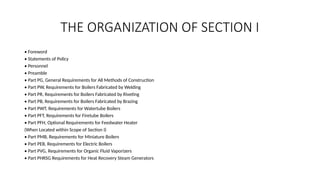
THE ORGANIZATION OF SECTION I
• Foreword
• Statements of Policy
• Personnel
• Preamble
• Part PG, General Requirements for All Methods of Construction
• Part PW, Requirements for Boilers Fabricated by Welding
• Part PR, Requirements for Boilers Fabricated by Riveting
• Part PB, Requirements for Boilers Fabricated by Brazing
• Part PWT, Requirements for Watertube Boilers
• Part PFT, Requirements for Firetube Boilers
• Part PFH, Optional Requirements for Feedwater Heater
(When Located within Scope of Section I)
• Part PMB, Requirements for Miniature Boilers
• Part PEB, Requirements for Electric Boilers
• Part PVG, Requirements for Organic Fluid Vaporizers
• Part PHRSG Requirements for Heat Recovery Steam Generators
• Appendix I, (Mandatory) Preparation of Technical Inquiries
to the Boiler and Pressure Vessel Committee
• Appendix II, (Mandatory) Standard Units for use in Equations
• Appendix III, (Mandatory) Criteria for Reapplication of a
Certification Mark
• Appendix IV, (Mandatory) Local Thin Areas in Cylindrical
Shells and in Spherical Segments of Heads
• Appendix A, (Nonmandatory) Explanation of Code Containing
Matter not Mandatory Unless Specifically Referred to in
the Rules of the Code
• Appendix B, (Nonmandatory) Positive Material Identification
Practice
• Endnotes
• Index
Part PG
• Part PG is the first major section of Section I and provides general
requirements for all methods of construction.
• It covers such important topics as scope and service limitations;
permitted materials; design; cold forming of austenitic materials;
requirements for piping, valves, fittings, feedwater supply, and safety
valves; permitted fabrication methods; inspection; hydrostatic testing;
and certification by stamping and data reports.
• The general requirements of Part PG must be used in conjunction
with specific requirements given in the remainder of the book for the
particular type of construction or type of boiler used
Part PW
• The second major section is called Part PW, Requirements for Boilers
Fabricated by Welding.
• Since almost all boilers are now welded, this is a broadly applicable
part containing much important information.
• It covers such topics as responsibility for welding; qualification of
welding procedures and welders; acceptable weld joint designs; types
of welding permitted; postweld heat treatment of welds; radiography,
inspection, and repair of welds; and testing of welded test plates
Part PR
With the gradual replacement of riveting by welding, Subcommittee I
decided that no purpose was served by continuing to maintain and
reprint in each edition the special rules applicable to riveted
construction, Part PR.
Accordingly, the 1974 and all subsequent editions of Section I mandate
the use of Part PR rules as last published in the 1971 edition.
Part PB
The next section, Part PB, Requirements for Boilers Fabricated by
Brazing, first appeared in the 1996 Addenda to the 1995 edition of
Section I.
Although brazing had long been used in the construction of certain low-
pressure boilers, no brazing rules had ever been provided in Section I.
Part PB brazing rules resemble Part PW welding rules, but are much
less extensive.
Part PWT
• Part PWT, Requirements for Watertube Boilers, is a very brief collection of
rules for this type of boiler, with some of the rules pertaining to
construction details rarely used today. All large high-pressure boilers are
watertube boilers.
• Most construction rules for these boilers are found in Parts PG and PW,
and Part PWT is merely a brief supplement. It is, however, the only place
where rules for the attachment of tubes to shells and headers of
watertube boilers can be found.
• Part PWT is an example of the retention by Section I of certain old rules
and construction details because some manufacturers might still use
them.
Part PFT
• Part PFT, Requirements for Firetube Boilers, is a much more extensive set
of rules, still very much in use for this popular type of boiler, which is
quite economical for generating low-pressure steam. Except in special
cases, the large-diameter shell places a practical limit on design pressure
at about 400 psi, although most firetube boilers have lower pressures.
• Part PFT covers many variations within the type in considerable detail.
• Requirements cover material, design, combustion chambers and
furnaces, stayed surfaces, doors and openings, domes, setting, piping,
and fittings. Part PFT is the only part of Section I where design for
external pressure (on the tubes and on the furnace) is considered.
Part PFH
Part PFH, Optional Requirements for Feedwater Heater, applies to
feedwater heaters that fall within the scope of Section I by virtue of
their location in the feedwater piping between the Code-required stop
valve and the boiler.
Under these circumstances, the heater may be constructed in
compliance with the rules in Section VIII, Pressure Vessels, Division 1,
for unfired steam boilers, which are more strict in a number of respects
than those applicable to ordinary Section VIII vessels.
Part PMB
• Part PMB, Requirements for Miniature Boilers, contains special rules for the
construction of small boilers that do not exceed certain limits (16 in. inside
diameter of shell, 20 sq ft of heating surface, 5 cu ft gross volume, 100 psi
MAWP). Because of this relatively small size and low pressure, many
requirements normally applicable to power boilers are waived. These have
to do with materials, material marking, minimum plate thickness, postweld
heat treatment and radiography of welds, and feedwater supply.
• To compensate somewhat for this relaxation of the normal rules, and to
provide an extra margin of safety, PMB-21 stipulates that miniature boilers
are to be given a hydrostatic test at a pressure equal to three times the
MAWP.
Part PEB
• This part, Requirements for Electric Boilers, was added to Section I in
1976. Until that time, manufacturers had been building these boilers
as Section VIII devices.
• However, Section VIII had no specific rules for electric boilers and the
various openings, valves, and fittings normally mandated by Section I
(blowoff, drain, water gage, pressure gage, check valve, etc.). Also, the
manufacturers were not formally assuming design responsibility for
the boiler. The rules of Part PEB remedied these shortcomings.
Part PVG
• This part provides rules for organic fluid vaporizers, which are boiler
like devices that use an organic fluid (such as Dowtherm TM) instead
of steam as the working fluid. The principal advantage of using these
organic fluids is that they have much lower vapor pressures than
water at a given temperature.
• Thus, they are particularly suitable for heating in industrial processes
requiring high temperatures at low pressure. On the other hand,
these liquids are both flammable and toxic, and Part PVG contains a
number of special provisions because of these drawbacks.
Part PHRSG
This part provides rules for a heat recovery steam generator, HRSG, that
has as it’s principal source of thermal energy a hot gas stream having
high ramp rates and temperatures such as the exhaust of a gas turbine.
Such an HRSG may utilize supplemental firing and may have one or
more superheaters, reheaters, evaporators, economizers, and/or
feedwater heaters, which are housed in a common gas path enclosure.
The sections cannot be individually isolated from the gas stream.
Mandatory Appendices
• Mandatory Appendix I – Submittal of Technical inquires to
the Boiler and Pressure Vessel Committee (Note: This material
has been moved to the Front matter)
• Mandatory Appendix II – Standard Units for use in Equations
• Mandatory Appendix III – Criteria for Reapplication of a
Certification mark
• Mandatory Appendix IV – Local Thin Areas in Cylindrical
Shells and in Spherical Segments of Heads
Nonmandatory Appendix A
Contains a great deal of miscellaneous information, some of it dating
from the first edition.
Much of this is nonmandatory explanatory material, unless it is
specifically referred to in the main body of Section I. In recent
years, the Boiler and Pressure Vessel Standards Committee I
(BPVI) has been doing some long overdue housekeeping and has
removed material in the Appendix considered obsolete or redundant.
The diversity of the remaining subjects can be seen from this
list of contents:
• Braced and Stayed Surfaces
• Method of Checking Pressure Relief Valve Capacity by
Measuring Maximum Amount of Fuel that can be Burned
• Automatic Water Gages
• Proof Tests to Establish Maximum Allowable Working
Pressure
• Suggested Rules Covering Existing Installations
• Pressure Relief Valves for Power Boilers
• Repairs to Existing Boilers
• Examples of Methods of Computation of Openings in Vessel
Shells
• Examples of Computation of Allowable Loading on
Structural Attachment to Tubes
• Preheating
• Heating and Cooling Rates for Postweld Heat Treatment
• Maximum Allowable Working Pressure – Thick Shells
• Rounded Indication Charts
• Methods for Magnetic Particle Examination (MT)
• Methods for Liquid Penetrant Examination (PT)
• Quality Control System ETC…………………………….
Nonmandatory Appendix B
Positive Material Identification Practice
• This appendix covers the case where a Manufacturer may determine
that a situation warrants positive material identification for a specific
material or item.
• The rules contained in this Appendix permits the Manufacturer to use
the specific material or item in the construction of his ASME Code
certified component.
SCOPE OF SECTION I: PRESSURE
LIMITS AND EXCLUSIONS
• Scope
Section I applies to several types of boilers and components of boilers,
such as economizers, superheaters, reheaters, and in some
circumstances feedwater heaters.
Although its title is Power Boilers, the scope of Section I is somewhat
broader. The Preamble to Section I explains that it covers power boilers,
electric boilers, miniature boilers, high-temperature water boilers, and
organic fluid vaporizers.
• Since the precise definitions of these various types of boilers are not
generally known, the following definitions, found in footnotes to the
Preamble, are helpful:
Power boiler— a boiler in which steam or other vapor is generated at
a pressure of more than 15 psi (100 kPa) for use external to itself.
Electric boiler— a power boiler or a high-temperature water boiler in
which the source of heat is electricity.
Miniature boiler— a power boiler or high-temperature water boiler in
which the limits in PMB-2 are not exceeded.
High-temperature water boiler— a water boiler intended for
operation at pressures in excess of 160 psi (1.1 MPa) and/or
temperatures in excess of 250°F (120°C).
Heat recovery steam generator (HRSG) – a boiler that has as its
principal source of thermal energy a hot gas stream having high ramp
rates and temperatures such as the exhaust of a gas turbine.
Fired pressure vessel – reheaters, isolable superheaters, and
nonintegral separately fired superheaters.
• Scope of Section I covers the complete boiler unit, which is defined as
comprising the boiler proper and the boiler external piping.
• The boiler proper consists of all the pressure parts comprising the
boiler, such as the drum, the economizer, the superheater, the
reheater, waterwalls, steam-generating tubes known as the boiler
bank, various headers, downcomers, risers, and transfer piping
connecting these components.
• Any such piping connecting parts of the boiler proper is called boiler
proper piping.
The boiler external piping is defined by its extent:
• it is the piping that begins at the first joint where the boiler proper
terminates and extends to and includes the valve or valves required
by Section I.
FUNDAMENTALS OF SECTION I
CONSTRUCTION
• The technique used by Section I to achieve safe boiler design is a relatively simple one. It
requires all those features considered necessary for safety (e.g., water glass, safety valve,
pressure gage, check valve, and drain) and then provides detailed rules governing the
construction of the various components comprising the boiler.
• This approach is analogous to the old saying that a chain is no stronger than its weakest
link. For a boiler, the links of the figurative chain are the materials, design (formulas,
loads, allowable stress, and construction details), fabrication techniques, welding,
inspection, testing, and certification by stamping and data reports.
• If each of these elements meets the appropriate Section I rules, a safe boiler results.
• An important element of this construction process is a quality control program intended
to ensure that the Code has been followed.
Using Section II
Section II of the Code, Materials, is a compilation of all the material
specifications adopted by the ASME for use by the various book
sections of the Code. However, as a general rule, a material cannot be
used for pressure parts unless it is also adopted and listed within the
section of the Code covering the construction. Section I lists permitted
materials in PG-5 through PG-14. PW-5 adds further requirements for
materials used in welded construction.
In addition, Section I sets temperature limits for the use of the various
materials; they must be used within the temperature range for which
allowable stress values (often called design stresses) are provided.
DESIGN
• The principal design rules are found in Part PG, paragraphs PG-16 through PG-55.
• There are formulas for the design of cylindrical components under internal
pressure (tube, pipe, headers, and drums), heads (dished, flat, stayed, and
unstayed), stayed surfaces, and ligaments between holes. Rules are also
provided for openings or penetrations in any of these components, based on a
system of compensation in which the material removed for the opening is
replaced as reinforcing in the region immediately around the opening, called the
limits of compensation (see PG- 36).
• All of these formulas involve internal pressure except for the rules for support
and attachment lugs of PG-55, for which the designer chooses the design loads
on the basis of the anticipated weight or other loads to be carried.
Welding and Postweld Heat Treatment
Among the many aspects of welding covered by Part PW are the
following:
responsibilities of the manufacturer or other organization doing the
welding; the materials that may be welded; the design of welded joints;
radiographic and ultrasonic examination of welds and when such
examination is required; the welding of nozzles; attachment welds;
welding processes permitted; qualification of welding; preparation,
alignment, and assembly of parts to be joined; the use of backing
strips; advice on preheating; requirements for postweld heat
treatment; repair of weld defects; etc…………
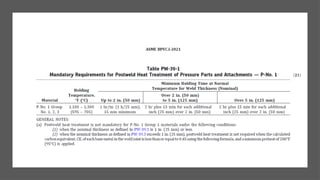
• In PWHT the components to be treated are placed in a heat treatment
furnace and slowly heated to the temperature specified in Table PW-39.
They are held at that temperature for the time specified, usually 1
hr/in. (1 hr/25 mm) of thickness plus an additional 15 min/in. (15
min/25 mm) over a certain thickness.
• This rule is intended to ensure that the centermost portions of thick
sections have sufficient time to reach the minimum holding
temperature. The nominal thickness in Table PW-39 used to determine
PWHT requirements is the thickness of the weld, the pressure-retaining
material, or the thinner of the sections being joined, whichever is the
least.
Nondestructive Examination
The examinations referenced by Section I in the NDE category
are the following:
• radiographic examination,
• ultrasonic examination (which is mandated as an alternative or
supplement to radiographic examination),
• magnetic-particle examination, and
• liquid-penetrant examination (also called dyepenetrant examination).
Hydrostatic Testing
• The hydrostatic test is one of the last steps in the construction of the boiler.
Hydrostatic test requirements are given in PG-99 and PW-54.
• These tests may be made either in the manufacturer’s shop or in the field
using water. Unlike Section VIII, Section I does not permit the use of other
fluids or pneumatic testing.
• The hydrostatic test pressure is normally 1.5 times MAWP.
• In this sense, the hydrostatic test is seen to demonstrate the validity of the
design as a pressure container. Another important aspect of the hydrostatic
test is that it serves as a leak test.
• Any leaks revealed by the test must be repaired, and the boiler must be
retested (see PW-54).
Third-Party Inspection
• a boiler manufacturer and the boiler purchaser are the first two
parties, and an Authorized Inspector (AI) is the independent third
party.
• It is the function of the AI to ensure and verify that the manufacturer
complies with the Code.

Introduction to ASME Section I Awareness

  • 1.
    Introduction to ASME I By:Mohamad Hiswandy Ishak
  • 2.
    Contents • Introduction • Historyand Philosophy of Section • The Organization of Section • Scope of Section I: Pressure Limits and Exclusions • Distinction Between Boiler Proper Piping and Boiler External Piping
  • 3.
    Introduction Power Boilers, SectionI of the ASME Boiler and Pressure Vessel Code, provides rules for the construction of power boilers, but since it is neither a textbook nor a design handbook, its rules are accompanied by very little explanations.
  • 4.
    History and Philosophyof Section 1 • According to the dictionary, the term code has several meanings: a system of principles or rules; a body of laws arranged systematically for easy reference; a systematic statement of a body of law, especially one given statutory force. • Section I is primarily a system of rules.
  • 5.
    • When theASME decided in 1911 that the country needed a boiler code, it assigned a committee and gave it a mandate to formulate standard rules for the construction of steam boilers and other pressure vessels. • The first edition of what is now known as Section I was finally approved by the ASME in 1915 and incorporated what was considered at the time to be the best practice in boiler construction. • However, the guiding principle, then as now, was that these are safety rules.
  • 6.
    • Section Icovers the design, fabrication, and inspection of boilers during construction, that is, it covers new construction only. • Other rules cover repair and alteration of boilers and pressure vessels in service, for example, the National Board Inspection Code also, and the API Pressure Vessel Inspection Code, API 510
  • 7.
    THE ORGANIZATION OFSECTION I • Foreword • Statements of Policy • Personnel • Preamble • Part PG, General Requirements for All Methods of Construction • Part PW, Requirements for Boilers Fabricated by Welding • Part PR, Requirements for Boilers Fabricated by Riveting • Part PB, Requirements for Boilers Fabricated by Brazing • Part PWT, Requirements for Watertube Boilers • Part PFT, Requirements for Firetube Boilers • Part PFH, Optional Requirements for Feedwater Heater (When Located within Scope of Section I) • Part PMB, Requirements for Miniature Boilers • Part PEB, Requirements for Electric Boilers • Part PVG, Requirements for Organic Fluid Vaporizers • Part PHRSG Requirements for Heat Recovery Steam Generators
  • 8.
    • Appendix I,(Mandatory) Preparation of Technical Inquiries to the Boiler and Pressure Vessel Committee • Appendix II, (Mandatory) Standard Units for use in Equations • Appendix III, (Mandatory) Criteria for Reapplication of a Certification Mark • Appendix IV, (Mandatory) Local Thin Areas in Cylindrical Shells and in Spherical Segments of Heads • Appendix A, (Nonmandatory) Explanation of Code Containing Matter not Mandatory Unless Specifically Referred to in the Rules of the Code • Appendix B, (Nonmandatory) Positive Material Identification Practice • Endnotes • Index
  • 9.
    Part PG • PartPG is the first major section of Section I and provides general requirements for all methods of construction. • It covers such important topics as scope and service limitations; permitted materials; design; cold forming of austenitic materials; requirements for piping, valves, fittings, feedwater supply, and safety valves; permitted fabrication methods; inspection; hydrostatic testing; and certification by stamping and data reports. • The general requirements of Part PG must be used in conjunction with specific requirements given in the remainder of the book for the particular type of construction or type of boiler used
  • 10.
    Part PW • Thesecond major section is called Part PW, Requirements for Boilers Fabricated by Welding. • Since almost all boilers are now welded, this is a broadly applicable part containing much important information. • It covers such topics as responsibility for welding; qualification of welding procedures and welders; acceptable weld joint designs; types of welding permitted; postweld heat treatment of welds; radiography, inspection, and repair of welds; and testing of welded test plates
  • 11.
    Part PR With thegradual replacement of riveting by welding, Subcommittee I decided that no purpose was served by continuing to maintain and reprint in each edition the special rules applicable to riveted construction, Part PR. Accordingly, the 1974 and all subsequent editions of Section I mandate the use of Part PR rules as last published in the 1971 edition.
  • 12.
    Part PB The nextsection, Part PB, Requirements for Boilers Fabricated by Brazing, first appeared in the 1996 Addenda to the 1995 edition of Section I. Although brazing had long been used in the construction of certain low- pressure boilers, no brazing rules had ever been provided in Section I. Part PB brazing rules resemble Part PW welding rules, but are much less extensive.
  • 13.
    Part PWT • PartPWT, Requirements for Watertube Boilers, is a very brief collection of rules for this type of boiler, with some of the rules pertaining to construction details rarely used today. All large high-pressure boilers are watertube boilers. • Most construction rules for these boilers are found in Parts PG and PW, and Part PWT is merely a brief supplement. It is, however, the only place where rules for the attachment of tubes to shells and headers of watertube boilers can be found. • Part PWT is an example of the retention by Section I of certain old rules and construction details because some manufacturers might still use them.
  • 14.
    Part PFT • PartPFT, Requirements for Firetube Boilers, is a much more extensive set of rules, still very much in use for this popular type of boiler, which is quite economical for generating low-pressure steam. Except in special cases, the large-diameter shell places a practical limit on design pressure at about 400 psi, although most firetube boilers have lower pressures. • Part PFT covers many variations within the type in considerable detail. • Requirements cover material, design, combustion chambers and furnaces, stayed surfaces, doors and openings, domes, setting, piping, and fittings. Part PFT is the only part of Section I where design for external pressure (on the tubes and on the furnace) is considered.
  • 15.
    Part PFH Part PFH,Optional Requirements for Feedwater Heater, applies to feedwater heaters that fall within the scope of Section I by virtue of their location in the feedwater piping between the Code-required stop valve and the boiler. Under these circumstances, the heater may be constructed in compliance with the rules in Section VIII, Pressure Vessels, Division 1, for unfired steam boilers, which are more strict in a number of respects than those applicable to ordinary Section VIII vessels.
  • 16.
    Part PMB • PartPMB, Requirements for Miniature Boilers, contains special rules for the construction of small boilers that do not exceed certain limits (16 in. inside diameter of shell, 20 sq ft of heating surface, 5 cu ft gross volume, 100 psi MAWP). Because of this relatively small size and low pressure, many requirements normally applicable to power boilers are waived. These have to do with materials, material marking, minimum plate thickness, postweld heat treatment and radiography of welds, and feedwater supply. • To compensate somewhat for this relaxation of the normal rules, and to provide an extra margin of safety, PMB-21 stipulates that miniature boilers are to be given a hydrostatic test at a pressure equal to three times the MAWP.
  • 17.
    Part PEB • Thispart, Requirements for Electric Boilers, was added to Section I in 1976. Until that time, manufacturers had been building these boilers as Section VIII devices. • However, Section VIII had no specific rules for electric boilers and the various openings, valves, and fittings normally mandated by Section I (blowoff, drain, water gage, pressure gage, check valve, etc.). Also, the manufacturers were not formally assuming design responsibility for the boiler. The rules of Part PEB remedied these shortcomings.
  • 18.
    Part PVG • Thispart provides rules for organic fluid vaporizers, which are boiler like devices that use an organic fluid (such as Dowtherm TM) instead of steam as the working fluid. The principal advantage of using these organic fluids is that they have much lower vapor pressures than water at a given temperature. • Thus, they are particularly suitable for heating in industrial processes requiring high temperatures at low pressure. On the other hand, these liquids are both flammable and toxic, and Part PVG contains a number of special provisions because of these drawbacks.
  • 19.
    Part PHRSG This partprovides rules for a heat recovery steam generator, HRSG, that has as it’s principal source of thermal energy a hot gas stream having high ramp rates and temperatures such as the exhaust of a gas turbine. Such an HRSG may utilize supplemental firing and may have one or more superheaters, reheaters, evaporators, economizers, and/or feedwater heaters, which are housed in a common gas path enclosure. The sections cannot be individually isolated from the gas stream.
  • 20.
    Mandatory Appendices • MandatoryAppendix I – Submittal of Technical inquires to the Boiler and Pressure Vessel Committee (Note: This material has been moved to the Front matter) • Mandatory Appendix II – Standard Units for use in Equations • Mandatory Appendix III – Criteria for Reapplication of a Certification mark • Mandatory Appendix IV – Local Thin Areas in Cylindrical Shells and in Spherical Segments of Heads
  • 21.
    Nonmandatory Appendix A Containsa great deal of miscellaneous information, some of it dating from the first edition. Much of this is nonmandatory explanatory material, unless it is specifically referred to in the main body of Section I. In recent years, the Boiler and Pressure Vessel Standards Committee I (BPVI) has been doing some long overdue housekeeping and has removed material in the Appendix considered obsolete or redundant. The diversity of the remaining subjects can be seen from this list of contents:
  • 22.
    • Braced andStayed Surfaces • Method of Checking Pressure Relief Valve Capacity by Measuring Maximum Amount of Fuel that can be Burned • Automatic Water Gages • Proof Tests to Establish Maximum Allowable Working Pressure • Suggested Rules Covering Existing Installations • Pressure Relief Valves for Power Boilers • Repairs to Existing Boilers • Examples of Methods of Computation of Openings in Vessel Shells • Examples of Computation of Allowable Loading on Structural Attachment to Tubes • Preheating • Heating and Cooling Rates for Postweld Heat Treatment • Maximum Allowable Working Pressure – Thick Shells • Rounded Indication Charts • Methods for Magnetic Particle Examination (MT) • Methods for Liquid Penetrant Examination (PT) • Quality Control System ETC…………………………….
  • 23.
    Nonmandatory Appendix B PositiveMaterial Identification Practice • This appendix covers the case where a Manufacturer may determine that a situation warrants positive material identification for a specific material or item. • The rules contained in this Appendix permits the Manufacturer to use the specific material or item in the construction of his ASME Code certified component.
  • 24.
    SCOPE OF SECTIONI: PRESSURE LIMITS AND EXCLUSIONS • Scope Section I applies to several types of boilers and components of boilers, such as economizers, superheaters, reheaters, and in some circumstances feedwater heaters. Although its title is Power Boilers, the scope of Section I is somewhat broader. The Preamble to Section I explains that it covers power boilers, electric boilers, miniature boilers, high-temperature water boilers, and organic fluid vaporizers.
  • 25.
    • Since theprecise definitions of these various types of boilers are not generally known, the following definitions, found in footnotes to the Preamble, are helpful: Power boiler— a boiler in which steam or other vapor is generated at a pressure of more than 15 psi (100 kPa) for use external to itself. Electric boiler— a power boiler or a high-temperature water boiler in which the source of heat is electricity. Miniature boiler— a power boiler or high-temperature water boiler in which the limits in PMB-2 are not exceeded.
  • 26.
    High-temperature water boiler—a water boiler intended for operation at pressures in excess of 160 psi (1.1 MPa) and/or temperatures in excess of 250°F (120°C). Heat recovery steam generator (HRSG) – a boiler that has as its principal source of thermal energy a hot gas stream having high ramp rates and temperatures such as the exhaust of a gas turbine. Fired pressure vessel – reheaters, isolable superheaters, and nonintegral separately fired superheaters.
  • 27.
    • Scope ofSection I covers the complete boiler unit, which is defined as comprising the boiler proper and the boiler external piping. • The boiler proper consists of all the pressure parts comprising the boiler, such as the drum, the economizer, the superheater, the reheater, waterwalls, steam-generating tubes known as the boiler bank, various headers, downcomers, risers, and transfer piping connecting these components. • Any such piping connecting parts of the boiler proper is called boiler proper piping.
  • 28.
    The boiler externalpiping is defined by its extent: • it is the piping that begins at the first joint where the boiler proper terminates and extends to and includes the valve or valves required by Section I.
  • 29.
    FUNDAMENTALS OF SECTIONI CONSTRUCTION • The technique used by Section I to achieve safe boiler design is a relatively simple one. It requires all those features considered necessary for safety (e.g., water glass, safety valve, pressure gage, check valve, and drain) and then provides detailed rules governing the construction of the various components comprising the boiler. • This approach is analogous to the old saying that a chain is no stronger than its weakest link. For a boiler, the links of the figurative chain are the materials, design (formulas, loads, allowable stress, and construction details), fabrication techniques, welding, inspection, testing, and certification by stamping and data reports. • If each of these elements meets the appropriate Section I rules, a safe boiler results. • An important element of this construction process is a quality control program intended to ensure that the Code has been followed.
  • 30.
    Using Section II SectionII of the Code, Materials, is a compilation of all the material specifications adopted by the ASME for use by the various book sections of the Code. However, as a general rule, a material cannot be used for pressure parts unless it is also adopted and listed within the section of the Code covering the construction. Section I lists permitted materials in PG-5 through PG-14. PW-5 adds further requirements for materials used in welded construction. In addition, Section I sets temperature limits for the use of the various materials; they must be used within the temperature range for which allowable stress values (often called design stresses) are provided.
  • 31.
    DESIGN • The principaldesign rules are found in Part PG, paragraphs PG-16 through PG-55. • There are formulas for the design of cylindrical components under internal pressure (tube, pipe, headers, and drums), heads (dished, flat, stayed, and unstayed), stayed surfaces, and ligaments between holes. Rules are also provided for openings or penetrations in any of these components, based on a system of compensation in which the material removed for the opening is replaced as reinforcing in the region immediately around the opening, called the limits of compensation (see PG- 36). • All of these formulas involve internal pressure except for the rules for support and attachment lugs of PG-55, for which the designer chooses the design loads on the basis of the anticipated weight or other loads to be carried.
  • 32.
    Welding and PostweldHeat Treatment Among the many aspects of welding covered by Part PW are the following: responsibilities of the manufacturer or other organization doing the welding; the materials that may be welded; the design of welded joints; radiographic and ultrasonic examination of welds and when such examination is required; the welding of nozzles; attachment welds; welding processes permitted; qualification of welding; preparation, alignment, and assembly of parts to be joined; the use of backing strips; advice on preheating; requirements for postweld heat treatment; repair of weld defects; etc…………
  • 33.
    • In PWHTthe components to be treated are placed in a heat treatment furnace and slowly heated to the temperature specified in Table PW-39. They are held at that temperature for the time specified, usually 1 hr/in. (1 hr/25 mm) of thickness plus an additional 15 min/in. (15 min/25 mm) over a certain thickness. • This rule is intended to ensure that the centermost portions of thick sections have sufficient time to reach the minimum holding temperature. The nominal thickness in Table PW-39 used to determine PWHT requirements is the thickness of the weld, the pressure-retaining material, or the thinner of the sections being joined, whichever is the least.
  • 35.
    Nondestructive Examination The examinationsreferenced by Section I in the NDE category are the following: • radiographic examination, • ultrasonic examination (which is mandated as an alternative or supplement to radiographic examination), • magnetic-particle examination, and • liquid-penetrant examination (also called dyepenetrant examination).
  • 36.
    Hydrostatic Testing • Thehydrostatic test is one of the last steps in the construction of the boiler. Hydrostatic test requirements are given in PG-99 and PW-54. • These tests may be made either in the manufacturer’s shop or in the field using water. Unlike Section VIII, Section I does not permit the use of other fluids or pneumatic testing. • The hydrostatic test pressure is normally 1.5 times MAWP. • In this sense, the hydrostatic test is seen to demonstrate the validity of the design as a pressure container. Another important aspect of the hydrostatic test is that it serves as a leak test. • Any leaks revealed by the test must be repaired, and the boiler must be retested (see PW-54).
  • 37.
    Third-Party Inspection • aboiler manufacturer and the boiler purchaser are the first two parties, and an Authorized Inspector (AI) is the independent third party. • It is the function of the AI to ensure and verify that the manufacturer complies with the Code.