!"#$%&'()*+,*-%
./01,23024/35%67/%&680,3*2%
9,+37%:307-*,2,7*
!"#$%&'(")*+$,"&+-"'.+#
!/012323
仁田智也 (名工大玉木研)
概要
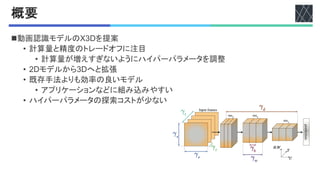
n動画認識モデルの456を提案
• 計算量と精度のトレードオフに注目
• 計算量が増えすぎないようにハイパーパラメータを調整
• 26モデルから56へと拡張
• 既存手法よりも効率の良いモデル
• アプリケーションなどに組み込みやすい
• ハイパーパラメータの探索コストが少ない
効率的なモデル
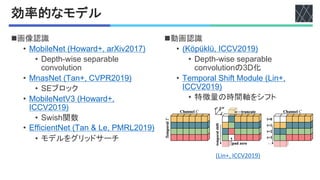
n画像認識
• 7'8$9+:+&);<'=>#?@A)>#4$B23CDE
• 6+(&"F=$%+)%+(>#>89+)
,'-B'9G&$'-
• 7->%:+&);H>-@A)!/0123CIE
• JKブロック
• 7'8$9+:+&/5);<'=>#?@A)
L!!/23CIE
• J=$%"関数
• K..$,$+-&:+&);H>-)M)N+A)071N23CIE
• モデルをグリッドサーチ
n動画認識
• ;OP(QR9QA)L!!/23CIE
• 6+(&"F=$%+)%+(>#>89+)
,'-B'9G&$'-の56化
• H+S('#>9)J"$.&)7'?G9+);N$-@A)
L!!/23CIE
• 特徴量の時間軸をシフト
(Lin+, ICCV2019)
!"#
n426
• ベースとなる26モデル
• 軸の探索をするモデル
• Tつの軸を全てCに設定
n426からTつの軸を探索
• フレームレート:𝛾!
• フレーム数:𝛾"
• 解像度:𝛾#
• チャネル幅:𝛾$
• ボトルネック幅:𝛾%
• 深さ:𝛾&
In relation to most of these works, our approach does
not assume a fixed inherited design from 2D networks, but
expands a tiny architecture across several axes in space, time,
channels and depth to achieve a good efficiency trade-off.
3. X3D Networks
Image classification architectures have gone through an
evolution of architecture design with progressively expand-
ng existing models along network depth [7,23,37,51,58,81],
nput resolution [27,57,60] or channel width [75,80]. Simi-
ar progress can be observed for the mobile image classifi-
cation domain where contracting modifications (shallower
networks, lower resolution, thinner layers, separable convo-
ution [24,25,29,48,82]) allowed operating at lower compu-
ational budget. Given this history in image ConvNet design,
a similar progress has not been observed for video architec-
ures as these were customarily based on direct temporal
extensions of image models. However, is single expansion
of a fixed 2D architecture to 3D ideal, or is it better to expand
stage filters output sizes T×S2
data layer stride γτ , 12
1γt×(112γs)2
conv1 1×32, 3×1, 24γw 1γt×(56γs)2
res2


1×12, 24γbγw
3×32, 24γbγw
1×12, 24γw

×γd 1γt×(28γs)2
res3


1×12, 48γbγw
3×32, 48γbγw
1×12, 48γw

×2γd 1γt×(14γs)2
res4


1×12, 96γbγw
3×32, 96γbγw
1×12, 96γw

×5γd 1γt×(7γs)2
res5


1×12, 192γbγw
3×32, 192γbγw
1×12, 192γw

×3γd 1γt×(4γs)2
conv5 1×12, 192γbγw 1γt×(4γs)2
pool5 1γt×(4γs)2 1×1×1
fc1 1×12, 2048 1×1×1
fc2 1×12, #classes 1×1×1
𝛾!が1なので!"
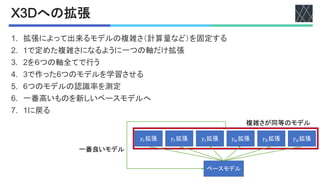
!$#への拡張
CU 拡張によって出来るモデルの複雑さ(計算量など)を固定する
2U Cで定めた複雑さになるように一つの軸だけ拡張
5U 2を6つの軸全てで行う
VU 5で作ったTつのモデルを学習させる
WU Tつのモデルの認識率を測定
TU 一番高いものを新しいベースモデルへ
DU Cに戻る
ベースモデル
𝛾!拡張 𝛾"拡張
𝛾#拡張 𝛾$拡張 𝛾%拡張 𝛾&拡張
一番良いモデル
複雑さが同等のモデル
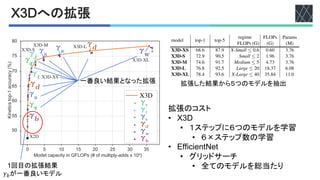
!$#への拡張
τ
s
d
b
t
w
X3D
d
d
t
t
b
τ
τ
X3D-L
X3D-M
X3D-S
X3D-XS
s
s
s
X2D
w
X3D-XL
Model capacity in GFLOPs (# of multiply-adds x 109
)
0 5 15 25 35
10 20 30
80
75
70
65
60
55
50
Kinetics
top-1
accuracy
(%)
Figure 2. Progressive network expansion of X3D. The X2D base
model is expanded 1st
across bottleneck width (γb), 2nd
tempo-
ral resolution (γτ ), 3rd
spatial resolution (γs), 4th
depth (γd), 5th
model top-1 top-5
regime FLOPs Params
FLOPs (G) (G) (M)
X3D-XS 68.6 87.9 X-Small ≤ 0.6 0.60 3.76
X3D-S 72.9 90.5 Small ≤ 2 1.96 3.76
X3D-M 74.6 91.7 Medium ≤ 5 4.73 3.76
X3D-L 76.8 92.5 Large ≤ 20 18.37 6.08
X3D-XL 78.4 93.6 X-Large ≤ 40 35.84 11.0
Table 2. Expanded instances on K400-val. 10-Center clip testing is
used. We show top-1 and top-5 classification accuracy (%), as well
as computational complexity measured in GFLOPs (floating-point
operations, in # of multiply-adds ×109
) for a single clip input.
Inference-time computational cost is proportional to 10× of this,
as a fixed number of 10 of clips is used per video.
4.1. Expanded networks
The accuracy/complexity trade-off curve for the expan-
sion process on K400 is shown in Fig. 2. Expansion starts
from X2D that produces 47.75% top-1 accuracy (vertical
axis) with 1.63M parameters 20.67M FLOPs per clip (hori-
zontal axis), which is roughly doubled in each progressive
step. We use 10-Center clip testing as our default test setting
for expansion, so the overall cost per video is ×10. We
τ
s
d
b
t
w
X3D
d
d
t
t
b
τ
τ
X3D-L
X3D-M
X3D-S
X3D-XS
s
s
s
X2D
w
X3D-XL
Model capacity in GFLOPs (# of multiply-adds x 109
)
0 5 15 25 35
10 20 30
80
75
70
65
60
55
50
Kinetics
top-1
accuracy
(%)
Figure 2. Progressive network expansion of X3D. The X2D base
model is expanded 1st
across bottleneck width (γb), 2nd
tempo-
model top-1 top-5
regime FLOPs Params
FLOPs (G) (G) (M)
X3D-XS 68.6 87.9 X-Small ≤ 0.6 0.60 3.76
X3D-S 72.9 90.5 Small ≤ 2 1.96 3.76
X3D-M 74.6 91.7 Medium ≤ 5 4.73 3.76
X3D-L 76.8 92.5 Large ≤ 20 18.37 6.08
X3D-XL 78.4 93.6 X-Large ≤ 40 35.84 11.0
Table 2. Expanded instances on K400-val. 10-Center clip testing is
used. We show top-1 and top-5 classification accuracy (%), as well
as computational complexity measured in GFLOPs (floating-point
operations, in # of multiply-adds ×109
) for a single clip input.
Inference-time computational cost is proportional to 10× of this,
as a fixed number of 10 of clips is used per video.
4.1. Expanded networks
The accuracy/complexity trade-off curve for the expan-
sion process on K400 is shown in Fig. 2. Expansion starts
from X2D that produces 47.75% top-1 accuracy (vertical
axis) with 1.63M parameters 20.67M FLOPs per clip (hori-
zontal axis), which is roughly doubled in each progressive
step. We use 10-Center clip testing as our default test setting
!回目の拡張結果
𝛾!が一番良いモデル
一番良い結果となった拡張 拡張した結果から5つのモデルを抽出
拡張のコスト
• 456
• 1ステップに6つのモデルを学習
• 6×ステップ数の学習
• K..$,$+-&:+&
• グリッドサーチ
• 全てのモデルを総当たり
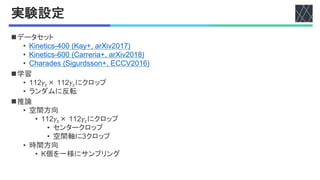
実験設定
nデータセット
• !"#$%"&'()**+,!-./0+-12"34*567
• !"#$%"&'(8**+,9-11$1"-/0+-12"34*5:7
• 9;-1-<$'+,=">?1<''@#/0+A99B4*587
n学習
• 554𝛾!× 554𝛾!にクロップ
• ランダムに反転
n推論
• 空間方向
• 554𝛾!× 554𝛾!にクロップ
• センタークロップ
• 空間軸にCクロップ
• 時間方向
• !個を一様にサンプリング
!$#性能比較
model pre top-1 top-5 test GFLOPs×views Param
I3D [6]
ImageNet
71.1 90.3 80.2 108 × N/A 12M
Two-Stream I3D [6] 75.7 92.0 82.8 216 × N/A 25M
Two-Stream S3D-G [76] 77.2 93.0 143 × N/A 23.1M
MF-Net [9] 72.8 90.4 11.1 × 50 8.0M
TSM R50 [41] 74.7 N/A 65 × 10 24.3M
Nonlocal R50 [68] 76.5 92.6 282 × 30 35.3M
Nonlocal R101 [68] 77.7 93.3 83.8 359 × 30 54.3M
Two-Stream I3D [6] - 71.6 90.0 216 × NA 25.0M
R(2+1)D [64] - 72.0 90.0 152 × 115 63.6M
Two-Stream R(2+1)D [64] - 73.9 90.9 304 × 115 127.2M
Oct-I3D + NL [8] - 75.7 N/A 28.9 × 30 33.6M
ip-CSN-152 [63] - 77.8 92.8 109 × 30 32.8M
SlowFast 4×16, R50 [14] - 75.6 92.1 36.1 × 30 34.4M
SlowFast 8×8, R101 [14] - 77.9 93.2 84.2 106 × 30 53.7M
SlowFast 8×8, R101+NL [14] - 78.7 93.5 84.9 116 × 30 59.9M
SlowFast 16×8, R101+NL [14] - 79.8 93.9 85.7 234 × 30 59.9M
X3D-M - 76.0 92.3 82.9 6.2 × 30 3.8M
X3D-L - 77.5 92.9 83.8 24.8 × 30 6.1M
X3D-XL - 79.1 93.9 85.3 48.4 × 30 11.0M
Table 4. Comparison to the state-of-the-art on K400-val & test.
We report the inference cost with a single “view" (temporal clip with
spatial crop) × the numbers of such views used (GFLOPs×views).
“N/A” indicates the numbers are not available for us. The “test”
model pretrain mAP GFLOPs×views Param
Nonlocal [68] ImageNet+Kinetics400 37.5 544 × 30 54.3M
STRG, +NL [69] ImageNet+Kinetics400 39.7 630 × 30 58.3M
Timeception [28] Kinetics-400 41.1 N/A×N/A N/A
LFB, +NL [71] Kinetics-400 42.5 529 × 30 122M
SlowFast, +NL [14] Kinetics-400 42.5 234 × 30 59.9M
SlowFast, +NL [14] Kinetics-600 45.2 234 × 30 59.9M
X3D-XL Kinetics-400 43.4 48.4 × 30 11.0M
X3D-XL Kinetics-600 47.1 48.4 × 30 11.0M
Table 6. Comparison with the state-of-the-art on Charades.
SlowFast variants are based on T×τ = 16×8.
model data top-1 top-5 FLOPs (G) Params (M)
EfficientNet3D-B0
K400
66.7 86.6 0.74 3.30
X3D-XS
val
68.6 (+1.9) 87.9 (+1.3) 0.60 (−1.4) 3.76 (+0.5)
EfficientNet3D-B3 72.4 89.6 6.91 8.19
X3D-M 74.6 (+2.2) 91.7 (+2.1) 4.73 (−2.2) 3.76 (−4.4)
EfficientNet3D-B4 74.5 90.6 23.80 12.16
X3D-L 76.8 (+2.3) 92.5 (+1.9) 18.37 (−5.4) 6.08 (−6.1)
EfficientNet3D-B0
K400
64.8 85.4 0.74 3.30
X3D-XS
test
66.6 (+1.8) 86.8 (+1.4) 0.60 (−1.4) 3.76 (+0.5)
EfficientNet3D-B3 69.9 88.1 6.91 8.19
X3D-M 73.0 (+2.1) 90.8 (+2.7) 4.73 (−2.2) 3.76 (−4.4)
EfficientNet3D-B4 71.8 88.9 23.80 12.16
X3D-XL - 79.1 93.9 85.3 48.4 × 30 11.0M
Table 4. Comparison to the state-of-the-art on K400-val & test.
We report the inference cost with a single “view" (temporal clip with
spatial crop) × the numbers of such views used (GFLOPs×views).
“N/A” indicates the numbers are not available for us. The “test”
column shows average of top1 and top5 on the Kinetics-400 testset.
model pretrain top-1 top-5 GFLOPs×views Param
I3D [3] - 71.9 90.1 108 × N/A 12M
Oct-I3D + NL [8] ImageNet 76.0 N/A 25.6 × 30 12M
SlowFast 4×16, R50 [14] - 78.8 94.0 36.1 × 30 34.4M
SlowFast 16×8, R101+NL [14] - 81.8 95.1 234 × 30 59.9M
X3D-M - 78.8 94.5 6.2 × 30 3.8M
X3D-XL - 81.9 95.5 48.4 × 30 11.0M
Table 5. Comparison with the state-of-the-art on Kinetics-600.
Results are consistent with K400 in Table 4 above.
Kinetics-600 is a larger version of Kinetics that shall
demonstrate further generalization of our approach. Re-
sults are shown in Table 5. Our variants demonstrate similar
performance as above, with the best model now providing
slightly better performance than the previous state-of-the-
art SlowFast 16×8, R101+NL [14], again for 4.8× fewer
FLOPs (i.e. multiply-add operations) and 5.5× fewer param-
eter. In the lower computation regime, X3D-M is compara-
ble to SlowFast 4×16, R50 but requires 5.8× fewer FLOPs
and 9.1× fewer parameters.
Charades [49] is a dataset with longer range activities. Ta-
model pre top-1 top-5 test GFLOPs×views Param
I3D [6]
ImageNet
71.1 90.3 80.2 108 × N/A 12M
Two-Stream I3D [6] 75.7 92.0 82.8 216 × N/A 25M
Two-Stream S3D-G [76] 77.2 93.0 143 × N/A 23.1M
MF-Net [9] 72.8 90.4 11.1 × 50 8.0M
TSM R50 [41] 74.7 N/A 65 × 10 24.3M
Nonlocal R50 [68] 76.5 92.6 282 × 30 35.3M
Nonlocal R101 [68] 77.7 93.3 83.8 359 × 30 54.3M
Two-Stream I3D [6] - 71.6 90.0 216 × NA 25.0M
R(2+1)D [64] - 72.0 90.0 152 × 115 63.6M
Two-Stream R(2+1)D [64] - 73.9 90.9 304 × 115 127.2M
Oct-I3D + NL [8] - 75.7 N/A 28.9 × 30 33.6M
ip-CSN-152 [63] - 77.8 92.8 109 × 30 32.8M
SlowFast 4×16, R50 [14] - 75.6 92.1 36.1 × 30 34.4M
SlowFast 8×8, R101 [14] - 77.9 93.2 84.2 106 × 30 53.7M
SlowFast 8×8, R101+NL [14] - 78.7 93.5 84.9 116 × 30 59.9M
model pretrain mAP GFLOPs×views Param
Nonlocal [68] ImageNet+Kinetics400 37.5 544 × 30 54.3M
STRG, +NL [69] ImageNet+Kinetics400 39.7 630 × 30 58.3M
Timeception [28] Kinetics-400 41.1 N/A×N/A N/A
LFB, +NL [71] Kinetics-400 42.5 529 × 30 122M
SlowFast, +NL [14] Kinetics-400 42.5 234 × 30 59.9M
SlowFast, +NL [14] Kinetics-600 45.2 234 × 30 59.9M
X3D-XL Kinetics-400 43.4 48.4 × 30 11.0M
X3D-XL Kinetics-600 47.1 48.4 × 30 11.0M
Table 6. Comparison with the state-of-the-art on Charades.
SlowFast variants are based on T×τ = 16×8.
model data top-1 top-5 FLOPs (G) Params (M)
EfficientNet3D-B0 66.7 86.6 0.74 3.30
"#$%&#'()*++
"#$%&#'(),++
-./0/1%(
事前
学習
既存
手法
同等の性能よりも
計算量削減
!$#性能比較
SlowFast, +NL [14] Kinetics-600 45.2 234 × 30 59.9M
X3D-XL Kinetics-400 43.4 48.4 × 30 11.0M
X3D-XL Kinetics-600 47.1 48.4 × 30 11.0M
Table 6. Comparison with the state-of-the-art on Charades.
SlowFast variants are based on T×τ = 16×8.
model data top-1 top-5 FLOPs (G) Params (M)
EfficientNet3D-B0
K400
66.7 86.6 0.74 3.30
X3D-XS
val
68.6 (+1.9) 87.9 (+1.3) 0.60 (−1.4) 3.76 (+0.5)
EfficientNet3D-B3 72.4 89.6 6.91 8.19
X3D-M 74.6 (+2.2) 91.7 (+2.1) 4.73 (−2.2) 3.76 (−4.4)
EfficientNet3D-B4 74.5 90.6 23.80 12.16
X3D-L 76.8 (+2.3) 92.5 (+1.9) 18.37 (−5.4) 6.08 (−6.1)
EfficientNet3D-B0
K400
64.8 85.4 0.74 3.30
X3D-XS
test
66.6 (+1.8) 86.8 (+1.4) 0.60 (−1.4) 3.76 (+0.5)
EfficientNet3D-B3 69.9 88.1 6.91 8.19
X3D-M 73.0 (+2.1) 90.8 (+2.7) 4.73 (−2.2) 3.76 (−4.4)
EfficientNet3D-B4 71.8 88.9 23.80 12.16
X3D-L 74.6 (+2.8) 91.4 (+2.5) 18.37 (−5.4) 6.08 (−6.1)
Table 7. Comparison to EfficientNet3D: We compare to a 3D
version of EfficientNet on K400-val and test. 10-Center clip testing
is used. EfficientNet3D has the same mobile components as X3D.
but was found by searching a large number of models for op-
timal trade-off on image-classification. This ablation studies
if a direct extension of EfficientNet to 3D is comparable to
X3D (which is expanded by only training few models). Effi-
cientNet models are provided for various complexity ranges.
233#'#%$&4%&56との比較
456のハイパーパラメータ探索が優れている
Inference cost per video in TFLOPs (# of multiply-adds x 1012
)
0.0 0.2 0.4 0.6 0.8
76
74
72
70
68
66
64
Kinetics
top-1
accuracy
(%)
78
SlowFast 8x8, R101+NL
SlowFast 8x8, R101
X3D-XL
X3D-M
X3D-S
CSN (Channel-Separated Networks)
TSM (Temporal Shift Module)
Figure 3. Accuracy/complexity trade-off on Kinetics-400 for dif-
ferent number of inference clips per video. The top-1 accuracy
(vertical axis) is obtained by K-Center clip testing where the num-
ber of temporal clips K ∈ {1, 3, 5, 7, 10} is shown in each curve.
The horizontal axis shows the full inference cost per video.
Inference cost. In many cases, like the experiments before,
推論時のクリップ数と認識率
!75クリップの
比較
5クリップ以上は
計算量に対して認識率の伸びが悪い
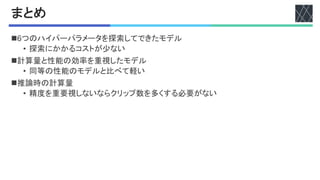
まとめ
nTつのハイパーパラメータを探索してできたモデル
• 探索にかかるコストが少ない
n計算量と性能の効率を重視したモデル
• 同等の性能のモデルと比べて軽い
n推論時の計算量
• 精度を重要視しないならクリップ数を多くする必要がない
補足スライド
!$#への拡張
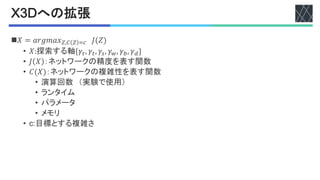
n𝑋 = 𝑎𝑟𝑔𝑚𝑎𝑥(,* ( +, 𝐽(𝑍)
• 𝑋:探索する軸{𝛾!, 𝛾", 𝛾#, 𝛾$, 𝛾%, 𝛾&}
• 𝐽 𝑋 :ネットワークの精度を表す関数
• 𝐶(𝑋):ネットワークの複雑性を表す関数
• 演算回数 (実験で使用)
• ランタイム
• パラメータ
• メモリ
• ,X目標とする複雑さ
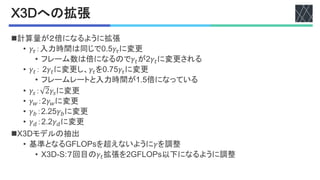
!$#への拡張
n計算量が2倍になるように拡張
• 𝛾!:入力時間は同じで3UW𝛾!に変更
• フレーム数は倍になるので𝛾"が2𝛾"に変更される
• 𝛾": 2𝛾"に変更し、𝛾!を3UDW𝛾!に変更
• フレームレートと入力時間がCUW倍になっている
• 𝛾#: 2𝛾#に変更
• 𝛾$:2𝛾$に変更
• 𝛾%:2U2W𝛾%に変更
• 𝛾&:2U2𝛾&に変更
n456モデルの抽出
• 基準となるY*NZ0%を超えないように𝛾を調整
• 456FJX7回目の𝛾"拡張を2Y*NZ0%以下になるように調整
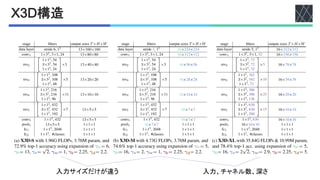
!$#構造
stage filters output sizes T×H×W
data layer stride 6, 12
13×160×160
conv1 1×32, 3×1, 24 13×80×80
res2


1×12, 54
3×32, 54
1×12, 24

×3 13×40×40
res3


1×12, 108
3×32, 108
1×12, 48

×5 13×20×20
res4


1×12, 216
3×32, 216
1×12, 96

×11 13×10×10
res5


1×12, 432
3×32, 432
1×12, 192

×7 13×5×5
conv5 1×12, 432 13×5×5
pool5 13×5×5 1×1×1
fc1 1×12, 2048 1×1×1
fc2 1×12, #classes 1×1×1
(a) X3D-S with 1.96G FLOPs, 3.76M param, and
72.9% top-1 accuracy using expansion of γτ = 6,
γt= 13, γs=
√
2, γw= 1, γb= 2.25, γd= 2.2.
stage filters output sizes T×H×W
data layer stride 5, 12
16×224×224
conv1 1×32, 3×1, 24 16×112×112
res2


1×12, 54
3×32, 54
1×12, 24

×3 16×56×56
res3


1×12, 108
3×32, 108
1×12, 48

×5 16×28×28
res4


1×12, 216
3×32, 216
1×12, 96

×11 16×14×14
res5


1×12, 432
3×32, 432
1×12, 192

×7 16×7×7
conv5 1×12, 432 16×7×7
pool5 16×7×7 1×1×1
fc1 1×12, 2048 1×1×1
fc2 1×12, #classes 1×1×1
(b) X3D-M with 4.73G FLOPs, 3.76M param, and
74.6% top-1 accuracy using expansion of γτ = 5,
γt= 16, γs= 2, γw= 1, γb= 2.25, γd= 2.2.
stage filters output sizes T×H×W
data layer stride 5, 12
16×312×312
conv1 1×32, 3×1, 32 16×156×156
res2


1×12, 72
3×32, 72
1×12, 32

×5 16×78×78
res3


1×12, 162
3×32, 162
1×12, 72

×10 16×39×39
res4


1×12, 306
3×32, 306
1×12, 136

×25 16×20×20
res5


1×12, 630
3×32, 630
1×12, 280

×15 16×10×10
conv5 1×12, 630 16×10×10
pool5 16×10×10 1×1×1
fc1 1×12, 2048 1×1×1
fc2 1×12, #classes 1×1×1
(c) X3D-XL with 35.84G FLOPs & 10.99M param,
and 78.4% top-1 acc. using expansion of γτ = 5,
γt= 16, γs= 2
√
2, γw= 2.9, γb= 2.25, γd= 5.
Table 3. Three instantiations of X3D with varying complexity. The top-1 accuracy corresponds to 10-Center view testing on K400. The
models in (a) and (b) only differ in spatiotemporal resolution of the input and activations (γt, γτ , γs), and (c) differs from (b) in spatial
resolution, γs, width, γw, and depth, γd. See Table 1 for X2D. Surprisingly X3D-XL has a maximum width of 630 feature channels.
入力サイズだけが違う 入力、チャネル数、深さ
学習 %&'()*'+,-.//0
nバッチサイズ:C32V
• Y0[1台につき8クリップ
• クリップでバッチノーマライゼーショ
ン
n反復数:2WTエポック
nオプティマイザー:JY6
• S'S+-&GSX3UI
• =+$]"&)?+,>^X5×10-.
• 学習率XCUT
nドロップアウト:3UW
nスケジューラ
• 最初の333反復
• 線形ウォームアップ
• コサインスケジューラ
• 𝜂 8 0.5 cos
/
/!"#
𝜋 + 1
• 𝜂:CUT
• 𝑛012:最大学習反復数
学習
nO$-+&$,%FT33
• 反復数:O$-+&$,%FV33の倍
• スケジューラも同様に倍
n!">#>?+%
• O$-+&$,%のモデルをファインチューニ
ング
• バッチサイズ:CT
• 学習率:3U32
• =+$]"&)?+,>^:10-.
• 入力のフレームレートを半分
• 長い時間を推論するため
n_/_
• 反復数:Tエポック
• 最初のC333反復
• 線形ウォームアップ
• LZ[閾値:3UI
!$#性能比較 (アクション検出)
nデータセット
• _/_);YG@A)!/0123CE
n推論
• C28𝛾#×C2𝛾#にセンタークロップ
XL
M
S
model AVA pre val mAP GFLOPs Param
LFB, R50+NL [71]
v2.1 K400
25.8 529 73.6M
LFB, R101+NL [71] 26.8 677 122M
X3D-XL 26.1 48.4 11.0M
SlowFast 4×16, R50 [14]
v2.2 K600
24.7 52.5 33.7M
SlowFast, 8×8 R101+NL [14] 27.4 146 59.2M
X3D-M 23.2 6.2 3.1M
X3D-XL 27.4 48.4 11.0M
Table 8. Comparison with the state-of-the-art on AVA. All meth-
ods use single center crop inference; full testing cost is directly
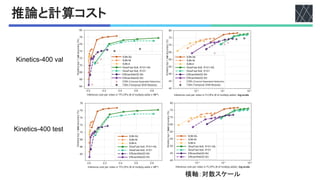
推論と計算コスト
Inference cost per video in TFLOPs (# of multiply-adds x 1012
)
0.0 0.2 0.4 0.6 0.8
76
74
72
70
68
66
64
Kinetics
top-1
val
accuracy
(%)
78
80
SlowFast 8x8, R101+NL
SlowFast 8x8, R101
X3D-XL
X3D-M
EfficientNet3D-B4
EfficientNet3D-B3
X3D-S
CSN (Channel-Separated Networks)
TSM (Temporal Shift Module)
Inference cost per video in FLOPs (# of multiply-adds), log-scale
SlowFast 8x8, R101+NL
SlowFast 8x8, R101
X3D-XL
X3D-M
EfficientNet3D-B4
EfficientNet3D-B3
X3D-S
CSN (Channel-Separated Networks)
TSM (Temporal Shift Module)
75
70
65
60
55
50
45
Kinetics
top-1
val
accuracy
(%)
80
40
1010
1011
1012
76
74
72
70
68
66
64
Kinetics
top-1
test
accuracy
(%)
78
Inference cost per video in TFLOPs (# of multiply-adds x 1012
)
0.0 0.2 0.4 0.6 0.8
SlowFast 8x8, R101+NL
SlowFast 8x8, R101
X3D-XL
X3D-M
EfficientNet3D-B4
EfficientNet3D-B3
X3D-S
SlowFast 8x8, R101+NL
SlowFast 8x8, R101
X3D-XL
X3D-M
EfficientNet3D-B4
EfficientNet3D-B3
X3D-S
75
70
65
60
55
50
45
Kinetics
top-1
test
accuracy
(%)
80
40
Inference cost per video in FLOPs (# of multiply-adds), log-scale
1010
1011
1012
Figure A.1. Accuracy/complexity trade-off on K400-val (top) & test (bottom) for varying # of inference clips per video. The top-1
accuracy (vertical axis) is obtained by K-Center clip testing where the number of temporal clips K 2 {1, 3, 5, 7, 10} is shown in each curve.
"#$%&#'()*++89/:
"#$%&#'()*++8&%(&
横軸:対数スケール
追加実験
n6+(&"F=$%+)%+(>#>89+),'-B'9G&$'-
• 通常の56畳み込みに変更し𝛾%を変更
• パラメータ数が同等になるように
• 通常の56畳み込みに変更
nJ=$%"
• 1+N[に変更で性能が少し低下
• メモリを優先するなら1+N[
nJKブロック
• 削除で性能低下
• パフォーマンスに大きな影響を与えている
model top-1 top-5 FLOPs (G) Param (M)
X3D-S 72.9 90.5 1.96 3.76
CW conv b= 0.6 68.9 88.8 1.95 3.16
CW conv 73.2 90.4 17.6 22.1
swish 72.0 90.4 1.96 3.76
SE 71.3 89.9 1.96 3.60
(a) Ablating mobile components on a Small model.
X3D
C
Table A.1. Ablations of mobile components for video classification on K
parameters, and computational complexity measured in GFLOPs (floatin
input of size t⇥112 s⇥112 x. Inference-time computational cost is repo
The results show that removing channel-wise separable convolution (CW
increases mutliply-adds and parameters at slightly higher accuracy, while
[5] Ross Girshick, Ilija Radosavovic, Georgia Gkioxari, Piotr
Dollár, and Kaiming He. Detectron. https://github.
com/facebookresearch/detectron, 2018. 1
[6] Priya Goyal, Piotr Dollár, Ross Girshick, Pieter Noord-
huis, Lukasz Wesolowski, Aapo Kyrola, Andrew Tulloch,
Yangqing Jia, and Kaiming He. Accurate, large minibatch
SGD: training ImageNet in 1 hour. arXiv:1706.02677, 2017.
1
[7] Chunhui Gu, Chen Sun, David A. Ross, Carl Vondrick, Car-
oline Pantofaru, Yeqing Li, Sudheendra Vijayanarasimhan,
George Toderici, Susanna Ricco, Rahul Sukthankar, Cordelia
[1
[1
[1
model top-1 top-5 FLOPs (G) Param (M)
X3D-S 72.9 90.5 1.96 3.76
CW conv b= 0.6 68.9 88.8 1.95 3.16
CW conv 73.2 90.4 17.6 22.1
swish 72.0 90.4 1.96 3.76
SE 71.3 89.9 1.96 3.60
(a) Ablating mobile components on a Small model.
model top-1 top-5 FLOPs (G) Param (M)
X3D-XL 78.4 93.6 35.84 11.0
CW conv, b= 0.56 76.0 92.6 34.80 9.73
CW conv 79.2 93.5 365.4 95.1
swish 78.0 93.4 35.84 11.0
SE 77.1 93.0 35.84 10.4
(b) Ablating mobile components on an X-Large model.
Table A.1. Ablations of mobile components for video classification on K400-val. We show top-1 and top-5 classification accuracy (%
parameters, and computational complexity measured in GFLOPs (floating-point operations, in # of multiply-adds ⇥109
) for a single c
input of size t⇥112 s⇥112 x. Inference-time computational cost is reported GFLOPs ⇥10, as a fixed number of 10-Center views is us
The results show that removing channel-wise separable convolution (CW conv) with unchanged bottleneck expansion ratio, b, drastica
increases mutliply-adds and parameters at slightly higher accuracy, while swish has a smaller effect on performance than SE.
[5] Ross Girshick, Ilija Radosavovic, Georgia Gkioxari, Piotr
Dollár, and Kaiming He. Detectron. https://github.
com/facebookresearch/detectron, 2018. 1
quality estimation of multiple intermediate frames for vid
interpolation. In Proc. CVPR, 2018. 1
[17] Alex Krizhevsky, Ilya Sutskever, and Geoffrey E Hinton. Im

文献紹介:X3D: Expanding Architectures for Efficient Video Recognition

  • 1.
  • 2.
    概要 n動画認識モデルの456を提案 • 計算量と精度のトレードオフに注目 • 計算量が増えすぎないようにハイパーパラメータを調整 •26モデルから56へと拡張 • 既存手法よりも効率の良いモデル • アプリケーションなどに組み込みやすい • ハイパーパラメータの探索コストが少ない
  • 3.
    効率的なモデル n画像認識 • 7'8$9+:+&);<'=>#?@A)>#4$B23CDE • 6+(&"F=$%+)%+(>#>89+) ,'-B'9G&$'- •7->%:+&);H>-@A)!/0123CIE • JKブロック • 7'8$9+:+&/5);<'=>#?@A) L!!/23CIE • J=$%"関数 • K..$,$+-&:+&);H>-)M)N+A)071N23CIE • モデルをグリッドサーチ n動画認識 • ;OP(QR9QA)L!!/23CIE • 6+(&"F=$%+)%+(>#>89+) ,'-B'9G&$'-の56化 • H+S('#>9)J"$.&)7'?G9+);N$-@A) L!!/23CIE • 特徴量の時間軸をシフト (Lin+, ICCV2019)
  • 4.
    !"# n426 • ベースとなる26モデル • 軸の探索をするモデル •Tつの軸を全てCに設定 n426からTつの軸を探索 • フレームレート:𝛾! • フレーム数:𝛾" • 解像度:𝛾# • チャネル幅:𝛾$ • ボトルネック幅:𝛾% • 深さ:𝛾& In relation to most of these works, our approach does not assume a fixed inherited design from 2D networks, but expands a tiny architecture across several axes in space, time, channels and depth to achieve a good efficiency trade-off. 3. X3D Networks Image classification architectures have gone through an evolution of architecture design with progressively expand- ng existing models along network depth [7,23,37,51,58,81], nput resolution [27,57,60] or channel width [75,80]. Simi- ar progress can be observed for the mobile image classifi- cation domain where contracting modifications (shallower networks, lower resolution, thinner layers, separable convo- ution [24,25,29,48,82]) allowed operating at lower compu- ational budget. Given this history in image ConvNet design, a similar progress has not been observed for video architec- ures as these were customarily based on direct temporal extensions of image models. However, is single expansion of a fixed 2D architecture to 3D ideal, or is it better to expand stage filters output sizes T×S2 data layer stride γτ , 12 1γt×(112γs)2 conv1 1×32, 3×1, 24γw 1γt×(56γs)2 res2   1×12, 24γbγw 3×32, 24γbγw 1×12, 24γw  ×γd 1γt×(28γs)2 res3   1×12, 48γbγw 3×32, 48γbγw 1×12, 48γw  ×2γd 1γt×(14γs)2 res4   1×12, 96γbγw 3×32, 96γbγw 1×12, 96γw  ×5γd 1γt×(7γs)2 res5   1×12, 192γbγw 3×32, 192γbγw 1×12, 192γw  ×3γd 1γt×(4γs)2 conv5 1×12, 192γbγw 1γt×(4γs)2 pool5 1γt×(4γs)2 1×1×1 fc1 1×12, 2048 1×1×1 fc2 1×12, #classes 1×1×1 𝛾!が1なので!"
  • 5.
    !$#への拡張 CU 拡張によって出来るモデルの複雑さ(計算量など)を固定する 2U Cで定めた複雑さになるように一つの軸だけ拡張 5U2を6つの軸全てで行う VU 5で作ったTつのモデルを学習させる WU Tつのモデルの認識率を測定 TU 一番高いものを新しいベースモデルへ DU Cに戻る ベースモデル 𝛾!拡張 𝛾"拡張 𝛾#拡張 𝛾$拡張 𝛾%拡張 𝛾&拡張 一番良いモデル 複雑さが同等のモデル
  • 6.
    !$#への拡張 τ s d b t w X3D d d t t b τ τ X3D-L X3D-M X3D-S X3D-XS s s s X2D w X3D-XL Model capacity inGFLOPs (# of multiply-adds x 109 ) 0 5 15 25 35 10 20 30 80 75 70 65 60 55 50 Kinetics top-1 accuracy (%) Figure 2. Progressive network expansion of X3D. The X2D base model is expanded 1st across bottleneck width (γb), 2nd tempo- ral resolution (γτ ), 3rd spatial resolution (γs), 4th depth (γd), 5th model top-1 top-5 regime FLOPs Params FLOPs (G) (G) (M) X3D-XS 68.6 87.9 X-Small ≤ 0.6 0.60 3.76 X3D-S 72.9 90.5 Small ≤ 2 1.96 3.76 X3D-M 74.6 91.7 Medium ≤ 5 4.73 3.76 X3D-L 76.8 92.5 Large ≤ 20 18.37 6.08 X3D-XL 78.4 93.6 X-Large ≤ 40 35.84 11.0 Table 2. Expanded instances on K400-val. 10-Center clip testing is used. We show top-1 and top-5 classification accuracy (%), as well as computational complexity measured in GFLOPs (floating-point operations, in # of multiply-adds ×109 ) for a single clip input. Inference-time computational cost is proportional to 10× of this, as a fixed number of 10 of clips is used per video. 4.1. Expanded networks The accuracy/complexity trade-off curve for the expan- sion process on K400 is shown in Fig. 2. Expansion starts from X2D that produces 47.75% top-1 accuracy (vertical axis) with 1.63M parameters 20.67M FLOPs per clip (hori- zontal axis), which is roughly doubled in each progressive step. We use 10-Center clip testing as our default test setting for expansion, so the overall cost per video is ×10. We τ s d b t w X3D d d t t b τ τ X3D-L X3D-M X3D-S X3D-XS s s s X2D w X3D-XL Model capacity in GFLOPs (# of multiply-adds x 109 ) 0 5 15 25 35 10 20 30 80 75 70 65 60 55 50 Kinetics top-1 accuracy (%) Figure 2. Progressive network expansion of X3D. The X2D base model is expanded 1st across bottleneck width (γb), 2nd tempo- model top-1 top-5 regime FLOPs Params FLOPs (G) (G) (M) X3D-XS 68.6 87.9 X-Small ≤ 0.6 0.60 3.76 X3D-S 72.9 90.5 Small ≤ 2 1.96 3.76 X3D-M 74.6 91.7 Medium ≤ 5 4.73 3.76 X3D-L 76.8 92.5 Large ≤ 20 18.37 6.08 X3D-XL 78.4 93.6 X-Large ≤ 40 35.84 11.0 Table 2. Expanded instances on K400-val. 10-Center clip testing is used. We show top-1 and top-5 classification accuracy (%), as well as computational complexity measured in GFLOPs (floating-point operations, in # of multiply-adds ×109 ) for a single clip input. Inference-time computational cost is proportional to 10× of this, as a fixed number of 10 of clips is used per video. 4.1. Expanded networks The accuracy/complexity trade-off curve for the expan- sion process on K400 is shown in Fig. 2. Expansion starts from X2D that produces 47.75% top-1 accuracy (vertical axis) with 1.63M parameters 20.67M FLOPs per clip (hori- zontal axis), which is roughly doubled in each progressive step. We use 10-Center clip testing as our default test setting !回目の拡張結果 𝛾!が一番良いモデル 一番良い結果となった拡張 拡張した結果から5つのモデルを抽出 拡張のコスト • 456 • 1ステップに6つのモデルを学習 • 6×ステップ数の学習 • K..$,$+-&:+& • グリッドサーチ • 全てのモデルを総当たり
  • 7.
    実験設定 nデータセット • !"#$%"&'()**+,!-./0+-12"34*567 • !"#$%"&'(8**+,9-11$1"-/0+-12"34*5:7 •9;-1-<$'+,=">?1<''@#/0+A99B4*587 n学習 • 554𝛾!× 554𝛾!にクロップ • ランダムに反転 n推論 • 空間方向 • 554𝛾!× 554𝛾!にクロップ • センタークロップ • 空間軸にCクロップ • 時間方向 • !個を一様にサンプリング
  • 8.
    !$#性能比較 model pre top-1top-5 test GFLOPs×views Param I3D [6] ImageNet 71.1 90.3 80.2 108 × N/A 12M Two-Stream I3D [6] 75.7 92.0 82.8 216 × N/A 25M Two-Stream S3D-G [76] 77.2 93.0 143 × N/A 23.1M MF-Net [9] 72.8 90.4 11.1 × 50 8.0M TSM R50 [41] 74.7 N/A 65 × 10 24.3M Nonlocal R50 [68] 76.5 92.6 282 × 30 35.3M Nonlocal R101 [68] 77.7 93.3 83.8 359 × 30 54.3M Two-Stream I3D [6] - 71.6 90.0 216 × NA 25.0M R(2+1)D [64] - 72.0 90.0 152 × 115 63.6M Two-Stream R(2+1)D [64] - 73.9 90.9 304 × 115 127.2M Oct-I3D + NL [8] - 75.7 N/A 28.9 × 30 33.6M ip-CSN-152 [63] - 77.8 92.8 109 × 30 32.8M SlowFast 4×16, R50 [14] - 75.6 92.1 36.1 × 30 34.4M SlowFast 8×8, R101 [14] - 77.9 93.2 84.2 106 × 30 53.7M SlowFast 8×8, R101+NL [14] - 78.7 93.5 84.9 116 × 30 59.9M SlowFast 16×8, R101+NL [14] - 79.8 93.9 85.7 234 × 30 59.9M X3D-M - 76.0 92.3 82.9 6.2 × 30 3.8M X3D-L - 77.5 92.9 83.8 24.8 × 30 6.1M X3D-XL - 79.1 93.9 85.3 48.4 × 30 11.0M Table 4. Comparison to the state-of-the-art on K400-val & test. We report the inference cost with a single “view" (temporal clip with spatial crop) × the numbers of such views used (GFLOPs×views). “N/A” indicates the numbers are not available for us. The “test” model pretrain mAP GFLOPs×views Param Nonlocal [68] ImageNet+Kinetics400 37.5 544 × 30 54.3M STRG, +NL [69] ImageNet+Kinetics400 39.7 630 × 30 58.3M Timeception [28] Kinetics-400 41.1 N/A×N/A N/A LFB, +NL [71] Kinetics-400 42.5 529 × 30 122M SlowFast, +NL [14] Kinetics-400 42.5 234 × 30 59.9M SlowFast, +NL [14] Kinetics-600 45.2 234 × 30 59.9M X3D-XL Kinetics-400 43.4 48.4 × 30 11.0M X3D-XL Kinetics-600 47.1 48.4 × 30 11.0M Table 6. Comparison with the state-of-the-art on Charades. SlowFast variants are based on T×τ = 16×8. model data top-1 top-5 FLOPs (G) Params (M) EfficientNet3D-B0 K400 66.7 86.6 0.74 3.30 X3D-XS val 68.6 (+1.9) 87.9 (+1.3) 0.60 (−1.4) 3.76 (+0.5) EfficientNet3D-B3 72.4 89.6 6.91 8.19 X3D-M 74.6 (+2.2) 91.7 (+2.1) 4.73 (−2.2) 3.76 (−4.4) EfficientNet3D-B4 74.5 90.6 23.80 12.16 X3D-L 76.8 (+2.3) 92.5 (+1.9) 18.37 (−5.4) 6.08 (−6.1) EfficientNet3D-B0 K400 64.8 85.4 0.74 3.30 X3D-XS test 66.6 (+1.8) 86.8 (+1.4) 0.60 (−1.4) 3.76 (+0.5) EfficientNet3D-B3 69.9 88.1 6.91 8.19 X3D-M 73.0 (+2.1) 90.8 (+2.7) 4.73 (−2.2) 3.76 (−4.4) EfficientNet3D-B4 71.8 88.9 23.80 12.16 X3D-XL - 79.1 93.9 85.3 48.4 × 30 11.0M Table 4. Comparison to the state-of-the-art on K400-val & test. We report the inference cost with a single “view" (temporal clip with spatial crop) × the numbers of such views used (GFLOPs×views). “N/A” indicates the numbers are not available for us. The “test” column shows average of top1 and top5 on the Kinetics-400 testset. model pretrain top-1 top-5 GFLOPs×views Param I3D [3] - 71.9 90.1 108 × N/A 12M Oct-I3D + NL [8] ImageNet 76.0 N/A 25.6 × 30 12M SlowFast 4×16, R50 [14] - 78.8 94.0 36.1 × 30 34.4M SlowFast 16×8, R101+NL [14] - 81.8 95.1 234 × 30 59.9M X3D-M - 78.8 94.5 6.2 × 30 3.8M X3D-XL - 81.9 95.5 48.4 × 30 11.0M Table 5. Comparison with the state-of-the-art on Kinetics-600. Results are consistent with K400 in Table 4 above. Kinetics-600 is a larger version of Kinetics that shall demonstrate further generalization of our approach. Re- sults are shown in Table 5. Our variants demonstrate similar performance as above, with the best model now providing slightly better performance than the previous state-of-the- art SlowFast 16×8, R101+NL [14], again for 4.8× fewer FLOPs (i.e. multiply-add operations) and 5.5× fewer param- eter. In the lower computation regime, X3D-M is compara- ble to SlowFast 4×16, R50 but requires 5.8× fewer FLOPs and 9.1× fewer parameters. Charades [49] is a dataset with longer range activities. Ta- model pre top-1 top-5 test GFLOPs×views Param I3D [6] ImageNet 71.1 90.3 80.2 108 × N/A 12M Two-Stream I3D [6] 75.7 92.0 82.8 216 × N/A 25M Two-Stream S3D-G [76] 77.2 93.0 143 × N/A 23.1M MF-Net [9] 72.8 90.4 11.1 × 50 8.0M TSM R50 [41] 74.7 N/A 65 × 10 24.3M Nonlocal R50 [68] 76.5 92.6 282 × 30 35.3M Nonlocal R101 [68] 77.7 93.3 83.8 359 × 30 54.3M Two-Stream I3D [6] - 71.6 90.0 216 × NA 25.0M R(2+1)D [64] - 72.0 90.0 152 × 115 63.6M Two-Stream R(2+1)D [64] - 73.9 90.9 304 × 115 127.2M Oct-I3D + NL [8] - 75.7 N/A 28.9 × 30 33.6M ip-CSN-152 [63] - 77.8 92.8 109 × 30 32.8M SlowFast 4×16, R50 [14] - 75.6 92.1 36.1 × 30 34.4M SlowFast 8×8, R101 [14] - 77.9 93.2 84.2 106 × 30 53.7M SlowFast 8×8, R101+NL [14] - 78.7 93.5 84.9 116 × 30 59.9M model pretrain mAP GFLOPs×views Param Nonlocal [68] ImageNet+Kinetics400 37.5 544 × 30 54.3M STRG, +NL [69] ImageNet+Kinetics400 39.7 630 × 30 58.3M Timeception [28] Kinetics-400 41.1 N/A×N/A N/A LFB, +NL [71] Kinetics-400 42.5 529 × 30 122M SlowFast, +NL [14] Kinetics-400 42.5 234 × 30 59.9M SlowFast, +NL [14] Kinetics-600 45.2 234 × 30 59.9M X3D-XL Kinetics-400 43.4 48.4 × 30 11.0M X3D-XL Kinetics-600 47.1 48.4 × 30 11.0M Table 6. Comparison with the state-of-the-art on Charades. SlowFast variants are based on T×τ = 16×8. model data top-1 top-5 FLOPs (G) Params (M) EfficientNet3D-B0 66.7 86.6 0.74 3.30 "#$%&#'()*++ "#$%&#'(),++ -./0/1%( 事前 学習 既存 手法 同等の性能よりも 計算量削減
  • 9.
    !$#性能比較 SlowFast, +NL [14]Kinetics-600 45.2 234 × 30 59.9M X3D-XL Kinetics-400 43.4 48.4 × 30 11.0M X3D-XL Kinetics-600 47.1 48.4 × 30 11.0M Table 6. Comparison with the state-of-the-art on Charades. SlowFast variants are based on T×τ = 16×8. model data top-1 top-5 FLOPs (G) Params (M) EfficientNet3D-B0 K400 66.7 86.6 0.74 3.30 X3D-XS val 68.6 (+1.9) 87.9 (+1.3) 0.60 (−1.4) 3.76 (+0.5) EfficientNet3D-B3 72.4 89.6 6.91 8.19 X3D-M 74.6 (+2.2) 91.7 (+2.1) 4.73 (−2.2) 3.76 (−4.4) EfficientNet3D-B4 74.5 90.6 23.80 12.16 X3D-L 76.8 (+2.3) 92.5 (+1.9) 18.37 (−5.4) 6.08 (−6.1) EfficientNet3D-B0 K400 64.8 85.4 0.74 3.30 X3D-XS test 66.6 (+1.8) 86.8 (+1.4) 0.60 (−1.4) 3.76 (+0.5) EfficientNet3D-B3 69.9 88.1 6.91 8.19 X3D-M 73.0 (+2.1) 90.8 (+2.7) 4.73 (−2.2) 3.76 (−4.4) EfficientNet3D-B4 71.8 88.9 23.80 12.16 X3D-L 74.6 (+2.8) 91.4 (+2.5) 18.37 (−5.4) 6.08 (−6.1) Table 7. Comparison to EfficientNet3D: We compare to a 3D version of EfficientNet on K400-val and test. 10-Center clip testing is used. EfficientNet3D has the same mobile components as X3D. but was found by searching a large number of models for op- timal trade-off on image-classification. This ablation studies if a direct extension of EfficientNet to 3D is comparable to X3D (which is expanded by only training few models). Effi- cientNet models are provided for various complexity ranges. 233#'#%$&4%&56との比較 456のハイパーパラメータ探索が優れている Inference cost per video in TFLOPs (# of multiply-adds x 1012 ) 0.0 0.2 0.4 0.6 0.8 76 74 72 70 68 66 64 Kinetics top-1 accuracy (%) 78 SlowFast 8x8, R101+NL SlowFast 8x8, R101 X3D-XL X3D-M X3D-S CSN (Channel-Separated Networks) TSM (Temporal Shift Module) Figure 3. Accuracy/complexity trade-off on Kinetics-400 for dif- ferent number of inference clips per video. The top-1 accuracy (vertical axis) is obtained by K-Center clip testing where the num- ber of temporal clips K ∈ {1, 3, 5, 7, 10} is shown in each curve. The horizontal axis shows the full inference cost per video. Inference cost. In many cases, like the experiments before, 推論時のクリップ数と認識率 !75クリップの 比較 5クリップ以上は 計算量に対して認識率の伸びが悪い
  • 10.
  • 11.
  • 12.
    !$#への拡張 n𝑋 = 𝑎𝑟𝑔𝑚𝑎𝑥(,*( +, 𝐽(𝑍) • 𝑋:探索する軸{𝛾!, 𝛾", 𝛾#, 𝛾$, 𝛾%, 𝛾&} • 𝐽 𝑋 :ネットワークの精度を表す関数 • 𝐶(𝑋):ネットワークの複雑性を表す関数 • 演算回数 (実験で使用) • ランタイム • パラメータ • メモリ • ,X目標とする複雑さ
  • 13.
    !$#への拡張 n計算量が2倍になるように拡張 • 𝛾!:入力時間は同じで3UW𝛾!に変更 • フレーム数は倍になるので𝛾"が2𝛾"に変更される •𝛾": 2𝛾"に変更し、𝛾!を3UDW𝛾!に変更 • フレームレートと入力時間がCUW倍になっている • 𝛾#: 2𝛾#に変更 • 𝛾$:2𝛾$に変更 • 𝛾%:2U2W𝛾%に変更 • 𝛾&:2U2𝛾&に変更 n456モデルの抽出 • 基準となるY*NZ0%を超えないように𝛾を調整 • 456FJX7回目の𝛾"拡張を2Y*NZ0%以下になるように調整
  • 14.
    !$#構造 stage filters outputsizes T×H×W data layer stride 6, 12 13×160×160 conv1 1×32, 3×1, 24 13×80×80 res2   1×12, 54 3×32, 54 1×12, 24  ×3 13×40×40 res3   1×12, 108 3×32, 108 1×12, 48  ×5 13×20×20 res4   1×12, 216 3×32, 216 1×12, 96  ×11 13×10×10 res5   1×12, 432 3×32, 432 1×12, 192  ×7 13×5×5 conv5 1×12, 432 13×5×5 pool5 13×5×5 1×1×1 fc1 1×12, 2048 1×1×1 fc2 1×12, #classes 1×1×1 (a) X3D-S with 1.96G FLOPs, 3.76M param, and 72.9% top-1 accuracy using expansion of γτ = 6, γt= 13, γs= √ 2, γw= 1, γb= 2.25, γd= 2.2. stage filters output sizes T×H×W data layer stride 5, 12 16×224×224 conv1 1×32, 3×1, 24 16×112×112 res2   1×12, 54 3×32, 54 1×12, 24  ×3 16×56×56 res3   1×12, 108 3×32, 108 1×12, 48  ×5 16×28×28 res4   1×12, 216 3×32, 216 1×12, 96  ×11 16×14×14 res5   1×12, 432 3×32, 432 1×12, 192  ×7 16×7×7 conv5 1×12, 432 16×7×7 pool5 16×7×7 1×1×1 fc1 1×12, 2048 1×1×1 fc2 1×12, #classes 1×1×1 (b) X3D-M with 4.73G FLOPs, 3.76M param, and 74.6% top-1 accuracy using expansion of γτ = 5, γt= 16, γs= 2, γw= 1, γb= 2.25, γd= 2.2. stage filters output sizes T×H×W data layer stride 5, 12 16×312×312 conv1 1×32, 3×1, 32 16×156×156 res2   1×12, 72 3×32, 72 1×12, 32  ×5 16×78×78 res3   1×12, 162 3×32, 162 1×12, 72  ×10 16×39×39 res4   1×12, 306 3×32, 306 1×12, 136  ×25 16×20×20 res5   1×12, 630 3×32, 630 1×12, 280  ×15 16×10×10 conv5 1×12, 630 16×10×10 pool5 16×10×10 1×1×1 fc1 1×12, 2048 1×1×1 fc2 1×12, #classes 1×1×1 (c) X3D-XL with 35.84G FLOPs & 10.99M param, and 78.4% top-1 acc. using expansion of γτ = 5, γt= 16, γs= 2 √ 2, γw= 2.9, γb= 2.25, γd= 5. Table 3. Three instantiations of X3D with varying complexity. The top-1 accuracy corresponds to 10-Center view testing on K400. The models in (a) and (b) only differ in spatiotemporal resolution of the input and activations (γt, γτ , γs), and (c) differs from (b) in spatial resolution, γs, width, γw, and depth, γd. See Table 1 for X2D. Surprisingly X3D-XL has a maximum width of 630 feature channels. 入力サイズだけが違う 入力、チャネル数、深さ
  • 15.
    学習 %&'()*'+,-.//0 nバッチサイズ:C32V • Y0[1台につき8クリップ •クリップでバッチノーマライゼーショ ン n反復数:2WTエポック nオプティマイザー:JY6 • S'S+-&GSX3UI • =+$]"&)?+,>^X5×10-. • 学習率XCUT nドロップアウト:3UW nスケジューラ • 最初の333反復 • 線形ウォームアップ • コサインスケジューラ • 𝜂 8 0.5 cos / /!"# 𝜋 + 1 • 𝜂:CUT • 𝑛012:最大学習反復数
  • 16.
    学習 nO$-+&$,%FT33 • 反復数:O$-+&$,%FV33の倍 • スケジューラも同様に倍 n!">#>?+% •O$-+&$,%のモデルをファインチューニ ング • バッチサイズ:CT • 学習率:3U32 • =+$]"&)?+,>^:10-. • 入力のフレームレートを半分 • 長い時間を推論するため n_/_ • 反復数:Tエポック • 最初のC333反復 • 線形ウォームアップ • LZ[閾値:3UI
  • 17.
    !$#性能比較 (アクション検出) nデータセット • _/_);YG@A)!/0123CE n推論 •C28𝛾#×C2𝛾#にセンタークロップ XL M S model AVA pre val mAP GFLOPs Param LFB, R50+NL [71] v2.1 K400 25.8 529 73.6M LFB, R101+NL [71] 26.8 677 122M X3D-XL 26.1 48.4 11.0M SlowFast 4×16, R50 [14] v2.2 K600 24.7 52.5 33.7M SlowFast, 8×8 R101+NL [14] 27.4 146 59.2M X3D-M 23.2 6.2 3.1M X3D-XL 27.4 48.4 11.0M Table 8. Comparison with the state-of-the-art on AVA. All meth- ods use single center crop inference; full testing cost is directly
  • 18.
    推論と計算コスト Inference cost pervideo in TFLOPs (# of multiply-adds x 1012 ) 0.0 0.2 0.4 0.6 0.8 76 74 72 70 68 66 64 Kinetics top-1 val accuracy (%) 78 80 SlowFast 8x8, R101+NL SlowFast 8x8, R101 X3D-XL X3D-M EfficientNet3D-B4 EfficientNet3D-B3 X3D-S CSN (Channel-Separated Networks) TSM (Temporal Shift Module) Inference cost per video in FLOPs (# of multiply-adds), log-scale SlowFast 8x8, R101+NL SlowFast 8x8, R101 X3D-XL X3D-M EfficientNet3D-B4 EfficientNet3D-B3 X3D-S CSN (Channel-Separated Networks) TSM (Temporal Shift Module) 75 70 65 60 55 50 45 Kinetics top-1 val accuracy (%) 80 40 1010 1011 1012 76 74 72 70 68 66 64 Kinetics top-1 test accuracy (%) 78 Inference cost per video in TFLOPs (# of multiply-adds x 1012 ) 0.0 0.2 0.4 0.6 0.8 SlowFast 8x8, R101+NL SlowFast 8x8, R101 X3D-XL X3D-M EfficientNet3D-B4 EfficientNet3D-B3 X3D-S SlowFast 8x8, R101+NL SlowFast 8x8, R101 X3D-XL X3D-M EfficientNet3D-B4 EfficientNet3D-B3 X3D-S 75 70 65 60 55 50 45 Kinetics top-1 test accuracy (%) 80 40 Inference cost per video in FLOPs (# of multiply-adds), log-scale 1010 1011 1012 Figure A.1. Accuracy/complexity trade-off on K400-val (top) & test (bottom) for varying # of inference clips per video. The top-1 accuracy (vertical axis) is obtained by K-Center clip testing where the number of temporal clips K 2 {1, 3, 5, 7, 10} is shown in each curve. "#$%&#'()*++89/: "#$%&#'()*++8&%(& 横軸:対数スケール
  • 19.
    追加実験 n6+(&"F=$%+)%+(>#>89+),'-B'9G&$'- • 通常の56畳み込みに変更し𝛾%を変更 • パラメータ数が同等になるように •通常の56畳み込みに変更 nJ=$%" • 1+N[に変更で性能が少し低下 • メモリを優先するなら1+N[ nJKブロック • 削除で性能低下 • パフォーマンスに大きな影響を与えている model top-1 top-5 FLOPs (G) Param (M) X3D-S 72.9 90.5 1.96 3.76 CW conv b= 0.6 68.9 88.8 1.95 3.16 CW conv 73.2 90.4 17.6 22.1 swish 72.0 90.4 1.96 3.76 SE 71.3 89.9 1.96 3.60 (a) Ablating mobile components on a Small model. X3D C Table A.1. Ablations of mobile components for video classification on K parameters, and computational complexity measured in GFLOPs (floatin input of size t⇥112 s⇥112 x. Inference-time computational cost is repo The results show that removing channel-wise separable convolution (CW increases mutliply-adds and parameters at slightly higher accuracy, while [5] Ross Girshick, Ilija Radosavovic, Georgia Gkioxari, Piotr Dollár, and Kaiming He. Detectron. https://github. com/facebookresearch/detectron, 2018. 1 [6] Priya Goyal, Piotr Dollár, Ross Girshick, Pieter Noord- huis, Lukasz Wesolowski, Aapo Kyrola, Andrew Tulloch, Yangqing Jia, and Kaiming He. Accurate, large minibatch SGD: training ImageNet in 1 hour. arXiv:1706.02677, 2017. 1 [7] Chunhui Gu, Chen Sun, David A. Ross, Carl Vondrick, Car- oline Pantofaru, Yeqing Li, Sudheendra Vijayanarasimhan, George Toderici, Susanna Ricco, Rahul Sukthankar, Cordelia [1 [1 [1 model top-1 top-5 FLOPs (G) Param (M) X3D-S 72.9 90.5 1.96 3.76 CW conv b= 0.6 68.9 88.8 1.95 3.16 CW conv 73.2 90.4 17.6 22.1 swish 72.0 90.4 1.96 3.76 SE 71.3 89.9 1.96 3.60 (a) Ablating mobile components on a Small model. model top-1 top-5 FLOPs (G) Param (M) X3D-XL 78.4 93.6 35.84 11.0 CW conv, b= 0.56 76.0 92.6 34.80 9.73 CW conv 79.2 93.5 365.4 95.1 swish 78.0 93.4 35.84 11.0 SE 77.1 93.0 35.84 10.4 (b) Ablating mobile components on an X-Large model. Table A.1. Ablations of mobile components for video classification on K400-val. We show top-1 and top-5 classification accuracy (% parameters, and computational complexity measured in GFLOPs (floating-point operations, in # of multiply-adds ⇥109 ) for a single c input of size t⇥112 s⇥112 x. Inference-time computational cost is reported GFLOPs ⇥10, as a fixed number of 10-Center views is us The results show that removing channel-wise separable convolution (CW conv) with unchanged bottleneck expansion ratio, b, drastica increases mutliply-adds and parameters at slightly higher accuracy, while swish has a smaller effect on performance than SE. [5] Ross Girshick, Ilija Radosavovic, Georgia Gkioxari, Piotr Dollár, and Kaiming He. Detectron. https://github. com/facebookresearch/detectron, 2018. 1 quality estimation of multiple intermediate frames for vid interpolation. In Proc. CVPR, 2018. 1 [17] Alex Krizhevsky, Ilya Sutskever, and Geoffrey E Hinton. Im