This is the fifth edition of our
Market Year in Review & Outlook Report,
a report that I am immensely proud to have
seen grow over the years into a must-read, not
only by those with an interest in the Greater Golden
Horseshoe (GGH) real estate market, but also by those
with a keen interest in seeking solutions to improve
the quality of life in this region.
-	 John DiMichele
	 CEO, Toronto Regional Real Estate Board
Market Year in Review & Outlook Report 2020	3	
A Message from the President���������������������������4
A Message from the CEO�����������������������������������5
Executive Summary ������������������������������������������6
2019 Year in Review  2020 Outlook������������������9
	 2019 Year in Review������������������������������������������ 10
	 2020 Market Outlook��������������������������������������� 13
Rental Market Review  Outlook���������������������17
	Summary����������������������������������������������������������� 18
	 Rental Demand Increased in 2019������������������� 18
	 Strong Listings Growth Helps Moderate
	 Rent Growth����������������������������������������������������� 19
	 Rental Market Moving Forward������������������������ 20
New Home  Residential Land Sectors������������21
	 Section Summary��������������������������������������������� 22
	 New Home Sector�������������������������������������������� 23
	 Residential Land Sector����������������������������������� 25
	 Looking Ahead�������������������������������������������������� 26
Commercial Review  Outlook������������������������27
	 Market Drivers in Brief�������������������������������������� 28
	 Commercial Leasing����������������������������������������� 29
	 Commercial Property Sales����������������������������� 30
Policymakers on Solutions for
Population Growth������������������������������������������31
	 Steve Clark�������������������������������������������������������� 32
	 Minister of Municipal Affairs  Housing, Province of Ontario
	 John Tory���������������������������������������������������������� 33
	 Mayor, City of Toronto
	 Patrick Brown���������������������������������������������������� 34
	 Mayor, City of Brampton
	 Bonnie Crombie������������������������������������������������ 35
	 Mayor, City of Mississauga
	 Dan Carter�������������������������������������������������������� 36
	 Mayor, City of Oshawa
	 Dave Ryan��������������������������������������������������������� 37
	 Mayor, City of Pickering
	 John Henry������������������������������������������������������� 38
	 Durham Regional Chair and CEO
	 Nancy Polsinelli������������������������������������������������� 39
	 Peel Region CAO (Interim)
	 Wayne Emmerson�������������������������������������������� 40
	 York Region Chairman and CEO
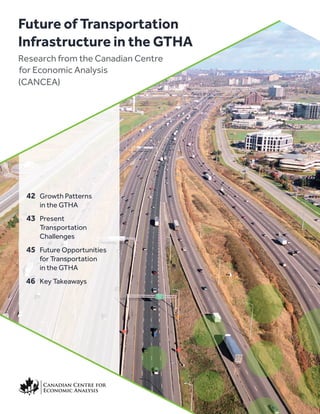
Future of Transportation Infrastructure
in the GTHA����������������������������������������������������41
	 Growth Patterns in the GTHA�������������������������� 42
	 Present Transportation Challenges����������������� 43
	 Future Opportunities for
	 Transportation in the GTHA����������������������������� 45
	 Key Takeaways�������������������������������������������������� 46
Transit-Supportive Development
Along Bus Corridors����������������������������������������47
	 Greater Housing Around Transit
	 is a Smart Investment�������������������������������������� 48
	 Housing Diversity – A Foundation
	 of Every Vibrant City����������������������������������������� 49
	 Seizing the Opportunities�������������������������������� 49
	 Recommendations������������������������������������������� 51
Future GTHA Economic Growth
 Housing Affordability�����������������������������������53
	 Upbeat Outlook for GTHA
	 Economy to 2031���������������������������������������������� 54
	 GTHA Economy Likely to
	 Remain Resilient����������������������������������������������� 55
	 Housing Affordability Challenges Will
	 Remain Even With Incomes on the Rise���������� 56
	 Renting Will Become the New Normal������������� 57
	 A Regional View������������������������������������������������ 57
	 More Supply is Needed to Provide
	 Relief to Rising Housing Costs ������������������������ 57
	 Conclusion�������������������������������������������������������� 58
Market Year in Review
 Outlook Report
Table of Contents
Market Year in Review
 Outlook Report
A Message from the President
	4	 Market Year in Review  Outlook Report 2020
I am honoured to share this message for TREB’s Market Year in Review and Outlook
Report. Each year, I look forward to the release of the report, and continue to find it
a resourceful tool about the past and upcoming trends in the real estate market. It
also provides great material to engage in discussions with colleagues and clients on
pressing topics related to our industry.
Inside this report, you will find new and exciting evidence-based research, consumer
intentions, market overviews and forecasts, with each section digging deep behind
the numbers. In addition, the 2019 market year and outlook for 2020 section presents
readers with an opportunity to better understand the market.
Speaking of 2020, this marks a very special year for TREB. Our 100th
Anniversary is on November 29,
2020, and TREB Member REALTORS®
have participated in turning houses into homes, offices into
businesses, and streets into neighbourhoods over the last 100 years.
Home ownership continues to be a sound long-term investment for buyers and the economy. In fact,
several sections in this report touch on the topic of Canada’s strong economy and how this scenario fuels
population growth and in turn creates a pent-up demand for housing.
However, the supply of housing across the region is not expected to grow fast enough to meet the
demand for housing. So, how can we keep up with the growing population and meet housing demands?
TREB has the opportunity to use this report as a tool to make suggestions and call on policymakers and
industry stakeholders to convert these issues into action. Specifically, in this year’s report, you’ll find
research that hones in on transportation trends, pressures and development. We at TREB believe that
quality transportation mixed in with a diverse housing supply offers people the chance to live where they
want and an easier way to move around the region.
We’ve also followed suit from last year’s report and included a section on the rental market – a segment
of the real estate market that is also faced with a dwindling supply and affordability issues. To cover all
aspects of the real estate market, you’ll also find a commercial section.
I hope you enjoy reading this report and have found a resource that provides a snapshot of the
2019 market year and an informative outlook for 2020 and onwards, in addition to the pages full of
comprehensive research.
Michael Collins
2019/2020 President
Toronto Regional Real Estate Board
Market Year in Review  Outlook Report 2020	5	
Market Year in Review
 Outlook Report
A Message from the CEO
This is the fifth edition of our annual Market Year in Review  Outlook Report, a report that I am
immensely proud to have seen grow over the years into a must-read, not only by those with an interest
in the Greater Golden Horseshoe (GGH) real estate market, but also by those with a keen interest in
seeking solutions to improve the quality of life in this region.
This initiative began in 2015, with the inaugural report examining the competitive positioning of the
GGH, drawing attention to the challenges we face with the provision of housing and affordable home
ownership, infrastructure and broader economic development. Year after year, this report has proven
to shed light, provide clear and hard evidence, as well as offer solutions to the major challenges we
collectively face in the Greater Toronto Area and beyond that we identified in the initial report, namely
infrastructure, transportation and traffic, transit and housing supply.
We would like to acknowledge the work of the Toronto Region Board of Trade on the movement of people and goods file, an
area where we collaborated on research that has contributed to the dialogue.
This year’s report presents fresh ideas on what is critically needed to accommodate the increasing population across the
GGH, as well recommendations on how to manage the ongoing demand for housing. The Toronto Regional Real Estate Board
continues to make great strides in working with policymakers and industry stakeholders in advancing the issues and
suggested solutions to major issues in the region.
We currently have infrastructure that does not appear to be keeping pace with the large number of people attracted to this
region. It seems like we’ve been talking about the housing supply issue for quite some time. Although there is encouraging
news and steps coming from various levels of government, the time is now to start making real efforts to bring in more supply
and a greater diversity in housing types.
We need to see the development of a greater diversity of mid-density housing to bridge the gap between detached homes
and high-rise condos. In other words, we need to see policymakers actively addressing the “Missing Middle.” Alongside a
diverse supply of housing, the GGH needs flexible housing market policies that will help sustain balanced market conditions
over the long term.
The Greater Golden Horseshoe is globally recognized as a great place to live, work and do business. To create more housing
supply in our high demand real estate market, I believe all levels of government should make a stronger commitment to work
together to expand infrastructure and transportation across the GGH.
Technological advances are a reality, and emerging trends in transportation also have the potential to impact the system,
including vehicle-on-demand services and autonomous vehicles on our roads. Without properly leveraged and well-planned
transportation infrastructure, this could exacerbate the GGH’s current transportation challenges. With that in mind, this
report offers evidence-based research that discusses and offers solutions to some of these issues.
In fact, we titled this year’s edition “The Time is Now” to put focus on planning for growth in the GGH, because in order to solve
tomorrow’s problems, we need to plan and implement solutions now. It costs billions to build needed infrastructure today.
However, if we miss an opportunity, what will it cost to build the necessary infrastructure in 5 or 10 years? What is the immedi-
ate and long-term economic impact? How much will government intervention in the real estate market impact these changes?
I hope you enjoy reading this report and encourage you to be part of the dialogue.
John DiMichele
CEO, Toronto Regional Real Estate Board
Market Year in Review
 Outlook Report
Executive Summary
	6	 Market Year in Review  Outlook Report 2020
This year’s report is all about planning for growth
in the Greater Toronto Area and broader Greater
Golden Horseshoe. The report’s subtitle is “The
Time is Now,” and the contents within put the fo-
cus on planning for growth in the GTHA. In addition
to sharing the latest data on the Greater Toronto
Area ownership housing market, rental market and
commercial real estate data, the Toronto Regional
Real Estate Board has worked with several of our
partners to bring top-quality and evidence-based
research. Our partners this year include Altus
Group, the Canadian Centre for Economic Analysis,
the Pembina Institute and Ryerson University. Be-
low, you can find a brief snapshot of the contents
found in this year’s report, with each section offer-
ing a conclusion, takeaways, or recommendation.
Ownership Housing
Recapping the Market in 2019
In 2019, sales growth resumed in the GTA, with
87,825 home sales reported to TREB’s MLS®
System – an increase of 12.6 per cent compared
to 2018. The number of new listings in 2019 was
down 2.4 per cent, resulting in increased com-
petition between buyers and an acceleration in
price growth with the average price climbing to
$819,319 for all home types combined. More infor-
mation on the market in 2019 and a look into Ipsos
consumer survey results of recent home buyers
can be found on page 10.
Looking Ahead to the Market in 2020
Home ownership demand will remain strong in
2020, as key demand drivers, including positive
labour market conditions and low borrowing costs,
remain in place. A greater number of existing
residents and newcomers will purchase a home
over the next year. With that said, the relationship
between sales growth and the declining number of
new listings will result in stronger annual rates of
price growth over the next year. Read more on page
13 for insight on TREB’s outlook, including results
from the most recent Ipsos Home Buyers Survey.
The Rental Market
The rental market in 2019 was characterized by
continued growth in rental transactions, stronger
growth in the number of units listed for rent during
the year and sustained above-inflation average
condominium apartment rent growth. This section
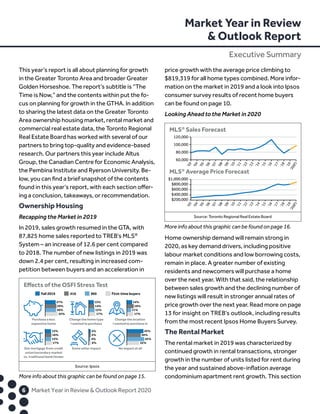
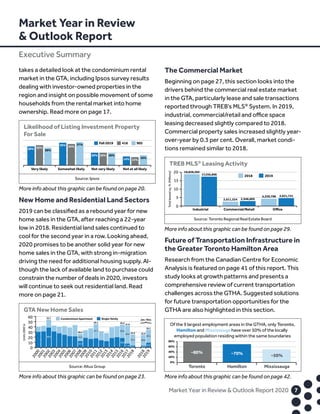
Source: Ipsos
Effects of the OSFI Stress Test
Fall 2019 416 905 First-time buyers
Purchase a less
expensive home
Change the home type
I wanted to purchase
Change the location
I wanted to purchase in
Get mortgage from credit
union/secondary market
vs. traditional bank/lender
Some other impact No impact at all
27%
29%
28%
32%
15%
16%
15%
17%
5%
5%
4%
6%
43%
36%
45%
32%
13%
14%
15%
17%
14%
18%
11%
17%
More info about this graphic can be found on page 15.
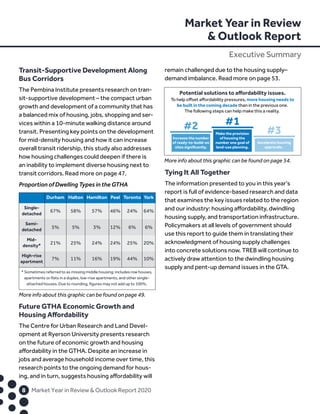
MLS®
Sales Forecast
MLS®
Average Price Forecast
Source: Toronto Regional Real Estate Board
‘03
‘04
‘05
‘06
‘07
‘08
‘09
‘10
‘11
‘12
‘13
‘14
‘15
‘16
‘17
‘18
‘19
‘20(F)
60,000
80,000
100,000
120,000
‘03
‘04
‘05
‘06
‘07
‘08
‘09
‘10
‘11
‘12
‘13
‘14
‘15
‘16
‘17
‘18
‘19
‘20(F)
$200,000
$400,000
$600,000
$800,000
$1,000,000
More info about this graphic can be found on page 16.
Market Year in Review
 Outlook Report
Executive Summary
	 Market Year in Review  Outlook Report 2020	7	
takes a detailed look at the condominium rental
market in the GTA, including Ipsos survey results
dealing with investor-owned properties in the
region and insight on possible movement of some
households from the rental market into home
ownership. Read more on page 17.
New Home and Residential Land Sectors
2019 can be classified as a rebound year for new
home sales in the GTA, after reaching a 22-year
low in 2018. Residential land sales continued to
cool for the second year in a row. Looking ahead,
2020 promises to be another solid year for new
home sales in the GTA, with strong in-migration
driving the need for additional housing supply. Al-
though the lack of available land to purchase could
constrain the number of deals in 2020, investors
will continue to seek out residential land. Read
more on page 21.
The Commercial Market
Beginning on page 27, this section looks into the
drivers behind the commercial real estate market
in the GTA, particularly lease and sale transactions
reported through TREB’s MLS®
System. In 2019,
industrial, commercial/retail and office space
leasing decreased slightly compared to 2018.
Commercial property sales increased slightly year-
over-year by 0.3 per cent. Overall, market condi-
tions remained similar to 2018.
Future of Transportation Infrastructure in
the Greater Toronto Hamilton Area
Research from the Canadian Centre for Economic
Analysis is featured on page 41 of this report. This
study looks at growth patterns and presents a
comprehensive review of current transportation
challenges across the GTHA. Suggested solutions
for future transportation opportunities for the
GTHA are also highlighted in this section.
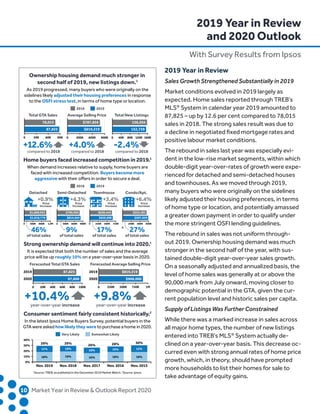
Source: Ipsos
Very likely Somewhat likely Not very likely Not at all likely
Likelihood of Listing Investment Property
For Sale
Fall 2019 416 905
30% 32%
28%
36% 34%
37%
20% 20% 20%
14% 13%
16%
More info about this graphic can be found on page 20.
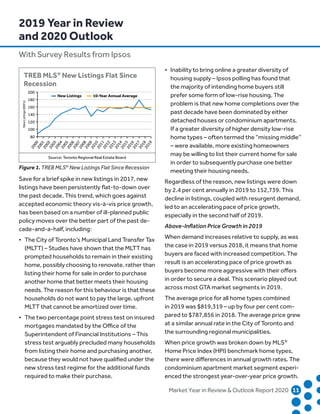
Source: Altus Group
2000200120022003200420052006200720082009201020112012201320142015201620172018
20182019
GTA New Home Sales
Single-familyCondominium Apartment
0
10
20
30
40
50
60
Units(000’s)
38�4
53�7
12�2
14�2
26�4 27�7
45�1
26�4
18�0
44�4
34�4
7�4
41�8
Jan�-Nov�
21�2
24�9
20�4
23�9
25�1
9�0
34�1
{
3�7 3�6
More info about this graphic can be found on page 23.
Source: Toronto Regional Real Estate Board
0
5
10
15
20
Totalleasedsq�ft�(Millions)
2018 2019
Industrial Commercial/Retail Office
18,838,365
17,356,898
2,611,524 2,948,869
4,330,798 4,631,741
TREB MLS®
Leasing Activity
More info about this graphic can be found on page 29.
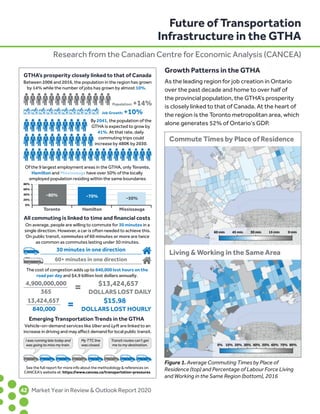
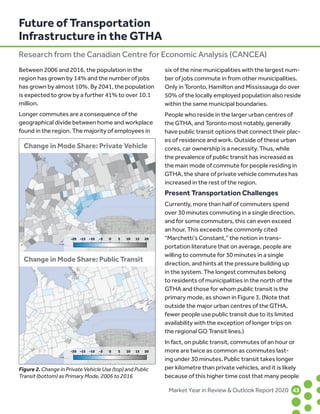
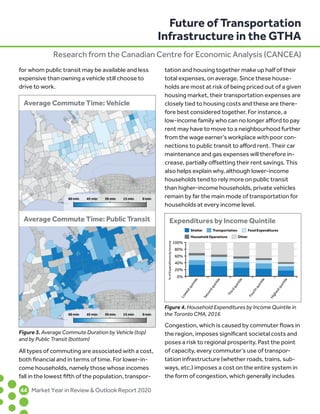
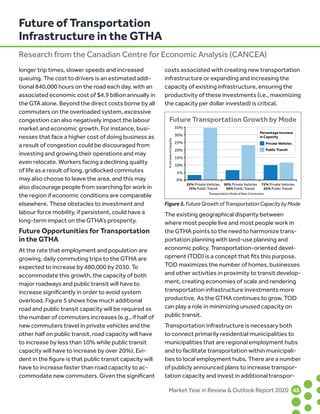
Of the 9 largest employment areas in the GTHA, only Toronto,
Hamilton and Mississauga have over 50% of the locally
employed population residing within the same boundaries
Toronto Hamilton Mississauga
0%
20%
40%
60%
80%
~80% ~70% ~50%
More info about this graphic can be found on page 42.
Market Year in Review
 Outlook Report
Executive Summary
	8	 Market Year in Review  Outlook Report 2020
Transit-Supportive Development Along
Bus Corridors
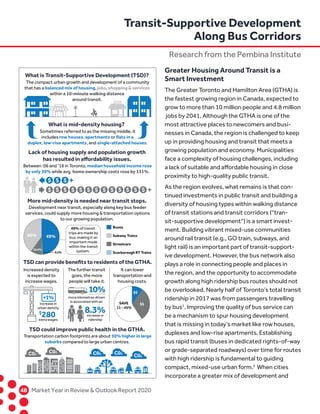
The Pembina Institute presents research on tran-
sit-supportive development – the compact urban
growth and development of a community that has
a balanced mix of housing, jobs, shopping and ser-
vices within a 10-minute walking distance around
transit. Presenting key points on the development
for mid-density housing and how it can increase
overall transit ridership, this study also addresses
how housing challenges could deepen if there is
an inability to implement diverse housing next to
transit corridors. Read more on page 47.
Future GTHA Economic Growth and
Housing Affordability
The Centre for Urban Research and Land Devel-
opment at Ryerson University presents research
on the future of economic growth and housing
affordability in the GTHA. Despite an increase in
jobs and average household income over time, this
research points to the ongoing demand for hous-
ing, and in turn, suggests housing affordability will
remain challenged due to the housing supply–
demand imbalance. Read more on page 53.
Tying It All Together
The information presented to you in this year’s
report is full of evidence-based research and data
that examines the key issues related to the region
and our industry: housing affordability, dwindling
housing supply, and transportation infrastructure.
Policymakers at all levels of government should
use this report to guide them in translating their
acknowledgment of housing supply challenges
into concrete solutions now. TREB will continue to
actively draw attention to the dwindling housing
supply and pent-up demand issues in the GTA.
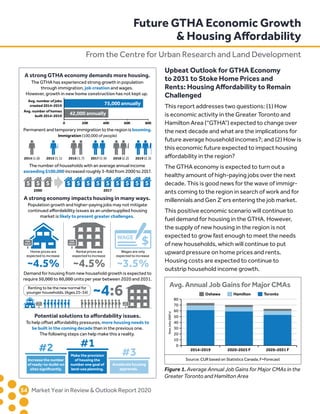
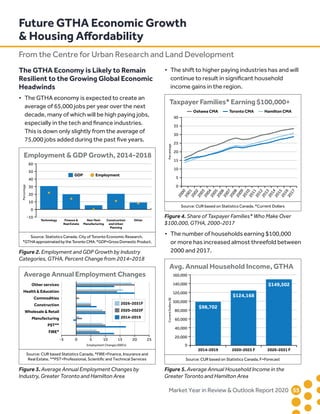
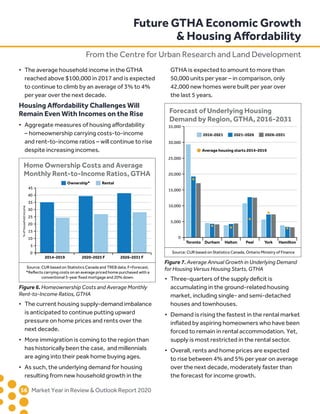
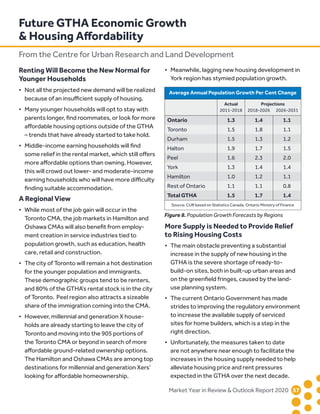
To help offset affordability pressures, more housing needs to
be built in the coming decade than in the previous one.
The following steps can help make this a reality.
Potential solutions to affordability issues.
Make the provision
of housing the
number one goal of
land-use planning.
#1
Increase the number
of ready-to-build-on
sites significantly.
#2 #3
Accelerate housing
approvals.
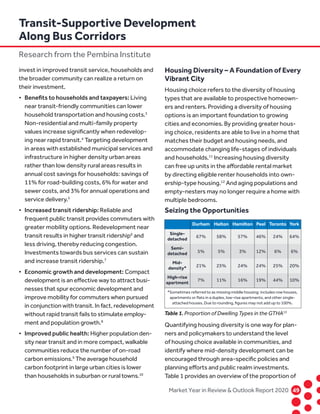
* Sometimes referred to as missing middle housing: includes row houses,
apartments or flats in a duplex, low-rise apartments, and other single-
attached houses. Due to rounding, figures may not add up to 100%.
Single-
detached
Semi-
detached
Mid-
density*
High-rise
apartment
	 Durham	 Halton	Hamilton	Peel	Toronto	York
	 67%	 58%	 57%	 46%	 24%	 64%
	 5%	 5%	 3%	 12%	 6%	 6%
	 21%	 25%	 24%	 24%	 25%	 20%
	 7%	 11%	 16%	 19%	 44%	 10%
More info about this graphic can be found on page 49.
More info about this graphic can be found on page 54.
Proportion of Dwelling Types in the GTHA
10	 2019 Year in Review
	13	 2020 Market Outlook
2019 Year in Review
and 2020 Outlook
With Survey Results from Ipsos
10	 Market Year in Review  Outlook Report 2020
2019 Year in Review
Sales Growth Strengthened Substantially in 2019
Market conditions evolved in 2019 largely as
expected. Home sales reported through TREB’s
MLS®
System in calendar year 2019 amounted to
87,825 – up by 12.6 per cent compared to 78,015
sales in 2018. The strong sales result was due to
a decline in negotiated fixed mortgage rates and

positive labour market conditions.
The rebound in sales last year was especially evi-
dent in the low-rise market segments, within which
double-digit year-over-rates of growth were expe-
rienced for detached and semi-detached houses
and townhouses. As we moved through 2019,
many buyers who were originally on the sidelines
likely adjusted their housing preferences, in terms
of home type or location, and potentially amassed
a greater down payment in order to qualify under
the more stringent OSFI lending guidelines.
The rebound in sales was not uniform through-
out 2019. Ownership housing demand was much
stronger in the second half of the year, with sus-
tained double-digit year-over-year sales growth.
On a seasonally adjusted and annualized basis, the
level of home sales was generally at or above the
90,000 mark from July onward, moving closer to
demographic potential in the GTA, given the cur-
rent population level and historic sales per capita.
Supply of Listings Was Further Constrained
While there was a marked increase in sales across
all major home types, the number of new listings
entered into TREB’s MLS®
System actually de-
clined on a year-over-year basis. This decrease oc-
curred even with strong annual rates of home price
growth, which, in theory, should have prompted
more households to list their homes for sale to
take advantage of equity gains.
Ownership housing demand much stronger in
second half of 2019, new listings down.1
As 2019 progressed, many buyers who were originally on the
sidelines likely adjusted their housing preferences in response
to the OSFI stress test, in terms of home type or location.
Home buyers faced increased competition in 2019.1
When demand increases relative to supply, home buyers are
faced with increased competition. Buyers become more
aggressive with their offers in order to secure a deal.
Strong ownership demand will continue into 2020.1
It is expected that both the number of sales and the average
price will be up roughly 10% on a year-over-year basis in 2020.
Consumer sentiment fairly consistent historically.2
In the latest Ipsos Home Buyers Survey, potential buyers in the
GTA were asked how likely they were to purchase a home in 2020.
1
Source: TREB, as published in the December 2019 Market Watch. 2
Source: Ipsos.
Total GTA Sales Average Selling Price Total New Listings
compared to 2018
+12.6%
compared to 2018
+4.0%
compared to 2018
-2.4%
2019
2019
2018
0 30K 60K 90K
78,015
87,825
0 300K 600K 900K
$787,856
$819,319
0 40K 80K 120K 160K
156,504
152,739
+0.9%
Price
Increase
+4.3%
Price
Increase
46%
of total sales
Detached Semi-Detached Townhouse Condo/Apt.
0 400K 800K 1.2M
$1,008,052
$1,016,776
9%
of total sales
0 300K 600K 900K
$780,904
$814,424
+3.4%
Price
Increase
17%
of total sales
0 250K 500K 750K
$638,445
$659,990
+6.4%
Price
Increase
27%
of total sales
0
200K 400K 600K
$552,401
$587,959
2018
Somewhat LikelyVery Likely
Forecasted Total GTA Sales
year-over-year increase
2019
2020
+10.4%
0 20K 40K 60K 80K 100K
87,825
97,000
Forecasted Average Selling Price
year-over-year increase
+9.8%
2019
2020
0 250K 500K 750K 1M
$819,319
$900,000
0%
10%
20%
30%
40%
Nov. 2019
18%
11%
19%
10%
16%
10%
18%
10%
18%
29% 29% 26% 28% 30%
12%
Nov. 2018 Nov. 2017 Nov. 2016 Nov. 2015
2019 Year in Review
and 2020 Outlook
With Survey Results from Ipsos
Market Year in Review  Outlook Report 2020	11	
Save for a brief spike in new listings in 2017, new
listings have been persistently flat-to-down over
the past decade. This trend, which goes against
accepted economic theory vis-à-vis price growth,
has been based on a number of ill-planned public
policy moves over the better part of the past de-
cade-and-a-half, including:
•	 The City of Toronto’s Municipal Land Transfer Tax
	 (MLTT) – Studies have shown that the MLTT has
	 prompted households to remain in their existing
	 home, possibly choosing to renovate, rather than
	 listing their home for sale in order to purchase
	 another home that better meets their housing
	 needs. The reason for this behaviour is that these
	 households do not want to pay the large, upfront
	 MLTT that cannot be amortized over time.
•	 The two percentage point stress test on insured
	 mortgages mandated by the Office of the
	 Superintendent of Financial Institutions – This
	 stress test arguably precluded many households
	 from listing their home and purchasing another,
	 because they would not have qualified under the
	 new stress test regime for the additional funds
	 required to make their purchase.
•	 Inability to bring online a greater diversity of
	 housing supply – Ipsos polling has found that
	 the majority of intending home buyers still
	 prefer some form of low-rise housing. The
	 problem is that new home completions over the
	 past decade have been dominated by either
	 detached houses or condominium apartments.
	 If a greater diversity of higher density low-rise
	 home types – often termed the “missing middle”
	 – were available, more existing homeowners
	 may be willing to list their current home for sale
	 in order to subsequently purchase one better
	 meeting their housing needs.
Regardless of the reason, new listings were down

by 2.4 per cent annually in 2019 to 152,739. This
decline in listings, coupled with resurgent demand,
led to an accelerating pace of price growth,
especially in the second half of 2019.
Above-Inflation Price Growth in 2019
When demand increases relative to supply, as was
the case in 2019 versus 2018, it means that home
buyers are faced with increased competition. The
result is an accelerating pace of price growth as
buyers become more aggressive with their offers
in order to secure a deal. This scenario played out
across most GTA market segments in 2019.
The average price for all home types combined
in 2019 was $819,319 – up by four per cent com-
pared to $787,856 in 2018. The average price grew
at a similar annual rate in the City of Toronto and
the surrounding regional municipalities.
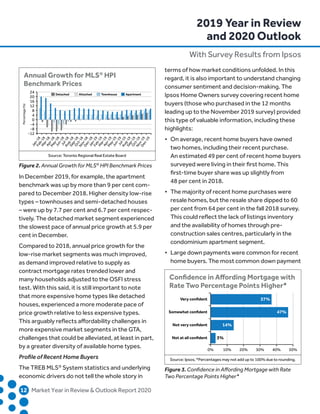
When price growth was broken down by MLS®
Home Price Index (HPI) benchmark home types,
there were differences in annual growth rates. The
condominium apartment market segment experi-
enced the strongest year-over-year price growth.
Source: Toronto Regional Real Estate Board
TREB MLS®
New Listings Flat Since
Recession
NewListings(000’s)
80
100
120
140
160
180
200
New Listings 10-Year Annual Average
20002001200220032004200520062007200820092010201120122013201420152016201720182019
Figure 1. TREB MLS®
New Listings Flat Since Recession
2019 Year in Review
and 2020 Outlook
With Survey Results from Ipsos
In December 2019, for example, the apartment
benchmark was up by more than 9 per cent com-
pared to December 2018. Higher density low-rise
types – townhouses and semi-detached houses
– were up by 7.7 per cent and 6.7 per cent respec-
tively. The detached market segment experienced
the slowest pace of annual price growth at 5.9 per
cent in December.
Compared to 2018, annual price growth for the
low-rise market segments was much improved,
as demand improved relative to supply as
contract mortgage rates trended lower and
many households adjusted to the OSFI stress
test. With this said, it is still important to note
that more expensive home types like detached
houses, experienced a more moderate pace of
price growth relative to less expensive types.
This arguably reflects affordability challenges in
more expensive market segments in the GTA,
challenges that could be alleviated, at least in part,
by a greater diversity of available home types.
Profile of Recent Home Buyers
The TREB MLS®
System statistics and underlying
economic drivers do not tell the whole story in
terms of how market conditions unfolded. In this
regard, it is also important to understand changing
consumer sentiment and decision-making. The
Ipsos Home Owners survey covering recent home
buyers (those who purchased in the 12 months
leading up to the November 2019 survey) provided
this type of valuable information, including these
highlights:
•	 On average, recent home buyers have owned
	 two homes, including their recent purchase.
	 An estimated 49 per cent of recent home buyers
	 surveyed were living in their first home. This
	 first-time buyer share was up slightly from
	 48 per cent in 2018.
•	 The majority of recent home purchases were
	 resale homes, but the resale share dipped to 60
	 per cent from 64 per cent in the fall 2018 survey.
	 This could reflect the lack of listings inventory
	 and the availability of homes through pre-
	 construction sales centres, particularly in the
	 condominium apartment segment.
•	 Large down payments were common for recent
	 home buyers. The most common down payment
	12	 Market Year in Review  Outlook Report 2020
2019 Year in Review
and 2020 Outlook
With Survey Results from Ipsos
Source: Toronto Regional Real Estate Board
Annual Growth for MLS®
HPI
Benchmark Prices
Percentage(%)
Jan-18Feb-18Mar-18Apr-18May-18Jun-18Jul-18Aug-18Sep-18Oct-18Nov-18Dec-18Jan-19Feb-19Mar-19Apr-19May-19Jun-19Jul-19Aug-19Sep-19Oct-19Nov-19Dec-19
-12
-8
-4
0
4
8
12
16
20
24 Detached Townhouse ApartmentAttached
Source: Ipsos. *Percentages may not add up to 100% due to rounding.
Confidence in Affording Mortgage with
Rate Two Percentage Points Higher*
Somewhat confident
Very confident
Not at all confident
Not very confident
0% 10% 20% 30% 40% 50%
47%
37%
3%
14%
Figure 2. Annual Growth for MLS®
HPI Benchmark Prices
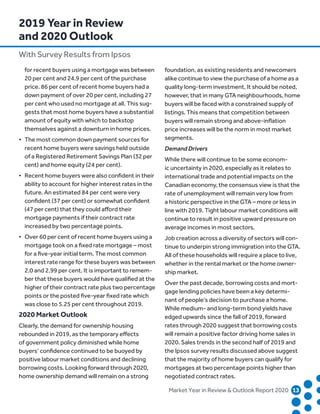
Figure 3. Confidence in Affording Mortgage with Rate
Two Percentage Points Higher*
Market Year in Review  Outlook Report 2020	13	
	 for recent buyers using a mortgage was between
	 20 per cent and 24.9 per cent of the purchase
	 price. 86 per cent of recent home buyers had a
	 down payment of over 20 per cent, including 27
	 per cent who used no mortgage at all. This sug-
	 gests that most home buyers have a substantial
	 amount of equity with which to backstop
	 themselves against a downturn in home prices.
•	 The most common down payment sources for
	 recent home buyers were savings held outside
	 of a Registered Retirement Savings Plan (32 per
	 cent) and home equity (24 per cent).
•	 Recent home buyers were also confident in their
	 ability to account for higher interest rates in the
	 future. An estimated 84 per cent were very
	 confident (37 per cent) or somewhat confident
	 (47 per cent) that they could afford their
	 mortgage payments if their contract rate
	 increased by two percentage points.
•	 Over 60 per cent of recent home buyers using a
	 mortgage took on a fixed rate mortgage – most
	 for a five-year initial term. The most common
	 interest rate range for these buyers was between
	 2.0 and 2.99 per cent. It is important to remem-
	 ber that these buyers would have qualified at the
	 higher of their contract rate plus two percentage
	 points or the posted five-year fixed rate which
	 was close to 5.25 per cent throughout 2019.
2020 Market Outlook
Clearly, the demand for ownership housing
rebounded in 2019, as the temporary effects
of government policy diminished while home
buyers’ confidence continued to be buoyed by
positive labour market conditions and declining
borrowing costs. Looking forward through 2020,
home ownership demand will remain on a strong
foundation, as existing residents and newcomers
alike continue to view the purchase of a home as a
quality long-term investment. It should be noted,
however, that in many GTA neighbourhoods, home
buyers will be faced with a constrained supply of
listings. This means that competition between
buyers will remain strong and above-inflation
price increases will be the norm in most market
segments.
Demand Drivers
While there will continue to be some econom-
ic uncertainty in 2020, especially as it relates to
international trade and potential impacts on the
Canadian economy, the consensus view is that the
rate of unemployment will remain very low from
a historic perspective in the GTA – more or less in
line with 2019. Tight labour market conditions will
continue to result in positive upward pressure on
average incomes in most sectors.
Job creation across a diversity of sectors will con-
tinue to underpin strong immigration into the GTA.
All of these households will require a place to live,
whether in the rental market or the home owner-
ship market.
Over the past decade, borrowing costs and mort-
gage lending policies have been a key determi-
nant of people’s decision to purchase a home.
While medium- and long-term bond yields have
edged upwards since the fall of 2019, forward
rates through 2020 suggest that borrowing costs
will remain a positive factor driving home sales in
2020. Sales trends in the second half of 2019 and
the Ipsos survey results discussed above suggest
that the majority of home buyers can qualify for
mortgages at two percentage points higher than
negotiated contract rates.
2019 Year in Review
and 2020 Outlook
With Survey Results from Ipsos
Ipsos Home Buyers Survey Summary Points
Against the backdrop of the generally positive
demand drivers discussed above, it is also
important to consider the direction of consumer
sentiment, as captured in the results of the latest
Ipsos Home Buyers Survey undertaken for TREB in
November 2019:
•	 For the GTA as a whole, 11 per cent of those
	 surveyed indicated that they were very likely to
	 purchase a home over the next year – up slightly
	 from 10 per cent in November 2018. The share
	 of likely home buyers – very likely and somewhat
	 likely (18 per cent) – remained the same as the
	 fall 2018 result at 29 per cent.
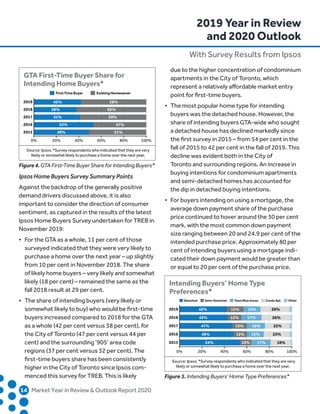
•	 The share of intending buyers (very likely or
	 somewhat likely to buy) who would be first-time
	 buyers increased compared to 2018 for the GTA
	 as a whole (42 per cent versus 38 per cent), for
	 the City of Toronto (47 per cent versus 44 per
	 cent) and the surrounding ‘905’ area code
	 regions (37 per cent versus 32 per cent). The
	 first-time buyers share has been consistently
	 higher in the City of Toronto since Ipsos com-
	 menced this survey for TREB. This is likely
	 due to the higher concentration of condominium
	 apartments in the City of Toronto, which
	 represent a relatively affordable market entry
	 point for first-time buyers.
•	 The most popular home type for intending
	 buyers was the detached house. However, the
	 share of intending buyers GTA-wide who sought
	 a detached house has declined markedly since
	 the first survey in 2015 – from 54 per cent in the
	 fall of 2015 to 42 per cent in the fall of 2019. This
	 decline was evident both in the City of
	 Toronto and surrounding regions. An increase in
	 buying intentions for condominium apartments
	 and semi-detached homes has accounted for
	 the dip in detached buying intentions.
•	 For buyers intending on using a mortgage, the
	 average down payment share of the purchase
	 price continued to hover around the 30 per cent
	 mark, with the most common down payment
	 size ranging between 20 and 24.9 per cent of the
	 intended purchase price. Approximately 80 per
	 cent of intending buyers using a mortgage indi-
	 cated their down payment would be greater than
	 or equal to 20 per cent of the purchase price.
	14	 Market Year in Review  Outlook Report 2020
2019 Year in Review
and 2020 Outlook
With Survey Results from Ipsos
GTA First-Time Buyer Share for
Intending Home Buyers*
2019
2018
2017
2016
2015
Source: Ipsos. *Survey respondants who indicated that they are very
likely or somewhat likely to purchase a home over the next year.
First-Time Buyer Existing Homeowner
0% 20% 40% 60% 80% 100%
42%
38%
41%
53%
49%
58%
62%
59%
47%
51%
Intending Buyers’ Home Type
Preferences*
2019
2018
2017
2016
2015
Source: Ipsos. *Survey respondants who indicated that they are very
likely or somewhat likely to purchase a home over the next year.
0% 20% 40% 60% 80% 100%
42%
43%
47%
48%
54%
15%
12%
13%
12%
10%
15%
17%
16%
15%
17%
26%
26%
22%
23%
18%
Detached Town/Row house Condo Apt. OtherSemi-Detached
Figure4. GTA First-Time Buyer Share for Intending Buyers*
Figure 5. Intending Buyers’ Home Type Preferences*
Market Year in Review  Outlook Report 2020	15	
•	 For all intending buyers and for first-time
	 buyers, the most common source for down
	 payments was savings held outside of an RRSP.
	 For first-time buyers, the second most common
	 down payment source was savings within an
	 RRSP. For all home buyers combined, the second
	 most common down payment source was equity
	 from a current home.
•	 Intending home buyers who had obtained pre-
	 approval for a mortgage confirmed that nego-
	 tiated mortgage rates had trended lower in 2019
	 from where they stood in the fall of 2018. The
	 most commonly cited pre-approval rate range
	 in the November 2019 survey was 2%–2.99%
	 – down from 3%–3.99% in November 2018.
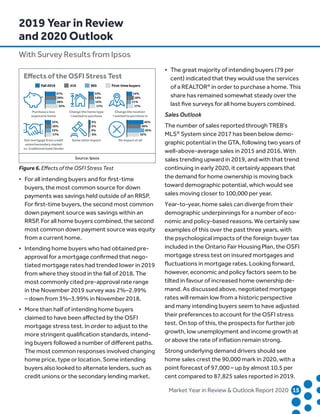
•	 More than half of intending home buyers
	 claimed to have been affected by the OSFI
	 mortgage stress test. In order to adjust to the
	 more stringent qualification standards, intend-
	 ing buyers followed a number of different paths.
	 The most common responses involved changing
	 home price, type or location. Some intending
	 buyers also looked to alternate lenders, such as
	 credit unions or the secondary lending market.
•	 The great majority of intending buyers (79 per
	 cent) indicated that they would use the services
	 of a REALTOR®
in order to purchase a home. This
	 share has remained somewhat steady over the
	 last five surveys for all home buyers combined.
Sales Outlook
The number of sales reported through TREB’s
MLS®
System since 2017 has been below demo-
graphic potential in the GTA, following two years of
well-above-average sales in 2015 and 2016. With
sales trending upward in 2019, and with that trend
continuing in early 2020, it certainly appears that
the demand for home ownership is moving back
toward demographic potential, which would see
sales moving closer to 100,000 per year.
Year-to-year, home sales can diverge from their
demographic underpinnings for a number of eco-
nomic and policy-based reasons. We certainly saw
examples of this over the past three years, with
the psychological impacts of the foreign buyer tax
included in the Ontario Fair Housing Plan, the OSFI
mortgage stress test on insured mortgages and
fluctuations in mortgage rates. Looking forward,
however, economic and policy factors seem to be
tilted in favour of increased home ownership de-
mand. As discussed above, negotiated mortgage
rates will remain low from a historic perspective
and many intending buyers seem to have adjusted
their preferences to account for the OSFI stress
test. On top of this, the prospects for further job
growth, low unemployment and income growth at
or above the rate of inflation remain strong.
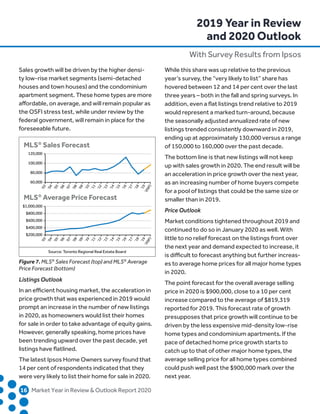
Strong underlying demand drivers should see
home sales crest the 90,000 mark in 2020, with a
point forecast of 97,000 – up by almost 10.5 per
cent compared to 87,825 sales reported in 2019.
2019 Year in Review
and 2020 Outlook
With Survey Results from Ipsos
Source: Ipsos
Effects of the OSFI Stress Test
Fall 2019 416 905 First-time buyers
Purchase a less
expensive home
Change the home type
I wanted to purchase
Change the location
I wanted to purchase in
Get mortgage from credit
union/secondary market
vs. traditional bank/lender
Some other impact No impact at all
27%
29%
28%
32%
15%
16%
15%
17%
5%
5%
4%
6%
43%
36%
45%
32%
13%
14%
15%
17%
14%
18%
11%
17%
Figure 6. Effects of the OSFI Stress Test
Sales growth will be driven by the higher densi-
ty low-rise market segments (semi-detached
houses and town houses) and the condominium
apartment segment. These home types are more
affordable, on average, and will remain popular as
the OSFI stress test, while under review by the
federal government, will remain in place for the
foreseeable future.
Listings Outlook
In an efficient housing market, the acceleration in
price growth that was experienced in 2019 would
prompt an increase in the number of new listings
in 2020, as homeowners would list their homes
for sale in order to take advantage of equity gains.
However, generally speaking, home prices have
been trending upward over the past decade, yet
listings have flatlined.
The latest Ipsos Home Owners survey found that
14 per cent of respondents indicated that they
were very likely to list their home for sale in 2020.
While this share was up relative to the previous
year’s survey, the “very likely to list” share has
hovered between 12 and 14 per cent over the last
three years – both in the fall and spring surveys. In
addition, even a flat listings trend relative to 2019
would represent a marked turn-around, because
the seasonally adjusted annualized rate of new
listings trended consistently downward in 2019,
ending up at approximately 130,000 versus a range
of 150,000 to 160,000 over the past decade.
The bottom line is that new listings will not keep
up with sales growth in 2020. The end result will be
an acceleration in price growth over the next year,
as an increasing number of home buyers compete
for a pool of listings that could be the same size or
smaller than in 2019.
Price Outlook
Market conditions tightened throughout 2019 and
continued to do so in January 2020 as well. With
little to no relief forecast on the listings front over
the next year and demand expected to increase, it
is difficult to forecast anything but further increas-
es to average home prices for all major home types
in 2020.
The point forecast for the overall average selling
price in 2020 is $900,000, close to a 10 per cent
increase compared to the average of $819,319
reported for 2019. This forecast rate of growth
presupposes that price growth will continue to be
driven by the less expensive mid-density low-rise
home types and condominium apartments. If the
pace of detached home price growth starts to
catch up to that of other major home types, the
average selling price for all home types combined
could push well past the $900,000 mark over the
next year.
	16	 Market Year in Review  Outlook Report 2020
2019 Year in Review
and 2020 Outlook
With Survey Results from Ipsos
MLS®
Sales Forecast
MLS®
Average Price Forecast
Source: Toronto Regional Real Estate Board
‘03
‘04
‘05
‘06
‘07
‘08
‘09
‘10
‘11
‘12
‘13
‘14
‘15
‘16
‘17
‘18
‘19
‘20(F)
60,000
80,000
100,000
120,000
‘03
‘04
‘05
‘06
‘07
‘08
‘09
‘10
‘11
‘12
‘13
‘14
‘15
‘16
‘17
‘18
‘19
‘20(F)
$200,000
$400,000
$600,000
$800,000
$1,000,000
Figure 7. MLS®
Sales Forecast (top) and MLS®
Average
Price Forecast (bottom)
18	Summary
	18	 Rental Demand
		 Increased in 2019
	19	 Strong Listings Growth
		 Helped Moderate Rent
		Growth
	20	 Rental Market Moving
		Forward
Rental Market
Review and Outlook
With Survey Results from Ipsos
18	 Market Year in Review  Outlook Report 2020
Summary
The Greater Toronto Area (GTA) condominium
apartment rental market was characterized by low
vacancies and strong average rent growth in 2019.
One difference, however, was the fact that people
searching for rental accommodation did benefit
from slightly more choice, as the number of
rental units listed at some point during 2019 did
increase. With a moderate uptick in supply,
average rent growth was not as brisk as 2017 and
2018, but still well above the rate of inflation.
Rental Demand Increased in 2019
The GTA has experienced no shortage of demand
for rental units over the past decade. There are two
intertwined factors that have been driving rental
demand: job creation and population growth.
Strong year-over-year job growth has been the
norm over the past ten years, as has been a steady
downward trend in the unemployment rate.
New jobs have been created across a number of
different sectors, which has attracted newcomers
to the GTA. On top of this, young people finishing
their education have also sought to take advan-
tage of job opportunities in the region.
Both young people and recent immigrants often
start their search for housing in the rental market.
Generally speaking, renting is more affordable than
home ownership and provides a greater degree of
flexibility to move vis-à-vis home ownership.
Reflecting the demand factors discussed above,
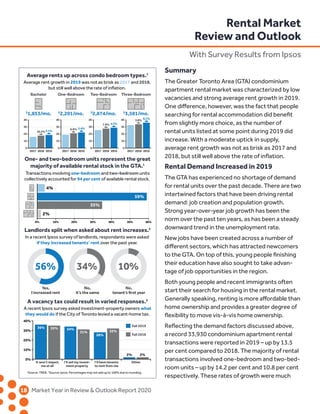
a record 33,930 condominium apartment rental
transactions were reported in 2019 – up by 13.5
per cent compared to 2018. The majority of rental
transactions involved one-bedroom and two-bed-
room units – up by 14.2 per cent and 10.8 per cent
respectively. These rates of growth were much
Average rents up across condo bedroom types.1
Average rent growth in 2019 was not as brisk as 2017 and 2018,
but still well above the rate of inflation.
One- and two-bedroom units represent the great
majority of available rental stock in the GTA.1
Transactions involving one-bedroom and two-bedroom units
collectively accounted for 94 per cent of available rental stock.
Landlords split when asked about rent increases.2
In a recent Ipsos survey of landlords, respondants were asked
if they increased tenants’ rent over the past year.
A vacancy tax could result in varied responses.2
A recent Ipsos survey asked investment-property owners what
they would do if the City of Toronto levied a vacant-home tax.
Bachelor One-Bedroom Two-Bedroom Three-Bedroom
2017
Yes,
I increased rent
It won’t impact
me at all
I’ll sell my invest-
ment property
I’ll have tenants
to rent from me
Other
2018 2019
$
1,853/mo.
10.2%
$
2,201/mo. $
2,874/mo. $
3,581/mo.
0
1K
2K
3K
4K
5.1%
2017 2018 2019
9.9%
0
1K
2K
3K
4K
5.4%
2017 2018 2019
7.9%
0
1K
2K
3K
4K
4.5%
2017 2018 2019
3.8%
0
1K
2K
3K
4K 6.1%
0% 10% 20% 30% 40% 50% 60%
59%
35%
2%
4%
1
Source: TREB. 2
Source: Ipsos. Percentages may not add up to 100% due to rounding.
56%
No,
it’s the same
34%
No,
tenant’s first year
10%
0%
10%
20%
30%
40%
Fall 2019
Fall 2018
36% 35% 34%
31%
28%
32%
2%2%
Rental Market
Review and Outlook
With Survey Results from Ipsos
Market Year in Review  Outlook Report 2020	19	
stronger than those reported in previous years.
For example, the number of condominium apart-
ment rental transactions was basically flat in 2018
relative to 2017.
Strong Listings Growth Helped Moderate
Rent Growth
The great majority of rental stock added in the GTA
over the past decade has been brought online by
investor-owners of condominium apartments. Ap-
proximately 25 per cent of survey respondents to
the most recent Ipsos survey of homeowners indi-
cated that they owned a property that was rented
out or was currently available for rent. This section
considers this segment of rental market supply.
While year-over-year rental transaction growth
was strong through 2019, growth in the number of
units listed at some point during 2019 was much
stronger. The number of one-bedroom and two-
bedroom condominium apartments listed for rent
at some point during 2019 was up by 27.5 per cent
and 20.2 per cent respectively compared to 2018.
With the number of condominium apartments
listed for rent growing at a faster pace than rental
transactions, many renters appear to have benefit-
ted from a better supplied market, with the annual
pace of rent growth moderating compared to 2017
and 2018, albeit still above the rate of inflation.
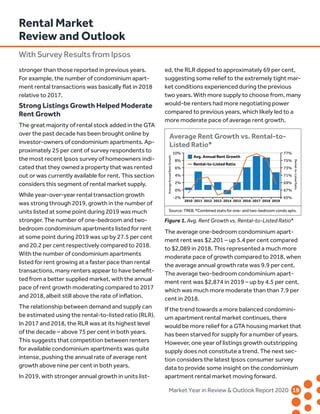
The relationship between demand and supply can
be estimated using the rental-to-listed ratio (RLR).
In 2017 and 2018, the RLR was at its highest level
of the decade – above 75 per cent in both years.
This suggests that competition between renters
for available condominium apartments was quite
intense, pushing the annual rate of average rent
growth above nine per cent in both years.
In 2019, with stronger annual growth in units list-
ed, the RLR dipped to approximately 69 per cent,
suggesting some relief to the extremely tight mar-
ket conditions experienced during the previous
two years. With more supply to choose from, many
would-be renters had more negotiating power
compared to previous years, which likely led to a
more moderate pace of average rent growth.
The average one-bedroom condominium apart-
ment rent was $2,201 – up 5.4 per cent compared
to $2,089 in 2018. This represented a much more
moderate pace of growth compared to 2018, when
the average annual growth rate was 9.9 per cent.
The average two-bedroom condominium apart-
ment rent was $2,874 in 2019 – up by 4.5 per cent,
which was much more moderate than than 7.9 per
cent in 2018.
If the trend towards a more balanced condomini-
um apartment rental market continues, there
would be more relief for a GTA housing market that
has been starved for supply for a number of years.
However, one year of listings growth outstripping
supply does not constitute a trend. The next sec-
tion considers the latest Ipsos consumer survey
data to provide some insight on the condominium
apartment rental market moving forward.
Rental Market
Review and Outlook
With Survey Results from Ipsos
Source: TREB. *Combined stats for one- and two-bedroom condo apts.
2010 2011 2012 2013 2014 2015 2016 2017 2018 2019
Average Rent Growth vs. Rental-to-
Listed Ratio*
AverageAnnualRentGrowth
Rental-to-ListedRatio
-2%
0%
2%
4%
6%
8%
10%
Avg. Annual Rent Growth
Rental-to-Listed Ratio
65%
67%
69%
71%
73%
75%
77%
Figure 1. Avg. Rent Growth vs. Rental-to-Listed Ratio*
Rental Market Moving Forward
The most recent Ipsos survey of potential home
buyers over the next year suggests that approxi-
mately one-third of current GTA renters are al-
ready seriously considering moving from rental to
home ownership over the next year. An additional
23 per cent of renter households say they would
seriously consider a move to home ownership if
they face further rent increases. Supporting these
findings is another Ipsos-based statistic that sug-
gests first-time buying activity will be edging up in
2020. These polling results point to a significant
amount of churn in the rental market over the next
year. While people moving from rental accommo-
dation into home ownership would free up space
for other renters, this churn will not on its own
result in any net new additions to the rental stock.
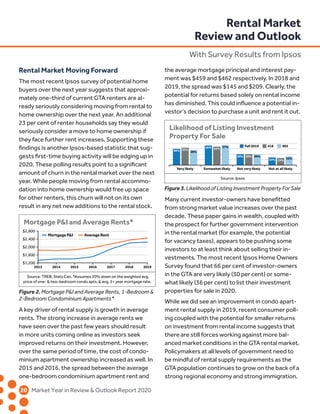
A key driver of rental supply is growth in average
rents. The strong increase in average rents we
have seen over the past few years should result
in more units coming online as investors seek
improved returns on their investment. However,
over the same period of time, the cost of condo-
minium apartment ownership increased as well. In
2015 and 2016, the spread between the average
one-bedroom condominium apartment rent and
the average mortgage principal and interest pay-
ment was $459 and $462 respectively. In 2018 and
2019, the spread was $145 and $209. Clearly, the
potential for returns based solely on rental income
has diminished. This could influence a potential in-
vestor’s decision to purchase a unit and rent it out.
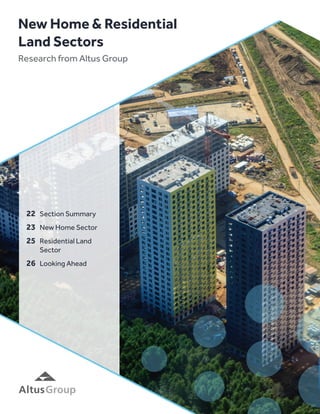
Many current investor-owners have benefitted
from strong market value increases over the past
decade. These paper gains in wealth, coupled with
the prospect for further government intervention
in the rental market (for example, the potential
for vacancy taxes), appears to be pushing some
investors to at least think about selling their in-
vestments. The most recent Ipsos Home Owners
Survey found that 66 per cent of investor-owners
in the GTA are very likely (30 per cent) or some-
what likely (36 per cent) to list their investment
properties for sale in 2020.
While we did see an improvement in condo apart-
ment rental supply in 2019, recent consumer poll-
ing coupled with the potential for smaller returns
on investment from rental income suggests that
there are still forces working against more bal-
anced market conditions in the GTA rental market.
Policymakers at all levels of government need to
be mindful of rental supply requirements as the
GTA population continues to grow on the back of a
strong regional economy and strong immigration.
Source: TREB; Stats Can. *Assumes 20% down on the weighted avg.
price of one-  two-bedroom condo apts.  avg. 5+ year mortgage rate.
Mortgage PI and Average Rents*
2013 2014 2015
$1,200
$1,600
$2,000
$2,400
$2,800
2016 2017 2018 2019
Mortgage PI Average Rent
Figure 2. Mortgage PI and Average Rents, 1-Bedroom 
2-Bedroom Condominium Apartments*
	20	 Market Year in Review  Outlook Report 2020
Source: Ipsos
Very likely Somewhat likely Not very likely Not at all likely
Likelihood of Listing Investment
Property For Sale
Fall 2019 416 905
30% 32%
28%
36% 34%
37%
20% 20% 20%
14% 13%
16%
Figure3. Likelihood of Listing Investment Property For Sale
Rental Market
Review and Outlook
With Survey Results from Ipsos
22	 Section Summary
	23	 New Home Sector
	25	 Residential Land
		Sector
	26	 Looking Ahead
New Home  Residential
Land Sectors
Research from Altus Group
22	 Market Year in Review  Outlook Report 2020
Section Summary
•	 2019 was a rebound year for total new home sales
	 in the GTA, after reaching a 22-year low in 2018.
•	 Single-family new home sales more than
	 doubled in 2019 but remain low in historical
	 terms, while new condominium apartment sales
	 also showed improvement.
•	 Average asking prices for new condominium
	 apartments continued to set new records, while
	 average asking prices for new single-family
	 home prices dipped further.
•	 Higher new condo apartment completions over
	 the next two years will help to relieve some of
	 the current undersupply in the GTA rental and
	 resale condominium apartment markets.
•	 Residential land sales in the GTA continued to
	 cool in 2019, the second year of decline after
	 record sales in 2017.
•	 The 2019 decrease in total residential land
	 sales was entirely due to a plummet in sales of
	 low density land; sales of high density
	 residential land outpaced 2018, and medium
	 density land sales held constant.
•	 Residential land sales rebounded in the City of
	 Toronto, but not enough to offset declines in the
	 other GTA Regions.
•	 2020 promises to be another solid year for new
	 home sales in the GTA, although uncertainty
	 with respect to the global economy and
	 geopolitical risk could cut short the recovery.
•	 While investors are expected to remain
	 interested in acquiring residential land in 2020,
	 lack of product available to purchase, in
	 particular for low density land, may continue
	 to constrain actual sales.
Total new home sales up through November 2019
Single-family and condo apartment sales combined increased
by 42% from the same period in 2018.
Newly-built single-family home sales fared better in 2019 than
2018. Sales were 2.5x higher than in 2018.
Level of new condominium apartment inventory
well below long-term average.
Residential land sales are measured by density.
Residential land sales cool for second year in a row.
LOW DENSITY LAND
Primarily for detached and semi-detached homes
MEDIUM DENSITY LAND
Primarily for future townhouse-oriented developments
HIGH DENSITY LAND
Primarily for condominium and purpose-built rental
apartment development
Jan.-Nov.
2018
Jan.-Nov.
2019
2018
Q3 YTD
2019
Q3 YTD
Total: 24,000
Total: 34,100
6.7 Months
The available inventory in late 2019 represented less than
7 months of supply at the pace of sales in the previous year.
Dollar volume of residential land sales in the GTA decreased
by 8% in the first three quarters of 2019.
37% of all residential land deals in the first three quarters of
2019 were smaller deals in the $1 million to $3 million range.
Long-term average: 10.5 Months
Low
Med.
High
2018
2019
$1B $0.6B
$0.4B $0.6B
$2.1B
$2.3B
37%
New Home  Residential
Land Sectors
Research from Altus Group
Market Year in Review  Outlook Report 2020	23	
New Home Sector
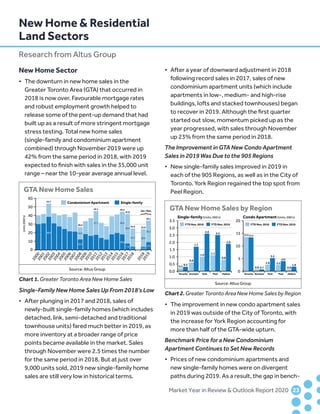
•	 The downturn in new home sales in the
	 Greater Toronto Area (GTA) that occurred in
	 2018 is now over. Favourable mortgage rates
	 and robust employment growth helped to
	 release some of the pent-up demand that had
	 built up as a result of more stringent mortgage
	 stress testing. Total new home sales
	 (single-family and condominium apartment
	 combined) through November 2019 were up
	 42% from the same period in 2018, with 2019
	 expected to finish with sales in the 35,000 unit
	 range – near the 10-year average annual level.
Single-Family New Home Sales Up From 2018’s Low
•	 After plunging in 2017 and 2018, sales of
	 newly-built single-family homes (which includes
	 detached, link, semi-detached and traditional
	 townhouse units) fared much better in 2019, as
	 more inventory at a broader range of price
	 points became available in the market. Sales
	 through November were 2.5 times the number
	 for the same period in 2018. But at just over
	 9,000 units sold, 2019 new single-family home
	 sales are still very low in historical terms.
•	 After a year of downward adjustment in 2018
	 following record sales in 2017, sales of new
	 condominium apartment units (which include
	 apartments in low-, medium- and high-rise
	 buildings, lofts and stacked townhouses) began
	 to recover in 2019. Although the first quarter
	 started out slow, momentum picked up as the
	 year progressed, with sales through November
	 up 23% from the same period in 2018.
The Improvement in GTA New Condo Apartment
Sales in 2019 Was Due to the 905 Regions
•	 New single-family sales improved in 2019 in
	 each of the 905 Regions, as well as in the City of
	 Toronto. York Region regained the top spot from
	 Peel Region.
•	 The improvement in new condo apartment sales
	 in 2019 was outside of the City of Toronto, with
	 the increase for York Region accounting for
	 more than half of the GTA-wide upturn.
Benchmark Price for a New Condominium
Apartment Continues to Set New Records
•	 Prices of new condominium apartments and
	 new single-family homes were on divergent
	 paths during 2019. As a result, the gap in bench-
New Home  Residential
Land Sectors
Research from Altus Group
Source: Altus Group
2000200120022003200420052006200720082009201020112012201320142015201620172018
20182019
GTA New Home Sales
Single-familyCondominium Apartment
0
10
20
30
40
50
60
Units(000’s)
38.4
53.7
12.2
14.2
26.4
27.7
45.1
26.4
18.0
44.4
34.4
7.4
41.8 Jan.-Nov.
21.2
3.7
24.9
20.4
3.6
23.9
25.1
9.0
34.1
{
Chart 1. Greater Toronto Area New Home Sales
Source: Altus Group
GTA New Home Sales by Region
YTD Nov. 2018
Single-family(Units, 000’s)
YTD Nov. 2019
0.0
0.5
1.0
1.5
2.0
2.5
3.0
3.5
Toronto Durham York Peel Halton
0.2
0.3
0.6
1.7
1.0
2.6
1.1
2.5
0.8
1.9
YTD Nov. 2018
Condo Apartment(Units, 000’s)
YTD Nov. 2019
0
5
10
15
20
Toronto Durham York Peel Halton
13.613.4
0.8 0.7
2.6
5.2
2.5
4.0
0.8
1.8
Chart 2. Greater Toronto Area New Home Sales by Region
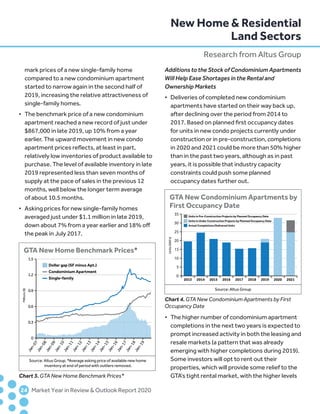
mark prices of a new single-family home
	 compared to a new condominium apartment
	 started to narrow again in the second half of
	 2019, increasing the relative attractiveness of
	 single-family homes.
•	 The benchmark price of a new condominium
	 apartment reached a new record of just under
	 $867,000 in late 2019, up 10% from a year
	 earlier. The upward movement in new condo
	 apartment prices reflects, at least in part,
	 relatively low inventories of product available to
	 purchase. The level of available inventory in late
	 2019 represented less than seven months of
	 supply at the pace of sales in the previous 12
	 months, well below the longer term average
	 of about 10.5 months.
•	 Asking prices for new single-family homes
	 averaged just under $1.1 million in late 2019,
	 down about 7% from a year earlier and 18% off
	 the peak in July 2017.
Additions to the Stock of Condominium Apartments
Will Help Ease Shortages in the Rental and
Ownership Markets
•	 Deliveries of completed new condominium
	 apartments have started on their way back up,
	 after declining over the period from 2014 to
	 2017. Based on planned first occupancy dates
	 for units in new condo projects currently under
	 construction or in pre-construction, completions
	 in 2020 and 2021 could be more than 50% higher
	 than in the past two years, although as in past
	 years, it is possible that industry capacity
	 constraints could push some planned
	 occupancy dates further out.
•	 The higher number of condominium apartment
	 completions in the next two years is expected to
	 prompt increased activity in both the leasing and
	 resale markets (a pattern that was already
	 emerging with higher completions during 2019).
	 Some investors will opt to rent out their
	 properties, which will provide some relief to the
	 GTA’s tight rental market, with the higher levels
	24	 Market Year in Review  Outlook Report 2020
Source: Altus Group
Units in Pre-Construction Projects by Planned Occupancy Date
Units in Under Construction Projects by Planned Occupancy Date
Actual Completions/Delivered Units
2013 2014 2015 2016 2017 2018 2019 2020 2021
GTA New Condominium Apartments by
First Occupancy Date
Units(000’s)
0
5
10
15
20
25
30
35
Chart 4. GTA New Condominium Apartments by First
Occupancy Date
Source: Altus Group. *Average asking price of available new home
inventory at end of period with outliers removed.
Jan-07
Jan-08
Jan-09
Jan-10
Jan-11
Jan-12
Jan-13
Jan-14
Jan-15
Jan-16
Jan-17
Jan-18
Jan-19
GTA New Home Benchmark Prices*
Millions($)
0
0.3
0.6
0.9
1.2
1.5
Dollar gap (SF minus Apt.)
Condominium Apartment
Single-family
Chart 3. GTA New Home Benchmark Prices*
New Home  Residential
Land Sectors
Research from Altus Group
of new supply helping to keep rent increases in
	 check. Similarly, some investors will sell once
	 they take ownership, boosting currently low
	 inventory levels for resale condominiums. Even
	 among buyers who originally intended to occupy
	 their unit themselves, some are expected to
	 list their units for lease or resale, as their
	 circumstances may have changed given the long
	 lead times from purchasing a new pre-
	 construction unit to taking possession.
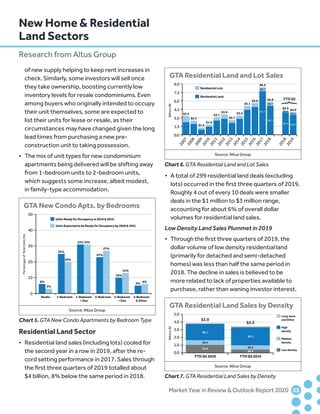
•	 The mix of unit types for new condominium
	 apartments being delivered will be shifting away
	 from 1-bedroom units to 2-bedroom units,
	 which suggests some increase, albeit modest,
	 in family-type accommodation.
Residential Land Sector
•	 Residential land sales (including lots) cooled for
	 the second year in a row in 2019, after the re-
	 cord setting performance in 2017. Sales through
	 the first three quarters of 2019 totalled about
	 $4 billion, 8% below the same period in 2018.
•	 A total of 299 residential land deals (excluding
	 lots) occurred in the first three quarters of 2019.
	 Roughly 4 out of every 10 deals were smaller
	 deals in the $1 million to $3 million range,
	 accounting for about 6% of overall dollar
	 volumes for residential land sales.
Low Density Land Sales Plummet in 2019
•	 Through the first three quarters of 2019, the
	 dollar volume of low density residential land
	 (primarily for detached and semi-detached
	 homes) was less than half the same period in
	 2018. The decline in sales is believed to be
	 more related to lack of properties available to
	 purchase, rather than waning investor interest.
	 Market Year in Review  Outlook Report 2020	25	
Source: Altus Group
GTA Residential Land Sales by Density
Long-term
and Other
High
density
Medium
density
Low density
YTD Q3 2018 YTD Q3 2019
Billions($)
0.0
1.0
2.0
3.0
4.0
5.0
$1.0
$0.6
$2.1
$3.9
$0.4
$0.6
$2.3
$3.5
Chart 7. GTA Residential Land Sales by Density
Source: Altus Group
GTA New Condo Apts. by Bedrooms
0
10
20
30
40
50
Studio
6%
3%
25%
20%
31% 31%
23%
27%
10%
13%
5%
6%
1-Bedroom 1-Bedroom
+ Den
2-Bedroom 2-Bedroom
+ Den
3-Bedroom
 Other
PercentageofTotalUnits(%)
Units Ready for Occupancy in 2018  2019
Units Expected to be Ready for Occupancy by 2020  2021
Source: Altus Group
GTA Residential Land and Lot Sales
Billions($)
0.0
1.5
3.0
4.5
6.0
7.5
9.0
2007
2008
2009
2010
2011
2012
2013
2014
2015
2016
2017
2018
2018
2019
YTD Q3
{
$3.3
$2.5
$1.4
$1.8
$3.1
$3.6
$2.7
$3.4
$5.1
$5.6
$8.4
$0.7
$7.7
$5.8
$0.7
$5.1
$4.3
$0.4
$3.9
$4.0
$0.5
$3.5
Residential Lots
Residential Land
Chart 5. GTA New Condo Apartments by Bedroom Type
Chart 6. GTA Residential Land and Lot Sales
New Home  Residential
Land Sectors
Research from Altus Group
•	 Medium density land (primarily for future
	 townhouse-oriented developments) held
	 steady through the first three quarters of 2019.
	 This segment is being driven by a growing
	 demand for more affordable ground-oriented
	 housing product.
•	 High density residential land (primarily for
	 condominium and purpose-built rental apart-
	 ment development) was the relative bright spot
	 in 2019. With sales up by 11% through the first
	 three quarters, this segment has the potential
	 to match 2017’s record performance.
City of Toronto Accounted for Two-Thirds of Land
Sales Volumes in the GTA
•	 Consistent with the softening in low density land
	 sales, total residential land sales were down in
	 the 905 Regions in 2019.
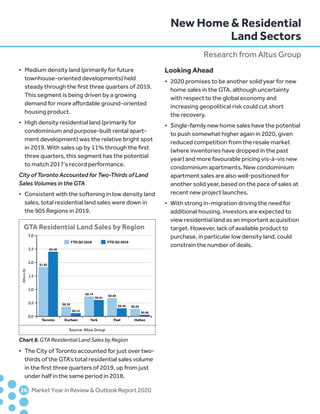
•	 The City of Toronto accounted for just over two-
	 thirds of the GTA’s total residential sales volume
	 in the first three quarters of 2019, up from just
	 under half in the same period in 2018.
Looking Ahead
•	 2020 promises to be another solid year for new
	 home sales in the GTA, although uncertainty
	 with respect to the global economy and
	 increasing geopolitical risk could cut short
	 the recovery.
•	 Single-family new home sales have the potential
	 to push somewhat higher again in 2020, given
	 reduced competition from the resale market
	 (where inventories have dropped in the past
	 year) and more favourable pricing vis-à-vis new
	 condominium apartments. New condominium
	 apartment sales are also well-positioned for
	 another solid year, based on the pace of sales at
	 recent new project launches.
•	 With strong in-migration driving the need for
	 additional housing, investors are expected to
	 view residential land as an important acquisition
	 target. However, lack of available product to
	 purchase, in particular low density land, could
	 constrain the number of deals.
	26	 Market Year in Review  Outlook Report 2020
Source: Altus Group
GTA Residential Land Sales by Region
Toronto Durham York Peel Halton
Billions($)
YTD Q3 2018 YTD Q3 2019
0.0
0.5
1.0
1.5
2.0
2.5
3.0
$1.83
$2.40
$0.36
$0.12
$0.74
$0.61
$0.68
$0.30 $0.28
$0.06
Chart 8. GTA Residential Land Sales by Region
New Home  Residential
Land Sectors
Research from Altus Group
28	 Market Drivers in Brief
	29	 Commercial Leasing
	30	 Commercial Property
		Sales
Commercial
Review  Outlook
The Market in 2019  2020
28	 Market Year in Review  Outlook Report 2020
Market Drivers in Brief
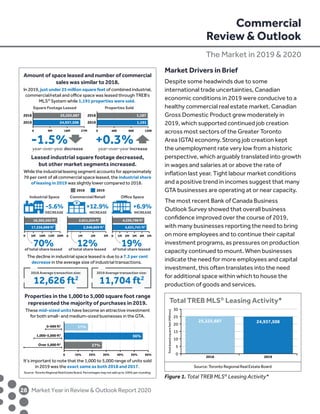
Despite some headwinds due to some
international trade uncertainties, Canadian
economic conditions in 2019 were conducive to a
healthy commercial real estate market. Canadian
Gross Domestic Product grew moderately in
2019, which supported continued job creation
across most sectors of the Greater Toronto
Area (GTA) economy. Strong job creation kept
the unemployment rate very low from a historic
perspective, which arguably translated into growth
in wages and salaries at or above the rate of
inflation last year. Tight labour market conditions
and a positive trend in incomes suggest that many
GTA businesses are operating at or near capacity.
The most recent Bank of Canada Business
Outlook Survey showed that overall business
confidence improved over the course of 2019,
with many businesses reporting the need to bring
on more employees and to continue their capital
investment programs, as pressures on production
capacity continued to mount. When businesses
indicate the need for more employees and capital
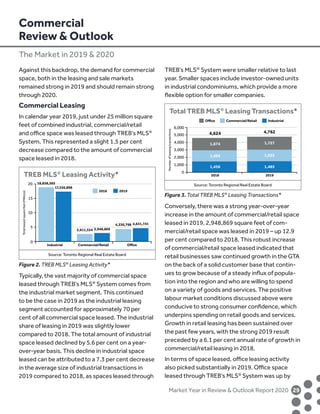
investment, this often translates into the need
for additional space within which to house the
production of goods and services.
Amount of space leased and number of commercial
sales was similar to 2018.
In 2019, just under 25 million square feet of combined industrial,
commercial/retail and office space was leased through TREB’s
MLS®
System while 1,191 properties were sold.
Leased industrial square footage decreased,
but other market segments increased.
While the industrial leasing segment accounts for approximately
70 per cent of all commercial space leased, the industrial share
of leasing in 2019 was slightly lower compared to 2018.
The decline in industrial space leased is due to a 7.3 per cent
decrease in the average size of industrial transactions.
Properties in the 1,000 to 5,000 square foot range
represented the majority of purchases in 2019.
It’s important to note that the 1,000 to 5,000 range of units sold
in 2019 was the exact same as both 2018 and 2017.
Source: Toronto Regional Real Estate Board. Percentages may not add up to 100% per rounding.
Square Footage Leased
year-over-year decrease
0 9M 18M 27M
0 5M 10M 15M 20M
2018
2019
25,325,687
24,937,508
-1.5% year-over-year increase
+0.3%
Properties Sold
0 400 800 1200
2018
2019
1,187
1,191
18,383,365 ft2
17,356,898 ft2
-5.6%
Industrial Space
DECREASE
70%of total share leased
12,626 ft2
2018 Average transaction size:
0 1M 2M 3M 4M 5M
4,330,798 ft2
4,631,741 ft2
+6.9%
Office Space
INCREASE
0 1M 2M 3M
+12.9%
Commercial/Retail
INCREASE
20192018
2,611,524 ft2
2,948,869 ft2
12%of total share leased
19%of total share leased
11,704 ft2
2019 Average transaction size:
0-999 ft2
1,000-5,000 ft2
Over 5,000 ft2
0 10% 20% 30% 40% 50% 60%
17%
56%
27%
These mid-sized units have become an attractive investment
for both small- and medium-sized businesses in the GTA.
Commercial
Review  Outlook
The Market in 2019  2020
Source: Toronto Regional Real Estate Board
Total TREB MLS®
Leasing Activity*
Totalleasedsquarefeet(Millions)
$7.7
$5.1
$3.9 $3.5
2018 2019
0
5
10
15
20
25
30
25,325,687 24,937,508
Figure 1. Total TREB MLS®
Leasing Activity*
Market Year in Review  Outlook Report 2020	29	
Against this backdrop, the demand for commercial
space, both in the leasing and sale markets
remained strong in 2019 and should remain strong
through 2020.
Commercial Leasing
In calendar year 2019, just under 25 million square
feet of combined industrial, commercial/retail
and office space was leased through TREB’s MLS®
System. This represented a slight 1.5 per cent
decrease compared to the amount of commercial
space leased in 2018.
Typically, the vast majority of commercial space
leased through TREB’s MLS®
System comes from
the industrial market segment. This continued
to be the case in 2019 as the industrial leasing
segment accounted for approximately 70 per
cent of all commercial space leased. The industrial
share of leasing in 2019 was slightly lower
compared to 2018. The total amount of industrial
space leased declined by 5.6 per cent on a year-
over-year basis. This decline in industrial space
leased can be attributed to a 7.3 per cent decrease
in the average size of industrial transactions in
2019 compared to 2018, as spaces leased through
TREB’s MLS®
System were smaller relative to last
year. Smaller spaces include investor-owned units
in industrial condominiums, which provide a more
flexible option for smaller companies.
Conversely, there was a strong year-over-year
increase in the amount of commercial/retail space
leased in 2019. 2,948,869 square feet of com-
mercial/retail space was leased in 2019 – up 12.9
per cent compared to 2018. This robust increase
of commercial/retail space leased indicated that
retail businesses saw continued growth in the GTA
on the back of a solid customer base that contin-
ues to grow because of a steady influx of popula-
tion into the region and who are willing to spend
on a variety of goods and services. The positive
labour market conditions discussed above were
conducive to strong consumer confidence, which
underpins spending on retail goods and services.
Growth in retail leasing has been sustained over
the past few years, with the strong 2019 result
preceded by a 6.1 per cent annual rate of growth in
commercial/retail leasing in 2018.
In terms of space leased, office leasing activity
also picked substantially in 2019. Office space
leased through TREB’s MLS®
System was up by
Commercial
Review  Outlook
The Market in 2019  2020
Source: Toronto Regional Real Estate Board
TREB MLS®
Leasing Activity*
0
5
10
15
20
Totalleasedsquarefeet(Millions)
2018 2019
Industrial Commercial/Retail Office
18,838,365
17,356,898
2,611,524 2,948,869
4,330,798 4,631,741
Source: Toronto Regional Real Estate Board
Total TREB MLS®
Leasing Transactions*
Numberofleasingtransactions
2018 2019
0
1,000
2,000
3,000
4,000
5,000
6,000
1,674
1,494
1,456
1,727
4,624 4,762
1,552
1,483
Office Commercial/Retail Industrial
Figure 2. TREB MLS®
Leasing Activity*
Figure 3. Total TREB MLS®
Leasing Transactions*
6.9 per cent over 2018 to 4,631,741 square feet.
This increase follows the fact that the Toronto
area has become a centre for growth in finance,
professional, technology and other high-order
service sectors. In all likelihood, the region’s
economic base will continue to evolve towards
sectors that require some type of office space.
With this in mind, it is not surprising to see strong
growth in office leasing. It is also reasonable to
assume that this growth will continue moving
forward, barring a broader economic shock
impacting the Canadian economy as a whole.
Commercial Property Sales
Commercial property sales through TREB’s MLS®
System were slightly up compared to 2018. A
combined 1,191 industrial, commercial/retail and
office properties were sold in 2019 – up 0.3 per
cent from 1,187 properties sold in 2018. Industrial
property sales were down by 0.2 per cent on a
year-over-year basis, with 454 sales. The office
segment experienced an annual decrease of 7.2
per cent to 257 properties sold. The commercial/
retail segment experienced a jump in sales with a
5.5 per cent year-over-year to 480 transactions.
According to sales data entered into TREB’s MLS®
System, the most popular size range of units sold
amongst the three commercial segments was
between 1,000–5,000 square feet, representing 56
per cent of all commercial sales. In this size range,
the average size of commercial/retail units sold
was 2,336 square feet, the average size of industri-
al units sold was 2,454 square feet and the average
size of sold office space was 2,106 square feet.
It is important to note that the most popular sized
range of units sold entered into TREB’s MLS®
System in 2019 was the exact same as both 2018
and 2017. These types of mid-sized units have
become an attractive investment for both small-
and medium-sized businesses looking to capitalize
on the hiring pool of the talented workforce that is
found in the GTA, as well as the proximity to a large
consumer base to sell products and services.
Positive labour market conditions and growing
wages and salaries, on average, have served to
bolster consumer confidence, and by extension,
spending on retail goods. As the population of the
GTA continues to grow, it is reasonable to assume
that many population serving businesses will have
the opportunity to expand. Many of these business
owners may seek to invest in commercial/retail
property. In addition, investors may choose to
make investments in order to lease space to
expanding businesses.
*Figures summarize total industrial, commercial/retail,
and office square feet sales through TREB’s MLS®
System, regardless of pricing terms.
	30	 Market Year in Review  Outlook Report 2020
Source: Toronto Regional Real Estate Board
Total TREB MLS®
Sales Activity*
Numberofsales
2018 2019
0
200
400
600
800
1,000
1,200
1,400
277
455
455
257
1,187 1,191
480
454
Office Commercial/Retail Industrial
Figure 4. Total TREB MLS®
Sales Activity*
Commercial
Review  Outlook
The Market in 2019  2020
32	 Steve Clark
		Minister of Municipal Affairs 
		 Housing, Province of Ontario
33		 John Tory
		Mayor, City of Toronto
34		 Patrick Brown
		Mayor, City of Brampton
35		 Bonnie Crombie
		Mayor, City of Mississauga
36		 Dan Carter
		Mayor, City of Oshawa
37		 Dave Ryan
		Mayor, City of Pickering
38		 John Henry
		 Durham Regional Chair and CEO
39		 Nancy Polsinelli
		 Peel Region CAO (Interim)
40		 Wayne Emmerson
		 York Region Chairman and CEO
Policymakers on Solutions
for Population Growth
Submissions from Provincial
and Municipal Officials
Policymakers on Solutions
for Population Growth
Submissions from Provincial  Municipal Officials
	32	 Market Year in Review  Outlook Report 2020
Our government wants to put affordable home ownership within reach of more
Ontario families and make it easier for people to live closer to where they work.
With the continued economic growth of the Greater Toronto and Greater Golden
Horseshoe Region, we understand the need to make it faster and easier to build
housing in our province.
Earlier this year, we introduced More Homes, More Choice: Ontario’s Housing Supply
Action Plan to help build the right types of housing in the right places and to make
housing more affordable. We want to ensure that Ontarians can rent or buy the home
they need at every stage of life. Our plan increases the land available for development and encourages
greater density around transit stations. Our government understands that we must increase supply to
match the demands of a growing population.
We realize that as more housing becomes available, it is essential to ensure these growing communities
have access to all types of transportation. I am very pleased that our government has reached a pivotal
moment in Toronto transit history – with the City of Toronto and the Province of Ontario endorsing one
single unified plan for subway expansion in Toronto. We have also expanded GO Train service, invested
in buses, and are improving our highways. Our work to improve access to public transportation will help
reduce congestion on roads and highways, and allow people to spend more time with their families.
Over the last year, we have laid the groundwork for our partners, but our government cannot solve the
housing crisis alone. Cities must zone for a mix of housing that meets people’s changing needs, and home
builders must seize the opportunity to build housing that people can afford.
I know we can attract the most talented and innovative people to invest and spend their lives in our
province. We all need to be innovative ourselves and work together to create more housing that meets
people’s needs and their budget, because every Ontarian deserves a place to call home.
Hon. Steve Clark
Minister of Municipal Affairs  Housing, Province of Ontario
Policymakers on Solutions
for Population Growth
Submissions from Provincial  Municipal Officials
	 Market Year in Review  Outlook Report 2020	33	
Toronto is booming by every measure. People from all over the globe are coming to
Toronto to be part of our city – we have become the fastest growing city in North
America.
With that growth comes challenges and new priorities. That is why I have been fully
committed to investing in our infrastructure to keep it up to date and in good repair,
expanding our transit system to help move people across our city, modernizing
our city government so it can quickly adapt to change and new technologies, and
increasing our housing supply to ensure that we are able to manage our city’s growth.
I am proud to have led City Hall in taking clear steps to grow the housing supply in the city and to find ways
to tackle the ongoing issue around housing affordability.
To ensure that people in Toronto have access to safe, secure and affordable housing, I introduced
Housing Now. The Housing Now program represents the largest ever expansion of affordable housing in
Toronto. This plan will guide sustainable and equitable development with a vision to build mixed-income
communities where residents can afford quality housing near transit. The first phase will fast-track new
housing developments at 11 surplus City-owned properties to create 11,000 new residential units –
3,700 of which will be affordable rental.
Beyond housing, we know as a growing city that we have to invest in reliable and quality transit so that we
can get people moving across this city. With a financial commitment by the provincial government, we
recently announced a $28.5 billion investment in expanding Toronto’s transit system which will allow us to
build new transit lines so that we can accommodate the growth we are seeing and invest billions more in
the upkeep of our current system.
I will continue to work hard in bringing all three levels of government together to meet the needs of our
growing city. With support from both the federal and provincial governments, Toronto will be able to
continue on as the economic engine of this country.
We know there is more work to be done to turn Toronto into the world class city that it is. We are
committed to making key investments in housing and our transit system so that we are able to provide
residents the opportunity to participate in our city’s success.
His Worship John Tory
Mayor, City of Toronto
34	 Market Year in Review  Outlook Report 2020
Last March, Council finalized its priorities to advance the city over the next three
years. These 22 priorities continue the momentum of implementing Brampton’s 2040
Vision and reflect feedback heard from residents.
It’s about the environment, jobs and urban centres, neighbourhoods, transportation,
social matters, and health, along with arts and culture. Improving livability and pros-
perity by focusing on local education and employment opportunities, neighbourhood
services and programs, and job investment strategies is key to our City’s success.
While the Region of Peel is the local housing authority, the City is responsible for land
use planning. The City recently began developing its affordable housing strategy, Housing Brampton.
It is focused on increasing the number of affordable rental and ownership units that are created. The
strategy looks at affordable housing tools like CIPs, inclusionary zoning, second units, rental protection
policies, and a streamlined development approvals process. Affordable housing is critical to attracting
and retaining talent and the workforce employers need. Today’s trend is for talent to live close to work
and avoid commuting. The City is working with residents, housing providers, community stakeholders,
and all levels of government to develop a “made in Brampton” strategy that responds to the current and
future housing needs of Brampton residents. We expect the final strategy to be presented to Council in
the latter half of 2020.
Patrick Brown
Mayor, City of Brampton
Policymakers on Solutions
for Population Growth
Submissions from Provincial  Municipal Officials
Market Year in Review  Outlook Report 2020	35	
Access to affordable, connected housing is one of the top priorities of residents
in Mississauga. We are working with our development community to fast-track
applications for affordable units and have a plan called Making Room for the Middle to
encourage the building of more affordable homes for middle-income earners.
At the same time, we are being smart with where we build to ensure that new
communities are connected by transit. We focus on transit-oriented development to
ensure people have access to local and regional transit to get where they need to go,
without having to choose the car.
This year alone, we’ve increased our MiWay Transit service by over 30,000 hours, bringing the total
increase in the last 5 years to over 300,000 hours. We’re building light rail along Hurontario Street to
intersect with our BRT along the 403 and the soon to be built Dundas and Lakeshore BRT routes.
We’re planning for the future by building mixed-use, transit connected communities.
Mississauga is home to over 94,000 businesses employing over 420,000 people, and we are a net
importer of jobs. As an economic engine in the GTA and Canada, it is our goal to build a community where
people can both live and work comfortably.
Bonnie Crombie
Mayor, City of Mississauga
Policymakers on Solutions
for Population Growth
Submissions from Provincial  Municipal Officials
36	 Market Year in Review  Outlook Report 2020
Oshawa is benefitting from strong, balanced growth. Over the past 5 years,
residential permit values totalled $1.7 billion, including 5,700 new units (1,850
apartments), creating a range of new housing. 2019 was a record year for industrial
development; 1.3 million sq. ft. of new industrial space is built or currently in the
pipeline. Overall, current and proposed development activity in Oshawa represents
over $5 billion of investment. These projects have the capacity to welcome 42,000
new residents occupying 16,000 new residential units.
Future employment growth in Oshawa is being driven by new and emerging
industries, such as artificial intelligence, cyber security and health care – all supported by local academic
partners, such as Ontario Tech University, Durham College and Trent University Durham GTA. These
post-secondary institutions have a collective student population of 25,000, ensuring a strong pipeline of
future talent within the community. The expansion of Spark Centre, an entrepreneurial incubator, along
with a proposed innovation district, will support early stage and rapidly growing technology companies.
Oshawa continues to be a strong supporter of the proposal to extend the GO Train through our
downtown and into Bowmanville. Annual ridership would increase to 6.3 million by 2031 and would
stimulate up to 21,000 jobs and 6,000 new homes.
Dan Carter
Mayor, City of Oshawa
Policymakers on Solutions
for Population Growth
Submissions from Provincial  Municipal Officials
Market Year in Review  Outlook Report 2020	37	
The City of Pickering will be one of Ontario’s growth leaders over the next 15 to 20
years, and is fast becoming one of its elite municipalities.
The City partnered with Cushman  Wakefield and the Pickering Town Centre to
create a brand new, vibrant, walkable downtown, which will see the construction
of a new arts centre, senior/youth centre, and central library. On site will also be
a 50-storey rental tower along with a pair of 30+ storey condominiums. These
new facilities and residential buildings will be seamlessly linked via activated and
pedestrian friendly walkways lined with shops, cafes, and restaurants – bringing a new
and urban dynamic to Pickering.
Our downtown is directly connected to the Pickering GO Station by our landmark pedestrian bridge,
which provides easy access to all parts of the GTA. Currently under construction and just steps from the
GO Station is the Universal City Condo project, which will feature five residential condominium towers
providing housing opportunities for first-time home buyers or those looking to downsize.
The master planned community of Seaton will attract 70,000 new residents and will offer a broad
and diverse array of housing options, including detached, semi-detached, townhouses, and stacked
townhomes, all nestled within a stunning, natural heritage system.
Equally as important, our goal is to attract 35,000 new jobs to the Innovation Corridor, which runs parallel
to Highway 407, just north of Seaton. Economic development and job creation is one of our highest
priorities, because we want residents to be able to live, work, and play right in our community.
Dave Ryan
Mayor, City of Pickering
Policymakers on Solutions
for Population Growth
Submissions from Provincial  Municipal Officials
38	 Market Year in Review  Outlook Report 2020
Durham Region is one of the fastest growing areas in the Greater Golden Horseshoe.
As our community grows, efficient transit and job creation are key priorities. Rapid
technological innovation is transforming the nature of work. This impacts our
residents directly, as they retrain, travel to new jobs, or perhaps work remotely from
home. As these new technologies reshape lives, we must plan ahead.
We are working to extend and improve broadband access across Durham Region, to
better connect our communities and support businesses. Investing in infrastructure
such as the GO East rail extension, or the Toronto East Aerotropolis in Pickering will
help the Greater Golden Horseshoe compete on the world stage for talent. New streams of education
and retraining are emerging, and students will value being able to travel and connect easily to campuses.
These essential investments also improve the quality of life for current and future residents, bringing new
enterprises and jobs to Durham Region.
Our goal is to create an environment where residents of Durham Region continue to prosper and where
entrepreneurs can thrive. We are setting the stage by fostering an innovation community where many
partners work together to create sustainable job growth in Durham Region.
John Henry
Regional Chair and CEO, Region of Durham
Policymakers on Solutions
for Population Growth
Submissions from Provincial  Municipal Officials
Market Year in Review  Outlook Report 2020	39	
The Region of Peel is home to over 1.4 million people making up about 430,000
households, and is expected to grow to almost 2 million people by 2041. Our research
shows that nearly 31% of middle-income households and 70% of low-income
households are unaffordably housed.
Peel Region uses an integrated approach to growth management, as we strive to
achieve our vision of Community for Life. Through this work, a number of initiatives
are coming together that will support an increased supply of medium density, family
size units. These initiatives include planning for a significantly increased proportion
of medium density housing through growth, proactive community planning for transit station areas and
other priority redevelopment areas that will support medium density housing, aligning infrastructure and
financial strategies with the land use plans, and exploring affordable housing supportive policies and tools
such as incentives and inclusionary zoning.
Peel’s population is growing, and the community wants more mobility options to be able to move around
Peel. We support growth through building capacity in the road network and finding ways to better utilize
our existing infrastructure. We are looking at transportation demand management policies and programs
with the goal of increasing travel options available in Peel, including public transit, carpooling, walking and
cycling.
Nancy Polsinelli
Interim Chief Administrative Officer, Region of Peel
Policymakers on Solutions
for Population Growth
Submissions from Provincial  Municipal Officials
40	 Market Year in Review  Outlook Report 2020
The Regional Municipality of York consists of nine local cities and towns and provides
a variety of programs and services to 1.2 million residents, 52,000 businesses and
636,000 employees. By 2041, York Region is forecasted to grow to 1.79 million people
and 900,000 jobs.
Home to the second largest tech cluster in Canada and the third largest business com-
munity in Ontario, York Region has a growing reputation as an economic powerhouse.
Through the work set out in our Economic Development Action Plan, York Region has
become a major business hub, attracting and retaining high quality jobs across a broad
range of sectors, including information and communications technology, financial and business services,
health care, advanced manufacturing and agri-food. Supporting diverse business and job growth is fun-
damental to York Region’s economic vitality and is essential to ensuring York Region residents have the
opportunity to work and thrive where they live.
To support York Region’s strong economy and plan for future growth, York Region has undertaken signifi-
cant city building initiatives. This integrated approach to planning combines pedestrian friendly, walkable
communities with the construction of new rapid transit lanes and stations that connect York Region and
the Greater Toronto Area. City building initiatives, specifically in our four major city centres in Markham,
Newmarket, Richmond Hill and Vaughan, also include a healthy mix of housing options to meet the needs
of residents of all ages, stages and abilities. Housing is a priority for York Regional Council and connects
residents to our economy, transportation systems, health and social services and the environment.
As a leading economic centre in the GTHA, Regional Council recognizes encouraging more affordable
rental housing options and new office development is vital to maintaining a prosperous Region. To build
complete communities that offer robust employment and housing options, Regional Council recently ap-
proved two targeted development charge deferral programs with the aim of attracting both growth and
investment to our city centres.
Under both programs, development charges payable to the Region could be deferred, interest free, for
five to 20 years. The new incentives are intended to increase the supply of affordable rental options and
provide office space for York Region’s growing knowledge-based economy.
These initiatives demonstrate the importance York Region places on building complete communities
that will contribute to the health and well-being of our communities. More information about the deferral
programs can be found at york.ca/financialincentives
Wayne Emmerson
Chairman and CEO, The Regional Municipality of York
Policymakers on Solutions
for Population Growth
Submissions from Provincial  Municipal Officials
42	 Growth Patterns
		 in the GTHA
	43	Present
		Transportation
		Challenges
	45	 Future Opportunities 		
for Transportation 		
in the GTHA
46		 Key Takeaways
Future of Transportation
Infrastructure in the GTHA
Research from the Canadian Centre
for Economic Analysis
(CANCEA)
42	 Market Year in Review  Outlook Report 2020
Growth Patterns in the GTHA
As the leading region for job creation in Ontario
over the past decade and home to over half of
the provincial population, the GTHA’s prosperity
is closely linked to that of Canada. At the heart of
the region is the Toronto metropolitan area, which
alone generates 52% of Ontario’s GDP.
GTHA’s prosperity closely linked to that of Canada
All commuting is linked to time and financial costs
Between 2006 and 2016, the population in the region has grown
by 14% while the number of jobs has grown by almost 10%.
On average, people are willing to commute for 30 minutes in a
single direction. However, a car is often needed to achieve this.
On public transit, commutes of 60 minutes or more are twice
as common as commutes lasting under 30 minutes.
Emerging Transportation Trends in the GTHA
Vehicle-on-demand services like Uber and Lyft are linked to an
increase in driving and may affect demand for local public transit.
The cost of congestion adds up to 840,000 lost hours on the
road per day and $4.9 billion lost dollars annually.
Of the 9 largest employment areas in the GTHA, only Toronto,
Hamilton and Mississauga have over 50% of the locally
employed population residing within the same boundaries
Toronto Hamilton Mississauga
By 2041, the population of the
GTHA is expected to grow by
41%. At that rate, daily
commuting trips could
increase by 480K by 2030.
Population: +14%
Job Growth: +10%
0%
20%
40%
60%
80%
~80% ~70%
30 minutes in one direction
4,900,000,000
365
~50%
.....................................................................................
60+ minutes in one direction
..................................................................................
= $13,424,657
DOLLARS LOST DAILY
= $15.98
DOLLARS LOST HOURLY
13,424,657
840,000
I was running late today and
was going to miss my train.
See the full report for more info about the methodology  references on
CANCEA's website at: https://www.cancea.ca/transportation-pressures
My TTC line
was closed.
Transit routes can’t get
me to my destination.
Future of Transportation
Infrastructure in the GTHA
Research from the Canadian Centre for Economic Analysis (CANCEA)
Figure 1. Average Commuting Times by Place of
Residence (top) and Percentage of Labour Force Living
and Working in the Same Region (bottom), 2016
Market Year in Review  Outlook Report 2020	43	
Between 2006 and 2016, the population in the
region has grown by 14% and the number of jobs
has grown by almost 10%. By 2041, the population
is expected to grow by a further 41% to over 10.1
million.
Longer commutes are a consequence of the
geographical divide between home and workplace
found in the region. The majority of employees in
six of the nine municipalities with the largest num-
ber of jobs commute in from other municipalities.
Only in Toronto, Hamilton and Mississauga do over
50% of the locally employed population also reside
within the same municipal boundaries.
People who reside in the larger urban centres of
the GTHA, and Toronto most notably, generally
have public transit options that connect their plac-
es of residence and work. Outside of these urban
cores, car ownership is a necessity. Thus, while
the prevalence of public transit has increased as
the main mode of commute for people residing in
GTHA, the share of private vehicle commutes has
increased in the rest of the region.
Present Transportation Challenges
Currently, more than half of commuters spend
over 30 minutes commuting in a single direction,
and for some commuters, this can even exceed
an hour. This exceeds the commonly cited
“Marchetti’s Constant,” the notion in trans-
portation literature that on average, people are
willing to commute for 30 minutes in a single
direction, and hints at the pressure building up
in the system. The longest commutes belong
to residents of municipalities in the north of the
GTHA and those for whom public transit is the
primary mode, as shown in Figure 3. (Note that
outside the major urban centres of the GTHA,
fewer people use public transit due to its limited
availability with the exception of longer trips on
the regional GO Transit lines.)
In fact, on public transit, commutes of an hour or
more are twice as common as commutes last-
ing under 30 minutes. Public transit takes longer
per kilometre than private vehicles, and it is likely
because of this higher time cost that many people
Future of Transportation
Infrastructure in the GTHA
Research from the Canadian Centre for Economic Analysis (CANCEA)
Figure 2. Change in Private Vehicle Use (top) and Public
Transit (bottom) as Primary Mode, 2006 to 2016
for whom public transit may be available and less
expensive than owning a vehicle still choose to
drive to work.
All types of commuting are associated with a cost,
both financial and in terms of time. For lower-in-
come households, namely those whose incomes
fall in the lowest fifth of the population, transpor-
tation and housing together make up half of their
total expenses, on average. Since these house-
holds are most at risk of being priced out of a given
housing market, their transportation expenses are
closely tied to housing costs and these are there-
fore best considered together. For instance, a
low-income family who can no longer afford to pay
rent may have to move to a neighbourhood further
from the wage earner’s workplace with poor con-
nections to public transit to afford rent. Their car
maintenance and gas expenses will therefore in-
crease, partially offsetting their rent savings. This
also helps explain why, although lower-income
households tend to rely more on public transit
than higher-income households, private vehicles
remain by far the main mode of transportation for
households at every income level.
Congestion, which is caused by commuter flows in
the region, imposes significant societal costs and
poses a risk to regional prosperity. Past the point
of capacity, every commuter’s use of transpor-
tation infrastructure (whether roads, trains, sub-
ways, etc.) imposes a cost on the entire system in
the form of congestion, which generally includes
Future of Transportation
Infrastructure in the GTHA
Research from the Canadian Centre for Economic Analysis (CANCEA)
Lowestquintile
Secondquintile
Thirdquintile
Fourthquintile
Highestquintile
Expenditures by Income Quintile
Food ExpendituresTransportationShelter
OtherHousehold Operations
0%
20%
40%
60%
80%
100%
%ofExpendituresbyIncome
Figure 3. Average Commute Duration by Vehicle (top)
and by Public Transit (bottom)
Figure 4. Household Expenditures by Income Quintile in
the Toronto CMA, 2016
	44	 Market Year in Review  Outlook Report 2020
longer trip times, slower speeds and increased
queuing. The cost to drivers is an estimated addi-
tional 840,000 hours on the road each day, with an
associated economic cost of $4.9 billion annually in
the GTA alone. Beyond the direct costs borne by all
commuters on the overloaded system, excessive
congestion can also negatively impact the labour
market and economic growth. For instance, busi-
nesses that face a higher cost of doing business as
a result of congestion could be discouraged from
investing and growing their operations and may
even relocate. Workers facing a declining quality
of life as a result of long, gridlocked commutes
may also choose to leave the area, and this may
also discourage people from searching for work in
the region if economic conditions are comparable
elsewhere. These obstacles to investment and
labour force mobility, if persistent, could have a
long-term impact on the GTHA’s prosperity.
Future Opportunities for Transportation
in the GTHA
At the rate that employment and population are
growing, daily commuting trips to the GTHA are
expected to increase by 480,000 by 2030. To
accommodate this growth, the capacity of both
major roadways and public transit will have to
increase significantly in order to avoid system
overload. Figure 5 shows how much additional
road and public transit capacity will be required as
the number of commuters increases (e.g., if half of
new commuters travel in private vehicles and the
other half on public transit, road capacity will have
to increase by less than 10% while public transit
capacity will have to increase by over 20%). Evi-
dent in the figure is that public transit capacity will
have to increase faster than road capacity to ac-
commodate new commuters. Given the significant
costs associated with creating new transportation
infrastructure or expanding and increasing the
capacity of existing infrastructure, ensuring the
productivity of these investments (i.e., maximizing
the capacity per dollar invested) is critical.
The existing geographical disparity between
where most people live and most people work in
the GTHA points to the need to harmonize trans-
portation planning with land-use planning and
economic policy. Transportation-oriented devel-
opment (TOD) is a concept that fits this purpose.
TOD maximizes the number of homes, businesses
and other activities in proximity to transit develop-
ment, creating economies of scale and rendering
transportation infrastructure investments more
productive. As the GTHA continues to grow, TOD
can play a role in minimizing unused capacity on
public transit.
Transportation infrastructure is necessary both
to connect primarily residential municipalities to
municipalities that are regional employment hubs
and to facilitate transportation within municipali-
ties to local employment hubs. There are a number
of publicly announced plans to increase transpor-
tation capacity and invest in additional transpor-
Future of Transportation
Infrastructure in the GTHA
Research from the Canadian Centre for Economic Analysis (CANCEA)
25% Private Vehicles
75% Public Transit
50% Private Vehicles
50% Public Transit
75% Private Vehicles
25% Public Transit
Future Transportation Growth by Mode
Private Vehicles
Percentage Increase
in Capacity
Public Transit
0%
5%
10%
15%
20%
25%
30%
35%
%IncreaseinCapacity
Transportation Mode of New Commuters
Figure5.FutureGrowthofTransportationCapacitybyMode
	
Market Year in Review  Outlook Report 2020	45
tation infrastructure in the GTHA. For instance, at
the inter-municipal level, Metrolinx, the provincial
transportation infrastructure agency is preparing
to accommodate a doubling of ridership over the
next one to two decades by implementing the
Regional Express Rail expansion. For private ve-
hicle commuters, planned projects to increase
capacity and connectivity include ongoing im-
provements to a number of main arteries that
cross the region and the expansion of Highway 407
to the east with connections to Highway 401. At
the intra-municipal level, there are light rail transit
projects underway in Toronto and Mississauga with
completion dates within the next five years. This
additional transportation infrastructure, however
sorely needed, will only yield benefits if invest-
ments are governed by planning best practices
and if their productivity is maximized.
Emerging trends in transportation also have the
potential to impact the system. One such example
is the rise of “vehicle-on-demand” (VOD) services
in the last decade, which in addition to taxicabs, in-
cludes technology-driven platforms such as Uber
and Lyft. These have already begun to change how
infrastructure is used. There is increasing evidence
that VOD services actually increase the number
of cars on the road, in part by reducing the num-
ber of cars sitting idle in garages and driveways.
Studies have shown that their impact on public
transit ridership in American cities is mixed. Cities
and towns with small, less extensive public transit
systems tend to see a decline in ridership following
the expansion of VOD services in the area, which
suggests that these offer a competing service. On
the other hand, cities with larger, more extensive
public transit systems have seen a small increase
in transit use following their introduction, which
suggests some degree of complementarity. It will
be important to continue to monitor these trends
and assess their relevance to the GTHA context as
they develop and to consider the possible impacts
of VOD services when planning future regional
transportation infrastructure. Autonomous Vehi-
cles (AV) are another emerging trend whose future
impacts will become clearer as the technology ma-
tures. Nonetheless, decision-makers and planners
should begin contemplating a range of adoption
scenarios and modelling how each could affect
commuter flows in the GTHA and change conges-
tion patterns.
Key Takeaways
•	 The continued population and employment	
growth in the GTHA can exacerbate current	
transportation challenges.
•	 Without sufficient, properly leveraged and well-
	 planned transportation infrastructure:	
˚	 Commutes could continue to lengthen and		
quality of life could suffer.	
˚	 Average commute times could increase,		
pushing people to look elsewhere for 		
employment opportunities.	
˚	 Costs of doing business may increase and the
		 ability to attract employees could decrease, 		
constraining regional economic growth.
•	 To avoid a worsening of congestion and to	
lessen transportation pressures, future invest-
	 ments in transportation infrastructure should be 	
evaluated on the basis of their productivity to 	
make sure every dollar invested goes to a project 	
that will generate capacity where it is most
	needed.
•	 The alignment of residential, economic and	
transportation development is critical to	
Ontario’s prosperity and future growth.
See the full report for more info about the meth-
odology  references on CANCEA’s website at:
https://www.cancea.ca/transportation-pressures
Future of Transportation
Infrastructure in the GTHA
Research from the Canadian Centre for Economic Analysis (CANCEA)
	46	 Market Year in Review  Outlook Report 2020
48	 Greater Housing 		
Around Transit is a 		
Smart Investment
	49	 Housing Diversity 		
– A Foundation of		
Every Vibrant City
	49	 Seizing the
		Opportunities
	51	 Recommendations
Transit-Supportive Development
Along Bus Corridors
Research from the Pembina Institute
48	 Market Year in Review  Outlook Report 2020
Greater Housing Around Transit is a
Smart Investment
The Greater Toronto and Hamilton Area (GTHA) is
the fastest growing region in Canada, expected to
grow to more than 10 million people and 4.8 million
jobs by 2041. Although the GTHA is one of the
most attractive places to newcomers and busi-
nesses in Canada, the region is challenged to keep
up in providing housing and transit that meets a
growing population and economy. Municipalities
face a complexity of housing challenges, including
a lack of suitable and affordable housing in close
proximity to high-quality public transit.
As the region evolves, what remains is that con-
tinued investments in public transit and building a
diversity of housing types within walking distance
of transit stations and transit corridors (“tran-
sit-supportive development”) is a smart invest-
ment. Building vibrant mixed-use communities
around rail transit (e.g., GO train, subways, and
light rail) is an important part of transit-support-
ive development. However, the bus network also
plays a role in connecting people and places in
the region, and the opportunity to accommodate
growth along high ridership bus routes should not
be overlooked. Nearly half of Toronto’s total transit
ridership in 2017 was from passengers travelling
by bus1
. Improving the quality of bus service can
be a mechanism to spur housing development
that is missing in today’s market like row houses,
duplexes and low-rise apartments. Establishing
bus rapid transit (buses in dedicated rights-of-way
or grade-separated roadways) over time for routes
with high ridership is fundamental to guiding
compact, mixed-use urban form.2
When cities
incorporate a greater mix of development and
What is Transit-Supportive Development (TSD)?
The compact urban growth and development of a community
that has a balanced mix of housing, jobs, shopping  services
within a 10-minute walking distance
around transit.
What is mid-density housing?
Sometimes referred to as the missing middle, it
includes row houses, apartments or flats in a
duplex, low-rise apartments, and single-attached houses.
Between ‘06 and ’18 in Toronto, median household income rose
by only 30% while avg. home ownership costs rose by 131%.
Development near transit, especially along key bus feeder
services, could supply more housing  transportation options
to our growing population.
Lack of housing supply and population growth
has resulted in affordability issues.
More mid-density is needed near transit stops.
Transportation carbon footprints are about 50% higher in large
suburbs compared to large urban centres.
TSD could improve public health in the GTHA.
It can lower
transportation and
housing costs.
The further transit
goes, the more
people will take it.
Increased density
is expected to
increase wages.
TSD can provide benefits to residents of the GTHA.
Buses
Subway Trains
Streetcars
Scarborough RT Trains
49% of transit
trips are made by
bus, making it an
important mode
within the transit
system.
49%40%
10.5%
0.5%
SAVE
11 - 45%
$$
$$
increase in
urban density
more kilometres driven
is associated with an
increase in
ridershipextra wages
+1%
$
280
10%
8.3%
C02
C02
C02 C02
C02
Transit-Supportive Development
Along Bus Corridors
Research from the Pembina Institute
Market Year in Review  Outlook Report 2020	49	
invest in improved transit service, households and
the broader community can realize a return on
their investment.
•	 Benefits to households and taxpayers: Living	
near transit-friendly communities can lower	
household transportation and housing costs.3	
Non-residential and multi-family property	
values increase significantly when redevelop-
	 ing near rapid transit.4
Targeting development 	
in areas with established municipal services and 	
infrastructure in higher density urban areas 	
rather than low density rural areas results in 	
annual cost savings for households: savings of 	
11% for road-building costs, 6% for water and 	
sewer costs, and 3% for annual operations and 	
service delivery.5
•	 Increased transit ridership: Reliable and	
frequent public transit provides commuters with	
greater mobility options. Redevelopment near	
transit results in higher transit ridership6
and	
less driving, thereby reducing congestion.	
Investments towards bus services can sustain	
and increase transit ridership.7
•	 Economic growth and development: Compact	
development is an effective way to attract busi-
	 nesses that spur economic development and 	
improve mobility for commuters when pursued 	
in conjunction with transit. In fact, redevelopment 	
without rapid transit fails to stimulate employ-
	 ment and population growth.8
•	 Improved public health: Higher population den-
	 sity near transit and in more compact, walkable	
communities reduce the number of on-road 	
carbon emissions.9
The average household 	
carbon footprint in large urban cities is lower 	
than households in suburban or rural towns.10
Housing Diversity – A Foundation of Every
Vibrant City
Housing choice refers to the diversity of housing
types that are available to prospective homeown-
ers and renters. Providing a diversity of housing
options is an important foundation to growing
cities and economies. By providing greater hous-
ing choice, residents are able to live in a home that
matches their budget and housing needs, and
accommodate changing life-stages of individuals
and households.11
Increasing housing diversity
can free up units in the affordable rental market
by directing eligible renter households into own-
ership-type housing.12
And aging populations and
empty-nesters may no longer require a home with
multiple bedrooms.
Seizing the Opportunities
Quantifying housing diversity is one way for plan-
ners and policymakers to understand the level
of housing choice available in communities, and
identify where mid-density development can be
encouraged through area-specific policies and
planning efforts and public realm investments.
Table 1 provides an overview of the proportion of
Transit-Supportive Development
Along Bus Corridors
Research from the Pembina Institute
Table 1. Proportion of Dwelling Types in the GTHA13
*Sometimes referred to as missing middle housing: includes row houses,
apartments or flats in a duplex, low-rise apartments, and other single-
attached houses. Due to rounding, figures may not add up to 100%.
Single-
detached
Semi-
detached
Mid-
density*
High-rise
apartment
	
Durham	 Halton	 Hamilton	Peel	Toronto	York
	 67%	 58%	 57%	 46%	24%	64%
	 5%	 5%	 3%	 12%	6%	 6%
	 21%	 25%	 24%	 24%	25%	20%
	 7%	 11%	 16%	 19%	44%	10%
50	 Market Year in Review  Outlook Report 2020
dwelling types in the GTHA, but in order to identi-
fy opportunities for greater mid-density housing
near transit, housing diversity must be examined
at the neighbourhood level.
The Simpsons Diversity Index, together with other
indicators on transit service and function, real
estate market potential, community structure and
composition14
, can be used to evaluate the diversi-
ty of housing stock and identify potential opportu-
nities for new mid-density development.
Communities with relatively low housing diver-
sity and well-served bus transit are prime areas
for new mid-density development. Several neigh-
bourhoods in the GTHA are comprised by a few
high-rise apartments and single- and semi-
detached housing account for a large share of
the housing mix. For example, in Markland Wood,
Edenbridge-Humber Valley, and Willowridge-
Martingrove-Richview in Toronto (Figure 1), the
share of single-detached units is almost equiva-
lent to the share of high-rise apartments (Figure
2). What is missing in these communities is a more
even balance of housing types – mid-density
housing would help increase the “in-between”
housing that is lacking in the market.
Willowridge-Martingrove-Richview
Lambton Baby Point
Eringate-Centennial-West Deane
Princess-Rosethorn
Markland Wood
Edenbridge-Humber Valley
Kingsway South
Runnymede-Bloor West Village
Proportion of Single-Detached Housing
in Toronto by Community, 2016
Source: Statistics Canada, 2016 and Toronto Real Estate Board, 2019; Projection: UTM Zone 17N NAD 1983
TTC Subway
Example opportunity
areas for mid-density
Transit-Supportive
Development
Percentage of
single-detached homes
0-19
20-39
40-59
60-79
80-100
Lam
bton
BabyPoint
KingswaySouthPrincess-
Rosethorn
Runnym
ede-Bloor
W
estVillage
MarklandW
oodEdenbridge-
Hum
berValley
Eringate-Centennial-
W
estDeane
W
illowridge-
Martingrove-Richview
Private Dwellings by Housing Type
High-Rise Semi-Detached
Mid-Density Single-Detached
Diversity Index
0
1
2
3
4
5
6
7
8
9
0.0
0.1
0.2
0.3
0.4
0.5
0.6
0.7
0.8
Privatedwellingunits(thousands)
DiversityIndex
Figure 1. Identifying Opportunities for Mid-Density Housing in Toronto
Figure 2. Housing Diversity Index15
and Number of Dwell-
ing Units by Housing Type in Select Communities With
Potential for Greater Mid-Density Housing in Toronto
Transit-Supportive Development
Along Bus Corridors
Research from the Pembina Institute
Market Year in Review  Outlook Report 2020	51	
Greater mid-density development can increase
overall transit ridership. Neighbourhoods with
limited mid-density housing have a higher share
of auto trips compared to communities where
mid-density housing is abundant. Auto trips in
low-density neighbourhoods in Toronto account
for 56% to 81% of all trips (Figure 3), compared to
43% to 65% in neighbourhoods where mid-den-
sity housing is more prevalent (Figure 4). In Mis-
sissauga’s Sheridan and East Credit communities,
single- and semi-detached units are the dominant
housing type and auto trips represent over 80% of
trips. In contrast, Mississauga’s Malton and Ap-
plewood neighbourhoods have a more balanced
housing mix and approximately 70% of trips are
made by car. Transit and active transport make up
a larger share of the modal split in all of these com-
munities, demonstrating that people make fewer
trips by car in communities with more diverse
housing options and compact development.
Recommendations
Mid-density development along key bus feeder
services to major transit stations should be pri-
oritized to increase the spread of mid-density
housing types across the region, increase transit
access and create a more compact, mixed-use
urban form.
An inability to implement greater housing around
these transit corridors will deepen the region’s
housing challenges and result in more congestion.
To seize the opportunities that exist, it is recom-
mended that policymakers better integrate hous-
ing and transit planning by:
•	 Updating land use plans and zoning bylaws to	
allow mid-density housing development along	
corridors with high-ridership bus feeder routes	
to major transit stations.
•	 Proactively engaging communities in exercises	
to develop a local vision on how growth can be	
gently integrated in “stable residential” neigh-
	 bourhoods, especially in close proximity to 	
major bus routes (outside 800m radius of major 	
transit station areas). As the province and 	
Metrolinx create a market-driven transit-orient-
	 ed development strategy, consideration should 	
be given to increasing mid-density development 	
around key bus feeder routes to transit stations.
Lam
bton
BabyPoint
KingswaySouth
Princess-
Rosethorn
Runnym
ede-Bloor
W
estVillage
MarklandW
oodEdenbridge-
Hum
berValley
Eringate-Centennial-
W
estDeane
W
illowridge-
Martingrove-Richview
Potential Mid-Density - Transportation
Other Active Transport Auto Transit
0%
20%
40%
60%
80%
100%
Shareoftripsbymode
Beechborough-
GreenbrookW
eston-
Pellam
Park
CorsoItallia-
DavenportW
ychwoodJunctionArea
Trinity-
BellwoodsLittlePortugal
TheBeaches
Abundant Mid-Density - Transportation
Other Active Transport Auto Transit
0%
20%
40%
60%
80%
100%
Shareoftripsbymode
Figure 3. Mode Split in Toronto Communities With
Potential for Greater Mid-Density Housing
Figure 4. Mode Split in Toronto Communities Where
Mid-Density Housing is Abundant
Transit-Supportive Development
Along Bus Corridors
Research from the Pembina Institute
52	 Market Year in Review  Outlook Report 2020
•	 Continuing policy and planning action to increase	
housing stock with frequent and reliable bus ser-
	 vice, given that the market alone may not always
	 deliver developments at a price that is afford-
	 able to middle- and lower-income households.
•	 Improving bus service performance to comple-
	 ment enhancements and expansions to the rail	
transit system (e.g., GO Transit, subway, light 	
rail). Where warranted, upgrade high ridership 	
bus routes to bus rapid transit to reduce travel 	
time for commuters and increase overall transit 	
ridership.
Endnotes
	1	Toronto Transit Commission, “2017 Operating 		
Statistics: Conventional System,” https://www.ttc.
		ca/About_the_TTC/Operating_Statistics/2017/
		section_one.jsp
	2	Genevieve Boisjoly et al., “Invest in the ride: A 14 		
year longitudinal analysis of the determinants of 		
public transport ridership in 25 North American
		cities,” Transportation Research Part A 116 (2018),
		434.
	3	Carolyn Kim, The Way to GO (Pembina Institute,
		 2019), 6. https://www.pembina.org/reports/the-
		 way-to-go-final.pdf
	4	L. Cox, A. Bassi, K. Kolling, A. Procter, N. Flanders, N.
		 Tanners and R. Araujo, “Exploring Synergies Be-
		 tween Trasnit Investment and Dense Redevel-
		 opment: A Scenario Analysis in a Rapidly Urbanizing 		
Landscape,” Landscape and Urban Planning 167
		(2017).
	5	Mark Muro and Robert Puentes, “Investing in a
		 Better Future: A Review of the Fiscal and Competi-
		 tive Advantages of Smarter Growth Development 		
Patterns,” The Brookings Institution Center on 		
Urban and Metropolitan Policy, 2004. https://www.
		brookings.edu/wp-content/uploads/2016/
		06/200403_smartgrowth.pdf
	6	Ibid.
	7	Genevieve Boisjoly et al., “Invest in the ride: A 14 		
year longitudinal analysis of the determinants of 		
public transport ridership in 25 North American
		cities,” Transportation Research Part A 116 (2018),
		434.
	8	Richard Florida, “Cities with Denser Cores Do 		
Better,” Citylab, November 28, 2012. https://www.
		citylab.com/life/2012/11/cities-denser-cores-do-
		better/3911/
	9	Ramana Gudipudi, Till Fluschnik, Anselmo Garcia 		
Cantu Ros, Carsten Walther and Jurgen P. Kropp, 		
“City Density and CO2 Efficiency,” Energy Policy 91
		(2016).
	10	 Christopher Jones and Daniel Kammen, “Spatial 		
Distribution of U.S. Household Carbon Footprints 		
Reveals Suburbanization Undermines Greenhouse 		
Gas Benefits of Urban Population Density,” 		
Environmental Science and Technology 48 (2014).
	11	 Magdalena Les and Chris Maher, “Measuring 		
Diversity: Choice in Local Housing Markets,”
		Geographical Analysis 30, no. 2 (1998), 173.
	12	 Canadian Urban Institute, Scaling Up Affordable 		
Ownership Housing in the GTA (2017), 11.
		https://static1.squarespace.com/static/
		546bbd2ae4b077803c592197/t/5a5f8b0571c
		10bedb02949c1/1516210974821/CUIPublication. 		
ScalingUpAffordableHousingGTA.2017.pdf
	13	 Statistics Canada, 2016. CANSIM (database). Using 		
CHASS (distributior). Last updated 2017.
	14	 Pembina and Evergreen, “How to create vibrant 		
transit supportive communities: A typology 		
and evaluation tool.” (2019). https://www.pembina.
		org/pub/how-create-vibrant-transit-supportive-
		communities
	15	 The diversity index can range from zero to one. 		
Communities with a score closer to zero are the 		
least diverse while communities with a score closer 		
to one are the most diverse. The index accounts for 		
the number of units in each housing type.
	16	 Ontario Ministry of Transportation. Transit-
		 supportive Guidelines. 2012, pg. 208
		http://www.mto.gov.on.ca/english/transit/pdfs/
		transit-supportive-guidelines.pdf
Transit-Supportive Development
Along Bus Corridors
Research from the Pembina Institute
Future GTHA Economic Growth
 Housing Affordability
From the Centre for Urban Research
and Land Development
	54	 Upbeat Outlook for
		GTHA Economy to 2031
	55	 GTHA Economy Likely 		
to Remain Resilient
	56	 Housing Affordability 		
Challenges Will Remain 		
Even With Incomes on 		
the Rise
	57	 Renting Will Become
		 the New Normal
57		 A Regional View
57		 More Supply is Needed 		
to Provide Relief to 		
Rising Housing Costs
58		 Conclusion
54	 Market Year in Review  Outlook Report 2020
Upbeat Outlook for GTHA Economy
to 2031 to Stoke Home Prices and
Rents: Housing Affordability to Remain
Challenged
This report addresses two questions: (1) How
is economic activity in the Greater Toronto and
Hamilton Area (“GTHA”) expected to change over
the next decade and what are the implications for
future average household incomes?; and (2) How is
this economic future expected to impact housing
affordability in the region?
The GTHA economy is expected to turn out a
healthy amount of high-paying jobs over the next
decade. This is good news for the wave of immigr-
ants coming to the region in search of work and for
millennials and Gen Z’ers entering the job market.
This positive economic scenario will continue to
fuel demand for housing in the GTHA. However,
the supply of new housing in the region is not
expected to grow fast enough to meet the needs
of new households, which will continue to put
upward pressure on home prices and rents.
Housing costs are expected to continue to
outstrip household income growth.
A strong GTHA economy demands more housing.
The GTHA has experienced strong growth in population
through immigration, job creation and wages.
However, growth in new home construction has not kept up.
Permanent and temporary immigration to the region is booming.
Immigration (100,000 of people)
The number of households with an average annual income
exceeding $100,000 increased roughly 3-fold from 2000 to 2017.
Population growth and higher-paying jobs may not mitigate
continued affordability issues as an undersupplied housing
market is likely to present greater challenges.
Demand for housing from new household growth is expected to
require 50,000 to 60,000 units per year between 2020 and 2031.
A strong economy impacts housing in many ways.
To help offset affordability pressures, more housing needs to
be built in the coming decade than in the previous one.
The following steps can help make this a reality.
Potential solutions to affordability issues.
Avg. number of jobs
created 2014-2019
Avg. number of homes
built 2014-2019
2014 (1.0)
2000 2017
0 20K 40K 60K 80K
75,000 annually
42,000 annually
¾
Make the provision
of housing the
number one goal of
land-use planning.
~4.5%
~4:6
FOR
SALE
Home prices are
expected to increase
~4.5%
FOR
RENT
Rental prices are
expected to increase
~3.5%
Wages are only
expected to increase
2015 (1.1) 2016 (1.7) 2017 (1.9) 2018 (2.2) 2019 (2.3)
WAGE
FOR
RENT
FOR
SALE
Renting to be the new normal for
younger households. (Ages 25-34)
#1
Increase the number
of ready-to-build-on
sites significantly.
#2 #3
Accelerate housing
approvals.
Future GTHA Economic Growth
 Housing Affordability
From the Centre for Urban Research and Land Development
Avg. Annual Job Gains for Major CMAs
Oshawa Hamilton Toronto
NewJobs(000’s)
Source: CUR based on Statistics Canada, F=Forecast
2014-2019 2020-2025 F 2026-2031 F
0
10
20
30
40
50
60
70
80
Figure 1. Average Annual Job Gains for Major CMAs in the
Greater Toronto and Hamilton Area
Market Year in Review  Outlook Report 2020	 55	
The GTHA Economy is Likely to Remain
Resilient to the Growing Global Economic
Headwinds
•	 The GTHA economy is expected to create an	
average of 65,000 jobs per year over the next	
decade, many of which will be high paying jobs,
especially in the tech and finance industries.	
This is down only slightly from the average of
75,000 jobs added during the past five years.
•	 The shift to higher paying industries has and will
continue to result in significant household	
income gains in the region.
•	 The number of households earning $100,000	
or more has increased almost threefold between	
2000 and 2017.
Future GTHA Economic Growth
 Housing Affordability
From the Centre for Urban Research and Land Development
Average Annual Employment Changes
Source: CUR based Statistics Canada, *FIRE=Finance, Insurance and
Real Estate. **PST=Professional, Scientific and Technical Services
Other services
Health  Education
Commodities
Construction
Wholesale  Retail
Manufacturing
PST**
FIRE*
-5 0 5 10 15 20 25
2026-2031F
2020-2025F
2014-2019
Employment Changes (000’s)
Figure 3. Average Annual Employment Changes by
Industry, Greater Toronto and Hamilton Area
Taxpayer Families* Earning $100,000+
Toronto CMAOshawa CMA Hamilton CMA
Percentage
Source: CUR based on Statistics Canada. *Current Dollars
2000
2001
2002
2003
2004
2005
2006
2007
2008
2009
2010
2011
2012
2013
2014
2015
2016
2017
0
5
10
15
20
25
30
35
40
Figure 4. Share of Taxpayer Families* Who Make Over
$100,000, GTHA, 2000-2017
Avg. Annual Household Income, GTHA
CurrentDollars($)
Source: CUR based on Statistics Canada, F=Forecast
2014-2019 2020-2025 F 2026-2031 F
0
20,000
40,000
60,000
80,000
100,000
120,000
140,000
160,000
$98,702
$124,168
$149,502
Figure 5. Average Annual Household Income in the
Greater Toronto and Hamilton Area
Figure 2. Employment and GDP Growth by Industry
Categories, GTHA, Percent Change from 2014–2018
Employment  GDP Growth, 2014-2018
GDP Employment
Percentage
Source: Statistics Canada, City of Toronto Economic Research.
*GTHAapproximatedbytheTorontoCMA.*GDP=GrossDomesticProduct.
Technology Finance 
Real Estate
Non-Tech
Manufacturing
Construction
and Urban
Planning
Other
-10
0
10
20
30
40
50
60
56	 Market Year in Review  Outlook Report 2020
•	 The average household income in the GTHA
	 reached above $100,000 in 2017 and is expected
	 to continue to climb by an average of 3% to 4%
	 per year over the next decade.
Housing Affordability Challenges Will
Remain Even With Incomes on the Rise
•	 Aggregate measures of housing affordability
	 – homeownership carrying costs-to-income
	 and rent-to-income ratios – will continue to rise
	 despite increasing incomes.
•	 The current housing supply-demand imbalance
	 is anticipated to continue putting upward
	 pressure on home prices and rents over the
	 next decade.
•	 More immigration is coming to the region than
	 has historically been the case, and millennials
	 are aging into their peak home buying ages.
•	 As such, the underlying demand for housing
	 resulting from new household growth in the
	 GTHA is expected to amount to more than
	 50,000 units per year – in comparison, only
	 42,000 new homes were built per year over
	 the last 5 years.
•	 Three-quarters of the supply deficit is
	 accumulating in the ground-related housing
	 market, including single- and semi-detached
	 houses and townhouses.
•	 Demand is rising the fastest in the rental market
	 inflated by aspiring homeowners who have been
	 forced to remain in rental accommodation. Yet,
	 supply is most restricted in the rental sector.
•	 Overall, rents and home prices are expected
	 to rise between 4% and 5% per year on average
	 over the next decade, moderately faster than
	 the forecast for income growth.
Home Ownership Costs and Average
Monthly Rent-to-Income Ratios, GTHA
RentalOwnership*
%ofhouseholdincome
Source: CUR based on Statistics Canada and TREB data, F=Forecast.
*Reflects carrying costs on an average priced home purchased with a
conventional 5-year fixed mortgage and 20% down.
2014-2019 2020-2025 F 2026-2031 F
0
5
10
15
20
25
30
35
40
45
Figure 6. Homeownership Costs and Average Monthly
Rent-to-Income Ratios, GTHA
Forecast of Underlying Housing
Demand by Region, GTHA, 2016-2031
2021-2026 2026-20312016-2021
Source: CUR based on Statistics Canada, Ontario Ministry of Finance
Toronto Durham Halton Peel York Hamilton
0
5,000
10,000
15,000
20,000
25,000
30,000
35,000
Average housing starts 2014-2019
Figure 7. Average Annual Growth in Underlying Demand
for Housing Versus Housing Starts, GTHA
Future GTHA Economic Growth
 Housing Affordability
From the Centre for Urban Research and Land Development
Market Year in Review  Outlook Report 2020	57	
Renting Will Become the New Normal for
Younger Households
•	 Not all the projected new demand will be realized
	 because of an insufficient supply of housing.
•	 Many younger households will opt to stay with
	 parents longer, find roommates, or look for more
	 affordable housing options outside of the GTHA
	 – trends that have already started to take hold.
•	 Middle-income earning households will find
	 some relief in the rental market, which still offers
	 more affordable options than owning. However,
	 this will crowd out lower- and moderate-income
	 earning households who will have more difficulty
	 finding suitable accommodation.
A Regional View
•	 While most of the job gain will occur in the
	 Toronto CMA, the job markets in Hamilton and
	 Oshawa CMAs will also benefit from employ-
	 ment creation in service industries tied to
	 population growth, such as education, health
	 care, retail and construction.
•	 The city of Toronto will remain a hot destination
	 for the younger population and immigrants.
	 These demographic groups tend to be renters,
	 and 80% of the GTHA’s rental stock is in the city
	 of Toronto. Peel region also attracts a sizeable
	 share of the immigration coming into the CMA.
•	 However, millennial and generation X house-
	 holds are already starting to leave the city of
	 Toronto and moving into the 905 portions of
	 the Toronto CMA or beyond in search of more
	 affordable ground-related ownership options.
	 The Hamilton and Oshawa CMAs are among top
	 destinations for millennial and generation Xers’
	 looking for affordable homeownership.
•	 Meanwhile, lagging new housing development in
	 York region has stymied population growth.
More Supply is Needed to Provide Relief
to Rising Housing Costs
•	 The main obstacle preventing a substantial
	 increase in the supply of new housing in the
	 GTHA is the severe shortage of ready-to-
	 build-on sites, both in built-up urban areas and
	 on the greenfield fringes, caused by the land-
	 use planning system.
•	 The current Ontario Government has made
	 strides to improving the regulatory environment
	 to increase the available supply of serviced
	 sites for home builders, which is a step in the
	 right direction.
•	 Unfortunately, the measures taken to date
	 are not anywhere near enough to facilitate the
	 increases in the housing supply needed to help
	 alleviate housing price and rent pressures
	 expected in the GTHA over the next decade.
Future GTHA Economic Growth
 Housing Affordability
From the Centre for Urban Research and Land Development
Figure 8. Population Growth Forecasts by Regions
Source: CUR based on Statistics Canada, Ontario Ministry of Finance
Actual
2011-2018
Projections
2018-2026 2026-2031
Average Annual Population Growth Per Cent Change
Ontario	 1.3	 1.4	 1.1
Toronto	 1.5	1.8	1.1
Durham	 1.5	1.3	1.2
Halton	 1.9	1.7	1.5
Peel	 1.6	2.3	2.0
York	 1.3	1.4	1.4
Hamilton	 1.0	1.2	1.1
Rest of Ontario	 1.1	 1.1	 0.8
Total GTHA	 1.5	 1.7	 1.4
58	 Market Year in Review  Outlook Report 2020
•	 Solutions with more punch would include:
		
˚	 Make the provision of housing the number
			 one goal of the land-use planning system.
	 	 ˚	 Encourage and incentivize secondary suites
			in single-detached homes.
	 	 ˚	 Ensure municipalities are maintaining a
	 	 	 sufficient inventory of developable sites by
			 unit type to accommodate housing demand
			 (as is required by provincial regulation).
	 	 ˚	 Rezone residential neighbourhoods and
			 lower priority employment lands to allow
			 for more “missing middle” housing.
	 	 ˚	 Speed up development around major transit
			 stations surrounded by low-density areas.
•	 These changes were recommended by CUR in a
	 February 2019 study, funded by TREB.
Conclusion
•	 The GTHA economy is expected create many
	 high-income paying jobs, especially in both tech
	 and finance.
•	 Even as incomes rise, housing affordability will
	 continue to deteriorate without a sizeable
	 change in the land use planning system to
	 greatly increase the supply of serviced sites
	 for home builders in build-up and greenfield
	 areas throughout the GTHA.
To read the full report from the Centre for Urban
Research and Land Development, click here.
Future GTHA Economic Growth
 Housing Affordability
From the Centre for Urban Research and Land Development
I hope you enjoyed reading this report and have found
a resource that provides a snapshot of the 2019 market
year and an informative outlook for 2020 and onwards, in
addition to the pages full of comprehensive research.
-	 Michael Collins
	 2019/2020 President
	 Toronto Regional Real Estate Board
2020  TREB Year in Review

2020 TREB Year in Review

  • 2.
    This is thefifth edition of our Market Year in Review & Outlook Report, a report that I am immensely proud to have seen grow over the years into a must-read, not only by those with an interest in the Greater Golden Horseshoe (GGH) real estate market, but also by those with a keen interest in seeking solutions to improve the quality of life in this region. - John DiMichele CEO, Toronto Regional Real Estate Board
  • 3.
    Market Year inReview & Outlook Report 2020 3 A Message from the President���������������������������4 A Message from the CEO�����������������������������������5 Executive Summary ������������������������������������������6 2019 Year in Review 2020 Outlook������������������9 2019 Year in Review������������������������������������������ 10 2020 Market Outlook��������������������������������������� 13 Rental Market Review Outlook���������������������17 Summary����������������������������������������������������������� 18 Rental Demand Increased in 2019������������������� 18 Strong Listings Growth Helps Moderate Rent Growth����������������������������������������������������� 19 Rental Market Moving Forward������������������������ 20 New Home Residential Land Sectors������������21 Section Summary��������������������������������������������� 22 New Home Sector�������������������������������������������� 23 Residential Land Sector����������������������������������� 25 Looking Ahead�������������������������������������������������� 26 Commercial Review Outlook������������������������27 Market Drivers in Brief�������������������������������������� 28 Commercial Leasing����������������������������������������� 29 Commercial Property Sales����������������������������� 30 Policymakers on Solutions for Population Growth������������������������������������������31 Steve Clark�������������������������������������������������������� 32 Minister of Municipal Affairs Housing, Province of Ontario John Tory���������������������������������������������������������� 33 Mayor, City of Toronto Patrick Brown���������������������������������������������������� 34 Mayor, City of Brampton Bonnie Crombie������������������������������������������������ 35 Mayor, City of Mississauga Dan Carter�������������������������������������������������������� 36 Mayor, City of Oshawa Dave Ryan��������������������������������������������������������� 37 Mayor, City of Pickering John Henry������������������������������������������������������� 38 Durham Regional Chair and CEO Nancy Polsinelli������������������������������������������������� 39 Peel Region CAO (Interim) Wayne Emmerson�������������������������������������������� 40 York Region Chairman and CEO Future of Transportation Infrastructure in the GTHA����������������������������������������������������41 Growth Patterns in the GTHA�������������������������� 42 Present Transportation Challenges����������������� 43 Future Opportunities for Transportation in the GTHA����������������������������� 45 Key Takeaways�������������������������������������������������� 46 Transit-Supportive Development Along Bus Corridors����������������������������������������47 Greater Housing Around Transit is a Smart Investment�������������������������������������� 48 Housing Diversity – A Foundation of Every Vibrant City����������������������������������������� 49 Seizing the Opportunities�������������������������������� 49 Recommendations������������������������������������������� 51 Future GTHA Economic Growth Housing Affordability�����������������������������������53 Upbeat Outlook for GTHA Economy to 2031���������������������������������������������� 54 GTHA Economy Likely to Remain Resilient����������������������������������������������� 55 Housing Affordability Challenges Will Remain Even With Incomes on the Rise���������� 56 Renting Will Become the New Normal������������� 57 A Regional View������������������������������������������������ 57 More Supply is Needed to Provide Relief to Rising Housing Costs ������������������������ 57 Conclusion�������������������������������������������������������� 58 Market Year in Review Outlook Report Table of Contents
  • 4.
    Market Year inReview Outlook Report A Message from the President 4 Market Year in Review Outlook Report 2020 I am honoured to share this message for TREB’s Market Year in Review and Outlook Report. Each year, I look forward to the release of the report, and continue to find it a resourceful tool about the past and upcoming trends in the real estate market. It also provides great material to engage in discussions with colleagues and clients on pressing topics related to our industry. Inside this report, you will find new and exciting evidence-based research, consumer intentions, market overviews and forecasts, with each section digging deep behind the numbers. In addition, the 2019 market year and outlook for 2020 section presents readers with an opportunity to better understand the market. Speaking of 2020, this marks a very special year for TREB. Our 100th Anniversary is on November 29, 2020, and TREB Member REALTORS® have participated in turning houses into homes, offices into businesses, and streets into neighbourhoods over the last 100 years. Home ownership continues to be a sound long-term investment for buyers and the economy. In fact, several sections in this report touch on the topic of Canada’s strong economy and how this scenario fuels population growth and in turn creates a pent-up demand for housing. However, the supply of housing across the region is not expected to grow fast enough to meet the demand for housing. So, how can we keep up with the growing population and meet housing demands? TREB has the opportunity to use this report as a tool to make suggestions and call on policymakers and industry stakeholders to convert these issues into action. Specifically, in this year’s report, you’ll find research that hones in on transportation trends, pressures and development. We at TREB believe that quality transportation mixed in with a diverse housing supply offers people the chance to live where they want and an easier way to move around the region. We’ve also followed suit from last year’s report and included a section on the rental market – a segment of the real estate market that is also faced with a dwindling supply and affordability issues. To cover all aspects of the real estate market, you’ll also find a commercial section. I hope you enjoy reading this report and have found a resource that provides a snapshot of the 2019 market year and an informative outlook for 2020 and onwards, in addition to the pages full of comprehensive research. Michael Collins 2019/2020 President Toronto Regional Real Estate Board
  • 5.
    Market Year inReview Outlook Report 2020 5 Market Year in Review Outlook Report A Message from the CEO This is the fifth edition of our annual Market Year in Review Outlook Report, a report that I am immensely proud to have seen grow over the years into a must-read, not only by those with an interest in the Greater Golden Horseshoe (GGH) real estate market, but also by those with a keen interest in seeking solutions to improve the quality of life in this region. This initiative began in 2015, with the inaugural report examining the competitive positioning of the GGH, drawing attention to the challenges we face with the provision of housing and affordable home ownership, infrastructure and broader economic development. Year after year, this report has proven to shed light, provide clear and hard evidence, as well as offer solutions to the major challenges we collectively face in the Greater Toronto Area and beyond that we identified in the initial report, namely infrastructure, transportation and traffic, transit and housing supply. We would like to acknowledge the work of the Toronto Region Board of Trade on the movement of people and goods file, an area where we collaborated on research that has contributed to the dialogue. This year’s report presents fresh ideas on what is critically needed to accommodate the increasing population across the GGH, as well recommendations on how to manage the ongoing demand for housing. The Toronto Regional Real Estate Board continues to make great strides in working with policymakers and industry stakeholders in advancing the issues and suggested solutions to major issues in the region. We currently have infrastructure that does not appear to be keeping pace with the large number of people attracted to this region. It seems like we’ve been talking about the housing supply issue for quite some time. Although there is encouraging news and steps coming from various levels of government, the time is now to start making real efforts to bring in more supply and a greater diversity in housing types. We need to see the development of a greater diversity of mid-density housing to bridge the gap between detached homes and high-rise condos. In other words, we need to see policymakers actively addressing the “Missing Middle.” Alongside a diverse supply of housing, the GGH needs flexible housing market policies that will help sustain balanced market conditions over the long term. The Greater Golden Horseshoe is globally recognized as a great place to live, work and do business. To create more housing supply in our high demand real estate market, I believe all levels of government should make a stronger commitment to work together to expand infrastructure and transportation across the GGH. Technological advances are a reality, and emerging trends in transportation also have the potential to impact the system, including vehicle-on-demand services and autonomous vehicles on our roads. Without properly leveraged and well-planned transportation infrastructure, this could exacerbate the GGH’s current transportation challenges. With that in mind, this report offers evidence-based research that discusses and offers solutions to some of these issues. In fact, we titled this year’s edition “The Time is Now” to put focus on planning for growth in the GGH, because in order to solve tomorrow’s problems, we need to plan and implement solutions now. It costs billions to build needed infrastructure today. However, if we miss an opportunity, what will it cost to build the necessary infrastructure in 5 or 10 years? What is the immedi- ate and long-term economic impact? How much will government intervention in the real estate market impact these changes? I hope you enjoy reading this report and encourage you to be part of the dialogue. John DiMichele CEO, Toronto Regional Real Estate Board
  • 6.
    Market Year inReview Outlook Report Executive Summary 6 Market Year in Review Outlook Report 2020 This year’s report is all about planning for growth in the Greater Toronto Area and broader Greater Golden Horseshoe. The report’s subtitle is “The Time is Now,” and the contents within put the fo- cus on planning for growth in the GTHA. In addition to sharing the latest data on the Greater Toronto Area ownership housing market, rental market and commercial real estate data, the Toronto Regional Real Estate Board has worked with several of our partners to bring top-quality and evidence-based research. Our partners this year include Altus Group, the Canadian Centre for Economic Analysis, the Pembina Institute and Ryerson University. Be- low, you can find a brief snapshot of the contents found in this year’s report, with each section offer- ing a conclusion, takeaways, or recommendation. Ownership Housing Recapping the Market in 2019 In 2019, sales growth resumed in the GTA, with 87,825 home sales reported to TREB’s MLS® System – an increase of 12.6 per cent compared to 2018. The number of new listings in 2019 was down 2.4 per cent, resulting in increased com- petition between buyers and an acceleration in price growth with the average price climbing to $819,319 for all home types combined. More infor- mation on the market in 2019 and a look into Ipsos consumer survey results of recent home buyers can be found on page 10. Looking Ahead to the Market in 2020 Home ownership demand will remain strong in 2020, as key demand drivers, including positive labour market conditions and low borrowing costs, remain in place. A greater number of existing residents and newcomers will purchase a home over the next year. With that said, the relationship between sales growth and the declining number of new listings will result in stronger annual rates of price growth over the next year. Read more on page 13 for insight on TREB’s outlook, including results from the most recent Ipsos Home Buyers Survey. The Rental Market The rental market in 2019 was characterized by continued growth in rental transactions, stronger growth in the number of units listed for rent during the year and sustained above-inflation average condominium apartment rent growth. This section Source: Ipsos Effects of the OSFI Stress Test Fall 2019 416 905 First-time buyers Purchase a less expensive home Change the home type I wanted to purchase Change the location I wanted to purchase in Get mortgage from credit union/secondary market vs. traditional bank/lender Some other impact No impact at all 27% 29% 28% 32% 15% 16% 15% 17% 5% 5% 4% 6% 43% 36% 45% 32% 13% 14% 15% 17% 14% 18% 11% 17% More info about this graphic can be found on page 15. MLS® Sales Forecast MLS® Average Price Forecast Source: Toronto Regional Real Estate Board ‘03 ‘04 ‘05 ‘06 ‘07 ‘08 ‘09 ‘10 ‘11 ‘12 ‘13 ‘14 ‘15 ‘16 ‘17 ‘18 ‘19 ‘20(F) 60,000 80,000 100,000 120,000 ‘03 ‘04 ‘05 ‘06 ‘07 ‘08 ‘09 ‘10 ‘11 ‘12 ‘13 ‘14 ‘15 ‘16 ‘17 ‘18 ‘19 ‘20(F) $200,000 $400,000 $600,000 $800,000 $1,000,000 More info about this graphic can be found on page 16.
  • 7.
    Market Year inReview Outlook Report Executive Summary Market Year in Review Outlook Report 2020 7 takes a detailed look at the condominium rental market in the GTA, including Ipsos survey results dealing with investor-owned properties in the region and insight on possible movement of some households from the rental market into home ownership. Read more on page 17. New Home and Residential Land Sectors 2019 can be classified as a rebound year for new home sales in the GTA, after reaching a 22-year low in 2018. Residential land sales continued to cool for the second year in a row. Looking ahead, 2020 promises to be another solid year for new home sales in the GTA, with strong in-migration driving the need for additional housing supply. Al- though the lack of available land to purchase could constrain the number of deals in 2020, investors will continue to seek out residential land. Read more on page 21. The Commercial Market Beginning on page 27, this section looks into the drivers behind the commercial real estate market in the GTA, particularly lease and sale transactions reported through TREB’s MLS® System. In 2019, industrial, commercial/retail and office space leasing decreased slightly compared to 2018. Commercial property sales increased slightly year- over-year by 0.3 per cent. Overall, market condi- tions remained similar to 2018. Future of Transportation Infrastructure in the Greater Toronto Hamilton Area Research from the Canadian Centre for Economic Analysis is featured on page 41 of this report. This study looks at growth patterns and presents a comprehensive review of current transportation challenges across the GTHA. Suggested solutions for future transportation opportunities for the GTHA are also highlighted in this section. Source: Ipsos Very likely Somewhat likely Not very likely Not at all likely Likelihood of Listing Investment Property For Sale Fall 2019 416 905 30% 32% 28% 36% 34% 37% 20% 20% 20% 14% 13% 16% More info about this graphic can be found on page 20. Source: Altus Group 2000200120022003200420052006200720082009201020112012201320142015201620172018 20182019 GTA New Home Sales Single-familyCondominium Apartment 0 10 20 30 40 50 60 Units(000’s) 38�4 53�7 12�2 14�2 26�4 27�7 45�1 26�4 18�0 44�4 34�4 7�4 41�8 Jan�-Nov� 21�2 24�9 20�4 23�9 25�1 9�0 34�1 { 3�7 3�6 More info about this graphic can be found on page 23. Source: Toronto Regional Real Estate Board 0 5 10 15 20 Totalleasedsq�ft�(Millions) 2018 2019 Industrial Commercial/Retail Office 18,838,365 17,356,898 2,611,524 2,948,869 4,330,798 4,631,741 TREB MLS® Leasing Activity More info about this graphic can be found on page 29. Of the 9 largest employment areas in the GTHA, only Toronto, Hamilton and Mississauga have over 50% of the locally employed population residing within the same boundaries Toronto Hamilton Mississauga 0% 20% 40% 60% 80% ~80% ~70% ~50% More info about this graphic can be found on page 42.
  • 8.
    Market Year inReview Outlook Report Executive Summary 8 Market Year in Review Outlook Report 2020 Transit-Supportive Development Along Bus Corridors The Pembina Institute presents research on tran- sit-supportive development – the compact urban growth and development of a community that has a balanced mix of housing, jobs, shopping and ser- vices within a 10-minute walking distance around transit. Presenting key points on the development for mid-density housing and how it can increase overall transit ridership, this study also addresses how housing challenges could deepen if there is an inability to implement diverse housing next to transit corridors. Read more on page 47. Future GTHA Economic Growth and Housing Affordability The Centre for Urban Research and Land Devel- opment at Ryerson University presents research on the future of economic growth and housing affordability in the GTHA. Despite an increase in jobs and average household income over time, this research points to the ongoing demand for hous- ing, and in turn, suggests housing affordability will remain challenged due to the housing supply– demand imbalance. Read more on page 53. Tying It All Together The information presented to you in this year’s report is full of evidence-based research and data that examines the key issues related to the region and our industry: housing affordability, dwindling housing supply, and transportation infrastructure. Policymakers at all levels of government should use this report to guide them in translating their acknowledgment of housing supply challenges into concrete solutions now. TREB will continue to actively draw attention to the dwindling housing supply and pent-up demand issues in the GTA. To help offset affordability pressures, more housing needs to be built in the coming decade than in the previous one. The following steps can help make this a reality. Potential solutions to affordability issues. Make the provision of housing the number one goal of land-use planning. #1 Increase the number of ready-to-build-on sites significantly. #2 #3 Accelerate housing approvals. * Sometimes referred to as missing middle housing: includes row houses, apartments or flats in a duplex, low-rise apartments, and other single- attached houses. Due to rounding, figures may not add up to 100%. Single- detached Semi- detached Mid- density* High-rise apartment Durham Halton Hamilton Peel Toronto York 67% 58% 57% 46% 24% 64% 5% 5% 3% 12% 6% 6% 21% 25% 24% 24% 25% 20% 7% 11% 16% 19% 44% 10% More info about this graphic can be found on page 49. More info about this graphic can be found on page 54. Proportion of Dwelling Types in the GTHA
  • 9.
    10 2019 Yearin Review 13 2020 Market Outlook 2019 Year in Review and 2020 Outlook With Survey Results from Ipsos
  • 10.
    10 Market Yearin Review Outlook Report 2020 2019 Year in Review Sales Growth Strengthened Substantially in 2019 Market conditions evolved in 2019 largely as expected. Home sales reported through TREB’s MLS® System in calendar year 2019 amounted to 87,825 – up by 12.6 per cent compared to 78,015 sales in 2018. The strong sales result was due to a decline in negotiated fixed mortgage rates and positive labour market conditions. The rebound in sales last year was especially evi- dent in the low-rise market segments, within which double-digit year-over-rates of growth were expe- rienced for detached and semi-detached houses and townhouses. As we moved through 2019, many buyers who were originally on the sidelines likely adjusted their housing preferences, in terms of home type or location, and potentially amassed a greater down payment in order to qualify under the more stringent OSFI lending guidelines. The rebound in sales was not uniform through- out 2019. Ownership housing demand was much stronger in the second half of the year, with sus- tained double-digit year-over-year sales growth. On a seasonally adjusted and annualized basis, the level of home sales was generally at or above the 90,000 mark from July onward, moving closer to demographic potential in the GTA, given the cur- rent population level and historic sales per capita. Supply of Listings Was Further Constrained While there was a marked increase in sales across all major home types, the number of new listings entered into TREB’s MLS® System actually de- clined on a year-over-year basis. This decrease oc- curred even with strong annual rates of home price growth, which, in theory, should have prompted more households to list their homes for sale to take advantage of equity gains. Ownership housing demand much stronger in second half of 2019, new listings down.1 As 2019 progressed, many buyers who were originally on the sidelines likely adjusted their housing preferences in response to the OSFI stress test, in terms of home type or location. Home buyers faced increased competition in 2019.1 When demand increases relative to supply, home buyers are faced with increased competition. Buyers become more aggressive with their offers in order to secure a deal. Strong ownership demand will continue into 2020.1 It is expected that both the number of sales and the average price will be up roughly 10% on a year-over-year basis in 2020. Consumer sentiment fairly consistent historically.2 In the latest Ipsos Home Buyers Survey, potential buyers in the GTA were asked how likely they were to purchase a home in 2020. 1 Source: TREB, as published in the December 2019 Market Watch. 2 Source: Ipsos. Total GTA Sales Average Selling Price Total New Listings compared to 2018 +12.6% compared to 2018 +4.0% compared to 2018 -2.4% 2019 2019 2018 0 30K 60K 90K 78,015 87,825 0 300K 600K 900K $787,856 $819,319 0 40K 80K 120K 160K 156,504 152,739 +0.9% Price Increase +4.3% Price Increase 46% of total sales Detached Semi-Detached Townhouse Condo/Apt. 0 400K 800K 1.2M $1,008,052 $1,016,776 9% of total sales 0 300K 600K 900K $780,904 $814,424 +3.4% Price Increase 17% of total sales 0 250K 500K 750K $638,445 $659,990 +6.4% Price Increase 27% of total sales 0 200K 400K 600K $552,401 $587,959 2018 Somewhat LikelyVery Likely Forecasted Total GTA Sales year-over-year increase 2019 2020 +10.4% 0 20K 40K 60K 80K 100K 87,825 97,000 Forecasted Average Selling Price year-over-year increase +9.8% 2019 2020 0 250K 500K 750K 1M $819,319 $900,000 0% 10% 20% 30% 40% Nov. 2019 18% 11% 19% 10% 16% 10% 18% 10% 18% 29% 29% 26% 28% 30% 12% Nov. 2018 Nov. 2017 Nov. 2016 Nov. 2015 2019 Year in Review and 2020 Outlook With Survey Results from Ipsos
  • 11.
    Market Year inReview Outlook Report 2020 11 Save for a brief spike in new listings in 2017, new listings have been persistently flat-to-down over the past decade. This trend, which goes against accepted economic theory vis-à-vis price growth, has been based on a number of ill-planned public policy moves over the better part of the past de- cade-and-a-half, including: • The City of Toronto’s Municipal Land Transfer Tax (MLTT) – Studies have shown that the MLTT has prompted households to remain in their existing home, possibly choosing to renovate, rather than listing their home for sale in order to purchase another home that better meets their housing needs. The reason for this behaviour is that these households do not want to pay the large, upfront MLTT that cannot be amortized over time. • The two percentage point stress test on insured mortgages mandated by the Office of the Superintendent of Financial Institutions – This stress test arguably precluded many households from listing their home and purchasing another, because they would not have qualified under the new stress test regime for the additional funds required to make their purchase. • Inability to bring online a greater diversity of housing supply – Ipsos polling has found that the majority of intending home buyers still prefer some form of low-rise housing. The problem is that new home completions over the past decade have been dominated by either detached houses or condominium apartments. If a greater diversity of higher density low-rise home types – often termed the “missing middle” – were available, more existing homeowners may be willing to list their current home for sale in order to subsequently purchase one better meeting their housing needs. Regardless of the reason, new listings were down by 2.4 per cent annually in 2019 to 152,739. This decline in listings, coupled with resurgent demand, led to an accelerating pace of price growth, especially in the second half of 2019. Above-Inflation Price Growth in 2019 When demand increases relative to supply, as was the case in 2019 versus 2018, it means that home buyers are faced with increased competition. The result is an accelerating pace of price growth as buyers become more aggressive with their offers in order to secure a deal. This scenario played out across most GTA market segments in 2019. The average price for all home types combined in 2019 was $819,319 – up by four per cent com- pared to $787,856 in 2018. The average price grew at a similar annual rate in the City of Toronto and the surrounding regional municipalities. When price growth was broken down by MLS® Home Price Index (HPI) benchmark home types, there were differences in annual growth rates. The condominium apartment market segment experi- enced the strongest year-over-year price growth. Source: Toronto Regional Real Estate Board TREB MLS® New Listings Flat Since Recession NewListings(000’s) 80 100 120 140 160 180 200 New Listings 10-Year Annual Average 20002001200220032004200520062007200820092010201120122013201420152016201720182019 Figure 1. TREB MLS® New Listings Flat Since Recession 2019 Year in Review and 2020 Outlook With Survey Results from Ipsos
  • 12.
    In December 2019,for example, the apartment benchmark was up by more than 9 per cent com- pared to December 2018. Higher density low-rise types – townhouses and semi-detached houses – were up by 7.7 per cent and 6.7 per cent respec- tively. The detached market segment experienced the slowest pace of annual price growth at 5.9 per cent in December. Compared to 2018, annual price growth for the low-rise market segments was much improved, as demand improved relative to supply as contract mortgage rates trended lower and many households adjusted to the OSFI stress test. With this said, it is still important to note that more expensive home types like detached houses, experienced a more moderate pace of price growth relative to less expensive types. This arguably reflects affordability challenges in more expensive market segments in the GTA, challenges that could be alleviated, at least in part, by a greater diversity of available home types. Profile of Recent Home Buyers The TREB MLS® System statistics and underlying economic drivers do not tell the whole story in terms of how market conditions unfolded. In this regard, it is also important to understand changing consumer sentiment and decision-making. The Ipsos Home Owners survey covering recent home buyers (those who purchased in the 12 months leading up to the November 2019 survey) provided this type of valuable information, including these highlights: • On average, recent home buyers have owned two homes, including their recent purchase. An estimated 49 per cent of recent home buyers surveyed were living in their first home. This first-time buyer share was up slightly from 48 per cent in 2018. • The majority of recent home purchases were resale homes, but the resale share dipped to 60 per cent from 64 per cent in the fall 2018 survey. This could reflect the lack of listings inventory and the availability of homes through pre- construction sales centres, particularly in the condominium apartment segment. • Large down payments were common for recent home buyers. The most common down payment 12 Market Year in Review Outlook Report 2020 2019 Year in Review and 2020 Outlook With Survey Results from Ipsos Source: Toronto Regional Real Estate Board Annual Growth for MLS® HPI Benchmark Prices Percentage(%) Jan-18Feb-18Mar-18Apr-18May-18Jun-18Jul-18Aug-18Sep-18Oct-18Nov-18Dec-18Jan-19Feb-19Mar-19Apr-19May-19Jun-19Jul-19Aug-19Sep-19Oct-19Nov-19Dec-19 -12 -8 -4 0 4 8 12 16 20 24 Detached Townhouse ApartmentAttached Source: Ipsos. *Percentages may not add up to 100% due to rounding. Confidence in Affording Mortgage with Rate Two Percentage Points Higher* Somewhat confident Very confident Not at all confident Not very confident 0% 10% 20% 30% 40% 50% 47% 37% 3% 14% Figure 2. Annual Growth for MLS® HPI Benchmark Prices Figure 3. Confidence in Affording Mortgage with Rate Two Percentage Points Higher*
  • 13.
    Market Year inReview Outlook Report 2020 13 for recent buyers using a mortgage was between 20 per cent and 24.9 per cent of the purchase price. 86 per cent of recent home buyers had a down payment of over 20 per cent, including 27 per cent who used no mortgage at all. This sug- gests that most home buyers have a substantial amount of equity with which to backstop themselves against a downturn in home prices. • The most common down payment sources for recent home buyers were savings held outside of a Registered Retirement Savings Plan (32 per cent) and home equity (24 per cent). • Recent home buyers were also confident in their ability to account for higher interest rates in the future. An estimated 84 per cent were very confident (37 per cent) or somewhat confident (47 per cent) that they could afford their mortgage payments if their contract rate increased by two percentage points. • Over 60 per cent of recent home buyers using a mortgage took on a fixed rate mortgage – most for a five-year initial term. The most common interest rate range for these buyers was between 2.0 and 2.99 per cent. It is important to remem- ber that these buyers would have qualified at the higher of their contract rate plus two percentage points or the posted five-year fixed rate which was close to 5.25 per cent throughout 2019. 2020 Market Outlook Clearly, the demand for ownership housing rebounded in 2019, as the temporary effects of government policy diminished while home buyers’ confidence continued to be buoyed by positive labour market conditions and declining borrowing costs. Looking forward through 2020, home ownership demand will remain on a strong foundation, as existing residents and newcomers alike continue to view the purchase of a home as a quality long-term investment. It should be noted, however, that in many GTA neighbourhoods, home buyers will be faced with a constrained supply of listings. This means that competition between buyers will remain strong and above-inflation price increases will be the norm in most market segments. Demand Drivers While there will continue to be some econom- ic uncertainty in 2020, especially as it relates to international trade and potential impacts on the Canadian economy, the consensus view is that the rate of unemployment will remain very low from a historic perspective in the GTA – more or less in line with 2019. Tight labour market conditions will continue to result in positive upward pressure on average incomes in most sectors. Job creation across a diversity of sectors will con- tinue to underpin strong immigration into the GTA. All of these households will require a place to live, whether in the rental market or the home owner- ship market. Over the past decade, borrowing costs and mort- gage lending policies have been a key determi- nant of people’s decision to purchase a home. While medium- and long-term bond yields have edged upwards since the fall of 2019, forward rates through 2020 suggest that borrowing costs will remain a positive factor driving home sales in 2020. Sales trends in the second half of 2019 and the Ipsos survey results discussed above suggest that the majority of home buyers can qualify for mortgages at two percentage points higher than negotiated contract rates. 2019 Year in Review and 2020 Outlook With Survey Results from Ipsos
  • 14.
    Ipsos Home BuyersSurvey Summary Points Against the backdrop of the generally positive demand drivers discussed above, it is also important to consider the direction of consumer sentiment, as captured in the results of the latest Ipsos Home Buyers Survey undertaken for TREB in November 2019: • For the GTA as a whole, 11 per cent of those surveyed indicated that they were very likely to purchase a home over the next year – up slightly from 10 per cent in November 2018. The share of likely home buyers – very likely and somewhat likely (18 per cent) – remained the same as the fall 2018 result at 29 per cent. • The share of intending buyers (very likely or somewhat likely to buy) who would be first-time buyers increased compared to 2018 for the GTA as a whole (42 per cent versus 38 per cent), for the City of Toronto (47 per cent versus 44 per cent) and the surrounding ‘905’ area code regions (37 per cent versus 32 per cent). The first-time buyers share has been consistently higher in the City of Toronto since Ipsos com- menced this survey for TREB. This is likely due to the higher concentration of condominium apartments in the City of Toronto, which represent a relatively affordable market entry point for first-time buyers. • The most popular home type for intending buyers was the detached house. However, the share of intending buyers GTA-wide who sought a detached house has declined markedly since the first survey in 2015 – from 54 per cent in the fall of 2015 to 42 per cent in the fall of 2019. This decline was evident both in the City of Toronto and surrounding regions. An increase in buying intentions for condominium apartments and semi-detached homes has accounted for the dip in detached buying intentions. • For buyers intending on using a mortgage, the average down payment share of the purchase price continued to hover around the 30 per cent mark, with the most common down payment size ranging between 20 and 24.9 per cent of the intended purchase price. Approximately 80 per cent of intending buyers using a mortgage indi- cated their down payment would be greater than or equal to 20 per cent of the purchase price. 14 Market Year in Review Outlook Report 2020 2019 Year in Review and 2020 Outlook With Survey Results from Ipsos GTA First-Time Buyer Share for Intending Home Buyers* 2019 2018 2017 2016 2015 Source: Ipsos. *Survey respondants who indicated that they are very likely or somewhat likely to purchase a home over the next year. First-Time Buyer Existing Homeowner 0% 20% 40% 60% 80% 100% 42% 38% 41% 53% 49% 58% 62% 59% 47% 51% Intending Buyers’ Home Type Preferences* 2019 2018 2017 2016 2015 Source: Ipsos. *Survey respondants who indicated that they are very likely or somewhat likely to purchase a home over the next year. 0% 20% 40% 60% 80% 100% 42% 43% 47% 48% 54% 15% 12% 13% 12% 10% 15% 17% 16% 15% 17% 26% 26% 22% 23% 18% Detached Town/Row house Condo Apt. OtherSemi-Detached Figure4. GTA First-Time Buyer Share for Intending Buyers* Figure 5. Intending Buyers’ Home Type Preferences*
  • 15.
    Market Year inReview Outlook Report 2020 15 • For all intending buyers and for first-time buyers, the most common source for down payments was savings held outside of an RRSP. For first-time buyers, the second most common down payment source was savings within an RRSP. For all home buyers combined, the second most common down payment source was equity from a current home. • Intending home buyers who had obtained pre- approval for a mortgage confirmed that nego- tiated mortgage rates had trended lower in 2019 from where they stood in the fall of 2018. The most commonly cited pre-approval rate range in the November 2019 survey was 2%–2.99% – down from 3%–3.99% in November 2018. • More than half of intending home buyers claimed to have been affected by the OSFI mortgage stress test. In order to adjust to the more stringent qualification standards, intend- ing buyers followed a number of different paths. The most common responses involved changing home price, type or location. Some intending buyers also looked to alternate lenders, such as credit unions or the secondary lending market. • The great majority of intending buyers (79 per cent) indicated that they would use the services of a REALTOR® in order to purchase a home. This share has remained somewhat steady over the last five surveys for all home buyers combined. Sales Outlook The number of sales reported through TREB’s MLS® System since 2017 has been below demo- graphic potential in the GTA, following two years of well-above-average sales in 2015 and 2016. With sales trending upward in 2019, and with that trend continuing in early 2020, it certainly appears that the demand for home ownership is moving back toward demographic potential, which would see sales moving closer to 100,000 per year. Year-to-year, home sales can diverge from their demographic underpinnings for a number of eco- nomic and policy-based reasons. We certainly saw examples of this over the past three years, with the psychological impacts of the foreign buyer tax included in the Ontario Fair Housing Plan, the OSFI mortgage stress test on insured mortgages and fluctuations in mortgage rates. Looking forward, however, economic and policy factors seem to be tilted in favour of increased home ownership de- mand. As discussed above, negotiated mortgage rates will remain low from a historic perspective and many intending buyers seem to have adjusted their preferences to account for the OSFI stress test. On top of this, the prospects for further job growth, low unemployment and income growth at or above the rate of inflation remain strong. Strong underlying demand drivers should see home sales crest the 90,000 mark in 2020, with a point forecast of 97,000 – up by almost 10.5 per cent compared to 87,825 sales reported in 2019. 2019 Year in Review and 2020 Outlook With Survey Results from Ipsos Source: Ipsos Effects of the OSFI Stress Test Fall 2019 416 905 First-time buyers Purchase a less expensive home Change the home type I wanted to purchase Change the location I wanted to purchase in Get mortgage from credit union/secondary market vs. traditional bank/lender Some other impact No impact at all 27% 29% 28% 32% 15% 16% 15% 17% 5% 5% 4% 6% 43% 36% 45% 32% 13% 14% 15% 17% 14% 18% 11% 17% Figure 6. Effects of the OSFI Stress Test
  • 16.
    Sales growth willbe driven by the higher densi- ty low-rise market segments (semi-detached houses and town houses) and the condominium apartment segment. These home types are more affordable, on average, and will remain popular as the OSFI stress test, while under review by the federal government, will remain in place for the foreseeable future. Listings Outlook In an efficient housing market, the acceleration in price growth that was experienced in 2019 would prompt an increase in the number of new listings in 2020, as homeowners would list their homes for sale in order to take advantage of equity gains. However, generally speaking, home prices have been trending upward over the past decade, yet listings have flatlined. The latest Ipsos Home Owners survey found that 14 per cent of respondents indicated that they were very likely to list their home for sale in 2020. While this share was up relative to the previous year’s survey, the “very likely to list” share has hovered between 12 and 14 per cent over the last three years – both in the fall and spring surveys. In addition, even a flat listings trend relative to 2019 would represent a marked turn-around, because the seasonally adjusted annualized rate of new listings trended consistently downward in 2019, ending up at approximately 130,000 versus a range of 150,000 to 160,000 over the past decade. The bottom line is that new listings will not keep up with sales growth in 2020. The end result will be an acceleration in price growth over the next year, as an increasing number of home buyers compete for a pool of listings that could be the same size or smaller than in 2019. Price Outlook Market conditions tightened throughout 2019 and continued to do so in January 2020 as well. With little to no relief forecast on the listings front over the next year and demand expected to increase, it is difficult to forecast anything but further increas- es to average home prices for all major home types in 2020. The point forecast for the overall average selling price in 2020 is $900,000, close to a 10 per cent increase compared to the average of $819,319 reported for 2019. This forecast rate of growth presupposes that price growth will continue to be driven by the less expensive mid-density low-rise home types and condominium apartments. If the pace of detached home price growth starts to catch up to that of other major home types, the average selling price for all home types combined could push well past the $900,000 mark over the next year. 16 Market Year in Review Outlook Report 2020 2019 Year in Review and 2020 Outlook With Survey Results from Ipsos MLS® Sales Forecast MLS® Average Price Forecast Source: Toronto Regional Real Estate Board ‘03 ‘04 ‘05 ‘06 ‘07 ‘08 ‘09 ‘10 ‘11 ‘12 ‘13 ‘14 ‘15 ‘16 ‘17 ‘18 ‘19 ‘20(F) 60,000 80,000 100,000 120,000 ‘03 ‘04 ‘05 ‘06 ‘07 ‘08 ‘09 ‘10 ‘11 ‘12 ‘13 ‘14 ‘15 ‘16 ‘17 ‘18 ‘19 ‘20(F) $200,000 $400,000 $600,000 $800,000 $1,000,000 Figure 7. MLS® Sales Forecast (top) and MLS® Average Price Forecast (bottom)
  • 17.
    18 Summary 18 Rental Demand Increased in 2019 19 Strong Listings Growth Helped Moderate Rent Growth 20 Rental Market Moving Forward Rental Market Review and Outlook With Survey Results from Ipsos
  • 18.
    18 Market Yearin Review Outlook Report 2020 Summary The Greater Toronto Area (GTA) condominium apartment rental market was characterized by low vacancies and strong average rent growth in 2019. One difference, however, was the fact that people searching for rental accommodation did benefit from slightly more choice, as the number of rental units listed at some point during 2019 did increase. With a moderate uptick in supply, average rent growth was not as brisk as 2017 and 2018, but still well above the rate of inflation. Rental Demand Increased in 2019 The GTA has experienced no shortage of demand for rental units over the past decade. There are two intertwined factors that have been driving rental demand: job creation and population growth. Strong year-over-year job growth has been the norm over the past ten years, as has been a steady downward trend in the unemployment rate. New jobs have been created across a number of different sectors, which has attracted newcomers to the GTA. On top of this, young people finishing their education have also sought to take advan- tage of job opportunities in the region. Both young people and recent immigrants often start their search for housing in the rental market. Generally speaking, renting is more affordable than home ownership and provides a greater degree of flexibility to move vis-à-vis home ownership. Reflecting the demand factors discussed above, a record 33,930 condominium apartment rental transactions were reported in 2019 – up by 13.5 per cent compared to 2018. The majority of rental transactions involved one-bedroom and two-bed- room units – up by 14.2 per cent and 10.8 per cent respectively. These rates of growth were much Average rents up across condo bedroom types.1 Average rent growth in 2019 was not as brisk as 2017 and 2018, but still well above the rate of inflation. One- and two-bedroom units represent the great majority of available rental stock in the GTA.1 Transactions involving one-bedroom and two-bedroom units collectively accounted for 94 per cent of available rental stock. Landlords split when asked about rent increases.2 In a recent Ipsos survey of landlords, respondants were asked if they increased tenants’ rent over the past year. A vacancy tax could result in varied responses.2 A recent Ipsos survey asked investment-property owners what they would do if the City of Toronto levied a vacant-home tax. Bachelor One-Bedroom Two-Bedroom Three-Bedroom 2017 Yes, I increased rent It won’t impact me at all I’ll sell my invest- ment property I’ll have tenants to rent from me Other 2018 2019 $ 1,853/mo. 10.2% $ 2,201/mo. $ 2,874/mo. $ 3,581/mo. 0 1K 2K 3K 4K 5.1% 2017 2018 2019 9.9% 0 1K 2K 3K 4K 5.4% 2017 2018 2019 7.9% 0 1K 2K 3K 4K 4.5% 2017 2018 2019 3.8% 0 1K 2K 3K 4K 6.1% 0% 10% 20% 30% 40% 50% 60% 59% 35% 2% 4% 1 Source: TREB. 2 Source: Ipsos. Percentages may not add up to 100% due to rounding. 56% No, it’s the same 34% No, tenant’s first year 10% 0% 10% 20% 30% 40% Fall 2019 Fall 2018 36% 35% 34% 31% 28% 32% 2%2% Rental Market Review and Outlook With Survey Results from Ipsos
  • 19.
    Market Year inReview Outlook Report 2020 19 stronger than those reported in previous years. For example, the number of condominium apart- ment rental transactions was basically flat in 2018 relative to 2017. Strong Listings Growth Helped Moderate Rent Growth The great majority of rental stock added in the GTA over the past decade has been brought online by investor-owners of condominium apartments. Ap- proximately 25 per cent of survey respondents to the most recent Ipsos survey of homeowners indi- cated that they owned a property that was rented out or was currently available for rent. This section considers this segment of rental market supply. While year-over-year rental transaction growth was strong through 2019, growth in the number of units listed at some point during 2019 was much stronger. The number of one-bedroom and two- bedroom condominium apartments listed for rent at some point during 2019 was up by 27.5 per cent and 20.2 per cent respectively compared to 2018. With the number of condominium apartments listed for rent growing at a faster pace than rental transactions, many renters appear to have benefit- ted from a better supplied market, with the annual pace of rent growth moderating compared to 2017 and 2018, albeit still above the rate of inflation. The relationship between demand and supply can be estimated using the rental-to-listed ratio (RLR). In 2017 and 2018, the RLR was at its highest level of the decade – above 75 per cent in both years. This suggests that competition between renters for available condominium apartments was quite intense, pushing the annual rate of average rent growth above nine per cent in both years. In 2019, with stronger annual growth in units list- ed, the RLR dipped to approximately 69 per cent, suggesting some relief to the extremely tight mar- ket conditions experienced during the previous two years. With more supply to choose from, many would-be renters had more negotiating power compared to previous years, which likely led to a more moderate pace of average rent growth. The average one-bedroom condominium apart- ment rent was $2,201 – up 5.4 per cent compared to $2,089 in 2018. This represented a much more moderate pace of growth compared to 2018, when the average annual growth rate was 9.9 per cent. The average two-bedroom condominium apart- ment rent was $2,874 in 2019 – up by 4.5 per cent, which was much more moderate than than 7.9 per cent in 2018. If the trend towards a more balanced condomini- um apartment rental market continues, there would be more relief for a GTA housing market that has been starved for supply for a number of years. However, one year of listings growth outstripping supply does not constitute a trend. The next sec- tion considers the latest Ipsos consumer survey data to provide some insight on the condominium apartment rental market moving forward. Rental Market Review and Outlook With Survey Results from Ipsos Source: TREB. *Combined stats for one- and two-bedroom condo apts. 2010 2011 2012 2013 2014 2015 2016 2017 2018 2019 Average Rent Growth vs. Rental-to- Listed Ratio* AverageAnnualRentGrowth Rental-to-ListedRatio -2% 0% 2% 4% 6% 8% 10% Avg. Annual Rent Growth Rental-to-Listed Ratio 65% 67% 69% 71% 73% 75% 77% Figure 1. Avg. Rent Growth vs. Rental-to-Listed Ratio*
  • 20.
    Rental Market MovingForward The most recent Ipsos survey of potential home buyers over the next year suggests that approxi- mately one-third of current GTA renters are al- ready seriously considering moving from rental to home ownership over the next year. An additional 23 per cent of renter households say they would seriously consider a move to home ownership if they face further rent increases. Supporting these findings is another Ipsos-based statistic that sug- gests first-time buying activity will be edging up in 2020. These polling results point to a significant amount of churn in the rental market over the next year. While people moving from rental accommo- dation into home ownership would free up space for other renters, this churn will not on its own result in any net new additions to the rental stock. A key driver of rental supply is growth in average rents. The strong increase in average rents we have seen over the past few years should result in more units coming online as investors seek improved returns on their investment. However, over the same period of time, the cost of condo- minium apartment ownership increased as well. In 2015 and 2016, the spread between the average one-bedroom condominium apartment rent and the average mortgage principal and interest pay- ment was $459 and $462 respectively. In 2018 and 2019, the spread was $145 and $209. Clearly, the potential for returns based solely on rental income has diminished. This could influence a potential in- vestor’s decision to purchase a unit and rent it out. Many current investor-owners have benefitted from strong market value increases over the past decade. These paper gains in wealth, coupled with the prospect for further government intervention in the rental market (for example, the potential for vacancy taxes), appears to be pushing some investors to at least think about selling their in- vestments. The most recent Ipsos Home Owners Survey found that 66 per cent of investor-owners in the GTA are very likely (30 per cent) or some- what likely (36 per cent) to list their investment properties for sale in 2020. While we did see an improvement in condo apart- ment rental supply in 2019, recent consumer poll- ing coupled with the potential for smaller returns on investment from rental income suggests that there are still forces working against more bal- anced market conditions in the GTA rental market. Policymakers at all levels of government need to be mindful of rental supply requirements as the GTA population continues to grow on the back of a strong regional economy and strong immigration. Source: TREB; Stats Can. *Assumes 20% down on the weighted avg. price of one- two-bedroom condo apts. avg. 5+ year mortgage rate. Mortgage PI and Average Rents* 2013 2014 2015 $1,200 $1,600 $2,000 $2,400 $2,800 2016 2017 2018 2019 Mortgage PI Average Rent Figure 2. Mortgage PI and Average Rents, 1-Bedroom 2-Bedroom Condominium Apartments* 20 Market Year in Review Outlook Report 2020 Source: Ipsos Very likely Somewhat likely Not very likely Not at all likely Likelihood of Listing Investment Property For Sale Fall 2019 416 905 30% 32% 28% 36% 34% 37% 20% 20% 20% 14% 13% 16% Figure3. Likelihood of Listing Investment Property For Sale Rental Market Review and Outlook With Survey Results from Ipsos
  • 21.
    22 Section Summary 23 New Home Sector 25 Residential Land Sector 26 Looking Ahead New Home Residential Land Sectors Research from Altus Group
  • 22.
    22 Market Yearin Review Outlook Report 2020 Section Summary • 2019 was a rebound year for total new home sales in the GTA, after reaching a 22-year low in 2018. • Single-family new home sales more than doubled in 2019 but remain low in historical terms, while new condominium apartment sales also showed improvement. • Average asking prices for new condominium apartments continued to set new records, while average asking prices for new single-family home prices dipped further. • Higher new condo apartment completions over the next two years will help to relieve some of the current undersupply in the GTA rental and resale condominium apartment markets. • Residential land sales in the GTA continued to cool in 2019, the second year of decline after record sales in 2017. • The 2019 decrease in total residential land sales was entirely due to a plummet in sales of low density land; sales of high density residential land outpaced 2018, and medium density land sales held constant. • Residential land sales rebounded in the City of Toronto, but not enough to offset declines in the other GTA Regions. • 2020 promises to be another solid year for new home sales in the GTA, although uncertainty with respect to the global economy and geopolitical risk could cut short the recovery. • While investors are expected to remain interested in acquiring residential land in 2020, lack of product available to purchase, in particular for low density land, may continue to constrain actual sales. Total new home sales up through November 2019 Single-family and condo apartment sales combined increased by 42% from the same period in 2018. Newly-built single-family home sales fared better in 2019 than 2018. Sales were 2.5x higher than in 2018. Level of new condominium apartment inventory well below long-term average. Residential land sales are measured by density. Residential land sales cool for second year in a row. LOW DENSITY LAND Primarily for detached and semi-detached homes MEDIUM DENSITY LAND Primarily for future townhouse-oriented developments HIGH DENSITY LAND Primarily for condominium and purpose-built rental apartment development Jan.-Nov. 2018 Jan.-Nov. 2019 2018 Q3 YTD 2019 Q3 YTD Total: 24,000 Total: 34,100 6.7 Months The available inventory in late 2019 represented less than 7 months of supply at the pace of sales in the previous year. Dollar volume of residential land sales in the GTA decreased by 8% in the first three quarters of 2019. 37% of all residential land deals in the first three quarters of 2019 were smaller deals in the $1 million to $3 million range. Long-term average: 10.5 Months Low Med. High 2018 2019 $1B $0.6B $0.4B $0.6B $2.1B $2.3B 37% New Home Residential Land Sectors Research from Altus Group
  • 23.
    Market Year inReview Outlook Report 2020 23 New Home Sector • The downturn in new home sales in the Greater Toronto Area (GTA) that occurred in 2018 is now over. Favourable mortgage rates and robust employment growth helped to release some of the pent-up demand that had built up as a result of more stringent mortgage stress testing. Total new home sales (single-family and condominium apartment combined) through November 2019 were up 42% from the same period in 2018, with 2019 expected to finish with sales in the 35,000 unit range – near the 10-year average annual level. Single-Family New Home Sales Up From 2018’s Low • After plunging in 2017 and 2018, sales of newly-built single-family homes (which includes detached, link, semi-detached and traditional townhouse units) fared much better in 2019, as more inventory at a broader range of price points became available in the market. Sales through November were 2.5 times the number for the same period in 2018. But at just over 9,000 units sold, 2019 new single-family home sales are still very low in historical terms. • After a year of downward adjustment in 2018 following record sales in 2017, sales of new condominium apartment units (which include apartments in low-, medium- and high-rise buildings, lofts and stacked townhouses) began to recover in 2019. Although the first quarter started out slow, momentum picked up as the year progressed, with sales through November up 23% from the same period in 2018. The Improvement in GTA New Condo Apartment Sales in 2019 Was Due to the 905 Regions • New single-family sales improved in 2019 in each of the 905 Regions, as well as in the City of Toronto. York Region regained the top spot from Peel Region. • The improvement in new condo apartment sales in 2019 was outside of the City of Toronto, with the increase for York Region accounting for more than half of the GTA-wide upturn. Benchmark Price for a New Condominium Apartment Continues to Set New Records • Prices of new condominium apartments and new single-family homes were on divergent paths during 2019. As a result, the gap in bench- New Home Residential Land Sectors Research from Altus Group Source: Altus Group 2000200120022003200420052006200720082009201020112012201320142015201620172018 20182019 GTA New Home Sales Single-familyCondominium Apartment 0 10 20 30 40 50 60 Units(000’s) 38.4 53.7 12.2 14.2 26.4 27.7 45.1 26.4 18.0 44.4 34.4 7.4 41.8 Jan.-Nov. 21.2 3.7 24.9 20.4 3.6 23.9 25.1 9.0 34.1 { Chart 1. Greater Toronto Area New Home Sales Source: Altus Group GTA New Home Sales by Region YTD Nov. 2018 Single-family(Units, 000’s) YTD Nov. 2019 0.0 0.5 1.0 1.5 2.0 2.5 3.0 3.5 Toronto Durham York Peel Halton 0.2 0.3 0.6 1.7 1.0 2.6 1.1 2.5 0.8 1.9 YTD Nov. 2018 Condo Apartment(Units, 000’s) YTD Nov. 2019 0 5 10 15 20 Toronto Durham York Peel Halton 13.613.4 0.8 0.7 2.6 5.2 2.5 4.0 0.8 1.8 Chart 2. Greater Toronto Area New Home Sales by Region
  • 24.
    mark prices ofa new single-family home compared to a new condominium apartment started to narrow again in the second half of 2019, increasing the relative attractiveness of single-family homes. • The benchmark price of a new condominium apartment reached a new record of just under $867,000 in late 2019, up 10% from a year earlier. The upward movement in new condo apartment prices reflects, at least in part, relatively low inventories of product available to purchase. The level of available inventory in late 2019 represented less than seven months of supply at the pace of sales in the previous 12 months, well below the longer term average of about 10.5 months. • Asking prices for new single-family homes averaged just under $1.1 million in late 2019, down about 7% from a year earlier and 18% off the peak in July 2017. Additions to the Stock of Condominium Apartments Will Help Ease Shortages in the Rental and Ownership Markets • Deliveries of completed new condominium apartments have started on their way back up, after declining over the period from 2014 to 2017. Based on planned first occupancy dates for units in new condo projects currently under construction or in pre-construction, completions in 2020 and 2021 could be more than 50% higher than in the past two years, although as in past years, it is possible that industry capacity constraints could push some planned occupancy dates further out. • The higher number of condominium apartment completions in the next two years is expected to prompt increased activity in both the leasing and resale markets (a pattern that was already emerging with higher completions during 2019). Some investors will opt to rent out their properties, which will provide some relief to the GTA’s tight rental market, with the higher levels 24 Market Year in Review Outlook Report 2020 Source: Altus Group Units in Pre-Construction Projects by Planned Occupancy Date Units in Under Construction Projects by Planned Occupancy Date Actual Completions/Delivered Units 2013 2014 2015 2016 2017 2018 2019 2020 2021 GTA New Condominium Apartments by First Occupancy Date Units(000’s) 0 5 10 15 20 25 30 35 Chart 4. GTA New Condominium Apartments by First Occupancy Date Source: Altus Group. *Average asking price of available new home inventory at end of period with outliers removed. Jan-07 Jan-08 Jan-09 Jan-10 Jan-11 Jan-12 Jan-13 Jan-14 Jan-15 Jan-16 Jan-17 Jan-18 Jan-19 GTA New Home Benchmark Prices* Millions($) 0 0.3 0.6 0.9 1.2 1.5 Dollar gap (SF minus Apt.) Condominium Apartment Single-family Chart 3. GTA New Home Benchmark Prices* New Home Residential Land Sectors Research from Altus Group
  • 25.
    of new supplyhelping to keep rent increases in check. Similarly, some investors will sell once they take ownership, boosting currently low inventory levels for resale condominiums. Even among buyers who originally intended to occupy their unit themselves, some are expected to list their units for lease or resale, as their circumstances may have changed given the long lead times from purchasing a new pre- construction unit to taking possession. • The mix of unit types for new condominium apartments being delivered will be shifting away from 1-bedroom units to 2-bedroom units, which suggests some increase, albeit modest, in family-type accommodation. Residential Land Sector • Residential land sales (including lots) cooled for the second year in a row in 2019, after the re- cord setting performance in 2017. Sales through the first three quarters of 2019 totalled about $4 billion, 8% below the same period in 2018. • A total of 299 residential land deals (excluding lots) occurred in the first three quarters of 2019. Roughly 4 out of every 10 deals were smaller deals in the $1 million to $3 million range, accounting for about 6% of overall dollar volumes for residential land sales. Low Density Land Sales Plummet in 2019 • Through the first three quarters of 2019, the dollar volume of low density residential land (primarily for detached and semi-detached homes) was less than half the same period in 2018. The decline in sales is believed to be more related to lack of properties available to purchase, rather than waning investor interest. Market Year in Review Outlook Report 2020 25 Source: Altus Group GTA Residential Land Sales by Density Long-term and Other High density Medium density Low density YTD Q3 2018 YTD Q3 2019 Billions($) 0.0 1.0 2.0 3.0 4.0 5.0 $1.0 $0.6 $2.1 $3.9 $0.4 $0.6 $2.3 $3.5 Chart 7. GTA Residential Land Sales by Density Source: Altus Group GTA New Condo Apts. by Bedrooms 0 10 20 30 40 50 Studio 6% 3% 25% 20% 31% 31% 23% 27% 10% 13% 5% 6% 1-Bedroom 1-Bedroom + Den 2-Bedroom 2-Bedroom + Den 3-Bedroom Other PercentageofTotalUnits(%) Units Ready for Occupancy in 2018 2019 Units Expected to be Ready for Occupancy by 2020 2021 Source: Altus Group GTA Residential Land and Lot Sales Billions($) 0.0 1.5 3.0 4.5 6.0 7.5 9.0 2007 2008 2009 2010 2011 2012 2013 2014 2015 2016 2017 2018 2018 2019 YTD Q3 { $3.3 $2.5 $1.4 $1.8 $3.1 $3.6 $2.7 $3.4 $5.1 $5.6 $8.4 $0.7 $7.7 $5.8 $0.7 $5.1 $4.3 $0.4 $3.9 $4.0 $0.5 $3.5 Residential Lots Residential Land Chart 5. GTA New Condo Apartments by Bedroom Type Chart 6. GTA Residential Land and Lot Sales New Home Residential Land Sectors Research from Altus Group
  • 26.
    • Medium densityland (primarily for future townhouse-oriented developments) held steady through the first three quarters of 2019. This segment is being driven by a growing demand for more affordable ground-oriented housing product. • High density residential land (primarily for condominium and purpose-built rental apart- ment development) was the relative bright spot in 2019. With sales up by 11% through the first three quarters, this segment has the potential to match 2017’s record performance. City of Toronto Accounted for Two-Thirds of Land Sales Volumes in the GTA • Consistent with the softening in low density land sales, total residential land sales were down in the 905 Regions in 2019. • The City of Toronto accounted for just over two- thirds of the GTA’s total residential sales volume in the first three quarters of 2019, up from just under half in the same period in 2018. Looking Ahead • 2020 promises to be another solid year for new home sales in the GTA, although uncertainty with respect to the global economy and increasing geopolitical risk could cut short the recovery. • Single-family new home sales have the potential to push somewhat higher again in 2020, given reduced competition from the resale market (where inventories have dropped in the past year) and more favourable pricing vis-à-vis new condominium apartments. New condominium apartment sales are also well-positioned for another solid year, based on the pace of sales at recent new project launches. • With strong in-migration driving the need for additional housing, investors are expected to view residential land as an important acquisition target. However, lack of available product to purchase, in particular low density land, could constrain the number of deals. 26 Market Year in Review Outlook Report 2020 Source: Altus Group GTA Residential Land Sales by Region Toronto Durham York Peel Halton Billions($) YTD Q3 2018 YTD Q3 2019 0.0 0.5 1.0 1.5 2.0 2.5 3.0 $1.83 $2.40 $0.36 $0.12 $0.74 $0.61 $0.68 $0.30 $0.28 $0.06 Chart 8. GTA Residential Land Sales by Region New Home Residential Land Sectors Research from Altus Group
  • 27.
    28 Market Driversin Brief 29 Commercial Leasing 30 Commercial Property Sales Commercial Review Outlook The Market in 2019 2020
  • 28.
    28 Market Yearin Review Outlook Report 2020 Market Drivers in Brief Despite some headwinds due to some international trade uncertainties, Canadian economic conditions in 2019 were conducive to a healthy commercial real estate market. Canadian Gross Domestic Product grew moderately in 2019, which supported continued job creation across most sectors of the Greater Toronto Area (GTA) economy. Strong job creation kept the unemployment rate very low from a historic perspective, which arguably translated into growth in wages and salaries at or above the rate of inflation last year. Tight labour market conditions and a positive trend in incomes suggest that many GTA businesses are operating at or near capacity. The most recent Bank of Canada Business Outlook Survey showed that overall business confidence improved over the course of 2019, with many businesses reporting the need to bring on more employees and to continue their capital investment programs, as pressures on production capacity continued to mount. When businesses indicate the need for more employees and capital investment, this often translates into the need for additional space within which to house the production of goods and services. Amount of space leased and number of commercial sales was similar to 2018. In 2019, just under 25 million square feet of combined industrial, commercial/retail and office space was leased through TREB’s MLS® System while 1,191 properties were sold. Leased industrial square footage decreased, but other market segments increased. While the industrial leasing segment accounts for approximately 70 per cent of all commercial space leased, the industrial share of leasing in 2019 was slightly lower compared to 2018. The decline in industrial space leased is due to a 7.3 per cent decrease in the average size of industrial transactions. Properties in the 1,000 to 5,000 square foot range represented the majority of purchases in 2019. It’s important to note that the 1,000 to 5,000 range of units sold in 2019 was the exact same as both 2018 and 2017. Source: Toronto Regional Real Estate Board. Percentages may not add up to 100% per rounding. Square Footage Leased year-over-year decrease 0 9M 18M 27M 0 5M 10M 15M 20M 2018 2019 25,325,687 24,937,508 -1.5% year-over-year increase +0.3% Properties Sold 0 400 800 1200 2018 2019 1,187 1,191 18,383,365 ft2 17,356,898 ft2 -5.6% Industrial Space DECREASE 70%of total share leased 12,626 ft2 2018 Average transaction size: 0 1M 2M 3M 4M 5M 4,330,798 ft2 4,631,741 ft2 +6.9% Office Space INCREASE 0 1M 2M 3M +12.9% Commercial/Retail INCREASE 20192018 2,611,524 ft2 2,948,869 ft2 12%of total share leased 19%of total share leased 11,704 ft2 2019 Average transaction size: 0-999 ft2 1,000-5,000 ft2 Over 5,000 ft2 0 10% 20% 30% 40% 50% 60% 17% 56% 27% These mid-sized units have become an attractive investment for both small- and medium-sized businesses in the GTA. Commercial Review Outlook The Market in 2019 2020 Source: Toronto Regional Real Estate Board Total TREB MLS® Leasing Activity* Totalleasedsquarefeet(Millions) $7.7 $5.1 $3.9 $3.5 2018 2019 0 5 10 15 20 25 30 25,325,687 24,937,508 Figure 1. Total TREB MLS® Leasing Activity*
  • 29.
    Market Year inReview Outlook Report 2020 29 Against this backdrop, the demand for commercial space, both in the leasing and sale markets remained strong in 2019 and should remain strong through 2020. Commercial Leasing In calendar year 2019, just under 25 million square feet of combined industrial, commercial/retail and office space was leased through TREB’s MLS® System. This represented a slight 1.5 per cent decrease compared to the amount of commercial space leased in 2018. Typically, the vast majority of commercial space leased through TREB’s MLS® System comes from the industrial market segment. This continued to be the case in 2019 as the industrial leasing segment accounted for approximately 70 per cent of all commercial space leased. The industrial share of leasing in 2019 was slightly lower compared to 2018. The total amount of industrial space leased declined by 5.6 per cent on a year- over-year basis. This decline in industrial space leased can be attributed to a 7.3 per cent decrease in the average size of industrial transactions in 2019 compared to 2018, as spaces leased through TREB’s MLS® System were smaller relative to last year. Smaller spaces include investor-owned units in industrial condominiums, which provide a more flexible option for smaller companies. Conversely, there was a strong year-over-year increase in the amount of commercial/retail space leased in 2019. 2,948,869 square feet of com- mercial/retail space was leased in 2019 – up 12.9 per cent compared to 2018. This robust increase of commercial/retail space leased indicated that retail businesses saw continued growth in the GTA on the back of a solid customer base that contin- ues to grow because of a steady influx of popula- tion into the region and who are willing to spend on a variety of goods and services. The positive labour market conditions discussed above were conducive to strong consumer confidence, which underpins spending on retail goods and services. Growth in retail leasing has been sustained over the past few years, with the strong 2019 result preceded by a 6.1 per cent annual rate of growth in commercial/retail leasing in 2018. In terms of space leased, office leasing activity also picked substantially in 2019. Office space leased through TREB’s MLS® System was up by Commercial Review Outlook The Market in 2019 2020 Source: Toronto Regional Real Estate Board TREB MLS® Leasing Activity* 0 5 10 15 20 Totalleasedsquarefeet(Millions) 2018 2019 Industrial Commercial/Retail Office 18,838,365 17,356,898 2,611,524 2,948,869 4,330,798 4,631,741 Source: Toronto Regional Real Estate Board Total TREB MLS® Leasing Transactions* Numberofleasingtransactions 2018 2019 0 1,000 2,000 3,000 4,000 5,000 6,000 1,674 1,494 1,456 1,727 4,624 4,762 1,552 1,483 Office Commercial/Retail Industrial Figure 2. TREB MLS® Leasing Activity* Figure 3. Total TREB MLS® Leasing Transactions*
  • 30.
    6.9 per centover 2018 to 4,631,741 square feet. This increase follows the fact that the Toronto area has become a centre for growth in finance, professional, technology and other high-order service sectors. In all likelihood, the region’s economic base will continue to evolve towards sectors that require some type of office space. With this in mind, it is not surprising to see strong growth in office leasing. It is also reasonable to assume that this growth will continue moving forward, barring a broader economic shock impacting the Canadian economy as a whole. Commercial Property Sales Commercial property sales through TREB’s MLS® System were slightly up compared to 2018. A combined 1,191 industrial, commercial/retail and office properties were sold in 2019 – up 0.3 per cent from 1,187 properties sold in 2018. Industrial property sales were down by 0.2 per cent on a year-over-year basis, with 454 sales. The office segment experienced an annual decrease of 7.2 per cent to 257 properties sold. The commercial/ retail segment experienced a jump in sales with a 5.5 per cent year-over-year to 480 transactions. According to sales data entered into TREB’s MLS® System, the most popular size range of units sold amongst the three commercial segments was between 1,000–5,000 square feet, representing 56 per cent of all commercial sales. In this size range, the average size of commercial/retail units sold was 2,336 square feet, the average size of industri- al units sold was 2,454 square feet and the average size of sold office space was 2,106 square feet. It is important to note that the most popular sized range of units sold entered into TREB’s MLS® System in 2019 was the exact same as both 2018 and 2017. These types of mid-sized units have become an attractive investment for both small- and medium-sized businesses looking to capitalize on the hiring pool of the talented workforce that is found in the GTA, as well as the proximity to a large consumer base to sell products and services. Positive labour market conditions and growing wages and salaries, on average, have served to bolster consumer confidence, and by extension, spending on retail goods. As the population of the GTA continues to grow, it is reasonable to assume that many population serving businesses will have the opportunity to expand. Many of these business owners may seek to invest in commercial/retail property. In addition, investors may choose to make investments in order to lease space to expanding businesses. *Figures summarize total industrial, commercial/retail, and office square feet sales through TREB’s MLS® System, regardless of pricing terms. 30 Market Year in Review Outlook Report 2020 Source: Toronto Regional Real Estate Board Total TREB MLS® Sales Activity* Numberofsales 2018 2019 0 200 400 600 800 1,000 1,200 1,400 277 455 455 257 1,187 1,191 480 454 Office Commercial/Retail Industrial Figure 4. Total TREB MLS® Sales Activity* Commercial Review Outlook The Market in 2019 2020
  • 31.
    32 Steve Clark Ministerof Municipal Affairs Housing, Province of Ontario 33 John Tory Mayor, City of Toronto 34 Patrick Brown Mayor, City of Brampton 35 Bonnie Crombie Mayor, City of Mississauga 36 Dan Carter Mayor, City of Oshawa 37 Dave Ryan Mayor, City of Pickering 38 John Henry Durham Regional Chair and CEO 39 Nancy Polsinelli Peel Region CAO (Interim) 40 Wayne Emmerson York Region Chairman and CEO Policymakers on Solutions for Population Growth Submissions from Provincial and Municipal Officials
  • 32.
    Policymakers on Solutions forPopulation Growth Submissions from Provincial Municipal Officials 32 Market Year in Review Outlook Report 2020 Our government wants to put affordable home ownership within reach of more Ontario families and make it easier for people to live closer to where they work. With the continued economic growth of the Greater Toronto and Greater Golden Horseshoe Region, we understand the need to make it faster and easier to build housing in our province. Earlier this year, we introduced More Homes, More Choice: Ontario’s Housing Supply Action Plan to help build the right types of housing in the right places and to make housing more affordable. We want to ensure that Ontarians can rent or buy the home they need at every stage of life. Our plan increases the land available for development and encourages greater density around transit stations. Our government understands that we must increase supply to match the demands of a growing population. We realize that as more housing becomes available, it is essential to ensure these growing communities have access to all types of transportation. I am very pleased that our government has reached a pivotal moment in Toronto transit history – with the City of Toronto and the Province of Ontario endorsing one single unified plan for subway expansion in Toronto. We have also expanded GO Train service, invested in buses, and are improving our highways. Our work to improve access to public transportation will help reduce congestion on roads and highways, and allow people to spend more time with their families. Over the last year, we have laid the groundwork for our partners, but our government cannot solve the housing crisis alone. Cities must zone for a mix of housing that meets people’s changing needs, and home builders must seize the opportunity to build housing that people can afford. I know we can attract the most talented and innovative people to invest and spend their lives in our province. We all need to be innovative ourselves and work together to create more housing that meets people’s needs and their budget, because every Ontarian deserves a place to call home. Hon. Steve Clark Minister of Municipal Affairs Housing, Province of Ontario
  • 33.
    Policymakers on Solutions forPopulation Growth Submissions from Provincial Municipal Officials Market Year in Review Outlook Report 2020 33 Toronto is booming by every measure. People from all over the globe are coming to Toronto to be part of our city – we have become the fastest growing city in North America. With that growth comes challenges and new priorities. That is why I have been fully committed to investing in our infrastructure to keep it up to date and in good repair, expanding our transit system to help move people across our city, modernizing our city government so it can quickly adapt to change and new technologies, and increasing our housing supply to ensure that we are able to manage our city’s growth. I am proud to have led City Hall in taking clear steps to grow the housing supply in the city and to find ways to tackle the ongoing issue around housing affordability. To ensure that people in Toronto have access to safe, secure and affordable housing, I introduced Housing Now. The Housing Now program represents the largest ever expansion of affordable housing in Toronto. This plan will guide sustainable and equitable development with a vision to build mixed-income communities where residents can afford quality housing near transit. The first phase will fast-track new housing developments at 11 surplus City-owned properties to create 11,000 new residential units – 3,700 of which will be affordable rental. Beyond housing, we know as a growing city that we have to invest in reliable and quality transit so that we can get people moving across this city. With a financial commitment by the provincial government, we recently announced a $28.5 billion investment in expanding Toronto’s transit system which will allow us to build new transit lines so that we can accommodate the growth we are seeing and invest billions more in the upkeep of our current system. I will continue to work hard in bringing all three levels of government together to meet the needs of our growing city. With support from both the federal and provincial governments, Toronto will be able to continue on as the economic engine of this country. We know there is more work to be done to turn Toronto into the world class city that it is. We are committed to making key investments in housing and our transit system so that we are able to provide residents the opportunity to participate in our city’s success. His Worship John Tory Mayor, City of Toronto
  • 34.
    34 Market Yearin Review Outlook Report 2020 Last March, Council finalized its priorities to advance the city over the next three years. These 22 priorities continue the momentum of implementing Brampton’s 2040 Vision and reflect feedback heard from residents. It’s about the environment, jobs and urban centres, neighbourhoods, transportation, social matters, and health, along with arts and culture. Improving livability and pros- perity by focusing on local education and employment opportunities, neighbourhood services and programs, and job investment strategies is key to our City’s success. While the Region of Peel is the local housing authority, the City is responsible for land use planning. The City recently began developing its affordable housing strategy, Housing Brampton. It is focused on increasing the number of affordable rental and ownership units that are created. The strategy looks at affordable housing tools like CIPs, inclusionary zoning, second units, rental protection policies, and a streamlined development approvals process. Affordable housing is critical to attracting and retaining talent and the workforce employers need. Today’s trend is for talent to live close to work and avoid commuting. The City is working with residents, housing providers, community stakeholders, and all levels of government to develop a “made in Brampton” strategy that responds to the current and future housing needs of Brampton residents. We expect the final strategy to be presented to Council in the latter half of 2020. Patrick Brown Mayor, City of Brampton Policymakers on Solutions for Population Growth Submissions from Provincial Municipal Officials
  • 35.
    Market Year inReview Outlook Report 2020 35 Access to affordable, connected housing is one of the top priorities of residents in Mississauga. We are working with our development community to fast-track applications for affordable units and have a plan called Making Room for the Middle to encourage the building of more affordable homes for middle-income earners. At the same time, we are being smart with where we build to ensure that new communities are connected by transit. We focus on transit-oriented development to ensure people have access to local and regional transit to get where they need to go, without having to choose the car. This year alone, we’ve increased our MiWay Transit service by over 30,000 hours, bringing the total increase in the last 5 years to over 300,000 hours. We’re building light rail along Hurontario Street to intersect with our BRT along the 403 and the soon to be built Dundas and Lakeshore BRT routes. We’re planning for the future by building mixed-use, transit connected communities. Mississauga is home to over 94,000 businesses employing over 420,000 people, and we are a net importer of jobs. As an economic engine in the GTA and Canada, it is our goal to build a community where people can both live and work comfortably. Bonnie Crombie Mayor, City of Mississauga Policymakers on Solutions for Population Growth Submissions from Provincial Municipal Officials
  • 36.
    36 Market Yearin Review Outlook Report 2020 Oshawa is benefitting from strong, balanced growth. Over the past 5 years, residential permit values totalled $1.7 billion, including 5,700 new units (1,850 apartments), creating a range of new housing. 2019 was a record year for industrial development; 1.3 million sq. ft. of new industrial space is built or currently in the pipeline. Overall, current and proposed development activity in Oshawa represents over $5 billion of investment. These projects have the capacity to welcome 42,000 new residents occupying 16,000 new residential units. Future employment growth in Oshawa is being driven by new and emerging industries, such as artificial intelligence, cyber security and health care – all supported by local academic partners, such as Ontario Tech University, Durham College and Trent University Durham GTA. These post-secondary institutions have a collective student population of 25,000, ensuring a strong pipeline of future talent within the community. The expansion of Spark Centre, an entrepreneurial incubator, along with a proposed innovation district, will support early stage and rapidly growing technology companies. Oshawa continues to be a strong supporter of the proposal to extend the GO Train through our downtown and into Bowmanville. Annual ridership would increase to 6.3 million by 2031 and would stimulate up to 21,000 jobs and 6,000 new homes. Dan Carter Mayor, City of Oshawa Policymakers on Solutions for Population Growth Submissions from Provincial Municipal Officials
  • 37.
    Market Year inReview Outlook Report 2020 37 The City of Pickering will be one of Ontario’s growth leaders over the next 15 to 20 years, and is fast becoming one of its elite municipalities. The City partnered with Cushman Wakefield and the Pickering Town Centre to create a brand new, vibrant, walkable downtown, which will see the construction of a new arts centre, senior/youth centre, and central library. On site will also be a 50-storey rental tower along with a pair of 30+ storey condominiums. These new facilities and residential buildings will be seamlessly linked via activated and pedestrian friendly walkways lined with shops, cafes, and restaurants – bringing a new and urban dynamic to Pickering. Our downtown is directly connected to the Pickering GO Station by our landmark pedestrian bridge, which provides easy access to all parts of the GTA. Currently under construction and just steps from the GO Station is the Universal City Condo project, which will feature five residential condominium towers providing housing opportunities for first-time home buyers or those looking to downsize. The master planned community of Seaton will attract 70,000 new residents and will offer a broad and diverse array of housing options, including detached, semi-detached, townhouses, and stacked townhomes, all nestled within a stunning, natural heritage system. Equally as important, our goal is to attract 35,000 new jobs to the Innovation Corridor, which runs parallel to Highway 407, just north of Seaton. Economic development and job creation is one of our highest priorities, because we want residents to be able to live, work, and play right in our community. Dave Ryan Mayor, City of Pickering Policymakers on Solutions for Population Growth Submissions from Provincial Municipal Officials
  • 38.
    38 Market Yearin Review Outlook Report 2020 Durham Region is one of the fastest growing areas in the Greater Golden Horseshoe. As our community grows, efficient transit and job creation are key priorities. Rapid technological innovation is transforming the nature of work. This impacts our residents directly, as they retrain, travel to new jobs, or perhaps work remotely from home. As these new technologies reshape lives, we must plan ahead. We are working to extend and improve broadband access across Durham Region, to better connect our communities and support businesses. Investing in infrastructure such as the GO East rail extension, or the Toronto East Aerotropolis in Pickering will help the Greater Golden Horseshoe compete on the world stage for talent. New streams of education and retraining are emerging, and students will value being able to travel and connect easily to campuses. These essential investments also improve the quality of life for current and future residents, bringing new enterprises and jobs to Durham Region. Our goal is to create an environment where residents of Durham Region continue to prosper and where entrepreneurs can thrive. We are setting the stage by fostering an innovation community where many partners work together to create sustainable job growth in Durham Region. John Henry Regional Chair and CEO, Region of Durham Policymakers on Solutions for Population Growth Submissions from Provincial Municipal Officials
  • 39.
    Market Year inReview Outlook Report 2020 39 The Region of Peel is home to over 1.4 million people making up about 430,000 households, and is expected to grow to almost 2 million people by 2041. Our research shows that nearly 31% of middle-income households and 70% of low-income households are unaffordably housed. Peel Region uses an integrated approach to growth management, as we strive to achieve our vision of Community for Life. Through this work, a number of initiatives are coming together that will support an increased supply of medium density, family size units. These initiatives include planning for a significantly increased proportion of medium density housing through growth, proactive community planning for transit station areas and other priority redevelopment areas that will support medium density housing, aligning infrastructure and financial strategies with the land use plans, and exploring affordable housing supportive policies and tools such as incentives and inclusionary zoning. Peel’s population is growing, and the community wants more mobility options to be able to move around Peel. We support growth through building capacity in the road network and finding ways to better utilize our existing infrastructure. We are looking at transportation demand management policies and programs with the goal of increasing travel options available in Peel, including public transit, carpooling, walking and cycling. Nancy Polsinelli Interim Chief Administrative Officer, Region of Peel Policymakers on Solutions for Population Growth Submissions from Provincial Municipal Officials
  • 40.
    40 Market Yearin Review Outlook Report 2020 The Regional Municipality of York consists of nine local cities and towns and provides a variety of programs and services to 1.2 million residents, 52,000 businesses and 636,000 employees. By 2041, York Region is forecasted to grow to 1.79 million people and 900,000 jobs. Home to the second largest tech cluster in Canada and the third largest business com- munity in Ontario, York Region has a growing reputation as an economic powerhouse. Through the work set out in our Economic Development Action Plan, York Region has become a major business hub, attracting and retaining high quality jobs across a broad range of sectors, including information and communications technology, financial and business services, health care, advanced manufacturing and agri-food. Supporting diverse business and job growth is fun- damental to York Region’s economic vitality and is essential to ensuring York Region residents have the opportunity to work and thrive where they live. To support York Region’s strong economy and plan for future growth, York Region has undertaken signifi- cant city building initiatives. This integrated approach to planning combines pedestrian friendly, walkable communities with the construction of new rapid transit lanes and stations that connect York Region and the Greater Toronto Area. City building initiatives, specifically in our four major city centres in Markham, Newmarket, Richmond Hill and Vaughan, also include a healthy mix of housing options to meet the needs of residents of all ages, stages and abilities. Housing is a priority for York Regional Council and connects residents to our economy, transportation systems, health and social services and the environment. As a leading economic centre in the GTHA, Regional Council recognizes encouraging more affordable rental housing options and new office development is vital to maintaining a prosperous Region. To build complete communities that offer robust employment and housing options, Regional Council recently ap- proved two targeted development charge deferral programs with the aim of attracting both growth and investment to our city centres. Under both programs, development charges payable to the Region could be deferred, interest free, for five to 20 years. The new incentives are intended to increase the supply of affordable rental options and provide office space for York Region’s growing knowledge-based economy. These initiatives demonstrate the importance York Region places on building complete communities that will contribute to the health and well-being of our communities. More information about the deferral programs can be found at york.ca/financialincentives Wayne Emmerson Chairman and CEO, The Regional Municipality of York Policymakers on Solutions for Population Growth Submissions from Provincial Municipal Officials
  • 41.
    42 Growth Patterns in the GTHA 43 Present Transportation Challenges 45 Future Opportunities for Transportation in the GTHA 46 Key Takeaways Future of Transportation Infrastructure in the GTHA Research from the Canadian Centre for Economic Analysis (CANCEA)
  • 42.
    42 Market Yearin Review Outlook Report 2020 Growth Patterns in the GTHA As the leading region for job creation in Ontario over the past decade and home to over half of the provincial population, the GTHA’s prosperity is closely linked to that of Canada. At the heart of the region is the Toronto metropolitan area, which alone generates 52% of Ontario’s GDP. GTHA’s prosperity closely linked to that of Canada All commuting is linked to time and financial costs Between 2006 and 2016, the population in the region has grown by 14% while the number of jobs has grown by almost 10%. On average, people are willing to commute for 30 minutes in a single direction. However, a car is often needed to achieve this. On public transit, commutes of 60 minutes or more are twice as common as commutes lasting under 30 minutes. Emerging Transportation Trends in the GTHA Vehicle-on-demand services like Uber and Lyft are linked to an increase in driving and may affect demand for local public transit. The cost of congestion adds up to 840,000 lost hours on the road per day and $4.9 billion lost dollars annually. Of the 9 largest employment areas in the GTHA, only Toronto, Hamilton and Mississauga have over 50% of the locally employed population residing within the same boundaries Toronto Hamilton Mississauga By 2041, the population of the GTHA is expected to grow by 41%. At that rate, daily commuting trips could increase by 480K by 2030. Population: +14% Job Growth: +10% 0% 20% 40% 60% 80% ~80% ~70% 30 minutes in one direction 4,900,000,000 365 ~50% ..................................................................................... 60+ minutes in one direction .................................................................................. = $13,424,657 DOLLARS LOST DAILY = $15.98 DOLLARS LOST HOURLY 13,424,657 840,000 I was running late today and was going to miss my train. See the full report for more info about the methodology references on CANCEA's website at: https://www.cancea.ca/transportation-pressures My TTC line was closed. Transit routes can’t get me to my destination. Future of Transportation Infrastructure in the GTHA Research from the Canadian Centre for Economic Analysis (CANCEA) Figure 1. Average Commuting Times by Place of Residence (top) and Percentage of Labour Force Living and Working in the Same Region (bottom), 2016
  • 43.
    Market Year inReview Outlook Report 2020 43 Between 2006 and 2016, the population in the region has grown by 14% and the number of jobs has grown by almost 10%. By 2041, the population is expected to grow by a further 41% to over 10.1 million. Longer commutes are a consequence of the geographical divide between home and workplace found in the region. The majority of employees in six of the nine municipalities with the largest num- ber of jobs commute in from other municipalities. Only in Toronto, Hamilton and Mississauga do over 50% of the locally employed population also reside within the same municipal boundaries. People who reside in the larger urban centres of the GTHA, and Toronto most notably, generally have public transit options that connect their plac- es of residence and work. Outside of these urban cores, car ownership is a necessity. Thus, while the prevalence of public transit has increased as the main mode of commute for people residing in GTHA, the share of private vehicle commutes has increased in the rest of the region. Present Transportation Challenges Currently, more than half of commuters spend over 30 minutes commuting in a single direction, and for some commuters, this can even exceed an hour. This exceeds the commonly cited “Marchetti’s Constant,” the notion in trans- portation literature that on average, people are willing to commute for 30 minutes in a single direction, and hints at the pressure building up in the system. The longest commutes belong to residents of municipalities in the north of the GTHA and those for whom public transit is the primary mode, as shown in Figure 3. (Note that outside the major urban centres of the GTHA, fewer people use public transit due to its limited availability with the exception of longer trips on the regional GO Transit lines.) In fact, on public transit, commutes of an hour or more are twice as common as commutes last- ing under 30 minutes. Public transit takes longer per kilometre than private vehicles, and it is likely because of this higher time cost that many people Future of Transportation Infrastructure in the GTHA Research from the Canadian Centre for Economic Analysis (CANCEA) Figure 2. Change in Private Vehicle Use (top) and Public Transit (bottom) as Primary Mode, 2006 to 2016
  • 44.
    for whom publictransit may be available and less expensive than owning a vehicle still choose to drive to work. All types of commuting are associated with a cost, both financial and in terms of time. For lower-in- come households, namely those whose incomes fall in the lowest fifth of the population, transpor- tation and housing together make up half of their total expenses, on average. Since these house- holds are most at risk of being priced out of a given housing market, their transportation expenses are closely tied to housing costs and these are there- fore best considered together. For instance, a low-income family who can no longer afford to pay rent may have to move to a neighbourhood further from the wage earner’s workplace with poor con- nections to public transit to afford rent. Their car maintenance and gas expenses will therefore in- crease, partially offsetting their rent savings. This also helps explain why, although lower-income households tend to rely more on public transit than higher-income households, private vehicles remain by far the main mode of transportation for households at every income level. Congestion, which is caused by commuter flows in the region, imposes significant societal costs and poses a risk to regional prosperity. Past the point of capacity, every commuter’s use of transpor- tation infrastructure (whether roads, trains, sub- ways, etc.) imposes a cost on the entire system in the form of congestion, which generally includes Future of Transportation Infrastructure in the GTHA Research from the Canadian Centre for Economic Analysis (CANCEA) Lowestquintile Secondquintile Thirdquintile Fourthquintile Highestquintile Expenditures by Income Quintile Food ExpendituresTransportationShelter OtherHousehold Operations 0% 20% 40% 60% 80% 100% %ofExpendituresbyIncome Figure 3. Average Commute Duration by Vehicle (top) and by Public Transit (bottom) Figure 4. Household Expenditures by Income Quintile in the Toronto CMA, 2016 44 Market Year in Review Outlook Report 2020
  • 45.
    longer trip times,slower speeds and increased queuing. The cost to drivers is an estimated addi- tional 840,000 hours on the road each day, with an associated economic cost of $4.9 billion annually in the GTA alone. Beyond the direct costs borne by all commuters on the overloaded system, excessive congestion can also negatively impact the labour market and economic growth. For instance, busi- nesses that face a higher cost of doing business as a result of congestion could be discouraged from investing and growing their operations and may even relocate. Workers facing a declining quality of life as a result of long, gridlocked commutes may also choose to leave the area, and this may also discourage people from searching for work in the region if economic conditions are comparable elsewhere. These obstacles to investment and labour force mobility, if persistent, could have a long-term impact on the GTHA’s prosperity. Future Opportunities for Transportation in the GTHA At the rate that employment and population are growing, daily commuting trips to the GTHA are expected to increase by 480,000 by 2030. To accommodate this growth, the capacity of both major roadways and public transit will have to increase significantly in order to avoid system overload. Figure 5 shows how much additional road and public transit capacity will be required as the number of commuters increases (e.g., if half of new commuters travel in private vehicles and the other half on public transit, road capacity will have to increase by less than 10% while public transit capacity will have to increase by over 20%). Evi- dent in the figure is that public transit capacity will have to increase faster than road capacity to ac- commodate new commuters. Given the significant costs associated with creating new transportation infrastructure or expanding and increasing the capacity of existing infrastructure, ensuring the productivity of these investments (i.e., maximizing the capacity per dollar invested) is critical. The existing geographical disparity between where most people live and most people work in the GTHA points to the need to harmonize trans- portation planning with land-use planning and economic policy. Transportation-oriented devel- opment (TOD) is a concept that fits this purpose. TOD maximizes the number of homes, businesses and other activities in proximity to transit develop- ment, creating economies of scale and rendering transportation infrastructure investments more productive. As the GTHA continues to grow, TOD can play a role in minimizing unused capacity on public transit. Transportation infrastructure is necessary both to connect primarily residential municipalities to municipalities that are regional employment hubs and to facilitate transportation within municipali- ties to local employment hubs. There are a number of publicly announced plans to increase transpor- tation capacity and invest in additional transpor- Future of Transportation Infrastructure in the GTHA Research from the Canadian Centre for Economic Analysis (CANCEA) 25% Private Vehicles 75% Public Transit 50% Private Vehicles 50% Public Transit 75% Private Vehicles 25% Public Transit Future Transportation Growth by Mode Private Vehicles Percentage Increase in Capacity Public Transit 0% 5% 10% 15% 20% 25% 30% 35% %IncreaseinCapacity Transportation Mode of New Commuters Figure5.FutureGrowthofTransportationCapacitybyMode Market Year in Review Outlook Report 2020 45
  • 46.
    tation infrastructure inthe GTHA. For instance, at the inter-municipal level, Metrolinx, the provincial transportation infrastructure agency is preparing to accommodate a doubling of ridership over the next one to two decades by implementing the Regional Express Rail expansion. For private ve- hicle commuters, planned projects to increase capacity and connectivity include ongoing im- provements to a number of main arteries that cross the region and the expansion of Highway 407 to the east with connections to Highway 401. At the intra-municipal level, there are light rail transit projects underway in Toronto and Mississauga with completion dates within the next five years. This additional transportation infrastructure, however sorely needed, will only yield benefits if invest- ments are governed by planning best practices and if their productivity is maximized. Emerging trends in transportation also have the potential to impact the system. One such example is the rise of “vehicle-on-demand” (VOD) services in the last decade, which in addition to taxicabs, in- cludes technology-driven platforms such as Uber and Lyft. These have already begun to change how infrastructure is used. There is increasing evidence that VOD services actually increase the number of cars on the road, in part by reducing the num- ber of cars sitting idle in garages and driveways. Studies have shown that their impact on public transit ridership in American cities is mixed. Cities and towns with small, less extensive public transit systems tend to see a decline in ridership following the expansion of VOD services in the area, which suggests that these offer a competing service. On the other hand, cities with larger, more extensive public transit systems have seen a small increase in transit use following their introduction, which suggests some degree of complementarity. It will be important to continue to monitor these trends and assess their relevance to the GTHA context as they develop and to consider the possible impacts of VOD services when planning future regional transportation infrastructure. Autonomous Vehi- cles (AV) are another emerging trend whose future impacts will become clearer as the technology ma- tures. Nonetheless, decision-makers and planners should begin contemplating a range of adoption scenarios and modelling how each could affect commuter flows in the GTHA and change conges- tion patterns. Key Takeaways • The continued population and employment growth in the GTHA can exacerbate current transportation challenges. • Without sufficient, properly leveraged and well- planned transportation infrastructure: ˚ Commutes could continue to lengthen and quality of life could suffer. ˚ Average commute times could increase, pushing people to look elsewhere for employment opportunities. ˚ Costs of doing business may increase and the ability to attract employees could decrease, constraining regional economic growth. • To avoid a worsening of congestion and to lessen transportation pressures, future invest- ments in transportation infrastructure should be evaluated on the basis of their productivity to make sure every dollar invested goes to a project that will generate capacity where it is most needed. • The alignment of residential, economic and transportation development is critical to Ontario’s prosperity and future growth. See the full report for more info about the meth- odology references on CANCEA’s website at: https://www.cancea.ca/transportation-pressures Future of Transportation Infrastructure in the GTHA Research from the Canadian Centre for Economic Analysis (CANCEA) 46 Market Year in Review Outlook Report 2020
  • 47.
    48 Greater Housing Around Transit is a Smart Investment 49 Housing Diversity – A Foundation of Every Vibrant City 49 Seizing the Opportunities 51 Recommendations Transit-Supportive Development Along Bus Corridors Research from the Pembina Institute
  • 48.
    48 Market Yearin Review Outlook Report 2020 Greater Housing Around Transit is a Smart Investment The Greater Toronto and Hamilton Area (GTHA) is the fastest growing region in Canada, expected to grow to more than 10 million people and 4.8 million jobs by 2041. Although the GTHA is one of the most attractive places to newcomers and busi- nesses in Canada, the region is challenged to keep up in providing housing and transit that meets a growing population and economy. Municipalities face a complexity of housing challenges, including a lack of suitable and affordable housing in close proximity to high-quality public transit. As the region evolves, what remains is that con- tinued investments in public transit and building a diversity of housing types within walking distance of transit stations and transit corridors (“tran- sit-supportive development”) is a smart invest- ment. Building vibrant mixed-use communities around rail transit (e.g., GO train, subways, and light rail) is an important part of transit-support- ive development. However, the bus network also plays a role in connecting people and places in the region, and the opportunity to accommodate growth along high ridership bus routes should not be overlooked. Nearly half of Toronto’s total transit ridership in 2017 was from passengers travelling by bus1 . Improving the quality of bus service can be a mechanism to spur housing development that is missing in today’s market like row houses, duplexes and low-rise apartments. Establishing bus rapid transit (buses in dedicated rights-of-way or grade-separated roadways) over time for routes with high ridership is fundamental to guiding compact, mixed-use urban form.2 When cities incorporate a greater mix of development and What is Transit-Supportive Development (TSD)? The compact urban growth and development of a community that has a balanced mix of housing, jobs, shopping services within a 10-minute walking distance around transit. What is mid-density housing? Sometimes referred to as the missing middle, it includes row houses, apartments or flats in a duplex, low-rise apartments, and single-attached houses. Between ‘06 and ’18 in Toronto, median household income rose by only 30% while avg. home ownership costs rose by 131%. Development near transit, especially along key bus feeder services, could supply more housing transportation options to our growing population. Lack of housing supply and population growth has resulted in affordability issues. More mid-density is needed near transit stops. Transportation carbon footprints are about 50% higher in large suburbs compared to large urban centres. TSD could improve public health in the GTHA. It can lower transportation and housing costs. The further transit goes, the more people will take it. Increased density is expected to increase wages. TSD can provide benefits to residents of the GTHA. Buses Subway Trains Streetcars Scarborough RT Trains 49% of transit trips are made by bus, making it an important mode within the transit system. 49%40% 10.5% 0.5% SAVE 11 - 45% $$ $$ increase in urban density more kilometres driven is associated with an increase in ridershipextra wages +1% $ 280 10% 8.3% C02 C02 C02 C02 C02 Transit-Supportive Development Along Bus Corridors Research from the Pembina Institute
  • 49.
    Market Year inReview Outlook Report 2020 49 invest in improved transit service, households and the broader community can realize a return on their investment. • Benefits to households and taxpayers: Living near transit-friendly communities can lower household transportation and housing costs.3 Non-residential and multi-family property values increase significantly when redevelop- ing near rapid transit.4 Targeting development in areas with established municipal services and infrastructure in higher density urban areas rather than low density rural areas results in annual cost savings for households: savings of 11% for road-building costs, 6% for water and sewer costs, and 3% for annual operations and service delivery.5 • Increased transit ridership: Reliable and frequent public transit provides commuters with greater mobility options. Redevelopment near transit results in higher transit ridership6 and less driving, thereby reducing congestion. Investments towards bus services can sustain and increase transit ridership.7 • Economic growth and development: Compact development is an effective way to attract busi- nesses that spur economic development and improve mobility for commuters when pursued in conjunction with transit. In fact, redevelopment without rapid transit fails to stimulate employ- ment and population growth.8 • Improved public health: Higher population den- sity near transit and in more compact, walkable communities reduce the number of on-road carbon emissions.9 The average household carbon footprint in large urban cities is lower than households in suburban or rural towns.10 Housing Diversity – A Foundation of Every Vibrant City Housing choice refers to the diversity of housing types that are available to prospective homeown- ers and renters. Providing a diversity of housing options is an important foundation to growing cities and economies. By providing greater hous- ing choice, residents are able to live in a home that matches their budget and housing needs, and accommodate changing life-stages of individuals and households.11 Increasing housing diversity can free up units in the affordable rental market by directing eligible renter households into own- ership-type housing.12 And aging populations and empty-nesters may no longer require a home with multiple bedrooms. Seizing the Opportunities Quantifying housing diversity is one way for plan- ners and policymakers to understand the level of housing choice available in communities, and identify where mid-density development can be encouraged through area-specific policies and planning efforts and public realm investments. Table 1 provides an overview of the proportion of Transit-Supportive Development Along Bus Corridors Research from the Pembina Institute Table 1. Proportion of Dwelling Types in the GTHA13 *Sometimes referred to as missing middle housing: includes row houses, apartments or flats in a duplex, low-rise apartments, and other single- attached houses. Due to rounding, figures may not add up to 100%. Single- detached Semi- detached Mid- density* High-rise apartment Durham Halton Hamilton Peel Toronto York 67% 58% 57% 46% 24% 64% 5% 5% 3% 12% 6% 6% 21% 25% 24% 24% 25% 20% 7% 11% 16% 19% 44% 10%
  • 50.
    50 Market Yearin Review Outlook Report 2020 dwelling types in the GTHA, but in order to identi- fy opportunities for greater mid-density housing near transit, housing diversity must be examined at the neighbourhood level. The Simpsons Diversity Index, together with other indicators on transit service and function, real estate market potential, community structure and composition14 , can be used to evaluate the diversi- ty of housing stock and identify potential opportu- nities for new mid-density development. Communities with relatively low housing diver- sity and well-served bus transit are prime areas for new mid-density development. Several neigh- bourhoods in the GTHA are comprised by a few high-rise apartments and single- and semi- detached housing account for a large share of the housing mix. For example, in Markland Wood, Edenbridge-Humber Valley, and Willowridge- Martingrove-Richview in Toronto (Figure 1), the share of single-detached units is almost equiva- lent to the share of high-rise apartments (Figure 2). What is missing in these communities is a more even balance of housing types – mid-density housing would help increase the “in-between” housing that is lacking in the market. Willowridge-Martingrove-Richview Lambton Baby Point Eringate-Centennial-West Deane Princess-Rosethorn Markland Wood Edenbridge-Humber Valley Kingsway South Runnymede-Bloor West Village Proportion of Single-Detached Housing in Toronto by Community, 2016 Source: Statistics Canada, 2016 and Toronto Real Estate Board, 2019; Projection: UTM Zone 17N NAD 1983 TTC Subway Example opportunity areas for mid-density Transit-Supportive Development Percentage of single-detached homes 0-19 20-39 40-59 60-79 80-100 Lam bton BabyPoint KingswaySouthPrincess- Rosethorn Runnym ede-Bloor W estVillage MarklandW oodEdenbridge- Hum berValley Eringate-Centennial- W estDeane W illowridge- Martingrove-Richview Private Dwellings by Housing Type High-Rise Semi-Detached Mid-Density Single-Detached Diversity Index 0 1 2 3 4 5 6 7 8 9 0.0 0.1 0.2 0.3 0.4 0.5 0.6 0.7 0.8 Privatedwellingunits(thousands) DiversityIndex Figure 1. Identifying Opportunities for Mid-Density Housing in Toronto Figure 2. Housing Diversity Index15 and Number of Dwell- ing Units by Housing Type in Select Communities With Potential for Greater Mid-Density Housing in Toronto Transit-Supportive Development Along Bus Corridors Research from the Pembina Institute
  • 51.
    Market Year inReview Outlook Report 2020 51 Greater mid-density development can increase overall transit ridership. Neighbourhoods with limited mid-density housing have a higher share of auto trips compared to communities where mid-density housing is abundant. Auto trips in low-density neighbourhoods in Toronto account for 56% to 81% of all trips (Figure 3), compared to 43% to 65% in neighbourhoods where mid-den- sity housing is more prevalent (Figure 4). In Mis- sissauga’s Sheridan and East Credit communities, single- and semi-detached units are the dominant housing type and auto trips represent over 80% of trips. In contrast, Mississauga’s Malton and Ap- plewood neighbourhoods have a more balanced housing mix and approximately 70% of trips are made by car. Transit and active transport make up a larger share of the modal split in all of these com- munities, demonstrating that people make fewer trips by car in communities with more diverse housing options and compact development. Recommendations Mid-density development along key bus feeder services to major transit stations should be pri- oritized to increase the spread of mid-density housing types across the region, increase transit access and create a more compact, mixed-use urban form. An inability to implement greater housing around these transit corridors will deepen the region’s housing challenges and result in more congestion. To seize the opportunities that exist, it is recom- mended that policymakers better integrate hous- ing and transit planning by: • Updating land use plans and zoning bylaws to allow mid-density housing development along corridors with high-ridership bus feeder routes to major transit stations. • Proactively engaging communities in exercises to develop a local vision on how growth can be gently integrated in “stable residential” neigh- bourhoods, especially in close proximity to major bus routes (outside 800m radius of major transit station areas). As the province and Metrolinx create a market-driven transit-orient- ed development strategy, consideration should be given to increasing mid-density development around key bus feeder routes to transit stations. Lam bton BabyPoint KingswaySouth Princess- Rosethorn Runnym ede-Bloor W estVillage MarklandW oodEdenbridge- Hum berValley Eringate-Centennial- W estDeane W illowridge- Martingrove-Richview Potential Mid-Density - Transportation Other Active Transport Auto Transit 0% 20% 40% 60% 80% 100% Shareoftripsbymode Beechborough- GreenbrookW eston- Pellam Park CorsoItallia- DavenportW ychwoodJunctionArea Trinity- BellwoodsLittlePortugal TheBeaches Abundant Mid-Density - Transportation Other Active Transport Auto Transit 0% 20% 40% 60% 80% 100% Shareoftripsbymode Figure 3. Mode Split in Toronto Communities With Potential for Greater Mid-Density Housing Figure 4. Mode Split in Toronto Communities Where Mid-Density Housing is Abundant Transit-Supportive Development Along Bus Corridors Research from the Pembina Institute
  • 52.
    52 Market Yearin Review Outlook Report 2020 • Continuing policy and planning action to increase housing stock with frequent and reliable bus ser- vice, given that the market alone may not always deliver developments at a price that is afford- able to middle- and lower-income households. • Improving bus service performance to comple- ment enhancements and expansions to the rail transit system (e.g., GO Transit, subway, light rail). Where warranted, upgrade high ridership bus routes to bus rapid transit to reduce travel time for commuters and increase overall transit ridership. Endnotes 1 Toronto Transit Commission, “2017 Operating Statistics: Conventional System,” https://www.ttc. ca/About_the_TTC/Operating_Statistics/2017/ section_one.jsp 2 Genevieve Boisjoly et al., “Invest in the ride: A 14 year longitudinal analysis of the determinants of public transport ridership in 25 North American cities,” Transportation Research Part A 116 (2018), 434. 3 Carolyn Kim, The Way to GO (Pembina Institute, 2019), 6. https://www.pembina.org/reports/the- way-to-go-final.pdf 4 L. Cox, A. Bassi, K. Kolling, A. Procter, N. Flanders, N. Tanners and R. Araujo, “Exploring Synergies Be- tween Trasnit Investment and Dense Redevel- opment: A Scenario Analysis in a Rapidly Urbanizing Landscape,” Landscape and Urban Planning 167 (2017). 5 Mark Muro and Robert Puentes, “Investing in a Better Future: A Review of the Fiscal and Competi- tive Advantages of Smarter Growth Development Patterns,” The Brookings Institution Center on Urban and Metropolitan Policy, 2004. https://www. brookings.edu/wp-content/uploads/2016/ 06/200403_smartgrowth.pdf 6 Ibid. 7 Genevieve Boisjoly et al., “Invest in the ride: A 14 year longitudinal analysis of the determinants of public transport ridership in 25 North American cities,” Transportation Research Part A 116 (2018), 434. 8 Richard Florida, “Cities with Denser Cores Do Better,” Citylab, November 28, 2012. https://www. citylab.com/life/2012/11/cities-denser-cores-do- better/3911/ 9 Ramana Gudipudi, Till Fluschnik, Anselmo Garcia Cantu Ros, Carsten Walther and Jurgen P. Kropp, “City Density and CO2 Efficiency,” Energy Policy 91 (2016). 10 Christopher Jones and Daniel Kammen, “Spatial Distribution of U.S. Household Carbon Footprints Reveals Suburbanization Undermines Greenhouse Gas Benefits of Urban Population Density,” Environmental Science and Technology 48 (2014). 11 Magdalena Les and Chris Maher, “Measuring Diversity: Choice in Local Housing Markets,” Geographical Analysis 30, no. 2 (1998), 173. 12 Canadian Urban Institute, Scaling Up Affordable Ownership Housing in the GTA (2017), 11. https://static1.squarespace.com/static/ 546bbd2ae4b077803c592197/t/5a5f8b0571c 10bedb02949c1/1516210974821/CUIPublication. ScalingUpAffordableHousingGTA.2017.pdf 13 Statistics Canada, 2016. CANSIM (database). Using CHASS (distributior). Last updated 2017. 14 Pembina and Evergreen, “How to create vibrant transit supportive communities: A typology and evaluation tool.” (2019). https://www.pembina. org/pub/how-create-vibrant-transit-supportive- communities 15 The diversity index can range from zero to one. Communities with a score closer to zero are the least diverse while communities with a score closer to one are the most diverse. The index accounts for the number of units in each housing type. 16 Ontario Ministry of Transportation. Transit- supportive Guidelines. 2012, pg. 208 http://www.mto.gov.on.ca/english/transit/pdfs/ transit-supportive-guidelines.pdf Transit-Supportive Development Along Bus Corridors Research from the Pembina Institute
  • 53.
    Future GTHA EconomicGrowth Housing Affordability From the Centre for Urban Research and Land Development 54 Upbeat Outlook for GTHA Economy to 2031 55 GTHA Economy Likely to Remain Resilient 56 Housing Affordability Challenges Will Remain Even With Incomes on the Rise 57 Renting Will Become the New Normal 57 A Regional View 57 More Supply is Needed to Provide Relief to Rising Housing Costs 58 Conclusion
  • 54.
    54 Market Yearin Review Outlook Report 2020 Upbeat Outlook for GTHA Economy to 2031 to Stoke Home Prices and Rents: Housing Affordability to Remain Challenged This report addresses two questions: (1) How is economic activity in the Greater Toronto and Hamilton Area (“GTHA”) expected to change over the next decade and what are the implications for future average household incomes?; and (2) How is this economic future expected to impact housing affordability in the region? The GTHA economy is expected to turn out a healthy amount of high-paying jobs over the next decade. This is good news for the wave of immigr- ants coming to the region in search of work and for millennials and Gen Z’ers entering the job market. This positive economic scenario will continue to fuel demand for housing in the GTHA. However, the supply of new housing in the region is not expected to grow fast enough to meet the needs of new households, which will continue to put upward pressure on home prices and rents. Housing costs are expected to continue to outstrip household income growth. A strong GTHA economy demands more housing. The GTHA has experienced strong growth in population through immigration, job creation and wages. However, growth in new home construction has not kept up. Permanent and temporary immigration to the region is booming. Immigration (100,000 of people) The number of households with an average annual income exceeding $100,000 increased roughly 3-fold from 2000 to 2017. Population growth and higher-paying jobs may not mitigate continued affordability issues as an undersupplied housing market is likely to present greater challenges. Demand for housing from new household growth is expected to require 50,000 to 60,000 units per year between 2020 and 2031. A strong economy impacts housing in many ways. To help offset affordability pressures, more housing needs to be built in the coming decade than in the previous one. The following steps can help make this a reality. Potential solutions to affordability issues. Avg. number of jobs created 2014-2019 Avg. number of homes built 2014-2019 2014 (1.0) 2000 2017 0 20K 40K 60K 80K 75,000 annually 42,000 annually ¾ Make the provision of housing the number one goal of land-use planning. ~4.5% ~4:6 FOR SALE Home prices are expected to increase ~4.5% FOR RENT Rental prices are expected to increase ~3.5% Wages are only expected to increase 2015 (1.1) 2016 (1.7) 2017 (1.9) 2018 (2.2) 2019 (2.3) WAGE FOR RENT FOR SALE Renting to be the new normal for younger households. (Ages 25-34) #1 Increase the number of ready-to-build-on sites significantly. #2 #3 Accelerate housing approvals. Future GTHA Economic Growth Housing Affordability From the Centre for Urban Research and Land Development Avg. Annual Job Gains for Major CMAs Oshawa Hamilton Toronto NewJobs(000’s) Source: CUR based on Statistics Canada, F=Forecast 2014-2019 2020-2025 F 2026-2031 F 0 10 20 30 40 50 60 70 80 Figure 1. Average Annual Job Gains for Major CMAs in the Greater Toronto and Hamilton Area
  • 55.
    Market Year inReview Outlook Report 2020 55 The GTHA Economy is Likely to Remain Resilient to the Growing Global Economic Headwinds • The GTHA economy is expected to create an average of 65,000 jobs per year over the next decade, many of which will be high paying jobs, especially in the tech and finance industries. This is down only slightly from the average of 75,000 jobs added during the past five years. • The shift to higher paying industries has and will continue to result in significant household income gains in the region. • The number of households earning $100,000 or more has increased almost threefold between 2000 and 2017. Future GTHA Economic Growth Housing Affordability From the Centre for Urban Research and Land Development Average Annual Employment Changes Source: CUR based Statistics Canada, *FIRE=Finance, Insurance and Real Estate. **PST=Professional, Scientific and Technical Services Other services Health Education Commodities Construction Wholesale Retail Manufacturing PST** FIRE* -5 0 5 10 15 20 25 2026-2031F 2020-2025F 2014-2019 Employment Changes (000’s) Figure 3. Average Annual Employment Changes by Industry, Greater Toronto and Hamilton Area Taxpayer Families* Earning $100,000+ Toronto CMAOshawa CMA Hamilton CMA Percentage Source: CUR based on Statistics Canada. *Current Dollars 2000 2001 2002 2003 2004 2005 2006 2007 2008 2009 2010 2011 2012 2013 2014 2015 2016 2017 0 5 10 15 20 25 30 35 40 Figure 4. Share of Taxpayer Families* Who Make Over $100,000, GTHA, 2000-2017 Avg. Annual Household Income, GTHA CurrentDollars($) Source: CUR based on Statistics Canada, F=Forecast 2014-2019 2020-2025 F 2026-2031 F 0 20,000 40,000 60,000 80,000 100,000 120,000 140,000 160,000 $98,702 $124,168 $149,502 Figure 5. Average Annual Household Income in the Greater Toronto and Hamilton Area Figure 2. Employment and GDP Growth by Industry Categories, GTHA, Percent Change from 2014–2018 Employment GDP Growth, 2014-2018 GDP Employment Percentage Source: Statistics Canada, City of Toronto Economic Research. *GTHAapproximatedbytheTorontoCMA.*GDP=GrossDomesticProduct. Technology Finance Real Estate Non-Tech Manufacturing Construction and Urban Planning Other -10 0 10 20 30 40 50 60
  • 56.
    56 Market Yearin Review Outlook Report 2020 • The average household income in the GTHA reached above $100,000 in 2017 and is expected to continue to climb by an average of 3% to 4% per year over the next decade. Housing Affordability Challenges Will Remain Even With Incomes on the Rise • Aggregate measures of housing affordability – homeownership carrying costs-to-income and rent-to-income ratios – will continue to rise despite increasing incomes. • The current housing supply-demand imbalance is anticipated to continue putting upward pressure on home prices and rents over the next decade. • More immigration is coming to the region than has historically been the case, and millennials are aging into their peak home buying ages. • As such, the underlying demand for housing resulting from new household growth in the GTHA is expected to amount to more than 50,000 units per year – in comparison, only 42,000 new homes were built per year over the last 5 years. • Three-quarters of the supply deficit is accumulating in the ground-related housing market, including single- and semi-detached houses and townhouses. • Demand is rising the fastest in the rental market inflated by aspiring homeowners who have been forced to remain in rental accommodation. Yet, supply is most restricted in the rental sector. • Overall, rents and home prices are expected to rise between 4% and 5% per year on average over the next decade, moderately faster than the forecast for income growth. Home Ownership Costs and Average Monthly Rent-to-Income Ratios, GTHA RentalOwnership* %ofhouseholdincome Source: CUR based on Statistics Canada and TREB data, F=Forecast. *Reflects carrying costs on an average priced home purchased with a conventional 5-year fixed mortgage and 20% down. 2014-2019 2020-2025 F 2026-2031 F 0 5 10 15 20 25 30 35 40 45 Figure 6. Homeownership Costs and Average Monthly Rent-to-Income Ratios, GTHA Forecast of Underlying Housing Demand by Region, GTHA, 2016-2031 2021-2026 2026-20312016-2021 Source: CUR based on Statistics Canada, Ontario Ministry of Finance Toronto Durham Halton Peel York Hamilton 0 5,000 10,000 15,000 20,000 25,000 30,000 35,000 Average housing starts 2014-2019 Figure 7. Average Annual Growth in Underlying Demand for Housing Versus Housing Starts, GTHA Future GTHA Economic Growth Housing Affordability From the Centre for Urban Research and Land Development
  • 57.
    Market Year inReview Outlook Report 2020 57 Renting Will Become the New Normal for Younger Households • Not all the projected new demand will be realized because of an insufficient supply of housing. • Many younger households will opt to stay with parents longer, find roommates, or look for more affordable housing options outside of the GTHA – trends that have already started to take hold. • Middle-income earning households will find some relief in the rental market, which still offers more affordable options than owning. However, this will crowd out lower- and moderate-income earning households who will have more difficulty finding suitable accommodation. A Regional View • While most of the job gain will occur in the Toronto CMA, the job markets in Hamilton and Oshawa CMAs will also benefit from employ- ment creation in service industries tied to population growth, such as education, health care, retail and construction. • The city of Toronto will remain a hot destination for the younger population and immigrants. These demographic groups tend to be renters, and 80% of the GTHA’s rental stock is in the city of Toronto. Peel region also attracts a sizeable share of the immigration coming into the CMA. • However, millennial and generation X house- holds are already starting to leave the city of Toronto and moving into the 905 portions of the Toronto CMA or beyond in search of more affordable ground-related ownership options. The Hamilton and Oshawa CMAs are among top destinations for millennial and generation Xers’ looking for affordable homeownership. • Meanwhile, lagging new housing development in York region has stymied population growth. More Supply is Needed to Provide Relief to Rising Housing Costs • The main obstacle preventing a substantial increase in the supply of new housing in the GTHA is the severe shortage of ready-to- build-on sites, both in built-up urban areas and on the greenfield fringes, caused by the land- use planning system. • The current Ontario Government has made strides to improving the regulatory environment to increase the available supply of serviced sites for home builders, which is a step in the right direction. • Unfortunately, the measures taken to date are not anywhere near enough to facilitate the increases in the housing supply needed to help alleviate housing price and rent pressures expected in the GTHA over the next decade. Future GTHA Economic Growth Housing Affordability From the Centre for Urban Research and Land Development Figure 8. Population Growth Forecasts by Regions Source: CUR based on Statistics Canada, Ontario Ministry of Finance Actual 2011-2018 Projections 2018-2026 2026-2031 Average Annual Population Growth Per Cent Change Ontario 1.3 1.4 1.1 Toronto 1.5 1.8 1.1 Durham 1.5 1.3 1.2 Halton 1.9 1.7 1.5 Peel 1.6 2.3 2.0 York 1.3 1.4 1.4 Hamilton 1.0 1.2 1.1 Rest of Ontario 1.1 1.1 0.8 Total GTHA 1.5 1.7 1.4
  • 58.
    58 Market Yearin Review Outlook Report 2020 • Solutions with more punch would include: ˚ Make the provision of housing the number one goal of the land-use planning system. ˚ Encourage and incentivize secondary suites in single-detached homes. ˚ Ensure municipalities are maintaining a sufficient inventory of developable sites by unit type to accommodate housing demand (as is required by provincial regulation). ˚ Rezone residential neighbourhoods and lower priority employment lands to allow for more “missing middle” housing. ˚ Speed up development around major transit stations surrounded by low-density areas. • These changes were recommended by CUR in a February 2019 study, funded by TREB. Conclusion • The GTHA economy is expected create many high-income paying jobs, especially in both tech and finance. • Even as incomes rise, housing affordability will continue to deteriorate without a sizeable change in the land use planning system to greatly increase the supply of serviced sites for home builders in build-up and greenfield areas throughout the GTHA. To read the full report from the Centre for Urban Research and Land Development, click here. Future GTHA Economic Growth Housing Affordability From the Centre for Urban Research and Land Development
  • 59.
    I hope youenjoyed reading this report and have found a resource that provides a snapshot of the 2019 market year and an informative outlook for 2020 and onwards, in addition to the pages full of comprehensive research. - Michael Collins 2019/2020 President Toronto Regional Real Estate Board