



2015 Canadian Market Outlook
Commercialrealestatetrendsanddriversin2015
REGIONAL OVERVIEW
CANADIAN MARKET OUTLOOK 2015
“The 2010 Winter
Olympics elevated
Vancouver to the world
stage, and opened the
floodgates to an influx
of demand from new
companies migrating to
Vancouver.”
Norm Taylor Executive Vice President
and Managing Director, Vancouver
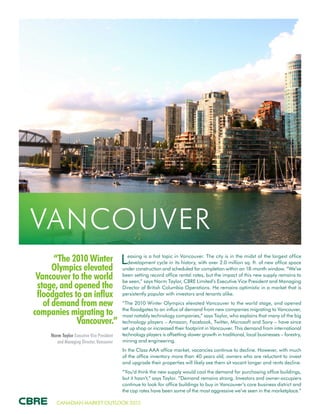
VANCOUVER
Leasing is a hot topic in Vancouver. The city is in the midst of the largest office
development cycle in its history, with over 2.0 million sq. ft. of new office space
under construction and scheduled for completion within an 18-month window. “We’ve
been setting record office rental rates, but the impact of this new supply remains to
be seen,” says Norm Taylor, CBRE Limited’s Executive Vice President and Managing
Director of British Columbia Operations. He remains optimistic in a market that is
persistently popular with investors and tenants alike.
“The 2010 Winter Olympics elevated Vancouver to the world stage, and opened
the floodgates to an influx of demand from new companies migrating to Vancouver,
most notably technology companies,” says Taylor, who explains that many of the big
technology players – Amazon, Facebook, Twitter, Microsoft and Sony – have since
set up shop or increased their footprint in Vancouver. This demand from international
technology players is offsetting slower growth in traditional, local businesses – forestry,
mining and engineering.
In the Class AAA office market, vacancies continue to decline. However, with much
of the office inventory more than 40 years old, owners who are reluctant to invest
and upgrade their properties will likely see them sit vacant longer and rents decline.
“You’d think the new supply would cool the demand for purchasing office buildings,
but it hasn’t,” says Taylor. “Demand remains strong. Investors and owner-occupiers
continue to look for office buildings to buy in Vancouver’s core business district and
the cap rates have been some of the most aggressive we’ve seen in the marketplace.”
2
PROJECTS TO WATCH
International investors, who used to focus on residential real estate,
are now very focused on office buildings, shopping centres and
commercial property – a trend Taylor sees continuing through
2015.
Retail is another hot topic, with global luxury brands like
Christian Dior, Jaeger-LeCoultre, and Nordstroms moving into
both downtown and some select suburban markets like West
Vancouver. Formerly lined with tourist shops, Alberni Street has
been transformed into a mecca for high fashion retailers and
top-quality restaurants. Taylor predicts that consumer spending
will continue to grow and drive the economy.
In the industrial market, land scarcity remains a perennial issue.
The city’s scenic topography makes it difficult to assemble land
parcels that are needed for large-scale development and big
projects are rarely built on a speculative basis. The new Boundary
Bay Industrial Park is located on trucking routes to the east and
south, along with convenient access to the Deltaport and the
airport. Phase 1, a 440,000 sq. ft. speculative development which
is the largest ever built in Vancouver, is now 75.0% leased and
ahead of developer leasing assumptions. Demand for this type
of project illustrates the strength of the market and the need to
move quickly when unique opportunities like this arise. Phase
two of this development consists of an additional 430,000 sq. ft.
building and will begin construction in early 2015.
Because of land constraints, Vancouver is at the forefront of
property redevelopment efforts. The recent zoning relaxation in
the Mount Pleasant area near the Olympic Village has sparked
a flurry of activity in the market. Warehouses are being quickly
snapped up by investors and owner-occupiers for redevelopment
into higher density uses, including office, retail and residential
properties. “Each building is now closely examined in an attempt to
determine if that’s the highest and best use,” says Taylor. Industrial
buildings, strip malls, auto dealers – all offer great redevelopment
opportunities.
Transit has become an important factor for investors and occupiers.
“When an investor looks at a building on a yield basis, if it’s off-
transit in the suburbs, it will be discounted significantly compared
to an office building within 500 metres of a SkyTrain station,”
says Taylor. Suburban business parks battling vacancy issues
have revitalized their business by thinking creatively and offering
shuttle service to transit.
With bridges and tunnels essential to moving people and goods
in a city that is constrained by mountains, rivers and the sea,
infrastructure will always play an important role in Vancouver.
The SkyTrain expansion to the east towards high-growth areas
and the upcoming replacement of the George Massey Tunnel
on the main route to the U.S. are likely to have a positive impact
on the market.
“We’re always going to be geographically limited in this market,”
says Taylor. “Opportunities don’t arrive very often and investors
and occupiers need to pay attention when they do.”
PACIFIC CENTRE
Developed by Cadillac Fairview, Pacific Centre
encompasses 290,000 sq. ft. of Class AAA office space
and 565,000 sq. ft. of mixed-use space. Microsoft and
Sony Corporation have preleased a significant portion of
the office space in 725 Granville Street, while Nordstrom
is the main retail anchor.
www.pacificcentre.ca
BOUNDARY BAY INDUSTRIAL PARK
Strategically located minutes from the Delta Container
Port and Highway 99, this development meets the needs
of large distribution users who will benefit from greater
proximity to the port.
www.boundarybayindustrialpark.ca
THE EXCHANGE OFFICE TOWER
Credit Suisse’s $200.0 million venture into B.C. is a
31-storey speculative LEED Platinum office tower in
the financial district of Vancouver. It will be the last
completed building in the ongoing development cycle and
is poised to accommodate the next phase of economic
growth.
www.theexchangebuilding.ca
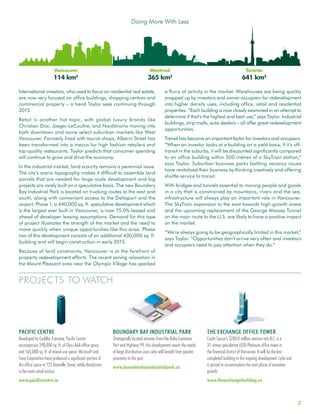
Doing More With Less
Vancouver
114 km2
Montreal
365 km2
Toronto
641 km2
CANADIAN MARKET OUTLOOK 2015
“We’re very optimistic
on growth but it will be
hugely tempered by the
fact that we don’t have
enough people to support
the economy.”
Greg Kwong Executive Vice President
and Regional Managing Director, Alberta
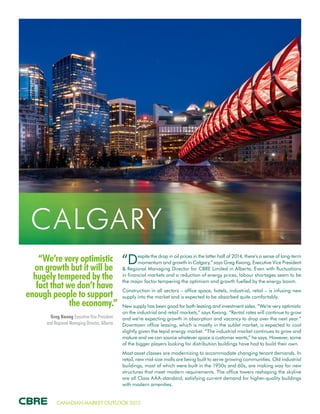
CALGARY
“Despite the drop in oil prices in the latter half of 2014, there’s a sense of long-term
momentum and growth in Calgary,” says Greg Kwong, Executive Vice President
& Regional Managing Director for CBRE Limited in Alberta. Even with fluctuations
in financial markets and a reduction of energy prices, labour shortages seem to be
the major factor tempering the optimism and growth fuelled by the energy boom.
Construction in all sectors – office space, hotels, industrial, retail – is infusing new
supply into the market and is expected to be absorbed quite comfortably.
New supply has been good for both leasing and investment sales. “We’re very optimistic
on the industrial and retail markets,” says Kwong. “Rental rates will continue to grow
and we’re expecting growth in absorption and vacancy to drop over the next year.”
Downtown office leasing, which is mostly in the sublet market, is expected to cool
slightly given the tepid energy market. “The industrial market continues to grow and
mature and we can source whatever space a customer wants,” he says. However, some
of the bigger players looking for distribution buildings have had to build their own.
Most asset classes are modernizing to accommodate changing tenant demands. In
retail, new mid-size malls are being built to serve growing communities. Old industrial
buildings, most of which were built in the 1950s and 60s, are making way for new
structures that meet modern requirements. The office towers reshaping the skyline
are all Class AAA-standard, satisfying current demand for higher-quality buildings
with modern amenities.
4
PROJECTS TO WATCH
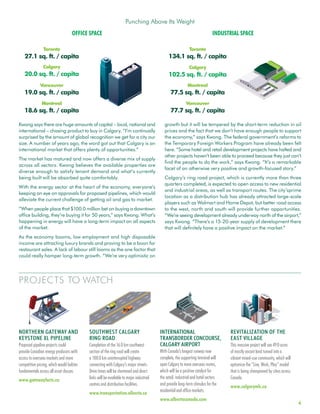
Calgary
102.5 sq. ft. / capita
Kwong says there are huge amounts of capital – local, national and
international – chasing product to buy in Calgary. “I’m continually
surprised by the amount of global recognition we get for a city our
size. A number of years ago, the word got out that Calgary is an
international market that offers plenty of opportunities.”
The market has matured and now offers a diverse mix of supply
across all sectors. Kwong believes the available properties are
diverse enough to satisfy tenant demand and what‘s currently
being built will be absorbed quite comfortably.
With the energy sector at the heart of the economy, everyone’s
keeping an eye on approvals for proposed pipelines, which would
alleviate the current challenge of getting oil and gas to market.
“When people place that $100.0 million bet on buying a downtown
office building, they’re buying it for 50 years,” says Kwong. What’s
happening in energy will have a long-term impact on all aspects
of the market.
As the economy booms, low employment and high disposable
income are attracting luxury brands and proving to be a boon for
restaurant sales. A lack of labour still looms as the one factor that
could really hamper long-term growth. “We’re very optimistic on
growth but it will be tempered by the short-term reduction in oil
prices and the fact that we don’t have enough people to support
the economy,” says Kwong. The federal government’s reforms to
the Temporary Foreign Workers Program have already been felt
here. “Some hotel and retail development projects have halted and
other projects haven’t been able to proceed because they just can’t
find the people to do the work,” says Kwong. “It’s a remarkable
facet of an otherwise very positive and growth-focused story.”
Calgary’s ring road project, which is currently more than three
quarters completed, is expected to open access to new residential
and industrial areas, as well as transport routes. The city’sprime
location as a distribution hub has already attracted large-scale
players such as Walmart and Home Depot, but better road access
to the west, north and south will provide further opportunities.
“We’re seeing development already underway north of the airport,”
says Kwong. “There’s a 15-20-year supply of development there
that will definitely have a positive impact on the market.”
NORTHERN GATEWAY AND
KEYSTONE XL PIPELINE
Proposed pipeline projects could
provide Canadian energy producers with
access to overseas markets and more
competitive pricing, which would bolster
fundamentals across all asset classes.
www.gatewayfacts.ca
SOUTHWEST CALGARY
RING ROAD
Completion of the 16.0 km southwest
section of the ring road will create
a 100.0 km uninterrupted highway
connecting with Calgary’s major streets.
Drive times will be shortened and direct
links will be available to major industrial
centres and distribution facilities.
www.transportation.alberta.ca
INTERNATIONAL
TRANSBORDER CONCOURSE,
CALGARY AIRPORT
With Canada’s longest runway now
complete, the supporting terminal will
open Calgary to more overseas routes,
which will be a positive catalyst for
the retail, industrial and hotel sectors
and provide long-term stimulus for the
residential and office markets.
www.albertacanada.com
REVITALIZATION OF THE
EAST VILLAGE
This massive project will see 49.0 acres
of mostly vacant land turned into a
vibrant mixed-use community, which will
epitomize the “Live, Work, Play” model
that is being championed by cities across
Canada.
www.calgarymlc.ca
Punching Above Its Weight
Vancouver
19.0 sq. ft. / capita
Vancouver
77.7 sq. ft. / capita
Toronto
27.1 sq. ft. / capita
Toronto
134.1 sq. ft. / capita
Montreal
18.6 sq. ft. / capita
Montreal
77.5 sq. ft. / capita
OFFICE SPACE INDUSTRIAL SPACE
Calgary
20.0 sq. ft. / capita
CANADIAN MARKET OUTLOOK 2015
“The longevity and
long-term outlook
for our industrial
business, which drives
the balance of the
economy, is very good.”
David Young Executive Vice President
and Managing Director, Edmonton
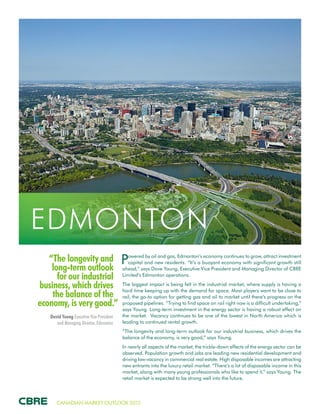
EDMONTON
Powered by oil and gas, Edmonton’s economy continues to grow, attract investment
capital and new residents. “It’s a buoyant economy with significant growth still
ahead,” says Dave Young, Executive Vice President and Managing Director of CBRE
Limited’s Edmonton operations.
The biggest impact is being felt in the industrial market, where supply is having a
hard time keeping up with the demand for space. Most players want to be close to
rail, the go-to option for getting gas and oil to market until there’s progress on the
proposed pipelines. “Trying to find space on rail right now is a difficult undertaking,”
says Young. Long-term investment in the energy sector is having a robust effect on
the market. Vacancy continues to be one of the lowest in North America which is
leading to continued rental growth.
“The longevity and long-term outlook for our industrial business, which drives the
balance of the economy, is very good,” says Young.
In nearly all aspects of the market, the trickle-down effects of the energy sector can be
observed. Population growth and jobs are leading new residential development and
driving low-vacancy in commercial real estate. High disposable incomes are attracting
new entrants into the luxury retail market. “There’s a lot of disposable income in this
market, along with many young professionals who like to spend it,” says Young. The
retail market is expected to be strong well into the future.
6
PROJECTS TO WATCH
Despite strong migration, with Edmonton outpacing Calgary in
terms of population growth in recent years, the demand for labour
continues to outstrip supply. With 72.4% employment and fewer
opportunities to bring in temporary foreign workers due to federal
government reforms, finding enough staff -- from engineers to
hospitality staff -- is a challenge for most businesses and will
remain so for the foreseeable future, says Young.
Infrastructure investment is also expected to drive growth in the
coming years. The new Edmonton Arena District (EAD), as well
as investments in arts and culture with the development of the
new Royal Alberta Museum just east of the EAD, will revitalize the
core and bring people downtown. Another positive for the city and
suburban areas is the expected completion of the Anthony Henday
freeway system, which will provide critical connections to energy
markets in northern Alberta and to much-needed industrial land
in the northeast quadrant of the city.
Young believes the big challenge in the downtown office market
could be a risk of oversupply over the next three years as new
buildings are completed. Landlords of older buildings will likely
face downward pressure on rents and may need to step up their
reinvestment programmes to keep older properties competitive.
In the suburban office market, construction, engineering and oil
field service companies are all looking for office space closer to
their clients. “The suburban office market should remain in good
shape in the near term,” he says.
Young expects the investment market in 2015 to be very similar
to 2014 “The capital is there but investors can’t find the core
industrial and retail properties they want to buy, so they’ve been
building their own.”
“The business optimism in Edmonton and across the region is
extremely high,” says Young. The market is hugely dynamic and
growth-driven and there are a myriad of industries and activities
around energy – from research and development, to technology
and manufacturing – contributing to the growth. “The oil and gas
sector will help our market well into the future,” says Young. “If
we can get access to more serviced land next year, leasing and
investment activity will outpace this year’s numbers.”
NORTHEAST ANTHONY HENDAY
DRIVE
Anthony Henday Drive will be completed in the fall of
2016 and will boost activity in northeast Edmonton.
There is strong demand for land in this area, but a lack of
transportation has held back development.
www.northeastanthonyhenday.com
EDMONTON ARENA DISTRICT
Arena District is a multi-billion dollar project by Katz
Group of Companies and WAM Development Group that
spans 25.0 acres of office, retail, hospitality, residential
and hotel properties. The project will revamp Edmonton’s
urban core. Delta Hotels has already partnered to create a
luxury hotel and condo tower.
www.ead.ca
41ST AVENUE SOUTHWEST
INTERCHANGE
The City of Edmonton, in partnership with Leduc County,
is upgrading 41 Avenue Southwest as a major arterial
roadway to provide full access to the QEII Highway. This
will support the ongoing development in the south of
Edmonton and north of Leduc.
www.edmonton.ca
Destinations in Demand
(Two-Year Population Growth Rate)
Edmonton
7.4%
Calgary
6.7%
CANADIAN MARKET OUTLOOK 2015
“We’re hearing from
institutional investors
that they would like
to set up shop in
Winnipeg, and I’m
tremendously excited
about the activity I
see ahead.”
Trevor Clay Sales Associate, Winnipeg
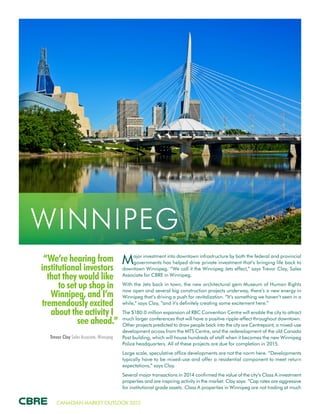
WINNIPEG
Major investment into downtown infrastructure by both the federal and provincial
governments has helped drive private investment that’s bringing life back to
downtown Winnipeg. “We call it the Winnipeg Jets effect,” says Trevor Clay, Sales
Associate for CBRE in Winnipeg.
With the Jets back in town, the new architectural gem Museum of Human Rights
now open and several big construction projects underway, there’s a new energy in
Winnipeg that’s driving a push for revitalization. “It’s something we haven’t seen in a
while,” says Clay, “and it’s definitely creating some excitement here.”
The $180.0 million expansion of RBC Convention Centre will enable the city to attract
much larger conferences that will have a positive ripple-effect throughout downtown.
Other projects predicted to draw people back into the city are Centrepoint, a mixed-use
development across from the MTS Centre, and the redevelopment of the old Canada
Post building, which will house hundreds of staff when it becomes the new Winnipeg
Police headquarters. All of these projects are due for completion in 2015.
Large scale, speculative office developments are not the norm here. “Developments
typically have to be mixed-use and offer a residential component to meet return
expectations,” says Clay.
Several major transactions in 2014 confirmed the value of the city’s Class A investment
properties and are inspiring activity in the market. Clay says: “Cap rates are aggressive
for institutional grade assets. Class A properties in Winnipeg are not trading at much
8
PROJECTS TO WATCH
of a discount compared with other markets.” Going forward he
predicts cap rates will remain stable and demand should continue
to be strong for quality commercial investment opportunities.
An interesting new trend is that suburban office tenants are giving
downtown locations a second look. Drawn to new amenities
and opportunities in the reinvigorated central business district,
they’re seeing the city in a more positive light and reconsidering
their options. Despite the limited public transit system, Clay says
downtown is still the most accessible location for all parts of the city.
While there’s plenty of movement in the office market, it’s mostly
tenants moving between submarkets or buildings, and there isn’t
substantial demand from new office tenants. Office vacancy rates
continue to hover around 10.5% downtown and just under just
under 13.0% in the suburban office market.
There’s a much more positive outlook in the industrial market, with
growth expected to come from new tenants and new construction.
On the leasing side, new logistics companies are entering the
market, which is helping to offset the loss of some larger distribution
centres to Calgary. The aerospace industry continues to have
a substantial presence in Winnipeg with three major players
manufacturing here.
A lack of serviced land is currently hampering industrial growth
in the northwest, but the area offers huge potential. CentrePort
Canada is currently working on securing water and septic services
to 20,000 acres of land, which would unlock opportunities for
both industrial and residential development.
Bentall Kennedy has acquired 130 acres of land in the
northwest quadrant of the city, where they plan to build a mix of
manufacturing and distribution buildings. This project will drive
activity in the area for the foreseeable future.
In recent years, Winnipeg has seen the completion of a number of
major infrastructure projects. The city is now reaping the benefits
of its new, award-winning airport terminal, the CentrePort Canada
inland port expansion and new CFL stadium at the University of
Manitoba. The first phase of the Bus Rapid Transit (BRT) corridor
has also been constructed. Clay says future plans to expand the
BRT further south will likely attract commercial and multifamily
development around the transit corridor and have an impact on
the market.
With all the investment and revitalization, Clay says Winnipeg
has a new energy and a positive outlook for the coming year.
“We’re hearing from institutional investors that they would like
to set up shop in Winnipeg, and I’m tremendously excited about
the activity I see ahead.”
RBC CONVENTION CENTRE
EXPANSION
The $180.0 million expansion will nearly double the
rentable area to 264,000 sq. ft. when completed in 2016.
There will be an additional 133,000 sq. ft. of exhibition
space, a new ballroom and expanded underground
parking.
www.wcc.mb.ca
NEW POLICE HEADQUARTERS
DOWNTOWN
Construction was recently completed on a new 600,000
sq. ft. downtown headquarters for the Winnipeg Police
Service. The former Canada Post building on Graham
Avenue was purchased in 2009 for $31.6 million and
redeveloped at a cost of $178.4 million.
CENTREPORT AND BENTALL KENNEDY
INDUSTRIAL DEVELOPMENT,
NORTHWEST WINNIPEG
Bentall Kennedy recently acquired 130.0 acres of land in
northwest Winnipeg and is in the process of developing
a plan for the site, which will focus on building a new
format distribution and manufacturing facility.
Winnipeg Jets Effect
Win•ne•pehg/jets/e’fekt/
verb
1. The ability of a professional hockey team to bring life
and investment to downtown Winnipeg
CANADIAN MARKET OUTLOOK 2015
“From an investment
perspective, we think
retail will be strong,
the office sector will be
solid and the industrial
sector will be quite
robust in 2015.”
Peter Whatmore Senior Vice President and
Executive Managing Director, Southwestern Ontario
LONDON &
KITCHENER-WATERLOO
The cross currents of the Canadian and global economy are evident in London and
Kitchener-Waterloo. Above all, “Southwestern Ontario continues to be a market
worthy of future investment,” says Peter Whatmore, CBRE Limited’s Senior Vice President
& Executive Managing Director, Southwestern Ontario.
With most of the significant plant closures in London now complete, employment growth
is dominating the conversation. The good news is that most of the large facilities along
the 401 corridor have been leased or sold and are in the hands of new operators.
Those facilities are regaining some employment, which Whatmore notes is particularly
encouraging, particularly for the service and retail sectors.
One issue that isn’t likely to change soon is the stubbornly high office vacancy rate
in London. Significant changes in the retail sector, such as large department store
closures and shopping mall conversions to office space over the past decade, created
the surplus office space that has taken time to absorb. While a marginal decline in
vacancy can be expected next year, Whatmore anticipates that it will be 2016 before
meaningful improvement takes hold.
The industrial market looks more promising. “We’re expecting a substantial amount
of the vacant industrial inventory to be absorbed, so there could be opportunities for
speculative construction from mid-2015 and possibly into 2016,” says Whatmore.
Road infrastructure projects, such as the new Wonderland Road on the west side
(scheduled for completion in early 2015) and the extension of Veterans Memorial
10
PROJECTS TO WATCH
Parkway (soon to start) will open up potential areas for industrial
development in the region.
While national buyers are taking a pause, regional investors will
be active in London. There’s unlikely to be much activity in Class
A and B office product, which is tightly held, but multifamily, retail
and industrial holdings may provide a lift in the overall market
activity from this year. Whatmore says he doubts 2015 will be a
record year, but believes it is likely to be a good stable year for the
market, provided interest rates stay in the current range.
Local government is attempting to encourage the revitalization
of the city core by waiving development charges for high-rise
residential development. Thus far, Whatmore feels it is having a
measurable impact.
Meanwhile, a different story is unfolding in the Kitchener-Waterloo
area. This market has mostly absorbed the tremendous amount
of office and industrial space delivered by the repositioning of the
major high-tech tenant in the market. “Some suggested it could
take as long as 10 years to take down that space but we forecast
that it will be absorbed in two to three years,” says Whatmore.
The entire portfolio sold in 2014 and some of the assets have
since been resold.
Investor interest remains high in Kitchener-Waterloo, as evidenced
by the recent trade of the Sun Life Tower and a number of significant
high-rise condominium projects that are under construction. “It’s a
good indicator of a strong, healthy marketplace,” says Whatmore.
“From an investment perspective, we think retail will be strong,
the office sector will be solid and the industrial sector will be quite
robust in 2015 in Kitchener, Waterloo, Cambridge and Guelph.
Many investors are focused on revenue sustainability, which is
achievable in this market.”
The start of construction on the long-discussed rapid transit project
has created a hotbed of activity. New high-rise residential buildings
are going up and there’s been a significant increase in retrofitting
of office and old industrial properties close to the rapid transit
route, which bodes well for the project’s impact on the market.
Meanwhile, in spite of the profound changes to major players in
the market, Kitchener-Waterloo’s technology sector is alive and
well. It is expected to drive new development and create great
opportunities in this vibrant market.
VETERANS MEMORIAL
PARKWAY EXTENSION
Veterans Memorial Parkway is a key
corridor that will provide increased access
to the City of London, Highway 401,
and the London International Airport.
This corridor has the potential to open
up good tracts of industrial land to
development.
www.london.ca
REDEVELOPMENT
VICTORIA HOSPITAL
LANDS
This unique 12.6 acre residential/mixed-
use redevelopment opportunity is located
on the bank of the Thames River in the
SoHo neighborhood, just south of the
London’s downtown core.
www.cbre.ca/
WATERLOO REGION LRT
Construction has begun and the LRT,
which is expected to be complete in
2017. Demand is expected to be high and
retrofitting will take place around the LRT
stations, in particular the Colombia Street
node, which is located on the edge of
University of Waterloo.
www.rapidtransit.regionofwaterloo.ca
BREITHAUPT BLOCK
Winner of the Canadian Urban
Institute 2014 award for best overall
redevelopment, Breithaupt Block
is located centrally in Kitchener-
Waterloo, and is steps away from large
condominiums. This property will support
the “Live, Work, Play” culture that is
embraced by technology companies like
Google.
www.thebreithauptblock.com
Unemployment Improvement
(Oct. 2014 Unemployment Rate)
London
7.5%
(down 40 bps y-o-y)
Waterloo Region
6.3%
(down 40 bps y-o-y)
CANADIAN MARKET OUTLOOK 2015
“Rents haven’t decreased
despite significant
new construction, but
we’re starting to see
deal structures that are
slightly more favourable
for tenants.”
John O’Toole Executive Vice President
and Executive Managing Director, Toronto
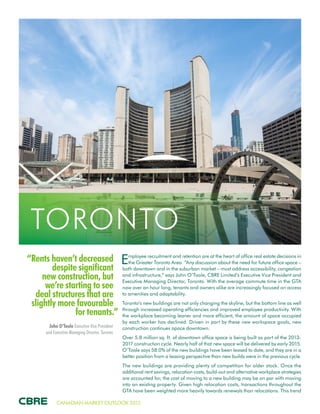
TORONTO
Employee recruitment and retention are at the heart of office real estate decisions in
the Greater Toronto Area. “Any discussion about the need for future office space –
both downtown and in the suburban market – must address accessibility, congestion
and infrastructure,” says John O’Toole, CBRE Limited’s Executive Vice President and
Executive Managing Director, Toronto. With the average commute time in the GTA
now over an hour long, tenants and owners alike are increasingly focused on access
to amenities and adaptability.
Toronto’s new buildings are not only changing the skyline, but the bottom line as well
through increased operating efficiencies and improved employee productivity. With
the workplace becoming leaner and more efficient, the amount of space occupied
by each worker has declined. Driven in part by these new workspace goals, new
construction continues apace downtown.
Over 5.8 million sq. ft. of downtown office space is being built as part of the 2013-
2017 construction cycle. Nearly half of that new space will be delivered by early 2015.
O’Toole says 58.0% of the new buildings have been leased to date, and they are in a
better position from a leasing perspective than new builds were in the previous cycle.
The new buildings are providing plenty of competition for older stock. Once the
additional rent savings, relocation costs, build-out and alternative workplace strategies
are accounted for, the cost of moving to a new building may be on par with moving
into an existing property. Given high relocation costs, transactions throughout the
GTA have been weighted more heavily towards renewals than relocations. This trend
12
PROJECTS TO WATCH
is strongest in suburban markets. Downtown leasing activity is
more balanced with renewals accounting for 53.0% of all deals
over 50,000 sq. ft. in the last five years.
“The balance point between a tenant’s market and a landlord’s
market is around 8.0-9.0% vacancy, and the downtown office
vacancy rate is only 5.3% overall,” says O’Toole. “Rents haven’t
decreased despite significant new construction, but we’re starting
to see deal structures that are slightly more favourable for tenants.”
In 2015, he expects downtown leasing activity to remain strong
and the demand for quality space to continue to outstrip supply.
Future growth is expected to come from the traditional source –
the finance sector – as well as technology, advertising and media.
In contrast to downtown tenants, suburban tenants are much
more value-driven and budget-conscious. They continue to
optimize their space by reducing their real estate footprints, says
Werner Dietl, Executive Vice President and Managing Director of
CBRE’s Toronto West Office. Parking ratios demanded by tenants
keep going up as tenants densify, but transit is still a factor for
many suburban tenants.
Dietl says the 2.0 million sq. ft. of office space currently under
construction in the suburban markets is well within historical
averages. A significant number of the new suburban office
buildings are design-build and many are pulling tenants out of
existing inventory, rather than attracting new net growth. “This
speaks to an ongoing flight to quality, as tenants move from
existing stock to higher-quality buildings,” says Dietl.
“New construction is being focused in specific nodes, while other
areas continue to exhibit elevated vacancy rates. Areas in demand
combine accessibility – whether that is transit or the parking
facilities that tenants demand – with quality space,” explained
Dietl. Submarkets with access to transit, amenities and newer
facilities will continue to enjoy strong demand at the expense of
older, less accessible areas. In particular, the Meadowvale and
Highway 10/401 nodes will see good activity levels.
While the industrial market is less reliant on public transit, the old
adage of location, location, location still holds true. Industrial
availability rates are very low across the GTA, which is spurring
construction and encouraging tenants to reconsider older industrial
stock. In some cases, owners of older vacant buildings have found
tenants in the form of non-traditional industrial users, including
caterers and recreational activities to name a few.
“The momentum in the industrial market is widespread, unlike
years past when modern logistics facilities accounted for the
bulk of leasing and investment activity,” says Dietl. “In fact, the
best potential for rent growth is in the more dense nodes like
Etobicoke.” These areas will be particularly appealing for retailers
and e-commerce businesses that favour sites close to transport
networks that ensure speedy delivery to consumers.
Industrial developers have weathered another round of
municipal development charge increases, but rental rates are
firming up, which is making it easier for developers to bear this
cost. “Developers continue to move forward with construction
despite increasing costs; however, we have seen an increase in
redevelopment projects and efforts to attain development charge
credits, which indicates that rising costs are a factor in decision
making,” Dietl said. Further development charge increases have the
potential to shape construction activity and curb new development.
Major investments in infrastructure are expected to deliver benefits
throughout the region. The Union Station revitalization will make
the commute more efficient and downtown more accessible to
tenants from the suburbs once it is completed in 2016. The Toronto-
York Spadina subway extension, also due for completion in 2016,
will open access to and contribute to the growth of the North York
West and Vaughan submarkets, while the Eglinton Cross Town line
will improve accessibility across that corridor. In the east end of the
city, the extension of Highway 407 is expected to have significant
impact in terms of improving commuting times and may spur
further development in that area. Meanwhile, in the west end, there
are encouraging signs of transit improvements in the Bus Rapid
Transit extension that will connect Mississauga’s pivotal Airport
Corporate Centre to the City Centre market. These projects are
emblematic of the influential role of transit and accessibility as
drivers of both market activity and tenant intentions in the coming
year and beyond.
UNION STATION REVITALIZATION
The $640.0 million revitalization of Union Station is one
of Canada’s Top 100 Infrastructure Projects. It will provide
greater access for commuters in and out of Toronto’s south
core, and will include a new atrium structure.
www.metrolinx.com
TORONTO-YORK SPADINA
SUBWAY EXTENSION
Construction on the Toronto-York Subway Extension is
scheduled for completion in the fall of 2016 and will
carry an estimated 20,200 riders per day. It is the first
subway line to cross a municipal boundary in the region
and will attract new development to North York West and
Vaughan.
www.ttc.ca/Spadina/
QRC WEST
Queen Richmond Centre is a landmark mixed-use
285,581 sq. ft. development in Toronto’s Downtown West
submarket. It is already 78.0% preleased and features
modern design and amenities. Construction is expected to
be complete in May 2015.
www.qrcwest.com
CANADIAN MARKET OUTLOOK 2015
“In moving from a small
city to a larger city,
we’re leaving the old
Ottawa behind. It will
be exciting to see what
happens next.”
Shawn Hamilton Vice President
and Managing Director, Ottawa
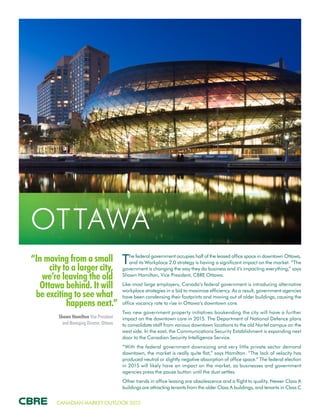
OTTAWA
The federal government occupies half of the leased office space in downtown Ottawa,
and its Workplace 2.0 strategy is having a significant impact on the market. “The
government is changing the way they do business and it’s impacting everything,” says
Shawn Hamilton, Vice President, CBRE Ottawa.
Like most large employers, Canada’s federal government is introducing alternative
workplace strategies in a bid to maximize efficiency. As a result, government agencies
have been condensing their footprints and moving out of older buildings, causing the
office vacancy rate to rise in Ottawa’s downtown core.
Two new government property initiatives bookending the city will have a further
impact on the downtown core in 2015. The Department of National Defence plans
to consolidate staff from various downtown locations to the old Nortel campus on the
west side. In the east, the Communications Security Establishment is expanding next
door to the Canadian Security Intelligence Service.
“With the federal government downsizing and very little private sector demand
downtown, the market is really quite flat,” says Hamilton. “The lack of velocity has
produced neutral or slightly negative absorption of office space.” The federal election
in 2015 will likely have an impact on the market, as businesses and government
agencies press the pause button until the dust settles.
Other trends in office leasing are obsolescence and a flight to quality. Newer Class A
buildings are attracting tenants from the older Class A buildings, and tenants in Class C
14
PROJECTS TO WATCH
properties are moving up to Class B space. “We’re coming to a
crucial point for Ottawa’s aging buildings,” he says. “Owners
will increasingly need to consider refurbishing or demolishing
office properties.”
While downtown real estate is dominated by the government, it’s
a different story in Kanata. Kanata, known as Canada’s other
technology hub, is a private sector market that is governed by
the ups and downs of the technology sector, which has been
showing signs of recovery. With access to a steady stream of
educated talent from several post-secondary institutions, Kanata
is a hotbed of innovation. There were several large transactions
in Kanata in 2014 and Hamilton expects the growth and recovery
to continue next year.
The industrial market, much of which is also tied to the government,
isn’t likely to change much in 2015. “We’re not seeing new demand
or growth,” says Hamilton. “There’s about 200,000 sq. ft. of
industrial space coming into the market in the short term, but
tenant movements will largely equate to a game of musical chairs.”
Despite this, Hamilton expects that face rates in Ottawa’s industrial
market will continue to be higher than the national average.
A new trend that’s changing the cityscape in Ottawa is the
emergence of full-service, “live, work, play” neighbourhoods. All-
in-one developments, such as the redevelopment of the Lansdowne
Park area and the proposed development at the old Domtar paper
mill site on the Ottawa River, will allow residents to do everything
locally. “Ottawa is starting to develop self-sustaining communities,
much like what has happened in cities like Toronto,” says Hamilton,
noting it’s a big change from the previous model where people
lived in the suburbs and commuted downtown for work.
Two infrastructure investments are expected to have long-term
positive impacts throughout Ottawa. The Confederation Line,
Ottawa’s new state-of-the-art rapid rail transit system, is scheduled
for completion in 2017 and will move people around the city more
efficiently. In the meantime, Highway 417, the city’s east-west
artery is being expanded to accommodate Rapid Bus Transit and
alleviate congestion.
Hamilton says we’re seeing a real change in Ottawa as it becomes
a new, more sustainable, more diversified city. “In moving from
a small city to a larger city, we’re leaving the old Ottawa behind.
It will be exciting to see what happens next.”
CONFEDERATION LRT
The first phase of this public transit project will increase
density with a mix of residential, office and retail
development around the LRT stations. The federal
government will likely lease up commercial space in close
proximity to LRT stations.
www.confederationline.ca
417 HIGHWAY EXPANSION
The Highway 417 expansion is scheduled for completion
in the fall of 2015 and will alleviate traffic congestion
and delays by adding in two additional lanes.
www.queenswayexpansioneast.com
GOVERNMENT – WORKPLACE 2.0
The federal government plans to rejuvenate their offices
using new guidelines that embrace modern and flexible
workplace strategies, a reduction in space per employee,
more sustainable and strategically located buildings,
along with greater accessibility and worker amenities.
www.tpsgc-pwgsc.gc.ca
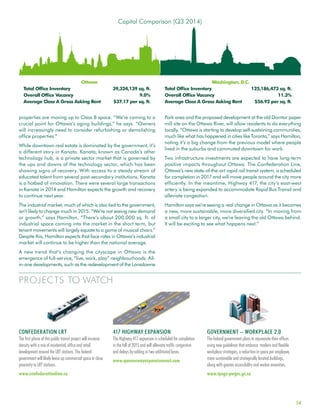
Washington, D.C.
Total Office Inventory	 125,186,473 sq. ft.
Overall Office Vacancy	 11.3%
Average Class A Gross Asking Rent 	 $56.92 per sq. ft.
Ottawa
Total Office Inventory	 39,324,139 sq. ft.
Overall Office Vacancy	 9.0%
Average Class A Gross Asking Rent 	 $37.17 per sq. ft.
Capital Comparison (Q3 2014)
CANADIAN MARKET OUTLOOK 2015
“We’re seeing a real
transformation of
the city as a result of
urban densification,
redevelopment and
key infrastructure
investments.”
Alexandre Sieber Senior Vice President
and Senior Managing Director, Montreal
MONTREAL
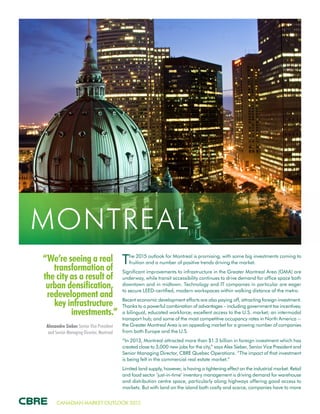
The 2015 outlook for Montreal is promising, with some big investments coming to
fruition and a number of positive trends driving the market.
Significant improvements to infrastructure in the Greater Montreal Area (GMA) are
underway, while transit accessibility continues to drive demand for office space both
downtown and in midtown. Technology and IT companies in particular are eager
to secure LEED-certified, modern workspaces within walking distance of the metro.
Recent economic development efforts are also paying off, attracting foreign investment.
Thanks to a powerful combination of advantages – including government tax incentives;
a bilingual, educated workforce; excellent access to the U.S. market; an intermodal
transport hub; and some of the most competitive occupancy rates in North America --
the Greater Montreal Area is an appealing market for a growing number of companies
from both Europe and the U.S.
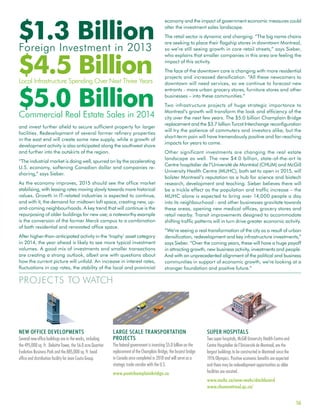
“In 2013, Montreal attracted more than $1.3 billion in foreign investment which has
created close to 3,000 new jobs for the city,” says Alex Sieber, Senior Vice President and
Senior Managing Director, CBRE Quebec Operations. “The impact of that investment
is being felt in the commercial real estate market.”
Limited land supply, however, is having a tightening effect on the industrial market. Retail
and food sector ‘just-in-time’ inventory management is driving demand for warehouse
and distribution centre space, particularly along highways offering good access to
markets. But with land on the island both costly and scarce, companies have to move
16
PROJECTS TO WATCH
and invest further afield to secure sufficient property for larger
facilities. Redevelopment of several former refinery properties
in the east end will create some new supply, while a growth of
development activity is also anticipated along the southwest shore
and further into the outskirts of the region.
“The industrial market is doing well, spurred on by the accelerating
U.S. economy, softening Canadian dollar and companies re-
shoring,” says Sieber.
As the economy improves, 2015 should see the office market
stabilizing, with leasing rates moving slowly towards more historical
values. Growth in IT-related industries is expected to continue,
and with it, the demand for midtown loft space, creating new, up-
and-coming neighbourhoods. A key trend that will continue is the
repurposing of older buildings for new use; a noteworthy example
is the conversion of the former Merck campus to a combination
of both residential and renovated office space.
After higher-than-anticipated activity in the ‘trophy’ asset category
in 2014, the year ahead is likely to see more typical investment
volumes. A good mix of investments and smaller transactions
are creating a strong outlook, albeit one with questions about
how the current picture will unfold. An increase in interest rates,
fluctuations in cap rates, the stability of the local and provincial
economy and the impact of government economic measures could
alter the investment sales landscape.
The retail sector is dynamic and changing. “The big name chains
are seeking to place their flagship stores in downtown Montreal,
so we’re still seeing growth in core retail streets,” says Sieber,
who explains that smaller companies in this area are feeling the
impact of this activity.
The face of the downtown core is changing with more residential
projects and increased densification. “All these newcomers to
downtown will need services, so we continue to forecast new
entrants - more urban grocery stores, furniture stores and other
businesses – into these communities.”
Two infrastructure projects of huge strategic importance to
Montreal’s growth will transform the look and efficiency of the
city over the next few years. The $5.0 billion Champlain Bridge
replacement and the $3.7 billion Turcot Interchange reconfiguration
will try the patience of commuters and investors alike, but the
short-term pain will have tremendously positive and far-reaching
impacts for years to come.
Other significant investments are changing the real estate
landscape as well. The new $4.0 billion, state-of-the-art le
Centre hospitalier de l’Université de Montréal (CHUM) and McGill
University Health Centre (MUHC), both set to open in 2015, will
bolster Montreal’s reputation as a hub for science and biotech
research, development and teaching. Sieber believes there will
be a trickle effect as the population and traffic increase – the
MUHC alone is expected to bring over 14,000 people a day
into its neighbourhood - and other businesses gravitate towards
these areas, opening new medical offices, grocery stores and
retail nearby. Transit improvements designed to accommodate
shifting traffic patterns will in turn drive greater economic activity.
“We’re seeing a real transformation of the city as a result of urban
densification, redevelopment and key infrastructure investments,”
says Sieber. “Over the coming years, these will have a huge payoff
in attracting growth, new business activity, investments and people.
And with an unprecedented alignment of the political and business
communities in support of economic growth, we’re looking at a
stronger foundation and positive future.”
NEW OFFICE DEVELOPMENTS
Several new office buildings are in the works, including
the 495,000 sq. ft. Deloitte Tower, the 56.0 acre Quartier
Evolution Business Park and the 885,000 sq. ft. head
office and distribution facility for Jean Coutu Group.
LARGE SCALE TRANSPORTATION
PROJECTS
The federal government is investing $5.0 billion on the
replacement of the Champlain Bridge, the busiest bridge
in Canada once completed in 2018 and will serve as a
strategic trade corridor with the U.S.
www.pontchamplainbridge.ca
SUPER HOSPITALS
Two super hospitals, McGill University Health Centre and
Centre Hospitalier de l’Université de Montreal, are the
largest buildings to be constructed in Montreal since the
1976 Olympics. Positive economic benefits are expected
and there may be redevelopment opportunities as older
facilities are vacated.
www.muhc.ca/new-muhc/dashboard
www.chumontreal.qc.ca/
$1.3 BillionForeign Investment in 2013
$4.5 BillionLocal Infrastructure Spending Over Next Three Years
$5.0 BillionCommercial Real Estate Sales in 2014
CANADIAN MARKET OUTLOOK 2015
“It’s a good time to
identify commercial real
estate opportunities
and get into the market
before momentum puts
options out of reach.”
Bob Mussett Senior Vice President
and Senior Managing Director, Halifax
ATLANTIC CANADA
There’s an air of optimism in the real estate market in Halifax, mirroring the mood
of a region gathering momentum. “There’s great value here,” says Robert Mussett,
Senior Vice President & Senior Managing Director, Halifax. “It’s a good time to identify
commercial real estate opportunities and get into the market.”
That momentum is being driven by shipbuilding and energy, two industries that are
gathering steam and bringing the kind of investment and jobs that will deliver long-
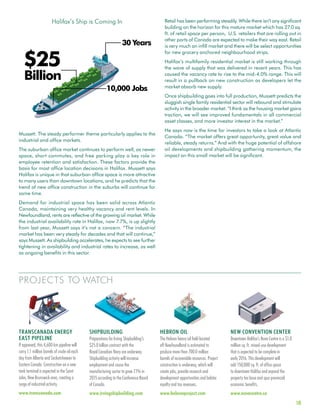
term impacts across multiple sectors of the economy. The Royal Canadian Navy’s
$25.0 billion contract to build new ships at the Halifax Shipyard is expected to bring
more than 10,000 jobs to the region, while the Hebron oil platform in Newfoundland
will bring massive investment to that province. Meanwhile, off the south coast of Nova
Scotia, Shell and BP have already completed deep sea seismic work with oil drilling
exploration expected to commence in the fall of 2015.
This activity is a welcome change in a region that’s seen little growth in recent years,
compared with the rest of Canada.
Mussett says commercial real estate in the region has solid fundamentals and is known
for its “steady-as-she-goes performance”. A local buyer acquired 50 Innovation Drive
(the former Blackberry building) in Halifax, which will be fully leased by year end,
highlighting the strength of the market and the need to act when opportunities arise.
In the tightly-held industrial market, there are few trades. “Investors tend to hold
industrial properties because it’s a small market and quality assets are limited,” says
PROJECTS TO WATCH
18
PROJECTS TO WATCH
Mussett. The steady performer theme particularly applies to the
industrial and office markets.
The suburban office market continues to perform well, as newer
space, short commutes, and free parking play a key role in
employee retention and satisfaction. These factors provide the
basis for most office location decisions in Halifax. Mussett says
Halifax is unique in that suburban office space is more attractive
to many users than downtown locations, and he predicts that the
trend of new office construction in the suburbs will continue for
some time.
Demand for industrial space has been solid across Atlantic
Canada, maintaining very healthy vacancy and rent levels. In
Newfoundland, rents are reflective of the growing oil market. While
the industrial availability rate in Halifax, now 7.7%, is up slightly
from last year, Mussett says it’s not a concern. “The industrial
market has been very steady for decades and that will continue,”
says Mussett. As shipbuilding accelerates, he expects to see further
tightening in availability and industrial rates to increase, as well
as ongoing benefits in this sector.
Retail has been performing steadily. While there isn’t any significant
building on the horizon for this mature market which has 27.0 sq.
ft. of retail space per person, U.S. retailers that are rolling out in
other parts of Canada are expected to make their way east. Retail
is very much an infill market and there will be select opportunities
for new grocery anchored neighbourhood strips.
Halifax’s multifamily residential market is still working through
the wave of supply that was delivered in recent years. This has
caused the vacancy rate to rise to the mid-4.0% range. This will
result in a pullback on new construction as developers let the
market absorb new supply.
Once shipbuilding goes into full production, Mussett predicts the
sluggish single family residential sector will rebound and stimulate
activity in the broader market. “I think as the housing market gains
traction, we will see improved fundamentals in all commercial
asset classes, and more investor interest in the market.”
He says now is the time for investors to take a look at Atlantic
Canada. “The market offers great opportunity, great value and
reliable, steady returns.” And with the huge potential of offshore
oil developments and shipbuilding gathering momentum, the
impact on this small market will be significant.
TRANSCANADA ENERGY
EAST PIPELINE
If approved, this 4,600 km pipeline will
carry 1.1 million barrels of crude oil each
day from Alberta and Saskatchewan to
Eastern Canada. Construction on a new
tank terminal is expected in the Saint
John, New Brunswick area, creating a
surge of industrial activity.
www.transcanada.com
SHIPBUILDING
Preparations for Irving Shipbuilding’s
$25.0 billion contract with the
Royal Canadian Navy are underway.
Shipbuilding activity will increase
employment and cause the
manufacturing sector to grow 7.1% in
2015 according to the Conference Board
of Canada.
www.irvingshipbuilding.com
HEBRON OIL
The Hebron heavy oil field located
off Newfoundland is estimated to
produce more than 700.0 million
barrels of recoverable resources. Project
construction is underway, which will
create jobs, provide research and
development opportunities and bolster
royalty and tax revenues.
www.hebronproject.com
NEW CONVENTION CENTER
Downtown Halifax’s Nova Centre is a $1.0
million sq. ft. mixed-use development
that is expected to be complete in
early 2016. This development will
add 150,000 sq. ft. of office space
to downtown Halifax and expand the
property tax base and spur provincial
economic benefits.
www.novacentre.ca
Halifax’s Ship is Coming In
30 Years
10,000 Jobs
$25
Billion

2015 MARKET OUTLOOK Commercial Real Estate Trends

  • 1.
    2015 Canadian MarketOutlook Commercialrealestatetrendsanddriversin2015
  • 2.
  • 3.
    CANADIAN MARKET OUTLOOK2015 “The 2010 Winter Olympics elevated Vancouver to the world stage, and opened the floodgates to an influx of demand from new companies migrating to Vancouver.” Norm Taylor Executive Vice President and Managing Director, Vancouver VANCOUVER Leasing is a hot topic in Vancouver. The city is in the midst of the largest office development cycle in its history, with over 2.0 million sq. ft. of new office space under construction and scheduled for completion within an 18-month window. “We’ve been setting record office rental rates, but the impact of this new supply remains to be seen,” says Norm Taylor, CBRE Limited’s Executive Vice President and Managing Director of British Columbia Operations. He remains optimistic in a market that is persistently popular with investors and tenants alike. “The 2010 Winter Olympics elevated Vancouver to the world stage, and opened the floodgates to an influx of demand from new companies migrating to Vancouver, most notably technology companies,” says Taylor, who explains that many of the big technology players – Amazon, Facebook, Twitter, Microsoft and Sony – have since set up shop or increased their footprint in Vancouver. This demand from international technology players is offsetting slower growth in traditional, local businesses – forestry, mining and engineering. In the Class AAA office market, vacancies continue to decline. However, with much of the office inventory more than 40 years old, owners who are reluctant to invest and upgrade their properties will likely see them sit vacant longer and rents decline. “You’d think the new supply would cool the demand for purchasing office buildings, but it hasn’t,” says Taylor. “Demand remains strong. Investors and owner-occupiers continue to look for office buildings to buy in Vancouver’s core business district and the cap rates have been some of the most aggressive we’ve seen in the marketplace.”
  • 4.
    2 PROJECTS TO WATCH Internationalinvestors, who used to focus on residential real estate, are now very focused on office buildings, shopping centres and commercial property – a trend Taylor sees continuing through 2015. Retail is another hot topic, with global luxury brands like Christian Dior, Jaeger-LeCoultre, and Nordstroms moving into both downtown and some select suburban markets like West Vancouver. Formerly lined with tourist shops, Alberni Street has been transformed into a mecca for high fashion retailers and top-quality restaurants. Taylor predicts that consumer spending will continue to grow and drive the economy. In the industrial market, land scarcity remains a perennial issue. The city’s scenic topography makes it difficult to assemble land parcels that are needed for large-scale development and big projects are rarely built on a speculative basis. The new Boundary Bay Industrial Park is located on trucking routes to the east and south, along with convenient access to the Deltaport and the airport. Phase 1, a 440,000 sq. ft. speculative development which is the largest ever built in Vancouver, is now 75.0% leased and ahead of developer leasing assumptions. Demand for this type of project illustrates the strength of the market and the need to move quickly when unique opportunities like this arise. Phase two of this development consists of an additional 430,000 sq. ft. building and will begin construction in early 2015. Because of land constraints, Vancouver is at the forefront of property redevelopment efforts. The recent zoning relaxation in the Mount Pleasant area near the Olympic Village has sparked a flurry of activity in the market. Warehouses are being quickly snapped up by investors and owner-occupiers for redevelopment into higher density uses, including office, retail and residential properties. “Each building is now closely examined in an attempt to determine if that’s the highest and best use,” says Taylor. Industrial buildings, strip malls, auto dealers – all offer great redevelopment opportunities. Transit has become an important factor for investors and occupiers. “When an investor looks at a building on a yield basis, if it’s off- transit in the suburbs, it will be discounted significantly compared to an office building within 500 metres of a SkyTrain station,” says Taylor. Suburban business parks battling vacancy issues have revitalized their business by thinking creatively and offering shuttle service to transit. With bridges and tunnels essential to moving people and goods in a city that is constrained by mountains, rivers and the sea, infrastructure will always play an important role in Vancouver. The SkyTrain expansion to the east towards high-growth areas and the upcoming replacement of the George Massey Tunnel on the main route to the U.S. are likely to have a positive impact on the market. “We’re always going to be geographically limited in this market,” says Taylor. “Opportunities don’t arrive very often and investors and occupiers need to pay attention when they do.” PACIFIC CENTRE Developed by Cadillac Fairview, Pacific Centre encompasses 290,000 sq. ft. of Class AAA office space and 565,000 sq. ft. of mixed-use space. Microsoft and Sony Corporation have preleased a significant portion of the office space in 725 Granville Street, while Nordstrom is the main retail anchor. www.pacificcentre.ca BOUNDARY BAY INDUSTRIAL PARK Strategically located minutes from the Delta Container Port and Highway 99, this development meets the needs of large distribution users who will benefit from greater proximity to the port. www.boundarybayindustrialpark.ca THE EXCHANGE OFFICE TOWER Credit Suisse’s $200.0 million venture into B.C. is a 31-storey speculative LEED Platinum office tower in the financial district of Vancouver. It will be the last completed building in the ongoing development cycle and is poised to accommodate the next phase of economic growth. www.theexchangebuilding.ca Doing More With Less Vancouver 114 km2 Montreal 365 km2 Toronto 641 km2
  • 5.
    CANADIAN MARKET OUTLOOK2015 “We’re very optimistic on growth but it will be hugely tempered by the fact that we don’t have enough people to support the economy.” Greg Kwong Executive Vice President and Regional Managing Director, Alberta CALGARY “Despite the drop in oil prices in the latter half of 2014, there’s a sense of long-term momentum and growth in Calgary,” says Greg Kwong, Executive Vice President & Regional Managing Director for CBRE Limited in Alberta. Even with fluctuations in financial markets and a reduction of energy prices, labour shortages seem to be the major factor tempering the optimism and growth fuelled by the energy boom. Construction in all sectors – office space, hotels, industrial, retail – is infusing new supply into the market and is expected to be absorbed quite comfortably. New supply has been good for both leasing and investment sales. “We’re very optimistic on the industrial and retail markets,” says Kwong. “Rental rates will continue to grow and we’re expecting growth in absorption and vacancy to drop over the next year.” Downtown office leasing, which is mostly in the sublet market, is expected to cool slightly given the tepid energy market. “The industrial market continues to grow and mature and we can source whatever space a customer wants,” he says. However, some of the bigger players looking for distribution buildings have had to build their own. Most asset classes are modernizing to accommodate changing tenant demands. In retail, new mid-size malls are being built to serve growing communities. Old industrial buildings, most of which were built in the 1950s and 60s, are making way for new structures that meet modern requirements. The office towers reshaping the skyline are all Class AAA-standard, satisfying current demand for higher-quality buildings with modern amenities.
  • 6.
    4 PROJECTS TO WATCH Calgary 102.5sq. ft. / capita Kwong says there are huge amounts of capital – local, national and international – chasing product to buy in Calgary. “I’m continually surprised by the amount of global recognition we get for a city our size. A number of years ago, the word got out that Calgary is an international market that offers plenty of opportunities.” The market has matured and now offers a diverse mix of supply across all sectors. Kwong believes the available properties are diverse enough to satisfy tenant demand and what‘s currently being built will be absorbed quite comfortably. With the energy sector at the heart of the economy, everyone’s keeping an eye on approvals for proposed pipelines, which would alleviate the current challenge of getting oil and gas to market. “When people place that $100.0 million bet on buying a downtown office building, they’re buying it for 50 years,” says Kwong. What’s happening in energy will have a long-term impact on all aspects of the market. As the economy booms, low employment and high disposable income are attracting luxury brands and proving to be a boon for restaurant sales. A lack of labour still looms as the one factor that could really hamper long-term growth. “We’re very optimistic on growth but it will be tempered by the short-term reduction in oil prices and the fact that we don’t have enough people to support the economy,” says Kwong. The federal government’s reforms to the Temporary Foreign Workers Program have already been felt here. “Some hotel and retail development projects have halted and other projects haven’t been able to proceed because they just can’t find the people to do the work,” says Kwong. “It’s a remarkable facet of an otherwise very positive and growth-focused story.” Calgary’s ring road project, which is currently more than three quarters completed, is expected to open access to new residential and industrial areas, as well as transport routes. The city’sprime location as a distribution hub has already attracted large-scale players such as Walmart and Home Depot, but better road access to the west, north and south will provide further opportunities. “We’re seeing development already underway north of the airport,” says Kwong. “There’s a 15-20-year supply of development there that will definitely have a positive impact on the market.” NORTHERN GATEWAY AND KEYSTONE XL PIPELINE Proposed pipeline projects could provide Canadian energy producers with access to overseas markets and more competitive pricing, which would bolster fundamentals across all asset classes. www.gatewayfacts.ca SOUTHWEST CALGARY RING ROAD Completion of the 16.0 km southwest section of the ring road will create a 100.0 km uninterrupted highway connecting with Calgary’s major streets. Drive times will be shortened and direct links will be available to major industrial centres and distribution facilities. www.transportation.alberta.ca INTERNATIONAL TRANSBORDER CONCOURSE, CALGARY AIRPORT With Canada’s longest runway now complete, the supporting terminal will open Calgary to more overseas routes, which will be a positive catalyst for the retail, industrial and hotel sectors and provide long-term stimulus for the residential and office markets. www.albertacanada.com REVITALIZATION OF THE EAST VILLAGE This massive project will see 49.0 acres of mostly vacant land turned into a vibrant mixed-use community, which will epitomize the “Live, Work, Play” model that is being championed by cities across Canada. www.calgarymlc.ca Punching Above Its Weight Vancouver 19.0 sq. ft. / capita Vancouver 77.7 sq. ft. / capita Toronto 27.1 sq. ft. / capita Toronto 134.1 sq. ft. / capita Montreal 18.6 sq. ft. / capita Montreal 77.5 sq. ft. / capita OFFICE SPACE INDUSTRIAL SPACE Calgary 20.0 sq. ft. / capita
  • 7.
    CANADIAN MARKET OUTLOOK2015 “The longevity and long-term outlook for our industrial business, which drives the balance of the economy, is very good.” David Young Executive Vice President and Managing Director, Edmonton EDMONTON Powered by oil and gas, Edmonton’s economy continues to grow, attract investment capital and new residents. “It’s a buoyant economy with significant growth still ahead,” says Dave Young, Executive Vice President and Managing Director of CBRE Limited’s Edmonton operations. The biggest impact is being felt in the industrial market, where supply is having a hard time keeping up with the demand for space. Most players want to be close to rail, the go-to option for getting gas and oil to market until there’s progress on the proposed pipelines. “Trying to find space on rail right now is a difficult undertaking,” says Young. Long-term investment in the energy sector is having a robust effect on the market. Vacancy continues to be one of the lowest in North America which is leading to continued rental growth. “The longevity and long-term outlook for our industrial business, which drives the balance of the economy, is very good,” says Young. In nearly all aspects of the market, the trickle-down effects of the energy sector can be observed. Population growth and jobs are leading new residential development and driving low-vacancy in commercial real estate. High disposable incomes are attracting new entrants into the luxury retail market. “There’s a lot of disposable income in this market, along with many young professionals who like to spend it,” says Young. The retail market is expected to be strong well into the future.
  • 8.
    6 PROJECTS TO WATCH Despitestrong migration, with Edmonton outpacing Calgary in terms of population growth in recent years, the demand for labour continues to outstrip supply. With 72.4% employment and fewer opportunities to bring in temporary foreign workers due to federal government reforms, finding enough staff -- from engineers to hospitality staff -- is a challenge for most businesses and will remain so for the foreseeable future, says Young. Infrastructure investment is also expected to drive growth in the coming years. The new Edmonton Arena District (EAD), as well as investments in arts and culture with the development of the new Royal Alberta Museum just east of the EAD, will revitalize the core and bring people downtown. Another positive for the city and suburban areas is the expected completion of the Anthony Henday freeway system, which will provide critical connections to energy markets in northern Alberta and to much-needed industrial land in the northeast quadrant of the city. Young believes the big challenge in the downtown office market could be a risk of oversupply over the next three years as new buildings are completed. Landlords of older buildings will likely face downward pressure on rents and may need to step up their reinvestment programmes to keep older properties competitive. In the suburban office market, construction, engineering and oil field service companies are all looking for office space closer to their clients. “The suburban office market should remain in good shape in the near term,” he says. Young expects the investment market in 2015 to be very similar to 2014 “The capital is there but investors can’t find the core industrial and retail properties they want to buy, so they’ve been building their own.” “The business optimism in Edmonton and across the region is extremely high,” says Young. The market is hugely dynamic and growth-driven and there are a myriad of industries and activities around energy – from research and development, to technology and manufacturing – contributing to the growth. “The oil and gas sector will help our market well into the future,” says Young. “If we can get access to more serviced land next year, leasing and investment activity will outpace this year’s numbers.” NORTHEAST ANTHONY HENDAY DRIVE Anthony Henday Drive will be completed in the fall of 2016 and will boost activity in northeast Edmonton. There is strong demand for land in this area, but a lack of transportation has held back development. www.northeastanthonyhenday.com EDMONTON ARENA DISTRICT Arena District is a multi-billion dollar project by Katz Group of Companies and WAM Development Group that spans 25.0 acres of office, retail, hospitality, residential and hotel properties. The project will revamp Edmonton’s urban core. Delta Hotels has already partnered to create a luxury hotel and condo tower. www.ead.ca 41ST AVENUE SOUTHWEST INTERCHANGE The City of Edmonton, in partnership with Leduc County, is upgrading 41 Avenue Southwest as a major arterial roadway to provide full access to the QEII Highway. This will support the ongoing development in the south of Edmonton and north of Leduc. www.edmonton.ca Destinations in Demand (Two-Year Population Growth Rate) Edmonton 7.4% Calgary 6.7%
  • 9.
    CANADIAN MARKET OUTLOOK2015 “We’re hearing from institutional investors that they would like to set up shop in Winnipeg, and I’m tremendously excited about the activity I see ahead.” Trevor Clay Sales Associate, Winnipeg WINNIPEG Major investment into downtown infrastructure by both the federal and provincial governments has helped drive private investment that’s bringing life back to downtown Winnipeg. “We call it the Winnipeg Jets effect,” says Trevor Clay, Sales Associate for CBRE in Winnipeg. With the Jets back in town, the new architectural gem Museum of Human Rights now open and several big construction projects underway, there’s a new energy in Winnipeg that’s driving a push for revitalization. “It’s something we haven’t seen in a while,” says Clay, “and it’s definitely creating some excitement here.” The $180.0 million expansion of RBC Convention Centre will enable the city to attract much larger conferences that will have a positive ripple-effect throughout downtown. Other projects predicted to draw people back into the city are Centrepoint, a mixed-use development across from the MTS Centre, and the redevelopment of the old Canada Post building, which will house hundreds of staff when it becomes the new Winnipeg Police headquarters. All of these projects are due for completion in 2015. Large scale, speculative office developments are not the norm here. “Developments typically have to be mixed-use and offer a residential component to meet return expectations,” says Clay. Several major transactions in 2014 confirmed the value of the city’s Class A investment properties and are inspiring activity in the market. Clay says: “Cap rates are aggressive for institutional grade assets. Class A properties in Winnipeg are not trading at much
  • 10.
    8 PROJECTS TO WATCH ofa discount compared with other markets.” Going forward he predicts cap rates will remain stable and demand should continue to be strong for quality commercial investment opportunities. An interesting new trend is that suburban office tenants are giving downtown locations a second look. Drawn to new amenities and opportunities in the reinvigorated central business district, they’re seeing the city in a more positive light and reconsidering their options. Despite the limited public transit system, Clay says downtown is still the most accessible location for all parts of the city. While there’s plenty of movement in the office market, it’s mostly tenants moving between submarkets or buildings, and there isn’t substantial demand from new office tenants. Office vacancy rates continue to hover around 10.5% downtown and just under just under 13.0% in the suburban office market. There’s a much more positive outlook in the industrial market, with growth expected to come from new tenants and new construction. On the leasing side, new logistics companies are entering the market, which is helping to offset the loss of some larger distribution centres to Calgary. The aerospace industry continues to have a substantial presence in Winnipeg with three major players manufacturing here. A lack of serviced land is currently hampering industrial growth in the northwest, but the area offers huge potential. CentrePort Canada is currently working on securing water and septic services to 20,000 acres of land, which would unlock opportunities for both industrial and residential development. Bentall Kennedy has acquired 130 acres of land in the northwest quadrant of the city, where they plan to build a mix of manufacturing and distribution buildings. This project will drive activity in the area for the foreseeable future. In recent years, Winnipeg has seen the completion of a number of major infrastructure projects. The city is now reaping the benefits of its new, award-winning airport terminal, the CentrePort Canada inland port expansion and new CFL stadium at the University of Manitoba. The first phase of the Bus Rapid Transit (BRT) corridor has also been constructed. Clay says future plans to expand the BRT further south will likely attract commercial and multifamily development around the transit corridor and have an impact on the market. With all the investment and revitalization, Clay says Winnipeg has a new energy and a positive outlook for the coming year. “We’re hearing from institutional investors that they would like to set up shop in Winnipeg, and I’m tremendously excited about the activity I see ahead.” RBC CONVENTION CENTRE EXPANSION The $180.0 million expansion will nearly double the rentable area to 264,000 sq. ft. when completed in 2016. There will be an additional 133,000 sq. ft. of exhibition space, a new ballroom and expanded underground parking. www.wcc.mb.ca NEW POLICE HEADQUARTERS DOWNTOWN Construction was recently completed on a new 600,000 sq. ft. downtown headquarters for the Winnipeg Police Service. The former Canada Post building on Graham Avenue was purchased in 2009 for $31.6 million and redeveloped at a cost of $178.4 million. CENTREPORT AND BENTALL KENNEDY INDUSTRIAL DEVELOPMENT, NORTHWEST WINNIPEG Bentall Kennedy recently acquired 130.0 acres of land in northwest Winnipeg and is in the process of developing a plan for the site, which will focus on building a new format distribution and manufacturing facility. Winnipeg Jets Effect Win•ne•pehg/jets/e’fekt/ verb 1. The ability of a professional hockey team to bring life and investment to downtown Winnipeg
  • 11.
    CANADIAN MARKET OUTLOOK2015 “From an investment perspective, we think retail will be strong, the office sector will be solid and the industrial sector will be quite robust in 2015.” Peter Whatmore Senior Vice President and Executive Managing Director, Southwestern Ontario LONDON & KITCHENER-WATERLOO The cross currents of the Canadian and global economy are evident in London and Kitchener-Waterloo. Above all, “Southwestern Ontario continues to be a market worthy of future investment,” says Peter Whatmore, CBRE Limited’s Senior Vice President & Executive Managing Director, Southwestern Ontario. With most of the significant plant closures in London now complete, employment growth is dominating the conversation. The good news is that most of the large facilities along the 401 corridor have been leased or sold and are in the hands of new operators. Those facilities are regaining some employment, which Whatmore notes is particularly encouraging, particularly for the service and retail sectors. One issue that isn’t likely to change soon is the stubbornly high office vacancy rate in London. Significant changes in the retail sector, such as large department store closures and shopping mall conversions to office space over the past decade, created the surplus office space that has taken time to absorb. While a marginal decline in vacancy can be expected next year, Whatmore anticipates that it will be 2016 before meaningful improvement takes hold. The industrial market looks more promising. “We’re expecting a substantial amount of the vacant industrial inventory to be absorbed, so there could be opportunities for speculative construction from mid-2015 and possibly into 2016,” says Whatmore. Road infrastructure projects, such as the new Wonderland Road on the west side (scheduled for completion in early 2015) and the extension of Veterans Memorial
  • 12.
    10 PROJECTS TO WATCH Parkway(soon to start) will open up potential areas for industrial development in the region. While national buyers are taking a pause, regional investors will be active in London. There’s unlikely to be much activity in Class A and B office product, which is tightly held, but multifamily, retail and industrial holdings may provide a lift in the overall market activity from this year. Whatmore says he doubts 2015 will be a record year, but believes it is likely to be a good stable year for the market, provided interest rates stay in the current range. Local government is attempting to encourage the revitalization of the city core by waiving development charges for high-rise residential development. Thus far, Whatmore feels it is having a measurable impact. Meanwhile, a different story is unfolding in the Kitchener-Waterloo area. This market has mostly absorbed the tremendous amount of office and industrial space delivered by the repositioning of the major high-tech tenant in the market. “Some suggested it could take as long as 10 years to take down that space but we forecast that it will be absorbed in two to three years,” says Whatmore. The entire portfolio sold in 2014 and some of the assets have since been resold. Investor interest remains high in Kitchener-Waterloo, as evidenced by the recent trade of the Sun Life Tower and a number of significant high-rise condominium projects that are under construction. “It’s a good indicator of a strong, healthy marketplace,” says Whatmore. “From an investment perspective, we think retail will be strong, the office sector will be solid and the industrial sector will be quite robust in 2015 in Kitchener, Waterloo, Cambridge and Guelph. Many investors are focused on revenue sustainability, which is achievable in this market.” The start of construction on the long-discussed rapid transit project has created a hotbed of activity. New high-rise residential buildings are going up and there’s been a significant increase in retrofitting of office and old industrial properties close to the rapid transit route, which bodes well for the project’s impact on the market. Meanwhile, in spite of the profound changes to major players in the market, Kitchener-Waterloo’s technology sector is alive and well. It is expected to drive new development and create great opportunities in this vibrant market. VETERANS MEMORIAL PARKWAY EXTENSION Veterans Memorial Parkway is a key corridor that will provide increased access to the City of London, Highway 401, and the London International Airport. This corridor has the potential to open up good tracts of industrial land to development. www.london.ca REDEVELOPMENT VICTORIA HOSPITAL LANDS This unique 12.6 acre residential/mixed- use redevelopment opportunity is located on the bank of the Thames River in the SoHo neighborhood, just south of the London’s downtown core. www.cbre.ca/ WATERLOO REGION LRT Construction has begun and the LRT, which is expected to be complete in 2017. Demand is expected to be high and retrofitting will take place around the LRT stations, in particular the Colombia Street node, which is located on the edge of University of Waterloo. www.rapidtransit.regionofwaterloo.ca BREITHAUPT BLOCK Winner of the Canadian Urban Institute 2014 award for best overall redevelopment, Breithaupt Block is located centrally in Kitchener- Waterloo, and is steps away from large condominiums. This property will support the “Live, Work, Play” culture that is embraced by technology companies like Google. www.thebreithauptblock.com Unemployment Improvement (Oct. 2014 Unemployment Rate) London 7.5% (down 40 bps y-o-y) Waterloo Region 6.3% (down 40 bps y-o-y)
  • 13.
    CANADIAN MARKET OUTLOOK2015 “Rents haven’t decreased despite significant new construction, but we’re starting to see deal structures that are slightly more favourable for tenants.” John O’Toole Executive Vice President and Executive Managing Director, Toronto TORONTO Employee recruitment and retention are at the heart of office real estate decisions in the Greater Toronto Area. “Any discussion about the need for future office space – both downtown and in the suburban market – must address accessibility, congestion and infrastructure,” says John O’Toole, CBRE Limited’s Executive Vice President and Executive Managing Director, Toronto. With the average commute time in the GTA now over an hour long, tenants and owners alike are increasingly focused on access to amenities and adaptability. Toronto’s new buildings are not only changing the skyline, but the bottom line as well through increased operating efficiencies and improved employee productivity. With the workplace becoming leaner and more efficient, the amount of space occupied by each worker has declined. Driven in part by these new workspace goals, new construction continues apace downtown. Over 5.8 million sq. ft. of downtown office space is being built as part of the 2013- 2017 construction cycle. Nearly half of that new space will be delivered by early 2015. O’Toole says 58.0% of the new buildings have been leased to date, and they are in a better position from a leasing perspective than new builds were in the previous cycle. The new buildings are providing plenty of competition for older stock. Once the additional rent savings, relocation costs, build-out and alternative workplace strategies are accounted for, the cost of moving to a new building may be on par with moving into an existing property. Given high relocation costs, transactions throughout the GTA have been weighted more heavily towards renewals than relocations. This trend
  • 14.
    12 PROJECTS TO WATCH isstrongest in suburban markets. Downtown leasing activity is more balanced with renewals accounting for 53.0% of all deals over 50,000 sq. ft. in the last five years. “The balance point between a tenant’s market and a landlord’s market is around 8.0-9.0% vacancy, and the downtown office vacancy rate is only 5.3% overall,” says O’Toole. “Rents haven’t decreased despite significant new construction, but we’re starting to see deal structures that are slightly more favourable for tenants.” In 2015, he expects downtown leasing activity to remain strong and the demand for quality space to continue to outstrip supply. Future growth is expected to come from the traditional source – the finance sector – as well as technology, advertising and media. In contrast to downtown tenants, suburban tenants are much more value-driven and budget-conscious. They continue to optimize their space by reducing their real estate footprints, says Werner Dietl, Executive Vice President and Managing Director of CBRE’s Toronto West Office. Parking ratios demanded by tenants keep going up as tenants densify, but transit is still a factor for many suburban tenants. Dietl says the 2.0 million sq. ft. of office space currently under construction in the suburban markets is well within historical averages. A significant number of the new suburban office buildings are design-build and many are pulling tenants out of existing inventory, rather than attracting new net growth. “This speaks to an ongoing flight to quality, as tenants move from existing stock to higher-quality buildings,” says Dietl. “New construction is being focused in specific nodes, while other areas continue to exhibit elevated vacancy rates. Areas in demand combine accessibility – whether that is transit or the parking facilities that tenants demand – with quality space,” explained Dietl. Submarkets with access to transit, amenities and newer facilities will continue to enjoy strong demand at the expense of older, less accessible areas. In particular, the Meadowvale and Highway 10/401 nodes will see good activity levels. While the industrial market is less reliant on public transit, the old adage of location, location, location still holds true. Industrial availability rates are very low across the GTA, which is spurring construction and encouraging tenants to reconsider older industrial stock. In some cases, owners of older vacant buildings have found tenants in the form of non-traditional industrial users, including caterers and recreational activities to name a few. “The momentum in the industrial market is widespread, unlike years past when modern logistics facilities accounted for the bulk of leasing and investment activity,” says Dietl. “In fact, the best potential for rent growth is in the more dense nodes like Etobicoke.” These areas will be particularly appealing for retailers and e-commerce businesses that favour sites close to transport networks that ensure speedy delivery to consumers. Industrial developers have weathered another round of municipal development charge increases, but rental rates are firming up, which is making it easier for developers to bear this cost. “Developers continue to move forward with construction despite increasing costs; however, we have seen an increase in redevelopment projects and efforts to attain development charge credits, which indicates that rising costs are a factor in decision making,” Dietl said. Further development charge increases have the potential to shape construction activity and curb new development. Major investments in infrastructure are expected to deliver benefits throughout the region. The Union Station revitalization will make the commute more efficient and downtown more accessible to tenants from the suburbs once it is completed in 2016. The Toronto- York Spadina subway extension, also due for completion in 2016, will open access to and contribute to the growth of the North York West and Vaughan submarkets, while the Eglinton Cross Town line will improve accessibility across that corridor. In the east end of the city, the extension of Highway 407 is expected to have significant impact in terms of improving commuting times and may spur further development in that area. Meanwhile, in the west end, there are encouraging signs of transit improvements in the Bus Rapid Transit extension that will connect Mississauga’s pivotal Airport Corporate Centre to the City Centre market. These projects are emblematic of the influential role of transit and accessibility as drivers of both market activity and tenant intentions in the coming year and beyond. UNION STATION REVITALIZATION The $640.0 million revitalization of Union Station is one of Canada’s Top 100 Infrastructure Projects. It will provide greater access for commuters in and out of Toronto’s south core, and will include a new atrium structure. www.metrolinx.com TORONTO-YORK SPADINA SUBWAY EXTENSION Construction on the Toronto-York Subway Extension is scheduled for completion in the fall of 2016 and will carry an estimated 20,200 riders per day. It is the first subway line to cross a municipal boundary in the region and will attract new development to North York West and Vaughan. www.ttc.ca/Spadina/ QRC WEST Queen Richmond Centre is a landmark mixed-use 285,581 sq. ft. development in Toronto’s Downtown West submarket. It is already 78.0% preleased and features modern design and amenities. Construction is expected to be complete in May 2015. www.qrcwest.com
  • 15.
    CANADIAN MARKET OUTLOOK2015 “In moving from a small city to a larger city, we’re leaving the old Ottawa behind. It will be exciting to see what happens next.” Shawn Hamilton Vice President and Managing Director, Ottawa OTTAWA The federal government occupies half of the leased office space in downtown Ottawa, and its Workplace 2.0 strategy is having a significant impact on the market. “The government is changing the way they do business and it’s impacting everything,” says Shawn Hamilton, Vice President, CBRE Ottawa. Like most large employers, Canada’s federal government is introducing alternative workplace strategies in a bid to maximize efficiency. As a result, government agencies have been condensing their footprints and moving out of older buildings, causing the office vacancy rate to rise in Ottawa’s downtown core. Two new government property initiatives bookending the city will have a further impact on the downtown core in 2015. The Department of National Defence plans to consolidate staff from various downtown locations to the old Nortel campus on the west side. In the east, the Communications Security Establishment is expanding next door to the Canadian Security Intelligence Service. “With the federal government downsizing and very little private sector demand downtown, the market is really quite flat,” says Hamilton. “The lack of velocity has produced neutral or slightly negative absorption of office space.” The federal election in 2015 will likely have an impact on the market, as businesses and government agencies press the pause button until the dust settles. Other trends in office leasing are obsolescence and a flight to quality. Newer Class A buildings are attracting tenants from the older Class A buildings, and tenants in Class C
  • 16.
    14 PROJECTS TO WATCH propertiesare moving up to Class B space. “We’re coming to a crucial point for Ottawa’s aging buildings,” he says. “Owners will increasingly need to consider refurbishing or demolishing office properties.” While downtown real estate is dominated by the government, it’s a different story in Kanata. Kanata, known as Canada’s other technology hub, is a private sector market that is governed by the ups and downs of the technology sector, which has been showing signs of recovery. With access to a steady stream of educated talent from several post-secondary institutions, Kanata is a hotbed of innovation. There were several large transactions in Kanata in 2014 and Hamilton expects the growth and recovery to continue next year. The industrial market, much of which is also tied to the government, isn’t likely to change much in 2015. “We’re not seeing new demand or growth,” says Hamilton. “There’s about 200,000 sq. ft. of industrial space coming into the market in the short term, but tenant movements will largely equate to a game of musical chairs.” Despite this, Hamilton expects that face rates in Ottawa’s industrial market will continue to be higher than the national average. A new trend that’s changing the cityscape in Ottawa is the emergence of full-service, “live, work, play” neighbourhoods. All- in-one developments, such as the redevelopment of the Lansdowne Park area and the proposed development at the old Domtar paper mill site on the Ottawa River, will allow residents to do everything locally. “Ottawa is starting to develop self-sustaining communities, much like what has happened in cities like Toronto,” says Hamilton, noting it’s a big change from the previous model where people lived in the suburbs and commuted downtown for work. Two infrastructure investments are expected to have long-term positive impacts throughout Ottawa. The Confederation Line, Ottawa’s new state-of-the-art rapid rail transit system, is scheduled for completion in 2017 and will move people around the city more efficiently. In the meantime, Highway 417, the city’s east-west artery is being expanded to accommodate Rapid Bus Transit and alleviate congestion. Hamilton says we’re seeing a real change in Ottawa as it becomes a new, more sustainable, more diversified city. “In moving from a small city to a larger city, we’re leaving the old Ottawa behind. It will be exciting to see what happens next.” CONFEDERATION LRT The first phase of this public transit project will increase density with a mix of residential, office and retail development around the LRT stations. The federal government will likely lease up commercial space in close proximity to LRT stations. www.confederationline.ca 417 HIGHWAY EXPANSION The Highway 417 expansion is scheduled for completion in the fall of 2015 and will alleviate traffic congestion and delays by adding in two additional lanes. www.queenswayexpansioneast.com GOVERNMENT – WORKPLACE 2.0 The federal government plans to rejuvenate their offices using new guidelines that embrace modern and flexible workplace strategies, a reduction in space per employee, more sustainable and strategically located buildings, along with greater accessibility and worker amenities. www.tpsgc-pwgsc.gc.ca Washington, D.C. Total Office Inventory 125,186,473 sq. ft. Overall Office Vacancy 11.3% Average Class A Gross Asking Rent $56.92 per sq. ft. Ottawa Total Office Inventory 39,324,139 sq. ft. Overall Office Vacancy 9.0% Average Class A Gross Asking Rent $37.17 per sq. ft. Capital Comparison (Q3 2014)
  • 17.
    CANADIAN MARKET OUTLOOK2015 “We’re seeing a real transformation of the city as a result of urban densification, redevelopment and key infrastructure investments.” Alexandre Sieber Senior Vice President and Senior Managing Director, Montreal MONTREAL The 2015 outlook for Montreal is promising, with some big investments coming to fruition and a number of positive trends driving the market. Significant improvements to infrastructure in the Greater Montreal Area (GMA) are underway, while transit accessibility continues to drive demand for office space both downtown and in midtown. Technology and IT companies in particular are eager to secure LEED-certified, modern workspaces within walking distance of the metro. Recent economic development efforts are also paying off, attracting foreign investment. Thanks to a powerful combination of advantages – including government tax incentives; a bilingual, educated workforce; excellent access to the U.S. market; an intermodal transport hub; and some of the most competitive occupancy rates in North America -- the Greater Montreal Area is an appealing market for a growing number of companies from both Europe and the U.S. “In 2013, Montreal attracted more than $1.3 billion in foreign investment which has created close to 3,000 new jobs for the city,” says Alex Sieber, Senior Vice President and Senior Managing Director, CBRE Quebec Operations. “The impact of that investment is being felt in the commercial real estate market.” Limited land supply, however, is having a tightening effect on the industrial market. Retail and food sector ‘just-in-time’ inventory management is driving demand for warehouse and distribution centre space, particularly along highways offering good access to markets. But with land on the island both costly and scarce, companies have to move
  • 18.
    16 PROJECTS TO WATCH andinvest further afield to secure sufficient property for larger facilities. Redevelopment of several former refinery properties in the east end will create some new supply, while a growth of development activity is also anticipated along the southwest shore and further into the outskirts of the region. “The industrial market is doing well, spurred on by the accelerating U.S. economy, softening Canadian dollar and companies re- shoring,” says Sieber. As the economy improves, 2015 should see the office market stabilizing, with leasing rates moving slowly towards more historical values. Growth in IT-related industries is expected to continue, and with it, the demand for midtown loft space, creating new, up- and-coming neighbourhoods. A key trend that will continue is the repurposing of older buildings for new use; a noteworthy example is the conversion of the former Merck campus to a combination of both residential and renovated office space. After higher-than-anticipated activity in the ‘trophy’ asset category in 2014, the year ahead is likely to see more typical investment volumes. A good mix of investments and smaller transactions are creating a strong outlook, albeit one with questions about how the current picture will unfold. An increase in interest rates, fluctuations in cap rates, the stability of the local and provincial economy and the impact of government economic measures could alter the investment sales landscape. The retail sector is dynamic and changing. “The big name chains are seeking to place their flagship stores in downtown Montreal, so we’re still seeing growth in core retail streets,” says Sieber, who explains that smaller companies in this area are feeling the impact of this activity. The face of the downtown core is changing with more residential projects and increased densification. “All these newcomers to downtown will need services, so we continue to forecast new entrants - more urban grocery stores, furniture stores and other businesses – into these communities.” Two infrastructure projects of huge strategic importance to Montreal’s growth will transform the look and efficiency of the city over the next few years. The $5.0 billion Champlain Bridge replacement and the $3.7 billion Turcot Interchange reconfiguration will try the patience of commuters and investors alike, but the short-term pain will have tremendously positive and far-reaching impacts for years to come. Other significant investments are changing the real estate landscape as well. The new $4.0 billion, state-of-the-art le Centre hospitalier de l’Université de Montréal (CHUM) and McGill University Health Centre (MUHC), both set to open in 2015, will bolster Montreal’s reputation as a hub for science and biotech research, development and teaching. Sieber believes there will be a trickle effect as the population and traffic increase – the MUHC alone is expected to bring over 14,000 people a day into its neighbourhood - and other businesses gravitate towards these areas, opening new medical offices, grocery stores and retail nearby. Transit improvements designed to accommodate shifting traffic patterns will in turn drive greater economic activity. “We’re seeing a real transformation of the city as a result of urban densification, redevelopment and key infrastructure investments,” says Sieber. “Over the coming years, these will have a huge payoff in attracting growth, new business activity, investments and people. And with an unprecedented alignment of the political and business communities in support of economic growth, we’re looking at a stronger foundation and positive future.” NEW OFFICE DEVELOPMENTS Several new office buildings are in the works, including the 495,000 sq. ft. Deloitte Tower, the 56.0 acre Quartier Evolution Business Park and the 885,000 sq. ft. head office and distribution facility for Jean Coutu Group. LARGE SCALE TRANSPORTATION PROJECTS The federal government is investing $5.0 billion on the replacement of the Champlain Bridge, the busiest bridge in Canada once completed in 2018 and will serve as a strategic trade corridor with the U.S. www.pontchamplainbridge.ca SUPER HOSPITALS Two super hospitals, McGill University Health Centre and Centre Hospitalier de l’Université de Montreal, are the largest buildings to be constructed in Montreal since the 1976 Olympics. Positive economic benefits are expected and there may be redevelopment opportunities as older facilities are vacated. www.muhc.ca/new-muhc/dashboard www.chumontreal.qc.ca/ $1.3 BillionForeign Investment in 2013 $4.5 BillionLocal Infrastructure Spending Over Next Three Years $5.0 BillionCommercial Real Estate Sales in 2014
  • 19.
    CANADIAN MARKET OUTLOOK2015 “It’s a good time to identify commercial real estate opportunities and get into the market before momentum puts options out of reach.” Bob Mussett Senior Vice President and Senior Managing Director, Halifax ATLANTIC CANADA There’s an air of optimism in the real estate market in Halifax, mirroring the mood of a region gathering momentum. “There’s great value here,” says Robert Mussett, Senior Vice President & Senior Managing Director, Halifax. “It’s a good time to identify commercial real estate opportunities and get into the market.” That momentum is being driven by shipbuilding and energy, two industries that are gathering steam and bringing the kind of investment and jobs that will deliver long- term impacts across multiple sectors of the economy. The Royal Canadian Navy’s $25.0 billion contract to build new ships at the Halifax Shipyard is expected to bring more than 10,000 jobs to the region, while the Hebron oil platform in Newfoundland will bring massive investment to that province. Meanwhile, off the south coast of Nova Scotia, Shell and BP have already completed deep sea seismic work with oil drilling exploration expected to commence in the fall of 2015. This activity is a welcome change in a region that’s seen little growth in recent years, compared with the rest of Canada. Mussett says commercial real estate in the region has solid fundamentals and is known for its “steady-as-she-goes performance”. A local buyer acquired 50 Innovation Drive (the former Blackberry building) in Halifax, which will be fully leased by year end, highlighting the strength of the market and the need to act when opportunities arise. In the tightly-held industrial market, there are few trades. “Investors tend to hold industrial properties because it’s a small market and quality assets are limited,” says
  • 20.
    PROJECTS TO WATCH 18 PROJECTSTO WATCH Mussett. The steady performer theme particularly applies to the industrial and office markets. The suburban office market continues to perform well, as newer space, short commutes, and free parking play a key role in employee retention and satisfaction. These factors provide the basis for most office location decisions in Halifax. Mussett says Halifax is unique in that suburban office space is more attractive to many users than downtown locations, and he predicts that the trend of new office construction in the suburbs will continue for some time. Demand for industrial space has been solid across Atlantic Canada, maintaining very healthy vacancy and rent levels. In Newfoundland, rents are reflective of the growing oil market. While the industrial availability rate in Halifax, now 7.7%, is up slightly from last year, Mussett says it’s not a concern. “The industrial market has been very steady for decades and that will continue,” says Mussett. As shipbuilding accelerates, he expects to see further tightening in availability and industrial rates to increase, as well as ongoing benefits in this sector. Retail has been performing steadily. While there isn’t any significant building on the horizon for this mature market which has 27.0 sq. ft. of retail space per person, U.S. retailers that are rolling out in other parts of Canada are expected to make their way east. Retail is very much an infill market and there will be select opportunities for new grocery anchored neighbourhood strips. Halifax’s multifamily residential market is still working through the wave of supply that was delivered in recent years. This has caused the vacancy rate to rise to the mid-4.0% range. This will result in a pullback on new construction as developers let the market absorb new supply. Once shipbuilding goes into full production, Mussett predicts the sluggish single family residential sector will rebound and stimulate activity in the broader market. “I think as the housing market gains traction, we will see improved fundamentals in all commercial asset classes, and more investor interest in the market.” He says now is the time for investors to take a look at Atlantic Canada. “The market offers great opportunity, great value and reliable, steady returns.” And with the huge potential of offshore oil developments and shipbuilding gathering momentum, the impact on this small market will be significant. TRANSCANADA ENERGY EAST PIPELINE If approved, this 4,600 km pipeline will carry 1.1 million barrels of crude oil each day from Alberta and Saskatchewan to Eastern Canada. Construction on a new tank terminal is expected in the Saint John, New Brunswick area, creating a surge of industrial activity. www.transcanada.com SHIPBUILDING Preparations for Irving Shipbuilding’s $25.0 billion contract with the Royal Canadian Navy are underway. Shipbuilding activity will increase employment and cause the manufacturing sector to grow 7.1% in 2015 according to the Conference Board of Canada. www.irvingshipbuilding.com HEBRON OIL The Hebron heavy oil field located off Newfoundland is estimated to produce more than 700.0 million barrels of recoverable resources. Project construction is underway, which will create jobs, provide research and development opportunities and bolster royalty and tax revenues. www.hebronproject.com NEW CONVENTION CENTER Downtown Halifax’s Nova Centre is a $1.0 million sq. ft. mixed-use development that is expected to be complete in early 2016. This development will add 150,000 sq. ft. of office space to downtown Halifax and expand the property tax base and spur provincial economic benefits. www.novacentre.ca Halifax’s Ship is Coming In 30 Years 10,000 Jobs $25 Billion