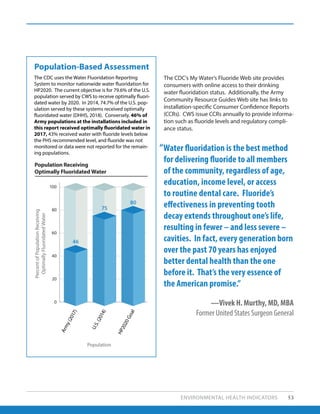
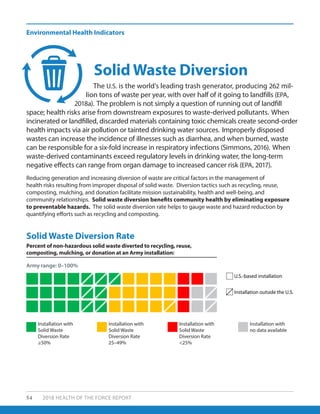
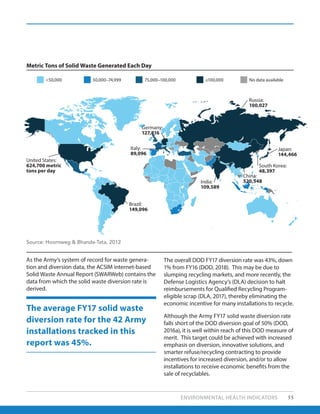
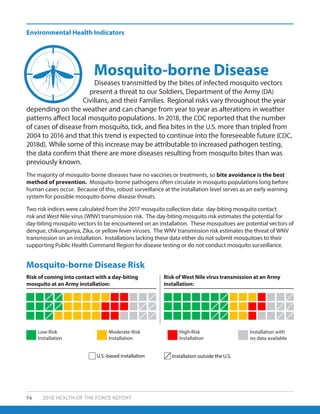
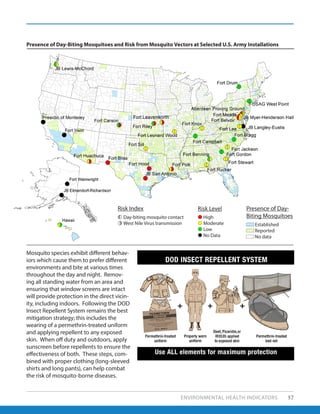
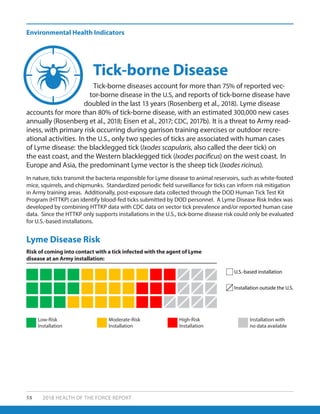
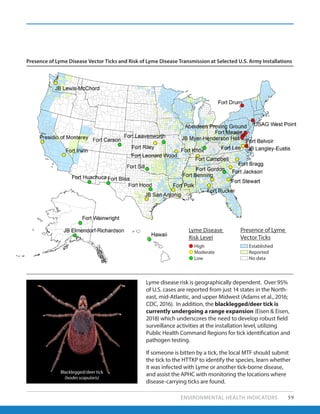
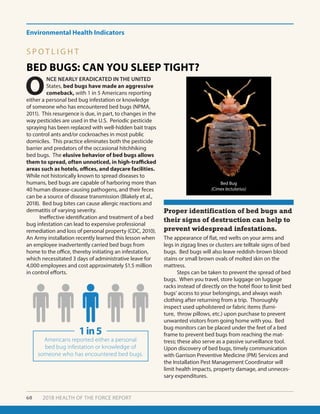
Create a healthier force for tomorrow.
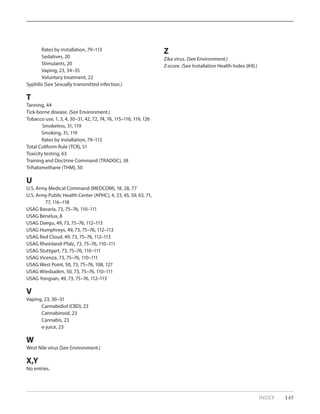
HEALTH
FORCE
OF THE
2018
— U.S.Army Public Health Center —
Approved for public release,
distribution unlimited.
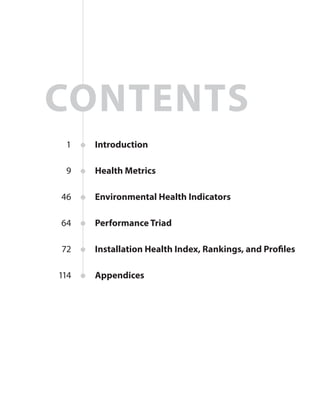
Introduction
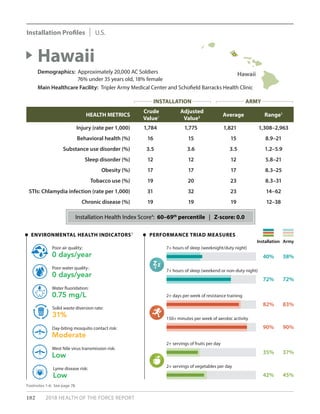
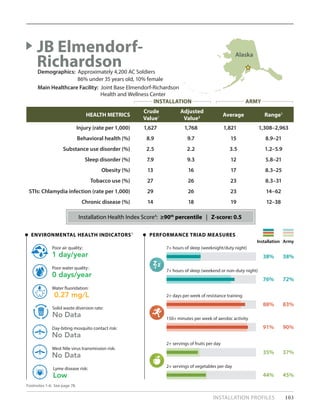
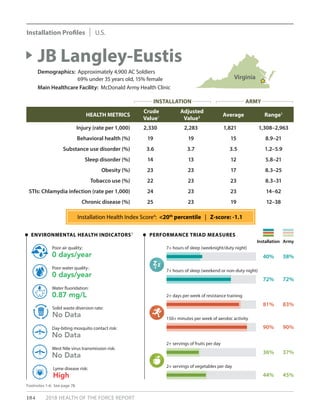
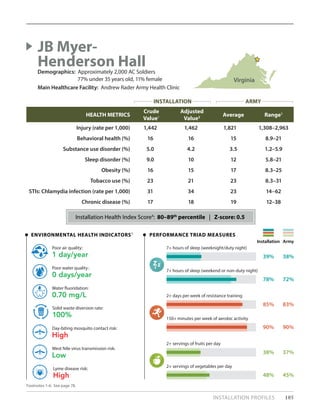
Health Metrics
Environmental Health Indicators
Performance Triad
Installation Health Index, Rankings, and Profiles
Appendices
1
9
46
64
72
114
CONTENTS
Our Purpose
Empower Army senior leaders with knowledge and
context to improve Army health and Soldier readiness.
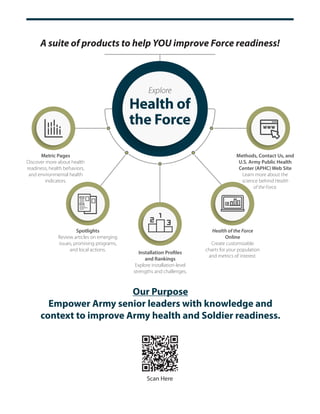
A suite of products to help YOU improve Force readiness!
Metric Pages
Discover more about health
readiness, health behaviors,
and environmental health
indicators.
Spotlights
Review articles on emerging
issues, promising programs,
and local actions.
Installation Profiles
and Rankings
Explore installation-level
strengths and challenges.
Methods, Contact Us, and
U.S. Army Public Health
Center (APHC) Web Site
Learn more about the
science behind Health
of the Force.
Health of the Force
Online
Create customizable
charts for your population
and metrics of interest.
Explore
Health of
the Force
Scan Here
INTRODUCTION 1
Welcome to the 2018 Health of the Force Report
	 The health of the individual Soldier is the foundation of the Army’s ability to deploy, fight, and
win against any adversary. Health of the Force provides an evidence-based portrait of the health and
well-being of the U.S. Army Active Component (AC) Soldier population. Leaders can use Health of
the Force data to inform health promotion and prevention measures, as well as drive cultural and pro-
grammatic changes necessary to achieve Force dominance.
	The Health of the Force report reflects medical, wellness, and environmental data for the prior
year (i.e., the 2018 report reflects calendar year 2017 data). Such data include key health metrics and
Performance Triad indicators to help leaders optimize Soldier health and performance. An expanded
environmental health section describes how the condition of the environment plays an integral role in
Soldiers’ ability to work, train, and deploy. Educational spotlights distributed throughout the report
highlight emerging threats to health readiness and promote programs that have successfully influenced
health status within the Army.
	Throughout Health of the Force, readers will find salient health issues illustrated through info-
graphics and charts. A new style of range chart is introduced with vertical lines indicating the distri-
bution of installation rates. Installation profiles provide a report card on 40 Army installations (30 in
the U.S. and 10 outside the U.S.) with average AC populations greater than 1,000. Installation rank-
ings are presented for selected key metrics: injury, obesity, tobacco use, and chronic disease.
	 Medical readiness classification summaries are excluded from the 2018 Health of the Force due to
lack of data. The transition to the International Classification of Diseases, Tenth Revision, Clinical Modi-
fication (ICD-10-CM) medical coding system introduced more diagnosis codes for injury. This neces-
sitated a comprehensive evaluation and categorization of injury codes and, as a result of the expanded
injury diagnosis code options, injury rates are higher than have been reported previously in Health of
the Force (2015–2017). Complete surveillance data for Soldiers assigned to Joint Base Lewis-McChord
(JBLM) were unavailable due to the Madigan Army Medical Center’s transition to the new Military
Health System electonic health record (Genesis). Therefore, JBLM is not reflected in metrics that were
derived from Defense Medical Surveillance System data. Finally, Aberdeen Proving Ground was
removed from the 2018 report because its 2017 average AC Soldier population fell below the inclusion
threshold of 1,000 Soldiers.
	 The 2018 print edition will be enhanced by Health of the Force Online, a digital interface that will
allow readers to drill down into available data. Together, these Health of the Force products can facil-
itate informed decisions that ultimately improve the readiness, health, and well-being of Soldiers
and the Total Army Family.
Create a healthier force for tomorrow.
HEALTH
FORCE
OF THE
2 2018 HEALTH OF THE FORCE REPORT
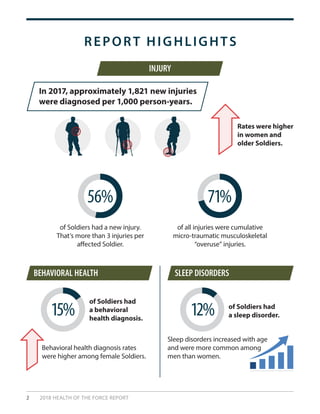
REPORT HIGHLIGHTS
of all injuries were cumulative
micro-traumatic musculoskeletal
“overuse” injuries.
of Soldiers had a new injury.
That’s more than 3 injuries per
affected Soldier.
SLEEP DISORDERSBEHAVIORAL HEALTH
INJURY
In 2017, approximately 1,821 new injuries
were diagnosed per 1,000 person-years.
Rates were higher
in women and
older Soldiers.
71%56%
of Soldiers had
a behavioral
health diagnosis.
15% of Soldiers had
a sleep disorder.12%
Behavioral health diagnosis rates
were higher among female Soldiers.
Sleep disorders increased with age
and were more common among
men than women.
INTRODUCTION 3
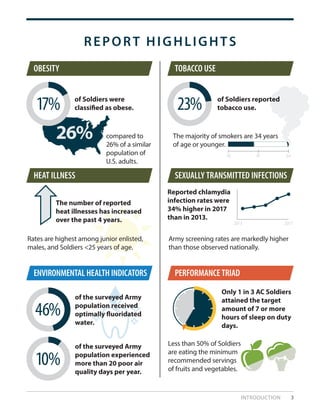
The majority of smokers are 34 years
of age or younger.
Rates are highest among junior enlisted,
males, and Soldiers <25 years of age.
Less than 50% of Soldiers
are eating the minimum
recommended servings
of fruits and vegetables.
Army screening rates are markedly higher
than those observed nationally.
26%
REPORT HIGHLIGHTS
SEXUALLY TRANSMITTED INFECTIONSHEAT ILLNESS
OBESITY
PERFORMANCE TRIAD
TOBACCO USE
ENVIRONMENTAL HEALTH INDICATORS
of the surveyed Army
population received
optimally fluoridated
water.
of the surveyed Army
population experienced
more than 20 poor air
quality days per year.
Only 1 in 3 AC Soldiers
attained the target
amount of 7 or more
hours of sleep on duty
days.
of Soldiers were
classified as obese.
The number of reported
heat illnesses has increased
over the past 4 years.
Reported chlamydia
infection rates were
34% higher in 2017
than in 2013.
of Soldiers reported
tobacco use.
compared to
26% of a similar
population of
U.S. adults.
46%
10%
17% 23%
18
2013 2017
41 64
4 2018 HEALTH OF THE FORCE REPORT
What Health of the Force Metrics Mean to Medical Readiness
There’s more to the data with Health of the
Force Online, including additional installa-
tion- and command-specific data. Delve
deeper into what these data mean for your
population. Read and share tools and sup-
plemental information to bring insight and
personal context to the report. Dynamically
generate charts to visualize data, make com-
parisons, and develop a better understand-
ing of the Health of YOUR Force. From the
APHC Web site, follow the Health of the Force
link to the CAC-enabled CarePoint platform:
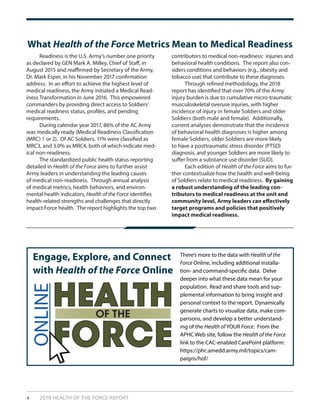
https://phc.amedd.army.mil/topics/cam-
paigns/hof/
Engage, Explore, and Connect
with Health of the Force Online
ONLINE
HEALTH
FORCE
OF THE
	 Readiness is the U.S. Army’s number one priority
as declared by GEN Mark A. Milley, Chief of Staff, in
August 2015 and reaffirmed by Secretary of the Army,
Dr. Mark Esper, in his November 2017 confirmation
address. In an effort to achieve the highest level of
medical readiness, the Army initiated a Medical Read-
iness Transformation in June 2016. This empowered
commanders by providing direct access to Soldiers’
medical readiness status, profiles, and pending
requirements.
	 During calendar year 2017, 86% of the AC Army
was medically ready (Medical Readiness Classification
(MRC) 1 or 2). Of AC Soldiers, 11% were classified as
MRC3, and 3.0% as MRC4, both of which indicate med-
ical non-readiness.
	 The standardized public health status reporting
detailed in Health of the Force aims to further assist
Army leaders in understanding the leading causes
of medical non-readiness. Through annual analysis
of medical metrics, health behaviors, and environ-
mental health indicators, Health of the Force identifies
health-related strengths and challenges that directly
impact Force health. The report highlights the top two
contributors to medical non-readiness: injuries and
behavioral health conditions. The report also con-
siders conditions and behaviors (e.g., obesity and
tobacco use) that contribute to these diagnoses.
	 Through refined methodology, the 2018
report has identified that over 70% of the Army
injury burden is due to cumulative micro-traumatic
musculoskeletal overuse injuries, with higher
incidence of injury in female Soldiers and older
Soldiers (both male and female). Additionally,
current analyses demonstrate that the incidence
of behavioral health diagnoses is higher among
female Soldiers, older Soldiers are more likely
to have a posttraumatic stress disorder (PTSD)
diagnosis, and younger Soldiers are more likely to
suffer from a substance use disorder (SUD).
	 Each edition of Health of the Force aims to fur-
ther contextualize how the health and well-being
of Soldiers relate to medical readiness. By gaining
a robust understanding of the leading con-
tributors to medical readiness at the unit and
community level, Army leaders can effectively
target programs and policies that positively
impact medical readiness.
INTRODUCTION 5
0
100,000
200,000
300,000
400,000
500,000
2013 2014 2015 2016 2017
Female
Male
Total
68,442
402,635
471,077
68,779
396,207
464,986
69,012
418,539
487,551
72,006
458,144
530,150
70,438
438,483
508,921
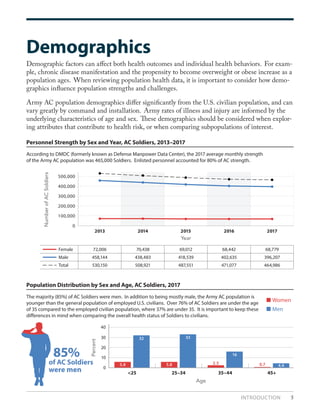
Demographics
Demographic factors can affect both health outcomes and individual health behaviors. For exam-
ple, chronic disease manifestation and the propensity to become overweight or obese increase as a
population ages. When reviewing population health data, it is important to consider how demo-
graphics influence population strengths and challenges.
Army AC population demographics differ significantly from the U.S. civilian population, and can
vary greatly by command and installation. Army rates of illness and injury are informed by the
underlying characteristics of age and sex. These demographics should be considered when explor-
ing attributes that contribute to health risk, or when comparing subpopulations of interest.
<25 25–34 35–44 45+
0
10
20
40
30
5.8 5.8
33
2.5
32
16
0.7 4.4
Personnel Strength by Sex and Year, AC Soldiers, 2013–2017
Population Distribution by Sex and Age, AC Soldiers, 2017
According to DMDC (formerly known as Defense Manpower Data Center), the 2017 average monthly strength
of the Army AC population was 465,000 Soldiers. Enlisted personnel accounted for 80% of AC strength.
The majority (85%) of AC Soldiers were men. In addition to being mostly male, the Army AC population is
younger than the general population of employed U.S. civilians. Over 76% of AC Soldiers are under the age
of 35 compared to the employed civilian population, where 37% are under 35. It is important to keep these
differences in mind when comparing the overall health status of Soldiers to civilians.
Age
Year
NumberofACSoldiers
Percent
Women
Men
85%
of AC Soldiers
were men
6 2018 HEALTH OF THE FORCE REPORT
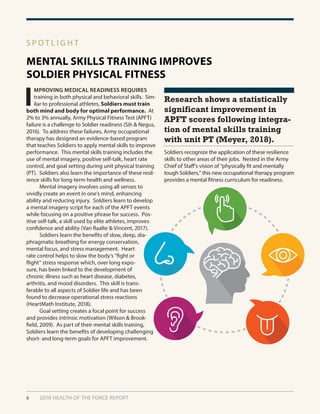
MENTAL SKILLS TRAINING IMPROVES
SOLDIER PHYSICAL FITNESS
S P O T L I G H T
I
MPROVING MEDICAL READINESS REQUIRES
training in both physical and behavioral skills. Sim-
ilar to professional athletes, Soldiers must train
both mind and body for optimal performance. At
2% to 3% annually, Army Physical Fitness Test (APFT)
failure is a challenge to Soldier readiness (Sih & Negus,
2016). To address these failures, Army occupational
therapy has designed an evidence-based program
that teaches Soldiers to apply mental skills to improve
performance. This mental skills training includes the
use of mental imagery, positive self-talk, heart rate
control, and goal setting during unit physical training
(PT). Soldiers also learn the importance of these resil-
ience skills for long-term health and wellness.
	 Mental imagery involves using all senses to
vividly create an event in one’s mind, enhancing
ability and reducing injury. Soldiers learn to develop
a mental imagery script for each of the APFT events
while focusing on a positive phrase for success. Pos-
itive self-talk, a skill used by elite athletes, improves
confidence and ability (Van Raalte & Vincent, 2017).
	 Soldiers learn the benefits of slow, deep, dia-
phragmatic breathing for energy conservation,
mental focus, and stress management. Heart
rate control helps to slow the body’s “fight or
flight” stress response which, over long expo-
sure, has been linked to the development of
chronic illness such as heart disease, diabetes,
arthritis, and mood disorders. This skill is trans-
ferable to all aspects of Soldier life and has been
found to decrease operational stress reactions
(HeartMath Institute, 2018).
	 Goal setting creates a focal point for success
and provides intrinsic motivation (Wilson & Brook-
field, 2009). As part of their mental skills training,
Soldiers learn the benefits of developing challenging
short- and long-term goals for APFT improvement.
Soldiers recognize the application of these resilience
skills to other areas of their jobs. Nested in the Army
Chief of Staff’s vision of “physically fit and mentally
tough Soldiers,” this new occupational therapy program
provides a mental fitness curriculum for readiness.
Research shows a statistically
significant improvement in
APFT scores following integra-
tion of mental skills training
with unit PT (Meyer, 2018).
INTRODUCTION 7
ARMY WELLNESS CENTERS
SUPPORT HEALTH AND READINESS
S P O T L I G H T
A
RMY WELLNESS CENTERS (AWC) APPLY BEST
practices in workplace health promotion
programming to improve Soldier readiness
and Army community health. Designed to shift the
focus from reactive, treatment-focused health care to
a prevention-focused system for health, AWCs deliver
an individual-level health education and coaching
model that supports prevention by helping Soldiers
and Army community members increase healthy
behaviors, reduce disease risk factors, and optimize
readiness and resiliency. The AWCs’ approach, sup-
ported by the Community Preventive Services Task
Force, includes the health risk assessment, feedback
from participants, and health education. Six evi-
dence-informed core programs are standardized
across a global network of 35 AWCs.
	 AWCs are monitored to assess both the achieve-
ment of performance benchmarks and model compli-
ance. They are evaluated for program effectiveness
and identification of areas for improvement. In the
second quarter of Fiscal Year 2018 (FY18), AWCs
served 18,000 clients and achieved a 97% client satis-
faction rating. An FY14–15 AWC outcomes evaluation
(Rivera et al., 2018) concluded that clients who en-
gaged in at least one follow-up AWC assessment
not only experienced improvements in cardio-
respiratory fitness but also reductions in body
fat, body mass index (BMI), blood pressure, and
perceived stress. For example, nearly 70% of clients
increased their level of cardiorespiratory fitness, and
nearly 60% decreased their body fat and BMI. These
results are particularly meaningful given research
showing that increased levels of cardiorespiratory fit-
ness and decreased levels of BMI are generally tied to
better health- and injury-related outcomes (Verweij
et al., 2011; Jones et al., 2017), both of which positively
impact Soldier deployability and readiness.
	 AWCs are the community outreach arm of the
Army Patient Centered Medical Home (PCMH) model
and are often located apart from medical treatment
facilities to help mitigate the perceived stigma asso-
ciated with seeking medical care. Evaluation efforts
that examined the collaboration between the AWC
and PCMH suggest that ongoing collaboration could
be improved by standardizing the referral process
and increasing communication via huddle meeting
representation (APHC(Prov), 2016a).
	 AWC services are available to Army commu-
nity members at no cost. For more information or
to schedule an appointment, contact your local AWC.
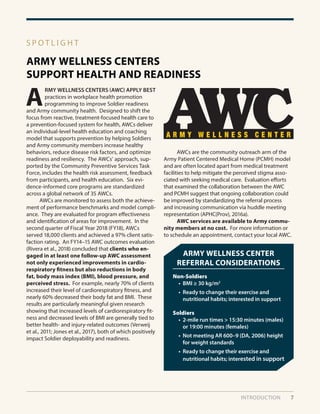
ARMY WELLNESS CENTER
REFERRAL CONSIDERATIONS
Non-Soldiers
• BMI ≥ 30 kg/m2
• Ready to change their exercise and
nutritional habits; interested in support
Soldiers
• 2-mile run times > 15:30 minutes (males)
or 19:00 minutes (females)
• Not meeting AR 600–9 (DA, 2006) height
for weight standards
• Ready to change their exercise and
nutritional habits; interested in support
Fort Sill Health Readiness Center
Improves Medical Readiness
U.S. Army Garrison Benelux Reduces
Medical Readiness Classification 4 Rates
L O C A L A C T I O N
I
n February 2017, Fort Sill opened a Health Readiness Center in response to the Senior
Commander’s directive to address a medical non-readiness rate of 11% through the Com-
mander’s Ready and Resilient Council (CR2C) Improvement Plan. The Fort Sill Health and
Readiness Council spearheaded the initiative to locate nutrition care, public health nursing, case
management, Periodic Health Assessments (PHAs), AWCs, and medical readiness reviews in one
center. At Fort Sill, Soldiers process through the Health Readiness Center as part of their per-
sonal readiness requirements. Since the Center’s implementation, PHA compliance has increased
to 97% (a 19% increase), the number of Soldiers receiving MRC3 or MRC4 designations has
decreased by 48% and 82%, respectively, and deployability has increased to 92%. In addition,
Fort Sill referrals to available prevention services have increased by 82% since the Health Readi-
ness Center was established. Coordinated approaches to addressing medical readiness reduce gaps
in services, increase referral rates to preventive health services, and prevent duplication of efforts.
D
uring a Commander’s Readiness Forum, it was identified that 12% of U.S. Army
Garrison (USAG) Benelux Soldiers were in an MRC4 status and, therefore, were
not medically ready. The USAG Benelux CR2C and Medical Treatment Facility
(MTF) formed a working group to plan and implement an initiative to reduce MRC4 rates.
The program incorporated readiness checks into every outpatient appointment to rapidly refer
Soldiers to programs and resources that address readiness deficiencies. Additionally, primary
care providers sent reminders to Soldiers via a secure messaging system. As a result, USAG
Benelux MRC4 rates have dropped significantly to under 2%. Building medical readiness into
the way organizations conduct daily operations ensures that readiness is a priority for the entire
installation.
8 2018 HEALTH OF THE FORCE REPORT
INTRODUCTION 9
Health Metrics
INJURY
TOBACCO USE
BEHAVIORAL HEALTH
HEAT ILLNESS
SUBSTANCE USE
HEARING
SLEEP DISORDERS
OBESITY
SEXUALLY TRANSMITTED INFECTIONS
CHRONIC DISEASE
Health Metrics Injury
10 2018 HEALTH OF THE FORCE REPORT
Injury
Injury is a significant contributor to the Army’s healthcare burden, impacting medical readiness
and Soldier health. Over 1 million medical encounters and roughly 10 million days of limited
duty occur annually as a result of injuries and injury-related musculoskeletal conditions, affecting
over half of Soldiers each year.
Injuries reported here are defined as any damage or interruption of body tissue function caused by
an energy transfer that exceeds tissue tolerance suddenly (acute trauma) or gradually (cumulative
micro-trauma) (APHC, 2017a). A comprehensive re-classification of injury diagnosis codes was
necessitated by the Military Health System’s transition to the ICD-10-CM medical coding sys-
tem in October 2015. Following the transition to ICD-10-CM, the rates of injury diagnoses are
higher than those reported previously. Revised 2016 rates under the new definition are shown for
comparison (top of next page).
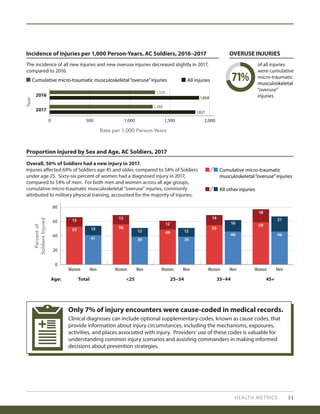
Incidence of Injury by Sex and Age, AC Soldiers, 2017
Among AC Soldiers, approximately 1,821 new injuries were diagnosed per 1,000 person-years
in 2017. The high rate reflects multiple injuries among affected Soldiers. Injury rates were
higher among women and older Soldiers.
There were 1,821 new injuries per 1,000 person-years.
Incidence ranged from 1,308 to 2,963 per 1,000 person-years across Army installations.
1,821
1,308 2,963
Rateper1,000
Person-Years
Age
Women
Men
Total <25 25–34 35–44 45+
0
500
1,000
2,500
3,500
1,500
2,000
3,000
2,396
3,415
2,894
1,720
2,683
2,230
2,066
1,5411,470
2,474
HEALTH METRICS 11
Incidence of Injuries per 1,000 Person-Years, AC Soldiers, 2016–2017 OVERUSE INJURIES
The incidence of all new injuries and new overuse injuries decreased slightly in 2017,
compared to 2016.
of all injuries
were cumulative
micro-traumatic
musculoskeletal
“overuse”
injuries.
Cumulative micro-traumatic musculoskeletal“overuse”injuries All injuries
Year
Rate per 1,000 Person-Years
Proportion Injured by Sex and Age, AC Soldiers, 2017
Overall, 56% of Soldiers had a new injury in 2017.
Injuries affected 69% of Soldiers age 45 and older, compared to 54% of Soldiers
under age 25. Sixty-six percent of women had a diagnosed injury in 2017,
compared to 54% of men. For both men and women across all age groups,
cumulative micro-traumatic musculoskeletal “overuse” injuries, commonly
attributed to military physical training, accounted for the majority of injuries.
Cumulative micro-traumatic
musculoskeletal“overuse”injuries
All other injuries
Total
Women Men Women Men Women Men Women Men Women Men
Age: <25 25–34 35–44 45+
0
20
40
60
80
53
13
56
13
39
12 49
12
41
13
39
12
55
14
46
16
46
21
59
18
Percentof
SoldiersInjured
2016
2017
0 2,000500
1,320
1,000 1,500
1,868
1,288
1,821
71%
Only 7% of injury encounters were cause-coded in medical records.
Clinical diagnoses can include optional supplementary codes, known as cause codes, that
provide information about injury circumstances, including the mechanisms, exposures,
activities, and places associated with injury. Providers’ use of these codes is valuable for
understanding common injury scenarios and assisting commanders in making informed
decisions about prevention strategies.
Health Metrics Injury
12 2018 HEALTH OF THE FORCE REPORT
U.S. Army Hawaii 25th
Infantry Division
Addresses Injury Prevention
L O C A L A C T I O N
T
he CR2C strategically manages, monitors, and implements health improvement plans
across medical, garrison, and mission operations. Using CR2C processes, the U.S. Army
Hawaii Physical Health Working Group spearheaded an initiative to reduce injuries,
reduce rates of MRC3 designations, and improve physical training methods. Physical thera-
pists trained the 3rd
Battalion, 7th
Field Artillery Regiment 25th
Infantry Division Soldiers in
evidenced-based approaches to physical reconditioning. As a result, the number of Soldiers on
profile due to musculoskeletal injuries decreased by 72%. Due to the success of the program, it
is now being applied to other 25th
Infantry Division units.
”Continuing to build upon and follow a systematic, public
health approach to injury prevention will enable continued
progress toward reducing the negative impact injuries place
on Soldiers, their Families, commanders, and the Army
medical system.”
—LTG Eric Shoomaker
former Surgeon General of the Army
HEALTH METRICS 13
DON’T BE BENCHED BY PEC MUSCLE
AND TENDON INJURIES
S P O T L I G H T
S
OLDIERS MUST STRIVE TO ATTAIN HIGH lev-
els of physical fitness to complete the mission
effectively. Strength training is an increasingly
popular way to improve muscle mass and optimize
body composition. However, the military medical
community has reported a notable increase in sur-
geries for torn or ruptured pectoralis major muscles
(PMM)/tendons (PMT) (Salazar et al., 2018; Antosh
et al., 2009; White et al., 2007). Injuries to the “pecs”
primarily occur while bench pressing heavy weights,
when a sudden imbalance puts unexpected strain on
one side.
	 Injuries that require surgery result in months of
limited movement and lost work, permanent loss of
strength, and/or reassignment of work duties (Pochini
et al., 2014; Merlin et al., 2017). Partial PMM/PMT
tears not requiring surgery still restrict lifting for days
or weeks. Reports thus far have focused on surgical
cases, so the full extent of the military PMM/PMT
injury problem is not yet known.
	 Increase in PMM/PMT injuries is linked to the
growing interest in weight-lifting activities. Many
military-owned or -operated facilities (even in deploy-
ment settings) provide bench press equipment. The
use of other makeshift items (e.g., cinderblocks,
sand-filled jugs) has also been reported. Most sur-
gical cases are men who were bench pressing heavy
weights (over 175 pounds, but especially over 250
pounds) at the time of their injury.
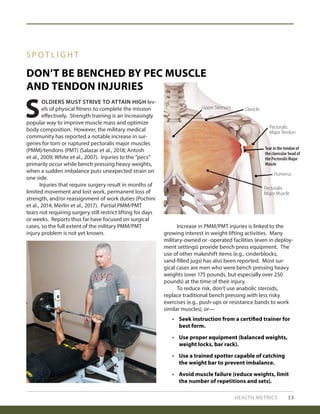
	 To reduce risk, don’t use anabolic steroids,
replace traditional bench pressing with less risky
exercises (e.g., push-ups or resistance bands to work
similar muscles), or—
•	 Seek instruction from a certified trainer for
best form.
•	 Use proper equipment (balanced weights,
weight locks, bar rack).
•	 Use a trained spotter capable of catching
the weight bar to prevent imbalance.
•	 Avoid muscle failure (reduce weights, limit
the number of repetitions and sets).
Upper Sternum Clavicle
Pectoralis
Major Tendon
Humerus
Pectoralis
Major Muscle
Tear in the tendon of
the clavicular head of
the Pectoralis Major
Muscle
Health Metrics Behavioral Health
14 2018 HEALTH OF THE FORCE REPORT
Behavioral Health
The stressors of military life can strongly influence the psychological well-being of Soldiers and
their Families. Particularly when unrecognized and untreated, behavioral health (BH) diagnoses
can lead to lack of medical readiness, early discharge from the Army, and suicidal behavior. In
2017, 15% of Soldiers had a diagnosis of one or more BH conditions, which include adjustment
disorder, mood disorders, anxiety disorders, posttraumatic stress disorder (PTSD), substance use
disorder (SUD), personality disorder, and psychosis.
Overall, 15% of Soldiers had a behavioral health disorder.
Prevalence ranged from 8.9% to 21% across Army installations.
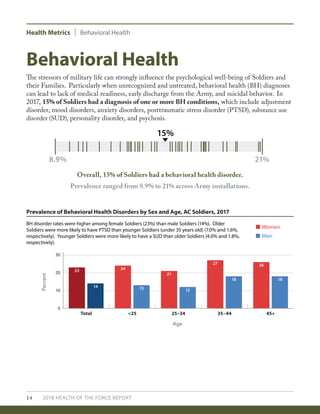
Prevalence of Behavioral Health Disorders by Sex and Age, AC Soldiers, 2017
BH disorder rates were higher among female Soldiers (23%) than male Soldiers (14%). Older
Soldiers were more likely to have PTSD than younger Soldiers (under 35 years old) (7.0% and 1.6%,
respectively). Younger Soldiers were more likely to have a SUD than older Soldiers (4.0% and 1.8%,
respectively).
Women
Men
Percent
Age
Total <25 25–34 35–44 45+
0
10
20
30
23 24
13
21
14
12
27
18 18
26
15%
8.9% 21%
HEALTH METRICS 15
Prevalence of Behavioral Health Disorder by Condition, AC Soldiers, 2013-2017
The proportion of AC Soldiers with a diagnosed BH disorder has slowly declined in the last 5 years from
a high of 17% in 2013 to 15% in 2017. With the exception of SUD, the prevalence of all BH disorders has
also decreased. Despite these reductions in diagnoses, Army Medicine continues to strive to bring more
Soldiers into care to improve the readiness and well-being of the Force.
Condition
Percent
0
5
10
15
20
2013 2014 2015 2016 2017
Any BH disorder 16 151617 16
Adjustment disorder 8.5 8.18.38.6 8.2
Mood disorder 4.9 4.55.45.8 5.7
Other anxiety disorder 5.2 4.85.65.4 5.5
PTSD 3.3 2.93.43.7 3.6
Substance use disorder 3.2 3.53.13.3 3.0
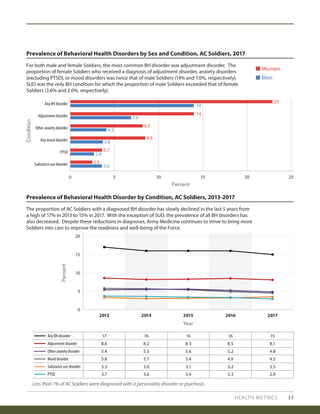
Prevalence of Behavioral Health Disorders by Sex and Condition, AC Soldiers, 2017
For both male and female Soldiers, the most common BH disorder was adjustment disorder. The
proportion of female Soldiers who received a diagnosis of adjustment disorder, anxiety disorders
(excluding PTSD), or mood disorders was twice that of male Soldiers (14% and 7.0%, respectively).
SUD was the only BH condition for which the proportion of male Soldiers exceeded that of female
Soldiers (3.6% and 2.6%, respectively).
Women
Men
Percent
Year
Any BH disorder
Adjustment disorder
Other anxiety disorder
Any mood disorder
PTSD
Substance use disorder
2550 10 15 20
23
14
14
7.0
8.3
4.2
8.6
3.8
3.7
2.8
2.6
3.6
Less than 1% of AC Soldiers were diagnosed with a personality disorder or psychosis.
Health Metrics Behavioral Health
16 2018 HEALTH OF THE FORCE REPORT
POSTTRAUMATIC STRESS DISORDER AND
PHYSICAL HEALTH INTERRELATIONSHIP
S P O T L I G H T
P
OSTTRAUMATIC STRESS DISORDER
is one of the most common BH conditions
to occur after exposure to traumatic events,
including combat, assault, rape, accidents, natural
disasters, and other life-threatening experiences. It
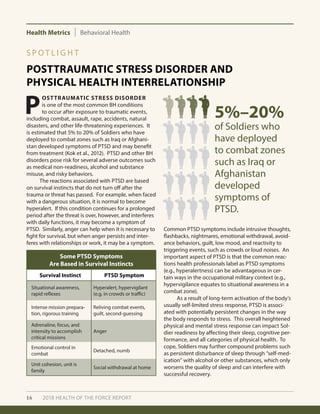
is estimated that 5% to 20% of Soldiers who have
deployed to combat zones such as Iraq or Afghani-
stan developed symptoms of PTSD and may benefit
from treatment (Kok et al., 2012). PTSD and other BH
disorders pose risk for several adverse outcomes such
as medical non-readiness, alcohol and substance
misuse, and risky behaviors.
	 The reactions associated with PTSD are based
on survival instincts that do not turn off after the
trauma or threat has passed. For example, when faced
with a dangerous situation, it is normal to become
hyperalert. If this condition continues for a prolonged
period after the threat is over, however, and interferes
with daily functions, it may become a symptom of
PTSD. Similarly, anger can help when it is necessary to
fight for survival, but when anger persists and inter-
feres with relationships or work, it may be a symptom.
Common PTSD symptoms include intrusive thoughts,
flashbacks, nightmares, emotional withdrawal, avoid-
ance behaviors, guilt, low mood, and reactivity to
triggering events, such as crowds or loud noises. An
important aspect of PTSD is that the common reac-
tions health professionals label as PTSD symptoms
(e.g., hyperalertness) can be advantageous in cer-
tain ways in the occupational military context (e.g.,
hypervigilance equates to situational awareness in a
combat zone).
	 As a result of long-term activation of the body’s
usually self-limited stress response, PTSD is associ-
ated with potentially persistent changes in the way
the body responds to stress. This overall heightened
physical and mental stress response can impact Sol-
dier readiness by affecting their sleep, cognitive per-
formance, and all categories of physical health. To
cope, Soldiers may further compound problems such
as persistent disturbance of sleep through ”self-med-
ication” with alcohol or other substances, which only
worsens the quality of sleep and can interfere with
successful recovery.
Some PTSD Symptoms
Are Based in Survival Instincts
Survival Instinct PTSD Symptom
Situational awareness,
rapid reflexes
Hyperalert, hypervigilant
(e.g. in crowds or traffic)
Intense mission prepara-
tion, rigorous training
Reliving combat events,
guilt, second-guessing
Adrenaline, focus, and
intensity to accomplish
critical missions
Anger
Emotional control in
combat
Detached, numb
Unit cohesion, unit is
family
Social withdrawal at home
of Soldiers who
have deployed
to combat zones
such as Iraq or
Afghanistan
developed
symptoms of
PTSD.
5%–20%
HEALTH METRICS 17
Joint Base Langley-Eustis Reduces
Behavioral Health No-Show Rates
L O C A L A C T I O N
F
ollowing the loss of a Soldier by suicide after he failed to keep a BH appointment,
the Joint Base Langley-Eustis (JBLE) community coordinated an effort to reduce the
no-show rates for healthcare appointments. Recognizing that access to care and attend-
ing appointments are critical to personal readiness, a working group implemented an email and
telephone call appointment reminder system for both Soldiers and commanders. By helping
to ensure Soldiers are released for scheduled healthcare appointments, commanders are
supporting Soldiers in getting the care they need when they need it, thus demonstrating the
importance of BH care as a key factor in personal readiness. Since implementation of the JBLE
program, the no-show rates for BH appointments have decreased by 1.7%, and those for sub-
stance abuse counseling appointments have decreased by 3.3%. These observed reductions in
no-show rates are expected to improve further as the appointment reminder system continues to
be implemented.
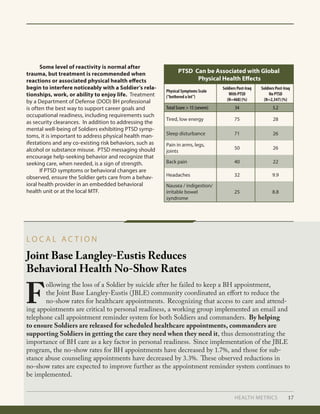
PTSD Can be Associated with Global
Physical Health Effects
Physical Symptoms Scale
(“bothered a lot”)
Soldiers Post-Iraq
With PTSD
(N=468) (%)
Soldiers Post-Iraq
No PTSD
(N=2,347) (%)
Total Score > 15 (severe) 34 5.2
Tired, low energy 75 28
Sleep disturbance 71 26
Pain in arms, legs,
joints
50 26
Back pain 40 22
Headaches 32 9.9
Nausea / indigestion/
irritable bowel
syndrome
25 8.8
	 Some level of reactivity is normal after
trauma, but treatment is recommended when
reactions or associated physical health effects
begin to interfere noticeably with a Soldier’s rela-
tionships, work, or ability to enjoy life. Treatment
by a Department of Defense (DOD) BH professional
is often the best way to support career goals and
occupational readiness, including requirements such
as security clearances. In addition to addressing the
mental well-being of Soldiers exhibiting PTSD symp-
toms, it is important to address physical health man-
ifestations and any co-existing risk behaviors, such as
alcohol or substance misuse. PTSD messaging should
encourage help-seeking behavior and recognize that
seeking care, when needed, is a sign of strength.
	 If PTSD symptoms or behavioral changes are
observed, ensure the Soldier gets care from a behav-
ioral health provider in an embedded behavioral
health unit or at the local MTF.
Health Metrics Behavioral Health
18 2018 HEALTH OF THE FORCE REPORT
IMPROVING SOLDIER READINESS BY OPTIMIZING
BEHAVIORAL HEALTH TREATMENT EFFECTIVENESS
S P O T L I G H T
T
HE ARMY BH SERVICE LINE SUPPORTS
Soldier readiness and Family health through
a cycle of patient-centered, data-informed,
healthcare delivery and leadership support. Patient-
reported data are collected to inform individual
patient care and increase overall treatment effec-
tiveness at the clinic, MTF, region, and U.S. Army
Medical Command (MEDCOM) levels. This cycle of
care benefits patients by improving treatment out-
comes, ensuring the provider and patient are working
together toward mutually agreed-upon goals, and
allowing them to identify when the current treatment
plan needs to be adjusted to ensure treatment is max-
imally effective.
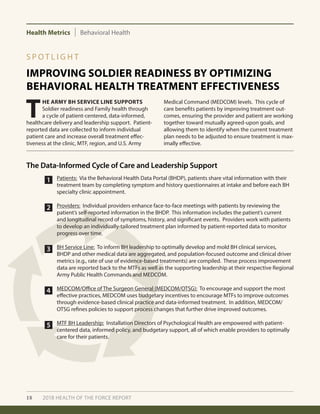
The Data-Informed Cycle of Care and Leadership Support
Patients: Via the Behavioral Health Data Portal (BHDP), patients share vital information with their
treatment team by completing symptom and history questionnaires at intake and before each BH
specialty clinic appointment.
Providers: Individual providers enhance face-to-face meetings with patients by reviewing the
patient’s self-reported information in the BHDP. This information includes the patient’s current
and longitudinal record of symptoms, history, and significant events. Providers work with patients
to develop an individually-tailored treatment plan informed by patient-reported data to monitor
progress over time.
BH Service Line: To inform BH leadership to optimally develop and mold BH clinical services,
BHDP and other medical data are aggregated, and population-focused outcome and clinical driver
metrics (e.g., rate of use of evidence-based treatments) are compiled. These process improvement
data are reported back to the MTFs as well as the supporting leadership at their respective Regional
Army Public Health Commands and MEDCOM.
MEDCOM/Office of The Surgeon General (MEDCOM/OTSG): To encourage and support the most
effective practices, MEDCOM uses budgetary incentives to encourage MTFs to improve outcomes
through evidence-based clinical practice and data-informed treatment. In addition, MEDCOM/
OTSG refines policies to support process changes that further drive improved outcomes.
MTF BH Leadership: Installation Directors of Psychological Health are empowered with patient-
centered data, informed policy, and budgetary support, all of which enable providers to optimally
care for their patients.
1
2
3
4
5
HEALTH METRICS 19
EMBEDDED BEHAVIORAL HEALTH
PROMOTES UNIT READINESS
S P O T L I G H T
E
MBEDDED BEHAVIORAL HEALTH (EBH) IS
one of the most innovative transformations
to occur in the delivery of military BH care
and has been validated as a best practice of military
medicine. Research studies (DiBenigno, 2017; Kochan
et al., 2016; APHC, 2017b) have demonstrated that
use of the EBH model results in statistically significant
improvements in mission readiness, increased outpa-
tient BH care and leader-provided collaboration, and
decreased need for acute inpatient psychiatric care.
	 The EBH team serves as the Soldiers’ single point
of entry into BH care and is typically located within
walking distance of where they live and work. Each
battalion is assigned a BH provider, ensuring continu-
ity of care for Soldiers and providing leaders with an
easily accessible subject matter expert.
This relationship between the BH provider and key
battalion personnel overcomes the stigma commonly
associated with seeking BH care in the military. In
addition, the unit-aligned BH provider is able to main-
tain visibility on mission readiness and BH trends in
the formation, specifically tailoring BH treatment and
education options to that battalion’s Soldiers. In the
EBH model, unit-aligned BH providers meet with key
battalion personnel (medical providers, commanders,
chaplains, etc.) on a regular basis to discuss the readi-
ness and BH needs of their units.
	 In one example from an infantry regiment,
the leadership was able to voice concerns about the
morale, motivation, risk-taking, and future plans of
Soldiers facing disciplinary problems and/or potential
administrative discharge. The EBH team then devel-
oped a weekly therapy group to address coping skills,
decision making, relationships, and occupational
planning for this potentially vulnerable population.
In addition to gaining valuable skills, participants ben-
efitted from the social support and contributions of
the group. The battalion commander’s participation
demonstrated leader support for BH care and rein-
forced unit cohesion. Because of this group’s success,
similar therapy groups have been implemented for
multiple cohorts.
	 Due to the documented, reproducible, and sus-
tainable benefits of this model of care, unit-aligned
providers and dedicated command consultation
time have been integrated into the current operating
model for all Soldier outpatient BH care.
Leaders and BH providers can
build working relationships
that promote individual and
unit readiness through en-
hanced access to care, early
intervention, and responsive
consultation.
Health Metrics Substance Use
20 2018 HEALTH OF THE FORCE REPORT
Substance Use
Substance use disorder (SUD) includes the misuse of alcohol, cannabis, cocaine, hallucinogens,
opioids, sedatives, or stimulants. According to the Diagnostic and Statistical Manual of Mental
Disorders, 5th Edition (DSM-5®), a diagnosis of SUD is based on evidence of impaired control,
social impairment, risky use, and pharmacological criteria (APA, 2013). The misuse of alcohol,
prescription medications, and other drugs can impact Soldier readiness and resilience and poten-
tially impact family, friends, and the Army community as a whole. Drug and alcohol overdose is
the leading method of attempted suicide among Soldiers (APHC, 2017c). The Army continues to
adapt treatment and prevention efforts to accommodate the unique characteristics of military life
and culture. Overall, more than 18,000 Soldiers were diagnosed with a SUD in 2017.
Prevalence of Substance Use Disorder by Sex and Age, AC Soldiers, 2017
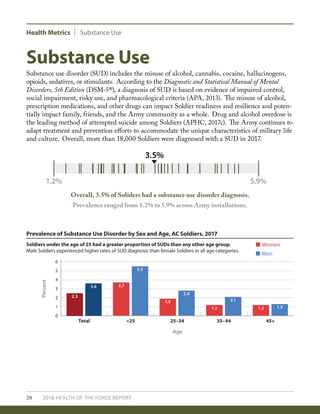
Soldiers under the age of 25 had a greater proportion of SUDs than any other age group.
Male Soldiers experienced higher rates of SUD diagnosis than female Soldiers in all age categories.
Women
Men
Percent
Age
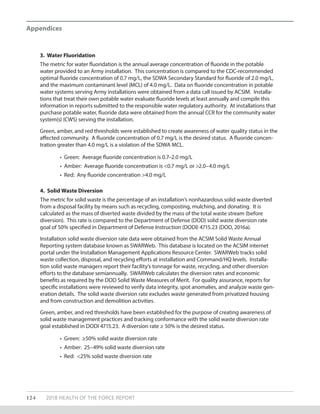
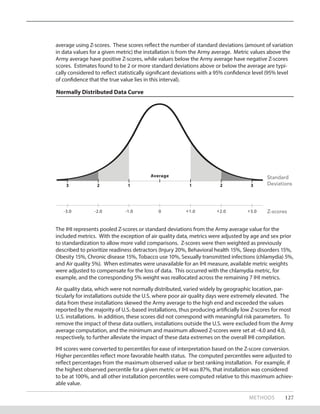
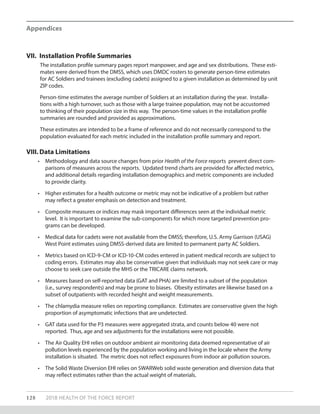
Overall, 3.5% of Soliders had a substance use disorder diagnosis.
Prevalence ranged from 1.2% to 5.9% across Army installations.
Total <25 25–34 35–44 45+
0
1
2
4
6
3
5
3.7
1.9
2.8
1.2
5.5
2.1
1.2 1.3
3.6
2.5
3.5%
1.2% 5.9%
0
20
40
60
80
2013 2014 2015 2016 2017
Alcohol (%) 80 747976 79
Cannabis (%) 12 171110 10
Opioids (%) 2.9 2.03.15.6 4.0
Cocaine (%) 2.2 3.22.22.0 2.0
Amphetamines (%) 1.4 2.11.91.7 1.6
HEALTH METRICS 21
Proportion Enrolled in Formal Treatment by Substance, AC Soldiers, 2013–2017
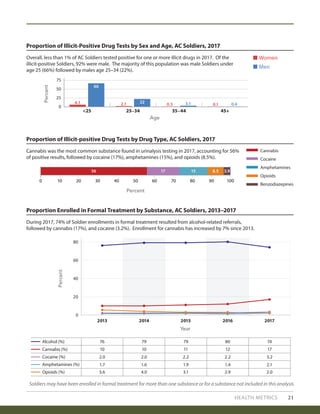
During 2017, 74% of Soldier enrollments in formal treatment resulted from alcohol-related referrals,
followed by cannabis (17%), and cocaine (3.2%). Enrollment for cannabis has increased by 7% since 2013.
Year
Proportion of Illicit-positive Drug Tests by Drug Type, AC Soldiers, 2017
Percent
Cannabis was the most common substance found in urinalysis testing in 2017, accounting for 56%
of positive results, followed by cocaine (17%), amphetamines (15%), and opioids (8.5%).
0 10 20 30 40 50 60 70 80 90 100
56 15 8.517 3.9
Cannabis
Cocaine
Amphetamines
Opioids
Benzodiazepines
Percent
Proportion of Illicit-Positive Drug Tests by Sex and Age, AC Soldiers, 2017
Women
Men
Percent
Overall, less than 1% of AC Soldiers tested positive for one or more illicit drugs in 2017. Of the
illicit-positive Soldiers, 92% were male. The majority of this population was male Soldiers under
age 25 (66%) followed by males age 25–34 (22%).
Age
<25 25–34 35–44 45+
0
25
50
75
6.1 2.1 22
0.3
66
3.1 0.1 0.4
Soldiers may have been enrolled in formal treatment for more than one substance or for a substance not included in this analysis.
Health Metrics Substance Use
REDUCING STIGMA WITH VOLUNTARY ALCOHOL-
RELATED BEHAVIORAL HEALTH CARE
S P O T L I G H T
S
TIGMA HAS LONG BEEN A FACTOR THAT
impacts a Soldier’s willingness to seek treat-
ment for BH and substance misuse issues.
Soldiers often believe that seeking care will cause
others to lose confidence in their abilities, threaten
their career advancement and security clearances,
and cause removal from their units (DOD, 2007). In
the recent Policy for Voluntary Alcohol-Related Behav-
ioral Health Care (pending publication), the OTSG aims
to fight this stigma and change the culture to one
that encourages Soldiers to seek help earlier, ulti-
mately increasing the health and readiness of the
Force. According to this policy, Soldiers will be able
to voluntarily seek alcohol-re-
lated BH care without fear that
discontinuing their care will
serve as a basis for adminis-
trative separation. Those who
receive voluntary alcohol-re-
lated care will be treated in
the same manner as Soldiers
who seek voluntary BH
care, meaning neither
requires command noti-
fication unless there is
a risk to safety, judge-
ment, or of occupa-
tional impairment.
	 Studies on Operation Enduring Freedom and
Operation Iraqi Freedom Veterans have shown the
comorbidity of SUDs and other BH disorders is as high
as 93%. The co-occurrence of PTSD and SUDs can
be as high as 63% (Larson et al., 2012). Studies have
also shown an increase in Veteran suicide risk among
those with a SUD (Seal et al., 2011). Soldiers who fre-
quently drink excessively and engage in risky behav-
iors, have memory problems, or make poor decisions
are encouraged to self-refer to their local BH clinic for
a SUD evaluation.
	 Soldiers who do not receive timely SUD
treatment have a higher likelihood of negative
outcomes such as indiscipline events, relationship
problems, and health consequences. Untreated
alcohol abuse is connected to rates of sexual assault,
domestic abuse, and suicide. The new policy provides
a pathway for Soldiers to obtain necessary health care
without fear of career repercussions. Distinguishing
mandatory treatment from voluntary care in this way
will encourage Soldiers to seek help earlier and will
positively impact Force readiness.
93% Comorbidity of SUDs and other
BH disorders is as high as 93%.
63%Co-occurence of PTSD and SUDs
can be as high as 63%.
22 2018 HEALTH OF THE FORCE REPORT
These synthetic cannabinoids are created to mimic
the effects of THC, but the resulting high is unpredict-
able and can be life-threatening.
	 In January 2018, the APHC learned that dozens
of Service members in North Carolina arrived at local
MTFs with a range of symptoms including extreme
disorientation, anxiety, unconsciousness, headache,
rapid heart rate, nausea/vomiting, high blood pres-
sure, and seizures. An investigation found the Service
members had vaped e-juices labeled as containing
CBD oil. Toxicology results showed the products con-
tained a synthetic cannabinoid nearly 300 times more
potent than THC (WHO, 2017). The APHC coordinated
a tri-Service response effort, in collaboration with the
Centers for Disease Control and Prevention (CDC) and
state health departments. This effort developed and
disseminated public and clinical health risk commu-
nications and established surveillance systems to
track future cases.
	 Soldiers who vape cannabis or synthetic can-
nabinoid products may be self-medicating due to
underlying physical or BH conditions (Metrik et al.,
2018). Leaders should encourage the use of BH care
among Soldiers and ensure all are aware
of the available resources from which they
can seek help for substance misuse.
D
EVICES COMMONLY KNOWN AS“VAPES,”
which are used to vaporize cannabis or syn-
thetic cannabinoid products, are increasing in
popularity. Similar to e-cigarettes, vapes are per-
ceived as less harmful than smoking, and the variety
of liquid products continues to expand. Vapes can be
used to heat liquid (e-juice), raw botanical cannabis,
cannabis extracts, or synthetic cannabinoids into an
aerosol, which is inhaled. Not only is it illegal for
Soldiers to use cannabis products, but the act of
“vaping”cannabis or synthetic cannabinoid prod-
ucts can also have a profound effect on mission
readiness and may cause irreversible harm.
	 The cannabis plant contains over 100 natu-
rally occurring cannabinoids (NIDA, 2018), but the
cannabinoids that receive the most attention are
delta-9-tetrahydrocannabinol (THC) and cannabidiol
(CBD). THC is the mind-altering compound which
causes the euphoric“high”associated with cannabis
use. CBD does not produce a high but has gained pop-
ularity as a dietary supplement to treat multiple health
conditions.
	 In addition to propylene glycol, vegetable glyc-
erin, and flavorings, e-juices may contain a range of
other substances, some of which may not be labeled
accurately on the product.
Vape products marketed as con-
taining CBD and/or THC are not
regulated, are often mislabeled
(Bonn-Miller et al., 2017), and could
contain dangerous chemical addi-
tives or highly potent synthetic can-
nabinoids (CDC, 2018a, 2018b).
ON HIGH ALERT:
DANGERS OF VAPING CANNABIS PRODUCTS
S P O T L I G H T
HEALTH METRICS 23
Health Metrics Sleep Disorders
24 2018 HEALTH OF THE FORCE REPORT
Sleep Disorders
High-quality sleep is critical to Soldier readiness and mission success. A good night’s sleep can
help increase productivity and decrease the risk of accidents, errors, and injuries. Sleep disorders
that can impair readiness and function, including sleep apnea, insomnia, hypersomnia, circadian
rhythm sleep disorder, and narcolepsy were assessed in Health of the Force.
Prevalence of Sleep Disorders by Sex and Age, AC Soldiers, 2017
Most Frequently Diagnosed Sleep Disorders by Sex, AC Soldiers, 2017
In 2017, approximately 12% of Soldiers had a sleep disorder. The prevalence of sleep disorders
increased with age and was more common among men than women. The percentage of
Soldiers diagnosed with a sleep disorder has remained relatively constant over the past 5 years.
Women
Women
Men
Men
Percent
Sleep apnea was the most frequently diagnosed sleep
disorder in 2017, accounting for 43% of all sleep disorder
diagnoses. The majority of these diagnoses were for obstruc-
tive sleep apnea, a disorder that is linked to overweight/
obesity. The percentage of men diagnosed with sleep apnea
was over 2.5 times greater than that of women. Insomnia
accounted for 29% of sleep disorder diagnoses. In contrast
to sleep apnea, the percentage of women diagnosed with
insomnia was over 1.5 times greater than that of men.
Age
Percent
Overall, 12% of Soldiers had a sleep disorder.
Prevalence ranged from 5.8% to 21% across Army installations.
Total <25 25–34 35–44 45+
0
5
10
15
35
20
25
30
11
7.8
5.4
9.4
12
9.3
18
24
32
24
Sleep apnea
Insomnia
0 654321
2.1
5.1
5.6
3.1
12%
5.8% 21%
HEALTH METRICS 25
S P O T L I G H T
Photo courtesy of LTC Phillip Neal; used with permission.
A
RMY DENTISTRY HAS A VALUABLE OPPOR-
tunity to support Army Medicine in the
treatment of obstructive sleep apnea (OSA)
(OTSG/MEDCOM, 2018). Positive airway pressure
(PAP) devices are the gold standard treatment for
this sleep disorder. However, some Soldiers may not
tolerate these devices well, and they are inconvenient
in combat settings due to their size, maintenance
requirements, and need for reliable electricity. Con-
sequently, some Soldiers’ OSA may remain untreated,
leading to poor sleep quality. Oral appliance therapy
(OAT) is the primary device alternative to PAP. OAT
appliances, which are delivered by qualified Dental
Sleep Medicine (DSM) providers, hold the jaw forward
and prevent collapse of the upper airway, thereby
preventing OSA. Unlike PAP devices, OAT appliances
are small and can be used in any environment.
They are effective, well tolerated, easily adjusted, and
can fit inside a Soldier’s uniform pocket. Through OAT,
Army DSM providers can enhance mission perfor-
mance, advance deployment readiness, and improve
the health of the Force (OTSG/MEDCOM, 2018; Phillips
et al., 2013; Ramar et al., 2015; Sutherland et al., 2015).
ARMY DENTISTS HELP SOLDIERS GET BETTER SLEEP
Health Metrics Obesity
26 2018 HEALTH OF THE FORCE REPORT
Obesity
The high prevalence of obesity in the U.S. poses a serious challenge to recruiting and retaining
healthy Soldiers. Obesity is a leading factor in preventable death and increases a person’s risk of
hypertension, type 2 diabetes, stroke, and injuries, compared to someone with a healthy weight.
Obesity can have a serious impact on a Soldier’s performance, quality of life, and mental and phys-
ical well-being.
Obesity is determined by calculating Body Mass Index (BMI), a ratio of weight to height. The
CDC defines obesity as a BMI of at least 30 kg/m2
(weight in kilograms divided by height in
meters squared) or greater and overweight as a BMI between 25 and 30. However, Army studies
have demonstrated that up to 20% of Soldiers with BMIs between 25 and 28 are not “overweight”
due to excess body fat but rather have increased muscle mass. The Army Body Composition Program,
AR 600-9, takes this into account and also adjusts height/weight standards for age and sex (e.g., a
40-year old male Soldier can have a BMI of 27.5 and be in compliance).
Medical providers in both the DOD and civilian sector rarely use diagnosis codes to document
overweight and obesity in medical records. BMI provides a means to monitor Soldiers’ body
composition, as height and weight are routinely captured during healthcare visits.
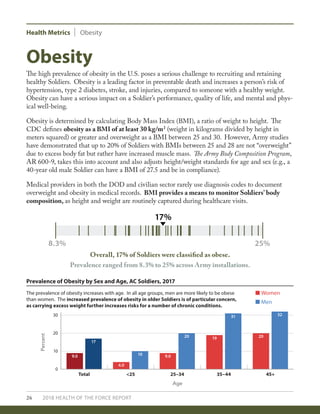
Prevalence of Obesity by Sex and Age, AC Soldiers, 2017
The prevalence of obesity increases with age. In all age groups, men are more likely to be obese
than women. The increased prevalence of obesity in older Soldiers is of particular concern,
as carrying excess weight further increases risks for a number of chronic conditions.
Women
Men
Overall, 17% of Soldiers were classified as obese.
Prevalence ranged from 8.3% to 25% across Army installations.
Percent
Age
Total <25 25–34 35–44 45+
0
10
20
30
9.0
4.0
10 9.0
17
20 19
31 32
20
17%
8.3% 25%
HEALTH METRICS 27
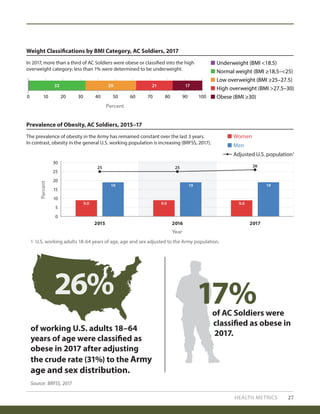
Weight Classifications by BMI Category, AC Soldiers, 2017
Prevalence of Obesity, AC Soldiers, 2015–17
In 2017, more than a third of AC Soldiers were obese or classified into the high
overweight category; less than 1% were determined to be underweight.
The prevalence of obesity in the Army has remained constant over the last 3 years.
In contrast, obesity in the general U.S. working population is increasing (BRFSS, 2017).
Women
Underweight (BMI <18.5)
Normal weight (BMI ≥18.5–<25)
Low overweight (BMI ≥25–27.5)
High overweight (BMI >27.5–30)
Obese (BMI ≥30)
Men
Adjusted U.S. population1
Percent
Percent
Year
0 10 20 30 40 50 60 70 80 90 100
33 21 1729
0
25
30
20
5
10
15
2015 2016 2017
9.0
19
25 26
9.0
19
9.0
19
25
26%
of working U.S. adults 18–64
years of age were classified as
obese in 2017 after adjusting
the crude rate (31%) to the Army
age and sex distribution.
of AC Soldiers were
classified as obese in
2017.
17%
Source: BRFSS, 2017
1 U.S. working adults 18-64 years of age, age and sex adjusted to the Army population.
Health Metrics Obesity
28 2018 HEALTH OF THE FORCE REPORT
U.S. Army Alaska Targets Obesity
and Physical Readiness
L O C A L A C T I O N
T
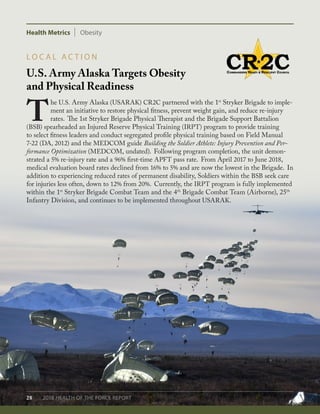
he U.S. Army Alaska (USARAK) CR2C partnered with the 1st
Stryker Brigade to imple-
ment an initiative to restore physical fitness, prevent weight gain, and reduce re-injury
rates. The 1st Stryker Brigade Physical Therapist and the Brigade Support Battalion
(BSB) spearheaded an Injured Reserve Physical Training (IRPT) program to provide training
to select fitness leaders and conduct segregated profile physical training based on Field Manual
7-22 (DA, 2012) and the MEDCOM guide Building the Soldier Athlete: Injury Prevention and Per-
formance Optimization (MEDCOM, undated). Following program completion, the unit demon-
strated a 5% re-injury rate and a 96% first-time APFT pass rate. From April 2017 to June 2018,
medical evaluation board rates declined from 16% to 5% and are now the lowest in the Brigade. In
addition to experiencing reduced rates of permanent disability, Soldiers within the BSB seek care
for injuries less often, down to 12% from 20%. Currently, the IRPT program is fully implemented
within the 1st
Stryker Brigade Combat Team and the 4th
Brigade Combat Team (Airborne), 25th
Infantry Division, and continues to be implemented throughout USARAK.
8.5% 27%
BMI (Q1) Q2 Q3 Q4 (Q5)
Q5
Q4
Q3
Q2
Q1
(Highest)
(Lowest)
(Fastest) (Slowest)
HEALTH METRICS 29
S
EVERAL STUDIES HAVE SHOWN THAT BOTH
poor aerobic fitness (as measured by APFT
2-mile run times) and a BMI that is too high or
too low are risk factors for injuries which can nega-
tively affect medical readiness (Jones & Hauschild,
2015). While it is logical that those who are more
aerobically fit can perform tasks for longer durations
with less fatigue and recovery time (Knapik, 2015),
the relationship between BMI and injury risk is less
straightforward.
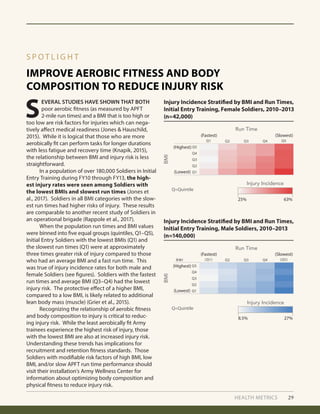
	 In a population of over 180,000 Soldiers in Initial
Entry Training during FY10 through FY13, the high-
est injury rates were seen among Soldiers with
the lowest BMIs and slowest run times (Jones et
al., 2017). Soldiers in all BMI categories with the slow-
est run times had higher risks of injury. These results
are comparable to another recent study of Soldiers in
an operational brigade (Rappole et al., 2017).
	 When the population run times and BMI values
were binned into five equal groups (quintiles, Q1–Q5),
Initial Entry Soldiers with the lowest BMIs (Q1) and
the slowest run times (Q1) were at approximately
three times greater risk of injury compared to those
who had an average BMI and a fast run time. This
was true of injury incidence rates for both male and
female Soldiers (see figures). Soldiers with the fastest
run times and average BMI (Q3–Q4) had the lowest
injury risk. The protective effect of a higher BMI,
compared to a low BMI, is likely related to additional
lean body mass (muscle) (Grier et al., 2015).
	 Recognizing the relationship of aerobic fitness
and body composition to injury is critical to reduc-
ing injury risk. While the least aerobically fit Army
trainees experience the highest risk of injury, those
with the lowest BMI are also at increased injury risk.
Understanding these trends has implications for
recruitment and retention fitness standards. Those
Soldiers with modifiable risk factors of high BMI, low
BMI, and/or slow APFT run time performance should
visit their installation’s Army Wellness Center for
information about optimizing body composition and
physical fitness to reduce injury risk.
IMPROVE AEROBIC FITNESS AND BODY
COMPOSITION TO REDUCE INJURY RISK
S P O T L I G H T
Injury Incidence Stratified by BMI and Run Times,
Initial Entry Training, Female Soldiers, 2010–2013
(n=42,000)
Injury Incidence Stratified by BMI and Run Times,
Initial Entry Training, Male Soldiers, 2010–2013
(n=140,000)
Q1 Q2 Q3 Q4 Q5
Q5
Q4
Q3
Q2
Q1
(Fastest)
(Highest)
(Lowest)
(Slowest)
25% 63%
BMIBMI
Run Time
Run Time
Injury Incidence
Injury Incidence
Q=Quintile
Q=Quintile
Health Metrics Tobacco Use
30 2018 HEALTH OF THE FORCE REPORT
Tobacco Use
Using tobacco products negatively impacts Soldier readiness by impairing physical fitness
and by increasing illness, absenteeism, premature death, and healthcare costs (DA, 2015). The
Periodic Health Assessment (PHA), completed annually by Soldiers, contains several self-reported
tobacco-related questions (DOD, 2016b). Because the PHA is conducted as part of a physical
exam which determines an individual’s ability to deploy, many Soldiers may not report their
tobacco usage to avoid potential negative attention. In addition, nicotine is known to increase
alertness, and some Soldiers believe tobacco use enhances their ability to survive in austere envi-
ronments. Data on vaping, e-cigarettes, or other alternative methods of consuming nicotine are
currently being captured on the PHA.
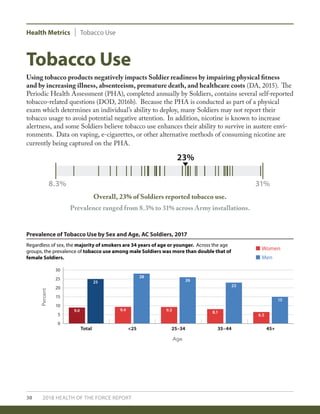
Overall, 23% of Soldiers reported tobacco use.
Prevalence ranged from 8.3% to 31% across Army installations.
Prevalence of Tobacco Use by Sex and Age, AC Soldiers, 2017
Regardless of sex, the majority of smokers are 34 years of age or younger. Across the age
groups, the prevalence of tobacco use among male Soldiers was more than double that of
female Soldiers.
Women
Men
Percent
Age
Total <25 25–34 35–44 45+
0
5
30
10
15
20
25
9.3
26
9.4
28
8.1
23
6.5
15
25
9.0
23%
8.3% 31%
HEALTH METRICS 31
Percent
Year
Prevalence of Tobacco Use, AC Soldiers, 2013–2017
0
5
10
15
20
25
30
2013 2014 2015 2016 2017
Any tobacco use
Smoking
Smokeless
24
16
23
14
26
17
30
21
28
19
12 111212 12
Tobacco use has decreased by nearly 7.0% since 2013; however, the increasing popularity of vaping and
e-cigarettes may have impacted the observed decline in smoking tobacco use. Among the tobacco use categories
assessed, the largest number of Soldiers reported smoking. The prevalence of Soldiers who reported smokeless
(chewing or dipping) use remained the same over this timeframe. The general U.S. population rates for tobacco
use are higher than the Army rates in 2017. The reported use of smokeless tobacco in the Army (11%) is higher
than the national rate (8.6%) (BRFSS, 2017).
Smoking
adjusted rate
(18% crude rate)
adjusted rate
(4.4% crude rate)
adjusted rate
(21% crude rate)
Smokeless Total
ArmyU.S.
14%
19%
11%
8.6%
23%
25%
Source: BRFSS, 2017
Heat Illness
Heat illness refers to a group of disorders that occur when the body is unable to compensate for
increased body temperatures due to hot and humid environmental conditions and/or exertion
during exercise or training. These illnesses can have operational and readiness impacts for the
Army. Heat illness represents a set of conditions that exist along a continuum of symptoms and
illness severity that includes heat exhaustion and heat stroke, which are reportable medical events
that should be reported through the Disease Reporting System, internet (DRSi).
32 2018 HEALTH OF THE FORCE REPORT
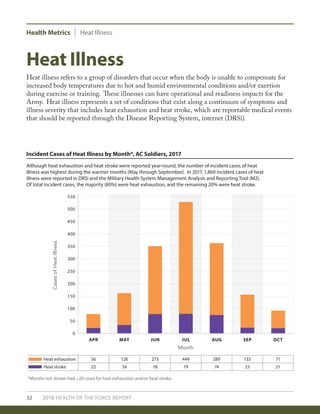
Incident Cases of Heat Illness by Month*, AC Soldiers, 2017
Although heat exhaustion and heat stroke were reported year-round, the number of incident cases of heat
illness was highest during the warmer months (May through September). In 2017, 1,869 incident cases of heat
illness were reported in DRSi and the Military Health System Management Analysis and Reporting Tool (M2).
Of total incident cases, the majority (80%) were heat exhaustion, and the remaining 20% were heat stroke.
0
550
50
100
150
200
250
300
350
400
450
500
APR MAY JUN JUL AUG SEP OCT
Heat stroke
Heat exhaustion
22
56
34
128
78
273
79
449
74
289
23
133
21
71
CasesofHeatIllness
Month
*Months not shown had <20 cases for heat exhaustion and/or heat stroke.
Health Metrics Heat Illness
0
500
1,000
1,500
2014Year: 2015 2016 2017
Hospitalized
Not hospitalized
142
1,180
Heat
Exhaustion
Heat
Stroke
Heat
Exhaustion
Heat
Stroke
Heat
Exhaustion
Heat
Stroke
Heat
Exhaustion
Heat
Stroke
78
170
114 94
1,316 185
123
1,371
109
197
96
1,407
110
256
Incidence of Heat Illness by Rank, AC Soldiers, 2017
Incidence of Heat Illness Hospitalizations, AC Soldiers, 2014–2017
Groups with the highest frequency of heat exhaustion in 2017 were junior enlisted (76%),
male (79%), and under the age of 25 (69%). The same groups had the highest frequency of
heat strokes: junior enlisted (57%), male (86%), and under the age of 25 (55%).
The number of reported heat illness cases has increased over the past 4 years. Increased awareness of heat
illness risks and local program efforts may have contributed to the increase. From 2016-2017, the number
of heat exhaustion cases increased by less than 1% while there was a 20% increase in heat stroke cases. In
2017, 3.6% of heat exhaustion patients and 30% of heat stroke patients were hospitalized.
Cases of Heat Illness
CasesofHeatIllness
Rank
HEALTH METRICS 33
0 300 600 900 1200
E1–E4
E5–E9
1,142
209
209
79
123
63
*Officers
Heat Exhaustion
Heat Stroke
*Officers includes Warrant Officers
34 2018 HEALTH OF THE FORCE REPORT
Health Metrics Heat Illness
Fort Benning Strives for Excellence in
Preventing Heat-Related Illnesses
L O C A L A C T I O N
F
ort Benning, Georgia, reports the highest number of heat-related illnesses (HRIs) among
all Training and Doctrine Command (TRADOC) installations, yet an HRI death has not
occurred there in over a year. This success is due to a collaborative effort by Fort Benning
leaders and subject matter experts to establish the Heat Center at Fort Benning and implement
best practices for the prevention and treatment of HRIs, such as heat stroke and low sodium
blood levels (hyponatremia). Fort Benning has created a “chain of survival” for HRIs by devel-
oping and implementing clinical standard operating procedures, referred to as The Benning
Protocols, from point of injury through treatment and disposition. These protocols, along
with recent updates on HRIs, are reviewed by medical and non-medical leaders at the annual heat
forum.
	 The Martin Army Community Hospital
Department of Emergency Medicine partnered
with the U.S. Army Research Institute of Envi-
ronmental Medicine and the U.S. Army Maneu-
ver Center of Excellence on a June 2018 research
project targeted at identifying Soldiers at highest
risk for heat stroke under real-time training condi-
tions. Through use of these data, the Heat Center
aims to be a cutting-edge, sustainable organiza-
tion dedicated to saving Soldiers’ lives, advancing
medicine, and improving Soldier readiness at Fort
Benning by mitigating HRIs.
Both Soldiers and leaders can take steps to mitigate the impact of heat illnesses.
Soldiers can ensure they get adequate sleep, hydration, and nutrition prior
to training. Leaders can use risk management guidelines when planning for
training in the heat, including consideration of Soldier acclimatization. Leaders
should ensure personnel are trained on prevention, recognition, and basic
treatment of heat illness. Guidance for preventing heat illness can be found at:
https://phc.amedd.army.mil/topics/discond/hipss/Pages/heatillnessalert.aspx
HEALTH METRICS 41
Health Metrics Injury
36 2018 HEALTH OF THE FORCE REPORT
Hearing readiness is an essential component of medical readiness, as hearing directly impacts
communication abilities that influence lethality and survivability in all environments. Good
hearing preserves awareness and improves communication responses that are crucial to suc-
cess on the battlefield. The Defense Occupational and Environmental Health Readiness System
- Hearing Conservation (DOEHRS-HC) is a Military Health System (MHS) information system
designed to support personal auditory readiness and prevent significant hearing loss through the
early detection of hearing changes. The Army Hearing Program (AHP) uses DOEHRS-HC to
monitor the hearing ability of military and DA Civilian personnel.
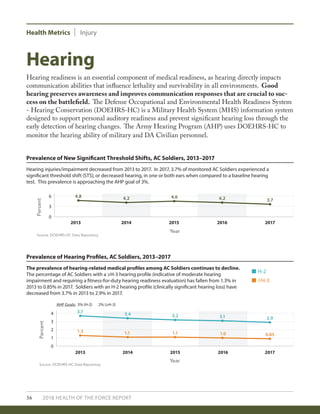
Prevalence of New Significant Threshold Shifts, AC Soldiers, 2013–2017
Hearing injuries/impairment decreased from 2013 to 2017. In 2017, 3.7% of monitored AC Soldiers experienced a
significant threshold shift (STS), or decreased hearing, in one or both ears when compared to a baseline hearing
test. This prevalence is approaching the AHP goal of 3%.
Percent
Year
Source: DOEHRS-HC Data Repository
0
2013 2014 2015 2016 2017
3
6 4.2 3.7
4.64.8 4.2
Prevalence of Hearing Profiles, AC Soldiers, 2013–2017
The prevalence of hearing-related medical profiles among AC Soldiers continues to decline.
The percentage of AC Soldiers with a ≥H-3 hearing profile (indicative of moderate hearing
impairment and requiring a fitness-for-duty hearing readiness evaluation) has fallen from 1.3% in
2013 to 0.85% in 2017. Soldiers with an H-2 hearing profile (clinically significant hearing loss) have
decreased from 3.7% in 2013 to 2.9% in 2017.
Source: DOEHRS-HC Data Repository
Percent
Year
0
2
3
4
2013 2014 2015 2016 2017
3.1 2.9
3.2
3.7
3.4
1.0 0.851.11.3 1.1
1
AHP Goals: 3% (H-2) 2% (≥H-3)
H-2
≥H-3
Hearing
HEALTH METRICS 37
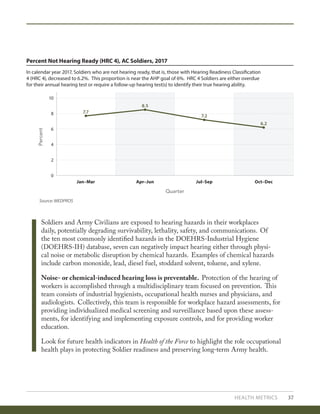
Percent Not Hearing Ready (HRC 4), AC Soldiers, 2017
In calendar year 2017, Soldiers who are not hearing ready, that is, those with Hearing Readiness Classification
4 (HRC 4), decreased to 6.2%. This proportion is near the AHP goal of 6%. HRC 4 Soldiers are either overdue
for their annual hearing test or require a follow-up hearing test(s) to identify their true hearing ability.
Source: MEDPROS
Percent
Quarter
0
10
Jan–Mar Apr–Jun Jul–Sep Oct–Dec
6.2
7.7
8.5
2
4
6
8 7.2
Soldiers and Army Civilians are exposed to hearing hazards in their workplaces
daily, potentially degrading survivability, lethality, safety, and communications. Of
the ten most commonly identified hazards in the DOEHRS-Industrial Hygiene
(DOEHRS-IH) database, seven can negatively impact hearing either through physi-
cal noise or metabolic disruption by chemical hazards. Examples of chemical hazards
include carbon monoxide, lead, diesel fuel, stoddard solvent, toluene, and xylene.
Noise- or chemical-induced hearing loss is preventable. Protection of the hearing of
workers is accomplished through a multidisciplinary team focused on prevention. This
team consists of industrial hygienists, occupational health nurses and physicians, and
audiologists. Collectively, this team is responsible for workplace hazard assessments, for
providing individualized medical screening and surveillance based upon these assess-
ments, for identifying and implementing exposure controls, and for providing worker
education.
Look for future health indicators in Health of the Force to highlight the role occupational
health plays in protecting Soldier readiness and preserving long-term Army health.
Health Metrics STIs
38 2018 HEALTH OF THE FORCE REPORT
Sexually Transmitted Infections
Chlamydia is the most commonly reported sexually transmitted infection (STI) both in the U.S.
and the Army. Civilian and military public health agencies use reported chlamydia infections
as an indicator of overall STI burden. Infection rates also provide a measure of risk behavior
and help to identify vulnerable populations. Since STIs, including chlamydia, do not always
produce recognizable symptoms, people are often unaware that they have an infection, thereby
increasing the risk of their spreading it to others. Left untreated, STIs may lead to severe health
complications. Women are disproportionately affected and may experience pelvic inflammatory
disease, ectopic pregnancy, and infertility. These complications can impact Soldier medical read-
iness and well-being. The CDC and U.S. Preventive Services Task Force (USPSTF) recommend
that pregnant women, sexually active women under 25 years old, and women or men with risk
factors be screened annually for chlamydia and gonorrhea (USPSTF, 2018).
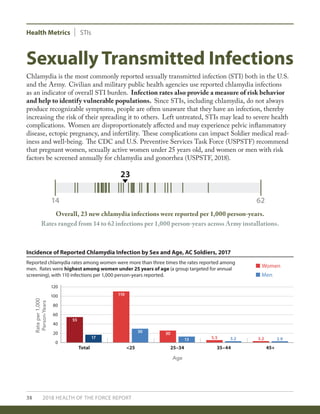
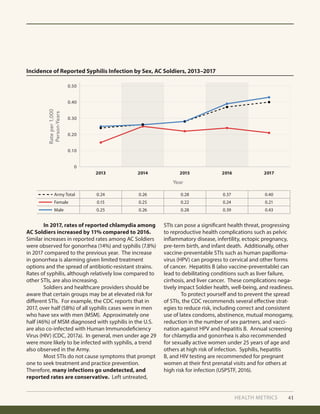
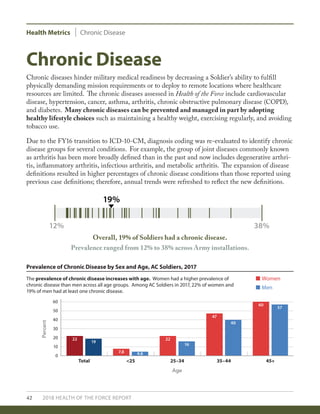
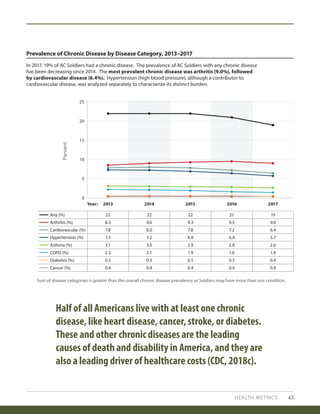
Incidence of Reported Chlamydia Infection by Sex and Age, AC Soldiers, 2017
Reported chlamydia rates among women were more than three times the rates reported among
men. Rates were highest among women under 25 years of age (a group targeted for annual
screening), with 110 infections per 1,000 person-years reported.
Women
Men
Rateper1,000
Person-Years
Age
Overall, 23 new chlamydia infections were reported per 1,000 person-years.
Rates ranged from 14 to 62 infections per 1,000 person-years across Army installations.
Total <25 25–34 35–44 45+
0
20
40
60
80
100
120
55
110
30 30
26
17 13 5.5 3.2 2.93.2
23
14 62
0
20
40
60
80
100
2013 2014 2015 2016 2017
Army average 84 848273 77
Installation minimum 70 706951 62
Installation maximum 96 979594 91
0
60
10
20
30
40
50
2013 2014 2015 2016 2017
Female
Male
Army Total
50
16
21
55
17
23
44
14
18
40
13
17
41
13
17
HEALTH METRICS 39
Incidence of Reported Chlamydia Infection by Sex, AC Soldiers, 2013–2017
On average, 84% of female Soldiers under 25 years of age were screened for chlamydia in 2017 in accordance
with USPSTF guidelines. Screening has improved from the 73% compliance rate observed in 2013; however,
there is considerable variability by installation, with compliance rates ranging from 70% to 97%. Overall,
Army screening rates are markedly higher than those observed nationally, where 2016 screening rates
ranged from 40% to 54% (NCQA, 2018).
Percent of AC Females under Age 25 Screened for Chlamydia, AC Soldiers, 2013–2017
Rateper1,000
Person-YearsPercent
A steady rise in reported chlamydia infections has occurred over the past 5 years, most notably among
women. Overall rates reported for 2017 were 34% higher than in 2013. This increase is consistent with
national rising rates.
Year
Year
Health Metrics STIs
40 2018 HEALTH OF THE FORCE REPORT
SEXUALLY TRANSMITTED INFECTIONS ON THE RISE
S P O T L I G H T
S
EXUALLY TRANSMITTED INFECTIONS (STIs) HAVE SURGED IN THE U.S., WITH
rates of reportable infections reaching record highs in 2017. From 2016 to 2017,
the CDC reported increases of 6.9%, 19%, and 11% for chlamydia, gonorrhea, and
syphilis, respectively (CDC, 2017a). Army STI rates often exceed those reported in
the general population, and are also rising. This excess is not surprising given that
the Army is skewed towards younger groups who are at higher risk, and Soldiers have
greater access to medical screening, which increases the likelihood of detection.
Incidence of Reported STIs, AC Soldiers, 2013–2017
Year GonorrheaandSyphilisRatesper
1,000Person-Years
0
5
10
15
20
25
4
5
3
2
1
0
2013 2014 2015 2016 2017
Chlamydia
Gonorrhea
Syphilis
20
3.3
0.37
23
3.7
0.40
18
2.8
0.28
17
3.3
0.24
17
2.9
0.26
Army STIs by the Numbers (2017)
10,242
cases
Chlamydia Gonorrhea Syphilis
1,680
cases
180
cases
The rate of reported syphillis infection has increased by nearly 70% from 2013–2017.
ChlamydiaRateper
1,000Person-Years
HEALTH METRICS 41
	 In 2017, rates of reported chlamydia among
AC Soldiers increased by 11% compared to 2016.
Similar increases in reported rates among AC Soldiers
were observed for gonorrhea (14%) and syphilis (7.8%)
in 2017 compared to the previous year. The increase
in gonorrhea is alarming given limited treatment
options and the spread of antibiotic-resistant strains.
Rates of syphilis, although relatively low compared to
other STIs, are also increasing.
	 Soldiers and healthcare providers should be
aware that certain groups may be at elevated risk for
different STIs. For example, the CDC reports that in
2017, over half (58%) of all syphilis cases were in men
who have sex with men (MSM). Approximately one
half (46%) of MSM diagnosed with syphilis in the U.S.
are also co-infected with Human Immunodeficiency
Virus (HIV) (CDC, 2017a). In general, men under age 29
were more likely to be infected with syphilis, a trend
also observed in the Army.
	 Most STIs do not cause symptoms that prompt
one to seek treatment and practice prevention.
Therefore, many infections go undetected, and
reported rates are conservative. Left untreated,
Incidence of Reported Syphilis Infection by Sex, AC Soldiers, 2013–2017
Year
0
0.50
0.10
0.20
0.30
0.40
2013 2014 2015 2016 2017
Female
Male
Army Total
0.24
0.39
0.37
0.21
0.43
0.40
0.22
0.28
0.28
0.15
0.25
0.24
0.25
0.26
0.26
Rateper1,000
Person-Years
STIs can pose a significant health threat, progressing
to reproductive health complications such as pelvic
inflammatory disease, infertility, ectopic pregnancy,
pre-term birth, and infant death. Additionally, other
vaccine-preventable STIs such as human papilloma-
virus (HPV) can progress to cervical and other forms
of cancer. Hepatitis B (also vaccine-preventable) can
lead to debilitating conditions such as liver failure,
cirrhosis, and liver cancer. These complications nega-
tively impact Soldier health, well-being, and readiness.
	 To protect yourself and to prevent the spread
of STIs, the CDC recommends several effective strat-
egies to reduce risk, including correct and consistent
use of latex condoms, abstinence, mutual monogamy,
reduction in the number of sex partners, and vacci-
nation against HPV and hepatitis B. Annual screening
for chlamydia and gonorrhea is also recommended
for sexually active women under 25 years of age and
others at high risk of infection. Syphilis, hepatitis
B, and HIV testing are recommended for pregnant
women at their first prenatal visits and for others at
high risk for infection (USPSTF, 2016).
Health Metrics Chronic Disease
42 2018 HEALTH OF THE FORCE REPORT
Chronic Disease
Chronic diseases hinder military medical readiness by decreasing a Soldier’s ability to fulfill
physically demanding mission requirements or to deploy to remote locations where healthcare
resources are limited. The chronic diseases assessed in Health of the Force include cardiovascular
disease, hypertension, cancer, asthma, arthritis, chronic obstructive pulmonary disease (COPD),
and diabetes. Many chronic diseases can be prevented and managed in part by adopting
healthy lifestyle choices such as maintaining a healthy weight, exercising regularly, and avoiding
tobacco use.
Due to the FY16 transition to ICD-10-CM, diagnosis coding was re-evaluated to identify chronic
disease groups for several conditions. For example, the group of joint diseases commonly known
as arthritis has been more broadly defined than in the past and now includes degenerative arthri-
tis, inflammatory arthritis, infectious arthritis, and metabolic arthritis. The expansion of disease
definitions resulted in higher percentages of chronic disease conditions than those reported using
previous case definitions; therefore, annual trends were refreshed to reflect the new definitions.
Prevalence of Chronic Disease by Sex and Age, AC Soldiers, 2017
The prevalence of chronic disease increases with age. Women had a higher prevalence of
chronic disease than men across all age groups. Among AC Soldiers in 2017, 22% of women and
19% of men had at least one chronic disease.
Women
Men
Percent
Age
Overall, 19% of Soldiers had a chronic disease.
Prevalence ranged from 12% to 38% across Army installations.
Total <25 25–34 35–44 45+
0
10
20
40
60
30
50
22
7.8 4.6
22
19
16
47
40
57
60
19%
12% 38%
HEALTH METRICS 43
Prevalence of Chronic Disease by Disease Category, 2013–2017
In 2017, 19% of AC Soldiers had a chronic disease. The prevalence of AC Soldiers with any chronic disease
has been decreasing since 2014. The most prevalent chronic disease was arthritis (9.0%), followed
by cardiovascular disease (6.4%). Hypertension (high blood pressure), although a contributor to
cardiovascular disease, was analyzed separately to characterize its distinct burden.
Percent
Half of all Americans live with at least one chronic
disease, like heart disease, cancer, stroke, or diabetes.
These and other chronic diseases are the leading
causes of death and disability in America, and they are
also a leading driver of healthcare costs (CDC, 2018c).
0
5
10
15
25
20
2013Year: 2014 2015 2016 2017
Any (%)
Asthma (%)
COPD (%)
Diabetes (%)
Cancer (%)
21 192222 22
2.8 2.62.93.1 3.0
1.6 1.41.92.2 2.1
0.5 0.40.50.5 0.5
0.4 0.40.40.4 0.4
Cardiovascular (%) 7.2 6.47.87.8 8.0
Hypertension (%) 6.4 5.76.97.3 7.2
Arthritis (%) 9.5 9.09.38.5 9.0
Sum of disease categories is greater than the overall chronic disease prevalence as Soldiers may have more than one condition.
Health Metrics Chronic Disease
44 2018 HEALTH OF THE FORCE REPORT
ARMY SURGEON GENERAL RECOMMENDS THE
IMMEDIATE REMOVAL OF INDOOR TANNING DEVICES
S P O T L I G H T
E
XPOSURE TO ULTRAVIOLET (UV) RADIATION
from the sun and artificial sources increases
a person’s long-term risk for health problems
to the skin and eyes. Although reducing natural
sunlight exposure can be challenging, UV exposure
from indoor tanning (such as tanning beds/booths
and sunlamps) is entirely avoidable. The American
Academy of Dermatology, the CDC, the U.S. Surgeon
General, and the World Health Organization (WHO)
all recognize indoor tanning as a significant skin
cancer risk (DHHS, 2014; WHO, 2018).
	 In the U.S., up to 400,000 annual skin cancer
cases may be related to indoor tanning (WHO, 2018).
Almost 70% of tanning bed users are young Cauca-
sian women. Women under 30 are six times more
likely to develop melanoma if they use indoor
tanning (AAD, 2018). Because young people are
especially at risk (DHHS, 2014), some states prohibit
indoor tanning by persons under 18 years of age
(NCSL, 2017).
	 In the Army, just over 3,200 new skin cancers
were diagnosed in a recent 10-year period (Lee et al,
2016a, 2016b). Although it is unknown if these new
cancer diagnoses were related to indoor tanning, it is
well understood that the negative health impacts
of indoor tanning far outweigh any perceived
benefit. 		
	 The Army Surgeon General identified that
indoor tanning is a detriment to health, wellness, and
readiness and has recommended immediate removal
of indoor tanning devices from Army installations
(DOD, 1999; OTSG, 2017). In FY19, a prohibition of
indoor tanning will be implemented in accordance
with Army Regulation (AR) 40-5 (DA, 2000) and DA
Pam 40-11 (DA, 2005). This prohibition affirms the
Army’s commitment to preserve the health of Sol-
diers, Civilians, and their Families.
400,000annual skin cancer cases
in the U.S.
may be related to
indoor
tanning
Indoor tanning users are at increased risk for melanoma
and non-melanoma skin cancers like this squamous cell
carcinoma (Wehner et al., 2012).
Photo courtesy of the National Cancer Institute
HEALTH METRICS 45
ARMY MASTER PLANNING AND HEALTHY ARMY
COMMUNITIES PARTNER TO RESHAPE INSTALLATIONS
S P O T L I G H T
W
HERE WE LIVE, WORK, AND PLAY GREATLY
impacts all aspects of our lives, including
our health. The U.S. Army Installation Man-
agement Command (IMCOM) is leading the Healthy
Army Communities (HAC) commitment to better
understand and shape community environments that
support active living through the promotion of readi-
ness and resilience.
	 HAC is dedicated to redesigning Army communi-
ties by first working with installation Master Planners to
promote public health through the planning process.
The integration at the planning level follows several
private-sector recommendations on incorporating
health and bringing a public health perspective to
municipal planning (Beck, 2010; Ricklin & Kushner,
2013). Similar to the installation environment, munic-
ipalities can create environments and provide oppor-
tunities for residents to choose healthier behaviors
and live healthier lifestyles (Beck, 2010). In several
case studies around the country, municipalities
have been successful in promoting more physical
activity and active living through built environ-
ment changes (e.g., more parks, connected trails,
sheltered bus stops for public transit) by working
through policy, utilizing public health champions, and
capitalizing on the advocacy of local coalitions (Ricklin
& Kushner, 2013).
	 Starting in August 2017, the APHC partnered
with IMCOM Master Planners to integrate the HAC
mission into two Area Development Plan (ADP)
workshops. The APHC added a “healthy community”
planning component to an existing exercise. The
ADP workshop participants were excited to discuss
healthy community planning, and these conversations
heavily influenced all proposed projects. The results
of these two case studies include the integration
of projects that prioritized changes to the built
environment, such as creating more green space,
improving sidewalks and trails, and cultivating
infrastructure for multimodal transportation
options (e.g., buses, cars, bicycles, and walking).
These changes will positively affect the Total Army by
providing more opportunities for active living and
encouraging community members to make healthier
choices.
	 The APHC and IMCOM plan to continue their col-
laborations to improve overall installation planning.
As installation infrastructure changes to meet mission
needs, careful consideration of installation environ-
ments during the planning process can support and
prioritize the health of Army communities.
For more information on IMCOM’s work with
installation communities, visit: https://home.
army.mil/imcom
AIR QUALITY
SOLID WASTE DIVERSION
DRINKING WATER QUALITY
MOSQUITO-BORNE DISEASE
WATER FLUORIDATION
TICK-BORNE DISEASE
Environmental Health Indicators
48 2018 HEALTH OF THE FORCE REPORT
This year marks the 25th
anniversary of the groundbreaking study
that revealed the link between air pollution and mortality risk
(Dockery, et al., 1993). This research ushered in three decades of science
documenting the many ways that air pollution affects human health. A growing body of
evidence implicates air pollution in a range of health conditions including cardiovascular
and respiratory disease, type 2 diabetes, adult cognitive decline, childhood obesity, and
adverse birth outcomes (Bowe et al., 2018; Chen et al., 2017; Alderete et al., 2017; Sapoka
et al., 2010).
Although the U.S. continues to have good air quality relative to most of the world, pockets of elevated air
pollution persist in densely populated regions and places with concentrated industrial activity. Further, the
effects of climate change have begun to exacerbate the frequency and intensity of natural events which
can trigger hazardous levels of air pollution. In 2017, wildfires in western states produced harmful levels of
fine particulate matter (PM2.5
) that billowed from Canada to Mexico, and Hurricane Harvey caused Houston
area industries to emit a typical year’s worth of toxic air contaminants – 8 million pounds – in only a few
weeks (Olsen, 2018).	
Outside the U.S., 95% of the world’s population lives in places that fail to meet World Health Organi-
zation guidelines for healthy air (Health Effects Institute, 2018). Areas most at risk include countries in the
Middle East, South Asia, East Asia, North Africa, and West Africa. The primary offending pollutant is PM2.5
,
created by sources such as coal-fired power and industrial plants, solid fuel burning for residential heat,
open burning of land and waste, and vehicular activity.
Poor Air Quality
Installation in area
with <5 days/year
Installation in area
with 5–20 days/year
Installation in area
with >20 days/year
Installation with
no data available
U.S.-based installation
Installation outside the U.S.
Days when air pollution near Army installations was at levels deemed
unhealthy for some or all of the general public:
Army range: 0–123 days/year
Air Quality
ENVIRONMENTAL HEALTH INDICATORS 49
2015 2016 2017
Air Quality at U.S. Army Garrisons in South Korea,
2015–2017
What’s Happening at Army Installations?
Where to Find Air Quality Information?
As in prior years, the majority of poor air quality
days at U.S. Army installations were due to ground
level ozone, which is elevated seasonally between
May and September. Exceptions occurred at Joint
Base Lewis-McChord (JBLM) and Fort Wainwright,
both of which experienced high levels of PM2.5
; and
Fort Bliss, which experienced high levels of both
ozone and PM2.5
. At JBLM, high PM2.5
levels occurred
most often during July and August due to drifting
smoke from British Columbia wildfires. At Fort
Wainwright, PM2.5
levels were high in winter months
due to wood-burning stoves and fireplaces.
This year, for the first time, Health of the Force
includes air quality data for 10 Army installations
outside the U.S. Most poor air quality days at these
locations were due to PM2.5
, although ozone was a
contributing factor at nearly every location. Installa-
tions in South Korea experienced the worst air qual-
ity in terms of both frequency and magnitude. As
shown in the chart, it is not unusual for U.S. Army
installations in South Korea to experience more
than 100 poor air quality days per year.
The Environmental Protection Agency’s (EPA)
AirNow Web site provides real-time data on air
pollution levels in the U.S., along with behavior
management guidance based on the pollutant level
and affected population. Air pollution information
for locations outside the U.S. is available on the Air
Pollution in World: Real-time Air Quality Index Visual
Map. This Web site acquires open source real-time
air pollution data published by international envi-
ronmental authorities and converts it to the EPA
Air Quality Index (AQI) format, including the index
value and color. Users can obtain an AQI value for
a location of interest and match it to the associated
health precautions at the EPA AQI Web site.
PoorAirQualityDays/Year
USAG
Red Cloud
USAG
Yongsan
USAG
Humphreys
USAG
Daegu
25
0
50
75
100
125
150
175
200
115
65
103
102
179
106
119
111
112
72
123
51
AIR QUALITY INDEX
Environmental Health Indicators
The Safe Drinking Water Act (SDWA) protects drinking water sup-
plies by requiring the EPA to set limits on the amounts of chemical,
biological, and physical impurities permitted in drinking water. Some
of these limits, known as health-based standards, are designed to protect the health
and well-being of human consumers who rely on safe sources of drinking water. Health-
based standards protect against acute health concerns such as hemorrhagic diarrhea,
caused by E. coli; or methemoglobinemia (“blue baby syndrome”), caused by elevated
levels of nitrate or nitrite. Health-based standards also protect against chronic health
concerns such as cancer and birth defects.
In FY17, Army water systems reported three health-based drinking water violations, compared to
five in FY16. All were violations of standards protecting against non-acute health effects. USAG West Point
reported a repeat violation related to elevated total trihalomethanes (THMs) which occur when chlorine
used as a drinking water disinfectant reacts with naturally occurring organic matter in water. USAG Japan
received a total coliform violation at Sagami General Depot. Total coliform bacteria are an indicator of the
possible presence of pathogenic bacteria. USAG Wiesbaden violated action levels for lead and copper at
Wiesbaden Family Housing areas and Clay Kaserne. Corrective actions were implemented for these three
installation water systems, and the violations were resolved. Violations of these health-based standards
ranged from 3 to 90 days’ duration.
Drinking Water Quality
Poor Water Quality
Installation with no
violation of health-
based drinking
water standards
Installation with
violation of health-
based standards for
non-acute effects
Installation with
violation of health-
based standards for
acute effects
Installation with
no data available
U.S.-based installation
Installation outside the U.S.
Violations of health-based drinking water standards at an Army installation:
50 2018 HEALTH OF THE FORCE REPORT
Over the last four years (FY14–FY17), two types of
recurring violations have predominated at Army
water systems. The most commonly violated stan-
dard was the Stage 2 Disinfectants and Disinfection
Byproducts Rule, followed by the Total Coliform
Rule (TCR). Although the TCR had been one of the
most frequently violated national standards, FY17
violations were significantly lower than in FY16.
Army experienced a similar decrease in the propor-
tion of annual TCR violations from 6.0% to 0.06%.
Reductions may be due to recent revisions to the
TCR, which changed how violations are assessed.
These recent Army water system violations align
with trends occurring in CWS serving the U.S. In
general, failures in water treatment and/or distri-
bution system operational practices are likely con-
tributing factors for the most frequently occurring
health-based violations. Understanding the causes
and effects of these violations is a priority for Army
water system managers to improve potable water
quality for consumers.
State of U.S. Drinking Water
According to the EPA, five common violations are
responsible for the majority of health-based standard
violations in community water systems (CWS) serving
the U.S. (EPA, 2017). The most commonly violated
standard is the Surface Water Treatment Rule, which
requires water systems to filter and disinfect surface
water sources to reduce the incidence of illness from
disease-causing pathogens.
Common SDWA Rule Violations in U.S.
Community Water Systems, FY17
1
0
2
3
4
2.7
4.0
0.2
0.1
<0.1
PercentofAffectedCWSConsumers
SDWA Rule Violation
SurfaceWater
TreatmentRule
Arsenic
NitrateTotalColiform
Rule
ENVIRONMENTAL HEALTH INDICATORS 51
Stage2Disinfectants/
DisinfectionByproductRule
Consumers can learn
about the quality
of their drinking
water at the EPA’s
Safe Drinking Water
Information System (SDWIS). The
site provides information such as
system classification and violation
history.
Environmental Health Indicators
52 2018 HEALTH OF THE FORCE REPORT
Community water systems (CWS) add fluoride to drinking water
to prevent tooth decay and maintain oral health for the benefit of
all consumers. Water fluoridation has been a major factor in decreasing
the prevalence and severity of dental caries and has been touted as one of the 10 great
public health achievements of the 20th
century (CDC, 1999). The fluoridation of CWS is
one of the oral health objectives in Healthy People 2020 (HP2020) and is recognized as
one of the most cost-effective measures to improve oral health. A 2016 study showed
that fluoridation saves communities an average of $32 per person per year by averting
treatment for tooth decay (O’Connell et al., 2016).
The U.S. Public Health Service’s (PHS) recommendation for fluoride concentration in drinking water is a
non-enforceable, evidence-based guideline (DHHS, 2015). For water systems that fluoridate, PHS and the
CDC recommend an optimal fluoride concentration of 0.7 milligrams/liter (mg/L). This is the lowest level
capable of preventing tooth decay while reducing the risk of dental fluorosis, i.e., a primarily cosmetic con-
dition of the tooth caused by ingestion of excess fluoride during tooth development.
The Office of the Assistant Chief of Staff for Installation Management (ACSIM) surveyed all IMCOM instal-
lations to determine how many provided optimally fluoridated drinking water in FY17. A subset of those
installations is tracked in this report. Of tracked installations, 50% provided water to their consumers at the
optimal fluoridation level, 45% provided water that was less than optimally fluoridated, and 4.8% either did
not report or were not monitored. None of the surveyed installations provided water that exceeded the
Safe Drinking Water Act maximum contaminant level (MCL) for fluoride (4 mg/L) (EPA, 2018b).
Water Fluoridation
Optimal Fluoridation
Installation-based Assessment
Water Fluoridation
0.7–2.0 mg/L <0.7 mg/L or
2.0–4.0 mg/L
>4.0 mg/L Installation with
no data available
U.S.-based installation
Installation outside the U.S.
Average fluoride concentration in drinking water at an Army installation:
Army range: <0.25–1.6 mg/L
ENVIRONMENTAL HEALTH INDICATORS 53
The CDC’s My Water’s Fluoride Web site provides
consumers with online access to their drinking
water fluoridation status. Additionally, the Army
Community Resource Guides Web site has links to
installation-specific Consumer Confidence Reports
(CCRs). CWS issue CCRs annually to provide informa-
tion such as fluoride levels and regulatory compli-
ance status.
Population-Based Assessment
The CDC uses the Water Fluoridation Reporting
System to monitor nationwide water fluoridation for
HP2020. The current objective is for 79.6% of the U.S.
population served by CWS to receive optimally fluori-
dated water by 2020. In 2014, 74.7% of the U.S. pop-
ulation served by these systems received optimally
fluoridated water (DHHS, 2018). Conversely, 46% of
Army populations at the installations included in
this report received optimally fluoridated water in
2017, 43% received water with fluoride levels below
the PHS recommended level, and fluoride was not
monitored or data were not reported for the remain-
ing populations.
Population Receiving
Optimally Fluoridated Water
20
0
40
60
80
100
75
46
80
PercentofPopulationReceiving
OptimallyFluoridatedWater
Population
Army(2017)
U.S.(2014)
HP2020Goal
“Water fluoridation is the best method
for delivering fluoride to all members
of the community, regardless of age,
education, income level, or access
to routine dental care. Fluoride’s
effectiveness in preventing tooth
decay extends throughout one’s life,
resulting in fewer – and less severe –
cavities. In fact, every generation born
over the past 70 years has enjoyed
better dental health than the one
before it. That’s the very essence of
the American promise.”
—Vivek H. Murthy, MD, MBA
Former United States Surgeon General
Installation with
Solid Waste
Diversion Rate
25–49%
Environmental Health Indicators
54 2018 HEALTH OF THE FORCE REPORT
The U.S. is the world’s leading trash generator, producing 262 mil-
lion tons of waste per year, with over half of it going to landfills (EPA,
2018a). The problem is not simply a question of running out of landfill
space; health risks arise from downstream exposures to waste-derived pollutants. When
incinerated or landfilled, discarded materials containing toxic chemicals create second-order
health impacts via air pollution or tainted drinking water sources. Improperly disposed
wastes can increase the incidence of illnesses such as diarrhea, and when burned, waste
can be responsible for a six-fold increase in respiratory infections (Simmons, 2016). When
waste-derived contaminants exceed regulatory levels in drinking water, the long-term
negative effects can range from organ damage to increased cancer risk (EPA, 2017).
Reducing generation and increasing diversion of waste are critical factors in the management of
health risks resulting from improper disposal of solid waste. Diversion tactics such as recycling, reuse,
composting, mulching, and donation facilitate mission sustainability, health and well-being, and
community relationships. Solid waste diversion benefits community health by eliminating exposure
to preventable hazards. The solid waste diversion rate helps to gauge waste and hazard reduction by
quantifying efforts such as recycling and composting.
Solid Waste Diversion
Solid Waste Diversion Rate
Installation with
Solid Waste
Diversion Rate
≥50%
Installation with
Solid Waste
Diversion Rate
<25%
Installation with
no data available
U.S.-based installation
Installation outside the U.S.
Percent of non-hazardous solid waste diverted to recycling, reuse,
composting, mulching, or donation at an Army installation:
Army range: 0–100%
ENVIRONMENTAL HEALTH INDICATORS 55
As the Army’s system of record for waste genera-
tion and diversion data, the ACSIM internet-based
Solid Waste Annual Report (SWARWeb) contains the
data from which the solid waste diversion rate is
derived.
<50,000
Germany:
127,816
Italy:
89,096
South Korea:
48,397
United States:
624,700 metric
tons per day
Brazil:
149,096
China:
520,548India:
109,589
Russia:
100,027
Japan:
144,466
No data available50,000–74,999 75,000–100,000 ≥100,000
Metric Tons of Solid Waste Generated Each Day
Source: Hoornweg & Bhanda-Tata, 2012
The average FY17 solid waste
diversion rate for the 42 Army
installations tracked in this
report was 45%.
The overall DOD FY17 diversion rate was 43%, down
1% from FY16 (DOD, 2018). This may be due to
slumping recycling markets, and more recently, the
Defense Logistics Agency’s (DLA) decision to halt
reimbursements for Qualified Recycling Program-
eligible scrap (DLA, 2017), thereby eliminating the
economic incentive for many installations to recycle.
Although the Army FY17 solid waste diversion rate
falls short of the DOD diversion goal of 50% (DOD,
2016a), it is well within reach of this DOD measure of
merit. This target could be achieved with increased
emphasis on diversion, innovative solutions, and
smarter refuse/recycling contracting to provide
incentives for increased diversion, and/or to allow
installations to receive economic benefits from the
sale of recyclables.
Environmental Health Indicators
56 2018 HEALTH OF THE FORCE REPORT
Diseases transmitted by the bites of infected mosquito vectors
present a threat to our Soldiers, Department of the Army (DA)
Civilians, and their Families. Regional risks vary throughout the year
depending on the weather and can change from year to year as alterations in weather
patterns affect local mosquito populations. In 2018, the CDC reported that the number
of cases of disease from mosquito, tick, and flea bites in the U.S. more than tripled from
2004 to 2016 and that this trend is expected to continue into the foreseeable future (CDC,
2018d). While some of this increase may be attributable to increased pathogen testing,
the data confirm that there are more diseases resulting from mosquito bites than was
previously known.
The majority of mosquito-borne diseases have no vaccines or treatments, so bite avoidance is the best
method of prevention. Mosquito-borne pathogens often circulate in mosquito populations long before
human cases occur. Because of this, robust surveillance at the installation level serves as an early warning
system for possible mosquito-borne disease threats.
Two risk indices were calculated from the 2017 mosquito collection data: day-biting mosquito contact
risk and West Nile virus (WNV) transmission risk. The day-biting mosquito risk estimates the potential for
day-biting mosquito vectors to be encountered on an installation. These mosquitoes are potential vectors of
dengue, chikungunya, Zika, or yellow fever viruses. The WNV transmission risk estimates the threat of WNV
transmission on an installation. Installations lacking these data either do not submit mosquitoes to their
supporting Public Health Command Region for disease testing or do not conduct mosquito surveillance.
Mosquito-borne Disease
Mosquito-borne Disease Risk
Low-Risk
Installation
Moderate-Risk
Installation
High-Risk
Installation
Installation with
no data available
U.S.-based installation
Risk of coming into contact with a day-biting
mosquito at an Army installation:
Risk of West Nile virus transmission at an Army
installation:
Installation outside the U.S.
ENVIRONMENTAL HEALTH INDICATORS 57
Presence of Day-Biting Mosquitoes and Risk from Mosquito Vectors at Selected U.S. Army Installations
Mosquito species exhibit different behav-
iors which cause them to prefer different
environments and bite at various times
throughout the day and night. Remov-
ing all standing water from an area and
ensuring that window screens are intact
will provide protection in the direct vicin-
ity, including indoors. Following the DOD
Insect Repellent System remains the best
mitigation strategy; this includes the
wearing of a permethrin-treated uniform
and applying repellent to any exposed
skin. When off duty and outdoors, apply
sunscreen before repellents to ensure the
effectiveness of both. These steps, com-
bined with proper clothing (long-sleeved
shirts and long pants), can help combat
the risk of mosquito-borne diseases.
Risk Level
 High
 Moderate
 Low
 No Data
Risk Index
 Day-biting mosquito contact
 West Nile Virus transmission
Presence of Day-
Biting Mosquitoes
Established
Reported
No data
Environmental Health Indicators
58 2018 HEALTH OF THE FORCE REPORT
Tick-borne diseases account for more than 75% of reported vec-
tor-borne disease in the U.S, and reports of tick-borne disease have
doubled in the last 13 years (Rosenberg et al., 2018). Lyme disease
accounts for more than 80% of tick-borne disease, with an estimated 300,000 new cases
annually (Rosenberg et al., 2018; Eisen et al., 2017; CDC, 2017b). It is a threat to Army read-
iness, with primary risk occurring during garrison training exercises or outdoor recre-
ational activities. In the U.S., only two species of ticks are associated with human cases
of Lyme disease: the blacklegged tick (Ixodes scapularis, also called the deer tick) on
the east coast, and the Western blacklegged tick (Ixodes pacificus) on the west coast. In
Europe and Asia, the predominant Lyme vector is the sheep tick (Ixodes ricinus).
Tick-borne Disease
Lyme Disease Risk
Low-Risk
Installation
Moderate-Risk
Installation
High-Risk
Installation
Installation with
no data available
U.S.-based installation
Installation outside the U.S.
Risk of coming into contact with a tick infected with the agent of Lyme
disease at an Army installation:
In nature, ticks transmit the bacteria responsible for Lyme disease to animal reservoirs, such as white-footed
mice, squirrels, and chipmunks. Standardized periodic field surveillance for ticks can inform risk mitigation
in Army training areas. Additionally, post-exposure data collected through the DOD Human Tick Test Kit
Program (HTTKP) can identify blood-fed ticks submitted by DOD personnel. A Lyme Disease Risk Index was
developed by combining HTTKP data with CDC data on vector tick prevalence and/or reported human case
data. Since the HTTKP only supports installations in the U.S., tick-borne disease risk could only be evaluated
for U.S.-based installations.
ENVIRONMENTAL HEALTH INDICATORS 59
Presence of Lyme Disease Vector Ticks and Risk of Lyme Disease Transmission at Selected U.S. Army Installations
Lyme disease risk is geographically dependent. Over 95%
of U.S. cases are reported from just 14 states in the North-
east, mid-Atlantic, and upper Midwest (Adams et al., 2016;
CDC, 2016). In addition, the blacklegged/deer tick is
currently undergoing a range expansion (Eisen & Eisen,
2018) which underscores the need to develop robust field
surveillance activities at the installation level, utilizing
Public Health Command Regions for tick identification and
pathogen testing.
If someone is bitten by a tick, the local MTF should submit
the tick to the HTTKP to identify the species, learn whether
it was infected with Lyme or another tick-borne disease,
and assist the APHC with monitoring the locations where
disease-carrying ticks are found.
Lyme Disease
Risk Level
 High
 Moderate
 Low
Presence of Lyme
Vector Ticks
Established
Reported
No data
Blacklegged/deer tick
(Ixodes scapularis)
Environmental Health Indicators
60 2018 HEALTH OF THE FORCE REPORT
BED BUGS: CAN YOU SLEEP TIGHT?
Proper identification of bed bugs and
their signs of destruction can help to
prevent widespread infestations.
O
NCE NEARLY ERADICATED IN THE UNITED
States, bed bugs have made an aggressive
comeback, with 1 in 5 Americans reporting
either a personal bed bug infestation or knowledge
of someone who has encountered bed bugs (NPMA,
2011). This resurgence is due, in part, to changes in the
way pesticides are used in the U.S. Periodic pesticide
spraying has been replaced with well-hidden bait traps
to control ants and/or cockroaches in most public
domiciles. This practice eliminates both the pesticide
barrier and predators of the occasional hitchhiking
bed bugs. The elusive behavior of bed bugs allows
them to spread, often unnoticed, in high-trafficked
areas such as hotels, offices, and daycare facilities.
While not historically known to spread diseases to
humans, bed bugs are capable of harboring more than
40 human disease-causing pathogens, and their feces
can be a source of disease transmission (Blakely et al.,
2018). Bed bug bites can cause allergic reactions and
dermatitis of varying severity.
	 Ineffective identification and treatment of a bed
bug infestation can lead to expensive professional
remediation and loss of personal property (CDC, 2010).
An Army installation recently learned this lesson when
an employee inadvertently carried bed bugs from
home to the office, thereby initiating an infestation,
which necessitated 3 days of administrative leave for
4,000 employees and cost approximately $1.5 million
in control efforts.
Bed Bug
(Cimex lectularius)
The appearance of flat, red welts on your arms and
legs in zigzag lines or clusters are telltale signs of bed
bugs. Bed bugs will also leave reddish-brown blood
stains or small brown ovals of molted skin on the
mattress.
	 Steps can be taken to prevent the spread of bed
bugs. When you travel, store luggage on luggage
racks instead of directly on the hotel floor to limit bed
bugs’ access to your belongings, and always wash
clothing after returning from a trip. Thoroughly
inspect used upholstered or fabric items (furni-
ture, throw pillows, etc.) upon purchase to prevent
unwanted visitors from going home with you. Bed
bug monitors can be placed under the feet of a bed
frame to prevent bed bugs from reaching the mat-
tress; these also serve as a passive surveillance tool.
Upon discovery of bed bugs, timely communication
with Garrison Preventive Medicine (PM) Services and
the Installation Pest Management Coordinator will
limit health impacts, property damage, and unneces-
sary expenditures.
Bed Bug
(Cimex lectularius)
1in5
Americans reported either a personal
bed bug infestation or knowledge of
someone who has encountered bed bugs.
S P O T L I G H T
ENVIRONMENTAL HEALTH INDICATORS 61
1.	Behind artwork and mirrors
2.	Behind wall fixtures
3.	Behind headboards
4.	Inside and underneath furniture
1
2
3
4
5
6
7
8
Common Areas of Inspection and Treatment
5.	Mattress seams and foundations
6.	Draperies and upholsteries
7.	Seams of adjoining furniture
8.	Baseboards and carpet seams
Environmental Health Indicators
62 2018 HEALTH OF THE FORCE REPORT
PREVENTING FOODBORNE ILLNESS
KEEPS SOLDIERS IN THE FIGHT
S P O T L I G H T
F
OODBORNE ILLNESS IS A PREVENTABLE CAUSE
of morbidity and mortality worldwide, causing
48 million illnesses annually in the U.S. (Scallan
et al., 2011). Soldiers are at risk for foodborne illness,
and outbreaks among large military populations can
reduce operational readiness. Foodborne infections
from pathogens such as Campylobacter, E. coli O157:H7,
and L. monocytogenes can result in serious long-term
after-effects that impact individual readiness (Batz
et al., 2013). Symptoms of foodborne illness include
vomiting, diarrhea, abdominal pain, fever, and weak-
ness. In a recent survey, Mullaney et al. (2019) found
that Soldiers who experienced these symptoms did
so twice yearly and missed an average of 3 work days,
resulting in the equivalent of $900 million in wages.
Although many inspection activities are performed in
garrison, some functions are unique to an operational
environment. Program elements common to both
environments include installation food vulnerability
assessments, subsistence recalls, refrigeration failure
response, and Operational Ration inspections. A table
outlining the food protection program and Veterinary
Services (VS) support is available on Health of the Force
Online.
	 The Medical Detachment Veterinary Service
Support (MDVSS) Food Procurement and Laboratory
Team provides both field confirmatory microbio-
logical analysis and presumptive chemical labora-
tory analysis of food and bottled water. Within the
MDVSS, multiple veterinary service support teams
(VSSTs) provide food protection and food and water
The DOD’s robust food protection
program ensures safe food for all
beneficiaries. Army Veterinary
Corps officers and food inspection
specialists inspect more than 300
installations and 2,000 commercial
food establishments worldwide.
laboratory analysis. To maximize these capabilities,
each VSST can be divided into two food inspection
teams.
	 Leaders can play a role in reducing their Sol-
diers’ risk of foodborne illness. A pre-deployment
Food and Water Risk Assessment should be requested
when no DOD-approved food sources are available
in the theater of operations during exercises outside
the continental United States and short-term training
events. When a special event is held in garrison, a Spe-
cial Event Vulnerability Assessment (JCS, 2015) should
be requested to ensure food protection procedures
are followed. Leaders can also disseminate free VS
educational resources on handling food safely outside
of duty hours (e.g., tailgating, brownbag lunches, and
farmers’ markets). Education and proactive planning
are key to preventing foodborne illness so Soldiers can
stay in the fight.
48million
$900million3workdays
annual foodborne illness cases
in lost wages
resulting in nearlyAnnually, Soldiers with
foodborne illness missed
48million
$900million3workdays
annual foodborne illness cases
in wages.
resulting in the equivalent of
Annually, Soldiers with
foodborne illness missed
ENVIRONMENTAL HEALTH INDICATORS 63
APHC SUPPORTS SOLDIER READINESS AND FUTURES
COMMAND BY TOXICITY TESTING NEW MILITARY
MATERIALS
S P O T L I G H T
W
ITH CHANGES IN GLOBAL THREATS, THE
science of warfare is increasing at an expo-
nential rate. In addition to new explosives
used in insensitive munitions, pyrotechnics, smoke
generators, lead-free primers, and gun and rocket
propellants, the APHC Toxicology Directorate evalu-
ates other materials entering the Army/DOD supply
chain. These include a diverse array of chemicals such
as cleaners, lubricants, organic coatings, inorganic
surface finishing processes, sealants, degreasers, and
fire-extinguishing agents.
	 All of these items are being developed in order
to preserve or improve battlefield performance of
materials and equipment, while ensuring the safety
of the Soldiers and workers. Additional goals include
minimizing environmental impacts during manufac-
ture, end use, and range sustainment. Testing the
toxicology of these new materials and ensuring Sol-
diers can use them without injury is vital to ensuring
medical readiness and mission success.
	 The APHC is working with research, testing,
demonstration, and acquisition entities to ensure
these new substances can be fielded safely through
the development of toxicity data at multiple points in
the research and development process. This collab-
orative, phased approach (ASTM, 2016) between tox-
icologists and weapon system developers has led to
the optimization of performance while addressing
environmental, occupational, safety, and health
concerns early in the development phase and at
multiple points during the weapon system devel-
opment and fielding. As a result of these efforts, the
lifetime program expenses associated with fielding
new materials is reduced by decreasing the likelihood
of both short- and long-term health and/or environ-
mental impacts that could require costly Soldier and
Soldier for Life health care, disruption of training and
testing activities, range clean-up, and high disposal/
demilitarization costs.
Performance Triad
	 Sleep, activity, and nutrition (SAN) forms the founda-
tion of optimal physical, behavioral, and emotional health
and is the focus of the Performance Triad (P3) campaign.
Working toward established SAN targets and understand-
ing the interrelationships between SAN elements are both
critical for maximizing Soldier performance. Neglect of any
single SAN domain can lead to suboptimal performance
and, in some cases, injury. To address SAN deficiencies,
Leaders and Soldiers need information about the targets
they fail to meet.
	 The Global Assessment Tool (GAT) is a survey designed
to assess an individual’s behaviors with regard to SAN,
among other domains. Soldiers are required to complete
the GAT per AR 350-53 (DA, 2014). The data presented here
represent the proportions of Soldier GAT respondents
meeting expert-defined targets.
PERFORMANCE TRIAD 65
Women Men
Estimated Hours of Sleep by Duty Status, AC Soldiers, 2017
Percent Meeting Weeknight/Duty Night Sleep Target by Sex and Age, AC Soldiers, 2017
Sleep, Activity, and Nutrition
Sleep
The CDC and the National Sleep Foundation (NSF) both recommend adults attain 7 or more
hours of sleep per night (CDC, 2017c; NSF, 2018). In 2017, most AC Soldiers reported getting 6
or more hours of sleep per night on both duty and non-duty nights.
Regardless of sex or age, approximately 1 in 3 AC Soldiers attained the target amount of 7 or more hours
of sleep on weeknights/duty nights.
Most Soldiers reported sleeping 6 to 7 hours per night, regardless of duty status. However, nearly 1 in 3
reported getting less than 6 hours of sleep on weeknights/duty nights. Soldiers also reported getting
more sleep on weekend/non-duty nights compared to weeknights/duty nights.
Total <25 25–34 35–44 45+
0
20
80
Percent
40
60
Age
38 38 37 4038 39 35 37 4035
4 hours or less 5 hours 6 hours 7 hours 8 or more hours
0
10
20
50
Percent
30
40
Hours of Sleep
7
16
33
5
19
10
26
10
46
28
Percent Meeting Weekend/Non-Duty Night Sleep Target by Sex and Age, AC Soldiers, 2017
Nearly 3 out of 4 AC Soldiers met the sleep target on weekends/non-duty nights. The trend of increased
hours of sleep on non-duty nights was similar across sex and age groups.
Total <25 25–34 35–44 45+
0
20
Percent
40
60
80
Age
72 74 73 7472 73
66 67 6763
Women Men
Weeknight/Duty Night
Weekend/Non-Duty Night
66 2018 HEALTH OF THE FORCE REPORT
Performance Triad Sleep/Activity/Nutrition
Total <25 25–34 35–44 45+
0
20
Percent
40
60
100
80
Age
77 80 85
7984 85
71
80
76
65
Women Men
Percent Meeting Resistance Training Target by Sex and Age, AC Soldiers, 2017
Activity
The CDC recommends two activity targets (CDC, 2018e): engaging in 2 or more days of resistance
training per week, and adequate aerobic activity. Adequate aerobic activity can be attained in
three ways:
	 — 150 minutes a week of moderate-intensity aerobic activity, or
	 — 75 minutes a week of vigorous-intensity aerobic activity, or
	 — An equivalent combination of moderate- and vigorous-intensity aerobic activity.
More than 4 out of 5 Soldiers engaged in resistance training on 2 or more days per week. Target
attainment varied by sex and age groups, with 85% of men under age 35 reporting adequate resistance
training while 65% of women over age 45 met the target.
Total <25 25–34 35–44 45+
0
40
Percent
60
80
100
20
Age
87 91 8790 88 91
84 89 88
81
Women Men
Percent Meeting Aerobic Activity Target by Sex and Age, AC Soldiers, 2017
Approximately 90% of Soldiers attained adequate aerobic activity in 2017. Women met the target less
frequently than their male counterparts across all age categories.
Total
Aerobic
Activity
=
+
150 minutes moderate,
a combination of moderate-
and vigorous-intensity
aerobic activity.
75 minutes vigorous,
—or—
—or—
PERFORMANCE TRIAD 67
Nutrition
Nutrition targets are based on U.S. Department of Agriculture MyPlate recommendations
(USDA, 2018). The GAT, which defines a serving slightly differently than the MyPlate
recommendations, asks Soldiers to report the approximate servings of fruits and vegetables
they consume each week. Nutrition targets are defined as eating two or more servings of fruits
and two or more servings of vegetables per day. On average, Soldiers reported consuming
more servings of vegetables than fruits.
Estimated Fruit and Vegetable Consumption per Week, AC Soldiers, 2017
Most Soldiers reported fruit consumption ranging from a few servings per week to a few servings per
day. Vegetable consumption was higher; more Soldiers reported consuming multiple servings per day.
Rarely
or never
1 or 2 servings
per week
3 to 6 servings
per week
1 serving
per day
2 to 3 servings
per day
4 or more
servings per day
0
10
20
40
Percent
30
Number of Servings
5.5
3.4
14
22 21
27
9.510
21 21
33
12
Fruit Consumption
Vegetable Consumption
Total <25 25–34 35–44 45+
0
20
50
Percent
60
10
30
40
Age
40 38 40
36 39 36
42
34 35
45
Women
Women
Men
Men
Percent Meeting Fruit Consumption Target by Sex and Age, AC Soldiers, 2017
Percent Meeting Vegetable Consumption Target by Sex and Age, AC Soldiers, 2017
More than 1 in 3 Soldiers reported eating 2 or more servings of fruits per day. A higher proportion of
women met the fruit target than men across all age categories.
Nearly half of Soldiers reported meeting the target of eating 2 or more servings of vegetables per day.
Similar to the reported fruit consumption, a higher proportion of women met the vegetable target than men.
Total <25 25–34 35–44 45+
0
20
50
Percent
60
10
30
40
Age
48
43
50
45 42
46
53
45 46
57
Performance Triad Sleep/Activity/Nutrition
Summary
Army leadership can prioritize weekday sleep for all Soldiers and emphasize focused intervention for increasing
resistance training among female Soldiers. Male Soldiers would benefit from consuming additional fruits and
vegetables. Combined, these tactics will enable Soldiers to achieve optimal performance and readiness goals.
Percent Meeting SAN Targets, AC Soldiers, 2017:
38% attained 7 or more hours of sleep on
weeknights/duty nights.
72% attained 7 or more hours of sleep on
weekends/non-duty nights.
83% engaged in resistance training 2 or more
days per week.
90% achieved adequate moderate and/or
vigorous aerobic activity targets.
37% ate 2 or more servings of fruits per day.
45% ate 2 or more servings of vegetables per day.
COMPANY NORMS AND SOLDIER PERCEPTIONS OF
THEIR SURROUNDINGS INFLUENCE SLEEP, ACTIVITY,
AND NUTRITION
S P O T L I G H T
E
VIDENCE SUGGESTS THAT SURROUNDINGS
affect not only the ability to access resources, but
to engage in recommended health behaviors
such as SAN. Recent P3 program evaluation activi-
ties sought to understand which behaviors Soldiers
engaged in and what they noticed about the envi-
ronment around them. According to these program
evaluation data, fewer than one in ten Soldiers is
meeting sleep and nutrition targets, and most do not
believe that their environment (e.g., unit or installa-
tion) supports healthy sleep or nutrition. Conversely,
around 80% of Soldiers are meeting activity targets
and believe that their installation encourages physical
activity (Army Analytics Group, 2017).1
	 We are now trying to understand how Soldiers’
perceptions of their environments (“It seems my unit
is eating healthy”) as well as the actual environments,
that is, the “norms” of their companies (“My peers
are actually eating healthy”), affect their behavior.
An understanding of these factors can help target
intervention strategies to boost sleep and nutrition
behaviors.
	 To address this, Soldier perceptions and calcu-
lated company-level norms data from P3 program
evaluations were compared to self-reported behavior
data.
	 Activity data indicate that what is actually
happening in the unit is linked to Soldiers’ individual
activity behavior; this finding makes sense since phys-
ical training (PT) is often undertaken as a unit. Con-
tinuing the tradition of group PT may maintain
Soldiers’ individual activity behaviors.
	 For sleep, the opposite correlation is true—Sol-
diers’ individual perceptions of their surroundings,
not what their unit was actually doing, were linked
to sleep behavior. Company-level leadership can
work to enhance perceptions of a positive sleep
environment (e.g., promote and emphasize the impor-
tance of sleep in communications, encourage the use
of good mattresses and blackout curtains).
	 When nutrition data were compared to behavior
data, both Soldiers’ individual perceptions of their
nutrition environment and company nutrition norms
were linked to healthier eating. The combination of
enhancing perceptions of a healthy eating envi-
ronment and company nutrition norms are im-
portant for nutrition behaviors.
What We Know What We Found Out
What We Don’t Know
PERFORMANCE TRIAD 69
Sleep, activity, and nutrition are the foundation of health and
readiness. Taken together, the evaluation findings suggest that
efforts to improve health behaviors should focus on changes
that impact both the individual perceptions of Soldiers as well
as their actual company environments.
1 Sleep targets for the evaluation reported here included 8 hours or more per night of weekday/duty night sleep, 8 hours or more per
night of weekend/non-duty night sleep, and no consumption of caffeine within 6 hours of bedtime.
70 2018 HEALTH OF THE FORCE REPORT
TOOLS PROVIDE A PICTURE OF
INSTALLATION COMMUNITY HEALTH
S P O T L I G H T
H
AVING A THOROUGH, CURRENT SNAPSHOT
of a community’s health helps Army decision-
makers identify priority Soldier health and
readiness issues. A community health assessment
(CHA) identifies a community’s key health issues and
needs through systematic data collection and anal-
ysis (CDC, 2018f) and is now a requirement of Army
Installation PM Departments in preparation for Army
Public Health Accreditation (MEDCOM, 2018).
	 Existing assessments and information sources
inform a comprehensive CHA and help installation
partners come together via the CR2C and working
groups to learn about the installation commu-
nity’s health, identify factors that affect health,
understand issues important to the community
members, and identify community assets.
	 The results of at least these two assessments should be presented in a CHA report that is
reviewed once a year to ensure it is current; it should be updated at least every 5 years. Other
sources that may inform the comprehensive CHA include data from the following:
•	 Health of the Force reports
•	 Local Public Health System Assessment
•	 Forces of Change Assessment
•	 Assessments and surveys sponsored by other Departments or Commands (e.g.,
Survey of Health-Related Behaviors, ACSIM-sponsored Soldier needs assessment)
•	 Army Family Action Plan feedback
•	 Commanders’ town hall meetings
•	 Local sensing sessions
•	 Neighboring local and state public health departments
Combined, these sources help installations create a more complete picture of the installation
community health than has previously been available.
A comprehensive CHA is used to develop an installa-
tion community health improvement plan that out-
lines how installation partners, with significant input
from the CR2C and the PM Departments, will take
action to address priority issues to improve the health,
readiness, and resilience of the Total Army.
	 To complete a comprehensive CHA, installation
partners should use one of the following:
•	 Community Health Status Assessment
(CHSA) tool. The assessment is conducted
every 3 years through the installation’s
Army Public Health Nursing section.
•	 Community Strengths and Themes Assess-
ment (CSTA) tool. The CR2C Facilitator coor-
dinates this assessment every 2 years across
the installation community.
71
COMMUNITY STRENGTHS AND THEMES ASSESSMENT
INFORMS COMMUNITY HEALTH PLANNING
S P O T L I G H T
C
URRENT ARMY REGULATIONS DIRECT
installations to assess communities for health
risk factors and needs (DA, 2000; DA, 2015).
The APHC developed a standardized Community
Strengths and Themes Assessment (CSTA) (APHC(Prov),
2016b) to capture community members’ perceptions
of their quality of life, health, safety, and satisfaction
within the environment of an Army installation. In
addition to other assessments, the CSTA assists in the
identification of priorities for the CR2C and working
groups.
	 Leaders at Fort Rucker, Alabama, have used the
CSTA since 2016 and will conduct the assessment
biennially to identify pressing health concerns facing
Soldiers, Civilians, Families, and Soldiers for Life.
Recent survey processes identified work/life balance,
lack of community connectedness, and healthy
nutritional choices as key concerns facing the installa-
tion (APHC(Prov), 2016c). As a result, the Fort Rucker
Garrison Commander directed the CR2C to implement
action plans that address decreasing stigma for those
seeking counseling for stress management, increasing
social resiliency-based activities to engage underrep-
resented community members (i.e., single parents,
non-traditional families, foreign flight students, and
other military branches), and implanting robust nutri-
tional campaigns and partnerships to increase healthy
food choices and behaviors.
FORT RUCKER
U.S. ARMY VICENZA
	 Since 2014, leaders have successfully used
the CSTA to drive community health planning. The
most recent assessment results identified community
concerns surrounding employment issues, drug and
alcohol abuse, and nutrition (APHC(Prov), 2016d). Each
of the working groups is actively developing action
plans to address these community issues. To ensure
community members link their survey responses to
actions taken, the CR2C coordinates public messag-
ing about results and initiatives implemented by the
installation. Vicenza credits its local Public Affairs
Officer for successfully messaging the results of the
CSTA and communicating actions the CR2C is taking
to support community health and readiness. 	
	 As a result of the CSTA process, collabo-
ration has improved across medical, garrison,
and mission operations. Army communities have
become more engaged in providing feedback, and
the public health planning process addresses the chief
health and readiness concerns identified by commu-
nity members.
Installation Health Index Overview
72 2018 HEALTH OF THE FORCE REPORT
Installation Health Index
The Health of the Force team conducts comparative analyses of health metrics with the intent of
revealing actionable interpretations and discerning when populations achieve desired outcomes.
Computations such as the Installation Health Index (IHI) and metric rankings aim to
motivate discussions about successes and challenges that can be leveraged across the Force.
Leaders may use these tools to help guide targeted health program and policy efforts.
Indices are used to gauge the overall health of populations. They help inform community
health needs and offer an evidence-based tool for comparing a range of health metrics across
communities. To facilitate comparisons of overall installation health, the IHI was used to
score each installation relative to the Army average. The IHI consists of two components: a
composite Z-score and a percentile score derived from the Z-score.
The IHI comprises eight metrics, standardized to
the Army average using Z-score. The weights for
each metric are shown below. See the Methods
Appendix for more information on the IHI.
• Injury (20%)
• Behavioral health (15%)
• Obesity (BMI) (15%)
• Sleep disorders (15%)
• Chronic disease (15%)
• Tobacco use (10%)
• Sexually transmitted infections (chlamydia) (5%)
• Air quality (5%)
Crude unadjusted values for each medical met-
ric are provided throughout the report, and are
accompanied by age and sex adjusted values in
How should IHI be interpreted?
Z-score Percentile
Standard deviation (SD) is the average distance each instal-
lation is from the Army average for a particular metric or set
of metrics
Reflects where an installation’s Z-score falls on a normal
distribution curve; values are from 0% to 100%
Reflects the installation’s number of standard deviations
from the Army average for the compiled IHI metrics
Highest percentile for a given metric is assigned a value of
100%; other installation percentiles are computed relative
to the highest percentile value
Positive scores indicate the IHI or overall health is above the
Army average
Higher percentiles indicate better overall health status
the installation profiles. The crude values provide
the clearest understanding of the burden a med-
ical condition imposes on a population, while the
adjusted value controls for potential biases due to
demographic differences in the populations being
compared. The adjusted values were used in IHI
scoring to enable more valid comparisons across
installations.
The assessment revealed that the majority of instal-
lations scored within one standard deviation of the
Army average, indicating similar overall health status.
Red, amber, and green color coding has been add-
ed to the IHI score on each Installation Profile page
to emphasize those installations that scored better
or worse than the Army average.
Ranking by Installation Health Index Score
Z-score
-1.5 -1.0 -0.5 0.0 0.5 1.0 1.5
Fort Belvoir (-1.3)
JB Langley-Eustis (-1.1)
JB Leavenworth (-1.1)
Fort Hood (-1.1)
Fort Sill (-1.1)
Fort Irwin (-0.9)
Fort Meade (-0.8)
Fort Polk (-0.7)
Fort Lee (-0.6)
Fort Gordon (-0.5)
Fort Stewart (-0.4)
Fort Leonard Wood (-0.4)
Fort Knox (-0.4)
JB San Antonio (-0.3)
Fort Drum (-0.3)
Fort Bliss (-0.3)
Fort Jackson (-0.2)
Fort Benning (-0.1)
Fort Campbell (-0.1)
Hawaii (0.0)
Fort Riley (0.0)
Fort Wainwright (0.0)
Fort Huachuca (0.2)
Presidio of Monterey (0.4)
Fort Rucker (0.4)
Fort Carson (0.4)
JB Myer-Henderson Hall (0.5)
JB Elmendorf-Richardson (0.5)
Fort Bragg (0.6)
USAG West Point (1.0)
USAG Rheinland-Pfalz (-0.6)
USAG Wiesbaden (-0.5)
USAG Daegu (-0.2)
USAG Yongsan (0.1)
USAG Bavaria (0.2)
USAG Humphreys (0.2)
USAG Stuttgart (0.2)
USAG Red Cloud (0.2)
USAG Vicenza (0.5)
Japan (0.7)
The ranking order is based on adjusted, unrounded rates.
COLOR CODE KEY:
= Better than the Army average by 1 or more SD
= Worse than the Army average by 1 or more SD
GREEN
AMBER
RED
NO COLOR ADDED
= Worse than the Army average by 2 or more SD
= About the same as the Army average
INSTALLATION HEALTH INDEX 73
Installations Outside the U.S.
U.S.-based Installations
74 2018 HEALTH OF THE FORCE REPORT
Rankings
Rankings have proven effective in stimulating com-
munity interest and driving health improvement.
With this knowledge, leaders can target specific
health conditions or behaviors in their populations
with appropriate healthcare and health education
resources. Detailed installation rankings for injury,
obesity, tobacco, and chronic disease metrics are
provided for AC populations assigned to instal-
lations with an average of at least 1,000 Soldiers.
Rankings data were adjusted by age and sex to
those of the overall Army population to allow for
a more accurate comparison of health outcomes
throughout the Force. Installations outside of
the U.S. were ranked separately from U.S.-based
installations due to inherent differences which
may have biased their comparison with U.S.-based
installations.
Certain metrics, such as behavioral health and
sexually transmitted infections, are not ranked
because higher percentages may reflect greater
access to care rather than elevated adverse health
outcomes. However, as important determinants of
medical readiness, behavioral health and sexually
transmitted infections were included as part of the
IHI. Identifying concerns early and encouraging
Soldiers to seek treatment are the primary goals of
Army Medicine and lead to better clinical outcomes.
Where installation rankings are tied, the rank order
is not significant. Red, amber, and green color cod-
ing contextualizes health status compared to the
Army average.
The ranking order is based on adjusted, unrounded rates.
COLOR CODE KEY:
= Better than the Army average by more than 1 SD
= Worse than the Army average by more than 1 SD
= Worse than the Army average by more than 2 SD
NO COLOR ADDED = About the same as the Army average
GREEN
AMBER
RED
Installation Health Index Ranking
RANKING 75
Injury
IncidenceofInjuriesper1,000person-years,ACSoldiers,2017
Chronic Disease
ChronicDiseasePrevalence,ACSoldiers,2017
JB Myer-Henderson Hall
Fort Carson
Fort Riley
Fort Bragg
Presidio of Monterey
FortWainwright
Fort Stewart
Fort Polk
Fort Bliss
USAGWest Point
JB Elmendorf-Richardson
Hawaii
Fort Drum
JB San Antonio
Fort Rucker
Fort Knox
Fort Belvoir
Fort Gordon
Fort Campbell
Fort Meade
Fort Hood
Fort Huachuca
Fort Irwin
Fort Lee
Fort Sill
Fort Benning
Fort Leavenworth
JB Langley-Eustis
Fort LeonardWood
Fort Jackson
Fort Bragg
Fort Campbell
Fort Carson
JB Myer-Henderson Hall
FortWainwright
Fort Bliss
JB Elmendorf-Richardson
Fort Jackson
Fort Drum
Fort Riley
Fort Benning
Hawaii
Fort LeonardWood
Fort Rucker
Fort Hood
Presidio of Monterey
Fort Gordon
USAGWest Point
Fort Sill
Fort Stewart
Fort Irwin
Fort Huachuca
Fort Lee
Fort Polk
Fort Meade
JB San Antonio
JB Langley-Eustis
Fort Knox
Fort Leavenworth
Fort Belvoir
____________________________
____________________________
____________________________
____________________________
____________________________
____________________________
____________________________
____________________________
____________________________
____________________________
____________________________
____________________________
____________________________
____________________________
____________________________
____________________________
____________________________
____________________________
____________________________
____________________________
____________________________
____________________________
____________________________
____________________________
____________________________
____________________________
____________________________
____________________________
____________________________
____________________________
____________________________
____________________________
____________________________
____________________________
____________________________
____________________________
____________________________
____________________________
____________________________
____________________________
____________________________
____________________________
____________________________
____________________________
____________________________
____________________________
____________________________
____________________________
____________________________
____________________________
____________________________
____________________________
____________________________
____________________________
____________________________
____________________________
____________________________
____________________________
____________________________
____________________________
____________________________
____________________________
____________________________
____________________________
____________________________
____________________________
____________________________
____________________________
____________________________
____________________________
____________________________
____________________________
____________________________
____________________________
____________________________
____________________________
____________________________
____________________________
____________________________
____________________________
Japan
USAG Red Cloud
USAG Stuttgart
USAG Humphreys
USAGVicenza
USAG Bavaria
USAG Rheinland-Pfalz
USAGYongsan
USAG Daegu
USAGWiesbaden
USAGVicenza
Japan
USAG Red Cloud
USAG Humphreys
USAG Bavaria
USAGYongsan
USAG Daegu
USAG Stuttgart
USAGWiesbaden
USAG Rheinland-Pfalz
1,292 16%2,677 27%
ArmyAverage(1,821)
ArmyAverage(19%)
19%1,821
____________________________
____________________________
____________________________
____________________________
____________________________
____________________________
____________________________
____________________________
____________________________
____________________________
____________________________
____________________________
____________________________
____________________________
____________________________
____________________________
____________________________
____________________________
____________________________
____________________________
76 2018 HEALTH OF THE FORCE REPORT
Installation Health Index Ranking
Obesity
ObesityPrevalence,ACSoldiers,2017
Tobacco Use
TobaccoUsePrevalence,ACSoldiers,2017
USAGWest Point
Presidio of Monterey
Fort Huachuca
Fort Jackson
JB Myer-Henderson Hall
Fort Carson
JB Elmendorf-Richardson
Fort Benning
Fort LeonardWood
Fort Rucker
Hawaii
FortWainwright
Fort Bliss
JB San Antonio
Fort Riley
Fort Lee
Fort Knox
Fort Bragg
Fort Irwin
Fort Campbell
Fort Stewart
Fort Sill
Fort Polk
Fort Hood
Fort Leavenworth
Fort Belvoir
Fort Drum
Fort Meade
JB Langley-Eustis
Fort Gordon
USAGWest Point
JB San Antonio
Presidio of Monterey
Fort Knox
Fort Meade
Fort Huachuca
Fort Gordon
Fort Rucker
Fort Jackson
Fort Belvoir
Hawaii
Fort Leavenworth
JB Myer-Henderson Hall
Fort Lee
JB Langley-Eustis
Fort Bliss
Fort Bragg
Fort Hood
Fort LeonardWood
Fort Benning
Fort Stewart
Fort Sill
JB Elmendorf-Richardson
Fort Carson
Fort Irwin
Fort Drum
Fort Riley
Fort Campbell
FortWainwright
Fort Polk
____________________________
____________________________
____________________________
____________________________
____________________________
____________________________
____________________________
____________________________
____________________________
____________________________
____________________________
____________________________
____________________________
____________________________
____________________________
____________________________
____________________________
____________________________
____________________________
____________________________
____________________________
____________________________
____________________________
____________________________
____________________________
____________________________
____________________________
____________________________
____________________________
____________________________
____________________________
____________________________
____________________________
____________________________
____________________________
____________________________
____________________________
____________________________
____________________________
____________________________
____________________________
____________________________
____________________________
____________________________
____________________________
____________________________
____________________________
____________________________
____________________________
____________________________
____________________________
____________________________
____________________________
____________________________
____________________________
____________________________
____________________________
____________________________
____________________________
____________________________
USAGVicenza
USAG Bavaria
USAG Red Cloud
USAG Stuttgart
USAGYongsan
USAG Humphreys
USAG Daegu
USAGWiesbaden
USAG Rheinland-Pfalz
Japan
Japan
USAG Stuttgart
USAGYongsan
USAGWiesbaden
USAG Rheinland-Pfalz
USAGVicenza
USAG Daegu
USAG Humphreys
USAG Bavaria
USAG Red Cloud
14% 10%25% 30%
ArmyAverage(17%)
ArmyAverage(23%)
23%17%
ARMY PUBLIC HEALTH ACCREDITATION:
EVIDENCE OF PUBLIC HEALTH ENTERPRISE PERFORMANCE IMPROVEMENT
S P O T L I G H T
A
RMY MEDICINE RECOGNIZES THE IMPOR-
tance of accreditations and certifications in the
provision of their services to assure integrity
and quality. The decision to explore an accreditation
program for Army PM departments was borne out of a
movement towards public health department accred-
itation in civilian public health departments. The
Fort Riley (Kansas) Department of Public Health (DPH)
was the first among the Services to pursue national
accreditation.
	 In FY18, the MEDCOM Chief of Staff approved
the Army Public Health Performance Improvement
and Accreditation (PI&A) Initiative (MEDCOM, 2018a).
Twenty-eight Army PM departments were directed to
improve performance in alignment with nationally-
recognized public health standards and to apply for
public health accreditation by the end of FY25.
	 This initiative is intended to ensure the quality
and effectiveness of Army PM departments by meet-
ing nationally-recognized public health standards;
signaling that Army public health delivers services on
par with private sector counterparts; and filling the
gap in non-healthcare accreditation designation.
	 The DPH staff identified lessons learned and
made process change recommendations for other
Army PM departments that pursue public health
accreditation. The MEDCOM Deputy Chief of Staff
for Public Health/Director, APHC is working to apply
those lessons learned to the PI&A Initiative and share
resources with all Army PM departments via subject
matter expertise and consultation.
“[The PI&A Initiative] showed
us that there is a lot more to
public health than the little
things we were doing, like
ergonomic surveys or water
buffalo inspections...it showed
us that there is a lot more...”
—Fort Riley Department of Public Health Staff Member
Results from an APHC-led case study of
the Fort Riley DPH’s accreditation pursuit
revealed that staff and partners observed
several positive outcomes throughout the
accreditation process, including—
•	 Increased team cohesion.
•	 Increased collaboration with partners.
•	 Increased awareness of DPH in the
community.
•	 Increased DPH staff awareness of public
health practice.
•	 Changes to DPH processes through an
emphasis on quality improvement.
•	 Improved communication within DPH
and with partners.
•	 Improved DPH staff knowledge and
professional development.
For more information, a CAC-enabled Toolkit is
available at https://eaphc.amedd.army.mil/PHPIT/
SitePages/Home.aspx.
77
78 2018 HEALTH OF THE FORCE REPORT
Installation Profiles
Footnotes for Installation Profile Pages
1. Crude values reflect rates for each metric, unadjusted by age and sex to the Army population
distribution.
2. Adjusted values reflect rates for each metric adjusted by age and sex to the Army population
distribution.
3. Range of crude values for the 40 Army installations included in the report.
4. The Z-score reflects collective SD from the Army average for eight Health of the Force metrics (injury,
behavioral health, sleep disorders, chronic disease, obesity, tobacco use, STIs: chlamydia, and air
quality). Positive values reflect better overall health status. See IHI description on page 72.
5. Environmental Health Indicator color coding (green, amber, and red) indicates metric status in the
affected community. Green denotes the desired condition.
6. Data are not displayed (ND) when <20 cases were reported or when reporting compliance was
estimated to be <50%.
HEALTH METRICS
Crude
Value1
Adjusted
Value2 Average Range3
Injury (rate per 1,000) 2,142 1,895 1,821 1,308–2,963
Behavioral health (%) 21 21 15 8.9–21
Substance use disorder (%) 2.8 4.2 3.5 1.2–5.9
Sleep disorder (%) 21 17 12 5.8–21
Obesity (%) 24 21 17 8.3–25
Tobacco use (%) 15 20 23 8.3–31
STIs: Chlamydia infection (rate per 1,000) 17 30 23 14–62
Chronic disease (%) 38 27 19 12–38
Fort Belvoir
Demographics: Approximately 3,300 AC Soldiers
	 46% under 35 years old, 24% female
Main Healthcare Facility: Fort Belvoir Community Hospital
PERFORMANCE TRIAD MEASURES
Installation Army
ENVIRONMENTAL HEALTH INDICATORS5
1 day/year
Poor air quality:
55%
Solid waste diversion rate:
0 days/year
Poor water quality:
High
Day-biting mosquito contact risk:
0.60 mg/L
Water fluoridation:
Moderate
West Nile virus transmission risk:
High
Lyme disease risk:
77% 83%
2+ days per week of resistance training
86% 90%
150+ minutes per week of aerobic activity
36% 37%
2+ servings of fruits per day
48% 45%
2+ servings of vegetables per day
43% 38%
7+ hours of sleep (weeknight/duty night)
74% 72%
7+ hours of sleep (weekend or non-duty night)
Footnotes 1-6: See page 78.
Virginia
Installation Health Index Score4
: <20th
percentile | Z-score: -1.3
INSTALLATION ARMY
INSTALLATION PROFILES 79
80 2018 HEALTH OF THE FORCE REPORT
Georgia
HEALTH METRICS
Crude
Value1
Adjusted
Value2 Average Range3
Injury (rate per 1,000) 2,104 2,244 1,821 1,308–2,963
Behavioral health (%) 12 15 15 8.9–21
Substance use disorder (%) 2.2 2.3 3.5 1.2–5.9
Sleep disorder (%) 7.7 11 12 5.8–21
Obesity (%) 11 16 17 8.3–25
Tobacco use (%) 26 25 23 8.3–31
STIs: Chlamydia infection (rate per 1,000) 14 16 23 14–62
Chronic disease (%) 14 19 19 12–38
Fort Benning
Demographics: Approximately 19,000 AC Soldiers
	 85% under 35 years old, 6.6% female
Main Healthcare Facility: Martin Army Community Hospital
PERFORMANCE TRIAD MEASURES
Installation Army
ENVIRONMENTAL HEALTH INDICATORS5
0 days/year
Poor air quality:
23%
Solid waste diversion rate:
0 days/year
Poor water quality:
Low
Day-biting mosquito contact risk:
0.75 mg/L
Water fluoridation:
Moderate
West Nile virus transmission risk:
Moderate
Lyme disease risk:
84% 83%
2+ days per week of resistance training
89% 90%
150+ minutes per week of aerobic activity
47% 37%
2+ servings of fruits per day
53% 45%
2+ servings of vegetables per day
37% 38%
7+ hours of sleep (weeknight/duty night)
67% 72%
7+ hours of sleep (weekend or non-duty night)
Footnotes 1-6: See page 78.
INSTALLATION ARMY
Installation Health Index Score4
: 50–59th
percentile | Z-score: -0.1
Installation Profiles U.S.
INSTALLATION PROFILES 81
HEALTH METRICS
Crude
Value1
Adjusted
Value2 Average Range3
Injury (rate per 1,000) 1,719 1,760 1,821 1,308–2,963
Behavioral health (%) 16 16 15 8.9–21
Substance use disorder (%) 4.0 3.7 3.5 1.2–5.9
Sleep disorder (%) 13 14 12 5.8–21
Obesity (%) 17 17 17 8.3–25
Tobacco use (%) 23 23 23 8.3–31
STIs: Chlamydia infection (rate per 1,000) 35 31 23 14–62
Chronic disease (%) 16 18 19 12–38
Fort Bliss
Demographics: Approximately 25,000 AC Soldiers
	 80% under 35 years old, 14% female
Main Healthcare Facility: William Beaumont Army Medical Center
PERFORMANCE TRIAD MEASURES
Installation Army
ENVIRONMENTAL HEALTH INDICATORS5
24 days/year
Poor air quality:
48%
Solid waste diversion rate:
0 days/year
Poor water quality:
High
Day-biting mosquito contact risk:
0.80 mg/L
Water fluoridation:
High
West Nile virus transmission risk:
Low
Lyme disease risk:
83% 83%
2+ days per week of resistance training
90% 90%
150+ minutes per week of aerobic activity
34% 37%
2+ servings of fruits per day
42% 45%
2+ servings of vegetables per day
39% 38%
7+ hours of sleep (weeknight/duty night)
71% 72%
7+ hours of sleep (weekend or non-duty night)
Footnotes 1-6: See page 78.
INSTALLATION ARMY
Installation Health Index Score4
: 50–59th
percentile | Z-score: -0.3
Texas
82 2018 HEALTH OF THE FORCE REPORT
HEALTH METRICS
Crude
Value1
Adjusted
Value2 Average Range3
Injury (rate per 1,000) 1,553 1,587 1,821 1,308–2,963
Behavioral health (%) 10 11 15 8.9–21
Substance use disorder (%) 3.2 3.2 3.5 1.2–5.9
Sleep disorder (%) 9.5 10 12 5.8–21
Obesity (%) 18 18 17 8.3–25
Tobacco use (%) 23 23 23 8.3–31
STIs: Chlamydia infection (rate per 1,000) 21 22 23 14–62
Chronic disease (%) 16 16 19 12–38
Fort Bragg
Demographics: Approximately 45,000 AC Soldiers
	 78% under 35 years old, 12% female
Main Healthcare Facility: Womack Army Medical Center
PERFORMANCE TRIAD MEASURES
Installation Army
ENVIRONMENTAL HEALTH INDICATORS5
0 days/year
Poor air quality:
27%
Solid waste diversion rate:
0 days/year
Poor water quality:
Moderate
Day-biting mosquito contact risk:
0.35 mg/L
Water fluoridation:
Low
West Nile virus transmission risk:
Moderate
Lyme disease risk:
85% 83%
2+ days per week of resistance training
90% 90%
150+ minutes per week of aerobic activity
36% 37%
2+ servings of fruits per day
46% 45%
2+ servings of vegetables per day
39% 38%
7+ hours of sleep (weeknight/duty night)
75% 72%
7+ hours of sleep (weekend or non-duty night)
Footnotes 1-6: See page 78.
Installation Health Index Score4
: ≥90th
percentile | Z-score: 0.6
North Carolina
INSTALLATION ARMY
Installation Profiles U.S.
INSTALLATION PROFILES 83
HEALTH METRICS
Crude
Value1
Adjusted
Value2 Average Range3
Injury (rate per 1,000) 1,827 1,925 1,821 1,308–2,963
Behavioral health (%) 14 15 15 8.9–21
Substance use disorder (%) 3.2 2.9 3.5 1.2–5.9
Sleep disorder (%) 10 12 12 5.8–21
Obesity (%) 17 19 17 8.3–25
Tobacco use (%) 27 27 23 8.3–31
STIs: Chlamydia infection (rate per 1,000) ND6
ND6
23 14–62
Chronic disease (%) 14 17 19 12–38
Fort Campbell
Demographics: Approximately 27,000 AC Soldiers
	 84% under 35 years old, 12% female
Main Healthcare Facility: Blanchfield Army Community Hospital
PERFORMANCE TRIAD MEASURES
Installation Army
ENVIRONMENTAL HEALTH INDICATORS5
0 days/year
Poor air quality:
41%
Solid waste diversion rate:
0 days/year
Poor water quality:
Moderate
Day-biting mosquito contact risk:
0.37 mg/L
Water fluoridation:
Moderate
West Nile virus transmission risk:
Moderate
Lyme disease risk:
85% 83%
2+ days per week of resistance training
91% 90%
150+ minutes per week of aerobic activity
33% 37%
2+ servings of fruits per day
42% 45%
2+ servings of vegetables per day
43% 38%
7+ hours of sleep (weeknight/duty night)
74% 72%
7+ hours of sleep (weekend or non-duty night)
Footnotes 1-6: See page 78.
Installation Health Index Score4
: 60–69th
percentile | Z-score: -0.1
Kentucky
Tennessee
INSTALLATION ARMY
84 2018 HEALTH OF THE FORCE REPORT
HEALTH METRICS
Crude
Value1
Adjusted
Value2 Average Range3
Injury (rate per 1,000) 1,395 1,470 1,821 1,308–2,963
Behavioral health (%) 14 14 15 8.9–21
Substance use disorder (%) 3.6 3.4 3.5 1.2–5.9
Sleep disorder (%) 10 11 12 5.8–21
Obesity (%) 14 15 17 8.3–25
Tobacco use (%) 26 26 23 8.3–31
STIs: Chlamydia infection (rate per 1,000) 34 30 23 14–62
Chronic disease (%) 15 17 19 12–38
Fort Carson
Demographics: Approximately 24,000 AC Soldiers
	 83% under 35 years old, 14% female
Main Healthcare Facility: Evans Army Community Hospital
PERFORMANCE TRIAD MEASURES
Installation Army
ENVIRONMENTAL HEALTH INDICATORS5
3 days/year
Poor air quality:
42%
Solid waste diversion rate:
0 days/year
Poor water quality:
Low
Day-biting mosquito contact risk:
0.57 mg/L
Water fluoridation:
High
West Nile virus transmission risk:
Low
Lyme disease risk:
83% 83%
2+ days per week of resistance training
90% 90%
150+ minutes per week of aerobic activity
33% 37%
2+ servings of fruits per day
40% 45%
2+ servings of vegetables per day
40% 38%
7+ hours of sleep (weeknight/duty night)
72% 72%
7+ hours of sleep (weekend or non-duty night)
Footnotes 1-6: See page 78.
Installation Health Index Score4
: 80–89th
percentile | Z-score: 0.4
Colorado
INSTALLATION ARMY
Installation Profiles U.S.
INSTALLATION PROFILES 85
HEALTH METRICS
Crude
Value1
Adjusted
Value2 Average Range3
Injury (rate per 1,000) 1,654 1,792 1,821 1,308–2,963
Behavioral health (%) 14 15 15 8.9–21
Substance use disorder (%) 4.2 3.7 3.5 1.2–5.9
Sleep disorder (%) 11 12 12 5.8–21
Obesity (%) 19 22 17 8.3–25
Tobacco use (%) 27 27 23 8.3–31
STIs: Chlamydia infection (rate per 1,000) 25 22 23 14–62
Chronic disease (%) 15 19 19 12–38
Fort Drum
Demographics: Approximately 15,000 AC Soldiers
	 84% under 35 years old, 12% female
Main Healthcare Facility: Guthrie Army Health Clinic
PERFORMANCE TRIAD MEASURES
Installation Army
ENVIRONMENTAL HEALTH INDICATORS5
2 days/year
Poor air quality:
55%
Solid waste diversion rate:
0 days/year
Poor water quality:
Low
Day-biting mosquito contact risk:
0.70 mg/L
Water fluoridation:
Low
West Nile virus transmission risk:
High
Lyme disease risk:
84% 83%
2+ days per week of resistance training
90% 90%
150+ minutes per week of aerobic activity
32% 37%
2+ servings of fruits per day
40% 45%
2+ servings of vegetables per day
40% 38%
7+ hours of sleep (weeknight/duty night)
75% 72%
7+ hours of sleep (weekend or non-duty night)
Footnotes 1-6: See page 78.
Installation Health Index Score4
: 40–49th
percentile | Z-score: -0.3
New York
INSTALLATION ARMY
86 2018 HEALTH OF THE FORCE REPORT
HEALTH METRICS
Crude
Value1
Adjusted
Value2 Average Range3
Injury (rate per 1,000) 1,942 1,898 1,821 1,308–2,963
Behavioral health (%) 18 17 15 8.9–21
Substance use disorder (%) 3.0 3.0 3.5 1.2–5.9
Sleep disorder (%) 12 11 12 5.8–21
Obesity (%) 25 25 17 8.3–25
Tobacco use (%) 16 17 23 8.3–31
STIs: Chlamydia infection (rate per 1,000) 16 14 23 14–62
Chronic disease (%) 21 21 19 12–38
Fort Gordon
Demographics: Approximately 9,000 AC Soldiers
	 74% under 35 years old, 20% female
Main Healthcare Facility: Dwight D. EisenhowerArmy Medical Center
PERFORMANCE TRIAD MEASURES
Installation Army
ENVIRONMENTAL HEALTH INDICATORS5
1 day/year
Poor air quality:
26%
Solid waste diversion rate:
0 days/year
Poor water quality:
Moderate
Day-biting mosquito contact risk:
0.74 mg/L
Water fluoridation:
Low
West Nile virus transmission risk:
Low
Lyme disease risk:
80% 83%
2+ days per week of resistance training
89% 90%
150+ minutes per week of aerobic activity
38% 37%
2+ servings of fruits per day
48% 45%
2+ servings of vegetables per day
35% 38%
7+ hours of sleep (weeknight/duty night)
75% 72%
7+ hours of sleep (weekend or non-duty night)
Footnotes 1-6: See page 78.
Installation Health Index Score4
: 30–39th
percentile | Z-score: -0.5
Georgia
INSTALLATION ARMY
Installation Profiles U.S.
INSTALLATION PROFILES 87
HEALTH METRICS
Crude
Value1
Adjusted
Value2 Average Range3
Injury (rate per 1,000) 1,935 1,994 1,821 1,308–2,963
Behavioral health (%) 21 21 15 8.9–21
Substance use disorder (%) 5.9 5.5 3.5 1.2–5.9
Sleep disorder (%) 15 17 12 5.8–21
Obesity (%) 18 20 17 8.3–25
Tobacco use (%) 23 24 23 8.3–31
STIs: Chlamydia infection (rate per 1,000) 36 31 23 14–62
Chronic disease (%) 18 20 19 12–38
Fort Hood
Demographics: Approximately 32,000 AC Soldiers
	 80% under 35 years old, 16% female
Main Healthcare Facility: Carl R. Darnall Army Medical Center
PERFORMANCE TRIAD MEASURES
Installation Army
ENVIRONMENTAL HEALTH INDICATORS5
5 days/year
Poor air quality:
55%
Solid waste diversion rate:
0 days/year
Poor water quality:
High
Day-biting mosquito contact risk:
0.24 mg/L
Water fluoridation:
Moderate
West Nile virus transmission risk:
Low
Lyme disease risk:
82% 83%
2+ days per week of resistance training
89% 90%
150+ minutes per week of aerobic activity
33% 37%
2+ servings of fruits per day
41% 45%
2+ servings of vegetables per day
35% 38%
7+ hours of sleep (weeknight/duty night)
70% 72%
7+ hours of sleep (weekend or non-duty night)
Footnotes 1-6: See page 78.
Installation Health Index Score4
: <20th
percentile | Z-score: -1.1
Texas
INSTALLATION ARMY
88 2018 HEALTH OF THE FORCE REPORT
HEALTH METRICS
Crude
Value1
Adjusted
Value2 Average Range3
Injury (rate per 1,000) 2,097 2,101 1,821 1,308–2,963
Behavioral health (%) 10 10 15 8.9–21
Substance use disorder (%) 2.5 2.5 3.5 1.2–5.9
Sleep disorder (%) 11 12 12 5.8–21
Obesity (%) 13 15 17 8.3–25
Tobacco use (%) 17 17 23 8.3–31
STIs: Chlamydia infection (rate per 1,000) 17 16 23 14–62
Chronic disease (%) 19 21 19 12–38
Fort Huachuca
Demographics: Approximately 3,800 AC Soldiers
	 76% under 35 years old, 16% female
Main Healthcare Facility: Raymond W. Bliss Army Health Clinic
PERFORMANCE TRIAD MEASURES
Installation Army
ENVIRONMENTAL HEALTH INDICATORS5
1 day/year
Poor air quality:
0%
Solid waste diversion rate:
0 days/year
Poor water quality:
Moderate
Day-biting mosquito contact risk:
0.73 mg/L
Water fluoridation:
High
West Nile virus transmission risk:
Low
Lyme disease risk:
83% 83%
2+ days per week of resistance training
92% 90%
150+ minutes per week of aerobic activity
42% 37%
2+ servings of fruits per day
48% 45%
2+ servings of vegetables per day
38% 38%
7+ hours of sleep (weeknight/duty night)
79% 72%
7+ hours of sleep (weekend or non-duty night)
Footnotes 1-6: See page 78.
Installation Health Index Score4
: 70–79th
percentile | Z-score: 0.2
Arizona
INSTALLATION ARMY
Installation Profiles U.S.
INSTALLATION PROFILES 89
HEALTH METRICS
Crude
Value1
Adjusted
Value2 Average Range3
Injury (rate per 1,000) 2,102 2,107 1,821 1,308–2,963
Behavioral health (%) 18 18 15 8.9–21
Substance use disorder (%) 5.4 5.2 3.5 1.2–5.9
Sleep disorder (%) 15 15 12 5.8–21
Obesity (%) 18 19 17 8.3–25
Tobacco use (%) 27 27 23 8.3–31
STIs: Chlamydia infection (rate per 1,000) ND6
ND6
23 14–62
Chronic disease (%) 21 21 19 12–38
Fort Irwin
Demographics: Approximately 3,900 AC Soldiers
	 75% under 35 years old, 14% female
Main Healthcare Facility: Weed Army Community Hospital
PERFORMANCE TRIAD MEASURES
Installation Army
ENVIRONMENTAL HEALTH INDICATORS5
10 days/year
Poor air quality:
29%
Solid waste diversion rate:
0 days/year
Poor water quality:
No Data
Day-biting mosquito contact risk:
1.60 mg/L
Water fluoridation:
No Data
West Nile virus transmission risk:
Moderate
Lyme disease risk:
80% 83%
2+ days per week of resistance training
88% 90%
150+ minutes per week of aerobic activity
33% 37%
2+ servings of fruits per day
40% 45%
2+ servings of vegetables per day
39% 38%
7+ hours of sleep (weeknight/duty night)
71% 72%
7+ hours of sleep (weekend or non-duty night)
Footnotes 1-6: See page 78.
Installation Health Index Score4
: <20th
percentile | Z-score: -0.9
California
INSTALLATION ARMY
90 2018 HEALTH OF THE FORCE REPORT
HEALTH METRICS
Crude
Value1
Adjusted
Value2 Average Range3
Injury (rate per 1,000) 2,963 2,677 1,821 1,308–2,963
Behavioral health (%) 14 15 15 8.9–21
Substance use disorder (%) 1.2 1.5 3.5 1.2–5.9
Sleep disorder (%) 5.8 10 12 5.8–21
Obesity (%) 10 15 17 8.3–25
Tobacco use (%) 18 19 23 8.3–31
STIs: Chlamydia infection (rate per 1,000) 22 15 23 14–62
Chronic disease (%) 12 18 19 12–38
Fort Jackson
Demographics: Approximately 9,200 AC Soldiers
	 85% under 35 years old, 26% female
Main Healthcare Facility: Moncrief Army Health Clinic
PERFORMANCE TRIAD MEASURES
Installation Army
ENVIRONMENTAL HEALTH INDICATORS5
2 days/year
Poor air quality:
39%
Solid waste diversion rate:
0 days/year
Poor water quality:
Moderate
Day-biting mosquito contact risk:
0.63 mg/L
Water fluoridation:
Low
West Nile virus transmission risk:
Moderate
Lyme disease risk:
82% 83%
2+ days per week of resistance training
93% 90%
150+ minutes per week of aerobic activity
59% 37%
2+ servings of fruits per day
62% 45%
2+ servings of vegetables per day
26% 38%
7+ hours of sleep (weeknight/duty night)
54% 72%
7+ hours of sleep (weekend or non-duty night)
Footnotes 1-6: See page 78.
Installation Health Index Score4
: 50–59th
percentile | Z-score: -0.2
South Carolina
INSTALLATION ARMY
Installation Profiles U.S.
INSTALLATION PROFILES 91
HEALTH METRICS
Crude
Value1
Adjusted
Value2 Average Range3
Injury (rate per 1,000) 2,027 1,872 1,821 1,308–2,963
Behavioral health (%) 17 15 15 8.9–21
Substance use disorder (%) 2.2 2.5 3.5 1.2–5.9
Sleep disorder (%) 18 14 12 5.8–21
Obesity (%) 22 18 17 8.3–25
Tobacco use (%) 14 15 23 8.3–31
STIs: Chlamydia infection (rate per 1,000) 15 15 23 14–62
Chronic disease (%) 31 24 19 12–38
Fort Knox
Demographics: Approximately 4,500 AC Soldiers
	 66% under 35 years old, 21% female
Main Healthcare Facility: Ireland Army Community Hospital
PERFORMANCE TRIAD MEASURES
Installation Army
ENVIRONMENTAL HEALTH INDICATORS5
0 days/year
Poor air quality:
31%
Solid waste diversion rate:
0 days/year
Poor water quality:
Moderate
Day-biting mosquito contact risk:
0.75 mg/L
Water fluoridation:
Low
West Nile virus transmission risk:
Low
Lyme disease risk:
81% 83%
2+ days per week of resistance training
90% 90%
150+ minutes per week of aerobic activity
37% 37%
2+ servings of fruits per day
47% 45%
2+ servings of vegetables per day
43% 38%
7+ hours of sleep (weeknight/duty night)
75% 72%
7+ hours of sleep (weekend or non-duty night)
Footnotes 1-6: See page 78.
Installation Health Index Score4
: 40–49th
percentile | Z-score: -0.4
Kentucky
INSTALLATION ARMY
92 2018 HEALTH OF THE FORCE REPORT
HEALTH METRICS
Crude
Value1
Adjusted
Value2 Average Range3
Injury (rate per 1,000) 2,401 2,249 1,821 1,308–2,963
Behavioral health (%) 17 19 15 8.9–21
Substance use disorder (%) 2.6 3.9 3.5 1.2–5.9
Sleep disorder (%) 15 12 12 5.8–21
Obesity (%) 24 21 17 8.3–25
Tobacco use (%) 18 20 23 8.3–31
STIs: Chlamydia infection (rate per 1,000) 16 25 23 14–62
Chronic disease (%) 34 25 19 12–38
Fort Leavenworth
Demographics: Approximately 3,200 AC Soldiers
	 52% under 35 years old, 16% female
Main Healthcare Facility: Munson Army Health Center
PERFORMANCE TRIAD MEASURES
Installation Army
ENVIRONMENTAL HEALTH INDICATORS5
0 days/year
Poor air quality:
35%
Solid waste diversion rate:
0 days/year
Poor water quality:
Moderate
Day-biting mosquito contact risk:
0.53 mg/L
Water fluoridation:
Moderate
West Nile virus transmission risk:
Low
Lyme disease risk:
81% 83%
2+ days per week of resistance training
88% 90%
150+ minutes per week of aerobic activity
38% 37%
2+ servings of fruits per day
50% 45%
2+ servings of vegetables per day
48% 38%
7+ hours of sleep (weeknight/duty night)
76% 72%
7+ hours of sleep (weekend or non-duty night)
Footnotes 1-6: See page 78.
ARMY
Installation Health Index Score4
: <20th
percentile | Z-score: -1.1
Kansas
INSTALLATION ARMY
Installation Profiles U.S.
INSTALLATION PROFILES 93
HEALTH METRICS
Crude
Value1
Adjusted
Value2 Average Range3
Injury (rate per 1,000) 2,228 2,231 1,821 1,308–2,963
Behavioral health (%) 16 17 15 8.9–21
Substance use disorder (%) 2.0 2.3 3.5 1.2–5.9
Sleep disorder (%) 11 13 12 5.8–21
Obesity (%) 14 18 17 8.3–25
Tobacco use (%) 19 21 23 8.3–31
STIs: Chlamydia infection (rate per 1,000) 17 11 23 14–62
Chronic disease (%) 18 22 19 12–38
Fort Lee
Demographics: Approximately 7,800 AC Soldiers
	 79% under 35 years old, 23% female
Main Healthcare Facility: Kenner Army Health Clinic
Installation Health Index Score4
: 20–29th
percentile | Z-score: -0.6
PERFORMANCE TRIAD MEASURES
Installation Army
ENVIRONMENTAL HEALTH INDICATORS5
No Data
Poor air quality:
50%
Solid waste diversion rate:
0 days/year
Poor water quality:
Moderate
Day-biting mosquito contact risk:
0.79 mg/L
Water fluoridation:
Low
West Nile virus transmission risk:
Moderate
Lyme disease risk:
81% 83%
2+ days per week of resistance training
91% 90%
150+ minutes per week of aerobic activity
40% 37%
2+ servings of fruits per day
44% 45%
2+ servings of vegetables per day
34% 38%
7+ hours of sleep (weeknight/duty night)
74% 72%
7+ hours of sleep (weekend or non-duty night)
Footnotes 1-6: See page 78.
Virginia
INSTALLATION ARMY
94 2018 HEALTH OF THE FORCE REPORT
HEALTH METRICS
Crude
Value1
Adjusted
Value2 Average Range3
Injury (rate per 1,000) 2,550 2,453 1,821 1,308–2,963
Behavioral health (%) 15 16 15 8.9–21
Substance use disorder (%) 2.3 2.4 3.5 1.2–5.9
Sleep disorder (%) 8.6 12 12 5.8–21
Obesity (%) 12 16 17 8.3–25
Tobacco use (%) 24 24 23 8.3–31
STIs: Chlamydia infection (rate per 1,000) 15 12 23 14–62
Chronic disease (%) 14 19 19 12–38
Fort Leonard Wood
Demographics: Approximately 9,500 AC Soldiers
	 84% under 35 years old, 19% female
Main Healthcare Facility: General Leonard Wood Army Community Hospital
Installation Health Index Score4
: 30–39th
percentile | Z-score: -0.4
PERFORMANCE TRIAD MEASURES
Installation Army
ENVIRONMENTAL HEALTH INDICATORS5
No Data
Poor air quality:
50%
Solid waste diversion rate:
0 days/year
Poor water quality:
Moderate
Day-biting mosquito contact risk:
0.94 mg/L
Water fluoridation:
Low
West Nile virus transmission risk:
Moderate
Lyme disease risk:
83% 83%
2+ days per week of resistance training
92% 90%
150+ minutes per week of aerobic activity
47% 37%
2+ servings of fruits per day
54% 45%
2+ servings of vegetables per day
37% 38%
7+ hours of sleep (weeknight/duty night)
70% 72%
7+ hours of sleep (weekend or non-duty night)
Footnotes 1-6: See page 78.
Missouri
INSTALLATION ARMY
Installation Profiles U.S.
INSTALLATION PROFILES 95
HEALTH METRICS
Crude
Value1
Adjusted
Value2 Average Range3
Injury (rate per 1,000) 2,049 1,976 1,821 1,308–2,963
Behavioral health (%) 17 18 15 8.9–21
Substance use disorder (%) 2.0 2.7 3.5 1.2–5.9
Sleep disorder (%) 16 14 12 5.8–21
Obesity (%) 25 23 17 8.3–25
Tobacco use (%) 14 16 23 8.3–31
STIs: Chlamydia infection (rate per 1,000) 16 22 23 14–62
Chronic disease (%) 29 22 19 12–38
Fort Meade
Demographics: Approximately 4,100 AC Soldiers
	 61% under 35 years old, 19% female
Main Healthcare Facility: Kimbrough Ambulatory Care Center
PERFORMANCE TRIAD MEASURES
Installation Army
ENVIRONMENTAL HEALTH INDICATORS5
6 days/year
Poor air quality:
10%
Solid waste diversion rate:
0 days/year
Poor water quality:
High
Day-biting mosquito contact risk:
0.66 mg/L
Water fluoridation:
Low
West Nile virus transmission risk:
High
Lyme disease risk:
82% 83%
2+ days per week of resistance training
89% 90%
150+ minutes per week of aerobic activity
36% 37%
2+ servings of fruits per day
48% 45%
2+ servings of vegetables per day
44% 38%
7+ hours of sleep (weeknight/duty night)
77% 72%
7+ hours of sleep (weekend or non-duty night)
Footnotes 1-6: See page 78.
Installation Health Index Score4
: 20–29th
percentile | Z-score: -0.8
Maryland
INSTALLATION ARMY
96 2018 HEALTH OF THE FORCE REPORT
HEALTH METRICS
Crude
Value1
Adjusted
Value2 Average Range3
Injury (rate per 1,000) 1,631 1,742 1,821 1,308–2,963
Behavioral health (%) 17 17 15 8.9–21
Substance use disorder (%) 4.9 4.5 3.5 1.2–5.9
Sleep disorder (%) 12 14 12 5.8–21
Obesity (%) 18 20 17 8.3–25
Tobacco use (%) 31 30 23 8.3–31
STIs: Chlamydia infection (rate per 1,000) 27 25 23 14–62
Chronic disease (%) 19 22 19 12–38
Fort Polk
Demographics: Approximately 7,800 AC Soldiers
	 81% under 35 years old, 11% female
Main Healthcare Facility: Bayne-Jones Army Community Hospital
PERFORMANCE TRIAD MEASURES
Installation Army
ENVIRONMENTAL HEALTH INDICATORS5
No Data
Poor air quality:
52%
Solid waste diversion rate:
0 days/year
Poor water quality:
Moderate
Day-biting mosquito contact risk:
0.70 mg/L
Water fluoridation:
High
West Nile virus transmission risk:
Moderate
Lyme disease risk:
83% 83%
2+ days per week of resistance training
90% 90%
150+ minutes per week of aerobic activity
31% 37%
2+ servings of fruits per day
39% 45%
2+ servings of vegetables per day
39% 38%
7+ hours of sleep (weeknight/duty night)
74% 72%
7+ hours of sleep (weekend or non-duty night)
Footnotes 1-6: See page 78.
Installation Health Index Score4
: 20-29th
percentile | Z-score: -0.7
Louisiana
INSTALLATION ARMY
Installation Profiles U.S.
INSTALLATION PROFILES 97
HEALTH METRICS
Crude
Value1
Adjusted
Value2 Average Range3
Injury (rate per 1,000) 1,485 1,585 1,821 1,308–2,963
Behavioral health (%) 16 16 15 8.9–21
Substance use disorder (%) 5.2 4.5 3.5 1.2–5.9
Sleep disorder (%) 10 12 12 5.8–21
Obesity (%) 16 18 17 8.3–25
Tobacco use (%) 27 27 23 8.3–31
STIs: Chlamydia infection (rate per 1,000) 24 21 23 14–62
Chronic disease (%) 15 19 19 12–38
Fort Riley
Demographics: Approximately 15,000 AC Soldiers
	 84% under 35 years old, 13% female
Main Healthcare Facility: Irwin Army Community Hospital
PERFORMANCE TRIAD MEASURES
Installation Army
ENVIRONMENTAL HEALTH INDICATORS5
No Data
Poor air quality:
68%
Solid waste diversion rate:
0 days/year
Poor water quality:
Low
Day-biting mosquito contact risk:
0.65 mg/L
Water fluoridation:
Moderate
West Nile virus transmission risk:
Moderate
Lyme disease risk:
84% 83%
2+ days per week of resistance training
91% 90%
150+ minutes per week of aerobic activity
33% 37%
2+ servings of fruits per day
41% 45%
2+ servings of vegetables per day
38% 38%
7+ hours of sleep (weeknight/duty night)
74% 72%
7+ hours of sleep (weekend or non-duty night)
Footnotes 1-6: See page 78.
Installation Health Index Score4
: 60–69th
percentile | Z-score: 0.0
Kansas
INSTALLATION ARMY
98 2018 HEALTH OF THE FORCE REPORT
HEALTH METRICS
Crude
Value1
Adjusted
Value2 Average Range3
Injury (rate per 1,000) 1,947 1,844 1,821 1,308–2,963
Behavioral health (%) 11 10 15 8.9–21
Substance use disorder (%) 1.8 1.9 3.5 1.2–5.9
Sleep disorder (%) 14 12 12 5.8–21
Obesity (%) 19 16 17 8.3–25
Tobacco use (%) 18 17 23 8.3–31
STIs: Chlamydia infection (rate per 1,000) 16 18 23 14–62
Chronic disease (%) 23 20 19 12–38
Fort Rucker
Demographics: Approximately 3,500 AC Soldiers
	 69% under 35 years old, 12% female
Main Healthcare Facility: Lyster Army Health Center
PERFORMANCE TRIAD MEASURES
Installation Army
ENVIRONMENTAL HEALTH INDICATORS5
No Data
Poor air quality:
60%
Solid waste diversion rate:
0 days/year
Poor water quality:
Moderate
Day-biting mosquito contact risk:
0.58 mg/L
Water fluoridation:
Low
West Nile virus transmission risk:
Moderate
Lyme disease risk:
82% 83%
2+ days per week of resistance training
89% 90%
150+ minutes per week of aerobic activity
36% 37%
2+ servings of fruits per day
49% 45%
2+ servings of vegetables per day
53% 38%
7+ hours of sleep (weeknight/duty night)
78% 72%
7+ hours of sleep (weekend or non-duty night)
Footnotes 1-6: See page 78.
Installation Health Index Score4
: 80–89th
percentile | Z-score: 0.4
Alabama
INSTALLATION ARMY
Installation Profiles U.S.
INSTALLATION PROFILES 99
HEALTH METRICS
Crude
Value1
Adjusted
Value2 Average Range3
Injury (rate per 1,000) 2,124 2,236 1,821 1,308–2,963
Behavioral health (%) 19 20 15 8.9–21
Substance use disorder (%) 3.6 3.5 3.5 1.2–5.9
Sleep disorder (%) 13 16 12 5.8–21
Obesity (%) 17 20 17 8.3–25
Tobacco use (%) 25 25 23 8.3–31
STIs: Chlamydia infection (rate per 1,000) 18 15 23 14–62
Chronic disease (%) 16 21 19 12–38
Fort Sill
Demographics: Approximately 11,000 AC Soldiers
	 83% under 35 years old, 17% female
Main Healthcare Facility: Reynolds Army Community Hospital
PERFORMANCE TRIAD MEASURES
Installation Army
ENVIRONMENTAL HEALTH INDICATORS5
1 day/year
Poor air quality:
53%
Solid waste diversion rate:
0 days/year
Poor water quality:
Moderate
Day-biting mosquito contact risk:
0.70 mg/L
Water fluoridation:
Low
West Nile virus transmission risk:
Low
Lyme disease risk:
83% 83%
2+ days per week of resistance training
91% 90%
150+ minutes per week of aerobic activity
37% 37%
2+ servings of fruits per day
46% 45%
2+ servings of vegetables per day
36% 38%
7+ hours of sleep (weeknight/duty night)
73% 72%
7+ hours of sleep (weekend or non-duty night)
Footnotes 1-6: See page 78.
Installation Health Index Score4
: <20th
percentile | Z-score: -1.1
Oklahoma
INSTALLATION ARMY
100 2018 HEALTH OF THE FORCE REPORT
HEALTH METRICS
Crude
Value1
Adjusted
Value2 Average Range3
Injury (rate per 1,000) 1,646 1,720 1,821 1,308–2,963
Behavioral health (%) 19 19 15 8.9–21
Substance use disorder (%) 4.5 4.2 3.5 1.2–5.9
Sleep disorder (%) 11 12 12 5.8–21
Obesity (%) 17 19 17 8.3–25
Tobacco use (%) 25 25 23 8.3–31
STIs: Chlamydia infection (rate per 1,000) 27 23 23 14–62
Chronic disease (%) 19 21 19 12–38
Fort Stewart
Demographics: Approximately 20,000 AC Soldiers
	 82% under 35 years old, 15% female
Main Healthcare Facility: Winn Army Community Hospital
PERFORMANCE TRIAD MEASURES
Installation Army
ENVIRONMENTAL HEALTH INDICATORS5
No Data
Poor air quality:
58%
Solid waste diversion rate:
0 days/year
Poor water quality:
Moderate
Day-biting mosquito contact risk:
0.92 mg/L
Water fluoridation:
Low
West Nile virus transmission risk:
Moderate
Lyme disease risk:
84% 83%
2+ days per week of resistance training
90% 90%
150+ minutes per week of aerobic activity
32% 37%
2+ servings of fruits per day
39% 45%
2+ servings of vegetables per day
36% 38%
7+ hours of sleep (weeknight/duty night)
72% 72%
7+ hours of sleep (weekend or non-duty night)
Footnotes 1-6: See page 78.
Installation Health Index Score4
: 30–39th
percentile | Z-score: -0.4
Georgia
INSTALLATION ARMY
Installation Profiles U.S.
INSTALLATION PROFILES 101
HEALTH METRICS
Crude
Value1
Adjusted
Value2 Average Range3
Injury (rate per 1,000) 1,492 1,610 1,821 1,308–2,963
Behavioral health (%) 13 13 15 8.9–21
Substance use disorder (%) 4.2 3.6 3.5 1.2–5.9
Sleep disorder (%) 8.2 10 12 5.8–21
Obesity (%) 15 17 17 8.3–25
Tobacco use (%) 31 29 23 8.3–31
STIs: Chlamydia infection (rate per 1,000) 21 18 23 14–62
Chronic disease (%) 14 18 19 12–38
Fort Wainwright
Demographics: Approximately 7,400 AC Soldiers
	 87% under 35 years old, 9.8% female
Main Healthcare Facility: Bassett Army Community Hospital
PERFORMANCE TRIAD MEASURES
Installation Army
ENVIRONMENTAL HEALTH INDICATORS5
45 days/year
Poor air quality:
0%
Solid waste diversion rate:
0 days/year
Poor water quality:
No Data
Day-biting mosquito contact risk:
0.33 mg/L
Water fluoridation:
No Data
West Nile virus transmission risk:
Low
Lyme disease risk:
83% 83%
2+ days per week of resistance training
89% 90%
150+ minutes per week of aerobic activity
30% 37%
2+ servings of fruits per day
39% 45%
2+ servings of vegetables per day
36% 38%
7+ hours of sleep (weeknight/duty night)
73% 72%
7+ hours of sleep (weekend or non-duty night)
Footnotes 1-6: See page 78.
Installation Health Index Score4
: 70–79th
percentile | Z-score: 0.0
Alaska
INSTALLATION ARMY
102 2018 HEALTH OF THE FORCE REPORT
HEALTH METRICS
Crude
Value1
Adjusted
Value2 Average Range3
Injury (rate per 1,000) 1,784 1,775 1,821 1,308–2,963
Behavioral health (%) 16 15 15 8.9–21
Substance use disorder (%) 3.5 3.6 3.5 1.2–5.9
Sleep disorder (%) 12 12 12 5.8–21
Obesity (%) 17 17 17 8.3–25
Tobacco use (%) 19 20 23 8.3–31
STIs: Chlamydia infection (rate per 1,000) 31 32 23 14–62
Chronic disease (%) 19 19 19 12–38
Hawaii
Demographics: Approximately 20,000 AC Soldiers
	 76% under 35 years old, 18% female
Main Healthcare Facility: Tripler Army Medical Center and Schofield Barracks Health Clinic
PERFORMANCE TRIAD MEASURES
Installation Army
ENVIRONMENTAL HEALTH INDICATORS5
0 days/year
Poor air quality:
31%
Solid waste diversion rate:
0 days/year
Poor water quality:
Moderate
Day-biting mosquito contact risk:
0.75 mg/L
Water fluoridation:
Low
West Nile virus transmission risk:
Low
Lyme disease risk:
82% 83%
2+ days per week of resistance training
90% 90%
150+ minutes per week of aerobic activity
35% 37%
2+ servings of fruits per day
42% 45%
2+ servings of vegetables per day
40% 38%
7+ hours of sleep (weeknight/duty night)
72% 72%
7+ hours of sleep (weekend or non-duty night)
Footnotes 1-6: See page 78.
Installation Health Index Score4
: 60–69th
percentile | Z-score: 0.0
Hawaii
INSTALLATION ARMY
Installation Profiles U.S.
INSTALLATION PROFILES 103
HEALTH METRICS
Crude
Value1
Adjusted
Value2 Average Range3
Injury (rate per 1,000) 1,627 1,768 1,821 1,308–2,963
Behavioral health (%) 8.9 9.7 15 8.9–21
Substance use disorder (%) 2.5 2.2 3.5 1.2–5.9
Sleep disorder (%) 7.9 9.3 12 5.8–21
Obesity (%) 13 16 17 8.3–25
Tobacco use (%) 27 26 23 8.3–31
STIs: Chlamydia infection (rate per 1,000) 29 26 23 14–62
Chronic disease (%) 14 18 19 12–38
JB Elmendorf-
RichardsonDemographics: Approximately 4,200 AC Soldiers
	 86% under 35 years old, 10% female
Main Healthcare Facility: Joint Base Elmendorf-Richardson
		 Health and Wellness Center
PERFORMANCE TRIAD MEASURES
Installation Army
ENVIRONMENTAL HEALTH INDICATORS5
1 day/year
Poor air quality:
No Data
Solid waste diversion rate:
0 days/year
Poor water quality:
No Data
Day-biting mosquito contact risk:
0.27 mg/L
Water fluoridation:
No Data
West Nile virus transmission risk:
Low
Lyme disease risk:
88% 83%
2+ days per week of resistance training
91% 90%
150+ minutes per week of aerobic activity
35% 37%
2+ servings of fruits per day
44% 45%
2+ servings of vegetables per day
38% 38%
7+ hours of sleep (weeknight/duty night)
76% 72%
7+ hours of sleep (weekend or non-duty night)
Footnotes 1-6: See page 78.
Installation Health Index Score4
: ≥90th
percentile | Z-score: 0.5
Alaska
INSTALLATION ARMY
104 2018 HEALTH OF THE FORCE REPORT
HEALTH METRICS
Crude
Value1
Adjusted
Value2 Average Range3
Injury (rate per 1,000) 2,330 2,283 1,821 1,308–2,963
Behavioral health (%) 19 19 15 8.9–21
Substance use disorder (%) 3.6 3.7 3.5 1.2–5.9
Sleep disorder (%) 14 13 12 5.8–21
Obesity (%) 23 23 17 8.3–25
Tobacco use (%) 22 23 23 8.3–31
STIs: Chlamydia infection (rate per 1,000) 24 23 23 14–62
Chronic disease (%) 25 23 19 12–38
JB Langley-Eustis
Demographics: Approximately 4,900 AC Soldiers
	 69% under 35 years old, 15% female
Main Healthcare Facility: McDonald Army Health Clinic
PERFORMANCE TRIAD MEASURES
Installation Army
ENVIRONMENTAL HEALTH INDICATORS5
0 days/year
Poor air quality:
No Data
Solid waste diversion rate:
0 days/year
Poor water quality:
No Data
Day-biting mosquito contact risk:
0.87 mg/L
Water fluoridation:
No Data
West Nile virus transmission risk:
High
Lyme disease risk:
81% 83%
2+ days per week of resistance training
90% 90%
150+ minutes per week of aerobic activity
36% 37%
2+ servings of fruits per day
44% 45%
2+ servings of vegetables per day
40% 38%
7+ hours of sleep (weeknight/duty night)
72% 72%
7+ hours of sleep (weekend or non-duty night)
Footnotes 1-6: See page 78.
Installation Health Index Score4
: <20th
percentile | Z-score: -1.1
Virginia
INSTALLATION ARMY
Installation Profiles U.S.
INSTALLATION PROFILES 105
HEALTH METRICS
Crude
Value1
Adjusted
Value2 Average Range3
Injury (rate per 1,000) 1,442 1,462 1,821 1,308–2,963
Behavioral health (%) 16 16 15 8.9–21
Substance use disorder (%) 5.0 4.2 3.5 1.2–5.9
Sleep disorder (%) 9.0 10 12 5.8–21
Obesity (%) 16 15 17 8.3–25
Tobacco use (%) 23 21 23 8.3–31
STIs: Chlamydia infection (rate per 1,000) 31 34 23 14–62
Chronic disease (%) 17 18 19 12–38
Demographics: Approximately 2,000 AC Soldiers
	 77% under 35 years old, 11% female
Main Healthcare Facility: Andrew Rader Army Health Clinic
PERFORMANCE TRIAD MEASURES
Installation Army
ENVIRONMENTAL HEALTH INDICATORS5
1 day/year
Poor air quality:
100%
Solid waste diversion rate:
0 days/year
Poor water quality:
High
Day-biting mosquito contact risk:
0.70 mg/L
Water fluoridation:
Low
West Nile virus transmission risk:
High
Lyme disease risk:
85% 83%
2+ days per week of resistance training
90% 90%
150+ minutes per week of aerobic activity
38% 37%
2+ servings of fruits per day
48% 45%
2+ servings of vegetables per day
39% 38%
7+ hours of sleep (weeknight/duty night)
78% 72%
7+ hours of sleep (weekend or non-duty night)
Footnotes 1-6: See page 78.
JB Myer-
Henderson Hall
Installation Health Index Score4
: 80–89th
percentile | Z-score: 0.5
Virginia
INSTALLATION ARMY
HEALTH METRICS
Crude
Value1
Adjusted
Value2 Average Range3
Injury (rate per 1,000) 2,061 1,826 1,821 1,308–2,963
Behavioral health (%) 21 18 15 8.9–21
Substance use disorder (%) 1.7 1.9 3.5 1.2–5.9
Sleep disorder (%) 18 15 12 5.8–21
Obesity (%) 18 18 17 8.3–25
Tobacco use (%) 10 11 23 8.3–31
STIs: Chlamydia infection (rate per 1,000) 15 15 23 14–62
Chronic disease (%) 29 23 19 12–38
JB San Antonio
Demographics: Approximately 8,300 AC Soldiers
	 60% under 35 years old, 28% female
Main Healthcare Facility: San Antonio Military Medical Center
PERFORMANCE TRIAD MEASURES
Installation Army
ENVIRONMENTAL HEALTH INDICATORS5
6 days/year
Poor air quality:
No Data
Solid waste diversion rate:
0 days/year
Poor water quality:
High
Day-biting mosquito contact risk:
0.24 mg/L
Water fluoridation:
Moderate
West Nile virus transmission risk:
Moderate
Lyme disease risk:
78% 83%
2+ days per week of resistance training
87% 90%
150+ minutes per week of aerobic activity
41% 37%
2+ servings of fruits per day
51% 45%
2+ servings of vegetables per day
35% 38%
7+ hours of sleep (weeknight/duty night)
75% 72%
7+ hours of sleep (weekend or non-duty night)
Footnotes 1-6: See page 78.
Installation Health Index Score4
: 40–49th
percentile | Z-score: -0.3
Texas
106 2018 HEALTH OF THE FORCE REPORT
INSTALLATION ARMY
Installation Profiles U.S.
HEALTH METRICS
Crude
Value1
Adjusted
Value2 Average Range3
Injury (rate per 1,000) 1,661 1,593 1,821 1,308–2,963
Behavioral health (%) 19 19 15 8.9–21
Substance use disorder (%) 2.5 2.9 3.5 1.2–5.9
Sleep disorder (%) 11 11 12 5.8–21
Obesity (%) 14 14 17 8.3–25
Tobacco use (%) 13 14 23 8.3–31
STIs: Chlamydia infection (rate per 1,000) ND6
ND6
23 14–62
Chronic disease (%) 21 21 19 12–38
Demographics: Approximately 1,000 AC Soldiers
	 77% under 35 years old, 24% female
Main Healthcare Facility: Presidio of Monterey
		 Army Health Clinic
PERFORMANCE TRIAD MEASURES
Installation Army
ENVIRONMENTAL HEALTH INDICATORS5
1 day/year
Poor air quality:
42%
Solid waste diversion rate:
0 days/year
Poor water quality:
No Data
Day-biting mosquito contact risk:
0.21 mg/L
Water fluoridation:
No Data
West Nile virus transmission risk:
Moderate
Lyme disease risk:
83% 83%
2+ days per week of resistance training
93% 90%
150+ minutes per week of aerobic activity
48% 37%
2+ servings of fruits per day
64% 45%
2+ servings of vegetables per day
47% 38%
7+ hours of sleep (weeknight/duty night)
86% 72%
7+ hours of sleep (weekend or non-duty night)
Footnotes 1-6: See page 78.
Presidio of Monterey
Installation Health Index Score4
: 70–79th
percentile | Z-score: 0.4
California
INSTALLATION PROFILES 107
INSTALLATION ARMY
Installation Profiles U.S.
HEALTH METRICS
Crude
Value1
Adjusted
Value2 Average Range3
Injury (rate per 1,000) 1,794 1,763 1,821 1,308–2,963
Behavioral health (%) 10 9.4 15 8.9–21
Substance use disorder (%) 1.4 1.4 3.5 1.2–5.9
Sleep disorder (%) 10 7.8 12 5.8–21
Obesity (%) 8.3 14 17 8.3–25
Tobacco use (%) 8.3 10 23 8.3–31
STIs: Chlamydia infection (rate per 1,000) ND6
ND6
23 14–62
Chronic disease (%) 25 21 19 12–38
USAG West Point
Demographics: Approximately 1,500 AC Soldiers
	 58% under 35 years old, 19% female
Main Healthcare Facility: Keller Army Community Hospital
PERFORMANCE TRIAD MEASURES
Installation Army
ENVIRONMENTAL HEALTH INDICATORS5
0 days/year
Poor air quality:
29%
Solid waste diversion rate:
90 days/year
Poor water quality:
Low
Day-biting mosquito contact risk:
0.59 mg/L
Water fluoridation:
Low
West Nile virus transmission risk:
High
Lyme disease risk:
77% 83%
2+ days per week of resistance training
88% 90%
150+ minutes per week of aerobic activity
43% 37%
2+ servings of fruits per day
45% 45%
2+ servings of vegetables per day
49% 38%
7+ hours of sleep (weeknight/duty night)
81% 72%
7+ hours of sleep (weekend or non-duty night)
Footnotes 1-6: See page 78.
Installation Health Index Score4
: ≥90th
percentile | Z-score: 1.0
New York
108 2018 HEALTH OF THE FORCE REPORT
INSTALLATION ARMY
INSTALLATION PROFILES 109
Army-Europe
Installations
Outside the
United States
Army-Pacific
Installation Profiles Outside the U.S.
110 2018 HEALTH OF THE FORCE REPORT
USAG
Bavaria
USAG
Rheinland-
Pfalz
USAG
Stuttgart
USAG
Vicenza
USAG
Wiesbaden
Approximate population 9,300 6,300 1,800 3,400 1,400
%Under 35 83 71 56 78 68
%Female 10 22 9.6 9.7 17
Army-Europe
USAG Wiesbaden
USAG Rheinland-Pfalz
USAG Stuttgart
USAG Bavaria
USAG Vicenza
INSTALLATION POPULATION STATISTICS
INSTALLATION PROFILES 111
USAG
Bavaria
USAG
Rheinland Pfalz
USAG
Stuttgart
USAG
Vicenza
USAG
Wiesbaden
Health Metrics
Crude
Value1
Adjusted
Value2
Crude
Value
Adjusted
Value
Crude
Value
Adjusted
Value
Crude
Value
Adjusted
Value
Crude
Value
Adjusted
Value
Injury (rate per 1,000) 1,597 1,682 1,767 1,694 1,659 1,583 1,615 1,654 1,946 1,876
Behavioral health (%) 16 17 18 17 13 15 13 14 18 17
Substance use disorder (%) 4.9 4.4 3.6 3.9 3.9 4.8 4.5 4.4 3.7 4.0
Sleep disorder (%) 10 11 16 15 12 9.3 9.3 10 16 15
Obesity (%) 14 15 19 19 21 17 14 14 19 18
Tobacco use (%) 28 27 19 21 18 19 22 22 20 21
STIs: Chlamydia infection
(rate per 1,000)
25 24 29 28 17 24 21 21 16 17
Chronic disease (%) 15 18 24 22 27 21 15 16 25 22
Environmental Health Indicators5
Poor air quality 3 days/year 15 days/year 11 days/year 133 days/year 14 days/year
Poor water quality 0 days/year 0 days/year 0 days/year 0 days/year 3 days/year
Water fluoridation 0.82 mg/L 0.80 mg/L 0.83 mg/L No Data No Data
Solid waste diversion rate No Data No Data 54% 51% 51%
Day-biting mosquito
contact risk
No Data Low No Data No Data No Data
West Nile virus
transmission risk
No Data Low No Data No Data No Data
Lyme disease risk No Data No Data No Data No Data No Data
Installation Health Index Score4
Percentile 40–49th
<20th
60–69th
80–89th
<20th
Z-score 0.2 -0.6 0.2 0.5 -0.5
Performance Triad Measures
7+ hours of sleep
(weeknight/ duty night)
36% 36% 42% 37% 38%
7+ hours of sleep
(weekend / non-duty night)
72% 73% 75% 77% 73%
2+ days per week
of resistance training
83% 80% 81% 86% 80%
150+ minutes per week
of aerobic activity
90% 87% 89% 92% 87%
2+ servings of fruits
per day
32% 34% 37% 35% 33%
2+ servings of
vegetables per day
40% 42% 45% 44% 45%
Footnotes 1-6: See page 78.
Installation Profiles Outside the U.S.
112 2018 HEALTH OF THE FORCE REPORT
Japan
USAG
Daegu
USAG
Humphreys
USAG
Red Cloud
USAG
Yongsan
Approximate population 2,600 1,800 4,400 2,500 4,500
%Under 35 71 69 79 75 70
%Female 14 22 15 14 17
USAG Red Cloud
USAG Yongsan
USAG Humphreys
USAG Daegu
Japan
INSTALLATION POPULATION STATISTICS
Army-Pacific
INSTALLATION PROFILES 113
Japan
USAG
Daegu
USAG
Humphreys
USAG
Red Cloud
USAG
Yongsan
Health Metrics
Crude
Value1
Adjusted
Value2
Crude
Value
Adjusted
Value
Crude
Value
Adjusted
Value
Crude
Value
Adjusted
Value
Crude
Value
Adjusted
Value
Injury (rate per 1,000) 1,308 1,292 1,848 1,773 1,587 1,603 1,341 1,349 1,765 1,708
Behavioral health (%) 13 13 15 14 11 12 13 13 14 13
Substance use disorder (%) 2.2 2.5 3.8 4.0 3.1 2.9 5.3 5.0 2.8 3.0
Sleep disorder (%) 7.2 7.0 11 11 9.4 10 8.7 8.9 11 11
Obesity (%) 23 22 16 17 16 17 16 17 17 17
Tobacco use (%) 18 19 20 22 24 24 27 27 20 20
STIs: Chlamydia infection
(rate per 1,000)
ND6
ND6
47 45 39 35 62 58 25 25
Chronic disease (%) 18 17 21 19 15 18 16 17 20 18
Environmental Health Indicators5
Poor air quality 10 days/year 51 days/year 123 days/year 112 days/year 72 days/year
Poor water quality 5 days/year 0 days/year 0 days/year 0 days/year 0 days/year
Water fluoridation 0.54 mg/L 0.70 mg/L <0.25 mg/L <0.25 mg/L 0.82 mg/L
Solid waste diversion rate 40% 68% 68% 54% 76%
Day-biting mosquito
contact risk
No Data Low Low Low Low
West Nile virus
transmission risk
No Data Low Low Low Low
Lyme disease risk No Data No Data No Data No Data No Data
Installation Health Index Score4
Percentile ≥90th
20–29th
50–59th
70–79th
30–39th
Z-score 0.7 -0.2 0.2 0.2 0.1
Performance Triad Measures
7+ hours of sleep
(weeknight/ duty night)
38% 37% 40% 36% 41%
7+ hours of sleep
(weekend / non-duty night)
73% 73% 75% 73% 74%
2+ days per week
of resistance training
85% 83% 83% 85% 82%
150+ minutes per week
of aerobic activity
91% 92% 90% 91% 88%
2+ servings of fruits
per day
33% 31% 33% 30% 33%
2+ servings of
vegetables per day
41% 40% 40% 37% 41%
Footnotes 1-6: See page 78.
APPENDICES
•	 Methods
•	 Acknowledgments
•	 References
•	 Acronyms and Abbreviations
•	 Index
Appendices
114 2018 HEALTH OF THE FORCE REPORT
METHODS 115
METHODS
I.	 Methodological and Data Updates
The 2018 edition of Health of the Force includes several methodological and data updates which pre-
vent direct comparison to prior reports. Changes that affected more than one metric are provided
below, and metric-specific changes are included in the subsequent methods sections.
•	 Injury, obesity, tobacco use, and chronic disease metrics along with the overall IHI were
selected for the purpose of ranking installations. These metrics are presented in a new
section of the report; results for installations inside and outside the U.S. are presented
separately.
•	 Selected health metric data are presented as range charts showing the distribution across
Army installations.
•	 Two installations were excluded from the 2018 edition: Joint Base Lewis-McChord (JBLM)
and Aberdeen Proving Ground (APG). JBLM was excluded due to its transition to Military
Health System (MHS) Genesis. When the system was released in 2017, JBLM medical data
became inaccessible. These data are included in prior years’ reporting and trend anal-
ysis; population statistics that were unaffected by the MHS Genesis implementation are
reported as part of the Army Active Component (AC) community demographics. APG
was dropped from installation reporting because it did not meet the required population
threshold of 1,000 AC Soldiers (as determined by person-time, or the amount of time spent
on an installation).
•	 When available, trend charts were included that provide historical Army-wide estimates
using the updated methodology. Trends are now reported over 5 years (2013–2017). New
injury case definitions were implemented to reflect an injury taxonomy which more appro-
priately accounted for the increased granularity in diagnoses available with the conversion
to International Classification of Diseases, Tenth Revision, Clinical Modi­fication (ICD-10-CM)
codes. As with chronic conditions, this resulted in
a greater capture of injury diagnoses and higher
rates. However, the new taxonomy did not ade-
quately translate to retrospective ICD-9-CM coding,
which limited trend analysis to calendar years 2016
and 2017.
•	 All ICD-based case definitions were updated to
better reflect the transition from ICD-9-CM to ICD-
10-CM diagnosis coding. Updated case definitions
affected all Installation Health Index (IHI) metrics
with the exception of obesity, tobacco use, sex-
ually transmitted infections (chlamydia), and air
quality, none of which are ICD-dependent.
•	 The sentinel metrics comprising the IHI were
revised and reweighted to better reflect the
outcomes associated with Soldier readiness and
2018 Health of the
Force IHI Metric
Weight (%)
Injury 20
Behavioral health 15
Obesity 15
Sleep disorders 15
Chronic disease 15
Tobacco use 10
Sexually transmitted
infections (chlamydia)
5
Air quality 5
health issues. Metrics were weighted based on the prevalence of the condition or factor
and the potential health, readiness and mission impacts. Specifically, weighting for chronic
disease metrics was reduced while weighting was increased for metrics that would have
greater immediate readiness impact and near-term healthcare implications. Since the
behavioral health metric captures substance use outcomes, an independent substance use
disorder (SUD) metric was removed from the IHI. An air quality metric was added due to its
potential to impact both acute and chronic health issues, and to maintain consistency with
relevant national population health indices. Weights were assigned to the IHI as described
in the table.
•	 In order to control for potential biases, data were adjusted by sex and age prior to compil-
ing the metric estimates for the IHI computation and before four metrics (injury, obesity,
tobacco use, and chronic disease) were ranked by installation. Data from the 2015 AC Army
population distribution were selected as the optimal standard population for the adjust-
ments based on a detailed U.S. Army Public Health Center (APHC) assessment examining
the impact of using various Army and national standards to compare metrics between
populations (Watkins et al., 2018). This is a change from prior reports in which the adjust-
ment was made using data from the same reporting year. The transition to a single 2015
standard is important for comparability of metrics across published studies and among
organizations. The 2015 Army age distribution was also used as the standard when com-
paring tobacco and obesity metrics between the AC Army and U.S. populations.
II.	 Installation Selection
Installation summaries are provided for installations and Joint bases with Army medical treatment
facilities (MTFs) and a minimum average population of 1,000 AC Soldiers. A Soldier’s contribution
to the AC population denominator was proportional to the number of days of the year that Soldier
was on active duty. A Soldier on active duty for an entire year contributed one person-year to the
denominator (population). Two different Soldiers on active duty for 6 months together contributed
one person-year to the population count. In this way, an average population count was determined
by only counting the time a Soldier contributed to the AC cohort.
Estimates from selected U.S.-based installations and installations outside the U.S. were considered
in the reported installation ranges for each evaluated metric. With the exception of JBLM, for which
there were incomplete medical data, information pertaining to AC Soldiers from excluded installa-
tions was also incorporated in the overall Army estimates.
Installations outside the U.S. were segregated for the purposes of installation ranking for key met-
rics due to inherent differences which could have biased their comparison with U.S.-based installa-
tions. For example, Soldiers stationed outside the U.S. are more likely to meet deployment medical
standards to qualify for assignment outside the U.S. There are also unique differences in healthcare
delivery given that installations located outside the U.S. may be more likely to outsource care.
III.	 Health Metrics
Health metrics were adapted from nationally recognized health indicators routinely tracked by pub-
lic health authorities such as the U.S. Centers for Disease Control and Prevention (CDC), the Robert
Wood Johnson Foundation, and the United Health Foundation. For the AC Soldier population, the
Appendices
116 2018 HEALTH OF THE FORCE REPORT
METHODS 117
APHC selected metrics using specific criteria: 1) the importance of the problem to Force health and
readiness (e.g., prevalence and severity of the condition), 2) the preventability of the problem, 3) the
feasibility of the metric, 4) the timeliness/frequency of data captured, and 5) strength of supporting
evidence (DHHS, 2018). Instal­lation estimates were adjusted by sex and age prior to ranking and IHI
computation (estimates not shown). Metrics and supporting health outcomes included in the report
are described below; metrics included in the IHI computation are designated with an asterisk.
1. Injury*
The overall incidence of injury and musculoskeletal conditions resulting from injury were evaluated
for AC Soldiers and trainees, excluding cadets (for whom complete data were unavailable). Data
were derived from records maintained in the Defense Medical Surveillance System (DMSS). Installa-
tion assignment was determined by the Soldier’s unit ZIP code at the time of injury.
The transition to the ICD-10-CM clinical coding system caused increased granularity and a higher
number of injury diagnosis codes (CDC, 2017d). This necessitated the development of a comprehen-
sive taxonomy of injuries which systematically defined injury and categorized injury diagnoses by
precipitating energy type and body region for increased consistency, transparency, and ease of
analyses (APHC 2017a). Rates of injury diagnoses are higher in the 2018 report than have been
reported in previous versions. ICD-10-CM diagnoses do not adequately translate to retrospective
ICD-9-CM codes; therefore, 2016 injury data were re-analyzed using the new method and were pro-
vided for comparison with 2017 data.
New or incident injuries were identified based on ICD-10-CM codes in the Soldier’s medical records
(direct MTF-based care as well as purchased care covered by TRICARE claims) using the new mili-
tary-relevant case definitions (APHC, 2017a). Injury is now defined as any damage to or interruption
of body tissue caused by an energy transfer (energy may be mechanical, thermal, nuclear, electri-
cal, or chemical). Injury diagnoses include those for traumatic injuries (ICD-10-CM S- and selected
T-codes) and for injury-related musculoskeletal conditions (selected ICD-10-CM M-codes).
Only unique medical visits with injury diagnoses codes included in the case definition were counted;
follow-up visits less than 60 days apart were excluded. Rates per 1,000 Soldiers were computed
based on Soldier person-time; time deployed was excluded to account for missed cases not identi-
fied during deployment. All encounters with a documented “war” or “battle”-related cause of inju-
ries were excluded from the analysis. The prevalence of Soldiers injured during the calendar year
was also evaluated for the Army as a whole, including examinations of age and sex differences.
2. Behavioral Health*
Medical data were extracted from the DMSS by the selection of ICD-9-CM and ICD-10-CM codes in
the Soldier’s medical records (direct MTF-based care as well as purchased care covered by TRICARE
claims). The prevalence of seven diagnosed behavioral health disorders of interest (adjustment
disorders, mood disorders, anxiety, posttraumatic stress disorder (PTSD), substance use disorders,
personality disorders, and psychoses) among AC Soldiers and trainees (excluding cadets) was eval-
uated. Soldiers with one or more of the selected conditions were identified for the analysis. Instal-
lation assignment was determined by the Soldier’s unit ZIP code with results reported for the last
assigned unit.
*	 Metrics that were included in the IHI computation are designated with an asterisk.
Case definitions established by the APHC and Armed Forces Health Surveillance Branch (AFHSB)
were applied for the seven disorders of interest. Behavioral health case definitions were revisited
to validate ICD-10-CM codes. The prevalence rule was changed from a lifetime prevalence rule to
one with an 11-month look-back period. This more accurately reflects the percent of Soldiers with
current diagnoses. The shorter look-back resulted in a rate drop compared to prior years.
Substance use disorders: The prevalence of substance use disorders, a subcomponent of the
behavioral health disorder measure, was evaluated for AC Soldiers and trainees (excluding cadets).
As with the broader behavioral health disorder metric, diagnoses were extracted from the DMSS.
Installation assignment was determined by the Soldier’s last assigned unit ZIP code. Soldiers were
assigned to a substance abuse category based on ICD-9-CM or ICD-10-CM codes in the Soldier’s
medical records (direct MTF-based care as well as purchased care covered by TRICARE claims). These
disorders are now reported only in aggregate rather than by individual substance type.
Drug testing: Drug testing results among AC Soldiers were furnished by the Army Resiliency Direc-
torate (ARD). Results were provided for cannabis, opioids, amphetamines, cocaine, and other illicit
drugs included in the screening panel. The drug testing population included randomly screened
Soldiers, randomly screened units, and Soldiers specifically referred for testing.
Army Substance Abuse Program (ASAP) referrals/enrollment: ASAP enrollments and illicit-positive
Soldier data were obtained from the ARD. Enrolled Soldiers were defined as the number of Soldiers
enrolled in ASAP per calendar year. ASAP enrollments include those for driving under the influence,
illicit-positive drug screen, and self-referrals for drug or alcohol concerns. Illicit-positive Soldiers
were defined as the number of distinct Soldiers that were illicit-positive. The data were reported by
cause for ASAP enrollment and for illicit-positive substance found on Soldier testing.
3. Sleep Disorders*
The prevalence of seven sleep disorders (insomnia, hypersomnia, circadian rhythm sleep disorder,
sleep apnea, narcolepsy and cataplexy, parasomnia, and sleep related movement disorders) was
evaluated for AC Soldiers and trainees (excluding cadets). Sleep disorder data were obtained from
the DMSS. Soldiers were assigned to a disease category if their medical records contained an ICD-
9-CM or ICD-10-CM code indicating a sleep disorder. Installation assignment was determined by the
Soldier’s unit ZIP code, with estimates mapped to the Soldier’s last recorded installation.
4. Obesity*
BMI was calculated from height and weight measurements recorded during outpatient medical
encounters for AC Soldiers, trainees, and some cadets. Height and weight data were obtained from
the Clinical Data Repository Vitals module of the ambulatory encounter record in the Military Health
System Data Repository (capturing approximately 85% of AC Soldiers). Data were furnished by the
Patient Administration Systems and Biostatistics Activity. Cases were assigned to the following
weight categories:
•	 Obese: BMI ≥30
•	 Low Overweight: BMI>25 and <27.5
•	 High Overweight: BMI≥27.5 and <30
•	 Normal weight: BMI ≥18.5 and <25
•	 Underweight: BMI <18.5
118 2018 HEALTH OF THE FORCE REPORT
Appendices
Height and weight data were drawn from the medical record to calculate BMI because these data
were more complete than similar data in physical fitness test records. When compared by sex and
age, BMI estimates calculated from the medical record are generally within 1% of BMI estimates from
physical fitness test records. The BMI averages reported in Health of the Force accurately estimate
population statistics, but may not be appropriate for smaller units and are not intended for individ-
ual Soldier assessment.
BMI was not calculated for females who had a pregnancy-related diagnosis code in their ambulatory
record or who were assigned a pregnancy-related Medicare Severity Diagnosis Related Group code
in their inpatient record in 2017.
Prevalence estimates are specific to the outpatient population for which data were available; instal-
lation assignment was based on the last assigned unit ZIP code.
Estimates for the U.S. civilian working population, aged 18–64 years, were compared to the Army
AC pop­ulation by adjusting national estimates to the 2015 Army AC age and sex distribution, which
was selected as the standard for all metric adjustments in the report (Watkins et al, 2018). Readily
avail­able survey data from the Behavioral Risk Factor Surveillance System (BRFSS) were used for the
analysis. BRFSS is widely used for similar regional comparisons of health metrics.
5. Tobacco Use*
Due to current deterioration of dental clinic data, the data source for reporting tobacco use changed
in this report. Data were obtained from the Periodic Health Assessment (PHA) survey, which collects
self-reported information on the respondent’s current smoking and smokeless tobacco use. Instal-
lation assignment was determined by the Soldier’s last assigned unit ZIP code at the time of PHA
completion. Unit ZIP codes were extracted from DMSS and paired with PHA tobacco use data.
Estimates for the U.S. civilian population, aged 18–64 years, were compared to the Army AC pop-
ulation by adjusting national estimates to the 2015 Army AC age and sex distribution, which was
selected as the standard for all metric adjustments in the report (Watkins et al, 2018). Readily available
survey data from the BRFSS were used for the analysis. BRFSS is widely used for similar regional
comparisons of tobacco use and other health metrics. The 2017 BRFFS data were chosen for com-
parison over other national sources based on the larger sample size (over 450,000) and because the
survey methodology was more consistent with that of the PHA.
6. Heat Illness
Heat illnesses were reported based on ICD-9-CM and ICD-10-CM code data received from the Dis-
ease Reporting System, internet (DRSi) and the Military Health System Management Analysis and
Reporting Tool (M2). Heat illnesses were identified using standard case definitions established by
the AFHSB. AFHSB case definitions for heat illnesses include heat stroke and heat exhaustion. The
current definition no longer includes other effects of heat and light. Per the AFHSB case definition,
Soldiers were considered an incident case only once per calendar year.
7. Hearing
Percent significant threshold shift (STS) and projected hearing profile data were assessed from
Defense Occupational and Environmental Health Readiness System - Hearing Conservation
(DOEHRS-HC). Auditory readiness outcomes for “Percent Not Hearing Ready” were based on Medical
METHODS 119
Protection System (MEDPROS) data for Soldiers who were overdue for annual hearing testing, due
for follow-up hearing testing, or for whom follow-up hearing testing was not completed within the
required timeframe. DOEHRS-HC hearing test results provide additional context to the diagnosed
hearing injury rates recorded in DMSS. DOEHRS-HC data were mapped based on the ZIP code of
the installation where the hearing test was performed; MEDPROS data were mapped to the Soldier’s
unit identification code.
8. Sexually Transmitted Infections (Chlamydia)*
The incidence of reported chlamydia infections was evaluated for non-deployed AC Soldiers and
trainees (excluding cadets). Installation assignment was based on the location of the MTF report-
ing the infection. New or incident infections were identified from case reports submitted through
the DRSi using case definitions published by the AFHSB. Only unique case reports were counted;
follow-up reports less than 30 days apart were excluded. Rates per 1,000 Soldiers were computed
based on Soldier person-time extracted from the DMSS; time deployed was excluded to account for
missed cases not identified during deployment.
Chlamydia rates for installations with fewer than 20 cases were not reported and were excluded
from IHI computation since small case counts limit the reliability of the estimates. While estimates
were provided for all other installations with more than 20 identified cases, estimates for installa-
tions with a reporting compliance of less than 50% were considered overly conservative and were
excluded from the ranking and IHI computation. Reporting compliance was determined by the
Navy and Marine Corps Public Health Center, which manages the DRSi.
Chlamydia screening: Data extracted from the Military Health System Population Health Portal in
Carepoint were used to examine annual chlamydia screening among MHS enrolled female AC Sol-
diers under age 25. The screening estimates contextualize the reported rates and identify areas for
improvement.
9. Chronic Disease*
Chronic disease case definitions were re-evaluated to account for the more detailed ICD-10-CM
codes. Some case definitions were also broadened which substantially increased case capture for
some categories of chronic disease, especially arthritis. The prevalence of six chronic conditions of
interest (asthma, arthritis, chronic obstructive pulmonary disease (COPD), cancer, diabetes, and car-
diovascular conditions, including hypertension) among AC Soldiers and trainees (excluding cadets)
was evaluated. Conditions identified at any point in the surveillance window were flagged as a
prevalent case. Installation assignment was determined by the Soldier’s unit ZIP code with results
reported for the last assigned unit per calendar year.
Soldiers with one or more of the selected conditions were identified for the analysis, and Army-level
trends were provided for each diagnostic subset. Medical encounter data were extracted from the
DMSS. Soldiers were assigned to a disease category based on ICD-9-CM and ICD-10-CM codes in
the Soldier’s medical records (direct MTF-based care as well as purchased care covered by TRICARE
claims).
120 2018 HEALTH OF THE FORCE REPORT
Appendices
IV.	 Performance Triad
Revised Performance Triad (P3) metrics reflect the percentage of Soldiers meeting national sleep,
activity, and nutrition (SAN) guidelines (e.g., CDC, National Sleep Foundation (NSF)). The revised
reporting method allows for interpretation of SAN metrics in terms of these standards, leading to
enhanced ability to compare with other groups and facilitating actionable changes targeting areas
for improvement.
P3 measures were obtained in aggregate from the ARD in coordination with the Army Analytics
Group. Estimates were derived from relevant survey items collected within the Physical Domain
of the Global Assessment Tool (GAT). Soldiers are required to complete the GAT annually per Army
Regulation (AR) 350–53 (DA, 2014). Data were only reported when at least 40 responses were avail-
able per stratum (e.g., installation, sex, and age group) as an aggregated summary statistic. In 2017,
66% of AC Soldiers completed the GAT.
1. Sleep
Sleep targets were based on CDC and NSF guidelines. Targets include the percentage of Soldiers
reporting 7 or more hours of sleep per night on average for (a) weeknights/duty nights and (b)
weekends/non-duty nights. Hours of sleep were reported separately because research indicates sig-
nificant differences in behavior between these two duty statuses. Sleep metrics were based on GAT
survey questions assessing self-reported average hours of sleep per 24-hour period during week-
nights/duty nights and self-reported average hours of sleep per 24-hour period during weekends/
days off.
2. Activity
Activity targets were similarly based on CDC recommendations. The first activity target included
in this report is the percentage of Soldiers meeting the resistance training recommendation of 2 or
more days per week. Data for this metric were derived from a GAT survey question asking Soldiers
to report the average number of days per week in which they participated in resistance training
in the last 30 days. The second activity target relates to aerobic exercise; the target may be met
by performing either 75 minutes of vigorous aerobic activity per week, 150 minutes of moderate
activity per week, or an equivalent combination of moderate and vigorous activity. The equivalent
combination is based on a formula in which vigorous activity is more heavily weighted than mod-
erate activity. The data for this metric are derived from a series of GAT questions asking about the
average number of days per week in which the Soldier engaged in (a) vigorous activity and (b) mod-
erate activity in the last 30 days, and the average number of minutes per day in which they engaged
in these activity levels.
METHODS 121
122 2018 HEALTH OF THE FORCE REPORT
Appendices
V.	 Environmental Health Indicators (EHIs)
1. Air Quality*
The metric for air quality is the number of days in a calendar year when ambient air pollution near
an Army installation violates a short-term (≤24 hours) U.S. National Ambient Air Quality Standard
(NAAQS). For U.S. installations, the number of poor air quality days was obtained from Air Qual-
ity Index (AQI) Reports and Daily Data summaries on the Environmental Protection Agency (EPA)
Air Data Web site. The AQI is a location-specific, daily numerical index derived from air pollution
measurements obtained at State- and Federally-operated air monitoring stations throughout the
U.S. An AQI score greater than 100 denotes a poor air quality day during which local air pollution
levels violated a short-term NAAQS and the air quality is considered unhealthy for some or all of the
general public. Poor air quality days for a U.S. Army installation were calculated as the sum of all
days in a calendar year when the local AQI score was greater than 100. Air monitoring data were not
available from State or Federal regulatory authorities in the airsheds where the following U.S. Army
* Air quality is included in the IHI computation.
MyPlateGAT
Fruits
Fresh, frozen, canned or dried, or
100% fruit juices. A serving is 1 cup
of fruit or ½ cup of fruit juice.
1 cup of fruit or 100% fruit juice, or ½
cup of dried fruit can be considered
as 1 cup from the Fruit Group.
Vegetables
Fresh, frozen, canned, cooked, or raw.
A serving is 1 cup of raw vegetables
or ½ cup of cooked vegetables.
1 cup of raw or cooked vegetables or
vegetable juice, or 2 cups of raw leafy
greens can be considered as 1 cup
from the Vegetable Group.
3. Nutrition
Nutrition targets were based on the U.S. Department of Agriculture (USDA) MyPlate recommenda-
tions* shown below.
Targets for fruit and vegetable consumption were analyzed as the percentage of Soldiers eating
2 or more servings of fruits and vegetables per day. The data for these metrics are based on GAT
survey questions asking Soldiers to report the average number of fruit and vegetable servings they
consumed per day, over the last 30 days. Due to differences in how servings of fruits and vegetables
are quantified and how consumption frequencies are listed, both MyPlate and GAT servings are
described in the table below.
*	 These amounts are appropriate for individuals who get less than 30 minutes per day of
moderate physical activity, beyond normal daily activities. Those who are more physically
active may be able to consume more while staying within calorie needs.
Women
19–30 years old 2 cups 2.5 cups
31–50 years old 1.5 cups 2.5 cups
51+ years old 1.5 cups 2 cups
Men
19–30 years old 2 cups 3 cups
31–50 years old 2 cups 3 cups
51+ years old 2 cups 2.5 cups
Age Fruits Vegetables
METHODS 123
installations are located: Fort Lee, Fort Leonard Wood, Fort Polk, Fort Riley, Fort Rucker, and Fort
Stewart. For the purpose of the IHI computation, missing installation values were set to 0 because
the lack of an air monitoring station was deemed indicative of low risk/need.
For installations outside the U.S., poor air quality days were determined by converting local air mon-
itoring data representative of the installation airshed to a daily AQI based on the relevant short-term
NAAQS. Days when the AQI was greater than 100 were summed to determine the annual number
of poor air quality days. Air monitoring data were obtained from host nation environmental author-
ities in Germany, South Korea, Japan, and the Air Quality e-Reporting database at the European Envi-
ronment Agency.
Green, amber, and red thresholds were established to create an awareness of air quality status in the
affected community and to encourage participation in the behavior modifications recommended
by municipal authorities on days when air quality is degraded. The desired status is fewer poor air
quality days. Thresholds were based on the average and top 5% of poor air quality days per year in
U.S. counties where ambient air monitoring occurs.
•	 Green: <5 poor air quality days per year
•	 Amber: 5–20 poor air quality days per year
•	 Red: >20 poor air quality days per year
2. Drinking Water Quality
The metric for drinking water quality is whether an Army population has been exposed to drinking
water from the installation’s potable water system that failed to meet a health-based standard pro-
mulgated under the Safe Drinking Water Act (SDWA). Data on violations of health-based drinking
water standards in the potable water systems serving Army installations were obtained from the
semi-annual data calls for Army environmental data issued by Office of the Assistant Chief of Staff
for Installation Management (ACSIM). If there was uncertainty in these data, details of the violation
were verified by discussion with garrison environmental staff. Additional references used to ver-
ify the occurrence of drinking water violations included the EPA Safe Drinking Water Information
System (SDWIS) database and the annual Consumer Confidence Report (CCR) for the potable water
system(s) serving the installation. The CCR is an EPA-mandated report published by a water pur-
veyor for the purpose of informing consumers about their local drinking water quality.
Green, amber, and red thresholds were established for the purpose of creating awareness of water
quality status in the affected community. No violation of any health-based drinking water standard
is the desired status.
•	 Green: No violation of any federal health-based drinking water standard
•	 Amber: Violation of a drinking water standard for non-acute health effects when popula-
tion exposure has occurred
•	 Red: Violation of a drinking water standard for acute health effects when population
exposure has occurred
124 2018 HEALTH OF THE FORCE REPORT
Appendices
3. Water Fluoridation
The metric for water fluoridation is the annual average concentration of fluoride in the potable
water provided to an Army installation. This concentration is compared to the CDC-recommended
optimal fluoride concentration of 0.7 mg/L, the SDWA Secondary Standard for fluoride of 2.0 mg/L,
and the maximum contaminant level (MCL) of 4.0 mg/L. Data on fluoride concentration in potable
water systems serving Army installations were obtained from a data call issued by ACSIM. Installa-
tions that treat their own potable water evaluate fluoride levels at least annually and compile this
information in reports submitted to the responsible water regulatory authority. At installations that
purchase potable water, fluoride data were obtained from the annual CCR for the community water
system(s) (CWS) serving the installation.
Green, amber, and red thresholds were established to create awareness of water quality status in the
affected community. A fluoride concentration of 0.7 mg/L is the desired status. A fluoride concen-
tration greater than 4.0 mg/L is a violation of the SDWA MCL.
•	 Green: Average fluoride concentration is 0.7–2.0 mg/L
•	 Amber: Average fluoride concentration is <0.7 mg/L or >2.0–4.0 mg/L
•	 Red: Any fluoride concentration >4.0 mg/L
4. Solid Waste Diversion
The metric for solid waste is the percentage of an installation’s nonhazardous solid waste diverted
from a disposal facility by means such as recycling, composting, mulching, and donating. It is
calculated as the mass of diverted waste divided by the mass of the total waste stream (before
diversion). This rate is compared to the Department of Defense (DOD) solid waste diversion rate
goal of 50% specified in Department of Defense Instruction (DODI) 4715.23 (DOD, 2016a).
Installation solid waste diversion rate data were obtained from the ACSIM Solid Waste Annual
Reporting system database known as SWARWeb. This database is located on the ACSIM internet
portal under the Installation Management Applications Resource Center. SWARWeb tracks solid
waste collection, disposal, and recycling efforts at installation and Command/HQ levels. Installa-
tion solid waste managers report their facility’s tonnage for waste, recycling, and other diversion
efforts to the database semiannually. SWARWeb calculates the diversion rates and economic
benefits as required by the DOD Solid Waste Measures of Merit. For quality assurance, reports for
specific installations were reviewed to verify data integrity, spot anomalies, and analyze waste gen-
eration details. The solid waste diversion rate excludes waste generated from privatized housing
and from construction and demolition activities.
Green, amber, and red thresholds have been established for the purpose of creating awareness of
solid waste management practices and tracking conformance with the solid waste diversion rate
goal established in DODI 4715.23. A diversion rate ≥ 50% is the desired status.
•	 Green: ≥50% solid waste diversion rate
•	 Amber: 25–49% solid waste diversion rate
•	 Red: <25% solid waste diversion rate
METHODS 125
Mosquito-borne Disease Criteria
Day-Biting Mosquito
Contact Risk
WNV Transmission
Risk
Vector reported in county/state public health records
[0=present; 1=not present]
0 or 1 N/A
Installation located in the CDC reported vector range
[0=present; 1=not present]
0 or 1 0 or 1
Vectors reported in county data where the installation
is located [0=not present; 1=present 1 year; 2=present 2
years; 3=present 3 or more years]
0 to 3 N/A
Vectors reported on the installation1
[0=neither Ae. aegypti or Ae. albopictus present; 1=either
Ae. aegypti or Ae. albopictus present; 2=both Ae. aegypti
and Ae. albopictus present]
0 to 2 N/A
WNV-positive mosquito from installation [0=present;
1=not present]
N/A 0 or 1
Incidence of neuroinvasive WNV in the state where the
installation is located [Cases per 100,000 people: 0=no
cases; 1=0.01–0.24 cases; 2=0.25–0.49 cases; 3=0.5–0.99
cases; 4=1.0 cases or more]
N/A 0 to 4
1	 Potential WNV vectors were present at every installation for which surveillance data were available. As a result, vector
presence was not used as a discriminating value.
N/A = Not Applicable
5. Mosquito-borne Disease
The metrics for mosquito-borne disease are two indices reflecting the risk of vector contact or
disease transmission from mosquitoes (Aedes aegypti and Aedes albopictus, Culex spp.) at an Army
installation. The metrics include (a) risk of contact with day-biting mosquitoes on an Army installa-
tion and (b) risk of West Nile virus (WNV) transmission on an Army installation.
The metrics reflect a combination of county/state mosquito surveillance reports from public
health authorities and scientific literature, as well as data from mosquito trapping and pathogen
identification at Army installations. Indices ranging from 0 to 7 indicate the risk of contact with a
Zika, dengue, or chikungunya-competent mosquito vector (day-biting mosquito), or risk of WNV
transmission at each Army installation. An index score of 0 to 2 represents negligible or low risk. A
score of 3 to 4 represents a moderate risk and suggests that the mosquito species may be present,
but disease transmission may be low or underreported. A score of 5 to 7 represents a high risk of
endemic mosquito vector presence and potential disease transmission on an installation.
The criteria used to compute the index scores are presented below.
126 2018 HEALTH OF THE FORCE REPORT
Appendices
Tick-borne Disease Criteria Lyme Disease Risk
Installation is in the CDC-predicted range for either Lyme vector tick species
(I. scapularis or I. pacificus), as published by Eisen et al., 2016.
[0=neither I. scapularis or I. pacificus present; 1=either I. scapularis or I. pacificus
present; 2=both I. scapularis and I. pacificus present]
0 to 2
The CDC has documented cases of Lyme disease within the last 10 years from
within the county where the installation is located (CDC, 2017e).
[0=false; 1=true]
0 or 1
Human-biting ticks submitted to the HTTKP within the last 10 years were
identified as Lyme vector ticks [0=false; 1=true]
0 or 1
The Lyme vector ticks submitted to the HTTKP were positive for Lyme disease
pathogen [0=false; 1=true]
0 or 1
6. Tick-borne Disease
The metric for tick-borne disease is an index reflecting the risk of coming into contact with a Lyme
vector tick (i.e., Ixodes scapularis or Ixodes pacificus) that is infected with the agent of Lyme disease
at an Army installation. The metric reflects a combination of county/state Lyme vector surveillance
reports from public health authorities and scientific literature, and data from human ticks submitted
and evaluated through the DOD Human Tick Test Kit Program (HTTKP). Ticks are voluntarily submit-
ted to the HTTKP after being found attached to (biting) Active Duty, Reserve or Retired personnel,
DOD Civilians, and Family members from all branches of military service. For each Army installa-
tion, an index ranging from 0 to 5 indicates the risk of coming into contact with a Lyme vector tick
infected with the agent of Lyme disease. An index score of 0 to 1 represents a low risk of coming
into contact with a Lyme vector tick and being exposed to the agent of Lyme disease. A score of 2
to 3 represents a moderate risk of coming into contact with a Lyme vector tick and being exposed
to the agent of Lyme disease. A score of 4 to 5 represents a high risk of coming into contact with a
Lyme vector tick and being exposed to the agent of Lyme disease.
The criteria used to compute the index scores are presented below.
VI.	 Installation Health Index
Health indices are widely used to gauge the overall health of populations. They offer an evidence-
based tool for comparing a broad range of metrics across communities and can help inform com-
munity health needs assessments. Such indices are also useful for ranking, which has proven effec-
tive in both stimulating community interest and driving health improvement. However, because
aggregate indices may hide influential factors, healthcare decision makers should review individual
measures that comprise the index in order to identify and effectively target key outcomes or behav-
iors that are the most significant health and readiness detractors for each installation.
The core metrics included in this report were prioritized for the AC Soldier population based on the
prevalence of the condition or factor, the potential health or readiness impact, the preventability of
the condition or factor, the validity of the data, supporting evidence, and the importance to Army
leadership.
In generating an IHI, the eight selected metrics (injury, behavioral health, obesity, sleep disorders,
chronic disease, tobacco use, chlamydia, and air quality) were individually standardized to the Army
METHODS 127
average using Z-scores. These scores reflect the number of standard deviations (amount of variation
in data values for a given metric) the installation is from the Army average. Metric values above the
Army average have positive Z-scores, while values below the Army average have negative Z-scores
scores. Estimates found to be 2 or more standard deviations above or below the average are typi-
cally considered to reflect statistically significant deviations with a 95% confidence level (95% level
of confidence that the true value lies in this interval).
The IHI represents pooled Z-scores or standard deviations from the Army average value for the
included metrics. With the exception of air quality data, metrics were adjusted by age and sex prior
to standardization to allow more valid comparisons. Z-scores were then weighted as previously
described to prioritize readiness detractors (Injury 20%, Behavioral health 15%, Sleep disorders 15%,
Obesity 15%, Chronic disease 15%, Tobacco use 10%, Sexually transmitted infections (chlamydia) 5%,
and Air quality 5%). When estimates were unavailable for an IHI measure, available metric weights
were adjusted to compensate for the loss of data. This occurred with the chlamydia metric, for
example, and the corresponding 5% weight was reallocated across the remaining 7 IHI metrics.
Air quality data, which were not normally distributed, varied widely by geographic location, par-
ticularly for installations outside the U.S. where poor air quality days were extremely elevated. The
data from these installations skewed the Army average to the high end and exceeded the values
reported by the majority of U.S.-based installations, thus producing artificially low Z-scores for most
U.S. installations. In addition, these scores did not correspond with meaningful risk parameters. To
remove the impact of these data outliers, installations outside the U.S. were excluded from the Army
average computation, and the minimum and maximum allowed Z-scores were set at -4.0 and 4.0,
respectively, to further alleviate the impact of these data extremes on the overall IHI compilation.
IHI scores were converted to percentiles for ease of interpretation based on the Z-score conversion.
Higher percentiles reflect more favorable health status. The computed percentiles were adjusted to
reflect percentages from the maximum observed value or best ranking installation. For example, if
the highest observed percentile for a given metric or IHI was 87%, that installation was considered
to be at 100%, and all other installation percentiles were computed relative to this maximum achiev-
able value.
Normally Distributed Data Curve
Standard
Deviations
Z-scores0-1.0 +1.0 +2.0 +3.0-2.0-3.0
11
Average
23 2 3
128 2018 HEALTH OF THE FORCE REPORT
Appendices
VII.	 Installation Profile Summaries
The installation profile summary pages report manpower, and age and sex distributions. These esti-
mates were derived from the DMSS, which uses DMDC rosters to generate person-time estimates
for AC Soldiers and trainees (excluding cadets) assigned to a given installation as determined by unit
ZIP codes.
Person-time estimates the average number of Soldiers at an installation during the year. Installa-
tions with a high turnover, such as those with a large trainee population, may not be accustomed
to thinking of their population size in this way. The person-time values in the installation profile
summaries are rounded and provided as approximations.
These estimates are intended to be a frame of reference and do not necessarily correspond to the
population evaluated for each metric included in the installation profile summary and report.
VIII.	Data Limitations
•	 Methodology and data source changes from prior Health of the Force reports prevent direct com-
parisons of measures across the reports. Updated trend charts are provided for affected metrics,
and additional details regarding installation demographics and metric components are included
to provide clarity.
•	 Higher estimates for a health outcome or metric may not be indicative of a problem but rather
may reflect a greater emphasis on detection and treatment.
•	 Composite measures or indices may mask important differences seen at the individual metric
level. It is important to examine the sub-components for which more targeted prevention pro-
grams can be developed.
•	 Medical data for cadets were not available from the DMSS; therefore, U.S. Army Garrison (USAG)
West Point estimates using DMSS-derived data are limited to permanent party AC Soldiers.
•	 Metrics based on ICD-9-CM or ICD-10-CM codes entered in patient medical records are subject to
coding errors. Estimates may also be conservative given that individuals may not seek care or may
choose to seek care outside the MHS or the TRICARE claims network.
•	 Measures based on self-reported data (GAT and PHA) are limited to a subset of the population
(i.e., survey respondents) and may be prone to biases. Obesity estimates are likewise based on a
subset of outpatients with recorded height and weight measurements.
•	 The chlamydia measure relies on reporting compliance. Estimates are conservative given the high
proportion of asymptomatic infections that are undetected.
•	 GAT data used for the P3 measures were aggregated strata, and counts below 40 were not
reported. Thus, age and sex adjustments for the installations were not possible.
•	 The Air Quality EHI relies on outdoor ambient air monitoring data deemed representative of air
pollution levels experienced by the population working and living in the locale where the Army
installation is situated. The metric does not reflect exposures from indoor air pollution sources.
•	 The Solid Waste Diversion EHI relies on SWARWeb solid waste generation and diversion data that
may reflect estimates rather than the actual weight of materials.
METHODS 129
Suggested citation
U.S. Army Public Health Center. 2018. 2018 Health of the Force, [https://phc.amedd.army.mil/topics/campaigns/hof].
•	 The Mosquito-borne Disease EHI relies on mosquito specimens acquired by the installation and
forwarded to the supporting Public Health Command Region for identification and pathogen
testing. Robustness of the risk characterizations is dependent upon installation surveillance pro-
grams collecting specimens and ensuring delivery to the supporting region for identification and
testing.
•	 The Tick-borne Disease EHI relies on tick specimens submitted to the DOD HTTKP for identification
and pathogen testing. Robustness of the risk estimate is dependent upon installation populations
submitting human ticks to the HTTKP for analysis.
130 2018 HEALTH OF THE FORCE REPORT
Appendices
Amy Millikan Bell, MD, MPH1
Health of the Force Chair
APHC Medical Advisor
Emily Briskin, MPH1
Epidemiologist
Disease Epidemiology Division
Alfonza Brown, MPH1
Epidemiologist
Disease Epidemiology Division
Ellyce Cook, PE1
Environmental Engineer
Public Health Education and Application Division
Abimbola Daferiogho, MPH1,5
Health of the Force Sleep, Activity, and Nutrition Team Lead
Biostatistician/Epidemiologist II
Public Health Assessment Division
Leeann Domanico, MS, CCC-A1
Hearing Conservation Consultant
Army Hearing Division
Jason Embrey1
Health of the Force Senior Designer
Visual Information Specialist
Visual Information Division
Christopher Hill, MPH, CPH1
Epidemiologist
Behavioral and Social Health Outcomes Practice Division
Matthew Inscore, MPH1
Health of the Force Chief Epidemiologist
Disease Epidemiology Division
Nikki Jordan, MPH1
Senior Epidemiologist
Disease Epidemiology Division
Jerrica Nichols1,2
Behavioral Health Epidemiologist
Armed Forces Health Surveillance Branch
Lisa Polyak, MSE, MHS1
Health of the Force Project Lead for Environmental Health
Metrics and Population Health Narratives
Environmental Engineer
Environmental Health Sciences and Engineering Directorate
Anne Quirin1,5
Health of the Force Technical Editor
Publication Management Division
Anna Schuh Renner, PhD1
Health of the Force Deputy Chief Epidemiologist
Safety Engineer
Injury Prevention Division
Lisa Ruth, PhD1
Health of the Force Editor-in-Chief
Biologist
Environmental Health Sciences and Engineering Directorate
LTC Michael Superior, MD1
Chief
Disease Epidemiology Division
Louise Valentine, MPH, CHES, ACSM EP-C1,3
ORISE Research Fellow
Public Health Program Development Division
George (Ginn) White1
Health of the Force Product Manager
Chief
Public Health Program Development Division
Alexander Zook, MS, PE1
Health of the Force Digital Team Lead
Environmental Engineer
Environmental Health Engineering Division
Health of the Force Working Group
ACKNOWLEDGMENTS
ACKNOWLEDGMENTS 131
Health of the Force Writers and Contributors
Kelly Woolaway Bickel, Ph.D.4
Behavioral Health Clinical Metrics Lead
Behavioral Health Division, Healthcare Delivery, G-3/5/7
Sara Birkmire1
Biologist
Environmental Health Engineering Division
Jill Brown, PhD1,3
Quantitative Data Analyst
Public Health Assessment Division
Stephanie Cinkovich, PhD1
Vector Data Analyst
Entomological Sciences Division
LTC Jeffrey Clark1
Operations Chief
Entomological Sciences Division
Anna Courie, RN, MS, PHNA-BC1
Health Promotion Policy and Evaluation Officer
Health Promotion Operations Division
Leeann Domanico, MS, CCC-A1
Hearing Conservation Consultant
Army Hearing Division
Kelly Forys-Donahue, PhD1
Clinical Health Psychologist
Behavioral and Social Health Outcomes Practice Division
Kelly Gibson, MPH1
Epidemiologist
Disease Epidemiology Division
MAJ Jarod Hanson, DVM, PhD, DACVPM1
Executive Officer
Toxicology Directorate
Veronique Hauschild, MPH1
Environmental Scientist
Injury Prevention Division
MAJ Christa Hirleman, DMD, MS1
Public Health Dentist
Disease Epidemiology Division
Charles Hoge, MD4
Psychiatrist
Behavioral Health Division, Healthcare Delivery, G-3/5/7
Todd Hoover, MA, CHES, ACSM EP-C1
Chief
Army Wellness Center Operations Division
Brantley Jarvis, PhD1
Research Psychologist
Behavioral and Social Health Outcomes Practice Division
LTC Chester Jean, MD4
Psychiatrist/Chief of Operations
Behavioral Health Division, Healthcare Delivery, G-3/5/7
Keri Kateley1
Senior Communications Specialist
Behavioral and Social Health Outcomes Practice Division
Alexis Maule, PhD1, 3
Epidemiologist
Disease Epidemiology Division
Mary Ann McGuire1
Secretary
Public Health Program Development Division
MAJ Sara Beth Mullaney, DVM, PhD, DACVPM1
Chief
One Health Division
COL Vanessa Meyer, MPsy, MSS6
Chief
Occupational Therapy, Fort Belvoir Community Hospital
Robyn Nadolny, PhD1
Biologist
Tick-Borne Disease Laboratory
Jamie Moore PsyD, LP4
Embedded Behavioral Health Clinical Director
Behavioral Health Division, Healthcare Delivery, G-3/5/7
Michelle Phillips1
Visual Information Specialist
Visual Information Division
132 2018 HEALTH OF THE FORCE REPORT
Appendices
Health of the Force
Steering Committee
Health of the Force
Writers and Contributors
CPT Electra Ragan1
Entomologist
Entomological Sciences Division
Catherine Rappole, MPH1
Epidemiologist
Injury Prevention Division
Patricia Rippey1
Environmental Scientist
Environmental Health Sciences Division
Theresa Jackson Santo PhD, MPH1
Chief
Public Health Assessment Division
Graham Snodgrass1
Photographer
Visual Information Division
Carol I. Tobias, MBA, BSN, COHN-S, FAAOHN1
Consultant Nurse
Occupational Medicine Division
April Tull Mowery, B.S.1
Health System Specialist
Industrial Hygiene Program Management Division
Larry Webber1
Environmental Protection Specialist
Environmental Health Engineering Division
Stephen Wengraitis1
Physicist
Nonionizing Radiation Division
Dr. Michael Bell (APHC)
Dr. Steven Cersovsky (APHC)
COL Rick Chavez (DCS-PH)
COL John Cuellar (MEDCOM RSSO, DCS-PH)
Dr. Joel Gaydos (APHC)
Ms. Jojuan Huber (TRADOC, Office of the Surgeon)
Dr. Theresa Jackson Santo (APHC)
LTC Chester Jean (G3/5/7, Behavioral Health Service Line)
Dr. Bruce Jones (APHC)
LTC Ian Lee (G3/5/7, Physical Performance Service Line)
Ms. Jill Longadin (G3/5/7, Behavioral Health Service Line –
Clinical Substance Abuse)
Dr. Amy Millikan Bell (APHC)
Dr. Raul Mirza (APHC)
MAJ Sara Mullaney (APHC)
COL Mark Reynolds (APHC)
LTC Alick Smith (APHC)
Mr. George (Ginn) White (APHC)
1 U.S. Army Public Health Center
2 Defense Health Agency
3 Oak Ridge Institute for Science and Education
4 Office of The Surgeon General
5 General Dynamics Information Technology
6 Fort Belvoir Community Hospital
REFERENCES 133
Adams, D.A., K.R. Thomas, R. Jajosky, P. Sharp, D. Onweh, A. Schley, W. Anderson, A. Faulkner, and K. Kugeler.
2016. Summary of notifiable infectious disease conditions—United States, 2014. MMWR Morb Mortal Wkly
Rep, 63:1–52.
Alderete, T.L., R. Habre, C.M. Toledo-Corral, K. Berhane, Z. Chen, F.W. Lurmann, M.J. Weigensberg, M.I. Goran,
and F.D. Gilliland. 2017. Longitudinal associations between ambient air pollution with insulin sensitivity,
β-cell function, and adiposity in Los Angeles Latino children. Diabetes, 66(7):1789–1796.
American Academy of Dermatology (AAD). 2018. Stats and Facts – Indoor Tanning, https://www.aad.org/
media/stats/prevention-and-care (accessed June 2018).
American Psychiatric Association (APA). 2013. Substance-Related and Addictive Disorders. In: APA, ed.
Diagnostic and Statistical Manual of Mental Disorders, Fifth Edition, https://dsm.psychiatryonline.org/
doi/10.1176/appi.books.9780890425596.dsm16 (accessed 2 October 2018).
American Society for Testing and Materials (ASTM). 2016. Standard Guide for Assessing the Environmental and
Human Health Impacts of New Compounds for Military Use. E 2552-16, Volume 11.06, Section Eleven, Water
and Environmental Technology, Biological Effects and Environmental Fate, Biotechnology. Conshohocken,
PA: ASTM International.
Antosh, I.J., J.A. Grassbaugh, S.A. Parada, and E.D. Arrington. 2009. Pectoralis Major Tendon Repairs in the
Active-Duty Population. Am J Orthop, 38(1):26–30.
APHC. 2017a. A Taxonomy of Injuries for Public Health Monitoring and Reporting. Public Health Information Paper
No. 12-01-0717, updated December 2017, http://www.dtic.mil/docs/citations/AD1039481.
APHC. 2017b. Embedded Behavioral Health monitoring and surveillance within 26 Army brigade combat teams:
July 2009 through September 2016. Aberdeen Proving Ground, Maryland.
APHC 2017c. Surveillance of Suicidal Behavior Publication (SSBP), January through December 2016. https://phc.
amedd.army.mil/topics/healthsurv/bhe/Pages/ssbp.aspx.
APHC(Prov)). 2016a. An Assessment of Army Patient Centered Medical Home and Army Wellness Center
Collaboration at Fort Carson, Colorado. Public Health Assessment Report No. S.0008134a-15. Aberdeen
Proving Ground, Maryland.
APHC(Prov). 2016b. The Community Strengths and Themes Assessment Tool. Aberdeen Proving Ground,
Maryland.
APHC(Prov). 2016c. The Fort Rucker Community Strengths and Themes Assessment Report. Aberdeen Proving
Ground, Maryland.
APHC(Prov). 2016d. U.S. Army Vicenza Community Strengths and Themes Assessment Report. Aberdeen Proving
Ground, Maryland.
Army Analytics Group. 2017. Environmental Factors in Health Behavior Change. Report prepared for the U.S.
Army Public Health Center. Aberdeen Proving Ground, Maryland.
Batz, M.B., E. Henke, and B. Kowalcyk. 2013. Long-term consequences of foodborne infections. Infect Dis Clin
North Am. 27(3):599–616.
REFERENCES
134 2018 HEALTH OF THE FORCE REPORT
Appendices
Beck, C.M. 2010. Healthy Communities: The Comprehensive Plan Assessment Tool. University of Delaware Institute
for Public Administration, http://www.ipa.udel.edu/healthyDEtoolkit/docs/CompPlanAssessmentTool.pdf.
Behavioral Risk Factor Surveillance System (BRFSS). 2017. 2017 BRFSS Survey Data and Documentation,
https://www.cdc.gov/brfss/annual_data/annual_2017.html (accessed 14 January 2019).
Blakely, B.N., S.F. Hanson, and A. Romero. 2018. Survival and Transstadial Persistence of Trypanosoma cruzi in
the bed bug (Hemiptera: Cimicidae). J Med Entomol, 55(3):742–46.
Bonn-Miller, M.O., M.J.E. Loflin, B.F. Thomas, J.P. Marcu, T. Hyke, and R. Vandrey. 2017. Labeling accuracy of
cannabidiol extracts sold online. JAMA, 318:1708–1709.
Bowe, B., Y. Xie, T. Li, Y. Yan, H. Xian, and Z. Al-Aly. 2018. The 2016 global and national burden of diabetes
mellitus attributable to PM2.5 air pollution. Lancet Glob Health, 2:e301–312.
CDC. 2018a. About Synthetic Cannabinoids, https://www.cdc.gov/nceh/hsb/chemicals/sc/About.html
(accessed 8 June 2018).
CDC. 2018b. Electronic Cigarettes, https://www.cdc.gov/tobacco/basic_information/e-cigarettes/index.htm
(accessed 8 June 2018).
CDC. 2018c. National Center for Chronic Disease Prevention and Health Promotion Web site, https://www.cdc.
gov/chronicdisease/index.htm (accessed 31 October 2018).
CDC. 2018d. Illnesses from Mosquito, Tick, and Flea Bites Increasing in the US, https://www.cdc.gov/media/
releases/2018/p0501-vs-vector-borne.html (accessed 10 September 2018).
CDC. 2018e. How much physical activity do adults need? https://www.cdc.gov/physicalactivity/basics/adults/
index.htm (accessed 13 August 2018).
CDC. 2018f. Community Health Assessments & Health Improvement Plans, https://www.cdc.gov/
stltpublichealth/cha/plan.html (accessed 25 June 2018).
CDC. 2017a. Sexually Transmitted Disease Surveillance 2016, https://www.cdc.gov/std/stats16/CDC_2016_
STDS_Report-for508WebSep21_2017_1644.pdf.
CDC. 2017b. How many people get Lyme disease? https://www.cdc.gov/lyme/stats/humancases.html
(accessed 20 July 2017).
CDC. 2017b. How much sleep do I need? https://www.cdc.gov/sleep/about_sleep/how_much_sleep.html
(accessed 2 March 2017).
CDC. 2017d. Proposed ICD-10-CM Surveillance Case Definitions for Injury Hospitalizations and Emergency
Department Visits. National Health Statistics Reports 100. https://www.cdc.gov/nchs/data/nhsr/nhsr100.
pdf.
CDC. 2017e. Lyme Disease Surveillance and Available Data, https://www.cdc.gov/lyme/stats/survfaq.html
(accessed 25 April 2018).
CDC. 2016. Lyme Disease Data and Statistics, http://www.cdc.gov/lyme/stats/index.html (accessed
12 November 2016).
CDC. 2010. Joint Statement on Bed Bug Control in the United States from the U.S. Centers for Disease Control and
Prevention (CDC) and the U.S. Environmental Protection Agency (EPA), https://stacks.cdc.gov/view/cdc/21750
(accessed 1 August 2018).
REFERENCES 135
CDC. 1999. Ten Great Public Health Achievements – United States, 1900–1999. MWMR Morb Mortal Wkly Rep,
48(12):241–43.
Chen, H., J.C. Kwong, R. Copes, P. Hystad, A. van Donkelaar, K. Tu, J.R. Brook, M.S. Goldberg, R.V. Martin, B.J.
Murray, A.S. Wilton, A. Kopp, and R.T. Burnett. 2017. Exposure to ambient air pollution and the incidence of
dementia: A population-based cohort study. Environ Int, 108:271–277.
DA. 2015. Regulation 600–63, Army Health Promotion, http://armypubs.army.mil.
DA. 2014. Regulation 350–53, Comprehensive Soldier and Family Fitness, https://www.armypubs.army.mil.
DA. 2012. Field Manual 7–22, Army Physical Readiness Training, http://armypubs.army.mil
DA. 2006. Regulation 600–9, The Army Weight Control Program, http://armypubs.army.mil.
DA. 2005. Pamphlet 40–11, Army Preventive Medicine, http://armypubs.army.mil.
DA. 2000. Regulation 40–5, Army Preventive Medicine, http://armypubs.army.mil.
Defense Logistics Agency (DLA). 2017. Memorandum for Qualified Recycling Program Managers, subject: FY17
Reimbursements for Qualified Recycling Program Scrap Turn-ins, 12 July 2017.
DHHS. DHHS Federal Panel on Drinking Water Fluoridation. 2015. U.S. Public Health Service Recommendation
for Fluoride Concentration in Drinking Water for the Prevention of Dental Caries. Public Health Rep,
130(4):318–31.
DHHS. Office of Disease Prevention and Health Promotion. 2018. Healthy People 2020, https://www.
healthypeople.gov/ (accessed 27 August 2018).
DHHS. Office of the Surgeon General. 2014. The Surgeon General’s Call to Action to Prevent Skin Cancer.
Washington, DC: DHHS.
DiBenigno, J. 2017. Anchored personalization in managing goal conflict between professional groups: The case
of U.S. Army mental health care. Adm Sci Q, 6:1–44.
Dockery, D.W., C.A. Pope, X. Xu, J.D. Spengler, J.H. Ware, M.E. Fay, B.G. Ferris, Jr., and F.E. Speizer. 1993. An
association between air pollution and mortality in six U.S. cities. N Engl J Med, 329:1753–1759.
DOD. 2018. FY17 DoD Solid Waste Diversion Fact Sheet, https://www.denix.osd.mil/iswm/home/ (accessed 27
September 2018).
DOD. 2016a. Department of Defense Instruction (DODI) 4715.23, Integrated Recycling and Solid Waste
Management, https://www.esd.whs.mil.
DOD. 2016b. Form 3024, Annual Periodic Health Assessment, http://www.esd.whs.mil/dd (update pending).
DOD. 2007. Department of Defense Task Force on Mental Health. An achievable vision: Report of the Department
of Defense Task Force on Mental Health. Falls Church, VA: Defense Health Board.
DOD. 1999. U.S. Army and U.S. Air Force Surgeons General Memorandum, subject: Tanning Booths, 15 July
1999. Falls Church, Virginia.
Eisen, R.J., and L. Eisen. 2018. The Blacklegged Tick, Ixodes scapularis: An Increasing Public Health Concern.
Trends Parasitol, 34(4):295–309.
136 2018 HEALTH OF THE FORCE REPORT
Appendices
Eisen, R.J., K.J. Kugeler, L. Eisen, C.B. Beard, and C.D. Paddock. 2017. Tick-borne zoonoses in the United States:
persistent and emerging threats to human health. ILAR J, 2017:1–17.
Eisen, R.J., L. Eisen, and C.B. Beard. 2016. County-scale distribution of Ixodes scapularis and Ixodes pacificus
(Acari: Ixodidae) in the continental United States. J Med Entomol, 53(2):349–386.
EPA. Office of Land Emergency Management. 2018a. Advancing Sustainable Materials Management: 2015 Fact
Sheet. Assessing Trends in Material Generation, Recycling, Composting, Combustion with Energy Recovery and
Landfilling in the United States, https://www.epa.gov/sites/production/files/2018-07/documents/2015_
smm_msw_factsheet_07242018_fnl_508_002.pdf.
EPA. 2018b. National Primary Drinking Water Regulations. https://www.epa.gov/ground-water-and-drinking-
water/national-primary-drinking-water-regulations (accessed July 2018).
EPA. 2017. Report on the Environment, https://www.epa.gov/report-environment/drinking-water (accessed
27 August 2018).
Grier, T., M. Canham-Chervak, M. Sharp, and B.H. Jones. 2015. Does Body Mass Index Misclassify Physically
Active Young Men? Prev Med Rep, 2:483–487.
Health Effects Institute. 2018. State of Global Air 2018. Special Report. Boston, MA: Health Effects Institute.
HeartMath Institute: HeartMath Resilience Programs for the Military, https://www.heartmath.org/programs/
resilience-training-military (accessed April 2018).
Hoornweg, D., and P. Bhanda-Tata. 2012. What a Waste: A Global Review of Solid Waste Management. Urban
development series, knowledge papers No. 15, http://hdl.handle.net/10986/17388 (accessed 17 October
2018).
Joint Chiefs of Staff (JCS). 2015. 2015 DoD Mission Assurance Assessment Benchmarks. RM-09, Special Event
Vulnerability Assessment, https://www.serdp-estcp.org/Tools-and-Training/Installation-Energy-and-Water/
Cybersecurity/Resources-Tools-and-Publications/Resources-and-Tools-Files/DoD-Mission-Assurance-
Assessment- vbBenchmarks (accessed 3 August 2018).
Jones, B.H., K.G. Hauret, S.K. Dye, V.D. Hauschild, S.P. Rossi, M.D. Richardson, and K.E. Friedl. 2017. Impact of
Physical Fitness and Body Composition on Injury Risk Among Active Adults: A Study of Army Trainees.
J Sci Med Sport, 20:S17–S22.
Jones, B.H. and V.D. Hauschild. 2015. Physical Training, Fitness, and Injuries: Lessons Learned from Military
Studies. J Strength Cond Res, 29:S57–S64.
Jones, B.H., M. Canham-Chervak, S. Canada, T.A. Mitchener, and S. Moore. 2010. Medical Surveillance of Injuries
in the U.S. Military. Descriptive Epidemiology and Recommendations for Improvement. Am J Prev Med,
38(1S):S42–S60.
Knapik, J.J. 2015. The Importance of Physical Fitness for Injury Prevention: Part 1. 2015. J Spec Oper Med,
15(1):123–127.
Kochan, T.A., J. Carroll, A.K. Glasmeier, R.C. Larson, A. Quaadgras, and J. Srinivasan. 2016. PTSI Final Report:
Transforming the psychological health system of care in the US Military. Cambridge, MA: Massachusetts
Institute of Technology.
Kok, B.C., R.K. Herrell, J.L. Thomas, and C.W. Hoge. 2012. Posttraumatic stress disorder associated with combat
service in Iraq or Afghanistan: reconciling prevalence differences between studies. J Nerv Ment Dis,
200(5):444–450.
Larson, M.J., N.R. Wooten, R.S. Adams, E.L. Merrick. 2012. Military combat deployments and substance use:
review and future directions. J Soc Work Pract Addict, 12(1):6–27.
Lee, T., S.B. Taubman, and V.F. Williams. 2016a. Incident diagnoses of non-melanoma skin cancer, active
component, U.S. Armed Forces, 2005–2014. MSMR, 23(12):2–6.
Lee, T., V.F. Williams, and L.L. Clark. 2016b. Incident diagnoses of cancers in the active component and cancer-
related deaths in the active and reserve components, U.S. Armed Forces, 2005–2014. MSMR, 23(7):23–31.
MEDCOM. 2018. Operations Order 18-71, Army Public Health Performance Improvement and Accreditation,
13 July 2018. Joint Base San Antonio, Texas.
MEDCOM. Undated. Building the Soldier Athlete: Injury Prevention and Performance Optimization. https://
armymedicine.health.mil/Regional-Health-Commands/Office-of-the-Surgeon-General/R2D/Physical-
Therapy-Tools (accessed 17 January 2019).
Merlin, G., S. Koenig, J. Gross, and E. Edgar. 2017. Functional outcome after pectoralis muscle repair.
Curr Orthop Pract, 28(4): 436–439.
Metrik J., S.S. Bassett, E.R. Aston, K.M. Jackson, and B. Borsari. 2018. Medicinal versus recreational cannabis use
among returning veterans. Translational Issues in Psychological Science, 4:6–20.
Meyer, V. 2018. Sport Psychology for the Soldier Athlete- A Paradigm Shift. Mil Med. 183(7-8):270–277.
Mullaney, S.B., S. Rao, M.D. Salman, B.J. McCluskey, and D.R. Hyatt. 2019. Magnitude distribution, risk factors,
and care-seeking behavior of acute, self-reported gastrointestinal illness among U.S. Army Soldiers: 2015.
Epidemiol Infect (pending publication).
National Cancer Institute (NCI) Web site, http://www.cancer.gov (accessed 1 November 2018).
National Committee for Quality Assurance (NCQA). 2018. Chlamydia Screening in Women, https://www.ncqa.
org/hedis/measures/chlamydia-screening-in-women.
National Conference of State Legislatures (NCSL). 2017. Indoor Tanning Restrictions for Minors: A State-by-State
Comparison. http://www.ncsl.org/research/health/indoor-tanning-restrictions.aspx (accessed 1 August
2018).
National Institute on Drug Abuse (NIDA). Marijuana. https://www.drugabuse.gov/publications/research-
reports/marijuana/what-marijuana (accessed 8 June 2018).
National Pest Management Association (NPMA). 2011. Bed bugs in America: new survey reveals impact on
everyday life. https://www.pestworld.org/pest-control-help/pest-control-faqs/bed-bugs/ (accessed
12 July 2018).
National Sleep Foundation (NSF). 2018. How much sleep do we really need? https://www.sleepfoundation.org/
how-sleep-works/how-much-sleep-do-we-really-need (accessed July 2018).
O’Connell, J.M., J. Rockwell, J. Ouellet, S.L. Tomar, and W. Maas. 2016. Costs and Savings Associated with
Community Water Fluoridation in the United States. Health Aff (Millwood), 35(12):2224–32.
REFERENCES 137
138 2018 HEALTH OF THE FORCE REPORT
Olsen, L. 2018, March 30–31. After Harvey, a “second storm” of air pollution, state reports show. Houston Chron-
icle, https://www.houstonchronicle.com/news/houston-texas/houston/article/After-Harvey-a-second-
storm-of-air-12795260.php (accessed 18 October 2018).
Office of The Surgeon General (OTSG). 2017. Memorandum, subject: Tanning Devices at Army Morale, Welfare,
and Recreation Facilities, 12 October 2017. Falls Church, Virginia.
OTSG/MEDCOM. 2018. Policy Memorandum 18-043, subject: Dental Sleep Medicine Therapy in the U.S. Army
Dental Care System, 3 August 2018; expires 3 August 2020. Joint Base San Antonio, Texas.
Phillips, C., R. Grunstein, M. Darendeliler, A. Mihailidou, V. Srinivasan, B. Yee, G. Marks, and P. Cistulli. 2013.
Health outcomes of continuous positive airway pressure versus oral appliance treatment for obstructive
sleep apnea: a randomized controlled trial. Am J Respir Crit Care Med, 187(8):879–887.
Pochini, A.C., C.V. Andreoli, and P.S. Belangero. 2014. Clinical Considerations for the Surgical Treatment of
Pectoralis Major Muscle Ruptures Based on 60 Cases: A Prospective Study and Literature Review. Am J
Sports Med, 42(1): 95–100.
Ramar, K., L. Dort, S. Katz, C. Lettieri, C. Harrod, S. Thomas, and R. Chervin. 2015. Clinical practice guideline for
the treatment of obstructive sleep apnea and snoring with oral appliance therapy: an update for 2015. An
American Academy of Sleep Medicine and American Academy of Dental Sleep Medicine Clinical Practice
Guideline. JDSM, 2(3):71–91.
Rappole, C., T. Grier, M.K. Anderson, V. Hauschild, and B.H. Jones. 2017. Associations of Age, Aerobic Fitness, and
Body Mass Index with Injury in an Operational Army Brigade. J Sci Med Sport, 20:S45–S50.
Ricklin, A. and N. Kushner. 2013. Healthy Plan Making: Integrating Health into the Comprehensive Planning Process:
An analysis of seven case studies and recommendations for change. American Planning Association, Planning
and Community Health Research Center. https://planning-org-uploaded-media.s3.amazonaws.com/
legacy_resources/research/publichealth/pdf/healthyplanningreport.pdf.
Rivera, L.O., J.D. Ford, M.M. Hartzell, and T.A Hoover. 2018. An evaluation of army wellness center clients’ health-
related outcomes. Am J Health Promot, doi: 10.1177/0890117117753184 [Epub ahead of print].
Rosenberg, R., N.P. Lindsey, M. Fischer, C.J. Gregory, A.F. Hinckley, P.S. Mead, G. Paz-Bailey, S.H. Waterman, N.A.
Drexler, G.J. Kersh, and H. Hooks. 2018. Vital Signs: Trends in Reported Vectorborne Disease Cases—United
States and Territories, 2004–2016. MMWR Morb Mortal Wkly Rep, 67(17):496.
Salazar, D., I. Shakir, H. Israel, W.S. Choate , K. Joe, and K. Van de Kieft. 2018. Acute Pectoralis Major Tears in
Forward Deployed Active Duty U.S. Military Personnel: A Population at Risk? J Orthop Rheumatol, 5(1):6.
Sapoka, A., A.P Chelikowsky, K.E. Nachman, and B. Ritz. 2010. Exposure to particulate matter and adverse birth
outcomes: A comprehensive review and meta-analysis. Air Qual Atmos Health, 5(4):1–13.
Scallan, E., R.M. Hoekstra, F.J. Angulo, R.V. Tauxe, M-A. Widdowson, S-L. Roy, J.L. Jones, and P.M. Griffin. 2011.
Foodborne illness acquired in the United States—major pathogens. Emerg Infec Dis. 17(1):7–15.
Seal, K.H., G. Cohen, A. Waldrop, B.E. Cohen, S. Maguen, and L. Ren. 2011. Substance use disorders in Iraq and
Afghanistan Veterans in VA healthcare, 2001–2010: Implications for screening, diagnosis and treatment.
Drug Alcohol Depend, 116(1–3):93–101.
Sih, B. and C. Negus. 2016. Physical Training Outcome Predictions With Biomechanics, Part I: Army Physical
Fitness Test Modeling. Mil Med. 181(5S):77–84.
Simmons, A.M. 2016, April 21–22. The world’s trash crisis, and why many Americans are oblivious. Los Angeles
Times, http://www.latimes.com/world/global-development/la-fg-global-trash-20160422-20160421-snap-
htmlstory.html (accessed May 2018).
Sutherland, K., C. Phillips, and P. Cistulli. 2015. Efficacy versus effectiveness in the treatment of obstructive sleep
apnea: cpap and oral appliances. JDSM, 2(4):175–181.
U.S. Army Medical Department (AMEDD). Undated. Building the Soldier Athlete. Injury Prevention and
Performance Optimization, https://armymedicine.health.mil.
U.S. Department of Agriculture (USDA). 2018. Choose My Plate Web site, https://www.choosemyplate.gov/
MyPlate (accessed 19 July 2018).
U.S. Preventive Services Task Force (USPSTF). 2018. Published Recommendations, https://www.
uspreventiveservicestaskforce.org/BrowseRec/Index.
USPSTF. 2016. Screening for Syphilis Infection in Nonpregnant Adults and Adolescents. US Preventive Services
Task Force Recommendation Statement. JAMA, 16;315(21):2321–2327. doi:10.1001/jama.2016.5824.
Van Raalte, J. and A. Vincent. 2017. Psychology. Self-Talk in Sport and Performance. Oxford Research
Encyclopedias [Internet], http://psychology.oxfordre.com/view/10.1093/acrefore/9780190236557.001.0001/
acrefore-9780190236557-e-157.
Verweij, L.M., J. Coffeng, W. van Mechelen, and K.I. Proper. 2011. Meta‐analyses of workplace physical activity
and dietary behaviour interventions on weight outcomes. Obes Rev, 12(6):406–429.
Watkins, E.Y., A. Spiess, I. Abdul-Rahman, C. Hill, N. Gibson, J. Nichols, V. McLeod, L. Johnson, T. Mitchell, J.A.
Pecko, and K. Cox. 2018. Adjusting Suicide Rates in a Military Population: Methods to Determine the
Appropriate Standard Population. AJPH, 108(6): 769–776.
Wehner, M.R., M.L. Shive, M-M. Chren, J. Han, A.A. Qureshi, and E. Linos. 2012. Indoor tanning and non-
melanoma skin cancer: systematic review and meta-analysis. BMJ, 345: e-5909. doi: 10.1136/bmj.e5909.
White, D.W, J.C. Wenke, D.S. Mosely, S.B. Mountcastle, and C.J. Basamania. 2007. Incidence of Major Tendon
Ruptures and Anterior Cruciate Ligament Tears in US Army Soldiers. Am J Sports Med, 35(8): 1308–1314.
Wilson, K. and D. Brookfield. 2009. Effect of Goal Setting on Motivation and Adherence in a Six Week Exercise
Program. Int J Sport Exerc Psychol. 7(1):89–100.
World Health Organization (WHO). 2018. The Known Health Effects of UV – Frequently Asked Questions. http://
www.who.int/uv/faq/uvhealtfac/en/index2.html (accessed June 2018).
WHO Expert Committee on Drug Dependence. 2017. 5F-ADB: Critical Review Report. http://www.who.int/
medicines/access/controlled-substances/CriticalReview_5F-ADB.pdf (accessed 8 June 2018).
REFERENCES 139
Appendices
140 2018 HEALTH OF THE FORCE REPORT
AC – Active Component
ACSIM – Assistant Chief of Staff for Installation Management
ADP – Area Development Plan
AFHSB – Armed Forces Health Surveillance Branch
AHP – Army Hearing Program
AMEDD – U.S. Army Medical Department
APA – American Psychiatric Association
APFT – Army Physical Fitness Test
APG – Aberdeen Proving Ground
APHC – U.S. Army Public Health Center
APHC (Prov) – U.S. Army Public Health Center (Provisional)
AQI – Air Quality Index
AR – Army Regulation
ARD – Army Resiliency Directorate
ASAP – Army Substance Abuse Program
ASTM – American Society for Testing and Materials
AWC – Army Wellness Center
BH – Behavioral Health
BHDP – Behavioral Health Data Portal
BMI – Body Mass Index
BRFSS – Behavioral Risk Factor Surveillance System
BSB – Brigade Support Battalion
CBD – Cannabidiol
CCR – Consumer Confidence Report
CDC – U.S. Centers for Disease Control and Prevention
CHA – Community Health Assessment
CHSA – Community Health Status Assessment
CMS – Command Management System
COPD – Chronic Obstructive Pulmonary Disease
CR2C – Commander’s Ready and Resilient Council
CSA – Chief of Staff of the Army
CSTA – Community Strengths and Themes Assessment
CWS – Community Water System
CY – Calendar Year
ACRONYMS AND ABBREVIATIONS
DA – Department of the Army
DA Pam –Department of the Army Pamphlet
DHA – Defense Health Agency
DHHS – U.S. Department of Health and Human Services
DLA – Defense Logistics Agency
DMSS – Defense Medical Surveillance System
DMDC – formerly Defense Manpower Data Center
DOD – Department of Defense
DODI – Department of Defense Instruction
DOEHRS – Defense Occupational and Environmental
Health Readiness System
DOEHRS-HR – Defense Occupational and Environmental
Health Readiness System-Hearing Readiness
DOEHRS-IH – Defense Occupational and Environmental
Health Readiness System-Industrial Hygiene
DPH – Department of Public Health
DPW – Department of Public Works
DRSi – Disease Reporting System, internet
DSM – Dental Sleep Medicine
EBH – Embedded Behavioral Health
EHI – Environmental Health Indicator(s)
EPA – U.S. Environmental Protection Agency
FM – Field Manual
FY – Fiscal Year
GAT – Global Assessment Tool
HAC – Healthy Army Communities
HIV – Human Immunodeficiency Virus
HP2020 – Healthy People 2020
HPV – Human Papillomavirus
HQDA – Headquarters, Department of the Army
HRC – Hearing Readiness Classification
HRI – Heat-related Illness
HTTKP – Human Tick Test Kit Program
ICD-10-CM – International Classification of Diseases,
Tenth Revision, Clinical Modification
ACRONYMS AND ABBREVIATIONS 141
IHI – Installation Health Index
IMCOM – U.S. Army Installation Management Command
IRPT – Injured Reserve Physical Training
JBLE – Joint Base Langley-Eustis
JBLM – Joint Base Lewis-McChord
JCS – Joint Chiefs of Staff
MCL – Maximum Contaminant Level
MDVSS – Medical Detachment Veterinary Service Support
MEDCOM – U.S. Army Medical Command
MEDPROS – Medical Protection System
mg/L – milligrams per liter
MHS – Military Health System
MRC – Medical Readiness Classification
MSM – Men who have sex with men
MTF – Medical Treatment Facility
NAAQS – U.S. National Ambient Air Quality Standard
NCI – National Cancer Institute
NCQA – National Committee for Quality Assurance
NCSL – National Conference of State Legislatures
NIDA – National Institute on Drug Abuse
NPMA – National Pest Management Association
NSF – National Sleep Foundation
OAT – Oral Appliance Therapy
OSA – Obstructive Sleep Apnea
OTSG – Office of The Surgeon General
P3 – Performance Triad
PAP – Positive Airway Pressure
PCMH – Patient Centered Medical Home
PHA – Periodic Health Assessment
PHS – U.S. Public Health Service
PI&A – Performance Improvement and Accreditation
PM – Preventive Medicine
PM2.5
– Fine particulate matter
PMM – Pectoralis Major Muscles
PMT – Pectoralis Major Tendons
PT – Physical Training
PTSD – Posttraumatic Stress Disorder
PWS – Public Water System(s)
SAN – Sleep, Activity, and Nutrition
SD – Standard Deviation
SDWA – Safe Drinking Water Act
SDWIS – Safe Drinking Water Information System
STI – Sexually Transmitted Infection
STS – Significant Threshold Shift
SUD – Substance Use Disorder
SWARWeb – Solid Waste Annual Reporting for the Web
TCR – Total Coliform Rule
THC – delta-9-tetrahydrocannabinol
THM – trihalomethanes
TRADOC – U.S. Army Training and Doctrine Command
USAG – U.S. Army Garrison
USARAK – U.S. Army Alaska
USDA – U.S. Department of Agriculture
USPSTF – U.S. Preventive Services Task Force
UV – Ultraviolet
VSST – Veterinary Service Support Team
WHO – World Health Organization
WNV – West Nile Virus
Appendices
142 2018 HEALTH OF THE FORCE REPORT
INDEX
A
Aberdeen Proving Ground (APG), 1, 115
Activity. (See Performance Triad (P3).)
Adjustment disorders (See Behavioral health.)
Air quality. (See Environment.)
Ozone, 49
Particulate matter, 48
Air Quality Index (AQI), 48-49, 72, 115, 122, 126
Alaska, 28
Alcohol. (See Substance use.)
Anxiety. (See Behavioral health.)
Armed Forces Health Surveillance Branch
	 (AFHSB), 117, 119–120
Army Hearing Program (AHP), 36
Army Master Planning, 45
Army Patient Centered Medical Home (PCMH), 7
Army Physical Fitness Test (APFT), 6, 32–33
Army Public Health Accreditation, 77
Army Resiliency Directorate (ARD), 118
Army Substance Abuse Program (ASAP), 118
Arthritis. (See Chronic disease.)
Asthma. (See Chronic disease.)
Army Wellness Center (AWC), 7–8, 29
B
Behavioral health (BH), 2, 14–19, 72, 115, 117,
Adjustment disorders, 14–15, 117
Anxiety, 14–15, 23, 117
Data portal, 18
Depression, 14
Embedded behavioral health (EBH), 19
Mental skills training, 6
Mood disorders, 6, 14–15, 117
No-show rates, 17
Personality disorders, 14–15, 117
Posttraumatic stress disorder (PTSD), 4, 14–18, 	
	 22, 117
Psychosis, 14-15
Rates by installation, 79–113
Service Line, 18
Substance use disorders, 15
Behavioral Risk Factor Surveillance System (BRFSS),
	 27, 31, 119	
Body Mass Index (BMI), 7, 26–29, 72, 118–119
C
Cancer (see also Chronic disease), 26–28, 45,
	 50, 54, 188
Cannabis. (See Substance use.)
Cardiovascular disease. (See Chronic disease.)
Chlamydia. (See Sexually transmitted infection.)
Chronic disease, 1, 5, 42–45, 126
Arthritis, 6, 42–43, 120
Asthma, 42–43, 120
Cancer, 41–44, 50, 54, 120
Cardiovascular disease, 42–43, 48, 120
Chronic obstructive pulmonary disease
	 (COPD), 42–43, 120
Diabetes, 6, 26, 42–43, 48, 120
Hypertension, 26, 42–43, 120
Rates by installation, 79–113
Cigarette. (See Tobacco.)
Cimex lectularius (See Environment.)
Clinical Data Repository, 118
Cocaine. (See Substance use.)
Commander’s Ready and Resilient Council
	 (CR2C), 8, 12, 32, 70–71
Community Health Assessment (CHA), 70
Community Health Status Assessment (CHSA), 70
Community Resource Guide, 53
Community Strengths and Themes Assessment
	 (CSTA), 70–71
Community Water System (CWS), 51–53, 124
Consumer Confidence Report (CCR), 53, 123
D
Defense Logistics Agency (DLA), 55
Defense Medical Surveillance System (DMSS), 1, 117
Defense Occupational and Environmental
Health Readiness System (DOEHRS), 36–37, 119–120,
Demographics, 5, 115, 127
Age, 5
Population, 5
Sex, 5
Dental Sleep Medicine (DSM), 25
Diabetes (See Chronic disease.)
Disease Reporting System, internet (DRSi), 36, 119
DOEHRS-Hearing Conservation (DOEHRS-HC), 40, 119
DOEHRS-Industrial Hygiene (DOEHRS-IH), 41
Drinking water quality. (See Environment.)
INDEX 143
E
Environment, 46–63
Aedes aegypti, 125
Aedes albopictus, 125
Air quality, 48–49, 72, 115–116, 122–123, 126,
		 128
Air Quality Index (AQI), 49, 121
Bed bugs, 60–61
Cimex lectularius (See bed bugs.)
Culex spp., 125
Day-biting mosquito, 56–57
Drinking water quality, 50-51, 123
Environmental Health Indicator, 46–61
		 By installation, 79–113
Human Tick Test Kit Program (HTTKP),
		 58–59, 125, 129
Ixodes pacificus, 58
Ixodes ricinus, 58	
Ixodes scapularis, 58
Lyme disease, 58–59
Mosquito-borne disease, 56–57, 125
Ozone, 49
Particulate matter, 48
Solid waste diversion, 54–55, 124
Tick-borne disease, 58–59, 125, 128
Water fluoridation, 3, 52–53, 124
West Nile virus, 56–57, 126
Zika virus, 56, 124
Environmental Health Indicator. (See Environment.)
F
Foodborne illness, 62
Fort Belvoir, 73, 75–76, 79
Fort Benning, 34, 73, 75–76, 80
Fort Bliss, 73, 75–76, 81
Fort Bragg, 73, 75–76, 82
Fort Campbell, 73, 75–76, 83
Fort Carson, 73, 75–76, 84
Fort Drum, 73, 75–76, 85
Fort Eustis. (See JB Langley-Eustis.)
Fort Gordon, 73, 75–76, 86
Fort Hood, 73, 75–76, 87
Fort Huachuca, 73, 75–76, 88
Fort Irwin, 73, 75–76, 89
Fort Jackson, 73, 75–76, 90
Fort Knox, 73, 75–76, 91
Fort Leavenworth, 73, 75–76, 92
Fort Lee, 73, 75–76, 93
Fort Leonard Wood, 73, 75–76, 94
Fort Lewis. (See JB Lewis-McChord.)
Fort Meade, 73, 75–76, 95
Fort Myer. (See JB Myer-Henderson Hall.)
Fort Polk, 73, 75–76, 96
Fort Sam Houston. (See JB San Antonio.)
Fort Richardson. (See JB Elmendorf-Richardson.)
Fort Riley, 73, 75–77, 97
Fort Rucker, 73, 75–76, 98
Fort Sill, 8, 73, 75–76, 99
Fort Stewart, 73, 75–76, 100
Fort Wainwright, 73, 75–76, 101
G
Global Assessment Tool (GAT), 64, 67, 121–122, 127–128
Gonorrhea (See Sexually transmitted infection.)
H
Hawaii, 12, 73, 75–76, 102
Health Readiness Center, 8
Healthy Army Communities (HAC), 45
Hearing, 36–37, 119
	 Hearing Readiness Classification (HRC), 37
	 Significant threshold shift (STS), 36
Heat illness, 32–35, 119
	 Heat exhaustion, 32–33
	 Heat-related illness (HRI), 34
	 Heat stroke, 32–33
	 Hyponatremia, 34
Human Tick Test Kit Program (HTTKP). (See Environment.)
Hypertension. (See Chronic disease.)
I
Illness, heat-related. (See Heat illness.)
Injury, 1, 2, 6, 10–13, 32–33, 38, 64, 72, 74
	 Hearing (See Hearing.)
	 Musculoskeletal, 2, 10–12, 17, 117
	 Pectoralis major muscles (PMM), 13
	 Pectoralis major tendons (PMT), 13
	 Rates by installation, 79–113
Installation Health Index (IHI), 72, 115, 126–127
	 Ranking by installation, 73
	 Z-score, 72–73, 78, 126–127
		 By installation, 79–113
Installation Management Command (IMCOM), 29
International Classification of Diseases, Tenth Revision, 	
	 Clinical Modification (ICD-10-CM), 1, 10, 42, 115,
		117–120, 128
Ixodes pacificus (See Environment.)
Appendices
144 2018 HEALTH OF THE FORCE REPORT
Ixodes ricinus (See Environment.)
Ixodes scapularis (See Environment.)
J
Japan, 50, 73, 75–76, 112–113, 122
JB Elmendorf-Richardson, 73, 75–76, 103
JB Langley-Eustis, 17, 73, 75–76, 104
JB Lewis-McChord, 1, 49, 115–116,
JB Myer-Henderson Hall, 73, 75–76, 105
JB San Antonio, 73, 75–76, 106
K
No entries.
L
Lyme disease. (See Environment.)
M
Maximum Contaminant Level (MCL), 52, 123
Marijuana. (See Substance use.)
Medical Detachment Veterinary Service Support
	 (MDVSS), 62
Medical Protection System (MEDPROS), 41
Medical Readiness Classification (MRC), 4, 8, 12
MRC1, 4
MRC2, 4
MRC3, 4, 8
MRC4, 4, 8
Medical Treatment Facility (MTF), 8, 18, 23, 59, 116–118, 120
Mental skills training, 6
Military Health System (MHS), 1, 40, 115, 119, 128
Military Health System Genesis, 1, 115
Military Health System Population Health Portal, 120
Mood disorders. (See Behavioral health.)
Mosquito-borne illness. (See Environment.)
Musculoskeletal injury. (See Injury.)
N
Nutrition. (See Performance Triad (P3).)
O
Obesity, 1, 3, 4, 24, 26–29, 48, 72, 74, 76, 115–116, 118–119, 	
	126–128
Aerobic fitness, 29
Body composition, 13, 26, 29
Overweight, 5, 24, 26–27, 118–119
Rates by installation, 79–113
Online, Health of the Force, 1, 4, 62
Opioid. (See Substance use.)
P
Particulate matter. (See Environment.)
Performance Triad (P3), 1, 3, 64–69, 121–122, 128
Activity, 29, 64, 66, 68–69, 121
Measures by installation, 79–113
Nutrition, 7, 8, 38, 64, 67–69, 70, 122
Sleep, 17, 24–25, 38, 60, 64–65, 68–69, 72, 121
Periodic health assessment (PHA), 8, 30, 119, 128
Personality disorders. (See Behavioral health.)
Posttraumatic Stress Disorder (PTSD). (See Behavioral health.)
Presidio of Monterey, 73, 75–76, 107
Psychosis. (See Behavioral health.)
Q
No entries.
R
No entries.
S
Safety, 22, 41, 63, 70
Sexually transmitted infection (STI), 3, 38–41, 120
Chlamydia, 38–41, 72, 115, 120, 126–128
Gonorrhea, 38, 40–41
Rates by installation, 79–113
Syphilis, 40–41
Safe Drinking Water Act (SDWA), 50-51, 122-123
Safe Drinking Water Information System (SDWIS),
	 51, 121
Sleep. (See Performance Triad (P3).)
Sleep disorders, 2, 24–25, 72, 115, 118, 126
Oral appliance therapy (OAT), 25
Obstructive sleep apnea (OSA), 25
Positive airway pressure (PAP), 25
Rates by installation, 79–113
Smokeless tobacco. (See Tobacco use.)
Smoking. (See Tobacco use.)
Solid waste diversion. (See Environment.)
Substance use, 2, 14–16, 20-23, 116–117
Alcohol, 16–17, 20–22, 70, 118
Amphetamines, 21, 118
Army Substance Abuse Program (ASAP),118
Benzodiazepines, 21
Cannabis, 20–21, 23, 118
Cocaine, 20–21, 118
Disorders, 20–23, 117
Hallucinogens, 20
Opioid, 20–21, 118
Rates by installation, 79–113
Sedatives, 20	
Stimulants, 20
Vaping, 23, 34–35
Voluntary treatment, 22
Syphilis (See Sexually transmitted infection.)
T
Tanning, 44
Tick-borne disease. (See Environment.)
Tobacco use, 1, 3, 4, 30–31, 42, 72, 74, 76, 115–116, 119, 126
Smokeless, 31, 119
Smoking, 31, 119
Rates by installation, 79–113
Total Coliform Rule (TCR), 51
Toxicity testing, 63
Training and Doctrine Command (TRADOC), 38
Trihalomethane (THM), 50
U
U.S. Army Medical Command (MEDCOM), 18, 28, 77
U.S. Army Public Health Center (APHC), 4, 23, 45, 59, 63, 71, 	
	 77, 116–118
USAG Bavaria, 73, 75–76, 110–111
USAG Benelux, 8
USAG Daegu, 49, 73, 75–76, 112–113
USAG Humphreys, 49, 73, 75–76, 112–113
USAG Red Cloud, 49, 73, 75–76, 112–113
USAG Rheinland-Pfalz, 73, 75–76, 110–111
USAG Stuttgart, 73, 75–76, 110–111
USAG Vicenza, 73, 75–76, 110–111
USAG West Point, 50, 73, 75–76, 108, 127
USAG Wiesbaden, 50, 73, 75–76, 110–111
USAG Yongsan, 49, 73, 75–76, 112–113
V
Vaping, 23, 30–31
Cannabidiol (CBD), 23
Cannabinoid, 23
Cannabis, 23
e-juice, 23
W
West Nile virus (See Environment.)
X,Y
No entries.
Z
Zika virus. (See Environment.)
Z-score. (See Installation Health Index (IHI).)
INDEX 145
HEALTH OF THE FORCE REPORT
2018
Visit us at https://phc.amedd.army.mil/topics/campaigns/hof

2018 healthoftheforcereport

  • 1.
    Create a healthierforce for tomorrow. HEALTH FORCE OF THE 2018 — U.S.Army Public Health Center — Approved for public release, distribution unlimited.
  • 3.
    Introduction Health Metrics Environmental HealthIndicators Performance Triad Installation Health Index, Rankings, and Profiles Appendices 1 9 46 64 72 114 CONTENTS
  • 4.
    Our Purpose Empower Armysenior leaders with knowledge and context to improve Army health and Soldier readiness. A suite of products to help YOU improve Force readiness! Metric Pages Discover more about health readiness, health behaviors, and environmental health indicators. Spotlights Review articles on emerging issues, promising programs, and local actions. Installation Profiles and Rankings Explore installation-level strengths and challenges. Methods, Contact Us, and U.S. Army Public Health Center (APHC) Web Site Learn more about the science behind Health of the Force. Health of the Force Online Create customizable charts for your population and metrics of interest. Explore Health of the Force Scan Here
  • 5.
    INTRODUCTION 1 Welcome tothe 2018 Health of the Force Report The health of the individual Soldier is the foundation of the Army’s ability to deploy, fight, and win against any adversary. Health of the Force provides an evidence-based portrait of the health and well-being of the U.S. Army Active Component (AC) Soldier population. Leaders can use Health of the Force data to inform health promotion and prevention measures, as well as drive cultural and pro- grammatic changes necessary to achieve Force dominance. The Health of the Force report reflects medical, wellness, and environmental data for the prior year (i.e., the 2018 report reflects calendar year 2017 data). Such data include key health metrics and Performance Triad indicators to help leaders optimize Soldier health and performance. An expanded environmental health section describes how the condition of the environment plays an integral role in Soldiers’ ability to work, train, and deploy. Educational spotlights distributed throughout the report highlight emerging threats to health readiness and promote programs that have successfully influenced health status within the Army. Throughout Health of the Force, readers will find salient health issues illustrated through info- graphics and charts. A new style of range chart is introduced with vertical lines indicating the distri- bution of installation rates. Installation profiles provide a report card on 40 Army installations (30 in the U.S. and 10 outside the U.S.) with average AC populations greater than 1,000. Installation rank- ings are presented for selected key metrics: injury, obesity, tobacco use, and chronic disease. Medical readiness classification summaries are excluded from the 2018 Health of the Force due to lack of data. The transition to the International Classification of Diseases, Tenth Revision, Clinical Modi- fication (ICD-10-CM) medical coding system introduced more diagnosis codes for injury. This neces- sitated a comprehensive evaluation and categorization of injury codes and, as a result of the expanded injury diagnosis code options, injury rates are higher than have been reported previously in Health of the Force (2015–2017). Complete surveillance data for Soldiers assigned to Joint Base Lewis-McChord (JBLM) were unavailable due to the Madigan Army Medical Center’s transition to the new Military Health System electonic health record (Genesis). Therefore, JBLM is not reflected in metrics that were derived from Defense Medical Surveillance System data. Finally, Aberdeen Proving Ground was removed from the 2018 report because its 2017 average AC Soldier population fell below the inclusion threshold of 1,000 Soldiers. The 2018 print edition will be enhanced by Health of the Force Online, a digital interface that will allow readers to drill down into available data. Together, these Health of the Force products can facil- itate informed decisions that ultimately improve the readiness, health, and well-being of Soldiers and the Total Army Family. Create a healthier force for tomorrow. HEALTH FORCE OF THE
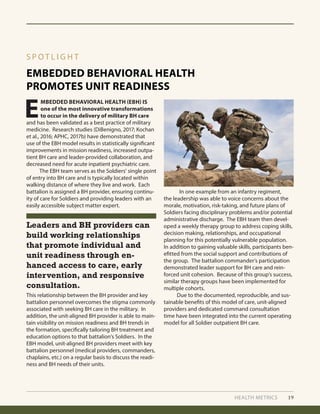
  • 6.
    2 2018 HEALTHOF THE FORCE REPORT REPORT HIGHLIGHTS of all injuries were cumulative micro-traumatic musculoskeletal “overuse” injuries. of Soldiers had a new injury. That’s more than 3 injuries per affected Soldier. SLEEP DISORDERSBEHAVIORAL HEALTH INJURY In 2017, approximately 1,821 new injuries were diagnosed per 1,000 person-years. Rates were higher in women and older Soldiers. 71%56% of Soldiers had a behavioral health diagnosis. 15% of Soldiers had a sleep disorder.12% Behavioral health diagnosis rates were higher among female Soldiers. Sleep disorders increased with age and were more common among men than women.
  • 7.
    INTRODUCTION 3 The majorityof smokers are 34 years of age or younger. Rates are highest among junior enlisted, males, and Soldiers <25 years of age. Less than 50% of Soldiers are eating the minimum recommended servings of fruits and vegetables. Army screening rates are markedly higher than those observed nationally. 26% REPORT HIGHLIGHTS SEXUALLY TRANSMITTED INFECTIONSHEAT ILLNESS OBESITY PERFORMANCE TRIAD TOBACCO USE ENVIRONMENTAL HEALTH INDICATORS of the surveyed Army population received optimally fluoridated water. of the surveyed Army population experienced more than 20 poor air quality days per year. Only 1 in 3 AC Soldiers attained the target amount of 7 or more hours of sleep on duty days. of Soldiers were classified as obese. The number of reported heat illnesses has increased over the past 4 years. Reported chlamydia infection rates were 34% higher in 2017 than in 2013. of Soldiers reported tobacco use. compared to 26% of a similar population of U.S. adults. 46% 10% 17% 23% 18 2013 2017 41 64
  • 8.
    4 2018 HEALTHOF THE FORCE REPORT What Health of the Force Metrics Mean to Medical Readiness There’s more to the data with Health of the Force Online, including additional installa- tion- and command-specific data. Delve deeper into what these data mean for your population. Read and share tools and sup- plemental information to bring insight and personal context to the report. Dynamically generate charts to visualize data, make com- parisons, and develop a better understand- ing of the Health of YOUR Force. From the APHC Web site, follow the Health of the Force link to the CAC-enabled CarePoint platform: https://phc.amedd.army.mil/topics/cam- paigns/hof/ Engage, Explore, and Connect with Health of the Force Online ONLINE HEALTH FORCE OF THE Readiness is the U.S. Army’s number one priority as declared by GEN Mark A. Milley, Chief of Staff, in August 2015 and reaffirmed by Secretary of the Army, Dr. Mark Esper, in his November 2017 confirmation address. In an effort to achieve the highest level of medical readiness, the Army initiated a Medical Read- iness Transformation in June 2016. This empowered commanders by providing direct access to Soldiers’ medical readiness status, profiles, and pending requirements. During calendar year 2017, 86% of the AC Army was medically ready (Medical Readiness Classification (MRC) 1 or 2). Of AC Soldiers, 11% were classified as MRC3, and 3.0% as MRC4, both of which indicate med- ical non-readiness. The standardized public health status reporting detailed in Health of the Force aims to further assist Army leaders in understanding the leading causes of medical non-readiness. Through annual analysis of medical metrics, health behaviors, and environ- mental health indicators, Health of the Force identifies health-related strengths and challenges that directly impact Force health. The report highlights the top two contributors to medical non-readiness: injuries and behavioral health conditions. The report also con- siders conditions and behaviors (e.g., obesity and tobacco use) that contribute to these diagnoses. Through refined methodology, the 2018 report has identified that over 70% of the Army injury burden is due to cumulative micro-traumatic musculoskeletal overuse injuries, with higher incidence of injury in female Soldiers and older Soldiers (both male and female). Additionally, current analyses demonstrate that the incidence of behavioral health diagnoses is higher among female Soldiers, older Soldiers are more likely to have a posttraumatic stress disorder (PTSD) diagnosis, and younger Soldiers are more likely to suffer from a substance use disorder (SUD). Each edition of Health of the Force aims to fur- ther contextualize how the health and well-being of Soldiers relate to medical readiness. By gaining a robust understanding of the leading con- tributors to medical readiness at the unit and community level, Army leaders can effectively target programs and policies that positively impact medical readiness.
  • 9.
    INTRODUCTION 5 0 100,000 200,000 300,000 400,000 500,000 2013 20142015 2016 2017 Female Male Total 68,442 402,635 471,077 68,779 396,207 464,986 69,012 418,539 487,551 72,006 458,144 530,150 70,438 438,483 508,921 Demographics Demographic factors can affect both health outcomes and individual health behaviors. For exam- ple, chronic disease manifestation and the propensity to become overweight or obese increase as a population ages. When reviewing population health data, it is important to consider how demo- graphics influence population strengths and challenges. Army AC population demographics differ significantly from the U.S. civilian population, and can vary greatly by command and installation. Army rates of illness and injury are informed by the underlying characteristics of age and sex. These demographics should be considered when explor- ing attributes that contribute to health risk, or when comparing subpopulations of interest. <25 25–34 35–44 45+ 0 10 20 40 30 5.8 5.8 33 2.5 32 16 0.7 4.4 Personnel Strength by Sex and Year, AC Soldiers, 2013–2017 Population Distribution by Sex and Age, AC Soldiers, 2017 According to DMDC (formerly known as Defense Manpower Data Center), the 2017 average monthly strength of the Army AC population was 465,000 Soldiers. Enlisted personnel accounted for 80% of AC strength. The majority (85%) of AC Soldiers were men. In addition to being mostly male, the Army AC population is younger than the general population of employed U.S. civilians. Over 76% of AC Soldiers are under the age of 35 compared to the employed civilian population, where 37% are under 35. It is important to keep these differences in mind when comparing the overall health status of Soldiers to civilians. Age Year NumberofACSoldiers Percent Women Men 85% of AC Soldiers were men
  • 10.
    6 2018 HEALTHOF THE FORCE REPORT MENTAL SKILLS TRAINING IMPROVES SOLDIER PHYSICAL FITNESS S P O T L I G H T I MPROVING MEDICAL READINESS REQUIRES training in both physical and behavioral skills. Sim- ilar to professional athletes, Soldiers must train both mind and body for optimal performance. At 2% to 3% annually, Army Physical Fitness Test (APFT) failure is a challenge to Soldier readiness (Sih & Negus, 2016). To address these failures, Army occupational therapy has designed an evidence-based program that teaches Soldiers to apply mental skills to improve performance. This mental skills training includes the use of mental imagery, positive self-talk, heart rate control, and goal setting during unit physical training (PT). Soldiers also learn the importance of these resil- ience skills for long-term health and wellness. Mental imagery involves using all senses to vividly create an event in one’s mind, enhancing ability and reducing injury. Soldiers learn to develop a mental imagery script for each of the APFT events while focusing on a positive phrase for success. Pos- itive self-talk, a skill used by elite athletes, improves confidence and ability (Van Raalte & Vincent, 2017). Soldiers learn the benefits of slow, deep, dia- phragmatic breathing for energy conservation, mental focus, and stress management. Heart rate control helps to slow the body’s “fight or flight” stress response which, over long expo- sure, has been linked to the development of chronic illness such as heart disease, diabetes, arthritis, and mood disorders. This skill is trans- ferable to all aspects of Soldier life and has been found to decrease operational stress reactions (HeartMath Institute, 2018). Goal setting creates a focal point for success and provides intrinsic motivation (Wilson & Brook- field, 2009). As part of their mental skills training, Soldiers learn the benefits of developing challenging short- and long-term goals for APFT improvement. Soldiers recognize the application of these resilience skills to other areas of their jobs. Nested in the Army Chief of Staff’s vision of “physically fit and mentally tough Soldiers,” this new occupational therapy program provides a mental fitness curriculum for readiness. Research shows a statistically significant improvement in APFT scores following integra- tion of mental skills training with unit PT (Meyer, 2018).
  • 11.
    INTRODUCTION 7 ARMY WELLNESSCENTERS SUPPORT HEALTH AND READINESS S P O T L I G H T A RMY WELLNESS CENTERS (AWC) APPLY BEST practices in workplace health promotion programming to improve Soldier readiness and Army community health. Designed to shift the focus from reactive, treatment-focused health care to a prevention-focused system for health, AWCs deliver an individual-level health education and coaching model that supports prevention by helping Soldiers and Army community members increase healthy behaviors, reduce disease risk factors, and optimize readiness and resiliency. The AWCs’ approach, sup- ported by the Community Preventive Services Task Force, includes the health risk assessment, feedback from participants, and health education. Six evi- dence-informed core programs are standardized across a global network of 35 AWCs. AWCs are monitored to assess both the achieve- ment of performance benchmarks and model compli- ance. They are evaluated for program effectiveness and identification of areas for improvement. In the second quarter of Fiscal Year 2018 (FY18), AWCs served 18,000 clients and achieved a 97% client satis- faction rating. An FY14–15 AWC outcomes evaluation (Rivera et al., 2018) concluded that clients who en- gaged in at least one follow-up AWC assessment not only experienced improvements in cardio- respiratory fitness but also reductions in body fat, body mass index (BMI), blood pressure, and perceived stress. For example, nearly 70% of clients increased their level of cardiorespiratory fitness, and nearly 60% decreased their body fat and BMI. These results are particularly meaningful given research showing that increased levels of cardiorespiratory fit- ness and decreased levels of BMI are generally tied to better health- and injury-related outcomes (Verweij et al., 2011; Jones et al., 2017), both of which positively impact Soldier deployability and readiness. AWCs are the community outreach arm of the Army Patient Centered Medical Home (PCMH) model and are often located apart from medical treatment facilities to help mitigate the perceived stigma asso- ciated with seeking medical care. Evaluation efforts that examined the collaboration between the AWC and PCMH suggest that ongoing collaboration could be improved by standardizing the referral process and increasing communication via huddle meeting representation (APHC(Prov), 2016a). AWC services are available to Army commu- nity members at no cost. For more information or to schedule an appointment, contact your local AWC. ARMY WELLNESS CENTER REFERRAL CONSIDERATIONS Non-Soldiers • BMI ≥ 30 kg/m2 • Ready to change their exercise and nutritional habits; interested in support Soldiers • 2-mile run times > 15:30 minutes (males) or 19:00 minutes (females) • Not meeting AR 600–9 (DA, 2006) height for weight standards • Ready to change their exercise and nutritional habits; interested in support
  • 12.
    Fort Sill HealthReadiness Center Improves Medical Readiness U.S. Army Garrison Benelux Reduces Medical Readiness Classification 4 Rates L O C A L A C T I O N L O C A L A C T I O N I n February 2017, Fort Sill opened a Health Readiness Center in response to the Senior Commander’s directive to address a medical non-readiness rate of 11% through the Com- mander’s Ready and Resilient Council (CR2C) Improvement Plan. The Fort Sill Health and Readiness Council spearheaded the initiative to locate nutrition care, public health nursing, case management, Periodic Health Assessments (PHAs), AWCs, and medical readiness reviews in one center. At Fort Sill, Soldiers process through the Health Readiness Center as part of their per- sonal readiness requirements. Since the Center’s implementation, PHA compliance has increased to 97% (a 19% increase), the number of Soldiers receiving MRC3 or MRC4 designations has decreased by 48% and 82%, respectively, and deployability has increased to 92%. In addition, Fort Sill referrals to available prevention services have increased by 82% since the Health Readi- ness Center was established. Coordinated approaches to addressing medical readiness reduce gaps in services, increase referral rates to preventive health services, and prevent duplication of efforts. D uring a Commander’s Readiness Forum, it was identified that 12% of U.S. Army Garrison (USAG) Benelux Soldiers were in an MRC4 status and, therefore, were not medically ready. The USAG Benelux CR2C and Medical Treatment Facility (MTF) formed a working group to plan and implement an initiative to reduce MRC4 rates. The program incorporated readiness checks into every outpatient appointment to rapidly refer Soldiers to programs and resources that address readiness deficiencies. Additionally, primary care providers sent reminders to Soldiers via a secure messaging system. As a result, USAG Benelux MRC4 rates have dropped significantly to under 2%. Building medical readiness into the way organizations conduct daily operations ensures that readiness is a priority for the entire installation. 8 2018 HEALTH OF THE FORCE REPORT
  • 13.
    INTRODUCTION 9 Health Metrics INJURY TOBACCOUSE BEHAVIORAL HEALTH HEAT ILLNESS SUBSTANCE USE HEARING SLEEP DISORDERS OBESITY SEXUALLY TRANSMITTED INFECTIONS CHRONIC DISEASE
  • 14.
    Health Metrics Injury 102018 HEALTH OF THE FORCE REPORT Injury Injury is a significant contributor to the Army’s healthcare burden, impacting medical readiness and Soldier health. Over 1 million medical encounters and roughly 10 million days of limited duty occur annually as a result of injuries and injury-related musculoskeletal conditions, affecting over half of Soldiers each year. Injuries reported here are defined as any damage or interruption of body tissue function caused by an energy transfer that exceeds tissue tolerance suddenly (acute trauma) or gradually (cumulative micro-trauma) (APHC, 2017a). A comprehensive re-classification of injury diagnosis codes was necessitated by the Military Health System’s transition to the ICD-10-CM medical coding sys- tem in October 2015. Following the transition to ICD-10-CM, the rates of injury diagnoses are higher than those reported previously. Revised 2016 rates under the new definition are shown for comparison (top of next page). Incidence of Injury by Sex and Age, AC Soldiers, 2017 Among AC Soldiers, approximately 1,821 new injuries were diagnosed per 1,000 person-years in 2017. The high rate reflects multiple injuries among affected Soldiers. Injury rates were higher among women and older Soldiers. There were 1,821 new injuries per 1,000 person-years. Incidence ranged from 1,308 to 2,963 per 1,000 person-years across Army installations. 1,821 1,308 2,963 Rateper1,000 Person-Years Age Women Men Total <25 25–34 35–44 45+ 0 500 1,000 2,500 3,500 1,500 2,000 3,000 2,396 3,415 2,894 1,720 2,683 2,230 2,066 1,5411,470 2,474
  • 15.
    HEALTH METRICS 11 Incidenceof Injuries per 1,000 Person-Years, AC Soldiers, 2016–2017 OVERUSE INJURIES The incidence of all new injuries and new overuse injuries decreased slightly in 2017, compared to 2016. of all injuries were cumulative micro-traumatic musculoskeletal “overuse” injuries. Cumulative micro-traumatic musculoskeletal“overuse”injuries All injuries Year Rate per 1,000 Person-Years Proportion Injured by Sex and Age, AC Soldiers, 2017 Overall, 56% of Soldiers had a new injury in 2017. Injuries affected 69% of Soldiers age 45 and older, compared to 54% of Soldiers under age 25. Sixty-six percent of women had a diagnosed injury in 2017, compared to 54% of men. For both men and women across all age groups, cumulative micro-traumatic musculoskeletal “overuse” injuries, commonly attributed to military physical training, accounted for the majority of injuries. Cumulative micro-traumatic musculoskeletal“overuse”injuries All other injuries Total Women Men Women Men Women Men Women Men Women Men Age: <25 25–34 35–44 45+ 0 20 40 60 80 53 13 56 13 39 12 49 12 41 13 39 12 55 14 46 16 46 21 59 18 Percentof SoldiersInjured 2016 2017 0 2,000500 1,320 1,000 1,500 1,868 1,288 1,821 71% Only 7% of injury encounters were cause-coded in medical records. Clinical diagnoses can include optional supplementary codes, known as cause codes, that provide information about injury circumstances, including the mechanisms, exposures, activities, and places associated with injury. Providers’ use of these codes is valuable for understanding common injury scenarios and assisting commanders in making informed decisions about prevention strategies.
  • 16.
    Health Metrics Injury 122018 HEALTH OF THE FORCE REPORT U.S. Army Hawaii 25th Infantry Division Addresses Injury Prevention L O C A L A C T I O N T he CR2C strategically manages, monitors, and implements health improvement plans across medical, garrison, and mission operations. Using CR2C processes, the U.S. Army Hawaii Physical Health Working Group spearheaded an initiative to reduce injuries, reduce rates of MRC3 designations, and improve physical training methods. Physical thera- pists trained the 3rd Battalion, 7th Field Artillery Regiment 25th Infantry Division Soldiers in evidenced-based approaches to physical reconditioning. As a result, the number of Soldiers on profile due to musculoskeletal injuries decreased by 72%. Due to the success of the program, it is now being applied to other 25th Infantry Division units. ”Continuing to build upon and follow a systematic, public health approach to injury prevention will enable continued progress toward reducing the negative impact injuries place on Soldiers, their Families, commanders, and the Army medical system.” —LTG Eric Shoomaker former Surgeon General of the Army
  • 17.
    HEALTH METRICS 13 DON’TBE BENCHED BY PEC MUSCLE AND TENDON INJURIES S P O T L I G H T S OLDIERS MUST STRIVE TO ATTAIN HIGH lev- els of physical fitness to complete the mission effectively. Strength training is an increasingly popular way to improve muscle mass and optimize body composition. However, the military medical community has reported a notable increase in sur- geries for torn or ruptured pectoralis major muscles (PMM)/tendons (PMT) (Salazar et al., 2018; Antosh et al., 2009; White et al., 2007). Injuries to the “pecs” primarily occur while bench pressing heavy weights, when a sudden imbalance puts unexpected strain on one side. Injuries that require surgery result in months of limited movement and lost work, permanent loss of strength, and/or reassignment of work duties (Pochini et al., 2014; Merlin et al., 2017). Partial PMM/PMT tears not requiring surgery still restrict lifting for days or weeks. Reports thus far have focused on surgical cases, so the full extent of the military PMM/PMT injury problem is not yet known. Increase in PMM/PMT injuries is linked to the growing interest in weight-lifting activities. Many military-owned or -operated facilities (even in deploy- ment settings) provide bench press equipment. The use of other makeshift items (e.g., cinderblocks, sand-filled jugs) has also been reported. Most sur- gical cases are men who were bench pressing heavy weights (over 175 pounds, but especially over 250 pounds) at the time of their injury. To reduce risk, don’t use anabolic steroids, replace traditional bench pressing with less risky exercises (e.g., push-ups or resistance bands to work similar muscles), or— • Seek instruction from a certified trainer for best form. • Use proper equipment (balanced weights, weight locks, bar rack). • Use a trained spotter capable of catching the weight bar to prevent imbalance. • Avoid muscle failure (reduce weights, limit the number of repetitions and sets). Upper Sternum Clavicle Pectoralis Major Tendon Humerus Pectoralis Major Muscle Tear in the tendon of the clavicular head of the Pectoralis Major Muscle
  • 18.
    Health Metrics BehavioralHealth 14 2018 HEALTH OF THE FORCE REPORT Behavioral Health The stressors of military life can strongly influence the psychological well-being of Soldiers and their Families. Particularly when unrecognized and untreated, behavioral health (BH) diagnoses can lead to lack of medical readiness, early discharge from the Army, and suicidal behavior. In 2017, 15% of Soldiers had a diagnosis of one or more BH conditions, which include adjustment disorder, mood disorders, anxiety disorders, posttraumatic stress disorder (PTSD), substance use disorder (SUD), personality disorder, and psychosis. Overall, 15% of Soldiers had a behavioral health disorder. Prevalence ranged from 8.9% to 21% across Army installations. Prevalence of Behavioral Health Disorders by Sex and Age, AC Soldiers, 2017 BH disorder rates were higher among female Soldiers (23%) than male Soldiers (14%). Older Soldiers were more likely to have PTSD than younger Soldiers (under 35 years old) (7.0% and 1.6%, respectively). Younger Soldiers were more likely to have a SUD than older Soldiers (4.0% and 1.8%, respectively). Women Men Percent Age Total <25 25–34 35–44 45+ 0 10 20 30 23 24 13 21 14 12 27 18 18 26 15% 8.9% 21%
  • 19.
    HEALTH METRICS 15 Prevalenceof Behavioral Health Disorder by Condition, AC Soldiers, 2013-2017 The proportion of AC Soldiers with a diagnosed BH disorder has slowly declined in the last 5 years from a high of 17% in 2013 to 15% in 2017. With the exception of SUD, the prevalence of all BH disorders has also decreased. Despite these reductions in diagnoses, Army Medicine continues to strive to bring more Soldiers into care to improve the readiness and well-being of the Force. Condition Percent 0 5 10 15 20 2013 2014 2015 2016 2017 Any BH disorder 16 151617 16 Adjustment disorder 8.5 8.18.38.6 8.2 Mood disorder 4.9 4.55.45.8 5.7 Other anxiety disorder 5.2 4.85.65.4 5.5 PTSD 3.3 2.93.43.7 3.6 Substance use disorder 3.2 3.53.13.3 3.0 Prevalence of Behavioral Health Disorders by Sex and Condition, AC Soldiers, 2017 For both male and female Soldiers, the most common BH disorder was adjustment disorder. The proportion of female Soldiers who received a diagnosis of adjustment disorder, anxiety disorders (excluding PTSD), or mood disorders was twice that of male Soldiers (14% and 7.0%, respectively). SUD was the only BH condition for which the proportion of male Soldiers exceeded that of female Soldiers (3.6% and 2.6%, respectively). Women Men Percent Year Any BH disorder Adjustment disorder Other anxiety disorder Any mood disorder PTSD Substance use disorder 2550 10 15 20 23 14 14 7.0 8.3 4.2 8.6 3.8 3.7 2.8 2.6 3.6 Less than 1% of AC Soldiers were diagnosed with a personality disorder or psychosis.
  • 20.
    Health Metrics BehavioralHealth 16 2018 HEALTH OF THE FORCE REPORT POSTTRAUMATIC STRESS DISORDER AND PHYSICAL HEALTH INTERRELATIONSHIP S P O T L I G H T P OSTTRAUMATIC STRESS DISORDER is one of the most common BH conditions to occur after exposure to traumatic events, including combat, assault, rape, accidents, natural disasters, and other life-threatening experiences. It is estimated that 5% to 20% of Soldiers who have deployed to combat zones such as Iraq or Afghani- stan developed symptoms of PTSD and may benefit from treatment (Kok et al., 2012). PTSD and other BH disorders pose risk for several adverse outcomes such as medical non-readiness, alcohol and substance misuse, and risky behaviors. The reactions associated with PTSD are based on survival instincts that do not turn off after the trauma or threat has passed. For example, when faced with a dangerous situation, it is normal to become hyperalert. If this condition continues for a prolonged period after the threat is over, however, and interferes with daily functions, it may become a symptom of PTSD. Similarly, anger can help when it is necessary to fight for survival, but when anger persists and inter- feres with relationships or work, it may be a symptom. Common PTSD symptoms include intrusive thoughts, flashbacks, nightmares, emotional withdrawal, avoid- ance behaviors, guilt, low mood, and reactivity to triggering events, such as crowds or loud noises. An important aspect of PTSD is that the common reac- tions health professionals label as PTSD symptoms (e.g., hyperalertness) can be advantageous in cer- tain ways in the occupational military context (e.g., hypervigilance equates to situational awareness in a combat zone). As a result of long-term activation of the body’s usually self-limited stress response, PTSD is associ- ated with potentially persistent changes in the way the body responds to stress. This overall heightened physical and mental stress response can impact Sol- dier readiness by affecting their sleep, cognitive per- formance, and all categories of physical health. To cope, Soldiers may further compound problems such as persistent disturbance of sleep through ”self-med- ication” with alcohol or other substances, which only worsens the quality of sleep and can interfere with successful recovery. Some PTSD Symptoms Are Based in Survival Instincts Survival Instinct PTSD Symptom Situational awareness, rapid reflexes Hyperalert, hypervigilant (e.g. in crowds or traffic) Intense mission prepara- tion, rigorous training Reliving combat events, guilt, second-guessing Adrenaline, focus, and intensity to accomplish critical missions Anger Emotional control in combat Detached, numb Unit cohesion, unit is family Social withdrawal at home of Soldiers who have deployed to combat zones such as Iraq or Afghanistan developed symptoms of PTSD. 5%–20%
  • 21.
    HEALTH METRICS 17 JointBase Langley-Eustis Reduces Behavioral Health No-Show Rates L O C A L A C T I O N F ollowing the loss of a Soldier by suicide after he failed to keep a BH appointment, the Joint Base Langley-Eustis (JBLE) community coordinated an effort to reduce the no-show rates for healthcare appointments. Recognizing that access to care and attend- ing appointments are critical to personal readiness, a working group implemented an email and telephone call appointment reminder system for both Soldiers and commanders. By helping to ensure Soldiers are released for scheduled healthcare appointments, commanders are supporting Soldiers in getting the care they need when they need it, thus demonstrating the importance of BH care as a key factor in personal readiness. Since implementation of the JBLE program, the no-show rates for BH appointments have decreased by 1.7%, and those for sub- stance abuse counseling appointments have decreased by 3.3%. These observed reductions in no-show rates are expected to improve further as the appointment reminder system continues to be implemented. PTSD Can be Associated with Global Physical Health Effects Physical Symptoms Scale (“bothered a lot”) Soldiers Post-Iraq With PTSD (N=468) (%) Soldiers Post-Iraq No PTSD (N=2,347) (%) Total Score > 15 (severe) 34 5.2 Tired, low energy 75 28 Sleep disturbance 71 26 Pain in arms, legs, joints 50 26 Back pain 40 22 Headaches 32 9.9 Nausea / indigestion/ irritable bowel syndrome 25 8.8 Some level of reactivity is normal after trauma, but treatment is recommended when reactions or associated physical health effects begin to interfere noticeably with a Soldier’s rela- tionships, work, or ability to enjoy life. Treatment by a Department of Defense (DOD) BH professional is often the best way to support career goals and occupational readiness, including requirements such as security clearances. In addition to addressing the mental well-being of Soldiers exhibiting PTSD symp- toms, it is important to address physical health man- ifestations and any co-existing risk behaviors, such as alcohol or substance misuse. PTSD messaging should encourage help-seeking behavior and recognize that seeking care, when needed, is a sign of strength. If PTSD symptoms or behavioral changes are observed, ensure the Soldier gets care from a behav- ioral health provider in an embedded behavioral health unit or at the local MTF.
  • 22.
    Health Metrics BehavioralHealth 18 2018 HEALTH OF THE FORCE REPORT IMPROVING SOLDIER READINESS BY OPTIMIZING BEHAVIORAL HEALTH TREATMENT EFFECTIVENESS S P O T L I G H T T HE ARMY BH SERVICE LINE SUPPORTS Soldier readiness and Family health through a cycle of patient-centered, data-informed, healthcare delivery and leadership support. Patient- reported data are collected to inform individual patient care and increase overall treatment effec- tiveness at the clinic, MTF, region, and U.S. Army Medical Command (MEDCOM) levels. This cycle of care benefits patients by improving treatment out- comes, ensuring the provider and patient are working together toward mutually agreed-upon goals, and allowing them to identify when the current treatment plan needs to be adjusted to ensure treatment is max- imally effective. The Data-Informed Cycle of Care and Leadership Support Patients: Via the Behavioral Health Data Portal (BHDP), patients share vital information with their treatment team by completing symptom and history questionnaires at intake and before each BH specialty clinic appointment. Providers: Individual providers enhance face-to-face meetings with patients by reviewing the patient’s self-reported information in the BHDP. This information includes the patient’s current and longitudinal record of symptoms, history, and significant events. Providers work with patients to develop an individually-tailored treatment plan informed by patient-reported data to monitor progress over time. BH Service Line: To inform BH leadership to optimally develop and mold BH clinical services, BHDP and other medical data are aggregated, and population-focused outcome and clinical driver metrics (e.g., rate of use of evidence-based treatments) are compiled. These process improvement data are reported back to the MTFs as well as the supporting leadership at their respective Regional Army Public Health Commands and MEDCOM. MEDCOM/Office of The Surgeon General (MEDCOM/OTSG): To encourage and support the most effective practices, MEDCOM uses budgetary incentives to encourage MTFs to improve outcomes through evidence-based clinical practice and data-informed treatment. In addition, MEDCOM/ OTSG refines policies to support process changes that further drive improved outcomes. MTF BH Leadership: Installation Directors of Psychological Health are empowered with patient- centered data, informed policy, and budgetary support, all of which enable providers to optimally care for their patients. 1 2 3 4 5
  • 23.
    HEALTH METRICS 19 EMBEDDEDBEHAVIORAL HEALTH PROMOTES UNIT READINESS S P O T L I G H T E MBEDDED BEHAVIORAL HEALTH (EBH) IS one of the most innovative transformations to occur in the delivery of military BH care and has been validated as a best practice of military medicine. Research studies (DiBenigno, 2017; Kochan et al., 2016; APHC, 2017b) have demonstrated that use of the EBH model results in statistically significant improvements in mission readiness, increased outpa- tient BH care and leader-provided collaboration, and decreased need for acute inpatient psychiatric care. The EBH team serves as the Soldiers’ single point of entry into BH care and is typically located within walking distance of where they live and work. Each battalion is assigned a BH provider, ensuring continu- ity of care for Soldiers and providing leaders with an easily accessible subject matter expert. This relationship between the BH provider and key battalion personnel overcomes the stigma commonly associated with seeking BH care in the military. In addition, the unit-aligned BH provider is able to main- tain visibility on mission readiness and BH trends in the formation, specifically tailoring BH treatment and education options to that battalion’s Soldiers. In the EBH model, unit-aligned BH providers meet with key battalion personnel (medical providers, commanders, chaplains, etc.) on a regular basis to discuss the readi- ness and BH needs of their units. In one example from an infantry regiment, the leadership was able to voice concerns about the morale, motivation, risk-taking, and future plans of Soldiers facing disciplinary problems and/or potential administrative discharge. The EBH team then devel- oped a weekly therapy group to address coping skills, decision making, relationships, and occupational planning for this potentially vulnerable population. In addition to gaining valuable skills, participants ben- efitted from the social support and contributions of the group. The battalion commander’s participation demonstrated leader support for BH care and rein- forced unit cohesion. Because of this group’s success, similar therapy groups have been implemented for multiple cohorts. Due to the documented, reproducible, and sus- tainable benefits of this model of care, unit-aligned providers and dedicated command consultation time have been integrated into the current operating model for all Soldier outpatient BH care. Leaders and BH providers can build working relationships that promote individual and unit readiness through en- hanced access to care, early intervention, and responsive consultation.
  • 24.
    Health Metrics SubstanceUse 20 2018 HEALTH OF THE FORCE REPORT Substance Use Substance use disorder (SUD) includes the misuse of alcohol, cannabis, cocaine, hallucinogens, opioids, sedatives, or stimulants. According to the Diagnostic and Statistical Manual of Mental Disorders, 5th Edition (DSM-5®), a diagnosis of SUD is based on evidence of impaired control, social impairment, risky use, and pharmacological criteria (APA, 2013). The misuse of alcohol, prescription medications, and other drugs can impact Soldier readiness and resilience and poten- tially impact family, friends, and the Army community as a whole. Drug and alcohol overdose is the leading method of attempted suicide among Soldiers (APHC, 2017c). The Army continues to adapt treatment and prevention efforts to accommodate the unique characteristics of military life and culture. Overall, more than 18,000 Soldiers were diagnosed with a SUD in 2017. Prevalence of Substance Use Disorder by Sex and Age, AC Soldiers, 2017 Soldiers under the age of 25 had a greater proportion of SUDs than any other age group. Male Soldiers experienced higher rates of SUD diagnosis than female Soldiers in all age categories. Women Men Percent Age Overall, 3.5% of Soliders had a substance use disorder diagnosis. Prevalence ranged from 1.2% to 5.9% across Army installations. Total <25 25–34 35–44 45+ 0 1 2 4 6 3 5 3.7 1.9 2.8 1.2 5.5 2.1 1.2 1.3 3.6 2.5 3.5% 1.2% 5.9%
  • 25.
    0 20 40 60 80 2013 2014 20152016 2017 Alcohol (%) 80 747976 79 Cannabis (%) 12 171110 10 Opioids (%) 2.9 2.03.15.6 4.0 Cocaine (%) 2.2 3.22.22.0 2.0 Amphetamines (%) 1.4 2.11.91.7 1.6 HEALTH METRICS 21 Proportion Enrolled in Formal Treatment by Substance, AC Soldiers, 2013–2017 During 2017, 74% of Soldier enrollments in formal treatment resulted from alcohol-related referrals, followed by cannabis (17%), and cocaine (3.2%). Enrollment for cannabis has increased by 7% since 2013. Year Proportion of Illicit-positive Drug Tests by Drug Type, AC Soldiers, 2017 Percent Cannabis was the most common substance found in urinalysis testing in 2017, accounting for 56% of positive results, followed by cocaine (17%), amphetamines (15%), and opioids (8.5%). 0 10 20 30 40 50 60 70 80 90 100 56 15 8.517 3.9 Cannabis Cocaine Amphetamines Opioids Benzodiazepines Percent Proportion of Illicit-Positive Drug Tests by Sex and Age, AC Soldiers, 2017 Women Men Percent Overall, less than 1% of AC Soldiers tested positive for one or more illicit drugs in 2017. Of the illicit-positive Soldiers, 92% were male. The majority of this population was male Soldiers under age 25 (66%) followed by males age 25–34 (22%). Age <25 25–34 35–44 45+ 0 25 50 75 6.1 2.1 22 0.3 66 3.1 0.1 0.4 Soldiers may have been enrolled in formal treatment for more than one substance or for a substance not included in this analysis.
  • 26.
    Health Metrics SubstanceUse REDUCING STIGMA WITH VOLUNTARY ALCOHOL- RELATED BEHAVIORAL HEALTH CARE S P O T L I G H T S TIGMA HAS LONG BEEN A FACTOR THAT impacts a Soldier’s willingness to seek treat- ment for BH and substance misuse issues. Soldiers often believe that seeking care will cause others to lose confidence in their abilities, threaten their career advancement and security clearances, and cause removal from their units (DOD, 2007). In the recent Policy for Voluntary Alcohol-Related Behav- ioral Health Care (pending publication), the OTSG aims to fight this stigma and change the culture to one that encourages Soldiers to seek help earlier, ulti- mately increasing the health and readiness of the Force. According to this policy, Soldiers will be able to voluntarily seek alcohol-re- lated BH care without fear that discontinuing their care will serve as a basis for adminis- trative separation. Those who receive voluntary alcohol-re- lated care will be treated in the same manner as Soldiers who seek voluntary BH care, meaning neither requires command noti- fication unless there is a risk to safety, judge- ment, or of occupa- tional impairment. Studies on Operation Enduring Freedom and Operation Iraqi Freedom Veterans have shown the comorbidity of SUDs and other BH disorders is as high as 93%. The co-occurrence of PTSD and SUDs can be as high as 63% (Larson et al., 2012). Studies have also shown an increase in Veteran suicide risk among those with a SUD (Seal et al., 2011). Soldiers who fre- quently drink excessively and engage in risky behav- iors, have memory problems, or make poor decisions are encouraged to self-refer to their local BH clinic for a SUD evaluation. Soldiers who do not receive timely SUD treatment have a higher likelihood of negative outcomes such as indiscipline events, relationship problems, and health consequences. Untreated alcohol abuse is connected to rates of sexual assault, domestic abuse, and suicide. The new policy provides a pathway for Soldiers to obtain necessary health care without fear of career repercussions. Distinguishing mandatory treatment from voluntary care in this way will encourage Soldiers to seek help earlier and will positively impact Force readiness. 93% Comorbidity of SUDs and other BH disorders is as high as 93%. 63%Co-occurence of PTSD and SUDs can be as high as 63%. 22 2018 HEALTH OF THE FORCE REPORT
  • 27.
    These synthetic cannabinoidsare created to mimic the effects of THC, but the resulting high is unpredict- able and can be life-threatening. In January 2018, the APHC learned that dozens of Service members in North Carolina arrived at local MTFs with a range of symptoms including extreme disorientation, anxiety, unconsciousness, headache, rapid heart rate, nausea/vomiting, high blood pres- sure, and seizures. An investigation found the Service members had vaped e-juices labeled as containing CBD oil. Toxicology results showed the products con- tained a synthetic cannabinoid nearly 300 times more potent than THC (WHO, 2017). The APHC coordinated a tri-Service response effort, in collaboration with the Centers for Disease Control and Prevention (CDC) and state health departments. This effort developed and disseminated public and clinical health risk commu- nications and established surveillance systems to track future cases. Soldiers who vape cannabis or synthetic can- nabinoid products may be self-medicating due to underlying physical or BH conditions (Metrik et al., 2018). Leaders should encourage the use of BH care among Soldiers and ensure all are aware of the available resources from which they can seek help for substance misuse. D EVICES COMMONLY KNOWN AS“VAPES,” which are used to vaporize cannabis or syn- thetic cannabinoid products, are increasing in popularity. Similar to e-cigarettes, vapes are per- ceived as less harmful than smoking, and the variety of liquid products continues to expand. Vapes can be used to heat liquid (e-juice), raw botanical cannabis, cannabis extracts, or synthetic cannabinoids into an aerosol, which is inhaled. Not only is it illegal for Soldiers to use cannabis products, but the act of “vaping”cannabis or synthetic cannabinoid prod- ucts can also have a profound effect on mission readiness and may cause irreversible harm. The cannabis plant contains over 100 natu- rally occurring cannabinoids (NIDA, 2018), but the cannabinoids that receive the most attention are delta-9-tetrahydrocannabinol (THC) and cannabidiol (CBD). THC is the mind-altering compound which causes the euphoric“high”associated with cannabis use. CBD does not produce a high but has gained pop- ularity as a dietary supplement to treat multiple health conditions. In addition to propylene glycol, vegetable glyc- erin, and flavorings, e-juices may contain a range of other substances, some of which may not be labeled accurately on the product. Vape products marketed as con- taining CBD and/or THC are not regulated, are often mislabeled (Bonn-Miller et al., 2017), and could contain dangerous chemical addi- tives or highly potent synthetic can- nabinoids (CDC, 2018a, 2018b). ON HIGH ALERT: DANGERS OF VAPING CANNABIS PRODUCTS S P O T L I G H T HEALTH METRICS 23
  • 28.
    Health Metrics SleepDisorders 24 2018 HEALTH OF THE FORCE REPORT Sleep Disorders High-quality sleep is critical to Soldier readiness and mission success. A good night’s sleep can help increase productivity and decrease the risk of accidents, errors, and injuries. Sleep disorders that can impair readiness and function, including sleep apnea, insomnia, hypersomnia, circadian rhythm sleep disorder, and narcolepsy were assessed in Health of the Force. Prevalence of Sleep Disorders by Sex and Age, AC Soldiers, 2017 Most Frequently Diagnosed Sleep Disorders by Sex, AC Soldiers, 2017 In 2017, approximately 12% of Soldiers had a sleep disorder. The prevalence of sleep disorders increased with age and was more common among men than women. The percentage of Soldiers diagnosed with a sleep disorder has remained relatively constant over the past 5 years. Women Women Men Men Percent Sleep apnea was the most frequently diagnosed sleep disorder in 2017, accounting for 43% of all sleep disorder diagnoses. The majority of these diagnoses were for obstruc- tive sleep apnea, a disorder that is linked to overweight/ obesity. The percentage of men diagnosed with sleep apnea was over 2.5 times greater than that of women. Insomnia accounted for 29% of sleep disorder diagnoses. In contrast to sleep apnea, the percentage of women diagnosed with insomnia was over 1.5 times greater than that of men. Age Percent Overall, 12% of Soldiers had a sleep disorder. Prevalence ranged from 5.8% to 21% across Army installations. Total <25 25–34 35–44 45+ 0 5 10 15 35 20 25 30 11 7.8 5.4 9.4 12 9.3 18 24 32 24 Sleep apnea Insomnia 0 654321 2.1 5.1 5.6 3.1 12% 5.8% 21%
  • 29.
    HEALTH METRICS 25 SP O T L I G H T Photo courtesy of LTC Phillip Neal; used with permission. A RMY DENTISTRY HAS A VALUABLE OPPOR- tunity to support Army Medicine in the treatment of obstructive sleep apnea (OSA) (OTSG/MEDCOM, 2018). Positive airway pressure (PAP) devices are the gold standard treatment for this sleep disorder. However, some Soldiers may not tolerate these devices well, and they are inconvenient in combat settings due to their size, maintenance requirements, and need for reliable electricity. Con- sequently, some Soldiers’ OSA may remain untreated, leading to poor sleep quality. Oral appliance therapy (OAT) is the primary device alternative to PAP. OAT appliances, which are delivered by qualified Dental Sleep Medicine (DSM) providers, hold the jaw forward and prevent collapse of the upper airway, thereby preventing OSA. Unlike PAP devices, OAT appliances are small and can be used in any environment. They are effective, well tolerated, easily adjusted, and can fit inside a Soldier’s uniform pocket. Through OAT, Army DSM providers can enhance mission perfor- mance, advance deployment readiness, and improve the health of the Force (OTSG/MEDCOM, 2018; Phillips et al., 2013; Ramar et al., 2015; Sutherland et al., 2015). ARMY DENTISTS HELP SOLDIERS GET BETTER SLEEP
  • 30.
    Health Metrics Obesity 262018 HEALTH OF THE FORCE REPORT Obesity The high prevalence of obesity in the U.S. poses a serious challenge to recruiting and retaining healthy Soldiers. Obesity is a leading factor in preventable death and increases a person’s risk of hypertension, type 2 diabetes, stroke, and injuries, compared to someone with a healthy weight. Obesity can have a serious impact on a Soldier’s performance, quality of life, and mental and phys- ical well-being. Obesity is determined by calculating Body Mass Index (BMI), a ratio of weight to height. The CDC defines obesity as a BMI of at least 30 kg/m2 (weight in kilograms divided by height in meters squared) or greater and overweight as a BMI between 25 and 30. However, Army studies have demonstrated that up to 20% of Soldiers with BMIs between 25 and 28 are not “overweight” due to excess body fat but rather have increased muscle mass. The Army Body Composition Program, AR 600-9, takes this into account and also adjusts height/weight standards for age and sex (e.g., a 40-year old male Soldier can have a BMI of 27.5 and be in compliance). Medical providers in both the DOD and civilian sector rarely use diagnosis codes to document overweight and obesity in medical records. BMI provides a means to monitor Soldiers’ body composition, as height and weight are routinely captured during healthcare visits. Prevalence of Obesity by Sex and Age, AC Soldiers, 2017 The prevalence of obesity increases with age. In all age groups, men are more likely to be obese than women. The increased prevalence of obesity in older Soldiers is of particular concern, as carrying excess weight further increases risks for a number of chronic conditions. Women Men Overall, 17% of Soldiers were classified as obese. Prevalence ranged from 8.3% to 25% across Army installations. Percent Age Total <25 25–34 35–44 45+ 0 10 20 30 9.0 4.0 10 9.0 17 20 19 31 32 20 17% 8.3% 25%
  • 31.
    HEALTH METRICS 27 WeightClassifications by BMI Category, AC Soldiers, 2017 Prevalence of Obesity, AC Soldiers, 2015–17 In 2017, more than a third of AC Soldiers were obese or classified into the high overweight category; less than 1% were determined to be underweight. The prevalence of obesity in the Army has remained constant over the last 3 years. In contrast, obesity in the general U.S. working population is increasing (BRFSS, 2017). Women Underweight (BMI <18.5) Normal weight (BMI ≥18.5–<25) Low overweight (BMI ≥25–27.5) High overweight (BMI >27.5–30) Obese (BMI ≥30) Men Adjusted U.S. population1 Percent Percent Year 0 10 20 30 40 50 60 70 80 90 100 33 21 1729 0 25 30 20 5 10 15 2015 2016 2017 9.0 19 25 26 9.0 19 9.0 19 25 26% of working U.S. adults 18–64 years of age were classified as obese in 2017 after adjusting the crude rate (31%) to the Army age and sex distribution. of AC Soldiers were classified as obese in 2017. 17% Source: BRFSS, 2017 1 U.S. working adults 18-64 years of age, age and sex adjusted to the Army population.
  • 32.
    Health Metrics Obesity 282018 HEALTH OF THE FORCE REPORT U.S. Army Alaska Targets Obesity and Physical Readiness L O C A L A C T I O N T he U.S. Army Alaska (USARAK) CR2C partnered with the 1st Stryker Brigade to imple- ment an initiative to restore physical fitness, prevent weight gain, and reduce re-injury rates. The 1st Stryker Brigade Physical Therapist and the Brigade Support Battalion (BSB) spearheaded an Injured Reserve Physical Training (IRPT) program to provide training to select fitness leaders and conduct segregated profile physical training based on Field Manual 7-22 (DA, 2012) and the MEDCOM guide Building the Soldier Athlete: Injury Prevention and Per- formance Optimization (MEDCOM, undated). Following program completion, the unit demon- strated a 5% re-injury rate and a 96% first-time APFT pass rate. From April 2017 to June 2018, medical evaluation board rates declined from 16% to 5% and are now the lowest in the Brigade. In addition to experiencing reduced rates of permanent disability, Soldiers within the BSB seek care for injuries less often, down to 12% from 20%. Currently, the IRPT program is fully implemented within the 1st Stryker Brigade Combat Team and the 4th Brigade Combat Team (Airborne), 25th Infantry Division, and continues to be implemented throughout USARAK.
  • 33.
    8.5% 27% BMI (Q1)Q2 Q3 Q4 (Q5) Q5 Q4 Q3 Q2 Q1 (Highest) (Lowest) (Fastest) (Slowest) HEALTH METRICS 29 S EVERAL STUDIES HAVE SHOWN THAT BOTH poor aerobic fitness (as measured by APFT 2-mile run times) and a BMI that is too high or too low are risk factors for injuries which can nega- tively affect medical readiness (Jones & Hauschild, 2015). While it is logical that those who are more aerobically fit can perform tasks for longer durations with less fatigue and recovery time (Knapik, 2015), the relationship between BMI and injury risk is less straightforward. In a population of over 180,000 Soldiers in Initial Entry Training during FY10 through FY13, the high- est injury rates were seen among Soldiers with the lowest BMIs and slowest run times (Jones et al., 2017). Soldiers in all BMI categories with the slow- est run times had higher risks of injury. These results are comparable to another recent study of Soldiers in an operational brigade (Rappole et al., 2017). When the population run times and BMI values were binned into five equal groups (quintiles, Q1–Q5), Initial Entry Soldiers with the lowest BMIs (Q1) and the slowest run times (Q1) were at approximately three times greater risk of injury compared to those who had an average BMI and a fast run time. This was true of injury incidence rates for both male and female Soldiers (see figures). Soldiers with the fastest run times and average BMI (Q3–Q4) had the lowest injury risk. The protective effect of a higher BMI, compared to a low BMI, is likely related to additional lean body mass (muscle) (Grier et al., 2015). Recognizing the relationship of aerobic fitness and body composition to injury is critical to reduc- ing injury risk. While the least aerobically fit Army trainees experience the highest risk of injury, those with the lowest BMI are also at increased injury risk. Understanding these trends has implications for recruitment and retention fitness standards. Those Soldiers with modifiable risk factors of high BMI, low BMI, and/or slow APFT run time performance should visit their installation’s Army Wellness Center for information about optimizing body composition and physical fitness to reduce injury risk. IMPROVE AEROBIC FITNESS AND BODY COMPOSITION TO REDUCE INJURY RISK S P O T L I G H T Injury Incidence Stratified by BMI and Run Times, Initial Entry Training, Female Soldiers, 2010–2013 (n=42,000) Injury Incidence Stratified by BMI and Run Times, Initial Entry Training, Male Soldiers, 2010–2013 (n=140,000) Q1 Q2 Q3 Q4 Q5 Q5 Q4 Q3 Q2 Q1 (Fastest) (Highest) (Lowest) (Slowest) 25% 63% BMIBMI Run Time Run Time Injury Incidence Injury Incidence Q=Quintile Q=Quintile
  • 34.
    Health Metrics TobaccoUse 30 2018 HEALTH OF THE FORCE REPORT Tobacco Use Using tobacco products negatively impacts Soldier readiness by impairing physical fitness and by increasing illness, absenteeism, premature death, and healthcare costs (DA, 2015). The Periodic Health Assessment (PHA), completed annually by Soldiers, contains several self-reported tobacco-related questions (DOD, 2016b). Because the PHA is conducted as part of a physical exam which determines an individual’s ability to deploy, many Soldiers may not report their tobacco usage to avoid potential negative attention. In addition, nicotine is known to increase alertness, and some Soldiers believe tobacco use enhances their ability to survive in austere envi- ronments. Data on vaping, e-cigarettes, or other alternative methods of consuming nicotine are currently being captured on the PHA. Overall, 23% of Soldiers reported tobacco use. Prevalence ranged from 8.3% to 31% across Army installations. Prevalence of Tobacco Use by Sex and Age, AC Soldiers, 2017 Regardless of sex, the majority of smokers are 34 years of age or younger. Across the age groups, the prevalence of tobacco use among male Soldiers was more than double that of female Soldiers. Women Men Percent Age Total <25 25–34 35–44 45+ 0 5 30 10 15 20 25 9.3 26 9.4 28 8.1 23 6.5 15 25 9.0 23% 8.3% 31%
  • 35.
    HEALTH METRICS 31 Percent Year Prevalenceof Tobacco Use, AC Soldiers, 2013–2017 0 5 10 15 20 25 30 2013 2014 2015 2016 2017 Any tobacco use Smoking Smokeless 24 16 23 14 26 17 30 21 28 19 12 111212 12 Tobacco use has decreased by nearly 7.0% since 2013; however, the increasing popularity of vaping and e-cigarettes may have impacted the observed decline in smoking tobacco use. Among the tobacco use categories assessed, the largest number of Soldiers reported smoking. The prevalence of Soldiers who reported smokeless (chewing or dipping) use remained the same over this timeframe. The general U.S. population rates for tobacco use are higher than the Army rates in 2017. The reported use of smokeless tobacco in the Army (11%) is higher than the national rate (8.6%) (BRFSS, 2017). Smoking adjusted rate (18% crude rate) adjusted rate (4.4% crude rate) adjusted rate (21% crude rate) Smokeless Total ArmyU.S. 14% 19% 11% 8.6% 23% 25% Source: BRFSS, 2017
  • 36.
    Heat Illness Heat illnessrefers to a group of disorders that occur when the body is unable to compensate for increased body temperatures due to hot and humid environmental conditions and/or exertion during exercise or training. These illnesses can have operational and readiness impacts for the Army. Heat illness represents a set of conditions that exist along a continuum of symptoms and illness severity that includes heat exhaustion and heat stroke, which are reportable medical events that should be reported through the Disease Reporting System, internet (DRSi). 32 2018 HEALTH OF THE FORCE REPORT Incident Cases of Heat Illness by Month*, AC Soldiers, 2017 Although heat exhaustion and heat stroke were reported year-round, the number of incident cases of heat illness was highest during the warmer months (May through September). In 2017, 1,869 incident cases of heat illness were reported in DRSi and the Military Health System Management Analysis and Reporting Tool (M2). Of total incident cases, the majority (80%) were heat exhaustion, and the remaining 20% were heat stroke. 0 550 50 100 150 200 250 300 350 400 450 500 APR MAY JUN JUL AUG SEP OCT Heat stroke Heat exhaustion 22 56 34 128 78 273 79 449 74 289 23 133 21 71 CasesofHeatIllness Month *Months not shown had <20 cases for heat exhaustion and/or heat stroke. Health Metrics Heat Illness
  • 37.
    0 500 1,000 1,500 2014Year: 2015 20162017 Hospitalized Not hospitalized 142 1,180 Heat Exhaustion Heat Stroke Heat Exhaustion Heat Stroke Heat Exhaustion Heat Stroke Heat Exhaustion Heat Stroke 78 170 114 94 1,316 185 123 1,371 109 197 96 1,407 110 256 Incidence of Heat Illness by Rank, AC Soldiers, 2017 Incidence of Heat Illness Hospitalizations, AC Soldiers, 2014–2017 Groups with the highest frequency of heat exhaustion in 2017 were junior enlisted (76%), male (79%), and under the age of 25 (69%). The same groups had the highest frequency of heat strokes: junior enlisted (57%), male (86%), and under the age of 25 (55%). The number of reported heat illness cases has increased over the past 4 years. Increased awareness of heat illness risks and local program efforts may have contributed to the increase. From 2016-2017, the number of heat exhaustion cases increased by less than 1% while there was a 20% increase in heat stroke cases. In 2017, 3.6% of heat exhaustion patients and 30% of heat stroke patients were hospitalized. Cases of Heat Illness CasesofHeatIllness Rank HEALTH METRICS 33 0 300 600 900 1200 E1–E4 E5–E9 1,142 209 209 79 123 63 *Officers Heat Exhaustion Heat Stroke *Officers includes Warrant Officers
  • 38.
    34 2018 HEALTHOF THE FORCE REPORT Health Metrics Heat Illness Fort Benning Strives for Excellence in Preventing Heat-Related Illnesses L O C A L A C T I O N F ort Benning, Georgia, reports the highest number of heat-related illnesses (HRIs) among all Training and Doctrine Command (TRADOC) installations, yet an HRI death has not occurred there in over a year. This success is due to a collaborative effort by Fort Benning leaders and subject matter experts to establish the Heat Center at Fort Benning and implement best practices for the prevention and treatment of HRIs, such as heat stroke and low sodium blood levels (hyponatremia). Fort Benning has created a “chain of survival” for HRIs by devel- oping and implementing clinical standard operating procedures, referred to as The Benning Protocols, from point of injury through treatment and disposition. These protocols, along with recent updates on HRIs, are reviewed by medical and non-medical leaders at the annual heat forum. The Martin Army Community Hospital Department of Emergency Medicine partnered with the U.S. Army Research Institute of Envi- ronmental Medicine and the U.S. Army Maneu- ver Center of Excellence on a June 2018 research project targeted at identifying Soldiers at highest risk for heat stroke under real-time training condi- tions. Through use of these data, the Heat Center aims to be a cutting-edge, sustainable organiza- tion dedicated to saving Soldiers’ lives, advancing medicine, and improving Soldier readiness at Fort Benning by mitigating HRIs. Both Soldiers and leaders can take steps to mitigate the impact of heat illnesses. Soldiers can ensure they get adequate sleep, hydration, and nutrition prior to training. Leaders can use risk management guidelines when planning for training in the heat, including consideration of Soldier acclimatization. Leaders should ensure personnel are trained on prevention, recognition, and basic treatment of heat illness. Guidance for preventing heat illness can be found at: https://phc.amedd.army.mil/topics/discond/hipss/Pages/heatillnessalert.aspx
  • 39.
  • 40.
    Health Metrics Injury 362018 HEALTH OF THE FORCE REPORT Hearing readiness is an essential component of medical readiness, as hearing directly impacts communication abilities that influence lethality and survivability in all environments. Good hearing preserves awareness and improves communication responses that are crucial to suc- cess on the battlefield. The Defense Occupational and Environmental Health Readiness System - Hearing Conservation (DOEHRS-HC) is a Military Health System (MHS) information system designed to support personal auditory readiness and prevent significant hearing loss through the early detection of hearing changes. The Army Hearing Program (AHP) uses DOEHRS-HC to monitor the hearing ability of military and DA Civilian personnel. Prevalence of New Significant Threshold Shifts, AC Soldiers, 2013–2017 Hearing injuries/impairment decreased from 2013 to 2017. In 2017, 3.7% of monitored AC Soldiers experienced a significant threshold shift (STS), or decreased hearing, in one or both ears when compared to a baseline hearing test. This prevalence is approaching the AHP goal of 3%. Percent Year Source: DOEHRS-HC Data Repository 0 2013 2014 2015 2016 2017 3 6 4.2 3.7 4.64.8 4.2 Prevalence of Hearing Profiles, AC Soldiers, 2013–2017 The prevalence of hearing-related medical profiles among AC Soldiers continues to decline. The percentage of AC Soldiers with a ≥H-3 hearing profile (indicative of moderate hearing impairment and requiring a fitness-for-duty hearing readiness evaluation) has fallen from 1.3% in 2013 to 0.85% in 2017. Soldiers with an H-2 hearing profile (clinically significant hearing loss) have decreased from 3.7% in 2013 to 2.9% in 2017. Source: DOEHRS-HC Data Repository Percent Year 0 2 3 4 2013 2014 2015 2016 2017 3.1 2.9 3.2 3.7 3.4 1.0 0.851.11.3 1.1 1 AHP Goals: 3% (H-2) 2% (≥H-3) H-2 ≥H-3 Hearing
  • 41.
    HEALTH METRICS 37 PercentNot Hearing Ready (HRC 4), AC Soldiers, 2017 In calendar year 2017, Soldiers who are not hearing ready, that is, those with Hearing Readiness Classification 4 (HRC 4), decreased to 6.2%. This proportion is near the AHP goal of 6%. HRC 4 Soldiers are either overdue for their annual hearing test or require a follow-up hearing test(s) to identify their true hearing ability. Source: MEDPROS Percent Quarter 0 10 Jan–Mar Apr–Jun Jul–Sep Oct–Dec 6.2 7.7 8.5 2 4 6 8 7.2 Soldiers and Army Civilians are exposed to hearing hazards in their workplaces daily, potentially degrading survivability, lethality, safety, and communications. Of the ten most commonly identified hazards in the DOEHRS-Industrial Hygiene (DOEHRS-IH) database, seven can negatively impact hearing either through physi- cal noise or metabolic disruption by chemical hazards. Examples of chemical hazards include carbon monoxide, lead, diesel fuel, stoddard solvent, toluene, and xylene. Noise- or chemical-induced hearing loss is preventable. Protection of the hearing of workers is accomplished through a multidisciplinary team focused on prevention. This team consists of industrial hygienists, occupational health nurses and physicians, and audiologists. Collectively, this team is responsible for workplace hazard assessments, for providing individualized medical screening and surveillance based upon these assess- ments, for identifying and implementing exposure controls, and for providing worker education. Look for future health indicators in Health of the Force to highlight the role occupational health plays in protecting Soldier readiness and preserving long-term Army health.
  • 42.
    Health Metrics STIs 382018 HEALTH OF THE FORCE REPORT Sexually Transmitted Infections Chlamydia is the most commonly reported sexually transmitted infection (STI) both in the U.S. and the Army. Civilian and military public health agencies use reported chlamydia infections as an indicator of overall STI burden. Infection rates also provide a measure of risk behavior and help to identify vulnerable populations. Since STIs, including chlamydia, do not always produce recognizable symptoms, people are often unaware that they have an infection, thereby increasing the risk of their spreading it to others. Left untreated, STIs may lead to severe health complications. Women are disproportionately affected and may experience pelvic inflammatory disease, ectopic pregnancy, and infertility. These complications can impact Soldier medical read- iness and well-being. The CDC and U.S. Preventive Services Task Force (USPSTF) recommend that pregnant women, sexually active women under 25 years old, and women or men with risk factors be screened annually for chlamydia and gonorrhea (USPSTF, 2018). Incidence of Reported Chlamydia Infection by Sex and Age, AC Soldiers, 2017 Reported chlamydia rates among women were more than three times the rates reported among men. Rates were highest among women under 25 years of age (a group targeted for annual screening), with 110 infections per 1,000 person-years reported. Women Men Rateper1,000 Person-Years Age Overall, 23 new chlamydia infections were reported per 1,000 person-years. Rates ranged from 14 to 62 infections per 1,000 person-years across Army installations. Total <25 25–34 35–44 45+ 0 20 40 60 80 100 120 55 110 30 30 26 17 13 5.5 3.2 2.93.2 23 14 62
  • 43.
    0 20 40 60 80 100 2013 2014 20152016 2017 Army average 84 848273 77 Installation minimum 70 706951 62 Installation maximum 96 979594 91 0 60 10 20 30 40 50 2013 2014 2015 2016 2017 Female Male Army Total 50 16 21 55 17 23 44 14 18 40 13 17 41 13 17 HEALTH METRICS 39 Incidence of Reported Chlamydia Infection by Sex, AC Soldiers, 2013–2017 On average, 84% of female Soldiers under 25 years of age were screened for chlamydia in 2017 in accordance with USPSTF guidelines. Screening has improved from the 73% compliance rate observed in 2013; however, there is considerable variability by installation, with compliance rates ranging from 70% to 97%. Overall, Army screening rates are markedly higher than those observed nationally, where 2016 screening rates ranged from 40% to 54% (NCQA, 2018). Percent of AC Females under Age 25 Screened for Chlamydia, AC Soldiers, 2013–2017 Rateper1,000 Person-YearsPercent A steady rise in reported chlamydia infections has occurred over the past 5 years, most notably among women. Overall rates reported for 2017 were 34% higher than in 2013. This increase is consistent with national rising rates. Year Year
  • 44.
    Health Metrics STIs 402018 HEALTH OF THE FORCE REPORT SEXUALLY TRANSMITTED INFECTIONS ON THE RISE S P O T L I G H T S EXUALLY TRANSMITTED INFECTIONS (STIs) HAVE SURGED IN THE U.S., WITH rates of reportable infections reaching record highs in 2017. From 2016 to 2017, the CDC reported increases of 6.9%, 19%, and 11% for chlamydia, gonorrhea, and syphilis, respectively (CDC, 2017a). Army STI rates often exceed those reported in the general population, and are also rising. This excess is not surprising given that the Army is skewed towards younger groups who are at higher risk, and Soldiers have greater access to medical screening, which increases the likelihood of detection. Incidence of Reported STIs, AC Soldiers, 2013–2017 Year GonorrheaandSyphilisRatesper 1,000Person-Years 0 5 10 15 20 25 4 5 3 2 1 0 2013 2014 2015 2016 2017 Chlamydia Gonorrhea Syphilis 20 3.3 0.37 23 3.7 0.40 18 2.8 0.28 17 3.3 0.24 17 2.9 0.26 Army STIs by the Numbers (2017) 10,242 cases Chlamydia Gonorrhea Syphilis 1,680 cases 180 cases The rate of reported syphillis infection has increased by nearly 70% from 2013–2017. ChlamydiaRateper 1,000Person-Years
  • 45.
    HEALTH METRICS 41 In 2017, rates of reported chlamydia among AC Soldiers increased by 11% compared to 2016. Similar increases in reported rates among AC Soldiers were observed for gonorrhea (14%) and syphilis (7.8%) in 2017 compared to the previous year. The increase in gonorrhea is alarming given limited treatment options and the spread of antibiotic-resistant strains. Rates of syphilis, although relatively low compared to other STIs, are also increasing. Soldiers and healthcare providers should be aware that certain groups may be at elevated risk for different STIs. For example, the CDC reports that in 2017, over half (58%) of all syphilis cases were in men who have sex with men (MSM). Approximately one half (46%) of MSM diagnosed with syphilis in the U.S. are also co-infected with Human Immunodeficiency Virus (HIV) (CDC, 2017a). In general, men under age 29 were more likely to be infected with syphilis, a trend also observed in the Army. Most STIs do not cause symptoms that prompt one to seek treatment and practice prevention. Therefore, many infections go undetected, and reported rates are conservative. Left untreated, Incidence of Reported Syphilis Infection by Sex, AC Soldiers, 2013–2017 Year 0 0.50 0.10 0.20 0.30 0.40 2013 2014 2015 2016 2017 Female Male Army Total 0.24 0.39 0.37 0.21 0.43 0.40 0.22 0.28 0.28 0.15 0.25 0.24 0.25 0.26 0.26 Rateper1,000 Person-Years STIs can pose a significant health threat, progressing to reproductive health complications such as pelvic inflammatory disease, infertility, ectopic pregnancy, pre-term birth, and infant death. Additionally, other vaccine-preventable STIs such as human papilloma- virus (HPV) can progress to cervical and other forms of cancer. Hepatitis B (also vaccine-preventable) can lead to debilitating conditions such as liver failure, cirrhosis, and liver cancer. These complications nega- tively impact Soldier health, well-being, and readiness. To protect yourself and to prevent the spread of STIs, the CDC recommends several effective strat- egies to reduce risk, including correct and consistent use of latex condoms, abstinence, mutual monogamy, reduction in the number of sex partners, and vacci- nation against HPV and hepatitis B. Annual screening for chlamydia and gonorrhea is also recommended for sexually active women under 25 years of age and others at high risk of infection. Syphilis, hepatitis B, and HIV testing are recommended for pregnant women at their first prenatal visits and for others at high risk for infection (USPSTF, 2016).
  • 46.
    Health Metrics ChronicDisease 42 2018 HEALTH OF THE FORCE REPORT Chronic Disease Chronic diseases hinder military medical readiness by decreasing a Soldier’s ability to fulfill physically demanding mission requirements or to deploy to remote locations where healthcare resources are limited. The chronic diseases assessed in Health of the Force include cardiovascular disease, hypertension, cancer, asthma, arthritis, chronic obstructive pulmonary disease (COPD), and diabetes. Many chronic diseases can be prevented and managed in part by adopting healthy lifestyle choices such as maintaining a healthy weight, exercising regularly, and avoiding tobacco use. Due to the FY16 transition to ICD-10-CM, diagnosis coding was re-evaluated to identify chronic disease groups for several conditions. For example, the group of joint diseases commonly known as arthritis has been more broadly defined than in the past and now includes degenerative arthri- tis, inflammatory arthritis, infectious arthritis, and metabolic arthritis. The expansion of disease definitions resulted in higher percentages of chronic disease conditions than those reported using previous case definitions; therefore, annual trends were refreshed to reflect the new definitions. Prevalence of Chronic Disease by Sex and Age, AC Soldiers, 2017 The prevalence of chronic disease increases with age. Women had a higher prevalence of chronic disease than men across all age groups. Among AC Soldiers in 2017, 22% of women and 19% of men had at least one chronic disease. Women Men Percent Age Overall, 19% of Soldiers had a chronic disease. Prevalence ranged from 12% to 38% across Army installations. Total <25 25–34 35–44 45+ 0 10 20 40 60 30 50 22 7.8 4.6 22 19 16 47 40 57 60 19% 12% 38%
  • 47.
    HEALTH METRICS 43 Prevalenceof Chronic Disease by Disease Category, 2013–2017 In 2017, 19% of AC Soldiers had a chronic disease. The prevalence of AC Soldiers with any chronic disease has been decreasing since 2014. The most prevalent chronic disease was arthritis (9.0%), followed by cardiovascular disease (6.4%). Hypertension (high blood pressure), although a contributor to cardiovascular disease, was analyzed separately to characterize its distinct burden. Percent Half of all Americans live with at least one chronic disease, like heart disease, cancer, stroke, or diabetes. These and other chronic diseases are the leading causes of death and disability in America, and they are also a leading driver of healthcare costs (CDC, 2018c). 0 5 10 15 25 20 2013Year: 2014 2015 2016 2017 Any (%) Asthma (%) COPD (%) Diabetes (%) Cancer (%) 21 192222 22 2.8 2.62.93.1 3.0 1.6 1.41.92.2 2.1 0.5 0.40.50.5 0.5 0.4 0.40.40.4 0.4 Cardiovascular (%) 7.2 6.47.87.8 8.0 Hypertension (%) 6.4 5.76.97.3 7.2 Arthritis (%) 9.5 9.09.38.5 9.0 Sum of disease categories is greater than the overall chronic disease prevalence as Soldiers may have more than one condition.
  • 48.
    Health Metrics ChronicDisease 44 2018 HEALTH OF THE FORCE REPORT ARMY SURGEON GENERAL RECOMMENDS THE IMMEDIATE REMOVAL OF INDOOR TANNING DEVICES S P O T L I G H T E XPOSURE TO ULTRAVIOLET (UV) RADIATION from the sun and artificial sources increases a person’s long-term risk for health problems to the skin and eyes. Although reducing natural sunlight exposure can be challenging, UV exposure from indoor tanning (such as tanning beds/booths and sunlamps) is entirely avoidable. The American Academy of Dermatology, the CDC, the U.S. Surgeon General, and the World Health Organization (WHO) all recognize indoor tanning as a significant skin cancer risk (DHHS, 2014; WHO, 2018). In the U.S., up to 400,000 annual skin cancer cases may be related to indoor tanning (WHO, 2018). Almost 70% of tanning bed users are young Cauca- sian women. Women under 30 are six times more likely to develop melanoma if they use indoor tanning (AAD, 2018). Because young people are especially at risk (DHHS, 2014), some states prohibit indoor tanning by persons under 18 years of age (NCSL, 2017). In the Army, just over 3,200 new skin cancers were diagnosed in a recent 10-year period (Lee et al, 2016a, 2016b). Although it is unknown if these new cancer diagnoses were related to indoor tanning, it is well understood that the negative health impacts of indoor tanning far outweigh any perceived benefit. The Army Surgeon General identified that indoor tanning is a detriment to health, wellness, and readiness and has recommended immediate removal of indoor tanning devices from Army installations (DOD, 1999; OTSG, 2017). In FY19, a prohibition of indoor tanning will be implemented in accordance with Army Regulation (AR) 40-5 (DA, 2000) and DA Pam 40-11 (DA, 2005). This prohibition affirms the Army’s commitment to preserve the health of Sol- diers, Civilians, and their Families. 400,000annual skin cancer cases in the U.S. may be related to indoor tanning Indoor tanning users are at increased risk for melanoma and non-melanoma skin cancers like this squamous cell carcinoma (Wehner et al., 2012). Photo courtesy of the National Cancer Institute
  • 49.
    HEALTH METRICS 45 ARMYMASTER PLANNING AND HEALTHY ARMY COMMUNITIES PARTNER TO RESHAPE INSTALLATIONS S P O T L I G H T W HERE WE LIVE, WORK, AND PLAY GREATLY impacts all aspects of our lives, including our health. The U.S. Army Installation Man- agement Command (IMCOM) is leading the Healthy Army Communities (HAC) commitment to better understand and shape community environments that support active living through the promotion of readi- ness and resilience. HAC is dedicated to redesigning Army communi- ties by first working with installation Master Planners to promote public health through the planning process. The integration at the planning level follows several private-sector recommendations on incorporating health and bringing a public health perspective to municipal planning (Beck, 2010; Ricklin & Kushner, 2013). Similar to the installation environment, munic- ipalities can create environments and provide oppor- tunities for residents to choose healthier behaviors and live healthier lifestyles (Beck, 2010). In several case studies around the country, municipalities have been successful in promoting more physical activity and active living through built environ- ment changes (e.g., more parks, connected trails, sheltered bus stops for public transit) by working through policy, utilizing public health champions, and capitalizing on the advocacy of local coalitions (Ricklin & Kushner, 2013). Starting in August 2017, the APHC partnered with IMCOM Master Planners to integrate the HAC mission into two Area Development Plan (ADP) workshops. The APHC added a “healthy community” planning component to an existing exercise. The ADP workshop participants were excited to discuss healthy community planning, and these conversations heavily influenced all proposed projects. The results of these two case studies include the integration of projects that prioritized changes to the built environment, such as creating more green space, improving sidewalks and trails, and cultivating infrastructure for multimodal transportation options (e.g., buses, cars, bicycles, and walking). These changes will positively affect the Total Army by providing more opportunities for active living and encouraging community members to make healthier choices. The APHC and IMCOM plan to continue their col- laborations to improve overall installation planning. As installation infrastructure changes to meet mission needs, careful consideration of installation environ- ments during the planning process can support and prioritize the health of Army communities. For more information on IMCOM’s work with installation communities, visit: https://home. army.mil/imcom
  • 51.
    AIR QUALITY SOLID WASTEDIVERSION DRINKING WATER QUALITY MOSQUITO-BORNE DISEASE WATER FLUORIDATION TICK-BORNE DISEASE
  • 52.
    Environmental Health Indicators 482018 HEALTH OF THE FORCE REPORT This year marks the 25th anniversary of the groundbreaking study that revealed the link between air pollution and mortality risk (Dockery, et al., 1993). This research ushered in three decades of science documenting the many ways that air pollution affects human health. A growing body of evidence implicates air pollution in a range of health conditions including cardiovascular and respiratory disease, type 2 diabetes, adult cognitive decline, childhood obesity, and adverse birth outcomes (Bowe et al., 2018; Chen et al., 2017; Alderete et al., 2017; Sapoka et al., 2010). Although the U.S. continues to have good air quality relative to most of the world, pockets of elevated air pollution persist in densely populated regions and places with concentrated industrial activity. Further, the effects of climate change have begun to exacerbate the frequency and intensity of natural events which can trigger hazardous levels of air pollution. In 2017, wildfires in western states produced harmful levels of fine particulate matter (PM2.5 ) that billowed from Canada to Mexico, and Hurricane Harvey caused Houston area industries to emit a typical year’s worth of toxic air contaminants – 8 million pounds – in only a few weeks (Olsen, 2018). Outside the U.S., 95% of the world’s population lives in places that fail to meet World Health Organi- zation guidelines for healthy air (Health Effects Institute, 2018). Areas most at risk include countries in the Middle East, South Asia, East Asia, North Africa, and West Africa. The primary offending pollutant is PM2.5 , created by sources such as coal-fired power and industrial plants, solid fuel burning for residential heat, open burning of land and waste, and vehicular activity. Poor Air Quality Installation in area with <5 days/year Installation in area with 5–20 days/year Installation in area with >20 days/year Installation with no data available U.S.-based installation Installation outside the U.S. Days when air pollution near Army installations was at levels deemed unhealthy for some or all of the general public: Army range: 0–123 days/year Air Quality
  • 53.
    ENVIRONMENTAL HEALTH INDICATORS49 2015 2016 2017 Air Quality at U.S. Army Garrisons in South Korea, 2015–2017 What’s Happening at Army Installations? Where to Find Air Quality Information? As in prior years, the majority of poor air quality days at U.S. Army installations were due to ground level ozone, which is elevated seasonally between May and September. Exceptions occurred at Joint Base Lewis-McChord (JBLM) and Fort Wainwright, both of which experienced high levels of PM2.5 ; and Fort Bliss, which experienced high levels of both ozone and PM2.5 . At JBLM, high PM2.5 levels occurred most often during July and August due to drifting smoke from British Columbia wildfires. At Fort Wainwright, PM2.5 levels were high in winter months due to wood-burning stoves and fireplaces. This year, for the first time, Health of the Force includes air quality data for 10 Army installations outside the U.S. Most poor air quality days at these locations were due to PM2.5 , although ozone was a contributing factor at nearly every location. Installa- tions in South Korea experienced the worst air qual- ity in terms of both frequency and magnitude. As shown in the chart, it is not unusual for U.S. Army installations in South Korea to experience more than 100 poor air quality days per year. The Environmental Protection Agency’s (EPA) AirNow Web site provides real-time data on air pollution levels in the U.S., along with behavior management guidance based on the pollutant level and affected population. Air pollution information for locations outside the U.S. is available on the Air Pollution in World: Real-time Air Quality Index Visual Map. This Web site acquires open source real-time air pollution data published by international envi- ronmental authorities and converts it to the EPA Air Quality Index (AQI) format, including the index value and color. Users can obtain an AQI value for a location of interest and match it to the associated health precautions at the EPA AQI Web site. PoorAirQualityDays/Year USAG Red Cloud USAG Yongsan USAG Humphreys USAG Daegu 25 0 50 75 100 125 150 175 200 115 65 103 102 179 106 119 111 112 72 123 51 AIR QUALITY INDEX
  • 54.
    Environmental Health Indicators TheSafe Drinking Water Act (SDWA) protects drinking water sup- plies by requiring the EPA to set limits on the amounts of chemical, biological, and physical impurities permitted in drinking water. Some of these limits, known as health-based standards, are designed to protect the health and well-being of human consumers who rely on safe sources of drinking water. Health- based standards protect against acute health concerns such as hemorrhagic diarrhea, caused by E. coli; or methemoglobinemia (“blue baby syndrome”), caused by elevated levels of nitrate or nitrite. Health-based standards also protect against chronic health concerns such as cancer and birth defects. In FY17, Army water systems reported three health-based drinking water violations, compared to five in FY16. All were violations of standards protecting against non-acute health effects. USAG West Point reported a repeat violation related to elevated total trihalomethanes (THMs) which occur when chlorine used as a drinking water disinfectant reacts with naturally occurring organic matter in water. USAG Japan received a total coliform violation at Sagami General Depot. Total coliform bacteria are an indicator of the possible presence of pathogenic bacteria. USAG Wiesbaden violated action levels for lead and copper at Wiesbaden Family Housing areas and Clay Kaserne. Corrective actions were implemented for these three installation water systems, and the violations were resolved. Violations of these health-based standards ranged from 3 to 90 days’ duration. Drinking Water Quality Poor Water Quality Installation with no violation of health- based drinking water standards Installation with violation of health- based standards for non-acute effects Installation with violation of health- based standards for acute effects Installation with no data available U.S.-based installation Installation outside the U.S. Violations of health-based drinking water standards at an Army installation: 50 2018 HEALTH OF THE FORCE REPORT
  • 55.
    Over the lastfour years (FY14–FY17), two types of recurring violations have predominated at Army water systems. The most commonly violated stan- dard was the Stage 2 Disinfectants and Disinfection Byproducts Rule, followed by the Total Coliform Rule (TCR). Although the TCR had been one of the most frequently violated national standards, FY17 violations were significantly lower than in FY16. Army experienced a similar decrease in the propor- tion of annual TCR violations from 6.0% to 0.06%. Reductions may be due to recent revisions to the TCR, which changed how violations are assessed. These recent Army water system violations align with trends occurring in CWS serving the U.S. In general, failures in water treatment and/or distri- bution system operational practices are likely con- tributing factors for the most frequently occurring health-based violations. Understanding the causes and effects of these violations is a priority for Army water system managers to improve potable water quality for consumers. State of U.S. Drinking Water According to the EPA, five common violations are responsible for the majority of health-based standard violations in community water systems (CWS) serving the U.S. (EPA, 2017). The most commonly violated standard is the Surface Water Treatment Rule, which requires water systems to filter and disinfect surface water sources to reduce the incidence of illness from disease-causing pathogens. Common SDWA Rule Violations in U.S. Community Water Systems, FY17 1 0 2 3 4 2.7 4.0 0.2 0.1 <0.1 PercentofAffectedCWSConsumers SDWA Rule Violation SurfaceWater TreatmentRule Arsenic NitrateTotalColiform Rule ENVIRONMENTAL HEALTH INDICATORS 51 Stage2Disinfectants/ DisinfectionByproductRule Consumers can learn about the quality of their drinking water at the EPA’s Safe Drinking Water Information System (SDWIS). The site provides information such as system classification and violation history.
  • 56.
    Environmental Health Indicators 522018 HEALTH OF THE FORCE REPORT Community water systems (CWS) add fluoride to drinking water to prevent tooth decay and maintain oral health for the benefit of all consumers. Water fluoridation has been a major factor in decreasing the prevalence and severity of dental caries and has been touted as one of the 10 great public health achievements of the 20th century (CDC, 1999). The fluoridation of CWS is one of the oral health objectives in Healthy People 2020 (HP2020) and is recognized as one of the most cost-effective measures to improve oral health. A 2016 study showed that fluoridation saves communities an average of $32 per person per year by averting treatment for tooth decay (O’Connell et al., 2016). The U.S. Public Health Service’s (PHS) recommendation for fluoride concentration in drinking water is a non-enforceable, evidence-based guideline (DHHS, 2015). For water systems that fluoridate, PHS and the CDC recommend an optimal fluoride concentration of 0.7 milligrams/liter (mg/L). This is the lowest level capable of preventing tooth decay while reducing the risk of dental fluorosis, i.e., a primarily cosmetic con- dition of the tooth caused by ingestion of excess fluoride during tooth development. The Office of the Assistant Chief of Staff for Installation Management (ACSIM) surveyed all IMCOM instal- lations to determine how many provided optimally fluoridated drinking water in FY17. A subset of those installations is tracked in this report. Of tracked installations, 50% provided water to their consumers at the optimal fluoridation level, 45% provided water that was less than optimally fluoridated, and 4.8% either did not report or were not monitored. None of the surveyed installations provided water that exceeded the Safe Drinking Water Act maximum contaminant level (MCL) for fluoride (4 mg/L) (EPA, 2018b). Water Fluoridation Optimal Fluoridation Installation-based Assessment Water Fluoridation 0.7–2.0 mg/L <0.7 mg/L or 2.0–4.0 mg/L >4.0 mg/L Installation with no data available U.S.-based installation Installation outside the U.S. Average fluoride concentration in drinking water at an Army installation: Army range: <0.25–1.6 mg/L
  • 57.
    ENVIRONMENTAL HEALTH INDICATORS53 The CDC’s My Water’s Fluoride Web site provides consumers with online access to their drinking water fluoridation status. Additionally, the Army Community Resource Guides Web site has links to installation-specific Consumer Confidence Reports (CCRs). CWS issue CCRs annually to provide informa- tion such as fluoride levels and regulatory compli- ance status. Population-Based Assessment The CDC uses the Water Fluoridation Reporting System to monitor nationwide water fluoridation for HP2020. The current objective is for 79.6% of the U.S. population served by CWS to receive optimally fluori- dated water by 2020. In 2014, 74.7% of the U.S. pop- ulation served by these systems received optimally fluoridated water (DHHS, 2018). Conversely, 46% of Army populations at the installations included in this report received optimally fluoridated water in 2017, 43% received water with fluoride levels below the PHS recommended level, and fluoride was not monitored or data were not reported for the remain- ing populations. Population Receiving Optimally Fluoridated Water 20 0 40 60 80 100 75 46 80 PercentofPopulationReceiving OptimallyFluoridatedWater Population Army(2017) U.S.(2014) HP2020Goal “Water fluoridation is the best method for delivering fluoride to all members of the community, regardless of age, education, income level, or access to routine dental care. Fluoride’s effectiveness in preventing tooth decay extends throughout one’s life, resulting in fewer – and less severe – cavities. In fact, every generation born over the past 70 years has enjoyed better dental health than the one before it. That’s the very essence of the American promise.” —Vivek H. Murthy, MD, MBA Former United States Surgeon General
  • 58.
    Installation with Solid Waste DiversionRate 25–49% Environmental Health Indicators 54 2018 HEALTH OF THE FORCE REPORT The U.S. is the world’s leading trash generator, producing 262 mil- lion tons of waste per year, with over half of it going to landfills (EPA, 2018a). The problem is not simply a question of running out of landfill space; health risks arise from downstream exposures to waste-derived pollutants. When incinerated or landfilled, discarded materials containing toxic chemicals create second-order health impacts via air pollution or tainted drinking water sources. Improperly disposed wastes can increase the incidence of illnesses such as diarrhea, and when burned, waste can be responsible for a six-fold increase in respiratory infections (Simmons, 2016). When waste-derived contaminants exceed regulatory levels in drinking water, the long-term negative effects can range from organ damage to increased cancer risk (EPA, 2017). Reducing generation and increasing diversion of waste are critical factors in the management of health risks resulting from improper disposal of solid waste. Diversion tactics such as recycling, reuse, composting, mulching, and donation facilitate mission sustainability, health and well-being, and community relationships. Solid waste diversion benefits community health by eliminating exposure to preventable hazards. The solid waste diversion rate helps to gauge waste and hazard reduction by quantifying efforts such as recycling and composting. Solid Waste Diversion Solid Waste Diversion Rate Installation with Solid Waste Diversion Rate ≥50% Installation with Solid Waste Diversion Rate <25% Installation with no data available U.S.-based installation Installation outside the U.S. Percent of non-hazardous solid waste diverted to recycling, reuse, composting, mulching, or donation at an Army installation: Army range: 0–100%
  • 59.
    ENVIRONMENTAL HEALTH INDICATORS55 As the Army’s system of record for waste genera- tion and diversion data, the ACSIM internet-based Solid Waste Annual Report (SWARWeb) contains the data from which the solid waste diversion rate is derived. <50,000 Germany: 127,816 Italy: 89,096 South Korea: 48,397 United States: 624,700 metric tons per day Brazil: 149,096 China: 520,548India: 109,589 Russia: 100,027 Japan: 144,466 No data available50,000–74,999 75,000–100,000 ≥100,000 Metric Tons of Solid Waste Generated Each Day Source: Hoornweg & Bhanda-Tata, 2012 The average FY17 solid waste diversion rate for the 42 Army installations tracked in this report was 45%. The overall DOD FY17 diversion rate was 43%, down 1% from FY16 (DOD, 2018). This may be due to slumping recycling markets, and more recently, the Defense Logistics Agency’s (DLA) decision to halt reimbursements for Qualified Recycling Program- eligible scrap (DLA, 2017), thereby eliminating the economic incentive for many installations to recycle. Although the Army FY17 solid waste diversion rate falls short of the DOD diversion goal of 50% (DOD, 2016a), it is well within reach of this DOD measure of merit. This target could be achieved with increased emphasis on diversion, innovative solutions, and smarter refuse/recycling contracting to provide incentives for increased diversion, and/or to allow installations to receive economic benefits from the sale of recyclables.
  • 60.
    Environmental Health Indicators 562018 HEALTH OF THE FORCE REPORT Diseases transmitted by the bites of infected mosquito vectors present a threat to our Soldiers, Department of the Army (DA) Civilians, and their Families. Regional risks vary throughout the year depending on the weather and can change from year to year as alterations in weather patterns affect local mosquito populations. In 2018, the CDC reported that the number of cases of disease from mosquito, tick, and flea bites in the U.S. more than tripled from 2004 to 2016 and that this trend is expected to continue into the foreseeable future (CDC, 2018d). While some of this increase may be attributable to increased pathogen testing, the data confirm that there are more diseases resulting from mosquito bites than was previously known. The majority of mosquito-borne diseases have no vaccines or treatments, so bite avoidance is the best method of prevention. Mosquito-borne pathogens often circulate in mosquito populations long before human cases occur. Because of this, robust surveillance at the installation level serves as an early warning system for possible mosquito-borne disease threats. Two risk indices were calculated from the 2017 mosquito collection data: day-biting mosquito contact risk and West Nile virus (WNV) transmission risk. The day-biting mosquito risk estimates the potential for day-biting mosquito vectors to be encountered on an installation. These mosquitoes are potential vectors of dengue, chikungunya, Zika, or yellow fever viruses. The WNV transmission risk estimates the threat of WNV transmission on an installation. Installations lacking these data either do not submit mosquitoes to their supporting Public Health Command Region for disease testing or do not conduct mosquito surveillance. Mosquito-borne Disease Mosquito-borne Disease Risk Low-Risk Installation Moderate-Risk Installation High-Risk Installation Installation with no data available U.S.-based installation Risk of coming into contact with a day-biting mosquito at an Army installation: Risk of West Nile virus transmission at an Army installation: Installation outside the U.S.
  • 61.
    ENVIRONMENTAL HEALTH INDICATORS57 Presence of Day-Biting Mosquitoes and Risk from Mosquito Vectors at Selected U.S. Army Installations Mosquito species exhibit different behav- iors which cause them to prefer different environments and bite at various times throughout the day and night. Remov- ing all standing water from an area and ensuring that window screens are intact will provide protection in the direct vicin- ity, including indoors. Following the DOD Insect Repellent System remains the best mitigation strategy; this includes the wearing of a permethrin-treated uniform and applying repellent to any exposed skin. When off duty and outdoors, apply sunscreen before repellents to ensure the effectiveness of both. These steps, com- bined with proper clothing (long-sleeved shirts and long pants), can help combat the risk of mosquito-borne diseases. Risk Level  High  Moderate  Low  No Data Risk Index  Day-biting mosquito contact  West Nile Virus transmission Presence of Day- Biting Mosquitoes Established Reported No data
  • 62.
    Environmental Health Indicators 582018 HEALTH OF THE FORCE REPORT Tick-borne diseases account for more than 75% of reported vec- tor-borne disease in the U.S, and reports of tick-borne disease have doubled in the last 13 years (Rosenberg et al., 2018). Lyme disease accounts for more than 80% of tick-borne disease, with an estimated 300,000 new cases annually (Rosenberg et al., 2018; Eisen et al., 2017; CDC, 2017b). It is a threat to Army read- iness, with primary risk occurring during garrison training exercises or outdoor recre- ational activities. In the U.S., only two species of ticks are associated with human cases of Lyme disease: the blacklegged tick (Ixodes scapularis, also called the deer tick) on the east coast, and the Western blacklegged tick (Ixodes pacificus) on the west coast. In Europe and Asia, the predominant Lyme vector is the sheep tick (Ixodes ricinus). Tick-borne Disease Lyme Disease Risk Low-Risk Installation Moderate-Risk Installation High-Risk Installation Installation with no data available U.S.-based installation Installation outside the U.S. Risk of coming into contact with a tick infected with the agent of Lyme disease at an Army installation: In nature, ticks transmit the bacteria responsible for Lyme disease to animal reservoirs, such as white-footed mice, squirrels, and chipmunks. Standardized periodic field surveillance for ticks can inform risk mitigation in Army training areas. Additionally, post-exposure data collected through the DOD Human Tick Test Kit Program (HTTKP) can identify blood-fed ticks submitted by DOD personnel. A Lyme Disease Risk Index was developed by combining HTTKP data with CDC data on vector tick prevalence and/or reported human case data. Since the HTTKP only supports installations in the U.S., tick-borne disease risk could only be evaluated for U.S.-based installations.
  • 63.
    ENVIRONMENTAL HEALTH INDICATORS59 Presence of Lyme Disease Vector Ticks and Risk of Lyme Disease Transmission at Selected U.S. Army Installations Lyme disease risk is geographically dependent. Over 95% of U.S. cases are reported from just 14 states in the North- east, mid-Atlantic, and upper Midwest (Adams et al., 2016; CDC, 2016). In addition, the blacklegged/deer tick is currently undergoing a range expansion (Eisen & Eisen, 2018) which underscores the need to develop robust field surveillance activities at the installation level, utilizing Public Health Command Regions for tick identification and pathogen testing. If someone is bitten by a tick, the local MTF should submit the tick to the HTTKP to identify the species, learn whether it was infected with Lyme or another tick-borne disease, and assist the APHC with monitoring the locations where disease-carrying ticks are found. Lyme Disease Risk Level  High  Moderate  Low Presence of Lyme Vector Ticks Established Reported No data Blacklegged/deer tick (Ixodes scapularis)
  • 64.
    Environmental Health Indicators 602018 HEALTH OF THE FORCE REPORT BED BUGS: CAN YOU SLEEP TIGHT? Proper identification of bed bugs and their signs of destruction can help to prevent widespread infestations. O NCE NEARLY ERADICATED IN THE UNITED States, bed bugs have made an aggressive comeback, with 1 in 5 Americans reporting either a personal bed bug infestation or knowledge of someone who has encountered bed bugs (NPMA, 2011). This resurgence is due, in part, to changes in the way pesticides are used in the U.S. Periodic pesticide spraying has been replaced with well-hidden bait traps to control ants and/or cockroaches in most public domiciles. This practice eliminates both the pesticide barrier and predators of the occasional hitchhiking bed bugs. The elusive behavior of bed bugs allows them to spread, often unnoticed, in high-trafficked areas such as hotels, offices, and daycare facilities. While not historically known to spread diseases to humans, bed bugs are capable of harboring more than 40 human disease-causing pathogens, and their feces can be a source of disease transmission (Blakely et al., 2018). Bed bug bites can cause allergic reactions and dermatitis of varying severity. Ineffective identification and treatment of a bed bug infestation can lead to expensive professional remediation and loss of personal property (CDC, 2010). An Army installation recently learned this lesson when an employee inadvertently carried bed bugs from home to the office, thereby initiating an infestation, which necessitated 3 days of administrative leave for 4,000 employees and cost approximately $1.5 million in control efforts. Bed Bug (Cimex lectularius) The appearance of flat, red welts on your arms and legs in zigzag lines or clusters are telltale signs of bed bugs. Bed bugs will also leave reddish-brown blood stains or small brown ovals of molted skin on the mattress. Steps can be taken to prevent the spread of bed bugs. When you travel, store luggage on luggage racks instead of directly on the hotel floor to limit bed bugs’ access to your belongings, and always wash clothing after returning from a trip. Thoroughly inspect used upholstered or fabric items (furni- ture, throw pillows, etc.) upon purchase to prevent unwanted visitors from going home with you. Bed bug monitors can be placed under the feet of a bed frame to prevent bed bugs from reaching the mat- tress; these also serve as a passive surveillance tool. Upon discovery of bed bugs, timely communication with Garrison Preventive Medicine (PM) Services and the Installation Pest Management Coordinator will limit health impacts, property damage, and unneces- sary expenditures. Bed Bug (Cimex lectularius) 1in5 Americans reported either a personal bed bug infestation or knowledge of someone who has encountered bed bugs. S P O T L I G H T
  • 65.
    ENVIRONMENTAL HEALTH INDICATORS61 1. Behind artwork and mirrors 2. Behind wall fixtures 3. Behind headboards 4. Inside and underneath furniture 1 2 3 4 5 6 7 8 Common Areas of Inspection and Treatment 5. Mattress seams and foundations 6. Draperies and upholsteries 7. Seams of adjoining furniture 8. Baseboards and carpet seams
  • 66.
    Environmental Health Indicators 622018 HEALTH OF THE FORCE REPORT PREVENTING FOODBORNE ILLNESS KEEPS SOLDIERS IN THE FIGHT S P O T L I G H T F OODBORNE ILLNESS IS A PREVENTABLE CAUSE of morbidity and mortality worldwide, causing 48 million illnesses annually in the U.S. (Scallan et al., 2011). Soldiers are at risk for foodborne illness, and outbreaks among large military populations can reduce operational readiness. Foodborne infections from pathogens such as Campylobacter, E. coli O157:H7, and L. monocytogenes can result in serious long-term after-effects that impact individual readiness (Batz et al., 2013). Symptoms of foodborne illness include vomiting, diarrhea, abdominal pain, fever, and weak- ness. In a recent survey, Mullaney et al. (2019) found that Soldiers who experienced these symptoms did so twice yearly and missed an average of 3 work days, resulting in the equivalent of $900 million in wages. Although many inspection activities are performed in garrison, some functions are unique to an operational environment. Program elements common to both environments include installation food vulnerability assessments, subsistence recalls, refrigeration failure response, and Operational Ration inspections. A table outlining the food protection program and Veterinary Services (VS) support is available on Health of the Force Online. The Medical Detachment Veterinary Service Support (MDVSS) Food Procurement and Laboratory Team provides both field confirmatory microbio- logical analysis and presumptive chemical labora- tory analysis of food and bottled water. Within the MDVSS, multiple veterinary service support teams (VSSTs) provide food protection and food and water The DOD’s robust food protection program ensures safe food for all beneficiaries. Army Veterinary Corps officers and food inspection specialists inspect more than 300 installations and 2,000 commercial food establishments worldwide. laboratory analysis. To maximize these capabilities, each VSST can be divided into two food inspection teams. Leaders can play a role in reducing their Sol- diers’ risk of foodborne illness. A pre-deployment Food and Water Risk Assessment should be requested when no DOD-approved food sources are available in the theater of operations during exercises outside the continental United States and short-term training events. When a special event is held in garrison, a Spe- cial Event Vulnerability Assessment (JCS, 2015) should be requested to ensure food protection procedures are followed. Leaders can also disseminate free VS educational resources on handling food safely outside of duty hours (e.g., tailgating, brownbag lunches, and farmers’ markets). Education and proactive planning are key to preventing foodborne illness so Soldiers can stay in the fight. 48million $900million3workdays annual foodborne illness cases in lost wages resulting in nearlyAnnually, Soldiers with foodborne illness missed 48million $900million3workdays annual foodborne illness cases in wages. resulting in the equivalent of Annually, Soldiers with foodborne illness missed
  • 67.
    ENVIRONMENTAL HEALTH INDICATORS63 APHC SUPPORTS SOLDIER READINESS AND FUTURES COMMAND BY TOXICITY TESTING NEW MILITARY MATERIALS S P O T L I G H T W ITH CHANGES IN GLOBAL THREATS, THE science of warfare is increasing at an expo- nential rate. In addition to new explosives used in insensitive munitions, pyrotechnics, smoke generators, lead-free primers, and gun and rocket propellants, the APHC Toxicology Directorate evalu- ates other materials entering the Army/DOD supply chain. These include a diverse array of chemicals such as cleaners, lubricants, organic coatings, inorganic surface finishing processes, sealants, degreasers, and fire-extinguishing agents. All of these items are being developed in order to preserve or improve battlefield performance of materials and equipment, while ensuring the safety of the Soldiers and workers. Additional goals include minimizing environmental impacts during manufac- ture, end use, and range sustainment. Testing the toxicology of these new materials and ensuring Sol- diers can use them without injury is vital to ensuring medical readiness and mission success. The APHC is working with research, testing, demonstration, and acquisition entities to ensure these new substances can be fielded safely through the development of toxicity data at multiple points in the research and development process. This collab- orative, phased approach (ASTM, 2016) between tox- icologists and weapon system developers has led to the optimization of performance while addressing environmental, occupational, safety, and health concerns early in the development phase and at multiple points during the weapon system devel- opment and fielding. As a result of these efforts, the lifetime program expenses associated with fielding new materials is reduced by decreasing the likelihood of both short- and long-term health and/or environ- mental impacts that could require costly Soldier and Soldier for Life health care, disruption of training and testing activities, range clean-up, and high disposal/ demilitarization costs.
  • 68.
    Performance Triad Sleep,activity, and nutrition (SAN) forms the founda- tion of optimal physical, behavioral, and emotional health and is the focus of the Performance Triad (P3) campaign. Working toward established SAN targets and understand- ing the interrelationships between SAN elements are both critical for maximizing Soldier performance. Neglect of any single SAN domain can lead to suboptimal performance and, in some cases, injury. To address SAN deficiencies, Leaders and Soldiers need information about the targets they fail to meet. The Global Assessment Tool (GAT) is a survey designed to assess an individual’s behaviors with regard to SAN, among other domains. Soldiers are required to complete the GAT per AR 350-53 (DA, 2014). The data presented here represent the proportions of Soldier GAT respondents meeting expert-defined targets.
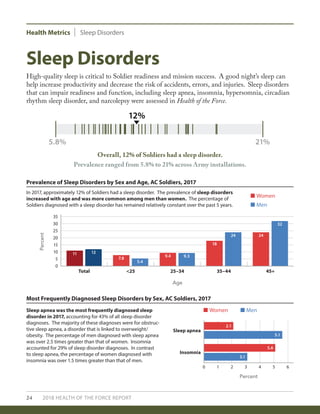
  • 69.
    PERFORMANCE TRIAD 65 WomenMen Estimated Hours of Sleep by Duty Status, AC Soldiers, 2017 Percent Meeting Weeknight/Duty Night Sleep Target by Sex and Age, AC Soldiers, 2017 Sleep, Activity, and Nutrition Sleep The CDC and the National Sleep Foundation (NSF) both recommend adults attain 7 or more hours of sleep per night (CDC, 2017c; NSF, 2018). In 2017, most AC Soldiers reported getting 6 or more hours of sleep per night on both duty and non-duty nights. Regardless of sex or age, approximately 1 in 3 AC Soldiers attained the target amount of 7 or more hours of sleep on weeknights/duty nights. Most Soldiers reported sleeping 6 to 7 hours per night, regardless of duty status. However, nearly 1 in 3 reported getting less than 6 hours of sleep on weeknights/duty nights. Soldiers also reported getting more sleep on weekend/non-duty nights compared to weeknights/duty nights. Total <25 25–34 35–44 45+ 0 20 80 Percent 40 60 Age 38 38 37 4038 39 35 37 4035 4 hours or less 5 hours 6 hours 7 hours 8 or more hours 0 10 20 50 Percent 30 40 Hours of Sleep 7 16 33 5 19 10 26 10 46 28 Percent Meeting Weekend/Non-Duty Night Sleep Target by Sex and Age, AC Soldiers, 2017 Nearly 3 out of 4 AC Soldiers met the sleep target on weekends/non-duty nights. The trend of increased hours of sleep on non-duty nights was similar across sex and age groups. Total <25 25–34 35–44 45+ 0 20 Percent 40 60 80 Age 72 74 73 7472 73 66 67 6763 Women Men Weeknight/Duty Night Weekend/Non-Duty Night
  • 70.
    66 2018 HEALTHOF THE FORCE REPORT Performance Triad Sleep/Activity/Nutrition Total <25 25–34 35–44 45+ 0 20 Percent 40 60 100 80 Age 77 80 85 7984 85 71 80 76 65 Women Men Percent Meeting Resistance Training Target by Sex and Age, AC Soldiers, 2017 Activity The CDC recommends two activity targets (CDC, 2018e): engaging in 2 or more days of resistance training per week, and adequate aerobic activity. Adequate aerobic activity can be attained in three ways: — 150 minutes a week of moderate-intensity aerobic activity, or — 75 minutes a week of vigorous-intensity aerobic activity, or — An equivalent combination of moderate- and vigorous-intensity aerobic activity. More than 4 out of 5 Soldiers engaged in resistance training on 2 or more days per week. Target attainment varied by sex and age groups, with 85% of men under age 35 reporting adequate resistance training while 65% of women over age 45 met the target. Total <25 25–34 35–44 45+ 0 40 Percent 60 80 100 20 Age 87 91 8790 88 91 84 89 88 81 Women Men Percent Meeting Aerobic Activity Target by Sex and Age, AC Soldiers, 2017 Approximately 90% of Soldiers attained adequate aerobic activity in 2017. Women met the target less frequently than their male counterparts across all age categories. Total Aerobic Activity = + 150 minutes moderate, a combination of moderate- and vigorous-intensity aerobic activity. 75 minutes vigorous, —or— —or—
  • 71.
    PERFORMANCE TRIAD 67 Nutrition Nutritiontargets are based on U.S. Department of Agriculture MyPlate recommendations (USDA, 2018). The GAT, which defines a serving slightly differently than the MyPlate recommendations, asks Soldiers to report the approximate servings of fruits and vegetables they consume each week. Nutrition targets are defined as eating two or more servings of fruits and two or more servings of vegetables per day. On average, Soldiers reported consuming more servings of vegetables than fruits. Estimated Fruit and Vegetable Consumption per Week, AC Soldiers, 2017 Most Soldiers reported fruit consumption ranging from a few servings per week to a few servings per day. Vegetable consumption was higher; more Soldiers reported consuming multiple servings per day. Rarely or never 1 or 2 servings per week 3 to 6 servings per week 1 serving per day 2 to 3 servings per day 4 or more servings per day 0 10 20 40 Percent 30 Number of Servings 5.5 3.4 14 22 21 27 9.510 21 21 33 12 Fruit Consumption Vegetable Consumption Total <25 25–34 35–44 45+ 0 20 50 Percent 60 10 30 40 Age 40 38 40 36 39 36 42 34 35 45 Women Women Men Men Percent Meeting Fruit Consumption Target by Sex and Age, AC Soldiers, 2017 Percent Meeting Vegetable Consumption Target by Sex and Age, AC Soldiers, 2017 More than 1 in 3 Soldiers reported eating 2 or more servings of fruits per day. A higher proportion of women met the fruit target than men across all age categories. Nearly half of Soldiers reported meeting the target of eating 2 or more servings of vegetables per day. Similar to the reported fruit consumption, a higher proportion of women met the vegetable target than men. Total <25 25–34 35–44 45+ 0 20 50 Percent 60 10 30 40 Age 48 43 50 45 42 46 53 45 46 57
  • 72.
    Performance Triad Sleep/Activity/Nutrition Summary Armyleadership can prioritize weekday sleep for all Soldiers and emphasize focused intervention for increasing resistance training among female Soldiers. Male Soldiers would benefit from consuming additional fruits and vegetables. Combined, these tactics will enable Soldiers to achieve optimal performance and readiness goals. Percent Meeting SAN Targets, AC Soldiers, 2017: 38% attained 7 or more hours of sleep on weeknights/duty nights. 72% attained 7 or more hours of sleep on weekends/non-duty nights. 83% engaged in resistance training 2 or more days per week. 90% achieved adequate moderate and/or vigorous aerobic activity targets. 37% ate 2 or more servings of fruits per day. 45% ate 2 or more servings of vegetables per day.
  • 73.
    COMPANY NORMS ANDSOLDIER PERCEPTIONS OF THEIR SURROUNDINGS INFLUENCE SLEEP, ACTIVITY, AND NUTRITION S P O T L I G H T E VIDENCE SUGGESTS THAT SURROUNDINGS affect not only the ability to access resources, but to engage in recommended health behaviors such as SAN. Recent P3 program evaluation activi- ties sought to understand which behaviors Soldiers engaged in and what they noticed about the envi- ronment around them. According to these program evaluation data, fewer than one in ten Soldiers is meeting sleep and nutrition targets, and most do not believe that their environment (e.g., unit or installa- tion) supports healthy sleep or nutrition. Conversely, around 80% of Soldiers are meeting activity targets and believe that their installation encourages physical activity (Army Analytics Group, 2017).1 We are now trying to understand how Soldiers’ perceptions of their environments (“It seems my unit is eating healthy”) as well as the actual environments, that is, the “norms” of their companies (“My peers are actually eating healthy”), affect their behavior. An understanding of these factors can help target intervention strategies to boost sleep and nutrition behaviors. To address this, Soldier perceptions and calcu- lated company-level norms data from P3 program evaluations were compared to self-reported behavior data. Activity data indicate that what is actually happening in the unit is linked to Soldiers’ individual activity behavior; this finding makes sense since phys- ical training (PT) is often undertaken as a unit. Con- tinuing the tradition of group PT may maintain Soldiers’ individual activity behaviors. For sleep, the opposite correlation is true—Sol- diers’ individual perceptions of their surroundings, not what their unit was actually doing, were linked to sleep behavior. Company-level leadership can work to enhance perceptions of a positive sleep environment (e.g., promote and emphasize the impor- tance of sleep in communications, encourage the use of good mattresses and blackout curtains). When nutrition data were compared to behavior data, both Soldiers’ individual perceptions of their nutrition environment and company nutrition norms were linked to healthier eating. The combination of enhancing perceptions of a healthy eating envi- ronment and company nutrition norms are im- portant for nutrition behaviors. What We Know What We Found Out What We Don’t Know PERFORMANCE TRIAD 69 Sleep, activity, and nutrition are the foundation of health and readiness. Taken together, the evaluation findings suggest that efforts to improve health behaviors should focus on changes that impact both the individual perceptions of Soldiers as well as their actual company environments. 1 Sleep targets for the evaluation reported here included 8 hours or more per night of weekday/duty night sleep, 8 hours or more per night of weekend/non-duty night sleep, and no consumption of caffeine within 6 hours of bedtime.
  • 74.
    70 2018 HEALTHOF THE FORCE REPORT TOOLS PROVIDE A PICTURE OF INSTALLATION COMMUNITY HEALTH S P O T L I G H T H AVING A THOROUGH, CURRENT SNAPSHOT of a community’s health helps Army decision- makers identify priority Soldier health and readiness issues. A community health assessment (CHA) identifies a community’s key health issues and needs through systematic data collection and anal- ysis (CDC, 2018f) and is now a requirement of Army Installation PM Departments in preparation for Army Public Health Accreditation (MEDCOM, 2018). Existing assessments and information sources inform a comprehensive CHA and help installation partners come together via the CR2C and working groups to learn about the installation commu- nity’s health, identify factors that affect health, understand issues important to the community members, and identify community assets. The results of at least these two assessments should be presented in a CHA report that is reviewed once a year to ensure it is current; it should be updated at least every 5 years. Other sources that may inform the comprehensive CHA include data from the following: • Health of the Force reports • Local Public Health System Assessment • Forces of Change Assessment • Assessments and surveys sponsored by other Departments or Commands (e.g., Survey of Health-Related Behaviors, ACSIM-sponsored Soldier needs assessment) • Army Family Action Plan feedback • Commanders’ town hall meetings • Local sensing sessions • Neighboring local and state public health departments Combined, these sources help installations create a more complete picture of the installation community health than has previously been available. A comprehensive CHA is used to develop an installa- tion community health improvement plan that out- lines how installation partners, with significant input from the CR2C and the PM Departments, will take action to address priority issues to improve the health, readiness, and resilience of the Total Army. To complete a comprehensive CHA, installation partners should use one of the following: • Community Health Status Assessment (CHSA) tool. The assessment is conducted every 3 years through the installation’s Army Public Health Nursing section. • Community Strengths and Themes Assess- ment (CSTA) tool. The CR2C Facilitator coor- dinates this assessment every 2 years across the installation community.
  • 75.
    71 COMMUNITY STRENGTHS ANDTHEMES ASSESSMENT INFORMS COMMUNITY HEALTH PLANNING S P O T L I G H T C URRENT ARMY REGULATIONS DIRECT installations to assess communities for health risk factors and needs (DA, 2000; DA, 2015). The APHC developed a standardized Community Strengths and Themes Assessment (CSTA) (APHC(Prov), 2016b) to capture community members’ perceptions of their quality of life, health, safety, and satisfaction within the environment of an Army installation. In addition to other assessments, the CSTA assists in the identification of priorities for the CR2C and working groups. Leaders at Fort Rucker, Alabama, have used the CSTA since 2016 and will conduct the assessment biennially to identify pressing health concerns facing Soldiers, Civilians, Families, and Soldiers for Life. Recent survey processes identified work/life balance, lack of community connectedness, and healthy nutritional choices as key concerns facing the installa- tion (APHC(Prov), 2016c). As a result, the Fort Rucker Garrison Commander directed the CR2C to implement action plans that address decreasing stigma for those seeking counseling for stress management, increasing social resiliency-based activities to engage underrep- resented community members (i.e., single parents, non-traditional families, foreign flight students, and other military branches), and implanting robust nutri- tional campaigns and partnerships to increase healthy food choices and behaviors. FORT RUCKER U.S. ARMY VICENZA Since 2014, leaders have successfully used the CSTA to drive community health planning. The most recent assessment results identified community concerns surrounding employment issues, drug and alcohol abuse, and nutrition (APHC(Prov), 2016d). Each of the working groups is actively developing action plans to address these community issues. To ensure community members link their survey responses to actions taken, the CR2C coordinates public messag- ing about results and initiatives implemented by the installation. Vicenza credits its local Public Affairs Officer for successfully messaging the results of the CSTA and communicating actions the CR2C is taking to support community health and readiness. As a result of the CSTA process, collabo- ration has improved across medical, garrison, and mission operations. Army communities have become more engaged in providing feedback, and the public health planning process addresses the chief health and readiness concerns identified by commu- nity members.
  • 76.
    Installation Health IndexOverview 72 2018 HEALTH OF THE FORCE REPORT Installation Health Index The Health of the Force team conducts comparative analyses of health metrics with the intent of revealing actionable interpretations and discerning when populations achieve desired outcomes. Computations such as the Installation Health Index (IHI) and metric rankings aim to motivate discussions about successes and challenges that can be leveraged across the Force. Leaders may use these tools to help guide targeted health program and policy efforts. Indices are used to gauge the overall health of populations. They help inform community health needs and offer an evidence-based tool for comparing a range of health metrics across communities. To facilitate comparisons of overall installation health, the IHI was used to score each installation relative to the Army average. The IHI consists of two components: a composite Z-score and a percentile score derived from the Z-score. The IHI comprises eight metrics, standardized to the Army average using Z-score. The weights for each metric are shown below. See the Methods Appendix for more information on the IHI. • Injury (20%) • Behavioral health (15%) • Obesity (BMI) (15%) • Sleep disorders (15%) • Chronic disease (15%) • Tobacco use (10%) • Sexually transmitted infections (chlamydia) (5%) • Air quality (5%) Crude unadjusted values for each medical met- ric are provided throughout the report, and are accompanied by age and sex adjusted values in How should IHI be interpreted? Z-score Percentile Standard deviation (SD) is the average distance each instal- lation is from the Army average for a particular metric or set of metrics Reflects where an installation’s Z-score falls on a normal distribution curve; values are from 0% to 100% Reflects the installation’s number of standard deviations from the Army average for the compiled IHI metrics Highest percentile for a given metric is assigned a value of 100%; other installation percentiles are computed relative to the highest percentile value Positive scores indicate the IHI or overall health is above the Army average Higher percentiles indicate better overall health status the installation profiles. The crude values provide the clearest understanding of the burden a med- ical condition imposes on a population, while the adjusted value controls for potential biases due to demographic differences in the populations being compared. The adjusted values were used in IHI scoring to enable more valid comparisons across installations. The assessment revealed that the majority of instal- lations scored within one standard deviation of the Army average, indicating similar overall health status. Red, amber, and green color coding has been add- ed to the IHI score on each Installation Profile page to emphasize those installations that scored better or worse than the Army average.
  • 77.
    Ranking by InstallationHealth Index Score Z-score -1.5 -1.0 -0.5 0.0 0.5 1.0 1.5 Fort Belvoir (-1.3) JB Langley-Eustis (-1.1) JB Leavenworth (-1.1) Fort Hood (-1.1) Fort Sill (-1.1) Fort Irwin (-0.9) Fort Meade (-0.8) Fort Polk (-0.7) Fort Lee (-0.6) Fort Gordon (-0.5) Fort Stewart (-0.4) Fort Leonard Wood (-0.4) Fort Knox (-0.4) JB San Antonio (-0.3) Fort Drum (-0.3) Fort Bliss (-0.3) Fort Jackson (-0.2) Fort Benning (-0.1) Fort Campbell (-0.1) Hawaii (0.0) Fort Riley (0.0) Fort Wainwright (0.0) Fort Huachuca (0.2) Presidio of Monterey (0.4) Fort Rucker (0.4) Fort Carson (0.4) JB Myer-Henderson Hall (0.5) JB Elmendorf-Richardson (0.5) Fort Bragg (0.6) USAG West Point (1.0) USAG Rheinland-Pfalz (-0.6) USAG Wiesbaden (-0.5) USAG Daegu (-0.2) USAG Yongsan (0.1) USAG Bavaria (0.2) USAG Humphreys (0.2) USAG Stuttgart (0.2) USAG Red Cloud (0.2) USAG Vicenza (0.5) Japan (0.7) The ranking order is based on adjusted, unrounded rates. COLOR CODE KEY: = Better than the Army average by 1 or more SD = Worse than the Army average by 1 or more SD GREEN AMBER RED NO COLOR ADDED = Worse than the Army average by 2 or more SD = About the same as the Army average INSTALLATION HEALTH INDEX 73 Installations Outside the U.S. U.S.-based Installations
  • 78.
    74 2018 HEALTHOF THE FORCE REPORT Rankings Rankings have proven effective in stimulating com- munity interest and driving health improvement. With this knowledge, leaders can target specific health conditions or behaviors in their populations with appropriate healthcare and health education resources. Detailed installation rankings for injury, obesity, tobacco, and chronic disease metrics are provided for AC populations assigned to instal- lations with an average of at least 1,000 Soldiers. Rankings data were adjusted by age and sex to those of the overall Army population to allow for a more accurate comparison of health outcomes throughout the Force. Installations outside of the U.S. were ranked separately from U.S.-based installations due to inherent differences which may have biased their comparison with U.S.-based installations. Certain metrics, such as behavioral health and sexually transmitted infections, are not ranked because higher percentages may reflect greater access to care rather than elevated adverse health outcomes. However, as important determinants of medical readiness, behavioral health and sexually transmitted infections were included as part of the IHI. Identifying concerns early and encouraging Soldiers to seek treatment are the primary goals of Army Medicine and lead to better clinical outcomes. Where installation rankings are tied, the rank order is not significant. Red, amber, and green color cod- ing contextualizes health status compared to the Army average. The ranking order is based on adjusted, unrounded rates. COLOR CODE KEY: = Better than the Army average by more than 1 SD = Worse than the Army average by more than 1 SD = Worse than the Army average by more than 2 SD NO COLOR ADDED = About the same as the Army average GREEN AMBER RED Installation Health Index Ranking
  • 79.
    RANKING 75 Injury IncidenceofInjuriesper1,000person-years,ACSoldiers,2017 Chronic Disease ChronicDiseasePrevalence,ACSoldiers,2017 JBMyer-Henderson Hall Fort Carson Fort Riley Fort Bragg Presidio of Monterey FortWainwright Fort Stewart Fort Polk Fort Bliss USAGWest Point JB Elmendorf-Richardson Hawaii Fort Drum JB San Antonio Fort Rucker Fort Knox Fort Belvoir Fort Gordon Fort Campbell Fort Meade Fort Hood Fort Huachuca Fort Irwin Fort Lee Fort Sill Fort Benning Fort Leavenworth JB Langley-Eustis Fort LeonardWood Fort Jackson Fort Bragg Fort Campbell Fort Carson JB Myer-Henderson Hall FortWainwright Fort Bliss JB Elmendorf-Richardson Fort Jackson Fort Drum Fort Riley Fort Benning Hawaii Fort LeonardWood Fort Rucker Fort Hood Presidio of Monterey Fort Gordon USAGWest Point Fort Sill Fort Stewart Fort Irwin Fort Huachuca Fort Lee Fort Polk Fort Meade JB San Antonio JB Langley-Eustis Fort Knox Fort Leavenworth Fort Belvoir ____________________________ ____________________________ ____________________________ ____________________________ ____________________________ ____________________________ ____________________________ ____________________________ ____________________________ ____________________________ ____________________________ ____________________________ ____________________________ ____________________________ ____________________________ ____________________________ ____________________________ ____________________________ ____________________________ ____________________________ ____________________________ ____________________________ ____________________________ ____________________________ ____________________________ ____________________________ ____________________________ ____________________________ ____________________________ ____________________________ ____________________________ ____________________________ ____________________________ ____________________________ ____________________________ ____________________________ ____________________________ ____________________________ ____________________________ ____________________________ ____________________________ ____________________________ ____________________________ ____________________________ ____________________________ ____________________________ ____________________________ ____________________________ ____________________________ ____________________________ ____________________________ ____________________________ ____________________________ ____________________________ ____________________________ ____________________________ ____________________________ ____________________________ ____________________________ ____________________________ ____________________________ ____________________________ ____________________________ ____________________________ ____________________________ ____________________________ ____________________________ ____________________________ ____________________________ ____________________________ ____________________________ ____________________________ ____________________________ ____________________________ ____________________________ ____________________________ ____________________________ ____________________________ ____________________________ ____________________________ Japan USAG Red Cloud USAG Stuttgart USAG Humphreys USAGVicenza USAG Bavaria USAG Rheinland-Pfalz USAGYongsan USAG Daegu USAGWiesbaden USAGVicenza Japan USAG Red Cloud USAG Humphreys USAG Bavaria USAGYongsan USAG Daegu USAG Stuttgart USAGWiesbaden USAG Rheinland-Pfalz 1,292 16%2,677 27% ArmyAverage(1,821) ArmyAverage(19%) 19%1,821
  • 80.
    ____________________________ ____________________________ ____________________________ ____________________________ ____________________________ ____________________________ ____________________________ ____________________________ ____________________________ ____________________________ ____________________________ ____________________________ ____________________________ ____________________________ ____________________________ ____________________________ ____________________________ ____________________________ ____________________________ ____________________________ 76 2018 HEALTHOF THE FORCE REPORT Installation Health Index Ranking Obesity ObesityPrevalence,ACSoldiers,2017 Tobacco Use TobaccoUsePrevalence,ACSoldiers,2017 USAGWest Point Presidio of Monterey Fort Huachuca Fort Jackson JB Myer-Henderson Hall Fort Carson JB Elmendorf-Richardson Fort Benning Fort LeonardWood Fort Rucker Hawaii FortWainwright Fort Bliss JB San Antonio Fort Riley Fort Lee Fort Knox Fort Bragg Fort Irwin Fort Campbell Fort Stewart Fort Sill Fort Polk Fort Hood Fort Leavenworth Fort Belvoir Fort Drum Fort Meade JB Langley-Eustis Fort Gordon USAGWest Point JB San Antonio Presidio of Monterey Fort Knox Fort Meade Fort Huachuca Fort Gordon Fort Rucker Fort Jackson Fort Belvoir Hawaii Fort Leavenworth JB Myer-Henderson Hall Fort Lee JB Langley-Eustis Fort Bliss Fort Bragg Fort Hood Fort LeonardWood Fort Benning Fort Stewart Fort Sill JB Elmendorf-Richardson Fort Carson Fort Irwin Fort Drum Fort Riley Fort Campbell FortWainwright Fort Polk ____________________________ ____________________________ ____________________________ ____________________________ ____________________________ ____________________________ ____________________________ ____________________________ ____________________________ ____________________________ ____________________________ ____________________________ ____________________________ ____________________________ ____________________________ ____________________________ ____________________________ ____________________________ ____________________________ ____________________________ ____________________________ ____________________________ ____________________________ ____________________________ ____________________________ ____________________________ ____________________________ ____________________________ ____________________________ ____________________________ ____________________________ ____________________________ ____________________________ ____________________________ ____________________________ ____________________________ ____________________________ ____________________________ ____________________________ ____________________________ ____________________________ ____________________________ ____________________________ ____________________________ ____________________________ ____________________________ ____________________________ ____________________________ ____________________________ ____________________________ ____________________________ ____________________________ ____________________________ ____________________________ ____________________________ ____________________________ ____________________________ ____________________________ ____________________________ ____________________________ USAGVicenza USAG Bavaria USAG Red Cloud USAG Stuttgart USAGYongsan USAG Humphreys USAG Daegu USAGWiesbaden USAG Rheinland-Pfalz Japan Japan USAG Stuttgart USAGYongsan USAGWiesbaden USAG Rheinland-Pfalz USAGVicenza USAG Daegu USAG Humphreys USAG Bavaria USAG Red Cloud 14% 10%25% 30% ArmyAverage(17%) ArmyAverage(23%) 23%17%
  • 81.
    ARMY PUBLIC HEALTHACCREDITATION: EVIDENCE OF PUBLIC HEALTH ENTERPRISE PERFORMANCE IMPROVEMENT S P O T L I G H T A RMY MEDICINE RECOGNIZES THE IMPOR- tance of accreditations and certifications in the provision of their services to assure integrity and quality. The decision to explore an accreditation program for Army PM departments was borne out of a movement towards public health department accred- itation in civilian public health departments. The Fort Riley (Kansas) Department of Public Health (DPH) was the first among the Services to pursue national accreditation. In FY18, the MEDCOM Chief of Staff approved the Army Public Health Performance Improvement and Accreditation (PI&A) Initiative (MEDCOM, 2018a). Twenty-eight Army PM departments were directed to improve performance in alignment with nationally- recognized public health standards and to apply for public health accreditation by the end of FY25. This initiative is intended to ensure the quality and effectiveness of Army PM departments by meet- ing nationally-recognized public health standards; signaling that Army public health delivers services on par with private sector counterparts; and filling the gap in non-healthcare accreditation designation. The DPH staff identified lessons learned and made process change recommendations for other Army PM departments that pursue public health accreditation. The MEDCOM Deputy Chief of Staff for Public Health/Director, APHC is working to apply those lessons learned to the PI&A Initiative and share resources with all Army PM departments via subject matter expertise and consultation. “[The PI&A Initiative] showed us that there is a lot more to public health than the little things we were doing, like ergonomic surveys or water buffalo inspections...it showed us that there is a lot more...” —Fort Riley Department of Public Health Staff Member Results from an APHC-led case study of the Fort Riley DPH’s accreditation pursuit revealed that staff and partners observed several positive outcomes throughout the accreditation process, including— • Increased team cohesion. • Increased collaboration with partners. • Increased awareness of DPH in the community. • Increased DPH staff awareness of public health practice. • Changes to DPH processes through an emphasis on quality improvement. • Improved communication within DPH and with partners. • Improved DPH staff knowledge and professional development. For more information, a CAC-enabled Toolkit is available at https://eaphc.amedd.army.mil/PHPIT/ SitePages/Home.aspx. 77
  • 82.
    78 2018 HEALTHOF THE FORCE REPORT Installation Profiles Footnotes for Installation Profile Pages 1. Crude values reflect rates for each metric, unadjusted by age and sex to the Army population distribution. 2. Adjusted values reflect rates for each metric adjusted by age and sex to the Army population distribution. 3. Range of crude values for the 40 Army installations included in the report. 4. The Z-score reflects collective SD from the Army average for eight Health of the Force metrics (injury, behavioral health, sleep disorders, chronic disease, obesity, tobacco use, STIs: chlamydia, and air quality). Positive values reflect better overall health status. See IHI description on page 72. 5. Environmental Health Indicator color coding (green, amber, and red) indicates metric status in the affected community. Green denotes the desired condition. 6. Data are not displayed (ND) when <20 cases were reported or when reporting compliance was estimated to be <50%.
  • 83.
    HEALTH METRICS Crude Value1 Adjusted Value2 AverageRange3 Injury (rate per 1,000) 2,142 1,895 1,821 1,308–2,963 Behavioral health (%) 21 21 15 8.9–21 Substance use disorder (%) 2.8 4.2 3.5 1.2–5.9 Sleep disorder (%) 21 17 12 5.8–21 Obesity (%) 24 21 17 8.3–25 Tobacco use (%) 15 20 23 8.3–31 STIs: Chlamydia infection (rate per 1,000) 17 30 23 14–62 Chronic disease (%) 38 27 19 12–38 Fort Belvoir Demographics: Approximately 3,300 AC Soldiers 46% under 35 years old, 24% female Main Healthcare Facility: Fort Belvoir Community Hospital PERFORMANCE TRIAD MEASURES Installation Army ENVIRONMENTAL HEALTH INDICATORS5 1 day/year Poor air quality: 55% Solid waste diversion rate: 0 days/year Poor water quality: High Day-biting mosquito contact risk: 0.60 mg/L Water fluoridation: Moderate West Nile virus transmission risk: High Lyme disease risk: 77% 83% 2+ days per week of resistance training 86% 90% 150+ minutes per week of aerobic activity 36% 37% 2+ servings of fruits per day 48% 45% 2+ servings of vegetables per day 43% 38% 7+ hours of sleep (weeknight/duty night) 74% 72% 7+ hours of sleep (weekend or non-duty night) Footnotes 1-6: See page 78. Virginia Installation Health Index Score4 : <20th percentile | Z-score: -1.3 INSTALLATION ARMY INSTALLATION PROFILES 79
  • 84.
    80 2018 HEALTHOF THE FORCE REPORT Georgia HEALTH METRICS Crude Value1 Adjusted Value2 Average Range3 Injury (rate per 1,000) 2,104 2,244 1,821 1,308–2,963 Behavioral health (%) 12 15 15 8.9–21 Substance use disorder (%) 2.2 2.3 3.5 1.2–5.9 Sleep disorder (%) 7.7 11 12 5.8–21 Obesity (%) 11 16 17 8.3–25 Tobacco use (%) 26 25 23 8.3–31 STIs: Chlamydia infection (rate per 1,000) 14 16 23 14–62 Chronic disease (%) 14 19 19 12–38 Fort Benning Demographics: Approximately 19,000 AC Soldiers 85% under 35 years old, 6.6% female Main Healthcare Facility: Martin Army Community Hospital PERFORMANCE TRIAD MEASURES Installation Army ENVIRONMENTAL HEALTH INDICATORS5 0 days/year Poor air quality: 23% Solid waste diversion rate: 0 days/year Poor water quality: Low Day-biting mosquito contact risk: 0.75 mg/L Water fluoridation: Moderate West Nile virus transmission risk: Moderate Lyme disease risk: 84% 83% 2+ days per week of resistance training 89% 90% 150+ minutes per week of aerobic activity 47% 37% 2+ servings of fruits per day 53% 45% 2+ servings of vegetables per day 37% 38% 7+ hours of sleep (weeknight/duty night) 67% 72% 7+ hours of sleep (weekend or non-duty night) Footnotes 1-6: See page 78. INSTALLATION ARMY Installation Health Index Score4 : 50–59th percentile | Z-score: -0.1 Installation Profiles U.S.
  • 85.
    INSTALLATION PROFILES 81 HEALTHMETRICS Crude Value1 Adjusted Value2 Average Range3 Injury (rate per 1,000) 1,719 1,760 1,821 1,308–2,963 Behavioral health (%) 16 16 15 8.9–21 Substance use disorder (%) 4.0 3.7 3.5 1.2–5.9 Sleep disorder (%) 13 14 12 5.8–21 Obesity (%) 17 17 17 8.3–25 Tobacco use (%) 23 23 23 8.3–31 STIs: Chlamydia infection (rate per 1,000) 35 31 23 14–62 Chronic disease (%) 16 18 19 12–38 Fort Bliss Demographics: Approximately 25,000 AC Soldiers 80% under 35 years old, 14% female Main Healthcare Facility: William Beaumont Army Medical Center PERFORMANCE TRIAD MEASURES Installation Army ENVIRONMENTAL HEALTH INDICATORS5 24 days/year Poor air quality: 48% Solid waste diversion rate: 0 days/year Poor water quality: High Day-biting mosquito contact risk: 0.80 mg/L Water fluoridation: High West Nile virus transmission risk: Low Lyme disease risk: 83% 83% 2+ days per week of resistance training 90% 90% 150+ minutes per week of aerobic activity 34% 37% 2+ servings of fruits per day 42% 45% 2+ servings of vegetables per day 39% 38% 7+ hours of sleep (weeknight/duty night) 71% 72% 7+ hours of sleep (weekend or non-duty night) Footnotes 1-6: See page 78. INSTALLATION ARMY Installation Health Index Score4 : 50–59th percentile | Z-score: -0.3 Texas
  • 86.
    82 2018 HEALTHOF THE FORCE REPORT HEALTH METRICS Crude Value1 Adjusted Value2 Average Range3 Injury (rate per 1,000) 1,553 1,587 1,821 1,308–2,963 Behavioral health (%) 10 11 15 8.9–21 Substance use disorder (%) 3.2 3.2 3.5 1.2–5.9 Sleep disorder (%) 9.5 10 12 5.8–21 Obesity (%) 18 18 17 8.3–25 Tobacco use (%) 23 23 23 8.3–31 STIs: Chlamydia infection (rate per 1,000) 21 22 23 14–62 Chronic disease (%) 16 16 19 12–38 Fort Bragg Demographics: Approximately 45,000 AC Soldiers 78% under 35 years old, 12% female Main Healthcare Facility: Womack Army Medical Center PERFORMANCE TRIAD MEASURES Installation Army ENVIRONMENTAL HEALTH INDICATORS5 0 days/year Poor air quality: 27% Solid waste diversion rate: 0 days/year Poor water quality: Moderate Day-biting mosquito contact risk: 0.35 mg/L Water fluoridation: Low West Nile virus transmission risk: Moderate Lyme disease risk: 85% 83% 2+ days per week of resistance training 90% 90% 150+ minutes per week of aerobic activity 36% 37% 2+ servings of fruits per day 46% 45% 2+ servings of vegetables per day 39% 38% 7+ hours of sleep (weeknight/duty night) 75% 72% 7+ hours of sleep (weekend or non-duty night) Footnotes 1-6: See page 78. Installation Health Index Score4 : ≥90th percentile | Z-score: 0.6 North Carolina INSTALLATION ARMY Installation Profiles U.S.
  • 87.
    INSTALLATION PROFILES 83 HEALTHMETRICS Crude Value1 Adjusted Value2 Average Range3 Injury (rate per 1,000) 1,827 1,925 1,821 1,308–2,963 Behavioral health (%) 14 15 15 8.9–21 Substance use disorder (%) 3.2 2.9 3.5 1.2–5.9 Sleep disorder (%) 10 12 12 5.8–21 Obesity (%) 17 19 17 8.3–25 Tobacco use (%) 27 27 23 8.3–31 STIs: Chlamydia infection (rate per 1,000) ND6 ND6 23 14–62 Chronic disease (%) 14 17 19 12–38 Fort Campbell Demographics: Approximately 27,000 AC Soldiers 84% under 35 years old, 12% female Main Healthcare Facility: Blanchfield Army Community Hospital PERFORMANCE TRIAD MEASURES Installation Army ENVIRONMENTAL HEALTH INDICATORS5 0 days/year Poor air quality: 41% Solid waste diversion rate: 0 days/year Poor water quality: Moderate Day-biting mosquito contact risk: 0.37 mg/L Water fluoridation: Moderate West Nile virus transmission risk: Moderate Lyme disease risk: 85% 83% 2+ days per week of resistance training 91% 90% 150+ minutes per week of aerobic activity 33% 37% 2+ servings of fruits per day 42% 45% 2+ servings of vegetables per day 43% 38% 7+ hours of sleep (weeknight/duty night) 74% 72% 7+ hours of sleep (weekend or non-duty night) Footnotes 1-6: See page 78. Installation Health Index Score4 : 60–69th percentile | Z-score: -0.1 Kentucky Tennessee INSTALLATION ARMY
  • 88.
    84 2018 HEALTHOF THE FORCE REPORT HEALTH METRICS Crude Value1 Adjusted Value2 Average Range3 Injury (rate per 1,000) 1,395 1,470 1,821 1,308–2,963 Behavioral health (%) 14 14 15 8.9–21 Substance use disorder (%) 3.6 3.4 3.5 1.2–5.9 Sleep disorder (%) 10 11 12 5.8–21 Obesity (%) 14 15 17 8.3–25 Tobacco use (%) 26 26 23 8.3–31 STIs: Chlamydia infection (rate per 1,000) 34 30 23 14–62 Chronic disease (%) 15 17 19 12–38 Fort Carson Demographics: Approximately 24,000 AC Soldiers 83% under 35 years old, 14% female Main Healthcare Facility: Evans Army Community Hospital PERFORMANCE TRIAD MEASURES Installation Army ENVIRONMENTAL HEALTH INDICATORS5 3 days/year Poor air quality: 42% Solid waste diversion rate: 0 days/year Poor water quality: Low Day-biting mosquito contact risk: 0.57 mg/L Water fluoridation: High West Nile virus transmission risk: Low Lyme disease risk: 83% 83% 2+ days per week of resistance training 90% 90% 150+ minutes per week of aerobic activity 33% 37% 2+ servings of fruits per day 40% 45% 2+ servings of vegetables per day 40% 38% 7+ hours of sleep (weeknight/duty night) 72% 72% 7+ hours of sleep (weekend or non-duty night) Footnotes 1-6: See page 78. Installation Health Index Score4 : 80–89th percentile | Z-score: 0.4 Colorado INSTALLATION ARMY Installation Profiles U.S.
  • 89.
    INSTALLATION PROFILES 85 HEALTHMETRICS Crude Value1 Adjusted Value2 Average Range3 Injury (rate per 1,000) 1,654 1,792 1,821 1,308–2,963 Behavioral health (%) 14 15 15 8.9–21 Substance use disorder (%) 4.2 3.7 3.5 1.2–5.9 Sleep disorder (%) 11 12 12 5.8–21 Obesity (%) 19 22 17 8.3–25 Tobacco use (%) 27 27 23 8.3–31 STIs: Chlamydia infection (rate per 1,000) 25 22 23 14–62 Chronic disease (%) 15 19 19 12–38 Fort Drum Demographics: Approximately 15,000 AC Soldiers 84% under 35 years old, 12% female Main Healthcare Facility: Guthrie Army Health Clinic PERFORMANCE TRIAD MEASURES Installation Army ENVIRONMENTAL HEALTH INDICATORS5 2 days/year Poor air quality: 55% Solid waste diversion rate: 0 days/year Poor water quality: Low Day-biting mosquito contact risk: 0.70 mg/L Water fluoridation: Low West Nile virus transmission risk: High Lyme disease risk: 84% 83% 2+ days per week of resistance training 90% 90% 150+ minutes per week of aerobic activity 32% 37% 2+ servings of fruits per day 40% 45% 2+ servings of vegetables per day 40% 38% 7+ hours of sleep (weeknight/duty night) 75% 72% 7+ hours of sleep (weekend or non-duty night) Footnotes 1-6: See page 78. Installation Health Index Score4 : 40–49th percentile | Z-score: -0.3 New York INSTALLATION ARMY
  • 90.
    86 2018 HEALTHOF THE FORCE REPORT HEALTH METRICS Crude Value1 Adjusted Value2 Average Range3 Injury (rate per 1,000) 1,942 1,898 1,821 1,308–2,963 Behavioral health (%) 18 17 15 8.9–21 Substance use disorder (%) 3.0 3.0 3.5 1.2–5.9 Sleep disorder (%) 12 11 12 5.8–21 Obesity (%) 25 25 17 8.3–25 Tobacco use (%) 16 17 23 8.3–31 STIs: Chlamydia infection (rate per 1,000) 16 14 23 14–62 Chronic disease (%) 21 21 19 12–38 Fort Gordon Demographics: Approximately 9,000 AC Soldiers 74% under 35 years old, 20% female Main Healthcare Facility: Dwight D. EisenhowerArmy Medical Center PERFORMANCE TRIAD MEASURES Installation Army ENVIRONMENTAL HEALTH INDICATORS5 1 day/year Poor air quality: 26% Solid waste diversion rate: 0 days/year Poor water quality: Moderate Day-biting mosquito contact risk: 0.74 mg/L Water fluoridation: Low West Nile virus transmission risk: Low Lyme disease risk: 80% 83% 2+ days per week of resistance training 89% 90% 150+ minutes per week of aerobic activity 38% 37% 2+ servings of fruits per day 48% 45% 2+ servings of vegetables per day 35% 38% 7+ hours of sleep (weeknight/duty night) 75% 72% 7+ hours of sleep (weekend or non-duty night) Footnotes 1-6: See page 78. Installation Health Index Score4 : 30–39th percentile | Z-score: -0.5 Georgia INSTALLATION ARMY Installation Profiles U.S.
  • 91.
    INSTALLATION PROFILES 87 HEALTHMETRICS Crude Value1 Adjusted Value2 Average Range3 Injury (rate per 1,000) 1,935 1,994 1,821 1,308–2,963 Behavioral health (%) 21 21 15 8.9–21 Substance use disorder (%) 5.9 5.5 3.5 1.2–5.9 Sleep disorder (%) 15 17 12 5.8–21 Obesity (%) 18 20 17 8.3–25 Tobacco use (%) 23 24 23 8.3–31 STIs: Chlamydia infection (rate per 1,000) 36 31 23 14–62 Chronic disease (%) 18 20 19 12–38 Fort Hood Demographics: Approximately 32,000 AC Soldiers 80% under 35 years old, 16% female Main Healthcare Facility: Carl R. Darnall Army Medical Center PERFORMANCE TRIAD MEASURES Installation Army ENVIRONMENTAL HEALTH INDICATORS5 5 days/year Poor air quality: 55% Solid waste diversion rate: 0 days/year Poor water quality: High Day-biting mosquito contact risk: 0.24 mg/L Water fluoridation: Moderate West Nile virus transmission risk: Low Lyme disease risk: 82% 83% 2+ days per week of resistance training 89% 90% 150+ minutes per week of aerobic activity 33% 37% 2+ servings of fruits per day 41% 45% 2+ servings of vegetables per day 35% 38% 7+ hours of sleep (weeknight/duty night) 70% 72% 7+ hours of sleep (weekend or non-duty night) Footnotes 1-6: See page 78. Installation Health Index Score4 : <20th percentile | Z-score: -1.1 Texas INSTALLATION ARMY
  • 92.
    88 2018 HEALTHOF THE FORCE REPORT HEALTH METRICS Crude Value1 Adjusted Value2 Average Range3 Injury (rate per 1,000) 2,097 2,101 1,821 1,308–2,963 Behavioral health (%) 10 10 15 8.9–21 Substance use disorder (%) 2.5 2.5 3.5 1.2–5.9 Sleep disorder (%) 11 12 12 5.8–21 Obesity (%) 13 15 17 8.3–25 Tobacco use (%) 17 17 23 8.3–31 STIs: Chlamydia infection (rate per 1,000) 17 16 23 14–62 Chronic disease (%) 19 21 19 12–38 Fort Huachuca Demographics: Approximately 3,800 AC Soldiers 76% under 35 years old, 16% female Main Healthcare Facility: Raymond W. Bliss Army Health Clinic PERFORMANCE TRIAD MEASURES Installation Army ENVIRONMENTAL HEALTH INDICATORS5 1 day/year Poor air quality: 0% Solid waste diversion rate: 0 days/year Poor water quality: Moderate Day-biting mosquito contact risk: 0.73 mg/L Water fluoridation: High West Nile virus transmission risk: Low Lyme disease risk: 83% 83% 2+ days per week of resistance training 92% 90% 150+ minutes per week of aerobic activity 42% 37% 2+ servings of fruits per day 48% 45% 2+ servings of vegetables per day 38% 38% 7+ hours of sleep (weeknight/duty night) 79% 72% 7+ hours of sleep (weekend or non-duty night) Footnotes 1-6: See page 78. Installation Health Index Score4 : 70–79th percentile | Z-score: 0.2 Arizona INSTALLATION ARMY Installation Profiles U.S.
  • 93.
    INSTALLATION PROFILES 89 HEALTHMETRICS Crude Value1 Adjusted Value2 Average Range3 Injury (rate per 1,000) 2,102 2,107 1,821 1,308–2,963 Behavioral health (%) 18 18 15 8.9–21 Substance use disorder (%) 5.4 5.2 3.5 1.2–5.9 Sleep disorder (%) 15 15 12 5.8–21 Obesity (%) 18 19 17 8.3–25 Tobacco use (%) 27 27 23 8.3–31 STIs: Chlamydia infection (rate per 1,000) ND6 ND6 23 14–62 Chronic disease (%) 21 21 19 12–38 Fort Irwin Demographics: Approximately 3,900 AC Soldiers 75% under 35 years old, 14% female Main Healthcare Facility: Weed Army Community Hospital PERFORMANCE TRIAD MEASURES Installation Army ENVIRONMENTAL HEALTH INDICATORS5 10 days/year Poor air quality: 29% Solid waste diversion rate: 0 days/year Poor water quality: No Data Day-biting mosquito contact risk: 1.60 mg/L Water fluoridation: No Data West Nile virus transmission risk: Moderate Lyme disease risk: 80% 83% 2+ days per week of resistance training 88% 90% 150+ minutes per week of aerobic activity 33% 37% 2+ servings of fruits per day 40% 45% 2+ servings of vegetables per day 39% 38% 7+ hours of sleep (weeknight/duty night) 71% 72% 7+ hours of sleep (weekend or non-duty night) Footnotes 1-6: See page 78. Installation Health Index Score4 : <20th percentile | Z-score: -0.9 California INSTALLATION ARMY
  • 94.
    90 2018 HEALTHOF THE FORCE REPORT HEALTH METRICS Crude Value1 Adjusted Value2 Average Range3 Injury (rate per 1,000) 2,963 2,677 1,821 1,308–2,963 Behavioral health (%) 14 15 15 8.9–21 Substance use disorder (%) 1.2 1.5 3.5 1.2–5.9 Sleep disorder (%) 5.8 10 12 5.8–21 Obesity (%) 10 15 17 8.3–25 Tobacco use (%) 18 19 23 8.3–31 STIs: Chlamydia infection (rate per 1,000) 22 15 23 14–62 Chronic disease (%) 12 18 19 12–38 Fort Jackson Demographics: Approximately 9,200 AC Soldiers 85% under 35 years old, 26% female Main Healthcare Facility: Moncrief Army Health Clinic PERFORMANCE TRIAD MEASURES Installation Army ENVIRONMENTAL HEALTH INDICATORS5 2 days/year Poor air quality: 39% Solid waste diversion rate: 0 days/year Poor water quality: Moderate Day-biting mosquito contact risk: 0.63 mg/L Water fluoridation: Low West Nile virus transmission risk: Moderate Lyme disease risk: 82% 83% 2+ days per week of resistance training 93% 90% 150+ minutes per week of aerobic activity 59% 37% 2+ servings of fruits per day 62% 45% 2+ servings of vegetables per day 26% 38% 7+ hours of sleep (weeknight/duty night) 54% 72% 7+ hours of sleep (weekend or non-duty night) Footnotes 1-6: See page 78. Installation Health Index Score4 : 50–59th percentile | Z-score: -0.2 South Carolina INSTALLATION ARMY Installation Profiles U.S.
  • 95.
    INSTALLATION PROFILES 91 HEALTHMETRICS Crude Value1 Adjusted Value2 Average Range3 Injury (rate per 1,000) 2,027 1,872 1,821 1,308–2,963 Behavioral health (%) 17 15 15 8.9–21 Substance use disorder (%) 2.2 2.5 3.5 1.2–5.9 Sleep disorder (%) 18 14 12 5.8–21 Obesity (%) 22 18 17 8.3–25 Tobacco use (%) 14 15 23 8.3–31 STIs: Chlamydia infection (rate per 1,000) 15 15 23 14–62 Chronic disease (%) 31 24 19 12–38 Fort Knox Demographics: Approximately 4,500 AC Soldiers 66% under 35 years old, 21% female Main Healthcare Facility: Ireland Army Community Hospital PERFORMANCE TRIAD MEASURES Installation Army ENVIRONMENTAL HEALTH INDICATORS5 0 days/year Poor air quality: 31% Solid waste diversion rate: 0 days/year Poor water quality: Moderate Day-biting mosquito contact risk: 0.75 mg/L Water fluoridation: Low West Nile virus transmission risk: Low Lyme disease risk: 81% 83% 2+ days per week of resistance training 90% 90% 150+ minutes per week of aerobic activity 37% 37% 2+ servings of fruits per day 47% 45% 2+ servings of vegetables per day 43% 38% 7+ hours of sleep (weeknight/duty night) 75% 72% 7+ hours of sleep (weekend or non-duty night) Footnotes 1-6: See page 78. Installation Health Index Score4 : 40–49th percentile | Z-score: -0.4 Kentucky INSTALLATION ARMY
  • 96.
    92 2018 HEALTHOF THE FORCE REPORT HEALTH METRICS Crude Value1 Adjusted Value2 Average Range3 Injury (rate per 1,000) 2,401 2,249 1,821 1,308–2,963 Behavioral health (%) 17 19 15 8.9–21 Substance use disorder (%) 2.6 3.9 3.5 1.2–5.9 Sleep disorder (%) 15 12 12 5.8–21 Obesity (%) 24 21 17 8.3–25 Tobacco use (%) 18 20 23 8.3–31 STIs: Chlamydia infection (rate per 1,000) 16 25 23 14–62 Chronic disease (%) 34 25 19 12–38 Fort Leavenworth Demographics: Approximately 3,200 AC Soldiers 52% under 35 years old, 16% female Main Healthcare Facility: Munson Army Health Center PERFORMANCE TRIAD MEASURES Installation Army ENVIRONMENTAL HEALTH INDICATORS5 0 days/year Poor air quality: 35% Solid waste diversion rate: 0 days/year Poor water quality: Moderate Day-biting mosquito contact risk: 0.53 mg/L Water fluoridation: Moderate West Nile virus transmission risk: Low Lyme disease risk: 81% 83% 2+ days per week of resistance training 88% 90% 150+ minutes per week of aerobic activity 38% 37% 2+ servings of fruits per day 50% 45% 2+ servings of vegetables per day 48% 38% 7+ hours of sleep (weeknight/duty night) 76% 72% 7+ hours of sleep (weekend or non-duty night) Footnotes 1-6: See page 78. ARMY Installation Health Index Score4 : <20th percentile | Z-score: -1.1 Kansas INSTALLATION ARMY Installation Profiles U.S.
  • 97.
    INSTALLATION PROFILES 93 HEALTHMETRICS Crude Value1 Adjusted Value2 Average Range3 Injury (rate per 1,000) 2,228 2,231 1,821 1,308–2,963 Behavioral health (%) 16 17 15 8.9–21 Substance use disorder (%) 2.0 2.3 3.5 1.2–5.9 Sleep disorder (%) 11 13 12 5.8–21 Obesity (%) 14 18 17 8.3–25 Tobacco use (%) 19 21 23 8.3–31 STIs: Chlamydia infection (rate per 1,000) 17 11 23 14–62 Chronic disease (%) 18 22 19 12–38 Fort Lee Demographics: Approximately 7,800 AC Soldiers 79% under 35 years old, 23% female Main Healthcare Facility: Kenner Army Health Clinic Installation Health Index Score4 : 20–29th percentile | Z-score: -0.6 PERFORMANCE TRIAD MEASURES Installation Army ENVIRONMENTAL HEALTH INDICATORS5 No Data Poor air quality: 50% Solid waste diversion rate: 0 days/year Poor water quality: Moderate Day-biting mosquito contact risk: 0.79 mg/L Water fluoridation: Low West Nile virus transmission risk: Moderate Lyme disease risk: 81% 83% 2+ days per week of resistance training 91% 90% 150+ minutes per week of aerobic activity 40% 37% 2+ servings of fruits per day 44% 45% 2+ servings of vegetables per day 34% 38% 7+ hours of sleep (weeknight/duty night) 74% 72% 7+ hours of sleep (weekend or non-duty night) Footnotes 1-6: See page 78. Virginia INSTALLATION ARMY
  • 98.
    94 2018 HEALTHOF THE FORCE REPORT HEALTH METRICS Crude Value1 Adjusted Value2 Average Range3 Injury (rate per 1,000) 2,550 2,453 1,821 1,308–2,963 Behavioral health (%) 15 16 15 8.9–21 Substance use disorder (%) 2.3 2.4 3.5 1.2–5.9 Sleep disorder (%) 8.6 12 12 5.8–21 Obesity (%) 12 16 17 8.3–25 Tobacco use (%) 24 24 23 8.3–31 STIs: Chlamydia infection (rate per 1,000) 15 12 23 14–62 Chronic disease (%) 14 19 19 12–38 Fort Leonard Wood Demographics: Approximately 9,500 AC Soldiers 84% under 35 years old, 19% female Main Healthcare Facility: General Leonard Wood Army Community Hospital Installation Health Index Score4 : 30–39th percentile | Z-score: -0.4 PERFORMANCE TRIAD MEASURES Installation Army ENVIRONMENTAL HEALTH INDICATORS5 No Data Poor air quality: 50% Solid waste diversion rate: 0 days/year Poor water quality: Moderate Day-biting mosquito contact risk: 0.94 mg/L Water fluoridation: Low West Nile virus transmission risk: Moderate Lyme disease risk: 83% 83% 2+ days per week of resistance training 92% 90% 150+ minutes per week of aerobic activity 47% 37% 2+ servings of fruits per day 54% 45% 2+ servings of vegetables per day 37% 38% 7+ hours of sleep (weeknight/duty night) 70% 72% 7+ hours of sleep (weekend or non-duty night) Footnotes 1-6: See page 78. Missouri INSTALLATION ARMY Installation Profiles U.S.
  • 99.
    INSTALLATION PROFILES 95 HEALTHMETRICS Crude Value1 Adjusted Value2 Average Range3 Injury (rate per 1,000) 2,049 1,976 1,821 1,308–2,963 Behavioral health (%) 17 18 15 8.9–21 Substance use disorder (%) 2.0 2.7 3.5 1.2–5.9 Sleep disorder (%) 16 14 12 5.8–21 Obesity (%) 25 23 17 8.3–25 Tobacco use (%) 14 16 23 8.3–31 STIs: Chlamydia infection (rate per 1,000) 16 22 23 14–62 Chronic disease (%) 29 22 19 12–38 Fort Meade Demographics: Approximately 4,100 AC Soldiers 61% under 35 years old, 19% female Main Healthcare Facility: Kimbrough Ambulatory Care Center PERFORMANCE TRIAD MEASURES Installation Army ENVIRONMENTAL HEALTH INDICATORS5 6 days/year Poor air quality: 10% Solid waste diversion rate: 0 days/year Poor water quality: High Day-biting mosquito contact risk: 0.66 mg/L Water fluoridation: Low West Nile virus transmission risk: High Lyme disease risk: 82% 83% 2+ days per week of resistance training 89% 90% 150+ minutes per week of aerobic activity 36% 37% 2+ servings of fruits per day 48% 45% 2+ servings of vegetables per day 44% 38% 7+ hours of sleep (weeknight/duty night) 77% 72% 7+ hours of sleep (weekend or non-duty night) Footnotes 1-6: See page 78. Installation Health Index Score4 : 20–29th percentile | Z-score: -0.8 Maryland INSTALLATION ARMY
  • 100.
    96 2018 HEALTHOF THE FORCE REPORT HEALTH METRICS Crude Value1 Adjusted Value2 Average Range3 Injury (rate per 1,000) 1,631 1,742 1,821 1,308–2,963 Behavioral health (%) 17 17 15 8.9–21 Substance use disorder (%) 4.9 4.5 3.5 1.2–5.9 Sleep disorder (%) 12 14 12 5.8–21 Obesity (%) 18 20 17 8.3–25 Tobacco use (%) 31 30 23 8.3–31 STIs: Chlamydia infection (rate per 1,000) 27 25 23 14–62 Chronic disease (%) 19 22 19 12–38 Fort Polk Demographics: Approximately 7,800 AC Soldiers 81% under 35 years old, 11% female Main Healthcare Facility: Bayne-Jones Army Community Hospital PERFORMANCE TRIAD MEASURES Installation Army ENVIRONMENTAL HEALTH INDICATORS5 No Data Poor air quality: 52% Solid waste diversion rate: 0 days/year Poor water quality: Moderate Day-biting mosquito contact risk: 0.70 mg/L Water fluoridation: High West Nile virus transmission risk: Moderate Lyme disease risk: 83% 83% 2+ days per week of resistance training 90% 90% 150+ minutes per week of aerobic activity 31% 37% 2+ servings of fruits per day 39% 45% 2+ servings of vegetables per day 39% 38% 7+ hours of sleep (weeknight/duty night) 74% 72% 7+ hours of sleep (weekend or non-duty night) Footnotes 1-6: See page 78. Installation Health Index Score4 : 20-29th percentile | Z-score: -0.7 Louisiana INSTALLATION ARMY Installation Profiles U.S.
  • 101.
    INSTALLATION PROFILES 97 HEALTHMETRICS Crude Value1 Adjusted Value2 Average Range3 Injury (rate per 1,000) 1,485 1,585 1,821 1,308–2,963 Behavioral health (%) 16 16 15 8.9–21 Substance use disorder (%) 5.2 4.5 3.5 1.2–5.9 Sleep disorder (%) 10 12 12 5.8–21 Obesity (%) 16 18 17 8.3–25 Tobacco use (%) 27 27 23 8.3–31 STIs: Chlamydia infection (rate per 1,000) 24 21 23 14–62 Chronic disease (%) 15 19 19 12–38 Fort Riley Demographics: Approximately 15,000 AC Soldiers 84% under 35 years old, 13% female Main Healthcare Facility: Irwin Army Community Hospital PERFORMANCE TRIAD MEASURES Installation Army ENVIRONMENTAL HEALTH INDICATORS5 No Data Poor air quality: 68% Solid waste diversion rate: 0 days/year Poor water quality: Low Day-biting mosquito contact risk: 0.65 mg/L Water fluoridation: Moderate West Nile virus transmission risk: Moderate Lyme disease risk: 84% 83% 2+ days per week of resistance training 91% 90% 150+ minutes per week of aerobic activity 33% 37% 2+ servings of fruits per day 41% 45% 2+ servings of vegetables per day 38% 38% 7+ hours of sleep (weeknight/duty night) 74% 72% 7+ hours of sleep (weekend or non-duty night) Footnotes 1-6: See page 78. Installation Health Index Score4 : 60–69th percentile | Z-score: 0.0 Kansas INSTALLATION ARMY
  • 102.
    98 2018 HEALTHOF THE FORCE REPORT HEALTH METRICS Crude Value1 Adjusted Value2 Average Range3 Injury (rate per 1,000) 1,947 1,844 1,821 1,308–2,963 Behavioral health (%) 11 10 15 8.9–21 Substance use disorder (%) 1.8 1.9 3.5 1.2–5.9 Sleep disorder (%) 14 12 12 5.8–21 Obesity (%) 19 16 17 8.3–25 Tobacco use (%) 18 17 23 8.3–31 STIs: Chlamydia infection (rate per 1,000) 16 18 23 14–62 Chronic disease (%) 23 20 19 12–38 Fort Rucker Demographics: Approximately 3,500 AC Soldiers 69% under 35 years old, 12% female Main Healthcare Facility: Lyster Army Health Center PERFORMANCE TRIAD MEASURES Installation Army ENVIRONMENTAL HEALTH INDICATORS5 No Data Poor air quality: 60% Solid waste diversion rate: 0 days/year Poor water quality: Moderate Day-biting mosquito contact risk: 0.58 mg/L Water fluoridation: Low West Nile virus transmission risk: Moderate Lyme disease risk: 82% 83% 2+ days per week of resistance training 89% 90% 150+ minutes per week of aerobic activity 36% 37% 2+ servings of fruits per day 49% 45% 2+ servings of vegetables per day 53% 38% 7+ hours of sleep (weeknight/duty night) 78% 72% 7+ hours of sleep (weekend or non-duty night) Footnotes 1-6: See page 78. Installation Health Index Score4 : 80–89th percentile | Z-score: 0.4 Alabama INSTALLATION ARMY Installation Profiles U.S.
  • 103.
    INSTALLATION PROFILES 99 HEALTHMETRICS Crude Value1 Adjusted Value2 Average Range3 Injury (rate per 1,000) 2,124 2,236 1,821 1,308–2,963 Behavioral health (%) 19 20 15 8.9–21 Substance use disorder (%) 3.6 3.5 3.5 1.2–5.9 Sleep disorder (%) 13 16 12 5.8–21 Obesity (%) 17 20 17 8.3–25 Tobacco use (%) 25 25 23 8.3–31 STIs: Chlamydia infection (rate per 1,000) 18 15 23 14–62 Chronic disease (%) 16 21 19 12–38 Fort Sill Demographics: Approximately 11,000 AC Soldiers 83% under 35 years old, 17% female Main Healthcare Facility: Reynolds Army Community Hospital PERFORMANCE TRIAD MEASURES Installation Army ENVIRONMENTAL HEALTH INDICATORS5 1 day/year Poor air quality: 53% Solid waste diversion rate: 0 days/year Poor water quality: Moderate Day-biting mosquito contact risk: 0.70 mg/L Water fluoridation: Low West Nile virus transmission risk: Low Lyme disease risk: 83% 83% 2+ days per week of resistance training 91% 90% 150+ minutes per week of aerobic activity 37% 37% 2+ servings of fruits per day 46% 45% 2+ servings of vegetables per day 36% 38% 7+ hours of sleep (weeknight/duty night) 73% 72% 7+ hours of sleep (weekend or non-duty night) Footnotes 1-6: See page 78. Installation Health Index Score4 : <20th percentile | Z-score: -1.1 Oklahoma INSTALLATION ARMY
  • 104.
    100 2018 HEALTHOF THE FORCE REPORT HEALTH METRICS Crude Value1 Adjusted Value2 Average Range3 Injury (rate per 1,000) 1,646 1,720 1,821 1,308–2,963 Behavioral health (%) 19 19 15 8.9–21 Substance use disorder (%) 4.5 4.2 3.5 1.2–5.9 Sleep disorder (%) 11 12 12 5.8–21 Obesity (%) 17 19 17 8.3–25 Tobacco use (%) 25 25 23 8.3–31 STIs: Chlamydia infection (rate per 1,000) 27 23 23 14–62 Chronic disease (%) 19 21 19 12–38 Fort Stewart Demographics: Approximately 20,000 AC Soldiers 82% under 35 years old, 15% female Main Healthcare Facility: Winn Army Community Hospital PERFORMANCE TRIAD MEASURES Installation Army ENVIRONMENTAL HEALTH INDICATORS5 No Data Poor air quality: 58% Solid waste diversion rate: 0 days/year Poor water quality: Moderate Day-biting mosquito contact risk: 0.92 mg/L Water fluoridation: Low West Nile virus transmission risk: Moderate Lyme disease risk: 84% 83% 2+ days per week of resistance training 90% 90% 150+ minutes per week of aerobic activity 32% 37% 2+ servings of fruits per day 39% 45% 2+ servings of vegetables per day 36% 38% 7+ hours of sleep (weeknight/duty night) 72% 72% 7+ hours of sleep (weekend or non-duty night) Footnotes 1-6: See page 78. Installation Health Index Score4 : 30–39th percentile | Z-score: -0.4 Georgia INSTALLATION ARMY Installation Profiles U.S.
  • 105.
    INSTALLATION PROFILES 101 HEALTHMETRICS Crude Value1 Adjusted Value2 Average Range3 Injury (rate per 1,000) 1,492 1,610 1,821 1,308–2,963 Behavioral health (%) 13 13 15 8.9–21 Substance use disorder (%) 4.2 3.6 3.5 1.2–5.9 Sleep disorder (%) 8.2 10 12 5.8–21 Obesity (%) 15 17 17 8.3–25 Tobacco use (%) 31 29 23 8.3–31 STIs: Chlamydia infection (rate per 1,000) 21 18 23 14–62 Chronic disease (%) 14 18 19 12–38 Fort Wainwright Demographics: Approximately 7,400 AC Soldiers 87% under 35 years old, 9.8% female Main Healthcare Facility: Bassett Army Community Hospital PERFORMANCE TRIAD MEASURES Installation Army ENVIRONMENTAL HEALTH INDICATORS5 45 days/year Poor air quality: 0% Solid waste diversion rate: 0 days/year Poor water quality: No Data Day-biting mosquito contact risk: 0.33 mg/L Water fluoridation: No Data West Nile virus transmission risk: Low Lyme disease risk: 83% 83% 2+ days per week of resistance training 89% 90% 150+ minutes per week of aerobic activity 30% 37% 2+ servings of fruits per day 39% 45% 2+ servings of vegetables per day 36% 38% 7+ hours of sleep (weeknight/duty night) 73% 72% 7+ hours of sleep (weekend or non-duty night) Footnotes 1-6: See page 78. Installation Health Index Score4 : 70–79th percentile | Z-score: 0.0 Alaska INSTALLATION ARMY
  • 106.
    102 2018 HEALTHOF THE FORCE REPORT HEALTH METRICS Crude Value1 Adjusted Value2 Average Range3 Injury (rate per 1,000) 1,784 1,775 1,821 1,308–2,963 Behavioral health (%) 16 15 15 8.9–21 Substance use disorder (%) 3.5 3.6 3.5 1.2–5.9 Sleep disorder (%) 12 12 12 5.8–21 Obesity (%) 17 17 17 8.3–25 Tobacco use (%) 19 20 23 8.3–31 STIs: Chlamydia infection (rate per 1,000) 31 32 23 14–62 Chronic disease (%) 19 19 19 12–38 Hawaii Demographics: Approximately 20,000 AC Soldiers 76% under 35 years old, 18% female Main Healthcare Facility: Tripler Army Medical Center and Schofield Barracks Health Clinic PERFORMANCE TRIAD MEASURES Installation Army ENVIRONMENTAL HEALTH INDICATORS5 0 days/year Poor air quality: 31% Solid waste diversion rate: 0 days/year Poor water quality: Moderate Day-biting mosquito contact risk: 0.75 mg/L Water fluoridation: Low West Nile virus transmission risk: Low Lyme disease risk: 82% 83% 2+ days per week of resistance training 90% 90% 150+ minutes per week of aerobic activity 35% 37% 2+ servings of fruits per day 42% 45% 2+ servings of vegetables per day 40% 38% 7+ hours of sleep (weeknight/duty night) 72% 72% 7+ hours of sleep (weekend or non-duty night) Footnotes 1-6: See page 78. Installation Health Index Score4 : 60–69th percentile | Z-score: 0.0 Hawaii INSTALLATION ARMY Installation Profiles U.S.
  • 107.
    INSTALLATION PROFILES 103 HEALTHMETRICS Crude Value1 Adjusted Value2 Average Range3 Injury (rate per 1,000) 1,627 1,768 1,821 1,308–2,963 Behavioral health (%) 8.9 9.7 15 8.9–21 Substance use disorder (%) 2.5 2.2 3.5 1.2–5.9 Sleep disorder (%) 7.9 9.3 12 5.8–21 Obesity (%) 13 16 17 8.3–25 Tobacco use (%) 27 26 23 8.3–31 STIs: Chlamydia infection (rate per 1,000) 29 26 23 14–62 Chronic disease (%) 14 18 19 12–38 JB Elmendorf- RichardsonDemographics: Approximately 4,200 AC Soldiers 86% under 35 years old, 10% female Main Healthcare Facility: Joint Base Elmendorf-Richardson Health and Wellness Center PERFORMANCE TRIAD MEASURES Installation Army ENVIRONMENTAL HEALTH INDICATORS5 1 day/year Poor air quality: No Data Solid waste diversion rate: 0 days/year Poor water quality: No Data Day-biting mosquito contact risk: 0.27 mg/L Water fluoridation: No Data West Nile virus transmission risk: Low Lyme disease risk: 88% 83% 2+ days per week of resistance training 91% 90% 150+ minutes per week of aerobic activity 35% 37% 2+ servings of fruits per day 44% 45% 2+ servings of vegetables per day 38% 38% 7+ hours of sleep (weeknight/duty night) 76% 72% 7+ hours of sleep (weekend or non-duty night) Footnotes 1-6: See page 78. Installation Health Index Score4 : ≥90th percentile | Z-score: 0.5 Alaska INSTALLATION ARMY
  • 108.
    104 2018 HEALTHOF THE FORCE REPORT HEALTH METRICS Crude Value1 Adjusted Value2 Average Range3 Injury (rate per 1,000) 2,330 2,283 1,821 1,308–2,963 Behavioral health (%) 19 19 15 8.9–21 Substance use disorder (%) 3.6 3.7 3.5 1.2–5.9 Sleep disorder (%) 14 13 12 5.8–21 Obesity (%) 23 23 17 8.3–25 Tobacco use (%) 22 23 23 8.3–31 STIs: Chlamydia infection (rate per 1,000) 24 23 23 14–62 Chronic disease (%) 25 23 19 12–38 JB Langley-Eustis Demographics: Approximately 4,900 AC Soldiers 69% under 35 years old, 15% female Main Healthcare Facility: McDonald Army Health Clinic PERFORMANCE TRIAD MEASURES Installation Army ENVIRONMENTAL HEALTH INDICATORS5 0 days/year Poor air quality: No Data Solid waste diversion rate: 0 days/year Poor water quality: No Data Day-biting mosquito contact risk: 0.87 mg/L Water fluoridation: No Data West Nile virus transmission risk: High Lyme disease risk: 81% 83% 2+ days per week of resistance training 90% 90% 150+ minutes per week of aerobic activity 36% 37% 2+ servings of fruits per day 44% 45% 2+ servings of vegetables per day 40% 38% 7+ hours of sleep (weeknight/duty night) 72% 72% 7+ hours of sleep (weekend or non-duty night) Footnotes 1-6: See page 78. Installation Health Index Score4 : <20th percentile | Z-score: -1.1 Virginia INSTALLATION ARMY Installation Profiles U.S.
  • 109.
    INSTALLATION PROFILES 105 HEALTHMETRICS Crude Value1 Adjusted Value2 Average Range3 Injury (rate per 1,000) 1,442 1,462 1,821 1,308–2,963 Behavioral health (%) 16 16 15 8.9–21 Substance use disorder (%) 5.0 4.2 3.5 1.2–5.9 Sleep disorder (%) 9.0 10 12 5.8–21 Obesity (%) 16 15 17 8.3–25 Tobacco use (%) 23 21 23 8.3–31 STIs: Chlamydia infection (rate per 1,000) 31 34 23 14–62 Chronic disease (%) 17 18 19 12–38 Demographics: Approximately 2,000 AC Soldiers 77% under 35 years old, 11% female Main Healthcare Facility: Andrew Rader Army Health Clinic PERFORMANCE TRIAD MEASURES Installation Army ENVIRONMENTAL HEALTH INDICATORS5 1 day/year Poor air quality: 100% Solid waste diversion rate: 0 days/year Poor water quality: High Day-biting mosquito contact risk: 0.70 mg/L Water fluoridation: Low West Nile virus transmission risk: High Lyme disease risk: 85% 83% 2+ days per week of resistance training 90% 90% 150+ minutes per week of aerobic activity 38% 37% 2+ servings of fruits per day 48% 45% 2+ servings of vegetables per day 39% 38% 7+ hours of sleep (weeknight/duty night) 78% 72% 7+ hours of sleep (weekend or non-duty night) Footnotes 1-6: See page 78. JB Myer- Henderson Hall Installation Health Index Score4 : 80–89th percentile | Z-score: 0.5 Virginia INSTALLATION ARMY
  • 110.
    HEALTH METRICS Crude Value1 Adjusted Value2 AverageRange3 Injury (rate per 1,000) 2,061 1,826 1,821 1,308–2,963 Behavioral health (%) 21 18 15 8.9–21 Substance use disorder (%) 1.7 1.9 3.5 1.2–5.9 Sleep disorder (%) 18 15 12 5.8–21 Obesity (%) 18 18 17 8.3–25 Tobacco use (%) 10 11 23 8.3–31 STIs: Chlamydia infection (rate per 1,000) 15 15 23 14–62 Chronic disease (%) 29 23 19 12–38 JB San Antonio Demographics: Approximately 8,300 AC Soldiers 60% under 35 years old, 28% female Main Healthcare Facility: San Antonio Military Medical Center PERFORMANCE TRIAD MEASURES Installation Army ENVIRONMENTAL HEALTH INDICATORS5 6 days/year Poor air quality: No Data Solid waste diversion rate: 0 days/year Poor water quality: High Day-biting mosquito contact risk: 0.24 mg/L Water fluoridation: Moderate West Nile virus transmission risk: Moderate Lyme disease risk: 78% 83% 2+ days per week of resistance training 87% 90% 150+ minutes per week of aerobic activity 41% 37% 2+ servings of fruits per day 51% 45% 2+ servings of vegetables per day 35% 38% 7+ hours of sleep (weeknight/duty night) 75% 72% 7+ hours of sleep (weekend or non-duty night) Footnotes 1-6: See page 78. Installation Health Index Score4 : 40–49th percentile | Z-score: -0.3 Texas 106 2018 HEALTH OF THE FORCE REPORT INSTALLATION ARMY Installation Profiles U.S.
  • 111.
    HEALTH METRICS Crude Value1 Adjusted Value2 AverageRange3 Injury (rate per 1,000) 1,661 1,593 1,821 1,308–2,963 Behavioral health (%) 19 19 15 8.9–21 Substance use disorder (%) 2.5 2.9 3.5 1.2–5.9 Sleep disorder (%) 11 11 12 5.8–21 Obesity (%) 14 14 17 8.3–25 Tobacco use (%) 13 14 23 8.3–31 STIs: Chlamydia infection (rate per 1,000) ND6 ND6 23 14–62 Chronic disease (%) 21 21 19 12–38 Demographics: Approximately 1,000 AC Soldiers 77% under 35 years old, 24% female Main Healthcare Facility: Presidio of Monterey Army Health Clinic PERFORMANCE TRIAD MEASURES Installation Army ENVIRONMENTAL HEALTH INDICATORS5 1 day/year Poor air quality: 42% Solid waste diversion rate: 0 days/year Poor water quality: No Data Day-biting mosquito contact risk: 0.21 mg/L Water fluoridation: No Data West Nile virus transmission risk: Moderate Lyme disease risk: 83% 83% 2+ days per week of resistance training 93% 90% 150+ minutes per week of aerobic activity 48% 37% 2+ servings of fruits per day 64% 45% 2+ servings of vegetables per day 47% 38% 7+ hours of sleep (weeknight/duty night) 86% 72% 7+ hours of sleep (weekend or non-duty night) Footnotes 1-6: See page 78. Presidio of Monterey Installation Health Index Score4 : 70–79th percentile | Z-score: 0.4 California INSTALLATION PROFILES 107 INSTALLATION ARMY
  • 112.
    Installation Profiles U.S. HEALTHMETRICS Crude Value1 Adjusted Value2 Average Range3 Injury (rate per 1,000) 1,794 1,763 1,821 1,308–2,963 Behavioral health (%) 10 9.4 15 8.9–21 Substance use disorder (%) 1.4 1.4 3.5 1.2–5.9 Sleep disorder (%) 10 7.8 12 5.8–21 Obesity (%) 8.3 14 17 8.3–25 Tobacco use (%) 8.3 10 23 8.3–31 STIs: Chlamydia infection (rate per 1,000) ND6 ND6 23 14–62 Chronic disease (%) 25 21 19 12–38 USAG West Point Demographics: Approximately 1,500 AC Soldiers 58% under 35 years old, 19% female Main Healthcare Facility: Keller Army Community Hospital PERFORMANCE TRIAD MEASURES Installation Army ENVIRONMENTAL HEALTH INDICATORS5 0 days/year Poor air quality: 29% Solid waste diversion rate: 90 days/year Poor water quality: Low Day-biting mosquito contact risk: 0.59 mg/L Water fluoridation: Low West Nile virus transmission risk: High Lyme disease risk: 77% 83% 2+ days per week of resistance training 88% 90% 150+ minutes per week of aerobic activity 43% 37% 2+ servings of fruits per day 45% 45% 2+ servings of vegetables per day 49% 38% 7+ hours of sleep (weeknight/duty night) 81% 72% 7+ hours of sleep (weekend or non-duty night) Footnotes 1-6: See page 78. Installation Health Index Score4 : ≥90th percentile | Z-score: 1.0 New York 108 2018 HEALTH OF THE FORCE REPORT INSTALLATION ARMY
  • 113.
  • 114.
    Installation Profiles Outsidethe U.S. 110 2018 HEALTH OF THE FORCE REPORT USAG Bavaria USAG Rheinland- Pfalz USAG Stuttgart USAG Vicenza USAG Wiesbaden Approximate population 9,300 6,300 1,800 3,400 1,400 %Under 35 83 71 56 78 68 %Female 10 22 9.6 9.7 17 Army-Europe USAG Wiesbaden USAG Rheinland-Pfalz USAG Stuttgart USAG Bavaria USAG Vicenza INSTALLATION POPULATION STATISTICS
  • 115.
    INSTALLATION PROFILES 111 USAG Bavaria USAG RheinlandPfalz USAG Stuttgart USAG Vicenza USAG Wiesbaden Health Metrics Crude Value1 Adjusted Value2 Crude Value Adjusted Value Crude Value Adjusted Value Crude Value Adjusted Value Crude Value Adjusted Value Injury (rate per 1,000) 1,597 1,682 1,767 1,694 1,659 1,583 1,615 1,654 1,946 1,876 Behavioral health (%) 16 17 18 17 13 15 13 14 18 17 Substance use disorder (%) 4.9 4.4 3.6 3.9 3.9 4.8 4.5 4.4 3.7 4.0 Sleep disorder (%) 10 11 16 15 12 9.3 9.3 10 16 15 Obesity (%) 14 15 19 19 21 17 14 14 19 18 Tobacco use (%) 28 27 19 21 18 19 22 22 20 21 STIs: Chlamydia infection (rate per 1,000) 25 24 29 28 17 24 21 21 16 17 Chronic disease (%) 15 18 24 22 27 21 15 16 25 22 Environmental Health Indicators5 Poor air quality 3 days/year 15 days/year 11 days/year 133 days/year 14 days/year Poor water quality 0 days/year 0 days/year 0 days/year 0 days/year 3 days/year Water fluoridation 0.82 mg/L 0.80 mg/L 0.83 mg/L No Data No Data Solid waste diversion rate No Data No Data 54% 51% 51% Day-biting mosquito contact risk No Data Low No Data No Data No Data West Nile virus transmission risk No Data Low No Data No Data No Data Lyme disease risk No Data No Data No Data No Data No Data Installation Health Index Score4 Percentile 40–49th <20th 60–69th 80–89th <20th Z-score 0.2 -0.6 0.2 0.5 -0.5 Performance Triad Measures 7+ hours of sleep (weeknight/ duty night) 36% 36% 42% 37% 38% 7+ hours of sleep (weekend / non-duty night) 72% 73% 75% 77% 73% 2+ days per week of resistance training 83% 80% 81% 86% 80% 150+ minutes per week of aerobic activity 90% 87% 89% 92% 87% 2+ servings of fruits per day 32% 34% 37% 35% 33% 2+ servings of vegetables per day 40% 42% 45% 44% 45% Footnotes 1-6: See page 78.
  • 116.
    Installation Profiles Outsidethe U.S. 112 2018 HEALTH OF THE FORCE REPORT Japan USAG Daegu USAG Humphreys USAG Red Cloud USAG Yongsan Approximate population 2,600 1,800 4,400 2,500 4,500 %Under 35 71 69 79 75 70 %Female 14 22 15 14 17 USAG Red Cloud USAG Yongsan USAG Humphreys USAG Daegu Japan INSTALLATION POPULATION STATISTICS Army-Pacific
  • 117.
    INSTALLATION PROFILES 113 Japan USAG Daegu USAG Humphreys USAG RedCloud USAG Yongsan Health Metrics Crude Value1 Adjusted Value2 Crude Value Adjusted Value Crude Value Adjusted Value Crude Value Adjusted Value Crude Value Adjusted Value Injury (rate per 1,000) 1,308 1,292 1,848 1,773 1,587 1,603 1,341 1,349 1,765 1,708 Behavioral health (%) 13 13 15 14 11 12 13 13 14 13 Substance use disorder (%) 2.2 2.5 3.8 4.0 3.1 2.9 5.3 5.0 2.8 3.0 Sleep disorder (%) 7.2 7.0 11 11 9.4 10 8.7 8.9 11 11 Obesity (%) 23 22 16 17 16 17 16 17 17 17 Tobacco use (%) 18 19 20 22 24 24 27 27 20 20 STIs: Chlamydia infection (rate per 1,000) ND6 ND6 47 45 39 35 62 58 25 25 Chronic disease (%) 18 17 21 19 15 18 16 17 20 18 Environmental Health Indicators5 Poor air quality 10 days/year 51 days/year 123 days/year 112 days/year 72 days/year Poor water quality 5 days/year 0 days/year 0 days/year 0 days/year 0 days/year Water fluoridation 0.54 mg/L 0.70 mg/L <0.25 mg/L <0.25 mg/L 0.82 mg/L Solid waste diversion rate 40% 68% 68% 54% 76% Day-biting mosquito contact risk No Data Low Low Low Low West Nile virus transmission risk No Data Low Low Low Low Lyme disease risk No Data No Data No Data No Data No Data Installation Health Index Score4 Percentile ≥90th 20–29th 50–59th 70–79th 30–39th Z-score 0.7 -0.2 0.2 0.2 0.1 Performance Triad Measures 7+ hours of sleep (weeknight/ duty night) 38% 37% 40% 36% 41% 7+ hours of sleep (weekend / non-duty night) 73% 73% 75% 73% 74% 2+ days per week of resistance training 85% 83% 83% 85% 82% 150+ minutes per week of aerobic activity 91% 92% 90% 91% 88% 2+ servings of fruits per day 33% 31% 33% 30% 33% 2+ servings of vegetables per day 41% 40% 40% 37% 41% Footnotes 1-6: See page 78.
  • 118.
    APPENDICES • Methods • Acknowledgments • References • Acronyms and Abbreviations • Index Appendices 114 2018 HEALTH OF THE FORCE REPORT
  • 119.
    METHODS 115 METHODS I. Methodologicaland Data Updates The 2018 edition of Health of the Force includes several methodological and data updates which pre- vent direct comparison to prior reports. Changes that affected more than one metric are provided below, and metric-specific changes are included in the subsequent methods sections. • Injury, obesity, tobacco use, and chronic disease metrics along with the overall IHI were selected for the purpose of ranking installations. These metrics are presented in a new section of the report; results for installations inside and outside the U.S. are presented separately. • Selected health metric data are presented as range charts showing the distribution across Army installations. • Two installations were excluded from the 2018 edition: Joint Base Lewis-McChord (JBLM) and Aberdeen Proving Ground (APG). JBLM was excluded due to its transition to Military Health System (MHS) Genesis. When the system was released in 2017, JBLM medical data became inaccessible. These data are included in prior years’ reporting and trend anal- ysis; population statistics that were unaffected by the MHS Genesis implementation are reported as part of the Army Active Component (AC) community demographics. APG was dropped from installation reporting because it did not meet the required population threshold of 1,000 AC Soldiers (as determined by person-time, or the amount of time spent on an installation). • When available, trend charts were included that provide historical Army-wide estimates using the updated methodology. Trends are now reported over 5 years (2013–2017). New injury case definitions were implemented to reflect an injury taxonomy which more appro- priately accounted for the increased granularity in diagnoses available with the conversion to International Classification of Diseases, Tenth Revision, Clinical Modi­fication (ICD-10-CM) codes. As with chronic conditions, this resulted in a greater capture of injury diagnoses and higher rates. However, the new taxonomy did not ade- quately translate to retrospective ICD-9-CM coding, which limited trend analysis to calendar years 2016 and 2017. • All ICD-based case definitions were updated to better reflect the transition from ICD-9-CM to ICD- 10-CM diagnosis coding. Updated case definitions affected all Installation Health Index (IHI) metrics with the exception of obesity, tobacco use, sex- ually transmitted infections (chlamydia), and air quality, none of which are ICD-dependent. • The sentinel metrics comprising the IHI were revised and reweighted to better reflect the outcomes associated with Soldier readiness and 2018 Health of the Force IHI Metric Weight (%) Injury 20 Behavioral health 15 Obesity 15 Sleep disorders 15 Chronic disease 15 Tobacco use 10 Sexually transmitted infections (chlamydia) 5 Air quality 5
  • 120.
    health issues. Metricswere weighted based on the prevalence of the condition or factor and the potential health, readiness and mission impacts. Specifically, weighting for chronic disease metrics was reduced while weighting was increased for metrics that would have greater immediate readiness impact and near-term healthcare implications. Since the behavioral health metric captures substance use outcomes, an independent substance use disorder (SUD) metric was removed from the IHI. An air quality metric was added due to its potential to impact both acute and chronic health issues, and to maintain consistency with relevant national population health indices. Weights were assigned to the IHI as described in the table. • In order to control for potential biases, data were adjusted by sex and age prior to compil- ing the metric estimates for the IHI computation and before four metrics (injury, obesity, tobacco use, and chronic disease) were ranked by installation. Data from the 2015 AC Army population distribution were selected as the optimal standard population for the adjust- ments based on a detailed U.S. Army Public Health Center (APHC) assessment examining the impact of using various Army and national standards to compare metrics between populations (Watkins et al., 2018). This is a change from prior reports in which the adjust- ment was made using data from the same reporting year. The transition to a single 2015 standard is important for comparability of metrics across published studies and among organizations. The 2015 Army age distribution was also used as the standard when com- paring tobacco and obesity metrics between the AC Army and U.S. populations. II. Installation Selection Installation summaries are provided for installations and Joint bases with Army medical treatment facilities (MTFs) and a minimum average population of 1,000 AC Soldiers. A Soldier’s contribution to the AC population denominator was proportional to the number of days of the year that Soldier was on active duty. A Soldier on active duty for an entire year contributed one person-year to the denominator (population). Two different Soldiers on active duty for 6 months together contributed one person-year to the population count. In this way, an average population count was determined by only counting the time a Soldier contributed to the AC cohort. Estimates from selected U.S.-based installations and installations outside the U.S. were considered in the reported installation ranges for each evaluated metric. With the exception of JBLM, for which there were incomplete medical data, information pertaining to AC Soldiers from excluded installa- tions was also incorporated in the overall Army estimates. Installations outside the U.S. were segregated for the purposes of installation ranking for key met- rics due to inherent differences which could have biased their comparison with U.S.-based installa- tions. For example, Soldiers stationed outside the U.S. are more likely to meet deployment medical standards to qualify for assignment outside the U.S. There are also unique differences in healthcare delivery given that installations located outside the U.S. may be more likely to outsource care. III. Health Metrics Health metrics were adapted from nationally recognized health indicators routinely tracked by pub- lic health authorities such as the U.S. Centers for Disease Control and Prevention (CDC), the Robert Wood Johnson Foundation, and the United Health Foundation. For the AC Soldier population, the Appendices 116 2018 HEALTH OF THE FORCE REPORT
  • 121.
    METHODS 117 APHC selectedmetrics using specific criteria: 1) the importance of the problem to Force health and readiness (e.g., prevalence and severity of the condition), 2) the preventability of the problem, 3) the feasibility of the metric, 4) the timeliness/frequency of data captured, and 5) strength of supporting evidence (DHHS, 2018). Instal­lation estimates were adjusted by sex and age prior to ranking and IHI computation (estimates not shown). Metrics and supporting health outcomes included in the report are described below; metrics included in the IHI computation are designated with an asterisk. 1. Injury* The overall incidence of injury and musculoskeletal conditions resulting from injury were evaluated for AC Soldiers and trainees, excluding cadets (for whom complete data were unavailable). Data were derived from records maintained in the Defense Medical Surveillance System (DMSS). Installa- tion assignment was determined by the Soldier’s unit ZIP code at the time of injury. The transition to the ICD-10-CM clinical coding system caused increased granularity and a higher number of injury diagnosis codes (CDC, 2017d). This necessitated the development of a comprehen- sive taxonomy of injuries which systematically defined injury and categorized injury diagnoses by precipitating energy type and body region for increased consistency, transparency, and ease of analyses (APHC 2017a). Rates of injury diagnoses are higher in the 2018 report than have been reported in previous versions. ICD-10-CM diagnoses do not adequately translate to retrospective ICD-9-CM codes; therefore, 2016 injury data were re-analyzed using the new method and were pro- vided for comparison with 2017 data. New or incident injuries were identified based on ICD-10-CM codes in the Soldier’s medical records (direct MTF-based care as well as purchased care covered by TRICARE claims) using the new mili- tary-relevant case definitions (APHC, 2017a). Injury is now defined as any damage to or interruption of body tissue caused by an energy transfer (energy may be mechanical, thermal, nuclear, electri- cal, or chemical). Injury diagnoses include those for traumatic injuries (ICD-10-CM S- and selected T-codes) and for injury-related musculoskeletal conditions (selected ICD-10-CM M-codes). Only unique medical visits with injury diagnoses codes included in the case definition were counted; follow-up visits less than 60 days apart were excluded. Rates per 1,000 Soldiers were computed based on Soldier person-time; time deployed was excluded to account for missed cases not identi- fied during deployment. All encounters with a documented “war” or “battle”-related cause of inju- ries were excluded from the analysis. The prevalence of Soldiers injured during the calendar year was also evaluated for the Army as a whole, including examinations of age and sex differences. 2. Behavioral Health* Medical data were extracted from the DMSS by the selection of ICD-9-CM and ICD-10-CM codes in the Soldier’s medical records (direct MTF-based care as well as purchased care covered by TRICARE claims). The prevalence of seven diagnosed behavioral health disorders of interest (adjustment disorders, mood disorders, anxiety, posttraumatic stress disorder (PTSD), substance use disorders, personality disorders, and psychoses) among AC Soldiers and trainees (excluding cadets) was eval- uated. Soldiers with one or more of the selected conditions were identified for the analysis. Instal- lation assignment was determined by the Soldier’s unit ZIP code with results reported for the last assigned unit. * Metrics that were included in the IHI computation are designated with an asterisk.
  • 122.
    Case definitions establishedby the APHC and Armed Forces Health Surveillance Branch (AFHSB) were applied for the seven disorders of interest. Behavioral health case definitions were revisited to validate ICD-10-CM codes. The prevalence rule was changed from a lifetime prevalence rule to one with an 11-month look-back period. This more accurately reflects the percent of Soldiers with current diagnoses. The shorter look-back resulted in a rate drop compared to prior years. Substance use disorders: The prevalence of substance use disorders, a subcomponent of the behavioral health disorder measure, was evaluated for AC Soldiers and trainees (excluding cadets). As with the broader behavioral health disorder metric, diagnoses were extracted from the DMSS. Installation assignment was determined by the Soldier’s last assigned unit ZIP code. Soldiers were assigned to a substance abuse category based on ICD-9-CM or ICD-10-CM codes in the Soldier’s medical records (direct MTF-based care as well as purchased care covered by TRICARE claims). These disorders are now reported only in aggregate rather than by individual substance type. Drug testing: Drug testing results among AC Soldiers were furnished by the Army Resiliency Direc- torate (ARD). Results were provided for cannabis, opioids, amphetamines, cocaine, and other illicit drugs included in the screening panel. The drug testing population included randomly screened Soldiers, randomly screened units, and Soldiers specifically referred for testing. Army Substance Abuse Program (ASAP) referrals/enrollment: ASAP enrollments and illicit-positive Soldier data were obtained from the ARD. Enrolled Soldiers were defined as the number of Soldiers enrolled in ASAP per calendar year. ASAP enrollments include those for driving under the influence, illicit-positive drug screen, and self-referrals for drug or alcohol concerns. Illicit-positive Soldiers were defined as the number of distinct Soldiers that were illicit-positive. The data were reported by cause for ASAP enrollment and for illicit-positive substance found on Soldier testing. 3. Sleep Disorders* The prevalence of seven sleep disorders (insomnia, hypersomnia, circadian rhythm sleep disorder, sleep apnea, narcolepsy and cataplexy, parasomnia, and sleep related movement disorders) was evaluated for AC Soldiers and trainees (excluding cadets). Sleep disorder data were obtained from the DMSS. Soldiers were assigned to a disease category if their medical records contained an ICD- 9-CM or ICD-10-CM code indicating a sleep disorder. Installation assignment was determined by the Soldier’s unit ZIP code, with estimates mapped to the Soldier’s last recorded installation. 4. Obesity* BMI was calculated from height and weight measurements recorded during outpatient medical encounters for AC Soldiers, trainees, and some cadets. Height and weight data were obtained from the Clinical Data Repository Vitals module of the ambulatory encounter record in the Military Health System Data Repository (capturing approximately 85% of AC Soldiers). Data were furnished by the Patient Administration Systems and Biostatistics Activity. Cases were assigned to the following weight categories: • Obese: BMI ≥30 • Low Overweight: BMI>25 and <27.5 • High Overweight: BMI≥27.5 and <30 • Normal weight: BMI ≥18.5 and <25 • Underweight: BMI <18.5 118 2018 HEALTH OF THE FORCE REPORT Appendices
  • 123.
    Height and weightdata were drawn from the medical record to calculate BMI because these data were more complete than similar data in physical fitness test records. When compared by sex and age, BMI estimates calculated from the medical record are generally within 1% of BMI estimates from physical fitness test records. The BMI averages reported in Health of the Force accurately estimate population statistics, but may not be appropriate for smaller units and are not intended for individ- ual Soldier assessment. BMI was not calculated for females who had a pregnancy-related diagnosis code in their ambulatory record or who were assigned a pregnancy-related Medicare Severity Diagnosis Related Group code in their inpatient record in 2017. Prevalence estimates are specific to the outpatient population for which data were available; instal- lation assignment was based on the last assigned unit ZIP code. Estimates for the U.S. civilian working population, aged 18–64 years, were compared to the Army AC pop­ulation by adjusting national estimates to the 2015 Army AC age and sex distribution, which was selected as the standard for all metric adjustments in the report (Watkins et al, 2018). Readily avail­able survey data from the Behavioral Risk Factor Surveillance System (BRFSS) were used for the analysis. BRFSS is widely used for similar regional comparisons of health metrics. 5. Tobacco Use* Due to current deterioration of dental clinic data, the data source for reporting tobacco use changed in this report. Data were obtained from the Periodic Health Assessment (PHA) survey, which collects self-reported information on the respondent’s current smoking and smokeless tobacco use. Instal- lation assignment was determined by the Soldier’s last assigned unit ZIP code at the time of PHA completion. Unit ZIP codes were extracted from DMSS and paired with PHA tobacco use data. Estimates for the U.S. civilian population, aged 18–64 years, were compared to the Army AC pop- ulation by adjusting national estimates to the 2015 Army AC age and sex distribution, which was selected as the standard for all metric adjustments in the report (Watkins et al, 2018). Readily available survey data from the BRFSS were used for the analysis. BRFSS is widely used for similar regional comparisons of tobacco use and other health metrics. The 2017 BRFFS data were chosen for com- parison over other national sources based on the larger sample size (over 450,000) and because the survey methodology was more consistent with that of the PHA. 6. Heat Illness Heat illnesses were reported based on ICD-9-CM and ICD-10-CM code data received from the Dis- ease Reporting System, internet (DRSi) and the Military Health System Management Analysis and Reporting Tool (M2). Heat illnesses were identified using standard case definitions established by the AFHSB. AFHSB case definitions for heat illnesses include heat stroke and heat exhaustion. The current definition no longer includes other effects of heat and light. Per the AFHSB case definition, Soldiers were considered an incident case only once per calendar year. 7. Hearing Percent significant threshold shift (STS) and projected hearing profile data were assessed from Defense Occupational and Environmental Health Readiness System - Hearing Conservation (DOEHRS-HC). Auditory readiness outcomes for “Percent Not Hearing Ready” were based on Medical METHODS 119
  • 124.
    Protection System (MEDPROS)data for Soldiers who were overdue for annual hearing testing, due for follow-up hearing testing, or for whom follow-up hearing testing was not completed within the required timeframe. DOEHRS-HC hearing test results provide additional context to the diagnosed hearing injury rates recorded in DMSS. DOEHRS-HC data were mapped based on the ZIP code of the installation where the hearing test was performed; MEDPROS data were mapped to the Soldier’s unit identification code. 8. Sexually Transmitted Infections (Chlamydia)* The incidence of reported chlamydia infections was evaluated for non-deployed AC Soldiers and trainees (excluding cadets). Installation assignment was based on the location of the MTF report- ing the infection. New or incident infections were identified from case reports submitted through the DRSi using case definitions published by the AFHSB. Only unique case reports were counted; follow-up reports less than 30 days apart were excluded. Rates per 1,000 Soldiers were computed based on Soldier person-time extracted from the DMSS; time deployed was excluded to account for missed cases not identified during deployment. Chlamydia rates for installations with fewer than 20 cases were not reported and were excluded from IHI computation since small case counts limit the reliability of the estimates. While estimates were provided for all other installations with more than 20 identified cases, estimates for installa- tions with a reporting compliance of less than 50% were considered overly conservative and were excluded from the ranking and IHI computation. Reporting compliance was determined by the Navy and Marine Corps Public Health Center, which manages the DRSi. Chlamydia screening: Data extracted from the Military Health System Population Health Portal in Carepoint were used to examine annual chlamydia screening among MHS enrolled female AC Sol- diers under age 25. The screening estimates contextualize the reported rates and identify areas for improvement. 9. Chronic Disease* Chronic disease case definitions were re-evaluated to account for the more detailed ICD-10-CM codes. Some case definitions were also broadened which substantially increased case capture for some categories of chronic disease, especially arthritis. The prevalence of six chronic conditions of interest (asthma, arthritis, chronic obstructive pulmonary disease (COPD), cancer, diabetes, and car- diovascular conditions, including hypertension) among AC Soldiers and trainees (excluding cadets) was evaluated. Conditions identified at any point in the surveillance window were flagged as a prevalent case. Installation assignment was determined by the Soldier’s unit ZIP code with results reported for the last assigned unit per calendar year. Soldiers with one or more of the selected conditions were identified for the analysis, and Army-level trends were provided for each diagnostic subset. Medical encounter data were extracted from the DMSS. Soldiers were assigned to a disease category based on ICD-9-CM and ICD-10-CM codes in the Soldier’s medical records (direct MTF-based care as well as purchased care covered by TRICARE claims). 120 2018 HEALTH OF THE FORCE REPORT Appendices
  • 125.
    IV. Performance Triad RevisedPerformance Triad (P3) metrics reflect the percentage of Soldiers meeting national sleep, activity, and nutrition (SAN) guidelines (e.g., CDC, National Sleep Foundation (NSF)). The revised reporting method allows for interpretation of SAN metrics in terms of these standards, leading to enhanced ability to compare with other groups and facilitating actionable changes targeting areas for improvement. P3 measures were obtained in aggregate from the ARD in coordination with the Army Analytics Group. Estimates were derived from relevant survey items collected within the Physical Domain of the Global Assessment Tool (GAT). Soldiers are required to complete the GAT annually per Army Regulation (AR) 350–53 (DA, 2014). Data were only reported when at least 40 responses were avail- able per stratum (e.g., installation, sex, and age group) as an aggregated summary statistic. In 2017, 66% of AC Soldiers completed the GAT. 1. Sleep Sleep targets were based on CDC and NSF guidelines. Targets include the percentage of Soldiers reporting 7 or more hours of sleep per night on average for (a) weeknights/duty nights and (b) weekends/non-duty nights. Hours of sleep were reported separately because research indicates sig- nificant differences in behavior between these two duty statuses. Sleep metrics were based on GAT survey questions assessing self-reported average hours of sleep per 24-hour period during week- nights/duty nights and self-reported average hours of sleep per 24-hour period during weekends/ days off. 2. Activity Activity targets were similarly based on CDC recommendations. The first activity target included in this report is the percentage of Soldiers meeting the resistance training recommendation of 2 or more days per week. Data for this metric were derived from a GAT survey question asking Soldiers to report the average number of days per week in which they participated in resistance training in the last 30 days. The second activity target relates to aerobic exercise; the target may be met by performing either 75 minutes of vigorous aerobic activity per week, 150 minutes of moderate activity per week, or an equivalent combination of moderate and vigorous activity. The equivalent combination is based on a formula in which vigorous activity is more heavily weighted than mod- erate activity. The data for this metric are derived from a series of GAT questions asking about the average number of days per week in which the Soldier engaged in (a) vigorous activity and (b) mod- erate activity in the last 30 days, and the average number of minutes per day in which they engaged in these activity levels. METHODS 121
  • 126.
    122 2018 HEALTHOF THE FORCE REPORT Appendices V. Environmental Health Indicators (EHIs) 1. Air Quality* The metric for air quality is the number of days in a calendar year when ambient air pollution near an Army installation violates a short-term (≤24 hours) U.S. National Ambient Air Quality Standard (NAAQS). For U.S. installations, the number of poor air quality days was obtained from Air Qual- ity Index (AQI) Reports and Daily Data summaries on the Environmental Protection Agency (EPA) Air Data Web site. The AQI is a location-specific, daily numerical index derived from air pollution measurements obtained at State- and Federally-operated air monitoring stations throughout the U.S. An AQI score greater than 100 denotes a poor air quality day during which local air pollution levels violated a short-term NAAQS and the air quality is considered unhealthy for some or all of the general public. Poor air quality days for a U.S. Army installation were calculated as the sum of all days in a calendar year when the local AQI score was greater than 100. Air monitoring data were not available from State or Federal regulatory authorities in the airsheds where the following U.S. Army * Air quality is included in the IHI computation. MyPlateGAT Fruits Fresh, frozen, canned or dried, or 100% fruit juices. A serving is 1 cup of fruit or ½ cup of fruit juice. 1 cup of fruit or 100% fruit juice, or ½ cup of dried fruit can be considered as 1 cup from the Fruit Group. Vegetables Fresh, frozen, canned, cooked, or raw. A serving is 1 cup of raw vegetables or ½ cup of cooked vegetables. 1 cup of raw or cooked vegetables or vegetable juice, or 2 cups of raw leafy greens can be considered as 1 cup from the Vegetable Group. 3. Nutrition Nutrition targets were based on the U.S. Department of Agriculture (USDA) MyPlate recommenda- tions* shown below. Targets for fruit and vegetable consumption were analyzed as the percentage of Soldiers eating 2 or more servings of fruits and vegetables per day. The data for these metrics are based on GAT survey questions asking Soldiers to report the average number of fruit and vegetable servings they consumed per day, over the last 30 days. Due to differences in how servings of fruits and vegetables are quantified and how consumption frequencies are listed, both MyPlate and GAT servings are described in the table below. * These amounts are appropriate for individuals who get less than 30 minutes per day of moderate physical activity, beyond normal daily activities. Those who are more physically active may be able to consume more while staying within calorie needs. Women 19–30 years old 2 cups 2.5 cups 31–50 years old 1.5 cups 2.5 cups 51+ years old 1.5 cups 2 cups Men 19–30 years old 2 cups 3 cups 31–50 years old 2 cups 3 cups 51+ years old 2 cups 2.5 cups Age Fruits Vegetables
  • 127.
    METHODS 123 installations arelocated: Fort Lee, Fort Leonard Wood, Fort Polk, Fort Riley, Fort Rucker, and Fort Stewart. For the purpose of the IHI computation, missing installation values were set to 0 because the lack of an air monitoring station was deemed indicative of low risk/need. For installations outside the U.S., poor air quality days were determined by converting local air mon- itoring data representative of the installation airshed to a daily AQI based on the relevant short-term NAAQS. Days when the AQI was greater than 100 were summed to determine the annual number of poor air quality days. Air monitoring data were obtained from host nation environmental author- ities in Germany, South Korea, Japan, and the Air Quality e-Reporting database at the European Envi- ronment Agency. Green, amber, and red thresholds were established to create an awareness of air quality status in the affected community and to encourage participation in the behavior modifications recommended by municipal authorities on days when air quality is degraded. The desired status is fewer poor air quality days. Thresholds were based on the average and top 5% of poor air quality days per year in U.S. counties where ambient air monitoring occurs. • Green: <5 poor air quality days per year • Amber: 5–20 poor air quality days per year • Red: >20 poor air quality days per year 2. Drinking Water Quality The metric for drinking water quality is whether an Army population has been exposed to drinking water from the installation’s potable water system that failed to meet a health-based standard pro- mulgated under the Safe Drinking Water Act (SDWA). Data on violations of health-based drinking water standards in the potable water systems serving Army installations were obtained from the semi-annual data calls for Army environmental data issued by Office of the Assistant Chief of Staff for Installation Management (ACSIM). If there was uncertainty in these data, details of the violation were verified by discussion with garrison environmental staff. Additional references used to ver- ify the occurrence of drinking water violations included the EPA Safe Drinking Water Information System (SDWIS) database and the annual Consumer Confidence Report (CCR) for the potable water system(s) serving the installation. The CCR is an EPA-mandated report published by a water pur- veyor for the purpose of informing consumers about their local drinking water quality. Green, amber, and red thresholds were established for the purpose of creating awareness of water quality status in the affected community. No violation of any health-based drinking water standard is the desired status. • Green: No violation of any federal health-based drinking water standard • Amber: Violation of a drinking water standard for non-acute health effects when popula- tion exposure has occurred • Red: Violation of a drinking water standard for acute health effects when population exposure has occurred
  • 128.
    124 2018 HEALTHOF THE FORCE REPORT Appendices 3. Water Fluoridation The metric for water fluoridation is the annual average concentration of fluoride in the potable water provided to an Army installation. This concentration is compared to the CDC-recommended optimal fluoride concentration of 0.7 mg/L, the SDWA Secondary Standard for fluoride of 2.0 mg/L, and the maximum contaminant level (MCL) of 4.0 mg/L. Data on fluoride concentration in potable water systems serving Army installations were obtained from a data call issued by ACSIM. Installa- tions that treat their own potable water evaluate fluoride levels at least annually and compile this information in reports submitted to the responsible water regulatory authority. At installations that purchase potable water, fluoride data were obtained from the annual CCR for the community water system(s) (CWS) serving the installation. Green, amber, and red thresholds were established to create awareness of water quality status in the affected community. A fluoride concentration of 0.7 mg/L is the desired status. A fluoride concen- tration greater than 4.0 mg/L is a violation of the SDWA MCL. • Green: Average fluoride concentration is 0.7–2.0 mg/L • Amber: Average fluoride concentration is <0.7 mg/L or >2.0–4.0 mg/L • Red: Any fluoride concentration >4.0 mg/L 4. Solid Waste Diversion The metric for solid waste is the percentage of an installation’s nonhazardous solid waste diverted from a disposal facility by means such as recycling, composting, mulching, and donating. It is calculated as the mass of diverted waste divided by the mass of the total waste stream (before diversion). This rate is compared to the Department of Defense (DOD) solid waste diversion rate goal of 50% specified in Department of Defense Instruction (DODI) 4715.23 (DOD, 2016a). Installation solid waste diversion rate data were obtained from the ACSIM Solid Waste Annual Reporting system database known as SWARWeb. This database is located on the ACSIM internet portal under the Installation Management Applications Resource Center. SWARWeb tracks solid waste collection, disposal, and recycling efforts at installation and Command/HQ levels. Installa- tion solid waste managers report their facility’s tonnage for waste, recycling, and other diversion efforts to the database semiannually. SWARWeb calculates the diversion rates and economic benefits as required by the DOD Solid Waste Measures of Merit. For quality assurance, reports for specific installations were reviewed to verify data integrity, spot anomalies, and analyze waste gen- eration details. The solid waste diversion rate excludes waste generated from privatized housing and from construction and demolition activities. Green, amber, and red thresholds have been established for the purpose of creating awareness of solid waste management practices and tracking conformance with the solid waste diversion rate goal established in DODI 4715.23. A diversion rate ≥ 50% is the desired status. • Green: ≥50% solid waste diversion rate • Amber: 25–49% solid waste diversion rate • Red: <25% solid waste diversion rate
  • 129.
    METHODS 125 Mosquito-borne DiseaseCriteria Day-Biting Mosquito Contact Risk WNV Transmission Risk Vector reported in county/state public health records [0=present; 1=not present] 0 or 1 N/A Installation located in the CDC reported vector range [0=present; 1=not present] 0 or 1 0 or 1 Vectors reported in county data where the installation is located [0=not present; 1=present 1 year; 2=present 2 years; 3=present 3 or more years] 0 to 3 N/A Vectors reported on the installation1 [0=neither Ae. aegypti or Ae. albopictus present; 1=either Ae. aegypti or Ae. albopictus present; 2=both Ae. aegypti and Ae. albopictus present] 0 to 2 N/A WNV-positive mosquito from installation [0=present; 1=not present] N/A 0 or 1 Incidence of neuroinvasive WNV in the state where the installation is located [Cases per 100,000 people: 0=no cases; 1=0.01–0.24 cases; 2=0.25–0.49 cases; 3=0.5–0.99 cases; 4=1.0 cases or more] N/A 0 to 4 1 Potential WNV vectors were present at every installation for which surveillance data were available. As a result, vector presence was not used as a discriminating value. N/A = Not Applicable 5. Mosquito-borne Disease The metrics for mosquito-borne disease are two indices reflecting the risk of vector contact or disease transmission from mosquitoes (Aedes aegypti and Aedes albopictus, Culex spp.) at an Army installation. The metrics include (a) risk of contact with day-biting mosquitoes on an Army installa- tion and (b) risk of West Nile virus (WNV) transmission on an Army installation. The metrics reflect a combination of county/state mosquito surveillance reports from public health authorities and scientific literature, as well as data from mosquito trapping and pathogen identification at Army installations. Indices ranging from 0 to 7 indicate the risk of contact with a Zika, dengue, or chikungunya-competent mosquito vector (day-biting mosquito), or risk of WNV transmission at each Army installation. An index score of 0 to 2 represents negligible or low risk. A score of 3 to 4 represents a moderate risk and suggests that the mosquito species may be present, but disease transmission may be low or underreported. A score of 5 to 7 represents a high risk of endemic mosquito vector presence and potential disease transmission on an installation. The criteria used to compute the index scores are presented below.
  • 130.
    126 2018 HEALTHOF THE FORCE REPORT Appendices Tick-borne Disease Criteria Lyme Disease Risk Installation is in the CDC-predicted range for either Lyme vector tick species (I. scapularis or I. pacificus), as published by Eisen et al., 2016. [0=neither I. scapularis or I. pacificus present; 1=either I. scapularis or I. pacificus present; 2=both I. scapularis and I. pacificus present] 0 to 2 The CDC has documented cases of Lyme disease within the last 10 years from within the county where the installation is located (CDC, 2017e). [0=false; 1=true] 0 or 1 Human-biting ticks submitted to the HTTKP within the last 10 years were identified as Lyme vector ticks [0=false; 1=true] 0 or 1 The Lyme vector ticks submitted to the HTTKP were positive for Lyme disease pathogen [0=false; 1=true] 0 or 1 6. Tick-borne Disease The metric for tick-borne disease is an index reflecting the risk of coming into contact with a Lyme vector tick (i.e., Ixodes scapularis or Ixodes pacificus) that is infected with the agent of Lyme disease at an Army installation. The metric reflects a combination of county/state Lyme vector surveillance reports from public health authorities and scientific literature, and data from human ticks submitted and evaluated through the DOD Human Tick Test Kit Program (HTTKP). Ticks are voluntarily submit- ted to the HTTKP after being found attached to (biting) Active Duty, Reserve or Retired personnel, DOD Civilians, and Family members from all branches of military service. For each Army installa- tion, an index ranging from 0 to 5 indicates the risk of coming into contact with a Lyme vector tick infected with the agent of Lyme disease. An index score of 0 to 1 represents a low risk of coming into contact with a Lyme vector tick and being exposed to the agent of Lyme disease. A score of 2 to 3 represents a moderate risk of coming into contact with a Lyme vector tick and being exposed to the agent of Lyme disease. A score of 4 to 5 represents a high risk of coming into contact with a Lyme vector tick and being exposed to the agent of Lyme disease. The criteria used to compute the index scores are presented below. VI. Installation Health Index Health indices are widely used to gauge the overall health of populations. They offer an evidence- based tool for comparing a broad range of metrics across communities and can help inform com- munity health needs assessments. Such indices are also useful for ranking, which has proven effec- tive in both stimulating community interest and driving health improvement. However, because aggregate indices may hide influential factors, healthcare decision makers should review individual measures that comprise the index in order to identify and effectively target key outcomes or behav- iors that are the most significant health and readiness detractors for each installation. The core metrics included in this report were prioritized for the AC Soldier population based on the prevalence of the condition or factor, the potential health or readiness impact, the preventability of the condition or factor, the validity of the data, supporting evidence, and the importance to Army leadership. In generating an IHI, the eight selected metrics (injury, behavioral health, obesity, sleep disorders, chronic disease, tobacco use, chlamydia, and air quality) were individually standardized to the Army
  • 131.
    METHODS 127 average usingZ-scores. These scores reflect the number of standard deviations (amount of variation in data values for a given metric) the installation is from the Army average. Metric values above the Army average have positive Z-scores, while values below the Army average have negative Z-scores scores. Estimates found to be 2 or more standard deviations above or below the average are typi- cally considered to reflect statistically significant deviations with a 95% confidence level (95% level of confidence that the true value lies in this interval). The IHI represents pooled Z-scores or standard deviations from the Army average value for the included metrics. With the exception of air quality data, metrics were adjusted by age and sex prior to standardization to allow more valid comparisons. Z-scores were then weighted as previously described to prioritize readiness detractors (Injury 20%, Behavioral health 15%, Sleep disorders 15%, Obesity 15%, Chronic disease 15%, Tobacco use 10%, Sexually transmitted infections (chlamydia) 5%, and Air quality 5%). When estimates were unavailable for an IHI measure, available metric weights were adjusted to compensate for the loss of data. This occurred with the chlamydia metric, for example, and the corresponding 5% weight was reallocated across the remaining 7 IHI metrics. Air quality data, which were not normally distributed, varied widely by geographic location, par- ticularly for installations outside the U.S. where poor air quality days were extremely elevated. The data from these installations skewed the Army average to the high end and exceeded the values reported by the majority of U.S.-based installations, thus producing artificially low Z-scores for most U.S. installations. In addition, these scores did not correspond with meaningful risk parameters. To remove the impact of these data outliers, installations outside the U.S. were excluded from the Army average computation, and the minimum and maximum allowed Z-scores were set at -4.0 and 4.0, respectively, to further alleviate the impact of these data extremes on the overall IHI compilation. IHI scores were converted to percentiles for ease of interpretation based on the Z-score conversion. Higher percentiles reflect more favorable health status. The computed percentiles were adjusted to reflect percentages from the maximum observed value or best ranking installation. For example, if the highest observed percentile for a given metric or IHI was 87%, that installation was considered to be at 100%, and all other installation percentiles were computed relative to this maximum achiev- able value. Normally Distributed Data Curve Standard Deviations Z-scores0-1.0 +1.0 +2.0 +3.0-2.0-3.0 11 Average 23 2 3
  • 132.
    128 2018 HEALTHOF THE FORCE REPORT Appendices VII. Installation Profile Summaries The installation profile summary pages report manpower, and age and sex distributions. These esti- mates were derived from the DMSS, which uses DMDC rosters to generate person-time estimates for AC Soldiers and trainees (excluding cadets) assigned to a given installation as determined by unit ZIP codes. Person-time estimates the average number of Soldiers at an installation during the year. Installa- tions with a high turnover, such as those with a large trainee population, may not be accustomed to thinking of their population size in this way. The person-time values in the installation profile summaries are rounded and provided as approximations. These estimates are intended to be a frame of reference and do not necessarily correspond to the population evaluated for each metric included in the installation profile summary and report. VIII. Data Limitations • Methodology and data source changes from prior Health of the Force reports prevent direct com- parisons of measures across the reports. Updated trend charts are provided for affected metrics, and additional details regarding installation demographics and metric components are included to provide clarity. • Higher estimates for a health outcome or metric may not be indicative of a problem but rather may reflect a greater emphasis on detection and treatment. • Composite measures or indices may mask important differences seen at the individual metric level. It is important to examine the sub-components for which more targeted prevention pro- grams can be developed. • Medical data for cadets were not available from the DMSS; therefore, U.S. Army Garrison (USAG) West Point estimates using DMSS-derived data are limited to permanent party AC Soldiers. • Metrics based on ICD-9-CM or ICD-10-CM codes entered in patient medical records are subject to coding errors. Estimates may also be conservative given that individuals may not seek care or may choose to seek care outside the MHS or the TRICARE claims network. • Measures based on self-reported data (GAT and PHA) are limited to a subset of the population (i.e., survey respondents) and may be prone to biases. Obesity estimates are likewise based on a subset of outpatients with recorded height and weight measurements. • The chlamydia measure relies on reporting compliance. Estimates are conservative given the high proportion of asymptomatic infections that are undetected. • GAT data used for the P3 measures were aggregated strata, and counts below 40 were not reported. Thus, age and sex adjustments for the installations were not possible. • The Air Quality EHI relies on outdoor ambient air monitoring data deemed representative of air pollution levels experienced by the population working and living in the locale where the Army installation is situated. The metric does not reflect exposures from indoor air pollution sources. • The Solid Waste Diversion EHI relies on SWARWeb solid waste generation and diversion data that may reflect estimates rather than the actual weight of materials.
  • 133.
    METHODS 129 Suggested citation U.S.Army Public Health Center. 2018. 2018 Health of the Force, [https://phc.amedd.army.mil/topics/campaigns/hof]. • The Mosquito-borne Disease EHI relies on mosquito specimens acquired by the installation and forwarded to the supporting Public Health Command Region for identification and pathogen testing. Robustness of the risk characterizations is dependent upon installation surveillance pro- grams collecting specimens and ensuring delivery to the supporting region for identification and testing. • The Tick-borne Disease EHI relies on tick specimens submitted to the DOD HTTKP for identification and pathogen testing. Robustness of the risk estimate is dependent upon installation populations submitting human ticks to the HTTKP for analysis.
  • 134.
    130 2018 HEALTHOF THE FORCE REPORT Appendices Amy Millikan Bell, MD, MPH1 Health of the Force Chair APHC Medical Advisor Emily Briskin, MPH1 Epidemiologist Disease Epidemiology Division Alfonza Brown, MPH1 Epidemiologist Disease Epidemiology Division Ellyce Cook, PE1 Environmental Engineer Public Health Education and Application Division Abimbola Daferiogho, MPH1,5 Health of the Force Sleep, Activity, and Nutrition Team Lead Biostatistician/Epidemiologist II Public Health Assessment Division Leeann Domanico, MS, CCC-A1 Hearing Conservation Consultant Army Hearing Division Jason Embrey1 Health of the Force Senior Designer Visual Information Specialist Visual Information Division Christopher Hill, MPH, CPH1 Epidemiologist Behavioral and Social Health Outcomes Practice Division Matthew Inscore, MPH1 Health of the Force Chief Epidemiologist Disease Epidemiology Division Nikki Jordan, MPH1 Senior Epidemiologist Disease Epidemiology Division Jerrica Nichols1,2 Behavioral Health Epidemiologist Armed Forces Health Surveillance Branch Lisa Polyak, MSE, MHS1 Health of the Force Project Lead for Environmental Health Metrics and Population Health Narratives Environmental Engineer Environmental Health Sciences and Engineering Directorate Anne Quirin1,5 Health of the Force Technical Editor Publication Management Division Anna Schuh Renner, PhD1 Health of the Force Deputy Chief Epidemiologist Safety Engineer Injury Prevention Division Lisa Ruth, PhD1 Health of the Force Editor-in-Chief Biologist Environmental Health Sciences and Engineering Directorate LTC Michael Superior, MD1 Chief Disease Epidemiology Division Louise Valentine, MPH, CHES, ACSM EP-C1,3 ORISE Research Fellow Public Health Program Development Division George (Ginn) White1 Health of the Force Product Manager Chief Public Health Program Development Division Alexander Zook, MS, PE1 Health of the Force Digital Team Lead Environmental Engineer Environmental Health Engineering Division Health of the Force Working Group ACKNOWLEDGMENTS
  • 135.
    ACKNOWLEDGMENTS 131 Health ofthe Force Writers and Contributors Kelly Woolaway Bickel, Ph.D.4 Behavioral Health Clinical Metrics Lead Behavioral Health Division, Healthcare Delivery, G-3/5/7 Sara Birkmire1 Biologist Environmental Health Engineering Division Jill Brown, PhD1,3 Quantitative Data Analyst Public Health Assessment Division Stephanie Cinkovich, PhD1 Vector Data Analyst Entomological Sciences Division LTC Jeffrey Clark1 Operations Chief Entomological Sciences Division Anna Courie, RN, MS, PHNA-BC1 Health Promotion Policy and Evaluation Officer Health Promotion Operations Division Leeann Domanico, MS, CCC-A1 Hearing Conservation Consultant Army Hearing Division Kelly Forys-Donahue, PhD1 Clinical Health Psychologist Behavioral and Social Health Outcomes Practice Division Kelly Gibson, MPH1 Epidemiologist Disease Epidemiology Division MAJ Jarod Hanson, DVM, PhD, DACVPM1 Executive Officer Toxicology Directorate Veronique Hauschild, MPH1 Environmental Scientist Injury Prevention Division MAJ Christa Hirleman, DMD, MS1 Public Health Dentist Disease Epidemiology Division Charles Hoge, MD4 Psychiatrist Behavioral Health Division, Healthcare Delivery, G-3/5/7 Todd Hoover, MA, CHES, ACSM EP-C1 Chief Army Wellness Center Operations Division Brantley Jarvis, PhD1 Research Psychologist Behavioral and Social Health Outcomes Practice Division LTC Chester Jean, MD4 Psychiatrist/Chief of Operations Behavioral Health Division, Healthcare Delivery, G-3/5/7 Keri Kateley1 Senior Communications Specialist Behavioral and Social Health Outcomes Practice Division Alexis Maule, PhD1, 3 Epidemiologist Disease Epidemiology Division Mary Ann McGuire1 Secretary Public Health Program Development Division MAJ Sara Beth Mullaney, DVM, PhD, DACVPM1 Chief One Health Division COL Vanessa Meyer, MPsy, MSS6 Chief Occupational Therapy, Fort Belvoir Community Hospital Robyn Nadolny, PhD1 Biologist Tick-Borne Disease Laboratory Jamie Moore PsyD, LP4 Embedded Behavioral Health Clinical Director Behavioral Health Division, Healthcare Delivery, G-3/5/7 Michelle Phillips1 Visual Information Specialist Visual Information Division
  • 136.
    132 2018 HEALTHOF THE FORCE REPORT Appendices Health of the Force Steering Committee Health of the Force Writers and Contributors CPT Electra Ragan1 Entomologist Entomological Sciences Division Catherine Rappole, MPH1 Epidemiologist Injury Prevention Division Patricia Rippey1 Environmental Scientist Environmental Health Sciences Division Theresa Jackson Santo PhD, MPH1 Chief Public Health Assessment Division Graham Snodgrass1 Photographer Visual Information Division Carol I. Tobias, MBA, BSN, COHN-S, FAAOHN1 Consultant Nurse Occupational Medicine Division April Tull Mowery, B.S.1 Health System Specialist Industrial Hygiene Program Management Division Larry Webber1 Environmental Protection Specialist Environmental Health Engineering Division Stephen Wengraitis1 Physicist Nonionizing Radiation Division Dr. Michael Bell (APHC) Dr. Steven Cersovsky (APHC) COL Rick Chavez (DCS-PH) COL John Cuellar (MEDCOM RSSO, DCS-PH) Dr. Joel Gaydos (APHC) Ms. Jojuan Huber (TRADOC, Office of the Surgeon) Dr. Theresa Jackson Santo (APHC) LTC Chester Jean (G3/5/7, Behavioral Health Service Line) Dr. Bruce Jones (APHC) LTC Ian Lee (G3/5/7, Physical Performance Service Line) Ms. Jill Longadin (G3/5/7, Behavioral Health Service Line – Clinical Substance Abuse) Dr. Amy Millikan Bell (APHC) Dr. Raul Mirza (APHC) MAJ Sara Mullaney (APHC) COL Mark Reynolds (APHC) LTC Alick Smith (APHC) Mr. George (Ginn) White (APHC) 1 U.S. Army Public Health Center 2 Defense Health Agency 3 Oak Ridge Institute for Science and Education 4 Office of The Surgeon General 5 General Dynamics Information Technology 6 Fort Belvoir Community Hospital
  • 137.
    REFERENCES 133 Adams, D.A.,K.R. Thomas, R. Jajosky, P. Sharp, D. Onweh, A. Schley, W. Anderson, A. Faulkner, and K. Kugeler. 2016. Summary of notifiable infectious disease conditions—United States, 2014. MMWR Morb Mortal Wkly Rep, 63:1–52. Alderete, T.L., R. Habre, C.M. Toledo-Corral, K. Berhane, Z. Chen, F.W. Lurmann, M.J. Weigensberg, M.I. Goran, and F.D. Gilliland. 2017. Longitudinal associations between ambient air pollution with insulin sensitivity, β-cell function, and adiposity in Los Angeles Latino children. Diabetes, 66(7):1789–1796. American Academy of Dermatology (AAD). 2018. Stats and Facts – Indoor Tanning, https://www.aad.org/ media/stats/prevention-and-care (accessed June 2018). American Psychiatric Association (APA). 2013. Substance-Related and Addictive Disorders. In: APA, ed. Diagnostic and Statistical Manual of Mental Disorders, Fifth Edition, https://dsm.psychiatryonline.org/ doi/10.1176/appi.books.9780890425596.dsm16 (accessed 2 October 2018). American Society for Testing and Materials (ASTM). 2016. Standard Guide for Assessing the Environmental and Human Health Impacts of New Compounds for Military Use. E 2552-16, Volume 11.06, Section Eleven, Water and Environmental Technology, Biological Effects and Environmental Fate, Biotechnology. Conshohocken, PA: ASTM International. Antosh, I.J., J.A. Grassbaugh, S.A. Parada, and E.D. Arrington. 2009. Pectoralis Major Tendon Repairs in the Active-Duty Population. Am J Orthop, 38(1):26–30. APHC. 2017a. A Taxonomy of Injuries for Public Health Monitoring and Reporting. Public Health Information Paper No. 12-01-0717, updated December 2017, http://www.dtic.mil/docs/citations/AD1039481. APHC. 2017b. Embedded Behavioral Health monitoring and surveillance within 26 Army brigade combat teams: July 2009 through September 2016. Aberdeen Proving Ground, Maryland. APHC 2017c. Surveillance of Suicidal Behavior Publication (SSBP), January through December 2016. https://phc. amedd.army.mil/topics/healthsurv/bhe/Pages/ssbp.aspx. APHC(Prov)). 2016a. An Assessment of Army Patient Centered Medical Home and Army Wellness Center Collaboration at Fort Carson, Colorado. Public Health Assessment Report No. S.0008134a-15. Aberdeen Proving Ground, Maryland. APHC(Prov). 2016b. The Community Strengths and Themes Assessment Tool. Aberdeen Proving Ground, Maryland. APHC(Prov). 2016c. The Fort Rucker Community Strengths and Themes Assessment Report. Aberdeen Proving Ground, Maryland. APHC(Prov). 2016d. U.S. Army Vicenza Community Strengths and Themes Assessment Report. Aberdeen Proving Ground, Maryland. Army Analytics Group. 2017. Environmental Factors in Health Behavior Change. Report prepared for the U.S. Army Public Health Center. Aberdeen Proving Ground, Maryland. Batz, M.B., E. Henke, and B. Kowalcyk. 2013. Long-term consequences of foodborne infections. Infect Dis Clin North Am. 27(3):599–616. REFERENCES
  • 138.
    134 2018 HEALTHOF THE FORCE REPORT Appendices Beck, C.M. 2010. Healthy Communities: The Comprehensive Plan Assessment Tool. University of Delaware Institute for Public Administration, http://www.ipa.udel.edu/healthyDEtoolkit/docs/CompPlanAssessmentTool.pdf. Behavioral Risk Factor Surveillance System (BRFSS). 2017. 2017 BRFSS Survey Data and Documentation, https://www.cdc.gov/brfss/annual_data/annual_2017.html (accessed 14 January 2019). Blakely, B.N., S.F. Hanson, and A. Romero. 2018. Survival and Transstadial Persistence of Trypanosoma cruzi in the bed bug (Hemiptera: Cimicidae). J Med Entomol, 55(3):742–46. Bonn-Miller, M.O., M.J.E. Loflin, B.F. Thomas, J.P. Marcu, T. Hyke, and R. Vandrey. 2017. Labeling accuracy of cannabidiol extracts sold online. JAMA, 318:1708–1709. Bowe, B., Y. Xie, T. Li, Y. Yan, H. Xian, and Z. Al-Aly. 2018. The 2016 global and national burden of diabetes mellitus attributable to PM2.5 air pollution. Lancet Glob Health, 2:e301–312. CDC. 2018a. About Synthetic Cannabinoids, https://www.cdc.gov/nceh/hsb/chemicals/sc/About.html (accessed 8 June 2018). CDC. 2018b. Electronic Cigarettes, https://www.cdc.gov/tobacco/basic_information/e-cigarettes/index.htm (accessed 8 June 2018). CDC. 2018c. National Center for Chronic Disease Prevention and Health Promotion Web site, https://www.cdc. gov/chronicdisease/index.htm (accessed 31 October 2018). CDC. 2018d. Illnesses from Mosquito, Tick, and Flea Bites Increasing in the US, https://www.cdc.gov/media/ releases/2018/p0501-vs-vector-borne.html (accessed 10 September 2018). CDC. 2018e. How much physical activity do adults need? https://www.cdc.gov/physicalactivity/basics/adults/ index.htm (accessed 13 August 2018). CDC. 2018f. Community Health Assessments & Health Improvement Plans, https://www.cdc.gov/ stltpublichealth/cha/plan.html (accessed 25 June 2018). CDC. 2017a. Sexually Transmitted Disease Surveillance 2016, https://www.cdc.gov/std/stats16/CDC_2016_ STDS_Report-for508WebSep21_2017_1644.pdf. CDC. 2017b. How many people get Lyme disease? https://www.cdc.gov/lyme/stats/humancases.html (accessed 20 July 2017). CDC. 2017b. How much sleep do I need? https://www.cdc.gov/sleep/about_sleep/how_much_sleep.html (accessed 2 March 2017). CDC. 2017d. Proposed ICD-10-CM Surveillance Case Definitions for Injury Hospitalizations and Emergency Department Visits. National Health Statistics Reports 100. https://www.cdc.gov/nchs/data/nhsr/nhsr100. pdf. CDC. 2017e. Lyme Disease Surveillance and Available Data, https://www.cdc.gov/lyme/stats/survfaq.html (accessed 25 April 2018). CDC. 2016. Lyme Disease Data and Statistics, http://www.cdc.gov/lyme/stats/index.html (accessed 12 November 2016). CDC. 2010. Joint Statement on Bed Bug Control in the United States from the U.S. Centers for Disease Control and Prevention (CDC) and the U.S. Environmental Protection Agency (EPA), https://stacks.cdc.gov/view/cdc/21750 (accessed 1 August 2018).
  • 139.
    REFERENCES 135 CDC. 1999.Ten Great Public Health Achievements – United States, 1900–1999. MWMR Morb Mortal Wkly Rep, 48(12):241–43. Chen, H., J.C. Kwong, R. Copes, P. Hystad, A. van Donkelaar, K. Tu, J.R. Brook, M.S. Goldberg, R.V. Martin, B.J. Murray, A.S. Wilton, A. Kopp, and R.T. Burnett. 2017. Exposure to ambient air pollution and the incidence of dementia: A population-based cohort study. Environ Int, 108:271–277. DA. 2015. Regulation 600–63, Army Health Promotion, http://armypubs.army.mil. DA. 2014. Regulation 350–53, Comprehensive Soldier and Family Fitness, https://www.armypubs.army.mil. DA. 2012. Field Manual 7–22, Army Physical Readiness Training, http://armypubs.army.mil DA. 2006. Regulation 600–9, The Army Weight Control Program, http://armypubs.army.mil. DA. 2005. Pamphlet 40–11, Army Preventive Medicine, http://armypubs.army.mil. DA. 2000. Regulation 40–5, Army Preventive Medicine, http://armypubs.army.mil. Defense Logistics Agency (DLA). 2017. Memorandum for Qualified Recycling Program Managers, subject: FY17 Reimbursements for Qualified Recycling Program Scrap Turn-ins, 12 July 2017. DHHS. DHHS Federal Panel on Drinking Water Fluoridation. 2015. U.S. Public Health Service Recommendation for Fluoride Concentration in Drinking Water for the Prevention of Dental Caries. Public Health Rep, 130(4):318–31. DHHS. Office of Disease Prevention and Health Promotion. 2018. Healthy People 2020, https://www. healthypeople.gov/ (accessed 27 August 2018). DHHS. Office of the Surgeon General. 2014. The Surgeon General’s Call to Action to Prevent Skin Cancer. Washington, DC: DHHS. DiBenigno, J. 2017. Anchored personalization in managing goal conflict between professional groups: The case of U.S. Army mental health care. Adm Sci Q, 6:1–44. Dockery, D.W., C.A. Pope, X. Xu, J.D. Spengler, J.H. Ware, M.E. Fay, B.G. Ferris, Jr., and F.E. Speizer. 1993. An association between air pollution and mortality in six U.S. cities. N Engl J Med, 329:1753–1759. DOD. 2018. FY17 DoD Solid Waste Diversion Fact Sheet, https://www.denix.osd.mil/iswm/home/ (accessed 27 September 2018). DOD. 2016a. Department of Defense Instruction (DODI) 4715.23, Integrated Recycling and Solid Waste Management, https://www.esd.whs.mil. DOD. 2016b. Form 3024, Annual Periodic Health Assessment, http://www.esd.whs.mil/dd (update pending). DOD. 2007. Department of Defense Task Force on Mental Health. An achievable vision: Report of the Department of Defense Task Force on Mental Health. Falls Church, VA: Defense Health Board. DOD. 1999. U.S. Army and U.S. Air Force Surgeons General Memorandum, subject: Tanning Booths, 15 July 1999. Falls Church, Virginia. Eisen, R.J., and L. Eisen. 2018. The Blacklegged Tick, Ixodes scapularis: An Increasing Public Health Concern. Trends Parasitol, 34(4):295–309.
  • 140.
    136 2018 HEALTHOF THE FORCE REPORT Appendices Eisen, R.J., K.J. Kugeler, L. Eisen, C.B. Beard, and C.D. Paddock. 2017. Tick-borne zoonoses in the United States: persistent and emerging threats to human health. ILAR J, 2017:1–17. Eisen, R.J., L. Eisen, and C.B. Beard. 2016. County-scale distribution of Ixodes scapularis and Ixodes pacificus (Acari: Ixodidae) in the continental United States. J Med Entomol, 53(2):349–386. EPA. Office of Land Emergency Management. 2018a. Advancing Sustainable Materials Management: 2015 Fact Sheet. Assessing Trends in Material Generation, Recycling, Composting, Combustion with Energy Recovery and Landfilling in the United States, https://www.epa.gov/sites/production/files/2018-07/documents/2015_ smm_msw_factsheet_07242018_fnl_508_002.pdf. EPA. 2018b. National Primary Drinking Water Regulations. https://www.epa.gov/ground-water-and-drinking- water/national-primary-drinking-water-regulations (accessed July 2018). EPA. 2017. Report on the Environment, https://www.epa.gov/report-environment/drinking-water (accessed 27 August 2018). Grier, T., M. Canham-Chervak, M. Sharp, and B.H. Jones. 2015. Does Body Mass Index Misclassify Physically Active Young Men? Prev Med Rep, 2:483–487. Health Effects Institute. 2018. State of Global Air 2018. Special Report. Boston, MA: Health Effects Institute. HeartMath Institute: HeartMath Resilience Programs for the Military, https://www.heartmath.org/programs/ resilience-training-military (accessed April 2018). Hoornweg, D., and P. Bhanda-Tata. 2012. What a Waste: A Global Review of Solid Waste Management. Urban development series, knowledge papers No. 15, http://hdl.handle.net/10986/17388 (accessed 17 October 2018). Joint Chiefs of Staff (JCS). 2015. 2015 DoD Mission Assurance Assessment Benchmarks. RM-09, Special Event Vulnerability Assessment, https://www.serdp-estcp.org/Tools-and-Training/Installation-Energy-and-Water/ Cybersecurity/Resources-Tools-and-Publications/Resources-and-Tools-Files/DoD-Mission-Assurance- Assessment- vbBenchmarks (accessed 3 August 2018). Jones, B.H., K.G. Hauret, S.K. Dye, V.D. Hauschild, S.P. Rossi, M.D. Richardson, and K.E. Friedl. 2017. Impact of Physical Fitness and Body Composition on Injury Risk Among Active Adults: A Study of Army Trainees. J Sci Med Sport, 20:S17–S22. Jones, B.H. and V.D. Hauschild. 2015. Physical Training, Fitness, and Injuries: Lessons Learned from Military Studies. J Strength Cond Res, 29:S57–S64. Jones, B.H., M. Canham-Chervak, S. Canada, T.A. Mitchener, and S. Moore. 2010. Medical Surveillance of Injuries in the U.S. Military. Descriptive Epidemiology and Recommendations for Improvement. Am J Prev Med, 38(1S):S42–S60. Knapik, J.J. 2015. The Importance of Physical Fitness for Injury Prevention: Part 1. 2015. J Spec Oper Med, 15(1):123–127. Kochan, T.A., J. Carroll, A.K. Glasmeier, R.C. Larson, A. Quaadgras, and J. Srinivasan. 2016. PTSI Final Report: Transforming the psychological health system of care in the US Military. Cambridge, MA: Massachusetts Institute of Technology.
  • 141.
    Kok, B.C., R.K.Herrell, J.L. Thomas, and C.W. Hoge. 2012. Posttraumatic stress disorder associated with combat service in Iraq or Afghanistan: reconciling prevalence differences between studies. J Nerv Ment Dis, 200(5):444–450. Larson, M.J., N.R. Wooten, R.S. Adams, E.L. Merrick. 2012. Military combat deployments and substance use: review and future directions. J Soc Work Pract Addict, 12(1):6–27. Lee, T., S.B. Taubman, and V.F. Williams. 2016a. Incident diagnoses of non-melanoma skin cancer, active component, U.S. Armed Forces, 2005–2014. MSMR, 23(12):2–6. Lee, T., V.F. Williams, and L.L. Clark. 2016b. Incident diagnoses of cancers in the active component and cancer- related deaths in the active and reserve components, U.S. Armed Forces, 2005–2014. MSMR, 23(7):23–31. MEDCOM. 2018. Operations Order 18-71, Army Public Health Performance Improvement and Accreditation, 13 July 2018. Joint Base San Antonio, Texas. MEDCOM. Undated. Building the Soldier Athlete: Injury Prevention and Performance Optimization. https:// armymedicine.health.mil/Regional-Health-Commands/Office-of-the-Surgeon-General/R2D/Physical- Therapy-Tools (accessed 17 January 2019). Merlin, G., S. Koenig, J. Gross, and E. Edgar. 2017. Functional outcome after pectoralis muscle repair. Curr Orthop Pract, 28(4): 436–439. Metrik J., S.S. Bassett, E.R. Aston, K.M. Jackson, and B. Borsari. 2018. Medicinal versus recreational cannabis use among returning veterans. Translational Issues in Psychological Science, 4:6–20. Meyer, V. 2018. Sport Psychology for the Soldier Athlete- A Paradigm Shift. Mil Med. 183(7-8):270–277. Mullaney, S.B., S. Rao, M.D. Salman, B.J. McCluskey, and D.R. Hyatt. 2019. Magnitude distribution, risk factors, and care-seeking behavior of acute, self-reported gastrointestinal illness among U.S. Army Soldiers: 2015. Epidemiol Infect (pending publication). National Cancer Institute (NCI) Web site, http://www.cancer.gov (accessed 1 November 2018). National Committee for Quality Assurance (NCQA). 2018. Chlamydia Screening in Women, https://www.ncqa. org/hedis/measures/chlamydia-screening-in-women. National Conference of State Legislatures (NCSL). 2017. Indoor Tanning Restrictions for Minors: A State-by-State Comparison. http://www.ncsl.org/research/health/indoor-tanning-restrictions.aspx (accessed 1 August 2018). National Institute on Drug Abuse (NIDA). Marijuana. https://www.drugabuse.gov/publications/research- reports/marijuana/what-marijuana (accessed 8 June 2018). National Pest Management Association (NPMA). 2011. Bed bugs in America: new survey reveals impact on everyday life. https://www.pestworld.org/pest-control-help/pest-control-faqs/bed-bugs/ (accessed 12 July 2018). National Sleep Foundation (NSF). 2018. How much sleep do we really need? https://www.sleepfoundation.org/ how-sleep-works/how-much-sleep-do-we-really-need (accessed July 2018). O’Connell, J.M., J. Rockwell, J. Ouellet, S.L. Tomar, and W. Maas. 2016. Costs and Savings Associated with Community Water Fluoridation in the United States. Health Aff (Millwood), 35(12):2224–32. REFERENCES 137
  • 142.
    138 2018 HEALTHOF THE FORCE REPORT Olsen, L. 2018, March 30–31. After Harvey, a “second storm” of air pollution, state reports show. Houston Chron- icle, https://www.houstonchronicle.com/news/houston-texas/houston/article/After-Harvey-a-second- storm-of-air-12795260.php (accessed 18 October 2018). Office of The Surgeon General (OTSG). 2017. Memorandum, subject: Tanning Devices at Army Morale, Welfare, and Recreation Facilities, 12 October 2017. Falls Church, Virginia. OTSG/MEDCOM. 2018. Policy Memorandum 18-043, subject: Dental Sleep Medicine Therapy in the U.S. Army Dental Care System, 3 August 2018; expires 3 August 2020. Joint Base San Antonio, Texas. Phillips, C., R. Grunstein, M. Darendeliler, A. Mihailidou, V. Srinivasan, B. Yee, G. Marks, and P. Cistulli. 2013. Health outcomes of continuous positive airway pressure versus oral appliance treatment for obstructive sleep apnea: a randomized controlled trial. Am J Respir Crit Care Med, 187(8):879–887. Pochini, A.C., C.V. Andreoli, and P.S. Belangero. 2014. Clinical Considerations for the Surgical Treatment of Pectoralis Major Muscle Ruptures Based on 60 Cases: A Prospective Study and Literature Review. Am J Sports Med, 42(1): 95–100. Ramar, K., L. Dort, S. Katz, C. Lettieri, C. Harrod, S. Thomas, and R. Chervin. 2015. Clinical practice guideline for the treatment of obstructive sleep apnea and snoring with oral appliance therapy: an update for 2015. An American Academy of Sleep Medicine and American Academy of Dental Sleep Medicine Clinical Practice Guideline. JDSM, 2(3):71–91. Rappole, C., T. Grier, M.K. Anderson, V. Hauschild, and B.H. Jones. 2017. Associations of Age, Aerobic Fitness, and Body Mass Index with Injury in an Operational Army Brigade. J Sci Med Sport, 20:S45–S50. Ricklin, A. and N. Kushner. 2013. Healthy Plan Making: Integrating Health into the Comprehensive Planning Process: An analysis of seven case studies and recommendations for change. American Planning Association, Planning and Community Health Research Center. https://planning-org-uploaded-media.s3.amazonaws.com/ legacy_resources/research/publichealth/pdf/healthyplanningreport.pdf. Rivera, L.O., J.D. Ford, M.M. Hartzell, and T.A Hoover. 2018. An evaluation of army wellness center clients’ health- related outcomes. Am J Health Promot, doi: 10.1177/0890117117753184 [Epub ahead of print]. Rosenberg, R., N.P. Lindsey, M. Fischer, C.J. Gregory, A.F. Hinckley, P.S. Mead, G. Paz-Bailey, S.H. Waterman, N.A. Drexler, G.J. Kersh, and H. Hooks. 2018. Vital Signs: Trends in Reported Vectorborne Disease Cases—United States and Territories, 2004–2016. MMWR Morb Mortal Wkly Rep, 67(17):496. Salazar, D., I. Shakir, H. Israel, W.S. Choate , K. Joe, and K. Van de Kieft. 2018. Acute Pectoralis Major Tears in Forward Deployed Active Duty U.S. Military Personnel: A Population at Risk? J Orthop Rheumatol, 5(1):6. Sapoka, A., A.P Chelikowsky, K.E. Nachman, and B. Ritz. 2010. Exposure to particulate matter and adverse birth outcomes: A comprehensive review and meta-analysis. Air Qual Atmos Health, 5(4):1–13. Scallan, E., R.M. Hoekstra, F.J. Angulo, R.V. Tauxe, M-A. Widdowson, S-L. Roy, J.L. Jones, and P.M. Griffin. 2011. Foodborne illness acquired in the United States—major pathogens. Emerg Infec Dis. 17(1):7–15. Seal, K.H., G. Cohen, A. Waldrop, B.E. Cohen, S. Maguen, and L. Ren. 2011. Substance use disorders in Iraq and Afghanistan Veterans in VA healthcare, 2001–2010: Implications for screening, diagnosis and treatment. Drug Alcohol Depend, 116(1–3):93–101. Sih, B. and C. Negus. 2016. Physical Training Outcome Predictions With Biomechanics, Part I: Army Physical Fitness Test Modeling. Mil Med. 181(5S):77–84.
  • 143.
    Simmons, A.M. 2016,April 21–22. The world’s trash crisis, and why many Americans are oblivious. Los Angeles Times, http://www.latimes.com/world/global-development/la-fg-global-trash-20160422-20160421-snap- htmlstory.html (accessed May 2018). Sutherland, K., C. Phillips, and P. Cistulli. 2015. Efficacy versus effectiveness in the treatment of obstructive sleep apnea: cpap and oral appliances. JDSM, 2(4):175–181. U.S. Army Medical Department (AMEDD). Undated. Building the Soldier Athlete. Injury Prevention and Performance Optimization, https://armymedicine.health.mil. U.S. Department of Agriculture (USDA). 2018. Choose My Plate Web site, https://www.choosemyplate.gov/ MyPlate (accessed 19 July 2018). U.S. Preventive Services Task Force (USPSTF). 2018. Published Recommendations, https://www. uspreventiveservicestaskforce.org/BrowseRec/Index. USPSTF. 2016. Screening for Syphilis Infection in Nonpregnant Adults and Adolescents. US Preventive Services Task Force Recommendation Statement. JAMA, 16;315(21):2321–2327. doi:10.1001/jama.2016.5824. Van Raalte, J. and A. Vincent. 2017. Psychology. Self-Talk in Sport and Performance. Oxford Research Encyclopedias [Internet], http://psychology.oxfordre.com/view/10.1093/acrefore/9780190236557.001.0001/ acrefore-9780190236557-e-157. Verweij, L.M., J. Coffeng, W. van Mechelen, and K.I. Proper. 2011. Meta‐analyses of workplace physical activity and dietary behaviour interventions on weight outcomes. Obes Rev, 12(6):406–429. Watkins, E.Y., A. Spiess, I. Abdul-Rahman, C. Hill, N. Gibson, J. Nichols, V. McLeod, L. Johnson, T. Mitchell, J.A. Pecko, and K. Cox. 2018. Adjusting Suicide Rates in a Military Population: Methods to Determine the Appropriate Standard Population. AJPH, 108(6): 769–776. Wehner, M.R., M.L. Shive, M-M. Chren, J. Han, A.A. Qureshi, and E. Linos. 2012. Indoor tanning and non- melanoma skin cancer: systematic review and meta-analysis. BMJ, 345: e-5909. doi: 10.1136/bmj.e5909. White, D.W, J.C. Wenke, D.S. Mosely, S.B. Mountcastle, and C.J. Basamania. 2007. Incidence of Major Tendon Ruptures and Anterior Cruciate Ligament Tears in US Army Soldiers. Am J Sports Med, 35(8): 1308–1314. Wilson, K. and D. Brookfield. 2009. Effect of Goal Setting on Motivation and Adherence in a Six Week Exercise Program. Int J Sport Exerc Psychol. 7(1):89–100. World Health Organization (WHO). 2018. The Known Health Effects of UV – Frequently Asked Questions. http:// www.who.int/uv/faq/uvhealtfac/en/index2.html (accessed June 2018). WHO Expert Committee on Drug Dependence. 2017. 5F-ADB: Critical Review Report. http://www.who.int/ medicines/access/controlled-substances/CriticalReview_5F-ADB.pdf (accessed 8 June 2018). REFERENCES 139
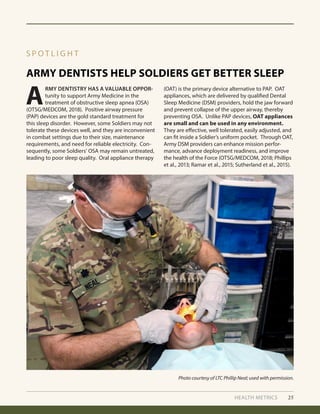
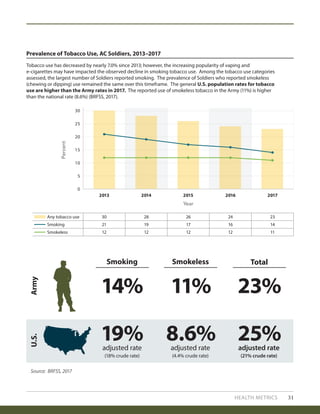
  • 144.
    Appendices 140 2018 HEALTHOF THE FORCE REPORT AC – Active Component ACSIM – Assistant Chief of Staff for Installation Management ADP – Area Development Plan AFHSB – Armed Forces Health Surveillance Branch AHP – Army Hearing Program AMEDD – U.S. Army Medical Department APA – American Psychiatric Association APFT – Army Physical Fitness Test APG – Aberdeen Proving Ground APHC – U.S. Army Public Health Center APHC (Prov) – U.S. Army Public Health Center (Provisional) AQI – Air Quality Index AR – Army Regulation ARD – Army Resiliency Directorate ASAP – Army Substance Abuse Program ASTM – American Society for Testing and Materials AWC – Army Wellness Center BH – Behavioral Health BHDP – Behavioral Health Data Portal BMI – Body Mass Index BRFSS – Behavioral Risk Factor Surveillance System BSB – Brigade Support Battalion CBD – Cannabidiol CCR – Consumer Confidence Report CDC – U.S. Centers for Disease Control and Prevention CHA – Community Health Assessment CHSA – Community Health Status Assessment CMS – Command Management System COPD – Chronic Obstructive Pulmonary Disease CR2C – Commander’s Ready and Resilient Council CSA – Chief of Staff of the Army CSTA – Community Strengths and Themes Assessment CWS – Community Water System CY – Calendar Year ACRONYMS AND ABBREVIATIONS DA – Department of the Army DA Pam –Department of the Army Pamphlet DHA – Defense Health Agency DHHS – U.S. Department of Health and Human Services DLA – Defense Logistics Agency DMSS – Defense Medical Surveillance System DMDC – formerly Defense Manpower Data Center DOD – Department of Defense DODI – Department of Defense Instruction DOEHRS – Defense Occupational and Environmental Health Readiness System DOEHRS-HR – Defense Occupational and Environmental Health Readiness System-Hearing Readiness DOEHRS-IH – Defense Occupational and Environmental Health Readiness System-Industrial Hygiene DPH – Department of Public Health DPW – Department of Public Works DRSi – Disease Reporting System, internet DSM – Dental Sleep Medicine EBH – Embedded Behavioral Health EHI – Environmental Health Indicator(s) EPA – U.S. Environmental Protection Agency FM – Field Manual FY – Fiscal Year GAT – Global Assessment Tool HAC – Healthy Army Communities HIV – Human Immunodeficiency Virus HP2020 – Healthy People 2020 HPV – Human Papillomavirus HQDA – Headquarters, Department of the Army HRC – Hearing Readiness Classification HRI – Heat-related Illness HTTKP – Human Tick Test Kit Program ICD-10-CM – International Classification of Diseases, Tenth Revision, Clinical Modification
  • 145.
    ACRONYMS AND ABBREVIATIONS141 IHI – Installation Health Index IMCOM – U.S. Army Installation Management Command IRPT – Injured Reserve Physical Training JBLE – Joint Base Langley-Eustis JBLM – Joint Base Lewis-McChord JCS – Joint Chiefs of Staff MCL – Maximum Contaminant Level MDVSS – Medical Detachment Veterinary Service Support MEDCOM – U.S. Army Medical Command MEDPROS – Medical Protection System mg/L – milligrams per liter MHS – Military Health System MRC – Medical Readiness Classification MSM – Men who have sex with men MTF – Medical Treatment Facility NAAQS – U.S. National Ambient Air Quality Standard NCI – National Cancer Institute NCQA – National Committee for Quality Assurance NCSL – National Conference of State Legislatures NIDA – National Institute on Drug Abuse NPMA – National Pest Management Association NSF – National Sleep Foundation OAT – Oral Appliance Therapy OSA – Obstructive Sleep Apnea OTSG – Office of The Surgeon General P3 – Performance Triad PAP – Positive Airway Pressure PCMH – Patient Centered Medical Home PHA – Periodic Health Assessment PHS – U.S. Public Health Service PI&A – Performance Improvement and Accreditation PM – Preventive Medicine PM2.5 – Fine particulate matter PMM – Pectoralis Major Muscles PMT – Pectoralis Major Tendons PT – Physical Training PTSD – Posttraumatic Stress Disorder PWS – Public Water System(s) SAN – Sleep, Activity, and Nutrition SD – Standard Deviation SDWA – Safe Drinking Water Act SDWIS – Safe Drinking Water Information System STI – Sexually Transmitted Infection STS – Significant Threshold Shift SUD – Substance Use Disorder SWARWeb – Solid Waste Annual Reporting for the Web TCR – Total Coliform Rule THC – delta-9-tetrahydrocannabinol THM – trihalomethanes TRADOC – U.S. Army Training and Doctrine Command USAG – U.S. Army Garrison USARAK – U.S. Army Alaska USDA – U.S. Department of Agriculture USPSTF – U.S. Preventive Services Task Force UV – Ultraviolet VSST – Veterinary Service Support Team WHO – World Health Organization WNV – West Nile Virus
  • 146.
    Appendices 142 2018 HEALTHOF THE FORCE REPORT INDEX A Aberdeen Proving Ground (APG), 1, 115 Activity. (See Performance Triad (P3).) Adjustment disorders (See Behavioral health.) Air quality. (See Environment.) Ozone, 49 Particulate matter, 48 Air Quality Index (AQI), 48-49, 72, 115, 122, 126 Alaska, 28 Alcohol. (See Substance use.) Anxiety. (See Behavioral health.) Armed Forces Health Surveillance Branch (AFHSB), 117, 119–120 Army Hearing Program (AHP), 36 Army Master Planning, 45 Army Patient Centered Medical Home (PCMH), 7 Army Physical Fitness Test (APFT), 6, 32–33 Army Public Health Accreditation, 77 Army Resiliency Directorate (ARD), 118 Army Substance Abuse Program (ASAP), 118 Arthritis. (See Chronic disease.) Asthma. (See Chronic disease.) Army Wellness Center (AWC), 7–8, 29 B Behavioral health (BH), 2, 14–19, 72, 115, 117, Adjustment disorders, 14–15, 117 Anxiety, 14–15, 23, 117 Data portal, 18 Depression, 14 Embedded behavioral health (EBH), 19 Mental skills training, 6 Mood disorders, 6, 14–15, 117 No-show rates, 17 Personality disorders, 14–15, 117 Posttraumatic stress disorder (PTSD), 4, 14–18, 22, 117 Psychosis, 14-15 Rates by installation, 79–113 Service Line, 18 Substance use disorders, 15 Behavioral Risk Factor Surveillance System (BRFSS), 27, 31, 119 Body Mass Index (BMI), 7, 26–29, 72, 118–119 C Cancer (see also Chronic disease), 26–28, 45, 50, 54, 188 Cannabis. (See Substance use.) Cardiovascular disease. (See Chronic disease.) Chlamydia. (See Sexually transmitted infection.) Chronic disease, 1, 5, 42–45, 126 Arthritis, 6, 42–43, 120 Asthma, 42–43, 120 Cancer, 41–44, 50, 54, 120 Cardiovascular disease, 42–43, 48, 120 Chronic obstructive pulmonary disease (COPD), 42–43, 120 Diabetes, 6, 26, 42–43, 48, 120 Hypertension, 26, 42–43, 120 Rates by installation, 79–113 Cigarette. (See Tobacco.) Cimex lectularius (See Environment.) Clinical Data Repository, 118 Cocaine. (See Substance use.) Commander’s Ready and Resilient Council (CR2C), 8, 12, 32, 70–71 Community Health Assessment (CHA), 70 Community Health Status Assessment (CHSA), 70 Community Resource Guide, 53 Community Strengths and Themes Assessment (CSTA), 70–71 Community Water System (CWS), 51–53, 124 Consumer Confidence Report (CCR), 53, 123 D Defense Logistics Agency (DLA), 55 Defense Medical Surveillance System (DMSS), 1, 117 Defense Occupational and Environmental Health Readiness System (DOEHRS), 36–37, 119–120, Demographics, 5, 115, 127 Age, 5 Population, 5 Sex, 5 Dental Sleep Medicine (DSM), 25 Diabetes (See Chronic disease.) Disease Reporting System, internet (DRSi), 36, 119 DOEHRS-Hearing Conservation (DOEHRS-HC), 40, 119 DOEHRS-Industrial Hygiene (DOEHRS-IH), 41 Drinking water quality. (See Environment.)
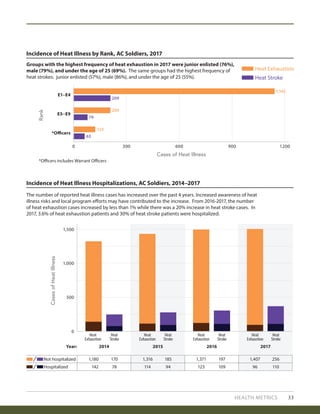
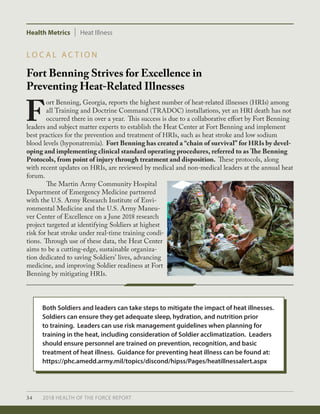
  • 147.
    INDEX 143 E Environment, 46–63 Aedesaegypti, 125 Aedes albopictus, 125 Air quality, 48–49, 72, 115–116, 122–123, 126, 128 Air Quality Index (AQI), 49, 121 Bed bugs, 60–61 Cimex lectularius (See bed bugs.) Culex spp., 125 Day-biting mosquito, 56–57 Drinking water quality, 50-51, 123 Environmental Health Indicator, 46–61 By installation, 79–113 Human Tick Test Kit Program (HTTKP), 58–59, 125, 129 Ixodes pacificus, 58 Ixodes ricinus, 58 Ixodes scapularis, 58 Lyme disease, 58–59 Mosquito-borne disease, 56–57, 125 Ozone, 49 Particulate matter, 48 Solid waste diversion, 54–55, 124 Tick-borne disease, 58–59, 125, 128 Water fluoridation, 3, 52–53, 124 West Nile virus, 56–57, 126 Zika virus, 56, 124 Environmental Health Indicator. (See Environment.) F Foodborne illness, 62 Fort Belvoir, 73, 75–76, 79 Fort Benning, 34, 73, 75–76, 80 Fort Bliss, 73, 75–76, 81 Fort Bragg, 73, 75–76, 82 Fort Campbell, 73, 75–76, 83 Fort Carson, 73, 75–76, 84 Fort Drum, 73, 75–76, 85 Fort Eustis. (See JB Langley-Eustis.) Fort Gordon, 73, 75–76, 86 Fort Hood, 73, 75–76, 87 Fort Huachuca, 73, 75–76, 88 Fort Irwin, 73, 75–76, 89 Fort Jackson, 73, 75–76, 90 Fort Knox, 73, 75–76, 91 Fort Leavenworth, 73, 75–76, 92 Fort Lee, 73, 75–76, 93 Fort Leonard Wood, 73, 75–76, 94 Fort Lewis. (See JB Lewis-McChord.) Fort Meade, 73, 75–76, 95 Fort Myer. (See JB Myer-Henderson Hall.) Fort Polk, 73, 75–76, 96 Fort Sam Houston. (See JB San Antonio.) Fort Richardson. (See JB Elmendorf-Richardson.) Fort Riley, 73, 75–77, 97 Fort Rucker, 73, 75–76, 98 Fort Sill, 8, 73, 75–76, 99 Fort Stewart, 73, 75–76, 100 Fort Wainwright, 73, 75–76, 101 G Global Assessment Tool (GAT), 64, 67, 121–122, 127–128 Gonorrhea (See Sexually transmitted infection.) H Hawaii, 12, 73, 75–76, 102 Health Readiness Center, 8 Healthy Army Communities (HAC), 45 Hearing, 36–37, 119 Hearing Readiness Classification (HRC), 37 Significant threshold shift (STS), 36 Heat illness, 32–35, 119 Heat exhaustion, 32–33 Heat-related illness (HRI), 34 Heat stroke, 32–33 Hyponatremia, 34 Human Tick Test Kit Program (HTTKP). (See Environment.) Hypertension. (See Chronic disease.) I Illness, heat-related. (See Heat illness.) Injury, 1, 2, 6, 10–13, 32–33, 38, 64, 72, 74 Hearing (See Hearing.) Musculoskeletal, 2, 10–12, 17, 117 Pectoralis major muscles (PMM), 13 Pectoralis major tendons (PMT), 13 Rates by installation, 79–113 Installation Health Index (IHI), 72, 115, 126–127 Ranking by installation, 73 Z-score, 72–73, 78, 126–127 By installation, 79–113 Installation Management Command (IMCOM), 29 International Classification of Diseases, Tenth Revision, Clinical Modification (ICD-10-CM), 1, 10, 42, 115, 117–120, 128 Ixodes pacificus (See Environment.)
  • 148.
    Appendices 144 2018 HEALTHOF THE FORCE REPORT Ixodes ricinus (See Environment.) Ixodes scapularis (See Environment.) J Japan, 50, 73, 75–76, 112–113, 122 JB Elmendorf-Richardson, 73, 75–76, 103 JB Langley-Eustis, 17, 73, 75–76, 104 JB Lewis-McChord, 1, 49, 115–116, JB Myer-Henderson Hall, 73, 75–76, 105 JB San Antonio, 73, 75–76, 106 K No entries. L Lyme disease. (See Environment.) M Maximum Contaminant Level (MCL), 52, 123 Marijuana. (See Substance use.) Medical Detachment Veterinary Service Support (MDVSS), 62 Medical Protection System (MEDPROS), 41 Medical Readiness Classification (MRC), 4, 8, 12 MRC1, 4 MRC2, 4 MRC3, 4, 8 MRC4, 4, 8 Medical Treatment Facility (MTF), 8, 18, 23, 59, 116–118, 120 Mental skills training, 6 Military Health System (MHS), 1, 40, 115, 119, 128 Military Health System Genesis, 1, 115 Military Health System Population Health Portal, 120 Mood disorders. (See Behavioral health.) Mosquito-borne illness. (See Environment.) Musculoskeletal injury. (See Injury.) N Nutrition. (See Performance Triad (P3).) O Obesity, 1, 3, 4, 24, 26–29, 48, 72, 74, 76, 115–116, 118–119, 126–128 Aerobic fitness, 29 Body composition, 13, 26, 29 Overweight, 5, 24, 26–27, 118–119 Rates by installation, 79–113 Online, Health of the Force, 1, 4, 62 Opioid. (See Substance use.) P Particulate matter. (See Environment.) Performance Triad (P3), 1, 3, 64–69, 121–122, 128 Activity, 29, 64, 66, 68–69, 121 Measures by installation, 79–113 Nutrition, 7, 8, 38, 64, 67–69, 70, 122 Sleep, 17, 24–25, 38, 60, 64–65, 68–69, 72, 121 Periodic health assessment (PHA), 8, 30, 119, 128 Personality disorders. (See Behavioral health.) Posttraumatic Stress Disorder (PTSD). (See Behavioral health.) Presidio of Monterey, 73, 75–76, 107 Psychosis. (See Behavioral health.) Q No entries. R No entries. S Safety, 22, 41, 63, 70 Sexually transmitted infection (STI), 3, 38–41, 120 Chlamydia, 38–41, 72, 115, 120, 126–128 Gonorrhea, 38, 40–41 Rates by installation, 79–113 Syphilis, 40–41 Safe Drinking Water Act (SDWA), 50-51, 122-123 Safe Drinking Water Information System (SDWIS), 51, 121 Sleep. (See Performance Triad (P3).) Sleep disorders, 2, 24–25, 72, 115, 118, 126 Oral appliance therapy (OAT), 25 Obstructive sleep apnea (OSA), 25 Positive airway pressure (PAP), 25 Rates by installation, 79–113 Smokeless tobacco. (See Tobacco use.) Smoking. (See Tobacco use.) Solid waste diversion. (See Environment.) Substance use, 2, 14–16, 20-23, 116–117 Alcohol, 16–17, 20–22, 70, 118 Amphetamines, 21, 118 Army Substance Abuse Program (ASAP),118 Benzodiazepines, 21 Cannabis, 20–21, 23, 118 Cocaine, 20–21, 118 Disorders, 20–23, 117 Hallucinogens, 20 Opioid, 20–21, 118
  • 149.
    Rates by installation,79–113 Sedatives, 20 Stimulants, 20 Vaping, 23, 34–35 Voluntary treatment, 22 Syphilis (See Sexually transmitted infection.) T Tanning, 44 Tick-borne disease. (See Environment.) Tobacco use, 1, 3, 4, 30–31, 42, 72, 74, 76, 115–116, 119, 126 Smokeless, 31, 119 Smoking, 31, 119 Rates by installation, 79–113 Total Coliform Rule (TCR), 51 Toxicity testing, 63 Training and Doctrine Command (TRADOC), 38 Trihalomethane (THM), 50 U U.S. Army Medical Command (MEDCOM), 18, 28, 77 U.S. Army Public Health Center (APHC), 4, 23, 45, 59, 63, 71, 77, 116–118 USAG Bavaria, 73, 75–76, 110–111 USAG Benelux, 8 USAG Daegu, 49, 73, 75–76, 112–113 USAG Humphreys, 49, 73, 75–76, 112–113 USAG Red Cloud, 49, 73, 75–76, 112–113 USAG Rheinland-Pfalz, 73, 75–76, 110–111 USAG Stuttgart, 73, 75–76, 110–111 USAG Vicenza, 73, 75–76, 110–111 USAG West Point, 50, 73, 75–76, 108, 127 USAG Wiesbaden, 50, 73, 75–76, 110–111 USAG Yongsan, 49, 73, 75–76, 112–113 V Vaping, 23, 30–31 Cannabidiol (CBD), 23 Cannabinoid, 23 Cannabis, 23 e-juice, 23 W West Nile virus (See Environment.) X,Y No entries. Z Zika virus. (See Environment.) Z-score. (See Installation Health Index (IHI).) INDEX 145
  • 152.
    HEALTH OF THEFORCE REPORT 2018 Visit us at https://phc.amedd.army.mil/topics/campaigns/hof