Week 13
           EDS 220

 EDS-220 Review
     Final
  Week
         Dr. Evrim Baran
Dr. Evrim Baran
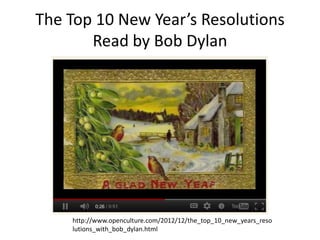
The Top 10 New Year’s Resolutions
       Read by Bob Dylan


    http://www.openculture.com/2012/12/the_top_10_new_years_reso
    lutions_with_bob_dylan.html
Humanistic Psychology Listening
              Technique
• Find a partner
• For 2 minutes the first person does all the
  talking and the second person must do
  nothing but listen (absolutely no talking)
• After 2 minutes reverse the role
• Talk about
  – What did you do for new years eve?
  – What is your new year resolution?
Congratulations!!!!
“You” Are The Champions'


http://www.youtube.com/watch?v=04854XqcfCY
Find a song
• Think of a well known song that could be each of
  the researcher’s theme song based on the topic
  area that you studied.
  –   ABRAHAM MASLOW
  –   CARL RODGERS
  –   IVAN PAVLOV
  –   JEAN PIAGET
  –   LAWRENCE KOHLBERG
  –   SIGMUND FREUD
  –   ERIK ERICKSON
  –   LEV VYGOTSKY
Who am I?
• Ask no more than ten “yes” and “no”
  questions in an attempt to figure our who you
  are.
• Possible questions:
     • Am I a developmental or learning psychologist?
     • Did I investigate --- development?
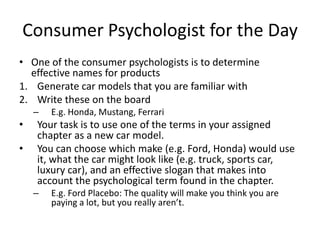
Consumer Psychologist for the Day
• One of the consumer psychologists is to determine
  effective names for products
1. Generate car models that you are familiar with
2. Write these on the board
    –   E.g. Honda, Mustang, Ferrari
•   Your task is to use one of the terms in your assigned
    chapter as a new car model.
•   You can choose which make (e.g. Ford, Honda) would use
    it, what the car might look like (e.g. truck, sports car,
    luxury car), and an effective slogan that makes into
    account the psychological term found in the chapter.
    –   E.g. Ford Placebo: The quality will make you think you are
        paying a lot, but you really aren’t.
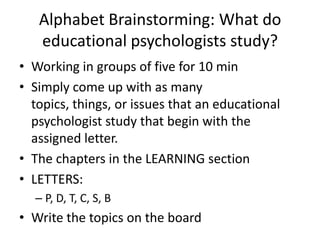
Alphabet Brainstorming: What do
   educational psychologists study?
• Working in groups of five for 10 min
• Simply come up with as many
  topics, things, or issues that an educational
  psychologist study that begin with the
  assigned letter.
• The chapters in the LEARNING section
• LETTERS:
  – P, D, T, C, S, B
• Write the topics on the board
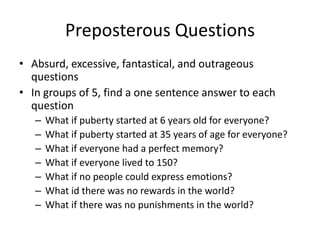
Preposterous Questions
• Absurd, excessive, fantastical, and outrageous
  questions
• In groups of 5, find a one sentence answer to each
  question
   –   What if puberty started at 6 years old for everyone?
   –   What if puberty started at 35 years of age for everyone?
   –   What if everyone had a perfect memory?
   –   What if everyone lived to 150?
   –   What if no people could express emotions?
   –   What id there was no rewards in the world?
   –   What if there was no punishments in the world?
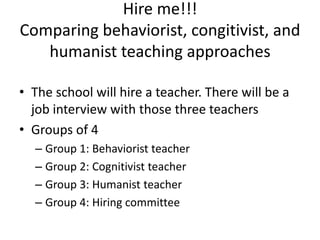
Hire me!!!
Comparing behaviorist, congitivist, and
   humanist teaching approaches

• The school will hire a teacher. There will be a
  job interview with those three teachers
• Groups of 4
  – Group 1: Behaviorist teacher
  – Group 2: Cognitivist teacher
  – Group 3: Humanist teacher
  – Group 4: Hiring committee
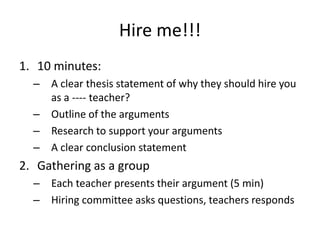
Hire me!!!
1. 10 minutes:
  – A clear thesis statement of why they should hire you
    as a ---- teacher?
  – Outline of the arguments
  – Research to support your arguments
  – A clear conclusion statement
2. Gathering as a group
  – Each teacher presents their argument (5 min)
  – Hiring committee asks questions, teachers responds
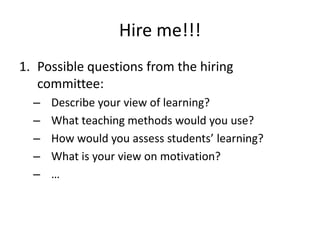
Hire me!!!
1. Possible questions from the hiring
   committee:
  –   Describe your view of learning?
  –   What teaching methods would you use?
  –   How would you assess students’ learning?
  –   What is your view on motivation?
  –   …
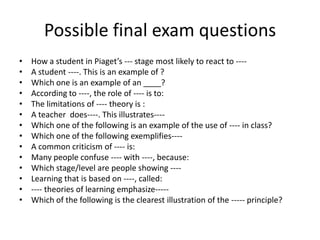
Possible final exam questions
•   How a student in Piaget’s --- stage most likely to react to ----
•   A student ----. This is an example of ?
•   Which one is an example of an ____?
•   According to ----, the role of ---- is to:
•   The limitations of ---- theory is :
•   A teacher does----. This illustrates----
•   Which one of the following is an example of the use of ---- in class?
•   Which one of the following exemplifies----
•   A common criticism of ---- is:
•   Many people confuse ---- with ----, because:
•   Which stage/level are people showing ----
•   Learning that is based on ----, called:
•   ---- theories of learning emphasize-----
•   Which of the following is the clearest illustration of the ----- principle?
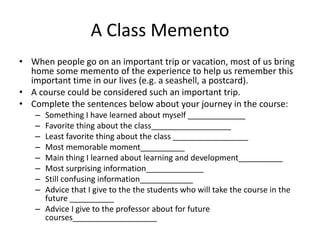
A Class Memento
• When people go on an important trip or vacation, most of us bring
  home some memento of the experience to help us remember this
  important time in our lives (e.g. a seashell, a postcard).
• A course could be considered such an important trip.
• Complete the sentences below about your journey in the course:
   – Something I have learned about myself _____________
   – Favorite thing about the class__________________
   – Least favorite thing about the class _________________
   – Most memorable moment__________
   – Main thing I learned about learning and development__________
   – Most surprising information_____________
   – Still confusing information____________
   – Advice that I give to the the students who will take the course in the
     future __________
   – Advice I give to the professor about for future
     courses___________________
Thanking Each Other


Thank you for your contributions and hard work

Final class

  • 1.
    Week 13 EDS 220 EDS-220 Review Final Week Dr. Evrim Baran Dr. Evrim Baran
  • 2.
    The Top 10New Year’s Resolutions Read by Bob Dylan http://www.openculture.com/2012/12/the_top_10_new_years_reso lutions_with_bob_dylan.html
  • 3.
    Humanistic Psychology Listening Technique • Find a partner • For 2 minutes the first person does all the talking and the second person must do nothing but listen (absolutely no talking) • After 2 minutes reverse the role • Talk about – What did you do for new years eve? – What is your new year resolution?
  • 4.
  • 5.
    “You” Are TheChampions' http://www.youtube.com/watch?v=04854XqcfCY
  • 6.
    Find a song •Think of a well known song that could be each of the researcher’s theme song based on the topic area that you studied. – ABRAHAM MASLOW – CARL RODGERS – IVAN PAVLOV – JEAN PIAGET – LAWRENCE KOHLBERG – SIGMUND FREUD – ERIK ERICKSON – LEV VYGOTSKY
  • 7.
    Who am I? •Ask no more than ten “yes” and “no” questions in an attempt to figure our who you are. • Possible questions: • Am I a developmental or learning psychologist? • Did I investigate --- development?
  • 8.
    Consumer Psychologist forthe Day • One of the consumer psychologists is to determine effective names for products 1. Generate car models that you are familiar with 2. Write these on the board – E.g. Honda, Mustang, Ferrari • Your task is to use one of the terms in your assigned chapter as a new car model. • You can choose which make (e.g. Ford, Honda) would use it, what the car might look like (e.g. truck, sports car, luxury car), and an effective slogan that makes into account the psychological term found in the chapter. – E.g. Ford Placebo: The quality will make you think you are paying a lot, but you really aren’t.
  • 9.
    Alphabet Brainstorming: Whatdo educational psychologists study? • Working in groups of five for 10 min • Simply come up with as many topics, things, or issues that an educational psychologist study that begin with the assigned letter. • The chapters in the LEARNING section • LETTERS: – P, D, T, C, S, B • Write the topics on the board
  • 10.
    Preposterous Questions • Absurd,excessive, fantastical, and outrageous questions • In groups of 5, find a one sentence answer to each question – What if puberty started at 6 years old for everyone? – What if puberty started at 35 years of age for everyone? – What if everyone had a perfect memory? – What if everyone lived to 150? – What if no people could express emotions? – What id there was no rewards in the world? – What if there was no punishments in the world?
  • 11.
    Hire me!!! Comparing behaviorist,congitivist, and humanist teaching approaches • The school will hire a teacher. There will be a job interview with those three teachers • Groups of 4 – Group 1: Behaviorist teacher – Group 2: Cognitivist teacher – Group 3: Humanist teacher – Group 4: Hiring committee
  • 12.
    Hire me!!! 1. 10minutes: – A clear thesis statement of why they should hire you as a ---- teacher? – Outline of the arguments – Research to support your arguments – A clear conclusion statement 2. Gathering as a group – Each teacher presents their argument (5 min) – Hiring committee asks questions, teachers responds
  • 13.
    Hire me!!! 1. Possiblequestions from the hiring committee: – Describe your view of learning? – What teaching methods would you use? – How would you assess students’ learning? – What is your view on motivation? – …
  • 14.
    Possible final examquestions • How a student in Piaget’s --- stage most likely to react to ---- • A student ----. This is an example of ? • Which one is an example of an ____? • According to ----, the role of ---- is to: • The limitations of ---- theory is : • A teacher does----. This illustrates---- • Which one of the following is an example of the use of ---- in class? • Which one of the following exemplifies---- • A common criticism of ---- is: • Many people confuse ---- with ----, because: • Which stage/level are people showing ---- • Learning that is based on ----, called: • ---- theories of learning emphasize----- • Which of the following is the clearest illustration of the ----- principle?
  • 15.
    A Class Memento •When people go on an important trip or vacation, most of us bring home some memento of the experience to help us remember this important time in our lives (e.g. a seashell, a postcard). • A course could be considered such an important trip. • Complete the sentences below about your journey in the course: – Something I have learned about myself _____________ – Favorite thing about the class__________________ – Least favorite thing about the class _________________ – Most memorable moment__________ – Main thing I learned about learning and development__________ – Most surprising information_____________ – Still confusing information____________ – Advice that I give to the the students who will take the course in the future __________ – Advice I give to the professor about for future courses___________________
  • 16.
    Thanking Each Other Thankyou for your contributions and hard work