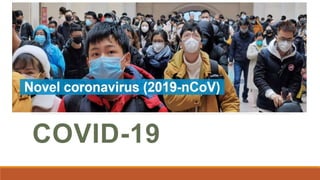
COVID-19
Introduction
Corona virus comprises of a large family of viruses that are common in human
beings as well animals (camels, cattle, cats, and bats).
There are seven different strains of corona virus.
Sometimes corona virus from animals infect people and spread further via human
to human transmission such as with MERS-CoV, SARS-CoV, and now with this
COVID 19 (Corona disease 2019).
The virus that causes COVID-19 is designated severe acute respiratory
syndrome corona virus 2 (SARS-CoV-2); previously, referred to as 2019-nCoV.
Transmission
Droplet transmission
Other possible modes of transmission- by
touching a surface or object that has the virus on
it and then touching their own mouth, nose, or
possibly their eyes, but this is not thought to be
the main way the virus spreads.
Virus may also be present in feces
Clinical Features
Incubation period- presumed to be between 2 to 14 days
after exposure, with most cases occurring within 5 days after
exposure
Age affected -Mostly middle aged (>30 years) and elderly
and symptomatic infection in children appears to be
uncommon, and when it occurs, it is usually mild
Clinical Presentation:Common clinical features •Fever in
88% •Fatigue in 38% •Dry cough in 67% •Myalgias in 14.9%
•Dyspnea in 18.7%
Other symptoms •Headache •Sore throat •Rhinorrhea
•Gastrointestinal symptoms
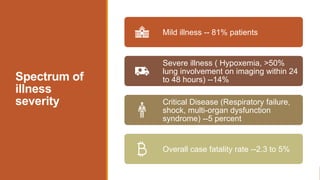
Spectrum of
illness
severity
Mild illness -- 81% patients
Severe illness ( Hypoxemia, >50%
lung involvement on imaging within 24
to 48 hours) --14%
Critical Disease (Respiratory failure,
shock, multi-organ dysfunction
syndrome) --5 percent
Overall case fatality rate --2.3 to 5%
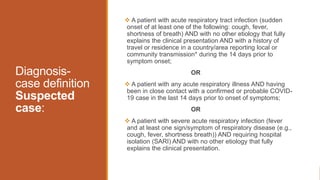
Diagnosis-
case definition
Suspected
case:
 A patient with acute respiratory tract infection (sudden
onset of at least one of the following: cough, fever,
shortness of breath) AND with no other etiology that fully
explains the clinical presentation AND with a history of
travel or residence in a country/area reporting local or
community transmission* during the 14 days prior to
symptom onset;
OR
 A patient with any acute respiratory illness AND having
been in close contact with a confirmed or probable COVID-
19 case in the last 14 days prior to onset of symptoms;
OR
 A patient with severe acute respiratory infection (fever
and at least one sign/symptom of respiratory disease (e.g.,
cough, fever, shortness breath)) AND requiring hospital
isolation (SARI) AND with no other etiology that fully
explains the clinical presentation.
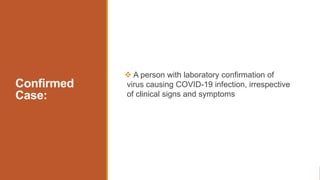
Confirmed
Case:
 A person with laboratory confirmation of
virus causing COVID-19 infection, irrespective
of clinical signs and symptoms
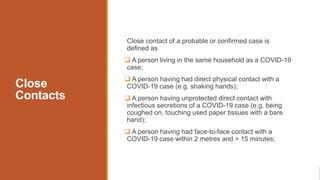
Close
Contacts
Close contact of a probable or confirmed case is
defined as
 A person living in the same household as a COVID-19
case;
 A person having had direct physical contact with a
COVID-19 case (e.g. shaking hands);
 A person having unprotected direct contact with
infectious secretions of a COVID-19 case (e.g. being
coughed on, touching used paper tissues with a bare
hand);
 A person having had face-to-face contact with a
COVID-19 case within 2 metres and > 15 minutes;
Close
Contacts
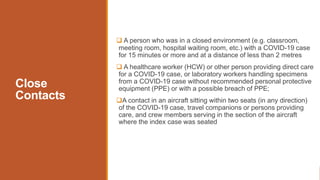
 A person who was in a closed environment (e.g. classroom,
meeting room, hospital waiting room, etc.) with a COVID-19 case
for 15 minutes or more and at a distance of less than 2 metres
 A healthcare worker (HCW) or other person providing direct care
for a COVID-19 case, or laboratory workers handling specimens
from a COVID-19 case without recommended personal protective
equipment (PPE) or with a possible breach of PPE;
A contact in an aircraft sitting within two seats (in any direction)
of the COVID-19 case, travel companions or persons providing
care, and crew members serving in the section of the aircraft
where the index case was seated
Recommendations for sample
collection
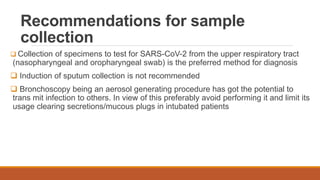
 Collection of specimens to test for SARS-CoV-2 from the upper respiratory tract
(nasopharyngeal and oropharyngeal swab) is the preferred method for diagnosis
 Induction of sputum collection is not recommended
 Bronchoscopy being an aerosol generating procedure has got the potential to
trans mit infection to others. In view of this preferably avoid performing it and limit its
usage clearing secretions/mucous plugs in intubated patients
Current recommended diagnostic
modality for COVID-19
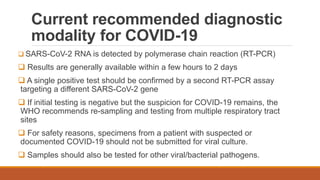
 SARS-CoV-2 RNA is detected by polymerase chain reaction (RT-PCR)
 Results are generally available within a few hours to 2 days
 A single positive test should be confirmed by a second RT-PCR assay
targeting a different SARS-CoV-2 gene
 If initial testing is negative but the suspicion for COVID-19 remains, the
WHO recommends re-sampling and testing from multiple respiratory tract
sites
 For safety reasons, specimens from a patient with suspected or
documented COVID-19 should not be submitted for viral culture.
 Samples should also be tested for other viral/bacterial pathogens.
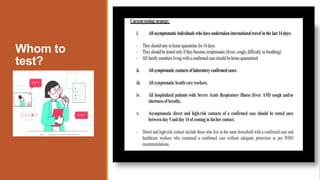
Whom to
test?
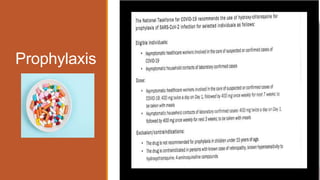
Prophylaxis
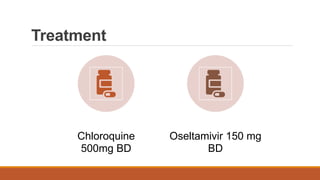
Treatment
Chloroquine
500mg BD
Oseltamivir 150 mg
BD
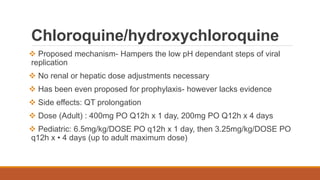
Chloroquine/hydroxychloroquine
 Proposed mechanism- Hampers the low pH dependant steps of viral
replication
 No renal or hepatic dose adjustments necessary
 Has been even proposed for prophylaxis- however lacks evidence
 Side effects: QT prolongation
 Dose (Adult) : 400mg PO Q12h x 1 day, 200mg PO Q12h x 4 days
 Pediatric: 6.5mg/kg/DOSE PO q12h x 1 day, then 3.25mg/kg/DOSE PO
q12h x • 4 days (up to adult maximum dose)
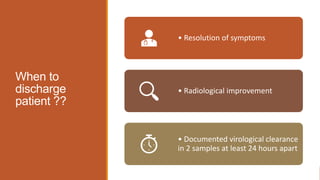
When to
discharge
patient ??
• Resolution of symptoms
• Radiological improvement
• Documented virological clearance
in 2 samples at least 24 hours apart
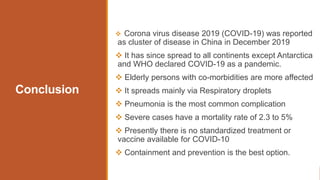
Conclusion
 Corona virus disease 2019 (COVID-19) was reported
as cluster of disease in China in December 2019
 It has since spread to all continents except Antarctica
and WHO declared COVID-19 as a pandemic.
 Elderly persons with co-morbidities are more affected
 It spreads mainly via Respiratory droplets
 Pneumonia is the most common complication
 Severe cases have a mortality rate of 2.3 to 5%
 Presently there is no standardized treatment or
vaccine available for COVID-10
 Containment and prevention is the best option.
THANKS

QUALITY PROCESS AND AUDITING.pptx

  • 1.
  • 2.
    Introduction Corona virus comprisesof a large family of viruses that are common in human beings as well animals (camels, cattle, cats, and bats). There are seven different strains of corona virus. Sometimes corona virus from animals infect people and spread further via human to human transmission such as with MERS-CoV, SARS-CoV, and now with this COVID 19 (Corona disease 2019). The virus that causes COVID-19 is designated severe acute respiratory syndrome corona virus 2 (SARS-CoV-2); previously, referred to as 2019-nCoV.
  • 3.
    Transmission Droplet transmission Other possiblemodes of transmission- by touching a surface or object that has the virus on it and then touching their own mouth, nose, or possibly their eyes, but this is not thought to be the main way the virus spreads. Virus may also be present in feces
  • 4.
    Clinical Features Incubation period-presumed to be between 2 to 14 days after exposure, with most cases occurring within 5 days after exposure Age affected -Mostly middle aged (>30 years) and elderly and symptomatic infection in children appears to be uncommon, and when it occurs, it is usually mild Clinical Presentation:Common clinical features •Fever in 88% •Fatigue in 38% •Dry cough in 67% •Myalgias in 14.9% •Dyspnea in 18.7% Other symptoms •Headache •Sore throat •Rhinorrhea •Gastrointestinal symptoms
  • 5.
    Spectrum of illness severity Mild illness-- 81% patients Severe illness ( Hypoxemia, >50% lung involvement on imaging within 24 to 48 hours) --14% Critical Disease (Respiratory failure, shock, multi-organ dysfunction syndrome) --5 percent Overall case fatality rate --2.3 to 5%
  • 6.
    Diagnosis- case definition Suspected case:  Apatient with acute respiratory tract infection (sudden onset of at least one of the following: cough, fever, shortness of breath) AND with no other etiology that fully explains the clinical presentation AND with a history of travel or residence in a country/area reporting local or community transmission* during the 14 days prior to symptom onset; OR  A patient with any acute respiratory illness AND having been in close contact with a confirmed or probable COVID- 19 case in the last 14 days prior to onset of symptoms; OR  A patient with severe acute respiratory infection (fever and at least one sign/symptom of respiratory disease (e.g., cough, fever, shortness breath)) AND requiring hospital isolation (SARI) AND with no other etiology that fully explains the clinical presentation.
  • 7.
    Confirmed Case:  A personwith laboratory confirmation of virus causing COVID-19 infection, irrespective of clinical signs and symptoms
  • 8.
    Close Contacts Close contact ofa probable or confirmed case is defined as  A person living in the same household as a COVID-19 case;  A person having had direct physical contact with a COVID-19 case (e.g. shaking hands);  A person having unprotected direct contact with infectious secretions of a COVID-19 case (e.g. being coughed on, touching used paper tissues with a bare hand);  A person having had face-to-face contact with a COVID-19 case within 2 metres and > 15 minutes;
  • 9.
    Close Contacts  A personwho was in a closed environment (e.g. classroom, meeting room, hospital waiting room, etc.) with a COVID-19 case for 15 minutes or more and at a distance of less than 2 metres  A healthcare worker (HCW) or other person providing direct care for a COVID-19 case, or laboratory workers handling specimens from a COVID-19 case without recommended personal protective equipment (PPE) or with a possible breach of PPE; A contact in an aircraft sitting within two seats (in any direction) of the COVID-19 case, travel companions or persons providing care, and crew members serving in the section of the aircraft where the index case was seated
  • 10.
    Recommendations for sample collection Collection of specimens to test for SARS-CoV-2 from the upper respiratory tract (nasopharyngeal and oropharyngeal swab) is the preferred method for diagnosis  Induction of sputum collection is not recommended  Bronchoscopy being an aerosol generating procedure has got the potential to trans mit infection to others. In view of this preferably avoid performing it and limit its usage clearing secretions/mucous plugs in intubated patients
  • 11.
    Current recommended diagnostic modalityfor COVID-19  SARS-CoV-2 RNA is detected by polymerase chain reaction (RT-PCR)  Results are generally available within a few hours to 2 days  A single positive test should be confirmed by a second RT-PCR assay targeting a different SARS-CoV-2 gene  If initial testing is negative but the suspicion for COVID-19 remains, the WHO recommends re-sampling and testing from multiple respiratory tract sites  For safety reasons, specimens from a patient with suspected or documented COVID-19 should not be submitted for viral culture.  Samples should also be tested for other viral/bacterial pathogens.
  • 12.
  • 13.
  • 14.
  • 15.
    Chloroquine/hydroxychloroquine  Proposed mechanism-Hampers the low pH dependant steps of viral replication  No renal or hepatic dose adjustments necessary  Has been even proposed for prophylaxis- however lacks evidence  Side effects: QT prolongation  Dose (Adult) : 400mg PO Q12h x 1 day, 200mg PO Q12h x 4 days  Pediatric: 6.5mg/kg/DOSE PO q12h x 1 day, then 3.25mg/kg/DOSE PO q12h x • 4 days (up to adult maximum dose)
  • 16.
    When to discharge patient ?? •Resolution of symptoms • Radiological improvement • Documented virological clearance in 2 samples at least 24 hours apart
  • 17.
    Conclusion  Corona virusdisease 2019 (COVID-19) was reported as cluster of disease in China in December 2019  It has since spread to all continents except Antarctica and WHO declared COVID-19 as a pandemic.  Elderly persons with co-morbidities are more affected  It spreads mainly via Respiratory droplets  Pneumonia is the most common complication  Severe cases have a mortality rate of 2.3 to 5%  Presently there is no standardized treatment or vaccine available for COVID-10  Containment and prevention is the best option.
  • 18.