핸드볼과 영양 C
Level C - ① 스포츠 과학
박 현(경희대학교)
No part of this publication may be reproduced, stored in a retrieval system, or transmitted in
any form or by any means -- electronic, mechanical, photocopying, recording, or otherwise--
without the permission of KHF Handball Academy
2
3
About me
• 연세대학교 생화학과
• 서울대 대학원 운동생리학 석사
• 미국 University of Texas at Austin 운동생화학 박사
• 前)체육과학연구원 선임연구원
• 前)운동영양학회 부회장
• 경희대학교 스포츠의학과 교수
• 미국 GSSI(Gatorade Sports Science Institute) 한국 학술자문위원
• 관심영역; 운동과 항노화(근기능 중심), 운동과 장내미생물, 기능성
보조제(스포츠드링크, 항산화물, 홍삼, 프로바이오틱스, 도핑), 수중운동(DWA) 등
4
Sport and Exercise Performance
 Genetics
• Stature
• Body composition
• VO2max
• Vision
 Training
• Optimal physiological,
psychological and
biomechanical training
5
Sports-Related Fitness: Exercise and Nutrition
 What makes a champion?
• Genetics
‐ Genetic factors determine 20 to 80 percent of the variation in a
wide variety of traits relevant to athletic performance
• Training
‐ Optimal training can maximize an athlete’s genetic potential
• Nutrition
‐ Some specific nutritional practices may benefit athletes
6
Sports-related fitness: Energy demands and control (1)
 Explosive power sports
• Olympic weight lifting
 Very high-intensity sports
• 100-meter dash
 High-intensity, short duration sports
• 5,000-meter run
 Intermittent high-intensity sports
• Soccer
7
Sports-related fitness: Energy demands and control (2)
 Endurance sports
• Marathon running (26.2 miles; 42.2 kilometers)
 Low-endurance, precision skill sports
• Golf
 Weight-control and body-image sports
• Bodybuilding
8
What is sports nutrition?
 The application of nutritional principles to enhance sports p
erformance.
• To promote good health
• To promote adaptations to training
• To recover quickly after each training session
• To perform optimally during competition
Louise Burke, Australian Institute of Sport
9
Roles of Nutrients in Sports Performance
10
Six Classes of Nutrients
• Carbohydrates (Macronutrient)
• Fats or Lipids (Macronutrient)
• Proteins (Macronutrient)
• Vitamins (Micronutrient)
• Minerals (Micronutrient)
• Water
11
Major functions of nutrients In food
12
Six Classes of Nutrients
Carbohydrates
• sugars and starches are chief forms of
carbohydrates
• Main source of energy for muscle
• stored in liver and muscle as glycogen
• aids the utilization of fat during exercise
• excess may store as fat
13
Six Classes of Nutrients
Protein
• protein helps build and repair every
cell in the body
• high protein meals were once
thought to be needed by athletes
prior to competition
• dietary excess converted to fat
14
Six Classes of Nutrients
Fat
• fat is a concentrated source of
energy
• more than twice as much energy as
protein or carbohydrate
• used in long term aerobic exercise
15
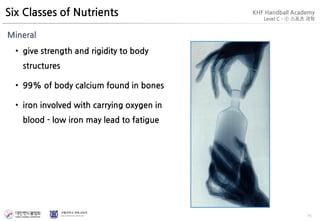
Six Classes of Nutrients
• give strength and rigidity to body
structures
• 99% of body calcium found in bones
• iron involved with carrying oxygen in
blood - low iron may lead to fatigue
Mineral
16
Six Classes of Nutrients
Vitamins
• control growth in body tissue
• essential for the release of energy
• no evidence that vitamins taken in
excess will enhance performance
17
Six Classes of Nutrients
Water
• makes up about 60% of the body
weight
• important coolant during exercise
• most neglected by athletes
• dehydration decrease strength and
leads to fatigue
18
“ that heavy feeling ”
19
Glycogen pre and post exercise
pre exercise post exercise
20
Body water
 Adult males
• 60% of body weight
• Greater amount of muscle (high water content)
 Adult females
• 50% of body weight
• Greater amount of body fat (low water content)
 Percentages of body water may vary
• 70 percent in muscular individuals
• 40 percent in obese individuals
21
22
23
24
25
Physiological effects of dehydration
26
Hyperthermia during Exercise
 Time to exhaustion;
• at 4℃ for 81min
• at 11℃ for 93min
• at 21℃ for 81min
• at 31℃ for 51min
 Critical level;
• 40.1 – 40.2 ℃ core temperature
27
28
Major Roles of Sports Drink
• Rehydration; better than water with its higher drink drive
• Additional CHO supply during exercise; 60g/hour max
• Maintain electrolytes balance
• Psychological refreshment
• Offer any possible ergogenic effect; antioxidative vitamins,
phytochemicals, BCAA, etc.
29
Supplementation
“ a poor diet,
supplemented,
is still a poor diet”
30
Ergogenic Aids & Doping
 Ergogenic vs. ergolytic
 Placebo effects
 Vulnerable mind of athletes
 국내
• 보약, 보신물의 문제
31
What is an ergogenic aid?
 Ergogenic
• Defined as a means to increase potential for work output
• Performance-enhancing techniques
• Performance-enhancing substances
 Classes of ergogenic aids
• Mechanical aids
• Psychological aids
• Physiological aids
• Pharmacological aids
• Nutritional aids
32
33
PROCESS OF APPLYING A PURPORTED
ERGOGENIC TO SPORT
34
 Use of drugs is illegal
• Doping
• World Anti-Doping Agency (WADA)
 Dietary supplements
• Sports supplements
 Popularity
• Belief in magical properties of some supplements
• Recommended by coaches and fellow athletes
• Shrewd advertising and marketing
‐ Endorsement by star athletes
Why are nutritional ergogenics (NE) so popular?
35
 Research suggests a few are but most are not
 Supplements are found in each nutrient class
• Carbohydrates: Specific forms such as ribose
• Fats: Specific fatty acids such as omega-3
• Protein: Specific nitrogen compounds such as creatine
• Vitamins: Specific vitamins such as B12
• Minerals: Specific minerals such as phosphate salts
• Water: Special oxygenated waters
• Others: Food drugs like caffeine and herbals like ginseng
Are nutritional ergogenics effective?
36
Acceptable Physiological Research Ineffective Disallowed
Scientific research
has shown a clear
performance or
health benefit to the
supplements use.
There is a clear
physiological rationale
for using the supplement.
However, the performance
or health outcome
research is unclear.
The physiological and
performance/health
outcome are unclear.
However, there is
practitioner based
evidence that there may
be a benefit to using the
supplement in elite sport.
There is no clear physiological,
performance or health benefit
to using the supplement.
These supplements are
either directly banned
and on the WADA
Prohibited Substances
List, or are deemed to
be a high risk for
a positive doping case,
and therefore should
no be used by athletes.
Sports foods
·Carbohydrate drinks, gels, powd
ers and bars
·Carbohydrate-electrolyte ‘sports’
drinks and powder
·Protein powders, drinks and bars
Performance
·Caffeine
·Creatine
Health
·Iron
·Multi antioxidants
·Multi minerals
·Multi vitamins
Antioxidant
Cardiovascular effects
·Arginine/Citrulline
Buffer capacity
·Beta-Alanine/Carnosine
Muscle growth and repair
·Branched Chain Amino Acids
CNS effects
·Branched Chain Amino Acids
Health
·Glucosamine
·Glutamine
Antioxidant
·Green Tea extract/EGCG
Cardiovascular effects
·Nitrates
Buffer capacity
Muscle growth and repair
CNS effects
·Tyrosine
Health
·Melatonin
Other
Examples of ineffective
·Coenzyme Q10
·Cytochrome C
·Pyruvate
·Ribose
Prohibited supplements
·Anabolic Agents
·Hormones & related substances
Substances banned in
competition only
·Alchohol & Beta Blockers
:prohibited in certain sports
APRID: an example of a dietary supplement
classification framework
37
 Several websites present detailed information
 USDA
• www.nutrition.gov/dietary-supplements/dietary-supplements-athletes
 Australian Institute of Sport
• www.ausport.gov.au/ais/nutrition/supplements
 Korea Anti Doping Agency
• http://www.kada-ad.or.kr/page/100a03
Where can I find more detailed information on
sports supplements?
38
KADA
 보충제란 무엇인가?
 도핑 위험성
 보충제 섭취 조언
 Q & A
• 영양보조제와 관련된 정보를 어디에서
얻을 수 있습니까?
• 팀동료 또는 다른 선수가 영양보조제
사용을 권유하는데 안전합니까?
• 영양보조제 사용의 위험성에도 차이가
있습니까?
• 한약, 건강보조식품을 복용할 때는
어떻게 하나요?
39
• Glucose and glycogen loading
• Creatine
• BCAA
• Antioxidants
• Water; sports drink
• Ginseng; FRG(fermented red ginseng)
• Probiotics, prebiotics, and symbiotics
• Nutrient Timing System
Nutritional Ergogenics ;
evidence-based suggestions
40
Nutrient Timing System
• Three phases ; Energy, Anabolic, Growth
41
 무엇을, 얼마나 먹느냐의 시대에서 “언제” 먹느냐의 시대로 전환
 운동 후 빠른 피로회복
 훈련효과 증대; 근력, 근질량
• 더 빠른 기간 내에 더 큰 근력의 향상 가능
 훈련 효과의 정체기를 없앨 수 있다
영양섭취 타이밍(Nutrient Timing System)의 중요성
42
영양섭취 타이밍 시스템의 세 단계
에너지
단계
동화 단계 성장 단계
 에너지 단계
• 바로 운동을 하는 순간 가장 중요한 목적은 근수축을 위한 충분한 에너지 확보
 동화 단계
• 근육이 운동을 마치고 적절한 영양소가 공급되는 상황(기회의 창; 1시간 이내, 늦어도 2
시간)
 성장 단계
• : 동화단계가 끝난 후부터 다음 운동이 시작 되기까지의 시간을 의미
43
추천 자료
 도서
• “영양 섭취 타이밍과 근육 발달” (박현 등, 라이프 사이언스)
 웹사이트- 미국 GSSI 연구자료
• https://www.gssiweb.org/en/research/All
End of document

2019 핸드볼 지도자 아카데미_핸드볼과 영양C

  • 1.
    핸드볼과 영양 C LevelC - ① 스포츠 과학 박 현(경희대학교) No part of this publication may be reproduced, stored in a retrieval system, or transmitted in any form or by any means -- electronic, mechanical, photocopying, recording, or otherwise-- without the permission of KHF Handball Academy
  • 2.
  • 3.
    3 About me • 연세대학교생화학과 • 서울대 대학원 운동생리학 석사 • 미국 University of Texas at Austin 운동생화학 박사 • 前)체육과학연구원 선임연구원 • 前)운동영양학회 부회장 • 경희대학교 스포츠의학과 교수 • 미국 GSSI(Gatorade Sports Science Institute) 한국 학술자문위원 • 관심영역; 운동과 항노화(근기능 중심), 운동과 장내미생물, 기능성 보조제(스포츠드링크, 항산화물, 홍삼, 프로바이오틱스, 도핑), 수중운동(DWA) 등
  • 4.
    4 Sport and ExercisePerformance  Genetics • Stature • Body composition • VO2max • Vision  Training • Optimal physiological, psychological and biomechanical training
  • 5.
    5 Sports-Related Fitness: Exerciseand Nutrition  What makes a champion? • Genetics ‐ Genetic factors determine 20 to 80 percent of the variation in a wide variety of traits relevant to athletic performance • Training ‐ Optimal training can maximize an athlete’s genetic potential • Nutrition ‐ Some specific nutritional practices may benefit athletes
  • 6.
    6 Sports-related fitness: Energydemands and control (1)  Explosive power sports • Olympic weight lifting  Very high-intensity sports • 100-meter dash  High-intensity, short duration sports • 5,000-meter run  Intermittent high-intensity sports • Soccer
  • 7.
    7 Sports-related fitness: Energydemands and control (2)  Endurance sports • Marathon running (26.2 miles; 42.2 kilometers)  Low-endurance, precision skill sports • Golf  Weight-control and body-image sports • Bodybuilding
  • 8.
    8 What is sportsnutrition?  The application of nutritional principles to enhance sports p erformance. • To promote good health • To promote adaptations to training • To recover quickly after each training session • To perform optimally during competition Louise Burke, Australian Institute of Sport
  • 9.
    9 Roles of Nutrientsin Sports Performance
  • 10.
    10 Six Classes ofNutrients • Carbohydrates (Macronutrient) • Fats or Lipids (Macronutrient) • Proteins (Macronutrient) • Vitamins (Micronutrient) • Minerals (Micronutrient) • Water
  • 11.
    11 Major functions ofnutrients In food
  • 12.
    12 Six Classes ofNutrients Carbohydrates • sugars and starches are chief forms of carbohydrates • Main source of energy for muscle • stored in liver and muscle as glycogen • aids the utilization of fat during exercise • excess may store as fat
  • 13.
    13 Six Classes ofNutrients Protein • protein helps build and repair every cell in the body • high protein meals were once thought to be needed by athletes prior to competition • dietary excess converted to fat
  • 14.
    14 Six Classes ofNutrients Fat • fat is a concentrated source of energy • more than twice as much energy as protein or carbohydrate • used in long term aerobic exercise
  • 15.
    15 Six Classes ofNutrients • give strength and rigidity to body structures • 99% of body calcium found in bones • iron involved with carrying oxygen in blood - low iron may lead to fatigue Mineral
  • 16.
    16 Six Classes ofNutrients Vitamins • control growth in body tissue • essential for the release of energy • no evidence that vitamins taken in excess will enhance performance
  • 17.
    17 Six Classes ofNutrients Water • makes up about 60% of the body weight • important coolant during exercise • most neglected by athletes • dehydration decrease strength and leads to fatigue
  • 18.
    18 “ that heavyfeeling ”
  • 19.
    19 Glycogen pre andpost exercise pre exercise post exercise
  • 20.
    20 Body water  Adultmales • 60% of body weight • Greater amount of muscle (high water content)  Adult females • 50% of body weight • Greater amount of body fat (low water content)  Percentages of body water may vary • 70 percent in muscular individuals • 40 percent in obese individuals
  • 21.
  • 22.
  • 23.
  • 24.
  • 25.
  • 26.
    26 Hyperthermia during Exercise Time to exhaustion; • at 4℃ for 81min • at 11℃ for 93min • at 21℃ for 81min • at 31℃ for 51min  Critical level; • 40.1 – 40.2 ℃ core temperature
  • 27.
  • 28.
    28 Major Roles ofSports Drink • Rehydration; better than water with its higher drink drive • Additional CHO supply during exercise; 60g/hour max • Maintain electrolytes balance • Psychological refreshment • Offer any possible ergogenic effect; antioxidative vitamins, phytochemicals, BCAA, etc.
  • 29.
    29 Supplementation “ a poordiet, supplemented, is still a poor diet”
  • 30.
    30 Ergogenic Aids &Doping  Ergogenic vs. ergolytic  Placebo effects  Vulnerable mind of athletes  국내 • 보약, 보신물의 문제
  • 31.
    31 What is anergogenic aid?  Ergogenic • Defined as a means to increase potential for work output • Performance-enhancing techniques • Performance-enhancing substances  Classes of ergogenic aids • Mechanical aids • Psychological aids • Physiological aids • Pharmacological aids • Nutritional aids
  • 32.
  • 33.
    33 PROCESS OF APPLYINGA PURPORTED ERGOGENIC TO SPORT
  • 34.
    34  Use ofdrugs is illegal • Doping • World Anti-Doping Agency (WADA)  Dietary supplements • Sports supplements  Popularity • Belief in magical properties of some supplements • Recommended by coaches and fellow athletes • Shrewd advertising and marketing ‐ Endorsement by star athletes Why are nutritional ergogenics (NE) so popular?
  • 35.
    35  Research suggestsa few are but most are not  Supplements are found in each nutrient class • Carbohydrates: Specific forms such as ribose • Fats: Specific fatty acids such as omega-3 • Protein: Specific nitrogen compounds such as creatine • Vitamins: Specific vitamins such as B12 • Minerals: Specific minerals such as phosphate salts • Water: Special oxygenated waters • Others: Food drugs like caffeine and herbals like ginseng Are nutritional ergogenics effective?
  • 36.
    36 Acceptable Physiological ResearchIneffective Disallowed Scientific research has shown a clear performance or health benefit to the supplements use. There is a clear physiological rationale for using the supplement. However, the performance or health outcome research is unclear. The physiological and performance/health outcome are unclear. However, there is practitioner based evidence that there may be a benefit to using the supplement in elite sport. There is no clear physiological, performance or health benefit to using the supplement. These supplements are either directly banned and on the WADA Prohibited Substances List, or are deemed to be a high risk for a positive doping case, and therefore should no be used by athletes. Sports foods ·Carbohydrate drinks, gels, powd ers and bars ·Carbohydrate-electrolyte ‘sports’ drinks and powder ·Protein powders, drinks and bars Performance ·Caffeine ·Creatine Health ·Iron ·Multi antioxidants ·Multi minerals ·Multi vitamins Antioxidant Cardiovascular effects ·Arginine/Citrulline Buffer capacity ·Beta-Alanine/Carnosine Muscle growth and repair ·Branched Chain Amino Acids CNS effects ·Branched Chain Amino Acids Health ·Glucosamine ·Glutamine Antioxidant ·Green Tea extract/EGCG Cardiovascular effects ·Nitrates Buffer capacity Muscle growth and repair CNS effects ·Tyrosine Health ·Melatonin Other Examples of ineffective ·Coenzyme Q10 ·Cytochrome C ·Pyruvate ·Ribose Prohibited supplements ·Anabolic Agents ·Hormones & related substances Substances banned in competition only ·Alchohol & Beta Blockers :prohibited in certain sports APRID: an example of a dietary supplement classification framework
  • 37.
    37  Several websitespresent detailed information  USDA • www.nutrition.gov/dietary-supplements/dietary-supplements-athletes  Australian Institute of Sport • www.ausport.gov.au/ais/nutrition/supplements  Korea Anti Doping Agency • http://www.kada-ad.or.kr/page/100a03 Where can I find more detailed information on sports supplements?
  • 38.
    38 KADA  보충제란 무엇인가? 도핑 위험성  보충제 섭취 조언  Q & A • 영양보조제와 관련된 정보를 어디에서 얻을 수 있습니까? • 팀동료 또는 다른 선수가 영양보조제 사용을 권유하는데 안전합니까? • 영양보조제 사용의 위험성에도 차이가 있습니까? • 한약, 건강보조식품을 복용할 때는 어떻게 하나요?
  • 39.
    39 • Glucose andglycogen loading • Creatine • BCAA • Antioxidants • Water; sports drink • Ginseng; FRG(fermented red ginseng) • Probiotics, prebiotics, and symbiotics • Nutrient Timing System Nutritional Ergogenics ; evidence-based suggestions
  • 40.
    40 Nutrient Timing System •Three phases ; Energy, Anabolic, Growth
  • 41.
    41  무엇을, 얼마나먹느냐의 시대에서 “언제” 먹느냐의 시대로 전환  운동 후 빠른 피로회복  훈련효과 증대; 근력, 근질량 • 더 빠른 기간 내에 더 큰 근력의 향상 가능  훈련 효과의 정체기를 없앨 수 있다 영양섭취 타이밍(Nutrient Timing System)의 중요성
  • 42.
    42 영양섭취 타이밍 시스템의세 단계 에너지 단계 동화 단계 성장 단계  에너지 단계 • 바로 운동을 하는 순간 가장 중요한 목적은 근수축을 위한 충분한 에너지 확보  동화 단계 • 근육이 운동을 마치고 적절한 영양소가 공급되는 상황(기회의 창; 1시간 이내, 늦어도 2 시간)  성장 단계 • : 동화단계가 끝난 후부터 다음 운동이 시작 되기까지의 시간을 의미
  • 43.
    43 추천 자료  도서 •“영양 섭취 타이밍과 근육 발달” (박현 등, 라이프 사이언스)  웹사이트- 미국 GSSI 연구자료 • https://www.gssiweb.org/en/research/All
  • 44.