TWITTER FORTHE PUBLIC GOOD
OR
WHYYOU SHOULD BE ONTWITTER
QCOR 2018
April 7, 2018
Marilyn Mann, JD
@MarilynMann
mannm@comcast.net
Disclosures
• AmericanCollege of Cardiology: travel expenses
• American Board of Internal Medicine: travel expenses
• Yale Center for Outcomes Research and Evaluation:
consulting fee for serving on a stakeholder advisory
committee for developing a performance measure
under a contract with CMS
2
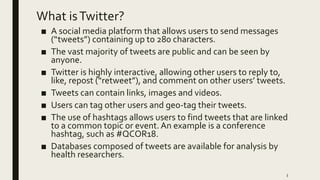
What isTwitter?
■ A social media platform that allows users to send messages
(“tweets”) containing up to 280 characters.
■ The vast majority of tweets are public and can be seen by
anyone.
■ Twitter is highly interactive, allowing other users to reply to,
like, repost (“retweet”), and comment on other users’ tweets.
■ Tweets can contain links, images and videos.
■ Users can tag other users and geo-tag their tweets.
■ The use of hashtags allows users to find tweets that are linked
to a common topic or event. An example is a conference
hashtag, such as #QCOR18.
■ Databases composed of tweets are available for analysis by
health researchers.
3
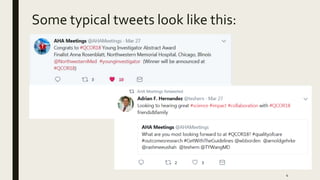
Some typical tweets look like this:
4
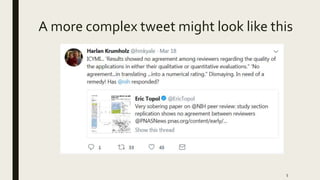
A more complex tweet might look like this
5
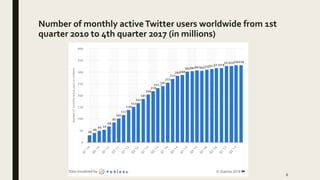
Number of monthly activeTwitter users worldwide from 1st
quarter 2010 to 4th quarter 2017 (in millions)
6
AHA Presence onTwitter
7Source:Twitter.com, accessed 3/29/18.
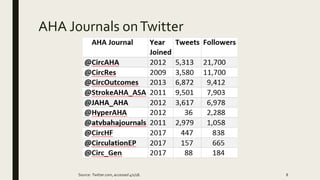
AHA Journals onTwitter
8Source: Twitter.com, accessed 4/1/18.
How medical journals onTwitter can
stimulate interest /excitement
Journals are experimenting with a variety of ways to generate interest and
excitement with theirTwitter feeds, including:
■ Editors tweeting from their personalTwitter accounts to comment on
articles
■ Attaching images
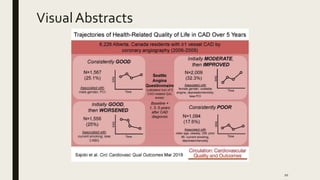
■ Visual abstracts
■ Podcasts (advertised onTwitter)
■ Quizzes and polls
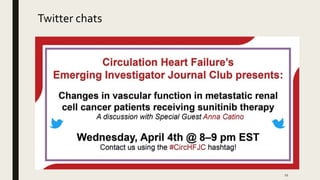
■ Twitter journal clubs
■ Blog posts summarizing articles, cross-posted toTwitter
Fox, et al. JAHA. 2016;5:e003088. Ibrahim, et al. Annals of Surgery. 2017;266:e46-e48. Hawkins, et al. JACR.
2017;14:596-602.
9
Visual Abstracts
10
11
Twitter chats
Benefits ofTwitter involvement for health
professionals/researchers
■ Spreading information on an emerging innovation or best practice
■ Explaining and summarizing new research
■ Patient education and support
■ Better interaction with colleagues, forming new connections
■ Keeping up with the medical literature
■ Correcting/counteracting online misinformation
■ Engaging patients in clinical trials
■ Discussing important/controversial issues in health care
■ Promoting the public health
12
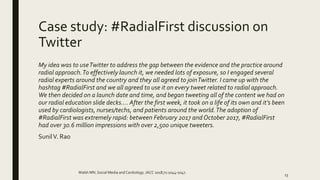
Case study: #RadialFirst discussion on
Twitter
My idea was to useTwitter to address the gap between the evidence and the practice around
radial approach.To effectively launch it, we needed lots of exposure, so I engaged several
radial experts around the country and they all agreed to joinTwitter. I came up with the
hashtag #RadialFirst and we all agreed to use it on every tweet related to radial approach.
We then decided on a launch date and time, and began tweeting all of the content we had on
our radial education slide decks…. After the first week, it took on a life of its own and it’s been
used by cardiologists, nurses/techs, and patients around the world.The adoption of
#RadialFirst was extremely rapid: between February 2017 and October 2017, #RadialFirst
had over 30.6 million impressions with over 2,500 unique tweeters.
SunilV. Rao
Walsh MN. Social Media and Cardiology. JACC 2018;71:1044-1047.
13
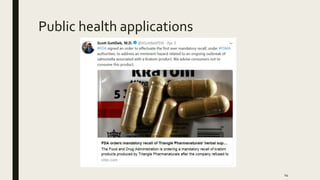
Public health applications
14
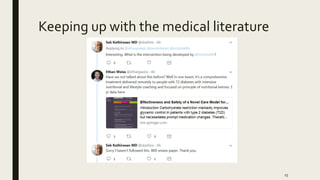
Keeping up with the medical literature
15
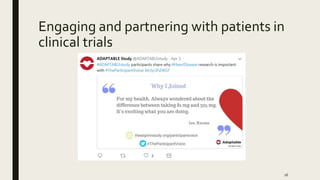
Engaging and partnering with patients in
clinical trials
16
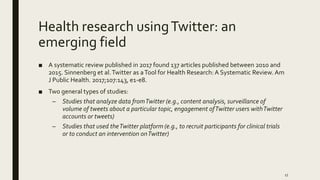
Health research usingTwitter: an
emerging field
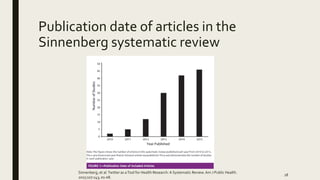
■ A systematic review published in 2017 found 137 articles published between 2010 and
2015. Sinnenberg et al.Twitter as aTool for Health Research: A Systematic Review. Am
J Public Health. 2017;107:143, e1-e8.
■ Two general types of studies:
– Studies that analyze data fromTwitter (e.g., content analysis, surveillance of
volume of tweets about a particular topic, engagement ofTwitter users withTwitter
accounts or tweets)
– Studies that used theTwitter platform (e.g., to recruit participants for clinical trials
or to conduct an intervention onTwitter)
17
Publication date of articles in the
Sinnenberg systematic review
Sinnenberg, et al.Twitter as aTool for Health Research: A Systematic Review.Am J Public Health.
2017;107:143, e1-e8.
18
Summary
■ Twitter is a highly interactive social media platform that can be used for health
communication.
■ Health professionals, researchers and consumers/patients are usingTwitter for
networking, education, and public outreach.
■ Analysis ofTwitter data is a new field of health research.
■ TheTwitter platform can be used in connection with clinical trial recruitment, support
and communication and other health care interventions.
19

Marilyn mann slides for qcor 2018 final

  • 1.
    TWITTER FORTHE PUBLICGOOD OR WHYYOU SHOULD BE ONTWITTER QCOR 2018 April 7, 2018 Marilyn Mann, JD @MarilynMann mannm@comcast.net
  • 2.
    Disclosures • AmericanCollege ofCardiology: travel expenses • American Board of Internal Medicine: travel expenses • Yale Center for Outcomes Research and Evaluation: consulting fee for serving on a stakeholder advisory committee for developing a performance measure under a contract with CMS 2
  • 3.
    What isTwitter? ■ Asocial media platform that allows users to send messages (“tweets”) containing up to 280 characters. ■ The vast majority of tweets are public and can be seen by anyone. ■ Twitter is highly interactive, allowing other users to reply to, like, repost (“retweet”), and comment on other users’ tweets. ■ Tweets can contain links, images and videos. ■ Users can tag other users and geo-tag their tweets. ■ The use of hashtags allows users to find tweets that are linked to a common topic or event. An example is a conference hashtag, such as #QCOR18. ■ Databases composed of tweets are available for analysis by health researchers. 3
  • 4.
    Some typical tweetslook like this: 4
  • 5.
    A more complextweet might look like this 5
  • 6.
    Number of monthlyactiveTwitter users worldwide from 1st quarter 2010 to 4th quarter 2017 (in millions) 6
  • 7.
  • 8.
    AHA Journals onTwitter 8Source:Twitter.com, accessed 4/1/18.
  • 9.
    How medical journalsonTwitter can stimulate interest /excitement Journals are experimenting with a variety of ways to generate interest and excitement with theirTwitter feeds, including: ■ Editors tweeting from their personalTwitter accounts to comment on articles ■ Attaching images ■ Visual abstracts ■ Podcasts (advertised onTwitter) ■ Quizzes and polls ■ Twitter journal clubs ■ Blog posts summarizing articles, cross-posted toTwitter Fox, et al. JAHA. 2016;5:e003088. Ibrahim, et al. Annals of Surgery. 2017;266:e46-e48. Hawkins, et al. JACR. 2017;14:596-602. 9
  • 10.
  • 11.
  • 12.
    Benefits ofTwitter involvementfor health professionals/researchers ■ Spreading information on an emerging innovation or best practice ■ Explaining and summarizing new research ■ Patient education and support ■ Better interaction with colleagues, forming new connections ■ Keeping up with the medical literature ■ Correcting/counteracting online misinformation ■ Engaging patients in clinical trials ■ Discussing important/controversial issues in health care ■ Promoting the public health 12
  • 13.
    Case study: #RadialFirstdiscussion on Twitter My idea was to useTwitter to address the gap between the evidence and the practice around radial approach.To effectively launch it, we needed lots of exposure, so I engaged several radial experts around the country and they all agreed to joinTwitter. I came up with the hashtag #RadialFirst and we all agreed to use it on every tweet related to radial approach. We then decided on a launch date and time, and began tweeting all of the content we had on our radial education slide decks…. After the first week, it took on a life of its own and it’s been used by cardiologists, nurses/techs, and patients around the world.The adoption of #RadialFirst was extremely rapid: between February 2017 and October 2017, #RadialFirst had over 30.6 million impressions with over 2,500 unique tweeters. SunilV. Rao Walsh MN. Social Media and Cardiology. JACC 2018;71:1044-1047. 13
  • 14.
  • 15.
    Keeping up withthe medical literature 15
  • 16.
    Engaging and partneringwith patients in clinical trials 16
  • 17.
    Health research usingTwitter:an emerging field ■ A systematic review published in 2017 found 137 articles published between 2010 and 2015. Sinnenberg et al.Twitter as aTool for Health Research: A Systematic Review. Am J Public Health. 2017;107:143, e1-e8. ■ Two general types of studies: – Studies that analyze data fromTwitter (e.g., content analysis, surveillance of volume of tweets about a particular topic, engagement ofTwitter users withTwitter accounts or tweets) – Studies that used theTwitter platform (e.g., to recruit participants for clinical trials or to conduct an intervention onTwitter) 17
  • 18.
    Publication date ofarticles in the Sinnenberg systematic review Sinnenberg, et al.Twitter as aTool for Health Research: A Systematic Review.Am J Public Health. 2017;107:143, e1-e8. 18
  • 19.
    Summary ■ Twitter isa highly interactive social media platform that can be used for health communication. ■ Health professionals, researchers and consumers/patients are usingTwitter for networking, education, and public outreach. ■ Analysis ofTwitter data is a new field of health research. ■ TheTwitter platform can be used in connection with clinical trial recruitment, support and communication and other health care interventions. 19