Ahmed - 1 . Inheritance
Polash - 2 . Polymorphism
Aman - 3 . Overloading
- 4 . Overriding
Mustafiz - 5 . Construction
- 6 . Encapsulation
Galib - 7 . Diff between method n construction
- 8 . Abstract
Welcome to our presentation
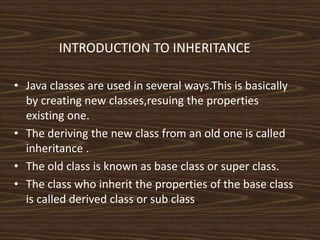
INTRODUCTION TO INHERITANCE
• Java classes are used in several ways.This is basically
by creating new classes,resuing the properties
existing one.
• The deriving the new class from an old one is called
inheritance .
• The old class is known as base class or super class.
• The class who inherit the properties of the base class
is called derived class or sub class.
TYPES OF INHERITANCE
• Single inheritance(one super class)
• Multiple inheritance
• Multilevel inheritance
• Hierarchical inheritance
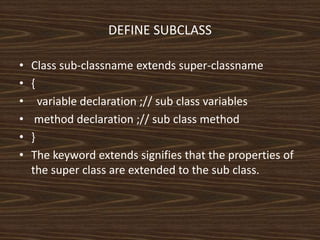
DEFINE SUBCLASS
• Class sub-classname extends super-classname
• {
• variable declaration ;// sub class variables
• method declaration ;// sub class method
• }
• The keyword extends signifies that the properties of
the super class are extended to the sub class.
EXAMPLE OF SINGLE INHERITANCE
• Class sum //Super class
• {
• int a=10;
• int b=20;
• void show()
• {
• System.out.println(“value of a :-” +a);
• System.out.println(“value of a :-” +b);
• }
• }
• Class sum2 extends sum //base class
• {
• public static void main(String args[])
• {
• Sum2 obj =new sum2();
• Obj.show1();
}
}
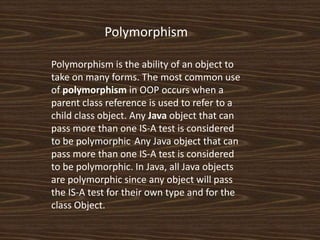
Polymorphism is the ability of an object to
take on many forms. The most common use
of polymorphism in OOP occurs when a
parent class reference is used to refer to a
child class object. Any Java object that can
pass more than one IS-A test is considered
to be polymorphic. Any Java object that can
pass more than one IS-A test is considered
to be polymorphic. In Java, all Java objects
are polymorphic since any object will pass
the IS-A test for their own type and for the
class Object.
Polymorphism
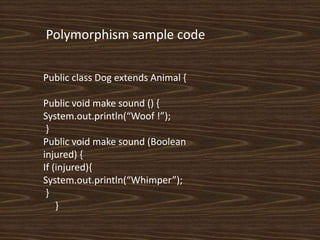
Public class Dog extends Animal {
Public void make sound () {
System.out.println(“Woof !”);
}
Public void make sound (Boolean
injured) {
If (injured){
System.out.println(“Whimper”);
}
}
Polymorphism sample code
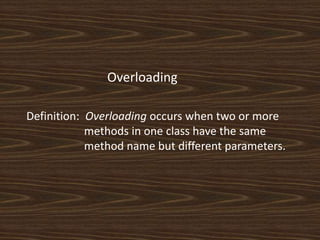
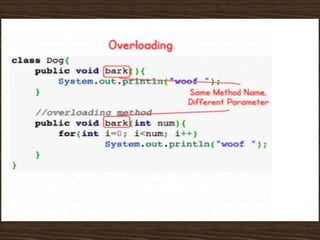
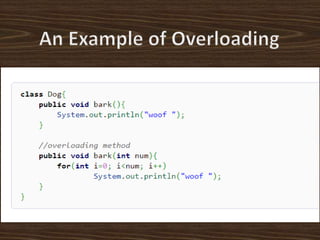
Definition: Overloading occurs when two or more
methods in one class have the same
method name but different parameters.
Overloading
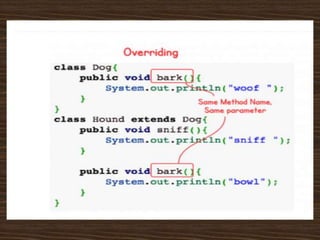
Definition:
Overriding means having two methods with the same
method name and parameters. One of the methods is in
the parent class and the other is in the child class.
Overriding allows a child class to provide a specific
implementation of a method that is already provided its
parent class.
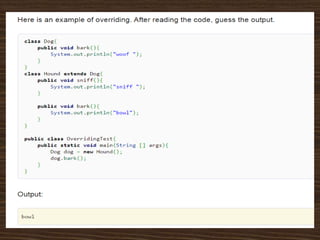
 In the example above, the dog variable is declared
to be a Dog. During compile time, the compiler
checks if the Dog class has the bark() method. As
long as the Dog class has the bark() method, the
code compilers. At run-time, a Hound is created
and assigned to dog. The JVM knows that dog is
referring to the object of Hound, so it calls
the bark() method of Hound. This is called
Dynamic Polymorphism
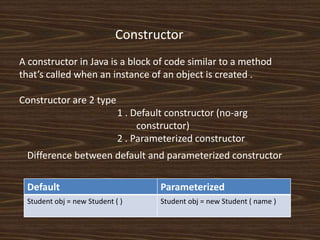
Constructor
A constructor in Java is a block of code similar to a method
that’s called when an instance of an object is created .
Constructor are 2 type
1 . Default constructor (no-arg
constructor)
2 . Parameterized constructor
Default Parameterized
Student obj = new Student ( ) Student obj = new Student ( name )
Difference between default and parameterized constructor
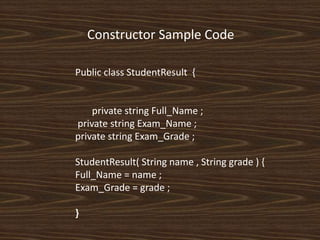
Public class StudentResult {
private string Full_Name ;
private string Exam_Name ;
private string Exam_Grade ;
StudentResult( String name , String grade ) {
Full_Name = name ;
Exam_Grade = grade ;
}
Constructor Sample Code
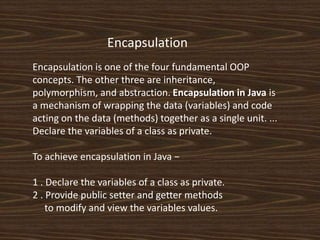
Encapsulation is one of the four fundamental OOP
concepts. The other three are inheritance,
polymorphism, and abstraction. Encapsulation in Java is
a mechanism of wrapping the data (variables) and code
acting on the data (methods) together as a single unit. ...
Declare the variables of a class as private.
To achieve encapsulation in Java −
1 . Declare the variables of a class as private.
2 . Provide public setter and getter methods
to modify and view the variables values.
Encapsulation
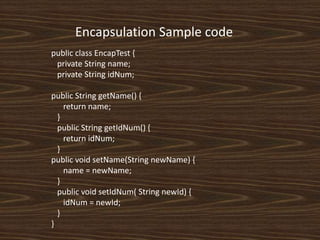
public class EncapTest {
private String name;
private String idNum;
public String getName() {
return name;
}
public String getIdNum() {
return idNum;
}
public void setName(String newName) {
name = newName;
}
public void setIdNum( String newId) {
idNum = newId;
}
}
Encapsulation Sample code
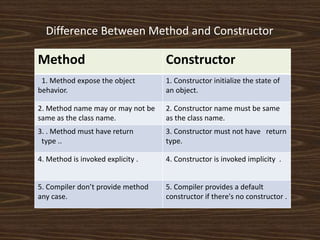
Method Constructor
1. Method expose the object
behavior.
1. Constructor initialize the state of
an object.
2. Method name may or may not be
same as the class name.
2. Constructor name must be same
as the class name.
3. . Method must have return
type ..
3. Constructor must not have return
type.
4. Method is invoked explicity . 4. Constructor is invoked implicity .
5. Compiler don’t provide method
any case.
5. Compiler provides a default
constructor if there's no constructor .
Difference Between Method and Constructor
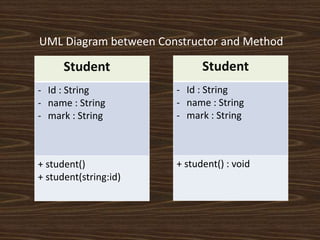
Student
- Id : String
- name : String
- mark : String
+ student()
+ student(string:id)
Student
- Id : String
- name : String
- mark : String
+ student() : void
UML Diagram between Constructor and Method
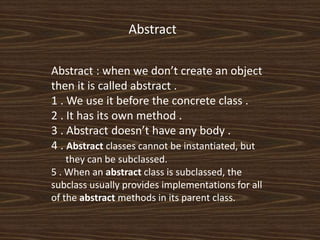
Abstract
Abstract : when we don’t create an object
then it is called abstract .
1 . We use it before the concrete class .
2 . It has its own method .
3 . Abstract doesn’t have any body .
4 . Abstract classes cannot be instantiated, but
they can be subclassed.
5 . When an abstract class is subclassed, the
subclass usually provides implementations for all
of the abstract methods in its parent class.
Abstract class HelloAbstractWorld { }
Class AbstractDemo {
Public static void main (String ar [ ]) {
System.out.println(“Hello World”);
//HelloAbstractWorld obj = new HelloAbstractWorld
}
} /* HelloAbstractWorld is Abstract and cannot be
intantiated */
Simple Abstract Code
Thank you
Hope u don’t get bored !!

Java

  • 1.
    Ahmed - 1. Inheritance Polash - 2 . Polymorphism Aman - 3 . Overloading - 4 . Overriding Mustafiz - 5 . Construction - 6 . Encapsulation Galib - 7 . Diff between method n construction - 8 . Abstract Welcome to our presentation
  • 2.
    INTRODUCTION TO INHERITANCE •Java classes are used in several ways.This is basically by creating new classes,resuing the properties existing one. • The deriving the new class from an old one is called inheritance . • The old class is known as base class or super class. • The class who inherit the properties of the base class is called derived class or sub class.
  • 3.
    TYPES OF INHERITANCE •Single inheritance(one super class) • Multiple inheritance • Multilevel inheritance • Hierarchical inheritance
  • 4.
    DEFINE SUBCLASS • Classsub-classname extends super-classname • { • variable declaration ;// sub class variables • method declaration ;// sub class method • } • The keyword extends signifies that the properties of the super class are extended to the sub class.
  • 5.
    EXAMPLE OF SINGLEINHERITANCE • Class sum //Super class • { • int a=10; • int b=20; • void show() • { • System.out.println(“value of a :-” +a); • System.out.println(“value of a :-” +b); • } • } • Class sum2 extends sum //base class • { • public static void main(String args[]) • { • Sum2 obj =new sum2(); • Obj.show1(); } }
  • 6.
    Polymorphism is theability of an object to take on many forms. The most common use of polymorphism in OOP occurs when a parent class reference is used to refer to a child class object. Any Java object that can pass more than one IS-A test is considered to be polymorphic. Any Java object that can pass more than one IS-A test is considered to be polymorphic. In Java, all Java objects are polymorphic since any object will pass the IS-A test for their own type and for the class Object. Polymorphism
  • 7.
    Public class Dogextends Animal { Public void make sound () { System.out.println(“Woof !”); } Public void make sound (Boolean injured) { If (injured){ System.out.println(“Whimper”); } } Polymorphism sample code
  • 8.
    Definition: Overloading occurswhen two or more methods in one class have the same method name but different parameters. Overloading
  • 11.
    Definition: Overriding means havingtwo methods with the same method name and parameters. One of the methods is in the parent class and the other is in the child class. Overriding allows a child class to provide a specific implementation of a method that is already provided its parent class.
  • 14.
     In theexample above, the dog variable is declared to be a Dog. During compile time, the compiler checks if the Dog class has the bark() method. As long as the Dog class has the bark() method, the code compilers. At run-time, a Hound is created and assigned to dog. The JVM knows that dog is referring to the object of Hound, so it calls the bark() method of Hound. This is called Dynamic Polymorphism
  • 15.
    Constructor A constructor inJava is a block of code similar to a method that’s called when an instance of an object is created . Constructor are 2 type 1 . Default constructor (no-arg constructor) 2 . Parameterized constructor Default Parameterized Student obj = new Student ( ) Student obj = new Student ( name ) Difference between default and parameterized constructor
  • 16.
    Public class StudentResult{ private string Full_Name ; private string Exam_Name ; private string Exam_Grade ; StudentResult( String name , String grade ) { Full_Name = name ; Exam_Grade = grade ; } Constructor Sample Code
  • 17.
    Encapsulation is oneof the four fundamental OOP concepts. The other three are inheritance, polymorphism, and abstraction. Encapsulation in Java is a mechanism of wrapping the data (variables) and code acting on the data (methods) together as a single unit. ... Declare the variables of a class as private. To achieve encapsulation in Java − 1 . Declare the variables of a class as private. 2 . Provide public setter and getter methods to modify and view the variables values. Encapsulation
  • 18.
    public class EncapTest{ private String name; private String idNum; public String getName() { return name; } public String getIdNum() { return idNum; } public void setName(String newName) { name = newName; } public void setIdNum( String newId) { idNum = newId; } } Encapsulation Sample code
  • 19.
    Method Constructor 1. Methodexpose the object behavior. 1. Constructor initialize the state of an object. 2. Method name may or may not be same as the class name. 2. Constructor name must be same as the class name. 3. . Method must have return type .. 3. Constructor must not have return type. 4. Method is invoked explicity . 4. Constructor is invoked implicity . 5. Compiler don’t provide method any case. 5. Compiler provides a default constructor if there's no constructor . Difference Between Method and Constructor
  • 20.
    Student - Id :String - name : String - mark : String + student() + student(string:id) Student - Id : String - name : String - mark : String + student() : void UML Diagram between Constructor and Method
  • 21.
    Abstract Abstract : whenwe don’t create an object then it is called abstract . 1 . We use it before the concrete class . 2 . It has its own method . 3 . Abstract doesn’t have any body . 4 . Abstract classes cannot be instantiated, but they can be subclassed. 5 . When an abstract class is subclassed, the subclass usually provides implementations for all of the abstract methods in its parent class.
  • 22.
    Abstract class HelloAbstractWorld{ } Class AbstractDemo { Public static void main (String ar [ ]) { System.out.println(“Hello World”); //HelloAbstractWorld obj = new HelloAbstractWorld } } /* HelloAbstractWorld is Abstract and cannot be intantiated */ Simple Abstract Code
  • 23.
    Thank you Hope udon’t get bored !!