Download as PDF, PPTX



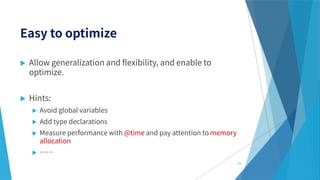
![a = [1, 2, 3, 4, 5]
function square(x)
return x^2
end
for x in a
println(square(x))
end
10](https://image.slidesharecdn.com/20190907thelanguageforfuturejulia-190904030124/85/20190907-Julia-the-language-for-future-10-320.jpg)






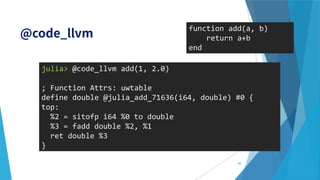
![julia> @code_native add(1, 2)
.text
Filename: REPL[2]
pushq %rbp
movq %rsp, %rbp
Source line: 2
leaq (%rcx,%rdx), %rax
popq %rbp
retq
nopw (%rax,%rax)
function add(a, b)
return a+b
end
39](https://image.slidesharecdn.com/20190907thelanguageforfuturejulia-190904030124/85/20190907-Julia-the-language-for-future-35-320.jpg)

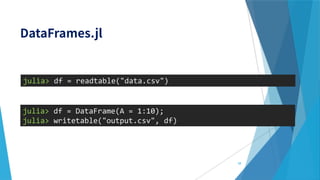
![julia> using DataFrames
julia> df = DataFrame(A = 1:4, B = ["M", "F", "F", "M"])
4× 2 DataFrame
│ Row │ A │ B │
├─────┼───┼───┤
│ 1 │ 1 │ M │
│ 2 │ 2 │ F │
│ 3 │ 3 │ F │
│ 4 │ 4 │ M │
56](https://image.slidesharecdn.com/20190907thelanguageforfuturejulia-190904030124/85/20190907-Julia-the-language-for-future-43-320.jpg)
![julia> df[:A]
4-element Array{Int64,1}:
1
2
3
4
julia> df[2, :A]
2
57](https://image.slidesharecdn.com/20190907thelanguageforfuturejulia-190904030124/85/20190907-Julia-the-language-for-future-44-320.jpg)
![julia> names = DataFrame(ID = [1, 2], Name = ["John Doe",
"Jane Doe"])
julia> jobs = DataFrame(ID = [1, 2], Job = ["Lawyer",
"Doctor"])
julia> full = join(names, jobs, on = :ID)
2× 3 DataFrame
│ Row │ ID │ Name │ Job │
├─────┼────┼──────────┼────────┤
│ 1 │ 1 │ John Doe │ Lawyer │
│ 2 │ 2 │ Jane Doe │ Doctor │ 59](https://image.slidesharecdn.com/20190907thelanguageforfuturejulia-190904030124/85/20190907-Julia-the-language-for-future-46-320.jpg)

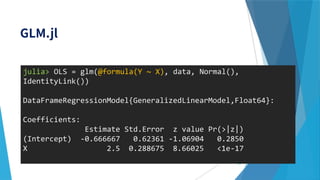
![64
julia> data = DataFrame(X=[1,2,3], Y=[2,4,7])
3x2 DataFrame
|-------|---|---|
| Row # | X | Y |
| 1 | 1 | 2 |
| 2 | 2 | 4 |
| 3 | 3 | 7 |](https://image.slidesharecdn.com/20190907thelanguageforfuturejulia-190904030124/85/20190907-Julia-the-language-for-future-51-320.jpg)
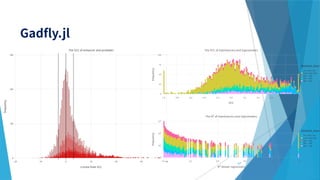
![66
julia> newX = DataFrame(X=[2,3,4]);
julia> predict(OLS, newX, :confint)
3× 3 Array{Float64,2}:
4.33333 1.33845 7.32821
6.83333 2.09801 11.5687
9.33333 1.40962 17.257
# The columns of the matrix are prediction, 95% lower and
upper confidence bounds](https://image.slidesharecdn.com/20190907thelanguageforfuturejulia-190904030124/85/20190907-Julia-the-language-for-future-53-320.jpg)
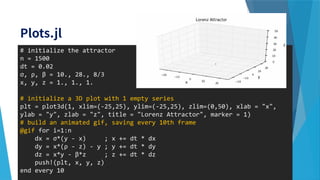
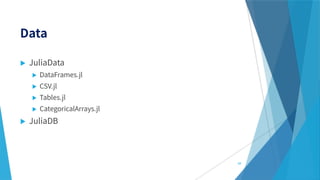


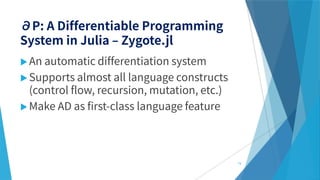


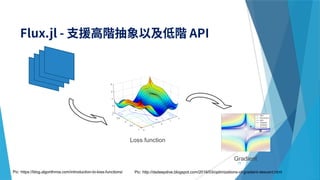
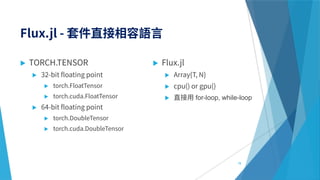

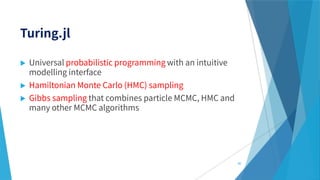
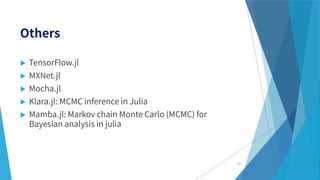
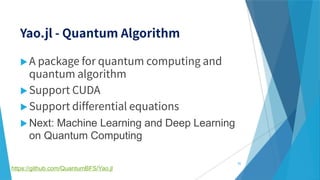

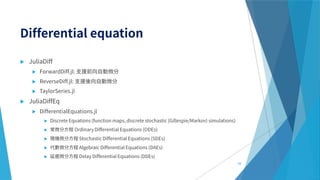
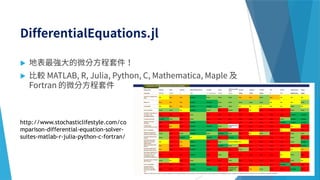

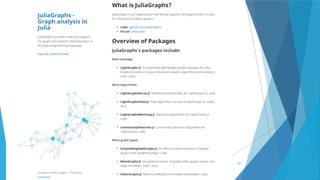









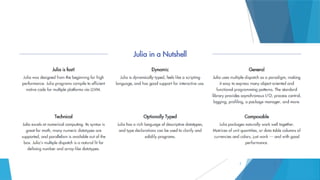
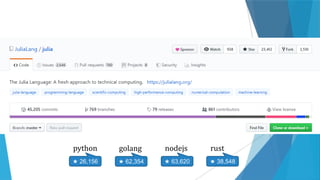
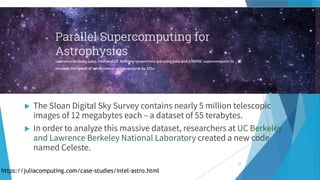
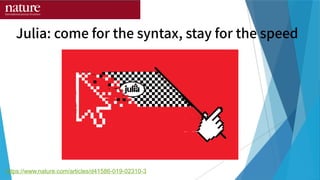
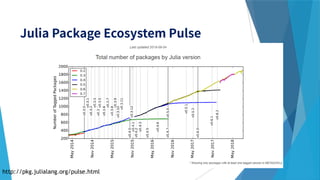
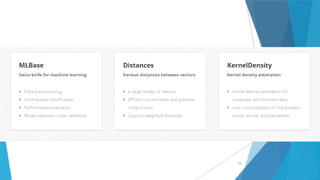
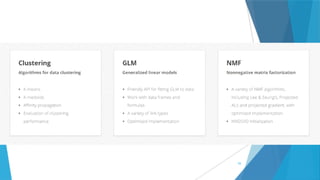
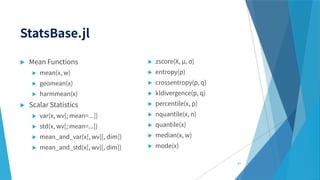
The document discusses the Julia programming language. It provides information on Julia's popularity compared to other languages like Python and R. It highlights several use cases for Julia in fields like finance, science, and engineering. It also demonstrates basic Julia code for tasks like data analysis, plotting, and numerical computing. Overall, the document serves as an introduction to the Julia language and provides examples of its capabilities.


![[COSCUP 2023] 我的Julia軟體架構演進之旅](https://cdn.slidesharecdn.com/ss_thumbnails/slides-230807142223-9909fa32-thumbnail.jpg?width=640&height=640&fit=bounds)


