Unikernels	-	The	next	big	little	thing	?
Snowcamp.io,	Grenoble,	France,	Feb	2017
Mike	Bright,	 	@mjbright
Overview
What	are	Unikernels?
Why	do	we	need	them?
Domains	of	application
Unikernel	implementations
Clean-slate	or	legacy
Tooling
Containers	and	Unikernels
Demo
Conclusions
Unikernels
@mjbright
Why	this	talk?
@mjbright
Why	this	talk?
Curiosity	about
What	we	can	expect	to	see	from	Unikernels	(and	Docker	...)
Who	the	players	are
@mjbright
Why	this	talk?
Curiosity	about
What	we	can	expect	to	see	from	Unikernels	(and	Docker	...)
Who	the	players	are
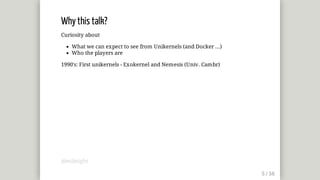
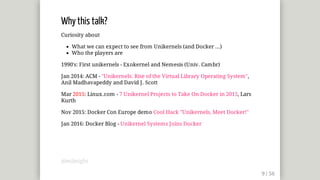
1990's:	First	unikernels	-	Exokernel	and	Nemesis	(Univ.	Cambr)
@mjbright
Why	this	talk?
Curiosity	about
What	we	can	expect	to	see	from	Unikernels	(and	Docker	...)
Who	the	players	are
1990's:	First	unikernels	-	Exokernel	and	Nemesis	(Univ.	Cambr)
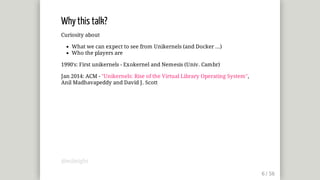
Jan	2014:	ACM	-	"Unikernels:	Rise	of	the	Virtual	Library	Operating	System",
Anil	Madhavapeddy	and	David	J.	Scott
@mjbright
Why	this	talk?
Curiosity	about
What	we	can	expect	to	see	from	Unikernels	(and	Docker	...)
Who	the	players	are
1990's:	First	unikernels	-	Exokernel	and	Nemesis	(Univ.	Cambr)
Jan	2014:	ACM	-	"Unikernels:	Rise	of	the	Virtual	Library	Operating	System",
Anil	Madhavapeddy	and	David	J.	Scott
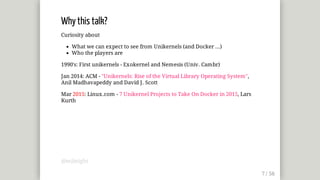
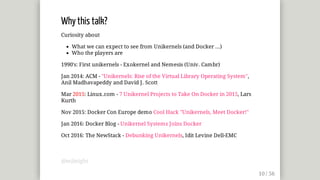
Mar	2015:	Linux.com	-	7	Unikernel	Projects	to	Take	On	Docker	in	2015,	Lars
Kurth
@mjbright
Why	this	talk?
Curiosity	about
What	we	can	expect	to	see	from	Unikernels	(and	Docker	...)
Who	the	players	are
1990's:	First	unikernels	-	Exokernel	and	Nemesis	(Univ.	Cambr)
Jan	2014:	ACM	-	"Unikernels:	Rise	of	the	Virtual	Library	Operating	System",
Anil	Madhavapeddy	and	David	J.	Scott
Mar	2015:	Linux.com	-	7	Unikernel	Projects	to	Take	On	Docker	in	2015,	Lars
Kurth
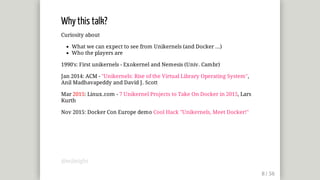
Nov	2015:	Docker	Con	Europe	demo	Cool	Hack	"Unikernels,	Meet	Docker!"
@mjbright
Why	this	talk?
Curiosity	about
What	we	can	expect	to	see	from	Unikernels	(and	Docker	...)
Who	the	players	are
1990's:	First	unikernels	-	Exokernel	and	Nemesis	(Univ.	Cambr)
Jan	2014:	ACM	-	"Unikernels:	Rise	of	the	Virtual	Library	Operating	System",
Anil	Madhavapeddy	and	David	J.	Scott
Mar	2015:	Linux.com	-	7	Unikernel	Projects	to	Take	On	Docker	in	2015,	Lars
Kurth
Nov	2015:	Docker	Con	Europe	demo	Cool	Hack	"Unikernels,	Meet	Docker!"
Jan	2016:	Docker	Blog	-	Unikernel	Systems	Joins	Docker
@mjbright
Why	this	talk?
Curiosity	about
What	we	can	expect	to	see	from	Unikernels	(and	Docker	...)
Who	the	players	are
1990's:	First	unikernels	-	Exokernel	and	Nemesis	(Univ.	Cambr)
Jan	2014:	ACM	-	"Unikernels:	Rise	of	the	Virtual	Library	Operating	System",
Anil	Madhavapeddy	and	David	J.	Scott
Mar	2015:	Linux.com	-	7	Unikernel	Projects	to	Take	On	Docker	in	2015,	Lars
Kurth
Nov	2015:	Docker	Con	Europe	demo	Cool	Hack	"Unikernels,	Meet	Docker!"
Jan	2016:	Docker	Blog	-	Unikernel	Systems	Joins	Docker
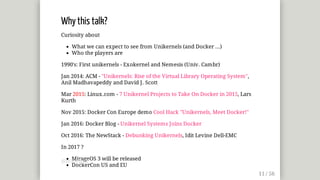
Oct	2016:	The	NewStack	-	Debunking	Unikernels,	Idit	Levine	Dell-EMC
@mjbright
Why	this	talk?
Curiosity	about
What	we	can	expect	to	see	from	Unikernels	(and	Docker	...)
Who	the	players	are
1990's:	First	unikernels	-	Exokernel	and	Nemesis	(Univ.	Cambr)
Jan	2014:	ACM	-	"Unikernels:	Rise	of	the	Virtual	Library	Operating	System",
Anil	Madhavapeddy	and	David	J.	Scott
Mar	2015:	Linux.com	-	7	Unikernel	Projects	to	Take	On	Docker	in	2015,	Lars
Kurth
Nov	2015:	Docker	Con	Europe	demo	Cool	Hack	"Unikernels,	Meet	Docker!"
Jan	2016:	Docker	Blog	-	Unikernel	Systems	Joins	Docker
Oct	2016:	The	NewStack	-	Debunking	Unikernels,	Idit	Levine	Dell-EMC
In	2017	?
MirageOS	3	will	be	released
DockerCon	US	and	EU
@mjbright
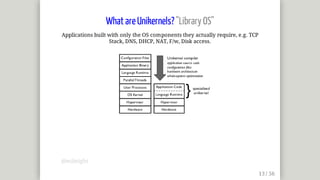
What	are	Unikernels?	"Library	OS"
Applications	built	with	only	the	OS	components	they	actually	require,	e.g.	TCP
Stack,	DNS,	DHCP,	NAT,	F/w,	Disk	access.
@mjbright
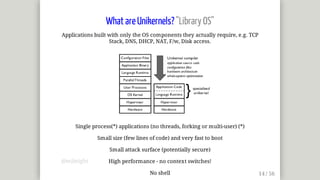
What	are	Unikernels?	"Library	OS"
Applications	built	with	only	the	OS	components	they	actually	require,	e.g.	TCP
Stack,	DNS,	DHCP,	NAT,	F/w,	Disk	access.
Single	process(*)	applications	(no	threads,	forking	or	multi-user)	(*)
Small	size	(few	lines	of	code)	and	very	fast	to	boot
Small	attack	surface	(potentially	secure)
High	performance	-	no	context	switches!
No	shell
@mjbright
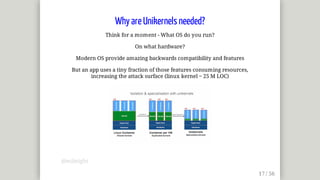
Why	are	Unikernels	needed?
Think	for	a	moment	-	What	OS	do	you	run?
On	what	hardware?
Modern	OS	provide	amazing	backwards	compatibility	and	features
@mjbright
Why	are	Unikernels	needed?
Think	for	a	moment	-	What	OS	do	you	run?
On	what	hardware?
Modern	OS	provide	amazing	backwards	compatibility	and	features
But	an	app	uses	a	tiny	fraction	of	those	features	consuming	resources,
increasing	the	attack	surface	(linux	kernel	~	25	M	LOC)
@mjbright
Why	are	Unikernels	needed?
Think	for	a	moment	-	What	OS	do	you	run?
On	what	hardware?
Modern	OS	provide	amazing	backwards	compatibility	and	features
But	an	app	uses	a	tiny	fraction	of	those	features	consuming	resources,
increasing	the	attack	surface	(linux	kernel	~	25	M	LOC)
@mjbright
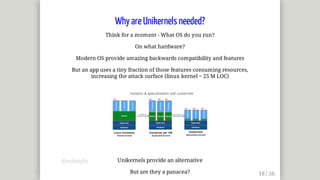
Why	are	Unikernels	needed?
Think	for	a	moment	-	What	OS	do	you	run?
On	what	hardware?
Modern	OS	provide	amazing	backwards	compatibility	and	features
But	an	app	uses	a	tiny	fraction	of	those	features	consuming	resources,
increasing	the	attack	surface	(linux	kernel	~	25	M	LOC)
Unikernels	provide	an	alternative
But	are	they	a	panacea?
@mjbright
The	2	families	of	Unikernels
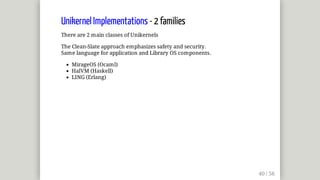
Unikernel	Implementations	-	2	families
There	are	2	main	classes	of	Unikernels
Unikernel	Implementations	-	2	families
There	are	2	main	classes	of	Unikernels
Clean-Slate
The	Clean-Slate	approach	emphasizes	safety	and	security.
Same	language	for	application	and	"Library	OS"	components.
One	example	of	this	approach	is	MirageOS	(written	in	Ocaml)
Unikernel	Implementations	-	2	families
There	are	2	main	classes	of	Unikernels
Clean-Slate
The	Clean-Slate	approach	emphasizes	safety	and	security.
Same	language	for	application	and	"Library	OS"	components.
One	example	of	this	approach	is	MirageOS	(written	in	Ocaml)
Legacy
The	Legacy	approach	favours	backward	compatibility	of	existing	applications
based	on	POSIX-compatibilities.
One	example	of	this	approach	is	OSv	for	which	there	are	implementatons	of
Tomcat,	Jetty,	Cassandra,	OpenJDK
We	will	see	more	Unikernel	implementations	later	...
Application	domains	for	Unikernels
In	what	domains	might	they	be	used?
Cloud	Computing
Small	(kB/MB)	immutable	entities	with	fast	boot	times	(100's	ms).
Possibility	of	on-demand	servers,	µ-services
Potentially	greater	security	(<	LOC)
@mjbright
In	what	domains	might	they	be	used?
Cloud	Computing
Small	(kB/MB)	immutable	entities	with	fast	boot	times	(100's	ms).
Possibility	of	on-demand	servers,	µ-services
Potentially	greater	security	(<	LOC)
NFV	(Network	Functional	Virtualization)
Cloud	but	stricter	requirements	on	response	times
Decouple	software	from	the	hardware,	decompose/chain	functions
Ericsson,	NEC,	Cisco	are	active	in	this	domain
@mjbright
In	what	domains	might	they	be	used?
Cloud	Computing
Small	(kB/MB)	immutable	entities	with	fast	boot	times	(100's	ms).
Possibility	of	on-demand	servers,	µ-services
Potentially	greater	security	(<	LOC)
NFV	(Network	Functional	Virtualization)
Cloud	but	stricter	requirements	on	response	times
Decouple	software	from	the	hardware,	decompose/chain	functions
Ericsson,	NEC,	Cisco	are	active	in	this	domain
IoT	/	Embedded	/	Network	Switches
For	low-resource,	potentially	secure	elements	(baremetal	or	µ-vmm	?)
Build	up	the	"app"	instead	of	stripping	down	the	"OS"
@mjbright
In	what	domains	might	they	be	used?
Cloud	Computing
Small	(kB/MB)	immutable	entities	with	fast	boot	times	(100's	ms).
Possibility	of	on-demand	servers,	µ-services
Potentially	greater	security	(<	LOC)
NFV	(Network	Functional	Virtualization)
Cloud	but	stricter	requirements	on	response	times
Decouple	software	from	the	hardware,	decompose/chain	functions
Ericsson,	NEC,	Cisco	are	active	in	this	domain
IoT	/	Embedded	/	Network	Switches
For	low-resource,	potentially	secure	elements	(baremetal	or	µ-vmm	?)
Build	up	the	"app"	instead	of	stripping	down	the	"OS"
HPC
Greater	performance	possible	(but	may	be	hard	work)@mjbright
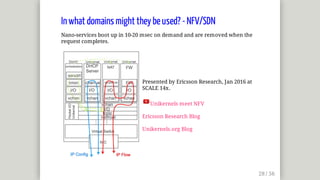
In	what	domains	might	they	be	used?	-	NFV/SDN
Nano-services	boot	up	in	10-20	msec	on	demand	and	are	removed	when	the
request	completes.
Presented	by	Ericsson	Research,	Jan	2016	at
SCALE	14x.	
Unikernels	meet	NFV	
Ericsson	Research	Blog	
Unikernels.org	Blog
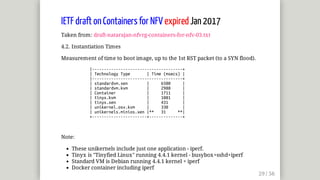
IETF	draft	on	Containers	for	NFV	expired	Jan	2017
Taken	from:	draft-natarajan-nfvrg-containers-for-nfv-03.txt
4.2.	Instantiation	Times
Measurement	of	time	to	boot	image,	up	to	the	1st	RST	packet	(to	a	SYN	flood).
												|--------------------------------------+
												|	Technology	Type							|	Time	(msecs)	|
												|--------------------------------------+
												|	standardvm.xen								|					6500					|
												|	standardvm.kvm								|					2988					|
												|	Container													|					1711					|
												|	tinyx.kvm													|					1081					|
												|	tinyx.xen													|					431						|
												|	unikernel.osv.kvm					|					330						|
												|	unikernels.minios.xen	|**			31					**|
												+-----------------------+--------------+
Note:
These	unikernels	include	just	one	application	-	iperf.
Tinyx	is	"Tinyfied	Linux"	running	4.4.1	kernel	-	busybox+sshd+iperf
Standard	VM	is	Debian	running	4.4.1	kernel	+	iperf
Docker	container	including	iperf
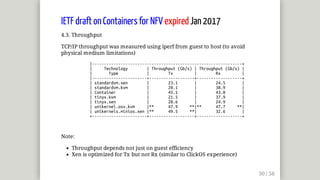
IETF	draft	on	Containers	for	NFV	expired	Jan	2017
4.3.	Throughput
TCP/IP	throughput	was	measured	using	iperf	from	guest	to	host	(to	avoid
physical	medium	limitations)
												|---------------------------------------------------------------+
												|					Technology								|	Throughput	(Gb/s)	|	Throughput	(Gb/s)	|
												|							Type												|								Tx									|								Rx									|
												|-----------------------+-------------------+-------------------+
												|	standardvm.xen								|								23.1							|								24.5							|
												|	standardvm.kvm								|								20.1							|								38.9							|
												|	Container													|								45.1							|								43.8							|
												|	tinyx.kvm													|								21.5							|								37.9							|
												|	tinyx.xen													|								28.6							|								24.9							|
												|	unikernel.osv.kvm					|**						47.9					**|**						47.7					**|
												|	unikernels.minios.xen	|**						49.5					**|								32.6							|
												+-----------------------+-------------------+-------------------+
Note:
Throughput	depends	not	just	on	guest	efficiency
Xen	is	optimized	for	Tx	but	not	Rx	(similar	to	ClickOS	experience)
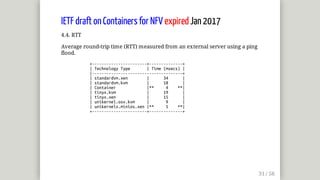
IETF	draft	on	Containers	for	NFV	expired	Jan	2017
4.4.	RTT
Average	round-trip	time	(RTT)	measured	from	an	external	server	using	a	ping
flood.
												+-----------------------+--------------+
												|	Technology	Type							|	Time	(msecs)	|
												|--------------------------------------+
												|	standardvm.xen								|						34						|
												|	standardvm.kvm								|						18						|
												|	Container													|**					4				**|
												|	tinyx.kvm													|						19						|
												|	tinyx.xen													|						15						|
												|	unikernel.osv.kvm					|							9						|
												|	unikernels.minios.xen	|**					5				**|
												+-----------------------+--------------+
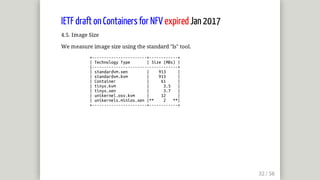
IETF	draft	on	Containers	for	NFV	expired	Jan	2017
4.5.	Image	Size
We	measure	image	size	using	the	standard	"ls"	tool.
												+-----------------------+------------+
												|	Technology	Type							|	Size	(MBs)	|
												|------------------------------------+
												|	standardvm.xen								|				913					|
												|	standardvm.kvm								|				913					|
												|	Container													|					61					|
												|	tinyx.kvm													|						3.5			|
												|	tinyx.xen													|						3.7			|
												|	unikernel.osv.kvm					|					12					|
												|	unikernels.minios.xen	|**				2			**|
												+-----------------------+------------+
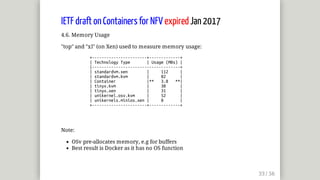
IETF	draft	on	Containers	for	NFV	expired	Jan	2017
4.6.	Memory	Usage
"top"	and	"xl"	(on	Xen)	used	to	measure	memory	usage:
												+-----------------------+-------------+
												|	Technology	Type							|	Usage	(MBs)	|
												|-------------------------------------+
												|	standardvm.xen								|					112					|
												|	standardvm.kvm								|					82						|
												|	Container													|**			3.8			**|
												|	tinyx.kvm													|					30						|
												|	tinyx.xen													|					31						|
												|	unikernel.osv.kvm					|					52						|
												|	unikernels.minios.xen	|					8							|
												+-----------------------+-------------+
Note:
OSv	pre-allocates	memory,	e.g	for	buffers
Best	result	is	Docker	as	it	has	no	OS	function
IETF	draft	on	Containers	for	NFV	expired	Jan	2017
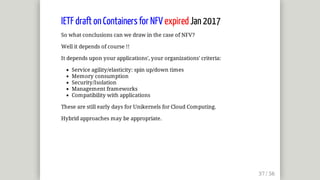
So	what	conclusions	can	we	draw	in	the	case	of	NFV?
IETF	draft	on	Containers	for	NFV	expired	Jan	2017
So	what	conclusions	can	we	draw	in	the	case	of	NFV?
Well	it	depends	of	course	!!
IETF	draft	on	Containers	for	NFV	expired	Jan	2017
So	what	conclusions	can	we	draw	in	the	case	of	NFV?
Well	it	depends	of	course	!!
It	depends	upon	your	applications',	your	organizations'	criteria:
Service	agility/elasticity:	spin	up/down	times
Memory	consumption
Security/Isolation
Management	frameworks
Compatibility	with	applications
IETF	draft	on	Containers	for	NFV	expired	Jan	2017
So	what	conclusions	can	we	draw	in	the	case	of	NFV?
Well	it	depends	of	course	!!
It	depends	upon	your	applications',	your	organizations'	criteria:
Service	agility/elasticity:	spin	up/down	times
Memory	consumption
Security/Isolation
Management	frameworks
Compatibility	with	applications
These	are	still	early	days	for	Unikernels	for	Cloud	Computing.
Hybrid	approaches	may	be	appropriate.
Unikernel	Implementations	...	in	more	detail
Unikernel	Implementations	-	2	families
There	are	2	main	classes	of	Unikernels
Unikernel	Implementations	-	2	families
There	are	2	main	classes	of	Unikernels
The	Clean-Slate	approach	emphasizes	safety	and	security.
Same	language	for	application	and	Library	OS	components.
MirageOS	(Ocaml)
HalVM	(Haskell)
LING	(Erlang)
Unikernel	Implementations	-	2	families
There	are	2	main	classes	of	Unikernels
The	Clean-Slate	approach	emphasizes	safety	and	security.
Same	language	for	application	and	Library	OS	components.
MirageOS	(Ocaml)
HalVM	(Haskell)
LING	(Erlang)
The	Legacy	approach	favours	backward	compatibility	of	existing	applications
based	on	POSIX-compatibilities.
Many	applications	have	been	ported
OSv	(Tomcat,	Jetty,	Cassandra,	OpenJDK,	...)
Rumprun	(MySQL,	PHP,	Nginx)
Runtimejs
Clive	(Go)
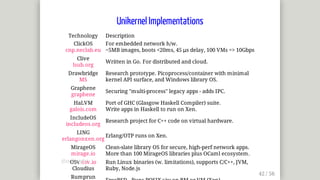
Unikernel	Implementations
Technology Description
ClickOS
cnp.neclab.eu
For	embedded	network	h/w.
~5MB	images,	boots	<20ms,	45	μs	delay,	100	VMs	=>	10Gbps
Clive
lsub.org
Written	in	Go.	For	distributed	and	cloud.
Drawbridge
MS
Research	prototype.	Picoprocess/container	with	minimal
kernel	API	surface,	and	Windows	library	OS.
Graphene
graphene
Securing	"multi-process"	legacy	apps	-	adds	IPC.
HaLVM
galois.com
Port	of	GHC	(Glasgow	Haskell	Compiler)	suite.
Write	apps	in	Haskell	to	run	on	Xen.
IncludeOS
includeos.org
Research	project	for	C++	code	on	virtual	hardware.
LING
erlangonxen.org
Erlang/OTP	runs	on	Xen.
MirageOS
mirage.io
Clean-slate	library	OS	for	secure,	high-perf	network	apps.
More	than	100	MirageOS	libraries	plus	OCaml	ecosystem.
OSv	osv.io
Cloudius
Run	Linux	binaries	(w.	limitations),	supports	C/C++,	JVM,
Ruby,	Node.js
Rumprun
@mjbright
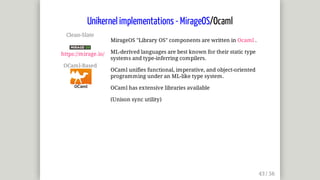
Clean-Slate	
	
https://mirage.io/
OCaml-Based	
MirageOS	"Library	OS"	components	are	written	in	Ocaml	.
ML-derived	languages	are	best	known	for	their	static	type
systems	and	type-inferring	compilers.
OCaml	unifies	functional,	imperative,	and	object-oriented
programming	under	an	ML-like	type	system.
OCaml	has	extensive	libraries	available
(Unison	sync	utility)
Unikernel	implementations	-	MirageOS/Ocaml
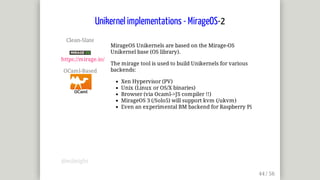
Clean-Slate	
	
https://mirage.io/
OCaml-Based	
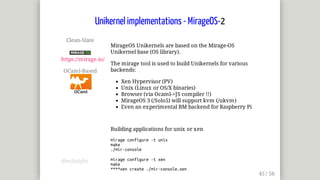
MirageOS	Unikernels	are	based	on	the	Mirage-OS
Unikernel	base	(OS	library).
The	mirage	tool	is	used	to	build	Unikernels	for	various
backends:
Xen	Hypervisor	(PV)
Unix	(Linux	or	OS/X	binaries)
Browser	(via	Ocaml->JS	compiler	!!)
MirageOS	3	(/Solo5)	will	support	kvm	(/ukvm)
Even	an	experimental	BM	backend	for	Raspberry	Pi
Unikernel	implementations	-	MirageOS-2
@mjbright
Clean-Slate	
	
https://mirage.io/
OCaml-Based	
MirageOS	Unikernels	are	based	on	the	Mirage-OS
Unikernel	base	(OS	library).
The	mirage	tool	is	used	to	build	Unikernels	for	various
backends:
Xen	Hypervisor	(PV)
Unix	(Linux	or	OS/X	binaries)
Browser	(via	Ocaml->JS	compiler	!!)
MirageOS	3	(/Solo5)	will	support	kvm	(/ukvm)
Even	an	experimental	BM	backend	for	Raspberry	Pi
Building	applications	for	unix	or	xen
mirage	configure	-t	unix
make
./mir-console
mirage	configure	-t	xen
make
****xen	create	./mir-console.xen
Unikernel	implementations	-	MirageOS-2
@mjbright
Clean-Slate	
	
https://mirage.io/
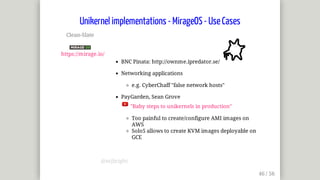
BNC	Pinata:	http://ownme.ipredator.se/	
Networking	applications
e.g.	CyberChaff	"false	network	hosts"
PayGarden,	Sean	Grove	
	"Baby	steps	to	unikernels	in	production"
Too	painful	to	create/configure	AMI	images	on
AWS
Solo5	allows	to	create	KVM	images	deployable	on
GCE
Unikernel	implementations	-	MirageOS	-	Use	Cases
@mjbright
Unik	[EMC-Dell]:	"The	Unikernel	Compilation	and
Deployment	Platform"	(+	image	hub)
rumprun:	Python,	Node.js	and	Go
OSv:	Java,	Node.js,	C	and	C++
IncludeOS:	C++
MirageOS:	OCaml
Solo5	[IBM]	:	An	alternative	unikernel-base	for
MirageOS
Provides	qemu/KVM	support	for	MirageOS
Is	currently	being	integrated	into	MirageOS	3	beta
ukvm	[IBM]:	An	alternative	VM	Monitor
a	"library	hypervisor"
capstan	:	OSv	build	tool	(+	image	hub)
Unikernel	Tooling
@mjbright
Unikernel	Tooling
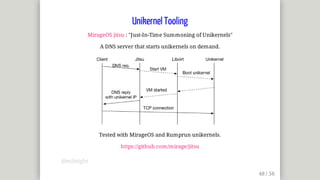
MirageOS	jitsu	:	"Just-In-Time	Summoning	of	Unikernels"
A	DNS	server	that	starts	unikernels	on	demand.
Tested	with	MirageOS	and	Rumprun	unikernels.
https://github.com/mirage/jitsu
@mjbright
Unikernels	and	Containers	:								My	guess	...
So	what	about	Containers?	...	and	why	did	Docker	buy	Unikernel	Systems?
@mjbright
Unikernels	and	Containers	:								My	guess	...
So	what	about	Containers?	...	and	why	did	Docker	buy	Unikernel	Systems?
Unikernel	Systems	are	involved	in	MirageOS/Xen
Unikernels	already	used	as	specific	functions	in	"Docker	for	Mac"
@mjbright
Unikernels	and	Containers	:								My	guess	...
So	what	about	Containers?	...	and	why	did	Docker	buy	Unikernel	Systems?
Unikernel	Systems	are	involved	in	MirageOS/Xen
Unikernels	already	used	as	specific	functions	in	"Docker	for	Mac"
No-brainer:	Provide	build/ship/run	tools	for	Unikernels
build:
tools	to	facilitate	building	Unikernels
test:	run	Unikernels	in	containers	to	faciltate	testing
https://github.com/mato/docker-unikernel-runner
ship:	Docker	registry	extended	to	provide	Unikernel	images
run:	Docker	Swarm	orchestrates	tasks	incl.	Unikernels
@mjbright
Unikernels	and	Containers	:								My	guess	...
So	what	about	Containers?	...	and	why	did	Docker	buy	Unikernel	Systems?
Unikernel	Systems	are	involved	in	MirageOS/Xen
Unikernels	already	used	as	specific	functions	in	"Docker	for	Mac"
No-brainer:	Provide	build/ship/run	tools	for	Unikernels
build:
tools	to	facilitate	building	Unikernels
test:	run	Unikernels	in	containers	to	faciltate	testing
https://github.com/mato/docker-unikernel-runner
ship:	Docker	registry	extended	to	provide	Unikernel	images
run:	Docker	Swarm	orchestrates	tasks	incl.	Unikernels
Secure	Container	deployments	through	hybrid	solutions
Secure	front-ends	made	of	unikernels
e.g.	for	OCaml	MediaWiki	(http2https,	tlstunnel,	...)
Containers	for	backend
Surprises?	...@mjbright@mjbright
Demo
DeferPanic	-	Unikernel	IaaS	-	https://deferpanic.com/
runtime.js	-	Node.js	Unikernel	-	https://github.com/runtimejs/example-web-
server
4	unikernel	demos	-	Look	Ma,	no	OS!	-	https://github.com/technolo-g/lookma
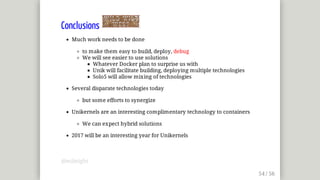
Conclusions	
Much	work	needs	to	be	done
to	make	them	easy	to	build,	deploy,	debug
We	will	see	easier	to	use	solutions
Whatever	Docker	plan	to	surprise	us	with
Unik	will	facilitate	building,	deploying	multiple	technologies
Solo5	will	allow	mixing	of	technologies
Several	disparate	technologies	today
but	some	efforts	to	synergize
Unikernels	are	an	interesting	complimentary	technology	to	containers
We	can	expect	hybrid	solutions
2017	will	be	an	interesting	year	for	Unikernels
@mjbright
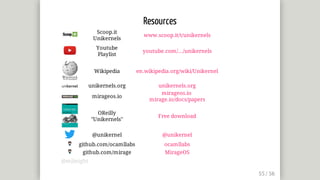
Resources
Scoop.it
Unikernels
www.scoop.it/t/unikernels
Youtube
Playlist
youtube.com/.../unikernels
Wikipedia en.wikipedia.org/wiki/Unikernel
unikernels.org unikernels.org
mirageos.io
mirageos.io	
mirage.io/docs/papers
OReilly
"Unikernels"
Free	download
@unikernel @unikernel
github.com/ocamllabs ocamllabs
github.com/mirage MirageOS
@mjbright
Thank	you
Q&A

2017 feb-10 snowcamp.io-unikernels