The	next	big	little	thing	?
Docker	Grenoble	Meetup,	19	Jan	2017
Mike	Bright,	 	@mjbright
@mjbright
Viktor	Farcic,	senior	consultant	at	CloudBees
...	One	of	the	most	exciting	areas	that	will	become	prominent	in	2017	will	be
unikernels.
While	the	majority	of	the	industry	is	still	trying	to	wrap	their	heads	around
containers,	we	will	start	seeing	unikernels	taking	over	the	stage.
They	will,	in	a	way,	unify	functionalities	provided	by	VMs	and	containers.
http://sdtimes.com/whats-horizon-2017/
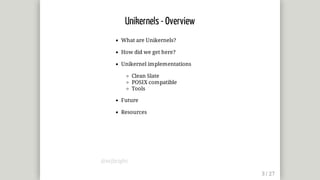
What	are	Unikernels?
How	did	we	get	here?
Unikernel	implementations
Clean	Slate
POSIX	compatible
Tools
Future
Resources
Unikernels	-	Overview
@mjbright
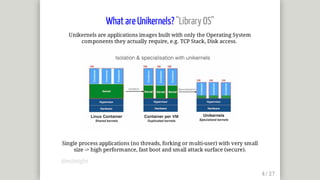
What	are	Unikernels?	"Library	OS"
Unikernels	are	applications	images	built	with	only	the	Operating	System
components	they	actually	require,	e.g.	TCP	Stack,	Disk	access.	
Single	process	applications	(no	threads,	forking	or	multi-user)	with	very	small
size	->	high	performance,	fast	boot	and	small	attack	surface	(secure).
@mjbright
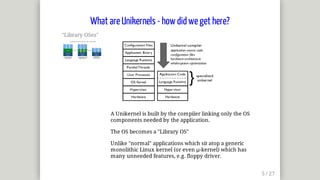
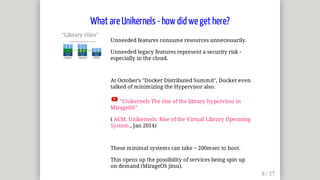
"Library	OSes"	
A	Unikernel	is	built	by	the	compiler	linking	only	the	OS
components	needed	by	the	application.
The	OS	becomes	a	"Library	OS"
Unlike	"normal"	applications	which	sit	atop	a	generic
monolithic	Linux	kernel	(or	even	μ-kernel)	which	has
many	unneeded	features,	e.g.	floppy	driver.
What	are	Unikernels	-	how	did	we	get	here?
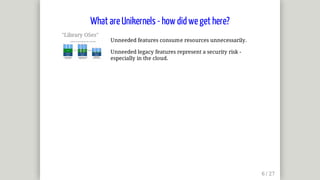
"Library	OSes"	
Unneeded	features	consume	resources	unnecessarily.
Unneeded	legacy	features	represent	a	security	risk	-
especially	in	the	cloud.
What	are	Unikernels	-	how	did	we	get	here?
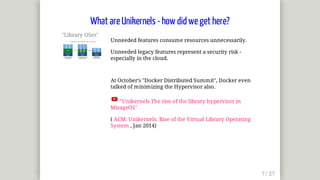
"Library	OSes"	
Unneeded	features	consume	resources	unnecessarily.
Unneeded	legacy	features	represent	a	security	risk	-
especially	in	the	cloud.
At	October's	"Docker	Distributed	Summit",	Docker	even
talked	of	minimizing	the	Hypervisor	also.
	"Unikernels	The	rise	of	the	library	hypervisor	in
MirageOS"
(	ACM:	Unikernels:	Rise	of	the	Virtual	Library	Operating
System	,	Jan	2014)
What	are	Unikernels	-	how	did	we	get	here?
"Library	OSes"	
Unneeded	features	consume	resources	unnecessarily.
Unneeded	legacy	features	represent	a	security	risk	-
especially	in	the	cloud.
At	October's	"Docker	Distributed	Summit",	Docker	even
talked	of	minimizing	the	Hypervisor	also.
	"Unikernels	The	rise	of	the	library	hypervisor	in
MirageOS"
(	ACM:	Unikernels:	Rise	of	the	Virtual	Library	Operating
System	,	Jan	2014)
These	minimal	systems	can	take	~	200msec	to	boot.
This	opens	up	the	possibility	of	services	being	spin	up	
on	demand	(MirageOS	jitsu).
What	are	Unikernels	-	how	did	we	get	here?
"Library	OSes"
Application	domains
Cloud,	e.g.	serverless
IoT	(Embedded)
HPC
NFV	(	 	Unikernels	meet	NFV	Ericsson	Research	)
Where	will	Unikernels	be	used?
"Library	OSes"
Application	domains
Cloud,	e.g.	serverless
IoT	(Embedded)
HPC
NFV	(	 	Unikernels	meet	NFV	Ericsson	Research	)
From	the	NFV	Containers	White	Paper	(2.3.	Unikernels):
			Unikernels	are	essentially	single-application	virtual	machines
			based	on	minimalistic	OSes.	Such	minimalistic	OSes	have	minimum
			overhead	and	are	typically	single-address	space	(so	no	user/kernel
			space	divide	and	no	expensive	system	calls)	and	have	a
			co-operative	scheduler	(so	reducing	context	switch	costs).
			Examples	of	such	minimalistic	OSes	are	MiniOS	[MINIOS]	which
			runs	on	Xen	and	OSv	[OSV]	which	runs	on	KVM,	Xen	and	VMWare.
https://datatracker.ietf.org/doc/draft-natarajan-nfvrg-
containers-for-nfv/?include_text=1
Where	will	Unikernels	be	used?
@mjbright
Unikernel
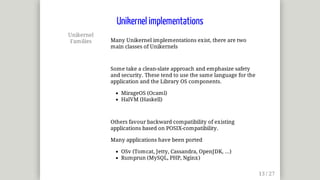
Families Many	Unikernel	implementations	exist,	there	are	two
main	classes	of	Unikernels
Unikernel	implementations
Unikernel
Families Many	Unikernel	implementations	exist,	there	are	two
main	classes	of	Unikernels
Some	take	a	clean-slate	approach	and	emphasize	safety
and	security.	These	tend	to	use	the	same	language	for	the
application	and	the	Library	OS	components.
MirageOS	(Ocaml)
HalVM	(Haskell)
Unikernel	implementations
Unikernel
Families Many	Unikernel	implementations	exist,	there	are	two
main	classes	of	Unikernels
Some	take	a	clean-slate	approach	and	emphasize	safety
and	security.	These	tend	to	use	the	same	language	for	the
application	and	the	Library	OS	components.
MirageOS	(Ocaml)
HalVM	(Haskell)
Others	favour	backward	compatibility	of	existing
applications	based	on	POSIX-compatibility.
Many	applications	have	been	ported
OSv	(Tomcat,	Jetty,	Cassandra,	OpenJDK,	...)
Rumprun	(MySQL,	PHP,	Nginx)
Unikernel	implementations
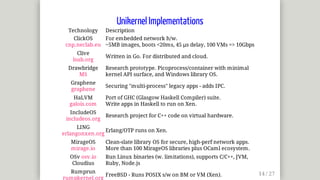
Unikernel	Implementations
Technology Description
ClickOS
cnp.neclab.eu
For	embedded	network	h/w.
~5MB	images,	boots	<20ms,	45	μs	delay,	100	VMs	=>	10Gbps
Clive
lsub.org
Written	in	Go.	For	distributed	and	cloud.
Drawbridge
MS
Research	prototype.	Picoprocess/container	with	minimal
kernel	API	surface,	and	Windows	library	OS.
Graphene
graphene
Securing	"multi-process"	legacy	apps	-	adds	IPC.
HaLVM
galois.com
Port	of	GHC	(Glasgow	Haskell	Compiler)	suite.
Write	apps	in	Haskell	to	run	on	Xen.
IncludeOS
includeos.org
Research	project	for	C++	code	on	virtual	hardware.
LING
erlangonxen.org
Erlang/OTP	runs	on	Xen.
MirageOS
mirage.io
Clean-slate	library	OS	for	secure,	high-perf	network	apps.
More	than	100	MirageOS	libraries	plus	OCaml	ecosystem.
OSv	osv.io
Cloudius
Run	Linux	binaries	(w.	limitations),	supports	C/C++,	JVM,
Ruby,	Node.js
Rumprun
rumpkernel.org
FreeBSD	-	Runs	POSIX	s/w	on	BM	or	VM	(Xen).
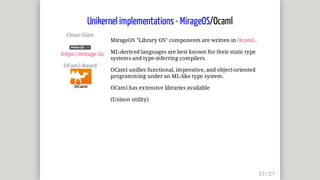
Clean-Slate	
	
https://mirage.io/
OCaml-Based	
MirageOS	"Library	OS"	components	are	written	in	Ocaml	.
ML-derived	languages	are	best	known	for	their	static	type
systems	and	type-inferring	compilers.
OCaml	unifies	functional,	imperative,	and	object-oriented
programming	under	an	ML-like	type	system.
OCaml	has	extensive	libraries	available
(Unison	utility)
Unikernel	implementations	-	MirageOS/Ocaml
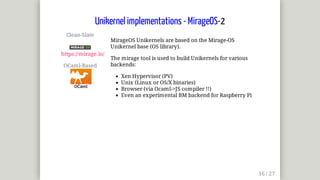
Clean-Slate	
	
https://mirage.io/
OCaml-Based	
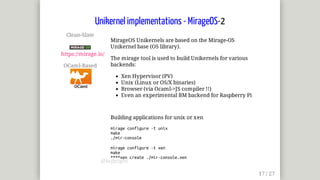
MirageOS	Unikernels	are	based	on	the	Mirage-OS
Unikernel	base	(OS	library).
The	mirage	tool	is	used	to	build	Unikernels	for	various
backends:
Xen	Hypervisor	(PV)
Unix	(Linux	or	OS/X	binaries)
Browser	(via	Ocaml->JS	compiler	!!)
Even	an	experimental	BM	backend	for	Raspberry	Pi
Unikernel	implementations	-	MirageOS-2
Clean-Slate	
	
https://mirage.io/
OCaml-Based	
MirageOS	Unikernels	are	based	on	the	Mirage-OS
Unikernel	base	(OS	library).
The	mirage	tool	is	used	to	build	Unikernels	for	various
backends:
Xen	Hypervisor	(PV)
Unix	(Linux	or	OS/X	binaries)
Browser	(via	Ocaml->JS	compiler	!!)
Even	an	experimental	BM	backend	for	Raspberry	Pi
Building	applications	for	unix	or	xen
mirage	configure	-t	unix
make
./mir-console
mirage	configure	-t	xen
make
****xen	create	./mir-console.xen
Unikernel	implementations	-	MirageOS-2
@mjbright
Clean-Slate	
	
https://mirage.io/
BNC	Pinata:	http://ownme.ipredator.se/	
Networking	applications
e.g.	CyberChaff	"false	network	hosts"
PayGarden,	Sean	Grove	
	"Baby	steps	to	unikernels	in	production"
Too	painful	to	create/configure	AMI	images	on
AWS
Solo5	allows	to	create	KVM	images	deployable	on
GCE
Unikernel	implementations	-	MirageOS	-	Use	Cases
@mjbright
Clean-Slate	
	
HalVM	-	The	Haskell	Lightweight	Virtual	Machine:	GHC
running	on	Xen
https://github.com/GaloisInc/HaLVM
HalVM3	is	reconsidering	it's	Unikernel	base
http://uhsure.com/halvm3.html
Use	rumpkernel	(NetBSD	base)
Shift	to	Solo5?
Unikernel	implementations	-	HalVM
@mjbright
POSIX-based	
http://osv.io
http://blog.osv.io
OSv	-	Capable	of	running	POSIX	binaries
can	run	JVM
Cassandra:
https://www.penninkhof.com/2015/05/minimalist-
cassandra-vm-using-osv/
Used	in	Mikelangelo	(EU	Project)	The	MIKELANGELO
project	aims	to	bring	High	Performance	Computing
(HPC)	to	the	cloud.	HPC	traditionally	involves	bleeding
edge	technologies,	including	lots	of	CPU	cores,
Infiniband	interconnects	between	nodes,	MPI	libraries
for	message	passing,	and,	surprise—NFS,	a	very	old
timer	of	the	UNIX	universe.
Building	OSv	Images	Using	Docker:
http://blog.osv.io/blog/blog/2015/04/27/docker/
SDI:	ODL	+	OSv:
http://blog.osv.io/blog/blog/2015/03/31/sdi/
Unikernel	implementations	-	OSv
@mjbright
Tools
Unik	:	tool	for	compiling	apps	to	unikernels	(various
technologies)
Solo5	:	An	alternative	unikernel-base	for	MirageOS
Provides	qemu/KVM	support	for	MirageOS
ukvm:	An	alternative	VM	Monitor
a	"library	hypervisor"
capstan	:	OSv	build	tool
Unikernel	Tools
@mjbright
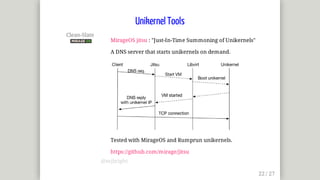
Clean-Slate	
MirageOS	jitsu	:	"Just-In-Time	Summoning	of	Unikernels"
A	DNS	server	that	starts	unikernels	on	demand.
Tested	with	MirageOS	and	Rumprun	unikernels.
https://github.com/mirage/jitsu
Unikernel	Tools
@mjbright
Unikernels	or
Containers? So	what	has	this	got	to	do	with	Containers?
Why	did	Docker	buy	Unikernel	Systems	(Jan	2016)?
Info.Q	/	Amir,	Aug	2016
Unikernels	and	Containers
Unikernels	or
Containers? So	what	has	this	got	to	do	with	Containers?
Why	did	Docker	buy	Unikernel	Systems	(Jan	2016)?
Info.Q	/	Amir,	Aug	2016
Unikernel	Systems	are	involved	in	MirageOS/Xen
Use	of	Unikernels	in	Docker	for	Mac
VPNKit,	DataKit
To	provide	build/run/ship	tools	for	Unikernels?
To	secure	Container	deployments
Running	Unikernels	in	containers????
Secure	front-ends	in	hybrid	solutions	made	of
unikernels	and	containers
e.g.	for	OCaml	MediaWiki	(http2https,	tls,	...)
Unikernels	and	Containers
@mjbright
Demo
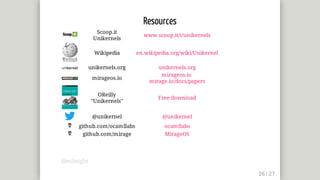
Resources
Scoop.it
Unikernels
www.scoop.it/t/unikernels
Wikipedia en.wikipedia.org/wiki/Unikernel
unikernels.org unikernels.org
mirageos.io
mirageos.io	
mirage.io/docs/papers
OReilly
"Unikernels"
Free	download
@unikernel @unikernel
github.com/ocamllabs ocamllabs
github.com/mirage MirageOS
@mjbright
Thank	you
Q&A

2017 jan-19 meetup-unikernels