Download to read offline
![T
he US Supreme Court in KSR International Co v Teleflex Inc raised the bar for
establishing non-obviousness, arguably the most easily challenged patentabil-
ity requirement in the United States. By rejecting the Federal Circuit’s require-
ment that the prior art contain an express teaching, suggestion or motivation (the
TSM test) to combine the claimed elements of the invention, the Supreme Court
encouraged an analytical shift towards a framework focusing on the predictability
of the art and reasonable expectation of success. This article explores how this shift
may be used to the patentee’s advantage in the fields of biotechnology and pharma-
ceuticals.
Origins of non-obviousness
Despite repeatedly revising the Patent Act after its enactment in 1790, Congress for
almost two centuries relied solely on the statutory requirements of novelty and util-
ity. Thus, the question of how to further refine patentability was largely left to the
courts. Accordingly, the US Supreme Court in Hotchkiss v Greenwood (1851) cre-
ated a new condition of patentability, requiring that the invention evidence “more
ingenuity and skill ... than were possessed by an ordinary mechanic acquainted with
the business”.
Congress codified the Hotchkiss test in Section 103 of the Patent Act of 1952,
labelling the requirement as one of non-obviousness. As the Court later noted in the
seminal case Graham v John Deere Co (1966), Hotchkiss had established a practi-
cal test requiring “a comparison between the subject matter of the patent, or patent
application, and the background skill of the calling”. The Section 103 formulation
similarly “place[d] emphasis on the pertinent art existing at the time the invention
was made and ... [was] implicitly tied to advances in that art”. The Court then elab-
orated on this basic non-obviousness framework:
Under § 103, the scope and content of the prior art are to be determined; differ-
ences between the prior art and the claims at issue are to be ascertained, and the
level of ordinary skill in the prior art resolved.... Such secondary considerations
as commercial success, long felt but unsolved needs, failure of others, etc, might
be utilized to give light to the circumstances surrounding the origin of the subject
matter sought to be patented.
As the Supreme Court more recently explained: “The non-obviousness requirement
extends the field of unpatentable material beyond that which could readily be
deduced from publicly available material by a person of ordinary skill in the perti-
nent field of endeavor” (Bonito Boats, Inc v Thunder Craft Boats, Inc, 1989).
Obviousness pre-KSR
Following the Graham decision, federal courts attempted to develop general guide-
lines – not only to ease non-obviousness analysis, but also to help establish judicial
consistency.
First, use of hindsight is improper in determining whether a combination is obvi-
ous (In re Fine, Fed Cir 1988). To guard against use of hindsight, the Federal Circuit
insisted that a claimed combination was obvious only where the prior art contained
a teaching, suggestion or motivation to combine the individual elements (Al-Site
Corp v VSI Int’l, Inc, Fed Cir 1999). Such a teaching, suggestion, or motivation may
be found in the prior art references themselves, the nature of the problem, or the
knowledge of those of ordinary skill in the art.
Second, the cited prior art need not assure the inventor that a particular combi-
nation will meet with certain success. Rather, obviousness requires only a “reason-
able expectation of success” (In re O’Farrell, Fed Cir 1988). But, at least until
US: BIOTECHNOLOGY PATENTS
How biotech patentees can navigate KSR
Ewa M Davison and Gary M Myles provide strategies for establishing non-obviousness in the
biotechnology and pharmaceutical arts in light of the Supreme Court’s rejection of a rigid TSM test
www.managingip.com
July/August 2008 79
In overcoming an obvious-
ness challenge asserted
during patent prosecution
or litigation, the patentee
of a biotechnology or phar-
maceutical invention must
stress the unpredictability of the art and/or
the absence of a reasonable expectation of
success. Consequently, although inventions in
these unpredictable fields are more vulnerable
to a finding of obviousness post-KSR, several
factors lend themselves to a strong non-obvi-
ousness argument. While practitioners can no
longer rely on the absence of an express
teaching, suggestion or motivation in the
prior art to overcome an obviousness chal-
lenge, the approaches outlined here provide a
roadmap for navigating the post-KSR non-
obviousness framework.
One-minute read](https://image.slidesharecdn.com/postksrobviousness-124957719898-phpapp02/85/Post-KSR-Obviousness-1-320.jpg)
![T
he US Supreme Court in KSR International Co v Teleflex Inc raised the bar for
establishing non-obviousness, arguably the most easily challenged patentabil-
ity requirement in the United States. By rejecting the Federal Circuit’s require-
ment that the prior art contain an express teaching, suggestion or motivation (the
TSM test) to combine the claimed elements of the invention, the Supreme Court
encouraged an analytical shift towards a framework focusing on the predictability
of the art and reasonable expectation of success. This article explores how this shift
may be used to the patentee’s advantage in the fields of biotechnology and pharma-
ceuticals.
Origins of non-obviousness
Despite repeatedly revising the Patent Act after its enactment in 1790, Congress for
almost two centuries relied solely on the statutory requirements of novelty and util-
ity. Thus, the question of how to further refine patentability was largely left to the
courts. Accordingly, the US Supreme Court in Hotchkiss v Greenwood (1851) cre-
ated a new condition of patentability, requiring that the invention evidence “more
ingenuity and skill ... than were possessed by an ordinary mechanic acquainted with
the business”.
Congress codified the Hotchkiss test in Section 103 of the Patent Act of 1952,
labelling the requirement as one of non-obviousness. As the Court later noted in the
seminal case Graham v John Deere Co (1966), Hotchkiss had established a practi-
cal test requiring “a comparison between the subject matter of the patent, or patent
application, and the background skill of the calling”. The Section 103 formulation
similarly “place[d] emphasis on the pertinent art existing at the time the invention
was made and ... [was] implicitly tied to advances in that art”. The Court then elab-
orated on this basic non-obviousness framework:
Under § 103, the scope and content of the prior art are to be determined; differ-
ences between the prior art and the claims at issue are to be ascertained, and the
level of ordinary skill in the prior art resolved.... Such secondary considerations
as commercial success, long felt but unsolved needs, failure of others, etc, might
be utilized to give light to the circumstances surrounding the origin of the subject
matter sought to be patented.
As the Supreme Court more recently explained: “The non-obviousness requirement
extends the field of unpatentable material beyond that which could readily be
deduced from publicly available material by a person of ordinary skill in the perti-
nent field of endeavor” (Bonito Boats, Inc v Thunder Craft Boats, Inc, 1989).
Obviousness pre-KSR
Following the Graham decision, federal courts attempted to develop general guide-
lines – not only to ease non-obviousness analysis, but also to help establish judicial
consistency.
First, use of hindsight is improper in determining whether a combination is obvi-
ous (In re Fine, Fed Cir 1988). To guard against use of hindsight, the Federal Circuit
insisted that a claimed combination was obvious only where the prior art contained
a teaching, suggestion or motivation to combine the individual elements (Al-Site
Corp v VSI Int’l, Inc, Fed Cir 1999). Such a teaching, suggestion, or motivation may
be found in the prior art references themselves, the nature of the problem, or the
knowledge of those of ordinary skill in the art.
Second, the cited prior art need not assure the inventor that a particular combi-
nation will meet with certain success. Rather, obviousness requires only a “reason-
able expectation of success” (In re O’Farrell, Fed Cir 1988). But, at least until
US: BIOTECHNOLOGY PATENTS
How biotech patentees can navigate KSR
Ewa M Davison and Gary M Myles provide strategies for establishing non-obviousness in the
biotechnology and pharmaceutical arts in light of the Supreme Court’s rejection of a rigid TSM test
www.managingip.com
July/August 2008 79
In overcoming an obvious-
ness challenge asserted
during patent prosecution
or litigation, the patentee
of a biotechnology or phar-
maceutical invention must
stress the unpredictability of the art and/or
the absence of a reasonable expectation of
success. Consequently, although inventions in
these unpredictable fields are more vulnerable
to a finding of obviousness post-KSR, several
factors lend themselves to a strong non-obvi-
ousness argument. While practitioners can no
longer rely on the absence of an express
teaching, suggestion or motivation in the
prior art to overcome an obviousness chal-
lenge, the approaches outlined here provide a
roadmap for navigating the post-KSR non-
obviousness framework.
One-minute read](https://image.slidesharecdn.com/postksrobviousness-124957719898-phpapp02/75/Post-KSR-Obviousness-1-2048.jpg)
![recently, obviousness could not be established on the basis that
the claimed combination was “obvious to try” – that is, that
either the inventor (1) varied all the numerous parameters or
choices presented by the prior art until a successful result was
reached, at least where the prior art provides “no indication of
which parameters were critical or no direction as to which of
many possible choices is likely to be successful”; or (2)
explored a promising new technology or approach with only
“general guidance” from the prior art.
Third, particular types of evidence aid in the establishment
of non-obviousness. For example, the Supreme Court indicat-
ed that unexpected or synergistic results constitute particular-
ly compelling evidence of non-obviousness (United States v
Adams, 1966; Anderson’s-Black Rock, Inc v Pavement
Salvage Co, 1969). The same tends to be true where the prior
art “teaches away” from the claimed combination by identify-
ing its disadvantages (United States v Adams, 1966).
The Supreme Court weighs in
In KSR International Co v Teleflex Inc, the Supreme Court
rejected the Federal Circuit’s “rigid” application of the TSM test
as “inconsistent” with the “expansive and flexible approach”
necessitated by the Graham obviousness framework. Although
noting that the TSM test embodied a “helpful insight” and that
no “necessary inconsistency” existed “between the idea under-
lying the TSM test and the Graham analysis”, the Court con-
cluded that an overly formulaic approach risked “[g]ranting
patent protection to advances that would occur in the ordinary
course without real innovation”. Accordingly, although it is still
important to identify a reason motivating a claimed combina-
tion, an obviousness analysis “need not seek out precise teach-
ings directed to the specific subject matter of the challenged
claim, for a court can take account of the inferences and creative
steps that a person of ordinary skill in the art would enjoy”.
The Court focused much of its obviousness analysis on pre-
dictability: “The combination of familiar elements according to
known methods is likely to be obvious when it does no more
than yield predictable results.” Thus, when determining
whether a claimed invention that combines prior art elements
is obvious, “a court must ask whether the improvement is more
than the predictable use of prior art elements according to their
established functions”. Absence of predictability may be estab-
lished by unexpected results, synergy, or teaching away; a com-
bination is also unpredictable if “beyond [the] skill” of one of
ordinary skill in the art. The Court further noted:
When there is a design need or market pressure to solve a
problem and there are a finite number of identified, pre-
dictable solutions, a person of ordinary skill has good rea-
son to pursue the known options within his or her technical
grasp. If this leads to the anticipated success, it is likely the
product not of innovation but of ordinary skill and common
sense. In that instance the fact that a combination was obvi-
ous to try might show that it was obvious under § 103.
The Court in KSR thus seems to have espoused the “obvi-
ous to try” standard long rejected by the Federal Circuit.
The new examination guidelines issued by the USPTO in
light of KSR similarly emphasize that an examiner must
focus on predictability in analyzing an invention’s obvious-
ness during patent prosecution (see box).
A long dry spell: obviousness post-KSR
In an unpublished decision issued a mere three days after KSR,
the Federal Circuit affirmed a jury verdict of obviousness
(Syngenta Seeds, Inc v Monsanto Co, Fed Cir 2007). The
US: BIOTECHNOLOGY PATENTS
www.managingip.com
July/August 200880
35 USC § 103(a) provides: “A patent may not be obtained though the invention is not identically
disclosed or described as set forth in section 102 of this title, if the differences between the sub-
ject matter sought to be patented and the prior art are such that the subject matter as a whole
would have been obvious at the time the invention was made to a person having ordinary skill in
the art to which said subject matter pertains.”
Statutory non-obviousness requirement
In light of the Supreme Court’s KSR decision, the USPTO issued new rationales for use by its exam-
iners in rejecting an invention as obvious:
A) combining prior art elements according to known methods to yield predictable results;
B) simple substitution of one known element for another to obtain predictable results;
C) use of known technique to improve similar devices (methods, or products) in the same way;
D) applying a known technique to a known device (method, or product) ready for improve-
ment to yield predictable results;
E) “obvious to try” – choosing from a finite number of identified, predictable solutions, with a
reasonable expectation of success;
F) known work in one field of endeavor may prompt variations of it for use in either the same
field or a different one based on design incentives or other market forces if the variations
would have been predictable to one of ordinary skill in the art;
G) some teaching, suggestion, or motivation in the prior art that would have led one of ordi-
nary skill to modify the prior art reference or to combine prior art reference teachings to
arrive at the claimed invention.
Source: 72 Fed Reg 57526, 57529 (October 10 2007) (emphasis added). Of particular note is how
many of these bases for an obvious rejection centre on the concept of predictability.
Post-KSR USPTO guidelines emphasize a
predictability standard](https://image.slidesharecdn.com/postksrobviousness-124957719898-phpapp02/85/Post-KSR-Obviousness-2-320.jpg)
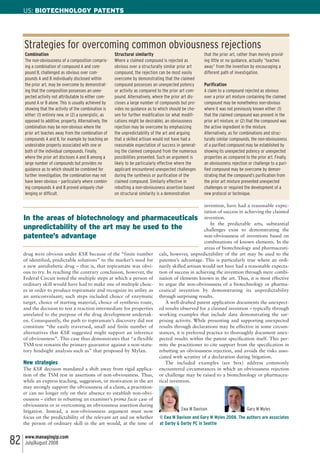
![patent at issue claimed transgenic corn expressing the insecti-
cidal protein Bt. To increase expression, patentee Syngenta
modified the Bt gene so that at least 60% of its nucleotides
consisted of guanine and cytosine. This patent was rendered
obvious, however, by a prior art reference teaching that Bt
gene expression could be improved in tobacco plants by
increasing guanine and cytosine content, and that this finding
was “equally applicable in other plant species”. Syngenta
failed to establish teaching away, absence of a reasonable
expectation of success, or unexpected results.
The Federal Circuit provided a more instructive opinion in
Aventis Pharma Deutschland GMBH v Lupin, Ltd, whereby it
reversed the district court’s summary judg-
ment of infringement (Fed Cir 2007). The
Federal Circuit found obvious those claims
of a pharmaceutical patent relating to the
5(S) stereoisomer of ramipril, an ACE
inhibitor used for treating high blood pres-
sure, in a form substantially free of other
isomers. The prior art contained a mixture
of the 5(S) and SSSSR stereoisomers of ramipril; nonetheless, the
district court, requiring “an explicit teaching to purify the 5(S)
stereoisomer”, found the claims valid. Rejecting this reasoning as
“precisely the sort of rigid application of the TSM test that was
criticized in KSR”, the Federal Circuit concluded:
if it is known that a desirable property of a mixture derives
in whole or in part from a particular one of its components,
or if the prior art would provide a person of ordinary skill
in the art with reason to believe that this is so, the purified
compound is prima facie obvious over the mixture even
without an explicit teaching that the ingredient should be
concentrated or purified.
Moreover, although the 5(S) stereoisomer was significantly
more potent than other ramipril stereoisomers, no unexpect-
ed result occurred here as the 5(S) stereoisomer’s potency cor-
related with its percentage in the prior art mixture.
In Pharmastem Therapeutics, Inc v Viacell, Inc, the Federal
Circuit concluded that a reasonable jury could not have found
non-obvious the challenged patents claiming cryopreserved
umbilical cord blood and its use in transplants for hematopoi-
etic reconstitution (Fed Cir 2007). The Federal Circuit noted
that prior art references suggested both cryopreserving cord
blood and using cord blood to effect hematopoietic reconsti-
tution, and that one of skill in the art would have had a rea-
sonable expectation of success in combining these references.
Moreover, the prior art “spelled out” each step required for
the cryopreservation and transplantation procedures. At most,
therefore, the inventors proved conclusively that stem cells in
cryopreserved cord blood were capable of hematopoietic
reconstitution. Although “[s]cientific confirmation of what
was already believed to be true may be a valuable contribu-
tion, ... it does not give rise to a patentable invention” – a find-
ing to the contrary would contravene KSR by “[g]ranting
patent protection to advances that would occur in the ordinary
course without real innovation”.
Needle in a haystack: non-obviousness post-KSR
In Takeda Chemical Industries, Ltd v Alphapharm Pty, Ltd,
the Federal Circuit clarified that “in cases involving new
chemical compounds, it remains necessary to identify some
reason that would have led a chemist to modify a known
compound in a particular manner” (Fed Cir 2007).
Alphapharm argued that Takeda’s claims to the antidiabetic
compound pioglitazone were obvious because: (1) the prior
art would have led a chemist to choose the related “com-
pound b” as the lead for further modification; and (2) it
would have been obvious to try modifying compound b
through homologation and ring-walking, thus creating piogli-
tazone. Affirming the district court’s finding of non-obvious-
ness, the Federal Circuit concluded that the obvious-to-try
standard was not satisfied because a chemist would have had
no reason to choose compound b for further study. Not only
did “the prior art disclose a broad selection of compounds
any one of which could have been selected as a lead com-
pound for further investigation”, but compound b led to
weight and fat increases and thus “exhibited negative proper-
ties that would have directed one of ordinary skill in the art
away from that compound”. Moreover, even if this were not
the case, non-obviousness could still be established based on
the unexpectedly decreased toxicity of pioglitazone as com-
pared to compound b.
Most recently, in Ortho-McNeil Pharmaceutical, Inc v
Mylan Laboratories, Inc, the Federal Circuit found that the
district court did not err in finding non-obvious patent
claims to an anti-epilepsy drug (Fed Cir 2008). Topiramate,
a reaction intermediate with anticonvulsive properties, was
discovered by an Ortho-McNeil scientist during his search
for new diabetes treatments. Seeking to market a generic
form of topiramate, Mylan argued that the claims to this
US: BIOTECHNOLOGY PATENTS
www.managingip.com
July/August 2008 81
The KSR decision mandated a shift away from
rigid application of the TSM test in assertions
of non-obviousness](https://image.slidesharecdn.com/postksrobviousness-124957719898-phpapp02/85/Post-KSR-Obviousness-3-320.jpg)

The US Supreme Court's decision in KSR International Co v. Teleflex Inc raised the non-obviousness standard in patent law, moving away from the rigid TSM test towards a more flexible analysis focusing on predictability and reasonable expectation of success. This change encouraged patentees in biotechnology and pharmaceuticals to leverage art unpredictability and the absence of expected results to argue for non-obviousness. The article outlines strategies for navigating the new framework, emphasizing that mere combinations of known elements may not suffice for patentability, especially when unexpected results can be demonstrated.


