Presented by:
Jim Barnes
Senior Managing Partner
WMS vs. WCS:
Where and When to Apply
Warehouse Management
Systems and Warehouse
Control Systems for
Optimal Results
Sponsored by:
© 2015 MHI®
Copyright claimed for audiovisual works and
sound recordings of seminar sessions. All rights reserved.
Today’s Agenda:
WMS and WCS Defined
Day in the Life of an Order
Standard Interface Architecture
Case Studies
Questions
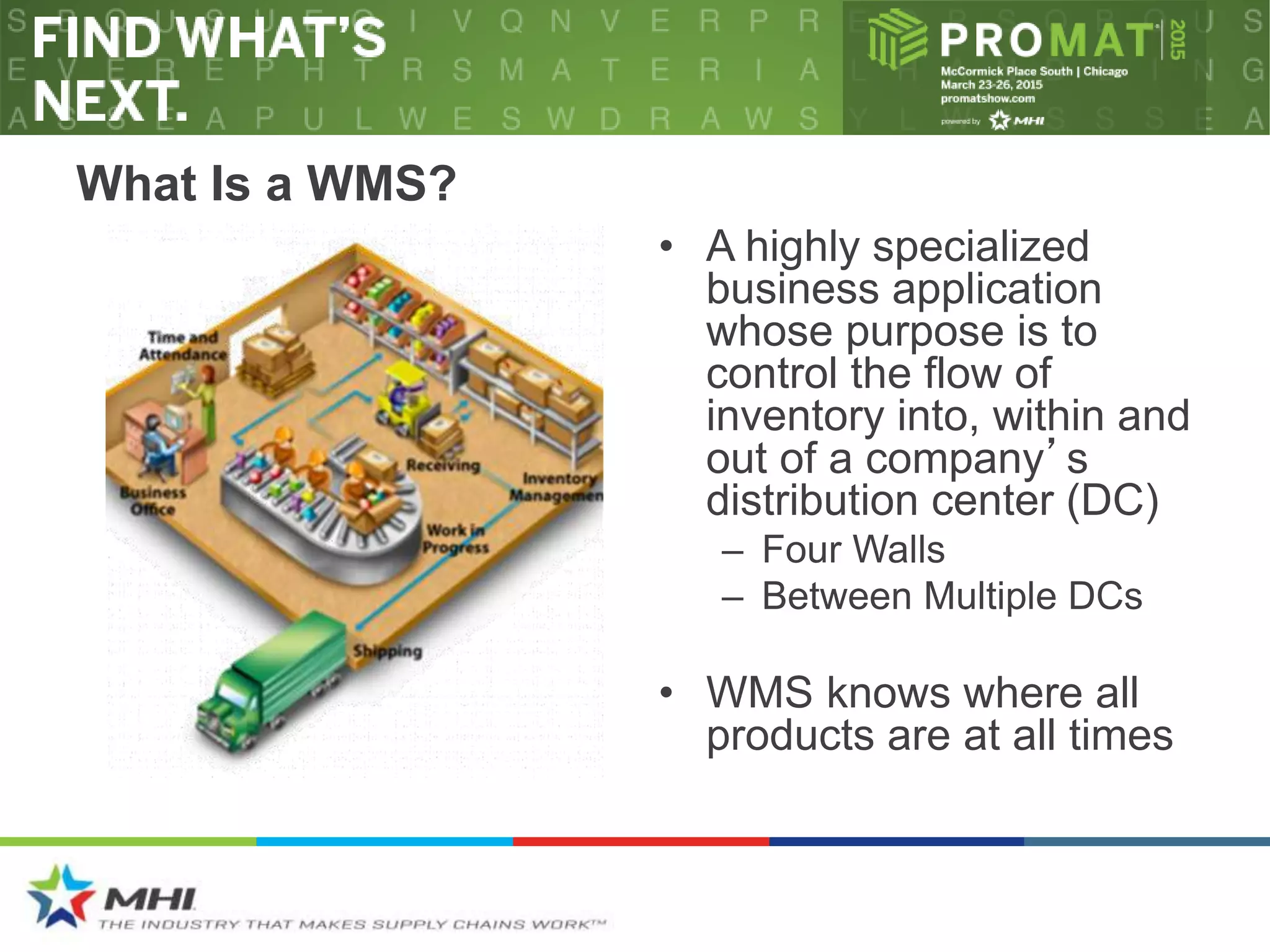
What Is a WMS?
• A highly specialized
business application
whose purpose is to
control the flow of
inventory into, within and
out of a company’s
distribution center (DC)
– Four Walls
– Between Multiple DCs
• WMS knows where all
products are at all times
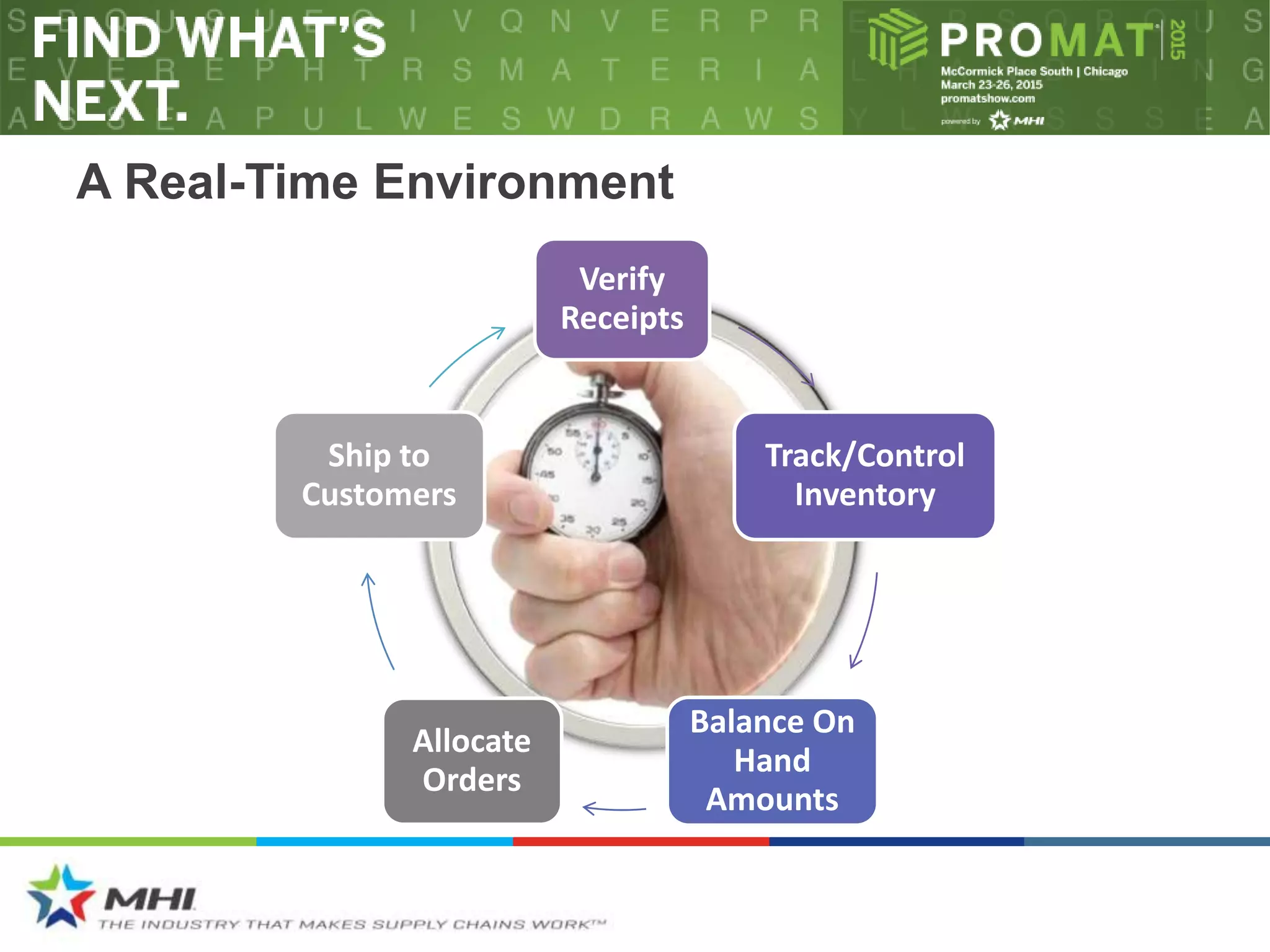
A Real-Time Environment
Verify
Receipts
Track/Control
Inventory
Balance On
Hand
Amounts
Allocate
Orders
Ship to
Customers
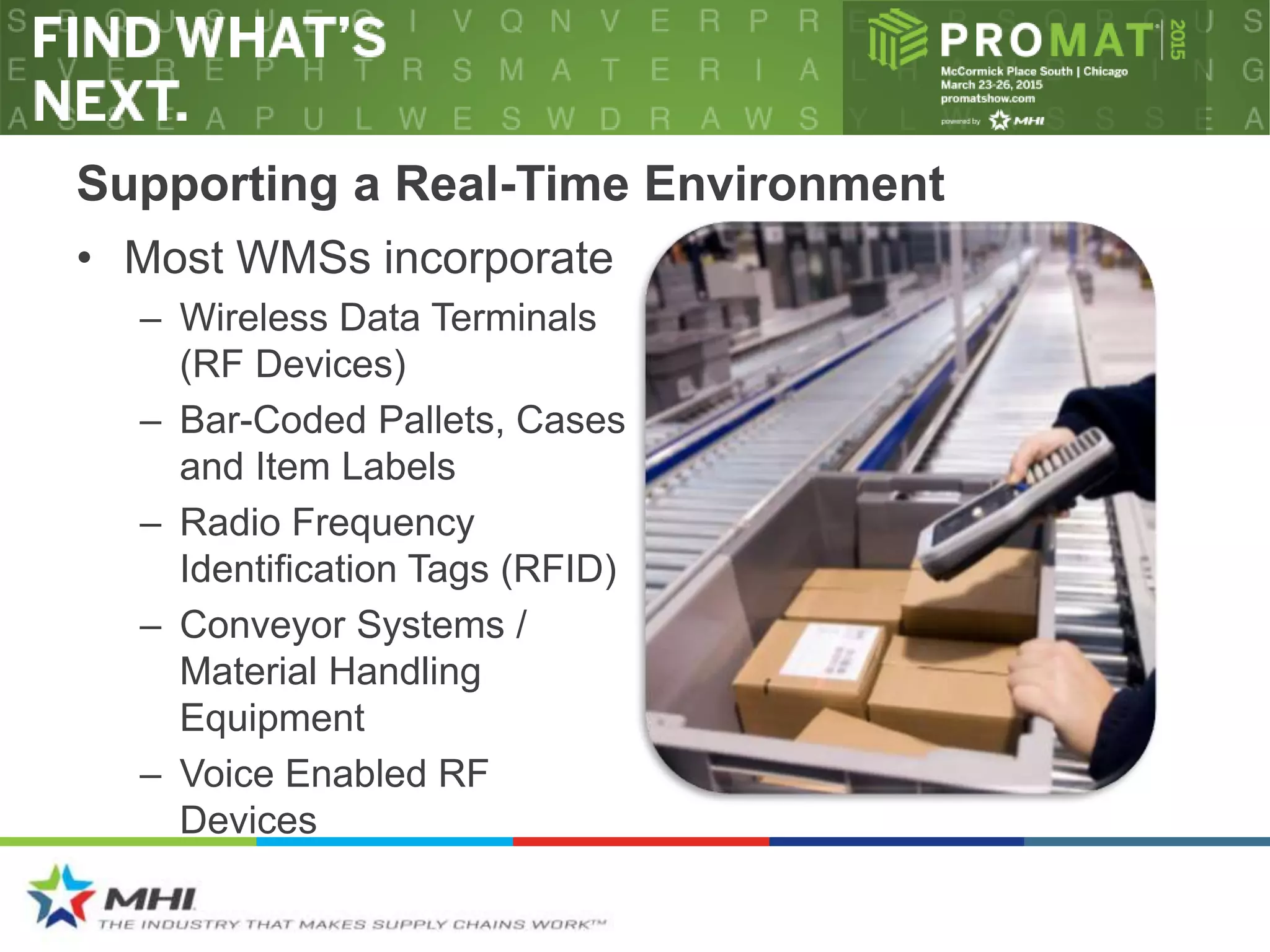
Supporting a Real-Time Environment
• Most WMSs incorporate
– Wireless Data Terminals
(RF Devices)
– Bar-Coded Pallets, Cases
and Item Labels
– Radio Frequency
Identification Tags (RFID)
– Conveyor Systems /
Material Handling
Equipment
– Voice Enabled RF
Devices
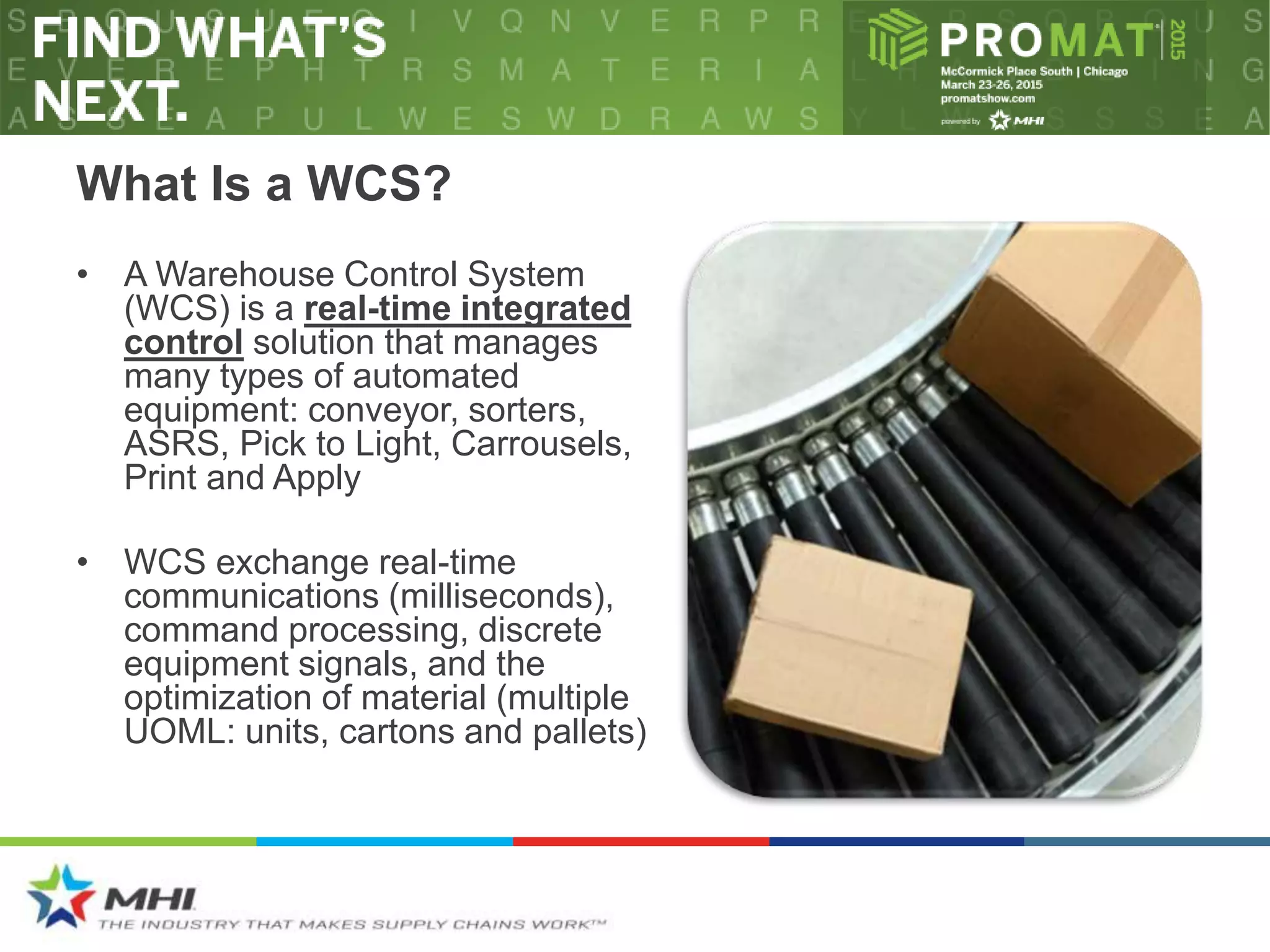
What Is a WCS?
• A Warehouse Control System
(WCS) is a real-time integrated
control solution that manages
many types of automated
equipment: conveyor, sorters,
ASRS, Pick to Light, Carrousels,
Print and Apply
• WCS exchange real-time
communications (milliseconds),
command processing, discrete
equipment signals, and the
optimization of material (multiple
UOML: units, cartons and pallets)
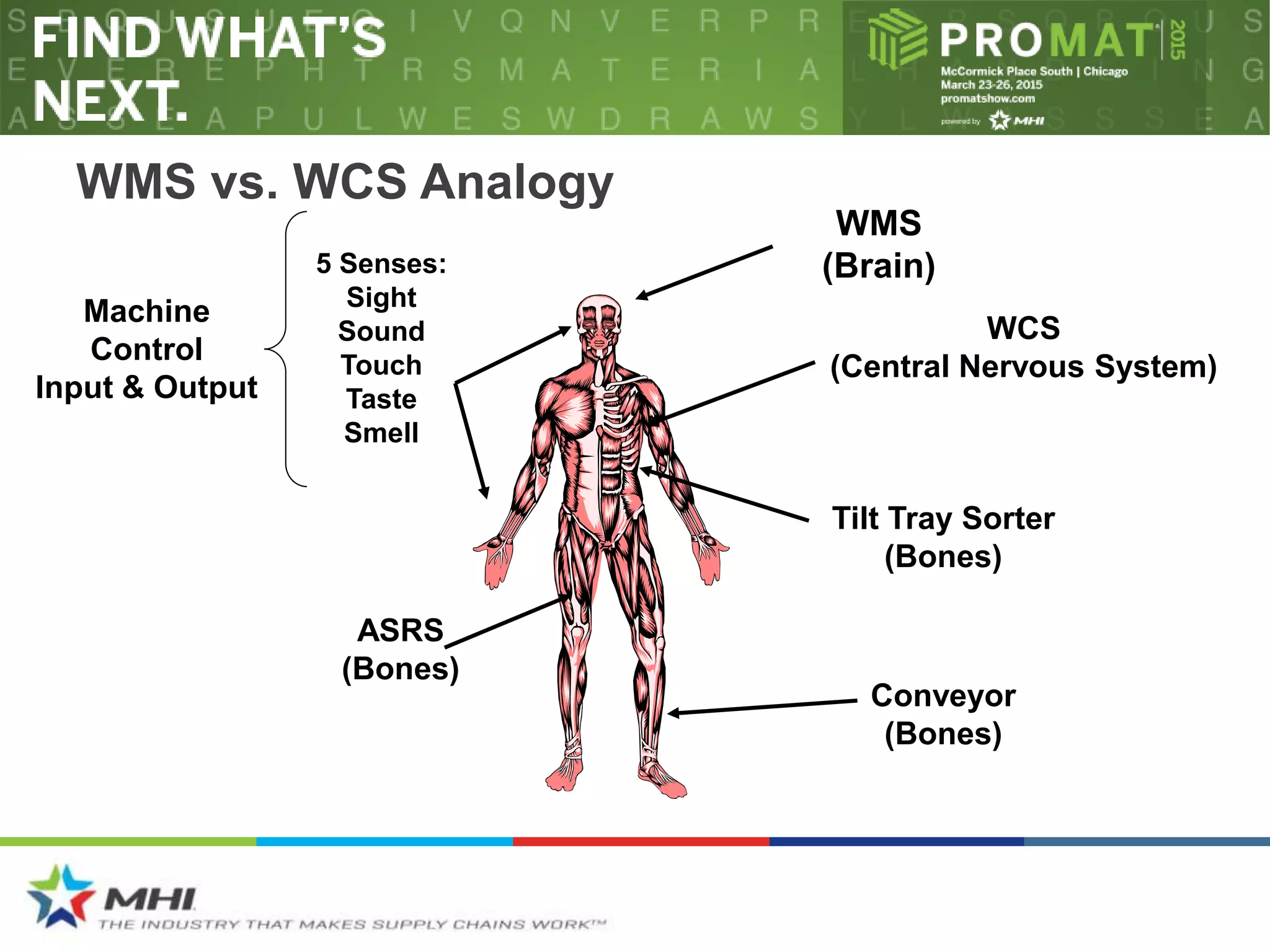
WMS vs. WCS Analogy
Tilt Tray Sorter
(Bones)
Conveyor
(Bones)
WMS
(Brain)
WCS
(Central Nervous System)
5 Senses:
Sight
Sound
Touch
Taste
Smell
Machine
Control
Input & Output
ASRS
(Bones)
Warehouse Management Systems
WMS Do Not control Put Light, Sorters, Conveyors, Print and Apply
and ASRS
WMS Do Not track carton level LPNs on automation equipment
WMS Do Not provide a GUI (ACAD) layout of your automation system
WMS Do Not control machine control (starters and motors)
WMS Do Not control machine language (ladder logic and PLCs)
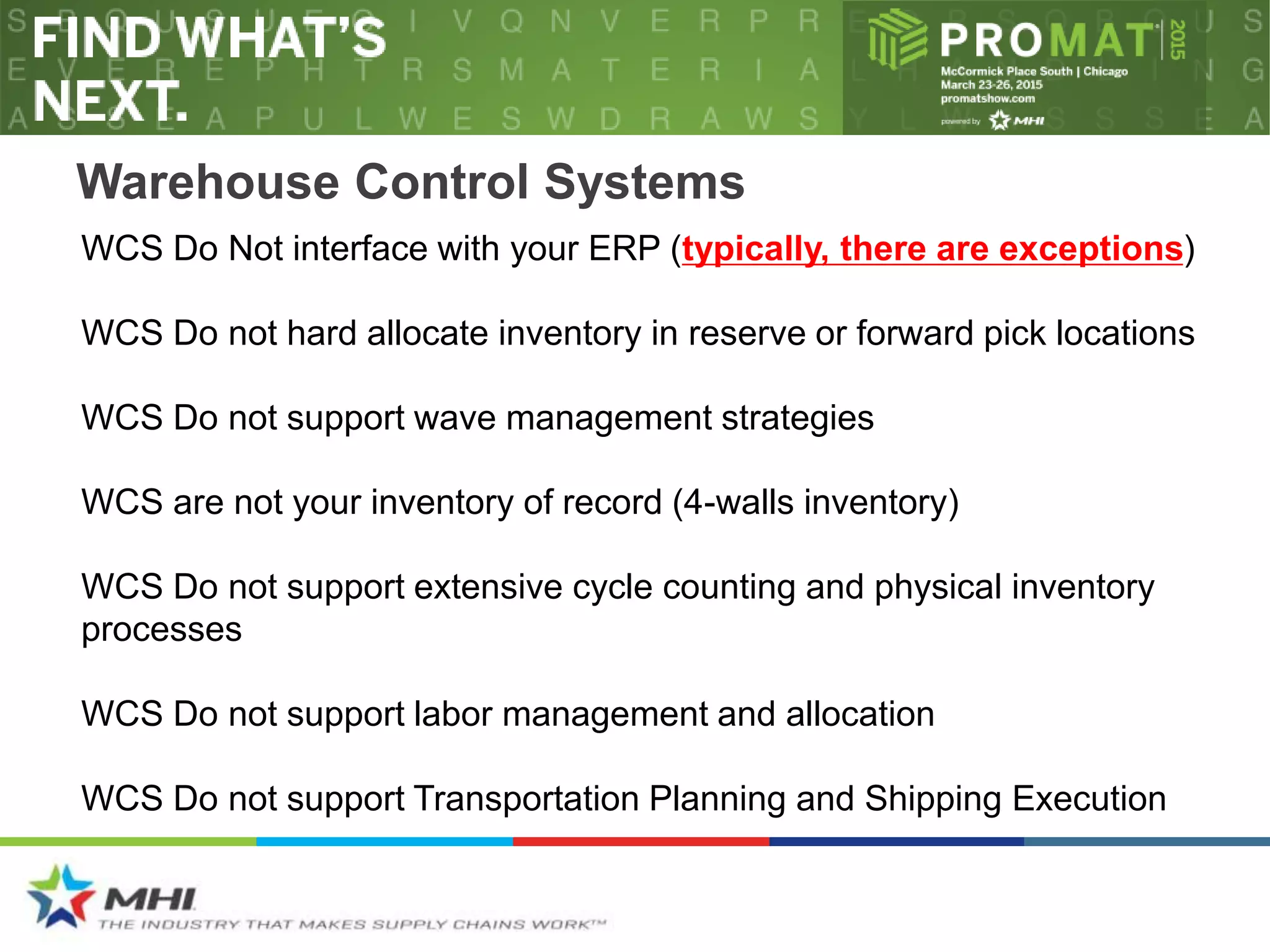
Warehouse Control Systems
WCS Do not support wave management strategies
WCS Do not hard allocate inventory in reserve or forward pick locations
WCS Do Not interface with your ERP (typically, there are exceptions)
WCS are not your inventory of record (4-walls inventory)
WCS Do not support extensive cycle counting and physical inventory
processes
WCS Do not support labor management and allocation
WCS Do not support Transportation Planning and Shipping Execution
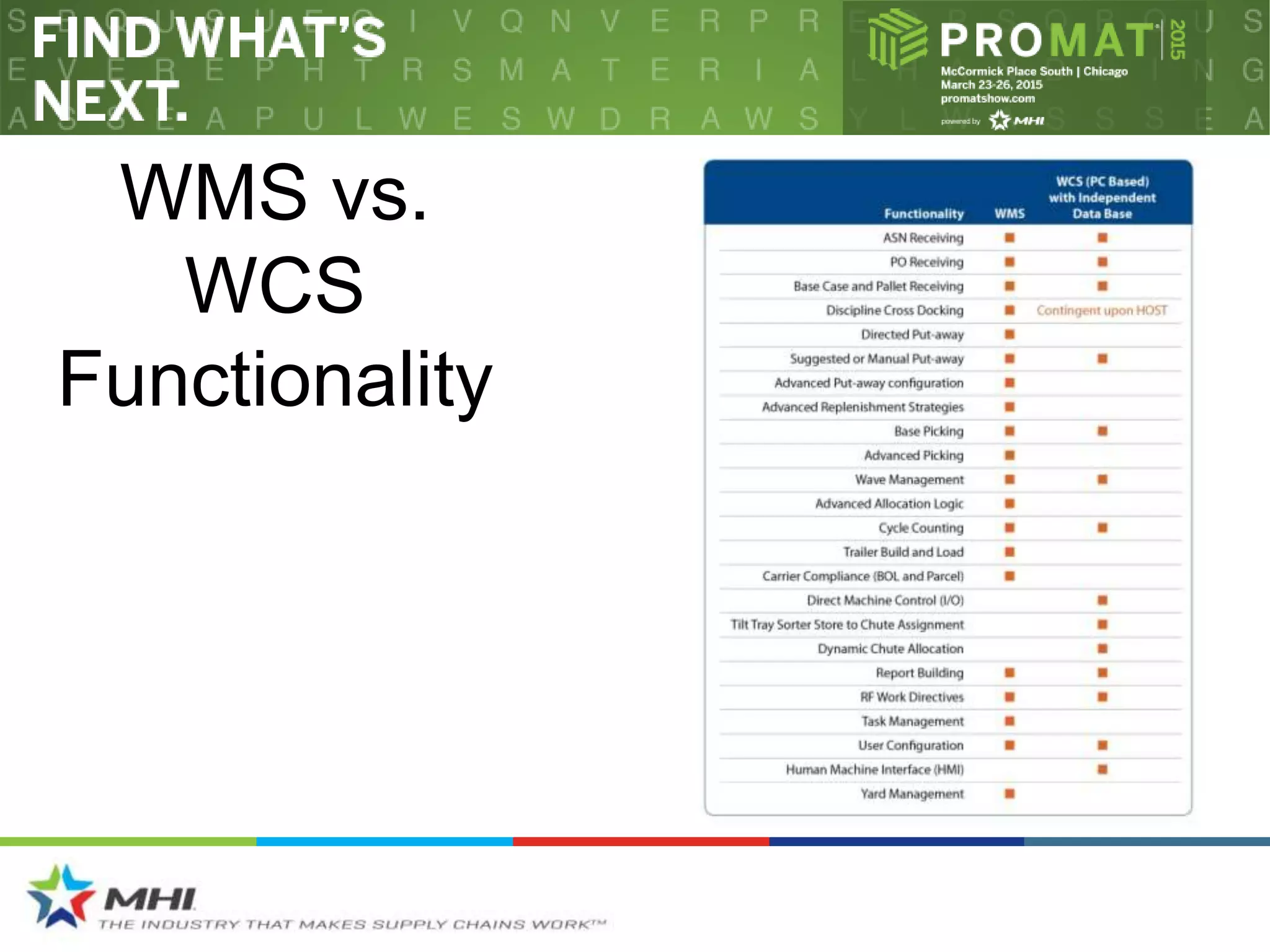
WMS vs.
WCS
Functionality
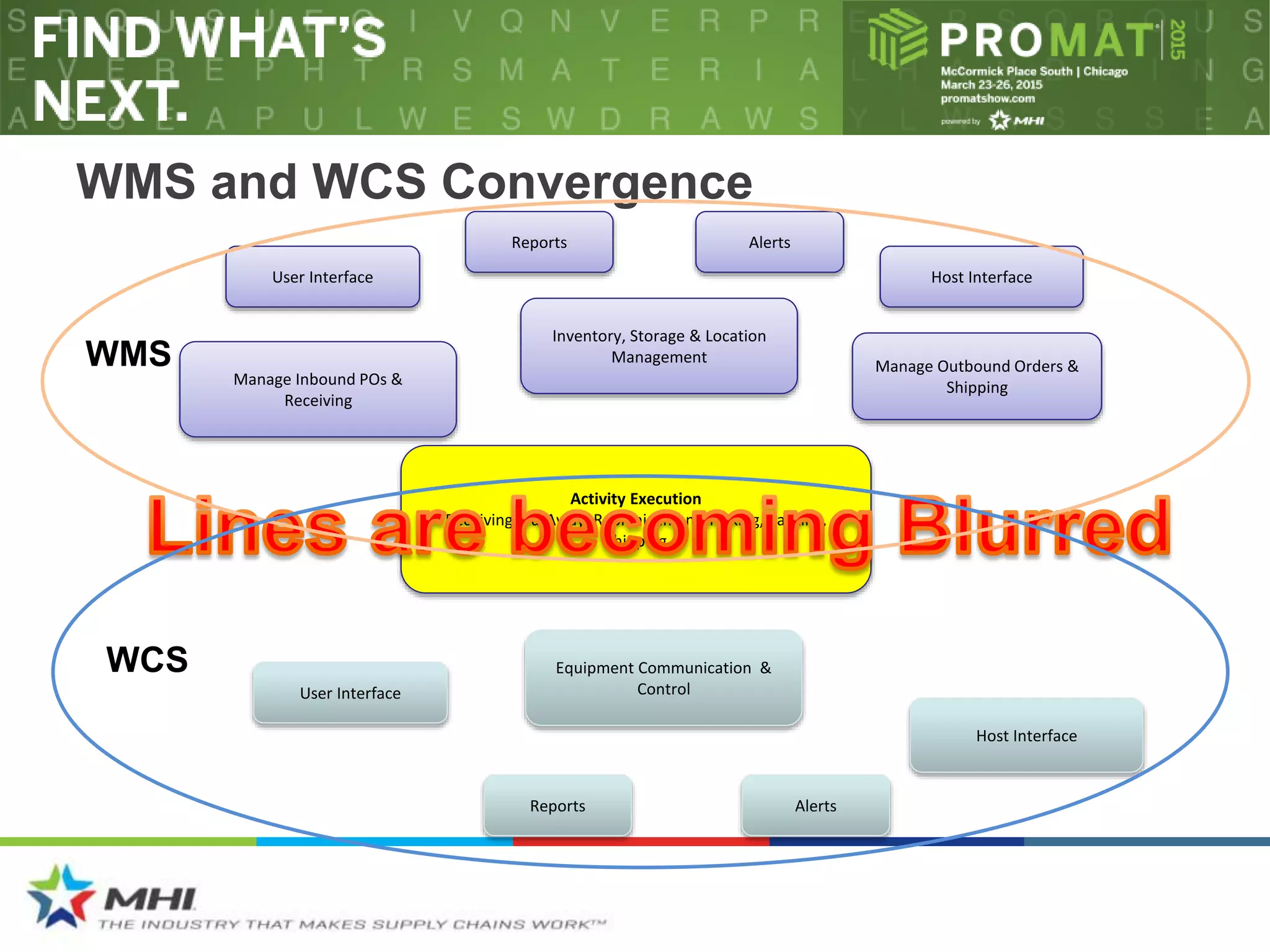
WMS and WCS Convergence
Host Interface
WMS
WCS
User Interface
Reports Alerts
Host Interface
Manage Inbound POs &
Receiving
Manage Outbound Orders &
Shipping
Inventory, Storage & Location
Management
User Interface
Reports Alerts
Equipment Communication &
Control
Activity Execution
Receiving, PutAway, Replenishment, Picking, Packing,
Shipping
Today’s Agenda:
WMS and WCS Defined
Day in the Life of an Order
Standard Interface Architecture
Case Studies
Questions
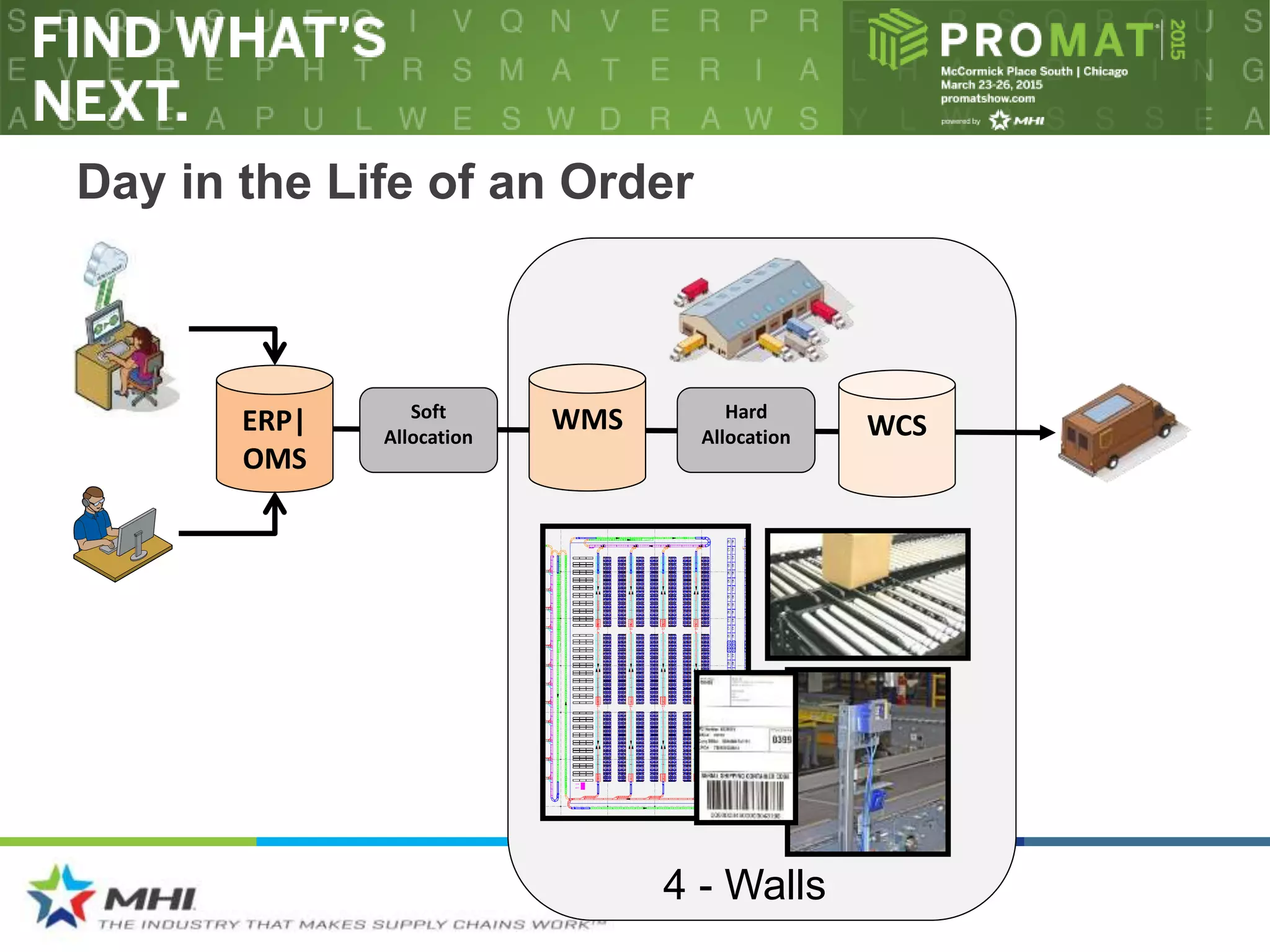
Day in the Life of an Order
ERP|
OMS
Soft
Allocation
WMS WCS
CON
SPL
SPL
CON
SPL
SPL
CON
SPL
SPL
CON
SPL
SPL
CON
SPL
SPL
CON
SPL
SPL
CON
SPL
SPL
CON
SPL
SPL
CON
SPL
SPL
SPLSPLSPLSPLSPLSPLSPLSPLSPL
CON
SPL
SPL
CON
SPL
SPL
CON
SPL
SPL
CON
SPL
SPL
CON
SPL
SPL
SPLSPLSPLSPLSPL
CONCONCONCONCONCONCONCON
SPLSPLSPLSPLSPLSPLSPLSPL
CONCONCONCONCON
SPLSPLSPLSPLSPL
CONCONCON
SPLSPLSPL
KD
KD
KD
KD
KD
KD
KD
KD
KD
KD
KD
KD
KD
KD
KD
KD
KD
KD
KD
KD
KD
KD
KD
KD
PRPRPRPRPRPRPRPRPRPRPR
PRPR
PRPR
PRPRPRPRPRPRPRPRPRPRPRPR
PR
PR
PRPRPRPRPRPRPRPRPRPRPR
PRPR
PRPR
PRPRPRPRPRPRPRPRPRPRPRPR
PR
PR
PRPRPRPRPR
PRPRPRPRPR
PR
PR
PRPRPRPRPR
PRPRPRPRPR
PR
PR
PRPRPRPRPRPRPRPRPRPRPRPRPRPRPRPRPRPRPRPRPRPRPRPRPRPRPRPRPRPRPRPR
PRPRPRPRPRPRPRPRPRPRPR
PRPR
PRPR
PRPRPRPRPRPRPRPRPRPRPRPR
PR
PR
PRPRPRPRPR
PRPRPRPRPR
PR
PR
Hard
Allocation
4 - Walls
Today’s Agenda:
WMS and WCS Defined
Day in the Life of an Order
Standard Interface Architecture
Case Studies
Questions
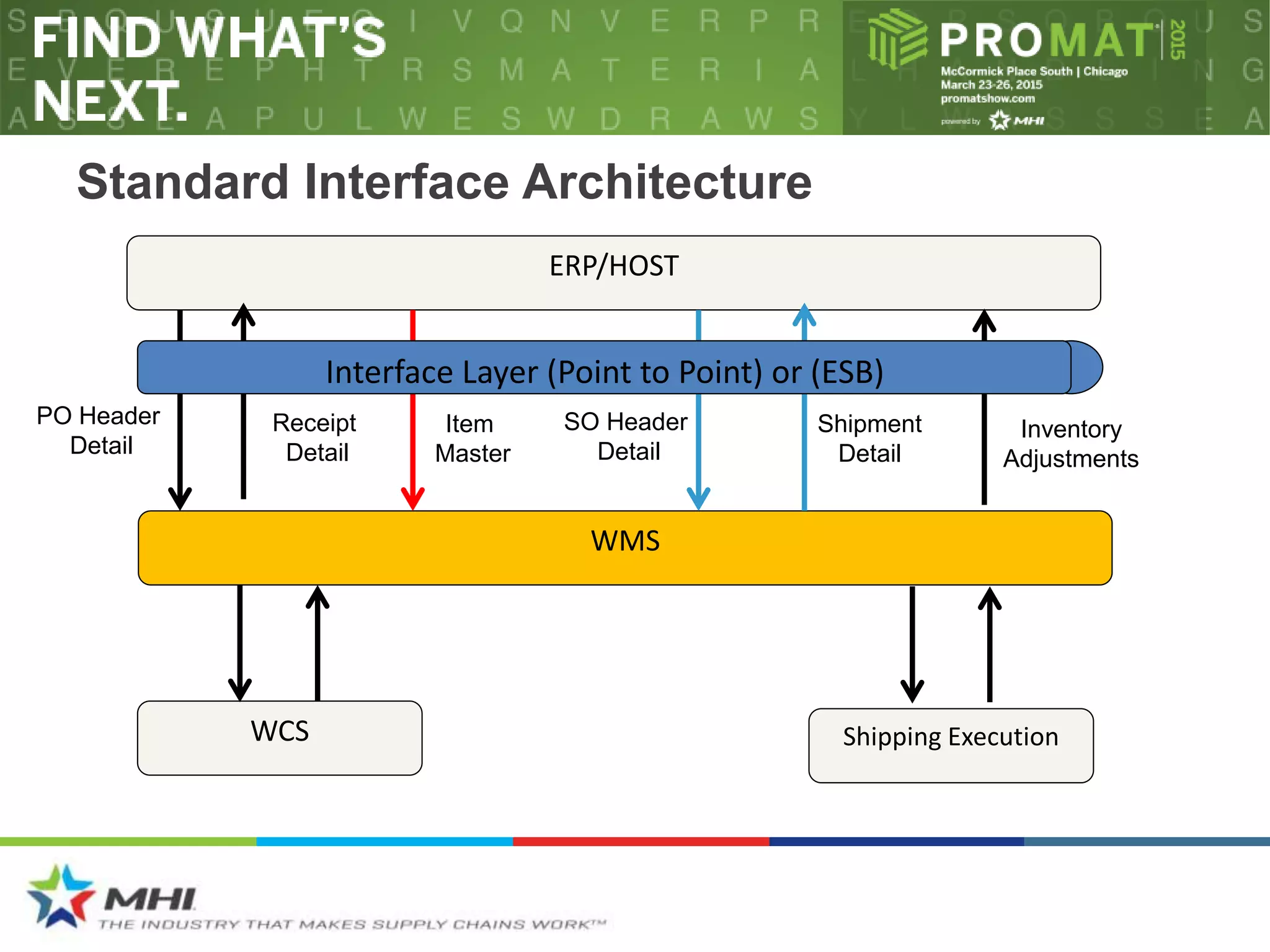
Standard Interface Architecture
ERP/HOST
WMS
SO Header
Detail
PO Header
Detail
Receipt
Detail
Item
Master
Shipment
Detail
Inventory
Adjustments
Interface Layer (Point to Point) or (ESB)
WCS Shipping Execution
Today’s Agenda:
WMS and WCS Defined
Day in the Life of an Order
Standard Interface Architecture
Case Studies
Questions
Case Study 1
• $800M Fashion Apparel Company
• Tier 1 WMS
• WCS Required for Put to Light and Conveyor
• However the WCS was used for discrete order
picking……
• WCS assumed inventory was always in the forward pick
location and did not manage, allocate or control the
inventory
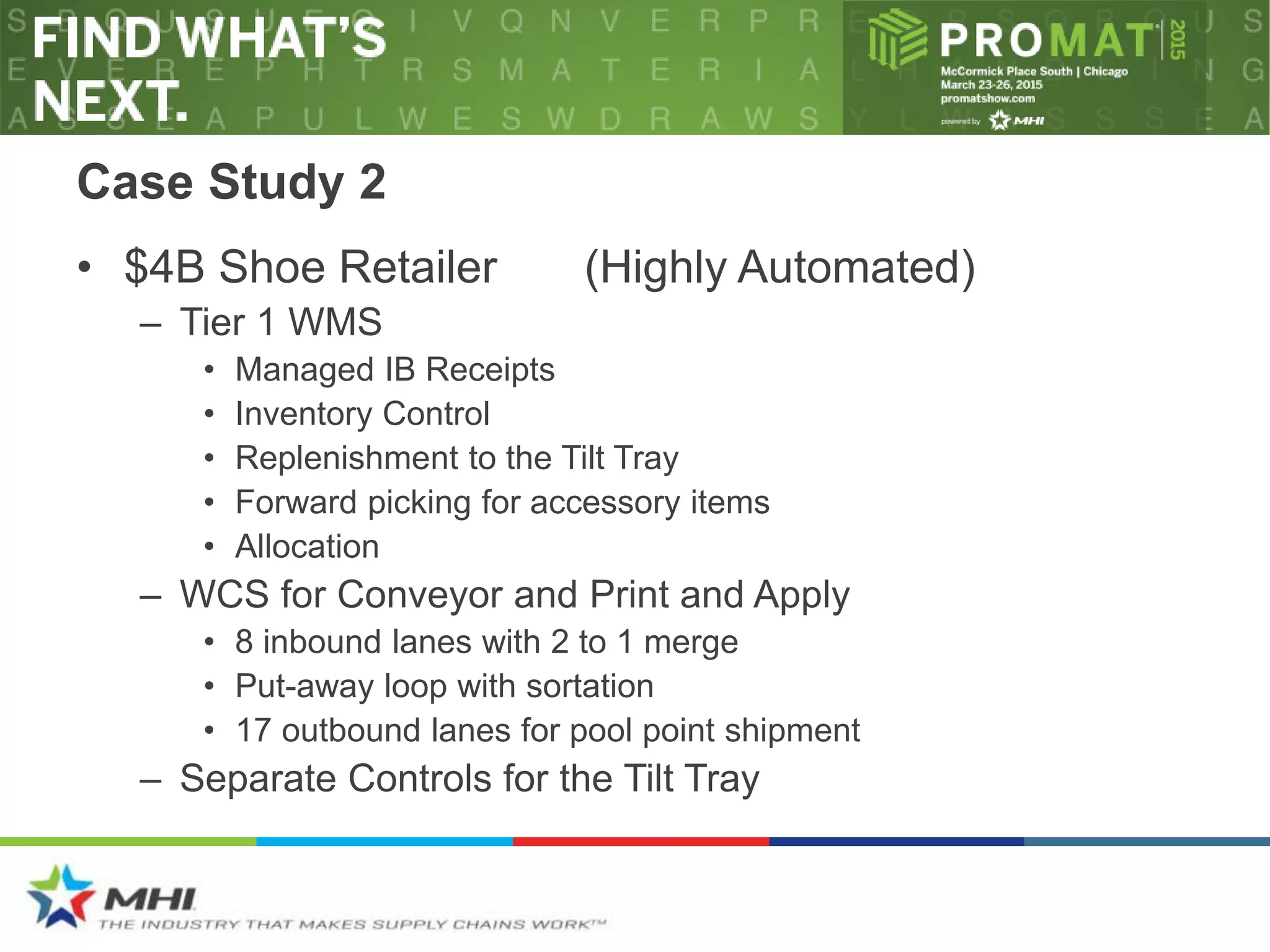
Case Study 2
• $4B Shoe Retailer (Highly Automated)
– Tier 1 WMS
• Managed IB Receipts
• Inventory Control
• Replenishment to the Tilt Tray
• Forward picking for accessory items
• Allocation
– WCS for Conveyor and Print and Apply
• 8 inbound lanes with 2 to 1 merge
• Put-away loop with sortation
• 17 outbound lanes for pool point shipment
– Separate Controls for the Tilt Tray
Lessons Learned
• Understand who (WMS vs. WCS) does best for
your business…..lines are getting blurred
• Understand how the physical movement of
inventory (UOM) moves through your facility
• Use a solutions architect that knows both
technologies….
– Happy Path work flows but more importantly…..
– Exception Management
Today’s Agenda:
WMS and WCS Defined
Day in the Life of an Order
Standard Interface Architecture
Case Studies
Questions
For More Information:
Jim Barnes
jbarnes@envistacorp.com
www.envistacorp.com

2015 promat wms vs. wcs

  • 1.
    Presented by: Jim Barnes SeniorManaging Partner WMS vs. WCS: Where and When to Apply Warehouse Management Systems and Warehouse Control Systems for Optimal Results Sponsored by: © 2015 MHI® Copyright claimed for audiovisual works and sound recordings of seminar sessions. All rights reserved.
  • 2.
    Today’s Agenda: WMS andWCS Defined Day in the Life of an Order Standard Interface Architecture Case Studies Questions
  • 3.
    What Is aWMS? • A highly specialized business application whose purpose is to control the flow of inventory into, within and out of a company’s distribution center (DC) – Four Walls – Between Multiple DCs • WMS knows where all products are at all times
  • 4.
    A Real-Time Environment Verify Receipts Track/Control Inventory BalanceOn Hand Amounts Allocate Orders Ship to Customers
  • 5.
    Supporting a Real-TimeEnvironment • Most WMSs incorporate – Wireless Data Terminals (RF Devices) – Bar-Coded Pallets, Cases and Item Labels – Radio Frequency Identification Tags (RFID) – Conveyor Systems / Material Handling Equipment – Voice Enabled RF Devices
  • 6.
    What Is aWCS? • A Warehouse Control System (WCS) is a real-time integrated control solution that manages many types of automated equipment: conveyor, sorters, ASRS, Pick to Light, Carrousels, Print and Apply • WCS exchange real-time communications (milliseconds), command processing, discrete equipment signals, and the optimization of material (multiple UOML: units, cartons and pallets)
  • 7.
    WMS vs. WCSAnalogy Tilt Tray Sorter (Bones) Conveyor (Bones) WMS (Brain) WCS (Central Nervous System) 5 Senses: Sight Sound Touch Taste Smell Machine Control Input & Output ASRS (Bones)
  • 8.
    Warehouse Management Systems WMSDo Not control Put Light, Sorters, Conveyors, Print and Apply and ASRS WMS Do Not track carton level LPNs on automation equipment WMS Do Not provide a GUI (ACAD) layout of your automation system WMS Do Not control machine control (starters and motors) WMS Do Not control machine language (ladder logic and PLCs)
  • 9.
    Warehouse Control Systems WCSDo not support wave management strategies WCS Do not hard allocate inventory in reserve or forward pick locations WCS Do Not interface with your ERP (typically, there are exceptions) WCS are not your inventory of record (4-walls inventory) WCS Do not support extensive cycle counting and physical inventory processes WCS Do not support labor management and allocation WCS Do not support Transportation Planning and Shipping Execution
  • 10.
  • 11.
    WMS and WCSConvergence Host Interface WMS WCS User Interface Reports Alerts Host Interface Manage Inbound POs & Receiving Manage Outbound Orders & Shipping Inventory, Storage & Location Management User Interface Reports Alerts Equipment Communication & Control Activity Execution Receiving, PutAway, Replenishment, Picking, Packing, Shipping
  • 12.
    Today’s Agenda: WMS andWCS Defined Day in the Life of an Order Standard Interface Architecture Case Studies Questions
  • 13.
    Day in theLife of an Order ERP| OMS Soft Allocation WMS WCS CON SPL SPL CON SPL SPL CON SPL SPL CON SPL SPL CON SPL SPL CON SPL SPL CON SPL SPL CON SPL SPL CON SPL SPL SPLSPLSPLSPLSPLSPLSPLSPLSPL CON SPL SPL CON SPL SPL CON SPL SPL CON SPL SPL CON SPL SPL SPLSPLSPLSPLSPL CONCONCONCONCONCONCONCON SPLSPLSPLSPLSPLSPLSPLSPL CONCONCONCONCON SPLSPLSPLSPLSPL CONCONCON SPLSPLSPL KD KD KD KD KD KD KD KD KD KD KD KD KD KD KD KD KD KD KD KD KD KD KD KD PRPRPRPRPRPRPRPRPRPRPR PRPRPRPRPRPRPRPRPRPRPR PRPR PRPR PRPRPRPRPRPRPRPRPRPRPRPR PRPRPRPRPRPRPRPRPRPRPRPR PR PR PRPRPRPRPRPRPRPRPRPRPR PRPRPRPRPRPRPRPRPRPRPR PRPR PRPR PRPRPRPRPRPRPRPRPRPRPRPR PRPRPRPRPRPRPRPRPRPRPRPR PR PR PRPRPRPRPR PRPRPRPRPR PR PR PRPRPRPRPR PRPRPRPRPR PR PR PRPRPRPRPRPRPRPRPRPRPRPRPRPRPRPRPRPRPRPRPRPRPRPRPRPRPRPRPRPRPRPR PRPRPRPRPRPRPRPRPRPRPR PRPRPRPRPRPRPRPRPRPRPR PRPR PRPR PRPRPRPRPRPRPRPRPRPRPRPR PRPRPRPRPRPRPRPRPRPRPRPR PR PR PRPRPRPRPR PRPRPRPRPR PR PR Hard Allocation 4 - Walls
  • 14.
    Today’s Agenda: WMS andWCS Defined Day in the Life of an Order Standard Interface Architecture Case Studies Questions
  • 15.
    Standard Interface Architecture ERP/HOST WMS SOHeader Detail PO Header Detail Receipt Detail Item Master Shipment Detail Inventory Adjustments Interface Layer (Point to Point) or (ESB) WCS Shipping Execution
  • 16.
    Today’s Agenda: WMS andWCS Defined Day in the Life of an Order Standard Interface Architecture Case Studies Questions
  • 17.
    Case Study 1 •$800M Fashion Apparel Company • Tier 1 WMS • WCS Required for Put to Light and Conveyor • However the WCS was used for discrete order picking…… • WCS assumed inventory was always in the forward pick location and did not manage, allocate or control the inventory
  • 18.
    Case Study 2 •$4B Shoe Retailer (Highly Automated) – Tier 1 WMS • Managed IB Receipts • Inventory Control • Replenishment to the Tilt Tray • Forward picking for accessory items • Allocation – WCS for Conveyor and Print and Apply • 8 inbound lanes with 2 to 1 merge • Put-away loop with sortation • 17 outbound lanes for pool point shipment – Separate Controls for the Tilt Tray
  • 19.
    Lessons Learned • Understandwho (WMS vs. WCS) does best for your business…..lines are getting blurred • Understand how the physical movement of inventory (UOM) moves through your facility • Use a solutions architect that knows both technologies…. – Happy Path work flows but more importantly….. – Exception Management
  • 20.
    Today’s Agenda: WMS andWCS Defined Day in the Life of an Order Standard Interface Architecture Case Studies Questions
  • 21.
    For More Information: JimBarnes jbarnes@envistacorp.com www.envistacorp.com