Math Facts Fluency
Central Virginia, 2015
What do Students Need to Be
Successful in Math?
• According to the National Mathematics
Panel, learning math requires three
types of knowledge.
– Factural
– Procedural
– Conceptual
Factual Knowledge
• It is the ability to have the answers (in
memory) to a small set of addition,
subtraction, multiplication and division
problems.
• The answers must be automatic and
simply retrieved from memory.
• This is important because complex
problems have simpler problems
embedded in them.
Procedural Knowledge
• Procedure is a sequence of steps by
which a problem can be solved.
• It is an understanding of meaning.
• It is knowing not understanding.
Conceptual Knowledge
• New concepts are built on previously
learned concepts.
• Students are able to acquire new math
concepts easier if they can recall their
math facts automatically.
Math Facts
• Addition, subtraction, multiplication and
division math facts are a key part of math
learning in 1st, 2nd, 3rd and 4th grades.
• Math facts can be memorized as a student
is learning the concepts of addition,
subtraction, multiplication and division.
• Knowing math facts automatically is similar
to knowing sight words in reading. It
allows your student to spend time and
energy on applying math problem solving.
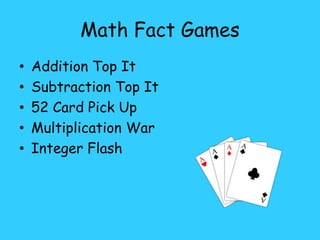
Math Fact Games
• Addition Top It
• Subtraction Top It
• 52 Card Pick Up
• Multiplication War
• Integer Flash
Addition Top It
How to Play:
• Each person is dealt ½ of the deck of cards and keeps
them together face down in her hand so they are not seen.
• For this game, a Jack = 11 and Queen = 12 and King = 13.
• Play begins with each player putting 2 cards from their
hand face up at the same time.
• Players add their cards, making sure to say a number
sentence each time.
• For example, if a player lays down a 2 and a Jack, he must
say “2 plus 11 equals 13”.
• The player with the highest answer, or sum, takes all 4
cards and places face down to the side in a discard pile.
• Play continues each round until all cards have been played.
Subtraction Top It
• This game can also be played subtracting
the 2 cards, called “Subtraction Top It”.
• For example, if a player lays down a 9 and
a 6, she must say “9 minus 6 equals 3”.
• If your student attempts to subtract
without beginning with the higher number,
correct them so that the problem does not
get a negative number.
52 Card Pick Up
How to Play:
• Scatter all 52 cards on a surface.
• For this game, a Jack = 11 and Queen = 12 and
King = 13.
• Ask your student to pick up 2 or 3 cards that
equal any number from 2 to 26.
For example, if you say “Pick up 2 or 3 cards that
equal 12.” Your student can pick up a 6 and a 6 or
a 9 and a 3 or a 5,5, and 2, etc.
• Play continues until all 52 cards have been
picked up.
Multiplication War
How to Play:
• Multiplication war is played very similar to regular war, but instead of
highest card winning the cards, the person to correctly state the value
of the two cards multiplied wins the cards.
• Each player gets half a deck, or 26 cards.
Example:
• Player A throws down a 6, Player B throws down a 7, the product of 6x7
=42, the first person to correctly identify the value of both cards wins
the cards.
• All Aces have the value of 1 and all face cards (kings, queens, and jacks)
have the value of 10. Ex. If an ace and a jack are thrown down then
the multiplication problem would be 10x10=100.
Duration: Until one player possess all cards or both players become tired
of playing the game. *Parents should set a minimum time limit.
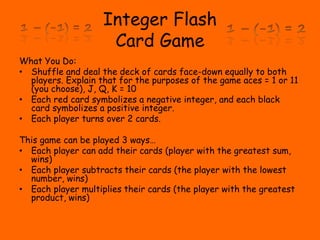
Integer Flash
Card Game
What You Do:
• Shuffle and deal the deck of cards face-down equally to both
players. Explain that for the purposes of the game aces = 1 or 11
(you choose), J, Q, K = 10
• Each red card symbolizes a negative integer, and each black
card symbolizes a positive integer.
• Each player turns over 2 cards.
This game can be played 3 ways…
• Each player can add their cards (player with the greatest sum,
wins)
• Each player subtracts their cards (the player with the lowest
number, wins)
• Each player multiplies their cards (the player with the greatest
product, wins)
Math Vocabulary
• It is very important to use the correct
math vocabulary when playing math
facts games with your student.
• “Plus” and “minus” refer only to the
symbols, not the math operation
Key Math Vocabulary Words
• Add/adding/addition
• Subtract/subtracting/subtraction
• Multiply/multiplying/multiplication
• Divide/dividing/division
• Equal/equate/equality
• Positive/negative
• Integers
• Sum/difference/product/quotient

Math fluency 3-15-15

  • 1.
  • 2.
    What do StudentsNeed to Be Successful in Math? • According to the National Mathematics Panel, learning math requires three types of knowledge. – Factural – Procedural – Conceptual
  • 3.
    Factual Knowledge • Itis the ability to have the answers (in memory) to a small set of addition, subtraction, multiplication and division problems. • The answers must be automatic and simply retrieved from memory. • This is important because complex problems have simpler problems embedded in them.
  • 4.
    Procedural Knowledge • Procedureis a sequence of steps by which a problem can be solved. • It is an understanding of meaning. • It is knowing not understanding.
  • 5.
    Conceptual Knowledge • Newconcepts are built on previously learned concepts. • Students are able to acquire new math concepts easier if they can recall their math facts automatically.
  • 6.
    Math Facts • Addition,subtraction, multiplication and division math facts are a key part of math learning in 1st, 2nd, 3rd and 4th grades. • Math facts can be memorized as a student is learning the concepts of addition, subtraction, multiplication and division. • Knowing math facts automatically is similar to knowing sight words in reading. It allows your student to spend time and energy on applying math problem solving.
  • 7.
    Math Fact Games •Addition Top It • Subtraction Top It • 52 Card Pick Up • Multiplication War • Integer Flash
  • 8.
    Addition Top It Howto Play: • Each person is dealt ½ of the deck of cards and keeps them together face down in her hand so they are not seen. • For this game, a Jack = 11 and Queen = 12 and King = 13. • Play begins with each player putting 2 cards from their hand face up at the same time. • Players add their cards, making sure to say a number sentence each time. • For example, if a player lays down a 2 and a Jack, he must say “2 plus 11 equals 13”. • The player with the highest answer, or sum, takes all 4 cards and places face down to the side in a discard pile. • Play continues each round until all cards have been played.
  • 9.
    Subtraction Top It •This game can also be played subtracting the 2 cards, called “Subtraction Top It”. • For example, if a player lays down a 9 and a 6, she must say “9 minus 6 equals 3”. • If your student attempts to subtract without beginning with the higher number, correct them so that the problem does not get a negative number.
  • 10.
    52 Card PickUp How to Play: • Scatter all 52 cards on a surface. • For this game, a Jack = 11 and Queen = 12 and King = 13. • Ask your student to pick up 2 or 3 cards that equal any number from 2 to 26. For example, if you say “Pick up 2 or 3 cards that equal 12.” Your student can pick up a 6 and a 6 or a 9 and a 3 or a 5,5, and 2, etc. • Play continues until all 52 cards have been picked up.
  • 11.
    Multiplication War How toPlay: • Multiplication war is played very similar to regular war, but instead of highest card winning the cards, the person to correctly state the value of the two cards multiplied wins the cards. • Each player gets half a deck, or 26 cards. Example: • Player A throws down a 6, Player B throws down a 7, the product of 6x7 =42, the first person to correctly identify the value of both cards wins the cards. • All Aces have the value of 1 and all face cards (kings, queens, and jacks) have the value of 10. Ex. If an ace and a jack are thrown down then the multiplication problem would be 10x10=100. Duration: Until one player possess all cards or both players become tired of playing the game. *Parents should set a minimum time limit.
  • 12.
    Integer Flash Card Game WhatYou Do: • Shuffle and deal the deck of cards face-down equally to both players. Explain that for the purposes of the game aces = 1 or 11 (you choose), J, Q, K = 10 • Each red card symbolizes a negative integer, and each black card symbolizes a positive integer. • Each player turns over 2 cards. This game can be played 3 ways… • Each player can add their cards (player with the greatest sum, wins) • Each player subtracts their cards (the player with the lowest number, wins) • Each player multiplies their cards (the player with the greatest product, wins)
  • 13.
    Math Vocabulary • Itis very important to use the correct math vocabulary when playing math facts games with your student. • “Plus” and “minus” refer only to the symbols, not the math operation
  • 14.
    Key Math VocabularyWords • Add/adding/addition • Subtract/subtracting/subtraction • Multiply/multiplying/multiplication • Divide/dividing/division • Equal/equate/equality • Positive/negative • Integers • Sum/difference/product/quotient