2015 Global Threat
Intelligence Report
An analysis of security trends in the
Financial Services industry
• over 6 billion attacks
• trillions of logs
• over 18,000 clients
• 28% Financial Services
industry respondents
Data gathered from NTT security
companies and NTT’s live Global
Threat Intelligence Platform
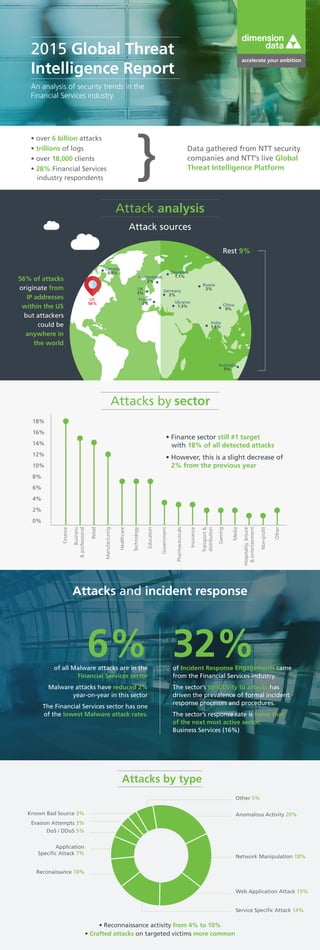
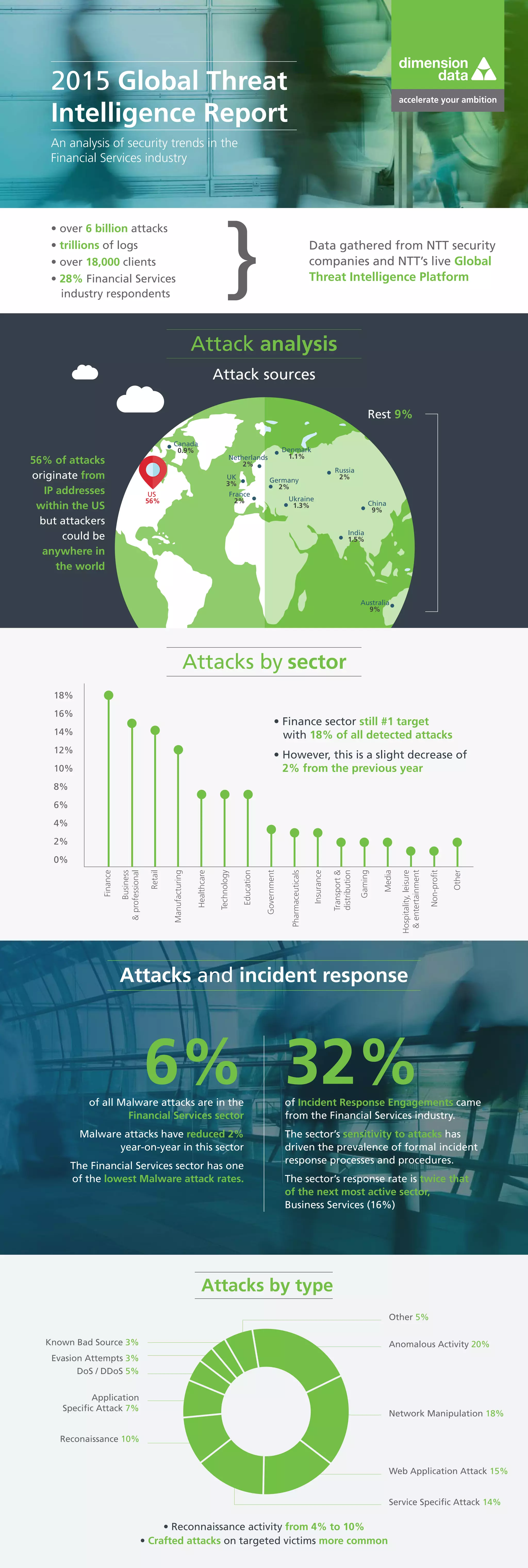
56% of attacks
originate from
IP addresses
within the US
but attackers
could be
anywhere in
the world
Attack analysis
Attack sources
US
56% China
9%
France
2%
India
1.5%
Germany
2%
Netherlands
2%
Denmark
1.1%
Russia
2%
Ukraine
1.3%
Canada
0.9%
Australia
9%
Rest 9%
UK
3%
Attacks by sector
• Finance sector still #1 target
with 18% of all detected attacks
Finance
0%
2%
4%
8%
10%
12%
14%
16%
18%
6%
Business
&professional
Manufacturing
Retail
Healthcare
Technology
Education
Government
Pharmaceuticals
Insurance
Transport&
distribution
Gaming
Media
Hospitality,leisure
&entertainment
Non-profit
Other
• However, this is a slight decrease of
2% from the previous year
Attacks and incident response
• Reconnaissance activity from 4% to 10%
• Crafted attacks on targeted victims more common
Other 5%
Known Bad Source 3%
Evasion Attempts 3%
DoS / DDoS 5%
Application
Specific Attack 7%
Reconaissance 10%
Anomalous Activity 20%
Network Manipulation 18%
Web Application Attack 15%
Service Specific Attack 14%
Attacks by type
6% 32%of all Malware attacks are in the
Financial Services sector
Malware attacks have reduced 2%
year-on-year in this sector
The Financial Services sector has one
of the lowest Malware attack rates.
of Incident Response Engagements came
from the Financial Services industry.
The sector’s sensitivity to attacks has
driven the prevalence of formal incident
response processes and procedures.
The sector’s response rate is twice that 	
of the next most active sector, 		
Business Services (16%)
dimensiondata.com/globalthreatreport #GlobalThreatReport
Threat intelligence defined
2. Raw information
collected based on
requirements
3. Information
processed  exploited
4. Intelligence
analysis
 production
1.Consumer needs,
planning, requirements
 direction
5. Dissemination
of product
to consumer
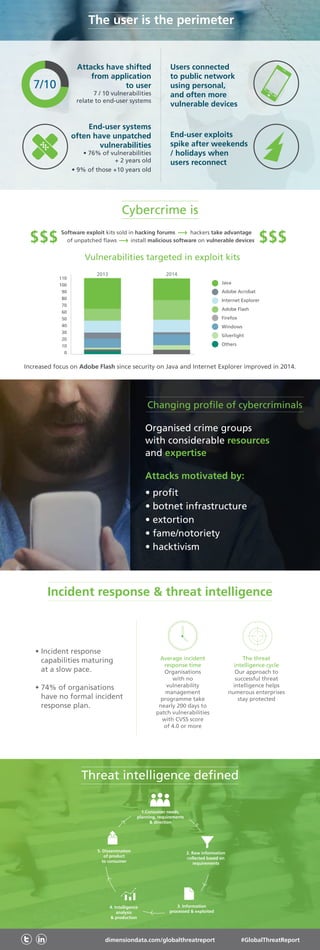
Attacks have shifted
from application
to user
7 / 10 vulnerabilities
relate to end-user systems
Users connected
to public network
using personal,
and often more
vulnerable devices
End-user exploits
spike after weekends
/ holidays when
users reconnect
End-user systems
often have unpatched
vulnerabilities
• 76% of vulnerabilities
+ 2 years old
• 9% of those +10 years old
The user is the perimeter
7/10
Vulnerabilities targeted in exploit kits
Cybercrime is
$$ $ $$ $Software exploit kits sold in hacking forums 	 hackers take advantage
of unpatched flaws install malicious software on vulnerable devices
Increased focus on Adobe Flash since security on Java and Internet Explorer improved in 2014.
Java
Adobe Acrobat
Internet Explorer
Adobe Flash
Firefox
Windows
Silverlight
Others
2013 2014
110
100
90
80
70
60
50
40
30
20
10
0
Changing profile of cybercriminals
Organised crime groups
with considerable resources
and expertise
Attacks motivated by:
• profit
• botnet infrastructure
• extortion
• fame/notoriety
• hacktivism
Incident response  threat intelligence
• Incident response 	
capabilities maturing 		
at a slow pace.
• 74% of organisations
have no formal incident
response plan.
Average incident
response time
Organisations
with no
vulnerability
management
programme take
nearly 200 days to
patch vulnerabilities
with CVSS score
of 4.0 or more
The threat
intelligence cycle
Our approach to
successful threat
intelligence helps
numerous enterprises
stay protected

2015 Global Threat Intelligence Report

  • 1.
    2015 Global Threat IntelligenceReport An analysis of security trends in the Financial Services industry • over 6 billion attacks • trillions of logs • over 18,000 clients • 28% Financial Services industry respondents Data gathered from NTT security companies and NTT’s live Global Threat Intelligence Platform 56% of attacks originate from IP addresses within the US but attackers could be anywhere in the world Attack analysis Attack sources US 56% China 9% France 2% India 1.5% Germany 2% Netherlands 2% Denmark 1.1% Russia 2% Ukraine 1.3% Canada 0.9% Australia 9% Rest 9% UK 3% Attacks by sector • Finance sector still #1 target with 18% of all detected attacks Finance 0% 2% 4% 8% 10% 12% 14% 16% 18% 6% Business &professional Manufacturing Retail Healthcare Technology Education Government Pharmaceuticals Insurance Transport& distribution Gaming Media Hospitality,leisure &entertainment Non-profit Other • However, this is a slight decrease of 2% from the previous year Attacks and incident response • Reconnaissance activity from 4% to 10% • Crafted attacks on targeted victims more common Other 5% Known Bad Source 3% Evasion Attempts 3% DoS / DDoS 5% Application Specific Attack 7% Reconaissance 10% Anomalous Activity 20% Network Manipulation 18% Web Application Attack 15% Service Specific Attack 14% Attacks by type 6% 32%of all Malware attacks are in the Financial Services sector Malware attacks have reduced 2% year-on-year in this sector The Financial Services sector has one of the lowest Malware attack rates. of Incident Response Engagements came from the Financial Services industry. The sector’s sensitivity to attacks has driven the prevalence of formal incident response processes and procedures. The sector’s response rate is twice that of the next most active sector, Business Services (16%)
  • 2.
    dimensiondata.com/globalthreatreport #GlobalThreatReport Threat intelligencedefined 2. Raw information collected based on requirements 3. Information processed exploited 4. Intelligence analysis production 1.Consumer needs, planning, requirements direction 5. Dissemination of product to consumer Attacks have shifted from application to user 7 / 10 vulnerabilities relate to end-user systems Users connected to public network using personal, and often more vulnerable devices End-user exploits spike after weekends / holidays when users reconnect End-user systems often have unpatched vulnerabilities • 76% of vulnerabilities + 2 years old • 9% of those +10 years old The user is the perimeter 7/10 Vulnerabilities targeted in exploit kits Cybercrime is $$ $ $$ $Software exploit kits sold in hacking forums hackers take advantage of unpatched flaws install malicious software on vulnerable devices Increased focus on Adobe Flash since security on Java and Internet Explorer improved in 2014. Java Adobe Acrobat Internet Explorer Adobe Flash Firefox Windows Silverlight Others 2013 2014 110 100 90 80 70 60 50 40 30 20 10 0 Changing profile of cybercriminals Organised crime groups with considerable resources and expertise Attacks motivated by: • profit • botnet infrastructure • extortion • fame/notoriety • hacktivism Incident response threat intelligence • Incident response capabilities maturing at a slow pace. • 74% of organisations have no formal incident response plan. Average incident response time Organisations with no vulnerability management programme take nearly 200 days to patch vulnerabilities with CVSS score of 4.0 or more The threat intelligence cycle Our approach to successful threat intelligence helps numerous enterprises stay protected