















YOUNG PEOPLE, THE FAITH AND
VOCATIONAL DISCERNMENT:
A TIME FOR DISCERNMENT AND ACTION
DR. CHARLOTTE MCCORQUODALE
What are key issues surrounding this
topic that you were hoping we would
discuss today?
WHAT DOYOU
THINK ISTHE
CHURCH’S
BIGGEST
CHALLENGE
WHEN IT
COMESTO
ENGAGING
YOUTH AND
YOUNG
ADULTS IN
FAITH?
Have we failed the
younger generations?
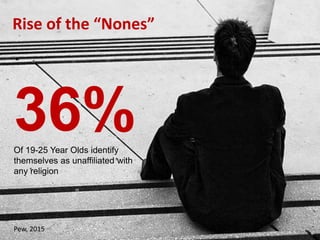
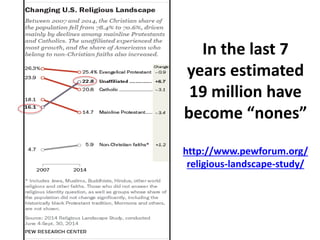
Rise of the “None”s
36%Of 19-25 Year Olds identify
themselves as unaffiliated with
any religion
Rise of the “Nones”
Pew, 2015
In the last 7
years estimated
19 million have
become “nones”
http://www.pewforum.org/
religious-landscape-study/
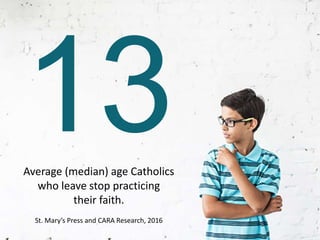
Average (median) age Catholics
who leave stop practicing
their faith.
St. Mary’s Press and CARA Research, 2016
“Increasingly
young
Catholics are
weakly
attached to
the Church.”
Going, Going, Gone, (p. 6)
“There is no
single reason
why many
young people
raised Catholic
no longer
identify with the
Church.”
Going, Going, Gone, (p. 13)
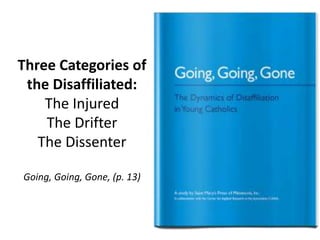
Three Categories of
the Disaffiliated:
The Injured
The Drifter
The Dissenter
Going, Going, Gone, (p. 13)
What do we do as a faith
community to reverse these
trends?
Can we even do it?
Each step in the process builds on the
next w
This is the moment….
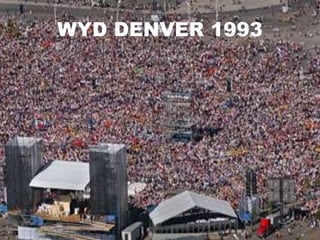
WYD DENVER 1993
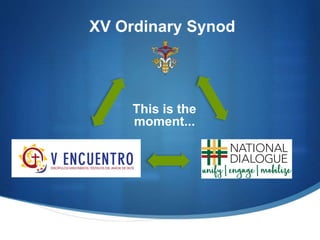
This is the
moment...
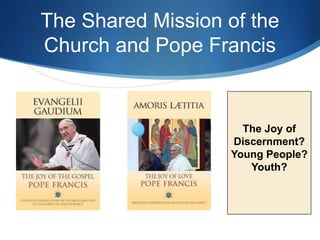
The Shared Mission of the
Church and Pope Francis
The Joy of
Discernment?
Young People?
Youth?
WHAT IS A SYNOD?
....A RELIGIOUS MEETING OR ASSEMBLY AT WHICH BISHOPS, GATHERED AROUND
AND WITH THE HOLY FATHER, HAVE OPPORTUNITY TO INTERACT WITH EACH
OTHER AND TO SHARE INFORMATION AND EXPERIENCES, IN THE COMMON
PURSUIT OF PASTORAL SOLUTIONS WHICH HAVE A UNIVERSAL VALIDITY AND
APPLICATION.
WHAT IS IT
ABOUT?
What is the Synod all about?
“…through a Synod with the topic, “Young People, the
Faith and Vocational Discernment”, the Church has
decided to examine herself on how she can lead
young people to recognize and accept the call to the
fullness of life and love, and to ask young people to
help her in identifying the most effective ways to
announce the Good News today.”
(Synod, Prepatory Document)
What is the Synod all about?
“…. By listening to young people, the Church will
once again hear the Lord speaking in today’s
world. As in the days of Samuel (cf. 1 Sam 3:1-21)
and Jeremiah (cf. Jer 1:4-10), young people know how
to discern the signs of our times, indicated by the
Spirit. Listening to their aspirations, the Church
can glimpse the world which lies ahead and the
paths the Church is called to follow.”
(Synod, Prepatory Document)
WHEN AND
WHERE?
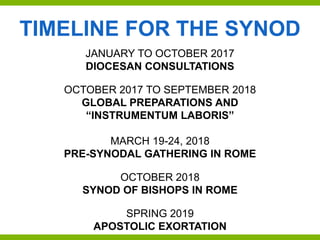
TIMELINE FOR THE SYNOD
JANUARY TO OCTOBER 2017
DIOCESAN CONSULTATIONS
OCTOBER 2017 TO SEPTEMBER 2018
GLOBAL PREPARATIONS AND
“INSTRUMENTUM LABORIS”
MARCH 19-24, 2018
PRE-SYNODAL GATHERING IN ROME
OCTOBER 2018
SYNOD OF BISHOPS IN ROME
SPRING 2019
APOSTOLIC EXORTATION
https://www.facebook.com/wydusa/videos/2023137324587662/.
Report to Bishops on the USCCB
Rome from Cardinal DiNardo
Report to Rome from
Cardinal DiNardo on
Behalf of USCCB
 100 dioceses, 25 national organizations, and several Bishop committees
participated in the consultation.
 Confirmed understanding that ministry with age groups is unique and they
should not be lumped together.
 Affirmed our awareness of the top challenge young people face today
economic struggles, poverty, drugs and alcohol abuse, isolation, anxiety,
and society pressures.
 They want to be listen to and what to be heard. They seek spiritual
guidance and mentorship from the church, and to be intentionally invited
into leadership because they do not feel invited and don’t know where to
find guidance and mentorship.
“We heard young people say
that the church is not there at
critical moments of
transition in their lives,
that was repeated
over and over again.”
Cardinal DiNardo, President of USCCB
On the Synod Consultation Report
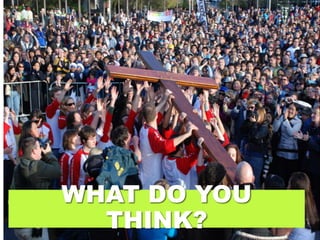
WHAT DO YOU
THINK?
This is the
moment...
 Purpose: The main objective of the process of the Encuentro
is to discern the way in which Hispanics/Latinos respond as
Church.
 History: Started in 1972, this will be the fifth Encuentro
process.
 Grassroots process that starts in events parish that build
towards diocese that builds towards regional events which
leads to national event, September 20-23, 2018 in Texas. In
2019 Conclusions will be published and shared with the
Church.
 Website: https://vencuentro.org/
This is the
moment...
 The Vision of the National Dialogue: The vision of this initiative
is an energized and unified Church committed to forming and
engaging youth and young adults as missionary disciples.
 Three Phases: Unify, engage, and mobilize Catholic Pastoral
Ministry with Youth and Young Adults. Intent is to assist the US
Church in implementing the XV Ordinary Synod and the V
Encuentro by mobilizing the church to respond.
 Timeline: Began in 2017 goes through to 2020,
National Conversations begin June 2018-December 2019
 Website: https://www.nationaldialogue.info/
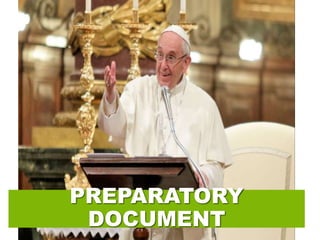
PREPARATORY
DOCUMENT
Young People,
the Faith and
Vocational
Discernment
16-29 year olds
Outline of the
Preparatory Document
 Introduction
 In the Footsteps of the Beloved
Disciple
 I. Young People in Today’s World
 A Rapidly-Changing World
 New Generations
 Young People and Choices
 II. Faith, Discernment, Vocation
 Faith and Vocation
 The Gift of Discernment
 Paths Toward Vocation and Mission
 Accompaniment
 III. Pastoral Activity
 Walking with Young People
 Agents
 Places
 Resources
 Mary of Nazareth
 Questions
 Gathering Statistics
 Evaluating the Situation
 Sharing Activities

What are the
major tasks of
adolescence
and emerging
adulthood?
Call….we all have one,
batman
“These things I have spoken to you, that my
joy may be in you, and that your joy may be
full” (Jn 15:11). This is God’s plan for all men
and women in every age, including all the
young men and women of the Third
Millennium, without exception.”
“You did not choose me, but I chose you and
appointed you that you should go and bear
fruit and that your fruit should abide; so that
whatever you ask the Father in my name, he
may give it to you. This I command you, to
love one another” (Jn 15:16-17).
From the XV ORDINARY GENERAL ASSEMBLY
Young People, the Faith and Vocational Discernment
PREPARATORY DOCUMENT
“If the vocation to the joy of love is the
fundamental call that God has placed in the
heart of every young person so that each
one’s existence will bear fruit, faith is both a
gift from on high and a response to feeling
oneself chosen and loved.”
From the XV ORDINARY GENERAL ASSEMBLY
Young People, the Faith and Vocational Discernment
PREPARATORY DOCUMENT
“For each person, the vocation
to love takes concrete form in
everyday life through a series
of choices, which find
expression in the states of life
(marriage, ordained ministry,
consecrated life, etc.),
professions, forms of social
and civil commitment, lifestyle,
the management of time and
money, etc.”
From the XV ORDINARY GENERAL ASSEMBLY
Young People, the Faith and Vocational Discernment
PREPARATORY DOCUMENT
“The purpose of vocational discernment
is to find out how to transform them
(choices), in the light of faith, into steps
towards the fullness of joy to which
everyone is called.”
Walking with them in their
discernment of life choices is
an important part of
accompanying young people.
“Precisely because the proposed message
involves the freedom of young people,
every community needs to give importance to
creative ways of addressing young people in a
personal way and supporting
personal development. In many cases, the task
involves learning to allow for something new and
not stifling what is new by attempting to apply a
preconceived framework.”
From the XV ORDINARY GENERAL ASSEMBLY
Young People, the Faith and Vocational Discernment
PREPARATORY DOCUMENT
No seed for vocations can be
fruitful if approached with a closed
and “complacent pastoral attitude
that says: ‘We have always done it
this way’” and without people being
“bold and creative in this task of
rethinking the goals, structures,
style and methods of
evangelization in their respective
communities”
(Evangelii gaudium, 33).
From the XV ORDINARY GENERAL ASSEMBLY
Young People, the Faith and Vocational Discernment
PREPARATORY DOCUMENT
“In pastoral activity, young people are
not objects but agents. Oftentimes,
society sees them as non-essential or
inconvenient. The Church cannot
reflect such an attitude, because all
young people, without exception, have
the right to be guided in life’s journey.”
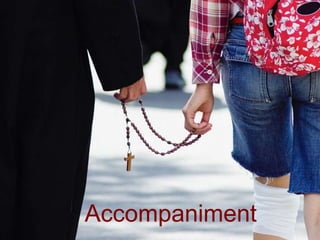
Accompaniment
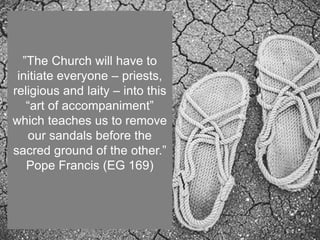
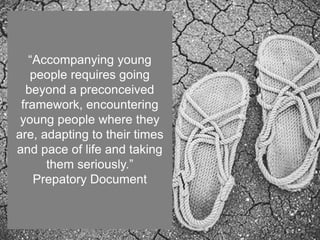
”The Church will have to
initiate everyone – priests,
religious and laity – into this
“art of accompaniment”
which teaches us to remove
our sandals before the
sacred ground of the other.”
Pope Francis (EG 169)
“Accompanying young
people requires going
beyond a preconceived
framework, encountering
young people where they
are, adapting to their times
and pace of life and taking
them seriously.”
Prepatory Document

How does the Church
help young people
accept their call to the
joy of the Gospel,
especially in these
times of uncertainty,
volatility and insecurity?
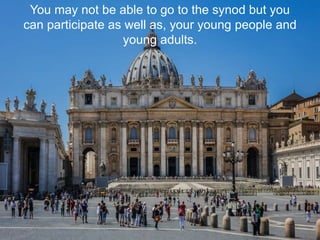
You may not be able to go to the synod but you
can participate as well as, your young people and
young adults.
Pre-Synodal Gathering
www.synod2018.va

Part One.
Challenges and Opportunities of
Young People in Today’s World
“We need to know each other as a
generation, to find out where we are, to
understand what matters and what to avoid,
to ascertain differences, accept them and go
beyond, to look forward and imagine what
awaits us and to find a balance between
excessive progress and deep, essential and
genuine introspection.”
From Letter of Invitation to Participate In Pre-Synodal Meeting Through
Social Media
http://www.synod2018.va/content/synod2018/en/pre-synodal-meeting/letter-
of-invitation.html

Part Two.
Faith and Vocation.
Discernment and
Accompaniment
“…faith in Jesus Christ speaks of a humanity
that has been touched, indeed lived by God.
The consequence of this meeting of the
human and divine enthusiastically compels us
towards our true good that is unknown to us.
Only in personal experience, in a journey, in
the intersecting of family bonds and personal
relationships is the truth about ourselves
revealed, a truth which guides our choices.”
From Letter of Invitation to Participate In Pre-Synodal Meeting Through Social
Media
http://www.synod2018.va/content/synod2018/en/pre-synodal-meeting/letter-of-

Part Three.
The Church’s Formative and
Pastoral Activity
“The basis for this change must be the
shared-responsibility of the Church and
young people. The Church is asked to
devise new approaches and new
instruments and forms of involvement,
adapted to the young generation, who
are asked to participate and add their
own characteristic mark.”
From Letter of Invitation to Participate In Pre-Synodal Meeting
Through Social Media
www.facebook.com/synod2018
Twitter: @Synod2018
www.instagram.com/synod2018/
As a Church we
want the church to
be ready for when
the exhortation
comes out. We
want to be ready to
act upon this
moment.
What does that look
like?
How can you and your
community become
involved in the XV
Synod, V Encuentro,
National Dialogue and
as such the
implementation and
mobilization?
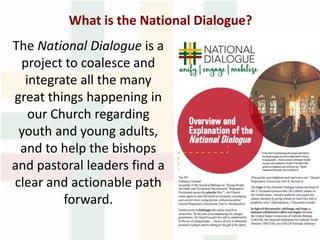
What is the National Dialogue?
The National Dialogue is a
project to coalesce and
integrate all the many
great things happening in
our Church regarding
youth and young adults,
and to help the bishops
and pastoral leaders find a
clear and actionable path
forward.
National Dialogue
Collaborating Organizations
Formally Supported by Five Standing
USCCB Committees
• Laity, Marriage, Family Life and Youth
• Catholic Education
• Clergy, Consecrated Life and Vocations
• Cultural Diversity in the Church
• Evangelization and Catechesis
Over 50 Bishops will be involved and
consulted on a regular basis.
What is the Vision of
the National Dialogue?
The vision of this initiative is an
energized and unified Church
committed to forming and engaging
youth and young adults
as missionary disciples.
PHASE ONE:
July 2017-June 2018
WHAT DOES IT MEAN TO
SAY THE CHURCH HAS
A UNIFIED EFFORT?
PHASE TWO:
July 2018 to December 2019
HOW WILL YOUTH AND YOUNG
ADULTS BE ENGAGED IN THE
NATIONAL DIALOGUE?
PHASE THREE:
January 2020-June 2021
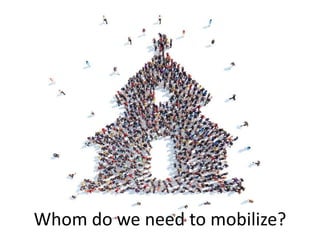
Whom do we need to mobilize?
When is the National Dialogue?
It is now!
There are three major phases of this
multi-year project that will continue
through 2020:
(1) unity of the fields of youth and young
adult ministries
(2) engagement through direct dialogue
with young people
(3) mobilization of the Church towards
implementation
Milestones of the National Dialogue…
 A kick-off event at the Convocation with 300 people
and 30 Bishops.
 The National Leadership Network made up of 75
national organizations has been established.
 The NLN had its inaugural gathering in September
of 2017 with over 100 participants.
 A National Dialogue website has been created
www.nationaldialogue.info
What is the purpose of the Phase 2
Conversations?
Purpose of the Phase 2 Conversations
The purpose of the conversations taking
place within the National Dialogue is to
more deeply understand the lived
experience of youth and young adults so
that as a Church, we can transform our
ministry practice
to more effectively encounter
and accompany the young church.
Purpose of the Phase 2 Conversations
The intent is that these conversations
will be a holy experience of dialogue,
listening, encounter, and
accompaniment. The hope is that
these conversations will build upon
what we are learning from the Synod
and Encuentro.
What are the characteristics of the Year 2
Conversations within the National Dialogue?
• created to be adaptable
• a simple movement from
Life to Faith to Life
• build upon the findings
coming from the Synod
and Encuentro, when
possible
• data gathered will help
mobilize the church’s
ministry to youth and
young adults
Step One: Preparing for the
Conversation
Step Two: Engaging in the Conversation
Step Three: Reporting on the
Conversation
How will the Year 2 Conversations
be structured?

Will you lead us?
Will you help our
voices, our stories
be heard?
www.nationaldialogue.info
Sign Up for Updates and to Learn
How to Be a Facilitator for the
National Conversations
PRAYER FOR THE SYNOD
Lord Jesus
in journeying towards the Synod,
your Church turns her attention
to all the young people of the world.
We pray that they might boldly
take charge of their lives, aim for
the most beautiful and profound things of
life
and always keep their hearts
Accompanied by wise and generous guides,
help them respond to the call you make
to each of them, to realize a proper plan of
life
and achieve happiness.
Keep their hearts open
to dreaming great dreams and make them
concerned for the good of others.
PRAYER FOR THE SYNOD
Like the Beloved Disciple,
may they stand at the foot of the Cross,
to receive your Mother as a gift from you.
May they be witnesses to your Resurrection
and be aware that you are at their side
as they joyously proclaim you as Lord.
Amen.
PRAYER FOR THE SYNOD
Time for questions
about anything we
have covered?
With Paul Jarzembowski
from the USCCB
LET’S CONNECT
charlotte@ministrytrainingsource.org
www.ministrytrainingsource.org
Follow me on Twitter: charmccor
https://twitter.com/charmccor
Follow me on Pinterest:
charmccorhttp://www.pinterest.com/charmccor/
Blog: http://www.ministrytrainingsource.org/blog/
Follow me on http://www.slideshare.net :
Charlotte McCorquodale

Synod Workshop 2018 RE Congress

  • 1.
    YOUNG PEOPLE, THEFAITH AND VOCATIONAL DISCERNMENT: A TIME FOR DISCERNMENT AND ACTION DR. CHARLOTTE MCCORQUODALE
  • 2.
    What are keyissues surrounding this topic that you were hoping we would discuss today?
  • 3.
    WHAT DOYOU THINK ISTHE CHURCH’S BIGGEST CHALLENGE WHENIT COMESTO ENGAGING YOUTH AND YOUNG ADULTS IN FAITH?
  • 4.
    Have we failedthe younger generations?
  • 5.
    Rise of the“None”s 36%Of 19-25 Year Olds identify themselves as unaffiliated with any religion Rise of the “Nones” Pew, 2015
  • 6.
    In the last7 years estimated 19 million have become “nones” http://www.pewforum.org/ religious-landscape-study/
  • 7.
    Average (median) ageCatholics who leave stop practicing their faith. St. Mary’s Press and CARA Research, 2016
  • 8.
  • 9.
    “There is no singlereason why many young people raised Catholic no longer identify with the Church.” Going, Going, Gone, (p. 13)
  • 10.
    Three Categories of theDisaffiliated: The Injured The Drifter The Dissenter Going, Going, Gone, (p. 13)
  • 11.
    What do wedo as a faith community to reverse these trends? Can we even do it?
  • 12.
    Each step inthe process builds on the next w This is the moment….
  • 13.
  • 14.
  • 15.
    The Shared Missionof the Church and Pope Francis The Joy of Discernment? Young People? Youth?
  • 16.
    WHAT IS ASYNOD?
  • 17.
    ....A RELIGIOUS MEETINGOR ASSEMBLY AT WHICH BISHOPS, GATHERED AROUND AND WITH THE HOLY FATHER, HAVE OPPORTUNITY TO INTERACT WITH EACH OTHER AND TO SHARE INFORMATION AND EXPERIENCES, IN THE COMMON PURSUIT OF PASTORAL SOLUTIONS WHICH HAVE A UNIVERSAL VALIDITY AND APPLICATION.
  • 19.
  • 20.
    What is theSynod all about? “…through a Synod with the topic, “Young People, the Faith and Vocational Discernment”, the Church has decided to examine herself on how she can lead young people to recognize and accept the call to the fullness of life and love, and to ask young people to help her in identifying the most effective ways to announce the Good News today.” (Synod, Prepatory Document)
  • 21.
    What is theSynod all about? “…. By listening to young people, the Church will once again hear the Lord speaking in today’s world. As in the days of Samuel (cf. 1 Sam 3:1-21) and Jeremiah (cf. Jer 1:4-10), young people know how to discern the signs of our times, indicated by the Spirit. Listening to their aspirations, the Church can glimpse the world which lies ahead and the paths the Church is called to follow.” (Synod, Prepatory Document)
  • 22.
  • 23.
    TIMELINE FOR THESYNOD JANUARY TO OCTOBER 2017 DIOCESAN CONSULTATIONS OCTOBER 2017 TO SEPTEMBER 2018 GLOBAL PREPARATIONS AND “INSTRUMENTUM LABORIS” MARCH 19-24, 2018 PRE-SYNODAL GATHERING IN ROME OCTOBER 2018 SYNOD OF BISHOPS IN ROME SPRING 2019 APOSTOLIC EXORTATION
  • 24.
  • 25.
    Report to Romefrom Cardinal DiNardo on Behalf of USCCB  100 dioceses, 25 national organizations, and several Bishop committees participated in the consultation.  Confirmed understanding that ministry with age groups is unique and they should not be lumped together.  Affirmed our awareness of the top challenge young people face today economic struggles, poverty, drugs and alcohol abuse, isolation, anxiety, and society pressures.  They want to be listen to and what to be heard. They seek spiritual guidance and mentorship from the church, and to be intentionally invited into leadership because they do not feel invited and don’t know where to find guidance and mentorship.
  • 26.
    “We heard youngpeople say that the church is not there at critical moments of transition in their lives, that was repeated over and over again.” Cardinal DiNardo, President of USCCB On the Synod Consultation Report
  • 27.
  • 28.
  • 30.
     Purpose: Themain objective of the process of the Encuentro is to discern the way in which Hispanics/Latinos respond as Church.  History: Started in 1972, this will be the fifth Encuentro process.  Grassroots process that starts in events parish that build towards diocese that builds towards regional events which leads to national event, September 20-23, 2018 in Texas. In 2019 Conclusions will be published and shared with the Church.  Website: https://vencuentro.org/
  • 31.
  • 33.
     The Visionof the National Dialogue: The vision of this initiative is an energized and unified Church committed to forming and engaging youth and young adults as missionary disciples.  Three Phases: Unify, engage, and mobilize Catholic Pastoral Ministry with Youth and Young Adults. Intent is to assist the US Church in implementing the XV Ordinary Synod and the V Encuentro by mobilizing the church to respond.  Timeline: Began in 2017 goes through to 2020, National Conversations begin June 2018-December 2019  Website: https://www.nationaldialogue.info/
  • 34.
  • 35.
    Young People, the Faithand Vocational Discernment
  • 36.
  • 37.
    Outline of the PreparatoryDocument  Introduction  In the Footsteps of the Beloved Disciple  I. Young People in Today’s World  A Rapidly-Changing World  New Generations  Young People and Choices  II. Faith, Discernment, Vocation  Faith and Vocation  The Gift of Discernment  Paths Toward Vocation and Mission  Accompaniment  III. Pastoral Activity  Walking with Young People  Agents  Places  Resources  Mary of Nazareth  Questions  Gathering Statistics  Evaluating the Situation  Sharing Activities
  • 38.
     What are the majortasks of adolescence and emerging adulthood?
  • 39.
  • 40.
    “These things Ihave spoken to you, that my joy may be in you, and that your joy may be full” (Jn 15:11). This is God’s plan for all men and women in every age, including all the young men and women of the Third Millennium, without exception.”
  • 41.
    “You did notchoose me, but I chose you and appointed you that you should go and bear fruit and that your fruit should abide; so that whatever you ask the Father in my name, he may give it to you. This I command you, to love one another” (Jn 15:16-17).
  • 42.
    From the XVORDINARY GENERAL ASSEMBLY Young People, the Faith and Vocational Discernment PREPARATORY DOCUMENT “If the vocation to the joy of love is the fundamental call that God has placed in the heart of every young person so that each one’s existence will bear fruit, faith is both a gift from on high and a response to feeling oneself chosen and loved.”
  • 43.
    From the XVORDINARY GENERAL ASSEMBLY Young People, the Faith and Vocational Discernment PREPARATORY DOCUMENT “For each person, the vocation to love takes concrete form in everyday life through a series of choices, which find expression in the states of life (marriage, ordained ministry, consecrated life, etc.), professions, forms of social and civil commitment, lifestyle, the management of time and money, etc.”
  • 44.
    From the XVORDINARY GENERAL ASSEMBLY Young People, the Faith and Vocational Discernment PREPARATORY DOCUMENT “The purpose of vocational discernment is to find out how to transform them (choices), in the light of faith, into steps towards the fullness of joy to which everyone is called.”
  • 45.
    Walking with themin their discernment of life choices is an important part of accompanying young people.
  • 46.
    “Precisely because theproposed message involves the freedom of young people, every community needs to give importance to creative ways of addressing young people in a personal way and supporting personal development. In many cases, the task involves learning to allow for something new and not stifling what is new by attempting to apply a preconceived framework.” From the XV ORDINARY GENERAL ASSEMBLY Young People, the Faith and Vocational Discernment PREPARATORY DOCUMENT
  • 47.
    No seed forvocations can be fruitful if approached with a closed and “complacent pastoral attitude that says: ‘We have always done it this way’” and without people being “bold and creative in this task of rethinking the goals, structures, style and methods of evangelization in their respective communities” (Evangelii gaudium, 33). From the XV ORDINARY GENERAL ASSEMBLY Young People, the Faith and Vocational Discernment PREPARATORY DOCUMENT
  • 48.
    “In pastoral activity,young people are not objects but agents. Oftentimes, society sees them as non-essential or inconvenient. The Church cannot reflect such an attitude, because all young people, without exception, have the right to be guided in life’s journey.”
  • 49.
  • 50.
    ”The Church willhave to initiate everyone – priests, religious and laity – into this “art of accompaniment” which teaches us to remove our sandals before the sacred ground of the other.” Pope Francis (EG 169)
  • 51.
    “Accompanying young people requiresgoing beyond a preconceived framework, encountering young people where they are, adapting to their times and pace of life and taking them seriously.” Prepatory Document
  • 52.
     How does theChurch help young people accept their call to the joy of the Gospel, especially in these times of uncertainty, volatility and insecurity?
  • 53.
    You may notbe able to go to the synod but you can participate as well as, your young people and young adults.
  • 54.
  • 55.
  • 56.
     Part One. Challenges andOpportunities of Young People in Today’s World “We need to know each other as a generation, to find out where we are, to understand what matters and what to avoid, to ascertain differences, accept them and go beyond, to look forward and imagine what awaits us and to find a balance between excessive progress and deep, essential and genuine introspection.” From Letter of Invitation to Participate In Pre-Synodal Meeting Through Social Media http://www.synod2018.va/content/synod2018/en/pre-synodal-meeting/letter- of-invitation.html
  • 62.
     Part Two. Faith andVocation. Discernment and Accompaniment “…faith in Jesus Christ speaks of a humanity that has been touched, indeed lived by God. The consequence of this meeting of the human and divine enthusiastically compels us towards our true good that is unknown to us. Only in personal experience, in a journey, in the intersecting of family bonds and personal relationships is the truth about ourselves revealed, a truth which guides our choices.” From Letter of Invitation to Participate In Pre-Synodal Meeting Through Social Media http://www.synod2018.va/content/synod2018/en/pre-synodal-meeting/letter-of-
  • 68.
     Part Three. The Church’sFormative and Pastoral Activity “The basis for this change must be the shared-responsibility of the Church and young people. The Church is asked to devise new approaches and new instruments and forms of involvement, adapted to the young generation, who are asked to participate and add their own characteristic mark.” From Letter of Invitation to Participate In Pre-Synodal Meeting Through Social Media
  • 73.
  • 74.
  • 75.
  • 76.
    As a Churchwe want the church to be ready for when the exhortation comes out. We want to be ready to act upon this moment. What does that look like?
  • 77.
    How can youand your community become involved in the XV Synod, V Encuentro, National Dialogue and as such the implementation and mobilization?
  • 79.
    What is theNational Dialogue? The National Dialogue is a project to coalesce and integrate all the many great things happening in our Church regarding youth and young adults, and to help the bishops and pastoral leaders find a clear and actionable path forward.
  • 80.
  • 81.
    Formally Supported byFive Standing USCCB Committees • Laity, Marriage, Family Life and Youth • Catholic Education • Clergy, Consecrated Life and Vocations • Cultural Diversity in the Church • Evangelization and Catechesis Over 50 Bishops will be involved and consulted on a regular basis.
  • 82.
    What is theVision of the National Dialogue? The vision of this initiative is an energized and unified Church committed to forming and engaging youth and young adults as missionary disciples.
  • 83.
  • 84.
    WHAT DOES ITMEAN TO SAY THE CHURCH HAS A UNIFIED EFFORT?
  • 85.
    PHASE TWO: July 2018to December 2019
  • 86.
    HOW WILL YOUTHAND YOUNG ADULTS BE ENGAGED IN THE NATIONAL DIALOGUE?
  • 87.
  • 88.
    Whom do weneed to mobilize?
  • 89.
    When is theNational Dialogue? It is now! There are three major phases of this multi-year project that will continue through 2020: (1) unity of the fields of youth and young adult ministries (2) engagement through direct dialogue with young people (3) mobilization of the Church towards implementation
  • 90.
    Milestones of theNational Dialogue…  A kick-off event at the Convocation with 300 people and 30 Bishops.  The National Leadership Network made up of 75 national organizations has been established.  The NLN had its inaugural gathering in September of 2017 with over 100 participants.  A National Dialogue website has been created www.nationaldialogue.info
  • 91.
    What is thepurpose of the Phase 2 Conversations?
  • 92.
    Purpose of thePhase 2 Conversations The purpose of the conversations taking place within the National Dialogue is to more deeply understand the lived experience of youth and young adults so that as a Church, we can transform our ministry practice to more effectively encounter and accompany the young church.
  • 93.
    Purpose of thePhase 2 Conversations The intent is that these conversations will be a holy experience of dialogue, listening, encounter, and accompaniment. The hope is that these conversations will build upon what we are learning from the Synod and Encuentro.
  • 94.
    What are thecharacteristics of the Year 2 Conversations within the National Dialogue? • created to be adaptable • a simple movement from Life to Faith to Life • build upon the findings coming from the Synod and Encuentro, when possible • data gathered will help mobilize the church’s ministry to youth and young adults
  • 95.
    Step One: Preparingfor the Conversation Step Two: Engaging in the Conversation Step Three: Reporting on the Conversation How will the Year 2 Conversations be structured?
  • 96.
     Will you leadus? Will you help our voices, our stories be heard?
  • 97.
    www.nationaldialogue.info Sign Up forUpdates and to Learn How to Be a Facilitator for the National Conversations
  • 98.
    PRAYER FOR THESYNOD Lord Jesus in journeying towards the Synod, your Church turns her attention to all the young people of the world. We pray that they might boldly take charge of their lives, aim for the most beautiful and profound things of life and always keep their hearts
  • 99.
    Accompanied by wiseand generous guides, help them respond to the call you make to each of them, to realize a proper plan of life and achieve happiness. Keep their hearts open to dreaming great dreams and make them concerned for the good of others. PRAYER FOR THE SYNOD
  • 100.
    Like the BelovedDisciple, may they stand at the foot of the Cross, to receive your Mother as a gift from you. May they be witnesses to your Resurrection and be aware that you are at their side as they joyously proclaim you as Lord. Amen. PRAYER FOR THE SYNOD
  • 101.
    Time for questions aboutanything we have covered? With Paul Jarzembowski from the USCCB
  • 102.
    LET’S CONNECT charlotte@ministrytrainingsource.org www.ministrytrainingsource.org Follow meon Twitter: charmccor https://twitter.com/charmccor Follow me on Pinterest: charmccorhttp://www.pinterest.com/charmccor/ Blog: http://www.ministrytrainingsource.org/blog/ Follow me on http://www.slideshare.net : Charlotte McCorquodale

Editor's Notes

  • #6 Statistic from http://www.pewresearch.org/fact-tank/2015/05/12/millennials-increasingly-are-driving-growth-of-nones/ Researchers have been tracking religious affiliation (belonging to a religion) since the early 20th century. The number of those who said that they belong to “no religion” has remained steady at 7-9% until approximately 1990. Since then that number increased dramatically to more than 22% of the total population. We see that trend continuing with our young adults. In 2012 was 31%. An Important distinction is none versus non-practicing. Young adults have historically wandered from their faith practices but usually self-identified as the religion they grew up in. Now they do not. When do they leave? They leave in this time period 13-23
  • #7 Total nones is 56 million
  • #8 ASK: What happens usually at 13? Nearly 4 in 10 leave between the ages of 13 and 17
  • #16 Pope Francis has been busy helping the church focus on mission of the church… Proclaiming the joy of the Gospel is the mission entrusted by the Lord to his Church. The Synod on the New Evangelization and the Apostolic Exhortation Evangelii Gaudium treated how to accomplish this mission in today’s world. The two synods on the family and the Post-Synodal Apostolic Exhortation Amoris laetitia were, instead, dedicated to helping families find this joy. Will the next one be the joy of young people or youth?
  • #17 The Synod of Bishops is a permanent institution established by Pope Paul VI, 15 September 1965, in response to the desire of the Fathers of the Second Vatican Council to keep alive the spirit of collegiality engendered by the conciliar experience. Literally speaking the word "synod", derived from two Greek words syn meaning "together" and hodos meaning "road" or "way", means a "coming together". A Synod is a religious meeting or assembly at which bishops, gathered around and with the Holy Father, have opportunity to interact with each other and to share information and experiences, in the common pursuit of pastoral solutions which have a universal validity and application. The Synod, generally speaking, can be defined as an assembly of bishops representing the Catholic episcopate, having the task of helping the Pope in the governing of the universal Church by rendering their counsel. Pope John Paul II has referred to the Synod as "a particularly fruitful expression and instrument of the collegiality of bishops”. Even before the Second Vatican Council the idea was growing for a structure which might provide the bishops with the means to assist the Pope in some manner to be determined, in his governing of the universal Church.
  • #18 The Synod of Bishops is a permanent institution established by Pope Paul VI, 15 September 1965, in response to the desire of the Fathers of the Second Vatican Council to keep alive the spirit of collegiality engendered by the conciliar experience. Literally speaking the word "synod", derived from two Greek words syn meaning "together" and hodos meaning "road" or "way", means a "coming together". A Synod is a religious meeting or assembly at which bishops, gathered around and with the Holy Father, have opportunity to interact with each other and to share information and experiences, in the common pursuit of pastoral solutions which have a universal validity and application. The Synod, generally speaking, can be defined as an assembly of bishops representing the Catholic episcopate, having the task of helping the Pope in the governing of the universal Church by rendering their counsel. Pope John Paul II has referred to the Synod as "a particularly fruitful expression and instrument of the collegiality of bishops”. Even before the Second Vatican Council the idea was growing for a structure which might provide the bishops with the means to assist the Pope in some manner to be determined, in his governing of the universal Church.
  • #36 Two parts, when the document and synod refer to young people they are Second part: For each person, the vocation to love takes concrete form in everyday life through a series of choices, which find expression in the states of life (marriage, ordained ministry, consecrated life, etc.), professions, forms of social and civil commitment, lifestyle, the management of time and money, etc. Whether these choices are willfully made or simply accepted, either consciously or unconsciously, no one is excluded from making these choices. The purpose of vocational discernment is to find out how to transform them, in the light of faith, into steps towards the fullness of joy to which everyone is called.
  • #37 “…the word ‘youth’ refers to persons who are roughly 16 to 29 years old, while bearing in mind that the term needs to be adapted to local circumstances. In any case, it is good to remember that the term ‘youth,’ in addition to referring to persons, is a stage of life that each generation understands in an unequal, original manner.” (Preparatory Document, XV Ordinary General Assembly of the Synod of Bishops Vatican City, 2017)
  • #45 It is continue Offering others the gifts that one has received means accompanying them and walking beside them on this journey as they deal with the weaknesses and difficulties in their lives, and especially supporting them in the exercise of freedom which is still being formed. Consequently, the Church, beginning with her Pastors, is called to make a self- examination and to rediscover her vocation of caring for others in the manner recommended by Pope Francis at the beginning of his pontificate:
  • #46 I With this in mind, the focus in the case of the synod is on vocational discernment, that is, the process by which a person makes fundamental choices, in dialogue with the Lord and listening to the voice of the Spirit, starting with the choice of one’s state in life. The question of how a person is not to waste the opportunities for self-realization is part-and-parcel of every man and woman. For the believer, the question becomes even more intense and profound, namely, how does a person live the good news of the Gospel and respond to the call which the Lord addresses to all those he encounters, whether through marriage, the ordained ministry or the consecrated life? Where can a person’s talents be put to good use: a professional life, volunteer work, service to the needy or involvement in civil and political life?
  • #48 Three verbs from the Gospel, which describe the way Jesus encountered the people of his time, can be of assistance in adopting this pastoral style: “going out”, “ seeing” and “calling.”
  • #52 Precisely because the proposed message involves the freedom of young people, every community needs to give importance to creative ways of addressing young people in a personal way and supporting personal development. In many cases, the task involves learning to allow for something new and not stifling what is new by attempting to apply a preconceived framework. No seed for vocations can be fruitful if approached with a closed and “complacent pastoral attitude that says: ‘We have always done it this way’” and without people being “bold and creative in this task of rethinking the goals, structures, style and methods of evangelization in their respective communities” (Evangelii gaudium, 33). Three verbs from the Gospel, which describe the way Jesus encountered the people of his time, can be of assistance in adopting this pastoral style: “going out”, “ seeing” and “calling.”
  • #53 Section III on Pastoral Activity
  • #57 We need to know each other as a generation, to find out where we are, to understand what matters and what to avoid, to ascertain differences, accept them and go beyond, to look forward and imagine what awaits us and to find a balance between excessive progress and deep, essential and genuine introspection. How many times are we forced to ask ourselves #WhoAmI? And who knows how long we will have to ask this question. Many people have shaped our lives; many experiences have defined our identity. Increasing inequality and #differences exist around us, which often cause division and conflicts Oftentimes, we find ourselves saying that we are the generation of the future. Tomorrow, however, is full of uncertainty and questions. What aspirations and hopes can we cultivate for our #future? In the unconstrained progress in technology, does our #DigitalWorld represent an opportunity or a risk? In the hyper-communicative and hyper-connected world, how can we come in contact with our #InteriorLife and open our heart to the spiritual realm?
  • #63 The faith, a journey which gives meaning to our freedom, leads to human fulfillment. In particular, faith in Jesus Christ speaks of a humanity that has been touched, indeed lived by God. The consequence of this meeting of the human and divine enthusiastically compels us towards our true good that is unknown to us. Only in personal experience, in a journey, in the intersecting of family bonds and personal relationships is the truth about ourselves revealed, a truth which guides our choices. Do you have something to say about #Jesus to today’s young people? How do they come to know him and what are their thoughts on him? What are the underpinnings of our lives? What is the hope that makes young people say: #IBelieve? Can we recognize that each of us is #called to be happy and to achieve something special? Let's try to indicate how the important #choices in our lives take shape. We sense a need for assistance to look outside ourselves. However, to find out what is inside ourselves requires another person’s perspective, a #guide who accompanies us.
  • #69 In these times, the Church hopes that young people can be true witnesses in proclaiming Jesus to the world, which requires rediscovering and recapturing the enthusiasm of the young generation and creating ways which can make young people leading figures in life. The basis for this change must be the shared-responsibility of the Church and young people. The Church is asked to devise new approaches and new instruments and forms of involvement, adapted to the young generation, who are asked to participate and add their own characteristic mark. What is the #Church to do in bearing witness to the Gospel and in acting in a credible way for young people? What manner of life should the Church adopt so that all young people can feel that they are #ActivelyInvolved in it? The Church needs the outlook and sensitivity of young people to faithfully fulfil its mission. What are the #places to encounter young people? What #proposals move the hearts of young people and set them on the journey of life? What #WaysAndMeans can the Church use to speak authentically about life and about the joy from God-given gifts and communion?
  • #83 Overview and Explanation of the National Dialogue The XV Ordinary General Assembly of the Synod of Bishops on “Young People, the Faith, and Vocational Discernment” Preparatory Document names the priority that “…the Church wants again to state her desire to encounter, accompany, and care for every young person, without exception.” (Synod Preparatory Document,Part II, Introduction) Furthermore it challenges the entire church to remember, “In the task of accompanying the younger generations, the Church accepts her call to collaboration in the joy of young people… Such a service is ultimately founded in prayer and in asking for the gift of the Spirit, Who guides and enlightens each and every one.”  (Synod Preparatory Document,Part II, Section 4) The hope of this National Dialogue echoes the hope of the V Encuentro process that “all Catholic leaders in the United States…become authentic and joyful missionary disciples by giving witness to God’s love with a prophetic voice.” (Introduction, V Encuentro Guide) In light of this priority, challenge, and hope, a national collaborative effort has begin between the United States Conference of Catholic Bishops (USCCB), the National Federation for Catholic Youth Ministry (NFCYM), the USCCB National Advisory Team on Young Adult Ministry, and the National Catholic Network de Pastoral Juvenil Hispana (LaRed) to engage the church in a National Dialogue on Catholic Pastoral Ministry with Youth and Young Adults with the intent to renew our ministry efforts with these members of our faith community.