Success Factors for Internationalisation of Clusters Dr. Gerd Meier zu Köcker Berlin, 18th September 2014 
www.bmwi.de
If policy makers insist 
If it is a mandatory part of funding rules 
Only because of funding 
If products or technologies are not competitive 
If cluster participants do not have capacities to internationalise 
If the cluster management does not have the mandate to internationalise 
If the cluster does not have any idea or strategy where and why to internationalise 
Reasons Not to Internationalise 
2
Reasons Why to Internationalise 
To increase growth and profit of cluster participants 
If transnational cooperation provides more added value than regional cooperation 
To enter new markets or acquiring new customers 
To tackle new value chains 
To acquire knowledge or competences not available among cluster participants 
To share risks (R&D, projects, investments etc.) 
To reduce costs (e. g. production is cheaper abroad) 
To increase visibility and become more attractive 
3
Internationalisation of Clusters… 
… is more than business trips and trade fairs 
… is more than only export promotions 
… is a tool, not a target 
… takes a long time to success 
… varies significantly between clusters 
4
Kinds of Internationalisation of Clusters 
Trend scouting 
Products, technologies 
Markets, consumer behaviour etc. 
Export promotion 
R&D cooperation 
Joint product development 
Incl. adaptive development 
Acquisition of know-how, technologies 
Strategic partnerships 
Joint venture 
Foreign branch 
Foreign production facilities 
5
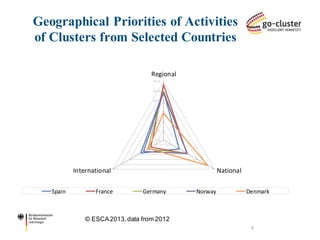
Geographical Priorities of Activities of Clusters from Selected Countries 
0 % 
10 % 
20 % 
30 % 
40 % 
50 % 
60 % 
Regional 
National 
International 
Spain 
France 
Germany 
Norway 
Denmark 
6 
© ESCA 2013, data from 2012
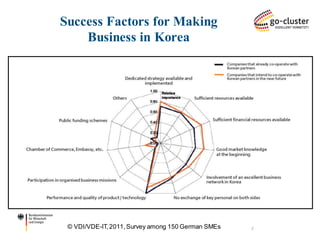
Success Factors for Making Business in Korea 
7 
© VDI/VDE-IT, 2011, Survey among 150 German SMEs
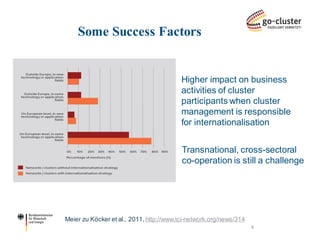
Higher impact on business 
activities of cluster 
participants when cluster 
management is responsible 
for internationalisation 
Some Success Factors 
Transnational, cross-sectoral 
co-operation is still a challenge 
Meier zu Köcker et al., 2011, http://www.tci-network.org/news/314 
8
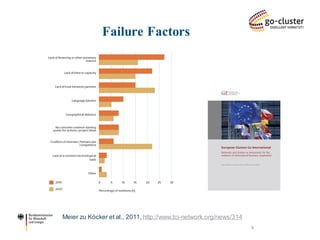
Failure Factors 
Meier zu Köcker et al., 2011, http://www.tci-network.org/news/314 
9
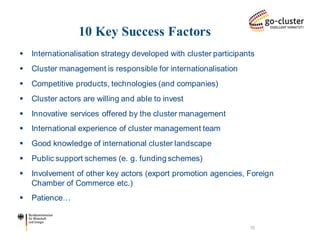
10 Key Success Factors 
Internationalisation strategy developed with cluster participants 
Cluster management is responsible for internationalisation 
Competitive products, technologies (and companies) 
Cluster actors are willing and able to invest 
Innovative services offered by the cluster management 
International experience of cluster management team 
Good knowledge of international cluster landscape 
Public support schemes (e. g. funding schemes) 
Involvement of other key actors (export promotion agencies, Foreign Chamber of Commerce etc.) 
Patience… 
10
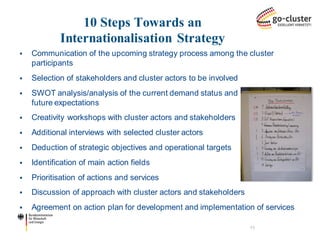
Communication of the upcoming strategy process among the cluster participants 
Selection of stakeholders and cluster actors to be involved 
SWOT analysis/analysis of the current demand status and future expectations 
Creativity workshops with cluster actors and stakeholders 
Additional interviews with selected cluster actors 
Deduction of strategic objectives and operational targets 
Identification of main action fields 
Prioritisation of actions and services 
Discussion of approach with cluster actors and stakeholders 
Agreement on action plan for development and implementation of services 
10 Steps Towards an Internationalisation Strategy 
11
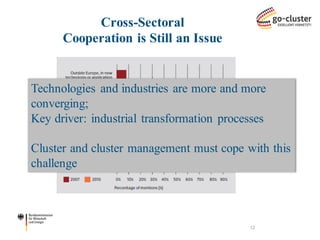
Cross-Sectoral Cooperation is Still an Issue 
Technologies and industries are more and more converging; Key driver: industrial transformation processes Cluster and cluster management must cope with this challenge 
12
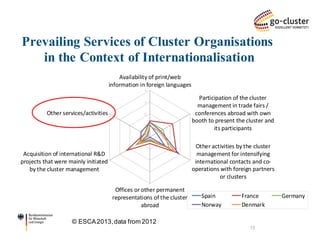
Prevailing Services of Cluster Organisations in the Context of Internationalisation 
0 
1 
2 
3 
4 
Availability of print/web 
information in foreign languages 
Participation of the cluster 
management in trade fairs / 
conferences abroad with own 
booth to present the cluster and 
its participants 
Other activities by the cluster 
management for intensifying 
international contacts and co- 
operations with foreign partners 
or clusters 
Offices or other permanent 
representations of the cluster 
abroad 
Acquisition of international R&D 
projects that were mainly initiated 
by the cluster management 
Other services/activities 
Spain 
France 
Germany 
Norway 
Denmark 
© ESCA 2013, data from 2012 
13
Current Trends 
14
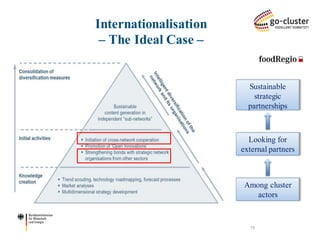
Internationalisation – The Ideal Case – 
Sustainable strategic partnerships 
Looking for external partners 
Among cluster actors 
15
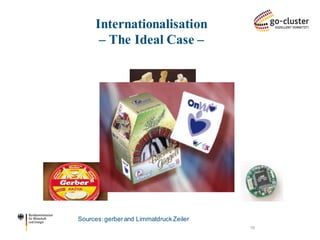
Internationalisation – The Ideal Case – 
Sources: gerber and Limmatdruck Zeiler 
16
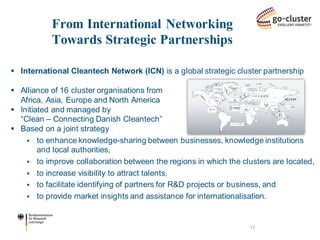
International Cleantech Network (ICN) is a global strategic cluster partnership 
Alliance of 16 cluster organisations from Africa, Asia, Europe and North America 
Initiated and managed by “Clean – Connecting Danish Cleantech” 
Based on a joint strategy 
to enhance knowledge-sharing between businesses, knowledge institutions and local authorities, 
to improve collaboration between the regions in which the clusters are located, 
to increase visibility to attract talents, 
to facilitate identifying of partners for R&D projects or business, and 
to provide market insights and assistance for internationalisation. 
From International Networking Towards Strategic Partnerships 
17
Traditional approaches and key success factors for cluster internationalisation are not sufficient to address upcoming industrial needs for internationalisation. 
Summary 
18
Dr. Gerd Meier zu Köcker 
VDI/VDE Innovation + Technik GmbH 
Steinplatz 1 
10623 Berlin 
E-Mail: mzk@vdivde-it.de 
Tel.: +49 30 310078-118 
Fax: +49 30 310078-222 
Contact 
19

20140918 internationalisation clusters_mz_k

  • 1.
    Success Factors forInternationalisation of Clusters Dr. Gerd Meier zu Köcker Berlin, 18th September 2014 www.bmwi.de
  • 2.
    If policy makersinsist If it is a mandatory part of funding rules Only because of funding If products or technologies are not competitive If cluster participants do not have capacities to internationalise If the cluster management does not have the mandate to internationalise If the cluster does not have any idea or strategy where and why to internationalise Reasons Not to Internationalise 2
  • 3.
    Reasons Why toInternationalise To increase growth and profit of cluster participants If transnational cooperation provides more added value than regional cooperation To enter new markets or acquiring new customers To tackle new value chains To acquire knowledge or competences not available among cluster participants To share risks (R&D, projects, investments etc.) To reduce costs (e. g. production is cheaper abroad) To increase visibility and become more attractive 3
  • 4.
    Internationalisation of Clusters… … is more than business trips and trade fairs … is more than only export promotions … is a tool, not a target … takes a long time to success … varies significantly between clusters 4
  • 5.
    Kinds of Internationalisationof Clusters Trend scouting Products, technologies Markets, consumer behaviour etc. Export promotion R&D cooperation Joint product development Incl. adaptive development Acquisition of know-how, technologies Strategic partnerships Joint venture Foreign branch Foreign production facilities 5
  • 6.
    Geographical Priorities ofActivities of Clusters from Selected Countries 0 % 10 % 20 % 30 % 40 % 50 % 60 % Regional National International Spain France Germany Norway Denmark 6 © ESCA 2013, data from 2012
  • 7.
    Success Factors forMaking Business in Korea 7 © VDI/VDE-IT, 2011, Survey among 150 German SMEs
  • 8.
    Higher impact onbusiness activities of cluster participants when cluster management is responsible for internationalisation Some Success Factors Transnational, cross-sectoral co-operation is still a challenge Meier zu Köcker et al., 2011, http://www.tci-network.org/news/314 8
  • 9.
    Failure Factors Meierzu Köcker et al., 2011, http://www.tci-network.org/news/314 9
  • 10.
    10 Key SuccessFactors Internationalisation strategy developed with cluster participants Cluster management is responsible for internationalisation Competitive products, technologies (and companies) Cluster actors are willing and able to invest Innovative services offered by the cluster management International experience of cluster management team Good knowledge of international cluster landscape Public support schemes (e. g. funding schemes) Involvement of other key actors (export promotion agencies, Foreign Chamber of Commerce etc.) Patience… 10
  • 11.
    Communication of theupcoming strategy process among the cluster participants Selection of stakeholders and cluster actors to be involved SWOT analysis/analysis of the current demand status and future expectations Creativity workshops with cluster actors and stakeholders Additional interviews with selected cluster actors Deduction of strategic objectives and operational targets Identification of main action fields Prioritisation of actions and services Discussion of approach with cluster actors and stakeholders Agreement on action plan for development and implementation of services 10 Steps Towards an Internationalisation Strategy 11
  • 12.
    Cross-Sectoral Cooperation isStill an Issue Technologies and industries are more and more converging; Key driver: industrial transformation processes Cluster and cluster management must cope with this challenge 12
  • 13.
    Prevailing Services ofCluster Organisations in the Context of Internationalisation 0 1 2 3 4 Availability of print/web information in foreign languages Participation of the cluster management in trade fairs / conferences abroad with own booth to present the cluster and its participants Other activities by the cluster management for intensifying international contacts and co- operations with foreign partners or clusters Offices or other permanent representations of the cluster abroad Acquisition of international R&D projects that were mainly initiated by the cluster management Other services/activities Spain France Germany Norway Denmark © ESCA 2013, data from 2012 13
  • 14.
  • 15.
    Internationalisation – TheIdeal Case – Sustainable strategic partnerships Looking for external partners Among cluster actors 15
  • 16.
    Internationalisation – TheIdeal Case – Sources: gerber and Limmatdruck Zeiler 16
  • 17.
    International Cleantech Network(ICN) is a global strategic cluster partnership Alliance of 16 cluster organisations from Africa, Asia, Europe and North America Initiated and managed by “Clean – Connecting Danish Cleantech” Based on a joint strategy to enhance knowledge-sharing between businesses, knowledge institutions and local authorities, to improve collaboration between the regions in which the clusters are located, to increase visibility to attract talents, to facilitate identifying of partners for R&D projects or business, and to provide market insights and assistance for internationalisation. From International Networking Towards Strategic Partnerships 17
  • 18.
    Traditional approaches andkey success factors for cluster internationalisation are not sufficient to address upcoming industrial needs for internationalisation. Summary 18
  • 19.
    Dr. Gerd Meierzu Köcker VDI/VDE Innovation + Technik GmbH Steinplatz 1 10623 Berlin E-Mail: mzk@vdivde-it.de Tel.: +49 30 310078-118 Fax: +49 30 310078-222 Contact 19