Resourcing Cluster
Initiatives sustainable –
Where there is no
specific support, policy or
programme -
THE HUNGARIAN CASE
Peter Keller
Head of International and Cluster Unit
Ministry for National Economy
MA for Economic Development Programmes
Sofia, 22 November 2017
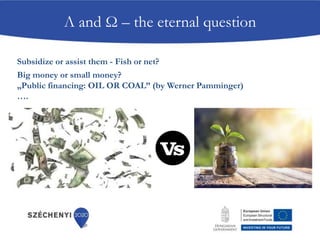
Λ and Ω – the eternal question
Subsidize or assist them - Fish or net?
Big money or small money?
„Public financing: OIL OR COAL” (by Werner Pamminger)
….
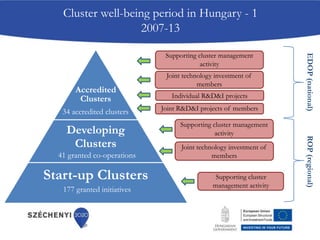
Supporting cluster
management activity
Supporting cluster management
activity
Joint technology investment of
members
Supporting cluster management
activity
Joint technology investment of
members
Joint R&D&I projects of members
Individual R&D&I projects
Cluster well-being period in Hungary - 1
2007-13
Accredited
Clusters
Developing
Clusters
Start-up Clusters
EDOP(national)ROP(regional)
34 accredited clusters
41 granted co-operations
177 granted initiatives
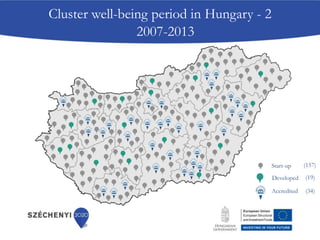
Cluster well-being period in Hungary - 2
Start-up
Developed
Accredited
2007-2013
(34)
(19)
(157)
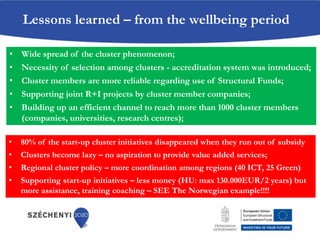
• Wide spread of the cluster phenomenon;
• Necessity of selection among clusters - accreditation system was introduced;
• Cluster members are more reliable regarding use of Structural Funds;
• Supporting joint R+I projects by cluster member companies;
• Building up an efficient channel to reach more than 1000 cluster members
(companies, universities, research centres);
Lessons learned – from the wellbeing period
• 80% of the start-up cluster initiatives disappeared when they run out of subsidy
• Clusters become lazy – no aspiration to provide value added services;
• Regional cluster policy – more coordination among regions (40 ICT, 25 Green)
• Supporting start-up initiatives – less money (HU: max 130.000EUR/2 years) but
more assistance, training coaching – SEE The Norwegian example!!!!
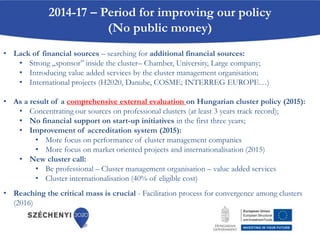
2014-17 – Period for improving our policy
(No public money)
• Lack of financial sources – searching for additional financial sources:
• Strong „sponsor” inside the cluster– Chamber, University, Large company;
• Introducing value added services by the cluster management organisation;
• International projects (H2020, Danube, COSME; INTERREG EUROPE…)
• As a result of a comprehensive external evaluation on Hungarian cluster policy (2015):
• Concentrating our sources on professional clusters (at least 3 years track record);
• No financial support on start-up initiatives in the first three years;
• Improvement of accreditation system (2015):
• More focus on performance of cluster management companies
• More focus on market oriented projects and internationalisation (2015)
• New cluster call:
• Be professional – Cluster management organisation – value added services
• Cluster internationalisation (40% of eligible cost)
• Reaching the critical mass is crucial - Facilitation process for convergence among clusters
(2016)
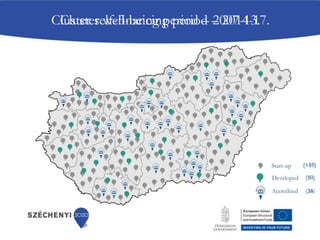
Cluster well-being period – 2007-13.
Start-up
Developed
Accredited (34)
(19)
(157)(~10)
(30)
(26)
Cluster self-financing period – 2014-17.
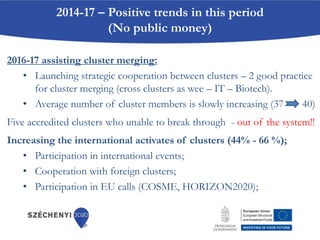
2014-17 – Positive trends in this period
(No public money)
2016-17 assisting cluster merging:
• Launching strategic cooperation between clusters – 2 good practice
for cluster merging (cross clusters as wee – IT – Biotech).
• Average number of cluster members is slowly increasing (37 40)
Five accredited clusters who unable to break through - out of the system!!
Increasing the international activates of clusters (44% - 66 %);
• Participation in international events;
• Cooperation with foreign clusters;
• Participation in EU calls (COSME, HORIZON2020);
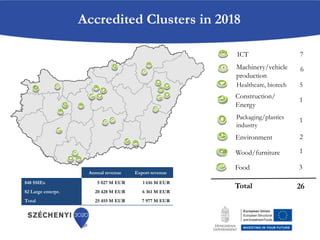
Accredited Clusters in 2018
26Total
Healthcare, biotech 5
ICT 7
Environment 2
Packaging/plastics
industry
1
Construction/
Energy
1
Machinery/vehicle
production
6
Wood/furniture 1
Food 3
Annual revenue Export revenue
848 SMEs 5 027 M EUR 1 616 M EUR
82 Large enterpr. 20 428 M EUR 6 361 M EUR
Total 25 455 M EUR 7 977 M EUR
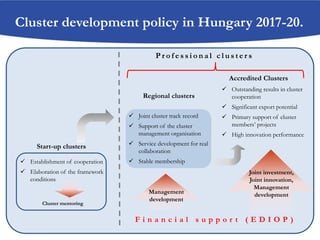
Cluster development policy in Hungary 2017-20.
Start-up clusters
P r o f e s s i o n a l c l u s t e r s
Accredited Clusters
Cluster mentoring
 Joint cluster track record
 Support of the cluster
management organisation
 Service development for real
collaboration
 Stable membership
 Outstanding results in cluster
cooperation
 Significant export potential
 Primary support of cluster
members’ projects
 High innovation performance
F i n a n c i a l s u p p o r t ( E D I O P )
Regional clusters
 Establishment of cooperation
 Elaboration of the framework
conditions
Joint investment,
Joint innovation,
Management
developmentManagement
development
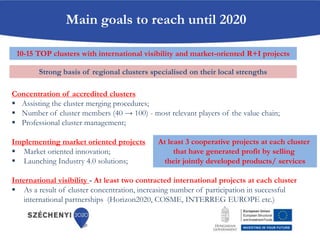
Concentration of accredited clusters
 Assisting the cluster merging procedures;
 Number of cluster members (40 → 100) - most relevant players of the value chain;
 Professional cluster management;
Implementing market oriented projects
 Market oriented innovation;
 Launching Industry 4.0 solutions;
International visibility - At least two contracted international projects at each cluster
 As a result of cluster concentration, increasing number of participation in successful
international partnerships (Horizon2020, COSME, INTERREG EUROPE etc.)
Main goals to reach until 2020
10-15 TOP clusters with international visibility and market-oriented R+I projects
At least 3 cooperative projects at each cluster
that have generated profit by selling
their jointly developed products/ services
Strong basis of regional clusters specialised on their local strengths
www.klaszterfejlesztes.hu
klaszterfejlesztes@ngm.gov.hu
www.palyazat.gov.hu
Thank you for
your attention!
Peter Keller
peter.keller@ngm.gov.hu
00 36 1 896 1302

Peter Keller, Presentation TCI2018 European Conference Sofia

  • 2.
    Resourcing Cluster Initiatives sustainable– Where there is no specific support, policy or programme - THE HUNGARIAN CASE Peter Keller Head of International and Cluster Unit Ministry for National Economy MA for Economic Development Programmes Sofia, 22 November 2017
  • 3.
    Λ and Ω– the eternal question Subsidize or assist them - Fish or net? Big money or small money? „Public financing: OIL OR COAL” (by Werner Pamminger) ….
  • 4.
    Supporting cluster management activity Supportingcluster management activity Joint technology investment of members Supporting cluster management activity Joint technology investment of members Joint R&D&I projects of members Individual R&D&I projects Cluster well-being period in Hungary - 1 2007-13 Accredited Clusters Developing Clusters Start-up Clusters EDOP(national)ROP(regional) 34 accredited clusters 41 granted co-operations 177 granted initiatives
  • 5.
    Cluster well-being periodin Hungary - 2 Start-up Developed Accredited 2007-2013 (34) (19) (157)
  • 6.
    • Wide spreadof the cluster phenomenon; • Necessity of selection among clusters - accreditation system was introduced; • Cluster members are more reliable regarding use of Structural Funds; • Supporting joint R+I projects by cluster member companies; • Building up an efficient channel to reach more than 1000 cluster members (companies, universities, research centres); Lessons learned – from the wellbeing period • 80% of the start-up cluster initiatives disappeared when they run out of subsidy • Clusters become lazy – no aspiration to provide value added services; • Regional cluster policy – more coordination among regions (40 ICT, 25 Green) • Supporting start-up initiatives – less money (HU: max 130.000EUR/2 years) but more assistance, training coaching – SEE The Norwegian example!!!!
  • 7.
    2014-17 – Periodfor improving our policy (No public money) • Lack of financial sources – searching for additional financial sources: • Strong „sponsor” inside the cluster– Chamber, University, Large company; • Introducing value added services by the cluster management organisation; • International projects (H2020, Danube, COSME; INTERREG EUROPE…) • As a result of a comprehensive external evaluation on Hungarian cluster policy (2015): • Concentrating our sources on professional clusters (at least 3 years track record); • No financial support on start-up initiatives in the first three years; • Improvement of accreditation system (2015): • More focus on performance of cluster management companies • More focus on market oriented projects and internationalisation (2015) • New cluster call: • Be professional – Cluster management organisation – value added services • Cluster internationalisation (40% of eligible cost) • Reaching the critical mass is crucial - Facilitation process for convergence among clusters (2016)
  • 8.
    Cluster well-being period– 2007-13. Start-up Developed Accredited (34) (19) (157)(~10) (30) (26) Cluster self-financing period – 2014-17.
  • 9.
    2014-17 – Positivetrends in this period (No public money) 2016-17 assisting cluster merging: • Launching strategic cooperation between clusters – 2 good practice for cluster merging (cross clusters as wee – IT – Biotech). • Average number of cluster members is slowly increasing (37 40) Five accredited clusters who unable to break through - out of the system!! Increasing the international activates of clusters (44% - 66 %); • Participation in international events; • Cooperation with foreign clusters; • Participation in EU calls (COSME, HORIZON2020);
  • 10.
    Accredited Clusters in2018 26Total Healthcare, biotech 5 ICT 7 Environment 2 Packaging/plastics industry 1 Construction/ Energy 1 Machinery/vehicle production 6 Wood/furniture 1 Food 3 Annual revenue Export revenue 848 SMEs 5 027 M EUR 1 616 M EUR 82 Large enterpr. 20 428 M EUR 6 361 M EUR Total 25 455 M EUR 7 977 M EUR
  • 11.
    Cluster development policyin Hungary 2017-20. Start-up clusters P r o f e s s i o n a l c l u s t e r s Accredited Clusters Cluster mentoring  Joint cluster track record  Support of the cluster management organisation  Service development for real collaboration  Stable membership  Outstanding results in cluster cooperation  Significant export potential  Primary support of cluster members’ projects  High innovation performance F i n a n c i a l s u p p o r t ( E D I O P ) Regional clusters  Establishment of cooperation  Elaboration of the framework conditions Joint investment, Joint innovation, Management developmentManagement development
  • 12.
    Concentration of accreditedclusters  Assisting the cluster merging procedures;  Number of cluster members (40 → 100) - most relevant players of the value chain;  Professional cluster management; Implementing market oriented projects  Market oriented innovation;  Launching Industry 4.0 solutions; International visibility - At least two contracted international projects at each cluster  As a result of cluster concentration, increasing number of participation in successful international partnerships (Horizon2020, COSME, INTERREG EUROPE etc.) Main goals to reach until 2020 10-15 TOP clusters with international visibility and market-oriented R+I projects At least 3 cooperative projects at each cluster that have generated profit by selling their jointly developed products/ services Strong basis of regional clusters specialised on their local strengths
  • 13.
    www.klaszterfejlesztes.hu klaszterfejlesztes@ngm.gov.hu www.palyazat.gov.hu Thank you for yourattention! Peter Keller peter.keller@ngm.gov.hu 00 36 1 896 1302