2014 - CVPR Tutorial on Deep Learning for Vision - Object Detection.pdf
1.
Object Detection
with DeepLearning
CVPR 2014 Tutorial
Pierre Sermanet, Google Research
Tutorial on Deep Learning for Vision, CVPR 2014 June 23, 2014
2.
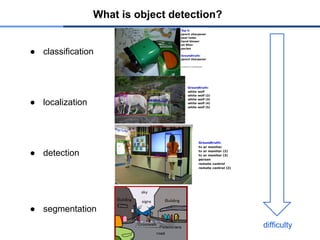
What is objectdetection?
● classification
● localization
● detection
● segmentation
difficulty
3.
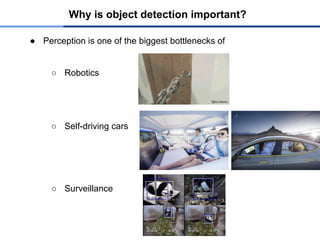
Why is objectdetection important?
● Perception is one of the biggest bottlenecks of
○ Robotics
○ Self-driving cars
○ Surveillance
4.
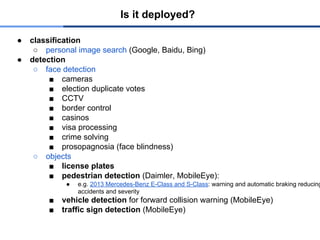
Is it deployed?
●classification
○ personal image search (Google, Baidu, Bing)
● detection
○ face detection
■ cameras
■ election duplicate votes
■ CCTV
■ border control
■ casinos
■ visa processing
■ crime solving
■ prosopagnosia (face blindness)
○ objects
■ license plates
■ pedestrian detection (Daimler, MobileEye):
● e.g. 2013 Mercedes-Benz E-Class and S-Class: warning and automatic braking reducing
accidents and severity
■ vehicle detection for forward collision warning (MobileEye)
■ traffic sign detection (MobileEye)
5.
What datasets fordetection?
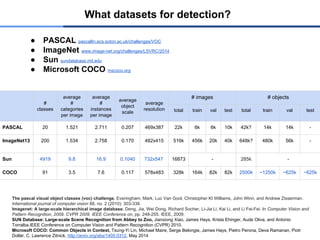
● PASCAL pascallin.ecs.soton.ac.uk/challenges/VOC
● ImageNet www.image-net.org/challenges/LSVRC/2014
● Sun sundatabase.mit.edu
● Microsoft COCO mscoco.org
The pascal visual object classes (voc) challenge. Everingham, Mark, Luc Van Gool, Christopher KI Williams, John Winn, and Andrew Zisserman.
International journal of computer vision 88, no. 2 (2010): 303-338.
Imagenet: A large-scale hierarchical image database. Deng, Jia, Wei Dong, Richard Socher, Li-Jia Li, Kai Li, and Li Fei-Fei. In Computer Vision and
Pattern Recognition, 2009. CVPR 2009. IEEE Conference on, pp. 248-255. IEEE, 2009.
SUN Database: Large-scale Scene Recognition from Abbey to Zoo, Jianxiong Xiao, James Hays, Krista Ehinger, Aude Oliva, and Antonio
Torralba.IEEE Conference on Computer Vision and Pattern Recognition (CVPR) 2010.
Microsoft COCO: Common Objects in Context, Tsung-Yi Lin, Michael Maire, Serge Belongie, James Hays, Pietro Perona, Deva Ramanan, Piotr
Dollár, C. Lawrence Zitnick, http://arxiv.org/abs/1405.0312, May 2014
#
classes
average
#
categories
per image
average
#
instances
per image
average
object
scale
average
resolution
# images # objects
total train val test total train val test
PASCAL 20 1.521 2.711 0.207 469x387 22k 6k 6k 10k 42k? 14k 14k -
ImageNet13 200 1.534 2.758 0.170 482x415 516k 456k 20k 40k 648k? 480k 56k -
Sun 4919 9.8 16.9 0.1040 732x547 16873 - 285k -
COCO 91 3.5 7.6 0.117 578x483 328k 164k 82k 82k 2500k ~1250k ~625k ~625k
6.
What datasets fordetection?
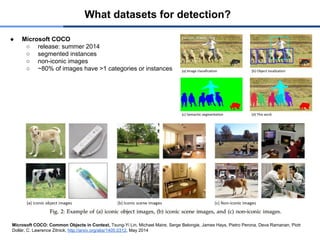
● Microsoft COCO
○ release: summer 2014
○ segmented instances
○ non-iconic images
○ ~80% of images have >1 categories or instances
Microsoft COCO: Common Objects in Context, Tsung-Yi Lin, Michael Maire, Serge Belongie, James Hays, Pietro Perona, Deva Ramanan, Piotr
Dollár, C. Lawrence Zitnick, http://arxiv.org/abs/1405.0312, May 2014
7.
What datasets fordetection?
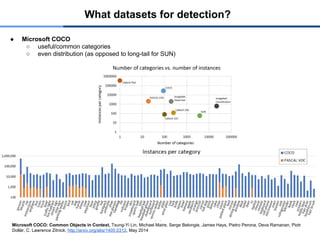
● Microsoft COCO
○ useful/common categories
○ even distribution (as opposed to long-tail for SUN)
Microsoft COCO: Common Objects in Context, Tsung-Yi Lin, Michael Maire, Serge Belongie, James Hays, Pietro Perona, Deva Ramanan, Piotr
Dollár, C. Lawrence Zitnick, http://arxiv.org/abs/1405.0312, May 2014
8.
VOC’10 VOC’12
VOC’07 VOC’09
VOC’08VOC’11
Recent history of object detection
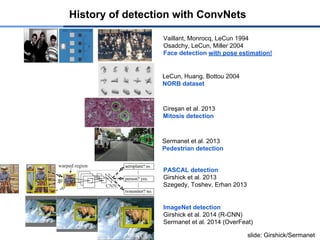
● Large improvements using Deep Learning [Girshick’13/14]
Rich feature hierarchies for accurate object detection and semantic segmentation. Girshick, Ross, Jeff Donahue, Trevor Darrell, and Jitendra Malik.
arXiv preprint arXiv:1311.2524 (2013).
The PASCAL Visual Object Classes Challenge - a Retrospective, Everingham, M., Eslami, S. M. A., Van Gool, L., Williams, C. K. I., Winn, J. and
Zisserman, A. Accepted for International Journal of Computer Vision, 2014
DPM
DPM,
HOG+BOW
DPM,
MKL
DPM++
DPM++,
MKL,
Selective
Search
Selective
Search,
DPM++,
MKL
41%
41%
37%
28%
23%
17%
SegDPM (2013)
Regionlets (2013)
Regionlets
(2013)
R-CNN
58.5%
R-CNN
53.7%
R-CNN
53.3%
ConvNets (2014)
9.
Recent history ofobject detection
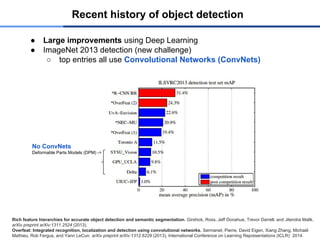
● Large improvements using Deep Learning
● ImageNet 2013 detection (new challenge)
○ top entries all use Convolutional Networks (ConvNets)
Rich feature hierarchies for accurate object detection and semantic segmentation. Girshick, Ross, Jeff Donahue, Trevor Darrell, and Jitendra Malik.
arXiv preprint arXiv:1311.2524 (2013).
Overfeat: Integrated recognition, localization and detection using convolutional networks. Sermanet, Pierre, David Eigen, Xiang Zhang, Michaël
Mathieu, Rob Fergus, and Yann LeCun. arXiv preprint arXiv:1312.6229 (2013), International Conference on Learning Representations (ICLR)` 2014.
No ConvNets
Deformable Parts Models (DPM) ->
10.
Dataset Performance Score
[Sermanetet al 2014]: OverFeat (fine-tuned features for each task)
(tasks are ordered by increasing difficulty)
● image classification
● object localization
● object detection
ImageNet LSVRC 2013
Dogs vs Cats Kaggle challenge 2014
ImageNet LSVRC 2013
ImageNet LSVRC 2013
competitive
state of the art
state of the art
competitive
13.6 % error
98.9%
29.9% error
24.3% mAP
[Razavian et al, 2014]: public OverFeat library (no retraining) + SVM
(simplest approach possible on purpose, no attempt at more complex classifiers)
(tasks are ordered by “distance” from classification task on which OverFeat was trained)
● image classification
● scene recognition
● fine grained recognition
● attribute detection
● image retrieval
(search by image similarity)
Pascal VOC 2007
MIT-67
Caltech-UCSD Birds 200-2011
Oxford 102 Flowers
UIUC 64 object attributes
H3D Human Attributes
Oxford 5k buildings
Paris 6k buildings
Sculp6k
Holidays
UKBench
competitive
state of the art
competitive
state of the art
state of the art
competitive
state of the art
state of the art
competitive
state of the art
state of the art
77.2% mAP
69% mAP
61.8% mAP
86.8% mAP
91.4% mAUC
73% mAP
68% mAP?
79.5% mAP?
42.3% mAP?
84.3% mAP?
91.1% mAP?
Pierre Sermanet, David Eigen, Xiang Zhang, Michael Mathieu, Rob Fergus, Yann LeCun, OverFeat: Integrated Recognition, Localization and
Detection using Convolutional Networks, http://arxiv.org/abs/1312.6229, ICLR 2014
Ali Sharif Razavian, Hossein Azizpour, Josephine Sullivan, Stefan Carlsson, CNN Features off-the-shelf: an Astounding Baseline for
Recognition, http://arxiv.org/abs/1403.6382, DeepVision CVPR 2014 workshop
ConvNets breakthroughs for visual tasks
11.
Dataset Performance Score
[Zeileret al 2013]
● image classification ImageNet LSVRC 2013
Caltech-101 (15, 30 samples per class)
Caltech-256 (15, 60 samples per class)
Pascal VOC 2012
state of the art
competitive
state of the art
competitive
11.2% error
83.8%, 86.5%
65.7%, 74.2%
79% mAP
[Donahue et al, 2014]: DeCAF+SVM
● image classification
● domain adaptation
● fine grained recognition
● scene recognition
Caltech-101 (30 classes)
Amazon -> Webcam, DSLR -> Webcam
Caltech-UCSD Birds 200-2011
SUN-397
state of the art
state of the art
state of the art
competitive
86.91%
82.1%, 94.8%
65.0%
40.9%
[Girshick et al, 2013]
● image detection
● image segmentation
Pascal VOC 2007
Pascal VOC 2010 (comp4)
ImageNet LSVRC 2013
Pascal VOC 2011 (comp6)
state of the art
state of the art
state of the art
state of the art
48.0% mAP
43.5% mAP
31.4% mAP
47.9% mAP
[Oquab et al, 2013]
● image classification Pascal VOC 2007
Pascal VOC 2012
Pascal VOC 2012 (action classification)
state of the art
state of the art
state of the art
77.7% mAP
82.8% mAP
70.2% mAP
M.D. Zeiler, R. Fergus, Visualizing and Understanding Convolutional Networks, Arxiv 1311.2901 http://arxiv.org/abs/1311.2901
J. Donahue, Y. Jia, O. Vinyals, J. Hoffman, N. Zhang, E. Tzeng, and T. Darrell. Decaf: A deep convolutional activation feature for generic visual
recognition. In ICML, 2014, http://arxiv.org/abs/1310.1531
R. B. Girshick, J. Donahue, T. Darrell, and J. Malik. Rich feature hierarchies for accurate object detection and semantic segmentation. arxiv:1311.2524
[cs.CV], 2013, http://arxiv.org/abs/1311.2524
M. Oquab, L. Bottou, I. Laptev, and J. Sivic. Learning and transferring mid-level image representations using convolutional neural networks. Technical
Report HAL-00911179, INRIA, 2013. http://hal.inria.fr/hal-00911179
ConvNets breakthroughs for visual tasks
12.
Dataset Performance Score
[Khanet al 2014]
● shadow detection UCF
CMU
UIUC
state of the art
state of the art
state of the art
90.56%
88.79%
93.16%
[Sander Dieleman, 2014]
● image attributes Kaggle Galaxy Zoo challenge state of the art 0.07492
S. H. Khan, M. Bennamoun, F. Sohel, R. Togneri. Automatic Feature Learning for Robust Shadow Detection, CVPR 2014
Sander Dieleman, Kaggle Galaxy Zoo challenge 2014 http://benanne.github.io/2014/04/05/galaxy-zoo.html
ConvNets breakthroughs for visual tasks
13.
[Razavian et al,2014]:
"It can be concluded that from now on, deep learning with CNN has to be
considered as the primary candidate in essentially any visual recognition task."
Ali Sharif Razavian, Hossein Azizpour, Josephine Sullivan, Stefan Carlsson, CNN Features off-the-shelf: an Astounding Baseline for
Recognition, http://arxiv.org/abs/1403.6382, DeepVision CVPR 2014 workshop
ConvNets breakthroughs for visual tasks
What are theweakest links in detection?
● [Parikh & Zitnick CVPR’10] replaced each component with humans
(Amazon Turk) and show which ones gain the most:
○ features
○ NMS
Finding the weakest link in person detectors. Parikh, Devi, and C. Lawrence Zitnick. Computer Vision and Pattern Recognition (CVPR), 2011 IEEE
Conference on. IEEE, 2011.
19.
ConvNets vs Primates
●[Cadieu’14] ConvNets rival primates “core visual object recognition”
○ rapid (100ms) feed-forward processing
● Feed-forward part ~solved?
● Remains:
■ lateral and feedback loops
■ better spatial exploration for classification/localization/detection
Deep Neural Networks Rival the Representation of Primate IT Cortex for Core Visual Object Recognition. Cadieu, Charles F., Ha Hong, Daniel LK
Yamins, Nicolas Pinto, Diego Ardila, Ethan A. Solomon, Najib J. Majaj, and James J. DiCarlo. arXiv preprint arXiv:1406.3284 (2014).
20.
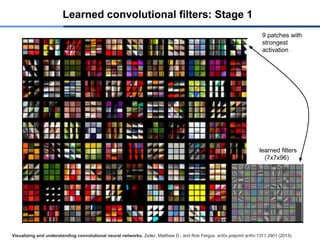
Learned convolutional filters:Stage 1
Visualizing and understanding convolutional neural networks. Zeiler, Matthew D., and Rob Fergus. arXiv preprint arXiv:1311.2901 (2013).
9 patches with
strongest
activation
learned filters
(7x7x96)
21.
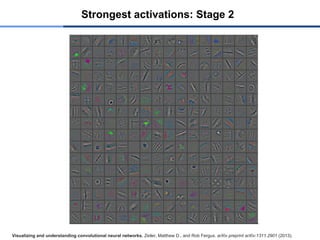
Strongest activations: Stage2
Visualizing and understanding convolutional neural networks. Zeiler, Matthew D., and Rob Fergus. arXiv preprint arXiv:1311.2901 (2013).
22.
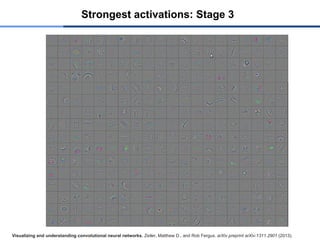
Strongest activations: Stage3
Visualizing and understanding convolutional neural networks. Zeiler, Matthew D., and Rob Fergus. arXiv preprint arXiv:1311.2901 (2013).
23.
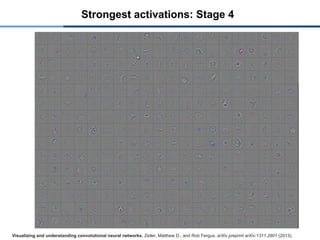
Strongest activations: Stage4
Visualizing and understanding convolutional neural networks. Zeiler, Matthew D., and Rob Fergus. arXiv preprint arXiv:1311.2901 (2013).
24.
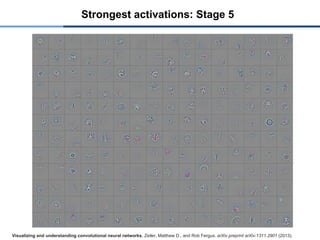
Strongest activations: Stage5
Visualizing and understanding convolutional neural networks. Zeiler, Matthew D., and Rob Fergus. arXiv preprint arXiv:1311.2901 (2013).
25.
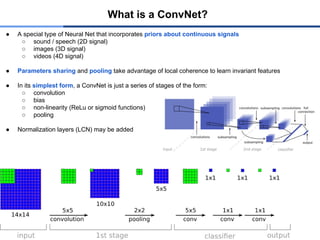
● A specialtype of Neural Net that incorporates priors about continuous signals
○ sound / speech (2D signal)
○ images (3D signal)
○ videos (4D signal)
● Parameters sharing and pooling take advantage of local coherence to learn invariant features
● In its simplest form, a ConvNet is just a series of stages of the form:
○ convolution
○ bias
○ non-linearity (ReLu or sigmoid functions)
○ pooling
● Normalization layers (LCN) may be added
What is a ConvNet?
26.
● [Krizhevsky’12] win2012 ImageNet classification with a much bigger ConvNet than before:
○ deeper: 7 stages vs 3 before
○ larger: 60 million parameters vs 1 million before
● This was made possible by:
○ fast hardware: GPU-optimized code
○ big dataset: 1.2 million images vs thousands before
○ better regularization: dropout
ConvNets 2.0
Imagenet classification with deep convolutional neural networks. Krizhevsky, Alex, Ilya Sutskever, and Geoffrey E. Hinton. Advances in neural
information processing systems. 2012.
27.
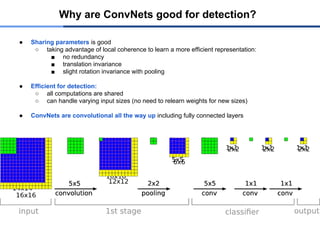
● Sharing parametersis good
○ taking advantage of local coherence to learn a more efficient representation:
■ no redundancy
■ translation invariance
■ slight rotation invariance with pooling
● Efficient for detection:
○ all computations are shared
○ can handle varying input sizes (no need to relearn weights for new sizes)
● ConvNets are convolutional all the way up including fully connected layers
Why are ConvNets good for detection?
28.
ImageNet pre-training
● Labeleddata is rare for detection: leverage large classification labeled datasets for
pre-training.
● ImageNet Classification pretraining + fine-tuning on a different task has been shown to
work very well by many people.
○ in particular [Razavian’14] took the off-the-shelf convnet OverFeat + SVM classifier on
top and obtained many state-of-the-art or competitive results on 10+ datasets and visual
tasks
CNN Features off-the-shelf: an Astounding Baseline for Recognition. Razavian, Ali Sharif, Hossein Azizpour, Josephine Sullivan, and Stefan
Carlsson. arXiv preprint arXiv:1403.6382 (2014).
29.
ImageNet pre-training
● Capacitymust match the problem at hand
○ 60M-parameters model has a capacity designed for ImageNet-scale data
○ one cannot train such model on a small dataset: e.g. 6k bird dataset in [Branson’14]
○ ImageNet pre-training will ensure general features as a starting point
● Fine-tuning
○ requires lowering the learning rate to avoid forgetting pre-training or use different
learning rates for the pre-trained and new layers
○ [Branson’14] propose a 2-step fine-tuning method that improves accuracy
i. only train the weights of the new layer(s)
ii. train all weights
Bird Species Categorization Using Pose Normalized Deep Convolutional Nets. Branson, Steve, Grant Van Horn, Serge Belongie, and Pietro Perona.
arXiv preprint arXiv:1406.2952 (2014).
30.
How much doesfine-tuning matter?
VOC 2007 VOC 2010
Regionlets (Wang et al. 2013) 41.7% 39.7%
SegDPM (Fidler et al. 2013) 40.4%
R-CNN pool5
44.2%
R-CNN fc6
46.2%
R-CNN fc7
44.7%
R-CNN FT pool5
47.3%
R-CNN FT fc6
53.1%
R-CNN FT fc7
54.2% 50.2%
metric: mean average precision (higher is better)
fine-tuned
● [Razavian’14] showed consistent gains using fixed ConvNet weights
● Fine-tuning always improves, but how much?
● However [Girshick’14] shows substantial improvements with fine-tuning on PASCAL
detection: 44.7% to 54.2% mAP
CNN Features off-the-shelf: an Astounding Baseline for Recognition. Razavian, Ali Sharif, Hossein Azizpour, Josephine Sullivan, and Stefan
Carlsson. arXiv preprint arXiv:1403.6382 (2014).
Rich feature hierarchies for accurate object detection and semantic segmentation. Girshick, Ross, Jeff Donahue, Trevor Darrell, and Jitendra Malik.
arXiv preprint arXiv:1311.2524 (2013).
31.
R-CNN: Regions withCNN features
Input
image
Extract region
proposals (~2k / image)
● Proposal-method agnostic, many choices
○ Selective Search [Uijlings et al. 2013] (Used in this work)
○ Objectness [Alexe et al. 2012]
○ Category independent object proposals [Endres & Hoiem 2010]
● Active area, at this CVPR
○ BING [Ming et al.] – fast
○ MCG [Arbelaez et al.] – high-quality segmentation
Rich feature hierarchies for accurate object detection and semantic segmentation. Girshick, Ross, Jeff Donahue, Trevor Darrell, and Jitendra Malik.
arXiv preprint arXiv:1311.2524 (2013).
32.
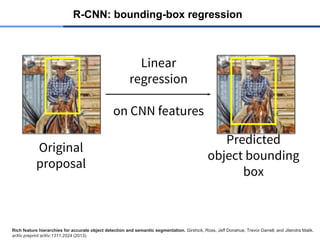
R-CNN: bounding-box regression
Richfeature hierarchies for accurate object detection and semantic segmentation. Girshick, Ross, Jeff Donahue, Trevor Darrell, and Jitendra Malik.
arXiv preprint arXiv:1311.2524 (2013).
Linear
regression
on CNN features
Original
proposal
Predicted
object bounding
box
33.
● fast densegeneric detection + slow sparse classification
(old idea used for detection of faces, traffic signs, etc)
○ segmentation [van de Sande 2011], ConvNets [Erhan 2014]
○ speeds up
○ reduces false positives
○ bounding boxes with any aspect ratio
van de Sande, K. E., Uijlings, J. R., Gevers, T., & Smeulders, A. W. (2011, November). Segmentation as selective search for object recognition.
ICCV’11
Objectness / Selective Search
34.
How to debugobject detection?
● [Hoiem’12] provide analysis software for detection
○ http://www.cs.illinois.edu/~dhoiem/projects/properties_project.html
● Visualize the proportions of
○ localization errors
○ confusion with similar classes
○ confusion with other classes
○ confusion with background
● [Girshick’14] show how fine-tuning and bbox-regression decrease localization errors
Diagnosing error in object detectors. Hoiem, Derek, Yodsawalai Chodpathumwan, and Qieyun Dai. Computer Vision–ECCV 2012. Springer Berlin
Heidelberg, 2012. 340-353.
Rich feature hierarchies for accurate object detection and semantic segmentation. Girshick, Ross, Jeff Donahue, Trevor Darrell, and Jitendra Malik.
arXiv preprint arXiv:1311.2524 (2013).
no fine-tuning fine-tuning b-box regression
35.
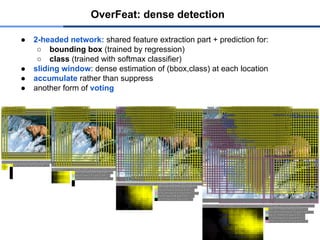
● 2-headed network:shared feature extraction part + prediction for:
○ bounding box (trained by regression)
○ class (trained with softmax classifier)
● sliding window: dense estimation of (bbox,class) at each location
● accumulate rather than suppress
● another form of voting
OverFeat: dense detection
36.
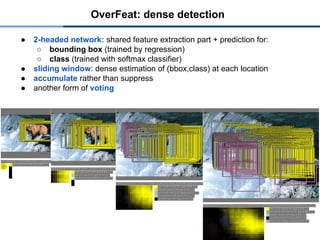
● 2-headed network:shared feature extraction part + prediction for:
○ bounding box (trained by regression)
○ class (trained with softmax classifier)
● sliding window: dense estimation of (bbox,class) at each location
● accumulate rather than suppress
● another form of voting
OverFeat: dense detection
37.
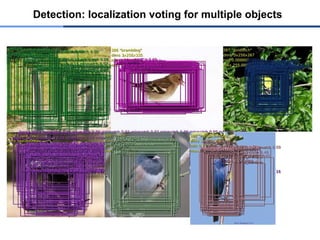
● Bounding boxesvoting:
○ voting is good (classification: views voting + model voting)
○ boosts confidence high above false positives ([0,1] up to 10.43 here)
○ more robust to individual localization errors
○ relying less on an accurate background class
OverFeat: dense detection
38.
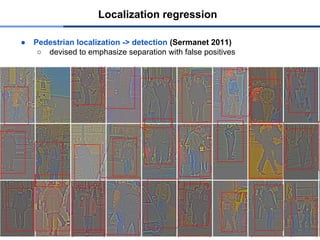
● Pedestrian localization-> detection (Sermanet 2011)
○ devised to emphasize separation with false positives
Localization regression
39.
[Osadchy’04]:
● estimating presenceand pose
● distance away from manifold indicates confidence
into presence of a face
● position on the manifold indicates face pose
Osadchy, Margarita, Yann Le Cun, and Matthew L. Miller. Synergistic face detection and pose estimation with energy-based models. The
Journal of Machine Learning Research 8 (2007): 1197-1215.
Pose regression with Convnet
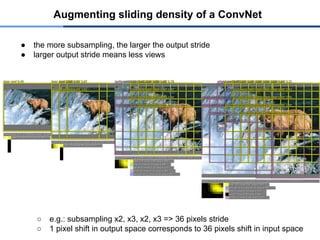
● the moresubsampling, the larger the output stride
● larger output stride means less views
○ e.g.: subsampling x2, x3, x2, x3 => 36 pixels stride
○ 1 pixel shift in output space corresponds to 36 pixels shift in input space
Augmenting sliding density of a ConvNet
42.
● 9x morebounding boxes (with last pooling 3x3)
● idea introduced by [Giusti’13]
A. Giusti, D. C. Ciresan, J. Masci, L. M. Gambardella, and J. Schmidhuber. Fast image scanning with deep max-pooling convolutional neural networks. In
International Conference on Image Processing (ICIP), 2013.
Augmenting sliding density of a ConvNet
43.
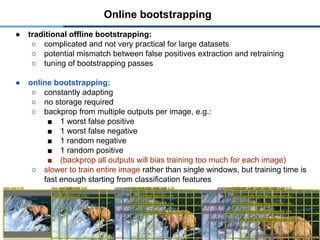
● traditional offlinebootstrapping:
○ complicated and not very practical for large datasets
○ potential mismatch between false positives extraction and retraining
○ tuning of bootstrapping passes
● online bootstrapping:
○ constantly adapting
○ no storage required
○ backprop from multiple outputs per image, e.g.:
■ 1 worst false positive
■ 1 worst false negative
■ 1 random negative
■ 1 random positive
■ (backprop all outputs will bias training too much for each image)
○ slower to train entire image rather than single windows, but training time is
fast enough starting from classification features
Online bootstrapping
44.
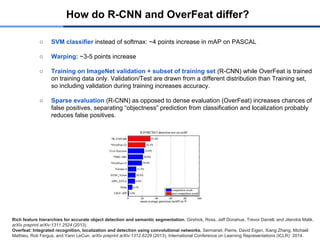
How do R-CNNand OverFeat differ?
○ SVM classifier instead of softmax: ~4 points increase in mAP on PASCAL
○ Warping: ~3-5 points increase
○ Training on ImageNet validation + subset of training set (R-CNN) while OverFeat is trained
on training data only. Validation/Test are drawn from a different distribution than Training set,
so including validation during training increases accuracy.
○ Sparse evaluation (R-CNN) as opposed to dense evaluation (OverFeat) increases chances of
false positives, separating “objectness” prediction from classification and localization probably
reduces false positives.
Rich feature hierarchies for accurate object detection and semantic segmentation. Girshick, Ross, Jeff Donahue, Trevor Darrell, and Jitendra Malik.
arXiv preprint arXiv:1311.2524 (2013).
Overfeat: Integrated recognition, localization and detection using convolutional networks. Sermanet, Pierre, David Eigen, Xiang Zhang, Michaël
Mathieu, Rob Fergus, and Yann LeCun. arXiv preprint arXiv:1312.6229 (2013), International Conference on Learning Representations (ICLR)` 2014.
45.
Warping
● ConvNets expecta fixed size input
● Warping improves detection by about 3-5 mAP points in [Girshick’13]
○ likely simplifies the learning problem by normalizing poses and shapes
● Overall better, but probably poses problems for some classes, e.g. cars/trucks or circle/elipses
Rich feature hierarchies for accurate object detection and semantic segmentation. Girshick, Ross, Jeff Donahue, Trevor Darrell, and Jitendra Malik.
arXiv preprint arXiv:1311.2524 (2013).
46.
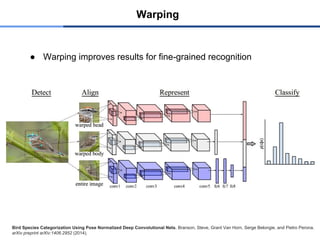
Warping
● Warping improvesresults for fine-grained recognition
Bird Species Categorization Using Pose Normalized Deep Convolutional Nets. Branson, Steve, Grant Van Horn, Serge Belongie, and Pietro Perona.
arXiv preprint arXiv:1406.2952 (2014).
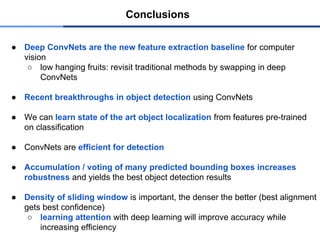
● Deep ConvNetsare the new feature extraction baseline for computer
vision
○ low hanging fruits: revisit traditional methods by swapping in deep
ConvNets
● Recent breakthroughs in object detection using ConvNets
● We can learn state of the art object localization from features pre-trained
on classification
● ConvNets are efficient for detection
● Accumulation / voting of many predicted bounding boxes increases
robustness and yields the best object detection results
● Density of sliding window is important, the denser the better (best alignment
gets best confidence)
○ learning attention with deep learning will improve accuracy while
increasing efficiency
Conclusions
● Detection withConvNets in the pre-Krizhevsky era:
`
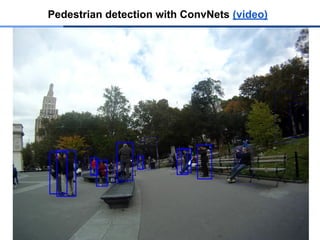
○ State of the art / competitive on major pedestrians datasets by [Sermanet’13]
○ Smaller models (1M) / datasets (thousands of samples)
○ Using unsupervised learning for pre-training
Pedestrian detection with ConvNets
Pedestrian detection with unsupervised multi-stage feature learning. Sermanet, Pierre, Koray Kavukcuoglu, Soumith Chintala, and Yann LeCun. In
Computer Vision and Pattern Recognition (CVPR), 2013 IEEE Conference on, pp. 3626-3633. IEEE, 2013.
58.
● INRIA pedestrian:small dataset, unsupervised learning can help [Sermanet’13]
● CPSD improves from 23.4% to 17.1% error
● Multi-stage (MS) features improve from 23.4% to 17.3%
● CPSD + MS = 10.55%
Unsupervised learning for detection
Sparse Coding Convolutional Sparse Coding (CPSD)
Pedestrian detection with unsupervised multi-stage feature learning. Sermanet, Pierre, Koray Kavukcuoglu, Soumith Chintala, and Yann LeCun. In
Computer Vision and Pattern Recognition (CVPR), 2013 IEEE Conference on, pp. 3626-3633. IEEE, 2013.
59.
Multi-stage features (skiplayer)
Pedestrian detection with unsupervised multi-stage feature learning. Sermanet, P., Kavukcuoglu, K., Chintala, S., & LeCun, Y. (2013, June). InComputer Vision and
Pattern Recognition (CVPR), 2013 IEEE Conference on(pp. 3626-3633). IEEE.
Traffic sign recognition with multi-scale convolutional networks. Sermanet, Pierre, and Yann LeCun. Neural Networks (IJCNN), The 2011 International Joint
Conference on. IEEE, 2011.
Convolutional neural networks applied to house numbers digit classification. Sermanet, Pierre, Soumith Chintala, and Yann LeCun. Pattern
Recognition (ICPR), 2012 21st International Conference on. IEEE, 2012.
Deep Learning Face Representation from Predicting 10,000 Classes. Sun, Yi, Xiaogang Wang, and Xiaoou Tang.
● Skip connections can bring substantial improvements [Sermanet’11’12’13] [Sun’14] by
retaining lower-level information
60.
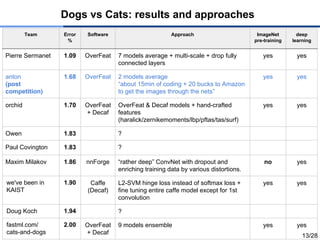
Team Error
%
Software ApproachImageNet
pre-training
deep
learning
Pierre Sermanet 1.09 OverFeat 7 models average + multi-scale + drop fully
connected layers
yes yes
anton
(post
competition)
1.68 OverFeat 2 models average
“about 15min of coding + 20 bucks to Amazon
to get the images through the nets”
yes yes
orchid 1.70 OverFeat
+ Decaf
OverFeat & Decaf models + hand-crafted
features
(haralick/zernikemoments/lbp/pftas/tas/surf)
yes yes
Owen 1.83 ?
Paul Covington 1.83 ?
Maxim Milakov 1.86 nnForge “rather deep” ConvNet with dropout and
enriching training data by various distortions.
no yes
we've been in
KAIST
1.90 Caffe
(Decaf)
L2-SVM hinge loss instead of softmax loss +
fine tuning entire caffe model except for 1st
convolution
yes yes
Doug Koch 1.94 ?
fastml.com/
cats-and-dogs
2.00 OverFeat
+ Decaf
9 models ensemble yes yes
13/28
Dogs vs Cats: results and approaches


![VOC’10 VOC’12
VOC’07 VOC’09
VOC’08 VOC’11
Recent history of object detection
● Large improvements using Deep Learning [Girshick’13/14]
Rich feature hierarchies for accurate object detection and semantic segmentation. Girshick, Ross, Jeff Donahue, Trevor Darrell, and Jitendra Malik.
arXiv preprint arXiv:1311.2524 (2013).
The PASCAL Visual Object Classes Challenge - a Retrospective, Everingham, M., Eslami, S. M. A., Van Gool, L., Williams, C. K. I., Winn, J. and
Zisserman, A. Accepted for International Journal of Computer Vision, 2014
DPM
DPM,
HOG+BOW
DPM,
MKL
DPM++
DPM++,
MKL,
Selective
Search
Selective
Search,
DPM++,
MKL
41%
41%
37%
28%
23%
17%
SegDPM (2013)
Regionlets (2013)
Regionlets
(2013)
R-CNN
58.5%
R-CNN
53.7%
R-CNN
53.3%
ConvNets (2014)](https://image.slidesharecdn.com/2014-cvprtutorialondeeplearningforvision-objectdetection-250927225920-583a61e9/85/2014-CVPR-Tutorial-on-Deep-Learning-for-Vision-Object-Detection-pdf-8-320.jpg)
![Dataset Performance Score
[Sermanet et al 2014]: OverFeat (fine-tuned features for each task)
(tasks are ordered by increasing difficulty)
● image classification
● object localization
● object detection
ImageNet LSVRC 2013
Dogs vs Cats Kaggle challenge 2014
ImageNet LSVRC 2013
ImageNet LSVRC 2013
competitive
state of the art
state of the art
competitive
13.6 % error
98.9%
29.9% error
24.3% mAP
[Razavian et al, 2014]: public OverFeat library (no retraining) + SVM
(simplest approach possible on purpose, no attempt at more complex classifiers)
(tasks are ordered by “distance” from classification task on which OverFeat was trained)
● image classification
● scene recognition
● fine grained recognition
● attribute detection
● image retrieval
(search by image similarity)
Pascal VOC 2007
MIT-67
Caltech-UCSD Birds 200-2011
Oxford 102 Flowers
UIUC 64 object attributes
H3D Human Attributes
Oxford 5k buildings
Paris 6k buildings
Sculp6k
Holidays
UKBench
competitive
state of the art
competitive
state of the art
state of the art
competitive
state of the art
state of the art
competitive
state of the art
state of the art
77.2% mAP
69% mAP
61.8% mAP
86.8% mAP
91.4% mAUC
73% mAP
68% mAP?
79.5% mAP?
42.3% mAP?
84.3% mAP?
91.1% mAP?
Pierre Sermanet, David Eigen, Xiang Zhang, Michael Mathieu, Rob Fergus, Yann LeCun, OverFeat: Integrated Recognition, Localization and
Detection using Convolutional Networks, http://arxiv.org/abs/1312.6229, ICLR 2014
Ali Sharif Razavian, Hossein Azizpour, Josephine Sullivan, Stefan Carlsson, CNN Features off-the-shelf: an Astounding Baseline for
Recognition, http://arxiv.org/abs/1403.6382, DeepVision CVPR 2014 workshop
ConvNets breakthroughs for visual tasks](https://image.slidesharecdn.com/2014-cvprtutorialondeeplearningforvision-objectdetection-250927225920-583a61e9/85/2014-CVPR-Tutorial-on-Deep-Learning-for-Vision-Object-Detection-pdf-10-320.jpg)
![Dataset Performance Score
[Zeiler et al 2013]
● image classification ImageNet LSVRC 2013
Caltech-101 (15, 30 samples per class)
Caltech-256 (15, 60 samples per class)
Pascal VOC 2012
state of the art
competitive
state of the art
competitive
11.2% error
83.8%, 86.5%
65.7%, 74.2%
79% mAP
[Donahue et al, 2014]: DeCAF+SVM
● image classification
● domain adaptation
● fine grained recognition
● scene recognition
Caltech-101 (30 classes)
Amazon -> Webcam, DSLR -> Webcam
Caltech-UCSD Birds 200-2011
SUN-397
state of the art
state of the art
state of the art
competitive
86.91%
82.1%, 94.8%
65.0%
40.9%
[Girshick et al, 2013]
● image detection
● image segmentation
Pascal VOC 2007
Pascal VOC 2010 (comp4)
ImageNet LSVRC 2013
Pascal VOC 2011 (comp6)
state of the art
state of the art
state of the art
state of the art
48.0% mAP
43.5% mAP
31.4% mAP
47.9% mAP
[Oquab et al, 2013]
● image classification Pascal VOC 2007
Pascal VOC 2012
Pascal VOC 2012 (action classification)
state of the art
state of the art
state of the art
77.7% mAP
82.8% mAP
70.2% mAP
M.D. Zeiler, R. Fergus, Visualizing and Understanding Convolutional Networks, Arxiv 1311.2901 http://arxiv.org/abs/1311.2901
J. Donahue, Y. Jia, O. Vinyals, J. Hoffman, N. Zhang, E. Tzeng, and T. Darrell. Decaf: A deep convolutional activation feature for generic visual
recognition. In ICML, 2014, http://arxiv.org/abs/1310.1531
R. B. Girshick, J. Donahue, T. Darrell, and J. Malik. Rich feature hierarchies for accurate object detection and semantic segmentation. arxiv:1311.2524
[cs.CV], 2013, http://arxiv.org/abs/1311.2524
M. Oquab, L. Bottou, I. Laptev, and J. Sivic. Learning and transferring mid-level image representations using convolutional neural networks. Technical
Report HAL-00911179, INRIA, 2013. http://hal.inria.fr/hal-00911179
ConvNets breakthroughs for visual tasks](https://image.slidesharecdn.com/2014-cvprtutorialondeeplearningforvision-objectdetection-250927225920-583a61e9/85/2014-CVPR-Tutorial-on-Deep-Learning-for-Vision-Object-Detection-pdf-11-320.jpg)
![Dataset Performance Score
[Khan et al 2014]
● shadow detection UCF
CMU
UIUC
state of the art
state of the art
state of the art
90.56%
88.79%
93.16%
[Sander Dieleman, 2014]
● image attributes Kaggle Galaxy Zoo challenge state of the art 0.07492
S. H. Khan, M. Bennamoun, F. Sohel, R. Togneri. Automatic Feature Learning for Robust Shadow Detection, CVPR 2014
Sander Dieleman, Kaggle Galaxy Zoo challenge 2014 http://benanne.github.io/2014/04/05/galaxy-zoo.html
ConvNets breakthroughs for visual tasks](https://image.slidesharecdn.com/2014-cvprtutorialondeeplearningforvision-objectdetection-250927225920-583a61e9/85/2014-CVPR-Tutorial-on-Deep-Learning-for-Vision-Object-Detection-pdf-12-320.jpg)
![[Razavian et al, 2014]:
"It can be concluded that from now on, deep learning with CNN has to be
considered as the primary candidate in essentially any visual recognition task."
Ali Sharif Razavian, Hossein Azizpour, Josephine Sullivan, Stefan Carlsson, CNN Features off-the-shelf: an Astounding Baseline for
Recognition, http://arxiv.org/abs/1403.6382, DeepVision CVPR 2014 workshop
ConvNets breakthroughs for visual tasks](https://image.slidesharecdn.com/2014-cvprtutorialondeeplearningforvision-objectdetection-250927225920-583a61e9/85/2014-CVPR-Tutorial-on-Deep-Learning-for-Vision-Object-Detection-pdf-13-320.jpg)
![What are the weakest links in detection?
● [Parikh & Zitnick CVPR’10] replaced each component with humans
(Amazon Turk) and show which ones gain the most:
○ features
○ NMS
Finding the weakest link in person detectors. Parikh, Devi, and C. Lawrence Zitnick. Computer Vision and Pattern Recognition (CVPR), 2011 IEEE
Conference on. IEEE, 2011.](https://image.slidesharecdn.com/2014-cvprtutorialondeeplearningforvision-objectdetection-250927225920-583a61e9/85/2014-CVPR-Tutorial-on-Deep-Learning-for-Vision-Object-Detection-pdf-18-320.jpg)
![ConvNets vs Primates
● [Cadieu’14] ConvNets rival primates “core visual object recognition”
○ rapid (100ms) feed-forward processing
● Feed-forward part ~solved?
● Remains:
■ lateral and feedback loops
■ better spatial exploration for classification/localization/detection
Deep Neural Networks Rival the Representation of Primate IT Cortex for Core Visual Object Recognition. Cadieu, Charles F., Ha Hong, Daniel LK
Yamins, Nicolas Pinto, Diego Ardila, Ethan A. Solomon, Najib J. Majaj, and James J. DiCarlo. arXiv preprint arXiv:1406.3284 (2014).](https://image.slidesharecdn.com/2014-cvprtutorialondeeplearningforvision-objectdetection-250927225920-583a61e9/85/2014-CVPR-Tutorial-on-Deep-Learning-for-Vision-Object-Detection-pdf-19-320.jpg)
![● [Krizhevsky’12] win 2012 ImageNet classification with a much bigger ConvNet than before:
○ deeper: 7 stages vs 3 before
○ larger: 60 million parameters vs 1 million before
● This was made possible by:
○ fast hardware: GPU-optimized code
○ big dataset: 1.2 million images vs thousands before
○ better regularization: dropout
ConvNets 2.0
Imagenet classification with deep convolutional neural networks. Krizhevsky, Alex, Ilya Sutskever, and Geoffrey E. Hinton. Advances in neural
information processing systems. 2012.](https://image.slidesharecdn.com/2014-cvprtutorialondeeplearningforvision-objectdetection-250927225920-583a61e9/85/2014-CVPR-Tutorial-on-Deep-Learning-for-Vision-Object-Detection-pdf-26-320.jpg)
![ImageNet pre-training
● Labeled data is rare for detection: leverage large classification labeled datasets for
pre-training.
● ImageNet Classification pretraining + fine-tuning on a different task has been shown to
work very well by many people.
○ in particular [Razavian’14] took the off-the-shelf convnet OverFeat + SVM classifier on
top and obtained many state-of-the-art or competitive results on 10+ datasets and visual
tasks
CNN Features off-the-shelf: an Astounding Baseline for Recognition. Razavian, Ali Sharif, Hossein Azizpour, Josephine Sullivan, and Stefan
Carlsson. arXiv preprint arXiv:1403.6382 (2014).](https://image.slidesharecdn.com/2014-cvprtutorialondeeplearningforvision-objectdetection-250927225920-583a61e9/85/2014-CVPR-Tutorial-on-Deep-Learning-for-Vision-Object-Detection-pdf-28-320.jpg)
![ImageNet pre-training
● Capacity must match the problem at hand
○ 60M-parameters model has a capacity designed for ImageNet-scale data
○ one cannot train such model on a small dataset: e.g. 6k bird dataset in [Branson’14]
○ ImageNet pre-training will ensure general features as a starting point
● Fine-tuning
○ requires lowering the learning rate to avoid forgetting pre-training or use different
learning rates for the pre-trained and new layers
○ [Branson’14] propose a 2-step fine-tuning method that improves accuracy
i. only train the weights of the new layer(s)
ii. train all weights
Bird Species Categorization Using Pose Normalized Deep Convolutional Nets. Branson, Steve, Grant Van Horn, Serge Belongie, and Pietro Perona.
arXiv preprint arXiv:1406.2952 (2014).](https://image.slidesharecdn.com/2014-cvprtutorialondeeplearningforvision-objectdetection-250927225920-583a61e9/85/2014-CVPR-Tutorial-on-Deep-Learning-for-Vision-Object-Detection-pdf-29-320.jpg)
![How much does fine-tuning matter?
VOC 2007 VOC 2010
Regionlets (Wang et al. 2013) 41.7% 39.7%
SegDPM (Fidler et al. 2013) 40.4%
R-CNN pool5
44.2%
R-CNN fc6
46.2%
R-CNN fc7
44.7%
R-CNN FT pool5
47.3%
R-CNN FT fc6
53.1%
R-CNN FT fc7
54.2% 50.2%
metric: mean average precision (higher is better)
fine-tuned
● [Razavian’14] showed consistent gains using fixed ConvNet weights
● Fine-tuning always improves, but how much?
● However [Girshick’14] shows substantial improvements with fine-tuning on PASCAL
detection: 44.7% to 54.2% mAP
CNN Features off-the-shelf: an Astounding Baseline for Recognition. Razavian, Ali Sharif, Hossein Azizpour, Josephine Sullivan, and Stefan
Carlsson. arXiv preprint arXiv:1403.6382 (2014).
Rich feature hierarchies for accurate object detection and semantic segmentation. Girshick, Ross, Jeff Donahue, Trevor Darrell, and Jitendra Malik.
arXiv preprint arXiv:1311.2524 (2013).](https://image.slidesharecdn.com/2014-cvprtutorialondeeplearningforvision-objectdetection-250927225920-583a61e9/85/2014-CVPR-Tutorial-on-Deep-Learning-for-Vision-Object-Detection-pdf-30-320.jpg)
![R-CNN: Regions with CNN features
Input
image
Extract region
proposals (~2k / image)
● Proposal-method agnostic, many choices
○ Selective Search [Uijlings et al. 2013] (Used in this work)
○ Objectness [Alexe et al. 2012]
○ Category independent object proposals [Endres & Hoiem 2010]
● Active area, at this CVPR
○ BING [Ming et al.] – fast
○ MCG [Arbelaez et al.] – high-quality segmentation
Rich feature hierarchies for accurate object detection and semantic segmentation. Girshick, Ross, Jeff Donahue, Trevor Darrell, and Jitendra Malik.
arXiv preprint arXiv:1311.2524 (2013).](https://image.slidesharecdn.com/2014-cvprtutorialondeeplearningforvision-objectdetection-250927225920-583a61e9/85/2014-CVPR-Tutorial-on-Deep-Learning-for-Vision-Object-Detection-pdf-31-320.jpg)
![● fast dense generic detection + slow sparse classification
(old idea used for detection of faces, traffic signs, etc)
○ segmentation [van de Sande 2011], ConvNets [Erhan 2014]
○ speeds up
○ reduces false positives
○ bounding boxes with any aspect ratio
van de Sande, K. E., Uijlings, J. R., Gevers, T., & Smeulders, A. W. (2011, November). Segmentation as selective search for object recognition.
ICCV’11
Objectness / Selective Search](https://image.slidesharecdn.com/2014-cvprtutorialondeeplearningforvision-objectdetection-250927225920-583a61e9/85/2014-CVPR-Tutorial-on-Deep-Learning-for-Vision-Object-Detection-pdf-33-320.jpg)
![How to debug object detection?
● [Hoiem’12] provide analysis software for detection
○ http://www.cs.illinois.edu/~dhoiem/projects/properties_project.html
● Visualize the proportions of
○ localization errors
○ confusion with similar classes
○ confusion with other classes
○ confusion with background
● [Girshick’14] show how fine-tuning and bbox-regression decrease localization errors
Diagnosing error in object detectors. Hoiem, Derek, Yodsawalai Chodpathumwan, and Qieyun Dai. Computer Vision–ECCV 2012. Springer Berlin
Heidelberg, 2012. 340-353.
Rich feature hierarchies for accurate object detection and semantic segmentation. Girshick, Ross, Jeff Donahue, Trevor Darrell, and Jitendra Malik.
arXiv preprint arXiv:1311.2524 (2013).
no fine-tuning fine-tuning b-box regression](https://image.slidesharecdn.com/2014-cvprtutorialondeeplearningforvision-objectdetection-250927225920-583a61e9/85/2014-CVPR-Tutorial-on-Deep-Learning-for-Vision-Object-Detection-pdf-34-320.jpg)
![● Bounding boxes voting:
○ voting is good (classification: views voting + model voting)
○ boosts confidence high above false positives ([0,1] up to 10.43 here)
○ more robust to individual localization errors
○ relying less on an accurate background class
OverFeat: dense detection](https://image.slidesharecdn.com/2014-cvprtutorialondeeplearningforvision-objectdetection-250927225920-583a61e9/85/2014-CVPR-Tutorial-on-Deep-Learning-for-Vision-Object-Detection-pdf-37-320.jpg)
![[Osadchy’04]:
● estimating presence and pose
● distance away from manifold indicates confidence
into presence of a face
● position on the manifold indicates face pose
Osadchy, Margarita, Yann Le Cun, and Matthew L. Miller. Synergistic face detection and pose estimation with energy-based models. The
Journal of Machine Learning Research 8 (2007): 1197-1215.
Pose regression with Convnet](https://image.slidesharecdn.com/2014-cvprtutorialondeeplearningforvision-objectdetection-250927225920-583a61e9/85/2014-CVPR-Tutorial-on-Deep-Learning-for-Vision-Object-Detection-pdf-39-320.jpg)
![● 9x more bounding boxes (with last pooling 3x3)
● idea introduced by [Giusti’13]
A. Giusti, D. C. Ciresan, J. Masci, L. M. Gambardella, and J. Schmidhuber. Fast image scanning with deep max-pooling convolutional neural networks. In
International Conference on Image Processing (ICIP), 2013.
Augmenting sliding density of a ConvNet](https://image.slidesharecdn.com/2014-cvprtutorialondeeplearningforvision-objectdetection-250927225920-583a61e9/85/2014-CVPR-Tutorial-on-Deep-Learning-for-Vision-Object-Detection-pdf-42-320.jpg)
![Warping
● ConvNets expect a fixed size input
● Warping improves detection by about 3-5 mAP points in [Girshick’13]
○ likely simplifies the learning problem by normalizing poses and shapes
● Overall better, but probably poses problems for some classes, e.g. cars/trucks or circle/elipses
Rich feature hierarchies for accurate object detection and semantic segmentation. Girshick, Ross, Jeff Donahue, Trevor Darrell, and Jitendra Malik.
arXiv preprint arXiv:1311.2524 (2013).](https://image.slidesharecdn.com/2014-cvprtutorialondeeplearningforvision-objectdetection-250927225920-583a61e9/85/2014-CVPR-Tutorial-on-Deep-Learning-for-Vision-Object-Detection-pdf-45-320.jpg)


![● Detection with ConvNets in the pre-Krizhevsky era:
`
○ State of the art / competitive on major pedestrians datasets by [Sermanet’13]
○ Smaller models (1M) / datasets (thousands of samples)
○ Using unsupervised learning for pre-training
Pedestrian detection with ConvNets
Pedestrian detection with unsupervised multi-stage feature learning. Sermanet, Pierre, Koray Kavukcuoglu, Soumith Chintala, and Yann LeCun. In
Computer Vision and Pattern Recognition (CVPR), 2013 IEEE Conference on, pp. 3626-3633. IEEE, 2013.](https://image.slidesharecdn.com/2014-cvprtutorialondeeplearningforvision-objectdetection-250927225920-583a61e9/85/2014-CVPR-Tutorial-on-Deep-Learning-for-Vision-Object-Detection-pdf-57-320.jpg)
![● INRIA pedestrian: small dataset, unsupervised learning can help [Sermanet’13]
● CPSD improves from 23.4% to 17.1% error
● Multi-stage (MS) features improve from 23.4% to 17.3%
● CPSD + MS = 10.55%
Unsupervised learning for detection
Sparse Coding Convolutional Sparse Coding (CPSD)
Pedestrian detection with unsupervised multi-stage feature learning. Sermanet, Pierre, Koray Kavukcuoglu, Soumith Chintala, and Yann LeCun. In
Computer Vision and Pattern Recognition (CVPR), 2013 IEEE Conference on, pp. 3626-3633. IEEE, 2013.](https://image.slidesharecdn.com/2014-cvprtutorialondeeplearningforvision-objectdetection-250927225920-583a61e9/85/2014-CVPR-Tutorial-on-Deep-Learning-for-Vision-Object-Detection-pdf-58-320.jpg)
![Multi-stage features (skip layer)
Pedestrian detection with unsupervised multi-stage feature learning. Sermanet, P., Kavukcuoglu, K., Chintala, S., & LeCun, Y. (2013, June). InComputer Vision and
Pattern Recognition (CVPR), 2013 IEEE Conference on(pp. 3626-3633). IEEE.
Traffic sign recognition with multi-scale convolutional networks. Sermanet, Pierre, and Yann LeCun. Neural Networks (IJCNN), The 2011 International Joint
Conference on. IEEE, 2011.
Convolutional neural networks applied to house numbers digit classification. Sermanet, Pierre, Soumith Chintala, and Yann LeCun. Pattern
Recognition (ICPR), 2012 21st International Conference on. IEEE, 2012.
Deep Learning Face Representation from Predicting 10,000 Classes. Sun, Yi, Xiaogang Wang, and Xiaoou Tang.
● Skip connections can bring substantial improvements [Sermanet’11’12’13] [Sun’14] by
retaining lower-level information](https://image.slidesharecdn.com/2014-cvprtutorialondeeplearningforvision-objectdetection-250927225920-583a61e9/85/2014-CVPR-Tutorial-on-Deep-Learning-for-Vision-Object-Detection-pdf-59-320.jpg)