7/4/2014
1
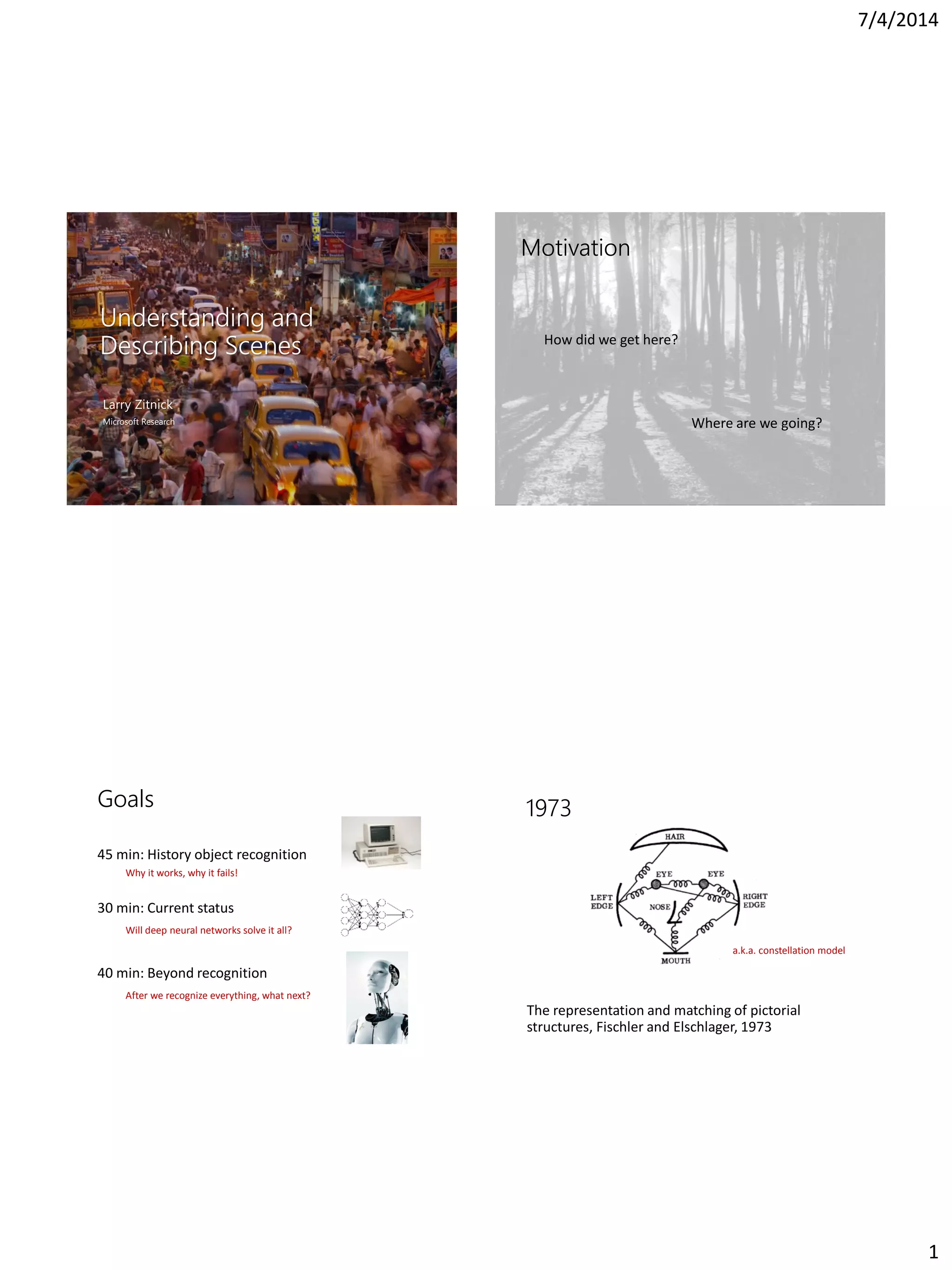
Understanding and
Describing Scenes
Larry Zitnick
Microsoft Research
Motivation
How did we get here?
Where are we going?
Goals
Will deep neural networks solve it all?
30 min: Current status
After we recognize everything, what next?
40 min: Beyond recognition
Why it works, why it fails!
45 min: History object recognition
1973
The representation and matching of pictorial
structures, Fischler and Elschlager, 1973
a.k.a. constellation model
7/4/2014
2
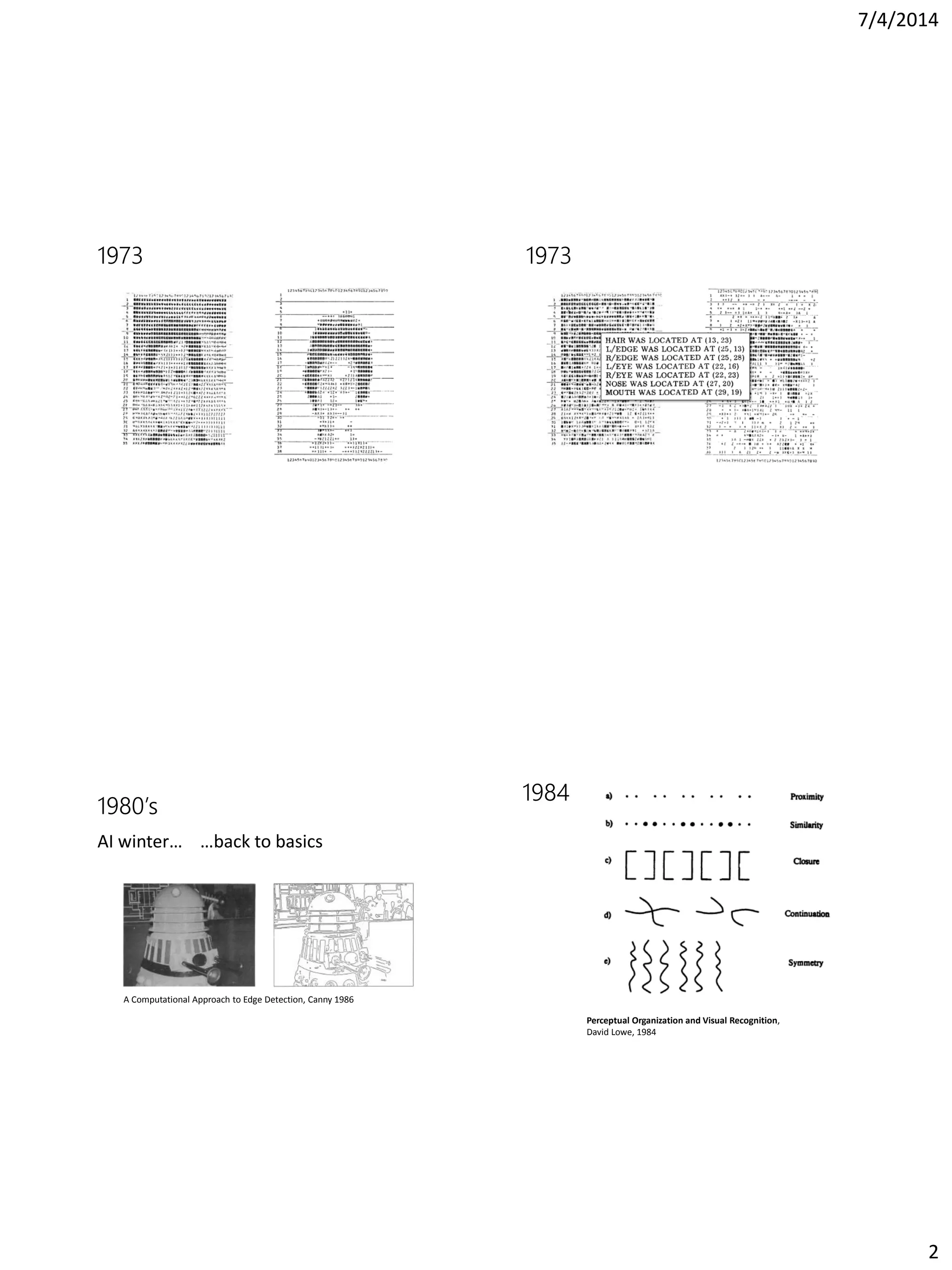
1973 1973
1980’s
AI winter… …back to basics
A Computational Approach to Edge Detection, Canny 1986
Perceptual Organization and Visual Recognition,
David Lowe, 1984
1984
7/4/2014
3
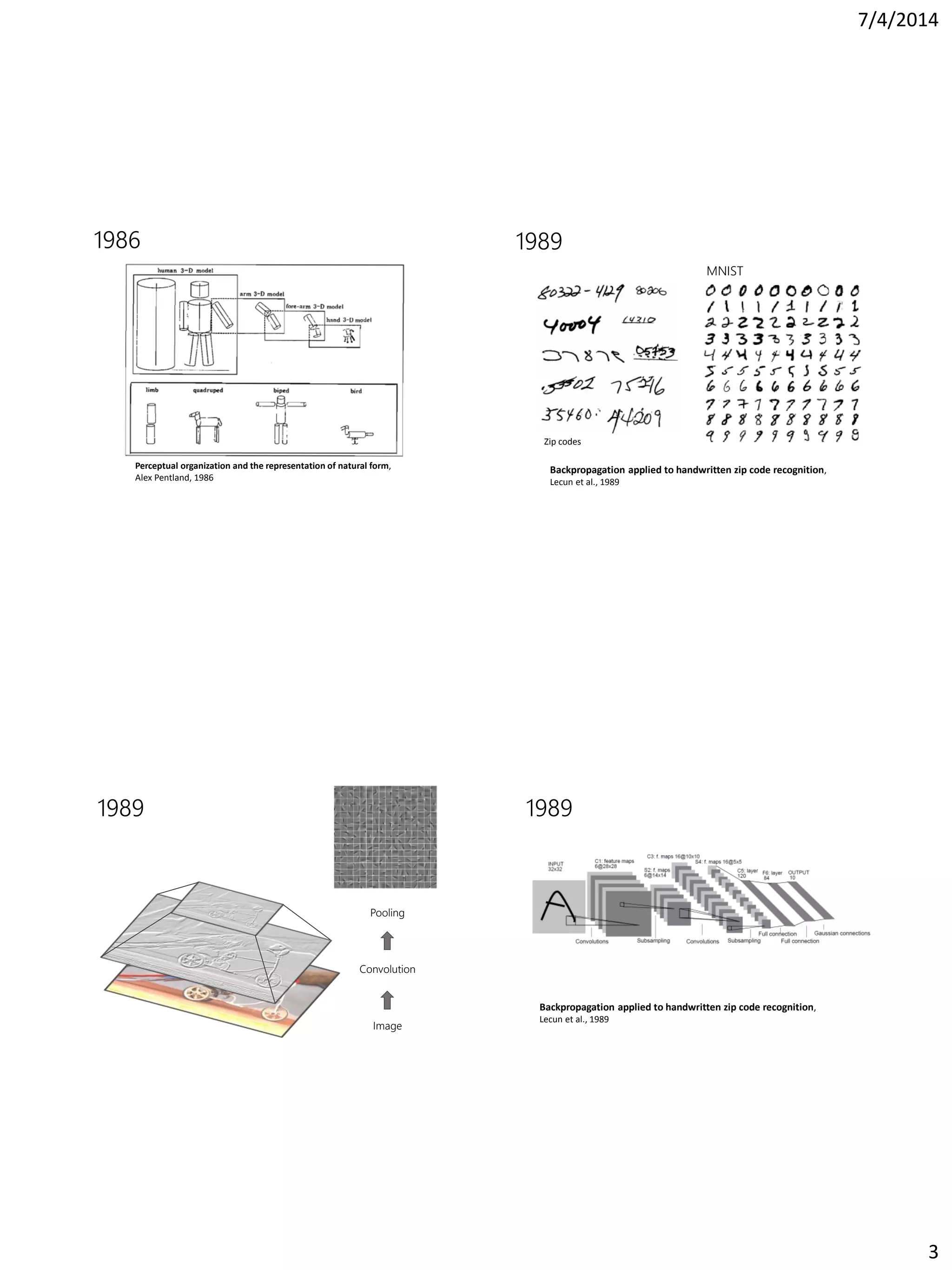
Perceptual organization and the representation of natural form,
Alex Pentland, 1986
1986 1989
Zip codes
MNIST
Backpropagation applied to handwritten zip code recognition,
Lecun et al., 1989
Image
Pooling
Convolution
1989 1989
Backpropagation applied to handwritten zip code recognition,
Lecun et al., 1989
7/4/2014
4
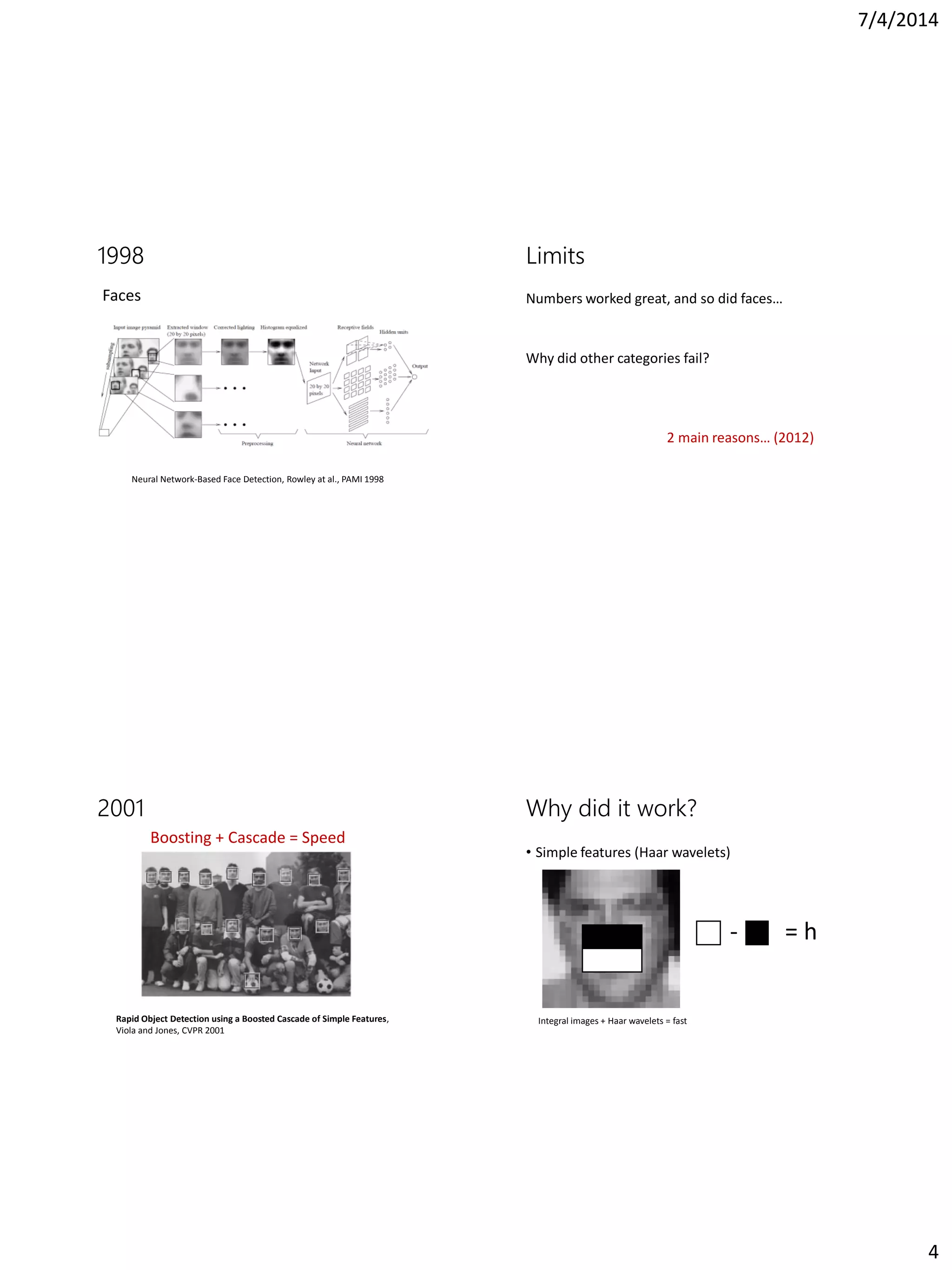
1998
Neural Network-Based Face Detection, Rowley at al., PAMI 1998
Faces
Limits
Numbers worked great, and so did faces…
Why did other categories fail?
2 main reasons… (2012)
2001
Rapid Object Detection using a Boosted Cascade of Simple Features,
Viola and Jones, CVPR 2001
Boosting + Cascade = Speed
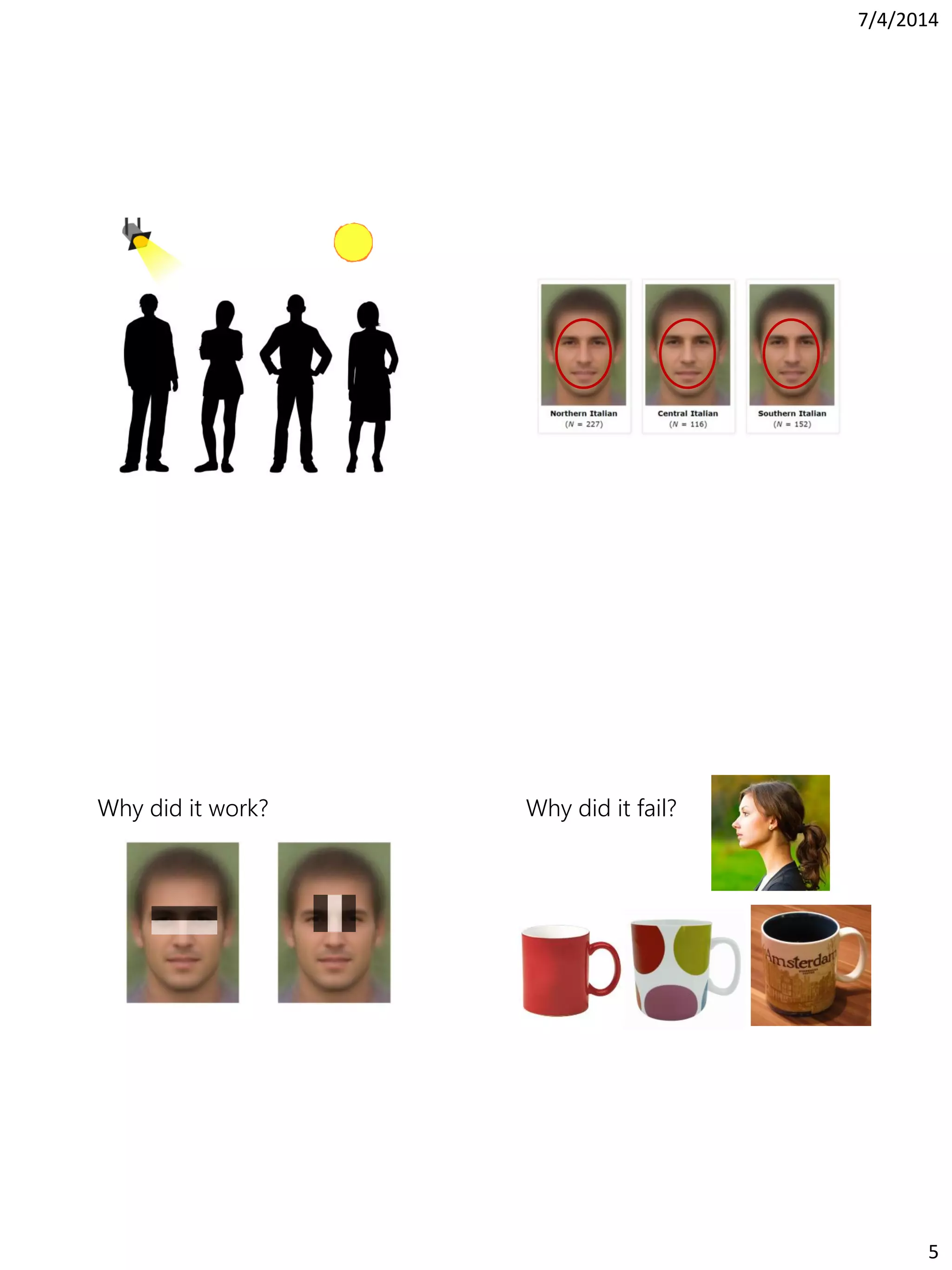
Why did it work?
• Simple features (Haar wavelets)
Integral images + Haar wavelets = fast
- = h
7/4/2014
5
Why did it work? Why did it fail?
7/4/2014
6
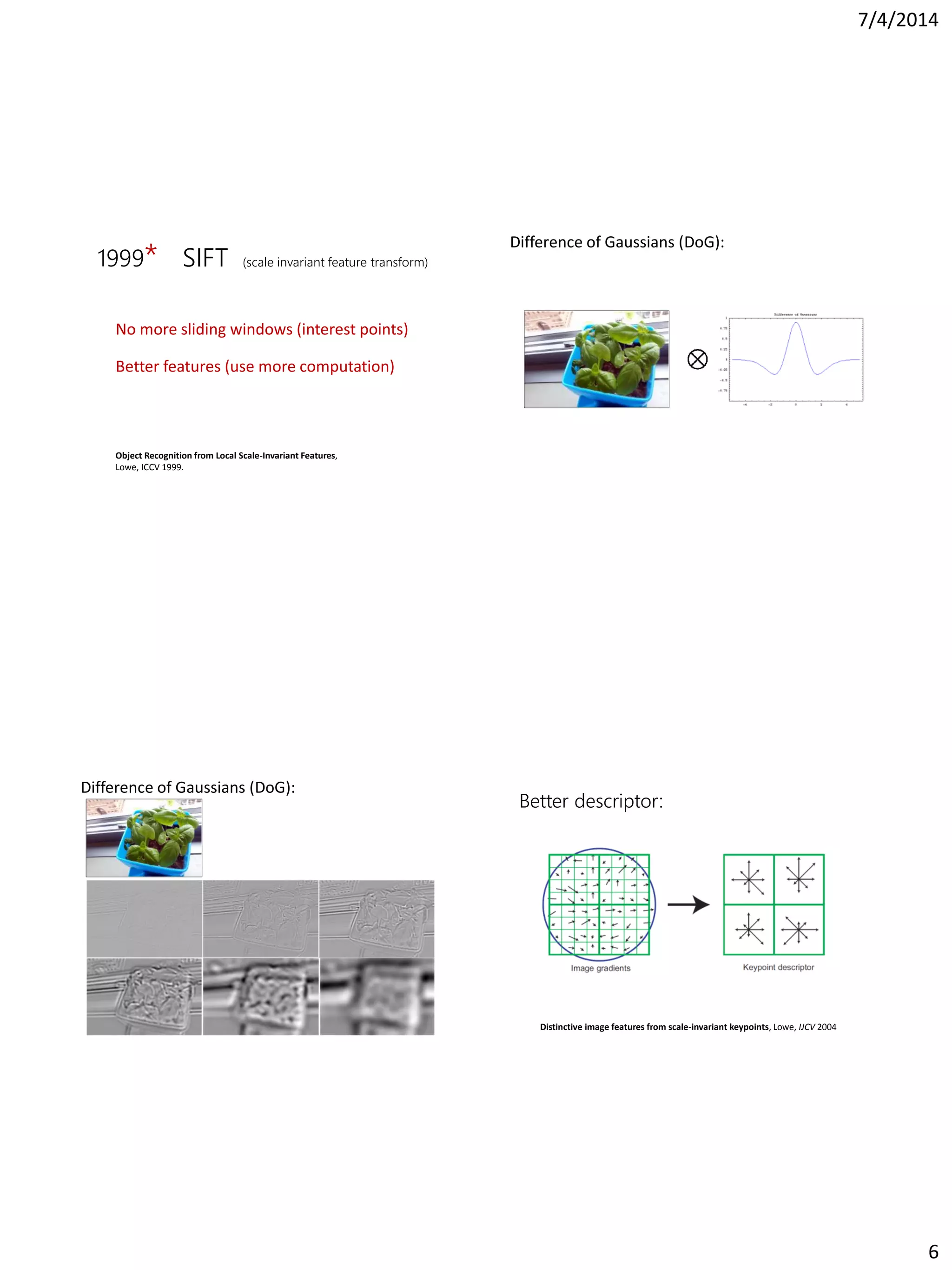
1999*
Object Recognition from Local Scale-Invariant Features,
Lowe, ICCV 1999.
SIFT (scale invariant feature transform)
No more sliding windows (interest points)
Better features (use more computation)
Difference of Gaussians (DoG):
Distinctive image features from scale-invariant keypoints, Lowe, IJCV 2004
Better descriptor:
7/4/2014
7
Truncated normalization
0.2
Distinctive image features from scale-invariant keypoints, Lowe, IJCV 2004
“Object instance” recognition
What worked
• Flat planer objects with lots of texture.
• Panorama stitching
Recognizing panoramas, Brown and Lowe, ICCV 2003
What failed…
7/4/2014
8
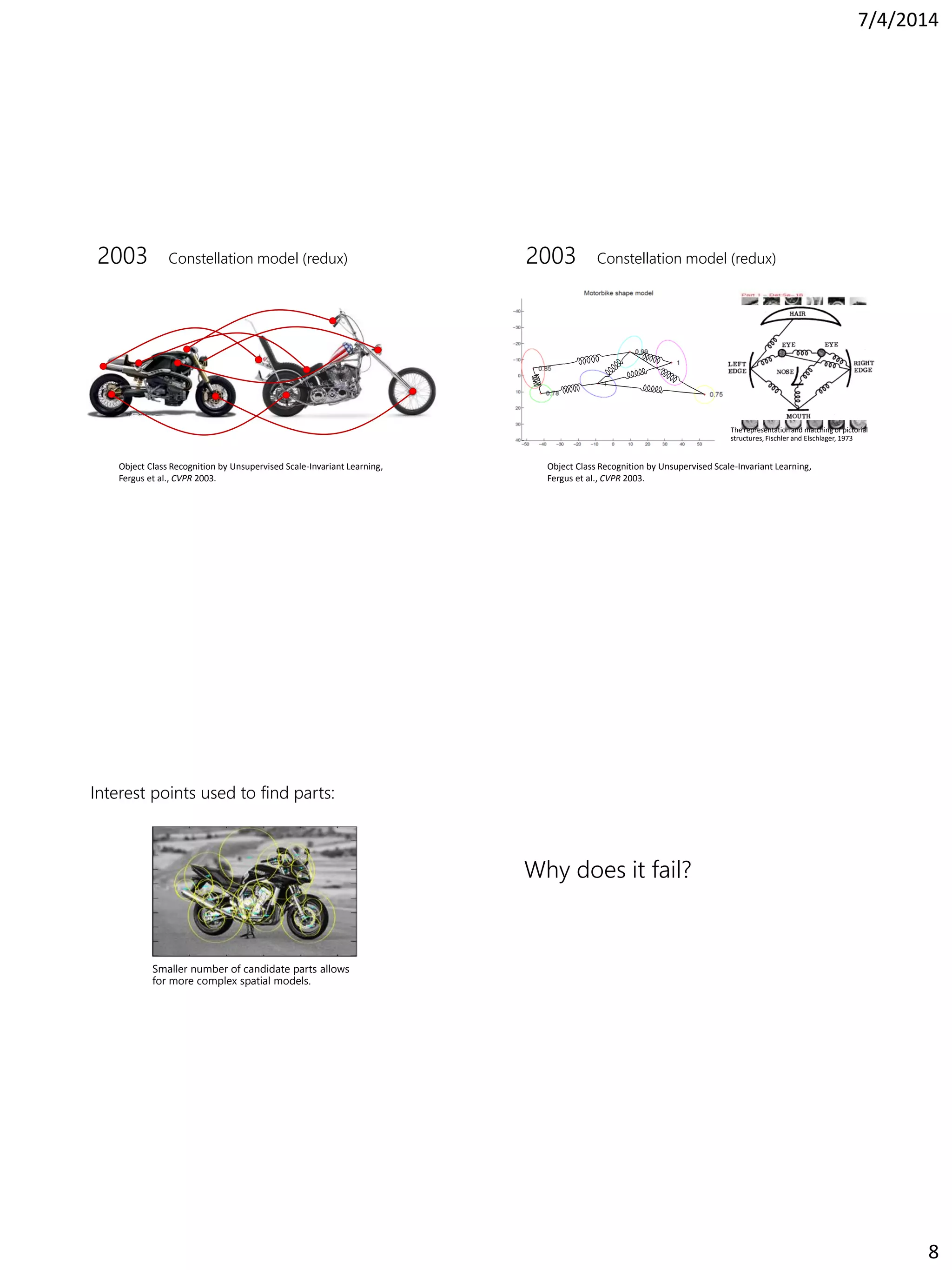
2003 Constellation model (redux)
Object Class Recognition by Unsupervised Scale-Invariant Learning,
Fergus et al., CVPR 2003.
2003 Constellation model (redux)
Object Class Recognition by Unsupervised Scale-Invariant Learning,
Fergus et al., CVPR 2003.
The representationand matching of pictorial
structures, Fischler and Elschlager, 1973
Interest points used to find parts:
Smaller number of candidate parts allows
for more complex spatial models.
Why does it fail?
7/4/2014
9
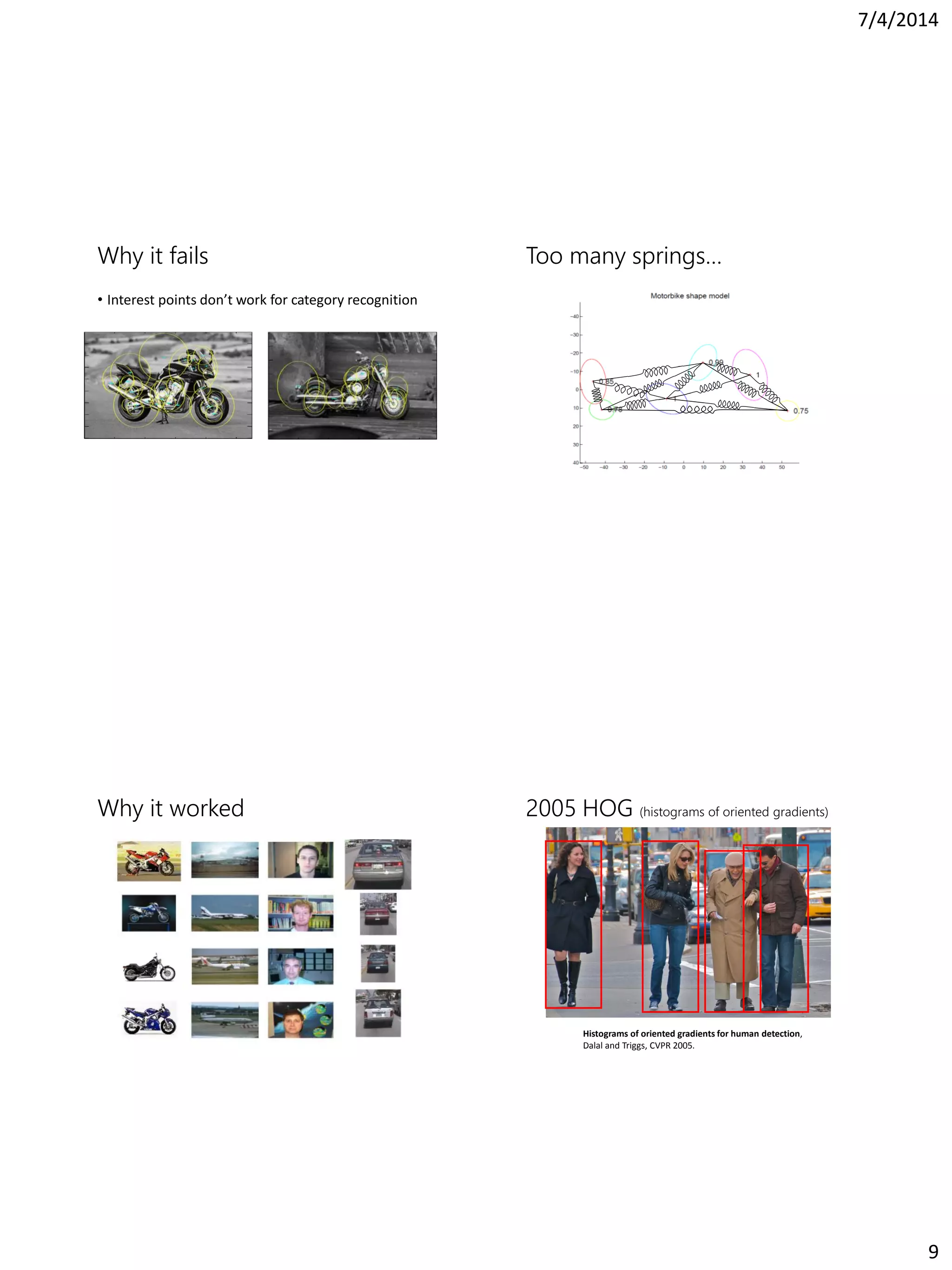
Why it fails
• Interest points don’t work for category recognition
Too many springs…
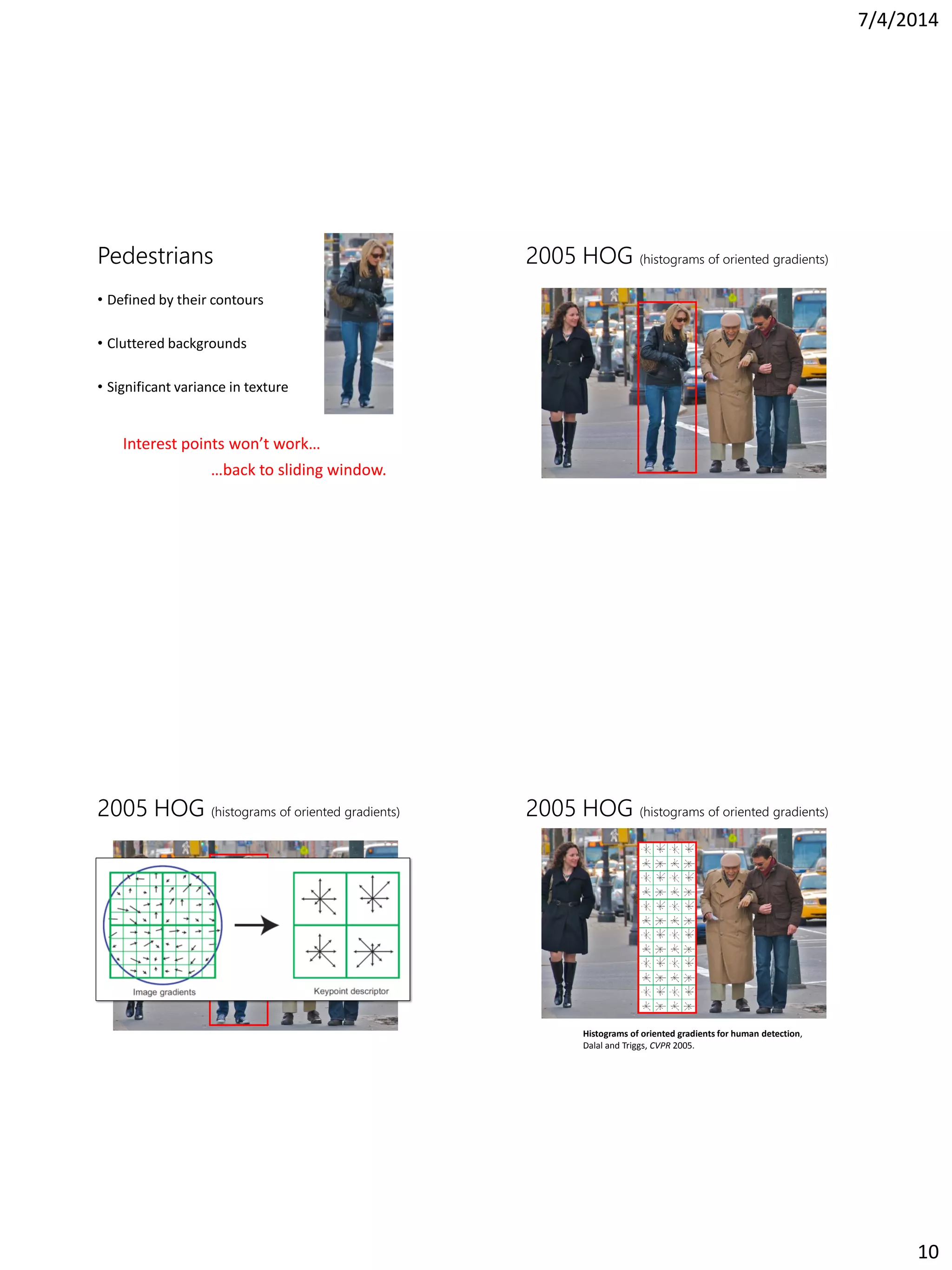
Why it worked 2005 HOG (histograms of oriented gradients)
Histograms of oriented gradients for human detection,
Dalal and Triggs, CVPR 2005.
7/4/2014
10
Pedestrians
• Defined by their contours
• Cluttered backgrounds
• Significant variance in texture
Interest points won’t work…
…back to sliding window.
2005 HOG (histograms of oriented gradients)
2005 HOG (histograms of oriented gradients) 2005 HOG (histograms of oriented gradients)
Histograms of oriented gradients for human detection,
Dalal and Triggs, CVPR 2005.
7/4/2014
11
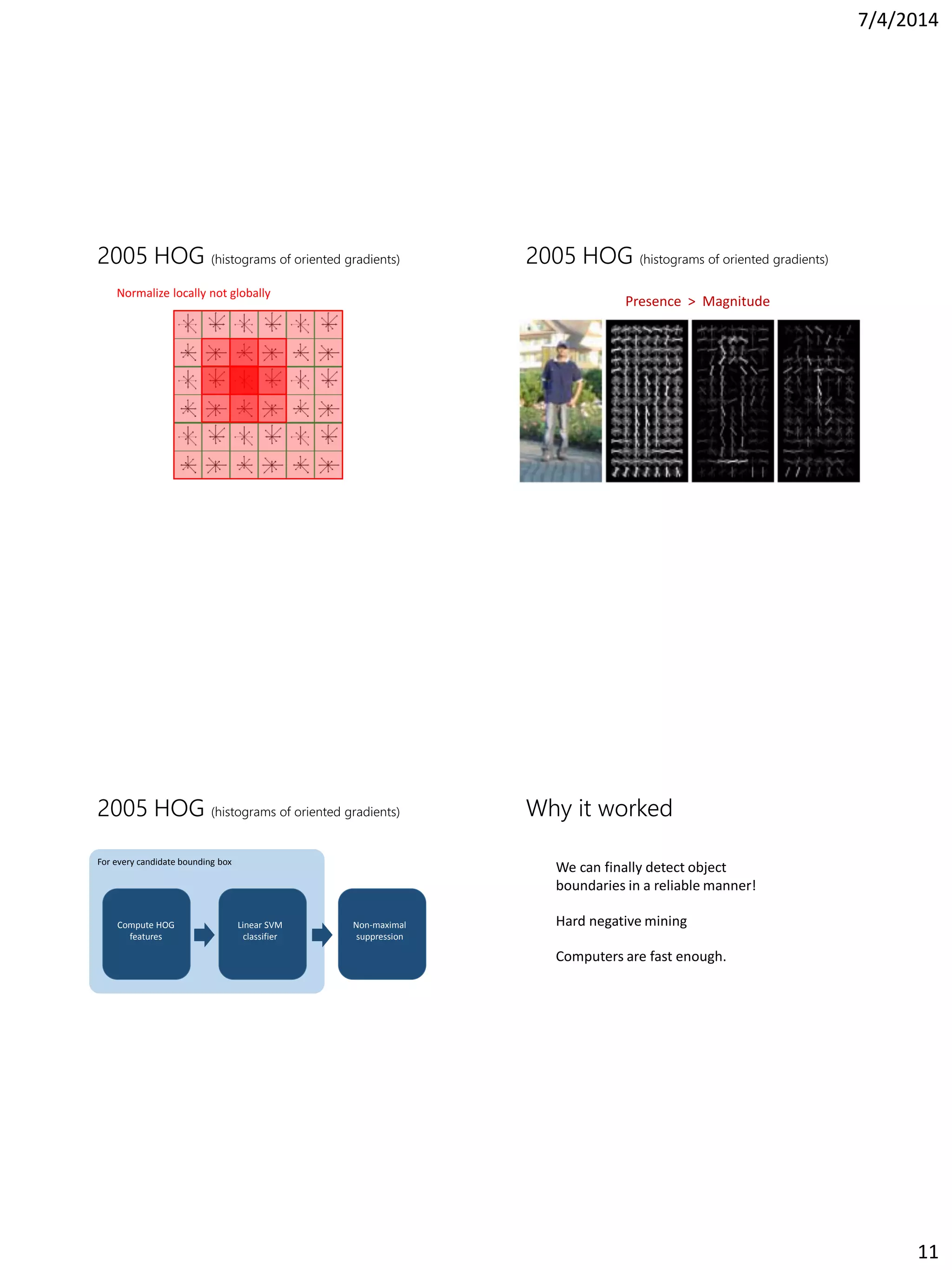
2005 HOG (histograms of oriented gradients)
Normalize locally not globally
2005 HOG (histograms of oriented gradients)
Presence > Magnitude
2005 HOG (histograms of oriented gradients)
NMS
Linear SVM
classifier
For every candidate bounding box
Compute HOG
features
Non-maximal
suppression
Why it worked
We can finally detect object
boundaries in a reliable manner!
Computers are fast enough.
Hard negative mining
7/4/2014
12
Why it failed 2006 Context
People don’t walk in the sky…
Putting Objects in Perspective, Hoiem, Efros, and Hebert, CVPR 2006.
Why it worked
• Our world is not random
• Some contextual cues may be reliably found
Why it failed
• Many contextual cues are hard to detect
• We need more data
• Doesn’t help with false negatives
7/4/2014
13
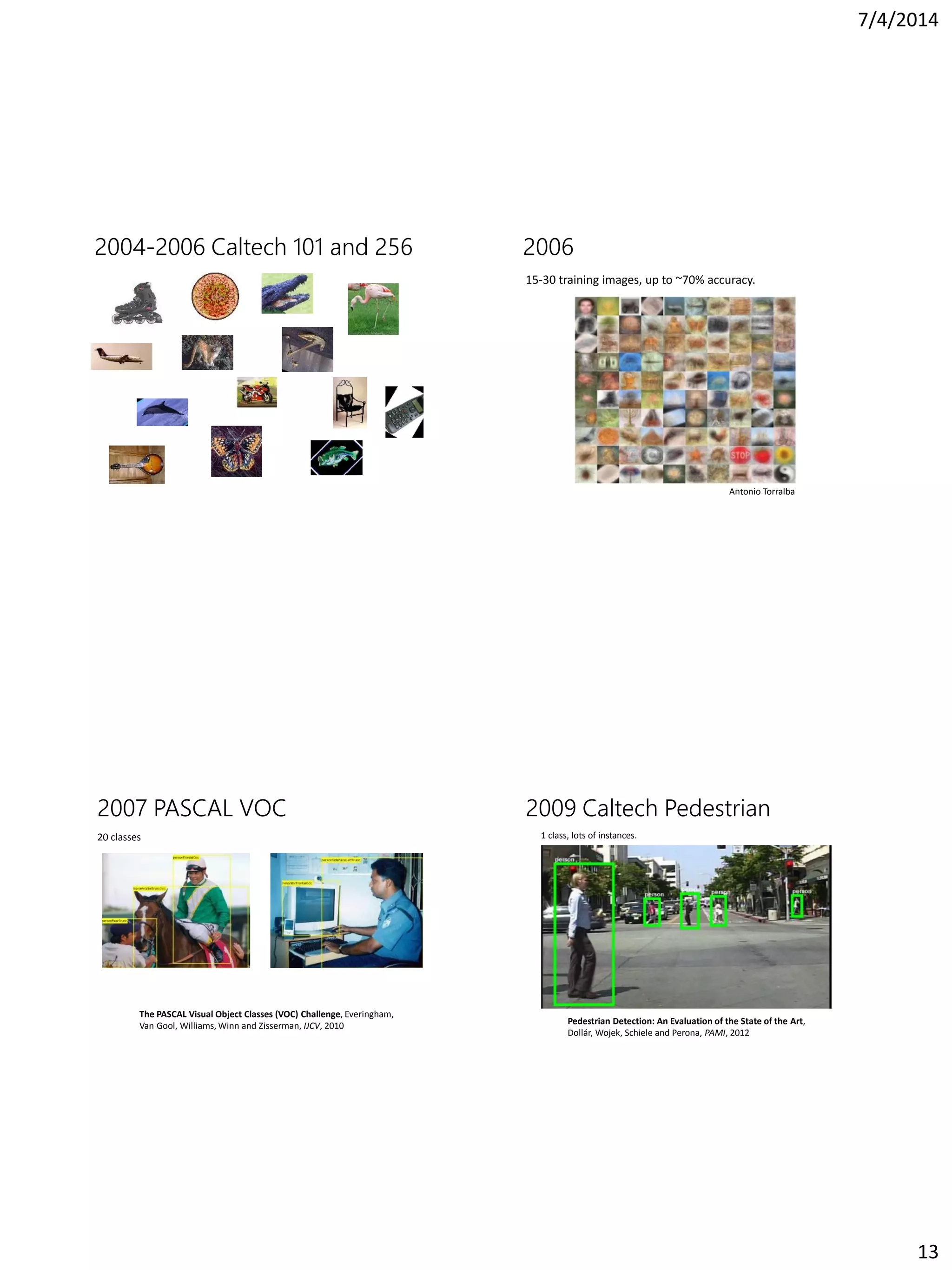
2004-2006 Caltech 101 and 256 2006
15-30 training images, up to ~70% accuracy.
Antonio Torralba
2007 PASCAL VOC
The PASCAL Visual Object Classes (VOC) Challenge, Everingham,
Van Gool, Williams, Winn and Zisserman, IJCV, 2010
20 classes
2009 Caltech Pedestrian
Pedestrian Detection: An Evaluation of the State of the Art,
Dollár, Wojek, Schiele and Perona, PAMI, 2012
1 class, lots of instances.
7/4/2014
14
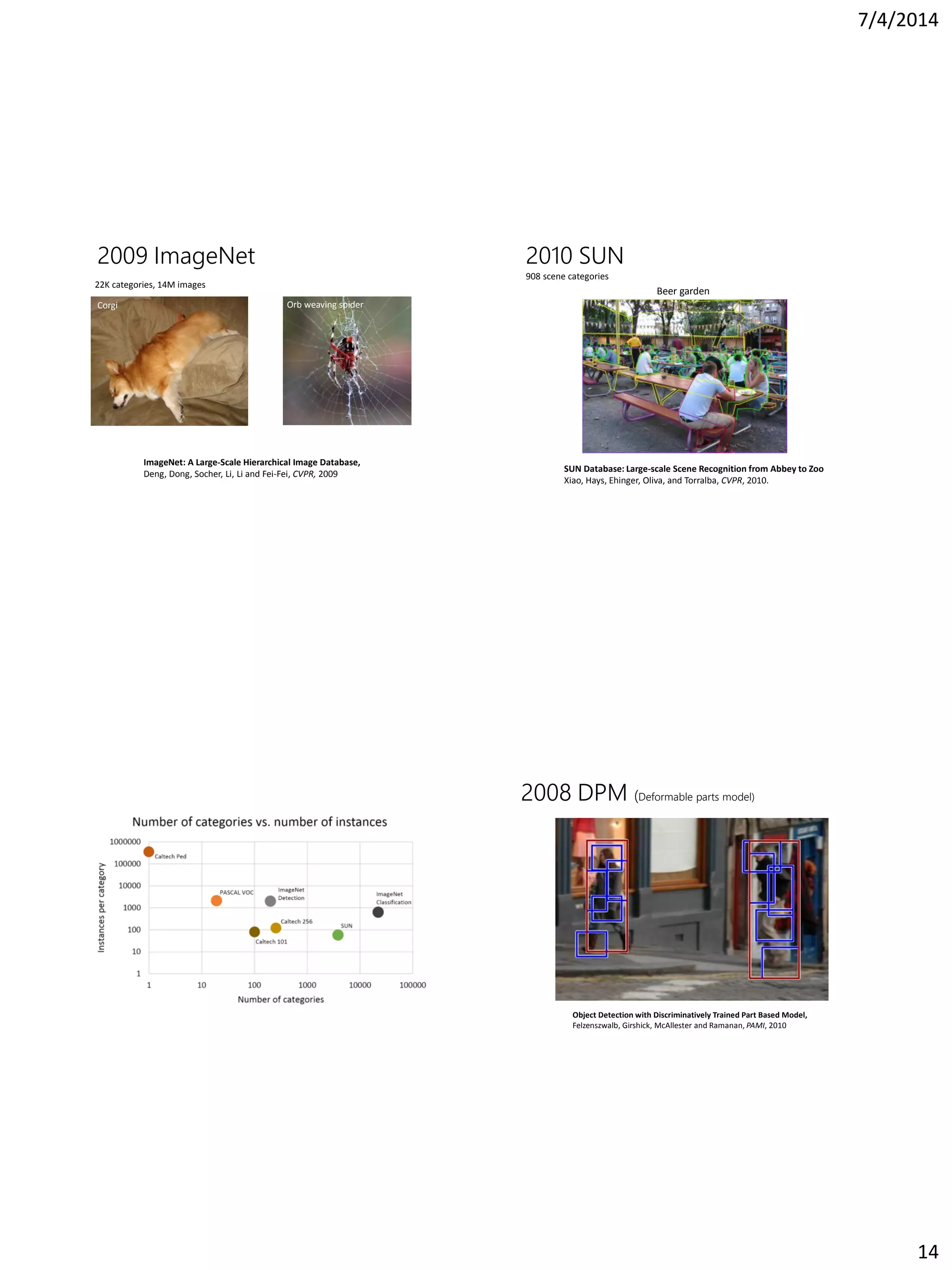
2009 ImageNet
ImageNet: A Large-Scale Hierarchical Image Database,
Deng, Dong, Socher, Li, Li and Fei-Fei, CVPR, 2009
Corgi Orb weaving spider
22K categories, 14M images
2010 SUN
SUN Database: Large-scale Scene Recognition from Abbey to Zoo
Xiao, Hays, Ehinger, Oliva, and Torralba, CVPR, 2010.
908 scene categories
Beer garden
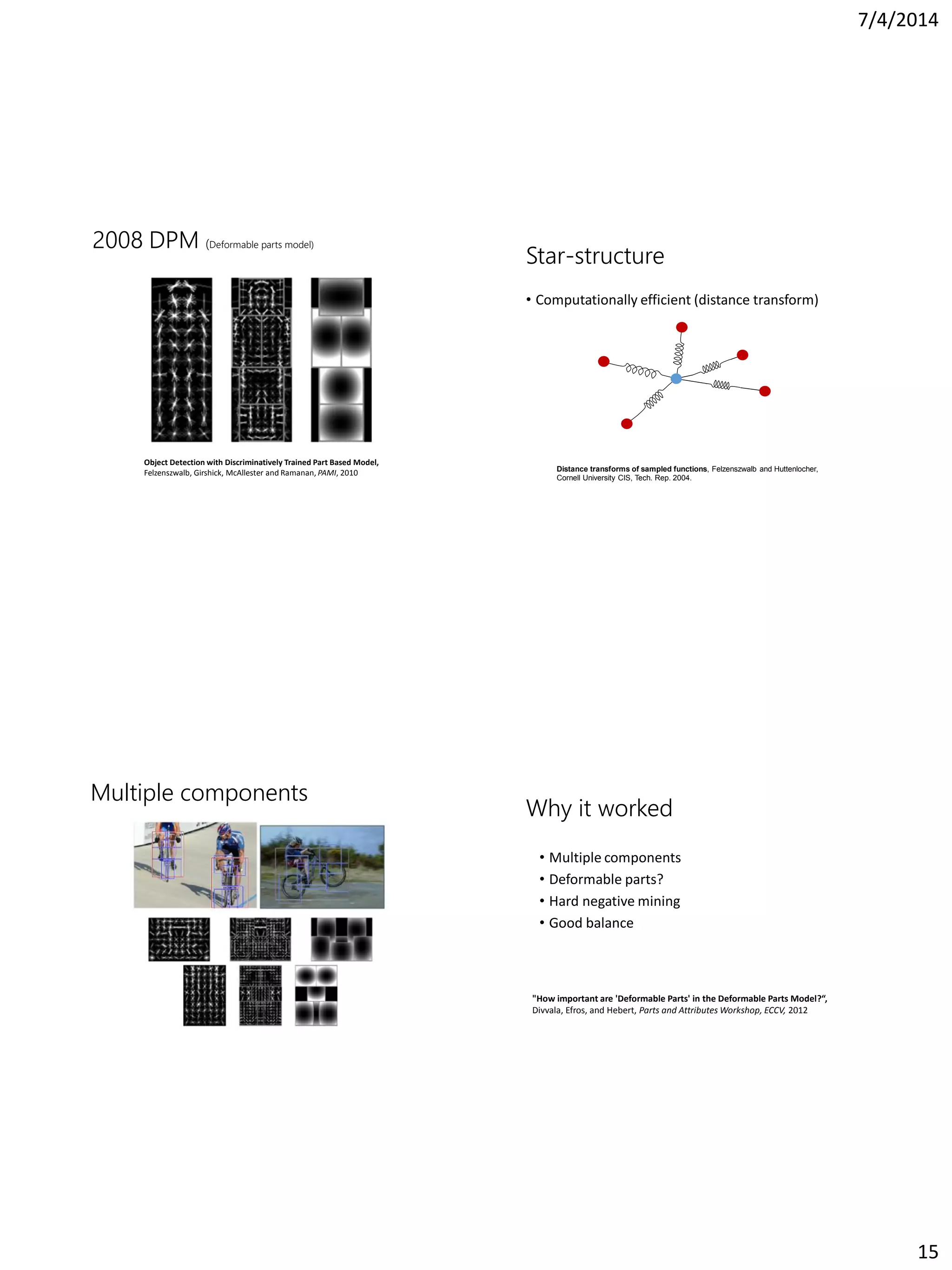
2008 DPM (Deformable parts model)
Object Detection with Discriminatively Trained Part Based Model,
Felzenszwalb, Girshick, McAllester and Ramanan, PAMI, 2010
7/4/2014
15
2008 DPM (Deformable parts model)
Object Detection with Discriminatively Trained Part Based Model,
Felzenszwalb, Girshick, McAllester and Ramanan, PAMI, 2010
Star-structure
• Computationally efficient (distance transform)
Distance transforms of sampled functions, Felzenszwalb and Huttenlocher,
Cornell University CIS, Tech. Rep. 2004.
Multiple components
Why it worked
• Multiple components
• Deformable parts?
• Hard negative mining
• Good balance
"How important are 'Deformable Parts' in the Deformable Parts Model?“,
Divvala, Efros, and Hebert, Parts and Attributes Workshop, ECCV, 2012
7/4/2014
16
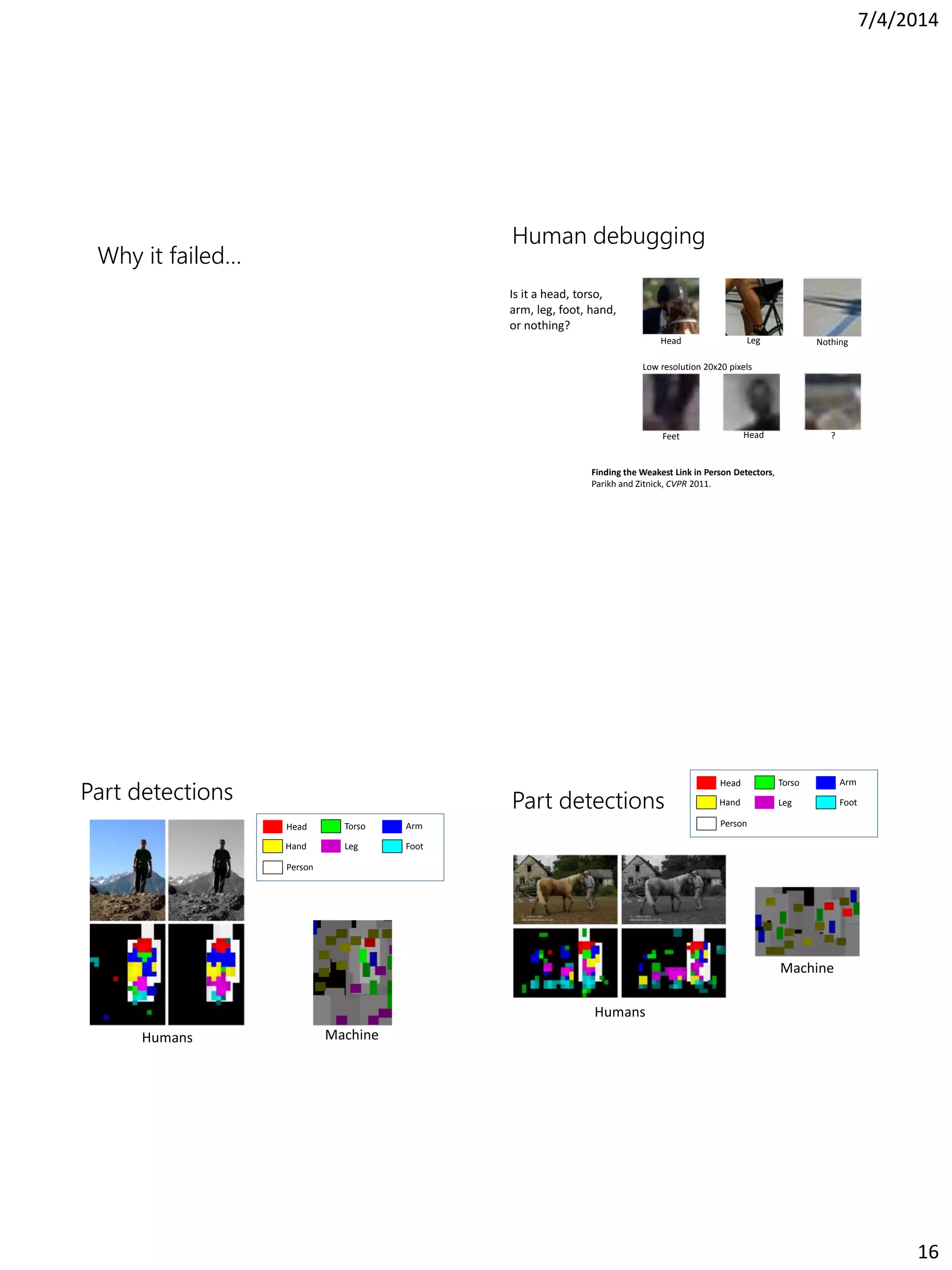
Why it failed…
Human debugging
Low resolution 20x20 pixels
Head Leg
Feet Head ?
Is it a head, torso,
arm, leg, foot, hand,
or nothing?
Nothing
Finding the Weakest Link in Person Detectors,
Parikh and Zitnick, CVPR 2011.
Part detections
Humans Machine
Head Torso Arm
Hand Leg Foot
Person
Part detections
Humans
Machine
Head Torso Arm
Hand Leg Foot
Person
7/4/2014
17
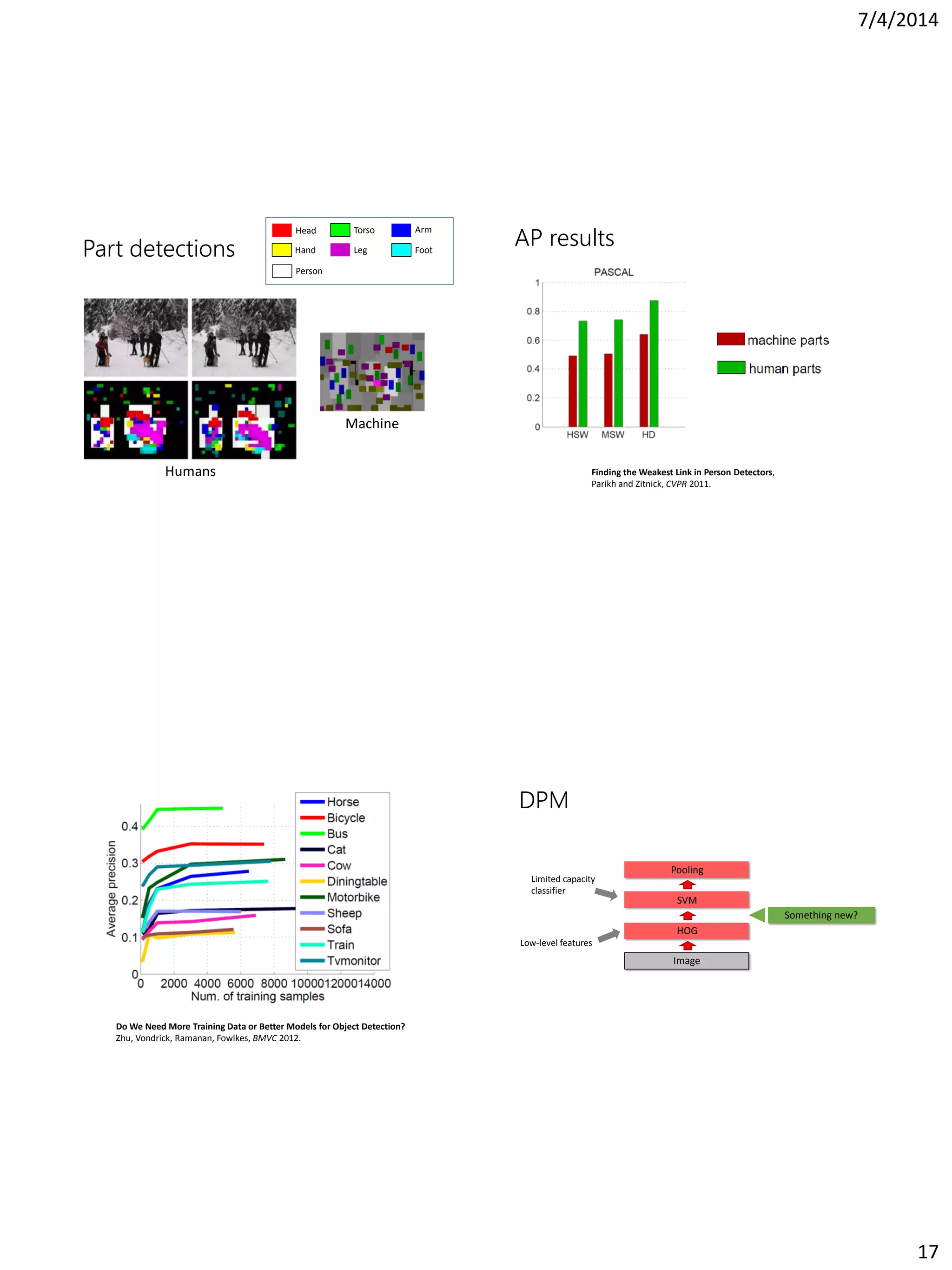
Part detections
Humans
Machine
Head Torso Arm
Hand Leg Foot
Person
AP results
Finding the Weakest Link in Person Detectors,
Parikh and Zitnick, CVPR 2011.
Do We Need More Training Data or Better Models for Object Detection?
Zhu, Vondrick, Ramanan, Fowlkes, BMVC 2012.
HOG
SVM
Pooling
Image
DPM
Limited capacity
classifier
Low-level features
Something new?
7/4/2014
18
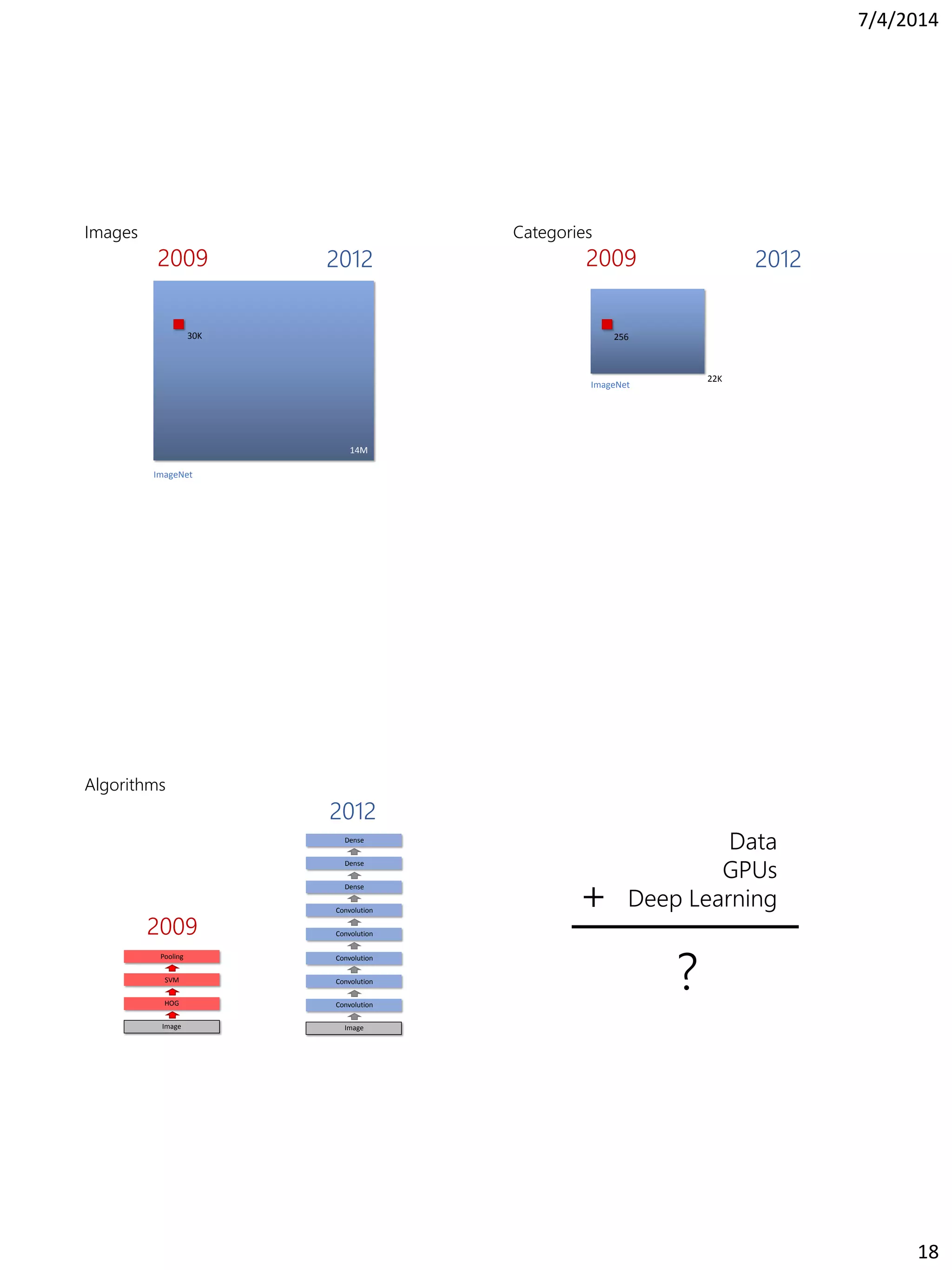
2009 2012
Images
30K
14M
ImageNet
2009 2012
Categories
22K
256
ImageNet
2009
Algorithms
HOG
SVM
Pooling
Image
2012
Convolution
Convolution
Convolution
Image
Convolution
Convolution
Dense
Dense
Dense
Data
GPUs
Deep Learning+
?
7/4/2014
19
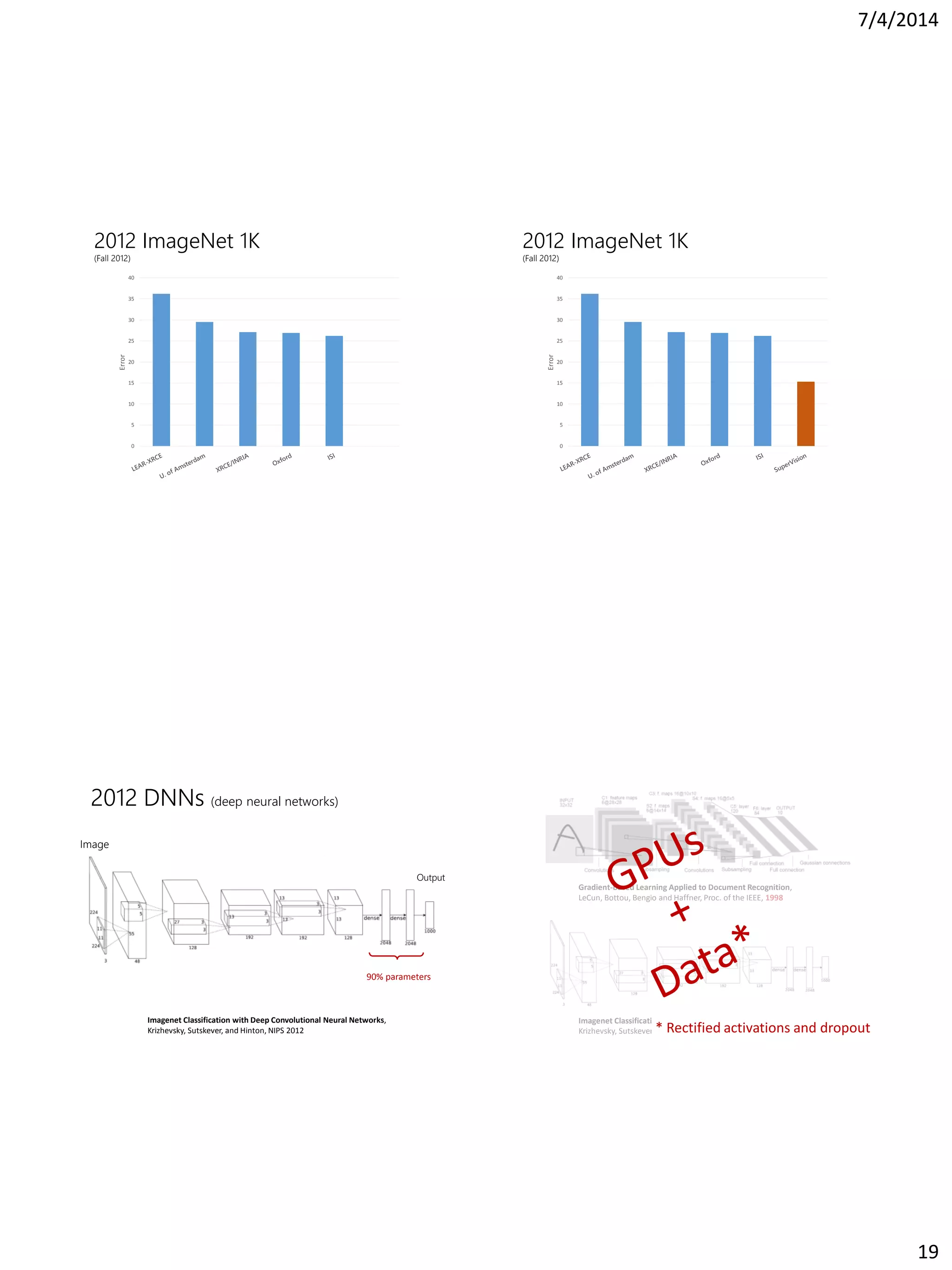
2012 ImageNet 1K
(Fall 2012)
0
5
10
15
20
25
30
35
40
Error
0
5
10
15
20
25
30
35
40
Error
2012 ImageNet 1K
(Fall 2012)
2012 DNNs (deep neural networks)
Image
Output
90% parameters
Imagenet Classification with Deep Convolutional Neural Networks,
Krizhevsky, Sutskever, and Hinton, NIPS 2012
Imagenet Classification with Deep Convolutional Neural Networks,
Krizhevsky, Sutskever, and Hinton, NIPS 2012
Gradient-Based Learning Applied to Document Recognition,
LeCun, Bottou, Bengio and Haffner, Proc. of the IEEE, 1998
* Rectified activations and dropout
7/4/2014
20
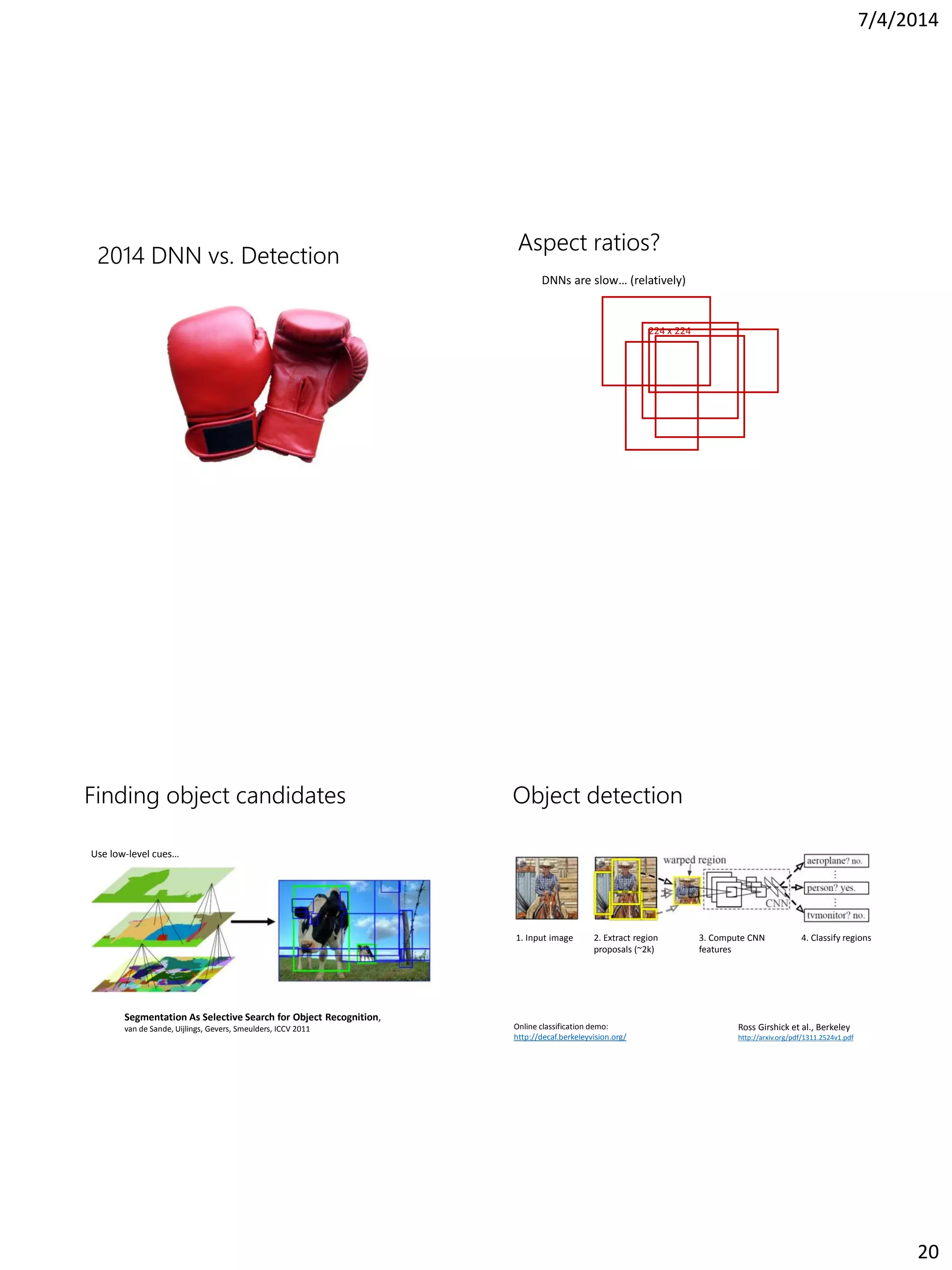
2014 DNN vs. Detection
Aspect ratios?
DNNs are slow… (relatively)
224 x 224
Finding object candidates
Use low-level cues…
Segmentation As Selective Search for Object Recognition,
van de Sande, Uijlings, Gevers, Smeulders, ICCV 2011 Ross Girshick et al., Berkeley
http://arxiv.org/pdf/1311.2524v1.pdf
1. Input image 2. Extract region
proposals (~2k)
3. Compute CNN
features
4. Classify regions
Online classification demo:
http://decaf.berkeleyvision.org/
Object detection
7/4/2014
21
7/4/2014
22
7/4/2014
23
7/4/2014
24
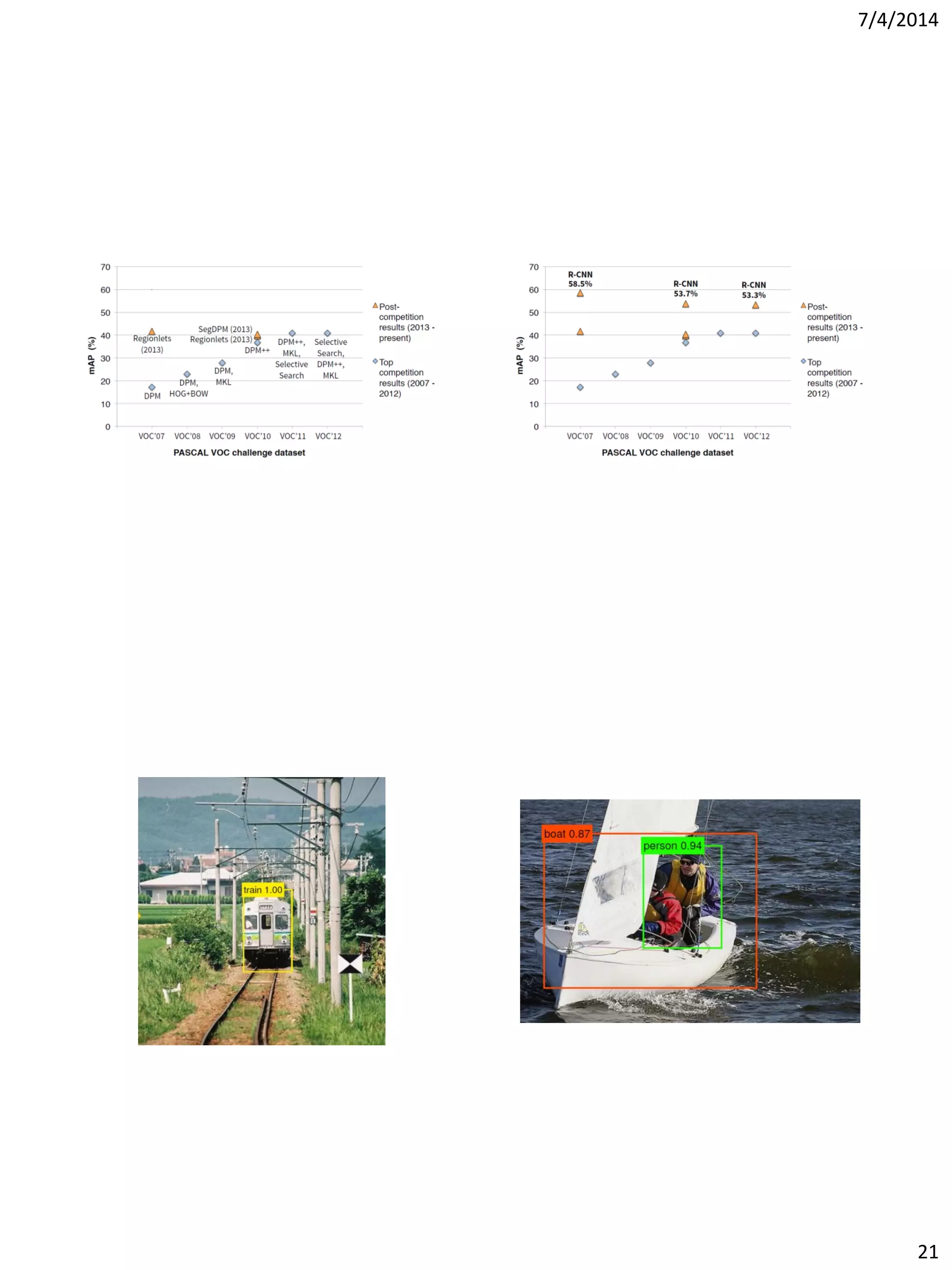
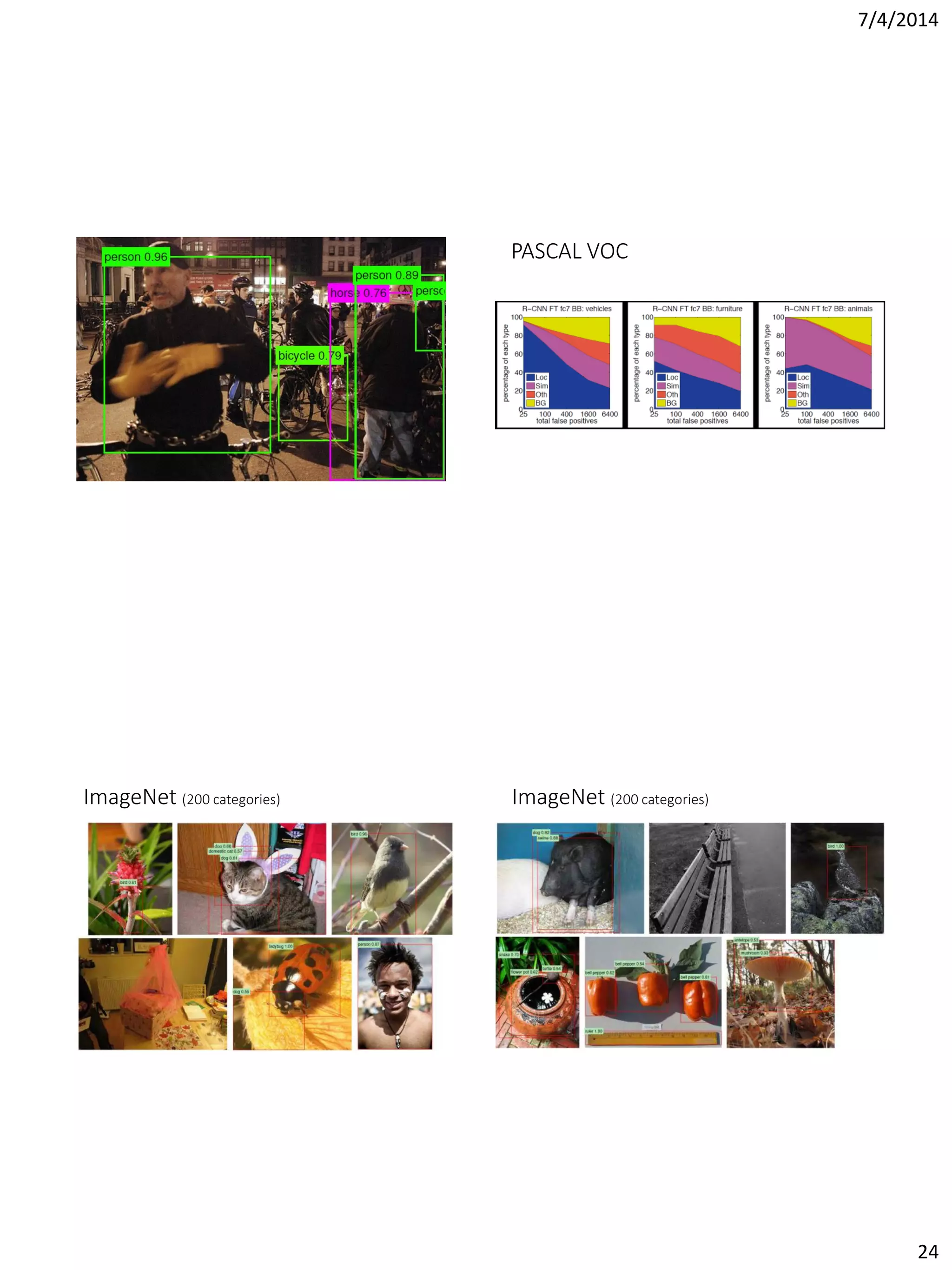
PASCAL VOC
ImageNet (200 categories) ImageNet (200 categories)
7/4/2014
25
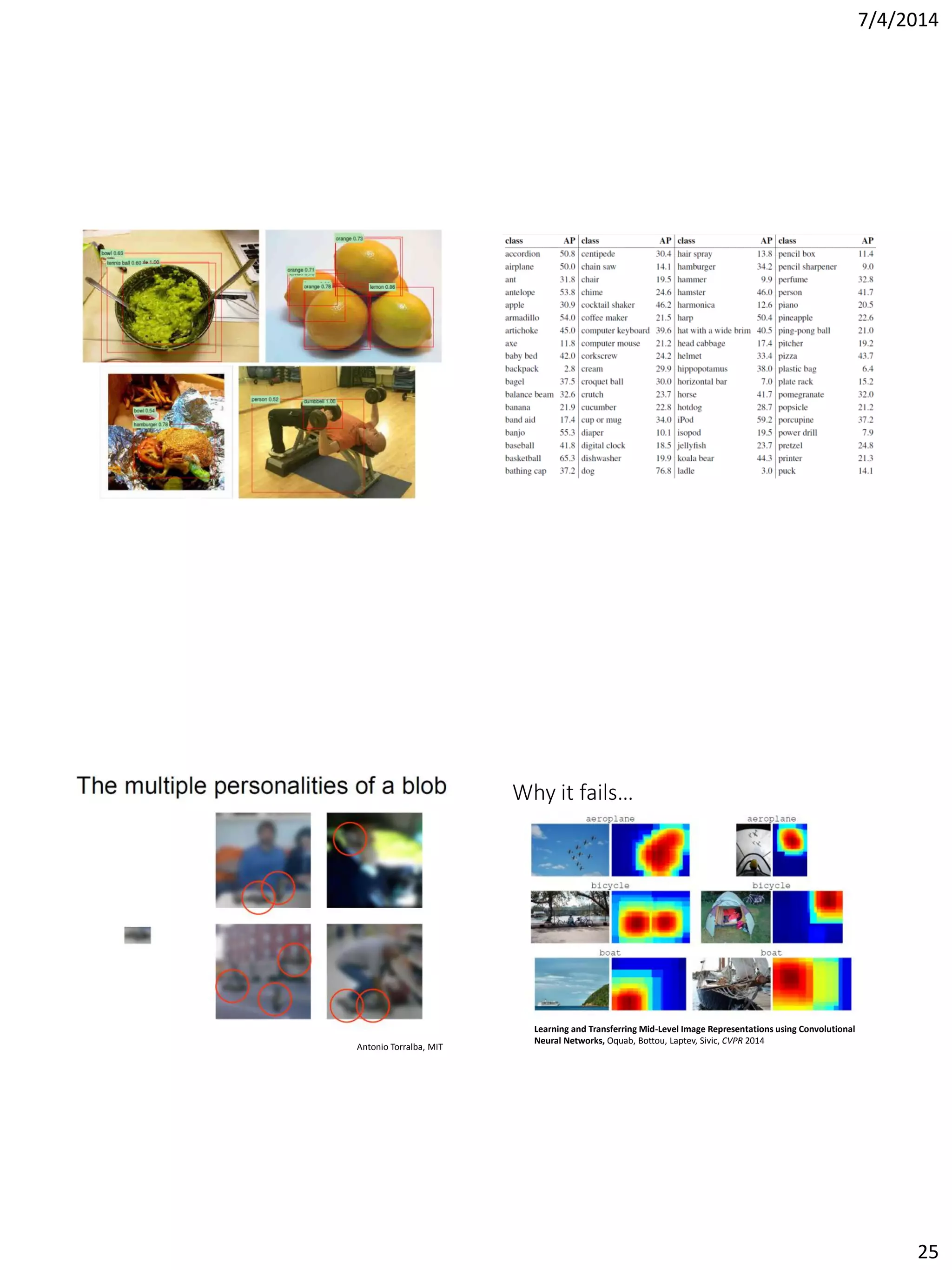
Antonio Torralba, MIT
Why it fails…
Learning and Transferring Mid-Level Image Representations using Convolutional
Neural Networks, Oquab, Bottou, Laptev, Sivic, CVPR 2014
7/4/2014
26
Why it fails…
Intriguing properties of neural networks,
Szegedy, Zaremba, Sutskever, Bruna, Erhan, Goodfellow, Fergus, ICLR 2014.
Correctly
classified
Incorrectly
classified
Why it fails…
PANDA: Pose Aligned Networks for Deep
Attribute Modeling, Zhang, Paluri, Ranzato,
Darrell, Bourdev, CVPR 2014.
DeepFace: closing the gap to human-Level
performance in face verification, Taigman,
Yang, Ranzato, Wolf, CVPR 2014.
Finding object candidates
Use low-level cues…
Segmentation As Selective Search for Object Recognition,
van de Sande, Uijlings, Gevers, Smeulders, ICCV 2011
Looking forward…
7/4/2014
27
Microsoft COCO: Common Objects in Context,
Lin, Maire, Belongie, Hays, Perona, Ramanan,
Dollár, Zitnick, ECCV 2014.
http://mscoco.org
Why a new dataset?
Continue our field’s momentum:
• Detecting difficult instances (context)
• Segmentation
• Enabling new research directions
Detection in Context
Instance segmentation
Non-iconic instances
Iconic object images
7/4/2014
28
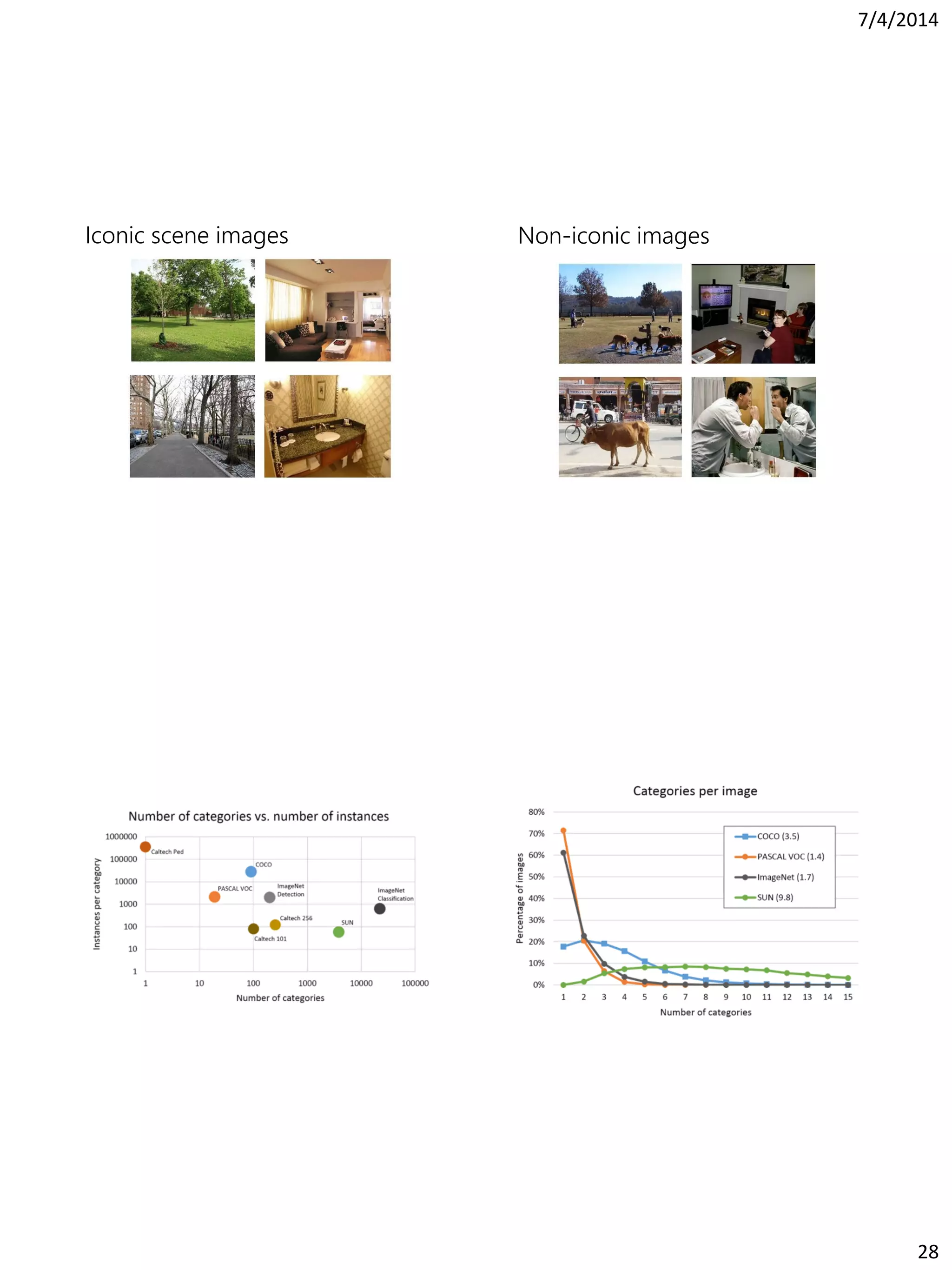
Iconic scene images Non-iconic images
7/4/2014
29
MS COCO
• 70-100 object categories (things not stuff)
• 330,000 images (~150k first release)
• 2 million instances (400k people)
• Every instance is segmented
• 7.7 instances per image (3.5 categories)
• Key points
• 5 sentences per image
http://mscoco.org
Over 55,000 worker hours (6+ years)
Post-recognition era
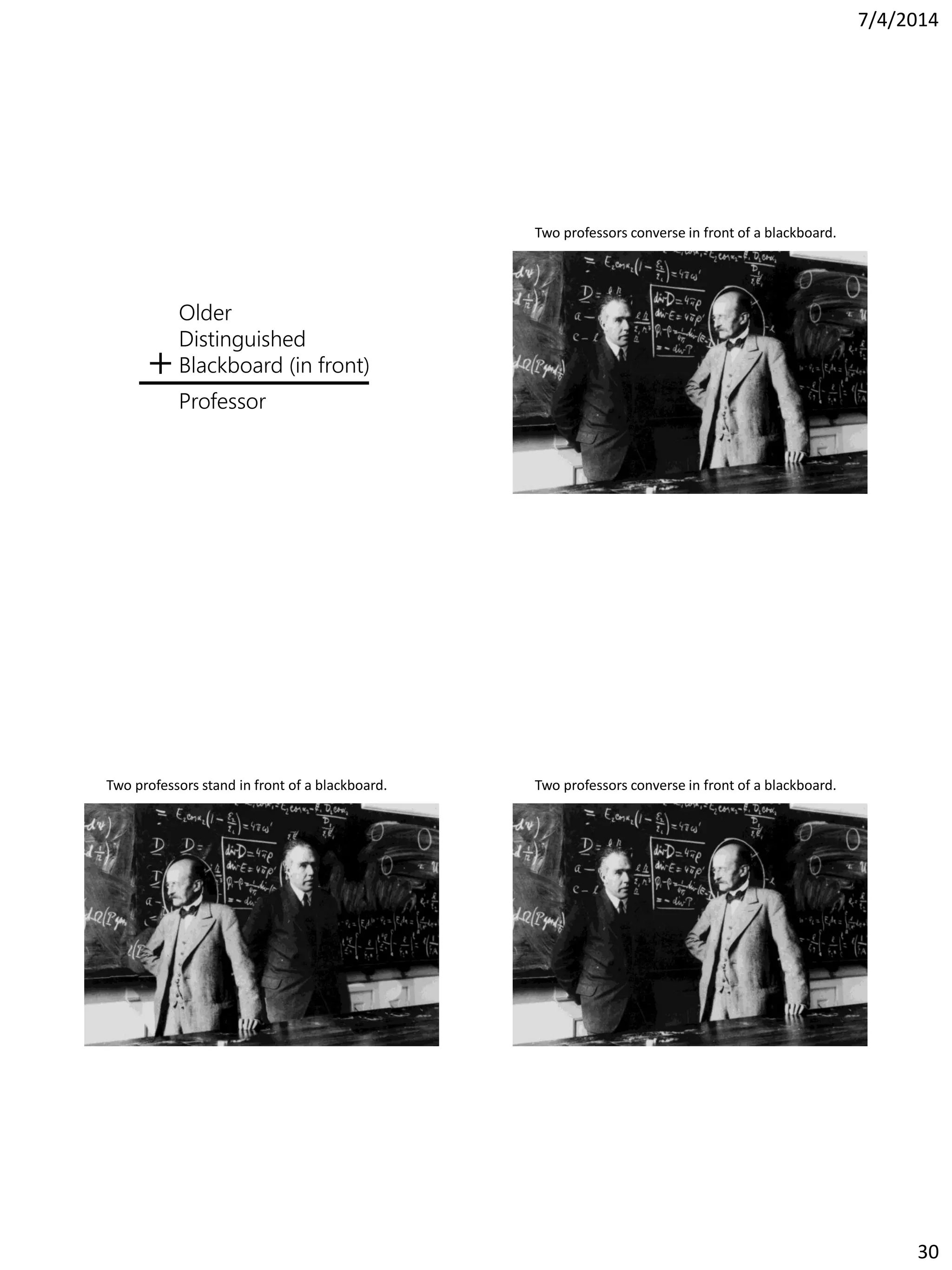
Two professors converse in front of a blackboard.
7/4/2014
30
Older
Distinguished
Blackboard (in front)
Professor
+
Two professors converse in front of a blackboard.
Two professors stand in front of a blackboard. Two professors converse in front of a blackboard.
7/4/2014
31
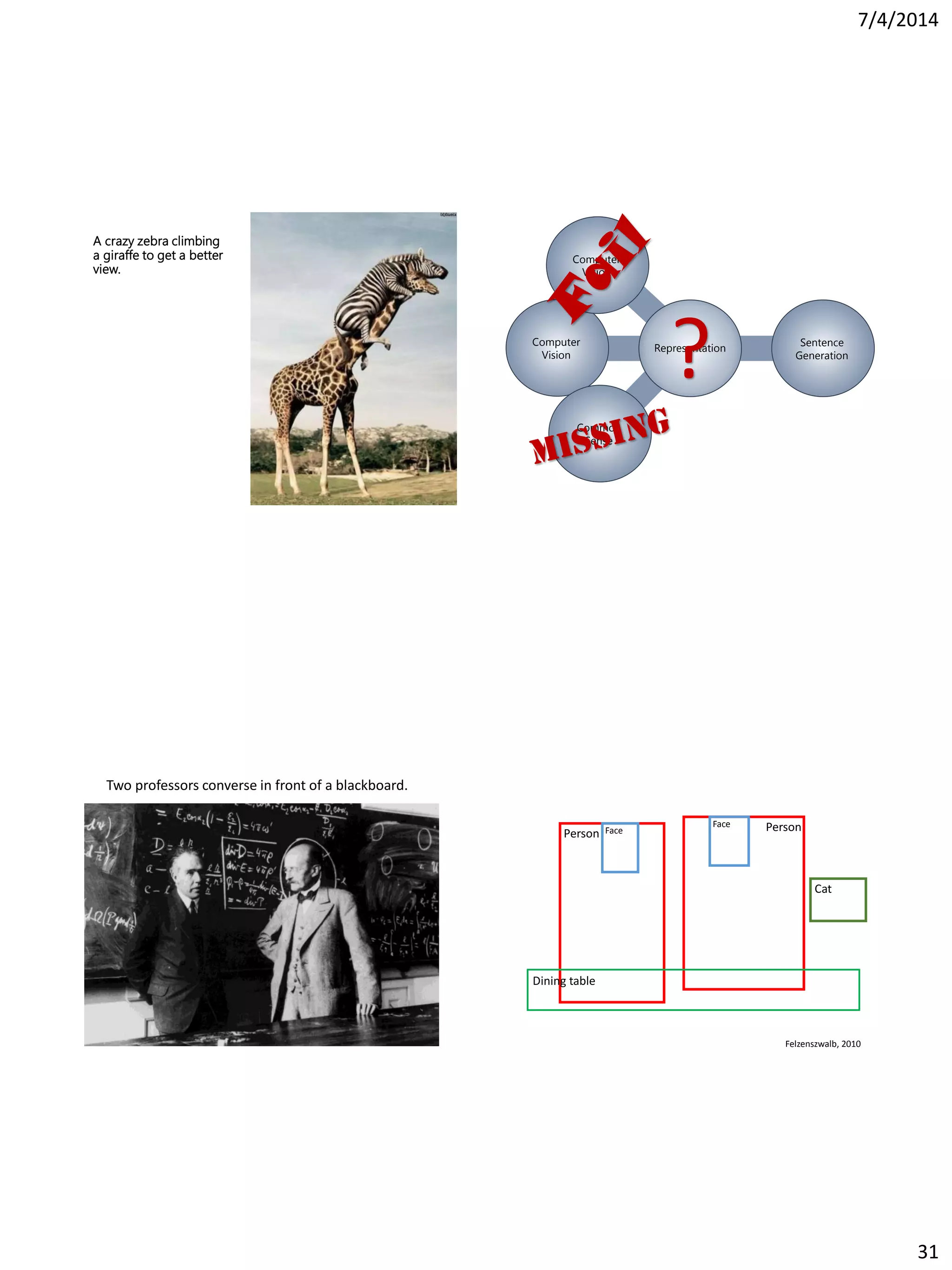
A crazy zebra climbing
a giraffe to get a better
view.
Computer
Vision
Common
Sense
Computer
Vision
Representation
Sentence
Generation
?
Two professors converse in front of a blackboard.
Person
Person
Dining table
Felzenszwalb, 2010
Face
Face
Cat
7/4/2014
32
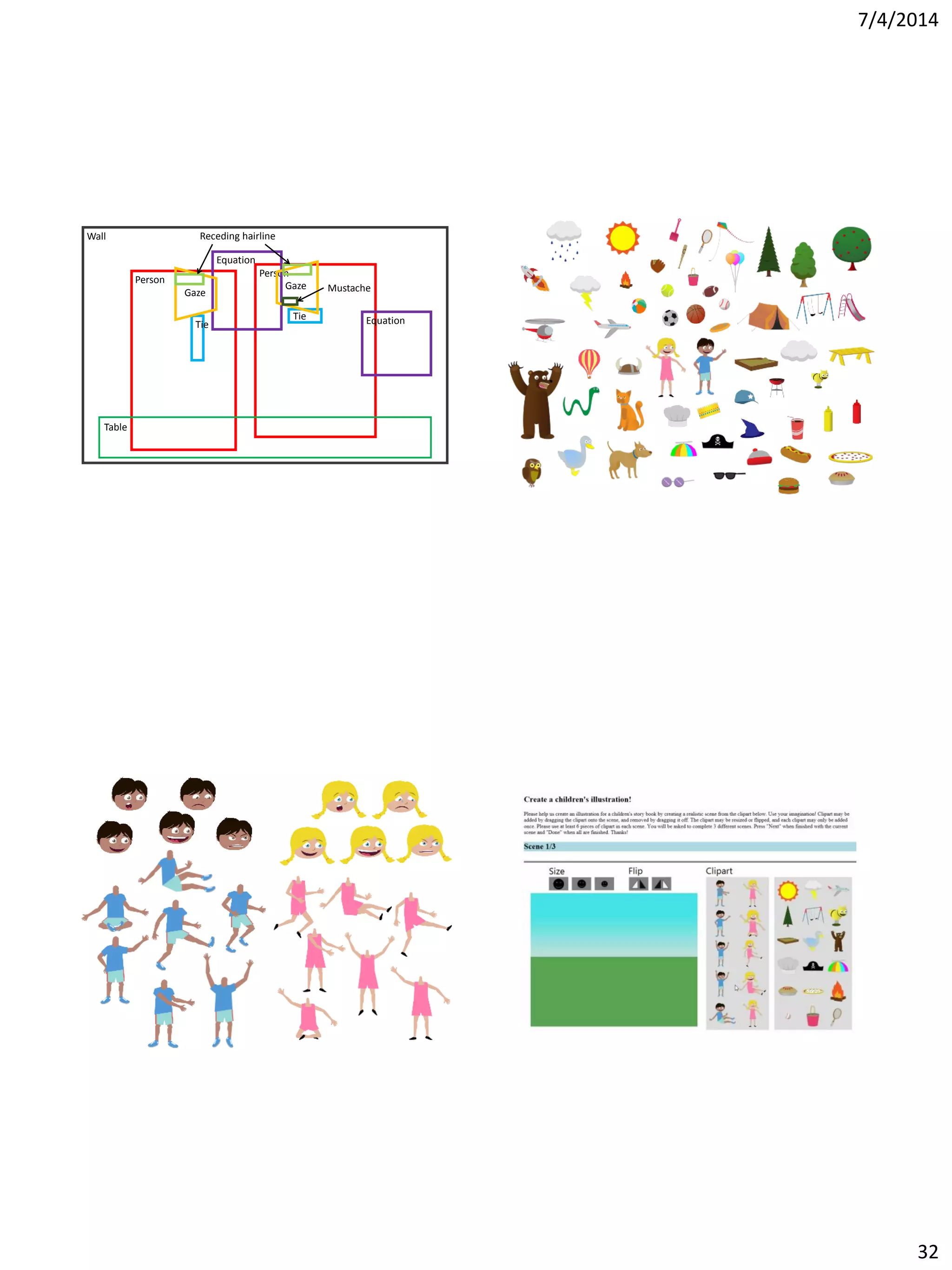
Person
Person
Table
Equation
Equation
Gaze
Gaze
Tie
Tie
Mustache
Receding hairlineWall
7/4/2014
33
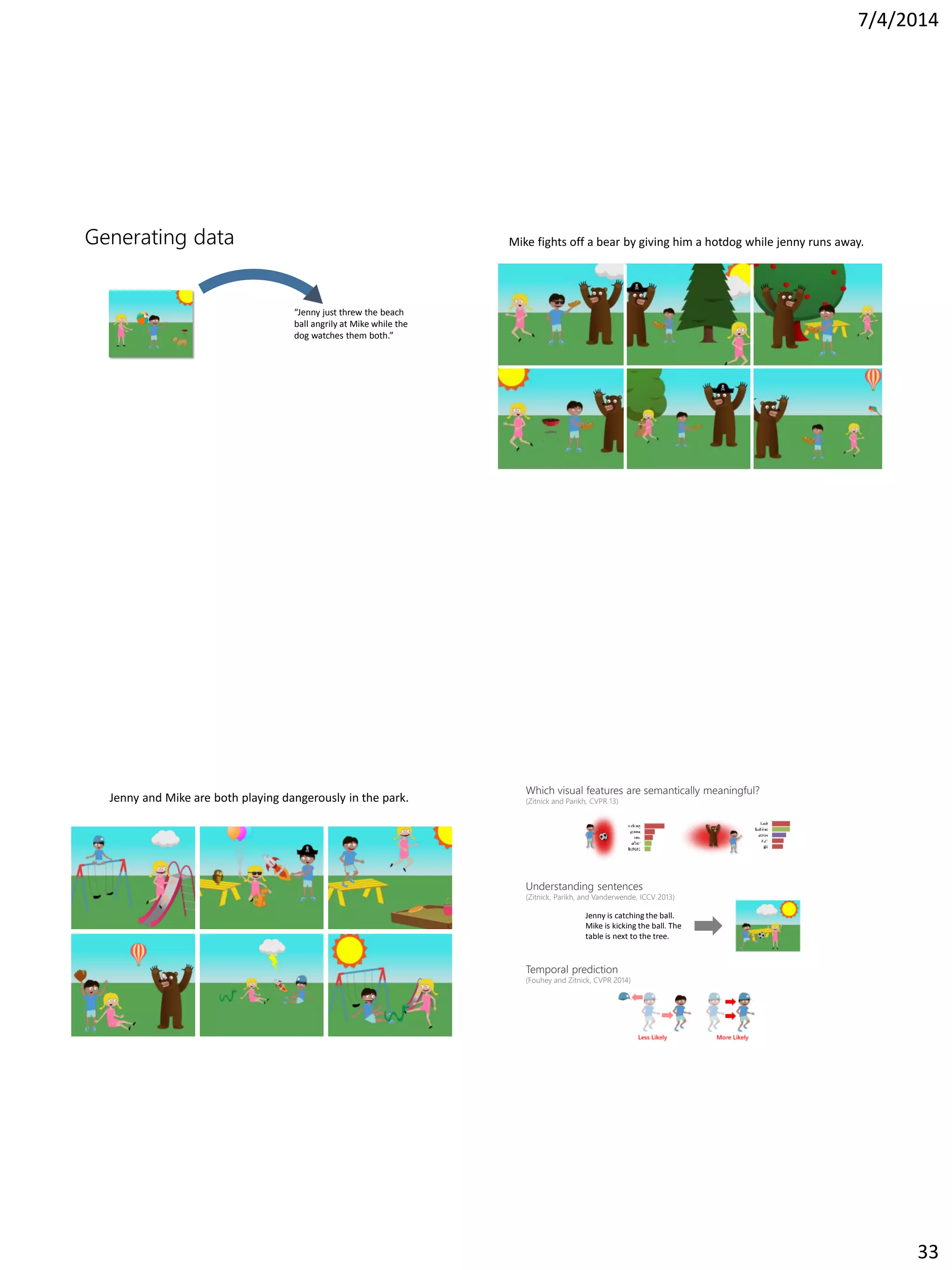
Generating data
“Jenny just threw the beach
ball angrily at Mike while the
dog watches them both.”
Mike fights off a bear by giving him a hotdog while jenny runs away.
Jenny and Mike are both playing dangerously in the park.
Understanding sentences
(Zitnick, Parikh, and Vanderwende, ICCV 2013)
Jenny is catching the ball.
Mike is kicking the ball. The
table is next to the tree.
Which visual features are semantically meaningful?
(Zitnick and Parikh, CVPR 13)
Temporal prediction
(Fouhey and Zitnick, CVPR 2014)
7/4/2014
34
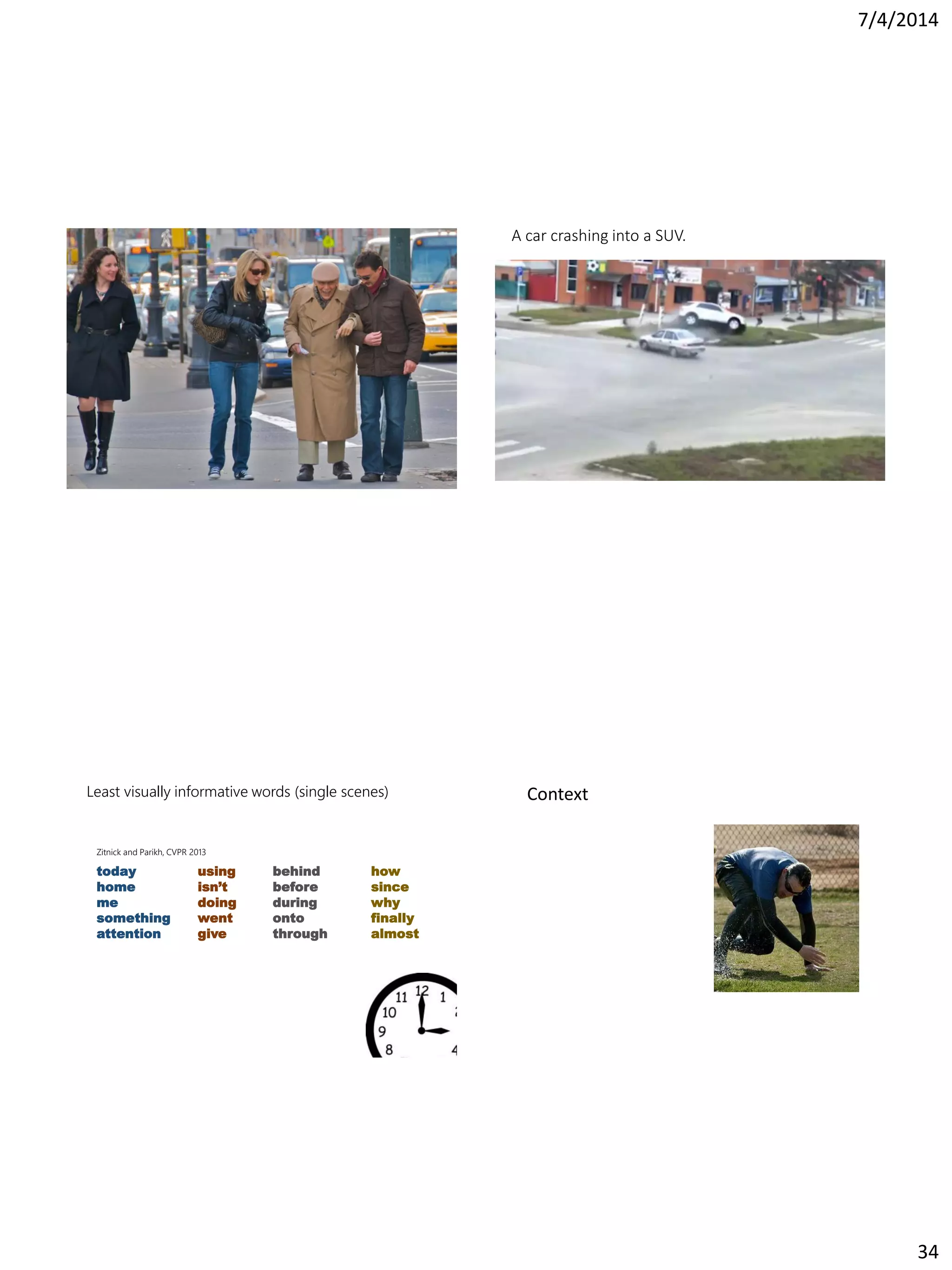
A car crashing into a SUV.
Least visually informative words (single scenes)
using
isn’t
doing
went
give
behind
before
during
onto
through
how
since
why
finally
almost
today
home
me
something
attention
Zitnick and Parikh, CVPR 2013
Context
7/4/2014
35
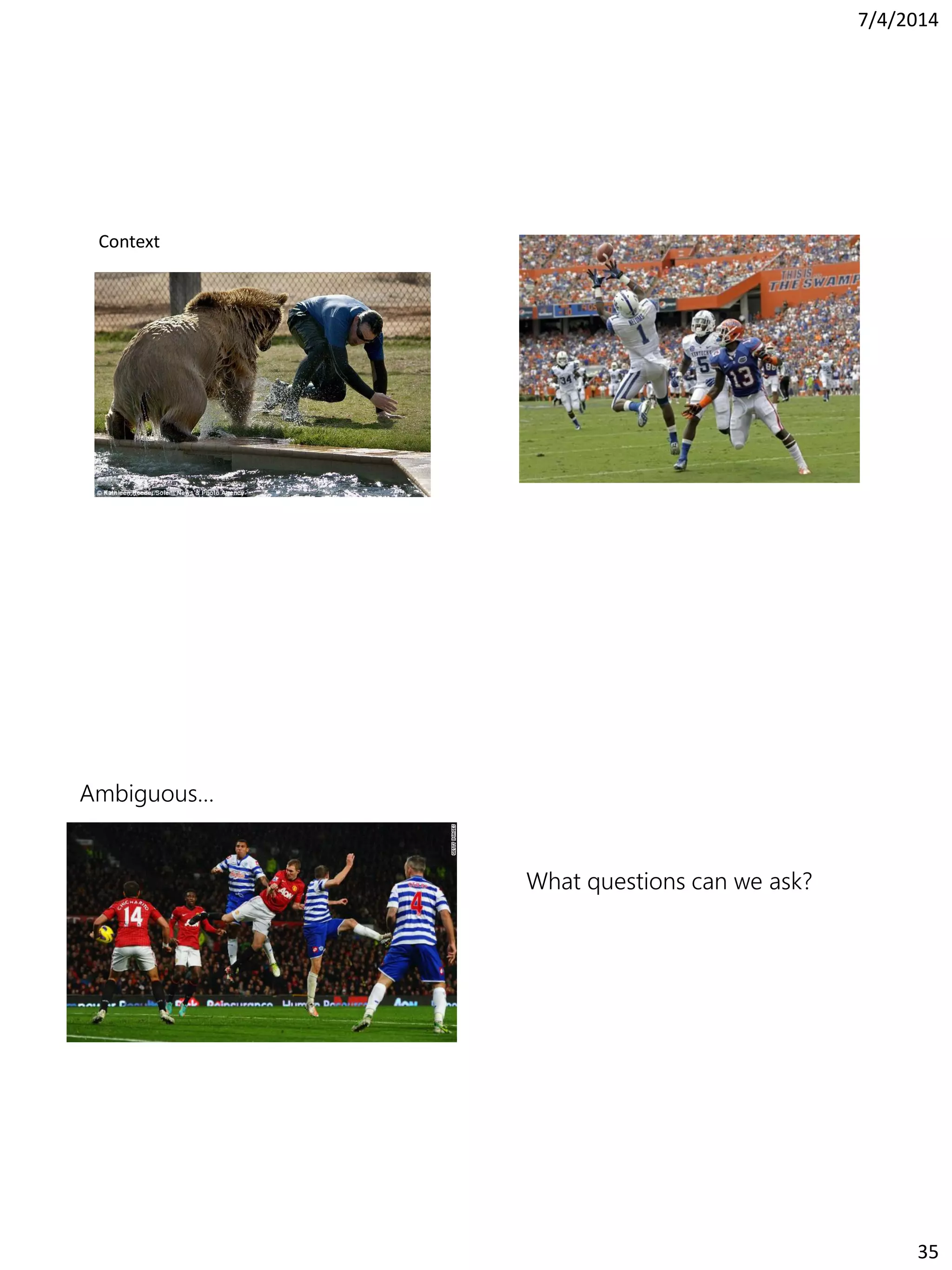
Context
Ambiguous…
What questions can we ask?
7/4/2014
36
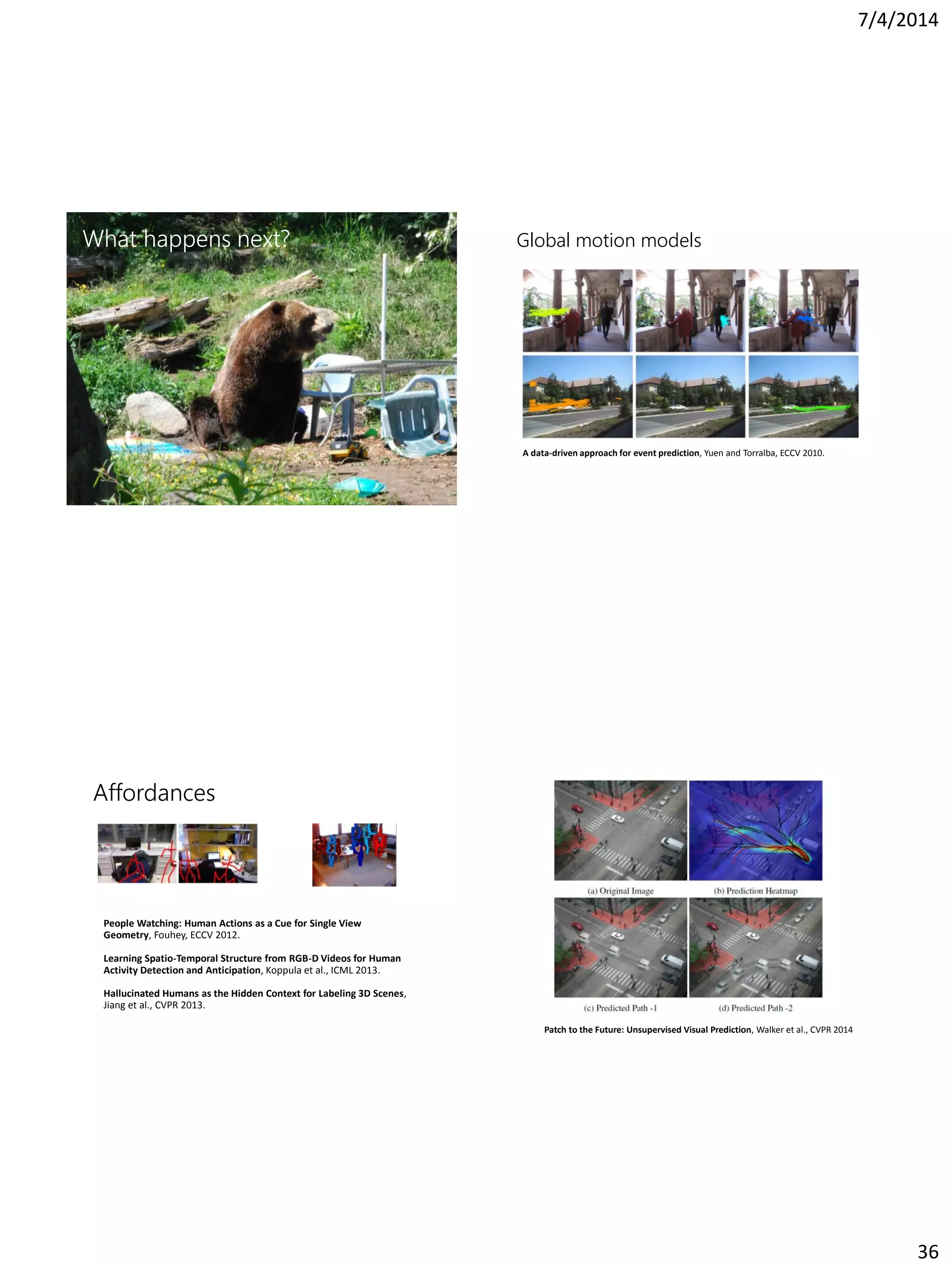
What happens next? Global motion models
A data-driven approach for event prediction, Yuen and Torralba, ECCV 2010.
Affordances
People Watching: Human Actions as a Cue for Single View
Geometry, Fouhey, ECCV 2012.
Learning Spatio-Temporal Structure from RGB-D Videos for Human
Activity Detection and Anticipation, Koppula et al., ICML 2013.
Hallucinated Humans as the Hidden Context for Labeling 3D Scenes,
Jiang et al., CVPR 2013.
Patch to the Future: Unsupervised Visual Prediction, Walker et al., CVPR 2014
7/4/2014
37
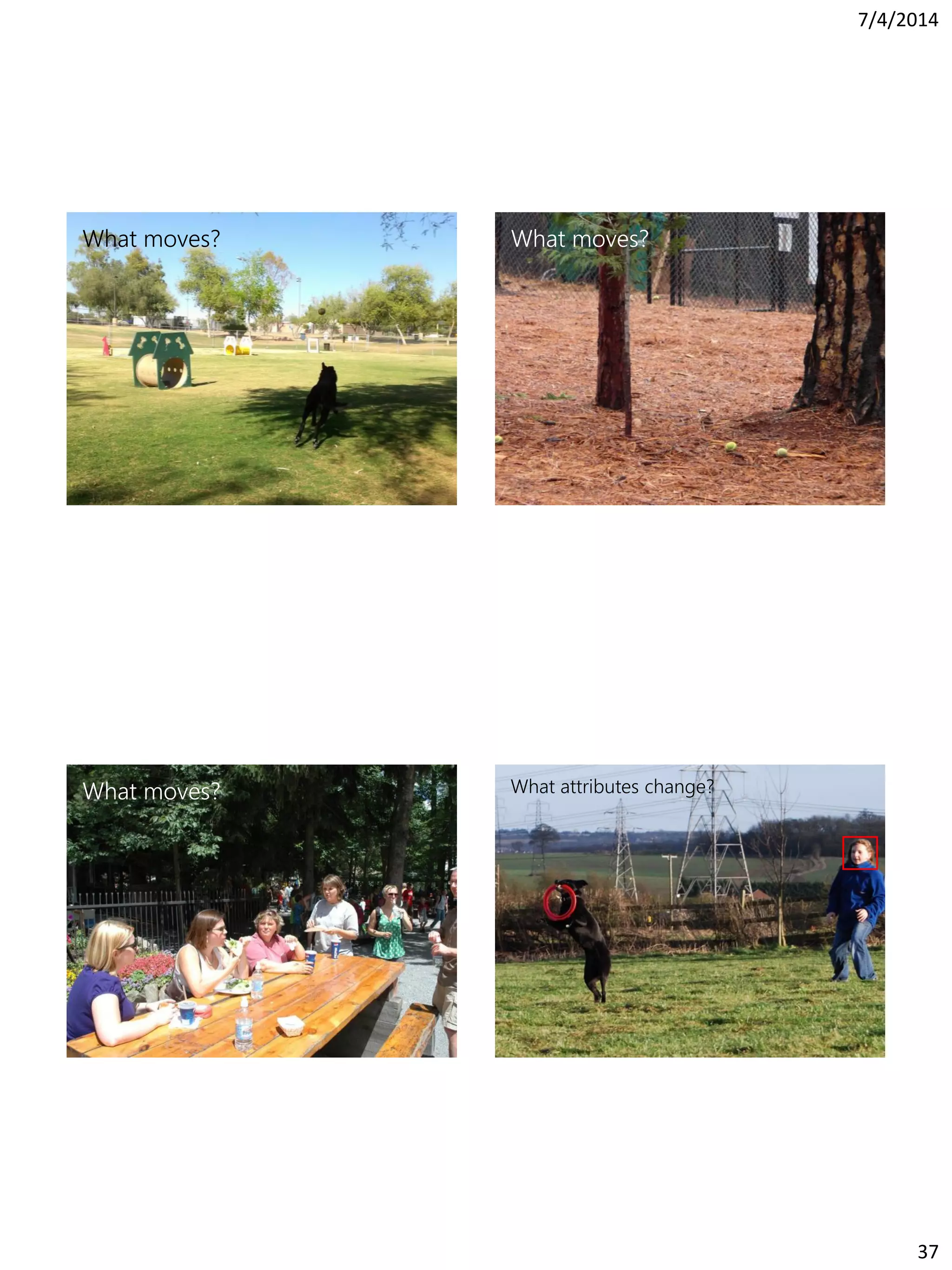
What moves? What moves?
What moves? What attributes change?
7/4/2014
38
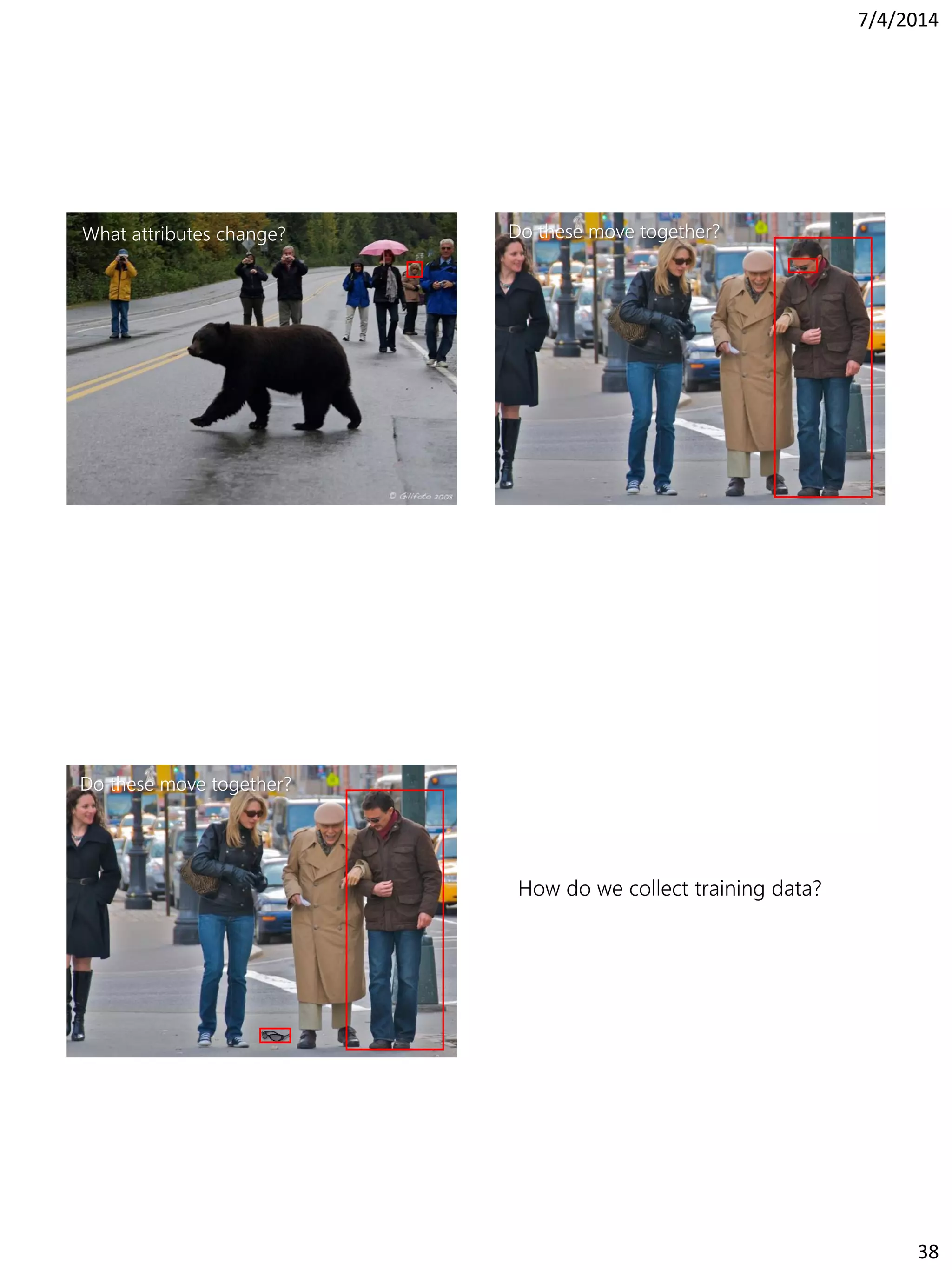
What attributes change? Do these move together?
Do these move together?
How do we collect training data?
7/4/2014
39
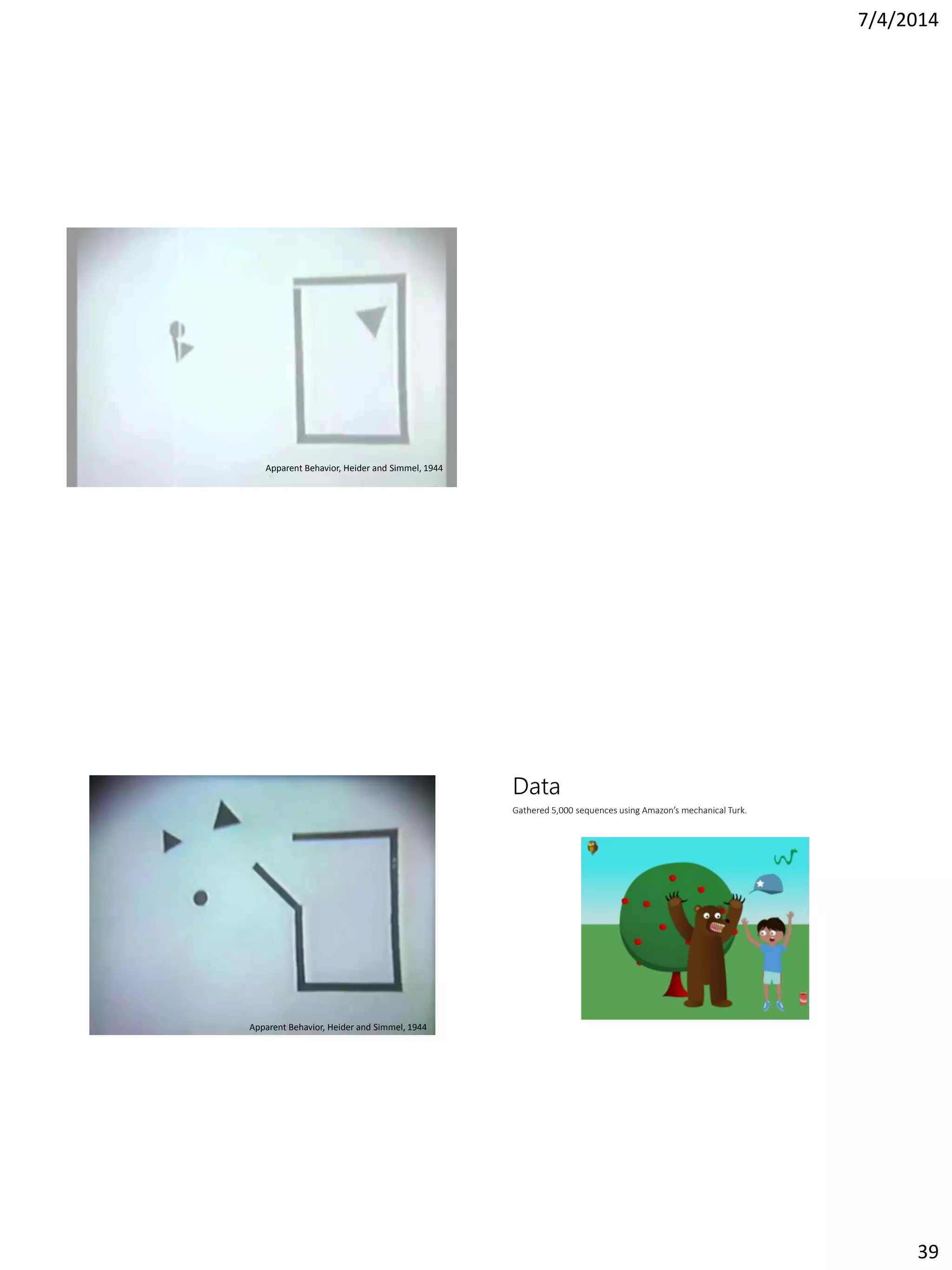
Apparent Behavior, Heider and Simmel, 1944
Data
Gathered 5,000 sequences using Amazon’s mechanical Turk.
7/4/2014
40
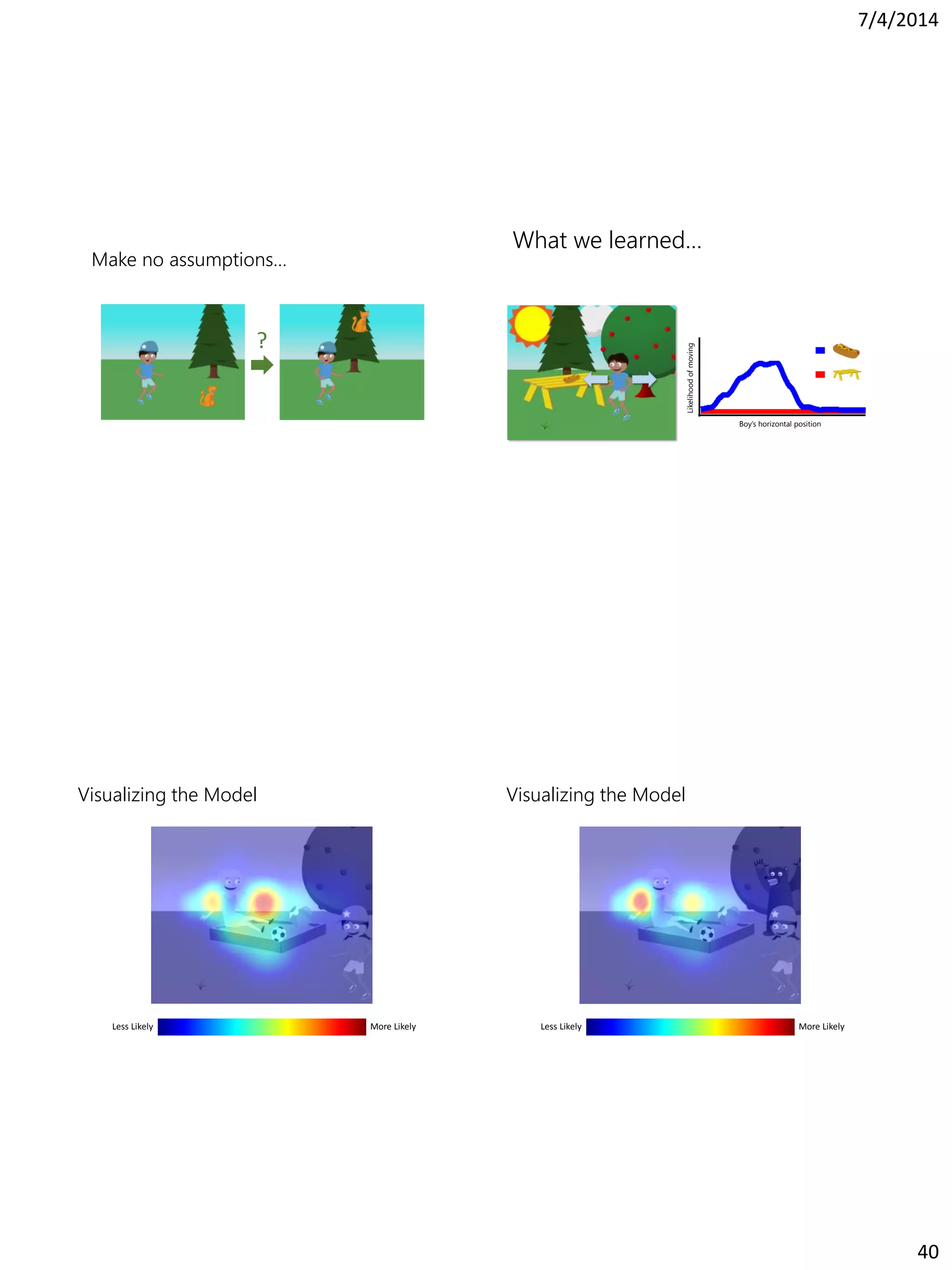
Make no assumptions…
?
Likelihoodofmoving
Boy’s horizontal position
What we learned…
Less Likely More Likely
Visualizing the Model Visualizing the Model
Less Likely More Likely
7/4/2014
41
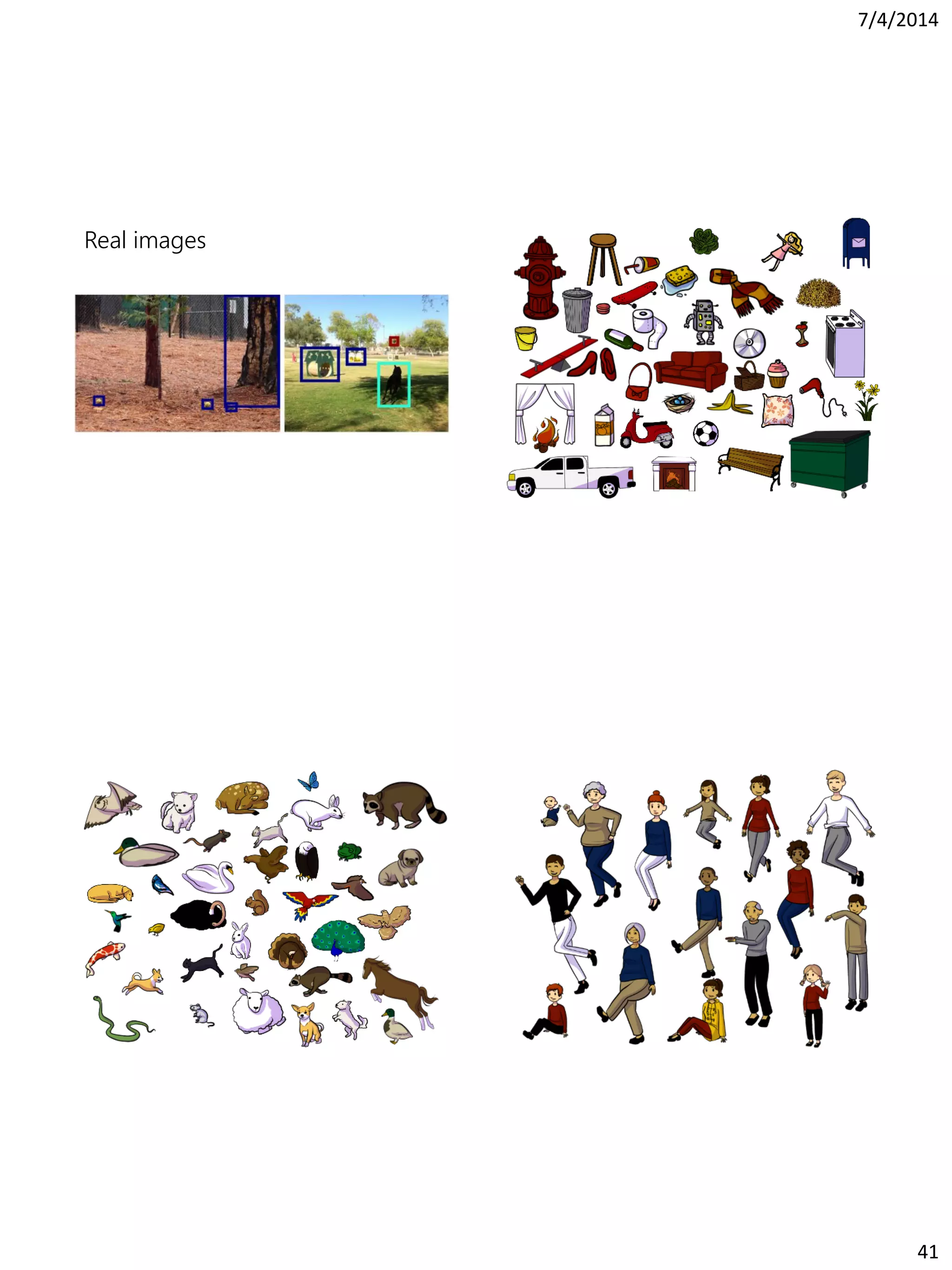
Real images
7/4/2014
42
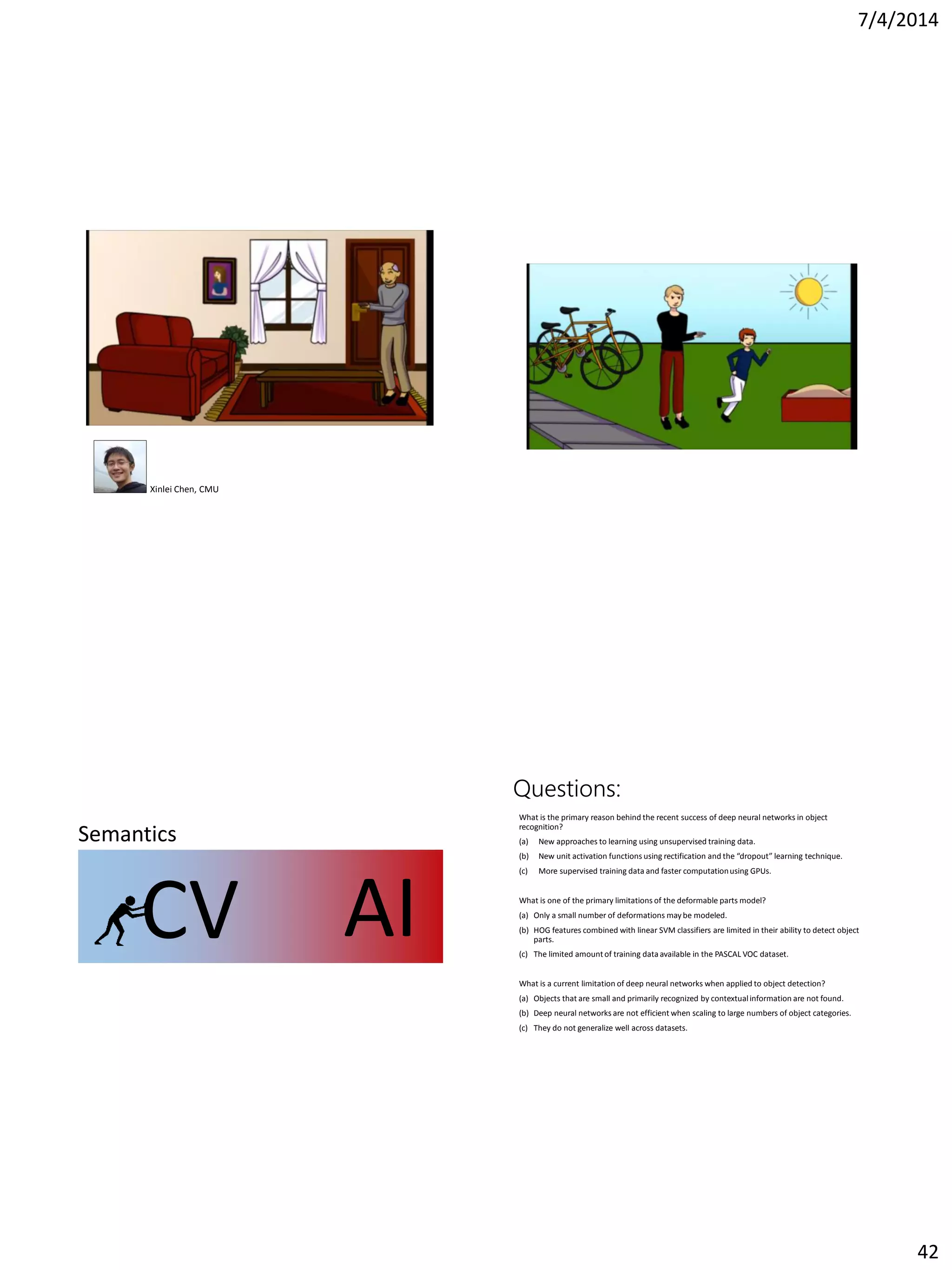
Xinlei Chen, CMU
CV AI
Semantics
Questions:
What is the primary reason behind the recent success of deep neural networks in object
recognition?
(a) New approaches to learning using unsupervised training data.
(b) New unit activation functions using rectification and the “dropout” learning technique.
(c) More supervised training data and faster computationusing GPUs.
What is one of the primary limitations of the deformable parts model?
(a) Only a small number of deformations may be modeled.
(b) HOG features combined with linear SVM classifiers are limited in their ability to detect object
parts.
(c) The limited amount of training data available in the PASCAL VOC dataset.
What is a current limitation of deep neural networks when applied to object detection?
(a) Objects that are small and primarily recognized by contextualinformation are not found.
(b) Deep neural networks are not efficient when scaling to large numbers of object categories.
(c) They do not generalize well across datasets.

Lecture 08 larry zitnick - undestanding and describing scenes

  • 1.
    7/4/2014 1 Understanding and Describing Scenes LarryZitnick Microsoft Research Motivation How did we get here? Where are we going? Goals Will deep neural networks solve it all? 30 min: Current status After we recognize everything, what next? 40 min: Beyond recognition Why it works, why it fails! 45 min: History object recognition 1973 The representation and matching of pictorial structures, Fischler and Elschlager, 1973 a.k.a. constellation model
  • 2.
    7/4/2014 2 1973 1973 1980’s AI winter……back to basics A Computational Approach to Edge Detection, Canny 1986 Perceptual Organization and Visual Recognition, David Lowe, 1984 1984
  • 3.
    7/4/2014 3 Perceptual organization andthe representation of natural form, Alex Pentland, 1986 1986 1989 Zip codes MNIST Backpropagation applied to handwritten zip code recognition, Lecun et al., 1989 Image Pooling Convolution 1989 1989 Backpropagation applied to handwritten zip code recognition, Lecun et al., 1989
  • 4.
    7/4/2014 4 1998 Neural Network-Based FaceDetection, Rowley at al., PAMI 1998 Faces Limits Numbers worked great, and so did faces… Why did other categories fail? 2 main reasons… (2012) 2001 Rapid Object Detection using a Boosted Cascade of Simple Features, Viola and Jones, CVPR 2001 Boosting + Cascade = Speed Why did it work? • Simple features (Haar wavelets) Integral images + Haar wavelets = fast - = h
  • 5.
    7/4/2014 5 Why did itwork? Why did it fail?
  • 6.
    7/4/2014 6 1999* Object Recognition fromLocal Scale-Invariant Features, Lowe, ICCV 1999. SIFT (scale invariant feature transform) No more sliding windows (interest points) Better features (use more computation) Difference of Gaussians (DoG): Difference of Gaussians (DoG): Distinctive image features from scale-invariant keypoints, Lowe, IJCV 2004 Better descriptor:
  • 7.
    7/4/2014 7 Truncated normalization 0.2 Distinctive imagefeatures from scale-invariant keypoints, Lowe, IJCV 2004 “Object instance” recognition What worked • Flat planer objects with lots of texture. • Panorama stitching Recognizing panoramas, Brown and Lowe, ICCV 2003 What failed…
  • 8.
    7/4/2014 8 2003 Constellation model(redux) Object Class Recognition by Unsupervised Scale-Invariant Learning, Fergus et al., CVPR 2003. 2003 Constellation model (redux) Object Class Recognition by Unsupervised Scale-Invariant Learning, Fergus et al., CVPR 2003. The representationand matching of pictorial structures, Fischler and Elschlager, 1973 Interest points used to find parts: Smaller number of candidate parts allows for more complex spatial models. Why does it fail?
  • 9.
    7/4/2014 9 Why it fails •Interest points don’t work for category recognition Too many springs… Why it worked 2005 HOG (histograms of oriented gradients) Histograms of oriented gradients for human detection, Dalal and Triggs, CVPR 2005.
  • 10.
    7/4/2014 10 Pedestrians • Defined bytheir contours • Cluttered backgrounds • Significant variance in texture Interest points won’t work… …back to sliding window. 2005 HOG (histograms of oriented gradients) 2005 HOG (histograms of oriented gradients) 2005 HOG (histograms of oriented gradients) Histograms of oriented gradients for human detection, Dalal and Triggs, CVPR 2005.
  • 11.
    7/4/2014 11 2005 HOG (histogramsof oriented gradients) Normalize locally not globally 2005 HOG (histograms of oriented gradients) Presence > Magnitude 2005 HOG (histograms of oriented gradients) NMS Linear SVM classifier For every candidate bounding box Compute HOG features Non-maximal suppression Why it worked We can finally detect object boundaries in a reliable manner! Computers are fast enough. Hard negative mining
  • 12.
    7/4/2014 12 Why it failed2006 Context People don’t walk in the sky… Putting Objects in Perspective, Hoiem, Efros, and Hebert, CVPR 2006. Why it worked • Our world is not random • Some contextual cues may be reliably found Why it failed • Many contextual cues are hard to detect • We need more data • Doesn’t help with false negatives
  • 13.
    7/4/2014 13 2004-2006 Caltech 101and 256 2006 15-30 training images, up to ~70% accuracy. Antonio Torralba 2007 PASCAL VOC The PASCAL Visual Object Classes (VOC) Challenge, Everingham, Van Gool, Williams, Winn and Zisserman, IJCV, 2010 20 classes 2009 Caltech Pedestrian Pedestrian Detection: An Evaluation of the State of the Art, Dollár, Wojek, Schiele and Perona, PAMI, 2012 1 class, lots of instances.
  • 14.
    7/4/2014 14 2009 ImageNet ImageNet: ALarge-Scale Hierarchical Image Database, Deng, Dong, Socher, Li, Li and Fei-Fei, CVPR, 2009 Corgi Orb weaving spider 22K categories, 14M images 2010 SUN SUN Database: Large-scale Scene Recognition from Abbey to Zoo Xiao, Hays, Ehinger, Oliva, and Torralba, CVPR, 2010. 908 scene categories Beer garden 2008 DPM (Deformable parts model) Object Detection with Discriminatively Trained Part Based Model, Felzenszwalb, Girshick, McAllester and Ramanan, PAMI, 2010
  • 15.
    7/4/2014 15 2008 DPM (Deformableparts model) Object Detection with Discriminatively Trained Part Based Model, Felzenszwalb, Girshick, McAllester and Ramanan, PAMI, 2010 Star-structure • Computationally efficient (distance transform) Distance transforms of sampled functions, Felzenszwalb and Huttenlocher, Cornell University CIS, Tech. Rep. 2004. Multiple components Why it worked • Multiple components • Deformable parts? • Hard negative mining • Good balance "How important are 'Deformable Parts' in the Deformable Parts Model?“, Divvala, Efros, and Hebert, Parts and Attributes Workshop, ECCV, 2012
  • 16.
    7/4/2014 16 Why it failed… Humandebugging Low resolution 20x20 pixels Head Leg Feet Head ? Is it a head, torso, arm, leg, foot, hand, or nothing? Nothing Finding the Weakest Link in Person Detectors, Parikh and Zitnick, CVPR 2011. Part detections Humans Machine Head Torso Arm Hand Leg Foot Person Part detections Humans Machine Head Torso Arm Hand Leg Foot Person
  • 17.
    7/4/2014 17 Part detections Humans Machine Head TorsoArm Hand Leg Foot Person AP results Finding the Weakest Link in Person Detectors, Parikh and Zitnick, CVPR 2011. Do We Need More Training Data or Better Models for Object Detection? Zhu, Vondrick, Ramanan, Fowlkes, BMVC 2012. HOG SVM Pooling Image DPM Limited capacity classifier Low-level features Something new?
  • 18.
  • 19.
    7/4/2014 19 2012 ImageNet 1K (Fall2012) 0 5 10 15 20 25 30 35 40 Error 0 5 10 15 20 25 30 35 40 Error 2012 ImageNet 1K (Fall 2012) 2012 DNNs (deep neural networks) Image Output 90% parameters Imagenet Classification with Deep Convolutional Neural Networks, Krizhevsky, Sutskever, and Hinton, NIPS 2012 Imagenet Classification with Deep Convolutional Neural Networks, Krizhevsky, Sutskever, and Hinton, NIPS 2012 Gradient-Based Learning Applied to Document Recognition, LeCun, Bottou, Bengio and Haffner, Proc. of the IEEE, 1998 * Rectified activations and dropout
  • 20.
    7/4/2014 20 2014 DNN vs.Detection Aspect ratios? DNNs are slow… (relatively) 224 x 224 Finding object candidates Use low-level cues… Segmentation As Selective Search for Object Recognition, van de Sande, Uijlings, Gevers, Smeulders, ICCV 2011 Ross Girshick et al., Berkeley http://arxiv.org/pdf/1311.2524v1.pdf 1. Input image 2. Extract region proposals (~2k) 3. Compute CNN features 4. Classify regions Online classification demo: http://decaf.berkeleyvision.org/ Object detection
  • 21.
  • 22.
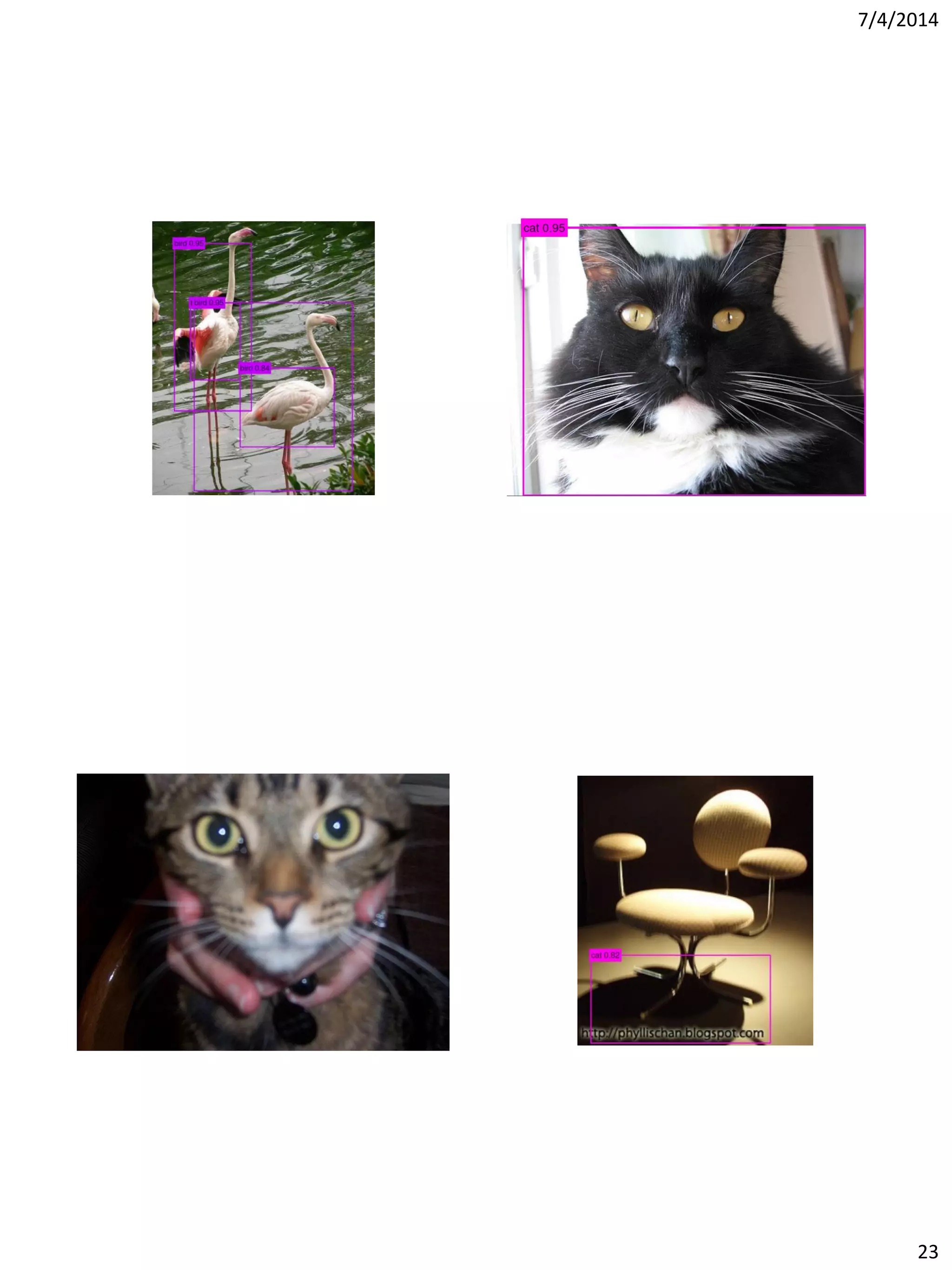
  • 23.
  • 24.
    7/4/2014 24 PASCAL VOC ImageNet (200categories) ImageNet (200 categories)
  • 25.
    7/4/2014 25 Antonio Torralba, MIT Whyit fails… Learning and Transferring Mid-Level Image Representations using Convolutional Neural Networks, Oquab, Bottou, Laptev, Sivic, CVPR 2014
  • 26.
    7/4/2014 26 Why it fails… Intriguingproperties of neural networks, Szegedy, Zaremba, Sutskever, Bruna, Erhan, Goodfellow, Fergus, ICLR 2014. Correctly classified Incorrectly classified Why it fails… PANDA: Pose Aligned Networks for Deep Attribute Modeling, Zhang, Paluri, Ranzato, Darrell, Bourdev, CVPR 2014. DeepFace: closing the gap to human-Level performance in face verification, Taigman, Yang, Ranzato, Wolf, CVPR 2014. Finding object candidates Use low-level cues… Segmentation As Selective Search for Object Recognition, van de Sande, Uijlings, Gevers, Smeulders, ICCV 2011 Looking forward…
  • 27.
    7/4/2014 27 Microsoft COCO: CommonObjects in Context, Lin, Maire, Belongie, Hays, Perona, Ramanan, Dollár, Zitnick, ECCV 2014. http://mscoco.org Why a new dataset? Continue our field’s momentum: • Detecting difficult instances (context) • Segmentation • Enabling new research directions Detection in Context Instance segmentation Non-iconic instances Iconic object images
  • 28.
  • 29.
    7/4/2014 29 MS COCO • 70-100object categories (things not stuff) • 330,000 images (~150k first release) • 2 million instances (400k people) • Every instance is segmented • 7.7 instances per image (3.5 categories) • Key points • 5 sentences per image http://mscoco.org Over 55,000 worker hours (6+ years) Post-recognition era Two professors converse in front of a blackboard.
  • 30.
    7/4/2014 30 Older Distinguished Blackboard (in front) Professor + Twoprofessors converse in front of a blackboard. Two professors stand in front of a blackboard. Two professors converse in front of a blackboard.
  • 31.
    7/4/2014 31 A crazy zebraclimbing a giraffe to get a better view. Computer Vision Common Sense Computer Vision Representation Sentence Generation ? Two professors converse in front of a blackboard. Person Person Dining table Felzenszwalb, 2010 Face Face Cat
  • 32.
  • 33.
    7/4/2014 33 Generating data “Jenny justthrew the beach ball angrily at Mike while the dog watches them both.” Mike fights off a bear by giving him a hotdog while jenny runs away. Jenny and Mike are both playing dangerously in the park. Understanding sentences (Zitnick, Parikh, and Vanderwende, ICCV 2013) Jenny is catching the ball. Mike is kicking the ball. The table is next to the tree. Which visual features are semantically meaningful? (Zitnick and Parikh, CVPR 13) Temporal prediction (Fouhey and Zitnick, CVPR 2014)
  • 34.
    7/4/2014 34 A car crashinginto a SUV. Least visually informative words (single scenes) using isn’t doing went give behind before during onto through how since why finally almost today home me something attention Zitnick and Parikh, CVPR 2013 Context
  • 35.
  • 36.
    7/4/2014 36 What happens next?Global motion models A data-driven approach for event prediction, Yuen and Torralba, ECCV 2010. Affordances People Watching: Human Actions as a Cue for Single View Geometry, Fouhey, ECCV 2012. Learning Spatio-Temporal Structure from RGB-D Videos for Human Activity Detection and Anticipation, Koppula et al., ICML 2013. Hallucinated Humans as the Hidden Context for Labeling 3D Scenes, Jiang et al., CVPR 2013. Patch to the Future: Unsupervised Visual Prediction, Walker et al., CVPR 2014
  • 37.
    7/4/2014 37 What moves? Whatmoves? What moves? What attributes change?
  • 38.
    7/4/2014 38 What attributes change?Do these move together? Do these move together? How do we collect training data?
  • 39.
    7/4/2014 39 Apparent Behavior, Heiderand Simmel, 1944 Apparent Behavior, Heider and Simmel, 1944 Data Gathered 5,000 sequences using Amazon’s mechanical Turk.
  • 40.
    7/4/2014 40 Make no assumptions… ? Likelihoodofmoving Boy’shorizontal position What we learned… Less Likely More Likely Visualizing the Model Visualizing the Model Less Likely More Likely
  • 41.
  • 42.
    7/4/2014 42 Xinlei Chen, CMU CVAI Semantics Questions: What is the primary reason behind the recent success of deep neural networks in object recognition? (a) New approaches to learning using unsupervised training data. (b) New unit activation functions using rectification and the “dropout” learning technique. (c) More supervised training data and faster computationusing GPUs. What is one of the primary limitations of the deformable parts model? (a) Only a small number of deformations may be modeled. (b) HOG features combined with linear SVM classifiers are limited in their ability to detect object parts. (c) The limited amount of training data available in the PASCAL VOC dataset. What is a current limitation of deep neural networks when applied to object detection? (a) Objects that are small and primarily recognized by contextualinformation are not found. (b) Deep neural networks are not efficient when scaling to large numbers of object categories. (c) They do not generalize well across datasets.