...FOCUSED,
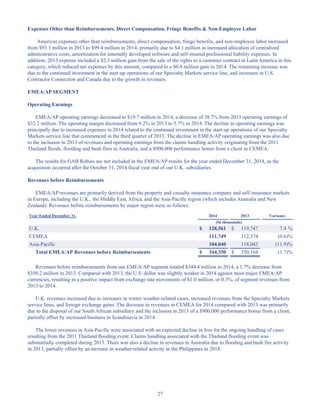
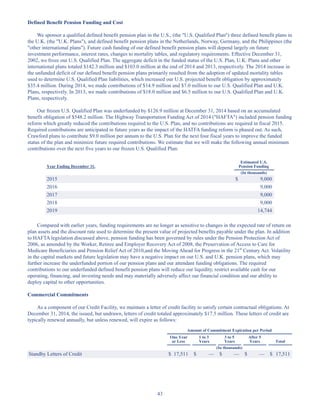
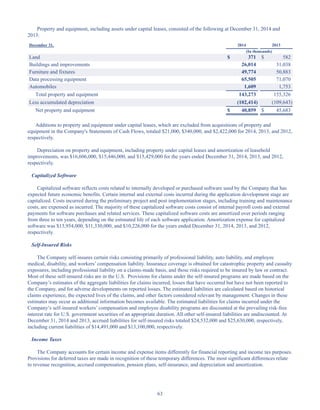
INNOVATIVE,
 PASSIONATE.
2 0 1 4 S H A R E H O L D E R A N N U A L R E P O R T
FROM OUR
PERSPECTIVE
...FOCUSED,
INNOVATIVE,
 PASSIONATE.
2 0 1 4 S H A R E H O L D E R A N N U A L R E P O R T
WEARE...
...FOCUSED,
INNOVATIVE,
 PASSIONATE.
2 0 1 4 S H A R E H O L D E R A N N U A L R E P O R T
At Crawford  Company®
, we are staying
FOCUSED on our long-term strategy while
continuing to strengthen and diversify our
business. Above all else, we listen to our clients
while developing world-class technology and
new INNOVATIVE solutions as part of
The Crawford Solution™
. Our employees are
dedicated and PASSIONATE about delivering
exceptional customer service.
C R A W F O R D  C O M P A N Y / 2 0 1 4 A N N U A L R E P O R T
T A B L E O F C O N T E N T S
01 The Crawford Solution™
02 Shareholder Message
04 Financial Highlights
06 A Global Perspective
13 Focused
18 Innovative
24 Passionate
28 Community Involvement
30 Vision, Values, Culture
31 2014 Awards
32 Condensed Consolidated Financial Statements
38 Directors and Global Executive Management Team
/ 0 1
CLAIMS SERVICES
With the broadest array of services in
the industry, Crawford can administer
virtually any claim function.
BUSINESS PROCESS
OUTSOURCING
We can deliver Business Process
Outsourcing (BPO) programs for all
aspects of claims management.
CONSULTING
We offer and design strategic
assessments for streamlined and
cost-effective solutions for clients.
Accident  Health, Catastrophe Services,
Disability and Leave Management, Financial
Risks, Large, Complex Losses, Liability,
Marine  Aviation/Transportation, Motor/Auto,
Product Recall, Property, Recovery, Workers
Compensation/Employer’s Liability.
Affinity Solutions, Claims Administration,
Legal Settlement Administration,
Managed Property Repair, Medical
Management, Risk Management Information
Services, Third-Party Administration.
Analytics, Audit, Counter Fraud Services,
Crawford iQ, Educational Services,
Global Programs, Multinational Services,
Pre-  Post-Loss Services.
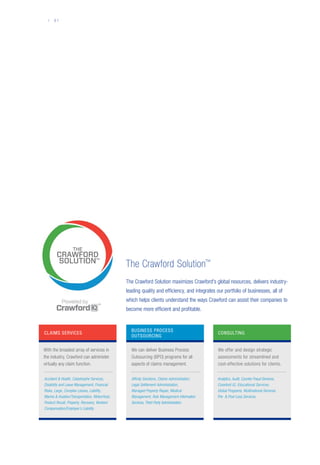
The Crawford Solution maximizes Crawford's global resources, delivers industry-
leading quality and efficiency, and integrates our portfolio of businesses, all of
which helps clients understand the ways Crawford can assist their companies to
become more efficient and profitable.
The Crawford Solution™
C R A W F O R D  C O M P A N Y / 2 0 1 4 A N N U A L R E P O R T
Crawford made significant progress on many fronts in 2014. We saw improved
performance in our Broadspire®
and Americas segments. We entered new
markets and grew our existing market share through two acquisitions that
expanded our global capabilities.
A Message to Our SHAREHOLDERS,
OUR FUTURE
REMAINS
VIBRANT
WITH A BROAD
ARRAY OF
OPPORTUNITIES.
“
”
0 2 / 0 3
JEFFREY T. BOWMAN
President and Chief Executive Officer
0 2 / 0 3
We continued to build on our ability to serve multina-
tional clients through enhancements to our Global
Technical Services division. Late in the year, we
launched a global business services center initiative
that is expected to enable consistent global response
for clients and produce cost savings for the Company,
ultimately benefiting our shareholders.
Even considering these strategic successes, 2014
financial results were below expectations. A weak global
third-party claims environment due to an absence of
major weather events led to declines in revenues, net
income and diluted earnings per share, all on a consoli-
dated basis for the year.
The Americas segment grew year over year in 2014,
resulting from improvements in our Canadian operations
and continued growth in our North American Contractor
Connection™
managed repair network. We are pleased
that growth in the Americas was delivered in a year that
saw no major weather events.
As mentioned earlier, we were gratified with the improved
performance accomplished in the Broadspire segment,
which reported steady and significant improvement in
both revenue and operating profitability throughout
2014. Broadspire’s operating earnings were up nearly
90 percent over the prior year. We believe the trends in
both revenue growth and profitability are sustainable
in Broadspire, and we anticipate continued growth in
the coming year.
At the beginning of 2014, we indicated that our Europe,
Middle East, Africa and Asia-Pacific (EMEA/AP)
segment results would show a decline compared to

2013, when we were finalizing claims arising from the
2011 catastrophic flood losses in Thailand. For 2014,
our EMEA/AP segment operating results reflected a
lower level of activity, both due to the absence of Thai
flood-related claims and a relatively benign global
claims environment that resulted from fewer weather-
related events.
Results from our Legal Settlement Administration seg-
ment during 2014 continued to include activity from
the Deepwater Horizon class action settlement project,
as well as a number of other meaningful class action
and bankruptcy matters. Activity related to Deepwater
Horizon is expected to continue to decline in 2015. As
this project runs off we are actively working to replace
these revenues with growth in other legal settlement
product lines.
INVESTING IN GROWTH OPPORTUNITIES
Throughout 2014, Crawford invested in our specialty
markets capabilities, both globally and particularly in
the UK. In July, we announced the purchase of Buckley
Scott, a UK-based international construction and engi-
neering adjusting firm. This acquisition increased our
strengths in international construction and engineering
in the UK, the London market and internationally.
In November, Crawford merged the specialty markets
product offerings into our long-established Global
Technical Services claims unit in order to build on our
history of consistent global service for our large, multi-
national clients. The resulting Global Technical Services
(GTS®
) brand is a uniquely positioned leader in large,
complex loss management. The new, revitalized GTS
brand is bolstered with a strong focus in specialty mar-
kets areas, including energy, marine, aviation, forensic
accounting and mining business lines for the Lloyd's of
London market.
This merger was augmented in December by the
acquisition of GAB Robins Holdings UK Limited, a loss
adjusting and claims management provider headquar-
tered in the UK. This acquisition brings Crawford a wide
portfolio of products, qualified technical experts, an
established client base and a record of financial suc-
cess. The acquisition will enable Crawford to significantly
broaden our claims-handling business across a wide
range of product lines in the UK, as well as expanding
our aviation specialty lines claims business.
LOOKING FORWARD
Crawford is positioned for improved consolidated operating
performance in 2015, although our bottom-line results
will reflect important strategic investments in global
capabilities and specialty markets. The establishment
of a Global Business Services Center (GBSC) in Manila,
Philippines this past fall provides a venue for global con-
solidation of certain business functions, shared services,
and currently outsourced processes. This should allow
Crawford to continue to strengthen our client service,
realize additional operational efficiencies, and invest in
new capabilities for business growth.
The creation of the GBSC will accelerate the Company’s
long-standing tradition of efficiency in delivering
high-quality services to the insurance industry.
Consolidating our operations allows us to leverage our
collective knowledge and expertise to increase innova-
tion, a strategic priority for Crawford and an essential
part of our success.
Crawford is making progress towards our strategic
goals of growing our emerging businesses, leveraging
existing customer relationships with new products, and
using technology and business process improvements
to deliver cost advantages. While consolidated sales
and earnings have proven challenging over the past
year as large projects have wound down and the claims
environment has been benign, core revenues and earn-
ings in many of our businesses continue to gain
meaningful momentum.
Our global management team is aggressively executing on
the strategies set forth in our 2015–2017 Strategic Plan.
The Plan provides a roadmap for the future while reflect-
ing our optimism and dedication to success in 2015, and
our intent to continue to innovate, improve and evolve.
We are acting on opportunities to grow revenue, manage
costs effectively and leverage resources around the
world. With these actions, we are optimistic that our
operating performance will improve in the coming year.
CONCLUSION
I would like to thank our employees for their hard work
and continuous efforts toward exceptional service, our
shareholders for their support, and our clients for the
opportunity to work with each of them. Our future
remains vibrant with a broad array of opportunities,
and our strategic plans reflect optimism, excitement
and dedication to our success in 2015.
Sincerely,
Jeffrey T. Bowman
President and Chief Executive Officer
+90%In 2014, Broadspire’s operating earnings were up nearly
90 percent over the prior year.
C R A W F O R D  C O M P A N Y / 2 0 1 4 A N N U A L R E P O R T
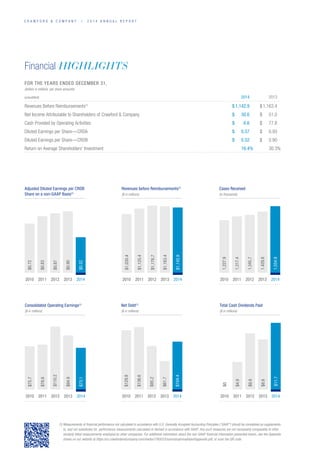
Adjusted Diluted Earnings per CRDB
Share on a non-GAAP Basis(1)
20112010 2012 2013 2014
$0.52
$0.90
$0.87
$0.83
$0.72
Revenues before Reimbursements(1)
($ in millions)
20112010 2012 2013 2014
$1,142.9
$1,030.4
$1,125.4
$1,176.7
$1,163.4
Cases Received
(in thousands)
20112010 2012 2013 2014
1,554.9
1,429.8
1,345.7
1,317.4
1,227.9
Consolidated Operating Earnings(1)
($ in millions)
20112010 2012 2013 2014
$73.1
$94.9
$110.2
$78.6
$75.7
Net Debt(1)
($ in millions)
20112010 2012 2013 2014
$104.4
$61.7
$95.2
$136.6
$129.8
(1) Measurements of financial performance not calculated in accordance with U.S. Generally Accepted Accounting Principles (“GAAP”) should be considered as supplements
to, and not substitutes for, performance measurements calculated or derived in accordance with GAAP. Any such measures are not necessarily comparable to other
similarly-titled measurements employed by other companies. For additional information about the non-GAAP financial information presented herein, see the Appendix
shown on our website at https://us.crawfordandcompany.com/media/1780033/summaryannualreportappendix.pdf, or scan the QR code.
Total Cash Dividends Paid
($ in millions)
20112010 2012 2013 2014
$11.7
$8.8
$9.9
$4.9
$0
FOR THE YEARS ENDED DECEMBER 31,
(dollars in millions, per share amounts)
(unaudited) 2014 2013
Revenues Before Reimbursements(1)
$1,142.9 $1,163.4
Net Income Attributable to Shareholders of Crawford  Company $30.6 $51.0
Cash Provided by Operating Activities $6.6 $77.8
Diluted Earnings per Share—CRDA $0.57 $0.93
Diluted Earnings per Share—CRDB $0.52 $0.90
Return on Average Shareholders’ Investment 16.4% 30.3%
Financial HIGHLIGHTS
0 4 / 0 5
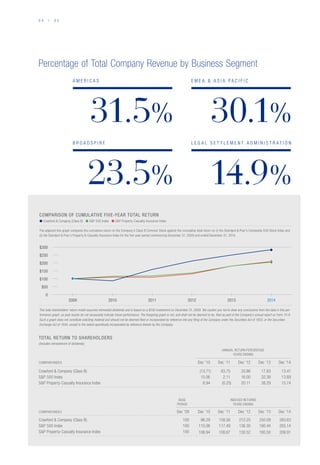
14.9%
L E G A L S E T T L E M E N T A D M I N I S T R A T I O N
30.1%
E M E A  A S I A P A C I F I C
31.5%
A M E R I C A S
23.5%
B R O A D S P I R E
TOTAL RETURN TO SHAREHOLDERS
(Includes reinvestment of dividends)
ANNUAL RETURN PERCENTAGE
YEARS ENDING
COMPANY/INDEX Dec ’10 Dec ’11 Dec ’12 Dec ’13 Dec ’14
Crawford  Company (Class B) (13.71) 83.75 33.86 17.83 13.41
SP 500 Index 15.06 2.11 16.00 32.39 13.69
SP Property-Casualty Insurance Index 8.94 (0.25) 20.11 38.29 15.74
BASE
PERIOD
INDEXED RETURNS
YEARS ENDING
COMPANY/INDEX Dec ’09 Dec ’10 Dec ’11 Dec ’12 Dec ’13 Dec ’14
Crawford  Company (Class B) 100 86.29 158.56 212.25 250.09 283.63
SP 500 Index 100 115.06 117.49 136.30 180.44 205.14
SP Property-Casualty Insurance Index 100 108.94 108.67 130.52 180.50 208.91
COMPARISON OF CUMULATIVE FIVE-YEAR TOTAL RETURN
● Crawford  Company (Class B) ● SP 500 Index ● SP Property-Casualty Insurance Index
This total shareholders’ return model assumes reinvested dividends and is based on a $100 investment on December 31, 2009. We caution you not to draw any conclusions from the data in this per-
formance graph, as past results do not necessarily indicate future performance. The foregoing graph is not, and shall not be deemed to be, filed as part of the Company’s annual report on Form 10-K.
Such a graph does not constitute soliciting material and should not be deemed filed or incorporated by reference into any filing of the Company under the Securities Act of 1933, or the Securities
Exchange Act of 1934, except to the extent specifically incorporated by reference therein by the Company.
$250
$300
$200
$150
$100
$50
0
20112009 2010 2012 2013 2014
The adjacent line graph compares the cumulative return on the Company’s Class B Common Stock against the cumulative total return on (i) the Standard  Poor’s Composite 500 Stock Index and
(ii) the Standard  Poor’s Property  Casualty Insurance Index for the five-year period ­commencing December 31, 2009 and ended December 31, 2014.
Percentage of Total Company Revenue by Business Segment
A GLOBAL
PERSPECTIVE
CRAWFORD  COMPANY
Atlanta, Georgia—Headquarters
C R A W F O R D  C O M P A N Y / 2 0 1 4 A N N U A L R E P O R T
0 6 / 0 7
2014 STRATEGY
In 2014 we took measures to ride out the reduction in weather claims while focusing on strategy. We concentrated our
energies on new initiatives, signed significant deals and worked closer with clients than ever before.
The Lloyd’s and London Market remains a strategic global market and the UK is a key operation for any worldwide
­business. We invested in talented professionals to expand across a number of product and specialty lines.
Consistent with our strategy to add world-class GTS adjusters, we acquired Buckley Scott to expand construction and
engineering expertise. This acquisition is fully integrated, winning new business and opening doors to new markets.
Two significant services were launched last year. New Broadspire TPA hubs were created in Singapore, Hong Kong and
Australia allowing us to market the first truly global third party administration (TPA) service. This has paid dividends
as we continue to win TPA contracts based on our global capability. In addition, the UK business launched Contractor
Connection, ­providing a new way of handling building repair claims in the UK market.
Our focus on clients and their customers led us to design the “Customer Service Experience” initiative to create faster
settlement times, increased satisfaction and higher employee engagement. This project is being rolled out across the
region, has strengthened relationships with clients and created many opportunities.
TOP TALENT
Our talented people are the cornerstone of our business and whilst weather related claims were down, our professionals
dealt with major incidents in Australia, Asia, Europe and UK.
We strengthened our leadership to respond quickly to market conditions, sought out new markets and concentrated on
our clients. The new team is ideally placed to explore new opportunities such as infrastructure in Asia and enhance our
global network as evidenced by our expansion into New Zealand.
Guided by our Strategic Plan, we continue to innovate for sustained competitive advantage. 2015 will be an exciting
period as we expect to roll-out new technologies using advanced techniques to deploy social media to combat fraud.
We also expect to advance our digital media project and expand into the customer self-service environment in 2015.
IAN V. MURESS
Executive Vice President and Chief Executive Officer, EMEA  Asia Pacific
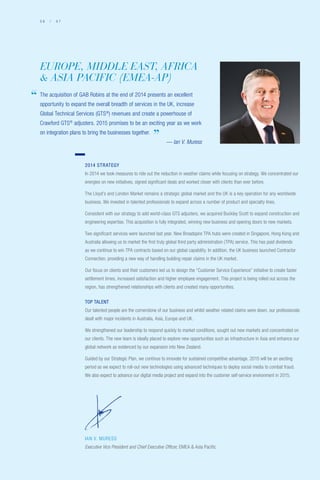
The acquisition of GAB Robins at the end of 2014 presents an excellent
­opportunity to expand the overall breadth of services in the UK, increase
Global Technical Services (GTS®
) revenues and create a powerhouse of
Crawford GTS®
adjusters. 2015 promises to be an exciting year as we work
on integration plans to bring the businesses together.
						 — Ian V. Muress
EUROPE, MIDDLE EAST, AFRICA
 ASIA PACIFIC (EMEA-AP)
”
“
C R A W F O R D  C O M P A N Y / 2 0 1 4 A N N U A L R E P O R T
VINCE E. COLE
Executive Vice President and Chief Executive Officer, Property  Casualty—Americas
STRONG PROGRESS IN THE REGION
In 2014, the Americas segment focused on strategic initiatives to promote growth and increase efficiency. This
segment includes U.S. claims services, Canada, Latin America/Caribbean and Contractor Connection operations.
U.S. claims services improved efficiencies across systems and processes. These included enhanced support
technologies and new platforms, based on Crawford iQ™, our group of proprietary technology systems. One new
technology platform reduced certain claims processing steps by 90 percent and created almost 20 back-office
automated processes related claims activities.
Responding to increasing market demand for emergency contractor services, Contractor Connection released a
technologically enhanced model to increase network response capabilities to respond to catastrophic weather events
that impact homeowners in the United States and Canada. Contractor Connection also launched an enhanced service
model for commercial property repairs ranging from low- to high-severity restoration needs.
Overall, 2014 was a very strong year for the Canadian business; both in record revenue and assignments received.
Even with minimal catastrophe activity, the core business achieved growth. Canada’s specialized businesses—
Contractor Connection, Class Action Services and Appraisal Management—continued to deliver solid performance
and growth.
In Latin America, we reached an agreement with a Swiss reinsurer to handle reinsurance claims across the region.
In Chile, Crawford Affinity adjusted more than 2,800 cases from the Iquique earthquake. Crawford Affinity expanded
to Brazil, and our Brazilian operations were nominated to handle marine road service cases for a U.S.-based insurer.
We also began handling new automobile services claims with a major auto insurer and providing claims adjustment
­services for homeowners, condominiums and small businesses for a Germany-based insurer.
We are looking forward to more growth in the Americas in 2015. We will continue to invest in GTS, new product
offerings and expand certain services to more countries. All our operations will benefit from our Global Business
Services Center (GBSC) in Manila, Philippines, which commenced operations in 2014. The GBSC is expected to enable
Crawford to improve service quality, operational efficiency, business growth and cost effectiveness as outlined in our
Strategic Plan.
AMERICAS
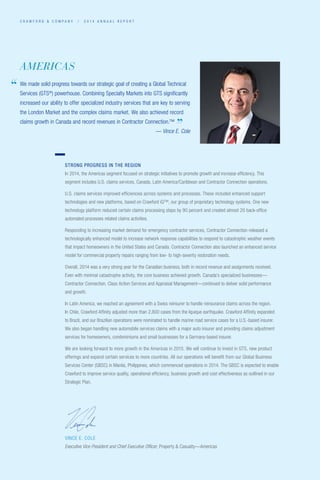
We made solid progress towards our strategic goal of creating a Global Technical
Services (GTS®
) powerhouse. Combining Specialty Markets into GTS significantly
increased our ability to offer specialized industry services that are key to serving
the London Market and the complex claims market. We also achieved record
claims growth in Canada and record revenues in Contractor Connection.™
						 — Vince E. Cole
“
”
0 8 / 0 9
DANIELLE M. LISENBEY
Executive Vice President and Chief Executive Officer, Broadspire
Broadspire is a global Third-Party Administrator (TPA) specializing in servicing the claims needs of corporations,
brokers and insurers who wish to take greater control over the claims process, total loss costs and data capture, as
well as to access meaningful management information. Our team of claims management, clinicians, account manage-
ment and risk management information system (RMIS) professionals has the global reach and local expertise to serve
as a full-service TPA partner. Utilizing a broad suite of leading-edge tools and resources, we develop solutions in areas
such as workers compensation claims management, auto and general liability claims management, medical manage-
ment and disability management programs. Broadspire strives to offer a comprehensive suite of solutions designed to
increase employee productivity while reducing the cost of risk.
GROWING OUR BUSINESS
2014 was an exciting year of growth and progress for Broadspire with our operating earnings nearly doubling that of
the previous year. By developing meaningful partnerships with new clients and maintaining successful relationships
with our existing clients, we continued to build our business. Our efforts realized a 7 percent increase in revenue over
last year from new clients and increased claim volume from existing clients. In the past year, we welcomed new clients
such as Staples, Johnson Controls, CPS Energy, Saks, Extended Stay America and Sanderson Farms, among many
others. We also retained over 92 percent of our existing clients during the year, a key metric in sustainable growth.
ENHANCING OUR TECHNOLOGY AND SERVICES
Broadspire continues to boost efficiencies and capabilities by upgrading technology and analytics with new tools and
enhanced processes. The use of business process management technology that transforms the way we operate. 2014
also saw the expansion of our offerings by introducing disability and leave management services as well as enhanced
product recall and cyber claims management, all of these enhancements have been well received in the industry.
LOOKING AHEAD
As we move forward into 2015 and beyond, we expect to continue to build upon our recent successes through
the continued use and expansion of our new technology as well as our claims and medical management services.
Accelerating our growth, retaining our existing client base, and enhancing our process management are all key drivers
to future success in accomplishing our goals. Arguably, the most important is continuing to engage, train and develop
our employees. As a service organization, you are only as good as those that deliver the service and we believe we
have the best in the industry.
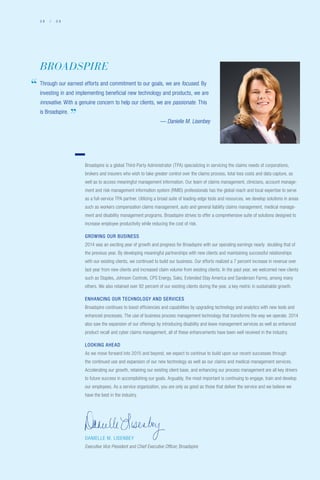
Through our earnest efforts and commitment to our goals, we are focused. By
investing in and implementing beneficial new technology and products, we are
innovative. With a genuine concern to help our clients, we are passionate. This
is Broadspire.
						— Danielle M. Lisenbey
BROADSPIRE
“
”
C R A W F O R D  C O M P A N Y / 2 0 1 4 A N N U A L R E P O R T
DAVID A. ISAAC
Executive Vice President and Chief Executive Officer, Garden City Group, LLC (GCG)
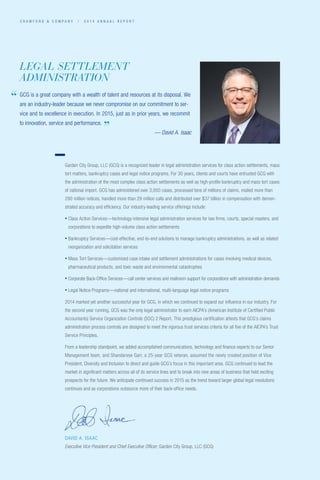
Garden City Group, LLC (GCG) is a recognized leader in legal administration services for class action settlements, mass
tort matters, bankruptcy cases and legal notice programs. For 30 years, clients and courts have entrusted GCG with
the administration of the most complex class action settlements as well as high-profile bankruptcy and mass tort cases
of national import. GCG has administered over 3,000 cases, processed tens of millions of claims, mailed more than
290 million notices, handled more than 29 million calls and distributed over $37 billion in compensation with demon-
strated accuracy and efficiency. Our industry-leading service offerings include:
• Class Action Services—technology-intensive legal administration services for law firms, courts, special masters, and
corporations to expedite high-volume class action settlements
• Bankruptcy Services—cost-effective, end-to-end solutions to manage bankruptcy administrations, as well as related
reorganization and solicitation services
• Mass Tort Services—customized case intake and settlement administrations for cases involving medical devices,
pharmaceutical products, and toxic waste and environmental catastrophes
• Corporate Back-Office Services—call center services and mailroom support for corporations with administration demands
• Legal Notice Programs—national and international, multi-language legal notice programs
2014 marked yet another successful year for GCG, in which we continued to expand our influence in our industry. For
the second year running, GCG was the only legal administrator to earn AICPA’s (American Institute of Certified Public
Accountants) Service Organization Controls (SOC) 2 Report. This prestigious certification attests that GCG’s claims
administration process controls are designed to meet the rigorous trust services criteria for all five of the AICPA’s Trust
Service Principles.
From a leadership standpoint, we added accomplished communications, technology and finance experts to our Senior
Management team, and Shandarese Garr, a 25-year GCG veteran, assumed the newly created position of Vice
President, Diversity and Inclusion to direct and guide GCG’s focus in this important area. GCG continued to lead the
market in significant matters across all of its service lines and to break into new areas of business that hold exciting
prospects for the future. We anticipate continued success in 2015 as the trend toward larger global legal resolutions
continues and as corporations outsource more of their back-office needs.
GCG is a great company with a wealth of talent and resources at its disposal. We
are an industry-leader because we never compromise on our commitment to ser-
vice and to excellence in execution. In 2015, just as in prior years, we recommit
to innovation, service and performance.	
— David A. Isaac
LEGAL SETTLEMENT
ADMINISTRATION
”
“
1 0 / 1 1
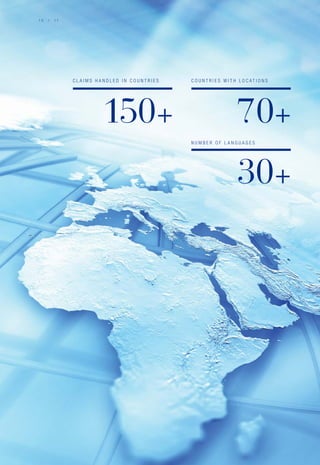
30+
N U M B E R O F L A N G U A G E S
70+
C O U N T R I E S W I T H L O C A T I O N S
150+
C L A I M S H A N D L E D I N C O U N T R I E S
Our INVESTORS
Crawford is focused on delivering shareholder value and further investing in
developing high growth businesses. Among our 2014 highlights were the
results of our Broadspire and Contractor Connection operations. In both units,
we see opportunities to gain in revenue and earnings in 2015.
WE ARE
FOCUSED ON
LONG-TERM
STRATEGY.
C R A W F O R D  C O M P A N Y / 2 0 1 4 A N N U A L R E P O R T
+92%Client retention rate in 2014, a key metric in
sustainable growth
1 4 / 1 5
BROADSPIRE
®
For 2014, Broadspire’s full year operating earnings nearly doubled over
2013, with a 7 percent increase in revenue over prior year on new clients and
increased claims volume from existing clients. We saw a robust sales pipeline
for last year and again into 2015. In August, Broadspire announced that we
would add short-term disability, long-term disability and leave management to
our global portfolio of products. The new suite of products was introduced in the
fourth quarter of 2014. Expanding into disability and leave management comple-
ments our well-established medical management and workers compensation
return-to-work strategies, and reflects the underlying trends around an aging
workforce and federal Affordable Care Act requirements.
In September, Broadspire began operations in the new Global Business Services
Center (GBSC) in Manila, Philippines. The GBSC allows Crawford to continue to
strengthen its client service, realize cost and other operational efficiencies, and
invest in new capabilities for growth.
Technology: We continue to make invest-
ments in systems around the globe as
well as service enhancements with one
goal in mind: a better claims outcome for
our clients.
Global TPA: In 2014, Broadspire responded
to client feedback by creating new strategic
TPA hubs in Canada, Singapore, Hong
Kong and Australia, cementing its position
as the world’s first truly global TPA.
New Program: Broadspire launched a
program addressing the issue of physician
dispensing; it’s designed to lower workers
compensation medication costs and improve
safety for injured workers.
C R A W F O R D  C O M P A N Y / 2 0 1 4 A N N U A L R E P O R T
In 2014, Contractor Connection continued its strong growth. It processes
more than 250,000 repair and renovation assignments annually for commercial
clients and consumers, and these assignment had an estimated value of more
than $1 billion. Last year we launched a consumer home improvement service
in the U.S. Homeowners can now access Contractor Connection’s contractor
network for home improvement services by using our website.
In response to growing insurance market needs during catastrophic events,
Contractor Connection significantly upgraded its ability to respond to weather-
related events by enhancing its catastrophe response network services, which
implements and integrates proprietary technology that links predictive weather
analytics with contractor network coverage to ensure policyholders have access
to contractors when they need it the most.
In June 2014, Contractor Connection hosted its 16th annual Conference  Expo,
with more than 2,900 contractors, insurance carrier representatives and service
provider partners attending the invitation-only three-day event.
CONTRACTOR
CONNECTION
™
New Service: In 2014, Contractor
Connection launched a consumer direct
campaign utilizing its 4,800 network mem-
ber contractors in an effort to dip into a
remodeling and home improvement market-
place valued at approximately $150 billion.
New Initiative: Contractor Connection
initiated a “Hiring Our Veterans” campaign,
challenging its contractors to hire veterans
and tracking the number of veterans hired
as part of the U.S. Chamber of Commerce
Foundation’s “Hiring Our Heroes” campaign.
1 6 / 1 7
WE ARE
HELPING OUR
CLIENTS BY
DELIVERING
INNOVATIVE
TECHNOLOGY.
Our CLIENTS
From large multinational insurance carriers, brokers and local insurance firms to
many Fortune®
500 corporations, our clients are demanding increasing efficiencies
in the management of their business. Crawford is delivering. From designing
technological solutions that help our clients achieve their business goals with
ease to adding process improvements that further streamlines efficiency for both
clients and employees, Crawford continually invests in technology to deliver
innovation, speed, automation and analytics.
C R A W F O R D  C O M P A N Y / 2 0 1 4 A N N U A L R E P O R T
TECHNOLOGY
MADE SIMPLE
Crawford provides its clients and employees with the most advanced set of infor-
mation and communication technology (ICT) tools in the industry. These tools are
integrated, flexible and user-friendly. By design, they foster a faster and simpler
workflow environment and deliver forward-thinking, cutting-edge solutions that
clients value.
As a way to categorize and describe this innovative suite of ICT products and
services, we refer to our systems collectively as Crawford iQ™. Delivered in four
easy offerings, Crawford iQ provides the intelligence that powers The Crawford
Solution™, the most comprehensive global, integrated solution for all corporate,
insurer and re-insurer claims administration.
Crawford iQ simplifies our extensive offering of technological services and pro-
cesses in a way that is easy to understand. This is accomplished by consolidating
our ICT products and services in a meaningful and logical manner according to
their specific function. The goal is to make Crawford’s state-of-the-art technology
approachable, accessible and uncomplicated.
Crawford iQ Portal™ – Offers clients a
gateway to access the work we do for them
Crawford iQ Claims Manager™ – Delivers
a vast array of claims management solutions
Crawford iQ Analytics™ – Provides clients
with claims analytics, dashboards and reports
Crawford iQ Mobile™ – Allows claims to
be managed anytime, anywhere on PCs and
mobile devices
E L E M E N T S O F C R A W F O R D i Q
2 0 / 2 1
CRAWFORD BUSINESS PROCESS MANAGEMENT
The Appian Business Process Management Suite, a market-leading technology platform Crawford purchased in 2011,
has radically altered the way we are developing software applications globally, working with business partners and
designing new services and solutions for clients. In addition to the numerous accolades we have received for our
technology, the latest analytics reveal double digit gains in back office efficiencies, in cycle times and productivity.
Our call center operations have been streamlined and employee satisfaction has increased.
C R A W F O R D  C O M P A N Y / 2 0 1 4 A N N U A L R E P O R T
Crawford’s new approach entailed revising all the administrative, operational
and technical processes to reflect the highest priority needs of customers.
The method resulted in faster settlements, increased customer satisfaction
and higher engagement for employees.
The feedback from customers has been
fantastic and demonstrates the commer-
cial value of a true supplier partnership.”
KELLY ROBSON
Head of Commercial Claims (Motor  Property) Aviva
“
CUSTOMER SERVICE ENHANCEMENTS
At Crawford, innovation means leading the market, with new ideas, new products and new services that help improve
outcomes for our clients and in the case of Aviva, their policyholders.
In the UK, Aviva commercial property claims and Crawford partnered to improve customer satisfaction. Joint teams from
both companies were established to analyze the entire customer journey from the perspective of the customer, looking to
see what improvements could be made to ensure the claims process was completed quickly and efficiently.
The results led not only to an improvement in service and overall performance but also to up-skilling the Aviva in-house
claims teams, enabling them to identify and settle some claims without the need for an external assessment.
As we understood the process in much more detail, we were clearer about where to improve and control effectively, and
we became closer to what really mattered to customers. This close engagement with team members at Crawford and Aviva
encouraged innovative and creative ideas to be shared to ensure the customer was put at the heart of the decision process.
The success of this partnership not only meant an improvement in customer service, faster settlements and higher engage-
ment for employees, it earned a coveted Insurance Times award for Business Partner of the Year.
COLLABORATE
AND DELIVER
52%The entire process flow was redesigned leading to
significant end-to-end closure time improvement
2 2 / 2 3
WE ARE
PASSIONATE
ABOUT OUR
BUSINESS.
Our EMPLOYEES
Employees are the lifeblood of our company. Driven by our shared values and our
Code of Business Conduct and Ethics, we are striving to become the world’s
leading provider of claim services, business process outsourcing and consulting
solutions. The people of Crawford whose efforts have improved our operations on
every dimension warrant significant recognition. Outside of work, our passionate
employees pursue a wide variety of interests often taking time to give back to
their communities in many ways, including our annual Global Day of Service.
C R A W F O R D  C O M P A N Y / 2 0 1 4 A N N U A L R E P O R T
VALUABLE
INSIGHT
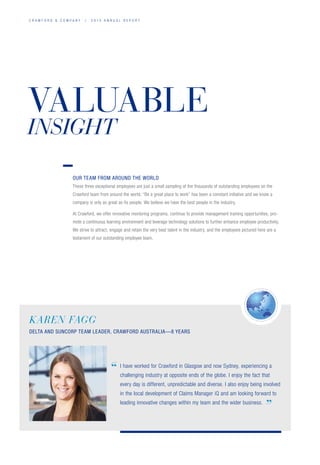
KAREN FAGG
DELTA AND SUNCORP TEAM LEADER, CRAWFORD AUSTRALIA—8 YEARS
I have worked for Crawford in Glasgow and now Sydney, experiencing a
challenging industry at opposite ends of the globe. I enjoy the fact that
every day is different, unpredictable and diverse. I also enjoy being involved
in the local development of Claims Manager iQ and am looking forward to
leading innovative changes within my team and the wider business.
”
“
OUR TEAM FROM AROUND THE WORLD
These three exceptional employees are just a small sampling of the thousands of outstanding employees on the
Crawford team from around the world. “Be a great place to work” has been a constant initiative and we know a
company is only as great as its people. We believe we have the best people in the industry.
At Crawford, we offer innovative mentoring programs, continue to provide management training opportunities, pro-
mote a continuous learning environment and leverage technology solutions to further enhance employee productivity.
We strive to attract, engage and retain the very best talent in the industry, and the employees pictured here are a
testament of our outstanding employee team.
2 6 / 2 7
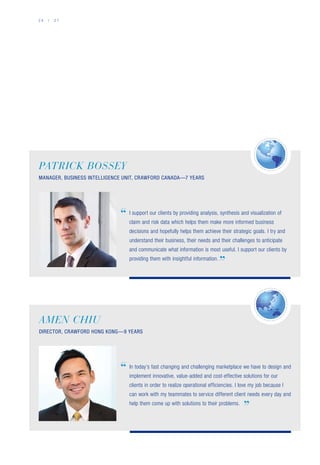
AMEN CHIU
DIRECTOR, CRAWFORD HONG KONG—9 YEARS
”
In today’s fast changing and challenging marketplace we have to design and
implement innovative, value-added and cost-effective solutions for our
clients in order to realize operational efficiencies. I love my job because I
can work with my teammates to service different client needs every day and
help them come up with solutions to their problems.
“
”
I support our clients by providing analysis, synthesis and visualization of
claim and risk data which helps them make more informed business
decisions and hopefully helps them achieve their strategic goals. I try and
understand their business, their needs and their challenges to anticipate
and communicate what information is most useful. I support our clients by
providing them with insightful information.
PATRICK BOSSEY
MANAGER, BUSINESS INTELLIGENCE UNIT, CRAWFORD CANADA—7 YEARS
“
C R A W F O R D  C O M P A N Y / 2 0 1 4 A N N U A L R E P O R T
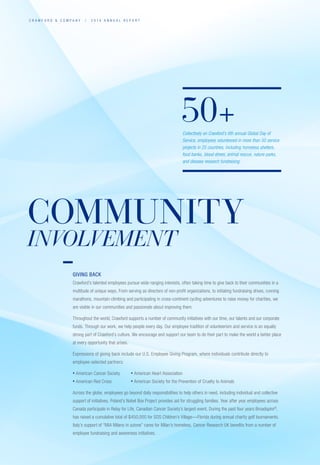
50+Collectively on Crawford’s 6th annual Global Day of
Service, employees volunteered in more than 50 service
projects in 25 countries, including homeless shelters,
food banks, blood drives, animal rescue, nature parks,
and disease research fundraising
COMMUNITY
INVOLVEMENT
GIVING BACK
Crawford’s talented employees pursue wide-ranging interests, often taking time to give back to their communities in a
multitude of unique ways. From serving as directors of non-profit organizations, to initiating fundraising drives, running
marathons, mountain climbing and participating in cross-continent cycling adventures to raise money for charities, we
are visible in our communities and passionate about improving them.
Throughout the world, Crawford supports a number of community initiatives with our time, our talents and our corporate
funds. Through our work, we help people every day. Our employee tradition of volunteerism and service is an equally
strong part of Crawford’s culture. We encourage and support our team to do their part to make the world a better place
at every opportunity that arises.
Expressions of giving back include our U.S. Employee Giving Program, where individuals contribute directly to
employee-selected partners:
• American Cancer Society 	 • American Heart Association
• American Red Cross 	 • American Society for the Prevention of Cruelty to Animals
Across the globe, employees go beyond daily responsibilities to help others in need, including individual and collective
support of initiatives. Poland’s Nobel Box Project provides aid for struggling families. Year after year employees across
Canada participate in Relay for Life, Canadian Cancer Society’s largest event. During the past four years Broadspire®
,
has raised a cumulative total of $450,000 for SOS Children’s Village—Florida during annual charity golf tournaments.
Italy’s support of “MIA Milano in azione” cares for Milan’s homeless. Cancer Research UK benefits from a number of
employee fundraising and awareness initiatives.
2 8 / 2 9
Partnerships: Crawford Contractor
Connection partnered with some 20 compa-
nies from its U.S. contractor network, work-
ing alongside our employees for our Global
Day of Service. Efforts ranged from home
repairs and park clean-ups, to Habitat for
Humanity builds, golf tournament fundraisers,
a clothing drive for veterans, and free dry
cleaning for retirees.
Global View: We have posted project photos
on our Crawford social media pages and
we invite you to visit our 2014 Global Day
of Service photo gallery to see more images
from service projects around the world.
Going Green: Waterloo’s Crawford team in
Canada was recognized by GREENSHIFT
as “Most Active Green Team” for its
advancements toward sustainable strategies
in reducing negative environmental impacts.
C R A W F O R D  C O M P A N Y / 2 0 1 4 A N N U A L R E P O R T
INTEGRITY: Do the right thing, always
QUALITY: What we do, we do well
INNOVATION: Change is constant
COMMUNICATION: Engage and be in the know
LEADERSHIP: Leaders lead
COLLABORATION: Leverage collective genius
ACCOUNTABILITY: If it’s to be, it’s up to me
PASSION: Committed in heart and mind
DIVERSITY: As inclusive as our services
VALUES
VISION
Our vision is to be the world’s leading provider of claim services, business process outsourcing and consulting solutions.
We will inspire our organization to develop world-class technology and innovative solutions to clients; to employ the
best and brightest people; and to deliver a strong financial performance.
CULTURE
Crawford  Company employees are innovative, dedicated, hardworking, and reliable. We are resilient, collaborative,
fast-acting, and share a passion to succeed. We hail from more than 70 countries and speak dozens of languages
reflecting the global audience we serve. With ongoing investments in technology and a laser focus on implementation,
our technologists have improved efficiencies and earned industry recognition and awards for their work. Crawford
employs the best and the brightest individuals in the niche markets they serve, specialists who possess unmatched
experience in difficult situations when our clients need us most. After all, at the end of the day we are in business to
help people.
Crawford’s talented employees pursue a wide range of interests often taking time to give back to their communities in a
multitude of unique ways. From serving as directors of non-profit organizations, to initiating fundraising drives, to running
marathons, mountain climbing and participating in cross-continent, off-road cycling adventures to raise money for
charities, we are visible in our communities and passionate about improving them.
OUR VISION
VALUES AND CULTURE
3 0 / 3 1
2014 AWARDS
2014 INFORMATIONWEEK ELITE 100
One of the industry's most prestigious awards, the InformationWeek Elite 100 corporate rankings spotlights the
most innovative users of information technology across the nation.
REACTIONS 2014 BEST LATIN AMERICA LOSS ADJUSTMENT FIRM AWARD
The Reactions awards are a unique program of events that reward the achievements and excellence of companies,
teams and individuals from domestic and international insurance, reinsurance and claims management firms.
LOSS ADJUSTER OF THE YEAR AWARD
Crawford Spain won “Loss Adjuster of the Year 2014” award in the category of Fraud Detection at the ICEA
(Cooperative Research between Insurance Companies and Pension Funds) awards after uncovering a significant
deception worth hundreds of thousands of euros.
2014 WFMC AWARDS FOR CASE MANAGEMENT: EXCELLENCE IN CLAIMS MANAGEMENT
SERVICES AWARD
The prestigious 2014 Global Awards for Excellence in Case Management recognize user organizations worldwide
that have demonstrably excelled in implementing innovative solutions.
CIO 100 AWARD 2014
CIO magazine’s editors and judges chose Crawford as one of 100 innovative organizations that uses information tech-
nology effectively to create business value by delivering competitive advantage to the enterprise and enabling growth.
2014 INVESTOR IN CUSTOMERS AWARD (UK)
Crawford  Company UK this year received its first Investor in Customers (IIC) Award, which assesses customer experi-
ence and satisfaction levels across industry. After rigorous assessment where employees, management and clients
were surveyed, IIC judged the Crawford customer service as outstanding.
BUSINESS PARTNER OF THE YEAR AWARD
TRAINING, EXCELLENCE  IMPACT AWARD
Crawford  Company’s The Way We Work project was the foundation for both awards and unified employees and
clients in collaborative work, challenged employees to learn new skills and encouraged open and honest discussion
between all parties. This approach transformed the claims experience for our customers and allowed Crawford to
demonstrate to the judges that when you work towards a common goal that it is easy to add value, settle a claim
quickly and improve the customer’s experience.
GARTNER BUSINESS PROCESS MANAGEMENT (BPM) EXCELLENCE AWARD
Gartner, Inc., named Crawford  Company as one of only three winners of the Gartner Business Process Management
(BPM) Excellence Awards in North America for 2014. Through this awards program, Gartner spotlights excellence
among organizations that take a BPM-centric approach to improving their business performance and have seen
exceptional results from doing so.
C R A W F O R D  C O M P A N Y / 2 0 1 4 A N N U A L R E P O R T
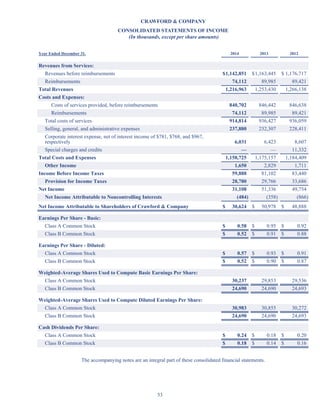
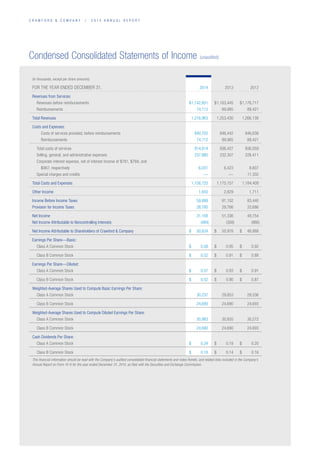
Condensed Consolidated Statements of Income (unaudited)
(In thousands, except per share amounts)
FOR THE YEAR ENDED DECEMBER 31, 2014 2013 2012
Revenues from Services:
  Revenues before reimbursements $1,142,851 $1,163,445 $1,176,717
 Reimbursements 74,112 89,985 89,421
Total Revenues 1,216,963 1,253,430 1,266,138
Costs and Expenses:
   Costs of services provided, before reimbursements 840,702 846,442 846,638
  Reimbursements 74,112 89,985 89,421
  Total costs of services 914,814 936,427 936,059
  Selling, general, and administrative expenses 237,880 232,307 228,411
 Corporate interest expense, net of interest income of $781, $768, and
  $967, respectively 6,031 6,423 8,607
  Special charges and credits — — 11,332
Total Costs and Expenses 1,158,725 1,175,157 1,184,409
Other Income 1,650 2,829 1,711
Income Before Income Taxes 59,888 81,102 83,440
Provision for Income Taxes 28,780 29,766 33,686
Net Income 31,108 51,336 49,754
Net Income Attributable to Noncontrolling Interests (484) (358) (866)
Net Income Attributable to Shareholders of Crawford  Company $30,624 $50,978 $48,888
Earnings Per Share—Basic:
  Class A Common Stock $0.58 $0.95 $0.92
  Class B Common Stock $0.52 $0.91 $0.88
Earnings Per Share—Diluted:
  Class A Common Stock $0.57 $0.93 $0.91
  Class B Common Stock $0.52 $0.90 $0.87
Weighted-Average Shares Used to Compute Basic Earnings Per Share:
  Class A Common Stock 30,237 29,853 29,536
  Class B Common Stock 24,690 24,690 24,693
Weighted-Average Shares Used to Compute Diluted Earnings Per Share:
  Class A Common Stock 30,983 30,855 30,272
  Class B Common Stock 24,690 24,690 24,693
Cash Dividends Per Share:
  Class A Common Stock $0.24 $0.18 $0.20
  Class B Common Stock $0.18 $0.14 $0.16
This financial information should be read with the Company’s audited consolidated financial statements and notes thereto, and related risks included in the Company’s
Annual Report on Form 10-K for the year ended December 31, 2014, as filed with the Securities and Exchange Commission.
3 2 / 3 3
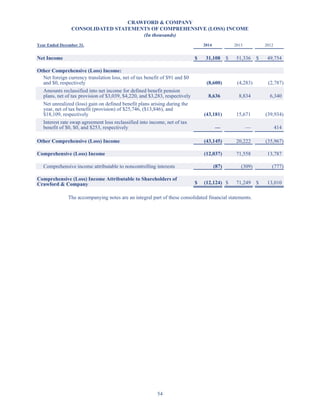
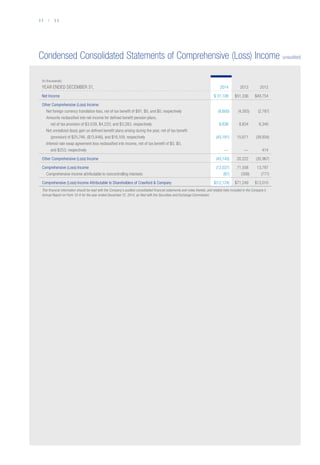
Condensed Consolidated Statements of Comprehensive (Loss) Income (unaudited)
(In thousands)
YEAR ENDED DECEMBER 31, 2014 2013 2012
Net Income $31,108 $51,336 $49,754
Other Comprehensive (Loss) Income:
  Net foreign currency translation loss, net of tax benefit of $91, $0, and $0, respectively (8,600) (4,283) (2,787)
  Amounts reclassified into net income for defined benefit pension plans,
   net of tax provision of $3,039, $4,220, and $3,283, respectively 8,636 8,834 6,340
  Net unrealized (loss) gain on defined benefit plans arising during the year, net of tax benefit
   (provision) of $25,746, ($13,846), and $18,109, respectively (43,181) 15,671 (39,934)
  Interest rate swap agreement loss reclassified into income, net of tax benefit of $0, $0,
   and $253, respectively — — 414
Other Comprehensive (Loss) Income (43,145) 20,222 (35,967)
Comprehensive (Loss) Income (12,037) 71,558 13,787
  Comprehensive income attributable to noncontrolling interests (87) (309) (777)
Comprehensive (Loss) Income Attributable to Shareholders of Crawford  Company $(12,124) $71,249 $13,010
This financial information should be read with the Company’s audited consolidated financial statements and notes thereto, and related risks included in the Company’s
Annual Report on Form 10-K for the year ended December 31, 2014, as filed with the Securities and Exchange Commission.
C R A W F O R D  C O M P A N Y / 2 0 1 4 A N N U A L R E P O R T
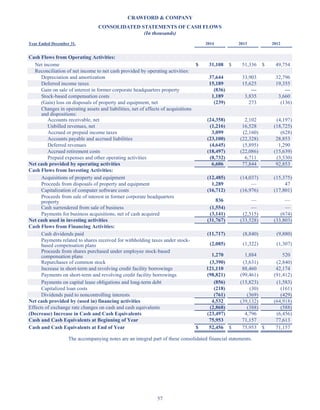
Condensed Consolidated Statements of Cash Flows (unaudited)
(In thousands)
YEAR ENDED DECEMBER 31, 2014 2013 2012
Cash Flows from Operating Activities:
  Net income $31,108 $51,336 $49,754
  Reconciliation of net income to net cash provided by operating activities:
   Depreciation and amortization 37,644 33,903 32,796
   Deferred income taxes 15,189 15,625 19,355
   Gain on sale of interest in former corporate headquarters property (836) — —
   Stock-based compensation costs 1,189 3,835 3,660
   (Gain) loss on disposals of property and equipment, net (239) 273 (136)
   Changes in operating assets and liabilities, net of effects of acquisitions and dispositions:
   Accounts receivable, net (24,358) 2,102 (4,197)
   Unbilled revenues, net (1,216) 16,528 (18,725)
    Accrued or prepaid income taxes 3,099 (2,160) (628)
    Accounts payable and accrued liabilities (23,100) (22,328) 28,853
   Deferred revenues (4,645) (5,895) 1,290
   Accrued retirement costs (18,497) (22,086) (15,639)
    Prepaid expenses and other operating activities (8,732) 6,711 (3,530)
Net cash provided by operating activities 6,606 77,844 92,853
Cash Flows from Investing Activities:
   Acquisitions of property and equipment (12,485) (14,037) (15,375)
   Proceeds from disposals of property and equipment 1,289 — 47
   Capitalization of computer software costs (16,712) (16,976) (17,801)
   Proceeds from sale of interest in former corporate headquarters property 836 — —
   Cash surrendered from sale of business (1,554) — —
   Payments for business acquisitions, net of cash acquired (3,141) (2,515) (674)
Net cash used in investing activities (31,767) (33,528) (33,803)
Cash Flows from Financing Activities:
   Cash dividends paid (11,717) (8,840) (9,880)
   Payments related to shares received for withholding taxes under stock-based compensation plans (2,085) (1,322) (1,307)
   Proceeds from shares purchased under employee stock-based compensation plans 1,270 1,884 520
   Repurchases of common stock (3,390) (3,631) (2,840)
   Increase in short-term and revolving credit facility borrowings 121,110 88,460 42,174
   Payments on short-term and revolving credit facility borrowings (98,821) (99,461) (91,412)
   Payments on capital lease obligations and long-term debt (856) (15,823) (1,583)
   Capitalized loan costs (218) (30) (161)
   Dividends paid to noncontrolling interests (761) (369) (429)
Net cash provided by (used in) financing activities 4,532 (39,132) (64,918)
Effects of exchange rate changes on cash and cash equivalents (2,868) (388) (588)
(Decrease) Increase in Cash and Cash Equivalents (23,497) 4,796 (6,456)
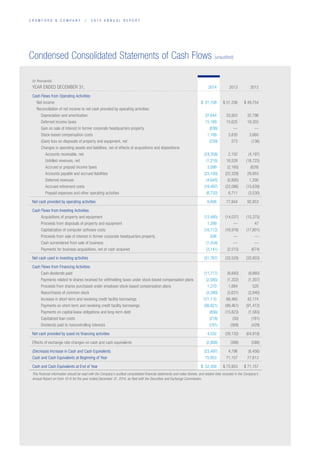
Cash and Cash Equivalents at Beginning of Year 75,953 71,157 77,613
Cash and Cash Equivalents at End of Year $52,456 $75,953 $71,157
This financial information should be read with the Company’s audited consolidated financial statements and notes thereto, and related risks included in the Company’s
Annual Report on Form 10-K for the year ended December 31, 2014, as filed with the Securities and Exchange Commission.
3 4 / 3 5
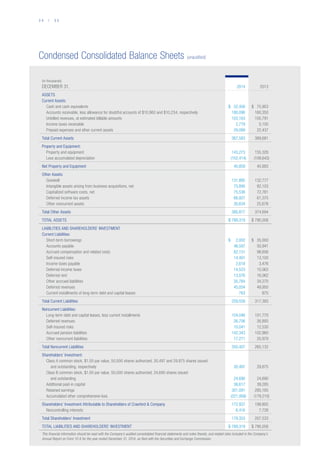
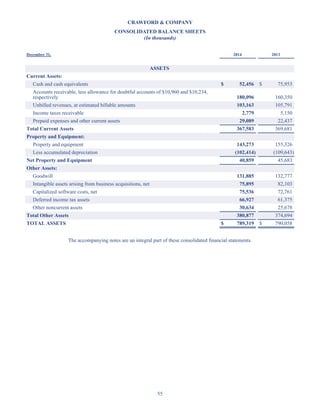
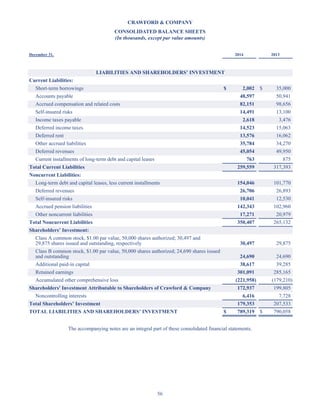
Condensed Consolidated Balance Sheets (unaudited)
(In thousands)
DECEMBER 31, 2014 2013
ASSETS
Current Assets:
  Cash and cash equivalents $52,456 $ 75,953
  Accounts receivable, less allowance for doubtful accounts of $10,960 and $10,234, respectively 180,096 160,350
  Unbilled revenues, at estimated billable amounts 103,163 105,791
  Income taxes receivable 2,779 5,150
  Prepaid expenses and other current assets 29,089 22,437
Total Current Assets 367,583 369,681
Property and Equipment:
  Property and equipment 143,273 155,326
  Less accumulated depreciation (102,414) (109,643)
Net Property and Equipment 40,859 45,683
Other Assets:
 Goodwill 131,885 132,777
  Intangible assets arising from business acquisitions, net 75,895 82,103
  Capitalized software costs, net 75,536 72,761
  Deferred income tax assets 66,927 61,375
  Other noncurrent assets 30,634 25,678
Total Other Assets 380,877 374,694
TOTAL ASSETS $789,319 $790,058
LIABILITIES AND SHAREHOLDERS’ INVESTMENT
Current Liabilities:
  Short-term borrowings $2,002 $ 35,000
  Accounts payable 48,597 50,941
  Accrued compensation and related costs 82,151 98,656
  Self-insured risks 14,491 13,100
  Income taxes payable 2,618 3,476
  Deferred income taxes 14,523 15,063
  Deferred rent 13,576 16,062
  Other accrued liabilities 35,784 34,270
  Deferred revenues 45,054 49,950
  Current installments of long-term debt and capital leases 763 875
Total Current Liabilities 259,559 317,393
Noncurrent Liabilities:
  Long-term debt and capital leases, less current installments 154,046 101,770
  Deferred revenues 26,706 26,893
  Self-insured risks 10,041 12,530
  Accrued pension liabilities 142,343 102,960
  Other noncurrent liabilities 17,271 20,979
Total Noncurrent Liabilities 350,407 265,132
Shareholders’ Investment:
  Class A common stock, $1.00 par value, 50,000 shares authorized; 30,497 and 29,875 shares issued
   and outstanding, respectively 30,497 29,875
  Class B common stock, $1.00 par value, 50,000 shares authorized; 24,690 shares issued
  and outstanding 24,690 24,690
  Additional paid-in capital 38,617 39,285
  Retained earnings 301,091 285,165
  Accumulated other comprehensive loss (221,958) (179,210)
Shareholders’ Investment Attributable to Shareholders of Crawford  Company 172,937 199,805
  Noncontrolling interests 6,416 7,728
Total Shareholders’ Investment 179,353 207,533
TOTAL LIABILITIES AND SHAREHOLDERS’ INVESTMENT $789,319 $790,058
This financial information should be read with the Company’s audited consolidated financial statements and notes thereto, and related risks included in the Company’s
Annual Report on Form 10-K for the year ended December 31, 2014, as filed with the Securities and Exchange Commission.
C R A W F O R D  C O M P A N Y / 2 0 1 4 A N N U A L R E P O R T
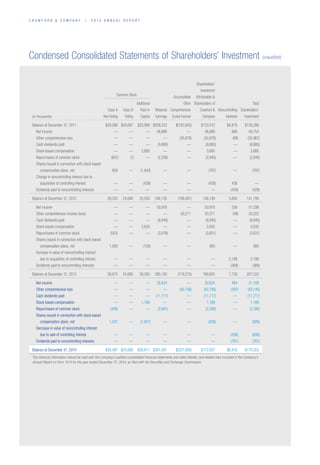
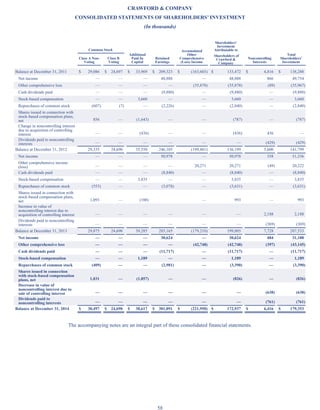
Condensed Consolidated Statements of Shareholders’ Investment (unaudited)
Shareholders’
Investment
Common Stock
Accumulated Attributable to
Additional Other Shareholders of Total
Class A Class B Paid-In Retained Comprehensive Crawford  Noncontrolling Shareholders’
(In thousands) Non-Voting Voting Capital Earnings (Loss) Income Company Interests Investment
Balance at December 31, 2011 $29,086 $24,697 $33,969 $209,323 $(163,603) $133,472 $4,816 $138,288
  Net income — — — 48,888 — 48,888 866 49,754
  Other comprehensive loss — — — — (35,878) (35,878) (89) (35,967)
  Cash dividends paid — — — (9,880) — (9,880) — (9,880)
  Stock-based compensation — — 3,660 — — 3,660 — 3,660
  Repurchases of common stock (607) (7) — (2,226) — (2,840) — (2,840)
  Shares issued in connection with stock-based
   compensation plans, net 856 — (1,643) — — (787) — (787)
  Change in noncontrolling interest due to
   acquisition of controlling interest — — (436) — — (436) 436 —
  Dividends paid to noncontrolling interests — — — — — — (429) (429)
Balance at December 31, 2012 29,335 24,690 35,550 246,105 (199,481) 136,199 5,600 141,799
  Net income — — — 50,978 — 50,978 358 51,336
  Other comprehensive income (loss) — — — — 20,271 20,271 (49) 20,222
  Cash dividends paid — — — (8,840) — (8,840) — (8,840)
  Stock-based compensation — — 3,835 — — 3,835 — 3,835
  Repurchases of common stock (553) — — (3,078) — (3,631) — (3,631)
  Shares issued in connection with stock-based
   compensation plans, net 1,093 — (100) — — 993 — 993
  Increase in value of noncontrolling interest
   due to acquisition of controlling interest — — — — — — 2,188 2,188
  Dividends paid to noncontrolling interests — — — — — — (369) (369)
Balance at December 31, 2013 29,875 24,690 39,285 285,165 (179,210) 199,805 7,728 207,533
  Net income — — — 30,624 — 30,624 484 31,108
  Other comprehensive loss — — — — (42,748) (42,748) (397) (43,145)
  Cash dividends paid — — — (11,717) — (11,717) — (11,717)
  Stock-based compensation — — 1,189 — — 1,189 — 1,189
  Repurchases of common stock (409) — — (2,981) — (3,390) — (3,390)
  Shares issued in connection with stock-based
   compensation plans, net 1,031 — (1,857) — — (826) — (826)
  Decrease in value of noncontrolling interest
   due to sale of controlling interest — — — — — — (638) (638)
  Dividends paid to noncontrolling interests — — — — — — (761) (761)
Balance at December 31, 2014 $30,497 $24,690 $38,617 $301,091 $(221,958) $172,937 $6,416 $179,353
This financial information should be read with the Company’s audited consolidated financial statements and notes thereto, and related risks included in the Company’s
Annual Report on Form 10-K for the year ended December 31, 2014, as filed with the Securities and Exchange Commission.
3 6 / 3 7
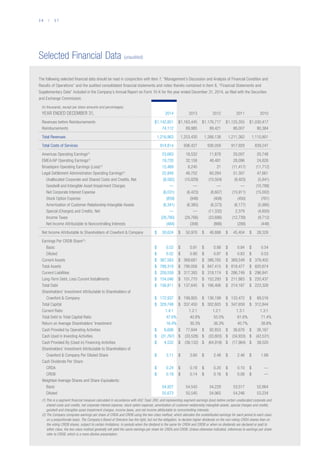
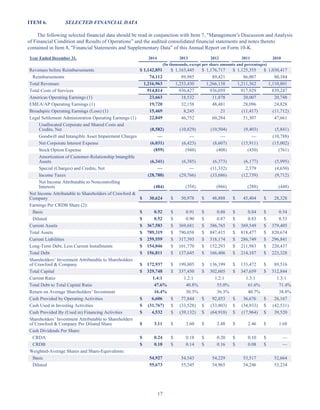
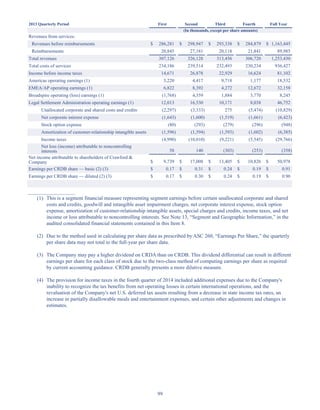
Selected Financial Data (unaudited)
The following selected financial data should be read in conjunction with Item 7, “Management’s Discussion and Analysis of Financial Condition and
Results of Operations” and the audited consolidated financial statements and notes thereto contained in Item 8, “Financial Statements and
Supplementary Data” included in the Company’s Annual Report on Form 10-K for the year ended December 31, 2014, as filed with the Securities
and Exchange Commission.
(In thousands, except per share amounts and percentages)
YEAR ENDED DECEMBER 31, 2014 2013 2012 2011 2010
Revenues before Reimbursements $1,142,851 $1,163,445 $1,176,717 $1,125,355 $1,030,417
Reimbursements 74,112 89,985 89,421 86,007 80,384
Total Revenues 1,216,963 1,253,430 1,266,138 1,211,362 1,110,801
Total Costs of Services 914,814 936,427 936,059 917,929 839,247
Americas Operating Earnings(1)
23,663 18,532 11,878 20,007 20,748
EMEA/AP Operating Earnings(1)
19,720 32,158 48,481 28,096 24,828
Broadspire Operating Earnings (Loss)(1)
15,469 8,245 21 (11,417) (11,712)
Legal Settlement Administration Operating Earnings(1)
22,849 46,752 60,284 51,307 47,661
  Unallocated Corporate and Shared Costs and Credits, Net (8,582) (10,829) (10,504) (9,403) (5,841)
  Goodwill and Intangible Asset Impairment Charges — — — — (10,788)
  Net Corporate Interest Expense (6,031) (6,423) (8,607) (15,911) (15,002)
  Stock Option Expense (859) (948) (408) (450) (761)
  Amortization of Customer-Relationship Intangible Assets (6,341) (6,385) (6,373) (6,177) (5,995)
  Special (Charges) and Credits, Net — — (11,332) 2,379 (4,650)
  Income Taxes (28,780) (29,766) (33,686) (12,739) (9,712)
  Net Income Attributable to Noncontrolling Interests (484) (358) (866) (288) (448)
Net Income Attributable to Shareholders of Crawford  Company $30,624 $ 50,978 $ 48,888 $ 45,404 $ 28,328
Earnings Per CRDB Share(2)
:
 Basic $0.52 $ 0.91 $ 0.88 $ 0.84 $ 0.54
 Diluted $0.52 $ 0.90 $ 0.87 $ 0.83 $ 0.53
Current Assets $367,583 $ 369,681 $ 386,765 $ 369,549 $ 379,405
Total Assets $789,319 $ 790,058 $ 847,415 $ 818,477 $ 820,674
Current Liabilities $259,559 $ 317,393 $ 318,174 $ 286,749 $ 296,841
Long-Term Debt, Less Current Installments $154,046 $ 101,770 $ 152,293 $ 211,983 $ 220,437
Total Debt $156,811 $ 137,645 $ 166,406 $ 214,187 $ 223,328
Shareholders’ Investment Attributable to Shareholders of
  Crawford  Company $172,937 $ 199,805 $ 136,199 $ 133,472 $ 89,516
Total Capital $329,748 $ 337,450 $ 302,605 $ 347,659 $ 312,844
Current Ratio 1.4:1 1.2:1 1.2:1 1.3:1 1.3:1
Total Debt to Total Capital Ratio 47.6% 40.8% 55.0% 61.6% 71.4%
Return on Average Shareholders’ Investment 16.4% 30.3% 36.3% 40.7% 38.8%
Cash Provided by Operating Activities $6,606 $ 77,844 $ 92,853 $ 36,676 $ 26,167
Cash Used in Investing Activities $(31,767) $ (33,528) $ (33,803) $ (34,933) $ (42,531)
Cash Provided By (Used in) Financing Activities $4,532 $ (39,132) $ (64,918) $ (17,964) $ 39,520
Shareholders’ Investment Attributable to Shareholders of
  Crawford  Company Per Diluted Share $3.11 $ 3.60 $ 2.48 $ 2.46 $ 1.68
Cash Dividends Per Share:
 CRDA $0.24 $ 0.18 $ 0.20 $ 0.10 $ —
 CRDB $0.18 $ 0.14 $ 0.16 $ 0.08 $ —
Weighted-Average Shares and Share-Equivalents:
 Basic 54,927 54,543 54,229 53,517 52,664
 Diluted 55,673 55,545 54,965 54,246 53,234
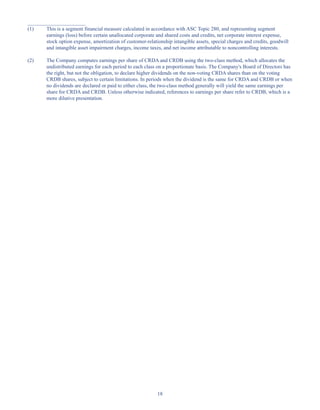
(1) This is a segment financial measure calculated in accordance with ASC Topic 280, and representing segment earnings (loss) before certain unallocated corporate and
shared costs and credits, net corporate interest expense, stock option expense, amortization of customer-relationship intangible assets, special charges and credits,
goodwill and intangible asset impairment charges, income taxes, and net income attributable to noncontrolling interests.
(2) The Company computes earnings per share of CRDA and CRDB using the two-class method, which allocates the undistributed earnings for each period to each class
on a proportionate basis. The Company’s Board of Directors has the right, but not the obligation, to declare higher dividends on the non-voting CRDA shares than on
the voting CRDB shares, subject to certain limitations. In periods when the dividend is the same for CRDA and CRDB or when no dividends are declared or paid to
either class, the two-class method generally will yield the same earnings per share for CRDA and CRDB. Unless otherwise indicated, references to earnings per share
refer to CRDB, which is a more dilutive presentation.
C R A W F O R D  C O M P A N Y / 2 0 1 4 A N N U A L R E P O R T
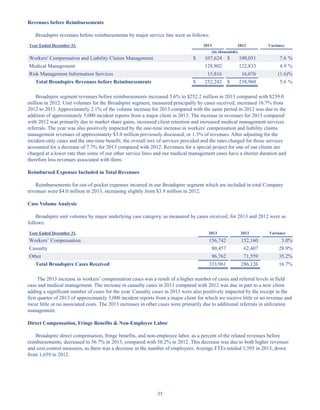
7
3 1
6
2
8 5 4 911
10
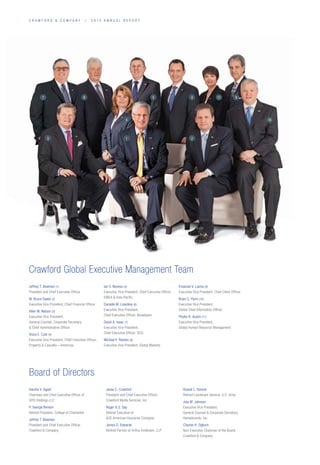
Jeffrey T. Bowman (1)
President and Chief Executive Officer
W. Bruce Swain (2)
Executive Vice President, Chief Financial Officer
Allen W. Nelson (3)
Executive Vice President,
General Counsel, Corporate Secretary
 Chief Administrative Officer
Vince E. Cole (4)
Executive Vice President, Chief Executive Officer,
Property  Casualty—Americas
Ian V. Muress (5)
Executive Vice President, Chief Executive Officer,
EMEA  Asia-Pacific
Danielle M. Lisenbey (6)
Executive Vice President,
Chief Executive Officer, Broadspire
David A. Isaac (7)
Executive Vice President,
Chief Executive Officer, GCG
Michael F. Reeves (8)
Executive Vice President, Global Markets
Emanuel V. Lauria (9)
Executive Vice President, Chief Client Officer
Brian S. Flynn (10)
Executive Vice President,
Global Chief Information Officer
Phyllis R. Austin (11)
Executive Vice President,
Global Human Resource Management
Crawford Global Executive Management Team
Harsha V. Agadi
Chairman and Chief Executive Officer of
GHS Holdings LLC
P. George Benson
Retired President, College of Charleston
Jeffrey T. Bowman
President and Chief Executive Officer,
Crawford  Company
Jesse C. Crawford
President and Chief Executive Officer,
Crawford Media Services, Inc.
Roger A.S. Day
Retired Executive of
ACE American Insurance Company
James D. Edwards
Retired Partner of Arthur Andersen, LLP
Russel L. Honoré
Retired Lieutenant General, U.S. Army
Joia M. Johnson
Executive Vice President,
General Counsel  Corporate Secretary,
Hanesbrands, Inc.
Charles H. Ogburn
Non-Executive Chairman of the Board,
Crawford  Company
Board of Directors
FORM 10-K
This proof is printed at 96% of original size
This line represents final trim and will not print
UNITED STATES SECURITIES AND EXCHANGE COMMISSION
Washington, D. C. 20549
Form 10-K
ANNUAL REPORT PURSUANT TO SECTION 13 OR 15(d) OF THE SECURITIES EXCHANGE ACT OF 1934
For the fiscal year ended December 31, 2014
TRANSITION REPORT PURSUANT TO SECTION 13 OR 15(d) OF THE SECURITIES EXCHANGE ACT OF
1934
For the transition period from to
Commission file number 1-10356.
CRAWFORD  COMPANY
(Exact name of Registrant as specified in its charter)
Georgia
(State or other jurisdiction of incorporation or organization)
58-0506554
(I.R.S. Employer Identification Number)
1001 Summit Boulevard, Atlanta, Georgia
(Address of principal executive offices)
30319
(Zip Code)
Registrant's telephone number, including area code
(404) 300-1000
Securities registered pursuant to Section 12(b) of the Act:
Title of Each Class Name of Each Exchange on Which Registered
Class A Common Stock — $1.00 Par Value New York Stock Exchange
Class B Common Stock — $1.00 Par Value New York Stock Exchange
Securities registered pursuant to Section 12(g) of the Act:
None
(Title of Class)
Indicate by check mark if the Registrant is a well-known seasoned issuer, as defined in Rule 405 of the Securities Act. Yes No
Indicate by check mark if the Registrant is not required to file reports pursuant to Section 13 or Section 15(d) of the Act. Yes No
Indicate by check mark whether the Registrant: (1) has filed all reports required to be filed by Section 13 or 15(d) of the Securities Exchange
Act of 1934 during the preceding 12 months (or for such shorter period that the Registrant was required to file such reports), and (2) has been subject
to such filing requirements for the past 90 days. Yes No
Indicate by check mark whether the Registrant has submitted electronically and posted on its corporate website, if any, every Interactive Data
File required to be submitted and posted pursuant to Rule 405 of Regulation S-T (§232.405 of this chapter) during the preceding 12 months (or for
such shorter period that the Registrant was required to submit and post such files). Yes No
Indicate by check mark if disclosure of delinquent filers pursuant to Item 405 of Regulation S-K (§229.405 of this chapter) is not contained
herein, and will not be contained, to the best of Registrant's knowledge, in definitive proxy or information statements incorporated by reference in
Part III of this Form 10-K or any amendment to this Form 10-K.
Indicate by check mark whether the registrant is a large accelerated filer, an accelerated filer, a non-accelerated filer, or a smaller reporting
company. See definitions of “large accelerated filer,” “accelerated filer,” “non-accelerated filer” and “smaller reporting company” in Rule 12b-2 of the
Exchange Act.
Large accelerated filer Accelerated filer Non-accelerated filer Smaller reporting company
(Do not check if a smaller reporting company)
Indicate by check mark whether the Registrant is a shell company (as defined in Rule 12b-2 of the Exchange Act). Yes No
The aggregate market value of the Registrant's voting and non-voting common stock held by non-affiliates of the Registrant was $249,643,422
as of June 30, 2014, based upon the closing prices of such stock as reported on the NYSE on such date. For purposes hereof, beneficial ownership is
determined under rules adopted pursuant to Section 13 of the Securities Exchange Act of 1934, and excludes voting and non-voting common stock
beneficially owned by the directors and executive officers of the Registrant, some of whom may not be deemed to be affiliates upon judicial
determination.
The number of shares outstanding of each of the Registrant's classes of common stock, as of February 13, 2015, was:
Class A Common Stock — $1.00 Par Value — 30,547,019 Shares
Class B Common Stock — $1.00 Par Value — 24,690,172 Shares
Documents incorporated by reference:
Portions of the Registrant's proxy statement for its 2015 annual shareholders’ meeting, which proxy statement will be filed within 120 days of the
Registrant's year end, are incorporated by reference into Part III hereof.
Table of Contents
This proof is printed at 96% of original size
This line represents final trim and will not print
CRAWFORD  COMPANY
FORM 10-K
For The Year Ended December 31, 2014
Table of Contents
PART I
Item 1. Business 1
Item 1A. Risk Factors 6
Item 1B. Unresolved Staff Comments 13
Item 2. Properties 13
Item 3. Legal Proceedings 13
Item 4. Mine Safety Disclosures 14
PART II
Item 5. Market for the Registrant’s Common Equity, Related Shareholder Matters, and Issuer Purchases
of Equity Securities 15
Item 6. Selected Financial Data 17
Item 7. Management’s Discussion and Analysis of Financial Condition and Results of Operations 19
Item 7A. Quantitative and Qualitative Disclosures about Market Risk 50
Item 8. Financial Statements and Supplementary Data 52
Item 9. Changes in and Disagreements with Accountants on Accounting and Financial Disclosure 100
Item 9A. Controls and Procedures 100
PART III
Item 10. Directors, Executive Officers and Corporate Governance 103
Item 11. Executive Compensation 103
Item 12. Security Ownership of Certain Beneficial Owners and Management and Related Shareholder
Matters 103
Item 13. Certain Relationships and Related Transactions, and Director Independence 103
Item 14. Principal Accountant Fees and Services 103
PART IV
Item 15. Exhibits, Financial Statement Schedules 104
Signatures 108
Exhibit Index 109
This proof is printed at 96% of original size
This line represents final trim and will not print
We use the terms “Crawford”, “the Company”, “the Registrant”, “we”, “us” and “our” to refer to the business of
Crawford  Company, its subsidiaries, and variable interest entities.
Cautionary Statement Concerning Forward-Looking Statements
This report contains and incorporates by reference forward-looking statements within the meaning of that term in the
Private Securities Litigation Reform Act of 1995, Section 27A of the Securities Act of 1933, and Section 21E of the
Securities Exchange Act of 1934. Statements contained or incorporated by reference in this report that are not statements of
historical fact are forward-looking statements made pursuant to the “safe harbor” provisions thereof. These statements may
relate to, among other things, expectations regarding our ability to reduce our operating expenses, expectations regarding our
anticipated contributions to our underfunded defined benefit pension plans, collectability of our billed and unbilled accounts
receivable, our continued compliance with the financial and other covenants contained in our financing agreements, our
expected future operating results and financial condition, expectations related to the timing, costs, and benefits of the
integration of our recently completed acquisition of GAB Robins Holdings UK Limited, expectations regarding the timing,
costs and synergies from our recently announced global business services center, and our other long-term capital resource and
liquidity requirements. These statements may also relate to our business strategies, goals and expectations concerning our
market position, future operations, margins, case and project volumes, profitability, contingencies, liquidity position, and
capital resources. The words “anticipate”, “believe”, “could”, “would”, “should”, “estimate”, “expect”, “intend”, “may”,
“plan”, “goal”, “strategy”, “predict”, “project”, “will” and similar terms and phrases, or the negatives thereof, identify
forward-looking statements in this report and in the statements incorporated by reference in this report. These risks and
uncertainties include, but are not limited to, those described in Part I, “Item 1A. Risk Factors” and elsewhere in this report
and those described from time to time in our other reports filed with the Securities and Exchange Commission.
Although we believe the assumptions upon which these forward-looking statements are based are reasonable, any of
these assumptions could prove to be inaccurate and the forward-looking statements based on these assumptions could be
incorrect. Our operations and the forward-looking statements related to our operations involve risks and uncertainties, many
of which are outside our control, and any one of which, or a combination of which, could materially affect our financial
condition and results of operations, and whether the forward-looking statements ultimately prove to be correct. As a result,
undue reliance should not be placed on any forward-looking statements. Actual results and trends in the future may differ
materially from those suggested or implied by the forward-looking statements. Forward-looking statements speak only as of
the date they are made and we undertake no obligation to publicly update any of these forward-looking statements in light of
new information or future events.
Table of Contents
This proof is printed at 96% of original size
This line represents final trim and will not print
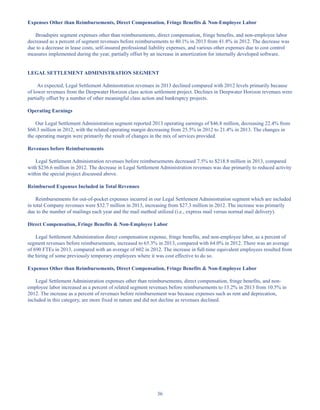
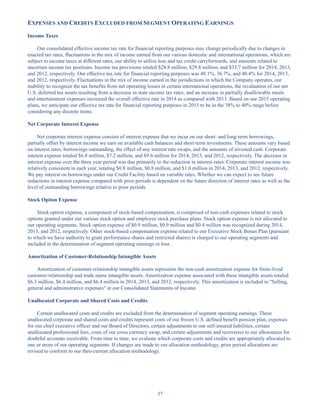
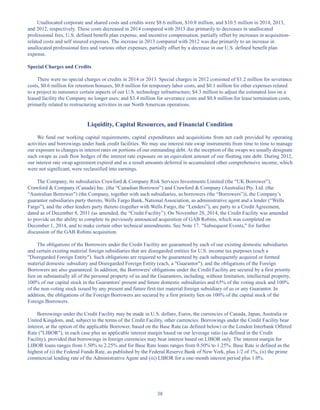
1
PART I
ITEM 1. BUSINESS
Headquartered in Atlanta, Georgia, and founded in 1941, the Company is the world's largest (based on annual revenues)
independent provider of claims management solutions to the risk management and insurance industry, as well as to self-
insured entities, with an expansive global network serving clients in more than 70 countries. For the year ended
December 31, 2014, the Company reported total revenues before reimbursements of $1.143 billion.
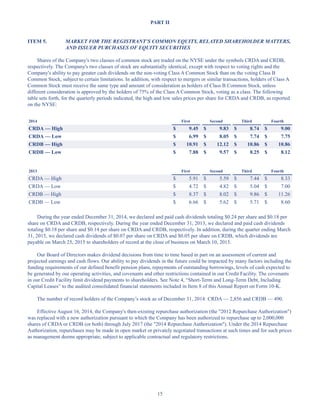
Shares of the Company's two classes of common stock are traded on the New York Stock Exchange (NYSE) under the
symbols CRDA and CRDB, respectively. The Company's two classes of stock are substantially identical, except with respect
to voting rights and the Company's ability to pay greater cash dividends on the non-voting Class A Common Stock than on
the voting Class B Common Stock, subject to certain limitations. In addition, with respect to mergers or similar transactions,
holders of Class A Common Stock must receive the same type and amount of consideration as holders of Class B Common
Stock, unless different consideration is approved by the holders of 75% of the Class A Common Stock, voting as a class.
DESCRIPTION OF SERVICES
The Crawford SolutionSM
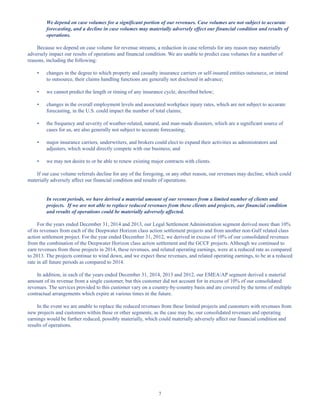
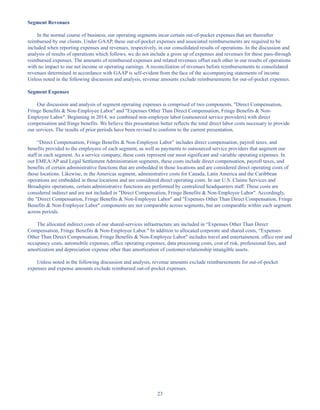
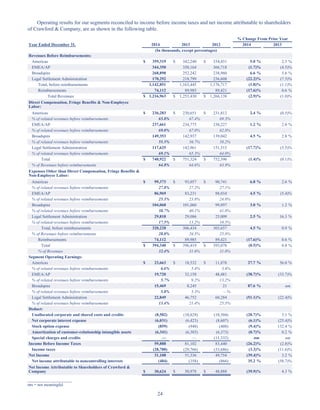
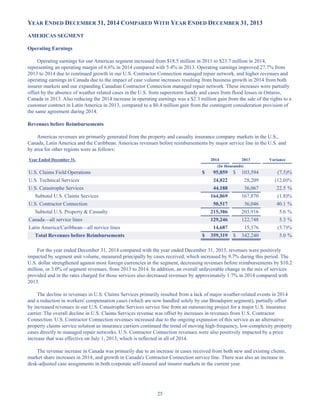
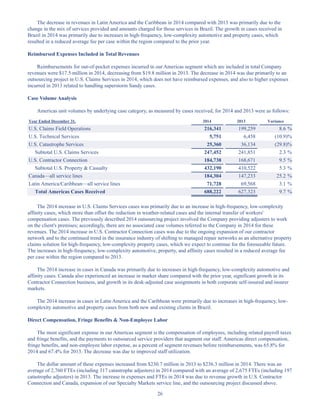
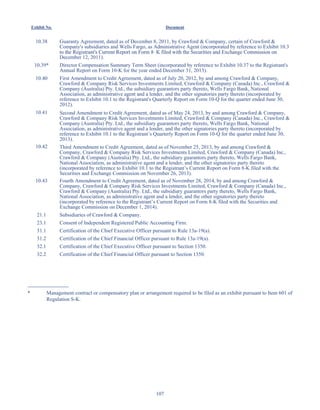
offers comprehensive, integrated claims services, business process outsourcing and consulting
services for major product lines including property and casualty claims management; workers’ compensation claims and
medical management; and legal settlement administration. The Crawford Solution is delivered to clients through the
Company's four operating segments: Americas, which primarily serves the property and casualty insurance company markets
in the U.S., Canada, Latin America, and the Caribbean; EMEA/AP, which serves the property and casualty insurance
company and self-insurance markets in Europe, including the United Kingdom (U.K.), the Middle East, Africa, and the
Asia-Pacific region (which includes Australia and New Zealand); Broadspire®
, which serves the self-insurance marketplace,
primarily in the U.S.; and Legal Settlement Administration, which serves the securities, bankruptcy, and other legal settlement
markets, primarily in the U.S.
A significant portion of our revenues are derived from international operations. For a discussion of certain risks attendant
to international operations, see Item 1A, Risk Factors.
AMERICAS. The Americas segment accounted for 31.5% of the Company's revenues before reimbursements in 2014.
The Company’s Americas segment provides claims management services in the U.S., Canada, Latin America, and the
Caribbean. Substantially all of the Company's Americas segment revenues are derived from the insurance company market.
These insurance companies customarily manage their own claims administration function, but often rely upon third-parties
for certain services which the Company provides, primarily with respect to field investigation and evaluation and resolution
of property and casualty insurance claims.
Claims management services offered by our Americas segment are provided to clients pursuant to a variety of different
referral assignments which generally are classified by the underlying insured risk categories used by insurance companies.
These major risk categories are:
• Property — losses caused by physical damage to commercial or residential real property and certain types of
personal property.
• Catastrophe — losses caused by all types of natural disasters, such as hurricanes, earthquakes and floods, and man-
made disasters such as oil spills, chemical releases, and explosions.
• Public Liability — a wide range of non-automobile liability claims such as product liability; owners, landlords and
tenants liabilities; and comprehensive general liability.
• Automobile — all types of losses involving use of an automobile, including bodily injury, physical damage, medical
payments, collision, fire, theft, and comprehensive liability.
• Affinity — all types of high-frequency, low-severity claims related to consumer products.
Table of Contents
This proof is printed at 96% of original size
This line represents final trim and will not print
2
Our Americas revenues are reported for three regions: U.S. Claims Services; Canada; and Latin America/Caribbean.
U.S. Claims Services are comprised of four major service lines: U.S. Claims Field Operations, U.S. Contractor Connection®
,
U.S. Technical Services, and U.S. Catastrophe Services.
U.S. Claims Services:
• U.S. Claims Field Operations is the largest service line of the Company's U.S. Claims Services operations. Services
provided by U.S. Claims Field Operations include property claims management, casualty claims management,
affinity claims management, and vehicle services.
• U.S. Contractor Connection is the largest independently managed contractor network in the industry, with
approximately 4,800 credentialed residential and commercial contractors. This innovative service solution for high-
frequency, low-severity claims optimizes the time and work process needed to resolve property claims. U.S.
Contractor Connection supports our business process outsourcing strategy by providing high-quality outsourced
contractor management to national and regional insurance carriers.
• U.S. Technical Services is devoted to large, complex claims. Our team of strategic loss managers and technical
adjusters are experts with specific experience and industry focus required to strategically manage large complex
claims.
• U.S. Catastrophe Services is an independent adjusting resource for insurance claims management in response to
natural or man-made disasters. We have one of the largest trained and credentialed field forces in the industry. U.S.
Catastrophe Services utilizes a proprietary response mechanism to ensure prompt, effective management of
catastrophic events for our clients.
Canada:
Services provided by our Canadian operations are comparable in scope and offerings to the services described above and
provided by U.S. Claims Services, and also include third-party administration and class action services in Canada.
Latin America/Caribbean:
Services provided by our Latin America/Caribbean operations are comparable in scope and offerings to the services
provided by U.S. Claims Field Operations, U.S. Technical Services and U.S. Catastrophe Services. In addition, our Latin
America/Caribbean operations provide affinity claims management.
EMEA/AP. The EMEA/AP segment accounted for 30.1% of the Company's revenues before reimbursements in 2014.
The Company’s EMEA/AP revenues are derived primarily from the insurance company and third-party administration
markets. Revenues within EMEA/AP are reported for three regions: the U.K.; Continental Europe, the Middle East and
Africa (“CEMEA”); and Asia-Pacific. The major elements of EMEA/AP claims management services are substantially the
same as those provided to U.S. property and casualty insurance company clients by our U.S. Claims Services. The segment
also derives revenues from third-party administration services provided under the Broadspire brand throughout EMEA/AP.
On December 1, 2014, we acquired 100% of the capital stock of GAB Robins Holdings UK Limited (GAB Robins), a
loss adjusting and claims management provider headquartered in the U.K. which will report through our EMEA/AP segment.
The acquisition is currently being reviewed by the CMA as a part of its routine acquisition review process, and we cannot
begin the integration process until this review is completed. Although we currently expect that this review will be concluded
during the first half of 2015, no assurances of the timing, or any material conditions being placed on this approval can be
provided. For additional information on this acquisition, see Item 7, Management's Discussion and Analysis of Financial
Condition and Results of Operations--Business Overview.
BROADSPIRE. The Broadspire segment, which operates in the U.S., accounted for 23.5% of the Company's revenues
before reimbursements in 2014. Broadspire Services, Inc., a wholly-owned subsidiary of the Company, is a leading third-
party administrator to employers and insurance companies, offering a comprehensive, integrated platform of workers’
compensation and liability claims management as well as medical management services in the U.S. Major risk categories
serviced by the Broadspire segment are:
Table of Contents
This proof is printed at 96% of original size
This line represents final trim and will not print
3
• Workers' Compensation — claims arising under state and federal workers' compensation laws.
• Public Liability — a wide range of non-automobile liability claims such as product liability; owners, landlords and
tenants liabilities; and comprehensive general liability.
• Automobile — all types of losses involving use of an automobile, including bodily injury, physical damage, medical
payments, collision, fire, theft, and comprehensive liability.
Through the Broadspire segment, the Company provides a complete range of claims and risk management services to
clients in the self-insured or commercially insured marketplace. In addition to field investigation and evaluation of claims,
Broadspire also offers initial loss reporting services for claimants; loss mitigation services, such as medical bill review,
medical case management and vocational rehabilitation; risk management information services; and administration of trust
funds established to pay claims. Broadspire services are provided through three major service lines: Workers' Compensation
and Liability Claims Management; Medical Management; and Risk Management Information Services.
• The Workers' Compensation and Liability Claims Management service line offers a comprehensive, integrated
approach to workers' compensation and liability claims management.
• The Medical Management service line offers case managers who proactively manage medical treatment while
facilitating an understanding of, and participation in, the rehabilitation process. These programs aim to help
employees recover as quickly as possible in a cost-effective method.
• Risk Management Information Services are provided through Risk Sciences Group, Inc. (“RSG”), a wholly-owned
subsidiary of the Company. RSG is a leading risk management information systems software and services company
with a history of providing customized risk management solutions to Fortune 1000 companies, insurance carriers,
and brokers.
LEGAL SETTLEMENT ADMINISTRATION. The Legal Settlement Administration segment accounted for 14.9% of
the Company's revenues before reimbursements in 2014. The segment provides legal settlement administration services
related to securities, product liability, and other class action settlements, as well as bankruptcies. These services include
identifying and qualifying class members, determining and dispensing settlement payments, and administering settlement
funds. Such services are generally referred to by the Company as class action services and are performed by The Garden City
Group, Inc. (“GCG”), a wholly-owned subsidiary of the Company. Since 1984, GCG has been focusing on diligently helping
its clients bring their toughest cases to timely, positive conclusions. GCG provides field-experienced, multi-disciplined and
technology-driven teams to support each case with appropriate administrative services and resources. GCG offers solutions in
three core areas:
• Class Action Services — technology-intensive administrative services for plaintiff and defense counsel as well as
corporate defendants to expedite high-volume class action settlements.
• Bankruptcy Services — cost-effective, end-to-end solutions for managing the administration of bankruptcy under
Chapter 11.
• GCG Communications — legal notice programs for successful case administration.
Table of Contents
This proof is printed at 96% of original size
This line represents final trim and will not print
4
FINANCIAL RESULTS
The percentages of the Company's total revenues before reimbursements derived from each operating segment are shown
in the following table:
Year Ended December 31, 2014 2013 2012
Americas 31.5% 29.4% 28.4%
EMEA/AP 30.1% 30.1% 31.2%
Broadspire 23.5% 21.7% 20.3%
Legal Settlement Administration 14.9% 18.8% 20.1%
100.0% 100.0% 100.0%
Financial results from the Company's operations outside of the U.S., Canada, the Caribbean, and certain subsidiaries in
the Philippines are reported and consolidated on a two-month delayed basis in accordance with the provisions of Accounting
Standards Codification (ASC) 810, “Consolidation,” in order to provide sufficient time for accumulation of their results
and, accordingly, the Company's December 31, 2014, 2013, and 2012 consolidated financial statements include the financial
position of such operations as of October 31, 2014 and 2013, respectively, and the results of such operations and cash flows
for the fiscal periods ended October 31, 2014, 2013, and 2012, respectively. As discussed below in Item 7. Management's
Discussion and Analysis of Financial Condition and Results of Operations and in Note 17, Subsequent Events, to the
audited consolidated financial statements included in Item 8 of this Annual Report on Form 10-K, the results of operations
and cash flows from the date of acquisition and the balance sheet impact from the acquisition of GAB Robins are excluded,
as the acquisition closed after the October 31, 2014 fiscal year end of our U.K. subsidiary through which GAB Robins will
report.
In the normal course of the Company's business, it sometimes incurs certain out-of-pocket expenses that are thereafter
reimbursed by its clients. Under U.S. generally accepted accounting principles (“GAAP”), these out-of-pocket expenses and
associated reimbursements are required to be included when reporting expenses and revenues, respectively, in the Company's
consolidated results of operations. However, because the amounts of reimbursed expenses and related revenues offset each
other in the accompanying consolidated statements of operations with no impact to net income or operating earnings,
management does not believe it is informative or beneficial to include these amounts in expenses and revenues, respectively.
As a result, unless otherwise indicated, revenue amounts on a consolidated basis and for each of our operating segments
described herein exclude reimbursements for out-of-pocket expenses. A reconciliation of revenues before reimbursements to
consolidated revenues determined in accordance with GAAP is self-evident from the face of the accompanying consolidated
financial statements.
Additional financial information regarding each of the Company's segments and geographic areas, including the
information required by Item 101(b) of Regulation S-K, is included in Note 13, “Segment and Geographic Information,” to
the audited consolidated financial statements included in Item 8 of this Annual Report on Form 10-K.
MATERIAL CUSTOMERS
Revenues and operating earnings from the Legal Settlement Administration operating segment are project based and can
vary significantly from period to period depending on the timing of project engagement and the work performed in a given
period. During the year ended December 31, 2012, the Company's previously disclosed special projects, the Deepwater
Horizon class action settlement and the Gulf Coast Claims Facility (GCCF) projects, together accounted for more than 10%
of the Company's consolidated revenues. During the years ended December 31, 2014 and 2013, Legal Settlement
Administration continued to derive more than 10% of its revenues from each of the Deepwater Horizon class action
settlement projects and from another non-Gulf related class action settlement project. The revenues from each of these
projects were individually less than 10% of our consolidated revenues in each of 2014 and 2013. The projects continue to
wind down, and we expect these revenues, and related operating earnings, to be at a reduced rate in all future periods as
compared to 2014.
Table of Contents
This proof is printed at 96% of original size
This line represents final trim and will not print
5
In addition, in each of the years ended December 31, 2014, 2013, and 2012, the Company's EMEA/AP segment derived
a material amount of its revenue from a single customer, but this customer did not account for in excess of 10% of our
revenues on a consolidated basis. The services provided to this customer vary on a country-by-country basis and are covered
by the terms of multiple contractual arrangements. In the event we are not able to replace any lost revenues from this
customer with revenues from another source, we believe that loss of revenues from this customer could result in materially
lower revenues and operating earnings within the EMEA/AP segment, and possibly for the Company as a whole.
INTELLECTUAL PROPERTY AND TRADEMARKS
The Company’s intellectual property portfolio is an important asset which it seeks to expand and protect globally through
a combination of trademarks, trade names, copyrights and trade secrets. The Company owns a number of active trademark
applications and registrations which expire at various times. As the laws of many countries do not protect intellectual
property to the same extent as the laws of the U.S., the Company cannot ensure that it will be able to adequately protect its
intellectual property assets outside of the U.S. The failure to protect our intellectual property assets could have a material
adverse affect on our business, however the loss of any single patent, trademark or service mark, taken alone, would not have
a material adverse effect on any of our segments or on the Company as a whole.
SERVICE DELIVERY
The Company’s claims management services are offered primarily through its global network serving clients in more
than 70 countries. Contractor Connection services are offered by providing high-quality outsourced contractor management
to national and regional insurance carriers.
COMPETITION
The global claims management services market is highly competitive and comprised of a large number of companies of
varying size and that offer a varied scope of services. The demand from insurance companies and self-insured entities for
services provided by independent claims service firms like us is largely dependent on industry-wide claims volumes, which
are affected by, among other things, the insurance underwriting cycle, weather-related events, general economic activity,
overall employment levels, and workplace injury rates. Demand is also impacted by decisions insurance companies and self-
insured entities may make with respect to the level of claims outsourced to independent claim service firms as opposed to
those handled by their own in-house claims adjusters. In addition, our ability to retain clients and maintain or increase case
referrals is also dependent in part on our ability to continue to provide high-quality, competitively priced services and
effective sales efforts.
We typically earn our revenues on an individual fee-per-claim basis for claims management services we provide to
insurance companies and self-insured entities. Accordingly, the volume of claim referrals to us is a key driver of our
revenues. Generally, fees are earned on cases as services are provided, which generally occurs in the period the case is
assigned to us, although sometimes a portion or substantially all of the revenues generated by a specific case assignment will
be earned in subsequent periods. We cannot predict the future trend of case volumes for a number of reasons, including the
frequency and severity of weather-related cases and the occurrence of natural and man-made disasters, which are a significant
source of cases for us and are not subject to accurate forecasting.
The Company competes with a substantial number of smaller local and regional claims management services firms
located throughout the U.S. and internationally. Many of these smaller firms have rate structures that are lower than the
Company’s or may, in certain markets, have local knowledge which provides them a competitive advantage. The Company
does not believe that these smaller firms offer the broad spectrum of claims management services in the range of locations the
Company provides and, although such firms may secure business which has a local or regional source, the Company believes
its quality product offerings, broader scope of services, and geographically dispersed offices provide the Company with an
overall competitive advantage in securing business from both U.S. and international clients. There are also national and
global independent companies that provide a similar broad spectrum of claims management services and who directly
compete with the Company.
Table of Contents
This proof is printed at 96% of original size
This line represents final trim and will not print
6
The legal settlement administration market is also highly competitive but is comprised of a smaller number of
specialized entities. The demand for legal settlement administration services is generally not directly tied to or affected by the
insurance underwriting cycle. The demand for these services is largely dependent on the volume of securities and product
liability class action settlements, the volume of Chapter 11 bankruptcy filings and the resulting settlements, and general
economic conditions. Competition in this segment is primarily on pricing, resource allocation ability, and experience
servicing similar matters. The Company believes that our experienced leadership, coupled with global resources and state-of-
the-art technology, provide a competitive advantage in this market.
EMPLOYEES
At December 31, 2014, the total number of full-time equivalent employees (FTEs) was 8,841. In addition, the
Company also from time to time uses the resources of a significant number of available temporary employees and a network
of independent contractors, as and when the demand for services requires. These temporary employees primarily provide
catastrophe adjuster services. The Company, through Crawford Educational Services, provides many of its employees with
formal classroom training in basic and advanced skills relating to claims administration and healthcare management services.
In many cases, employees are required to complete these or other professional courses in order to qualify for promotions
from their existing positions. The Company generally considers its relations with its employees to be good.
BACKLOG
Backlog is not meaningful other than in our Legal Settlement Administration segment. At December 31, 2014 and 2013,
our Legal Settlement Administration segment had an estimated revenue backlog related to projects awarded totaling
approximately $102 million and $108 million, respectively. Additional information regarding this backlog is contained in
Item 7, “Management’s Discussion and Analysis of Financial Condition and Results of Operations” of this Annual Report on
Form 10-K under the caption “Legal Settlement Administration.”
AVAILABLE INFORMATION
The Company is required to file annual, quarterly and current reports, proxy statements and other information with the
Securities and Exchange Commission (SEC). The public may read and copy any materials that the Company files with the
SEC at the SEC's Public Reference Room at 100 F Street, N.E., Washington, D.C. 20549. Information on the operation of the
Public Reference Room may be obtained by calling the SEC at 1-800-SEC-0330. In addition, the SEC maintains an Internet
site that contains reports, proxy and information statements, and other information regarding issuers that file electronically
with the SEC at http://www.sec.gov.
The Company’s Annual Report on Form 10-K, Quarterly Reports on Form 10-Q, Current Reports on Form 8-K and
amendments to reports filed pursuant to Sections 13(a) and 15(d) of the Securities Exchange Act of 1934 are available free of
charge as soon as reasonably practicable after these reports are electronically filed or furnished to the SEC on our website,
www.crawfordandcompany.com via a link to a third-party website with SEC filings. The information contained on, or
hyperlinked from, our website is not a part of, nor is it incorporated by reference into, this Annual Report on Form 10-K.
Copies of the Company’s annual report will also be made available, free of charge, upon written request to Corporate
Secretary, Legal Department, Crawford  Company, 1001 Summit Boulevard, Atlanta, Georgia 30319.
ITEM 1A. RISK FACTORS
You should carefully consider the risks described below, together with the other information contained or incorporated
by reference in this Annual Report on Form 10-K and in our other filings with the SEC from time to time when evaluating our
business and prospects. Any of the events discussed in the risk factors below may occur. If they do, our business, results of
operations or financial condition could be materially adversely affected. Additional risks and uncertainties not presently
known to us, or that we currently deem immaterial, may also impair our financial condition or results of operations.
This proof is printed at 96% of original size
This line represents final trim and will not print
7
We depend on case volumes for a significant portion of our revenues. Case volumes are not subject to accurate
forecasting, and a decline in case volumes may materially adversely effect our financial condition and results of
operations.
Because we depend on case volume for revenue streams, a reduction in case referrals for any reason may materially
adversely impact our results of operations and financial condition. We are unable to predict case volumes for a number of
reasons, including the following:
• changes in the degree to which property and casualty insurance carriers or self-insured entities outsource, or intend
to outsource, their claims handling functions are generally not disclosed in advance;
• we cannot predict the length or timing of any insurance cycle, described below;
• changes in the overall employment levels and associated workplace injury rates, which are not subject to accurate
forecasting, in the U.S. could impact the number of total claims;
• the frequency and severity of weather-related, natural, and man-made disasters, which are a significant source of
cases for us, are also generally not subject to accurate forecasting;
• major insurance carriers, underwriters, and brokers could elect to expand their activities as administrators and
adjusters, which would directly compete with our business; and
• we may not desire to or be able to renew existing major contracts with clients.
If our case volume referrals decline for any of the foregoing, or any other reason, our revenues may decline, which could
materially adversely affect our financial condition and results of operations.
In recent periods, we have derived a material amount of our revenues from a limited number of clients and
projects. If we are not able to replace reduced revenues from these clients and projects, our financial condition
and results of operations could be materially adversely affected.
For the years ended December 31, 2014 and 2013, our Legal Settlement Administration segment derived more than 10%
of its revenues from each of the Deepwater Horizon class action settlement projects and from another non-Gulf related class
action settlement project. For the year ended December 31, 2012, we derived in excess of 10% of our consolidated revenues
from the combination of the Deepwater Horizon class action settlement and the GCCF projects. Although we continued to
earn revenues from these projects in 2014, these revenues, and related operating earnings, were at a reduced rate as compared
to 2013. The projects continue to wind down, and we expect these revenues, and related operating earnings, to be at a reduced
rate in all future periods as compared to 2014.
In addition, in each of the years ended December 31, 2014, 2013 and 2012, our EMEA/AP segment derived a material
amount of its revenue from a single customer, but this customer did not account for in excess of 10% of our consolidated
revenues. The services provided to this customer vary on a country-by-country basis and are covered by the terms of multiple
contractual arrangements which expire at various times in the future.
In the event we are unable to replace the reduced revenues from these limited projects and customers with revenues from
new projects and customers within these or other segments, as the case may be, our consolidated revenues and operating
earnings would be further reduced, possibly materially, which could materially adversely affect our financial condition and
results of operations.
Table of Contents
This proof is printed at 96% of original size
This line represents final trim and will not print
8
Legal Settlement Administration service revenues are project-based and can fluctuate significantly from period to
period for various reasons, any of which can materially impact our financial condition and results of operations.
Our Legal Settlement Administration service revenues are project-based and can fluctuate significantly from period to
period. Revenues from this segment are in part dependent on product liability, bankruptcy and securities class action cases
and settlements. Legislation or a change in market conditions could curtail, slow or limit growth of this part of our business.
Tort reforms in the U.S., at either the national or state levels, could limit the number and size of future class action cases and
settlements. Any slowdown in the referral of projects to the Legal Settlement Administration segment or the commencement
of services under the projects in any period, if not replaced by new revenue sources in our other segments, could materially
adversely impact our financial condition and results of operations.
We currently operate on multiple proprietary software platforms to support our service offerings and internal
corporate systems. The failure or obsolescence of any of these platforms, if not remediated or replaced, could
materially adversely affect our business, results of operations, and financial condition.
We currently utilize multiple software platforms to support our service offerings. We believe certain of these software
platforms distinguish our service offerings from our competitors. The failure of one or more of our software platforms to
function properly, or the failure of these platforms to remain competitive, could materially adversely affect our business,
results of operations, and financial condition.
We may not be able to develop or acquire necessary IT resources to support and grow our business. Our failure to
do this could materially adversely affect our business, results of operations, and financial condition.
We have made substantial investments in software and related technologies that are critical to the core operations of our
business. These IT resources will require future maintenance and enhancements, potentially at substantial costs. Additionally,
these IT resources may become obsolete in the future and require replacement, potentially at substantial costs. We may not be
able to develop, acquire replacement resources or identify new technology resources necessary to support and grow our
business. Any failure to do so, or to do so in a timely manner or at a cost considered reasonable by us, could materially
adversely affect our business, results of operations, and financial condition.
We currently, and from time to time in the future may, outsource a portion of our internal business functions to
third-party providers. Outsourcing these functions has significant risks, and our failure to manage these risks
successfully could materially adversely affect our business, results of operations, and financial condition.
We currently, and from time to time in the future may, outsource significant portions of our internal business functions to
third-party providers. Third-party providers may not comply on a timely basis with all of our requirements, or may not
provide us with an acceptable level of service. In addition, our reliance on third-party providers could have significant
negative consequences, including significant disruptions in our operations and significantly increased costs to undertake our
operations, either of which could damage our relationships with our customers. As a result of our outsourcing activities, it
may also be more difficult for us to recruit and retain qualified employees for our business needs at any time. Our failure to
successfully outsource any material portion of our business functions could materially adversely affect our business, results
of operations, and financial condition.
Table of Contents
This proof is printed at 96% of original size
This line represents final trim and will not print
9
We completed the acquisition of GAB Robins in December 2014. The acquisition is currently being reviewed by
the United Kingdom Competition  Markets Authority (CMA). We cannot begin the integration process until
this review is completed, and any delay or restriction on our ability to integrate GAB Robins could materially
adversely affect our business and results of operations.
We completed the acquisition of GAB Robins in December 2014. The acquisition is currently being reviewed by the
CMA as a part of its routine acquisition review process, and we cannot begin the integration process until this review is
completed. Although we currently expect that this review will be concluded during the first half of 2015, no assurances of the
timing, or any material conditions being placed on this approval can be provided. The success of the GAB Robins acquisition
will depend, in part, on our ability to realize the anticipated synergies and cost savings from integrating GAB Robins on a
timely basis. The integration process may be complex, costly and time-consuming. We expect to record special charges of
approximately $7 million in 2015 related to these efforts. Difficulties of integrating the operations of the GAB Robins
business could include, among others:
• lack of approval by the CMA allowing us to integrate the businesses in their current form;
• delays in the timing of receiving CMA approval;
• failure to implement our business plan for the combined business on a timely basis or at current expected cost levels;
• unanticipated issues in integrating information, communications, and other systems;
• the impact on our internal controls and compliance with the regulatory requirements under the Sarbanes-Oxley Act
of 2002; and
• other unanticipated issues, expenses, and liabilities.
Although we currently expect to receive the approval of the CMA without material conditions, it is possible there could
be material conditions or delays that impact our inability to integrate GAB Robins. For these or any other reasons, we may
not accomplish the integration of GAB Robins business smoothly, successfully, or within the anticipated costs or time frame.
The diversion of the attention of management from our current operations to the approval and integration effort and any
difficulties encountered in combining operations could prevent us from realizing the full benefits anticipated to result from
the GAB Robins acquisition and could materially adversely affect our business and results of operations.
We recently announced the establishment of a Global Business Services Center (the “Center”) in Manila,
Philippines. If we are unable to timely and cost effectively complete and ramp up operations at the Center, or fail
to achieve the expected operational synergies therefrom on a timely basis or at all, our results of operations and
financial condition may be materially adversely affected.
On January 22, 2015, we announced the establishment of a wholly-owned global business services center (the Center)
in Manila, Philippines. The Center provides us a venue for global consolidation of certain business functions, shared services,
and currently outsourced processes. The Center, which is expected to be phased in through 2018, is expected to allow us to
continue to strengthen our client service, realize additional operational efficiencies, and invest in new capabilities for growth.
Operations in the Center are expected to deliver cumulative expense savings of approximately $60 million through 2019 and
annual cost savings of approximately $20 million per year thereafter. To achieve these savings, we expect to record charges
totaling approximately $20 million through 2018. An initial estimated charge of approximately $9 million is expected to be
incurred in 2015, which is expected to be partially offset by initial savings in 2015 of approximately $2 million.
We may not be able to have the Center fully staffed and operational on a timely basis, or at presently anticipated costs. In
addition, our anticipated efficiencies and future estimated cost savings are based on several assumptions that may prove to be
inaccurate, and, as a result, there can be no assurance that we will realize these efficiencies and cost savings in the expected
time line or at all. Our inability to have the Center staffed and operational within our presently anticipated timeframe or at
presently anticipated costs, or our failure or delays in achieving projected levels of efficiencies and cost savings from such
measures, or any unanticipated inefficiencies resulting from establishing the Center, could materially adversely affect our
results of operations and financial condition.
Table of Contents
This proof is printed at 96% of original size
This line represents final trim and will not print
10
Control by a principal shareholder could adversely affect our other shareholders.
As of December 31, 2014, Jesse C. Crawford, a member of our Board of Directors, beneficially owned approximately
52% of our outstanding voting Class B Common Stock. As a result, he has the ability to control substantially all matters
submitted to our shareholders for approval, including the election and removal of directors. He also has the ability to control
our management and affairs. As of December 31, 2014, Mr. Crawford also beneficially owned approximately 39% of our
outstanding non-voting Class A Common Stock. This concentration of ownership of our stock may delay or prevent a change
in control; impede a merger, consolidation, takeover, or other business combination involving us; discourage a potential
acquirer from making a tender offer or otherwise attempting to obtain control of us; reduce the liquidity, and thus the trading
price, of our stock; or result in other actions that may be opposed by, or not be in the best interests of, our other shareholders.
We are subject to insurance underwriting market cycle risks. We may not be able to identify new revenue sources
not directly tied to this cycle and, in that event, would remain subject to its risks.
Although the insurance industry underwriting cycle has been characterized in recent years as soft, the property-casualty
underwriting cycle remains volatile and could rapidly transition to a harder market due to certain factors such as the
occurrence of significant catastrophic losses or the performance of capital markets. In softer insurance markets, insurance
premiums and deductible levels are generally in decline and industry-wide claim volumes generally increase, which should
increase claim referrals to us, provided property and casualty insurance carriers do not reduce the number of claims they
outsource to independent firms such as ours. Because the underwriting cycle can change suddenly due to unforeseen events
in the financial markets and catastrophic claims activity, we cannot predict what impact the current market may have on us in
the future or the timing of when the market may change in the future. Indicators of a hard insurance underwriting cycle
generally include higher premiums, higher deductibles, lower liability limits, increased excluded coverages, increased
reservation of rights letters, and more unpaid claims. During a hard insurance underwriting market, insurance companies
typically become very selective in the risks they underwrite, and insurance premiums and policy deductibles increase. This
often results in a reduction in industry-wide claims volumes, which reduces claim referrals to us unless we can offset the
decline in claim referrals with growth in our market share.
We try to mitigate this risk exposure through the development and marketing of services that are not affected by the
insurance underwriting cycle. However, there can be no assurance that our mitigation efforts will be effective with respect to
eliminating or reducing underwriting market cycle risk. To the extent we cannot effectively minimize the risk through
diversification, our financial condition and results of operations could be materially adversely impacted by, or during, future
hard market cycles.
We manage a large amount of highly sensitive and confidential consumer information including personally
identifiable information, protected health information and financial information. The unauthorized access to,
alteration or disclosure of this data, whether as a result of criminal conduct, advances in computer hacking or
otherwise, could result in a material loss of business, substantial legal liability or significant harm to our
reputation.
We manage a large amount of highly sensitive and confidential consumer information including personally identifiable
information, protected health information and financial information. We use computers in substantially all aspects of our
business operations. We also use mobile devices, social networking and other online activities to connect with our employees
and our customers. Such uses give rise to cybersecurity risks, including security breach, espionage, system disruption, theft
and inadvertent release of information.
While we have implemented measures to prevent security breaches and cyber incidents, and although we maintain cyber
and crime insurance, our preventative measures and incident response efforts may not be entirely effective. The theft,
destruction, loss, misappropriation, or release of sensitive and/or confidential information or intellectual property, or
interference with our information technology systems or the technology systems of third parties on which we rely, could
result in business disruption, negative publicity, brand damage, violation of privacy laws, loss of customers, potential liability
and competitive disadvantage.
Table of Contents
This proof is printed at 96% of original size
This line represents final trim and will not print
11
A significant portion of our operations are international. These international operations face political, legal,
operational, exchange rate and other risks not generally present in U.S. operations, which could materially
negatively affect those operations or our business as a whole.
Our international operations face political, legal, operational, exchange rate and other risks that we do not face in our
domestic operations. We face, among other risks: the risk of discriminatory regulation; nationalization or expropriation of
assets; changes in both domestic and foreign laws regarding trade and investment abroad; potential loss of proprietary
information due to piracy, misappropriation or laws that may be less protective of our intellectual property rights; or price
controls and exchange controls or other restrictions that prevent us from transferring funds from these operations out of the
countries in which they were earned or converting local currencies we hold into U.S. dollars or other currencies.
International operations also subject us to numerous additional laws and regulations that are in addition to, or may be
different from, those affecting U.S. businesses, such as those related to labor, employment, worker health and safety, antitrust
and competition, environmental protection, consumer protection, import/export and anti-corruption, including but not limited
to the Foreign Corrupt Practices Act (FCPA). Although we have put into place policies and procedures aimed at ensuring
legal and regulatory compliance, our employees, subcontractors, and agents could inadvertently or intentionally take actions
that violate any of these requirements. Violations of these regulations could subject us to criminal or civil enforcement
actions, any of which could have a material adverse effect on our business, financial condition or results of operations.
We operate in highly competitive markets and face intense competition from both established entities and new
entrants into those markets. Our failure to compete effectively may adversely affect us.
The claims management services market, both in the U.S. and internationally, is highly competitive and comprised of a
large number of companies of varying size and that offer a varied scope of services. The demand from insurance companies
and self-insured entities for services provided by independent claims service firms like us is largely dependent on industry-
wide claims volumes, which are affected by, among other things, the insurance underwriting cycle, weather-related events,
general economic activity, overall employment levels, and associated workplace injury rates. We are also impacted by
decisions insurance companies and self-insured entities may make with respect to the level of claims outsourced to
independent claim service firms as opposed to those handled by their own in-house claims adjusters. Accordingly, we are
limited in our ability to predict case volumes and, consequently, our revenues, in any period. Our ability to retain clients and
maintain and increase case referrals is also dependent in part on our ability to continue to provide high-quality, competitively
priced services and effective sales efforts. In addition, the goodwill and intangible assets in each of our segments are exposed
to potential impairment if we are unable to effectively compete or our financial results are otherwise materially negatively
impacted. In particular, we believe $12.9 million of goodwill in the Americas segment and $72.1 million of goodwill in the
EMEA/AP segment are most exposed to potential impairments. We intend to continue to monitor the performance of the
Americas and EMEA/AP segments. Should actual operating earnings consistently fall below forecasted operating earnings,
we will perform an interim goodwill impairment analysis.
We may not be able to recruit, train, and retain qualified personnel, including retaining a sufficient number of
on-call claims adjusters, to respond to catastrophic events that may, singularly or in combination, significantly
increase our clients’ needs for adjusters.
Our catastrophe related work and revenues can fluctuate dramatically based on the frequency and severity of natural and
man-made disasters. When such events happen, our clients usually require a sudden and substantial increase in the need for
catastrophic claims services, which can place strains on our capacity. Our internal resources are sometimes not sufficient to
meet these sudden and substantial increases in demand. When these situations occur, we must retain outside adjusters
(temporary employees and contractors) to increase our capacity. There can be no assurance that we will be able to retain such
outside adjusters with the requisite qualifications, at the times needed or on terms that we believe are economically
reasonable. Insurance companies and other loss adjusting firms also aggressively compete for these independent adjusters,
who often command high prices for their services at such times of peak demand. Such competition could reduce availability,
increase our costs and reduce our revenues. Our failure to timely, efficiently, and competently provide these services to our
clients could result in reduced revenues, loss of customer goodwill and a materially negative impact on our results of
operations.
Table of Contents
This proof is printed at 96% of original size
This line represents final trim and will not print
12
If we do not protect our proprietary information and technology resources and prevent third parties from making
unauthorized use of our proprietary information, intellectual property, and technology, our financial results
could be harmed.
We rely on a combination of trademark, trade name, copyright and trade secret laws to protect our proprietary
information, intellectual property, and technology. However, all of these measures afford only limited protection and may be
challenged, invalidated or circumvented by third parties. Third parties may copy aspects of our processes, products or
materials, or otherwise obtain and use our proprietary information without authorization. Unauthorized copying or use of our
intellectual property or proprietary information could materially adversely affect our financial condition and results of
operations. Third parties may also develop similar or superior technology independently, including by designing around any
of our proprietary technology. Furthermore, the laws of some foreign countries do not offer the same level of protection of
our proprietary rights as the laws of the U.S., and we may be subject to unauthorized use of our intellectual property in those
countries. Any legal action that we may bring to protect intellectual property and proprietary information could be expensive
and may distract management from day-to-day operations.
We are, and may become, party to lawsuits or other claims that could adversely impact our business.
In the normal course of the claims administration services business, we are named as a defendant in suits by insureds or
claimants contesting decisions by us or our clients with respect to the settlement of claims. Additionally, our clients have in
the past brought, and may, in the future bring, claims for indemnification on the basis of alleged actions on our part or on the
part of our agents or our employees in rendering services to clients. There can be no assurance that additional lawsuits will
not be filed against us. There also can be no assurance that any such lawsuits will not have a disruptive impact upon the
operation of our business, that the defense of the lawsuits will not consume the time and attention of our senior management
and financial resources or that the resolution of any such litigation will not have a material adverse effect on our business,
financial condition and results of operations.
Our U.S. qualified defined benefit pension plan (the U.S. Qualified Plan) and our U.K. defined benefit pension
plans (the U.K. Plans) are underfunded. Future funding requirements, including those imposed by any further
regulatory changes, could restrict cash available for our operating, financing, and investing requirements.
At the end of the most recent measurement periods for our U.S. Qualified Plan, the U.K Plans, and our other
international defined benefit pension plans, the projected benefit obligations for these specific plans were underfunded by
$142.3 million. In recent years we have been required to make significant contributions to these plans. The Highway
Transportation Funding Act of 2014 (HAFTA) included pension funding reform which greatly reduced the contributions
required to the U.S. Plan, and no contributions are required in fiscal 2015. Required contributions are anticipated in future
years as the impact of the HATFA funding reform is phased out. As such, Crawford plans to contribute $9.0 million per
annum to the U.S. Plan for the next four fiscal years to improve the funded status of the plan and minimize future required
contributions. In addition, regulatory requirements in the U.K. require us to make additional contributions to our underfunded
U.K. Plans. Volatility in the capital markets and future legislation may have a negative impact on our U.S. and U.K. pension
plans, which may further increase the underfunded portion of our pension plans and our attendant funding obligations. The
required contributions to our underfunded defined benefit pension plans will reduce our liquidity, restrict available cash for
our operating, financing, and investing needs and may materially adversely affect our financial condition and our ability to
deploy capital to other opportunities.
While we intend to comply with our future funding requirements through the use of cash from operations, there can be
no assurance that we will generate enough cash to do so. Our inability to fund these obligations through cash from operations
could require us to seek funding from other sources, including through additional borrowings under our Credit Facility
(defined below), if available, proceeds from debt or equity financings, or asset sales. There can be no assurance that we
would be able to obtain any such external funding in amounts, at times and on terms that we deem commercially reasonable,
in order for us to meet these obligations. Furthermore, any of the foregoing could materially increase our outstanding debt or
debt service requirements, or dilute the value of the holdings of our current shareholders, as the case may be. Our inability to
comply with any funding obligations in a timely manner could materially adversely affect our financial condition.
Table of Contents
This proof is printed at 96% of original size
This line represents final trim and will not print
13
We have debt covenants in our credit facility that require us to maintain compliance with certain financial ratios
and other requirements. If we are not able to maintain compliance with these requirements, all of our
outstanding debt could become immediately due and payable.
We are party to a credit facility, dated December 8, 2011, with Wells Fargo Bank, N.A., Bank of America, N.A., RBS
Citizens, N.A., and the other lenders a party thereto, as amended (the “Credit Facility”). The Credit Facility contains various
representations, warranties and covenants, including covenants limiting liens, indebtedness, guarantees, mergers and
consolidations, substantial asset sales, investments and loans, sale and leasebacks, restrictions on dividends and distributions,
and other fundamental changes in our business. Additionally, the Credit Facility contains covenants requiring us to remain in
compliance with a maximum leverage ratio and a minimum fixed charge coverage ratio. If we do not maintain compliance
with the covenant requirements, we will be in default under the Credit Facility. In such an event, the lenders under the Credit
Facility would generally have the right to declare all then-outstanding amounts thereunder immediately due and payable. If
we could not obtain a required waiver on satisfactory terms, we could be required to renegotiate the terms of the Credit
Facility or immediately repay this indebtedness. Any such renegotiation could result in less favorable terms, including
additional fees, higher interest rates and accelerated payments, and would necessitate significant time and attention of
management, which could divert their focus from business operations. Any required payment may necessitate the sale of
assets or other uses of resources that we do not believe would be our best interests. While we do not presently expect to be in
violation of any of these requirements, no assurances can be given that we will be able to continue to comply with them in the
future. There can be no assurance that our actual financial results will match our projected results or that we will not violate
such covenants. Any failure to continue to comply with such requirements could materially adversely affect our borrowing
ability and access to liquidity, and thus our overall financial condition, as well as our ability to operate our business.
The risks described above are not the only ones facing us, but are the ones currently deemed the most material by us
based on available information. New risks may emerge from time to time, and it is not possible for management to predict all
such risks, nor can we assess the impact of known risks on our business or the extent to which any factor or combination of
factors may cause actual results to differ materially from those contained in any forward-looking statement.
ITEM 1B. UNRESOLVED STAFF COMMENTS
None.
ITEM 2. PROPERTIES
As of December 31, 2014, the Company owned an office in Kitchener, Ontario and an additional office location in
Stockport, England. As of December 31, 2014, the Company leased approximately 350 other office locations for use by the
Company of one or more of its segments under various leases with varying terms. Other office locations are occupied under
various short-term rental arrangements. The Company generally believes that its office locations are sufficient for its
operations and that, if it were necessary to obtain different or additional office locations, such locations would be available at
times, and on commercially reasonable terms, as would be necessary for the conduct of its business. No assurances can be
given, however, that the Company would be able to obtain such office locations as and when needed, or on terms it
considered to be reasonable, if at all.
ITEM 3. LEGAL PROCEEDINGS
In the normal course of the claims administration services business, the Company is named as a defendant in suits by
insureds or claimants contesting decisions by the Company or its clients with respect to the settlement of claims.
Additionally, clients of the Company have, in the past, brought and may, in the future bring, claims for indemnification on the
basis of alleged actions on the part of the Company, its agents or its employees in rendering service to clients. The majority of
these claims are of the type covered by insurance maintained by the Company; however, the Company is responsible for the
deductibles and self-insured retentions under its various insurance coverages. In the opinion of the Company, adequate
reserves have been provided for such known risks. No assurances can be provided, however, that the result of any such
action, claim or proceeding, now known or occurring in the future, will not result in a material adverse effect on our business,
financial condition or results of operations.
Table of Contents
This proof is printed at 96% of original size
This line represents final trim and will not print
14
ITEM 4. MINE SAFETY DISCLOSURES
Not applicable.
Table of Contents
This proof is printed at 96% of original size
This line represents final trim and will not print
15
PART II
ITEM 5. MARKET FOR THE REGISTRANT’S COMMON EQUITY, RELATED SHAREHOLDER MATTERS,
AND ISSUER PURCHASES OF EQUITY SECURITIES
Shares of the Company's two classes of common stock are traded on the NYSE under the symbols CRDA and CRDB,
respectively. The Company's two classes of stock are substantially identical, except with respect to voting rights and the
Company's ability to pay greater cash dividends on the non-voting Class A Common Stock than on the voting Class B
Common Stock, subject to certain limitations. In addition, with respect to mergers or similar transactions, holders of Class A
Common Stock must receive the same type and amount of consideration as holders of Class B Common Stock, unless
different consideration is approved by the holders of 75% of the Class A Common Stock, voting as a class. The following
table sets forth, for the quarterly periods indicated, the high and low sales prices per share for CRDA and CRDB, as reported
on the NYSE:
2014 First Second Third Fourth
CRDA — High $ 9.45 $ 9.83 $ 8.74 $ 9.00
CRDA — Low $ 6.99 $ 8.05 $ 7.74 $ 7.75
CRDB — High $ 10.91 $ 12.12 $ 10.86 $ 10.86
CRDB — Low $ 7.88 $ 9.57 $ 8.25 $ 8.12
2013 First Second Third Fourth
CRDA — High $ 5.91 $ 5.59 $ 7.44 $ 8.33
CRDA — Low $ 4.72 $ 4.82 $ 5.04 $ 7.00
CRDB — High $ 8.37 $ 8.02 $ 9.86 $ 11.26
CRDB — Low $ 6.66 $ 5.62 $ 5.71 $ 8.60
During the year ended December 31, 2014, we declared and paid cash dividends totaling $0.24 per share and $0.18 per
share on CRDA and CRDB, respectively. During the year ended December 31, 2013, we declared and paid cash dividends
totaling $0.18 per share and $0.14 per share on CRDA and CRDB, respectively. In addition, during the quarter ending March
31, 2015, we declared cash dividends of $0.07 per share on CRDA and $0.05 per share on CRDB, which dividends are
payable on March 25, 2015 to shareholders of record at the close of business on March 10, 2015.
Our Board of Directors makes dividend decisions from time to time based in part on an assessment of current and
projected earnings and cash flows. Our ability to pay dividends in the future could be impacted by many factors including the
funding requirements of our defined benefit pension plans, repayments of outstanding borrowings, levels of cash expected to
be generated by our operating activities, and covenants and other restrictions contained in our Credit Facility. The covenants
in our Credit Facility limit dividend payments to shareholders. See Note 4, “Short-Term and Long-Term Debt, Including
Capital Leases” to the audited consolidated financial statements included in Item 8 of this Annual Report on Form 10-K.
The number of record holders of the Company’s stock as of December 31, 2014: CRDA — 2,856 and CRDB — 490.
Effective August 16, 2014, the Company's then-existing repurchase authorization (the 2012 Repurchase Authorization)
was replaced with a new authorization pursuant to which the Company has been authorized to repurchase up to 2,000,000
shares of CRDA or CRDB (or both) through July 2017 (the 2014 Repurchase Authorization). Under the 2014 Repurchase
Authorization, repurchases may be made in open market or privately negotiated transactions at such times and for such prices
as management deems appropriate, subject to applicable contractual and regulatory restrictions.
Table of Contents
This proof is printed at 96% of original size
This line represents final trim and will not print
16
Through December 31, 2014, the Company had repurchased 27,000 shares of CRDA and 0 shares of CRDB under the
2014 Repurchase Authorization. The table below sets forth the repurchases of CRDA and CRDB by the Company under the
2014 Repurchase Authorization during the three months ended December 31, 2014. From the original 2012 Repurchase
Authorization in May 2012 through December 31, 2014, the Company has reacquired 1,571,527 shares of CRDA and
7,000 shares of CRDB at an average cost of $6.26 and $3.83 per share, respectively. As of December 31, 2014, the
Company's authorization to repurchase shares of its common stock was limited to an additional 1,973,000 shares.
Period
Total
Number of
Shares
Purchased
Average
Price Paid
Per Share
Total Number
of Shares
Purchased as
Part of Publicly
Announced
Plans or
Programs
Maximum
Number of
Shares That
May be
Purchased
Under the Plans
or Programs
Balance as of September 30, 2014 2,000,000
October 1, 2014 - October 31, 2014
CRDA — $ — —
CRDB — $ — —
Totals as of October 31, 2014 2,000,000
November 1, 2014 - November 30, 2014
CRDA — $ — —
CRDB — $ — —
Totals as of November 30, 2014 2,000,000
December 1, 2014 - December 31, 2014
CRDA 27,000 $ 8.64 27,000
CRDB — $ — —
Totals as of December 31, 2014 27,000 27,000 1,973,000
Table of Contents
This proof is printed at 96% of original size
This line represents final trim and will not print
17
ITEM 6. SELECTED FINANCIAL DATA
The following selected financial data should be read in conjunction with Item 7, Management’s Discussion and Analysis
of Financial Condition and Results of Operations” and the audited consolidated financial statements and notes thereto
contained in Item 8, Financial Statements and Supplementary Data” of this Annual Report on Form 10-K.
Year Ended December 31, 2014 2013 2012 2011 2010
(In thousands, except per share amounts and percentages)
Revenues before Reimbursements $ 1,142,851 $ 1,163,445 $ 1,176,717 $ 1,125,355 $ 1,030,417
Reimbursements 74,112 89,985 89,421 86,007 80,384
Total Revenues 1,216,963 1,253,430 1,266,138 1,211,362 1,110,801
Total Costs of Services 914,814 936,427 936,059 917,929 839,247
Americas Operating Earnings (1) 23,663 18,532 11,878 20,007 20,748
EMEA/AP Operating Earnings (1) 19,720 32,158 48,481 28,096 24,828
Broadspire Operating Earnings (Loss) (1) 15,469 8,245 21 (11,417) (11,712)
Legal Settlement Administration Operating Earnings (1) 22,849 46,752 60,284 51,307 47,661
Unallocated Corporate and Shared Costs and
Credits, Net (8,582) (10,829) (10,504) (9,403) (5,841)
Goodwill and Intangible Asset Impairment Charges — — — — (10,788)
Net Corporate Interest Expense (6,031) (6,423) (8,607) (15,911) (15,002)
Stock Option Expense (859) (948) (408) (450) (761)
Amortization of Customer-Relationship Intangible
Assets (6,341) (6,385) (6,373) (6,177) (5,995)
Special (Charges) and Credits, Net — — (11,332) 2,379 (4,650)
Income Taxes (28,780) (29,766) (33,686) (12,739) (9,712)
Net Income Attributable to Noncontrolling
Interests (484) (358) (866) (288) (448)
Net Income Attributable to Shareholders of Crawford 
Company $ 30,624 $ 50,978 $ 48,888 $ 45,404 $ 28,328
Earnings Per CRDB Share (2):
Basic $ 0.52 $ 0.91 $ 0.88 $ 0.84 $ 0.54
Diluted $ 0.52 $ 0.90 $ 0.87 $ 0.83 $ 0.53
Current Assets $ 367,583 $ 369,681 $ 386,765 $ 369,549 $ 379,405
Total Assets $ 789,319 $ 790,058 $ 847,415 $ 818,477 $ 820,674
Current Liabilities $ 259,559 $ 317,393 $ 318,174 $ 286,749 $ 296,841
Long-Term Debt, Less Current Installments $ 154,046 $ 101,770 $ 152,293 $ 211,983 $ 220,437
Total Debt $ 156,811 $ 137,645 $ 166,406 $ 214,187 $ 223,328
Shareholders’ Investment Attributable to Shareholders
of Crawford  Company $ 172,937 $ 199,805 $ 136,199 $ 133,472 $ 89,516
Total Capital $ 329,748 $ 337,450 $ 302,605 $ 347,659 $ 312,844
Current Ratio 1.4:1 1.2:1 1.2:1 1.3:1 1.3:1
Total Debt to Total Capital Ratio 47.6% 40.8% 55.0% 61.6% 71.4%
Return on Average Shareholders’ Investment 16.4% 30.3% 36.3% 40.7% 38.8%
Cash Provided by Operating Activities $ 6,606 $ 77,844 $ 92,853 $ 36,676 $ 26,167
Cash Used in Investing Activities $ (31,767) $ (33,528) $ (33,803) $ (34,933) $ (42,531)
Cash Provided By (Used in) Financing Activities $ 4,532 $ (39,132) $ (64,918) $ (17,964) $ 39,520
Shareholders’ Investment Attributable to Shareholders
of Crawford  Company Per Diluted Share $ 3.11 $ 3.60 $ 2.48 $ 2.46 $ 1.68
Cash Dividends Per Share:
CRDA $ 0.24 $ 0.18 $ 0.20 $ 0.10 $ —
CRDB $ 0.18 $ 0.14 $ 0.16 $ 0.08 $ —
Weighted-Average Shares and Share-Equivalents:
Basic 54,927 54,543 54,229 53,517 52,664
Diluted 55,673 55,545 54,965 54,246 53,234
Table of Contents
This proof is printed at 96% of original size
This line represents final trim and will not print
18
______________________
(1) This is a segment financial measure calculated in accordance with ASC Topic 280, and representing segment
earnings (loss) before certain unallocated corporate and shared costs and credits, net corporate interest expense,
stock option expense, amortization of customer-relationship intangible assets, special charges and credits, goodwill
and intangible asset impairment charges, income taxes, and net income attributable to noncontrolling interests.
(2) The Company computes earnings per share of CRDA and CRDB using the two-class method, which allocates the
undistributed earnings for each period to each class on a proportionate basis. The Company's Board of Directors has
the right, but not the obligation, to declare higher dividends on the non-voting CRDA shares than on the voting
CRDB shares, subject to certain limitations. In periods when the dividend is the same for CRDA and CRDB or when
no dividends are declared or paid to either class, the two-class method generally will yield the same earnings per
share for CRDA and CRDB. Unless otherwise indicated, references to earnings per share refer to CRDB, which is a
more dilutive presentation.
Table of Contents
This proof is printed at 96% of original size
This line represents final trim and will not print
19
ITEM 7. MANAGEMENT’S DISCUSSION AND ANALYSIS OF FINANCIAL CONDITION AND RESULTS
OF OPERATIONS
The following Management’s Discussion and Analysis of Financial Condition and Results of Operations (“MDA”) is
intended to help the reader understand Crawford  Company, our operations, and our business environment. This MDA is
provided as a supplement to — and should be read in conjunction with — our audited consolidated financial statements and
the accompanying notes thereto contained in Item 8, “Financial Statements and Supplementary Data,” of this Annual Report
on Form 10-K. As described in Note 1, “Significant Accounting and Reporting Policies,” of those accompanying audited
consolidated financial statements, financial results from the Company's operations outside of the U.S., Canada, the
Caribbean, and certain subsidiaries in the Philippines, are reported and consolidated on a two-month delayed basis in
accordance with the provisions of ASC 810, “Consolidation,” in order to provide sufficient time for accumulation of their
results. Accordingly, the Company's December 31, 2014, 2013, and 2012 consolidated financial statements include the
financial position of such operations as of October 31, 2014 and 2013, respectively, and the results of their operations and
cash flows for the fiscal periods ended October 31, 2014, 2013 and 2012, respectively. Thus, the results of operations and
cash flows from the date of acquisition and the balance sheet impact from the GAB Robins acquisition discussed below are
excluded from our consolidated financial statements as of and for the year ended December 31, 2014.
Business Overview
Based in Atlanta, Georgia, Crawford  Company (www.crawfordandcompany.com) is the world’s largest (based on
annual revenues) independent provider of claims management solutions to the risk management and insurance industry, as
well as to self-insured entities, with an expansive global network serving clients in more than 70 countries. The Crawford
SolutionSM
offers comprehensive, integrated claims services, business process outsourcing and consulting services for major
product lines including property and casualty claims management, workers’ compensation claims and medical management,
and legal settlement administration.
Shares of the Company’s two classes of common stock are traded on the NYSE under the symbols CRDA and CRDB,
respectively. The Company's two classes of stock are substantially identical, except with respect to voting rights and the
Company's ability to pay greater cash dividends on the non-voting Class A Common Stock than on the voting Class B
Common Stock, subject to certain limitations. In addition, with respect to mergers or similar transactions, holders of Class A
Common Stock must receive the same type and amount of consideration as holders of Class B Common Stock, unless
different consideration is approved by the holders of 75% of the Class A Common Stock, voting as a class.
As discussed in more detail in subsequent sections of this MDA, we have four operating segments: Americas, EMEA/
AP, Broadspire, and Legal Settlement Administration. Our four operating segments represent components of our Company
for which separate financial information is available, and which is evaluated regularly by our chief operating decision maker
(CODM) in deciding how to allocate resources and in assessing operating performance. Americas primarily serves the
property and casualty insurance company markets in the U.S., Canada, Latin America, and the Caribbean. EMEA/AP serves
the property and casualty insurance company and self-insurance markets in Europe, including the U.K., the Middle East,
Africa, and the Asia-Pacific region (which includes Australia and New Zealand). Broadspire serves the U.S. self-insurance
marketplace. Legal Settlement Administration serves the securities, bankruptcy, and other legal settlements markets,
primarily in the U.S.
Insurance companies, which represent the major source of our global revenues, customarily manage their own claims
administration function but often rely on third parties for certain services which we provide, primarily field investigation and
the evaluation of property and casualty insurance claims. We are also experiencing increased utilization by insurance
companies of the managed repair network provided by our Contractor Connection division.
Self-insured entities typically rely on us for a broader range of services. In addition to field investigation and claims
evaluation, we may also provide initial loss reporting services for their claimants, loss mitigation services such as medical bill
review, medical case management and vocational rehabilitation, risk management information services, and trust fund
administration to pay their claims.
We also perform legal settlement administration services related to securities, product liability, and other class action
settlements and bankruptcies, including identifying and qualifying class members, determining and dispensing settlement
payments, and administering settlement funds. Such services are usually referred to by us as class action services.
Table of Contents
This proof is printed at 96% of original size
This line represents final trim and will not print
20
The global claims management services market is highly competitive and comprised of a large number of companies of
varying size and that offer a varied scope of services. The demand from insurance companies and self-insured entities for
services provided by independent claims service firms like us is largely dependent on industry-wide claims volumes, which
are affected by, among other things, the insurance underwriting cycle, weather-related events, general economic activity,
overall employment levels, and workplace injury rates. Demand is also impacted by decisions insurance companies and self-
insured entities may make with respect to the level of claims outsourced to independent claim service firms as opposed to
those handled by their own in-house claims adjusters. In addition, our ability to retain clients and maintain or increase case
referrals is also dependent in part on our ability to continue to provide high-quality, competitively priced services and
effective sales efforts.
We typically earn our revenues on an individual fee-per-claim basis for claims management services we provide to
insurance companies and self-insured entities. Accordingly, the volume of claim referrals to us is a key driver of our
revenues. Generally, fees are earned on cases as services are provided, which generally occurs in the period the case is
assigned to us, although sometimes a portion or substantially all of the revenues generated by a specific case assignment will
be earned in subsequent periods. We cannot predict the future trend of case volumes for a number of reasons, including the
frequency and severity of weather-related cases and the occurrence of natural and man-made disasters, which are a significant
source of cases for us and are not subject to accurate forecasting.
The legal settlement administration market is also highly competitive but is comprised of a smaller number of
specialized entities. The demand for legal settlement administration services is generally not directly tied to or affected by the
insurance underwriting cycle. The demand for these services is largely dependent on the volume of securities and product
liability class action settlements, the volume of Chapter 11 bankruptcy filings and the resulting settlements, and general
economic conditions. Our revenues for legal settlement administration services are largely project-based and we earn these
revenues as we perform individual tasks and deliver the outputs as outlined in each project.
In 2014, we entered into a number of significant transactions in furtherance of our business strategy. On July 15, 2014
we acquired 100% of the capital stock of Buckley Scott Holdings Limited (Buckley Scott), a U.K. based international
construction and engineering adjusting firm, for $3.8 million, plus a potential future earnout payment. The acquisition of
Buckley Scott is expected to enable us to significantly expand our construction and engineering capabilities in the U.K. and
elsewhere. The results of operations of Buckley Scott, which are not material to our consolidated results of operations, are
reported in our EMEA/AP segment, and have been included in our consolidated results of operations since the acquisition
date.
On December 1, 2014, we borrowed $78.4 million under our Credit Facility to acquire 100% of the capital stock of GAB
Robins, a loss adjusting and claims management provider headquartered in the U.K. which will report through our EMEA/AP
segment. The acquisition is currently being reviewed by the CMA as a part of its routine acquisition review process, and we
cannot begin the integration process until this review is completed. Although we currently expect that this review will be
concluded during the first half of 2015, no assurances of the timing, or any material conditions being placed on this approval
can be provided. The success of the GAB Robins acquisition will depend, in part, on our ability to realize the anticipated
synergies and cost savings from integrating GAB Robins on a timely basis. The integration process may be complex, costly
and time-consuming. We expect to record special charges of approximately $7 million in 2015 related to these efforts.
Because the financial results of certain of our international subsidiaries, including those in the U.K. through which GAB
Robins will report, are included in our consolidated financial statements on a two-month delayed basis as described above,
the results of GAB Robins' business since the acquisition date have not been included in our consolidated results of
operations. In addition, the Credit Facility borrowings used to complete the GAB Robins acquisition are not included in
outstanding borrowings on our Consolidated Balance Sheet at December 31, 2014, because the U.K.-based borrowing entity
has an October 31 fiscal year end, and the balance sheet of that entity was consolidated as of October 31, 2014.
On January 22, 2015, we announced the establishment of a wholly-owned global business services center (the Center)
in Manila, Philippines. The Center provides us a venue for global consolidation of certain business functions, shared services,
and currently outsourced processes. The Center, which is expected to be phased in through 2018, is expected to allow us to
continue to strengthen our client service, realize additional operational efficiencies, and invest in new capabilities for growth.
Operations in the Center are expected to deliver cumulative expense savings of approximately $60 million through 2019 and
annual cost savings of approximately $20 million per year thereafter. To achieve these savings, we expect to record charges
totaling approximately $20 million through 2018. An initial estimated charge of approximately $9 million is expected to be
incurred in 2015, which is expected to be partially offset by initial savings in 2015 of approximately $2 million. No
assurances can be provided of our ability to timely or cost effectively complete and ramp up operations at the Center, or to
achieve expected cost savings on a timely basis, or at all.
Table of Contents
This proof is printed at 96% of original size
This line represents final trim and will not print
21
Results of Operations
Executive Summary
Net income attributable to Crawford  Company was $30.6 million in 2014, compared with net income of $51.0 million
in 2013 and $48.9 million in 2012.
There were no special charges or credits in 2014 or 2013. During 2012, the Company recorded pretax special charges of
$11.3 million, consisting of $1.2 million for severance costs, $0.6 million for retention bonuses, $0.8 million for temporary
labor costs, and $0.1 million for other expenses for a project to outsource certain aspects of our U.S. technology
infrastructure; $4.3 million to adjust the estimated loss on a leased facility the Company no longer uses; and $3.4 million for
severance costs and $0.8 million for lease termination costs, primarily related to restructuring activities in our North
American operations.
Segment operating earnings (a measure of segment operating performance used by our management that is defined and
discussed in more detail below) improved in our Americas and Broadspire segments from 2012 to 2013 and from 2013 to
2014, while we experienced expected declines in our EMEA/AP and Legal Settlement Administration segments in those
periods.
In the Americas segment, operating earnings improved from 2013 to 2014 due to continued growth in our U.S.
Contractor Connection managed repair network, and higher revenues and operating earnings in Canada due to the impact of
case volume increases resulting from business growth in 2014 from both insurer markets and our expanding Canadian
Contractor Connection managed repair network. These increases were partially offset by the absence of weather related cases
in the U.S. and cases from flood losses in Ontario, Canada in 2013. Also reducing the 2014 increase in operating earnings
was a $2.3 million gain from the sale of the rights to a customer contract in Latin America in 2013, compared to a $0.4
million gain from the contingent consideration provision of the same agreement during 2014.
Broadspire's operating earnings improved each year from 2012 to 2014. The improvements were due to higher revenues
from both new and existing clients, and improved control over operating expenses. The results for 2013 also included a one-
time increase in revenues and operating earnings of approximately $3.0 million due to Broadspire being relieved of the
obligation to continue to service certain clients' claims under lifetime pricing contracts and the associated release of the
remaining deferred revenue for those claims.
As expected, both EMEAA/P and Legal Settlement Administration's operating earnings declined in 2014 compared to
2013, reflecting the expected decline in revenues from certain special projects. EMEAA/P's handling of cases resulting from
the 2011 Thailand flooding was substantially completed during 2013, while Legal Settlement Administration had lower
revenues in 2014 from the Deepwater Horizon class action settlement project and another non-Gulf related special project,
compared with 2013. Operating earnings were higher in both 2013 and 2012, compared with 2014, in both segments due to
these special projects.
Compared with 2013, our consolidated revenues before reimbursements were 1.8% lower in 2014 due primarily to lower
revenues from the special projects in EMEA/AP and Legal Settlement Administration, partially offset by improvements in
our U.S. Contractor Connection managed repair network, the Canadian operations in our Americas segment, and in our
Broadspire segment. The special projects in Legal Settlement Administration continued to wind down and we expect these
revenues, and related operating earnings, to be at a reduced rate in all future periods as compared to 2014.
Other income includes dividend income from our unconsolidated subsidiaries and miscellaneous other income.
Included in Other income for the year ended December 31, 2014 was an $0.8 million gain from the sale of our interest in
the former corporate headquarters property sold in 2006 and a $0.4 million gain from the contingent consideration provision
of a 2013 agreement selling certain rights to a customer contract in Latin America. We have no further investment interest in
the former corporate headquarters property. Included in Other income for the year ended December 31, 2013 was a $2.3
million gain from the sale of the rights to the above-described customer contract. Except for the gain from the sale of our
interest in the former corporate headquarters property, which is included in Unallocated corporate shared costs and credits,
all of these amounts are included in the Americas segment operating earnings.
Table of Contents
This proof is printed at 96% of original size
This line represents final trim and will not print
22
Selling, general and administrative (SGA) expenses were 2.4% higher in 2014 than in 2013 and 1.7% higher in 2013
than in 2012. The increase in 2014 was due to an increase in acquisition-related costs, professional fees and self-insurance
expense, partially offset by a decrease in short-term and long-term incentive compensation costs. The increase in 2013 was
due to an increase in professional fees.
Segment Operating Earnings of our Operating Segments
We believe that a discussion and analysis of the segment operating earnings of our four operating segments is helpful in
understanding the results of our operations. Operating earnings is our segment measure of profitability as discussed in
Note 13, “Segment and Geographic Information, to the accompanying audited consolidated financial statements included in
Item 8 of this Annual Report on Form 10-K. Operating earnings is the primary financial performance measure used by our
senior management and CODM to evaluate the financial performance of our operating segments and make resource
allocation decisions.
We believe operating earnings is a measure that is useful to others in that it allows them to evaluate segment operating
performance using the same criteria used by our senior management and CODM. Segment operating earnings represent
segment earnings, including the direct and indirect costs of certain administrative functions required to operate our business
but excludes unallocated corporate and shared costs and credits, net corporate interest expense, stock option expense,
amortization of customer-relationship intangible assets, income taxes, and net income or loss attributable to noncontrolling
interests.
For most of our international operations, including our EMEA/AP, Canadian and Latin American operations, and for
Legal Settlement Administration, most administrative functions, such as finance, human resources, information technology,
quality and compliance, are embedded in those locations and are considered direct costs of those operations. For our domestic
operations (primarily Broadspire and U.S. Claims Services within the Americas segment), we have a centralized shared-
services arrangement for most of these administrative functions, and we allocate the costs of those services to the segments as
indirect costs based on usage. Although some of the administrative services in our shared-services center benefit, and are
allocated to, more than one of our operating segments, the majority of these shared services are allocated to Broadspire and
U.S. Claims Services within the Americas segment.
Income taxes, net corporate interest expense, stock option expense, and amortization of customer-relationship intangible
assets are recurring components of our net income, but they are not considered part of our segment operating earnings
because they are managed on a corporate-wide basis. Income taxes are calculated for the Company on a consolidated basis
based on statutory rates in effect in the various jurisdictions in which we provide services, and vary significantly by
jurisdiction. Net corporate interest expense results from capital structure decisions made by senior management and the
Board of Directors and affecting the Company as a whole. Stock option expense represents the non-cash costs generally
related to stock options and employee stock purchase plan expenses which are not allocated to our operating segments.
Amortization expense is a non-cash expense for customer-relationship intangible assets acquired in business combinations.
None of these costs relate directly to the performance of our services or operating activities and, therefore, are excluded from
segment operating earnings in order to better assess the results of each segment’s operating activities on a consistent basis.
Special charges and credits arise from time to time from events (such as expenses related to restructurings, losses on
subleases, arbitration awards, debt refinancings, and goodwill impairment charges) that are not allocated to any particular
segment since they historically have not regularly impacted our performance and are not expected to impact our future
performance on a regular basis.
Unallocated corporate and shared costs and credits represent expenses and credits related to our chief executive officer
and Board of Directors, certain provisions for bad debt allowances or subsequent recoveries such as those related to bankrupt
clients, defined benefit pension costs or credits for our frozen U.S. pension plan, and certain self-insurance costs and
recoveries that are not allocated to our individual operating segments.
Additional discussion and analysis of our income taxes, net corporate interest expense, stock option expense,
amortization of customer-relationship intangible assets, unallocated corporate and shared costs and credits, and special
charges and credits follows the discussion and analysis of the results of operations of our four operating segments.
Table of Contents
This proof is printed at 96% of original size
This line represents final trim and will not print
23
Segment Revenues
In the normal course of business, our operating segments incur certain out-of-pocket expenses that are thereafter
reimbursed by our clients. Under GAAP, these out-of-pocket expenses and associated reimbursements are required to be
included when reporting expenses and revenues, respectively, in our consolidated results of operations. In the discussion and
analysis of results of operations which follows, we do not include a gross up of expenses and revenues for these pass-through
reimbursed expenses. The amounts of reimbursed expenses and related revenues offset each other in our results of operations
with no impact to our net income or operating earnings. A reconciliation of revenues before reimbursements to consolidated
revenues determined in accordance with GAAP is self-evident from the face of the accompanying statements of income.
Unless noted in the following discussion and analysis, revenue amounts exclude reimbursements for out-of-pocket expenses.
Segment Expenses
Our discussion and analysis of segment operating expenses is comprised of two components. Direct Compensation,
Fringe Benefits  Non-Employee Labor and Expenses Other Than Direct Compensation, Fringe Benefits  Non-
Employee Labor. Beginning in 2014, we combined non-employee labor (outsourced service providers) with direct
compensation and fringe benefits. We believe this presentation better reflects the total direct labor costs necessary to provide
our services. The results of prior periods have been revised to conform to the current presentation.
“Direct Compensation, Fringe Benefits  Non-Employee Labor” includes direct compensation, payroll taxes, and
benefits provided to the employees of each segment, as well as payments to outsourced service providers that augment our
staff in each segment. As a service company, these costs represent our most significant and variable operating expenses. In
our EMEA/AP and Legal Settlement Administration segments, these costs include direct compensation, payroll taxes, and
benefits of certain administrative functions that are embedded in those locations and are considered direct operating costs of
those locations. Likewise, in the Americas segment, administrative costs for Canada, Latin America and the Caribbean
operations are embedded in those locations and are considered direct operating costs. In our U.S. Claims Services and
Broadspire operations, certain administrative functions are performed by centralized headquarters staff. These costs are
considered indirect and are not included in Direct Compensation, Fringe Benefits  Non-Employee Labor. Accordingly,
the Direct Compensation, Fringe Benefits  Non-Employee Labor and Expenses Other Than Direct Compensation, Fringe
Benefits  Non-Employee Labor components are not comparable across segments, but are comparable within each segment
across periods.
The allocated indirect costs of our shared-services infrastructure are included in “Expenses Other Than Direct
Compensation, Fringe Benefits  Non-Employee Labor. In addition to allocated corporate and shared costs, “Expenses
Other Than Direct Compensation, Fringe Benefits  Non-Employee Labor includes travel and entertainment, office rent and
occupancy costs, automobile expenses, office operating expenses, data processing costs, cost of risk, professional fees, and
amortization and depreciation expense other than amortization of customer-relationship intangible assets.
Unless noted in the following discussion and analysis, revenue amounts exclude reimbursements for out-of-pocket
expenses and expense amounts exclude reimbursed out-of-pocket expenses.
Table of Contents
This proof is printed at 96% of original size
This line represents final trim and will not print
24
Operating results for our segments reconciled to income before income taxes and net income attributable to shareholders
of Crawford  Company, are as shown in the following table.
% Change From Prior Year
Year Ended December 31, 2014 2013 2012 2014 2013
(In thousands, except percentages)
Revenues Before Reimbursements:
Americas $ 359,319 $ 342,240 $ 334,431 5.0 % 2.3 %
EMEA/AP 344,350 350,164 366,718 (1.7)% (4.5)%
Broadspire 268,890 252,242 238,960 6.6 % 5.6 %
Legal Settlement Administration 170,292 218,799 236,608 (22.2)% (7.5)%
Total, before reimbursements 1,142,851 1,163,445 1,176,717 (1.8)% (1.1)%
Reimbursements 74,112 89,985 89,421 (17.6)% 0.6 %
Total Revenues $ 1,216,963 $ 1,253,430 $ 1,266,138 (2.9)% (1.0)%
Direct Compensation, Fringe Benefits  Non-Employee
Labor:
Americas $ 236,283 $ 230,651 $ 231,812 2.4 % (0.5)%
% of related revenues before reimbursements 65.8% 67.4% 69.3%
EMEA/AP 237,661 234,775 230,227 1.2 % 2.0 %
% of related revenues before reimbursements 69.0% 67.0% 62.8%
Broadspire 149,353 142,937 139,042 4.5 % 2.8 %
% of related revenues before reimbursements 55.5% 56.7% 58.2%
Legal Settlement Administration 117,625 142,961 151,315 (17.7)% (5.5)%
% of related revenues before reimbursements 69.1% 65.3% 64.0%
Total $ 740,922 $ 751,324 $ 752,396 (1.4)% (0.1)%
% of Revenues before reimbursements 64.8% 64.6% 63.9%
Expenses Other than Direct Compensation, Fringe Benefits 
Non-Employee Labor:
Americas $ 99,373 $ 93,057 $ 90,741 6.8 % 2.6 %
% of related revenues before reimbursements 27.8% 27.2% 27.1%
EMEA/AP 86,969 83,231 88,010 4.5 % (5.4)%
% of related revenues before reimbursements 25.3% 23.8% 24.0%
Broadspire 104,068 101,060 99,897 3.0 % 1.2 %
% of related revenues before reimbursements 38.7% 40.1% 41.8%
Legal Settlement Administration 29,818 29,086 25,009 2.5 % 16.3 %
% of related revenues before reimbursements 17.5% 13.2% 10.5%
Total, before reimbursements 320,228 306,434 303,657 4.5 % 0.9 %
% of Revenues before reimbursements 28.0% 26.3% 25.8%
Reimbursements 74,112 89,985 89,421 (17.6)% 0.6 %
Total $ 394,340 $ 396,419 $ 393,078 (0.5)% 0.8 %
% of Revenues 32.4% 31.6% 31.0%
Segment Operating Earnings:
Americas $ 23,663 $ 18,532 $ 11,878 27.7 % 56.0 %
% of related revenues before reimbursements 6.6% 5.4% 3.6%
EMEA/AP 19,720 32,158 48,481 (38.7)% (33.7)%
% of related revenues before reimbursements 5.7% 9.2% 13.2%
Broadspire 15,469 8,245 21 87.6 % nm
% of related revenues before reimbursements 5.8% 3.3% —%
Legal Settlement Administration 22,849 46,752 60,284 (51.1)% (22.4)%
% of related revenues before reimbursements 13.4% 21.4% 25.5%
Deduct:
Unallocated corporate and shared costs and credits (8,582) (10,829) (10,504) (20.7)% 3.1 %
Net corporate interest expense (6,031) (6,423) (8,607) (6.1)% (25.4)%
Stock option expense (859) (948) (408) (9.4)% 132.4 %
Amortization of customer-relationship intangible assets (6,341) (6,385) (6,373) (0.7)% 0.2 %
Special charges and credits — — (11,332) nm nm
Income Before Income Taxes 59,888 81,102 83,440 (26.2)% (2.8)%
Income taxes (28,780) (29,766) (33,686) (3.3)% (11.6)%
Net Income 31,108 51,336 49,754 (39.4)% 3.2 %
Net income attributable to noncontrolling interests (484) (358) (866) 35.2 % (58.7)%
Net Income Attributable to Shareholders of Crawford 
Company $ 30,624 $ 50,978 $ 48,888 (39.9)% 4.3 %
_________________
nm = not meaningful
Table of Contents
This proof is printed at 96% of original size
This line represents final trim and will not print
25
YEAR ENDED DECEMBER 31, 2014 COMPARED WITH YEAR ENDED DECEMBER 31, 2013
AMERICAS SEGMENT
Operating Earnings
Operating earnings for our Americas segment increased from $18.5 million in 2013 to $23.7 million in 2014,
representing an operating margin of 6.6% in 2014 compared with 5.4% in 2013. Operating earnings improved 27.7% from
2013 to 2014 due to continued growth in our U.S. Contractor Connection managed repair network, and higher revenues and
operating earnings in Canada due to the impact of case volume increases resulting from business growth in 2014 from both
insurer markets and our expanding Canadian Contractor Connection managed repair network. These increases were partially
offset by the absence of weather related cases in the U.S. from superstorm Sandy and cases from flood losses in Ontario,
Canada in 2013. Also reducing the 2014 increase in operating earnings was a $2.3 million gain from the sale of the rights to a
customer contract in Latin America in 2013, compared to a $0.4 million gain from the contingent consideration provision of
the same agreement during 2014.
Revenues before Reimbursements
Americas revenues are primarily generated from the property and casualty insurance company markets in the U.S.,
Canada, Latin America and the Caribbean. Americas revenues before reimbursements by major service line in the U.S. and
by area for other regions were as follows:
Year Ended December 31, 2014 2013 Variance
(In thousands)
U.S. Claims Field Operations $ 95,859 $ 103,594 (7.5)%
U.S. Technical Services 24,822 28,209 (12.0)%
U.S. Catastrophe Services 44,188 36,067 22.5 %
Subtotal U.S. Claims Services 164,869 167,870 (1.8)%
U.S. Contractor Connection 50,517 36,046 40.1 %
Subtotal U.S. Property  Casualty 215,386 203,916 5.6 %
Canada—all service lines 129,246 122,748 5.3 %
Latin America/Caribbean—all service lines 14,687 15,576 (5.7)%
Total Revenues before Reimbursements $ 359,319 $ 342,240 5.0 %
For the year ended December 31, 2014 compared with the year ended December 31, 2013, revenues were positively
impacted by segment unit volume, measured principally by cases received, which increased by 9.7% during this period. The
U.S. dollar strengthened against most foreign currencies in the segment, decreasing revenues before reimbursements by $10.2
million, or 3.0% of segment revenues, from 2013 to 2014. In addition, an overall unfavorable change in the mix of services
provided and in the rates charged for those services also decreased revenues by approximately 1.7% in 2014 compared with
2013.
The decline in revenues in U.S. Claims Services primarily resulted from a lack of major weather-related events in 2014
and a reduction in workers' compensation cases (which are now handled solely by our Broadspire segment), partially offset
by increased revenues in our U.S. Catastrophe Services service line from an outsourcing project for a major U.S. insurance
carrier. The overall decline in U.S. Claims Services revenue was offset by increases in revenues from U.S. Contractor
Connection. U.S. Contractor Connection revenues increased due to the ongoing expansion of this service as an alternative
property claims service solution as insurance carriers continued the trend of moving high-frequency, low-complexity property
cases directly to managed repair networks. U.S. Contractor Connection revenues were also positively impacted by a price
increase that was effective on July 1, 2013, which is reflected in all of 2014.
The revenue increase in Canada was primarily due to an increase in cases received from both new and existing clients,
market share increases in 2014, and growth in Canada's Contractor Connection service line. There was also an increase in
desk-adjusted case assignments in both corporate self-insured and insurer markets in the current year.
Table of Contents
This proof is printed at 96% of original size
This line represents final trim and will not print
26
The decrease in revenues in Latin America and the Caribbean in 2014 compared with 2013 was primarily due to the
change in the mix of services provided and amounts charged for those services in Brazil. The growth in cases received in
Brazil in 2014 was primarily due to increases in high-frequency, low-complexity automotive and property cases, which
resulted in a reduced average fee per case within the region compared to the prior year.
Reimbursed Expenses Included in Total Revenues
Reimbursements for out-of-pocket expenses incurred in our Americas segment which are included in total Company
revenues were $17.5 million in 2014, decreasing from $19.8 million in 2013. The decrease in 2014 was due primarily to an
outsourcing project in U.S. Claims Services in 2014, which does not have reimbursed expenses, and also to higher expenses
incurred in 2013 related to handling superstorm Sandy cases.
Case Volume Analysis
Americas unit volumes by underlying case category, as measured by cases received, for 2014 and 2013 were as follows:
Year Ended December 31, 2014 2013 Variance
U.S. Claims Field Operations 216,341 199,259 8.6 %
U.S. Technical Services 5,751 6,458 (10.9)%
U.S. Catastrophe Services 25,360 36,134 (29.8)%
Subtotal U.S. Claims Services 247,452 241,851 2.3 %
U.S. Contractor Connection 184,738 168,671 9.5 %
Subtotal U.S. Property  Casualty 432,190 410,522 5.3 %
Canada—all service lines 184,304 147,233 25.2 %
Latin America/Caribbean—all service lines 71,728 69,568 3.1 %
Total Americas Cases Received 688,222 627,323 9.7 %
The 2014 increase in U.S. Claims Services cases was primarily due to an increase in high-frequency, low-complexity
affinity cases, which more than offset the reduction in weather-related cases and the internal transfer of workers'
compensation cases. The previously described 2014 outsourcing project involved the Company providing adjusters to work
on the client's premises; accordingly, there are no associated case volumes referred to the Company in 2014 for these
revenues. The 2014 increase in U.S. Contractor Connection cases was due to the ongoing expansion of our contractor
network and to the continued trend in the insurance industry of shifting to managed repair networks as an alternative property
claims solution for high-frequency, low-complexity property cases, which we expect to continue for the foreseeable future.
The increases in high-frequency, low-complexity automotive, property, and affinity cases resulted in a reduced average fee
per case within the region compared to 2013.
The 2014 increase in cases in Canada was primarily due to increases in high-frequency, low-complexity automotive and
affinity cases. Canada also experienced an increase in market share compared with the prior year, significant growth in its
Contractor Connection business, and growth in its desk-adjusted case assignments in both corporate self-insured and insurer
markets.
The 2014 increase in cases in Latin America and the Caribbean were primarily due to increases in high-frequency, low-
complexity automotive and property cases from both new and existing clients in Brazil.
Direct Compensation, Fringe Benefits  Non-Employee Labor
The most significant expense in our Americas segment is the compensation of employees, including related payroll taxes
and fringe benefits, and the payments to outsourced service providers that augment our staff. Americas direct compensation,
fringe benefits, and non-employee labor expense, as a percent of segment revenues before reimbursements, was 65.8% for
2014 and 67.4% for 2013. The decrease was due to improved staff utilization.
The dollar amount of these expenses increased from $230.7 million in 2013 to $236.3 million in 2014. There was an
average of 2,760 FTEs (including 317 catastrophe adjusters) in 2014 compared with an average of 2,675 FTEs (including 197
catastrophe adjusters) in 2013. The increase in expenses and FTEs in 2014 was due to revenue growth in U.S. Contractor
Connection and Canada, expansion of our Specialty Markets service line, and the outsourcing project discussed above.
Table of Contents
This proof is printed at 96% of original size
This line represents final trim and will not print
27
Expenses Other than Reimbursements, Direct Compensation, Fringe Benefits  Non-Employee Labor
Americas expenses other than reimbursements, direct compensation, fringe benefits, and non-employee labor increased
from $93.1 million in 2013 to $99.4 million in 2014, primarily due to $4.1 million in increased allocation of centralized
administrative costs, amortization for internally developed software and self-insured professional liability expenses. In
addition, 2013 expense included a $2.3 million gain from the sale of the rights to a customer contract in Latin America in this
category, which reduced net expenses by this amount, compared to a $0.4 million gain in 2014. The remaining increase was
due to the continued investment in the start-up operations of our Specialty Markets service line, and increases in U.S.
Contractor Connection and Canada due to the growth in revenues.
EMEA/AP SEGMENT
Operating Earnings
EMEA/AP operating earnings decreased to $19.7 million in 2014, a decrease of 38.7% from 2013 operating earnings of
$32.2 million. The operating margin decreased from 9.2% in 2013 to 5.7% in 2014. The decline in operating earnings was
principally due to increased expenses in 2014 related to the continued investment in the start-up operations of our Specialty
Markets service line that commenced in the third quarter of 2013. The decline in EMEA/AP operating earnings was also due
to the inclusion in 2013 of revenues and operating earnings from the claims handling activity originating from the 2011
Thailand floods, flooding and bush fires in Australia, and a $900,000 performance bonus from a client in CEMEA.
The results for GAB Robins are not included in the EMEA/AP results for the year ended December 31, 2014, as the
acquisition occurred after the October 31, 2014 fiscal year end of our U.K. subsidiaries.
Revenues before Reimbursements
EMEA/AP revenues are primarily derived from the property and casualty insurance company and self-insurance markets
in Europe, including the U.K., the Middle East, Africa, and the Asia-Pacific region (which includes Australia and New
Zealand). Revenues before reimbursements by major region were as follows:
Year Ended December 31, 2014 2013 Variance
(In thousands)
U.K. $ 128,561 $ 119,747 7.4 %
CEMEA 111,749 112,374 (0.6)%
Asia-Pacific 104,040 118,043 (11.9)%
Total EMEA/AP Revenues before Reimbursements $ 344,350 $ 350,164 (1.7)%
Revenues before reimbursements from our EMEA/AP segment totaled $344.4 million in 2014, a 1.7% decrease from
$350.2 million in 2013. Compared with 2013, the U.S. dollar was slightly weaker in 2014 against most major EMEA/AP
currencies, resulting in a positive impact from exchange rate movements of $1.0 million, or 0.3%, of segment revenues from
2013 to 2014.
U.K. revenues increased due to increases in winter weather-related cases, increased revenues from the Specialty Markets
service lines, and foreign exchange gains. The decrease in revenues in CEMEA for 2014 compared with 2013 was primarily
due to the disposal of our South African subsidiary and the inclusion in 2013 of a $900,000 performance bonus from a client,
partially offset by increased business in Scandinavia in 2014.
The lower revenues in Asia-Pacific were associated with an expected decline in fees for the ongoing handling of cases
resulting from the 2011 Thailand flooding event. Claims handling associated with the Thailand flooding event was
substantially completed during 2013. There was also a decline in revenues in Australia due to flooding and bush fire activity
in 2013, partially offset by an increase in weather-related activity in the Philippines in 2014.
Table of Contents
This proof is printed at 96% of original size
This line represents final trim and will not print
28
EMEA/AP unit volume, measured by cases received, increased 8.1% in 2014 compared with 2013, and increased 9.0%
when cases from our South African subsidiary are removed from 2013 for comparison purposes. Revenues decreased by
10.5% from changes in the mix of services provided and in the rates charged for those services, primarily due to the decline
in Thailand revenues and the additional high-frequency, low-complexity case volumes in CEMEA, net of an increase in the
average fee per case in the U.K. from reduced high-frequency, low-complexity cases received in the period. The disposal of
our South African subsidiary reduced revenue by 2.2%, while revenues resulting from the 2013 acquisition of Lloyd Warwick
International Limited and the 2014 acquisition of Buckley Scott Holdings Limited increased revenues by 1.7%.
Reimbursed Expenses Included in Total Revenues
Reimbursements for out-of-pocket expenses incurred in our EMEA/AP segment which are included in total Company
revenues decreased to $23.0 million in 2014 from $33.4 million in 2013. Reimbursements for out-of-pocket expenses were
higher in 2013 because of increased expenses associated with handling the Thailand flood cases.
Case Volume Analysis
EMEA/AP unit volumes by region for 2014 and 2013 were as follows:
Year Ended December 31, 2014 2013 Variance
U.K. 88,061 91,587 (3.8)%
CEMEA 261,344 227,910 14.7 %
Asia-Pacific 157,032 149,016 5.4 %
Total EMEA/AP Cases Received 506,437 468,513 8.1 %
The decrease in cases received in the U.K. was primarily due to a continued decline in the general property market as
well as a general decline in high-frequency, low-complexity cases. The increase in CEMEA cases, especially in Sweden,
Norway and Spain, was primarily due to expanding insurer contracts. Asia-Pacific overall case volumes increased due to
increases in high-frequency, low-complexity motor and property cases in China and Malaysia.
Direct Compensation, Fringe Benefits  Non-Employee Labor
Direct compensation expenses, fringe benefits, and non-employee labor, as a percent of segment revenues before
reimbursements, increased to 69.0% in 2014 from 67.0% in 2013. The percentage increase primarily reflected changes in the
mix of services provided and lower utilization of our staff after the completion of claims servicing related to the 2011
Thailand floods. The dollar amount of these expenses increased in 2014 by $2.9 million due to continued investment in the
start-up operations of our Specialty Markets service line. There was an average of 2,938 EMEA/AP FTEs in 2014, a slight
decrease from 3,045 FTEs in 2013 due to a decline in FTEs in the U.K., partially offset by an increase in FTEs in CEMEA
and Asia-Pacific.
Expenses Other than Reimbursements, Direct Compensation, Fringe Benefits  Non-Employee Labor
Expenses other than reimbursements, direct compensation, fringe benefits, and non-employee labor increased as a percent
of segment revenues before reimbursements from 23.8% in 2013 to 25.3% in 2014, and the dollar amount of these expenses
increased by $3.7 million, primarily resulting from increased Specialty Market expenses, bad debt expense, and professional
fees compared to the prior year.
BROADSPIRE SEGMENT
Operating Earnings
Broadspire recorded operating earnings of $15.5 million in 2014, or 5.8% of revenues, compared with operating earnings
of $8.2 million in 2013, or 3.3% of revenues. Operating earnings improved from 2013 to 2014 due to higher revenues and
improved control over operating expenses. The results for 2013 included a one-time increase in revenues and operating
earnings of approximately $3.0 million due to Broadspire being relieved of the obligation to continue to service certain
clients' claims under lifetime pricing contracts and the associated release of the remaining deferred revenue for those claims.
Table of Contents
This proof is printed at 96% of original size
This line represents final trim and will not print
29
Revenues before Reimbursements
Broadspire segment revenues are primarily derived from providing a complete range of claims and risk management
services to clients in the self-insured or commercially insured marketplace. In addition to field investigation and evaluation of
claims, Broadspire also offers initial loss reporting services for claimants; loss mitigation services, such as medical bill
review, medical case management and vocational rehabilitation; risk management information services; and administration of
trust funds established to pay claims. Broadspire revenues before reimbursements by major service line were as follows:
Year Ended December 31, 2014 2013 Variance
(In thousands)
Workers' Compensation and Liability Claims Management $ 112,334 $ 107,624 4.4 %
Medical Management 140,903 128,802 9.4 %
Risk Management Information Services 15,653 15,816 (1.0)%
Total Broadspire Revenues before Reimbursements $ 268,890 $ 252,242 6.6 %
Broadspire segment revenues before reimbursements increased 6.6% to $268.9 million in 2014 compared with $252.2
million in 2013. Excluding the $3.0 million one-time benefit in 2013 discussed above, the revenue increase would have been
7.9%. Unit volumes for the Broadspire segment, measured principally by cases received, increased 7.9% from 2013 to 2014.
Excluding approximately 5,000 one-time incident reports received from a major client in 2013 for which we received little or
no revenue and incurred little or no associated costs, unit volume increased 9.5% for 2014 compared with 2013. After
adjusting for the 5,000 incident reports and $3.0 million one-time benefit in 2013 discussed above, Broadspire had a negative
price/mix variance of 1.6% in 2014 compared to 2013.
The overall increase in 2014 revenues compared with 2013 was primarily due to organic growth and increased client
retention, revenues from new clients, the revenues associated with the transfer of workers' compensation cases from our U.S.
Claims Services service line in the Americas segment, and increased medical management services referrals.
Reimbursed Expenses Included in Total Revenues
Reimbursements for out-of-pocket expenses incurred in our Broadspire segment which are included in total Company
revenues were $3.9 million in 2014, decreasing slightly from $4.0 million in 2013.
Case Volume Analysis
Broadspire unit volumes by major underlying case category, as measured by cases received, for 2014 and 2013 were as
follows:
Year Ended December 31, 2014 2013 Variance
Workers’ Compensation 179,082 156,742 14.3 %
Casualty 72,156 80,457 (10.3)%
Other 109,014 96,762 12.7 %
Total Broadspire Cases Received 360,252 333,961 7.9 %
The 2014 increase in workers’ compensation cases primarily resulted from new clients and from a transfer of
approximately 2,000 workers' compensation cases from our U.S. Claims Services service line in the Americas segment, as all
workers' compensation cases in the U.S. are now handled by our Broadspire segment. The decrease in casualty cases in 2014
compared with 2013 was due to a decline of approximately 6,300 cases from two clients that were new in 2013, one of whose
cases were expected to decline over time and the other a one-time takeover of cases. Casualty cases in 2013 were also
positively impacted by the receipt in 2013 of approximately 5,000 incident reports from a major client for which we received
little or no revenue and incurred little or no associated costs. The 2014 increase in other cases was primarily due to increased
referrals to our medical management services from both new and existing clients.
Table of Contents
This proof is printed at 96% of original size
This line represents final trim and will not print
30
Direct Compensation, Fringe Benefits  Non-Employee Labor
The most significant expense in our Broadspire segment is the compensation of employees, including related payroll
taxes and fringe benefits, and the payments to outsourced service providers that augment the functions performed by our
employees. Broadspire direct compensation, fringe benefits, and non-employee labor expense, as a percent of the related
revenues before reimbursements, decreased to 55.5% in 2014, compared with 56.7% in 2013. The decline was due to
improved employee utilization. Average FTEs totaled 1,693 in 2014, up from 1,595 FTEs in 2013. The increase in employees
was due to the increased case volumes.
Expenses Other than Reimbursements, Direct Compensation, Fringe Benefits  Non-Employee Labor
Broadspire segment expenses other than reimbursements, direct compensation, fringe benefits, and non-employee labor
decreased as a percent of segment revenues before reimbursements to 38.7% in 2014 from 40.1% in 2013. This decrease is
because many of the fixed costs within the segment will not increase proportionately with an increase in revenues. Total 2014
expenses increased by $3.0 million compared with 2013, due to an increase in amortization for internally developed software
and other expenses related to the growth in revenues.
LEGAL SETTLEMENT ADMINISTRATION SEGMENT
As expected, Legal Settlement Administration revenues in 2014 declined compared with prior year levels primarily
because of lower revenues from the Deepwater Horizon class action settlement special project and a few other large projects.
The projects continue to wind down, and we expect these revenues, and related operating earnings, to be at a reduced rate in
all future periods as compared to 2014.
Operating Earnings
Our Legal Settlement Administration segment reported 2014 operating earnings of $22.8 million, decreasing 51.1% from
$46.8 million in 2013, with the related operating margin decreasing from 21.4% in 2013 to 13.4% in 2014. The changes in
the operating margin were primarily the result of changes in the mix of services provided.
Revenues before Reimbursements
Legal Settlement Administration revenues are primarily derived from legal settlement administration services related to
securities, product liability, other class action settlements, and bankruptcies, primarily in the U.S. Legal Settlement
Administration revenues before reimbursements decreased 22.2% to $170.3 million in 2014, compared with $218.8 million
in 2013. Legal Settlement Administration revenues are project-based and can fluctuate significantly due primarily to the
timing of projects awarded. The decrease in Legal Settlement Administration revenues was due primarily to the winding
down of the special projects discussed above.
At December 31, 2014, we had an estimated revenue backlog related to projects awarded totaling $102.0 million,
compared with $108.2 million at December 31, 2013. Of the $102.0 million backlog at December 31, 2014, approximately
$88.0 million is expected to be included in revenues within the next 12 months.
Reimbursed Expenses Included in Total Revenues
The nature and volume of work performed in our Legal Settlement Administration segment typically requires more
reimbursable out-of-pocket expenditures than our other operating segments. Reimbursements for out-of-pocket expenses
incurred in our Legal Settlement Administration segment which are included in total Company revenues were $29.7 million
in 2014, decreasing from $32.7 million in 2013. This decrease was due to a lower volume of case administration work for
settlements in the 2014 period. Reimbursable expenses may vary materially from year to year primarily due to the number of
mailings each year and the mail method utilized (i.e., express mail versus normal mail delivery).
Transaction Volume
Legal Settlement Administration services are generally project-based and not denominated by individual claims.
Depending upon the nature of projects and their respective stages of completion, the volume of transactions or tasks
performed by us in any period can vary, sometimes significantly.
Table of Contents
This proof is printed at 96% of original size
This line represents final trim and will not print
31
Direct Compensation, Fringe Benefits  Non-Employee Labor
Legal Settlement Administration direct compensation expense, fringe benefits, and non-employee labor, as a percent of
segment revenues before reimbursements, increased to 69.1% in 2014 compared with 65.3% in 2013. The amount of related
expenses declined to $117.6 million in 2014 compared with $143.0 million in 2013. The decreased amounts were primarily
due to lower utilization of outsourced service providers because of the winding down of the Deepwater Horizon special
project. There was an average of 805 FTEs in 2014, compared with an average of 690 in 2013. The increase in full-time
equivalent employees resulted from the hiring of some previously temporary employees where it was cost effective to do so.
Expenses Other than Reimbursements, Direct Compensation, Fringe Benefits  Non-Employee Labor
Legal Settlement Administration expenses other than reimbursements, direct compensation, fringe benefits, and non-
employee labor increased 2.5% to $29.8 million in 2014 from $29.1 million in 2013, and increased as a percent of related
segment revenues before reimbursements to 17.5% in 2014 from 13.2% in 2013. The dollar amount of these expenses
increased as a result of higher rent expense resulting from additional office space and higher depreciation and amortization
expense associated with the purchase of new computer equipment and software. The increase as a percent of revenues before
reimbursements was because expenses such as rent and deprecation, included in this category, are more fixed in nature and
did not decline as revenues declined. During 2014, we reduced a contingent consideration liability from a previous
acquisition by $2.0 million after concluding the consideration will not be paid. We also impaired and expensed the $1.3
million net book value of a customer list obtained in that acquisition.
YEAR ENDED DECEMBER 31, 2013 COMPARED WITH YEAR ENDED DECEMBER 31, 2012
AMERICAS SEGMENT
Operating Earnings
Operating earnings for our Americas segment increased from $11.9 million in 2012 to $18.5 million in 2013, representing
an operating margin of 5.4% in 2013 compared with 3.6% in 2012. Operating earnings improved 56.0% from 2012 to 2013
as a result of our Canadian operations showing marked improvement, primarily due to cases resulting from flood losses.
Operating earnings for 2013 were also positively impacted by additional claims handling resulting from superstorm Sandy,
continued growth in our U.S. Contractor Connection managed repair network, cost reductions in the U.S. and Canada, and a
$2.3 million gain from the sale of the rights to a customer contract in Latin America.
Revenues before Reimbursements
Americas revenues before reimbursements by major service line in the U.S. and by area for other regions were as follows:
Year Ended December 31, 2013 2012 Variance
(In thousands)
U.S. Claims Field Operations $ 103,594 $ 105,932 (2.2)%
U.S. Technical Services 28,209 29,122 (3.1)%
U.S. Catastrophe Services 36,067 38,504 (6.3)%
Subtotal U.S. Claims Services 167,870 173,558 (3.3)%
U.S. Contractor Connection 36,046 27,470 31.2 %
Subtotal U.S. Property  Casualty 203,916 201,028 1.4 %
Canada—all service lines 122,748 120,767 1.6 %
Latin America/Caribbean—all service lines 15,576 12,636 23.3 %
Total Revenues before Reimbursements $ 342,240 $ 334,431 2.3 %
Table of Contents
This proof is printed at 96% of original size
This line represents final trim and will not print
32
For the year ended December 31, 2013 compared with the year ended December 31, 2012, the U.S. dollar strengthened
against most foreign currencies in Canada, Latin America and the Caribbean, decreasing revenues before reimbursements by
1.6%. Revenues were positively impacted by segment unit volume, measured principally by cases received, which increased
by 4.0% during this period. In addition, an overall unfavorable change in the mix of services provided and in the rates
charged for those services also decreased revenues by approximately 0.1% in 2013 compared with 2012.
The decline in revenues in U.S. Claims Services primarily resulted from a reduction in major weather-related cases, and
an increase in the number of cases that clients insource. The decline in revenues in U.S. Claims Services was mitigated in
part by flood losses in Canada that were partially serviced by U.S.-based adjusters, and cases received from superstorm
Sandy. The cases received from the Canadian flooding are reported as case volumes in Canada below. Revenues resulting
from these cases were split between the U.S. and Canada based on the country from which the adjuster handling the case was
based. The overall decline in U.S. Claims Services was offset by increases in revenues from U.S. Contractor Connection.
U.S. Contractor Connection revenues increased due to the ongoing expansion of this service as an alternative property claims
service solution as insurance carriers continued the trend of moving high-frequency, low-complexity property cases directly
to managed repair networks. U.S. Contractor Connection revenues were also positively impacted by a price increase that was
effective on July 1, 2013.
The revenue increase in Canada was primarily due to an increase in cases received from both new and existing clients as
a result of the aforementioned flood losses in Ontario, Canada, and other weather related events in British Columbia. The
increase in cases received is not directly proportionate to the increase in revenues due to an increase in high-frequency, low-
complexity cases, compared to 2012.
Revenues in Latin America and the Caribbean increased approximately 38.0% in local currency. The increase in 2013
was primarily due to an increase in case volume associated with the automotive and marine business lines in Brazil, from
both new and existing clients.
Reimbursed Expenses Included in Total Revenues
Reimbursements for out-of-pocket expenses incurred in our Americas segment which are included in total Company
revenues were $19.8 million in 2013, increasing from $18.0 million in 2012. The increase in 2013 was due primarily to
increased expenses resulting from the increased cases related to the flood losses in Canada.
Case Volume Analysis
Americas unit volumes by underlying case category, as measured by cases received, for 2013 and 2012 were as follows:
Year Ended December 31, 2013 2012 Variance
U.S. Claims Field Operations 199,259 200,175 (0.5)%
U.S. Technical Services 6,458 8,388 (23.0)%
U.S. Catastrophe Services 36,134 61,346 (41.1)%
Subtotal U.S. Claims Services 241,851 269,909 (10.4)%
U.S. Contractor Connection 168,671 157,953 6.8 %
Subtotal U.S. Property  Casualty 410,522 427,862 (4.1)%
Canada—all service lines 147,233 121,321 21.4 %
Latin America/Caribbean—all service lines 69,568 54,264 28.2 %
Total Americas Cases Received 627,323 603,447 4.0 %
The 2013 decrease in U.S. Claims Services cases was primarily due to a reduction in major weather-related claims
activity in the U.S. and decisions by clients to insource certain claims handling functions. The 2013 increase in U.S.
Contractor Connection cases was due to the ongoing expansion of our managed repair network and to the continued trend in
the insurance industry of shifting to contractor programs as an alternative property claims solution for high-frequency, low-
complexity property cases.
The 2013 increase in cases in Canada was due to the aforementioned flood losses in Ontario and British Columbia, and
also an overall growth in business from new and existing clients.
Table of Contents
This proof is printed at 96% of original size
This line represents final trim and will not print
33
The increase in Latin America and the Caribbean was due to increases in high-frequency, low-complexity automotive
and affinity cases in Brazil.
Direct Compensation, Fringe Benefits  Non-Employee Labor
Americas direct compensation, fringe benefits, and non-employee labor expense, as a percent of segment revenues before
reimbursements, was 67.4% for 2013 and 69.3% for 2012. This decline was due to improved employee utilization, and a
change in the mix of cases received. There was an average of 2,675 FTEs (including 197 catastrophe adjusters) in 2013
compared with an average of 2,680 (including 181 catastrophe adjusters) in 2012.
Expenses Other than Reimbursements, Direct Compensation, Fringe Benefits  Non-Employee Labor
Americas expenses other than reimbursements, direct compensation, fringe benefits, and non-employee labor increased
from $90.7 million in 2012 to $93.1 million in 2013, staying relatively consistent as a percentage of revenues, at 27.2% in
2013 compared with 27.1% in 2012. 2013 also included a $2.3 million gain from the sale of the rights to a customer contract
in Latin America.
EMEA/AP SEGMENT
Operating Earnings
EMEA/AP operating earnings decreased to $32.2 million in 2013, a decrease of 33.7% from 2012 operating earnings of
$48.5 million. The operating margin decreased from 13.2% in 2012 to 9.2% in 2013. The 2013 revenue decrease shown
below was due to a $30.2 million reduction in revenues associated with the 2011 Thailand floods and a decline in U.K.
revenues, which were partially offset by increased claims volume and new sales in the core property and casualty markets in
CEMEA and Asia-Pacific.
Revenues before Reimbursements
EMEA/AP revenues before reimbursements by major region were as follows:
Year Ended December 31, 2013 2012 Variance
(In thousands)
U.K. $ 119,747 $ 133,436 (10.3)%
CEMEA 112,374 97,396 15.4 %
Asia-Pacific 118,043 135,886 (13.1)%
Total EMEA/AP Revenues before Reimbursements $ 350,164 $ 366,718 (4.5)%
Revenues before reimbursements from our EMEA/AP segment totaled $350.2 million in 2013, a 4.5% decrease from
$366.7 million in 2012. Compared with 2012, the U.S. dollar was stronger in 2013 against most major EMEA/AP currencies,
resulting in a negative impact from exchange rate movements of $5.7 million, or 1.5%, of segment revenues from 2012 to
2013. Excluding the negative impact of exchange rate fluctuations, EMEA/AP revenues would have been $355.8 million in
2013, reflecting a decline in revenues on a constant dollar basis of 3.0%.
U.K. revenues declined due to a reduction in cases in the market, largely attributable to benign weather, lower reported
fire and crime incidents and insourcing by some insurers when compared with the prior year. The increase in revenue in
CEMEA for 2013 compared with 2012 was primarily due to an increase in high-frequency, low-complexity motor and
residential cases from new and existing clients in Scandinavia, flooding in Germany and a $900,000 performance bonus from
a client.
The lower revenues in Asia-Pacific were associated with an expected decline in fees for the ongoing handling of claims
resulting from the 2011 Thailand flooding event. Revenues from Thailand were $16.3 million for 2013 compared with $37.0
million for 2012. Claims handling associated with the Thailand flooding event was substantially completed at the end of
2013.
Table of Contents
This proof is printed at 96% of original size
This line represents final trim and will not print
34
EMEA/AP unit volume, measured by cases received, increased 2.7% in 2013 compared with 2012. Average revenue per
case decreased 5.7% from changes in the mix of services provided and in the rates charged for those services, primarily due
to the decline in Thailand revenues, changes in the U.K. market and the additional high-frequency, low-complexity case
volumes in CEMEA.
Reimbursed Expenses Included in Total Revenues
Reimbursements for out-of-pocket expenses incurred in our EMEA/AP segment which are included in total Company
revenues decreased to $33.4 million in 2013 from $40.2 million in 2012. Reimbursements for out-of-pocket expenses were
higher in 2012 because of the increased expenses associated with handling the Thailand flood cases.
Case Volume Analysis
EMEA/AP unit volumes by region for 2013 and 2012 were as follows:
Year Ended December 31, 2013 2012 Variance
U.K. 91,587 120,850 (24.2)%
CEMEA 227,910 188,843 20.7 %
Asia-Pacific 149,016 146,406 1.8 %
Total EMEA/AP Cases Received 468,513 456,099 2.7 %
The decrease in cases received in the U.K. was primarily due to the benign weather, lower fire and crime incidents and
lower reported cases in the market as a whole. The increase in CEMEA cases resulted primarily from summer storms and
associated flooding in Germany. In addition, the Scandinavian market experienced an increase in high-frequency, low-
complexity motor and residential cases from new and existing clients. Overall case volumes increased in Asia-Pacific through
a mix of high-frequency, low-complexity automotive and affinity business in Malaysia, Hong Kong and Singapore, coupled
with growth in Australia.
Direct Compensation, Fringe Benefits  Non-Employee Labor
As a percent of segment revenues before reimbursements, direct compensation expenses, fringe benefits, and non-
employee labor increased to 67.0% in 2013 from 62.8% in 2012, and the dollar amount of these expenses increased in 2013
by $4.5 million. These increases primarily reflected changes in the mix of services provided and lower utilization of our staff
within EMEA/AP after the Thailand flood claims work was completed. There was an average of 3,045 EMEA/AP FTEs in
2013, a slight decrease from 3,067 in 2012 due to a decline in FTEs in the U.K. partially offset by an increase in Asia-Pacific.
Expenses Other than Reimbursements, Direct Compensation, Fringe Benefits  Non-Employee Labor
Expenses other than reimbursements, direct compensation, fringe benefits, and non-employee labor decreased as a
percent of segment revenues before reimbursements from 24.0% in 2012 to 23.8% in 2013, and the dollar amount of these
expenses decreased by $4.8 million. In local currency, the decrease would have been approximately $3.5 million, primarily
resulting from higher outsourced services expenses incurred to administer the Thailand flood cases in 2012.
BROADSPIRE SEGMENT
Operating Earnings
Broadspire recorded operating earnings of $8.2 million in 2013, or 3.3% of revenues, compared with breakeven operating
earnings in 2012. The improvement over the prior year was due to higher revenues and improved control over operating
expenses. The results for 2013 included a one-time increase in revenues and operating earnings of approximately $3.0 million
due to Broadspire being relieved of the obligation to continue to service certain clients' claims under lifetime pricing
contracts and the associated release of the remaining deferred revenue for those claims. Operating earnings were also
positively impacted by higher medical management revenues.
Table of Contents
This proof is printed at 96% of original size
This line represents final trim and will not print
35
Revenues before Reimbursements
Broadspire revenues before reimbursements by major service line were as follows:
Year Ended December 31, 2013 2012 Variance
(In thousands)
Workers' Compensation and Liability Claims Management $ 107,624 $ 100,051 7.6 %
Medical Management 128,802 122,833 4.9 %
Risk Management Information Services 15,816 16,076 (1.6)%
Total Broadspire Revenues before Reimbursements $ 252,242 $ 238,960 5.6 %
Broadspire segment revenues before reimbursements increased 5.6% to $252.2 million in 2013 compared with $239.0
million in 2012. Unit volumes for the Broadspire segment, measured principally by cases received, increased 16.7% from
2012 to 2013. Approximately 2.1% of the volume increase for 2013 compared with the same period in 2012 was due to the
addition of approximately 5,000 incident reports from a major client in 2013. The increase in revenues for 2013 compared
with 2012 was primarily due to market share gains, increased client retention and increased medical management services
referrals. The year was also positively impacted by the one-time increase in workers' compensation and liability claims
management revenues of approximately $3.0 million previously discussed, or 1.3% of revenues. After adjusting for the
incident-only cases and the one-time benefit, the overall mix of services provided and the rates charged for those services
accounted for a decrease of 7.7% for 2013 compared with 2012. Revenues for a special project for one of our clients are
charged at a lower rate than some of our other service lines and our medical management cases have a shorter duration and
therefore less revenues associated with them.
Reimbursed Expenses Included in Total Revenues
Reimbursements for out-of-pocket expenses incurred in our Broadspire segment which are included in total Company
revenues were $4.0 million in 2013, increasing slightly from $3.9 million in 2012.
Case Volume Analysis
Broadspire unit volumes by major underlying case category, as measured by cases received, for 2013 and 2012 were as
follows:
Year Ended December 31, 2013 2012 Variance
Workers’ Compensation 156,742 152,160 3.0%
Casualty 80,457 62,407 28.9%
Other 96,762 71,559 35.2%
Total Broadspire Cases Received 333,961 286,126 16.7%
The 2013 increase in workers’ compensation cases was a result of a higher number of cases and referral levels in field
case and medical management. The increase in casualty cases in 2013 compared with 2012 was due in part to a new client
adding a significant number of cases for the year. Casualty cases in 2013 were also positively impacted by the receipt in the
first quarter of 2013 of approximately 5,000 incident reports from a major client for which we receive little or no revenue and
incur little or no associated costs. The 2013 increases in other cases were primarily due to additional referrals in utilization
management.
Direct Compensation, Fringe Benefits  Non-Employee Labor
Broadspire direct compensation, fringe benefits, and non-employee labor, as a percent of the related revenues before
reimbursements, decreased to 56.7% in 2013, compared with 58.2% in 2012. This decrease was due to both higher revenues
and cost control measures, as there was a decrease in the number of employees. Average FTEs totaled 1,595 in 2013, down
from 1,659 in 2012.
Table of Contents
This proof is printed at 96% of original size
This line represents final trim and will not print
36
Expenses Other than Reimbursements, Direct Compensation, Fringe Benefits  Non-Employee Labor
Broadspire segment expenses other than reimbursements, direct compensation, fringe benefits, and non-employee labor
decreased as a percent of segment revenues before reimbursements to 40.1% in 2013 from 41.8% in 2012. The decrease was
due to a decrease in lease costs, self-insured professional liability expenses, and various other expenses due to cost control
measures implemented during the year, partially offset by an increase in amortization for internally developed software.
LEGAL SETTLEMENT ADMINISTRATION SEGMENT
As expected, Legal Settlement Administration revenues in 2013 declined compared with 2012 levels primarily because
of lower revenues from the Deepwater Horizon class action settlement project. Declines in Deepwater Horizon revenues were
partially offset by a number of other meaningful class action and bankruptcy projects.
Operating Earnings
Our Legal Settlement Administration segment reported 2013 operating earnings of $46.8 million, decreasing 22.4% from
$60.3 million in 2012, with the related operating margin decreasing from 25.5% in 2012 to 21.4% in 2013. The changes in
the operating margin were primarily the result of changes in the mix of services provided.
Revenues before Reimbursements
Legal Settlement Administration revenues before reimbursements decreased 7.5% to $218.8 million in 2013, compared
with $236.6 million in 2012. The decrease in Legal Settlement Administration revenues was due primarily to reduced activity
within the special project discussed above.
Reimbursed Expenses Included in Total Revenues
Reimbursements for out-of-pocket expenses incurred in our Legal Settlement Administration segment which are included
in total Company revenues were $32.7 million in 2013, increasing from $27.3 million in 2012. The increase was primarily
due to the number of mailings each year and the mail method utilized (i.e., express mail versus normal mail delivery).
Direct Compensation, Fringe Benefits  Non-Employee Labor
Legal Settlement Administration direct compensation expense, fringe benefits, and non-employee labor, as a percent of
segment revenues before reimbursements, increased to 65.3% in 2013, compared with 64.0% in 2012. There was an average
of 690 FTEs in 2013, compared with an average of 602 in 2012. The increase in full-time equivalent employees resulted from
the hiring of some previously temporary employees where it was cost effective to do so.
Expenses Other than Reimbursements, Direct Compensation, Fringe Benefits  Non-Employee Labor
Legal Settlement Administration expenses other than reimbursements, direct compensation, fringe benefits, and non-
employee labor increased as a percent of related segment revenues before reimbursements to 13.2% in 2013 from 10.5% in
2012. The increase as a percent of revenues before reimbursement was because expenses such as rent and deprecation,
included in this category, are more fixed in nature and did not decline as revenues declined.
Table of Contents
This proof is printed at 96% of original size
This line represents final trim and will not print
37
EXPENSES AND CREDITS EXCLUDED FROM SEGMENT OPERATING EARNINGS
Income Taxes
Our consolidated effective income tax rate for financial reporting purposes may change periodically due to changes in
enacted tax rates, fluctuations in the mix of income earned from our various domestic and international operations, which are
subject to income taxes at different rates, our ability to utilize loss and tax credit carryforwards, and amounts related to
uncertain income tax positions. Income tax provisions totaled $28.8 million, $29.8 million, and $33.7 million for 2014, 2013,
and 2012, respectively. Our effective tax rate for financial reporting purposes was 48.1%, 36.7%, and 40.4% for 2014, 2013,
and 2012, respectively. Fluctuations in the mix of income earned in the jurisdictions in which the Company operates, our
inability to recognize the tax benefits from net operating losses in certain international operations, the revaluation of our net
U.S. deferred tax assets resulting from a decrease in state income tax rates, and an increase in partially disallowable meals
and entertainment expenses increased the overall effective rate in 2014 as compared with 2013. Based on our 2015 operating
plans, we anticipate our effective tax rate for financial reporting purposes in 2015 to be in the 38% to 40% range before
considering any discrete items.
Net Corporate Interest Expense
Net corporate interest expense consists of interest expense that we incur on our short- and long-term borrowings,
partially offset by interest income we earn on available cash balances and short-term investments. These amounts vary based
on interest rates, borrowings outstanding, the effect of any interest rate swaps, and the amounts of invested cash. Corporate
interest expense totaled $6.8 million, $7.2 million, and $9.6 million for 2014, 2013, and 2012, respectively. The decrease in
interest expense over the three year period was due primarily to the reduction in interest rates. Corporate interest income was
relatively consistent in each year, totaling $0.8 million, $0.8 million, and $1.0 million in 2014, 2013, and 2012, respectively.
We pay interest on borrowings under our Credit Facility based on variable rates. Whether we can expect to see future
reductions in interest expense compared with prior periods is dependent on the future direction of interest rates as well as the
level of outstanding borrowings relative to prior periods.
Stock Option Expense
Stock option expense, a component of stock-based compensation, is comprised of non-cash expenses related to stock
options granted under our various stock option and employee stock purchase plans. Stock option expense is not allocated to
our operating segments. Stock option expense of $0.9 million, $0.9 million and $0.4 million was recognized during 2014,
2013, and 2012, respectively. Other stock-based compensation expense related to our Executive Stock Bonus Plan (pursuant
to which we have authority to grant performance shares and restricted shares) is charged to our operating segments and
included in the determination of segment operating earnings or loss.
Amortization of Customer-Relationship Intangible Assets
Amortization of customer-relationship intangible assets represents the non-cash amortization expense for finite-lived
customer-relationship and trade name intangible assets. Amortization expense associated with these intangible assets totaled
$6.3 million, $6.4 million, and $6.4 million in 2014, 2013, and 2012, respectively. This amortization is included in Selling,
general and administrative expenses in our Consolidated Statements of Income.
Unallocated Corporate and Shared Costs and Credits
Certain unallocated costs and credits are excluded from the determination of segment operating earnings. These
unallocated corporate and shared costs and credits represent costs of our frozen U.S. defined benefit pension plan, expenses
for our chief executive officer and our Board of Directors, certain adjustments to our self-insured liabilities, certain
unallocated professional fees, costs of our cross currency swap, and certain adjustments and recoveries to our allowances for
doubtful accounts receivable. From time to time, we evaluate which corporate costs and credits are appropriately allocated to
one or more of our operating segments. If changes are made to our allocation methodology, prior period allocations are
revised to conform to our then-current allocation methodology.
Table of Contents
This proof is printed at 96% of original size
This line represents final trim and will not print
38
Unallocated corporate and shared costs and credits were $8.6 million, $10.8 million, and $10.5 million in 2014, 2013,
and 2012, respectively. These costs decreased in 2014 compared with 2013 due primarily to decreases in unallocated
professional fees, U.S. defined benefit plan expense, and incentive compensation, partially offset by increases in acquisition-
related costs and self insured expenses. The increase in 2013 compared with 2012 was due primarily to an increase in
unallocated professional fees and various other expenses, partially offset by a decrease in our U.S. defined benefit plan
expense.
Special Charges and Credits
There were no special charges or credits in 2014 or 2013. Special charges in 2012 consisted of $1.2 million for severance
costs, $0.6 million for retention bonuses, $0.8 million for temporary labor costs, and $0.1 million for other expenses related
to a project to outsource certain aspects of our U.S. technology infrastructure; $4.3 million to adjust the estimated loss on a
leased facility the Company no longer uses; and $3.4 million for severance costs and $0.8 million for lease termination costs,
primarily related to restructuring activities in our North American operations.
Liquidity, Capital Resources, and Financial Condition
We fund our working capital requirements, capital expenditures and acquisitions from net cash provided by operating
activities and borrowings under bank credit facilities. We may use interest rate swap instruments from time to time to manage
our exposure to changes in interest rates on portions of our outstanding debt. At the inception of the swaps we usually designate
such swaps as cash flow hedges of the interest rate exposure on an equivalent amount of our floating rate debt. During 2012,
our interest rate swap agreement expired and as a result amounts deferred in accumulated other comprehensive income, which
were not significant, were reclassified into earnings.
The Company, its subsidiaries Crawford  Company Risk Services Investments Limited (the “UK Borrower”),
Crawford  Company (Canada) Inc. (the “Canadian Borrower”) and Crawford  Company (Australia) Pty. Ltd. (the
“Australian Borrower”) (the Company, together with such subsidiaries, as borrowers (the “Borrowers”)), the Company’s
guarantor subsidiaries party thereto, Wells Fargo Bank, National Association, as administrative agent and a lender (“Wells
Fargo”), and the other lenders party thereto (together with Wells Fargo, the “Lenders”), are party to a Credit Agreement,
dated as of December 8, 2011 (as amended, the “Credit Facility”). On November 28, 2014, the Credit Facility was amended
to provide us the ability to complete its previously announced acquisition of GAB Robins, which was completed on
December 1, 2014, and to make certain other technical amendments. See Note 17. Subsequent Events, for further
discussion of the GAB Robins acquisition.
The obligations of the Borrowers under the Credit Facility are guaranteed by each of our existing domestic subsidiaries
and certain existing material foreign subsidiaries that are disregarded entities for U.S. income tax purposes (each a
Disregarded Foreign Entity). Such obligations are required to be guaranteed by each subsequently acquired or formed
material domestic subsidiary and Disregarded Foreign Entity (each, a Guarantor), and the obligations of the Foreign
Borrowers are also guaranteed. In addition, the Borrowers' obligations under the Credit Facility are secured by a first priority
lien on substantially all of the personal property of us and the Guarantors, including, without limitation, intellectual property,
100% of our capital stock in the Guarantors' present and future domestic subsidiaries and 65% of the voting stock and 100%
of the non-voting stock issued by any present and future first-tier material foreign subsidiary of us or any Guarantor. In
addition, the obligations of the Foreign Borrowers are secured by a first priority lien on 100% of the capital stock of the
Foreign Borrowers.
Borrowings under the Credit Facility may be made in U.S. dollars, Euros, the currencies of Canada, Japan, Australia or
United Kingdom, and, subject to the terms of the Credit Facility, other currencies. Borrowings under the Credit Facility bear
interest, at the option of the applicable Borrower, based on the Base Rate (as defined below) or the London Interbank Offered
Rate (LIBOR), in each case plus an applicable interest margin based on our leverage ratio (as defined in the Credit
Facility), provided that borrowings in foreign currencies may bear interest based on LIBOR only. The interest margin for
LIBOR loans ranges from 1.50% to 2.25% and for Base Rate loans ranges from 0.50% to 1.25%. Base Rate is defined as the
highest of (i) the Federal Funds Rate, as published by the Federal Reserve Bank of New York, plus 1/2 of 1%, (ii) the prime
commercial lending rate of the Administrative Agent and (iii) LIBOR for a one-month interest period plus 1.0%.
Table of Contents
This proof is printed at 96% of original size
This line represents final trim and will not print
39
At December 31, 2014 and 2013, a total of $155.0 million and $135.0 million, respectively, was outstanding under the
Credit Facility and included in our Consolidated Balance Sheets. In addition, undrawn commitments under letters of credit
totaling $17.5 million and $17.8 million were outstanding at December 31, 2014 and 2013, respectively, under the letters of
credit subfacility of the Credit Facility. These letter of credit commitments were for our own obligations. Including the
amounts committed under the letters of credit subfacility, the available balance of the revolving credit portion of the Credit
Facility totaled $149.1 million and $247.2 million at December 31, 2014 and 2013, respectively. The available balance at
December 31, 2014 reflects the incurrence of an additional $78.4 million in debt by the UK Borrower under the Credit
Facility as a result of the GAB Robins acquisition discussed in Note 17, Subsequent Events. This debt and the balance
sheet impact of the GAB Robins acquisition are not included in our balance sheet at December 31, 2014, due to the two-
month delayed consolidation of our U.K. subsidiaries as allowed by ASC 810, Consolidation.
The representations, covenants, and events of default in the Credit Facility are customary for financing transactions of
this nature, including required compliance with a minimum fixed charge coverage ratio and a maximum leverage ratio (each
as defined below). Upon the occurrence of an event of default, the lenders may terminate the loan commitments, accelerate
all loans and exercise any of their rights under the Credit Facility and ancillary loan documents.
We are not aware of any additional restrictions placed on us, or being considered to be placed on us, related to our ability
to access capital, such as borrowings under the Credit Facility. We do not rely on repurchase agreements or the commercial
paper market to meet our short-term or long-term funding needs. For additional information on the key covenants contained
in our Credit Facility, see Other Matters Concerning Liquidity and Capital Resources below. At December 31, 2014, we
were in compliance with all of the covenants in our Credit Facility.
We continue the ongoing monitoring of our customers’ ability to pay us for the services that we render to them. Based on
historical results, we currently believe there is a low likelihood that write-offs of our existing accounts receivable will have a
material impact on our financial results. However, if one or more of our key customers files bankruptcy or otherwise becomes
unable to make required payments to us, or if overall economic conditions deteriorate, we may need to make material
provisions in the future to increase our allowance for accounts receivable.
The operations of our EMEA/AP segment and portions of our Americas segment expose us to foreign currency exchange
rate changes that can impact translations of foreign-denominated assets and liabilities into U.S. dollars and future earnings
and cash flows from transactions denominated in different currencies. Changes in the relative values of non-U.S. currencies
to the U.S. dollar affect our financial results. Increases in the value of the U.S. dollar compared with the other functional
currencies in certain of the locations in which we do business negatively impacted our revenues and operating earnings in
2014, 2013, and 2012. We cannot predict the impact that foreign currency exchange rates may have on our future revenues or
operating earnings in our Americas and EMEA/AP segments.
At December 31, 2014, our working capital balance (current assets less current liabilities) was approximately $108.0
million, compared with $52.3 million at December 31, 2013. The increase in working capital was due to increases in accounts
receivable and a classification of $2.0 million of borrowings under the Credit Facility as short term at December 31, 2014,
compared with $35.0 million classified as short-term at December 31, 2013. Cash and cash equivalents at the end of 2014
totaled $52.5 million, compared with $76.0 million at the end of 2013.
Table of Contents
This proof is printed at 96% of original size
This line represents final trim and will not print
40
Cash and cash equivalents as of December 31, 2014 consisted of $7.4 million held in the U.S. and $45.1 million held in
our foreign subsidiaries. All of the cash and cash equivalents held by our foreign subsidiaries is available for general
corporate purposes. The Company generally does not provide for additional U.S. and foreign income taxes on undistributed
earnings of foreign subsidiaries because they are considered to be indefinitely reinvested. The Company’s current expectation
is that such earnings will be reinvested by the subsidiaries or will be repatriated only when it would be tax effective or
otherwise strategically beneficial to the Company such as if a very unusual event or project generated profits significantly in
excess of ongoing business reinvestment needs. If such an event occurs, we would analyze our anticipated investment needs
in that region and provide for U.S. taxes for earnings that are not expected to be permanently reinvested. Such events
occurred in 2013 and 2012, and we provided for additional U.S. and foreign income taxes on such profits. Other historical
earnings and future foreign earnings necessary for business reinvestment are expected to remain permanently reinvested and
will be used to provide working capital for these operations, fund defined benefit pension plan obligations, repay non-U.S.
debt, fund capital improvements, and fund future acquisitions. We currently believe that funds expected to be generated from
our U.S. operations, along with potential borrowing capabilities in the U.S., will be sufficient to fund our U.S. operations and
other obligations, including our funding obligations under our U.S. defined benefit pension plan, for the foreseeable future
and, therefore, except in limited circumstances such as those described above, do not foresee a need to repatriate cash held by
our foreign subsidiaries in a taxable transaction to fund our U.S. operations. However, if at a future date or time these funds
are necessary for our operations in the U.S. or we otherwise believe it is in our best interests to repatriate all or a portion of
such funds, we may be required to accrue and pay U.S. taxes to repatriate these funds. No assurances can be provided as to
the amount or timing thereof, the tax consequences related thereto, or the ultimate impact any such action may have on our
results of operations or financial condition.
Cash Provided by Operating Activities
Cash provided by operating activities decreased by $71.2 million in 2014, from $77.8 million in 2013 to $6.6 million in
2014. This decrease was largely due to lower net income, increased accounts receivable, and an increase in other working
capital components in 2014 compared with 2013. Interest payments on our debt were $5.9 million in 2014, and tax payments,
net of refunds, were $13.0 million in 2014.
Cash provided by operating activities decreased by $15.0 million in 2013, from $92.9 million in 2012 to $77.8 million in
2013. This decrease was largely due to higher cash payments for accounts payable, accrued liabilities, defined benefit pension
plan contributions, and accrued compensation in 2013 compared with 2012. Interest payments on our debt were $6.4 million
in 2013, and tax payments, net of refunds, were $21.0 million in 2013.
Cash Used in Investing Activities
Cash used in investing activities decreased by $1.8 million in 2014, from $33.5 million in 2013 to $31.8 million in 2014.
Cash used to acquire property and equipment and capitalized software, including capitalization of costs for internally
developed software, was $29.2 million in 2014 compared with $31.0 million in 2013. We forecast that our property and
equipment additions in 2015, including capitalized software, will approximate $40 million.
Cash used in investing activities decreased by $0.3 million in 2013, from $33.8 million in 2012 to $33.5 million in 2013.
Cash used to acquire property and equipment and capitalized software, including capitalization of costs for internally
developed software, was $31.0 million in 2013 compared with $33.2 million in 2012.
Cash Provided by (Used in) Financing Activities
Cash provided by financing activities was $4.5 million in 2014. We paid quarterly cash dividends totaling $11.7 million
and repurchased $3.4 million of our common stock. In 2014, we borrowed $121.1 million in short-term borrowings during
the year for working capital needs, and we repaid a total of $98.8 million in short-term borrowings and $0.9 million in long-
term debt and capital lease obligations. Also in 2014, we received shares of our Class A common stock that were surrendered
by employees to settle $2.1 million of withholding taxes owed on the issuance of restricted and performance shares.
Cash used in financing activities was $39.1 million in 2013. We paid quarterly and special cash dividends totaling $8.8
million and repurchased $3.6 million of our common stock. We borrowed $88.5 million in short-term borrowings during the
year for working capital needs, and we repaid a total of $99.5 million in short-term borrowings and $15.8 million in long-
term debt and capital lease obligations. Also in 2013, we received shares of our Class A common stock that were surrendered
by employees to settle $1.3 million of withholding taxes owed on the issuance of restricted and performance shares.
Table of Contents
This proof is printed at 96% of original size
This line represents final trim and will not print
41
Other Matters Concerning Liquidity and Capital Resources
Our short-term debt obligations typically peak during the first quarter of each year due to the payment of incentive
compensation awards, contributions to retirement plans, and certain other recurring payments, and generally decline during
the balance of the year. Our maximum month-end short-term debt obligations were $104.3 million and $52.2 million in 2014
and 2013, respectively. Our average month-end short-term debt obligations were $59.9 million and $31.6 million in 2014 and
2013, respectively. The outstanding balance of our short-term borrowings, excluding outstanding but undrawn letters of credit
under our Credit Facility, was $2.0 million and $35.0 million at December 31, 2014 and 2013, respectively. The balance in
short-term borrowings at December 31, 2014 represents amounts under our revolving Credit Facility that we expect, but are
not required, to repay in the next twelve months. We have historically used the proceeds from our long-term borrowings to
finance, among other things, business acquisitions.
As disclosed in Note 4, “Short-Term and Long-Term Debt, Including Capital Leases,” to our accompanying audited
consolidated financial statements included in Item 8 of this Annual Report on Form 10-K, we have two principal financial
covenants in our Credit Facility. The leverage ratio covenant requires us to comply with a maximum leverage ratio, defined in
our Credit Facility as the ratio of (i) consolidated total funded debt minus unrestricted cash to (ii) consolidated earnings
before interest expense, income taxes, depreciation, amortization, stock-based compensation expense, and certain other
charges and expenses (“EBITDA”). This ratio must not be greater than 3.25 to 1.00. The fixed charge coverage ratio covenant
requires us to comply with a minimum fixed charge coverage ratio, defined as the ratio of (i)(A) consolidated EBITDA minus
(B) aggregate income taxes to the extent paid in cash minus (C) unfinanced capital expenditures to (ii) the sum of:
(A) consolidated interest expense to the extent paid (or required to be paid) in cash, plus (B) the aggregate of all scheduled
payments of principal on funded debt (including the principal component of payments made in respect of capital lease
obligations) required to have been made (whether or not such payments are actually made), plus (C) the aggregate of all
restricted payments (as defined) paid, plus (D) the aggregate of all earnouts paid or required to be paid, must not be less than
1.50 to 1.00 for the four-quarter period ending at the end of each fiscal quarter. At December 31, 2014, we were in
compliance with all required ratios under our Credit Facility. Based on our financial plans, we expect to be able to remain in
compliance with all required covenants throughout 2015. Our compliance with the leverage ratio and fixed charge coverage
ratio is particularly sensitive to changes in our EBITDA, and if our financial plans for 2015 or other future periods do not
meet our current projections, we could fail to remain in compliance with these financial covenants in our Credit Facility.
Our compliance with the leverage ratio covenant is also sensitive to changes in our level of consolidated total funded
debt, as defined in our Credit Facility. In addition to short- and long-term borrowings, capital leases, and bank overdrafts,
among other things, consolidated total funded debt includes letters of credit, the need for which can fluctuate based on our
business requirements. An increase in borrowings under our Credit Facility could negatively impact our leverage ratio, unless
those increased borrowings are offset by a corresponding increase in our EBITDA. In addition, a reduction in EBITDA in the
future could limit our ability to utilize available credit under the Credit Facility, which could negatively impact our ability to
fund our current operations or make needed capital investments.
We believe our current financial resources, together with funds generated from operations and existing and potential
borrowing capabilities, will be sufficient to maintain our current operations for the next 12 months.
Contractual Obligations
As of December 31, 2014, the impact that our contractual obligations, including estimated interest payments, are
expected to have on our liquidity and cash flow in future periods is as follows:
Table of Contents
This proof is printed at 96% of original size
This line represents final trim and will not print
42
(Note references in the following table refer to the note in the accompanying audited consolidated financial statements in
Item 8 of this Annual Report on Form 10-K).
Payments Due by Period
One Year
or Less
1 to 3
Years
3 to 5
Years
After 5
Years Total
(In thousands)
Operating lease obligations (Note 6) $ 41,785 $ 61,960 $ 34,398 $ 26,381 $ 164,524
Long-term debt, including current portions (Note 4) 2,002 — 153,000 — 155,002
Capital lease obligations (Note 4) 763 1,009 37 — 1,809
Total, before interest payments 44,550 62,969 187,435 26,381 321,335
Estimated interest payments under Credit Facility 9,800 22,500 16,300 — 48,600
Total contractual obligations $ 54,350 $ 85,469 $ 203,735 $ 26,381 $ 369,935
Approximately $25.0 million of operating lease obligations included in the table above are expected to be funded by
sublessors under existing sublease agreements. See Note 6, “Commitments Under Operating Leases” to the audited
consolidated financial statements included in Item 8 of this Annual Report on Form 10-K.
Long-term debt, including current portions shown as due in one year or less in the table above consists of $2.0 million of
outstanding borrowings under the Credit Facility that we expect, but are not required, to repay in 2015.
Amounts in the table above exclude the impact of the additional $78.4 million in borrowings by the UK Borrower under
the Credit Facility discussed in Note 17, Subsequent Events to the audited consolidated financial statements included in
Item 8 of this Annual Report on Form 10-K. This debt is not on the Company's Consolidated Balance Sheet at December 31,
2014, due to the two-month delay in consolidating the results of our U.K. subsidiaries as allowed by ASC 810,
Consolidation. Such amounts will be due upon maturity of the Credit Facility in 2018.
Borrowings under our Credit Facility bear interest at a variable rate, based on LIBOR or a Base Rate, in either case plus
an applicable margin. Long-term debt refers to the required principal repayment at maturity of the Credit Facility, and may
differ significantly from estimates, due to, among other things, actual amounts outstanding at maturity or any refinancings
prior to such date. Interest amounts are based on projected borrowings under our Credit Facility and interest rates in effect on
December 31, 2014, and the actual interest payments may differ significantly from estimates due to, among other things,
changes in outstanding borrowings and prevailing interest rates in the future.
At December 31, 2014, we had approximately $5.9 million of unrecognized income tax benefits related to uncertain tax
positions. We cannot reasonably estimate when all of these unrecognized income tax benefits may be settled. We expect no
significant reductions to unrecognized income tax benefits within the next 12 months as a result of projected resolutions of
income tax uncertainties.
Gross deferred income tax liabilities as of December 31, 2014 were approximately $86.4 million. This amount is not
included in the contractual obligations table because we believe this presentation would not be meaningful. Deferred income
tax liabilities are calculated based on temporary differences between the tax basis of assets and liabilities and their respective
book basis, which will result in taxable amounts in future years when the liabilities are settled at their reported financial
statement amounts. The results of these calculations do not have a direct connection with the amount of cash taxes to be paid
in any future periods. As a result, we believe scheduling deferred income tax liabilities as payments due by period could be
misleading, because this scheduling would not relate to liquidity needs.
Table of Contents
This proof is printed at 96% of original size
This line represents final trim and will not print
43
Defined Benefit Pension Funding and Cost
We sponsor a qualified defined benefit pension plan in the U.S., (the U.S. Qualified Plan) three defined benefit plans in
the U.K. (the U.K. Plans), and defined benefit pension plans in the Netherlands, Norway, Germany, and the Philippines (the
other international plans). Future cash funding of our defined benefit pension plans will depend largely on future
investment performance, interest rates, changes to mortality tables, and regulatory requirements. Effective December 31,
2002, we froze our U.S. Qualified Plan. The aggregate deficit in the funded status of the U.S. Plan, U.K. Plans and other
international plans totaled $142.3 million and $103.0 million at the end of 2014 and 2013, respectively. The 2014 increase in
the unfunded deficit of our defined benefit pension plans primarily resulted from the adoption of updated mortality tables
used to determine U.S. Qualified Plan liabilities, which increased our U.S. projected benefit obligation by approximately
$35.4 million. During 2014, we made contributions of $14.9 million and $7.0 million to our U.S. Qualified Plan and U.K.
Plans, respectively. In 2013, we made contributions of $18.0 million and $6.5 million to our U.S. Qualified Plan and U.K.
Plans, respectively.
Our frozen U.S. Qualified Plan was underfunded by $126.9 million at December 31, 2014 based on an accumulated
benefit obligation of $548.2 million. The Highway Transportation Funding Act of 2014 (HAFTA) included pension funding
reform which greatly reduced the contributions required to the U.S. Plan, and no contributions are required in fiscal 2015.
Required contributions are anticipated in future years as the impact of the HATFA funding reform is phased out. As such,
Crawford plans to contribute $9.0 million per annum to the U.S. Plan for the next four fiscal years to improve the funded
status of the plan and minimize future required contributions. We estimate that we will make the following annual minimum
contributions over the next five years to our frozen U.S. Qualified Plan:
Year Ending December 31,
Estimated U.S.
Pension Funding
(In thousands)
2015 $ 9,000
2016 9,000
2017 9,000
2018 9,000
2019 14,744
Compared with earlier years, funding requirements are no longer as sensitive to changes in the expected rate of return on
plan assets and the discount rate used to determine the present value of projected benefits payable under the plan. In addition
to HAFTA legislation discussed above, pension funding has been governed by rules under the Pension Protection Act of
2006, as amended by the Worker, Retiree and Employer Recovery Act of 2008, the Preservation of Access to Care for
Medicare Beneficiaries and Pension Relief Act of 2010,and the Moving Ahead for Progress in the 21st
Century Act. Volatility
in the capital markets and future legislation may have a negative impact on our U.S. and U.K. pension plans, which may
further increase the underfunded portion of our pension plans and our attendant funding obligations. The required
contributions to our underfunded defined benefit pension plans will reduce our liquidity, restrict available cash for our
operating, financing, and investing needs and may materially adversely affect our financial condition and our ability to
deploy capital to other opportunities.
Commercial Commitments
As a component of our Credit Facility, we maintain a letter of credit facility to satisfy certain contractual obligations. At
December 31, 2014, the issued, but undrawn, letters of credit totaled approximately $17.5 million. These letters of credit are
typically renewed annually, but unless renewed, will expire as follows:
Amount of Commitment Expiration per Period
One Year
or Less
1 to 3
Years
3 to 5
Years
After 5
Years Total
(In thousands)
Standby Letters of Credit $ 17,511 $ — $ — $ — $ 17,511
Table of Contents
This proof is printed at 96% of original size
This line represents final trim and will not print
44
Off-Balance Sheet Arrangements
At December 31, 2014, we were not party to any off-balance sheet arrangements, other than operating leases, which
could materially impact our operations, financial condition, or cash flows. We have certain material obligations under
operating lease agreements to which we are a party. In accordance with GAAP, these operating lease obligations and the
related leased assets are not reported on our consolidated balance sheet.
We maintain funds in trusts to administer claims for certain clients. These funds are not available for our general
operating activities and, as such, have not been recorded in the accompanying consolidated balance sheets. We have
concluded that we do not have material off-balance sheet financial risk related to these funds at December 31, 2014.
Changes in Financial Condition
The following addresses changes in our financial condition not addressed elsewhere in this MDA.
Significant changes on our consolidated balance sheet as of December 31, 2014, compared with our consolidated balance
sheet as of December 31, 2013, were as follows:
• Accounts receivable increased by $19.7 million, or $24.4 million, net of currency exchange impacts, in 2014
compared with 2013 primarily due to the timing of collections in Legal Settlement Administration on certain large
cases.
• Prepaid expenses and other current assets and other noncurrent assets increased by $11.6 million in 2014 compared
with 2013 primarily due to prepayment of $3.5 million of payroll taxes that related to the first pay period of 2015, an
increase of $2.3 million in the net prepaid pension balances of two U.K. defined benefit plans that are in an
overfunded position, and a $2.0 million increase in the value of our Canadian cross currency basis swap.
• Accrued compensation and related costs decreased by $16.5 million in 2014 compared with 2013, primarily due to
reduced incentive compensation payments accrued at year end due to lower than anticipated operating results.
• Noncurrent deferred income tax assets increased by $5.6 million primarily due to the tax impact of the adjustments
to retirement liabilities recorded in accumulated other comprehensive loss.
Critical Accounting Policies and Estimates
MDA addresses our consolidated financial statements, which are prepared in accordance with U.S. GAAP. The
preparation of these financial statements requires us to make estimates and assumptions that affect the reported amounts of
assets and liabilities, the disclosure of contingent assets and liabilities at the date of the financial statements, and the reported
amounts of revenues and expenses during the reporting period. On an ongoing basis, we evaluate these estimates and
judgments based upon historical experience and various other factors that we believe are reasonable under then-existing
circumstances. The results of these evaluations form the basis for making judgments about the carrying values of assets and
liabilities that are not readily apparent from other sources. Actual results may differ from these estimates under different
assumptions or conditions.
We believe the following critical accounting policies require significant judgments and estimates in the preparation of
our consolidated financial statements. Changes in these underlying estimates could potentially materially affect consolidated
results of operations, financial position and cash flows in the period of change. Although some variability is inherent in these
estimates, the amounts provided for are based on the best information available to us and we believe these estimates are
reasonable.
We have discussed the following critical accounting policies and estimates with the Audit Committee of our Board of
Directors, and the Audit Committee has reviewed our related disclosure in this MDA.
Table of Contents
This proof is printed at 96% of original size
This line represents final trim and will not print
45
Revenue Recognition
Our revenues are primarily comprised of claims processing or program administration fees. Fees for professional
services are recognized as unbilled revenues at estimated collectible amounts at the time such services are rendered.
Substantially all unbilled revenues are billed within one year. Out-of-pocket costs incurred in administering a claim are
typically passed on to our clients and included in our revenues under GAAP. Deferred revenues represent the estimated
unearned portion of fees related to future services to be performed under certain fixed-fee service arrangements. Deferred
revenues are recognized into revenues based on the estimated rate at which the services are provided. These rates are
primarily based on an evaluation of historical claim closing rates by major lines of coverage. Additionally, recent claim
closing rates are evaluated to ensure that current claim closing history does not indicate a significant deterioration or
improvement in the longer-term historical closing rates used.
Our fixed-fee service arrangements typically require us to handle claims on either a one- or two-year basis, or for the
lifetime of the claim. In cases where we handle a claim on a non-lifetime basis, we typically receive an additional fee on each
anniversary date that the claim remains open. For service arrangements where we provide services for the life of the claim,
we are only paid one fee for the life of the claim, regardless of the duration of the claim. As a result, our deferred revenues for
claims handled for one or two years are not as sensitive to changes in claim closing rates since the revenues are recognized in
the near future, and additional fees are generated for handling long-lived claims. Deferred revenues for lifetime claim
handling are considered more sensitive to changes in claim closing rates since we are obligated to handle these claims to their
conclusion with no additional fees received for long-lived claims. For all fixed fee service arrangements, revenues are
recognized over the expected service periods, by type of claim.
Based upon our historical averages, we close approximately 98% of all cases referred to us under lifetime claim service
arrangements within five years from the date of referral. Also, within that five-year period, the percentage of cases remaining
open in any one particular year has remained relatively consistent from period to period. Each quarter we evaluate our
historical case closing rates by type of claim and make adjustments as necessary. Any changes in estimates are recognized in
the period in which they are determined.
As of December 31, 2014, deferred revenues related to lifetime claim handling arrangements approximated
$44.7 million. If the rate at which we close cases changes, the amount of revenues recognized within a period could be
affected. In addition, given the competitive environment in which we operate, we may be unable to raise our prices to offset
the additional expense associated with handling longer-lived claims should such case closing rates change. The change in our
first-year case closing rates over the last ten years has ranged from a decrease of 3.4% to an increase of 4.1%, and has
averaged a decrease of 1.0%. A 1.0% change is a reasonably likely change in our estimate based on historical data. Absent an
increase in per-claim fees from our clients, a 1.0% decrease in claim closing rates for lifetime claims could result in the
deferral of additional revenues of approximately $1.4 million for the year ended December 31, 2014, $1.4 million for the year
ended December 31, 2013, and $1.6 million for the year ended December 31, 2012. If our average claim closing rates for
lifetime claims increased by 1.0%, we could recognize additional revenues of approximately $1.3 million for the year ended
December 31, 2014, $1.4 million for the year ended December 31, 2013, and $1.5 million for the year ended December 31,
2012.
Allowance for Doubtful Accounts
We maintain allowances for doubtful accounts for estimated losses resulting from the inability of our clients to make
required payments and for adjustments to invoiced amounts. Losses resulting from the inability of clients to make required
payments are accounted for as bad debt expense, while adjustments to invoices are accounted for as reductions to revenues.
These allowances are established by using historical write-off information intended to determine future loss expectations and
by considering the current credit worthiness of our clients, any known specific collection problems, and our assessment of
current industry conditions. Actual experience may differ significantly from historical or expected loss results. Each quarter,
we evaluate the adequacy of the assumptions used in determining these allowances and make adjustments as necessary.
Changes in estimates are recognized in the period in which they are determined. Historically, our estimates have been
materially accurate.
Table of Contents
This proof is printed at 96% of original size
This line represents final trim and will not print
46
As of December 31, 2014 and 2013, our allowance for doubtful accounts totaled $11.0 million and $10.2 million, or
approximately 5.6% and 6.0% of gross billed receivables at December 31, 2014 and 2013, respectively. If the financial
condition of our clients deteriorates, resulting in an inability to make required payments to us, or if economic conditions
deteriorate, additional allowances may be deemed to be appropriate or required. If the allowance for doubtful accounts
changed by 1.0% of gross billed receivables, reflecting either an increase or decrease in expected future write-offs, the impact
to consolidated pretax income would have been approximately $1.9 million in 2014, $1.7 million in 2013, and $1.8 million in
2012.
Valuation of Goodwill, Indefinite-Lived Intangible Assets, and Other Long-Lived Assets
We regularly evaluate whether events and circumstances have occurred which indicate that the carrying amounts of
goodwill, indefinite-lived intangible assets, or other long-lived assets have been impaired. Our indefinite-lived intangible
assets consist of trade names associated with acquired businesses. Our other long-lived assets consist primarily of property
and equipment, deferred income tax assets, capitalized software, and amortizable intangible assets related to customer
relationships, technology, and trade names with finite lives. When factors indicate that such assets should be evaluated for
possible impairment, we perform an impairment test. We believe our goodwill, indefinite-lived intangible assets, and other
long-lived assets were appropriately valued and not impaired at December 31, 2014.
We perform an annual impairment analysis of goodwill in which we compare the carrying value of our reporting units to
the estimated fair values of those reporting units as determined by discounting future projected cash flows. We perform an
interim impairment analysis when an event occurs or circumstances change between annual tests that would more likely than
not reduce the fair value of the reporting unit below its carrying value. The estimated market values of our reporting units are
based upon certain assumptions made by us. The estimated market values of our reporting units are reconciled to the
Company’s market value as determined by its stock price in order to validate the reasonableness of the estimated market
values. The estimated market value of all of our reporting units exceeded the carrying values of the reporting units.
The key variables in estimating the fair value of reporting units include the discount rate, the terminal growth rate, and
the net working capital turnover. The discount rates utilized in estimating the fair value of goodwill in 2014 for each reporting
unit were between the range of 10.5% and 13.5%, reflecting our assessment of a market participant's view of the risks
associated with the projected cash flows. The terminal growth rate used in the analysis was 2.0%. The net working capital
turnover assumption ranged from 4 to 10.
For goodwill impairment testing purposes, in 2014 we analyzed two reporting units of the Americas operating segment;
a) U.S. Contractor Connection and b) Americas excluding U.S. Contractor Connection. Based on the relative estimated fair
values of these two reporting units, determined by a discounted cash flow analysis, the Americas excluding U.S. Contractor
Connection has $12.9 million of goodwill associated with it that is at risk of potential impairment. Prior to 2014, U.S.
Contractor Connection was tested within the Americas reporting unit. The EMEA/AP segment, which has $72.1 million of
goodwill associated with it, is also exposed to potential impairment. Holding all other assumptions constant, both the EMEA/
AP segment and Americas excluding U.S. Contractor Connection component would have to achieve more than approximately
60-65.0% of their forecasted operating earnings to avoid the Company being required to proceed to Step 2 of the goodwill
impairment test. The EMEA/AP analysis did not include any impact of the GAB Robins acquisition, since the test was
performed prior to the acquisition date. We intend to continue to monitor the performance of the Americas and EMEA/AP
segments. Should actual operating earnings consistently fall below forecasted operating earnings, we will perform an interim
goodwill impairment analysis.
The indefinite-lived intangible asset consisting of the Broadspire and SLS trade names, with carrying values of $29.1
million and $2.1 million, respectively, are also evaluated for potential impairment on an annual basis or when indicators of
potential impairment are identified. Based on our 2014 analysis, we do not believe these tradenames are exposed to potential
impairments. The indefinite-lived intangible asset impairment test is similar to the goodwill impairment test as both involve
estimating the fair value using an internally prepared discounted cash flow analysis. The fair values of the trade names were
established using the relief-from-royalty method. This method recognizes that, by virtue of owning the trade name as opposed
to licensing it, a company or reporting unit is relieved from paying a royalty, usually expressed as a percentage of sales, for
the asset's use. The present value of the after-tax costs savings (i.e., royalty relief) at an appropriate discount rate indicates the
value of the trade name.
Table of Contents
This proof is printed at 96% of original size
This line represents final trim and will not print
47
The values of the Broadspire and SLS trade names are each sensitive to changes in the assumptions used above. A
decline in the U.S. royalty rate to 1.0%, in conjunction with an increase in the discount rate to 15.0%, could potentially
trigger an impairment. In addition, an increase to the discount rate above 18.0%, assuming no changes in the other key inputs,
could potentially trigger an impairment. We will continue to monitor the value of these trade names for potential indicators of
impairment.
Defined Benefit Pension Plans
We sponsor various defined benefit pension plans in the U.S. and U.K. that cover a substantial number of current and
former employees in each location. We utilize the services of independent actuaries to help us estimate our pension
obligations and measure pension costs. Our U.S. defined benefit pension plan was frozen on December 31, 2002. Our U.K.
defined benefit pension plans were closed to new employees as of October 31, 1997, but existing participants may still accrue
additional limited benefits based on salary levels existing at the close date. Benefits payable under our U.S. defined benefit
pension plan are generally based on career compensation; however, no additional benefits accrue on our frozen U.S. plan
after December 31, 2002. Benefits payable under the U.K. plans are generally based on an employee’s salary at the time the
applicable plan was closed. Our funding policy is to make cash contributions in amounts sufficient to maintain the plans on
an actuarially sound basis, but not in excess of amounts deductible under applicable income tax regulations. Note 8,
“Retirement Plans,” of our accompanying audited consolidated financial statements included in Item 8 of this Annual Report
on Form 10-K provides details about the assumptions used in determining the funded status of the plans, the unrecognized
actuarial gain/(loss), the components of net periodic benefit cost, benefit payments expected to be made in the future and plan
asset allocations.
Investment objectives for the Company’s U.S. and U.K. pension plan assets are to:
• ensure availability of funds for payment of plan benefits as they become due;
• provide for a reasonable amount of long-term growth of capital, without undue exposure to volatility, and protect the
assets from erosion of purchasing power; and
• provide investment results that meet or exceed the plans' actuarially assumed long-term rate of return.
The long-term goal for the U.S. and U.K. plans is to reach fully-funded status and to maintain that status. The investment
policies contemplate the plans’ asset return requirements and risk tolerances changing over time. Accordingly, reallocation of
the portfolios’ mix of return-seeking assets and liability-hedging assets will be performed as the plans’ funded status
improves. In conjunction with our investment policies we have rebalanced the U.S. and U.K. plans' target allocation mix to
reallocate from an equity-weighted to a fixed-income weighted investment strategy, as the plans' funded status has improved
and as we have made cash contributions to the plan.
The rules for pension accounting are complex and can produce volatility in our results, financial condition and liquidity.
Our pension expense is primarily a function of the value of our plan assets and the discount rate used to measure our pension
liability at a single point in time at the end of our fiscal year (the measurement date). Both of these factors are significantly
influenced by the stock and bond markets, which in recent years have experienced substantial volatility.
In addition to expense volatility, we are required to record mark-to-market adjustments to our balance sheet on an annual
basis for the net funded status of our pension plans. These adjustments have fluctuated significantly over the past several
years and, like our pension expense, are a result of the discount rate and value of our plan assets at each measurement date, as
well as periodic changes to mortality tables used to estimate the life expectancy of plan participants. The funded status of our
plans may also impact our liquidity, as changes to funding laws in the U.S. may require higher funding levels for our pension
plans.
The major assumptions used in accounting for our defined benefit pension plans are the discount rate, the expected long-
term return on plan assets, and the mortality expectations for plan participants. The discount rate assumptions reflect the rates
at which the benefit obligations could be effectively settled. Our discount rates were determined with the assistance of
actuaries, who calculate the yield on a theoretical portfolio of high-grade corporate bonds (rated Aa or better) with cash flows
that generally match our expected benefit payments in future years. At December 31, 2014, the discount rate used to compute
the benefit obligations of the U.S. and U.K. plans were 4.06% and 3.90%, respectively.
Table of Contents
This proof is printed at 96% of original size
This line represents final trim and will not print
48
The estimated average rate of return on plan assets is a long-term, forward-looking assumption that also materially
affects our pension cost. It is required to be the expected future long-term rate of earnings on plan assets. Our pension plan
assets are invested primarily in collective funds. As part of our strategy to manage future pension costs and net funded status
volatility, we have transitioned to a liability-driven investment strategy with a greater concentration of fixed-income
securities to better align plan assets with liabilities.
Establishing the expected future rate of investment return on our pension assets is a judgmental matter. Management
considers the following factors in determining this assumption:
• the duration of our pension plan liabilities, which drives the investment strategy we can employ with our pension
plan assets;
• the types of investment classes in which we invest our pension plan assets and the expected return we can
reasonably expect those investment classes to earn over time; and
• the investment returns we can reasonably expect our investment management program to achieve in excess of the
returns we could expect if investments were made strictly in indexed funds.
We review the expected long-term rate of return on an annual basis and revise it as appropriate. To support our
conclusions, we periodically commission asset/liability studies performed by third-party professional investment advisors and
actuaries to assist us in our reviews. These studies project our estimated future pension payments and evaluate the efficiency
of the allocation of our pension plan assets into various investment categories. These studies also generate probability-
adjusted expected future returns on those assets. As a result of the transition to a liability-driven investment strategy
described previously, the expected long-term rates of return on plan assets assumption used to determine 2015 net periodic
pension cost were estimated to be 6.50% and 7.12% for the U.S. and U.K. plans, respectively.
We review our employee demographic assumptions annually and update the assumptions as necessary. During 2014, we
revised the mortality assumptions for the U.S. plans to incorporate the new set of mortality tables issued by the Society of
Actuaries, adjusted to reflect Company-specific experience and future expectations. This resulted in an increase in the
projected benefit obligation of approximately $35.4 million for the U.S. plans.
Pension expense is also affected by the accounting policy used to determine the value of plan assets at the measurement
date. We apply our expected return on plan assets using fair market value as of the annual measurement date. The fair market
value method results in greater volatility to our pension expense than the calculated value method. The amounts recognized in
the balance sheet reflect a snapshot of the state of our long-term pension liabilities at the plan measurement date and the
effect of mark-to-market accounting on plan assets. At December 31, 2014, we recorded an decrease to equity through other
comprehensive income (OCI) of $43.2 million (net of tax) to reflect unrealized actuarial losses during 2014. At
December 31, 2013, we recorded an increase to equity through OCI of $15.7 million (net of tax) to reflect unrealized
actuarial gains during 2013. Those changes are subject to amortization over future years and may be reflected in future
income statements.
Cumulative unrecognized actuarial losses for all plans were $334.7 million through December 31, 2014, compared with
$278.0 million through December 31, 2013. These unrecognized losses reflect changes in the discount rates, differences
between expected and actual asset returns, and changes to mortality expectations for plan participants, which are being
amortized over future periods. These unrecognized losses may be recovered in future periods through actuarial gains.
However, unless the minimum amount required to be amortized is below a corridor amount equal to 10.0% of the greater of
the projected benefit obligation or the market-related value of plan assets, these unrecognized actuarial losses are required to
be amortized and recognized in future periods. For example, projected pension plan expense for 2015 includes $12.9 million
of amortization of these actuarial losses versus $11.8 million in 2014, $13.3 million in 2013 and $9.8 million in 2012.
Net periodic pension expense for our defined benefit pension plans is sensitive to changes in the underlying assumptions
for the expected rates of return on plan assets and the discount rates used to determine the present value of projected benefits
payable under the plans. If our assumptions for the expected returns on plan assets of our U.S. and U.K. defined benefit
pension plans changed by 0.5%, representing either an increase or decrease in expected returns, the impact to 2014
consolidated pretax income would have been approximately $3.2 million. If our assumptions for the discount rates used to
determine the present value of projected benefits payable under the plans changed by 0.25%, representing either an increase
or decrease in interest rates used to value pension plan liabilities, the impact to 2014 consolidated pretax income would have
been approximately $0.8 million.
Table of Contents
This proof is printed at 96% of original size
This line represents final trim and will not print
49
Determination of Effective Tax Rate Used for Financial Reporting
We account for certain income and expense items differently for financial reporting and income tax purposes. Provisions
for deferred taxes are made in recognition of these temporary differences. The most significant differences relate to revenue
recognition, accrued compensation and pensions, self-insurance, and depreciation and amortization.
For financial reporting purposes in accordance with the liability method of accounting for income taxes, the provision for
income taxes is the sum of income taxes both currently payable and deferred. Currently payable income taxes represent the
liability related to our income tax returns for the current year, while the net deferred tax expense or benefit represents the
change in the balance of deferred tax assets or liabilities as reported on our consolidated balance sheets that are not related to
balances in Accumulated other comprehensive loss. The changes in deferred tax assets and liabilities are determined based
upon changes between the basis of assets and liabilities for financial reporting purposes and the basis of assets and liabilities
for income tax purposes, multiplied by the enacted statutory tax rates for the year in which we estimate these differences will
reverse. We must estimate the timing of the reversal of temporary differences, as well as whether taxable income in future
periods will be sufficient to fully recognize any gross deferred tax assets.
Other factors which influence our effective tax rate used for financial reporting purposes include changes in enacted
statutory tax rates, changes in the composition of taxable income from the countries in which we operate, our ability to utilize
net operating loss and tax credit carryforwards, and changes in unrecognized tax benefits.
Our effective tax rate, defined as our provision for income taxes divided by income before income taxes, for financial
reporting purposes in 2014, 2013, and 2012 was 48.1%, 36.7%, and 40.4%, respectively. If our effective tax rate used for
financial reporting purposes changed by 1.0%, we would have recognized an increase or decrease to income taxes of
approximately $591,000, $811,000, and $834,000 for the years ended December 31, 2014, 2013, and 2012, respectively. Our
effective tax rate for financial reporting purposes is expected to range between 38% and 40% in 2015 before considering any
discrete items.
It is possible that future changes in the tax laws of jurisdictions in which we operate could have a significant impact on
U.S.-based multinational companies such as our Company. At this time we cannot predict the likelihood or details of any
such changes or their specific potential impact on our Company.
Our most significant deferred tax assets are related to the unfunded liability of our defined benefit pension plans, tax
credit carryforwards and net operating loss (“NOL”) carryforwards. The tax deduction for defined benefit pension plans
generally occurs upon funding of plan liabilities. Assuming that the estimated minimum funding requirements for the defined
benefit pension plans and the income projections are met, the deferred tax asset should be realized.
The tax credit carryforwards primarily consists of $42.9 million of foreign tax credit (“FTC”) carryforwards. Companies
that cannot credit all the foreign taxes paid or deemed paid in a particular tax year because their foreign taxes exceed their
FTC limitation are allowed to carry their excess taxes back to the preceding tax year and then forward to the ten succeeding
years. Utilization of the Company’s FTCs is dependent upon sufficient U.S. regular taxable income and foreign source
income which is impacted by the interaction of overall domestic and overall foreign loss rules. Based on Company
projections of income through 2019, the Company should be able to fully utilize its FTC carryforwards before expiration.
Accordingly, management concluded that it was more likely than not that the Company should be able to utilize its FTC
carryforwards.
The net operating loss carryforwards primarily consists of $11.0 million of state NOL carryforwards generated by our
domestic companies. In order to fully utilize these state NOL carryforwards, our domestic companies must generate taxable
income prior to the expiration of the carryforwards. We have identified tax planning strategies that are both prudent and
feasible, involving the internal sale of various assets that, if implemented, would generate sufficient taxable income at a state
level without generating federal taxable income, such that utilization of the state NOL carryforwards is more likely than not
to occur prior to their expiration.
Table of Contents
This proof is printed at 96% of original size
This line represents final trim and will not print
50
In accordance with GAAP, we have considered the four possible sources of taxable income that may be available to
realize a tax benefit for deductible temporary differences and carryforwards and have a $15.2 million valuation allowance on
certain net operating loss and tax credit carryforwards in our domestic and international operations. We believe that it is more
likely than not that we will realize our remaining net deferred tax assets based on our forecast of future taxable income and
tax planning strategies that are available to the Company. Future changes in the valuation allowance, if required, should not
affect our liquidity or our compliance with any existing debt covenants.
Self-Insured Risks
We self-insure certain insurable risks consisting primarily of professional liability, auto liability, employee medical,
disability, and workers’ compensation. Insurance coverage is obtained for catastrophic property and casualty exposures,
including professional liability on a claims-made basis, and those risks required to be insured by law or contract. Most of
these self-insured risks are in the U.S. Provisions for claims incurred under self-insured programs are made based on our
estimates of the aggregate liabilities for claims incurred, losses that have occurred but have not been reported to us, and the
adverse developments on reported losses. These estimated liabilities are calculated based on historical claim payment
experience, the expected life of the claims, and other factors considered relevant to the claims. The liabilities for claims
incurred under our self-insured workers’ compensation and employee disability programs are discounted at the prevailing
risk-free rate for government issues of an appropriate duration. All other self-insured liabilities are undiscounted. Each
quarter we evaluate the adequacy of the assumptions used in developing these estimated liabilities and make adjustments as
necessary. Changes in estimates are recognized in the period in which they are determined. Historically, our estimates have
been materially accurate.
As of December 31, 2014 and 2013, our estimated liabilities for self-insured risks totaled $24.5 million and $25.6
million, respectively. The estimated liability is most sensitive to changes in the ultimate liability for a claim and, if applicable,
the interest rate used to discount the liability. We believe our provisions for self-insured losses are adequate to cover the
expected net cost of losses incurred. However, these provisions are estimates and amounts ultimately settled may be
significantly greater or less than the provisions established. We used a discount rate of 1.62% to determine the present value
of our self-insured workers’ compensation liabilities as of December 31, 2014. If the average discount rate was reduced by
1.0% or increased by 1.0%, reflecting either an increase or decrease in underlying interest rates, our estimated liabilities for
these self-insured risks at December 31, 2014 would have been impacted by approximately $416,000, resulting in an increase
or decrease to 2014 consolidated net income of approximately $255,000.
New Accounting Standards
See Note 1, “Significant Accounting and Reporting Policies,” of our accompanying audited consolidated financial
statements in Item 8 of this Annual Report on Form 10-K for a description of recent accounting pronouncements including
the dates, or expected dates of adoption, and effects, or expected effects, on our disclosures, results of operations, and
financial condition.
ITEM 7A. QUANTITATIVE AND QUALITATIVE DISCLOSURES ABOUT MARKET RISK
Our operations expose us to various market risks, primarily from changes in foreign currency exchange rates and interest
rates. Our objective is to identify and understand these risks and implement strategies to manage them. When evaluating
potential strategies, we consider the fundamentals of each market and the underlying accounting and business implications.
To implement our various strategies, we may enter into various hedging or similar transactions. The sensitivity analyses we
present below do not consider the effect of possible adverse changes in the general economy, nor do they consider additional
actions we may take from time to time in the future to mitigate our exposure to these or other market risks. There can be no
assurance of the manner in which we will manage or continue to manage any risks in the future or that any of our efforts will
be successful.
Table of Contents
This proof is printed at 96% of original size
This line represents final trim and will not print
51
Foreign Currency Exchange Rate Risk
Our international operations (consisting principally of our operations in Canada and Latin America within the Americas
segment, and our EMEA/AP segment) expose us to foreign currency exchange rate changes that can impact translations of
foreign-denominated assets and liabilities into U.S. dollars and future earnings and cash flows from transactions denominated
in different currencies. Revenues before reimbursements from our international operations included in the Americas and
EMEA/AP segments were 42.7%, 42.0%, and 42.5% of consolidated revenues before reimbursements for 2014, 2013, and
2012, respectively. Except as discussed below, we do not presently engage in any hedging activities to compensate for the
effect of potential currency exchange rate fluctuations on the net assets or operating results of our foreign subsidiaries.
Crawford  Company, the U.S. parent corporation, holds a Canadian dollar (CAD) 35.3 million intercompany note due
from its Canadian subsidiary. The note bears interest at a variable rate based on 3-month Canada Bankers Acceptances and is
payable in quarterly installments over 15 years. In 2011, we entered into a U.S. dollar-CAD cross currency basis swap as an
economic hedge to the intercompany note. The swap requires quarterly payments of CAD589,000 to the counterparty, and we
receive quarterly payments of U.S. $593,000. We also make interest payments to the counterparty based on 3-month Canada
Bankers Acceptances plus a spread, and we receive interest payments based on U.S. 3-month LIBOR. The swap expires on
September 30, 2025 and was an asset with a fair value of $3.1 million at December 31, 2014. We have elected to not
designate this swap as a hedge of the intercompany note from our Canadian subsidiary. Accordingly, changes in the fair value
of the swap are recorded in the income statement over the life of the swap and should substantially offset changes in the value
of the intercompany note. The changes in the fair value of the swap will not totally offset changes in the value of the
intercompany note as the fair value of the swap is determined based on forward rates while the value of the intercompany
note is determined based on spot rates.
We measure foreign currency exchange rate risk based on changes in foreign currency exchange rates using a sensitivity
analysis. The sensitivity analysis measures the potential change in earnings based on a hypothetical 10.0% change in currency
exchange rates. Exchange rates and currency positions as of December 31, 2014 were used to perform the sensitivity analysis.
Such analysis indicated that a hypothetical 10.0% change in foreign currency exchange rates would have increased or
decreased consolidated pretax income during 2014 by approximately $1.9 million had the U.S. dollar exchange rate increased
or decreased relative to the currencies to which we had exposure.
Interest Rate Risk
As described above, borrowings under the Credit Facility bear interest at a variable rate, based on LIBOR or a Base Rate
(as defined), at our option. As a result, we have market risk exposure to changes in interest rates. Based on the amounts of our
floating rate debt at December 31, 2014 and December 31, 2013, if market interest rates had increased or decreased an
average of 100 basis points our pretax interest expense would have changed by $1.6 million and $1.4 million in 2014 and
2013, respectively. We determined these amounts by considering the impact of the hypothetical change in interest rates on our
borrowing costs.
Changes in the projected benefit obligations of our defined benefit pension plans are largely dependent on changes in
prevailing interest rates as of the plans’ respective measurement dates, which are used to value these obligations under ASC
715, Compensation--Retirement Benefits. If our assumptions for the discount rates used to determine the present value of
the projected benefit obligations changed by 0.25%, representing either an increase or decrease in the discount rate, the
projected benefit obligations of our U.S. and U.K. defined benefit pension plans would have changed by approximately $27.4
million at December 31, 2014. The impact of this change to 2014 consolidated pretax income would have been
approximately $0.8 million.
Periodic pension cost for our defined benefit pension plans is impacted primarily by changes in long-term interest rates
whereas interest expense for our variable-rate borrowings is impacted more directly by changes in short-term interest rates.
To the extent changes in interest rates on our variable-rate borrowings move in the same direction as changes in the discount
rates used for our defined benefit pension plans, changes in our interest expense on our borrowings would be offset to some
degree by changes in our defined benefit pension cost. We are unable to quantify the extent of any such offset.
Credit Risk Related to Performing Certain Services for Our Clients
We process payments for claims settlements, primarily on behalf of our self-insured clients. The liability for the
settlement cost of claims processed, which is generally pre-funded, remains with the client. Accordingly, we do not incur
significant credit risk in the performance of these services.
Table of Contents
This proof is printed at 96% of original size
This line represents final trim and will not print
52
ITEM 8. FINANCIAL STATEMENTS AND SUPPLEMENTARY DATA
Table of Contents
Page
Consolidated Statements of Income 53
Consolidated Statements of Comprehensive (Loss) Income 54
Consolidated Balance Sheets 55
Consolidated Statements of Cash Flows 57
Consolidated Statements of Shareholders’ Investment 58
Notes to Consolidated Financial Statements 59
Management’s Statement on Responsibility for Financial Reporting 96
Report of Independent Registered Public Accounting Firm 97
Quarterly Financial Data (Unaudited) 98
This proof is printed at 96% of original size
This line represents final trim and will not print
53
CRAWFORD  COMPANY
CONSOLIDATED STATEMENTS OF INCOME
(In thousands, except per share amounts)
Year Ended December 31, 2014 2013 2012
Revenues from Services:
Revenues before reimbursements $1,142,851 $1,163,445 $ 1,176,717
Reimbursements 74,112 89,985 89,421
Total Revenues 1,216,963 1,253,430 1,266,138
Costs and Expenses:
Costs of services provided, before reimbursements 840,702 846,442 846,638
Reimbursements 74,112 89,985 89,421
Total costs of services 914,814 936,427 936,059
Selling, general, and administrative expenses 237,880 232,307 228,411
Corporate interest expense, net of interest income of $781, $768, and $967,
respectively 6,031 6,423 8,607
Special charges and credits — — 11,332
Total Costs and Expenses 1,158,725 1,175,157 1,184,409
Other Income 1,650 2,829 1,711
Income Before Income Taxes 59,888 81,102 83,440
Provision for Income Taxes 28,780 29,766 33,686
Net Income 31,108 51,336 49,754
Net Income Attributable to Noncontrolling Interests (484) (358) (866)
Net Income Attributable to Shareholders of Crawford  Company $ 30,624 $ 50,978 $ 48,888
Earnings Per Share - Basic:
Class A Common Stock $ 0.58 $ 0.95 $ 0.92
Class B Common Stock $ 0.52 $ 0.91 $ 0.88
Earnings Per Share - Diluted:
Class A Common Stock $ 0.57 $ 0.93 $ 0.91
Class B Common Stock $ 0.52 $ 0.90 $ 0.87
Weighted-Average Shares Used to Compute Basic Earnings Per Share:
Class A Common Stock 30,237 29,853 29,536
Class B Common Stock 24,690 24,690 24,693
Weighted-Average Shares Used to Compute Diluted Earnings Per Share:
Class A Common Stock 30,983 30,855 30,272
Class B Common Stock 24,690 24,690 24,693
Cash Dividends Per Share:
Class A Common Stock $ 0.24 $ 0.18 $ 0.20
Class B Common Stock $ 0.18 $ 0.14 $ 0.16
The accompanying notes are an integral part of these consolidated financial statements.
Table of Contents
This proof is printed at 96% of original size
This line represents final trim and will not print
54
CRAWFORD  COMPANY
CONSOLIDATED STATEMENTS OF COMPREHENSIVE (LOSS) INCOME
(In thousands)
Year Ended December 31, 2014 2013 2012
Net Income $ 31,108 $ 51,336 $ 49,754
Other Comprehensive (Loss) Income:
Net foreign currency translation loss, net of tax benefit of $91 and $0
and $0, respectively (8,600) (4,283) (2,787)
Amounts reclassified into net income for defined benefit pension
plans, net of tax provision of $3,039, $4,220, and $3,283, respectively 8,636 8,834 6,340
Net unrealized (loss) gain on defined benefit plans arising during the
year, net of tax benefit (provision) of $25,746, ($13,846), and
$18,109, respectively (43,181) 15,671 (39,934)
Interest rate swap agreement loss reclassified into income, net of tax
benefit of $0, $0, and $253, respectively — — 414
Other Comprehensive (Loss) Income (43,145) 20,222 (35,967)
Comprehensive (Loss) Income (12,037) 71,558 13,787
Comprehensive income attributable to noncontrolling interests (87) (309) (777)
Comprehensive (Loss) Income Attributable to Shareholders of
Crawford  Company $ (12,124) $ 71,249 $ 13,010
The accompanying notes are an integral part of these consolidated financial statements.
Table of Contents
This proof is printed at 96% of original size
This line represents final trim and will not print
55
CRAWFORD  COMPANY
CONSOLIDATED BALANCE SHEETS
(In thousands)
December 31, 2014 2013
ASSETS
Current Assets:
Cash and cash equivalents $ 52,456 $ 75,953
Accounts receivable, less allowance for doubtful accounts of $10,960 and $10,234,
respectively 180,096 160,350
Unbilled revenues, at estimated billable amounts 103,163 105,791
Income taxes receivable 2,779 5,150
Prepaid expenses and other current assets 29,089 22,437
Total Current Assets 367,583 369,681
Property and Equipment:
Property and equipment 143,273 155,326
Less accumulated depreciation (102,414) (109,643)
Net Property and Equipment 40,859 45,683
Other Assets:
Goodwill 131,885 132,777
Intangible assets arising from business acquisitions, net 75,895 82,103
Capitalized software costs, net 75,536 72,761
Deferred income tax assets 66,927 61,375
Other noncurrent assets 30,634 25,678
Total Other Assets 380,877 374,694
TOTAL ASSETS $ 789,319 $ 790,058
The accompanying notes are an integral part of these consolidated financial statements.
Table of Contents
This proof is printed at 96% of original size
This line represents final trim and will not print
56
CRAWFORD  COMPANY
CONSOLIDATED BALANCE SHEETS
(In thousands, except par value amounts)
December 31, 2014 2013
LIABILITIES AND SHAREHOLDERS’ INVESTMENT
Current Liabilities:
Short-term borrowings $ 2,002 $ 35,000
Accounts payable 48,597 50,941
Accrued compensation and related costs 82,151 98,656
Self-insured risks 14,491 13,100
Income taxes payable 2,618 3,476
Deferred income taxes 14,523 15,063
Deferred rent 13,576 16,062
Other accrued liabilities 35,784 34,270
Deferred revenues 45,054 49,950
Current installments of long-term debt and capital leases 763 875
Total Current Liabilities 259,559 317,393
Noncurrent Liabilities:
Long-term debt and capital leases, less current installments 154,046 101,770
Deferred revenues 26,706 26,893
Self-insured risks 10,041 12,530
Accrued pension liabilities 142,343 102,960
Other noncurrent liabilities 17,271 20,979
Total Noncurrent Liabilities 350,407 265,132
Shareholders’ Investment:
Class A common stock, $1.00 par value, 50,000 shares authorized; 30,497 and
29,875 shares issued and outstanding, respectively 30,497 29,875
Class B common stock, $1.00 par value, 50,000 shares authorized; 24,690 shares issued
and outstanding 24,690 24,690
Additional paid-in capital 38,617 39,285
Retained earnings 301,091 285,165
Accumulated other comprehensive loss (221,958) (179,210)
Shareholders' Investment Attributable to Shareholders of Crawford  Company 172,937 199,805
Noncontrolling interests 6,416 7,728
Total Shareholders’ Investment 179,353 207,533
TOTAL LIABILITIES AND SHAREHOLDERS’ INVESTMENT $ 789,319 $ 790,058
The accompanying notes are an integral part of these consolidated financial statements.
Table of Contents
This proof is printed at 96% of original size
This line represents final trim and will not print
57
CRAWFORD  COMPANY
CONSOLIDATED STATEMENTS OF CASH FLOWS
(In thousands)
Year Ended December 31, 2014 2013 2012
Cash Flows from Operating Activities:
Net income $ 31,108 $ 51,336 $ 49,754
Reconciliation of net income to net cash provided by operating activities:
Depreciation and amortization 37,644 33,903 32,796
Deferred income taxes 15,189 15,625 19,355
Gain on sale of interest in former corporate headquarters property (836) — —
Stock-based compensation costs 1,189 3,835 3,660
(Gain) loss on disposals of property and equipment, net (239) 273 (136)
Changes in operating assets and liabilities, net of effects of acquisitions
and dispositions:
Accounts receivable, net (24,358) 2,102 (4,197)
Unbilled revenues, net (1,216) 16,528 (18,725)
Accrued or prepaid income taxes 3,099 (2,160) (628)
Accounts payable and accrued liabilities (23,100) (22,328) 28,853
Deferred revenues (4,645) (5,895) 1,290
Accrued retirement costs (18,497) (22,086) (15,639)
Prepaid expenses and other operating activities (8,732) 6,711 (3,530)
Net cash provided by operating activities 6,606 77,844 92,853
Cash Flows from Investing Activities:
Acquisitions of property and equipment (12,485) (14,037) (15,375)
Proceeds from disposals of property and equipment 1,289 — 47
Capitalization of computer software costs (16,712) (16,976) (17,801)
Proceeds from sale of interest in former corporate headquarters
property 836 — —
Cash surrendered from sale of business (1,554) — —
Payments for business acquisitions, net of cash acquired (3,141) (2,515) (674)
Net cash used in investing activities (31,767) (33,528) (33,803)
Cash Flows from Financing Activities:
Cash dividends paid (11,717) (8,840) (9,880)
Payments related to shares received for withholding taxes under stock-
based compensation plans (2,085) (1,322) (1,307)
Proceeds from shares purchased under employee stock-based
compensation plans 1,270 1,884 520
Repurchases of common stock (3,390) (3,631) (2,840)
Increase in short-term and revolving credit facility borrowings 121,110 88,460 42,174
Payments on short-term and revolving credit facility borrowings (98,821) (99,461) (91,412)
Payments on capital lease obligations and long-term debt (856) (15,823) (1,583)
Capitalized loan costs (218) (30) (161)
Dividends paid to noncontrolling interests (761) (369) (429)
Net cash provided by (used in) financing activities 4,532 (39,132) (64,918)
Effects of exchange rate changes on cash and cash equivalents (2,868) (388) (588)
(Decrease) Increase in Cash and Cash Equivalents (23,497) 4,796 (6,456)
Cash and Cash Equivalents at Beginning of Year 75,953 71,157 77,613
Cash and Cash Equivalents at End of Year $ 52,456 $ 75,953 $ 71,157
The accompanying notes are an integral part of these consolidated financial statements.
Table of Contents
This proof is printed at 96% of original size
This line represents final trim and will not print
58
CRAWFORD  COMPANY
CONSOLIDATED STATEMENTS OF SHAREHOLDERS’ INVESTMENT
(In thousands)
Common Stock
Additional
Paid-In
Capital
Accumulated
Other
Comprehensive
(Loss) Income
Shareholders'
Investment
Attributable to
Total
Shareholders’
Investment
Class A Non-
Voting
Class B
Voting
Retained
Earnings
Shareholders of
Crawford 
Company
Noncontrolling
Interests
Balance at December 31, 2011 $ 29,086 $ 24,697 $ 33,969 $ 209,323 $ (163,603) $ 133,472 $ 4,816 $ 138,288
Net income — — — 48,888 — 48,888 866 49,754
Other comprehensive loss — — — — (35,878) (35,878) (89) (35,967)
Cash dividends paid — — — (9,880) — (9,880) — (9,880)
Stock-based compensation — — 3,660 — — 3,660 — 3,660
Repurchases of common stock (607) (7) — (2,226) — (2,840) — (2,840)
Shares issued in connection with
stock-based compensation plans,
net 856 — (1,643) — — (787) — (787)
Change in noncontrolling interest
due to acquisition of controlling
interest — — (436) — — (436) 436 —
Dividends paid to noncontrolling
interests — — — — — — (429) (429)
Balance at December 31, 2012 29,335 24,690 35,550 246,105 (199,481) 136,199 5,600 141,799
Net income — — — 50,978 — 50,978 358 51,336
Other comprehensive income
(loss) — — — — 20,271 20,271 (49) 20,222
Cash dividends paid — — — (8,840) — (8,840) — (8,840)
Stock-based compensation — — 3,835 — — 3,835 — 3,835
Repurchases of common stock (553) — — (3,078) — (3,631) — (3,631)
Shares issued in connection with
stock-based compensation plans,
net 1,093 — (100) — 993 — 993
Increase in value of
noncontrolling interest due to
acquisition of controlling interest — — — — — — 2,188 2,188
Dividends paid to noncontrolling
interests — — — — — — (369) (369)
Balance at December 31, 2013 29,875 24,690 39,285 285,165 (179,210) 199,805 7,728 207,533
Net income — — — 30,624 — 30,624 484 31,108
Other comprehensive loss — — — — (42,748) (42,748) (397) (43,145)
Cash dividends paid — — — (11,717) — (11,717) — (11,717)
Stock-based compensation — — 1,189 — — 1,189 — 1,189
Repurchases of common stock (409) — — (2,981) — (3,390) — (3,390)
Shares issued in connection
with stock-based compensation
plans, net 1,031 — (1,857) — — (826) — (826)
Decrease in value of
noncontrolling interest due to
sale of controlling interest — — — — — — (638) (638)
Dividends paid to
noncontrolling interests — — — — — — (761) (761)
Balance at December 31, 2014 $ 30,497 $ 24,690 $ 38,617 $ 301,091 $ (221,958) $ 172,937 $ 6,416 $ 179,353
The accompanying notes are an integral part of these consolidated financial statements.
Table of Contents
This proof is printed at 96% of original size
This line represents final trim and will not print
59
Notes to Consolidated Financial Statements
1. Significant Accounting and Reporting Policies
Nature of Operations
Based in Atlanta, Georgia, Crawford  Company (Crawford or the Company) is the world's largest (based on annual
revenues) independent provider of claims management solutions to the risk management and insurance industry, as well as to
self-insured entities, with an expansive global network serving clients in more than 70 countries. The Crawford SolutionSM
offers comprehensive, integrated claims services, business process outsourcing and consulting services for major product
lines including property and casualty claims management, workers’ compensation claims and medical management, and legal
settlement administration.
Shares of the Company's two classes of common stock are traded on the New York Stock Exchange under the symbols
CRDA and CRDB, respectively. The Company's two classes of stock are substantially identical, except with respect to voting
rights and the Company's ability to pay greater cash dividends on the non-voting Class A Common Stock than on the voting
Class B Common Stock, subject to certain limitations. In addition, with respect to mergers or similar transactions, holders of
Class A Common Stock must receive the same type and amount of consideration as holders of Class B Common Stock,
unless different consideration is approved by the holders of 75% of the Class A Common Stock, voting as a class. The
Company's website is www.crawfordandcompany.com. The information contained on, or hyperlinked from, the Company's
website is not a part of, and is not incorporated by reference into, this report.
Principles of Consolidation
The accompanying consolidated financial statements were prepared in accordance with accounting principles generally
accepted in the U.S. (“GAAP”) and include the accounts of the Company, its majority-owned subsidiaries, and variable
interest entities in which the Company is deemed to be the primary beneficiary. Significant intercompany transactions are
eliminated in consolidation. Financial results from the Company's operations outside of the U.S., Canada, the Caribbean, and
certain subsidiaries in the Philippines are reported and consolidated on a two-month delayed basis in accordance with the
provisions of Accounting Standards Codification (ASC) 810, “Consolidation,” in order to provide sufficient time for
accumulation of their results. Accordingly, the Company's December 31, 2014, 2013, and 2012 consolidated financial
statements include the financial position of such operations as of October 31, 2014 and 2013, respectively, and the results of
their operations and cash flows for the fiscal periods ended October 31, 2014, 2013, and 2012, respectively.
The Company has controlling ownership interests in several entities that are not wholly-owned by the Company. The
financial results and financial positions of these controlled entities are included in the Company’s consolidated financial
statements, including both the controlling interests and the noncontrolling interests. The noncontrolling interests represent the
equity interests in these entities that are not attributable, either directly or indirectly, to the Company. Noncontrolling interests
are reported as a separate component of the Company’s Shareholders’ Investment. On the Company’s Consolidated
Statements of Income, net income is attributed to the controlling interests and the noncontrolling interests separately.
The Company consolidates the results of a variable interest entity (VIE) when it is determined to be the primary
beneficiary. In accordance with GAAP, in determining whether the Company is the primary beneficiary of a VIE for financial
reporting purposes, it considers whether it has the power to direct the activities of the VIE that most significantly impact the
economic performance of the VIE and whether it has the obligation to absorb losses or the right to receive returns that would
be significant to the VIE.
In March 2013, the Company acquired 51% of the capital stock of Lloyd Warwick International Limited (LWI). LWI is
a VIE primarily because it does not meet the business scope exception, as Crawford provides more than half of the financial
support, and because LWI lacks sufficient equity at risk to permit LWI to carry on its activities without additional financial
support. Crawford has agreed to provide financial support to LWI of approximately $10,000,000. Crawford is the primary
beneficiary of LWI because of its controlling ownership interest and because Crawford has the obligation to absorb LWI's
losses through the additional financial support that LWI may require. Creditors of LWI have no recourse to Crawford's
general credit. Total assets and liabilities of LWI as of December 31, 2014 were $6,045,000 and $8,346,000, respectively.
Included in LWI's total liabilities at December 31, 2014 is a loan from Crawford of $7,378,000. For additional information on
the acquisition of LWI, see Note 2, Acquisitions and Dispositions of Businesses.
Table of Contents
This proof is printed at 96% of original size
This line represents final trim and will not print
60
The Company consolidates the liabilities of its deferred compensation plan and the related assets, which are held in a
rabbi trust and considered a VIE of the Company. The rabbi trust was created to fund the liabilities of the Company's deferred
compensation plan. The Company is considered the primary beneficiary of the rabbi trust because the Company directs the
activities of the trust and can use the assets of the trust to satisfy the liabilities of the Company's deferred compensation plan.
At December 31, 2014 and 2013, the liabilities of this deferred compensation plan were $11,051,000 and $10,322,000,
respectively, which represented obligations of the Company rather than of the rabbi trust, and the values of the assets held in
the related rabbi trust were $15,519,000 and $15,140,000, respectively. These liabilities and assets are included in Other
noncurrent liabilities and Other noncurrent assets on the Company’s Consolidated Balance Sheets, respectively.
Management’s Use of Estimates
The preparation of financial statements in conformity with GAAP requires management to make estimates and
assumptions that affect the reported amounts of assets and liabilities, disclosure of contingent assets and liabilities at the date
of the financial statements, and the reported amounts of revenues and expenses during the reporting period. Actual results
could differ materially from those estimates.
Revenue Recognition
The Company’s revenues are primarily comprised of claims processing or program administration fees and are generated
from the Company’s four operating segments.
Both the Americas segment and the EMEA/AP segment earn revenues by providing field investigation and evaluation of
property and casualty claims for insurance companies and self-insured entities and by providing access to Company-owned
networks of direct repair service providers. The Company’s Broadspire segment earns revenues by providing field
investigation and claims evaluation of workers’ compensation and liability claims, initial loss reporting services for its clients'
claimants, loss mitigation services such as medical bill review, medical case management and vocational rehabilitation,
administration of trust funds established to pay claims, and risk management information services. The Legal Settlement
Administration segment earns revenues by providing administration services related to settlements of securities cases,
product liability cases, Chapter 11 bankruptcy noticing and distribution, and other legal settlements by identifying and
qualifying class members, determining and dispensing settlement payments, and administering settlement funds.
Fees for professional services are recognized in unbilled revenues at the time such services are rendered, at estimated
collectible amounts. Substantially all unbilled revenues are billed within one year.
Deferred revenues represent the estimated unearned portion of fees derived from certain fixed-rate claim service
agreements. The Company’s fixed-fee service arrangements typically call for the Company to handle claims on either a one-
or two-year basis, or for the lifetime of the claim. In cases where the claim is handled on a non-lifetime basis, an additional
fee is typically received on each anniversary date that the claim remains open. For service arrangements where the Company
provides services for the life of the claim, the Company receives only one fee for the life of the claim, regardless of the
duration of the claim. Deferred revenues are recognized into revenues based on the estimated rate at which the services are
provided. These rates are primarily based on a historical evaluation of actual claim durations by major line of coverage, and
assumptions based on average case closure rates and pricing for each claim type.
In the normal course of business, the Company incurs certain out-of-pocket expenses that are thereafter reimbursed by
the Company’s clients. Under GAAP, these out-of-pocket expenses and associated reimbursements are required to be
included when reporting expenses and revenues, respectively, in the Company’s consolidated results of operations. The
amounts of reimbursed expenses and related revenues from reimbursements offset each other in the Company’s consolidated
statements of operations with no impact to its net income.
Intersegment sales are recorded at cost and are not material.
Cash and Cash Equivalents
Cash and cash equivalents consist of cash on hand and marketable securities with original maturities of three months or
less. The fair value of cash and cash equivalents approximates book value due to their short-term nature. At December 31,
2014, cash and cash equivalents included time deposits of approximately $2,293,000 that were in financial institutions
outside the U.S.
Table of Contents
This proof is printed at 96% of original size
This line represents final trim and will not print
61
Accounts Receivable and Allowance for Doubtful Accounts
The Company extends credit based on an evaluation of a client’s financial condition and, generally, collateral is not
required. Accounts receivable are typically due upon receipt of the invoice and are stated on the Company’s Consolidated
Balance Sheets at amounts due from clients net of an estimated allowance for doubtful accounts. Accounts outstanding longer
than the contractual payment terms are considered past due. The fair value of accounts receivable approximates book value
due to their short-term contractual stipulations.
The Company maintains an allowance for doubtful accounts for estimated losses resulting primarily from the inability of
clients to make required payments and for adjustments to invoiced amounts. Losses resulting from the inability of clients to
make required payments are accounted for as bad debt expense, while adjustments to invoices are accounted for as reductions
to revenue. These allowances are established using historical write-off information to project future experience and by
considering the current creditworthiness of clients, any known specific collection problems, and an assessment of current
industry and economic conditions. Actual experience may differ significantly from historical or expected loss results. The
Company writes off accounts receivable when they become uncollectible, and any payments subsequently received are
accounted for as recoveries. A summary of the activities in the allowance for doubtful accounts for the years ended
December 31, 2014, 2013, and 2012 is as follows:
2014 2013 2012
(In thousands)
Allowance for doubtful accounts, January 1 $ 10,234 $ 10,584 $ 10,615
Add/ (Deduct):
Provision for bad debt expense 2,117 1,396 2,384
Write-offs, net of recoveries (812) (2,112) (2,256)
Currency translation and other changes (579) 366 (159)
Allowance for doubtful accounts, December 31 $ 10,960 $ 10,234 $ 10,584
For the years ended December 31, 2014, 2013, and 2012, the Company’s adjustments to revenues associated with client
invoice adjustments totaled $1,786,000, $2,812,000, and $2,712,000, respectively.
Goodwill, Indefinite-Lived Intangible Assets, and Other Long-Lived Assets
Goodwill is an asset that represents the excess of the purchase price over the fair value of the separately identifiable net
assets (tangible and intangible) acquired in business combinations. Indefinite-lived intangible assets consist of trade names
associated with acquired businesses. Other long-lived assets consist primarily of property and equipment, capitalized
software, and amortizable intangible assets related to customer relationships, technology, and trade names with finite lives.
Goodwill and indefinite-lived intangible assets are not amortized, but are subject to impairment testing at least annually.
Subsequent to a business acquisition in which goodwill and indefinite-lived intangibles are recorded as assets, post-
acquisition accounting requires that both be tested to determine whether there has been an impairment. The Company
performs an impairment test of goodwill, indefinite-lived intangible assets, and other long-lived assets at least annually on
October 1 of each year. The Company regularly evaluates whether events and circumstances have occurred which indicate
potential impairment of goodwill, indefinite-lived intangible assets, or other long-lived assets. When factors indicate that
such assets should be evaluated for possible impairment between the scheduled annual impairment tests, the Company
performs an impairment test. The Company believes its goodwill, indefinite-lived intangible assets, and other long-lived
assets were appropriately valued and not impaired at December 31, 2014.
Table of Contents
This proof is printed at 96% of original size
This line represents final trim and will not print
62
Goodwill impairment testing is a two-step process performed on a reporting unit basis. For goodwill impairment testing
purposes, in 2014 the Company separately identified the reporting units of the Americas segment as a) U.S. Contractor
Connection and b) the Americas excluding U.S. Contractor Connection. The value of goodwill for each reporting unit was
allocated based on the relative estimated fair values of these two reporting units determined by a discounted cash flow
analysis. Prior to 2014, U.S. Contractor Connection was tested within the Americas reporting unit. The other reporting units
tested were Broadspire, EMEA/AP, and Legal Settlement Administration. In step 1 of the testing process, the fair value of
each reporting unit is determined and compared with its book value. If the fair value of the reporting unit exceeds its book
value, goodwill is not deemed impaired. If the book value of the reporting unit exceeds its fair value, the testing proceeds to
step 2. In step 2, the reporting unit’s fair value is allocated to its assets and liabilities following acquisition accounting
procedures to determine the implied fair value of goodwill. This hypothetical acquisition accounting process is applied only
for the purpose of determining whether goodwill must be reduced; it is not used to adjust the book values of other assets or
liabilities. There is an impairment if (and to the extent) the book value of goodwill exceeds its implied fair value. An
impairment loss reduces the recorded goodwill and cannot subsequently be reversed.
For step 1 of goodwill impairment testing, the book value of each of the Company’s reporting units is compared with the
estimated fair value of the reporting unit as determined utilizing an income approach. The income approach is based on
projected debt-free cash flow which is discounted to the present value using discount factors that consider the timing and risk
of the cash flows. The Company believes that this approach is appropriate because it provides a fair value estimate based
upon the reporting unit’s expected long-term operating cash flow performance. The discount rates used reflect the Company’s
assessment of a market participant’s view of the risks associated with the projected cash flows. Other significant assumptions
include terminal value growth rates, terminal value margin rates, future capital expenditures and changes in future working
capital requirements. While there are inherent uncertainties related to the assumptions used and to management’s application
of these assumptions or any other assumptions, the Company believes that the income approach provides a reasonable
estimate of the fair value of its reporting units.
For impairment testing of indefinite-lived intangible assets, the book value is compared with the fair value, which
represents the present value of the incremental after-tax cash flows (excess earnings) attributable solely to the asset. The fair
values of the trade names are established using the relief-from-royalty method. This method recognizes that, by virtue of
owning the trade name as opposed to licensing it, a company or reporting unit is relieved from paying a royalty, usually
expressed as a percentage of sales, for the asset's use. The present value of the after-tax costs savings (i.e., royalty relief) at an
appropriate discount rate indicates the value of the trade name. The Company determined the discount rate based on its
performance compared to similar market participants, factored by risk in forecasting using a modified capital asset pricing
model.
If changes to the Company’s reporting structure impact the composition of the Company’s reporting units, existing
goodwill is reallocated to the revised reporting units based on their relative estimated fair values as determined by a
discounted cash flow analysis. If all of the assets and liabilities of an acquired business are assigned to a specific reporting
unit, then the goodwill associated with that acquisition is assigned to that reporting unit at acquisition unless another
reporting unit is also expected to benefit from the acquisition.
Property and Equipment
Property and equipment are stated at cost less accumulated depreciation. The Company depreciates the cost of property
and equipment, including assets recorded under capital leases, over the shorter of the remaining lease term or the estimated
useful lives of the related assets, primarily using the straight-line method. The estimated useful lives for property and
equipment classifications are as follows:
Classification Estimated Useful Lives
Furniture and fixtures 3-10 years
Data processing equipment 3-5 years
Automobiles and other 3-4 years
Buildings and improvements 7-40 years
Table of Contents
This proof is printed at 96% of original size
This line represents final trim and will not print
63
Property and equipment, including assets under capital leases, consisted of the following at December 31, 2014 and
2013:
December 31, 2014 2013
(In thousands)
Land $ 371 $ 582
Buildings and improvements 26,014 31,038
Furniture and fixtures 49,774 50,883
Data processing equipment 65,505 71,070
Automobiles 1,609 1,753
Total property and equipment 143,273 155,326
Less accumulated depreciation (102,414) (109,643)
Net property and equipment $ 40,859 $ 45,683
Additions to property and equipment under capital leases, which are excluded from acquisitions of property and
equipment in the Company's Statements of Cash Flows, totaled $21,000, $340,000, and $2,422,000 for 2014, 2013, and 2012,
respectively.
Depreciation on property and equipment, including property under capital leases and amortization of leasehold
improvements, was $16,606,000, $15,446,000, and $15,429,000 for the years ended December 31, 2014, 2013, and 2012,
respectively.
Capitalized Software
Capitalized software reflects costs related to internally developed or purchased software used by the Company that has
expected future economic benefits. Certain internal and external costs incurred during the application development stage are
capitalized. Costs incurred during the preliminary project and post implementation stages, including training and maintenance
costs, are expensed as incurred. The majority of these capitalized software costs consist of internal payroll costs and external
payments for software purchases and related services. These capitalized software costs are amortized over periods ranging
from three to ten years, depending on the estimated life of each software application. Amortization expense for capitalized
software was $13,954,000, $11,330,000, and $10,226,000 for the years ended December 31, 2014, 2013, and 2012,
respectively.
Self-Insured Risks
The Company self-insures certain risks consisting primarily of professional liability, auto liability, and employee
medical, disability, and workers’ compensation liability. Insurance coverage is obtained for catastrophic property and casualty
exposures, including professional liability on a claims-made basis, and those risks required to be insured by law or contract.
Most of these self-insured risks are in the U.S. Provisions for claims under the self-insured programs are made based on the
Company’s estimates of the aggregate liabilities for claims incurred, losses that have occurred but have not been reported to
the Company, and for adverse developments on reported losses. The estimated liabilities are calculated based on historical
claims experience, the expected lives of the claims, and other factors considered relevant by management. Changes in these
estimates may occur as additional information becomes available. The estimated liabilities for claims incurred under the
Company’s self-insured workers’ compensation and employee disability programs are discounted at the prevailing risk-free
interest rate for U.S. government securities of an appropriate duration. All other self-insured liabilities are undiscounted. At
December 31, 2014 and 2013, accrued liabilities for self-insured risks totaled $24,532,000 and $25,630,000, respectively,
including current liabilities of $14,491,000 and $13,100,000, respectively.
Income Taxes
The Company accounts for certain income and expense items differently for financial reporting and income tax purposes.
Provisions for deferred taxes are made in recognition of these temporary differences. The most significant differences relate
to revenue recognition, accrued compensation, pension plans, self-insurance, and depreciation and amortization.
Table of Contents
This proof is printed at 96% of original size
This line represents final trim and will not print
64
For financial reporting purposes, the provision for income taxes is the sum of income taxes both currently payable and
payable on a deferred basis. Currently payable income taxes represent the liability related to the income tax returns for the
current year, while the net deferred tax expense or benefit represents the change in the balance of deferred income tax assets
or liabilities as reported on the Company’s Consolidated Balance Sheets that are not related to balances in Accumulated
other comprehensive loss. The changes in deferred income tax assets and liabilities are determined based upon changes in
the differences between the basis of assets and liabilities for financial reporting purposes and the basis of assets and liabilities
for income tax purposes, measured by the enacted statutory tax rates in effect for the year in which the Company estimates
these differences will reverse. The Company must estimate the timing of the reversal of temporary differences, as well as
whether taxable income in future periods will be sufficient to fully recognize any gross deferred tax assets. A valuation
allowance is provided when it is deemed more-likely-than-not that some portion or all of a deferred tax asset will not be
realized.
Other factors which influence the effective tax rate used for financial reporting purposes include changes in enacted
statutory tax rates, changes in the composition of taxable income from the jurisdictions in which the Company operates, the
ability of the Company to utilize net operating loss and tax credit carryforwards, and the Company’s accounting for any
uncertain tax positions. See Note 7, “Income Taxes.”
Sales and Other Taxes
In certain jurisdictions, both in the U.S. and internationally, various governments and taxing authorities require the
Company to assess and collect sales and other taxes, such as value added taxes, on certain services that the Company renders
and bills to its customers. The majority of the Company’s revenues are not currently subject to these types of taxes. These
taxes are not recorded as additional revenues or expenses in the Company's Statements of Income, but are recorded on the
balance sheet as pass-through amounts until remitted.
Foreign Currency
Foreign currency transactions for the years ended December 31, 2014, 2013, and 2012 resulted in net losses of $274,000,
$1,084,000, and $268,000 respectively.
For operations outside the U.S. that prepare financial statements in currencies other than the U.S. dollar, results of
operations and cash flows are translated into U.S. dollars at average exchange rates during the period, and assets and
liabilities are translated at end-of-period exchange rates. The resulting translation adjustments, on a net basis, are included in
comprehensive (loss) income in the Company’s Consolidated Statements of Comprehensive (Loss) Income, and the
accumulated translation adjustment is reported as a component of Accumulated other comprehensive loss in the Company’s
Consolidated Balance Sheets.
Advertising Costs
Advertising costs are expensed in the period in which the costs are incurred. Advertising expenses were $2,981,000,
$2,793,000, and $3,317,000, respectively, for the years ended December 31, 2014, 2013, and 2012.
Pending Adoption of Recently Issued Accounting Standards
Disclosure of Uncertainties About an Entity's Ability to Continue as a Going Concern
In August 2014, the Financial Accounting Standards Board (FASB) issued Accounting Standards Update (ASU)
2014-15, Disclosure of Uncertainties About an Entity's Ability to Continue as a Going Concern. Under ASU 2014-15,
management of public companies will be required to assess an entity's ability to continue as a going concern, and to provide
related footnote disclosures in certain circumstances. The standard will be effective for the Company on January 1, 2017.
Early adoption is permitted for annual or interim reporting periods for which the financial statements have not previously
been issued. The Company does not expect this ASU will have an impact on its financial statements or disclosures upon
adoption.
Table of Contents
This proof is printed at 96% of original size
This line represents final trim and will not print
65
Revenue from Contracts with Customers
In May 2014, the FASB issued ASU 2014-09, Revenue from Contracts with Customers. Under ASU 2014-09,
companies will be required to recognize revenue to depict the transfer of goods or services to customers in amounts that
reflect the consideration (that is, payment) to which the company expects to be entitled in exchange for those goods or
services. The new standard also will result in enhanced disclosures about revenue, provide guidance for transactions that were
not previously addressed comprehensively (for example, service revenue and contract modifications) and modify guidance
for multiple-element arrangements. The revenue standard has been introduced into the FASB’s Accounting Standards
Codification as Topic 606 and replaced the previous guidance on revenue recognition in Topic 605. ASU 2014-09 will be
effective for the Company on January 1, 2017, with transition to the new standard following either a full retrospective
approach or a modified retrospective approach (i.e., an approach that would allow the standard to be applied by recording a
cumulative effect of the standard in the current period, with no restatement of the comparative periods, but with additional
disclosures required). Early adoption is not permitted. The Company is currently evaluating the effect this standard may have
on its results of operations, financial condition and cash flows.
2. Acquisitions and Dispositions of Businesses
On July 15, 2014, the Company acquired 100% of the capital stock of Buckley Scott Holdings Limited (Buckley
Scott), a U.K.-based international construction and engineering adjusting firm, for $3,812,000. Net assets purchased totaled
$1,532,000, including $488,000 cash acquired. A deferred tax liability of $473,000 was recognized on the acquired intangible
assets. The agreement contains an earnout provision based on Buckley Scott achieving certain financial results during the
two-year period following the completion of the acquisition, with a current estimated fair value of $1,153,000. The difference
between the purchase price and the allocation of that price to the net assets acquired represents customer relationship
intangibles of $2,195,000 with an estimated 15-year useful life, trade name intangibles of $169,000 with an estimated two-
year useful life, and $1,542,000 of goodwill with an estimated indefinite life, representing the estimated value of the
assembled workforce and expected synergies with existing businesses. The acquisition is expected to enable the Company to
significantly expand its construction and engineering business in the U.K. and internationally. The results for Buckley Scott
have been included in the EMEA/AP segment since the acquisition date and were not material to the operations of the
Company for the year ended December 31, 2014.
In March 2013, the Company acquired 51% of the capital stock of LWI, a specialist loss consulting company based in
London which offers onshore and offshore energy expertise. This acquisition increases Crawford's ability to handle offshore
claims and reiterates the Company's focus on offering market leading expertise in specialist and technical services. Crawford
has begun to leverage this acquisition to further grow its market share in the Oil and Energy sector, expanding LWI's
capabilities in this highly complex market.
The Company has the right to purchase the 49% noncontrolling interest of LWI for a period of six months beginning in
June 2018 for a price to be determined using a seven times multiple of LWI's average earnings before interest, taxes, depreciation
and amortization for the 36 months preceding the date the right is exercised. The Company also has the right of first refusal
within 30 days to match any offer to acquire the 49% noncontrolling interest.
The Company sold its 74.9% ownership interest in Crawford South Africa in February 2014 to the noncontrolling
interest holder at net book value. Net assets sold were $2,542,000, including cash of $1,554,000. The purchase price was
financed with a loan receivable due in two years. The Company had previously recognized a loss on the disposal of this entity
of $474,000 in the fourth quarter of 2013. The results of Crawford South Africa were not material to the Company. The
Company has an obligation to refer any work it receives within South Africa to the buyer and is entitled to a royalty equal to
2% of the buyer's future revenues in exchange for the continued use of the Crawford name, until either party gives 12 months
notice to terminate the ongoing relationship. The buyer is not a related party of the Company, and the future royalties are not
expected to be material to the Company.
Table of Contents
This proof is printed at 96% of original size
This line represents final trim and will not print
66
3. Goodwill and Intangible Assets
Goodwill
The following table shows the changes in the carrying amount of goodwill for the years ended December 31, 2014 and
2013:
Americas Broadspire
Legal
Settlement
Administration EMEA/AP Total
(In thousands)
Balance at December 31, 2012:
Goodwill $ 43,792 $ 151,133 $ 19,599 $ 68,604 $ 283,128
Accumulated Impairment Losses — (151,133) — — (151,133)
Net Goodwill 43,792 — 19,599 68,604 131,995
2013 Activity:
Goodwill of acquired businesses — — — 4,454 4,454
Impairment of goodwill of business held
for sale — — — (556) (556)
Foreign currency effects (1,606) — — (1,510) (3,116)
Balance at December 31, 2013:
Goodwill 42,186 151,133 19,599 71,548 284,466
Accumulated Impairment Losses — (151,133) — (556) (151,689)
Net Goodwill 42,186 — 19,599 70,992 132,777
2014 Activity:
Goodwill of acquired business — — — 1,542 1,542
Impairment of goodwill of disposed
business — — — (11) (11)
Other activity — — — 1,149 1,149
Foreign currency effects (1,978) — — (1,594) (3,572)
Balance at December 31, 2014:
Goodwill 40,208 151,133 19,599 72,645 283,585
Accumulated Impairment Losses — (151,133) — (567) (151,700)
Net Goodwill $ 40,208 $ — $ 19,599 $ 72,078 $ 131,885
The 2014 Other activityrelates to adjustments for deferred taxes acquired in connection with a prior period business
combination.
Table of Contents
This proof is printed at 96% of original size
This line represents final trim and will not print
67
Intangible Assets
The following is a summary of finite-lived intangible assets acquired through business acquisitions as of December 31,
2014 and 2013:
Gross Carrying
Amount
Accumulated
Amortization
Net Carrying
Value
Weighted-
Average
Amortization
Period
(In thousands, except years)
December 31, 2014:
Customer relationships $ 93,468 $ (50,030) $ 43,438 6.6 years
Technology-based 5,913 (4,794) 1,119 1.5 years
Trade name 343 (202) 141 0.6 years
Total $ 99,724 $ (55,026) $ 44,698 5.9 years
December 31, 2013:
Customer relationships $ 92,775 $ (43,791) $ 48,984 7.8 years
Technology-based 5,913 (4,051) 1,862 2.5 years
Trade name 200 (150) 50 0.7 years
Total $ 98,888 $ (47,992) $ 50,896 7.1 years
Amortization of finite-lived intangible assets was $7,084,000, $7,127,000, and $7,141,000 for the years ended
December 31, 2014, 2013, and 2012, respectively. For the years ended December 31, 2014, 2013, and 2012, amortization
expense for finite-lived customer relationships and trade name intangible assets in the amounts of $6,341,000, $6,385,000,
and $6,373,000, respectively, were excluded from segment operating earnings (see Note 13, “Segment and Geographic
Information”). The amortization expense for the technology-based intangible assets is included in segment operating
earnings. Intangible assets subject to amortization are amortized on a straight-line basis over lives ranging from 3 to 15 years.
At December 31, 2014, annual estimated aggregate amortization expense for intangible assets subject to amortization
was as follows:
Annual
Amortization
Expense
Year Ending December 31, (In thousands)
2015 $ 7,113
2016 6,699
2017 6,172
2018 6,172
2019 6,172
The following is a summary of indefinite-lived intangible assets at December 31, 2014 and 2013:
Gross Carrying
Amount
Accumulated
Impairments
Net Carrying
Value
(In thousands)
December 31, 2014:
Trade names $ 31,797 $ (600) $ 31,197
December 31, 2013:
Trade names $ 31,807 $ (600) $ 31,207
Table of Contents
This proof is printed at 96% of original size
This line represents final trim and will not print
68
4. Short-Term and Long-Term Debt, Including Capital Leases
Long-term debt consisted of the following at December 31, 2014 and 2013:
December 31, 2014 2013
(In thousands)
Credit Facility $ 155,002 $ 135,000
Capital lease obligations 1,809 2,645
Total long-term debt and capital leases 156,811 137,645
Less: portion of Credit Facility classified as short-term (2,002) (35,000)
Less: current installments (763) (875)
Total long-term debt and capital leases, less current installments $ 154,046 $ 101,770
The Company, its subsidiaries Crawford  Company Risk Services Investments Limited (the “UK Borrower”),
Crawford  Company (Canada) Inc. (the “Canadian Borrower”) and Crawford  Company (Australia) Pty. Ltd. (the
“Australian Borrower”), (the Company, together with such subsidiaries, as borrowers (the “Borrowers”)), the Company’s
guarantor subsidiaries party thereto, Wells Fargo Bank, National Association, as administrative agent and a lender (“Wells
Fargo”), and the other lenders party thereto (together with Wells Fargo, the “Lenders”), are party to a Credit Agreement,
dated as of December 8, 2011 (as amended, the “Credit Facility”). On November 28, 2014, the Credit Facility was amended
to provide the Company the ability to complete its previously announced acquisition of GAB Robins Holdings UK Limited
(GAB Robins), which was completed on December 1, 2014, and to make certain other technical amendments. See Note 17,
Subsequent Events, for further discussion of the GAB Robins acquisition.
The obligations of the Borrowers under the Credit Facility are guaranteed by each existing domestic subsidiary of the
Company and certain existing material foreign subsidiaries of the Company that are disregarded entities for U.S. income tax
purposes (each a Disregarded Foreign Entity). Such obligations are required to be guaranteed by each subsequently
acquired or formed material domestic subsidiary and Disregarded Foreign Entity (each, a Guarantor), and the obligations of
the Foreign Borrowers are also guaranteed by the Company. In addition, the Borrowers' obligations under the Credit Facility
are secured by a first priority lien on substantially all of the personal property of the Company and the Guarantors, including,
without limitation, intellectual property, 100% of the capital stock of the Company's and the Guarantors' present and future
domestic subsidiaries and 65% of the voting stock and 100% of the non-voting stock issued by any present and future first-
tier material foreign subsidiary of the Company or any Guarantor. In addition, the obligations of the Foreign Borrowers are
secured by a first priority lien on 100% of the capital stock of the Foreign Borrowers.
The Credit Facility consists of a $400.0 million revolving credit facility, with a letter of credit subfacility of $100.0
million. The Credit Facility contains sublimits of $185.0 million for borrowings by the UK Borrower, $40.0 million for
borrowings by the Canadian Borrower, and $15.0 million for borrowings by the Australian Borrower. The Credit Facility
matures, and all amounts outstanding thereunder will be due and payable, on November 25, 2018.
Borrowings under the Credit Facility may be made in U.S. dollars, Euros, the currencies of Canada, Japan, Australia or
United Kingdom and, subject to the terms of the Credit Facility, other currencies. Borrowings under the Credit Facility bear
interest, at the option of the applicable Borrower, based on the Base Rate (as defined below) or the London Interbank Offered
Rate (LIBOR), in each case plus an applicable interest margin based on the Company's leverage ratio (as defined below),
provided that borrowings in foreign currencies may bear interest based on LIBOR only. The interest margin for LIBOR loans
ranges from 1.50% to 2.25% and for Base Rate loans ranges from 0.50% to 1.25%. Base Rate is defined as the highest of (i)
the Federal Funds Rate, as published by the Federal Reserve Bank of New York, plus 1/2 of 1%, (ii) the prime commercial
lending rate of the Administrative Agent and (iii) LIBOR for a one month interest period plus 1.0%.
At December 31, 2014 and 2013, a total of $155,002,000 and $135,000,000, respectively, was outstanding under the
Credit Facility. In addition, undrawn commitments under letters of credit totaling $17,511,000 and $17,837,000 were
outstanding at December 31, 2014 and 2013, respectively, under the letters of credit subfacility of the Credit Facility. These
letter of credit commitments were for the Company’s own obligations. Including the amounts committed under the letters of
credit subfacility, the available borrowing capacity under the Credit Facility totaled $149,134,000 and $247,163,000 at
December 31, 2014 and 2013, respectively. The 2014 available balance takes into consideration the $78,355,000 in debt
incurred by the UK borrower discussed in Note 17, Subsequent Events, which is not on the Company's balance sheet at
December 31, 2014.
Table of Contents
This proof is printed at 96% of original size
This line represents final trim and will not print
69
The representations, covenants and events of default in the Credit Facility are customary for financing transactions of
this nature, including required compliance with a minimum fixed charge coverage ratio and a maximum leverage ratio (each
as defined below).
Under the Credit Facility, the fixed charge coverage ratio, defined as the ratio of (i)(A) consolidated earnings before
interest expense, income taxes, depreciation, amortization, stock-based compensation expense, and certain other charges and
expenses (“EBITDA”) minus (B) aggregate income taxes to the extent paid in cash minus (C) unfinanced capital
expenditures to (ii) the sum of: (A) consolidated interest expense to the extent paid (or required to be paid) in cash, plus
(B) the aggregate of all scheduled payments of principal on funded debt (including the principal component of payments
made in respect of capital lease obligations) required to have been made (whether or not such payments are actually made),
plus (C) the aggregate of all restricted payments (as defined) paid, plus (D) the aggregate of all earnouts paid or required to
be paid, must not be less than 1.50 to 1.00 for the four-quarter period ending at the end of each fiscal quarter.
Under the Credit Facility, the leverage ratio, as of the last day of any fiscal quarter, defined as the ratio of (i) consolidated
total funded debt minus unrestricted cash to (ii) consolidated EBITDA, must not be greater than 3.25 to 1.00.
At December 31, 2014, the Company was in compliance with the financial covenants under the Credit Facility. If the
Company does not meet the covenant requirements in the future, it would be in default under the Credit Facility. Upon the
occurrence of an event of default, the lenders may terminate the loan commitments, accelerate all loans and exercise any of
their rights under the Credit Facility and ancillary loan documents.
Short-term borrowings under the Credit Facility totaled $2,002,000 and $35,000,000 at December 31, 2014 and 2013,
respectively. The Company expects, but is not required, to repay all of such short-term borrowings at December 31, 2014 in
2015.
The Company’s capital leases are primarily comprised of equipment leases with terms ranging from 24 to 60 months.
Interest expense, including any impact from the Company’s cross currency basis swap and amortization of capitalized
loan costs, on the Company’s short-term and long-term borrowings was $6,812,000, $7,191,000, and $9,574,000 for the years
ended December 31, 2014, 2013, and 2012, respectively. Interest paid on the Company’s short-term and long-term
borrowings was $5,880,000, $6,379,000, and $8,728,000 for the years ended December 31, 2014, 2013, and 2012,
respectively.
Principal repayments of long-term debt, including current portions and capital leases, as of December 31, 2014 are
expected to be as follows:
Long-term
Debt
Capital
Lease
Obligations Total
Year Ending December 31, (In thousands)
2015 $ 2,002 $ 763 $ 2,765
2016 — 692 692
2017 — 317 317
2018 153,000 37 153,037
2019 — — —
Total $ 155,002 $ 1,809 $ 156,811
Amounts in the table above exclude the impact of the additional $78,355,000 in U.K. debt discussed in Note 17,
Subsequent Events, which is not on the Company's Consolidated Balance Sheet at December 31, 2014. Such amounts will
be due upon maturity of the Credit Facility in 2018.
Table of Contents
This proof is printed at 96% of original size
This line represents final trim and will not print
70
5. Derivative Instruments
In February 2011, the Company entered into a U.S. dollar and Canadian dollar (CAD) cross currency basis swap with
an initial notional amount of CAD34,749,000 as an economic hedge to an intercompany note payable to the U.S. parent by a
Canadian subsidiary. The cross currency basis swap requires the Canadian subsidiary to deliver quarterly payments of
CAD589,000 to the counterparty and entitles the U.S. parent to receive quarterly payments of U.S. $593,000. The Canadian
subsidiary also makes interest payments to the counterparty based on 3-month Canada Bankers Acceptances plus a spread,
and the U.S. parent receives payments based on U.S. 3-month LIBOR. The cross currency basis swap expires on September
30, 2025. The Company has elected to not designate this swap as a hedge of the intercompany note from the Canadian
subsidiary. Accordingly, changes in the fair value of this swap, as well as changes in the value of the intercompany note, are
recorded as gains or losses in Selling, general and administrative expenses in the Company’s Consolidated Statements of
Income over the term of the swap and are expected to substantially offset one another. The changes in the fair value of the
cross currency basis swap will not exactly offset changes in the value of the intercompany note, as the fair value of this swap
is determined based on forward rates while the value of the intercompany note is determined based on end of period spot
rates. The net gains and losses for the years ended December 31, 2014, 2013, and 2012 were not material. The Company
believes there have been no material changes in the creditworthiness of the counterparty to this cross currency basis swap
agreement and believes the risk of nonperformance by such party is minimal.
This swap agreement contains a provision providing that if the Company is in default under its Credit Facility , the
Company may also be deemed to be in default under the swap agreement. If there were such a default, the Company could be
required to contemporaneously settle some or all of the obligation under the swap agreement at values determined at the time
of default. At December 31, 2014, no such default existed, and the Company had no assets posted as collateral under the
swap agreement.
6. Commitments Under Operating Leases
The Company and its subsidiaries lease certain office space, computer equipment, and automobiles under operating
leases. For office leases that contain scheduled rent increases or rent concessions, the Company recognizes monthly rent
expense based on a calculated average monthly rent amount that considers the rent increases and rent concessions over the
life of the lease term. Leasehold improvements of a capital nature that are made to leased office space under operating leases
are amortized over the shorter of the term of the lease or the estimated useful life of the improvement. License and
maintenance costs related to leased vehicles are paid by the Company and are expensed as incurred.
Rental expenses, net of amortization of any incentives provided by lessors, for operating leases consisted of the following:
Year Ended December 31, 2014 2013 2012
(In thousands)
Office space $ 43,277 $ 43,715 $ 44,437
Automobiles 7,615 7,711 8,110
Computers and equipment 378 344 289
Total operating leases $ 51,270 $ 51,770 $ 52,836
At December 31, 2014, future minimum payments under non-cancelable operating leases with terms of more than 12
months were as follows:
Year Ending December 31, (In thousands)
2015 $ 41,785
2016 35,962
2017 25,998
2018 18,379
2019 16,019
2020 and Thereafter 26,381
Where applicable, the amounts above include sales taxes.
Table of Contents
This proof is printed at 96% of original size
This line represents final trim and will not print
71
Significant Operating Leases and Subleases
In November 2014, the Company entered into an amendment and extension of an existing lease, resulting in a 7 years, 5
months operating lease agreement for approximately 50,000 square feet of office space in Jacksonville, FL, for its U.S.
Contractor Connection service line in its Americas segment. The lease on the expanded premises began January 1, 2015.
Total lease payments over the term are approximately $5,328,000. Additionally, the Company is responsible for certain
related real estate taxes and operating expenses, which are excluded from the table above.
In January 2013, the Company entered into a 10-year operating lease for approximately 24,000 square feet of office
space in Berkeley Heights, NJ, primarily for its Broadspire segment. The lease began July 1, 2013. Total lease payments over
the 10-year term are approximately $6,042,000. Additionally, the Company is responsible for certain related real estate taxes
and operating expenses, which are excluded from the table above.
Effective May 1, 2012, the Company entered into a 10-year operating lease for the lease of approximately 45,000 square
feet of office space in Seattle, Washington for its Legal Settlement Administration segment. Included in the future minimum
lease payments noted above are total lease payments of $9,780,000 related to this lease. Additionally, the Company is
responsible for certain related real estate taxes and operating expenses, which are excluded from the table above.
On March 16, 2010, the Company entered into an 11-year operating lease for the lease of approximately 44,000 square
feet of office space in Lake Success, New York, for use as its Legal Settlement Administration segment's corporate
headquarters. The lease commenced on January 1, 2011 and was amended in January 2011 and again in January 2012 to
include a total of approximately 67,000 square feet. Included in the future minimum lease payments noted above are total
lease payments of $13,110,000 related to the amended lease. Additionally, the Company is responsible for certain related real
estate taxes and operating expenses, which are excluded from the table above.
Effective February 9, 2010, the Company entered into a 10-year operating lease for approximately 64,000 square feet of
office space in Sunrise, Florida, primarily for its Broadspire segment as a replacement for the subleased space in Plantation,
Florida described below. Included in the future minimum lease payments noted above are total lease payments of $7,010,000
related to this lease. Additionally, the Company is responsible for certain related real estate taxes and other expenses, which
are excluded from the table above.
Effective August 1, 2006, the Company entered into an 11-year operating lease for approximately 160,000 square feet of
office space in Atlanta, Georgia for use as the Company’s corporate headquarters. Included in the future minimum lease
payments noted above are total lease payments of $12,277,000 related to this lease. Additionally, the Company is responsible
for certain related property operating expenses, which are excluded from the table above.
Included in the acquired commitments of Broadspire Management Services, Inc. was a long-term operating lease for a
two-building office complex in Plantation, Florida. The term of this lease ends in December 2021. Included in the future
minimum office lease payments for operating leases noted above are total lease payments of $30,860,000 related to this
Plantation, Florida lease. A majority of this office space was subleased at December 31, 2014. Under executed sublease
arrangements at December 31, 2014, the sublessors are obligated to pay the Company minimum sublease payments as
follows:
Year Ending December 31, (In thousands)
2015 $ 3,080
2016 3,460
2017 3,532
2018 3,608
2019 3,684
2020-2021 7,602
Total minimum sublease payments to be received $ 24,966
Table of Contents
This proof is printed at 96% of original size
This line represents final trim and will not print
72
One of the sublease agreements is for three of the four floors of one of the leased buildings in Plantation, Florida; this
lease expires in December 2021. The other sublease is for an entire building and expires in December 2021. This lease
includes surrender options for the fourth floor between December 31, 2015 and June 30, 2017, and for the third floor as of
June 30, 2017, each with twelve months prior notice. The Company recognized pretax losses of $4,285,000 in 2012 on these
subleases, which are included in Special charges and credits in the Company's Consolidated Statements of Income for the
year ended December 31, 2012. Should the sublessor elect to surrender one or both floors and the Company is unable to
secure another sublessor, it may be required to recognize additional losses on this lease.
7. Income Taxes
Income before income taxes consisted of the following:
Year Ended December 31, 2014 2013 2012
(In thousands)
U.S. $ 40,840 $ 50,234 $ 48,514
Foreign 19,048 30,868 34,926
Income before income taxes $ 59,888 $ 81,102 $ 83,440
The provision for income taxes consisted of the following:
Year Ended December 31, 2014 2013 2012
(In thousands)
Current:
U.S. federal and state $ 4,867 $ 3,680 $ 1,375
Foreign 8,724 10,461 12,956
Deferred:
U.S. federal and state 13,645 14,004 19,831
Foreign 1,544 1,621 (476)
Provision for income taxes $ 28,780 $ 29,766 $ 33,686
Net cash payments for income taxes were $13,017,000, $21,030,000, and $14,378,000 in 2014, 2013, and 2012,
respectively.
The provision for income taxes is reconciled to the federal statutory income tax rate of 35% as follows:
Year Ended December 31, 2014 2013 2012
(In thousands)
Federal income taxes at statutory rate $ 20,961 $ 28,385 $ 29,204
State income taxes, net of federal benefit 1,975 988 1,273
Foreign taxes 1,544 (778) (1,640)
Change in valuation allowance 3,023 2,479 3,095
Research and development credits (266) (1,909) 49
Foreign tax credits (1,043) (3,542) (1,524)
Nondeductible meals and entertainment 1,662 1,102 807
Tax rate changes 1,002 1,749 927
Other (78) 1,292 1,495
Provision for income taxes $ 28,780 $ 29,766 $ 33,686
The tax rate change in 2014 was primarily due to state tax rate changes. The fiscal year 2013 tax rate change was
primarily due to the U.K. Finance Bill 2013 that was enacted in 2013. This bill included a change in the main U.K.
corporation tax rate from 23% to 21% effective April 1, 2014 and to 20% effective April 1, 2015. This tax rate change
resulted in a discrete tax expense of approximately $1,300,000 in 2013 as the value of the U.K. deferred tax assets declined
with the decrease in the tax rate.
Table of Contents
This proof is printed at 96% of original size
This line represents final trim and will not print
73
The Company generally does not provide for additional U.S. and foreign income taxes on undistributed earnings of
foreign subsidiaries because they are considered to be indefinitely reinvested. The Company’s intent is for such earnings to be
reinvested by the subsidiaries or to be repatriated only when it would be tax effective through the utilization of foreign tax
credits. An exception to this general policy could occur if a very unusual event or project generated profits significantly in
excess of ongoing business reinvestment needs. If such an event occurs, the Company would analyze its anticipated
investment needs in that region and provide for U.S. taxes for earnings that are not expected to be permanently reinvested.
Such an event occurred in 2013 and 2012, and the Company provided for additional U.S. and foreign income taxes on such
profits. All historical earnings and future foreign earnings needed for business reinvestment needs will remain permanently
reinvested and will be used to provide working capital for these operations, fund defined benefit pension plan obligations,
repay non-U.S. debt, fund capital improvements, and fund future acquisitions. At December 31, 2014, undistributed earnings
totaled $173,800,000. Determination of the deferred income tax liability on these undistributed earnings is not practicable
since such liability, if any, is dependent on circumstances existing when remittance occurs.
Deferred income taxes consisted of the following at December 31, 2014 and 2013:
2014 2013
(In thousands)
Accrued compensation $ 10,497 $ 13,463
Accrued pension liabilities 47,740 34,109
Self-insured risks 10,025 10,280
Deferred revenues 10,562 10,785
Accrued rent 2,148 2,553
Interest 6,036 4,832
Tax credit carryforwards 44,837 54,470
Loss carryforwards 20,094 19,447
Other 2,223 3,816
Gross deferred income tax assets 154,162 153,755
Accounts receivable allowance 10,724 9,899
Unbilled revenues 14,813 18,738
Depreciation and amortization 60,553 62,552
Other post-retirement benefits 343 561
Unrepatriated earnings — 3,297
Gross deferred income tax liabilities 86,433 95,047
Net deferred income tax assets before valuation allowance 67,729 58,708
Valuation allowance (15,231) (12,518)
Net deferred income tax assets $ 52,498 $ 46,190
Amounts recognized in the Consolidated Balance Sheets consist of :
Current deferred income tax assets included in Prepaid expenses and other current
assets $ 565 $ 471
Current deferred income tax liabilities included in Deferred income taxes (14,523) (15,063)
Long-term deferred income tax assets included in Deferred income tax assets 66,927 61,375
Long-term deferred income tax liabilities included in Other noncurrent liabilities (471) (593)
Net deferred income tax assets $ 52,498 $ 46,190
At December 31, 2014, the Company had deferred tax assets related to loss carryforwards of $21,038,000, before netting
of unrecognized tax benefits of $944,000. An estimated $10,017,000 of the deferred tax assets will not expire, and
$11,021,000 will expire over the next 20 years if not utilized by the Company.
Table of Contents
This proof is printed at 96% of original size
This line represents final trim and will not print
74
Changes in our deferred tax valuation allowance are recorded as adjustments to the provision for income taxes. An
analysis of our deferred tax asset valuation allowances is as follows for the years ended December 31, 2014, 2013, and 2012.
2014 2013 2012
(In thousands)
Balance, beginning of year $ 12,518 $ 7,927 $ 4,459
Increase in valuation allowance for state credits — 2,277 —
Other changes 2,713 2,314 3,468
Balance, end of year $ 15,231 $ 12,518 $ 7,927
Changes to the valuation allowance for the years ended December 31, 2014, 2013, and 2012 were primarily due to losses
in certain of our international operations as well as state tax credits.
A reconciliation of the beginning and ending balance of unrecognized income tax benefits follows:
(In thousands)
Balance at December 31, 2011 $ 1,806
Additions for tax provisions related to the current year 330
Lapses of applicable statutes of limitation (382)
Balance at December 31, 2012 1,754
Additions for tax positions related to the current year 4,826
Additions for tax positions related to prior years 2,036
Lapses of applicable statutes of limitation (692)
Balance at December 31, 2013 7,924
Reductions for tax positions related to the current year (1,664)
Additions for tax positions related to prior years 49
Lapses of applicable statutes of limitation (412)
Balance at December 31, 2014 $ 5,897
The Company accrues interest and, if applicable, penalties related to unrecognized tax benefits in income taxes. Total
accrued interest expense at December 31, 2014, 2013, and 2012, was $104,000, $134,000, and $619,000, respectively.
Included in the total unrecognized tax benefits at December 31, 2014, 2013, and 2012 were $2,475,000, $2,693,000, and
$1,401,000, respectively, of tax benefits that, if recognized, would affect the effective income tax rate.
The Company conducts business in a number of countries and, as a result, files U.S. federal and various state and foreign
jurisdiction income tax returns. In the normal course of business, the Company is subject to examination by various taxing
jurisdictions throughout the world, including Canada, the U.K., and the U.S. With few exceptions, the Company is no longer
subject to income tax examinations for years before 2004.
Although the outcome of tax audits is always uncertain, the Company believes that adequate amounts of tax, including
interest and penalties, have been provided for any adjustments that are expected to result from those years.
The Company expects no significant reductions to unrecognized income tax benefits within the next 12 months as a
result of projected resolutions of income tax uncertainties.
8. Retirement Plans
The Company and its subsidiaries sponsor various retirement plans. Substantially all employees in the U.S. and certain
employees outside the U.S. are covered under the Company’s defined contribution plans. Certain employees, retirees, and
eligible dependents are also covered under the Company’s defined benefit pension plans.
Table of Contents
This proof is printed at 96% of original size
This line represents final trim and will not print
75
Employer contributions under the Company’s defined contribution plans are determined annually based on employee
contributions, a percentage of each covered employee’s compensation, and years of service. The Company’s cost for defined
contribution plans totaled $24,249,000, $21,507,000, and $23,749,000 in 2014, 2013, and 2012, respectively.
The Company sponsors a qualified defined benefit pension plan in the U.S. (the U.S. Qualified Plan) and three defined
benefit pension plans in the U.K. (the U.K. Plans). Effective December 31, 2002, the Company elected to freeze its
U.S. Qualified Plan. Benefits payable under the Company’s U.S. Qualified Plan are generally based on career compensation;
however, no additional benefits have accrued on this plan since December 31, 2002. The Company’s U.K. Plans were closed to
new participants as of October 31, 1997, but existing participants may still accrue additional limited benefits based on salary
amounts in effect at the time the relevant plan was closed. Benefits payable under the U.K. Plans are generally based on an
employee’s final salary at the time the plan was closed. Benefits paid under the U.K. Plans are also subject to adjustments for
the effects of inflation. The actuarial present value of the projected benefit payments under the U.K. Plans are based on the
employees' expected dates of separation by retirement.
The Highway Transportation Funding Act of 2014 (HAFTA) included pension funding reform which greatly reduced the
contributions required to the U.S. Plan, and no contributions are required in fiscal 2015. Required contributions are anticipated
in future years as the impact of the HATFA funding reform is phased out. As such, Crawford plans to contribute $9,000,000 per
annum to the U.S. Plan for the next four fiscal years to improve the funded status of the plan and minimize future required
contributions.The Company expects to make contributions of approximately $9,000,000 to its U.S. Qualified Plan and
$6,750,000 to its U.K. Plans in 2015.
Certain other employees located in the Netherlands, Norway, Germany, and the Philippines (referred to herein as the “other
international plans”) have retirement benefits that are accounted for as defined benefit pension plans under U.S. GAAP.
External trusts are maintained to hold assets of the Company’s U.S. Qualified Plan, U.K. Plans, and other international
plans. The Company’s funding policy is to make cash contributions in amounts at least sufficient to meet regulatory funding
requirements and, in certain instances, to make contributions in excess thereof if such contributions would otherwise be in
accordance with the Company's capital allocation plans. Assets of the plans are measured at fair value at the end of each
reporting period, but the plan assets are not recorded on the Company’s Consolidated Balance Sheets. Instead, the funded or
unfunded status of the Company’s U.S. Qualified Plan, U.K. Plans, and other international plans are recorded in Accrued
pension liabilities on the Company’s Consolidated Balance Sheets based on the projected benefit obligations less the fair
values of the plans’ assets.
The majority of the Company's defined benefit pension plans have projected benefit obligations in excess of the fair value
of plan assets. For these plans (excluding the nonqualified plans discussed separately below), the projected benefit obligations
and the fair value of plan assets were as follows as of December 31, 2014 and 2013:
December 31, 2014 2013
(In thousands)
Projected benefit obligations $ 806,269 $ 773,551
Fair value of plans' assets 659,875 667,046
Certain of the Company's U.K. Plans have fair values of plan assets that exceed the projected benefit obligations. For these
plans, the projected benefit obligations and the fair value of plan assets were as follows as of December 31, 2014 and 2013:
December 31, 2014 2013
(In thousands)
Projected benefit obligations $ 62,478 $ 13,502
Fair value of plans' assets 65,895 14,574
A fixed number of U.S. employees, retirees, and eligible dependents are covered under a frozen post-retirement medical
benefits plan. The liabilities for this plan are included in the Company's self-insured risks liabilities, and contributions from
employees generally equal payments for their medical costs. This plan was frozen effective December 31, 2002.
In addition, the Company sponsors two frozen nonqualified, unfunded defined benefit pension plans for certain employees
and retirees, which are based on career compensation. These plans were frozen effective December 31, 2002. The liabilities of
these plans, which equal their projected benefit obligations, are included in Other accrued liabilities and Other noncurrent
liabilities based on these expected timing of funding these obligations, since they are funded as needed from Company assets.
Table of Contents
This proof is printed at 96% of original size
This line represents final trim and will not print
76
A reconciliation of the beginning and ending balances of the projected benefit obligations and the fair value of plans’ assets
for the Company’s defined benefit pension plans as of the plans’ most recent measurement dates is as follows:
Year Ended December 31, 2014 2013
(In thousands)
Projected Benefit Obligations:
Beginning of measurement period $ 787,053 $ 813,312
Service cost 2,667 2,922
Interest cost 35,269 33,309
Employee contributions 478 598
Actuarial loss (gain) 103,497 (24,772)
Benefits paid (56,418) (38,877)
Foreign currency effects (3,799) 561
End of measurement period 868,747 787,053
Fair Value of Plans’ Assets:
Beginning of measurement period 681,620 643,725
Actual return on plans’ assets 79,761 48,890
Employer contributions 23,585 26,890
Employee contributions 478 598
Benefits paid (56,418) (38,877)
Foreign currency effects (3,256) 394
End of measurement period 725,770 681,620
Unfunded Status $ (142,977) $ (105,433)
Due to the frozen status of the U.S. plans and the closed status of the U.K. plans, the accumulated benefit obligations and
the projected benefit obligations are not materially different.
The underfunded status of the Company’s defined benefit pension plans and post-retirement medical benefits plan
recognized in the Consolidated Balance Sheets at December 31 consisted of:
December 31, 2014 2013
(In thousands)
U.S. Qualified Plan $ 126,857 $ 77,483
U.K. Plans 8,059 15,317
Other international plans 7,427 10,160
Subtotal, included in Accrued pension liabilities 142,343 102,960
Prepaid pension asset included in Other noncurrent assets (3,417) (1,072)
Unfunded status of nonqualified defined benefit deferred pension plans included in Other
accrued liabilities 325 324
Unfunded status of nonqualified defined benefit pension plans included in Other
noncurrent liabilities 3,726 3,221
Total unfunded status $ 142,977 $ 105,433
Accumulated other comprehensive loss, before income taxes $ (333,749) $ (276,497)
Table of Contents
This proof is printed at 96% of original size
This line represents final trim and will not print
77
The following tables set forth the 2014 and 2013 changes in accumulated other comprehensive loss for the Company’s
defined benefit retirement plans and post-retirement medical benefits plan on a combined basis.
Defined Benefit
Pension Plans
Post-Retirement
Medical Benefits
Plan
(In thousands)
Net unrecognized actuarial (loss) gain, December 31, 2012 $ (320,742) $ 1,674
Amortization of net loss (gain) during 2013 13,263 (209)
Net gain arising during 2013 30,679 —
Currency translation for 2013 (1,162) —
Net unrecognized actuarial (loss) gain, December 31, 2013 (277,962) 1,465
Amortization of net loss (gain) during 2014 11,828 (153)
Net loss arising during 2014 (69,273) (400)
Currency translation for 2014 746 —
Net unrecognized actuarial (loss) gain, December 31, 2014 $ (334,661) $ 912
Unrecognized losses reflect changes in the discount rates and differences between expected and actual asset returns, which
are being amortized over future periods. These unrecognized losses may be recovered in future periods through actuarial gains.
However, unless the minimum amount required to be amortized is below a corridor amount equal to 10.0% of the greater of the
projected benefit obligation or the market-related value of plan assets, these unrecognized actuarial losses are required to be
amortized and recognized in future periods. Net unrecognized actuarial losses included in accumulated other comprehensive
loss and expected to be recognized in net periodic benefit costs during the year ending December 31, 2015 for the U.S. and
U.K. defined benefit pension plans are $12,913,000 ($8,613,000 net of tax).
Pension expense is affected by the accounting policy used to determine the value of plan assets at the measurement date.
The Company applies the expected return on plan assets using fair market value as of the annual measurement date. The fair
market value method results in greater volatility to pension expense than the calculated value method. The amounts recognized
in the Consolidated Balance Sheets reflect a snapshot of the state of the Company's long-term pension liabilities at the plan
measurement date and the effect of mark-to-market accounting on plan assets. Net periodic benefit cost related to all of the
Company’s defined benefit pension plans recognized in the Company’s Consolidated Statements of Income for the years ended
December 31, 2014, 2013, and 2012 included the following components:
Year Ended December 31, 2014 2013 2012
(In thousands)
Service cost $ 2,667 $ 2,922 $ 2,220
Interest cost 35,270 33,309 35,137
Expected return on assets (45,481) (42,949) (42,505)
Amortization of actuarial loss 11,828 13,263 9,832
Net periodic benefit cost $ 4,284 $ 6,545 $ 4,684
Benefit cost for the U.S. defined benefit pension plans does not include service cost since the plan is frozen.
Over the next ten years, the following benefit payments are expected to be required to be made from the Company’s
U.S. and U.K. defined benefit pension plans:
Year Ending December 31,
Expected Benefit
Payments
(In thousands)
2015 $ 42,227
2016 43,259
2017 44,038
2018 44,729
2019 45,396
2020-2024 233,228
Table of Contents
This proof is printed at 96% of original size
This line represents final trim and will not print
78
The Company reviews its employee demographic assumptions annually and updates the assumptions as necessary. During
2014, the Company revised the mortality assumptions for the U.S. plans to incorporate the new set of mortality tables issued by
the Society of Actuaries, adjusted to reflect the Company's specific experience and future expectations. This resulted in an
increase in the projected benefit obligation of approximately $35,400,000 for the U.S. plans. Certain assumptions used in
computing the benefit obligations and net periodic benefit cost for the U.S. and U.K. defined benefit pension plans were as
follows:
U.S. Defined Benefit Plans: 2014 2013
Discount rate used to compute benefit obligations 4.06% 4.86%
Discount rate used to compute periodic benefit cost 4.86% 4.06%
Expected long-term rates of return on plans' assets 6.50% 6.75%
U.K. Defined Benefit Plans: 2014 2013
Discount rate used to compute benefit obligations 3.90% 4.30%
Discount rate used to compute periodic benefit cost 4.30% 4.40%
Expected long-term rates of return on plans’ assets 7.12% 7.06%
The discount rate assumptions reflect the rates at which the Company believes the benefit obligations could be effectively
settled. The discount rates were determined based on the yield for a portfolio of investment grade corporate bonds with
maturity dates matched to the estimated future payments of the plans’ benefit obligations. The expected long-term rates of
return on plan assets were based on the plans’ asset mix, historical returns on equity securities and fixed income investments,
and an assessment of expected future returns. The expected long-term rates of return on plan assets assumption used to
determine 2015 net periodic pension cost are estimated to be 6.50% and 7.12% for the U.S. and U.K. plans, respectively. If
actual long-term rates of return differ from those assumed or if the Company used materially different assumptions, actual
funding obligations could differ materially from these estimates. Due to the frozen status of the U.S. plan and closed status of
the U.K. plans, increases in compensation rates are not material to the computations of benefit obligations or net periodic
benefit cost.
Plans’Assets
Asset allocations at the respective measurement dates, by asset category, for the Company’s U.S. and U.K. qualified defined
benefit pension plans were as follows:
U.S. Plan U.K. Plans
December 31, 2014 2013 2014 2013
Equity securities 33.4% 29.8% 24.1% 26.0%
Fixed income investments 64.9% 67.6% 59.2% 55.3%
Alternative strategies 0.2% 0.4% 16.0% 17.0%
Cash, cash equivalents and short-term investment funds 1.5% 2.2% 0.7% 1.7%
Total asset allocation 100.0% 100.0% 100.0% 100.0%
Investment objectives for the Company’s U.S. and U.K. pension plan assets are to ensure availability of funds for payment
of plan benefits as they become due; provide for a reasonable amount of long-term growth of capital, without undue exposure
to volatility; protect the assets from erosion of purchasing power; and provide investment results that meet or exceed the plans'
actuarially assumed long-term rate of return.
Alternative strategies include funds that invest in derivative instruments such as futures, forward contracts, options and
swaps, and funds that invest in real estate. These investments are used to help manage risks.
The long-term goal for the U.S. and U.K. plans is to reach fully-funded status and to maintain that status. The investment
policies recognize that the plans’ asset return requirements and risk tolerances will change over time. Accordingly, reallocation
of the portfolios’ mix of return-seeking assets and liability-hedging assets will be performed as the plans’ funded status
improves.
Table of Contents
This proof is printed at 96% of original size
This line represents final trim and will not print
79
See Note 12, Fair Value Measurements for the fair value disclosures of the U.S. and U.K. qualified defined benefit
pension plan assets. The assets of the Company's other international plans are primarily insurance contracts, which are
measured at contract value and are not measured at fair value. Obligations of the U.S. nonqualified plans are paid from
Company assets.
9. Common Stock and Earnings per Share
Shares of the Company's two classes of common stock are traded on the NYSE under the symbols CRDA and CRDB,
respectively. The Company's two classes of stock are substantially identical, except with respect to voting rights and the
Company's ability to pay greater cash dividends on the non-voting Class A Common Stock than on the voting Class B Common
Stock, subject to certain limitations. In addition, with respect to mergers or similar transactions, holders of Class A Common
StockmustreceivethesametypeandamountofconsiderationasholdersofClassBCommonStock,unlessdifferentconsideration
is approved by the holders of 75% of the Class A Common Stock, voting as a class. As described in Note 11, Stock-Based
Compensation, certain shares of CRDA are issued with restrictions under incentive compensation plans.
Effective August 16, 2014, the the Company's then-existing repurchase authorization was replaced with a new
authorization pursuant to which the Company has been authorized to repurchase up to 2,000,000 shares of CRDA or CRDB
(or both) through July 2017 (the 2014 Repurchase Authorization). Under the 2014 Repurchase Authorization, repurchases
may be made in open market or privately negotiated transactions at such times and for such prices as management deems
appropriate, subject to applicable contractual and regulatory restrictions.
During the year ended December 31, 2014, the Company reacquired 409,192 shares of CRDA at an average cost of
$8.28 under the 2014 Repurchase Authorization. No shares of CRDB were repurchased during the year ended December 31,
2014. At December 31, 2014, the Company has remaining authorization to repurchase 1,973,000 shares under the 2014
Repurchase Authorization.
Net Income Attributable to Shareholders of Crawford  Company per Common Share
The Company computes earnings per share of CRDA and CRDB using the two-class method, which allocates the
undistributed earnings for each period to each class on a proportionate basis. The Company's Board of Directors has the right,
but not the obligation, to declare higher dividends on the non-voting CRDA shares than on the voting CRDB shares, subject
to certain limitations. In periods when the dividend is the same for CRDA and CRDB or when no dividends are declared or
paid to either class, the two-class method generally will yield the same earnings per share for CRDA and CRDB. During
2014, 2013 and 2012, the Board of Directors declared a higher dividend on CRDA than on CRDB.
The computations of basic net income attributable to shareholders of Crawford  Company per common share were as
follows:
Year Ended December 31, 2014 2013 2012
CRDA CRDB CRDA CRDB CRDA CRDB
(In thousands, except earnings per share)
Earnings per share - basic:
Numerator:
Allocation of undistributed earnings $10,408 $ 8,499 $23,063 $19,075 $ 21,246 $ 17,762
Dividends paid 7,273 4,444 5,384 3,456 5,930 3,950
Net income available to common shareholders, basic 17,681 12,943 28,447 22,531 27,176 21,712
Denominator:
Weighted-average common shares outstanding,
basic 30,237 24,690 29,853 24,690 29,536 24,693
Earnings per share - basic $ 0.58 $ 0.52 $ 0.95 $ 0.91 $ 0.92 $ 0.88
Table of Contents
This proof is printed at 96% of original size
This line represents final trim and will not print
80
The computations of diluted net income attributable to shareholders of Crawford  Company per common share were as
follows:
Year Ended December 31, 2014 2013 2012
CRDA CRDB CRDA CRDB CRDA CRDB
(In thousands, except earnings per share)
Earnings per share - diluted:
Numerator:
Allocation of undistributed earnings $10,522 $ 8,385 $23,407 $18,731 $ 21,484 $ 17,524
Dividends paid 7,273 4,444 5,384 3,456 5,930 3,950
Net income available to common shareholders, diluted 17,795 12,829 28,791 22,187 27,414 21,474
Denominator:
Weighted-average common shares outstanding,
basic 30,237 24,690 29,853 24,690 29,536 24,693
Weighted-average effect of dilutive securities 746 — 1,002 — 736 —
Weighted-average number of shares outstanding,
diluted 30,983 24,690 30,855 24,690 30,272 24,693
Earnings per share - diluted $ 0.57 $ 0.52 $ 0.93 $ 0.90 $ 0.91 $ 0.87
Listed below are the shares excluded from the denominator in the above computation of diluted earnings per share for
CRDA because their inclusion would have been antidilutive:
Year Ended December 31, 2014 2013 2012
(In thousands)
Shares underlying stock options excluded due to the options'
respective exercise prices being greater than the average stock price
during the period — 1,212 1,154
Performance stock grants excluded because performance conditions
had not been met (1)
1,568 1,290 1,169
(1)
Compensation cost is recognized for these performance stock grants based on expected achievement rates; however no
consideration is given for these performance stock grants when calculating earnings per share until the performance
measurements have actually been achieved. As of December 31, 2014, the Company does not expect these
performance measurements to be achieved by December 31, 2015.
Table of Contents
This proof is printed at 96% of original size
This line represents final trim and will not print
81
10. Accumulated Other Comprehensive Loss
Comprehensive income (loss) for the Company consists of the total of net income, foreign currency translation
adjustments, and accrued pension and retiree medical liability adjustments. The changes in components of Accumulated
other comprehensive loss (AOCL), net of taxes and noncontrolling interests, included in the Company’s Consolidated
Balance Sheets were as follows:
Foreign
currency
translation
adjustments
Retirement
liabilities
AOCL attributable
to shareholders of
Crawford 
Company
(In thousands)
Balance at December 31, 2012 $ 7,778 $ (207,259) $ (199,481)
Other comprehensive loss before reclassifications (4,234) — (4,234)
Unrealized net gains arising during the year — 15,671 15,671
Amounts reclassified from accumulated other
comprehensive income (1)
— 8,834 8,834
Net current period other comprehensive (loss) income (4,234) 24,505 20,271
Balance at December 31, 2013 3,544 (182,754) (179,210)
Other comprehensive loss before reclassifications (8,203) — (8,203)
Unrealized net losses arising during the year — (43,181) (43,181)
Amounts reclassified from accumulated other
comprehensive income to net income (1)
— 8,636 8,636
Net current period other comprehensive loss (8,203) (34,545) (42,748)
Balance at December 31, 2014 $ (4,659) $ (217,299) $ (221,958)
(1)
Retirement liabilities reclassified to net income are related to the amortization of actuarial losses and are included in
Selling, general, and administrative expenses in the Company's Consolidated Statements of Income. See Note 8,
Retirement Plans for additional details.
The other comprehensive loss amounts attributable to noncontrolling interests shown in the Company's Consolidated
Statements of Shareholders' Investment are foreign currency translation adjustments.
11. Stock-Based Compensation
The Company has various stock-based incentive compensation plans for its employees and members of its Board of
Directors. Only shares of CRDA can be issued under these plans. The fair value of an equity award is estimated on the grant
date without regard to service or performance conditions. The fair value is recognized as compensation expense over the
requisite service period for all awards that vest. When recognizing compensation expense, estimates are made for the number
of awards that are expected to vest, and subsequent adjustments are made to reflect both changes in the number of shares
expected to vest and actual vesting. Compensation expense recognized at the end of any year equals at least the portion of the
grant-date value of an award that has vested at that date.
The pretax compensation expense recognized for all stock-based compensation plans was $1,189,000, $3,835,000, and
$3,660,000 for the years ended December 31, 2014, 2013, and 2012, respectively.
The total income tax benefit recognized in the Consolidated Statements of Income for stock-based compensation
arrangements was approximately $311,000, $1,338,000, and $1,221,000 for the years ended December 31, 2014, 2013, and
2012, respectively. Some of the Company’s stock-based compensation awards are granted under plans which are designed not
to be taxable as compensation to the recipient based on tax laws of the U.S. or other applicable country. Accordingly, the
Company does not recognize tax benefits on all of its stock-based compensation expense. Adjustments to additional paid-in
capital for differences between deductions taken on its income tax returns related to stock-based compensation plans and the
related income tax benefits previously recognized for financial reporting purposes were not significant in any year.
Table of Contents
This proof is printed at 96% of original size
This line represents final trim and will not print
82
Stock Options
The Company has granted nonqualified and incentive stock options to key employees and directors. All stock options
were for shares of CRDA. Option awards were granted with an exercise price equal to the fair market value of the Company’s
stock on the date of grant. The Company’s stock option plans have been approved by shareholders, and the Company’s Board
of Directors is authorized to make specific grants of stock options under active plans. Employee stock options typically are
subject to graded vesting over three years (33% each year) and have a typical life of ten years. Compensation cost for stock
options is recognized on a straight-line basis over the requisite service period for the entire award. For the years ended
December 31, 2014, 2013, and 2012, compensation expense of $474,000, $640,000, and $0, respectively, was recognized for
employee stock option awards.
A summary of option activity as of December 31, 2014, 2013, and 2012, and changes during each year, is presented
below:
Shares
Weighted-Average
Exercise Price
Weighted-Average
Remaining
Contractual Term
Aggregate
Intrinsic Value
(In thousands) (In thousands)
Outstanding at December 31, 2011 1,348 $ 6.33 2.9 years $ —
Forfeited or expired (234) 8.57
Outstanding at December 31, 2012 1,114 5.86 2.5 years 459
Granted 749 5.08
Exercised (49) 5.57
Forfeited or expired (154) 5.22
Outstanding at December 31, 2013 1,660 5.57 5.1 years 3,517
Exercised (449) 5.11
Forfeited or expired (375) 6.51
Outstanding at December 31, 2014 836 $ 5.40 6.7 years $ 2,647
Vested and Exercisable at December 31, 2014 353 $ 5.84 4.6 years $ 964
No stock options were granted in 2014 or 2012. The weighted average grant date fair value of stock options granted
during the year ended December 31, 2013 was $1.86. Options exercised in 2014 and 2013 had an intrinsic value of
$1,622,000 and $49,000, respectively. No options were exercised in 2012. The fair value of options that vested in 2014 was
$846,000. No options vested in 2013 or 2012.
At December 31, 2014, the unrecognized compensation cost related to unvested employee stock options was $236,000.
Directors’ stock options had no unrecognized compensation cost since directors’ options were vested when granted, and the
grant-date fair values were fully expensed on grant date.
The fair value of each option was estimated on the date of grant using the Black-Scholes-Merton option-pricing formula,
with the following weighted average assumptions:
2013
Expected dividend yield 4.50%
Expected volatility 57.70%
Risk-free interest rate 1.22%
Expected term of options 7 years
The expected dividend yield used for 2013 was based on the Company's historical dividend yield for 2011 and 2012. The
expected volatility of the price of CRDA was based on historical realized volatility. The risk-free interest rate was based on
the U.S. Treasury Daily Yield Curve Rate on the grant date, with a term equal to the expected term used in the pricing
formula. The expected term of the option took into account both the contractual term of the option and the effects of expected
exercise behavior.
Table of Contents
This proof is printed at 96% of original size
This line represents final trim and will not print
83
Performance-Based Stock Grants
Performance share grants are made to certain key employees of the Company. Such employees are eligible to earn shares
of CRDA upon the achievement of certain individual and/or corporate objectives. Grants of performance shares are made at
the discretion of the Company’s Board of Directors, or the Board’s Compensation Committee, and are subject to graded or
cliff vesting over three-year periods. Shares are not issued until the vesting requirements have been met. Dividends are not
paid or accrued on unvested/unissued shares. The grant-date fair value of a performance share grant is based on the market
value of CRDA on the date of grant, reduced for the present value of any dividends expected to be paid on CRDA prior to the
vesting of the award. Compensation expense for each award is recognized ratably from the grant date to the vesting date for
each tranche.
A summary of the status of the Company’s nonvested performance shares as of December 31, 2014, 2013, and 2012, and
changes during each year, is presented below:
Shares
Weighted-Average
Grant-Date Fair Value
Nonvested at December 31, 2011 860,500 $ 3.42
Granted 908,000 3.70
Vested (531,791) 3.48
Forfeited or unearned (67,584) 3.48
Nonvested at December 31, 2012 1,169,125 3.68
Granted 981,000 4.75
Vested (449,958) 3.76
Forfeited or unearned (59,167) 4.03
Nonvested at December 31, 2013 1,641,000 4.26
Granted 1,086,000 6.93
Vested (193,289) 5.47
Forfeited or unearned (758,000) 3.85
Nonvested at December 31, 2014 1,775,711 $ 5.93
The total fair value of the performance shares that vested in 2014, 2013, and 2012 was $1,057,000, $1,693,000, and
$1,849,000, respectively.
Compensation expense recognized for all performance shares totaled a credit of $(518,000) for the year ended
December 31, 2014, and expense of $2,223,000, and $2,645,000 for the years ended December 31, 2013 and 2012,
respectively. Compensation cost for these awards is net of estimated or actual award forfeitures. The credit in compensation
expense for the year ended December 31, 2014 resulted from reductions in expense related to cliff vesting shares granted in
2014, 2013, and 2012, as the Company determined that the performance conditions for these shares were not likely to be met.
Each of these plans required cumulative earnings per share targets over a three-year period. Certain performance shares vest
ratably over three years, without cumulative earnings per share targets. As of December 31, 2014, there was an estimated
$778,000 of unearned compensation cost for nonvested performance shares. This unearned compensation cost is expected to
be fully recognized by the end of 2015.
Restricted Shares
The Company’s Board of Directors may elect to issue restricted shares of CRDA in lieu of, or in addition to, cash
payments to certain key employees. Employees receiving these shares are subject to restrictions on their ability to sell the
shares. Such restrictions generally lapse ratably over vesting periods ranging from several months to five years. The grant-
date fair value of a restricted share of CRDA is based on the market value of the stock on the date of grant. Compensation
cost is recognized on a straight-line basis over the requisite service period since these awards only have service conditions
once granted.
Table of Contents
This proof is printed at 96% of original size
This line represents final trim and will not print
84
A summary of the status of the Company’s restricted shares of CRDA as of December 31, 2014, 2013, and 2012 and
changes during each year, is presented below:
Shares
Weighted-Average
Grant-Date Fair Value
Nonvested at December 31, 2011 8,670 $ 4.69
Granted 239,913 4.03
Vested (177,498) 4.00
Forfeited or unearned (3,918) 4.38
Nonvested at December 31, 2012 67,167 4.29
Granted 86,017 5.88
Vested (84,184) 5.27
Nonvested at December 31, 2013 69,000 5.07
Granted 154,145 7.85
Vested (129,811) 6.44
Forfeited or unearned (5,000) 6.59
Nonvested at December 31, 2014 88,334 $ 7.83
Compensation expense recognized for all restricted shares for the years ended December 31, 2014, 2013, and 2012 was
$848,000, $664,000, and $607,000, respectively. As of December 31, 2014, there was $497,000 of total unearned
compensation cost related to nonvested restricted shares which is expected to be recognized by June 30, 2017.
Employee Stock Purchase Plans
The Company has three employee stock purchase plans: the U.S. Plan, the U.K. Plan, and the International Plan. Eligible
employees in Canada, Puerto Rico, and the U.S. Virgin Islands may also participate in the U.S. Plan. The International Plan is
for eligible employees located in certain other countries who are not covered by the U.S. Plan or the U.K. Plan. All plans are
compensatory.
For all plans, the requisite service period is the period of time over which the employees contribute to the plans through
payroll withholdings. For purposes of recognizing compensation expense, estimates are made for the total withholdings
expected over the entire withholding period. The market price of a share of stock at the beginning of the withholding period
is then used to estimate the total number of shares that will be purchased using the total estimated withholdings.
Compensation cost is recognized ratably over the withholding period.
Under the U.S. Plan, the Company is authorized to issue up to 1,500,000 shares of CRDA to eligible employees.
Participating employees can elect to have up to $21,000 of their eligible annual earnings withheld to purchase shares at the
end of the one-year withholding period which starts each July 1 and ends the following June 30. The purchase price of the
stock is 85% of the lesser of the closing price of a share of such stock on the first day or the last day of the withholding
period. Participating employees may cease payroll withholdings during the withholding period and/or request a refund of all
amounts withheld before any shares are purchased.
Since the U.S. Plan involves a look-back option, the calculation of compensation cost is separated into two components.
The first component is calculated as 15% (the employee discount) of a nonvested share of CRDA. The second component
involves using the Black-Scholes-Merton option-pricing formula to value a one year option to purchase 85% of a share of
CRDA. This value is adjusted to reflect the effect of any estimated dividends that the employee will not receive during the
life of the option component.
During the years ended December 31, 2014 and 2013, a total of 154,519 and 146,891 shares, respectively, of CRDA were
issued under the U.S. Plan to the Company’s employees at purchase prices of $4.33 and $3.29 in 2014 and 2013, respectively.
At December 31, 2014, an estimated 96,000 shares will be issued and purchased under the U.S. Plan in 2015. During the
years ended December 31, 2014, 2013, and 2012, compensation expense of $259,000, $198,000, and $270,000, respectively,
was recognized for the U.S. Plan.
Table of Contents
This proof is printed at 96% of original size
This line represents final trim and will not print
85
Under the U.K. Plan, the Company is authorized to issue up to 2,000,000 shares of CRDA. Under the U.K. Plan, eligible
employees can elect to have up to £250 withheld from payroll each month to purchase shares after the end of a three-year
savings period. The purchase price of a share of stock is 85% of the market price of the stock at a date prior to the grant date
as determined under the U.K. Plan. Participating employees may cease payroll withholdings and/or request a refund of all
amounts withheld before any shares are purchased.
For purposes of calculating the compensation expense for shares issuable under the U.K. Plan, the fair value of a share is
equal to 15% (the employee discount) of the market price of a share of CRDA at the beginning of the withholding period.
At December 31, 2014, an estimated 531,000 shares will be eligible for purchase under the U.K. Plan at the end of the
current withholding periods. This estimate is subject to change based on future fluctuations in the value of the British pound
against the U.S. dollar, future changes in the market price of CRDA, and future employee participation rates. The purchase
price per share of CRDA under the U.K. Plan ranges from $2.05 to $6.22. For the years ended December 31, 2014, 2013, and
2012, compensation expense of $126,000, $110,000, and $138,000, respectively, was recognized for the U.K. Plan. During
2014, 2013, and 2012, a total of 264,998 shares, 495,968, shares and 15,008 shares of CRDA were issued under the U.K.
Plan, respectively.
Under the International Plan, up to 1,000,000 shares of CRDA may be issued. Participating employees can elect to have
up to $21,250 of their eligible annual earnings withheld to purchase up to 5,000 shares of CRDA at the end of the one-year
withholding period which starts each July 1 and ends the following June 30. The purchase price of the stock is 85% of the
lesser of the closing price for a share of such stock on the first day or the last day of the withholding period. Participating
employees may cease payroll withholdings during the withholding period and/or request a refund of all amounts withheld
before any shares are purchased. During 2014 and 2013, 11,900 and 10,794 shares were issued under the International Plan,
respectively. Compensation expense was immaterial for this plan in both years. No shares were issued under the International
Plan in 2012.
12. Fair Value Measurements
GAAP defines fair value as the price that would be received to sell an asset or to transfer a liability (an exit price) in the
principal or most advantageous market for the asset or liability in an orderly transaction between market participants at the
measurement date. Additionally, the inputs used to measure fair value are prioritized based on a three-level hierarchy. This
hierarchy requires entities to maximize the use of observable inputs and minimize the use of unobservable inputs. The three
levels of inputs used to measure fair value are as follows:
• Level 1— Observable inputs that reflect quoted prices in active markets for identical assets or liabilities.
• Level 2 — Observable inputs other than quoted prices included in Level 1. The Company values assets and
liabilities included in this level using dealer and broker quotations, certain pricing models, bid prices, quoted prices
for similar assets and liabilities in active markets, or other inputs that are observable or can be corroborated by
observable market data.
• Level 3 — Unobservable inputs that are supported by little or no market activity and that are significant to the fair
value of the assets or liabilities. This includes certain pricing models, discounted cash flow methodologies and
similar techniques that use significant unobservable inputs.
Table of Contents
This proof is printed at 96% of original size
This line represents final trim and will not print
86
Recurring Fair Value Measurements
The following table presents the Company’s assets and liabilities that are measured at fair value on a recurring basis and
are categorized using the fair value hierarchy:
December 31, 2014
Quoted Prices in
Active Markets
(Level 1)
Significant
Other
Observable
Inputs (Level 2)
Significant
Unobservable
Inputs (Level 3) Total
(In thousands)
Assets:
Money market funds (1)
$ 11 $ — $ — $ 11
Derivative not designated as hedging instrument:
Cross currency basis swap (2)
— 3,140 — 3,140
Liabilities:
Contingent earnout liability (3)
— — 1,153 1,153
December 31, 2013
Level 1 Level 2 Level 3 Total
(In thousands)
Assets:
Money market funds (1)
$ 47 $ — $ — $ 47
Derivative not designated as hedging instruments:
Cross currency basis swap (2)
— 1,104 — 1,104
____________________
(1)
The fair values of the money market funds were based on recently quoted market prices and reported transactions in an
active marketplace. Money market funds are included on the Company’s Consolidated Balance Sheets in Cash and
cash equivalents.
(2)
The fair value of the Company's cross currency basis swap was derived from a discounted cash flow analysis based on
the terms of the swap and the forward curves for foreign currency rates and interest rates adjusted for the
counterparty's credit risk. The fair value of this cross currency basis swap is included in Other noncurrent assets on
the Company’s Consolidated Balance Sheets, based upon the term of the cross currency basis swap.
(3)
The fair value of the contingent earnout liability for the Buckley Scott acquisition was estimated using an internally-
prepared probability-weighted discounted cash flow analysis. The fair value analysis relied upon both Level 2 data
(publicly observable data such as market interest rates and capital structures of peer companies) and Level 3 data
(internal data such as the Company's operating projections). As such, these are Level 3 fair value measurements. The
valuation is sensitive to Level 3 data, with the maximum possible earnout of $1,153,000. As such, the fair value is not
expected to vary materially from the balance recorded. The fair value of the contingent earnout liability is included in
Other noncurrent liabilities on the Company’s Consolidated Balance Sheets, based upon the term of the contingent
earnout agreement.
Fair Value Disclosures
There were no transfers of assets between fair value levels during the years ended December 31, 2014 or 2013. The
categorization of assets and liabilities within the fair value hierarchy and the measurement techniques are reviewed quarterly.
Any transfers between levels are deemed to have occurred at the end of the quarter.
The fair values of accounts receivable, unbilled revenues, accounts payable and short-term borrowings approximate their
respective carrying values due to the short-term maturities of the instruments. The interest rate on the Company's variable rate
long-term debt resets at least every 90 days; therefore, the recorded value approximates fair value. These assets and liabilities
are measured within Level 2 of the fair value hierarchy.
Table of Contents
This proof is printed at 96% of original size
This line represents final trim and will not print
87
Nonrecurring Fair Value Measurements
During the year ended December 31, 2014, the Company reduced the fair value of a contingent consideration liability for
a previous acquisition from $2,000,000 to zero. In addition, the Company impaired and expensed $1,271,000 of intangible
assets from the same acquisition. Both amounts were excluded from the Legal Settlement Administration segment operating
earnings and were included in Unallocated corporate and shared costs and credits. In the Consolidated Statements of
Income, the amounts are included as a component of Selling, general, and administrative expenses. Management concluded
that expectations about future results indicated the contingent consideration will not be paid and, accordingly, the value of the
intangible assets was impaired.
The fair values of both items were estimated using an internally-prepared probability-weighted discounted cash flow
analysis. The fair value analysis relied upon both Level 2 data (publicly observable data such as market interest rates and
capital structures of peer companies) and Level 3 data (internal data such as the Company's operating projections). As such,
these were Level 3 fair value measurements.
Fair Value Measurements for Defined Benefit Pension Plan Assets
The fair value hierarchy is also applied to certain other assets that indirectly impact the Company's consolidated financial
statements. Assets contributed by the Company to its defined benefit pension plans become the property of the individual
plans. Even though the Company no longer has control over these assets, it is indirectly impacted by subsequent fair value
adjustments to these assets. The actual return on these assets impacts the Company's future net periodic benefit cost, as well
as amounts recognized in its consolidated balance sheets. The Company uses the fair value hierarchy to measure the fair
value of assets held by its U.S. and U.K. defined benefit pension plans.
The following table summarizes the level within the fair value hierarchy used to determine the fair value of the
Company's pension plan assets for its U.S. plan at December 31, 2014 and 2013:
December 31, 2014 2013
Level 1 Level 2 Total Level 1 Level 2 Total
(In thousands)
Asset Category:
Cash and Cash
Equivalents $ 228 $ — $ 228 $ 3,833 $ — $ 3,833
Short-term
Investment Funds — 6,168 6,168 — 5,072 5,072
Equity Securities:
U.S. — 104,073 104,073 — 83,649 83,649
International — 36,604 36,604 — 38,090 38,090
Fixed Income
Securities:
U.S. 19,244 236,952 256,196 20,874 242,092 262,966
International — 17,378 17,378 — 13,191 13,191
Other — 738 738 — 1,443 1,443
TOTAL $ 19,472 $401,913 $421,385 $ 24,707 $383,537 $408,244
Table of Contents
This proof is printed at 96% of original size
This line represents final trim and will not print
88
The following table summarizes the level within the fair value hierarchy used to determine the fair value of the
Company's pension plan assets for its U.K. plans at December 31, 2014 and 2013:
December 31, 2014 2013
Level 1 Level 2 Level 3 Total Level 1 Level 2 Level 3 Total
(In thousands)
Asset Category:
Cash and Cash
Equivalents $ 1,968 $ — $ — $ 1,968 $ 4,322 $ — $ — $ 4,322
Equity Securities:
U.S. — 29,051 — 29,051 — 29,457 — 29,457
International — 35,506 — 35,506 — 34,579 — 34,579
Fixed Income
Securities:
Money market
funds — 103,754 — 103,754 — 60,644 — 60,644
Government
securities — 42,672 — 42,672 8,778 50,180 — 58,958
Corporate bonds
and debt
securities — 11,669 — 11,669 — 15,958 — 15,958
Mortgage-
backed securities — 782 — 782 — 789 — 789
Alternative
strategy funds — 28,283 — 28,283 129 28,523 — 28,652
Real estate funds — — 14,740 14,740 — — 13,319 13,319
TOTAL $ 1,968 $251,717 $ 14,740 $268,425 $ 13,229 $220,130 $ 13,319 $246,678
Short-term investment funds consist primarily of funds with a maturity of 60 days or less and are valued at amortized
cost which approximates fair value.
Equity securities consist primarily of common and preferred stocks of publicly traded U.S. companies and international
companies and common collective funds. Publicly traded equities are valued at the closing prices reported in the active
market in which the individual securities are traded. Preferred securities are stated at quoted market prices for the identical
security in an inactive market (Level 2). Common collective funds are valued at the net asset value per share multiplied by
the number of shares held as of the measurement date.
Fixed income securities consist of money market funds, government securities, corporate bonds and debt securities,
mortgage-backed securities and other common collective funds. Government securities are valued by third-party pricing
sources and are valued daily in an active market (Level 1). Corporate bonds are valued using either the yields currently
available on comparable securities of issuers with similar credit ratings or using a discounted cash flows approach that
utilizes observable inputs, such as current yields of similar instruments, and includes adjustments for valuation adjustments
from internal pricing models which use observable inputs such as issuer details, interest rates, yield curves, default rates and
quoted prices for similar assets (Level 2). Mortgage-backed securities are valued by pricing service providers that use broker-
dealer quotations or valuation estimates from their internal pricing models (Level 2). Other common collective funds are
valued at the net asset value per share multiplied by the number of shares held as of the measurement date (Level 2).
Alternative strategy funds consist of funds invested in listings on active exchanges (Level 1) and amounts in funds
valued at the net asset value per share multiplied by the number of shares held as of the measurement date (Level 2).
Alternative strategy funds may include derivative instruments such as futures, forward contracts, options and swaps and are
used to help manage risks. Derivative instruments are generally valued by the investment managers or in certain instances by
third party pricing sources (Level 2).
Table of Contents
This proof is printed at 96% of original size
This line represents final trim and will not print
89
Real estate funds are primarily property unit trusts whose values are primarily reported by the fund manager and are
based on valuation of the underlying investments which include inputs such as cost, discounted cash flows, independent
appraisals and market-based comparable data (Level 3). The fair values may, due to the inherent uncertainty of valuation for
those investments, differ significantly from the values that would have been used had a ready market for the investments
existed, and the differences could be material.
The following table provides a reconciliation of the beginning and ending balance of Level 3 assets within the
Company's U.K. pension plan during the years ended December 31, 2014 and 2013:
Real Estate
Funds
(In thousands)
Balance at December 31, 2012 $ 13,238
Actual return on plan assets:
Related to assets still held at the reporting date 55
Purchases, sales and settlements—net 26
Balance at December 31, 2013 13,319
Actual return on plan assets:
Related to assets still held at the reporting date 1,412
Purchases, sales and settlements—net 9
Balance at December 31, 2014 $ 14,740
13. Segment and Geographic Information
The Company’s four reportable segments represent components of the business for which separate financial information
is available, and which is evaluated regularly by the Chief Operating Decision Maker (CODM) in deciding how to allocate
resources and in assessing operating performance. The segments are organized based upon the nature of services and/or
geographic areas served and are: Americas, which primarily serves the property and casualty insurance company markets in
the U.S., Canada, Latin America, and the Caribbean; EMEA/AP which serves the property and casualty insurance company
and self-insurance markets in Europe, including the U.K., the Middle East, Africa, and the Asia-Pacific region (which
includes Australia and New Zealand); Broadspire which serves the self-insurance marketplace, primarily in the U.S.; and
Legal Settlement Administration which serves the securities, bankruptcy, and other legal settlement markets, primarily in the
U.S. Intersegment sales are recorded at cost and are not material.
Operating earnings is the primary financial performance measure used by the Company’s senior management and the
CODM to evaluate the financial performance of the Company’s four operating segments and make resource allocation
decisions. The Company believes this measure is useful to investors in that it allows them to evaluate segment operating
performance using the same criteria used by the Company’s senior management and CODM. Operating earnings will differ
from net income computed in accordance with GAAP since operating earnings represent segment earnings before certain
unallocated corporate and shared costs and credits, goodwill and intangible asset impairment charges, net corporate interest
expense, stock option expense, amortization of customer-relationship intangible assets, special charges and credits, income
taxes, and net income or loss attributable to noncontrolling interests.
Segment operating earnings includes allocations of certain corporate and shared costs. If the Company changes its
allocation methods or changes the types of costs that are allocated to its four operating segments, prior period amounts
presented in the current period financial statements are adjusted to conform to the current allocation process. In 2014, the
amortization expense of capitalized internally developed software related to projects under direct control of Americas and
Broadspire segment management was transferred from corporate and shared costs to direct costs of these two segments. The
amortization expense in 2013 and 2012 has been revised to conform to this current presentation. This change had no impact
on previously reported operating earnings of these segments, as these costs had been fully allocated.
Table of Contents
This proof is printed at 96% of original size
This line represents final trim and will not print
90
In the normal course of its business, the Company sometimes pays for certain out-of-pocket expenses that are thereafter
reimbursed by its clients. Under GAAP, these out-of-pocket expenses and associated reimbursements are required to be
included when reporting expenses and revenues, respectively, in the Company’s consolidated results of operations. However,
in evaluating segment results, Company management excludes these reimbursements and related expenses from segment
results, as they offset each other.
Financial information as of and for the years ended December 31, 2014, 2013, and 2012 related to the Company’s
reportable segments is presented below.
Americas EMEA/AP Broadspire
Legal Settlement
Administration Total
(In thousands)
2014
Revenues before reimbursements $ 359,319 $ 344,350 $ 268,890 $ 170,292 $ 1,142,851
Segment operating earnings 23,663 19,720 15,469 22,849 81,701
Depreciation and amortization (1)
4,747 5,193 8,448 5,895 24,283
Assets 124,992 240,760 103,894 122,129 591,775
2013
Revenues before reimbursements $ 342,240 $ 350,164 $ 252,242 $ 218,799 $ 1,163,445
Segment operating earnings 18,532 32,158 8,245 46,752 105,687
Depreciation and amortization (1)
4,007 5,167 7,381 5,252 21,807
Assets 131,765 261,127 109,933 111,869 614,694
2012
Revenues before reimbursements $ 334,431 $ 366,718 $ 238,960 $ 236,608 $ 1,176,717
Segment operating earnings 11,878 48,481 21 60,284 120,664
Depreciation and amortization (1)
4,309 5,105 6,811 4,263 20,488
Assets 137,609 284,981 110,984 106,878 640,452
______________________
(1)
Excludes amortization expense of finite-lived customer relationships and trade name intangible assets.
Substantially all revenues earned in the Broadspire and Legal Settlement Administration segments are earned in the
U.S. Substantially all of the revenues earned in the EMEA/AP segment are earned outside of the U.S.
Revenues by major service line in the U.S. and by area for other regions in the Americas segment and by major service
line for the Broadspire segment are shown in the following table. It is not practicable to provide revenues by service line for
the EMEA/AP segment.
Table of Contents
This proof is printed at 96% of original size
This line represents final trim and will not print
91
Year Ended December 31, 2014 2013 2012
(In thousands)
Americas
U.S. Claims Field Operations $ 95,859 $ 103,594 $ 105,932
U.S. Technical Services 24,822 28,209 29,122
U.S. Catastrophe Services 44,188 36,067 38,504
Subtotal U.S. Claims Services 164,869 167,870 173,558
U.S. Contractor Connection 50,517 36,046 27,470
Subtotal U.S. Property  Casualty 215,386 203,916 201,028
Canada—all service lines 129,246 122,748 120,767
Latin America/Caribbean—all service lines 14,687 15,576 12,636
Total Revenues before Reimbursements—Americas $ 359,319 $ 342,240 $ 334,431
Broadspire
Workers' Compensation and Liability Claims Management $ 112,334 $ 107,624 $ 100,051
Medical Management 140,903 128,802 122,833
Risk Management Information Services 15,653 15,816 16,076
Total Revenues before Reimbursements—Broadspire $ 268,890 $ 252,242 $ 238,960
The Company considers all Legal Settlement Administration revenues to be derived from one service line. For the year
ended December 31, 2012, it had revenues before reimbursements associated with two related special projects that exceeded
10% of the Company's consolidated revenues before reimbursements. Revenues from these special projects were $165.6
million in 2012.
Capital expenditures for the years ended December 31, 2014, 2013, and 2012 are shown in the following table:
Year Ended December 31, 2014 2013 2012
(In thousands)
Americas $ 7,109 $ 6,210 $ 4,944
EMEA/AP 5,186 4,663 5,225
Broadspire 7,705 6,452 7,187
Legal Settlement Administration 2,476 5,257 9,167
Corporate 6,721 8,431 6,653
Total capital expenditures $ 29,197 $ 31,013 $ 33,176
The total of the Company’s reportable segments’ revenues before reimbursements reconciled to total consolidated
revenues for the years ended December 31, 2014, 2013, and 2012 was as follows:
Year Ended December 31, 2014 2013 2012
(In thousands)
Segments’ revenues before reimbursements $ 1,142,851 $ 1,163,445 $ 1,176,717
Reimbursements 74,112 89,985 89,421
Total consolidated revenues $ 1,216,963 $ 1,253,430 $ 1,266,138
Table of Contents
This proof is printed at 96% of original size
This line represents final trim and will not print
92
The Company’s reportable segments’ total operating earnings reconciled to consolidated income before income taxes for
the years ended December 31, 2014, 2013, and 2012 were as follows:
Year Ended December 31, 2014 2013 2012
(In thousands)
Operating earnings of all reportable segments $ 81,701 $ 105,687 $ 120,664
Unallocated corporate and shared costs and credits (8,582) (10,829) (10,504)
Net corporate interest expense (6,031) (6,423) (8,607)
Stock option expense (859) (948) (408)
Amortization of customer-relationship intangible assets (6,341) (6,385) (6,373)
Special charges and credits — — (11,332)
Income before income taxes $ 59,888 $ 81,102 $ 83,440
The Company’s reportable segments’ total assets reconciled to consolidated total assets of the Company at December 31,
2014 and 2013 are presented in the following table. All foreign-denominated cash and cash equivalents are reported within
the Americas and EMEA/AP segments, while all U.S. cash and cash equivalents are reported as corporate assets in the
following table:
December 31, 2014 2013
(In thousands)
Assets of reportable segments $ 591,775 $ 614,694
Corporate assets:
Cash and cash equivalents 7,333 8,015
Unallocated allowances on receivables (3,536) (4,450)
Property and equipment 7,636 9,481
Capitalized software costs, net 69,906 65,848
Assets of deferred compensation plan 15,519 15,140
Capitalized loan costs 3,707 4,394
Deferred income tax assets 66,927 61,375
Prepaid expenses and other current assets 17,070 9,559
Other noncurrent assets 12,982 6,002
Total corporate assets 197,544 175,364
Total assets $ 789,319 $ 790,058
Revenues and long-lived assets for the countries in which revenues or long-lived assets represent more than 10 percent of
the consolidated totals are set out in the two tables below. For the purposes of these geographic area disclosures, long-lived
assets include items such as property and equipment and capital lease assets but exclude intangible assets, including
goodwill. In the Americas segment, only the U.S. and Canada are considered material for disclosure.
U.S. Canada Other
Total
Americas
Segment
(In thousands)
2014
Revenues before reimbursements $ 215,386 $ 129,246 $ 14,687 $ 359,319
Long-lived assets 3,626 2,274 726 6,626
2013
Revenues before reimbursements 203,916 122,748 15,576 342,240
Long-lived assets 2,832 3,571 913 7,316
2012
Revenues before reimbursements 201,028 120,767 12,636 334,431
Long-lived assets 2,522 4,566 1,029 8,117
Table of Contents
This proof is printed at 96% of original size
This line represents final trim and will not print
93
In the EMEA/AP segment, only the U.K. is considered material for disclosure; CEMEA and Asia Pacific regions are
shown in order to reconcile to the segment totals.
U.K. CEMEA Asia/Pacific
Total
EMEA/AP
Segment
(In thousands)
2014
Revenues before reimbursements $ 128,561 $ 111,749 $ 104,040 $ 344,350
Long-lived assets 12,116 1,995 4,609 18,720
2013
Revenues before reimbursements 119,747 112,374 118,043 350,164
Long-lived assets 9,691 2,251 4,876 16,818
2012
Revenues before reimbursements 133,436 97,396 135,886 366,718
Long-lived assets 9,715 2,286 5,353 17,354
14. Client Funds
The Company maintains funds in custodial accounts at financial institutions to administer claims for certain clients. These
funds are not available for the Company’s general operating activities and, as such, have not been recorded in the
accompanying Consolidated Balance Sheets. The amount of these funds totaled $364,144,000 and $337,424,000 at
December 31, 2014 and 2013, respectively. In addition, the Company’s Legal Settlement Administration segment administers
funds in noncustodial accounts at financial institutions that totaled $451,033,000 and $504,074,000 at December 31, 2014
and 2013, respectively.
15. Commitments and Contingencies
As part of the Company’s Credit Facility, the Company maintains a letter of credit facility to satisfy certain of its own
contractual requirements. At December 31, 2014, the aggregate committed amount of letters of credit outstanding under the
facility was $17,511,000.
From time to time, the Company enters into certain agreements for the purchase or sale of assets or businesses that
contain provisions that may require the Company to make additional payments in the future depending upon the achievement
of specified operating results of the acquired company, or provide the Company with an option or similar right to purchase
additional assets. The 2014 acquisition of Buckley Scott includes an earnout provision based on achieving certain financial
results during the two-year period following the completion of the acquisition, with a current estimated fair value of
$1,153,000. For additional information on these obligations and rights, see Note 2, Acquisitions and Dispositions of
Businesses.
In the normal course of its business, the Company is sometimes named as a defendant or responsible party in suits or
other actions by insureds or claimants contesting decisions made by the Company or its clients with respect to the settlement
of claims. Additionally, certain clients of the Company have in the past brought, and may, in the future bring, claims for
indemnification on the basis of alleged actions by the Company, its agents, or its employees in rendering services to clients.
The majority of these claims are of the type covered by insurance maintained by the Company. However, the Company is
responsible for the deductibles and self-insured retentions under various insurance coverages. In the opinion of Company
management, adequate provisions have been made for such known and foreseeable risks.
The Company is subject to numerous federal, state, and foreign employment laws, and from time to time the Company
faces claims by its employees and former employees under such laws. Such claims or litigation involving the Company or
any of the Company’s current or former employees could divert management’s time and attention from the Company’s
business operations and could potentially result in substantial costs of defense, settlement or other disposition, which could
have a material adverse effect on the Company’s results of operations, financial position, and cash flows. In the opinion of
Company management, adequate provisions have been made for items that are probable and reasonably estimable.
Table of Contents
This proof is printed at 96% of original size
This line represents final trim and will not print
94
16. Special Charges and Credits and Other Income
Special Charges and Credits
There were no special charges or credits during 2014 or 2013. During 2012, the Company recorded pretax special
charges of $11,332,000, consisting of $1,163,000 for severance costs, $642,000 for retention bonuses, $849,000 for
temporary labor costs, and $140,000 for other expenses for a project to outsource certain aspects of our U.S. technology
infrastructure; $4,285,000 to adjust the estimated loss on a leased facility the Company no longer uses; and $3,404,000 for
severance costs and $849,000 for lease termination costs, primarily related to restructuring activities in its North American
operations.
As of December 31, 2014, the following liabilities remained on the Company's Consolidated Balance Sheets related to
the special charges recorded in 2012. The rollforward of these costs for the years ended December 31, 2014 and 2013
follows:
(in thousands) Deferred rent
Accrued
compensation
and related
costs
Other
accrued
liabilities
Other
noncurrent
liabilities Total
Balance at December 31, 2012 $ 2,148 $ 2,303 $ 1,509 $ 1,253 $ 7,213
Adjustments to accruals 516 — 35 (204) 347
Cash payments — (1,805) (1,241) (465) (3,511)
Balance at December 31, 2013 2,664 498 303 584 4,049
Adjustments to accruals (1,233) — 278 (308) (1,263)
Cash payments — (367) (273) (276) (916)
Balance at December 31, 2014 $ 1,431 $ 131 $ 308 $ — $ 1,870
Other Income
Other income includes dividend income from the Company's unconsolidated subsidiaries and miscellaneous other
income. Included in Other income for the year ended December 31, 2014 was an $836,000 gain realized from the sale of
interest in the former corporate headquarters property sold in 2006 and a $418,000 gain from the contingent consideration
provision of a 2013 agreement selling certain rights to a customer contract in Latin America. The Company has no further
investment interest in the former corporate headquarters property. Included in Other income for the year ended December
31, 2013 was a $2,286,000 gain from the sale of the rights to the above-described customer contract. Except for the gain from
the redevelopment of the former corporate headquarters property, these amounts are included in the Americas segment
operating earnings.
17. Subsequent Events
On December 1, 2014, the Company acquired 100% of the capital stock of GAB Robins, a U.K.-based international loss
adjusting and claims management provider, for $71,812,000. Because the financial results of certain of the Company's
international subsidiaries, including those in the U.K. through which GAB Robins will report, are included in the Company's
consolidated financial statements on a two-month delayed basis, the results of GAB Robins' business since the acquisition
date have not been included in the Company's consolidated results of operations. In addition, $78,355,000 of borrowings by
the UK Borrower under the Credit Facility used to complete the GAB Robins acquisition are not included in outstanding
borrowings on the Company's Consolidated Balance Sheet at December 31, 2014, because the U.K.-based borrowing entity
has an October 31 fiscal year end, and the balance sheet of that entity was consolidated as of October 31, 2014. GAB Robins
has also not been included in the internal control structure of the Company for the year ended December 31, 2014. The
impact of the GAB Robins acquisition will be included in the Company's balance sheet and results of operations and cash
flows beginning February 1, 2015.
Table of Contents
This proof is printed at 96% of original size
This line represents final trim and will not print
95
Net assets acquired totaled $25,858,000, including $5,735,000 of cash acquired. The difference between the purchase
price and the net assets acquired represents definite-lived intangibles of $35,082,000, consisting of customer relationship and
trade names, and $17,888,000 of goodwill. Goodwill acquired represents the estimated value of the assembled workforce and
expected synergies with existing businesses. A deferred tax liability of $7,016,000 was recognized on the acquired intangible
assets. The purchase price includes $6,329,000 placed in escrow for up to two years related to certain acquired contingencies
and working capital adjustments per the terms of the acquisition agreement. The acquisition was funded primarily through
additional borrowings under the Credit Facility.
The acquisition is currently being reviewed by the United Kingdom Competition  Markets Authority (CMA) as a part
of its routine acquisition review process, and the Company cannot begin the integration process until this review is
completed. Although the Company currently expects that this review will be concluded during the first half of 2015, no
assurances of the timing, or any material conditions being placed on this approval can be provided. The success of the GAB
Robins acquisition will depend, in part, on the Company's ability to realize the anticipated synergies and cost savings from
integrating the GAB Robins business with its existing business on a timely basis.
Based upon the timing of the acquisition, the allocation of the purchase price presented below is preliminary and subject
to change, as the Company gathers additional information related to assets acquired and liabilities assumed, including
unbilled accounts receivable, intangible assets, other assets, accrued liabilities, deferred taxes, and uncertain tax positions.
The purchase price allocation may also be impacted by net debt and net working capital adjustments under the terms of the
acquisition agreement.The Company is in the process of obtaining final third-party valuations of certain intangible assets;
thus, the provisional measurements of intangible assets, goodwill, and deferred income taxes are subject to change.
The following table summarizes the Company's initial allocation of the purchase price for GAB Robins:
(December 1, 2014)
February 1, 2015
(In thousands)
Purchase Price $ 71,812
Preliminary Allocation of Purchase Price:
Cash and cash equivalents 5,735
Other tangible assets 34,706
Goodwill 17,888
Intangible assets 35,082
Deferred income taxes 7,078
Liabilities (28,677)
Identifiable Assets Acquired, Goodwill, and Liabilities Assumed, Before
Noncontrolling Interests 71,812
Noncontrolling interests 2,483
Identifiable Assets Acquired, Goodwill, and Liabilities Assumed, Net of
Noncontrolling Interests $ 69,329
Table of Contents
This proof is printed at 96% of original size
This line represents final trim and will not print
96
Management’s Statement on Responsibility for Financial Reporting
The management of Crawford  Company is responsible for the integrity and objectivity of the financial information in
this Annual Report on Form 10-K. The consolidated financial statements are prepared in conformity with accounting
principles generally accepted in the United States, using informed judgments and estimates where appropriate.
The Company maintains a system of internal accounting policies, procedures, and controls designed to provide
reasonable, but not absolute, assurance that assets are safeguarded and transactions are executed and recorded in accordance
with management’s authorization. The internal accounting control system is augmented by a program of internal audits and
reviews by management, written policies and guidelines, and the careful selection and training of qualified personnel.
The Audit Committee of the Board of Directors, comprised solely of outside directors, is responsible for monitoring the
Company’s accounting and reporting practices. The Audit Committee meets regularly with management, the internal auditors,
and the independent auditors to review the work of each and to assure that each performs its responsibilities. The independent
registered public accounting firm, Ernst  Young LLP, was selected by the Audit Committee of the Board of Directors. Both
the internal auditors and Ernst  Young LLP have unrestricted access to the Audit Committee allowing open discussion,
without management present, on the quality of financial reporting and the adequacy of accounting, disclosure and financial
reporting controls.
/s/ Jeffrey T. Bowman
Jeffrey T. Bowman
President and
Chief Executive Officer
/s/ W. Bruce Swain
W. Bruce Swain
Executive Vice President
and Chief Financial Officer
/s/ Dalerick M. Carden
Dalerick M. Carden
Senior Vice President, Corporate Controller,
and Chief Accounting Officer
February 23, 2015
Table of Contents
This proof is printed at 96% of original size
This line represents final trim and will not print
97
Report of Independent Registered Public Accounting Firm
The Board of Directors and Shareholders of Crawford  Company
We have audited the accompanying consolidated balance sheets of Crawford  Company as of December 31, 2014 and
2013, and the related consolidated statements of income, comprehensive (loss) income, cash flows, and shareholders'
investment for each of the three years in the period ended December 31, 2014. These financial statements are the
responsibility of the Company’s management. Our responsibility is to express an opinion on these financial statements based
on our audits.
We conducted our audits in accordance with the standards of the Public Company Accounting Oversight Board (United
States). Those standards require that we plan and perform the audit to obtain reasonable assurance about whether the financial
statements are free of material misstatement. An audit includes examining, on a test basis, evidence supporting the amounts
and disclosures in the financial statements. An audit also includes assessing the accounting principles used and significant
estimates made by management, as well as evaluating the overall financial statement presentation. We believe that our audits
provide a reasonable basis for our opinion.
In our opinion, the financial statements referred to above present fairly, in all material respects, the consolidated financial
position of Crawford  Company at December 31, 2014 and 2013, and the consolidated results of its operations and its cash
flows for each of the three years in the period ended December 31, 2014, in conformity with U.S. generally accepted
accounting principles.
We also have audited, in accordance with the standards of the Public Company Accounting Oversight Board (United
States), Crawford  Company’s internal control over financial reporting as of December 31, 2014, based on criteria
established in Internal Control-Integrated Framework issued by the Committee of Sponsoring Organizations of the Treadway
Commission (2013 framework) and our report dated February 23, 2015 expressed an unqualified opinion thereon.
/s/ Ernst  Young LLP
Atlanta, Georgia
February 23, 2015
Table of Contents
This proof is printed at 96% of original size
This line represents final trim and will not print
98
CRAWFORD  COMPANY
QUARTERLY FINANCIAL DATA (UNAUDITED)
2014 Quarterly Period First Second Third Fourth (4) Full Year
(In thousands, except per share amounts)
Revenues from services:
Revenues before reimbursements $ 275,349 $ 288,216 $ 293,831 $ 285,455 $ 1,142,851
Reimbursements 14,009 18,837 21,079 20,187 74,112
Total revenues 289,358 307,053 314,910 305,642 1,216,963
Total costs of services 217,902 227,086 234,521 235,305 914,814
Income before income taxes 10,874 17,556 19,444 12,014 59,888
Americas operating earnings (1) 6,934 8,142 7,036 1,551 23,663
EMEA/AP operating earnings (1) 1,900 4,310 4,225 9,285 19,720
Broadspire operating earnings (1) 2,003 2,715 4,422 6,329 15,469
Legal Settlement Administration operating earnings (1) 4,967 5,700 7,668 4,514 22,849
Unallocated corporate and shared costs and credits (1,743) 53 (500) (6,392) (8,582)
Net corporate interest expense (1,301) (1,551) (1,680) (1,499) (6,031)
Stock option expense (294) (202) (184) (179) (859)
Amortization of customer-relationship intangible
assets (1,592) (1,611) (1,543) (1,595) (6,341)
Income taxes (4,288) (6,962) (9,244) (8,286) (28,780)
Net loss (income) attributable to noncontrolling
interests 66 (130) (8) (412) (484)
Net income attributable to shareholders of Crawford 
Company $ 6,652 $ 10,464 $ 10,192 $ 3,316 $ 30,624
Earnings per CRDB share — basic (2) (3) $ 0.12 $ 0.18 $ 0.17 $ 0.05 $ 0.52
Earnings per CRDB share — diluted (2) (3) $ 0.11 $ 0.18 $ 0.17 $ 0.05 $ 0.52
Table of Contents
This proof is printed at 96% of original size
This line represents final trim and will not print
99
2013 Quarterly Period First Second Third Fourth Full Year
(In thousands, except per share amounts)
Revenues from services:
Revenues before reimbursements $ 286,281 $ 298,947 $ 293,338 $ 284,879 $ 1,163,445
Reimbursements 20,845 27,181 20,118 21,841 89,985
Total revenues 307,126 326,128 313,456 306,720 1,253,430
Total costs of services 234,186 239,514 232,493 230,234 936,427
Income before income taxes 14,671 26,878 22,929 16,624 81,102
Americas operating earnings (1) 3,220 4,417 9,718 1,177 18,532
EMEA/AP operating earnings (1) 6,822 8,392 4,272 12,672 32,158
Broadspire operating (loss) earnings (1) (1,768) 4,359 1,884 3,770 8,245
Legal Settlement Administration operating earnings (1) 12,013 16,530 10,171 8,038 46,752
Unallocated corporate and shared costs and credits (2,297) (3,333) 275 (5,474) (10,829)
Net corporate interest expense (1,643) (1,600) (1,519) (1,661) (6,423)
Stock option expense (80) (293) (279) (296) (948)
Amortization of customer-relationship intangible assets (1,596) (1,594) (1,593) (1,602) (6,385)
Income taxes (4,990) (10,010) (9,221) (5,545) (29,766)
Net loss (income) attributable to noncontrolling
interests 58 140 (303) (253) (358)
Net income attributable to shareholders of Crawford 
Company $ 9,739 $ 17,008 $ 13,405 $ 10,826 $ 50,978
Earnings per CRDB share — basic (2) (3) $ 0.17 $ 0.31 $ 0.24 $ 0.19 $ 0.91
Earnings per CRDB share — diluted (2) (3) $ 0.17 $ 0.30 $ 0.24 $ 0.19 $ 0.90
__________________
(1) This is a segment financial measure representing segment earnings before certain unallocated corporate and shared
costs and credits, goodwill and intangible asset impairment charges, net corporate interest expense, stock option
expense, amortization of customer-relationship intangible assets, special charges and credits, income taxes, and net
income or loss attributable to noncontrolling interests. See Note 13, “Segment and Geographic Information,” in the
audited consolidated financial statements contained in this Item 8.
(2) Due to the method used in calculating per share data as prescribed by ASC 260, “Earnings Per Share,” the quarterly
per share data may not total to the full-year per share data.
(3) The Company may pay a higher dividend on CRDA than on CRDB. This dividend differential can result in different
earnings per share for each class of stock due to the two-class method of computing earnings per share as required
by current accounting guidance. CRDB generally presents a more dilutive measure.
(4) The provision for income taxes in the fourth quarter of 2014 included additional expenses due to the Company's
inability to recognize the tax benefits from net operating losses in certain international operations, and the
revaluation of the Company's net U.S. deferred tax assets resulting from a decrease in state income tax rates, an
increase in partially disallowable meals and entertainment expenses, and certain other adjustments and changes in
estimates.
Table of Contents
This proof is printed at 96% of original size
This line represents final trim and will not print
100
ITEM 9. CHANGES IN AND DISAGREEMENTS WITH ACCOUNTANTS ON ACCOUNTING AND
FINANCIAL DISCLOSURE
Not applicable.
ITEM 9A. CONTROLS AND PROCEDURES
Evaluation of Disclosure Controls and Procedures
The Registrant maintains a set of disclosure controls and procedures, as defined in Rules 13a-15(e) and 15d-15(e) of the
Securities Exchange Act of 1934 (the Exchange Act), designed to ensure that information required to be disclosed by the
Registrant in reports that it files or submits under the Exchange Act is recorded, processed, summarized or reported within
the time periods specified in SEC rules and regulations.
Management necessarily applies its judgment in assessing the costs and benefits of such controls and procedures, which,
by their nature, can provide only reasonable assurance regarding management's control objectives. The Company's
management, including the Chief Executive Officer and the Chief Financial Officer, does not expect that our disclosure
controls and procedures can prevent all possible errors or fraud. A control system, no matter how well conceived and
operated, can provide only reasonable, not absolute, assurance that misstatements due to error or fraud will not occur or that
all control issues and instances of fraud, if any, within the Company have been detected. Judgments in decision-making can
be faulty and breakdowns can occur because of simple errors or mistakes. Additionally, controls can be circumvented by the
individual acts of one or more persons. The design of any system of controls is based in part upon certain assumptions about
the likelihood of future events, and while our disclosure controls and procedures are designed to be effective under
circumstances where they should reasonably be expected to operate effectively, there can be no assurance that any design will
succeed in achieving its stated goals under all potential future conditions. Because of the inherent limitations in any control
system, misstatements due to possible errors or fraud may occur and not be detected.
The Registrant's management, with the participation of the Chief Executive Officer and Chief Financial Officer, has
evaluated the effectiveness of the Registrant's disclosure controls and procedures as of December 31, 2014. Based on that
evaluation, the Registrant's Chief Executive Officer and Chief Financial Officer concluded that the Registrant's disclosure
controls and procedures were effective as of December 31, 2014.
Report of Management on Internal Control over Financial Reporting
The management of Crawford  Company is responsible for establishing and maintaining adequate internal control over
financial reporting as defined in Rules 13a-15(f) and 15d-15(f) under the Exchange Act. The Company's internal control over
financial reporting is a process designed to provide reasonable assurance regarding the reliability of financial reporting and
the preparation of financial statements for external purposes in accordance with generally accepted accounting principles.
The Company's internal control over financial reporting includes those policies and procedures that:
(i) pertain to maintenance of records that, in reasonable detail, accurately and fairly reflect the transactions and
disposition of the Company's assets;
(ii) provide reasonable assurance that transactions are recorded as necessary to permit preparation of financial
statements in accordance with U.S. generally accepted accounting principles, and that receipts and expenditures of
the Company are made only in accordance with authorizations of the Company's management and directors; and
(iii) provide reasonable assurance regarding prevention or timely detection of unauthorized acquisition, use or
disposition of the Company's assets that could have a material effect on the financial statements.
Because of its inherent limitations, internal control over financial reporting may not prevent or detect all misstatements.
Also, projections of any evaluation of effectiveness to future periods are subject to the risk that controls may become
inadequate because of changes in conditions, or that the degree of compliance with the policies or procedures may
deteriorate.
Table of Contents
This proof is printed at 96% of original size
This line represents final trim and will not print
101
Management assessed the effectiveness of the Company's internal control over financial reporting as of December 31,
2014. In making this assessment, management used the criteria set forth by the Committee of Sponsoring Organizations of
the Treadway Commission (COSO) in Internal Control-Integrated Framework (2013 framework). Based on this assessment,
management determined that the Company maintained effective internal control over financial reporting as of December 31,
2014.
The Company's independent registered public accounting firm, Ernst  Young LLP, is appointed by the Audit
Committee. Ernst  Young LLP has audited and reported on the consolidated financial statements of Crawford  Company
and the Company's internal control over financial reporting, each as contained in this Annual Report on Form 10-K.
Changes in Internal Control over Financial Reporting
There were no changes in the Registrant's internal control over financial reporting during the fourth quarter of 2014 that
have materially affected, or are reasonably likely to materially affect, the Registrant's internal control over financial reporting.
Table of Contents
This proof is printed at 96% of original size
This line represents final trim and will not print
102
Attestation Report of Independent Registered Public Accounting Firm
Report of Independent Registered Public Accounting Firm
The Board of Directors and Shareholders of Crawford  Company
We have audited Crawford  Company's internal control over financial reporting as of December 31, 2014, based on
criteria established in Internal Control – Integrated Framework issued by the Committee of Sponsoring Organizations of the
Treadway Commission (2013 Framework) (the COSO criteria). Crawford  Company's management is responsible for
maintaining effective internal control over financial reporting, and for its assessment of the effectiveness of internal control
over financial reporting included in the accompanying Report of Management on Internal Control over Financial Reporting.
Our responsibility is to express an opinion on the Company's internal control over financial reporting based on our audit.
We conducted our audit in accordance with the standards of the Public Company Accounting Oversight Board (United
States). Those standards require that we plan and perform the audit to obtain reasonable assurance about whether effective
internal control over financial reporting was maintained in all material respects. Our audit included obtaining an
understanding of internal control over financial reporting, assessing the risk that a material weakness exists, testing and
evaluating the design and operating effectiveness of internal control based on the assessed risk, and performing such other
procedures as we considered necessary in the circumstances. We believe that our audit provides a reasonable basis for our
opinion.
A company's internal control over financial reporting is a process designed to provide reasonable assurance regarding the
reliability of financial reporting and the preparation of financial statements for external purposes in accordance with generally
accepted accounting principles. A company's internal control over financial reporting includes those policies and procedures
that (1) pertain to the maintenance of records that, in reasonable detail, accurately and fairly reflect the transactions and
dispositions of the assets of the company; (2) provide reasonable assurance that transactions are recorded as necessary to
permit preparation of financial statements in accordance with generally accepted accounting principles, and that receipts and
expenditures of the company are being made only in accordance with authorizations of management and directors of the
company; and (3) provide reasonable assurance regarding prevention or timely detection of unauthorized acquisition, use, or
disposition of the company's assets that could have a material effect on the financial statements.
Because of its inherent limitations, internal control over financial reporting may not prevent or detect misstatements.
Also, projections of any evaluation of effectiveness to future periods are subject to the risk that controls may become
inadequate because of changes in conditions, or that the degree of compliance with the policies or procedures may
deteriorate.
In our opinion, Crawford  Company maintained, in all material respects, effective internal control over financial
reporting as of December 31, 2014, based on the COSO criteria.
We also have audited, in accordance with the standards of the Public Company Accounting Oversight Board (United
States), the consolidated balance sheets of Crawford  Company as of December 31, 2014 and 2013, and the related
consolidated statements of income, comprehensive (loss) income, cash flows, and shareholders’ investment for each of the
three years in the period ended December 31, 2014 of Crawford  Company, and our report dated February 23, 2015
expressed an unqualified opinion thereon.
/s/ Ernst  Young LLP
Atlanta, Georgia
February 23, 2015
Table of Contents
This proof is printed at 96% of original size
This line represents final trim and will not print
103
PART III
ITEM 10. DIRECTORS, EXECUTIVE OFFICERS AND CORPORATE GOVERNANCE
Information required by this Item will be included under the captions “Election of Directors — Nominee Information”,
“Section 16(a) Beneficial Ownership Reporting Compliance”, Executive Officers, “Corporate Governance—Standing
Committees and Attendance at Board and Committee Meetings” and “Corporate Governance — Corporate Governance
Guidelines, Committee Charters and Code of Business Conduct” of the Registrant’s Proxy Statement for its 2015 Annual
Meeting of Shareholders (the Proxy Statement) to be filed within 120 days after December 31, 2014, and is incorporated
herein by reference.
The Registrant has adopted a Code of Business Conduct and Ethics for its CEO, CFO, principal accounting officer and all
other officers, directors and employees of the Registrant. The Code of Business Conduct and Ethics, as well as the
Registrant’s Corporate Governance Guidelines and Committee Charters, are available at www.crawfordandcompany.com.
Any amendment or waiver of the Code of Business Conduct and Ethics will be posted on this website within four business
days after the effectiveness thereof. The Code of Business Conduct and Ethics may also be obtained without charge by
writing to Corporate Secretary, Legal Department, Crawford  Company, 1001 Summit Boulevard, N.E., Atlanta, Georgia
30319.
ITEM 11. EXECUTIVE COMPENSATION
The information required by this Item will be included under the captions “Compensation Discussion and Analysis,”
“Summary Compensation Table,” “Employment and Change in Control Arrangements,” “Corporate Governance—Director
Compensation,” “Report of the Compensation Committee of the Board of Directors on Executive Compensation,” and
Compensation Committee Interlocks and Insider Participation of the Registrant’s Proxy Statement, and is incorporated
herein by reference.
ITEM 12. SECURITY OWNERSHIP OF CERTAIN BENEFICIAL OWNERS AND MANAGEMENT AND
RELATED SHAREHOLDER MATTERS
The information required by this Item will be included under the captions “Stock Ownership Information” and “Equity
Compensation Plans” of the Registrant’s Proxy Statement, and is incorporated herein by reference.
ITEM 13. CERTAIN RELATIONSHIPS AND RELATED TRANSACTIONS, AND DIRECTOR
INDEPENDENCE
The information required by this Item will be included under the captions “Information with Respect to Certain Business
Relationships and Related Transactions” and Corporate Governance - Director Independence of the Registrant’s Proxy
Statement, and is incorporated herein by reference.
ITEM 14. PRINCIPAL ACCOUNTANT FEES AND SERVICES
Information regarding principal accountant fees and services will be included under the caption “Ratification of
Independent Auditor — Fees Paid to Ernst  Young LLP” of the Registrant’s Proxy Statement, and is incorporated herein by
reference.
Table of Contents
This proof is printed at 96% of original size
This line represents final trim and will not print
104
PART IV
ITEM 15. EXHIBITS, FINANCIAL STATEMENT SCHEDULES
(a) The following documents are filed as part of this report:
1. Financial Statements
The financial statements listed below and the related report of Ernst  Young LLP are incorporated herein by
reference and included in Item 8 of this Annual Report on Form 10-K:
• Consolidated Balance Sheets as of December 31, 2014 and 2013
• Consolidated Statements of Income for the Years Ended December 31, 2014, 2013, and 2012
• Consolidated Statements of Comprehensive (Loss) Income for the Years Ended December 31, 2014, 2013,
and 2012
• Consolidated Statements of Shareholders’ Investment for the Years Ended December 31, 2014, 2013, and
2012
• Consolidated Statements of Cash Flows for the Years Ended December 31, 2014, 2013, and 2012
• Notes to Consolidated Financial Statements
2. Financial Statement Schedule
• Schedule II — Valuation and Qualifying Accounts — Information required by this schedule is included under
the caption “Accounts Receivable and Allowance for Doubtful Accounts” in Note 1 and also in Note 7,
Income Taxes to the Consolidated Financial Statements included in Item 8 of this Annual Report on Form
10-K, and is incorporated herein by reference.
Other schedules have been omitted because they are not applicable.
3. Exhibits filed with this report.
Exhibit No. Document
2.1 Agreement for the sale and purchase of shares, dated as of December 1, 2014, by and among Crawford 
Company Adjusters (UK) Limited and certain shareholders of GAB Robins Holdings UK Limited
(incorporated by reference to the Registrant's current report on Form 8-K filed with the Securities and
Exchange Commission on December 1, 2014).
3.1 Restated Articles of Incorporation of the Registrant (incorporated by reference to Exhibit 3.1 to the
Registrant’s Current Report on Form 8-K filed with the Securities and Exchange Commission on May 14,
2007).
3.2 Restated By-laws of the Registrant, as amended (incorporated by reference to Exhibit 3.1 of the Registrant’s
Current Report on Form 8-K filed with the Securities and Exchange Commission on November 5, 2013).
10.1* Crawford  Company 1997 Key Employee Stock Option Plan, as amended (incorporated by reference to
Exhibit 10.2 to the Registrant’s Annual Report on Form 10-K for the year ended December 31, 2005).
10.2* Crawford  Company 1997 Non-Employee Director Stock Option Plan (incorporated by reference to
Exhibit 10.3 to the Registrant’s Annual Report on Form 10-K for the year ended December 31, 2005).
10.3* Crawford  Company 2007 Non-Employee Director Stock Option Plan (incorporated by reference to
Appendix A of the Registrant’s Proxy Statement for the Annual Meeting of Shareholders held on May 3,
2007).
10.4* Crawford  Company Non-Employee Director Stock Plan (incorporated by reference to Appendix C of the
Registrant’s Proxy Statement for the Annual Meeting of Shareholders held on May 5, 2009).
10.5* Crawford  Company Supplemental Executive Retirement Plan as Amended and Restated December 20,
2007, effective as of January 1, 2007 (incorporated by reference to Exhibit 10.4 to the Registrant’s Annual
Report on Form 10-K for the year ended December 31, 2007).
Table of Contents
This proof is printed at 96% of original size
This line represents final trim and will not print
105
Exhibit No. Document
10.6* Crawford  Company 1996 Employee Stock Purchase Plan, as amended (incorporated by reference to
Appendix A to the Registrant’s Proxy Statement for the Annual Meeting of Shareholders held on May 4,
2010).
10.7* Crawford  Company Medical Reimbursement Plan, as amended and restated January 31, 1995
(incorporated by reference to Exhibit 10.7 to the Registrant’s Annual Report on Form 10-K for the year
ended December 31, 2005).
10.8* Crawford  Company Discretionary Allowance Plan, adopted January 31, 1995 (incorporated by reference
to Exhibit 10.8 to the Registrant’s Annual Report on Form 10-K for the year ended December 31, 2005).
10.9* Crawford  Company Deferred Compensation Plan, as amended and restated as of January 1, 2003
(incorporated by reference to Exhibit 10.2 to the Registrant’s Quarterly Report on Form 10-Q for the quarter
ended September 30, 2003).
10.10* Crawford  Company 1996 Incentive Compensation Plan, as amended and restated February 2, 1999
(incorporated by reference to Exhibit 10.10 to the Registrant’s Annual Report on Form 10-K for the year
ended December 31, 2005).
10.11* Crawford  Company amended and restated Executive Stock Bonus Plan (incorporated by reference to
Exhibit 99.1 to the Registrant's Registration statement on Form S-8 (File No. 333-199915) filed with the
Securities and Exchange Commission on November 6, 2014).
10.12* Form of Restricted Share Unit Award under the Registrant’s Executive Stock Bonus Plan (incorporated by
reference to Exhibit 10.11 to the Registrant’s Annual Report on Form 10-K for the year ended December 31,
2007).
10.13* Form of Performance Share Unit Award under the Registrant’s Executive Stock Bonus Plan (incorporated by
reference to Exhibit 10.12 to the Registrant’s Annual Report on Form 10-K for the year ended December 31,
2007).
10.14* Crawford  Company U.K. ShareSave Scheme, as amended (incorporated by reference to Appendix A of the
Registrant’s Proxy Statement for the Annual Meeting of Shareholders held on May 8, 2013).
10.15* Crawford  Company International Employee Stock Purchase Plan (incorporated by reference to
Appendix B of the Registrant’s Proxy Statement for the Annual Meeting of Shareholders held on May 5,
2009).
10.16* Crawford  Company 2007 Management Team Incentive Compensation Plan (incorporated by reference to
Appendix B of the Registrant’s Proxy Statement for the Annual Meeting of Shareholders held on May 3,
2007).
10.17* Terms of Restated Employment Agreement between Jeffrey T. Bowman and the Registrant, dated March 15,
2013 (incorporated by reference to Exhibit 10.42 to the Registrant’s Annual Report on Form 10-K for the
year ended December 31, 2012).
10.18* Change of Control and Severance Agreement between Kevin B. Frawley and the Registrant, dated
February 23, 2005 (incorporated by reference to Exhibit 10.1 to Registrant’s Current Report on Form 8-K
filed with the Securities and Exchange Commission on March 4, 2005).
10.19* Terms of Employment Agreement between Allen W. Nelson and the Registrant, dated November 22, 2005
(incorporated by reference to Exhibit 10.1 to the Registrant’s Current Report on Form 8-K filed with the
Securities and Exchange Commission on November 28, 2005).
10.20* Employment Agreement by and between the Registrant and Jeffrey T. Bowman, dated August 7, 2009
(incorporated by reference to Exhibit 10.2 to the Registrant’s Quarterly Report on Form 10-Q for the quarter
ended September 30, 2009).
10.21* Terms of Employment Agreement between W. Bruce Swain, Jr. and the Registrant, dated August 1, 2012
(incorporated by reference to Exhibit 10.4 to the Registrant's Quarterly Report on Form 10-Q for the quarter
ended June 30, 2012).
10.22* Employment Agreement between David A. Isaac, The Garden City Group, Inc. and the Registrant, dated July
1, 2011 (incorporated by reference to Exhibit 10.1 to the Registrant’s Current Report on Form 8-K filed with
the Securities and Exchange Commission on July 8, 2011).
10.23* Terms of Restated Employment Agreement between Phyllis R. Austin and the Registrant, dated January 13,
2014 (incorporated by reference to Exhibit 10.23 to the Registrant's Annual Report on Form 10K for the year
ended December 31, 2013).
Table of Contents
This proof is printed at 96% of original size
This line represents final trim and will not print
106
Exhibit No. Document
10.24* Terms of Employment Agreement between Danielle M. Lisenbey and the Registrant, dated June 30, 2014
(incorporated by reference to Exhibit 10 to the Registrant’s Quarterly Report on Form 10-Q for the quarter
ended June 30, 2014).
10.25* Terms of Employment Agreement between Brian J. Flynn and the Registrant, effective as of November 3,
2007 (incorporated by reference to Exhibit 10.25 to the Registrant’s Annual Report on Form 10-K for the
year ended December 31, 2007).
10.26* Terms of Employment Agreement between Dalerick Carden and the Registrant, dated October 2, 2014
(incorporated by reference to Exhibit 10 to the Registrant's Quarterly Report on Form 10-Q for the quarter
ended September 30, 2014).
10.27* Terms of Employment Agreement between Michael Frank Reeves and Crawford-THG (UK) Limited,
effective as of November 25, 1997 (incorporated by reference to Exhibit 10.27 to the Registrant’s Annual
Report on Form 10-K for the year ended December 31, 2007).
10.28* Service Agreement between Ian Muress and Crawford  Company Adjusters (U.K.) Limited dated as of
January 18, 2002 (incorporated by reference to Exhibit 10.28 to the Registrant’s Annual Report on Form 10-
K for the year ended December 31, 2007).
10.29* Variation to Service Agreement between Ian Muress and Crawford  Company Adjusters (U.K.) Limited
dated as of December 1, 2006 (incorporated by reference to Exhibit 10.29 to the Registrant’s Annual Report
on Form 10-K for the year ended December 31, 2007).
10.30* Terms of Employment Agreement between Ian Muress and the Registrant dated as of April 12, 2006
(incorporated by reference to Exhibit 10.30 to the Registrant’s Annual Report on Form 10-K for the year
ended December 31, 2007).
10.31* Performance Share Unit Award Agreement between Ian Muress and the Registrant dated as of March 24,
2006 (incorporated by reference to Exhibit 10.31 to the Registrant’s Annual Report on Form 10-K for the
year ended December 31, 2007).
10.32* Terms of Employment Agreement between Emanuel V. Lauria and the Registrant, dated June 1, 2012
(incorporated by reference to Exhibit 10.2 to the Registrant’s Quarterly Report on Form 10-Q for the quarter
ended June 30, 2012).
10.33* Terms of Employment Agreement between Vince E. Cole and the Registrant, dated June 4, 2012
(incorporated by reference to Exhibit 10.3 to the Registrant’s Quarterly Report on Form 10-Q for the quarter
ended June 30, 2012).
10.34 Amended and Restated Purchase and Sale Agreement, dated as of June 9, 2006 and effective as of June 12,
2006, between Registrant, Buckhead Trading  Investment Company, LLC, Richard Bowers  Co., Easlan
Capital of Atlanta, Inc., and Calloway Title and Escrow, L.L.C. (incorporated by reference to Exhibit 10.1 to
the Registrant’s Current Report on Form 8-K filed with the Securities and Exchange Commission on June 16,
2006).
10.35 Lease Agreement, effective as of July 1, 2006, between Registrant and Hewlett-Packard Company
(incorporated by reference to Exhibit 10.1 to the Registrant’s Current Report on Form 8-K filed with the
Securities and Exchange Commission on August 1, 2006).
10.36 Credit Agreement, dated as of December 8, 2011, among Crawford  Company, Crawford  Company Risk
Services Investments Limited, Crawford  Company (Canada) Inc. and Crawford  Company (Australia)
Pty. Ltd., as borrowers, the lenders party thereto, Wells Fargo Bank, National Association, as Administrative
Agent, Australian Security Trustee, and UK Security Trustee for the lenders, Bank of America, N.A., as
Syndication Agent, RBS Citizens, N.A., as Documentation Agent, Wells Fargo Securities, LLC, Merrill
Lynch, Pierce, Fenner  Smith Incorporated, as Joint Lead Arrangers and Joint Lead Bookrunners
(incorporated by reference to Exhibit 10.1 to the Registrant's Current Report on Form 8-K filed with the
Securities and Exchange Commission on December 12, 2011).
10.37 Pledge and Security Agreement, dated as of December 8, 2011, by Crawford  Company and certain of
Crawford  Company's subsidiaries in favor of Wells Fargo, as Administrative Agent (incorporated by
reference to Exhibit 10.2 to the Registrant's Current Report on Form 8-K filed with the Securities and
Exchange Commission on December 12, 2011).
Table of Contents
This proof is printed at 96% of original size
This line represents final trim and will not print
107
Exhibit No. Document
10.38 Guaranty Agreement, dated as of December 8, 2011, by Crawford  Company, certain of Crawford 
Company's subsidiaries and Wells Fargo, as Administrative Agent (incorporated by reference to Exhibit 10.3
December 12, 2011).
10.39* Director Compensation Summary Term Sheet (incorporated by reference to Exhibit 10.37 to the Registrant's
Annual Report on Form 10-K for the year ended December 31, 2013).
10.40 First Amendment to Credit Agreement, dated as of July 20, 2012, by and among Crawford  Company,
Crawford  Company Risk Services Investments Limited, Crawford  Company (Canada) Inc., Crawford 
Company (Australia) Pty. Ltd., the subsidiary guarantors party thereto, Wells Fargo Bank, National
Association, as administrative agent and a lender, and the other signatories party thereto (incorporated by
reference to Exhibit 10.1 to the Registrant's Quarterly Report on Form 10-Q for the quarter ended June 30,
2012).
10.41 Second Amendment to Credit Agreement, dated as of May 24, 2013, by and among Crawford  Company,
Crawford  Company Risk Services Investments Limited, Crawford  Company (Canada) Inc., Crawford 
Company (Australia) Pty. Ltd., the subsidiary guarantors party thereto, Wells Fargo Bank, National
Association, as administrative agent and a lender, and the other signatories party thereto (incorporated by
reference to Exhibit 10.1 to the Registrant’s Quarterly Report on Form 10-Q for the quarter ended June 30,
2013).
10.42 Third Amendment to Credit Agreement, dated as of November 25, 2013, by and among Crawford 
Company, Crawford  Company Risk Services Investments Limited, Crawford  Company (Canada) Inc.,
Crawford  Company (Australia) Pty. Ltd., the subsidiary guarantors party thereto, Wells Fargo Bank,
National Association, as administrative agent and a lender, and the other signatories party thereto
(incorporated by reference to Exhibit 10.1 to the Registrant’s Current Report on Form 8-K filed with the
Securities and Exchange Commission on November 26, 2013).
10.43 Fourth Amendment to Credit Agreement, dated as of November 28, 2014, by and among Crawford 
Company, Crawford  Company Risk Services Investments Limited, Crawford  Company (Canada) Inc.,
Crawford  Company (Australia) Pty. Ltd., the subsidiary guarantors party thereto, Wells Fargo Bank,
National Association, as administrative agent and a lender, and the other signatories party thereto
(incorporated by reference to the Registrant’s Current Report on Form 8-K filed with the Securities and
Exchange Commission on December 1, 2014).
21.1 Subsidiaries of Crawford  Company.
23.1 Consent of Independent Registered Public Accounting Firm.
31.1 Certification of the Chief Executive Officer pursuant to Rule 13a-19(a).
31.2 Certification of the Chief Financial Officer pursuant to Rule 13a-19(a).
32.1 Certification of the Chief Executive Officer pursuant to Section 1350.
32.2 Certification of the Chief Financial Officer pursuant to Section 1350.
_____________
* Management contract or compensatory plan or arrangement required to be filed as an exhibit pursuant to Item 601 of
Regulation S-K.
Table of Contents
This proof is printed at 96% of original size
This line represents final trim and will not print
108
SIGNATURES
Pursuant to the requirements of Section 13 or 15(d) of the Securities Exchange Act of 1934, the Registrant has duly
caused this report to be signed on its behalf by the undersigned, thereunto duly authorized.
CRAWFORD  COMPANY
Date February 23, 2015 By /s/ Jeffrey T. Bowman
JEFFREY T. BOWMAN, President and Chief Executive
Officer
Pursuant to the requirements of the Securities Exchange Act of 1934, this report has been signed below by the following
persons on behalf of the Registrant and in the capacities and on the dates indicated.
NAME AND TITLE
Date February 23, 2015 /s/ Jeffrey T. Bowman
JEFFREY T. BOWMAN, President and Chief Executive Officer (Principal Executive
Officer) and Director
Date February 23, 2015 /s/ W. Bruce Swain
W. BRUCE SWAIN, Executive Vice President-Finance (Principal Financial Officer)
Date February 23, 2015 /s/ Dalerick M. Carden
DALERICK M. CARDEN, Senior Vice President and Controller (Principal Accounting
Officer)
Date February 23, 2015 /s/ Harsha V. Agadi
HARSHA V. AGADI, Director
Date February 23, 2015 /s/ P. George Benson
P. GEORGE BENSON, Director
Date February 23, 2015 /s/ Jesse C. Crawford
JESSE C. CRAWFORD, Director
Date February 23, 2015 /s/ Roger A. S. Day
ROGER A. S. DAY, Director
Date February 23, 2015 /s/ James D. Edwards
JAMES D. EDWARDS, Director
Date February 23, 2015 /s/ Russel L. Honoré
RUSSEL L. HONORÉ, Director
Date February 23, 2015 /s/ Joia M. Johnson
JOIA M. JOHNSON, Director
Date February 23, 2015 /s/ Charles H. Ogburn
CHARLES H. OGBURN, Director
Table of Contents
This proof is printed at 96% of original size
This line represents final trim and will not print
109
EXHIBIT INDEX
Exhibit No. Description of Exhibit
21.1 Subsidiaries of Crawford  Company.
23.1 Consent of Independent Registered Public Accounting Firm.
31.1 Certification of the Chief Executive Officer pursuant to Rule 13a-19(a).
31.2 Certification of the Chief Financial Officer pursuant to Rule 13a-19(a).
32.1 Certification of the Chief Executive Officer pursuant to Section 1350.
32.2 Certification of the Chief Financial Officer pursuant to Section 1350.
Table of Contents
This proof is printed at 96% of original size
This line represents final trim and will not print
Exhibit 21.1
SUBSIDIARIES *
Jurisdiction
in
Subsidiary Which Organized
Crawford  Company International, Inc. Georgia
Broadspire Services, Inc. Delaware
The Garden City Group, Inc. Delaware
Risk Sciences Group, Inc. Delaware
Crawford  Company Adjusters Limited England
Crawford  Company Adjusters (UK) Limited England
Crawford  Company (Canada), Inc. Canada
Crawford  Company (Australia) Pty Limited Australia
Crawford  Company EMEA/A-P Holdings Limited United Kingdom
Crawford  Company Financial Services Ltd. Cayman Islands
* Excludes subsidiaries which, if considered in the aggregate as a single subsidiary, would not constitute a significant
subsidiary for the year ended December 31, 2014.
This proof is printed at 96% of original size
This line represents final trim and will not print
Exhibit 23.1
Consent of Independent Registered Public Accounting Firm
We consent to the incorporation by reference in the following Registration Statements:
(1) Registration Statement (Form S-8 No. 333-02051) pertaining to the Crawford 
Company 1996 Employee Stock Purchase Plan,
(2) Registration Statement (Form S-8 No. 333-24425) pertaining to the Crawford 
Company 1997 Non-Employee Director Stock Option Plan,
(3) Registration Statement (Form S-8 No. 333-24427) pertaining to the Crawford 
Company 1997 Key Employee Stock Option Plan,
(4) Registration Statement (Form S-8 No. 333-43740) pertaining to the Crawford 
Company 1997 Key Employee Stock Option Plan,
(5) Registration Statement (Form S-8 No. 333-87465) pertaining to the Crawford 
Company U.K. Sharesave Scheme,
(6) Registration Statement (Form S-8 No. 333-125557) pertaining to the Crawford 
Company Executive Stock Bonus Plan,
(7) Registration Statement (Form S-8 No. 333-140310) pertaining to the Crawford 
Company U.K. Sharesave Scheme,
(8) Registration Statement (Form S-3/A No. 333-142569) pertaining to the registration
of common stock,
(9) Registration Statement (Form S-8 No. 333-157896) pertaining to the Crawford 
Company 2007 Non-Employee Director Stock Option Plan,
(10) Registration Statement (Form S-8 No. 333-161278) pertaining to the Crawford 
Company International Employee Stock Purchase Plan,
(11) Registration Statement (Form S-8 No. 333-161279) pertaining to the Crawford 
Company Non-Employee Director Stock Plan,
(12) Registration Statement (Form S-8 No. 333-161280) pertaining to the Crawford 
Company Executive Stock Bonus Plan,
(13) Registration Statement (Form S-8 No. 333-170344) pertaining to the Crawford 
Company 1996 Employee Stock Purchase Plan,
(14) Registration Statement (Form S-8 No. 333-190373) pertaining to the Crawford 
Company U.K. Sharesave Scheme, and
(15) Registration Statement (Form S-8 No. 333-199915) pertaining to the Crawford 
Company Executive Stock Bonus Plan;
of our reports dated February 23, 2015, with respect to the consolidated financial statements of
Crawford  Company and the effectiveness of internal control over financial reporting of Crawford
 Company included in this Annual Report (Form 10-K) for the year ended December 31, 2014.
/s/ Ernst  Young LLP
Atlanta, Georgia
February 23, 2015
This proof is printed at 96% of original size
This line represents final trim and will not print
Exhibit 31.1
SECTION 302 CERTIFICATION OF PRINCIPAL EXECUTIVE OFFICER
I, Jeffrey T. Bowman, certify that:
1. I have reviewed this Annual Report on Form 10-K of Crawford  Company;
2. Based on my knowledge, this report does not contain any untrue statement of a material fact or omit to state a material
fact necessary to make the statements made, in light of the circumstances under which such statements were made, not
misleading with respect to the period covered by this report;
3. Based on my knowledge, the financial statements, and other financial information included in this report, fairly
present in all material respects the financial condition, results of operations and cash flows of the registrant as of, and
for, the periods presented in this report;
4. The registrant's other certifying officer and I are responsible for establishing and maintaining disclosure controls and
procedures (as defined in Exchange Act Rules 13a-15(e) and 15d-15(e)) and internal control over financial reporting
(as defined in Exchange Act Rules 13a-15(f) and 15d-15(f)), for the registrant and have:
(a) Designed such disclosure controls and procedures, or caused such disclosure controls and
procedures to be designed under our supervision, to ensure that material information relating to the registrant,
including its consolidated subsidiaries, is made known to us by others within those entities, particularly during the
period in which this report is being prepared;
(b) Designed such internal control over financial reporting, or caused such internal control over
financial reporting to be designed under our supervision, to provide reasonable assurance regarding the reliability of
financial reporting and the preparation of financial statements for external purposes in accordance with generally
accepted accounting principles;
(c) Evaluated the effectiveness of the registrant's disclosure controls and procedures and presented in
this report our conclusions about the effectiveness of the disclosure controls and procedures, as of the end of the
period covered by this report based on such evaluation; and
(d) Disclosed in this report any change in the registrant's internal control over financial reporting that
occurred during the registrant's most recent fiscal quarter that has materially affected, or is reasonably likely to
materially affect, the registrant's internal control over financial reporting; and
5. The registrant's other certifying officer and I have disclosed, based on our most recent evaluation of internal control
over financial reporting, to the registrant's auditors and the audit committee of the registrant's board of directors (or
persons performing the equivalent functions):
(a) All significant deficiencies and material weaknesses in the design or operation of internal control
over financial reporting which are reasonably likely to adversely affect the registrant's ability to record, process,
summarize and report financial information; and
(b) Any fraud, whether or not material, that involves management or other employees who have a
significant role in the registrant's internal control over financial reporting.
Date: February 23, 2015 /s/ Jeffrey T. Bowman
Jeffrey T. Bowman
President and Chief Executive Officer
(Principal Executive Officer)
This proof is printed at 96% of original size
This line represents final trim and will not print
Exhibit 31.2
SECTION 302 CERTIFICATION OF PRINCIPAL EXECUTIVE OFFICER
I, W. Bruce Swain, certify that:
1. I have reviewed this Annual Report on Form 10-K of Crawford  Company;
2. Based on my knowledge, this report does not contain any untrue statement of a material fact or omit to state a material
fact necessary to make the statements made, in light of the circumstances under which such statements were made, not
misleading with respect to the period covered by this report;
3. Based on my knowledge, the financial statements, and other financial information included in this report, fairly
present in all material respects the financial condition, results of operations and cash flows of the registrant as of, and
for, the periods presented in this report;
4. The registrant's other certifying officer and I are responsible for establishing and maintaining disclosure controls and
procedures (as defined in Exchange Act Rules 13a-15(e) and 15d-15(e)) and internal control over financial reporting
(as defined in Exchange Act Rules 13a-15(f) and 15d-15(f)), for the registrant and have:
(a) Designed such disclosure controls and procedures, or caused such disclosure controls and
procedures to be designed under our supervision, to ensure that material information relating to the registrant,
including its consolidated subsidiaries, is made known to us by others within those entities, particularly during the
period in which this report is being prepared;
(b) Designed such internal control over financial reporting, or caused such internal control over
financial reporting to be designed under our supervision, to provide reasonable assurance regarding the reliability of
financial reporting and the preparation of financial statements for external purposes in accordance with generally
accepted accounting principles;
(c) Evaluated the effectiveness of the registrant's disclosure controls and procedures and presented in
this report our conclusions about the effectiveness of the disclosure controls and procedures, as of the end of the
period covered by this report based on such evaluation; and
(d) Disclosed in this report any change in the registrant's internal control over financial reporting that
occurred during the registrant's most recent fiscal quarter that has materially affected, or is reasonably likely to
materially affect, the registrant's internal control over financial reporting; and
5. The registrant's other certifying officer and I have disclosed, based on our most recent evaluation of internal control
over financial reporting, to the registrant's auditors and the audit committee of the registrant's board of directors (or
persons performing the equivalent functions):
(a) All significant deficiencies and material weaknesses in the design or operation of internal control
over financial reporting which are reasonably likely to adversely affect the registrant's ability to record, process,
summarize and report financial information; and
(b) Any fraud, whether or not material, that involves management or other employees who have a
significant role in the registrant's internal control over financial reporting.
Date: February 23, 2015 /s/ W. Bruce Swain
W. Bruce Swain
Executive Vice President and Chief
Financial Officer (Principal Financial Officer)
This proof is printed at 96% of original size
This line represents final trim and will not print
Exhibit 32.1
CERTIFICATION PURSUANT TO 18 U.S.C. SECTION 1350,
AS ADOPTED PURSUANT TO
SECTION 906 OF THE SARBANES-OXLEY ACT OF 2002
In connection with the Annual Report of Crawford  Company (the “Company”) on Form 10-K for the period ended
December 31, 2014 as filed with the Securities and Exchange Commission on the date hereof (the “Report”), I, Jeffrey T.
Bowman, President and Chief Executive Officer of the Company, certify, pursuant to 18 U.S.C. 1350, as adopted pursuant to
Section 906 of the Sarbanes-Oxley Act of 2002, that:
1. The Report fully complies with the requirements of section 13(a) or 15(d) of the Securities Exchange Act of 1934 (15
U.S.C. 78m or 780(d)); and
2. The information contained in the Report fairly presents, in all material respects, the financial condition and results of
operations of the Company.
Date: February 23, 2015 /s/ Jeffrey T. Bowman
Jeffrey T. Bowman
President and Chief Executive Officer
(Principal Executive Officer)
This proof is printed at 96% of original size
This line represents final trim and will not print
Exhibit 32.2
CERTIFICATION PURSUANT TO 18 U.S.C. SECTION 1350,
AS ADOPTED PURSUANT TO
SECTION 906 OF THE SARBANES-OXLEY ACT OF 2002
In connection with the Annual Report of Crawford  Company (the “Company”) on Form 10-K for the period ended
December 31, 2014 as filed with the Securities and Exchange Commission on the date hereof (the “Report”), I, W. Bruce
Swain, Executive Vice President and Chief Financial Officer of the Company, certify, pursuant to 18 U.S.C. 1350, as adopted
pursuant to Section 906 of the Sarbanes-Oxley Act of 2002, that:
1. The Report fully complies with the requirements of section 13(a) or 15(d) of the Securities Exchange Act of 1934 (15
U.S.C. 78m or 780(d)); and
2. The information contained in the Report fairly presents, in all material respects, the financial condition and results of
operations of the Company.
Date: February 23, 2015 /s/ W. Bruce Swain
W. Bruce Swain
Executive Vice President and Chief Financial Officer
(Principal Financial Officer)
This proof is printed at 96% of original size
This line represents final trim and will not print
CORPORATE HEADQUARTERS
1001 Summit Boulevard
Atlanta, Georgia 30319
404.300.1000
INQUIRIES
Individuals seeking financial data should contact:
W. Bruce Swain, Jr.
Investor Relations
Chief Financial Officer
404.300.1051
FORM 10-K
A copy of the Company’s annual report on Form 10-K as filed with the
Securities and Exchange Commission is available without charge upon
request to:
Corporate Secretary
Crawford  Company
1001 Summit Boulevard
Atlanta, Georgia 30319
404.300.1021
Our Form 10-K is also available online at either
www.sec.gov or in the Investor Relations section at
www.crawfordandcompany.com
ANNUAL MEETING
The Annual Meeting of shareholders will be held at 2:00 p.m. on May 12,
2015, at the corporate headquarters of
Crawford  Company
1001 Summit Boulevard
Atlanta, Georgia 30319
404.300.1000
COMPANY STOCK
Shares of the Company’s two classes of common stock are traded on the
NYSE under the symbols CRDA and CRDB, respectively. The Company's
two classes of stock are substantially identical, except with respect to
voting rights and the Company’s ability to pay greater cash dividends on
the non-voting Class A Common Stock than on the voting Class B Common
Stock, subject to certain limitations. In addition, with respect to mergers or
similar transactions, holders of Class A Common Stock must receive the
same type and amount of consideration as holders of Class B Common
Stock, unless different consideration is approved by the holders of
75 percent of the Class A Common Stock, voting as a class.
TRANSFER AGENT
Wells Fargo Shareowner Services
P.O. Box 64854
St. Paul, Minnesota 55164-0854
1.800.468.9716
shareowneronline.com
INTERNET ADDRESS
www.crawfordandcompany.com
CERTIFICATIONS
In 2014, Crawford  Company’s chief executive officer (CEO) provided to
the New York Stock Exchange the annual CEO certification regarding
Crawford’s compliance with the New York Stock Exchange’s corporate gov-
ernance listing standards. In addition, Crawford’s CEO and chief financial
officer filed with the U.S. Securities and Exchange Com­mission all required
certifications regarding the quality of Crawford’s public disclosures in its
fiscal 2014 reports.
FORWARD-LOOKING STATEMENTS
This report contains forward-looking statements, including statements
about the future financial condition, results of operations and earnings
outlook of Crawford  Company. State­ments, both qualitative and
quantitative, that are not statements of historical fact may be “forward-
looking statements” as defined in the Private Securities Litigation Reform
Act of 1995 and other securities laws. Forward-looking statements involve
a number of risks and uncertainties that could cause actual results to differ
materially from historical experience or Crawford  Company's present
expectations. Accordingly, no one should place undue reliance on forward-
looking statements, which speak only as of the date on which they are
made. Crawford  Company does not undertake to update forward-looking
statements to reflect the impact of circumstances or events that may arise
or not arise after the date the forward-looking statements are made.
For further information regarding Crawford  Company, and the risks and
uncertainties involved in forward-looking statements, please read Crawford
 Company's reports filed with the SEC and available at www.sec.gov or
in the Investor Relations section of Crawford  Company’s website at
www.crawfordandcompany.com.
Corporate INFORMATION
Annual Report Design by Curran  Connors, Inc. / www.curran-connors.com
B R O A D S P I R E ®
| C O N T R A C T O R C O N N E C T I O N TM
| E D U C AT I O N A L S E R V I C E S | G C G ®
| G L O B A L T E C H N I C A L S E R V I C E S TM
P R O P E R T Y  C A S U A LT Y | R I S K S C I E N C E S G R O U P ®
| S P E C I A L I S T L I A B I L I T Y S E R V I C E S TM
Crawford  Company / 1001 Summit Boulevard, Atlanta, GA 30319 / An equal opportunity employer
COMPANY PROFILE
Based in Atlanta, GA, Crawford  Company (www.crawfordandcompany.com) is the world’s largest independent provider of
claims management solutions to the risk management and insurance industry as well as self-insured entities, with an expansive
global network serving clients in more than 70 countries. The Crawford Solution™ offers comprehensive, integrated claims
services, business process outsourcing and consulting services for major product lines including property and casualty claims
management, workers compensation claims and medical management, and legal settlement administration. The Company’s
shares are traded on the NYSE under the symbols CRDA and CRDB.

2014 Crawford Annual Report

  • 1.
    ...FOCUSED, INNOVATIVE, PASSIONATE. 2 01 4 S H A R E H O L D E R A N N U A L R E P O R T FROM OUR PERSPECTIVE
  • 2.
    ...FOCUSED, INNOVATIVE, PASSIONATE. 2 01 4 S H A R E H O L D E R A N N U A L R E P O R T WEARE...
  • 3.
    ...FOCUSED, INNOVATIVE, PASSIONATE. 2 01 4 S H A R E H O L D E R A N N U A L R E P O R T
  • 4.
    At Crawford Company® , we are staying FOCUSED on our long-term strategy while continuing to strengthen and diversify our business. Above all else, we listen to our clients while developing world-class technology and new INNOVATIVE solutions as part of The Crawford Solution™ . Our employees are dedicated and PASSIONATE about delivering exceptional customer service. C R A W F O R D C O M P A N Y / 2 0 1 4 A N N U A L R E P O R T T A B L E O F C O N T E N T S 01 The Crawford Solution™ 02 Shareholder Message 04 Financial Highlights 06 A Global Perspective 13 Focused 18 Innovative 24 Passionate 28 Community Involvement 30 Vision, Values, Culture 31 2014 Awards 32 Condensed Consolidated Financial Statements 38 Directors and Global Executive Management Team
  • 5.
    / 0 1 CLAIMSSERVICES With the broadest array of services in the industry, Crawford can administer virtually any claim function. BUSINESS PROCESS OUTSOURCING We can deliver Business Process Outsourcing (BPO) programs for all aspects of claims management. CONSULTING We offer and design strategic assessments for streamlined and cost-effective solutions for clients. Accident Health, Catastrophe Services, Disability and Leave Management, Financial Risks, Large, Complex Losses, Liability, Marine Aviation/Transportation, Motor/Auto, Product Recall, Property, Recovery, Workers Compensation/Employer’s Liability. Affinity Solutions, Claims Administration, Legal Settlement Administration, Managed Property Repair, Medical Management, Risk Management Information Services, Third-Party Administration. Analytics, Audit, Counter Fraud Services, Crawford iQ, Educational Services, Global Programs, Multinational Services, Pre- Post-Loss Services. The Crawford Solution maximizes Crawford's global resources, delivers industry- leading quality and efficiency, and integrates our portfolio of businesses, all of which helps clients understand the ways Crawford can assist their companies to become more efficient and profitable. The Crawford Solution™
  • 6.
    C R AW F O R D C O M P A N Y / 2 0 1 4 A N N U A L R E P O R T Crawford made significant progress on many fronts in 2014. We saw improved performance in our Broadspire® and Americas segments. We entered new markets and grew our existing market share through two acquisitions that expanded our global capabilities. A Message to Our SHAREHOLDERS, OUR FUTURE REMAINS VIBRANT WITH A BROAD ARRAY OF OPPORTUNITIES. “ ”
  • 7.
    0 2 /0 3 JEFFREY T. BOWMAN President and Chief Executive Officer
  • 8.
    0 2 /0 3 We continued to build on our ability to serve multina- tional clients through enhancements to our Global Technical Services division. Late in the year, we launched a global business services center initiative that is expected to enable consistent global response for clients and produce cost savings for the Company, ultimately benefiting our shareholders. Even considering these strategic successes, 2014 financial results were below expectations. A weak global third-party claims environment due to an absence of major weather events led to declines in revenues, net income and diluted earnings per share, all on a consoli- dated basis for the year. The Americas segment grew year over year in 2014, resulting from improvements in our Canadian operations and continued growth in our North American Contractor Connection™ managed repair network. We are pleased that growth in the Americas was delivered in a year that saw no major weather events. As mentioned earlier, we were gratified with the improved performance accomplished in the Broadspire segment, which reported steady and significant improvement in both revenue and operating profitability throughout 2014. Broadspire’s operating earnings were up nearly 90 percent over the prior year. We believe the trends in both revenue growth and profitability are sustainable in Broadspire, and we anticipate continued growth in the coming year. At the beginning of 2014, we indicated that our Europe, Middle East, Africa and Asia-Pacific (EMEA/AP) segment results would show a decline compared to 2013, when we were finalizing claims arising from the 2011 catastrophic flood losses in Thailand. For 2014, our EMEA/AP segment operating results reflected a lower level of activity, both due to the absence of Thai flood-related claims and a relatively benign global claims environment that resulted from fewer weather- related events. Results from our Legal Settlement Administration seg- ment during 2014 continued to include activity from the Deepwater Horizon class action settlement project, as well as a number of other meaningful class action and bankruptcy matters. Activity related to Deepwater Horizon is expected to continue to decline in 2015. As this project runs off we are actively working to replace these revenues with growth in other legal settlement product lines. INVESTING IN GROWTH OPPORTUNITIES Throughout 2014, Crawford invested in our specialty markets capabilities, both globally and particularly in the UK. In July, we announced the purchase of Buckley Scott, a UK-based international construction and engi- neering adjusting firm. This acquisition increased our strengths in international construction and engineering in the UK, the London market and internationally. In November, Crawford merged the specialty markets product offerings into our long-established Global Technical Services claims unit in order to build on our history of consistent global service for our large, multi- national clients. The resulting Global Technical Services (GTS® ) brand is a uniquely positioned leader in large, complex loss management. The new, revitalized GTS brand is bolstered with a strong focus in specialty mar- kets areas, including energy, marine, aviation, forensic accounting and mining business lines for the Lloyd's of London market. This merger was augmented in December by the acquisition of GAB Robins Holdings UK Limited, a loss adjusting and claims management provider headquar- tered in the UK. This acquisition brings Crawford a wide portfolio of products, qualified technical experts, an established client base and a record of financial suc- cess. The acquisition will enable Crawford to significantly broaden our claims-handling business across a wide range of product lines in the UK, as well as expanding our aviation specialty lines claims business.
  • 9.
    LOOKING FORWARD Crawford ispositioned for improved consolidated operating performance in 2015, although our bottom-line results will reflect important strategic investments in global capabilities and specialty markets. The establishment of a Global Business Services Center (GBSC) in Manila, Philippines this past fall provides a venue for global con- solidation of certain business functions, shared services, and currently outsourced processes. This should allow Crawford to continue to strengthen our client service, realize additional operational efficiencies, and invest in new capabilities for business growth. The creation of the GBSC will accelerate the Company’s long-standing tradition of efficiency in delivering high-quality services to the insurance industry. Consolidating our operations allows us to leverage our collective knowledge and expertise to increase innova- tion, a strategic priority for Crawford and an essential part of our success. Crawford is making progress towards our strategic goals of growing our emerging businesses, leveraging existing customer relationships with new products, and using technology and business process improvements to deliver cost advantages. While consolidated sales and earnings have proven challenging over the past year as large projects have wound down and the claims environment has been benign, core revenues and earn- ings in many of our businesses continue to gain meaningful momentum. Our global management team is aggressively executing on the strategies set forth in our 2015–2017 Strategic Plan. The Plan provides a roadmap for the future while reflect- ing our optimism and dedication to success in 2015, and our intent to continue to innovate, improve and evolve. We are acting on opportunities to grow revenue, manage costs effectively and leverage resources around the world. With these actions, we are optimistic that our operating performance will improve in the coming year. CONCLUSION I would like to thank our employees for their hard work and continuous efforts toward exceptional service, our shareholders for their support, and our clients for the opportunity to work with each of them. Our future remains vibrant with a broad array of opportunities, and our strategic plans reflect optimism, excitement and dedication to our success in 2015. Sincerely, Jeffrey T. Bowman President and Chief Executive Officer +90%In 2014, Broadspire’s operating earnings were up nearly 90 percent over the prior year.
  • 10.
    C R AW F O R D C O M P A N Y / 2 0 1 4 A N N U A L R E P O R T Adjusted Diluted Earnings per CRDB Share on a non-GAAP Basis(1) 20112010 2012 2013 2014 $0.52 $0.90 $0.87 $0.83 $0.72 Revenues before Reimbursements(1) ($ in millions) 20112010 2012 2013 2014 $1,142.9 $1,030.4 $1,125.4 $1,176.7 $1,163.4 Cases Received (in thousands) 20112010 2012 2013 2014 1,554.9 1,429.8 1,345.7 1,317.4 1,227.9 Consolidated Operating Earnings(1) ($ in millions) 20112010 2012 2013 2014 $73.1 $94.9 $110.2 $78.6 $75.7 Net Debt(1) ($ in millions) 20112010 2012 2013 2014 $104.4 $61.7 $95.2 $136.6 $129.8 (1) Measurements of financial performance not calculated in accordance with U.S. Generally Accepted Accounting Principles (“GAAP”) should be considered as supplements to, and not substitutes for, performance measurements calculated or derived in accordance with GAAP. Any such measures are not necessarily comparable to other similarly-titled measurements employed by other companies. For additional information about the non-GAAP financial information presented herein, see the Appendix shown on our website at https://us.crawfordandcompany.com/media/1780033/summaryannualreportappendix.pdf, or scan the QR code. Total Cash Dividends Paid ($ in millions) 20112010 2012 2013 2014 $11.7 $8.8 $9.9 $4.9 $0 FOR THE YEARS ENDED DECEMBER 31, (dollars in millions, per share amounts) (unaudited) 2014 2013 Revenues Before Reimbursements(1) $1,142.9 $1,163.4 Net Income Attributable to Shareholders of Crawford Company $30.6 $51.0 Cash Provided by Operating Activities $6.6 $77.8 Diluted Earnings per Share—CRDA $0.57 $0.93 Diluted Earnings per Share—CRDB $0.52 $0.90 Return on Average Shareholders’ Investment 16.4% 30.3% Financial HIGHLIGHTS
  • 11.
    0 4 /0 5 14.9% L E G A L S E T T L E M E N T A D M I N I S T R A T I O N 30.1% E M E A A S I A P A C I F I C 31.5% A M E R I C A S 23.5% B R O A D S P I R E TOTAL RETURN TO SHAREHOLDERS (Includes reinvestment of dividends) ANNUAL RETURN PERCENTAGE YEARS ENDING COMPANY/INDEX Dec ’10 Dec ’11 Dec ’12 Dec ’13 Dec ’14 Crawford Company (Class B) (13.71) 83.75 33.86 17.83 13.41 SP 500 Index 15.06 2.11 16.00 32.39 13.69 SP Property-Casualty Insurance Index 8.94 (0.25) 20.11 38.29 15.74 BASE PERIOD INDEXED RETURNS YEARS ENDING COMPANY/INDEX Dec ’09 Dec ’10 Dec ’11 Dec ’12 Dec ’13 Dec ’14 Crawford Company (Class B) 100 86.29 158.56 212.25 250.09 283.63 SP 500 Index 100 115.06 117.49 136.30 180.44 205.14 SP Property-Casualty Insurance Index 100 108.94 108.67 130.52 180.50 208.91 COMPARISON OF CUMULATIVE FIVE-YEAR TOTAL RETURN ● Crawford Company (Class B) ● SP 500 Index ● SP Property-Casualty Insurance Index This total shareholders’ return model assumes reinvested dividends and is based on a $100 investment on December 31, 2009. We caution you not to draw any conclusions from the data in this per- formance graph, as past results do not necessarily indicate future performance. The foregoing graph is not, and shall not be deemed to be, filed as part of the Company’s annual report on Form 10-K. Such a graph does not constitute soliciting material and should not be deemed filed or incorporated by reference into any filing of the Company under the Securities Act of 1933, or the Securities Exchange Act of 1934, except to the extent specifically incorporated by reference therein by the Company. $250 $300 $200 $150 $100 $50 0 20112009 2010 2012 2013 2014 The adjacent line graph compares the cumulative return on the Company’s Class B Common Stock against the cumulative total return on (i) the Standard Poor’s Composite 500 Stock Index and (ii) the Standard Poor’s Property Casualty Insurance Index for the five-year period ­commencing December 31, 2009 and ended December 31, 2014. Percentage of Total Company Revenue by Business Segment
  • 12.
    A GLOBAL PERSPECTIVE CRAWFORD COMPANY Atlanta, Georgia—Headquarters C R A W F O R D C O M P A N Y / 2 0 1 4 A N N U A L R E P O R T
  • 13.
    0 6 /0 7 2014 STRATEGY In 2014 we took measures to ride out the reduction in weather claims while focusing on strategy. We concentrated our energies on new initiatives, signed significant deals and worked closer with clients than ever before. The Lloyd’s and London Market remains a strategic global market and the UK is a key operation for any worldwide ­business. We invested in talented professionals to expand across a number of product and specialty lines. Consistent with our strategy to add world-class GTS adjusters, we acquired Buckley Scott to expand construction and engineering expertise. This acquisition is fully integrated, winning new business and opening doors to new markets. Two significant services were launched last year. New Broadspire TPA hubs were created in Singapore, Hong Kong and Australia allowing us to market the first truly global third party administration (TPA) service. This has paid dividends as we continue to win TPA contracts based on our global capability. In addition, the UK business launched Contractor Connection, ­providing a new way of handling building repair claims in the UK market. Our focus on clients and their customers led us to design the “Customer Service Experience” initiative to create faster settlement times, increased satisfaction and higher employee engagement. This project is being rolled out across the region, has strengthened relationships with clients and created many opportunities. TOP TALENT Our talented people are the cornerstone of our business and whilst weather related claims were down, our professionals dealt with major incidents in Australia, Asia, Europe and UK. We strengthened our leadership to respond quickly to market conditions, sought out new markets and concentrated on our clients. The new team is ideally placed to explore new opportunities such as infrastructure in Asia and enhance our global network as evidenced by our expansion into New Zealand. Guided by our Strategic Plan, we continue to innovate for sustained competitive advantage. 2015 will be an exciting period as we expect to roll-out new technologies using advanced techniques to deploy social media to combat fraud. We also expect to advance our digital media project and expand into the customer self-service environment in 2015. IAN V. MURESS Executive Vice President and Chief Executive Officer, EMEA Asia Pacific The acquisition of GAB Robins at the end of 2014 presents an excellent ­opportunity to expand the overall breadth of services in the UK, increase Global Technical Services (GTS® ) revenues and create a powerhouse of Crawford GTS® adjusters. 2015 promises to be an exciting year as we work on integration plans to bring the businesses together. — Ian V. Muress EUROPE, MIDDLE EAST, AFRICA ASIA PACIFIC (EMEA-AP) ” “
  • 14.
    C R AW F O R D C O M P A N Y / 2 0 1 4 A N N U A L R E P O R T VINCE E. COLE Executive Vice President and Chief Executive Officer, Property Casualty—Americas STRONG PROGRESS IN THE REGION In 2014, the Americas segment focused on strategic initiatives to promote growth and increase efficiency. This segment includes U.S. claims services, Canada, Latin America/Caribbean and Contractor Connection operations. U.S. claims services improved efficiencies across systems and processes. These included enhanced support technologies and new platforms, based on Crawford iQ™, our group of proprietary technology systems. One new technology platform reduced certain claims processing steps by 90 percent and created almost 20 back-office automated processes related claims activities. Responding to increasing market demand for emergency contractor services, Contractor Connection released a technologically enhanced model to increase network response capabilities to respond to catastrophic weather events that impact homeowners in the United States and Canada. Contractor Connection also launched an enhanced service model for commercial property repairs ranging from low- to high-severity restoration needs. Overall, 2014 was a very strong year for the Canadian business; both in record revenue and assignments received. Even with minimal catastrophe activity, the core business achieved growth. Canada’s specialized businesses— Contractor Connection, Class Action Services and Appraisal Management—continued to deliver solid performance and growth. In Latin America, we reached an agreement with a Swiss reinsurer to handle reinsurance claims across the region. In Chile, Crawford Affinity adjusted more than 2,800 cases from the Iquique earthquake. Crawford Affinity expanded to Brazil, and our Brazilian operations were nominated to handle marine road service cases for a U.S.-based insurer. We also began handling new automobile services claims with a major auto insurer and providing claims adjustment ­services for homeowners, condominiums and small businesses for a Germany-based insurer. We are looking forward to more growth in the Americas in 2015. We will continue to invest in GTS, new product offerings and expand certain services to more countries. All our operations will benefit from our Global Business Services Center (GBSC) in Manila, Philippines, which commenced operations in 2014. The GBSC is expected to enable Crawford to improve service quality, operational efficiency, business growth and cost effectiveness as outlined in our Strategic Plan. AMERICAS We made solid progress towards our strategic goal of creating a Global Technical Services (GTS® ) powerhouse. Combining Specialty Markets into GTS significantly increased our ability to offer specialized industry services that are key to serving the London Market and the complex claims market. We also achieved record claims growth in Canada and record revenues in Contractor Connection.™ — Vince E. Cole “ ”
  • 15.
    0 8 /0 9 DANIELLE M. LISENBEY Executive Vice President and Chief Executive Officer, Broadspire Broadspire is a global Third-Party Administrator (TPA) specializing in servicing the claims needs of corporations, brokers and insurers who wish to take greater control over the claims process, total loss costs and data capture, as well as to access meaningful management information. Our team of claims management, clinicians, account manage- ment and risk management information system (RMIS) professionals has the global reach and local expertise to serve as a full-service TPA partner. Utilizing a broad suite of leading-edge tools and resources, we develop solutions in areas such as workers compensation claims management, auto and general liability claims management, medical manage- ment and disability management programs. Broadspire strives to offer a comprehensive suite of solutions designed to increase employee productivity while reducing the cost of risk. GROWING OUR BUSINESS 2014 was an exciting year of growth and progress for Broadspire with our operating earnings nearly doubling that of the previous year. By developing meaningful partnerships with new clients and maintaining successful relationships with our existing clients, we continued to build our business. Our efforts realized a 7 percent increase in revenue over last year from new clients and increased claim volume from existing clients. In the past year, we welcomed new clients such as Staples, Johnson Controls, CPS Energy, Saks, Extended Stay America and Sanderson Farms, among many others. We also retained over 92 percent of our existing clients during the year, a key metric in sustainable growth. ENHANCING OUR TECHNOLOGY AND SERVICES Broadspire continues to boost efficiencies and capabilities by upgrading technology and analytics with new tools and enhanced processes. The use of business process management technology that transforms the way we operate. 2014 also saw the expansion of our offerings by introducing disability and leave management services as well as enhanced product recall and cyber claims management, all of these enhancements have been well received in the industry. LOOKING AHEAD As we move forward into 2015 and beyond, we expect to continue to build upon our recent successes through the continued use and expansion of our new technology as well as our claims and medical management services. Accelerating our growth, retaining our existing client base, and enhancing our process management are all key drivers to future success in accomplishing our goals. Arguably, the most important is continuing to engage, train and develop our employees. As a service organization, you are only as good as those that deliver the service and we believe we have the best in the industry. Through our earnest efforts and commitment to our goals, we are focused. By investing in and implementing beneficial new technology and products, we are innovative. With a genuine concern to help our clients, we are passionate. This is Broadspire. — Danielle M. Lisenbey BROADSPIRE “ ”
  • 16.
    C R AW F O R D C O M P A N Y / 2 0 1 4 A N N U A L R E P O R T DAVID A. ISAAC Executive Vice President and Chief Executive Officer, Garden City Group, LLC (GCG) Garden City Group, LLC (GCG) is a recognized leader in legal administration services for class action settlements, mass tort matters, bankruptcy cases and legal notice programs. For 30 years, clients and courts have entrusted GCG with the administration of the most complex class action settlements as well as high-profile bankruptcy and mass tort cases of national import. GCG has administered over 3,000 cases, processed tens of millions of claims, mailed more than 290 million notices, handled more than 29 million calls and distributed over $37 billion in compensation with demon- strated accuracy and efficiency. Our industry-leading service offerings include: • Class Action Services—technology-intensive legal administration services for law firms, courts, special masters, and corporations to expedite high-volume class action settlements • Bankruptcy Services—cost-effective, end-to-end solutions to manage bankruptcy administrations, as well as related reorganization and solicitation services • Mass Tort Services—customized case intake and settlement administrations for cases involving medical devices, pharmaceutical products, and toxic waste and environmental catastrophes • Corporate Back-Office Services—call center services and mailroom support for corporations with administration demands • Legal Notice Programs—national and international, multi-language legal notice programs 2014 marked yet another successful year for GCG, in which we continued to expand our influence in our industry. For the second year running, GCG was the only legal administrator to earn AICPA’s (American Institute of Certified Public Accountants) Service Organization Controls (SOC) 2 Report. This prestigious certification attests that GCG’s claims administration process controls are designed to meet the rigorous trust services criteria for all five of the AICPA’s Trust Service Principles. From a leadership standpoint, we added accomplished communications, technology and finance experts to our Senior Management team, and Shandarese Garr, a 25-year GCG veteran, assumed the newly created position of Vice President, Diversity and Inclusion to direct and guide GCG’s focus in this important area. GCG continued to lead the market in significant matters across all of its service lines and to break into new areas of business that hold exciting prospects for the future. We anticipate continued success in 2015 as the trend toward larger global legal resolutions continues and as corporations outsource more of their back-office needs. GCG is a great company with a wealth of talent and resources at its disposal. We are an industry-leader because we never compromise on our commitment to ser- vice and to excellence in execution. In 2015, just as in prior years, we recommit to innovation, service and performance. — David A. Isaac LEGAL SETTLEMENT ADMINISTRATION ” “
  • 17.
    1 0 /1 1 30+ N U M B E R O F L A N G U A G E S 70+ C O U N T R I E S W I T H L O C A T I O N S 150+ C L A I M S H A N D L E D I N C O U N T R I E S
  • 18.
    Our INVESTORS Crawford isfocused on delivering shareholder value and further investing in developing high growth businesses. Among our 2014 highlights were the results of our Broadspire and Contractor Connection operations. In both units, we see opportunities to gain in revenue and earnings in 2015.
  • 19.
  • 20.
    C R AW F O R D C O M P A N Y / 2 0 1 4 A N N U A L R E P O R T +92%Client retention rate in 2014, a key metric in sustainable growth
  • 21.
    1 4 /1 5 BROADSPIRE ® For 2014, Broadspire’s full year operating earnings nearly doubled over 2013, with a 7 percent increase in revenue over prior year on new clients and increased claims volume from existing clients. We saw a robust sales pipeline for last year and again into 2015. In August, Broadspire announced that we would add short-term disability, long-term disability and leave management to our global portfolio of products. The new suite of products was introduced in the fourth quarter of 2014. Expanding into disability and leave management comple- ments our well-established medical management and workers compensation return-to-work strategies, and reflects the underlying trends around an aging workforce and federal Affordable Care Act requirements. In September, Broadspire began operations in the new Global Business Services Center (GBSC) in Manila, Philippines. The GBSC allows Crawford to continue to strengthen its client service, realize cost and other operational efficiencies, and invest in new capabilities for growth. Technology: We continue to make invest- ments in systems around the globe as well as service enhancements with one goal in mind: a better claims outcome for our clients. Global TPA: In 2014, Broadspire responded to client feedback by creating new strategic TPA hubs in Canada, Singapore, Hong Kong and Australia, cementing its position as the world’s first truly global TPA. New Program: Broadspire launched a program addressing the issue of physician dispensing; it’s designed to lower workers compensation medication costs and improve safety for injured workers.
  • 22.
    C R AW F O R D C O M P A N Y / 2 0 1 4 A N N U A L R E P O R T In 2014, Contractor Connection continued its strong growth. It processes more than 250,000 repair and renovation assignments annually for commercial clients and consumers, and these assignment had an estimated value of more than $1 billion. Last year we launched a consumer home improvement service in the U.S. Homeowners can now access Contractor Connection’s contractor network for home improvement services by using our website. In response to growing insurance market needs during catastrophic events, Contractor Connection significantly upgraded its ability to respond to weather- related events by enhancing its catastrophe response network services, which implements and integrates proprietary technology that links predictive weather analytics with contractor network coverage to ensure policyholders have access to contractors when they need it the most. In June 2014, Contractor Connection hosted its 16th annual Conference Expo, with more than 2,900 contractors, insurance carrier representatives and service provider partners attending the invitation-only three-day event. CONTRACTOR CONNECTION ™ New Service: In 2014, Contractor Connection launched a consumer direct campaign utilizing its 4,800 network mem- ber contractors in an effort to dip into a remodeling and home improvement market- place valued at approximately $150 billion. New Initiative: Contractor Connection initiated a “Hiring Our Veterans” campaign, challenging its contractors to hire veterans and tracking the number of veterans hired as part of the U.S. Chamber of Commerce Foundation’s “Hiring Our Heroes” campaign.
  • 23.
    1 6 /1 7
  • 24.
    WE ARE HELPING OUR CLIENTSBY DELIVERING INNOVATIVE TECHNOLOGY.
  • 25.
    Our CLIENTS From largemultinational insurance carriers, brokers and local insurance firms to many Fortune® 500 corporations, our clients are demanding increasing efficiencies in the management of their business. Crawford is delivering. From designing technological solutions that help our clients achieve their business goals with ease to adding process improvements that further streamlines efficiency for both clients and employees, Crawford continually invests in technology to deliver innovation, speed, automation and analytics.
  • 26.
    C R AW F O R D C O M P A N Y / 2 0 1 4 A N N U A L R E P O R T TECHNOLOGY MADE SIMPLE Crawford provides its clients and employees with the most advanced set of infor- mation and communication technology (ICT) tools in the industry. These tools are integrated, flexible and user-friendly. By design, they foster a faster and simpler workflow environment and deliver forward-thinking, cutting-edge solutions that clients value. As a way to categorize and describe this innovative suite of ICT products and services, we refer to our systems collectively as Crawford iQ™. Delivered in four easy offerings, Crawford iQ provides the intelligence that powers The Crawford Solution™, the most comprehensive global, integrated solution for all corporate, insurer and re-insurer claims administration. Crawford iQ simplifies our extensive offering of technological services and pro- cesses in a way that is easy to understand. This is accomplished by consolidating our ICT products and services in a meaningful and logical manner according to their specific function. The goal is to make Crawford’s state-of-the-art technology approachable, accessible and uncomplicated. Crawford iQ Portal™ – Offers clients a gateway to access the work we do for them Crawford iQ Claims Manager™ – Delivers a vast array of claims management solutions Crawford iQ Analytics™ – Provides clients with claims analytics, dashboards and reports Crawford iQ Mobile™ – Allows claims to be managed anytime, anywhere on PCs and mobile devices E L E M E N T S O F C R A W F O R D i Q
  • 27.
    2 0 /2 1 CRAWFORD BUSINESS PROCESS MANAGEMENT The Appian Business Process Management Suite, a market-leading technology platform Crawford purchased in 2011, has radically altered the way we are developing software applications globally, working with business partners and designing new services and solutions for clients. In addition to the numerous accolades we have received for our technology, the latest analytics reveal double digit gains in back office efficiencies, in cycle times and productivity. Our call center operations have been streamlined and employee satisfaction has increased.
  • 28.
    C R AW F O R D C O M P A N Y / 2 0 1 4 A N N U A L R E P O R T Crawford’s new approach entailed revising all the administrative, operational and technical processes to reflect the highest priority needs of customers. The method resulted in faster settlements, increased customer satisfaction and higher engagement for employees. The feedback from customers has been fantastic and demonstrates the commer- cial value of a true supplier partnership.” KELLY ROBSON Head of Commercial Claims (Motor Property) Aviva “ CUSTOMER SERVICE ENHANCEMENTS At Crawford, innovation means leading the market, with new ideas, new products and new services that help improve outcomes for our clients and in the case of Aviva, their policyholders. In the UK, Aviva commercial property claims and Crawford partnered to improve customer satisfaction. Joint teams from both companies were established to analyze the entire customer journey from the perspective of the customer, looking to see what improvements could be made to ensure the claims process was completed quickly and efficiently. The results led not only to an improvement in service and overall performance but also to up-skilling the Aviva in-house claims teams, enabling them to identify and settle some claims without the need for an external assessment. As we understood the process in much more detail, we were clearer about where to improve and control effectively, and we became closer to what really mattered to customers. This close engagement with team members at Crawford and Aviva encouraged innovative and creative ideas to be shared to ensure the customer was put at the heart of the decision process. The success of this partnership not only meant an improvement in customer service, faster settlements and higher engage- ment for employees, it earned a coveted Insurance Times award for Business Partner of the Year. COLLABORATE AND DELIVER
  • 29.
    52%The entire processflow was redesigned leading to significant end-to-end closure time improvement 2 2 / 2 3
  • 30.
  • 31.
    Our EMPLOYEES Employees arethe lifeblood of our company. Driven by our shared values and our Code of Business Conduct and Ethics, we are striving to become the world’s leading provider of claim services, business process outsourcing and consulting solutions. The people of Crawford whose efforts have improved our operations on every dimension warrant significant recognition. Outside of work, our passionate employees pursue a wide variety of interests often taking time to give back to their communities in many ways, including our annual Global Day of Service.
  • 32.
    C R AW F O R D C O M P A N Y / 2 0 1 4 A N N U A L R E P O R T VALUABLE INSIGHT KAREN FAGG DELTA AND SUNCORP TEAM LEADER, CRAWFORD AUSTRALIA—8 YEARS I have worked for Crawford in Glasgow and now Sydney, experiencing a challenging industry at opposite ends of the globe. I enjoy the fact that every day is different, unpredictable and diverse. I also enjoy being involved in the local development of Claims Manager iQ and am looking forward to leading innovative changes within my team and the wider business. ” “ OUR TEAM FROM AROUND THE WORLD These three exceptional employees are just a small sampling of the thousands of outstanding employees on the Crawford team from around the world. “Be a great place to work” has been a constant initiative and we know a company is only as great as its people. We believe we have the best people in the industry. At Crawford, we offer innovative mentoring programs, continue to provide management training opportunities, pro- mote a continuous learning environment and leverage technology solutions to further enhance employee productivity. We strive to attract, engage and retain the very best talent in the industry, and the employees pictured here are a testament of our outstanding employee team.
  • 33.
    2 6 /2 7 AMEN CHIU DIRECTOR, CRAWFORD HONG KONG—9 YEARS ” In today’s fast changing and challenging marketplace we have to design and implement innovative, value-added and cost-effective solutions for our clients in order to realize operational efficiencies. I love my job because I can work with my teammates to service different client needs every day and help them come up with solutions to their problems. “ ” I support our clients by providing analysis, synthesis and visualization of claim and risk data which helps them make more informed business decisions and hopefully helps them achieve their strategic goals. I try and understand their business, their needs and their challenges to anticipate and communicate what information is most useful. I support our clients by providing them with insightful information. PATRICK BOSSEY MANAGER, BUSINESS INTELLIGENCE UNIT, CRAWFORD CANADA—7 YEARS “
  • 34.
    C R AW F O R D C O M P A N Y / 2 0 1 4 A N N U A L R E P O R T 50+Collectively on Crawford’s 6th annual Global Day of Service, employees volunteered in more than 50 service projects in 25 countries, including homeless shelters, food banks, blood drives, animal rescue, nature parks, and disease research fundraising COMMUNITY INVOLVEMENT GIVING BACK Crawford’s talented employees pursue wide-ranging interests, often taking time to give back to their communities in a multitude of unique ways. From serving as directors of non-profit organizations, to initiating fundraising drives, running marathons, mountain climbing and participating in cross-continent cycling adventures to raise money for charities, we are visible in our communities and passionate about improving them. Throughout the world, Crawford supports a number of community initiatives with our time, our talents and our corporate funds. Through our work, we help people every day. Our employee tradition of volunteerism and service is an equally strong part of Crawford’s culture. We encourage and support our team to do their part to make the world a better place at every opportunity that arises. Expressions of giving back include our U.S. Employee Giving Program, where individuals contribute directly to employee-selected partners: • American Cancer Society • American Heart Association • American Red Cross • American Society for the Prevention of Cruelty to Animals Across the globe, employees go beyond daily responsibilities to help others in need, including individual and collective support of initiatives. Poland’s Nobel Box Project provides aid for struggling families. Year after year employees across Canada participate in Relay for Life, Canadian Cancer Society’s largest event. During the past four years Broadspire® , has raised a cumulative total of $450,000 for SOS Children’s Village—Florida during annual charity golf tournaments. Italy’s support of “MIA Milano in azione” cares for Milan’s homeless. Cancer Research UK benefits from a number of employee fundraising and awareness initiatives.
  • 35.
    2 8 /2 9 Partnerships: Crawford Contractor Connection partnered with some 20 compa- nies from its U.S. contractor network, work- ing alongside our employees for our Global Day of Service. Efforts ranged from home repairs and park clean-ups, to Habitat for Humanity builds, golf tournament fundraisers, a clothing drive for veterans, and free dry cleaning for retirees. Global View: We have posted project photos on our Crawford social media pages and we invite you to visit our 2014 Global Day of Service photo gallery to see more images from service projects around the world. Going Green: Waterloo’s Crawford team in Canada was recognized by GREENSHIFT as “Most Active Green Team” for its advancements toward sustainable strategies in reducing negative environmental impacts.
  • 36.
    C R AW F O R D C O M P A N Y / 2 0 1 4 A N N U A L R E P O R T INTEGRITY: Do the right thing, always QUALITY: What we do, we do well INNOVATION: Change is constant COMMUNICATION: Engage and be in the know LEADERSHIP: Leaders lead COLLABORATION: Leverage collective genius ACCOUNTABILITY: If it’s to be, it’s up to me PASSION: Committed in heart and mind DIVERSITY: As inclusive as our services VALUES VISION Our vision is to be the world’s leading provider of claim services, business process outsourcing and consulting solutions. We will inspire our organization to develop world-class technology and innovative solutions to clients; to employ the best and brightest people; and to deliver a strong financial performance. CULTURE Crawford Company employees are innovative, dedicated, hardworking, and reliable. We are resilient, collaborative, fast-acting, and share a passion to succeed. We hail from more than 70 countries and speak dozens of languages reflecting the global audience we serve. With ongoing investments in technology and a laser focus on implementation, our technologists have improved efficiencies and earned industry recognition and awards for their work. Crawford employs the best and the brightest individuals in the niche markets they serve, specialists who possess unmatched experience in difficult situations when our clients need us most. After all, at the end of the day we are in business to help people. Crawford’s talented employees pursue a wide range of interests often taking time to give back to their communities in a multitude of unique ways. From serving as directors of non-profit organizations, to initiating fundraising drives, to running marathons, mountain climbing and participating in cross-continent, off-road cycling adventures to raise money for charities, we are visible in our communities and passionate about improving them. OUR VISION VALUES AND CULTURE
  • 37.
    3 0 /3 1 2014 AWARDS 2014 INFORMATIONWEEK ELITE 100 One of the industry's most prestigious awards, the InformationWeek Elite 100 corporate rankings spotlights the most innovative users of information technology across the nation. REACTIONS 2014 BEST LATIN AMERICA LOSS ADJUSTMENT FIRM AWARD The Reactions awards are a unique program of events that reward the achievements and excellence of companies, teams and individuals from domestic and international insurance, reinsurance and claims management firms. LOSS ADJUSTER OF THE YEAR AWARD Crawford Spain won “Loss Adjuster of the Year 2014” award in the category of Fraud Detection at the ICEA (Cooperative Research between Insurance Companies and Pension Funds) awards after uncovering a significant deception worth hundreds of thousands of euros. 2014 WFMC AWARDS FOR CASE MANAGEMENT: EXCELLENCE IN CLAIMS MANAGEMENT SERVICES AWARD The prestigious 2014 Global Awards for Excellence in Case Management recognize user organizations worldwide that have demonstrably excelled in implementing innovative solutions. CIO 100 AWARD 2014 CIO magazine’s editors and judges chose Crawford as one of 100 innovative organizations that uses information tech- nology effectively to create business value by delivering competitive advantage to the enterprise and enabling growth. 2014 INVESTOR IN CUSTOMERS AWARD (UK) Crawford Company UK this year received its first Investor in Customers (IIC) Award, which assesses customer experi- ence and satisfaction levels across industry. After rigorous assessment where employees, management and clients were surveyed, IIC judged the Crawford customer service as outstanding. BUSINESS PARTNER OF THE YEAR AWARD TRAINING, EXCELLENCE IMPACT AWARD Crawford Company’s The Way We Work project was the foundation for both awards and unified employees and clients in collaborative work, challenged employees to learn new skills and encouraged open and honest discussion between all parties. This approach transformed the claims experience for our customers and allowed Crawford to demonstrate to the judges that when you work towards a common goal that it is easy to add value, settle a claim quickly and improve the customer’s experience. GARTNER BUSINESS PROCESS MANAGEMENT (BPM) EXCELLENCE AWARD Gartner, Inc., named Crawford Company as one of only three winners of the Gartner Business Process Management (BPM) Excellence Awards in North America for 2014. Through this awards program, Gartner spotlights excellence among organizations that take a BPM-centric approach to improving their business performance and have seen exceptional results from doing so.
  • 38.
    C R AW F O R D C O M P A N Y / 2 0 1 4 A N N U A L R E P O R T Condensed Consolidated Statements of Income (unaudited) (In thousands, except per share amounts) FOR THE YEAR ENDED DECEMBER 31, 2014 2013 2012 Revenues from Services:   Revenues before reimbursements $1,142,851 $1,163,445 $1,176,717  Reimbursements 74,112 89,985 89,421 Total Revenues 1,216,963 1,253,430 1,266,138 Costs and Expenses:    Costs of services provided, before reimbursements 840,702 846,442 846,638   Reimbursements 74,112 89,985 89,421   Total costs of services 914,814 936,427 936,059   Selling, general, and administrative expenses 237,880 232,307 228,411  Corporate interest expense, net of interest income of $781, $768, and   $967, respectively 6,031 6,423 8,607   Special charges and credits — — 11,332 Total Costs and Expenses 1,158,725 1,175,157 1,184,409 Other Income 1,650 2,829 1,711 Income Before Income Taxes 59,888 81,102 83,440 Provision for Income Taxes 28,780 29,766 33,686 Net Income 31,108 51,336 49,754 Net Income Attributable to Noncontrolling Interests (484) (358) (866) Net Income Attributable to Shareholders of Crawford Company $30,624 $50,978 $48,888 Earnings Per Share—Basic:   Class A Common Stock $0.58 $0.95 $0.92   Class B Common Stock $0.52 $0.91 $0.88 Earnings Per Share—Diluted:   Class A Common Stock $0.57 $0.93 $0.91   Class B Common Stock $0.52 $0.90 $0.87 Weighted-Average Shares Used to Compute Basic Earnings Per Share:   Class A Common Stock 30,237 29,853 29,536   Class B Common Stock 24,690 24,690 24,693 Weighted-Average Shares Used to Compute Diluted Earnings Per Share:   Class A Common Stock 30,983 30,855 30,272   Class B Common Stock 24,690 24,690 24,693 Cash Dividends Per Share:   Class A Common Stock $0.24 $0.18 $0.20   Class B Common Stock $0.18 $0.14 $0.16 This financial information should be read with the Company’s audited consolidated financial statements and notes thereto, and related risks included in the Company’s Annual Report on Form 10-K for the year ended December 31, 2014, as filed with the Securities and Exchange Commission.
  • 39.
    3 2 /3 3 Condensed Consolidated Statements of Comprehensive (Loss) Income (unaudited) (In thousands) YEAR ENDED DECEMBER 31, 2014 2013 2012 Net Income $31,108 $51,336 $49,754 Other Comprehensive (Loss) Income:   Net foreign currency translation loss, net of tax benefit of $91, $0, and $0, respectively (8,600) (4,283) (2,787)   Amounts reclassified into net income for defined benefit pension plans,    net of tax provision of $3,039, $4,220, and $3,283, respectively 8,636 8,834 6,340   Net unrealized (loss) gain on defined benefit plans arising during the year, net of tax benefit    (provision) of $25,746, ($13,846), and $18,109, respectively (43,181) 15,671 (39,934)   Interest rate swap agreement loss reclassified into income, net of tax benefit of $0, $0,    and $253, respectively — — 414 Other Comprehensive (Loss) Income (43,145) 20,222 (35,967) Comprehensive (Loss) Income (12,037) 71,558 13,787   Comprehensive income attributable to noncontrolling interests (87) (309) (777) Comprehensive (Loss) Income Attributable to Shareholders of Crawford Company $(12,124) $71,249 $13,010 This financial information should be read with the Company’s audited consolidated financial statements and notes thereto, and related risks included in the Company’s Annual Report on Form 10-K for the year ended December 31, 2014, as filed with the Securities and Exchange Commission.
  • 40.
    C R AW F O R D C O M P A N Y / 2 0 1 4 A N N U A L R E P O R T Condensed Consolidated Statements of Cash Flows (unaudited) (In thousands) YEAR ENDED DECEMBER 31, 2014 2013 2012 Cash Flows from Operating Activities:   Net income $31,108 $51,336 $49,754   Reconciliation of net income to net cash provided by operating activities:    Depreciation and amortization 37,644 33,903 32,796    Deferred income taxes 15,189 15,625 19,355    Gain on sale of interest in former corporate headquarters property (836) — —    Stock-based compensation costs 1,189 3,835 3,660    (Gain) loss on disposals of property and equipment, net (239) 273 (136)    Changes in operating assets and liabilities, net of effects of acquisitions and dispositions:    Accounts receivable, net (24,358) 2,102 (4,197)    Unbilled revenues, net (1,216) 16,528 (18,725)     Accrued or prepaid income taxes 3,099 (2,160) (628)     Accounts payable and accrued liabilities (23,100) (22,328) 28,853    Deferred revenues (4,645) (5,895) 1,290    Accrued retirement costs (18,497) (22,086) (15,639)     Prepaid expenses and other operating activities (8,732) 6,711 (3,530) Net cash provided by operating activities 6,606 77,844 92,853 Cash Flows from Investing Activities:    Acquisitions of property and equipment (12,485) (14,037) (15,375)    Proceeds from disposals of property and equipment 1,289 — 47    Capitalization of computer software costs (16,712) (16,976) (17,801)    Proceeds from sale of interest in former corporate headquarters property 836 — —    Cash surrendered from sale of business (1,554) — —    Payments for business acquisitions, net of cash acquired (3,141) (2,515) (674) Net cash used in investing activities (31,767) (33,528) (33,803) Cash Flows from Financing Activities:    Cash dividends paid (11,717) (8,840) (9,880)    Payments related to shares received for withholding taxes under stock-based compensation plans (2,085) (1,322) (1,307)    Proceeds from shares purchased under employee stock-based compensation plans 1,270 1,884 520    Repurchases of common stock (3,390) (3,631) (2,840)    Increase in short-term and revolving credit facility borrowings 121,110 88,460 42,174    Payments on short-term and revolving credit facility borrowings (98,821) (99,461) (91,412)    Payments on capital lease obligations and long-term debt (856) (15,823) (1,583)    Capitalized loan costs (218) (30) (161)    Dividends paid to noncontrolling interests (761) (369) (429) Net cash provided by (used in) financing activities 4,532 (39,132) (64,918) Effects of exchange rate changes on cash and cash equivalents (2,868) (388) (588) (Decrease) Increase in Cash and Cash Equivalents (23,497) 4,796 (6,456) Cash and Cash Equivalents at Beginning of Year 75,953 71,157 77,613 Cash and Cash Equivalents at End of Year $52,456 $75,953 $71,157 This financial information should be read with the Company’s audited consolidated financial statements and notes thereto, and related risks included in the Company’s Annual Report on Form 10-K for the year ended December 31, 2014, as filed with the Securities and Exchange Commission.
  • 41.
    3 4 /3 5 Condensed Consolidated Balance Sheets (unaudited) (In thousands) DECEMBER 31, 2014 2013 ASSETS Current Assets:   Cash and cash equivalents $52,456 $ 75,953   Accounts receivable, less allowance for doubtful accounts of $10,960 and $10,234, respectively 180,096 160,350   Unbilled revenues, at estimated billable amounts 103,163 105,791   Income taxes receivable 2,779 5,150   Prepaid expenses and other current assets 29,089 22,437 Total Current Assets 367,583 369,681 Property and Equipment:   Property and equipment 143,273 155,326   Less accumulated depreciation (102,414) (109,643) Net Property and Equipment 40,859 45,683 Other Assets:  Goodwill 131,885 132,777   Intangible assets arising from business acquisitions, net 75,895 82,103   Capitalized software costs, net 75,536 72,761   Deferred income tax assets 66,927 61,375   Other noncurrent assets 30,634 25,678 Total Other Assets 380,877 374,694 TOTAL ASSETS $789,319 $790,058 LIABILITIES AND SHAREHOLDERS’ INVESTMENT Current Liabilities:   Short-term borrowings $2,002 $ 35,000   Accounts payable 48,597 50,941   Accrued compensation and related costs 82,151 98,656   Self-insured risks 14,491 13,100   Income taxes payable 2,618 3,476   Deferred income taxes 14,523 15,063   Deferred rent 13,576 16,062   Other accrued liabilities 35,784 34,270   Deferred revenues 45,054 49,950   Current installments of long-term debt and capital leases 763 875 Total Current Liabilities 259,559 317,393 Noncurrent Liabilities:   Long-term debt and capital leases, less current installments 154,046 101,770   Deferred revenues 26,706 26,893   Self-insured risks 10,041 12,530   Accrued pension liabilities 142,343 102,960   Other noncurrent liabilities 17,271 20,979 Total Noncurrent Liabilities 350,407 265,132 Shareholders’ Investment:   Class A common stock, $1.00 par value, 50,000 shares authorized; 30,497 and 29,875 shares issued    and outstanding, respectively 30,497 29,875   Class B common stock, $1.00 par value, 50,000 shares authorized; 24,690 shares issued   and outstanding 24,690 24,690   Additional paid-in capital 38,617 39,285   Retained earnings 301,091 285,165   Accumulated other comprehensive loss (221,958) (179,210) Shareholders’ Investment Attributable to Shareholders of Crawford Company 172,937 199,805   Noncontrolling interests 6,416 7,728 Total Shareholders’ Investment 179,353 207,533 TOTAL LIABILITIES AND SHAREHOLDERS’ INVESTMENT $789,319 $790,058 This financial information should be read with the Company’s audited consolidated financial statements and notes thereto, and related risks included in the Company’s Annual Report on Form 10-K for the year ended December 31, 2014, as filed with the Securities and Exchange Commission.
  • 42.
    C R AW F O R D C O M P A N Y / 2 0 1 4 A N N U A L R E P O R T Condensed Consolidated Statements of Shareholders’ Investment (unaudited) Shareholders’ Investment Common Stock Accumulated Attributable to Additional Other Shareholders of Total Class A Class B Paid-In Retained Comprehensive Crawford Noncontrolling Shareholders’ (In thousands) Non-Voting Voting Capital Earnings (Loss) Income Company Interests Investment Balance at December 31, 2011 $29,086 $24,697 $33,969 $209,323 $(163,603) $133,472 $4,816 $138,288   Net income — — — 48,888 — 48,888 866 49,754   Other comprehensive loss — — — — (35,878) (35,878) (89) (35,967)   Cash dividends paid — — — (9,880) — (9,880) — (9,880)   Stock-based compensation — — 3,660 — — 3,660 — 3,660   Repurchases of common stock (607) (7) — (2,226) — (2,840) — (2,840)   Shares issued in connection with stock-based    compensation plans, net 856 — (1,643) — — (787) — (787)   Change in noncontrolling interest due to    acquisition of controlling interest — — (436) — — (436) 436 —   Dividends paid to noncontrolling interests — — — — — — (429) (429) Balance at December 31, 2012 29,335 24,690 35,550 246,105 (199,481) 136,199 5,600 141,799   Net income — — — 50,978 — 50,978 358 51,336   Other comprehensive income (loss) — — — — 20,271 20,271 (49) 20,222   Cash dividends paid — — — (8,840) — (8,840) — (8,840)   Stock-based compensation — — 3,835 — — 3,835 — 3,835   Repurchases of common stock (553) — — (3,078) — (3,631) — (3,631)   Shares issued in connection with stock-based    compensation plans, net 1,093 — (100) — — 993 — 993   Increase in value of noncontrolling interest    due to acquisition of controlling interest — — — — — — 2,188 2,188   Dividends paid to noncontrolling interests — — — — — — (369) (369) Balance at December 31, 2013 29,875 24,690 39,285 285,165 (179,210) 199,805 7,728 207,533   Net income — — — 30,624 — 30,624 484 31,108   Other comprehensive loss — — — — (42,748) (42,748) (397) (43,145)   Cash dividends paid — — — (11,717) — (11,717) — (11,717)   Stock-based compensation — — 1,189 — — 1,189 — 1,189   Repurchases of common stock (409) — — (2,981) — (3,390) — (3,390)   Shares issued in connection with stock-based    compensation plans, net 1,031 — (1,857) — — (826) — (826)   Decrease in value of noncontrolling interest    due to sale of controlling interest — — — — — — (638) (638)   Dividends paid to noncontrolling interests — — — — — — (761) (761) Balance at December 31, 2014 $30,497 $24,690 $38,617 $301,091 $(221,958) $172,937 $6,416 $179,353 This financial information should be read with the Company’s audited consolidated financial statements and notes thereto, and related risks included in the Company’s Annual Report on Form 10-K for the year ended December 31, 2014, as filed with the Securities and Exchange Commission.
  • 43.
    3 6 /3 7 Selected Financial Data (unaudited) The following selected financial data should be read in conjunction with Item 7, “Management’s Discussion and Analysis of Financial Condition and Results of Operations” and the audited consolidated financial statements and notes thereto contained in Item 8, “Financial Statements and Supplementary Data” included in the Company’s Annual Report on Form 10-K for the year ended December 31, 2014, as filed with the Securities and Exchange Commission. (In thousands, except per share amounts and percentages) YEAR ENDED DECEMBER 31, 2014 2013 2012 2011 2010 Revenues before Reimbursements $1,142,851 $1,163,445 $1,176,717 $1,125,355 $1,030,417 Reimbursements 74,112 89,985 89,421 86,007 80,384 Total Revenues 1,216,963 1,253,430 1,266,138 1,211,362 1,110,801 Total Costs of Services 914,814 936,427 936,059 917,929 839,247 Americas Operating Earnings(1) 23,663 18,532 11,878 20,007 20,748 EMEA/AP Operating Earnings(1) 19,720 32,158 48,481 28,096 24,828 Broadspire Operating Earnings (Loss)(1) 15,469 8,245 21 (11,417) (11,712) Legal Settlement Administration Operating Earnings(1) 22,849 46,752 60,284 51,307 47,661   Unallocated Corporate and Shared Costs and Credits, Net (8,582) (10,829) (10,504) (9,403) (5,841)   Goodwill and Intangible Asset Impairment Charges — — — — (10,788)   Net Corporate Interest Expense (6,031) (6,423) (8,607) (15,911) (15,002)   Stock Option Expense (859) (948) (408) (450) (761)   Amortization of Customer-Relationship Intangible Assets (6,341) (6,385) (6,373) (6,177) (5,995)   Special (Charges) and Credits, Net — — (11,332) 2,379 (4,650)   Income Taxes (28,780) (29,766) (33,686) (12,739) (9,712)   Net Income Attributable to Noncontrolling Interests (484) (358) (866) (288) (448) Net Income Attributable to Shareholders of Crawford Company $30,624 $ 50,978 $ 48,888 $ 45,404 $ 28,328 Earnings Per CRDB Share(2) :  Basic $0.52 $ 0.91 $ 0.88 $ 0.84 $ 0.54  Diluted $0.52 $ 0.90 $ 0.87 $ 0.83 $ 0.53 Current Assets $367,583 $ 369,681 $ 386,765 $ 369,549 $ 379,405 Total Assets $789,319 $ 790,058 $ 847,415 $ 818,477 $ 820,674 Current Liabilities $259,559 $ 317,393 $ 318,174 $ 286,749 $ 296,841 Long-Term Debt, Less Current Installments $154,046 $ 101,770 $ 152,293 $ 211,983 $ 220,437 Total Debt $156,811 $ 137,645 $ 166,406 $ 214,187 $ 223,328 Shareholders’ Investment Attributable to Shareholders of   Crawford Company $172,937 $ 199,805 $ 136,199 $ 133,472 $ 89,516 Total Capital $329,748 $ 337,450 $ 302,605 $ 347,659 $ 312,844 Current Ratio 1.4:1 1.2:1 1.2:1 1.3:1 1.3:1 Total Debt to Total Capital Ratio 47.6% 40.8% 55.0% 61.6% 71.4% Return on Average Shareholders’ Investment 16.4% 30.3% 36.3% 40.7% 38.8% Cash Provided by Operating Activities $6,606 $ 77,844 $ 92,853 $ 36,676 $ 26,167 Cash Used in Investing Activities $(31,767) $ (33,528) $ (33,803) $ (34,933) $ (42,531) Cash Provided By (Used in) Financing Activities $4,532 $ (39,132) $ (64,918) $ (17,964) $ 39,520 Shareholders’ Investment Attributable to Shareholders of   Crawford Company Per Diluted Share $3.11 $ 3.60 $ 2.48 $ 2.46 $ 1.68 Cash Dividends Per Share:  CRDA $0.24 $ 0.18 $ 0.20 $ 0.10 $ —  CRDB $0.18 $ 0.14 $ 0.16 $ 0.08 $ — Weighted-Average Shares and Share-Equivalents:  Basic 54,927 54,543 54,229 53,517 52,664  Diluted 55,673 55,545 54,965 54,246 53,234 (1) This is a segment financial measure calculated in accordance with ASC Topic 280, and representing segment earnings (loss) before certain unallocated corporate and shared costs and credits, net corporate interest expense, stock option expense, amortization of customer-relationship intangible assets, special charges and credits, goodwill and intangible asset impairment charges, income taxes, and net income attributable to noncontrolling interests. (2) The Company computes earnings per share of CRDA and CRDB using the two-class method, which allocates the undistributed earnings for each period to each class on a proportionate basis. The Company’s Board of Directors has the right, but not the obligation, to declare higher dividends on the non-voting CRDA shares than on the voting CRDB shares, subject to certain limitations. In periods when the dividend is the same for CRDA and CRDB or when no dividends are declared or paid to either class, the two-class method generally will yield the same earnings per share for CRDA and CRDB. Unless otherwise indicated, references to earnings per share refer to CRDB, which is a more dilutive presentation.
  • 44.
    C R AW F O R D C O M P A N Y / 2 0 1 4 A N N U A L R E P O R T 7 3 1 6 2 8 5 4 911 10 Jeffrey T. Bowman (1) President and Chief Executive Officer W. Bruce Swain (2) Executive Vice President, Chief Financial Officer Allen W. Nelson (3) Executive Vice President, General Counsel, Corporate Secretary Chief Administrative Officer Vince E. Cole (4) Executive Vice President, Chief Executive Officer, Property Casualty—Americas Ian V. Muress (5) Executive Vice President, Chief Executive Officer, EMEA Asia-Pacific Danielle M. Lisenbey (6) Executive Vice President, Chief Executive Officer, Broadspire David A. Isaac (7) Executive Vice President, Chief Executive Officer, GCG Michael F. Reeves (8) Executive Vice President, Global Markets Emanuel V. Lauria (9) Executive Vice President, Chief Client Officer Brian S. Flynn (10) Executive Vice President, Global Chief Information Officer Phyllis R. Austin (11) Executive Vice President, Global Human Resource Management Crawford Global Executive Management Team Harsha V. Agadi Chairman and Chief Executive Officer of GHS Holdings LLC P. George Benson Retired President, College of Charleston Jeffrey T. Bowman President and Chief Executive Officer, Crawford Company Jesse C. Crawford President and Chief Executive Officer, Crawford Media Services, Inc. Roger A.S. Day Retired Executive of ACE American Insurance Company James D. Edwards Retired Partner of Arthur Andersen, LLP Russel L. Honoré Retired Lieutenant General, U.S. Army Joia M. Johnson Executive Vice President, General Counsel Corporate Secretary, Hanesbrands, Inc. Charles H. Ogburn Non-Executive Chairman of the Board, Crawford Company Board of Directors
  • 45.
    FORM 10-K This proofis printed at 96% of original size This line represents final trim and will not print
  • 46.
    UNITED STATES SECURITIESAND EXCHANGE COMMISSION Washington, D. C. 20549 Form 10-K ANNUAL REPORT PURSUANT TO SECTION 13 OR 15(d) OF THE SECURITIES EXCHANGE ACT OF 1934 For the fiscal year ended December 31, 2014 TRANSITION REPORT PURSUANT TO SECTION 13 OR 15(d) OF THE SECURITIES EXCHANGE ACT OF 1934 For the transition period from to Commission file number 1-10356. CRAWFORD COMPANY (Exact name of Registrant as specified in its charter) Georgia (State or other jurisdiction of incorporation or organization) 58-0506554 (I.R.S. Employer Identification Number) 1001 Summit Boulevard, Atlanta, Georgia (Address of principal executive offices) 30319 (Zip Code) Registrant's telephone number, including area code (404) 300-1000 Securities registered pursuant to Section 12(b) of the Act: Title of Each Class Name of Each Exchange on Which Registered Class A Common Stock — $1.00 Par Value New York Stock Exchange Class B Common Stock — $1.00 Par Value New York Stock Exchange Securities registered pursuant to Section 12(g) of the Act: None (Title of Class) Indicate by check mark if the Registrant is a well-known seasoned issuer, as defined in Rule 405 of the Securities Act. Yes No Indicate by check mark if the Registrant is not required to file reports pursuant to Section 13 or Section 15(d) of the Act. Yes No Indicate by check mark whether the Registrant: (1) has filed all reports required to be filed by Section 13 or 15(d) of the Securities Exchange Act of 1934 during the preceding 12 months (or for such shorter period that the Registrant was required to file such reports), and (2) has been subject to such filing requirements for the past 90 days. Yes No Indicate by check mark whether the Registrant has submitted electronically and posted on its corporate website, if any, every Interactive Data File required to be submitted and posted pursuant to Rule 405 of Regulation S-T (§232.405 of this chapter) during the preceding 12 months (or for such shorter period that the Registrant was required to submit and post such files). Yes No Indicate by check mark if disclosure of delinquent filers pursuant to Item 405 of Regulation S-K (§229.405 of this chapter) is not contained herein, and will not be contained, to the best of Registrant's knowledge, in definitive proxy or information statements incorporated by reference in Part III of this Form 10-K or any amendment to this Form 10-K. Indicate by check mark whether the registrant is a large accelerated filer, an accelerated filer, a non-accelerated filer, or a smaller reporting company. See definitions of “large accelerated filer,” “accelerated filer,” “non-accelerated filer” and “smaller reporting company” in Rule 12b-2 of the Exchange Act. Large accelerated filer Accelerated filer Non-accelerated filer Smaller reporting company (Do not check if a smaller reporting company) Indicate by check mark whether the Registrant is a shell company (as defined in Rule 12b-2 of the Exchange Act). Yes No The aggregate market value of the Registrant's voting and non-voting common stock held by non-affiliates of the Registrant was $249,643,422 as of June 30, 2014, based upon the closing prices of such stock as reported on the NYSE on such date. For purposes hereof, beneficial ownership is determined under rules adopted pursuant to Section 13 of the Securities Exchange Act of 1934, and excludes voting and non-voting common stock beneficially owned by the directors and executive officers of the Registrant, some of whom may not be deemed to be affiliates upon judicial determination. The number of shares outstanding of each of the Registrant's classes of common stock, as of February 13, 2015, was: Class A Common Stock — $1.00 Par Value — 30,547,019 Shares Class B Common Stock — $1.00 Par Value — 24,690,172 Shares Documents incorporated by reference: Portions of the Registrant's proxy statement for its 2015 annual shareholders’ meeting, which proxy statement will be filed within 120 days of the Registrant's year end, are incorporated by reference into Part III hereof. Table of Contents This proof is printed at 96% of original size This line represents final trim and will not print
  • 47.
    CRAWFORD COMPANY FORM10-K For The Year Ended December 31, 2014 Table of Contents PART I Item 1. Business 1 Item 1A. Risk Factors 6 Item 1B. Unresolved Staff Comments 13 Item 2. Properties 13 Item 3. Legal Proceedings 13 Item 4. Mine Safety Disclosures 14 PART II Item 5. Market for the Registrant’s Common Equity, Related Shareholder Matters, and Issuer Purchases of Equity Securities 15 Item 6. Selected Financial Data 17 Item 7. Management’s Discussion and Analysis of Financial Condition and Results of Operations 19 Item 7A. Quantitative and Qualitative Disclosures about Market Risk 50 Item 8. Financial Statements and Supplementary Data 52 Item 9. Changes in and Disagreements with Accountants on Accounting and Financial Disclosure 100 Item 9A. Controls and Procedures 100 PART III Item 10. Directors, Executive Officers and Corporate Governance 103 Item 11. Executive Compensation 103 Item 12. Security Ownership of Certain Beneficial Owners and Management and Related Shareholder Matters 103 Item 13. Certain Relationships and Related Transactions, and Director Independence 103 Item 14. Principal Accountant Fees and Services 103 PART IV Item 15. Exhibits, Financial Statement Schedules 104 Signatures 108 Exhibit Index 109 This proof is printed at 96% of original size This line represents final trim and will not print
  • 48.
    We use theterms “Crawford”, “the Company”, “the Registrant”, “we”, “us” and “our” to refer to the business of Crawford Company, its subsidiaries, and variable interest entities. Cautionary Statement Concerning Forward-Looking Statements This report contains and incorporates by reference forward-looking statements within the meaning of that term in the Private Securities Litigation Reform Act of 1995, Section 27A of the Securities Act of 1933, and Section 21E of the Securities Exchange Act of 1934. Statements contained or incorporated by reference in this report that are not statements of historical fact are forward-looking statements made pursuant to the “safe harbor” provisions thereof. These statements may relate to, among other things, expectations regarding our ability to reduce our operating expenses, expectations regarding our anticipated contributions to our underfunded defined benefit pension plans, collectability of our billed and unbilled accounts receivable, our continued compliance with the financial and other covenants contained in our financing agreements, our expected future operating results and financial condition, expectations related to the timing, costs, and benefits of the integration of our recently completed acquisition of GAB Robins Holdings UK Limited, expectations regarding the timing, costs and synergies from our recently announced global business services center, and our other long-term capital resource and liquidity requirements. These statements may also relate to our business strategies, goals and expectations concerning our market position, future operations, margins, case and project volumes, profitability, contingencies, liquidity position, and capital resources. The words “anticipate”, “believe”, “could”, “would”, “should”, “estimate”, “expect”, “intend”, “may”, “plan”, “goal”, “strategy”, “predict”, “project”, “will” and similar terms and phrases, or the negatives thereof, identify forward-looking statements in this report and in the statements incorporated by reference in this report. These risks and uncertainties include, but are not limited to, those described in Part I, “Item 1A. Risk Factors” and elsewhere in this report and those described from time to time in our other reports filed with the Securities and Exchange Commission. Although we believe the assumptions upon which these forward-looking statements are based are reasonable, any of these assumptions could prove to be inaccurate and the forward-looking statements based on these assumptions could be incorrect. Our operations and the forward-looking statements related to our operations involve risks and uncertainties, many of which are outside our control, and any one of which, or a combination of which, could materially affect our financial condition and results of operations, and whether the forward-looking statements ultimately prove to be correct. As a result, undue reliance should not be placed on any forward-looking statements. Actual results and trends in the future may differ materially from those suggested or implied by the forward-looking statements. Forward-looking statements speak only as of the date they are made and we undertake no obligation to publicly update any of these forward-looking statements in light of new information or future events. Table of Contents This proof is printed at 96% of original size This line represents final trim and will not print
  • 49.
    1 PART I ITEM 1.BUSINESS Headquartered in Atlanta, Georgia, and founded in 1941, the Company is the world's largest (based on annual revenues) independent provider of claims management solutions to the risk management and insurance industry, as well as to self- insured entities, with an expansive global network serving clients in more than 70 countries. For the year ended December 31, 2014, the Company reported total revenues before reimbursements of $1.143 billion. Shares of the Company's two classes of common stock are traded on the New York Stock Exchange (NYSE) under the symbols CRDA and CRDB, respectively. The Company's two classes of stock are substantially identical, except with respect to voting rights and the Company's ability to pay greater cash dividends on the non-voting Class A Common Stock than on the voting Class B Common Stock, subject to certain limitations. In addition, with respect to mergers or similar transactions, holders of Class A Common Stock must receive the same type and amount of consideration as holders of Class B Common Stock, unless different consideration is approved by the holders of 75% of the Class A Common Stock, voting as a class. DESCRIPTION OF SERVICES The Crawford SolutionSM offers comprehensive, integrated claims services, business process outsourcing and consulting services for major product lines including property and casualty claims management; workers’ compensation claims and medical management; and legal settlement administration. The Crawford Solution is delivered to clients through the Company's four operating segments: Americas, which primarily serves the property and casualty insurance company markets in the U.S., Canada, Latin America, and the Caribbean; EMEA/AP, which serves the property and casualty insurance company and self-insurance markets in Europe, including the United Kingdom (U.K.), the Middle East, Africa, and the Asia-Pacific region (which includes Australia and New Zealand); Broadspire® , which serves the self-insurance marketplace, primarily in the U.S.; and Legal Settlement Administration, which serves the securities, bankruptcy, and other legal settlement markets, primarily in the U.S. A significant portion of our revenues are derived from international operations. For a discussion of certain risks attendant to international operations, see Item 1A, Risk Factors. AMERICAS. The Americas segment accounted for 31.5% of the Company's revenues before reimbursements in 2014. The Company’s Americas segment provides claims management services in the U.S., Canada, Latin America, and the Caribbean. Substantially all of the Company's Americas segment revenues are derived from the insurance company market. These insurance companies customarily manage their own claims administration function, but often rely upon third-parties for certain services which the Company provides, primarily with respect to field investigation and evaluation and resolution of property and casualty insurance claims. Claims management services offered by our Americas segment are provided to clients pursuant to a variety of different referral assignments which generally are classified by the underlying insured risk categories used by insurance companies. These major risk categories are: • Property — losses caused by physical damage to commercial or residential real property and certain types of personal property. • Catastrophe — losses caused by all types of natural disasters, such as hurricanes, earthquakes and floods, and man- made disasters such as oil spills, chemical releases, and explosions. • Public Liability — a wide range of non-automobile liability claims such as product liability; owners, landlords and tenants liabilities; and comprehensive general liability. • Automobile — all types of losses involving use of an automobile, including bodily injury, physical damage, medical payments, collision, fire, theft, and comprehensive liability. • Affinity — all types of high-frequency, low-severity claims related to consumer products. Table of Contents This proof is printed at 96% of original size This line represents final trim and will not print
  • 50.
    2 Our Americas revenuesare reported for three regions: U.S. Claims Services; Canada; and Latin America/Caribbean. U.S. Claims Services are comprised of four major service lines: U.S. Claims Field Operations, U.S. Contractor Connection® , U.S. Technical Services, and U.S. Catastrophe Services. U.S. Claims Services: • U.S. Claims Field Operations is the largest service line of the Company's U.S. Claims Services operations. Services provided by U.S. Claims Field Operations include property claims management, casualty claims management, affinity claims management, and vehicle services. • U.S. Contractor Connection is the largest independently managed contractor network in the industry, with approximately 4,800 credentialed residential and commercial contractors. This innovative service solution for high- frequency, low-severity claims optimizes the time and work process needed to resolve property claims. U.S. Contractor Connection supports our business process outsourcing strategy by providing high-quality outsourced contractor management to national and regional insurance carriers. • U.S. Technical Services is devoted to large, complex claims. Our team of strategic loss managers and technical adjusters are experts with specific experience and industry focus required to strategically manage large complex claims. • U.S. Catastrophe Services is an independent adjusting resource for insurance claims management in response to natural or man-made disasters. We have one of the largest trained and credentialed field forces in the industry. U.S. Catastrophe Services utilizes a proprietary response mechanism to ensure prompt, effective management of catastrophic events for our clients. Canada: Services provided by our Canadian operations are comparable in scope and offerings to the services described above and provided by U.S. Claims Services, and also include third-party administration and class action services in Canada. Latin America/Caribbean: Services provided by our Latin America/Caribbean operations are comparable in scope and offerings to the services provided by U.S. Claims Field Operations, U.S. Technical Services and U.S. Catastrophe Services. In addition, our Latin America/Caribbean operations provide affinity claims management. EMEA/AP. The EMEA/AP segment accounted for 30.1% of the Company's revenues before reimbursements in 2014. The Company’s EMEA/AP revenues are derived primarily from the insurance company and third-party administration markets. Revenues within EMEA/AP are reported for three regions: the U.K.; Continental Europe, the Middle East and Africa (“CEMEA”); and Asia-Pacific. The major elements of EMEA/AP claims management services are substantially the same as those provided to U.S. property and casualty insurance company clients by our U.S. Claims Services. The segment also derives revenues from third-party administration services provided under the Broadspire brand throughout EMEA/AP. On December 1, 2014, we acquired 100% of the capital stock of GAB Robins Holdings UK Limited (GAB Robins), a loss adjusting and claims management provider headquartered in the U.K. which will report through our EMEA/AP segment. The acquisition is currently being reviewed by the CMA as a part of its routine acquisition review process, and we cannot begin the integration process until this review is completed. Although we currently expect that this review will be concluded during the first half of 2015, no assurances of the timing, or any material conditions being placed on this approval can be provided. For additional information on this acquisition, see Item 7, Management's Discussion and Analysis of Financial Condition and Results of Operations--Business Overview. BROADSPIRE. The Broadspire segment, which operates in the U.S., accounted for 23.5% of the Company's revenues before reimbursements in 2014. Broadspire Services, Inc., a wholly-owned subsidiary of the Company, is a leading third- party administrator to employers and insurance companies, offering a comprehensive, integrated platform of workers’ compensation and liability claims management as well as medical management services in the U.S. Major risk categories serviced by the Broadspire segment are: Table of Contents This proof is printed at 96% of original size This line represents final trim and will not print
  • 51.
    3 • Workers' Compensation— claims arising under state and federal workers' compensation laws. • Public Liability — a wide range of non-automobile liability claims such as product liability; owners, landlords and tenants liabilities; and comprehensive general liability. • Automobile — all types of losses involving use of an automobile, including bodily injury, physical damage, medical payments, collision, fire, theft, and comprehensive liability. Through the Broadspire segment, the Company provides a complete range of claims and risk management services to clients in the self-insured or commercially insured marketplace. In addition to field investigation and evaluation of claims, Broadspire also offers initial loss reporting services for claimants; loss mitigation services, such as medical bill review, medical case management and vocational rehabilitation; risk management information services; and administration of trust funds established to pay claims. Broadspire services are provided through three major service lines: Workers' Compensation and Liability Claims Management; Medical Management; and Risk Management Information Services. • The Workers' Compensation and Liability Claims Management service line offers a comprehensive, integrated approach to workers' compensation and liability claims management. • The Medical Management service line offers case managers who proactively manage medical treatment while facilitating an understanding of, and participation in, the rehabilitation process. These programs aim to help employees recover as quickly as possible in a cost-effective method. • Risk Management Information Services are provided through Risk Sciences Group, Inc. (“RSG”), a wholly-owned subsidiary of the Company. RSG is a leading risk management information systems software and services company with a history of providing customized risk management solutions to Fortune 1000 companies, insurance carriers, and brokers. LEGAL SETTLEMENT ADMINISTRATION. The Legal Settlement Administration segment accounted for 14.9% of the Company's revenues before reimbursements in 2014. The segment provides legal settlement administration services related to securities, product liability, and other class action settlements, as well as bankruptcies. These services include identifying and qualifying class members, determining and dispensing settlement payments, and administering settlement funds. Such services are generally referred to by the Company as class action services and are performed by The Garden City Group, Inc. (“GCG”), a wholly-owned subsidiary of the Company. Since 1984, GCG has been focusing on diligently helping its clients bring their toughest cases to timely, positive conclusions. GCG provides field-experienced, multi-disciplined and technology-driven teams to support each case with appropriate administrative services and resources. GCG offers solutions in three core areas: • Class Action Services — technology-intensive administrative services for plaintiff and defense counsel as well as corporate defendants to expedite high-volume class action settlements. • Bankruptcy Services — cost-effective, end-to-end solutions for managing the administration of bankruptcy under Chapter 11. • GCG Communications — legal notice programs for successful case administration. Table of Contents This proof is printed at 96% of original size This line represents final trim and will not print
  • 52.
    4 FINANCIAL RESULTS The percentagesof the Company's total revenues before reimbursements derived from each operating segment are shown in the following table: Year Ended December 31, 2014 2013 2012 Americas 31.5% 29.4% 28.4% EMEA/AP 30.1% 30.1% 31.2% Broadspire 23.5% 21.7% 20.3% Legal Settlement Administration 14.9% 18.8% 20.1% 100.0% 100.0% 100.0% Financial results from the Company's operations outside of the U.S., Canada, the Caribbean, and certain subsidiaries in the Philippines are reported and consolidated on a two-month delayed basis in accordance with the provisions of Accounting Standards Codification (ASC) 810, “Consolidation,” in order to provide sufficient time for accumulation of their results and, accordingly, the Company's December 31, 2014, 2013, and 2012 consolidated financial statements include the financial position of such operations as of October 31, 2014 and 2013, respectively, and the results of such operations and cash flows for the fiscal periods ended October 31, 2014, 2013, and 2012, respectively. As discussed below in Item 7. Management's Discussion and Analysis of Financial Condition and Results of Operations and in Note 17, Subsequent Events, to the audited consolidated financial statements included in Item 8 of this Annual Report on Form 10-K, the results of operations and cash flows from the date of acquisition and the balance sheet impact from the acquisition of GAB Robins are excluded, as the acquisition closed after the October 31, 2014 fiscal year end of our U.K. subsidiary through which GAB Robins will report. In the normal course of the Company's business, it sometimes incurs certain out-of-pocket expenses that are thereafter reimbursed by its clients. Under U.S. generally accepted accounting principles (“GAAP”), these out-of-pocket expenses and associated reimbursements are required to be included when reporting expenses and revenues, respectively, in the Company's consolidated results of operations. However, because the amounts of reimbursed expenses and related revenues offset each other in the accompanying consolidated statements of operations with no impact to net income or operating earnings, management does not believe it is informative or beneficial to include these amounts in expenses and revenues, respectively. As a result, unless otherwise indicated, revenue amounts on a consolidated basis and for each of our operating segments described herein exclude reimbursements for out-of-pocket expenses. A reconciliation of revenues before reimbursements to consolidated revenues determined in accordance with GAAP is self-evident from the face of the accompanying consolidated financial statements. Additional financial information regarding each of the Company's segments and geographic areas, including the information required by Item 101(b) of Regulation S-K, is included in Note 13, “Segment and Geographic Information,” to the audited consolidated financial statements included in Item 8 of this Annual Report on Form 10-K. MATERIAL CUSTOMERS Revenues and operating earnings from the Legal Settlement Administration operating segment are project based and can vary significantly from period to period depending on the timing of project engagement and the work performed in a given period. During the year ended December 31, 2012, the Company's previously disclosed special projects, the Deepwater Horizon class action settlement and the Gulf Coast Claims Facility (GCCF) projects, together accounted for more than 10% of the Company's consolidated revenues. During the years ended December 31, 2014 and 2013, Legal Settlement Administration continued to derive more than 10% of its revenues from each of the Deepwater Horizon class action settlement projects and from another non-Gulf related class action settlement project. The revenues from each of these projects were individually less than 10% of our consolidated revenues in each of 2014 and 2013. The projects continue to wind down, and we expect these revenues, and related operating earnings, to be at a reduced rate in all future periods as compared to 2014. Table of Contents This proof is printed at 96% of original size This line represents final trim and will not print
  • 53.
    5 In addition, ineach of the years ended December 31, 2014, 2013, and 2012, the Company's EMEA/AP segment derived a material amount of its revenue from a single customer, but this customer did not account for in excess of 10% of our revenues on a consolidated basis. The services provided to this customer vary on a country-by-country basis and are covered by the terms of multiple contractual arrangements. In the event we are not able to replace any lost revenues from this customer with revenues from another source, we believe that loss of revenues from this customer could result in materially lower revenues and operating earnings within the EMEA/AP segment, and possibly for the Company as a whole. INTELLECTUAL PROPERTY AND TRADEMARKS The Company’s intellectual property portfolio is an important asset which it seeks to expand and protect globally through a combination of trademarks, trade names, copyrights and trade secrets. The Company owns a number of active trademark applications and registrations which expire at various times. As the laws of many countries do not protect intellectual property to the same extent as the laws of the U.S., the Company cannot ensure that it will be able to adequately protect its intellectual property assets outside of the U.S. The failure to protect our intellectual property assets could have a material adverse affect on our business, however the loss of any single patent, trademark or service mark, taken alone, would not have a material adverse effect on any of our segments or on the Company as a whole. SERVICE DELIVERY The Company’s claims management services are offered primarily through its global network serving clients in more than 70 countries. Contractor Connection services are offered by providing high-quality outsourced contractor management to national and regional insurance carriers. COMPETITION The global claims management services market is highly competitive and comprised of a large number of companies of varying size and that offer a varied scope of services. The demand from insurance companies and self-insured entities for services provided by independent claims service firms like us is largely dependent on industry-wide claims volumes, which are affected by, among other things, the insurance underwriting cycle, weather-related events, general economic activity, overall employment levels, and workplace injury rates. Demand is also impacted by decisions insurance companies and self- insured entities may make with respect to the level of claims outsourced to independent claim service firms as opposed to those handled by their own in-house claims adjusters. In addition, our ability to retain clients and maintain or increase case referrals is also dependent in part on our ability to continue to provide high-quality, competitively priced services and effective sales efforts. We typically earn our revenues on an individual fee-per-claim basis for claims management services we provide to insurance companies and self-insured entities. Accordingly, the volume of claim referrals to us is a key driver of our revenues. Generally, fees are earned on cases as services are provided, which generally occurs in the period the case is assigned to us, although sometimes a portion or substantially all of the revenues generated by a specific case assignment will be earned in subsequent periods. We cannot predict the future trend of case volumes for a number of reasons, including the frequency and severity of weather-related cases and the occurrence of natural and man-made disasters, which are a significant source of cases for us and are not subject to accurate forecasting. The Company competes with a substantial number of smaller local and regional claims management services firms located throughout the U.S. and internationally. Many of these smaller firms have rate structures that are lower than the Company’s or may, in certain markets, have local knowledge which provides them a competitive advantage. The Company does not believe that these smaller firms offer the broad spectrum of claims management services in the range of locations the Company provides and, although such firms may secure business which has a local or regional source, the Company believes its quality product offerings, broader scope of services, and geographically dispersed offices provide the Company with an overall competitive advantage in securing business from both U.S. and international clients. There are also national and global independent companies that provide a similar broad spectrum of claims management services and who directly compete with the Company. Table of Contents This proof is printed at 96% of original size This line represents final trim and will not print
  • 54.
    6 The legal settlementadministration market is also highly competitive but is comprised of a smaller number of specialized entities. The demand for legal settlement administration services is generally not directly tied to or affected by the insurance underwriting cycle. The demand for these services is largely dependent on the volume of securities and product liability class action settlements, the volume of Chapter 11 bankruptcy filings and the resulting settlements, and general economic conditions. Competition in this segment is primarily on pricing, resource allocation ability, and experience servicing similar matters. The Company believes that our experienced leadership, coupled with global resources and state-of- the-art technology, provide a competitive advantage in this market. EMPLOYEES At December 31, 2014, the total number of full-time equivalent employees (FTEs) was 8,841. In addition, the Company also from time to time uses the resources of a significant number of available temporary employees and a network of independent contractors, as and when the demand for services requires. These temporary employees primarily provide catastrophe adjuster services. The Company, through Crawford Educational Services, provides many of its employees with formal classroom training in basic and advanced skills relating to claims administration and healthcare management services. In many cases, employees are required to complete these or other professional courses in order to qualify for promotions from their existing positions. The Company generally considers its relations with its employees to be good. BACKLOG Backlog is not meaningful other than in our Legal Settlement Administration segment. At December 31, 2014 and 2013, our Legal Settlement Administration segment had an estimated revenue backlog related to projects awarded totaling approximately $102 million and $108 million, respectively. Additional information regarding this backlog is contained in Item 7, “Management’s Discussion and Analysis of Financial Condition and Results of Operations” of this Annual Report on Form 10-K under the caption “Legal Settlement Administration.” AVAILABLE INFORMATION The Company is required to file annual, quarterly and current reports, proxy statements and other information with the Securities and Exchange Commission (SEC). The public may read and copy any materials that the Company files with the SEC at the SEC's Public Reference Room at 100 F Street, N.E., Washington, D.C. 20549. Information on the operation of the Public Reference Room may be obtained by calling the SEC at 1-800-SEC-0330. In addition, the SEC maintains an Internet site that contains reports, proxy and information statements, and other information regarding issuers that file electronically with the SEC at http://www.sec.gov. The Company’s Annual Report on Form 10-K, Quarterly Reports on Form 10-Q, Current Reports on Form 8-K and amendments to reports filed pursuant to Sections 13(a) and 15(d) of the Securities Exchange Act of 1934 are available free of charge as soon as reasonably practicable after these reports are electronically filed or furnished to the SEC on our website, www.crawfordandcompany.com via a link to a third-party website with SEC filings. The information contained on, or hyperlinked from, our website is not a part of, nor is it incorporated by reference into, this Annual Report on Form 10-K. Copies of the Company’s annual report will also be made available, free of charge, upon written request to Corporate Secretary, Legal Department, Crawford Company, 1001 Summit Boulevard, Atlanta, Georgia 30319. ITEM 1A. RISK FACTORS You should carefully consider the risks described below, together with the other information contained or incorporated by reference in this Annual Report on Form 10-K and in our other filings with the SEC from time to time when evaluating our business and prospects. Any of the events discussed in the risk factors below may occur. If they do, our business, results of operations or financial condition could be materially adversely affected. Additional risks and uncertainties not presently known to us, or that we currently deem immaterial, may also impair our financial condition or results of operations. This proof is printed at 96% of original size This line represents final trim and will not print
  • 55.
    7 We depend oncase volumes for a significant portion of our revenues. Case volumes are not subject to accurate forecasting, and a decline in case volumes may materially adversely effect our financial condition and results of operations. Because we depend on case volume for revenue streams, a reduction in case referrals for any reason may materially adversely impact our results of operations and financial condition. We are unable to predict case volumes for a number of reasons, including the following: • changes in the degree to which property and casualty insurance carriers or self-insured entities outsource, or intend to outsource, their claims handling functions are generally not disclosed in advance; • we cannot predict the length or timing of any insurance cycle, described below; • changes in the overall employment levels and associated workplace injury rates, which are not subject to accurate forecasting, in the U.S. could impact the number of total claims; • the frequency and severity of weather-related, natural, and man-made disasters, which are a significant source of cases for us, are also generally not subject to accurate forecasting; • major insurance carriers, underwriters, and brokers could elect to expand their activities as administrators and adjusters, which would directly compete with our business; and • we may not desire to or be able to renew existing major contracts with clients. If our case volume referrals decline for any of the foregoing, or any other reason, our revenues may decline, which could materially adversely affect our financial condition and results of operations. In recent periods, we have derived a material amount of our revenues from a limited number of clients and projects. If we are not able to replace reduced revenues from these clients and projects, our financial condition and results of operations could be materially adversely affected. For the years ended December 31, 2014 and 2013, our Legal Settlement Administration segment derived more than 10% of its revenues from each of the Deepwater Horizon class action settlement projects and from another non-Gulf related class action settlement project. For the year ended December 31, 2012, we derived in excess of 10% of our consolidated revenues from the combination of the Deepwater Horizon class action settlement and the GCCF projects. Although we continued to earn revenues from these projects in 2014, these revenues, and related operating earnings, were at a reduced rate as compared to 2013. The projects continue to wind down, and we expect these revenues, and related operating earnings, to be at a reduced rate in all future periods as compared to 2014. In addition, in each of the years ended December 31, 2014, 2013 and 2012, our EMEA/AP segment derived a material amount of its revenue from a single customer, but this customer did not account for in excess of 10% of our consolidated revenues. The services provided to this customer vary on a country-by-country basis and are covered by the terms of multiple contractual arrangements which expire at various times in the future. In the event we are unable to replace the reduced revenues from these limited projects and customers with revenues from new projects and customers within these or other segments, as the case may be, our consolidated revenues and operating earnings would be further reduced, possibly materially, which could materially adversely affect our financial condition and results of operations. Table of Contents This proof is printed at 96% of original size This line represents final trim and will not print
  • 56.
    8 Legal Settlement Administrationservice revenues are project-based and can fluctuate significantly from period to period for various reasons, any of which can materially impact our financial condition and results of operations. Our Legal Settlement Administration service revenues are project-based and can fluctuate significantly from period to period. Revenues from this segment are in part dependent on product liability, bankruptcy and securities class action cases and settlements. Legislation or a change in market conditions could curtail, slow or limit growth of this part of our business. Tort reforms in the U.S., at either the national or state levels, could limit the number and size of future class action cases and settlements. Any slowdown in the referral of projects to the Legal Settlement Administration segment or the commencement of services under the projects in any period, if not replaced by new revenue sources in our other segments, could materially adversely impact our financial condition and results of operations. We currently operate on multiple proprietary software platforms to support our service offerings and internal corporate systems. The failure or obsolescence of any of these platforms, if not remediated or replaced, could materially adversely affect our business, results of operations, and financial condition. We currently utilize multiple software platforms to support our service offerings. We believe certain of these software platforms distinguish our service offerings from our competitors. The failure of one or more of our software platforms to function properly, or the failure of these platforms to remain competitive, could materially adversely affect our business, results of operations, and financial condition. We may not be able to develop or acquire necessary IT resources to support and grow our business. Our failure to do this could materially adversely affect our business, results of operations, and financial condition. We have made substantial investments in software and related technologies that are critical to the core operations of our business. These IT resources will require future maintenance and enhancements, potentially at substantial costs. Additionally, these IT resources may become obsolete in the future and require replacement, potentially at substantial costs. We may not be able to develop, acquire replacement resources or identify new technology resources necessary to support and grow our business. Any failure to do so, or to do so in a timely manner or at a cost considered reasonable by us, could materially adversely affect our business, results of operations, and financial condition. We currently, and from time to time in the future may, outsource a portion of our internal business functions to third-party providers. Outsourcing these functions has significant risks, and our failure to manage these risks successfully could materially adversely affect our business, results of operations, and financial condition. We currently, and from time to time in the future may, outsource significant portions of our internal business functions to third-party providers. Third-party providers may not comply on a timely basis with all of our requirements, or may not provide us with an acceptable level of service. In addition, our reliance on third-party providers could have significant negative consequences, including significant disruptions in our operations and significantly increased costs to undertake our operations, either of which could damage our relationships with our customers. As a result of our outsourcing activities, it may also be more difficult for us to recruit and retain qualified employees for our business needs at any time. Our failure to successfully outsource any material portion of our business functions could materially adversely affect our business, results of operations, and financial condition. Table of Contents This proof is printed at 96% of original size This line represents final trim and will not print
  • 57.
    9 We completed theacquisition of GAB Robins in December 2014. The acquisition is currently being reviewed by the United Kingdom Competition Markets Authority (CMA). We cannot begin the integration process until this review is completed, and any delay or restriction on our ability to integrate GAB Robins could materially adversely affect our business and results of operations. We completed the acquisition of GAB Robins in December 2014. The acquisition is currently being reviewed by the CMA as a part of its routine acquisition review process, and we cannot begin the integration process until this review is completed. Although we currently expect that this review will be concluded during the first half of 2015, no assurances of the timing, or any material conditions being placed on this approval can be provided. The success of the GAB Robins acquisition will depend, in part, on our ability to realize the anticipated synergies and cost savings from integrating GAB Robins on a timely basis. The integration process may be complex, costly and time-consuming. We expect to record special charges of approximately $7 million in 2015 related to these efforts. Difficulties of integrating the operations of the GAB Robins business could include, among others: • lack of approval by the CMA allowing us to integrate the businesses in their current form; • delays in the timing of receiving CMA approval; • failure to implement our business plan for the combined business on a timely basis or at current expected cost levels; • unanticipated issues in integrating information, communications, and other systems; • the impact on our internal controls and compliance with the regulatory requirements under the Sarbanes-Oxley Act of 2002; and • other unanticipated issues, expenses, and liabilities. Although we currently expect to receive the approval of the CMA without material conditions, it is possible there could be material conditions or delays that impact our inability to integrate GAB Robins. For these or any other reasons, we may not accomplish the integration of GAB Robins business smoothly, successfully, or within the anticipated costs or time frame. The diversion of the attention of management from our current operations to the approval and integration effort and any difficulties encountered in combining operations could prevent us from realizing the full benefits anticipated to result from the GAB Robins acquisition and could materially adversely affect our business and results of operations. We recently announced the establishment of a Global Business Services Center (the “Center”) in Manila, Philippines. If we are unable to timely and cost effectively complete and ramp up operations at the Center, or fail to achieve the expected operational synergies therefrom on a timely basis or at all, our results of operations and financial condition may be materially adversely affected. On January 22, 2015, we announced the establishment of a wholly-owned global business services center (the Center) in Manila, Philippines. The Center provides us a venue for global consolidation of certain business functions, shared services, and currently outsourced processes. The Center, which is expected to be phased in through 2018, is expected to allow us to continue to strengthen our client service, realize additional operational efficiencies, and invest in new capabilities for growth. Operations in the Center are expected to deliver cumulative expense savings of approximately $60 million through 2019 and annual cost savings of approximately $20 million per year thereafter. To achieve these savings, we expect to record charges totaling approximately $20 million through 2018. An initial estimated charge of approximately $9 million is expected to be incurred in 2015, which is expected to be partially offset by initial savings in 2015 of approximately $2 million. We may not be able to have the Center fully staffed and operational on a timely basis, or at presently anticipated costs. In addition, our anticipated efficiencies and future estimated cost savings are based on several assumptions that may prove to be inaccurate, and, as a result, there can be no assurance that we will realize these efficiencies and cost savings in the expected time line or at all. Our inability to have the Center staffed and operational within our presently anticipated timeframe or at presently anticipated costs, or our failure or delays in achieving projected levels of efficiencies and cost savings from such measures, or any unanticipated inefficiencies resulting from establishing the Center, could materially adversely affect our results of operations and financial condition. Table of Contents This proof is printed at 96% of original size This line represents final trim and will not print
  • 58.
    10 Control by aprincipal shareholder could adversely affect our other shareholders. As of December 31, 2014, Jesse C. Crawford, a member of our Board of Directors, beneficially owned approximately 52% of our outstanding voting Class B Common Stock. As a result, he has the ability to control substantially all matters submitted to our shareholders for approval, including the election and removal of directors. He also has the ability to control our management and affairs. As of December 31, 2014, Mr. Crawford also beneficially owned approximately 39% of our outstanding non-voting Class A Common Stock. This concentration of ownership of our stock may delay or prevent a change in control; impede a merger, consolidation, takeover, or other business combination involving us; discourage a potential acquirer from making a tender offer or otherwise attempting to obtain control of us; reduce the liquidity, and thus the trading price, of our stock; or result in other actions that may be opposed by, or not be in the best interests of, our other shareholders. We are subject to insurance underwriting market cycle risks. We may not be able to identify new revenue sources not directly tied to this cycle and, in that event, would remain subject to its risks. Although the insurance industry underwriting cycle has been characterized in recent years as soft, the property-casualty underwriting cycle remains volatile and could rapidly transition to a harder market due to certain factors such as the occurrence of significant catastrophic losses or the performance of capital markets. In softer insurance markets, insurance premiums and deductible levels are generally in decline and industry-wide claim volumes generally increase, which should increase claim referrals to us, provided property and casualty insurance carriers do not reduce the number of claims they outsource to independent firms such as ours. Because the underwriting cycle can change suddenly due to unforeseen events in the financial markets and catastrophic claims activity, we cannot predict what impact the current market may have on us in the future or the timing of when the market may change in the future. Indicators of a hard insurance underwriting cycle generally include higher premiums, higher deductibles, lower liability limits, increased excluded coverages, increased reservation of rights letters, and more unpaid claims. During a hard insurance underwriting market, insurance companies typically become very selective in the risks they underwrite, and insurance premiums and policy deductibles increase. This often results in a reduction in industry-wide claims volumes, which reduces claim referrals to us unless we can offset the decline in claim referrals with growth in our market share. We try to mitigate this risk exposure through the development and marketing of services that are not affected by the insurance underwriting cycle. However, there can be no assurance that our mitigation efforts will be effective with respect to eliminating or reducing underwriting market cycle risk. To the extent we cannot effectively minimize the risk through diversification, our financial condition and results of operations could be materially adversely impacted by, or during, future hard market cycles. We manage a large amount of highly sensitive and confidential consumer information including personally identifiable information, protected health information and financial information. The unauthorized access to, alteration or disclosure of this data, whether as a result of criminal conduct, advances in computer hacking or otherwise, could result in a material loss of business, substantial legal liability or significant harm to our reputation. We manage a large amount of highly sensitive and confidential consumer information including personally identifiable information, protected health information and financial information. We use computers in substantially all aspects of our business operations. We also use mobile devices, social networking and other online activities to connect with our employees and our customers. Such uses give rise to cybersecurity risks, including security breach, espionage, system disruption, theft and inadvertent release of information. While we have implemented measures to prevent security breaches and cyber incidents, and although we maintain cyber and crime insurance, our preventative measures and incident response efforts may not be entirely effective. The theft, destruction, loss, misappropriation, or release of sensitive and/or confidential information or intellectual property, or interference with our information technology systems or the technology systems of third parties on which we rely, could result in business disruption, negative publicity, brand damage, violation of privacy laws, loss of customers, potential liability and competitive disadvantage. Table of Contents This proof is printed at 96% of original size This line represents final trim and will not print
  • 59.
    11 A significant portionof our operations are international. These international operations face political, legal, operational, exchange rate and other risks not generally present in U.S. operations, which could materially negatively affect those operations or our business as a whole. Our international operations face political, legal, operational, exchange rate and other risks that we do not face in our domestic operations. We face, among other risks: the risk of discriminatory regulation; nationalization or expropriation of assets; changes in both domestic and foreign laws regarding trade and investment abroad; potential loss of proprietary information due to piracy, misappropriation or laws that may be less protective of our intellectual property rights; or price controls and exchange controls or other restrictions that prevent us from transferring funds from these operations out of the countries in which they were earned or converting local currencies we hold into U.S. dollars or other currencies. International operations also subject us to numerous additional laws and regulations that are in addition to, or may be different from, those affecting U.S. businesses, such as those related to labor, employment, worker health and safety, antitrust and competition, environmental protection, consumer protection, import/export and anti-corruption, including but not limited to the Foreign Corrupt Practices Act (FCPA). Although we have put into place policies and procedures aimed at ensuring legal and regulatory compliance, our employees, subcontractors, and agents could inadvertently or intentionally take actions that violate any of these requirements. Violations of these regulations could subject us to criminal or civil enforcement actions, any of which could have a material adverse effect on our business, financial condition or results of operations. We operate in highly competitive markets and face intense competition from both established entities and new entrants into those markets. Our failure to compete effectively may adversely affect us. The claims management services market, both in the U.S. and internationally, is highly competitive and comprised of a large number of companies of varying size and that offer a varied scope of services. The demand from insurance companies and self-insured entities for services provided by independent claims service firms like us is largely dependent on industry- wide claims volumes, which are affected by, among other things, the insurance underwriting cycle, weather-related events, general economic activity, overall employment levels, and associated workplace injury rates. We are also impacted by decisions insurance companies and self-insured entities may make with respect to the level of claims outsourced to independent claim service firms as opposed to those handled by their own in-house claims adjusters. Accordingly, we are limited in our ability to predict case volumes and, consequently, our revenues, in any period. Our ability to retain clients and maintain and increase case referrals is also dependent in part on our ability to continue to provide high-quality, competitively priced services and effective sales efforts. In addition, the goodwill and intangible assets in each of our segments are exposed to potential impairment if we are unable to effectively compete or our financial results are otherwise materially negatively impacted. In particular, we believe $12.9 million of goodwill in the Americas segment and $72.1 million of goodwill in the EMEA/AP segment are most exposed to potential impairments. We intend to continue to monitor the performance of the Americas and EMEA/AP segments. Should actual operating earnings consistently fall below forecasted operating earnings, we will perform an interim goodwill impairment analysis. We may not be able to recruit, train, and retain qualified personnel, including retaining a sufficient number of on-call claims adjusters, to respond to catastrophic events that may, singularly or in combination, significantly increase our clients’ needs for adjusters. Our catastrophe related work and revenues can fluctuate dramatically based on the frequency and severity of natural and man-made disasters. When such events happen, our clients usually require a sudden and substantial increase in the need for catastrophic claims services, which can place strains on our capacity. Our internal resources are sometimes not sufficient to meet these sudden and substantial increases in demand. When these situations occur, we must retain outside adjusters (temporary employees and contractors) to increase our capacity. There can be no assurance that we will be able to retain such outside adjusters with the requisite qualifications, at the times needed or on terms that we believe are economically reasonable. Insurance companies and other loss adjusting firms also aggressively compete for these independent adjusters, who often command high prices for their services at such times of peak demand. Such competition could reduce availability, increase our costs and reduce our revenues. Our failure to timely, efficiently, and competently provide these services to our clients could result in reduced revenues, loss of customer goodwill and a materially negative impact on our results of operations. Table of Contents This proof is printed at 96% of original size This line represents final trim and will not print
  • 60.
    12 If we donot protect our proprietary information and technology resources and prevent third parties from making unauthorized use of our proprietary information, intellectual property, and technology, our financial results could be harmed. We rely on a combination of trademark, trade name, copyright and trade secret laws to protect our proprietary information, intellectual property, and technology. However, all of these measures afford only limited protection and may be challenged, invalidated or circumvented by third parties. Third parties may copy aspects of our processes, products or materials, or otherwise obtain and use our proprietary information without authorization. Unauthorized copying or use of our intellectual property or proprietary information could materially adversely affect our financial condition and results of operations. Third parties may also develop similar or superior technology independently, including by designing around any of our proprietary technology. Furthermore, the laws of some foreign countries do not offer the same level of protection of our proprietary rights as the laws of the U.S., and we may be subject to unauthorized use of our intellectual property in those countries. Any legal action that we may bring to protect intellectual property and proprietary information could be expensive and may distract management from day-to-day operations. We are, and may become, party to lawsuits or other claims that could adversely impact our business. In the normal course of the claims administration services business, we are named as a defendant in suits by insureds or claimants contesting decisions by us or our clients with respect to the settlement of claims. Additionally, our clients have in the past brought, and may, in the future bring, claims for indemnification on the basis of alleged actions on our part or on the part of our agents or our employees in rendering services to clients. There can be no assurance that additional lawsuits will not be filed against us. There also can be no assurance that any such lawsuits will not have a disruptive impact upon the operation of our business, that the defense of the lawsuits will not consume the time and attention of our senior management and financial resources or that the resolution of any such litigation will not have a material adverse effect on our business, financial condition and results of operations. Our U.S. qualified defined benefit pension plan (the U.S. Qualified Plan) and our U.K. defined benefit pension plans (the U.K. Plans) are underfunded. Future funding requirements, including those imposed by any further regulatory changes, could restrict cash available for our operating, financing, and investing requirements. At the end of the most recent measurement periods for our U.S. Qualified Plan, the U.K Plans, and our other international defined benefit pension plans, the projected benefit obligations for these specific plans were underfunded by $142.3 million. In recent years we have been required to make significant contributions to these plans. The Highway Transportation Funding Act of 2014 (HAFTA) included pension funding reform which greatly reduced the contributions required to the U.S. Plan, and no contributions are required in fiscal 2015. Required contributions are anticipated in future years as the impact of the HATFA funding reform is phased out. As such, Crawford plans to contribute $9.0 million per annum to the U.S. Plan for the next four fiscal years to improve the funded status of the plan and minimize future required contributions. In addition, regulatory requirements in the U.K. require us to make additional contributions to our underfunded U.K. Plans. Volatility in the capital markets and future legislation may have a negative impact on our U.S. and U.K. pension plans, which may further increase the underfunded portion of our pension plans and our attendant funding obligations. The required contributions to our underfunded defined benefit pension plans will reduce our liquidity, restrict available cash for our operating, financing, and investing needs and may materially adversely affect our financial condition and our ability to deploy capital to other opportunities. While we intend to comply with our future funding requirements through the use of cash from operations, there can be no assurance that we will generate enough cash to do so. Our inability to fund these obligations through cash from operations could require us to seek funding from other sources, including through additional borrowings under our Credit Facility (defined below), if available, proceeds from debt or equity financings, or asset sales. There can be no assurance that we would be able to obtain any such external funding in amounts, at times and on terms that we deem commercially reasonable, in order for us to meet these obligations. Furthermore, any of the foregoing could materially increase our outstanding debt or debt service requirements, or dilute the value of the holdings of our current shareholders, as the case may be. Our inability to comply with any funding obligations in a timely manner could materially adversely affect our financial condition. Table of Contents This proof is printed at 96% of original size This line represents final trim and will not print
  • 61.
    13 We have debtcovenants in our credit facility that require us to maintain compliance with certain financial ratios and other requirements. If we are not able to maintain compliance with these requirements, all of our outstanding debt could become immediately due and payable. We are party to a credit facility, dated December 8, 2011, with Wells Fargo Bank, N.A., Bank of America, N.A., RBS Citizens, N.A., and the other lenders a party thereto, as amended (the “Credit Facility”). The Credit Facility contains various representations, warranties and covenants, including covenants limiting liens, indebtedness, guarantees, mergers and consolidations, substantial asset sales, investments and loans, sale and leasebacks, restrictions on dividends and distributions, and other fundamental changes in our business. Additionally, the Credit Facility contains covenants requiring us to remain in compliance with a maximum leverage ratio and a minimum fixed charge coverage ratio. If we do not maintain compliance with the covenant requirements, we will be in default under the Credit Facility. In such an event, the lenders under the Credit Facility would generally have the right to declare all then-outstanding amounts thereunder immediately due and payable. If we could not obtain a required waiver on satisfactory terms, we could be required to renegotiate the terms of the Credit Facility or immediately repay this indebtedness. Any such renegotiation could result in less favorable terms, including additional fees, higher interest rates and accelerated payments, and would necessitate significant time and attention of management, which could divert their focus from business operations. Any required payment may necessitate the sale of assets or other uses of resources that we do not believe would be our best interests. While we do not presently expect to be in violation of any of these requirements, no assurances can be given that we will be able to continue to comply with them in the future. There can be no assurance that our actual financial results will match our projected results or that we will not violate such covenants. Any failure to continue to comply with such requirements could materially adversely affect our borrowing ability and access to liquidity, and thus our overall financial condition, as well as our ability to operate our business. The risks described above are not the only ones facing us, but are the ones currently deemed the most material by us based on available information. New risks may emerge from time to time, and it is not possible for management to predict all such risks, nor can we assess the impact of known risks on our business or the extent to which any factor or combination of factors may cause actual results to differ materially from those contained in any forward-looking statement. ITEM 1B. UNRESOLVED STAFF COMMENTS None. ITEM 2. PROPERTIES As of December 31, 2014, the Company owned an office in Kitchener, Ontario and an additional office location in Stockport, England. As of December 31, 2014, the Company leased approximately 350 other office locations for use by the Company of one or more of its segments under various leases with varying terms. Other office locations are occupied under various short-term rental arrangements. The Company generally believes that its office locations are sufficient for its operations and that, if it were necessary to obtain different or additional office locations, such locations would be available at times, and on commercially reasonable terms, as would be necessary for the conduct of its business. No assurances can be given, however, that the Company would be able to obtain such office locations as and when needed, or on terms it considered to be reasonable, if at all. ITEM 3. LEGAL PROCEEDINGS In the normal course of the claims administration services business, the Company is named as a defendant in suits by insureds or claimants contesting decisions by the Company or its clients with respect to the settlement of claims. Additionally, clients of the Company have, in the past, brought and may, in the future bring, claims for indemnification on the basis of alleged actions on the part of the Company, its agents or its employees in rendering service to clients. The majority of these claims are of the type covered by insurance maintained by the Company; however, the Company is responsible for the deductibles and self-insured retentions under its various insurance coverages. In the opinion of the Company, adequate reserves have been provided for such known risks. No assurances can be provided, however, that the result of any such action, claim or proceeding, now known or occurring in the future, will not result in a material adverse effect on our business, financial condition or results of operations. Table of Contents This proof is printed at 96% of original size This line represents final trim and will not print
  • 62.
    14 ITEM 4. MINESAFETY DISCLOSURES Not applicable. Table of Contents This proof is printed at 96% of original size This line represents final trim and will not print
  • 63.
    15 PART II ITEM 5.MARKET FOR THE REGISTRANT’S COMMON EQUITY, RELATED SHAREHOLDER MATTERS, AND ISSUER PURCHASES OF EQUITY SECURITIES Shares of the Company's two classes of common stock are traded on the NYSE under the symbols CRDA and CRDB, respectively. The Company's two classes of stock are substantially identical, except with respect to voting rights and the Company's ability to pay greater cash dividends on the non-voting Class A Common Stock than on the voting Class B Common Stock, subject to certain limitations. In addition, with respect to mergers or similar transactions, holders of Class A Common Stock must receive the same type and amount of consideration as holders of Class B Common Stock, unless different consideration is approved by the holders of 75% of the Class A Common Stock, voting as a class. The following table sets forth, for the quarterly periods indicated, the high and low sales prices per share for CRDA and CRDB, as reported on the NYSE: 2014 First Second Third Fourth CRDA — High $ 9.45 $ 9.83 $ 8.74 $ 9.00 CRDA — Low $ 6.99 $ 8.05 $ 7.74 $ 7.75 CRDB — High $ 10.91 $ 12.12 $ 10.86 $ 10.86 CRDB — Low $ 7.88 $ 9.57 $ 8.25 $ 8.12 2013 First Second Third Fourth CRDA — High $ 5.91 $ 5.59 $ 7.44 $ 8.33 CRDA — Low $ 4.72 $ 4.82 $ 5.04 $ 7.00 CRDB — High $ 8.37 $ 8.02 $ 9.86 $ 11.26 CRDB — Low $ 6.66 $ 5.62 $ 5.71 $ 8.60 During the year ended December 31, 2014, we declared and paid cash dividends totaling $0.24 per share and $0.18 per share on CRDA and CRDB, respectively. During the year ended December 31, 2013, we declared and paid cash dividends totaling $0.18 per share and $0.14 per share on CRDA and CRDB, respectively. In addition, during the quarter ending March 31, 2015, we declared cash dividends of $0.07 per share on CRDA and $0.05 per share on CRDB, which dividends are payable on March 25, 2015 to shareholders of record at the close of business on March 10, 2015. Our Board of Directors makes dividend decisions from time to time based in part on an assessment of current and projected earnings and cash flows. Our ability to pay dividends in the future could be impacted by many factors including the funding requirements of our defined benefit pension plans, repayments of outstanding borrowings, levels of cash expected to be generated by our operating activities, and covenants and other restrictions contained in our Credit Facility. The covenants in our Credit Facility limit dividend payments to shareholders. See Note 4, “Short-Term and Long-Term Debt, Including Capital Leases” to the audited consolidated financial statements included in Item 8 of this Annual Report on Form 10-K. The number of record holders of the Company’s stock as of December 31, 2014: CRDA — 2,856 and CRDB — 490. Effective August 16, 2014, the Company's then-existing repurchase authorization (the 2012 Repurchase Authorization) was replaced with a new authorization pursuant to which the Company has been authorized to repurchase up to 2,000,000 shares of CRDA or CRDB (or both) through July 2017 (the 2014 Repurchase Authorization). Under the 2014 Repurchase Authorization, repurchases may be made in open market or privately negotiated transactions at such times and for such prices as management deems appropriate, subject to applicable contractual and regulatory restrictions. Table of Contents This proof is printed at 96% of original size This line represents final trim and will not print
  • 64.
    16 Through December 31,2014, the Company had repurchased 27,000 shares of CRDA and 0 shares of CRDB under the 2014 Repurchase Authorization. The table below sets forth the repurchases of CRDA and CRDB by the Company under the 2014 Repurchase Authorization during the three months ended December 31, 2014. From the original 2012 Repurchase Authorization in May 2012 through December 31, 2014, the Company has reacquired 1,571,527 shares of CRDA and 7,000 shares of CRDB at an average cost of $6.26 and $3.83 per share, respectively. As of December 31, 2014, the Company's authorization to repurchase shares of its common stock was limited to an additional 1,973,000 shares. Period Total Number of Shares Purchased Average Price Paid Per Share Total Number of Shares Purchased as Part of Publicly Announced Plans or Programs Maximum Number of Shares That May be Purchased Under the Plans or Programs Balance as of September 30, 2014 2,000,000 October 1, 2014 - October 31, 2014 CRDA — $ — — CRDB — $ — — Totals as of October 31, 2014 2,000,000 November 1, 2014 - November 30, 2014 CRDA — $ — — CRDB — $ — — Totals as of November 30, 2014 2,000,000 December 1, 2014 - December 31, 2014 CRDA 27,000 $ 8.64 27,000 CRDB — $ — — Totals as of December 31, 2014 27,000 27,000 1,973,000 Table of Contents This proof is printed at 96% of original size This line represents final trim and will not print
  • 65.
    17 ITEM 6. SELECTEDFINANCIAL DATA The following selected financial data should be read in conjunction with Item 7, Management’s Discussion and Analysis of Financial Condition and Results of Operations” and the audited consolidated financial statements and notes thereto contained in Item 8, Financial Statements and Supplementary Data” of this Annual Report on Form 10-K. Year Ended December 31, 2014 2013 2012 2011 2010 (In thousands, except per share amounts and percentages) Revenues before Reimbursements $ 1,142,851 $ 1,163,445 $ 1,176,717 $ 1,125,355 $ 1,030,417 Reimbursements 74,112 89,985 89,421 86,007 80,384 Total Revenues 1,216,963 1,253,430 1,266,138 1,211,362 1,110,801 Total Costs of Services 914,814 936,427 936,059 917,929 839,247 Americas Operating Earnings (1) 23,663 18,532 11,878 20,007 20,748 EMEA/AP Operating Earnings (1) 19,720 32,158 48,481 28,096 24,828 Broadspire Operating Earnings (Loss) (1) 15,469 8,245 21 (11,417) (11,712) Legal Settlement Administration Operating Earnings (1) 22,849 46,752 60,284 51,307 47,661 Unallocated Corporate and Shared Costs and Credits, Net (8,582) (10,829) (10,504) (9,403) (5,841) Goodwill and Intangible Asset Impairment Charges — — — — (10,788) Net Corporate Interest Expense (6,031) (6,423) (8,607) (15,911) (15,002) Stock Option Expense (859) (948) (408) (450) (761) Amortization of Customer-Relationship Intangible Assets (6,341) (6,385) (6,373) (6,177) (5,995) Special (Charges) and Credits, Net — — (11,332) 2,379 (4,650) Income Taxes (28,780) (29,766) (33,686) (12,739) (9,712) Net Income Attributable to Noncontrolling Interests (484) (358) (866) (288) (448) Net Income Attributable to Shareholders of Crawford Company $ 30,624 $ 50,978 $ 48,888 $ 45,404 $ 28,328 Earnings Per CRDB Share (2): Basic $ 0.52 $ 0.91 $ 0.88 $ 0.84 $ 0.54 Diluted $ 0.52 $ 0.90 $ 0.87 $ 0.83 $ 0.53 Current Assets $ 367,583 $ 369,681 $ 386,765 $ 369,549 $ 379,405 Total Assets $ 789,319 $ 790,058 $ 847,415 $ 818,477 $ 820,674 Current Liabilities $ 259,559 $ 317,393 $ 318,174 $ 286,749 $ 296,841 Long-Term Debt, Less Current Installments $ 154,046 $ 101,770 $ 152,293 $ 211,983 $ 220,437 Total Debt $ 156,811 $ 137,645 $ 166,406 $ 214,187 $ 223,328 Shareholders’ Investment Attributable to Shareholders of Crawford Company $ 172,937 $ 199,805 $ 136,199 $ 133,472 $ 89,516 Total Capital $ 329,748 $ 337,450 $ 302,605 $ 347,659 $ 312,844 Current Ratio 1.4:1 1.2:1 1.2:1 1.3:1 1.3:1 Total Debt to Total Capital Ratio 47.6% 40.8% 55.0% 61.6% 71.4% Return on Average Shareholders’ Investment 16.4% 30.3% 36.3% 40.7% 38.8% Cash Provided by Operating Activities $ 6,606 $ 77,844 $ 92,853 $ 36,676 $ 26,167 Cash Used in Investing Activities $ (31,767) $ (33,528) $ (33,803) $ (34,933) $ (42,531) Cash Provided By (Used in) Financing Activities $ 4,532 $ (39,132) $ (64,918) $ (17,964) $ 39,520 Shareholders’ Investment Attributable to Shareholders of Crawford Company Per Diluted Share $ 3.11 $ 3.60 $ 2.48 $ 2.46 $ 1.68 Cash Dividends Per Share: CRDA $ 0.24 $ 0.18 $ 0.20 $ 0.10 $ — CRDB $ 0.18 $ 0.14 $ 0.16 $ 0.08 $ — Weighted-Average Shares and Share-Equivalents: Basic 54,927 54,543 54,229 53,517 52,664 Diluted 55,673 55,545 54,965 54,246 53,234 Table of Contents This proof is printed at 96% of original size This line represents final trim and will not print
  • 66.
    18 ______________________ (1) This isa segment financial measure calculated in accordance with ASC Topic 280, and representing segment earnings (loss) before certain unallocated corporate and shared costs and credits, net corporate interest expense, stock option expense, amortization of customer-relationship intangible assets, special charges and credits, goodwill and intangible asset impairment charges, income taxes, and net income attributable to noncontrolling interests. (2) The Company computes earnings per share of CRDA and CRDB using the two-class method, which allocates the undistributed earnings for each period to each class on a proportionate basis. The Company's Board of Directors has the right, but not the obligation, to declare higher dividends on the non-voting CRDA shares than on the voting CRDB shares, subject to certain limitations. In periods when the dividend is the same for CRDA and CRDB or when no dividends are declared or paid to either class, the two-class method generally will yield the same earnings per share for CRDA and CRDB. Unless otherwise indicated, references to earnings per share refer to CRDB, which is a more dilutive presentation. Table of Contents This proof is printed at 96% of original size This line represents final trim and will not print
  • 67.
    19 ITEM 7. MANAGEMENT’SDISCUSSION AND ANALYSIS OF FINANCIAL CONDITION AND RESULTS OF OPERATIONS The following Management’s Discussion and Analysis of Financial Condition and Results of Operations (“MDA”) is intended to help the reader understand Crawford Company, our operations, and our business environment. This MDA is provided as a supplement to — and should be read in conjunction with — our audited consolidated financial statements and the accompanying notes thereto contained in Item 8, “Financial Statements and Supplementary Data,” of this Annual Report on Form 10-K. As described in Note 1, “Significant Accounting and Reporting Policies,” of those accompanying audited consolidated financial statements, financial results from the Company's operations outside of the U.S., Canada, the Caribbean, and certain subsidiaries in the Philippines, are reported and consolidated on a two-month delayed basis in accordance with the provisions of ASC 810, “Consolidation,” in order to provide sufficient time for accumulation of their results. Accordingly, the Company's December 31, 2014, 2013, and 2012 consolidated financial statements include the financial position of such operations as of October 31, 2014 and 2013, respectively, and the results of their operations and cash flows for the fiscal periods ended October 31, 2014, 2013 and 2012, respectively. Thus, the results of operations and cash flows from the date of acquisition and the balance sheet impact from the GAB Robins acquisition discussed below are excluded from our consolidated financial statements as of and for the year ended December 31, 2014. Business Overview Based in Atlanta, Georgia, Crawford Company (www.crawfordandcompany.com) is the world’s largest (based on annual revenues) independent provider of claims management solutions to the risk management and insurance industry, as well as to self-insured entities, with an expansive global network serving clients in more than 70 countries. The Crawford SolutionSM offers comprehensive, integrated claims services, business process outsourcing and consulting services for major product lines including property and casualty claims management, workers’ compensation claims and medical management, and legal settlement administration. Shares of the Company’s two classes of common stock are traded on the NYSE under the symbols CRDA and CRDB, respectively. The Company's two classes of stock are substantially identical, except with respect to voting rights and the Company's ability to pay greater cash dividends on the non-voting Class A Common Stock than on the voting Class B Common Stock, subject to certain limitations. In addition, with respect to mergers or similar transactions, holders of Class A Common Stock must receive the same type and amount of consideration as holders of Class B Common Stock, unless different consideration is approved by the holders of 75% of the Class A Common Stock, voting as a class. As discussed in more detail in subsequent sections of this MDA, we have four operating segments: Americas, EMEA/ AP, Broadspire, and Legal Settlement Administration. Our four operating segments represent components of our Company for which separate financial information is available, and which is evaluated regularly by our chief operating decision maker (CODM) in deciding how to allocate resources and in assessing operating performance. Americas primarily serves the property and casualty insurance company markets in the U.S., Canada, Latin America, and the Caribbean. EMEA/AP serves the property and casualty insurance company and self-insurance markets in Europe, including the U.K., the Middle East, Africa, and the Asia-Pacific region (which includes Australia and New Zealand). Broadspire serves the U.S. self-insurance marketplace. Legal Settlement Administration serves the securities, bankruptcy, and other legal settlements markets, primarily in the U.S. Insurance companies, which represent the major source of our global revenues, customarily manage their own claims administration function but often rely on third parties for certain services which we provide, primarily field investigation and the evaluation of property and casualty insurance claims. We are also experiencing increased utilization by insurance companies of the managed repair network provided by our Contractor Connection division. Self-insured entities typically rely on us for a broader range of services. In addition to field investigation and claims evaluation, we may also provide initial loss reporting services for their claimants, loss mitigation services such as medical bill review, medical case management and vocational rehabilitation, risk management information services, and trust fund administration to pay their claims. We also perform legal settlement administration services related to securities, product liability, and other class action settlements and bankruptcies, including identifying and qualifying class members, determining and dispensing settlement payments, and administering settlement funds. Such services are usually referred to by us as class action services. Table of Contents This proof is printed at 96% of original size This line represents final trim and will not print
  • 68.
    20 The global claimsmanagement services market is highly competitive and comprised of a large number of companies of varying size and that offer a varied scope of services. The demand from insurance companies and self-insured entities for services provided by independent claims service firms like us is largely dependent on industry-wide claims volumes, which are affected by, among other things, the insurance underwriting cycle, weather-related events, general economic activity, overall employment levels, and workplace injury rates. Demand is also impacted by decisions insurance companies and self- insured entities may make with respect to the level of claims outsourced to independent claim service firms as opposed to those handled by their own in-house claims adjusters. In addition, our ability to retain clients and maintain or increase case referrals is also dependent in part on our ability to continue to provide high-quality, competitively priced services and effective sales efforts. We typically earn our revenues on an individual fee-per-claim basis for claims management services we provide to insurance companies and self-insured entities. Accordingly, the volume of claim referrals to us is a key driver of our revenues. Generally, fees are earned on cases as services are provided, which generally occurs in the period the case is assigned to us, although sometimes a portion or substantially all of the revenues generated by a specific case assignment will be earned in subsequent periods. We cannot predict the future trend of case volumes for a number of reasons, including the frequency and severity of weather-related cases and the occurrence of natural and man-made disasters, which are a significant source of cases for us and are not subject to accurate forecasting. The legal settlement administration market is also highly competitive but is comprised of a smaller number of specialized entities. The demand for legal settlement administration services is generally not directly tied to or affected by the insurance underwriting cycle. The demand for these services is largely dependent on the volume of securities and product liability class action settlements, the volume of Chapter 11 bankruptcy filings and the resulting settlements, and general economic conditions. Our revenues for legal settlement administration services are largely project-based and we earn these revenues as we perform individual tasks and deliver the outputs as outlined in each project. In 2014, we entered into a number of significant transactions in furtherance of our business strategy. On July 15, 2014 we acquired 100% of the capital stock of Buckley Scott Holdings Limited (Buckley Scott), a U.K. based international construction and engineering adjusting firm, for $3.8 million, plus a potential future earnout payment. The acquisition of Buckley Scott is expected to enable us to significantly expand our construction and engineering capabilities in the U.K. and elsewhere. The results of operations of Buckley Scott, which are not material to our consolidated results of operations, are reported in our EMEA/AP segment, and have been included in our consolidated results of operations since the acquisition date. On December 1, 2014, we borrowed $78.4 million under our Credit Facility to acquire 100% of the capital stock of GAB Robins, a loss adjusting and claims management provider headquartered in the U.K. which will report through our EMEA/AP segment. The acquisition is currently being reviewed by the CMA as a part of its routine acquisition review process, and we cannot begin the integration process until this review is completed. Although we currently expect that this review will be concluded during the first half of 2015, no assurances of the timing, or any material conditions being placed on this approval can be provided. The success of the GAB Robins acquisition will depend, in part, on our ability to realize the anticipated synergies and cost savings from integrating GAB Robins on a timely basis. The integration process may be complex, costly and time-consuming. We expect to record special charges of approximately $7 million in 2015 related to these efforts. Because the financial results of certain of our international subsidiaries, including those in the U.K. through which GAB Robins will report, are included in our consolidated financial statements on a two-month delayed basis as described above, the results of GAB Robins' business since the acquisition date have not been included in our consolidated results of operations. In addition, the Credit Facility borrowings used to complete the GAB Robins acquisition are not included in outstanding borrowings on our Consolidated Balance Sheet at December 31, 2014, because the U.K.-based borrowing entity has an October 31 fiscal year end, and the balance sheet of that entity was consolidated as of October 31, 2014. On January 22, 2015, we announced the establishment of a wholly-owned global business services center (the Center) in Manila, Philippines. The Center provides us a venue for global consolidation of certain business functions, shared services, and currently outsourced processes. The Center, which is expected to be phased in through 2018, is expected to allow us to continue to strengthen our client service, realize additional operational efficiencies, and invest in new capabilities for growth. Operations in the Center are expected to deliver cumulative expense savings of approximately $60 million through 2019 and annual cost savings of approximately $20 million per year thereafter. To achieve these savings, we expect to record charges totaling approximately $20 million through 2018. An initial estimated charge of approximately $9 million is expected to be incurred in 2015, which is expected to be partially offset by initial savings in 2015 of approximately $2 million. No assurances can be provided of our ability to timely or cost effectively complete and ramp up operations at the Center, or to achieve expected cost savings on a timely basis, or at all. Table of Contents This proof is printed at 96% of original size This line represents final trim and will not print
  • 69.
    21 Results of Operations ExecutiveSummary Net income attributable to Crawford Company was $30.6 million in 2014, compared with net income of $51.0 million in 2013 and $48.9 million in 2012. There were no special charges or credits in 2014 or 2013. During 2012, the Company recorded pretax special charges of $11.3 million, consisting of $1.2 million for severance costs, $0.6 million for retention bonuses, $0.8 million for temporary labor costs, and $0.1 million for other expenses for a project to outsource certain aspects of our U.S. technology infrastructure; $4.3 million to adjust the estimated loss on a leased facility the Company no longer uses; and $3.4 million for severance costs and $0.8 million for lease termination costs, primarily related to restructuring activities in our North American operations. Segment operating earnings (a measure of segment operating performance used by our management that is defined and discussed in more detail below) improved in our Americas and Broadspire segments from 2012 to 2013 and from 2013 to 2014, while we experienced expected declines in our EMEA/AP and Legal Settlement Administration segments in those periods. In the Americas segment, operating earnings improved from 2013 to 2014 due to continued growth in our U.S. Contractor Connection managed repair network, and higher revenues and operating earnings in Canada due to the impact of case volume increases resulting from business growth in 2014 from both insurer markets and our expanding Canadian Contractor Connection managed repair network. These increases were partially offset by the absence of weather related cases in the U.S. and cases from flood losses in Ontario, Canada in 2013. Also reducing the 2014 increase in operating earnings was a $2.3 million gain from the sale of the rights to a customer contract in Latin America in 2013, compared to a $0.4 million gain from the contingent consideration provision of the same agreement during 2014. Broadspire's operating earnings improved each year from 2012 to 2014. The improvements were due to higher revenues from both new and existing clients, and improved control over operating expenses. The results for 2013 also included a one- time increase in revenues and operating earnings of approximately $3.0 million due to Broadspire being relieved of the obligation to continue to service certain clients' claims under lifetime pricing contracts and the associated release of the remaining deferred revenue for those claims. As expected, both EMEAA/P and Legal Settlement Administration's operating earnings declined in 2014 compared to 2013, reflecting the expected decline in revenues from certain special projects. EMEAA/P's handling of cases resulting from the 2011 Thailand flooding was substantially completed during 2013, while Legal Settlement Administration had lower revenues in 2014 from the Deepwater Horizon class action settlement project and another non-Gulf related special project, compared with 2013. Operating earnings were higher in both 2013 and 2012, compared with 2014, in both segments due to these special projects. Compared with 2013, our consolidated revenues before reimbursements were 1.8% lower in 2014 due primarily to lower revenues from the special projects in EMEA/AP and Legal Settlement Administration, partially offset by improvements in our U.S. Contractor Connection managed repair network, the Canadian operations in our Americas segment, and in our Broadspire segment. The special projects in Legal Settlement Administration continued to wind down and we expect these revenues, and related operating earnings, to be at a reduced rate in all future periods as compared to 2014. Other income includes dividend income from our unconsolidated subsidiaries and miscellaneous other income. Included in Other income for the year ended December 31, 2014 was an $0.8 million gain from the sale of our interest in the former corporate headquarters property sold in 2006 and a $0.4 million gain from the contingent consideration provision of a 2013 agreement selling certain rights to a customer contract in Latin America. We have no further investment interest in the former corporate headquarters property. Included in Other income for the year ended December 31, 2013 was a $2.3 million gain from the sale of the rights to the above-described customer contract. Except for the gain from the sale of our interest in the former corporate headquarters property, which is included in Unallocated corporate shared costs and credits, all of these amounts are included in the Americas segment operating earnings. Table of Contents This proof is printed at 96% of original size This line represents final trim and will not print
  • 70.
    22 Selling, general andadministrative (SGA) expenses were 2.4% higher in 2014 than in 2013 and 1.7% higher in 2013 than in 2012. The increase in 2014 was due to an increase in acquisition-related costs, professional fees and self-insurance expense, partially offset by a decrease in short-term and long-term incentive compensation costs. The increase in 2013 was due to an increase in professional fees. Segment Operating Earnings of our Operating Segments We believe that a discussion and analysis of the segment operating earnings of our four operating segments is helpful in understanding the results of our operations. Operating earnings is our segment measure of profitability as discussed in Note 13, “Segment and Geographic Information, to the accompanying audited consolidated financial statements included in Item 8 of this Annual Report on Form 10-K. Operating earnings is the primary financial performance measure used by our senior management and CODM to evaluate the financial performance of our operating segments and make resource allocation decisions. We believe operating earnings is a measure that is useful to others in that it allows them to evaluate segment operating performance using the same criteria used by our senior management and CODM. Segment operating earnings represent segment earnings, including the direct and indirect costs of certain administrative functions required to operate our business but excludes unallocated corporate and shared costs and credits, net corporate interest expense, stock option expense, amortization of customer-relationship intangible assets, income taxes, and net income or loss attributable to noncontrolling interests. For most of our international operations, including our EMEA/AP, Canadian and Latin American operations, and for Legal Settlement Administration, most administrative functions, such as finance, human resources, information technology, quality and compliance, are embedded in those locations and are considered direct costs of those operations. For our domestic operations (primarily Broadspire and U.S. Claims Services within the Americas segment), we have a centralized shared- services arrangement for most of these administrative functions, and we allocate the costs of those services to the segments as indirect costs based on usage. Although some of the administrative services in our shared-services center benefit, and are allocated to, more than one of our operating segments, the majority of these shared services are allocated to Broadspire and U.S. Claims Services within the Americas segment. Income taxes, net corporate interest expense, stock option expense, and amortization of customer-relationship intangible assets are recurring components of our net income, but they are not considered part of our segment operating earnings because they are managed on a corporate-wide basis. Income taxes are calculated for the Company on a consolidated basis based on statutory rates in effect in the various jurisdictions in which we provide services, and vary significantly by jurisdiction. Net corporate interest expense results from capital structure decisions made by senior management and the Board of Directors and affecting the Company as a whole. Stock option expense represents the non-cash costs generally related to stock options and employee stock purchase plan expenses which are not allocated to our operating segments. Amortization expense is a non-cash expense for customer-relationship intangible assets acquired in business combinations. None of these costs relate directly to the performance of our services or operating activities and, therefore, are excluded from segment operating earnings in order to better assess the results of each segment’s operating activities on a consistent basis. Special charges and credits arise from time to time from events (such as expenses related to restructurings, losses on subleases, arbitration awards, debt refinancings, and goodwill impairment charges) that are not allocated to any particular segment since they historically have not regularly impacted our performance and are not expected to impact our future performance on a regular basis. Unallocated corporate and shared costs and credits represent expenses and credits related to our chief executive officer and Board of Directors, certain provisions for bad debt allowances or subsequent recoveries such as those related to bankrupt clients, defined benefit pension costs or credits for our frozen U.S. pension plan, and certain self-insurance costs and recoveries that are not allocated to our individual operating segments. Additional discussion and analysis of our income taxes, net corporate interest expense, stock option expense, amortization of customer-relationship intangible assets, unallocated corporate and shared costs and credits, and special charges and credits follows the discussion and analysis of the results of operations of our four operating segments. Table of Contents This proof is printed at 96% of original size This line represents final trim and will not print
  • 71.
    23 Segment Revenues In thenormal course of business, our operating segments incur certain out-of-pocket expenses that are thereafter reimbursed by our clients. Under GAAP, these out-of-pocket expenses and associated reimbursements are required to be included when reporting expenses and revenues, respectively, in our consolidated results of operations. In the discussion and analysis of results of operations which follows, we do not include a gross up of expenses and revenues for these pass-through reimbursed expenses. The amounts of reimbursed expenses and related revenues offset each other in our results of operations with no impact to our net income or operating earnings. A reconciliation of revenues before reimbursements to consolidated revenues determined in accordance with GAAP is self-evident from the face of the accompanying statements of income. Unless noted in the following discussion and analysis, revenue amounts exclude reimbursements for out-of-pocket expenses. Segment Expenses Our discussion and analysis of segment operating expenses is comprised of two components. Direct Compensation, Fringe Benefits Non-Employee Labor and Expenses Other Than Direct Compensation, Fringe Benefits Non- Employee Labor. Beginning in 2014, we combined non-employee labor (outsourced service providers) with direct compensation and fringe benefits. We believe this presentation better reflects the total direct labor costs necessary to provide our services. The results of prior periods have been revised to conform to the current presentation. “Direct Compensation, Fringe Benefits Non-Employee Labor” includes direct compensation, payroll taxes, and benefits provided to the employees of each segment, as well as payments to outsourced service providers that augment our staff in each segment. As a service company, these costs represent our most significant and variable operating expenses. In our EMEA/AP and Legal Settlement Administration segments, these costs include direct compensation, payroll taxes, and benefits of certain administrative functions that are embedded in those locations and are considered direct operating costs of those locations. Likewise, in the Americas segment, administrative costs for Canada, Latin America and the Caribbean operations are embedded in those locations and are considered direct operating costs. In our U.S. Claims Services and Broadspire operations, certain administrative functions are performed by centralized headquarters staff. These costs are considered indirect and are not included in Direct Compensation, Fringe Benefits Non-Employee Labor. Accordingly, the Direct Compensation, Fringe Benefits Non-Employee Labor and Expenses Other Than Direct Compensation, Fringe Benefits Non-Employee Labor components are not comparable across segments, but are comparable within each segment across periods. The allocated indirect costs of our shared-services infrastructure are included in “Expenses Other Than Direct Compensation, Fringe Benefits Non-Employee Labor. In addition to allocated corporate and shared costs, “Expenses Other Than Direct Compensation, Fringe Benefits Non-Employee Labor includes travel and entertainment, office rent and occupancy costs, automobile expenses, office operating expenses, data processing costs, cost of risk, professional fees, and amortization and depreciation expense other than amortization of customer-relationship intangible assets. Unless noted in the following discussion and analysis, revenue amounts exclude reimbursements for out-of-pocket expenses and expense amounts exclude reimbursed out-of-pocket expenses. Table of Contents This proof is printed at 96% of original size This line represents final trim and will not print
  • 72.
    24 Operating results forour segments reconciled to income before income taxes and net income attributable to shareholders of Crawford Company, are as shown in the following table. % Change From Prior Year Year Ended December 31, 2014 2013 2012 2014 2013 (In thousands, except percentages) Revenues Before Reimbursements: Americas $ 359,319 $ 342,240 $ 334,431 5.0 % 2.3 % EMEA/AP 344,350 350,164 366,718 (1.7)% (4.5)% Broadspire 268,890 252,242 238,960 6.6 % 5.6 % Legal Settlement Administration 170,292 218,799 236,608 (22.2)% (7.5)% Total, before reimbursements 1,142,851 1,163,445 1,176,717 (1.8)% (1.1)% Reimbursements 74,112 89,985 89,421 (17.6)% 0.6 % Total Revenues $ 1,216,963 $ 1,253,430 $ 1,266,138 (2.9)% (1.0)% Direct Compensation, Fringe Benefits Non-Employee Labor: Americas $ 236,283 $ 230,651 $ 231,812 2.4 % (0.5)% % of related revenues before reimbursements 65.8% 67.4% 69.3% EMEA/AP 237,661 234,775 230,227 1.2 % 2.0 % % of related revenues before reimbursements 69.0% 67.0% 62.8% Broadspire 149,353 142,937 139,042 4.5 % 2.8 % % of related revenues before reimbursements 55.5% 56.7% 58.2% Legal Settlement Administration 117,625 142,961 151,315 (17.7)% (5.5)% % of related revenues before reimbursements 69.1% 65.3% 64.0% Total $ 740,922 $ 751,324 $ 752,396 (1.4)% (0.1)% % of Revenues before reimbursements 64.8% 64.6% 63.9% Expenses Other than Direct Compensation, Fringe Benefits Non-Employee Labor: Americas $ 99,373 $ 93,057 $ 90,741 6.8 % 2.6 % % of related revenues before reimbursements 27.8% 27.2% 27.1% EMEA/AP 86,969 83,231 88,010 4.5 % (5.4)% % of related revenues before reimbursements 25.3% 23.8% 24.0% Broadspire 104,068 101,060 99,897 3.0 % 1.2 % % of related revenues before reimbursements 38.7% 40.1% 41.8% Legal Settlement Administration 29,818 29,086 25,009 2.5 % 16.3 % % of related revenues before reimbursements 17.5% 13.2% 10.5% Total, before reimbursements 320,228 306,434 303,657 4.5 % 0.9 % % of Revenues before reimbursements 28.0% 26.3% 25.8% Reimbursements 74,112 89,985 89,421 (17.6)% 0.6 % Total $ 394,340 $ 396,419 $ 393,078 (0.5)% 0.8 % % of Revenues 32.4% 31.6% 31.0% Segment Operating Earnings: Americas $ 23,663 $ 18,532 $ 11,878 27.7 % 56.0 % % of related revenues before reimbursements 6.6% 5.4% 3.6% EMEA/AP 19,720 32,158 48,481 (38.7)% (33.7)% % of related revenues before reimbursements 5.7% 9.2% 13.2% Broadspire 15,469 8,245 21 87.6 % nm % of related revenues before reimbursements 5.8% 3.3% —% Legal Settlement Administration 22,849 46,752 60,284 (51.1)% (22.4)% % of related revenues before reimbursements 13.4% 21.4% 25.5% Deduct: Unallocated corporate and shared costs and credits (8,582) (10,829) (10,504) (20.7)% 3.1 % Net corporate interest expense (6,031) (6,423) (8,607) (6.1)% (25.4)% Stock option expense (859) (948) (408) (9.4)% 132.4 % Amortization of customer-relationship intangible assets (6,341) (6,385) (6,373) (0.7)% 0.2 % Special charges and credits — — (11,332) nm nm Income Before Income Taxes 59,888 81,102 83,440 (26.2)% (2.8)% Income taxes (28,780) (29,766) (33,686) (3.3)% (11.6)% Net Income 31,108 51,336 49,754 (39.4)% 3.2 % Net income attributable to noncontrolling interests (484) (358) (866) 35.2 % (58.7)% Net Income Attributable to Shareholders of Crawford Company $ 30,624 $ 50,978 $ 48,888 (39.9)% 4.3 % _________________ nm = not meaningful Table of Contents This proof is printed at 96% of original size This line represents final trim and will not print
  • 73.
    25 YEAR ENDED DECEMBER31, 2014 COMPARED WITH YEAR ENDED DECEMBER 31, 2013 AMERICAS SEGMENT Operating Earnings Operating earnings for our Americas segment increased from $18.5 million in 2013 to $23.7 million in 2014, representing an operating margin of 6.6% in 2014 compared with 5.4% in 2013. Operating earnings improved 27.7% from 2013 to 2014 due to continued growth in our U.S. Contractor Connection managed repair network, and higher revenues and operating earnings in Canada due to the impact of case volume increases resulting from business growth in 2014 from both insurer markets and our expanding Canadian Contractor Connection managed repair network. These increases were partially offset by the absence of weather related cases in the U.S. from superstorm Sandy and cases from flood losses in Ontario, Canada in 2013. Also reducing the 2014 increase in operating earnings was a $2.3 million gain from the sale of the rights to a customer contract in Latin America in 2013, compared to a $0.4 million gain from the contingent consideration provision of the same agreement during 2014. Revenues before Reimbursements Americas revenues are primarily generated from the property and casualty insurance company markets in the U.S., Canada, Latin America and the Caribbean. Americas revenues before reimbursements by major service line in the U.S. and by area for other regions were as follows: Year Ended December 31, 2014 2013 Variance (In thousands) U.S. Claims Field Operations $ 95,859 $ 103,594 (7.5)% U.S. Technical Services 24,822 28,209 (12.0)% U.S. Catastrophe Services 44,188 36,067 22.5 % Subtotal U.S. Claims Services 164,869 167,870 (1.8)% U.S. Contractor Connection 50,517 36,046 40.1 % Subtotal U.S. Property Casualty 215,386 203,916 5.6 % Canada—all service lines 129,246 122,748 5.3 % Latin America/Caribbean—all service lines 14,687 15,576 (5.7)% Total Revenues before Reimbursements $ 359,319 $ 342,240 5.0 % For the year ended December 31, 2014 compared with the year ended December 31, 2013, revenues were positively impacted by segment unit volume, measured principally by cases received, which increased by 9.7% during this period. The U.S. dollar strengthened against most foreign currencies in the segment, decreasing revenues before reimbursements by $10.2 million, or 3.0% of segment revenues, from 2013 to 2014. In addition, an overall unfavorable change in the mix of services provided and in the rates charged for those services also decreased revenues by approximately 1.7% in 2014 compared with 2013. The decline in revenues in U.S. Claims Services primarily resulted from a lack of major weather-related events in 2014 and a reduction in workers' compensation cases (which are now handled solely by our Broadspire segment), partially offset by increased revenues in our U.S. Catastrophe Services service line from an outsourcing project for a major U.S. insurance carrier. The overall decline in U.S. Claims Services revenue was offset by increases in revenues from U.S. Contractor Connection. U.S. Contractor Connection revenues increased due to the ongoing expansion of this service as an alternative property claims service solution as insurance carriers continued the trend of moving high-frequency, low-complexity property cases directly to managed repair networks. U.S. Contractor Connection revenues were also positively impacted by a price increase that was effective on July 1, 2013, which is reflected in all of 2014. The revenue increase in Canada was primarily due to an increase in cases received from both new and existing clients, market share increases in 2014, and growth in Canada's Contractor Connection service line. There was also an increase in desk-adjusted case assignments in both corporate self-insured and insurer markets in the current year. Table of Contents This proof is printed at 96% of original size This line represents final trim and will not print
  • 74.
    26 The decrease inrevenues in Latin America and the Caribbean in 2014 compared with 2013 was primarily due to the change in the mix of services provided and amounts charged for those services in Brazil. The growth in cases received in Brazil in 2014 was primarily due to increases in high-frequency, low-complexity automotive and property cases, which resulted in a reduced average fee per case within the region compared to the prior year. Reimbursed Expenses Included in Total Revenues Reimbursements for out-of-pocket expenses incurred in our Americas segment which are included in total Company revenues were $17.5 million in 2014, decreasing from $19.8 million in 2013. The decrease in 2014 was due primarily to an outsourcing project in U.S. Claims Services in 2014, which does not have reimbursed expenses, and also to higher expenses incurred in 2013 related to handling superstorm Sandy cases. Case Volume Analysis Americas unit volumes by underlying case category, as measured by cases received, for 2014 and 2013 were as follows: Year Ended December 31, 2014 2013 Variance U.S. Claims Field Operations 216,341 199,259 8.6 % U.S. Technical Services 5,751 6,458 (10.9)% U.S. Catastrophe Services 25,360 36,134 (29.8)% Subtotal U.S. Claims Services 247,452 241,851 2.3 % U.S. Contractor Connection 184,738 168,671 9.5 % Subtotal U.S. Property Casualty 432,190 410,522 5.3 % Canada—all service lines 184,304 147,233 25.2 % Latin America/Caribbean—all service lines 71,728 69,568 3.1 % Total Americas Cases Received 688,222 627,323 9.7 % The 2014 increase in U.S. Claims Services cases was primarily due to an increase in high-frequency, low-complexity affinity cases, which more than offset the reduction in weather-related cases and the internal transfer of workers' compensation cases. The previously described 2014 outsourcing project involved the Company providing adjusters to work on the client's premises; accordingly, there are no associated case volumes referred to the Company in 2014 for these revenues. The 2014 increase in U.S. Contractor Connection cases was due to the ongoing expansion of our contractor network and to the continued trend in the insurance industry of shifting to managed repair networks as an alternative property claims solution for high-frequency, low-complexity property cases, which we expect to continue for the foreseeable future. The increases in high-frequency, low-complexity automotive, property, and affinity cases resulted in a reduced average fee per case within the region compared to 2013. The 2014 increase in cases in Canada was primarily due to increases in high-frequency, low-complexity automotive and affinity cases. Canada also experienced an increase in market share compared with the prior year, significant growth in its Contractor Connection business, and growth in its desk-adjusted case assignments in both corporate self-insured and insurer markets. The 2014 increase in cases in Latin America and the Caribbean were primarily due to increases in high-frequency, low- complexity automotive and property cases from both new and existing clients in Brazil. Direct Compensation, Fringe Benefits Non-Employee Labor The most significant expense in our Americas segment is the compensation of employees, including related payroll taxes and fringe benefits, and the payments to outsourced service providers that augment our staff. Americas direct compensation, fringe benefits, and non-employee labor expense, as a percent of segment revenues before reimbursements, was 65.8% for 2014 and 67.4% for 2013. The decrease was due to improved staff utilization. The dollar amount of these expenses increased from $230.7 million in 2013 to $236.3 million in 2014. There was an average of 2,760 FTEs (including 317 catastrophe adjusters) in 2014 compared with an average of 2,675 FTEs (including 197 catastrophe adjusters) in 2013. The increase in expenses and FTEs in 2014 was due to revenue growth in U.S. Contractor Connection and Canada, expansion of our Specialty Markets service line, and the outsourcing project discussed above. Table of Contents This proof is printed at 96% of original size This line represents final trim and will not print
  • 75.
    27 Expenses Other thanReimbursements, Direct Compensation, Fringe Benefits Non-Employee Labor Americas expenses other than reimbursements, direct compensation, fringe benefits, and non-employee labor increased from $93.1 million in 2013 to $99.4 million in 2014, primarily due to $4.1 million in increased allocation of centralized administrative costs, amortization for internally developed software and self-insured professional liability expenses. In addition, 2013 expense included a $2.3 million gain from the sale of the rights to a customer contract in Latin America in this category, which reduced net expenses by this amount, compared to a $0.4 million gain in 2014. The remaining increase was due to the continued investment in the start-up operations of our Specialty Markets service line, and increases in U.S. Contractor Connection and Canada due to the growth in revenues. EMEA/AP SEGMENT Operating Earnings EMEA/AP operating earnings decreased to $19.7 million in 2014, a decrease of 38.7% from 2013 operating earnings of $32.2 million. The operating margin decreased from 9.2% in 2013 to 5.7% in 2014. The decline in operating earnings was principally due to increased expenses in 2014 related to the continued investment in the start-up operations of our Specialty Markets service line that commenced in the third quarter of 2013. The decline in EMEA/AP operating earnings was also due to the inclusion in 2013 of revenues and operating earnings from the claims handling activity originating from the 2011 Thailand floods, flooding and bush fires in Australia, and a $900,000 performance bonus from a client in CEMEA. The results for GAB Robins are not included in the EMEA/AP results for the year ended December 31, 2014, as the acquisition occurred after the October 31, 2014 fiscal year end of our U.K. subsidiaries. Revenues before Reimbursements EMEA/AP revenues are primarily derived from the property and casualty insurance company and self-insurance markets in Europe, including the U.K., the Middle East, Africa, and the Asia-Pacific region (which includes Australia and New Zealand). Revenues before reimbursements by major region were as follows: Year Ended December 31, 2014 2013 Variance (In thousands) U.K. $ 128,561 $ 119,747 7.4 % CEMEA 111,749 112,374 (0.6)% Asia-Pacific 104,040 118,043 (11.9)% Total EMEA/AP Revenues before Reimbursements $ 344,350 $ 350,164 (1.7)% Revenues before reimbursements from our EMEA/AP segment totaled $344.4 million in 2014, a 1.7% decrease from $350.2 million in 2013. Compared with 2013, the U.S. dollar was slightly weaker in 2014 against most major EMEA/AP currencies, resulting in a positive impact from exchange rate movements of $1.0 million, or 0.3%, of segment revenues from 2013 to 2014. U.K. revenues increased due to increases in winter weather-related cases, increased revenues from the Specialty Markets service lines, and foreign exchange gains. The decrease in revenues in CEMEA for 2014 compared with 2013 was primarily due to the disposal of our South African subsidiary and the inclusion in 2013 of a $900,000 performance bonus from a client, partially offset by increased business in Scandinavia in 2014. The lower revenues in Asia-Pacific were associated with an expected decline in fees for the ongoing handling of cases resulting from the 2011 Thailand flooding event. Claims handling associated with the Thailand flooding event was substantially completed during 2013. There was also a decline in revenues in Australia due to flooding and bush fire activity in 2013, partially offset by an increase in weather-related activity in the Philippines in 2014. Table of Contents This proof is printed at 96% of original size This line represents final trim and will not print
  • 76.
    28 EMEA/AP unit volume,measured by cases received, increased 8.1% in 2014 compared with 2013, and increased 9.0% when cases from our South African subsidiary are removed from 2013 for comparison purposes. Revenues decreased by 10.5% from changes in the mix of services provided and in the rates charged for those services, primarily due to the decline in Thailand revenues and the additional high-frequency, low-complexity case volumes in CEMEA, net of an increase in the average fee per case in the U.K. from reduced high-frequency, low-complexity cases received in the period. The disposal of our South African subsidiary reduced revenue by 2.2%, while revenues resulting from the 2013 acquisition of Lloyd Warwick International Limited and the 2014 acquisition of Buckley Scott Holdings Limited increased revenues by 1.7%. Reimbursed Expenses Included in Total Revenues Reimbursements for out-of-pocket expenses incurred in our EMEA/AP segment which are included in total Company revenues decreased to $23.0 million in 2014 from $33.4 million in 2013. Reimbursements for out-of-pocket expenses were higher in 2013 because of increased expenses associated with handling the Thailand flood cases. Case Volume Analysis EMEA/AP unit volumes by region for 2014 and 2013 were as follows: Year Ended December 31, 2014 2013 Variance U.K. 88,061 91,587 (3.8)% CEMEA 261,344 227,910 14.7 % Asia-Pacific 157,032 149,016 5.4 % Total EMEA/AP Cases Received 506,437 468,513 8.1 % The decrease in cases received in the U.K. was primarily due to a continued decline in the general property market as well as a general decline in high-frequency, low-complexity cases. The increase in CEMEA cases, especially in Sweden, Norway and Spain, was primarily due to expanding insurer contracts. Asia-Pacific overall case volumes increased due to increases in high-frequency, low-complexity motor and property cases in China and Malaysia. Direct Compensation, Fringe Benefits Non-Employee Labor Direct compensation expenses, fringe benefits, and non-employee labor, as a percent of segment revenues before reimbursements, increased to 69.0% in 2014 from 67.0% in 2013. The percentage increase primarily reflected changes in the mix of services provided and lower utilization of our staff after the completion of claims servicing related to the 2011 Thailand floods. The dollar amount of these expenses increased in 2014 by $2.9 million due to continued investment in the start-up operations of our Specialty Markets service line. There was an average of 2,938 EMEA/AP FTEs in 2014, a slight decrease from 3,045 FTEs in 2013 due to a decline in FTEs in the U.K., partially offset by an increase in FTEs in CEMEA and Asia-Pacific. Expenses Other than Reimbursements, Direct Compensation, Fringe Benefits Non-Employee Labor Expenses other than reimbursements, direct compensation, fringe benefits, and non-employee labor increased as a percent of segment revenues before reimbursements from 23.8% in 2013 to 25.3% in 2014, and the dollar amount of these expenses increased by $3.7 million, primarily resulting from increased Specialty Market expenses, bad debt expense, and professional fees compared to the prior year. BROADSPIRE SEGMENT Operating Earnings Broadspire recorded operating earnings of $15.5 million in 2014, or 5.8% of revenues, compared with operating earnings of $8.2 million in 2013, or 3.3% of revenues. Operating earnings improved from 2013 to 2014 due to higher revenues and improved control over operating expenses. The results for 2013 included a one-time increase in revenues and operating earnings of approximately $3.0 million due to Broadspire being relieved of the obligation to continue to service certain clients' claims under lifetime pricing contracts and the associated release of the remaining deferred revenue for those claims. Table of Contents This proof is printed at 96% of original size This line represents final trim and will not print
  • 77.
    29 Revenues before Reimbursements Broadspiresegment revenues are primarily derived from providing a complete range of claims and risk management services to clients in the self-insured or commercially insured marketplace. In addition to field investigation and evaluation of claims, Broadspire also offers initial loss reporting services for claimants; loss mitigation services, such as medical bill review, medical case management and vocational rehabilitation; risk management information services; and administration of trust funds established to pay claims. Broadspire revenues before reimbursements by major service line were as follows: Year Ended December 31, 2014 2013 Variance (In thousands) Workers' Compensation and Liability Claims Management $ 112,334 $ 107,624 4.4 % Medical Management 140,903 128,802 9.4 % Risk Management Information Services 15,653 15,816 (1.0)% Total Broadspire Revenues before Reimbursements $ 268,890 $ 252,242 6.6 % Broadspire segment revenues before reimbursements increased 6.6% to $268.9 million in 2014 compared with $252.2 million in 2013. Excluding the $3.0 million one-time benefit in 2013 discussed above, the revenue increase would have been 7.9%. Unit volumes for the Broadspire segment, measured principally by cases received, increased 7.9% from 2013 to 2014. Excluding approximately 5,000 one-time incident reports received from a major client in 2013 for which we received little or no revenue and incurred little or no associated costs, unit volume increased 9.5% for 2014 compared with 2013. After adjusting for the 5,000 incident reports and $3.0 million one-time benefit in 2013 discussed above, Broadspire had a negative price/mix variance of 1.6% in 2014 compared to 2013. The overall increase in 2014 revenues compared with 2013 was primarily due to organic growth and increased client retention, revenues from new clients, the revenues associated with the transfer of workers' compensation cases from our U.S. Claims Services service line in the Americas segment, and increased medical management services referrals. Reimbursed Expenses Included in Total Revenues Reimbursements for out-of-pocket expenses incurred in our Broadspire segment which are included in total Company revenues were $3.9 million in 2014, decreasing slightly from $4.0 million in 2013. Case Volume Analysis Broadspire unit volumes by major underlying case category, as measured by cases received, for 2014 and 2013 were as follows: Year Ended December 31, 2014 2013 Variance Workers’ Compensation 179,082 156,742 14.3 % Casualty 72,156 80,457 (10.3)% Other 109,014 96,762 12.7 % Total Broadspire Cases Received 360,252 333,961 7.9 % The 2014 increase in workers’ compensation cases primarily resulted from new clients and from a transfer of approximately 2,000 workers' compensation cases from our U.S. Claims Services service line in the Americas segment, as all workers' compensation cases in the U.S. are now handled by our Broadspire segment. The decrease in casualty cases in 2014 compared with 2013 was due to a decline of approximately 6,300 cases from two clients that were new in 2013, one of whose cases were expected to decline over time and the other a one-time takeover of cases. Casualty cases in 2013 were also positively impacted by the receipt in 2013 of approximately 5,000 incident reports from a major client for which we received little or no revenue and incurred little or no associated costs. The 2014 increase in other cases was primarily due to increased referrals to our medical management services from both new and existing clients. Table of Contents This proof is printed at 96% of original size This line represents final trim and will not print
  • 78.
    30 Direct Compensation, FringeBenefits Non-Employee Labor The most significant expense in our Broadspire segment is the compensation of employees, including related payroll taxes and fringe benefits, and the payments to outsourced service providers that augment the functions performed by our employees. Broadspire direct compensation, fringe benefits, and non-employee labor expense, as a percent of the related revenues before reimbursements, decreased to 55.5% in 2014, compared with 56.7% in 2013. The decline was due to improved employee utilization. Average FTEs totaled 1,693 in 2014, up from 1,595 FTEs in 2013. The increase in employees was due to the increased case volumes. Expenses Other than Reimbursements, Direct Compensation, Fringe Benefits Non-Employee Labor Broadspire segment expenses other than reimbursements, direct compensation, fringe benefits, and non-employee labor decreased as a percent of segment revenues before reimbursements to 38.7% in 2014 from 40.1% in 2013. This decrease is because many of the fixed costs within the segment will not increase proportionately with an increase in revenues. Total 2014 expenses increased by $3.0 million compared with 2013, due to an increase in amortization for internally developed software and other expenses related to the growth in revenues. LEGAL SETTLEMENT ADMINISTRATION SEGMENT As expected, Legal Settlement Administration revenues in 2014 declined compared with prior year levels primarily because of lower revenues from the Deepwater Horizon class action settlement special project and a few other large projects. The projects continue to wind down, and we expect these revenues, and related operating earnings, to be at a reduced rate in all future periods as compared to 2014. Operating Earnings Our Legal Settlement Administration segment reported 2014 operating earnings of $22.8 million, decreasing 51.1% from $46.8 million in 2013, with the related operating margin decreasing from 21.4% in 2013 to 13.4% in 2014. The changes in the operating margin were primarily the result of changes in the mix of services provided. Revenues before Reimbursements Legal Settlement Administration revenues are primarily derived from legal settlement administration services related to securities, product liability, other class action settlements, and bankruptcies, primarily in the U.S. Legal Settlement Administration revenues before reimbursements decreased 22.2% to $170.3 million in 2014, compared with $218.8 million in 2013. Legal Settlement Administration revenues are project-based and can fluctuate significantly due primarily to the timing of projects awarded. The decrease in Legal Settlement Administration revenues was due primarily to the winding down of the special projects discussed above. At December 31, 2014, we had an estimated revenue backlog related to projects awarded totaling $102.0 million, compared with $108.2 million at December 31, 2013. Of the $102.0 million backlog at December 31, 2014, approximately $88.0 million is expected to be included in revenues within the next 12 months. Reimbursed Expenses Included in Total Revenues The nature and volume of work performed in our Legal Settlement Administration segment typically requires more reimbursable out-of-pocket expenditures than our other operating segments. Reimbursements for out-of-pocket expenses incurred in our Legal Settlement Administration segment which are included in total Company revenues were $29.7 million in 2014, decreasing from $32.7 million in 2013. This decrease was due to a lower volume of case administration work for settlements in the 2014 period. Reimbursable expenses may vary materially from year to year primarily due to the number of mailings each year and the mail method utilized (i.e., express mail versus normal mail delivery). Transaction Volume Legal Settlement Administration services are generally project-based and not denominated by individual claims. Depending upon the nature of projects and their respective stages of completion, the volume of transactions or tasks performed by us in any period can vary, sometimes significantly. Table of Contents This proof is printed at 96% of original size This line represents final trim and will not print
  • 79.
    31 Direct Compensation, FringeBenefits Non-Employee Labor Legal Settlement Administration direct compensation expense, fringe benefits, and non-employee labor, as a percent of segment revenues before reimbursements, increased to 69.1% in 2014 compared with 65.3% in 2013. The amount of related expenses declined to $117.6 million in 2014 compared with $143.0 million in 2013. The decreased amounts were primarily due to lower utilization of outsourced service providers because of the winding down of the Deepwater Horizon special project. There was an average of 805 FTEs in 2014, compared with an average of 690 in 2013. The increase in full-time equivalent employees resulted from the hiring of some previously temporary employees where it was cost effective to do so. Expenses Other than Reimbursements, Direct Compensation, Fringe Benefits Non-Employee Labor Legal Settlement Administration expenses other than reimbursements, direct compensation, fringe benefits, and non- employee labor increased 2.5% to $29.8 million in 2014 from $29.1 million in 2013, and increased as a percent of related segment revenues before reimbursements to 17.5% in 2014 from 13.2% in 2013. The dollar amount of these expenses increased as a result of higher rent expense resulting from additional office space and higher depreciation and amortization expense associated with the purchase of new computer equipment and software. The increase as a percent of revenues before reimbursements was because expenses such as rent and deprecation, included in this category, are more fixed in nature and did not decline as revenues declined. During 2014, we reduced a contingent consideration liability from a previous acquisition by $2.0 million after concluding the consideration will not be paid. We also impaired and expensed the $1.3 million net book value of a customer list obtained in that acquisition. YEAR ENDED DECEMBER 31, 2013 COMPARED WITH YEAR ENDED DECEMBER 31, 2012 AMERICAS SEGMENT Operating Earnings Operating earnings for our Americas segment increased from $11.9 million in 2012 to $18.5 million in 2013, representing an operating margin of 5.4% in 2013 compared with 3.6% in 2012. Operating earnings improved 56.0% from 2012 to 2013 as a result of our Canadian operations showing marked improvement, primarily due to cases resulting from flood losses. Operating earnings for 2013 were also positively impacted by additional claims handling resulting from superstorm Sandy, continued growth in our U.S. Contractor Connection managed repair network, cost reductions in the U.S. and Canada, and a $2.3 million gain from the sale of the rights to a customer contract in Latin America. Revenues before Reimbursements Americas revenues before reimbursements by major service line in the U.S. and by area for other regions were as follows: Year Ended December 31, 2013 2012 Variance (In thousands) U.S. Claims Field Operations $ 103,594 $ 105,932 (2.2)% U.S. Technical Services 28,209 29,122 (3.1)% U.S. Catastrophe Services 36,067 38,504 (6.3)% Subtotal U.S. Claims Services 167,870 173,558 (3.3)% U.S. Contractor Connection 36,046 27,470 31.2 % Subtotal U.S. Property Casualty 203,916 201,028 1.4 % Canada—all service lines 122,748 120,767 1.6 % Latin America/Caribbean—all service lines 15,576 12,636 23.3 % Total Revenues before Reimbursements $ 342,240 $ 334,431 2.3 % Table of Contents This proof is printed at 96% of original size This line represents final trim and will not print
  • 80.
    32 For the yearended December 31, 2013 compared with the year ended December 31, 2012, the U.S. dollar strengthened against most foreign currencies in Canada, Latin America and the Caribbean, decreasing revenues before reimbursements by 1.6%. Revenues were positively impacted by segment unit volume, measured principally by cases received, which increased by 4.0% during this period. In addition, an overall unfavorable change in the mix of services provided and in the rates charged for those services also decreased revenues by approximately 0.1% in 2013 compared with 2012. The decline in revenues in U.S. Claims Services primarily resulted from a reduction in major weather-related cases, and an increase in the number of cases that clients insource. The decline in revenues in U.S. Claims Services was mitigated in part by flood losses in Canada that were partially serviced by U.S.-based adjusters, and cases received from superstorm Sandy. The cases received from the Canadian flooding are reported as case volumes in Canada below. Revenues resulting from these cases were split between the U.S. and Canada based on the country from which the adjuster handling the case was based. The overall decline in U.S. Claims Services was offset by increases in revenues from U.S. Contractor Connection. U.S. Contractor Connection revenues increased due to the ongoing expansion of this service as an alternative property claims service solution as insurance carriers continued the trend of moving high-frequency, low-complexity property cases directly to managed repair networks. U.S. Contractor Connection revenues were also positively impacted by a price increase that was effective on July 1, 2013. The revenue increase in Canada was primarily due to an increase in cases received from both new and existing clients as a result of the aforementioned flood losses in Ontario, Canada, and other weather related events in British Columbia. The increase in cases received is not directly proportionate to the increase in revenues due to an increase in high-frequency, low- complexity cases, compared to 2012. Revenues in Latin America and the Caribbean increased approximately 38.0% in local currency. The increase in 2013 was primarily due to an increase in case volume associated with the automotive and marine business lines in Brazil, from both new and existing clients. Reimbursed Expenses Included in Total Revenues Reimbursements for out-of-pocket expenses incurred in our Americas segment which are included in total Company revenues were $19.8 million in 2013, increasing from $18.0 million in 2012. The increase in 2013 was due primarily to increased expenses resulting from the increased cases related to the flood losses in Canada. Case Volume Analysis Americas unit volumes by underlying case category, as measured by cases received, for 2013 and 2012 were as follows: Year Ended December 31, 2013 2012 Variance U.S. Claims Field Operations 199,259 200,175 (0.5)% U.S. Technical Services 6,458 8,388 (23.0)% U.S. Catastrophe Services 36,134 61,346 (41.1)% Subtotal U.S. Claims Services 241,851 269,909 (10.4)% U.S. Contractor Connection 168,671 157,953 6.8 % Subtotal U.S. Property Casualty 410,522 427,862 (4.1)% Canada—all service lines 147,233 121,321 21.4 % Latin America/Caribbean—all service lines 69,568 54,264 28.2 % Total Americas Cases Received 627,323 603,447 4.0 % The 2013 decrease in U.S. Claims Services cases was primarily due to a reduction in major weather-related claims activity in the U.S. and decisions by clients to insource certain claims handling functions. The 2013 increase in U.S. Contractor Connection cases was due to the ongoing expansion of our managed repair network and to the continued trend in the insurance industry of shifting to contractor programs as an alternative property claims solution for high-frequency, low- complexity property cases. The 2013 increase in cases in Canada was due to the aforementioned flood losses in Ontario and British Columbia, and also an overall growth in business from new and existing clients. Table of Contents This proof is printed at 96% of original size This line represents final trim and will not print
  • 81.
    33 The increase inLatin America and the Caribbean was due to increases in high-frequency, low-complexity automotive and affinity cases in Brazil. Direct Compensation, Fringe Benefits Non-Employee Labor Americas direct compensation, fringe benefits, and non-employee labor expense, as a percent of segment revenues before reimbursements, was 67.4% for 2013 and 69.3% for 2012. This decline was due to improved employee utilization, and a change in the mix of cases received. There was an average of 2,675 FTEs (including 197 catastrophe adjusters) in 2013 compared with an average of 2,680 (including 181 catastrophe adjusters) in 2012. Expenses Other than Reimbursements, Direct Compensation, Fringe Benefits Non-Employee Labor Americas expenses other than reimbursements, direct compensation, fringe benefits, and non-employee labor increased from $90.7 million in 2012 to $93.1 million in 2013, staying relatively consistent as a percentage of revenues, at 27.2% in 2013 compared with 27.1% in 2012. 2013 also included a $2.3 million gain from the sale of the rights to a customer contract in Latin America. EMEA/AP SEGMENT Operating Earnings EMEA/AP operating earnings decreased to $32.2 million in 2013, a decrease of 33.7% from 2012 operating earnings of $48.5 million. The operating margin decreased from 13.2% in 2012 to 9.2% in 2013. The 2013 revenue decrease shown below was due to a $30.2 million reduction in revenues associated with the 2011 Thailand floods and a decline in U.K. revenues, which were partially offset by increased claims volume and new sales in the core property and casualty markets in CEMEA and Asia-Pacific. Revenues before Reimbursements EMEA/AP revenues before reimbursements by major region were as follows: Year Ended December 31, 2013 2012 Variance (In thousands) U.K. $ 119,747 $ 133,436 (10.3)% CEMEA 112,374 97,396 15.4 % Asia-Pacific 118,043 135,886 (13.1)% Total EMEA/AP Revenues before Reimbursements $ 350,164 $ 366,718 (4.5)% Revenues before reimbursements from our EMEA/AP segment totaled $350.2 million in 2013, a 4.5% decrease from $366.7 million in 2012. Compared with 2012, the U.S. dollar was stronger in 2013 against most major EMEA/AP currencies, resulting in a negative impact from exchange rate movements of $5.7 million, or 1.5%, of segment revenues from 2012 to 2013. Excluding the negative impact of exchange rate fluctuations, EMEA/AP revenues would have been $355.8 million in 2013, reflecting a decline in revenues on a constant dollar basis of 3.0%. U.K. revenues declined due to a reduction in cases in the market, largely attributable to benign weather, lower reported fire and crime incidents and insourcing by some insurers when compared with the prior year. The increase in revenue in CEMEA for 2013 compared with 2012 was primarily due to an increase in high-frequency, low-complexity motor and residential cases from new and existing clients in Scandinavia, flooding in Germany and a $900,000 performance bonus from a client. The lower revenues in Asia-Pacific were associated with an expected decline in fees for the ongoing handling of claims resulting from the 2011 Thailand flooding event. Revenues from Thailand were $16.3 million for 2013 compared with $37.0 million for 2012. Claims handling associated with the Thailand flooding event was substantially completed at the end of 2013. Table of Contents This proof is printed at 96% of original size This line represents final trim and will not print
  • 82.
    34 EMEA/AP unit volume,measured by cases received, increased 2.7% in 2013 compared with 2012. Average revenue per case decreased 5.7% from changes in the mix of services provided and in the rates charged for those services, primarily due to the decline in Thailand revenues, changes in the U.K. market and the additional high-frequency, low-complexity case volumes in CEMEA. Reimbursed Expenses Included in Total Revenues Reimbursements for out-of-pocket expenses incurred in our EMEA/AP segment which are included in total Company revenues decreased to $33.4 million in 2013 from $40.2 million in 2012. Reimbursements for out-of-pocket expenses were higher in 2012 because of the increased expenses associated with handling the Thailand flood cases. Case Volume Analysis EMEA/AP unit volumes by region for 2013 and 2012 were as follows: Year Ended December 31, 2013 2012 Variance U.K. 91,587 120,850 (24.2)% CEMEA 227,910 188,843 20.7 % Asia-Pacific 149,016 146,406 1.8 % Total EMEA/AP Cases Received 468,513 456,099 2.7 % The decrease in cases received in the U.K. was primarily due to the benign weather, lower fire and crime incidents and lower reported cases in the market as a whole. The increase in CEMEA cases resulted primarily from summer storms and associated flooding in Germany. In addition, the Scandinavian market experienced an increase in high-frequency, low- complexity motor and residential cases from new and existing clients. Overall case volumes increased in Asia-Pacific through a mix of high-frequency, low-complexity automotive and affinity business in Malaysia, Hong Kong and Singapore, coupled with growth in Australia. Direct Compensation, Fringe Benefits Non-Employee Labor As a percent of segment revenues before reimbursements, direct compensation expenses, fringe benefits, and non- employee labor increased to 67.0% in 2013 from 62.8% in 2012, and the dollar amount of these expenses increased in 2013 by $4.5 million. These increases primarily reflected changes in the mix of services provided and lower utilization of our staff within EMEA/AP after the Thailand flood claims work was completed. There was an average of 3,045 EMEA/AP FTEs in 2013, a slight decrease from 3,067 in 2012 due to a decline in FTEs in the U.K. partially offset by an increase in Asia-Pacific. Expenses Other than Reimbursements, Direct Compensation, Fringe Benefits Non-Employee Labor Expenses other than reimbursements, direct compensation, fringe benefits, and non-employee labor decreased as a percent of segment revenues before reimbursements from 24.0% in 2012 to 23.8% in 2013, and the dollar amount of these expenses decreased by $4.8 million. In local currency, the decrease would have been approximately $3.5 million, primarily resulting from higher outsourced services expenses incurred to administer the Thailand flood cases in 2012. BROADSPIRE SEGMENT Operating Earnings Broadspire recorded operating earnings of $8.2 million in 2013, or 3.3% of revenues, compared with breakeven operating earnings in 2012. The improvement over the prior year was due to higher revenues and improved control over operating expenses. The results for 2013 included a one-time increase in revenues and operating earnings of approximately $3.0 million due to Broadspire being relieved of the obligation to continue to service certain clients' claims under lifetime pricing contracts and the associated release of the remaining deferred revenue for those claims. Operating earnings were also positively impacted by higher medical management revenues. Table of Contents This proof is printed at 96% of original size This line represents final trim and will not print
  • 83.
    35 Revenues before Reimbursements Broadspirerevenues before reimbursements by major service line were as follows: Year Ended December 31, 2013 2012 Variance (In thousands) Workers' Compensation and Liability Claims Management $ 107,624 $ 100,051 7.6 % Medical Management 128,802 122,833 4.9 % Risk Management Information Services 15,816 16,076 (1.6)% Total Broadspire Revenues before Reimbursements $ 252,242 $ 238,960 5.6 % Broadspire segment revenues before reimbursements increased 5.6% to $252.2 million in 2013 compared with $239.0 million in 2012. Unit volumes for the Broadspire segment, measured principally by cases received, increased 16.7% from 2012 to 2013. Approximately 2.1% of the volume increase for 2013 compared with the same period in 2012 was due to the addition of approximately 5,000 incident reports from a major client in 2013. The increase in revenues for 2013 compared with 2012 was primarily due to market share gains, increased client retention and increased medical management services referrals. The year was also positively impacted by the one-time increase in workers' compensation and liability claims management revenues of approximately $3.0 million previously discussed, or 1.3% of revenues. After adjusting for the incident-only cases and the one-time benefit, the overall mix of services provided and the rates charged for those services accounted for a decrease of 7.7% for 2013 compared with 2012. Revenues for a special project for one of our clients are charged at a lower rate than some of our other service lines and our medical management cases have a shorter duration and therefore less revenues associated with them. Reimbursed Expenses Included in Total Revenues Reimbursements for out-of-pocket expenses incurred in our Broadspire segment which are included in total Company revenues were $4.0 million in 2013, increasing slightly from $3.9 million in 2012. Case Volume Analysis Broadspire unit volumes by major underlying case category, as measured by cases received, for 2013 and 2012 were as follows: Year Ended December 31, 2013 2012 Variance Workers’ Compensation 156,742 152,160 3.0% Casualty 80,457 62,407 28.9% Other 96,762 71,559 35.2% Total Broadspire Cases Received 333,961 286,126 16.7% The 2013 increase in workers’ compensation cases was a result of a higher number of cases and referral levels in field case and medical management. The increase in casualty cases in 2013 compared with 2012 was due in part to a new client adding a significant number of cases for the year. Casualty cases in 2013 were also positively impacted by the receipt in the first quarter of 2013 of approximately 5,000 incident reports from a major client for which we receive little or no revenue and incur little or no associated costs. The 2013 increases in other cases were primarily due to additional referrals in utilization management. Direct Compensation, Fringe Benefits Non-Employee Labor Broadspire direct compensation, fringe benefits, and non-employee labor, as a percent of the related revenues before reimbursements, decreased to 56.7% in 2013, compared with 58.2% in 2012. This decrease was due to both higher revenues and cost control measures, as there was a decrease in the number of employees. Average FTEs totaled 1,595 in 2013, down from 1,659 in 2012. Table of Contents This proof is printed at 96% of original size This line represents final trim and will not print
  • 84.
    36 Expenses Other thanReimbursements, Direct Compensation, Fringe Benefits Non-Employee Labor Broadspire segment expenses other than reimbursements, direct compensation, fringe benefits, and non-employee labor decreased as a percent of segment revenues before reimbursements to 40.1% in 2013 from 41.8% in 2012. The decrease was due to a decrease in lease costs, self-insured professional liability expenses, and various other expenses due to cost control measures implemented during the year, partially offset by an increase in amortization for internally developed software. LEGAL SETTLEMENT ADMINISTRATION SEGMENT As expected, Legal Settlement Administration revenues in 2013 declined compared with 2012 levels primarily because of lower revenues from the Deepwater Horizon class action settlement project. Declines in Deepwater Horizon revenues were partially offset by a number of other meaningful class action and bankruptcy projects. Operating Earnings Our Legal Settlement Administration segment reported 2013 operating earnings of $46.8 million, decreasing 22.4% from $60.3 million in 2012, with the related operating margin decreasing from 25.5% in 2012 to 21.4% in 2013. The changes in the operating margin were primarily the result of changes in the mix of services provided. Revenues before Reimbursements Legal Settlement Administration revenues before reimbursements decreased 7.5% to $218.8 million in 2013, compared with $236.6 million in 2012. The decrease in Legal Settlement Administration revenues was due primarily to reduced activity within the special project discussed above. Reimbursed Expenses Included in Total Revenues Reimbursements for out-of-pocket expenses incurred in our Legal Settlement Administration segment which are included in total Company revenues were $32.7 million in 2013, increasing from $27.3 million in 2012. The increase was primarily due to the number of mailings each year and the mail method utilized (i.e., express mail versus normal mail delivery). Direct Compensation, Fringe Benefits Non-Employee Labor Legal Settlement Administration direct compensation expense, fringe benefits, and non-employee labor, as a percent of segment revenues before reimbursements, increased to 65.3% in 2013, compared with 64.0% in 2012. There was an average of 690 FTEs in 2013, compared with an average of 602 in 2012. The increase in full-time equivalent employees resulted from the hiring of some previously temporary employees where it was cost effective to do so. Expenses Other than Reimbursements, Direct Compensation, Fringe Benefits Non-Employee Labor Legal Settlement Administration expenses other than reimbursements, direct compensation, fringe benefits, and non- employee labor increased as a percent of related segment revenues before reimbursements to 13.2% in 2013 from 10.5% in 2012. The increase as a percent of revenues before reimbursement was because expenses such as rent and deprecation, included in this category, are more fixed in nature and did not decline as revenues declined. Table of Contents This proof is printed at 96% of original size This line represents final trim and will not print
  • 85.
    37 EXPENSES AND CREDITSEXCLUDED FROM SEGMENT OPERATING EARNINGS Income Taxes Our consolidated effective income tax rate for financial reporting purposes may change periodically due to changes in enacted tax rates, fluctuations in the mix of income earned from our various domestic and international operations, which are subject to income taxes at different rates, our ability to utilize loss and tax credit carryforwards, and amounts related to uncertain income tax positions. Income tax provisions totaled $28.8 million, $29.8 million, and $33.7 million for 2014, 2013, and 2012, respectively. Our effective tax rate for financial reporting purposes was 48.1%, 36.7%, and 40.4% for 2014, 2013, and 2012, respectively. Fluctuations in the mix of income earned in the jurisdictions in which the Company operates, our inability to recognize the tax benefits from net operating losses in certain international operations, the revaluation of our net U.S. deferred tax assets resulting from a decrease in state income tax rates, and an increase in partially disallowable meals and entertainment expenses increased the overall effective rate in 2014 as compared with 2013. Based on our 2015 operating plans, we anticipate our effective tax rate for financial reporting purposes in 2015 to be in the 38% to 40% range before considering any discrete items. Net Corporate Interest Expense Net corporate interest expense consists of interest expense that we incur on our short- and long-term borrowings, partially offset by interest income we earn on available cash balances and short-term investments. These amounts vary based on interest rates, borrowings outstanding, the effect of any interest rate swaps, and the amounts of invested cash. Corporate interest expense totaled $6.8 million, $7.2 million, and $9.6 million for 2014, 2013, and 2012, respectively. The decrease in interest expense over the three year period was due primarily to the reduction in interest rates. Corporate interest income was relatively consistent in each year, totaling $0.8 million, $0.8 million, and $1.0 million in 2014, 2013, and 2012, respectively. We pay interest on borrowings under our Credit Facility based on variable rates. Whether we can expect to see future reductions in interest expense compared with prior periods is dependent on the future direction of interest rates as well as the level of outstanding borrowings relative to prior periods. Stock Option Expense Stock option expense, a component of stock-based compensation, is comprised of non-cash expenses related to stock options granted under our various stock option and employee stock purchase plans. Stock option expense is not allocated to our operating segments. Stock option expense of $0.9 million, $0.9 million and $0.4 million was recognized during 2014, 2013, and 2012, respectively. Other stock-based compensation expense related to our Executive Stock Bonus Plan (pursuant to which we have authority to grant performance shares and restricted shares) is charged to our operating segments and included in the determination of segment operating earnings or loss. Amortization of Customer-Relationship Intangible Assets Amortization of customer-relationship intangible assets represents the non-cash amortization expense for finite-lived customer-relationship and trade name intangible assets. Amortization expense associated with these intangible assets totaled $6.3 million, $6.4 million, and $6.4 million in 2014, 2013, and 2012, respectively. This amortization is included in Selling, general and administrative expenses in our Consolidated Statements of Income. Unallocated Corporate and Shared Costs and Credits Certain unallocated costs and credits are excluded from the determination of segment operating earnings. These unallocated corporate and shared costs and credits represent costs of our frozen U.S. defined benefit pension plan, expenses for our chief executive officer and our Board of Directors, certain adjustments to our self-insured liabilities, certain unallocated professional fees, costs of our cross currency swap, and certain adjustments and recoveries to our allowances for doubtful accounts receivable. From time to time, we evaluate which corporate costs and credits are appropriately allocated to one or more of our operating segments. If changes are made to our allocation methodology, prior period allocations are revised to conform to our then-current allocation methodology. Table of Contents This proof is printed at 96% of original size This line represents final trim and will not print
  • 86.
    38 Unallocated corporate andshared costs and credits were $8.6 million, $10.8 million, and $10.5 million in 2014, 2013, and 2012, respectively. These costs decreased in 2014 compared with 2013 due primarily to decreases in unallocated professional fees, U.S. defined benefit plan expense, and incentive compensation, partially offset by increases in acquisition- related costs and self insured expenses. The increase in 2013 compared with 2012 was due primarily to an increase in unallocated professional fees and various other expenses, partially offset by a decrease in our U.S. defined benefit plan expense. Special Charges and Credits There were no special charges or credits in 2014 or 2013. Special charges in 2012 consisted of $1.2 million for severance costs, $0.6 million for retention bonuses, $0.8 million for temporary labor costs, and $0.1 million for other expenses related to a project to outsource certain aspects of our U.S. technology infrastructure; $4.3 million to adjust the estimated loss on a leased facility the Company no longer uses; and $3.4 million for severance costs and $0.8 million for lease termination costs, primarily related to restructuring activities in our North American operations. Liquidity, Capital Resources, and Financial Condition We fund our working capital requirements, capital expenditures and acquisitions from net cash provided by operating activities and borrowings under bank credit facilities. We may use interest rate swap instruments from time to time to manage our exposure to changes in interest rates on portions of our outstanding debt. At the inception of the swaps we usually designate such swaps as cash flow hedges of the interest rate exposure on an equivalent amount of our floating rate debt. During 2012, our interest rate swap agreement expired and as a result amounts deferred in accumulated other comprehensive income, which were not significant, were reclassified into earnings. The Company, its subsidiaries Crawford Company Risk Services Investments Limited (the “UK Borrower”), Crawford Company (Canada) Inc. (the “Canadian Borrower”) and Crawford Company (Australia) Pty. Ltd. (the “Australian Borrower”) (the Company, together with such subsidiaries, as borrowers (the “Borrowers”)), the Company’s guarantor subsidiaries party thereto, Wells Fargo Bank, National Association, as administrative agent and a lender (“Wells Fargo”), and the other lenders party thereto (together with Wells Fargo, the “Lenders”), are party to a Credit Agreement, dated as of December 8, 2011 (as amended, the “Credit Facility”). On November 28, 2014, the Credit Facility was amended to provide us the ability to complete its previously announced acquisition of GAB Robins, which was completed on December 1, 2014, and to make certain other technical amendments. See Note 17. Subsequent Events, for further discussion of the GAB Robins acquisition. The obligations of the Borrowers under the Credit Facility are guaranteed by each of our existing domestic subsidiaries and certain existing material foreign subsidiaries that are disregarded entities for U.S. income tax purposes (each a Disregarded Foreign Entity). Such obligations are required to be guaranteed by each subsequently acquired or formed material domestic subsidiary and Disregarded Foreign Entity (each, a Guarantor), and the obligations of the Foreign Borrowers are also guaranteed. In addition, the Borrowers' obligations under the Credit Facility are secured by a first priority lien on substantially all of the personal property of us and the Guarantors, including, without limitation, intellectual property, 100% of our capital stock in the Guarantors' present and future domestic subsidiaries and 65% of the voting stock and 100% of the non-voting stock issued by any present and future first-tier material foreign subsidiary of us or any Guarantor. In addition, the obligations of the Foreign Borrowers are secured by a first priority lien on 100% of the capital stock of the Foreign Borrowers. Borrowings under the Credit Facility may be made in U.S. dollars, Euros, the currencies of Canada, Japan, Australia or United Kingdom, and, subject to the terms of the Credit Facility, other currencies. Borrowings under the Credit Facility bear interest, at the option of the applicable Borrower, based on the Base Rate (as defined below) or the London Interbank Offered Rate (LIBOR), in each case plus an applicable interest margin based on our leverage ratio (as defined in the Credit Facility), provided that borrowings in foreign currencies may bear interest based on LIBOR only. The interest margin for LIBOR loans ranges from 1.50% to 2.25% and for Base Rate loans ranges from 0.50% to 1.25%. Base Rate is defined as the highest of (i) the Federal Funds Rate, as published by the Federal Reserve Bank of New York, plus 1/2 of 1%, (ii) the prime commercial lending rate of the Administrative Agent and (iii) LIBOR for a one-month interest period plus 1.0%. Table of Contents This proof is printed at 96% of original size This line represents final trim and will not print
  • 87.
    39 At December 31,2014 and 2013, a total of $155.0 million and $135.0 million, respectively, was outstanding under the Credit Facility and included in our Consolidated Balance Sheets. In addition, undrawn commitments under letters of credit totaling $17.5 million and $17.8 million were outstanding at December 31, 2014 and 2013, respectively, under the letters of credit subfacility of the Credit Facility. These letter of credit commitments were for our own obligations. Including the amounts committed under the letters of credit subfacility, the available balance of the revolving credit portion of the Credit Facility totaled $149.1 million and $247.2 million at December 31, 2014 and 2013, respectively. The available balance at December 31, 2014 reflects the incurrence of an additional $78.4 million in debt by the UK Borrower under the Credit Facility as a result of the GAB Robins acquisition discussed in Note 17, Subsequent Events. This debt and the balance sheet impact of the GAB Robins acquisition are not included in our balance sheet at December 31, 2014, due to the two- month delayed consolidation of our U.K. subsidiaries as allowed by ASC 810, Consolidation. The representations, covenants, and events of default in the Credit Facility are customary for financing transactions of this nature, including required compliance with a minimum fixed charge coverage ratio and a maximum leverage ratio (each as defined below). Upon the occurrence of an event of default, the lenders may terminate the loan commitments, accelerate all loans and exercise any of their rights under the Credit Facility and ancillary loan documents. We are not aware of any additional restrictions placed on us, or being considered to be placed on us, related to our ability to access capital, such as borrowings under the Credit Facility. We do not rely on repurchase agreements or the commercial paper market to meet our short-term or long-term funding needs. For additional information on the key covenants contained in our Credit Facility, see Other Matters Concerning Liquidity and Capital Resources below. At December 31, 2014, we were in compliance with all of the covenants in our Credit Facility. We continue the ongoing monitoring of our customers’ ability to pay us for the services that we render to them. Based on historical results, we currently believe there is a low likelihood that write-offs of our existing accounts receivable will have a material impact on our financial results. However, if one or more of our key customers files bankruptcy or otherwise becomes unable to make required payments to us, or if overall economic conditions deteriorate, we may need to make material provisions in the future to increase our allowance for accounts receivable. The operations of our EMEA/AP segment and portions of our Americas segment expose us to foreign currency exchange rate changes that can impact translations of foreign-denominated assets and liabilities into U.S. dollars and future earnings and cash flows from transactions denominated in different currencies. Changes in the relative values of non-U.S. currencies to the U.S. dollar affect our financial results. Increases in the value of the U.S. dollar compared with the other functional currencies in certain of the locations in which we do business negatively impacted our revenues and operating earnings in 2014, 2013, and 2012. We cannot predict the impact that foreign currency exchange rates may have on our future revenues or operating earnings in our Americas and EMEA/AP segments. At December 31, 2014, our working capital balance (current assets less current liabilities) was approximately $108.0 million, compared with $52.3 million at December 31, 2013. The increase in working capital was due to increases in accounts receivable and a classification of $2.0 million of borrowings under the Credit Facility as short term at December 31, 2014, compared with $35.0 million classified as short-term at December 31, 2013. Cash and cash equivalents at the end of 2014 totaled $52.5 million, compared with $76.0 million at the end of 2013. Table of Contents This proof is printed at 96% of original size This line represents final trim and will not print
  • 88.
    40 Cash and cashequivalents as of December 31, 2014 consisted of $7.4 million held in the U.S. and $45.1 million held in our foreign subsidiaries. All of the cash and cash equivalents held by our foreign subsidiaries is available for general corporate purposes. The Company generally does not provide for additional U.S. and foreign income taxes on undistributed earnings of foreign subsidiaries because they are considered to be indefinitely reinvested. The Company’s current expectation is that such earnings will be reinvested by the subsidiaries or will be repatriated only when it would be tax effective or otherwise strategically beneficial to the Company such as if a very unusual event or project generated profits significantly in excess of ongoing business reinvestment needs. If such an event occurs, we would analyze our anticipated investment needs in that region and provide for U.S. taxes for earnings that are not expected to be permanently reinvested. Such events occurred in 2013 and 2012, and we provided for additional U.S. and foreign income taxes on such profits. Other historical earnings and future foreign earnings necessary for business reinvestment are expected to remain permanently reinvested and will be used to provide working capital for these operations, fund defined benefit pension plan obligations, repay non-U.S. debt, fund capital improvements, and fund future acquisitions. We currently believe that funds expected to be generated from our U.S. operations, along with potential borrowing capabilities in the U.S., will be sufficient to fund our U.S. operations and other obligations, including our funding obligations under our U.S. defined benefit pension plan, for the foreseeable future and, therefore, except in limited circumstances such as those described above, do not foresee a need to repatriate cash held by our foreign subsidiaries in a taxable transaction to fund our U.S. operations. However, if at a future date or time these funds are necessary for our operations in the U.S. or we otherwise believe it is in our best interests to repatriate all or a portion of such funds, we may be required to accrue and pay U.S. taxes to repatriate these funds. No assurances can be provided as to the amount or timing thereof, the tax consequences related thereto, or the ultimate impact any such action may have on our results of operations or financial condition. Cash Provided by Operating Activities Cash provided by operating activities decreased by $71.2 million in 2014, from $77.8 million in 2013 to $6.6 million in 2014. This decrease was largely due to lower net income, increased accounts receivable, and an increase in other working capital components in 2014 compared with 2013. Interest payments on our debt were $5.9 million in 2014, and tax payments, net of refunds, were $13.0 million in 2014. Cash provided by operating activities decreased by $15.0 million in 2013, from $92.9 million in 2012 to $77.8 million in 2013. This decrease was largely due to higher cash payments for accounts payable, accrued liabilities, defined benefit pension plan contributions, and accrued compensation in 2013 compared with 2012. Interest payments on our debt were $6.4 million in 2013, and tax payments, net of refunds, were $21.0 million in 2013. Cash Used in Investing Activities Cash used in investing activities decreased by $1.8 million in 2014, from $33.5 million in 2013 to $31.8 million in 2014. Cash used to acquire property and equipment and capitalized software, including capitalization of costs for internally developed software, was $29.2 million in 2014 compared with $31.0 million in 2013. We forecast that our property and equipment additions in 2015, including capitalized software, will approximate $40 million. Cash used in investing activities decreased by $0.3 million in 2013, from $33.8 million in 2012 to $33.5 million in 2013. Cash used to acquire property and equipment and capitalized software, including capitalization of costs for internally developed software, was $31.0 million in 2013 compared with $33.2 million in 2012. Cash Provided by (Used in) Financing Activities Cash provided by financing activities was $4.5 million in 2014. We paid quarterly cash dividends totaling $11.7 million and repurchased $3.4 million of our common stock. In 2014, we borrowed $121.1 million in short-term borrowings during the year for working capital needs, and we repaid a total of $98.8 million in short-term borrowings and $0.9 million in long- term debt and capital lease obligations. Also in 2014, we received shares of our Class A common stock that were surrendered by employees to settle $2.1 million of withholding taxes owed on the issuance of restricted and performance shares. Cash used in financing activities was $39.1 million in 2013. We paid quarterly and special cash dividends totaling $8.8 million and repurchased $3.6 million of our common stock. We borrowed $88.5 million in short-term borrowings during the year for working capital needs, and we repaid a total of $99.5 million in short-term borrowings and $15.8 million in long- term debt and capital lease obligations. Also in 2013, we received shares of our Class A common stock that were surrendered by employees to settle $1.3 million of withholding taxes owed on the issuance of restricted and performance shares. Table of Contents This proof is printed at 96% of original size This line represents final trim and will not print
  • 89.
    41 Other Matters ConcerningLiquidity and Capital Resources Our short-term debt obligations typically peak during the first quarter of each year due to the payment of incentive compensation awards, contributions to retirement plans, and certain other recurring payments, and generally decline during the balance of the year. Our maximum month-end short-term debt obligations were $104.3 million and $52.2 million in 2014 and 2013, respectively. Our average month-end short-term debt obligations were $59.9 million and $31.6 million in 2014 and 2013, respectively. The outstanding balance of our short-term borrowings, excluding outstanding but undrawn letters of credit under our Credit Facility, was $2.0 million and $35.0 million at December 31, 2014 and 2013, respectively. The balance in short-term borrowings at December 31, 2014 represents amounts under our revolving Credit Facility that we expect, but are not required, to repay in the next twelve months. We have historically used the proceeds from our long-term borrowings to finance, among other things, business acquisitions. As disclosed in Note 4, “Short-Term and Long-Term Debt, Including Capital Leases,” to our accompanying audited consolidated financial statements included in Item 8 of this Annual Report on Form 10-K, we have two principal financial covenants in our Credit Facility. The leverage ratio covenant requires us to comply with a maximum leverage ratio, defined in our Credit Facility as the ratio of (i) consolidated total funded debt minus unrestricted cash to (ii) consolidated earnings before interest expense, income taxes, depreciation, amortization, stock-based compensation expense, and certain other charges and expenses (“EBITDA”). This ratio must not be greater than 3.25 to 1.00. The fixed charge coverage ratio covenant requires us to comply with a minimum fixed charge coverage ratio, defined as the ratio of (i)(A) consolidated EBITDA minus (B) aggregate income taxes to the extent paid in cash minus (C) unfinanced capital expenditures to (ii) the sum of: (A) consolidated interest expense to the extent paid (or required to be paid) in cash, plus (B) the aggregate of all scheduled payments of principal on funded debt (including the principal component of payments made in respect of capital lease obligations) required to have been made (whether or not such payments are actually made), plus (C) the aggregate of all restricted payments (as defined) paid, plus (D) the aggregate of all earnouts paid or required to be paid, must not be less than 1.50 to 1.00 for the four-quarter period ending at the end of each fiscal quarter. At December 31, 2014, we were in compliance with all required ratios under our Credit Facility. Based on our financial plans, we expect to be able to remain in compliance with all required covenants throughout 2015. Our compliance with the leverage ratio and fixed charge coverage ratio is particularly sensitive to changes in our EBITDA, and if our financial plans for 2015 or other future periods do not meet our current projections, we could fail to remain in compliance with these financial covenants in our Credit Facility. Our compliance with the leverage ratio covenant is also sensitive to changes in our level of consolidated total funded debt, as defined in our Credit Facility. In addition to short- and long-term borrowings, capital leases, and bank overdrafts, among other things, consolidated total funded debt includes letters of credit, the need for which can fluctuate based on our business requirements. An increase in borrowings under our Credit Facility could negatively impact our leverage ratio, unless those increased borrowings are offset by a corresponding increase in our EBITDA. In addition, a reduction in EBITDA in the future could limit our ability to utilize available credit under the Credit Facility, which could negatively impact our ability to fund our current operations or make needed capital investments. We believe our current financial resources, together with funds generated from operations and existing and potential borrowing capabilities, will be sufficient to maintain our current operations for the next 12 months. Contractual Obligations As of December 31, 2014, the impact that our contractual obligations, including estimated interest payments, are expected to have on our liquidity and cash flow in future periods is as follows: Table of Contents This proof is printed at 96% of original size This line represents final trim and will not print
  • 90.
    42 (Note references inthe following table refer to the note in the accompanying audited consolidated financial statements in Item 8 of this Annual Report on Form 10-K). Payments Due by Period One Year or Less 1 to 3 Years 3 to 5 Years After 5 Years Total (In thousands) Operating lease obligations (Note 6) $ 41,785 $ 61,960 $ 34,398 $ 26,381 $ 164,524 Long-term debt, including current portions (Note 4) 2,002 — 153,000 — 155,002 Capital lease obligations (Note 4) 763 1,009 37 — 1,809 Total, before interest payments 44,550 62,969 187,435 26,381 321,335 Estimated interest payments under Credit Facility 9,800 22,500 16,300 — 48,600 Total contractual obligations $ 54,350 $ 85,469 $ 203,735 $ 26,381 $ 369,935 Approximately $25.0 million of operating lease obligations included in the table above are expected to be funded by sublessors under existing sublease agreements. See Note 6, “Commitments Under Operating Leases” to the audited consolidated financial statements included in Item 8 of this Annual Report on Form 10-K. Long-term debt, including current portions shown as due in one year or less in the table above consists of $2.0 million of outstanding borrowings under the Credit Facility that we expect, but are not required, to repay in 2015. Amounts in the table above exclude the impact of the additional $78.4 million in borrowings by the UK Borrower under the Credit Facility discussed in Note 17, Subsequent Events to the audited consolidated financial statements included in Item 8 of this Annual Report on Form 10-K. This debt is not on the Company's Consolidated Balance Sheet at December 31, 2014, due to the two-month delay in consolidating the results of our U.K. subsidiaries as allowed by ASC 810, Consolidation. Such amounts will be due upon maturity of the Credit Facility in 2018. Borrowings under our Credit Facility bear interest at a variable rate, based on LIBOR or a Base Rate, in either case plus an applicable margin. Long-term debt refers to the required principal repayment at maturity of the Credit Facility, and may differ significantly from estimates, due to, among other things, actual amounts outstanding at maturity or any refinancings prior to such date. Interest amounts are based on projected borrowings under our Credit Facility and interest rates in effect on December 31, 2014, and the actual interest payments may differ significantly from estimates due to, among other things, changes in outstanding borrowings and prevailing interest rates in the future. At December 31, 2014, we had approximately $5.9 million of unrecognized income tax benefits related to uncertain tax positions. We cannot reasonably estimate when all of these unrecognized income tax benefits may be settled. We expect no significant reductions to unrecognized income tax benefits within the next 12 months as a result of projected resolutions of income tax uncertainties. Gross deferred income tax liabilities as of December 31, 2014 were approximately $86.4 million. This amount is not included in the contractual obligations table because we believe this presentation would not be meaningful. Deferred income tax liabilities are calculated based on temporary differences between the tax basis of assets and liabilities and their respective book basis, which will result in taxable amounts in future years when the liabilities are settled at their reported financial statement amounts. The results of these calculations do not have a direct connection with the amount of cash taxes to be paid in any future periods. As a result, we believe scheduling deferred income tax liabilities as payments due by period could be misleading, because this scheduling would not relate to liquidity needs. Table of Contents This proof is printed at 96% of original size This line represents final trim and will not print
  • 91.
    43 Defined Benefit PensionFunding and Cost We sponsor a qualified defined benefit pension plan in the U.S., (the U.S. Qualified Plan) three defined benefit plans in the U.K. (the U.K. Plans), and defined benefit pension plans in the Netherlands, Norway, Germany, and the Philippines (the other international plans). Future cash funding of our defined benefit pension plans will depend largely on future investment performance, interest rates, changes to mortality tables, and regulatory requirements. Effective December 31, 2002, we froze our U.S. Qualified Plan. The aggregate deficit in the funded status of the U.S. Plan, U.K. Plans and other international plans totaled $142.3 million and $103.0 million at the end of 2014 and 2013, respectively. The 2014 increase in the unfunded deficit of our defined benefit pension plans primarily resulted from the adoption of updated mortality tables used to determine U.S. Qualified Plan liabilities, which increased our U.S. projected benefit obligation by approximately $35.4 million. During 2014, we made contributions of $14.9 million and $7.0 million to our U.S. Qualified Plan and U.K. Plans, respectively. In 2013, we made contributions of $18.0 million and $6.5 million to our U.S. Qualified Plan and U.K. Plans, respectively. Our frozen U.S. Qualified Plan was underfunded by $126.9 million at December 31, 2014 based on an accumulated benefit obligation of $548.2 million. The Highway Transportation Funding Act of 2014 (HAFTA) included pension funding reform which greatly reduced the contributions required to the U.S. Plan, and no contributions are required in fiscal 2015. Required contributions are anticipated in future years as the impact of the HATFA funding reform is phased out. As such, Crawford plans to contribute $9.0 million per annum to the U.S. Plan for the next four fiscal years to improve the funded status of the plan and minimize future required contributions. We estimate that we will make the following annual minimum contributions over the next five years to our frozen U.S. Qualified Plan: Year Ending December 31, Estimated U.S. Pension Funding (In thousands) 2015 $ 9,000 2016 9,000 2017 9,000 2018 9,000 2019 14,744 Compared with earlier years, funding requirements are no longer as sensitive to changes in the expected rate of return on plan assets and the discount rate used to determine the present value of projected benefits payable under the plan. In addition to HAFTA legislation discussed above, pension funding has been governed by rules under the Pension Protection Act of 2006, as amended by the Worker, Retiree and Employer Recovery Act of 2008, the Preservation of Access to Care for Medicare Beneficiaries and Pension Relief Act of 2010,and the Moving Ahead for Progress in the 21st Century Act. Volatility in the capital markets and future legislation may have a negative impact on our U.S. and U.K. pension plans, which may further increase the underfunded portion of our pension plans and our attendant funding obligations. The required contributions to our underfunded defined benefit pension plans will reduce our liquidity, restrict available cash for our operating, financing, and investing needs and may materially adversely affect our financial condition and our ability to deploy capital to other opportunities. Commercial Commitments As a component of our Credit Facility, we maintain a letter of credit facility to satisfy certain contractual obligations. At December 31, 2014, the issued, but undrawn, letters of credit totaled approximately $17.5 million. These letters of credit are typically renewed annually, but unless renewed, will expire as follows: Amount of Commitment Expiration per Period One Year or Less 1 to 3 Years 3 to 5 Years After 5 Years Total (In thousands) Standby Letters of Credit $ 17,511 $ — $ — $ — $ 17,511 Table of Contents This proof is printed at 96% of original size This line represents final trim and will not print
  • 92.
    44 Off-Balance Sheet Arrangements AtDecember 31, 2014, we were not party to any off-balance sheet arrangements, other than operating leases, which could materially impact our operations, financial condition, or cash flows. We have certain material obligations under operating lease agreements to which we are a party. In accordance with GAAP, these operating lease obligations and the related leased assets are not reported on our consolidated balance sheet. We maintain funds in trusts to administer claims for certain clients. These funds are not available for our general operating activities and, as such, have not been recorded in the accompanying consolidated balance sheets. We have concluded that we do not have material off-balance sheet financial risk related to these funds at December 31, 2014. Changes in Financial Condition The following addresses changes in our financial condition not addressed elsewhere in this MDA. Significant changes on our consolidated balance sheet as of December 31, 2014, compared with our consolidated balance sheet as of December 31, 2013, were as follows: • Accounts receivable increased by $19.7 million, or $24.4 million, net of currency exchange impacts, in 2014 compared with 2013 primarily due to the timing of collections in Legal Settlement Administration on certain large cases. • Prepaid expenses and other current assets and other noncurrent assets increased by $11.6 million in 2014 compared with 2013 primarily due to prepayment of $3.5 million of payroll taxes that related to the first pay period of 2015, an increase of $2.3 million in the net prepaid pension balances of two U.K. defined benefit plans that are in an overfunded position, and a $2.0 million increase in the value of our Canadian cross currency basis swap. • Accrued compensation and related costs decreased by $16.5 million in 2014 compared with 2013, primarily due to reduced incentive compensation payments accrued at year end due to lower than anticipated operating results. • Noncurrent deferred income tax assets increased by $5.6 million primarily due to the tax impact of the adjustments to retirement liabilities recorded in accumulated other comprehensive loss. Critical Accounting Policies and Estimates MDA addresses our consolidated financial statements, which are prepared in accordance with U.S. GAAP. The preparation of these financial statements requires us to make estimates and assumptions that affect the reported amounts of assets and liabilities, the disclosure of contingent assets and liabilities at the date of the financial statements, and the reported amounts of revenues and expenses during the reporting period. On an ongoing basis, we evaluate these estimates and judgments based upon historical experience and various other factors that we believe are reasonable under then-existing circumstances. The results of these evaluations form the basis for making judgments about the carrying values of assets and liabilities that are not readily apparent from other sources. Actual results may differ from these estimates under different assumptions or conditions. We believe the following critical accounting policies require significant judgments and estimates in the preparation of our consolidated financial statements. Changes in these underlying estimates could potentially materially affect consolidated results of operations, financial position and cash flows in the period of change. Although some variability is inherent in these estimates, the amounts provided for are based on the best information available to us and we believe these estimates are reasonable. We have discussed the following critical accounting policies and estimates with the Audit Committee of our Board of Directors, and the Audit Committee has reviewed our related disclosure in this MDA. Table of Contents This proof is printed at 96% of original size This line represents final trim and will not print
  • 93.
    45 Revenue Recognition Our revenuesare primarily comprised of claims processing or program administration fees. Fees for professional services are recognized as unbilled revenues at estimated collectible amounts at the time such services are rendered. Substantially all unbilled revenues are billed within one year. Out-of-pocket costs incurred in administering a claim are typically passed on to our clients and included in our revenues under GAAP. Deferred revenues represent the estimated unearned portion of fees related to future services to be performed under certain fixed-fee service arrangements. Deferred revenues are recognized into revenues based on the estimated rate at which the services are provided. These rates are primarily based on an evaluation of historical claim closing rates by major lines of coverage. Additionally, recent claim closing rates are evaluated to ensure that current claim closing history does not indicate a significant deterioration or improvement in the longer-term historical closing rates used. Our fixed-fee service arrangements typically require us to handle claims on either a one- or two-year basis, or for the lifetime of the claim. In cases where we handle a claim on a non-lifetime basis, we typically receive an additional fee on each anniversary date that the claim remains open. For service arrangements where we provide services for the life of the claim, we are only paid one fee for the life of the claim, regardless of the duration of the claim. As a result, our deferred revenues for claims handled for one or two years are not as sensitive to changes in claim closing rates since the revenues are recognized in the near future, and additional fees are generated for handling long-lived claims. Deferred revenues for lifetime claim handling are considered more sensitive to changes in claim closing rates since we are obligated to handle these claims to their conclusion with no additional fees received for long-lived claims. For all fixed fee service arrangements, revenues are recognized over the expected service periods, by type of claim. Based upon our historical averages, we close approximately 98% of all cases referred to us under lifetime claim service arrangements within five years from the date of referral. Also, within that five-year period, the percentage of cases remaining open in any one particular year has remained relatively consistent from period to period. Each quarter we evaluate our historical case closing rates by type of claim and make adjustments as necessary. Any changes in estimates are recognized in the period in which they are determined. As of December 31, 2014, deferred revenues related to lifetime claim handling arrangements approximated $44.7 million. If the rate at which we close cases changes, the amount of revenues recognized within a period could be affected. In addition, given the competitive environment in which we operate, we may be unable to raise our prices to offset the additional expense associated with handling longer-lived claims should such case closing rates change. The change in our first-year case closing rates over the last ten years has ranged from a decrease of 3.4% to an increase of 4.1%, and has averaged a decrease of 1.0%. A 1.0% change is a reasonably likely change in our estimate based on historical data. Absent an increase in per-claim fees from our clients, a 1.0% decrease in claim closing rates for lifetime claims could result in the deferral of additional revenues of approximately $1.4 million for the year ended December 31, 2014, $1.4 million for the year ended December 31, 2013, and $1.6 million for the year ended December 31, 2012. If our average claim closing rates for lifetime claims increased by 1.0%, we could recognize additional revenues of approximately $1.3 million for the year ended December 31, 2014, $1.4 million for the year ended December 31, 2013, and $1.5 million for the year ended December 31, 2012. Allowance for Doubtful Accounts We maintain allowances for doubtful accounts for estimated losses resulting from the inability of our clients to make required payments and for adjustments to invoiced amounts. Losses resulting from the inability of clients to make required payments are accounted for as bad debt expense, while adjustments to invoices are accounted for as reductions to revenues. These allowances are established by using historical write-off information intended to determine future loss expectations and by considering the current credit worthiness of our clients, any known specific collection problems, and our assessment of current industry conditions. Actual experience may differ significantly from historical or expected loss results. Each quarter, we evaluate the adequacy of the assumptions used in determining these allowances and make adjustments as necessary. Changes in estimates are recognized in the period in which they are determined. Historically, our estimates have been materially accurate. Table of Contents This proof is printed at 96% of original size This line represents final trim and will not print
  • 94.
    46 As of December31, 2014 and 2013, our allowance for doubtful accounts totaled $11.0 million and $10.2 million, or approximately 5.6% and 6.0% of gross billed receivables at December 31, 2014 and 2013, respectively. If the financial condition of our clients deteriorates, resulting in an inability to make required payments to us, or if economic conditions deteriorate, additional allowances may be deemed to be appropriate or required. If the allowance for doubtful accounts changed by 1.0% of gross billed receivables, reflecting either an increase or decrease in expected future write-offs, the impact to consolidated pretax income would have been approximately $1.9 million in 2014, $1.7 million in 2013, and $1.8 million in 2012. Valuation of Goodwill, Indefinite-Lived Intangible Assets, and Other Long-Lived Assets We regularly evaluate whether events and circumstances have occurred which indicate that the carrying amounts of goodwill, indefinite-lived intangible assets, or other long-lived assets have been impaired. Our indefinite-lived intangible assets consist of trade names associated with acquired businesses. Our other long-lived assets consist primarily of property and equipment, deferred income tax assets, capitalized software, and amortizable intangible assets related to customer relationships, technology, and trade names with finite lives. When factors indicate that such assets should be evaluated for possible impairment, we perform an impairment test. We believe our goodwill, indefinite-lived intangible assets, and other long-lived assets were appropriately valued and not impaired at December 31, 2014. We perform an annual impairment analysis of goodwill in which we compare the carrying value of our reporting units to the estimated fair values of those reporting units as determined by discounting future projected cash flows. We perform an interim impairment analysis when an event occurs or circumstances change between annual tests that would more likely than not reduce the fair value of the reporting unit below its carrying value. The estimated market values of our reporting units are based upon certain assumptions made by us. The estimated market values of our reporting units are reconciled to the Company’s market value as determined by its stock price in order to validate the reasonableness of the estimated market values. The estimated market value of all of our reporting units exceeded the carrying values of the reporting units. The key variables in estimating the fair value of reporting units include the discount rate, the terminal growth rate, and the net working capital turnover. The discount rates utilized in estimating the fair value of goodwill in 2014 for each reporting unit were between the range of 10.5% and 13.5%, reflecting our assessment of a market participant's view of the risks associated with the projected cash flows. The terminal growth rate used in the analysis was 2.0%. The net working capital turnover assumption ranged from 4 to 10. For goodwill impairment testing purposes, in 2014 we analyzed two reporting units of the Americas operating segment; a) U.S. Contractor Connection and b) Americas excluding U.S. Contractor Connection. Based on the relative estimated fair values of these two reporting units, determined by a discounted cash flow analysis, the Americas excluding U.S. Contractor Connection has $12.9 million of goodwill associated with it that is at risk of potential impairment. Prior to 2014, U.S. Contractor Connection was tested within the Americas reporting unit. The EMEA/AP segment, which has $72.1 million of goodwill associated with it, is also exposed to potential impairment. Holding all other assumptions constant, both the EMEA/ AP segment and Americas excluding U.S. Contractor Connection component would have to achieve more than approximately 60-65.0% of their forecasted operating earnings to avoid the Company being required to proceed to Step 2 of the goodwill impairment test. The EMEA/AP analysis did not include any impact of the GAB Robins acquisition, since the test was performed prior to the acquisition date. We intend to continue to monitor the performance of the Americas and EMEA/AP segments. Should actual operating earnings consistently fall below forecasted operating earnings, we will perform an interim goodwill impairment analysis. The indefinite-lived intangible asset consisting of the Broadspire and SLS trade names, with carrying values of $29.1 million and $2.1 million, respectively, are also evaluated for potential impairment on an annual basis or when indicators of potential impairment are identified. Based on our 2014 analysis, we do not believe these tradenames are exposed to potential impairments. The indefinite-lived intangible asset impairment test is similar to the goodwill impairment test as both involve estimating the fair value using an internally prepared discounted cash flow analysis. The fair values of the trade names were established using the relief-from-royalty method. This method recognizes that, by virtue of owning the trade name as opposed to licensing it, a company or reporting unit is relieved from paying a royalty, usually expressed as a percentage of sales, for the asset's use. The present value of the after-tax costs savings (i.e., royalty relief) at an appropriate discount rate indicates the value of the trade name. Table of Contents This proof is printed at 96% of original size This line represents final trim and will not print
  • 95.
    47 The values ofthe Broadspire and SLS trade names are each sensitive to changes in the assumptions used above. A decline in the U.S. royalty rate to 1.0%, in conjunction with an increase in the discount rate to 15.0%, could potentially trigger an impairment. In addition, an increase to the discount rate above 18.0%, assuming no changes in the other key inputs, could potentially trigger an impairment. We will continue to monitor the value of these trade names for potential indicators of impairment. Defined Benefit Pension Plans We sponsor various defined benefit pension plans in the U.S. and U.K. that cover a substantial number of current and former employees in each location. We utilize the services of independent actuaries to help us estimate our pension obligations and measure pension costs. Our U.S. defined benefit pension plan was frozen on December 31, 2002. Our U.K. defined benefit pension plans were closed to new employees as of October 31, 1997, but existing participants may still accrue additional limited benefits based on salary levels existing at the close date. Benefits payable under our U.S. defined benefit pension plan are generally based on career compensation; however, no additional benefits accrue on our frozen U.S. plan after December 31, 2002. Benefits payable under the U.K. plans are generally based on an employee’s salary at the time the applicable plan was closed. Our funding policy is to make cash contributions in amounts sufficient to maintain the plans on an actuarially sound basis, but not in excess of amounts deductible under applicable income tax regulations. Note 8, “Retirement Plans,” of our accompanying audited consolidated financial statements included in Item 8 of this Annual Report on Form 10-K provides details about the assumptions used in determining the funded status of the plans, the unrecognized actuarial gain/(loss), the components of net periodic benefit cost, benefit payments expected to be made in the future and plan asset allocations. Investment objectives for the Company’s U.S. and U.K. pension plan assets are to: • ensure availability of funds for payment of plan benefits as they become due; • provide for a reasonable amount of long-term growth of capital, without undue exposure to volatility, and protect the assets from erosion of purchasing power; and • provide investment results that meet or exceed the plans' actuarially assumed long-term rate of return. The long-term goal for the U.S. and U.K. plans is to reach fully-funded status and to maintain that status. The investment policies contemplate the plans’ asset return requirements and risk tolerances changing over time. Accordingly, reallocation of the portfolios’ mix of return-seeking assets and liability-hedging assets will be performed as the plans’ funded status improves. In conjunction with our investment policies we have rebalanced the U.S. and U.K. plans' target allocation mix to reallocate from an equity-weighted to a fixed-income weighted investment strategy, as the plans' funded status has improved and as we have made cash contributions to the plan. The rules for pension accounting are complex and can produce volatility in our results, financial condition and liquidity. Our pension expense is primarily a function of the value of our plan assets and the discount rate used to measure our pension liability at a single point in time at the end of our fiscal year (the measurement date). Both of these factors are significantly influenced by the stock and bond markets, which in recent years have experienced substantial volatility. In addition to expense volatility, we are required to record mark-to-market adjustments to our balance sheet on an annual basis for the net funded status of our pension plans. These adjustments have fluctuated significantly over the past several years and, like our pension expense, are a result of the discount rate and value of our plan assets at each measurement date, as well as periodic changes to mortality tables used to estimate the life expectancy of plan participants. The funded status of our plans may also impact our liquidity, as changes to funding laws in the U.S. may require higher funding levels for our pension plans. The major assumptions used in accounting for our defined benefit pension plans are the discount rate, the expected long- term return on plan assets, and the mortality expectations for plan participants. The discount rate assumptions reflect the rates at which the benefit obligations could be effectively settled. Our discount rates were determined with the assistance of actuaries, who calculate the yield on a theoretical portfolio of high-grade corporate bonds (rated Aa or better) with cash flows that generally match our expected benefit payments in future years. At December 31, 2014, the discount rate used to compute the benefit obligations of the U.S. and U.K. plans were 4.06% and 3.90%, respectively. Table of Contents This proof is printed at 96% of original size This line represents final trim and will not print
  • 96.
    48 The estimated averagerate of return on plan assets is a long-term, forward-looking assumption that also materially affects our pension cost. It is required to be the expected future long-term rate of earnings on plan assets. Our pension plan assets are invested primarily in collective funds. As part of our strategy to manage future pension costs and net funded status volatility, we have transitioned to a liability-driven investment strategy with a greater concentration of fixed-income securities to better align plan assets with liabilities. Establishing the expected future rate of investment return on our pension assets is a judgmental matter. Management considers the following factors in determining this assumption: • the duration of our pension plan liabilities, which drives the investment strategy we can employ with our pension plan assets; • the types of investment classes in which we invest our pension plan assets and the expected return we can reasonably expect those investment classes to earn over time; and • the investment returns we can reasonably expect our investment management program to achieve in excess of the returns we could expect if investments were made strictly in indexed funds. We review the expected long-term rate of return on an annual basis and revise it as appropriate. To support our conclusions, we periodically commission asset/liability studies performed by third-party professional investment advisors and actuaries to assist us in our reviews. These studies project our estimated future pension payments and evaluate the efficiency of the allocation of our pension plan assets into various investment categories. These studies also generate probability- adjusted expected future returns on those assets. As a result of the transition to a liability-driven investment strategy described previously, the expected long-term rates of return on plan assets assumption used to determine 2015 net periodic pension cost were estimated to be 6.50% and 7.12% for the U.S. and U.K. plans, respectively. We review our employee demographic assumptions annually and update the assumptions as necessary. During 2014, we revised the mortality assumptions for the U.S. plans to incorporate the new set of mortality tables issued by the Society of Actuaries, adjusted to reflect Company-specific experience and future expectations. This resulted in an increase in the projected benefit obligation of approximately $35.4 million for the U.S. plans. Pension expense is also affected by the accounting policy used to determine the value of plan assets at the measurement date. We apply our expected return on plan assets using fair market value as of the annual measurement date. The fair market value method results in greater volatility to our pension expense than the calculated value method. The amounts recognized in the balance sheet reflect a snapshot of the state of our long-term pension liabilities at the plan measurement date and the effect of mark-to-market accounting on plan assets. At December 31, 2014, we recorded an decrease to equity through other comprehensive income (OCI) of $43.2 million (net of tax) to reflect unrealized actuarial losses during 2014. At December 31, 2013, we recorded an increase to equity through OCI of $15.7 million (net of tax) to reflect unrealized actuarial gains during 2013. Those changes are subject to amortization over future years and may be reflected in future income statements. Cumulative unrecognized actuarial losses for all plans were $334.7 million through December 31, 2014, compared with $278.0 million through December 31, 2013. These unrecognized losses reflect changes in the discount rates, differences between expected and actual asset returns, and changes to mortality expectations for plan participants, which are being amortized over future periods. These unrecognized losses may be recovered in future periods through actuarial gains. However, unless the minimum amount required to be amortized is below a corridor amount equal to 10.0% of the greater of the projected benefit obligation or the market-related value of plan assets, these unrecognized actuarial losses are required to be amortized and recognized in future periods. For example, projected pension plan expense for 2015 includes $12.9 million of amortization of these actuarial losses versus $11.8 million in 2014, $13.3 million in 2013 and $9.8 million in 2012. Net periodic pension expense for our defined benefit pension plans is sensitive to changes in the underlying assumptions for the expected rates of return on plan assets and the discount rates used to determine the present value of projected benefits payable under the plans. If our assumptions for the expected returns on plan assets of our U.S. and U.K. defined benefit pension plans changed by 0.5%, representing either an increase or decrease in expected returns, the impact to 2014 consolidated pretax income would have been approximately $3.2 million. If our assumptions for the discount rates used to determine the present value of projected benefits payable under the plans changed by 0.25%, representing either an increase or decrease in interest rates used to value pension plan liabilities, the impact to 2014 consolidated pretax income would have been approximately $0.8 million. Table of Contents This proof is printed at 96% of original size This line represents final trim and will not print
  • 97.
    49 Determination of EffectiveTax Rate Used for Financial Reporting We account for certain income and expense items differently for financial reporting and income tax purposes. Provisions for deferred taxes are made in recognition of these temporary differences. The most significant differences relate to revenue recognition, accrued compensation and pensions, self-insurance, and depreciation and amortization. For financial reporting purposes in accordance with the liability method of accounting for income taxes, the provision for income taxes is the sum of income taxes both currently payable and deferred. Currently payable income taxes represent the liability related to our income tax returns for the current year, while the net deferred tax expense or benefit represents the change in the balance of deferred tax assets or liabilities as reported on our consolidated balance sheets that are not related to balances in Accumulated other comprehensive loss. The changes in deferred tax assets and liabilities are determined based upon changes between the basis of assets and liabilities for financial reporting purposes and the basis of assets and liabilities for income tax purposes, multiplied by the enacted statutory tax rates for the year in which we estimate these differences will reverse. We must estimate the timing of the reversal of temporary differences, as well as whether taxable income in future periods will be sufficient to fully recognize any gross deferred tax assets. Other factors which influence our effective tax rate used for financial reporting purposes include changes in enacted statutory tax rates, changes in the composition of taxable income from the countries in which we operate, our ability to utilize net operating loss and tax credit carryforwards, and changes in unrecognized tax benefits. Our effective tax rate, defined as our provision for income taxes divided by income before income taxes, for financial reporting purposes in 2014, 2013, and 2012 was 48.1%, 36.7%, and 40.4%, respectively. If our effective tax rate used for financial reporting purposes changed by 1.0%, we would have recognized an increase or decrease to income taxes of approximately $591,000, $811,000, and $834,000 for the years ended December 31, 2014, 2013, and 2012, respectively. Our effective tax rate for financial reporting purposes is expected to range between 38% and 40% in 2015 before considering any discrete items. It is possible that future changes in the tax laws of jurisdictions in which we operate could have a significant impact on U.S.-based multinational companies such as our Company. At this time we cannot predict the likelihood or details of any such changes or their specific potential impact on our Company. Our most significant deferred tax assets are related to the unfunded liability of our defined benefit pension plans, tax credit carryforwards and net operating loss (“NOL”) carryforwards. The tax deduction for defined benefit pension plans generally occurs upon funding of plan liabilities. Assuming that the estimated minimum funding requirements for the defined benefit pension plans and the income projections are met, the deferred tax asset should be realized. The tax credit carryforwards primarily consists of $42.9 million of foreign tax credit (“FTC”) carryforwards. Companies that cannot credit all the foreign taxes paid or deemed paid in a particular tax year because their foreign taxes exceed their FTC limitation are allowed to carry their excess taxes back to the preceding tax year and then forward to the ten succeeding years. Utilization of the Company’s FTCs is dependent upon sufficient U.S. regular taxable income and foreign source income which is impacted by the interaction of overall domestic and overall foreign loss rules. Based on Company projections of income through 2019, the Company should be able to fully utilize its FTC carryforwards before expiration. Accordingly, management concluded that it was more likely than not that the Company should be able to utilize its FTC carryforwards. The net operating loss carryforwards primarily consists of $11.0 million of state NOL carryforwards generated by our domestic companies. In order to fully utilize these state NOL carryforwards, our domestic companies must generate taxable income prior to the expiration of the carryforwards. We have identified tax planning strategies that are both prudent and feasible, involving the internal sale of various assets that, if implemented, would generate sufficient taxable income at a state level without generating federal taxable income, such that utilization of the state NOL carryforwards is more likely than not to occur prior to their expiration. Table of Contents This proof is printed at 96% of original size This line represents final trim and will not print
  • 98.
    50 In accordance withGAAP, we have considered the four possible sources of taxable income that may be available to realize a tax benefit for deductible temporary differences and carryforwards and have a $15.2 million valuation allowance on certain net operating loss and tax credit carryforwards in our domestic and international operations. We believe that it is more likely than not that we will realize our remaining net deferred tax assets based on our forecast of future taxable income and tax planning strategies that are available to the Company. Future changes in the valuation allowance, if required, should not affect our liquidity or our compliance with any existing debt covenants. Self-Insured Risks We self-insure certain insurable risks consisting primarily of professional liability, auto liability, employee medical, disability, and workers’ compensation. Insurance coverage is obtained for catastrophic property and casualty exposures, including professional liability on a claims-made basis, and those risks required to be insured by law or contract. Most of these self-insured risks are in the U.S. Provisions for claims incurred under self-insured programs are made based on our estimates of the aggregate liabilities for claims incurred, losses that have occurred but have not been reported to us, and the adverse developments on reported losses. These estimated liabilities are calculated based on historical claim payment experience, the expected life of the claims, and other factors considered relevant to the claims. The liabilities for claims incurred under our self-insured workers’ compensation and employee disability programs are discounted at the prevailing risk-free rate for government issues of an appropriate duration. All other self-insured liabilities are undiscounted. Each quarter we evaluate the adequacy of the assumptions used in developing these estimated liabilities and make adjustments as necessary. Changes in estimates are recognized in the period in which they are determined. Historically, our estimates have been materially accurate. As of December 31, 2014 and 2013, our estimated liabilities for self-insured risks totaled $24.5 million and $25.6 million, respectively. The estimated liability is most sensitive to changes in the ultimate liability for a claim and, if applicable, the interest rate used to discount the liability. We believe our provisions for self-insured losses are adequate to cover the expected net cost of losses incurred. However, these provisions are estimates and amounts ultimately settled may be significantly greater or less than the provisions established. We used a discount rate of 1.62% to determine the present value of our self-insured workers’ compensation liabilities as of December 31, 2014. If the average discount rate was reduced by 1.0% or increased by 1.0%, reflecting either an increase or decrease in underlying interest rates, our estimated liabilities for these self-insured risks at December 31, 2014 would have been impacted by approximately $416,000, resulting in an increase or decrease to 2014 consolidated net income of approximately $255,000. New Accounting Standards See Note 1, “Significant Accounting and Reporting Policies,” of our accompanying audited consolidated financial statements in Item 8 of this Annual Report on Form 10-K for a description of recent accounting pronouncements including the dates, or expected dates of adoption, and effects, or expected effects, on our disclosures, results of operations, and financial condition. ITEM 7A. QUANTITATIVE AND QUALITATIVE DISCLOSURES ABOUT MARKET RISK Our operations expose us to various market risks, primarily from changes in foreign currency exchange rates and interest rates. Our objective is to identify and understand these risks and implement strategies to manage them. When evaluating potential strategies, we consider the fundamentals of each market and the underlying accounting and business implications. To implement our various strategies, we may enter into various hedging or similar transactions. The sensitivity analyses we present below do not consider the effect of possible adverse changes in the general economy, nor do they consider additional actions we may take from time to time in the future to mitigate our exposure to these or other market risks. There can be no assurance of the manner in which we will manage or continue to manage any risks in the future or that any of our efforts will be successful. Table of Contents This proof is printed at 96% of original size This line represents final trim and will not print
  • 99.
    51 Foreign Currency ExchangeRate Risk Our international operations (consisting principally of our operations in Canada and Latin America within the Americas segment, and our EMEA/AP segment) expose us to foreign currency exchange rate changes that can impact translations of foreign-denominated assets and liabilities into U.S. dollars and future earnings and cash flows from transactions denominated in different currencies. Revenues before reimbursements from our international operations included in the Americas and EMEA/AP segments were 42.7%, 42.0%, and 42.5% of consolidated revenues before reimbursements for 2014, 2013, and 2012, respectively. Except as discussed below, we do not presently engage in any hedging activities to compensate for the effect of potential currency exchange rate fluctuations on the net assets or operating results of our foreign subsidiaries. Crawford Company, the U.S. parent corporation, holds a Canadian dollar (CAD) 35.3 million intercompany note due from its Canadian subsidiary. The note bears interest at a variable rate based on 3-month Canada Bankers Acceptances and is payable in quarterly installments over 15 years. In 2011, we entered into a U.S. dollar-CAD cross currency basis swap as an economic hedge to the intercompany note. The swap requires quarterly payments of CAD589,000 to the counterparty, and we receive quarterly payments of U.S. $593,000. We also make interest payments to the counterparty based on 3-month Canada Bankers Acceptances plus a spread, and we receive interest payments based on U.S. 3-month LIBOR. The swap expires on September 30, 2025 and was an asset with a fair value of $3.1 million at December 31, 2014. We have elected to not designate this swap as a hedge of the intercompany note from our Canadian subsidiary. Accordingly, changes in the fair value of the swap are recorded in the income statement over the life of the swap and should substantially offset changes in the value of the intercompany note. The changes in the fair value of the swap will not totally offset changes in the value of the intercompany note as the fair value of the swap is determined based on forward rates while the value of the intercompany note is determined based on spot rates. We measure foreign currency exchange rate risk based on changes in foreign currency exchange rates using a sensitivity analysis. The sensitivity analysis measures the potential change in earnings based on a hypothetical 10.0% change in currency exchange rates. Exchange rates and currency positions as of December 31, 2014 were used to perform the sensitivity analysis. Such analysis indicated that a hypothetical 10.0% change in foreign currency exchange rates would have increased or decreased consolidated pretax income during 2014 by approximately $1.9 million had the U.S. dollar exchange rate increased or decreased relative to the currencies to which we had exposure. Interest Rate Risk As described above, borrowings under the Credit Facility bear interest at a variable rate, based on LIBOR or a Base Rate (as defined), at our option. As a result, we have market risk exposure to changes in interest rates. Based on the amounts of our floating rate debt at December 31, 2014 and December 31, 2013, if market interest rates had increased or decreased an average of 100 basis points our pretax interest expense would have changed by $1.6 million and $1.4 million in 2014 and 2013, respectively. We determined these amounts by considering the impact of the hypothetical change in interest rates on our borrowing costs. Changes in the projected benefit obligations of our defined benefit pension plans are largely dependent on changes in prevailing interest rates as of the plans’ respective measurement dates, which are used to value these obligations under ASC 715, Compensation--Retirement Benefits. If our assumptions for the discount rates used to determine the present value of the projected benefit obligations changed by 0.25%, representing either an increase or decrease in the discount rate, the projected benefit obligations of our U.S. and U.K. defined benefit pension plans would have changed by approximately $27.4 million at December 31, 2014. The impact of this change to 2014 consolidated pretax income would have been approximately $0.8 million. Periodic pension cost for our defined benefit pension plans is impacted primarily by changes in long-term interest rates whereas interest expense for our variable-rate borrowings is impacted more directly by changes in short-term interest rates. To the extent changes in interest rates on our variable-rate borrowings move in the same direction as changes in the discount rates used for our defined benefit pension plans, changes in our interest expense on our borrowings would be offset to some degree by changes in our defined benefit pension cost. We are unable to quantify the extent of any such offset. Credit Risk Related to Performing Certain Services for Our Clients We process payments for claims settlements, primarily on behalf of our self-insured clients. The liability for the settlement cost of claims processed, which is generally pre-funded, remains with the client. Accordingly, we do not incur significant credit risk in the performance of these services. Table of Contents This proof is printed at 96% of original size This line represents final trim and will not print
  • 100.
    52 ITEM 8. FINANCIALSTATEMENTS AND SUPPLEMENTARY DATA Table of Contents Page Consolidated Statements of Income 53 Consolidated Statements of Comprehensive (Loss) Income 54 Consolidated Balance Sheets 55 Consolidated Statements of Cash Flows 57 Consolidated Statements of Shareholders’ Investment 58 Notes to Consolidated Financial Statements 59 Management’s Statement on Responsibility for Financial Reporting 96 Report of Independent Registered Public Accounting Firm 97 Quarterly Financial Data (Unaudited) 98 This proof is printed at 96% of original size This line represents final trim and will not print
  • 101.
    53 CRAWFORD COMPANY CONSOLIDATEDSTATEMENTS OF INCOME (In thousands, except per share amounts) Year Ended December 31, 2014 2013 2012 Revenues from Services: Revenues before reimbursements $1,142,851 $1,163,445 $ 1,176,717 Reimbursements 74,112 89,985 89,421 Total Revenues 1,216,963 1,253,430 1,266,138 Costs and Expenses: Costs of services provided, before reimbursements 840,702 846,442 846,638 Reimbursements 74,112 89,985 89,421 Total costs of services 914,814 936,427 936,059 Selling, general, and administrative expenses 237,880 232,307 228,411 Corporate interest expense, net of interest income of $781, $768, and $967, respectively 6,031 6,423 8,607 Special charges and credits — — 11,332 Total Costs and Expenses 1,158,725 1,175,157 1,184,409 Other Income 1,650 2,829 1,711 Income Before Income Taxes 59,888 81,102 83,440 Provision for Income Taxes 28,780 29,766 33,686 Net Income 31,108 51,336 49,754 Net Income Attributable to Noncontrolling Interests (484) (358) (866) Net Income Attributable to Shareholders of Crawford Company $ 30,624 $ 50,978 $ 48,888 Earnings Per Share - Basic: Class A Common Stock $ 0.58 $ 0.95 $ 0.92 Class B Common Stock $ 0.52 $ 0.91 $ 0.88 Earnings Per Share - Diluted: Class A Common Stock $ 0.57 $ 0.93 $ 0.91 Class B Common Stock $ 0.52 $ 0.90 $ 0.87 Weighted-Average Shares Used to Compute Basic Earnings Per Share: Class A Common Stock 30,237 29,853 29,536 Class B Common Stock 24,690 24,690 24,693 Weighted-Average Shares Used to Compute Diluted Earnings Per Share: Class A Common Stock 30,983 30,855 30,272 Class B Common Stock 24,690 24,690 24,693 Cash Dividends Per Share: Class A Common Stock $ 0.24 $ 0.18 $ 0.20 Class B Common Stock $ 0.18 $ 0.14 $ 0.16 The accompanying notes are an integral part of these consolidated financial statements. Table of Contents This proof is printed at 96% of original size This line represents final trim and will not print
  • 102.
    54 CRAWFORD COMPANY CONSOLIDATEDSTATEMENTS OF COMPREHENSIVE (LOSS) INCOME (In thousands) Year Ended December 31, 2014 2013 2012 Net Income $ 31,108 $ 51,336 $ 49,754 Other Comprehensive (Loss) Income: Net foreign currency translation loss, net of tax benefit of $91 and $0 and $0, respectively (8,600) (4,283) (2,787) Amounts reclassified into net income for defined benefit pension plans, net of tax provision of $3,039, $4,220, and $3,283, respectively 8,636 8,834 6,340 Net unrealized (loss) gain on defined benefit plans arising during the year, net of tax benefit (provision) of $25,746, ($13,846), and $18,109, respectively (43,181) 15,671 (39,934) Interest rate swap agreement loss reclassified into income, net of tax benefit of $0, $0, and $253, respectively — — 414 Other Comprehensive (Loss) Income (43,145) 20,222 (35,967) Comprehensive (Loss) Income (12,037) 71,558 13,787 Comprehensive income attributable to noncontrolling interests (87) (309) (777) Comprehensive (Loss) Income Attributable to Shareholders of Crawford Company $ (12,124) $ 71,249 $ 13,010 The accompanying notes are an integral part of these consolidated financial statements. Table of Contents This proof is printed at 96% of original size This line represents final trim and will not print
  • 103.
    55 CRAWFORD COMPANY CONSOLIDATEDBALANCE SHEETS (In thousands) December 31, 2014 2013 ASSETS Current Assets: Cash and cash equivalents $ 52,456 $ 75,953 Accounts receivable, less allowance for doubtful accounts of $10,960 and $10,234, respectively 180,096 160,350 Unbilled revenues, at estimated billable amounts 103,163 105,791 Income taxes receivable 2,779 5,150 Prepaid expenses and other current assets 29,089 22,437 Total Current Assets 367,583 369,681 Property and Equipment: Property and equipment 143,273 155,326 Less accumulated depreciation (102,414) (109,643) Net Property and Equipment 40,859 45,683 Other Assets: Goodwill 131,885 132,777 Intangible assets arising from business acquisitions, net 75,895 82,103 Capitalized software costs, net 75,536 72,761 Deferred income tax assets 66,927 61,375 Other noncurrent assets 30,634 25,678 Total Other Assets 380,877 374,694 TOTAL ASSETS $ 789,319 $ 790,058 The accompanying notes are an integral part of these consolidated financial statements. Table of Contents This proof is printed at 96% of original size This line represents final trim and will not print
  • 104.
    56 CRAWFORD COMPANY CONSOLIDATEDBALANCE SHEETS (In thousands, except par value amounts) December 31, 2014 2013 LIABILITIES AND SHAREHOLDERS’ INVESTMENT Current Liabilities: Short-term borrowings $ 2,002 $ 35,000 Accounts payable 48,597 50,941 Accrued compensation and related costs 82,151 98,656 Self-insured risks 14,491 13,100 Income taxes payable 2,618 3,476 Deferred income taxes 14,523 15,063 Deferred rent 13,576 16,062 Other accrued liabilities 35,784 34,270 Deferred revenues 45,054 49,950 Current installments of long-term debt and capital leases 763 875 Total Current Liabilities 259,559 317,393 Noncurrent Liabilities: Long-term debt and capital leases, less current installments 154,046 101,770 Deferred revenues 26,706 26,893 Self-insured risks 10,041 12,530 Accrued pension liabilities 142,343 102,960 Other noncurrent liabilities 17,271 20,979 Total Noncurrent Liabilities 350,407 265,132 Shareholders’ Investment: Class A common stock, $1.00 par value, 50,000 shares authorized; 30,497 and 29,875 shares issued and outstanding, respectively 30,497 29,875 Class B common stock, $1.00 par value, 50,000 shares authorized; 24,690 shares issued and outstanding 24,690 24,690 Additional paid-in capital 38,617 39,285 Retained earnings 301,091 285,165 Accumulated other comprehensive loss (221,958) (179,210) Shareholders' Investment Attributable to Shareholders of Crawford Company 172,937 199,805 Noncontrolling interests 6,416 7,728 Total Shareholders’ Investment 179,353 207,533 TOTAL LIABILITIES AND SHAREHOLDERS’ INVESTMENT $ 789,319 $ 790,058 The accompanying notes are an integral part of these consolidated financial statements. Table of Contents This proof is printed at 96% of original size This line represents final trim and will not print
  • 105.
    57 CRAWFORD COMPANY CONSOLIDATEDSTATEMENTS OF CASH FLOWS (In thousands) Year Ended December 31, 2014 2013 2012 Cash Flows from Operating Activities: Net income $ 31,108 $ 51,336 $ 49,754 Reconciliation of net income to net cash provided by operating activities: Depreciation and amortization 37,644 33,903 32,796 Deferred income taxes 15,189 15,625 19,355 Gain on sale of interest in former corporate headquarters property (836) — — Stock-based compensation costs 1,189 3,835 3,660 (Gain) loss on disposals of property and equipment, net (239) 273 (136) Changes in operating assets and liabilities, net of effects of acquisitions and dispositions: Accounts receivable, net (24,358) 2,102 (4,197) Unbilled revenues, net (1,216) 16,528 (18,725) Accrued or prepaid income taxes 3,099 (2,160) (628) Accounts payable and accrued liabilities (23,100) (22,328) 28,853 Deferred revenues (4,645) (5,895) 1,290 Accrued retirement costs (18,497) (22,086) (15,639) Prepaid expenses and other operating activities (8,732) 6,711 (3,530) Net cash provided by operating activities 6,606 77,844 92,853 Cash Flows from Investing Activities: Acquisitions of property and equipment (12,485) (14,037) (15,375) Proceeds from disposals of property and equipment 1,289 — 47 Capitalization of computer software costs (16,712) (16,976) (17,801) Proceeds from sale of interest in former corporate headquarters property 836 — — Cash surrendered from sale of business (1,554) — — Payments for business acquisitions, net of cash acquired (3,141) (2,515) (674) Net cash used in investing activities (31,767) (33,528) (33,803) Cash Flows from Financing Activities: Cash dividends paid (11,717) (8,840) (9,880) Payments related to shares received for withholding taxes under stock- based compensation plans (2,085) (1,322) (1,307) Proceeds from shares purchased under employee stock-based compensation plans 1,270 1,884 520 Repurchases of common stock (3,390) (3,631) (2,840) Increase in short-term and revolving credit facility borrowings 121,110 88,460 42,174 Payments on short-term and revolving credit facility borrowings (98,821) (99,461) (91,412) Payments on capital lease obligations and long-term debt (856) (15,823) (1,583) Capitalized loan costs (218) (30) (161) Dividends paid to noncontrolling interests (761) (369) (429) Net cash provided by (used in) financing activities 4,532 (39,132) (64,918) Effects of exchange rate changes on cash and cash equivalents (2,868) (388) (588) (Decrease) Increase in Cash and Cash Equivalents (23,497) 4,796 (6,456) Cash and Cash Equivalents at Beginning of Year 75,953 71,157 77,613 Cash and Cash Equivalents at End of Year $ 52,456 $ 75,953 $ 71,157 The accompanying notes are an integral part of these consolidated financial statements. Table of Contents This proof is printed at 96% of original size This line represents final trim and will not print
  • 106.
    58 CRAWFORD COMPANY CONSOLIDATEDSTATEMENTS OF SHAREHOLDERS’ INVESTMENT (In thousands) Common Stock Additional Paid-In Capital Accumulated Other Comprehensive (Loss) Income Shareholders' Investment Attributable to Total Shareholders’ Investment Class A Non- Voting Class B Voting Retained Earnings Shareholders of Crawford Company Noncontrolling Interests Balance at December 31, 2011 $ 29,086 $ 24,697 $ 33,969 $ 209,323 $ (163,603) $ 133,472 $ 4,816 $ 138,288 Net income — — — 48,888 — 48,888 866 49,754 Other comprehensive loss — — — — (35,878) (35,878) (89) (35,967) Cash dividends paid — — — (9,880) — (9,880) — (9,880) Stock-based compensation — — 3,660 — — 3,660 — 3,660 Repurchases of common stock (607) (7) — (2,226) — (2,840) — (2,840) Shares issued in connection with stock-based compensation plans, net 856 — (1,643) — — (787) — (787) Change in noncontrolling interest due to acquisition of controlling interest — — (436) — — (436) 436 — Dividends paid to noncontrolling interests — — — — — — (429) (429) Balance at December 31, 2012 29,335 24,690 35,550 246,105 (199,481) 136,199 5,600 141,799 Net income — — — 50,978 — 50,978 358 51,336 Other comprehensive income (loss) — — — — 20,271 20,271 (49) 20,222 Cash dividends paid — — — (8,840) — (8,840) — (8,840) Stock-based compensation — — 3,835 — — 3,835 — 3,835 Repurchases of common stock (553) — — (3,078) — (3,631) — (3,631) Shares issued in connection with stock-based compensation plans, net 1,093 — (100) — 993 — 993 Increase in value of noncontrolling interest due to acquisition of controlling interest — — — — — — 2,188 2,188 Dividends paid to noncontrolling interests — — — — — — (369) (369) Balance at December 31, 2013 29,875 24,690 39,285 285,165 (179,210) 199,805 7,728 207,533 Net income — — — 30,624 — 30,624 484 31,108 Other comprehensive loss — — — — (42,748) (42,748) (397) (43,145) Cash dividends paid — — — (11,717) — (11,717) — (11,717) Stock-based compensation — — 1,189 — — 1,189 — 1,189 Repurchases of common stock (409) — — (2,981) — (3,390) — (3,390) Shares issued in connection with stock-based compensation plans, net 1,031 — (1,857) — — (826) — (826) Decrease in value of noncontrolling interest due to sale of controlling interest — — — — — — (638) (638) Dividends paid to noncontrolling interests — — — — — — (761) (761) Balance at December 31, 2014 $ 30,497 $ 24,690 $ 38,617 $ 301,091 $ (221,958) $ 172,937 $ 6,416 $ 179,353 The accompanying notes are an integral part of these consolidated financial statements. Table of Contents This proof is printed at 96% of original size This line represents final trim and will not print
  • 107.
    59 Notes to ConsolidatedFinancial Statements 1. Significant Accounting and Reporting Policies Nature of Operations Based in Atlanta, Georgia, Crawford Company (Crawford or the Company) is the world's largest (based on annual revenues) independent provider of claims management solutions to the risk management and insurance industry, as well as to self-insured entities, with an expansive global network serving clients in more than 70 countries. The Crawford SolutionSM offers comprehensive, integrated claims services, business process outsourcing and consulting services for major product lines including property and casualty claims management, workers’ compensation claims and medical management, and legal settlement administration. Shares of the Company's two classes of common stock are traded on the New York Stock Exchange under the symbols CRDA and CRDB, respectively. The Company's two classes of stock are substantially identical, except with respect to voting rights and the Company's ability to pay greater cash dividends on the non-voting Class A Common Stock than on the voting Class B Common Stock, subject to certain limitations. In addition, with respect to mergers or similar transactions, holders of Class A Common Stock must receive the same type and amount of consideration as holders of Class B Common Stock, unless different consideration is approved by the holders of 75% of the Class A Common Stock, voting as a class. The Company's website is www.crawfordandcompany.com. The information contained on, or hyperlinked from, the Company's website is not a part of, and is not incorporated by reference into, this report. Principles of Consolidation The accompanying consolidated financial statements were prepared in accordance with accounting principles generally accepted in the U.S. (“GAAP”) and include the accounts of the Company, its majority-owned subsidiaries, and variable interest entities in which the Company is deemed to be the primary beneficiary. Significant intercompany transactions are eliminated in consolidation. Financial results from the Company's operations outside of the U.S., Canada, the Caribbean, and certain subsidiaries in the Philippines are reported and consolidated on a two-month delayed basis in accordance with the provisions of Accounting Standards Codification (ASC) 810, “Consolidation,” in order to provide sufficient time for accumulation of their results. Accordingly, the Company's December 31, 2014, 2013, and 2012 consolidated financial statements include the financial position of such operations as of October 31, 2014 and 2013, respectively, and the results of their operations and cash flows for the fiscal periods ended October 31, 2014, 2013, and 2012, respectively. The Company has controlling ownership interests in several entities that are not wholly-owned by the Company. The financial results and financial positions of these controlled entities are included in the Company’s consolidated financial statements, including both the controlling interests and the noncontrolling interests. The noncontrolling interests represent the equity interests in these entities that are not attributable, either directly or indirectly, to the Company. Noncontrolling interests are reported as a separate component of the Company’s Shareholders’ Investment. On the Company’s Consolidated Statements of Income, net income is attributed to the controlling interests and the noncontrolling interests separately. The Company consolidates the results of a variable interest entity (VIE) when it is determined to be the primary beneficiary. In accordance with GAAP, in determining whether the Company is the primary beneficiary of a VIE for financial reporting purposes, it considers whether it has the power to direct the activities of the VIE that most significantly impact the economic performance of the VIE and whether it has the obligation to absorb losses or the right to receive returns that would be significant to the VIE. In March 2013, the Company acquired 51% of the capital stock of Lloyd Warwick International Limited (LWI). LWI is a VIE primarily because it does not meet the business scope exception, as Crawford provides more than half of the financial support, and because LWI lacks sufficient equity at risk to permit LWI to carry on its activities without additional financial support. Crawford has agreed to provide financial support to LWI of approximately $10,000,000. Crawford is the primary beneficiary of LWI because of its controlling ownership interest and because Crawford has the obligation to absorb LWI's losses through the additional financial support that LWI may require. Creditors of LWI have no recourse to Crawford's general credit. Total assets and liabilities of LWI as of December 31, 2014 were $6,045,000 and $8,346,000, respectively. Included in LWI's total liabilities at December 31, 2014 is a loan from Crawford of $7,378,000. For additional information on the acquisition of LWI, see Note 2, Acquisitions and Dispositions of Businesses. Table of Contents This proof is printed at 96% of original size This line represents final trim and will not print
  • 108.
    60 The Company consolidatesthe liabilities of its deferred compensation plan and the related assets, which are held in a rabbi trust and considered a VIE of the Company. The rabbi trust was created to fund the liabilities of the Company's deferred compensation plan. The Company is considered the primary beneficiary of the rabbi trust because the Company directs the activities of the trust and can use the assets of the trust to satisfy the liabilities of the Company's deferred compensation plan. At December 31, 2014 and 2013, the liabilities of this deferred compensation plan were $11,051,000 and $10,322,000, respectively, which represented obligations of the Company rather than of the rabbi trust, and the values of the assets held in the related rabbi trust were $15,519,000 and $15,140,000, respectively. These liabilities and assets are included in Other noncurrent liabilities and Other noncurrent assets on the Company’s Consolidated Balance Sheets, respectively. Management’s Use of Estimates The preparation of financial statements in conformity with GAAP requires management to make estimates and assumptions that affect the reported amounts of assets and liabilities, disclosure of contingent assets and liabilities at the date of the financial statements, and the reported amounts of revenues and expenses during the reporting period. Actual results could differ materially from those estimates. Revenue Recognition The Company’s revenues are primarily comprised of claims processing or program administration fees and are generated from the Company’s four operating segments. Both the Americas segment and the EMEA/AP segment earn revenues by providing field investigation and evaluation of property and casualty claims for insurance companies and self-insured entities and by providing access to Company-owned networks of direct repair service providers. The Company’s Broadspire segment earns revenues by providing field investigation and claims evaluation of workers’ compensation and liability claims, initial loss reporting services for its clients' claimants, loss mitigation services such as medical bill review, medical case management and vocational rehabilitation, administration of trust funds established to pay claims, and risk management information services. The Legal Settlement Administration segment earns revenues by providing administration services related to settlements of securities cases, product liability cases, Chapter 11 bankruptcy noticing and distribution, and other legal settlements by identifying and qualifying class members, determining and dispensing settlement payments, and administering settlement funds. Fees for professional services are recognized in unbilled revenues at the time such services are rendered, at estimated collectible amounts. Substantially all unbilled revenues are billed within one year. Deferred revenues represent the estimated unearned portion of fees derived from certain fixed-rate claim service agreements. The Company’s fixed-fee service arrangements typically call for the Company to handle claims on either a one- or two-year basis, or for the lifetime of the claim. In cases where the claim is handled on a non-lifetime basis, an additional fee is typically received on each anniversary date that the claim remains open. For service arrangements where the Company provides services for the life of the claim, the Company receives only one fee for the life of the claim, regardless of the duration of the claim. Deferred revenues are recognized into revenues based on the estimated rate at which the services are provided. These rates are primarily based on a historical evaluation of actual claim durations by major line of coverage, and assumptions based on average case closure rates and pricing for each claim type. In the normal course of business, the Company incurs certain out-of-pocket expenses that are thereafter reimbursed by the Company’s clients. Under GAAP, these out-of-pocket expenses and associated reimbursements are required to be included when reporting expenses and revenues, respectively, in the Company’s consolidated results of operations. The amounts of reimbursed expenses and related revenues from reimbursements offset each other in the Company’s consolidated statements of operations with no impact to its net income. Intersegment sales are recorded at cost and are not material. Cash and Cash Equivalents Cash and cash equivalents consist of cash on hand and marketable securities with original maturities of three months or less. The fair value of cash and cash equivalents approximates book value due to their short-term nature. At December 31, 2014, cash and cash equivalents included time deposits of approximately $2,293,000 that were in financial institutions outside the U.S. Table of Contents This proof is printed at 96% of original size This line represents final trim and will not print
  • 109.
    61 Accounts Receivable andAllowance for Doubtful Accounts The Company extends credit based on an evaluation of a client’s financial condition and, generally, collateral is not required. Accounts receivable are typically due upon receipt of the invoice and are stated on the Company’s Consolidated Balance Sheets at amounts due from clients net of an estimated allowance for doubtful accounts. Accounts outstanding longer than the contractual payment terms are considered past due. The fair value of accounts receivable approximates book value due to their short-term contractual stipulations. The Company maintains an allowance for doubtful accounts for estimated losses resulting primarily from the inability of clients to make required payments and for adjustments to invoiced amounts. Losses resulting from the inability of clients to make required payments are accounted for as bad debt expense, while adjustments to invoices are accounted for as reductions to revenue. These allowances are established using historical write-off information to project future experience and by considering the current creditworthiness of clients, any known specific collection problems, and an assessment of current industry and economic conditions. Actual experience may differ significantly from historical or expected loss results. The Company writes off accounts receivable when they become uncollectible, and any payments subsequently received are accounted for as recoveries. A summary of the activities in the allowance for doubtful accounts for the years ended December 31, 2014, 2013, and 2012 is as follows: 2014 2013 2012 (In thousands) Allowance for doubtful accounts, January 1 $ 10,234 $ 10,584 $ 10,615 Add/ (Deduct): Provision for bad debt expense 2,117 1,396 2,384 Write-offs, net of recoveries (812) (2,112) (2,256) Currency translation and other changes (579) 366 (159) Allowance for doubtful accounts, December 31 $ 10,960 $ 10,234 $ 10,584 For the years ended December 31, 2014, 2013, and 2012, the Company’s adjustments to revenues associated with client invoice adjustments totaled $1,786,000, $2,812,000, and $2,712,000, respectively. Goodwill, Indefinite-Lived Intangible Assets, and Other Long-Lived Assets Goodwill is an asset that represents the excess of the purchase price over the fair value of the separately identifiable net assets (tangible and intangible) acquired in business combinations. Indefinite-lived intangible assets consist of trade names associated with acquired businesses. Other long-lived assets consist primarily of property and equipment, capitalized software, and amortizable intangible assets related to customer relationships, technology, and trade names with finite lives. Goodwill and indefinite-lived intangible assets are not amortized, but are subject to impairment testing at least annually. Subsequent to a business acquisition in which goodwill and indefinite-lived intangibles are recorded as assets, post- acquisition accounting requires that both be tested to determine whether there has been an impairment. The Company performs an impairment test of goodwill, indefinite-lived intangible assets, and other long-lived assets at least annually on October 1 of each year. The Company regularly evaluates whether events and circumstances have occurred which indicate potential impairment of goodwill, indefinite-lived intangible assets, or other long-lived assets. When factors indicate that such assets should be evaluated for possible impairment between the scheduled annual impairment tests, the Company performs an impairment test. The Company believes its goodwill, indefinite-lived intangible assets, and other long-lived assets were appropriately valued and not impaired at December 31, 2014. Table of Contents This proof is printed at 96% of original size This line represents final trim and will not print
  • 110.
    62 Goodwill impairment testingis a two-step process performed on a reporting unit basis. For goodwill impairment testing purposes, in 2014 the Company separately identified the reporting units of the Americas segment as a) U.S. Contractor Connection and b) the Americas excluding U.S. Contractor Connection. The value of goodwill for each reporting unit was allocated based on the relative estimated fair values of these two reporting units determined by a discounted cash flow analysis. Prior to 2014, U.S. Contractor Connection was tested within the Americas reporting unit. The other reporting units tested were Broadspire, EMEA/AP, and Legal Settlement Administration. In step 1 of the testing process, the fair value of each reporting unit is determined and compared with its book value. If the fair value of the reporting unit exceeds its book value, goodwill is not deemed impaired. If the book value of the reporting unit exceeds its fair value, the testing proceeds to step 2. In step 2, the reporting unit’s fair value is allocated to its assets and liabilities following acquisition accounting procedures to determine the implied fair value of goodwill. This hypothetical acquisition accounting process is applied only for the purpose of determining whether goodwill must be reduced; it is not used to adjust the book values of other assets or liabilities. There is an impairment if (and to the extent) the book value of goodwill exceeds its implied fair value. An impairment loss reduces the recorded goodwill and cannot subsequently be reversed. For step 1 of goodwill impairment testing, the book value of each of the Company’s reporting units is compared with the estimated fair value of the reporting unit as determined utilizing an income approach. The income approach is based on projected debt-free cash flow which is discounted to the present value using discount factors that consider the timing and risk of the cash flows. The Company believes that this approach is appropriate because it provides a fair value estimate based upon the reporting unit’s expected long-term operating cash flow performance. The discount rates used reflect the Company’s assessment of a market participant’s view of the risks associated with the projected cash flows. Other significant assumptions include terminal value growth rates, terminal value margin rates, future capital expenditures and changes in future working capital requirements. While there are inherent uncertainties related to the assumptions used and to management’s application of these assumptions or any other assumptions, the Company believes that the income approach provides a reasonable estimate of the fair value of its reporting units. For impairment testing of indefinite-lived intangible assets, the book value is compared with the fair value, which represents the present value of the incremental after-tax cash flows (excess earnings) attributable solely to the asset. The fair values of the trade names are established using the relief-from-royalty method. This method recognizes that, by virtue of owning the trade name as opposed to licensing it, a company or reporting unit is relieved from paying a royalty, usually expressed as a percentage of sales, for the asset's use. The present value of the after-tax costs savings (i.e., royalty relief) at an appropriate discount rate indicates the value of the trade name. The Company determined the discount rate based on its performance compared to similar market participants, factored by risk in forecasting using a modified capital asset pricing model. If changes to the Company’s reporting structure impact the composition of the Company’s reporting units, existing goodwill is reallocated to the revised reporting units based on their relative estimated fair values as determined by a discounted cash flow analysis. If all of the assets and liabilities of an acquired business are assigned to a specific reporting unit, then the goodwill associated with that acquisition is assigned to that reporting unit at acquisition unless another reporting unit is also expected to benefit from the acquisition. Property and Equipment Property and equipment are stated at cost less accumulated depreciation. The Company depreciates the cost of property and equipment, including assets recorded under capital leases, over the shorter of the remaining lease term or the estimated useful lives of the related assets, primarily using the straight-line method. The estimated useful lives for property and equipment classifications are as follows: Classification Estimated Useful Lives Furniture and fixtures 3-10 years Data processing equipment 3-5 years Automobiles and other 3-4 years Buildings and improvements 7-40 years Table of Contents This proof is printed at 96% of original size This line represents final trim and will not print
  • 111.
    63 Property and equipment,including assets under capital leases, consisted of the following at December 31, 2014 and 2013: December 31, 2014 2013 (In thousands) Land $ 371 $ 582 Buildings and improvements 26,014 31,038 Furniture and fixtures 49,774 50,883 Data processing equipment 65,505 71,070 Automobiles 1,609 1,753 Total property and equipment 143,273 155,326 Less accumulated depreciation (102,414) (109,643) Net property and equipment $ 40,859 $ 45,683 Additions to property and equipment under capital leases, which are excluded from acquisitions of property and equipment in the Company's Statements of Cash Flows, totaled $21,000, $340,000, and $2,422,000 for 2014, 2013, and 2012, respectively. Depreciation on property and equipment, including property under capital leases and amortization of leasehold improvements, was $16,606,000, $15,446,000, and $15,429,000 for the years ended December 31, 2014, 2013, and 2012, respectively. Capitalized Software Capitalized software reflects costs related to internally developed or purchased software used by the Company that has expected future economic benefits. Certain internal and external costs incurred during the application development stage are capitalized. Costs incurred during the preliminary project and post implementation stages, including training and maintenance costs, are expensed as incurred. The majority of these capitalized software costs consist of internal payroll costs and external payments for software purchases and related services. These capitalized software costs are amortized over periods ranging from three to ten years, depending on the estimated life of each software application. Amortization expense for capitalized software was $13,954,000, $11,330,000, and $10,226,000 for the years ended December 31, 2014, 2013, and 2012, respectively. Self-Insured Risks The Company self-insures certain risks consisting primarily of professional liability, auto liability, and employee medical, disability, and workers’ compensation liability. Insurance coverage is obtained for catastrophic property and casualty exposures, including professional liability on a claims-made basis, and those risks required to be insured by law or contract. Most of these self-insured risks are in the U.S. Provisions for claims under the self-insured programs are made based on the Company’s estimates of the aggregate liabilities for claims incurred, losses that have occurred but have not been reported to the Company, and for adverse developments on reported losses. The estimated liabilities are calculated based on historical claims experience, the expected lives of the claims, and other factors considered relevant by management. Changes in these estimates may occur as additional information becomes available. The estimated liabilities for claims incurred under the Company’s self-insured workers’ compensation and employee disability programs are discounted at the prevailing risk-free interest rate for U.S. government securities of an appropriate duration. All other self-insured liabilities are undiscounted. At December 31, 2014 and 2013, accrued liabilities for self-insured risks totaled $24,532,000 and $25,630,000, respectively, including current liabilities of $14,491,000 and $13,100,000, respectively. Income Taxes The Company accounts for certain income and expense items differently for financial reporting and income tax purposes. Provisions for deferred taxes are made in recognition of these temporary differences. The most significant differences relate to revenue recognition, accrued compensation, pension plans, self-insurance, and depreciation and amortization. Table of Contents This proof is printed at 96% of original size This line represents final trim and will not print
  • 112.
    64 For financial reportingpurposes, the provision for income taxes is the sum of income taxes both currently payable and payable on a deferred basis. Currently payable income taxes represent the liability related to the income tax returns for the current year, while the net deferred tax expense or benefit represents the change in the balance of deferred income tax assets or liabilities as reported on the Company’s Consolidated Balance Sheets that are not related to balances in Accumulated other comprehensive loss. The changes in deferred income tax assets and liabilities are determined based upon changes in the differences between the basis of assets and liabilities for financial reporting purposes and the basis of assets and liabilities for income tax purposes, measured by the enacted statutory tax rates in effect for the year in which the Company estimates these differences will reverse. The Company must estimate the timing of the reversal of temporary differences, as well as whether taxable income in future periods will be sufficient to fully recognize any gross deferred tax assets. A valuation allowance is provided when it is deemed more-likely-than-not that some portion or all of a deferred tax asset will not be realized. Other factors which influence the effective tax rate used for financial reporting purposes include changes in enacted statutory tax rates, changes in the composition of taxable income from the jurisdictions in which the Company operates, the ability of the Company to utilize net operating loss and tax credit carryforwards, and the Company’s accounting for any uncertain tax positions. See Note 7, “Income Taxes.” Sales and Other Taxes In certain jurisdictions, both in the U.S. and internationally, various governments and taxing authorities require the Company to assess and collect sales and other taxes, such as value added taxes, on certain services that the Company renders and bills to its customers. The majority of the Company’s revenues are not currently subject to these types of taxes. These taxes are not recorded as additional revenues or expenses in the Company's Statements of Income, but are recorded on the balance sheet as pass-through amounts until remitted. Foreign Currency Foreign currency transactions for the years ended December 31, 2014, 2013, and 2012 resulted in net losses of $274,000, $1,084,000, and $268,000 respectively. For operations outside the U.S. that prepare financial statements in currencies other than the U.S. dollar, results of operations and cash flows are translated into U.S. dollars at average exchange rates during the period, and assets and liabilities are translated at end-of-period exchange rates. The resulting translation adjustments, on a net basis, are included in comprehensive (loss) income in the Company’s Consolidated Statements of Comprehensive (Loss) Income, and the accumulated translation adjustment is reported as a component of Accumulated other comprehensive loss in the Company’s Consolidated Balance Sheets. Advertising Costs Advertising costs are expensed in the period in which the costs are incurred. Advertising expenses were $2,981,000, $2,793,000, and $3,317,000, respectively, for the years ended December 31, 2014, 2013, and 2012. Pending Adoption of Recently Issued Accounting Standards Disclosure of Uncertainties About an Entity's Ability to Continue as a Going Concern In August 2014, the Financial Accounting Standards Board (FASB) issued Accounting Standards Update (ASU) 2014-15, Disclosure of Uncertainties About an Entity's Ability to Continue as a Going Concern. Under ASU 2014-15, management of public companies will be required to assess an entity's ability to continue as a going concern, and to provide related footnote disclosures in certain circumstances. The standard will be effective for the Company on January 1, 2017. Early adoption is permitted for annual or interim reporting periods for which the financial statements have not previously been issued. The Company does not expect this ASU will have an impact on its financial statements or disclosures upon adoption. Table of Contents This proof is printed at 96% of original size This line represents final trim and will not print
  • 113.
    65 Revenue from Contractswith Customers In May 2014, the FASB issued ASU 2014-09, Revenue from Contracts with Customers. Under ASU 2014-09, companies will be required to recognize revenue to depict the transfer of goods or services to customers in amounts that reflect the consideration (that is, payment) to which the company expects to be entitled in exchange for those goods or services. The new standard also will result in enhanced disclosures about revenue, provide guidance for transactions that were not previously addressed comprehensively (for example, service revenue and contract modifications) and modify guidance for multiple-element arrangements. The revenue standard has been introduced into the FASB’s Accounting Standards Codification as Topic 606 and replaced the previous guidance on revenue recognition in Topic 605. ASU 2014-09 will be effective for the Company on January 1, 2017, with transition to the new standard following either a full retrospective approach or a modified retrospective approach (i.e., an approach that would allow the standard to be applied by recording a cumulative effect of the standard in the current period, with no restatement of the comparative periods, but with additional disclosures required). Early adoption is not permitted. The Company is currently evaluating the effect this standard may have on its results of operations, financial condition and cash flows. 2. Acquisitions and Dispositions of Businesses On July 15, 2014, the Company acquired 100% of the capital stock of Buckley Scott Holdings Limited (Buckley Scott), a U.K.-based international construction and engineering adjusting firm, for $3,812,000. Net assets purchased totaled $1,532,000, including $488,000 cash acquired. A deferred tax liability of $473,000 was recognized on the acquired intangible assets. The agreement contains an earnout provision based on Buckley Scott achieving certain financial results during the two-year period following the completion of the acquisition, with a current estimated fair value of $1,153,000. The difference between the purchase price and the allocation of that price to the net assets acquired represents customer relationship intangibles of $2,195,000 with an estimated 15-year useful life, trade name intangibles of $169,000 with an estimated two- year useful life, and $1,542,000 of goodwill with an estimated indefinite life, representing the estimated value of the assembled workforce and expected synergies with existing businesses. The acquisition is expected to enable the Company to significantly expand its construction and engineering business in the U.K. and internationally. The results for Buckley Scott have been included in the EMEA/AP segment since the acquisition date and were not material to the operations of the Company for the year ended December 31, 2014. In March 2013, the Company acquired 51% of the capital stock of LWI, a specialist loss consulting company based in London which offers onshore and offshore energy expertise. This acquisition increases Crawford's ability to handle offshore claims and reiterates the Company's focus on offering market leading expertise in specialist and technical services. Crawford has begun to leverage this acquisition to further grow its market share in the Oil and Energy sector, expanding LWI's capabilities in this highly complex market. The Company has the right to purchase the 49% noncontrolling interest of LWI for a period of six months beginning in June 2018 for a price to be determined using a seven times multiple of LWI's average earnings before interest, taxes, depreciation and amortization for the 36 months preceding the date the right is exercised. The Company also has the right of first refusal within 30 days to match any offer to acquire the 49% noncontrolling interest. The Company sold its 74.9% ownership interest in Crawford South Africa in February 2014 to the noncontrolling interest holder at net book value. Net assets sold were $2,542,000, including cash of $1,554,000. The purchase price was financed with a loan receivable due in two years. The Company had previously recognized a loss on the disposal of this entity of $474,000 in the fourth quarter of 2013. The results of Crawford South Africa were not material to the Company. The Company has an obligation to refer any work it receives within South Africa to the buyer and is entitled to a royalty equal to 2% of the buyer's future revenues in exchange for the continued use of the Crawford name, until either party gives 12 months notice to terminate the ongoing relationship. The buyer is not a related party of the Company, and the future royalties are not expected to be material to the Company. Table of Contents This proof is printed at 96% of original size This line represents final trim and will not print
  • 114.
    66 3. Goodwill andIntangible Assets Goodwill The following table shows the changes in the carrying amount of goodwill for the years ended December 31, 2014 and 2013: Americas Broadspire Legal Settlement Administration EMEA/AP Total (In thousands) Balance at December 31, 2012: Goodwill $ 43,792 $ 151,133 $ 19,599 $ 68,604 $ 283,128 Accumulated Impairment Losses — (151,133) — — (151,133) Net Goodwill 43,792 — 19,599 68,604 131,995 2013 Activity: Goodwill of acquired businesses — — — 4,454 4,454 Impairment of goodwill of business held for sale — — — (556) (556) Foreign currency effects (1,606) — — (1,510) (3,116) Balance at December 31, 2013: Goodwill 42,186 151,133 19,599 71,548 284,466 Accumulated Impairment Losses — (151,133) — (556) (151,689) Net Goodwill 42,186 — 19,599 70,992 132,777 2014 Activity: Goodwill of acquired business — — — 1,542 1,542 Impairment of goodwill of disposed business — — — (11) (11) Other activity — — — 1,149 1,149 Foreign currency effects (1,978) — — (1,594) (3,572) Balance at December 31, 2014: Goodwill 40,208 151,133 19,599 72,645 283,585 Accumulated Impairment Losses — (151,133) — (567) (151,700) Net Goodwill $ 40,208 $ — $ 19,599 $ 72,078 $ 131,885 The 2014 Other activityrelates to adjustments for deferred taxes acquired in connection with a prior period business combination. Table of Contents This proof is printed at 96% of original size This line represents final trim and will not print
  • 115.
    67 Intangible Assets The followingis a summary of finite-lived intangible assets acquired through business acquisitions as of December 31, 2014 and 2013: Gross Carrying Amount Accumulated Amortization Net Carrying Value Weighted- Average Amortization Period (In thousands, except years) December 31, 2014: Customer relationships $ 93,468 $ (50,030) $ 43,438 6.6 years Technology-based 5,913 (4,794) 1,119 1.5 years Trade name 343 (202) 141 0.6 years Total $ 99,724 $ (55,026) $ 44,698 5.9 years December 31, 2013: Customer relationships $ 92,775 $ (43,791) $ 48,984 7.8 years Technology-based 5,913 (4,051) 1,862 2.5 years Trade name 200 (150) 50 0.7 years Total $ 98,888 $ (47,992) $ 50,896 7.1 years Amortization of finite-lived intangible assets was $7,084,000, $7,127,000, and $7,141,000 for the years ended December 31, 2014, 2013, and 2012, respectively. For the years ended December 31, 2014, 2013, and 2012, amortization expense for finite-lived customer relationships and trade name intangible assets in the amounts of $6,341,000, $6,385,000, and $6,373,000, respectively, were excluded from segment operating earnings (see Note 13, “Segment and Geographic Information”). The amortization expense for the technology-based intangible assets is included in segment operating earnings. Intangible assets subject to amortization are amortized on a straight-line basis over lives ranging from 3 to 15 years. At December 31, 2014, annual estimated aggregate amortization expense for intangible assets subject to amortization was as follows: Annual Amortization Expense Year Ending December 31, (In thousands) 2015 $ 7,113 2016 6,699 2017 6,172 2018 6,172 2019 6,172 The following is a summary of indefinite-lived intangible assets at December 31, 2014 and 2013: Gross Carrying Amount Accumulated Impairments Net Carrying Value (In thousands) December 31, 2014: Trade names $ 31,797 $ (600) $ 31,197 December 31, 2013: Trade names $ 31,807 $ (600) $ 31,207 Table of Contents This proof is printed at 96% of original size This line represents final trim and will not print
  • 116.
    68 4. Short-Term andLong-Term Debt, Including Capital Leases Long-term debt consisted of the following at December 31, 2014 and 2013: December 31, 2014 2013 (In thousands) Credit Facility $ 155,002 $ 135,000 Capital lease obligations 1,809 2,645 Total long-term debt and capital leases 156,811 137,645 Less: portion of Credit Facility classified as short-term (2,002) (35,000) Less: current installments (763) (875) Total long-term debt and capital leases, less current installments $ 154,046 $ 101,770 The Company, its subsidiaries Crawford Company Risk Services Investments Limited (the “UK Borrower”), Crawford Company (Canada) Inc. (the “Canadian Borrower”) and Crawford Company (Australia) Pty. Ltd. (the “Australian Borrower”), (the Company, together with such subsidiaries, as borrowers (the “Borrowers”)), the Company’s guarantor subsidiaries party thereto, Wells Fargo Bank, National Association, as administrative agent and a lender (“Wells Fargo”), and the other lenders party thereto (together with Wells Fargo, the “Lenders”), are party to a Credit Agreement, dated as of December 8, 2011 (as amended, the “Credit Facility”). On November 28, 2014, the Credit Facility was amended to provide the Company the ability to complete its previously announced acquisition of GAB Robins Holdings UK Limited (GAB Robins), which was completed on December 1, 2014, and to make certain other technical amendments. See Note 17, Subsequent Events, for further discussion of the GAB Robins acquisition. The obligations of the Borrowers under the Credit Facility are guaranteed by each existing domestic subsidiary of the Company and certain existing material foreign subsidiaries of the Company that are disregarded entities for U.S. income tax purposes (each a Disregarded Foreign Entity). Such obligations are required to be guaranteed by each subsequently acquired or formed material domestic subsidiary and Disregarded Foreign Entity (each, a Guarantor), and the obligations of the Foreign Borrowers are also guaranteed by the Company. In addition, the Borrowers' obligations under the Credit Facility are secured by a first priority lien on substantially all of the personal property of the Company and the Guarantors, including, without limitation, intellectual property, 100% of the capital stock of the Company's and the Guarantors' present and future domestic subsidiaries and 65% of the voting stock and 100% of the non-voting stock issued by any present and future first- tier material foreign subsidiary of the Company or any Guarantor. In addition, the obligations of the Foreign Borrowers are secured by a first priority lien on 100% of the capital stock of the Foreign Borrowers. The Credit Facility consists of a $400.0 million revolving credit facility, with a letter of credit subfacility of $100.0 million. The Credit Facility contains sublimits of $185.0 million for borrowings by the UK Borrower, $40.0 million for borrowings by the Canadian Borrower, and $15.0 million for borrowings by the Australian Borrower. The Credit Facility matures, and all amounts outstanding thereunder will be due and payable, on November 25, 2018. Borrowings under the Credit Facility may be made in U.S. dollars, Euros, the currencies of Canada, Japan, Australia or United Kingdom and, subject to the terms of the Credit Facility, other currencies. Borrowings under the Credit Facility bear interest, at the option of the applicable Borrower, based on the Base Rate (as defined below) or the London Interbank Offered Rate (LIBOR), in each case plus an applicable interest margin based on the Company's leverage ratio (as defined below), provided that borrowings in foreign currencies may bear interest based on LIBOR only. The interest margin for LIBOR loans ranges from 1.50% to 2.25% and for Base Rate loans ranges from 0.50% to 1.25%. Base Rate is defined as the highest of (i) the Federal Funds Rate, as published by the Federal Reserve Bank of New York, plus 1/2 of 1%, (ii) the prime commercial lending rate of the Administrative Agent and (iii) LIBOR for a one month interest period plus 1.0%. At December 31, 2014 and 2013, a total of $155,002,000 and $135,000,000, respectively, was outstanding under the Credit Facility. In addition, undrawn commitments under letters of credit totaling $17,511,000 and $17,837,000 were outstanding at December 31, 2014 and 2013, respectively, under the letters of credit subfacility of the Credit Facility. These letter of credit commitments were for the Company’s own obligations. Including the amounts committed under the letters of credit subfacility, the available borrowing capacity under the Credit Facility totaled $149,134,000 and $247,163,000 at December 31, 2014 and 2013, respectively. The 2014 available balance takes into consideration the $78,355,000 in debt incurred by the UK borrower discussed in Note 17, Subsequent Events, which is not on the Company's balance sheet at December 31, 2014. Table of Contents This proof is printed at 96% of original size This line represents final trim and will not print
  • 117.
    69 The representations, covenantsand events of default in the Credit Facility are customary for financing transactions of this nature, including required compliance with a minimum fixed charge coverage ratio and a maximum leverage ratio (each as defined below). Under the Credit Facility, the fixed charge coverage ratio, defined as the ratio of (i)(A) consolidated earnings before interest expense, income taxes, depreciation, amortization, stock-based compensation expense, and certain other charges and expenses (“EBITDA”) minus (B) aggregate income taxes to the extent paid in cash minus (C) unfinanced capital expenditures to (ii) the sum of: (A) consolidated interest expense to the extent paid (or required to be paid) in cash, plus (B) the aggregate of all scheduled payments of principal on funded debt (including the principal component of payments made in respect of capital lease obligations) required to have been made (whether or not such payments are actually made), plus (C) the aggregate of all restricted payments (as defined) paid, plus (D) the aggregate of all earnouts paid or required to be paid, must not be less than 1.50 to 1.00 for the four-quarter period ending at the end of each fiscal quarter. Under the Credit Facility, the leverage ratio, as of the last day of any fiscal quarter, defined as the ratio of (i) consolidated total funded debt minus unrestricted cash to (ii) consolidated EBITDA, must not be greater than 3.25 to 1.00. At December 31, 2014, the Company was in compliance with the financial covenants under the Credit Facility. If the Company does not meet the covenant requirements in the future, it would be in default under the Credit Facility. Upon the occurrence of an event of default, the lenders may terminate the loan commitments, accelerate all loans and exercise any of their rights under the Credit Facility and ancillary loan documents. Short-term borrowings under the Credit Facility totaled $2,002,000 and $35,000,000 at December 31, 2014 and 2013, respectively. The Company expects, but is not required, to repay all of such short-term borrowings at December 31, 2014 in 2015. The Company’s capital leases are primarily comprised of equipment leases with terms ranging from 24 to 60 months. Interest expense, including any impact from the Company’s cross currency basis swap and amortization of capitalized loan costs, on the Company’s short-term and long-term borrowings was $6,812,000, $7,191,000, and $9,574,000 for the years ended December 31, 2014, 2013, and 2012, respectively. Interest paid on the Company’s short-term and long-term borrowings was $5,880,000, $6,379,000, and $8,728,000 for the years ended December 31, 2014, 2013, and 2012, respectively. Principal repayments of long-term debt, including current portions and capital leases, as of December 31, 2014 are expected to be as follows: Long-term Debt Capital Lease Obligations Total Year Ending December 31, (In thousands) 2015 $ 2,002 $ 763 $ 2,765 2016 — 692 692 2017 — 317 317 2018 153,000 37 153,037 2019 — — — Total $ 155,002 $ 1,809 $ 156,811 Amounts in the table above exclude the impact of the additional $78,355,000 in U.K. debt discussed in Note 17, Subsequent Events, which is not on the Company's Consolidated Balance Sheet at December 31, 2014. Such amounts will be due upon maturity of the Credit Facility in 2018. Table of Contents This proof is printed at 96% of original size This line represents final trim and will not print
  • 118.
    70 5. Derivative Instruments InFebruary 2011, the Company entered into a U.S. dollar and Canadian dollar (CAD) cross currency basis swap with an initial notional amount of CAD34,749,000 as an economic hedge to an intercompany note payable to the U.S. parent by a Canadian subsidiary. The cross currency basis swap requires the Canadian subsidiary to deliver quarterly payments of CAD589,000 to the counterparty and entitles the U.S. parent to receive quarterly payments of U.S. $593,000. The Canadian subsidiary also makes interest payments to the counterparty based on 3-month Canada Bankers Acceptances plus a spread, and the U.S. parent receives payments based on U.S. 3-month LIBOR. The cross currency basis swap expires on September 30, 2025. The Company has elected to not designate this swap as a hedge of the intercompany note from the Canadian subsidiary. Accordingly, changes in the fair value of this swap, as well as changes in the value of the intercompany note, are recorded as gains or losses in Selling, general and administrative expenses in the Company’s Consolidated Statements of Income over the term of the swap and are expected to substantially offset one another. The changes in the fair value of the cross currency basis swap will not exactly offset changes in the value of the intercompany note, as the fair value of this swap is determined based on forward rates while the value of the intercompany note is determined based on end of period spot rates. The net gains and losses for the years ended December 31, 2014, 2013, and 2012 were not material. The Company believes there have been no material changes in the creditworthiness of the counterparty to this cross currency basis swap agreement and believes the risk of nonperformance by such party is minimal. This swap agreement contains a provision providing that if the Company is in default under its Credit Facility , the Company may also be deemed to be in default under the swap agreement. If there were such a default, the Company could be required to contemporaneously settle some or all of the obligation under the swap agreement at values determined at the time of default. At December 31, 2014, no such default existed, and the Company had no assets posted as collateral under the swap agreement. 6. Commitments Under Operating Leases The Company and its subsidiaries lease certain office space, computer equipment, and automobiles under operating leases. For office leases that contain scheduled rent increases or rent concessions, the Company recognizes monthly rent expense based on a calculated average monthly rent amount that considers the rent increases and rent concessions over the life of the lease term. Leasehold improvements of a capital nature that are made to leased office space under operating leases are amortized over the shorter of the term of the lease or the estimated useful life of the improvement. License and maintenance costs related to leased vehicles are paid by the Company and are expensed as incurred. Rental expenses, net of amortization of any incentives provided by lessors, for operating leases consisted of the following: Year Ended December 31, 2014 2013 2012 (In thousands) Office space $ 43,277 $ 43,715 $ 44,437 Automobiles 7,615 7,711 8,110 Computers and equipment 378 344 289 Total operating leases $ 51,270 $ 51,770 $ 52,836 At December 31, 2014, future minimum payments under non-cancelable operating leases with terms of more than 12 months were as follows: Year Ending December 31, (In thousands) 2015 $ 41,785 2016 35,962 2017 25,998 2018 18,379 2019 16,019 2020 and Thereafter 26,381 Where applicable, the amounts above include sales taxes. Table of Contents This proof is printed at 96% of original size This line represents final trim and will not print
  • 119.
    71 Significant Operating Leasesand Subleases In November 2014, the Company entered into an amendment and extension of an existing lease, resulting in a 7 years, 5 months operating lease agreement for approximately 50,000 square feet of office space in Jacksonville, FL, for its U.S. Contractor Connection service line in its Americas segment. The lease on the expanded premises began January 1, 2015. Total lease payments over the term are approximately $5,328,000. Additionally, the Company is responsible for certain related real estate taxes and operating expenses, which are excluded from the table above. In January 2013, the Company entered into a 10-year operating lease for approximately 24,000 square feet of office space in Berkeley Heights, NJ, primarily for its Broadspire segment. The lease began July 1, 2013. Total lease payments over the 10-year term are approximately $6,042,000. Additionally, the Company is responsible for certain related real estate taxes and operating expenses, which are excluded from the table above. Effective May 1, 2012, the Company entered into a 10-year operating lease for the lease of approximately 45,000 square feet of office space in Seattle, Washington for its Legal Settlement Administration segment. Included in the future minimum lease payments noted above are total lease payments of $9,780,000 related to this lease. Additionally, the Company is responsible for certain related real estate taxes and operating expenses, which are excluded from the table above. On March 16, 2010, the Company entered into an 11-year operating lease for the lease of approximately 44,000 square feet of office space in Lake Success, New York, for use as its Legal Settlement Administration segment's corporate headquarters. The lease commenced on January 1, 2011 and was amended in January 2011 and again in January 2012 to include a total of approximately 67,000 square feet. Included in the future minimum lease payments noted above are total lease payments of $13,110,000 related to the amended lease. Additionally, the Company is responsible for certain related real estate taxes and operating expenses, which are excluded from the table above. Effective February 9, 2010, the Company entered into a 10-year operating lease for approximately 64,000 square feet of office space in Sunrise, Florida, primarily for its Broadspire segment as a replacement for the subleased space in Plantation, Florida described below. Included in the future minimum lease payments noted above are total lease payments of $7,010,000 related to this lease. Additionally, the Company is responsible for certain related real estate taxes and other expenses, which are excluded from the table above. Effective August 1, 2006, the Company entered into an 11-year operating lease for approximately 160,000 square feet of office space in Atlanta, Georgia for use as the Company’s corporate headquarters. Included in the future minimum lease payments noted above are total lease payments of $12,277,000 related to this lease. Additionally, the Company is responsible for certain related property operating expenses, which are excluded from the table above. Included in the acquired commitments of Broadspire Management Services, Inc. was a long-term operating lease for a two-building office complex in Plantation, Florida. The term of this lease ends in December 2021. Included in the future minimum office lease payments for operating leases noted above are total lease payments of $30,860,000 related to this Plantation, Florida lease. A majority of this office space was subleased at December 31, 2014. Under executed sublease arrangements at December 31, 2014, the sublessors are obligated to pay the Company minimum sublease payments as follows: Year Ending December 31, (In thousands) 2015 $ 3,080 2016 3,460 2017 3,532 2018 3,608 2019 3,684 2020-2021 7,602 Total minimum sublease payments to be received $ 24,966 Table of Contents This proof is printed at 96% of original size This line represents final trim and will not print
  • 120.
    72 One of thesublease agreements is for three of the four floors of one of the leased buildings in Plantation, Florida; this lease expires in December 2021. The other sublease is for an entire building and expires in December 2021. This lease includes surrender options for the fourth floor between December 31, 2015 and June 30, 2017, and for the third floor as of June 30, 2017, each with twelve months prior notice. The Company recognized pretax losses of $4,285,000 in 2012 on these subleases, which are included in Special charges and credits in the Company's Consolidated Statements of Income for the year ended December 31, 2012. Should the sublessor elect to surrender one or both floors and the Company is unable to secure another sublessor, it may be required to recognize additional losses on this lease. 7. Income Taxes Income before income taxes consisted of the following: Year Ended December 31, 2014 2013 2012 (In thousands) U.S. $ 40,840 $ 50,234 $ 48,514 Foreign 19,048 30,868 34,926 Income before income taxes $ 59,888 $ 81,102 $ 83,440 The provision for income taxes consisted of the following: Year Ended December 31, 2014 2013 2012 (In thousands) Current: U.S. federal and state $ 4,867 $ 3,680 $ 1,375 Foreign 8,724 10,461 12,956 Deferred: U.S. federal and state 13,645 14,004 19,831 Foreign 1,544 1,621 (476) Provision for income taxes $ 28,780 $ 29,766 $ 33,686 Net cash payments for income taxes were $13,017,000, $21,030,000, and $14,378,000 in 2014, 2013, and 2012, respectively. The provision for income taxes is reconciled to the federal statutory income tax rate of 35% as follows: Year Ended December 31, 2014 2013 2012 (In thousands) Federal income taxes at statutory rate $ 20,961 $ 28,385 $ 29,204 State income taxes, net of federal benefit 1,975 988 1,273 Foreign taxes 1,544 (778) (1,640) Change in valuation allowance 3,023 2,479 3,095 Research and development credits (266) (1,909) 49 Foreign tax credits (1,043) (3,542) (1,524) Nondeductible meals and entertainment 1,662 1,102 807 Tax rate changes 1,002 1,749 927 Other (78) 1,292 1,495 Provision for income taxes $ 28,780 $ 29,766 $ 33,686 The tax rate change in 2014 was primarily due to state tax rate changes. The fiscal year 2013 tax rate change was primarily due to the U.K. Finance Bill 2013 that was enacted in 2013. This bill included a change in the main U.K. corporation tax rate from 23% to 21% effective April 1, 2014 and to 20% effective April 1, 2015. This tax rate change resulted in a discrete tax expense of approximately $1,300,000 in 2013 as the value of the U.K. deferred tax assets declined with the decrease in the tax rate. Table of Contents This proof is printed at 96% of original size This line represents final trim and will not print
  • 121.
    73 The Company generallydoes not provide for additional U.S. and foreign income taxes on undistributed earnings of foreign subsidiaries because they are considered to be indefinitely reinvested. The Company’s intent is for such earnings to be reinvested by the subsidiaries or to be repatriated only when it would be tax effective through the utilization of foreign tax credits. An exception to this general policy could occur if a very unusual event or project generated profits significantly in excess of ongoing business reinvestment needs. If such an event occurs, the Company would analyze its anticipated investment needs in that region and provide for U.S. taxes for earnings that are not expected to be permanently reinvested. Such an event occurred in 2013 and 2012, and the Company provided for additional U.S. and foreign income taxes on such profits. All historical earnings and future foreign earnings needed for business reinvestment needs will remain permanently reinvested and will be used to provide working capital for these operations, fund defined benefit pension plan obligations, repay non-U.S. debt, fund capital improvements, and fund future acquisitions. At December 31, 2014, undistributed earnings totaled $173,800,000. Determination of the deferred income tax liability on these undistributed earnings is not practicable since such liability, if any, is dependent on circumstances existing when remittance occurs. Deferred income taxes consisted of the following at December 31, 2014 and 2013: 2014 2013 (In thousands) Accrued compensation $ 10,497 $ 13,463 Accrued pension liabilities 47,740 34,109 Self-insured risks 10,025 10,280 Deferred revenues 10,562 10,785 Accrued rent 2,148 2,553 Interest 6,036 4,832 Tax credit carryforwards 44,837 54,470 Loss carryforwards 20,094 19,447 Other 2,223 3,816 Gross deferred income tax assets 154,162 153,755 Accounts receivable allowance 10,724 9,899 Unbilled revenues 14,813 18,738 Depreciation and amortization 60,553 62,552 Other post-retirement benefits 343 561 Unrepatriated earnings — 3,297 Gross deferred income tax liabilities 86,433 95,047 Net deferred income tax assets before valuation allowance 67,729 58,708 Valuation allowance (15,231) (12,518) Net deferred income tax assets $ 52,498 $ 46,190 Amounts recognized in the Consolidated Balance Sheets consist of : Current deferred income tax assets included in Prepaid expenses and other current assets $ 565 $ 471 Current deferred income tax liabilities included in Deferred income taxes (14,523) (15,063) Long-term deferred income tax assets included in Deferred income tax assets 66,927 61,375 Long-term deferred income tax liabilities included in Other noncurrent liabilities (471) (593) Net deferred income tax assets $ 52,498 $ 46,190 At December 31, 2014, the Company had deferred tax assets related to loss carryforwards of $21,038,000, before netting of unrecognized tax benefits of $944,000. An estimated $10,017,000 of the deferred tax assets will not expire, and $11,021,000 will expire over the next 20 years if not utilized by the Company. Table of Contents This proof is printed at 96% of original size This line represents final trim and will not print
  • 122.
    74 Changes in ourdeferred tax valuation allowance are recorded as adjustments to the provision for income taxes. An analysis of our deferred tax asset valuation allowances is as follows for the years ended December 31, 2014, 2013, and 2012. 2014 2013 2012 (In thousands) Balance, beginning of year $ 12,518 $ 7,927 $ 4,459 Increase in valuation allowance for state credits — 2,277 — Other changes 2,713 2,314 3,468 Balance, end of year $ 15,231 $ 12,518 $ 7,927 Changes to the valuation allowance for the years ended December 31, 2014, 2013, and 2012 were primarily due to losses in certain of our international operations as well as state tax credits. A reconciliation of the beginning and ending balance of unrecognized income tax benefits follows: (In thousands) Balance at December 31, 2011 $ 1,806 Additions for tax provisions related to the current year 330 Lapses of applicable statutes of limitation (382) Balance at December 31, 2012 1,754 Additions for tax positions related to the current year 4,826 Additions for tax positions related to prior years 2,036 Lapses of applicable statutes of limitation (692) Balance at December 31, 2013 7,924 Reductions for tax positions related to the current year (1,664) Additions for tax positions related to prior years 49 Lapses of applicable statutes of limitation (412) Balance at December 31, 2014 $ 5,897 The Company accrues interest and, if applicable, penalties related to unrecognized tax benefits in income taxes. Total accrued interest expense at December 31, 2014, 2013, and 2012, was $104,000, $134,000, and $619,000, respectively. Included in the total unrecognized tax benefits at December 31, 2014, 2013, and 2012 were $2,475,000, $2,693,000, and $1,401,000, respectively, of tax benefits that, if recognized, would affect the effective income tax rate. The Company conducts business in a number of countries and, as a result, files U.S. federal and various state and foreign jurisdiction income tax returns. In the normal course of business, the Company is subject to examination by various taxing jurisdictions throughout the world, including Canada, the U.K., and the U.S. With few exceptions, the Company is no longer subject to income tax examinations for years before 2004. Although the outcome of tax audits is always uncertain, the Company believes that adequate amounts of tax, including interest and penalties, have been provided for any adjustments that are expected to result from those years. The Company expects no significant reductions to unrecognized income tax benefits within the next 12 months as a result of projected resolutions of income tax uncertainties. 8. Retirement Plans The Company and its subsidiaries sponsor various retirement plans. Substantially all employees in the U.S. and certain employees outside the U.S. are covered under the Company’s defined contribution plans. Certain employees, retirees, and eligible dependents are also covered under the Company’s defined benefit pension plans. Table of Contents This proof is printed at 96% of original size This line represents final trim and will not print
  • 123.
    75 Employer contributions underthe Company’s defined contribution plans are determined annually based on employee contributions, a percentage of each covered employee’s compensation, and years of service. The Company’s cost for defined contribution plans totaled $24,249,000, $21,507,000, and $23,749,000 in 2014, 2013, and 2012, respectively. The Company sponsors a qualified defined benefit pension plan in the U.S. (the U.S. Qualified Plan) and three defined benefit pension plans in the U.K. (the U.K. Plans). Effective December 31, 2002, the Company elected to freeze its U.S. Qualified Plan. Benefits payable under the Company’s U.S. Qualified Plan are generally based on career compensation; however, no additional benefits have accrued on this plan since December 31, 2002. The Company’s U.K. Plans were closed to new participants as of October 31, 1997, but existing participants may still accrue additional limited benefits based on salary amounts in effect at the time the relevant plan was closed. Benefits payable under the U.K. Plans are generally based on an employee’s final salary at the time the plan was closed. Benefits paid under the U.K. Plans are also subject to adjustments for the effects of inflation. The actuarial present value of the projected benefit payments under the U.K. Plans are based on the employees' expected dates of separation by retirement. The Highway Transportation Funding Act of 2014 (HAFTA) included pension funding reform which greatly reduced the contributions required to the U.S. Plan, and no contributions are required in fiscal 2015. Required contributions are anticipated in future years as the impact of the HATFA funding reform is phased out. As such, Crawford plans to contribute $9,000,000 per annum to the U.S. Plan for the next four fiscal years to improve the funded status of the plan and minimize future required contributions.The Company expects to make contributions of approximately $9,000,000 to its U.S. Qualified Plan and $6,750,000 to its U.K. Plans in 2015. Certain other employees located in the Netherlands, Norway, Germany, and the Philippines (referred to herein as the “other international plans”) have retirement benefits that are accounted for as defined benefit pension plans under U.S. GAAP. External trusts are maintained to hold assets of the Company’s U.S. Qualified Plan, U.K. Plans, and other international plans. The Company’s funding policy is to make cash contributions in amounts at least sufficient to meet regulatory funding requirements and, in certain instances, to make contributions in excess thereof if such contributions would otherwise be in accordance with the Company's capital allocation plans. Assets of the plans are measured at fair value at the end of each reporting period, but the plan assets are not recorded on the Company’s Consolidated Balance Sheets. Instead, the funded or unfunded status of the Company’s U.S. Qualified Plan, U.K. Plans, and other international plans are recorded in Accrued pension liabilities on the Company’s Consolidated Balance Sheets based on the projected benefit obligations less the fair values of the plans’ assets. The majority of the Company's defined benefit pension plans have projected benefit obligations in excess of the fair value of plan assets. For these plans (excluding the nonqualified plans discussed separately below), the projected benefit obligations and the fair value of plan assets were as follows as of December 31, 2014 and 2013: December 31, 2014 2013 (In thousands) Projected benefit obligations $ 806,269 $ 773,551 Fair value of plans' assets 659,875 667,046 Certain of the Company's U.K. Plans have fair values of plan assets that exceed the projected benefit obligations. For these plans, the projected benefit obligations and the fair value of plan assets were as follows as of December 31, 2014 and 2013: December 31, 2014 2013 (In thousands) Projected benefit obligations $ 62,478 $ 13,502 Fair value of plans' assets 65,895 14,574 A fixed number of U.S. employees, retirees, and eligible dependents are covered under a frozen post-retirement medical benefits plan. The liabilities for this plan are included in the Company's self-insured risks liabilities, and contributions from employees generally equal payments for their medical costs. This plan was frozen effective December 31, 2002. In addition, the Company sponsors two frozen nonqualified, unfunded defined benefit pension plans for certain employees and retirees, which are based on career compensation. These plans were frozen effective December 31, 2002. The liabilities of these plans, which equal their projected benefit obligations, are included in Other accrued liabilities and Other noncurrent liabilities based on these expected timing of funding these obligations, since they are funded as needed from Company assets. Table of Contents This proof is printed at 96% of original size This line represents final trim and will not print
  • 124.
    76 A reconciliation ofthe beginning and ending balances of the projected benefit obligations and the fair value of plans’ assets for the Company’s defined benefit pension plans as of the plans’ most recent measurement dates is as follows: Year Ended December 31, 2014 2013 (In thousands) Projected Benefit Obligations: Beginning of measurement period $ 787,053 $ 813,312 Service cost 2,667 2,922 Interest cost 35,269 33,309 Employee contributions 478 598 Actuarial loss (gain) 103,497 (24,772) Benefits paid (56,418) (38,877) Foreign currency effects (3,799) 561 End of measurement period 868,747 787,053 Fair Value of Plans’ Assets: Beginning of measurement period 681,620 643,725 Actual return on plans’ assets 79,761 48,890 Employer contributions 23,585 26,890 Employee contributions 478 598 Benefits paid (56,418) (38,877) Foreign currency effects (3,256) 394 End of measurement period 725,770 681,620 Unfunded Status $ (142,977) $ (105,433) Due to the frozen status of the U.S. plans and the closed status of the U.K. plans, the accumulated benefit obligations and the projected benefit obligations are not materially different. The underfunded status of the Company’s defined benefit pension plans and post-retirement medical benefits plan recognized in the Consolidated Balance Sheets at December 31 consisted of: December 31, 2014 2013 (In thousands) U.S. Qualified Plan $ 126,857 $ 77,483 U.K. Plans 8,059 15,317 Other international plans 7,427 10,160 Subtotal, included in Accrued pension liabilities 142,343 102,960 Prepaid pension asset included in Other noncurrent assets (3,417) (1,072) Unfunded status of nonqualified defined benefit deferred pension plans included in Other accrued liabilities 325 324 Unfunded status of nonqualified defined benefit pension plans included in Other noncurrent liabilities 3,726 3,221 Total unfunded status $ 142,977 $ 105,433 Accumulated other comprehensive loss, before income taxes $ (333,749) $ (276,497) Table of Contents This proof is printed at 96% of original size This line represents final trim and will not print
  • 125.
    77 The following tablesset forth the 2014 and 2013 changes in accumulated other comprehensive loss for the Company’s defined benefit retirement plans and post-retirement medical benefits plan on a combined basis. Defined Benefit Pension Plans Post-Retirement Medical Benefits Plan (In thousands) Net unrecognized actuarial (loss) gain, December 31, 2012 $ (320,742) $ 1,674 Amortization of net loss (gain) during 2013 13,263 (209) Net gain arising during 2013 30,679 — Currency translation for 2013 (1,162) — Net unrecognized actuarial (loss) gain, December 31, 2013 (277,962) 1,465 Amortization of net loss (gain) during 2014 11,828 (153) Net loss arising during 2014 (69,273) (400) Currency translation for 2014 746 — Net unrecognized actuarial (loss) gain, December 31, 2014 $ (334,661) $ 912 Unrecognized losses reflect changes in the discount rates and differences between expected and actual asset returns, which are being amortized over future periods. These unrecognized losses may be recovered in future periods through actuarial gains. However, unless the minimum amount required to be amortized is below a corridor amount equal to 10.0% of the greater of the projected benefit obligation or the market-related value of plan assets, these unrecognized actuarial losses are required to be amortized and recognized in future periods. Net unrecognized actuarial losses included in accumulated other comprehensive loss and expected to be recognized in net periodic benefit costs during the year ending December 31, 2015 for the U.S. and U.K. defined benefit pension plans are $12,913,000 ($8,613,000 net of tax). Pension expense is affected by the accounting policy used to determine the value of plan assets at the measurement date. The Company applies the expected return on plan assets using fair market value as of the annual measurement date. The fair market value method results in greater volatility to pension expense than the calculated value method. The amounts recognized in the Consolidated Balance Sheets reflect a snapshot of the state of the Company's long-term pension liabilities at the plan measurement date and the effect of mark-to-market accounting on plan assets. Net periodic benefit cost related to all of the Company’s defined benefit pension plans recognized in the Company’s Consolidated Statements of Income for the years ended December 31, 2014, 2013, and 2012 included the following components: Year Ended December 31, 2014 2013 2012 (In thousands) Service cost $ 2,667 $ 2,922 $ 2,220 Interest cost 35,270 33,309 35,137 Expected return on assets (45,481) (42,949) (42,505) Amortization of actuarial loss 11,828 13,263 9,832 Net periodic benefit cost $ 4,284 $ 6,545 $ 4,684 Benefit cost for the U.S. defined benefit pension plans does not include service cost since the plan is frozen. Over the next ten years, the following benefit payments are expected to be required to be made from the Company’s U.S. and U.K. defined benefit pension plans: Year Ending December 31, Expected Benefit Payments (In thousands) 2015 $ 42,227 2016 43,259 2017 44,038 2018 44,729 2019 45,396 2020-2024 233,228 Table of Contents This proof is printed at 96% of original size This line represents final trim and will not print
  • 126.
    78 The Company reviewsits employee demographic assumptions annually and updates the assumptions as necessary. During 2014, the Company revised the mortality assumptions for the U.S. plans to incorporate the new set of mortality tables issued by the Society of Actuaries, adjusted to reflect the Company's specific experience and future expectations. This resulted in an increase in the projected benefit obligation of approximately $35,400,000 for the U.S. plans. Certain assumptions used in computing the benefit obligations and net periodic benefit cost for the U.S. and U.K. defined benefit pension plans were as follows: U.S. Defined Benefit Plans: 2014 2013 Discount rate used to compute benefit obligations 4.06% 4.86% Discount rate used to compute periodic benefit cost 4.86% 4.06% Expected long-term rates of return on plans' assets 6.50% 6.75% U.K. Defined Benefit Plans: 2014 2013 Discount rate used to compute benefit obligations 3.90% 4.30% Discount rate used to compute periodic benefit cost 4.30% 4.40% Expected long-term rates of return on plans’ assets 7.12% 7.06% The discount rate assumptions reflect the rates at which the Company believes the benefit obligations could be effectively settled. The discount rates were determined based on the yield for a portfolio of investment grade corporate bonds with maturity dates matched to the estimated future payments of the plans’ benefit obligations. The expected long-term rates of return on plan assets were based on the plans’ asset mix, historical returns on equity securities and fixed income investments, and an assessment of expected future returns. The expected long-term rates of return on plan assets assumption used to determine 2015 net periodic pension cost are estimated to be 6.50% and 7.12% for the U.S. and U.K. plans, respectively. If actual long-term rates of return differ from those assumed or if the Company used materially different assumptions, actual funding obligations could differ materially from these estimates. Due to the frozen status of the U.S. plan and closed status of the U.K. plans, increases in compensation rates are not material to the computations of benefit obligations or net periodic benefit cost. Plans’Assets Asset allocations at the respective measurement dates, by asset category, for the Company’s U.S. and U.K. qualified defined benefit pension plans were as follows: U.S. Plan U.K. Plans December 31, 2014 2013 2014 2013 Equity securities 33.4% 29.8% 24.1% 26.0% Fixed income investments 64.9% 67.6% 59.2% 55.3% Alternative strategies 0.2% 0.4% 16.0% 17.0% Cash, cash equivalents and short-term investment funds 1.5% 2.2% 0.7% 1.7% Total asset allocation 100.0% 100.0% 100.0% 100.0% Investment objectives for the Company’s U.S. and U.K. pension plan assets are to ensure availability of funds for payment of plan benefits as they become due; provide for a reasonable amount of long-term growth of capital, without undue exposure to volatility; protect the assets from erosion of purchasing power; and provide investment results that meet or exceed the plans' actuarially assumed long-term rate of return. Alternative strategies include funds that invest in derivative instruments such as futures, forward contracts, options and swaps, and funds that invest in real estate. These investments are used to help manage risks. The long-term goal for the U.S. and U.K. plans is to reach fully-funded status and to maintain that status. The investment policies recognize that the plans’ asset return requirements and risk tolerances will change over time. Accordingly, reallocation of the portfolios’ mix of return-seeking assets and liability-hedging assets will be performed as the plans’ funded status improves. Table of Contents This proof is printed at 96% of original size This line represents final trim and will not print
  • 127.
    79 See Note 12,Fair Value Measurements for the fair value disclosures of the U.S. and U.K. qualified defined benefit pension plan assets. The assets of the Company's other international plans are primarily insurance contracts, which are measured at contract value and are not measured at fair value. Obligations of the U.S. nonqualified plans are paid from Company assets. 9. Common Stock and Earnings per Share Shares of the Company's two classes of common stock are traded on the NYSE under the symbols CRDA and CRDB, respectively. The Company's two classes of stock are substantially identical, except with respect to voting rights and the Company's ability to pay greater cash dividends on the non-voting Class A Common Stock than on the voting Class B Common Stock, subject to certain limitations. In addition, with respect to mergers or similar transactions, holders of Class A Common StockmustreceivethesametypeandamountofconsiderationasholdersofClassBCommonStock,unlessdifferentconsideration is approved by the holders of 75% of the Class A Common Stock, voting as a class. As described in Note 11, Stock-Based Compensation, certain shares of CRDA are issued with restrictions under incentive compensation plans. Effective August 16, 2014, the the Company's then-existing repurchase authorization was replaced with a new authorization pursuant to which the Company has been authorized to repurchase up to 2,000,000 shares of CRDA or CRDB (or both) through July 2017 (the 2014 Repurchase Authorization). Under the 2014 Repurchase Authorization, repurchases may be made in open market or privately negotiated transactions at such times and for such prices as management deems appropriate, subject to applicable contractual and regulatory restrictions. During the year ended December 31, 2014, the Company reacquired 409,192 shares of CRDA at an average cost of $8.28 under the 2014 Repurchase Authorization. No shares of CRDB were repurchased during the year ended December 31, 2014. At December 31, 2014, the Company has remaining authorization to repurchase 1,973,000 shares under the 2014 Repurchase Authorization. Net Income Attributable to Shareholders of Crawford Company per Common Share The Company computes earnings per share of CRDA and CRDB using the two-class method, which allocates the undistributed earnings for each period to each class on a proportionate basis. The Company's Board of Directors has the right, but not the obligation, to declare higher dividends on the non-voting CRDA shares than on the voting CRDB shares, subject to certain limitations. In periods when the dividend is the same for CRDA and CRDB or when no dividends are declared or paid to either class, the two-class method generally will yield the same earnings per share for CRDA and CRDB. During 2014, 2013 and 2012, the Board of Directors declared a higher dividend on CRDA than on CRDB. The computations of basic net income attributable to shareholders of Crawford Company per common share were as follows: Year Ended December 31, 2014 2013 2012 CRDA CRDB CRDA CRDB CRDA CRDB (In thousands, except earnings per share) Earnings per share - basic: Numerator: Allocation of undistributed earnings $10,408 $ 8,499 $23,063 $19,075 $ 21,246 $ 17,762 Dividends paid 7,273 4,444 5,384 3,456 5,930 3,950 Net income available to common shareholders, basic 17,681 12,943 28,447 22,531 27,176 21,712 Denominator: Weighted-average common shares outstanding, basic 30,237 24,690 29,853 24,690 29,536 24,693 Earnings per share - basic $ 0.58 $ 0.52 $ 0.95 $ 0.91 $ 0.92 $ 0.88 Table of Contents This proof is printed at 96% of original size This line represents final trim and will not print
  • 128.
    80 The computations ofdiluted net income attributable to shareholders of Crawford Company per common share were as follows: Year Ended December 31, 2014 2013 2012 CRDA CRDB CRDA CRDB CRDA CRDB (In thousands, except earnings per share) Earnings per share - diluted: Numerator: Allocation of undistributed earnings $10,522 $ 8,385 $23,407 $18,731 $ 21,484 $ 17,524 Dividends paid 7,273 4,444 5,384 3,456 5,930 3,950 Net income available to common shareholders, diluted 17,795 12,829 28,791 22,187 27,414 21,474 Denominator: Weighted-average common shares outstanding, basic 30,237 24,690 29,853 24,690 29,536 24,693 Weighted-average effect of dilutive securities 746 — 1,002 — 736 — Weighted-average number of shares outstanding, diluted 30,983 24,690 30,855 24,690 30,272 24,693 Earnings per share - diluted $ 0.57 $ 0.52 $ 0.93 $ 0.90 $ 0.91 $ 0.87 Listed below are the shares excluded from the denominator in the above computation of diluted earnings per share for CRDA because their inclusion would have been antidilutive: Year Ended December 31, 2014 2013 2012 (In thousands) Shares underlying stock options excluded due to the options' respective exercise prices being greater than the average stock price during the period — 1,212 1,154 Performance stock grants excluded because performance conditions had not been met (1) 1,568 1,290 1,169 (1) Compensation cost is recognized for these performance stock grants based on expected achievement rates; however no consideration is given for these performance stock grants when calculating earnings per share until the performance measurements have actually been achieved. As of December 31, 2014, the Company does not expect these performance measurements to be achieved by December 31, 2015. Table of Contents This proof is printed at 96% of original size This line represents final trim and will not print
  • 129.
    81 10. Accumulated OtherComprehensive Loss Comprehensive income (loss) for the Company consists of the total of net income, foreign currency translation adjustments, and accrued pension and retiree medical liability adjustments. The changes in components of Accumulated other comprehensive loss (AOCL), net of taxes and noncontrolling interests, included in the Company’s Consolidated Balance Sheets were as follows: Foreign currency translation adjustments Retirement liabilities AOCL attributable to shareholders of Crawford Company (In thousands) Balance at December 31, 2012 $ 7,778 $ (207,259) $ (199,481) Other comprehensive loss before reclassifications (4,234) — (4,234) Unrealized net gains arising during the year — 15,671 15,671 Amounts reclassified from accumulated other comprehensive income (1) — 8,834 8,834 Net current period other comprehensive (loss) income (4,234) 24,505 20,271 Balance at December 31, 2013 3,544 (182,754) (179,210) Other comprehensive loss before reclassifications (8,203) — (8,203) Unrealized net losses arising during the year — (43,181) (43,181) Amounts reclassified from accumulated other comprehensive income to net income (1) — 8,636 8,636 Net current period other comprehensive loss (8,203) (34,545) (42,748) Balance at December 31, 2014 $ (4,659) $ (217,299) $ (221,958) (1) Retirement liabilities reclassified to net income are related to the amortization of actuarial losses and are included in Selling, general, and administrative expenses in the Company's Consolidated Statements of Income. See Note 8, Retirement Plans for additional details. The other comprehensive loss amounts attributable to noncontrolling interests shown in the Company's Consolidated Statements of Shareholders' Investment are foreign currency translation adjustments. 11. Stock-Based Compensation The Company has various stock-based incentive compensation plans for its employees and members of its Board of Directors. Only shares of CRDA can be issued under these plans. The fair value of an equity award is estimated on the grant date without regard to service or performance conditions. The fair value is recognized as compensation expense over the requisite service period for all awards that vest. When recognizing compensation expense, estimates are made for the number of awards that are expected to vest, and subsequent adjustments are made to reflect both changes in the number of shares expected to vest and actual vesting. Compensation expense recognized at the end of any year equals at least the portion of the grant-date value of an award that has vested at that date. The pretax compensation expense recognized for all stock-based compensation plans was $1,189,000, $3,835,000, and $3,660,000 for the years ended December 31, 2014, 2013, and 2012, respectively. The total income tax benefit recognized in the Consolidated Statements of Income for stock-based compensation arrangements was approximately $311,000, $1,338,000, and $1,221,000 for the years ended December 31, 2014, 2013, and 2012, respectively. Some of the Company’s stock-based compensation awards are granted under plans which are designed not to be taxable as compensation to the recipient based on tax laws of the U.S. or other applicable country. Accordingly, the Company does not recognize tax benefits on all of its stock-based compensation expense. Adjustments to additional paid-in capital for differences between deductions taken on its income tax returns related to stock-based compensation plans and the related income tax benefits previously recognized for financial reporting purposes were not significant in any year. Table of Contents This proof is printed at 96% of original size This line represents final trim and will not print
  • 130.
    82 Stock Options The Companyhas granted nonqualified and incentive stock options to key employees and directors. All stock options were for shares of CRDA. Option awards were granted with an exercise price equal to the fair market value of the Company’s stock on the date of grant. The Company’s stock option plans have been approved by shareholders, and the Company’s Board of Directors is authorized to make specific grants of stock options under active plans. Employee stock options typically are subject to graded vesting over three years (33% each year) and have a typical life of ten years. Compensation cost for stock options is recognized on a straight-line basis over the requisite service period for the entire award. For the years ended December 31, 2014, 2013, and 2012, compensation expense of $474,000, $640,000, and $0, respectively, was recognized for employee stock option awards. A summary of option activity as of December 31, 2014, 2013, and 2012, and changes during each year, is presented below: Shares Weighted-Average Exercise Price Weighted-Average Remaining Contractual Term Aggregate Intrinsic Value (In thousands) (In thousands) Outstanding at December 31, 2011 1,348 $ 6.33 2.9 years $ — Forfeited or expired (234) 8.57 Outstanding at December 31, 2012 1,114 5.86 2.5 years 459 Granted 749 5.08 Exercised (49) 5.57 Forfeited or expired (154) 5.22 Outstanding at December 31, 2013 1,660 5.57 5.1 years 3,517 Exercised (449) 5.11 Forfeited or expired (375) 6.51 Outstanding at December 31, 2014 836 $ 5.40 6.7 years $ 2,647 Vested and Exercisable at December 31, 2014 353 $ 5.84 4.6 years $ 964 No stock options were granted in 2014 or 2012. The weighted average grant date fair value of stock options granted during the year ended December 31, 2013 was $1.86. Options exercised in 2014 and 2013 had an intrinsic value of $1,622,000 and $49,000, respectively. No options were exercised in 2012. The fair value of options that vested in 2014 was $846,000. No options vested in 2013 or 2012. At December 31, 2014, the unrecognized compensation cost related to unvested employee stock options was $236,000. Directors’ stock options had no unrecognized compensation cost since directors’ options were vested when granted, and the grant-date fair values were fully expensed on grant date. The fair value of each option was estimated on the date of grant using the Black-Scholes-Merton option-pricing formula, with the following weighted average assumptions: 2013 Expected dividend yield 4.50% Expected volatility 57.70% Risk-free interest rate 1.22% Expected term of options 7 years The expected dividend yield used for 2013 was based on the Company's historical dividend yield for 2011 and 2012. The expected volatility of the price of CRDA was based on historical realized volatility. The risk-free interest rate was based on the U.S. Treasury Daily Yield Curve Rate on the grant date, with a term equal to the expected term used in the pricing formula. The expected term of the option took into account both the contractual term of the option and the effects of expected exercise behavior. Table of Contents This proof is printed at 96% of original size This line represents final trim and will not print
  • 131.
    83 Performance-Based Stock Grants Performanceshare grants are made to certain key employees of the Company. Such employees are eligible to earn shares of CRDA upon the achievement of certain individual and/or corporate objectives. Grants of performance shares are made at the discretion of the Company’s Board of Directors, or the Board’s Compensation Committee, and are subject to graded or cliff vesting over three-year periods. Shares are not issued until the vesting requirements have been met. Dividends are not paid or accrued on unvested/unissued shares. The grant-date fair value of a performance share grant is based on the market value of CRDA on the date of grant, reduced for the present value of any dividends expected to be paid on CRDA prior to the vesting of the award. Compensation expense for each award is recognized ratably from the grant date to the vesting date for each tranche. A summary of the status of the Company’s nonvested performance shares as of December 31, 2014, 2013, and 2012, and changes during each year, is presented below: Shares Weighted-Average Grant-Date Fair Value Nonvested at December 31, 2011 860,500 $ 3.42 Granted 908,000 3.70 Vested (531,791) 3.48 Forfeited or unearned (67,584) 3.48 Nonvested at December 31, 2012 1,169,125 3.68 Granted 981,000 4.75 Vested (449,958) 3.76 Forfeited or unearned (59,167) 4.03 Nonvested at December 31, 2013 1,641,000 4.26 Granted 1,086,000 6.93 Vested (193,289) 5.47 Forfeited or unearned (758,000) 3.85 Nonvested at December 31, 2014 1,775,711 $ 5.93 The total fair value of the performance shares that vested in 2014, 2013, and 2012 was $1,057,000, $1,693,000, and $1,849,000, respectively. Compensation expense recognized for all performance shares totaled a credit of $(518,000) for the year ended December 31, 2014, and expense of $2,223,000, and $2,645,000 for the years ended December 31, 2013 and 2012, respectively. Compensation cost for these awards is net of estimated or actual award forfeitures. The credit in compensation expense for the year ended December 31, 2014 resulted from reductions in expense related to cliff vesting shares granted in 2014, 2013, and 2012, as the Company determined that the performance conditions for these shares were not likely to be met. Each of these plans required cumulative earnings per share targets over a three-year period. Certain performance shares vest ratably over three years, without cumulative earnings per share targets. As of December 31, 2014, there was an estimated $778,000 of unearned compensation cost for nonvested performance shares. This unearned compensation cost is expected to be fully recognized by the end of 2015. Restricted Shares The Company’s Board of Directors may elect to issue restricted shares of CRDA in lieu of, or in addition to, cash payments to certain key employees. Employees receiving these shares are subject to restrictions on their ability to sell the shares. Such restrictions generally lapse ratably over vesting periods ranging from several months to five years. The grant- date fair value of a restricted share of CRDA is based on the market value of the stock on the date of grant. Compensation cost is recognized on a straight-line basis over the requisite service period since these awards only have service conditions once granted. Table of Contents This proof is printed at 96% of original size This line represents final trim and will not print
  • 132.
    84 A summary ofthe status of the Company’s restricted shares of CRDA as of December 31, 2014, 2013, and 2012 and changes during each year, is presented below: Shares Weighted-Average Grant-Date Fair Value Nonvested at December 31, 2011 8,670 $ 4.69 Granted 239,913 4.03 Vested (177,498) 4.00 Forfeited or unearned (3,918) 4.38 Nonvested at December 31, 2012 67,167 4.29 Granted 86,017 5.88 Vested (84,184) 5.27 Nonvested at December 31, 2013 69,000 5.07 Granted 154,145 7.85 Vested (129,811) 6.44 Forfeited or unearned (5,000) 6.59 Nonvested at December 31, 2014 88,334 $ 7.83 Compensation expense recognized for all restricted shares for the years ended December 31, 2014, 2013, and 2012 was $848,000, $664,000, and $607,000, respectively. As of December 31, 2014, there was $497,000 of total unearned compensation cost related to nonvested restricted shares which is expected to be recognized by June 30, 2017. Employee Stock Purchase Plans The Company has three employee stock purchase plans: the U.S. Plan, the U.K. Plan, and the International Plan. Eligible employees in Canada, Puerto Rico, and the U.S. Virgin Islands may also participate in the U.S. Plan. The International Plan is for eligible employees located in certain other countries who are not covered by the U.S. Plan or the U.K. Plan. All plans are compensatory. For all plans, the requisite service period is the period of time over which the employees contribute to the plans through payroll withholdings. For purposes of recognizing compensation expense, estimates are made for the total withholdings expected over the entire withholding period. The market price of a share of stock at the beginning of the withholding period is then used to estimate the total number of shares that will be purchased using the total estimated withholdings. Compensation cost is recognized ratably over the withholding period. Under the U.S. Plan, the Company is authorized to issue up to 1,500,000 shares of CRDA to eligible employees. Participating employees can elect to have up to $21,000 of their eligible annual earnings withheld to purchase shares at the end of the one-year withholding period which starts each July 1 and ends the following June 30. The purchase price of the stock is 85% of the lesser of the closing price of a share of such stock on the first day or the last day of the withholding period. Participating employees may cease payroll withholdings during the withholding period and/or request a refund of all amounts withheld before any shares are purchased. Since the U.S. Plan involves a look-back option, the calculation of compensation cost is separated into two components. The first component is calculated as 15% (the employee discount) of a nonvested share of CRDA. The second component involves using the Black-Scholes-Merton option-pricing formula to value a one year option to purchase 85% of a share of CRDA. This value is adjusted to reflect the effect of any estimated dividends that the employee will not receive during the life of the option component. During the years ended December 31, 2014 and 2013, a total of 154,519 and 146,891 shares, respectively, of CRDA were issued under the U.S. Plan to the Company’s employees at purchase prices of $4.33 and $3.29 in 2014 and 2013, respectively. At December 31, 2014, an estimated 96,000 shares will be issued and purchased under the U.S. Plan in 2015. During the years ended December 31, 2014, 2013, and 2012, compensation expense of $259,000, $198,000, and $270,000, respectively, was recognized for the U.S. Plan. Table of Contents This proof is printed at 96% of original size This line represents final trim and will not print
  • 133.
    85 Under the U.K.Plan, the Company is authorized to issue up to 2,000,000 shares of CRDA. Under the U.K. Plan, eligible employees can elect to have up to £250 withheld from payroll each month to purchase shares after the end of a three-year savings period. The purchase price of a share of stock is 85% of the market price of the stock at a date prior to the grant date as determined under the U.K. Plan. Participating employees may cease payroll withholdings and/or request a refund of all amounts withheld before any shares are purchased. For purposes of calculating the compensation expense for shares issuable under the U.K. Plan, the fair value of a share is equal to 15% (the employee discount) of the market price of a share of CRDA at the beginning of the withholding period. At December 31, 2014, an estimated 531,000 shares will be eligible for purchase under the U.K. Plan at the end of the current withholding periods. This estimate is subject to change based on future fluctuations in the value of the British pound against the U.S. dollar, future changes in the market price of CRDA, and future employee participation rates. The purchase price per share of CRDA under the U.K. Plan ranges from $2.05 to $6.22. For the years ended December 31, 2014, 2013, and 2012, compensation expense of $126,000, $110,000, and $138,000, respectively, was recognized for the U.K. Plan. During 2014, 2013, and 2012, a total of 264,998 shares, 495,968, shares and 15,008 shares of CRDA were issued under the U.K. Plan, respectively. Under the International Plan, up to 1,000,000 shares of CRDA may be issued. Participating employees can elect to have up to $21,250 of their eligible annual earnings withheld to purchase up to 5,000 shares of CRDA at the end of the one-year withholding period which starts each July 1 and ends the following June 30. The purchase price of the stock is 85% of the lesser of the closing price for a share of such stock on the first day or the last day of the withholding period. Participating employees may cease payroll withholdings during the withholding period and/or request a refund of all amounts withheld before any shares are purchased. During 2014 and 2013, 11,900 and 10,794 shares were issued under the International Plan, respectively. Compensation expense was immaterial for this plan in both years. No shares were issued under the International Plan in 2012. 12. Fair Value Measurements GAAP defines fair value as the price that would be received to sell an asset or to transfer a liability (an exit price) in the principal or most advantageous market for the asset or liability in an orderly transaction between market participants at the measurement date. Additionally, the inputs used to measure fair value are prioritized based on a three-level hierarchy. This hierarchy requires entities to maximize the use of observable inputs and minimize the use of unobservable inputs. The three levels of inputs used to measure fair value are as follows: • Level 1— Observable inputs that reflect quoted prices in active markets for identical assets or liabilities. • Level 2 — Observable inputs other than quoted prices included in Level 1. The Company values assets and liabilities included in this level using dealer and broker quotations, certain pricing models, bid prices, quoted prices for similar assets and liabilities in active markets, or other inputs that are observable or can be corroborated by observable market data. • Level 3 — Unobservable inputs that are supported by little or no market activity and that are significant to the fair value of the assets or liabilities. This includes certain pricing models, discounted cash flow methodologies and similar techniques that use significant unobservable inputs. Table of Contents This proof is printed at 96% of original size This line represents final trim and will not print
  • 134.
    86 Recurring Fair ValueMeasurements The following table presents the Company’s assets and liabilities that are measured at fair value on a recurring basis and are categorized using the fair value hierarchy: December 31, 2014 Quoted Prices in Active Markets (Level 1) Significant Other Observable Inputs (Level 2) Significant Unobservable Inputs (Level 3) Total (In thousands) Assets: Money market funds (1) $ 11 $ — $ — $ 11 Derivative not designated as hedging instrument: Cross currency basis swap (2) — 3,140 — 3,140 Liabilities: Contingent earnout liability (3) — — 1,153 1,153 December 31, 2013 Level 1 Level 2 Level 3 Total (In thousands) Assets: Money market funds (1) $ 47 $ — $ — $ 47 Derivative not designated as hedging instruments: Cross currency basis swap (2) — 1,104 — 1,104 ____________________ (1) The fair values of the money market funds were based on recently quoted market prices and reported transactions in an active marketplace. Money market funds are included on the Company’s Consolidated Balance Sheets in Cash and cash equivalents. (2) The fair value of the Company's cross currency basis swap was derived from a discounted cash flow analysis based on the terms of the swap and the forward curves for foreign currency rates and interest rates adjusted for the counterparty's credit risk. The fair value of this cross currency basis swap is included in Other noncurrent assets on the Company’s Consolidated Balance Sheets, based upon the term of the cross currency basis swap. (3) The fair value of the contingent earnout liability for the Buckley Scott acquisition was estimated using an internally- prepared probability-weighted discounted cash flow analysis. The fair value analysis relied upon both Level 2 data (publicly observable data such as market interest rates and capital structures of peer companies) and Level 3 data (internal data such as the Company's operating projections). As such, these are Level 3 fair value measurements. The valuation is sensitive to Level 3 data, with the maximum possible earnout of $1,153,000. As such, the fair value is not expected to vary materially from the balance recorded. The fair value of the contingent earnout liability is included in Other noncurrent liabilities on the Company’s Consolidated Balance Sheets, based upon the term of the contingent earnout agreement. Fair Value Disclosures There were no transfers of assets between fair value levels during the years ended December 31, 2014 or 2013. The categorization of assets and liabilities within the fair value hierarchy and the measurement techniques are reviewed quarterly. Any transfers between levels are deemed to have occurred at the end of the quarter. The fair values of accounts receivable, unbilled revenues, accounts payable and short-term borrowings approximate their respective carrying values due to the short-term maturities of the instruments. The interest rate on the Company's variable rate long-term debt resets at least every 90 days; therefore, the recorded value approximates fair value. These assets and liabilities are measured within Level 2 of the fair value hierarchy. Table of Contents This proof is printed at 96% of original size This line represents final trim and will not print
  • 135.
    87 Nonrecurring Fair ValueMeasurements During the year ended December 31, 2014, the Company reduced the fair value of a contingent consideration liability for a previous acquisition from $2,000,000 to zero. In addition, the Company impaired and expensed $1,271,000 of intangible assets from the same acquisition. Both amounts were excluded from the Legal Settlement Administration segment operating earnings and were included in Unallocated corporate and shared costs and credits. In the Consolidated Statements of Income, the amounts are included as a component of Selling, general, and administrative expenses. Management concluded that expectations about future results indicated the contingent consideration will not be paid and, accordingly, the value of the intangible assets was impaired. The fair values of both items were estimated using an internally-prepared probability-weighted discounted cash flow analysis. The fair value analysis relied upon both Level 2 data (publicly observable data such as market interest rates and capital structures of peer companies) and Level 3 data (internal data such as the Company's operating projections). As such, these were Level 3 fair value measurements. Fair Value Measurements for Defined Benefit Pension Plan Assets The fair value hierarchy is also applied to certain other assets that indirectly impact the Company's consolidated financial statements. Assets contributed by the Company to its defined benefit pension plans become the property of the individual plans. Even though the Company no longer has control over these assets, it is indirectly impacted by subsequent fair value adjustments to these assets. The actual return on these assets impacts the Company's future net periodic benefit cost, as well as amounts recognized in its consolidated balance sheets. The Company uses the fair value hierarchy to measure the fair value of assets held by its U.S. and U.K. defined benefit pension plans. The following table summarizes the level within the fair value hierarchy used to determine the fair value of the Company's pension plan assets for its U.S. plan at December 31, 2014 and 2013: December 31, 2014 2013 Level 1 Level 2 Total Level 1 Level 2 Total (In thousands) Asset Category: Cash and Cash Equivalents $ 228 $ — $ 228 $ 3,833 $ — $ 3,833 Short-term Investment Funds — 6,168 6,168 — 5,072 5,072 Equity Securities: U.S. — 104,073 104,073 — 83,649 83,649 International — 36,604 36,604 — 38,090 38,090 Fixed Income Securities: U.S. 19,244 236,952 256,196 20,874 242,092 262,966 International — 17,378 17,378 — 13,191 13,191 Other — 738 738 — 1,443 1,443 TOTAL $ 19,472 $401,913 $421,385 $ 24,707 $383,537 $408,244 Table of Contents This proof is printed at 96% of original size This line represents final trim and will not print
  • 136.
    88 The following tablesummarizes the level within the fair value hierarchy used to determine the fair value of the Company's pension plan assets for its U.K. plans at December 31, 2014 and 2013: December 31, 2014 2013 Level 1 Level 2 Level 3 Total Level 1 Level 2 Level 3 Total (In thousands) Asset Category: Cash and Cash Equivalents $ 1,968 $ — $ — $ 1,968 $ 4,322 $ — $ — $ 4,322 Equity Securities: U.S. — 29,051 — 29,051 — 29,457 — 29,457 International — 35,506 — 35,506 — 34,579 — 34,579 Fixed Income Securities: Money market funds — 103,754 — 103,754 — 60,644 — 60,644 Government securities — 42,672 — 42,672 8,778 50,180 — 58,958 Corporate bonds and debt securities — 11,669 — 11,669 — 15,958 — 15,958 Mortgage- backed securities — 782 — 782 — 789 — 789 Alternative strategy funds — 28,283 — 28,283 129 28,523 — 28,652 Real estate funds — — 14,740 14,740 — — 13,319 13,319 TOTAL $ 1,968 $251,717 $ 14,740 $268,425 $ 13,229 $220,130 $ 13,319 $246,678 Short-term investment funds consist primarily of funds with a maturity of 60 days or less and are valued at amortized cost which approximates fair value. Equity securities consist primarily of common and preferred stocks of publicly traded U.S. companies and international companies and common collective funds. Publicly traded equities are valued at the closing prices reported in the active market in which the individual securities are traded. Preferred securities are stated at quoted market prices for the identical security in an inactive market (Level 2). Common collective funds are valued at the net asset value per share multiplied by the number of shares held as of the measurement date. Fixed income securities consist of money market funds, government securities, corporate bonds and debt securities, mortgage-backed securities and other common collective funds. Government securities are valued by third-party pricing sources and are valued daily in an active market (Level 1). Corporate bonds are valued using either the yields currently available on comparable securities of issuers with similar credit ratings or using a discounted cash flows approach that utilizes observable inputs, such as current yields of similar instruments, and includes adjustments for valuation adjustments from internal pricing models which use observable inputs such as issuer details, interest rates, yield curves, default rates and quoted prices for similar assets (Level 2). Mortgage-backed securities are valued by pricing service providers that use broker- dealer quotations or valuation estimates from their internal pricing models (Level 2). Other common collective funds are valued at the net asset value per share multiplied by the number of shares held as of the measurement date (Level 2). Alternative strategy funds consist of funds invested in listings on active exchanges (Level 1) and amounts in funds valued at the net asset value per share multiplied by the number of shares held as of the measurement date (Level 2). Alternative strategy funds may include derivative instruments such as futures, forward contracts, options and swaps and are used to help manage risks. Derivative instruments are generally valued by the investment managers or in certain instances by third party pricing sources (Level 2). Table of Contents This proof is printed at 96% of original size This line represents final trim and will not print
  • 137.
    89 Real estate fundsare primarily property unit trusts whose values are primarily reported by the fund manager and are based on valuation of the underlying investments which include inputs such as cost, discounted cash flows, independent appraisals and market-based comparable data (Level 3). The fair values may, due to the inherent uncertainty of valuation for those investments, differ significantly from the values that would have been used had a ready market for the investments existed, and the differences could be material. The following table provides a reconciliation of the beginning and ending balance of Level 3 assets within the Company's U.K. pension plan during the years ended December 31, 2014 and 2013: Real Estate Funds (In thousands) Balance at December 31, 2012 $ 13,238 Actual return on plan assets: Related to assets still held at the reporting date 55 Purchases, sales and settlements—net 26 Balance at December 31, 2013 13,319 Actual return on plan assets: Related to assets still held at the reporting date 1,412 Purchases, sales and settlements—net 9 Balance at December 31, 2014 $ 14,740 13. Segment and Geographic Information The Company’s four reportable segments represent components of the business for which separate financial information is available, and which is evaluated regularly by the Chief Operating Decision Maker (CODM) in deciding how to allocate resources and in assessing operating performance. The segments are organized based upon the nature of services and/or geographic areas served and are: Americas, which primarily serves the property and casualty insurance company markets in the U.S., Canada, Latin America, and the Caribbean; EMEA/AP which serves the property and casualty insurance company and self-insurance markets in Europe, including the U.K., the Middle East, Africa, and the Asia-Pacific region (which includes Australia and New Zealand); Broadspire which serves the self-insurance marketplace, primarily in the U.S.; and Legal Settlement Administration which serves the securities, bankruptcy, and other legal settlement markets, primarily in the U.S. Intersegment sales are recorded at cost and are not material. Operating earnings is the primary financial performance measure used by the Company’s senior management and the CODM to evaluate the financial performance of the Company’s four operating segments and make resource allocation decisions. The Company believes this measure is useful to investors in that it allows them to evaluate segment operating performance using the same criteria used by the Company’s senior management and CODM. Operating earnings will differ from net income computed in accordance with GAAP since operating earnings represent segment earnings before certain unallocated corporate and shared costs and credits, goodwill and intangible asset impairment charges, net corporate interest expense, stock option expense, amortization of customer-relationship intangible assets, special charges and credits, income taxes, and net income or loss attributable to noncontrolling interests. Segment operating earnings includes allocations of certain corporate and shared costs. If the Company changes its allocation methods or changes the types of costs that are allocated to its four operating segments, prior period amounts presented in the current period financial statements are adjusted to conform to the current allocation process. In 2014, the amortization expense of capitalized internally developed software related to projects under direct control of Americas and Broadspire segment management was transferred from corporate and shared costs to direct costs of these two segments. The amortization expense in 2013 and 2012 has been revised to conform to this current presentation. This change had no impact on previously reported operating earnings of these segments, as these costs had been fully allocated. Table of Contents This proof is printed at 96% of original size This line represents final trim and will not print
  • 138.
    90 In the normalcourse of its business, the Company sometimes pays for certain out-of-pocket expenses that are thereafter reimbursed by its clients. Under GAAP, these out-of-pocket expenses and associated reimbursements are required to be included when reporting expenses and revenues, respectively, in the Company’s consolidated results of operations. However, in evaluating segment results, Company management excludes these reimbursements and related expenses from segment results, as they offset each other. Financial information as of and for the years ended December 31, 2014, 2013, and 2012 related to the Company’s reportable segments is presented below. Americas EMEA/AP Broadspire Legal Settlement Administration Total (In thousands) 2014 Revenues before reimbursements $ 359,319 $ 344,350 $ 268,890 $ 170,292 $ 1,142,851 Segment operating earnings 23,663 19,720 15,469 22,849 81,701 Depreciation and amortization (1) 4,747 5,193 8,448 5,895 24,283 Assets 124,992 240,760 103,894 122,129 591,775 2013 Revenues before reimbursements $ 342,240 $ 350,164 $ 252,242 $ 218,799 $ 1,163,445 Segment operating earnings 18,532 32,158 8,245 46,752 105,687 Depreciation and amortization (1) 4,007 5,167 7,381 5,252 21,807 Assets 131,765 261,127 109,933 111,869 614,694 2012 Revenues before reimbursements $ 334,431 $ 366,718 $ 238,960 $ 236,608 $ 1,176,717 Segment operating earnings 11,878 48,481 21 60,284 120,664 Depreciation and amortization (1) 4,309 5,105 6,811 4,263 20,488 Assets 137,609 284,981 110,984 106,878 640,452 ______________________ (1) Excludes amortization expense of finite-lived customer relationships and trade name intangible assets. Substantially all revenues earned in the Broadspire and Legal Settlement Administration segments are earned in the U.S. Substantially all of the revenues earned in the EMEA/AP segment are earned outside of the U.S. Revenues by major service line in the U.S. and by area for other regions in the Americas segment and by major service line for the Broadspire segment are shown in the following table. It is not practicable to provide revenues by service line for the EMEA/AP segment. Table of Contents This proof is printed at 96% of original size This line represents final trim and will not print
  • 139.
    91 Year Ended December31, 2014 2013 2012 (In thousands) Americas U.S. Claims Field Operations $ 95,859 $ 103,594 $ 105,932 U.S. Technical Services 24,822 28,209 29,122 U.S. Catastrophe Services 44,188 36,067 38,504 Subtotal U.S. Claims Services 164,869 167,870 173,558 U.S. Contractor Connection 50,517 36,046 27,470 Subtotal U.S. Property Casualty 215,386 203,916 201,028 Canada—all service lines 129,246 122,748 120,767 Latin America/Caribbean—all service lines 14,687 15,576 12,636 Total Revenues before Reimbursements—Americas $ 359,319 $ 342,240 $ 334,431 Broadspire Workers' Compensation and Liability Claims Management $ 112,334 $ 107,624 $ 100,051 Medical Management 140,903 128,802 122,833 Risk Management Information Services 15,653 15,816 16,076 Total Revenues before Reimbursements—Broadspire $ 268,890 $ 252,242 $ 238,960 The Company considers all Legal Settlement Administration revenues to be derived from one service line. For the year ended December 31, 2012, it had revenues before reimbursements associated with two related special projects that exceeded 10% of the Company's consolidated revenues before reimbursements. Revenues from these special projects were $165.6 million in 2012. Capital expenditures for the years ended December 31, 2014, 2013, and 2012 are shown in the following table: Year Ended December 31, 2014 2013 2012 (In thousands) Americas $ 7,109 $ 6,210 $ 4,944 EMEA/AP 5,186 4,663 5,225 Broadspire 7,705 6,452 7,187 Legal Settlement Administration 2,476 5,257 9,167 Corporate 6,721 8,431 6,653 Total capital expenditures $ 29,197 $ 31,013 $ 33,176 The total of the Company’s reportable segments’ revenues before reimbursements reconciled to total consolidated revenues for the years ended December 31, 2014, 2013, and 2012 was as follows: Year Ended December 31, 2014 2013 2012 (In thousands) Segments’ revenues before reimbursements $ 1,142,851 $ 1,163,445 $ 1,176,717 Reimbursements 74,112 89,985 89,421 Total consolidated revenues $ 1,216,963 $ 1,253,430 $ 1,266,138 Table of Contents This proof is printed at 96% of original size This line represents final trim and will not print
  • 140.
    92 The Company’s reportablesegments’ total operating earnings reconciled to consolidated income before income taxes for the years ended December 31, 2014, 2013, and 2012 were as follows: Year Ended December 31, 2014 2013 2012 (In thousands) Operating earnings of all reportable segments $ 81,701 $ 105,687 $ 120,664 Unallocated corporate and shared costs and credits (8,582) (10,829) (10,504) Net corporate interest expense (6,031) (6,423) (8,607) Stock option expense (859) (948) (408) Amortization of customer-relationship intangible assets (6,341) (6,385) (6,373) Special charges and credits — — (11,332) Income before income taxes $ 59,888 $ 81,102 $ 83,440 The Company’s reportable segments’ total assets reconciled to consolidated total assets of the Company at December 31, 2014 and 2013 are presented in the following table. All foreign-denominated cash and cash equivalents are reported within the Americas and EMEA/AP segments, while all U.S. cash and cash equivalents are reported as corporate assets in the following table: December 31, 2014 2013 (In thousands) Assets of reportable segments $ 591,775 $ 614,694 Corporate assets: Cash and cash equivalents 7,333 8,015 Unallocated allowances on receivables (3,536) (4,450) Property and equipment 7,636 9,481 Capitalized software costs, net 69,906 65,848 Assets of deferred compensation plan 15,519 15,140 Capitalized loan costs 3,707 4,394 Deferred income tax assets 66,927 61,375 Prepaid expenses and other current assets 17,070 9,559 Other noncurrent assets 12,982 6,002 Total corporate assets 197,544 175,364 Total assets $ 789,319 $ 790,058 Revenues and long-lived assets for the countries in which revenues or long-lived assets represent more than 10 percent of the consolidated totals are set out in the two tables below. For the purposes of these geographic area disclosures, long-lived assets include items such as property and equipment and capital lease assets but exclude intangible assets, including goodwill. In the Americas segment, only the U.S. and Canada are considered material for disclosure. U.S. Canada Other Total Americas Segment (In thousands) 2014 Revenues before reimbursements $ 215,386 $ 129,246 $ 14,687 $ 359,319 Long-lived assets 3,626 2,274 726 6,626 2013 Revenues before reimbursements 203,916 122,748 15,576 342,240 Long-lived assets 2,832 3,571 913 7,316 2012 Revenues before reimbursements 201,028 120,767 12,636 334,431 Long-lived assets 2,522 4,566 1,029 8,117 Table of Contents This proof is printed at 96% of original size This line represents final trim and will not print
  • 141.
    93 In the EMEA/APsegment, only the U.K. is considered material for disclosure; CEMEA and Asia Pacific regions are shown in order to reconcile to the segment totals. U.K. CEMEA Asia/Pacific Total EMEA/AP Segment (In thousands) 2014 Revenues before reimbursements $ 128,561 $ 111,749 $ 104,040 $ 344,350 Long-lived assets 12,116 1,995 4,609 18,720 2013 Revenues before reimbursements 119,747 112,374 118,043 350,164 Long-lived assets 9,691 2,251 4,876 16,818 2012 Revenues before reimbursements 133,436 97,396 135,886 366,718 Long-lived assets 9,715 2,286 5,353 17,354 14. Client Funds The Company maintains funds in custodial accounts at financial institutions to administer claims for certain clients. These funds are not available for the Company’s general operating activities and, as such, have not been recorded in the accompanying Consolidated Balance Sheets. The amount of these funds totaled $364,144,000 and $337,424,000 at December 31, 2014 and 2013, respectively. In addition, the Company’s Legal Settlement Administration segment administers funds in noncustodial accounts at financial institutions that totaled $451,033,000 and $504,074,000 at December 31, 2014 and 2013, respectively. 15. Commitments and Contingencies As part of the Company’s Credit Facility, the Company maintains a letter of credit facility to satisfy certain of its own contractual requirements. At December 31, 2014, the aggregate committed amount of letters of credit outstanding under the facility was $17,511,000. From time to time, the Company enters into certain agreements for the purchase or sale of assets or businesses that contain provisions that may require the Company to make additional payments in the future depending upon the achievement of specified operating results of the acquired company, or provide the Company with an option or similar right to purchase additional assets. The 2014 acquisition of Buckley Scott includes an earnout provision based on achieving certain financial results during the two-year period following the completion of the acquisition, with a current estimated fair value of $1,153,000. For additional information on these obligations and rights, see Note 2, Acquisitions and Dispositions of Businesses. In the normal course of its business, the Company is sometimes named as a defendant or responsible party in suits or other actions by insureds or claimants contesting decisions made by the Company or its clients with respect to the settlement of claims. Additionally, certain clients of the Company have in the past brought, and may, in the future bring, claims for indemnification on the basis of alleged actions by the Company, its agents, or its employees in rendering services to clients. The majority of these claims are of the type covered by insurance maintained by the Company. However, the Company is responsible for the deductibles and self-insured retentions under various insurance coverages. In the opinion of Company management, adequate provisions have been made for such known and foreseeable risks. The Company is subject to numerous federal, state, and foreign employment laws, and from time to time the Company faces claims by its employees and former employees under such laws. Such claims or litigation involving the Company or any of the Company’s current or former employees could divert management’s time and attention from the Company’s business operations and could potentially result in substantial costs of defense, settlement or other disposition, which could have a material adverse effect on the Company’s results of operations, financial position, and cash flows. In the opinion of Company management, adequate provisions have been made for items that are probable and reasonably estimable. Table of Contents This proof is printed at 96% of original size This line represents final trim and will not print
  • 142.
    94 16. Special Chargesand Credits and Other Income Special Charges and Credits There were no special charges or credits during 2014 or 2013. During 2012, the Company recorded pretax special charges of $11,332,000, consisting of $1,163,000 for severance costs, $642,000 for retention bonuses, $849,000 for temporary labor costs, and $140,000 for other expenses for a project to outsource certain aspects of our U.S. technology infrastructure; $4,285,000 to adjust the estimated loss on a leased facility the Company no longer uses; and $3,404,000 for severance costs and $849,000 for lease termination costs, primarily related to restructuring activities in its North American operations. As of December 31, 2014, the following liabilities remained on the Company's Consolidated Balance Sheets related to the special charges recorded in 2012. The rollforward of these costs for the years ended December 31, 2014 and 2013 follows: (in thousands) Deferred rent Accrued compensation and related costs Other accrued liabilities Other noncurrent liabilities Total Balance at December 31, 2012 $ 2,148 $ 2,303 $ 1,509 $ 1,253 $ 7,213 Adjustments to accruals 516 — 35 (204) 347 Cash payments — (1,805) (1,241) (465) (3,511) Balance at December 31, 2013 2,664 498 303 584 4,049 Adjustments to accruals (1,233) — 278 (308) (1,263) Cash payments — (367) (273) (276) (916) Balance at December 31, 2014 $ 1,431 $ 131 $ 308 $ — $ 1,870 Other Income Other income includes dividend income from the Company's unconsolidated subsidiaries and miscellaneous other income. Included in Other income for the year ended December 31, 2014 was an $836,000 gain realized from the sale of interest in the former corporate headquarters property sold in 2006 and a $418,000 gain from the contingent consideration provision of a 2013 agreement selling certain rights to a customer contract in Latin America. The Company has no further investment interest in the former corporate headquarters property. Included in Other income for the year ended December 31, 2013 was a $2,286,000 gain from the sale of the rights to the above-described customer contract. Except for the gain from the redevelopment of the former corporate headquarters property, these amounts are included in the Americas segment operating earnings. 17. Subsequent Events On December 1, 2014, the Company acquired 100% of the capital stock of GAB Robins, a U.K.-based international loss adjusting and claims management provider, for $71,812,000. Because the financial results of certain of the Company's international subsidiaries, including those in the U.K. through which GAB Robins will report, are included in the Company's consolidated financial statements on a two-month delayed basis, the results of GAB Robins' business since the acquisition date have not been included in the Company's consolidated results of operations. In addition, $78,355,000 of borrowings by the UK Borrower under the Credit Facility used to complete the GAB Robins acquisition are not included in outstanding borrowings on the Company's Consolidated Balance Sheet at December 31, 2014, because the U.K.-based borrowing entity has an October 31 fiscal year end, and the balance sheet of that entity was consolidated as of October 31, 2014. GAB Robins has also not been included in the internal control structure of the Company for the year ended December 31, 2014. The impact of the GAB Robins acquisition will be included in the Company's balance sheet and results of operations and cash flows beginning February 1, 2015. Table of Contents This proof is printed at 96% of original size This line represents final trim and will not print
  • 143.
    95 Net assets acquiredtotaled $25,858,000, including $5,735,000 of cash acquired. The difference between the purchase price and the net assets acquired represents definite-lived intangibles of $35,082,000, consisting of customer relationship and trade names, and $17,888,000 of goodwill. Goodwill acquired represents the estimated value of the assembled workforce and expected synergies with existing businesses. A deferred tax liability of $7,016,000 was recognized on the acquired intangible assets. The purchase price includes $6,329,000 placed in escrow for up to two years related to certain acquired contingencies and working capital adjustments per the terms of the acquisition agreement. The acquisition was funded primarily through additional borrowings under the Credit Facility. The acquisition is currently being reviewed by the United Kingdom Competition Markets Authority (CMA) as a part of its routine acquisition review process, and the Company cannot begin the integration process until this review is completed. Although the Company currently expects that this review will be concluded during the first half of 2015, no assurances of the timing, or any material conditions being placed on this approval can be provided. The success of the GAB Robins acquisition will depend, in part, on the Company's ability to realize the anticipated synergies and cost savings from integrating the GAB Robins business with its existing business on a timely basis. Based upon the timing of the acquisition, the allocation of the purchase price presented below is preliminary and subject to change, as the Company gathers additional information related to assets acquired and liabilities assumed, including unbilled accounts receivable, intangible assets, other assets, accrued liabilities, deferred taxes, and uncertain tax positions. The purchase price allocation may also be impacted by net debt and net working capital adjustments under the terms of the acquisition agreement.The Company is in the process of obtaining final third-party valuations of certain intangible assets; thus, the provisional measurements of intangible assets, goodwill, and deferred income taxes are subject to change. The following table summarizes the Company's initial allocation of the purchase price for GAB Robins: (December 1, 2014) February 1, 2015 (In thousands) Purchase Price $ 71,812 Preliminary Allocation of Purchase Price: Cash and cash equivalents 5,735 Other tangible assets 34,706 Goodwill 17,888 Intangible assets 35,082 Deferred income taxes 7,078 Liabilities (28,677) Identifiable Assets Acquired, Goodwill, and Liabilities Assumed, Before Noncontrolling Interests 71,812 Noncontrolling interests 2,483 Identifiable Assets Acquired, Goodwill, and Liabilities Assumed, Net of Noncontrolling Interests $ 69,329 Table of Contents This proof is printed at 96% of original size This line represents final trim and will not print
  • 144.
    96 Management’s Statement onResponsibility for Financial Reporting The management of Crawford Company is responsible for the integrity and objectivity of the financial information in this Annual Report on Form 10-K. The consolidated financial statements are prepared in conformity with accounting principles generally accepted in the United States, using informed judgments and estimates where appropriate. The Company maintains a system of internal accounting policies, procedures, and controls designed to provide reasonable, but not absolute, assurance that assets are safeguarded and transactions are executed and recorded in accordance with management’s authorization. The internal accounting control system is augmented by a program of internal audits and reviews by management, written policies and guidelines, and the careful selection and training of qualified personnel. The Audit Committee of the Board of Directors, comprised solely of outside directors, is responsible for monitoring the Company’s accounting and reporting practices. The Audit Committee meets regularly with management, the internal auditors, and the independent auditors to review the work of each and to assure that each performs its responsibilities. The independent registered public accounting firm, Ernst Young LLP, was selected by the Audit Committee of the Board of Directors. Both the internal auditors and Ernst Young LLP have unrestricted access to the Audit Committee allowing open discussion, without management present, on the quality of financial reporting and the adequacy of accounting, disclosure and financial reporting controls. /s/ Jeffrey T. Bowman Jeffrey T. Bowman President and Chief Executive Officer /s/ W. Bruce Swain W. Bruce Swain Executive Vice President and Chief Financial Officer /s/ Dalerick M. Carden Dalerick M. Carden Senior Vice President, Corporate Controller, and Chief Accounting Officer February 23, 2015 Table of Contents This proof is printed at 96% of original size This line represents final trim and will not print
  • 145.
    97 Report of IndependentRegistered Public Accounting Firm The Board of Directors and Shareholders of Crawford Company We have audited the accompanying consolidated balance sheets of Crawford Company as of December 31, 2014 and 2013, and the related consolidated statements of income, comprehensive (loss) income, cash flows, and shareholders' investment for each of the three years in the period ended December 31, 2014. These financial statements are the responsibility of the Company’s management. Our responsibility is to express an opinion on these financial statements based on our audits. We conducted our audits in accordance with the standards of the Public Company Accounting Oversight Board (United States). Those standards require that we plan and perform the audit to obtain reasonable assurance about whether the financial statements are free of material misstatement. An audit includes examining, on a test basis, evidence supporting the amounts and disclosures in the financial statements. An audit also includes assessing the accounting principles used and significant estimates made by management, as well as evaluating the overall financial statement presentation. We believe that our audits provide a reasonable basis for our opinion. In our opinion, the financial statements referred to above present fairly, in all material respects, the consolidated financial position of Crawford Company at December 31, 2014 and 2013, and the consolidated results of its operations and its cash flows for each of the three years in the period ended December 31, 2014, in conformity with U.S. generally accepted accounting principles. We also have audited, in accordance with the standards of the Public Company Accounting Oversight Board (United States), Crawford Company’s internal control over financial reporting as of December 31, 2014, based on criteria established in Internal Control-Integrated Framework issued by the Committee of Sponsoring Organizations of the Treadway Commission (2013 framework) and our report dated February 23, 2015 expressed an unqualified opinion thereon. /s/ Ernst Young LLP Atlanta, Georgia February 23, 2015 Table of Contents This proof is printed at 96% of original size This line represents final trim and will not print
  • 146.
    98 CRAWFORD COMPANY QUARTERLYFINANCIAL DATA (UNAUDITED) 2014 Quarterly Period First Second Third Fourth (4) Full Year (In thousands, except per share amounts) Revenues from services: Revenues before reimbursements $ 275,349 $ 288,216 $ 293,831 $ 285,455 $ 1,142,851 Reimbursements 14,009 18,837 21,079 20,187 74,112 Total revenues 289,358 307,053 314,910 305,642 1,216,963 Total costs of services 217,902 227,086 234,521 235,305 914,814 Income before income taxes 10,874 17,556 19,444 12,014 59,888 Americas operating earnings (1) 6,934 8,142 7,036 1,551 23,663 EMEA/AP operating earnings (1) 1,900 4,310 4,225 9,285 19,720 Broadspire operating earnings (1) 2,003 2,715 4,422 6,329 15,469 Legal Settlement Administration operating earnings (1) 4,967 5,700 7,668 4,514 22,849 Unallocated corporate and shared costs and credits (1,743) 53 (500) (6,392) (8,582) Net corporate interest expense (1,301) (1,551) (1,680) (1,499) (6,031) Stock option expense (294) (202) (184) (179) (859) Amortization of customer-relationship intangible assets (1,592) (1,611) (1,543) (1,595) (6,341) Income taxes (4,288) (6,962) (9,244) (8,286) (28,780) Net loss (income) attributable to noncontrolling interests 66 (130) (8) (412) (484) Net income attributable to shareholders of Crawford Company $ 6,652 $ 10,464 $ 10,192 $ 3,316 $ 30,624 Earnings per CRDB share — basic (2) (3) $ 0.12 $ 0.18 $ 0.17 $ 0.05 $ 0.52 Earnings per CRDB share — diluted (2) (3) $ 0.11 $ 0.18 $ 0.17 $ 0.05 $ 0.52 Table of Contents This proof is printed at 96% of original size This line represents final trim and will not print
  • 147.
    99 2013 Quarterly PeriodFirst Second Third Fourth Full Year (In thousands, except per share amounts) Revenues from services: Revenues before reimbursements $ 286,281 $ 298,947 $ 293,338 $ 284,879 $ 1,163,445 Reimbursements 20,845 27,181 20,118 21,841 89,985 Total revenues 307,126 326,128 313,456 306,720 1,253,430 Total costs of services 234,186 239,514 232,493 230,234 936,427 Income before income taxes 14,671 26,878 22,929 16,624 81,102 Americas operating earnings (1) 3,220 4,417 9,718 1,177 18,532 EMEA/AP operating earnings (1) 6,822 8,392 4,272 12,672 32,158 Broadspire operating (loss) earnings (1) (1,768) 4,359 1,884 3,770 8,245 Legal Settlement Administration operating earnings (1) 12,013 16,530 10,171 8,038 46,752 Unallocated corporate and shared costs and credits (2,297) (3,333) 275 (5,474) (10,829) Net corporate interest expense (1,643) (1,600) (1,519) (1,661) (6,423) Stock option expense (80) (293) (279) (296) (948) Amortization of customer-relationship intangible assets (1,596) (1,594) (1,593) (1,602) (6,385) Income taxes (4,990) (10,010) (9,221) (5,545) (29,766) Net loss (income) attributable to noncontrolling interests 58 140 (303) (253) (358) Net income attributable to shareholders of Crawford Company $ 9,739 $ 17,008 $ 13,405 $ 10,826 $ 50,978 Earnings per CRDB share — basic (2) (3) $ 0.17 $ 0.31 $ 0.24 $ 0.19 $ 0.91 Earnings per CRDB share — diluted (2) (3) $ 0.17 $ 0.30 $ 0.24 $ 0.19 $ 0.90 __________________ (1) This is a segment financial measure representing segment earnings before certain unallocated corporate and shared costs and credits, goodwill and intangible asset impairment charges, net corporate interest expense, stock option expense, amortization of customer-relationship intangible assets, special charges and credits, income taxes, and net income or loss attributable to noncontrolling interests. See Note 13, “Segment and Geographic Information,” in the audited consolidated financial statements contained in this Item 8. (2) Due to the method used in calculating per share data as prescribed by ASC 260, “Earnings Per Share,” the quarterly per share data may not total to the full-year per share data. (3) The Company may pay a higher dividend on CRDA than on CRDB. This dividend differential can result in different earnings per share for each class of stock due to the two-class method of computing earnings per share as required by current accounting guidance. CRDB generally presents a more dilutive measure. (4) The provision for income taxes in the fourth quarter of 2014 included additional expenses due to the Company's inability to recognize the tax benefits from net operating losses in certain international operations, and the revaluation of the Company's net U.S. deferred tax assets resulting from a decrease in state income tax rates, an increase in partially disallowable meals and entertainment expenses, and certain other adjustments and changes in estimates. Table of Contents This proof is printed at 96% of original size This line represents final trim and will not print
  • 148.
    100 ITEM 9. CHANGESIN AND DISAGREEMENTS WITH ACCOUNTANTS ON ACCOUNTING AND FINANCIAL DISCLOSURE Not applicable. ITEM 9A. CONTROLS AND PROCEDURES Evaluation of Disclosure Controls and Procedures The Registrant maintains a set of disclosure controls and procedures, as defined in Rules 13a-15(e) and 15d-15(e) of the Securities Exchange Act of 1934 (the Exchange Act), designed to ensure that information required to be disclosed by the Registrant in reports that it files or submits under the Exchange Act is recorded, processed, summarized or reported within the time periods specified in SEC rules and regulations. Management necessarily applies its judgment in assessing the costs and benefits of such controls and procedures, which, by their nature, can provide only reasonable assurance regarding management's control objectives. The Company's management, including the Chief Executive Officer and the Chief Financial Officer, does not expect that our disclosure controls and procedures can prevent all possible errors or fraud. A control system, no matter how well conceived and operated, can provide only reasonable, not absolute, assurance that misstatements due to error or fraud will not occur or that all control issues and instances of fraud, if any, within the Company have been detected. Judgments in decision-making can be faulty and breakdowns can occur because of simple errors or mistakes. Additionally, controls can be circumvented by the individual acts of one or more persons. The design of any system of controls is based in part upon certain assumptions about the likelihood of future events, and while our disclosure controls and procedures are designed to be effective under circumstances where they should reasonably be expected to operate effectively, there can be no assurance that any design will succeed in achieving its stated goals under all potential future conditions. Because of the inherent limitations in any control system, misstatements due to possible errors or fraud may occur and not be detected. The Registrant's management, with the participation of the Chief Executive Officer and Chief Financial Officer, has evaluated the effectiveness of the Registrant's disclosure controls and procedures as of December 31, 2014. Based on that evaluation, the Registrant's Chief Executive Officer and Chief Financial Officer concluded that the Registrant's disclosure controls and procedures were effective as of December 31, 2014. Report of Management on Internal Control over Financial Reporting The management of Crawford Company is responsible for establishing and maintaining adequate internal control over financial reporting as defined in Rules 13a-15(f) and 15d-15(f) under the Exchange Act. The Company's internal control over financial reporting is a process designed to provide reasonable assurance regarding the reliability of financial reporting and the preparation of financial statements for external purposes in accordance with generally accepted accounting principles. The Company's internal control over financial reporting includes those policies and procedures that: (i) pertain to maintenance of records that, in reasonable detail, accurately and fairly reflect the transactions and disposition of the Company's assets; (ii) provide reasonable assurance that transactions are recorded as necessary to permit preparation of financial statements in accordance with U.S. generally accepted accounting principles, and that receipts and expenditures of the Company are made only in accordance with authorizations of the Company's management and directors; and (iii) provide reasonable assurance regarding prevention or timely detection of unauthorized acquisition, use or disposition of the Company's assets that could have a material effect on the financial statements. Because of its inherent limitations, internal control over financial reporting may not prevent or detect all misstatements. Also, projections of any evaluation of effectiveness to future periods are subject to the risk that controls may become inadequate because of changes in conditions, or that the degree of compliance with the policies or procedures may deteriorate. Table of Contents This proof is printed at 96% of original size This line represents final trim and will not print
  • 149.
    101 Management assessed theeffectiveness of the Company's internal control over financial reporting as of December 31, 2014. In making this assessment, management used the criteria set forth by the Committee of Sponsoring Organizations of the Treadway Commission (COSO) in Internal Control-Integrated Framework (2013 framework). Based on this assessment, management determined that the Company maintained effective internal control over financial reporting as of December 31, 2014. The Company's independent registered public accounting firm, Ernst Young LLP, is appointed by the Audit Committee. Ernst Young LLP has audited and reported on the consolidated financial statements of Crawford Company and the Company's internal control over financial reporting, each as contained in this Annual Report on Form 10-K. Changes in Internal Control over Financial Reporting There were no changes in the Registrant's internal control over financial reporting during the fourth quarter of 2014 that have materially affected, or are reasonably likely to materially affect, the Registrant's internal control over financial reporting. Table of Contents This proof is printed at 96% of original size This line represents final trim and will not print
  • 150.
    102 Attestation Report ofIndependent Registered Public Accounting Firm Report of Independent Registered Public Accounting Firm The Board of Directors and Shareholders of Crawford Company We have audited Crawford Company's internal control over financial reporting as of December 31, 2014, based on criteria established in Internal Control – Integrated Framework issued by the Committee of Sponsoring Organizations of the Treadway Commission (2013 Framework) (the COSO criteria). Crawford Company's management is responsible for maintaining effective internal control over financial reporting, and for its assessment of the effectiveness of internal control over financial reporting included in the accompanying Report of Management on Internal Control over Financial Reporting. Our responsibility is to express an opinion on the Company's internal control over financial reporting based on our audit. We conducted our audit in accordance with the standards of the Public Company Accounting Oversight Board (United States). Those standards require that we plan and perform the audit to obtain reasonable assurance about whether effective internal control over financial reporting was maintained in all material respects. Our audit included obtaining an understanding of internal control over financial reporting, assessing the risk that a material weakness exists, testing and evaluating the design and operating effectiveness of internal control based on the assessed risk, and performing such other procedures as we considered necessary in the circumstances. We believe that our audit provides a reasonable basis for our opinion. A company's internal control over financial reporting is a process designed to provide reasonable assurance regarding the reliability of financial reporting and the preparation of financial statements for external purposes in accordance with generally accepted accounting principles. A company's internal control over financial reporting includes those policies and procedures that (1) pertain to the maintenance of records that, in reasonable detail, accurately and fairly reflect the transactions and dispositions of the assets of the company; (2) provide reasonable assurance that transactions are recorded as necessary to permit preparation of financial statements in accordance with generally accepted accounting principles, and that receipts and expenditures of the company are being made only in accordance with authorizations of management and directors of the company; and (3) provide reasonable assurance regarding prevention or timely detection of unauthorized acquisition, use, or disposition of the company's assets that could have a material effect on the financial statements. Because of its inherent limitations, internal control over financial reporting may not prevent or detect misstatements. Also, projections of any evaluation of effectiveness to future periods are subject to the risk that controls may become inadequate because of changes in conditions, or that the degree of compliance with the policies or procedures may deteriorate. In our opinion, Crawford Company maintained, in all material respects, effective internal control over financial reporting as of December 31, 2014, based on the COSO criteria. We also have audited, in accordance with the standards of the Public Company Accounting Oversight Board (United States), the consolidated balance sheets of Crawford Company as of December 31, 2014 and 2013, and the related consolidated statements of income, comprehensive (loss) income, cash flows, and shareholders’ investment for each of the three years in the period ended December 31, 2014 of Crawford Company, and our report dated February 23, 2015 expressed an unqualified opinion thereon. /s/ Ernst Young LLP Atlanta, Georgia February 23, 2015 Table of Contents This proof is printed at 96% of original size This line represents final trim and will not print
  • 151.
    103 PART III ITEM 10.DIRECTORS, EXECUTIVE OFFICERS AND CORPORATE GOVERNANCE Information required by this Item will be included under the captions “Election of Directors — Nominee Information”, “Section 16(a) Beneficial Ownership Reporting Compliance”, Executive Officers, “Corporate Governance—Standing Committees and Attendance at Board and Committee Meetings” and “Corporate Governance — Corporate Governance Guidelines, Committee Charters and Code of Business Conduct” of the Registrant’s Proxy Statement for its 2015 Annual Meeting of Shareholders (the Proxy Statement) to be filed within 120 days after December 31, 2014, and is incorporated herein by reference. The Registrant has adopted a Code of Business Conduct and Ethics for its CEO, CFO, principal accounting officer and all other officers, directors and employees of the Registrant. The Code of Business Conduct and Ethics, as well as the Registrant’s Corporate Governance Guidelines and Committee Charters, are available at www.crawfordandcompany.com. Any amendment or waiver of the Code of Business Conduct and Ethics will be posted on this website within four business days after the effectiveness thereof. The Code of Business Conduct and Ethics may also be obtained without charge by writing to Corporate Secretary, Legal Department, Crawford Company, 1001 Summit Boulevard, N.E., Atlanta, Georgia 30319. ITEM 11. EXECUTIVE COMPENSATION The information required by this Item will be included under the captions “Compensation Discussion and Analysis,” “Summary Compensation Table,” “Employment and Change in Control Arrangements,” “Corporate Governance—Director Compensation,” “Report of the Compensation Committee of the Board of Directors on Executive Compensation,” and Compensation Committee Interlocks and Insider Participation of the Registrant’s Proxy Statement, and is incorporated herein by reference. ITEM 12. SECURITY OWNERSHIP OF CERTAIN BENEFICIAL OWNERS AND MANAGEMENT AND RELATED SHAREHOLDER MATTERS The information required by this Item will be included under the captions “Stock Ownership Information” and “Equity Compensation Plans” of the Registrant’s Proxy Statement, and is incorporated herein by reference. ITEM 13. CERTAIN RELATIONSHIPS AND RELATED TRANSACTIONS, AND DIRECTOR INDEPENDENCE The information required by this Item will be included under the captions “Information with Respect to Certain Business Relationships and Related Transactions” and Corporate Governance - Director Independence of the Registrant’s Proxy Statement, and is incorporated herein by reference. ITEM 14. PRINCIPAL ACCOUNTANT FEES AND SERVICES Information regarding principal accountant fees and services will be included under the caption “Ratification of Independent Auditor — Fees Paid to Ernst Young LLP” of the Registrant’s Proxy Statement, and is incorporated herein by reference. Table of Contents This proof is printed at 96% of original size This line represents final trim and will not print
  • 152.
    104 PART IV ITEM 15.EXHIBITS, FINANCIAL STATEMENT SCHEDULES (a) The following documents are filed as part of this report: 1. Financial Statements The financial statements listed below and the related report of Ernst Young LLP are incorporated herein by reference and included in Item 8 of this Annual Report on Form 10-K: • Consolidated Balance Sheets as of December 31, 2014 and 2013 • Consolidated Statements of Income for the Years Ended December 31, 2014, 2013, and 2012 • Consolidated Statements of Comprehensive (Loss) Income for the Years Ended December 31, 2014, 2013, and 2012 • Consolidated Statements of Shareholders’ Investment for the Years Ended December 31, 2014, 2013, and 2012 • Consolidated Statements of Cash Flows for the Years Ended December 31, 2014, 2013, and 2012 • Notes to Consolidated Financial Statements 2. Financial Statement Schedule • Schedule II — Valuation and Qualifying Accounts — Information required by this schedule is included under the caption “Accounts Receivable and Allowance for Doubtful Accounts” in Note 1 and also in Note 7, Income Taxes to the Consolidated Financial Statements included in Item 8 of this Annual Report on Form 10-K, and is incorporated herein by reference. Other schedules have been omitted because they are not applicable. 3. Exhibits filed with this report. Exhibit No. Document 2.1 Agreement for the sale and purchase of shares, dated as of December 1, 2014, by and among Crawford Company Adjusters (UK) Limited and certain shareholders of GAB Robins Holdings UK Limited (incorporated by reference to the Registrant's current report on Form 8-K filed with the Securities and Exchange Commission on December 1, 2014). 3.1 Restated Articles of Incorporation of the Registrant (incorporated by reference to Exhibit 3.1 to the Registrant’s Current Report on Form 8-K filed with the Securities and Exchange Commission on May 14, 2007). 3.2 Restated By-laws of the Registrant, as amended (incorporated by reference to Exhibit 3.1 of the Registrant’s Current Report on Form 8-K filed with the Securities and Exchange Commission on November 5, 2013). 10.1* Crawford Company 1997 Key Employee Stock Option Plan, as amended (incorporated by reference to Exhibit 10.2 to the Registrant’s Annual Report on Form 10-K for the year ended December 31, 2005). 10.2* Crawford Company 1997 Non-Employee Director Stock Option Plan (incorporated by reference to Exhibit 10.3 to the Registrant’s Annual Report on Form 10-K for the year ended December 31, 2005). 10.3* Crawford Company 2007 Non-Employee Director Stock Option Plan (incorporated by reference to Appendix A of the Registrant’s Proxy Statement for the Annual Meeting of Shareholders held on May 3, 2007). 10.4* Crawford Company Non-Employee Director Stock Plan (incorporated by reference to Appendix C of the Registrant’s Proxy Statement for the Annual Meeting of Shareholders held on May 5, 2009). 10.5* Crawford Company Supplemental Executive Retirement Plan as Amended and Restated December 20, 2007, effective as of January 1, 2007 (incorporated by reference to Exhibit 10.4 to the Registrant’s Annual Report on Form 10-K for the year ended December 31, 2007). Table of Contents This proof is printed at 96% of original size This line represents final trim and will not print
  • 153.
    105 Exhibit No. Document 10.6*Crawford Company 1996 Employee Stock Purchase Plan, as amended (incorporated by reference to Appendix A to the Registrant’s Proxy Statement for the Annual Meeting of Shareholders held on May 4, 2010). 10.7* Crawford Company Medical Reimbursement Plan, as amended and restated January 31, 1995 (incorporated by reference to Exhibit 10.7 to the Registrant’s Annual Report on Form 10-K for the year ended December 31, 2005). 10.8* Crawford Company Discretionary Allowance Plan, adopted January 31, 1995 (incorporated by reference to Exhibit 10.8 to the Registrant’s Annual Report on Form 10-K for the year ended December 31, 2005). 10.9* Crawford Company Deferred Compensation Plan, as amended and restated as of January 1, 2003 (incorporated by reference to Exhibit 10.2 to the Registrant’s Quarterly Report on Form 10-Q for the quarter ended September 30, 2003). 10.10* Crawford Company 1996 Incentive Compensation Plan, as amended and restated February 2, 1999 (incorporated by reference to Exhibit 10.10 to the Registrant’s Annual Report on Form 10-K for the year ended December 31, 2005). 10.11* Crawford Company amended and restated Executive Stock Bonus Plan (incorporated by reference to Exhibit 99.1 to the Registrant's Registration statement on Form S-8 (File No. 333-199915) filed with the Securities and Exchange Commission on November 6, 2014). 10.12* Form of Restricted Share Unit Award under the Registrant’s Executive Stock Bonus Plan (incorporated by reference to Exhibit 10.11 to the Registrant’s Annual Report on Form 10-K for the year ended December 31, 2007). 10.13* Form of Performance Share Unit Award under the Registrant’s Executive Stock Bonus Plan (incorporated by reference to Exhibit 10.12 to the Registrant’s Annual Report on Form 10-K for the year ended December 31, 2007). 10.14* Crawford Company U.K. ShareSave Scheme, as amended (incorporated by reference to Appendix A of the Registrant’s Proxy Statement for the Annual Meeting of Shareholders held on May 8, 2013). 10.15* Crawford Company International Employee Stock Purchase Plan (incorporated by reference to Appendix B of the Registrant’s Proxy Statement for the Annual Meeting of Shareholders held on May 5, 2009). 10.16* Crawford Company 2007 Management Team Incentive Compensation Plan (incorporated by reference to Appendix B of the Registrant’s Proxy Statement for the Annual Meeting of Shareholders held on May 3, 2007). 10.17* Terms of Restated Employment Agreement between Jeffrey T. Bowman and the Registrant, dated March 15, 2013 (incorporated by reference to Exhibit 10.42 to the Registrant’s Annual Report on Form 10-K for the year ended December 31, 2012). 10.18* Change of Control and Severance Agreement between Kevin B. Frawley and the Registrant, dated February 23, 2005 (incorporated by reference to Exhibit 10.1 to Registrant’s Current Report on Form 8-K filed with the Securities and Exchange Commission on March 4, 2005). 10.19* Terms of Employment Agreement between Allen W. Nelson and the Registrant, dated November 22, 2005 (incorporated by reference to Exhibit 10.1 to the Registrant’s Current Report on Form 8-K filed with the Securities and Exchange Commission on November 28, 2005). 10.20* Employment Agreement by and between the Registrant and Jeffrey T. Bowman, dated August 7, 2009 (incorporated by reference to Exhibit 10.2 to the Registrant’s Quarterly Report on Form 10-Q for the quarter ended September 30, 2009). 10.21* Terms of Employment Agreement between W. Bruce Swain, Jr. and the Registrant, dated August 1, 2012 (incorporated by reference to Exhibit 10.4 to the Registrant's Quarterly Report on Form 10-Q for the quarter ended June 30, 2012). 10.22* Employment Agreement between David A. Isaac, The Garden City Group, Inc. and the Registrant, dated July 1, 2011 (incorporated by reference to Exhibit 10.1 to the Registrant’s Current Report on Form 8-K filed with the Securities and Exchange Commission on July 8, 2011). 10.23* Terms of Restated Employment Agreement between Phyllis R. Austin and the Registrant, dated January 13, 2014 (incorporated by reference to Exhibit 10.23 to the Registrant's Annual Report on Form 10K for the year ended December 31, 2013). Table of Contents This proof is printed at 96% of original size This line represents final trim and will not print
  • 154.
    106 Exhibit No. Document 10.24*Terms of Employment Agreement between Danielle M. Lisenbey and the Registrant, dated June 30, 2014 (incorporated by reference to Exhibit 10 to the Registrant’s Quarterly Report on Form 10-Q for the quarter ended June 30, 2014). 10.25* Terms of Employment Agreement between Brian J. Flynn and the Registrant, effective as of November 3, 2007 (incorporated by reference to Exhibit 10.25 to the Registrant’s Annual Report on Form 10-K for the year ended December 31, 2007). 10.26* Terms of Employment Agreement between Dalerick Carden and the Registrant, dated October 2, 2014 (incorporated by reference to Exhibit 10 to the Registrant's Quarterly Report on Form 10-Q for the quarter ended September 30, 2014). 10.27* Terms of Employment Agreement between Michael Frank Reeves and Crawford-THG (UK) Limited, effective as of November 25, 1997 (incorporated by reference to Exhibit 10.27 to the Registrant’s Annual Report on Form 10-K for the year ended December 31, 2007). 10.28* Service Agreement between Ian Muress and Crawford Company Adjusters (U.K.) Limited dated as of January 18, 2002 (incorporated by reference to Exhibit 10.28 to the Registrant’s Annual Report on Form 10- K for the year ended December 31, 2007). 10.29* Variation to Service Agreement between Ian Muress and Crawford Company Adjusters (U.K.) Limited dated as of December 1, 2006 (incorporated by reference to Exhibit 10.29 to the Registrant’s Annual Report on Form 10-K for the year ended December 31, 2007). 10.30* Terms of Employment Agreement between Ian Muress and the Registrant dated as of April 12, 2006 (incorporated by reference to Exhibit 10.30 to the Registrant’s Annual Report on Form 10-K for the year ended December 31, 2007). 10.31* Performance Share Unit Award Agreement between Ian Muress and the Registrant dated as of March 24, 2006 (incorporated by reference to Exhibit 10.31 to the Registrant’s Annual Report on Form 10-K for the year ended December 31, 2007). 10.32* Terms of Employment Agreement between Emanuel V. Lauria and the Registrant, dated June 1, 2012 (incorporated by reference to Exhibit 10.2 to the Registrant’s Quarterly Report on Form 10-Q for the quarter ended June 30, 2012). 10.33* Terms of Employment Agreement between Vince E. Cole and the Registrant, dated June 4, 2012 (incorporated by reference to Exhibit 10.3 to the Registrant’s Quarterly Report on Form 10-Q for the quarter ended June 30, 2012). 10.34 Amended and Restated Purchase and Sale Agreement, dated as of June 9, 2006 and effective as of June 12, 2006, between Registrant, Buckhead Trading Investment Company, LLC, Richard Bowers Co., Easlan Capital of Atlanta, Inc., and Calloway Title and Escrow, L.L.C. (incorporated by reference to Exhibit 10.1 to the Registrant’s Current Report on Form 8-K filed with the Securities and Exchange Commission on June 16, 2006). 10.35 Lease Agreement, effective as of July 1, 2006, between Registrant and Hewlett-Packard Company (incorporated by reference to Exhibit 10.1 to the Registrant’s Current Report on Form 8-K filed with the Securities and Exchange Commission on August 1, 2006). 10.36 Credit Agreement, dated as of December 8, 2011, among Crawford Company, Crawford Company Risk Services Investments Limited, Crawford Company (Canada) Inc. and Crawford Company (Australia) Pty. Ltd., as borrowers, the lenders party thereto, Wells Fargo Bank, National Association, as Administrative Agent, Australian Security Trustee, and UK Security Trustee for the lenders, Bank of America, N.A., as Syndication Agent, RBS Citizens, N.A., as Documentation Agent, Wells Fargo Securities, LLC, Merrill Lynch, Pierce, Fenner Smith Incorporated, as Joint Lead Arrangers and Joint Lead Bookrunners (incorporated by reference to Exhibit 10.1 to the Registrant's Current Report on Form 8-K filed with the Securities and Exchange Commission on December 12, 2011). 10.37 Pledge and Security Agreement, dated as of December 8, 2011, by Crawford Company and certain of Crawford Company's subsidiaries in favor of Wells Fargo, as Administrative Agent (incorporated by reference to Exhibit 10.2 to the Registrant's Current Report on Form 8-K filed with the Securities and Exchange Commission on December 12, 2011). Table of Contents This proof is printed at 96% of original size This line represents final trim and will not print
  • 155.
    107 Exhibit No. Document 10.38Guaranty Agreement, dated as of December 8, 2011, by Crawford Company, certain of Crawford Company's subsidiaries and Wells Fargo, as Administrative Agent (incorporated by reference to Exhibit 10.3 December 12, 2011). 10.39* Director Compensation Summary Term Sheet (incorporated by reference to Exhibit 10.37 to the Registrant's Annual Report on Form 10-K for the year ended December 31, 2013). 10.40 First Amendment to Credit Agreement, dated as of July 20, 2012, by and among Crawford Company, Crawford Company Risk Services Investments Limited, Crawford Company (Canada) Inc., Crawford Company (Australia) Pty. Ltd., the subsidiary guarantors party thereto, Wells Fargo Bank, National Association, as administrative agent and a lender, and the other signatories party thereto (incorporated by reference to Exhibit 10.1 to the Registrant's Quarterly Report on Form 10-Q for the quarter ended June 30, 2012). 10.41 Second Amendment to Credit Agreement, dated as of May 24, 2013, by and among Crawford Company, Crawford Company Risk Services Investments Limited, Crawford Company (Canada) Inc., Crawford Company (Australia) Pty. Ltd., the subsidiary guarantors party thereto, Wells Fargo Bank, National Association, as administrative agent and a lender, and the other signatories party thereto (incorporated by reference to Exhibit 10.1 to the Registrant’s Quarterly Report on Form 10-Q for the quarter ended June 30, 2013). 10.42 Third Amendment to Credit Agreement, dated as of November 25, 2013, by and among Crawford Company, Crawford Company Risk Services Investments Limited, Crawford Company (Canada) Inc., Crawford Company (Australia) Pty. Ltd., the subsidiary guarantors party thereto, Wells Fargo Bank, National Association, as administrative agent and a lender, and the other signatories party thereto (incorporated by reference to Exhibit 10.1 to the Registrant’s Current Report on Form 8-K filed with the Securities and Exchange Commission on November 26, 2013). 10.43 Fourth Amendment to Credit Agreement, dated as of November 28, 2014, by and among Crawford Company, Crawford Company Risk Services Investments Limited, Crawford Company (Canada) Inc., Crawford Company (Australia) Pty. Ltd., the subsidiary guarantors party thereto, Wells Fargo Bank, National Association, as administrative agent and a lender, and the other signatories party thereto (incorporated by reference to the Registrant’s Current Report on Form 8-K filed with the Securities and Exchange Commission on December 1, 2014). 21.1 Subsidiaries of Crawford Company. 23.1 Consent of Independent Registered Public Accounting Firm. 31.1 Certification of the Chief Executive Officer pursuant to Rule 13a-19(a). 31.2 Certification of the Chief Financial Officer pursuant to Rule 13a-19(a). 32.1 Certification of the Chief Executive Officer pursuant to Section 1350. 32.2 Certification of the Chief Financial Officer pursuant to Section 1350. _____________ * Management contract or compensatory plan or arrangement required to be filed as an exhibit pursuant to Item 601 of Regulation S-K. Table of Contents This proof is printed at 96% of original size This line represents final trim and will not print
  • 156.
    108 SIGNATURES Pursuant to therequirements of Section 13 or 15(d) of the Securities Exchange Act of 1934, the Registrant has duly caused this report to be signed on its behalf by the undersigned, thereunto duly authorized. CRAWFORD COMPANY Date February 23, 2015 By /s/ Jeffrey T. Bowman JEFFREY T. BOWMAN, President and Chief Executive Officer Pursuant to the requirements of the Securities Exchange Act of 1934, this report has been signed below by the following persons on behalf of the Registrant and in the capacities and on the dates indicated. NAME AND TITLE Date February 23, 2015 /s/ Jeffrey T. Bowman JEFFREY T. BOWMAN, President and Chief Executive Officer (Principal Executive Officer) and Director Date February 23, 2015 /s/ W. Bruce Swain W. BRUCE SWAIN, Executive Vice President-Finance (Principal Financial Officer) Date February 23, 2015 /s/ Dalerick M. Carden DALERICK M. CARDEN, Senior Vice President and Controller (Principal Accounting Officer) Date February 23, 2015 /s/ Harsha V. Agadi HARSHA V. AGADI, Director Date February 23, 2015 /s/ P. George Benson P. GEORGE BENSON, Director Date February 23, 2015 /s/ Jesse C. Crawford JESSE C. CRAWFORD, Director Date February 23, 2015 /s/ Roger A. S. Day ROGER A. S. DAY, Director Date February 23, 2015 /s/ James D. Edwards JAMES D. EDWARDS, Director Date February 23, 2015 /s/ Russel L. Honoré RUSSEL L. HONORÉ, Director Date February 23, 2015 /s/ Joia M. Johnson JOIA M. JOHNSON, Director Date February 23, 2015 /s/ Charles H. Ogburn CHARLES H. OGBURN, Director Table of Contents This proof is printed at 96% of original size This line represents final trim and will not print
  • 157.
    109 EXHIBIT INDEX Exhibit No.Description of Exhibit 21.1 Subsidiaries of Crawford Company. 23.1 Consent of Independent Registered Public Accounting Firm. 31.1 Certification of the Chief Executive Officer pursuant to Rule 13a-19(a). 31.2 Certification of the Chief Financial Officer pursuant to Rule 13a-19(a). 32.1 Certification of the Chief Executive Officer pursuant to Section 1350. 32.2 Certification of the Chief Financial Officer pursuant to Section 1350. Table of Contents This proof is printed at 96% of original size This line represents final trim and will not print
  • 158.
    Exhibit 21.1 SUBSIDIARIES * Jurisdiction in SubsidiaryWhich Organized Crawford Company International, Inc. Georgia Broadspire Services, Inc. Delaware The Garden City Group, Inc. Delaware Risk Sciences Group, Inc. Delaware Crawford Company Adjusters Limited England Crawford Company Adjusters (UK) Limited England Crawford Company (Canada), Inc. Canada Crawford Company (Australia) Pty Limited Australia Crawford Company EMEA/A-P Holdings Limited United Kingdom Crawford Company Financial Services Ltd. Cayman Islands * Excludes subsidiaries which, if considered in the aggregate as a single subsidiary, would not constitute a significant subsidiary for the year ended December 31, 2014. This proof is printed at 96% of original size This line represents final trim and will not print
  • 159.
    Exhibit 23.1 Consent ofIndependent Registered Public Accounting Firm We consent to the incorporation by reference in the following Registration Statements: (1) Registration Statement (Form S-8 No. 333-02051) pertaining to the Crawford Company 1996 Employee Stock Purchase Plan, (2) Registration Statement (Form S-8 No. 333-24425) pertaining to the Crawford Company 1997 Non-Employee Director Stock Option Plan, (3) Registration Statement (Form S-8 No. 333-24427) pertaining to the Crawford Company 1997 Key Employee Stock Option Plan, (4) Registration Statement (Form S-8 No. 333-43740) pertaining to the Crawford Company 1997 Key Employee Stock Option Plan, (5) Registration Statement (Form S-8 No. 333-87465) pertaining to the Crawford Company U.K. Sharesave Scheme, (6) Registration Statement (Form S-8 No. 333-125557) pertaining to the Crawford Company Executive Stock Bonus Plan, (7) Registration Statement (Form S-8 No. 333-140310) pertaining to the Crawford Company U.K. Sharesave Scheme, (8) Registration Statement (Form S-3/A No. 333-142569) pertaining to the registration of common stock, (9) Registration Statement (Form S-8 No. 333-157896) pertaining to the Crawford Company 2007 Non-Employee Director Stock Option Plan, (10) Registration Statement (Form S-8 No. 333-161278) pertaining to the Crawford Company International Employee Stock Purchase Plan, (11) Registration Statement (Form S-8 No. 333-161279) pertaining to the Crawford Company Non-Employee Director Stock Plan, (12) Registration Statement (Form S-8 No. 333-161280) pertaining to the Crawford Company Executive Stock Bonus Plan, (13) Registration Statement (Form S-8 No. 333-170344) pertaining to the Crawford Company 1996 Employee Stock Purchase Plan, (14) Registration Statement (Form S-8 No. 333-190373) pertaining to the Crawford Company U.K. Sharesave Scheme, and (15) Registration Statement (Form S-8 No. 333-199915) pertaining to the Crawford Company Executive Stock Bonus Plan; of our reports dated February 23, 2015, with respect to the consolidated financial statements of Crawford Company and the effectiveness of internal control over financial reporting of Crawford Company included in this Annual Report (Form 10-K) for the year ended December 31, 2014. /s/ Ernst Young LLP Atlanta, Georgia February 23, 2015 This proof is printed at 96% of original size This line represents final trim and will not print
  • 160.
    Exhibit 31.1 SECTION 302CERTIFICATION OF PRINCIPAL EXECUTIVE OFFICER I, Jeffrey T. Bowman, certify that: 1. I have reviewed this Annual Report on Form 10-K of Crawford Company; 2. Based on my knowledge, this report does not contain any untrue statement of a material fact or omit to state a material fact necessary to make the statements made, in light of the circumstances under which such statements were made, not misleading with respect to the period covered by this report; 3. Based on my knowledge, the financial statements, and other financial information included in this report, fairly present in all material respects the financial condition, results of operations and cash flows of the registrant as of, and for, the periods presented in this report; 4. The registrant's other certifying officer and I are responsible for establishing and maintaining disclosure controls and procedures (as defined in Exchange Act Rules 13a-15(e) and 15d-15(e)) and internal control over financial reporting (as defined in Exchange Act Rules 13a-15(f) and 15d-15(f)), for the registrant and have: (a) Designed such disclosure controls and procedures, or caused such disclosure controls and procedures to be designed under our supervision, to ensure that material information relating to the registrant, including its consolidated subsidiaries, is made known to us by others within those entities, particularly during the period in which this report is being prepared; (b) Designed such internal control over financial reporting, or caused such internal control over financial reporting to be designed under our supervision, to provide reasonable assurance regarding the reliability of financial reporting and the preparation of financial statements for external purposes in accordance with generally accepted accounting principles; (c) Evaluated the effectiveness of the registrant's disclosure controls and procedures and presented in this report our conclusions about the effectiveness of the disclosure controls and procedures, as of the end of the period covered by this report based on such evaluation; and (d) Disclosed in this report any change in the registrant's internal control over financial reporting that occurred during the registrant's most recent fiscal quarter that has materially affected, or is reasonably likely to materially affect, the registrant's internal control over financial reporting; and 5. The registrant's other certifying officer and I have disclosed, based on our most recent evaluation of internal control over financial reporting, to the registrant's auditors and the audit committee of the registrant's board of directors (or persons performing the equivalent functions): (a) All significant deficiencies and material weaknesses in the design or operation of internal control over financial reporting which are reasonably likely to adversely affect the registrant's ability to record, process, summarize and report financial information; and (b) Any fraud, whether or not material, that involves management or other employees who have a significant role in the registrant's internal control over financial reporting. Date: February 23, 2015 /s/ Jeffrey T. Bowman Jeffrey T. Bowman President and Chief Executive Officer (Principal Executive Officer) This proof is printed at 96% of original size This line represents final trim and will not print
  • 161.
    Exhibit 31.2 SECTION 302CERTIFICATION OF PRINCIPAL EXECUTIVE OFFICER I, W. Bruce Swain, certify that: 1. I have reviewed this Annual Report on Form 10-K of Crawford Company; 2. Based on my knowledge, this report does not contain any untrue statement of a material fact or omit to state a material fact necessary to make the statements made, in light of the circumstances under which such statements were made, not misleading with respect to the period covered by this report; 3. Based on my knowledge, the financial statements, and other financial information included in this report, fairly present in all material respects the financial condition, results of operations and cash flows of the registrant as of, and for, the periods presented in this report; 4. The registrant's other certifying officer and I are responsible for establishing and maintaining disclosure controls and procedures (as defined in Exchange Act Rules 13a-15(e) and 15d-15(e)) and internal control over financial reporting (as defined in Exchange Act Rules 13a-15(f) and 15d-15(f)), for the registrant and have: (a) Designed such disclosure controls and procedures, or caused such disclosure controls and procedures to be designed under our supervision, to ensure that material information relating to the registrant, including its consolidated subsidiaries, is made known to us by others within those entities, particularly during the period in which this report is being prepared; (b) Designed such internal control over financial reporting, or caused such internal control over financial reporting to be designed under our supervision, to provide reasonable assurance regarding the reliability of financial reporting and the preparation of financial statements for external purposes in accordance with generally accepted accounting principles; (c) Evaluated the effectiveness of the registrant's disclosure controls and procedures and presented in this report our conclusions about the effectiveness of the disclosure controls and procedures, as of the end of the period covered by this report based on such evaluation; and (d) Disclosed in this report any change in the registrant's internal control over financial reporting that occurred during the registrant's most recent fiscal quarter that has materially affected, or is reasonably likely to materially affect, the registrant's internal control over financial reporting; and 5. The registrant's other certifying officer and I have disclosed, based on our most recent evaluation of internal control over financial reporting, to the registrant's auditors and the audit committee of the registrant's board of directors (or persons performing the equivalent functions): (a) All significant deficiencies and material weaknesses in the design or operation of internal control over financial reporting which are reasonably likely to adversely affect the registrant's ability to record, process, summarize and report financial information; and (b) Any fraud, whether or not material, that involves management or other employees who have a significant role in the registrant's internal control over financial reporting. Date: February 23, 2015 /s/ W. Bruce Swain W. Bruce Swain Executive Vice President and Chief Financial Officer (Principal Financial Officer) This proof is printed at 96% of original size This line represents final trim and will not print
  • 162.
    Exhibit 32.1 CERTIFICATION PURSUANTTO 18 U.S.C. SECTION 1350, AS ADOPTED PURSUANT TO SECTION 906 OF THE SARBANES-OXLEY ACT OF 2002 In connection with the Annual Report of Crawford Company (the “Company”) on Form 10-K for the period ended December 31, 2014 as filed with the Securities and Exchange Commission on the date hereof (the “Report”), I, Jeffrey T. Bowman, President and Chief Executive Officer of the Company, certify, pursuant to 18 U.S.C. 1350, as adopted pursuant to Section 906 of the Sarbanes-Oxley Act of 2002, that: 1. The Report fully complies with the requirements of section 13(a) or 15(d) of the Securities Exchange Act of 1934 (15 U.S.C. 78m or 780(d)); and 2. The information contained in the Report fairly presents, in all material respects, the financial condition and results of operations of the Company. Date: February 23, 2015 /s/ Jeffrey T. Bowman Jeffrey T. Bowman President and Chief Executive Officer (Principal Executive Officer) This proof is printed at 96% of original size This line represents final trim and will not print
  • 163.
    Exhibit 32.2 CERTIFICATION PURSUANTTO 18 U.S.C. SECTION 1350, AS ADOPTED PURSUANT TO SECTION 906 OF THE SARBANES-OXLEY ACT OF 2002 In connection with the Annual Report of Crawford Company (the “Company”) on Form 10-K for the period ended December 31, 2014 as filed with the Securities and Exchange Commission on the date hereof (the “Report”), I, W. Bruce Swain, Executive Vice President and Chief Financial Officer of the Company, certify, pursuant to 18 U.S.C. 1350, as adopted pursuant to Section 906 of the Sarbanes-Oxley Act of 2002, that: 1. The Report fully complies with the requirements of section 13(a) or 15(d) of the Securities Exchange Act of 1934 (15 U.S.C. 78m or 780(d)); and 2. The information contained in the Report fairly presents, in all material respects, the financial condition and results of operations of the Company. Date: February 23, 2015 /s/ W. Bruce Swain W. Bruce Swain Executive Vice President and Chief Financial Officer (Principal Financial Officer) This proof is printed at 96% of original size This line represents final trim and will not print
  • 164.
    CORPORATE HEADQUARTERS 1001 SummitBoulevard Atlanta, Georgia 30319 404.300.1000 INQUIRIES Individuals seeking financial data should contact: W. Bruce Swain, Jr. Investor Relations Chief Financial Officer 404.300.1051 FORM 10-K A copy of the Company’s annual report on Form 10-K as filed with the Securities and Exchange Commission is available without charge upon request to: Corporate Secretary Crawford Company 1001 Summit Boulevard Atlanta, Georgia 30319 404.300.1021 Our Form 10-K is also available online at either www.sec.gov or in the Investor Relations section at www.crawfordandcompany.com ANNUAL MEETING The Annual Meeting of shareholders will be held at 2:00 p.m. on May 12, 2015, at the corporate headquarters of Crawford Company 1001 Summit Boulevard Atlanta, Georgia 30319 404.300.1000 COMPANY STOCK Shares of the Company’s two classes of common stock are traded on the NYSE under the symbols CRDA and CRDB, respectively. The Company's two classes of stock are substantially identical, except with respect to voting rights and the Company’s ability to pay greater cash dividends on the non-voting Class A Common Stock than on the voting Class B Common Stock, subject to certain limitations. In addition, with respect to mergers or similar transactions, holders of Class A Common Stock must receive the same type and amount of consideration as holders of Class B Common Stock, unless different consideration is approved by the holders of 75 percent of the Class A Common Stock, voting as a class. TRANSFER AGENT Wells Fargo Shareowner Services P.O. Box 64854 St. Paul, Minnesota 55164-0854 1.800.468.9716 shareowneronline.com INTERNET ADDRESS www.crawfordandcompany.com CERTIFICATIONS In 2014, Crawford Company’s chief executive officer (CEO) provided to the New York Stock Exchange the annual CEO certification regarding Crawford’s compliance with the New York Stock Exchange’s corporate gov- ernance listing standards. In addition, Crawford’s CEO and chief financial officer filed with the U.S. Securities and Exchange Com­mission all required certifications regarding the quality of Crawford’s public disclosures in its fiscal 2014 reports. FORWARD-LOOKING STATEMENTS This report contains forward-looking statements, including statements about the future financial condition, results of operations and earnings outlook of Crawford Company. State­ments, both qualitative and quantitative, that are not statements of historical fact may be “forward- looking statements” as defined in the Private Securities Litigation Reform Act of 1995 and other securities laws. Forward-looking statements involve a number of risks and uncertainties that could cause actual results to differ materially from historical experience or Crawford Company's present expectations. Accordingly, no one should place undue reliance on forward- looking statements, which speak only as of the date on which they are made. Crawford Company does not undertake to update forward-looking statements to reflect the impact of circumstances or events that may arise or not arise after the date the forward-looking statements are made. For further information regarding Crawford Company, and the risks and uncertainties involved in forward-looking statements, please read Crawford Company's reports filed with the SEC and available at www.sec.gov or in the Investor Relations section of Crawford Company’s website at www.crawfordandcompany.com. Corporate INFORMATION Annual Report Design by Curran Connors, Inc. / www.curran-connors.com
  • 165.
    B R OA D S P I R E ® | C O N T R A C T O R C O N N E C T I O N TM | E D U C AT I O N A L S E R V I C E S | G C G ® | G L O B A L T E C H N I C A L S E R V I C E S TM P R O P E R T Y C A S U A LT Y | R I S K S C I E N C E S G R O U P ® | S P E C I A L I S T L I A B I L I T Y S E R V I C E S TM Crawford Company / 1001 Summit Boulevard, Atlanta, GA 30319 / An equal opportunity employer COMPANY PROFILE Based in Atlanta, GA, Crawford Company (www.crawfordandcompany.com) is the world’s largest independent provider of claims management solutions to the risk management and insurance industry as well as self-insured entities, with an expansive global network serving clients in more than 70 countries. The Crawford Solution™ offers comprehensive, integrated claims services, business process outsourcing and consulting services for major product lines including property and casualty claims management, workers compensation claims and medical management, and legal settlement administration. The Company’s shares are traded on the NYSE under the symbols CRDA and CRDB.