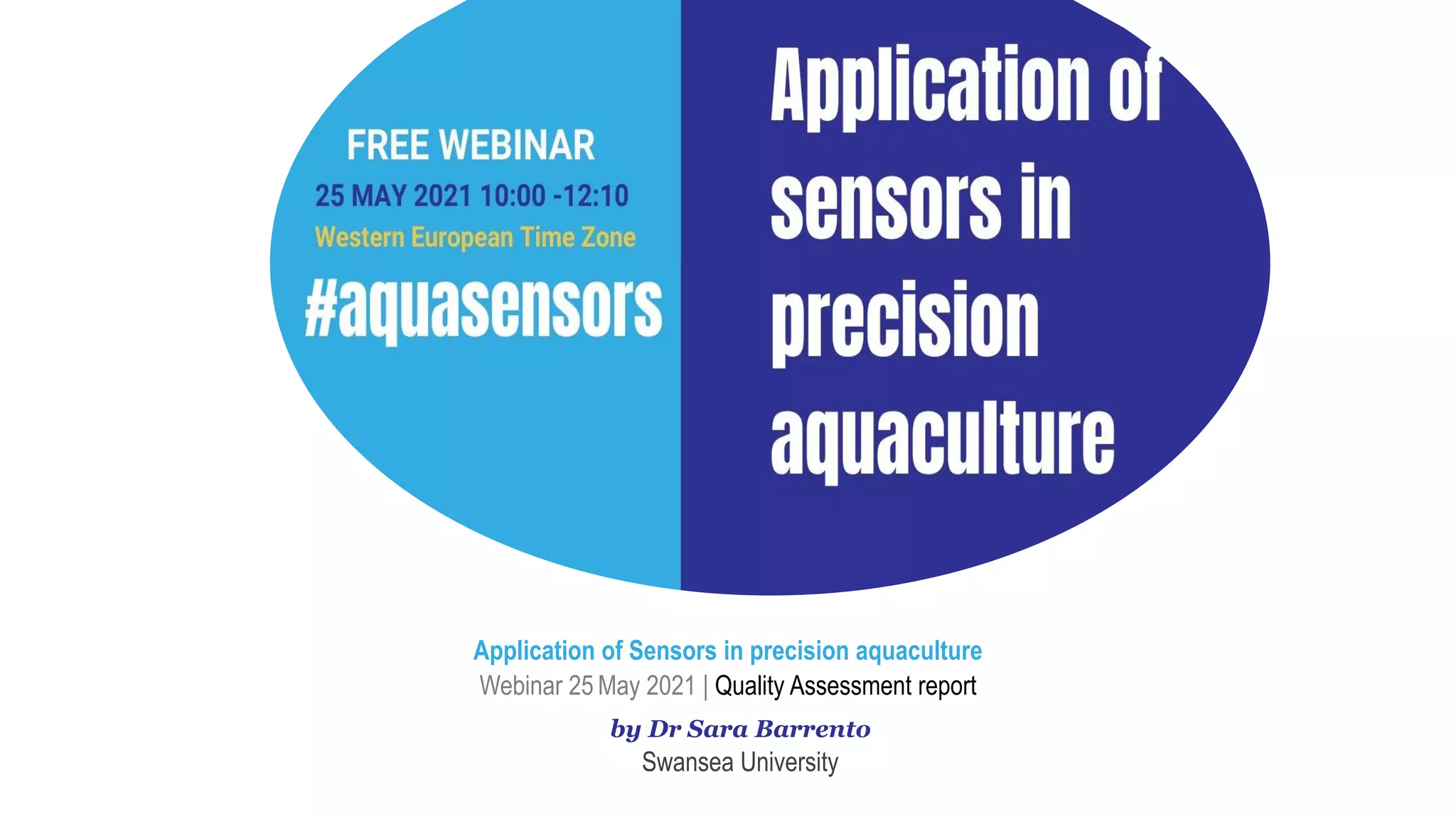
Application of Sensors in precision aquaculture
Webinar 25 May 2021 | Quality Assessment report
by Dr Sara Barrento
Swansea University
THE SYMPOSIUM ON THE APPLICATION OF SENSORS IN
PRECISION AQUACULTURE #aquasensors
#aquasensors
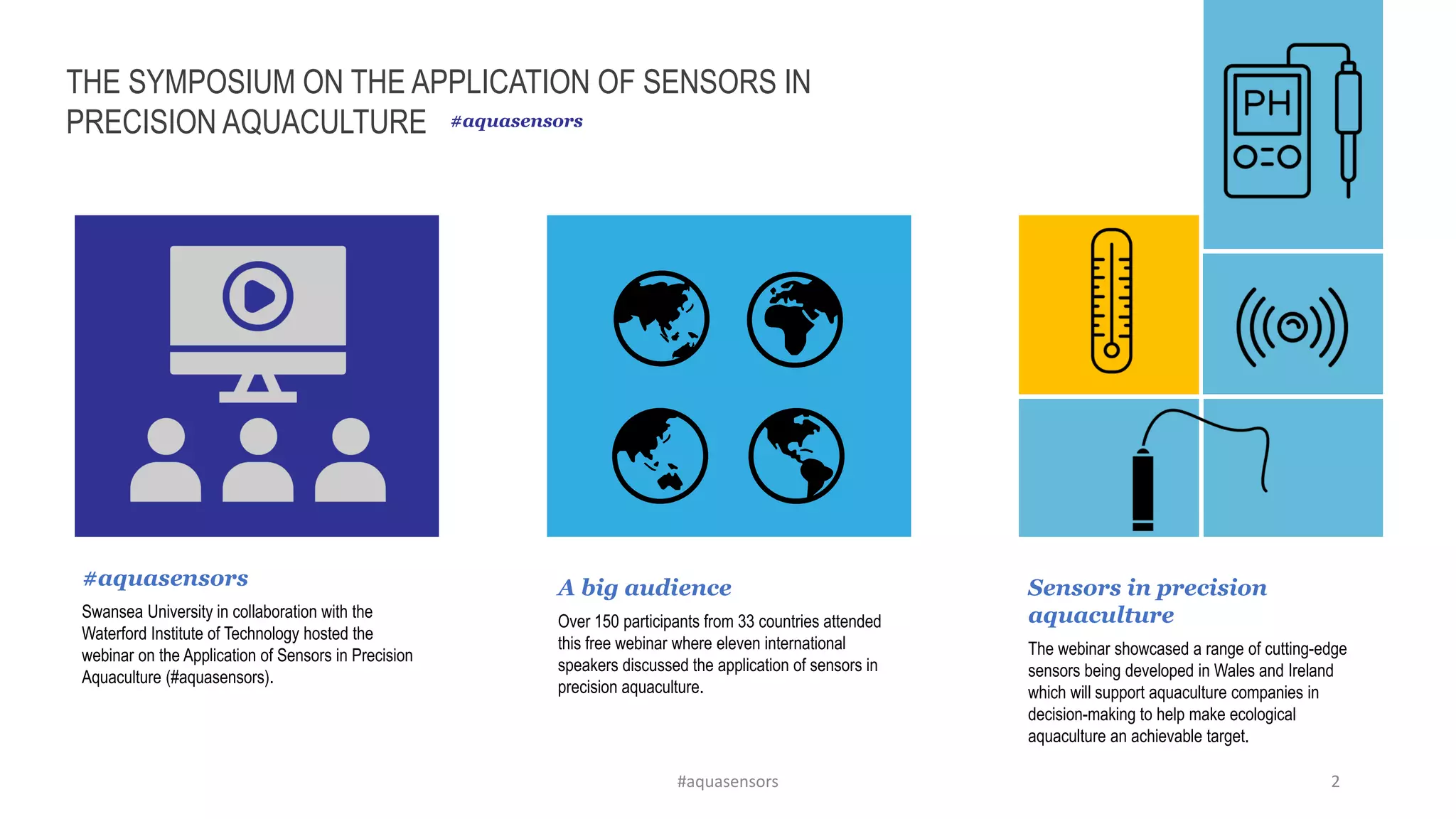
Swansea University in collaboration with the
Waterford Institute of Technology hosted the
webinar on the Application of Sensors in Precision
Aquaculture (#aquasensors).
A big audience
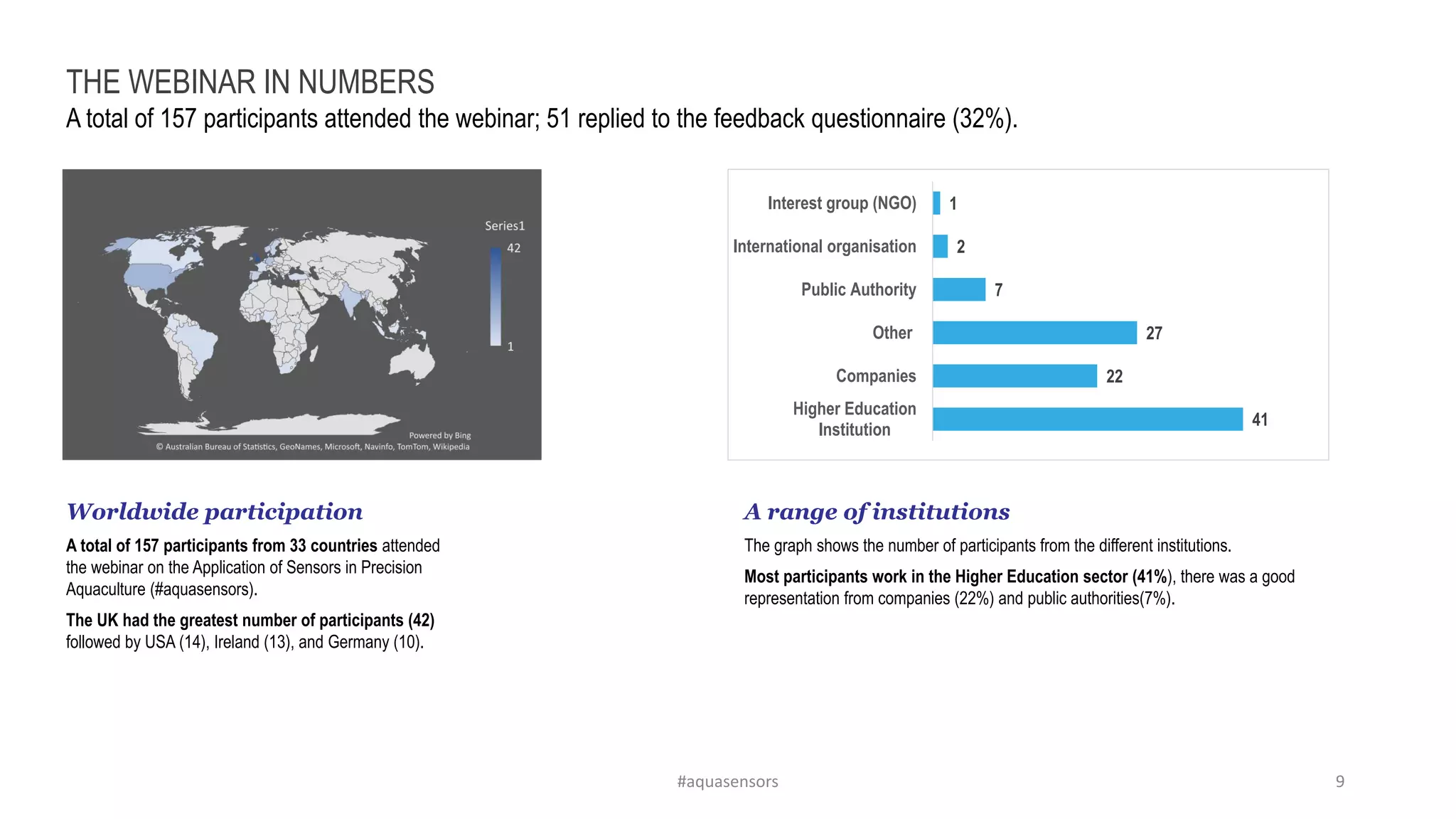
Over 150 participants from 33 countries attended
this free webinar where eleven international
speakers discussed the application of sensors in
precision aquaculture.
Sensors in precision
aquaculture
The webinar showcased a range of cutting-edge
sensors being developed in Wales and Ireland
which will support aquaculture companies in
decision-making to help make ecological
aquaculture an achievable target.
#aquasensors 2
EVENT ORGANIZATION AND
COMMUNICATION CAMPAIGN
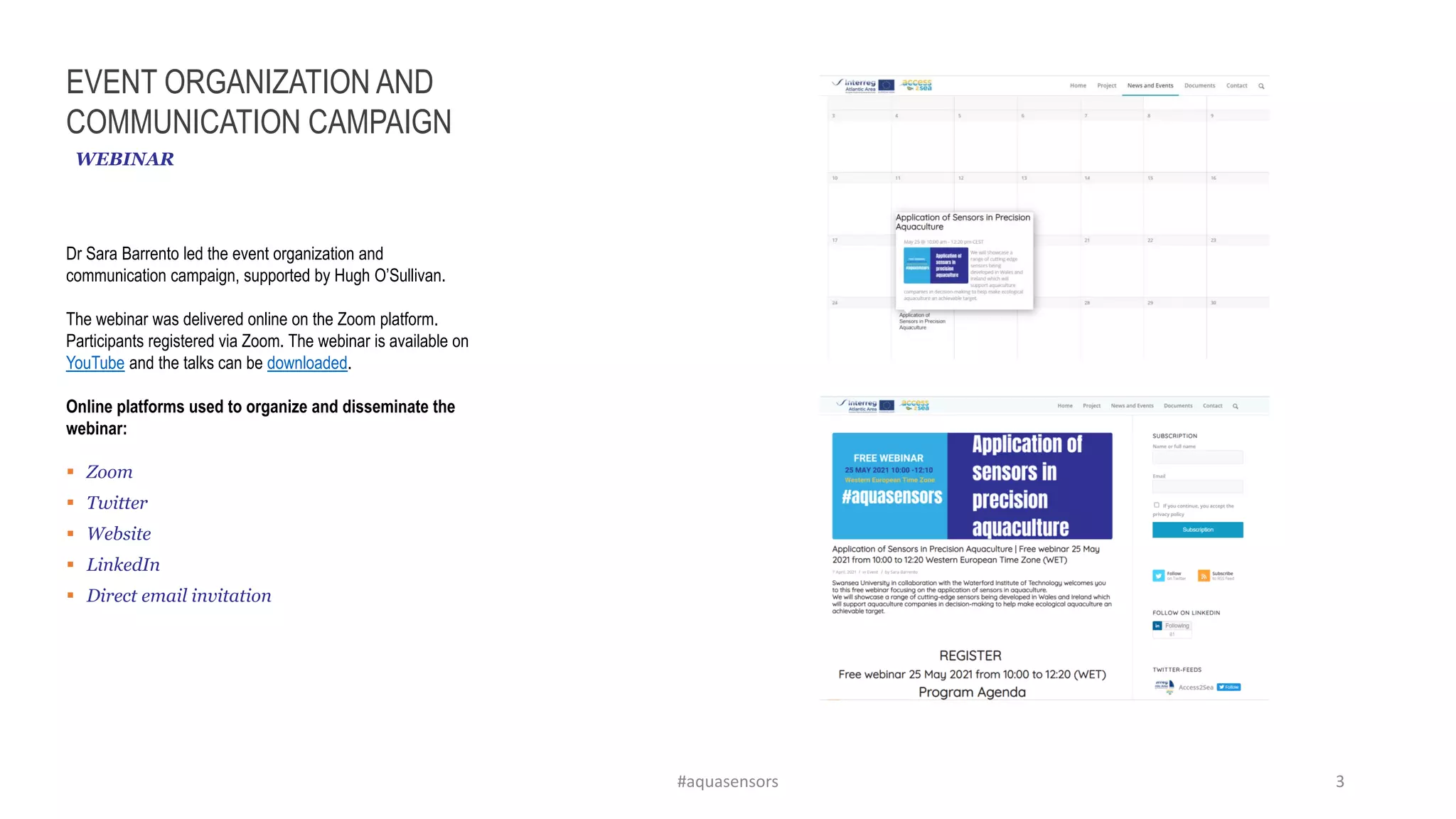
Dr Sara Barrento led the event organization and
communication campaign, supported by Hugh O’Sullivan.
The webinar was delivered online on the Zoom platform.
Participants registered via Zoom. The webinar is available on
YouTube and the talks can be downloaded.
Online platforms used to organize and disseminate the
webinar:
▪ Zoom
▪ Twitter
▪ Website
▪ LinkedIn
▪ Direct email invitation
WEBINAR
#aquasensors 3
PRECISION AQUACULTURE
#aquasensors 4
SPEAKERS PRESENTATION OVERVIEW
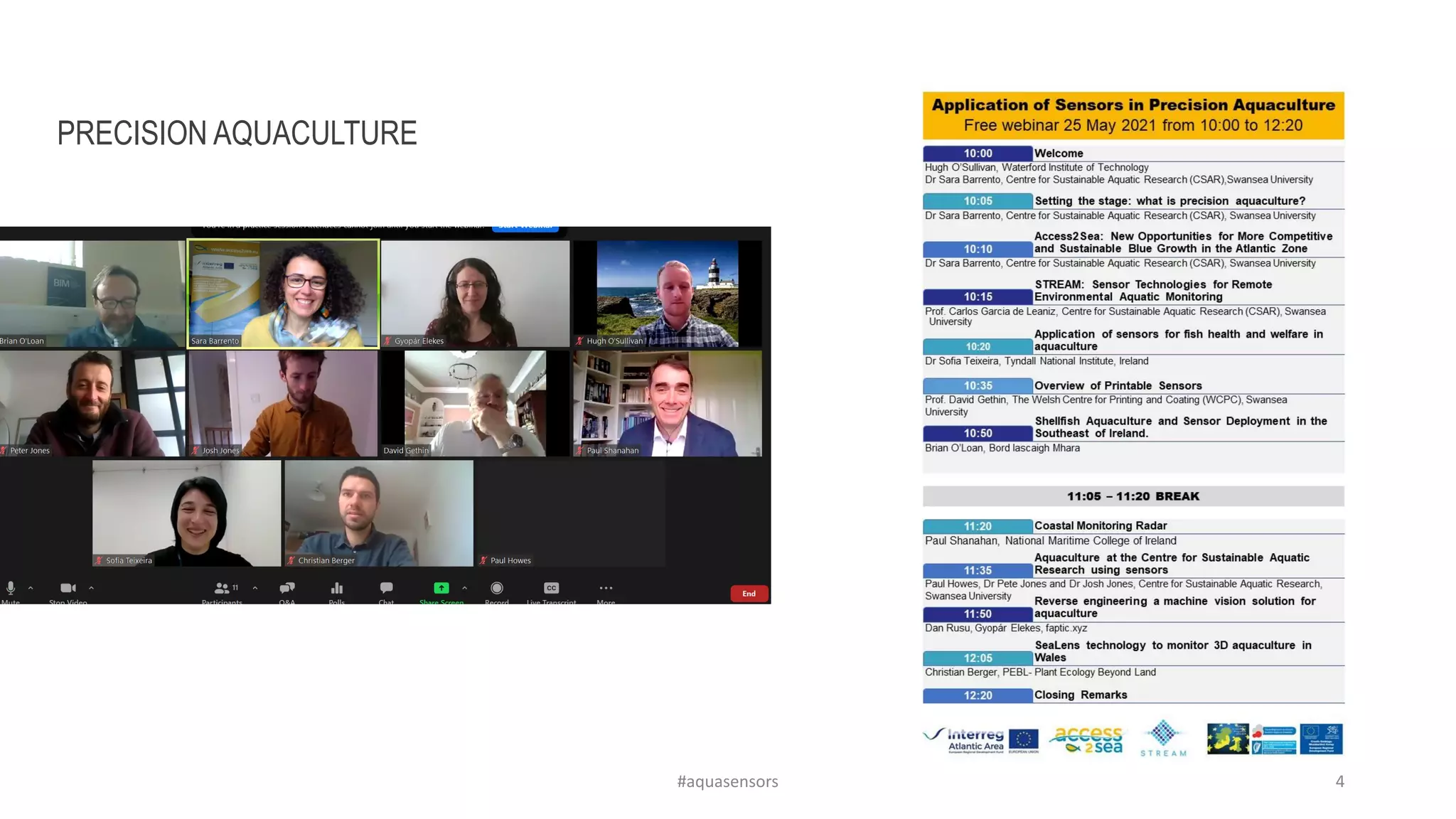
Eleven speakers – eleven views
“The webinar was well organised.
congrats to the team.”
Feedback from participant
#aquasensors 5
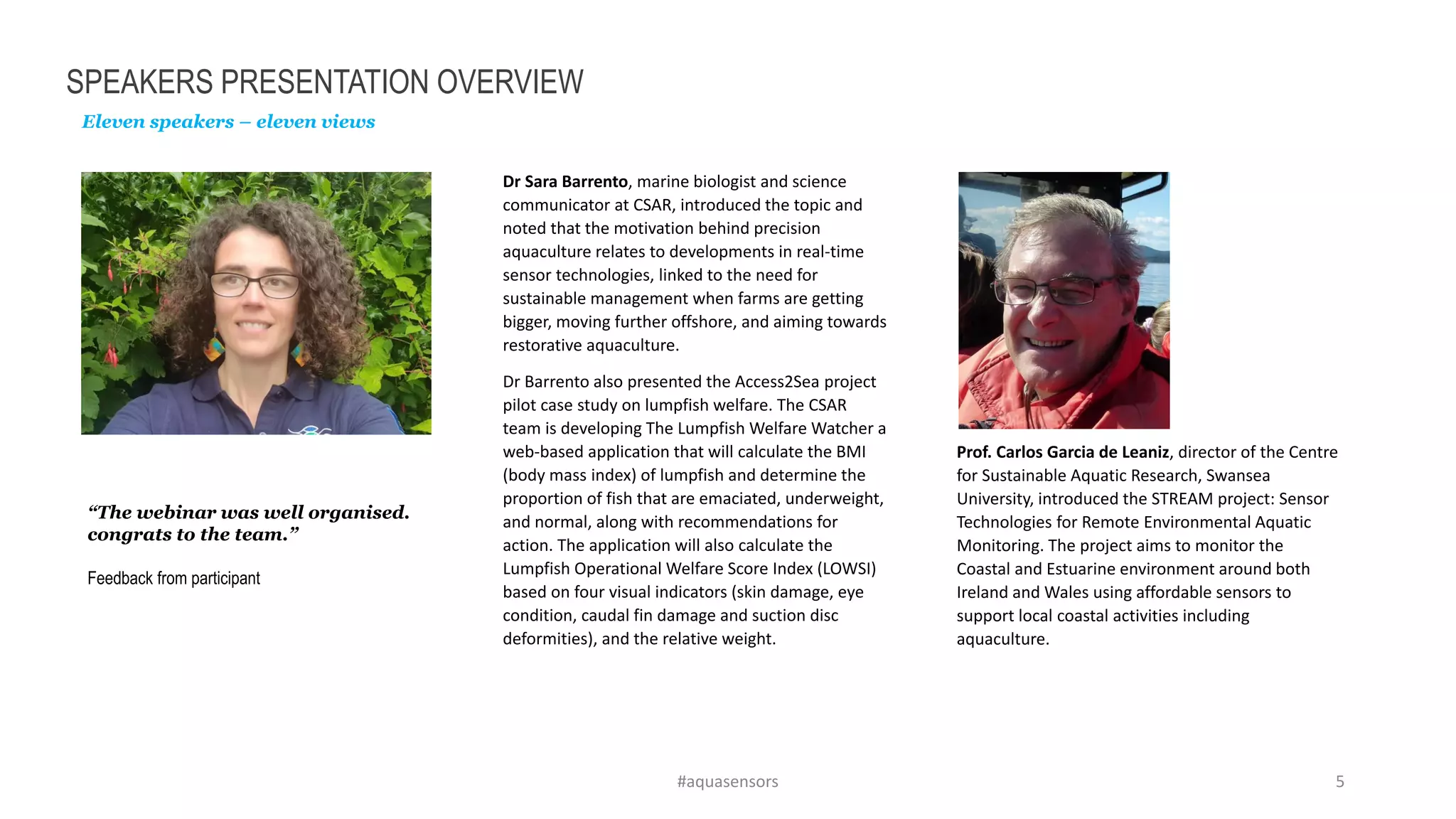
Dr Sara Barrento, marine biologist and science
communicator at CSAR, introduced the topic and
noted that the motivation behind precision
aquaculture relates to developments in real-time
sensor technologies, linked to the need for
sustainable management when farms are getting
bigger, moving further offshore, and aiming towards
restorative aquaculture.
Dr Barrento also presented the Access2Sea project
pilot case study on lumpfish welfare. The CSAR
team is developing The Lumpfish Welfare Watcher a
web-based application that will calculate the BMI
(body mass index) of lumpfish and determine the
proportion of fish that are emaciated, underweight,
and normal, along with recommendations for
action. The application will also calculate the
Lumpfish Operational Welfare Score Index (LOWSI)
based on four visual indicators (skin damage, eye
condition, caudal fin damage and suction disc
deformities), and the relative weight.
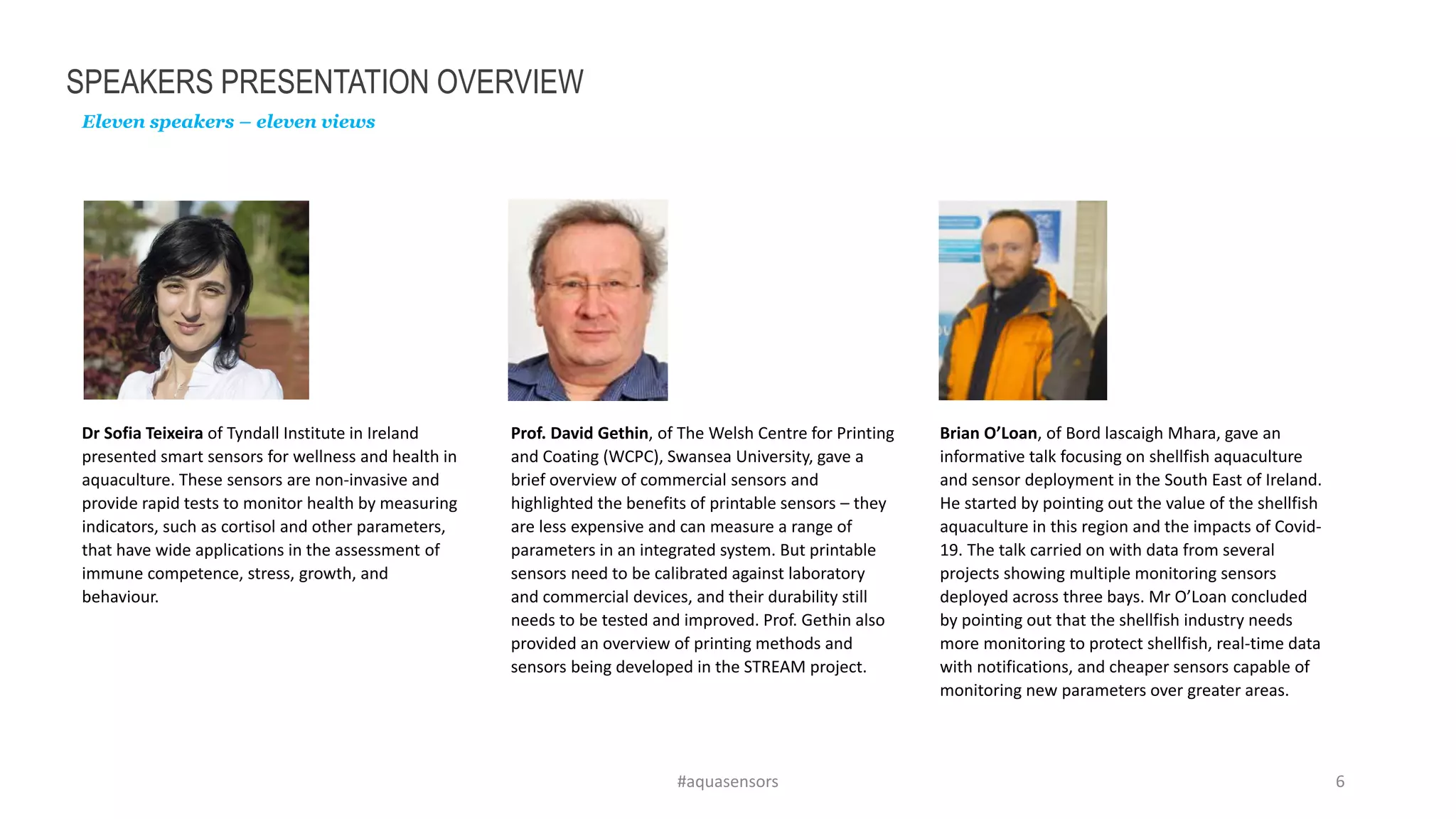
Prof. Carlos Garcia de Leaniz, director of the Centre
for Sustainable Aquatic Research, Swansea
University, introduced the STREAM project: Sensor
Technologies for Remote Environmental Aquatic
Monitoring. The project aims to monitor the
Coastal and Estuarine environment around both
Ireland and Wales using affordable sensors to
support local coastal activities including
aquaculture.
SPEAKERS PRESENTATION OVERVIEW
Eleven speakers – eleven views
#aquasensors 6
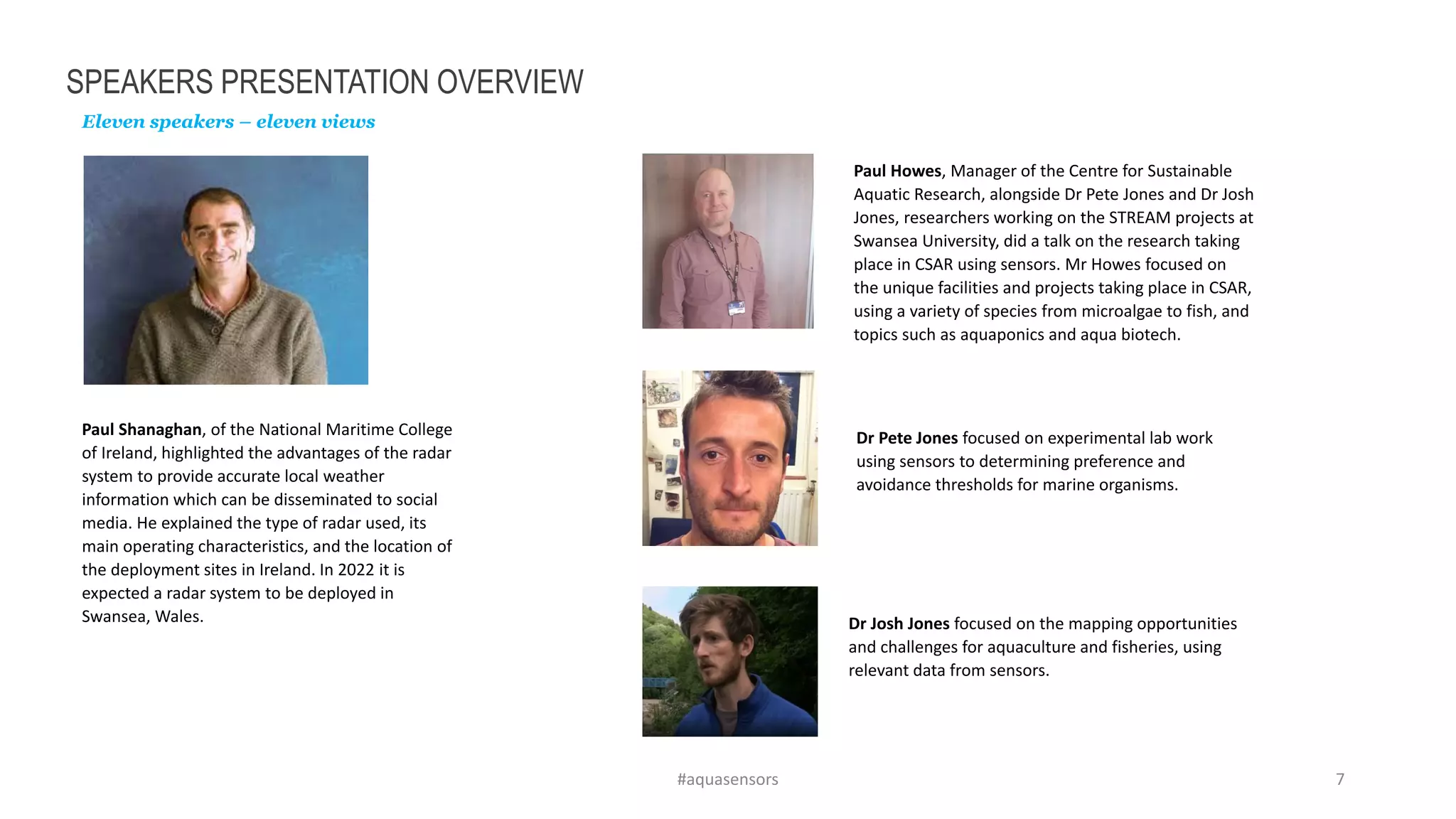
Dr Sofia Teixeira of Tyndall Institute in Ireland
presented smart sensors for wellness and health in
aquaculture. These sensors are non-invasive and
provide rapid tests to monitor health by measuring
indicators, such as cortisol and other parameters,
that have wide applications in the assessment of
immune competence, stress, growth, and
behaviour.
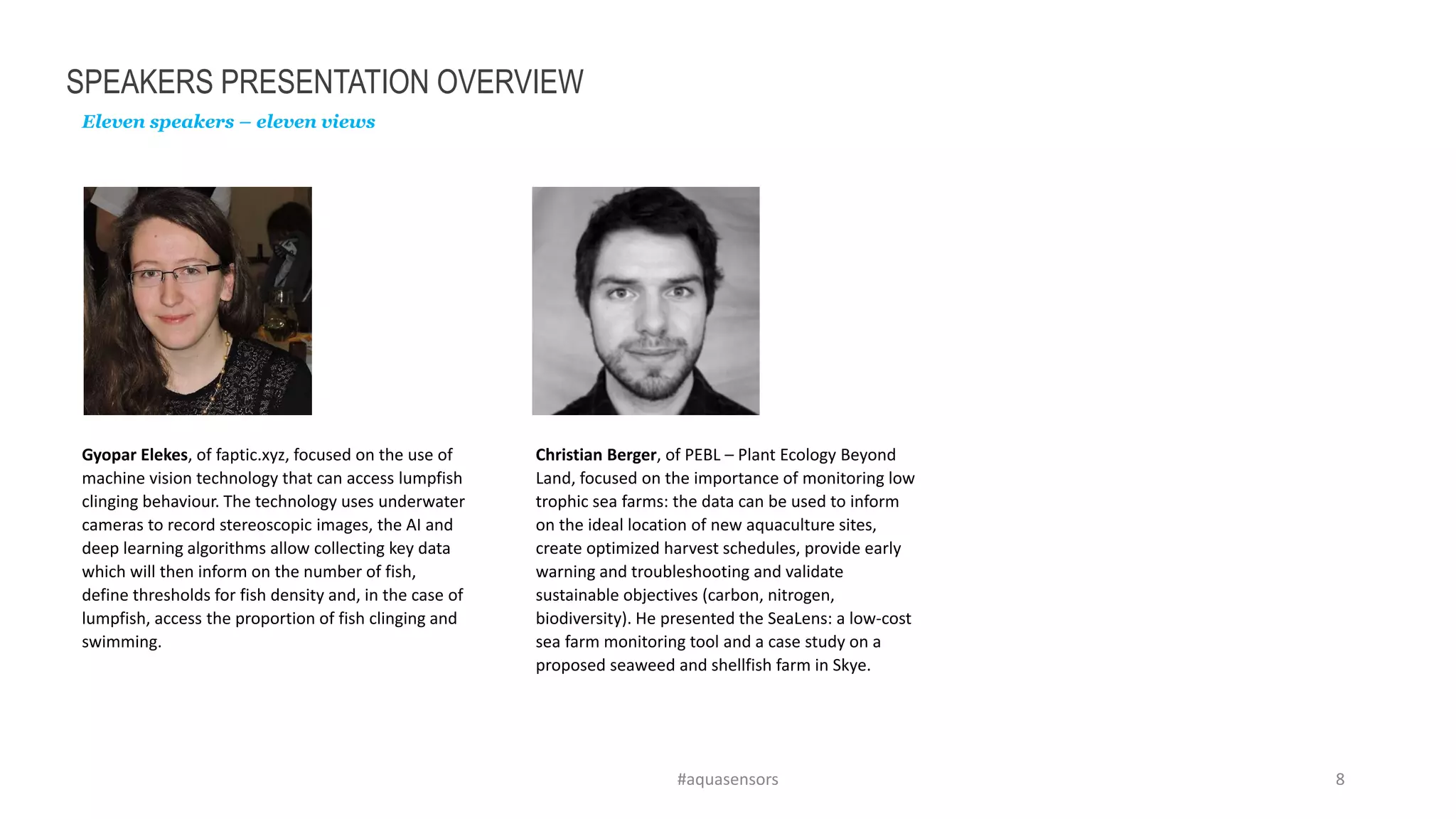
Prof. David Gethin, of The Welsh Centre for Printing
and Coating (WCPC), Swansea University, gave a
brief overview of commercial sensors and
highlighted the benefits of printable sensors – they
are less expensive and can measure a range of
parameters in an integrated system. But printable
sensors need to be calibrated against laboratory
and commercial devices, and their durability still
needs to be tested and improved. Prof. Gethin also
provided an overview of printing methods and
sensors being developed in the STREAM project.
Brian O’Loan, of Bord lascaigh Mhara, gave an
informative talk focusing on shellfish aquaculture
and sensor deployment in the South East of Ireland.
He started by pointing out the value of the shellfish
aquaculture in this region and the impacts of Covid-
19. The talk carried on with data from several
projects showing multiple monitoring sensors
deployed across three bays. Mr O’Loan concluded
by pointing out that the shellfish industry needs
more monitoring to protect shellfish, real-time data
with notifications, and cheaper sensors capable of
monitoring new parameters over greater areas.
SPEAKERS PRESENTATION OVERVIEW
Eleven speakers – eleven views
#aquasensors 7
Paul Shanaghan, of the National Maritime College
of Ireland, highlighted the advantages of the radar
system to provide accurate local weather
information which can be disseminated to social
media. He explained the type of radar used, its
main operating characteristics, and the location of
the deployment sites in Ireland. In 2022 it is
expected a radar system to be deployed in
Swansea, Wales.
Paul Howes, Manager of the Centre for Sustainable
Aquatic Research, alongside Dr Pete Jones and Dr Josh
Jones, researchers working on the STREAM projects at
Swansea University, did a talk on the research taking
place in CSAR using sensors. Mr Howes focused on
the unique facilities and projects taking place in CSAR,
using a variety of species from microalgae to fish, and
topics such as aquaponics and aqua biotech.
Dr Josh Jones focused on the mapping opportunities
and challenges for aquaculture and fisheries, using
relevant data from sensors.
Dr Pete Jones focused on experimental lab work
using sensors to determining preference and
avoidance thresholds for marine organisms.
SPEAKERS PRESENTATION OVERVIEW
Eleven speakers – eleven views
#aquasensors 8
Gyopar Elekes, of faptic.xyz, focused on the use of
machine vision technology that can access lumpfish
clinging behaviour. The technology uses underwater
cameras to record stereoscopic images, the AI and
deep learning algorithms allow collecting key data
which will then inform on the number of fish,
define thresholds for fish density and, in the case of
lumpfish, access the proportion of fish clinging and
swimming.
Christian Berger, of PEBL – Plant Ecology Beyond
Land, focused on the importance of monitoring low
trophic sea farms: the data can be used to inform
on the ideal location of new aquaculture sites,
create optimized harvest schedules, provide early
warning and troubleshooting and validate
sustainable objectives (carbon, nitrogen,
biodiversity). He presented the SeaLens: a low-cost
sea farm monitoring tool and a case study on a
proposed seaweed and shellfish farm in Skye.
THE WEBINAR IN NUMBERS
A total of 157 participants attended the webinar; 51 replied to the feedback questionnaire (32%).
Worldwide participation
A total of 157 participants from 33 countries attended
the webinar on the Application of Sensors in Precision
Aquaculture (#aquasensors).
The UK had the greatest number of participants (42)
followed by USA (14), Ireland (13), and Germany (10).
A range of institutions
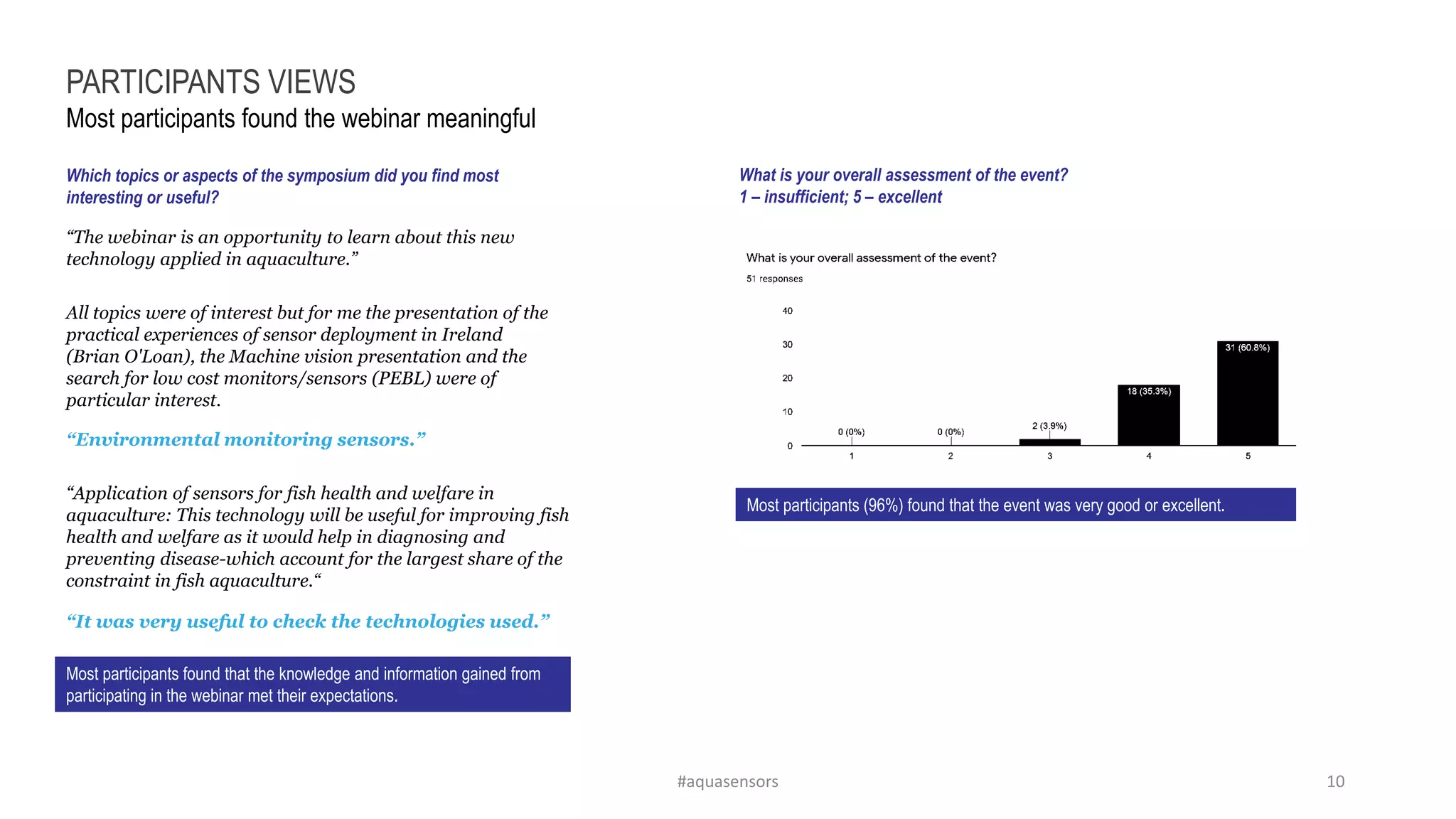
The graph shows the number of participants from the different institutions.
Most participants work in the Higher Education sector (41%), there was a good
representation from companies (22%) and public authorities(7%).
#aquasensors 9
41
22
27
7
2
1
Higher Education
Institution
Companies
Other
Public Authority
International organisation
Interest group (NGO)
PARTICIPANTS VIEWS
Most participants found the webinar meaningful
“Environmental monitoring sensors.”
“Application of sensors for fish health and welfare in
aquaculture: This technology will be useful for improving fish
health and welfare as it would help in diagnosing and
preventing disease-which account for the largest share of the
constraint in fish aquaculture.“
Which topics or aspects of the symposium did you find most
interesting or useful?
“It was very useful to check the technologies used.”
“The webinar is an opportunity to learn about this new
technology applied in aquaculture.”
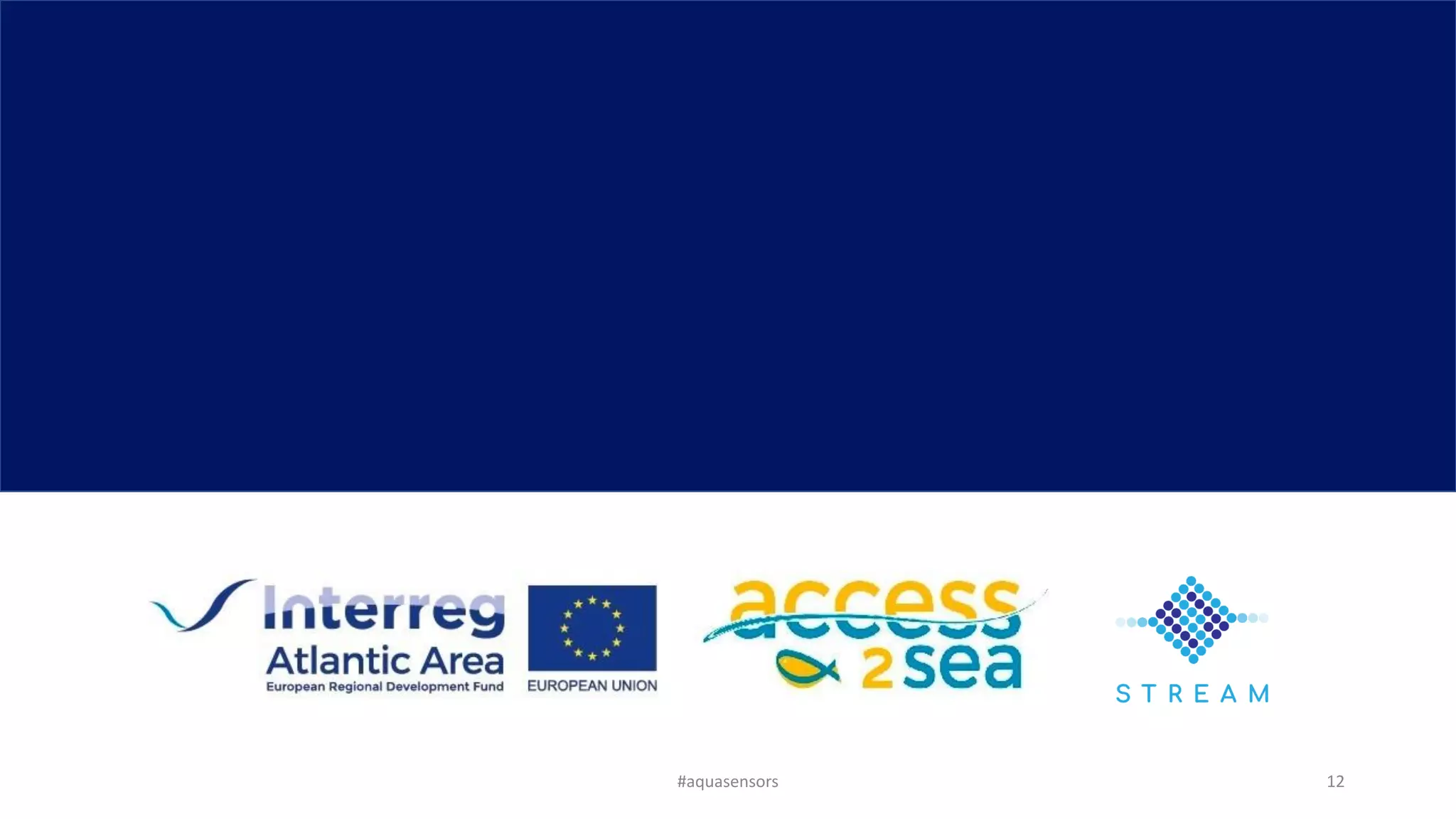
Most participants found that the knowledge and information gained from
participating in the webinar met their expectations.
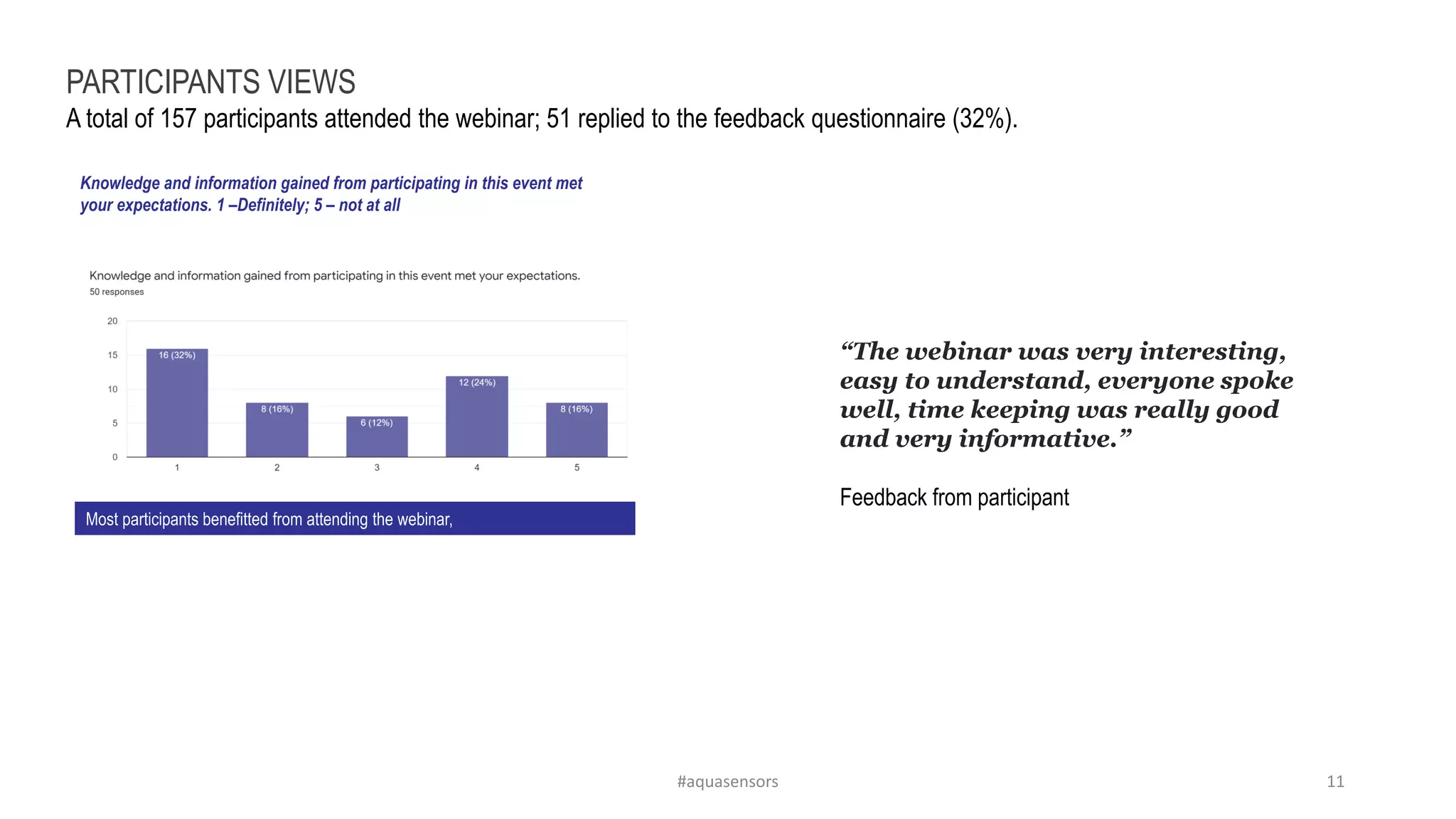
Most participants (96%) found that the event was very good or excellent.
#aquasensors 10
All topics were of interest but for me the presentation of the
practical experiences of sensor deployment in Ireland
(Brian O'Loan), the Machine vision presentation and the
search for low cost monitors/sensors (PEBL) were of
particular interest.
What is your overall assessment of the event?
1 – insufficient; 5 – excellent
PARTICIPANTS VIEWS
A total of 157 participants attended the webinar; 51 replied to the feedback questionnaire (32%).
#aquasensors 11
Knowledge and information gained from participating in this event met
your expectations. 1 –Definitely; 5 – not at all
Most participants benefitted from attending the webinar,
“The webinar was very interesting,
easy to understand, everyone spoke
well, time keeping was really good
and very informative.”
Feedback from participant
#aquasensors 12

Application of Sensors in Precision Aquaculture - quality assessment report

  • 1.
    Application of Sensorsin precision aquaculture Webinar 25 May 2021 | Quality Assessment report by Dr Sara Barrento Swansea University
  • 2.
    THE SYMPOSIUM ONTHE APPLICATION OF SENSORS IN PRECISION AQUACULTURE #aquasensors #aquasensors Swansea University in collaboration with the Waterford Institute of Technology hosted the webinar on the Application of Sensors in Precision Aquaculture (#aquasensors). A big audience Over 150 participants from 33 countries attended this free webinar where eleven international speakers discussed the application of sensors in precision aquaculture. Sensors in precision aquaculture The webinar showcased a range of cutting-edge sensors being developed in Wales and Ireland which will support aquaculture companies in decision-making to help make ecological aquaculture an achievable target. #aquasensors 2
  • 3.
    EVENT ORGANIZATION AND COMMUNICATIONCAMPAIGN Dr Sara Barrento led the event organization and communication campaign, supported by Hugh O’Sullivan. The webinar was delivered online on the Zoom platform. Participants registered via Zoom. The webinar is available on YouTube and the talks can be downloaded. Online platforms used to organize and disseminate the webinar: ▪ Zoom ▪ Twitter ▪ Website ▪ LinkedIn ▪ Direct email invitation WEBINAR #aquasensors 3
  • 4.
  • 5.
    SPEAKERS PRESENTATION OVERVIEW Elevenspeakers – eleven views “The webinar was well organised. congrats to the team.” Feedback from participant #aquasensors 5 Dr Sara Barrento, marine biologist and science communicator at CSAR, introduced the topic and noted that the motivation behind precision aquaculture relates to developments in real-time sensor technologies, linked to the need for sustainable management when farms are getting bigger, moving further offshore, and aiming towards restorative aquaculture. Dr Barrento also presented the Access2Sea project pilot case study on lumpfish welfare. The CSAR team is developing The Lumpfish Welfare Watcher a web-based application that will calculate the BMI (body mass index) of lumpfish and determine the proportion of fish that are emaciated, underweight, and normal, along with recommendations for action. The application will also calculate the Lumpfish Operational Welfare Score Index (LOWSI) based on four visual indicators (skin damage, eye condition, caudal fin damage and suction disc deformities), and the relative weight. Prof. Carlos Garcia de Leaniz, director of the Centre for Sustainable Aquatic Research, Swansea University, introduced the STREAM project: Sensor Technologies for Remote Environmental Aquatic Monitoring. The project aims to monitor the Coastal and Estuarine environment around both Ireland and Wales using affordable sensors to support local coastal activities including aquaculture.
  • 6.
    SPEAKERS PRESENTATION OVERVIEW Elevenspeakers – eleven views #aquasensors 6 Dr Sofia Teixeira of Tyndall Institute in Ireland presented smart sensors for wellness and health in aquaculture. These sensors are non-invasive and provide rapid tests to monitor health by measuring indicators, such as cortisol and other parameters, that have wide applications in the assessment of immune competence, stress, growth, and behaviour. Prof. David Gethin, of The Welsh Centre for Printing and Coating (WCPC), Swansea University, gave a brief overview of commercial sensors and highlighted the benefits of printable sensors – they are less expensive and can measure a range of parameters in an integrated system. But printable sensors need to be calibrated against laboratory and commercial devices, and their durability still needs to be tested and improved. Prof. Gethin also provided an overview of printing methods and sensors being developed in the STREAM project. Brian O’Loan, of Bord lascaigh Mhara, gave an informative talk focusing on shellfish aquaculture and sensor deployment in the South East of Ireland. He started by pointing out the value of the shellfish aquaculture in this region and the impacts of Covid- 19. The talk carried on with data from several projects showing multiple monitoring sensors deployed across three bays. Mr O’Loan concluded by pointing out that the shellfish industry needs more monitoring to protect shellfish, real-time data with notifications, and cheaper sensors capable of monitoring new parameters over greater areas.
  • 7.
    SPEAKERS PRESENTATION OVERVIEW Elevenspeakers – eleven views #aquasensors 7 Paul Shanaghan, of the National Maritime College of Ireland, highlighted the advantages of the radar system to provide accurate local weather information which can be disseminated to social media. He explained the type of radar used, its main operating characteristics, and the location of the deployment sites in Ireland. In 2022 it is expected a radar system to be deployed in Swansea, Wales. Paul Howes, Manager of the Centre for Sustainable Aquatic Research, alongside Dr Pete Jones and Dr Josh Jones, researchers working on the STREAM projects at Swansea University, did a talk on the research taking place in CSAR using sensors. Mr Howes focused on the unique facilities and projects taking place in CSAR, using a variety of species from microalgae to fish, and topics such as aquaponics and aqua biotech. Dr Josh Jones focused on the mapping opportunities and challenges for aquaculture and fisheries, using relevant data from sensors. Dr Pete Jones focused on experimental lab work using sensors to determining preference and avoidance thresholds for marine organisms.
  • 8.
    SPEAKERS PRESENTATION OVERVIEW Elevenspeakers – eleven views #aquasensors 8 Gyopar Elekes, of faptic.xyz, focused on the use of machine vision technology that can access lumpfish clinging behaviour. The technology uses underwater cameras to record stereoscopic images, the AI and deep learning algorithms allow collecting key data which will then inform on the number of fish, define thresholds for fish density and, in the case of lumpfish, access the proportion of fish clinging and swimming. Christian Berger, of PEBL – Plant Ecology Beyond Land, focused on the importance of monitoring low trophic sea farms: the data can be used to inform on the ideal location of new aquaculture sites, create optimized harvest schedules, provide early warning and troubleshooting and validate sustainable objectives (carbon, nitrogen, biodiversity). He presented the SeaLens: a low-cost sea farm monitoring tool and a case study on a proposed seaweed and shellfish farm in Skye.
  • 9.
    THE WEBINAR INNUMBERS A total of 157 participants attended the webinar; 51 replied to the feedback questionnaire (32%). Worldwide participation A total of 157 participants from 33 countries attended the webinar on the Application of Sensors in Precision Aquaculture (#aquasensors). The UK had the greatest number of participants (42) followed by USA (14), Ireland (13), and Germany (10). A range of institutions The graph shows the number of participants from the different institutions. Most participants work in the Higher Education sector (41%), there was a good representation from companies (22%) and public authorities(7%). #aquasensors 9 41 22 27 7 2 1 Higher Education Institution Companies Other Public Authority International organisation Interest group (NGO)
  • 10.
    PARTICIPANTS VIEWS Most participantsfound the webinar meaningful “Environmental monitoring sensors.” “Application of sensors for fish health and welfare in aquaculture: This technology will be useful for improving fish health and welfare as it would help in diagnosing and preventing disease-which account for the largest share of the constraint in fish aquaculture.“ Which topics or aspects of the symposium did you find most interesting or useful? “It was very useful to check the technologies used.” “The webinar is an opportunity to learn about this new technology applied in aquaculture.” Most participants found that the knowledge and information gained from participating in the webinar met their expectations. Most participants (96%) found that the event was very good or excellent. #aquasensors 10 All topics were of interest but for me the presentation of the practical experiences of sensor deployment in Ireland (Brian O'Loan), the Machine vision presentation and the search for low cost monitors/sensors (PEBL) were of particular interest. What is your overall assessment of the event? 1 – insufficient; 5 – excellent
  • 11.
    PARTICIPANTS VIEWS A totalof 157 participants attended the webinar; 51 replied to the feedback questionnaire (32%). #aquasensors 11 Knowledge and information gained from participating in this event met your expectations. 1 –Definitely; 5 – not at all Most participants benefitted from attending the webinar, “The webinar was very interesting, easy to understand, everyone spoke well, time keeping was really good and very informative.” Feedback from participant
  • 12.