0

Venezuela: Options for the Future
The Economy:
How to Get Sustainable and Equitable Growth?

Miguel Angel Santos
miguel_santos@hks14.harvard.edu
David Rockefeller Center for Latin American Studies
November, 2012

Miguel Ángel Santos
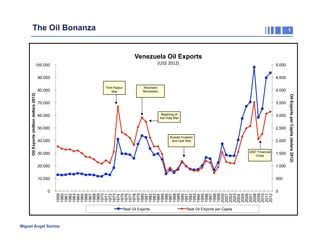
The Oil Bonanza

1

Venezuela Oil Exports
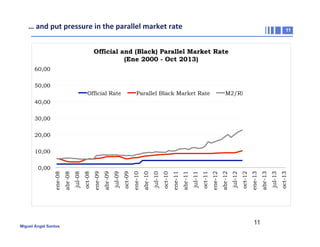
(US$	
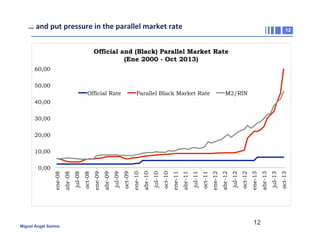
  2012)	
  

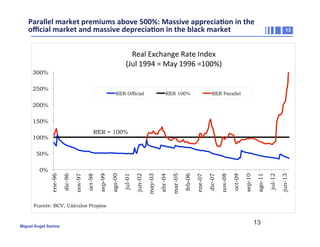
100.000

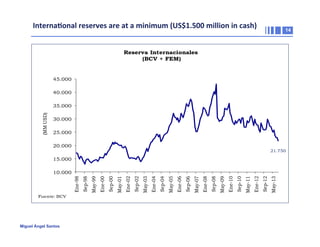
5.000

90.000

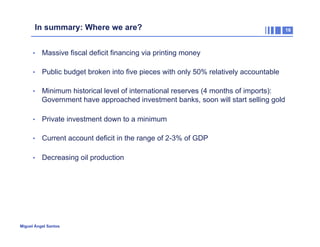
4.500
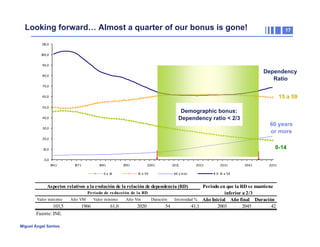
Yom Kippur
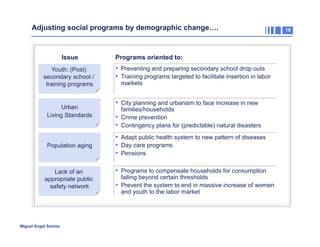
War

Khomeini
Revolution

4.000

70.000

3.500
Begining of
Iran-Iraq War

60.000

3.000

50.000

2.500
Kuwait Invasion
and Gulf War

40.000

2.000
2007 Financial
Crisis

30.000

1.500
1.000

10.000

500

0

1959
1960
1961
1962
1963
1964
1965
1966
1967
1968
1969
1970
1971
1972
1973
1974
1975
1976
1977
1978
1979
1980
1981
1982
1983
1984
1985
1986
1987
1988
1989
1990
1991
1992
1993
1994
1995
1996
1997
1998
1999
2000
2001
2002
2003
2004
2005
2006
2007
2008
2009
2010
2011
2012

20.000

Real Oil Exports

Miguel Ángel Santos

Real Oil EXports per Capita

0

Oil Exports per Capita (dolars 2012)

Oil Exports (million dollars 2012)

80.000
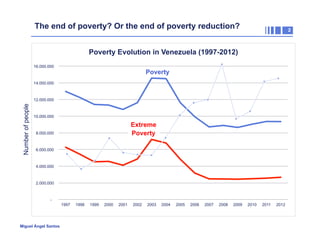
The end of poverty? Or the end of poverty reduction?

2

Poverty Evolution in Venezuela (1997-2012)
16.000.000

Poverty

14.000.000

Number of people

12.000.000

10.000.000

Extreme
Poverty

8.000.000

6.000.000

4.000.000

2.000.000

1997

Miguel Ángel Santos

1998

1999

2000

2001

2002

2003

2004

2005

2006

2007

2008

2009

2010

2011

2012
Growth and Inequality or Consumption and Inequality?

3

GDP and Consumption per Capita (1998=100) and
Gini Coefficient (1980-2012)
1,80

0,35
0,37

1,60

60.0%
CAGR:
3.2%

0,39
0,41

1,40

0,43
1,20

0,45
0,47

1,00

0,49
0,51

0,80

0,53
0,60

1995

1996

1997

1998

1999

2000

2001

2002

GDP PC 1998=100

Miguel Ángel Santos

2003

2004

2005

2006

2007

CON PC 1998=100

2008

2009

Gini

2010

2011

2012

0,55

14.3%
CAGR:
0.8%
Boom in consumption was mirrored by a boom in imports

4

Venezuela: FOB Imports
(US$ 2012)

60.000

3.000

40.000

2.000

30.000

1.500

20.000

1.000

10.000

500

Miguel Ángel Santos

2012

2011

2010

2009

2008

2007

2006

Real Imports per Capita
2004

2003

2002

2001

2000

1999

1998

0

1997

Real Imports

2005

Imports FOB (milion dollars 2012)

2.500

0

Imports FOB per Cápita (dollars 2012)

50.000
Boom in consumption was mirrored by a boom in imports
0,7	
  

Imports/Household	
  Consump2on	
  
(measured	
  in	
  US$	
  2005)	
  

0,6	
  

0,5	
  

0,4	
  

0,3	
  

0,1	
  

1974	
  
1975	
  
1976	
  
1977	
  
1978	
  
1979	
  
1980	
  
1981	
  
1982	
  
1983	
  
1984	
  
1985	
  
1986	
  
1987	
  
1988	
  
1989	
  
1990	
  
1991	
  
1992	
  
1993	
  
1994	
  
1995	
  
1996	
  
1997	
  
1998	
  
1999	
  
2000	
  
2001	
  
2002	
  
2003	
  
2004	
  
2005	
  
2006	
  
2007	
  
2008	
  
2009	
  
2010	
  
2011	
  
2012	
  

0,2	
  

Average 1974-1998: 25%

Average 1999-2012: 44%
2006-2012: 51%
Imports/Household	
  ConsumpBon	
  

Fuente: World Development Indicators
Miguel Ángel Santos

5
Boom in public expenditure and imports exceeded the oil bonanza

6

Deuda Pública Externa
Foreign Public Debt
(USD Millones)

(US$ Million)

120.000

100.000

26.104

25.942

27.702

28.853

28.138

30.534

1999

2000

2001

2002

2003

2004

2005

98.011

85.304

106.048

29.067

1998

50.909

28.455

1997

38.681

28.705

20.000

26.598

40.000

67.449

60.000

105.779

80.000

2012

2013-II

0

Fuente: BCV
Miguel Ángel Santos

2006

2007

2008

2009

2010

2011
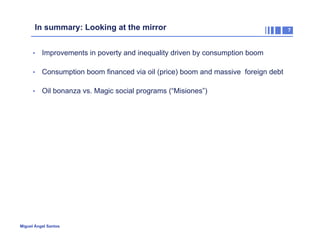
In summary: Looking at the mirror
•  Improvements in poverty and inequality driven by consumption boom
•  Consumption boom financed via oil (price) boom and massive foreign debt
•  Oil bonanza vs. Magic social programs (“Misiones”)

Miguel Ángel Santos

7
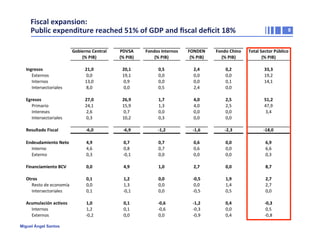
Fiscal	
  expansion:	
  
Public	
  expenditure	
  reached	
  51%	
  of	
  GDP	
  and	
  fiscal	
  deficit	
  18%	
  

Miguel Ángel Santos

8
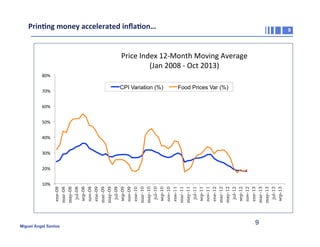
Prin2ng	
  money	
  accelerated	
  infla2on…	


9

Price	
  Index	
  12-­‐Month	
  Moving	
  Average	
  
(Jan	
  2008	
  -­‐	
  Oct	
  2013)	
  
80%	
  

CPI Variation (%)

70%	
  

Food Prices Var (%)

60%	
  
50%	
  
40%	
  
30%	
  

10%	
  

ene-08
mar-08
may-08
jul-08
sep-08
nov-08
ene-09
mar-09
may-09
jul-09
sep-09
nov-09
ene-10
mar-10
may-10
jul-10
sep-10
nov-10
ene-11
mar-11
may-11
jul-11
sep-11
nov-11
ene-12
mar-12
may-12
jul-12
sep-12
nov-12
ene-13
mar-13
may-13
jul-13
sep-13

20%	
  

Miguel Ángel Santos

9
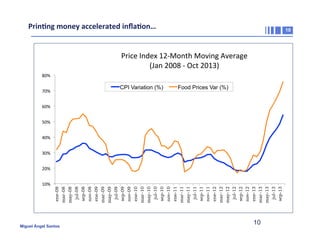
Prin2ng	
  money	
  accelerated	
  infla2on…	


10

Price	
  Index	
  12-­‐Month	
  Moving	
  Average	
  
(Jan	
  2008	
  -­‐	
  Oct	
  2013)	
  
80%	
  

CPI Variation (%)

70%	
  

Food Prices Var (%)

60%	
  
50%	
  
40%	
  
30%	
  

10%	
  

ene-08
mar-08
may-08
jul-08
sep-08
nov-08
ene-09
mar-09
may-09
jul-09
sep-09
nov-09
ene-10
mar-10
may-10
jul-10
sep-10
nov-10
ene-11
mar-11
may-11
jul-11
sep-11
nov-11
ene-12
mar-12
may-12
jul-12
sep-12
nov-12
ene-13
mar-13
may-13
jul-13
sep-13

20%	
  

Miguel Ángel Santos

10
…	
  and	
  put	
  pressure	
  in	
  the	
  parallel	
  market	
  rate	


11

Official and (Black) Parallel Market Rate
(Ene 2000 - Oct 2013)
60,00
50,00
Official Rate

Parallel Black Market Rate

M2/RIN

40,00
30,00
20,00

Miguel Ángel Santos

11

oct-13

jul-13

abr-13

ene-13

oct-12

jul-12

abr-12

ene-12

oct-11

jul-11

abr-11

ene-11

oct-10

jul-10

abr-10

ene-10

oct-09

jul-09

abr-09

ene-09

oct-08

jul-08

abr-08

0,00

ene-08

10,00
…	
  and	
  put	
  pressure	
  in	
  the	
  parallel	
  market	
  rate	


12

Official and (Black) Parallel Market Rate
(Ene 2000 - Oct 2013)
60,00
50,00
Official Rate

Parallel Black Market Rate

M2/RIN

40,00
30,00
20,00

Miguel Ángel Santos

12

oct-13

jul-13

abr-13

ene-13

oct-12

jul-12

abr-12

ene-12

oct-11

jul-11

abr-11

ene-11

oct-10

jul-10

abr-10

ene-10

oct-09

jul-09

abr-09

ene-09

oct-08

jul-08

abr-08

0,00

ene-08

10,00
Parallel	
  market	
  premiums	
  above	
  500%:	
  Massive	
  apprecia2on	
  in	
  the	
  
official	
  market	
  and	
  massive	
  deprecia2on	
  in	
  the	
  black	
  market	
  

13

Real	
  Exchange	
  Rate	
  Index	
  
(Jul	
  1994	
  =	
  May	
  1996	
  =100%)	
  
300%
250%

RER Official

RER 100%

RER Parallel

200%
150%
RER = 100%

100%

Fuente: BCV, Cálculos Propios

Miguel Ángel Santos

13

jun-13

jul-12

ago-11

sep-10

oct-09

nov-08

dic-07

ene-07

feb-06

mar-05

abr-04

may-03

jun-02

jul-01

ago-00

sep-99

oct-98

nov-97

dic-96

0%

ene-96

50%
Interna2onal	
  reserves	
  are	
  at	
  a	
  minimum	
  (US$1.500	
  million	
  in	
  cash)	
  

14

Reserva Internacionales
(BCV + FEM)

45.000
40.000

(MM USD)

35.000
30.000
25.000
20.000

21.750

15.000

Fuente: BCV

Miguel Ángel Santos

May-13

Sep-12

Ene-12

May-11

Sep-10

Ene-10

May-09

Sep-08

Ene-08

May-07

Sep-06

Ene-06

May-05

Sep-04

Ene-04

May-03

Sep-02

Ene-02

May-01

Sep-00

Ene-00

May-99

Sep-98

Ene-98

10.000
Venezuela:	
  The	
  product	
  space	
  

Miguel Ángel Santos

15

15
In summary: Where we are?
•  Massive fiscal deficit financing via printing money
•  Public budget broken into five pieces with only 50% relatively accountable
•  Minimum historical level of international reserves (4 months of imports):

Government have approached investment banks, soon will start selling gold
•  Private investment down to a minimum
•  Current account deficit in the range of 2-3% of GDP
•  Decreasing oil production

Miguel Ángel Santos

16
Looking forward… Almost a quarter of our bonus is gone!

17

110,0
100,0
90,0

Dependency
Ratio

80,0
70,0

15 a 59

60,0

Bono Demográfico

50,0

Demographic bonus:
Relación de dependencia
Dependency ratio < 2/3
inferior a 2/3

40,0

60 years
or more

30,0
20,0

0-14

10,0
0,0
1961

1971

1981
0	
  a 	
  14

1991

2001
15	
  a 	
  5 9

2011
60	
  y	
  m ás

Aspectos relativos a la evolución de la relación de dependencia (RD)

2021

2031

2041

2051

R D 	
  15	
  a 	
  5 9

Período en que la RD se mantiene
Período de reducción de la RD
inferior a 2/3
Valor máximo
Año VM
Valor mínimo
Año Vm
Duración
Intensidad % Año Inicial Año final Duración
103,5
1966
61,0
2020
54
41,1
2003
2045
42
Fuente: INE. Proyecciones de población. Cálculos de G. Zúñiga.
Miguel Ángel Santos
Adjusting social programs by demographic change….

Issue
Youth: (Post)
secondary school /
training programs

Urban
Living Standards

Population aging

Lack of an
appropriate public
safety network

Miguel Ángel Santos

Programs oriented to:

•  Preventing and preparing secondary school drop outs
•  Training programs targeted to facilitate insertion in labor
markets

•  City planning and urbanism to face increase in new
• 
• 

families/households
Crime prevention
Contingency plans for (predictable) natural disasters

•  Adapt public health system to new pattern of diseases
•  Day care programs
•  Pensions
•  Programs to compensate households for consumption
• 

falling beyond certain thresholds
Prevent the system to end in massive increase of women
and youth to the labor market

18
19

Thanks!

Miguel Ángel Santos
20

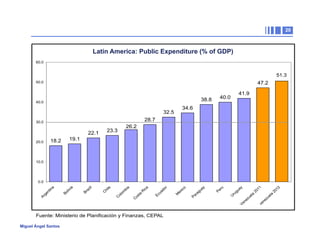
Venezuela(registra(así(el(gasto(público(más(alto(de(América(La:na(
Latin America: Public Expendituredel PIB)
Gasto Público Consolidado (% (% of GDP)
60.0

51.3
50.6

47.2

50.0

38.8

40.0

34.6

32.5
28.7

30.0

22.1
20.0

41.9

40.0

18.2

26.2

23.3

19.1

10.0

Fuente: Ministerio de Planificación y Finanzas, CEPAL
Miguel Ángel Santos

20
12

ne
z
ve

ez
ue

la

ue
la

20
11

gu
ay
Ve
n

U

ru

Pe
ru

ua
y
Pa
ra
g

ex
ic
o
M

r
ad
o

R
ta
os
C

Ec
u

ic
a

a
om
bi
ol
C

le
C
hi

zi
l
Br
a

Bo
liv
ia

Ar
g

en
t

in
a

0.0
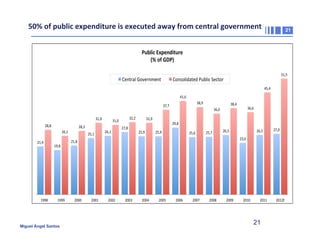
50%	
  of	
  public	
  expenditure	
  is	
  executed	
  away	
  from	
  central	
  government	
  

21

Public'Expenditure'
(%'of'GDP)''
Central%Government%

51,5%%

Consolidated%Public%Sector%
45,4%%
41,6%%
38,9%%

37,7%%
31,9%%
28,8%%
26,1%%
21,4%%

1998%

19,8%%

1999%

Miguel Ángel Santos

28,3%%
25,1%%

31,0%%
26,1%%

32,2%%
27,8%%

31,9%%
25,9%%

38,4%%
36,0%%

29,8%%
25,9%%

25,6%%

25,7%%

26,5%%

2001%

26,5%%

27,0%%

23,0%%

21,8%%

2000%

36,6%%

2002%

2003%

2004%

2005%

2006%

2007%

2008%

2009%

2010%

2011%

21

2012E%
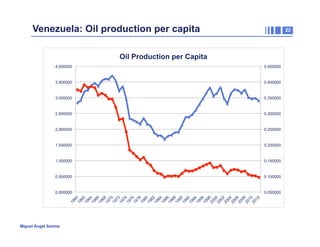
Venezuela: Oil production per capita

22

Oil Production per Capita
4,000000

0,450000

3,500000

0,400000

3,000000

0,350000

2,500000

0,300000

2,000000

0,250000

1,500000

0,200000

1,000000

0,150000

0,500000

0,100000

0,000000

0,050000

Miguel Ángel Santos

The Venezuelan Economy: How to achieve equitable growth (delivered at Rockefeller Center, Cambridge, MA 22/22/2013)

  • 1.
    0 Venezuela: Options forthe Future The Economy: How to Get Sustainable and Equitable Growth? Miguel Angel Santos miguel_santos@hks14.harvard.edu David Rockefeller Center for Latin American Studies November, 2012 Miguel Ángel Santos
  • 2.
    The Oil Bonanza 1 VenezuelaOil Exports (US$  2012)   100.000 5.000 90.000 4.500 Yom Kippur War Khomeini Revolution 4.000 70.000 3.500 Begining of Iran-Iraq War 60.000 3.000 50.000 2.500 Kuwait Invasion and Gulf War 40.000 2.000 2007 Financial Crisis 30.000 1.500 1.000 10.000 500 0 1959 1960 1961 1962 1963 1964 1965 1966 1967 1968 1969 1970 1971 1972 1973 1974 1975 1976 1977 1978 1979 1980 1981 1982 1983 1984 1985 1986 1987 1988 1989 1990 1991 1992 1993 1994 1995 1996 1997 1998 1999 2000 2001 2002 2003 2004 2005 2006 2007 2008 2009 2010 2011 2012 20.000 Real Oil Exports Miguel Ángel Santos Real Oil EXports per Capita 0 Oil Exports per Capita (dolars 2012) Oil Exports (million dollars 2012) 80.000
  • 3.
    The end ofpoverty? Or the end of poverty reduction? 2 Poverty Evolution in Venezuela (1997-2012) 16.000.000 Poverty 14.000.000 Number of people 12.000.000 10.000.000 Extreme Poverty 8.000.000 6.000.000 4.000.000 2.000.000 1997 Miguel Ángel Santos 1998 1999 2000 2001 2002 2003 2004 2005 2006 2007 2008 2009 2010 2011 2012
  • 4.
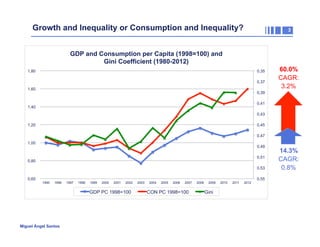
    Growth and Inequalityor Consumption and Inequality? 3 GDP and Consumption per Capita (1998=100) and Gini Coefficient (1980-2012) 1,80 0,35 0,37 1,60 60.0% CAGR: 3.2% 0,39 0,41 1,40 0,43 1,20 0,45 0,47 1,00 0,49 0,51 0,80 0,53 0,60 1995 1996 1997 1998 1999 2000 2001 2002 GDP PC 1998=100 Miguel Ángel Santos 2003 2004 2005 2006 2007 CON PC 1998=100 2008 2009 Gini 2010 2011 2012 0,55 14.3% CAGR: 0.8%
  • 5.
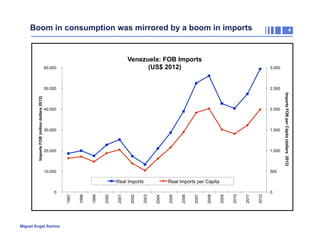
    Boom in consumptionwas mirrored by a boom in imports 4 Venezuela: FOB Imports (US$ 2012) 60.000 3.000 40.000 2.000 30.000 1.500 20.000 1.000 10.000 500 Miguel Ángel Santos 2012 2011 2010 2009 2008 2007 2006 Real Imports per Capita 2004 2003 2002 2001 2000 1999 1998 0 1997 Real Imports 2005 Imports FOB (milion dollars 2012) 2.500 0 Imports FOB per Cápita (dollars 2012) 50.000
  • 6.
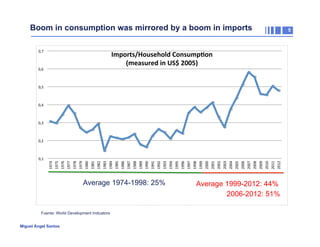
    Boom in consumptionwas mirrored by a boom in imports 0,7   Imports/Household  Consump2on   (measured  in  US$  2005)   0,6   0,5   0,4   0,3   0,1   1974   1975   1976   1977   1978   1979   1980   1981   1982   1983   1984   1985   1986   1987   1988   1989   1990   1991   1992   1993   1994   1995   1996   1997   1998   1999   2000   2001   2002   2003   2004   2005   2006   2007   2008   2009   2010   2011   2012   0,2   Average 1974-1998: 25% Average 1999-2012: 44% 2006-2012: 51% Imports/Household  ConsumpBon   Fuente: World Development Indicators Miguel Ángel Santos 5
  • 7.
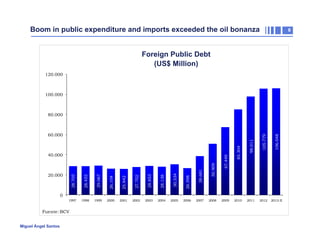
    Boom in publicexpenditure and imports exceeded the oil bonanza 6 Deuda Pública Externa Foreign Public Debt (USD Millones) (US$ Million) 120.000 100.000 26.104 25.942 27.702 28.853 28.138 30.534 1999 2000 2001 2002 2003 2004 2005 98.011 85.304 106.048 29.067 1998 50.909 28.455 1997 38.681 28.705 20.000 26.598 40.000 67.449 60.000 105.779 80.000 2012 2013-II 0 Fuente: BCV Miguel Ángel Santos 2006 2007 2008 2009 2010 2011
  • 8.
    In summary: Lookingat the mirror •  Improvements in poverty and inequality driven by consumption boom •  Consumption boom financed via oil (price) boom and massive foreign debt •  Oil bonanza vs. Magic social programs (“Misiones”) Miguel Ángel Santos 7
  • 9.
    Fiscal  expansion:   Public  expenditure  reached  51%  of  GDP  and  fiscal  deficit  18%   Miguel Ángel Santos 8
  • 10.
    Prin2ng  money  accelerated  infla2on…     9 Price  Index  12-­‐Month  Moving  Average   (Jan  2008  -­‐  Oct  2013)   80%   CPI Variation (%) 70%   Food Prices Var (%) 60%   50%   40%   30%   10%   ene-08 mar-08 may-08 jul-08 sep-08 nov-08 ene-09 mar-09 may-09 jul-09 sep-09 nov-09 ene-10 mar-10 may-10 jul-10 sep-10 nov-10 ene-11 mar-11 may-11 jul-11 sep-11 nov-11 ene-12 mar-12 may-12 jul-12 sep-12 nov-12 ene-13 mar-13 may-13 jul-13 sep-13 20%   Miguel Ángel Santos 9
  • 11.
    Prin2ng  money  accelerated  infla2on…     10 Price  Index  12-­‐Month  Moving  Average   (Jan  2008  -­‐  Oct  2013)   80%   CPI Variation (%) 70%   Food Prices Var (%) 60%   50%   40%   30%   10%   ene-08 mar-08 may-08 jul-08 sep-08 nov-08 ene-09 mar-09 may-09 jul-09 sep-09 nov-09 ene-10 mar-10 may-10 jul-10 sep-10 nov-10 ene-11 mar-11 may-11 jul-11 sep-11 nov-11 ene-12 mar-12 may-12 jul-12 sep-12 nov-12 ene-13 mar-13 may-13 jul-13 sep-13 20%   Miguel Ángel Santos 10
  • 12.
    …  and  put  pressure  in  the  parallel  market  rate     11 Official and (Black) Parallel Market Rate (Ene 2000 - Oct 2013) 60,00 50,00 Official Rate Parallel Black Market Rate M2/RIN 40,00 30,00 20,00 Miguel Ángel Santos 11 oct-13 jul-13 abr-13 ene-13 oct-12 jul-12 abr-12 ene-12 oct-11 jul-11 abr-11 ene-11 oct-10 jul-10 abr-10 ene-10 oct-09 jul-09 abr-09 ene-09 oct-08 jul-08 abr-08 0,00 ene-08 10,00
  • 13.
    …  and  put  pressure  in  the  parallel  market  rate     12 Official and (Black) Parallel Market Rate (Ene 2000 - Oct 2013) 60,00 50,00 Official Rate Parallel Black Market Rate M2/RIN 40,00 30,00 20,00 Miguel Ángel Santos 12 oct-13 jul-13 abr-13 ene-13 oct-12 jul-12 abr-12 ene-12 oct-11 jul-11 abr-11 ene-11 oct-10 jul-10 abr-10 ene-10 oct-09 jul-09 abr-09 ene-09 oct-08 jul-08 abr-08 0,00 ene-08 10,00
  • 14.
    Parallel  market  premiums  above  500%:  Massive  apprecia2on  in  the   official  market  and  massive  deprecia2on  in  the  black  market   13 Real  Exchange  Rate  Index   (Jul  1994  =  May  1996  =100%)   300% 250% RER Official RER 100% RER Parallel 200% 150% RER = 100% 100% Fuente: BCV, Cálculos Propios Miguel Ángel Santos 13 jun-13 jul-12 ago-11 sep-10 oct-09 nov-08 dic-07 ene-07 feb-06 mar-05 abr-04 may-03 jun-02 jul-01 ago-00 sep-99 oct-98 nov-97 dic-96 0% ene-96 50%
  • 15.
    Interna2onal  reserves  are  at  a  minimum  (US$1.500  million  in  cash)   14 Reserva Internacionales (BCV + FEM) 45.000 40.000 (MM USD) 35.000 30.000 25.000 20.000 21.750 15.000 Fuente: BCV Miguel Ángel Santos May-13 Sep-12 Ene-12 May-11 Sep-10 Ene-10 May-09 Sep-08 Ene-08 May-07 Sep-06 Ene-06 May-05 Sep-04 Ene-04 May-03 Sep-02 Ene-02 May-01 Sep-00 Ene-00 May-99 Sep-98 Ene-98 10.000
  • 16.
    Venezuela:  The  product  space   Miguel Ángel Santos 15 15
  • 17.
    In summary: Wherewe are? •  Massive fiscal deficit financing via printing money •  Public budget broken into five pieces with only 50% relatively accountable •  Minimum historical level of international reserves (4 months of imports): Government have approached investment banks, soon will start selling gold •  Private investment down to a minimum •  Current account deficit in the range of 2-3% of GDP •  Decreasing oil production Miguel Ángel Santos 16
  • 18.
    Looking forward… Almosta quarter of our bonus is gone! 17 110,0 100,0 90,0 Dependency Ratio 80,0 70,0 15 a 59 60,0 Bono Demográfico 50,0 Demographic bonus: Relación de dependencia Dependency ratio < 2/3 inferior a 2/3 40,0 60 years or more 30,0 20,0 0-14 10,0 0,0 1961 1971 1981 0  a  14 1991 2001 15  a  5 9 2011 60  y  m ás Aspectos relativos a la evolución de la relación de dependencia (RD) 2021 2031 2041 2051 R D  15  a  5 9 Período en que la RD se mantiene Período de reducción de la RD inferior a 2/3 Valor máximo Año VM Valor mínimo Año Vm Duración Intensidad % Año Inicial Año final Duración 103,5 1966 61,0 2020 54 41,1 2003 2045 42 Fuente: INE. Proyecciones de población. Cálculos de G. Zúñiga. Miguel Ángel Santos
  • 19.
    Adjusting social programsby demographic change…. Issue Youth: (Post) secondary school / training programs Urban Living Standards Population aging Lack of an appropriate public safety network Miguel Ángel Santos Programs oriented to: •  Preventing and preparing secondary school drop outs •  Training programs targeted to facilitate insertion in labor markets •  City planning and urbanism to face increase in new •  •  families/households Crime prevention Contingency plans for (predictable) natural disasters •  Adapt public health system to new pattern of diseases •  Day care programs •  Pensions •  Programs to compensate households for consumption •  falling beyond certain thresholds Prevent the system to end in massive increase of women and youth to the labor market 18
  • 20.
  • 21.
    20 Venezuela(registra(así(el(gasto(público(más(alto(de(América(La:na( Latin America: PublicExpendituredel PIB) Gasto Público Consolidado (% (% of GDP) 60.0 51.3 50.6 47.2 50.0 38.8 40.0 34.6 32.5 28.7 30.0 22.1 20.0 41.9 40.0 18.2 26.2 23.3 19.1 10.0 Fuente: Ministerio de Planificación y Finanzas, CEPAL Miguel Ángel Santos 20 12 ne z ve ez ue la ue la 20 11 gu ay Ve n U ru Pe ru ua y Pa ra g ex ic o M r ad o R ta os C Ec u ic a a om bi ol C le C hi zi l Br a Bo liv ia Ar g en t in a 0.0
  • 22.
    50%  of  public  expenditure  is  executed  away  from  central  government   21 Public'Expenditure' (%'of'GDP)'' Central%Government% 51,5%% Consolidated%Public%Sector% 45,4%% 41,6%% 38,9%% 37,7%% 31,9%% 28,8%% 26,1%% 21,4%% 1998% 19,8%% 1999% Miguel Ángel Santos 28,3%% 25,1%% 31,0%% 26,1%% 32,2%% 27,8%% 31,9%% 25,9%% 38,4%% 36,0%% 29,8%% 25,9%% 25,6%% 25,7%% 26,5%% 2001% 26,5%% 27,0%% 23,0%% 21,8%% 2000% 36,6%% 2002% 2003% 2004% 2005% 2006% 2007% 2008% 2009% 2010% 2011% 21 2012E%
  • 23.
    Venezuela: Oil productionper capita 22 Oil Production per Capita 4,000000 0,450000 3,500000 0,400000 3,000000 0,350000 2,500000 0,300000 2,000000 0,250000 1,500000 0,200000 1,000000 0,150000 0,500000 0,100000 0,000000 0,050000 Miguel Ángel Santos