GBM:
Distributed Tree Algorithms
on H2O
Cliff Click, CTO 0xdata
cliffc@0xdata.com
http://0xdata.com
http://cliffc.org/blog
0xdata.com 2
H2O is...
● Pure Java, Open Source: 0xdata.com
● https://github.com/0xdata/h2o/
● A Platform for doing Math
● Parallel Distributed Math
● In-memory analytics: GLM, GBM, RF, Logistic Reg
● Accessible via REST & JSON
● A K/V Store: ~150ns per get or put
● Distributed Fork/Join + Map/Reduce + K/V
0xdata.com 3
Agenda
● Building Blocks For Big Data:
● Vecs & Frames & Chunks
● Distributed Tree Algorithms
● Access Patterns & Execution
● GBM on H2O
● Performance
0xdata.com 4
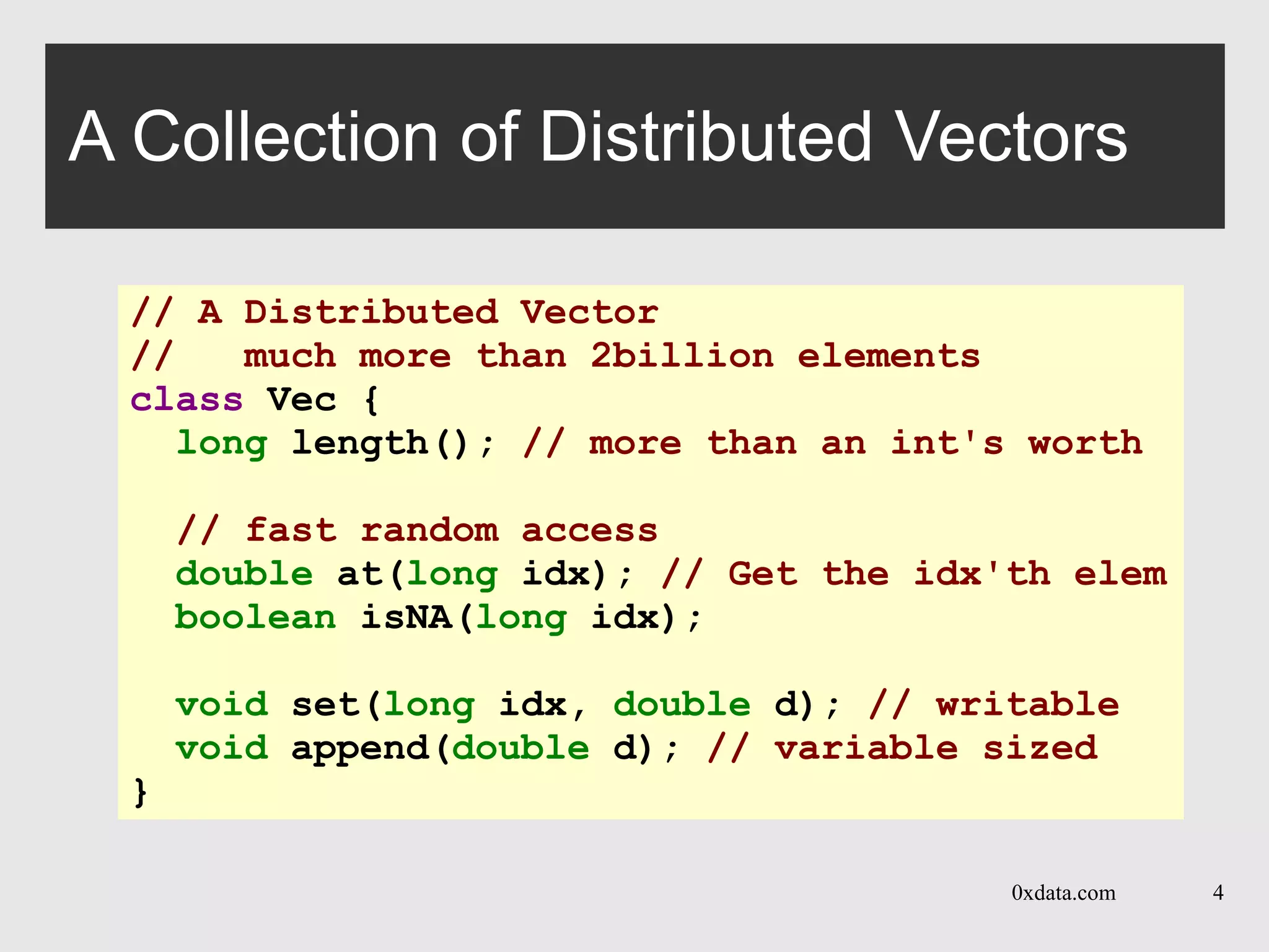
A Collection of Distributed Vectors
// A Distributed Vector
// much more than 2billion elements
class Vec {
long length(); // more than an int's worth
// fast random access
double at(long idx); // Get the idx'th elem
boolean isNA(long idx);
void set(long idx, double d); // writable
void append(double d); // variable sized
}
0xdata.com 5
JVM 4
Heap
JVM 1
Heap
JVM 2
Heap
JVM 3
Heap
Frames
A Frame: Vec[]
age sex zip ID car
●Vecs aligned
in heaps
●Optimized for
concurrent access
●Random access
any row, any JVM
●But faster if local...
more on that later
0xdata.com 6
JVM 4
Heap
JVM 1
Heap
JVM 2
Heap
JVM 3
Heap
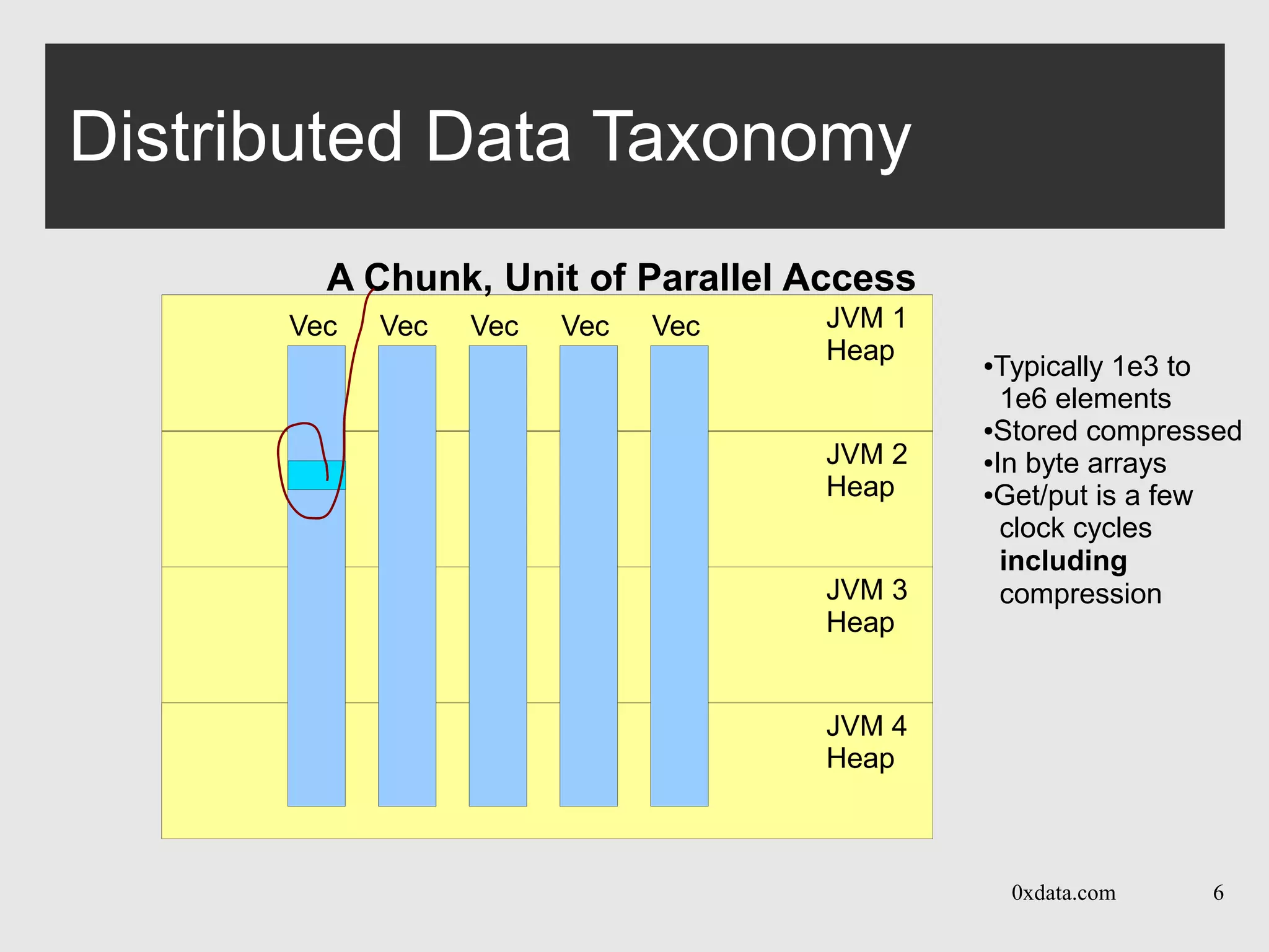
Distributed Data Taxonomy
A Chunk, Unit of Parallel Access
Vec Vec Vec Vec Vec
●Typically 1e3 to
1e6 elements
●Stored compressed
●In byte arrays
●Get/put is a few
clock cycles
including
compression
0xdata.com 7
JVM 4
Heap
JVM 1
Heap
JVM 2
Heap
JVM 3
Heap
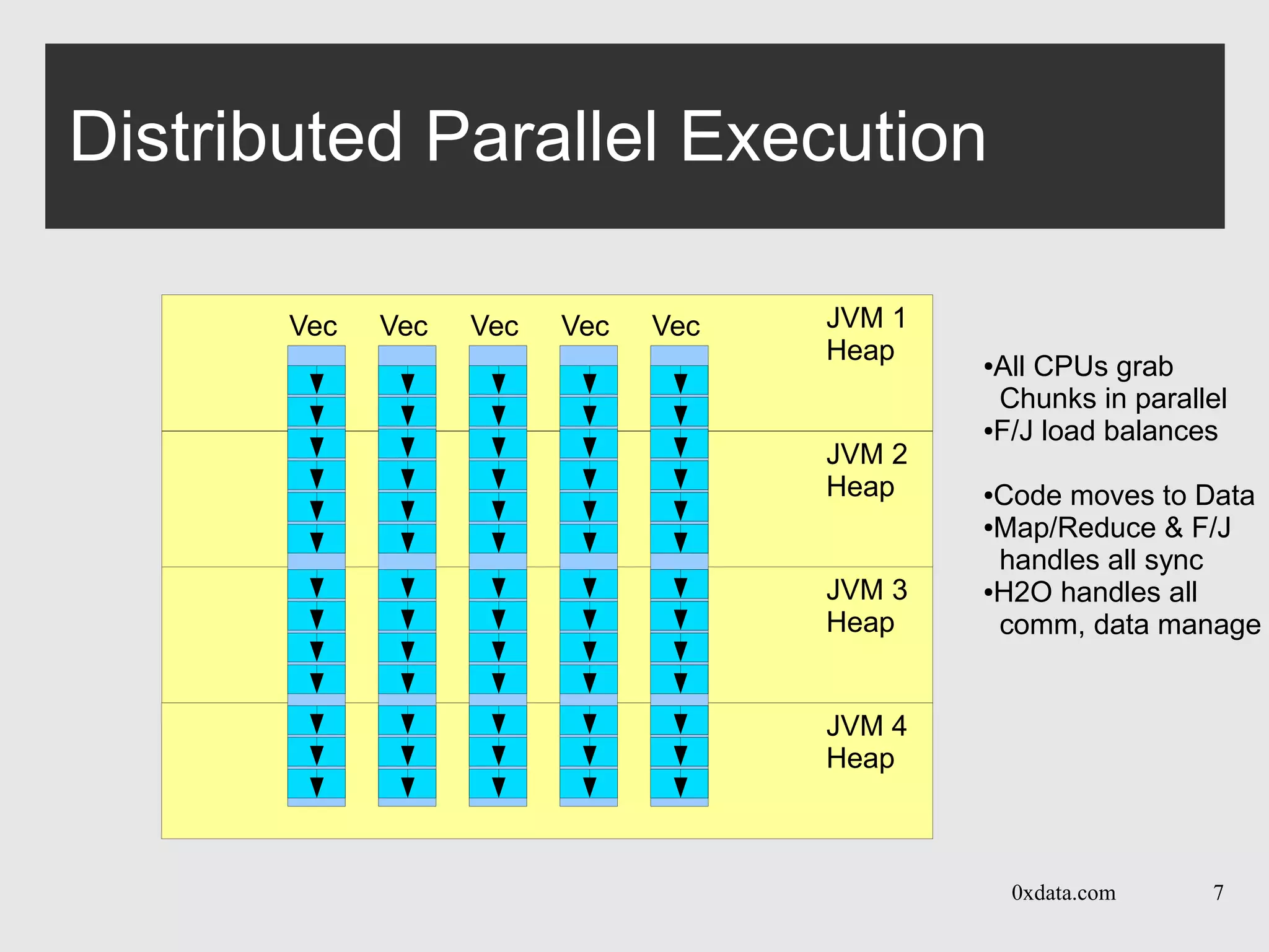
Distributed Parallel Execution
Vec Vec Vec Vec Vec
●All CPUs grab
Chunks in parallel
●F/J load balances
●Code moves to Data
●Map/Reduce & F/J
handles all sync
●H2O handles all
comm, data manage
0xdata.com 8
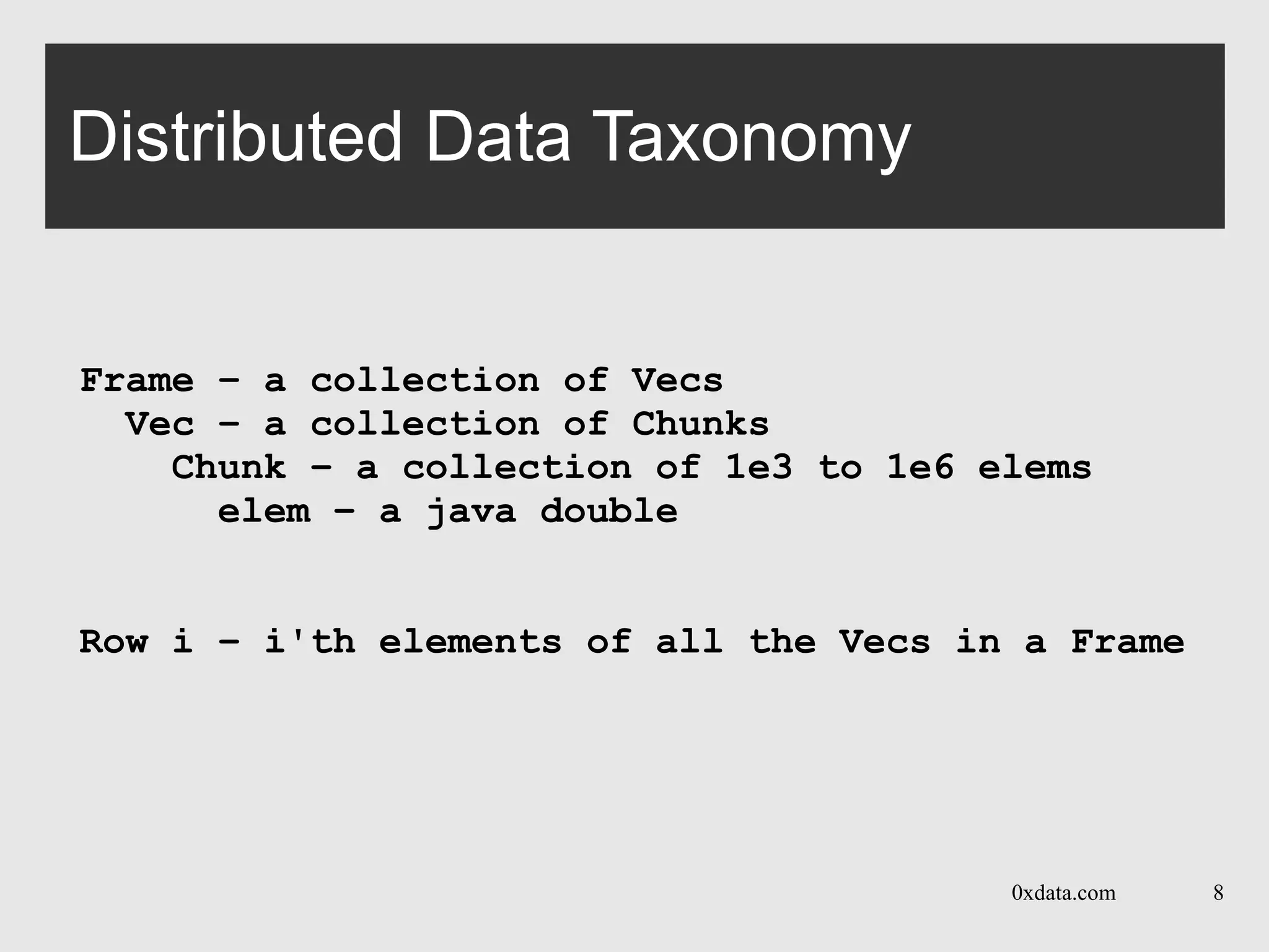
Distributed Data Taxonomy
Frame – a collection of Vecs
Vec – a collection of Chunks
Chunk – a collection of 1e3 to 1e6 elems
elem – a java double
Row i – i'th elements of all the Vecs in a Frame
0xdata.com 9
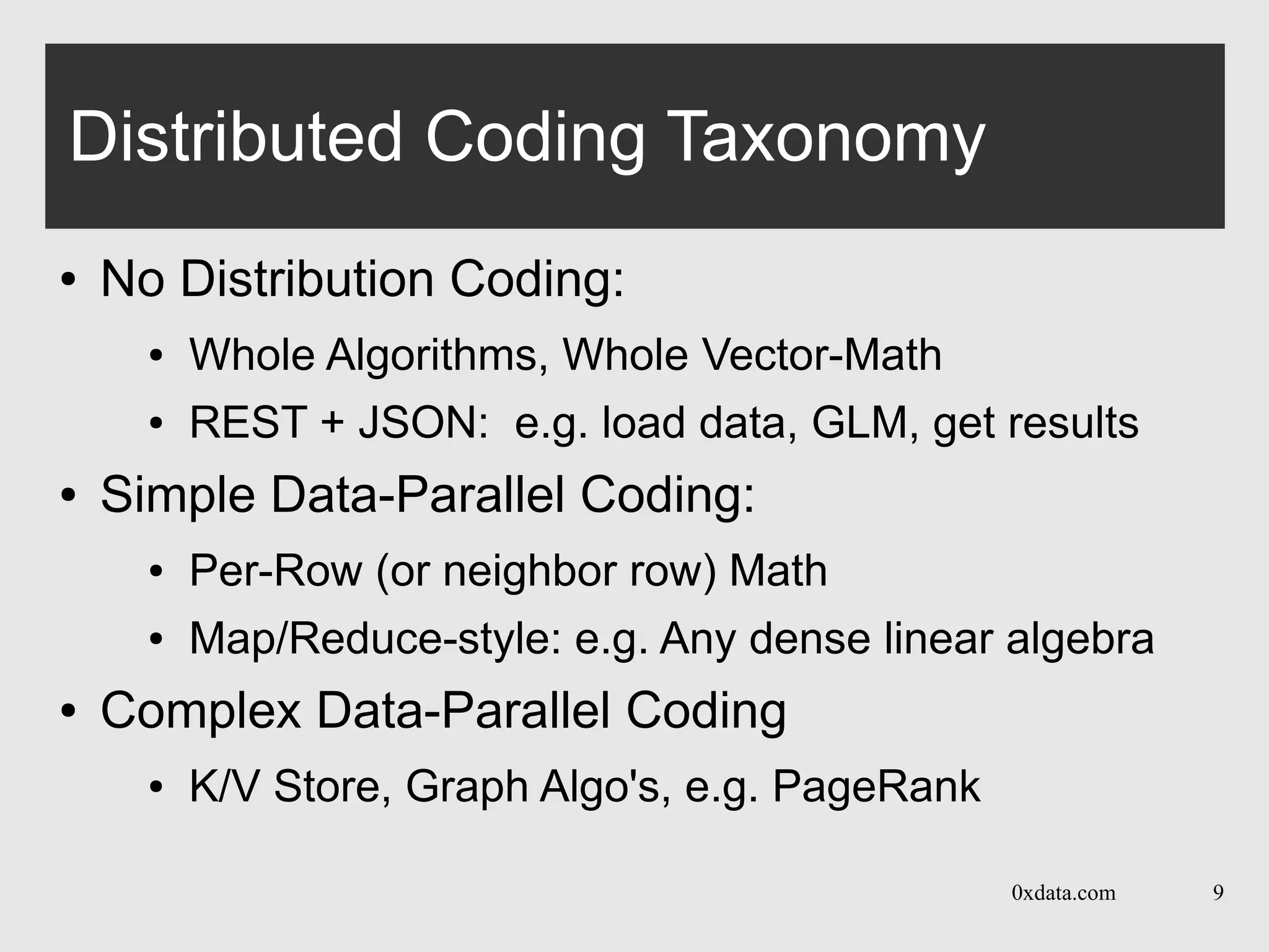
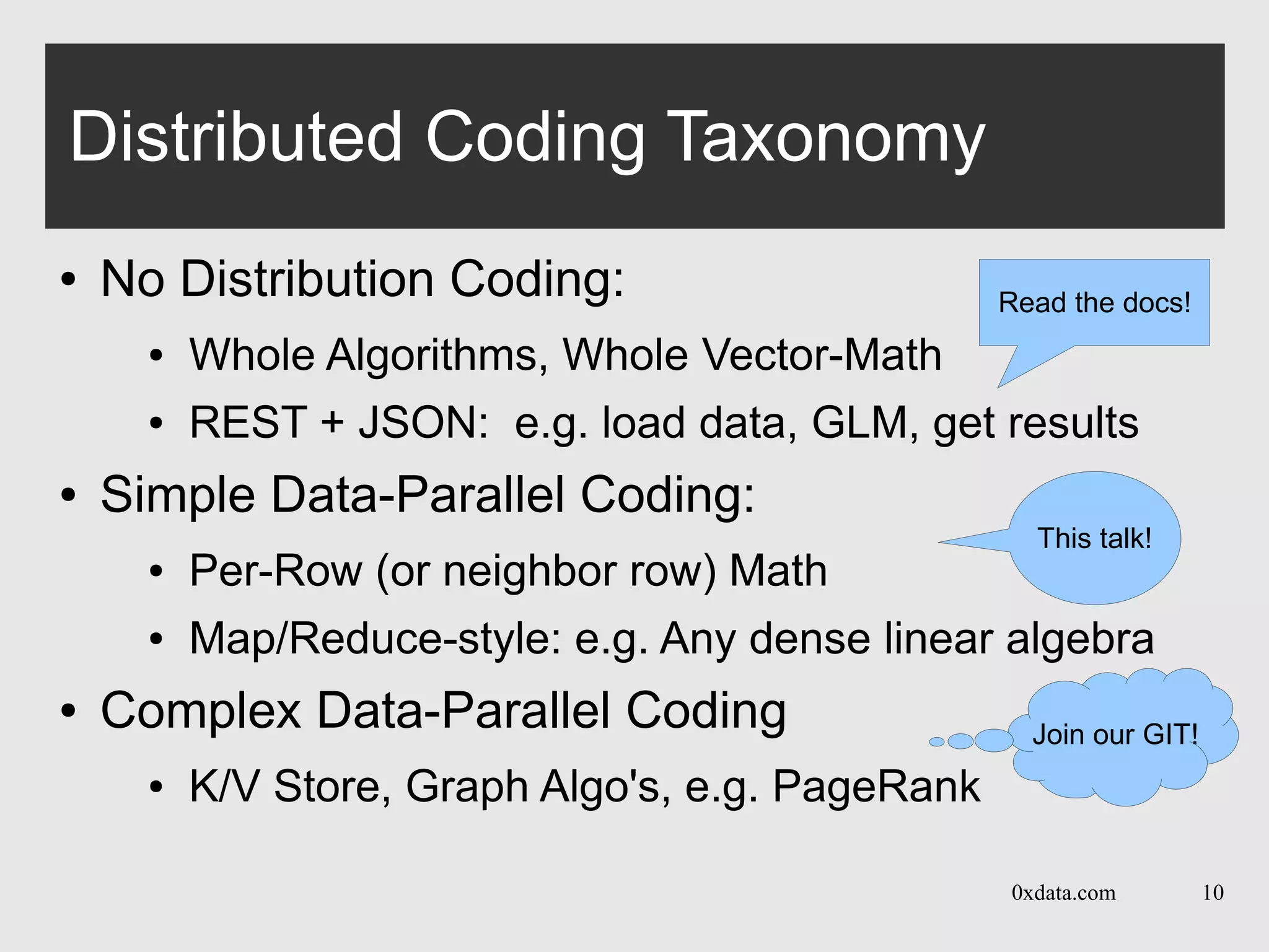
Distributed Coding Taxonomy
● No Distribution Coding:
● Whole Algorithms, Whole Vector-Math
● REST + JSON: e.g. load data, GLM, get results
● Simple Data-Parallel Coding:
● Per-Row (or neighbor row) Math
● Map/Reduce-style: e.g. Any dense linear algebra
● Complex Data-Parallel Coding
● K/V Store, Graph Algo's, e.g. PageRank
0xdata.com 10
Distributed Coding Taxonomy
● No Distribution Coding:
● Whole Algorithms, Whole Vector-Math
● REST + JSON: e.g. load data, GLM, get results
● Simple Data-Parallel Coding:
● Per-Row (or neighbor row) Math
● Map/Reduce-style: e.g. Any dense linear algebra
● Complex Data-Parallel Coding
● K/V Store, Graph Algo's, e.g. PageRank
Read the docs!
This talk!
Join our GIT!
0xdata.com 11
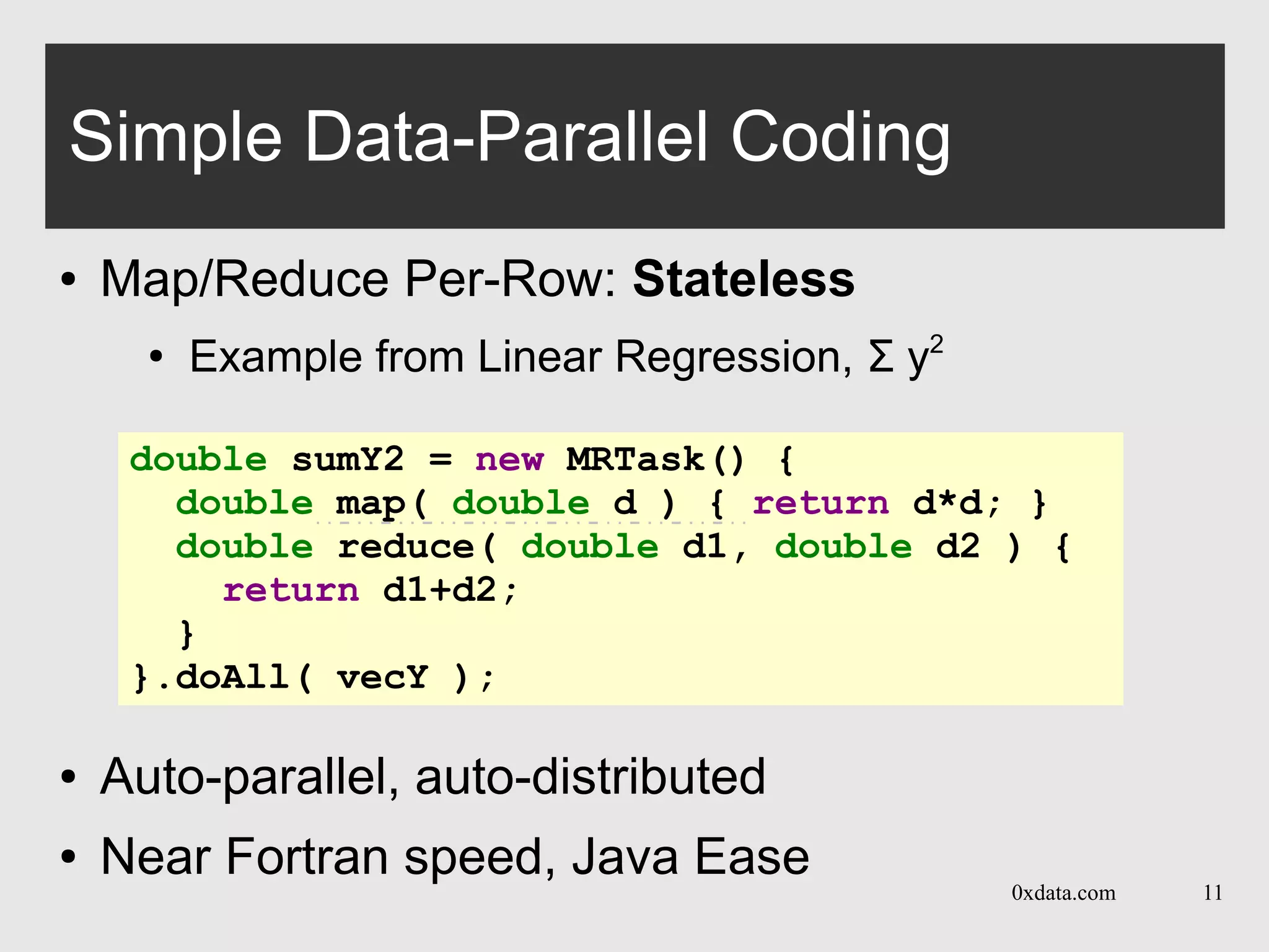
Simple Data-Parallel Coding
● Map/Reduce Per-Row: Stateless
●
Example from Linear Regression, Σ y2
● Auto-parallel, auto-distributed
● Near Fortran speed, Java Ease
double sumY2 = new MRTask() {
double map( double d ) { return d*d; }
double reduce( double d1, double d2 ) {
return d1+d2;
}
}.doAll( vecY );
0xdata.com 12
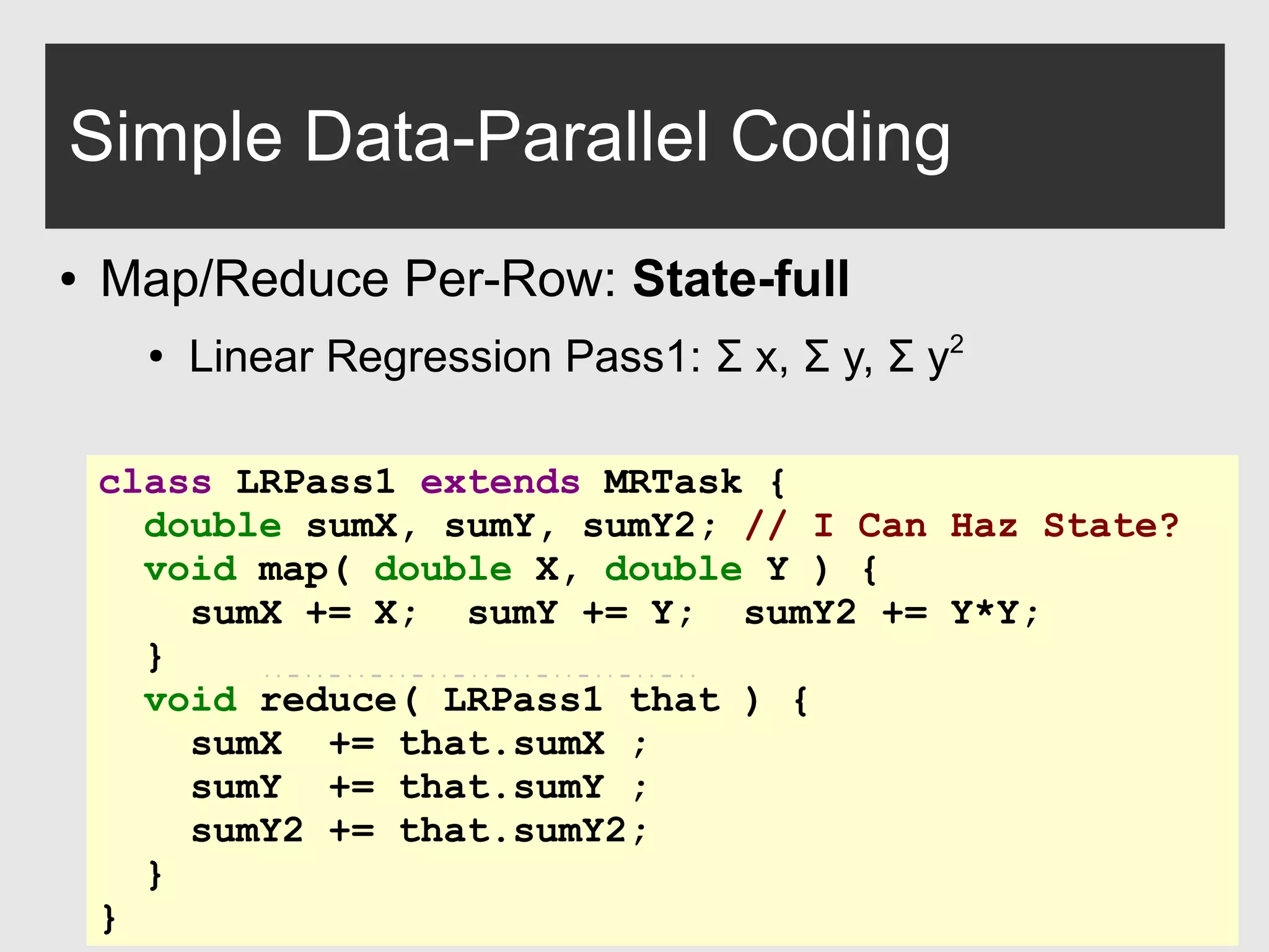
Simple Data-Parallel Coding
● Map/Reduce Per-Row: State-full
●
Linear Regression Pass1: Σ x, Σ y, Σ y2
class LRPass1 extends MRTask {
double sumX, sumY, sumY2; // I Can Haz State?
void map( double X, double Y ) {
sumX += X; sumY += Y; sumY2 += Y*Y;
}
void reduce( LRPass1 that ) {
sumX += that.sumX ;
sumY += that.sumY ;
sumY2 += that.sumY2;
}
}
0xdata.com 13
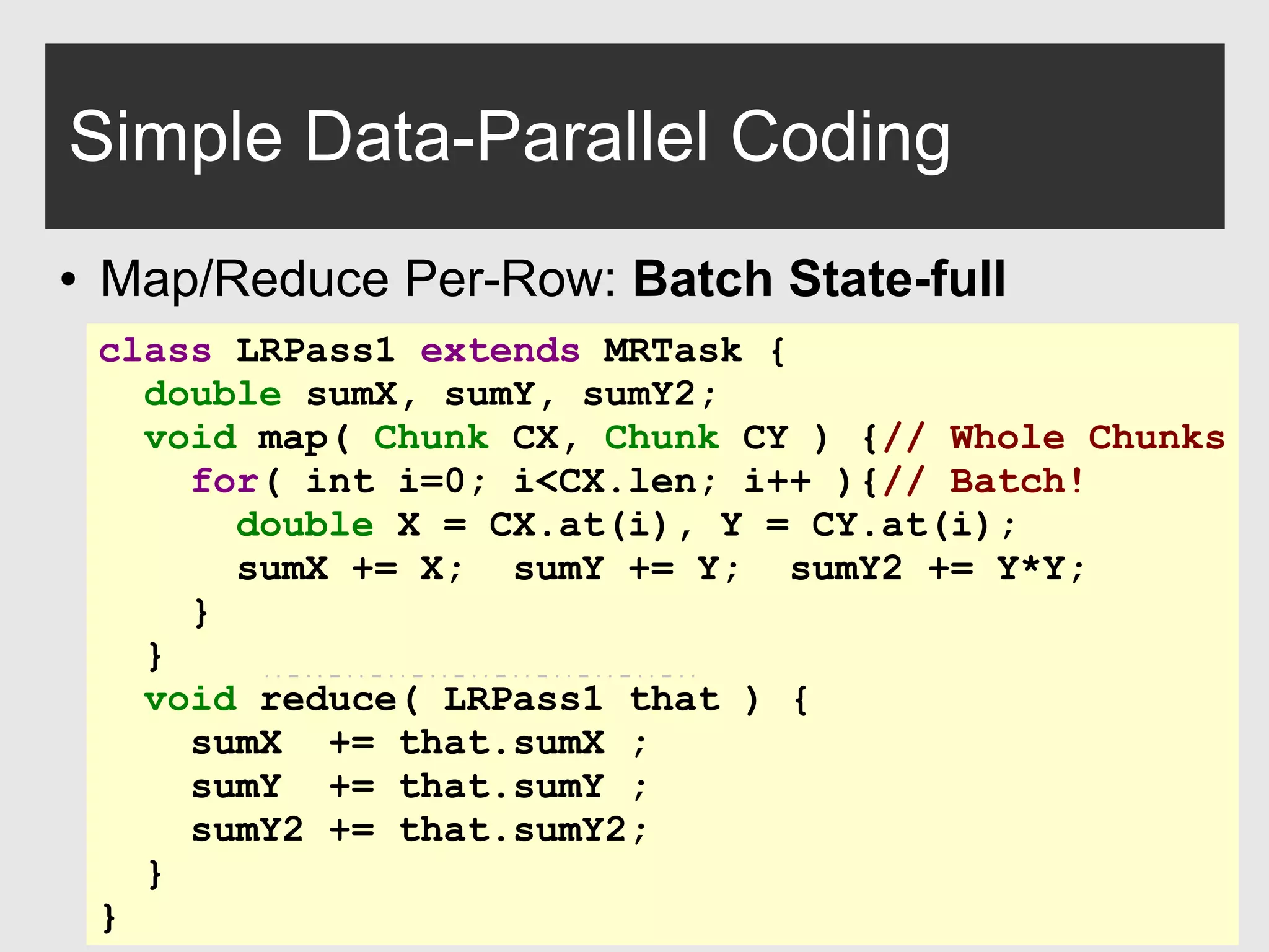
Simple Data-Parallel Coding
● Map/Reduce Per-Row: Batch State-full
class LRPass1 extends MRTask {
double sumX, sumY, sumY2;
void map( Chunk CX, Chunk CY ) {// Whole Chunks
for( int i=0; i<CX.len; i++ ){// Batch!
double X = CX.at(i), Y = CY.at(i);
sumX += X; sumY += Y; sumY2 += Y*Y;
}
}
void reduce( LRPass1 that ) {
sumX += that.sumX ;
sumY += that.sumY ;
sumY2 += that.sumY2;
}
}
0xdata.com 14
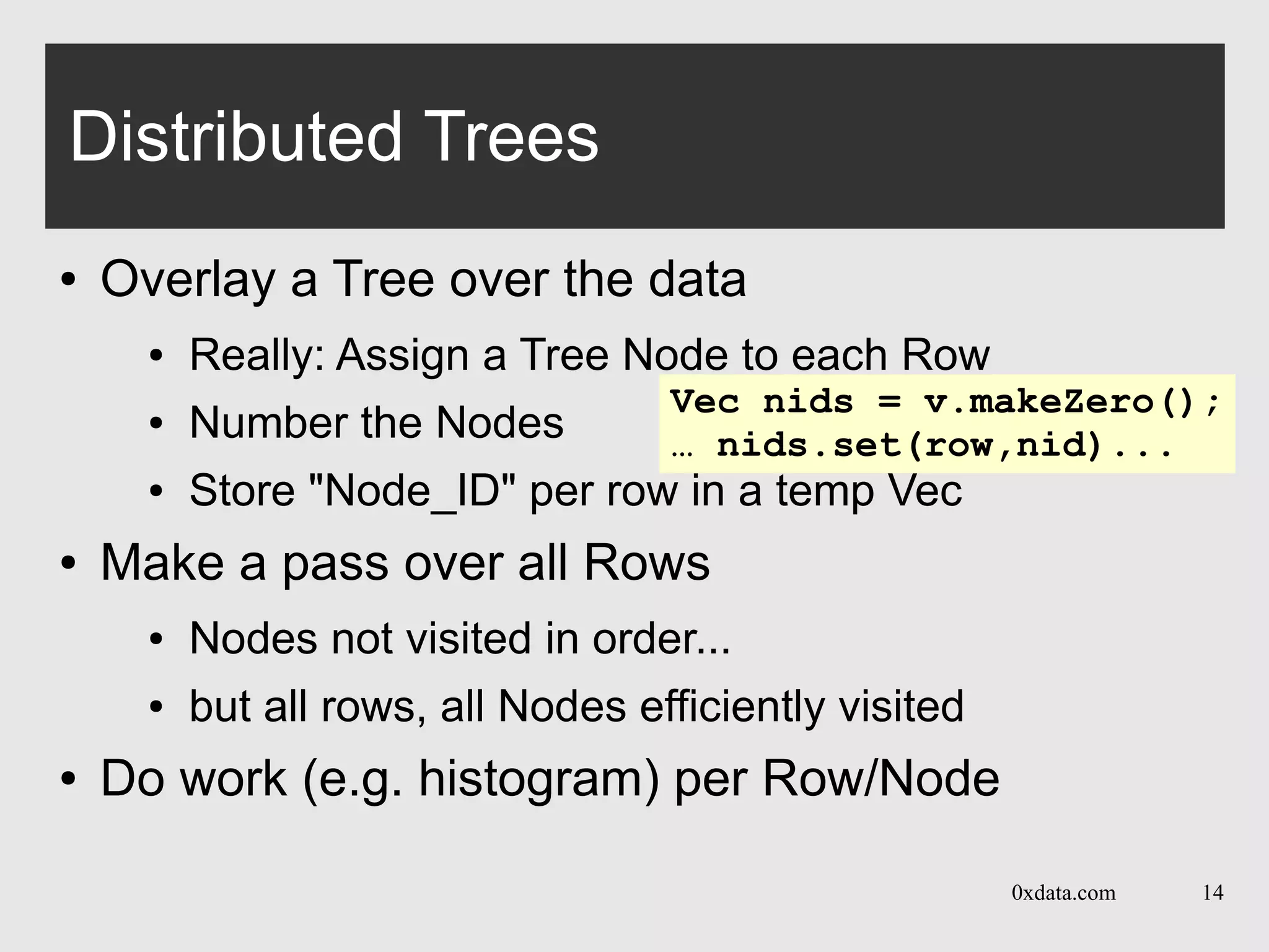
Distributed Trees
● Overlay a Tree over the data
● Really: Assign a Tree Node to each Row
● Number the Nodes
● Store "Node_ID" per row in a temp Vec
● Make a pass over all Rows
● Nodes not visited in order...
● but all rows, all Nodes efficiently visited
● Do work (e.g. histogram) per Row/Node
Vec nids = v.makeZero();
… nids.set(row,nid)...
0xdata.com 15
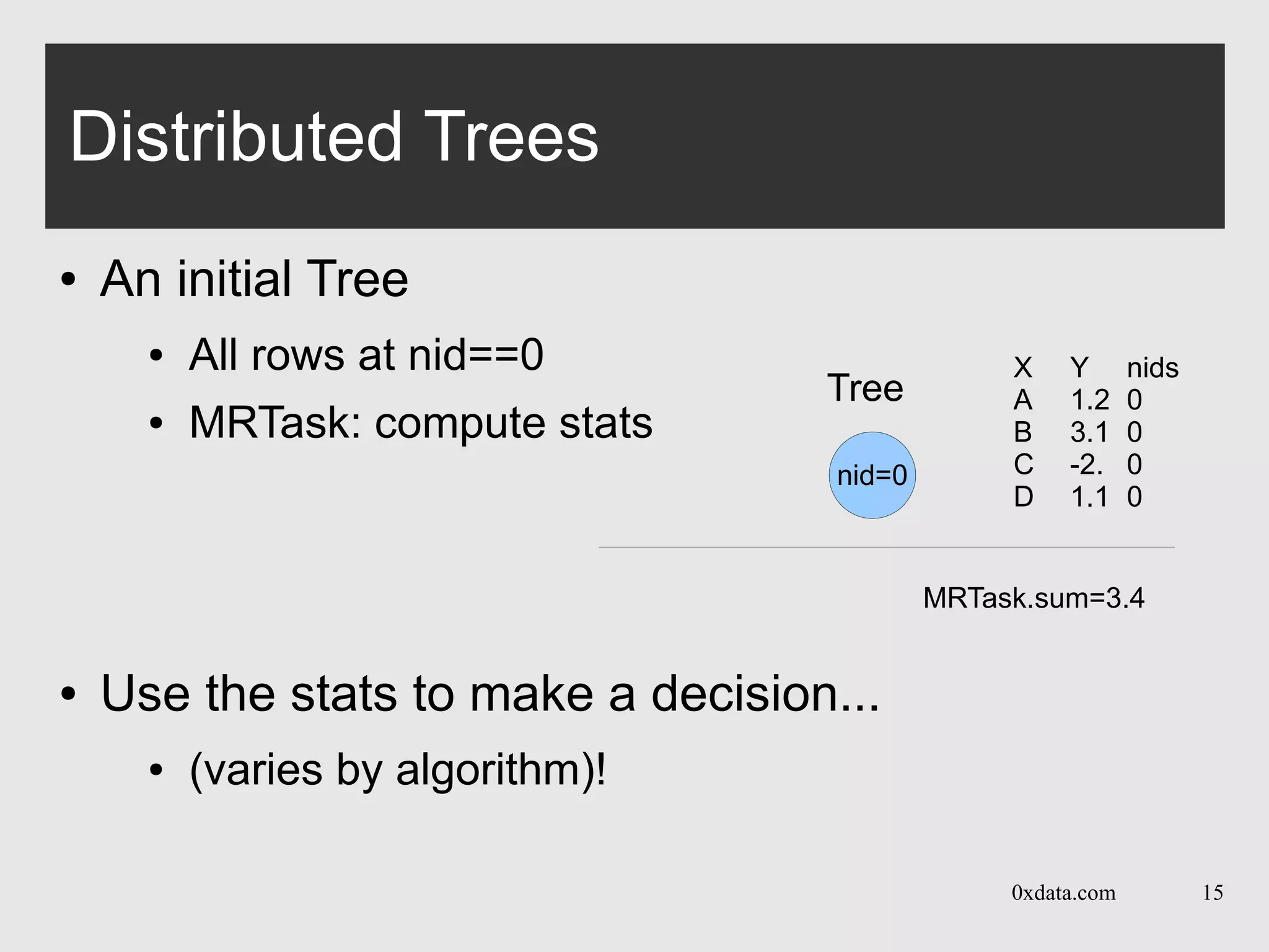
Distributed Trees
● An initial Tree
● All rows at nid==0
● MRTask: compute stats
● Use the stats to make a decision...
● (varies by algorithm)!
nid=0
X Y nids
A 1.2 0
B 3.1 0
C -2. 0
D 1.1 0
nid=0nid=0
Tree
MRTask.sum=3.4
0xdata.com 16
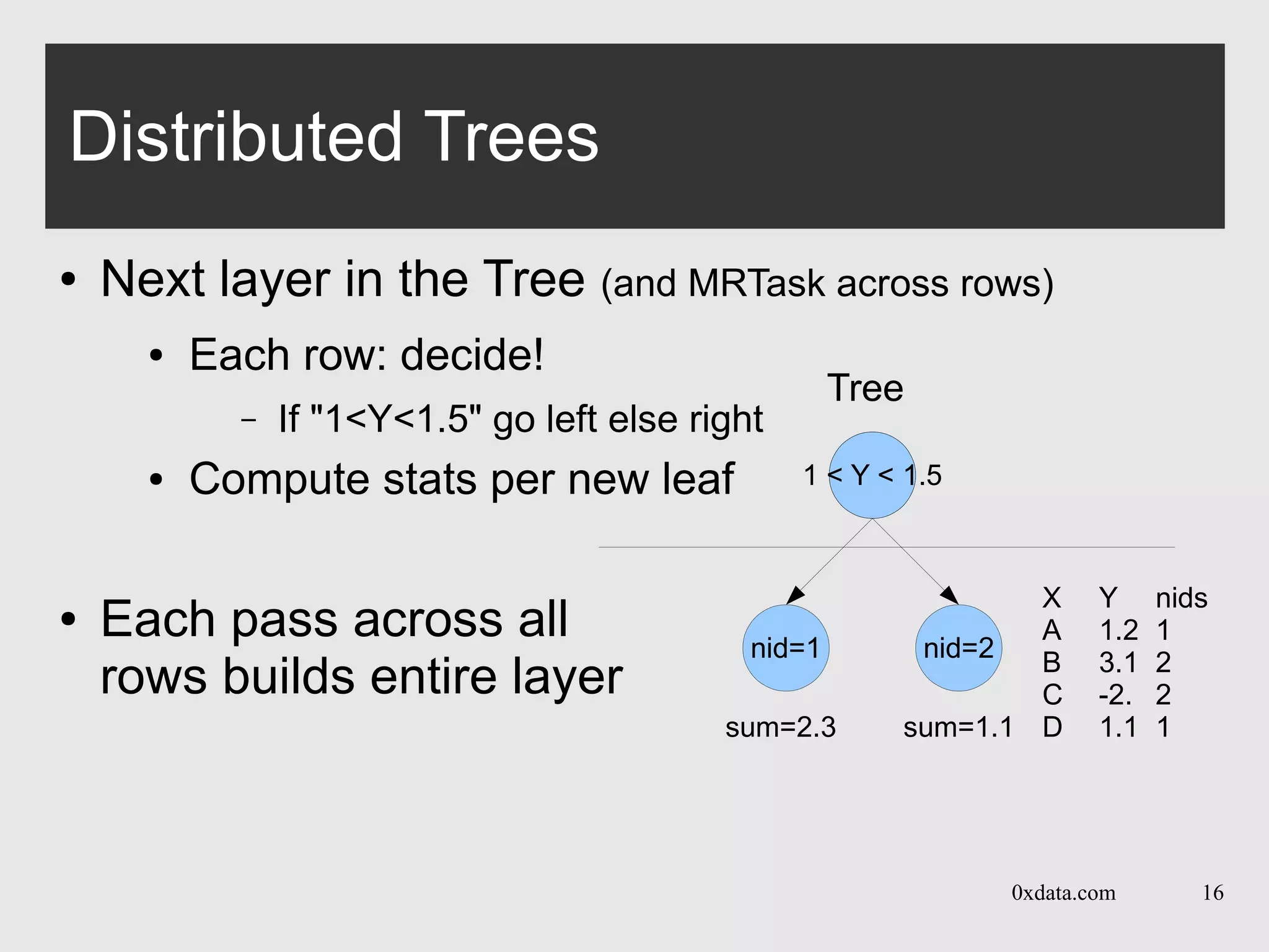
Distributed Trees
● Next layer in the Tree (and MRTask across rows)
● Each row: decide!
– If "1<Y<1.5" go left else right
● Compute stats per new leaf
● Each pass across all
rows builds entire layer
nid=0
X Y nids
A 1.2 1
B 3.1 2
C -2. 2
D 1.1 1
nid=01 < Y < 1.5
Tree
sum=1.1
nid=1 nid=2
sum=2.3
0xdata.com 17
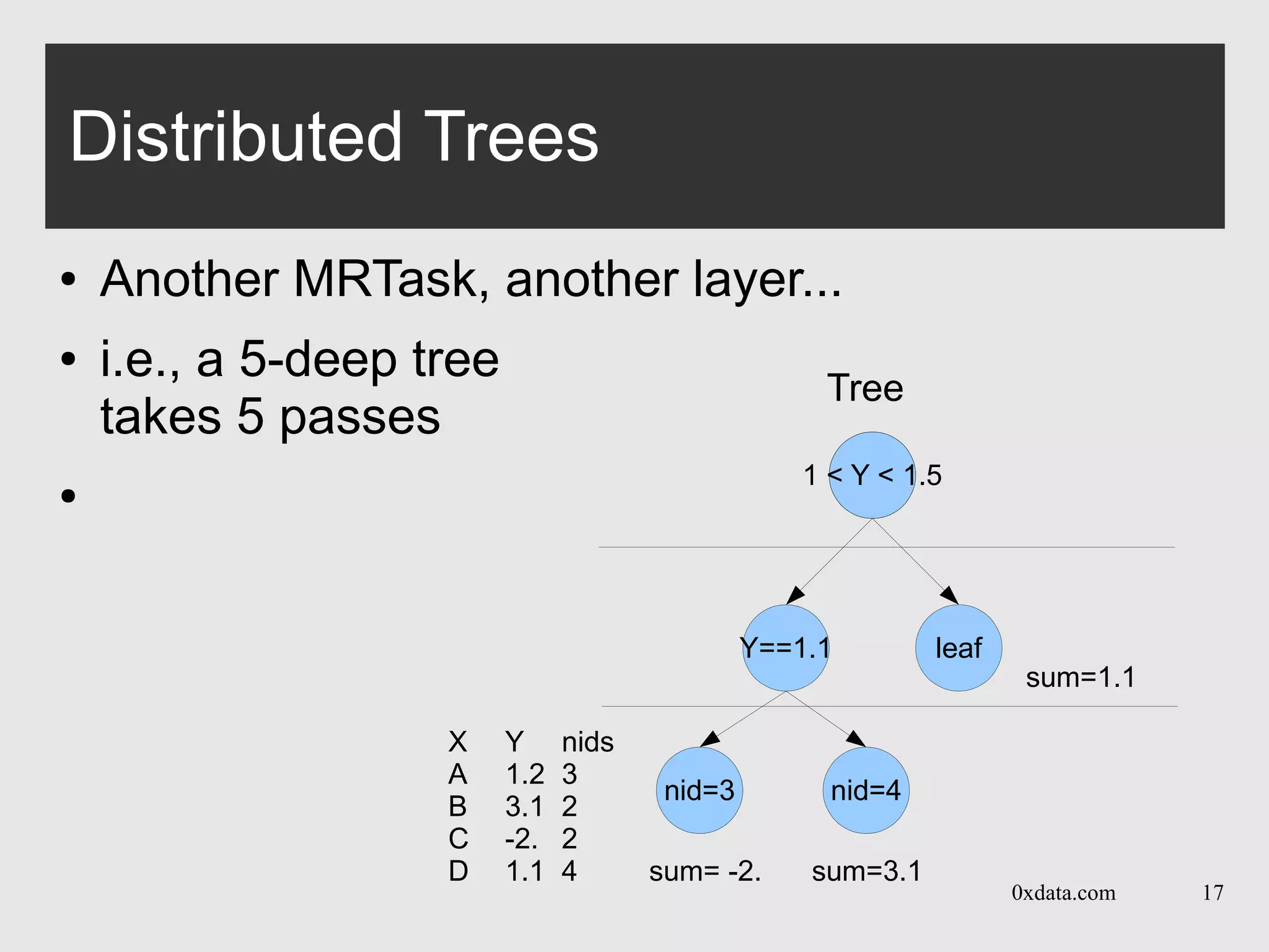
Distributed Trees
● Another MRTask, another layer...
● i.e., a 5-deep tree
takes 5 passes
●
nid=0nid=01 < Y < 1.5
Tree
sum=1.1
Y==1.1 leaf
nid=3 nid=4
X Y nids
A 1.2 3
B 3.1 2
C -2. 2
D 1.1 4 sum= -2. sum=3.1
0xdata.com 18
Distributed Trees
● Each pass is over one layer in the tree
● Builds per-node histogram in map+reduce calls
class Pass extends MRTask2<Pass> {
void map( Chunk chks[] ) {
Chunk nids = chks[...]; // Node-IDs per row
for( int r=0; r<nids.len; r++ ){// All rows
int nid = nids.at80(i); // Node-ID THIS row
// Lazy: not all Chunks see all Nodes
if( dHisto[nid]==null ) dHisto[nid]=...
// Accumulate histogram stats per node
dHisto[nid].accum(chks,r);
}
}
}.doAll(myDataFrame,nids);
0xdata.com 19
Distributed Trees
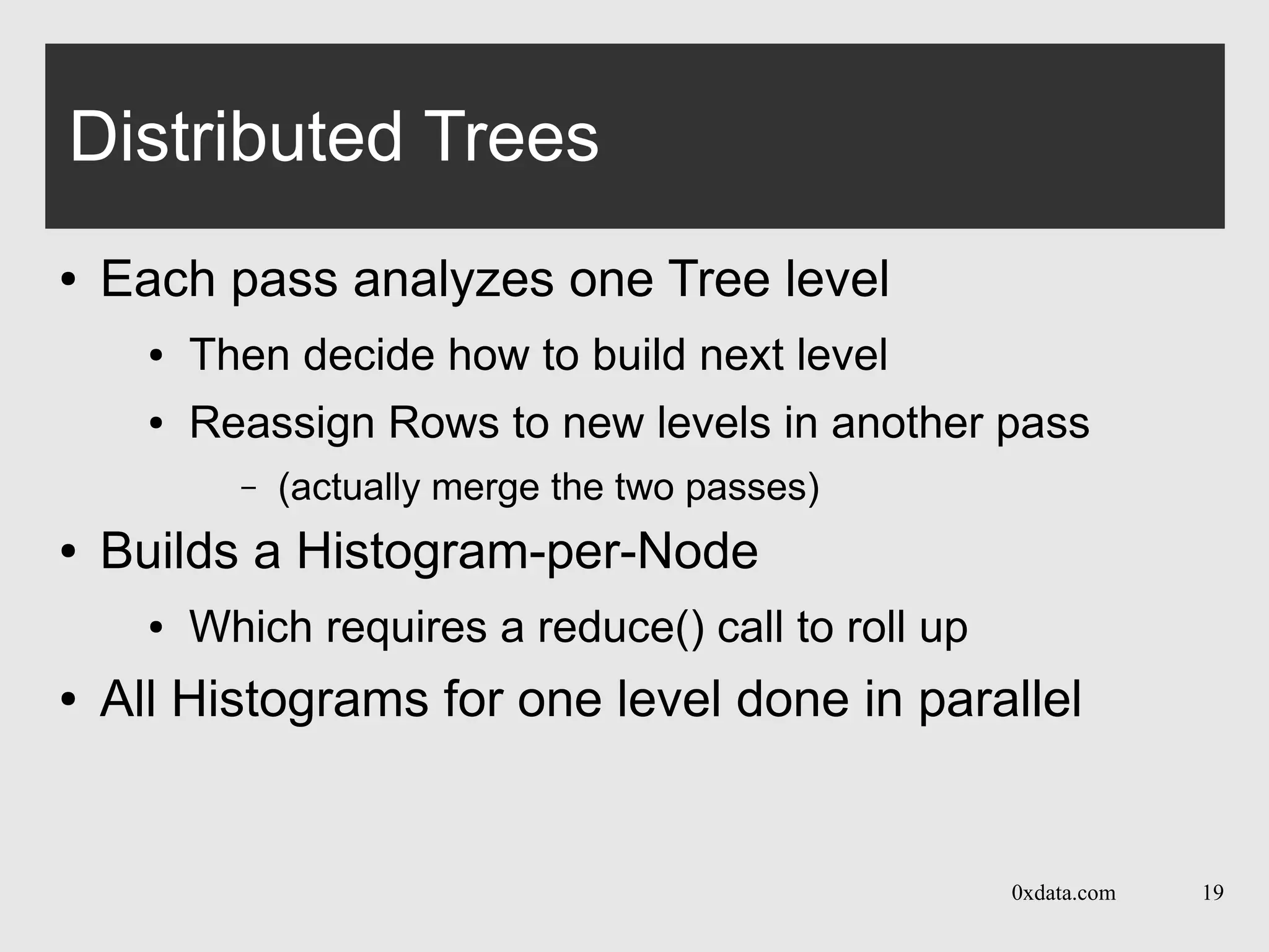
● Each pass analyzes one Tree level
● Then decide how to build next level
● Reassign Rows to new levels in another pass
– (actually merge the two passes)
● Builds a Histogram-per-Node
● Which requires a reduce() call to roll up
● All Histograms for one level done in parallel
0xdata.com 20
Distributed Trees: utilities
● “score+build” in one pass:
● Test each row against decision from prior pass
● Assign to a new leaf
● Build histogram on that leaf
● “score”: just walk the tree, and get results
● “compress”: Tree from POJO to byte[]
● Easily 10x smaller, can still walk, score, print
● Plus utilities to walk, print, display
0xdata.com 21
GBM on Distributed Trees
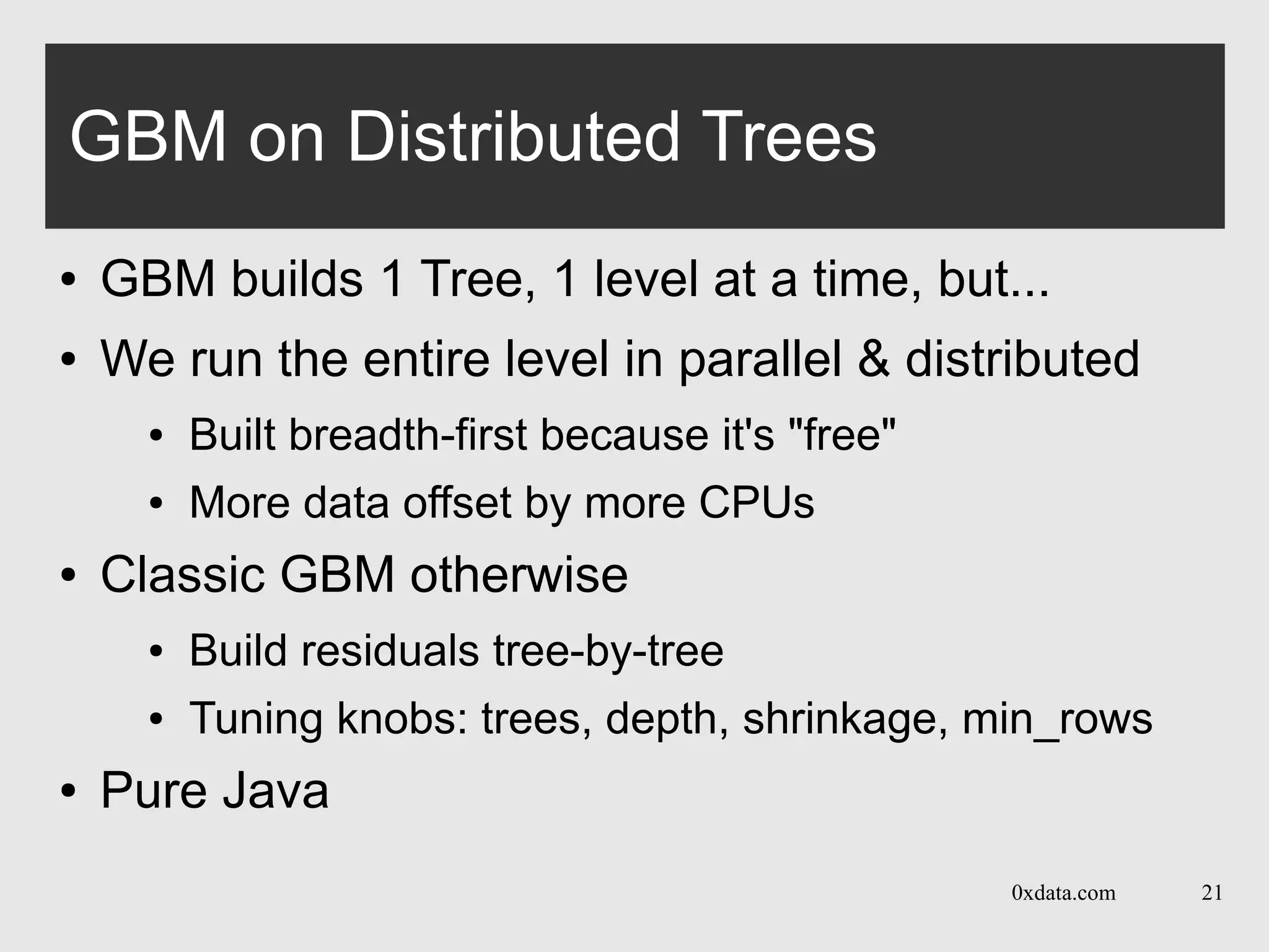
● GBM builds 1 Tree, 1 level at a time, but...
● We run the entire level in parallel & distributed
● Built breadth-first because it's "free"
● More data offset by more CPUs
● Classic GBM otherwise
● Build residuals tree-by-tree
● Tuning knobs: trees, depth, shrinkage, min_rows
● Pure Java
0xdata.com 22
GBM on Distributed Trees
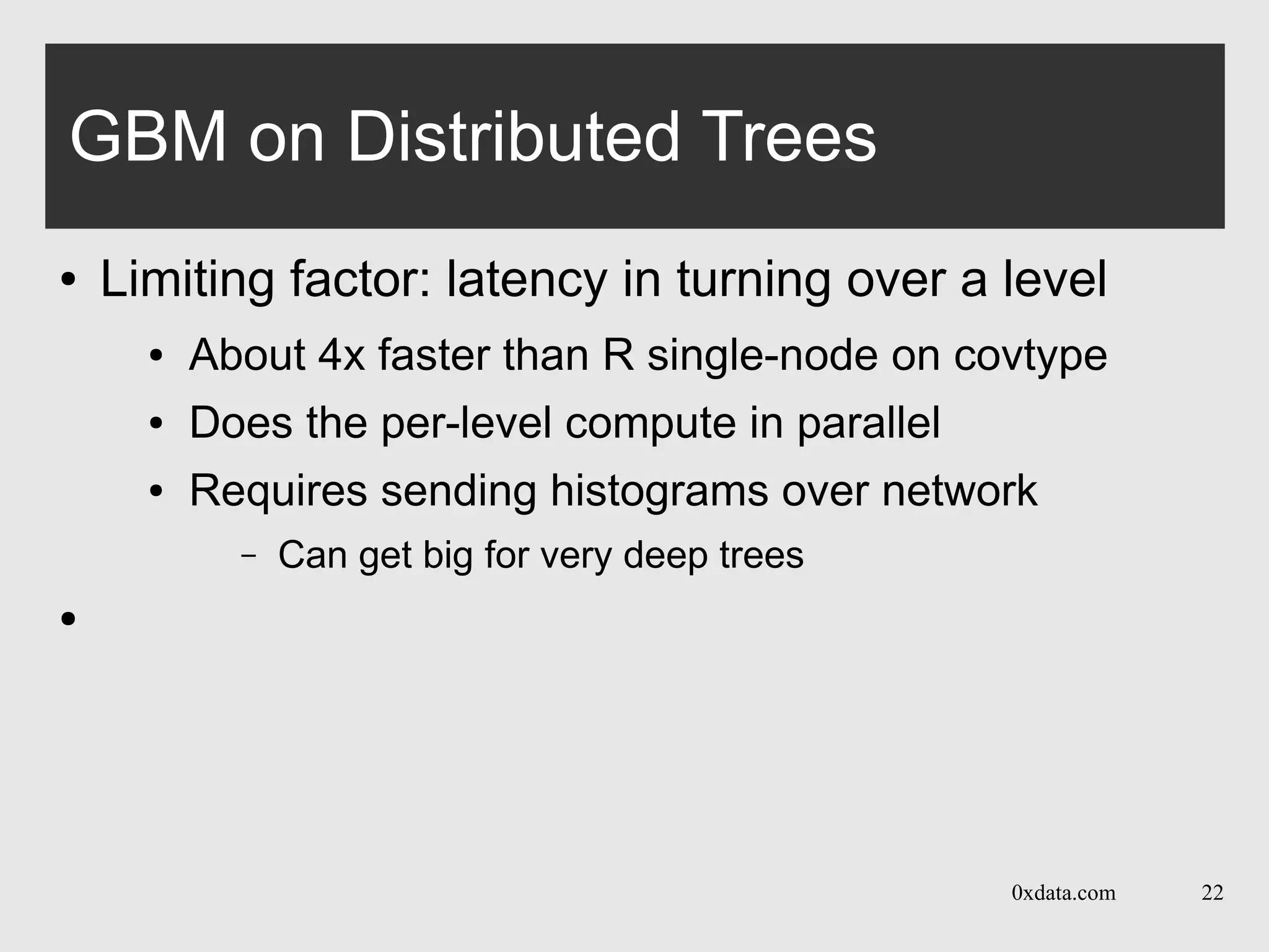
● Limiting factor: latency in turning over a level
● About 4x faster than R single-node on covtype
● Does the per-level compute in parallel
● Requires sending histograms over network
– Can get big for very deep trees
●
0xdata.com 23
Summary: Write (parallel) Java
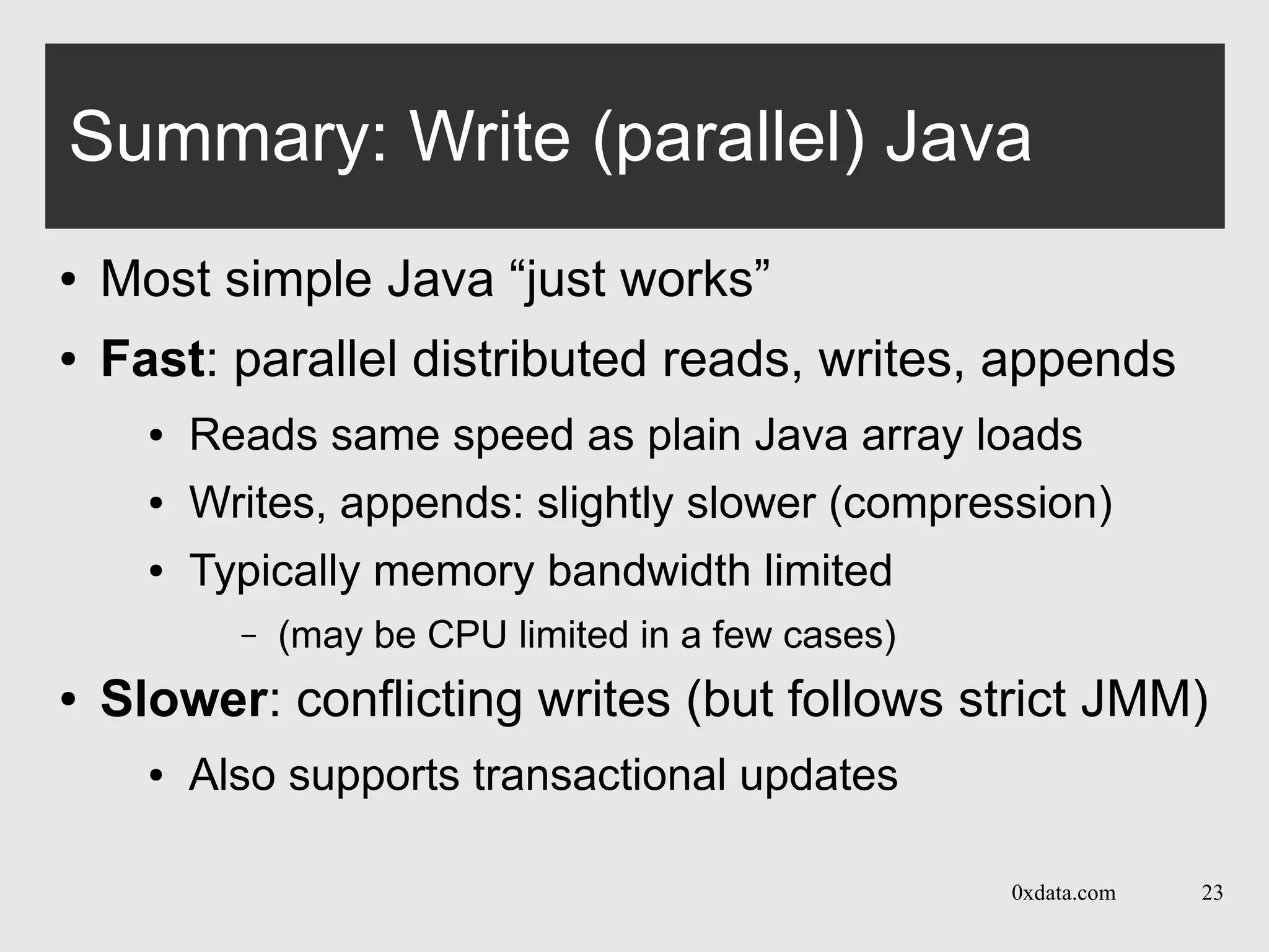
● Most simple Java “just works”
● Fast: parallel distributed reads, writes, appends
● Reads same speed as plain Java array loads
● Writes, appends: slightly slower (compression)
● Typically memory bandwidth limited
– (may be CPU limited in a few cases)
● Slower: conflicting writes (but follows strict JMM)
● Also supports transactional updates
0xdata.com 24
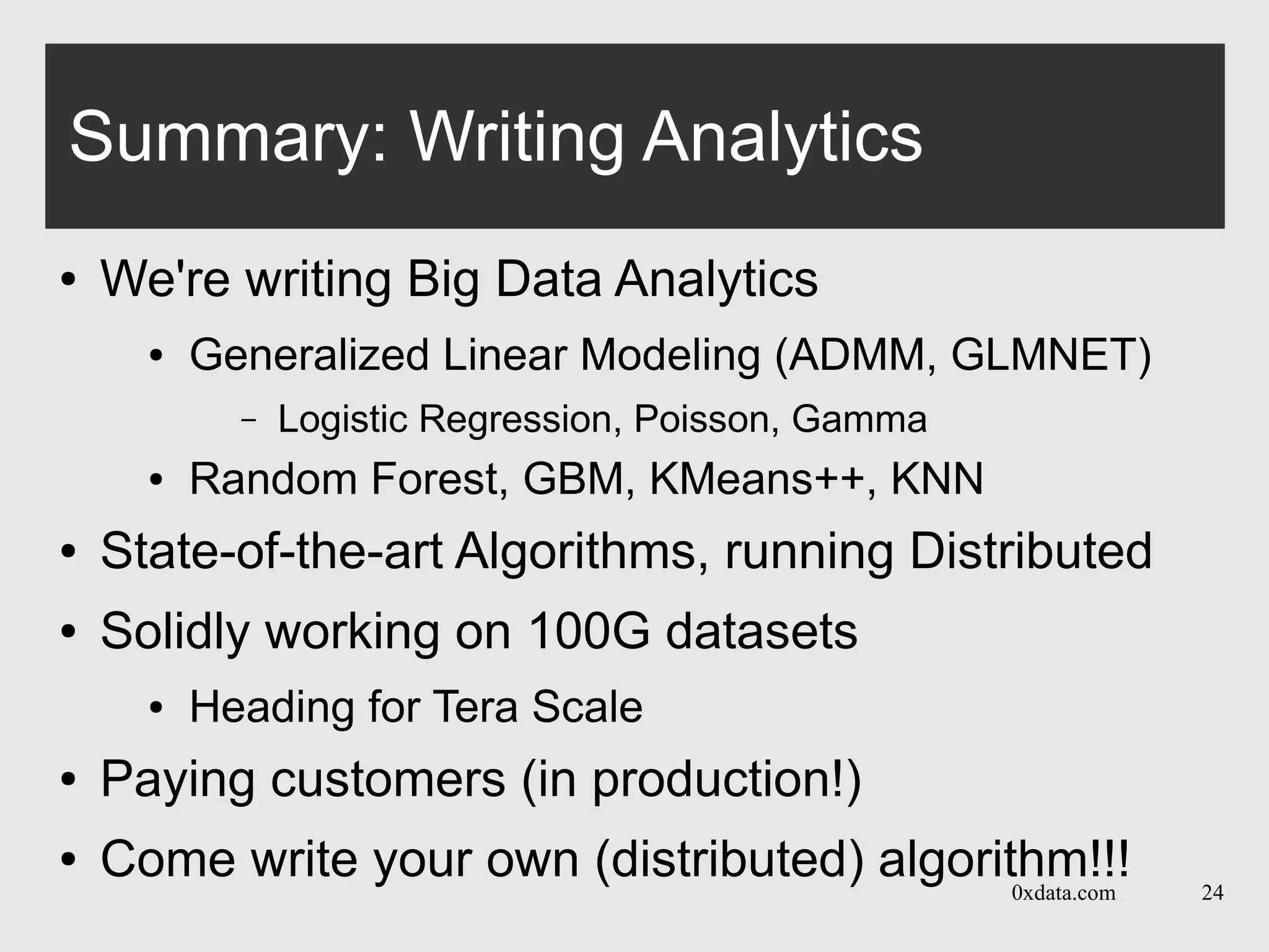
Summary: Writing Analytics
● We're writing Big Data Analytics
● Generalized Linear Modeling (ADMM, GLMNET)
– Logistic Regression, Poisson, Gamma
● Random Forest, GBM, KMeans++, KNN
● State-of-the-art Algorithms, running Distributed
● Solidly working on 100G datasets
● Heading for Tera Scale
● Paying customers (in production!)
● Come write your own (distributed) algorithm!!!
0xdata.com 25
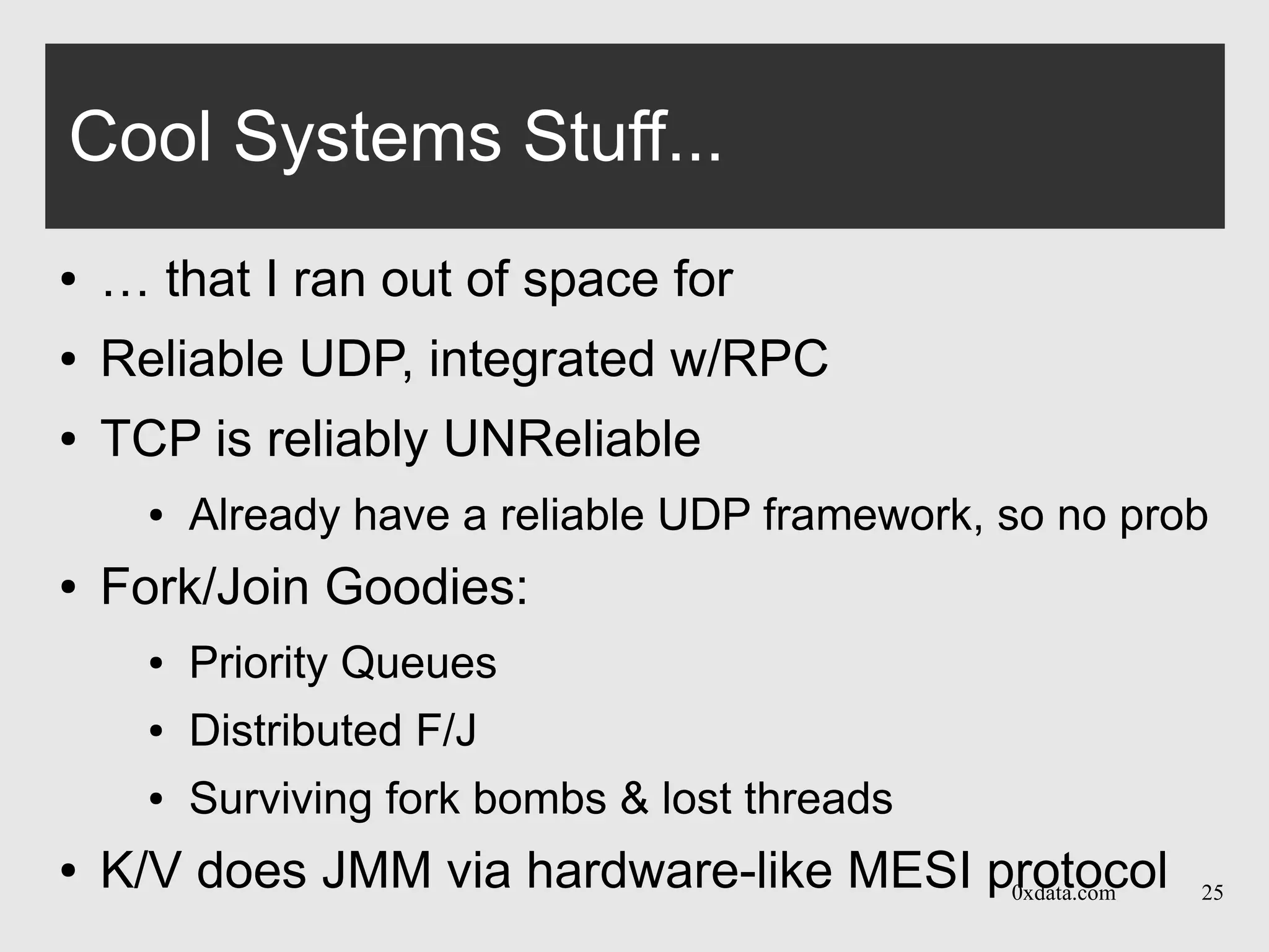
Cool Systems Stuff...
● … that I ran out of space for
● Reliable UDP, integrated w/RPC
● TCP is reliably UNReliable
● Already have a reliable UDP framework, so no prob
● Fork/Join Goodies:
● Priority Queues
● Distributed F/J
● Surviving fork bombs & lost threads
● K/V does JMM via hardware-like MESI protocol
0xdata.com 26
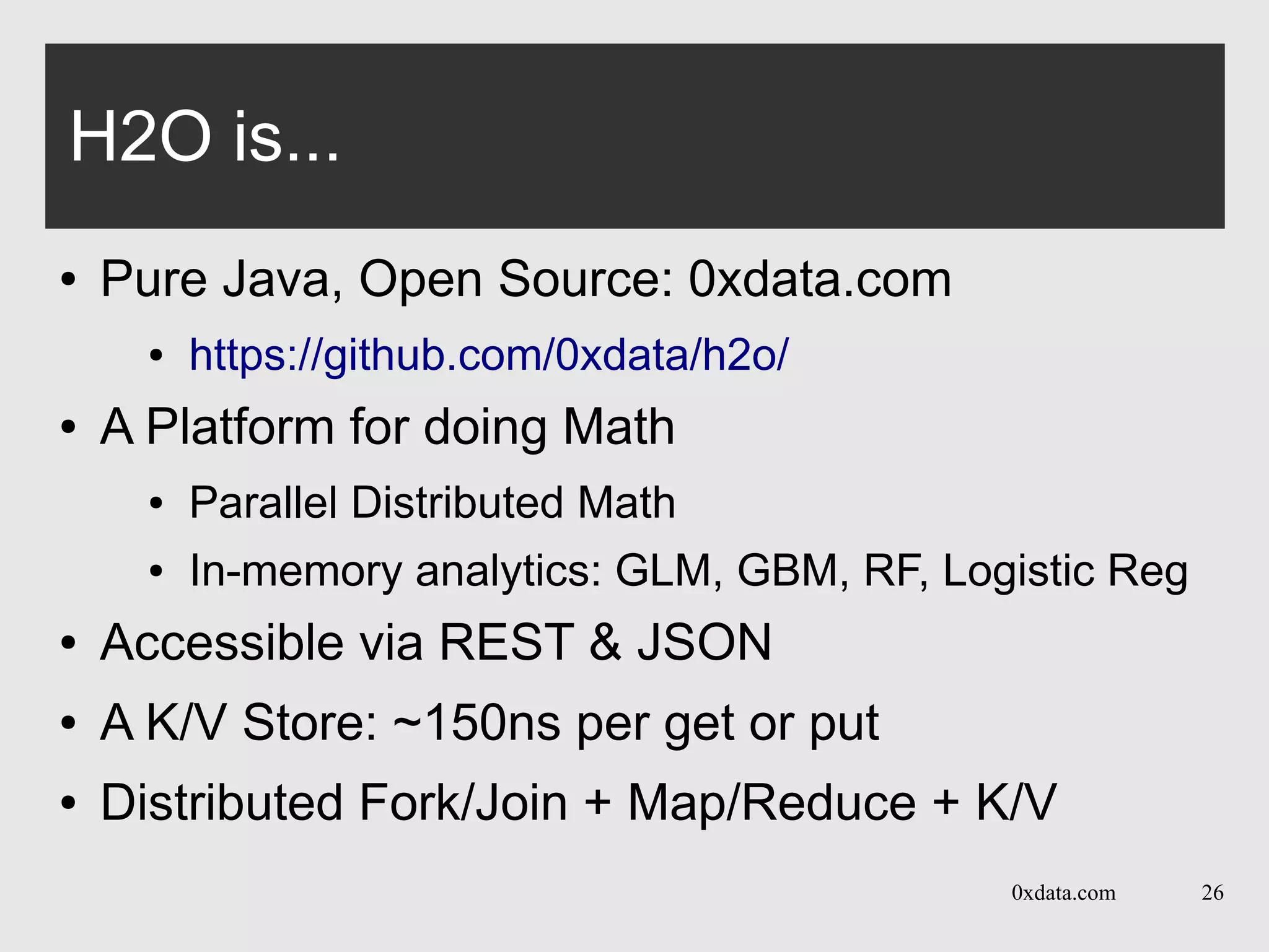
H2O is...
● Pure Java, Open Source: 0xdata.com
● https://github.com/0xdata/h2o/
● A Platform for doing Math
● Parallel Distributed Math
● In-memory analytics: GLM, GBM, RF, Logistic Reg
● Accessible via REST & JSON
● A K/V Store: ~150ns per get or put
● Distributed Fork/Join + Map/Reduce + K/V
0xdata.com 27
The Platform
NFS
HDFS
byte[]
extends Iced
extends DTask
AutoBuffer
RPC
extends DRemoteTask D/F/J
extends MRTask User code?
JVM 1
NFS
HDFS
byte[]
extends Iced
extends DTask
AutoBuffer
RPC
extends DRemoteTask D/F/J
extends MRTask User code?
JVM 2
K/V get/put
UDP / TCP
0xdata.com 28
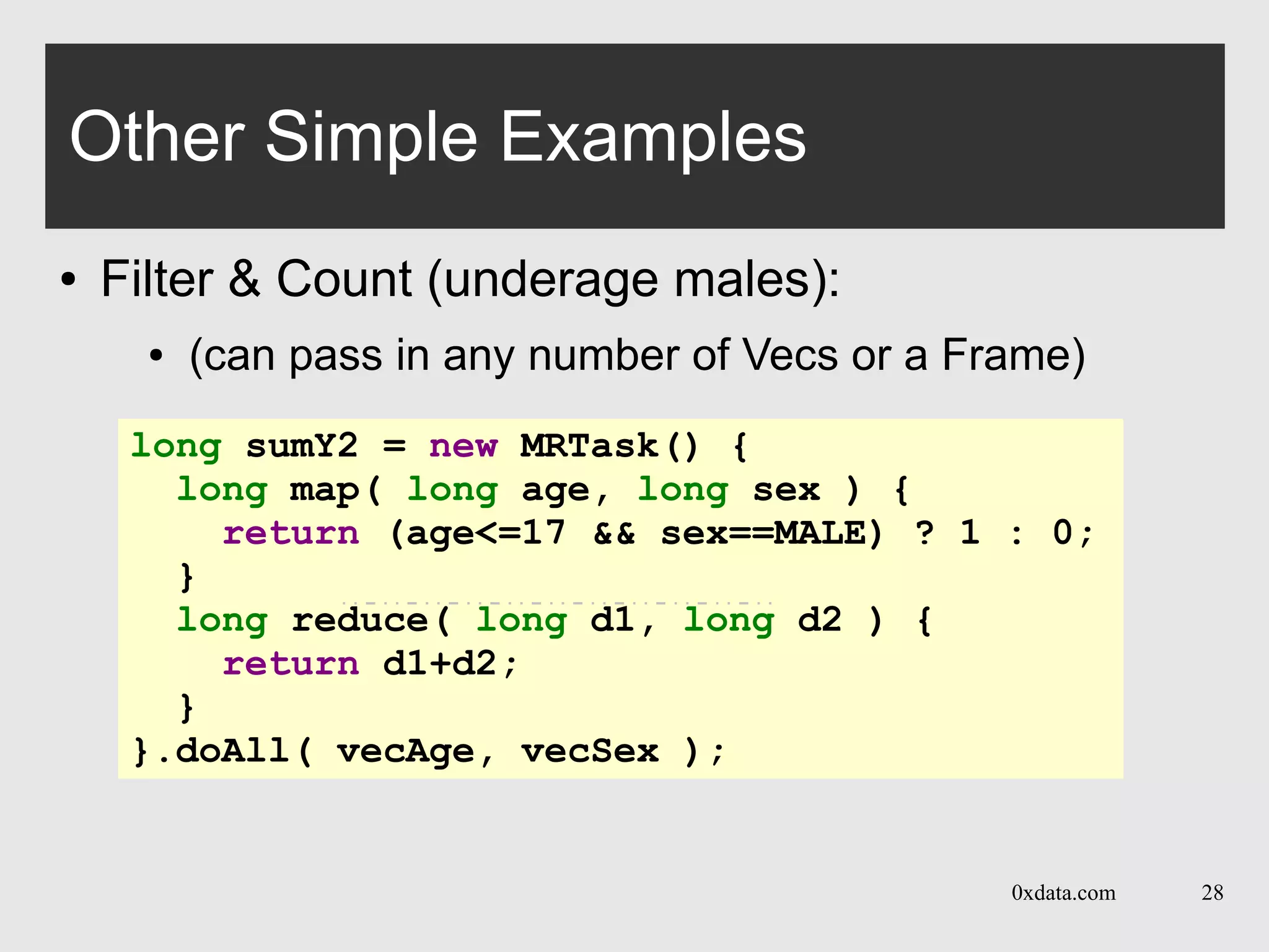
Other Simple Examples
● Filter & Count (underage males):
● (can pass in any number of Vecs or a Frame)
long sumY2 = new MRTask() {
long map( long age, long sex ) {
return (age<=17 && sex==MALE) ? 1 : 0;
}
long reduce( long d1, long d2 ) {
return d1+d2;
}
}.doAll( vecAge, vecSex );
0xdata.com 29
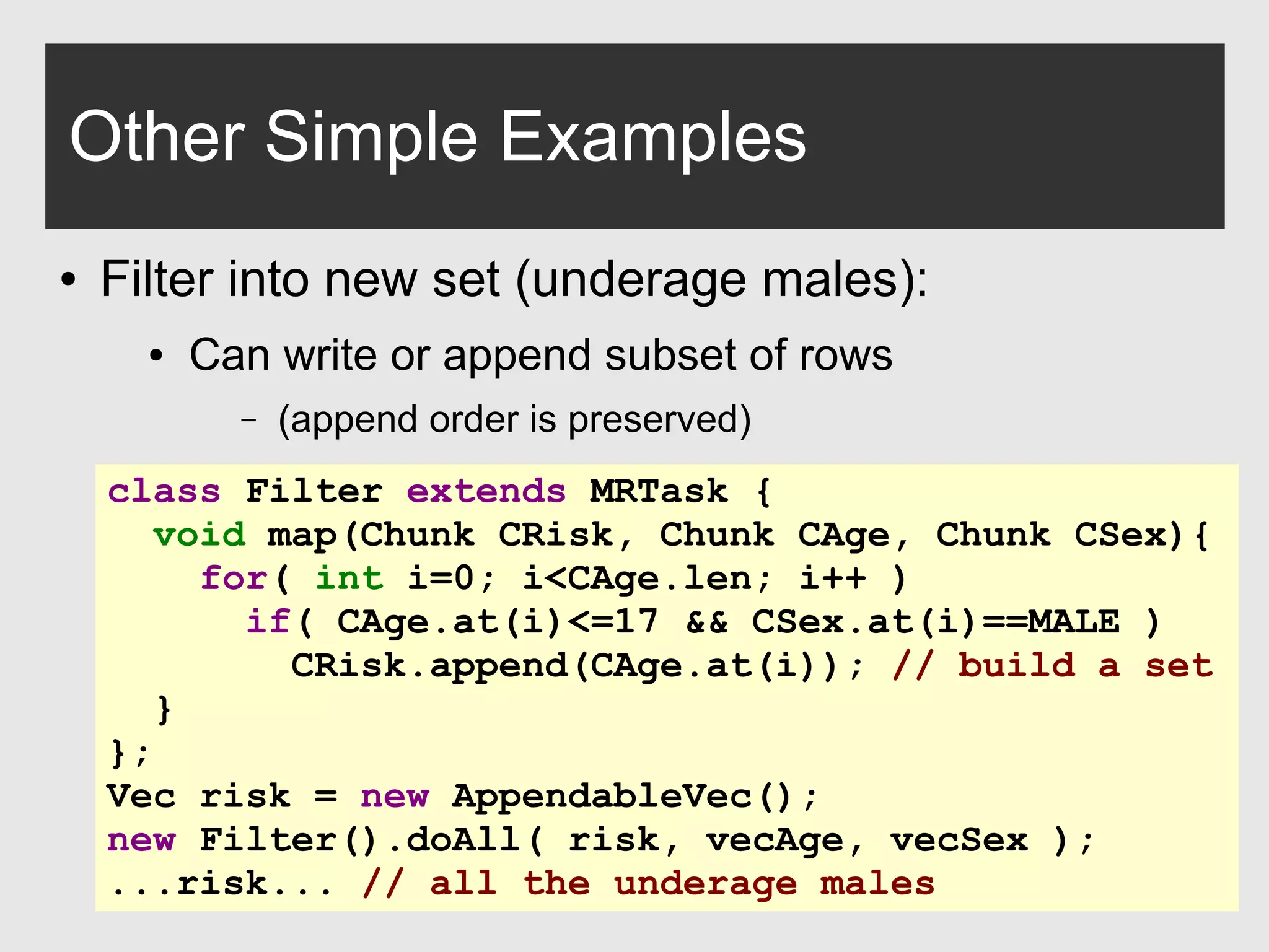
Other Simple Examples
● Filter into new set (underage males):
● Can write or append subset of rows
– (append order is preserved)
class Filter extends MRTask {
void map(Chunk CRisk, Chunk CAge, Chunk CSex){
for( int i=0; i<CAge.len; i++ )
if( CAge.at(i)<=17 && CSex.at(i)==MALE )
CRisk.append(CAge.at(i)); // build a set
}
};
Vec risk = new AppendableVec();
new Filter().doAll( risk, vecAge, vecSex );
...risk... // all the underage males
0xdata.com 30
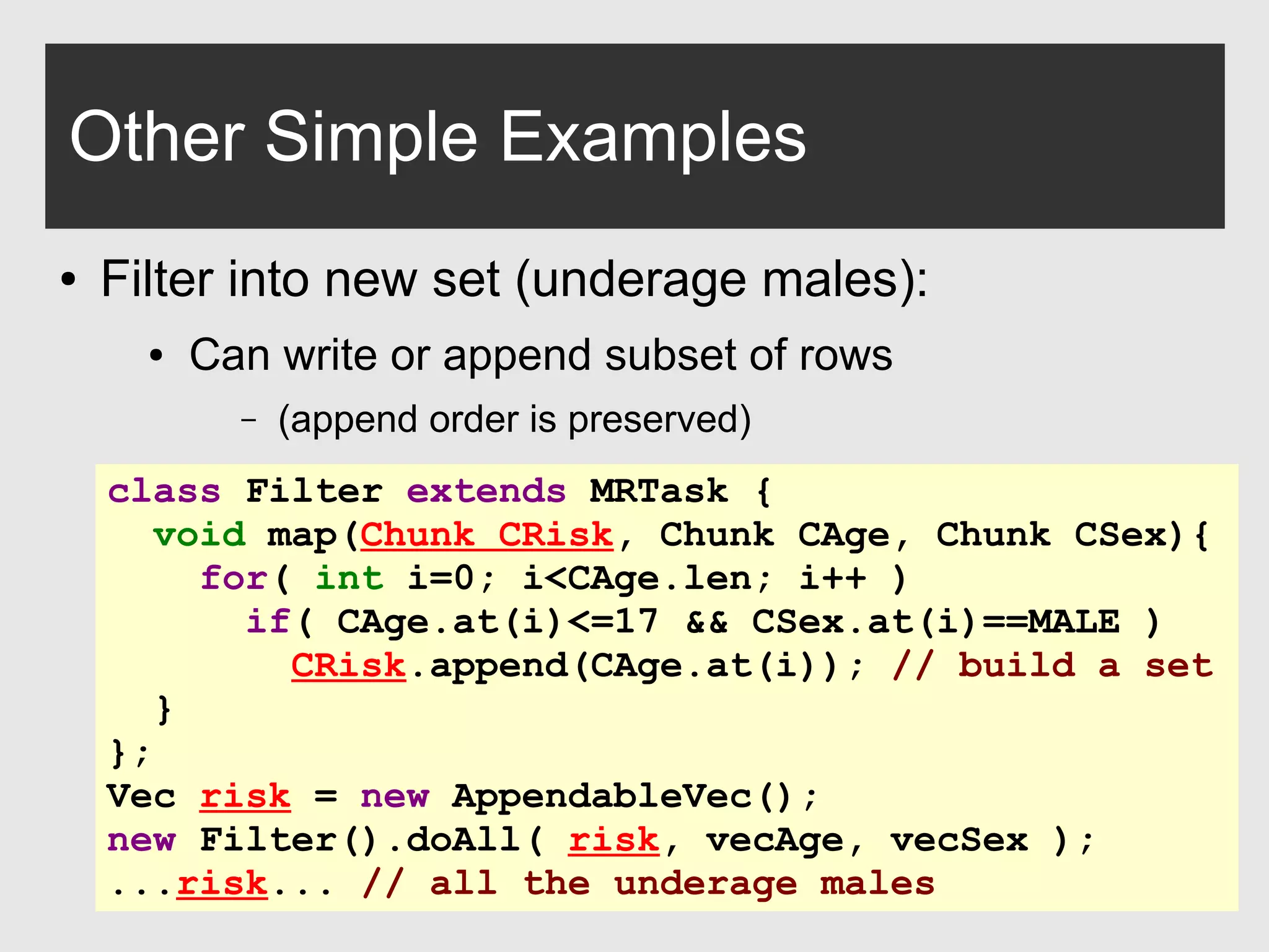
Other Simple Examples
● Filter into new set (underage males):
● Can write or append subset of rows
– (append order is preserved)
class Filter extends MRTask {
void map(Chunk CRisk, Chunk CAge, Chunk CSex){
for( int i=0; i<CAge.len; i++ )
if( CAge.at(i)<=17 && CSex.at(i)==MALE )
CRisk.append(CAge.at(i)); // build a set
}
};
Vec risk = new AppendableVec();
new Filter().doAll( risk, vecAge, vecSex );
...risk... // all the underage males
0xdata.com 31
Other Simple Examples
● Group-by: count of car-types by age
class AgeHisto extends MRTask {
long carAges[][]; // count of cars by age
void map( Chunk CAge, Chunk CCar ) {
carAges = new long[numAges][numCars];
for( int i=0; i<CAge.len; i++ )
carAges[CAge.at(i)][CCar.at(i)]++;
}
void reduce( AgeHisto that ) {
for( int i=0; i<carAges.length; i++ )
for( int j=0; i<carAges[j].length; j++ )
carAges[i][j] += that.carAges[i][j];
}
}
0xdata.com 32
class AgeHisto extends MRTask {
long carAges[][]; // count of cars by age
void map( Chunk CAge, Chunk CCar ) {
carAges = new long[numAges][numCars];
for( int i=0; i<CAge.len; i++ )
carAges[CAge.at(i)][CCar.at(i)]++;
}
void reduce( AgeHisto that ) {
for( int i=0; i<carAges.length; i++ )
for( int j=0; i<carAges[j].length; j++ )
carAges[i][j] += that.carAges[i][j];
}
}
Other Simple Examples
● Group-by: count of car-types by age
Setting carAges in map() makes it an output field.
Private per-map call, single-threaded write access.
Must be rolled-up in the reduce call.
Setting carAges in map makes it an output field.
Private per-map call, single-threaded write access.
Must be rolled-up in the reduce call.
0xdata.com 33
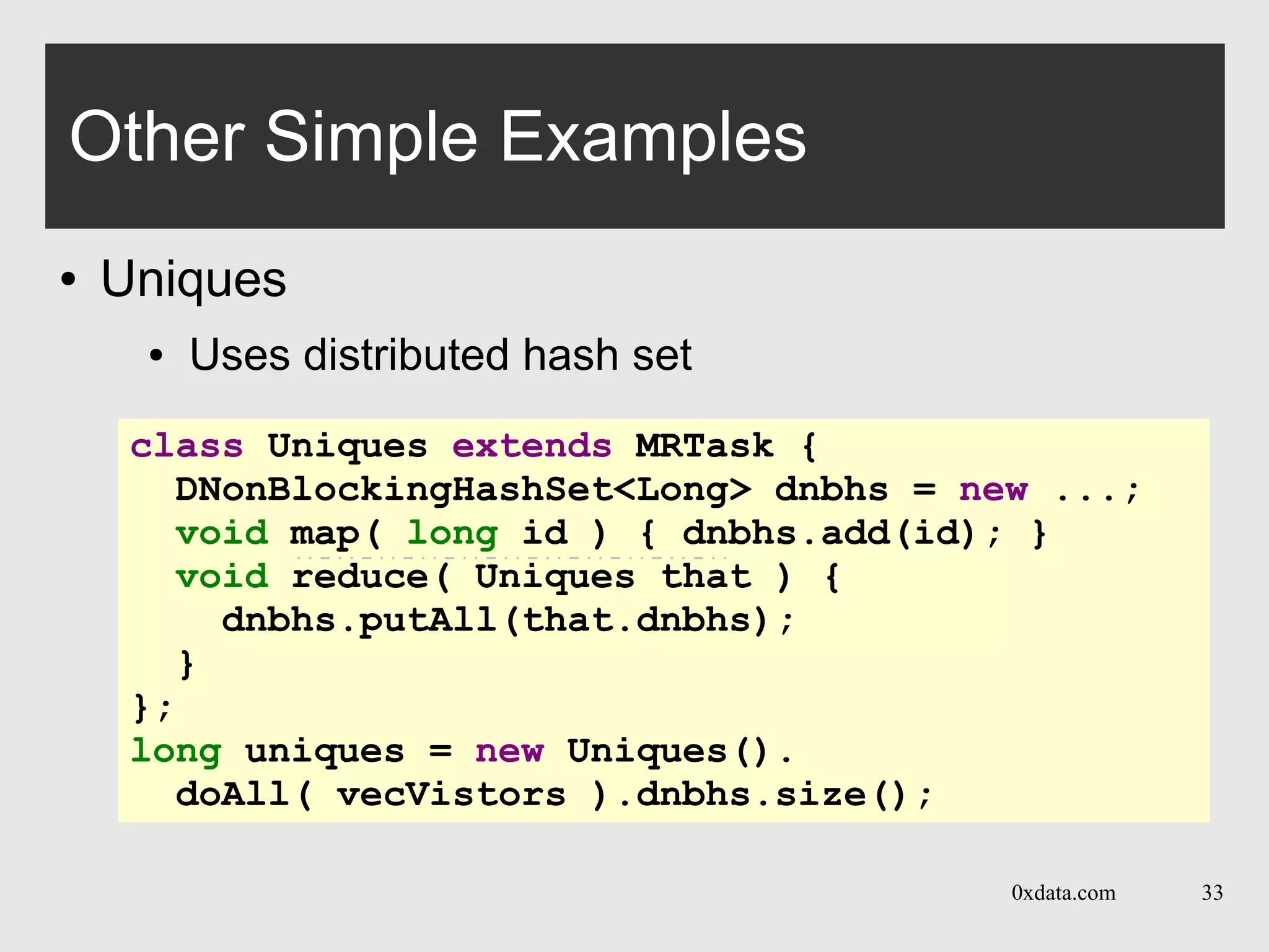
Other Simple Examples
● Uniques
● Uses distributed hash set
class Uniques extends MRTask {
DNonBlockingHashSet<Long> dnbhs = new ...;
void map( long id ) { dnbhs.add(id); }
void reduce( Uniques that ) {
dnbhs.putAll(that.dnbhs);
}
};
long uniques = new Uniques().
doAll( vecVistors ).dnbhs.size();
0xdata.com 34
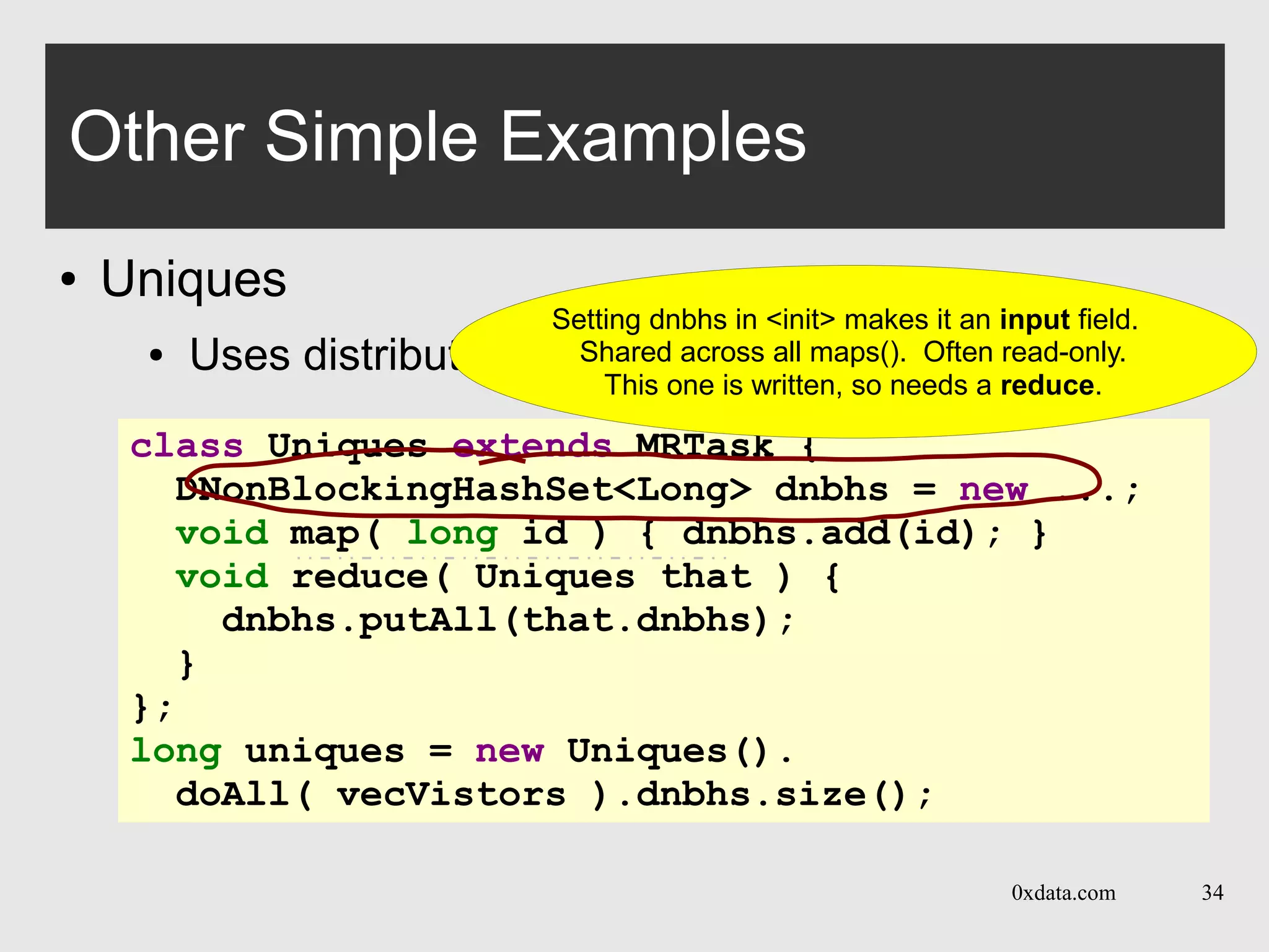
Other Simple Examples
● Uniques
● Uses distributed hash set
class Uniques extends MRTask {
DNonBlockingHashSet<Long> dnbhs = new ...;
void map( long id ) { dnbhs.add(id); }
void reduce( Uniques that ) {
dnbhs.putAll(that.dnbhs);
}
};
long uniques = new Uniques().
doAll( vecVistors ).dnbhs.size();
Setting dnbhs in <init> makes it an input field.
Shared across all maps(). Often read-only.
This one is written, so needs a reduce.

GBM in H2O with Cliff Click: H2O API

  • 1.
    GBM: Distributed Tree Algorithms onH2O Cliff Click, CTO 0xdata cliffc@0xdata.com http://0xdata.com http://cliffc.org/blog
  • 2.
    0xdata.com 2 H2O is... ●Pure Java, Open Source: 0xdata.com ● https://github.com/0xdata/h2o/ ● A Platform for doing Math ● Parallel Distributed Math ● In-memory analytics: GLM, GBM, RF, Logistic Reg ● Accessible via REST & JSON ● A K/V Store: ~150ns per get or put ● Distributed Fork/Join + Map/Reduce + K/V
  • 3.
    0xdata.com 3 Agenda ● BuildingBlocks For Big Data: ● Vecs & Frames & Chunks ● Distributed Tree Algorithms ● Access Patterns & Execution ● GBM on H2O ● Performance
  • 4.
    0xdata.com 4 A Collectionof Distributed Vectors // A Distributed Vector // much more than 2billion elements class Vec { long length(); // more than an int's worth // fast random access double at(long idx); // Get the idx'th elem boolean isNA(long idx); void set(long idx, double d); // writable void append(double d); // variable sized }
  • 5.
    0xdata.com 5 JVM 4 Heap JVM1 Heap JVM 2 Heap JVM 3 Heap Frames A Frame: Vec[] age sex zip ID car ●Vecs aligned in heaps ●Optimized for concurrent access ●Random access any row, any JVM ●But faster if local... more on that later
  • 6.
    0xdata.com 6 JVM 4 Heap JVM1 Heap JVM 2 Heap JVM 3 Heap Distributed Data Taxonomy A Chunk, Unit of Parallel Access Vec Vec Vec Vec Vec ●Typically 1e3 to 1e6 elements ●Stored compressed ●In byte arrays ●Get/put is a few clock cycles including compression
  • 7.
    0xdata.com 7 JVM 4 Heap JVM1 Heap JVM 2 Heap JVM 3 Heap Distributed Parallel Execution Vec Vec Vec Vec Vec ●All CPUs grab Chunks in parallel ●F/J load balances ●Code moves to Data ●Map/Reduce & F/J handles all sync ●H2O handles all comm, data manage
  • 8.
    0xdata.com 8 Distributed DataTaxonomy Frame – a collection of Vecs Vec – a collection of Chunks Chunk – a collection of 1e3 to 1e6 elems elem – a java double Row i – i'th elements of all the Vecs in a Frame
  • 9.
    0xdata.com 9 Distributed CodingTaxonomy ● No Distribution Coding: ● Whole Algorithms, Whole Vector-Math ● REST + JSON: e.g. load data, GLM, get results ● Simple Data-Parallel Coding: ● Per-Row (or neighbor row) Math ● Map/Reduce-style: e.g. Any dense linear algebra ● Complex Data-Parallel Coding ● K/V Store, Graph Algo's, e.g. PageRank
  • 10.
    0xdata.com 10 Distributed CodingTaxonomy ● No Distribution Coding: ● Whole Algorithms, Whole Vector-Math ● REST + JSON: e.g. load data, GLM, get results ● Simple Data-Parallel Coding: ● Per-Row (or neighbor row) Math ● Map/Reduce-style: e.g. Any dense linear algebra ● Complex Data-Parallel Coding ● K/V Store, Graph Algo's, e.g. PageRank Read the docs! This talk! Join our GIT!
  • 11.
    0xdata.com 11 Simple Data-ParallelCoding ● Map/Reduce Per-Row: Stateless ● Example from Linear Regression, Σ y2 ● Auto-parallel, auto-distributed ● Near Fortran speed, Java Ease double sumY2 = new MRTask() { double map( double d ) { return d*d; } double reduce( double d1, double d2 ) { return d1+d2; } }.doAll( vecY );
  • 12.
    0xdata.com 12 Simple Data-ParallelCoding ● Map/Reduce Per-Row: State-full ● Linear Regression Pass1: Σ x, Σ y, Σ y2 class LRPass1 extends MRTask { double sumX, sumY, sumY2; // I Can Haz State? void map( double X, double Y ) { sumX += X; sumY += Y; sumY2 += Y*Y; } void reduce( LRPass1 that ) { sumX += that.sumX ; sumY += that.sumY ; sumY2 += that.sumY2; } }
  • 13.
    0xdata.com 13 Simple Data-ParallelCoding ● Map/Reduce Per-Row: Batch State-full class LRPass1 extends MRTask { double sumX, sumY, sumY2; void map( Chunk CX, Chunk CY ) {// Whole Chunks for( int i=0; i<CX.len; i++ ){// Batch! double X = CX.at(i), Y = CY.at(i); sumX += X; sumY += Y; sumY2 += Y*Y; } } void reduce( LRPass1 that ) { sumX += that.sumX ; sumY += that.sumY ; sumY2 += that.sumY2; } }
  • 14.
    0xdata.com 14 Distributed Trees ●Overlay a Tree over the data ● Really: Assign a Tree Node to each Row ● Number the Nodes ● Store "Node_ID" per row in a temp Vec ● Make a pass over all Rows ● Nodes not visited in order... ● but all rows, all Nodes efficiently visited ● Do work (e.g. histogram) per Row/Node Vec nids = v.makeZero(); … nids.set(row,nid)...
  • 15.
    0xdata.com 15 Distributed Trees ●An initial Tree ● All rows at nid==0 ● MRTask: compute stats ● Use the stats to make a decision... ● (varies by algorithm)! nid=0 X Y nids A 1.2 0 B 3.1 0 C -2. 0 D 1.1 0 nid=0nid=0 Tree MRTask.sum=3.4
  • 16.
    0xdata.com 16 Distributed Trees ●Next layer in the Tree (and MRTask across rows) ● Each row: decide! – If "1<Y<1.5" go left else right ● Compute stats per new leaf ● Each pass across all rows builds entire layer nid=0 X Y nids A 1.2 1 B 3.1 2 C -2. 2 D 1.1 1 nid=01 < Y < 1.5 Tree sum=1.1 nid=1 nid=2 sum=2.3
  • 17.
    0xdata.com 17 Distributed Trees ●Another MRTask, another layer... ● i.e., a 5-deep tree takes 5 passes ● nid=0nid=01 < Y < 1.5 Tree sum=1.1 Y==1.1 leaf nid=3 nid=4 X Y nids A 1.2 3 B 3.1 2 C -2. 2 D 1.1 4 sum= -2. sum=3.1
  • 18.
    0xdata.com 18 Distributed Trees ●Each pass is over one layer in the tree ● Builds per-node histogram in map+reduce calls class Pass extends MRTask2<Pass> { void map( Chunk chks[] ) { Chunk nids = chks[...]; // Node-IDs per row for( int r=0; r<nids.len; r++ ){// All rows int nid = nids.at80(i); // Node-ID THIS row // Lazy: not all Chunks see all Nodes if( dHisto[nid]==null ) dHisto[nid]=... // Accumulate histogram stats per node dHisto[nid].accum(chks,r); } } }.doAll(myDataFrame,nids);
  • 19.
    0xdata.com 19 Distributed Trees ●Each pass analyzes one Tree level ● Then decide how to build next level ● Reassign Rows to new levels in another pass – (actually merge the two passes) ● Builds a Histogram-per-Node ● Which requires a reduce() call to roll up ● All Histograms for one level done in parallel
  • 20.
    0xdata.com 20 Distributed Trees:utilities ● “score+build” in one pass: ● Test each row against decision from prior pass ● Assign to a new leaf ● Build histogram on that leaf ● “score”: just walk the tree, and get results ● “compress”: Tree from POJO to byte[] ● Easily 10x smaller, can still walk, score, print ● Plus utilities to walk, print, display
  • 21.
    0xdata.com 21 GBM onDistributed Trees ● GBM builds 1 Tree, 1 level at a time, but... ● We run the entire level in parallel & distributed ● Built breadth-first because it's "free" ● More data offset by more CPUs ● Classic GBM otherwise ● Build residuals tree-by-tree ● Tuning knobs: trees, depth, shrinkage, min_rows ● Pure Java
  • 22.
    0xdata.com 22 GBM onDistributed Trees ● Limiting factor: latency in turning over a level ● About 4x faster than R single-node on covtype ● Does the per-level compute in parallel ● Requires sending histograms over network – Can get big for very deep trees ●
  • 23.
    0xdata.com 23 Summary: Write(parallel) Java ● Most simple Java “just works” ● Fast: parallel distributed reads, writes, appends ● Reads same speed as plain Java array loads ● Writes, appends: slightly slower (compression) ● Typically memory bandwidth limited – (may be CPU limited in a few cases) ● Slower: conflicting writes (but follows strict JMM) ● Also supports transactional updates
  • 24.
    0xdata.com 24 Summary: WritingAnalytics ● We're writing Big Data Analytics ● Generalized Linear Modeling (ADMM, GLMNET) – Logistic Regression, Poisson, Gamma ● Random Forest, GBM, KMeans++, KNN ● State-of-the-art Algorithms, running Distributed ● Solidly working on 100G datasets ● Heading for Tera Scale ● Paying customers (in production!) ● Come write your own (distributed) algorithm!!!
  • 25.
    0xdata.com 25 Cool SystemsStuff... ● … that I ran out of space for ● Reliable UDP, integrated w/RPC ● TCP is reliably UNReliable ● Already have a reliable UDP framework, so no prob ● Fork/Join Goodies: ● Priority Queues ● Distributed F/J ● Surviving fork bombs & lost threads ● K/V does JMM via hardware-like MESI protocol
  • 26.
    0xdata.com 26 H2O is... ●Pure Java, Open Source: 0xdata.com ● https://github.com/0xdata/h2o/ ● A Platform for doing Math ● Parallel Distributed Math ● In-memory analytics: GLM, GBM, RF, Logistic Reg ● Accessible via REST & JSON ● A K/V Store: ~150ns per get or put ● Distributed Fork/Join + Map/Reduce + K/V
  • 27.
    0xdata.com 27 The Platform NFS HDFS byte[] extendsIced extends DTask AutoBuffer RPC extends DRemoteTask D/F/J extends MRTask User code? JVM 1 NFS HDFS byte[] extends Iced extends DTask AutoBuffer RPC extends DRemoteTask D/F/J extends MRTask User code? JVM 2 K/V get/put UDP / TCP
  • 28.
    0xdata.com 28 Other SimpleExamples ● Filter & Count (underage males): ● (can pass in any number of Vecs or a Frame) long sumY2 = new MRTask() { long map( long age, long sex ) { return (age<=17 && sex==MALE) ? 1 : 0; } long reduce( long d1, long d2 ) { return d1+d2; } }.doAll( vecAge, vecSex );
  • 29.
    0xdata.com 29 Other SimpleExamples ● Filter into new set (underage males): ● Can write or append subset of rows – (append order is preserved) class Filter extends MRTask { void map(Chunk CRisk, Chunk CAge, Chunk CSex){ for( int i=0; i<CAge.len; i++ ) if( CAge.at(i)<=17 && CSex.at(i)==MALE ) CRisk.append(CAge.at(i)); // build a set } }; Vec risk = new AppendableVec(); new Filter().doAll( risk, vecAge, vecSex ); ...risk... // all the underage males
  • 30.
    0xdata.com 30 Other SimpleExamples ● Filter into new set (underage males): ● Can write or append subset of rows – (append order is preserved) class Filter extends MRTask { void map(Chunk CRisk, Chunk CAge, Chunk CSex){ for( int i=0; i<CAge.len; i++ ) if( CAge.at(i)<=17 && CSex.at(i)==MALE ) CRisk.append(CAge.at(i)); // build a set } }; Vec risk = new AppendableVec(); new Filter().doAll( risk, vecAge, vecSex ); ...risk... // all the underage males
  • 31.
    0xdata.com 31 Other SimpleExamples ● Group-by: count of car-types by age class AgeHisto extends MRTask { long carAges[][]; // count of cars by age void map( Chunk CAge, Chunk CCar ) { carAges = new long[numAges][numCars]; for( int i=0; i<CAge.len; i++ ) carAges[CAge.at(i)][CCar.at(i)]++; } void reduce( AgeHisto that ) { for( int i=0; i<carAges.length; i++ ) for( int j=0; i<carAges[j].length; j++ ) carAges[i][j] += that.carAges[i][j]; } }
  • 32.
    0xdata.com 32 class AgeHistoextends MRTask { long carAges[][]; // count of cars by age void map( Chunk CAge, Chunk CCar ) { carAges = new long[numAges][numCars]; for( int i=0; i<CAge.len; i++ ) carAges[CAge.at(i)][CCar.at(i)]++; } void reduce( AgeHisto that ) { for( int i=0; i<carAges.length; i++ ) for( int j=0; i<carAges[j].length; j++ ) carAges[i][j] += that.carAges[i][j]; } } Other Simple Examples ● Group-by: count of car-types by age Setting carAges in map() makes it an output field. Private per-map call, single-threaded write access. Must be rolled-up in the reduce call. Setting carAges in map makes it an output field. Private per-map call, single-threaded write access. Must be rolled-up in the reduce call.
  • 33.
    0xdata.com 33 Other SimpleExamples ● Uniques ● Uses distributed hash set class Uniques extends MRTask { DNonBlockingHashSet<Long> dnbhs = new ...; void map( long id ) { dnbhs.add(id); } void reduce( Uniques that ) { dnbhs.putAll(that.dnbhs); } }; long uniques = new Uniques(). doAll( vecVistors ).dnbhs.size();
  • 34.
    0xdata.com 34 Other SimpleExamples ● Uniques ● Uses distributed hash set class Uniques extends MRTask { DNonBlockingHashSet<Long> dnbhs = new ...; void map( long id ) { dnbhs.add(id); } void reduce( Uniques that ) { dnbhs.putAll(that.dnbhs); } }; long uniques = new Uniques(). doAll( vecVistors ).dnbhs.size(); Setting dnbhs in <init> makes it an input field. Shared across all maps(). Often read-only. This one is written, so needs a reduce.