Presentation by:
Steve Austen, Head of Engineering Support
Angus Watson, Head of Construction and Refit
Concept to production –
The challenges of project management in the RNLI
Overview
•Introduction
•What were the challenges:-
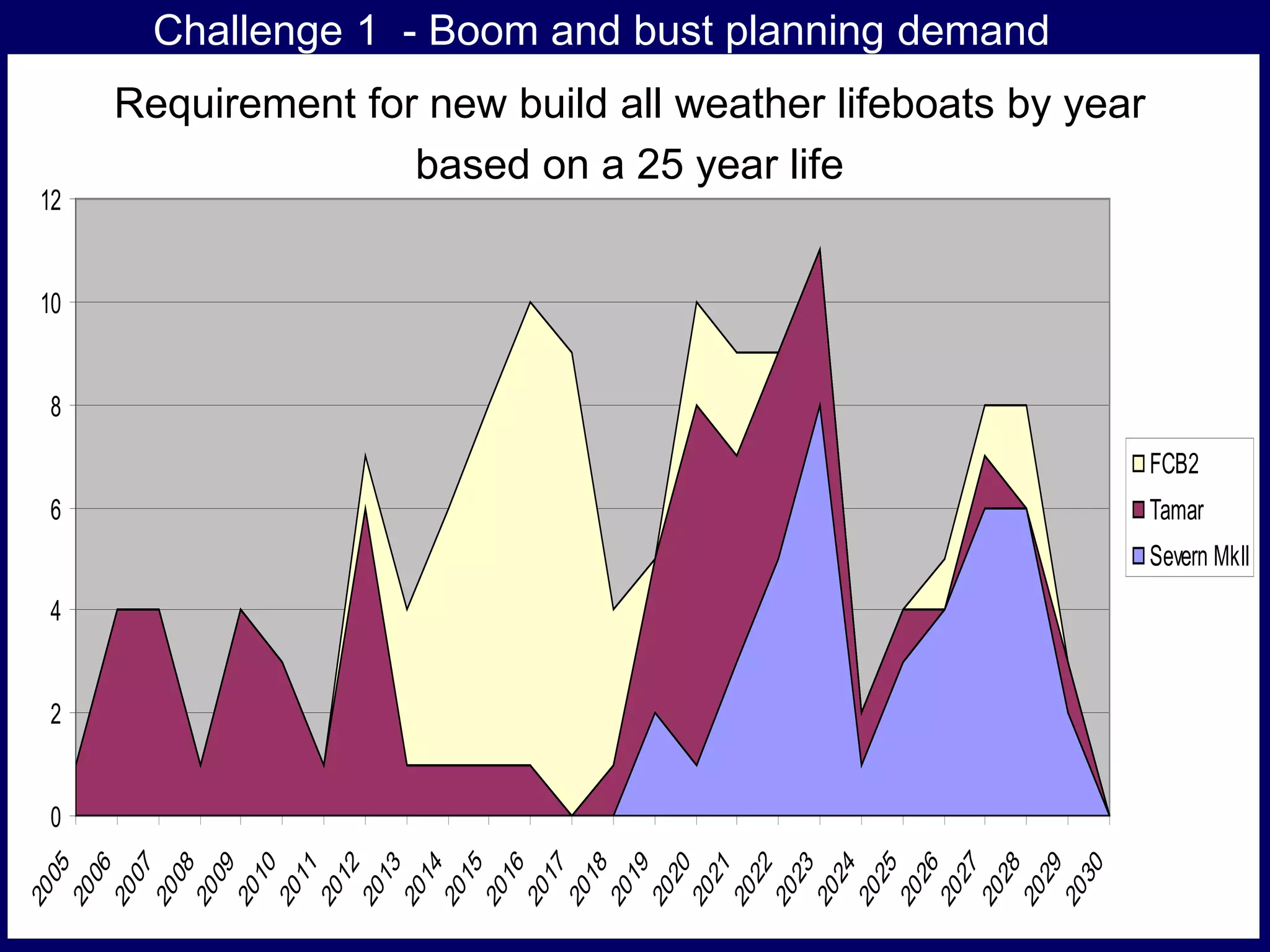
• Challenge 1 - Boom and bust planning demand
• Challenge 2 – How to get more for the same during a recession
• Challenge 3 – Sustainability
•Summary and Conclusion
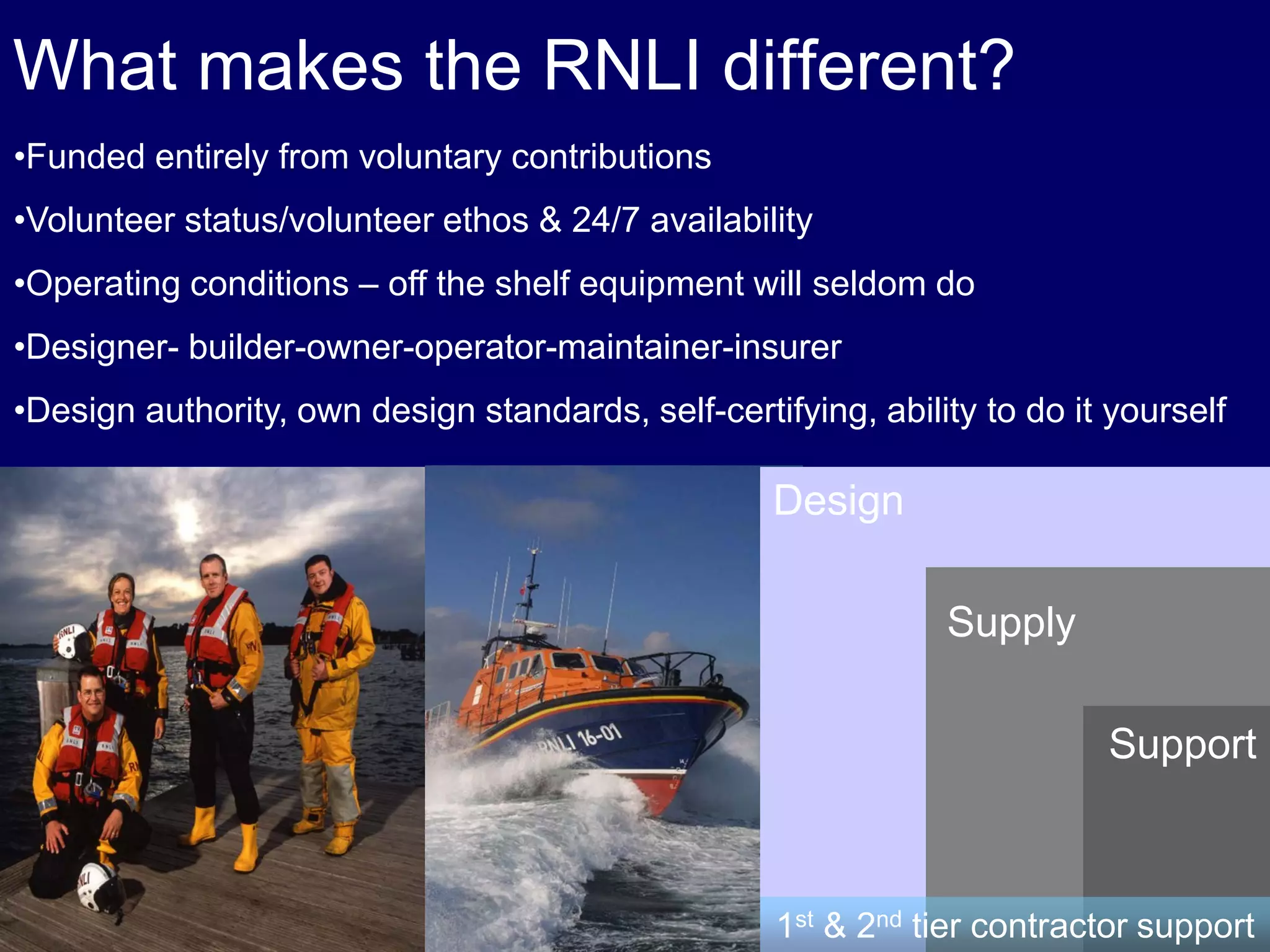
What makes the RNLI different?
•Funded entirely from voluntary contributions
•Volunteer status/volunteer ethos & 24/7 availability
•Operating conditions – off the shelf equipment will seldom do
•Designer- builder-owner-operator-maintainer-insurer
•Design authority, own design standards, self-certifying, ability to do it yourself
Design
Supply
Support
1st & 2nd tier contractor support
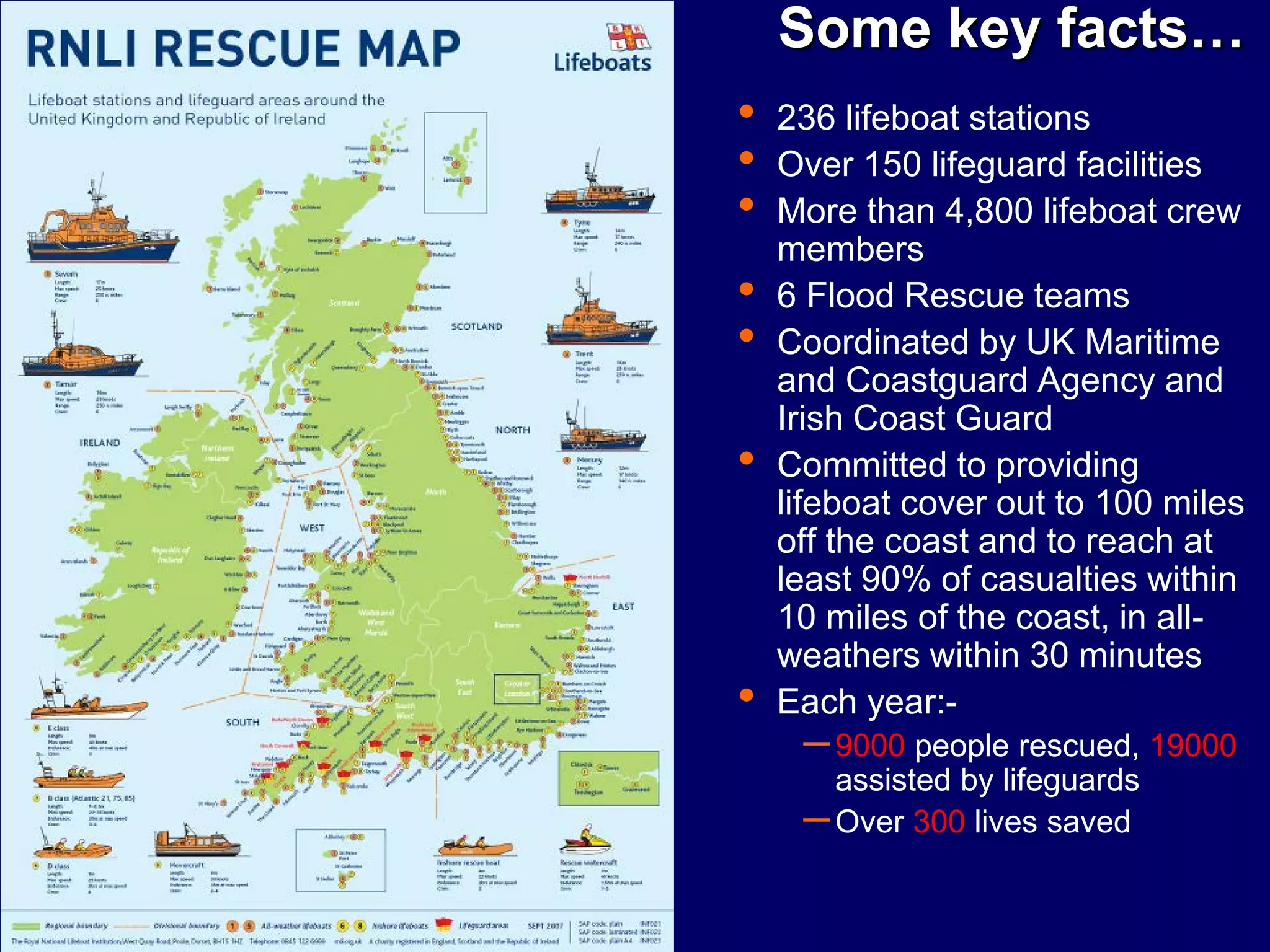
Some key facts…
• 236 lifeboat stations
• Over 150 lifeguard facilities
• More than 4,800 lifeboat crew
members
• 6 Flood Rescue teams
• Coordinated by UK Maritime
and Coastguard Agency and
Irish Coast Guard
• Committed to providing
lifeboat cover out to 100 miles
off the coast and to reach at
least 90% of casualties within
10 miles of the coast, in all-
weathers within 30 minutes
• Each year:-
–9000 people rescued, 19000
assisted by lifeguards
–Over 300 lives saved
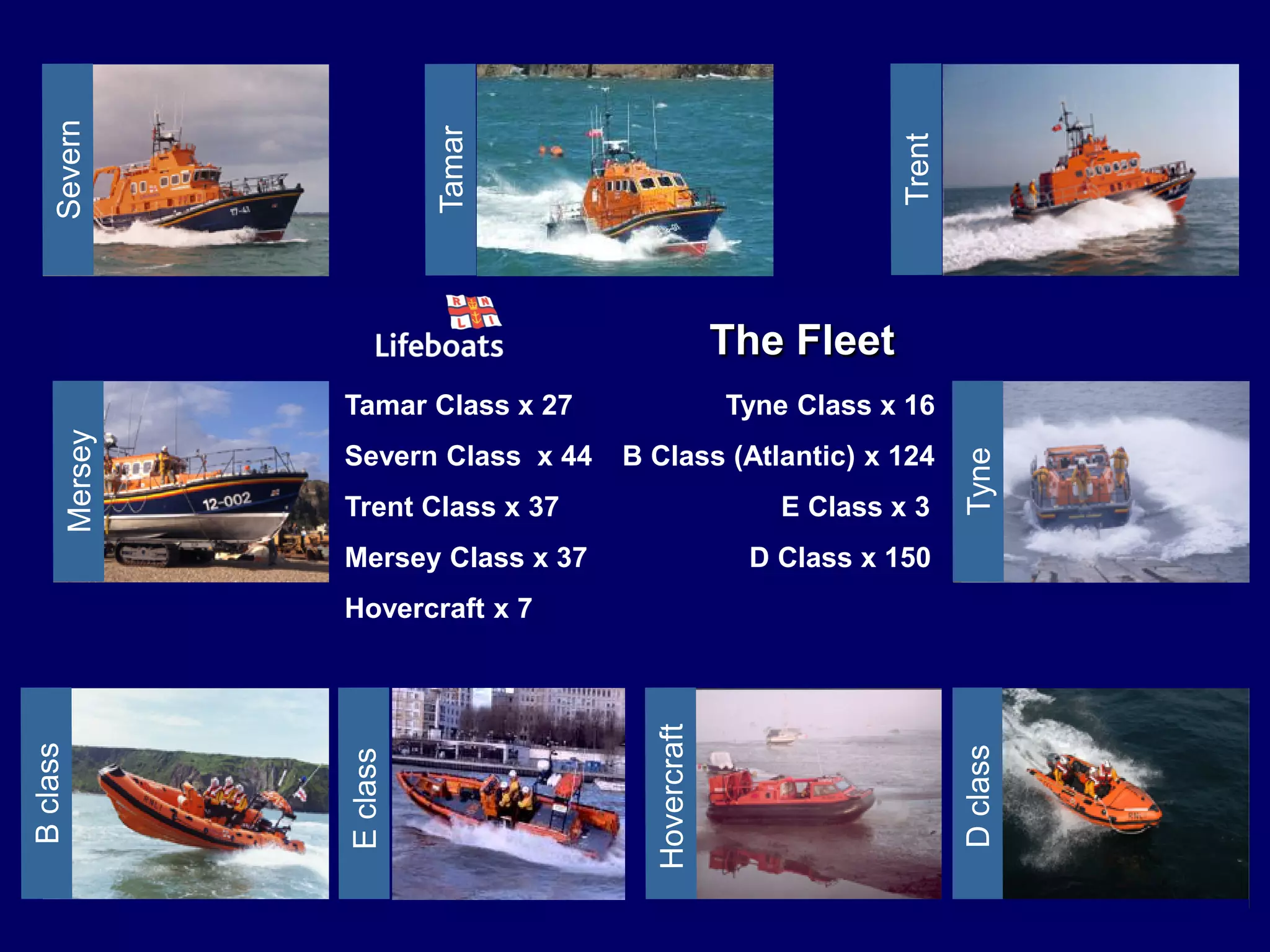
Tamar Class x 27 Tyne Class x 16
Severn Class x 44 B Class (Atlantic) x 124
Trent Class x 37 E Class x 3
Mersey Class x 37 D Class x 150
Hovercraft x 7
The Fleet
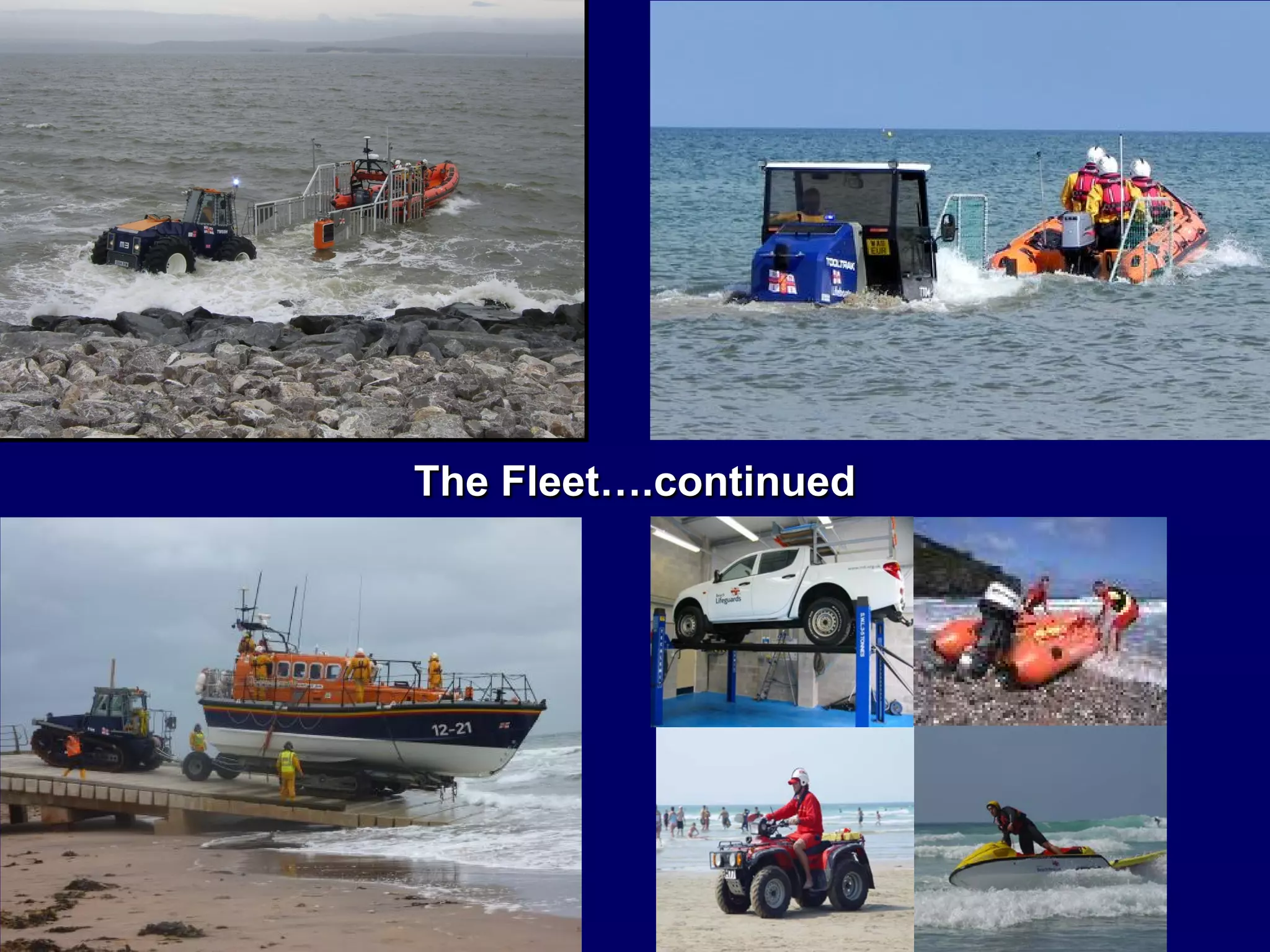
The Fleet….continued
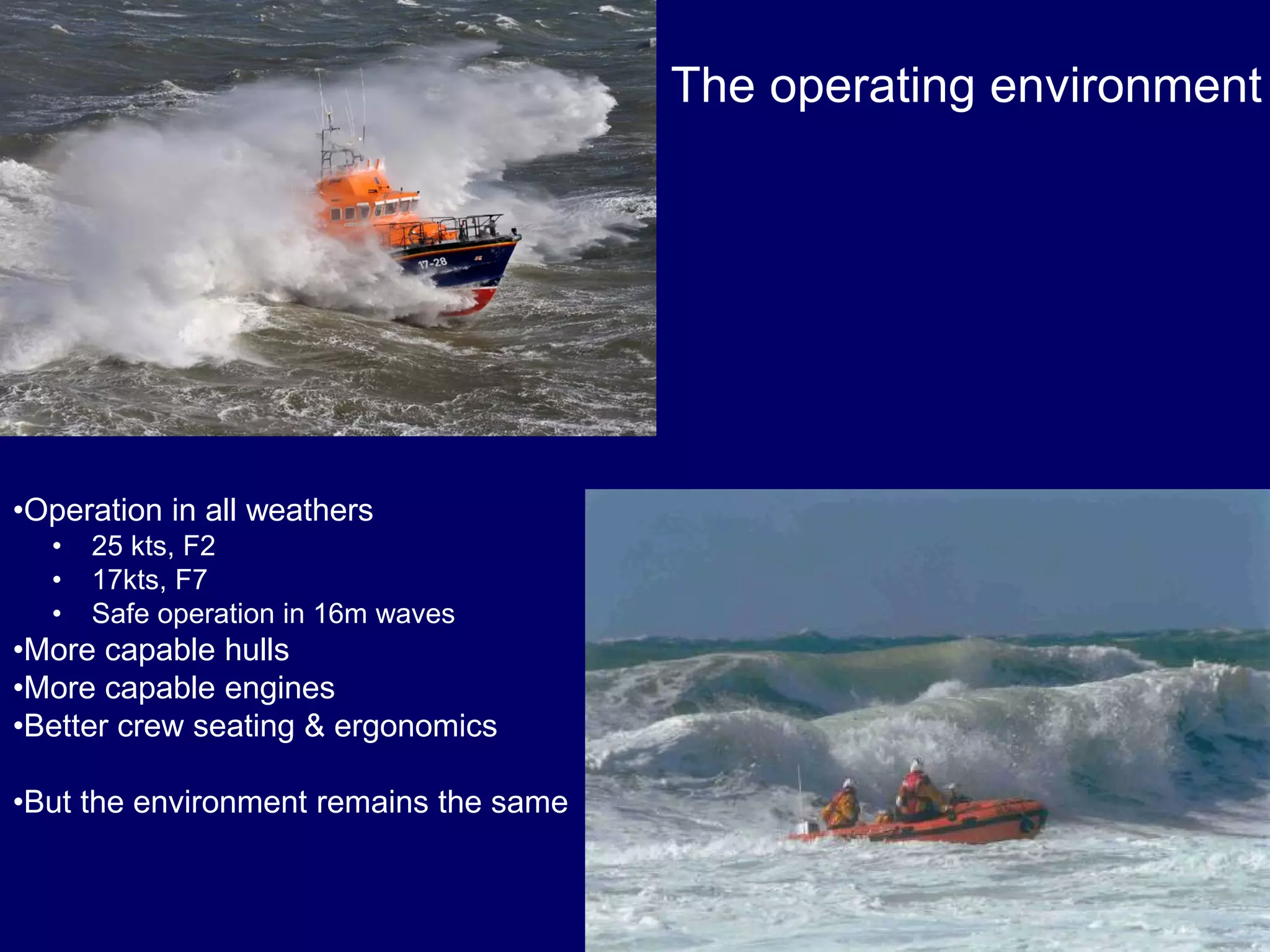
The operating environment
•Operation in all weathers
• 25 kts, F2
• 17kts, F7
• Safe operation in 16m waves
•More capable hulls
•More capable engines
•Better crew seating & ergonomics
•But the environment remains the same
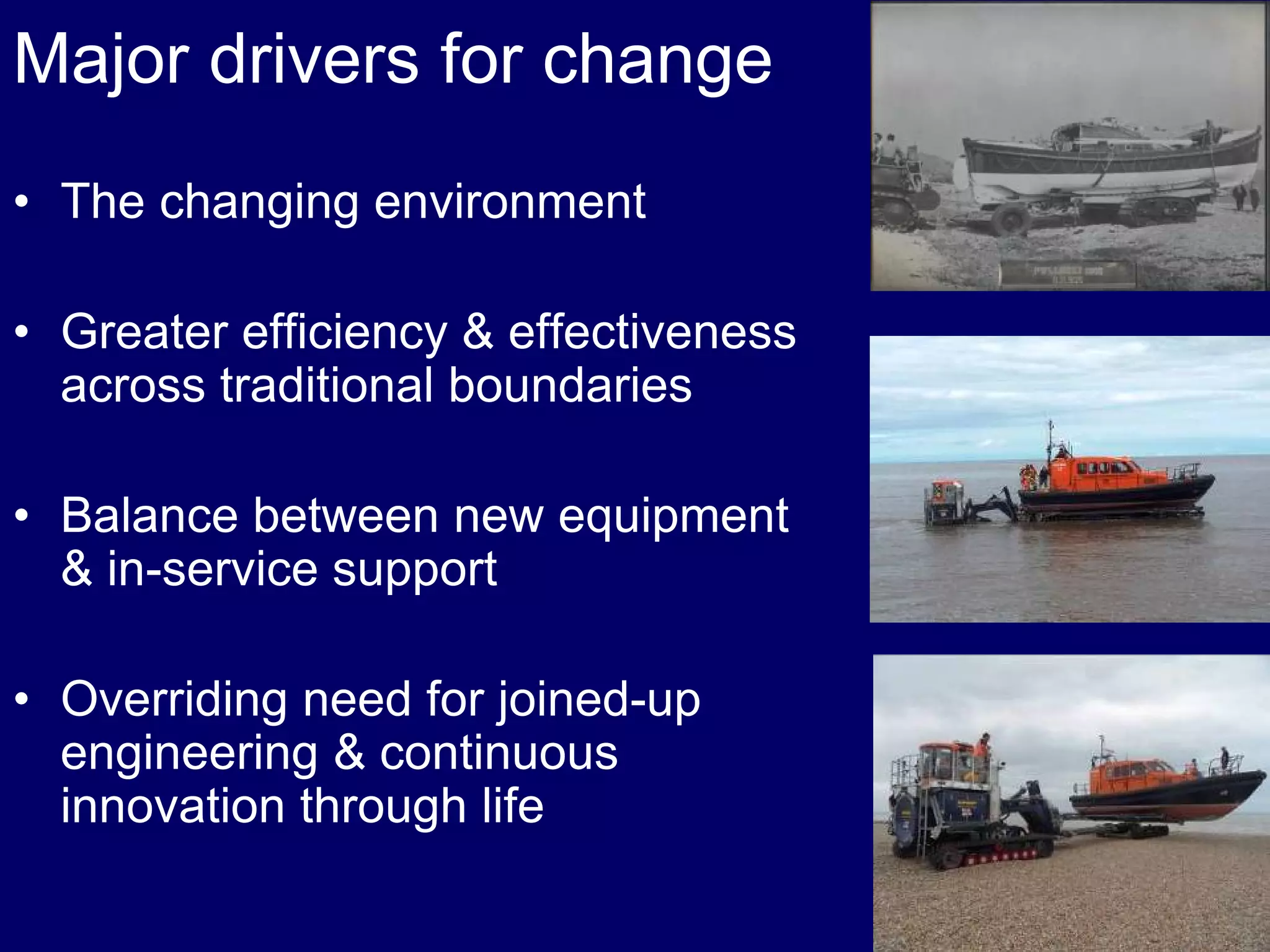
Major drivers for change
• The changing environment
• Greater efficiency & effectiveness
across traditional boundaries
• Balance between new equipment
& in-service support
• Overriding need for joined-up
engineering & continuous
innovation through life
Requirement by Class
0
2
4
6
8
10
12
2005
2006
2007
2008
2009
2010
2011
2012
2013
2014
2015
2016
2017
2018
2019
2020
2021
2022
2023
2024
2025
2026
2027
2028
2029
2030
FCB2
Tamar
Severn MkII
Requirement for new build all weather lifeboats by year
based on a 25 year life
Challenge 1 - Boom and bust planning demand
Requirement by Class
0
2
4
6
8
10
12
2005
2006
2007
2008
2009
2010
2011
2012
2013
2014
2015
2016
2017
2018
2019
2020
2021
2022
2023
2024
2025
2026
2027
2028
2029
2030
FCB2
Tamar
Severn MkII
Requirement for new build all weather lifeboats by year
based on a 25 year life
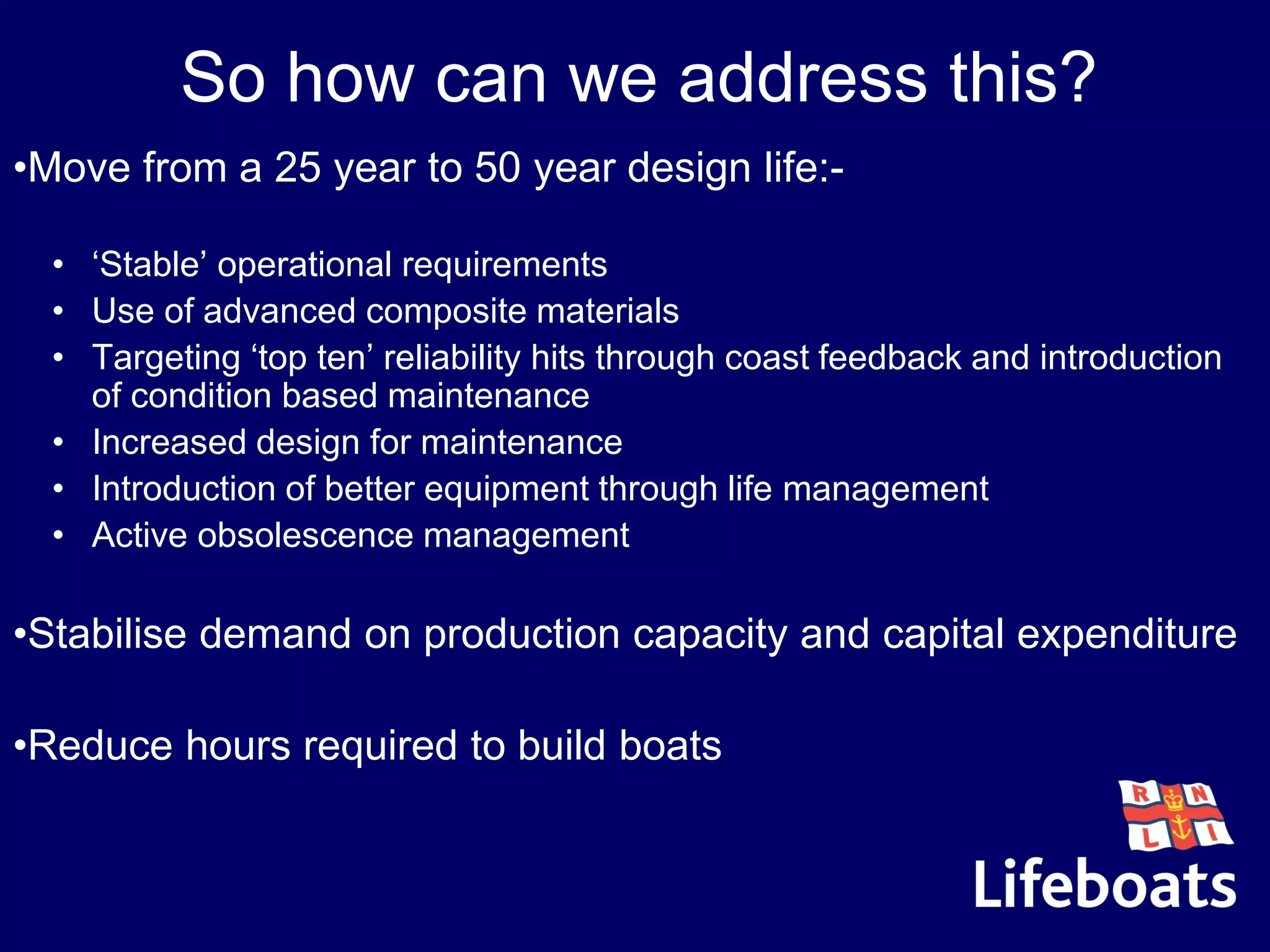
So how can we address this?
•Move from a 25 year to 50 year design life:-
• ‘Stable’ operational requirements
• Use of advanced composite materials
• Targeting ‘top ten’ reliability hits through coast feedback and introduction
of condition based maintenance
• Increased design for maintenance
• Introduction of better equipment through life management
• Active obsolescence management
•Stabilise demand on production capacity and capital expenditure
•Reduce hours required to build boats
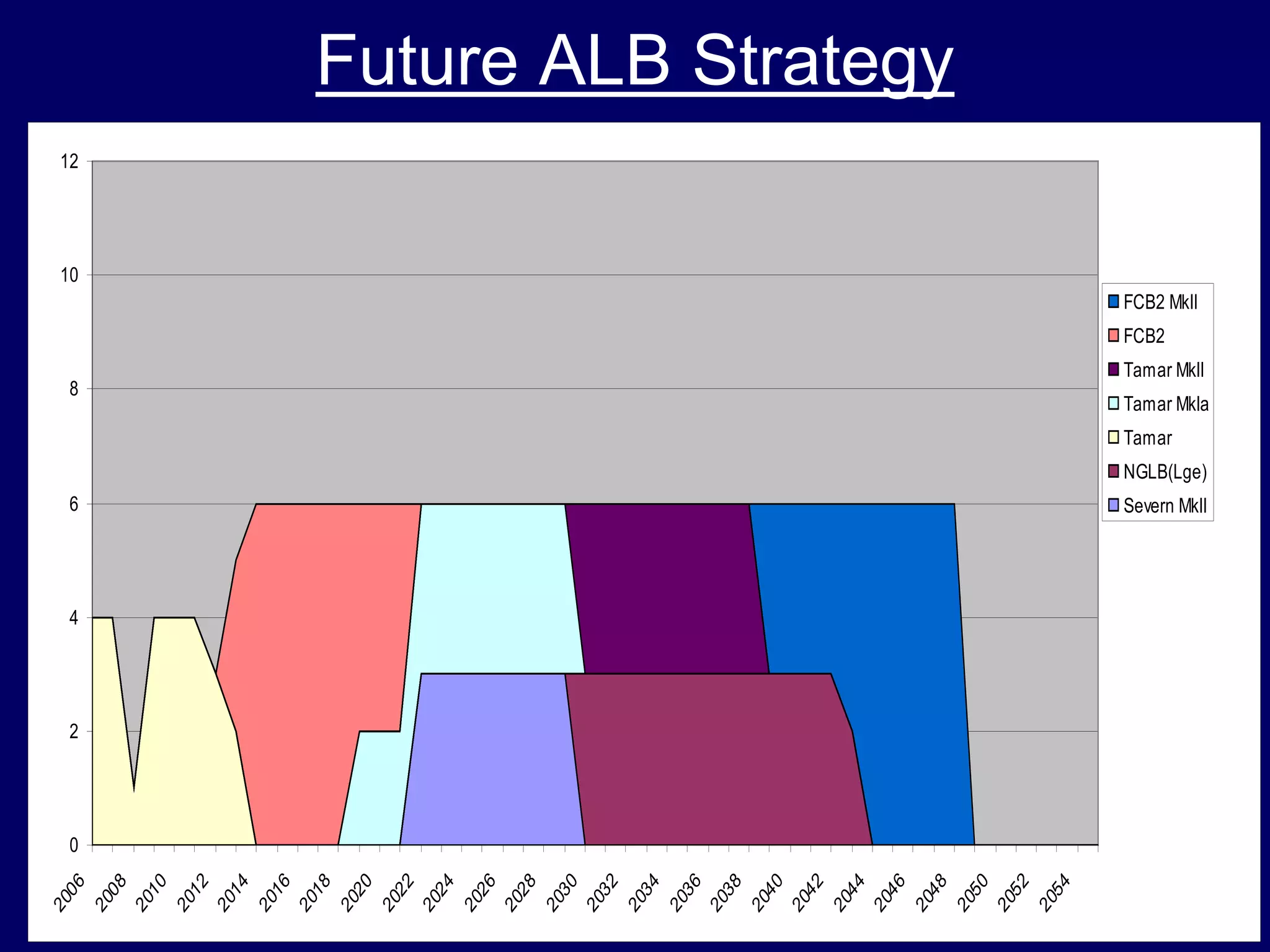
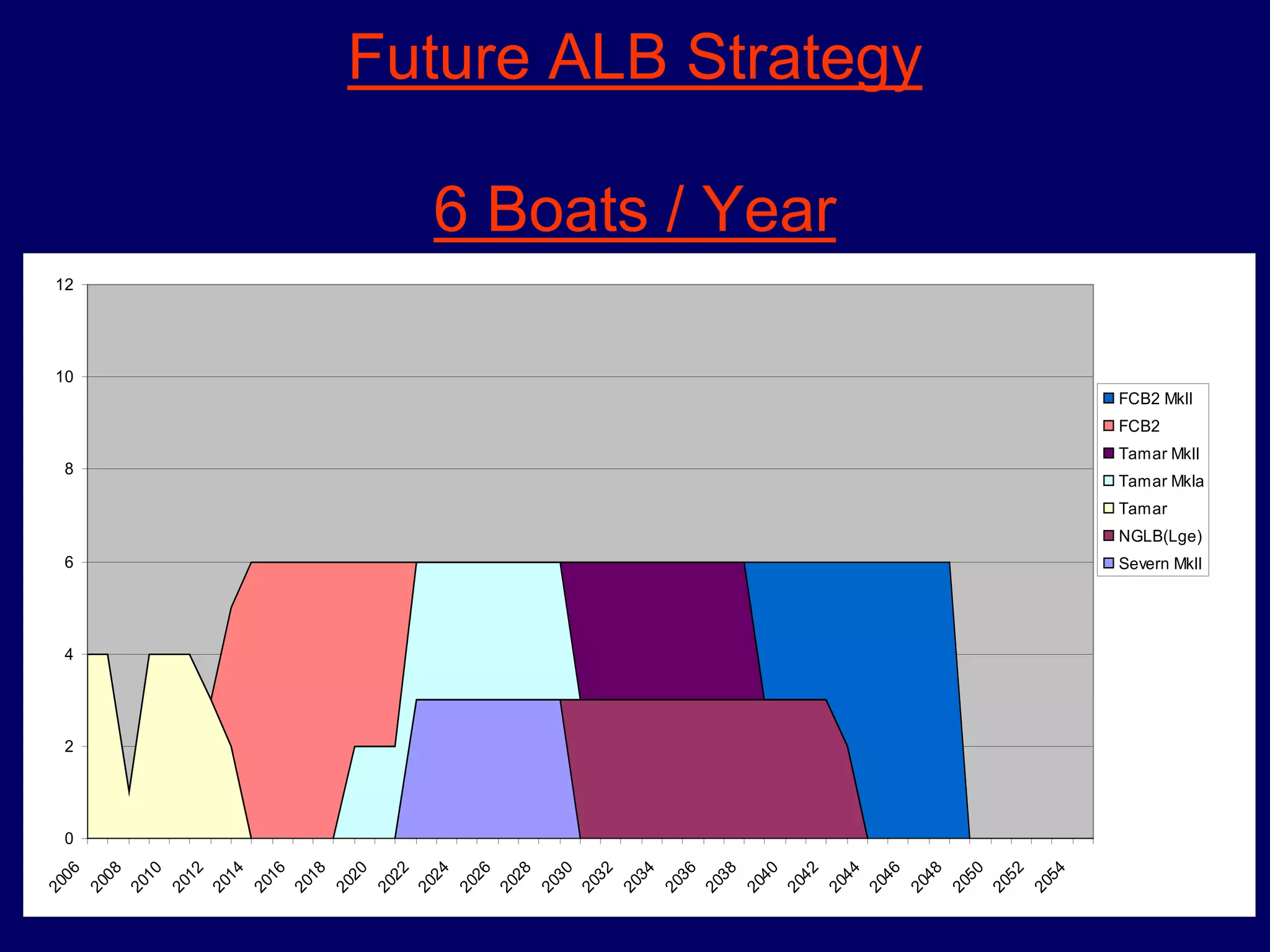
Future ALB Strategy
0
2
4
6
8
10
12
2006
2008
2010
2012
2014
2016
2018
2020
2022
2024
2026
2028
2030
2032
2034
2036
2038
2040
2042
2044
2046
2048
2050
2052
2054
FCB2 MkII
FCB2
Tamar MkII
Tamar MkIa
Tamar
NGLB(Lge)
Severn MkII
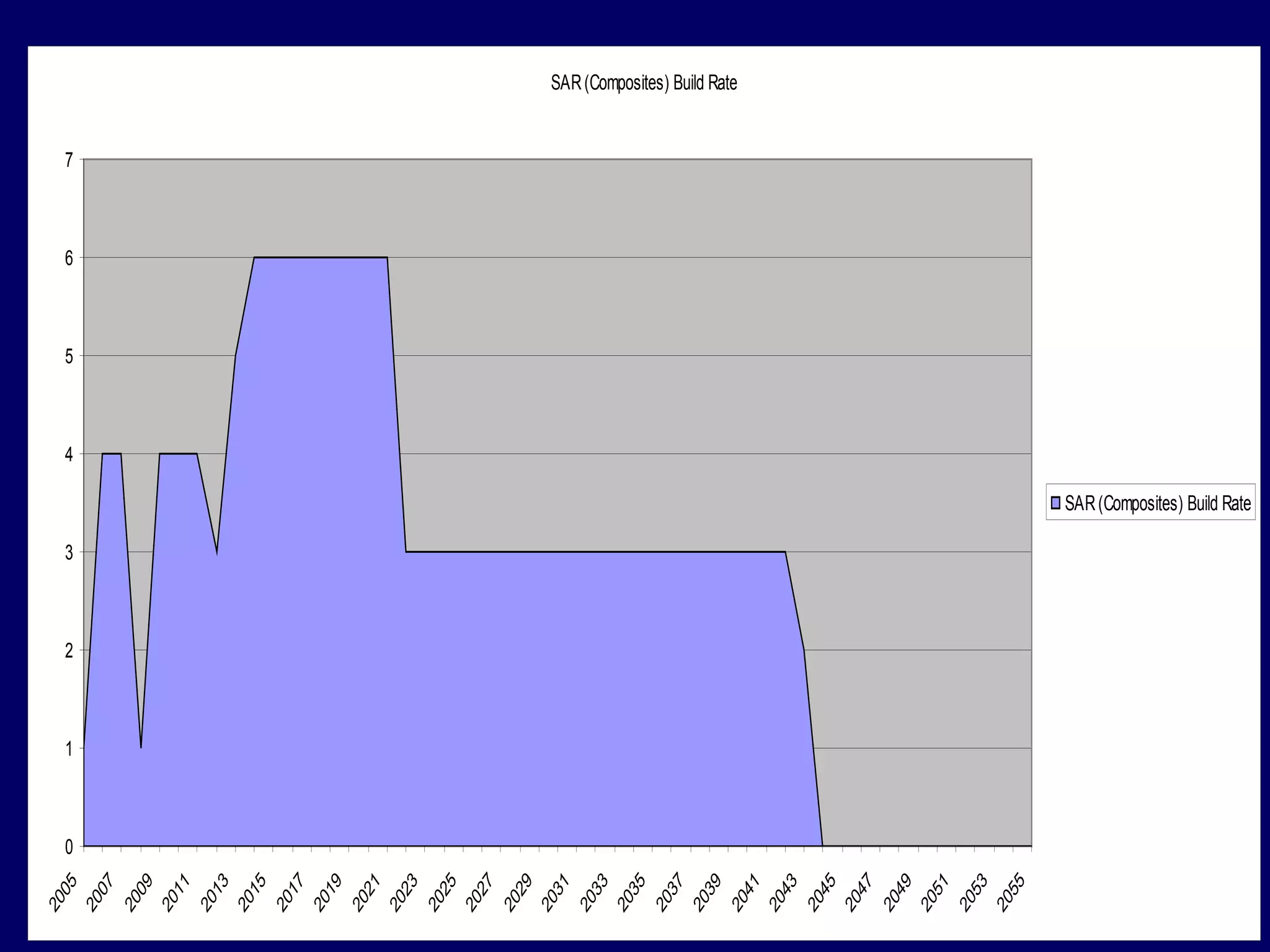
SAR(Composites) Build Rate
0
1
2
3
4
5
6
7
2005
2007
2009
2011
2013
2015
2017
2019
2021
2023
2025
2027
2029
2031
2033
2035
2037
2039
2041
2043
2045
2047
2049
2051
2053
2055
SAR(Composites) Build Rate
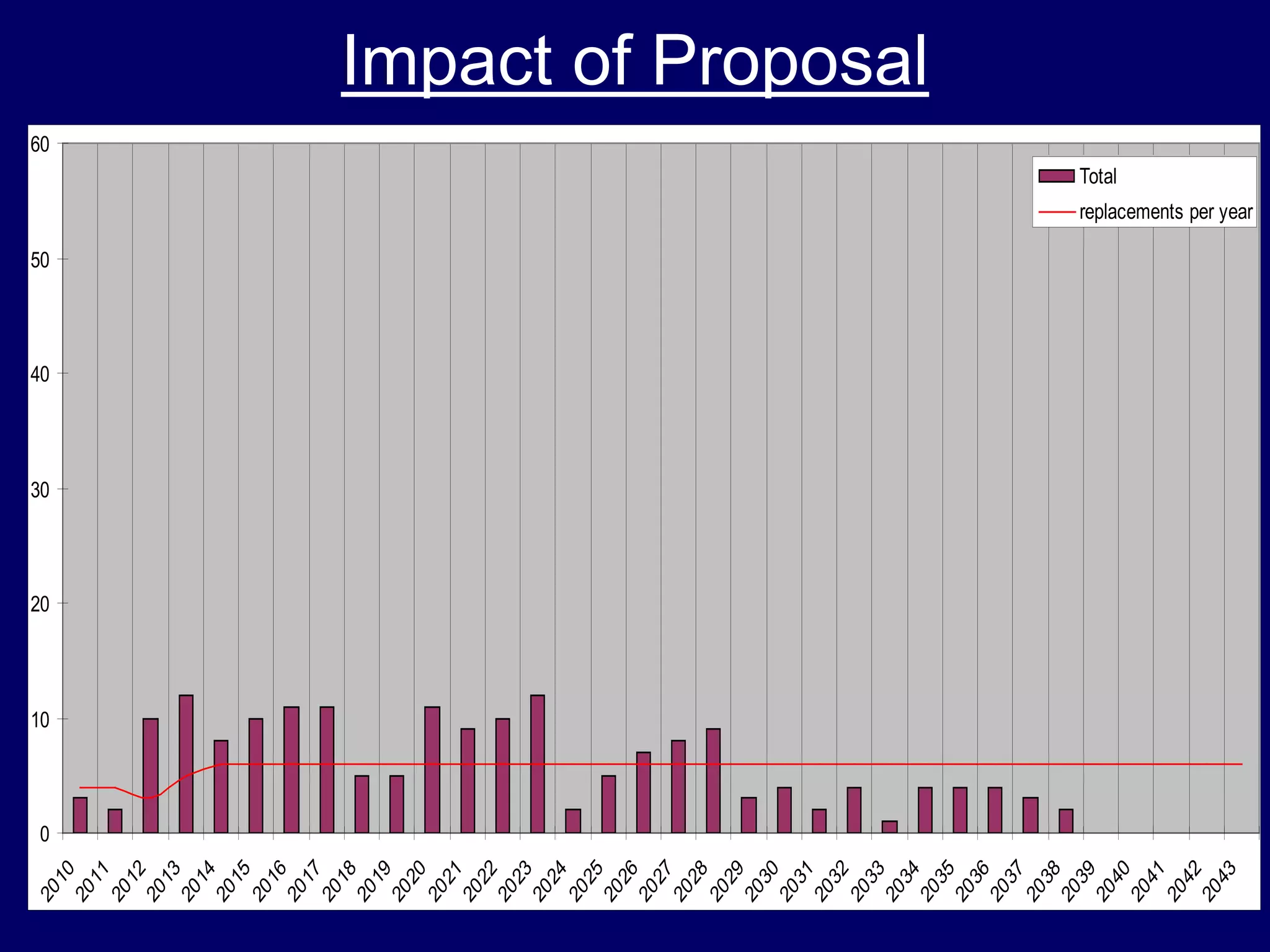
Impact of Proposal
0
10
20
30
40
50
60
2010
2011
2012
2013
2014
2015
2016
2017
2018
2019
2020
2021
2022
2023
2024
2025
2026
2027
2028
2029
2030
2031
2032
2033
2034
2035
2036
2037
2038
2039
2040
2041
2042
2043
Total
replacements per year
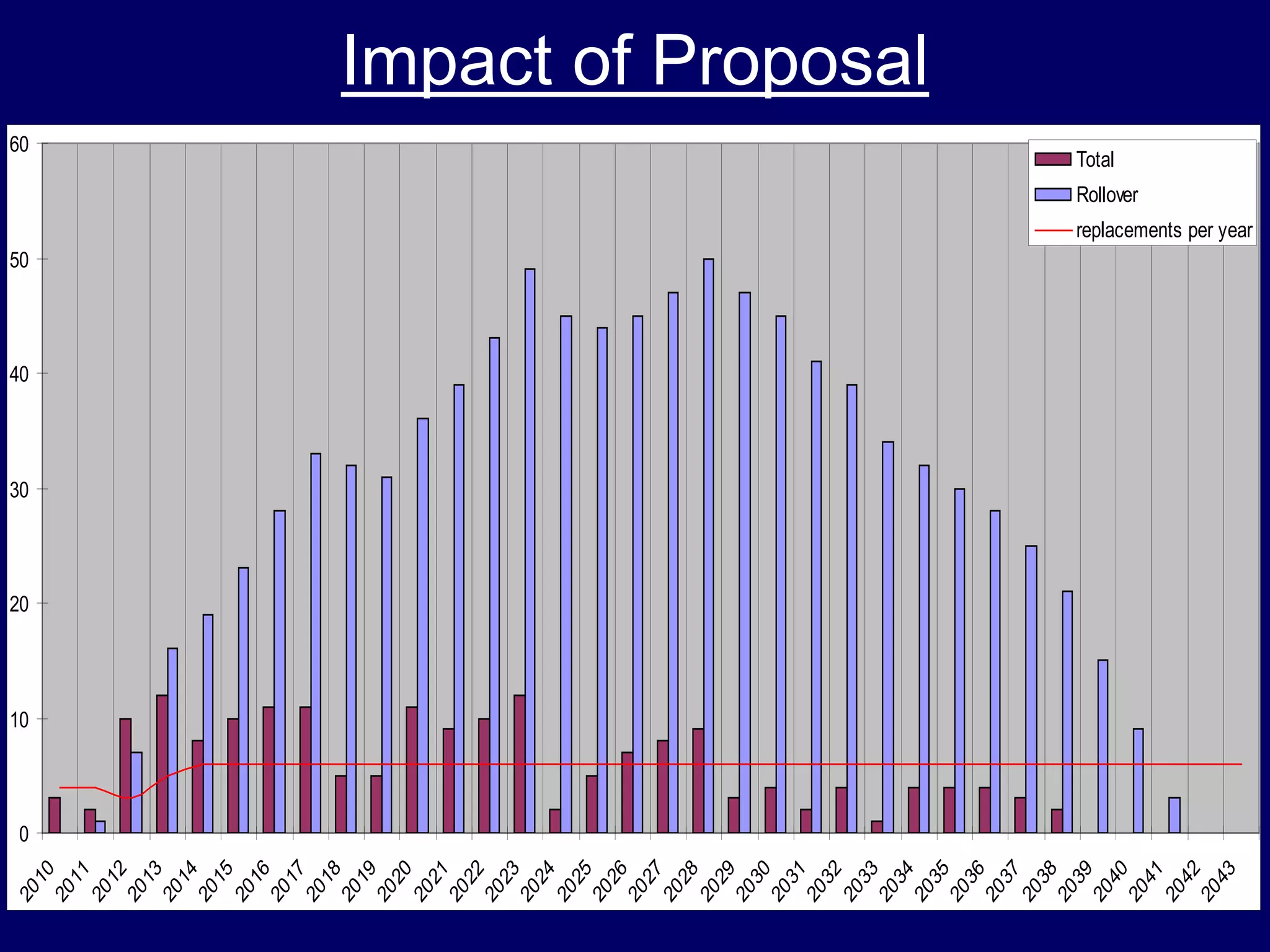
Impact of Proposal
0
10
20
30
40
50
60
2010
2011
2012
2013
2014
2015
2016
2017
2018
2019
2020
2021
2022
2023
2024
2025
2026
2027
2028
2029
2030
2031
2032
2033
2034
2035
2036
2037
2038
2039
2040
2041
2042
2043
Total
Rollover
replacements per year
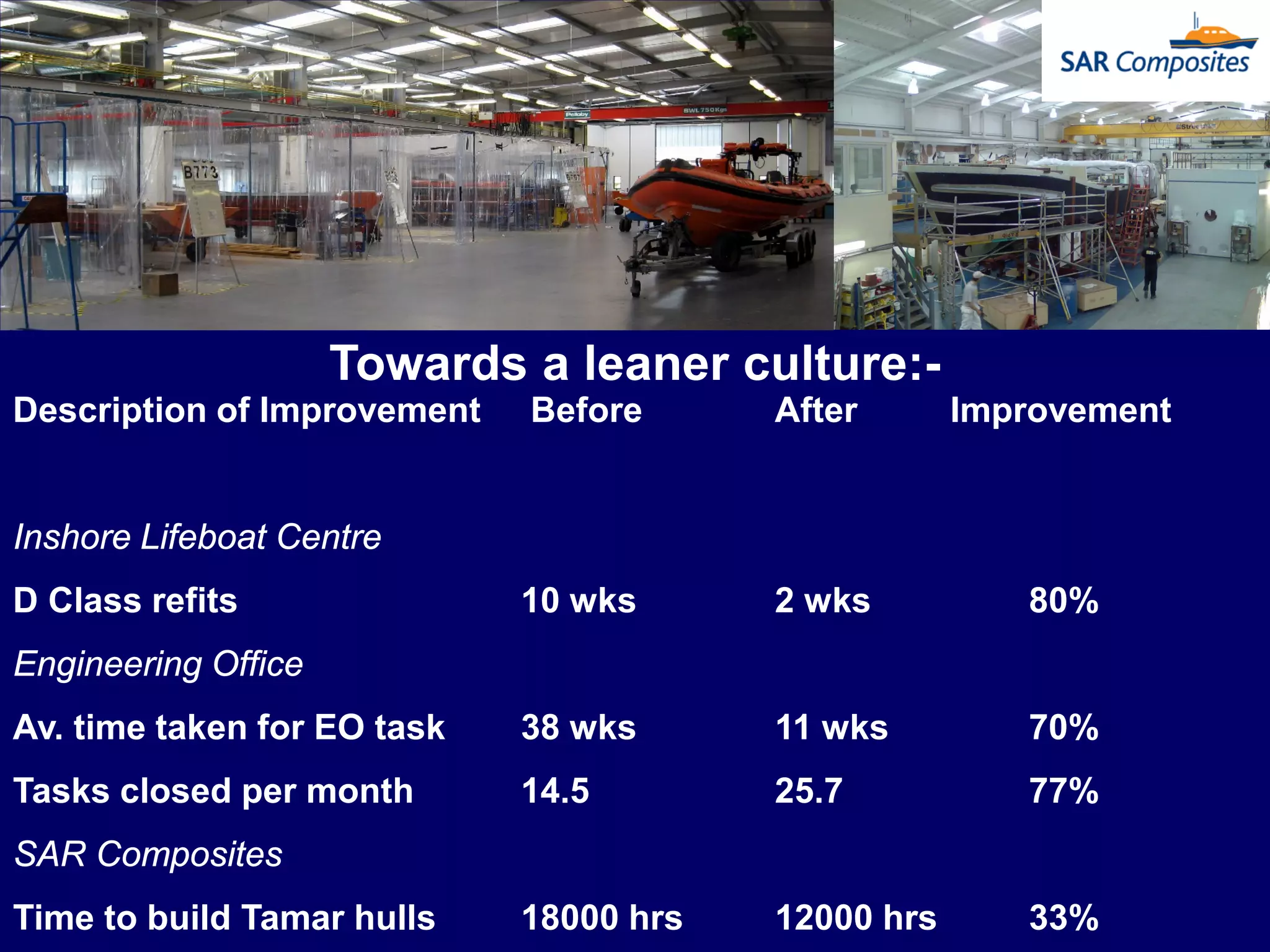
Towards a leaner culture:-
Description of Improvement Before After Improvement
Inshore Lifeboat Centre
D Class refits 10 wks 2 wks 80%
Engineering Office
Av. time taken for EO task 38 wks 11 wks 70%
Tasks closed per month 14.5 25.7 77%
SAR Composites
Time to build Tamar hulls 18000 hrs 12000 hrs 33%
Lean design
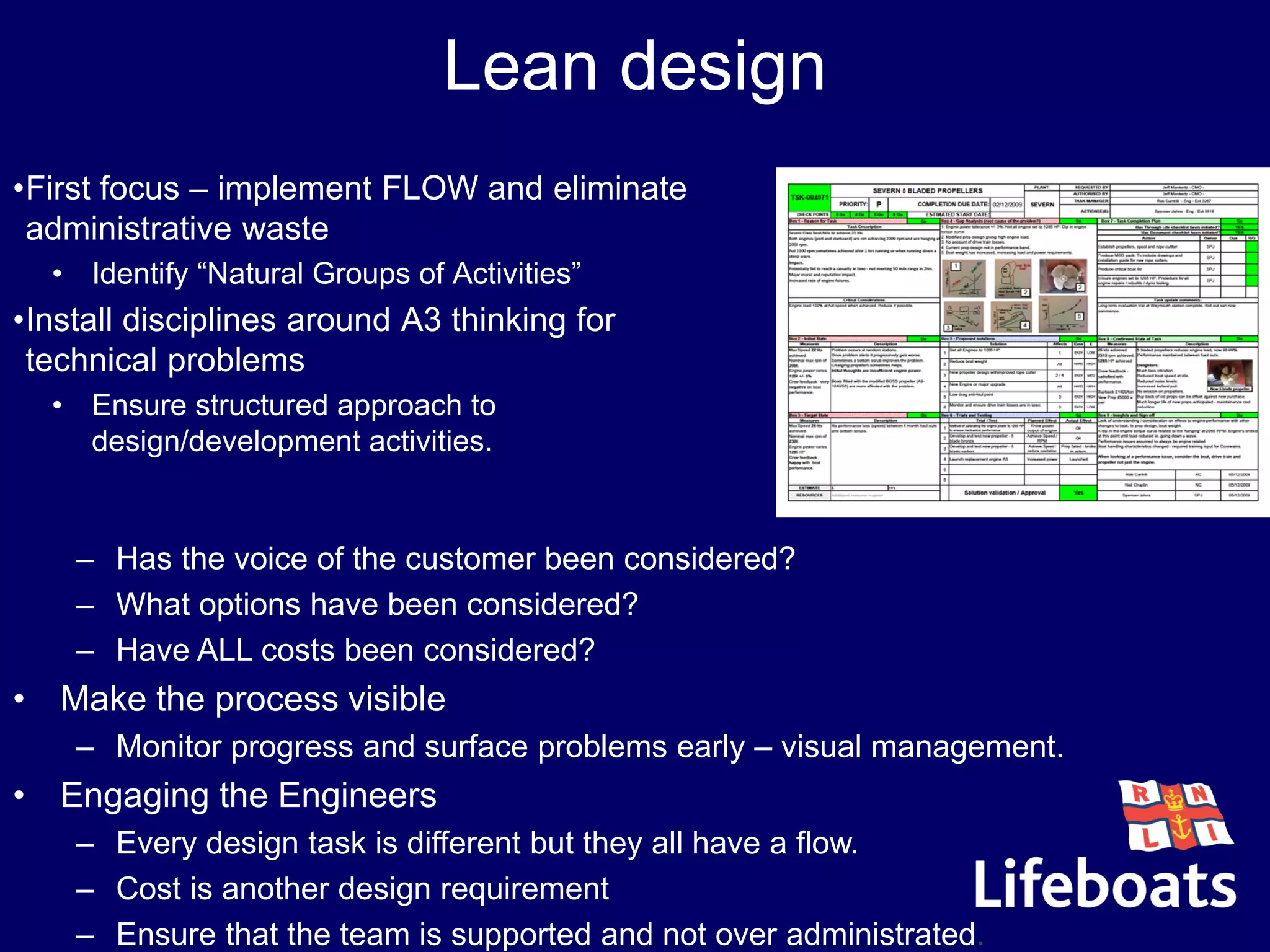
•First focus – implement FLOW and eliminate
administrative waste
• Identify “Natural Groups of Activities”
•Install disciplines around A3 thinking for
technical problems
• Ensure structured approach to
design/development activities.
– Has the voice of the customer been considered?
– What options have been considered?
– Have ALL costs been considered?
• Make the process visible
– Monitor progress and surface problems early – visual management.
• Engaging the Engineers
– Every design task is different but they all have a flow.
– Cost is another design requirement
– Ensure that the team is supported and not over administrated.
Value Engineering – Shannon Class
•Value engineering event made a significant
breakthrough:
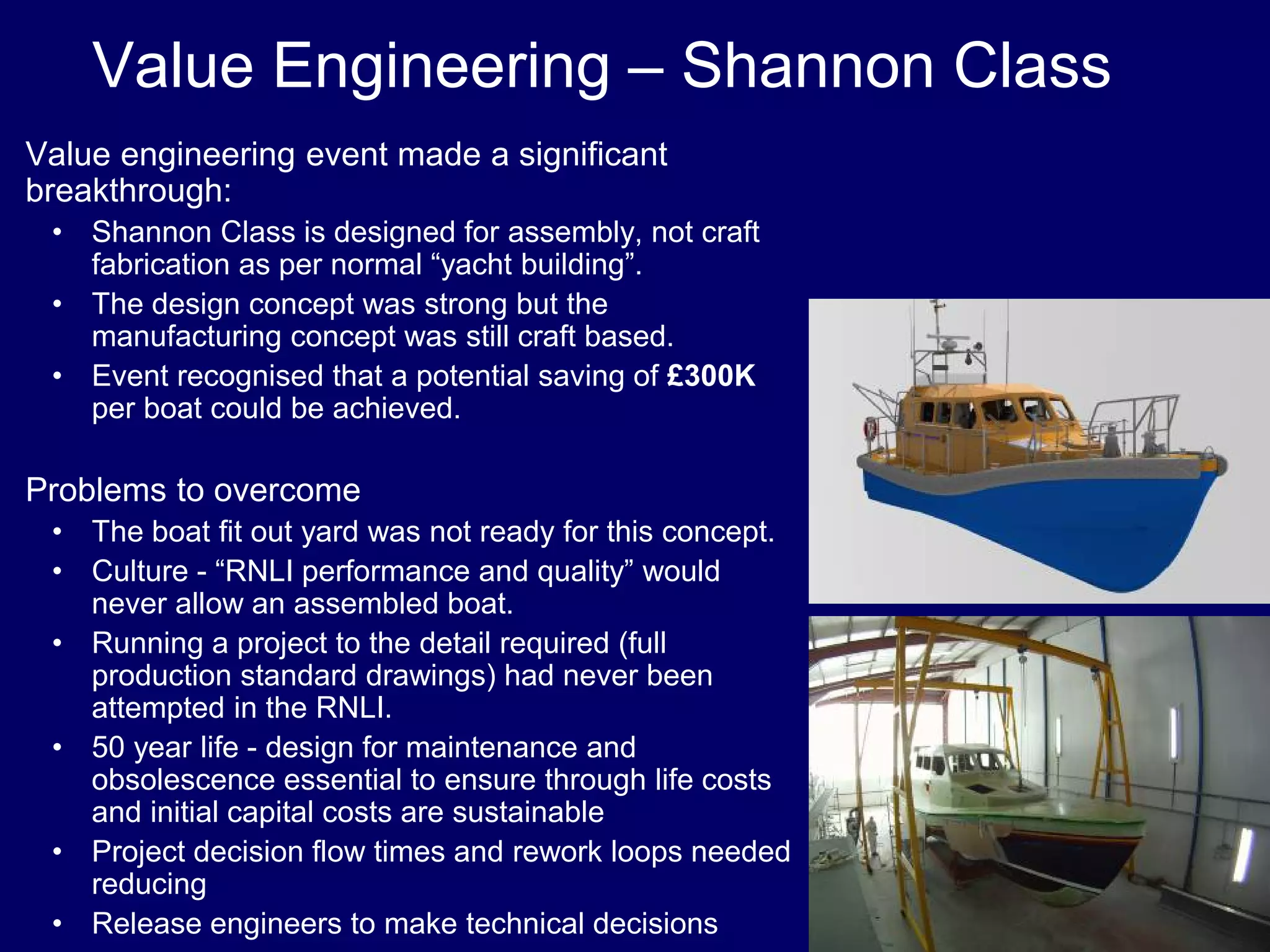
• Shannon Class is designed for assembly, not craft
fabrication as per normal “yacht building”.
• The design concept was strong but the
manufacturing concept was still craft based.
• Event recognised that a potential saving of £300K
per boat could be achieved.
•Problems to overcome
• The boat fit out yard was not ready for this concept.
• Culture - “RNLI performance and quality” would
never allow an assembled boat.
• Running a project to the detail required (full
production standard drawings) had never been
attempted in the RNLI.
• 50 year life - design for maintenance and
obsolescence essential to ensure through life costs
and initial capital costs are sustainable
• Project decision flow times and rework loops needed
reducing
• Release engineers to make technical decisions
Project solution
•Integrate the builder into the project team to pool experience with engineers and
CAD technicians on design and manufacturability.
•Develop an obeya studio concept allowing:-
• weekly planning, daily reviews and problem solving
• Inclusive project management – find the problems don’t hide them.
• team based problem solving
• simple processes that work with quality built in (drawing improvement /change sheets)
•Hold items from CAD if critical engineering decisions have not been resolved (i.e.
don’t be busy fools)
•Give responsibility to engineers to resolve issues and work as a team.
•The prototype boat fully tested all the elements of the design – build in as much as
possible of the critical features to learn about the boat’s performance in all
respects – close to ‘production standard’
Impact of approach
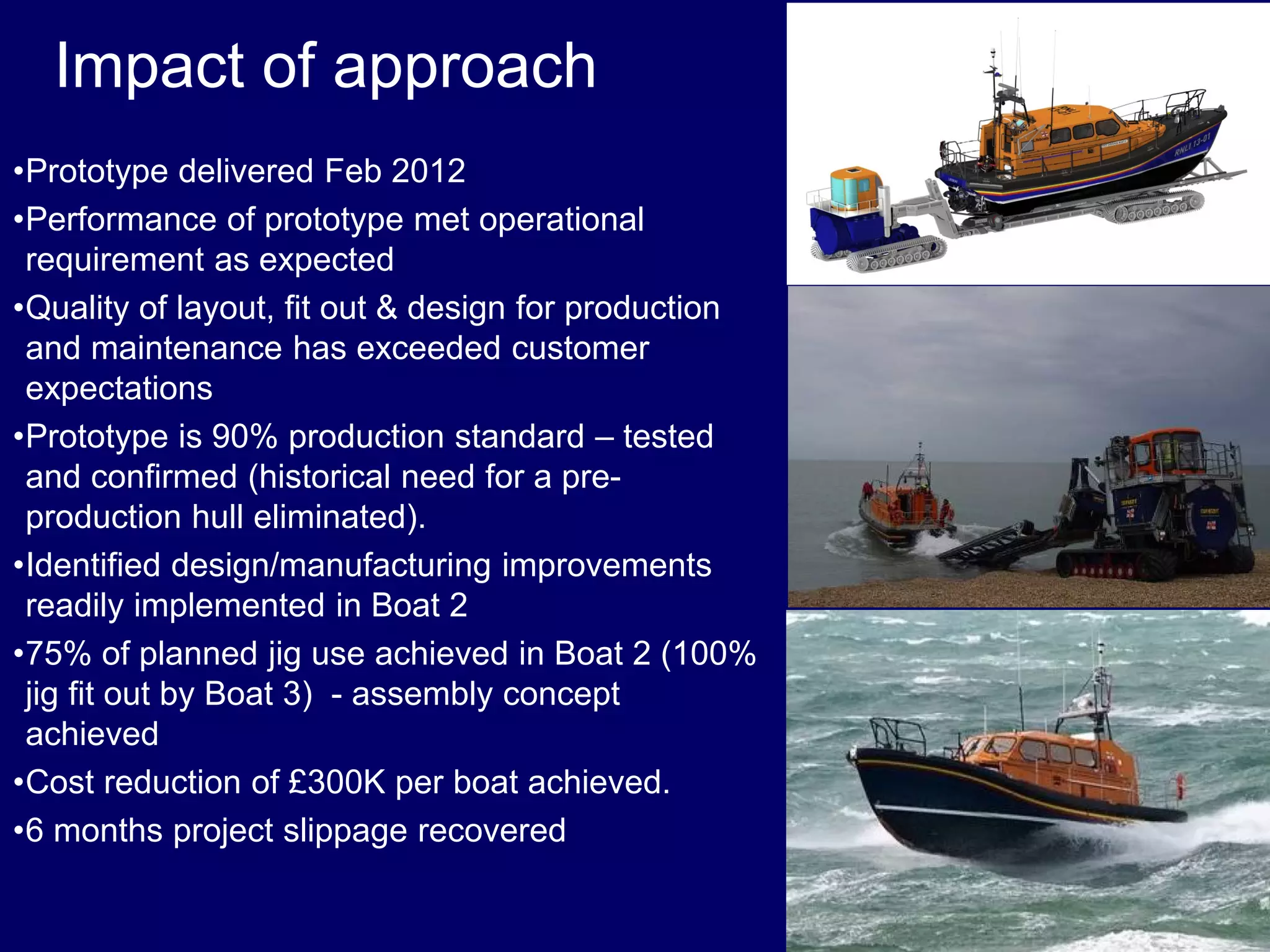
•Prototype delivered Feb 2012
•Performance of prototype met operational
requirement as expected
•Quality of layout, fit out & design for production
and maintenance has exceeded customer
expectations
•Prototype is 90% production standard – tested
and confirmed (historical need for a pre-
production hull eliminated).
•Identified design/manufacturing improvements
readily implemented in Boat 2
•75% of planned jig use achieved in Boat 2 (100%
jig fit out by Boat 3) - assembly concept
achieved
•Cost reduction of £300K per boat achieved.
•6 months project slippage recovered
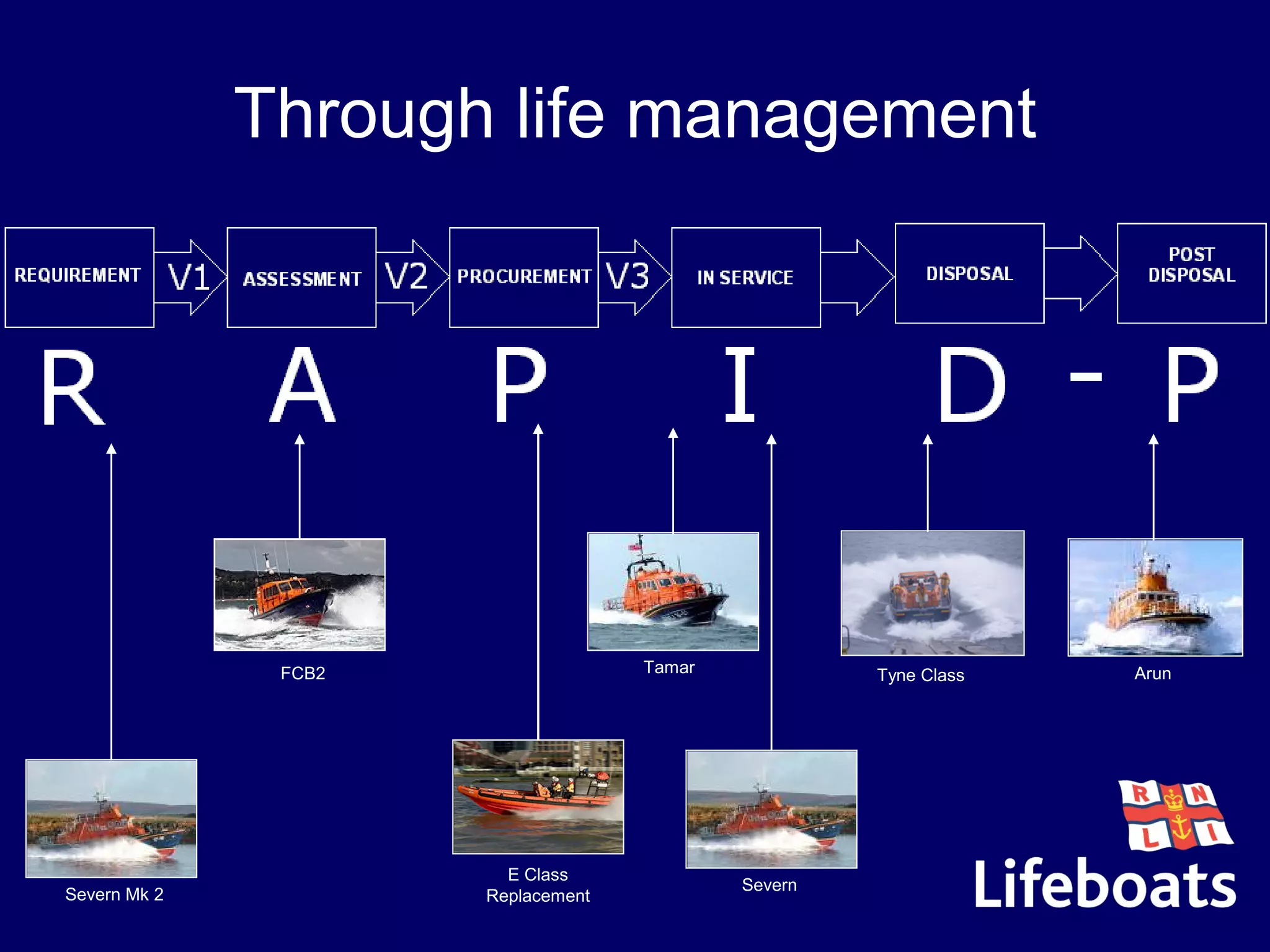
Through life management
E Class
Replacement
FCB2 Tamar
Severn
ArunTyne Class
Severn Mk 2
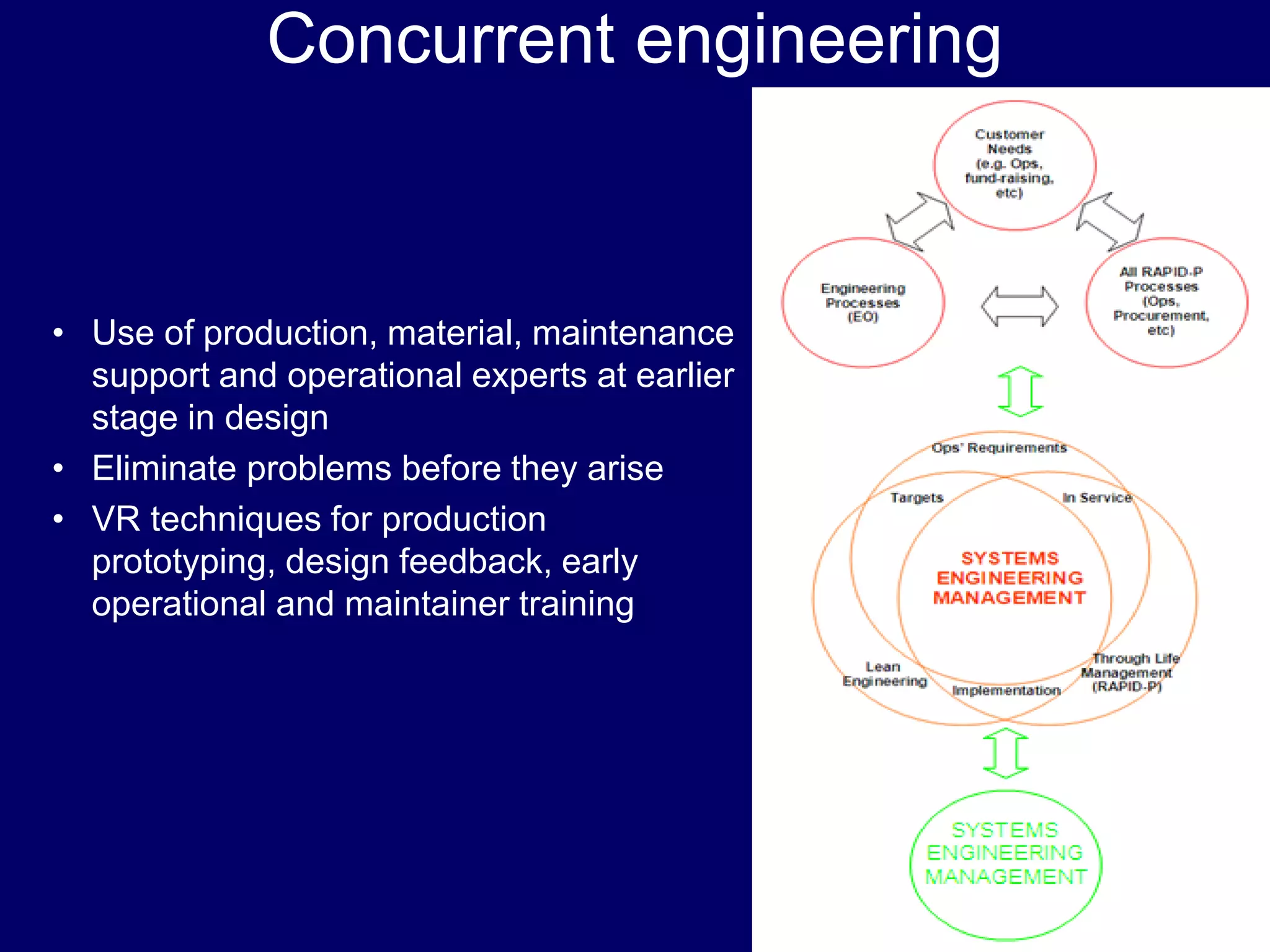
Concurrent engineering
• Use of production, material, maintenance
support and operational experts at earlier
stage in design
• Eliminate problems before they arise
• VR techniques for production
prototyping, design feedback, early
operational and maintainer training
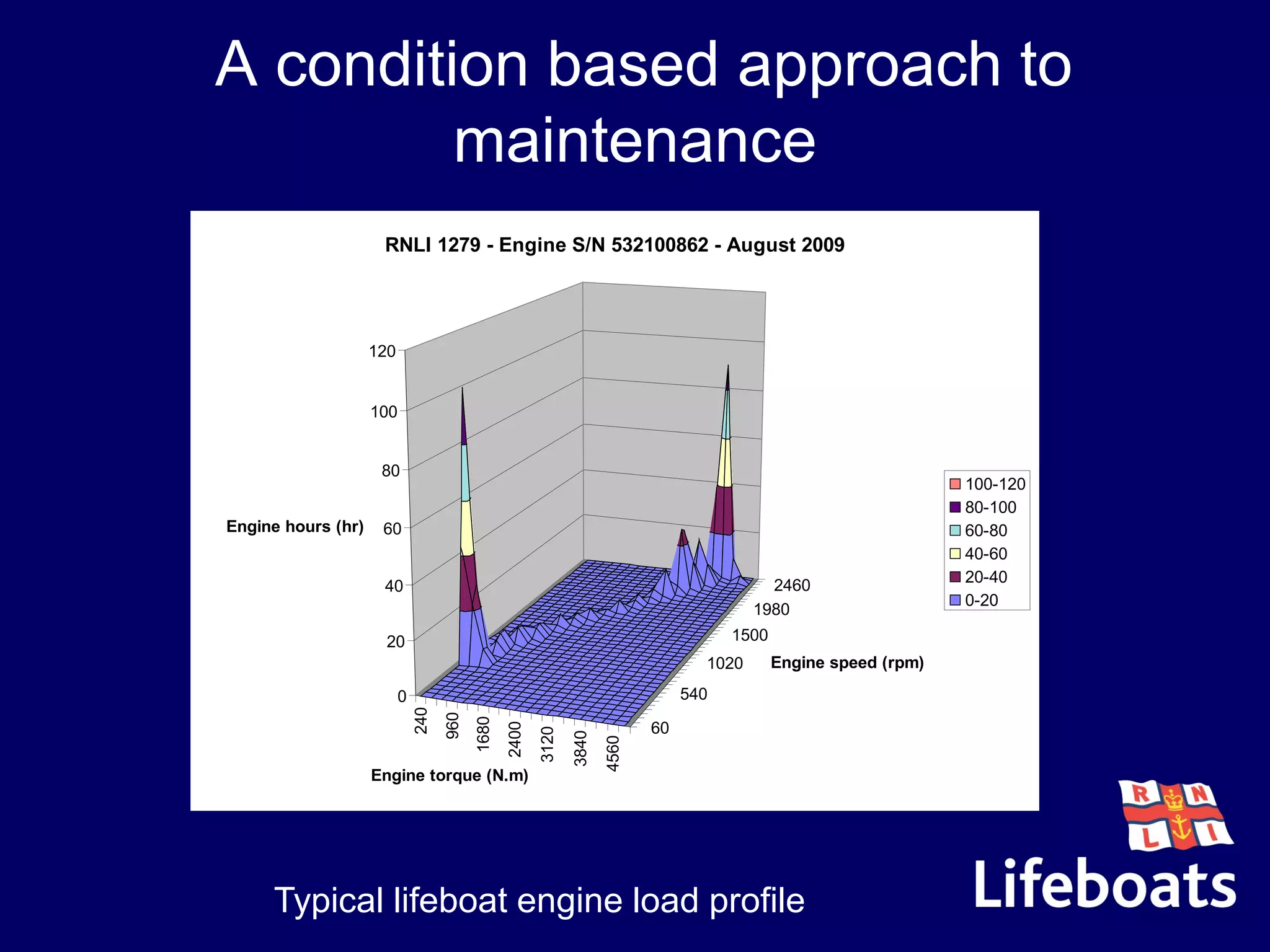
A condition based approach to
maintenance
Typical lifeboat engine load profile
240
960
1680
2400
3120
3840
4560
60
540
1020
1500
1980
2460
0
20
40
60
80
100
120
Engine hours (hr)
Engine torque (N.m)
Engine speed (rpm)
RNLI 1279 - Engine S/N 532100862 - August 2009
100-120
80-100
60-80
40-60
20-40
0-20
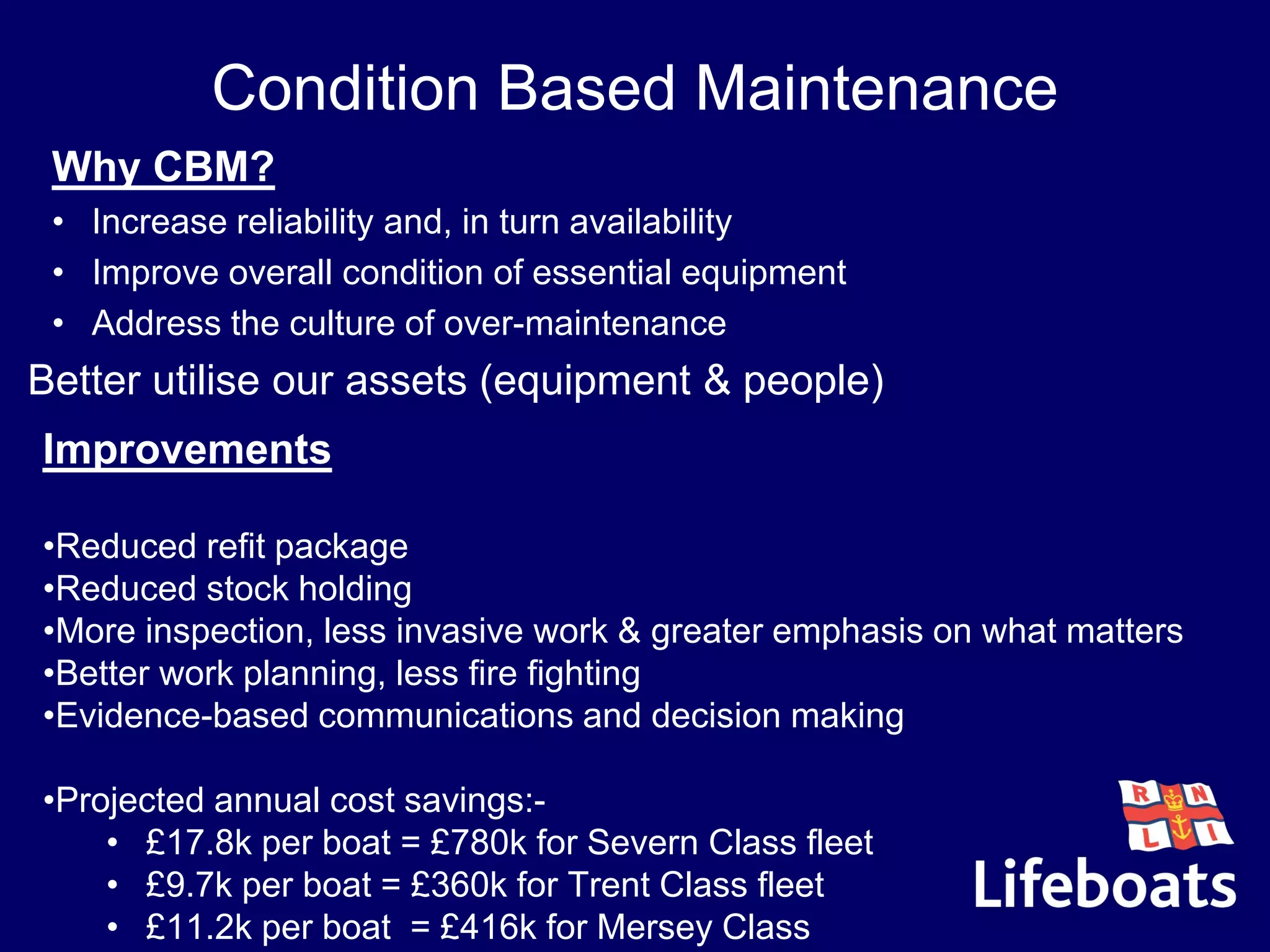
Condition Based Maintenance
Improvements
•Reduced refit package
•Reduced stock holding
•More inspection, less invasive work & greater emphasis on what matters
•Better work planning, less fire fighting
•Evidence-based communications and decision making
•Projected annual cost savings:-
• £17.8k per boat = £780k for Severn Class fleet
• £9.7k per boat = £360k for Trent Class fleet
• £11.2k per boat = £416k for Mersey Class
Why CBM?
• Increase reliability and, in turn availability
• Improve overall condition of essential equipment
• Address the culture of over-maintenance
•Better utilise our assets (equipment & people)
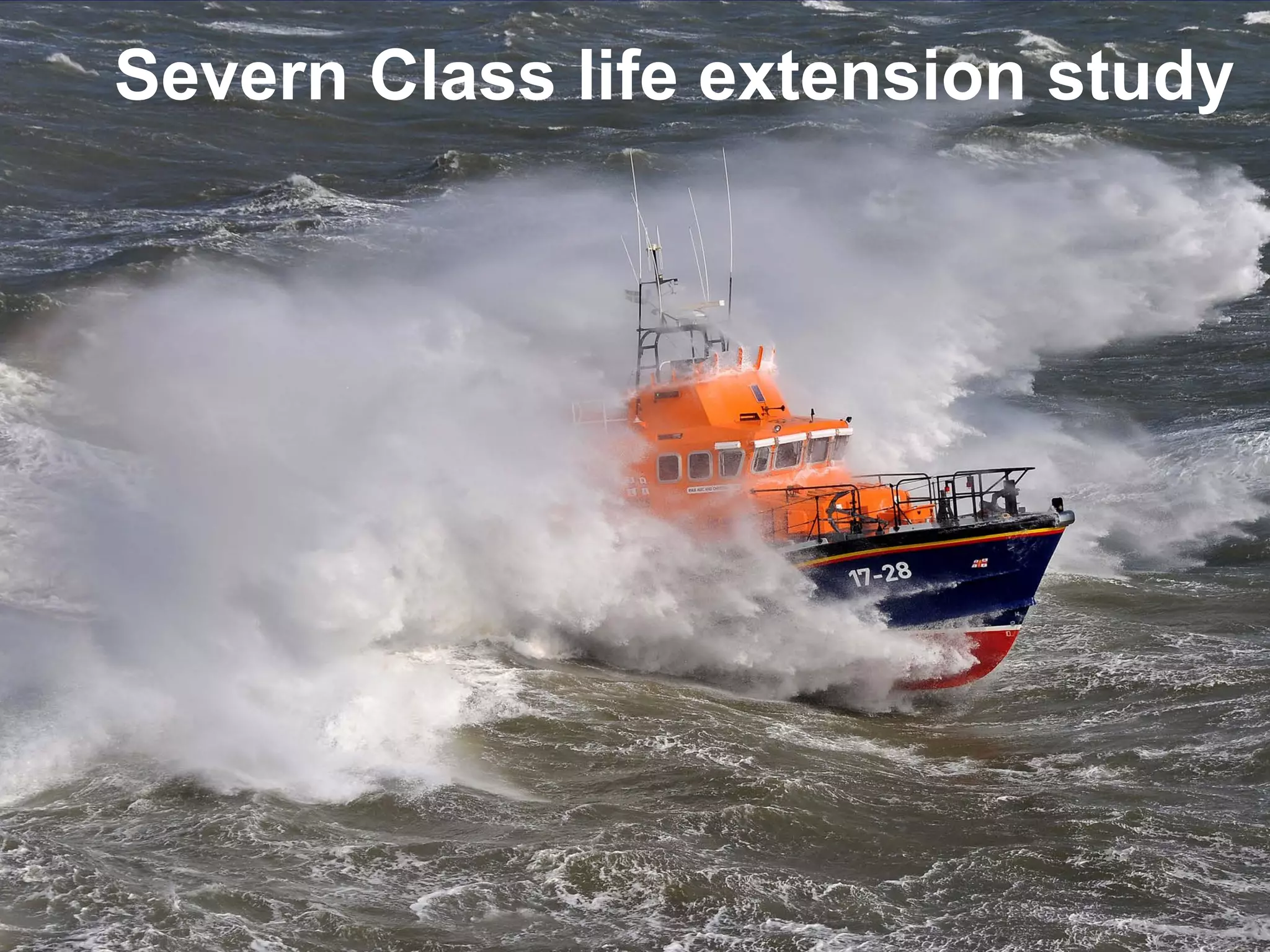
Severn Class life extension study
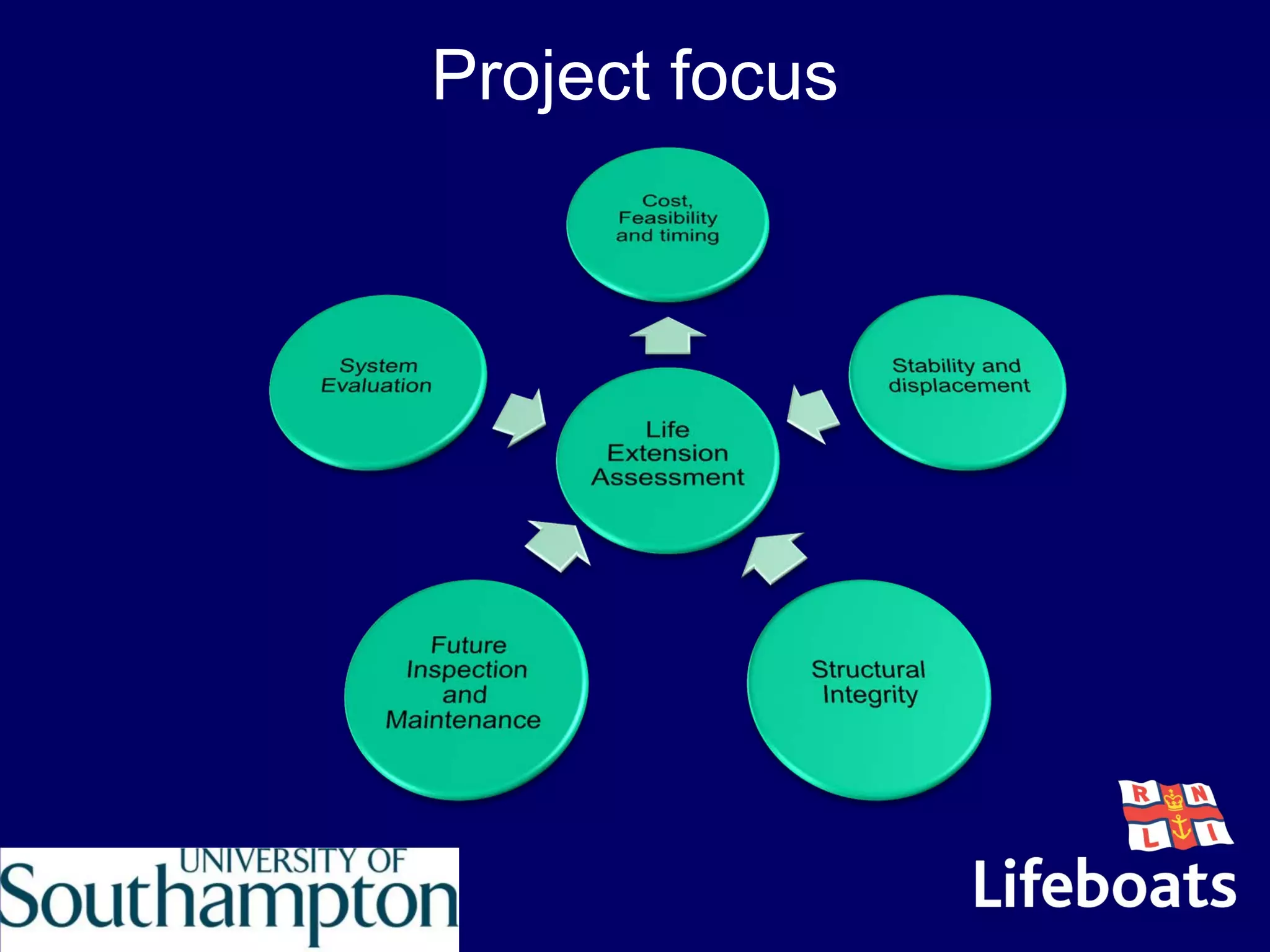
Project focus
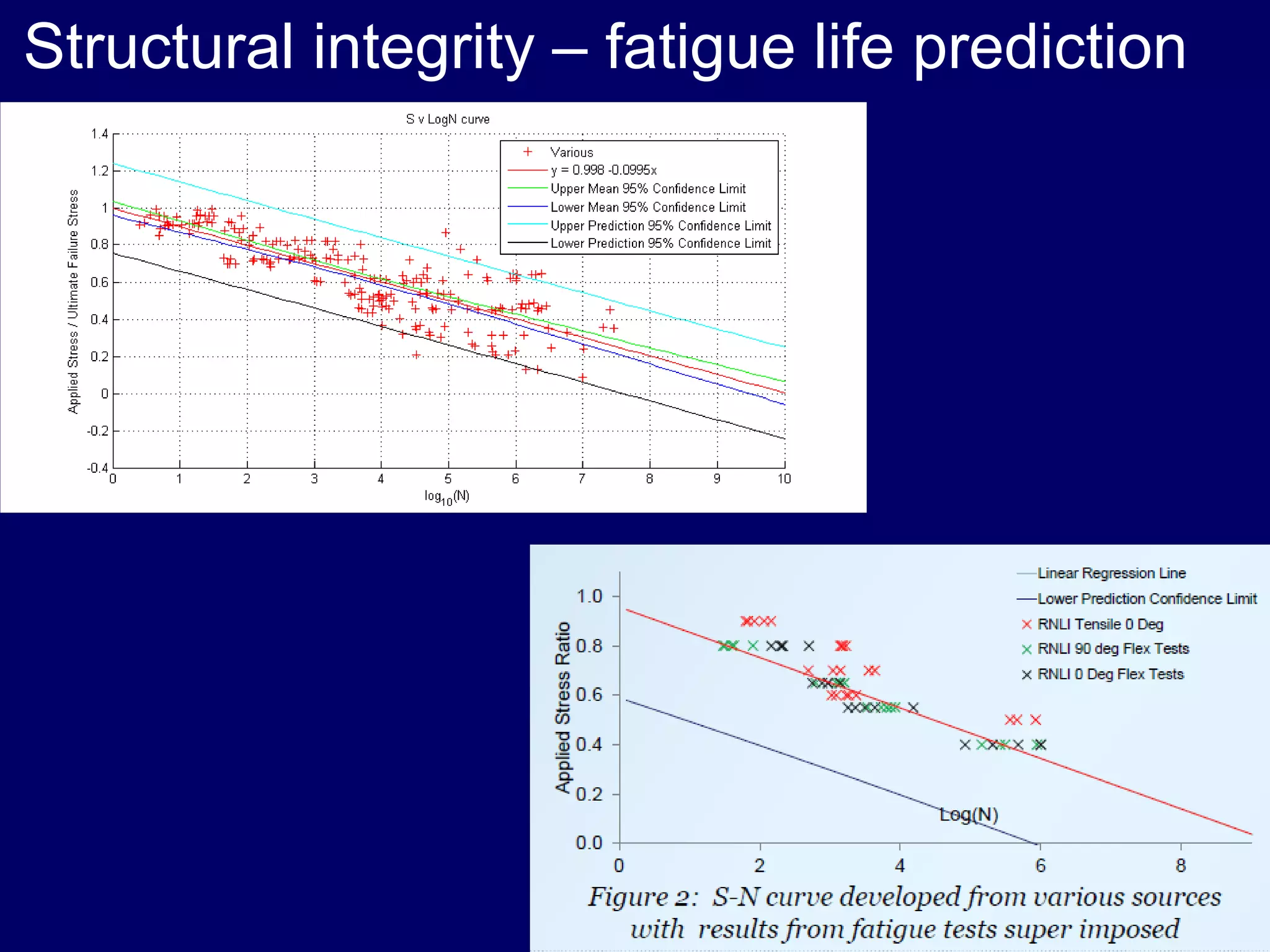
•Structural integrity – fatigue life prediction
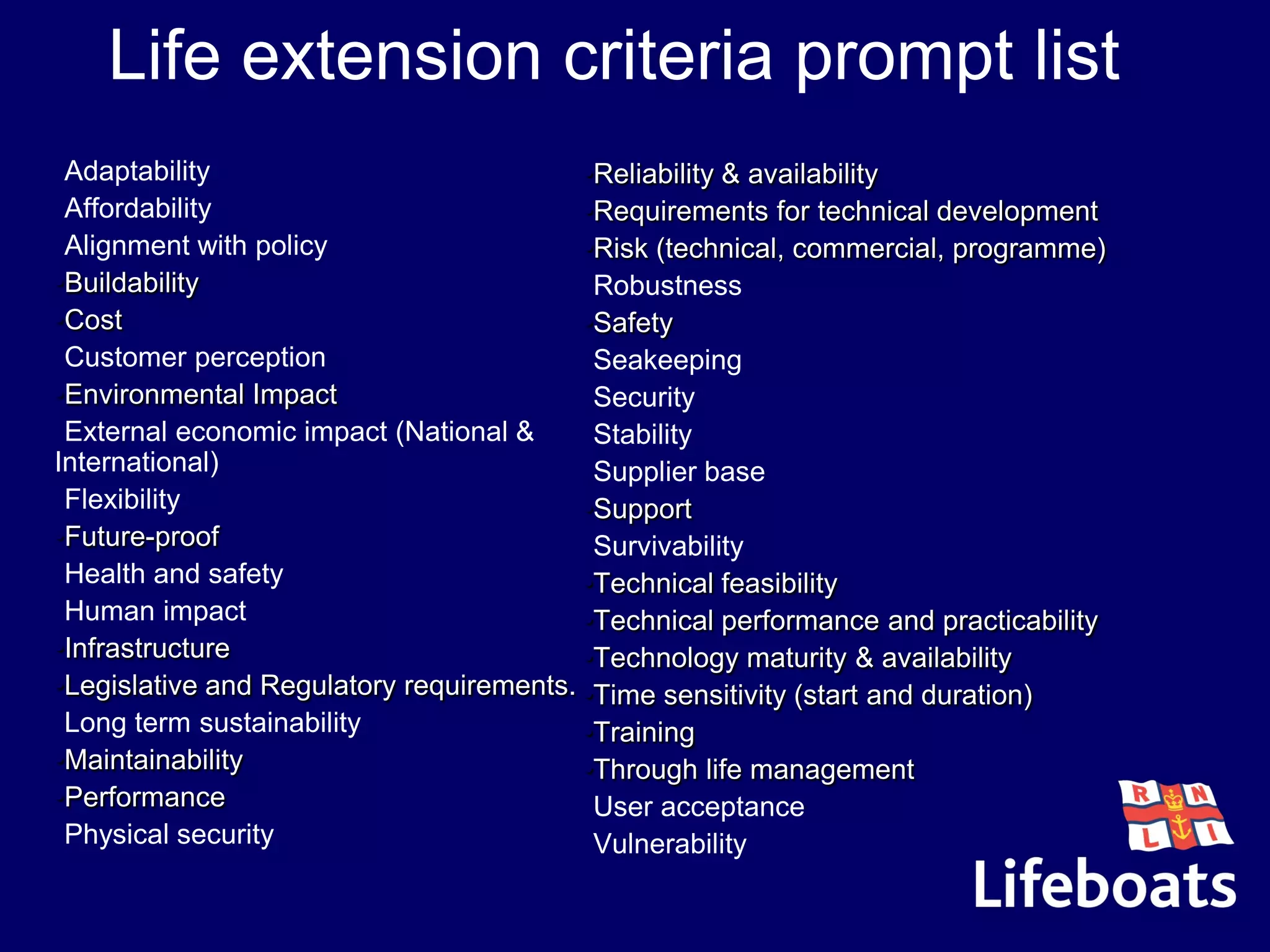
Life extension criteria prompt list
•Adaptability
•Affordability
•Alignment with policy
•Buildability
•Cost
•Customer perception
•Environmental Impact
•External economic impact (National &
International)
•Flexibility
•Future-proof
•Health and safety
•Human impact
•Infrastructure
•Legislative and Regulatory requirements.
•Long term sustainability
•Maintainability
•Performance
•Physical security
•Reliability & availability
•Requirements for technical development
•Risk (technical, commercial, programme)
•Robustness
•Safety
•Seakeeping
•Security
•Stability
•Supplier base
•Support
•Survivability
•Technical feasibility
•Technical performance and practicability
•Technology maturity & availability
•Time sensitivity (start and duration)
•Training
•Through life management
•User acceptance
•Vulnerability
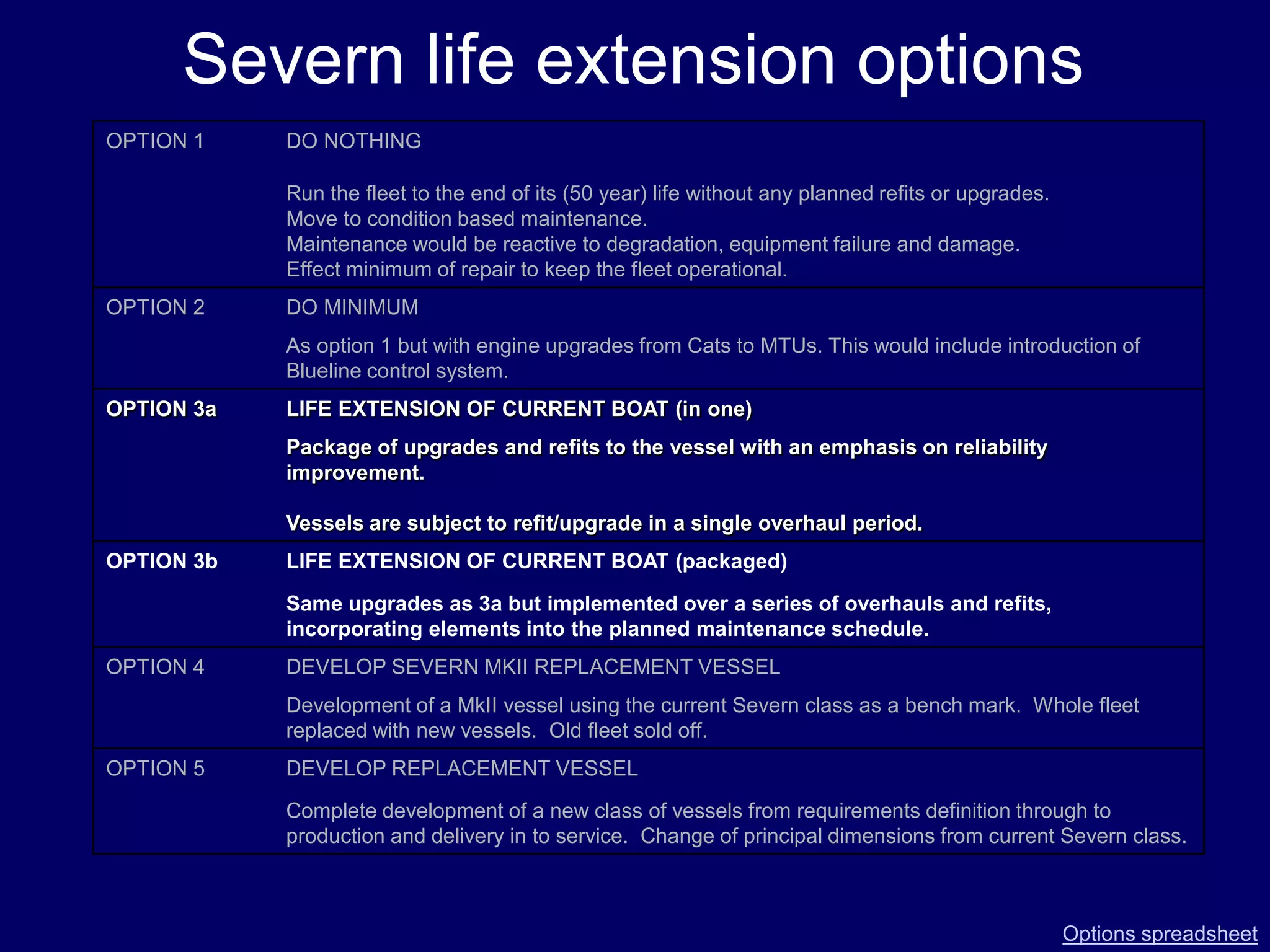
Severn life extension options
OPTION 1 DO NOTHING
Run the fleet to the end of its (50 year) life without any planned refits or upgrades.
Move to condition based maintenance.
Maintenance would be reactive to degradation, equipment failure and damage.
Effect minimum of repair to keep the fleet operational.
OPTION 2 DO MINIMUM
As option 1 but with engine upgrades from Cats to MTUs. This would include introduction of
Blueline control system.
OPTION 3a LIFE EXTENSION OF CURRENT BOAT (in one)
Package of upgrades and refits to the vessel with an emphasis on reliability
improvement.
Vessels are subject to refit/upgrade in a single overhaul period.
OPTION 3b LIFE EXTENSION OF CURRENT BOAT (packaged)
Same upgrades as 3a but implemented over a series of overhauls and refits,
incorporating elements into the planned maintenance schedule.
OPTION 4 DEVELOP SEVERN MKII REPLACEMENT VESSEL
Development of a MkII vessel using the current Severn class as a bench mark. Whole fleet
replaced with new vessels. Old fleet sold off.
OPTION 5 DEVELOP REPLACEMENT VESSEL
Complete development of a new class of vessels from requirements definition through to
production and delivery in to service. Change of principal dimensions from current Severn class.
Options spreadsheet
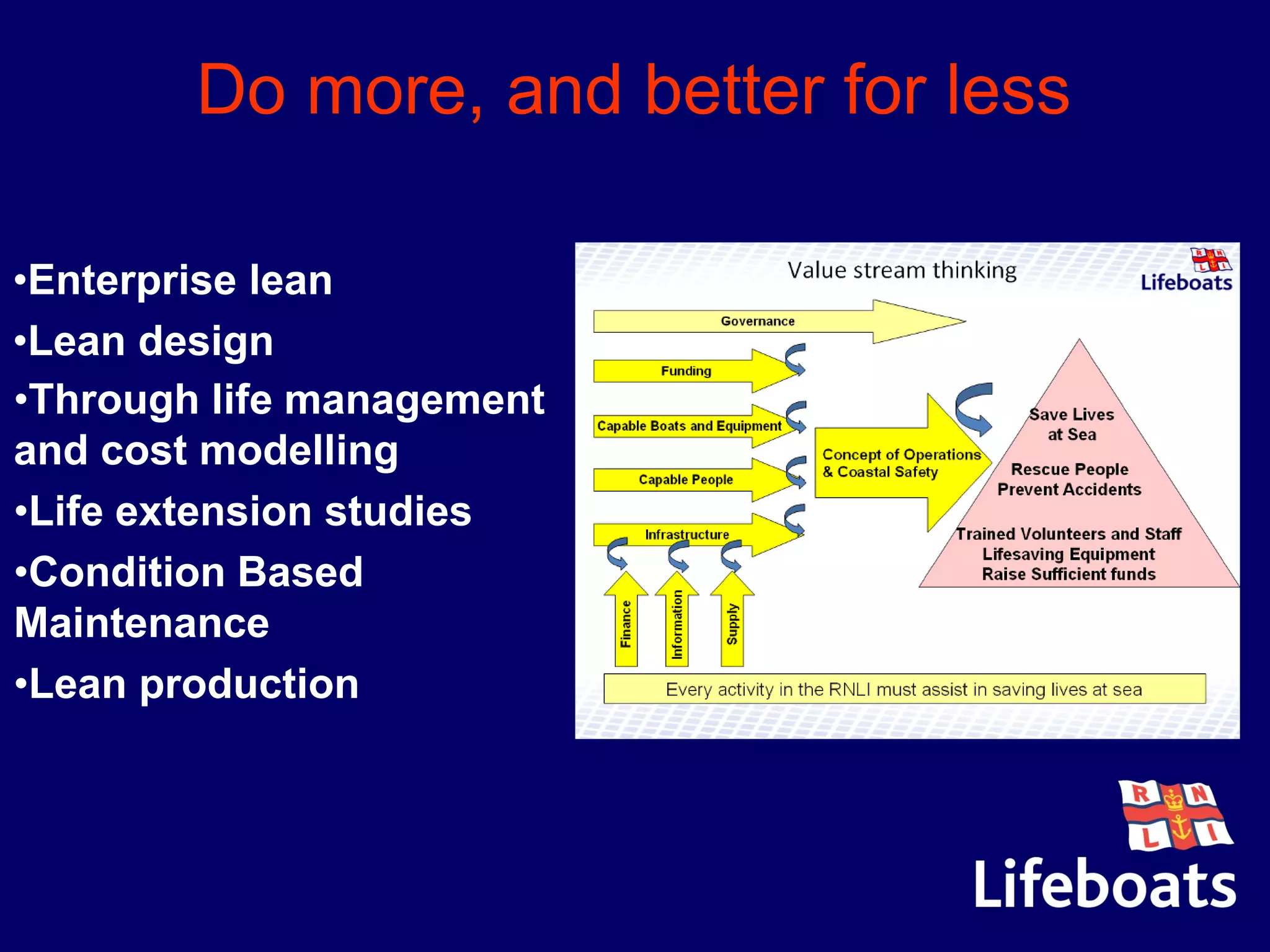
Do more, and better for less
•Enterprise lean
•Lean design
•Through life management
and cost modelling
•Life extension studies
•Condition Based
Maintenance
•Lean production
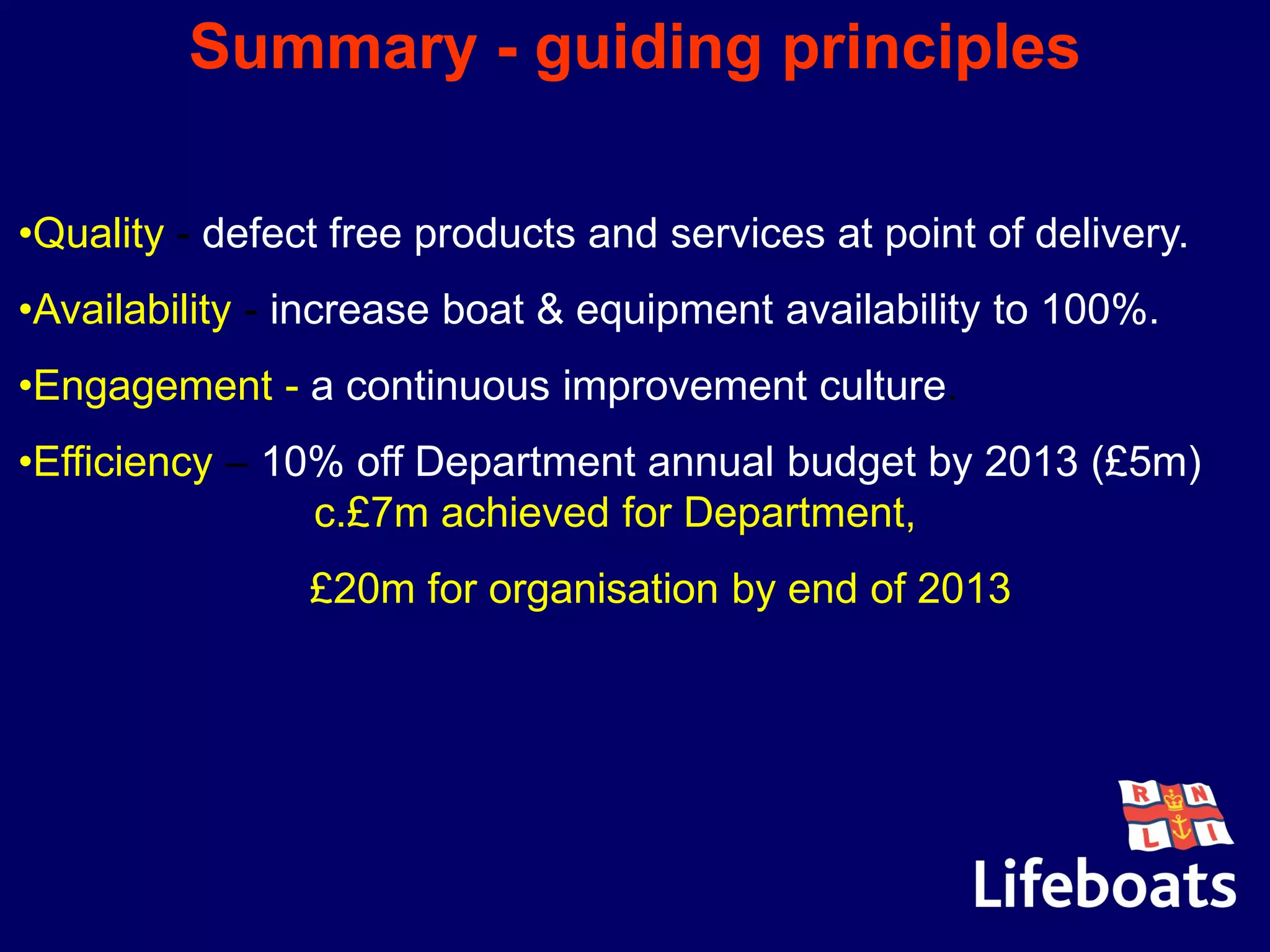
Summary - guiding principles
•Quality - defect free products and services at point of delivery.
•Availability - increase boat & equipment availability to 100%.
•Engagement - a continuous improvement culture.
•Efficiency – 10% off Department annual budget by 2013 (£5m)
c.£7m achieved for Department,
£20m for organisation by end of 2013
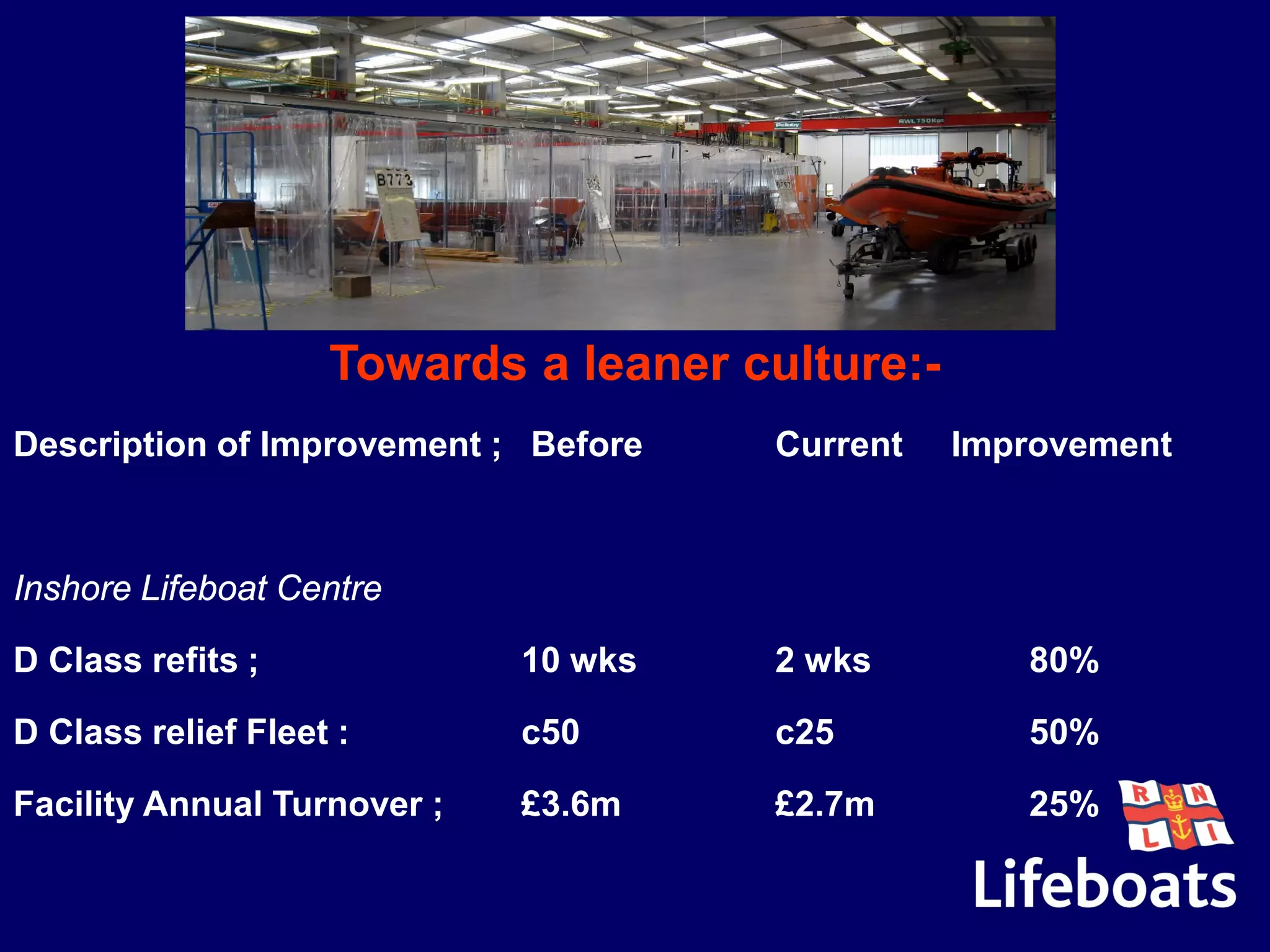
Towards a leaner culture:-
Description of Improvement ; Before Current Improvement
Inshore Lifeboat Centre
D Class refits ; 10 wks 2 wks 80%
D Class relief Fleet : c50 c25 50%
Facility Annual Turnover ; £3.6m £2.7m 25%
Part assembly commercial approach
and risk - July 2008
Continued reliance on a sole supplier
for ALB composite hulls represents an
unacceptable strategic risk to RNLI
capability.
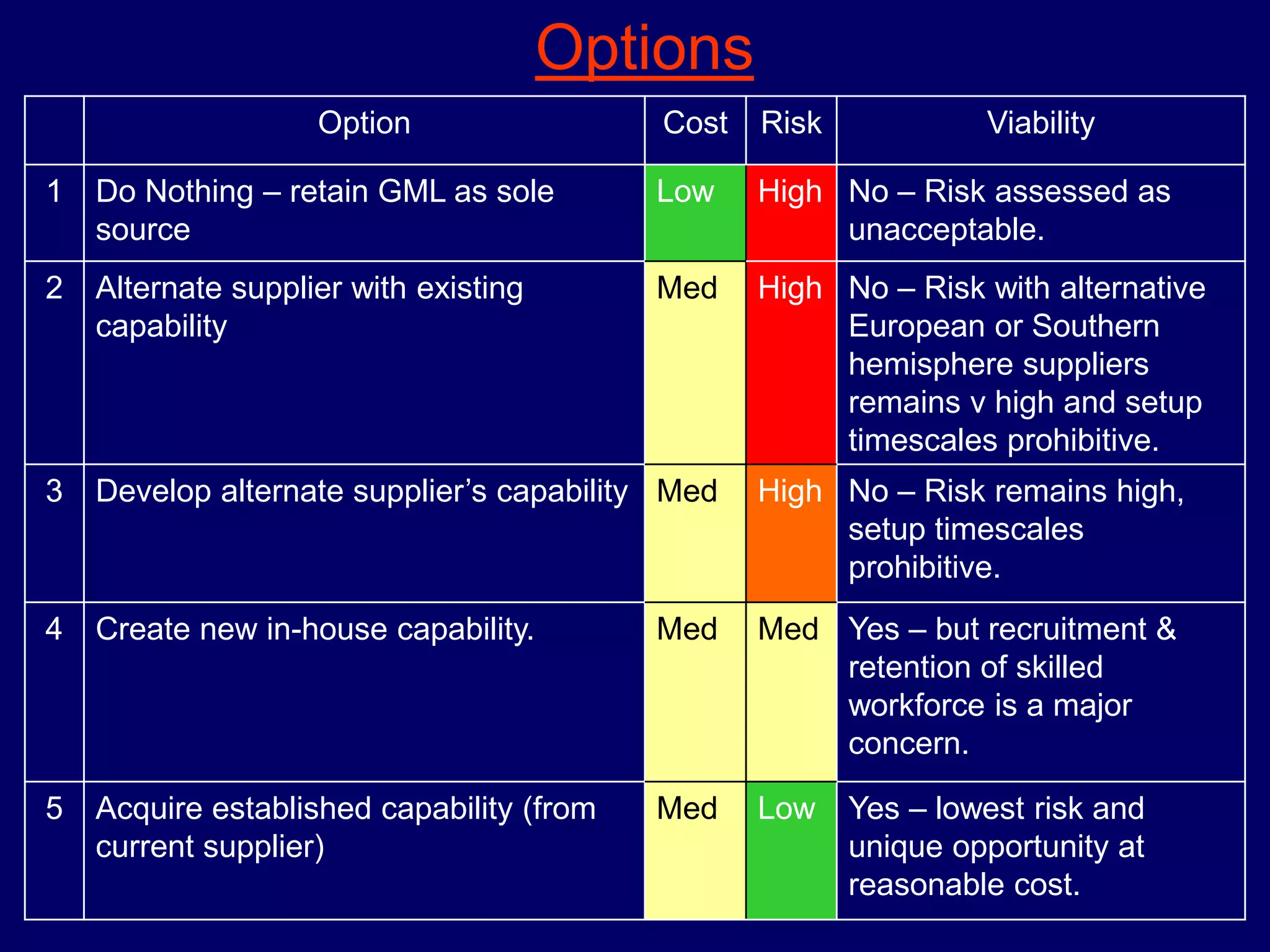
Options
Option Cost Risk Viability
1 Do Nothing – retain GML as sole
source
Low High No – Risk assessed as
unacceptable.
2 Alternate supplier with existing
capability
Med High No – Risk with alternative
European or Southern
hemisphere suppliers
remains v high and setup
timescales prohibitive.
3 Develop alternate supplier’s capability Med High No – Risk remains high,
setup timescales
prohibitive.
4 Create new in-house capability. Med Med Yes – but recruitment &
retention of skilled
workforce is a major
concern.
5 Acquire established capability (from
current supplier)
Med Low Yes – lowest risk and
unique opportunity at
reasonable cost.
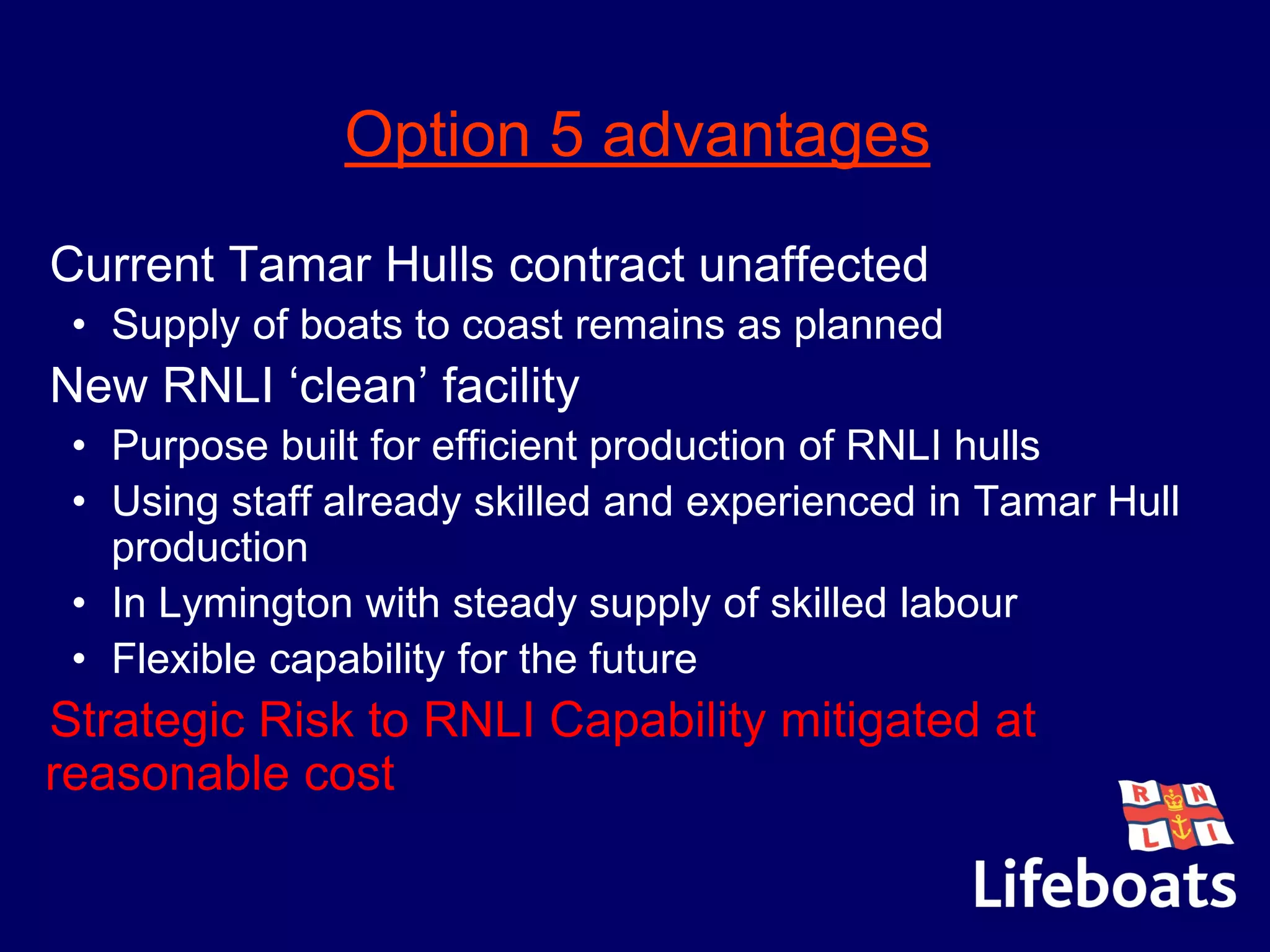
Option 5 advantages
•Current Tamar Hulls contract unaffected
• Supply of boats to coast remains as planned
•New RNLI ‘clean’ facility
• Purpose built for efficient production of RNLI hulls
• Using staff already skilled and experienced in Tamar Hull
production
• In Lymington with steady supply of skilled labour
• Flexible capability for the future
•Strategic Risk to RNLI Capability mitigated at
reasonable cost
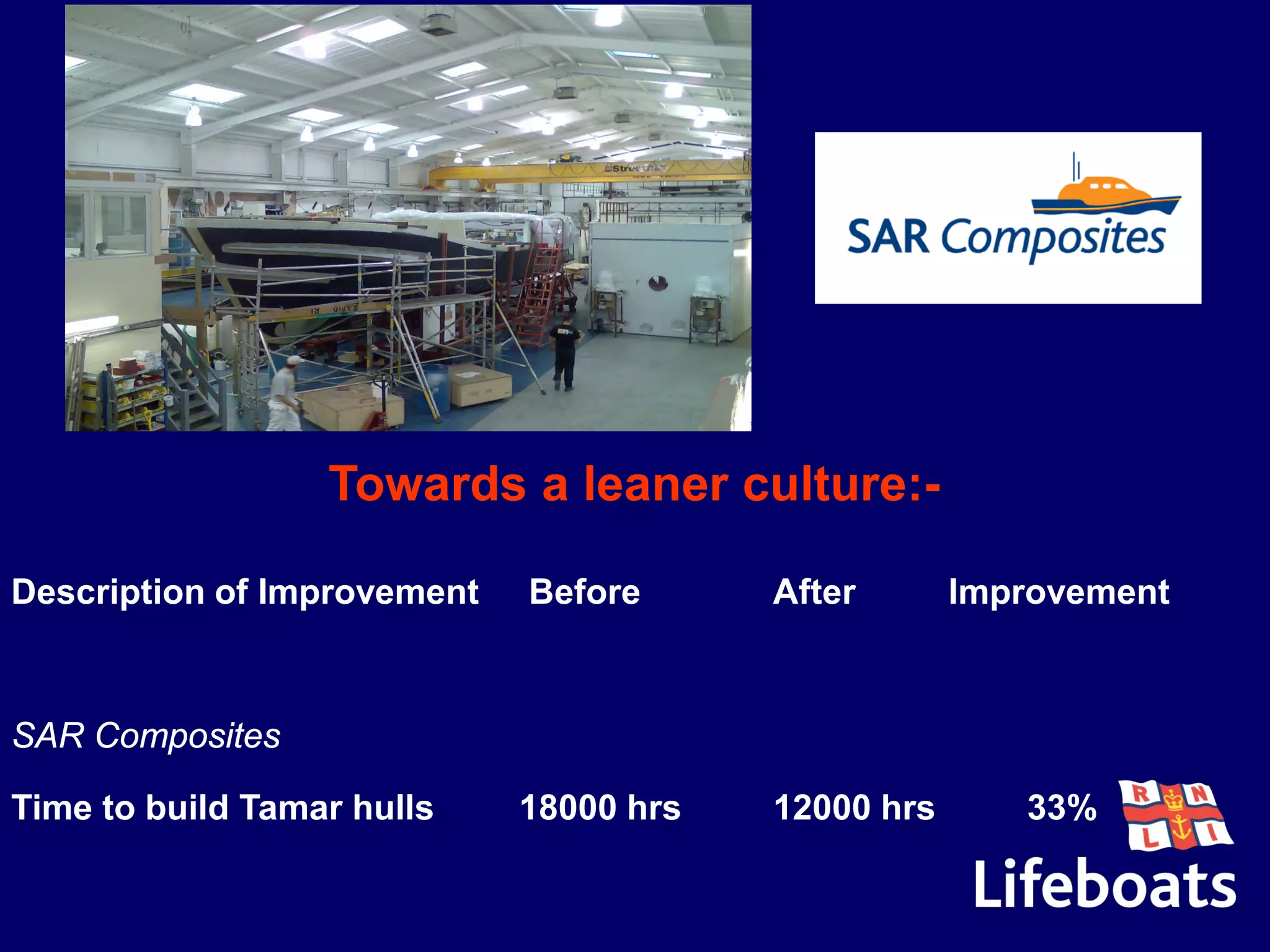
Towards a leaner culture:-
Description of Improvement Before After Improvement
SAR Composites
Time to build Tamar hulls 18000 hrs 12000 hrs 33%
Future ALB Strategy
6 Boats / Year
0
2
4
6
8
10
12
2006
2008
2010
2012
2014
2016
2018
2020
2022
2024
2026
2028
2030
2032
2034
2036
2038
2040
2042
2044
2046
2048
2050
2052
2054
FCB2 MkII
FCB2
Tamar MkII
Tamar MkIa
Tamar
NGLB(Lge)
Severn MkII
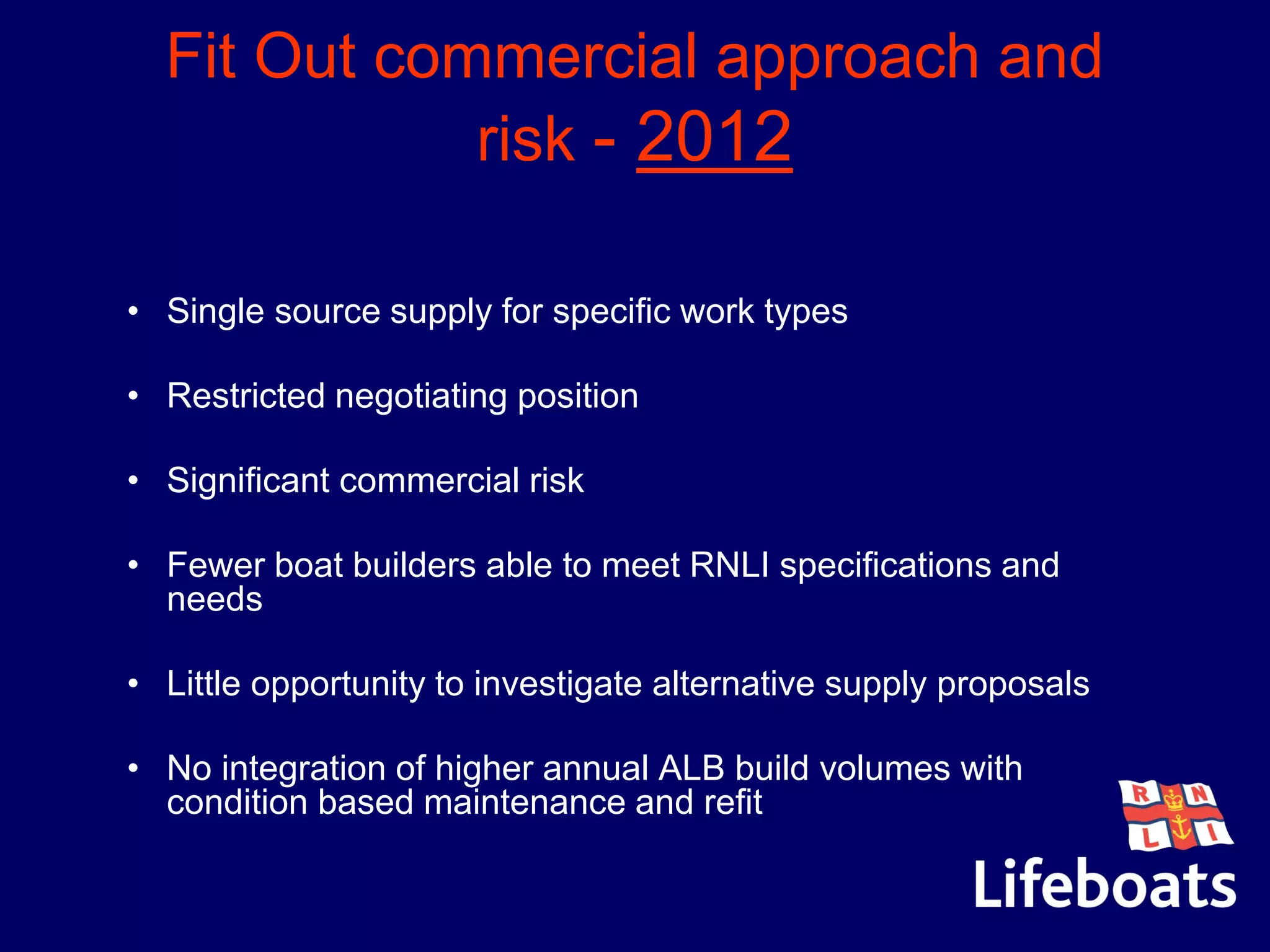
Fit Out commercial approach and
risk - 2012
• Single source supply for specific work types
• Restricted negotiating position
• Significant commercial risk
• Fewer boat builders able to meet RNLI specifications and
needs
• Little opportunity to investigate alternative supply proposals
• No integration of higher annual ALB build volumes with
condition based maintenance and refit
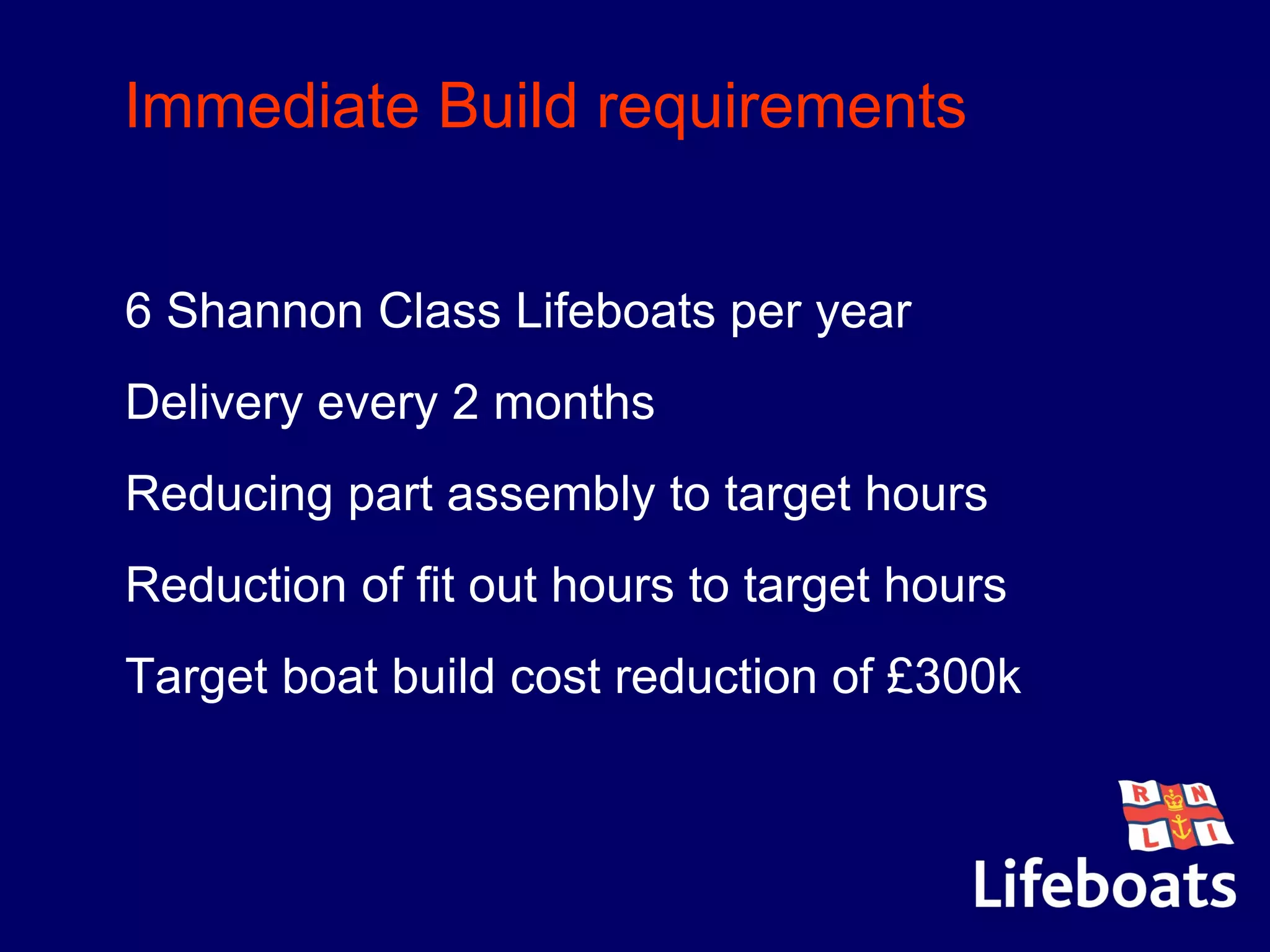
Immediate Build requirements
•6 Shannon Class Lifeboats per year
•Delivery every 2 months
•Reducing part assembly to target hours
•Reduction of fit out hours to target hours
•Target boat build cost reduction of £300k
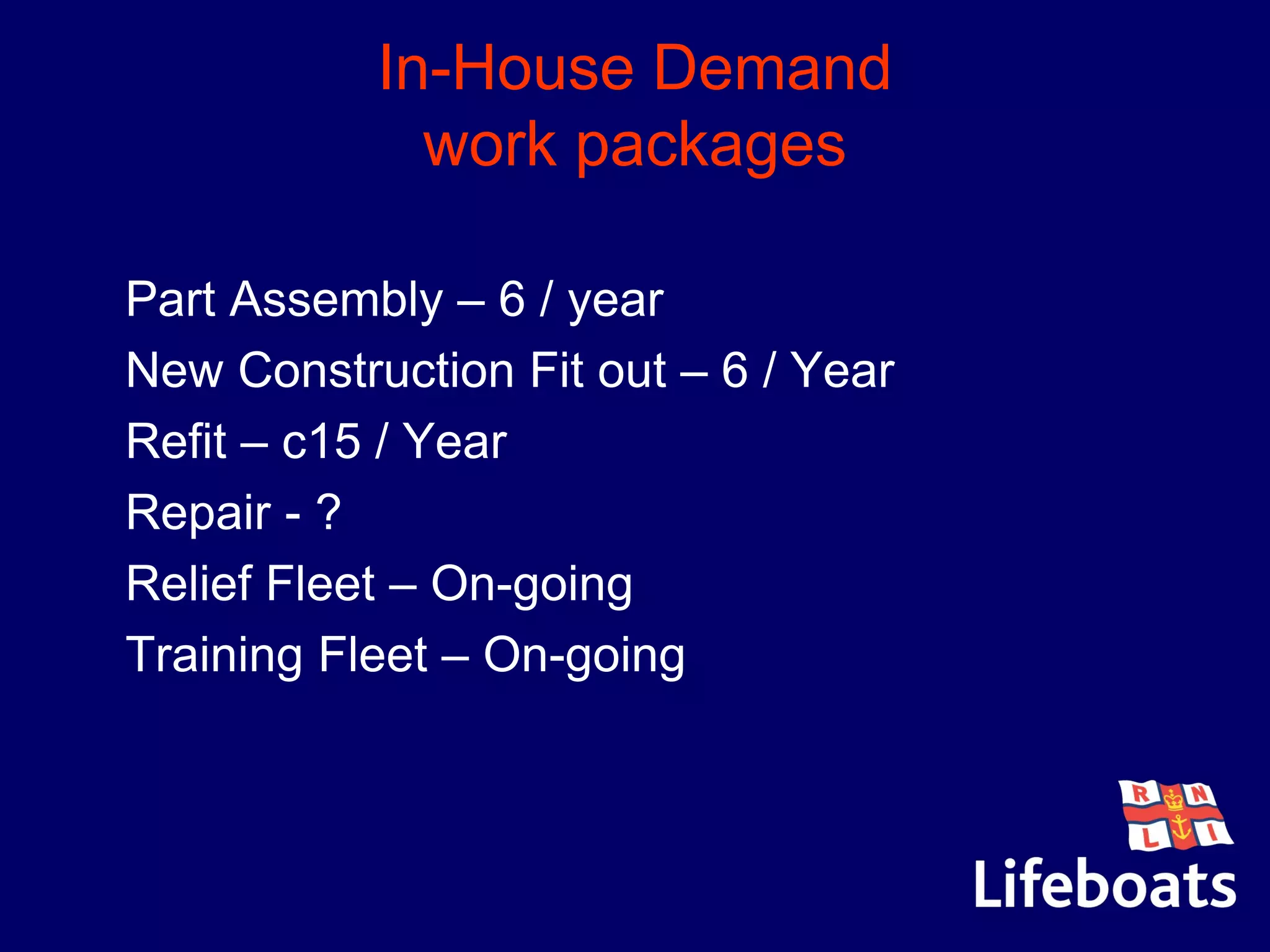
In-House Demand
work packages
•Part Assembly – 6 / year
•New Construction Fit out – 6 / Year
•Refit – c15 / Year
•Repair - ?
•Relief Fleet – On-going
•Training Fleet – On-going
Demand forecast
Demand model re-assessed in response to new
ALB strategy:
Volume, type, sequencing of work and facilities
required were all re-calculated:
• Period to reach true ‘steady state’ 17 years
• Total programme costs in period £250 million +
• Total production hours in period - 3 million +
Strategic Opportunities
Greater visibility of future demand enabled a longer term view of
ALB production, in light of this, consider alternative sourcing
models.
•The overarching priority of the RNLI is to minimise delivery risk
and ensure the ALB strategy is delivered on time and to a
consistently high standard by, in part, ensuring it has more
influence over the supply chain.
•Commercial considerations are also of key importance.
Options
Many options were considered but were soon
refined to:
1. Work with both existing and alternative vendors with a
view to:
i. Setting up dual supply or
ii. establishing a long term gain-share contract
2. Transfer ALB fit-out & overhaul to a purpose-built facility
at a third party site
3. Transfer ALB fit-out & overhaul to a purpose-built facility
at the RNLI own site in Poole (currently under utilised)
Solution
Feasibility study carried out and business case model
created.
Conclusion:
Create a single In-House production facility built on
RNLI owned land in Poole –
Project Coventina
Why
“Project Coventina”?
•RNLI lifeboats are traditionally named after
rivers.
•Coventina was a Celtic river goddess,
•known for renewal, new beginnings,
•life cycles, healing and inspiration.
Coventina benefits
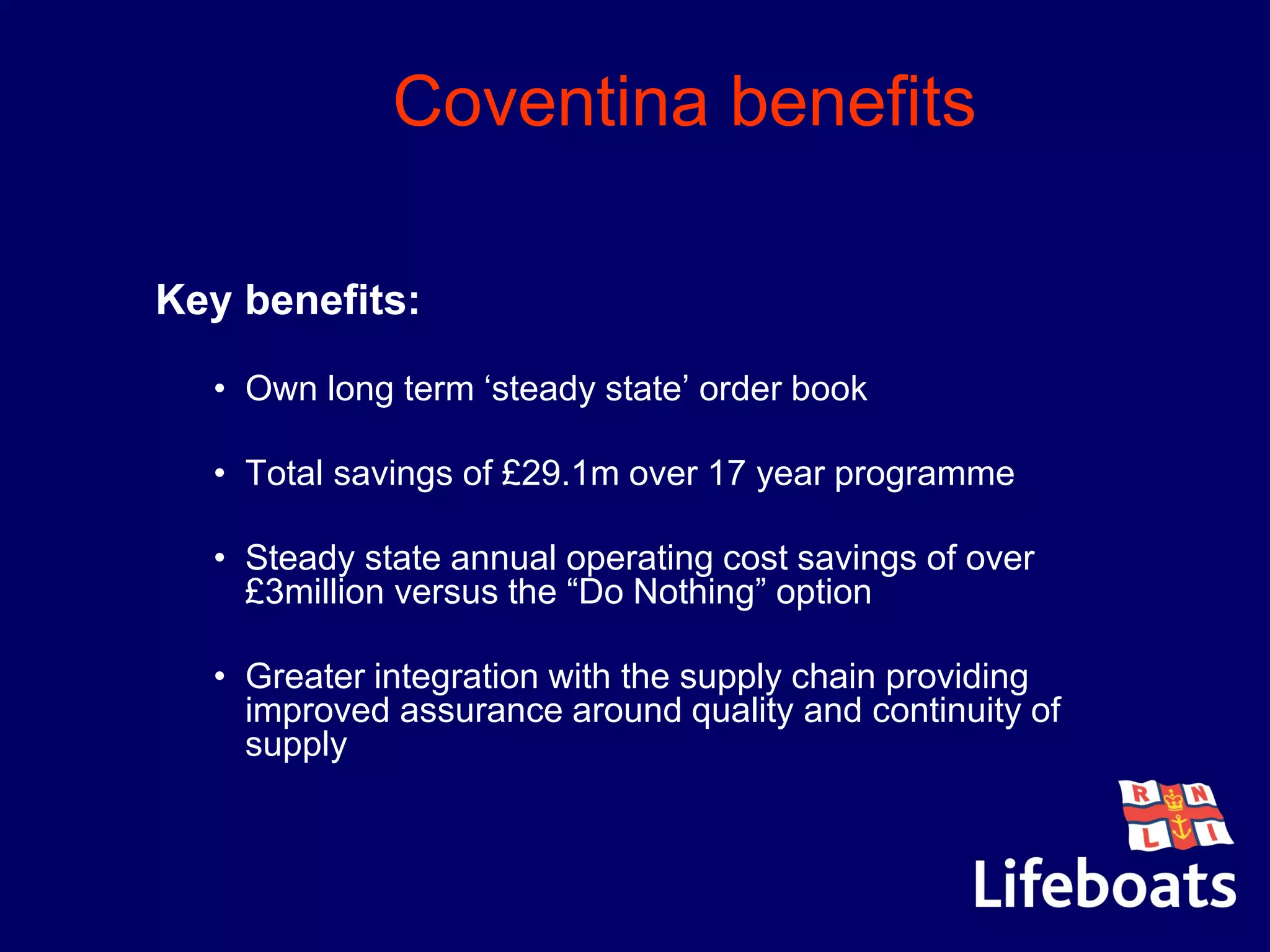
Key benefits:
• Own long term ‘steady state’ order book
• Total savings of £29.1m over 17 year programme
• Steady state annual operating cost savings of over
£3million versus the “Do Nothing” option
• Greater integration with the supply chain providing
improved assurance around quality and continuity of
supply
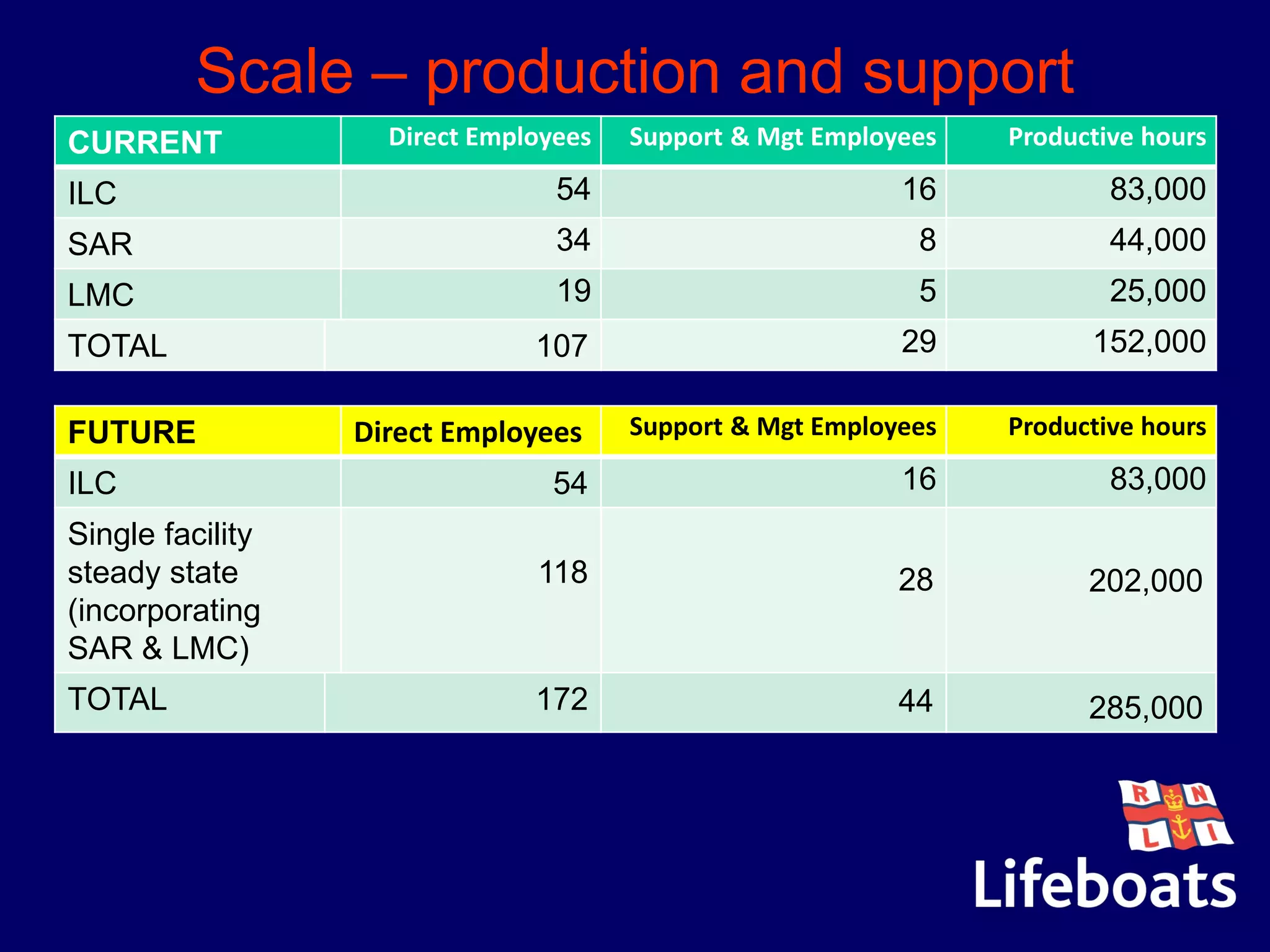
Scale – production and support
CURRENT Direct Employees Support & Mgt Employees Productive hours
ILC 54 16 83,000
SAR 34 8 44,000
LMC 19 5 25,000
TOTAL 107 29 152,000
FUTURE Direct Employees Support & Mgt Employees Productive hours
ILC 54 16 83,000
Single facility
steady state
(incorporating
SAR & LMC)
118 28 202,000
TOTAL 172 44 285,000
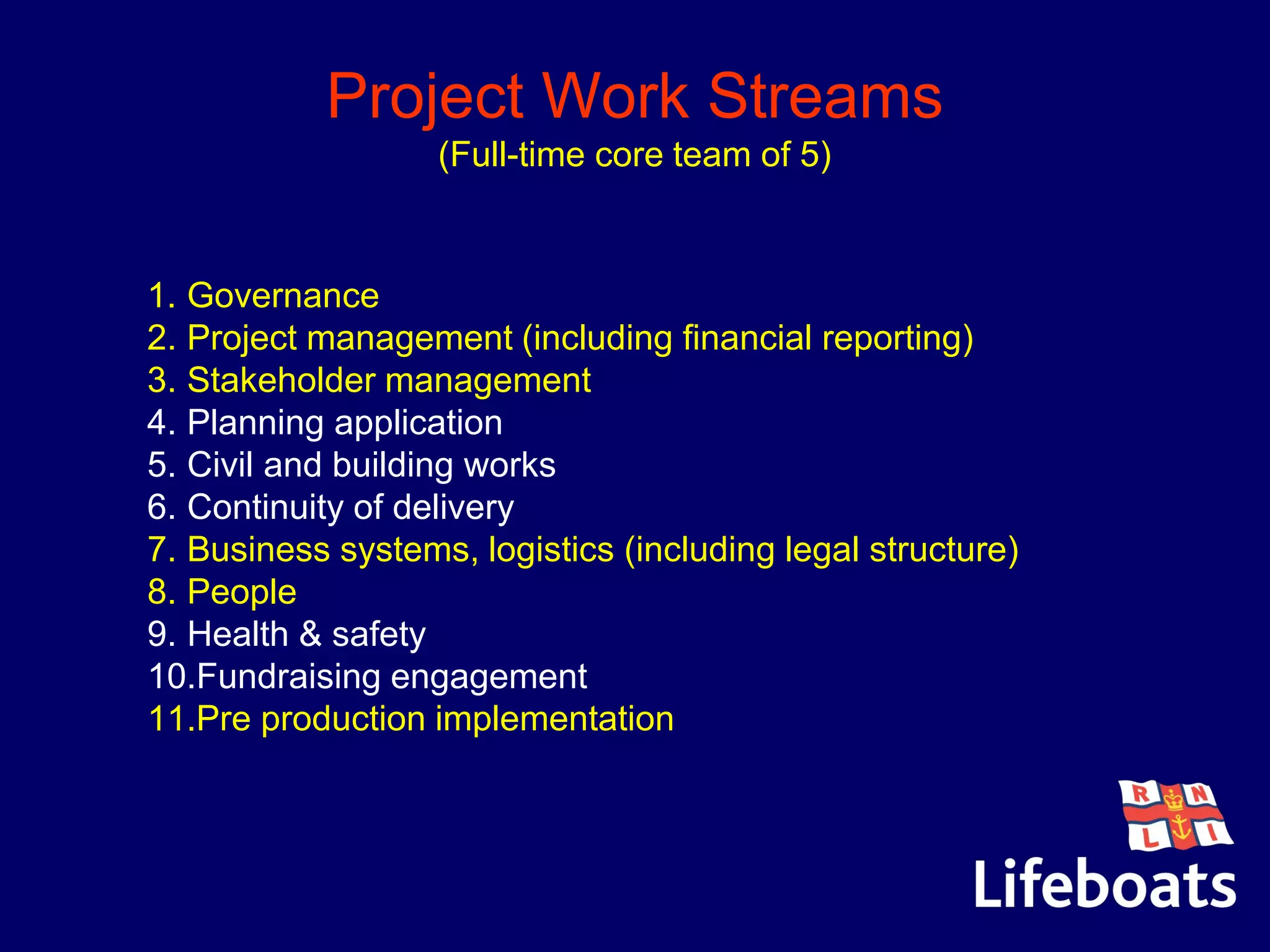
Project Work Streams
(Full-time core team of 5)
1. Governance
2. Project management (including financial reporting)
3. Stakeholder management
4. Planning application
5. Civil and building works
6. Continuity of delivery
7. Business systems, logistics (including legal structure)
8. People
9. Health & safety
10.Fundraising engagement
11.Pre production implementation
Project tools
• Vertical value stream maps (VVSMs)
• Microsoft Project
• SharePoint
• SAP (including project module)
Wider impact and risk management
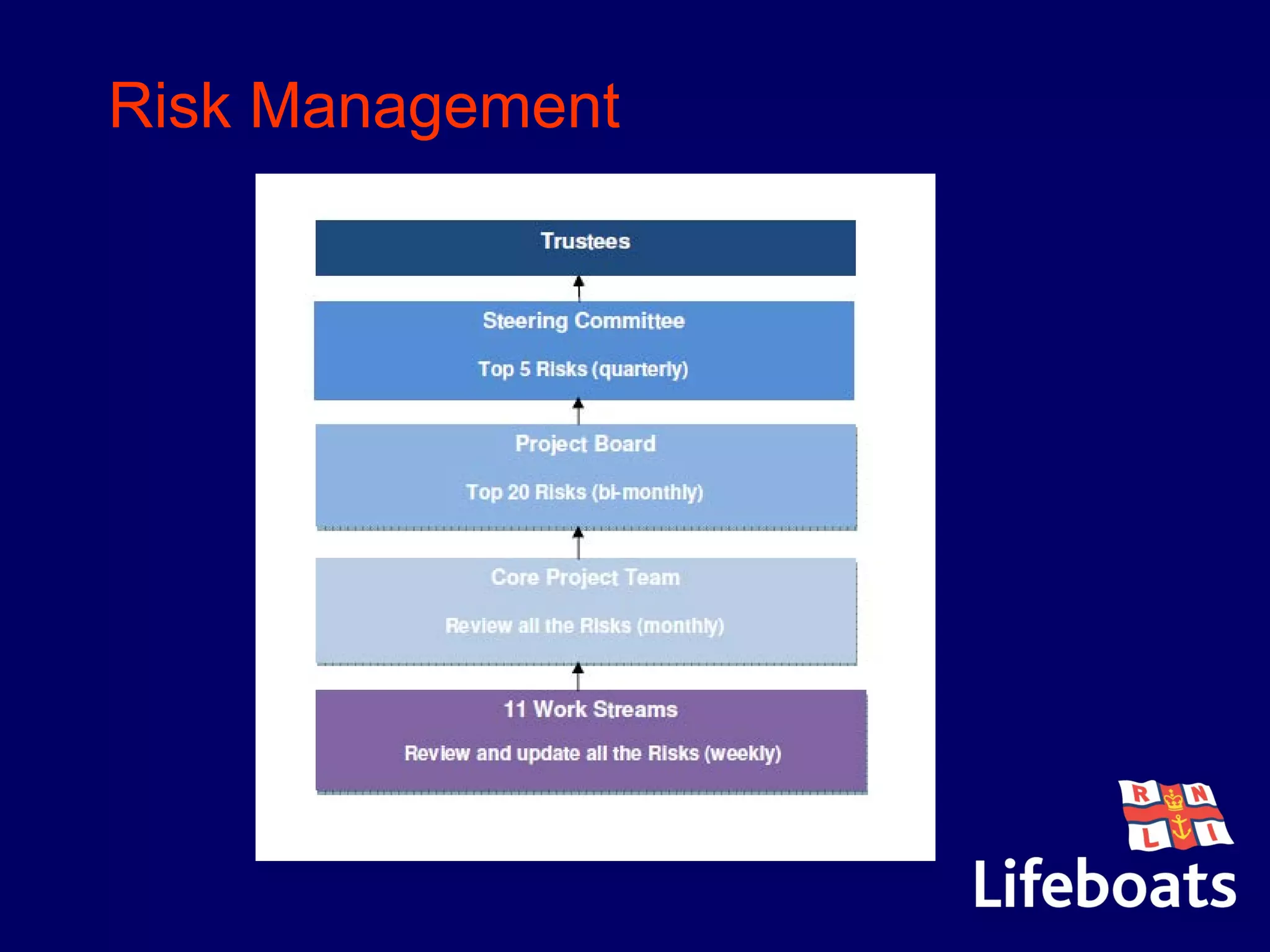
•Key high level risks were identified at an early stage.
•These, together with more detailed risks, are recorded,
scored and monitored on a regular basis in the project
risk register.
•Key risks changes are reported through the
governance structure.
Risk Management
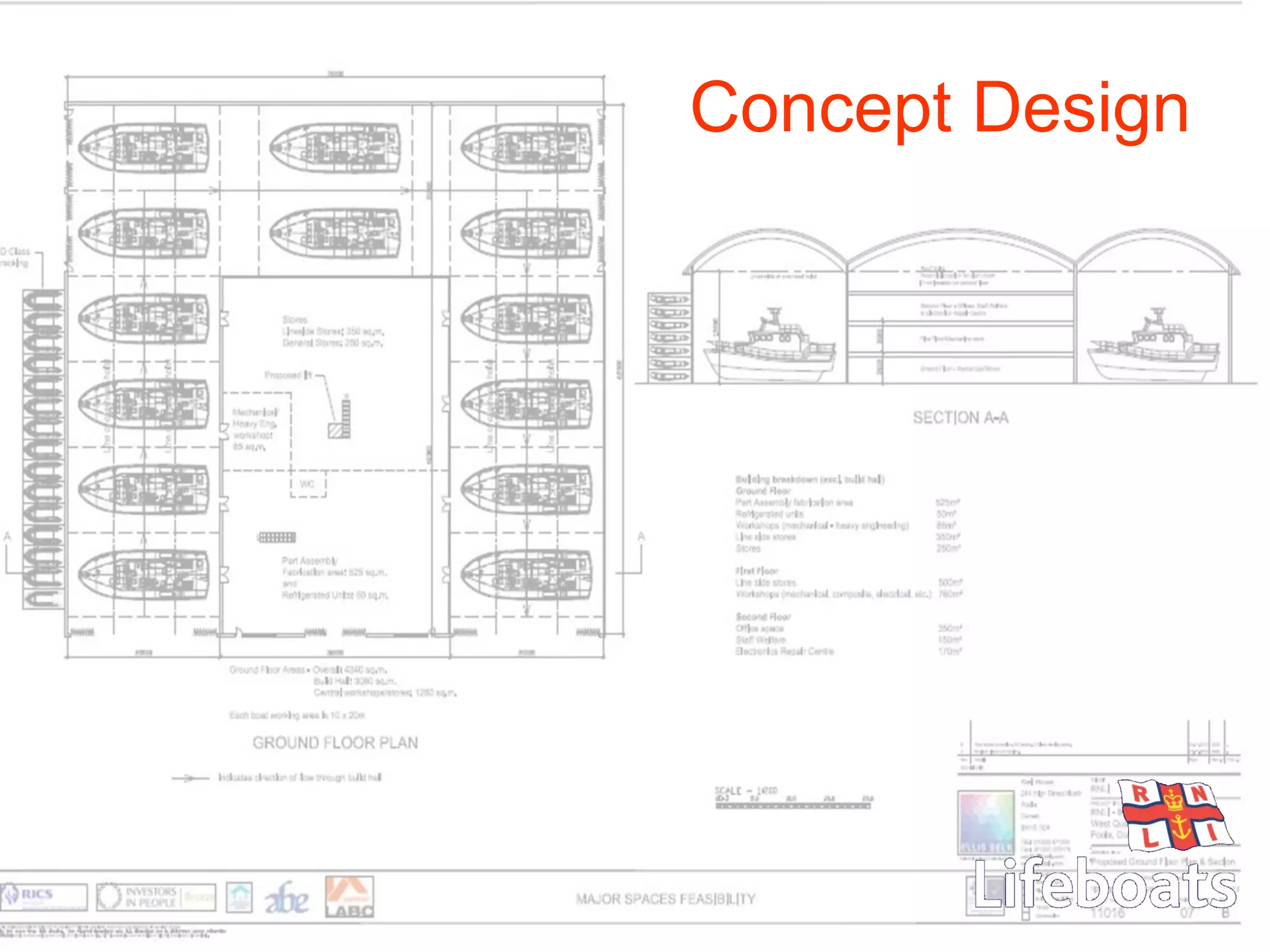
Concept Design
Value Engineering & the Evolution of
Design
• Challenge the concept by a wider circle of experience, both
internal and external, using Lean techniques.
To:
• Produce a more versatile solution
• Maximise the useable space within the site
• Create a more flexible and future proof approach
• Ensure all costs are Value Adding
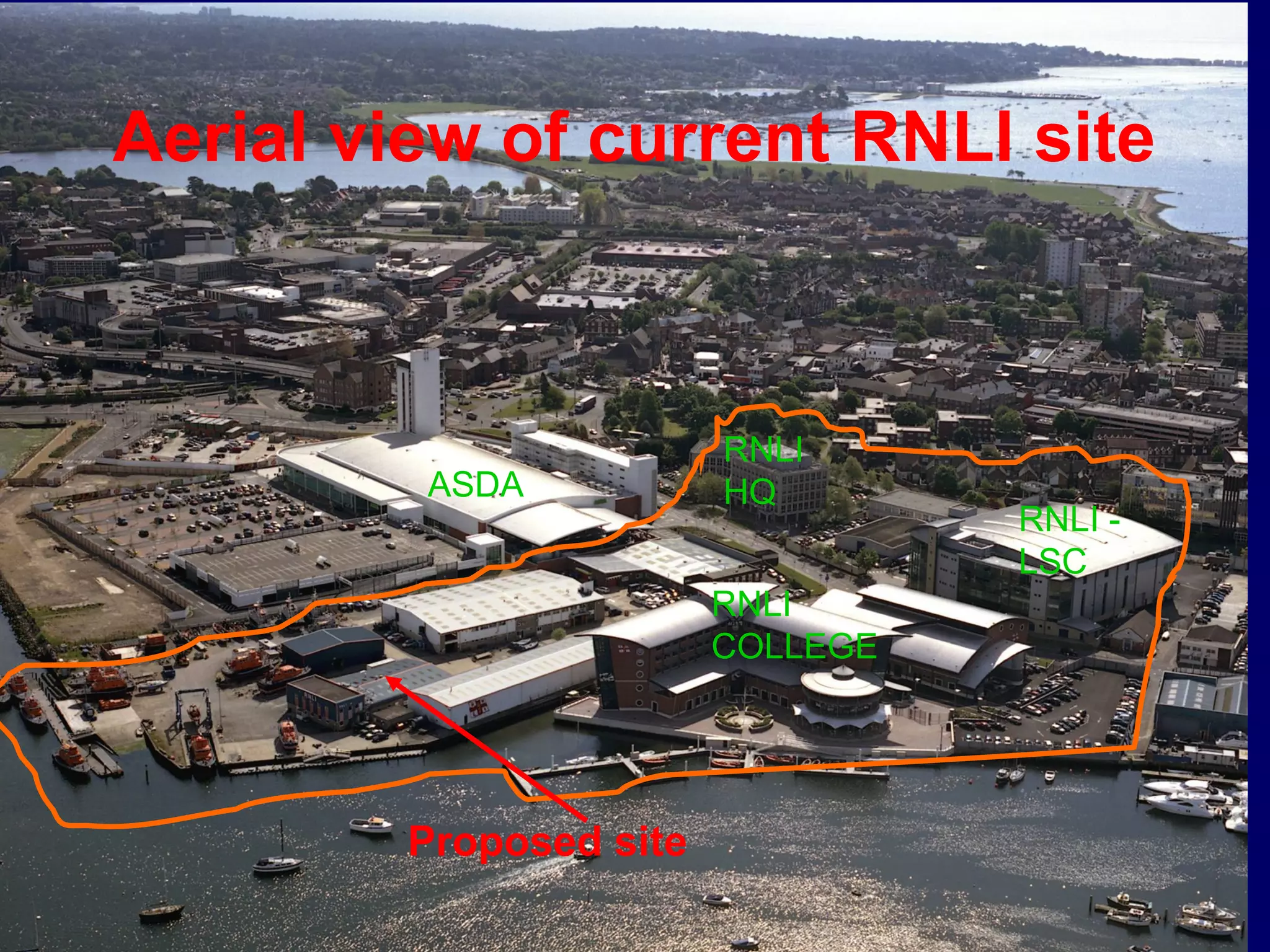
Proposed site
ASDA
Aerial view of current RNLI site
RNLI
HQ
RNLI -
LSC
RNLI
COLLEGE
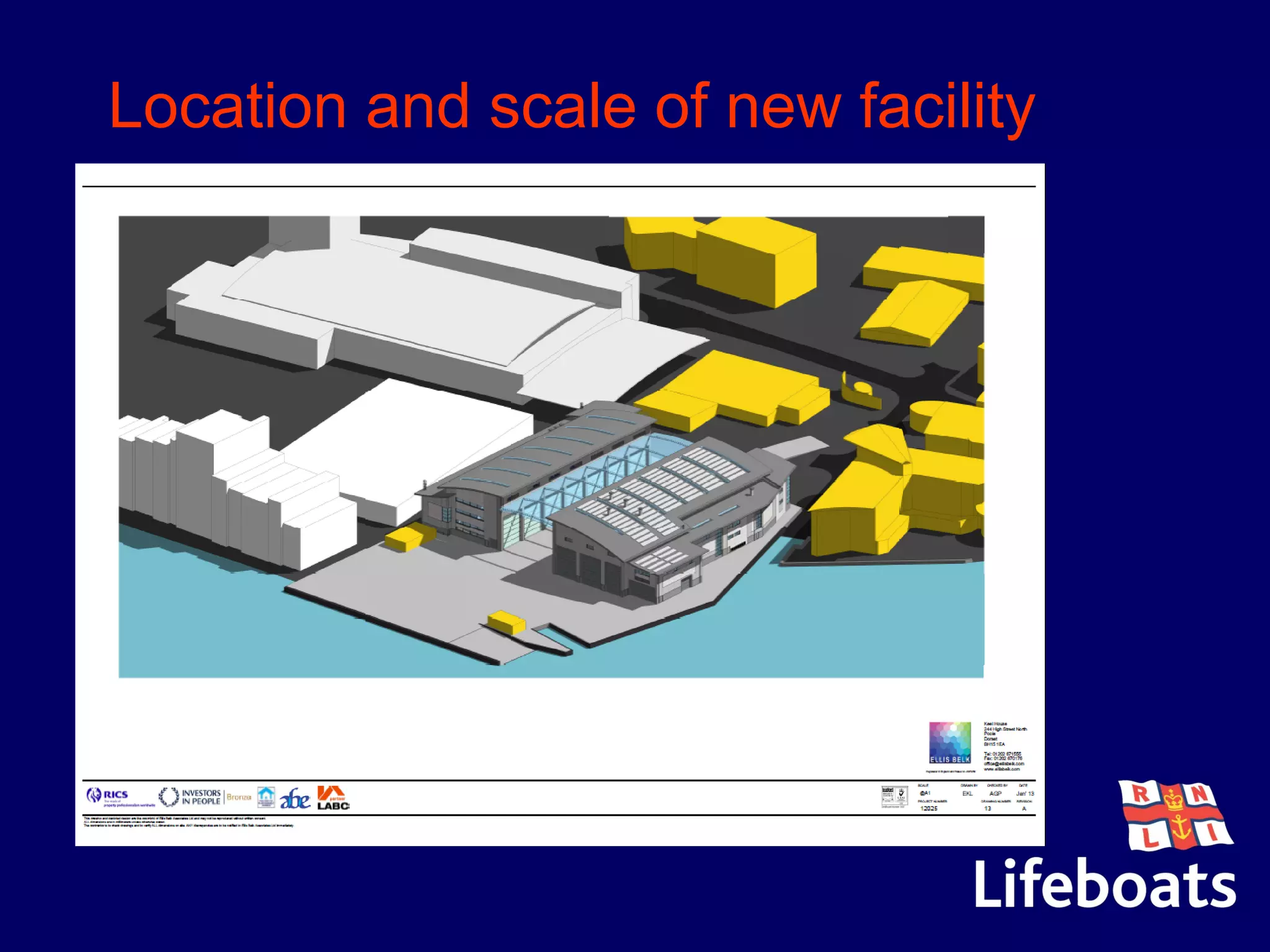
Location and scale of new facility
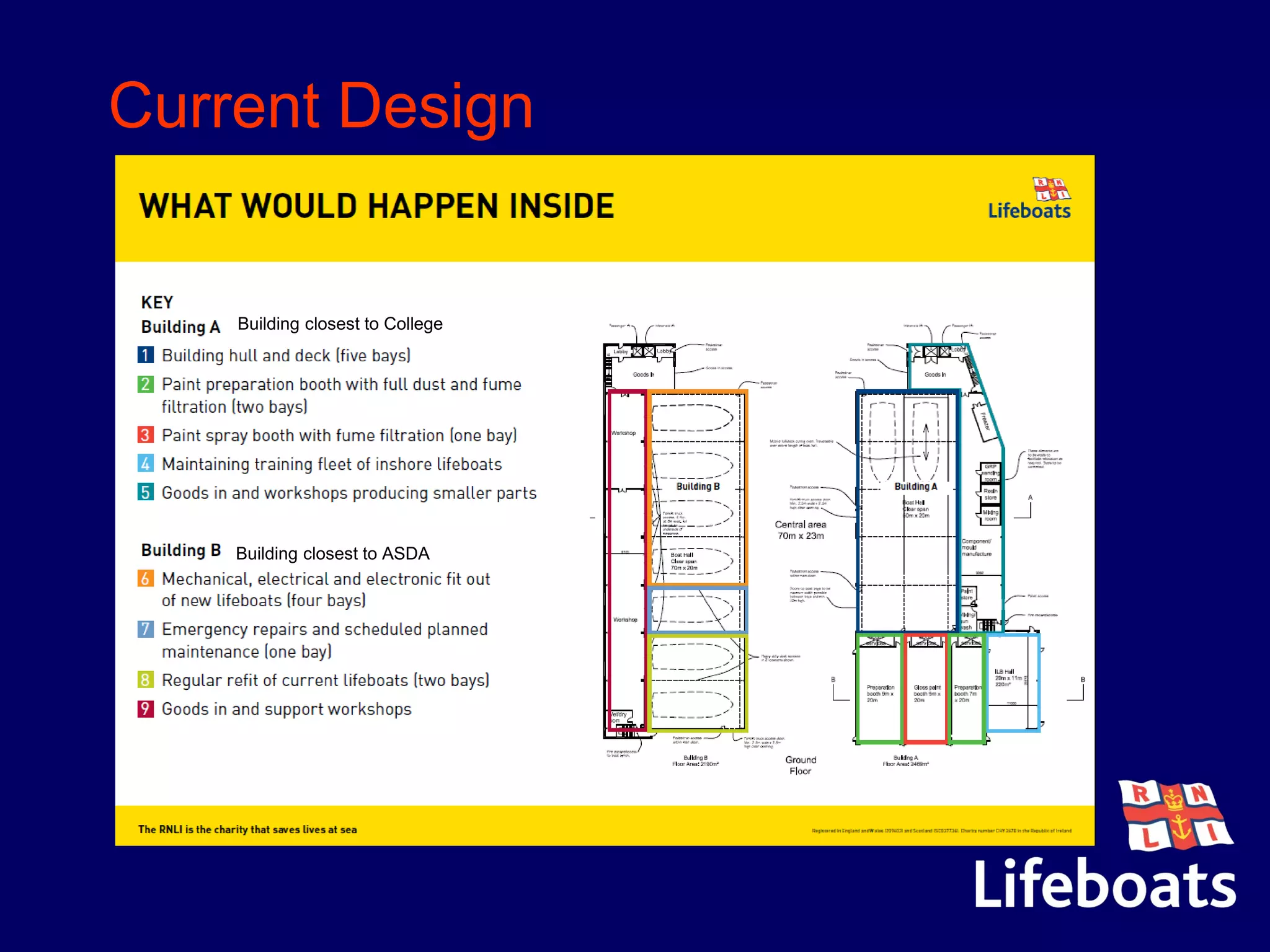
Current Design
Building closest to College
Building closest to ASDA
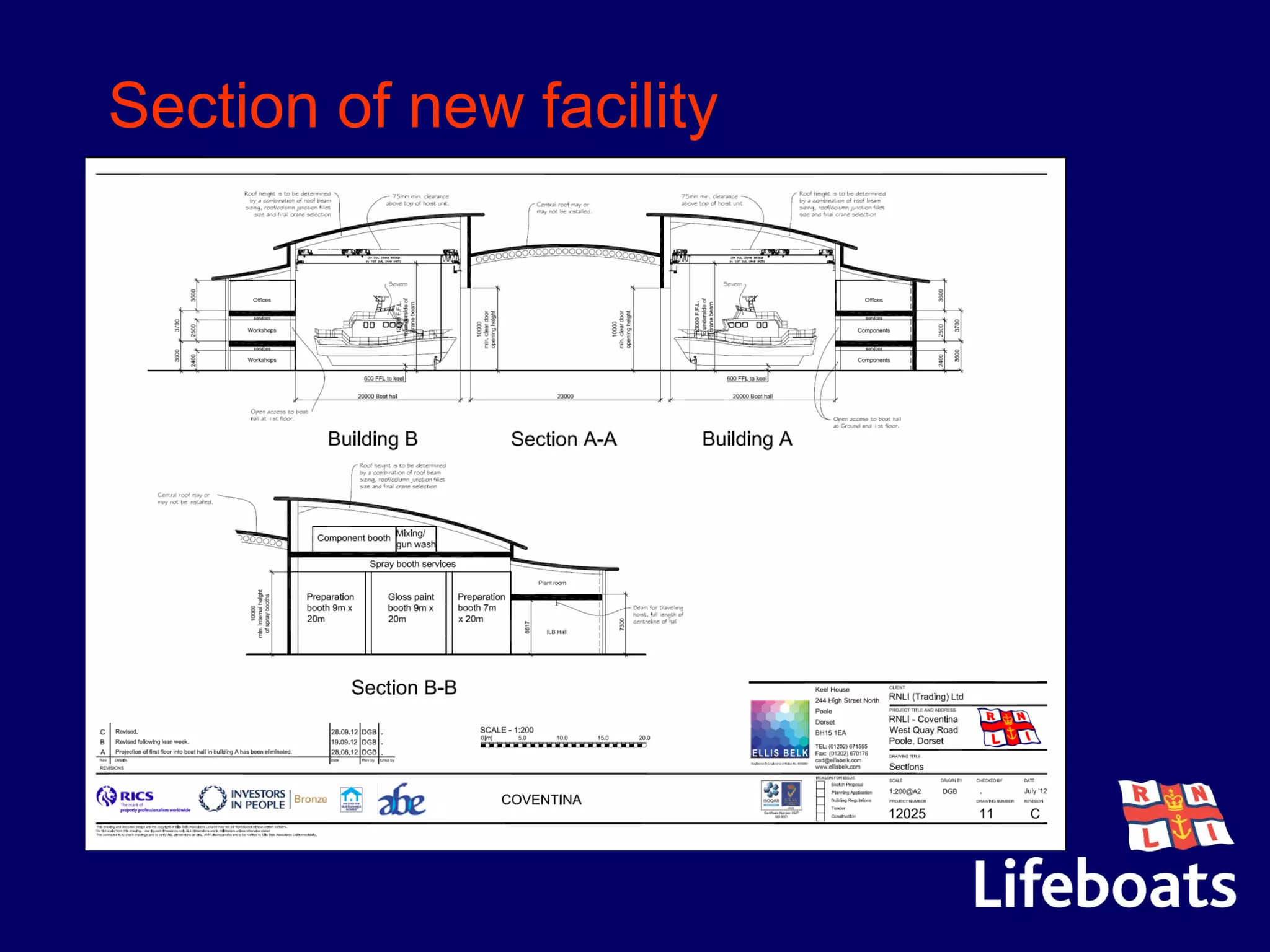
Section of new facility
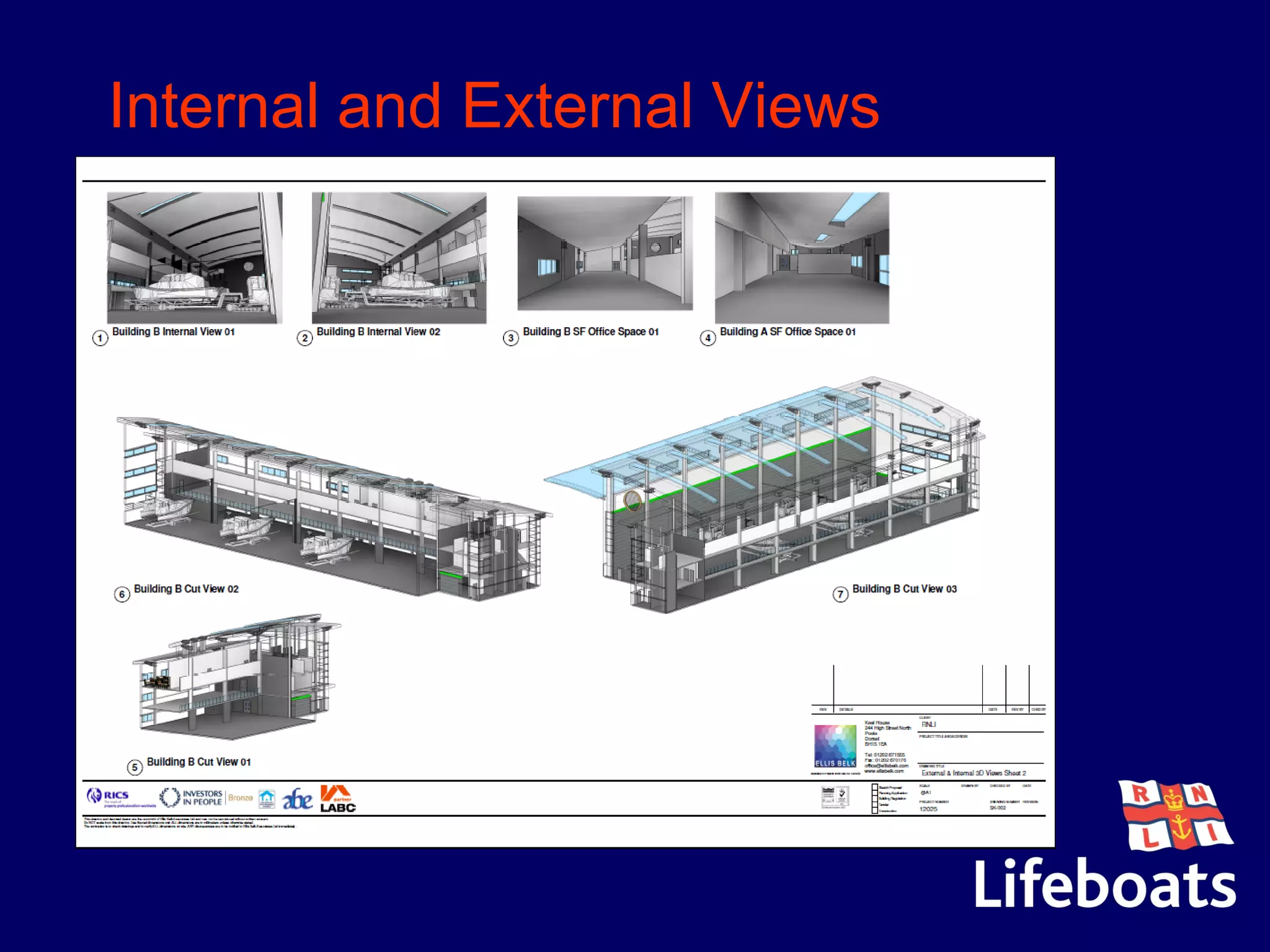
Internal and External Views
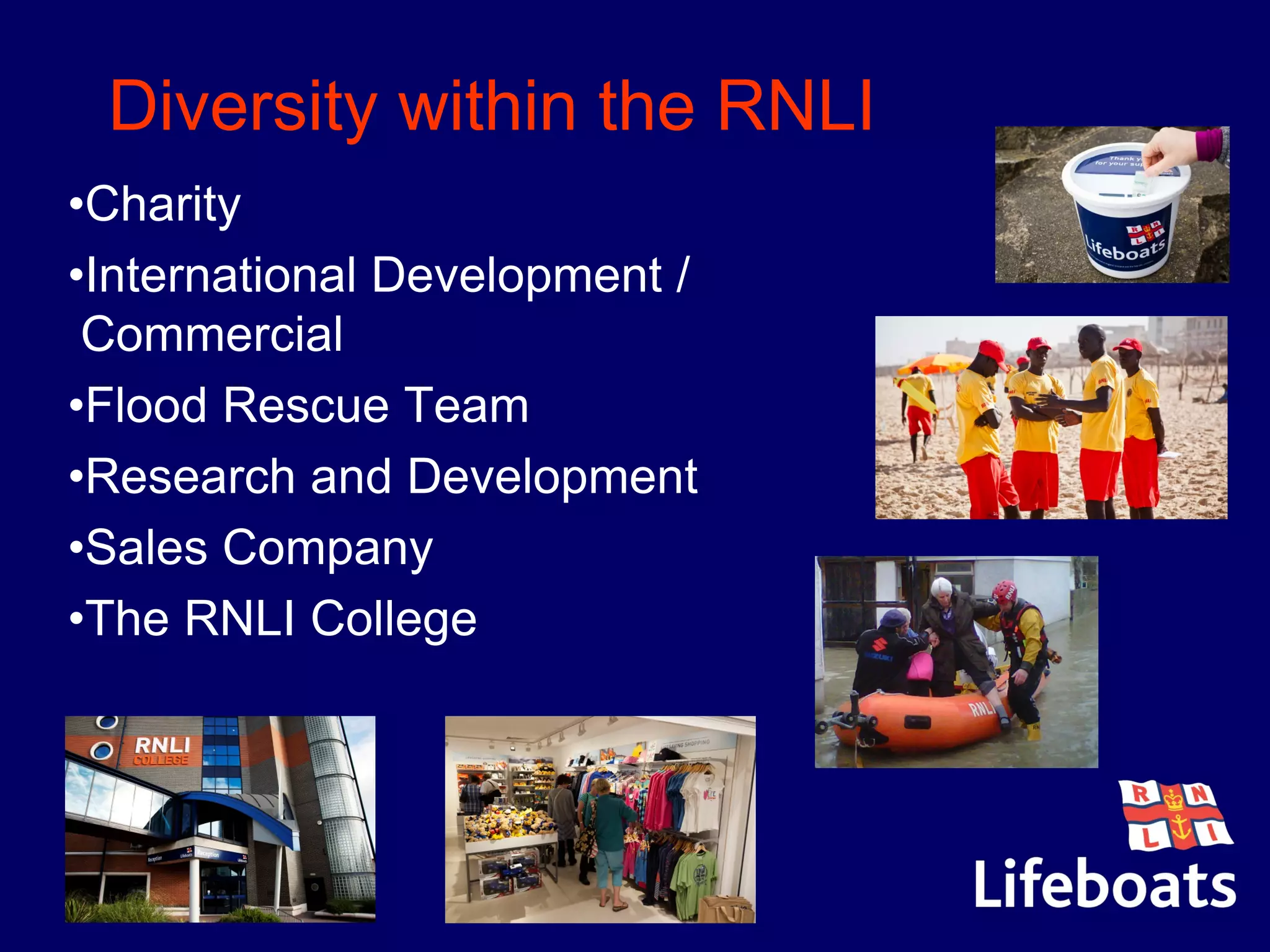
Diversity within the RNLI
•Charity
•International Development /
Commercial
•Flood Rescue Team
•Research and Development
•Sales Company
•The RNLI College
Charity with Commercial Awareness
• 1,300 staff, 4,800 volunteer crew, 30,000 volunteer
fundraisers
• Teddy bears and Christmas card sales
•
• Multi disciplinary Engineering design
• Marine civil Engineering design and construction
• Lean one piece flow manufacturing
The Benefits of Strategic Planning &
Performance Management
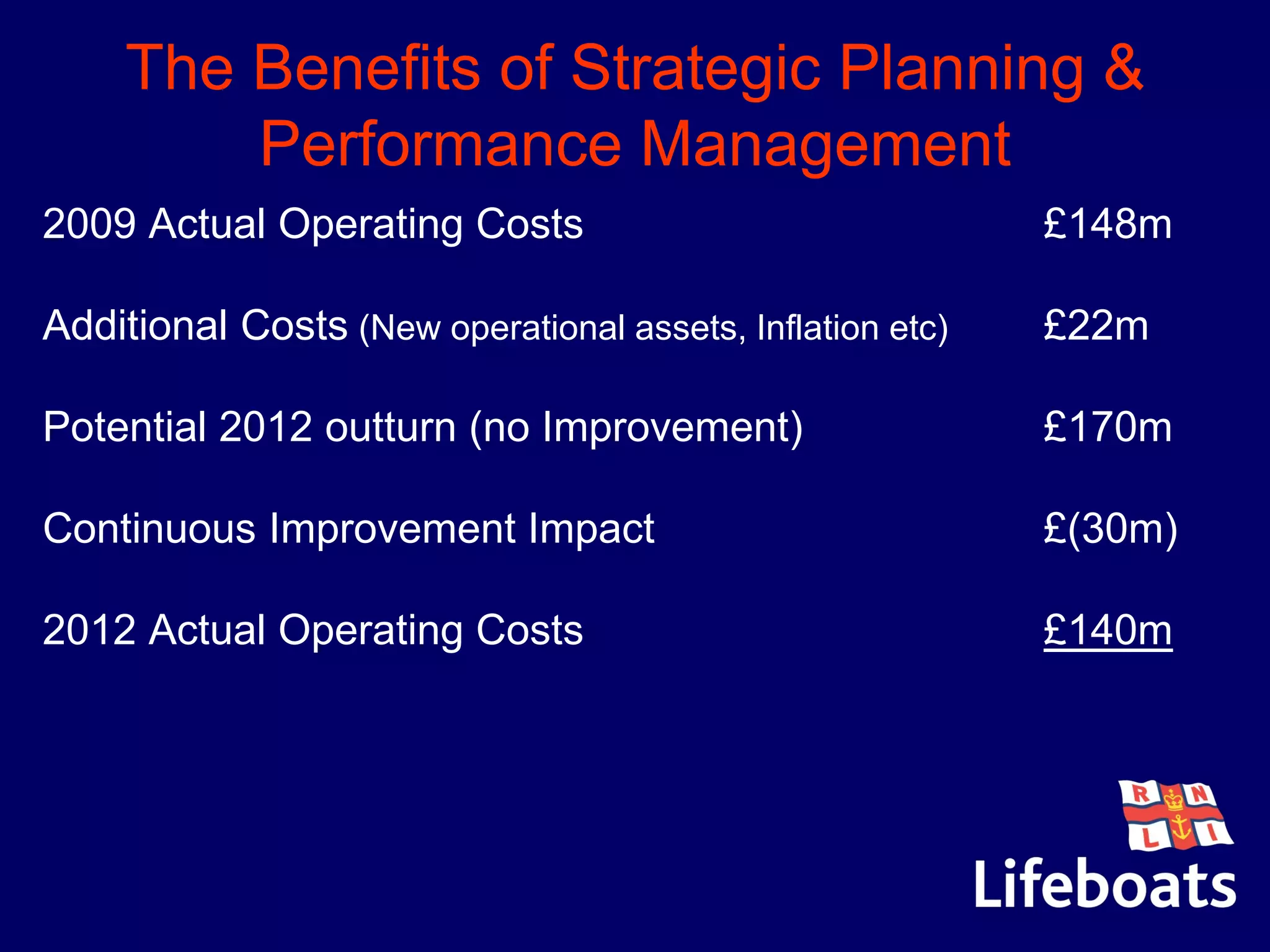
•2009 Actual Operating Costs £148m
•Additional Costs (New operational assets, Inflation etc) £22m
•Potential 2012 outturn (no Improvement) £170m
•Continuous Improvement Impact £(30m)
•2012 Actual Operating Costs £140m
Corporate Impact
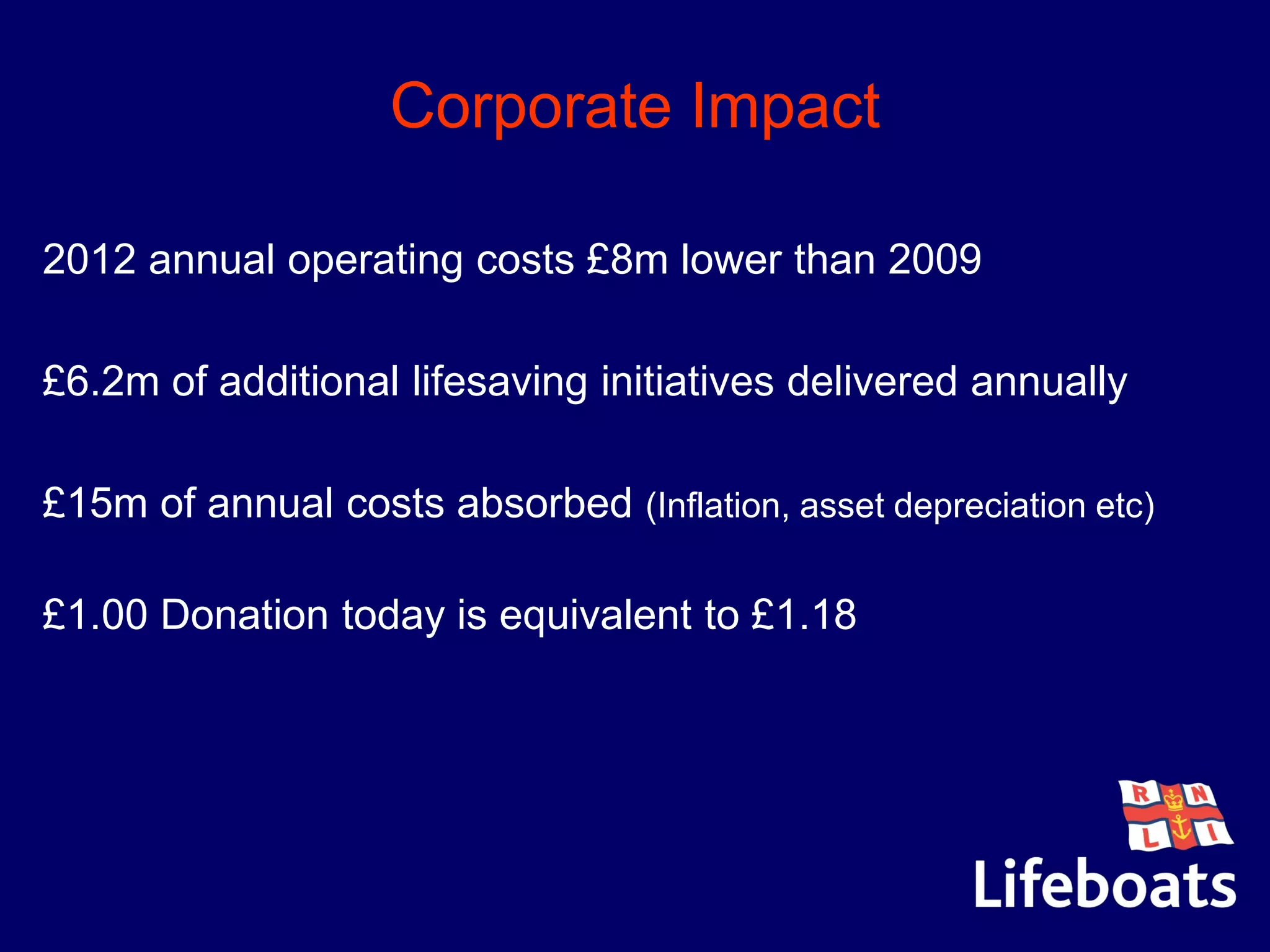
•2012 annual operating costs £8m lower than 2009
•£6.2m of additional lifesaving initiatives delivered annually
•£15m of annual costs absorbed (Inflation, asset depreciation etc)
•£1.00 Donation today is equivalent to £1.18
Future Approach
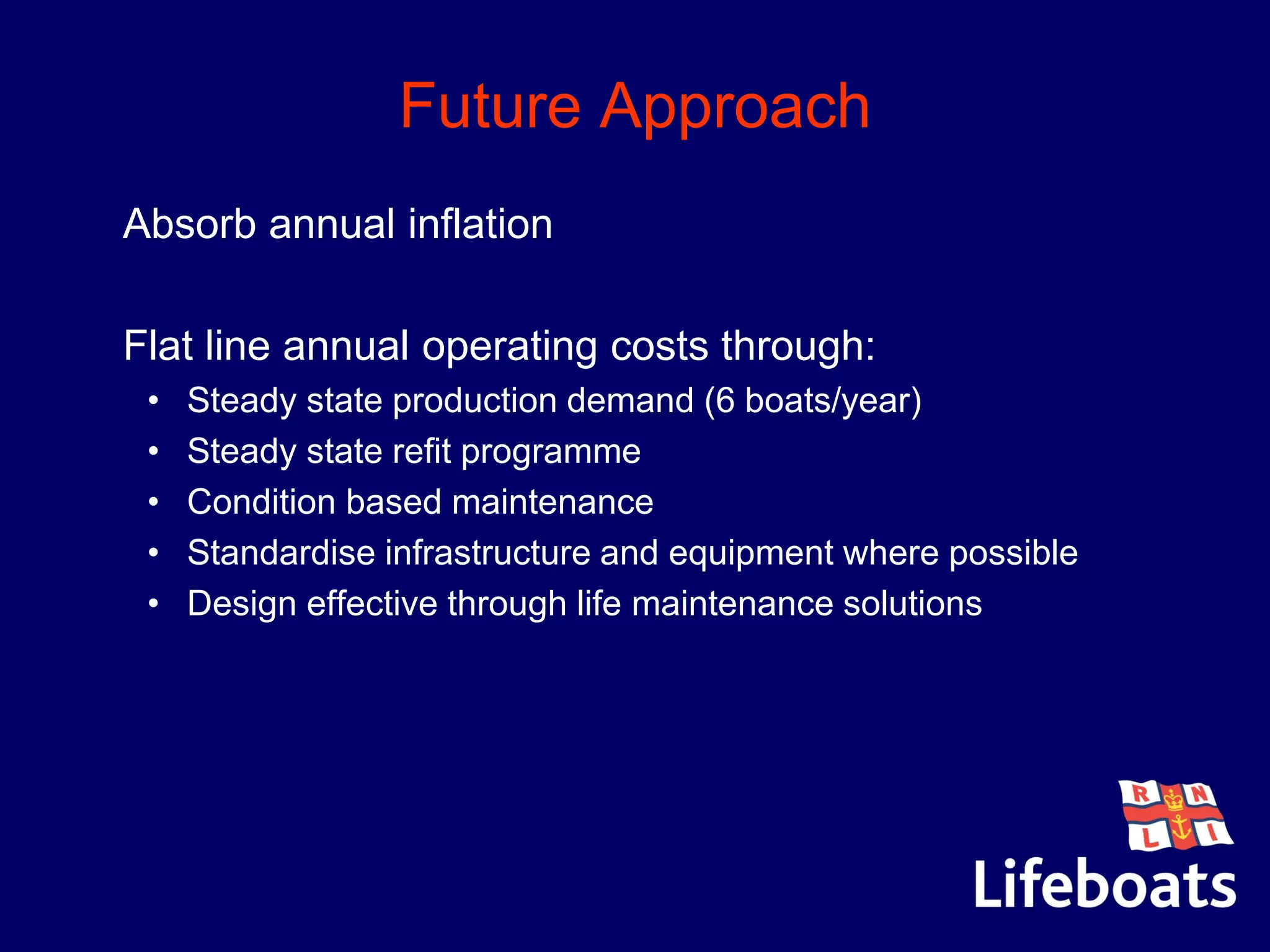
•Absorb annual inflation
•Flat line annual operating costs through:
• Steady state production demand (6 boats/year)
• Steady state refit programme
• Condition based maintenance
• Standardise infrastructure and equipment where possible
• Design effective through life maintenance solutions
Corporate Impact
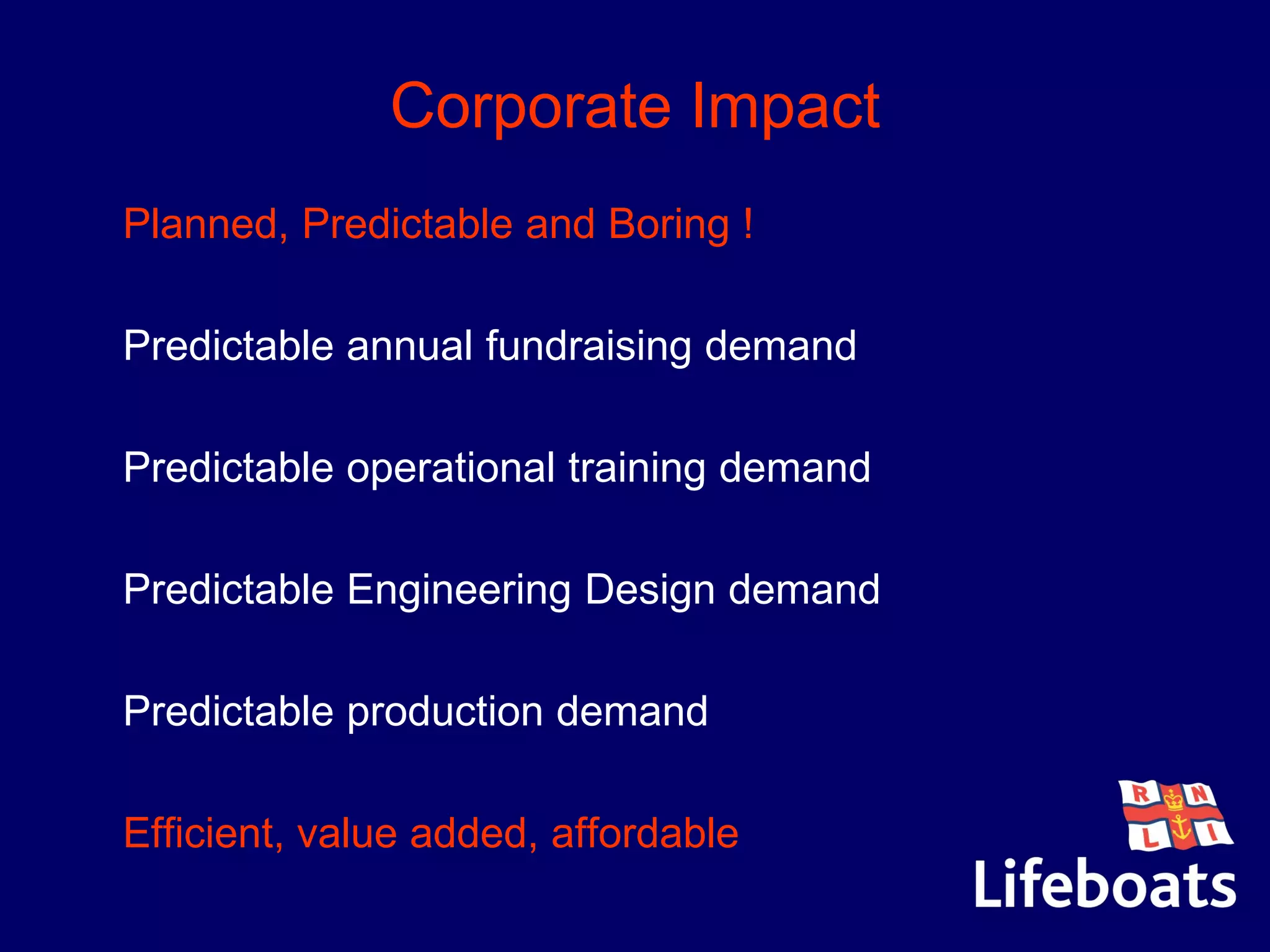
•Planned, Predictable and Boring !
•Predictable annual fundraising demand
•Predictable operational training demand
•Predictable Engineering Design demand
•Predictable production demand
•Efficient, value added, affordable
Any questions?

Concept to production - "The challenges of PM in the RNLI"

  • 1.
    Presentation by: Steve Austen,Head of Engineering Support Angus Watson, Head of Construction and Refit Concept to production – The challenges of project management in the RNLI
  • 2.
    Overview •Introduction •What were thechallenges:- • Challenge 1 - Boom and bust planning demand • Challenge 2 – How to get more for the same during a recession • Challenge 3 – Sustainability •Summary and Conclusion
  • 3.
    What makes theRNLI different? •Funded entirely from voluntary contributions •Volunteer status/volunteer ethos & 24/7 availability •Operating conditions – off the shelf equipment will seldom do •Designer- builder-owner-operator-maintainer-insurer •Design authority, own design standards, self-certifying, ability to do it yourself Design Supply Support 1st & 2nd tier contractor support
  • 4.
    Some key facts… •236 lifeboat stations • Over 150 lifeguard facilities • More than 4,800 lifeboat crew members • 6 Flood Rescue teams • Coordinated by UK Maritime and Coastguard Agency and Irish Coast Guard • Committed to providing lifeboat cover out to 100 miles off the coast and to reach at least 90% of casualties within 10 miles of the coast, in all- weathers within 30 minutes • Each year:- –9000 people rescued, 19000 assisted by lifeguards –Over 300 lives saved
  • 5.
    Tamar Class x27 Tyne Class x 16 Severn Class x 44 B Class (Atlantic) x 124 Trent Class x 37 E Class x 3 Mersey Class x 37 D Class x 150 Hovercraft x 7 The Fleet
  • 6.
  • 7.
    The operating environment •Operationin all weathers • 25 kts, F2 • 17kts, F7 • Safe operation in 16m waves •More capable hulls •More capable engines •Better crew seating & ergonomics •But the environment remains the same
  • 9.
    Major drivers forchange • The changing environment • Greater efficiency & effectiveness across traditional boundaries • Balance between new equipment & in-service support • Overriding need for joined-up engineering & continuous innovation through life
  • 10.
    Requirement by Class 0 2 4 6 8 10 12 2005 2006 2007 2008 2009 2010 2011 2012 2013 2014 2015 2016 2017 2018 2019 2020 2021 2022 2023 2024 2025 2026 2027 2028 2029 2030 FCB2 Tamar SevernMkII Requirement for new build all weather lifeboats by year based on a 25 year life Challenge 1 - Boom and bust planning demand Requirement by Class 0 2 4 6 8 10 12 2005 2006 2007 2008 2009 2010 2011 2012 2013 2014 2015 2016 2017 2018 2019 2020 2021 2022 2023 2024 2025 2026 2027 2028 2029 2030 FCB2 Tamar Severn MkII Requirement for new build all weather lifeboats by year based on a 25 year life
  • 11.
    So how canwe address this? •Move from a 25 year to 50 year design life:- • ‘Stable’ operational requirements • Use of advanced composite materials • Targeting ‘top ten’ reliability hits through coast feedback and introduction of condition based maintenance • Increased design for maintenance • Introduction of better equipment through life management • Active obsolescence management •Stabilise demand on production capacity and capital expenditure •Reduce hours required to build boats
  • 12.
  • 13.
  • 14.
  • 15.
  • 16.
    Towards a leanerculture:- Description of Improvement Before After Improvement Inshore Lifeboat Centre D Class refits 10 wks 2 wks 80% Engineering Office Av. time taken for EO task 38 wks 11 wks 70% Tasks closed per month 14.5 25.7 77% SAR Composites Time to build Tamar hulls 18000 hrs 12000 hrs 33%
  • 17.
    Lean design •First focus– implement FLOW and eliminate administrative waste • Identify “Natural Groups of Activities” •Install disciplines around A3 thinking for technical problems • Ensure structured approach to design/development activities. – Has the voice of the customer been considered? – What options have been considered? – Have ALL costs been considered? • Make the process visible – Monitor progress and surface problems early – visual management. • Engaging the Engineers – Every design task is different but they all have a flow. – Cost is another design requirement – Ensure that the team is supported and not over administrated.
  • 18.
    Value Engineering –Shannon Class •Value engineering event made a significant breakthrough: • Shannon Class is designed for assembly, not craft fabrication as per normal “yacht building”. • The design concept was strong but the manufacturing concept was still craft based. • Event recognised that a potential saving of £300K per boat could be achieved. •Problems to overcome • The boat fit out yard was not ready for this concept. • Culture - “RNLI performance and quality” would never allow an assembled boat. • Running a project to the detail required (full production standard drawings) had never been attempted in the RNLI. • 50 year life - design for maintenance and obsolescence essential to ensure through life costs and initial capital costs are sustainable • Project decision flow times and rework loops needed reducing • Release engineers to make technical decisions
  • 19.
    Project solution •Integrate thebuilder into the project team to pool experience with engineers and CAD technicians on design and manufacturability. •Develop an obeya studio concept allowing:- • weekly planning, daily reviews and problem solving • Inclusive project management – find the problems don’t hide them. • team based problem solving • simple processes that work with quality built in (drawing improvement /change sheets) •Hold items from CAD if critical engineering decisions have not been resolved (i.e. don’t be busy fools) •Give responsibility to engineers to resolve issues and work as a team. •The prototype boat fully tested all the elements of the design – build in as much as possible of the critical features to learn about the boat’s performance in all respects – close to ‘production standard’
  • 20.
    Impact of approach •Prototypedelivered Feb 2012 •Performance of prototype met operational requirement as expected •Quality of layout, fit out & design for production and maintenance has exceeded customer expectations •Prototype is 90% production standard – tested and confirmed (historical need for a pre- production hull eliminated). •Identified design/manufacturing improvements readily implemented in Boat 2 •75% of planned jig use achieved in Boat 2 (100% jig fit out by Boat 3) - assembly concept achieved •Cost reduction of £300K per boat achieved. •6 months project slippage recovered
  • 21.
    Through life management EClass Replacement FCB2 Tamar Severn ArunTyne Class Severn Mk 2
  • 22.
    Concurrent engineering • Useof production, material, maintenance support and operational experts at earlier stage in design • Eliminate problems before they arise • VR techniques for production prototyping, design feedback, early operational and maintainer training
  • 23.
    A condition basedapproach to maintenance Typical lifeboat engine load profile 240 960 1680 2400 3120 3840 4560 60 540 1020 1500 1980 2460 0 20 40 60 80 100 120 Engine hours (hr) Engine torque (N.m) Engine speed (rpm) RNLI 1279 - Engine S/N 532100862 - August 2009 100-120 80-100 60-80 40-60 20-40 0-20
  • 24.
    Condition Based Maintenance Improvements •Reducedrefit package •Reduced stock holding •More inspection, less invasive work & greater emphasis on what matters •Better work planning, less fire fighting •Evidence-based communications and decision making •Projected annual cost savings:- • £17.8k per boat = £780k for Severn Class fleet • £9.7k per boat = £360k for Trent Class fleet • £11.2k per boat = £416k for Mersey Class Why CBM? • Increase reliability and, in turn availability • Improve overall condition of essential equipment • Address the culture of over-maintenance •Better utilise our assets (equipment & people)
  • 25.
    Severn Class lifeextension study
  • 26.
  • 27.
    •Structural integrity –fatigue life prediction
  • 28.
    Life extension criteriaprompt list •Adaptability •Affordability •Alignment with policy •Buildability •Cost •Customer perception •Environmental Impact •External economic impact (National & International) •Flexibility •Future-proof •Health and safety •Human impact •Infrastructure •Legislative and Regulatory requirements. •Long term sustainability •Maintainability •Performance •Physical security •Reliability & availability •Requirements for technical development •Risk (technical, commercial, programme) •Robustness •Safety •Seakeeping •Security •Stability •Supplier base •Support •Survivability •Technical feasibility •Technical performance and practicability •Technology maturity & availability •Time sensitivity (start and duration) •Training •Through life management •User acceptance •Vulnerability
  • 29.
    Severn life extensionoptions OPTION 1 DO NOTHING Run the fleet to the end of its (50 year) life without any planned refits or upgrades. Move to condition based maintenance. Maintenance would be reactive to degradation, equipment failure and damage. Effect minimum of repair to keep the fleet operational. OPTION 2 DO MINIMUM As option 1 but with engine upgrades from Cats to MTUs. This would include introduction of Blueline control system. OPTION 3a LIFE EXTENSION OF CURRENT BOAT (in one) Package of upgrades and refits to the vessel with an emphasis on reliability improvement. Vessels are subject to refit/upgrade in a single overhaul period. OPTION 3b LIFE EXTENSION OF CURRENT BOAT (packaged) Same upgrades as 3a but implemented over a series of overhauls and refits, incorporating elements into the planned maintenance schedule. OPTION 4 DEVELOP SEVERN MKII REPLACEMENT VESSEL Development of a MkII vessel using the current Severn class as a bench mark. Whole fleet replaced with new vessels. Old fleet sold off. OPTION 5 DEVELOP REPLACEMENT VESSEL Complete development of a new class of vessels from requirements definition through to production and delivery in to service. Change of principal dimensions from current Severn class. Options spreadsheet
  • 30.
    Do more, andbetter for less •Enterprise lean •Lean design •Through life management and cost modelling •Life extension studies •Condition Based Maintenance •Lean production
  • 31.
    Summary - guidingprinciples •Quality - defect free products and services at point of delivery. •Availability - increase boat & equipment availability to 100%. •Engagement - a continuous improvement culture. •Efficiency – 10% off Department annual budget by 2013 (£5m) c.£7m achieved for Department, £20m for organisation by end of 2013
  • 32.
    Towards a leanerculture:- Description of Improvement ; Before Current Improvement Inshore Lifeboat Centre D Class refits ; 10 wks 2 wks 80% D Class relief Fleet : c50 c25 50% Facility Annual Turnover ; £3.6m £2.7m 25%
  • 33.
    Part assembly commercialapproach and risk - July 2008 Continued reliance on a sole supplier for ALB composite hulls represents an unacceptable strategic risk to RNLI capability.
  • 34.
    Options Option Cost RiskViability 1 Do Nothing – retain GML as sole source Low High No – Risk assessed as unacceptable. 2 Alternate supplier with existing capability Med High No – Risk with alternative European or Southern hemisphere suppliers remains v high and setup timescales prohibitive. 3 Develop alternate supplier’s capability Med High No – Risk remains high, setup timescales prohibitive. 4 Create new in-house capability. Med Med Yes – but recruitment & retention of skilled workforce is a major concern. 5 Acquire established capability (from current supplier) Med Low Yes – lowest risk and unique opportunity at reasonable cost.
  • 35.
    Option 5 advantages •CurrentTamar Hulls contract unaffected • Supply of boats to coast remains as planned •New RNLI ‘clean’ facility • Purpose built for efficient production of RNLI hulls • Using staff already skilled and experienced in Tamar Hull production • In Lymington with steady supply of skilled labour • Flexible capability for the future •Strategic Risk to RNLI Capability mitigated at reasonable cost
  • 36.
    Towards a leanerculture:- Description of Improvement Before After Improvement SAR Composites Time to build Tamar hulls 18000 hrs 12000 hrs 33%
  • 37.
    Future ALB Strategy 6Boats / Year 0 2 4 6 8 10 12 2006 2008 2010 2012 2014 2016 2018 2020 2022 2024 2026 2028 2030 2032 2034 2036 2038 2040 2042 2044 2046 2048 2050 2052 2054 FCB2 MkII FCB2 Tamar MkII Tamar MkIa Tamar NGLB(Lge) Severn MkII
  • 38.
    Fit Out commercialapproach and risk - 2012 • Single source supply for specific work types • Restricted negotiating position • Significant commercial risk • Fewer boat builders able to meet RNLI specifications and needs • Little opportunity to investigate alternative supply proposals • No integration of higher annual ALB build volumes with condition based maintenance and refit
  • 39.
    Immediate Build requirements •6Shannon Class Lifeboats per year •Delivery every 2 months •Reducing part assembly to target hours •Reduction of fit out hours to target hours •Target boat build cost reduction of £300k
  • 40.
    In-House Demand work packages •PartAssembly – 6 / year •New Construction Fit out – 6 / Year •Refit – c15 / Year •Repair - ? •Relief Fleet – On-going •Training Fleet – On-going
  • 41.
    Demand forecast Demand modelre-assessed in response to new ALB strategy: Volume, type, sequencing of work and facilities required were all re-calculated: • Period to reach true ‘steady state’ 17 years • Total programme costs in period £250 million + • Total production hours in period - 3 million +
  • 42.
    Strategic Opportunities Greater visibilityof future demand enabled a longer term view of ALB production, in light of this, consider alternative sourcing models. •The overarching priority of the RNLI is to minimise delivery risk and ensure the ALB strategy is delivered on time and to a consistently high standard by, in part, ensuring it has more influence over the supply chain. •Commercial considerations are also of key importance.
  • 43.
    Options Many options wereconsidered but were soon refined to: 1. Work with both existing and alternative vendors with a view to: i. Setting up dual supply or ii. establishing a long term gain-share contract 2. Transfer ALB fit-out & overhaul to a purpose-built facility at a third party site 3. Transfer ALB fit-out & overhaul to a purpose-built facility at the RNLI own site in Poole (currently under utilised)
  • 44.
    Solution Feasibility study carriedout and business case model created. Conclusion: Create a single In-House production facility built on RNLI owned land in Poole – Project Coventina
  • 45.
    Why “Project Coventina”? •RNLI lifeboatsare traditionally named after rivers. •Coventina was a Celtic river goddess, •known for renewal, new beginnings, •life cycles, healing and inspiration.
  • 46.
    Coventina benefits Key benefits: •Own long term ‘steady state’ order book • Total savings of £29.1m over 17 year programme • Steady state annual operating cost savings of over £3million versus the “Do Nothing” option • Greater integration with the supply chain providing improved assurance around quality and continuity of supply
  • 47.
    Scale – productionand support CURRENT Direct Employees Support & Mgt Employees Productive hours ILC 54 16 83,000 SAR 34 8 44,000 LMC 19 5 25,000 TOTAL 107 29 152,000 FUTURE Direct Employees Support & Mgt Employees Productive hours ILC 54 16 83,000 Single facility steady state (incorporating SAR & LMC) 118 28 202,000 TOTAL 172 44 285,000
  • 48.
    Project Work Streams (Full-timecore team of 5) 1. Governance 2. Project management (including financial reporting) 3. Stakeholder management 4. Planning application 5. Civil and building works 6. Continuity of delivery 7. Business systems, logistics (including legal structure) 8. People 9. Health & safety 10.Fundraising engagement 11.Pre production implementation
  • 49.
    Project tools • Verticalvalue stream maps (VVSMs) • Microsoft Project • SharePoint • SAP (including project module)
  • 50.
    Wider impact andrisk management •Key high level risks were identified at an early stage. •These, together with more detailed risks, are recorded, scored and monitored on a regular basis in the project risk register. •Key risks changes are reported through the governance structure.
  • 51.
  • 52.
  • 53.
    Value Engineering &the Evolution of Design • Challenge the concept by a wider circle of experience, both internal and external, using Lean techniques. To: • Produce a more versatile solution • Maximise the useable space within the site • Create a more flexible and future proof approach • Ensure all costs are Value Adding
  • 54.
    Proposed site ASDA Aerial viewof current RNLI site RNLI HQ RNLI - LSC RNLI COLLEGE
  • 55.
    Location and scaleof new facility
  • 56.
    Current Design Building closestto College Building closest to ASDA
  • 57.
  • 58.
  • 59.
    Diversity within theRNLI •Charity •International Development / Commercial •Flood Rescue Team •Research and Development •Sales Company •The RNLI College
  • 60.
    Charity with CommercialAwareness • 1,300 staff, 4,800 volunteer crew, 30,000 volunteer fundraisers • Teddy bears and Christmas card sales • • Multi disciplinary Engineering design • Marine civil Engineering design and construction • Lean one piece flow manufacturing
  • 61.
    The Benefits ofStrategic Planning & Performance Management •2009 Actual Operating Costs £148m •Additional Costs (New operational assets, Inflation etc) £22m •Potential 2012 outturn (no Improvement) £170m •Continuous Improvement Impact £(30m) •2012 Actual Operating Costs £140m
  • 62.
    Corporate Impact •2012 annualoperating costs £8m lower than 2009 •£6.2m of additional lifesaving initiatives delivered annually •£15m of annual costs absorbed (Inflation, asset depreciation etc) •£1.00 Donation today is equivalent to £1.18
  • 63.
    Future Approach •Absorb annualinflation •Flat line annual operating costs through: • Steady state production demand (6 boats/year) • Steady state refit programme • Condition based maintenance • Standardise infrastructure and equipment where possible • Design effective through life maintenance solutions
  • 64.
    Corporate Impact •Planned, Predictableand Boring ! •Predictable annual fundraising demand •Predictable operational training demand •Predictable Engineering Design demand •Predictable production demand •Efficient, value added, affordable
  • 65.