Архитектура поискового кластера

            Яндекс
        Den Raskovalov
  denplusplus@yandex-team.ru
        Санкт-Петербург
          25.02.2012
О чем это?

Несмотря на то, что автор сведущ лишь в
том, как работает поиск Яндекса, слышал о
том, как работают другие поисковые
машины, он имеет наглость полагать, что
приемы, которые накоплены в поисковой
индустрии будут полезны любому
высоконагруженному сервису обработки
данных.
Что умеет Яндекс?
●   Зарабатывать деньги (реклама в интернете)
●   Делать надежные высоконагруженные
    сложные сервисы
●   Увязывать тысячи источников данных в один
    продукт
●   Решать задачи обработки данных
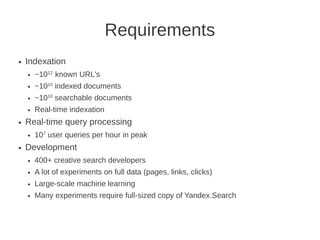
Requirements
●   Indexation
    ●   ~1012 known URL's
    ●   ~1010 indexed documents
    ●   ~1010 searchable documents
    ●   Real-time indexation
●   Real-time query processing
    ●   107 user queries per hour in peak
●   Development
    ●   400+ creative search developers
    ●   A lot of experiments on full data (pages, links, clicks)
    ●   Large-scale machine learning
    ●   Many experiments require full-sized copy of Yandex.Search
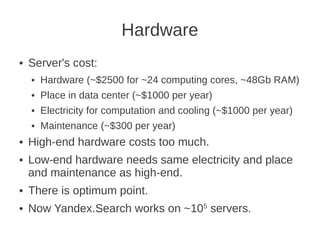
Hardware
●   Server's cost:
    ●   Hardware (~$2500 for ~24 computing cores, ~48Gb RAM)
    ●   Place in data center (~$1000 per year)
    ●   Electricity for computation and cooling (~$1000 per year)
    ●   Maintenance (~$300 per year)
●   High-end hardware costs too much.
●   Low-end hardware needs same electricity and place
    and maintenance as high-end.
●   There is optimum point.
●   Now Yandex.Search works on ~105 servers.
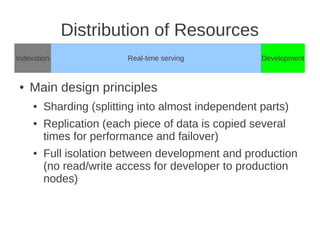
Distribution of Resources
Indexation                Real-time serving          Development


 ●   Main design principles
     ●   Sharding (splitting into almost independent parts)
     ●   Replication (each piece of data is copied several
         times for performance and failover)
     ●   Full isolation between development and production
         (no read/write access for developer to production
         nodes)
Content System


Content system – system for crawling internet
urls, building indexes (inverted index for search,
link index, pagerank, ...) and deployment
indexes for real-time query processing.
Content System
●   Content system phases:
    ●   Crawling (building a list of URLs)
    ●   Selection (we can't fetch everything, we need to predict quality
        before fetching)
    ●   Fetching document data from Internet
    ●   Building search representation for documents (inverted indices
        with lemmatization; binding of external host/url information, link
        information)
    ●   Spam detection
    ●   Duplicates detection
    ●   Selection (we can't search on everything we fetch)
    ●   Documents deployment to system of real-time query processing
Content System
●   In fact we have two content systems now
    ●   Batch (for processing ~1012 URLs)
    ●   Real-time (for processing ~109 URLs we need for
        freshness)
●   Different update periods inflects architecture
    ●   Disc-efficient (sort/join) algorithms for batch
    ●   Almost everything in memory for real-time
Batch Content System
●   We split internet in n parts based on 32-bit hash
    of a hostname. We have ~104 computers, a
    computer for an interval of hash values; it
    crawls “it's” hosts and builds search indexes.
●   We represent “knowledge” of internet as
    relational tables (table of urls, table of links,
    table of hosts).
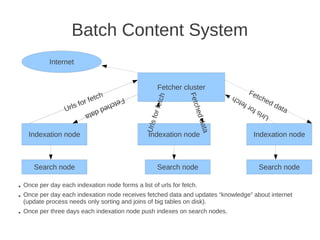
Batch Content System
             Internet


                                                      Fetcher cluster
                                    h                                              Fe
                                                                                     tch
                               fetc


                                                                 Fetc
                                                     tch
                                                                                        ed
                           Fet
                           Fet
                           Fet                                                       ch
                          or
                    rls f
                               che
                               che
                               che                                               fet       d      ata


                                                   or fe
                   U                                                         for
                                  dd
                                  dd
                                  dd


                                                                     h
                                    ata
                                    ata
                                    ata


                                                                    ed d
                                                                                             ls
                                                                                          Ur


                                                      f
                                                 Urls


                                                                         a
                                                                        ta
     Indexation node                              Indexation node                    Indexation node


       Search node                                    Search node                         Search node

●   Once per day each indexation node forms a list of urls for fetch.
●   Once per day each indexation node receives fetched data and updates “knowledge” about internet
    (update process needs only sorting and joins of big tables on disk).
●   Once per three days each indexation node push indexes on search nodes.
Batch Content System
●   Each indexation node needs “external” data
    ●   Links from another indexation nodes
        –   data passing is asynchronous
        –   death of source or target indexation nodes isn't critical (in
            case of failure data will be received next time)
    ●   Aggregated clicks on URLs from MapReduce
    ●   External data about hosts and pages
Real-time Content System
●   Main requirement for real-time content system is small time interval
    between availability of information about document and ability to
    search on document's content.
●   It implies that data can be stored only in RAM. HDD can only be used
    for eventually consistent backup.
●   You have to switch from relational design of data processing to
    services and message passing algorithms.
●   You need big and fast key-value storage in RAM.
●   Algorithms with smaller guarantees without consistency invariants
    (because any network packet can be lose).
Real-time Content System
●   We run each set of services on a node:
    ●   Link database
    ●   Local pagerank calculator
    ●   Global dup-detector
    ●   Anti-spam checker
    ●   Indexer
●   We have library of maintaing key-value storage in
    memory with eventual backup/restore to/from HDD.
●   A lot of network traffic between nodes of real-time
    content system. Almost no data locality. Nodes of real-
    time content system need to be in one datacenter.
MapReduce in Yandex.Search

●   MapReduce approach is simple, clear data storage
    combined with data processing, which hides complexity of
    parallelizing algorithms on several computation nodes
●   MapReduce stores set of relational tables. Each table
    keeps set of records. Each table is physically represented
    of set of chunks on a HDD (~64Mb). One server (master)
    knows about all chunks, keeps constraint of replication
    count >= 3.
●   Each record is triple of {key, subKey, value}.
MapReduce in Yandex.Search
●   What operations are available:
    ●   Append set of records to some table
    ●   Map (iteration over records of some table producing
        another table, can see only one record)
    ●   Reduce (iteration over all values with some key)
    ●   Iteration over table data
●   Reduce is implemented with distributed sort.

●   Example: calculation of URL click-trought-ratio
    (CTR) for some query.
MapReduce in Yandex.Search
●   We use MR for
    ●   logs (views, clicks) processing
    ●   development experiments, which need a lot of data
        or a lot of CPU
●   We have several independent MR-clusters with
    a total of ~103 nodes (some of them are
    “production”, some of them for data uploading
    and code execution)
HPC in Search Quality
●   We use 'pools' -- conveniently represented or
    aggregated parts of web data.
●   Types of 'pools':
    ●   LETOR data
    ●   n-grams frequencies
    ●   text and HTML samples
    ●   ....
    ●   pages with song lyrics from web
    ●   ....
    ●   any crazy idea? (you can check it in hours)
HPC in Search Quality
●   May be the most important task in search quality is relevance
    prediction. Assume that you have URL-query pairs. We have
    statistics about url (pagerank, text length), query (frequency,
    commerciality) and pair {url, query} (text relevance, link
    relevance); which we call relevance features. We want to
    predict relevance of URL on search query by some feature-
    based algorithm.
●   We need to collect relevance features for thousands queries for
    millions of documents from thousands computers for
    training/evaluation of relevance prediction models.
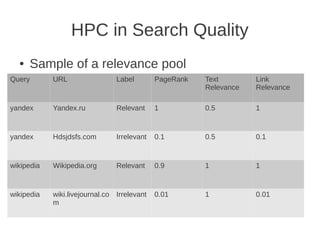
HPC in Search Quality
  ●   Sample of a relevance pool
Query       URL                 Label        PageRank   Text        Link
  ●
                                                        Relevance   Relevance

yandex      Yandex.ru           Relevant     1          0.5         1


yandex      Hdsjdsfs.com        Irrelevant   0.1        0.5         0.1


wikipedia   Wikipedia.org       Relevant     0.9        1           1


wikipedia   wiki.livejournal.co Irrelevant   0.01       1           0.01
            m
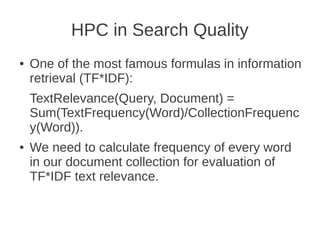
HPC in Search Quality
●   One of the most famous formulas in information
    retrieval (TF*IDF):
    TextRelevance(Query, Document) =
    Sum(TextFrequency(Word)/CollectionFrequenc
    y(Word)).
●   We need to calculate frequency of every word
    in our document collection for evaluation of
    TF*IDF text relevance.
HPC in Search Quality
●   MatrixNet is the name of our machine learning
    algorithm.
●   MatrixNet can be run on arbitrary number of
    core processing units.
●   It's important because it allows to decrease
    time for experiment from a week to several
    hours (if you have 100 computers :) ).
HPC in Search Quality
●   Many experiments need analysis of difference between Yandex and
    slightly modified Yandex (beta version).
●   Any developer needs the ability to build betas in minutes.
●   Requirements:
    ●   strong system of deployment (you always need to know all parts of system
        with versions and how you can put it on any node)
    ●   strong code management (branches, tags, code review)
    ●   dynamic resource management (you need only several betas at one time)
    ●   system of automatic search quality evaluation
    ●   a lot of resources
HPC in Search Quality
●   Problems:
    ●   You need full web data and even more
    ●   Any computer can be unavailable at any moment
    ●   You need robust data and code distribution tools
    ●   You have to execute code near data
    ●   You need some coordination between different users on
        development nodes
    ●   You cannot predict load of development node
●   But your progress speed determined by development speed
●   Solution: data replication, scheduling of tasks, convenient and
    robust APIs for developers
●   But..
HPC in Search Quality

No final solution.

They are developers. They
can eat all resources they
can reach.
Overview
●   Structure of the cluster
●   Architectures:
    ●   Data-centric
        –   Batch
        –   Real-time
    ●   Development-centric
        –   MapReduce
        –   Ad-hoc
    ●   Real-time query processing
What is this about


 ●
     Computational model of query processing
 ●
     Problems and their solutions in terms of this
     model
 ●
     Evolution of Search architecture
 ●
     Evolution of Search components
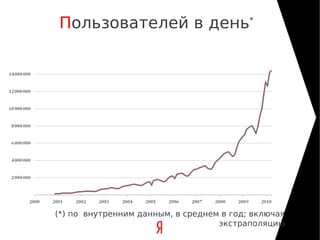
Пользователей в день*


(*) по внутренним данным, в среднем в год; включая
                                   экстраполяцию
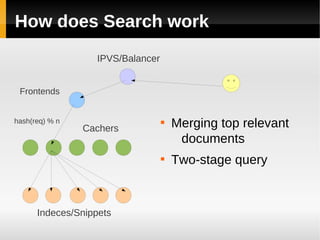
How does Search work
                  IPVS/Balancer


 Frontends


hash(req) % n
                Cachers
                                  
                                      Merging top relevant
                                       documents
                                  
                                      Two-stage query


      Indeces/Snippets
Problems

      
          Connectivity
      
          Load balancing
             
                 Static (precalculated)
             
                 Dynamic (run-time)
      
          Fault tolerance
      
          Latency
Network

 
     Unpredictability of latency
 
     Bottleneck of the system
 
     Throughput grows slower than CPU
 
     Heterogeneous topology
        
            1 datacenter => many datacenters
        
            Many datacenters => datacenters in many
             countries
Load Balancing


    Machines and indexes are different
       
           3 generations of hardware

    Uncontrollable processes at nodes
       
           OS decided to clear buffers
       
           Monitoring system daemon writes core dump
       
           RAID Rebuilding
       
           Whatever
Fault tolerance


    Machines fail
       
           1% of resources is always unavailable

    Packets are lost in the network

    Datacenters get turned off
       
           Summer, heat, cooling doesn’t cope with workload
       
           Forgot to pay for energy
       
           Drunk worker cut the cable

    Cross-country links fail
Latency


    Different system parts reply with different speed
       
           3 generations of machines
       
           Indexes are different

    Random latency
       
           Packets are lost in the network
       
           Scheduler in the OS doesn’t work
       
           Disk is slow (200 S/PS)

    Slow “tail” of queries
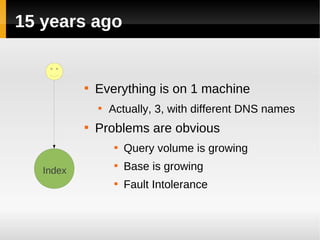
15 years ago


           
               Everything is on 1 machine
               
                   Actually, 3, with different DNS names
           
               Problems are obvious
                    
                        Query volume is growing
   Index
                    
                        Base is growing
                    
                        Fault Intolerance
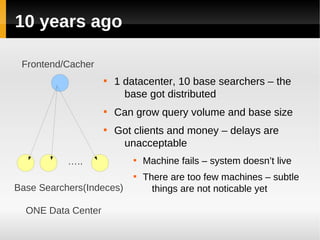
10 years ago

 Frontend/Cacher
                    
                        1 datacenter, 10 base searchers – the
                          base got distributed
                    
                        Can grow query volume and base size
                    
                        Got clients and money – delays are
                         unacceptable
           …..              
                                Machine fails – system doesn’t live
                            
                                There are too few machines – subtle
Base Searchers(Indeces)           things are not noticable yet

  ONE Data Center
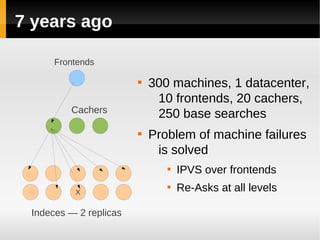
7 years ago

      Frontends

                        
                            300 machines, 1 datacenter,
                             10 frontends, 20 cachers,
         Cachers             250 base searches
                        
                            Problem of machine failures
                             is solved
                               
                                   IPVS over frontends
          X
                               
                                   Re-Asks at all levels

 Indeces — 2 replicas
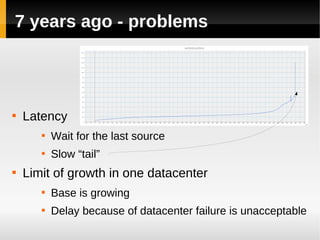
7 years ago - problems



    Latency
       
           Wait for the last source
       
           Slow “tail”

    Limit of growth in one datacenter
       
           Base is growing
       
           Delay because of datacenter failure is unacceptable
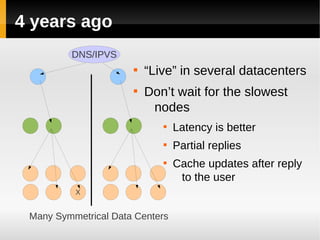
4 years ago
         DNS/IPVS
                      
                          “Live” in several datacenters
                      
                          Don’t wait for the slowest
                           nodes
                             
                                 Latency is better
                             
                                 Partial replies
                             
                                 Cache updates after reply
                                  to the user
          X


 Many Symmetrical Data Centers
4 years ago - problems

 
     Datacenters are different, the base is growing,
      one datacenter can’t hold the whole base
 
     Need more network even inside the datacenter
 
     Manual configuration
 
     “No-reply”s – the scariest word
 
     Different behavior for different users
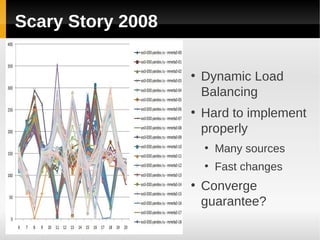
Scary Story 2008

                   ●
                       Dynamic Load
                       Balancing
                   ●
                       Hard to implement
                       properly
                       ●
                           Many sources
                       ●
                           Fast changes
                   ●
                       Converge
                       guarantee?
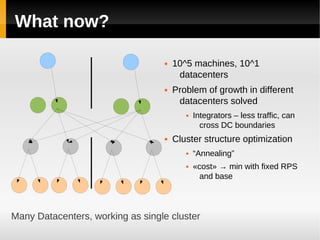
What now?

                                     10^5 machines, 10^1
                                       datacenters
                                     Problem of growth in different
                                       datacenters solved
                                            Integrators – less traffic, can
                                               cross DC boundaries
                                     Cluster structure optimization
                                            “Annealing”
                                            «cost» → min with fixed RPS
                                               and base


Many Datacenters, working as single cluster
Frontier

     
         New Markets
            
                Distributed Data Centers
            
                Slow channels
            
                Database upload
            
                Independent DCs again?
     
         Latency is “not modern”
            
                Ask 2 replicas simultaneously
            
                Wait only for the best
Resume


   
       Succession of architectures
   
       Linear horizontal scaling
          
              By queries
          
              By base
   
       Growth limits are years ahead
   
       Robustness of computational model
Base Search

    “Conservative” component
           Stable external interface
           Complication/optimization of ranking
    Filtering iterator
    Pruning
    Early query termination
    Selection Rank
Cacher/metasearch


    Synchronous -> asynchronous
       
           Message passing
       
           Early decision making

    Merge tree

    Rerankings
       
           Metasearch statistics
       
           Data enrichment
Balancer

        DNS
        IPVS
              Only inside VLAN
              Distribution by IP
        HTTP balancer
              Keepalive
              Ssl
              Honest frontend balancing
              Early robots elimination
Also...
                                     Cacher
 
     Tiers
        
            Golden       GOLD
                                 COMMON
        
            Common                             GARBAGE
        
            Garbage
 
     Index update frequency
        
            Main – slow updates (days)
        
            Fast – fast updates (hours, minutes)
        
            Real-time – ultra-fast updates (seconds)
Further Reading
●   Yet Another MapReduce
    http://prezi.com/p4uipwixfd4p/yet-another-mapredu
●   Оптимизация алгоритмов ранжирования
    методами машинного обучения
    http://romip.ru/romip2009/15_yandex.pdf
●   Как работают поисковые системы
    http://download.yandex.ru/company/iworld-
    3.pdf
Thank you.

Questions?

20120225 information retrieval raskovalov_lecture01-02

  • 1.
    Архитектура поискового кластера Яндекс Den Raskovalov denplusplus@yandex-team.ru Санкт-Петербург 25.02.2012
  • 2.
    О чем это? Несмотряна то, что автор сведущ лишь в том, как работает поиск Яндекса, слышал о том, как работают другие поисковые машины, он имеет наглость полагать, что приемы, которые накоплены в поисковой индустрии будут полезны любому высоконагруженному сервису обработки данных.
  • 3.
    Что умеет Яндекс? ● Зарабатывать деньги (реклама в интернете) ● Делать надежные высоконагруженные сложные сервисы ● Увязывать тысячи источников данных в один продукт ● Решать задачи обработки данных
  • 6.
    Requirements ● Indexation ● ~1012 known URL's ● ~1010 indexed documents ● ~1010 searchable documents ● Real-time indexation ● Real-time query processing ● 107 user queries per hour in peak ● Development ● 400+ creative search developers ● A lot of experiments on full data (pages, links, clicks) ● Large-scale machine learning ● Many experiments require full-sized copy of Yandex.Search
  • 7.
    Hardware ● Server's cost: ● Hardware (~$2500 for ~24 computing cores, ~48Gb RAM) ● Place in data center (~$1000 per year) ● Electricity for computation and cooling (~$1000 per year) ● Maintenance (~$300 per year) ● High-end hardware costs too much. ● Low-end hardware needs same electricity and place and maintenance as high-end. ● There is optimum point. ● Now Yandex.Search works on ~105 servers.
  • 8.
    Distribution of Resources Indexation Real-time serving Development ● Main design principles ● Sharding (splitting into almost independent parts) ● Replication (each piece of data is copied several times for performance and failover) ● Full isolation between development and production (no read/write access for developer to production nodes)
  • 9.
    Content System Content system– system for crawling internet urls, building indexes (inverted index for search, link index, pagerank, ...) and deployment indexes for real-time query processing.
  • 10.
    Content System ● Content system phases: ● Crawling (building a list of URLs) ● Selection (we can't fetch everything, we need to predict quality before fetching) ● Fetching document data from Internet ● Building search representation for documents (inverted indices with lemmatization; binding of external host/url information, link information) ● Spam detection ● Duplicates detection ● Selection (we can't search on everything we fetch) ● Documents deployment to system of real-time query processing
  • 11.
    Content System ● In fact we have two content systems now ● Batch (for processing ~1012 URLs) ● Real-time (for processing ~109 URLs we need for freshness) ● Different update periods inflects architecture ● Disc-efficient (sort/join) algorithms for batch ● Almost everything in memory for real-time
  • 12.
    Batch Content System ● We split internet in n parts based on 32-bit hash of a hostname. We have ~104 computers, a computer for an interval of hash values; it crawls “it's” hosts and builds search indexes. ● We represent “knowledge” of internet as relational tables (table of urls, table of links, table of hosts).
  • 13.
    Batch Content System Internet Fetcher cluster h Fe tch fetc Fetc tch ed Fet Fet Fet ch or rls f che che che fet d ata or fe U for dd dd dd h ata ata ata ed d ls Ur f Urls a ta Indexation node Indexation node Indexation node Search node Search node Search node ● Once per day each indexation node forms a list of urls for fetch. ● Once per day each indexation node receives fetched data and updates “knowledge” about internet (update process needs only sorting and joins of big tables on disk). ● Once per three days each indexation node push indexes on search nodes.
  • 14.
    Batch Content System ● Each indexation node needs “external” data ● Links from another indexation nodes – data passing is asynchronous – death of source or target indexation nodes isn't critical (in case of failure data will be received next time) ● Aggregated clicks on URLs from MapReduce ● External data about hosts and pages
  • 15.
    Real-time Content System ● Main requirement for real-time content system is small time interval between availability of information about document and ability to search on document's content. ● It implies that data can be stored only in RAM. HDD can only be used for eventually consistent backup. ● You have to switch from relational design of data processing to services and message passing algorithms. ● You need big and fast key-value storage in RAM. ● Algorithms with smaller guarantees without consistency invariants (because any network packet can be lose).
  • 16.
    Real-time Content System ● We run each set of services on a node: ● Link database ● Local pagerank calculator ● Global dup-detector ● Anti-spam checker ● Indexer ● We have library of maintaing key-value storage in memory with eventual backup/restore to/from HDD. ● A lot of network traffic between nodes of real-time content system. Almost no data locality. Nodes of real- time content system need to be in one datacenter.
  • 17.
    MapReduce in Yandex.Search ● MapReduce approach is simple, clear data storage combined with data processing, which hides complexity of parallelizing algorithms on several computation nodes ● MapReduce stores set of relational tables. Each table keeps set of records. Each table is physically represented of set of chunks on a HDD (~64Mb). One server (master) knows about all chunks, keeps constraint of replication count >= 3. ● Each record is triple of {key, subKey, value}.
  • 18.
    MapReduce in Yandex.Search ● What operations are available: ● Append set of records to some table ● Map (iteration over records of some table producing another table, can see only one record) ● Reduce (iteration over all values with some key) ● Iteration over table data ● Reduce is implemented with distributed sort. ● Example: calculation of URL click-trought-ratio (CTR) for some query.
  • 19.
    MapReduce in Yandex.Search ● We use MR for ● logs (views, clicks) processing ● development experiments, which need a lot of data or a lot of CPU ● We have several independent MR-clusters with a total of ~103 nodes (some of them are “production”, some of them for data uploading and code execution)
  • 20.
    HPC in SearchQuality ● We use 'pools' -- conveniently represented or aggregated parts of web data. ● Types of 'pools': ● LETOR data ● n-grams frequencies ● text and HTML samples ● .... ● pages with song lyrics from web ● .... ● any crazy idea? (you can check it in hours)
  • 21.
    HPC in SearchQuality ● May be the most important task in search quality is relevance prediction. Assume that you have URL-query pairs. We have statistics about url (pagerank, text length), query (frequency, commerciality) and pair {url, query} (text relevance, link relevance); which we call relevance features. We want to predict relevance of URL on search query by some feature- based algorithm. ● We need to collect relevance features for thousands queries for millions of documents from thousands computers for training/evaluation of relevance prediction models.
  • 22.
    HPC in SearchQuality ● Sample of a relevance pool Query URL Label PageRank Text Link ● Relevance Relevance yandex Yandex.ru Relevant 1 0.5 1 yandex Hdsjdsfs.com Irrelevant 0.1 0.5 0.1 wikipedia Wikipedia.org Relevant 0.9 1 1 wikipedia wiki.livejournal.co Irrelevant 0.01 1 0.01 m
  • 23.
    HPC in SearchQuality ● One of the most famous formulas in information retrieval (TF*IDF): TextRelevance(Query, Document) = Sum(TextFrequency(Word)/CollectionFrequenc y(Word)). ● We need to calculate frequency of every word in our document collection for evaluation of TF*IDF text relevance.
  • 24.
    HPC in SearchQuality ● MatrixNet is the name of our machine learning algorithm. ● MatrixNet can be run on arbitrary number of core processing units. ● It's important because it allows to decrease time for experiment from a week to several hours (if you have 100 computers :) ).
  • 25.
    HPC in SearchQuality ● Many experiments need analysis of difference between Yandex and slightly modified Yandex (beta version). ● Any developer needs the ability to build betas in minutes. ● Requirements: ● strong system of deployment (you always need to know all parts of system with versions and how you can put it on any node) ● strong code management (branches, tags, code review) ● dynamic resource management (you need only several betas at one time) ● system of automatic search quality evaluation ● a lot of resources
  • 26.
    HPC in SearchQuality ● Problems: ● You need full web data and even more ● Any computer can be unavailable at any moment ● You need robust data and code distribution tools ● You have to execute code near data ● You need some coordination between different users on development nodes ● You cannot predict load of development node ● But your progress speed determined by development speed ● Solution: data replication, scheduling of tasks, convenient and robust APIs for developers ● But..
  • 27.
    HPC in SearchQuality No final solution. They are developers. They can eat all resources they can reach.
  • 28.
    Overview ● Structure of the cluster ● Architectures: ● Data-centric – Batch – Real-time ● Development-centric – MapReduce – Ad-hoc ● Real-time query processing
  • 29.
    What is thisabout ● Computational model of query processing ● Problems and their solutions in terms of this model ● Evolution of Search architecture ● Evolution of Search components
  • 30.
    Пользователей в день* (*)по внутренним данным, в среднем в год; включая экстраполяцию
  • 31.
    How does Searchwork IPVS/Balancer Frontends hash(req) % n Cachers  Merging top relevant documents  Two-stage query Indeces/Snippets
  • 32.
    Problems  Connectivity  Load balancing  Static (precalculated)  Dynamic (run-time)  Fault tolerance  Latency
  • 33.
    Network  Unpredictability of latency  Bottleneck of the system  Throughput grows slower than CPU  Heterogeneous topology  1 datacenter => many datacenters  Many datacenters => datacenters in many countries
  • 34.
    Load Balancing  Machines and indexes are different  3 generations of hardware  Uncontrollable processes at nodes  OS decided to clear buffers  Monitoring system daemon writes core dump  RAID Rebuilding  Whatever
  • 35.
    Fault tolerance  Machines fail  1% of resources is always unavailable  Packets are lost in the network  Datacenters get turned off  Summer, heat, cooling doesn’t cope with workload  Forgot to pay for energy  Drunk worker cut the cable  Cross-country links fail
  • 36.
    Latency  Different system parts reply with different speed  3 generations of machines  Indexes are different  Random latency  Packets are lost in the network  Scheduler in the OS doesn’t work  Disk is slow (200 S/PS)  Slow “tail” of queries
  • 37.
    15 years ago  Everything is on 1 machine  Actually, 3, with different DNS names  Problems are obvious  Query volume is growing Index  Base is growing  Fault Intolerance
  • 38.
    10 years ago Frontend/Cacher  1 datacenter, 10 base searchers – the base got distributed  Can grow query volume and base size  Got clients and money – delays are unacceptable …..  Machine fails – system doesn’t live  There are too few machines – subtle Base Searchers(Indeces) things are not noticable yet ONE Data Center
  • 39.
    7 years ago Frontends  300 machines, 1 datacenter, 10 frontends, 20 cachers, Cachers 250 base searches  Problem of machine failures is solved  IPVS over frontends X  Re-Asks at all levels Indeces — 2 replicas
  • 40.
    7 years ago- problems  Latency  Wait for the last source  Slow “tail”  Limit of growth in one datacenter  Base is growing  Delay because of datacenter failure is unacceptable
  • 41.
    4 years ago DNS/IPVS  “Live” in several datacenters  Don’t wait for the slowest nodes  Latency is better  Partial replies  Cache updates after reply to the user X Many Symmetrical Data Centers
  • 42.
    4 years ago- problems  Datacenters are different, the base is growing, one datacenter can’t hold the whole base  Need more network even inside the datacenter  Manual configuration  “No-reply”s – the scariest word  Different behavior for different users
  • 43.
    Scary Story 2008 ● Dynamic Load Balancing ● Hard to implement properly ● Many sources ● Fast changes ● Converge guarantee?
  • 44.
    What now?  10^5 machines, 10^1 datacenters  Problem of growth in different datacenters solved  Integrators – less traffic, can cross DC boundaries  Cluster structure optimization  “Annealing”  «cost» → min with fixed RPS and base Many Datacenters, working as single cluster
  • 45.
    Frontier  New Markets  Distributed Data Centers  Slow channels  Database upload  Independent DCs again?  Latency is “not modern”  Ask 2 replicas simultaneously  Wait only for the best
  • 46.
    Resume  Succession of architectures  Linear horizontal scaling  By queries  By base  Growth limits are years ahead  Robustness of computational model
  • 47.
    Base Search  “Conservative” component  Stable external interface  Complication/optimization of ranking  Filtering iterator  Pruning  Early query termination  Selection Rank
  • 48.
    Cacher/metasearch  Synchronous -> asynchronous  Message passing  Early decision making  Merge tree  Rerankings  Metasearch statistics  Data enrichment
  • 49.
    Balancer  DNS  IPVS  Only inside VLAN  Distribution by IP  HTTP balancer  Keepalive  Ssl  Honest frontend balancing  Early robots elimination
  • 50.
    Also... Cacher  Tiers  Golden GOLD COMMON  Common GARBAGE  Garbage  Index update frequency  Main – slow updates (days)  Fast – fast updates (hours, minutes)  Real-time – ultra-fast updates (seconds)
  • 51.
    Further Reading ● Yet Another MapReduce http://prezi.com/p4uipwixfd4p/yet-another-mapredu ● Оптимизация алгоритмов ранжирования методами машинного обучения http://romip.ru/romip2009/15_yandex.pdf ● Как работают поисковые системы http://download.yandex.ru/company/iworld- 3.pdf
  • 52.