Giving Them a Voice: 
CTW’s Study of Undergraduates 
and eBooks 
Image Source: http://allthingslearning.files.wordpress.com/2012/05/the-educators-voice.png
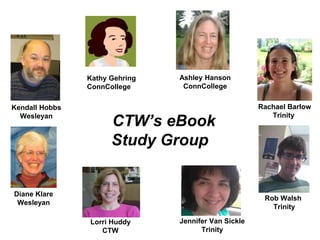
Kathy Gehring 
ConnCollege 
CTW’s eBook 
Study Group 
Diane Klare 
Wesleyan 
Rachael Barlow 
Trinity 
Jennifer Van Sickle 
Trinity 
Rob Walsh 
Trinity 
Lorri Huddy 
CTW 
Kendall Hobbs 
Wesleyan 
Ashley Hanson 
ConnCollege
Why a Study about 
eBooks & Students? 
Space Needs 
Discovery Layers 
eBook Readers 
Collection Decisions 
Image Source: http://www.mcccvoice.org/ebooks/
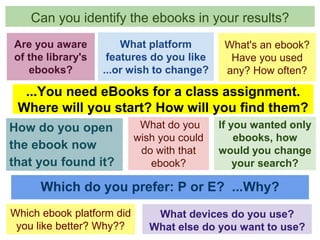
Can you identify the ebooks in your results? 
What's an ebook? 
Have you used 
any? How often? 
...You need eBooks for a class assignment. 
Where will you start? How will you find them? 
If you wanted only 
ebooks, how 
would you change 
your search? 
Are you aware 
of the library's 
ebooks? 
What platform 
features do you like 
...or wish to change? 
What devices do you use? 
What else do you want to use? 
How do you open 
the ebook now 
that you found it? 
Which do you prefer: P or E? ...Why? 
Which ebook platform did 
you like better? Why?? 
What do you 
wish you could 
do with that 
ebook?
What?! …how to find ebooks? 
The Discovery Process 
Image Source: AFP/Getty http://www.globalpost.com/photo/5675140/munch-the-scream/
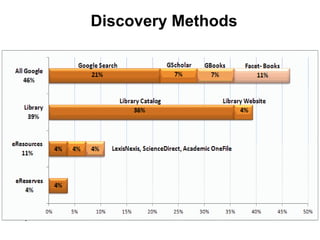
Discovery Methods
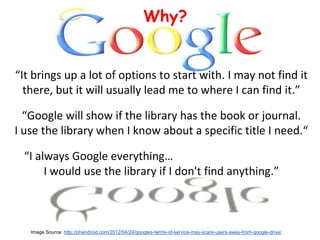
Why? 
“It brings up a lot of options to start with. I may not find it 
there, but it will usually lead me to where I can find it.” 
“Google will show if the library has the book or journal. 
I use the library when I know about a specific title I need.“ 
“I always Google everything… 
I would use the library if I don't find anything.” 
Image Source: http://phandroid.com/2012/04/24/googles-terms-of-service-may-scare-users-away-from-google-drive/
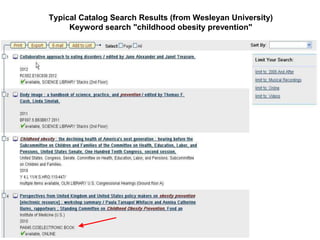
Typical Catalog Search Results (from Wesleyan University) 
Keyword search "childhood obesity prevention"
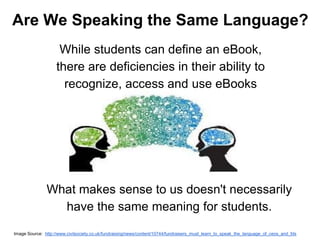
Are We Speaking the Same Language? 
While students can define an eBook, 
there are deficiencies in their ability to 
recognize, access and use eBooks 
What makes sense to us doesn't necessarily 
have the same meaning for students. 
Image Source: http://www.civilsociety.co.uk/fundraising/news/content/10744/fundraisers_must_learn_to_speak_the_language_of_ceos_and_fds
“I can't get over the stupidity 
of this layout...but 
I really like the Bookshelf." 
Students' Use of Specific 
eBook Platforms 
Image Source: http://hypenotice.com/design/invisible-bookshelves/15/
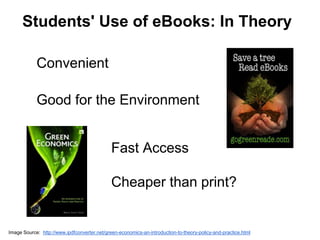
Students' Use of eBooks: In Theory 
Convenient 
Good for the Environment 
Fast Access 
Cheaper than print? 
Image Source: http://www.ipdfconverter.net/green-economics-an-introduction-to-theory-policy-and-practice.html
Student use of ebooks: In Practice 
• “Frustrating” 
• Not comfortable reading a lot of text on a screen 
• Difficulty interpreting platform icons and language 
• Liked the "search within the book“ feature 
• Really, REALLY want to be able to download the 
entire ebook 
Image Source: http://mygrannygeek.com/ebook-info/i-need-your-help-please/
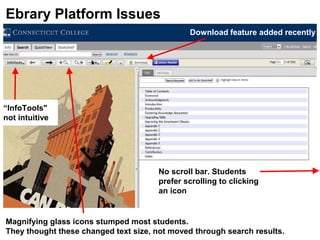
Ebrary Platform Issues 
Download feature added recently 
No scroll bar. Students 
prefer scrolling to clicking 
an icon 
“InfoTools" 
not intuitive 
Magnifying glass icons stumped most students. 
They thought these changed text size, not moved through search results.
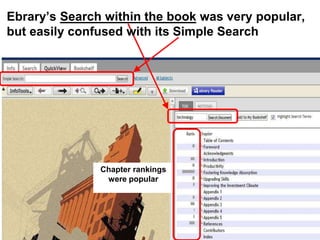
Ebrary’s Search within the book was very popular, 
but easily confused with its Simple Search 
Chapter rankings 
were popular
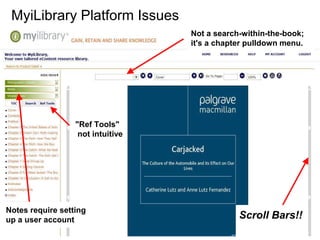
"Ref Tools" 
not intuitive 
Notes require setting 
up a user account 
Not a search-within-the-book; 
it's a chapter pulldown menu. 
Scroll Bars!! 
MyiLibrary Platform Issues
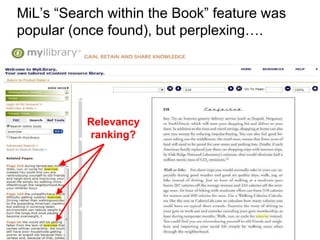
MiL’s “Search within the Book” feature was 
popular (once found), but perplexing…. 
Relevancy 
ranking?
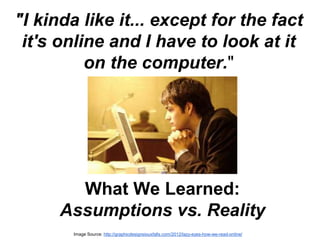
"I kinda like it... except for the fact 
it's online and I have to look at it 
on the computer." 
What We Learned: 
Assumptions vs. Reality 
Image Source: http://graphicdesignsiouxfalls.com/2012/lazy-eyes-how-we-read-online/
Some Observations 
on Student Use of eBooks 
• Academic vs. Leisure eBooks 
• Skim eBook, then find print version 
• Print or download and read later 
Image Source: http://allthingslearning.wordpress.com/category/classroom-teaching/
What do you 
think (or hope) 
eBooks will be like 
in 5 years? 
Photo by Todd Martin http://www.flickr.com/photos/tmartin/32010732/
Students’ “Wish Lists” 
Image Source: 
http://blacklifecoaches.net/2012/01/11/power-pollination/dandelion/
The Future: (Prematurely) 
Mourning the Death of Print 
I think print will become obsolete and am upset 
about it - really sad about the idea of losing print 
(love getting newspaper print on my fingers and 
the smell of a library book). Everything is going 
to be online, and I'm really sad about it. 
We are heading towards more electronic books, 
which is why I ditched my plans to go into the 
publishing business. 
Image Source: http://www.blackbookmag.com/nightlife/amazon-reveals-the-new-kindle-textbook-rental-program-1.24201
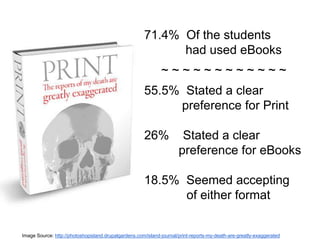
71.4% Of the students 
had used eBooks 
~ ~ ~ ~ ~ ~ ~ ~ ~ ~ ~ ~ 
55.5% Stated a clear 
preference for Print 
26% Stated a clear 
preference for eBooks 
18.5% Seemed accepting 
of either format 
Image Source: http://photoshopisland.drupalgardens.com/island-journal/print-reports-my-death-are-greatly-exaggerated

July 2012: Giving Them A Voice: CTW's Study of Undergraduates and eBooks

  • 1.
    Giving Them aVoice: CTW’s Study of Undergraduates and eBooks Image Source: http://allthingslearning.files.wordpress.com/2012/05/the-educators-voice.png
  • 2.
    Kathy Gehring ConnCollege CTW’s eBook Study Group Diane Klare Wesleyan Rachael Barlow Trinity Jennifer Van Sickle Trinity Rob Walsh Trinity Lorri Huddy CTW Kendall Hobbs Wesleyan Ashley Hanson ConnCollege
  • 3.
    Why a Studyabout eBooks & Students? Space Needs Discovery Layers eBook Readers Collection Decisions Image Source: http://www.mcccvoice.org/ebooks/
  • 4.
    Can you identifythe ebooks in your results? What's an ebook? Have you used any? How often? ...You need eBooks for a class assignment. Where will you start? How will you find them? If you wanted only ebooks, how would you change your search? Are you aware of the library's ebooks? What platform features do you like ...or wish to change? What devices do you use? What else do you want to use? How do you open the ebook now that you found it? Which do you prefer: P or E? ...Why? Which ebook platform did you like better? Why?? What do you wish you could do with that ebook?
  • 5.
    What?! …how tofind ebooks? The Discovery Process Image Source: AFP/Getty http://www.globalpost.com/photo/5675140/munch-the-scream/
  • 6.
  • 7.
    Why? “It bringsup a lot of options to start with. I may not find it there, but it will usually lead me to where I can find it.” “Google will show if the library has the book or journal. I use the library when I know about a specific title I need.“ “I always Google everything… I would use the library if I don't find anything.” Image Source: http://phandroid.com/2012/04/24/googles-terms-of-service-may-scare-users-away-from-google-drive/
  • 8.
    Typical Catalog SearchResults (from Wesleyan University) Keyword search "childhood obesity prevention"
  • 9.
    Are We Speakingthe Same Language? While students can define an eBook, there are deficiencies in their ability to recognize, access and use eBooks What makes sense to us doesn't necessarily have the same meaning for students. Image Source: http://www.civilsociety.co.uk/fundraising/news/content/10744/fundraisers_must_learn_to_speak_the_language_of_ceos_and_fds
  • 10.
    “I can't getover the stupidity of this layout...but I really like the Bookshelf." Students' Use of Specific eBook Platforms Image Source: http://hypenotice.com/design/invisible-bookshelves/15/
  • 11.
    Students' Use ofeBooks: In Theory Convenient Good for the Environment Fast Access Cheaper than print? Image Source: http://www.ipdfconverter.net/green-economics-an-introduction-to-theory-policy-and-practice.html
  • 12.
    Student use ofebooks: In Practice • “Frustrating” • Not comfortable reading a lot of text on a screen • Difficulty interpreting platform icons and language • Liked the "search within the book“ feature • Really, REALLY want to be able to download the entire ebook Image Source: http://mygrannygeek.com/ebook-info/i-need-your-help-please/
  • 13.
    Ebrary Platform Issues Download feature added recently No scroll bar. Students prefer scrolling to clicking an icon “InfoTools" not intuitive Magnifying glass icons stumped most students. They thought these changed text size, not moved through search results.
  • 14.
    Ebrary’s Search withinthe book was very popular, but easily confused with its Simple Search Chapter rankings were popular
  • 15.
    "Ref Tools" notintuitive Notes require setting up a user account Not a search-within-the-book; it's a chapter pulldown menu. Scroll Bars!! MyiLibrary Platform Issues
  • 16.
    MiL’s “Search withinthe Book” feature was popular (once found), but perplexing…. Relevancy ranking?
  • 17.
    "I kinda likeit... except for the fact it's online and I have to look at it on the computer." What We Learned: Assumptions vs. Reality Image Source: http://graphicdesignsiouxfalls.com/2012/lazy-eyes-how-we-read-online/
  • 18.
    Some Observations onStudent Use of eBooks • Academic vs. Leisure eBooks • Skim eBook, then find print version • Print or download and read later Image Source: http://allthingslearning.wordpress.com/category/classroom-teaching/
  • 19.
    What do you think (or hope) eBooks will be like in 5 years? Photo by Todd Martin http://www.flickr.com/photos/tmartin/32010732/
  • 20.
    Students’ “Wish Lists” Image Source: http://blacklifecoaches.net/2012/01/11/power-pollination/dandelion/
  • 21.
    The Future: (Prematurely) Mourning the Death of Print I think print will become obsolete and am upset about it - really sad about the idea of losing print (love getting newspaper print on my fingers and the smell of a library book). Everything is going to be online, and I'm really sad about it. We are heading towards more electronic books, which is why I ditched my plans to go into the publishing business. Image Source: http://www.blackbookmag.com/nightlife/amazon-reveals-the-new-kindle-textbook-rental-program-1.24201
  • 22.
    71.4% Of thestudents had used eBooks ~ ~ ~ ~ ~ ~ ~ ~ ~ ~ ~ ~ 55.5% Stated a clear preference for Print 26% Stated a clear preference for eBooks 18.5% Seemed accepting of either format Image Source: http://photoshopisland.drupalgardens.com/island-journal/print-reports-my-death-are-greatly-exaggerated

Editor's Notes

  • #3 In early 2011, this group decided - for a variety of reasons – to find out more about CTW students’ use of, and thoughts about ebooks. We were lucky to have Trinity’s "Data Queen"– Rachael Barlow - in our group. She was instrumental in helping us: define & narrow our research focus, choose the best techniques to use, and develop the questions we would ask...
  • #4 Library discussions and interactions with students were among the many good reasons for an ebook study. But mostly, we had a lot of questions
  • #5 And we had a lot of them! Since we chose an ethnographic study, our role was to guide the interview rather than lead it.
  • #6 First,we asked students about their overall familiarity with e-books: And found out Approx 90% were aware of ebooks and could accurately define them Approximately 2/3 had used an e-book. Most thought of ebooks in terms of a device (Kindle, Nook, iPad) And as something to be downloaded and read on such a device. Several were familiar with e-readers due to friends or relatives who owned them. Next, came the task of finding ebooks (and this reaction from one student!) We created a class assignment scenario, -- the student needed to find resources on the prevention of childhood obesity. At least two sources had to be books but... the library was closed so the student HAD to find ebooks. We asked: Where would they start? What would they do to find ebooks?
  • #7 46% started in Google sites – 18% used Google Books (or the faceted results within Google) but some weren’t aware that they had defaulted to ebooks by doing this one student said he would look through these results for the books Google Scholar users said they thought scholarly e-books were one of its components or it was the "right place to look“ Over 1/3 started in the library catalog and 15% opened a library e-resources database or the library website The most surprising research tactic ? going to eReserves, looking for a class on childhood obesity -- the reason was that: if the class existed so would a list of resources.
  • #8 What makes Google so good? There were some good reasons, while for others it may simply be a habit. But they also said they’d ask for help… if they couldn’t figure it out themselves. One said "I'm not technically savvy so this is very confusing. ...I'd go to the reference desk.“ Aside from asking librarians for help – students said they would ask a friend or their professors.
  • #9 Back to the 36% who went to the library catalog. One said: “Using the library catalog is easier than Google because you get 1,000s of results (in Google.)” Others started with the catalog so they didn't have to pay for ebooks. The typical search process: Simply typing in a few keyword terms The result: Getting a mix of print and electronic formats. Several knew to look for “Online” or “Electronic Book” labels But electronic govdocs created a bit of confusion, until explained to them. Another source of confusion was format types – some tried to use these as a limiter and looked for “electronic book” . When they couldn’t find it, they opted for formats with “file” in the name (which didn’t give them what they wanted.) More troubling...not everyone was able to immediately figure out how to open the ebook after identifying it in the results and opening the catalog record. URLs -- not hot-linked phrases – seemed to help, but not always A few thought they needed to "place a request" to get the ebook (and its link) sent to them.
  • #10 The takeaway from watching them struggle? We should take an objective look at our library tools from the end-user / first-time user perspective. They’re intuitive to us because we use them daily. But it’s not always as intuitive to them as we’d like to think.
  • #11 Next, we provided an ebrary and a MyiLibrary ebook for them to try out and see what they liked and disliked.
  • #12 Many commented it would great to not have to carry books around. They thought ebooks were more “green” and less expensive than print. They also liked the idea of immediate and 24/7 access (especially for textbooks.)
  • #13 Platforms are not intuitive to first time users. There was also some confusion between browser and platform functions There didn’t seem to be a lot of enthusiasm for features like highlighting and annotating They liked the ability to search, skim the TOC and abstract to determine if the book was relevant to their needs Printing and downloading limits are annoying …but some understood the reasons why and mentioned copyright issues Here a few slides that point out platform issues
  • #14 “InfoTools” had little meaning to students. Magnifying icons are typically used –elsewhere -- to increase text size, so this created lots of confusion And students like to scroll – not click - through pages.
  • #15 The larger and better located “Simple Search” box searches across the ebrary collection. But students tried using it to search within the opened ebook, and got confused when it searched across the entire ebrary collection. Once they figured out to search in the open ebook, they liked the “ranking bars” whose size indicated how often their search terms appeared in each chapter.
  • #16 MyiLibrary Platform Issues: THE #1 issue in MyiLibrary was its Blank “It-looks-like-a-search” Box (above the cover.) Practically every student tried to use it as such. The actual search-in-the-ebook feature is tucked away under the SEARCH tab (which seems intuitive, but wasn’t.) Annotating requires a user account – something students said they might do IF the book was really needed. And there were labeling issues – “Ref Tools” and “Bibliographic Details” are not student-friendly terms.
  • #17 Students really liked how MyiLibrary provided snippets for results. They said it was helpful seeing their search terms within context – But they could not figure out why the results were listed in the order they appeared (and neither could the librarians!)
  • #18  Now to recap some of our takeaways from the study…
  • #19 The students seemed more apt to use ebooks for recreational, rather than academic purposes. Those who hadn’t used ebooks before were impressed by the search-in-the-book feature and said it was a good reason to start using ebooks. Many who already used this feature – said that after determining they needed the book, were likely to look for or request a print copy. There was a willingness to consider creating ebook user accounts for platform features and to save books to their electronic “bookshelf” – if they thought they’d use the ebook a lot. - some weren’t bothered by another UN/PW but others suggested it would be more convenient if it used campus credentials
  • #20 Lastly, we asked them to look to the future…
  • #21 In the near future, they want: To touch to flip through e-pages, bookmark them and highlight with a finger. To access complementary resources such as web links, reference and news sources No hidden menus! An obvious ebook toolbar with all available features The ability to share ebook notes with other students and professors eBooks that read to them voice recognition technology that searches for them and speech-to-text technology for annotations. They want the ability to download ebooks and put them on mobile devices so they can access them wherever, whenever they want
  • #22 Practically every student predicted an increasing abundance of ebooks, And a few seemed especially mournful by their prediction regarding the death of print. However…it ain’t dead yet!
  • #23 The transition toward ebooks is underway… In a few years? The acceptance of either format is likely to be higher Students who clearly stated they preferred print ….really liked the ability to preview content online. And many who accepted either format…said that for in-depth, research purposes they prefer to use print when possible. But, the end-user experience is likely to impact the future of both print and ebooks. Some students observed that ebook platforms seem more intent on preventing piracy than allowing legal use of the ebooks. They also implied they’d find and use whatever was easiest – IF changes aren’t made so ebook platforms meet (or exceed) expectations -- then print is likely to remain the format of choice for some users.