LEARNING AREA 1 :
INFORMATION AND
COMMUNICATION
TECHNOLOGY
INTRODUCTION TO ICT

COMPUTER
ETHICS AND
LEGAL ISSUES
LEARNING OUTCOME :
• State the definition of computer ethics, code
of ethics, intellectual property, privacy,
computer crime and cyber law.

• Differentiate between ethics and law.
COMPUTER ETHICS
System of moral standards or moral values used as a
guideline for computer users.

CODE OF ETHICS
Guidelines in ICT that help determine whether a
specific computer action is ethical or unethical.

INTELLECTUAL PROPERTY
Works created by inventors, authors and artists.

PRIVACY
Right of individuals and companies to deny or restrict
the collection and use of information about them.
COMPUTER ETHICS
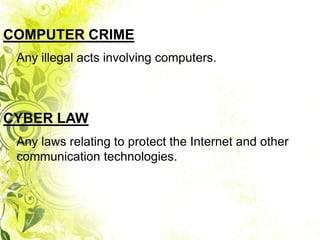
COMPUTER CRIME
System of moral standards or moral values used as a
guideline for computer users.
Any illegal acts involving computers.

CODE OF ETHICS
Guidelines in ICT that help determine whether a
specific computer action is ethical or unethical.
CYBER LAW

INTELLECTUAL to protect the Internet and other
Any laws relating PROPERTY
communicationby inventors, authors and artists.
Works created technologies.

PRIVACY
Right of individuals and companies to deny or restrict
the collection and use of information about them.
DIFFERENTIATE BETWEEN ETHICS AND LAW

LAW

ETHICS
As a guideline
Free to follow
Universal
Ethical computers
users
Immoral

As a rule
Must follow
Depend on country
Prevent misuse
Crime
CONCLUSION
• Thera are 6 definition you should know which
are : computer ethics (moral standards) , code
of ethics (guideline) , intellectual property
(works created) , privacy (rights or restrict the
collection), computer crime (illegal) and cyber
law (to protect).
• 5 differences between ethics and law.
EXERCISES
1.
2.
3.
4.
5.

State the definition of privacy.
State the definition of computer crime.
State the definition of intellectual property.
State the definition of computer ethics.
Give three differences between ethics and
law.

2011 4-define-ethics-and-law

  • 2.
    LEARNING AREA 1: INFORMATION AND COMMUNICATION TECHNOLOGY INTRODUCTION TO ICT COMPUTER ETHICS AND LEGAL ISSUES
  • 3.
    LEARNING OUTCOME : •State the definition of computer ethics, code of ethics, intellectual property, privacy, computer crime and cyber law. • Differentiate between ethics and law.
  • 4.
    COMPUTER ETHICS System ofmoral standards or moral values used as a guideline for computer users. CODE OF ETHICS Guidelines in ICT that help determine whether a specific computer action is ethical or unethical. INTELLECTUAL PROPERTY Works created by inventors, authors and artists. PRIVACY Right of individuals and companies to deny or restrict the collection and use of information about them.
  • 5.
    COMPUTER ETHICS COMPUTER CRIME Systemof moral standards or moral values used as a guideline for computer users. Any illegal acts involving computers. CODE OF ETHICS Guidelines in ICT that help determine whether a specific computer action is ethical or unethical. CYBER LAW INTELLECTUAL to protect the Internet and other Any laws relating PROPERTY communicationby inventors, authors and artists. Works created technologies. PRIVACY Right of individuals and companies to deny or restrict the collection and use of information about them.
  • 6.
    DIFFERENTIATE BETWEEN ETHICSAND LAW LAW ETHICS As a guideline Free to follow Universal Ethical computers users Immoral As a rule Must follow Depend on country Prevent misuse Crime
  • 7.
    CONCLUSION • Thera are6 definition you should know which are : computer ethics (moral standards) , code of ethics (guideline) , intellectual property (works created) , privacy (rights or restrict the collection), computer crime (illegal) and cyber law (to protect). • 5 differences between ethics and law.
  • 9.
    EXERCISES 1. 2. 3. 4. 5. State the definitionof privacy. State the definition of computer crime. State the definition of intellectual property. State the definition of computer ethics. Give three differences between ethics and law.