Intellectual property issues are of
tremendous importance when
developing digital content for use in
education. Ownership of content
developed is a key issue to consider.
Globalization and ICT
Sembok, 2003
Expression
freedom,
Information access,
privacy rights, IP
rights, cultural
diversities
Ethical,
legal,
societal
issues
Globalization
&
Digital
convergence
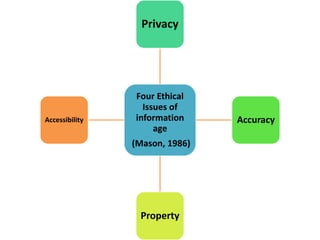
Four Ethical
Issues of
information
age
(Mason, 1986)
Privacy
Accuracy
Property
Accessibility
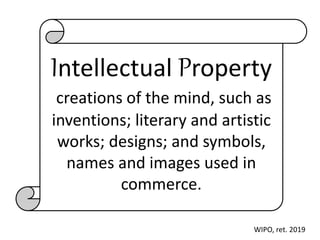
Intellectual Property
creations of the mind, such as
inventions; literary and artistic
works; designs; and symbols,
names and images used in
commerce.
WIPO, ret. 2019
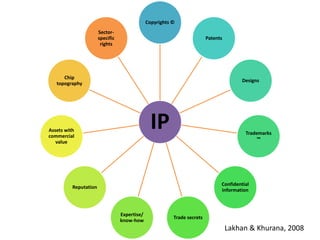
IP
Copyrights ©
Patents
Designs
Trademarks
™
Confidential
information
Trade secrets
Expertise/
know-how
Reputation
Assets with
commercial
value
Chip
topography
Sector-
specific
rights
Lakhan & Khurana, 2008
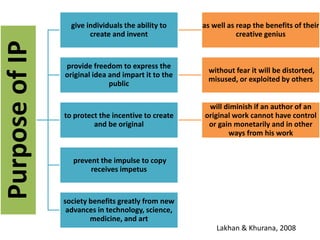
PurposeofIP give individuals the ability to
create and invent
as well as reap the benefits of their
creative genius
provide freedom to express the
original idea and impart it to the
public
without fear it will be distorted,
misused, or exploited by others
to protect the incentive to create
and be original
will diminish if an author of an
original work cannot have control
or gain monetarily and in other
ways from his work
prevent the impulse to copy
receives impetus
society benefits greatly from new
advances in technology, science,
medicine, and art
Lakhan & Khurana, 2008
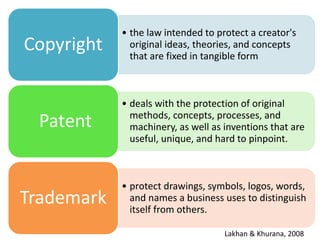
• the law intended to protect a creator's
original ideas, theories, and concepts
that are fixed in tangible form
Copyright
• deals with the protection of original
methods, concepts, processes, and
machinery, as well as inventions that are
useful, unique, and hard to pinpoint.
Patent
• protect drawings, symbols, logos, words,
and names a business uses to distinguish
itself from others.
Trademark
Lakhan & Khurana, 2008
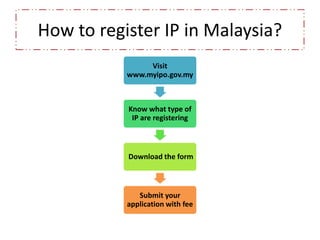
How to register IP in Malaysia?
Visit
www.myipo.gov.my
Know what type of
IP are registering
Download the form
Submit your
application with fee
Reference
References
Alakurt, Turgay & Bardakcı, Salih & Keser, Hafize. (2012). ICT Student Teachers’ Judgments and
Justifications about Ethical Issues. Turkish Online Journal of Qualitative Inquiry. 3.
10.17569/tojqi.80752.
Lakhan, S. E., & Khurana, M. K. (2008). Intellectual property, copyright, and fair use in
education. Journal of Academic Leadership, 6(4).
Mason, R. O. (1986). Four Ethical Issues of the Information Age. MIS Quarterly, 10(1), 5.
doi:10.2307/248873
The Official Portal of Intellectual Property Corporation of Malaysia – (MyIPO). (2019, May 15).
Retrieved from http://www.myipo.gov.my
T. Sembok, T. M. (2003, November). Ethics of Information Communication Technology (ICT). Paper
presented at Regional Meeting on Ethics of Science and Technology, Bangkok.

Ethics in ict

  • 1.
    Intellectual property issuesare of tremendous importance when developing digital content for use in education. Ownership of content developed is a key issue to consider.
  • 2.
    Globalization and ICT Sembok,2003 Expression freedom, Information access, privacy rights, IP rights, cultural diversities Ethical, legal, societal issues Globalization & Digital convergence
  • 3.
    Four Ethical Issues of information age (Mason,1986) Privacy Accuracy Property Accessibility
  • 4.
    Intellectual Property creations ofthe mind, such as inventions; literary and artistic works; designs; and symbols, names and images used in commerce. WIPO, ret. 2019
  • 5.
    IP Copyrights © Patents Designs Trademarks ™ Confidential information Trade secrets Expertise/ know-how Reputation Assetswith commercial value Chip topography Sector- specific rights Lakhan & Khurana, 2008
  • 6.
    PurposeofIP give individualsthe ability to create and invent as well as reap the benefits of their creative genius provide freedom to express the original idea and impart it to the public without fear it will be distorted, misused, or exploited by others to protect the incentive to create and be original will diminish if an author of an original work cannot have control or gain monetarily and in other ways from his work prevent the impulse to copy receives impetus society benefits greatly from new advances in technology, science, medicine, and art Lakhan & Khurana, 2008
  • 7.
    • the lawintended to protect a creator's original ideas, theories, and concepts that are fixed in tangible form Copyright • deals with the protection of original methods, concepts, processes, and machinery, as well as inventions that are useful, unique, and hard to pinpoint. Patent • protect drawings, symbols, logos, words, and names a business uses to distinguish itself from others. Trademark Lakhan & Khurana, 2008
  • 8.
    How to registerIP in Malaysia? Visit www.myipo.gov.my Know what type of IP are registering Download the form Submit your application with fee
  • 10.
    Reference References Alakurt, Turgay &Bardakcı, Salih & Keser, Hafize. (2012). ICT Student Teachers’ Judgments and Justifications about Ethical Issues. Turkish Online Journal of Qualitative Inquiry. 3. 10.17569/tojqi.80752. Lakhan, S. E., & Khurana, M. K. (2008). Intellectual property, copyright, and fair use in education. Journal of Academic Leadership, 6(4). Mason, R. O. (1986). Four Ethical Issues of the Information Age. MIS Quarterly, 10(1), 5. doi:10.2307/248873 The Official Portal of Intellectual Property Corporation of Malaysia – (MyIPO). (2019, May 15). Retrieved from http://www.myipo.gov.my T. Sembok, T. M. (2003, November). Ethics of Information Communication Technology (ICT). Paper presented at Regional Meeting on Ethics of Science and Technology, Bangkok.