Internet of Things
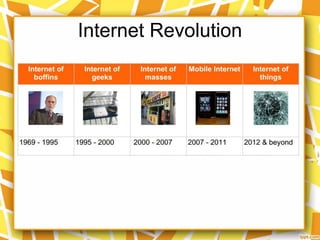
Internet Revolution
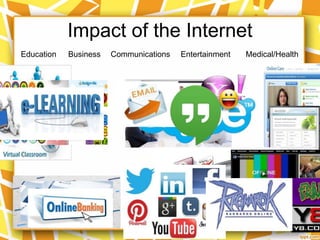
Impact of the Internet
Education Business Communications Entertainment Medical/Health
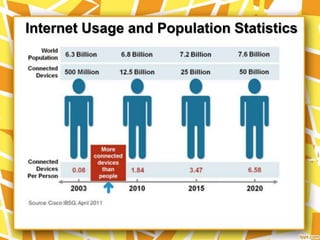
Internet Usage and Population Statistics
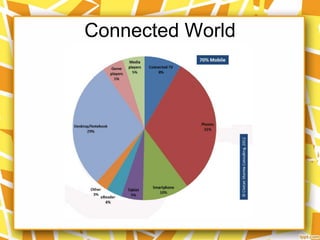
Connected World
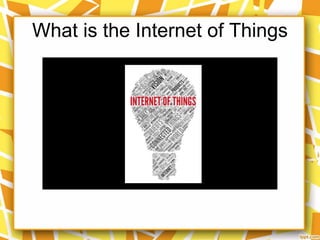
What is the Internet of Things
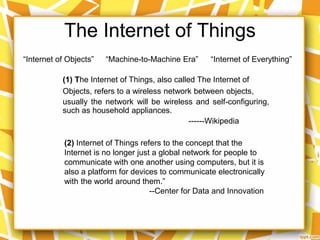
The Internet of Things
“Internet of Objects” “Machine-to-Machine Era”
(2) Internet of Things refers to the concept that the
Internet is no longer just a global network for people to
communicate with one another using computers, but it is
also a platform for devices to communicate electronically
with the world around them.”
--Center for Data and Innovation
(1) The Internet of Things, also called The Internet of
Objects, refers to a wireless network between objects,
usually the network will be wireless and self-configuring,
such as household appliances.
------Wikipedia
“Internet of Everything”
The Internet of Things
(4) “Things having identities and virtual personalities
operating in smart spaces using intelligent interfaces to
connect and communicate within social, environmental,
and user contexts”.
-------IoT in 2020
(3) The term "Internet of Things" has come to describe a
number of technologies and research disciplines that
enable the Internet to reach out into the real world of
physical objects.
------IoT 2008
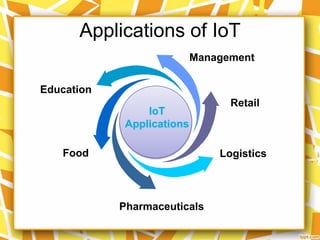
Applications of IoT
Education
Food
Management
IoT
Applications
Retail
Logistics
Pharmaceuticals
Challenges and Issues
• Issues
– Society: People, security, privacy
• A policy for people in the Internet of Things:
• Legislation
– Environmental aspects
• Resource efficiency
• Pollution and disaster avoidance
– Technological
• Architecture (edge devices, servers, discovery services,
security, etc.)
• Governance, naming, identity, interfaces
• Service openness, interoperability
• Connections of real and virtual world
• Standards
IoT will inherit the drawbacks of the current
internet on an infinitely larger, but more
invisible scale
– Privacy – will be a huge issue when
implementing IoT
– Efficiency – speed - person loses identity and
is an IP address
– Decisions – do not delegate too much of our
decision making and freedom of choice to
things and machines
Challenges and Issues
• Transition to IPv6 – Internet protocol v6
• Estalishing a common set of standards between
companies, educational systems, and nations.
– The same type of cabling,
– The same applications or programming
– The same protocol or set of rules that will apply to all
• Developing energy sources for millions -even
billions - of sensors.
– Wind
– Solar,
– Hydro-electric
Challenges and Issues
Thank you !

Iot amey p naik

  • 1.
  • 2.
  • 3.
    Impact of theInternet Education Business Communications Entertainment Medical/Health
  • 4.
    Internet Usage andPopulation Statistics
  • 5.
  • 6.
    What is theInternet of Things
  • 7.
    The Internet ofThings “Internet of Objects” “Machine-to-Machine Era” (2) Internet of Things refers to the concept that the Internet is no longer just a global network for people to communicate with one another using computers, but it is also a platform for devices to communicate electronically with the world around them.” --Center for Data and Innovation (1) The Internet of Things, also called The Internet of Objects, refers to a wireless network between objects, usually the network will be wireless and self-configuring, such as household appliances. ------Wikipedia “Internet of Everything”
  • 8.
    The Internet ofThings (4) “Things having identities and virtual personalities operating in smart spaces using intelligent interfaces to connect and communicate within social, environmental, and user contexts”. -------IoT in 2020 (3) The term "Internet of Things" has come to describe a number of technologies and research disciplines that enable the Internet to reach out into the real world of physical objects. ------IoT 2008
  • 9.
  • 10.
    Challenges and Issues •Issues – Society: People, security, privacy • A policy for people in the Internet of Things: • Legislation – Environmental aspects • Resource efficiency • Pollution and disaster avoidance – Technological • Architecture (edge devices, servers, discovery services, security, etc.) • Governance, naming, identity, interfaces • Service openness, interoperability • Connections of real and virtual world • Standards
  • 11.
    IoT will inheritthe drawbacks of the current internet on an infinitely larger, but more invisible scale – Privacy – will be a huge issue when implementing IoT – Efficiency – speed - person loses identity and is an IP address – Decisions – do not delegate too much of our decision making and freedom of choice to things and machines Challenges and Issues
  • 12.
    • Transition toIPv6 – Internet protocol v6 • Estalishing a common set of standards between companies, educational systems, and nations. – The same type of cabling, – The same applications or programming – The same protocol or set of rules that will apply to all • Developing energy sources for millions -even billions - of sensors. – Wind – Solar, – Hydro-electric Challenges and Issues
  • 13.

Editor's Notes

  • #4 Impact of the Internet
  • #10 Logistics – Tagging items on a UPS truck (now they use barcodes to be scanned) but not real-time. Using the newer technology all is in realtime.
  • #11 Legislation: mandatory that policy keeps up with technology so that citizens gain confidence in the new technology People’s momentarily context and roles can determine their attitudes towards new technology. An employee will resist his boss’ access to his or her mailbox while the same person may demand the same insight into the mailboxes of subordinates.