Open Source
     Sensing:
Can we have both
privacy and safety?
    Christine Peterson
    Foresight Institute
    www.foresight.org
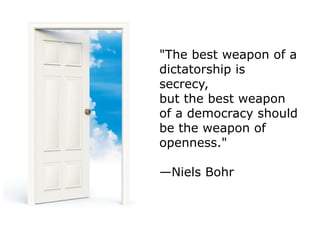
"The best weapon of a
dictatorship is
secrecy,
but the best weapon
of a democracy should
be the weapon of
openness."

—Niels Bohr
No Secret
Software for
Public Voting
   Data!        The E-voting mess —
                  The Open Science
                community could have
                 nipped it in the bud.
One
molecule
Nanotech can
do it now too

 the sensors
 are coming
Nanotech-
based sensors
“The detector generates a
continuous 'spectrum' of
information about any chemical
agents in its presence...”
“easily programmable”
Sewer monitoring has begun


“The test doesn’t screen people directly but
instead seeks out evidence of illicit drug
abuse in drug residues and metabolites
excreted in urine and flushed toward
municipal sewage treatment plants.”
“We found a drug molecule —
Everybody out for a breath check!”
Things worth detecting:
  weapons of mass destruction

• Explosives, chemicals, nukes — today
• Bioweapons – in early stages — nasty, but
  delicate and hard to control)
• Nanoweapons — later — like bioweapons,
  but tougher and more controllable)
Technological Advance

          Cost of WMD comes down


$


          GDP per capita goes up

             Time
Fear + poor WMD data =


 Sudan pharmaceutical plant, August 1998
Result: more surveillance
Electronic, video, biological, chemical
Being integrated into national system
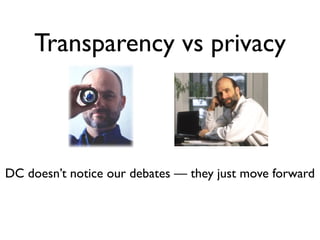
Transparency vs privacy


DC doesn’t notice our debates — they just move forward
Top-down approach to
  bottom-up problem
• Centralized
• Mandatory
• Monolithic
• Limited in participation
• Secretive
• Leads toward Surveillance State
Open Science-style
    physical security
• Decentralized
• Minimal                “Track the
• Voluntary/privatized    problem,
                           not the
• Experimental            people”
• Collaborative
• Open
• Transparent
Who can figure out
whether & how to collect
    public sensing data?
• Need a community that understands the
  relationships between:
• Security
• Privacy
• Functionality
• Freedom
Graphic: Gina Miller
Open Sensing-based Security:
  What would it be like?
 • Open source style development
 • Citizen controlled
 • Privacy oriented
 • Verifiably limited
 • Detects materials of concern
 • Does not track individuals or
   nonweapons (e.g. drugs)
What might we regard
  as worth detecting?
• Real problems
• Anthrax (NYC, DC, FL 2001)
• Sarin (Tokyo, 1995)
• Ricin (London 2002, Las Vegas 2008)
• Later: syn bio accidents or abuse
Who gets the data?
• Communities negotiate
• Mutual data exchange, e.g. anthrax within 100 km
• Agreements on how to treat the data
• “Communities” size can vary from household to
  nation, depending on what is detected (e.g., TNT
  vs nukes)
Proposed law in
                                 New York City
                                that will require
                                 people to get a
                                 license before
                                  they can buy
                                    chemical,
                                  biological, or
                                   radiological
                                attack detectors


Do we not have a “freedom to sense”?
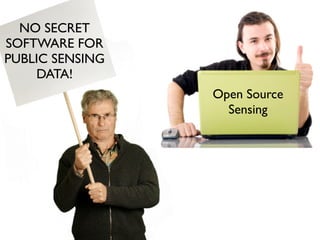
NO SECRET
SOFTWARE FOR
PUBLIC SENSING
    DATA!
                 Open Source
                   Sensing
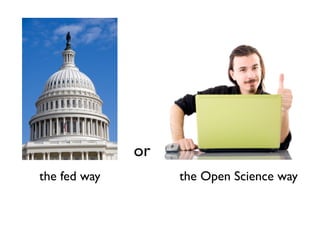
or
the fed way        the Open Science way
Open sensing
• OpenSourceSensing.org
• Email me:
 peterson@foresight.org


           No Secret
          Software for
         Public Sensing
             Data!

2010 opensciencepeterson

  • 1.
    Open Source Sensing: Can we have both privacy and safety? Christine Peterson Foresight Institute www.foresight.org
  • 2.
    "The best weaponof a dictatorship is secrecy, but the best weapon of a democracy should be the weapon of openness." —Niels Bohr
  • 3.
    No Secret Software for PublicVoting Data! The E-voting mess — The Open Science community could have nipped it in the bud.
  • 4.
    One molecule Nanotech can do itnow too the sensors are coming
  • 5.
    Nanotech- based sensors “The detectorgenerates a continuous 'spectrum' of information about any chemical agents in its presence...” “easily programmable”
  • 6.
    Sewer monitoring hasbegun “The test doesn’t screen people directly but instead seeks out evidence of illicit drug abuse in drug residues and metabolites excreted in urine and flushed toward municipal sewage treatment plants.”
  • 7.
    “We found adrug molecule — Everybody out for a breath check!”
  • 8.
    Things worth detecting: weapons of mass destruction • Explosives, chemicals, nukes — today • Bioweapons – in early stages — nasty, but delicate and hard to control) • Nanoweapons — later — like bioweapons, but tougher and more controllable)
  • 9.
    Technological Advance Cost of WMD comes down $ GDP per capita goes up Time
  • 10.
    Fear + poorWMD data = Sudan pharmaceutical plant, August 1998
  • 11.
    Result: more surveillance Electronic,video, biological, chemical Being integrated into national system
  • 12.
    Transparency vs privacy DCdoesn’t notice our debates — they just move forward
  • 13.
    Top-down approach to bottom-up problem • Centralized • Mandatory • Monolithic • Limited in participation • Secretive • Leads toward Surveillance State
  • 14.
    Open Science-style physical security • Decentralized • Minimal “Track the • Voluntary/privatized problem, not the • Experimental people” • Collaborative • Open • Transparent
  • 15.
    Who can figureout whether & how to collect public sensing data? • Need a community that understands the relationships between: • Security • Privacy • Functionality • Freedom
  • 16.
  • 17.
    Open Sensing-based Security: What would it be like? • Open source style development • Citizen controlled • Privacy oriented • Verifiably limited • Detects materials of concern • Does not track individuals or nonweapons (e.g. drugs)
  • 18.
    What might weregard as worth detecting? • Real problems • Anthrax (NYC, DC, FL 2001) • Sarin (Tokyo, 1995) • Ricin (London 2002, Las Vegas 2008) • Later: syn bio accidents or abuse
  • 19.
    Who gets thedata? • Communities negotiate • Mutual data exchange, e.g. anthrax within 100 km • Agreements on how to treat the data • “Communities” size can vary from household to nation, depending on what is detected (e.g., TNT vs nukes)
  • 20.
    Proposed law in New York City that will require people to get a license before they can buy chemical, biological, or radiological attack detectors Do we not have a “freedom to sense”?
  • 21.
    NO SECRET SOFTWARE FOR PUBLICSENSING DATA! Open Source Sensing
  • 22.
    or the fed way the Open Science way
  • 23.
    Open sensing • OpenSourceSensing.org •Email me: peterson@foresight.org No Secret Software for Public Sensing Data!