ASSISTING CLIENTS THROUGH THE SSI/SSDI APPLICATION PROCESS   HOME Conference  September 16, 2010   Presented By: Marian V. Bland, LCSW-C Margaret Flanagan, MSW Caroline Bolas, MSW, MS
Excerpted from…. Perret, Y & Dennis, D. STEPPING STONES TO RECOVERY:  A  TRAINING CURRICULUM FOR CASE  MANAGER ASSISTING ADULTS WHO  ARE HOMELESS WITH SOCIAL SECURITY DISABILITY AND SUPLEMENTAL SECURITY INCOME APPLICATIONS .  DHHS Pub. No. SMA 06-Rockville, MD: CMHS, SAMHSA, 2006
WELCOME and INTRODUCTIONS Please tell us : Your Name Work Location and Role One sentence about your experience with completing SSI/SSDI applications
Importance of SSI and SSDI for People with Disabilities SSI and SSDI can be critical steps towards ending homelessness and promoting recovery for people with disabilities… Providing access to needed treatment, services and housing Supporting people in the long term to return to work through work incentive programs
The Problem The SSI application process is very difficult and especially so for people who are homeless, many of whom have mental illnesses and co-occurring substance use disorders Only about 10-15 percent of homeless adults who apply are typically approved on initial application Only about 37 percent of all applicants are typically approved on application Appeals take years and many potentially eligible people give up and do not appeal
Why Is Access To SSI So Difficult?  People often need assistance to apply because of the complexity of the process They need adequate assessment/documentation of how their medical conditions limit their ability to work  Those assisting SSI applicants need to understand the disability determination process and have time to assist in all aspects of completing applications Relationships with SSA, DDS, community medical providers and others are essential to changing the outcomes of SSI/SSDI applications
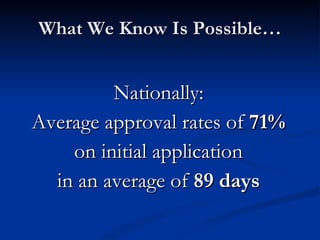
What We Know Is Possible… Nationally: Average approval rates of  71% on initial application in an average of  89 days
What Does It Take? Training  Commitment of staff by community agencies Implementation of SOAR Critical Components Collaboration with SSA, DDS and others Quality control Collect and report on outcomes
SOAR Technical Assistance Initiative SOAR stands for “SSI/SSDI Outreach, Access and Recovery” Designed to serve adults who are  homeless  and have a mental illness and/or co-occurring disorders who meet  adult criteria  under SSA Strategy to help States and communities increase access to mainstream benefits, especially for people who are homeless, through: training, technical assistance and strategic planning Includes use of SAMHSA’s  Stepping Stones to Recovery  training curriculum
Goal, Objectives, and Strategies Overarching goal:  To expedite and increase the number of successful SSI/SSDI applications for eligible applicants Objectives: Infrastructure building Case manager has key role Strategies: Collaboration and coordination Communication
How Is This Model Different? Case managers actively assist applicants and collate evidence Step-by-step explanation of SSI application and disability determination process Focuses on the initial application – “Get it right the first time!” Avoids appeals whenever possible Focuses on documenting the disability
Stepping Stones to Recovery Training Curriculum Based on success of University of Maryland Medical System Baltimore SSI Outreach Project Achieved success rate on application of 96% for those deemed likely eligible Comprehensive approach to individual’s needs with income as the “hook” Engagement, relationship, and assessment are integral parts of project and curriculum
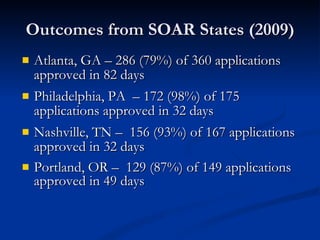
Outcomes from SOAR States (2009) Atlanta, GA – 286 (79%) of 360 applications approved in 82 days Philadelphia, PA  – 172 (98%) of 175 applications approved in 32 days Nashville, TN –  156 (93%) of 167 applications approved in 32 days Portland, OR –  129 (87%) of 149 applications approved in 49 days
More Outcomes… On average, the people receiving these benefits had been homeless 27 months. Approval rates were highest in places where more SOAR critical components were able to be implemented
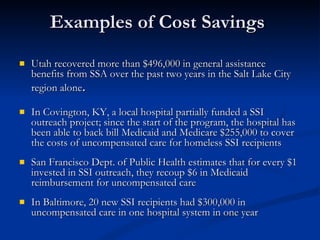
Utah recovered more than $496,000 in general assistance benefits from SSA over the past two years in the Salt Lake City region alone . In Covington, KY, a local hospital partially funded a SSI outreach project; since the start of the program, the hospital has been able to back bill Medicaid and Medicare $255,000 to cover the costs of uncompensated care for homeless SSI recipients San Francisco Dept. of Public Health estimates that for every $1 invested in SSI outreach, they recoup $6 in Medicaid reimbursement for uncompensated care In Baltimore, 20 new SSI recipients had $300,000 in uncompensated care in one hospital system in one year Examples of Cost Savings
History of SOAR in Maryland In 2006, the State Department of Human Resources (DHR) received a technical assistance grant from SAMHSA Baltimore City and Prince George’s County selected as pilot states and a state planning workgroup setup 2007-2008 case managers and human service providers trained in Baltimore City, Frederick, Mid-Shore Counties, and Prince George’s County
Status of SOAR in Maryland April 2008 SOAR Transferred to Mental Hygiene Administration Developed a State Wide SOAR Planning group Have active work groups in:  Anne Arundel Baltimore City Carroll County Howard County Lower Eastern Shores Montgomery County Prince George’s County
Status of SOAR in Maryland cont Have 7 active SOAR trainers 6 two-day training sessions in the last year, attended by more than 140 people PATH funding has been used to fund the following positions: SOAR Outreach Coordinators in Prince George’s  County and Baltimore City SOAR Outreach Workers in Anne Arundel and  Baltimore City Part time Evaluation and Data Consultant
Maryland SOAR Outcomes  Within Baltimore City,  25  out of  25  initial applications have been approved  (100%)  in an average of  61  days  They have also had a further  10  SOAR related cases approved, with  1  denial Within Maryland as a whole, there have been  41  SOAR related approvals, with an overall approval rate for new claims of  93%
Two Brothers Video
The Disability Programs
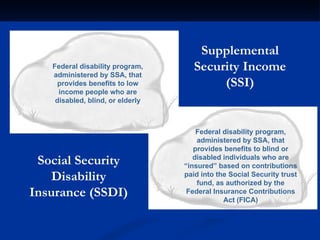
Social Security Disability Insurance (SSDI) Supplemental Security Income (SSI) I - 3 Federal disability program, administered by SSA, that provides benefits to blind or disabled individuals who are “insured” based on contributions paid into the Social Security trust fund, as authorized by the Federal Insurance Contributions Act (FICA) Federal disability program, administered by SSA, that provides benefits to low income people who are disabled, blind, or elderly
Disability  Impairments must affect a person’s ability to work. “ inability to engage in any substantial gainful activity (SGA)…”
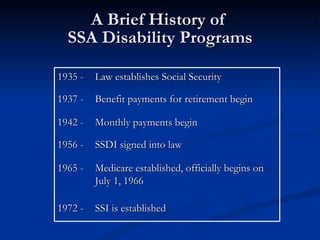
A Brief History of  SSA Disability Programs 1935 - Law establishes Social Security 1937 - Benefit payments for retirement begin  1942 - Monthly payments begin 1956 - SSDI signed into law 1965 - Medicare established, officially begins on July 1, 1966 1972 - SSI is established
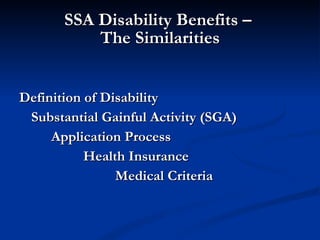
SSA Disability Benefits –  The Similarities Definition of Disability Substantial Gainful Activity (SGA) Application Process Health Insurance Medical Criteria
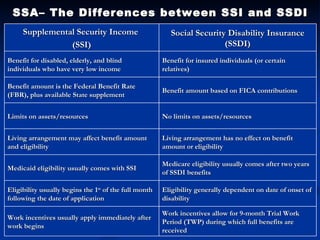
SSA– The Differences between SSI and SSDI Supplemental Security Income  (SSI) Social Security Disability Insurance (SSDI) Benefit for disabled, elderly, and blind individuals who have very low income Benefit for insured individuals (or certain relatives) Benefit amount is the Federal Benefit Rate (FBR), plus available State supplement Benefit amount based on FICA contributions Limits on assets/resources No limits on assets/resources Living arrangement may affect benefit amount and eligibility Living arrangement has no effect on benefit amount or eligibility Medicaid eligibility usually comes with SSI Medicare eligibility usually comes after two years of SSDI benefits Eligibility usually begins the 1 st  of the full month following the date of application Eligibility generally dependent on date of onset of disability Work incentives usually apply immediately after work begins Work incentives allow for 9-month Trial Work Period (TWP) during which full benefits are received
The Application Process Non-Medical and Medical Information and Eligibility Criteria
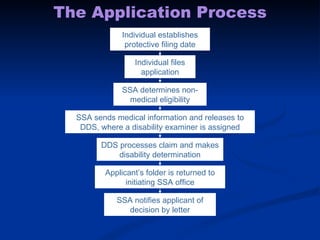
The Application Process Individual files application SSA determines non-medical eligibility SSA sends medical information and releases to DDS, where a disability examiner is assigned DDS processes claim and makes disability determination Applicant’s folder is returned to initiating SSA office SSA notifies applicant of decision by letter Individual establishes protective filing date III - 2
Social Security Administration   SSA Disability Determination Services DDS
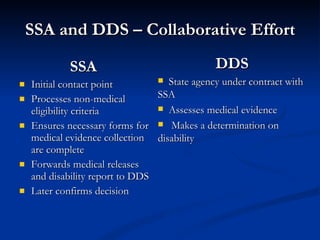
SSA and DDS – Collaborative Effort SSA  Initial contact point Processes non-medical eligibility criteria Ensures necessary forms for medical evidence collection are complete Forwards medical releases and disability report to DDS Later confirms decision DDS State agency under contract with SSA Assesses medical evidence  Makes a determination on disability
Protective Filing Date Establishing a date of first contact with SSA – Crucial!  Once established, this date is used to determine SSI eligibility This in turn, determines when an individual can potentially start receiving benefits
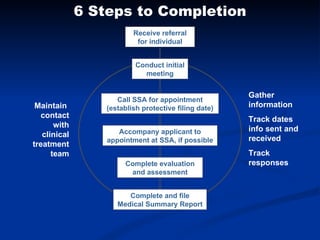
6 Steps to Completion Receive referral for individual Conduct initial meeting Call SSA for appointment (establish protective filing date) Accompany applicant to appointment at SSA, if possible Complete evaluation and assessment Complete and file Medical Summary Report Maintain  contact with clinical treatment team Gather  information Track dates info sent and received Track responses III - 8
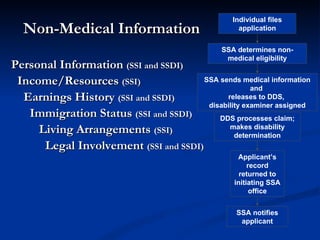
Non-Medical Information Personal Information  (SSI and SSDI) Income/Resources  (SSI) Earnings History  (SSI and SSDI) Immigration Status  (SSI and SSDI) Living Arrangements  (SSI) Legal Involvement  (SSI and SSDI) Individual files application SSA determines non-medical eligibility SSA sends medical information and  releases to DDS,  disability examiner assigned DDS processes claim; makes disability determination Applicant’s record returned to initiating SSA office SSA notifies applicant
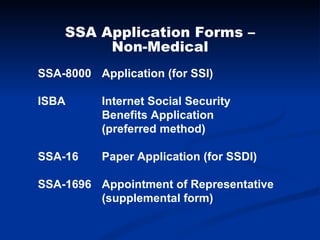
SSA-8000  Application (for SSI) ISBA Internet Social Security  Benefits Application  (preferred method) SSA-16  Paper Application (for SSDI) SSA-1696  Appointment of Representative (supplemental form) SSA Application Forms – Non-Medical
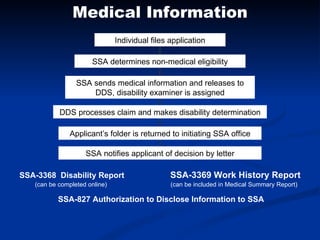
Medical Information Individual files application SSA determines non-medical eligibility Applicant’s folder is returned to initiating SSA office SSA notifies applicant of decision by letter SSA sends medical information and releases to DDS, disability examiner is assigned DDS processes claim and makes disability determination SSA-3368  Disability Report SSA-3369 Work History Report (can be included in Medical Summary Report) SSA-827 Authorization to Disclose Information to SSA (can be completed online)
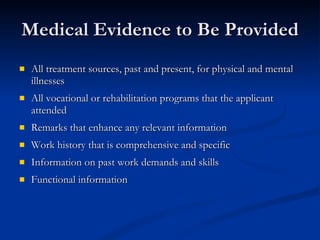
Medical Evidence to Be Provided All treatment sources, past and present, for physical and mental illnesses All vocational or rehabilitation programs that the applicant attended Remarks that enhance any relevant information Work history that is comprehensive and specific Information on past work demands and skills Functional information
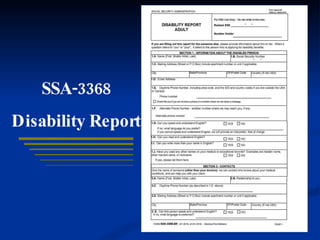
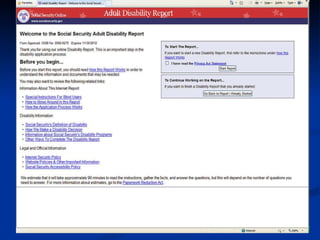
Disability Report:  SSA-3368 Disability Report allows DDS to obtain a complete picture of applicant’s medical history and treatment  Completeness is critical Ensure that all known information is provided  This form can be completed and submitted on-line – SSA i3368
IV - 9
SSA-3368 Disability Report
Authorization to Disclose Information to SSA: SSA-827  Psychotherapy notes Treatment dates HIPAA compliant forms
Handy Tips Disability reports should be completed in the first person in the applicant’s own words Be as complete as possible – add pages if necessary Include information about all health problems Make contact with the DDS professional/medical relations officer – plan strategies for collaboration
Criteria for Eligibility Medically Determinable Physical or Mental Impairment Illness(es) must either meet or be equivalent to the “listing” criteria used by DDS. Supporting information must be documented in medical records. 2. Duration The impairment tied to the illness(es) must have lasted OR be expected to last 12 months or more OR result in death. 3.  Functional Information Applicant must demonstrate that significant functional impairment related to the illness(es) exists.
Diagnosis and Functioning Comprehensive histories critical to understanding the impact of mental illness Diagnosis is not an exact science People present differently at different times and symptoms vary over time No testing – psychological and neuropsychological not readily available Functional information fleshes out the information provided in diagnosis
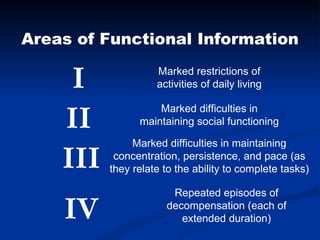
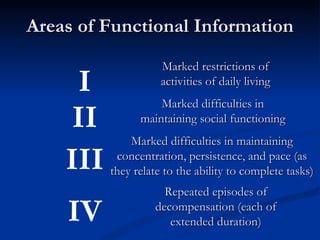
Areas of Functional Information I II III IV Marked restrictions of activities of daily living Marked difficulties in maintaining social functioning Marked difficulties in maintaining concentration, persistence, and pace (as they relate to the ability to complete tasks) Repeated episodes of decompensation (each of extended duration)
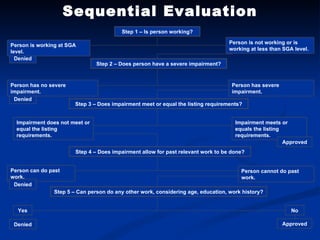
Sequential Evaluation Step 2 – Does person have a severe impairment? Step 3 – Does impairment meet or equal the listing requirements? Step 4 – Does impairment allow for past relevant work to be done? Step 5 – Can person do any other work, considering age, education, work history? Impairment does not meet or equal the listing requirements. Impairment meets or equals the listing requirements. Person can do past work. Person cannot do past work. Yes No Denied Denied Denied Denied Approved Approved Step 1 – Is person working? Person is not working or is working at less than SGA level. Person has no severe impairment. Person has severe impairment. Person is working at SGA level.
Approval?  Step 3 is critical Steps 4 and 5 are more subjective and more difficult to assess Case manager’s role immeasurable in providing medical proof Time necessary to process claim and receive benefits shortened if approved at Step 3
Denial? Step 1 – If applicant is working and earning at SGA level or higher Step 2 – If person does not have a severe impairment Step 4 – If impairment does not affect a person’s ability to do past relevant work Step 5 – If alternative work can be found
Summary - eligibility Understanding SSA disability criteria is critical A case manager is often the only conduit for people who are homeless in their search for resources Knowing eligibility criteria can greatly assist in deciding which services and/or income resources to pursue
Collecting the Medical Evidence
Benefits of the New Improved Process Communication among parties Transparency of process Completeness of information
Collaboration with SSA and DDS  Things to discuss with SSA and DDS Invite SSA and DDS staff to attend  Stepping Stones  trainings Fax SOAR  Consent for Release of Information  to SSA  Ask SSA to train to community staff to complete SSI application ( SSA-8000 ) on an outreach basis Utilize 60-day protective filing to complete claim Implement different medical evidence collection process Flag cases as SOAR in “Remarks” on electronic flag Assign specific claims representatives (SSA) or disability examiners (DDS) to SOAR applications Have at least bi-weekly contact with assigned DDS  examiner to track collection of evidence
Usual Process for Collection of Medical Evidence Disability Report and releases of information sent to DDS DDS sends releases to medical records departments of hospitals, clinics, and other providers Medical records staff take information from individual’s record and sends back to DDS DDS contacts treating sources for additional information, if needed Decision? If information is submitted and sufficient, decision is made If information is not submitted or is insufficient, a consultative examination may be scheduled
Difficulties in Usual Process Medical Records Staff: May send only specified or recent information Often unfamiliar with SSA/DDS process Rarely send progress notes – course of illness Records often do not address functional information
Things to remember… Medical evidence is the heart of disability determination Diagnosis and resulting impairment are determined through medical records Only physicians and psychologists can make diagnosis Other health care professionals can provide valuable information on functional impairment
The New and Improved Process
New Process for C ollecting Medical Evidence Make list of treating sources Have applicant sign two releases for each treating source Send releases to medical records departments Contact current treating providers Offer to copy the records Follow up weekly on information not received Organize records chronologically and review Continue to identify new sources of information Maintain contact with DDS
Medical Records Departments Contact directors of medical records departments Negotiate a process for collecting medical information Offer to copy records Honor the collaborative process worked out
Useful Evidence for Determinations –  Medical Evidence Psychiatric evaluations Physical health evaluations  Specialty physical health evaluations Neurological work-up reports Laboratory results Diagnostic tests Neuropsychological tests Psychological tests Admission summaries Discharge summaries Progress notes
Useful Evidence for Determinations – Collateral Information/Evaluations Bio-psychosocial evaluation reports Occupational therapy evaluation reports Vocational evaluation reports
Possible Paths to Medical Evidence Applicant Friends/Family Members Service Providers Commonly Used Facilities State Mental Health Departments SAMHSA Internet Yellow Pages
Interviewing and Assessing
Helping the Interview Process History Environment Language Process
History Goal – portray an individual’s history Focus on eliciting information, not completing application questions Ask yourself: What information do I have? Does it fit together to tell the whole story? What am I missing? Listen to the person’s story of his or her life
Language Avoid questions on assessment forms that lead to yes/no answers Use sensitivity – “physical abuse” or “substance use” Avoid jargon Ask open-ended questions
Process Not a one-time meeting An ongoing process Continual attention to the person and information offered – verbally and nonverbally – makes assessment richer and more accurate Strengths and struggles of the person
VIDEO (Mental Health History)
Questions 1. What were some general strategies used by the interviewer? 2. Were there specific phrases that struck them as useful that might fit with your style?
Functional Information
? DDS’s Main Question Does this illness (or illnesses) keep the person in question from being able to engage in substantial gainful activity?
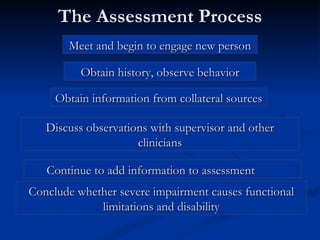
The Assessment Process Meet and begin to engage new person Obtain history, observe behavior Obtain information from collateral sources Discuss observations with supervisor and other clinicians Continue to add information to assessment   Conclude whether severe impairment causes functional limitations and disability
Areas of Functional Information I II III IV Marked restrictions of activities of daily living Marked difficulties in maintaining social functioning Marked difficulties in maintaining concentration, persistence, and pace (as they relate to the ability to complete tasks) Repeated episodes of decompensation (each of extended duration)
This is a new way of considering disability… Be sure to listen carefully, follow up on unclear or incomplete responses Determine if responses are consistent with observations Practice, practice, practice!
Functional Descriptions
The Goal of a Functional Description Impact of person’s illness and resulting impairment Based on collection of personal, medical, and collateral information Clearly explains: Nature of impairment How/if linked to illness  Impact on functioning and life, especially regarding ability to work
Clear Writing  Remember goal of functional description Write clearly Avoid technical terminology Write actively – avoid a passive voice Goal – make the complexity clear and intelligible
Samples Functional Description I Activities of daily living II Social functioning III Concentration, persistence and pace IV Repeated episodes of decompensation
Effective Functional Descriptions Ties diagnosis to functioning and links to inability to work Clear writing and fully descriptive Maintains active voice Evokes senses and draws a picture of individual
Medical Summary Report
Technical Details of Medical Summary Report Agency letterhead Typed Co-signed by physician or psychologist who has seen individual (makes it medical evidence)  Referenced documents and/or supplemental information attached  Sent directly to DDS disability examiner, hand delivered to SSA, or sent electronically
Components of  Medical Summary Report Reference Section Introduction Personal History Diagnostic and Treatment Information Link to Functional Impairment Summary Contact Information
Reference Section Applicant’s: Name Date of birth Social Security Number Typically aligned on right-hand side of first page
Introduction Section Demographics Physical description – hygiene, grooming, dress, make-up, any unusual characteristics Additional information – help DDS examiner “see” the individual as case manager does
Personal History Developmental problems Physical/sexual abuse Childhood Educational  Relationships  Medical problems  Substance use Current housing  Employment history Quotes from the individual are helpful!
Psychiatric Diagnoses and Treatment Chronological treatment history Specific quotes from the applicant or record that illustrate diagnosis Observations of behavior Durational issues Current mental status exam
Link to Functional Impairment Critical to connect symptoms/effects of illness with marked functional impairments  In at least two of the four functional areas Demonstrate impact of the illness(es) on ability to work Medication – effects and side effects Support and effect of support and compare with lack of support
Summary and Contact Information Ties all information together for a concise picture of the individual Contact – Names and Numbers Case manager/physician/psychologist co-signing
Benefits of Investing the Time  The overall process of applying for benefits is time-consuming.  Putting forth the initial effort for an earlier, more successful outcome may seem difficult, but it is worth the effort for the person and for the case manager.
SSI/SSDI Work Incentives
SSI/SSDI Work Incentives Importance of Employment: Contribution to one’s community Self-worth  Definition of role Connection to others
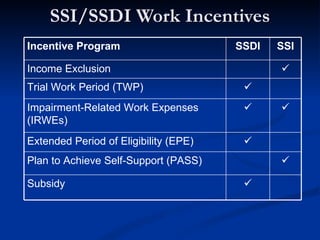
SSI/SSDI Work Incentives Incentive Program SSDI SSI Income Exclusion  Trial Work Period (TWP)  Impairment-Related Work Expenses (IRWEs)   Extended Period of Eligibility (EPE)  Plan to Achieve Self-Support (PASS)  Subsidy 
Income Exclusion: SSI Only Exclusion means certain amounts of earnings are not counted General exclusion:  $20 Earned income exclusion:  $65 If SSI is sole income, get both
Trial Work Period (TWP):  SSDI Only 9 months of gross earnings (per current SSA rate) Need not be consecutive Are counted within a 5-year period Trigger a review of one’s continued  eligibility for SSDI Visit www.prainc.com/soar
Impairment-Related Work Expe nses  (IRWEs):  SSI and SSDI Apply both to SSI and SSDI at different times Are out-of-pocket costs that a person must pay that are (1) related to one’s disability and (2) needed to be able to work Examples: Medication co-pays Special equipment
Extended Period of Eligibility (EPE):  SSDI Only Applies only to SSDI Lasts 36 months Applies to any month in which earnings fall below SGA Allows beneficiaries to receive SSDI in the months of non-SGA earnings during the EPE
Plan to Achieve Self-Support (PASS):  SSI Only Set aside of income/resources for employment or vocational goal PASS funds not counted when figuring SSI payment amount Must be written and approved by SSA Helps a person move towards a career goal
Subsidy:  SSDI Only Value  of extra support received on the job Examples of supports: Extra hours of supervision Job coach or mentor Reduced workload Provided by employer Subsidized worker earns the same pay as other workers doing the same job
Health Insurance SSI:  Medicaid May continue under Federal Rule 1619B even if SSI cash payments stop  SSDI:  Medicare Continues for 93 months (7.75 years) after the last month of the Trial Work Period May be purchased after 93 months under certain conditions;  premium costs for Part A then apply
Resources Work Incentives Planning and Assistance (WIPA) Program Protection and Advocacy for Beneficiaries of Social Security (PABSS) Disability Program Navigators (DPNs) (Department of Labor) Ticket to Work SSA Web site (www.socialsecurity.gov/work)
Closing Summary This approach works! SSI and SSDI is an essential  Stepping Stone to Recovery Convey hope! Encourage the possibilities!
Resources For more information visit:  SSA Web site  www.ssa.gov SOAR Web site www.prainc.com/soar C - 4
Presenters’ Contact Information Marian V. Bland, LCSW-C Director, Office of Special Needs Populations, Mental Hygiene Administration (410) 724-3242 Email  [email_address] Margaret Flanagan, MSW Baltimore City SOAR Project Manager Health Care for the Homeless (410) 703 1347 Email:  [email_address] Caroline Bolas, MSW, MS Data and Evaluation Consultant Office of Special Needs Populations, Mental Hygiene Administration (410) 724 3210 ext. 2176  Email: bolasc @ dhmh.state.md.us

2010 HOME Conference - SSI/ SSDI Application

  • 1.
    ASSISTING CLIENTS THROUGHTHE SSI/SSDI APPLICATION PROCESS HOME Conference September 16, 2010 Presented By: Marian V. Bland, LCSW-C Margaret Flanagan, MSW Caroline Bolas, MSW, MS
  • 2.
    Excerpted from…. Perret,Y & Dennis, D. STEPPING STONES TO RECOVERY: A TRAINING CURRICULUM FOR CASE MANAGER ASSISTING ADULTS WHO ARE HOMELESS WITH SOCIAL SECURITY DISABILITY AND SUPLEMENTAL SECURITY INCOME APPLICATIONS . DHHS Pub. No. SMA 06-Rockville, MD: CMHS, SAMHSA, 2006
  • 3.
    WELCOME and INTRODUCTIONSPlease tell us : Your Name Work Location and Role One sentence about your experience with completing SSI/SSDI applications
  • 4.
    Importance of SSIand SSDI for People with Disabilities SSI and SSDI can be critical steps towards ending homelessness and promoting recovery for people with disabilities… Providing access to needed treatment, services and housing Supporting people in the long term to return to work through work incentive programs
  • 5.
    The Problem TheSSI application process is very difficult and especially so for people who are homeless, many of whom have mental illnesses and co-occurring substance use disorders Only about 10-15 percent of homeless adults who apply are typically approved on initial application Only about 37 percent of all applicants are typically approved on application Appeals take years and many potentially eligible people give up and do not appeal
  • 6.
    Why Is AccessTo SSI So Difficult? People often need assistance to apply because of the complexity of the process They need adequate assessment/documentation of how their medical conditions limit their ability to work Those assisting SSI applicants need to understand the disability determination process and have time to assist in all aspects of completing applications Relationships with SSA, DDS, community medical providers and others are essential to changing the outcomes of SSI/SSDI applications
  • 7.
    What We KnowIs Possible… Nationally: Average approval rates of 71% on initial application in an average of 89 days
  • 8.
    What Does ItTake? Training Commitment of staff by community agencies Implementation of SOAR Critical Components Collaboration with SSA, DDS and others Quality control Collect and report on outcomes
  • 9.
    SOAR Technical AssistanceInitiative SOAR stands for “SSI/SSDI Outreach, Access and Recovery” Designed to serve adults who are homeless and have a mental illness and/or co-occurring disorders who meet adult criteria under SSA Strategy to help States and communities increase access to mainstream benefits, especially for people who are homeless, through: training, technical assistance and strategic planning Includes use of SAMHSA’s Stepping Stones to Recovery training curriculum
  • 10.
    Goal, Objectives, andStrategies Overarching goal: To expedite and increase the number of successful SSI/SSDI applications for eligible applicants Objectives: Infrastructure building Case manager has key role Strategies: Collaboration and coordination Communication
  • 11.
    How Is ThisModel Different? Case managers actively assist applicants and collate evidence Step-by-step explanation of SSI application and disability determination process Focuses on the initial application – “Get it right the first time!” Avoids appeals whenever possible Focuses on documenting the disability
  • 12.
    Stepping Stones toRecovery Training Curriculum Based on success of University of Maryland Medical System Baltimore SSI Outreach Project Achieved success rate on application of 96% for those deemed likely eligible Comprehensive approach to individual’s needs with income as the “hook” Engagement, relationship, and assessment are integral parts of project and curriculum
  • 13.
    Outcomes from SOARStates (2009) Atlanta, GA – 286 (79%) of 360 applications approved in 82 days Philadelphia, PA – 172 (98%) of 175 applications approved in 32 days Nashville, TN – 156 (93%) of 167 applications approved in 32 days Portland, OR – 129 (87%) of 149 applications approved in 49 days
  • 14.
    More Outcomes… Onaverage, the people receiving these benefits had been homeless 27 months. Approval rates were highest in places where more SOAR critical components were able to be implemented
  • 15.
    Utah recovered morethan $496,000 in general assistance benefits from SSA over the past two years in the Salt Lake City region alone . In Covington, KY, a local hospital partially funded a SSI outreach project; since the start of the program, the hospital has been able to back bill Medicaid and Medicare $255,000 to cover the costs of uncompensated care for homeless SSI recipients San Francisco Dept. of Public Health estimates that for every $1 invested in SSI outreach, they recoup $6 in Medicaid reimbursement for uncompensated care In Baltimore, 20 new SSI recipients had $300,000 in uncompensated care in one hospital system in one year Examples of Cost Savings
  • 16.
    History of SOARin Maryland In 2006, the State Department of Human Resources (DHR) received a technical assistance grant from SAMHSA Baltimore City and Prince George’s County selected as pilot states and a state planning workgroup setup 2007-2008 case managers and human service providers trained in Baltimore City, Frederick, Mid-Shore Counties, and Prince George’s County
  • 17.
    Status of SOARin Maryland April 2008 SOAR Transferred to Mental Hygiene Administration Developed a State Wide SOAR Planning group Have active work groups in: Anne Arundel Baltimore City Carroll County Howard County Lower Eastern Shores Montgomery County Prince George’s County
  • 18.
    Status of SOARin Maryland cont Have 7 active SOAR trainers 6 two-day training sessions in the last year, attended by more than 140 people PATH funding has been used to fund the following positions: SOAR Outreach Coordinators in Prince George’s County and Baltimore City SOAR Outreach Workers in Anne Arundel and Baltimore City Part time Evaluation and Data Consultant
  • 19.
    Maryland SOAR Outcomes Within Baltimore City, 25 out of 25 initial applications have been approved (100%) in an average of 61 days They have also had a further 10 SOAR related cases approved, with 1 denial Within Maryland as a whole, there have been 41 SOAR related approvals, with an overall approval rate for new claims of 93%
  • 20.
  • 21.
  • 22.
    Social Security DisabilityInsurance (SSDI) Supplemental Security Income (SSI) I - 3 Federal disability program, administered by SSA, that provides benefits to blind or disabled individuals who are “insured” based on contributions paid into the Social Security trust fund, as authorized by the Federal Insurance Contributions Act (FICA) Federal disability program, administered by SSA, that provides benefits to low income people who are disabled, blind, or elderly
  • 23.
    Disability Impairmentsmust affect a person’s ability to work. “ inability to engage in any substantial gainful activity (SGA)…”
  • 24.
    A Brief Historyof SSA Disability Programs 1935 - Law establishes Social Security 1937 - Benefit payments for retirement begin 1942 - Monthly payments begin 1956 - SSDI signed into law 1965 - Medicare established, officially begins on July 1, 1966 1972 - SSI is established
  • 25.
    SSA Disability Benefits– The Similarities Definition of Disability Substantial Gainful Activity (SGA) Application Process Health Insurance Medical Criteria
  • 26.
    SSA– The Differencesbetween SSI and SSDI Supplemental Security Income (SSI) Social Security Disability Insurance (SSDI) Benefit for disabled, elderly, and blind individuals who have very low income Benefit for insured individuals (or certain relatives) Benefit amount is the Federal Benefit Rate (FBR), plus available State supplement Benefit amount based on FICA contributions Limits on assets/resources No limits on assets/resources Living arrangement may affect benefit amount and eligibility Living arrangement has no effect on benefit amount or eligibility Medicaid eligibility usually comes with SSI Medicare eligibility usually comes after two years of SSDI benefits Eligibility usually begins the 1 st of the full month following the date of application Eligibility generally dependent on date of onset of disability Work incentives usually apply immediately after work begins Work incentives allow for 9-month Trial Work Period (TWP) during which full benefits are received
  • 27.
    The Application ProcessNon-Medical and Medical Information and Eligibility Criteria
  • 28.
    The Application ProcessIndividual files application SSA determines non-medical eligibility SSA sends medical information and releases to DDS, where a disability examiner is assigned DDS processes claim and makes disability determination Applicant’s folder is returned to initiating SSA office SSA notifies applicant of decision by letter Individual establishes protective filing date III - 2
  • 29.
    Social Security Administration SSA Disability Determination Services DDS
  • 30.
    SSA and DDS– Collaborative Effort SSA Initial contact point Processes non-medical eligibility criteria Ensures necessary forms for medical evidence collection are complete Forwards medical releases and disability report to DDS Later confirms decision DDS State agency under contract with SSA Assesses medical evidence Makes a determination on disability
  • 31.
    Protective Filing DateEstablishing a date of first contact with SSA – Crucial! Once established, this date is used to determine SSI eligibility This in turn, determines when an individual can potentially start receiving benefits
  • 32.
    6 Steps toCompletion Receive referral for individual Conduct initial meeting Call SSA for appointment (establish protective filing date) Accompany applicant to appointment at SSA, if possible Complete evaluation and assessment Complete and file Medical Summary Report Maintain contact with clinical treatment team Gather information Track dates info sent and received Track responses III - 8
  • 33.
    Non-Medical Information PersonalInformation (SSI and SSDI) Income/Resources (SSI) Earnings History (SSI and SSDI) Immigration Status (SSI and SSDI) Living Arrangements (SSI) Legal Involvement (SSI and SSDI) Individual files application SSA determines non-medical eligibility SSA sends medical information and releases to DDS, disability examiner assigned DDS processes claim; makes disability determination Applicant’s record returned to initiating SSA office SSA notifies applicant
  • 34.
    SSA-8000 Application(for SSI) ISBA Internet Social Security Benefits Application (preferred method) SSA-16 Paper Application (for SSDI) SSA-1696 Appointment of Representative (supplemental form) SSA Application Forms – Non-Medical
  • 35.
    Medical Information Individualfiles application SSA determines non-medical eligibility Applicant’s folder is returned to initiating SSA office SSA notifies applicant of decision by letter SSA sends medical information and releases to DDS, disability examiner is assigned DDS processes claim and makes disability determination SSA-3368 Disability Report SSA-3369 Work History Report (can be included in Medical Summary Report) SSA-827 Authorization to Disclose Information to SSA (can be completed online)
  • 36.
    Medical Evidence toBe Provided All treatment sources, past and present, for physical and mental illnesses All vocational or rehabilitation programs that the applicant attended Remarks that enhance any relevant information Work history that is comprehensive and specific Information on past work demands and skills Functional information
  • 37.
    Disability Report: SSA-3368 Disability Report allows DDS to obtain a complete picture of applicant’s medical history and treatment Completeness is critical Ensure that all known information is provided This form can be completed and submitted on-line – SSA i3368
  • 38.
  • 39.
  • 40.
    Authorization to DiscloseInformation to SSA: SSA-827 Psychotherapy notes Treatment dates HIPAA compliant forms
  • 41.
    Handy Tips Disabilityreports should be completed in the first person in the applicant’s own words Be as complete as possible – add pages if necessary Include information about all health problems Make contact with the DDS professional/medical relations officer – plan strategies for collaboration
  • 42.
    Criteria for EligibilityMedically Determinable Physical or Mental Impairment Illness(es) must either meet or be equivalent to the “listing” criteria used by DDS. Supporting information must be documented in medical records. 2. Duration The impairment tied to the illness(es) must have lasted OR be expected to last 12 months or more OR result in death. 3. Functional Information Applicant must demonstrate that significant functional impairment related to the illness(es) exists.
  • 43.
    Diagnosis and FunctioningComprehensive histories critical to understanding the impact of mental illness Diagnosis is not an exact science People present differently at different times and symptoms vary over time No testing – psychological and neuropsychological not readily available Functional information fleshes out the information provided in diagnosis
  • 44.
    Areas of FunctionalInformation I II III IV Marked restrictions of activities of daily living Marked difficulties in maintaining social functioning Marked difficulties in maintaining concentration, persistence, and pace (as they relate to the ability to complete tasks) Repeated episodes of decompensation (each of extended duration)
  • 45.
    Sequential Evaluation Step2 – Does person have a severe impairment? Step 3 – Does impairment meet or equal the listing requirements? Step 4 – Does impairment allow for past relevant work to be done? Step 5 – Can person do any other work, considering age, education, work history? Impairment does not meet or equal the listing requirements. Impairment meets or equals the listing requirements. Person can do past work. Person cannot do past work. Yes No Denied Denied Denied Denied Approved Approved Step 1 – Is person working? Person is not working or is working at less than SGA level. Person has no severe impairment. Person has severe impairment. Person is working at SGA level.
  • 46.
    Approval? Step3 is critical Steps 4 and 5 are more subjective and more difficult to assess Case manager’s role immeasurable in providing medical proof Time necessary to process claim and receive benefits shortened if approved at Step 3
  • 47.
    Denial? Step 1– If applicant is working and earning at SGA level or higher Step 2 – If person does not have a severe impairment Step 4 – If impairment does not affect a person’s ability to do past relevant work Step 5 – If alternative work can be found
  • 48.
    Summary - eligibilityUnderstanding SSA disability criteria is critical A case manager is often the only conduit for people who are homeless in their search for resources Knowing eligibility criteria can greatly assist in deciding which services and/or income resources to pursue
  • 49.
  • 50.
    Benefits of theNew Improved Process Communication among parties Transparency of process Completeness of information
  • 51.
    Collaboration with SSAand DDS Things to discuss with SSA and DDS Invite SSA and DDS staff to attend Stepping Stones trainings Fax SOAR Consent for Release of Information to SSA Ask SSA to train to community staff to complete SSI application ( SSA-8000 ) on an outreach basis Utilize 60-day protective filing to complete claim Implement different medical evidence collection process Flag cases as SOAR in “Remarks” on electronic flag Assign specific claims representatives (SSA) or disability examiners (DDS) to SOAR applications Have at least bi-weekly contact with assigned DDS examiner to track collection of evidence
  • 52.
    Usual Process forCollection of Medical Evidence Disability Report and releases of information sent to DDS DDS sends releases to medical records departments of hospitals, clinics, and other providers Medical records staff take information from individual’s record and sends back to DDS DDS contacts treating sources for additional information, if needed Decision? If information is submitted and sufficient, decision is made If information is not submitted or is insufficient, a consultative examination may be scheduled
  • 53.
    Difficulties in UsualProcess Medical Records Staff: May send only specified or recent information Often unfamiliar with SSA/DDS process Rarely send progress notes – course of illness Records often do not address functional information
  • 54.
    Things to remember…Medical evidence is the heart of disability determination Diagnosis and resulting impairment are determined through medical records Only physicians and psychologists can make diagnosis Other health care professionals can provide valuable information on functional impairment
  • 55.
    The New andImproved Process
  • 56.
    New Process forC ollecting Medical Evidence Make list of treating sources Have applicant sign two releases for each treating source Send releases to medical records departments Contact current treating providers Offer to copy the records Follow up weekly on information not received Organize records chronologically and review Continue to identify new sources of information Maintain contact with DDS
  • 57.
    Medical Records DepartmentsContact directors of medical records departments Negotiate a process for collecting medical information Offer to copy records Honor the collaborative process worked out
  • 58.
    Useful Evidence forDeterminations – Medical Evidence Psychiatric evaluations Physical health evaluations Specialty physical health evaluations Neurological work-up reports Laboratory results Diagnostic tests Neuropsychological tests Psychological tests Admission summaries Discharge summaries Progress notes
  • 59.
    Useful Evidence forDeterminations – Collateral Information/Evaluations Bio-psychosocial evaluation reports Occupational therapy evaluation reports Vocational evaluation reports
  • 60.
    Possible Paths toMedical Evidence Applicant Friends/Family Members Service Providers Commonly Used Facilities State Mental Health Departments SAMHSA Internet Yellow Pages
  • 61.
  • 62.
    Helping the InterviewProcess History Environment Language Process
  • 63.
    History Goal –portray an individual’s history Focus on eliciting information, not completing application questions Ask yourself: What information do I have? Does it fit together to tell the whole story? What am I missing? Listen to the person’s story of his or her life
  • 64.
    Language Avoid questionson assessment forms that lead to yes/no answers Use sensitivity – “physical abuse” or “substance use” Avoid jargon Ask open-ended questions
  • 65.
    Process Not aone-time meeting An ongoing process Continual attention to the person and information offered – verbally and nonverbally – makes assessment richer and more accurate Strengths and struggles of the person
  • 66.
  • 67.
    Questions 1. Whatwere some general strategies used by the interviewer? 2. Were there specific phrases that struck them as useful that might fit with your style?
  • 68.
  • 69.
    ? DDS’s MainQuestion Does this illness (or illnesses) keep the person in question from being able to engage in substantial gainful activity?
  • 70.
    The Assessment ProcessMeet and begin to engage new person Obtain history, observe behavior Obtain information from collateral sources Discuss observations with supervisor and other clinicians Continue to add information to assessment Conclude whether severe impairment causes functional limitations and disability
  • 71.
    Areas of FunctionalInformation I II III IV Marked restrictions of activities of daily living Marked difficulties in maintaining social functioning Marked difficulties in maintaining concentration, persistence, and pace (as they relate to the ability to complete tasks) Repeated episodes of decompensation (each of extended duration)
  • 72.
    This is anew way of considering disability… Be sure to listen carefully, follow up on unclear or incomplete responses Determine if responses are consistent with observations Practice, practice, practice!
  • 73.
  • 74.
    The Goal ofa Functional Description Impact of person’s illness and resulting impairment Based on collection of personal, medical, and collateral information Clearly explains: Nature of impairment How/if linked to illness Impact on functioning and life, especially regarding ability to work
  • 75.
    Clear Writing Remember goal of functional description Write clearly Avoid technical terminology Write actively – avoid a passive voice Goal – make the complexity clear and intelligible
  • 76.
    Samples Functional DescriptionI Activities of daily living II Social functioning III Concentration, persistence and pace IV Repeated episodes of decompensation
  • 77.
    Effective Functional DescriptionsTies diagnosis to functioning and links to inability to work Clear writing and fully descriptive Maintains active voice Evokes senses and draws a picture of individual
  • 78.
  • 79.
    Technical Details ofMedical Summary Report Agency letterhead Typed Co-signed by physician or psychologist who has seen individual (makes it medical evidence) Referenced documents and/or supplemental information attached Sent directly to DDS disability examiner, hand delivered to SSA, or sent electronically
  • 80.
    Components of Medical Summary Report Reference Section Introduction Personal History Diagnostic and Treatment Information Link to Functional Impairment Summary Contact Information
  • 81.
    Reference Section Applicant’s:Name Date of birth Social Security Number Typically aligned on right-hand side of first page
  • 82.
    Introduction Section DemographicsPhysical description – hygiene, grooming, dress, make-up, any unusual characteristics Additional information – help DDS examiner “see” the individual as case manager does
  • 83.
    Personal History Developmentalproblems Physical/sexual abuse Childhood Educational Relationships Medical problems Substance use Current housing Employment history Quotes from the individual are helpful!
  • 84.
    Psychiatric Diagnoses andTreatment Chronological treatment history Specific quotes from the applicant or record that illustrate diagnosis Observations of behavior Durational issues Current mental status exam
  • 85.
    Link to FunctionalImpairment Critical to connect symptoms/effects of illness with marked functional impairments In at least two of the four functional areas Demonstrate impact of the illness(es) on ability to work Medication – effects and side effects Support and effect of support and compare with lack of support
  • 86.
    Summary and ContactInformation Ties all information together for a concise picture of the individual Contact – Names and Numbers Case manager/physician/psychologist co-signing
  • 87.
    Benefits of Investingthe Time The overall process of applying for benefits is time-consuming. Putting forth the initial effort for an earlier, more successful outcome may seem difficult, but it is worth the effort for the person and for the case manager.
  • 88.
  • 89.
    SSI/SSDI Work IncentivesImportance of Employment: Contribution to one’s community Self-worth Definition of role Connection to others
  • 90.
    SSI/SSDI Work IncentivesIncentive Program SSDI SSI Income Exclusion  Trial Work Period (TWP)  Impairment-Related Work Expenses (IRWEs)   Extended Period of Eligibility (EPE)  Plan to Achieve Self-Support (PASS)  Subsidy 
  • 91.
    Income Exclusion: SSIOnly Exclusion means certain amounts of earnings are not counted General exclusion: $20 Earned income exclusion: $65 If SSI is sole income, get both
  • 92.
    Trial Work Period(TWP): SSDI Only 9 months of gross earnings (per current SSA rate) Need not be consecutive Are counted within a 5-year period Trigger a review of one’s continued eligibility for SSDI Visit www.prainc.com/soar
  • 93.
    Impairment-Related Work Expenses (IRWEs): SSI and SSDI Apply both to SSI and SSDI at different times Are out-of-pocket costs that a person must pay that are (1) related to one’s disability and (2) needed to be able to work Examples: Medication co-pays Special equipment
  • 94.
    Extended Period ofEligibility (EPE): SSDI Only Applies only to SSDI Lasts 36 months Applies to any month in which earnings fall below SGA Allows beneficiaries to receive SSDI in the months of non-SGA earnings during the EPE
  • 95.
    Plan to AchieveSelf-Support (PASS): SSI Only Set aside of income/resources for employment or vocational goal PASS funds not counted when figuring SSI payment amount Must be written and approved by SSA Helps a person move towards a career goal
  • 96.
    Subsidy: SSDIOnly Value of extra support received on the job Examples of supports: Extra hours of supervision Job coach or mentor Reduced workload Provided by employer Subsidized worker earns the same pay as other workers doing the same job
  • 97.
    Health Insurance SSI: Medicaid May continue under Federal Rule 1619B even if SSI cash payments stop SSDI: Medicare Continues for 93 months (7.75 years) after the last month of the Trial Work Period May be purchased after 93 months under certain conditions; premium costs for Part A then apply
  • 98.
    Resources Work IncentivesPlanning and Assistance (WIPA) Program Protection and Advocacy for Beneficiaries of Social Security (PABSS) Disability Program Navigators (DPNs) (Department of Labor) Ticket to Work SSA Web site (www.socialsecurity.gov/work)
  • 99.
    Closing Summary Thisapproach works! SSI and SSDI is an essential Stepping Stone to Recovery Convey hope! Encourage the possibilities!
  • 100.
    Resources For moreinformation visit: SSA Web site www.ssa.gov SOAR Web site www.prainc.com/soar C - 4
  • 101.
    Presenters’ Contact InformationMarian V. Bland, LCSW-C Director, Office of Special Needs Populations, Mental Hygiene Administration (410) 724-3242 Email [email_address] Margaret Flanagan, MSW Baltimore City SOAR Project Manager Health Care for the Homeless (410) 703 1347 Email: [email_address] Caroline Bolas, MSW, MS Data and Evaluation Consultant Office of Special Needs Populations, Mental Hygiene Administration (410) 724 3210 ext. 2176 Email: bolasc @ dhmh.state.md.us