BASIC PRINCIPLES OF
THE PERSON
CENTERED APPROACH
House of New Hope New Employee Orientation
1
“It’s amazing what you can do when you
set your mind to it… especially when
you’re no longer supposed to have
one!”…
Woman with a mental illness describing her participation in person-centered
planning
2
3
WHAT IS PERSON-CENTERED
CARE?
• We define person-centered care planning as involving a collaborative
process between the person and his/her supporters (including the clinician)
that results in the development and implementation of an action plan to
assist the person in achieving his/her unique, personal goals along the
journey of recovery.
• This plan must meet the rigorous documentation elements required by
accrediting and funding bodies (such as ODMHAS) and can be attentive to
the specific mental health barriers interfering with goal achievement.
4
WHAT IS PERSON-CENTERED
CARE?
For the plan to be considered person-centered it needs to:
1. Be oriented toward promoting recovery rather than only minimizing illness;
2. Be based on the person’s own goals and aspirations;
3. Articulate the person’s own role and the role of both paid and natural
supports in assisting the person to achieve his/her own goals;
4. Focus and build on the person’s capacities, strengths, and interests;
5. Emphasize the use of natural community settings rather than segregated
program settings; and
6. Allow for uncertainty, setbacks, and disagreements as inevitable steps on
the path to greater self-determination.
5
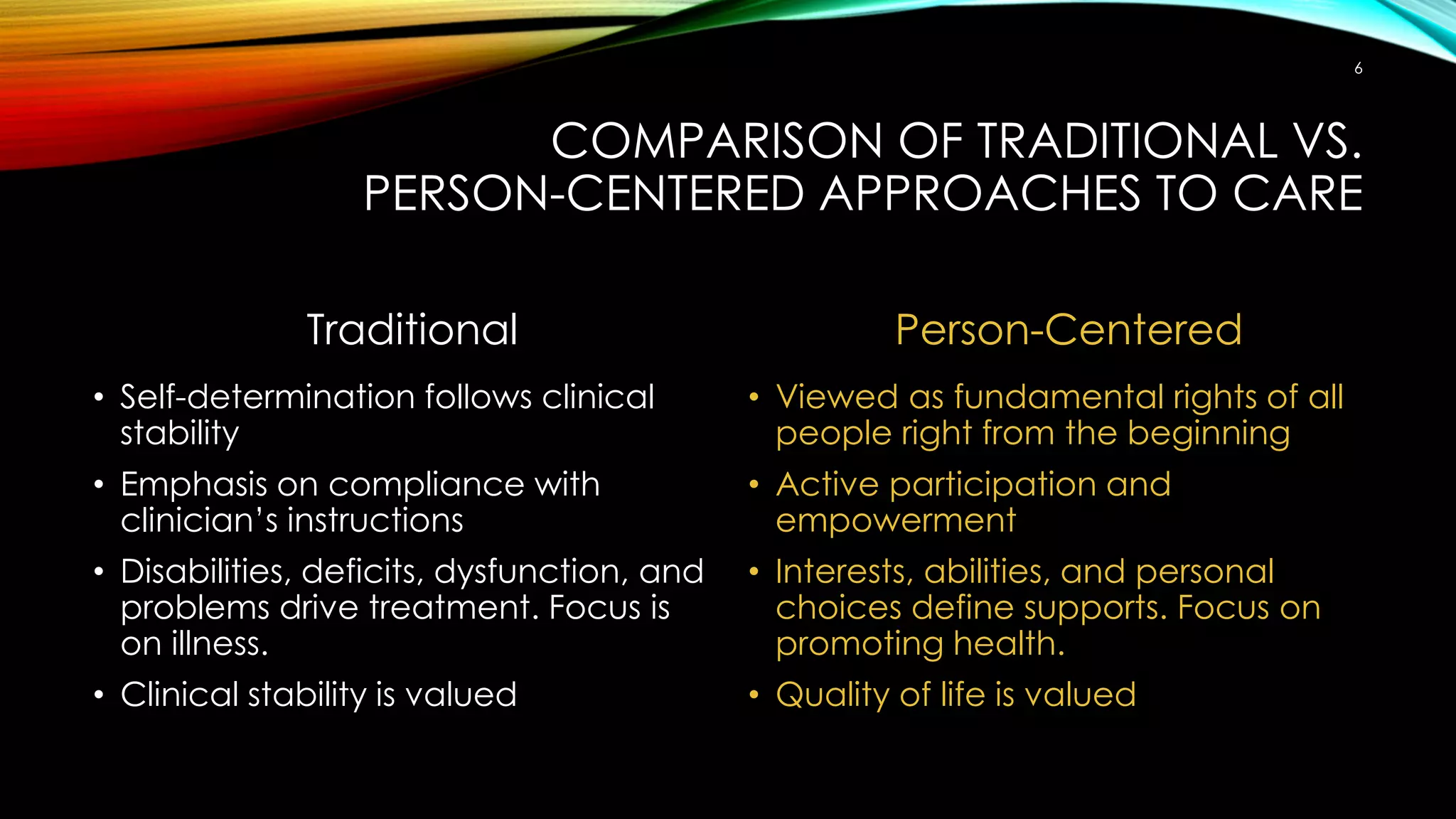
COMPARISON OF TRADITIONAL VS.
PERSON-CENTERED APPROACHES TO CARE
Traditional
• Self-determination follows clinical
stability
• Emphasis on compliance with
clinician’s instructions
• Disabilities, deficits, dysfunction, and
problems drive treatment. Focus is
on illness.
• Clinical stability is valued
Person-Centered
• Viewed as fundamental rights of all
people right from the beginning
• Active participation and
empowerment
• Interests, abilities, and personal
choices define supports. Focus on
promoting health.
• Quality of life is valued
6
THE MOST COMMON MISTAKE
“Too often the creation of the
individual service plan is not fully
inclusive of the member.”
7
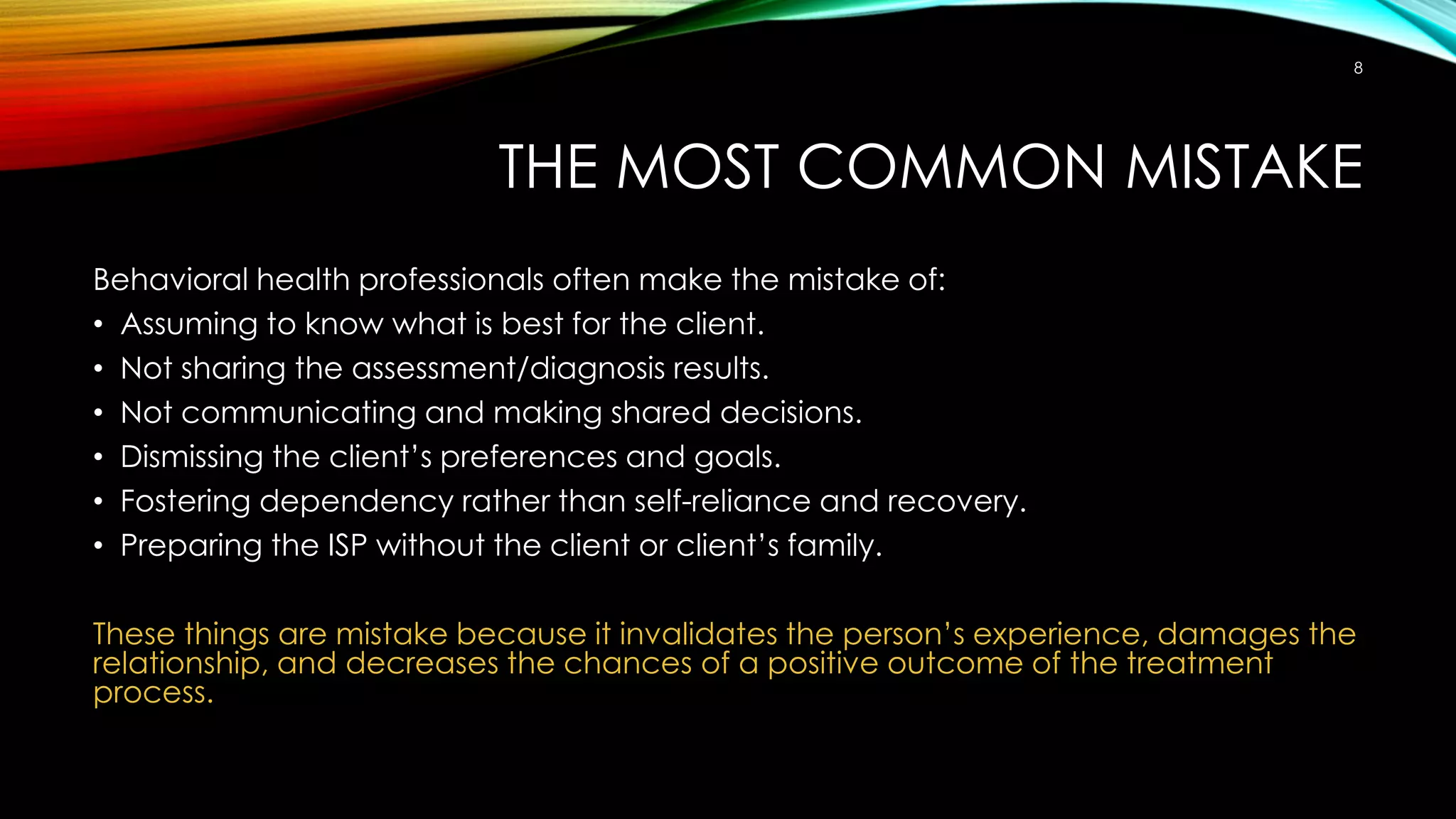
THE MOST COMMON MISTAKE
Behavioral health professionals often make the mistake of:
• Assuming to know what is best for the client.
• Not sharing the assessment/diagnosis results.
• Not communicating and making shared decisions.
• Dismissing the client’s preferences and goals.
• Fostering dependency rather than self-reliance and recovery.
• Preparing the ISP without the client or client’s family.
These things are mistake because it invalidates the person’s experience, damages the
relationship, and decreases the chances of a positive outcome of the treatment
process.
8
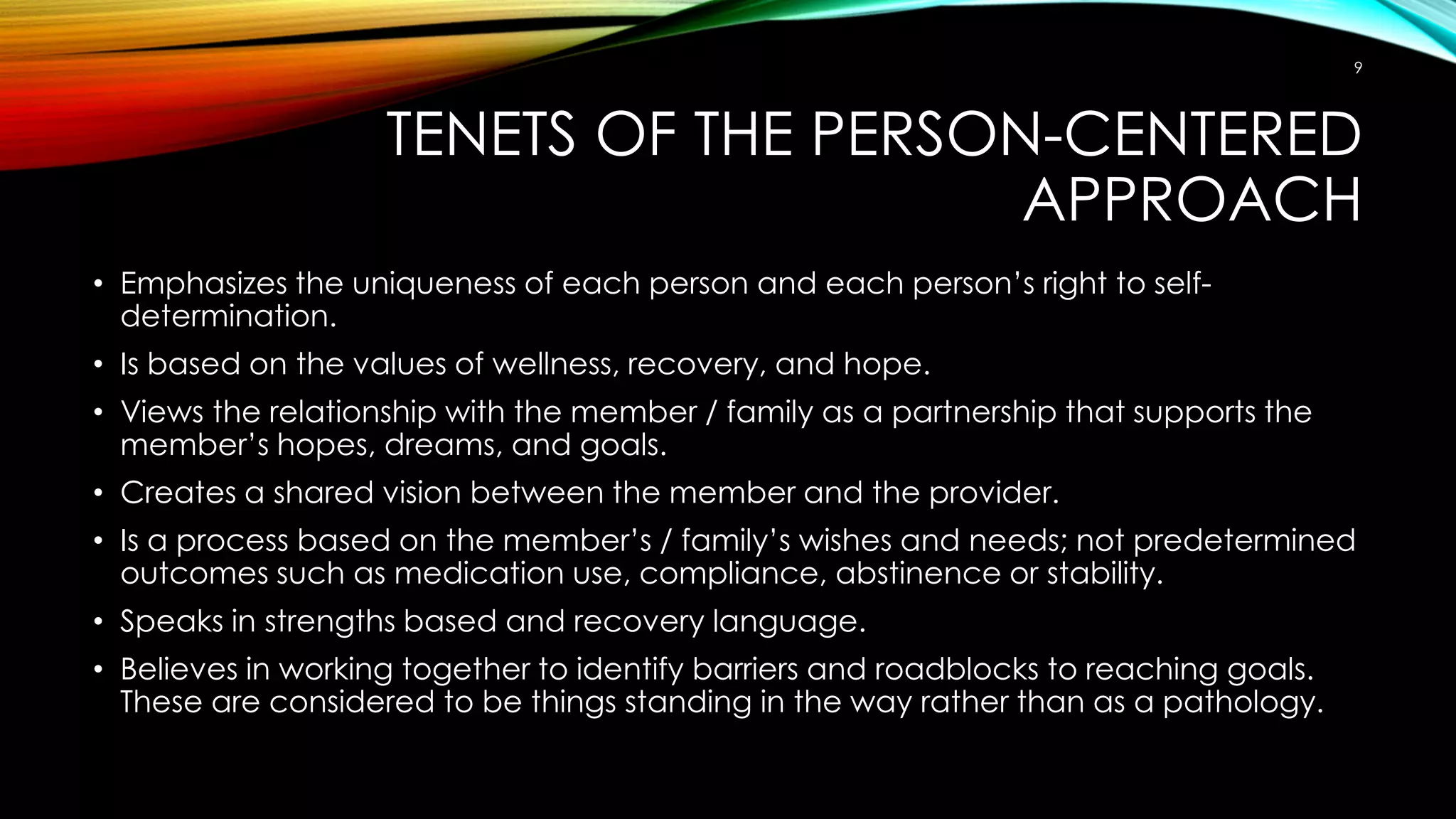
TENETS OF THE PERSON-CENTERED
APPROACH
• Emphasizes the uniqueness of each person and each person’s right to self-
determination.
• Is based on the values of wellness, recovery, and hope.
• Views the relationship with the member / family as a partnership that supports the
member’s hopes, dreams, and goals.
• Creates a shared vision between the member and the provider.
• Is a process based on the member’s / family’s wishes and needs; not predetermined
outcomes such as medication use, compliance, abstinence or stability.
• Speaks in strengths based and recovery language.
• Believes in working together to identify barriers and roadblocks to reaching goals.
These are considered to be things standing in the way rather than as a pathology.
9
CHOOSE YOUR WORDS
CAREFULLY
“The words you use to write about mental health are very important, and can help reduce
stigma around mental illness if carefully chosen. Focus on the person, not the condition.
• The basic concept is that the mental health condition (or physical or other
condition) is only one aspect of a person’s life, not the defining characteristic.
• Preferred: She is a person with schizophrenia.
• Not preferred: She is schizophrenic.
• Be specific. Mental illness is a general condition. Specific disorders are types of
mental illness and should be used whenever possible.
• Preferred: He was diagnosed with bipolar disorder
• Not preferred: He was mentally ill
• Avoid derogatory language. Terms such as psycho, crazy and junkie should not be
used. In addition, avoid words like “suffering” or “victim” when discussing those who
have mental health challenges.
• Preferred: She has a mental health illness. She has a substance use disorder.
• Not preferred: She suffers from mental illness. She’s a drug abuse
10
TREATMENT PLANNING
“…the person-centered approach emphasizes the development of
partnerships between clients and providers. All aspects of person-centered
treatment planning rely on shared decision making and client-defined
outcomes…this process promotes client choice, empowerment, resilience,
and self-reliance.”
“Rather than relying on cookie-cutter plans whose primary target is to reduce
the symptoms that make up the client's diagnosis, person-centered treatment
plans are holistic, are highly individualized, and identify positive outcomes
based on clients' strengths and available supports.”
11
PERSON-CENTERED SERVICE PLANNING: ISP
IS A LIVING DOCUMENT
• Reminder: The Individual Service Plan is a “living” and “working” document.
The Individual Service Plan is not meant to be a once and done document.
• As interventions are completed, objectives are accomplished, and goals are
achieved, the ISP needs to be updated to reflect current focuses and needs
for the member. The Person Centered Individual Service Plan reflects the
member where they are and changes as the member changes.
• By adopting a person-centered approach to developing individual service
plans, true collaborative partnerships can be established between providers
and members allowing providers a more facilitative role and members a
more decision making role in the service planning process. A far more
effective approach.
12

Basic Principles of the Person Centered Approach

  • 1.
    BASIC PRINCIPLES OF THEPERSON CENTERED APPROACH House of New Hope New Employee Orientation 1
  • 2.
    “It’s amazing whatyou can do when you set your mind to it… especially when you’re no longer supposed to have one!”… Woman with a mental illness describing her participation in person-centered planning 2
  • 3.
  • 4.
    WHAT IS PERSON-CENTERED CARE? •We define person-centered care planning as involving a collaborative process between the person and his/her supporters (including the clinician) that results in the development and implementation of an action plan to assist the person in achieving his/her unique, personal goals along the journey of recovery. • This plan must meet the rigorous documentation elements required by accrediting and funding bodies (such as ODMHAS) and can be attentive to the specific mental health barriers interfering with goal achievement. 4
  • 5.
    WHAT IS PERSON-CENTERED CARE? Forthe plan to be considered person-centered it needs to: 1. Be oriented toward promoting recovery rather than only minimizing illness; 2. Be based on the person’s own goals and aspirations; 3. Articulate the person’s own role and the role of both paid and natural supports in assisting the person to achieve his/her own goals; 4. Focus and build on the person’s capacities, strengths, and interests; 5. Emphasize the use of natural community settings rather than segregated program settings; and 6. Allow for uncertainty, setbacks, and disagreements as inevitable steps on the path to greater self-determination. 5
  • 6.
    COMPARISON OF TRADITIONALVS. PERSON-CENTERED APPROACHES TO CARE Traditional • Self-determination follows clinical stability • Emphasis on compliance with clinician’s instructions • Disabilities, deficits, dysfunction, and problems drive treatment. Focus is on illness. • Clinical stability is valued Person-Centered • Viewed as fundamental rights of all people right from the beginning • Active participation and empowerment • Interests, abilities, and personal choices define supports. Focus on promoting health. • Quality of life is valued 6
  • 7.
    THE MOST COMMONMISTAKE “Too often the creation of the individual service plan is not fully inclusive of the member.” 7
  • 8.
    THE MOST COMMONMISTAKE Behavioral health professionals often make the mistake of: • Assuming to know what is best for the client. • Not sharing the assessment/diagnosis results. • Not communicating and making shared decisions. • Dismissing the client’s preferences and goals. • Fostering dependency rather than self-reliance and recovery. • Preparing the ISP without the client or client’s family. These things are mistake because it invalidates the person’s experience, damages the relationship, and decreases the chances of a positive outcome of the treatment process. 8
  • 9.
    TENETS OF THEPERSON-CENTERED APPROACH • Emphasizes the uniqueness of each person and each person’s right to self- determination. • Is based on the values of wellness, recovery, and hope. • Views the relationship with the member / family as a partnership that supports the member’s hopes, dreams, and goals. • Creates a shared vision between the member and the provider. • Is a process based on the member’s / family’s wishes and needs; not predetermined outcomes such as medication use, compliance, abstinence or stability. • Speaks in strengths based and recovery language. • Believes in working together to identify barriers and roadblocks to reaching goals. These are considered to be things standing in the way rather than as a pathology. 9
  • 10.
    CHOOSE YOUR WORDS CAREFULLY “Thewords you use to write about mental health are very important, and can help reduce stigma around mental illness if carefully chosen. Focus on the person, not the condition. • The basic concept is that the mental health condition (or physical or other condition) is only one aspect of a person’s life, not the defining characteristic. • Preferred: She is a person with schizophrenia. • Not preferred: She is schizophrenic. • Be specific. Mental illness is a general condition. Specific disorders are types of mental illness and should be used whenever possible. • Preferred: He was diagnosed with bipolar disorder • Not preferred: He was mentally ill • Avoid derogatory language. Terms such as psycho, crazy and junkie should not be used. In addition, avoid words like “suffering” or “victim” when discussing those who have mental health challenges. • Preferred: She has a mental health illness. She has a substance use disorder. • Not preferred: She suffers from mental illness. She’s a drug abuse 10
  • 11.
    TREATMENT PLANNING “…the person-centeredapproach emphasizes the development of partnerships between clients and providers. All aspects of person-centered treatment planning rely on shared decision making and client-defined outcomes…this process promotes client choice, empowerment, resilience, and self-reliance.” “Rather than relying on cookie-cutter plans whose primary target is to reduce the symptoms that make up the client's diagnosis, person-centered treatment plans are holistic, are highly individualized, and identify positive outcomes based on clients' strengths and available supports.” 11
  • 12.
    PERSON-CENTERED SERVICE PLANNING:ISP IS A LIVING DOCUMENT • Reminder: The Individual Service Plan is a “living” and “working” document. The Individual Service Plan is not meant to be a once and done document. • As interventions are completed, objectives are accomplished, and goals are achieved, the ISP needs to be updated to reflect current focuses and needs for the member. The Person Centered Individual Service Plan reflects the member where they are and changes as the member changes. • By adopting a person-centered approach to developing individual service plans, true collaborative partnerships can be established between providers and members allowing providers a more facilitative role and members a more decision making role in the service planning process. A far more effective approach. 12