The   Systems Biology Software Infrastructure TiMet Workshop  May 7 th  2010, Edinburgh Richard Adams www.sbsi.ed.ac.uk http://sourceforge.net/projects/sbsi/
SBSI - Overall objective ‘ A new infrastructure to streamline the connection between data, models, and analysis, allowing the updating of large scale data, models  and analytic tools with greatly reduced overhead’
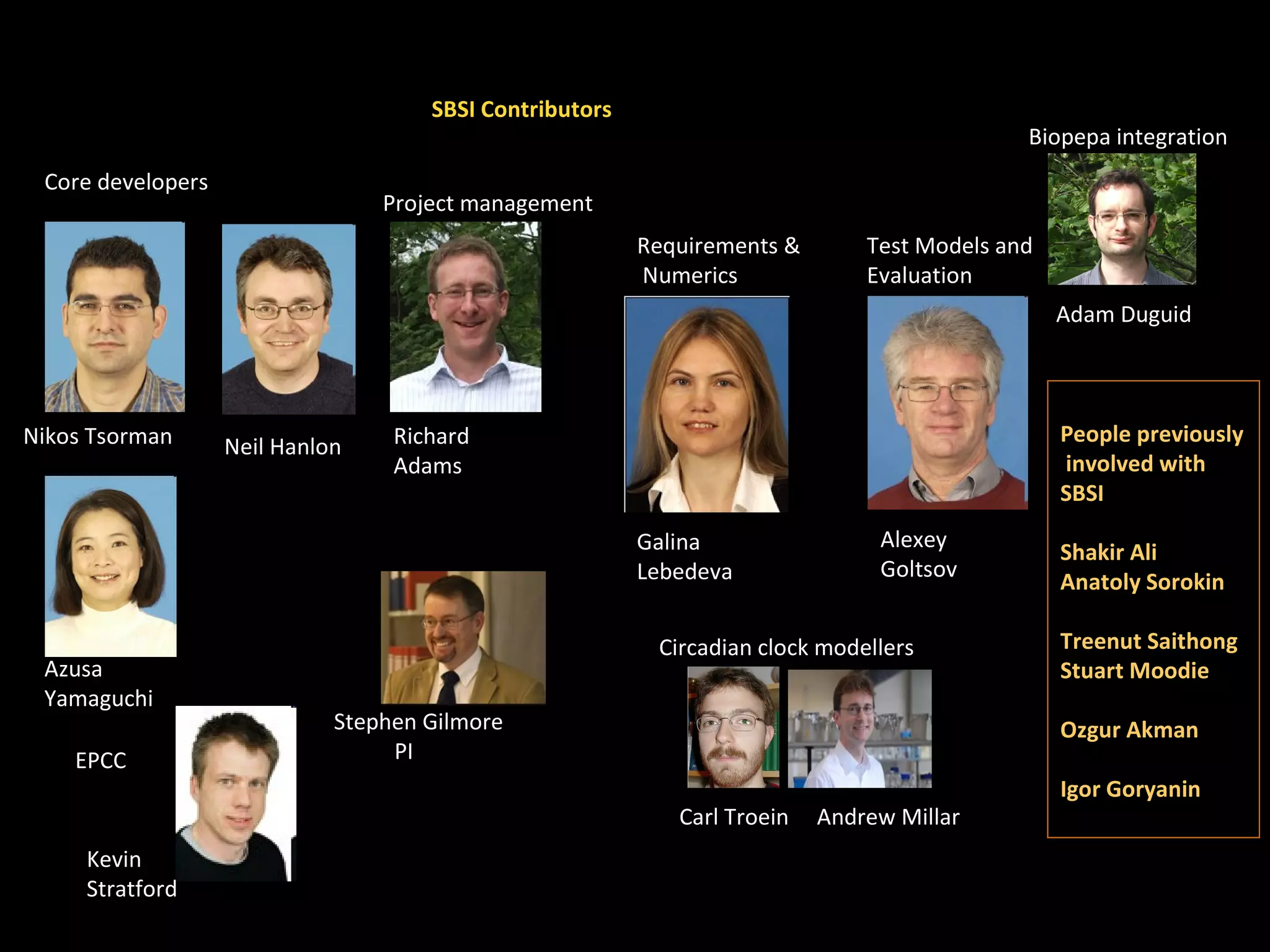
SBSI Contributors Core developers EPCC Test Models and  Evaluation  Project management Circadian clock modellers Stephen Gilmore PI Nikos Tsorman Neil Hanlon Galina Lebedeva Alexey Goltsov Azusa Yamaguchi Kevin Stratford  People previously  involved with SBSI Shakir Ali Anatoly Sorokin Treenut Saithong Stuart Moodie Ozgur Akman Igor Goryanin Biopepa integration Adam Duguid Richard Adams Requirements & Numerics  Andrew Millar Carl Troein
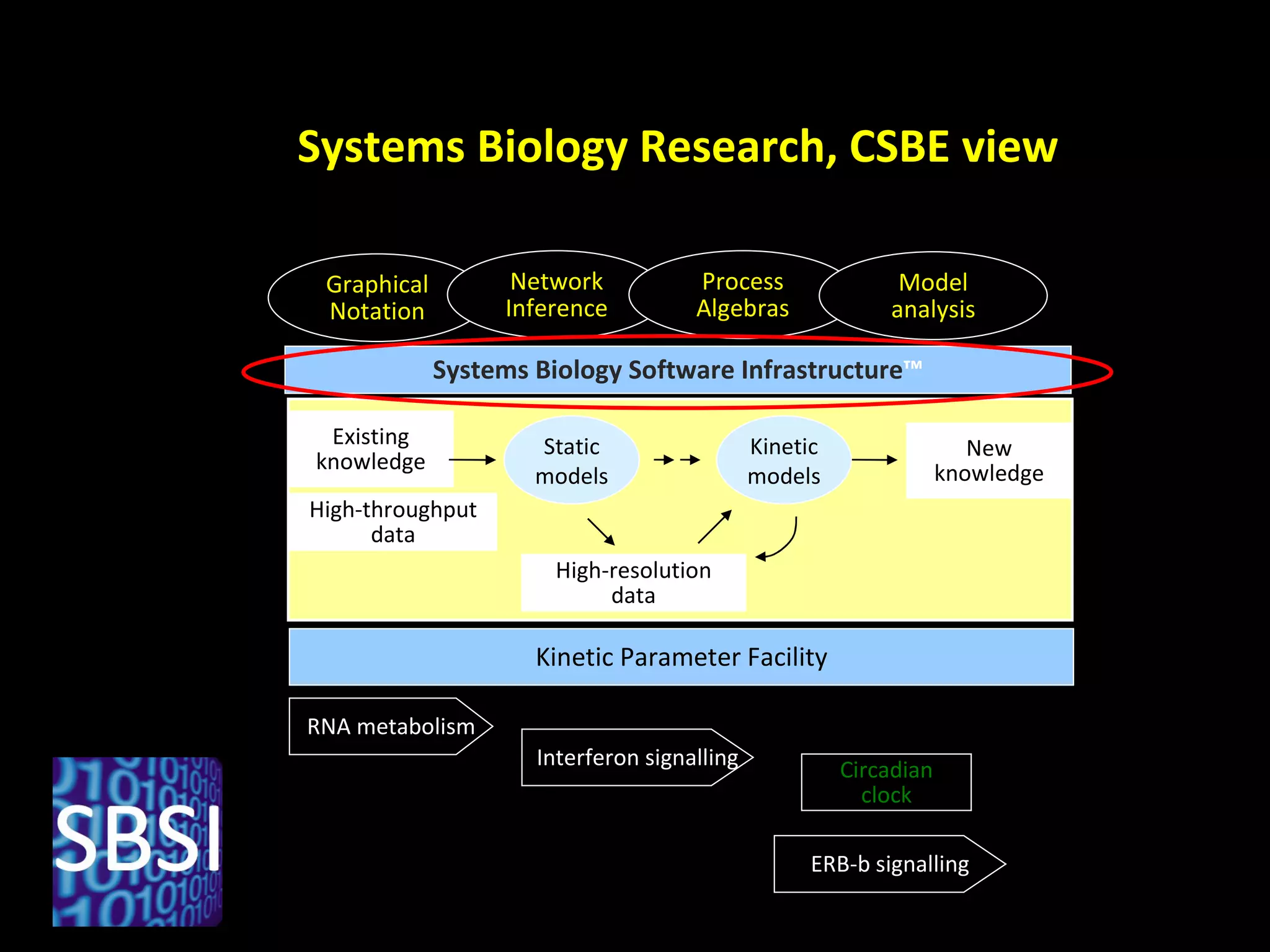
Graphical Notation Network Inference Process Algebras Model analysis Existing knowledge High-resolution data High-throughput data New knowledge Static models Kinetic models Systems Biology Software Infrastructure ™ Kinetic Parameter Facility Circadian clock RNA metabolism Interferon signalling Systems Biology Research, CSBE view ERB-b signalling
Initial use case : Parameter Estimation Problem Building predictive models –  challenging problem in Systems Biology Parameter estimation – critical stage in model development Multiple data sets needed for model calibration Optimization of large scale models –computationally challenging Circadian clock modelling project requires model optimization.
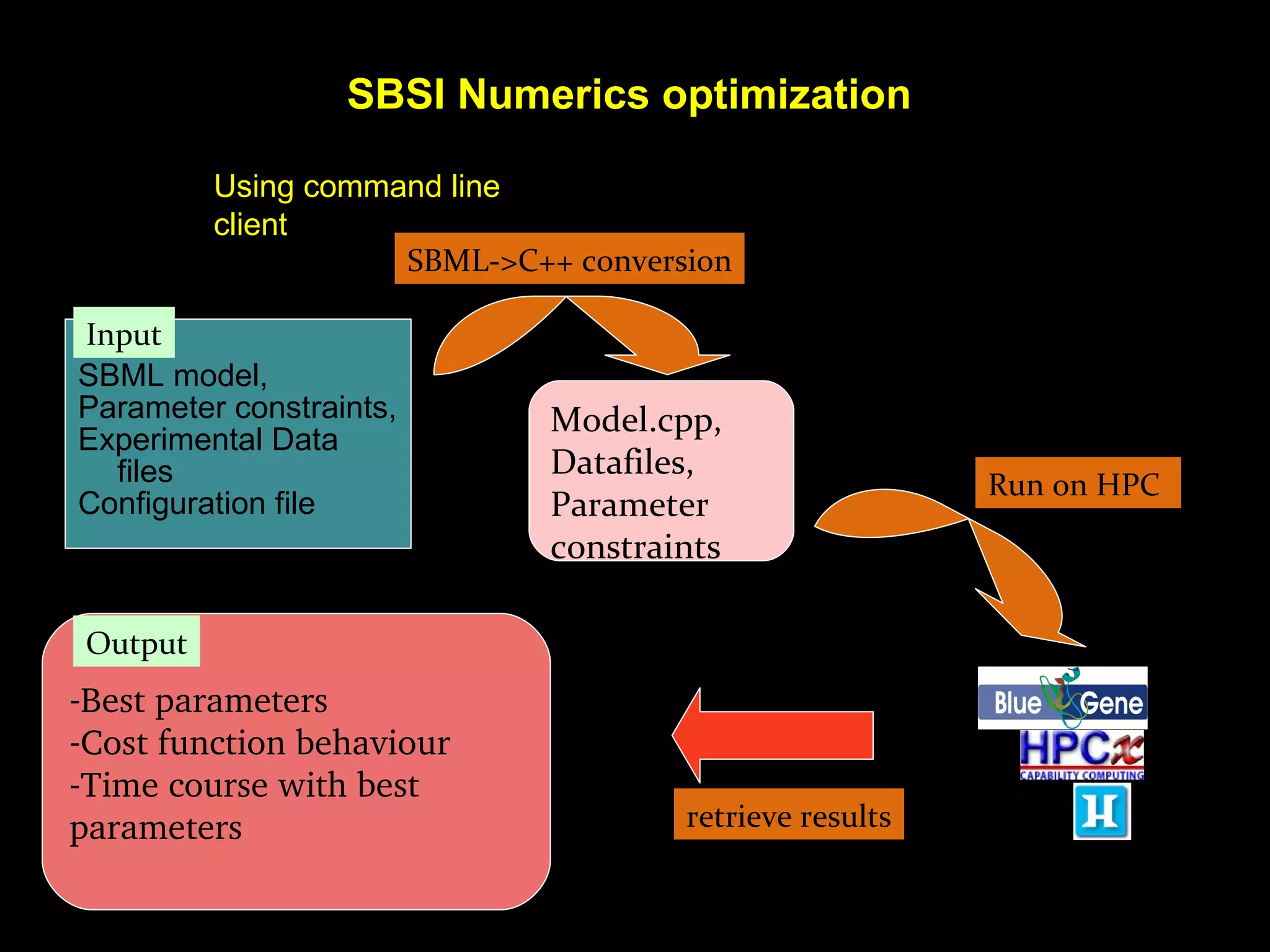
SBSI Numerics optimization  SBML model,  Parameter constraints, Experimental Data files Configuration file Model.cpp, Datafiles, Parameter constraints SBML->C++ conversion Best parameters Cost function behaviour Time course with best parameters Eddie (ECDF) Output Using command line client Run on HPC  retrieve results Input
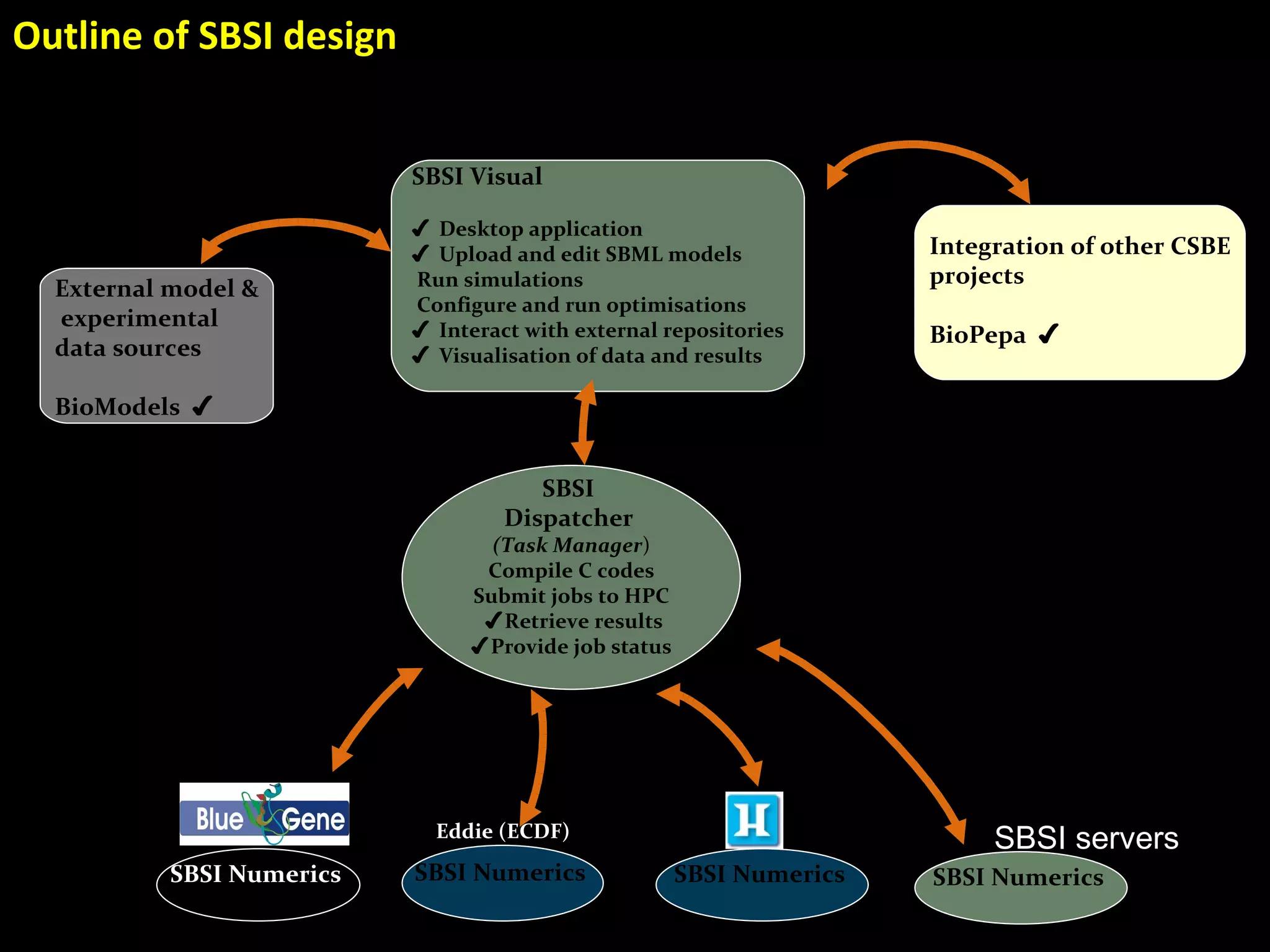
Integration of other CSBE projects BioPepa  ✔ Outline of SBSI design External model & experimental d ata sources BioModels  ✔ SBSI  Dispatcher   (Task Manager ) Compile C codes Submit jobs to HPC ✔ Retrieve results ✔ Provide job status SBSI Numerics   core SBSI Visual  ✔ Desktop application ✔ Upload and edit SBML models Run simulations Configure and run optimisations ✔ Interact with external repositories ✔ Visualisation of data and results Eddie (ECDF) SBSI Numerics   SBSI Numerics   SBSI servers SBSI Numerics   SBSI  - complete system
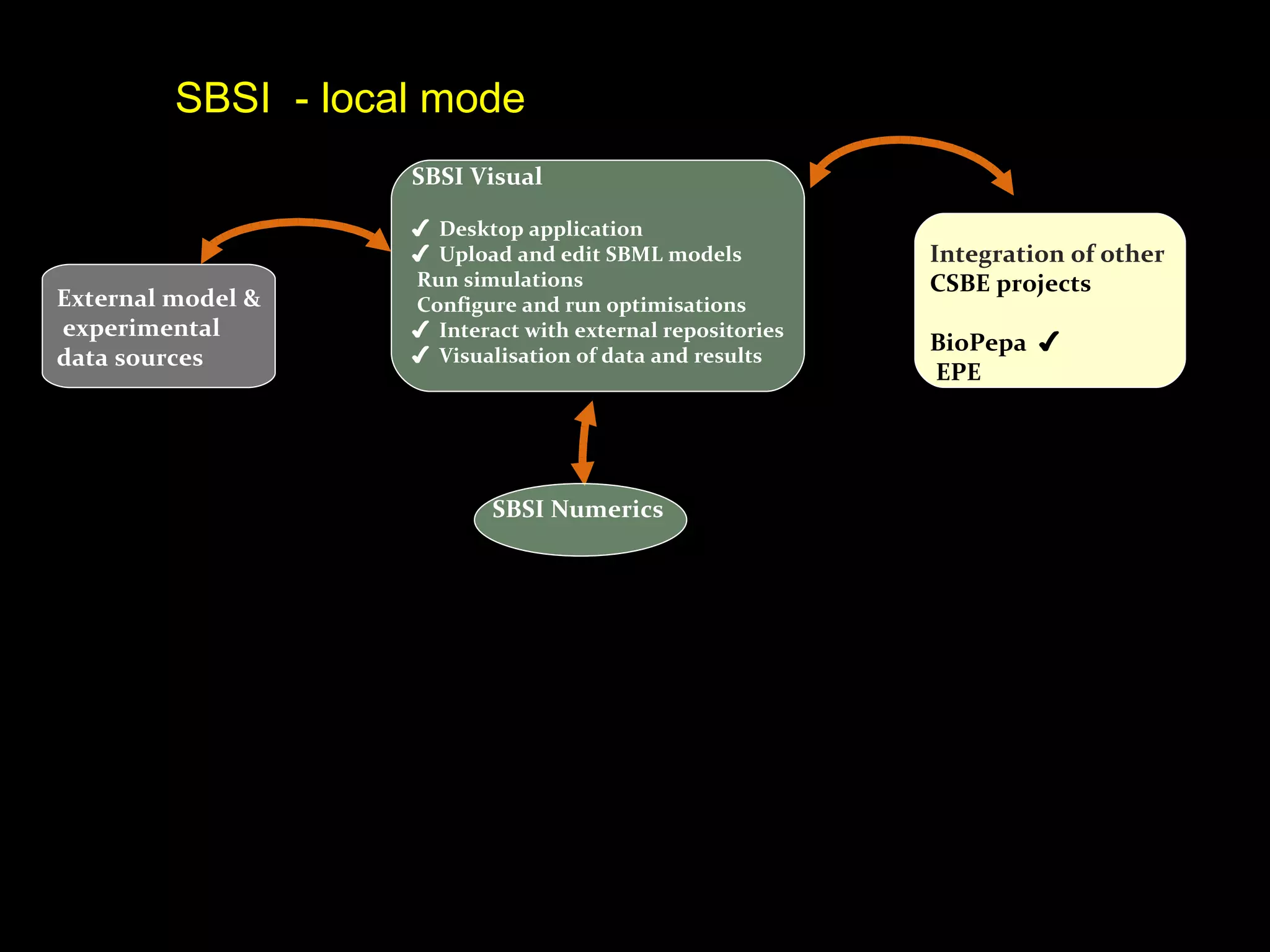
Integration of other  CSBE projects BioPepa  ✔ EPE External model & experimental d ata sources SBSI Visual  ✔ Desktop application ✔ Upload and edit SBML models Run simulations Configure and run optimisations ✔ Interact with external repositories ✔ Visualisation of data and results SBSI Numerics   SBSI  - local mode
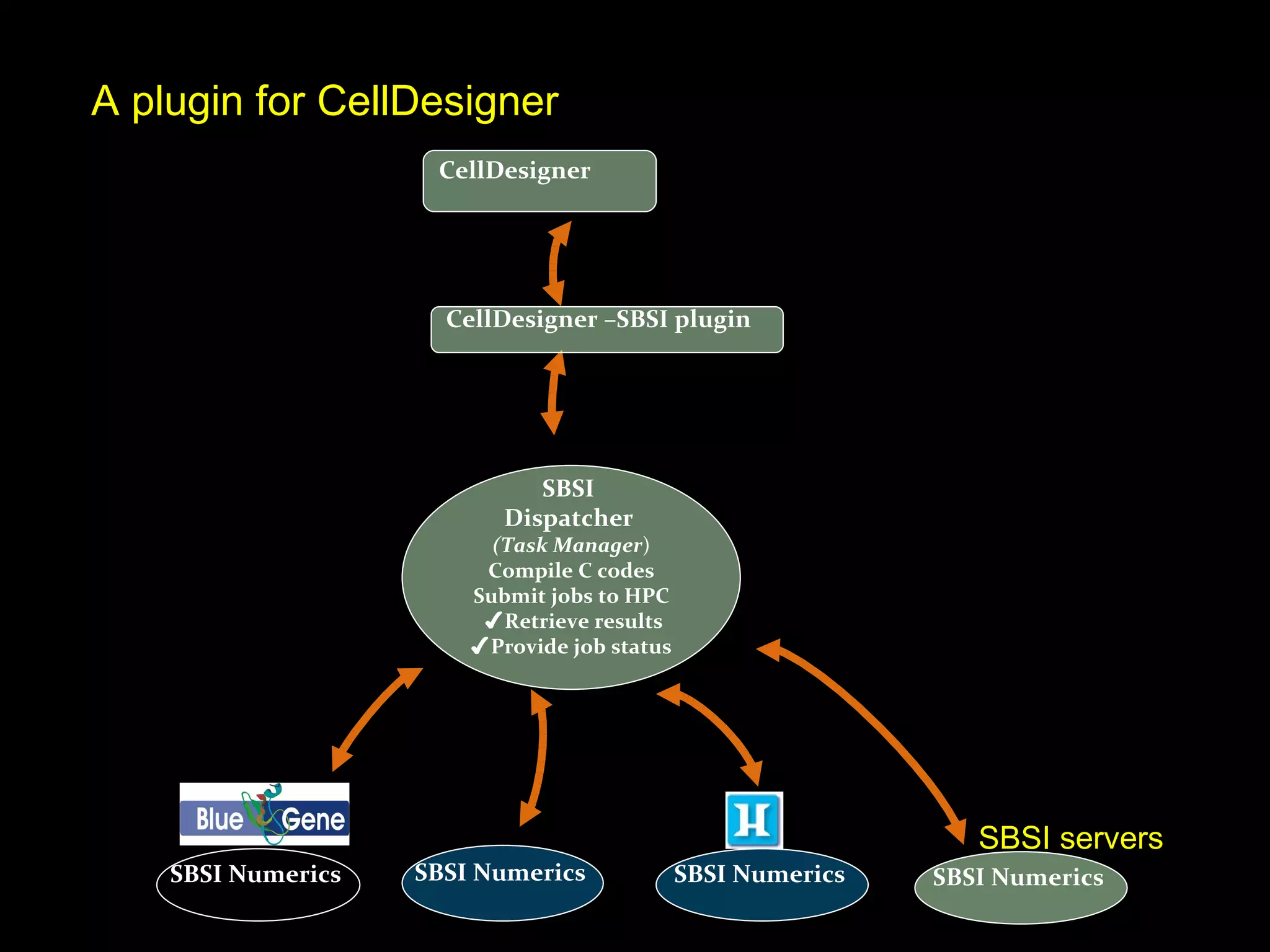
SBSI  Dispatcher   (Task Manager ) Compile C codes Submit jobs to HPC ✔ Retrieve results ✔ Provide job status SBSI Numerics   CellDesigner Eddie (ECDF) SBSI Numerics   SBSI Numerics   SBSI servers SBSI Numerics   A plugin for CellDesigner  CellDesigner  – SBSI plugin
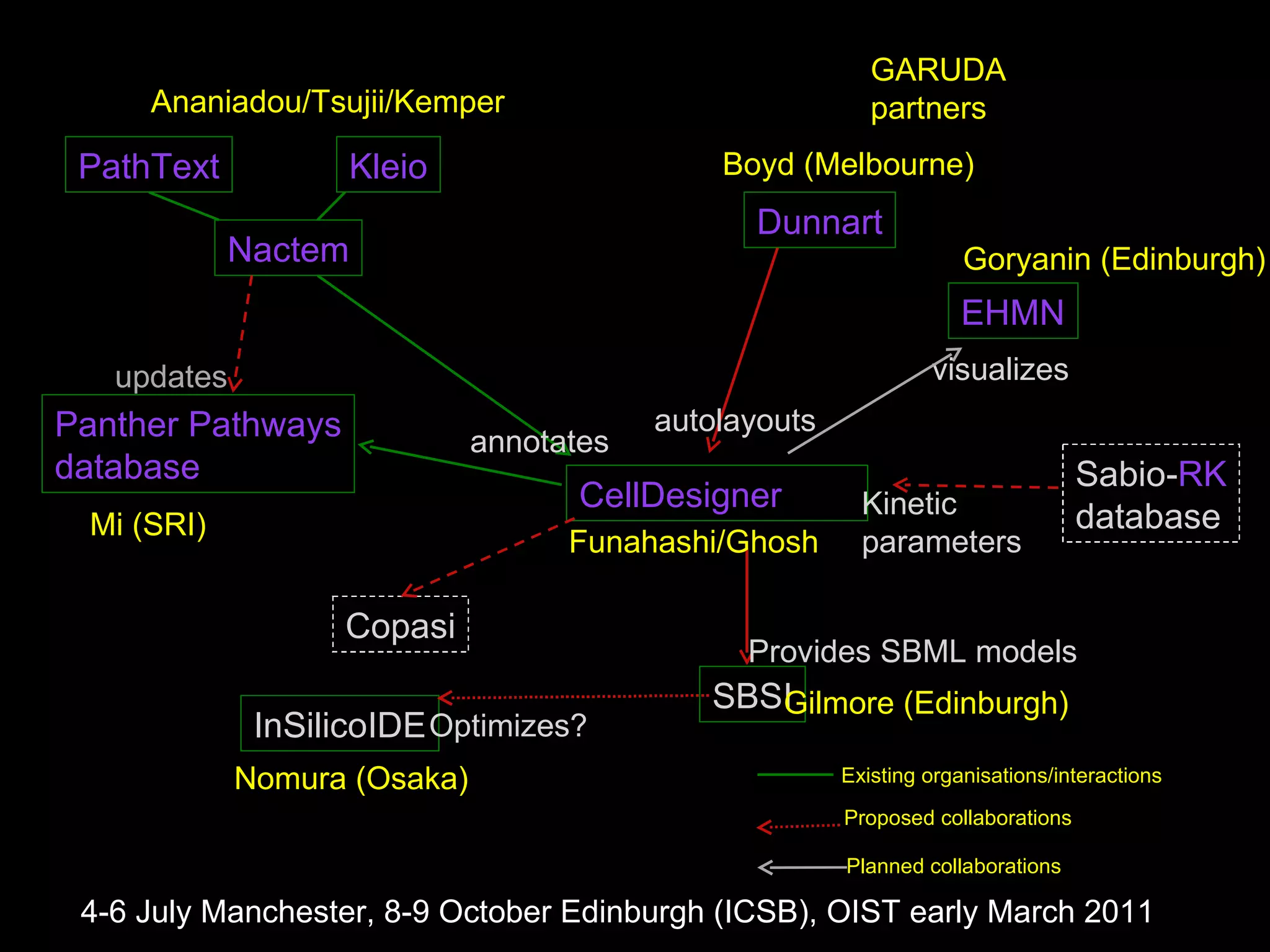
Nactem CellDesigner Dunnart InSilicoIDE SBSI PathText Kleio Panther Pathways database autolayouts visualizes annotates Provides SBML models Optimizes? Sabio- RK database Kinetic  parameters Copasi Ananiadou/Tsujii/Kemper Mi (SRI) Funahashi/Ghosh Nomura (Osaka) updates EHMN Goryanin (Edinburgh) Boyd (Melbourne) 4-6 July Manchester, 8-9 October Edinburgh (ICSB), OIST early March 2011 Existing organisations/interactions Planned collaborations Gilmore (Edinburgh) GARUDA partners Proposed collaborations
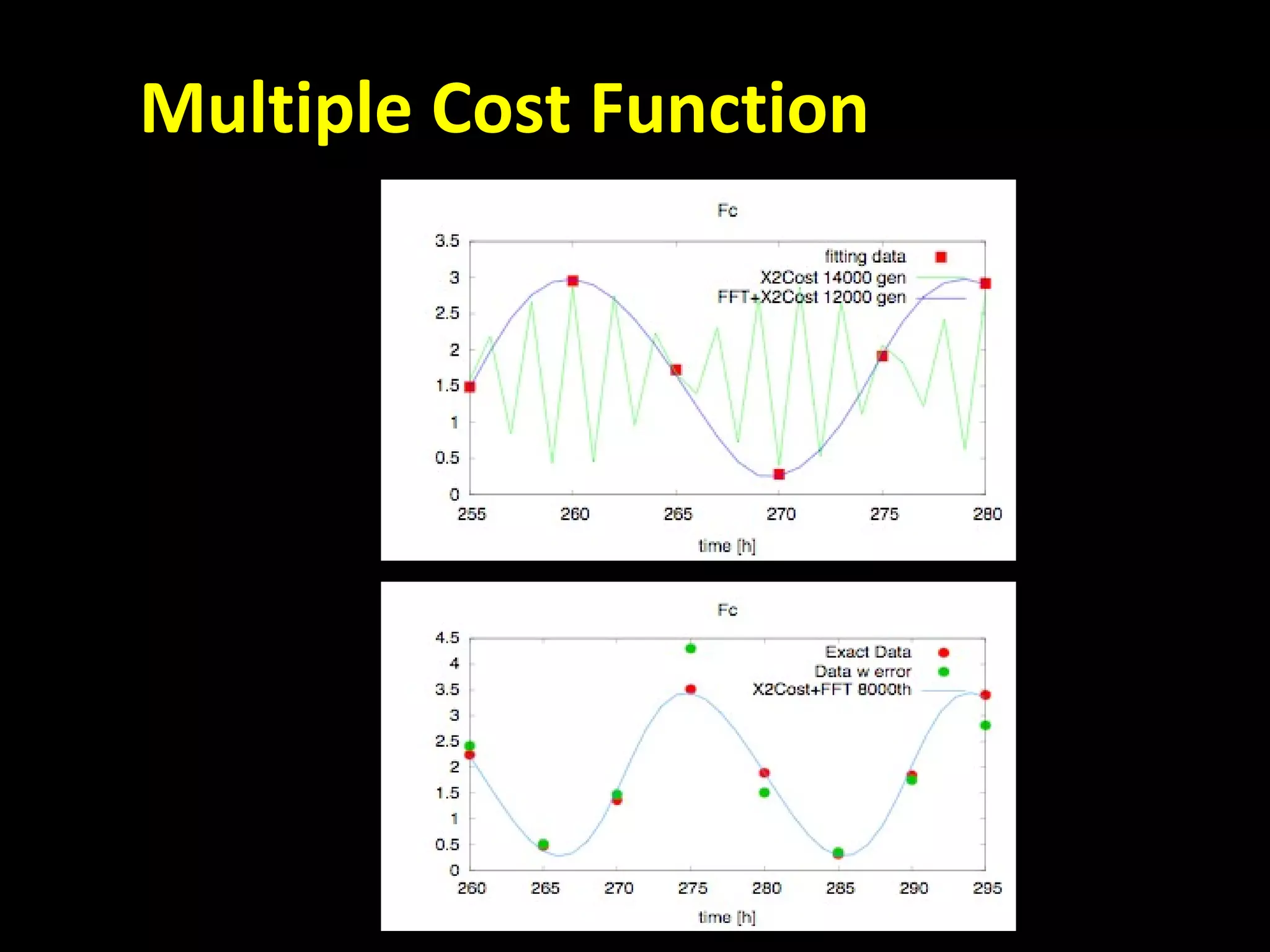
Multiple Cost Function
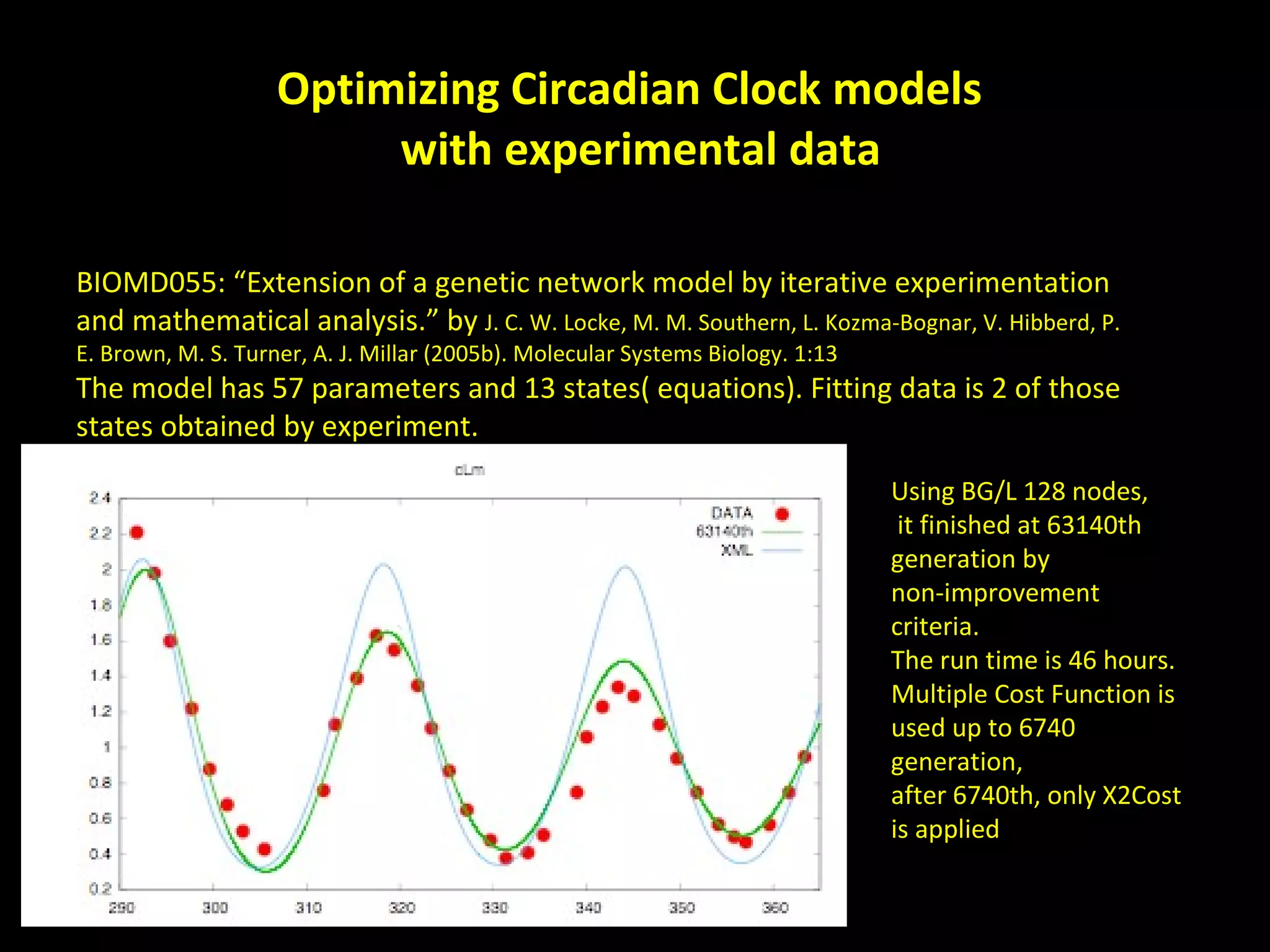
Optimizing Circadian Clock models   with experimental data BIOMD055: “Extension of a genetic network model by iterative experimentation and mathematical analysis.” by  J. C. W. Locke, M. M. Southern, L. Kozma-Bognar, V. Hibberd, P. E. Brown, M. S. Turner, A. J. Millar (2005b). Molecular Systems Biology. 1:13 The model has 57 parameters and 13 states( equations). Fitting data is 2 of those states obtained by experiment. Using BG/L 128 nodes, it finished at 63140th  generation by  non-improvement criteria. The run time is 46 hours.  Multiple Cost Function is used up to 6740 generation,  after 6740th, only X2Cost is applied
Release code base on Sourceforge Establish SBSI Numerics on Hector Provide access to SBSI through CellDesigner Develop user base /community Publish! SBSI goals 2010
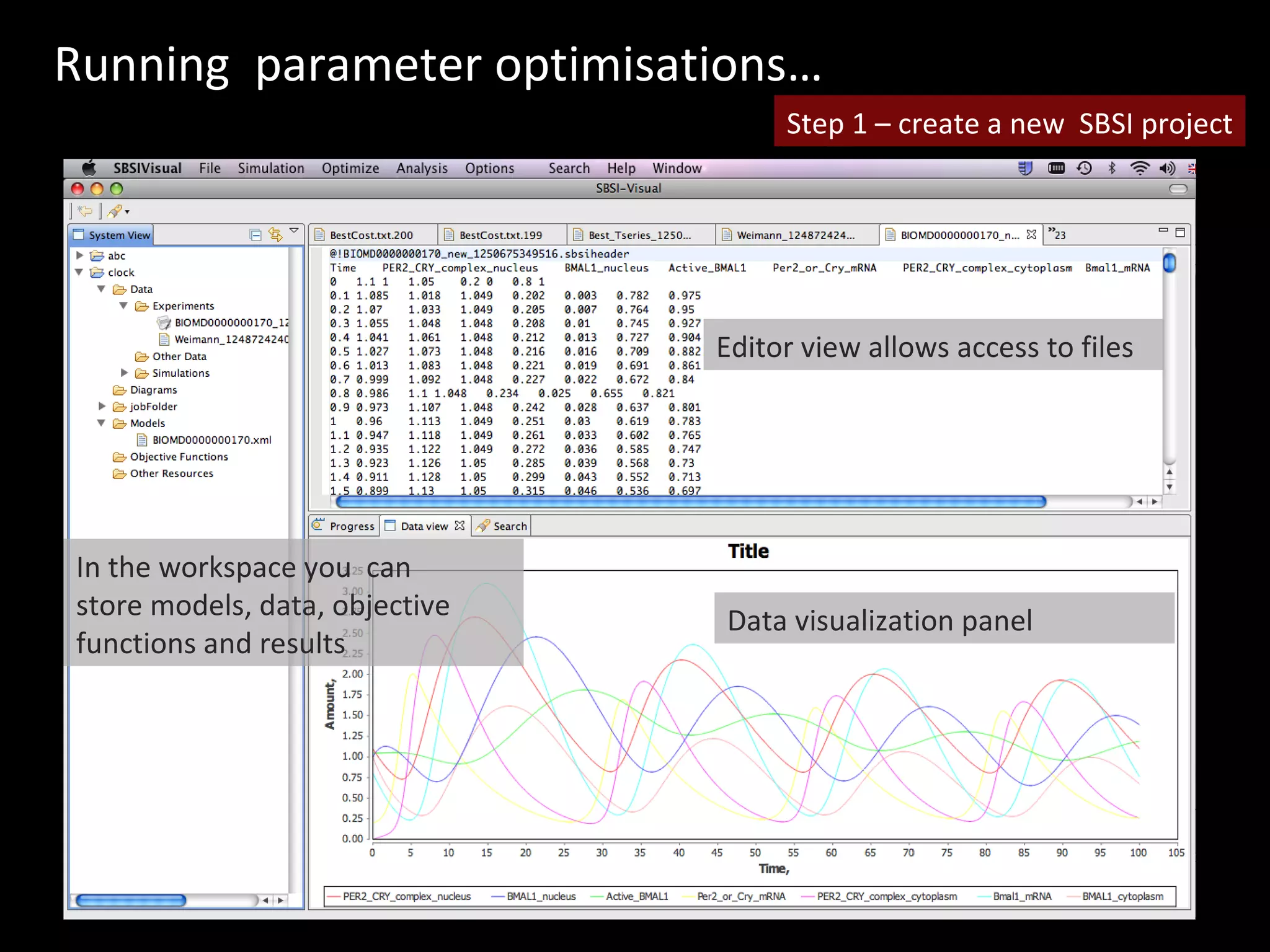
In the workspace you  can  store models, data, objective functions and results Editor view allows access to files Data visualization panel Step 1 – create a new  SBSI project Running  parameter optimisations…
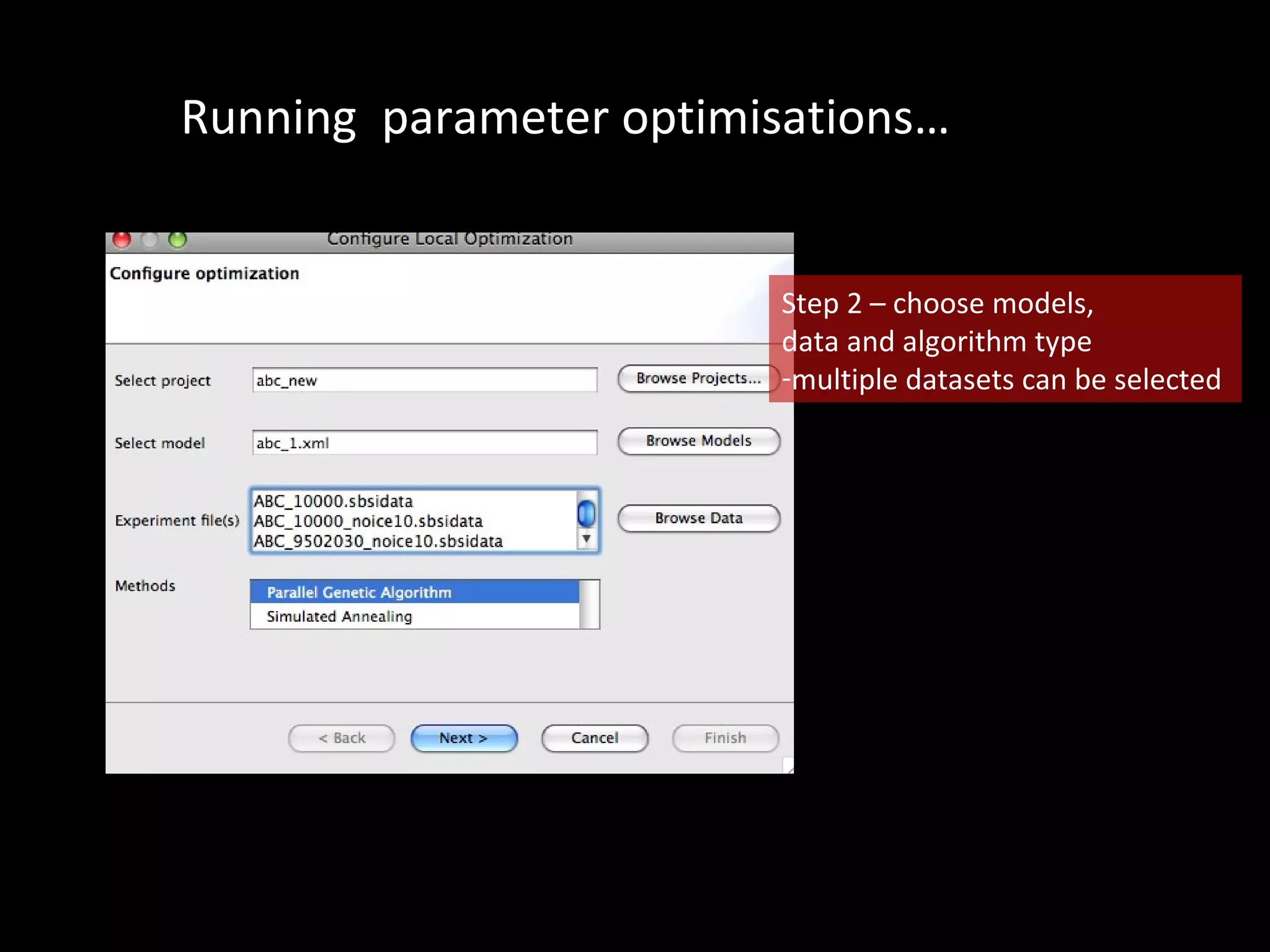
Running  parameter optimisations… Step 2 – choose models, data and algorithm type multiple datasets can be selected
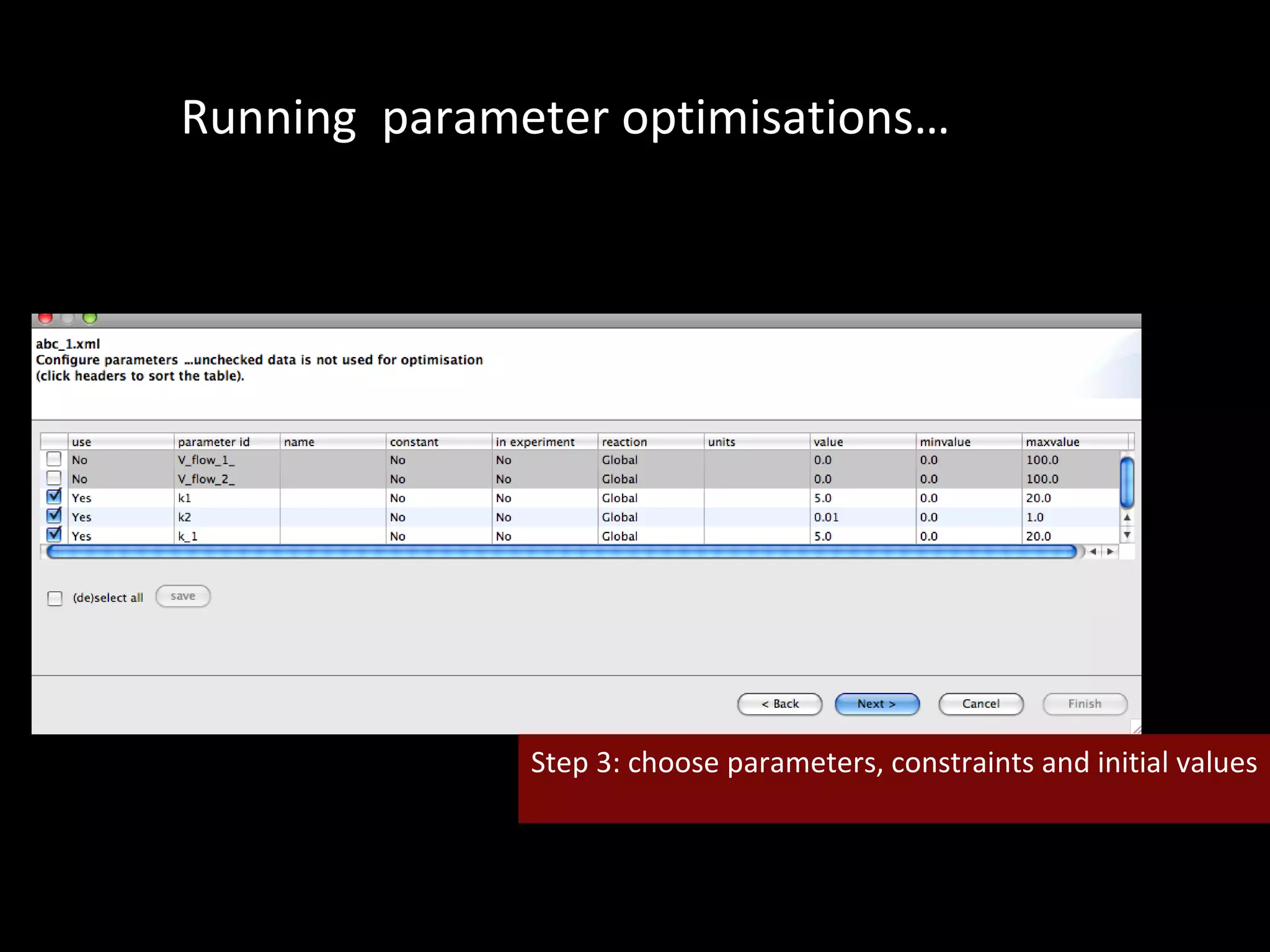
Step 3: choose parameters, constraints and initial values Running  parameter optimisations…
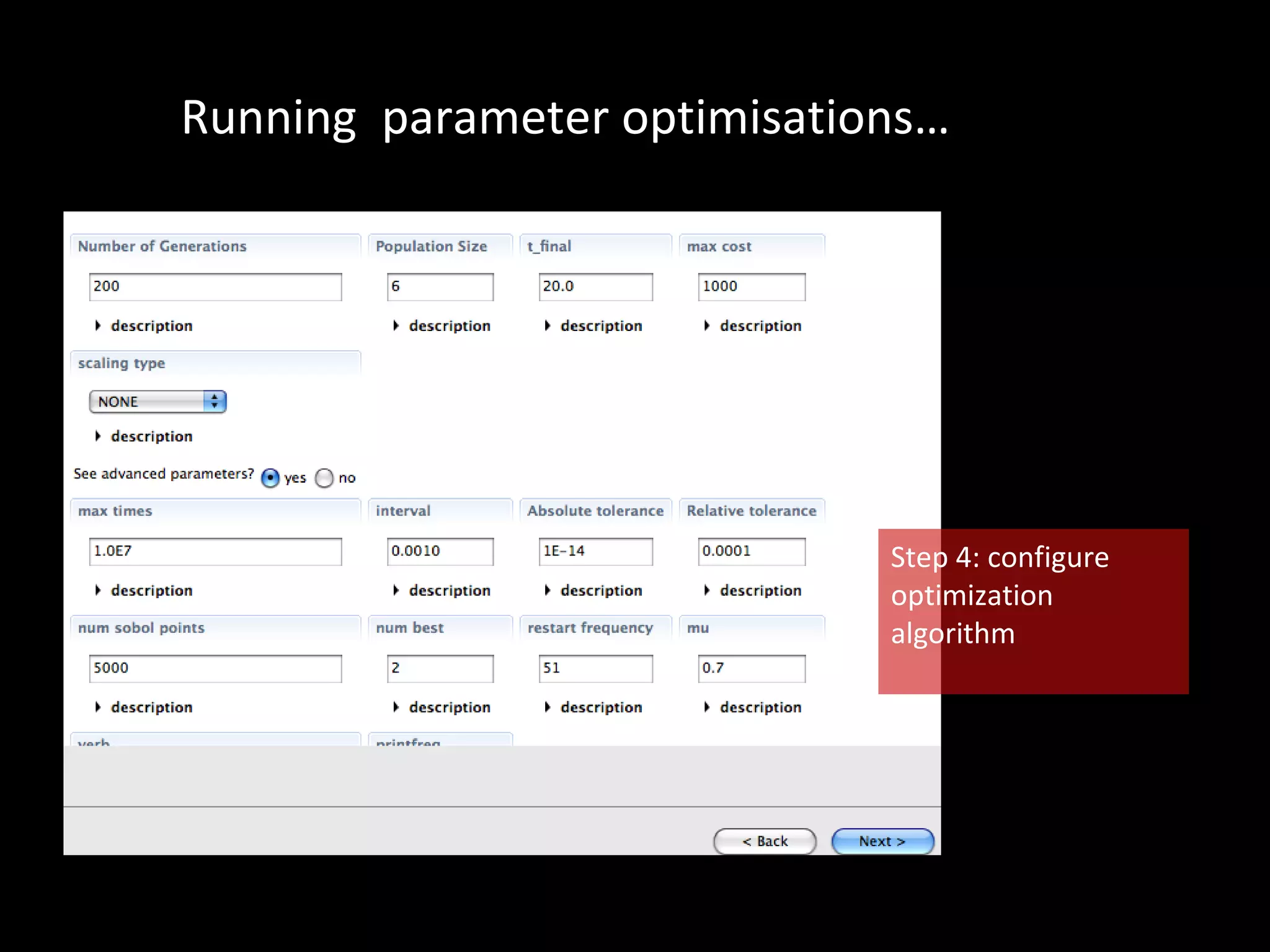
Running  parameter optimisations… Step 4: configure optimization algorithm
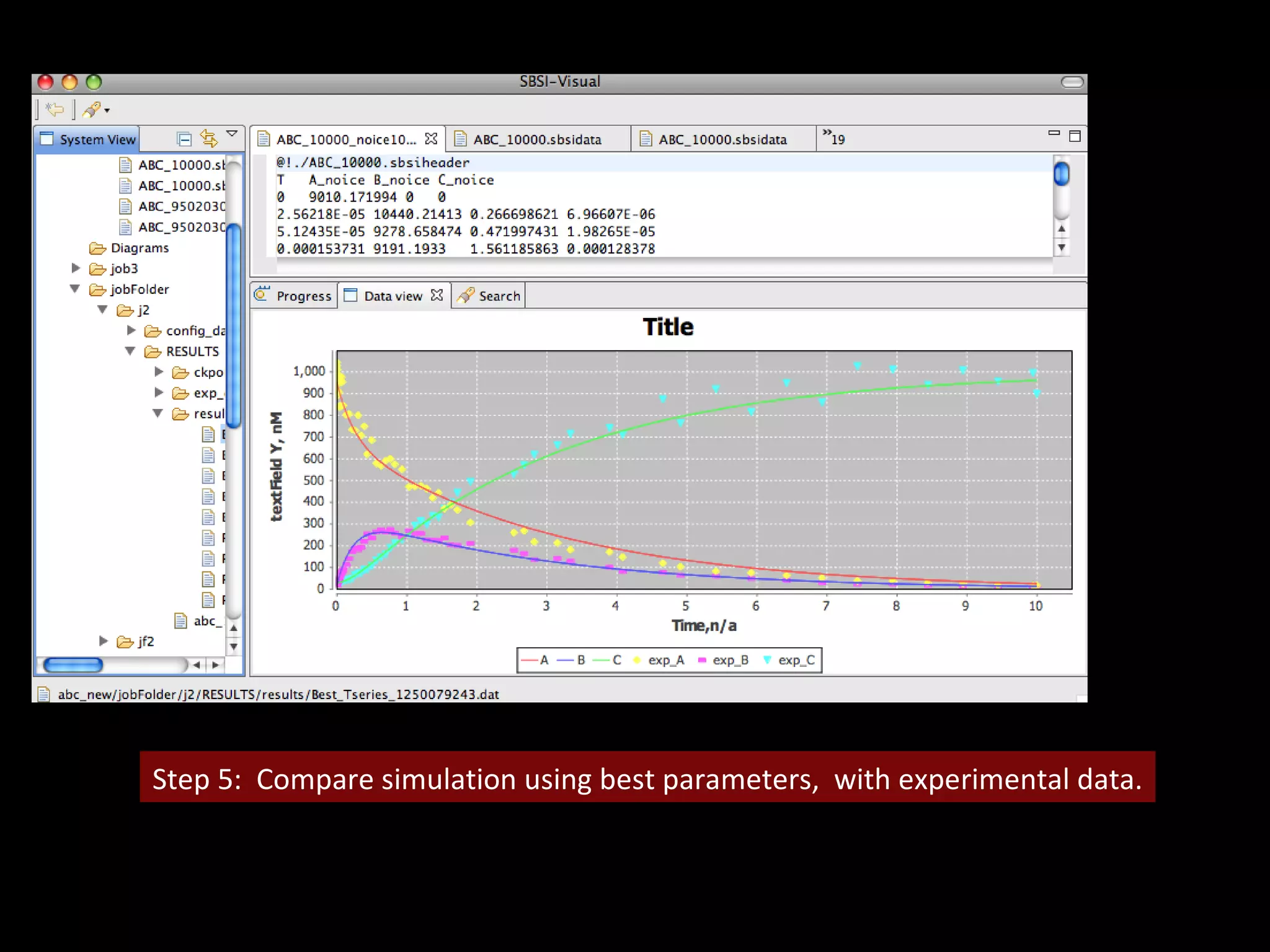
Step 5:  Compare simulation using best parameters,  with experimental data.

Ti met may10

  • 1.
    The Systems Biology Software Infrastructure TiMet Workshop May 7 th 2010, Edinburgh Richard Adams www.sbsi.ed.ac.uk http://sourceforge.net/projects/sbsi/
  • 2.
    SBSI - Overallobjective ‘ A new infrastructure to streamline the connection between data, models, and analysis, allowing the updating of large scale data, models and analytic tools with greatly reduced overhead’
  • 3.
    SBSI Contributors Coredevelopers EPCC Test Models and Evaluation Project management Circadian clock modellers Stephen Gilmore PI Nikos Tsorman Neil Hanlon Galina Lebedeva Alexey Goltsov Azusa Yamaguchi Kevin Stratford People previously involved with SBSI Shakir Ali Anatoly Sorokin Treenut Saithong Stuart Moodie Ozgur Akman Igor Goryanin Biopepa integration Adam Duguid Richard Adams Requirements & Numerics Andrew Millar Carl Troein
  • 4.
    Graphical Notation NetworkInference Process Algebras Model analysis Existing knowledge High-resolution data High-throughput data New knowledge Static models Kinetic models Systems Biology Software Infrastructure ™ Kinetic Parameter Facility Circadian clock RNA metabolism Interferon signalling Systems Biology Research, CSBE view ERB-b signalling
  • 5.
    Initial use case: Parameter Estimation Problem Building predictive models – challenging problem in Systems Biology Parameter estimation – critical stage in model development Multiple data sets needed for model calibration Optimization of large scale models –computationally challenging Circadian clock modelling project requires model optimization.
  • 6.
    SBSI Numerics optimization SBML model, Parameter constraints, Experimental Data files Configuration file Model.cpp, Datafiles, Parameter constraints SBML->C++ conversion Best parameters Cost function behaviour Time course with best parameters Eddie (ECDF) Output Using command line client Run on HPC retrieve results Input
  • 7.
    Integration of otherCSBE projects BioPepa ✔ Outline of SBSI design External model & experimental d ata sources BioModels ✔ SBSI Dispatcher (Task Manager ) Compile C codes Submit jobs to HPC ✔ Retrieve results ✔ Provide job status SBSI Numerics core SBSI Visual ✔ Desktop application ✔ Upload and edit SBML models Run simulations Configure and run optimisations ✔ Interact with external repositories ✔ Visualisation of data and results Eddie (ECDF) SBSI Numerics SBSI Numerics SBSI servers SBSI Numerics SBSI - complete system
  • 8.
    Integration of other CSBE projects BioPepa ✔ EPE External model & experimental d ata sources SBSI Visual ✔ Desktop application ✔ Upload and edit SBML models Run simulations Configure and run optimisations ✔ Interact with external repositories ✔ Visualisation of data and results SBSI Numerics SBSI - local mode
  • 9.
    SBSI Dispatcher (Task Manager ) Compile C codes Submit jobs to HPC ✔ Retrieve results ✔ Provide job status SBSI Numerics CellDesigner Eddie (ECDF) SBSI Numerics SBSI Numerics SBSI servers SBSI Numerics A plugin for CellDesigner CellDesigner – SBSI plugin
  • 10.
    Nactem CellDesigner DunnartInSilicoIDE SBSI PathText Kleio Panther Pathways database autolayouts visualizes annotates Provides SBML models Optimizes? Sabio- RK database Kinetic parameters Copasi Ananiadou/Tsujii/Kemper Mi (SRI) Funahashi/Ghosh Nomura (Osaka) updates EHMN Goryanin (Edinburgh) Boyd (Melbourne) 4-6 July Manchester, 8-9 October Edinburgh (ICSB), OIST early March 2011 Existing organisations/interactions Planned collaborations Gilmore (Edinburgh) GARUDA partners Proposed collaborations
  • 11.
  • 12.
    Optimizing Circadian Clockmodels with experimental data BIOMD055: “Extension of a genetic network model by iterative experimentation and mathematical analysis.” by J. C. W. Locke, M. M. Southern, L. Kozma-Bognar, V. Hibberd, P. E. Brown, M. S. Turner, A. J. Millar (2005b). Molecular Systems Biology. 1:13 The model has 57 parameters and 13 states( equations). Fitting data is 2 of those states obtained by experiment. Using BG/L 128 nodes, it finished at 63140th generation by non-improvement criteria. The run time is 46 hours. Multiple Cost Function is used up to 6740 generation, after 6740th, only X2Cost is applied
  • 13.
    Release code baseon Sourceforge Establish SBSI Numerics on Hector Provide access to SBSI through CellDesigner Develop user base /community Publish! SBSI goals 2010
  • 14.
    In the workspaceyou can store models, data, objective functions and results Editor view allows access to files Data visualization panel Step 1 – create a new SBSI project Running parameter optimisations…
  • 15.
    Running parameteroptimisations… Step 2 – choose models, data and algorithm type multiple datasets can be selected
  • 16.
    Step 3: chooseparameters, constraints and initial values Running parameter optimisations…
  • 17.
    Running parameteroptimisations… Step 4: configure optimization algorithm
  • 18.
    Step 5: Compare simulation using best parameters, with experimental data.

Editor's Notes

  • #6 Predictive models – desirable e.g., for P4 medicine Search space dimensionality increases with each new parameter to fit
  • #10 - Motivated from Kitano’s comments after ISAB last year Access CellDesigner user base Part of wider ‘Garuda’ concept.
  • #11 Garuda idea – technologies for all systems biology tasks Analogy with airline partners
  • #14 SBSI has a broad set of aims, we have initially chosen to focus on a key set that would be of early benefit. Client application easy to use Integration point for other software projects