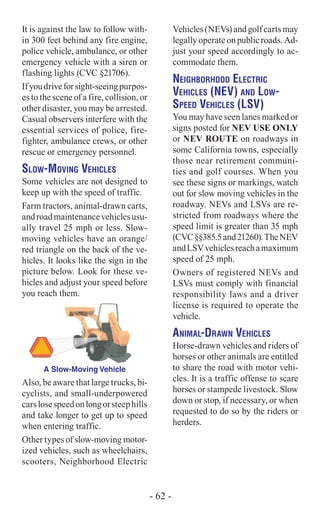



Edmund G. Brown Jr., Governor
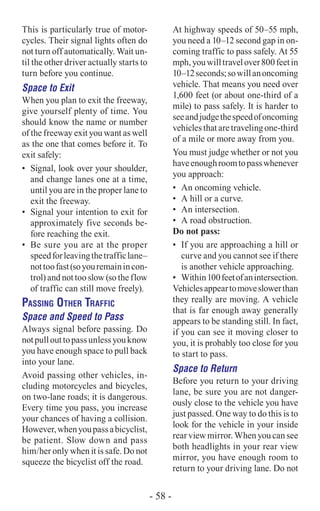
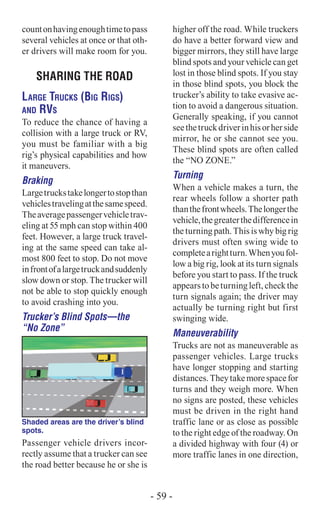
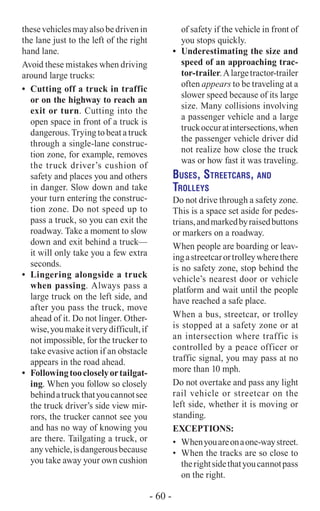
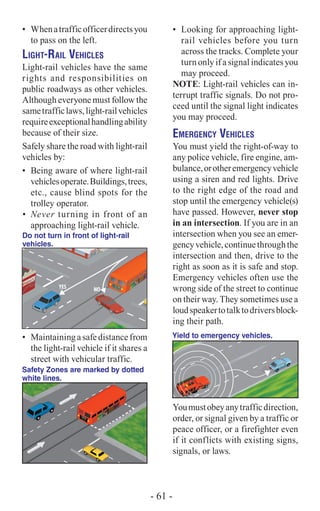
State of California
Brian P. Kelly, Secretary
California State Transportation Agency
Jean Shiomoto, Director
California Department of Motor Vehicles
®
Driver Handbook
You can also study this handbook online plus use
many other DMV online services at www.dmv.ca.gov.
Tell us how we’re doing!
English
2014
Page left
intentionally
blank
Dear Fellow Californian:
Californians today have more tools and educational materials than ever before
to help prepare for becoming a safer driver. The 2014 edition of the California
Driver Handbook contains updated information on rules of the road, prepara-
tion for the drive test and strategies to extend safe driving years.
This year, DMV has also introduced a dynamic and interactive Apple iPad
version of the California Driver Handbook to help drivers prepare for DMV’s
written exam. New and experienced drivers will find this handbook a valu-
able resource for information about safe driving.
DMV’s YouTube Channel continues to cover a wide range of topic—driver
safety, study tips on passing the drive test, videos on commercial vehicles,
and other educational videos of interest.
DMV also offers useful online services at www.dmv.ca.gov. You can go on-
line for vehicle registration, driver license renewal, online appointments and
opportunities to purchase specialty license plates.
Whether you are a new or experienced motorist, I hope this handbook—and
all DMV educational resources—enhances your experience on California
roads and promotes safe driving in the years ahead.
Sincerely,
Brian P. Kelly
Secretary
California State Transportation Agency
- i -
Page left
intentionally
blank
TABLE OF CONTENTS
New 2014 Laws........................ vi
Effective September 16, 2014.......vi
Where to Write...............................vi
dmv INFORMATION................... vii
GENERAL INFORMATION............... 1
Disclaimer.......................................1
Accurate Identification....................1
Basic Information............................1
THE CALIFORNIA DRIVER LICENSE... 2
Who Must Have a Driver License?.....2
California Residents...................2
California Resident Military
Personnel (U.S. Armed Forces).....2
Nonresident Military Personnel
Stationed in California................2
New California Residents...........2
Adults Visiting California.............2
Minors Visiting California............3
OBTAINING A DRIVER LICENSE........ 3
Acceptable Documents..................3
Application Requirements for a
Basic Class C Driver License.........4
Adults’ Permit Requirements..........4
Adults’ Driver License
Requirements.................................5
Driver LICENSE CLASSES............. 5
THE EXAMINATION PROCESS.......... 9
Where to Take the Tests.................9
Cheating.........................................9
DMV Examinations.........................9
Special Section - Minors..........10
Minors’ Permit Requirements.......10
Minors’ Permit Restrictions..........10
Minors’ Driver License
Requirements...............................11
Exceptions - Minors’ Driver
License Restrictions.....................11
Out-Of-State Minors.....................12
Out-Of-State Minor’s Permit.....12
Out-Of-State Minor’s Driver
License ....................................12
Traffic Violations ..........................12
Teenage Traffic Deaths............13
Actions Against the Provisional
Driver License...............................13
Keeping Your Provisional Driver
License.....................................13
Habitual Truant—
Persons 13 – 18 Years of Age...14
Minors and Cell Phones...............14
MISCELLANEOUS LICENSING
INFORMATION...........................14
To Replace a Lost/Stolen or
Damaged Driver License..............14
Name Changes.............................14
Driver License Renewals..............14
Renewal by Mail, Internet, or
Telephone.....................................15
Driver License Extension.............15
Driver License in Your
Possession...................................15
Address Changes.........................16
Vision............................................16
Medical Information Card.............16
Organ and Tissue Donation.........16
Veteran Benefit Information..........17
Unlicensed Drivers.......................17
Diplomatic Driver Licenses...........17
Identification (ID) Cards................17
Free ID Cards for Physical and
Mental (P&M) Conditions.............18
Identification (ID) Card Renewal
by Mail or Internet ........................18
Driving Schools............................18
Mature Driver Program.................18
Pedestrian Responsibilities..........19
OCCUPANT PROTECTION..............20
Seat Belts.....................................20
Mistaken Beliefs About Seat
Belts..........................................20
Child Restraint System and
Safety Seats.................................21
Riding Safely with Air Bags......... 22
Side-Impact Air Bags.............. 22
Unattended Children in Motor
Vehicles........................................23
Hot Weather Risks........................23
Traffic CONTROLS....................23
Traffic Signal Lights......................23
Pedestrian Signal Lights..............24
Traffic Signs..................................29
LAWS AND RULES OF THE ROAD.....30
Right-of-Way Rules..................... 30
General Information................. 30
- iii -
Pedestrians.............................. 30
Crosswalks...............................31
Intersections.............................31
Roundabouts........................... 32
On Mountain Roads................ 32
Speed Limits................................ 33
Maximum Speed Limit............ 33
Reduced Speeds.................... 33
Heavy Traffic or Bad Weather.. 33
Towing Vehicles, Buses, or
Large Trucks............................33
Around Children......................33
Blind Intersections...................34
Alleys.......................................34
Near Railroad Tracks...............34
Light Rail Transit Vehicle
Crossings................................35
Near Streetcars, Trolleys, or
Buses.......................................35
Business or Residential
Districts....................................36
Near Animals...........................36
VISUAL SEARCH.........................36
Scanning...................................... 36
Know What Is Ahead............... 36
Know What Is at Your Side...... 38
Know What Is Behind You....... 38
How Well Can You Stop?............ 39
LANE CONTROL..........................39
Line Colors.................................. 39
Choosing a Lane......................... 40
Changing Lanes.......................... 40
Passing Lanes..............................41
Carpool/High Occupancy
Vehicles (HOV) Lanes .................41
Center Left Turn Lanes.................41
Turnout Areas and Lanes.............42
End-of-Lane Markings..................42
Shared Roadway Bicycle
Markings (Sharrows)....................42
Bicycle Lanes...............................42
TURNS.....................................43
Examples of Right and Left Turns... 44
Legal U-Turns.............................. 45
Illegal U-Turns.............................. 45
PARKING..................................46
Parking on a Hill.......................... 46
Parallel Parking........................... 46
How to Park..................................47
Parking at Colored Curbs.............51
Illegal Parking...............................52
Special Parking Rules..................52
SAFE DRIVING PRACTICES............53
Signaling...................................... 53
Steering....................................... 53
Horn, Headlights, and
Emergency Signals..................... 54
Use Your Horn......................... 54
Do Not Use Your Horn............. 54
Use Your Headlights................ 54
Use Your Emergency Signals.. 55
Text Messaging and Cell Phones... 55
VEHICLE POSITIONING.................56
Following Distances.................... 56
Taking Dangers One at a Time..56
Splitting the Difference............ 56
Persons Who Present Dangers
to Drivers.................................. 56
Merging In/Out of Traffic...............57
Space to Merge........................57
Space to Cross or Enter...........57
Space to Exit........................... 58
Passing Other Traffic................... 58
Space and Speed to Pass...... 58
Space to Return....................... 58
SHARING THE ROAD....................59
Large Trucks (Big Rigs)
and RVs........................................59
Braking.....................................59
Trucker’s Blind Spots—the
“No Zone”.................................59
Turning......................................59
Maneuverability........................59
Buses, Streetcars, and Trolleys... 60
Light-Rail Vehicles........................61
Emergency Vehicles.....................61
Slow-Moving Vehicles................. 62
Neighborhood Electric Vehicles
(NEV) and Low-Speed Vehicles
(LSV)............................................ 62
Animal-Drawn Vehicles............... 62
Motorcycles................................. 63
Bicycles....................................... 64
Bicycles in Travel Lanes.......... 65
Pedestrians Who Are Blind......... 65
Road Workers and Work Zones
(“Cone Zones”)............................ 66
Double Fine Zones.......................67
Move Over and Slow Down..........67
- iv -
Vehicles with Hazardous Loads...67
Important Driving Tips................. 68
Dealing with Traffic Congestion... 68
Dealing with Aggressive Drivers
and Road Rage........................... 68
Special Driving Situations......68
Keep Your Car Visible................. 68
What Is the Road Condition........ 68
Curves......................................... 69
Driving in Heavy Traffic............... 69
Traffic Speeds............................. 69
Driving Hazards........................... 69
Water on the Road................... 69
Slippery Roads........................ 69
High Winds...............................72
Driving in the Fog.....................72
Driving in Darkness..................73
Driving in Rain or Snow............73
Driving in Hill Country or Curves....74
Traffic Breaks ...........................74
Clean Windows and Mirrors.........74
Adjust Seat and Mirrors................74
What a Driver Should Do During
an Enforcement Stop....................75
HANDLING EMERGENCIES.............75
Mechanical Tips...........................75
Skids on Slippery Surfaces......75
Acceleration Skids....................76
Locked Wheel Skids.................76
Accelerator Malfunction...........76
Steering Wheel Locking
Device.......................................76
Collisions Are Not Accidents....... 77
Causes of Collisions................ 77
Involved in a Collision.............. 77
Reporting a Collision............... 77
Safety Tips....................................78
DRIVER READINESS....................79
Safety for the Aging Driver...........79
Good Vision for All Drivers...........79
Hearing.........................................79
Alertness..................................... 80
Medications................................. 80
Health and Emotions....................81
Conditions Physicians Must
Report...........................................81
Alcohol and Drugs.................81
Alcohol/Drugs and Driving Is
Dangerous....................................81
Carrying Alcohol in a Vehicle...... 85
Drivers Under 21 (Possession
of Alcohol)................................ 85
Drivers of All Ages....................... 85
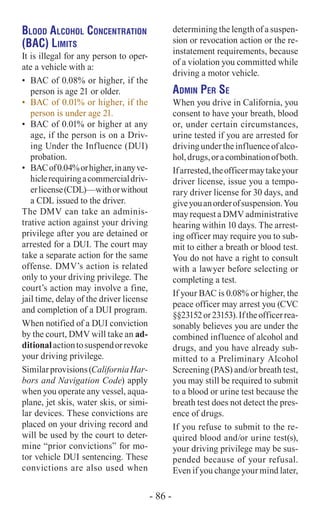
Blood Alcohol Concentration
(BAC) Limits................................. 86
Admin Per Se............................... 86
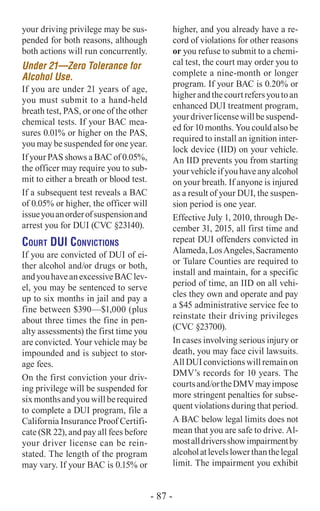
Under 21—Zero Tolerance for
Alcohol Use. ............................87
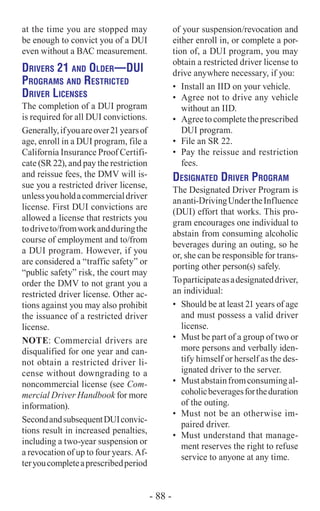
Court DUI Convictions..................87
Drivers 21 and Older­—DUI
Programs and Restricted Driver
Licenses...................................... 88
Designated Driver Program......... 88
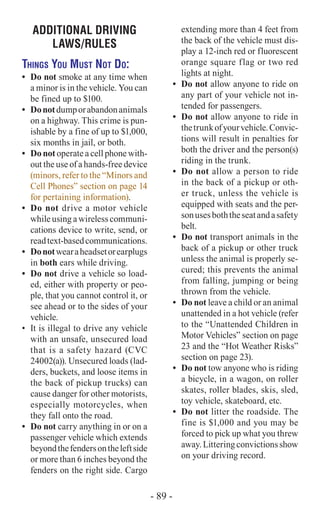
ADDITIONAL DRIVING
laws/RULES............................89
Things You Must Not Do:............. 89
Things You Must Do:................... 90
ADMINISTRATIVE.......................91
Financial Responsibility...............91
Insurance Requirements..............91
Collisions on Your Record........... 92
Collisions, Insurance, and
Minors.......................................... 92
Getting a Ticket........................... 92
Evading a Peace Officer.............. 93
Points on the Driver Record........ 93
Traffic Violator School
Convictions.................................. 93
Suspension or Revocation by
the DMV....................................... 94
Suspension by Judge.................. 94
Record Confidentiality................. 94
Vandalism/Graffiti—All Ages....... 95
Speed Contests/Reckless
Driving......................................... 95
Possessing Firearms................... 95
Vehicle Registration
Requirements.............................. 95
California Vehicles................... 95
Out-of-State Vehicles.............. 96
Vehicle Theft Prevention Tips..... 96
Driver License Fast Facts and
Other Publications ................98
Available Online........................... 98
Available in Print Only................. 98
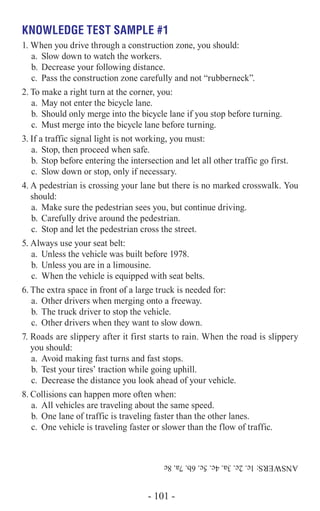
Knowledge Test Sample #1........101
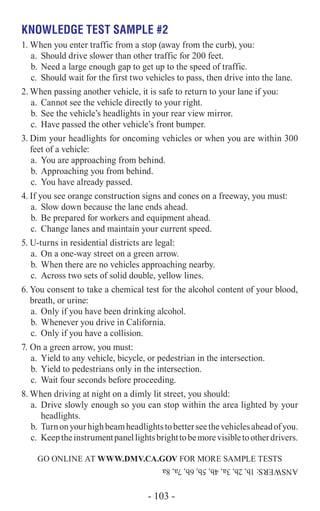
Knowledge Test Sample #2........103
- v -
New 2014 Laws
Effective September 16, 2014
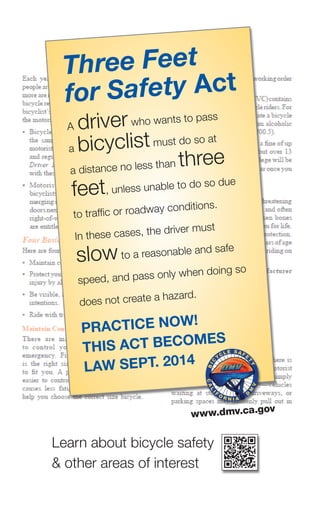
Three Feet for Safety Act
A driver who wants to pass a bicyclist must do so at a distance no less than
three feet, unless unable to do so due to traffic or roadway conditions. In
these cases, the driver must slow to a reasonable and safe speed, and pass
only when doing so does not create a hazard.
Where to Write
If you have any comments or suggestions regarding this publication,
please send them to:
Department of Motor Vehicles
Customer Communications Section MS H165
PO Box 932345
Sacramento, CA 94232-3450
© Copyright, Department of Motor Vehicles 2014
All rights reserved
This work is protected by U. S. Copyright Law. DMV owns the copyright of this work.
Copyright law prohibits the following: (1) reproduction of the copyrighted work; (2)
distribution of copies of the copyrighted work; (3) preparation of derivative works
based upon the copyrighted work; (4) displaying the copyrighted work publicly; or
(5) performing the copyrighted work publicly. All requests for permission to make
copies of all or any part of this publication should be addressed to:
Department of Motor Vehicles
Legal Office MS C128
PO Box 932382
Sacramento, CA 94232-3820
- vi -
dmv INFORMATION
Most DMV offices are open from 8 a.m. to 5 p.m. on Monday, Tuesday,
Thursday and Friday; from 9 a.m. to 5 p.m. on Wednesday. Some field of-
fices have extended hours (open earlier), and a few offer only driver license
or vehicle registration services. To find out if your local field office has ex-
tended hours, or to find a field office location and service options, go online
or call the toll-free number.
Make sure to have your driver license or identification card number, vehicle
license plate number and/or vehicle identification number (VIN) available.
Go online at www.dmv.ca.gov for (to):
•	 Field office locations, hours, directions, and phone numbers.
•	 Make appointments to visit a field office or take a driving test (except for
commercial driving tests).
•	 Order personalized plates.
•	 Driver license and identification card information.
•	 Vehicle/vessel registration information.
•	 Downloadable forms.
•	 Publications—handbooks, brochures, and sample tests.
•	 Senior driver information.
•	 Teen driver information.
•	 Links to other state and federal agencies.
•	 Renew your driver license or vehicle registration.
Call1-800-777-0133duringnormal
business hours to:
•	 Obtain/requestdriverlicenseand
vehicle registration information,
forms, and publications.
•	 Find office locations and hours.
•	 Makeadrivingtestappointment.
•	 Speak to a DMV representative
or request a call back.
Call 1-800-777-0133 for automat-
ed service 24 hours a day, 7 days
a week to:
•	 Renew your driver license or
vehicle registration with the
Renewal Identification Number
(RIN) provided on your billing
notice. You can pay with a credit
card or e-check.
•	 Make a field office appointment.
Advertising sponsorship helps defray the printing costs of this publication. The
products and services provided by the advertising sponsors are not promoted or
endorsed by DMV, but the significant contribution by the advertising sponsors is
most appreciated.
If you would like to advertise in this publication, please call the Office of State
Publishing Advertising Department at 1-866-824-0603.
Persons with speech or hearing impairments can call, toll free, 1-800-368-
4327 for assistance with DMV services. Only typed messages from another
TTY are received and responded to at this number.
- vii -
®
w w w.dmv.ca.gov
1-800-777-0133
m a k e a n
a p p o I n t m e n t
get out
free
of DmV lInes
GENERAL INFORMATION
Disclaimer
The fees listed in the California Driver Handbook are subject to legislative
change. This handbook provides a summary of the laws and regulations out-
linedintheCaliforniaVehicleCode(CVC).TheDepartmentofMotorVehicles
(DMV), law enforcement, and the courts follow the full and exact language of
the CVC. The CVC and DMV fees are available online at www.dmv.ca.gov.
You may also buy a copy of the CVC at any DMV office.
Accurate Identification
The reliability, integrity, and confidentiality of the California driver license
(DL) and identification (ID) card is of prime concern to all levels of govern-
ment, the private sector and the general public.
It is critical that these documents be completely authenticated and accurate.
The California Legislature has declared that the DL or ID card is the primary
identification document in this state. California law requires that all appli-
cants who apply for an original California DL/ID card submit proof of legal
presence in the U.S. as authorized under federal law. Your true full name as
shown on your legal presence document will appear on your DL/ID card.
NOTE: Pursuant to AB 60 (Ch. 524, Stats. 2013), DMV will begin issuing
driver licenses to applicants who are unable to provide evidence of their status
in the United States (U.S.). As such, requirements for driver licensing will be
modified in accordance with the effective date of January 1, 2015.
Basic Information
A California driver license shows that you have been given permission by the
state to drive on public roadways. You may apply for a driver license at most
DMV offices (refer to page vii).
It is a misdemeanor to drive in California without a valid driver license. If
you do, you can be cited, your vehicle may be impounded, and you may have
to appear in court.
If you do not have outstanding actions on your record, you will receive a
driver license after you pay the application fee, pass all applicable knowledge
examinations, show that your physical and/or mental condition is satisfacto-
ry, and demonstrate your ability to drive safely. If you have a medical condi-
tion or a disability, the DMV may require you to take a driving test. You may
also have to provide a statement from your physician regarding your current
health condition.
- 1 -
THE CALIFORNIA DRIVER
LICENSE
Who Must Have a Driver
License?
California Residents
California residents who drive on
public highways or use public park-
ing facilities must have a California
driver license, unless they are:
•	 An officer or employee of the U.S.
government operating a vehicle
owned or controlled by the
U.S. government on federal
business, except when operating
a commercial motor vehicle.
•	 Drivingoroperatingimplements
of husbandry not operated or
moved over a highway.
•	 Drivingoroperatinganoff-high-
way vehicle across a highway.
California Resident Military
Personnel (U.S. Armed Forces)
If you are out-of-state on active
military duty and have a valid Cali-
fornia driver license, your and your
spouse’s California driver license
willbevalidforthefulltimeyouare
absent from California and for 30
daysfollowingyourdischargedate,
ifyouarehonorablydischargedout-
side of California. Carry both, your
driver license and discharge or sep-
aration documents, during those 30
days (CVC §12817).
Call 1-800-777-0133 to obtain an
Extension of License for Person in
ArmedForces(DL236)cardwhich
extends your California driver
license.
NOTE: Your driver license is not
valid if it is suspended, cancelled
or revoked.
Nonresident Military Personnel
Stationed in California
If you are 18 years of age or older,
refer to the “California Residents”
and “Adults Visiting California”
sections on this page for additional
information. Licensees eligible for
military extensions should carry
documentation from their home
state to verify their status to law
enforcement.
New California Residents
When you become a California
resident and you want to drive in
California, you must apply for a
California driver license within
10 days. Residency is established
in a variety of ways, including the
following:
•	 Being registered to vote in
California elections.
•	 Paying resident tuition at a
California college or university.
•	 Filingforahomeowner’sproperty
tax exemption.
•	 Receiving any other privilege or
benefit not ordinarily extended
to nonresidents.
Adults Visiting California
Visitors over 18 years old with a
validdriverlicensefromtheirhome
state or country may drive in Cali-
fornia without getting a California
driver license as long as their home
state driver license is valid.
- 2 -
Minors Visiting California
Visitors between 16 – 18 years old
may drive with their home state
driver license for only 10 days af-
ter arriving in California. After 10
days, they must have a:
•	 CurrentCaliforniadriverlicense,
or
•	 Nonresident Minor’s Certificate
(which is issued by DMV) to a
minor with proof of financial
responsibility.
OBTAINING A DRIVER
LICENSE
When you apply for an original
DL/ID card, you must present
an acceptable birth date/legal
presence document and provide
your social security number (SSN).
Depending on the birth date/legal
presence document you present,
your California DL/ID card may
expireonthesamedateasyourlegal
presence document. If the name
on your birth date/legal presence
documentisdifferentfromthename
on your DL/ID card application,
you must also bring an acceptable
true full name document. Your
fingerprint, signature, and picture
will also be taken (refer to the
“Application Requirements for
a Basic Class C Driver License”
section on page 4). For any other
DL/ID card transaction, you must
present photo identification.
Acceptable Documents
An acceptable birth date/legal
presenceortruefullnamedocument
is issued by a county or state. This
document is a certified copy of the
original (the original is retained by
the county or state) and contains
an impressed seal or an original
stamped impression. The DMV
will not accept a photocopy of
the certified copy for birth date/
legal presence or true full name
verification.
NOTE: Pursuant to AB 60 (Ch.
524, Stats. 2013), DMV will begin
issuingdriverlicensestoapplicants
who are unable to provide evidence
of their status in the U.S. As such,
requirements for driver licensing
willbemodifiedinaccordancewith
theeffectivedateofJanuary1,2015.
Examples of other acceptable birth
date/legal presence documents
are: U.S. Birth Certificate, U.S.
Passport, U.S. Armed Forces ID
Cards,CertificateofNaturalization,
Permanent Resident Card, or a
foreignpassportorMexicanBorder
CrossingCardwithavalidI-94.The
I-94 expiration date must be more
than 2 months from the DL/ID card
application date.
Examples of true full name
verification documents include:
adoption documents containing
your legal name as a result of
the adoption, name change
documents containing your legal
name both before and after, a
marriage certificate, a certificate
- 3 -
or registration document verifying
the information of a domestic
partnership, or a dissolution of
marriage document containing
your legal name as a result of the
court order.
A complete list of birth date/legal
presence documents is available
at www.dmv.ca.gov or in the
Requirements for a California
Driver License/Identification (DL/
ID) Card (FFDL 05) Fast Facts
brochure.
Application Requirements
for a Basic Class C Driver
License
ToapplyforaClassCdriverlicense,
you must:
•	 Submit a completed and signed
Driver License or Identification
Card Application (DL 44) form.
Signing this form means you
agree to submit to a chemical test
to determine the alcohol or drug
content of your blood when re-
quested by a peace officer. If you
refuse to sign this statement, the
DMV will not issue a permit or
driver license.
•	 Present an acceptable birth date/
legal presence document.
•	 Provide your true full name.
•	 Provide your SSN, if eligible,
which will be electronically ver-
ified with the Social Security
Administration.
NOTE: Pursuant to AB 60 (Ch.
524, Stats. 2013), DMV will begin
issuingdriverlicensestoapplicants
who are unable to provide evidence
of their status in the U.S. As such,
requirements for driver licensing
willbemodifiedinaccordancewith
theeffectivedateofJanuary1,2015.
•	 Pay a nonrefundable application
fee. The fee is good for 12 months
and allows you to take the appro-
priate law test(s) three times. If
youfailthelawtestand/ordriving
test three times, your application
will be void and a new applica-
tion and fee are required. This
fee pays for both the instruction
permit and driver license, if you
qualifyforbothdocumentswithin
the 12-month period. If the appli-
cationexpires,youmustresubmit
documents, repay the application
fee, and retake the required tests.
•	 Pass a vision test. You must be
able to pass a vision test, with or
without corrective lenses, with
visual acuity better than 20/200
in at least one eye without the
use of a bioptic telescopic lens or
similar bioptic device to meet the
minimum vision acuity standard
(CVC §12805(b)).
•	 Have your picture taken.
•	 Give a fingerprint scan.
•	 Sign your name.
Adults’ Permit Requirements
If you are at least 18 years old, meet
the application requirements, and
pass the required tests, you may
be issued a California instruction
permit.
You must have an instruction per-
mit while learning to drive. Your
accompanying driver must be 18
years of age or older and have a
- 4 -
validCaliforniadriverlicense.This
person must be seated close enough
to you that he or she is able to take
control of the vehicle at any time.
An instruction permit does not per-
mit you to drive alone–not even to a
DMVofficetotakethedrivingtest.
If you want to obtain professional
drivereducationanddrivertraining,
refer to the “Driving Schools” and
“Mature Driver Program” sections
on pages 18 and 19.
Ifyouhaveamotorcyclepermit,you
cannot carry passengers, you must
rideduringdaylighthoursonly,and
you cannot ride on the freeway.
Togetamotorcyclepermityoumust:
•	 Be at least 18 years of age.
•	 Complete the application
requirements.
•	 Pass a traffic laws and road signs
test.
Adults’ Driver License
Requirements
Ifyouhaveneverbeenlicensed,you
must meet the following criteria:
•	 Be at least 18 years old.
•	 Complywiththerequirementsfor
a driving permit and when you
are ready, make an appointment
totakethebehind-the-wheeldriv-
ing test. When you report for the
driving test, bring your instruc-
tion permit with you.
•	 Pass the behind-the-wheel driv-
ing test. If you fail the test, you
must pay a retest fee for a second
or subsequent test and schedule a
behind-the-wheeldrivingtestfor
another day.
If you have an out-of-state or out-
of-countrydriverlicense,youmust:
•	 Complete all the steps required
for a driving permit.
•	 Bring your valid out-of-state
driver license to the DMV. Your
out-of-state driver license will
be invalidated and returned to
you unless you are applying for
a commercial driver license.
NOTE:Thebehind-the-wheeldriv-
ing test for holders of out-of-state
or U.S. territory driver licenses are
normally waived. However, DMV
may require a behind-the-wheel
driving test for any type of driver
license application. Behind-the-
wheel driving tests are mandatory
for out-of-country driver license
holders.
Driver LICENSE
CLASSES
This handbook is primarily for a
basic Class C driver license.
Class C driver license -
•	 You may drive a:
–	 2-axlevehiclewithaGrossVe-
hicle Weight Rating (GVWR)
of 26,000 lbs. or less.
–	3-axle vehicle weighing 6,000
lbs. or less gross.
–	Housecar 40 feet or less.
–	3-wheel motorcycle with two
wheels located in the front or
back.
–	Vanpool vehicle designed to
carry more than 10 persons,
but no more than 15 persons
including the driver.
- 5 -
note: A driver of a vanpool ve-
hicle must have evidence of a val-
id Medical Examination Report or
Medical Examination Certificate
(DL51orDL51A)whenoperatinga
vanpool.Thedrivermustkeepinthe
vanpool vehicle a statement signed
under penalty of perjury, that he or
she has not been convicted of reck-
less driving, drunk driving, or hit-
and-run in the last five years (CVC
§12804.9(j)).
•	 You may tow a:
–	Single vehicle with a GVWR
of10,000lbs.orless,including
a tow dolly, if used.
•	 Withavehicleweighing4,000lbs.
or more unladen, you may tow a:
–	Trailer coach or 5th-wheel
travel trailer under 10,000 lbs.
GVWR when towing is not for
compensation.
–	5th-wheel travel trailer ex-
ceeding 10,000 lbs. but under
15,000lbs.GVWR,whentow-
ing is not for compensation,
and with endorsement.
•	 Afarmeroremployeeofafarmer
may drive:
–	Any combination of vehicles
with a GVWR of 26,000 lbs.
or less, if used exclusively in
agricultural operations and it
isnotforhireorcompensation.
NOTE:
•	 Class C licensees may not tow
more than one vehicle.
•	 A passenger vehicle, regardless
ofweight,maynottowmorethan
one vehicle.
•	 A motor vehicle under 4,000 lbs.
unladen weight may not tow any
vehicle weighing 6,000 lbs. or
more gross. (CVC §21715(b))
Other classes of driver licenses/
endorsements are:
•	 Noncommercial Class A
•	 Noncommercial Class B
•	 Commercial Class A
•	 Commercial Class B
•	 Commercial Class C
•	 Motorcycle Class M1
•	 Motorcycle Class M2
•	 Commercial endorsements:
–	Doubles/Triples
–	Hazardous Materials
–	Passenger Transportation
–	Tank Vehicle
•	 Ambulance Driver Certificate
•	 School Bus Endorsement
•	 Tow Truck Driver Certificate
•	 Verification of Transit Training
Certificate
•	 Firefighter Endorsement
NOTE: Commercially licensed
firefighters must submit a Medi-
cal Examination Report (DL 51)
every 2 years. Noncommercially
licensed firefighters can submit a
self-certifying Health Question-
naire (DL 546).
Detailedinformationonotherdriver
licensetypesandendorsementscan
befoundintheCaliforniaCommer-
cial Driver Handbook, Recreation-
al Vehicles and Trailers Handbook,
AmbulanceDriversHandbook,Cal-
iforniaParent-TeenTrainingGuide,
and California Motorcycle Hand-
book. Please refer to these hand-
books for additional information.
- 6 -
NOTES
- 7 -
®
dmv is connecting
with Californians...
Twitter DMV NOW DMV BLOG YouTube DMV Home Pagefacebook
www.dmv.
THE EXAMINATION
PROCESS
Where to Take the Tests
You may take the knowledge, vi-
sion, and behind-the-wheel driving
tests at any DMV field office that
provides driver license services.
To save time, make an appointment
online at www.dmv.ca.gov or call
1-800-777-0133duringnormalbusi-
ness hours.
NOTE:TheDMVwillnotadminis-
ter knowledge or audio exams after
4:30 p.m. to ensure you have suffi-
cient time for testing.
Knowledge and vision tests are re-
quired when you apply for an orig-
inal driver license or upgrade to a
different class of driver license.
Cheating
The use of testing aids is strictly
prohibited. This includes, but is not
limited to: the California Driver
Handbook, cheat sheets, or elec-
troniccommunicationdevicessuch
asacellphone,hand-heldcomputer,
etc. If any testing aid is used during
the knowledge test, the knowledge
test will be marked as a “failure.”
An action may also be taken by the
DMVagainstyourdrivingprivilege
or the driving privilege of anyone
else who assists you in the exami-
nation process.
DMV Examinations
Your driver license examinations
include:
•	 A vision test. (Bring your eye-
glasses or contact lenses to the
exam.)
•	 A test of traffic laws and road
signs.
•	 A behind-the-wheel driving test,
if required. You must have an ap-
pointmenttotakethebehind-the-
wheeldrivingtest.Forthedriving
test, bring:
–	Your old driver license or in-
struction permit, if you have
one.
–	A licensed driver age 18 years
or older with a valid driver
license.
–	Proof that the vehicle is prop-
erly insured.
–	A vehicle that is safe to drive,
and has valid registration. The
vehicle’s brake lights, horn,
parking brake, and electric
signals must work properly.
The vehicle cannot have bald
tires, which would have less
than 1/32 inch tread depth in
any two adjacent grooves. The
driver’s side window must roll
down.Thewindshieldmustal-
lowafullunobstructedfieldof
vision for you and the examin-
er. There must be at least two
rear view mirrors (one on the
left outside of the vehicle).
You will be asked to locate
the controls for the vehicle’s
headlights, windshield wip-
ers, defroster, and emergency
flashers.Youmustdemonstrate
howtousetheparkingbrake.If
you use a rental vehicle for the
- 9 -
driving test, the driver’s name
must show on the contract as
the insured driver. You must
also wear your seat belt.
NOTE:Thebehind-the-wheeldriv-
ing test will be rescheduled if the
vehicle does not meet the above re-
quirements or if you refuse to use
yourseatbeltduringthedrivingtest.
For more information, refer to the
How to Prepare for Your Driving
Test (FFDL 22) Fast Facts bro-
chure, DMV videos, and sample
tests available online at www.dmv.
ca.gov.
Special Section -
Minors
Minors’ Permit Requirements
A minor is a person under 18 years
of age. Minors must have their ap-
plications (for a driver license or
any change of driver license class)
signed by their parent(s) or legal
guardian(s). If both parents/guard-
ians have joint custody, both must
sign.
NOTE: Minors may not work as
a driver for pay and they may not
driveaschoolbuscontainingpupils.
To get a permit you must:
•	 Be at least 151
/2 years of age, but
under 18 years of age.
•	 Complete the Driver License or
Identification Card Application
(DL 44) form.
•	 Haveyourparent(s)orguardian(s)
sign the DL 44 form.
•	 Pass the traffic laws and road
signs test. If you fail the test, you
must wait one week before retak-
ing the test.
•	 If you are 151
/2–171
/2 years of age,
youwillneedtoprovideproofthat
you:
–	Completed driver education
(Certificate of Completion of
Driver Education) OR
–	Are enrolled and participat-
ing in an approved integrated
driver education/driver train-
ing program (Certificate of
Enrollment in an Integrated
[Classroom] Driver Education
andDriverTrainingProgram).
For more information, refer
to the Provisional Licensing
(FFDL19)FastFactsbrochure
at www.dmv.ca.gov.
The provisional permit is not valid
until you start your behind-the-
wheel driver training with an in-
structor or reach age 171
/2.
If you have a permit and plan to
drive outside of California, check
licensing requirements in that state
or country.
NOTE: If you are at least 171
/2
years of age, you may obtain a per-
mit without completing driver edu-
cation or driver training. However,
you cannot get a driver license be-
fore you are 18 years old.
Minors’ Permit Restrictions
Your permit is not valid until you
begin driver training; your instruc-
tor will sign the permit to validate
it.Youmustpracticewithalicensed
- 10 -
California driver: parent, guardian,
driving instructor, spouse, or an
adult 25 years of age or older. The
person must sit close enough to you
to take control of the vehicle at any
time. A provisional permit does not
allowyoutodrivealone–notevento
a DMV office to take a driving test.
Minors’ Driver License
Requirements
You must:
•	 Be at least 16 years old.
•	 Prove that you have finished
both driver education and driver
training.
•	 HavehadaCaliforniainstruction
permit or an instruction permit
from another state for at least six
months (refer to the Out-of-State
Minors section on page 12).
•	 Provide parent(s) or guardian(s)
signature(s) on your instruction
permitstatingthatyouhavecom-
pleted 50 hours of supervised
drivingpractice(10hoursmustbe
night driving) as outlined in the
California Parent-Teen Training
Guide (DL 603). Visit the Teen
website at www.dmv.ca.gov/
teenweb/ or call 1-800-777-0133
to request this booklet.
•	 Pass the behind-the-wheel driv-
ing test. You have three chances
topassthedrivingtestwhileyour
permit is valid. If you fail the be-
hind-the-wheel driving test, you
must pay a retest fee for a second
or subsequent test and wait two
weeks before you are retested.
Once you have your provisional
driverlicense,youmaydrivealone,
as long as you do not have any col-
lisions or traffic violations.
When you become 18 years old, the
“provisional” part of your driver li-
censeends.Youmaykeepyourpro-
visional photo license or pay a fee
for a duplicate driver license with-
out the word “provisional.”
Duringthefirst12monthsafteryou
are licensed, you cannot drive be-
tween 11 p.m. and 5 a.m. and you
cannot transport passengers under
20 years of age, unless you are ac-
companied by a licensed parent or
guardian,alicenseddriver25years
of age or older, or a licensed or cer-
tified driving instructor.
Exceptions - Minors’ Driver
License Restrictions
The law allows the following ex-
ceptions when reasonable trans-
portation is not available and it is
necessaryforyoutodrive.Asigned
note explaining the necessity to
drive and the date when this driv-
ing necessity will end must be kept
inyourpossessionforthefollowing
exceptions(emancipatedminorsare
excluded from this requirement):
•	 Medical necessity to drive when
reasonable transportation alter-
natives are inadequate. The note
must be signed by a physician
with the diagnosis and probable
date of recovery.
•	 Schooling or school-authorized
activity. The note must be signed
- 11 -
by the school principal, dean, or
designee.
•	 Employment necessity and the
need to operate a vehicle as part
of your employment. The note
must be signed by the employer
verifying employment.
•	 The necessity to drive an im-
mediate family member. A note
signed by your parent(s) or legal

guardian(s) is required, stating
the reason and probable end date
of the necessity to drive the im-
mediate family member.
EXCEPTION:Theserequirements
do not apply to an emancipated mi-
nor.Youmusthavedeclaredyourself
emancipatedandprovidedtheDMV
withProofofFinancialResponsibil-
ity (SR 1P) in lieu of your parent(s)
or guarantor(s) signature(s).
Out-Of-State Minors
All out-of-state minor applicants
must comply with the application
requirements outlined in the “Ap-
plication Requirements for a Basic
Class C Driver License” section
on page 4 and must have parent(s)
and/or legal guardian(s) signature
on the Driver License or Identifica-
tionCardApplication(DL44)form.
Out-Of-State Minor’s Permit
Out-of-state minor’s permit appli-
cants must meet the requirements
listed in the “Minor’s Permit Re-
quirements” section on page 10.
In addition, if your driver educa-
tion and driver training courses
were taken in a state other than
California, DMV may accept a
To Secondary Schools Other Than
California Schools (DL 33) form
completed by the out-of-state sec-
ondaryschool.YoumayobtainaDL
33 form at your local DMV office
or by calling the DMV at 1-800-
777-0133. Send the DL 33 form to
your out-of-state secondary school
and ask them to complete and re-
turn to you.
Out-Of-State Minor’s Driver
License
You will be asked to present your
out-of-state driver license and pass
a knowledge exam as part of the ap-
plication process. The behind-the-
wheel driving test for holders of
out-of-state driver licenses is nor-
mallywaived.However,DMVmay
require a behind-the wheel driving
test for any type of driver license
application.
NOTE: Out-of-state minor appli-
cants are subject to provisional re-
strictions per California law.
Traffic Violations
Nearly 50 percent of the drivers be-
tween 15 – 19 years of age are con-
victed of a traffic violation in their
first year of driving.
The most common violation is for
speeding, which often results in the
loss of vehicle control and accounts
for about 50 percent of all teen traf-
fic convictions.
When you violate traffic laws, you
increase your chances of having a
collision.
- 12 -
Teenage Traffic Deaths
Drivers 15–19 years old have the
highesttrafficconviction,collision,
and injury rates of any age group.
Traffic collisions are the leading
cause of death for teenagers. If you
areunder18yearsold,yourriskofa
fatalcollisionisabout2½timesthat
of the “average” driver. Your risk
of an injury collision is three times
higherthantheaveragedriver’srisk.
Actions Against the
Provisional Driver License
Teenagers as a group average twice
as many collisions as adult drivers,
while driving only half as many
miles.Theteenagecollisionrateper
mile is four times greater than the
adult driver collision rate per mile.
Studies show that the traffic deaths
of new drivers are deadly combina-
tions of their inexperience driving,
lack of familiarity with the vehicle,
and their need to push themselves
and the vehicle to the limit.
Keeping Your Provisional
Driver License
TheDMVwilltrackyourdrivingre-
cordandtakeactionsbaseduponany
collisions or violations as follows:
•	 If you get a traffic ticket and fail
to appear in court, the DMV will
suspend your driving privilege
until you appear in court.
•	 If you get a traffic ticket and fail
to pay the fine, the DMV will
suspend your driving privilege
until you pay the fine.
•	 Ifyouhaveone“atfault”collision
or conviction within 12 months,
the DMV will send you a warn-
ing letter.
•	 If you have a second “at fault”
collisionorconviction(orcombi-
nation of both) within 12 months,
you cannot drive for 30 days,
unless accompanied by your li-
censed parent or other licensed
adult who is at least 25 years of
age.
•	 If you have a third “at fault” col-
lision or conviction (or any com-
bination) within 12 months, you
will be suspended for six months
and placed on probation for one
year.
•	 If you have additional “at fault”
collisions or point count convic-
tions while on probation, you
will be suspended again. (Traf-
fic law violations resolved in Ju-
venile Court are also reported to
the DMV.)
•	 Ifyouareconvictedofusingalco-
hol or a controlled substance and
you are between 13 – 21 years of
age, the court orders the DMV
to suspend your driver license
for one year. If you do not have
a driver license, the court orders
theDMVtodelayyoureligibility
to apply for a driver license. You
may also be required to complete
a Driving Under the Influence
(DUI) program.
Anyrestriction,suspension,orpro-
bation will continue for its full term
past your 18th
birthday.
Other, stronger actions may be tak-
en if your driving record justifies
them. Remember, if your driving
- 13 -
privilege has been suspended or
revoked, you may not drive in
California.
Habitual Truant—
Persons 13 – 18 Years of Age
Thecourtwillsuspend,restrict,de-
lay,orrevokeyourdrivingprivilege
for one year if you are convicted of
beingahabitualtruantfromschool.
Minors and Cell Phones
•	 It is against the law for a minor
to use a cell phone while driv-
ing. If your cell phone rings, do
not answer the call or respond to
the text message.
•	 Convictions for violations of this
law are subject to fines.
Exceptions:Youmayuseacell
phone to contact law enforcement,
a health care provider, the fire de-
partment, or another emergency
entity in an emergency situation.
MISCELLANEOUS
LICENSING INFORMATION
To Replace a Lost/Stolen or
Damaged Driver License
If your driver license is lost, stolen,
or damaged, you must go to a DMV
office, complete the Driver License
or Identification Card Application
(DL 44) form, and pay a fee for the
replacement. You should also pres-
ent a photo identification. If the
DMVcannotconfirmyouridentity,
you will not be issued a temporary
driver license.
If you are a minor, your parent(s)
or guardian(s) must sign the DL 44
form.Ifbothparents/guardianshave
joint custody, both must sign.
Once a replacement driver license
isissued,thepreviousdriverlicense
is no longer valid. Destroy the old
driver license if you find it later.
Name Changes
Whenyoulegallychangeyourname
because of marriage or other rea-
sons, be sure to change your name
with the Social Security Adminis-
tration (SSA) before coming into
the DMV.
Bring your driver license to the
DMV in person, along with your
marriage certificate or other ac-
ceptable verification of your “true
full name” (refer to the “Acceptable
Documents” section on pages 3 and
4). You must complete the Driver
License or Identification Card Ap-
plication (DL 44) form and pay the
applicable fee. The DMV will elec-
tronically verify your name, birth
date, and social security number
(SSN) with the SSA.
A new picture, fingerprint, and sig-
naturewillbetaken.Youroldphoto
DL/ID card will be invalidated and
returned to you.
Driver License Renewals
The DMV sends a renewal notice
to your address of record about two
months before your driver license
expires. Follow the instructions on
the renewal notice. If you do not
receive a renewal notice, go online
- 14 -
or call to make an appointment to
renew your driver license (refer to
page vii).
Qualified drivers may be eligible to
renew their driver license online at
the DMV’s website at www.dmv.
ca.gov or by mail.
TheDMVmayissueadriverlicense
forfiveyears.Thedriverlicenseex-
pires on your birthday in the year
shown on the driver license, unless
otherwiseindicated.Itisagainstthe
law to drive with an expired driver
license.
A driving test may be required as
part of any driver license transac-
tion. Driving tests are not required
simply because of age.
If the DMV cannot confirm your
identity, you will not be issued a
temporary driver license.
For other types of driver licenses
refer to the California Commercial
DriverHandbook,RecreationalVe-
hicles and Trailers Handbook, or
California Motorcycle Handbook.
Renewal by Mail, Internet,
or Telephone
Ifyouhavenotreceivedtwoconsec-
utivefive-yeardriverlicenseexten-
sions, you may be eligible to renew
bymail,Internet,ortelephonewith-
out taking a law test, if:
•	 Your current driver license ex-
pires before age 70.
•	 You do not have a probationary
driver license (CVC §14250).
•	 You have not violated a written
promise to appear in court or to
pay a fine within the last two
years.
•	 You are not suspended for driv-
ing with an illegal Blood Alcohol
Concentration (BAC) level, or
refusing or failing to complete a
chemical or preliminary alcohol
screening test within the last two
years.
•	 You do not have a total viola-
tion point count greater than one
point.
NOTE: If you renew by telephone,
you must have the Renewal Iden-
tification Number (RIN) available
when you call. This can be found
on your renewal notice.
Driver License Extension
If you are away from California
(up to one year), you may request a
freeone-yearextensionbeforeyour
driver license expires. Mail your
request to DMV, PO Box 942890,
Sacramento, CA 94290-0001. In-
clude your name, driver license
number, birth date, California resi-
dence address, and out-of-state ad-
dress. Limited term drivers are not
eligible for this extension.
Driver License in Your
Possession
You must always have your driver
license with you when you drive.
Show it to any peace officer who
asks to see it. If you are in a colli-
sion, you must show it to the other
driver(s) involved (refer to the “In-
volved in a Collision” section on
page 77).
- 15 -
Address Changes
When you move, you must give
the DMV your new address within
10 days. There is no fee to change
your address. You may notify the
DMV of your address change for
your driver license, identification
card, and vehicle(s) online at www.
dmv.ca.gov. You may also down-
load a Change of Address (DMV
14) form and mail it to the address
on the form, or call the DMV at
1-800-777-0133andrequestaDMV
14 form be mailed to you.
A new driver license or identifica-
tion card is not issued when you
change your address.
You may type or write your new ad-
dressonasmallpieceofpaper,sign,
and date the paper and carry it (do
not use tape or staples) with your
driverlicenseoridentificationcard.
Ifyouchangeyouraddressatafield
office,theDMVrepresentativewill
give you a Change of Address Card
(DL 43) to complete and carry with
your driver license or identifica-
tion card.
Reminder: The U.S. Postal
Service forwards some DMV cor-
respondence; however, it is your
responsibility to ensure the DMV
has your correct mailing address
on record.
Vision
DMVscreensalldriverstomeasure
vision with or without corrective
lenses. If you do not meet DMV’s
vision standard (20/40), you will be
required to visit a vision specialist.
The DMV representative will give
youaReportofVisionExamination
(DL 62) form to have completed by
the vision specialist. If your vision
is not worse than 20/70, DMV may
issue you a 30-day temporary driv-
er license to allow you time to have
your vision checked.
Medical Information Card
Call 1-800-777-0133 to obtain a
Medical Information Card (DL
390) to list your blood type, aller-
gies, name of physician, and other
medical information. It can be car-
ried with your DL/ID card.
Organ and Tissue Donation
You may sign up to donate your or-
gans and tissue for transplantation
after your death. When you apply
for or renew your driver license or
ID card, check the “YES! Add my
name to the donor registry.” box on
therenewalformtoplaceyourname
ontheDonateLifeCaliforniaOrgan
Tissue Donor Registry. If you need
additionalinformation,checkthe“I
do not wish to register at this time.”
box and call Donate Life California
where Donate Life California rep-
resentatives can answer any ques-
tions you may have about organ
and tissue donation. You may also
use the renewal form to financially
contribute to the registry by check-
ing the “$2 voluntary contribution
to support and promote organ and
tissue donation.” box.
Ifyouareolderthan13,andunder18
years of age, you may register with
- 16 -
Donate Life California, provided
your parent(s) or legal guardian(s)
authorize the donation.
For more information about
the donor registry, adding re-
strictions to your gift, and the
donation process, visit the Do-
nate Life California website at
donateLIFEcalifornia.org,orcall
1-866-797-2366. You may consent
to the organ and tissue donation
on their website; however, a new
driverlicenseoridentificationcard
with a pink dot will not be issued
until you check “YES! Add my
name to the donor registry.” box on
adriverlicenseoridentificationap-
plicationformandDMVprocesses
the new transaction (replacement,
renewal, change of name, etc.).
Veteran Benefit Information
Have you ever served in the Unit-
ed States Military? The California
Department of Veterans Affairs
(CDVA), CalVet Connect program,
would like you to receive informa-
tion regarding benefits, such as em-
ployment, housing, education, and
health care services, for which you
may be entitled. Check the “I have
servedintheUnitedStatesMilitary
and I want to receive veteran bene-
fits information.” box on the Driver
License or Identification Card Ap-
plication (DL 44) form. The DMV
will transmit your name and mail-
ing address to the CDVA for them
toforwardyoubenefitsinformation.
To locate a CDVA office near you,
refer to your local government
listing in your telephone book,
or visit the CDVA’s website at
www.cdva.ca.gov or the DMV’s
website at www.dmv.ca.gov.
Unlicensed Drivers
It is against the law to loan your ve-
hicle to a person who is unlicensed
orwhosedrivingprivilegehasbeen
suspended. If an unlicensed per-
son is caught driving your vehicle,
it may be impounded for 30 days
(CVC §14607.6).
No person of any age may drive on
a highway or in a public parking
facility unless he or she has a valid
driver license or permit. The law
alsostatesthatyoumustnotemploy,
permit, or authorize any person to
drive your vehicle on a public street
or highway, unless he or she is li-
censed to drive that class of vehicle.
A person must be at least 21 years
old to drive most commercial vehi-
cles for hire in interstate commerce
and to transport hazardous materi-
als or wastes.
Diplomatic Driver Licenses
Nonresidents who possess a valid
diplomatic driver license issued by
theU.S.DepartmentofStateareex-
empt from California driver licens-
ing ­requirements.
Identification (ID) Cards
The DMV issues ID cards to per-
sons of any age. To obtain an orig-
inal ID card, you must present a
birth date/legal presence verifica-
tion document and provide your
- 17 -
social security number (refer to the
“Obtaining a Driver License” and
“Acceptable Documents” sections
on pages 3 and 4). The ID card is
valid until the sixth birthday after
theissuedate.ThefeeforanIDcard
maybereduced,ifyoumeetcertain
income requirements for specific
public assistance programs.
Note:Governmentalornon-profit
organizationsdeterminewhetheran
individual meets the requirements
for a reduced-fee ID card.
If you are age 62 or older, you may
obtain a free senior citizen ID card
that is good for 10 years.
Free ID Cards for Physical
and Mental (P&M)
Conditions
Drivers with physical or mental
(P&M) conditions may need to be
reexamined from time to time by a
physician or be retested more often
than every five years by a DMV
examiner to obtain a limited-term
driver license.
Drivers who are no longer able to
drivesafelybecauseofaP&Mcondi-
tion may exchange their valid driver
license for a no-fee ID card, if cer-
tain guidelines are met. Go online
at www.dmv.ca.gov or call 1-800-
777-0133foradditionalinformation.
Identification (ID) Card
Renewal by Mail or Internet
Customerswhoareeligibletorenew
theirIDcardsbymailorInternetwill
receive a Renewal by Mail or Inter-
net Notice approximately 60 days
beforetheexpirationoftheircurrent
ID card. Reduced-fee ID cards can-
not be renewed by mail or Internet.
There is a fee for regular ID cards
(customers under 62 years of age);
there is no charge for senior citizen
ID cards (customers 62 years of age
or older), if applying for a senior
citizen ID card.
Driving Schools
When learning to drive, you should
seek qualified instruction, either
with a public or private high school
orastatelicensedprofessionaldriv-
ing school.
The DMV licenses professional
schoolsandinstructorsinCalifornia
thatmeetrigidqualifyingstandards.
Schools must carry liability
insurance,holdabond,andmaintain
complete records for the DMV
inspection. ­Vehicles are subject
to annual inspection. Instructors
must pass a written examination
every three years or show proof of
continuing education in the traffic
safety field. If you use the services
ofaprofessionaldrivingschool,ask
to see the instructor’s identification
card.Goonlineatwww.dmv.ca.gov
or refer to the Selecting a Driving
School (FFDL 33) Fast Facts
brochureforadditionalinformation.
Mature Driver Program
The Mature Driver Program is an
eight-hourcoursefordrivers55and
older.Thiscoursecoversavarietyof
topics of special interest to the ma-
ture driver and is available from the
DMV approved course providers.
- 18 -
Your insurance company may offer
discounts for those who complete
the class and receive a completion
certificate­. The certificate is valid
for three years and can be renewed
by completing a four-hour course.
Pedestrian Responsibilities
Pedestrians (including joggers)
should be aware of traff ic
conditions. Watch out for drivers
before assuming that you have the
right-of-waywhencrossingastreet.
Be aware that hybrid and electric
vehicles are virtually silent when
running on electric power and you
may not hear them approaching an
intersection.
Yield the right-of-way to vehicles
when you cross a street between
intersections and in areas with no
pedestrian crosswalks or signals.
Remember:Makingeyecontact
with a driver does not mean that the
driver will yield the right-of-way.
Do not suddenly leave a curb or
othersafeplace,andwalkorruninto
the path of a vehicle close enough
to be a danger to you. This is true
even though you are in a crosswalk.
The law states that drivers must
always yield the right-of-way to a
pedestrian, but if the driver cannot
stop in time to avoid hitting you,
the law will not prevent you from
being hit.
Avoid distractions as a pedestrian.
Do not use your mobile phone or
electronic device while moving. To
avoidbecomingahazardtovehicles
and other pedestrians, you should
be aware of your surroundings at
all times.
Alwaysobeytrafficsignals.Wheth-
er the intersection has pedestrian
signals or traffic lights, you must
obey the pedestrian rules (refer to
pages 30 and 31). At an intersec-
tion where traffic is not controlled
by signals, drivers are required to
yield the right-of-way to pedestri-
ans within any crosswalk, marked
or unmarked.
Whenasignalfirstchangestogreen
or“WALK,”lookleft,right,andthen
leftagain,andyieldtheright-of-way
to any vehicle in the intersection
before the signal changes.
If the signal begins blinking or
changes to “DON’T WALK,” or
to an upraised hand after you have
gone part way across a divided
street, you may continue across
the street.
Donotstopordelaytrafficunneces-
sarily while crossing a street.
Pedestrians are not permitted on
any toll bridge or highway cross-
ing, unless there is a sidewalk and
signs stating pedestrian traffic is
permitted.
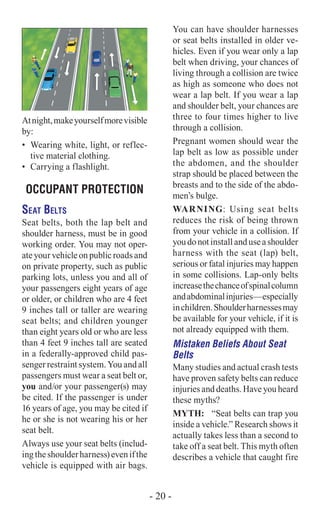
If there are no sidewalks, walk fac-
ing oncoming traffic (see graphic
on page 20). Do not walk or jog on
any freeway where signs tell you
thatpedestriansarenotallowed.Do
not walk or jog in a bike lane unless
there is no sidewalk.
- 19 -
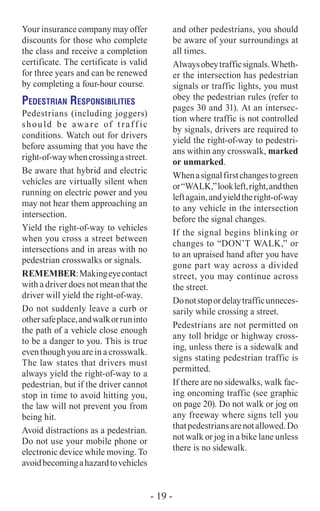
Atnight,makeyourselfmorevisible
by:
•	 Wearing white, light, or reflec-
tive material clothing.
•	 Carrying a flashlight.
OCCUPANT PROTECTION
Seat Belts
Seat belts, both the lap belt and
shoulder harness, must be in good
working order. You may not oper-
ate your vehicle on public roads and
on private property, such as public
parking lots, unless you and all of
your passengers eight years of age
or older, or children who are 4 feet
9 inches tall or taller are wearing
seat belts; and children younger
than eight years old or who are less
than 4 feet 9 inches tall are seated
in a federally-approved child pas-
senger restraint system. You and all
passengers must wear a seat belt or,
you and/or your passenger(s) may
be cited. If the passenger is under
16 years of age, you may be cited if
he or she is not wearing his or her
seat belt.
Always use your seat belts (includ-
ingtheshoulderharness)evenifthe
vehicle is equipped with air bags.
You can have shoulder harnesses
or seat belts installed in older ve-
hicles. Even if you wear only a lap
belt when driving, your chances of
living through a collision are twice
as high as someone who does not
wear a lap belt. If you wear a lap
and shoulder belt, your chances are
three to four times higher to live
through a collision.
Pregnant women should wear the
lap belt as low as possible under
the abdomen, and the shoulder
strap should be placed between the
breasts and to the side of the abdo-
men’s bulge.
WARNING: Using seat belts
reduces the risk of being thrown
from your vehicle in a collision. If
youdonotinstallanduseashoulder
harness with the seat (lap) belt,
serious or fatal injuries may happen
in some collisions. Lap-only belts
increasethechanceofspinalcolumn
andabdominalinjuries—especially
inchildren.Shoulderharnessesmay
be available for your vehicle, if it is
not already equipped with them.
Mistaken Beliefs About Seat
Belts
Many studies and actual crash tests
have proven safety belts can reduce
injuries and deaths. Have you heard
these myths?
MYTH:	 “Seat belts can trap you
inside a vehicle.” Research shows it
actually takes less than a second to
take off a seat belt. This myth often
describes a vehicle that caught fire
- 20 -
or sank in deep water. A seat belt
maykeepyoufrombeing“knocked
out.” Therefore, your chances to es-
cape are better if you are conscious.
MYTH:	 “Seat belts are good on
long trips, but I don’t need them if
I’mdrivingaroundtown.”Research
shows more than half of all traffic
deaths happen within 25 miles of
home. Do not take chances with
your life or the lives of your pas-
sengers. Buckle up every time you
drive regardless of travel distance.
MYTH:	 “Somepeoplearethrown
from a vehicle in a crash and walk
away with hardly a scratch.” Re-
search shows your chances of sur-
viving a collision are five times
better if, upon impact, you are not
thrown from the vehicle. A seat belt
can keep you from being thrown
into the path of another vehicle.
MYTH:	 “I’m only going to the
store. My little brother or sister
doesn’t need to be secured in a
safety seat.” Research shows car
collisions are the number one pre-
ventablecauseofdeathforchildren.
Thelawrequiresthatchildrenunder
eight years of age who are 4 feet 9
inches tall or taller to be properly
secured with an appropriate safety
belt , or be buckled into a federally-
approved child passenger restraint
system if under eight years of age
and less than 4 feet 9 inches tall.
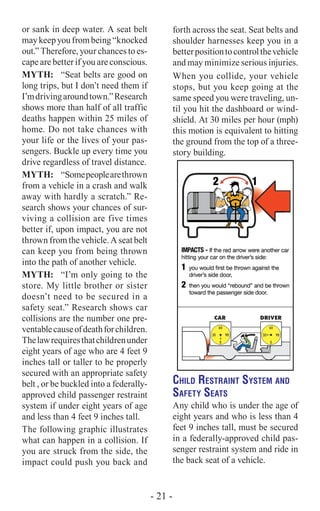
The following graphic illustrates
what can happen in a collision. If
you are struck from the side, the
impact could push you back and
forth across the seat. Seat belts and
shoulder harnesses keep you in a
betterpositiontocontrolthevehicle
and may minimize serious injuries.
When you collide, your vehicle
stops, but you keep going at the
same speed you were traveling, un-
til you hit the dashboard or wind-
shield. At 30 miles per hour (mph)
this motion is equivalent to hitting
the ground from the top of a three-
story building.
Child Restraint System and
Safety Seats
Any child who is under the age of
eight years and who is less than 4
feet 9 inches tall, must be secured
in a federally-approved child pas-
senger restraint system and ride in
the back seat of a vehicle.
- 21 -
Proper child passenger restraint
system installation can be checked
by contacting local law enforce-
ment agencies or fire departments
that may provide this service or re-
fer you to a Child Passenger Safety
(CPS) technician in your area. As
your child grows, check with these
agenciestoconfirmthatthecarseat
is the correct size for your child.
A child who is under the age of
eight years and who is less than 4
feet 9 inches tall, may ride in the
front seat of a vehicle only in the
following instances:
•	 There is no rear seat or the rear
seats are either side-facing jump
seats or rear-facing seats.
•	 The child passenger restraint
system cannot be properly
installed in the rear seat.
•	 Allrearseatsarealreadyoccupied
by children under the age of 12
years.
•	 A medical reason requires the
child to ride in the front seat.
A child may not ride in the front
seat of an airbag-equipped vehicle
if the child:
•	 Is less than one year of age.
•	 Weighs less than 20 lbs.
•	 Is riding in a rear-facing child
passenger restraint system.
Children eight years of age and
older, but under 16 years must be
properly secured with an appropri-
ate safety belt.
Children under eight years of age,
who are less than 4 feet 9 inches
tall must be properly secured in
an appropriate child passenger
restraint system that meets federal
safetystandards.However,children
under eight years of age, who are 4
feet 9 inches tall or taller may be
secured with an appropriate safety
belt instead of a child passenger
restraint system.
Riding Safely with Air Bags
Mostpeoplecantakestepstoelimi-
nate or reduce air bag risk without
turning off air bags. The biggest
risk is being too close to the air bag.
An air bag needs about 10 inches
of space to inflate. Ride at least 10
inches(measuredfromthecenterof
the steering wheel to your breast-
bone) from the air bag cover, if you
can do this while maintaining full
control of the vehicle. If you cannot
safelysit10inchesawayfromtheair
bag, contact your vehicle dealer or
manufacturer for advice about ad-
ditional ways of moving back from
your air bag.
Passengers should also sit at least
10 inches away from the passenger-
side air bag.
Side-Impact Air Bags
Side-impact air bags can provide
extra safety benefits to adults in
side-impactcrashes.However,chil-
dren who are seated next to a side
air bag may be at risk of serious
or fatal injury. Since side air bags
are different in design and perfor-
mance,youshouldconsidertheben-
efits and risks associated with the
use of side air bags if you transport
children. Studies have shown that
- 22 -
children who are leaning against a
side air bag when it inflates are at
risk of serious injury. These stud-
ies also show that children who are
traveling in a correctly installed
child restraint system appropriate
to age and weight are not at risk of
serious injury. These children are
usually not in the path of a side air
bag when it inflates.
Unattended Children in
Motor Vehicles
It is never a good idea to leave a
child unattended in a vehicle.
It is illegal to leave a child six years
or younger unattended in a motor
vehicle.
The court may fine a violator
and require him or her to attend
a community education program.
Also, DMV and court penalties
for leaving an unattended child
in a vehicle are more severe if the
childisinjured,requiresemergency
medical services, or dies.
NOTE: The child may be left under
the supervision of a person 12 years
of age or older.
Hot Weather Risks
As stated in the “Unattended Chil-
dren in Motor Vehicles” section
above, it is against the law to leave
unattendedminorchildreninavehi-
cle (CVC §5620). Additionally, and
equally important, it is dangerous
and deadly to leave children and/or
animals in a hot vehicle. After sit-
ting in the sun, even if a window is
slightlyopened,thetemperaturecan
rise rapidly inside a parked vehicle.
Thetemperatureinsideavehiclecan
rise approximately 40-50 degrees
higherthantheoutsidetemperature.
Dehydration, heat stroke, and death
can result from overexposure to the
heat. Remember if it’s too hot for
you,it’stoohotforchildrenandpets.
Traffic CONTROLS
Traffic Signal Lights
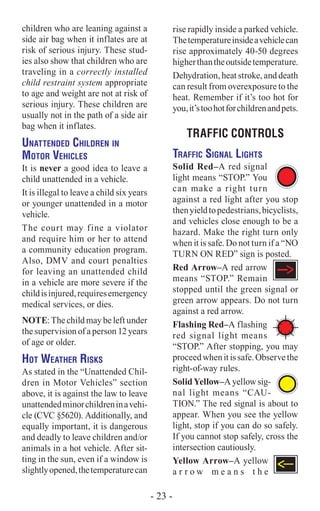
Solid Red–A red signal
light means “STOP.” You
can make a right turn
against a red light after you stop
thenyieldtopedestrians,bicyclists,
and vehicles close enough to be a
hazard. Make the right turn only
when it is safe. Do not turn if a “NO
TURN ON RED” sign is posted.
Red Arrow–A red arrow
means “STOP.” Remain
stopped until the green signal or
green arrow appears. Do not turn
against a red arrow.
Flashing Red–A flashing
red signal light means
“STOP.” After stopping, you may
proceedwhenitissafe.Observethe
right-of-way rules.
Solid Yellow–A yellow sig-
nal light means “CAU-
TION.” The red signal is about to
appear. When you see the yellow
light, stop if you can do so safely.
If you cannot stop safely, cross the
intersection cautiously.
Yellow Arrow–A yellow
a r r o w m e a n s t h e
- 23 -
“protected” turning time period is
ending.Bepreparedtoobeythenext
signal, which could be the green or
red light or the red arrow.
FlashingYellow–Aflashing
yellow signal light warns
youto“PROCEEDWITH
CAUTION.”Youdonotneedtostop
for a flashing yellow light, but you
must slow down and be especially
alert before entering the intersection.
F l a s h i n g Ye l l o w
Arrow–Thissignalmeans
turns are permitted (un-
protected), but you must first yield
tooncomingtrafficandpedestrians
and then proceed with caution.
Solid Green–Give the
right-of-waytoanyvehicle,
bicyclist, or pedestrian in
theintersection.Agreenlightmeans
“GO.” If you are turning left, make
the turn only if you have enough
space to complete the turn before
creating a hazard for any oncoming
vehicle, bicyclist, or pedestrian. Do
not enter the intersection if you can-
not get completely across before the
light turns red. If you block the in-
tersection, you can be cited.
Green Arrow–A green
arrow means “GO.” You
must turn in the direction the ar-
row is pointing after you yield to
any vehicle, bicyclist, or pedestrian
still in the intersection. The green
arrow allows you to make a “pro-
tected”turn.Oncomingvehicles,bi-
cyclists,andpedestriansarestopped
by a red light as long as the green
arrow is lighted.
Traffic Signal Blackout–The traf-
fic signal light is not working. Pro-
ceedcautiouslyasiftheintersection
is controlled by “STOP” signs in all
directions.
Pedestrian Signal Lights
Pedestrian signals show words or
pictures similar to the following
examples:
“Walk”or“WalkingPer-
son” signal light means it
is legal to cross the street.
“Don’tWalk”or“Raised
Hand” signal light means
you may not start crossing
the street.
Flashing “Don’t Walk” or Flash-
ing “Raised Hand” signal light
meansdonotstartcrossingthestreet
because the traffic signal is about
to change. If the signal light starts
flashing after you have already
started to cross, finish crossing the
street as quickly as possible.
Countdown signals indicate how
many seconds remain for crossing.
These signals allow pedestrians the
flexibility to speed up if the cross-
ing phase is about to expire.
Some signals may provide a beep-
ing or chirping sound or a verbal
message. These signals are de-
signed to help blind or visually im-
paired pedestrians cross the street.
At many traffic signals, you need to
push the pedestrian push button to
activate the “Walk” or “Walking
Person” signal light. If there are no
pedestrian signals, obey the traffic
signal lights.
- 24 -
®
safe driving practices:
www.dmv.ca.gov
keep your
eyes moving
and scan your
surroundings
to avoid
hazards!
- 78 -
Red and White Regulatory Signs
Highway Construction and Maintenance Signs
Guide Signs
Hazardous Loads Placards
White Regulatory Signs
Slow Moving Vehicle
No U-turn	 No Left Turn	 No Right Turn
- 26 -
- 79 -
Warning Signs
Slippery
When Wet
Sharp
Turn
Merging
Traffic
Divided
Highway
Lane
Ends
Two Way
Traffic
Traffic
Signal
Ahead
Pedestrian
Crossing
Stop Ahead
“T”
Intersection
Winding
Road
Reverse
Turn
CrossroadAdded Lane
Yield Ahead
Directional
Arrow
End Divided
Highway
Curve
- 27 -
®
www.dmv.ca.gov
1-800-777-0133
“oh, behave!”
If you intentionally obscure a license
plate’s readability you’ll pay a fine!
DMv answerman says,
Traffic Signs
The shape and color of a sign offers
you a clue about the information
contained on the sign. Here are the
common shapes used:
An eight-sided red STOP
signindicatesthatyoumust
make a full “STOP” when-
ever you see this sign. Stop at the
white limit line (a wide white line
painted on the street) or before en-
tering the crosswalk. If a limit line
or crosswalk is not painted on the
street, stop before entering the in-
tersection. Check traffic in all di-
rections before proceeding.
Athree-sidedredYIELD
sign indicates that you
must slow down and be
readytostop,ifnecessary,toletany
vehicle,bicyclist,orpedestrianpass
before you proceed.
A square red and white regulatory
sign indicates that you must follow
the sign’s instruction. For example,
the DO NOT ENTER sign means:
donotenteraroadorofframpwhere
thesignisposted(usu-
ally on a freeway off
ramp). The WRONG
WAYsignmayormay
not be posted with the
DO NOT ENTER
sign. If you see one or
both of these signs,
drivetothesideoftheroadandstop.
Youaregoingagainsttraffic.When
safe, back out or turn around and
return to the road you were on. At
night if you are going the wrong
STOP
DO NOT
WRONG
WAY
ENTER
DO NOT
WRONG
WAY
ENTER
way, the road reflectors will shine
red in your headlights.
Ifasignhasaredcirclewith
a red line through it, it al-
ways indicates “NO.” The
picture inside the circle shows what
you cannot do. The sign may be
shown with or without words.
Ayellowandblackcircular
sign indicates that you are
approaching a railroad
crossing.
X-shaped signs with a
whitebackgroundthatstate
RAILROAD CROSS-
ING indicate that you must look,
listen, slow down, and prepare to
stop, if necessary. Let any trains
pass before you proceed.
Afive-sidedsignindicates
that you are near a school.
Stop if children are in the
crosswalk.
A four-sided diamond-shaped sign
warns you of specific road condi-
tions and dangers ahead. Many
warningsignsarediamond-shaped.
A white rectangular sign indicates
that you must obey important rules.
Some warning signs have a fluo-
rescent yellow-green background.
These signs warn of conditions
related to pedestrians, bicyclists,
schools,playgrounds,schoolbuses,
andschoolpassengerloadingzones.
Obey all warning signs regardless
of their shape (refer to pages 26 and
27 for examples).
R R
R
A
IL
R
O
A
D
C
R
O
S
S
IN
G
- 29 -
LAWS AND RULES
OF THE ROAD
Right-of-Way Rules
General Information
Right-of-way rules, together with
courtesy and common sense, help
to promote traffic safety. It is im-
portant to respect the right-of-way
of others, especially pedestrians,
motorcycle riders, and bicycle rid-
ers.Neverassumeotherdriverswill
give you the right-of-way. Yield
your right-of-way when it helps to
prevent collisions.
Respectingtheright-of-wayofoth-
ers is not limited to situations such
as yielding to pedestrians in cross-
walks, or watching carefully to en-
sure the right-of-way of bicyclists
and motorcyclists. Motorists must
respect the right-of-way of others
by not violating traffic laws, such
as failing to stop at a stop sign or
traffic light, speeding, making un-
safe lane changes, or illegal turns.
Statistics show that right-of-way
violations cause a high percentage
of injury collisions in California.
Pedestrians
Pedestrian safety is a serious issue.
A pedestrian is a person on foot or
whousesaconveyancesuchasroller
skates, skateboard, etc., other than
a bicycle. A pedestrian can also be
a person with a disability using a
tricycle, quadricycle, or wheelchair
for transportation.
InCalifornia,pedestriandeathsoc-
cur in approximately 22 percent of
alltrafficfatalities.Drivecautiously
when pedestrians are near because
they may suddenly cross your path.
Pedestrians may be at risk walking
near hybrid and electric vehicles
because these vehicles are virtually
silentwhileoperating.Useextracau-
tion when driving near pedestrians.
•	 Respect the right-of-way of pe-
destrians. Always stop for any
pedestrian crossing at corners
or other crosswalks, even if the
crosswalk is in the middle of the
block, at corners with or without
traffic lights, whether or not the
crosswalksaremarkedbypainted
lines.
•	 Do not pass a vehicle that has
stopped at a crosswalk. A pedes-
trianyoucannotseemaybecross-
ing the street. Stop, then proceed
whenallpedestrianshavecrossed
the street.
•	 Do not drive on a sidewalk, ex-
cept to cross it to enter or exit a
drivewayoralley.Whencrossing,
yield to all pedestrians.
•	 Do not stop in a crosswalk. You
will place pedestrians in danger.
•	 Remember,ifapedestrianmakes
eye contact with you, he or she is
ready to cross the street. Yield to
the pedestrian.
•	 Allowolderpedestrians,disabled
pedestrians,andpedestrianswith
young children sufficient time to
cross the street.
Important: Blind pedestrians
rely on the sound of your vehicle
to become aware of your vehicle’s
presence;so,itisimportantthatyou
- 30 -
stopyourvehiclewithin5feetofthe
crosswalk.Driversofhybridorelec-
tricvehiclesmustremainespecially
aware that the lack of engine noise
may cause a blind pedestrian to as-
sume there is not a vehicle nearby.
Follow this cue:
•	 When a blind person pulls in his
or her cane and steps away from
the intersection, this gesture usu-
allymeansforyoutogo(additional
information regarding blind pe-
destrians can be found on pages
65 and 66).
Crosswalks
A crosswalk is the part of the road-
way set aside for pedestrian traffic.
Most intersections have a pedestri-
an crosswalk whether or not lines
are painted on the street. Most
crosswalks are located at corners,
but they can also be located in the
middle of the block. Before turning
a corner, watch for people about to
cross the street. Pedestrians have
theright-of-wayinmarkedorun-
marked crosswalks.
Crosswalks are often marked with
white lines. Yellow crosswalk lines
may be painted at school crossings.
Most often, crosswalks in residen-
tial areas are not marked.
Some crosswalks have flashing
lights to warn you that pedestrians
may be crossing. Look for pedestri-
ansandbepreparedtostop,whether
or not the lights are flashing.
Intersections
An intersection is any place where
one line of roadway meets anoth-
er roadway. Intersections include
cross streets, side streets, alleys,
freeway entrances, and any other
location where vehicles traveling
on different highways or roads join
each other.
Driving through an intersection
is one of the most complex traf-
fic situations motorists encounter.
Intersection collisions account for
more than 45 percent of all reported
crashes and 21 percent of fatalities
according to the Federal Highway
Administration.
•	 At intersections without “STOP”
or “YIELD” signs, slow down
and be ready to stop. Yield to
traffic and pedestrians already
in the intersection or just enter-
ingtheintersection.Also,yieldto
the vehicle or bicycle that arrives
first, or to the vehicle or bicycle
on your right if it reaches the in-
tersectionatthesametimeasyou.
•	 At “T” intersections without
“STOP”or“YIELD”signs,yield
to traffic and pedestrians on the
through road. They have the
right-of-way.
•	 When you turn left, give the
right-of-way to all vehicles ap-
proaching that are close enough
to be dangerous. Also, look for
motorcyclists, bicyclists, and
pedestrians.
Safety suggestion: While wait-
ing to turn left, keep your wheels
pointed straight ahead until it is
- 31 -
safe to start your turn. If your
wheels are pointed to the left,
and a vehicle hits you from be-
hind, you could be pushed into
oncoming traffic.
•	 When you turn right, be sure to
check for pedestrians crossing
the street and bicyclists coming
up behind you on the right.
•	 Ondividedhighwaysorhighways
withseverallanes,watchforvehi-
clescominginanylaneyoucross.
Turneitherleftorrightonlywhen
it is safe.
•	 When there are “STOP” signs at
all corners, stop first then follow
the rules listed above.
•	 If you have parked off the road
or are leaving a parking lot, etc.,
yield to traffic before reentering
the road.
Roundabouts
A roundabout is an intersection
where traffic travels around a cen-
tral island in a counter-clockwise
direction. Vehicles entering or exit-
ing the roundabout must yield to all
traffic including pedestrians.
When you approach a roundabout:
•	 Slow down as you approach the
roundabout.
•	 Yieldtopedestriansandbicyclists
crossing the roadway.
•	 Watch for signs and/or pavement
markings that guide you or pro-
hibit certain movements.
•	 Enter the roundabout when there
is a big enough gap in traffic.
•	 Drive in a counter-clockwise di-
rection. Do not stop or pass other
vehicles.
•	 Use your turn signals when
you change lanes or exit the
roundabout.
•	 If you miss your exit, continue
around until you return to your
exit.
Multiple and single lane roundabout
For roundabouts with multiple
lanes,chooseyourentryorexitlane
based on your destination as shown
in the graphic. For example, to:
•	 Turnrightattheintersection(blue
car), choose the right-hand lane
and exit in the right-hand lane.
•	 Go straight through the intersec-
tion (red car), choose either lane,
and exit in the lane you entered.
•	 Turn left (yellow car), choose the
left lane, and exit.
On Mountain Roads
When two vehicles meet on a steep
roadwhereneithervehiclecanpass,
the vehicle facing downhill must
yield the right-of-way by backing
upuntilthevehiclegoinguphillcan
pass. The vehicle facing downhill
has the greater amount of control
when backing up the hill.
- 32 -
Speed Limits
Californiahasa“BasicSpeedLaw.”
This law means that you may never
drive faster than is safe for current
conditions. For example, if you are
driving 45 mph in a 55 mph speed
zone during a dense fog, you could
be cited for driving “too fast for
conditions.”
Regardless of the posted speed lim-
it, your speed should depend on:
•	 The number and speed of other
vehicles on the road.
•	 Whether the road surface is
smooth, rough, graveled, wet,
dry, wide, or narrow.
•	 Bicyclistsorpedestrianswalking
on the road’s edge or crossing the
street.
•	 Whether it is raining, foggy,
snowing, windy, or dusty.
Maximum Speed Limit
The maximum speed limit on most
Californiahighwaysis65mph.You
may drive 70 mph where posted.
Unless otherwise posted, the maxi-
mum speed limit is 55 mph on two-
lane undivided highways and for
vehicles towing trailers.
Other speed limit signs are post-
ed for the type of roads and traffic
in each area. All speed limits are
based on ideal driving conditions.
Construction zones usually have
reduced speed zones.
Highspeedincreasesyourstopping
distance. The faster you go, the less
time you have to avoid a hazard or
collision. The force of a 60 mph
crashisnotjusttwiceasgreatasa30
mph crash; it’s four times as great!
Reduced Speeds
Heavy Traffic or Bad Weather
You must drive slower when there
is heavy traffic or bad weather.
However, if you block the normal
and reasonable movement of traf-
fic by driving too slowly, you may
be given a ticket. If you choose to
drive slower than other traffic, do
notdriveinthe“Number1lane”(the
fast lane) (refer to the “Choosing a
Lane” section on page 40). When
traveling below the speed limit and
another driver is close behind you
and wishes to drive faster, always
move to the right.
Towing Vehicles, Buses, or
Large Trucks
When you tow a vehicle or trailer,
or drive a bus or three or more axle
truck, you must drive in the right
hand lane or in a lane specially
marked for slower vehicles. If no
lanes are marked and there are four
lanes or more in your direction,
you may only drive in either of the
two lanes closest to the right edge
of the road.
Around Children
When driving within 500 to 1,000
feet of a school while children are
outside or crossing the street, the
speed limit is 25 mph unless oth-
erwise posted. Also, if the school
grounds have no fence and children
are outside, never drive faster than
25 mph. Some school zones may
- 33 -
have speed limits as low as 15 mph.
Always drive more carefully near
schools, playgrounds, parks, and
residential areas because children
may suddenly dart into the street.
Also,manychildrenhavenotyetde-
veloped the ability to judge speeds
and distances well enough to cross
streets safely when cars are mov-
ing fast.
All vehicles must stop
Near schools, look for:
•	 Bicyclists and pedestrians.
•	 School safety patrols or school
crossing guards. Be sure to obey
their directions. For the crossing
guard’s safety, allow him or her
tosafelygettothesideoftheroad
before driving ahead.
•	 Stopped school buses and chil-
dren crossing the street. Some
school buses flash yellow lights
when preparing to stop to let
children off the bus. The yellow
flashing lights warn you to slow
down and prepare to stop. When
the bus flashes red lights (locat-
ed at the top front and back of
the bus), you must stop from ei-
ther direction until the children
are safely across the street and
the lights stop flashing. The law
requires you remain stopped as
long as the red lights are flashing
(CVC §22454). If you fail to stop,
you may be fined up to $1,000
and your driving privilege could
be suspended for one year. If the
school bus is on the other side of
a divided or multilane highway
(two or more lanes in each direc-
tion), you do not need to stop.
Blind Intersections
The speed limit for a blind inter-
section is 15 mph. An intersection
is considered “blind” if there are no
stopsignsatanycornerandyoucan-
not see for 100 feet in either direc-
tion during the last 100 feet before
crossing. Trees, bushes, buildings,
or parked cars at intersections can
block your view to the side. If your
viewisblocked,edgeforwardslow-
ly until you can see.
Alleys
The speed limit in any alley is 15
mph.
Near Railroad Tracks
Thespeedlimitis15mphwithin100
feetofarailroadcrossingwhereyou
cannot see the tracks for 400 feet
in both directions. You may drive
faster than 15 mph if the crossing is
controlled by gates, a warning sig-
nal, or a flag man.
- 34 -
At railroad or train crossings:
•	 Lookinbothdirectionsandlisten
for trains. Many crossings have
multiple tracks; so, be ready to
stopbeforecrossing,ifnecessary.
Cross railroad tracks only at des-
ignated crossings and only when
it is safe to do so.
•	 Expect a train on any track at any
time traveling in either direction.
If you need to stop after cross-
ing the tracks, wait until you can
completelycrossthetracksbefore
proceeding. Make sure your ve-
hicle clears the tracks before you
stop.
•	 Neverstop on the railroadtracks.
Remember that a train cannot
stop quickly or swerve out of the
way. If you are on the tracks, you
risk injury or death.
•	 Watch for vehicles that must stop
before they cross train tracks.
These vehicles include buses,
school buses, and trucks trans-
porting hazardous loads.
•	 Remember that flashing red
lights mean STOP! Stop at least
15 feet, but not more than 50 feet,
from the nearest track when the
crossing devices are active or a
person warns you a train is com-
ing. Stop if you see a train com-
ing or you hear the whistle, horn,
or bell of an approaching train.
•	 Do not go under lowering gates
oraroundloweredgates.Flashing
red lights indicate you must stop
andwait.Donotproceedoverthe
crossing until the red lights stop
flashing, even if the gate rises.
If the gates are lowered and you
do not see a train approaching,
call the posted railroad emergen-
cy toll-free number or 9-1-1. Be
ready to give a detailed descrip-
tion of your location.
Light Rail Transit Vehicle
Crossings
The same rules apply to light rail
transit vehicle crossings as to train
crossings. Do not proceed across
the tracks until you can see clearly
inbothdirectionsandaresurethere
are no light rail transit vehicles or
trains coming. Do not go around or
under any lowered gate.
NOTE: Light rail transit vehicles
are very quiet and accelerate more
quickly than trains.
Near Streetcars, Trolleys, or
Buses
The passing speed limit, when safe
to pass, is no more than 10 mph.
This speed limit applies at a safe-
ty zone or an intersection where a
streetcar, trolley, or bus is stopped
and traffic is controlled by a peace
officer or traffic signal. A safety
zone is marked by raised buttons or
- 35 -
markers on the road and is set aside
for pedestrians. You will most of-
ten see safety zones in areas where
street cars or trolleys and vehicles
share the roadway.
Business or Residential Districts
The speed limit is 25 mph, unless
otherwise posted.
Near Animals
Ifyouseeanimalsorlivestock,slow
downandfollowdirectionsfromthe
person in charge of the animals. If
you see a stray animal in your path,
slow down or stop, if it is safe.
VISUAL SEARCH
Scanning
Scanningyoursurroundings(keep-
ing your eyes moving) includes
keepingasafedistancearoundyour
vehicle.Whenanotherdrivermakes
a mistake, you need time to react.
Giveyourselfthistimebykeepinga
“space cushion” on all sides of your
vehicle.Thisspacecushionwillgive
you room to brake or maneuver if
you need the space.
Know What Is Ahead
Toavoidlastminutemoves,scanthe
road 10–15 seconds ahead of your
vehiclesoyoucanseehazardsearly.
Constantly staring at the road just
in front of your vehicle is danger-
ous. As you scan ahead, be alert for
vehicles around you.
Where is the green vehicle headed?
Use your mirrors. Allow enough
space between you and the vehicle
aheadtogiveyourselfan“out.”Mis-
takes cause collisions. In the city,
10–15 seconds is about one block.
On the highway, 10–15 seconds is
about a quarter of a mile.
Take in the whole scene–If you
only look at the middle of the road,
you will miss what is happening on
the side of the road and behind you.
Scanning helps you to see:
•	 Cars, motorcycles, bicyclists, and
people that may be in the road by
the time you reach them.
•	 Signswarningofproblemsahead.
•	 Signs giving you directions.
The shaded areas are your blind
spots.
Before changing lanes, look into
your rear view mirror for nearby
vehiclesandalsooveryourshoulder
to check for blind spots. Blind spots
- 36 -
can hide a motorcyclist, a vehicle or
a bicyclist. Watch for things about
to happen, like a ball rolling into
the street or a vehicle door opening.
Watch for hazards–Look beyond
the vehicle ahead of you. Do not
develop a “fixed stare.” Keep scan-
ning. Check your rear view mir-
rors every two – five seconds so
you know the position of vehicles
near you.
On the freeway, be ready for chang-
es in traffic conditions. Watch for
signals from other drivers. Expect
merging vehicles at on-ramps and
interchanges. Be prepared for rapid
changesinroadconditionsandtraf-
ficflow.Knowwhichlanesareclear
so you can use them if necessary.
Donotbeatailgater!Manydrivers
follow too closely (tailgate) and are
not able to see as far ahead as they
should because the vehicle ahead
blocks their view.
The more space you allow between
your vehicle and the vehicle ahead,
the more time you will have to see
a hazard, and stop or avoid that
hazard.
Most rear end collisions are caused
by tailgating. To avoid tailgating,
use the “three-second rule”: when
the vehicle ahead of you passes a
certain point such as a sign, count
“one-thousand-one, one-thousand-
two,one-thousand-three.”Counting
these numbers takes approximately
three seconds. If you pass the same
point before you finish counting,
you are following too closely.
You should allow a four-second or
more cushion when:
•	 Being crowded by a tailgater.
Allow extra room ahead, do not
brakesuddenly.Slowdowngrad-
ually or merge into another lane
to prevent being hit from behind
by the tailgater!
•	 Driving on slippery roads.
•	 Following motorcyclists on wet
or icy roads, on metal surfaces
(e.g., bridge gratings, railroad
tracks, etc.), and on gravel. Mo-
torcyclistscanfallmoreeasilyon
these surfaces.
•	 The driver behind you wants to
pass. Allow room in front of your
vehicle so the driver will have
space to move in front of you.
•	 Towing a trailer or carrying a
heavy load. The extra weight
makes it harder to stop.
•	 Following large vehicles that
block your view ahead. The ex-
traspaceallowsyoutoseearound
the vehicle.
•	 You see a bus, school bus, or
a placarded vehicle at railroad
crossings. These vehicles must
stopatrailroadcrossings;so,slow
down early and allow plenty of
room.
•	 Merging onto a freeway.
If you follow too closely and anoth-
er driver “cuts” in front of you, just
takeyourfootoffthegas.Thisgives
youspacebetweenyourvehicleand
the other driver, without having to
slam on your brakes or swerve into
another lane.
- 37 -
Know What Is at Your Side
Anytimeyoucometoaplacewhere
people may cross or enter your path
or one line of traffic meets another,
you should look to the left and right
sidesofyourvehicletomakesureno
one is coming. Always look to each
sideofyourvehicleatintersections,
crosswalks, and railroad crossings.
At intersections:­
•	 Lookbothwaysevenifothertraf-
fic has a red light or a stop sign.
–	Look to the left first, since
vehicles coming from the left
are closer to you than vehicles
coming from the right.
–	Look to the right.
–	Take one more look to the left
in case there is a vehicle or a
pedestrian you did not see the
first time.
•	 Do not rely on traffic signals.
Some drivers do not obey traffic
signals; so, before you enter an
intersection, look left, right, and
ahead for approaching traffic.
Tomaintainaspacecushiononeach
side of your vehicle:
•	 Do not stay in another driver’s
blind spot. The other driver may
not see your vehicle and could
change lanes and hit you.
•	 Avoid driving directly alongside
othervehiclesonmultilanestreets
with or without traffic in the op-
posite direction. Another driver
might crowd your lane or change
lanes without looking and crash
into you. Drive either ahead of or
behind the other vehicle.
•	 If possible and when safe, make
room for vehicles entering free-
ways even though you have the
right-of-way.
•	 At freeway exits, do not drive
alongside other cars. A driver
may decide to exit suddenly or
swerve back onto the freeway.
•	 Keep a space between your ve-
hicle and parked cars. Someone
maystepoutfrombetweenthem,
a vehicle door may open, or a ve-
hicle may pull out suddenly.
•	 Becarefulwhendrivingnearmo-
torcyclists or bicyclists. Always
leave plenty of room between
your vehicle and any motorcy-
clists or bicyclists.
Know What Is Behind You
It is very important to check behind
you before you:
•	 Change lanes. Look over your
shouldertomakesureyouarenot
getting in the way of vehicles in
the lane you want to enter.
•	 Reduce your speed. Take a quick
glance in your mirrors. Also
check your mirrors when you
are preparing to turn into a side
road or driveway and when you
are stopping to pull into a park-
ing space.
•	 Drive down a long or steep hill.
Watch for large vehicles be-
cause they can gather speed very
quickly.
•	 Back up. Backing up is always
dangerous because it is hard to
see behind your vehicle. When
you are backing out of a parking
space:
- 38 -
–	Check in front and behind the
vehicle before you get in.
–	Know where your kids are.
Make sure they are away from
your vehicle and in full view
before moving your vehicle.
–	If other children are nearby,
make sure you can see them
before backing up.
–	Do not depend only on your
mirrors or only looking out a
side window.
–	Turn and look over your right
and left shoulders before you
begin backing. As a safety
measure, also look over your
right and left shoulders again
while backing.
–	 Backslowlytoavoidcollisions.
Check traffic behind you often to
know if you are being tailgated (an-
other driver is following too close-
ly). If you are being tailgated, be
careful! Brake slowly before stop-
ping. Tap your brakes lightly a few
times to warn the tailgater you are
slowing down.
“Lose” the tailgater as soon as you
can. Change lanes and allow the
tailgater to pass you, or slow down
to allow enough “cushion” between
youandthecarinfrontofyou.Ifthis
doesnotwork,pullofftheroadwhen
it is safe and let the tailgater pass.
How Well Can You Stop?
If something is in your path, you
need to see it in time to stop. As-
suming you have good tires, good
brakes, and dry pavement:
•	 At 55 mph, it takes about 400 feet
to react and bring the vehicle to a
complete stop.
•	 At 35 mph, it takes about 210 feet
to react and bring the vehicle to a
complete stop.
Adjust your driving speed to the
weather and road conditions (refer
to the “Basic Speed Law” in the
“Speed Limits” section on page
33). Turn on your lights during the
day, if it is hard to see or you cannot
see at least 1,000 feet ahead of you.
LANE CONTROL
(1)	 Solid yellow line: No passing if
solid yellow line is on your side.
(2)	 Double solid lines: DO NOT pass.
(3)	 Broken yellow line: May pass if
movement can be made safely.
Examples of lane markings
Line Colors
Solid yellow lines mark the center
of a road used for two-way traffic.
Broken yellow lines indicate that
you may pass if the broken line is
next to your driving lane.
Two solid yellow lines indicate no
passing. Never drive to the left of
these lines unless you are:
•	 In a carpool lane/High Occupan-
cy Vehicle (HOV) lane that has a
designated entrance on the left.
- 39 -
•	 Instructedbyconstructionoroth-
er signs to drive on the other side
of the road because your side of
the road is closed or blocked.
Two sets of solid double yellow
lines spaced 2 feet or more apart
are considered a barrier. Do not
driveonoroverthisbarrierormake
a left turn or a U-turn across it ex-
cept at designated openings (see
diagram).
B
Solidwhitelinesmarktrafficlanes
going in the same direction, such as
one-way streets.
Broken white lines separate traf-
fic lanes on roads with two or more
lanes in the same direction.
Double white lines are two solid
white lines that indicate a lane bar-
rierbetweenaregularuseandapref-
erentialuse,suchasacarpool/HOV
lane. Never change lanes while in
these lanes; wait until a single bro-
ken white line appears. You may
also see these parallel lines in or
near freeway on and off ramps.
Choosing a Lane
Traffic lanes are often referred to
by number. The left or “fast” lane
is called the “Number 1 Lane.”
The lane to the right of the “Num-
ber 1 Lane” is called the “Num-
ber 2 Lane,” then the “Number 3
Lane,” etc.
Example of numbered traffic lanes
Drive in the lane with the smooth-
estflowoftraffic.Ifyoucanchoose
among three lanes, pick the middle
lane for the smoothest driving. To
drive faster, pass, or turn left, use
the left lane. When you choose to
drive slowly or enter or turn off the
road, use the right lane.
If there are only two lanes in your
direction, pick the right lane for the
smoothest driving.
Do not weave in and out of traffic.
Stayinonelaneasmuchaspossible.
Once you start through an intersec-
tion,keepgoing.Ifyoustarttomake
a turn, follow through. Last minute
changesmaycausecollisions.Ifyou
miss a turn, continue until you can
safely and legally turn around.
Changing Lanes
Changing lanes includes:
•	 Movingfromonelanetoanother.
•	 Entering the freeway from an
on-ramp.
•	 Entering the road from a curb or
the shoulder.
Before changing lanes, signal, look
in all your mirrors, and:
•	 Check traffic behind and beside
you.
•	 Glance over your left or right
shoulder to make sure the lane
you want is clear.
- 40 -
•	 Checkforvehicles,motorcyclists,
and bicycle traffic in your blind
spot.
•	 Be sure there is enough room for
your vehicle in the next lane.
Passing Lanes
Before you pass, look ahead for
roadconditionsandtrafficthatmay
cause other vehicles to move into
your lane.
Never drive off the paved or main-
traveled portion of the road or on
the shoulder to pass. The edge of
the main-traveled portion of the
road may have a painted white line
on the road’s surface. Passing oth-
er vehicles at crossroads, railroad
crossings, and shopping center en-
trances is dangerous.
Pass traffic on the left. You may
pass on the right only when:
•	 An open highway is clearly
marked for two or more lanes of
travel in your direction.
•	 The driver ahead of you is turn-
ing left and you do not drive off
the roadway to pass. Never pass
on the left if the driver is signal-
ing a left turn.
Carpool/High Occupancy
Vehicles (HOV) Lanes
An HOV lane is a special lane used
only for carpools, buses, motorcy-
cles, or decaled low-emission vehi-
cles. You may use a carpool/HOV  
lane or on-ramp if your vehicle car-
ries the posted minimum number
of people required for the carpool
lane, or you drive a low-emission
vehicle displaying a special DMV-
issued decal. If you operate a low
emissionand/orhybridvehicle,you
may be exempt from all toll charges
onhighoccupancytoll(HOT)lanes.
Motorcycle riders may use desig-
nated carpool/HOV lanes, unless
otherwise posted.
Signs at the on-ramp or along the
freewaytellyoutheminimumnum-
ber of people per vehicle required
for the carpool/HOV lane(s). These
signs also list the days of the week
and the hours when the carpool/
HOV requirement applies. The
pavementinthislaneismarkedwith
a diamond symbol and the words
“Carpool Lane.” These lanes are
also known as high-occupancy ve-
hicle(HOV)lanes.Donotcrossover
doubleparallelsolidlinestoenteror
exit any carpool/HOV lane except
at designated entry or exit places.
Center Left Turn Lanes
A center left turn lane is located in
themiddleofatwo-waystreetandis
markedonbothsidesbytwopainted
lines. The inner line is broken and
BIKE
LANE
BIKE
LANE
- 41 -
the outer line is solid. If a street has
a center left turn lane, you must use
it to prepare for or make a left turn,
or to prepare for or make a permit-
ted U-turn (CVC §21460.5 (c)). You
may only drive for 200 feet in the
center left turn lane. This lane is
not a regular traffic lane or a pass-
ing lane. To turn left from this lane,
signal, look over your shoulder, and
drive completely inside the center
left turn lane. Do not stop with the
back of your vehicle blocking traf-
fic. Make sure the lane is clear in
both directions and then turn only
when it is safe. Look for vehicles
comingtowardyouinthesamelane,
preparing to start their left turn.
Whenturningleftfromasidestreet
or driveway, signal and wait until it
is safe. Then you may drive into the
center left turn lane. Enter traffic
only when it is safe.
Turnout Areas and Lanes
Special “turnout” areas
are sometimes marked
ontwo-laneroads.Drive
into these areas to allow
cars behind you to pass.
Some two-lane roads have passing
lanes. If you are driving slowly on
a two-lane highway or road where
passing is unsafe, and five or more
vehicles are following you, drive
into the turnout areas or lanes to let
the vehicles pass.
End-of-Lane Markings
Freeway lanes, as well as some city
street lanes, which are ending will
usually be marked by large broken
linespaintedonthepavement.Ifyou
are driving in a lane marked with
these broken lines, be prepared to
exit the freeway or for the lane to
end. Look for a sign that tells you
to exit or merge, etc.
Shared Roadway Bicycle
Markings (Sharrows)
Sharrows are used to indicate lanes
that bicyclists are lawfully allowed
to occupy.
Sharrows are used to assist bicy-
clists with positioning on a shared
roadway. They also alert motorists
of the location a bicyclist may oc-
cupy within the traveled roadway.
Bicycle Lanes
A bicycle lane is a designated traf-
fic lane for bicyclists, marked by a
solid white line, typically breaking
into a dotted line ending before it
- 42 -
reachesthecorner.Differentfroma
simple white line showing the edge
of the road, a bicycle lane follows
specific width requirements and is
clearly marked as a bike lane.
•	 Treat a bicycle lane the same as
other traffic lanes.
•	 Do not turn into the lane if there
is a bicyclist in the bike lane.
•	 Do not obstruct bicycle traffic by
reducing the width required for
safe bicycle passage, typically 3
to 4 feet.
When you are making a right turn
and are within 200 feet of the cor-
ner or other driveway entrance, you
mustenterthebicyclelaneonlyafter
ensuring there is no bicycle traffic,
andthenmaketheturn.Donotdrive
in the bicycle lane at any other time.
You may park in a bicycle lane if
your vehicle does not block a bicy-
clist and/or there is not a “No Park-
ing” sign posted.
Drivers of motorized bicycles
should use bicycle lanes carefully
to avoid collisions with bicyclists.
TURNS
Left turns–To make a left turn,
drive close to the center divider
line or into the left turn lane. Begin
signaling about 100 feet before the
turn. Look over your left shoulder
and reduce your speed. Stop be-
hind the limit line. Look left, then
right, then left again, and make the
turn when it is safe. When you turn
left, do not turn too soon and “cut
the corner” of the lane belonging to
the vehicles coming towards you.
DO NOT CUTCO
RNER
Example of a left turn
Safetysuggestion:Whilewaitingto
turn left, keep your wheels pointed
straight ahead until it is safe to start
your turn. If your wheels are point-
ed to the left and a vehicle hits you
from behind, you could be pushed
into oncoming traffic.
A left turn against a red light can
only be made from a one-way street
onto a one-way street. Signal and
stop for a red traffic light at the
markedlimitline.Ifthereisnolimit
line, stop before entering the cross-
walk. If there is no crosswalk, stop
beforeenteringtheintersection.You
may turn left into a left-moving,
one-way street if there is no sign to
prohibit the turn. Yield to pedes-
trians, bicyclists, or other vehicles
moving on their green light.
Right turns–To make a right turn,
drive close to the right edge of the
road. If there is a bike lane, drive
into the bike lane no more than 200
feet before the turn. Watch for bicy-
clists or motorcyclists who may get
between your vehicle and the curb.
Begin signaling about 100 feet be-
fore the turn. Look over your right
shoulder and reduce your speed.
Stop behind the limit line. Look
both ways and turn when it is safe.
Do not turn wide into another lane.
Completeyourturnintherightlane.
- 43 -
Example of a right turn
DONOTT
URNWIDE
Right turn against a red light–
Signalandstopforaredtrafficlight
at the marked limit line. If there is
no limit line, stop before entering
the crosswalk. If there is no cross-
walk,stopbeforeenteringtheinter-
section. You may turn right if there
is no sign to prohibit the turn. Yield
to pedestrians, motorcyclists, bicy-
clists, or other vehicles moving on
their green light.
No turn against a red arrow–You
may not turn right or left against a
red arrow.
Examples of Right and Left
Turns
The numbers on the cars in the di-
agrams refer to the numbered sen-
tences on these pages. Always use
your turn signals.
1.	 Left turn from a two-way street.
Starttheturnintheleftlaneclos-
est to the middle of the street.
Complete the turn, if safe, in
either lane of the cross street
(shown by the arrows). Use the
center left turn lane if one is
available. A left turn may be
made from the other lane, if per-
mitted by signs or arrows.
1
1
2*
2.	 Right turn. Begin and end the
turn in the lane nearest the
right-hand curb. Do not swing
wide into another lane of traffic.
Watch for pedestrians, motor-
cyclists, and bicyclists between
yourvehicleandthecurb.Some-
times, signs or pavement mark-
ings will let you turn right from
another lane as shown by the
graphic 2 .
3.	 Left turn from a two-way street
into a one-way street. Start the
turn from the lane closest to the
middle of the street. Turn into
any lane that is safely open, as
shown by the arrows.
4.	 Left turn from a one-way street
into a two-way street. Start the
turn from the far left lane. Turn
into either of the lanes that are
safely open, as shown by the
arrows.
5.	 Left turn from a one-way street
into a one-way street. Start the
turnfromthefarleftlane.Watch
- 44 -
for pedestrians, motorcyclists,
and bicyclists between your ve-
hicle and the curb because they
can legally use the left turn lane
for their left turns. Turn into any
lanethatissafelyopen,asshown
by the arrows.
5
6
*
oneway
6.	 Rightturnfromaone-waystreet
into a one-way street. Start the
turn in the far right lane. If safe,
youmayendtheturninanylane.
Sometimes, signs or pavement
markings will let you turn right
from another lane, as shown by
the graphic 6 .
7.	 Turn at a “T” intersection from
a one-way street into a two-way
street. Through traffic has the
right-of-way. You may turn ei-
ther right or left from the center
lane. Watch for vehicles, motor-
cyclists, and bicyclists inside
your turn.
7
Legal U-Turns
A U-turn is turning your vehicle
around in the street to go back the
way you came. To make a U-turn,
signal and use the far left lane or the
center left turn lane. You may make
a legal U-turn:
•	 Acrossadoubleyellowlinewhen
it is safe and legal.
•	 In a residential district:
–	If there are no vehicles ap-
proaching you within 200 feet.
–	Whenever a traffic sign, light,
or signal protects you from ap-
proaching vehicles.
•	 Atanintersectiononagreenlight
or green arrow, unless a “No U-
turn” sign is posted.
•	 On a divided highway, only if an
opening is provided in the center
divider.
Illegal U-Turns
Never make a U-turn:
•	 At or on a railroad crossing.
•	 On a divided highway by cross-
ing a dividing section, curb, strip
of land, or two sets of double yel-
low lines.
•	 Whereyoucannotseeclearly200
feet in each direction because of
a curve, hill, rain, fog, or other
reason.
•	 Where a “No U-Turn” sign is
posted.
•	 Whenothervehiclesmayhityou.
•	 On a one-way street.
•	 In front of a fire station. Never
useafirestationdrivewaytoturn
your vehicle around.
- 45 -
Always set your parking brake and
leave the vehicle in gear or in the
“park” position.
Parallel Parking
How to parallel park safely:
1.	 Find a space. Look for a space
at least 3 feet longer than your
vehicletosafelyparkinthespace
without striking another vehicle
orobject.Whenyoufindaspace,
signal your intention to park.
2.	 Pull your vehicle alongside the
vehicle in front of your space,
if any, 2 feet away from it and
bumpers aligned. Check your
rear view mirror and look over
your shoulder for approaching
vehicles. You can brake gently
so approaching vehicles behind
you will see the brake lights and
stop to allow you to park. Keep
your foot on the brake and put
the vehicle in reverse. Maintain
the turn signal.
3.	 Lift your foot off the brake.
Check your mirrors and look
over your shoulder to make sure
the street is clear of traffic be-
fore you begin to back up. Look
over your shoulder at the space
tomakesureitisclearofanyob-
jects, pedestrians, animals, etc.
Begin to back up while turning
the wheel hard toward the curb;
you want the angle to be sharp
but not too sharp.
4.	 Once the back of your seat is
aligned with the rear bumper of
the vehicle in front of the empty
space, begin turning the steer-
ing wheel away from the curb.
•	 In business districts. Areas with
churches, apartments, multiple
dwelling houses, clubs, and pub-
lic buildings (except schools) are
also considered to be business
districts.Turnonlyatanintersec-
tion, unless a sign prohibits it, or
where openings are provided for
turns.
PARKING
Parking on a Hill
When you park:
•	 On a sloping driveway, turn the
wheels so the vehicle will not roll
into the street if the brakes fail.
•	 Headeddownhill,turnyourfront
wheelsintothecurbortowardthe
side of the road. Set the parking
brake.
•	 Headed uphill, turn your front
wheels away from the curb and
let your vehicle roll back a few
inches. The wheel should gently
touch the curb. Set the parking
brake.
•	 Headed either uphill or down-
hill when there is no curb, turn
the wheels so the vehicle will roll
away from the center of the road
if the brakes fail.
	 down hill	 up hill	 no curb-
			 up hill or
			 down hill
- 46 -
5.	 Straighten out. Your vehicle
should now be about 6 inches
from and parallel the curb. You
might have to adjust your vehi-
cle forward or backward before
you put your vehicle in park and
turn off the engine. Check your
mirrors and look over your left
shoulderforoncomingtrafficor
bicyclists before you exit.
How to Park
Step 1
Bringyourcartoastopalongside
the car at the front of the space.
Step 2
Reverse into the space with an
S motion.
Step 3
Once the car is parallel with the
curb, pull forward to center your
car within the space.
- 47 -
Anywhere, Anytime,
Any device
DMV’s convenient, time-saving
online and mobile services.
1-800-777-0133 or dmv mobile app
www.dmv.ca.gov
®
Page left
intentionally
blank
NOTES
- 50 -
Parking at Colored Curbs
Painted colored curbs have the fol-
lowing special parking rules:
White–Stop only long enough to
pick up or drop off passengers or
mail.
Green–Park for a limited time.
Look for a posted sign next to the
green zone for time limits, or locate
the time limit painted on the curb.
Yellow–Stop no longer than the
time posted to load or unload pas-
sengers or freight. Drivers of non-
commercial vehicles are usually
required to stay with the vehicle.
Red–No stopping, standing, or
parking. (Buses may stop at a red
zone marked for buses.)
Blue–Parking is permit-
ted only for a disabled
person or a driver of a dis-
abledpersonwhodisplaysaplacard
or a special license plate for dis-
abled persons or disabled veterans.
Disabled people with a placard or
special plates may park in special
areas for unlimited periods of time,
regardless of time restrictions. No
one other than a disabled person or
a driver of a disabled person may
park there. A crosshatched (di-
agonal lines) area adjacent to a
designated disabled parking space
isanoparkingarea.Qualifiedper-
sons may apply at any DMV office
or visit the DMV website at www.
dmv.ca.gov to obtain a form for a
parking placard or special plates.
An identification card will be is-
sued to holders of disabled person
or disabled veteran license plates.
Example of crosshatched
(diagonal lines) area
NOTE: Placard abuse results in the
loss of special parking privileges. It
is also a misdemeanor and punish-
able by a fine of up to $1,000, im-
prisonment in county jail for up to
six months, or both.
Examples of placard abuse:
•	 Using a placard after it has been
reported lost or stolen without
reporting that the placard was
found.
•	 Loaning your placard to friends
or family members (disabled or
not).
•	 Interchanging placards with
friends or family members.
•	 Usingaplacardwhenthepersonit
was issued to is not in the vehicle
with you (disabled child, family
member,disabledemployer,etc.).
•	 Using a deceased person’s
placard.
- 51 -
NOTE: Disabled plates and/or
a placard must be surrendered
or returned to the nearest DMV
within 60 days of the death of the
disabled person. The plates and/
or placard can also be mailed to
the following address:
DMV
PO Box 942869 MS D238
Sacramento, CA 94269-0001
Illegal Parking
Never park or leave your vehicle:
•	 Where a “No Parking” sign is
posted.
•	 On a marked or unmarked cross-
walk, sidewalk, partially block-
ing a sidewalk, or in front of a
driveway.
•	 Within 3 feet of a sidewalk ramp
for disabled persons or in front of
or on a curb that provides wheel-
chair access to a sidewalk.
•	 In a disabled person parking
space, unless you are disabled
and display a placard or special
plates.
•	 Inthespacenexttoadisabledper-
son parking space, if it is paint-
ed in a crosshatched (diagonal)
pattern (CVC §22507.8(c)(2)).
•	 In a space designated for parking
or fueling zero-emission vehi-
cles which display an identifying
decal.
•	 In a tunnel or on a bridge, except
where permitted by signs.
•	 Within 15 feet of a fire hydrant
or a fire station driveway.
•	 On or within 71
/2 feet of a railroad
track.
•	 Between a safety zone and the
curb.
•	 “Double parked.” (Parking in the
streetwhenalllegalparkingplac-
es at the curb are taken.)
•	 On the wrong side of the street.
•	 At a red curb.
•	 On a freeway, except:
–	In an emergency, or
–	 Whenapeaceofficerordevice
requires a stop, or
–	Where a stop is specifically
permitted. A vehicle (even
if disabled) that is stopped,
parked, or left standing on a
freeway for more than four
hours may be removed (CVC
§22651(f)).
NOTE: If you must stop on a free-
way, park completely off the pave-
ment and stay in your vehicle with
the doors locked until help arrives.
Leave enough space for other vehi-
cles to freely pass by your vehicle.
Your vehicle should be visible for
at least 200 feet in each direction.
Special Parking Rules
•	 When you park alongside a curb
on a level street, the front and
back wheels must be parallel and
within 18 inches of the curb. Park
parallel to the street if there is no
curb.
•	 Neverleaveyourvehiclewhilethe
engine is still running; stop the
engine and set the parking brake.
•	 When you are ready to exit your
vehicle,lookcarefullyforpassing
vehicles,bicyclists,andmotorcy-
clists. Do not open the driver’s
- 52 -
side door unless it is safe to do
so and you do not interfere with
traffic.Donotleavethedooropen
any longer than necessary.
SAFE DRIVING
PRACTICES
Signaling
Always signal when turning left
or right, changing lanes, slowing
down,orstopping;itletsotherdriv-
ers, motorcyclists, bicyclists, and
pedestrians know your intentions.
Signals may be given by hand-and-
arm positions or by using the vehi-
cle’s signal lights. If bright sunlight
makes the signal lights hard to see,
also use hand-and-arm signals.
RIGHT TURN
SLOW or STOP
LEFT TURN
Motorcyclistsoftenusehandsignals
to make themselves more visible.
Bicyclists may give right turn-
signals with their right arm held
straight out, pointing right.
Signal:
•	 During the last 100 feet before
reaching the turning point (left
or right turn).
Caution!­—Even though you
signal,donotautomaticallyassume
that the space you want to occupy
is clear.
•	 Before every lane change. Check
your mirrors, look over your
shoulder, and check your blind
spot before changing lanes.
•	 At least five seconds before you
change lanes on a freeway.
•	 Before pulling next to the curb or
away from the curb.
•	 When you change directions.
•	 Even when you do not see other
vehicles.Avehicleyoudonotsee
maysuddenlyappearandhityou.
If you plan to turn beyond an
intersection, start signaling when
you are in the intersection. If you
signal too early, the other driver
may think you plan to turn into the
intersection and he or she may pull
out in front of you.
Remember to cancel your signal
after turning.
Steering
SteeringControl–Modernvehicles
require very little effort to turn.
Look at the steering wheel as a
clock face and place your hands at
9 and 3 o’clock or slightly lower at
around8and4o’clock.Thesearethe
desired hand positions that reduce
the possibility of turning the wheel
too sharply.
To reduce forearm and hand inju-
ries, your hands should be placed
on the lower half of the steering
wheel, with your knuckles on the
outside of the wheel, and your
- 53 -
thumbs stretched along the rim of
the steering wheel.
Pull-PushSteering–Usepull-push
steering for most turning maneu-
vers. Pull down with one hand and
push up with the other. This results
in smooth steering and reduces the
potential for over steering, which
can lead to loss of control. Keep
your hands and thumbs on the out-
side of the wheel.
Hand-Over-Hand Steering–Use
hand-over-hand steering when
steering movements are critical,
such as when:
•	 Parking.
•	 Performing sharp right turns.
•	 Correcting a skid.
Use quick movements on entry to
the maneuver, and then use slow,
smooth movements when straight-
ening the wheel.
One-HandSteering–Useone-hand
steering for:
•	 Backing maneuvers that do not
require full left or right turns, or
•	 When operating vehicle controls
forinformation,safety,orcomfort.
Horn, Headlights, and
Emergency Signals
Use Your Horn
•	 Only when necessary, to avoid
collisions.
•	 To try to get “eye contact” with
other drivers. You may tap your
horn to alert another driver who
might turn in front of you and
cause a collision.
•	 On narrow mountain roads,
where you cannot see at least 200
feet ahead of your vehicle.
Do Not Use Your Horn
•	 If a driver or bicyclist is going
slowly, and you want him or her
to drive faster or get out of your
way. The driver or bicyclist may
notbeabletosafelygofaster,due
toillness,beinglost,intoxication,
or having mechanical problems
with the vehicle.
•	 To alert other drivers that they
made a mistake. Your honking
may cause them to make more
mistakes or to become angry and
retaliate.
•	 Because you may be angry or
upset.
•	 Tohonkatpedestrians,bicyclists,
ormotorcyclistsunlessnecessary
to avoid a collision. Remember
thatyourhornsoundsmuchloud-
er outside a vehicle.
NOTE: Honking your horn may
startle other drivers. It is safer
to slow down or stop instead of
honking your horn.
Use Your Headlights
•	 When it is cloudy, raining, snow-
ing, or foggy. If weather con-
ditions require you to use your
windshieldwipers,youmustturn
on your low-beam headlights —
it’s the law.
•	 On frosty mornings, when other
drivers’ windows may be icy or
“fogged.”
•	 Any time conditions (clouds,
rain, snow, dust, smoke, fog, etc.)
- 54 -
preventyoufromseeingotherve-
hicles. Other drivers may have
trouble seeing you, too.
•	 On small country or mountain
roads, even on sunny days. This
helps other drivers see you and
may help you avoid a head-on
collision.
•	 When necessary to get another
driver’s attention.
Use Your Emergency Signals
If you can see a collision ahead,
warnthedriversbehindyoubyturn-
ing on your emergency flashers or
tapping your brake pedal quickly
three or four times. You can also
use the hand signal when slowing
and stopping.
Never stop on the road, unless nec-
essary for safety or to obey a law. If
you need to stop, then start braking
early as a signal to the cars behind
you. If your vehicle breaks down
on the road, make sure that other
drivers can see it. If you experience
vehicle trouble, and need to stop,
follow these rules:
•	 Pull off the road away from all
traffic, if possible.
•	 If you cannot get completely off
the road, stop where people can
seeyouandyourvehiclefrombe-
hind. Do not stop just over a hill
or just around a curve.
•	 Turn on your emergency flash-
ers if you are not moving. If your
vehicle doesn’t have emergency
flashers,turnsignalsmaybeused
instead.
•	 If it is safe, lift the hood to signal
an emergency.
•	 Giveotherdriversplentyofwarn-
ing. Place emergency flares or
triangles 200–300 feet behind
the vehicle. This allows other
drivers time to change lanes, if
necessary. Be very careful when
using flares. They may cause
fires, especially when used near
flammable liquids.
•	 If you do not have emergency
flares, follow the rules listed
above and stay in your vehicle
until help arrives. Be careful for
yoursafetyandstayofftheroad.
Remember: Do not try to
change a tire if it means you have
to stand in a traffic lane where
you cannot see at least 200 feet
ahead of your vehicle.
Text Messaging and Cell
Phones
It is illegal to drive a motor vehicle
while using an electronic wireless
communication device to write,
send, or read text messages, instant
messages,andemailsunlessyouare
18yearsofageorolderandusingan
electronicwirelesscommunications
device designed and configured to
allow voice-operated and hands-
free operation to dictate, send, or
listentotext-basedcommunications
when operating a vehicle.
Although hands-free devices are
permitted (except for minors), driv-
ers should minimize distractions to
focus on safe driving practices.
•	 Callforhelpinemergenciesonly.
•	 If your cell phone rings, do
not answer it. Let the call go
- 55 -
to voicemail, if you have this
feature.
•	 Ifyoumustmakeacall,pullsafely
off the road and stop before mak-
ing the call.
•	 Keep telephone conversations
short or if possible, have a pas-
senger make the call.
Do not use your cell phone:
•	 During hazardous conditions.
•	 To engage in distracting
conversations.
NOTE: Minors may not use a cell
phone except in certain emergen-
cies (refer to the “Minors and Cell
Phones” section on page 14 for ad-
ditional information.
VEHICLE POSITIONING
Following Distances
Taking Dangers One at a Time
Suppose there is an oncoming vehi-
cle to your left and a child on a bicy-
cle to your right. Instead of driving
between the vehicle and the child,
takeonedangeratatime.First,slow
downandletthevehiclepass.Then,
move to the left to allow plenty of
room to pass the child.
Splitting the Difference
Sometimestherewillbedangerson
both sides of the road at the same
time. For example, there will be
parked cars to the right and oncom-
ing cars to the left. In this case, the
best thing to do is “split the differ-
ence.” Steer a middle course be-
tween the oncoming cars and the
parked cars.
If one danger is greater than the
other, give the most room to the
most dangerous situation. Suppose
thereareoncomingcarsonyourleft
side and a child on a bike on your
right side. The child is more likely
to make a sudden move. Therefore,
slow down, and if safe, use as much
of your lane to the left as possible
until you pass the child.
Persons Who Present Dangers
to Drivers
Increase your following distance
and allow a bigger space cushion
for drivers who may be potential-
ly dangerous. Persons who present
dangers are:
•	 Drivers who cannot see you be-
cause their view is blocked by
buildings, trees, or other cars.
•	 Driversbackingoutofdriveways
or parking spaces.
•	 Drivers who pass you when there
is a curve or oncoming vehicle(s)
ahead.
•	 Drivers about to be forced into
your lane to avoid a vehicle, a pe-
destrian, a bicyclist, an obstruc-
tion, or because of fewer lanes
ahead.
•	 Pedestrians with umbrellas in
front of their faces or hats pulled
down over their eyes.
•	 Distracted people, such as:
–	Delivery persons.
–	Construction workers.
–	 Distractedpedestrians,suchas
those on the phone or texting.
–	Children, who often run into
the street without looking.
- 56 -
–	Drivers talking on cell phones
orspeakingtotheirpassengers.
–	Drivers taking care of chil-
dren,eating,orlookingatmaps
while driving.
•	 Confused people, such as:
–	Tourists, often at complicated
intersections.
–	Drivers who are looking for
a house number or who slow
down for no apparent reason.
Merging In/Out of Traffic
Whenever you enter traffic, signal
and be sure you have enough room
to safely enter the lane. You have to
share space with traffic already on
the road, and you must know how
much space you need to merge with
traffic,crossorentertraffic,andexit
out of traffic.
Space to Merge
Enter the freeway at or near the
speed of traffic. (Remember that
the maximum speed allowed is
65 mph on most freeways.) Do not
stop before merging into free-
way traffic, unless it is absolutely
necessary. Freeway traffic has the
right-of-way.
Anytimeyoumergewithothertraf-
fic, you need a gap of at least four
seconds, which gives both, you and
theothervehicle,onlyatwo-second
following distance. When it is safe,
go back to following the “three-
second rule” (refer to the “Do not
be a tailgater!” section on page 37).
•	 Do not try to squeeze into a gap
that is too small. Leave yourself
a big enough space cushion.
•	 Watch for vehicles around you.
Useyourmirrorsandturnsignals.
Turn your head to look quickly
over your shoulder before chang-
ing lanes or merging in traffic.
Leave three seconds of space be-
tween you and the vehicle ahead
of you. Make sure you can stop
safely, if necessary.
•	 If you need to cross several free-
way lanes, cross them one at a
time. If you wait until all of the
lanes are clear, you may cause
traffic delays or a collision.
Space to Cross or Enter
Whenever you cross or enter city
or highway traffic from a full stop,
you will need a large enough gap
(fromvehiclesapproachingineither
direction) to get up to the speed of
other vehicles. You need a gap that
is about:
•	 Half a block on city streets.
•	 A full block on the highway.
If you are crossing lanes or turning,
make sure there are no vehicles or
people blocking the path ahead or
to the sides of your vehicle. You do
not want to be caught in an inter-
section with traffic coming at you.
Even if you have the green light,
do not start across the intersec-
tion, if there are vehicles blocking
your way.
When turning left, do not start the
turn just because an approaching
vehicle has its right turn signal on.
The driver may plan to turn just be-
yond you, or the signal may have
been left on from an earlier turn.
- 57 -
This is particularly true of motor-
cycles. Their signal lights often do
not turn off automatically. Wait un-
til the other driver actually starts to
turn before you continue.
Space to Exit
When you plan to exit the freeway,
give yourself plenty of time. You
should know the name or number
of the freeway exit you want as well
as the one that comes before it. To
exit safely:
•	 Signal, look over your shoulder,
and change lanes one at a time,
until you are in the proper lane to
exit the freeway.
•	 Signal your intention to exit for
approximately five seconds be-
fore reaching the exit.
•	 Be sure you are at the proper
speedforleavingthetrafficlane–
nottoofast(soyouremainincon-
trol) and not too slow (so the flow
of traffic can still move freely).
Passing Other Traffic
Space and Speed to Pass
Always signal before passing. Do
notpullouttopassunlessyouknow
you have enough space to pull back
into your lane.
Avoid passing other vehicles, in-
cluding motorcycles and bicycles,
on two-lane roads; it is dangerous.
Every time you pass, you increase
your chances of having a collision.
However,whenyoupassabicyclist,
be patient. Slow down and pass
him/her only when it is safe. Do not
squeeze the bicyclist off the road.
At highway speeds of 50–55 mph,
you need a 10–12 second gap in on-
coming traffic to pass safely. At 55
mph,youwilltravelover800feetin
10–12seconds;sowillanoncoming
vehicle. That means you need over
1,600 feet (or about one-third of a
mile) to pass safely. It is harder to
seeandjudgethespeedofoncoming
vehiclesthataretravelingone-third
of a mile or more away from you.
You must judge whether or not you
haveenoughroomtopasswhenever
you approach:
•	 An oncoming vehicle.
•	 A hill or a curve.
•	 An intersection.
•	 A road obstruction.
Do not pass:
•	 If you are approaching a hill or
curve and you cannot see if there
is another vehicle approaching.
•	 Within100feetofanintersection.
Vehiclesappeartomoveslowerthan
they really are moving. A vehicle
that is far enough away generally
appears to be standing still. In fact,
if you can see it moving closer to
you, it is probably too close for you
to start to pass.
Space to Return
Before you return to your driving
lane, be sure you are not danger-
ously close to the vehicle you have
just passed. One way to do this is to
look for the vehicle in your inside
rear view mirror. When you can see
both headlights in your rear view
mirror, you have enough room to
return to your driving lane. Do not
- 58 -
countonhavingenoughtimetopass
several vehicles at once or that oth-
er drivers will make room for you.
SHARING THE ROAD
Large Trucks (Big Rigs)
and RVs
To reduce the chance of having a
collision with a large truck or RV,
you must be familiar with a big
rig’s physical capabilities and how
it maneuvers.
Braking
Largetruckstakelongertostopthan
vehiclestravelingatthesamespeed.
Theaveragepassengervehicletrav-
eling at 55 mph can stop within 400
feet. However, a large truck travel-
ing at the same speed can take al-
most 800 feet to stop. Do not move
infrontofalargetruckandsuddenly
slow down or stop. The trucker will
not be able to stop quickly enough
to avoid crashing into you.
Trucker’s Blind Spots—the
“No Zone”
Shaded areas are the driver’s blind
spots.
Passenger vehicle drivers incor-
rectly assume that a trucker can see
the road better because he or she is
higher off the road. While truckers
do have a better forward view and
bigger mirrors, they still have large
blind spots and your vehicle can get
lost in those blind spots. If you stay
in those blind spots, you block the
trucker’s ability to take evasive ac-
tion to avoid a dangerous situation.
Generally speaking, if you cannot
seethetruckdriverinhisorherside
mirror, he or she cannot see you.
These blind spots are often called
the “NO ZONE.”
Turning
When a vehicle makes a turn, the
rear wheels follow a shorter path
thanthefrontwheels.Thelongerthe
vehicle,thegreaterthedifferencein
the turning path. This is why big rig
drivers must often swing wide to
completearightturn.Whenyoufol-
low a big rig, look at its turn signals
before you start to pass. If the truck
appearstobeturningleft,checkthe
turn signals again; the driver may
actually be turning right but first
swinging wide.
Maneuverability
Trucks are not as maneuverable as
passenger vehicles. Large trucks
have longer stopping and starting
distances.Theytakemorespacefor
turns and they weigh more. When
no signs are posted, these vehicles
must be driven in the right hand
traffic lane or as close as possible
to the right edge of the roadway. On
a divided highway with four (4) or
more traffic lanes in one direction,
- 59 -
thesevehiclesmayalsobedrivenin
the lane just to the left of the right
hand lane.
Avoid these mistakes when driving
around large trucks:
•	 Cutting off a truck in traffic
or on the highway to reach an
exit or turn. Cutting into the
open space in front of a truck is
dangerous. Trying to beat a truck
through a single-lane construc-
tion zone, for example, removes
the truck driver’s cushion of
safety and places you and others
in danger. Slow down and take
your turn entering the construc-
tion zone. Do not speed up to
pass a truck, so you can exit the
roadway. Take a moment to slow
down and exit behind a truck—
it will only take you a few extra
seconds.
•	 Lingering alongside a truck
when passing. Always pass a
large truck on the left side, and
after you pass the truck, move
ahead of it. Do not linger. Other-
wise,youmakeitverydifficult,if
not impossible, for the trucker to
take evasive action if an obstacle
appears in the road ahead.
•	 Followingtoocloselyortailgat-
ing. When you follow so closely
behindatruckthatyoucannotsee
the truck driver’s side view mir-
rors, the trucker cannot see you
and has no way of knowing you
are there. Tailgating a truck, or
anyvehicle,isdangerousbecause
you take away your own cushion
of safety if the vehicle in front of
you stops quickly.
•	 Underestimating the size and
speed of an approaching trac-
tor-trailer.Alargetractor-trailer
often appears to be traveling at a
slower speed because of its large
size. Many collisions involving
a passenger vehicle and a large
truckoccuratintersections,when
the passenger vehicle driver did
not realize how close the truck
was or how fast it was traveling.
Buses, Streetcars, and
Trolleys
Do not drive through a safety zone.
This is a space set aside for pedes-
trians,andmarkedbyraisedbuttons
or markers on a roadway.
When people are boarding or leav-
ingastreetcarortrolleywherethere
is no safety zone, stop behind the
vehicle’s nearest door or vehicle
platform and wait until the people
have reached a safe place.
When a bus, streetcar, or trolley
is stopped at a safety zone or at
an intersection where traffic is
controlled by a peace officer or
traffic signal, you may pass at no
more than 10 mph.
Do not overtake and pass any light
rail vehicle or streetcar on the
left side, whether it is moving or
standing.
Exceptions:
•	 Whenyouareonaone-waystreet.
•	 When the tracks are so close to
therightsidethatyoucannotpass
on the right.
- 60 -
•	 Whenatrafficofficerdirectsyou
to pass on the left.
Light-Rail Vehicles
Light-rail vehicles have the same
rights and responsibilities on
public roadways as other ­vehicles.
Although everyone must follow the
same­trafficlaws,light-railvehicles
requireexceptional ­handlingability
because of their size.
Safely share the road with light-rail
vehicles by:
•	 Being aware of where light-rail
vehiclesoperate.Buildings,trees,
etc., cause blind spots for the
trolley operator.
•	 Never turning in front of an
approaching light-rail vehicle.
Do not turn in front of light-rail
vehicles.
•	 Maintainingasafedistancefrom
the light-rail vehicle if it shares a
street with vehicular traffic.
Safety Zones are marked by dotted
white lines.
•	 Looking for approaching light-
rail vehicles before you turn
across the tracks. Complete your
turn only if a signal indicates you
may proceed.
NOTE: Light-rail vehicles can in-
terrupt traffic signals. Do not pro-
ceed until the signal light indicates
you may proceed.
Emergency Vehicles
You must yield the right-of-way to
any police vehicle, fire engine, am-
bulance,orotheremergencyvehicle
using a siren and red lights. Drive
to the right edge of the road and
stop until the emergency vehicle(s)
have passed. However, never stop
in an intersection. If you are in an
intersection when you see an emer-
gencyvehicle,continuethroughthe
intersection and then, drive to the
right as soon as it is safe and stop.
Emergency vehicles often use the
wrong side of the street to continue
on their way. They sometimes use a
loudspeakertotalktodriversblock-
ing their path.
Yield to emergency vehicles.
Youmustobeyanytrafficdirection,
order, or signal given by a traffic or
peace officer, or a firefighter even
if it conflicts with existing signs,
signals, or laws.
- 61 -
It is against the law to follow with-
in 300 feet behind any fire engine,
police vehicle, ambulance, or other
emergency vehicle with a siren or
flashing lights (CVC §21706).
Ifyoudriveforsight-seeingpurpos-
es to the scene of a fire, collision, or
other disaster, you may be arrested.
Casual observers interfere with the
essential services of police, fire-
fighter, ambulance crews, or other
rescue or emergency personnel.
Slow-Moving Vehicles
Some vehicles are not designed to
keep up with the speed of traffic.
Farm tractors, animal-drawn carts,
androadmaintenancevehiclesusu-
ally travel 25 mph or less. Slow-
moving vehicles have an orange/
red triangle on the back of the ve-
hicles. It looks like the sign in the
picture below. Look for these ve-
hicles and adjust your speed before
you reach them.
A Slow-Moving Vehicle
Also, be aware that large trucks, bi-
cyclists, and small-underpowered
carslosespeedonlongorsteephills
and take longer to get up to speed
when entering traffic.
Other types of slow-moving motor-
ized vehicles, such as wheelchairs,
scooters, Neighborhood Electric
Vehicles(NEVs)andgolfcartsmay
legallyoperateonpublicroads.Ad-
just your speed accordingly to ac-
commodate them.
Neighborhood Electric
Vehicles (NEV) and Low-
Speed Vehicles (LSV)
You may have seen lanes marked or
signs posted for NEV USE ONLY
or NEV ROUTE on roadways in
some California towns, especially
those near retirement communi-
ties and golf courses. When you
see these signs or markings, watch
out for slow moving vehicles in the
roadway. NEVs and LSVs are re-
stricted from roadways where the
speed limit is greater than 35 mph
(CVC§§385.5and21260).TheNEV
andLSVvehiclesreachamaximum
speed of 25 mph.
Owners of registered NEVs and
LSVs must comply with financial
responsibility laws and a driver
license is required to operate the
vehicle.
Animal-Drawn Vehicles
Horse-drawn vehicles and riders of
horses or other animals are entitled
to share the road with motor vehi-
cles. It is a traffic offense to scare
horses or stampede livestock. Slow
down or stop, if necessary, or when
requested to do so by the riders or
herders.
- 62 -
Motorcycles
Motorcyclists have the same rights
and responsibilities as automobile
drivers. While everyone must fol-
low the same traffic laws, motor-
cyclists face additional dangers
because motorcycles require ex-
ceptional handling ability and are
harder to see. Therefore, many mo-
torcycles keep their headlight on
even during daylight hours.
From ahead or behind, a motorcy-
cle’s outline, whether 2 or 3 wheels,
ismuchsmallerthanapassengerve-
hicle’s outline. Most drivers expect
to see larger vehicles on the road
andarenotlookingformotorcycles.
Motorcyclists can do many things
to make it easier for others to rec-
ognize them while increasing their
chances of being seen.
•	 Wear a bright-colored jacket,
vest, and a helmet.
•	 Wear reflective material on hel-
mets and clothes.
•	 Use turn signals when planning
to change lanes or turn.
•	 Flash their brake lights before
slowing down to help others no-
tice the motorcycle.
Follow these rules to respect the
right-of-way and safely share the
road with motorcyclists:
•	 When you change lanes or enter
a major thoroughfare, make a vi-
sual check for motorcycles. Also
use your mirrors. Motorcycles
are small and can easily disap-
pear into a vehicle’s blind spots.
•	 Allow a four-second following
distance.Youwillneedthisspace
to avoid hitting the motorcyclist,
if he or she brakes suddenly or
falls off the motorcycle. Motor-
cycles generally can stop faster
than passenger vehicles.
•	 Allow the motorcycle a full lane
width. Although it is not illegal
to share lanes with motorcycles,
it is unsafe.
•	 Never try to pass a motorcycle
in the same lane you are sharing
with the motorcycle.
•	 When you make a turn, check
for motorcyclists and gauge their
speed before turning.
•	 Look carefully for motorcyclists
before opening doors next to
moving traffic or before turning
right.
•	 Motorcycles may travel faster
than traffic during congested
road conditions and can legally
travel in the unused space be-
tween two lines of moving or
stationary vehicles; this is com-
monly called “lane splitting.”
•	 Remember that road conditions,
which are minor annoyances to
you, pose major hazards to mo-
torcyclists. Potholes, gravel, wet
or slippery surfaces, pavement
seams, railroad crossings, and
grooved pavement can cause mo-
torcyclists to change speed or di-
rectionsuddenly.Ifyouareaware
of the effect of these conditions
and drive with care and attention,
you can help reduce motorcyclist
injuries and fatalities. For more
- 63 -
•	 Shallrideasneartotherightcurb
or edge of the roadway as practi-
cal–not on the sidewalk.
•	 Maymovelefttopassaparkedor
moving vehicle, bicycle, animal,
or avoid debris or other hazards.
•	 May choose to ride near the left
curb or edge of a one-way street.
•	 Should ride single file on a busy
or narrow street.
•	 Must make left and right turns in
thesamewaydriversdo,usingthe
same turn lanes. If the bicyclist
is traveling straight ahead, he or
she should use a through traffic
lane rather than ride next to the
curb and block traffic making
right turns.
•	 Must signal all their intentions
to motorists and bicyclists near
them.
•	 Must wear a helmet if under the
age of 18.
•	 Should carry identification.
•	 Shall not operate a bicycle on
a roadway unless the bicycle is
equipped with:
–	A brake which will enable the
operator to make one braked
wheel skid on dry, level, clean
pavement.
During darkness, bicyclists should
avoid wearing dark clothing and
musthavethefollowingequipment:
•	 A front lamp emitting a white
light visible from a distance of
300 feet.
•	 A rear red reflector visible from
a distance of 500 feet.
•	 A white or yellow reflector on
each pedal or on the bicyclist’s
information regarding motorcy-
cle safety, contact the Califor-
nia Motorcyclist Safety Program
at 1-877-RIDE-411 or www.ca-
msp.org.
Bicycles
Bicyclists:
•	 Are entitled to share
the road with motor
vehicles.
•	 Have the same rights
and responsibilities
as motor vehicle and
motorcycle drivers.
•	 Must obey all traffic signals and
stop signs.
•	 Are lawfully permitted to ride
on certain sections of roadway
in rural areas where there is no
alternate route.
•	 Must ride in the same direction
as other traffic, not against it.
STOP, LOOK
BEFORE CROSSING
RIDE A STRAIGHT LINE—DON’T TURN IN AND OUT
BETWEEN PARKED CARS. LEAVE SPACE TO AVOID
SUDDENLY OPENED DOORS.
MERGE LEFT TO PASS
VEHICLE TURNING RIGHT
Turns for bicyclists
Intersections with special lanes
- 64 -
shoes or ankles visible from a
distance of 200 feet.
Bicycles in Travel Lanes
Whenpassingabicyclistinthetrav-
el lane, you should allow at least
three feet between your vehicle and
the bicyclist, unless doing so would
cause a hazard. In these cases, slow
down and pass the bicyclist when it
is safe to do so.
Right Wrong
Bicyclists may occupy the center of
the lane when conditions such as a
narrow lane or road hazard make
it unsafe to ride in a position that
may provide room for a vehicle to
pass.Withanyslow-movingvehicle
or bicycle, drivers should follow at
a safe distance. When it is safe, the
bicyclists should move to a position
thatallowsvehiclestopass.Remem-
ber, bicyclists are entitled to share
the road with other drivers.
Bicyclists have the same rights and
responsibilities as vehicle and mo-
torcycle drivers.
Respect the right-of-
way of bicyclists be-
cause they are entitled
to share the road with
other drivers. Bicycles
may be travelling faster than you
think. Do not turn in front of a bi-
cyclist unless there is enough time
to safely make the turn. Here are
some critical points for drivers and
bicyclists to remember. Motor ve-
hicle drivers must:
•	 Always look carefully for bi-
cyclists before opening doors
next to moving traffic or before
turning.
•	 Allow bicyclists enough room to
avoidcollidingwithvehicledoors
that are opened into traffic.
•	 Mergetowardthecurborintothe
bike lane only when it is safe.
•	 Not try to pass a bicyclist just be-
fore making a turn. Merge safely
where it is allowed, then turn.
•	 Not drive in a bike lane unless
initiating a turn at an intersec-
tion or driveway, and not more
than 200 feet in advance.
•	 Make a visual check for bicyclists
when changing lanes or entering
traffic.Bicyclesaresmallandmay
behiddeninavehicle’sblindspot.
•	 Be careful when approaching or
passing a bicyclist on a two-lane
highway or freeway.
Pedestrians Who Are Blind
Pedestrians using guide dogs or
white canes with or without a red
tip must be given the right-of-way
at all times. These pedestrians are
partially or totally blind.
When these pedestrians are in your
vicinity, be especially careful when
turning corners or backing up, par-
ticularly if you are driving a quiet
hybrid vehicle.
- 65 -
Here are somesuggestions for help-
ing pedestrians who are blind:
•	 At a stop light or sign, do not
stop your vehicle more than 5
feet from the crosswalk, un-
less there is an advance stop
bar (line). Blind pedestrians rely
on the sound of your vehicle to
become aware of your vehicle’s
presence; so, it is important that
you stop your vehicle within 5
feet of the crosswalk. Drivers of
hybrid or electric vehicles must
remain especially aware that the
lack of engine noise may cause a
blind pedestrian to assume there
isnotavehiclenearby.Followthis
cue: When a blind person pulls
in his or her cane and steps away
fromtheintersection,thisgesture
usually means they are not ready
to cross the street and for you to
go.
•	 Stopatallcrosswalkswherepe-
destrians are waiting. Wait for
the pedestrian to cross the street.
•	 Do not stop in the middle of a
crosswalk. This forces the blind
pedestrian to go around your ve-
hicle and into traffic outside of
the crosswalk.
•	 Donotgivetheblindpedestrian
verbaldirections.Ablindpedes-
trian listens to all traffic sounds
beforedecidingtocrossthestreet.
•	 Do not turn right without look-
ing first. Look for any pedestri-
ans, especially blind pedestrians
or traffic, before starting your
turn. Blind pedestrians who have
a green light are not expecting
a driver to make a right turn in
frontofthem.Turningmayresult
in the blind pedestrian becoming
disoriented and vulnerable to be-
ing hit by another right turning
vehicle when attempting to cross
the street.
•	 Do not honk your horn at a
blind person. The blind person
has no idea who you are honk-
ing at and may be startled by the
noise.
•	 Do not block any sidewalk.
Road Workers and
Work Zones (“Cone Zones”)
Pay close attention when road work
is being performed. Signs and mes-
sage boards warn you of workers,
slow-movingequipment,andclosed
lanes ahead. Cones, drums, or oth-
er barriers will guide
you through the work
zone.Reduceyourspeed
and be prepared to slow
down or stop for high-
way equipment. Merge
as soon as it is safe to do
soandwithoutcrossingtheconesor
drums. In work zones where lanes
are narrow or where the shoulder is
closed,watchforbicyclesand“share
the road” when they are present.
Watchforworkzonespeedlimitand
reduced speed limit warning signs.
The most common cause of deaths
and injuries in work zones is rear-
end collisions. In fact, most of the
- 66 -
peoplekilledinworkzonesaredriv-
ers and passengers. For your own
safety and the
safetyofyourpas-
sengersremember
to pass the work
zone carefully,
slow down, allow extra following
roombetweenvehicles,mergeearly,
expect sudden slowing or stopping,
watch for drivers changing lanes at
the last minute, and avoid distrac-
tions while driving in the “Cone
Zone.” Distractions include using
yourhands-freecellphone,reading/
sending text messages, and/or oper-
ating your GPS and entertainment
systems. Fines for traffic violations
in the “Cone Zone” can be up to
$1,000 or more. Anyone convicted
ofassaultingahighwayworkerfaces
fines of up to $2,000 and imprison-
ment for up to one year.
Keepyoureyesontheroadandother
vehicles around you. Do not stop or
slow down to watch the road work.
Obey special signs or instructions
from workers (flaggers). Driving
carefully through work zones im-
proves safety for drivers, pedestri-
ans, bicyclists, and road workers.
Remember to “Slow for the Cone
Zone.”
Double Fine Zones
Due to increased collision-relat-
ed injuries and fatalities, certain
roads are designated as “Safety
Enhanced-Double Fine Zones.”
Fines for violations are doubled in
these zones and also in highway
construction or maintenance zones
when workers are present (CVC
§42010).
Move Over and Slow Down
Drivers are required to move over
a lane, if safe to do so, or slow
down when approaching a station-
ary emergency vehicle or tow truck
that is displaying flashing amber
warning lights, or a Department of
Transportation (CalTrans) vehicle
displaying emergency flashing or
amber warning lights while it is
stopped on the side of a state high-
wayorfreeway.Thelawisdesigned
to reduce the deaths of peace offi-
cers, tow truck drivers, paramed-
ics, Caltrans employees, and other
emergency personnel who are aid-
ing stranded or injured motorists or
involved in road work. Use caution
if lane changes are required.
Vehicles with Hazardous
Loads
- 78 -
Highway Construction and Maintenance S
Guide Signs
Hazardous Loads Placards
White Regulatory Signs
A diamond-shaped sign on a truck
means that the load on the truck
is potentially dangerous (gas, ex-
plosives, etc.). California Highway
Patrol (CHP) or fire department of-
ficers know what to do if the load is
accidentallyspilled.Vehicleswhich
display these signs are required to
stopbeforecrossingrailroadtracks.
- 67 -
Important Driving Tips
Safe driving requires personal re-
sponsibilitytousesoundjudgment,
reflexes, experience, and common
sense—every time you are behind
the wheel of a vehicle. Another im-
portant element of safe driving is
courtesy.Becourteousatalltimes!!!
Dealing with Traffic
Congestion
Smallchangesinyourdrivinghabits
can help relieve chronic traffic con-
gestion, according to the California
Office of Traffic Safety (OTS).
Avoid the following driving
behaviors:
•	 Rubbernecking–slowing down
to look at collisions or virtually
anything else out of the ordinary.
•	 Tailgating–followingtooclosely.
•	 Unnecessary lane changes–
weaving in and out of freeway
lanes.
•	 Inattention–­eating, grooming,
talking on a cell phone, text mes-
saging, reading the newspaper,
etc.
•	 Operatingapoorly-maintained
or malfunctioning vehicle or
running out of fuel.
Dealing with Aggressive
Drivers and Road Rage
Aggressive driving and road rage
happenswhencrowdedroads,rush-
ing,andimpatiencecauseonedriver
toreactangrilytoanotherdriver.To
avoid aggressive driving and road
rage situations:
•	 Allowplentyoftimetoreachyour
destination.
•	 Do not cut off other drivers.
•	 Do not drive slowly in the left
(fast) lane.
•	 Do not tailgate.
•	 Do not make gestures to other
drivers.
•	 Use your horn for emergencies
only.
Prevent a potentially violent inci-
dent by:
•	 Avoiding eye contact with an an-
gry driver.
•	 Giving an angry driver plenty of
space.
Takethequestionnaireonpage71to
determinethetypeofdriveryouare.
Special Driving
Situations
Keep Your Car Visible
The driver’s blind spots are shown
in the graphic on page 36. If you
look only in your mirrors, you can-
notseevehiclesintheseblindspots.
Turn your head to see if a vehicle is
in one of these blind spots. Do not
lingerinanotherdriver’sblindspot.
As quickly as you can, drop back or
pass the vehicle.
What Is the Road Condition
The faster your speed, the less con-
trol you have of your vehicle. Rath-
er than driving at the legal posted
speed limit, adjust your driving
speedforroadconditionsorwhatev-
er affects the safe operation of your
vehicle. For example, should you
drive 35 mph (the posted speed lim-
it) on a curve down an icy mountain
- 68 -
road? Many inexperienced drivers
do not adjust their driving speed
for the road conditions; that causes
them to have more “out-of-control”
collisionsthanexperienceddrivers.
Curves
Oncurves,thereisastrongoutward
pull on your vehicle, which is espe-
cially dangerous when the road is
slippery. Rain, mud, snow, ice, and
gravel make the road slippery. If a
speed limit is not posted before a
curve, you must judge how sharp
the curve is and adjust your speed
accordingly.Slowdownbeforeyou
enter the curve; you do not know
what may be ahead (stalled car, col-
lision,etc.).Brakingonacurvemay
cause you to skid.
Driving in Heavy Traffic
Driveslowerinheavytraffic,soyou
can stop within the available stop-
ping distance.
Asageneralrule,drivemoreslowly:
•	 In parking lots and downtown
areas.
•	 On roads with heavy traffic.
•	 When you see the brake lights of
several vehicles ahead of you.
•	 Overnarrowbridgesandthrough
tunnels.
•	 Through toll plazas.
•	 Near schools, playgrounds, and
in residential areas.
Traffic Speeds
Collisionsaremorelikelytohappen
whenonedrivergoesfasterorslow-
er than the other cars on the road.
Ifyoudrivefasterthanothertraffic,
you increase your chances of being
involvedinacollision.Studieshave
shown that speeding does not save
more than a few minutes in an hour
of driving time.
Driving slower than other vehicles
or stopping suddenly can be just as
dangerous as speeding, if not more
dangerous, because you may cause
a rear end collision or cause other
drivers to swerve to avoid hitting
your vehicle. If you are in the fast
lane and you notice vehicles mov-
ing to the right lane to pass you, or
a line of vehicles is forming behind
you,thebestthingtodoismoveinto
the right lane, when it is safe, and
let the vehicle(s) pass.
Driving Hazards
Water on the Road
Slow down when there is a lot of
water on the road. In a heavy rain
at speeds of 50 mph or more, your
tires can lose all contact with the
road and then your vehicle will be
riding on water or “hydroplaning.”
Aslightchangeofdirectionoragust
of wind could throw your vehicle
into a skid. If your vehicle starts to
hydroplane, slow down gradually–
do not apply the brakes.
Slippery Roads
Slow down at the first sign of rain,
especially after a dry spell. This is
when many roads are the most slip-
pery, because oil and dust have not
washed away. A slippery road will
not give your tires the grip they
- 69 -
®
www.dmv.ca.gov
1-800-777-0133
blinD
spots
It is not only trucks that have
All vehicles have them. Where
are your vehicles’ blind spots?
Overtake other vehicles only
on the left.
	 	 Avoid blocking passing lanes.
	 	 Yield to faster traffic by mov-
ing to the right.
	 	 Keep to the right as much as
possible.
	 	 Maintain appropriate follow-
ing distance.
	 	 Provide appropriate distance
when cutting in after passing
vehicles.
	 	 Use headlights in cloudy,
rainy, low light conditions.
	 	 Yield to pedestrians.
	 	 Come to a complete stop at
stop signs, etc.
	 	 Stop for red traffic lights.
	 	 Approach intersections and
pedestrians at slow speeds.
	 	 Follow right-of-way rules at
four-way stops.
	 	 Drive below the posted speed
limit when conditions warrant.
	 	 Drive at slower speeds in
construction zones.
	 	 Maintain speeds appropriate
for conditions.
	 	 Use vehicle turn signals for
turns and lane changes.
	 	 Make eye contact and signal
intention where needed.
	 	 Acknowledge intention of oth-
ers.
	 	 Use your horn sparingly.
	 	 Avoid unnecessary use of
high beam headlights.
	 	 Yield and move to the right
for emergency vehicles.
	 	 Refrain from flashing head-
lights.
	 	 Make slow, deliberate U-
turns.
	 	 Maintain proper speeds
around roadway crashes.
	 	 Avoid returning inappropriate
gestures.
	 	 Avoid challenging other driv-
ers.
	 	 Try to get out of the way of
aggressive drivers.
	 	 Focus on driving and avoid
distracting activities.
Do you avoid:
	 	 Driving when drowsy.
	 	 Blocking the right-turn lane.
	 	 Taking more than one parking
space.
	 	 Parking in a space desig-
nated for the disabled.
	 	 Letting your door hit the ve-
hicle parked next to you.
	 	 Using the cell phone while
driving.
	 	 Stopping in the road to talk.
	 	 Inflicting loud music on neigh-
boring cars.
ARE YOU AN AGGRESSIVE DRIVER?
DO YOU (Check the appropriate box):
Y	N		 Y	N
Score Yourself:
Count the number of “No”Answers
(1-3) Safe Driver	 (4-7) Good Driver
(8-11) Semi-Aggressive Driver 	 (12+) Aggressive Driver
- 71 -
need. Drive more slowly than you
would on a dry road. Adjust your
speed as follows:
•	 Wet road–go five–ten mph
slower.
•	 Packedsnow–reduceyourspeed
by half.
•	 Ice–slow to a crawl.
Some road surfaces are more slip-
pery than others when wet and usu-
ally have warning signs posted.
Herearesomecluestohelpyouspot
slippery roads:
•	 On cold, wet days, shade from
trees or buildings can hide spots
of ice. These areas freeze first
and dry out last.
•	 Bridges and overpasses tend to
freeze before the rest of the road
does. They can hide spots of ice.
•	 If it starts to rain on a hot day, the
pavement can be very slippery
forthefirstseveralminutes.Heat
causes oil in the asphalt to come
to the surface. The oil makes the
road slippery until the rain wash-
es the oil off the surface of the
road.
High Winds
High winds can be a hazard while
driving, especially to larger vehi-
cles, trucks, campers, and vehicles
withtrailers.Somepre-cautionsfor
driving in high winds include:
•	 Reduce your speed. Slowing
down gives you better control
overthevehicleandwillgiveyou
more time to react in the event
your vehicle gets hit by a strong
gust of wind.
•	 Maintain a firm hand position
on the steering wheel. Strong
wind gusts are unpredictable,
and if you are not holding the
wheel properly, gusts can be
strong enough to cause the steer-
ing wheel to be jerked out of your
hands.
•	 Be alert. Look well ahead and
watch for any debris on the road.
High winds can cause debris to
litter the highway or can even
throw debris directly into your
path. By looking ahead you give
yourself more time to react to
road hazards.
•	 Do not use cruise control. You
can maintain maximum control
of the gas pedal for when unpre-
dictable gusts of wind occur.
•	 Be proactive. Wait for the storm
to blow over. It may be safer to
pull over and take a break.
Driving in the Fog
The best advice for driving in the
fog is DON’T. You should consider
postponing your trip until the fog
clears. However, if you must drive,
then drive slowly, turn on your
windshieldwipers,anduseyourlow
beamheadlights.Thelightfromthe
high beam headlights will reflect
back and cause glare.
Never drive with just your park-
ing or fog lights.
Increaseyourfollowingdistanceand
be prepared to stop within the space
youcanseeahead.Avoidcrossingor
passing lanes of traffic unless abso-
lutely necessary. Listen for traffic
- 72 -
youcannotsee.Useyourwipersand
defrosterasnecessaryforbestvision.
If the fog becomes so thick that you
can barely see, consider pulling off
the roadway, activating your emer-
gency signal lights, and waiting
until the weather improves before
continuing.
Driving in Darkness
Drive more slowly at night because
you cannot see as far ahead and
you will have less time to stop for
a hazard. Make sure you can stop
within the distance lighted by your
­headlights.
Use your low beam headlights at
night when it rains. Do not drive
using only your parking lights.
Use your high beam headlights
whenever possible in open country
or dark city streets, as long as it is
not illegal. Do not blind other driv-
erswithyourhighbeamheadlights.
Dim your lights when necessary. If
another driver does not dim his or
her lights:
•	 Do not look directly into the on-
coming headlights.
•	 Look toward the right edge of
your lane.
•	 Watch the oncoming vehicle out
of the corner of your eye.
•	 Donottryto“getback”attheoth-
er driver by keeping your bright
lights on. If you do, both of you
may be blinded.
Whenyoudriveatnight,remember:
•	 Pedestrians and bicyclists are
much harder to see at night; stay
alert for them.
•	 Motorcyclesarealsohardertosee
at night because most have only
one taillight.
•	 Highway construction can take
placeatnight.Reduceyourspeed
in highway construction zones.
•	 When you leave a brightly-lit
place,driveslowlyuntilyoureyes
adjust to the darkness.
•	 Drive as far to the right as pos-
sible, when a vehicle with one
light drives toward you. It could
be a bicyclist or motorcyclist,
but it could also be a vehicle with
a missing headlight.
Driving in Rain or Snow
Many road pavements are the most
slipperywhenitfirststartstorainor
snow because oil and dust have not
yet washed away. Slow down at the
firstsignofrain,drizzle,orsnowon
the road. Turn on your windshield
wipers, low-beam headlights, and
defroster.
In a heavy rainstorm or snowstorm,
you may not be able to see more
than 100 feet ahead of your vehi-
cle. When you cannot see any far-
therthan100feet,youcannotsafely
drive faster than 30 mph. You may
have to stop from time to time to
wipe mud or snow off your wind-
shield, headlights, and taillights.
If you drive in snowy areas, carry
the correct number of chains and be
sure they will fit your drive wheels.
Learn how to put the chains on be-
fore you need to use them.
- 73 -
Driving in Hill Country or
Curves
You never know what is on the
other side of a steep hill or a sharp
curve. When you come to a hill or
curve,slowdownsoyoucanstopfor
any hazard. You must drive slowly
enough to stop.
Any time your view is blocked by a
hill or a curve, you should assume
there is another vehicle ahead of
you.Onlypassthevehicleifahillor
curve is at least one-third of a mile
away, because you need at least that
much room to pass safely.
Do not drive on the left side of the
road when coming to a curve or the
top of a hill, because you cannot
see far enough ahead to know if it
is safe to pass.
Traffic Breaks
Traffic breaks are used by law en-
forcement to:
•	 Slow or stop traffic to remove
hazards from the roadway.
•	 Conduct emergency operations.
•	 Preventtrafficcollisionsinheavy
fog or unusually heavy traffic.
During a traffic break, the officer
turns on the rear emergency lights,
slows the vehicle, and drives across
the lanes of traffic in a serpentine
manner. To assist the officer in con-
ducting a traffic break:
•	 Activate your emergency flash-
ers to warn other drivers there is
a hazard ahead.
•	 Slowly begin to decrease your
speed. Do not slow abruptly
unless it is necessary to avoid a
collision. Slow to the same speed
astheofficerwhilekeepingasafe
distance from the patrol vehicle
ahead of you.
•	 Do not attempt to drive past the
patrol vehicle. Do not accelerate
untilthepatrolvehiclehasturned
off its emergency lights and traf-
ficconditionsaheadallowthere-
turn to normal speeds.
Clean Windows and Mirrors
Keep your windshield and side
windows clean inside and outside.
Bright sun or headlights on a dirty
window make it hard to see out.
Clear off ice, frost, or dew from all
windows before you drive.
Make sure you can see and be seen.
Ifyoudriveinrainorsnow,youmay
havetostopsometimestowipemud
or snow off your windshield, head-
lights, and taillights.
Adjust Seat and Mirrors
Adjust your seat before you put on
your seat belt. You should sit high
enough to see the road. If you still
cannot see, use a seat cushion.
Adjustyourrearandsidemirrorsbe-
foreyoustartdriving.Ifyourvehicle
has a day/night mirror, learn how to
use it. The night setting reduces the
headlightglarefromthecarsbehind
you and helps you see well.
- 74 -
What a Driver Should Do
During an Enforcement Stop
Acknowledge the officer’s pres-
encebyturningonyourrightturn
signal. Activating your signal lets
the officer know that you recognize
his or her presence. An officer may
becomealarmedifyoufailtorecog-
nize him or her, and might perceive
thatyouhaveareasontoavoidyield-
ing or that you might be impaired.
Move your vehicle to the right
shoulder of the road. The officer
will guide you using his or her pa-
trol vehicle. Do not move onto the
center median. Do not stop in the
center median of a freeway or on
theoppositesideofatwo-laneroad-
way.Thisplacesboththedriverand
the officer in danger of being hit by
oncoming traffic.
On a freeway, move completely
onto the right shoulder, even if
you’re in the carpool/HOV lane.
Stop in a well lit area when pos-
sible. Pull your vehicle as far off
the roadway as possible. When it
is dark, look for locations that have
more light such as areas with street
or freeway lights, near restaurants,
or service stations.
End your cell phone conversa-
tion and turn off your radio. The
officer needs your full attention to
communicate with you to complete
the enforcement stop in the least
amount of time needed.
Remaininsideyourvehicleunless
otherwise directed by the officer.
Never step out of your vehicle, un-
less an officer directs you to do so.
During an enforcement stop, the
officer’s priorities are your safety,
the safety of your passengers, and
theofficer’sownpersonalsafety.In
most situations, the safest place for
you and your passengers is inside
your vehicle. Exiting your vehicle
without first being directed by an
officercanincreasetheriskofbeing
struck by a passing vehicle and/or
increase the officer’s level of feel-
ing threatened.
Placeyourhandsinclearview,in-
cludingallpassengers’handssuch
as on the steering wheel, on top of
your lap, etc. During an enforce-
ment stop, an officer’s inability to
see the hands of the driver and all
occupants in the vehicle increases
the officer’s level of feeling threat-
ened. Most violent criminal acts
against a law enforcement officer
occur through the use of a person’s
hands, such as the use of a firearm,
sharp object, etc. If your windows
are tinted, it is recommended that
you roll down your windows after
you have stopped your vehicle on
the right shoulder of the roadway
and before the officer makes con-
tact with you.
HANDLING EMERGENCIES
Mechanical Tips
Skids on Slippery Surfaces
A road that is normally safe can be-
comedangerouswhenitisslippery.
Iceandpackedsnowontheroadcan
- 75 -
cause your vehicle to skid, espe-
cially if you are driving too fast or
going downhill. If you start to skid:
•	 Ease off the gas pedal,
•	 Stop braking, and
•	 Turn the steering wheel in the di-
rection of the skid.
If you cannot control your vehicle
on a slippery surface, try to find
something to stop the skid. Try to
get a wheel on dry pavement or on
the shoulder of the road. You may
havetoedgeslowlyintoasnowbank
or some bushes to stop the vehicle.
To prevent skidding on slippery
surfaces:
•	 Drive slowly and stay farther be-
hind the vehicle ahead of you.
•	 Slow down as you approach
curves and intersections.
•	 Avoid fast turns.
•	 Avoid quick stops. “Pump” the
brakes to slow or stop. (Do not
pump antilock brakes.)
•	 Shift to low gear before going
down a steep hill.
•	 Avoid especially slippery areas,
such as ice patches, wet leaves,
oil, or deep puddles.
If the brakes get wet, dry them by
lightly pressing the gas pedal and
brake pedal at the same time so that
the vehicle drives against the pres-
sureofthebrakes.Performthislight
pressing only until the brakes dry.
Acceleration Skids
An acceleration skid usually hap-
pens when the drive wheels lose
traction on the road surface. To
maintain control of a skidding
vehicle, do not apply the brakes.
Easeoffthegaspedalandstraighten
the front wheels as the vehicle be-
gins to straighten itself out.
Locked Wheel Skids
This type of skid is usually caused
by braking too hard at a high rate of
speed and locking the wheels. The
vehicle will skid no matter which
way the steering wheel is turned.
Take your foot off the brake to un-
lockthewheels.Then,straightenthe
front wheels as the vehicle begins
to straighten out. Slow the vehicle
­gradually until you are at a safe
speed to continue driving.
Accelerator Malfunction
If your accelerator becomes stuck
you should:
1.	 Shift to neutral.
2.	 Apply the brakes.
3.	 Keep your eyes on the road.
4.	 Lookforanalternaterouteaway
fromtrafficorlookforawayout.
5.	 Warn other drivers by honking
and turning on your emergen-
cy lights.
6.	 Try to drive the car safely off
the road.
7.	 Stop and turn off the ignition.
Warning: Turning the igni-
tionoffwhilethevehicleismov-
ingmaylockthesteeringwheel;
you will not have control of the
steering.
Steering Wheel Locking Device
Neverturnyourvehicle’signitionto
the“lock” position whileitisstillin
motion; the steering will lock and
youwilllosecontrolofyourvehicle.
- 76 -
Collisions Are Not Accidents
An “accident” implies an unfore-
seen event that occurs without any-
one’sfaultornegligence.Mostoften
in traffic, that is not the case.
If you see a vehicle’s hazard lights
ahead, slow down. There may be
a collision or other road emergen-
cy ahead. Stop and give assistance
if asked by anyone, or pass very
carefully.
Avoid driving near collisions, if
you can. Those injured will be
helped faster if other vehicles aren’t
blocking the road. If you must drive
near a collision, do not stop or slow
down just to look. You may cause
another crash. Drive by carefully,
watching for people in the road.
Causes of Collisions
The most common causes of colli-
sions are:
•	 Driver distractions.
•	 Unsafe speed.
•	 Driving on the wrong side of the
road.
•	 Improper turns.
•	 Violating the right-of-way rules.
•	 Violating stop signals and signs.
Involved in a Collision
If you are involved in a collision:
•	 You must stop. Someone could
be injured and need your help. If
you do not stop, you may be con-
victed of “hit and run” and could
be severely punished.
•	 Call 9-1-1, if anyone is hurt.
•	 Move your vehicle out of the traf-
fic lane if no one is injured or
killed.
•	 Show your driver license, regis-
tration card, evidence of finan-
cial responsibility, and current
address to the other driver, per-
sons involved, or peace officer.
•	 You(oryourinsuranceagent,bro-
ker, or legal representative) must
make a written report to the po-
lice or CHP within 24 hours of
the collision if someone is killed
or injured.
•	 You(oryourinsuranceagent,bro-
ker, or legal representative) must
makeawrittenreporttotheDMV
within 10 days.
•	 Ifyouhitaparkedvehicleorother
property, leave a note with your
name,phonenumber,andaddress
in or securely attached to the ve-
hicle or property you hit. Report
the collision to the city police or,
in unincorporated areas, to the
CHP.
•	 If your parked car rolls away and
hitsanothervehicle,trytofindthe
owner and report the incident to
authorities as mentioned above.
•	 If you kill or injure an animal,
call the nearest humane society,
the police, or CHP. Do not try to
move an injured animal or leave
an injured animal to die.
Reporting a Collision
When you have a collision, report it
to the DMV within 10 days if:
•	 More than $750 in damage was
done to the property of any
person.
•	 Anyone was injured (no matter
how slightly) or killed.
- 77 -
Each driver (or the driver’s in-
surance agent, broker, or legal
representative) must file a report
with the DMV using the Report
of Traffic Accident Occurring in
California (SR 1) form. Go on-
line at www.dmv.ca.gov or call
1-800-777-0133 and ask for the
SR 1 form. The CHP or police will
not make this report for you.
You or your representative must
make this report whether or not you
caused the collision, even if the col-
lision occurred on private property.
Your driving privilege will be
suspended:
•	 If you do not make this report.
•	 Foruptofouryears,ifyoudidnot
have proper insurance coverage.
During the last three years of the
suspension, your driver license
can be returned to you if you pro-
videaCaliforniaInsuranceProof
Certificate (SR 22) and maintain
it during the three-year period.
Safety Tips
According to the CHP, if your ve-
hicle becomes disabled on the
freeway:
•	 Safely pull to the right shoulder.
Ideally, park the vehicle next to
a call box, if possible. (There is
a call box located every quarter
mile to two miles.)
•	 If you must exit the vehicle, exit
on the right side of your vehicle,
away from traffic.
•	 Once you arrange for assistance,
return to your vehicle, get back
into the vehicle from the right
side (away from traffic), and put
on your seatbelts.
•	 Stay inside your vehicle with the
seat belts on until help arrives.
In certain circumstances (when
there is not enough shoulder space
or if there is a guard rail or an area
to safely stay away from the free-
way lanes), exit your vehicle and
stay away from your vehicle. Use
your emergency blinking lights at
yourdiscretionaccordingtoweath-
er conditions. The lights may be
helpful, but they could also attract
drunk drivers.
The California Highway Patrol’s
Freeway Service Patrol (FSP) pro-
vides free emergency roadside ser-
vices during commute periods. If
you get stuck on the freeway be-
cause your automobile stops run-
ning, FSP will:
•	 Offer you a gallon of gas if you
run out.
•	 “Jump start” your vehicle if the
battery is dead.
•	 Refillyourradiatorandtapehoses.
•	 Change a flat tire.
The FSP program:
•	 Cannot tow your vehicle to a pri-
vate repair service or residence.
•	 Doesnotrecommendtowservice
companies or repair and body
shops.
•	 Does not tow motorcycles.
•	 Does not assist vehicles which
have been involved in a collision
unless directed by the CHP.
•	 Does report any collision to the
CHP.
- 78 -
If FSP cannot start your vehicle, it
will be towed free of charge to a
location approved by the CHP. FSP
will also contact additional assis-
tance for you. The CHP will notify
an auto club or towing service.
TheFSPservesthefollowingareas:
•	 Valley Division–the Sacramento
metro and Tracy areas
•	 Golden Gate Division–the San
Francisco Bay Area
•	 CentralDivision–theFresnoarea
•	 Southern Division–the Los An-
geles Basin
•	 Inland Division–the Riverside
area
•	 Border Division–the San Diego
and Orange County areas
•	 Coastal Division–the Monterey
and Santa Cruz areas
Call1-800-TELLCHP(835-5247)to
find out if the FSP operates where
you are and how to contact the FSP.
DRIVER READINESS
Safety for the Aging Driver
DMV has published a handbook
specifically for senior drivers.
Please go online at www.dmv.
ca.gov to view or download a copy
oftheSeniorGuideforSafeDriving
(DL 625), call 1-800-777-0133 to
requestacopytobemailed,gotothe
local DMV field office, or contact
the Senior Driver Ombudsman
Program in your area:
Los Angeles/Central Coast
Counties
(310) 615-3552
Northern California/Sacramento
Counties
(916) 657-6464
San Diego/Orange County
(714) 705-1588
San Francisco/Oakland
& Bay Areas
(510) 563-8998
Good Vision for All Drivers
You need good vision to drive safe-
ly (see Vision section, page 16). If
you cannot see clearly, you cannot
judge distances or spot trouble, and
youwillnotbeabletomakethebest
judgments. You also need to see pe-
ripherally or “out of the corner of
your eye” to spot cars coming up
beside you while your eyes are on
the road ahead.
You may see clearly and still not be
able to judge distances. You need
good distance judgment so you
know how far you are from other
cars. Many people who may see
clearly in the daytime have trouble
seeing clearly at night. Some peo-
ple see poorly in dim light. Others
may have trouble with the glare of
headlights.
Have your eyes checked every year
or two. You may never know about
poor peripheral vision or poor dis-
tance judgment, unless you have
your eyes checked by a healthcare
professional.
Hearing
Hearing is more important to driv-
ing than many people realize. The
soundofhorns,asiren,orscreeching
- 79 -
tirescanwarnyouofdanger.Some-
timesyoucanhearavehiclebutcan-
not see it, especially if it is in your
blind spots.
Evenpeoplewithgoodhearingcan-
nothearwelliftheradioorCDplay-
er is blaring. Do not wear a headset
or earplugs in both ears while driv-
ing; it is against the law.
Hearing problems, like bad eye-
sight, can come on so slowly that
you do not notice them. Have your
hearingcheckedperiodically.Driv-
ersthataredeaforhearing-impaired
can adjust their driver safety hab-
its by relying more on their seeing
senseandtherefore,compensatefor
the loss of hearing.
Alertness
When you are tired, you are less
alert.Althoughmostdriversareless
alertatnight;daytimetirednesscan
be just as dangerous. You may not
be able to see hazards or react as
quickly as when you are rested and
alert; so, your chances of having a
crash may be greater.
Symptoms of fatigue may include:
•	 Difficulty focusing or keeping
your eyes open.
•	 Havingtroublekeepingyourhead
up.
•	 Notrememberingdrivingthelast
few miles.
•	 Drifting between lanes, tailgat-
ing, or missing traffic signs.
•	 Delayed reaction times or jerky
and sudden motions.
To keep from becoming tired on a
long trip:
•	 Get a normal night’s sleep before
you start on your trip.
•	 Do not take any drugs that can
make you drowsy.
•	 Do not drive long hours; try not
to drive late at night.
•	 Takeregularreststopsevenifyou
are not tired.
•	 Keepshiftingyoureyesfromone
part of the road to another. Look
at objects near and far, left and
right.
•	 Try chewing gum or singing
along with the radio/CD.
•	 Roll your window down to get
some fresh air.
•	 Alternate drivers.
If you are tired all the time and fall
asleep often during the day, ask
your physician to check for a sleep
disorder.
Medications
Rememberthatallmedications,pre-
scription or over-the-counter, are
potentially dangerous and can im-
pairyourdriving.Over-the-counter
medicines that you take for colds
and allergies can make you drowsy
and affect your driving ability. If
you must take medication before
driving, find out the effects of the
medication from your physician or
pharmacist. It is your responsibil-
itytoknowtheeffectsofthemedi-
cations you take.
Before you decide to drive, do not:
•	 Mixmedications,unlessdirected
by your physician.
- 80 -
•	 Take medications prescribed for
someone else.
•	 Mixalcoholwithyourmedications
(prescribed or over-the-counter).
Health and Emotions
Your personality affects the way
you drive. Do not let your emotions
interfere with safe driving. Use all
of your good judgment, common
sense,andcourtesywhenyoudrive.
Follow all the recommended safe
driving rules.
Discuss health concerns such as
poor vision, heart problems, dia-
betes, or epilepsy with your physi-
cian and follow his or her advice.
Notify the DMV if you have a con-
dition that might affect your ability
to drive safely.
Conditions Physicians Must
Report
Physicians and surgeons are re-
quired to report patients at least 14
years of age and older who are di-
agnosed as having lapses of con-
sciousness, Alzheimer’s disease, or
relateddisorders(CaliforniaHealth
& Safety Code §103900).
Although not required by law, your
physician may report to the DMV
any other medical condition that he
orshebelievesmayaffectyourabil-
ity to drive safely.
Alcohol and Drugs
Alcohol/Drugs and Driving
Is Dangerous
Alcohol and/or drugs impair your
judgment. Impaired judgment or
good sense affects how you react to
sounds and what you see. It is also
dangerous to walk in traffic or ride
a bicycle while under the influence
of alcohol or drugs.
Much of what has been said about
alcohol also applies to drugs. Cali-
fornia’s drunk driving law is also
a drugged driving law. It refers to
“driving under the influence of al-
cohol and/or drugs.” If an officer
suspects that you are under the in-
fluence of drugs, the officer can le-
gally require you to take a blood or
urine test.Driverswhorefusethese
tests are subject to longer driver li-
cense suspensions and revocations.
The use of any drug (the law does
not distinguish between prescrip-
tion, over-the-counter, or illegal
drugs) which impairs your ability
todrivesafelyisillegal.Checkwith
your physician or pharmacist and
read the warning label if you are
not sure that taking the medication
will affect your driving. Here are
some facts:
•	 Most drugs taken for colds, hay
fever, allergy, or to calm nerves
or muscles can make a person
drowsy.
•	 Medicinestakentogetherorused
with alcohol can be dangerous.
- 81 -
Provide law enforcement with the:
exact location
vehicle make & model
license plate
One call could save a life.
If you see a drunk driver
on the road, call 911.
GetaDUI–LoseYourLicense!
ItisillegaltodrivewithaBloodAlcoholContent(BAC)of.08%ormore(.04%forcommercialvehicle
driversand.01%ifunder21).Otherfactors,suchasfatigue,medicationsorfoodmayaffectyour
abilitytolegallyoperateavehicle.Thetablebelowgivesanestimateofbloodalcohollevelsbased
onthenumberofdrinksconsumed,genderandbodyweight.REMEMBER:Evenonedrinkislikely
toaffectyourabilitytodrivesafely!
BLOODALCOHOLCONTENT(BAC)
TableforMale(M)/Female(F)
Numberof
Drinks
BodyWeightinPoundsDriving
Condition100120140160180200220240
0
M.00.00.00.00.00.00.00.00OnlySafe
DrivingLimitF.00.00.00.00.00.00.00.00
1
M.06.05.04.04.03.03.03.02
DrivingSkills
Impaired
F.07.06.05.04.04.03.03.03
2
M.12.10.09.07.07.06.05.05
F.13.11.09.08.07.07.06.06
3
M.18.15.13.11.10.09.08.07
F.20.17.14.12.11.10.09.08
Legally
Intoxicated
4
M.24.20.17.15.13.12.11.10
F.26.22.19.17.15.13.12.11
5
M.30.25.21.19.17.15.14.12
F.33.28.24.21.18.17.15.14
Subtract.01%foreach40minutesofdrinking.
1drink=1.5oz.80proofliquor,12oz.5%beer,or5oz.12%wine.
Fewerthan5personsoutof100willexceedthesevalues.
for more information:
www.dmv.ca.gov
formulAs for Accidents:
DIstraCteD DrIVers &
DIstraCteD peDestrIans
Manydrugshaveunexpectedside
effects when taken with alcohol.
•	 Pep pills, “uppers,” and diet pills
can make a driver more alert for
ashorttime.Later,however,they
can cause a person to be nervous,
dizzy,andnotabletoconcentrate.
They can also affect the vision.
Any drug that “may cause drowsi-
nessordizziness”isoneyoushould
not take before driving. Make sure
you read the label and know the ef-
fects of any drug you use.
Carrying Alcohol in a Vehicle
The law is very strict about carry-
ing alcohol or drugs in a vehicle,
whether the vehicle is on or off the
highway. You must not drink any
amount of alcohol in any vehicle.
A container of liquor, beer, or wine
carried inside the vehicle must be
full, sealed, and unopened. Other-
wise, it must be kept in the trunk
of the vehicle or in a place where
passengers do not sit. Keeping an
opened alcoholic drink in the glove
compartmentisspecificallyagainst
the law.
In a bus, taxi, camper, or motor
home, this law does not apply to
non-driving passengers.
Drivers Under 21 (Possession
of Alcohol)
If you are under 21 years of age:
•	 Youmaynotcarryliquor,beer,or
wine inside a vehicle unless you
are accompanied by a parent or
other person as specified by law
and the container is full, sealed,
and unopened.
•	 If you are caught with an alco-
holic beverage in your vehicle,
the vehicle may be impounded
for up to 30 days. The court may
fine you up to $1,000, and either
suspend your driving privilege
for one year or require the DMV
to delay the issuance of your first
driver license for up to one year,
if you are not already licensed.
•	 Your driving privilege will be
revoked for one year, if you are
convicted of either driving with
a Blood Alcohol Concentration
(BAC)of0.01%orhigherorDriv-
ing Under the Influence (DUI)
of alcohol and/or drugs. On the
first offense you will be required
to complete the educational por-
tion of a licensed DUI program.
Asubsequentoffensemayrequire
a longer DUI program and you
willnothavearestricteddriverli-
censetoattendtheDUIprogram.
Exception: You may carry
alcoholic beverages in closed
containers, while working for
someone with an off-site liquor
sales license.
Drivers of All Ages
It is illegal to drive after consum-
ing excessive amounts of alcohol
in any form (including medications
such as cough syrup), or taking any
drug (including prescription medi-
cations), or using any combination
ofalcoholordrugsthatimpairsyour
ability to drive.
- 85 -
Blood Alcohol Concentration
(BAC) Limits
It is illegal for any person to oper-
ate a vehicle with a:
•	 BAC of 0.08% or higher, if the
person is age 21 or older.
•	 BAC of 0.01% or higher, if the
person is under age 21.
•	 BAC of 0.01% or higher at any
age, if the person is on a Driv-
ing Under the Influence (DUI)
probation.
•	 BACof0.04%orhigher,inanyve-
hiclerequiringacommercialdriv-
erlicense(CDL)—withorwithout
a CDL issued to the driver.
The DMV can take an adminis-
trative action against your driving
privilege after you are detained or
arrested for a DUI. The court may
take a separate action for the same
offense. DMV’s action is related
only to your driving privilege. The
court’s action may involve a fine,
jail time, delay of the driver license
and completion of a DUI program.
When notified of a DUI conviction
by the court, DMV will take an ad-
ditionalactiontosuspendorrevoke
your driving privilege.
Similarprovisions(CaliforniaHar-
bors and Navigation Code) apply
when you operate any vessel, aqua-
plane, jet skis, water skis, or simi-
lar devices. These convictions are
placed on your driving record and
will be used by the court to deter-
mine “prior convictions” for mo-
tor vehicle DUI sentencing. These
convictions are also used when
determining the length of a suspen-
sion or revocation action or the re-
instatement requirements, because
of a violation you committed while
driving a motor vehicle.
Admin Per Se
When you drive in California, you
consent to have your breath, blood
or, under certain circumstances,
urine tested if you are arrested for
drivingundertheinfluenceofalco-
hol,drugs,oracombinationofboth.
Ifarrested,theofficermaytakeyour
driver license, issue you a tempo-
rary driver license for 30 days, and
giveyouanorderofsuspension.You
may request a DMV administrative
hearing within 10 days. The arrest-
ing officer may require you to sub-
mit to either a breath or blood test.
You do not have a right to consult
with a lawyer before selecting or
completing a test.
If your BAC is 0.08% or higher, the
peace officer may arrest you (CVC
§§23152or23153).Iftheofficerrea-
sonably believes you are under the
combined influence of alcohol and
drugs, and you have already sub-
mitted to a Preliminary Alcohol
Screening (PAS) and/or breath test,
you may still be required to submit
to a blood or urine test because the
breath test does not detect the pres-
ence of drugs.
If you refuse to submit to the re-
quired blood and/or urine test(s),
your driving privilege may be sus-
pended because of your refusal.
Even if you change your mind later,
- 86 -
your driving privilege may be sus-
pended for both reasons, although
both actions will run concurrently.
Under 21—Zero Tolerance for
Alcohol Use.
If you are under 21 years of age,
you must submit to a hand-held
breath test, PAS, or one of the other
chemical tests. If your BAC mea-
sures 0.01% or higher on the PAS,
you may be suspended for one year.
If your PAS shows a BAC of 0.05%,
the officer may require you to sub-
mit to either a breath or blood test.
If a subsequent test reveals a BAC
of 0.05% or higher, the officer will
issueyouanorderofsuspensionand
arrest you for DUI (CVC §23140).
Court DUI Convictions
If you are convicted of DUI of ei-
ther alcohol and/or drugs or both,
andyouhaveanexcessiveBAClev-
el, you may be sentenced to serve
up to six months in jail and pay a
fine between $390—$1,000 (plus
about three times the fine in pen-
alty assessments) the first time you
are convicted. Your vehicle may be
impounded and is subject to stor-
age fees.
On the first conviction your driv-
ing privilege will be suspended for
sixmonthsandyouwillberequired
to complete a DUI program, file a
California Insurance Proof Certifi-
cate (SR 22), and pay all fees before
your driver license can be rein-
stated. The length of the program
may vary. If your BAC is 0.15% or
higher, and you already have a re-
cord of violations for other reasons
or you refuse to submit to a chemi-
cal test, the court may order you to
complete a nine-month or longer
program. If your BAC is 0.20% or
higherandthecourtrefersyoutoan
enhanced DUI treatment program,
yourdriverlicensewillbesuspend-
ed for 10 months. You could also be
required to install an ignition inter-
lock device (IID) on your vehicle.
An IID prevents you from starting
yourvehicleifyouhaveanyalcohol
on your breath. If anyone is injured
as a result of your DUI, the suspen-
sion period is one year.
Effective July 1, 2010, through De-
cember 31, 2015, all first time and
repeat DUI offenders convicted in
Alameda,LosAngeles,Sacramento
or Tulare Counties are required to
install and maintain, for a specific
period of time, an IID on all vehi-
cles they own and operate and pay
a $45 administrative service fee to
reinstate their driving privileges
(CVC §23700).
In cases involving serious injury or
death, you may face civil lawsuits.
All DUI convictions will remain on
DMV’s records for 10 years. The
courtsand/ortheDMVmayimpose
more stringent penalties for subse-
quent violations during that period.
A BAC below legal limits does not
mean that you are safe to drive. Al-
mostalldriversshowimpairmentby
alcoholatlevelslowerthanthelegal
limit. The impairment you exhibit
- 87 -
at the time you are stopped may
be enough to convict you of a DUI
even without a BAC measurement.
Drivers 21 and Older­—DUI
Programs and Restricted
Driver Licenses
The completion of a DUI program
is required for all DUI convictions.
Generally,ifyouareover21yearsof
age, enroll in a DUI program, file a
California Insurance Proof Certifi-
cate (SR 22), and pay the restriction
and reissue fees, the DMV will is-
sue you a restricted driver license,
unlessyouholdacommercialdriver
license. First DUI convictions are
allowed a license that restricts you
todriveto/fromworkandduringthe
course of employment and to/from
a DUI program. However, if you
are considered a “traffic safety” or
“public safety” risk, the court may
order the DMV to not grant you a
restricted driver license. Other ac-
tions against you may also prohibit
the issuance of a restricted driver
license.
NOTE: Commercial drivers are
disqualified for one year and can-
not obtain a restricted driver li-
cense without downgrading to a
noncommercial license (see Com-
mercial Driver Handbook for more
information).
SecondandsubsequentDUIconvic-
tions result in increased penalties,
including a two-year suspension or
a revocation of up to four years. Af-
teryoucompleteaprescribedperiod
of your suspension/revocation and
either enroll in, or complete a por-
tion of, a DUI program, you may
obtain a restricted driver license to
drive anywhere necessary, if you:
•	 Install an IID on your vehicle.
•	 Agree not to drive any vehicle
without an IID.
•	 Agreetocompletetheprescribed
DUI program.
•	 File an SR 22.
•	 Pay the reissue and restriction
fees.
Designated Driver Program
The Designated Driver Program is
ananti-DrivingUndertheInfluence
(DUI) effort that works. This pro-
gram encourages one individual to
abstain from consuming alcoholic
beverages during an outing, so he
or, she can be responsible for trans-
porting other person(s) safely.
Toparticipateasadesignateddriver,
an individual:
•	 Should be at least 21 years of age
and must possess a valid driver
license.
•	 Must be part of a group of two or
more persons and verbally iden-
tify himself or herself as the des-
ignated driver to the server.
•	 Mustabstainfromconsumingal-
coholicbeveragesfortheduration
of the outing.
•	 Must not be an otherwise im-
paired driver.
•	 Must understand that manage-
ment reserves the right to refuse
service to anyone at any time.
- 88 -
ADDITIONAL DRIVING
laws/RULES
Things You Must Not Do:
•	 Do not smoke at any time when
a minor is in the vehicle. You can
be fined up to $100.
•	 Donotdumporabandonanimals
on a highway. This crime is pun-
ishable by a fine of up to $1,000,
six months in jail, or both.
•	 Do not operate a cell phone with-
out the use of a hands-free device
(minors, refer to the “Minors and
Cell Phones” section on page 14
for pertaining information).
•	 Do not drive a motor vehicle
while using a wireless communi-
cations device to write, send, or
readtext-basedcommunications.
•	 Donotwearaheadsetorearplugs
in both ears while driving.
•	 Do not drive a vehicle so load-
ed, either with property or peo-
ple, that you cannot control it, or
see ahead or to the sides of your
vehicle.
•	 It is illegal to drive any vehicle
with an unsafe, unsecured load
that is a safety hazard (CVC
24002(a)). Unsecured loads (lad-
ders, buckets, and loose items in
the back of pickup trucks) can
cause danger for other motorists,
especially motorcycles, when
they fall onto the road.
•	 Do not carry anything in or on a
passenger vehicle which extends
beyondthefendersontheleftside
or more than 6 inches beyond the
fenders on the right side. Cargo
extending more than 4 feet from
the back of the vehicle must dis-
play a 12-inch red or fluorescent
orange square flag or two red
lights at night.
•	 Do not allow anyone to ride on
any part of your vehicle not in-
tended for passengers.
•	 Do not allow anyone to ride in
thetrunkofyourvehicle.Convic-
tions will result in penalties for
both the driver and the person(s)
riding in the trunk.
•	 Do not allow a person to ride
in the back of a pickup or oth-
er truck, unless the vehicle is
equipped with seats and the per-
sonusesboththeseatandasafety
belt.
•	 Do not transport animals in the
back of a pickup or other truck
unless the animal is properly se-
cured; this prevents the animal
from falling, jumping or being
thrown from the vehicle.
•	 Do not leave a child or an animal
unattended in a hot vehicle (refer
to the “Unattended Children in
Motor Vehicles” section on page
23 and the “Hot Weather Risks”
section on page 23).
•	 Do not tow anyone who is riding
a bicycle, in a wagon, on roller
skates, roller blades, skis, sled,
toy vehicle, skateboard, etc.
•	 Do not litter the roadside. The
fine is $1,000 and you may be
forced to pick up what you threw
away.Litteringconvictionsshow
on your driving record.
- 89 -
•	 Do not wear eyeglasses with
temples wide enough to keep you
from seeing clearly to the sides.
•	 Do not drive a vehicle equipped
with a video monitor, if the mon-
itor is visible to the driver and
displays anything other than ve-
hicle information, global map-
ping displays, external media
player (MP3), or satellite radio
information.
•	 Do not honk your horn unless
it is a safety warning to avoid a
collision.
•	 Do not throw any cigarette, ci-
gar, or other flaming or glowing
substance from your vehicle.
•	 Do not shoot firearms on a high-
way or at traffic signs.
•	 Do not block your view by put-
ting signs or other objects on the
front windshield or the back side
windows. Do not hang objects on
the mirror. Windshield/window
stickers, etc., are permitted in
these locations only:
–	A seven-inch square on either
thepassenger’ssidewindshield
lower corner or the lower cor-
ner of the rear window.
–	A five-inch square on the low-
er corner of the driver’s side
window.
–	The side windows behind the
driver.
–	A five-inch square located in
the center uppermost portion
of your windshield for an elec-
tronic toll payment device.
•	 Do not drive any motor vehicle
intoadesignatedwildernessarea
(CVC §38301.3).
•	 Do not drive with illegally tinted
safety glass. If you have sun-sen-
sitive skin, you may use remov-
able sun screens during daylight
travel, provided you have a letter
from your physician.
•	 Do not block or hinder a funeral
procession. Vehicles taking part
in a funeral procession have the
right-of-way,andifyouinterfere,
obstruct, or interrupt the funeral
procession, you are subject to a
citation (CVC §2817). A funeral
procession is led by a traffic of-
ficer. All vehicles taking part in
the procession have windshield
markerstoidentifythemandhave
their headlights on.
•	 Do not ride, or allow a child to
ride, a “pocket bike” on a public
street or highway. These vehicles
arenotmanufacturedordesigned
for highway use, and do not meet
federal safety standards.
• Do not operate a vehicle that has
a visual or electronic product or
device that obscures the reading
or recognition of the license plate.
• Do not alter a license plate in any
manner.
Things You Must Do:
•	 You must drive as far to the right
as reasonably possible on narrow
mountainroads.Ifyoucannotsee
atleast200feetahead,honkyour
horn.
•	 You must use your headlights 30
minutes after sunset and leave
- 90 -
them on until 30 minutes before
sunrise.
•	 You must dim your lights to low
beamswithin500feetofavehicle
comingtowardyouorwithin300
feetofavehicleyouarefollowing.
•	 Youmustturnonyourheadlights
ifsnow,rain,fog,dust,orlowvis-
ibility(1,000feetorless)requires
the use of windshield wipers.
•	 If you are involved in a collision,
you must move your vehicle out
of the traffic lane (unless it is
disabled) when it is safe to do so.
Lawenforcementmaytoworim-
pound your vehicle if it is left in
an unsafe area and causes safety
concerns.
ADMINISTRATIVE
Financial Responsibility
The California Compulsory Finan-
cial Responsibility Law requires
every driver and every owner of a
motor vehicle to maintain financial
responsibility(liabilitycoverage)at
all times. There are four forms of
financial responsibility:
•	 A motor vehicle liability insur-
ance policy.
•	 A deposit of $35,000 with the
DMV.
•	 A surety bond for $35,000 ob-
tained from a company licensed
to do business in California.
•	 A DMV issued self-insurance
certificate.
You must possess evidence of fi-
nancial responsibility whenever
you drive, and show it to a peace
officer after a traffic stop or colli-
sion when asked to do so. You may
have to pay a fine or have your ve-
hicle impounded if you do not com-
ply with this law.
Insurance Requirements
The law states that you must be fi-
nancially responsible for your ac-
tionswheneveryoudriveandforall
the motor vehicles you own. Most
drivers choose to have a liability in-
surance policy as proof of financial
responsibility. If you have a colli-
sion not covered by your insurance,
or you do not have insurance, your
driver license will be suspended. If
thedriverisnotidentified,theown-
er of the motor vehicle involved in a
collision will have his or her driver
license suspended.
The minimum amount your insur-
ance* must cover per collision is:
•	 $15,000 for a single death or
injury.
•	 $30,000 for death or injury to
more than one person.
•	 $5,000 for property damage.
Call 1-800-927-HELP, before you
purchase insurance to confirm that
your agent/broker and insurer are
licensed by the California Depart-
ment of Insurance.
IfyouarevisitingCaliforniaorhave
just moved here, be aware that not
all out-of-state insurance compa-
nies are authorized to do business
*	 Low cost automobile policies are available in
Alameda, Contra Costa, Fresno, Imperial, Kern,
Los Angeles, Orange, Riverside, Sacramento, San
Bernardino,SanDiego,SanFrancisco,SanJoaquin,
San Mateo, Santa Clara, and Stanislaus counties.
Please contact your insurance agent.
- 91 -
inCalifornia.Beforeyoudrivehere,
ask your insurance company if you
are covered in case of a collision. If
you have a collision in California,
allthreeofthefollowingconditions
mustbemettoavoidthesuspension
of your driving privilege:
1.	 Your liability policy must pro-
vide bodily injury and property
damage coverage which equals
or exceeds the required limits
stated in this section.
2.	 Your insurance company must
file a power of attorney allow-
ing the DMV to act as its agent
for legal service in California.
3.	 You must insure the vehicle be-
foreyoucometoCalifornia.You
cannot renew the out-of-state
policy, once the vehicle is reg-
istered in California.
Collisions on Your Record
The DMV retains information
on every collision reported to the
DMV by:
•	 Law enforcement, unless the re-
portingofficerstatesanotherper-
son was at fault.
•	 You or another party involved in
the collision, if any one person
has over $750 in damage, or if
anyone is injured or dies.
It does not matter who caused the
collision; the DMV must keep this
record.
Collisions, Insurance, and
Minors
Ifyouareunder18yearsofage,your
parent(s) or guardian(s) must sign
your driver license application and
assume financial responsibility for
your driving. When you reach age
18, your parent(s) or guardian(s)’ li-
ability automatically ends.
If you are involved in a collision,
your parent(s) or guardian(s) may
be liable for civil damages and you
may also be fined.
EXCEPTION: Your parent(s) or
guardian(s) can have your driver
license cancelled at any time while
you are a minor.
Getting a Ticket
If you are stopped by a peace offi-
cer and cited for a traffic law viola-
tion,yousignapromisetoappearin
traffic court. When you go to court,
you may plead guilty or not guilty,
or you may forfeit (pay) the citation
fine. Paying the fine is the same as
a guilty plea.
If you ignore the traffic ticket and
do not keep your promise to appear
incourt,thefailuretoappear(FTA)
goes on your driver record. If you
fail to pay a fine (FTP), the court
will notify the DMV and will also
show on your driver record. Even
one FTA or FTP can cause DMV to
suspend your driver license. To end
thesuspensionwillcostyouadriver
license reissue fee of $55.
Each time you are convicted of a
moving traffic law violation, the
- 92 -
court notifies the DMV and the
conviction is placed on your driver
license record. Convictions report-
ed by other states are also added to
your driver record.
Evading a Peace Officer
Any person, while operating a mo-
tor vehicle, who willfully flees or
attempts to evade a peace offi-
cer performing his or her duties is
guilty of a misdemeanor punish-
able by imprisonment in a coun-
ty jail for not more than one year
(CVC §2800.1).
If a person is convicted of causing
serious bodily injury during the
course of a police pursuit (CVC
§2800.3(a)), he or she is subject to:
•	 Imprisonmentinastateprisonfor
three, five, or seven years or in a
county jail for not more than one
year.
•	 A fine that is not less than $2,000
or more than $10,000.
•	 Both a fine and imprisonment.
Whenapersonisconvictedofman-
slaughter resulting from evading
police during a pursuit, he or she is
subject to imprisonment in a state
prison for a minimum of four to ten
years (CVC §2800.3(b)).
Points on the Driver Record
The DMV keeps a public record of
all your traffic convictions and col-
lisions. Each occurrence stays on
yourrecordfor36months,orlonger,
dependingonthetypeofconviction.
The Negligent Operator Treat-
ment System (NOTS) is based on
negligent operator points and con-
sists of a computer generated series
of warning letters and progres-
sive sanctions against the driving
privilege.
You may be considered a negligent
operator, when your driving record
shows one of the following “point
count” totals:
•	 4 points in 12 months
•	 6 points in 24 months
•	 8 points in 36 months
Some examples of one point
violations:
•	 Traffic convictions
•	 At-fault collisions
Some examples of two point
violations:
•	 Reckless driving or hit-and-run
driving
•	 Driving Under the Influence
(DUI) of alcohol/drugs
•	 Driving while driver license is
suspended or revoked
Ifyouget4pointsin12months,you
will lose your driver license. A vio-
lation received in a commercial ve-
hicle carries one and one-half times
the point count normally assessed.
For detailed point count informa-
tion, refer to the California Com-
mercial Driver Handbook.
Traffic Violator School
Convictions
Whenadriveriscitedforaonepoint
trafficviolation,thejudgemayoffer
the driver the opportunity to attend
a Traffic Violator School. Driv-
ers who do not have a commercial
- 93 -
Suspension by Judge
A judge may suspend a person’s
driver license, if the driver is con-
victed of one of the following:
•	 Breaking speed laws or reckless
driving.
•	 Driving Under the Influence
(DUI) of alcohol or drugs.
•	 Hit-and-run.
•	 Engaging in lewd conduct and
prostitution in a vehicle within
1,000 feet of a residence.
•	 Assaulting a driver, passenger,
bicyclist, or pedestrian when the
offenseoccursonahighway(road
rage).
•	 Failure to stop as required at a
railway grade crossing.
•	 Felonyormisdemeanoroffenseof
recklessly fleeing a law enforce-
ment officer.
Regardlessofthepointcount,many
serious offenses in which a vehicle
is used carry heavy penalties such
as fines and/or imprisonment. If
you use your vehicle as a weapon,
your driver license may be perma-
nently revoked.
Record Confidentiality
Most information in your driver
license record is available to the
public. Your residence address may
only be viewed by authorized agen-
cies. Your mailing address, if dif-
ferent from your residence, is less
restricted.
Records on the physical or men-
tal condition of a driver remain
confidential.
driver license may participate once
in any 18-month period to have a
citation masked from their driving
records.Completionofthecourseis
reported electronically to the court
by the school. Paper completion
certificates are no longer used for
reporting purposes; however, the
student will receive a completion
receipt from the school.
NOTE: When a commercial driver
is cited in a noncommercial vehicle,
the driver may be eligible to attend
trafficschool.PleaserefertoDMV’s
website for further information at
www.dmv.ca.gov.
Suspension or Revocation
by the DMV
If you get too many negligent driv-
er points, the DMV will place you
on probation for one year (which
includes a six-month suspension)
or revoke your driving privilege
(refer to the topics included in the
“Administrative” section on pages
91-97). Your suspension or revoca-
tion order informs you of your right
to a hearing.
At the end of the suspension or re-
vocation period, you may apply for
a new driver license and must show
proof of financial responsibility.
The DMV will revoke your driver
license if you are convicted of a hit-
and-run or reckless driving that re-
sulted in injury.
- 94 -
Youmayobtainacopyofyourdriv-
ing record at any DMV office for a
fee with valid identification.
Vandalism/Graffiti—
All Ages
California law allows the courts to
suspend the driver license for up to
two years of a person convicted of
engaging in vandalism, including
graffiti. If you are convicted and do
not have a driver license, the courts
candelaytheissuanceofyourdriver
licenseforuptothreeyearsfromthe
dateyouarelegallyeligibletodrive.
Speed Contests/Reckless
Driving
A person convicted of driving reck-
lessly or engaging in a speed con-
test which causes bodily injury to
another person is subject to:
•	 Imprisonment in a county jail or
state prison for a minimum of 30
days to 6 months,
•	 Afinerangingfrom$220–$1,000,
or
•	 Both, a fine and imprisonment
(CVC §23104(a)).
Possessing Firearms
The court will:
•	 Suspend or revoke the driving
privilege of any minor convict-
ed of possessing a concealable
weapon or live ammunition, or
•	 Impose driver license sanctions
for minors convicted of misde-
meanors involving firearms.
Vehicle Registration
Requirements
Thefollowingisabriefsummaryof
California’s vehicle registration re-
quirements. Please visit the DMV’s
website to obtain detailed informa-
tion at www.dmv.ca.gov.
California Vehicles
When you purchase a new or used
vehicle from a licensed California
dealer, the dealer collects use tax
fees to register and title the vehi-
cle. The use tax is forwarded to the
Board of Equalization.
The transfer and registration fees
and documents are submitted to the
DMV which gives you temporary
operating authority. Usually within
six–eight weeks after the purchase
date, you will receive a registration
card, license plates, stickers, and a
Certificate of Title, as appropriate.
IfthedealerparticipatesintheBusi-
nessPartnerAutomation(BPA)pro-
gram,thedealerortheirregistration
service will process the DMV doc-
uments and issue the registration
card, license plates, and stickers to
the customer.
Ifyouobtainorpurchaseavehicle
fromaprivateparty,youmusttrans-
fer the ownership within 10 days.
Submit the following to the DMV:
•	 Aproperlyendorsedandcomplet-
ed Certificate of Title or Appli-
cation for Duplicate Title (REG
227).
•	 Smog certification, if required.
•	 Use tax payment, if required.
- 95 -
They may renew the registration in
their home state before it expires or
register the vehicle in California.
The items needed to register any
out-of-state vehicle are:
•	 Completed and signed Appli-
cation for Title or Registration
(REG 343).
•	 Verification of the vehicle com-
pleted by the DMV, law en-
forcement agent, or an auto club
employee.
•	 Out-of-state title and/or last is-
sued out-of-state registration
card, if the title is not submitted.
•	 Smog certification, if required.
•	 Weightcertificateforcommercial
vehicles only.
•	 Appropriate vehicle registration
fees and use tax, if applicable.
•	 Completed Odometer Mile-
age Disclosure statement, if
applicable.
If the vehicle is purchased from a
dealerenrolledintheBPAprogram,
the documentation may be submit-
ted by the dealer to DMV.
Vehicle Theft Prevention Tips
IntheUnitedStates,avehicleissto-
len an average of every 21 minutes.
Vehicle theft results in costs to the
victim and it increases insurance
premiums. Also, vehicle thieves of-
ten use the stolen vehicles to com-
mit other crimes.
Vehicle thefts occur more often
where large groups of cars are
parked at any time of day for ex-
tended periods of time, such as
•	 Odometer Mileage Disclosure
Statement, if applicable.
•	 Appropriate vehicle registration
fees.
When you sell or transfer a vehi-
cle, report it to the DMV within 5
days. You can complete the Notice
of Transfer and Release of Liability
(REG 138) form online, download
andmailthecompletedform,orcall
the DMV at 1-800-777-0133 to re-
quest the form be mailed.
Out-of-State Vehicles
Vehicles registered in another state
orforeigncountrymustberegistered
in California within 20 days after
you become a resident or get a job
(refer to page 2 for information
regarding additional residency
criteria).
NOTE: If you are a California resi-
dent and acquire a new car, truck,
or motorcycle (this includes cer-
tain diesel powered vehicles) from
another state, ensure that it meets
California smog laws; otherwise,
it might not qualify to be regis-
tered here. The DMV cannot ac-
cept an application to register the
vehicle in California when the ve-
hicle does not qualify for registra-
tion(HealthandSafetyCode[H&S]
§§43150-43156).
Nonresidentmilitarypersonneland
their spouses may operate their ve-
hicles in California with their valid
homestatelicenseplatesoruntilthe
plates issued from the state of their
last assigned duty station expire.
- 96 -
shopping centers, colleges, sport-
ing events, movie complexes, and
large apartment complexes.
Here are some tips you can use to
avoid becoming the victim of vehi-
cle theft. If you follow the sugges-
tionsbelow,youcanminimizeyour
chances of becoming the victim of
vehicle theft.
•	 Never leave:
–	 Your vehicle running and unat-
tended,eventodashintoastore.
–	The keys in the ignition.
–	Keys inside a locked garage or
a hide-a-key box.
–	Valuables such as purses, lap-
tops, etc., in plain view even
if your vehicle is locked. Place
them out of sight.
–	Personal identification doc-
uments, such as the owner-
ship title or credit cards in the
vehicle.
•	 Always:
–	Rollupyourwindowsandlock
yourvehicleevenifitisparked
in front of your house.
–	 Parkinhigh-traffic,well-light-
ed areas whenever possible.
–	 Immediatelyreportastolenve-
hicle to the police.
•	 Suggestions:
–	 Installamechanicaldevicethat
locks the steering wheel, col-
umn, or brakes.
–	 Thinkaboutpurchasingavehi-
cle theft tracking/security sys-
tem, especially if you own one
of the frequently-stolen model
vehicles.
–	 When you must leave your key
with a valet, attendant, or me-
chanic, only leave the ignition
key.
–	Copy your license plate and
vehicle information on a card,
andkeepthatinformationwith
you and not in the car. The po-
licewillneedthisinformation,
if your vehicle is stolen.
- 97 -
Driver License Fast Facts and Other Publications
Available Online
•	 FFDL 05 	 Requirements for a California Driver License/Identification
(DL/ID) Card
•	 FFDL 08 	 Social Security Number
•	 FFDL 08A	Social Security Number Supplemental Requirements
•	 FFDL 10 	 Potentially Unsafe Driver
•	 FFDL 14 	 Vision Standards
•	 FFDL 15 	 Retention of Driver Record Information
•	 FFDL 16 	 Vehicle Collisions!
•	 FFDL 19 	 Provisional Licensing
•	 FFDL 22 	 How to Prepare for Your Driving Test
•	 FFDL 24 	 Identity Theft
•	 FFDL 25 	 Identity Fraud
•	 FFDL 26 	 Administrative Hearings
•	 FFDL 27 	 DMV’s Reexamination Process
•	 FFDL 28 	 Driver Distractions
•	 FFDL 29 	 Federal Hazardous Materials Requirements -
USA Patriot Act of 2001
•	 FFDL 31 	 Ignition Interlock Devices
•	 FFDL 32 	 Limited Term for Legal Presence
•	 FFDL 33 	 Selecting a Driving School
•	 FFDL 34 	 Organ & Tissue Donation
•	 FFDL 35 	 Driving Under the Influence -
Immediate Driver License Suspension or Revocation:
Drivers Age 21 and Older
•	 FFDL 36 	 Driving Under the Influence - Immediate Driver License
Suspension: Drivers Under Age 21 With a 0.01% BAC
•	 FFDL 37 	 Sharing the Road
•	 FFDL 40 	 Diabetes and Driving
•	 FFDL 41 	 Helping Drivers Maintain Their Driving Independence
•	 FFDL 42 	 Firefighter Endorsement Training Requirements
•	 FFDL 43 	 Are You a Veteran?
•	 FFDL 44 	 Ignition Interlock Device (IID) Pilot Program
•	 Senior Guide for Safe Driving (DL 625)
•	 California Parent-Teen Training Guide (DL 603)
•	 Preparing for Your Supplemental Driving Performance Evaluation
(DL 956)
Available in Print Only
•	 Driving Test Criteria (DL 955)
- 98 -
NOTES
- 99 -
Three Feet
for Safety Act
a driverwho wants to pass
a bicyclistmust do so at
a distance no less than three
feet, unless unable to do so due
to traffic or roadway conditions.
In these cases, the driver must
slowto a reasonable and safe
speed, and pass only when doing so
does not create a hazard.
PrActice now!
this Act becomes
lAw sePt. 2014
www.dmv.ca.gov
learn about bicycle safety
& other areas of interest
Knowledge Test Sample #1
1.	When you drive through a construction zone, you should:
a.	 Slow down to watch the workers.
b.	Decrease your following distance.
c.	 Pass the construction zone carefully and not “rubberneck”.
2.	To make a right turn at the corner, you:
a.	 May not enter the bicycle lane.
b.	Should only merge into the bicycle lane if you stop before turning.
c.	 Must merge into the bicycle lane before turning.
3.	If a traffic signal light is not working, you must:
a.	 Stop, then proceed when safe.
b.	Stop before entering the intersection and let all other traffic go first.
c.	 Slow down or stop, only if necessary.
4.	A pedestrian is crossing your lane but there is no marked crosswalk. You
should:
a.	 Make sure the pedestrian sees you, but continue driving.
b.	Carefully drive around the pedestrian.
c.	 Stop and let the pedestrian cross the street.
5.	Always use your seat belt:
a.	 Unless the vehicle was built before 1978.
b.	Unless you are in a limousine.
c.	 When the vehicle is equipped with seat belts.
6.	The extra space in front of a large truck is needed for:
a.	 Other drivers when merging onto a freeway.
b.	The truck driver to stop the vehicle.
c.	 Other drivers when they want to slow down.
7.	Roads are slippery after it first starts to rain. When the road is slippery
you should:
a.	 Avoid making fast turns and fast stops.
b.	Test your tires’ traction while going uphill.
c.	 Decrease the distance you look ahead of your vehicle.
8.	Collisions can happen more often when:
a.	 All vehicles are traveling about the same speed.
b.	One lane of traffic is traveling faster than the other lanes.
c.	 One vehicle is traveling faster or slower than the flow of traffic.
ANSWERS:1c,2c,3a,4c,5c,6b,7a,8c
- 101 -
CLICK IT OR TICKET
Knowledge Test Sample #2
1.	When you enter traffic from a stop (away from the curb), you:
a.	 Should drive slower than other traffic for 200 feet.
b.	Need a large enough gap to get up to the speed of traffic.
c.	 Should wait for the first two vehicles to pass, then drive into the lane.
2.	When passing another vehicle, it is safe to return to your lane if you:
a.	 Cannot see the vehicle directly to your right.
b.	See the vehicle’s headlights in your rear view mirror.
c.	 Have passed the other vehicle’s front bumper.
3.	Dim your headlights for oncoming vehicles or when you are within 300
feet of a vehicle:
a.	 You are approaching from behind.
b.	Approaching you from behind.
c.	 You have already passed.
4.	If you see orange construction signs and cones on a freeway, you must:
a.	 Slow down because the lane ends ahead.
b.	Be prepared for workers and equipment ahead.
c.	 Change lanes and maintain your current speed.
5.	U-turns in residential districts are legal:
a.	 On a one-way street on a green arrow.
b.	When there are no vehicles approaching nearby.
c.	 Across two sets of solid double, yellow lines.
6.	You consent to take a chemical test for the alcohol content of your blood,
breath, or urine:
a.	 Only if you have been drinking alcohol.
b.	Whenever you drive in California.
c.	 Only if you have a collision.
7.	On a green arrow, you must:
a.	 Yield to any vehicle, bicycle, or pedestrian in the intersection.
b.	Yield to pedestrians only in the intersection.
c.	 Wait four seconds before proceeding.
8.	When driving at night on a dimly lit street, you should:
a.	 Drive slowly enough so you can stop within the area lighted by your
headlights.
b.	Turnonyourhighbeamheadlightstobetterseethevehiclesaheadofyou.
c.	 Keeptheinstrumentpanellightsbrighttobemorevisibletootherdrivers.
GO ONLINE AT Www.dmv.ca.gov FOR MORE SAMPLE TESTS
ANSWERS:1b,2b,3a,4b,5b,6b,7a,8a
- 103 -
NOTES
- 104 -
Page left
intentionally
blank
Mail to:
Address:
City, State, ZIP Code:
DL 600  ENGLISH  (REV. 1/2014)
Products or services provided by advertisers are not promoted or endorsed by DMVaCPE
Page left
intentionally
blank

DMV manual

  • 1.
    Edmund G. BrownJr., Governor State of California Brian P. Kelly, Secretary California State Transportation Agency Jean Shiomoto, Director California Department of Motor Vehicles ® Driver Handbook You can also study this handbook online plus use many other DMV online services at www.dmv.ca.gov. Tell us how we’re doing! English 2014
  • 2.
  • 3.
    Dear Fellow Californian: Californianstoday have more tools and educational materials than ever before to help prepare for becoming a safer driver. The 2014 edition of the California Driver Handbook contains updated information on rules of the road, prepara- tion for the drive test and strategies to extend safe driving years. This year, DMV has also introduced a dynamic and interactive Apple iPad version of the California Driver Handbook to help drivers prepare for DMV’s written exam. New and experienced drivers will find this handbook a valu- able resource for information about safe driving. DMV’s YouTube Channel continues to cover a wide range of topic—driver safety, study tips on passing the drive test, videos on commercial vehicles, and other educational videos of interest. DMV also offers useful online services at www.dmv.ca.gov. You can go on- line for vehicle registration, driver license renewal, online appointments and opportunities to purchase specialty license plates. Whether you are a new or experienced motorist, I hope this handbook—and all DMV educational resources—enhances your experience on California roads and promotes safe driving in the years ahead. Sincerely, Brian P. Kelly Secretary California State Transportation Agency - i -
  • 4.
  • 5.
    TABLE OF CONTENTS New2014 Laws........................ vi Effective September 16, 2014.......vi Where to Write...............................vi dmv INFORMATION................... vii GENERAL INFORMATION............... 1 Disclaimer.......................................1 Accurate Identification....................1 Basic Information............................1 THE CALIFORNIA DRIVER LICENSE... 2 Who Must Have a Driver License?.....2 California Residents...................2 California Resident Military Personnel (U.S. Armed Forces).....2 Nonresident Military Personnel Stationed in California................2 New California Residents...........2 Adults Visiting California.............2 Minors Visiting California............3 OBTAINING A DRIVER LICENSE........ 3 Acceptable Documents..................3 Application Requirements for a Basic Class C Driver License.........4 Adults’ Permit Requirements..........4 Adults’ Driver License Requirements.................................5 Driver LICENSE CLASSES............. 5 THE EXAMINATION PROCESS.......... 9 Where to Take the Tests.................9 Cheating.........................................9 DMV Examinations.........................9 Special Section - Minors..........10 Minors’ Permit Requirements.......10 Minors’ Permit Restrictions..........10 Minors’ Driver License Requirements...............................11 Exceptions - Minors’ Driver License Restrictions.....................11 Out-Of-State Minors.....................12 Out-Of-State Minor’s Permit.....12 Out-Of-State Minor’s Driver License ....................................12 Traffic Violations ..........................12 Teenage Traffic Deaths............13 Actions Against the Provisional Driver License...............................13 Keeping Your Provisional Driver License.....................................13 Habitual Truant— Persons 13 – 18 Years of Age...14 Minors and Cell Phones...............14 MISCELLANEOUS LICENSING INFORMATION...........................14 To Replace a Lost/Stolen or Damaged Driver License..............14 Name Changes.............................14 Driver License Renewals..............14 Renewal by Mail, Internet, or Telephone.....................................15 Driver License Extension.............15 Driver License in Your Possession...................................15 Address Changes.........................16 Vision............................................16 Medical Information Card.............16 Organ and Tissue Donation.........16 Veteran Benefit Information..........17 Unlicensed Drivers.......................17 Diplomatic Driver Licenses...........17 Identification (ID) Cards................17 Free ID Cards for Physical and Mental (P&M) Conditions.............18 Identification (ID) Card Renewal by Mail or Internet ........................18 Driving Schools............................18 Mature Driver Program.................18 Pedestrian Responsibilities..........19 OCCUPANT PROTECTION..............20 Seat Belts.....................................20 Mistaken Beliefs About Seat Belts..........................................20 Child Restraint System and Safety Seats.................................21 Riding Safely with Air Bags......... 22 Side-Impact Air Bags.............. 22 Unattended Children in Motor Vehicles........................................23 Hot Weather Risks........................23 Traffic CONTROLS....................23 Traffic Signal Lights......................23 Pedestrian Signal Lights..............24 Traffic Signs..................................29 LAWS AND RULES OF THE ROAD.....30 Right-of-Way Rules..................... 30 General Information................. 30 - iii -
  • 6.
    Pedestrians.............................. 30 Crosswalks...............................31 Intersections.............................31 Roundabouts........................... 32 OnMountain Roads................ 32 Speed Limits................................ 33 Maximum Speed Limit............ 33 Reduced Speeds.................... 33 Heavy Traffic or Bad Weather.. 33 Towing Vehicles, Buses, or Large Trucks............................33 Around Children......................33 Blind Intersections...................34 Alleys.......................................34 Near Railroad Tracks...............34 Light Rail Transit Vehicle Crossings................................35 Near Streetcars, Trolleys, or Buses.......................................35 Business or Residential Districts....................................36 Near Animals...........................36 VISUAL SEARCH.........................36 Scanning...................................... 36 Know What Is Ahead............... 36 Know What Is at Your Side...... 38 Know What Is Behind You....... 38 How Well Can You Stop?............ 39 LANE CONTROL..........................39 Line Colors.................................. 39 Choosing a Lane......................... 40 Changing Lanes.......................... 40 Passing Lanes..............................41 Carpool/High Occupancy Vehicles (HOV) Lanes .................41 Center Left Turn Lanes.................41 Turnout Areas and Lanes.............42 End-of-Lane Markings..................42 Shared Roadway Bicycle Markings (Sharrows)....................42 Bicycle Lanes...............................42 TURNS.....................................43 Examples of Right and Left Turns... 44 Legal U-Turns.............................. 45 Illegal U-Turns.............................. 45 PARKING..................................46 Parking on a Hill.......................... 46 Parallel Parking........................... 46 How to Park..................................47 Parking at Colored Curbs.............51 Illegal Parking...............................52 Special Parking Rules..................52 SAFE DRIVING PRACTICES............53 Signaling...................................... 53 Steering....................................... 53 Horn, Headlights, and Emergency Signals..................... 54 Use Your Horn......................... 54 Do Not Use Your Horn............. 54 Use Your Headlights................ 54 Use Your Emergency Signals.. 55 Text Messaging and Cell Phones... 55 VEHICLE POSITIONING.................56 Following Distances.................... 56 Taking Dangers One at a Time..56 Splitting the Difference............ 56 Persons Who Present Dangers to Drivers.................................. 56 Merging In/Out of Traffic...............57 Space to Merge........................57 Space to Cross or Enter...........57 Space to Exit........................... 58 Passing Other Traffic................... 58 Space and Speed to Pass...... 58 Space to Return....................... 58 SHARING THE ROAD....................59 Large Trucks (Big Rigs) and RVs........................................59 Braking.....................................59 Trucker’s Blind Spots—the “No Zone”.................................59 Turning......................................59 Maneuverability........................59 Buses, Streetcars, and Trolleys... 60 Light-Rail Vehicles........................61 Emergency Vehicles.....................61 Slow-Moving Vehicles................. 62 Neighborhood Electric Vehicles (NEV) and Low-Speed Vehicles (LSV)............................................ 62 Animal-Drawn Vehicles............... 62 Motorcycles................................. 63 Bicycles....................................... 64 Bicycles in Travel Lanes.......... 65 Pedestrians Who Are Blind......... 65 Road Workers and Work Zones (“Cone Zones”)............................ 66 Double Fine Zones.......................67 Move Over and Slow Down..........67 - iv -
  • 7.
    Vehicles with HazardousLoads...67 Important Driving Tips................. 68 Dealing with Traffic Congestion... 68 Dealing with Aggressive Drivers and Road Rage........................... 68 Special Driving Situations......68 Keep Your Car Visible................. 68 What Is the Road Condition........ 68 Curves......................................... 69 Driving in Heavy Traffic............... 69 Traffic Speeds............................. 69 Driving Hazards........................... 69 Water on the Road................... 69 Slippery Roads........................ 69 High Winds...............................72 Driving in the Fog.....................72 Driving in Darkness..................73 Driving in Rain or Snow............73 Driving in Hill Country or Curves....74 Traffic Breaks ...........................74 Clean Windows and Mirrors.........74 Adjust Seat and Mirrors................74 What a Driver Should Do During an Enforcement Stop....................75 HANDLING EMERGENCIES.............75 Mechanical Tips...........................75 Skids on Slippery Surfaces......75 Acceleration Skids....................76 Locked Wheel Skids.................76 Accelerator Malfunction...........76 Steering Wheel Locking Device.......................................76 Collisions Are Not Accidents....... 77 Causes of Collisions................ 77 Involved in a Collision.............. 77 Reporting a Collision............... 77 Safety Tips....................................78 DRIVER READINESS....................79 Safety for the Aging Driver...........79 Good Vision for All Drivers...........79 Hearing.........................................79 Alertness..................................... 80 Medications................................. 80 Health and Emotions....................81 Conditions Physicians Must Report...........................................81 Alcohol and Drugs.................81 Alcohol/Drugs and Driving Is Dangerous....................................81 Carrying Alcohol in a Vehicle...... 85 Drivers Under 21 (Possession of Alcohol)................................ 85 Drivers of All Ages....................... 85 Blood Alcohol Concentration (BAC) Limits................................. 86 Admin Per Se............................... 86 Under 21—Zero Tolerance for Alcohol Use. ............................87 Court DUI Convictions..................87 Drivers 21 and Older­—DUI Programs and Restricted Driver Licenses...................................... 88 Designated Driver Program......... 88 ADDITIONAL DRIVING laws/RULES............................89 Things You Must Not Do:............. 89 Things You Must Do:................... 90 ADMINISTRATIVE.......................91 Financial Responsibility...............91 Insurance Requirements..............91 Collisions on Your Record........... 92 Collisions, Insurance, and Minors.......................................... 92 Getting a Ticket........................... 92 Evading a Peace Officer.............. 93 Points on the Driver Record........ 93 Traffic Violator School Convictions.................................. 93 Suspension or Revocation by the DMV....................................... 94 Suspension by Judge.................. 94 Record Confidentiality................. 94 Vandalism/Graffiti—All Ages....... 95 Speed Contests/Reckless Driving......................................... 95 Possessing Firearms................... 95 Vehicle Registration Requirements.............................. 95 California Vehicles................... 95 Out-of-State Vehicles.............. 96 Vehicle Theft Prevention Tips..... 96 Driver License Fast Facts and Other Publications ................98 Available Online........................... 98 Available in Print Only................. 98 Knowledge Test Sample #1........101 Knowledge Test Sample #2........103 - v -
  • 8.
    New 2014 Laws EffectiveSeptember 16, 2014 Three Feet for Safety Act A driver who wants to pass a bicyclist must do so at a distance no less than three feet, unless unable to do so due to traffic or roadway conditions. In these cases, the driver must slow to a reasonable and safe speed, and pass only when doing so does not create a hazard. Where to Write If you have any comments or suggestions regarding this publication, please send them to: Department of Motor Vehicles Customer Communications Section MS H165 PO Box 932345 Sacramento, CA 94232-3450 © Copyright, Department of Motor Vehicles 2014 All rights reserved This work is protected by U. S. Copyright Law. DMV owns the copyright of this work. Copyright law prohibits the following: (1) reproduction of the copyrighted work; (2) distribution of copies of the copyrighted work; (3) preparation of derivative works based upon the copyrighted work; (4) displaying the copyrighted work publicly; or (5) performing the copyrighted work publicly. All requests for permission to make copies of all or any part of this publication should be addressed to: Department of Motor Vehicles Legal Office MS C128 PO Box 932382 Sacramento, CA 94232-3820 - vi -
  • 9.
    dmv INFORMATION Most DMVoffices are open from 8 a.m. to 5 p.m. on Monday, Tuesday, Thursday and Friday; from 9 a.m. to 5 p.m. on Wednesday. Some field of- fices have extended hours (open earlier), and a few offer only driver license or vehicle registration services. To find out if your local field office has ex- tended hours, or to find a field office location and service options, go online or call the toll-free number. Make sure to have your driver license or identification card number, vehicle license plate number and/or vehicle identification number (VIN) available. Go online at www.dmv.ca.gov for (to): • Field office locations, hours, directions, and phone numbers. • Make appointments to visit a field office or take a driving test (except for commercial driving tests). • Order personalized plates. • Driver license and identification card information. • Vehicle/vessel registration information. • Downloadable forms. • Publications—handbooks, brochures, and sample tests. • Senior driver information. • Teen driver information. • Links to other state and federal agencies. • Renew your driver license or vehicle registration. Call1-800-777-0133duringnormal business hours to: • Obtain/requestdriverlicenseand vehicle registration information, forms, and publications. • Find office locations and hours. • Makeadrivingtestappointment. • Speak to a DMV representative or request a call back. Call 1-800-777-0133 for automat- ed service 24 hours a day, 7 days a week to: • Renew your driver license or vehicle registration with the Renewal Identification Number (RIN) provided on your billing notice. You can pay with a credit card or e-check. • Make a field office appointment. Advertising sponsorship helps defray the printing costs of this publication. The products and services provided by the advertising sponsors are not promoted or endorsed by DMV, but the significant contribution by the advertising sponsors is most appreciated. If you would like to advertise in this publication, please call the Office of State Publishing Advertising Department at 1-866-824-0603. Persons with speech or hearing impairments can call, toll free, 1-800-368- 4327 for assistance with DMV services. Only typed messages from another TTY are received and responded to at this number. - vii -
  • 10.
    ® w w w.dmv.ca.gov 1-800-777-0133 ma k e a n a p p o I n t m e n t get out free of DmV lInes
  • 11.
    GENERAL INFORMATION Disclaimer The feeslisted in the California Driver Handbook are subject to legislative change. This handbook provides a summary of the laws and regulations out- linedintheCaliforniaVehicleCode(CVC).TheDepartmentofMotorVehicles (DMV), law enforcement, and the courts follow the full and exact language of the CVC. The CVC and DMV fees are available online at www.dmv.ca.gov. You may also buy a copy of the CVC at any DMV office. Accurate Identification The reliability, integrity, and confidentiality of the California driver license (DL) and identification (ID) card is of prime concern to all levels of govern- ment, the private sector and the general public. It is critical that these documents be completely authenticated and accurate. The California Legislature has declared that the DL or ID card is the primary identification document in this state. California law requires that all appli- cants who apply for an original California DL/ID card submit proof of legal presence in the U.S. as authorized under federal law. Your true full name as shown on your legal presence document will appear on your DL/ID card. NOTE: Pursuant to AB 60 (Ch. 524, Stats. 2013), DMV will begin issuing driver licenses to applicants who are unable to provide evidence of their status in the United States (U.S.). As such, requirements for driver licensing will be modified in accordance with the effective date of January 1, 2015. Basic Information A California driver license shows that you have been given permission by the state to drive on public roadways. You may apply for a driver license at most DMV offices (refer to page vii). It is a misdemeanor to drive in California without a valid driver license. If you do, you can be cited, your vehicle may be impounded, and you may have to appear in court. If you do not have outstanding actions on your record, you will receive a driver license after you pay the application fee, pass all applicable knowledge examinations, show that your physical and/or mental condition is satisfacto- ry, and demonstrate your ability to drive safely. If you have a medical condi- tion or a disability, the DMV may require you to take a driving test. You may also have to provide a statement from your physician regarding your current health condition. - 1 -
  • 12.
    THE CALIFORNIA DRIVER LICENSE WhoMust Have a Driver License? California Residents California residents who drive on public highways or use public park- ing facilities must have a California driver license, unless they are: • An officer or employee of the U.S. government operating a vehicle owned or controlled by the U.S. government on federal business, except when operating a commercial motor vehicle. • Drivingoroperatingimplements of husbandry not operated or moved over a highway. • Drivingoroperatinganoff-high- way vehicle across a highway. California Resident Military Personnel (U.S. Armed Forces) If you are out-of-state on active military duty and have a valid Cali- fornia driver license, your and your spouse’s California driver license willbevalidforthefulltimeyouare absent from California and for 30 daysfollowingyourdischargedate, ifyouarehonorablydischargedout- side of California. Carry both, your driver license and discharge or sep- aration documents, during those 30 days (CVC §12817). Call 1-800-777-0133 to obtain an Extension of License for Person in ArmedForces(DL236)cardwhich extends your California driver license. NOTE: Your driver license is not valid if it is suspended, cancelled or revoked. Nonresident Military Personnel Stationed in California If you are 18 years of age or older, refer to the “California Residents” and “Adults Visiting California” sections on this page for additional information. Licensees eligible for military extensions should carry documentation from their home state to verify their status to law enforcement. New California Residents When you become a California resident and you want to drive in California, you must apply for a California driver license within 10 days. Residency is established in a variety of ways, including the following: • Being registered to vote in California elections. • Paying resident tuition at a California college or university. • Filingforahomeowner’sproperty tax exemption. • Receiving any other privilege or benefit not ordinarily extended to nonresidents. Adults Visiting California Visitors over 18 years old with a validdriverlicensefromtheirhome state or country may drive in Cali- fornia without getting a California driver license as long as their home state driver license is valid. - 2 -
  • 13.
    Minors Visiting California Visitorsbetween 16 – 18 years old may drive with their home state driver license for only 10 days af- ter arriving in California. After 10 days, they must have a: • CurrentCaliforniadriverlicense, or • Nonresident Minor’s Certificate (which is issued by DMV) to a minor with proof of financial responsibility. OBTAINING A DRIVER LICENSE When you apply for an original DL/ID card, you must present an acceptable birth date/legal presence document and provide your social security number (SSN). Depending on the birth date/legal presence document you present, your California DL/ID card may expireonthesamedateasyourlegal presence document. If the name on your birth date/legal presence documentisdifferentfromthename on your DL/ID card application, you must also bring an acceptable true full name document. Your fingerprint, signature, and picture will also be taken (refer to the “Application Requirements for a Basic Class C Driver License” section on page 4). For any other DL/ID card transaction, you must present photo identification. Acceptable Documents An acceptable birth date/legal presenceortruefullnamedocument is issued by a county or state. This document is a certified copy of the original (the original is retained by the county or state) and contains an impressed seal or an original stamped impression. The DMV will not accept a photocopy of the certified copy for birth date/ legal presence or true full name verification. NOTE: Pursuant to AB 60 (Ch. 524, Stats. 2013), DMV will begin issuingdriverlicensestoapplicants who are unable to provide evidence of their status in the U.S. As such, requirements for driver licensing willbemodifiedinaccordancewith theeffectivedateofJanuary1,2015. Examples of other acceptable birth date/legal presence documents are: U.S. Birth Certificate, U.S. Passport, U.S. Armed Forces ID Cards,CertificateofNaturalization, Permanent Resident Card, or a foreignpassportorMexicanBorder CrossingCardwithavalidI-94.The I-94 expiration date must be more than 2 months from the DL/ID card application date. Examples of true full name verification documents include: adoption documents containing your legal name as a result of the adoption, name change documents containing your legal name both before and after, a marriage certificate, a certificate - 3 -
  • 14.
    or registration documentverifying the information of a domestic partnership, or a dissolution of marriage document containing your legal name as a result of the court order. A complete list of birth date/legal presence documents is available at www.dmv.ca.gov or in the Requirements for a California Driver License/Identification (DL/ ID) Card (FFDL 05) Fast Facts brochure. Application Requirements for a Basic Class C Driver License ToapplyforaClassCdriverlicense, you must: • Submit a completed and signed Driver License or Identification Card Application (DL 44) form. Signing this form means you agree to submit to a chemical test to determine the alcohol or drug content of your blood when re- quested by a peace officer. If you refuse to sign this statement, the DMV will not issue a permit or driver license. • Present an acceptable birth date/ legal presence document. • Provide your true full name. • Provide your SSN, if eligible, which will be electronically ver- ified with the Social Security Administration. NOTE: Pursuant to AB 60 (Ch. 524, Stats. 2013), DMV will begin issuingdriverlicensestoapplicants who are unable to provide evidence of their status in the U.S. As such, requirements for driver licensing willbemodifiedinaccordancewith theeffectivedateofJanuary1,2015. • Pay a nonrefundable application fee. The fee is good for 12 months and allows you to take the appro- priate law test(s) three times. If youfailthelawtestand/ordriving test three times, your application will be void and a new applica- tion and fee are required. This fee pays for both the instruction permit and driver license, if you qualifyforbothdocumentswithin the 12-month period. If the appli- cationexpires,youmustresubmit documents, repay the application fee, and retake the required tests. • Pass a vision test. You must be able to pass a vision test, with or without corrective lenses, with visual acuity better than 20/200 in at least one eye without the use of a bioptic telescopic lens or similar bioptic device to meet the minimum vision acuity standard (CVC §12805(b)). • Have your picture taken. • Give a fingerprint scan. • Sign your name. Adults’ Permit Requirements If you are at least 18 years old, meet the application requirements, and pass the required tests, you may be issued a California instruction permit. You must have an instruction per- mit while learning to drive. Your accompanying driver must be 18 years of age or older and have a - 4 -
  • 15.
    validCaliforniadriverlicense.This person must beseated close enough to you that he or she is able to take control of the vehicle at any time. An instruction permit does not per- mit you to drive alone–not even to a DMVofficetotakethedrivingtest. If you want to obtain professional drivereducationanddrivertraining, refer to the “Driving Schools” and “Mature Driver Program” sections on pages 18 and 19. Ifyouhaveamotorcyclepermit,you cannot carry passengers, you must rideduringdaylighthoursonly,and you cannot ride on the freeway. Togetamotorcyclepermityoumust: • Be at least 18 years of age. • Complete the application requirements. • Pass a traffic laws and road signs test. Adults’ Driver License Requirements Ifyouhaveneverbeenlicensed,you must meet the following criteria: • Be at least 18 years old. • Complywiththerequirementsfor a driving permit and when you are ready, make an appointment totakethebehind-the-wheeldriv- ing test. When you report for the driving test, bring your instruc- tion permit with you. • Pass the behind-the-wheel driv- ing test. If you fail the test, you must pay a retest fee for a second or subsequent test and schedule a behind-the-wheeldrivingtestfor another day. If you have an out-of-state or out- of-countrydriverlicense,youmust: • Complete all the steps required for a driving permit. • Bring your valid out-of-state driver license to the DMV. Your out-of-state driver license will be invalidated and returned to you unless you are applying for a commercial driver license. NOTE:Thebehind-the-wheeldriv- ing test for holders of out-of-state or U.S. territory driver licenses are normally waived. However, DMV may require a behind-the-wheel driving test for any type of driver license application. Behind-the- wheel driving tests are mandatory for out-of-country driver license holders. Driver LICENSE CLASSES This handbook is primarily for a basic Class C driver license. Class C driver license - • You may drive a: – 2-axlevehiclewithaGrossVe- hicle Weight Rating (GVWR) of 26,000 lbs. or less. – 3-axle vehicle weighing 6,000 lbs. or less gross. – Housecar 40 feet or less. – 3-wheel motorcycle with two wheels located in the front or back. – Vanpool vehicle designed to carry more than 10 persons, but no more than 15 persons including the driver. - 5 -
  • 16.
    note: A driverof a vanpool ve- hicle must have evidence of a val- id Medical Examination Report or Medical Examination Certificate (DL51orDL51A)whenoperatinga vanpool.Thedrivermustkeepinthe vanpool vehicle a statement signed under penalty of perjury, that he or she has not been convicted of reck- less driving, drunk driving, or hit- and-run in the last five years (CVC §12804.9(j)). • You may tow a: – Single vehicle with a GVWR of10,000lbs.orless,including a tow dolly, if used. • Withavehicleweighing4,000lbs. or more unladen, you may tow a: – Trailer coach or 5th-wheel travel trailer under 10,000 lbs. GVWR when towing is not for compensation. – 5th-wheel travel trailer ex- ceeding 10,000 lbs. but under 15,000lbs.GVWR,whentow- ing is not for compensation, and with endorsement. • Afarmeroremployeeofafarmer may drive: – Any combination of vehicles with a GVWR of 26,000 lbs. or less, if used exclusively in agricultural operations and it isnotforhireorcompensation. NOTE: • Class C licensees may not tow more than one vehicle. • A passenger vehicle, regardless ofweight,maynottowmorethan one vehicle. • A motor vehicle under 4,000 lbs. unladen weight may not tow any vehicle weighing 6,000 lbs. or more gross. (CVC §21715(b)) Other classes of driver licenses/ endorsements are: • Noncommercial Class A • Noncommercial Class B • Commercial Class A • Commercial Class B • Commercial Class C • Motorcycle Class M1 • Motorcycle Class M2 • Commercial endorsements: – Doubles/Triples – Hazardous Materials – Passenger Transportation – Tank Vehicle • Ambulance Driver Certificate • School Bus Endorsement • Tow Truck Driver Certificate • Verification of Transit Training Certificate • Firefighter Endorsement NOTE: Commercially licensed firefighters must submit a Medi- cal Examination Report (DL 51) every 2 years. Noncommercially licensed firefighters can submit a self-certifying Health Question- naire (DL 546). Detailedinformationonotherdriver licensetypesandendorsementscan befoundintheCaliforniaCommer- cial Driver Handbook, Recreation- al Vehicles and Trailers Handbook, AmbulanceDriversHandbook,Cal- iforniaParent-TeenTrainingGuide, and California Motorcycle Hand- book. Please refer to these hand- books for additional information. - 6 -
  • 17.
  • 18.
    ® dmv is connecting withCalifornians... Twitter DMV NOW DMV BLOG YouTube DMV Home Pagefacebook www.dmv.
  • 19.
    THE EXAMINATION PROCESS Where toTake the Tests You may take the knowledge, vi- sion, and behind-the-wheel driving tests at any DMV field office that provides driver license services. To save time, make an appointment online at www.dmv.ca.gov or call 1-800-777-0133duringnormalbusi- ness hours. NOTE:TheDMVwillnotadminis- ter knowledge or audio exams after 4:30 p.m. to ensure you have suffi- cient time for testing. Knowledge and vision tests are re- quired when you apply for an orig- inal driver license or upgrade to a different class of driver license. Cheating The use of testing aids is strictly prohibited. This includes, but is not limited to: the California Driver Handbook, cheat sheets, or elec- troniccommunicationdevicessuch asacellphone,hand-heldcomputer, etc. If any testing aid is used during the knowledge test, the knowledge test will be marked as a “failure.” An action may also be taken by the DMVagainstyourdrivingprivilege or the driving privilege of anyone else who assists you in the exami- nation process. DMV Examinations Your driver license examinations include: • A vision test. (Bring your eye- glasses or contact lenses to the exam.) • A test of traffic laws and road signs. • A behind-the-wheel driving test, if required. You must have an ap- pointmenttotakethebehind-the- wheeldrivingtest.Forthedriving test, bring: – Your old driver license or in- struction permit, if you have one. – A licensed driver age 18 years or older with a valid driver license. – Proof that the vehicle is prop- erly insured. – A vehicle that is safe to drive, and has valid registration. The vehicle’s brake lights, horn, parking brake, and electric signals must work properly. The vehicle cannot have bald tires, which would have less than 1/32 inch tread depth in any two adjacent grooves. The driver’s side window must roll down.Thewindshieldmustal- lowafullunobstructedfieldof vision for you and the examin- er. There must be at least two rear view mirrors (one on the left outside of the vehicle). You will be asked to locate the controls for the vehicle’s headlights, windshield wip- ers, defroster, and emergency flashers.Youmustdemonstrate howtousetheparkingbrake.If you use a rental vehicle for the - 9 -
  • 20.
    driving test, thedriver’s name must show on the contract as the insured driver. You must also wear your seat belt. NOTE:Thebehind-the-wheeldriv- ing test will be rescheduled if the vehicle does not meet the above re- quirements or if you refuse to use yourseatbeltduringthedrivingtest. For more information, refer to the How to Prepare for Your Driving Test (FFDL 22) Fast Facts bro- chure, DMV videos, and sample tests available online at www.dmv. ca.gov. Special Section - Minors Minors’ Permit Requirements A minor is a person under 18 years of age. Minors must have their ap- plications (for a driver license or any change of driver license class) signed by their parent(s) or legal guardian(s). If both parents/guard- ians have joint custody, both must sign. NOTE: Minors may not work as a driver for pay and they may not driveaschoolbuscontainingpupils. To get a permit you must: • Be at least 151 /2 years of age, but under 18 years of age. • Complete the Driver License or Identification Card Application (DL 44) form. • Haveyourparent(s)orguardian(s) sign the DL 44 form. • Pass the traffic laws and road signs test. If you fail the test, you must wait one week before retak- ing the test. • If you are 151 /2–171 /2 years of age, youwillneedtoprovideproofthat you: – Completed driver education (Certificate of Completion of Driver Education) OR – Are enrolled and participat- ing in an approved integrated driver education/driver train- ing program (Certificate of Enrollment in an Integrated [Classroom] Driver Education andDriverTrainingProgram). For more information, refer to the Provisional Licensing (FFDL19)FastFactsbrochure at www.dmv.ca.gov. The provisional permit is not valid until you start your behind-the- wheel driver training with an in- structor or reach age 171 /2. If you have a permit and plan to drive outside of California, check licensing requirements in that state or country. NOTE: If you are at least 171 /2 years of age, you may obtain a per- mit without completing driver edu- cation or driver training. However, you cannot get a driver license be- fore you are 18 years old. Minors’ Permit Restrictions Your permit is not valid until you begin driver training; your instruc- tor will sign the permit to validate it.Youmustpracticewithalicensed - 10 -
  • 21.
    California driver: parent,guardian, driving instructor, spouse, or an adult 25 years of age or older. The person must sit close enough to you to take control of the vehicle at any time. A provisional permit does not allowyoutodrivealone–notevento a DMV office to take a driving test. Minors’ Driver License Requirements You must: • Be at least 16 years old. • Prove that you have finished both driver education and driver training. • HavehadaCaliforniainstruction permit or an instruction permit from another state for at least six months (refer to the Out-of-State Minors section on page 12). • Provide parent(s) or guardian(s) signature(s) on your instruction permitstatingthatyouhavecom- pleted 50 hours of supervised drivingpractice(10hoursmustbe night driving) as outlined in the California Parent-Teen Training Guide (DL 603). Visit the Teen website at www.dmv.ca.gov/ teenweb/ or call 1-800-777-0133 to request this booklet. • Pass the behind-the-wheel driv- ing test. You have three chances topassthedrivingtestwhileyour permit is valid. If you fail the be- hind-the-wheel driving test, you must pay a retest fee for a second or subsequent test and wait two weeks before you are retested. Once you have your provisional driverlicense,youmaydrivealone, as long as you do not have any col- lisions or traffic violations. When you become 18 years old, the “provisional” part of your driver li- censeends.Youmaykeepyourpro- visional photo license or pay a fee for a duplicate driver license with- out the word “provisional.” Duringthefirst12monthsafteryou are licensed, you cannot drive be- tween 11 p.m. and 5 a.m. and you cannot transport passengers under 20 years of age, unless you are ac- companied by a licensed parent or guardian,alicenseddriver25years of age or older, or a licensed or cer- tified driving instructor. Exceptions - Minors’ Driver License Restrictions The law allows the following ex- ceptions when reasonable trans- portation is not available and it is necessaryforyoutodrive.Asigned note explaining the necessity to drive and the date when this driv- ing necessity will end must be kept inyourpossessionforthefollowing exceptions(emancipatedminorsare excluded from this requirement): • Medical necessity to drive when reasonable transportation alter- natives are inadequate. The note must be signed by a physician with the diagnosis and probable date of recovery. • Schooling or school-authorized activity. The note must be signed - 11 -
  • 22.
    by the schoolprincipal, dean, or designee. • Employment necessity and the need to operate a vehicle as part of your employment. The note must be signed by the employer verifying employment. • The necessity to drive an im- mediate family member. A note signed by your parent(s) or legal guardian(s) is required, stating the reason and probable end date of the necessity to drive the im- mediate family member. EXCEPTION:Theserequirements do not apply to an emancipated mi- nor.Youmusthavedeclaredyourself emancipatedandprovidedtheDMV withProofofFinancialResponsibil- ity (SR 1P) in lieu of your parent(s) or guarantor(s) signature(s). Out-Of-State Minors All out-of-state minor applicants must comply with the application requirements outlined in the “Ap- plication Requirements for a Basic Class C Driver License” section on page 4 and must have parent(s) and/or legal guardian(s) signature on the Driver License or Identifica- tionCardApplication(DL44)form. Out-Of-State Minor’s Permit Out-of-state minor’s permit appli- cants must meet the requirements listed in the “Minor’s Permit Re- quirements” section on page 10. In addition, if your driver educa- tion and driver training courses were taken in a state other than California, DMV may accept a To Secondary Schools Other Than California Schools (DL 33) form completed by the out-of-state sec- ondaryschool.YoumayobtainaDL 33 form at your local DMV office or by calling the DMV at 1-800- 777-0133. Send the DL 33 form to your out-of-state secondary school and ask them to complete and re- turn to you. Out-Of-State Minor’s Driver License You will be asked to present your out-of-state driver license and pass a knowledge exam as part of the ap- plication process. The behind-the- wheel driving test for holders of out-of-state driver licenses is nor- mallywaived.However,DMVmay require a behind-the wheel driving test for any type of driver license application. NOTE: Out-of-state minor appli- cants are subject to provisional re- strictions per California law. Traffic Violations Nearly 50 percent of the drivers be- tween 15 – 19 years of age are con- victed of a traffic violation in their first year of driving. The most common violation is for speeding, which often results in the loss of vehicle control and accounts for about 50 percent of all teen traf- fic convictions. When you violate traffic laws, you increase your chances of having a collision. - 12 -
  • 23.
    Teenage Traffic Deaths Drivers15–19 years old have the highesttrafficconviction,collision, and injury rates of any age group. Traffic collisions are the leading cause of death for teenagers. If you areunder18yearsold,yourriskofa fatalcollisionisabout2½timesthat of the “average” driver. Your risk of an injury collision is three times higherthantheaveragedriver’srisk. Actions Against the Provisional Driver License Teenagers as a group average twice as many collisions as adult drivers, while driving only half as many miles.Theteenagecollisionrateper mile is four times greater than the adult driver collision rate per mile. Studies show that the traffic deaths of new drivers are deadly combina- tions of their inexperience driving, lack of familiarity with the vehicle, and their need to push themselves and the vehicle to the limit. Keeping Your Provisional Driver License TheDMVwilltrackyourdrivingre- cordandtakeactionsbaseduponany collisions or violations as follows: • If you get a traffic ticket and fail to appear in court, the DMV will suspend your driving privilege until you appear in court. • If you get a traffic ticket and fail to pay the fine, the DMV will suspend your driving privilege until you pay the fine. • Ifyouhaveone“atfault”collision or conviction within 12 months, the DMV will send you a warn- ing letter. • If you have a second “at fault” collisionorconviction(orcombi- nation of both) within 12 months, you cannot drive for 30 days, unless accompanied by your li- censed parent or other licensed adult who is at least 25 years of age. • If you have a third “at fault” col- lision or conviction (or any com- bination) within 12 months, you will be suspended for six months and placed on probation for one year. • If you have additional “at fault” collisions or point count convic- tions while on probation, you will be suspended again. (Traf- fic law violations resolved in Ju- venile Court are also reported to the DMV.) • Ifyouareconvictedofusingalco- hol or a controlled substance and you are between 13 – 21 years of age, the court orders the DMV to suspend your driver license for one year. If you do not have a driver license, the court orders theDMVtodelayyoureligibility to apply for a driver license. You may also be required to complete a Driving Under the Influence (DUI) program. Anyrestriction,suspension,orpro- bation will continue for its full term past your 18th birthday. Other, stronger actions may be tak- en if your driving record justifies them. Remember, if your driving - 13 -
  • 24.
    privilege has beensuspended or revoked, you may not drive in California. Habitual Truant— Persons 13 – 18 Years of Age Thecourtwillsuspend,restrict,de- lay,orrevokeyourdrivingprivilege for one year if you are convicted of beingahabitualtruantfromschool. Minors and Cell Phones • It is against the law for a minor to use a cell phone while driv- ing. If your cell phone rings, do not answer the call or respond to the text message. • Convictions for violations of this law are subject to fines. Exceptions:Youmayuseacell phone to contact law enforcement, a health care provider, the fire de- partment, or another emergency entity in an emergency situation. MISCELLANEOUS LICENSING INFORMATION To Replace a Lost/Stolen or Damaged Driver License If your driver license is lost, stolen, or damaged, you must go to a DMV office, complete the Driver License or Identification Card Application (DL 44) form, and pay a fee for the replacement. You should also pres- ent a photo identification. If the DMVcannotconfirmyouridentity, you will not be issued a temporary driver license. If you are a minor, your parent(s) or guardian(s) must sign the DL 44 form.Ifbothparents/guardianshave joint custody, both must sign. Once a replacement driver license isissued,thepreviousdriverlicense is no longer valid. Destroy the old driver license if you find it later. Name Changes Whenyoulegallychangeyourname because of marriage or other rea- sons, be sure to change your name with the Social Security Adminis- tration (SSA) before coming into the DMV. Bring your driver license to the DMV in person, along with your marriage certificate or other ac- ceptable verification of your “true full name” (refer to the “Acceptable Documents” section on pages 3 and 4). You must complete the Driver License or Identification Card Ap- plication (DL 44) form and pay the applicable fee. The DMV will elec- tronically verify your name, birth date, and social security number (SSN) with the SSA. A new picture, fingerprint, and sig- naturewillbetaken.Youroldphoto DL/ID card will be invalidated and returned to you. Driver License Renewals The DMV sends a renewal notice to your address of record about two months before your driver license expires. Follow the instructions on the renewal notice. If you do not receive a renewal notice, go online - 14 -
  • 25.
    or call tomake an appointment to renew your driver license (refer to page vii). Qualified drivers may be eligible to renew their driver license online at the DMV’s website at www.dmv. ca.gov or by mail. TheDMVmayissueadriverlicense forfiveyears.Thedriverlicenseex- pires on your birthday in the year shown on the driver license, unless otherwiseindicated.Itisagainstthe law to drive with an expired driver license. A driving test may be required as part of any driver license transac- tion. Driving tests are not required simply because of age. If the DMV cannot confirm your identity, you will not be issued a temporary driver license. For other types of driver licenses refer to the California Commercial DriverHandbook,RecreationalVe- hicles and Trailers Handbook, or California Motorcycle Handbook. Renewal by Mail, Internet, or Telephone Ifyouhavenotreceivedtwoconsec- utivefive-yeardriverlicenseexten- sions, you may be eligible to renew bymail,Internet,ortelephonewith- out taking a law test, if: • Your current driver license ex- pires before age 70. • You do not have a probationary driver license (CVC §14250). • You have not violated a written promise to appear in court or to pay a fine within the last two years. • You are not suspended for driv- ing with an illegal Blood Alcohol Concentration (BAC) level, or refusing or failing to complete a chemical or preliminary alcohol screening test within the last two years. • You do not have a total viola- tion point count greater than one point. NOTE: If you renew by telephone, you must have the Renewal Iden- tification Number (RIN) available when you call. This can be found on your renewal notice. Driver License Extension If you are away from California (up to one year), you may request a freeone-yearextensionbeforeyour driver license expires. Mail your request to DMV, PO Box 942890, Sacramento, CA 94290-0001. In- clude your name, driver license number, birth date, California resi- dence address, and out-of-state ad- dress. Limited term drivers are not eligible for this extension. Driver License in Your Possession You must always have your driver license with you when you drive. Show it to any peace officer who asks to see it. If you are in a colli- sion, you must show it to the other driver(s) involved (refer to the “In- volved in a Collision” section on page 77). - 15 -
  • 26.
    Address Changes When youmove, you must give the DMV your new address within 10 days. There is no fee to change your address. You may notify the DMV of your address change for your driver license, identification card, and vehicle(s) online at www. dmv.ca.gov. You may also down- load a Change of Address (DMV 14) form and mail it to the address on the form, or call the DMV at 1-800-777-0133andrequestaDMV 14 form be mailed to you. A new driver license or identifica- tion card is not issued when you change your address. You may type or write your new ad- dressonasmallpieceofpaper,sign, and date the paper and carry it (do not use tape or staples) with your driverlicenseoridentificationcard. Ifyouchangeyouraddressatafield office,theDMVrepresentativewill give you a Change of Address Card (DL 43) to complete and carry with your driver license or identifica- tion card. Reminder: The U.S. Postal Service forwards some DMV cor- respondence; however, it is your responsibility to ensure the DMV has your correct mailing address on record. Vision DMVscreensalldriverstomeasure vision with or without corrective lenses. If you do not meet DMV’s vision standard (20/40), you will be required to visit a vision specialist. The DMV representative will give youaReportofVisionExamination (DL 62) form to have completed by the vision specialist. If your vision is not worse than 20/70, DMV may issue you a 30-day temporary driv- er license to allow you time to have your vision checked. Medical Information Card Call 1-800-777-0133 to obtain a Medical Information Card (DL 390) to list your blood type, aller- gies, name of physician, and other medical information. It can be car- ried with your DL/ID card. Organ and Tissue Donation You may sign up to donate your or- gans and tissue for transplantation after your death. When you apply for or renew your driver license or ID card, check the “YES! Add my name to the donor registry.” box on therenewalformtoplaceyourname ontheDonateLifeCaliforniaOrgan Tissue Donor Registry. If you need additionalinformation,checkthe“I do not wish to register at this time.” box and call Donate Life California where Donate Life California rep- resentatives can answer any ques- tions you may have about organ and tissue donation. You may also use the renewal form to financially contribute to the registry by check- ing the “$2 voluntary contribution to support and promote organ and tissue donation.” box. Ifyouareolderthan13,andunder18 years of age, you may register with - 16 -
  • 27.
    Donate Life California,provided your parent(s) or legal guardian(s) authorize the donation. For more information about the donor registry, adding re- strictions to your gift, and the donation process, visit the Do- nate Life California website at donateLIFEcalifornia.org,orcall 1-866-797-2366. You may consent to the organ and tissue donation on their website; however, a new driverlicenseoridentificationcard with a pink dot will not be issued until you check “YES! Add my name to the donor registry.” box on adriverlicenseoridentificationap- plicationformandDMVprocesses the new transaction (replacement, renewal, change of name, etc.). Veteran Benefit Information Have you ever served in the Unit- ed States Military? The California Department of Veterans Affairs (CDVA), CalVet Connect program, would like you to receive informa- tion regarding benefits, such as em- ployment, housing, education, and health care services, for which you may be entitled. Check the “I have servedintheUnitedStatesMilitary and I want to receive veteran bene- fits information.” box on the Driver License or Identification Card Ap- plication (DL 44) form. The DMV will transmit your name and mail- ing address to the CDVA for them toforwardyoubenefitsinformation. To locate a CDVA office near you, refer to your local government listing in your telephone book, or visit the CDVA’s website at www.cdva.ca.gov or the DMV’s website at www.dmv.ca.gov. Unlicensed Drivers It is against the law to loan your ve- hicle to a person who is unlicensed orwhosedrivingprivilegehasbeen suspended. If an unlicensed per- son is caught driving your vehicle, it may be impounded for 30 days (CVC §14607.6). No person of any age may drive on a highway or in a public parking facility unless he or she has a valid driver license or permit. The law alsostatesthatyoumustnotemploy, permit, or authorize any person to drive your vehicle on a public street or highway, unless he or she is li- censed to drive that class of vehicle. A person must be at least 21 years old to drive most commercial vehi- cles for hire in interstate commerce and to transport hazardous materi- als or wastes. Diplomatic Driver Licenses Nonresidents who possess a valid diplomatic driver license issued by theU.S.DepartmentofStateareex- empt from California driver licens- ing ­requirements. Identification (ID) Cards The DMV issues ID cards to per- sons of any age. To obtain an orig- inal ID card, you must present a birth date/legal presence verifica- tion document and provide your - 17 -
  • 28.
    social security number(refer to the “Obtaining a Driver License” and “Acceptable Documents” sections on pages 3 and 4). The ID card is valid until the sixth birthday after theissuedate.ThefeeforanIDcard maybereduced,ifyoumeetcertain income requirements for specific public assistance programs. Note:Governmentalornon-profit organizationsdeterminewhetheran individual meets the requirements for a reduced-fee ID card. If you are age 62 or older, you may obtain a free senior citizen ID card that is good for 10 years. Free ID Cards for Physical and Mental (P&M) Conditions Drivers with physical or mental (P&M) conditions may need to be reexamined from time to time by a physician or be retested more often than every five years by a DMV examiner to obtain a limited-term driver license. Drivers who are no longer able to drivesafelybecauseofaP&Mcondi- tion may exchange their valid driver license for a no-fee ID card, if cer- tain guidelines are met. Go online at www.dmv.ca.gov or call 1-800- 777-0133foradditionalinformation. Identification (ID) Card Renewal by Mail or Internet Customerswhoareeligibletorenew theirIDcardsbymailorInternetwill receive a Renewal by Mail or Inter- net Notice approximately 60 days beforetheexpirationoftheircurrent ID card. Reduced-fee ID cards can- not be renewed by mail or Internet. There is a fee for regular ID cards (customers under 62 years of age); there is no charge for senior citizen ID cards (customers 62 years of age or older), if applying for a senior citizen ID card. Driving Schools When learning to drive, you should seek qualified instruction, either with a public or private high school orastatelicensedprofessionaldriv- ing school. The DMV licenses professional schoolsandinstructorsinCalifornia thatmeetrigidqualifyingstandards. Schools must carry liability insurance,holdabond,andmaintain complete records for the DMV inspection. ­Vehicles are subject to annual inspection. Instructors must pass a written examination every three years or show proof of continuing education in the traffic safety field. If you use the services ofaprofessionaldrivingschool,ask to see the instructor’s identification card.Goonlineatwww.dmv.ca.gov or refer to the Selecting a Driving School (FFDL 33) Fast Facts brochureforadditionalinformation. Mature Driver Program The Mature Driver Program is an eight-hourcoursefordrivers55and older.Thiscoursecoversavarietyof topics of special interest to the ma- ture driver and is available from the DMV approved course providers. - 18 -
  • 29.
    Your insurance companymay offer discounts for those who complete the class and receive a completion certificate­. The certificate is valid for three years and can be renewed by completing a four-hour course. Pedestrian Responsibilities Pedestrians (including joggers) should be aware of traff ic conditions. Watch out for drivers before assuming that you have the right-of-waywhencrossingastreet. Be aware that hybrid and electric vehicles are virtually silent when running on electric power and you may not hear them approaching an intersection. Yield the right-of-way to vehicles when you cross a street between intersections and in areas with no pedestrian crosswalks or signals. Remember:Makingeyecontact with a driver does not mean that the driver will yield the right-of-way. Do not suddenly leave a curb or othersafeplace,andwalkorruninto the path of a vehicle close enough to be a danger to you. This is true even though you are in a crosswalk. The law states that drivers must always yield the right-of-way to a pedestrian, but if the driver cannot stop in time to avoid hitting you, the law will not prevent you from being hit. Avoid distractions as a pedestrian. Do not use your mobile phone or electronic device while moving. To avoidbecomingahazardtovehicles and other pedestrians, you should be aware of your surroundings at all times. Alwaysobeytrafficsignals.Wheth- er the intersection has pedestrian signals or traffic lights, you must obey the pedestrian rules (refer to pages 30 and 31). At an intersec- tion where traffic is not controlled by signals, drivers are required to yield the right-of-way to pedestri- ans within any crosswalk, marked or unmarked. Whenasignalfirstchangestogreen or“WALK,”lookleft,right,andthen leftagain,andyieldtheright-of-way to any vehicle in the intersection before the signal changes. If the signal begins blinking or changes to “DON’T WALK,” or to an upraised hand after you have gone part way across a divided street, you may continue across the street. Donotstopordelaytrafficunneces- sarily while crossing a street. Pedestrians are not permitted on any toll bridge or highway cross- ing, unless there is a sidewalk and signs stating pedestrian traffic is permitted. If there are no sidewalks, walk fac- ing oncoming traffic (see graphic on page 20). Do not walk or jog on any freeway where signs tell you thatpedestriansarenotallowed.Do not walk or jog in a bike lane unless there is no sidewalk. - 19 -
  • 30.
    Atnight,makeyourselfmorevisible by: • Wearing white,light, or reflec- tive material clothing. • Carrying a flashlight. OCCUPANT PROTECTION Seat Belts Seat belts, both the lap belt and shoulder harness, must be in good working order. You may not oper- ate your vehicle on public roads and on private property, such as public parking lots, unless you and all of your passengers eight years of age or older, or children who are 4 feet 9 inches tall or taller are wearing seat belts; and children younger than eight years old or who are less than 4 feet 9 inches tall are seated in a federally-approved child pas- senger restraint system. You and all passengers must wear a seat belt or, you and/or your passenger(s) may be cited. If the passenger is under 16 years of age, you may be cited if he or she is not wearing his or her seat belt. Always use your seat belts (includ- ingtheshoulderharness)evenifthe vehicle is equipped with air bags. You can have shoulder harnesses or seat belts installed in older ve- hicles. Even if you wear only a lap belt when driving, your chances of living through a collision are twice as high as someone who does not wear a lap belt. If you wear a lap and shoulder belt, your chances are three to four times higher to live through a collision. Pregnant women should wear the lap belt as low as possible under the abdomen, and the shoulder strap should be placed between the breasts and to the side of the abdo- men’s bulge. WARNING: Using seat belts reduces the risk of being thrown from your vehicle in a collision. If youdonotinstallanduseashoulder harness with the seat (lap) belt, serious or fatal injuries may happen in some collisions. Lap-only belts increasethechanceofspinalcolumn andabdominalinjuries—especially inchildren.Shoulderharnessesmay be available for your vehicle, if it is not already equipped with them. Mistaken Beliefs About Seat Belts Many studies and actual crash tests have proven safety belts can reduce injuries and deaths. Have you heard these myths? MYTH: “Seat belts can trap you inside a vehicle.” Research shows it actually takes less than a second to take off a seat belt. This myth often describes a vehicle that caught fire - 20 -
  • 31.
    or sank indeep water. A seat belt maykeepyoufrombeing“knocked out.” Therefore, your chances to es- cape are better if you are conscious. MYTH: “Seat belts are good on long trips, but I don’t need them if I’mdrivingaroundtown.”Research shows more than half of all traffic deaths happen within 25 miles of home. Do not take chances with your life or the lives of your pas- sengers. Buckle up every time you drive regardless of travel distance. MYTH: “Somepeoplearethrown from a vehicle in a crash and walk away with hardly a scratch.” Re- search shows your chances of sur- viving a collision are five times better if, upon impact, you are not thrown from the vehicle. A seat belt can keep you from being thrown into the path of another vehicle. MYTH: “I’m only going to the store. My little brother or sister doesn’t need to be secured in a safety seat.” Research shows car collisions are the number one pre- ventablecauseofdeathforchildren. Thelawrequiresthatchildrenunder eight years of age who are 4 feet 9 inches tall or taller to be properly secured with an appropriate safety belt , or be buckled into a federally- approved child passenger restraint system if under eight years of age and less than 4 feet 9 inches tall. The following graphic illustrates what can happen in a collision. If you are struck from the side, the impact could push you back and forth across the seat. Seat belts and shoulder harnesses keep you in a betterpositiontocontrolthevehicle and may minimize serious injuries. When you collide, your vehicle stops, but you keep going at the same speed you were traveling, un- til you hit the dashboard or wind- shield. At 30 miles per hour (mph) this motion is equivalent to hitting the ground from the top of a three- story building. Child Restraint System and Safety Seats Any child who is under the age of eight years and who is less than 4 feet 9 inches tall, must be secured in a federally-approved child pas- senger restraint system and ride in the back seat of a vehicle. - 21 -
  • 32.
    Proper child passengerrestraint system installation can be checked by contacting local law enforce- ment agencies or fire departments that may provide this service or re- fer you to a Child Passenger Safety (CPS) technician in your area. As your child grows, check with these agenciestoconfirmthatthecarseat is the correct size for your child. A child who is under the age of eight years and who is less than 4 feet 9 inches tall, may ride in the front seat of a vehicle only in the following instances: • There is no rear seat or the rear seats are either side-facing jump seats or rear-facing seats. • The child passenger restraint system cannot be properly installed in the rear seat. • Allrearseatsarealreadyoccupied by children under the age of 12 years. • A medical reason requires the child to ride in the front seat. A child may not ride in the front seat of an airbag-equipped vehicle if the child: • Is less than one year of age. • Weighs less than 20 lbs. • Is riding in a rear-facing child passenger restraint system. Children eight years of age and older, but under 16 years must be properly secured with an appropri- ate safety belt. Children under eight years of age, who are less than 4 feet 9 inches tall must be properly secured in an appropriate child passenger restraint system that meets federal safetystandards.However,children under eight years of age, who are 4 feet 9 inches tall or taller may be secured with an appropriate safety belt instead of a child passenger restraint system. Riding Safely with Air Bags Mostpeoplecantakestepstoelimi- nate or reduce air bag risk without turning off air bags. The biggest risk is being too close to the air bag. An air bag needs about 10 inches of space to inflate. Ride at least 10 inches(measuredfromthecenterof the steering wheel to your breast- bone) from the air bag cover, if you can do this while maintaining full control of the vehicle. If you cannot safelysit10inchesawayfromtheair bag, contact your vehicle dealer or manufacturer for advice about ad- ditional ways of moving back from your air bag. Passengers should also sit at least 10 inches away from the passenger- side air bag. Side-Impact Air Bags Side-impact air bags can provide extra safety benefits to adults in side-impactcrashes.However,chil- dren who are seated next to a side air bag may be at risk of serious or fatal injury. Since side air bags are different in design and perfor- mance,youshouldconsidertheben- efits and risks associated with the use of side air bags if you transport children. Studies have shown that - 22 -
  • 33.
    children who areleaning against a side air bag when it inflates are at risk of serious injury. These stud- ies also show that children who are traveling in a correctly installed child restraint system appropriate to age and weight are not at risk of serious injury. These children are usually not in the path of a side air bag when it inflates. Unattended Children in Motor Vehicles It is never a good idea to leave a child unattended in a vehicle. It is illegal to leave a child six years or younger unattended in a motor vehicle. The court may fine a violator and require him or her to attend a community education program. Also, DMV and court penalties for leaving an unattended child in a vehicle are more severe if the childisinjured,requiresemergency medical services, or dies. NOTE: The child may be left under the supervision of a person 12 years of age or older. Hot Weather Risks As stated in the “Unattended Chil- dren in Motor Vehicles” section above, it is against the law to leave unattendedminorchildreninavehi- cle (CVC §5620). Additionally, and equally important, it is dangerous and deadly to leave children and/or animals in a hot vehicle. After sit- ting in the sun, even if a window is slightlyopened,thetemperaturecan rise rapidly inside a parked vehicle. Thetemperatureinsideavehiclecan rise approximately 40-50 degrees higherthantheoutsidetemperature. Dehydration, heat stroke, and death can result from overexposure to the heat. Remember if it’s too hot for you,it’stoohotforchildrenandpets. Traffic CONTROLS Traffic Signal Lights Solid Red–A red signal light means “STOP.” You can make a right turn against a red light after you stop thenyieldtopedestrians,bicyclists, and vehicles close enough to be a hazard. Make the right turn only when it is safe. Do not turn if a “NO TURN ON RED” sign is posted. Red Arrow–A red arrow means “STOP.” Remain stopped until the green signal or green arrow appears. Do not turn against a red arrow. Flashing Red–A flashing red signal light means “STOP.” After stopping, you may proceedwhenitissafe.Observethe right-of-way rules. Solid Yellow–A yellow sig- nal light means “CAU- TION.” The red signal is about to appear. When you see the yellow light, stop if you can do so safely. If you cannot stop safely, cross the intersection cautiously. Yellow Arrow–A yellow a r r o w m e a n s t h e - 23 -
  • 34.
    “protected” turning timeperiod is ending.Bepreparedtoobeythenext signal, which could be the green or red light or the red arrow. FlashingYellow–Aflashing yellow signal light warns youto“PROCEEDWITH CAUTION.”Youdonotneedtostop for a flashing yellow light, but you must slow down and be especially alert before entering the intersection. F l a s h i n g Ye l l o w Arrow–Thissignalmeans turns are permitted (un- protected), but you must first yield tooncomingtrafficandpedestrians and then proceed with caution. Solid Green–Give the right-of-waytoanyvehicle, bicyclist, or pedestrian in theintersection.Agreenlightmeans “GO.” If you are turning left, make the turn only if you have enough space to complete the turn before creating a hazard for any oncoming vehicle, bicyclist, or pedestrian. Do not enter the intersection if you can- not get completely across before the light turns red. If you block the in- tersection, you can be cited. Green Arrow–A green arrow means “GO.” You must turn in the direction the ar- row is pointing after you yield to any vehicle, bicyclist, or pedestrian still in the intersection. The green arrow allows you to make a “pro- tected”turn.Oncomingvehicles,bi- cyclists,andpedestriansarestopped by a red light as long as the green arrow is lighted. Traffic Signal Blackout–The traf- fic signal light is not working. Pro- ceedcautiouslyasiftheintersection is controlled by “STOP” signs in all directions. Pedestrian Signal Lights Pedestrian signals show words or pictures similar to the following examples: “Walk”or“WalkingPer- son” signal light means it is legal to cross the street. “Don’tWalk”or“Raised Hand” signal light means you may not start crossing the street. Flashing “Don’t Walk” or Flash- ing “Raised Hand” signal light meansdonotstartcrossingthestreet because the traffic signal is about to change. If the signal light starts flashing after you have already started to cross, finish crossing the street as quickly as possible. Countdown signals indicate how many seconds remain for crossing. These signals allow pedestrians the flexibility to speed up if the cross- ing phase is about to expire. Some signals may provide a beep- ing or chirping sound or a verbal message. These signals are de- signed to help blind or visually im- paired pedestrians cross the street. At many traffic signals, you need to push the pedestrian push button to activate the “Walk” or “Walking Person” signal light. If there are no pedestrian signals, obey the traffic signal lights. - 24 -
  • 35.
    ® safe driving practices: www.dmv.ca.gov keepyour eyes moving and scan your surroundings to avoid hazards!
  • 36.
    - 78 - Redand White Regulatory Signs Highway Construction and Maintenance Signs Guide Signs Hazardous Loads Placards White Regulatory Signs Slow Moving Vehicle No U-turn No Left Turn No Right Turn - 26 -
  • 37.
    - 79 - WarningSigns Slippery When Wet Sharp Turn Merging Traffic Divided Highway Lane Ends Two Way Traffic Traffic Signal Ahead Pedestrian Crossing Stop Ahead “T” Intersection Winding Road Reverse Turn CrossroadAdded Lane Yield Ahead Directional Arrow End Divided Highway Curve - 27 -
  • 38.
    ® www.dmv.ca.gov 1-800-777-0133 “oh, behave!” If youintentionally obscure a license plate’s readability you’ll pay a fine! DMv answerman says,
  • 39.
    Traffic Signs The shapeand color of a sign offers you a clue about the information contained on the sign. Here are the common shapes used: An eight-sided red STOP signindicatesthatyoumust make a full “STOP” when- ever you see this sign. Stop at the white limit line (a wide white line painted on the street) or before en- tering the crosswalk. If a limit line or crosswalk is not painted on the street, stop before entering the in- tersection. Check traffic in all di- rections before proceeding. Athree-sidedredYIELD sign indicates that you must slow down and be readytostop,ifnecessary,toletany vehicle,bicyclist,orpedestrianpass before you proceed. A square red and white regulatory sign indicates that you must follow the sign’s instruction. For example, the DO NOT ENTER sign means: donotenteraroadorofframpwhere thesignisposted(usu- ally on a freeway off ramp). The WRONG WAYsignmayormay not be posted with the DO NOT ENTER sign. If you see one or both of these signs, drivetothesideoftheroadandstop. Youaregoingagainsttraffic.When safe, back out or turn around and return to the road you were on. At night if you are going the wrong STOP DO NOT WRONG WAY ENTER DO NOT WRONG WAY ENTER way, the road reflectors will shine red in your headlights. Ifasignhasaredcirclewith a red line through it, it al- ways indicates “NO.” The picture inside the circle shows what you cannot do. The sign may be shown with or without words. Ayellowandblackcircular sign indicates that you are approaching a railroad crossing. X-shaped signs with a whitebackgroundthatstate RAILROAD CROSS- ING indicate that you must look, listen, slow down, and prepare to stop, if necessary. Let any trains pass before you proceed. Afive-sidedsignindicates that you are near a school. Stop if children are in the crosswalk. A four-sided diamond-shaped sign warns you of specific road condi- tions and dangers ahead. Many warningsignsarediamond-shaped. A white rectangular sign indicates that you must obey important rules. Some warning signs have a fluo- rescent yellow-green background. These signs warn of conditions related to pedestrians, bicyclists, schools,playgrounds,schoolbuses, andschoolpassengerloadingzones. Obey all warning signs regardless of their shape (refer to pages 26 and 27 for examples). R R R A IL R O A D C R O S S IN G - 29 -
  • 40.
    LAWS AND RULES OFTHE ROAD Right-of-Way Rules General Information Right-of-way rules, together with courtesy and common sense, help to promote traffic safety. It is im- portant to respect the right-of-way of others, especially pedestrians, motorcycle riders, and bicycle rid- ers.Neverassumeotherdriverswill give you the right-of-way. Yield your right-of-way when it helps to prevent collisions. Respectingtheright-of-wayofoth- ers is not limited to situations such as yielding to pedestrians in cross- walks, or watching carefully to en- sure the right-of-way of bicyclists and motorcyclists. Motorists must respect the right-of-way of others by not violating traffic laws, such as failing to stop at a stop sign or traffic light, speeding, making un- safe lane changes, or illegal turns. Statistics show that right-of-way violations cause a high percentage of injury collisions in California. Pedestrians Pedestrian safety is a serious issue. A pedestrian is a person on foot or whousesaconveyancesuchasroller skates, skateboard, etc., other than a bicycle. A pedestrian can also be a person with a disability using a tricycle, quadricycle, or wheelchair for transportation. InCalifornia,pedestriandeathsoc- cur in approximately 22 percent of alltrafficfatalities.Drivecautiously when pedestrians are near because they may suddenly cross your path. Pedestrians may be at risk walking near hybrid and electric vehicles because these vehicles are virtually silentwhileoperating.Useextracau- tion when driving near pedestrians. • Respect the right-of-way of pe- destrians. Always stop for any pedestrian crossing at corners or other crosswalks, even if the crosswalk is in the middle of the block, at corners with or without traffic lights, whether or not the crosswalksaremarkedbypainted lines. • Do not pass a vehicle that has stopped at a crosswalk. A pedes- trianyoucannotseemaybecross- ing the street. Stop, then proceed whenallpedestrianshavecrossed the street. • Do not drive on a sidewalk, ex- cept to cross it to enter or exit a drivewayoralley.Whencrossing, yield to all pedestrians. • Do not stop in a crosswalk. You will place pedestrians in danger. • Remember,ifapedestrianmakes eye contact with you, he or she is ready to cross the street. Yield to the pedestrian. • Allowolderpedestrians,disabled pedestrians,andpedestrianswith young children sufficient time to cross the street. Important: Blind pedestrians rely on the sound of your vehicle to become aware of your vehicle’s presence;so,itisimportantthatyou - 30 -
  • 41.
    stopyourvehiclewithin5feetofthe crosswalk.Driversofhybridorelec- tricvehiclesmustremainespecially aware that thelack of engine noise may cause a blind pedestrian to as- sume there is not a vehicle nearby. Follow this cue: • When a blind person pulls in his or her cane and steps away from the intersection, this gesture usu- allymeansforyoutogo(additional information regarding blind pe- destrians can be found on pages 65 and 66). Crosswalks A crosswalk is the part of the road- way set aside for pedestrian traffic. Most intersections have a pedestri- an crosswalk whether or not lines are painted on the street. Most crosswalks are located at corners, but they can also be located in the middle of the block. Before turning a corner, watch for people about to cross the street. Pedestrians have theright-of-wayinmarkedorun- marked crosswalks. Crosswalks are often marked with white lines. Yellow crosswalk lines may be painted at school crossings. Most often, crosswalks in residen- tial areas are not marked. Some crosswalks have flashing lights to warn you that pedestrians may be crossing. Look for pedestri- ansandbepreparedtostop,whether or not the lights are flashing. Intersections An intersection is any place where one line of roadway meets anoth- er roadway. Intersections include cross streets, side streets, alleys, freeway entrances, and any other location where vehicles traveling on different highways or roads join each other. Driving through an intersection is one of the most complex traf- fic situations motorists encounter. Intersection collisions account for more than 45 percent of all reported crashes and 21 percent of fatalities according to the Federal Highway Administration. • At intersections without “STOP” or “YIELD” signs, slow down and be ready to stop. Yield to traffic and pedestrians already in the intersection or just enter- ingtheintersection.Also,yieldto the vehicle or bicycle that arrives first, or to the vehicle or bicycle on your right if it reaches the in- tersectionatthesametimeasyou. • At “T” intersections without “STOP”or“YIELD”signs,yield to traffic and pedestrians on the through road. They have the right-of-way. • When you turn left, give the right-of-way to all vehicles ap- proaching that are close enough to be dangerous. Also, look for motorcyclists, bicyclists, and pedestrians. Safety suggestion: While wait- ing to turn left, keep your wheels pointed straight ahead until it is - 31 -
  • 42.
    safe to startyour turn. If your wheels are pointed to the left, and a vehicle hits you from be- hind, you could be pushed into oncoming traffic. • When you turn right, be sure to check for pedestrians crossing the street and bicyclists coming up behind you on the right. • Ondividedhighwaysorhighways withseverallanes,watchforvehi- clescominginanylaneyoucross. Turneitherleftorrightonlywhen it is safe. • When there are “STOP” signs at all corners, stop first then follow the rules listed above. • If you have parked off the road or are leaving a parking lot, etc., yield to traffic before reentering the road. Roundabouts A roundabout is an intersection where traffic travels around a cen- tral island in a counter-clockwise direction. Vehicles entering or exit- ing the roundabout must yield to all traffic including pedestrians. When you approach a roundabout: • Slow down as you approach the roundabout. • Yieldtopedestriansandbicyclists crossing the roadway. • Watch for signs and/or pavement markings that guide you or pro- hibit certain movements. • Enter the roundabout when there is a big enough gap in traffic. • Drive in a counter-clockwise di- rection. Do not stop or pass other vehicles. • Use your turn signals when you change lanes or exit the roundabout. • If you miss your exit, continue around until you return to your exit. Multiple and single lane roundabout For roundabouts with multiple lanes,chooseyourentryorexitlane based on your destination as shown in the graphic. For example, to: • Turnrightattheintersection(blue car), choose the right-hand lane and exit in the right-hand lane. • Go straight through the intersec- tion (red car), choose either lane, and exit in the lane you entered. • Turn left (yellow car), choose the left lane, and exit. On Mountain Roads When two vehicles meet on a steep roadwhereneithervehiclecanpass, the vehicle facing downhill must yield the right-of-way by backing upuntilthevehiclegoinguphillcan pass. The vehicle facing downhill has the greater amount of control when backing up the hill. - 32 -
  • 43.
    Speed Limits Californiahasa“BasicSpeedLaw.” This lawmeans that you may never drive faster than is safe for current conditions. For example, if you are driving 45 mph in a 55 mph speed zone during a dense fog, you could be cited for driving “too fast for conditions.” Regardless of the posted speed lim- it, your speed should depend on: • The number and speed of other vehicles on the road. • Whether the road surface is smooth, rough, graveled, wet, dry, wide, or narrow. • Bicyclistsorpedestrianswalking on the road’s edge or crossing the street. • Whether it is raining, foggy, snowing, windy, or dusty. Maximum Speed Limit The maximum speed limit on most Californiahighwaysis65mph.You may drive 70 mph where posted. Unless otherwise posted, the maxi- mum speed limit is 55 mph on two- lane undivided highways and for vehicles towing trailers. Other speed limit signs are post- ed for the type of roads and traffic in each area. All speed limits are based on ideal driving conditions. Construction zones usually have reduced speed zones. Highspeedincreasesyourstopping distance. The faster you go, the less time you have to avoid a hazard or collision. The force of a 60 mph crashisnotjusttwiceasgreatasa30 mph crash; it’s four times as great! Reduced Speeds Heavy Traffic or Bad Weather You must drive slower when there is heavy traffic or bad weather. However, if you block the normal and reasonable movement of traf- fic by driving too slowly, you may be given a ticket. If you choose to drive slower than other traffic, do notdriveinthe“Number1lane”(the fast lane) (refer to the “Choosing a Lane” section on page 40). When traveling below the speed limit and another driver is close behind you and wishes to drive faster, always move to the right. Towing Vehicles, Buses, or Large Trucks When you tow a vehicle or trailer, or drive a bus or three or more axle truck, you must drive in the right hand lane or in a lane specially marked for slower vehicles. If no lanes are marked and there are four lanes or more in your direction, you may only drive in either of the two lanes closest to the right edge of the road. Around Children When driving within 500 to 1,000 feet of a school while children are outside or crossing the street, the speed limit is 25 mph unless oth- erwise posted. Also, if the school grounds have no fence and children are outside, never drive faster than 25 mph. Some school zones may - 33 -
  • 44.
    have speed limitsas low as 15 mph. Always drive more carefully near schools, playgrounds, parks, and residential areas because children may suddenly dart into the street. Also,manychildrenhavenotyetde- veloped the ability to judge speeds and distances well enough to cross streets safely when cars are mov- ing fast. All vehicles must stop Near schools, look for: • Bicyclists and pedestrians. • School safety patrols or school crossing guards. Be sure to obey their directions. For the crossing guard’s safety, allow him or her tosafelygettothesideoftheroad before driving ahead. • Stopped school buses and chil- dren crossing the street. Some school buses flash yellow lights when preparing to stop to let children off the bus. The yellow flashing lights warn you to slow down and prepare to stop. When the bus flashes red lights (locat- ed at the top front and back of the bus), you must stop from ei- ther direction until the children are safely across the street and the lights stop flashing. The law requires you remain stopped as long as the red lights are flashing (CVC §22454). If you fail to stop, you may be fined up to $1,000 and your driving privilege could be suspended for one year. If the school bus is on the other side of a divided or multilane highway (two or more lanes in each direc- tion), you do not need to stop. Blind Intersections The speed limit for a blind inter- section is 15 mph. An intersection is considered “blind” if there are no stopsignsatanycornerandyoucan- not see for 100 feet in either direc- tion during the last 100 feet before crossing. Trees, bushes, buildings, or parked cars at intersections can block your view to the side. If your viewisblocked,edgeforwardslow- ly until you can see. Alleys The speed limit in any alley is 15 mph. Near Railroad Tracks Thespeedlimitis15mphwithin100 feetofarailroadcrossingwhereyou cannot see the tracks for 400 feet in both directions. You may drive faster than 15 mph if the crossing is controlled by gates, a warning sig- nal, or a flag man. - 34 -
  • 45.
    At railroad ortrain crossings: • Lookinbothdirectionsandlisten for trains. Many crossings have multiple tracks; so, be ready to stopbeforecrossing,ifnecessary. Cross railroad tracks only at des- ignated crossings and only when it is safe to do so. • Expect a train on any track at any time traveling in either direction. If you need to stop after cross- ing the tracks, wait until you can completelycrossthetracksbefore proceeding. Make sure your ve- hicle clears the tracks before you stop. • Neverstop on the railroadtracks. Remember that a train cannot stop quickly or swerve out of the way. If you are on the tracks, you risk injury or death. • Watch for vehicles that must stop before they cross train tracks. These vehicles include buses, school buses, and trucks trans- porting hazardous loads. • Remember that flashing red lights mean STOP! Stop at least 15 feet, but not more than 50 feet, from the nearest track when the crossing devices are active or a person warns you a train is com- ing. Stop if you see a train com- ing or you hear the whistle, horn, or bell of an approaching train. • Do not go under lowering gates oraroundloweredgates.Flashing red lights indicate you must stop andwait.Donotproceedoverthe crossing until the red lights stop flashing, even if the gate rises. If the gates are lowered and you do not see a train approaching, call the posted railroad emergen- cy toll-free number or 9-1-1. Be ready to give a detailed descrip- tion of your location. Light Rail Transit Vehicle Crossings The same rules apply to light rail transit vehicle crossings as to train crossings. Do not proceed across the tracks until you can see clearly inbothdirectionsandaresurethere are no light rail transit vehicles or trains coming. Do not go around or under any lowered gate. NOTE: Light rail transit vehicles are very quiet and accelerate more quickly than trains. Near Streetcars, Trolleys, or Buses The passing speed limit, when safe to pass, is no more than 10 mph. This speed limit applies at a safe- ty zone or an intersection where a streetcar, trolley, or bus is stopped and traffic is controlled by a peace officer or traffic signal. A safety zone is marked by raised buttons or - 35 -
  • 46.
    markers on theroad and is set aside for pedestrians. You will most of- ten see safety zones in areas where street cars or trolleys and vehicles share the roadway. Business or Residential Districts The speed limit is 25 mph, unless otherwise posted. Near Animals Ifyouseeanimalsorlivestock,slow downandfollowdirectionsfromthe person in charge of the animals. If you see a stray animal in your path, slow down or stop, if it is safe. VISUAL SEARCH Scanning Scanningyoursurroundings(keep- ing your eyes moving) includes keepingasafedistancearoundyour vehicle.Whenanotherdrivermakes a mistake, you need time to react. Giveyourselfthistimebykeepinga “space cushion” on all sides of your vehicle.Thisspacecushionwillgive you room to brake or maneuver if you need the space. Know What Is Ahead Toavoidlastminutemoves,scanthe road 10–15 seconds ahead of your vehiclesoyoucanseehazardsearly. Constantly staring at the road just in front of your vehicle is danger- ous. As you scan ahead, be alert for vehicles around you. Where is the green vehicle headed? Use your mirrors. Allow enough space between you and the vehicle aheadtogiveyourselfan“out.”Mis- takes cause collisions. In the city, 10–15 seconds is about one block. On the highway, 10–15 seconds is about a quarter of a mile. Take in the whole scene–If you only look at the middle of the road, you will miss what is happening on the side of the road and behind you. Scanning helps you to see: • Cars, motorcycles, bicyclists, and people that may be in the road by the time you reach them. • Signswarningofproblemsahead. • Signs giving you directions. The shaded areas are your blind spots. Before changing lanes, look into your rear view mirror for nearby vehiclesandalsooveryourshoulder to check for blind spots. Blind spots - 36 -
  • 47.
    can hide amotorcyclist, a vehicle or a bicyclist. Watch for things about to happen, like a ball rolling into the street or a vehicle door opening. Watch for hazards–Look beyond the vehicle ahead of you. Do not develop a “fixed stare.” Keep scan- ning. Check your rear view mir- rors every two – five seconds so you know the position of vehicles near you. On the freeway, be ready for chang- es in traffic conditions. Watch for signals from other drivers. Expect merging vehicles at on-ramps and interchanges. Be prepared for rapid changesinroadconditionsandtraf- ficflow.Knowwhichlanesareclear so you can use them if necessary. Donotbeatailgater!Manydrivers follow too closely (tailgate) and are not able to see as far ahead as they should because the vehicle ahead blocks their view. The more space you allow between your vehicle and the vehicle ahead, the more time you will have to see a hazard, and stop or avoid that hazard. Most rear end collisions are caused by tailgating. To avoid tailgating, use the “three-second rule”: when the vehicle ahead of you passes a certain point such as a sign, count “one-thousand-one, one-thousand- two,one-thousand-three.”Counting these numbers takes approximately three seconds. If you pass the same point before you finish counting, you are following too closely. You should allow a four-second or more cushion when: • Being crowded by a tailgater. Allow extra room ahead, do not brakesuddenly.Slowdowngrad- ually or merge into another lane to prevent being hit from behind by the tailgater! • Driving on slippery roads. • Following motorcyclists on wet or icy roads, on metal surfaces (e.g., bridge gratings, railroad tracks, etc.), and on gravel. Mo- torcyclistscanfallmoreeasilyon these surfaces. • The driver behind you wants to pass. Allow room in front of your vehicle so the driver will have space to move in front of you. • Towing a trailer or carrying a heavy load. The extra weight makes it harder to stop. • Following large vehicles that block your view ahead. The ex- traspaceallowsyoutoseearound the vehicle. • You see a bus, school bus, or a placarded vehicle at railroad crossings. These vehicles must stopatrailroadcrossings;so,slow down early and allow plenty of room. • Merging onto a freeway. If you follow too closely and anoth- er driver “cuts” in front of you, just takeyourfootoffthegas.Thisgives youspacebetweenyourvehicleand the other driver, without having to slam on your brakes or swerve into another lane. - 37 -
  • 48.
    Know What Isat Your Side Anytimeyoucometoaplacewhere people may cross or enter your path or one line of traffic meets another, you should look to the left and right sidesofyourvehicletomakesureno one is coming. Always look to each sideofyourvehicleatintersections, crosswalks, and railroad crossings. At intersections:­ • Lookbothwaysevenifothertraf- fic has a red light or a stop sign. – Look to the left first, since vehicles coming from the left are closer to you than vehicles coming from the right. – Look to the right. – Take one more look to the left in case there is a vehicle or a pedestrian you did not see the first time. • Do not rely on traffic signals. Some drivers do not obey traffic signals; so, before you enter an intersection, look left, right, and ahead for approaching traffic. Tomaintainaspacecushiononeach side of your vehicle: • Do not stay in another driver’s blind spot. The other driver may not see your vehicle and could change lanes and hit you. • Avoid driving directly alongside othervehiclesonmultilanestreets with or without traffic in the op- posite direction. Another driver might crowd your lane or change lanes without looking and crash into you. Drive either ahead of or behind the other vehicle. • If possible and when safe, make room for vehicles entering free- ways even though you have the right-of-way. • At freeway exits, do not drive alongside other cars. A driver may decide to exit suddenly or swerve back onto the freeway. • Keep a space between your ve- hicle and parked cars. Someone maystepoutfrombetweenthem, a vehicle door may open, or a ve- hicle may pull out suddenly. • Becarefulwhendrivingnearmo- torcyclists or bicyclists. Always leave plenty of room between your vehicle and any motorcy- clists or bicyclists. Know What Is Behind You It is very important to check behind you before you: • Change lanes. Look over your shouldertomakesureyouarenot getting in the way of vehicles in the lane you want to enter. • Reduce your speed. Take a quick glance in your mirrors. Also check your mirrors when you are preparing to turn into a side road or driveway and when you are stopping to pull into a park- ing space. • Drive down a long or steep hill. Watch for large vehicles be- cause they can gather speed very quickly. • Back up. Backing up is always dangerous because it is hard to see behind your vehicle. When you are backing out of a parking space: - 38 -
  • 49.
    – Check in frontand behind the vehicle before you get in. – Know where your kids are. Make sure they are away from your vehicle and in full view before moving your vehicle. – If other children are nearby, make sure you can see them before backing up. – Do not depend only on your mirrors or only looking out a side window. – Turn and look over your right and left shoulders before you begin backing. As a safety measure, also look over your right and left shoulders again while backing. – Backslowlytoavoidcollisions. Check traffic behind you often to know if you are being tailgated (an- other driver is following too close- ly). If you are being tailgated, be careful! Brake slowly before stop- ping. Tap your brakes lightly a few times to warn the tailgater you are slowing down. “Lose” the tailgater as soon as you can. Change lanes and allow the tailgater to pass you, or slow down to allow enough “cushion” between youandthecarinfrontofyou.Ifthis doesnotwork,pullofftheroadwhen it is safe and let the tailgater pass. How Well Can You Stop? If something is in your path, you need to see it in time to stop. As- suming you have good tires, good brakes, and dry pavement: • At 55 mph, it takes about 400 feet to react and bring the vehicle to a complete stop. • At 35 mph, it takes about 210 feet to react and bring the vehicle to a complete stop. Adjust your driving speed to the weather and road conditions (refer to the “Basic Speed Law” in the “Speed Limits” section on page 33). Turn on your lights during the day, if it is hard to see or you cannot see at least 1,000 feet ahead of you. LANE CONTROL (1) Solid yellow line: No passing if solid yellow line is on your side. (2) Double solid lines: DO NOT pass. (3) Broken yellow line: May pass if movement can be made safely. Examples of lane markings Line Colors Solid yellow lines mark the center of a road used for two-way traffic. Broken yellow lines indicate that you may pass if the broken line is next to your driving lane. Two solid yellow lines indicate no passing. Never drive to the left of these lines unless you are: • In a carpool lane/High Occupan- cy Vehicle (HOV) lane that has a designated entrance on the left. - 39 -
  • 50.
    • Instructedbyconstructionoroth- er signsto drive on the other side of the road because your side of the road is closed or blocked. Two sets of solid double yellow lines spaced 2 feet or more apart are considered a barrier. Do not driveonoroverthisbarrierormake a left turn or a U-turn across it ex- cept at designated openings (see diagram). B Solidwhitelinesmarktrafficlanes going in the same direction, such as one-way streets. Broken white lines separate traf- fic lanes on roads with two or more lanes in the same direction. Double white lines are two solid white lines that indicate a lane bar- rierbetweenaregularuseandapref- erentialuse,suchasacarpool/HOV lane. Never change lanes while in these lanes; wait until a single bro- ken white line appears. You may also see these parallel lines in or near freeway on and off ramps. Choosing a Lane Traffic lanes are often referred to by number. The left or “fast” lane is called the “Number 1 Lane.” The lane to the right of the “Num- ber 1 Lane” is called the “Num- ber 2 Lane,” then the “Number 3 Lane,” etc. Example of numbered traffic lanes Drive in the lane with the smooth- estflowoftraffic.Ifyoucanchoose among three lanes, pick the middle lane for the smoothest driving. To drive faster, pass, or turn left, use the left lane. When you choose to drive slowly or enter or turn off the road, use the right lane. If there are only two lanes in your direction, pick the right lane for the smoothest driving. Do not weave in and out of traffic. Stayinonelaneasmuchaspossible. Once you start through an intersec- tion,keepgoing.Ifyoustarttomake a turn, follow through. Last minute changesmaycausecollisions.Ifyou miss a turn, continue until you can safely and legally turn around. Changing Lanes Changing lanes includes: • Movingfromonelanetoanother. • Entering the freeway from an on-ramp. • Entering the road from a curb or the shoulder. Before changing lanes, signal, look in all your mirrors, and: • Check traffic behind and beside you. • Glance over your left or right shoulder to make sure the lane you want is clear. - 40 -
  • 51.
    • Checkforvehicles,motorcyclists, and bicycletraffic in your blind spot. • Be sure there is enough room for your vehicle in the next lane. Passing Lanes Before you pass, look ahead for roadconditionsandtrafficthatmay cause other vehicles to move into your lane. Never drive off the paved or main- traveled portion of the road or on the shoulder to pass. The edge of the main-traveled portion of the road may have a painted white line on the road’s surface. Passing oth- er vehicles at crossroads, railroad crossings, and shopping center en- trances is dangerous. Pass traffic on the left. You may pass on the right only when: • An open highway is clearly marked for two or more lanes of travel in your direction. • The driver ahead of you is turn- ing left and you do not drive off the roadway to pass. Never pass on the left if the driver is signal- ing a left turn. Carpool/High Occupancy Vehicles (HOV) Lanes An HOV lane is a special lane used only for carpools, buses, motorcy- cles, or decaled low-emission vehi- cles. You may use a carpool/HOV lane or on-ramp if your vehicle car- ries the posted minimum number of people required for the carpool lane, or you drive a low-emission vehicle displaying a special DMV- issued decal. If you operate a low emissionand/orhybridvehicle,you may be exempt from all toll charges onhighoccupancytoll(HOT)lanes. Motorcycle riders may use desig- nated carpool/HOV lanes, unless otherwise posted. Signs at the on-ramp or along the freewaytellyoutheminimumnum- ber of people per vehicle required for the carpool/HOV lane(s). These signs also list the days of the week and the hours when the carpool/ HOV requirement applies. The pavementinthislaneismarkedwith a diamond symbol and the words “Carpool Lane.” These lanes are also known as high-occupancy ve- hicle(HOV)lanes.Donotcrossover doubleparallelsolidlinestoenteror exit any carpool/HOV lane except at designated entry or exit places. Center Left Turn Lanes A center left turn lane is located in themiddleofatwo-waystreetandis markedonbothsidesbytwopainted lines. The inner line is broken and BIKE LANE BIKE LANE - 41 -
  • 52.
    the outer lineis solid. If a street has a center left turn lane, you must use it to prepare for or make a left turn, or to prepare for or make a permit- ted U-turn (CVC §21460.5 (c)). You may only drive for 200 feet in the center left turn lane. This lane is not a regular traffic lane or a pass- ing lane. To turn left from this lane, signal, look over your shoulder, and drive completely inside the center left turn lane. Do not stop with the back of your vehicle blocking traf- fic. Make sure the lane is clear in both directions and then turn only when it is safe. Look for vehicles comingtowardyouinthesamelane, preparing to start their left turn. Whenturningleftfromasidestreet or driveway, signal and wait until it is safe. Then you may drive into the center left turn lane. Enter traffic only when it is safe. Turnout Areas and Lanes Special “turnout” areas are sometimes marked ontwo-laneroads.Drive into these areas to allow cars behind you to pass. Some two-lane roads have passing lanes. If you are driving slowly on a two-lane highway or road where passing is unsafe, and five or more vehicles are following you, drive into the turnout areas or lanes to let the vehicles pass. End-of-Lane Markings Freeway lanes, as well as some city street lanes, which are ending will usually be marked by large broken linespaintedonthepavement.Ifyou are driving in a lane marked with these broken lines, be prepared to exit the freeway or for the lane to end. Look for a sign that tells you to exit or merge, etc. Shared Roadway Bicycle Markings (Sharrows) Sharrows are used to indicate lanes that bicyclists are lawfully allowed to occupy. Sharrows are used to assist bicy- clists with positioning on a shared roadway. They also alert motorists of the location a bicyclist may oc- cupy within the traveled roadway. Bicycle Lanes A bicycle lane is a designated traf- fic lane for bicyclists, marked by a solid white line, typically breaking into a dotted line ending before it - 42 -
  • 53.
    reachesthecorner.Differentfroma simple white lineshowing the edge of the road, a bicycle lane follows specific width requirements and is clearly marked as a bike lane. • Treat a bicycle lane the same as other traffic lanes. • Do not turn into the lane if there is a bicyclist in the bike lane. • Do not obstruct bicycle traffic by reducing the width required for safe bicycle passage, typically 3 to 4 feet. When you are making a right turn and are within 200 feet of the cor- ner or other driveway entrance, you mustenterthebicyclelaneonlyafter ensuring there is no bicycle traffic, andthenmaketheturn.Donotdrive in the bicycle lane at any other time. You may park in a bicycle lane if your vehicle does not block a bicy- clist and/or there is not a “No Park- ing” sign posted. Drivers of motorized bicycles should use bicycle lanes carefully to avoid collisions with bicyclists. TURNS Left turns–To make a left turn, drive close to the center divider line or into the left turn lane. Begin signaling about 100 feet before the turn. Look over your left shoulder and reduce your speed. Stop be- hind the limit line. Look left, then right, then left again, and make the turn when it is safe. When you turn left, do not turn too soon and “cut the corner” of the lane belonging to the vehicles coming towards you. DO NOT CUTCO RNER Example of a left turn Safetysuggestion:Whilewaitingto turn left, keep your wheels pointed straight ahead until it is safe to start your turn. If your wheels are point- ed to the left and a vehicle hits you from behind, you could be pushed into oncoming traffic. A left turn against a red light can only be made from a one-way street onto a one-way street. Signal and stop for a red traffic light at the markedlimitline.Ifthereisnolimit line, stop before entering the cross- walk. If there is no crosswalk, stop beforeenteringtheintersection.You may turn left into a left-moving, one-way street if there is no sign to prohibit the turn. Yield to pedes- trians, bicyclists, or other vehicles moving on their green light. Right turns–To make a right turn, drive close to the right edge of the road. If there is a bike lane, drive into the bike lane no more than 200 feet before the turn. Watch for bicy- clists or motorcyclists who may get between your vehicle and the curb. Begin signaling about 100 feet be- fore the turn. Look over your right shoulder and reduce your speed. Stop behind the limit line. Look both ways and turn when it is safe. Do not turn wide into another lane. Completeyourturnintherightlane. - 43 -
  • 54.
    Example of aright turn DONOTT URNWIDE Right turn against a red light– Signalandstopforaredtrafficlight at the marked limit line. If there is no limit line, stop before entering the crosswalk. If there is no cross- walk,stopbeforeenteringtheinter- section. You may turn right if there is no sign to prohibit the turn. Yield to pedestrians, motorcyclists, bicy- clists, or other vehicles moving on their green light. No turn against a red arrow–You may not turn right or left against a red arrow. Examples of Right and Left Turns The numbers on the cars in the di- agrams refer to the numbered sen- tences on these pages. Always use your turn signals. 1. Left turn from a two-way street. Starttheturnintheleftlaneclos- est to the middle of the street. Complete the turn, if safe, in either lane of the cross street (shown by the arrows). Use the center left turn lane if one is available. A left turn may be made from the other lane, if per- mitted by signs or arrows. 1 1 2* 2. Right turn. Begin and end the turn in the lane nearest the right-hand curb. Do not swing wide into another lane of traffic. Watch for pedestrians, motor- cyclists, and bicyclists between yourvehicleandthecurb.Some- times, signs or pavement mark- ings will let you turn right from another lane as shown by the graphic 2 . 3. Left turn from a two-way street into a one-way street. Start the turn from the lane closest to the middle of the street. Turn into any lane that is safely open, as shown by the arrows. 4. Left turn from a one-way street into a two-way street. Start the turn from the far left lane. Turn into either of the lanes that are safely open, as shown by the arrows. 5. Left turn from a one-way street into a one-way street. Start the turnfromthefarleftlane.Watch - 44 -
  • 55.
    for pedestrians, motorcyclists, andbicyclists between your ve- hicle and the curb because they can legally use the left turn lane for their left turns. Turn into any lanethatissafelyopen,asshown by the arrows. 5 6 * oneway 6. Rightturnfromaone-waystreet into a one-way street. Start the turn in the far right lane. If safe, youmayendtheturninanylane. Sometimes, signs or pavement markings will let you turn right from another lane, as shown by the graphic 6 . 7. Turn at a “T” intersection from a one-way street into a two-way street. Through traffic has the right-of-way. You may turn ei- ther right or left from the center lane. Watch for vehicles, motor- cyclists, and bicyclists inside your turn. 7 Legal U-Turns A U-turn is turning your vehicle around in the street to go back the way you came. To make a U-turn, signal and use the far left lane or the center left turn lane. You may make a legal U-turn: • Acrossadoubleyellowlinewhen it is safe and legal. • In a residential district: – If there are no vehicles ap- proaching you within 200 feet. – Whenever a traffic sign, light, or signal protects you from ap- proaching vehicles. • Atanintersectiononagreenlight or green arrow, unless a “No U- turn” sign is posted. • On a divided highway, only if an opening is provided in the center divider. Illegal U-Turns Never make a U-turn: • At or on a railroad crossing. • On a divided highway by cross- ing a dividing section, curb, strip of land, or two sets of double yel- low lines. • Whereyoucannotseeclearly200 feet in each direction because of a curve, hill, rain, fog, or other reason. • Where a “No U-Turn” sign is posted. • Whenothervehiclesmayhityou. • On a one-way street. • In front of a fire station. Never useafirestationdrivewaytoturn your vehicle around. - 45 -
  • 56.
    Always set yourparking brake and leave the vehicle in gear or in the “park” position. Parallel Parking How to parallel park safely: 1. Find a space. Look for a space at least 3 feet longer than your vehicletosafelyparkinthespace without striking another vehicle orobject.Whenyoufindaspace, signal your intention to park. 2. Pull your vehicle alongside the vehicle in front of your space, if any, 2 feet away from it and bumpers aligned. Check your rear view mirror and look over your shoulder for approaching vehicles. You can brake gently so approaching vehicles behind you will see the brake lights and stop to allow you to park. Keep your foot on the brake and put the vehicle in reverse. Maintain the turn signal. 3. Lift your foot off the brake. Check your mirrors and look over your shoulder to make sure the street is clear of traffic be- fore you begin to back up. Look over your shoulder at the space tomakesureitisclearofanyob- jects, pedestrians, animals, etc. Begin to back up while turning the wheel hard toward the curb; you want the angle to be sharp but not too sharp. 4. Once the back of your seat is aligned with the rear bumper of the vehicle in front of the empty space, begin turning the steer- ing wheel away from the curb. • In business districts. Areas with churches, apartments, multiple dwelling houses, clubs, and pub- lic buildings (except schools) are also considered to be business districts.Turnonlyatanintersec- tion, unless a sign prohibits it, or where openings are provided for turns. PARKING Parking on a Hill When you park: • On a sloping driveway, turn the wheels so the vehicle will not roll into the street if the brakes fail. • Headeddownhill,turnyourfront wheelsintothecurbortowardthe side of the road. Set the parking brake. • Headed uphill, turn your front wheels away from the curb and let your vehicle roll back a few inches. The wheel should gently touch the curb. Set the parking brake. • Headed either uphill or down- hill when there is no curb, turn the wheels so the vehicle will roll away from the center of the road if the brakes fail. down hill up hill no curb- up hill or down hill - 46 -
  • 57.
    5. Straighten out.Your vehicle should now be about 6 inches from and parallel the curb. You might have to adjust your vehi- cle forward or backward before you put your vehicle in park and turn off the engine. Check your mirrors and look over your left shoulderforoncomingtrafficor bicyclists before you exit. How to Park Step 1 Bringyourcartoastopalongside the car at the front of the space. Step 2 Reverse into the space with an S motion. Step 3 Once the car is parallel with the curb, pull forward to center your car within the space. - 47 -
  • 58.
    Anywhere, Anytime, Any device DMV’sconvenient, time-saving online and mobile services. 1-800-777-0133 or dmv mobile app www.dmv.ca.gov ®
  • 59.
  • 60.
  • 61.
    Parking at ColoredCurbs Painted colored curbs have the fol- lowing special parking rules: White–Stop only long enough to pick up or drop off passengers or mail. Green–Park for a limited time. Look for a posted sign next to the green zone for time limits, or locate the time limit painted on the curb. Yellow–Stop no longer than the time posted to load or unload pas- sengers or freight. Drivers of non- commercial vehicles are usually required to stay with the vehicle. Red–No stopping, standing, or parking. (Buses may stop at a red zone marked for buses.) Blue–Parking is permit- ted only for a disabled person or a driver of a dis- abledpersonwhodisplaysaplacard or a special license plate for dis- abled persons or disabled veterans. Disabled people with a placard or special plates may park in special areas for unlimited periods of time, regardless of time restrictions. No one other than a disabled person or a driver of a disabled person may park there. A crosshatched (di- agonal lines) area adjacent to a designated disabled parking space isanoparkingarea.Qualifiedper- sons may apply at any DMV office or visit the DMV website at www. dmv.ca.gov to obtain a form for a parking placard or special plates. An identification card will be is- sued to holders of disabled person or disabled veteran license plates. Example of crosshatched (diagonal lines) area NOTE: Placard abuse results in the loss of special parking privileges. It is also a misdemeanor and punish- able by a fine of up to $1,000, im- prisonment in county jail for up to six months, or both. Examples of placard abuse: • Using a placard after it has been reported lost or stolen without reporting that the placard was found. • Loaning your placard to friends or family members (disabled or not). • Interchanging placards with friends or family members. • Usingaplacardwhenthepersonit was issued to is not in the vehicle with you (disabled child, family member,disabledemployer,etc.). • Using a deceased person’s placard. - 51 -
  • 62.
    NOTE: Disabled platesand/or a placard must be surrendered or returned to the nearest DMV within 60 days of the death of the disabled person. The plates and/ or placard can also be mailed to the following address: DMV PO Box 942869 MS D238 Sacramento, CA 94269-0001 Illegal Parking Never park or leave your vehicle: • Where a “No Parking” sign is posted. • On a marked or unmarked cross- walk, sidewalk, partially block- ing a sidewalk, or in front of a driveway. • Within 3 feet of a sidewalk ramp for disabled persons or in front of or on a curb that provides wheel- chair access to a sidewalk. • In a disabled person parking space, unless you are disabled and display a placard or special plates. • Inthespacenexttoadisabledper- son parking space, if it is paint- ed in a crosshatched (diagonal) pattern (CVC §22507.8(c)(2)). • In a space designated for parking or fueling zero-emission vehi- cles which display an identifying decal. • In a tunnel or on a bridge, except where permitted by signs. • Within 15 feet of a fire hydrant or a fire station driveway. • On or within 71 /2 feet of a railroad track. • Between a safety zone and the curb. • “Double parked.” (Parking in the streetwhenalllegalparkingplac- es at the curb are taken.) • On the wrong side of the street. • At a red curb. • On a freeway, except: – In an emergency, or – Whenapeaceofficerordevice requires a stop, or – Where a stop is specifically permitted. A vehicle (even if disabled) that is stopped, parked, or left standing on a freeway for more than four hours may be removed (CVC §22651(f)). NOTE: If you must stop on a free- way, park completely off the pave- ment and stay in your vehicle with the doors locked until help arrives. Leave enough space for other vehi- cles to freely pass by your vehicle. Your vehicle should be visible for at least 200 feet in each direction. Special Parking Rules • When you park alongside a curb on a level street, the front and back wheels must be parallel and within 18 inches of the curb. Park parallel to the street if there is no curb. • Neverleaveyourvehiclewhilethe engine is still running; stop the engine and set the parking brake. • When you are ready to exit your vehicle,lookcarefullyforpassing vehicles,bicyclists,andmotorcy- clists. Do not open the driver’s - 52 -
  • 63.
    side door unlessit is safe to do so and you do not interfere with traffic.Donotleavethedooropen any longer than necessary. SAFE DRIVING PRACTICES Signaling Always signal when turning left or right, changing lanes, slowing down,orstopping;itletsotherdriv- ers, motorcyclists, bicyclists, and pedestrians know your intentions. Signals may be given by hand-and- arm positions or by using the vehi- cle’s signal lights. If bright sunlight makes the signal lights hard to see, also use hand-and-arm signals. RIGHT TURN SLOW or STOP LEFT TURN Motorcyclistsoftenusehandsignals to make themselves more visible. Bicyclists may give right turn- signals with their right arm held straight out, pointing right. Signal: • During the last 100 feet before reaching the turning point (left or right turn). Caution!­—Even though you signal,donotautomaticallyassume that the space you want to occupy is clear. • Before every lane change. Check your mirrors, look over your shoulder, and check your blind spot before changing lanes. • At least five seconds before you change lanes on a freeway. • Before pulling next to the curb or away from the curb. • When you change directions. • Even when you do not see other vehicles.Avehicleyoudonotsee maysuddenlyappearandhityou. If you plan to turn beyond an intersection, start signaling when you are in the intersection. If you signal too early, the other driver may think you plan to turn into the intersection and he or she may pull out in front of you. Remember to cancel your signal after turning. Steering SteeringControl–Modernvehicles require very little effort to turn. Look at the steering wheel as a clock face and place your hands at 9 and 3 o’clock or slightly lower at around8and4o’clock.Thesearethe desired hand positions that reduce the possibility of turning the wheel too sharply. To reduce forearm and hand inju- ries, your hands should be placed on the lower half of the steering wheel, with your knuckles on the outside of the wheel, and your - 53 -
  • 64.
    thumbs stretched alongthe rim of the steering wheel. Pull-PushSteering–Usepull-push steering for most turning maneu- vers. Pull down with one hand and push up with the other. This results in smooth steering and reduces the potential for over steering, which can lead to loss of control. Keep your hands and thumbs on the out- side of the wheel. Hand-Over-Hand Steering–Use hand-over-hand steering when steering movements are critical, such as when: • Parking. • Performing sharp right turns. • Correcting a skid. Use quick movements on entry to the maneuver, and then use slow, smooth movements when straight- ening the wheel. One-HandSteering–Useone-hand steering for: • Backing maneuvers that do not require full left or right turns, or • When operating vehicle controls forinformation,safety,orcomfort. Horn, Headlights, and Emergency Signals Use Your Horn • Only when necessary, to avoid collisions. • To try to get “eye contact” with other drivers. You may tap your horn to alert another driver who might turn in front of you and cause a collision. • On narrow mountain roads, where you cannot see at least 200 feet ahead of your vehicle. Do Not Use Your Horn • If a driver or bicyclist is going slowly, and you want him or her to drive faster or get out of your way. The driver or bicyclist may notbeabletosafelygofaster,due toillness,beinglost,intoxication, or having mechanical problems with the vehicle. • To alert other drivers that they made a mistake. Your honking may cause them to make more mistakes or to become angry and retaliate. • Because you may be angry or upset. • Tohonkatpedestrians,bicyclists, ormotorcyclistsunlessnecessary to avoid a collision. Remember thatyourhornsoundsmuchloud- er outside a vehicle. NOTE: Honking your horn may startle other drivers. It is safer to slow down or stop instead of honking your horn. Use Your Headlights • When it is cloudy, raining, snow- ing, or foggy. If weather con- ditions require you to use your windshieldwipers,youmustturn on your low-beam headlights — it’s the law. • On frosty mornings, when other drivers’ windows may be icy or “fogged.” • Any time conditions (clouds, rain, snow, dust, smoke, fog, etc.) - 54 -
  • 65.
    preventyoufromseeingotherve- hicles. Other driversmay have trouble seeing you, too. • On small country or mountain roads, even on sunny days. This helps other drivers see you and may help you avoid a head-on collision. • When necessary to get another driver’s attention. Use Your Emergency Signals If you can see a collision ahead, warnthedriversbehindyoubyturn- ing on your emergency flashers or tapping your brake pedal quickly three or four times. You can also use the hand signal when slowing and stopping. Never stop on the road, unless nec- essary for safety or to obey a law. If you need to stop, then start braking early as a signal to the cars behind you. If your vehicle breaks down on the road, make sure that other drivers can see it. If you experience vehicle trouble, and need to stop, follow these rules: • Pull off the road away from all traffic, if possible. • If you cannot get completely off the road, stop where people can seeyouandyourvehiclefrombe- hind. Do not stop just over a hill or just around a curve. • Turn on your emergency flash- ers if you are not moving. If your vehicle doesn’t have emergency flashers,turnsignalsmaybeused instead. • If it is safe, lift the hood to signal an emergency. • Giveotherdriversplentyofwarn- ing. Place emergency flares or triangles 200–300 feet behind the vehicle. This allows other drivers time to change lanes, if necessary. Be very careful when using flares. They may cause fires, especially when used near flammable liquids. • If you do not have emergency flares, follow the rules listed above and stay in your vehicle until help arrives. Be careful for yoursafetyandstayofftheroad. Remember: Do not try to change a tire if it means you have to stand in a traffic lane where you cannot see at least 200 feet ahead of your vehicle. Text Messaging and Cell Phones It is illegal to drive a motor vehicle while using an electronic wireless communication device to write, send, or read text messages, instant messages,andemailsunlessyouare 18yearsofageorolderandusingan electronicwirelesscommunications device designed and configured to allow voice-operated and hands- free operation to dictate, send, or listentotext-basedcommunications when operating a vehicle. Although hands-free devices are permitted (except for minors), driv- ers should minimize distractions to focus on safe driving practices. • Callforhelpinemergenciesonly. • If your cell phone rings, do not answer it. Let the call go - 55 -
  • 66.
    to voicemail, ifyou have this feature. • Ifyoumustmakeacall,pullsafely off the road and stop before mak- ing the call. • Keep telephone conversations short or if possible, have a pas- senger make the call. Do not use your cell phone: • During hazardous conditions. • To engage in distracting conversations. NOTE: Minors may not use a cell phone except in certain emergen- cies (refer to the “Minors and Cell Phones” section on page 14 for ad- ditional information. VEHICLE POSITIONING Following Distances Taking Dangers One at a Time Suppose there is an oncoming vehi- cle to your left and a child on a bicy- cle to your right. Instead of driving between the vehicle and the child, takeonedangeratatime.First,slow downandletthevehiclepass.Then, move to the left to allow plenty of room to pass the child. Splitting the Difference Sometimestherewillbedangerson both sides of the road at the same time. For example, there will be parked cars to the right and oncom- ing cars to the left. In this case, the best thing to do is “split the differ- ence.” Steer a middle course be- tween the oncoming cars and the parked cars. If one danger is greater than the other, give the most room to the most dangerous situation. Suppose thereareoncomingcarsonyourleft side and a child on a bike on your right side. The child is more likely to make a sudden move. Therefore, slow down, and if safe, use as much of your lane to the left as possible until you pass the child. Persons Who Present Dangers to Drivers Increase your following distance and allow a bigger space cushion for drivers who may be potential- ly dangerous. Persons who present dangers are: • Drivers who cannot see you be- cause their view is blocked by buildings, trees, or other cars. • Driversbackingoutofdriveways or parking spaces. • Drivers who pass you when there is a curve or oncoming vehicle(s) ahead. • Drivers about to be forced into your lane to avoid a vehicle, a pe- destrian, a bicyclist, an obstruc- tion, or because of fewer lanes ahead. • Pedestrians with umbrellas in front of their faces or hats pulled down over their eyes. • Distracted people, such as: – Delivery persons. – Construction workers. – Distractedpedestrians,suchas those on the phone or texting. – Children, who often run into the street without looking. - 56 -
  • 67.
    – Drivers talking oncell phones orspeakingtotheirpassengers. – Drivers taking care of chil- dren,eating,orlookingatmaps while driving. • Confused people, such as: – Tourists, often at complicated intersections. – Drivers who are looking for a house number or who slow down for no apparent reason. Merging In/Out of Traffic Whenever you enter traffic, signal and be sure you have enough room to safely enter the lane. You have to share space with traffic already on the road, and you must know how much space you need to merge with traffic,crossorentertraffic,andexit out of traffic. Space to Merge Enter the freeway at or near the speed of traffic. (Remember that the maximum speed allowed is 65 mph on most freeways.) Do not stop before merging into free- way traffic, unless it is absolutely necessary. Freeway traffic has the right-of-way. Anytimeyoumergewithothertraf- fic, you need a gap of at least four seconds, which gives both, you and theothervehicle,onlyatwo-second following distance. When it is safe, go back to following the “three- second rule” (refer to the “Do not be a tailgater!” section on page 37). • Do not try to squeeze into a gap that is too small. Leave yourself a big enough space cushion. • Watch for vehicles around you. Useyourmirrorsandturnsignals. Turn your head to look quickly over your shoulder before chang- ing lanes or merging in traffic. Leave three seconds of space be- tween you and the vehicle ahead of you. Make sure you can stop safely, if necessary. • If you need to cross several free- way lanes, cross them one at a time. If you wait until all of the lanes are clear, you may cause traffic delays or a collision. Space to Cross or Enter Whenever you cross or enter city or highway traffic from a full stop, you will need a large enough gap (fromvehiclesapproachingineither direction) to get up to the speed of other vehicles. You need a gap that is about: • Half a block on city streets. • A full block on the highway. If you are crossing lanes or turning, make sure there are no vehicles or people blocking the path ahead or to the sides of your vehicle. You do not want to be caught in an inter- section with traffic coming at you. Even if you have the green light, do not start across the intersec- tion, if there are vehicles blocking your way. When turning left, do not start the turn just because an approaching vehicle has its right turn signal on. The driver may plan to turn just be- yond you, or the signal may have been left on from an earlier turn. - 57 -
  • 68.
    This is particularlytrue of motor- cycles. Their signal lights often do not turn off automatically. Wait un- til the other driver actually starts to turn before you continue. Space to Exit When you plan to exit the freeway, give yourself plenty of time. You should know the name or number of the freeway exit you want as well as the one that comes before it. To exit safely: • Signal, look over your shoulder, and change lanes one at a time, until you are in the proper lane to exit the freeway. • Signal your intention to exit for approximately five seconds be- fore reaching the exit. • Be sure you are at the proper speedforleavingthetrafficlane– nottoofast(soyouremainincon- trol) and not too slow (so the flow of traffic can still move freely). Passing Other Traffic Space and Speed to Pass Always signal before passing. Do notpullouttopassunlessyouknow you have enough space to pull back into your lane. Avoid passing other vehicles, in- cluding motorcycles and bicycles, on two-lane roads; it is dangerous. Every time you pass, you increase your chances of having a collision. However,whenyoupassabicyclist, be patient. Slow down and pass him/her only when it is safe. Do not squeeze the bicyclist off the road. At highway speeds of 50–55 mph, you need a 10–12 second gap in on- coming traffic to pass safely. At 55 mph,youwilltravelover800feetin 10–12seconds;sowillanoncoming vehicle. That means you need over 1,600 feet (or about one-third of a mile) to pass safely. It is harder to seeandjudgethespeedofoncoming vehiclesthataretravelingone-third of a mile or more away from you. You must judge whether or not you haveenoughroomtopasswhenever you approach: • An oncoming vehicle. • A hill or a curve. • An intersection. • A road obstruction. Do not pass: • If you are approaching a hill or curve and you cannot see if there is another vehicle approaching. • Within100feetofanintersection. Vehiclesappeartomoveslowerthan they really are moving. A vehicle that is far enough away generally appears to be standing still. In fact, if you can see it moving closer to you, it is probably too close for you to start to pass. Space to Return Before you return to your driving lane, be sure you are not danger- ously close to the vehicle you have just passed. One way to do this is to look for the vehicle in your inside rear view mirror. When you can see both headlights in your rear view mirror, you have enough room to return to your driving lane. Do not - 58 -
  • 69.
    countonhavingenoughtimetopass several vehicles atonce or that oth- er drivers will make room for you. SHARING THE ROAD Large Trucks (Big Rigs) and RVs To reduce the chance of having a collision with a large truck or RV, you must be familiar with a big rig’s physical capabilities and how it maneuvers. Braking Largetruckstakelongertostopthan vehiclestravelingatthesamespeed. Theaveragepassengervehicletrav- eling at 55 mph can stop within 400 feet. However, a large truck travel- ing at the same speed can take al- most 800 feet to stop. Do not move infrontofalargetruckandsuddenly slow down or stop. The trucker will not be able to stop quickly enough to avoid crashing into you. Trucker’s Blind Spots—the “No Zone” Shaded areas are the driver’s blind spots. Passenger vehicle drivers incor- rectly assume that a trucker can see the road better because he or she is higher off the road. While truckers do have a better forward view and bigger mirrors, they still have large blind spots and your vehicle can get lost in those blind spots. If you stay in those blind spots, you block the trucker’s ability to take evasive ac- tion to avoid a dangerous situation. Generally speaking, if you cannot seethetruckdriverinhisorherside mirror, he or she cannot see you. These blind spots are often called the “NO ZONE.” Turning When a vehicle makes a turn, the rear wheels follow a shorter path thanthefrontwheels.Thelongerthe vehicle,thegreaterthedifferencein the turning path. This is why big rig drivers must often swing wide to completearightturn.Whenyoufol- low a big rig, look at its turn signals before you start to pass. If the truck appearstobeturningleft,checkthe turn signals again; the driver may actually be turning right but first swinging wide. Maneuverability Trucks are not as maneuverable as passenger vehicles. Large trucks have longer stopping and starting distances.Theytakemorespacefor turns and they weigh more. When no signs are posted, these vehicles must be driven in the right hand traffic lane or as close as possible to the right edge of the roadway. On a divided highway with four (4) or more traffic lanes in one direction, - 59 -
  • 70.
    thesevehiclesmayalsobedrivenin the lane justto the left of the right hand lane. Avoid these mistakes when driving around large trucks: • Cutting off a truck in traffic or on the highway to reach an exit or turn. Cutting into the open space in front of a truck is dangerous. Trying to beat a truck through a single-lane construc- tion zone, for example, removes the truck driver’s cushion of safety and places you and others in danger. Slow down and take your turn entering the construc- tion zone. Do not speed up to pass a truck, so you can exit the roadway. Take a moment to slow down and exit behind a truck— it will only take you a few extra seconds. • Lingering alongside a truck when passing. Always pass a large truck on the left side, and after you pass the truck, move ahead of it. Do not linger. Other- wise,youmakeitverydifficult,if not impossible, for the trucker to take evasive action if an obstacle appears in the road ahead. • Followingtoocloselyortailgat- ing. When you follow so closely behindatruckthatyoucannotsee the truck driver’s side view mir- rors, the trucker cannot see you and has no way of knowing you are there. Tailgating a truck, or anyvehicle,isdangerousbecause you take away your own cushion of safety if the vehicle in front of you stops quickly. • Underestimating the size and speed of an approaching trac- tor-trailer.Alargetractor-trailer often appears to be traveling at a slower speed because of its large size. Many collisions involving a passenger vehicle and a large truckoccuratintersections,when the passenger vehicle driver did not realize how close the truck was or how fast it was traveling. Buses, Streetcars, and Trolleys Do not drive through a safety zone. This is a space set aside for pedes- trians,andmarkedbyraisedbuttons or markers on a roadway. When people are boarding or leav- ingastreetcarortrolleywherethere is no safety zone, stop behind the vehicle’s nearest door or vehicle platform and wait until the people have reached a safe place. When a bus, streetcar, or trolley is stopped at a safety zone or at an intersection where traffic is controlled by a peace officer or traffic signal, you may pass at no more than 10 mph. Do not overtake and pass any light rail vehicle or streetcar on the left side, whether it is moving or standing. Exceptions: • Whenyouareonaone-waystreet. • When the tracks are so close to therightsidethatyoucannotpass on the right. - 60 -
  • 71.
    • Whenatrafficofficerdirectsyou to passon the left. Light-Rail Vehicles Light-rail vehicles have the same rights and responsibilities on public roadways as other ­vehicles. Although everyone must follow the same­trafficlaws,light-railvehicles requireexceptional ­handlingability because of their size. Safely share the road with light-rail vehicles by: • Being aware of where light-rail vehiclesoperate.Buildings,trees, etc., cause blind spots for the trolley operator. • Never turning in front of an approaching light-rail vehicle. Do not turn in front of light-rail vehicles. • Maintainingasafedistancefrom the light-rail vehicle if it shares a street with vehicular traffic. Safety Zones are marked by dotted white lines. • Looking for approaching light- rail vehicles before you turn across the tracks. Complete your turn only if a signal indicates you may proceed. NOTE: Light-rail vehicles can in- terrupt traffic signals. Do not pro- ceed until the signal light indicates you may proceed. Emergency Vehicles You must yield the right-of-way to any police vehicle, fire engine, am- bulance,orotheremergencyvehicle using a siren and red lights. Drive to the right edge of the road and stop until the emergency vehicle(s) have passed. However, never stop in an intersection. If you are in an intersection when you see an emer- gencyvehicle,continuethroughthe intersection and then, drive to the right as soon as it is safe and stop. Emergency vehicles often use the wrong side of the street to continue on their way. They sometimes use a loudspeakertotalktodriversblock- ing their path. Yield to emergency vehicles. Youmustobeyanytrafficdirection, order, or signal given by a traffic or peace officer, or a firefighter even if it conflicts with existing signs, signals, or laws. - 61 -
  • 72.
    It is againstthe law to follow with- in 300 feet behind any fire engine, police vehicle, ambulance, or other emergency vehicle with a siren or flashing lights (CVC §21706). Ifyoudriveforsight-seeingpurpos- es to the scene of a fire, collision, or other disaster, you may be arrested. Casual observers interfere with the essential services of police, fire- fighter, ambulance crews, or other rescue or emergency personnel. Slow-Moving Vehicles Some vehicles are not designed to keep up with the speed of traffic. Farm tractors, animal-drawn carts, androadmaintenancevehiclesusu- ally travel 25 mph or less. Slow- moving vehicles have an orange/ red triangle on the back of the ve- hicles. It looks like the sign in the picture below. Look for these ve- hicles and adjust your speed before you reach them. A Slow-Moving Vehicle Also, be aware that large trucks, bi- cyclists, and small-underpowered carslosespeedonlongorsteephills and take longer to get up to speed when entering traffic. Other types of slow-moving motor- ized vehicles, such as wheelchairs, scooters, Neighborhood Electric Vehicles(NEVs)andgolfcartsmay legallyoperateonpublicroads.Ad- just your speed accordingly to ac- commodate them. Neighborhood Electric Vehicles (NEV) and Low- Speed Vehicles (LSV) You may have seen lanes marked or signs posted for NEV USE ONLY or NEV ROUTE on roadways in some California towns, especially those near retirement communi- ties and golf courses. When you see these signs or markings, watch out for slow moving vehicles in the roadway. NEVs and LSVs are re- stricted from roadways where the speed limit is greater than 35 mph (CVC§§385.5and21260).TheNEV andLSVvehiclesreachamaximum speed of 25 mph. Owners of registered NEVs and LSVs must comply with financial responsibility laws and a driver license is required to operate the vehicle. Animal-Drawn Vehicles Horse-drawn vehicles and riders of horses or other animals are entitled to share the road with motor vehi- cles. It is a traffic offense to scare horses or stampede livestock. Slow down or stop, if necessary, or when requested to do so by the riders or herders. - 62 -
  • 73.
    Motorcycles Motorcyclists have thesame rights and responsibilities as automobile drivers. While everyone must fol- low the same traffic laws, motor- cyclists face additional dangers because motorcycles require ex- ceptional handling ability and are harder to see. Therefore, many mo- torcycles keep their headlight on even during daylight hours. From ahead or behind, a motorcy- cle’s outline, whether 2 or 3 wheels, ismuchsmallerthanapassengerve- hicle’s outline. Most drivers expect to see larger vehicles on the road andarenotlookingformotorcycles. Motorcyclists can do many things to make it easier for others to rec- ognize them while increasing their chances of being seen. • Wear a bright-colored jacket, vest, and a helmet. • Wear reflective material on hel- mets and clothes. • Use turn signals when planning to change lanes or turn. • Flash their brake lights before slowing down to help others no- tice the motorcycle. Follow these rules to respect the right-of-way and safely share the road with motorcyclists: • When you change lanes or enter a major thoroughfare, make a vi- sual check for motorcycles. Also use your mirrors. Motorcycles are small and can easily disap- pear into a vehicle’s blind spots. • Allow a four-second following distance.Youwillneedthisspace to avoid hitting the motorcyclist, if he or she brakes suddenly or falls off the motorcycle. Motor- cycles generally can stop faster than passenger vehicles. • Allow the motorcycle a full lane width. Although it is not illegal to share lanes with motorcycles, it is unsafe. • Never try to pass a motorcycle in the same lane you are sharing with the motorcycle. • When you make a turn, check for motorcyclists and gauge their speed before turning. • Look carefully for motorcyclists before opening doors next to moving traffic or before turning right. • Motorcycles may travel faster than traffic during congested road conditions and can legally travel in the unused space be- tween two lines of moving or stationary vehicles; this is com- monly called “lane splitting.” • Remember that road conditions, which are minor annoyances to you, pose major hazards to mo- torcyclists. Potholes, gravel, wet or slippery surfaces, pavement seams, railroad crossings, and grooved pavement can cause mo- torcyclists to change speed or di- rectionsuddenly.Ifyouareaware of the effect of these conditions and drive with care and attention, you can help reduce motorcyclist injuries and fatalities. For more - 63 -
  • 74.
    • Shallrideasneartotherightcurb or edgeof the roadway as practi- cal–not on the sidewalk. • Maymovelefttopassaparkedor moving vehicle, bicycle, animal, or avoid debris or other hazards. • May choose to ride near the left curb or edge of a one-way street. • Should ride single file on a busy or narrow street. • Must make left and right turns in thesamewaydriversdo,usingthe same turn lanes. If the bicyclist is traveling straight ahead, he or she should use a through traffic lane rather than ride next to the curb and block traffic making right turns. • Must signal all their intentions to motorists and bicyclists near them. • Must wear a helmet if under the age of 18. • Should carry identification. • Shall not operate a bicycle on a roadway unless the bicycle is equipped with: – A brake which will enable the operator to make one braked wheel skid on dry, level, clean pavement. During darkness, bicyclists should avoid wearing dark clothing and musthavethefollowingequipment: • A front lamp emitting a white light visible from a distance of 300 feet. • A rear red reflector visible from a distance of 500 feet. • A white or yellow reflector on each pedal or on the bicyclist’s information regarding motorcy- cle safety, contact the Califor- nia Motorcyclist Safety Program at 1-877-RIDE-411 or www.ca- msp.org. Bicycles Bicyclists: • Are entitled to share the road with motor vehicles. • Have the same rights and responsibilities as motor vehicle and motorcycle drivers. • Must obey all traffic signals and stop signs. • Are lawfully permitted to ride on certain sections of roadway in rural areas where there is no alternate route. • Must ride in the same direction as other traffic, not against it. STOP, LOOK BEFORE CROSSING RIDE A STRAIGHT LINE—DON’T TURN IN AND OUT BETWEEN PARKED CARS. LEAVE SPACE TO AVOID SUDDENLY OPENED DOORS. MERGE LEFT TO PASS VEHICLE TURNING RIGHT Turns for bicyclists Intersections with special lanes - 64 -
  • 75.
    shoes or anklesvisible from a distance of 200 feet. Bicycles in Travel Lanes Whenpassingabicyclistinthetrav- el lane, you should allow at least three feet between your vehicle and the bicyclist, unless doing so would cause a hazard. In these cases, slow down and pass the bicyclist when it is safe to do so. Right Wrong Bicyclists may occupy the center of the lane when conditions such as a narrow lane or road hazard make it unsafe to ride in a position that may provide room for a vehicle to pass.Withanyslow-movingvehicle or bicycle, drivers should follow at a safe distance. When it is safe, the bicyclists should move to a position thatallowsvehiclestopass.Remem- ber, bicyclists are entitled to share the road with other drivers. Bicyclists have the same rights and responsibilities as vehicle and mo- torcycle drivers. Respect the right-of- way of bicyclists be- cause they are entitled to share the road with other drivers. Bicycles may be travelling faster than you think. Do not turn in front of a bi- cyclist unless there is enough time to safely make the turn. Here are some critical points for drivers and bicyclists to remember. Motor ve- hicle drivers must: • Always look carefully for bi- cyclists before opening doors next to moving traffic or before turning. • Allow bicyclists enough room to avoidcollidingwithvehicledoors that are opened into traffic. • Mergetowardthecurborintothe bike lane only when it is safe. • Not try to pass a bicyclist just be- fore making a turn. Merge safely where it is allowed, then turn. • Not drive in a bike lane unless initiating a turn at an intersec- tion or driveway, and not more than 200 feet in advance. • Make a visual check for bicyclists when changing lanes or entering traffic.Bicyclesaresmallandmay behiddeninavehicle’sblindspot. • Be careful when approaching or passing a bicyclist on a two-lane highway or freeway. Pedestrians Who Are Blind Pedestrians using guide dogs or white canes with or without a red tip must be given the right-of-way at all times. These pedestrians are partially or totally blind. When these pedestrians are in your vicinity, be especially careful when turning corners or backing up, par- ticularly if you are driving a quiet hybrid vehicle. - 65 -
  • 76.
    Here are somesuggestionsfor help- ing pedestrians who are blind: • At a stop light or sign, do not stop your vehicle more than 5 feet from the crosswalk, un- less there is an advance stop bar (line). Blind pedestrians rely on the sound of your vehicle to become aware of your vehicle’s presence; so, it is important that you stop your vehicle within 5 feet of the crosswalk. Drivers of hybrid or electric vehicles must remain especially aware that the lack of engine noise may cause a blind pedestrian to assume there isnotavehiclenearby.Followthis cue: When a blind person pulls in his or her cane and steps away fromtheintersection,thisgesture usually means they are not ready to cross the street and for you to go. • Stopatallcrosswalkswherepe- destrians are waiting. Wait for the pedestrian to cross the street. • Do not stop in the middle of a crosswalk. This forces the blind pedestrian to go around your ve- hicle and into traffic outside of the crosswalk. • Donotgivetheblindpedestrian verbaldirections.Ablindpedes- trian listens to all traffic sounds beforedecidingtocrossthestreet. • Do not turn right without look- ing first. Look for any pedestri- ans, especially blind pedestrians or traffic, before starting your turn. Blind pedestrians who have a green light are not expecting a driver to make a right turn in frontofthem.Turningmayresult in the blind pedestrian becoming disoriented and vulnerable to be- ing hit by another right turning vehicle when attempting to cross the street. • Do not honk your horn at a blind person. The blind person has no idea who you are honk- ing at and may be startled by the noise. • Do not block any sidewalk. Road Workers and Work Zones (“Cone Zones”) Pay close attention when road work is being performed. Signs and mes- sage boards warn you of workers, slow-movingequipment,andclosed lanes ahead. Cones, drums, or oth- er barriers will guide you through the work zone.Reduceyourspeed and be prepared to slow down or stop for high- way equipment. Merge as soon as it is safe to do soandwithoutcrossingtheconesor drums. In work zones where lanes are narrow or where the shoulder is closed,watchforbicyclesand“share the road” when they are present. Watchforworkzonespeedlimitand reduced speed limit warning signs. The most common cause of deaths and injuries in work zones is rear- end collisions. In fact, most of the - 66 -
  • 77.
    peoplekilledinworkzonesaredriv- ers and passengers.For your own safety and the safetyofyourpas- sengersremember to pass the work zone carefully, slow down, allow extra following roombetweenvehicles,mergeearly, expect sudden slowing or stopping, watch for drivers changing lanes at the last minute, and avoid distrac- tions while driving in the “Cone Zone.” Distractions include using yourhands-freecellphone,reading/ sending text messages, and/or oper- ating your GPS and entertainment systems. Fines for traffic violations in the “Cone Zone” can be up to $1,000 or more. Anyone convicted ofassaultingahighwayworkerfaces fines of up to $2,000 and imprison- ment for up to one year. Keepyoureyesontheroadandother vehicles around you. Do not stop or slow down to watch the road work. Obey special signs or instructions from workers (flaggers). Driving carefully through work zones im- proves safety for drivers, pedestri- ans, bicyclists, and road workers. Remember to “Slow for the Cone Zone.” Double Fine Zones Due to increased collision-relat- ed injuries and fatalities, certain roads are designated as “Safety Enhanced-Double Fine Zones.” Fines for violations are doubled in these zones and also in highway construction or maintenance zones when workers are present (CVC §42010). Move Over and Slow Down Drivers are required to move over a lane, if safe to do so, or slow down when approaching a station- ary emergency vehicle or tow truck that is displaying flashing amber warning lights, or a Department of Transportation (CalTrans) vehicle displaying emergency flashing or amber warning lights while it is stopped on the side of a state high- wayorfreeway.Thelawisdesigned to reduce the deaths of peace offi- cers, tow truck drivers, paramed- ics, Caltrans employees, and other emergency personnel who are aid- ing stranded or injured motorists or involved in road work. Use caution if lane changes are required. Vehicles with Hazardous Loads - 78 - Highway Construction and Maintenance S Guide Signs Hazardous Loads Placards White Regulatory Signs A diamond-shaped sign on a truck means that the load on the truck is potentially dangerous (gas, ex- plosives, etc.). California Highway Patrol (CHP) or fire department of- ficers know what to do if the load is accidentallyspilled.Vehicleswhich display these signs are required to stopbeforecrossingrailroadtracks. - 67 -
  • 78.
    Important Driving Tips Safedriving requires personal re- sponsibilitytousesoundjudgment, reflexes, experience, and common sense—every time you are behind the wheel of a vehicle. Another im- portant element of safe driving is courtesy.Becourteousatalltimes!!! Dealing with Traffic Congestion Smallchangesinyourdrivinghabits can help relieve chronic traffic con- gestion, according to the California Office of Traffic Safety (OTS). Avoid the following driving behaviors: • Rubbernecking–slowing down to look at collisions or virtually anything else out of the ordinary. • Tailgating–followingtooclosely. • Unnecessary lane changes– weaving in and out of freeway lanes. • Inattention–­eating, grooming, talking on a cell phone, text mes- saging, reading the newspaper, etc. • Operatingapoorly-maintained or malfunctioning vehicle or running out of fuel. Dealing with Aggressive Drivers and Road Rage Aggressive driving and road rage happenswhencrowdedroads,rush- ing,andimpatiencecauseonedriver toreactangrilytoanotherdriver.To avoid aggressive driving and road rage situations: • Allowplentyoftimetoreachyour destination. • Do not cut off other drivers. • Do not drive slowly in the left (fast) lane. • Do not tailgate. • Do not make gestures to other drivers. • Use your horn for emergencies only. Prevent a potentially violent inci- dent by: • Avoiding eye contact with an an- gry driver. • Giving an angry driver plenty of space. Takethequestionnaireonpage71to determinethetypeofdriveryouare. Special Driving Situations Keep Your Car Visible The driver’s blind spots are shown in the graphic on page 36. If you look only in your mirrors, you can- notseevehiclesintheseblindspots. Turn your head to see if a vehicle is in one of these blind spots. Do not lingerinanotherdriver’sblindspot. As quickly as you can, drop back or pass the vehicle. What Is the Road Condition The faster your speed, the less con- trol you have of your vehicle. Rath- er than driving at the legal posted speed limit, adjust your driving speedforroadconditionsorwhatev- er affects the safe operation of your vehicle. For example, should you drive 35 mph (the posted speed lim- it) on a curve down an icy mountain - 68 -
  • 79.
    road? Many inexperienceddrivers do not adjust their driving speed for the road conditions; that causes them to have more “out-of-control” collisionsthanexperienceddrivers. Curves Oncurves,thereisastrongoutward pull on your vehicle, which is espe- cially dangerous when the road is slippery. Rain, mud, snow, ice, and gravel make the road slippery. If a speed limit is not posted before a curve, you must judge how sharp the curve is and adjust your speed accordingly.Slowdownbeforeyou enter the curve; you do not know what may be ahead (stalled car, col- lision,etc.).Brakingonacurvemay cause you to skid. Driving in Heavy Traffic Driveslowerinheavytraffic,soyou can stop within the available stop- ping distance. Asageneralrule,drivemoreslowly: • In parking lots and downtown areas. • On roads with heavy traffic. • When you see the brake lights of several vehicles ahead of you. • Overnarrowbridgesandthrough tunnels. • Through toll plazas. • Near schools, playgrounds, and in residential areas. Traffic Speeds Collisionsaremorelikelytohappen whenonedrivergoesfasterorslow- er than the other cars on the road. Ifyoudrivefasterthanothertraffic, you increase your chances of being involvedinacollision.Studieshave shown that speeding does not save more than a few minutes in an hour of driving time. Driving slower than other vehicles or stopping suddenly can be just as dangerous as speeding, if not more dangerous, because you may cause a rear end collision or cause other drivers to swerve to avoid hitting your vehicle. If you are in the fast lane and you notice vehicles mov- ing to the right lane to pass you, or a line of vehicles is forming behind you,thebestthingtodoismoveinto the right lane, when it is safe, and let the vehicle(s) pass. Driving Hazards Water on the Road Slow down when there is a lot of water on the road. In a heavy rain at speeds of 50 mph or more, your tires can lose all contact with the road and then your vehicle will be riding on water or “hydroplaning.” Aslightchangeofdirectionoragust of wind could throw your vehicle into a skid. If your vehicle starts to hydroplane, slow down gradually– do not apply the brakes. Slippery Roads Slow down at the first sign of rain, especially after a dry spell. This is when many roads are the most slip- pery, because oil and dust have not washed away. A slippery road will not give your tires the grip they - 69 -
  • 80.
    ® www.dmv.ca.gov 1-800-777-0133 blinD spots It is notonly trucks that have All vehicles have them. Where are your vehicles’ blind spots?
  • 81.
    Overtake other vehiclesonly on the left. Avoid blocking passing lanes. Yield to faster traffic by mov- ing to the right. Keep to the right as much as possible. Maintain appropriate follow- ing distance. Provide appropriate distance when cutting in after passing vehicles. Use headlights in cloudy, rainy, low light conditions. Yield to pedestrians. Come to a complete stop at stop signs, etc. Stop for red traffic lights. Approach intersections and pedestrians at slow speeds. Follow right-of-way rules at four-way stops. Drive below the posted speed limit when conditions warrant. Drive at slower speeds in construction zones. Maintain speeds appropriate for conditions. Use vehicle turn signals for turns and lane changes. Make eye contact and signal intention where needed. Acknowledge intention of oth- ers. Use your horn sparingly. Avoid unnecessary use of high beam headlights. Yield and move to the right for emergency vehicles. Refrain from flashing head- lights. Make slow, deliberate U- turns. Maintain proper speeds around roadway crashes. Avoid returning inappropriate gestures. Avoid challenging other driv- ers. Try to get out of the way of aggressive drivers. Focus on driving and avoid distracting activities. Do you avoid: Driving when drowsy. Blocking the right-turn lane. Taking more than one parking space. Parking in a space desig- nated for the disabled. Letting your door hit the ve- hicle parked next to you. Using the cell phone while driving. Stopping in the road to talk. Inflicting loud music on neigh- boring cars. ARE YOU AN AGGRESSIVE DRIVER? DO YOU (Check the appropriate box): Y N Y N Score Yourself: Count the number of “No”Answers (1-3) Safe Driver (4-7) Good Driver (8-11) Semi-Aggressive Driver (12+) Aggressive Driver - 71 -
  • 82.
    need. Drive moreslowly than you would on a dry road. Adjust your speed as follows: • Wet road–go five–ten mph slower. • Packedsnow–reduceyourspeed by half. • Ice–slow to a crawl. Some road surfaces are more slip- pery than others when wet and usu- ally have warning signs posted. Herearesomecluestohelpyouspot slippery roads: • On cold, wet days, shade from trees or buildings can hide spots of ice. These areas freeze first and dry out last. • Bridges and overpasses tend to freeze before the rest of the road does. They can hide spots of ice. • If it starts to rain on a hot day, the pavement can be very slippery forthefirstseveralminutes.Heat causes oil in the asphalt to come to the surface. The oil makes the road slippery until the rain wash- es the oil off the surface of the road. High Winds High winds can be a hazard while driving, especially to larger vehi- cles, trucks, campers, and vehicles withtrailers.Somepre-cautionsfor driving in high winds include: • Reduce your speed. Slowing down gives you better control overthevehicleandwillgiveyou more time to react in the event your vehicle gets hit by a strong gust of wind. • Maintain a firm hand position on the steering wheel. Strong wind gusts are unpredictable, and if you are not holding the wheel properly, gusts can be strong enough to cause the steer- ing wheel to be jerked out of your hands. • Be alert. Look well ahead and watch for any debris on the road. High winds can cause debris to litter the highway or can even throw debris directly into your path. By looking ahead you give yourself more time to react to road hazards. • Do not use cruise control. You can maintain maximum control of the gas pedal for when unpre- dictable gusts of wind occur. • Be proactive. Wait for the storm to blow over. It may be safer to pull over and take a break. Driving in the Fog The best advice for driving in the fog is DON’T. You should consider postponing your trip until the fog clears. However, if you must drive, then drive slowly, turn on your windshieldwipers,anduseyourlow beamheadlights.Thelightfromthe high beam headlights will reflect back and cause glare. Never drive with just your park- ing or fog lights. Increaseyourfollowingdistanceand be prepared to stop within the space youcanseeahead.Avoidcrossingor passing lanes of traffic unless abso- lutely necessary. Listen for traffic - 72 -
  • 83.
    youcannotsee.Useyourwipersand defrosterasnecessaryforbestvision. If the fogbecomes so thick that you can barely see, consider pulling off the roadway, activating your emer- gency signal lights, and waiting until the weather improves before continuing. Driving in Darkness Drive more slowly at night because you cannot see as far ahead and you will have less time to stop for a hazard. Make sure you can stop within the distance lighted by your ­headlights. Use your low beam headlights at night when it rains. Do not drive using only your parking lights. Use your high beam headlights whenever possible in open country or dark city streets, as long as it is not illegal. Do not blind other driv- erswithyourhighbeamheadlights. Dim your lights when necessary. If another driver does not dim his or her lights: • Do not look directly into the on- coming headlights. • Look toward the right edge of your lane. • Watch the oncoming vehicle out of the corner of your eye. • Donottryto“getback”attheoth- er driver by keeping your bright lights on. If you do, both of you may be blinded. Whenyoudriveatnight,remember: • Pedestrians and bicyclists are much harder to see at night; stay alert for them. • Motorcyclesarealsohardertosee at night because most have only one taillight. • Highway construction can take placeatnight.Reduceyourspeed in highway construction zones. • When you leave a brightly-lit place,driveslowlyuntilyoureyes adjust to the darkness. • Drive as far to the right as pos- sible, when a vehicle with one light drives toward you. It could be a bicyclist or motorcyclist, but it could also be a vehicle with a missing headlight. Driving in Rain or Snow Many road pavements are the most slipperywhenitfirststartstorainor snow because oil and dust have not yet washed away. Slow down at the firstsignofrain,drizzle,orsnowon the road. Turn on your windshield wipers, low-beam headlights, and defroster. In a heavy rainstorm or snowstorm, you may not be able to see more than 100 feet ahead of your vehi- cle. When you cannot see any far- therthan100feet,youcannotsafely drive faster than 30 mph. You may have to stop from time to time to wipe mud or snow off your wind- shield, headlights, and taillights. If you drive in snowy areas, carry the correct number of chains and be sure they will fit your drive wheels. Learn how to put the chains on be- fore you need to use them. - 73 -
  • 84.
    Driving in HillCountry or Curves You never know what is on the other side of a steep hill or a sharp curve. When you come to a hill or curve,slowdownsoyoucanstopfor any hazard. You must drive slowly enough to stop. Any time your view is blocked by a hill or a curve, you should assume there is another vehicle ahead of you.Onlypassthevehicleifahillor curve is at least one-third of a mile away, because you need at least that much room to pass safely. Do not drive on the left side of the road when coming to a curve or the top of a hill, because you cannot see far enough ahead to know if it is safe to pass. Traffic Breaks Traffic breaks are used by law en- forcement to: • Slow or stop traffic to remove hazards from the roadway. • Conduct emergency operations. • Preventtrafficcollisionsinheavy fog or unusually heavy traffic. During a traffic break, the officer turns on the rear emergency lights, slows the vehicle, and drives across the lanes of traffic in a serpentine manner. To assist the officer in con- ducting a traffic break: • Activate your emergency flash- ers to warn other drivers there is a hazard ahead. • Slowly begin to decrease your speed. Do not slow abruptly unless it is necessary to avoid a collision. Slow to the same speed astheofficerwhilekeepingasafe distance from the patrol vehicle ahead of you. • Do not attempt to drive past the patrol vehicle. Do not accelerate untilthepatrolvehiclehasturned off its emergency lights and traf- ficconditionsaheadallowthere- turn to normal speeds. Clean Windows and Mirrors Keep your windshield and side windows clean inside and outside. Bright sun or headlights on a dirty window make it hard to see out. Clear off ice, frost, or dew from all windows before you drive. Make sure you can see and be seen. Ifyoudriveinrainorsnow,youmay havetostopsometimestowipemud or snow off your windshield, head- lights, and taillights. Adjust Seat and Mirrors Adjust your seat before you put on your seat belt. You should sit high enough to see the road. If you still cannot see, use a seat cushion. Adjustyourrearandsidemirrorsbe- foreyoustartdriving.Ifyourvehicle has a day/night mirror, learn how to use it. The night setting reduces the headlightglarefromthecarsbehind you and helps you see well. - 74 -
  • 85.
    What a DriverShould Do During an Enforcement Stop Acknowledge the officer’s pres- encebyturningonyourrightturn signal. Activating your signal lets the officer know that you recognize his or her presence. An officer may becomealarmedifyoufailtorecog- nize him or her, and might perceive thatyouhaveareasontoavoidyield- ing or that you might be impaired. Move your vehicle to the right shoulder of the road. The officer will guide you using his or her pa- trol vehicle. Do not move onto the center median. Do not stop in the center median of a freeway or on theoppositesideofatwo-laneroad- way.Thisplacesboththedriverand the officer in danger of being hit by oncoming traffic. On a freeway, move completely onto the right shoulder, even if you’re in the carpool/HOV lane. Stop in a well lit area when pos- sible. Pull your vehicle as far off the roadway as possible. When it is dark, look for locations that have more light such as areas with street or freeway lights, near restaurants, or service stations. End your cell phone conversa- tion and turn off your radio. The officer needs your full attention to communicate with you to complete the enforcement stop in the least amount of time needed. Remaininsideyourvehicleunless otherwise directed by the officer. Never step out of your vehicle, un- less an officer directs you to do so. During an enforcement stop, the officer’s priorities are your safety, the safety of your passengers, and theofficer’sownpersonalsafety.In most situations, the safest place for you and your passengers is inside your vehicle. Exiting your vehicle without first being directed by an officercanincreasetheriskofbeing struck by a passing vehicle and/or increase the officer’s level of feel- ing threatened. Placeyourhandsinclearview,in- cludingallpassengers’handssuch as on the steering wheel, on top of your lap, etc. During an enforce- ment stop, an officer’s inability to see the hands of the driver and all occupants in the vehicle increases the officer’s level of feeling threat- ened. Most violent criminal acts against a law enforcement officer occur through the use of a person’s hands, such as the use of a firearm, sharp object, etc. If your windows are tinted, it is recommended that you roll down your windows after you have stopped your vehicle on the right shoulder of the roadway and before the officer makes con- tact with you. HANDLING EMERGENCIES Mechanical Tips Skids on Slippery Surfaces A road that is normally safe can be- comedangerouswhenitisslippery. Iceandpackedsnowontheroadcan - 75 -
  • 86.
    cause your vehicleto skid, espe- cially if you are driving too fast or going downhill. If you start to skid: • Ease off the gas pedal, • Stop braking, and • Turn the steering wheel in the di- rection of the skid. If you cannot control your vehicle on a slippery surface, try to find something to stop the skid. Try to get a wheel on dry pavement or on the shoulder of the road. You may havetoedgeslowlyintoasnowbank or some bushes to stop the vehicle. To prevent skidding on slippery surfaces: • Drive slowly and stay farther be- hind the vehicle ahead of you. • Slow down as you approach curves and intersections. • Avoid fast turns. • Avoid quick stops. “Pump” the brakes to slow or stop. (Do not pump antilock brakes.) • Shift to low gear before going down a steep hill. • Avoid especially slippery areas, such as ice patches, wet leaves, oil, or deep puddles. If the brakes get wet, dry them by lightly pressing the gas pedal and brake pedal at the same time so that the vehicle drives against the pres- sureofthebrakes.Performthislight pressing only until the brakes dry. Acceleration Skids An acceleration skid usually hap- pens when the drive wheels lose traction on the road surface. To maintain control of a skidding vehicle, do not apply the brakes. Easeoffthegaspedalandstraighten the front wheels as the vehicle be- gins to straighten itself out. Locked Wheel Skids This type of skid is usually caused by braking too hard at a high rate of speed and locking the wheels. The vehicle will skid no matter which way the steering wheel is turned. Take your foot off the brake to un- lockthewheels.Then,straightenthe front wheels as the vehicle begins to straighten out. Slow the vehicle ­gradually until you are at a safe speed to continue driving. Accelerator Malfunction If your accelerator becomes stuck you should: 1. Shift to neutral. 2. Apply the brakes. 3. Keep your eyes on the road. 4. Lookforanalternaterouteaway fromtrafficorlookforawayout. 5. Warn other drivers by honking and turning on your emergen- cy lights. 6. Try to drive the car safely off the road. 7. Stop and turn off the ignition. Warning: Turning the igni- tionoffwhilethevehicleismov- ingmaylockthesteeringwheel; you will not have control of the steering. Steering Wheel Locking Device Neverturnyourvehicle’signitionto the“lock” position whileitisstillin motion; the steering will lock and youwilllosecontrolofyourvehicle. - 76 -
  • 87.
    Collisions Are NotAccidents An “accident” implies an unfore- seen event that occurs without any- one’sfaultornegligence.Mostoften in traffic, that is not the case. If you see a vehicle’s hazard lights ahead, slow down. There may be a collision or other road emergen- cy ahead. Stop and give assistance if asked by anyone, or pass very carefully. Avoid driving near collisions, if you can. Those injured will be helped faster if other vehicles aren’t blocking the road. If you must drive near a collision, do not stop or slow down just to look. You may cause another crash. Drive by carefully, watching for people in the road. Causes of Collisions The most common causes of colli- sions are: • Driver distractions. • Unsafe speed. • Driving on the wrong side of the road. • Improper turns. • Violating the right-of-way rules. • Violating stop signals and signs. Involved in a Collision If you are involved in a collision: • You must stop. Someone could be injured and need your help. If you do not stop, you may be con- victed of “hit and run” and could be severely punished. • Call 9-1-1, if anyone is hurt. • Move your vehicle out of the traf- fic lane if no one is injured or killed. • Show your driver license, regis- tration card, evidence of finan- cial responsibility, and current address to the other driver, per- sons involved, or peace officer. • You(oryourinsuranceagent,bro- ker, or legal representative) must make a written report to the po- lice or CHP within 24 hours of the collision if someone is killed or injured. • You(oryourinsuranceagent,bro- ker, or legal representative) must makeawrittenreporttotheDMV within 10 days. • Ifyouhitaparkedvehicleorother property, leave a note with your name,phonenumber,andaddress in or securely attached to the ve- hicle or property you hit. Report the collision to the city police or, in unincorporated areas, to the CHP. • If your parked car rolls away and hitsanothervehicle,trytofindthe owner and report the incident to authorities as mentioned above. • If you kill or injure an animal, call the nearest humane society, the police, or CHP. Do not try to move an injured animal or leave an injured animal to die. Reporting a Collision When you have a collision, report it to the DMV within 10 days if: • More than $750 in damage was done to the property of any person. • Anyone was injured (no matter how slightly) or killed. - 77 -
  • 88.
    Each driver (orthe driver’s in- surance agent, broker, or legal representative) must file a report with the DMV using the Report of Traffic Accident Occurring in California (SR 1) form. Go on- line at www.dmv.ca.gov or call 1-800-777-0133 and ask for the SR 1 form. The CHP or police will not make this report for you. You or your representative must make this report whether or not you caused the collision, even if the col- lision occurred on private property. Your driving privilege will be suspended: • If you do not make this report. • Foruptofouryears,ifyoudidnot have proper insurance coverage. During the last three years of the suspension, your driver license can be returned to you if you pro- videaCaliforniaInsuranceProof Certificate (SR 22) and maintain it during the three-year period. Safety Tips According to the CHP, if your ve- hicle becomes disabled on the freeway: • Safely pull to the right shoulder. Ideally, park the vehicle next to a call box, if possible. (There is a call box located every quarter mile to two miles.) • If you must exit the vehicle, exit on the right side of your vehicle, away from traffic. • Once you arrange for assistance, return to your vehicle, get back into the vehicle from the right side (away from traffic), and put on your seatbelts. • Stay inside your vehicle with the seat belts on until help arrives. In certain circumstances (when there is not enough shoulder space or if there is a guard rail or an area to safely stay away from the free- way lanes), exit your vehicle and stay away from your vehicle. Use your emergency blinking lights at yourdiscretionaccordingtoweath- er conditions. The lights may be helpful, but they could also attract drunk drivers. The California Highway Patrol’s Freeway Service Patrol (FSP) pro- vides free emergency roadside ser- vices during commute periods. If you get stuck on the freeway be- cause your automobile stops run- ning, FSP will: • Offer you a gallon of gas if you run out. • “Jump start” your vehicle if the battery is dead. • Refillyourradiatorandtapehoses. • Change a flat tire. The FSP program: • Cannot tow your vehicle to a pri- vate repair service or residence. • Doesnotrecommendtowservice companies or repair and body shops. • Does not tow motorcycles. • Does not assist vehicles which have been involved in a collision unless directed by the CHP. • Does report any collision to the CHP. - 78 -
  • 89.
    If FSP cannotstart your vehicle, it will be towed free of charge to a location approved by the CHP. FSP will also contact additional assis- tance for you. The CHP will notify an auto club or towing service. TheFSPservesthefollowingareas: • Valley Division–the Sacramento metro and Tracy areas • Golden Gate Division–the San Francisco Bay Area • CentralDivision–theFresnoarea • Southern Division–the Los An- geles Basin • Inland Division–the Riverside area • Border Division–the San Diego and Orange County areas • Coastal Division–the Monterey and Santa Cruz areas Call1-800-TELLCHP(835-5247)to find out if the FSP operates where you are and how to contact the FSP. DRIVER READINESS Safety for the Aging Driver DMV has published a handbook specifically for senior drivers. Please go online at www.dmv. ca.gov to view or download a copy oftheSeniorGuideforSafeDriving (DL 625), call 1-800-777-0133 to requestacopytobemailed,gotothe local DMV field office, or contact the Senior Driver Ombudsman Program in your area: Los Angeles/Central Coast Counties (310) 615-3552 Northern California/Sacramento Counties (916) 657-6464 San Diego/Orange County (714) 705-1588 San Francisco/Oakland & Bay Areas (510) 563-8998 Good Vision for All Drivers You need good vision to drive safe- ly (see Vision section, page 16). If you cannot see clearly, you cannot judge distances or spot trouble, and youwillnotbeabletomakethebest judgments. You also need to see pe- ripherally or “out of the corner of your eye” to spot cars coming up beside you while your eyes are on the road ahead. You may see clearly and still not be able to judge distances. You need good distance judgment so you know how far you are from other cars. Many people who may see clearly in the daytime have trouble seeing clearly at night. Some peo- ple see poorly in dim light. Others may have trouble with the glare of headlights. Have your eyes checked every year or two. You may never know about poor peripheral vision or poor dis- tance judgment, unless you have your eyes checked by a healthcare professional. Hearing Hearing is more important to driv- ing than many people realize. The soundofhorns,asiren,orscreeching - 79 -
  • 90.
    tirescanwarnyouofdanger.Some- timesyoucanhearavehiclebutcan- not see it,especially if it is in your blind spots. Evenpeoplewithgoodhearingcan- nothearwelliftheradioorCDplay- er is blaring. Do not wear a headset or earplugs in both ears while driv- ing; it is against the law. Hearing problems, like bad eye- sight, can come on so slowly that you do not notice them. Have your hearingcheckedperiodically.Driv- ersthataredeaforhearing-impaired can adjust their driver safety hab- its by relying more on their seeing senseandtherefore,compensatefor the loss of hearing. Alertness When you are tired, you are less alert.Althoughmostdriversareless alertatnight;daytimetirednesscan be just as dangerous. You may not be able to see hazards or react as quickly as when you are rested and alert; so, your chances of having a crash may be greater. Symptoms of fatigue may include: • Difficulty focusing or keeping your eyes open. • Havingtroublekeepingyourhead up. • Notrememberingdrivingthelast few miles. • Drifting between lanes, tailgat- ing, or missing traffic signs. • Delayed reaction times or jerky and sudden motions. To keep from becoming tired on a long trip: • Get a normal night’s sleep before you start on your trip. • Do not take any drugs that can make you drowsy. • Do not drive long hours; try not to drive late at night. • Takeregularreststopsevenifyou are not tired. • Keepshiftingyoureyesfromone part of the road to another. Look at objects near and far, left and right. • Try chewing gum or singing along with the radio/CD. • Roll your window down to get some fresh air. • Alternate drivers. If you are tired all the time and fall asleep often during the day, ask your physician to check for a sleep disorder. Medications Rememberthatallmedications,pre- scription or over-the-counter, are potentially dangerous and can im- pairyourdriving.Over-the-counter medicines that you take for colds and allergies can make you drowsy and affect your driving ability. If you must take medication before driving, find out the effects of the medication from your physician or pharmacist. It is your responsibil- itytoknowtheeffectsofthemedi- cations you take. Before you decide to drive, do not: • Mixmedications,unlessdirected by your physician. - 80 -
  • 91.
    • Take medicationsprescribed for someone else. • Mixalcoholwithyourmedications (prescribed or over-the-counter). Health and Emotions Your personality affects the way you drive. Do not let your emotions interfere with safe driving. Use all of your good judgment, common sense,andcourtesywhenyoudrive. Follow all the recommended safe driving rules. Discuss health concerns such as poor vision, heart problems, dia- betes, or epilepsy with your physi- cian and follow his or her advice. Notify the DMV if you have a con- dition that might affect your ability to drive safely. Conditions Physicians Must Report Physicians and surgeons are re- quired to report patients at least 14 years of age and older who are di- agnosed as having lapses of con- sciousness, Alzheimer’s disease, or relateddisorders(CaliforniaHealth & Safety Code §103900). Although not required by law, your physician may report to the DMV any other medical condition that he orshebelievesmayaffectyourabil- ity to drive safely. Alcohol and Drugs Alcohol/Drugs and Driving Is Dangerous Alcohol and/or drugs impair your judgment. Impaired judgment or good sense affects how you react to sounds and what you see. It is also dangerous to walk in traffic or ride a bicycle while under the influence of alcohol or drugs. Much of what has been said about alcohol also applies to drugs. Cali- fornia’s drunk driving law is also a drugged driving law. It refers to “driving under the influence of al- cohol and/or drugs.” If an officer suspects that you are under the in- fluence of drugs, the officer can le- gally require you to take a blood or urine test.Driverswhorefusethese tests are subject to longer driver li- cense suspensions and revocations. The use of any drug (the law does not distinguish between prescrip- tion, over-the-counter, or illegal drugs) which impairs your ability todrivesafelyisillegal.Checkwith your physician or pharmacist and read the warning label if you are not sure that taking the medication will affect your driving. Here are some facts: • Most drugs taken for colds, hay fever, allergy, or to calm nerves or muscles can make a person drowsy. • Medicinestakentogetherorused with alcohol can be dangerous. - 81 -
  • 92.
    Provide law enforcementwith the: exact location vehicle make & model license plate One call could save a life. If you see a drunk driver on the road, call 911.
  • 93.
    GetaDUI–LoseYourLicense! ItisillegaltodrivewithaBloodAlcoholContent(BAC)of.08%ormore(.04%forcommercialvehicle driversand.01%ifunder21).Otherfactors,suchasfatigue,medicationsorfoodmayaffectyour abilitytolegallyoperateavehicle.Thetablebelowgivesanestimateofbloodalcohollevelsbased onthenumberofdrinksconsumed,genderandbodyweight.REMEMBER:Evenonedrinkislikely toaffectyourabilitytodrivesafely! BLOODALCOHOLCONTENT(BAC) TableforMale(M)/Female(F) Numberof Drinks BodyWeightinPoundsDriving Condition100120140160180200220240 0 M.00.00.00.00.00.00.00.00OnlySafe DrivingLimitF.00.00.00.00.00.00.00.00 1 M.06.05.04.04.03.03.03.02 DrivingSkills Impaired F.07.06.05.04.04.03.03.03 2 M.12.10.09.07.07.06.05.05 F.13.11.09.08.07.07.06.06 3 M.18.15.13.11.10.09.08.07 F.20.17.14.12.11.10.09.08 Legally Intoxicated 4 M.24.20.17.15.13.12.11.10 F.26.22.19.17.15.13.12.11 5 M.30.25.21.19.17.15.14.12 F.33.28.24.21.18.17.15.14 Subtract.01%foreach40minutesofdrinking. 1drink=1.5oz.80proofliquor,12oz.5%beer,or5oz.12%wine. Fewerthan5personsoutof100willexceedthesevalues.
  • 94.
    for more information: www.dmv.ca.gov formulAsfor Accidents: DIstraCteD DrIVers & DIstraCteD peDestrIans
  • 95.
    Manydrugshaveunexpectedside effects when takenwith alcohol. • Pep pills, “uppers,” and diet pills can make a driver more alert for ashorttime.Later,however,they can cause a person to be nervous, dizzy,andnotabletoconcentrate. They can also affect the vision. Any drug that “may cause drowsi- nessordizziness”isoneyoushould not take before driving. Make sure you read the label and know the ef- fects of any drug you use. Carrying Alcohol in a Vehicle The law is very strict about carry- ing alcohol or drugs in a vehicle, whether the vehicle is on or off the highway. You must not drink any amount of alcohol in any vehicle. A container of liquor, beer, or wine carried inside the vehicle must be full, sealed, and unopened. Other- wise, it must be kept in the trunk of the vehicle or in a place where passengers do not sit. Keeping an opened alcoholic drink in the glove compartmentisspecificallyagainst the law. In a bus, taxi, camper, or motor home, this law does not apply to non-driving passengers. Drivers Under 21 (Possession of Alcohol) If you are under 21 years of age: • Youmaynotcarryliquor,beer,or wine inside a vehicle unless you are accompanied by a parent or other person as specified by law and the container is full, sealed, and unopened. • If you are caught with an alco- holic beverage in your vehicle, the vehicle may be impounded for up to 30 days. The court may fine you up to $1,000, and either suspend your driving privilege for one year or require the DMV to delay the issuance of your first driver license for up to one year, if you are not already licensed. • Your driving privilege will be revoked for one year, if you are convicted of either driving with a Blood Alcohol Concentration (BAC)of0.01%orhigherorDriv- ing Under the Influence (DUI) of alcohol and/or drugs. On the first offense you will be required to complete the educational por- tion of a licensed DUI program. Asubsequentoffensemayrequire a longer DUI program and you willnothavearestricteddriverli- censetoattendtheDUIprogram. Exception: You may carry alcoholic beverages in closed containers, while working for someone with an off-site liquor sales license. Drivers of All Ages It is illegal to drive after consum- ing excessive amounts of alcohol in any form (including medications such as cough syrup), or taking any drug (including prescription medi- cations), or using any combination ofalcoholordrugsthatimpairsyour ability to drive. - 85 -
  • 96.
    Blood Alcohol Concentration (BAC)Limits It is illegal for any person to oper- ate a vehicle with a: • BAC of 0.08% or higher, if the person is age 21 or older. • BAC of 0.01% or higher, if the person is under age 21. • BAC of 0.01% or higher at any age, if the person is on a Driv- ing Under the Influence (DUI) probation. • BACof0.04%orhigher,inanyve- hiclerequiringacommercialdriv- erlicense(CDL)—withorwithout a CDL issued to the driver. The DMV can take an adminis- trative action against your driving privilege after you are detained or arrested for a DUI. The court may take a separate action for the same offense. DMV’s action is related only to your driving privilege. The court’s action may involve a fine, jail time, delay of the driver license and completion of a DUI program. When notified of a DUI conviction by the court, DMV will take an ad- ditionalactiontosuspendorrevoke your driving privilege. Similarprovisions(CaliforniaHar- bors and Navigation Code) apply when you operate any vessel, aqua- plane, jet skis, water skis, or simi- lar devices. These convictions are placed on your driving record and will be used by the court to deter- mine “prior convictions” for mo- tor vehicle DUI sentencing. These convictions are also used when determining the length of a suspen- sion or revocation action or the re- instatement requirements, because of a violation you committed while driving a motor vehicle. Admin Per Se When you drive in California, you consent to have your breath, blood or, under certain circumstances, urine tested if you are arrested for drivingundertheinfluenceofalco- hol,drugs,oracombinationofboth. Ifarrested,theofficermaytakeyour driver license, issue you a tempo- rary driver license for 30 days, and giveyouanorderofsuspension.You may request a DMV administrative hearing within 10 days. The arrest- ing officer may require you to sub- mit to either a breath or blood test. You do not have a right to consult with a lawyer before selecting or completing a test. If your BAC is 0.08% or higher, the peace officer may arrest you (CVC §§23152or23153).Iftheofficerrea- sonably believes you are under the combined influence of alcohol and drugs, and you have already sub- mitted to a Preliminary Alcohol Screening (PAS) and/or breath test, you may still be required to submit to a blood or urine test because the breath test does not detect the pres- ence of drugs. If you refuse to submit to the re- quired blood and/or urine test(s), your driving privilege may be sus- pended because of your refusal. Even if you change your mind later, - 86 -
  • 97.
    your driving privilegemay be sus- pended for both reasons, although both actions will run concurrently. Under 21—Zero Tolerance for Alcohol Use. If you are under 21 years of age, you must submit to a hand-held breath test, PAS, or one of the other chemical tests. If your BAC mea- sures 0.01% or higher on the PAS, you may be suspended for one year. If your PAS shows a BAC of 0.05%, the officer may require you to sub- mit to either a breath or blood test. If a subsequent test reveals a BAC of 0.05% or higher, the officer will issueyouanorderofsuspensionand arrest you for DUI (CVC §23140). Court DUI Convictions If you are convicted of DUI of ei- ther alcohol and/or drugs or both, andyouhaveanexcessiveBAClev- el, you may be sentenced to serve up to six months in jail and pay a fine between $390—$1,000 (plus about three times the fine in pen- alty assessments) the first time you are convicted. Your vehicle may be impounded and is subject to stor- age fees. On the first conviction your driv- ing privilege will be suspended for sixmonthsandyouwillberequired to complete a DUI program, file a California Insurance Proof Certifi- cate (SR 22), and pay all fees before your driver license can be rein- stated. The length of the program may vary. If your BAC is 0.15% or higher, and you already have a re- cord of violations for other reasons or you refuse to submit to a chemi- cal test, the court may order you to complete a nine-month or longer program. If your BAC is 0.20% or higherandthecourtrefersyoutoan enhanced DUI treatment program, yourdriverlicensewillbesuspend- ed for 10 months. You could also be required to install an ignition inter- lock device (IID) on your vehicle. An IID prevents you from starting yourvehicleifyouhaveanyalcohol on your breath. If anyone is injured as a result of your DUI, the suspen- sion period is one year. Effective July 1, 2010, through De- cember 31, 2015, all first time and repeat DUI offenders convicted in Alameda,LosAngeles,Sacramento or Tulare Counties are required to install and maintain, for a specific period of time, an IID on all vehi- cles they own and operate and pay a $45 administrative service fee to reinstate their driving privileges (CVC §23700). In cases involving serious injury or death, you may face civil lawsuits. All DUI convictions will remain on DMV’s records for 10 years. The courtsand/ortheDMVmayimpose more stringent penalties for subse- quent violations during that period. A BAC below legal limits does not mean that you are safe to drive. Al- mostalldriversshowimpairmentby alcoholatlevelslowerthanthelegal limit. The impairment you exhibit - 87 -
  • 98.
    at the timeyou are stopped may be enough to convict you of a DUI even without a BAC measurement. Drivers 21 and Older­—DUI Programs and Restricted Driver Licenses The completion of a DUI program is required for all DUI convictions. Generally,ifyouareover21yearsof age, enroll in a DUI program, file a California Insurance Proof Certifi- cate (SR 22), and pay the restriction and reissue fees, the DMV will is- sue you a restricted driver license, unlessyouholdacommercialdriver license. First DUI convictions are allowed a license that restricts you todriveto/fromworkandduringthe course of employment and to/from a DUI program. However, if you are considered a “traffic safety” or “public safety” risk, the court may order the DMV to not grant you a restricted driver license. Other ac- tions against you may also prohibit the issuance of a restricted driver license. NOTE: Commercial drivers are disqualified for one year and can- not obtain a restricted driver li- cense without downgrading to a noncommercial license (see Com- mercial Driver Handbook for more information). SecondandsubsequentDUIconvic- tions result in increased penalties, including a two-year suspension or a revocation of up to four years. Af- teryoucompleteaprescribedperiod of your suspension/revocation and either enroll in, or complete a por- tion of, a DUI program, you may obtain a restricted driver license to drive anywhere necessary, if you: • Install an IID on your vehicle. • Agree not to drive any vehicle without an IID. • Agreetocompletetheprescribed DUI program. • File an SR 22. • Pay the reissue and restriction fees. Designated Driver Program The Designated Driver Program is ananti-DrivingUndertheInfluence (DUI) effort that works. This pro- gram encourages one individual to abstain from consuming alcoholic beverages during an outing, so he or, she can be responsible for trans- porting other person(s) safely. Toparticipateasadesignateddriver, an individual: • Should be at least 21 years of age and must possess a valid driver license. • Must be part of a group of two or more persons and verbally iden- tify himself or herself as the des- ignated driver to the server. • Mustabstainfromconsumingal- coholicbeveragesfortheduration of the outing. • Must not be an otherwise im- paired driver. • Must understand that manage- ment reserves the right to refuse service to anyone at any time. - 88 -
  • 99.
    ADDITIONAL DRIVING laws/RULES Things YouMust Not Do: • Do not smoke at any time when a minor is in the vehicle. You can be fined up to $100. • Donotdumporabandonanimals on a highway. This crime is pun- ishable by a fine of up to $1,000, six months in jail, or both. • Do not operate a cell phone with- out the use of a hands-free device (minors, refer to the “Minors and Cell Phones” section on page 14 for pertaining information). • Do not drive a motor vehicle while using a wireless communi- cations device to write, send, or readtext-basedcommunications. • Donotwearaheadsetorearplugs in both ears while driving. • Do not drive a vehicle so load- ed, either with property or peo- ple, that you cannot control it, or see ahead or to the sides of your vehicle. • It is illegal to drive any vehicle with an unsafe, unsecured load that is a safety hazard (CVC 24002(a)). Unsecured loads (lad- ders, buckets, and loose items in the back of pickup trucks) can cause danger for other motorists, especially motorcycles, when they fall onto the road. • Do not carry anything in or on a passenger vehicle which extends beyondthefendersontheleftside or more than 6 inches beyond the fenders on the right side. Cargo extending more than 4 feet from the back of the vehicle must dis- play a 12-inch red or fluorescent orange square flag or two red lights at night. • Do not allow anyone to ride on any part of your vehicle not in- tended for passengers. • Do not allow anyone to ride in thetrunkofyourvehicle.Convic- tions will result in penalties for both the driver and the person(s) riding in the trunk. • Do not allow a person to ride in the back of a pickup or oth- er truck, unless the vehicle is equipped with seats and the per- sonusesboththeseatandasafety belt. • Do not transport animals in the back of a pickup or other truck unless the animal is properly se- cured; this prevents the animal from falling, jumping or being thrown from the vehicle. • Do not leave a child or an animal unattended in a hot vehicle (refer to the “Unattended Children in Motor Vehicles” section on page 23 and the “Hot Weather Risks” section on page 23). • Do not tow anyone who is riding a bicycle, in a wagon, on roller skates, roller blades, skis, sled, toy vehicle, skateboard, etc. • Do not litter the roadside. The fine is $1,000 and you may be forced to pick up what you threw away.Litteringconvictionsshow on your driving record. - 89 -
  • 100.
    • Do notwear eyeglasses with temples wide enough to keep you from seeing clearly to the sides. • Do not drive a vehicle equipped with a video monitor, if the mon- itor is visible to the driver and displays anything other than ve- hicle information, global map- ping displays, external media player (MP3), or satellite radio information. • Do not honk your horn unless it is a safety warning to avoid a collision. • Do not throw any cigarette, ci- gar, or other flaming or glowing substance from your vehicle. • Do not shoot firearms on a high- way or at traffic signs. • Do not block your view by put- ting signs or other objects on the front windshield or the back side windows. Do not hang objects on the mirror. Windshield/window stickers, etc., are permitted in these locations only: – A seven-inch square on either thepassenger’ssidewindshield lower corner or the lower cor- ner of the rear window. – A five-inch square on the low- er corner of the driver’s side window. – The side windows behind the driver. – A five-inch square located in the center uppermost portion of your windshield for an elec- tronic toll payment device. • Do not drive any motor vehicle intoadesignatedwildernessarea (CVC §38301.3). • Do not drive with illegally tinted safety glass. If you have sun-sen- sitive skin, you may use remov- able sun screens during daylight travel, provided you have a letter from your physician. • Do not block or hinder a funeral procession. Vehicles taking part in a funeral procession have the right-of-way,andifyouinterfere, obstruct, or interrupt the funeral procession, you are subject to a citation (CVC §2817). A funeral procession is led by a traffic of- ficer. All vehicles taking part in the procession have windshield markerstoidentifythemandhave their headlights on. • Do not ride, or allow a child to ride, a “pocket bike” on a public street or highway. These vehicles arenotmanufacturedordesigned for highway use, and do not meet federal safety standards. • Do not operate a vehicle that has a visual or electronic product or device that obscures the reading or recognition of the license plate. • Do not alter a license plate in any manner. Things You Must Do: • You must drive as far to the right as reasonably possible on narrow mountainroads.Ifyoucannotsee atleast200feetahead,honkyour horn. • You must use your headlights 30 minutes after sunset and leave - 90 -
  • 101.
    them on until30 minutes before sunrise. • You must dim your lights to low beamswithin500feetofavehicle comingtowardyouorwithin300 feetofavehicleyouarefollowing. • Youmustturnonyourheadlights ifsnow,rain,fog,dust,orlowvis- ibility(1,000feetorless)requires the use of windshield wipers. • If you are involved in a collision, you must move your vehicle out of the traffic lane (unless it is disabled) when it is safe to do so. Lawenforcementmaytoworim- pound your vehicle if it is left in an unsafe area and causes safety concerns. ADMINISTRATIVE Financial Responsibility The California Compulsory Finan- cial Responsibility Law requires every driver and every owner of a motor vehicle to maintain financial responsibility(liabilitycoverage)at all times. There are four forms of financial responsibility: • A motor vehicle liability insur- ance policy. • A deposit of $35,000 with the DMV. • A surety bond for $35,000 ob- tained from a company licensed to do business in California. • A DMV issued self-insurance certificate. You must possess evidence of fi- nancial responsibility whenever you drive, and show it to a peace officer after a traffic stop or colli- sion when asked to do so. You may have to pay a fine or have your ve- hicle impounded if you do not com- ply with this law. Insurance Requirements The law states that you must be fi- nancially responsible for your ac- tionswheneveryoudriveandforall the motor vehicles you own. Most drivers choose to have a liability in- surance policy as proof of financial responsibility. If you have a colli- sion not covered by your insurance, or you do not have insurance, your driver license will be suspended. If thedriverisnotidentified,theown- er of the motor vehicle involved in a collision will have his or her driver license suspended. The minimum amount your insur- ance* must cover per collision is: • $15,000 for a single death or injury. • $30,000 for death or injury to more than one person. • $5,000 for property damage. Call 1-800-927-HELP, before you purchase insurance to confirm that your agent/broker and insurer are licensed by the California Depart- ment of Insurance. IfyouarevisitingCaliforniaorhave just moved here, be aware that not all out-of-state insurance compa- nies are authorized to do business * Low cost automobile policies are available in Alameda, Contra Costa, Fresno, Imperial, Kern, Los Angeles, Orange, Riverside, Sacramento, San Bernardino,SanDiego,SanFrancisco,SanJoaquin, San Mateo, Santa Clara, and Stanislaus counties. Please contact your insurance agent. - 91 -
  • 102.
    inCalifornia.Beforeyoudrivehere, ask your insurancecompany if you are covered in case of a collision. If you have a collision in California, allthreeofthefollowingconditions mustbemettoavoidthesuspension of your driving privilege: 1. Your liability policy must pro- vide bodily injury and property damage coverage which equals or exceeds the required limits stated in this section. 2. Your insurance company must file a power of attorney allow- ing the DMV to act as its agent for legal service in California. 3. You must insure the vehicle be- foreyoucometoCalifornia.You cannot renew the out-of-state policy, once the vehicle is reg- istered in California. Collisions on Your Record The DMV retains information on every collision reported to the DMV by: • Law enforcement, unless the re- portingofficerstatesanotherper- son was at fault. • You or another party involved in the collision, if any one person has over $750 in damage, or if anyone is injured or dies. It does not matter who caused the collision; the DMV must keep this record. Collisions, Insurance, and Minors Ifyouareunder18yearsofage,your parent(s) or guardian(s) must sign your driver license application and assume financial responsibility for your driving. When you reach age 18, your parent(s) or guardian(s)’ li- ability automatically ends. If you are involved in a collision, your parent(s) or guardian(s) may be liable for civil damages and you may also be fined. EXCEPTION: Your parent(s) or guardian(s) can have your driver license cancelled at any time while you are a minor. Getting a Ticket If you are stopped by a peace offi- cer and cited for a traffic law viola- tion,yousignapromisetoappearin traffic court. When you go to court, you may plead guilty or not guilty, or you may forfeit (pay) the citation fine. Paying the fine is the same as a guilty plea. If you ignore the traffic ticket and do not keep your promise to appear incourt,thefailuretoappear(FTA) goes on your driver record. If you fail to pay a fine (FTP), the court will notify the DMV and will also show on your driver record. Even one FTA or FTP can cause DMV to suspend your driver license. To end thesuspensionwillcostyouadriver license reissue fee of $55. Each time you are convicted of a moving traffic law violation, the - 92 -
  • 103.
    court notifies theDMV and the conviction is placed on your driver license record. Convictions report- ed by other states are also added to your driver record. Evading a Peace Officer Any person, while operating a mo- tor vehicle, who willfully flees or attempts to evade a peace offi- cer performing his or her duties is guilty of a misdemeanor punish- able by imprisonment in a coun- ty jail for not more than one year (CVC §2800.1). If a person is convicted of causing serious bodily injury during the course of a police pursuit (CVC §2800.3(a)), he or she is subject to: • Imprisonmentinastateprisonfor three, five, or seven years or in a county jail for not more than one year. • A fine that is not less than $2,000 or more than $10,000. • Both a fine and imprisonment. Whenapersonisconvictedofman- slaughter resulting from evading police during a pursuit, he or she is subject to imprisonment in a state prison for a minimum of four to ten years (CVC §2800.3(b)). Points on the Driver Record The DMV keeps a public record of all your traffic convictions and col- lisions. Each occurrence stays on yourrecordfor36months,orlonger, dependingonthetypeofconviction. The Negligent Operator Treat- ment System (NOTS) is based on negligent operator points and con- sists of a computer generated series of warning letters and progres- sive sanctions against the driving privilege. You may be considered a negligent operator, when your driving record shows one of the following “point count” totals: • 4 points in 12 months • 6 points in 24 months • 8 points in 36 months Some examples of one point violations: • Traffic convictions • At-fault collisions Some examples of two point violations: • Reckless driving or hit-and-run driving • Driving Under the Influence (DUI) of alcohol/drugs • Driving while driver license is suspended or revoked Ifyouget4pointsin12months,you will lose your driver license. A vio- lation received in a commercial ve- hicle carries one and one-half times the point count normally assessed. For detailed point count informa- tion, refer to the California Com- mercial Driver Handbook. Traffic Violator School Convictions Whenadriveriscitedforaonepoint trafficviolation,thejudgemayoffer the driver the opportunity to attend a Traffic Violator School. Driv- ers who do not have a commercial - 93 -
  • 104.
    Suspension by Judge Ajudge may suspend a person’s driver license, if the driver is con- victed of one of the following: • Breaking speed laws or reckless driving. • Driving Under the Influence (DUI) of alcohol or drugs. • Hit-and-run. • Engaging in lewd conduct and prostitution in a vehicle within 1,000 feet of a residence. • Assaulting a driver, passenger, bicyclist, or pedestrian when the offenseoccursonahighway(road rage). • Failure to stop as required at a railway grade crossing. • Felonyormisdemeanoroffenseof recklessly fleeing a law enforce- ment officer. Regardlessofthepointcount,many serious offenses in which a vehicle is used carry heavy penalties such as fines and/or imprisonment. If you use your vehicle as a weapon, your driver license may be perma- nently revoked. Record Confidentiality Most information in your driver license record is available to the public. Your residence address may only be viewed by authorized agen- cies. Your mailing address, if dif- ferent from your residence, is less restricted. Records on the physical or men- tal condition of a driver remain confidential. driver license may participate once in any 18-month period to have a citation masked from their driving records.Completionofthecourseis reported electronically to the court by the school. Paper completion certificates are no longer used for reporting purposes; however, the student will receive a completion receipt from the school. NOTE: When a commercial driver is cited in a noncommercial vehicle, the driver may be eligible to attend trafficschool.PleaserefertoDMV’s website for further information at www.dmv.ca.gov. Suspension or Revocation by the DMV If you get too many negligent driv- er points, the DMV will place you on probation for one year (which includes a six-month suspension) or revoke your driving privilege (refer to the topics included in the “Administrative” section on pages 91-97). Your suspension or revoca- tion order informs you of your right to a hearing. At the end of the suspension or re- vocation period, you may apply for a new driver license and must show proof of financial responsibility. The DMV will revoke your driver license if you are convicted of a hit- and-run or reckless driving that re- sulted in injury. - 94 -
  • 105.
    Youmayobtainacopyofyourdriv- ing record atany DMV office for a fee with valid identification. Vandalism/Graffiti— All Ages California law allows the courts to suspend the driver license for up to two years of a person convicted of engaging in vandalism, including graffiti. If you are convicted and do not have a driver license, the courts candelaytheissuanceofyourdriver licenseforuptothreeyearsfromthe dateyouarelegallyeligibletodrive. Speed Contests/Reckless Driving A person convicted of driving reck- lessly or engaging in a speed con- test which causes bodily injury to another person is subject to: • Imprisonment in a county jail or state prison for a minimum of 30 days to 6 months, • Afinerangingfrom$220–$1,000, or • Both, a fine and imprisonment (CVC §23104(a)). Possessing Firearms The court will: • Suspend or revoke the driving privilege of any minor convict- ed of possessing a concealable weapon or live ammunition, or • Impose driver license sanctions for minors convicted of misde- meanors involving firearms. Vehicle Registration Requirements Thefollowingisabriefsummaryof California’s vehicle registration re- quirements. Please visit the DMV’s website to obtain detailed informa- tion at www.dmv.ca.gov. California Vehicles When you purchase a new or used vehicle from a licensed California dealer, the dealer collects use tax fees to register and title the vehi- cle. The use tax is forwarded to the Board of Equalization. The transfer and registration fees and documents are submitted to the DMV which gives you temporary operating authority. Usually within six–eight weeks after the purchase date, you will receive a registration card, license plates, stickers, and a Certificate of Title, as appropriate. IfthedealerparticipatesintheBusi- nessPartnerAutomation(BPA)pro- gram,thedealerortheirregistration service will process the DMV doc- uments and issue the registration card, license plates, and stickers to the customer. Ifyouobtainorpurchaseavehicle fromaprivateparty,youmusttrans- fer the ownership within 10 days. Submit the following to the DMV: • Aproperlyendorsedandcomplet- ed Certificate of Title or Appli- cation for Duplicate Title (REG 227). • Smog certification, if required. • Use tax payment, if required. - 95 -
  • 106.
    They may renewthe registration in their home state before it expires or register the vehicle in California. The items needed to register any out-of-state vehicle are: • Completed and signed Appli- cation for Title or Registration (REG 343). • Verification of the vehicle com- pleted by the DMV, law en- forcement agent, or an auto club employee. • Out-of-state title and/or last is- sued out-of-state registration card, if the title is not submitted. • Smog certification, if required. • Weightcertificateforcommercial vehicles only. • Appropriate vehicle registration fees and use tax, if applicable. • Completed Odometer Mile- age Disclosure statement, if applicable. If the vehicle is purchased from a dealerenrolledintheBPAprogram, the documentation may be submit- ted by the dealer to DMV. Vehicle Theft Prevention Tips IntheUnitedStates,avehicleissto- len an average of every 21 minutes. Vehicle theft results in costs to the victim and it increases insurance premiums. Also, vehicle thieves of- ten use the stolen vehicles to com- mit other crimes. Vehicle thefts occur more often where large groups of cars are parked at any time of day for ex- tended periods of time, such as • Odometer Mileage Disclosure Statement, if applicable. • Appropriate vehicle registration fees. When you sell or transfer a vehi- cle, report it to the DMV within 5 days. You can complete the Notice of Transfer and Release of Liability (REG 138) form online, download andmailthecompletedform,orcall the DMV at 1-800-777-0133 to re- quest the form be mailed. Out-of-State Vehicles Vehicles registered in another state orforeigncountrymustberegistered in California within 20 days after you become a resident or get a job (refer to page 2 for information regarding additional residency criteria). NOTE: If you are a California resi- dent and acquire a new car, truck, or motorcycle (this includes cer- tain diesel powered vehicles) from another state, ensure that it meets California smog laws; otherwise, it might not qualify to be regis- tered here. The DMV cannot ac- cept an application to register the vehicle in California when the ve- hicle does not qualify for registra- tion(HealthandSafetyCode[H&S] §§43150-43156). Nonresidentmilitarypersonneland their spouses may operate their ve- hicles in California with their valid homestatelicenseplatesoruntilthe plates issued from the state of their last assigned duty station expire. - 96 -
  • 107.
    shopping centers, colleges,sport- ing events, movie complexes, and large apartment complexes. Here are some tips you can use to avoid becoming the victim of vehi- cle theft. If you follow the sugges- tionsbelow,youcanminimizeyour chances of becoming the victim of vehicle theft. • Never leave: – Your vehicle running and unat- tended,eventodashintoastore. – The keys in the ignition. – Keys inside a locked garage or a hide-a-key box. – Valuables such as purses, lap- tops, etc., in plain view even if your vehicle is locked. Place them out of sight. – Personal identification doc- uments, such as the owner- ship title or credit cards in the vehicle. • Always: – Rollupyourwindowsandlock yourvehicleevenifitisparked in front of your house. – Parkinhigh-traffic,well-light- ed areas whenever possible. – Immediatelyreportastolenve- hicle to the police. • Suggestions: – Installamechanicaldevicethat locks the steering wheel, col- umn, or brakes. – Thinkaboutpurchasingavehi- cle theft tracking/security sys- tem, especially if you own one of the frequently-stolen model vehicles. – When you must leave your key with a valet, attendant, or me- chanic, only leave the ignition key. – Copy your license plate and vehicle information on a card, andkeepthatinformationwith you and not in the car. The po- licewillneedthisinformation, if your vehicle is stolen. - 97 -
  • 108.
    Driver License FastFacts and Other Publications Available Online • FFDL 05 Requirements for a California Driver License/Identification (DL/ID) Card • FFDL 08 Social Security Number • FFDL 08A Social Security Number Supplemental Requirements • FFDL 10 Potentially Unsafe Driver • FFDL 14 Vision Standards • FFDL 15 Retention of Driver Record Information • FFDL 16 Vehicle Collisions! • FFDL 19 Provisional Licensing • FFDL 22 How to Prepare for Your Driving Test • FFDL 24 Identity Theft • FFDL 25 Identity Fraud • FFDL 26 Administrative Hearings • FFDL 27 DMV’s Reexamination Process • FFDL 28 Driver Distractions • FFDL 29 Federal Hazardous Materials Requirements - USA Patriot Act of 2001 • FFDL 31 Ignition Interlock Devices • FFDL 32 Limited Term for Legal Presence • FFDL 33 Selecting a Driving School • FFDL 34 Organ & Tissue Donation • FFDL 35 Driving Under the Influence - Immediate Driver License Suspension or Revocation: Drivers Age 21 and Older • FFDL 36 Driving Under the Influence - Immediate Driver License Suspension: Drivers Under Age 21 With a 0.01% BAC • FFDL 37 Sharing the Road • FFDL 40 Diabetes and Driving • FFDL 41 Helping Drivers Maintain Their Driving Independence • FFDL 42 Firefighter Endorsement Training Requirements • FFDL 43 Are You a Veteran? • FFDL 44 Ignition Interlock Device (IID) Pilot Program • Senior Guide for Safe Driving (DL 625) • California Parent-Teen Training Guide (DL 603) • Preparing for Your Supplemental Driving Performance Evaluation (DL 956) Available in Print Only • Driving Test Criteria (DL 955) - 98 -
  • 109.
  • 110.
    Three Feet for SafetyAct a driverwho wants to pass a bicyclistmust do so at a distance no less than three feet, unless unable to do so due to traffic or roadway conditions. In these cases, the driver must slowto a reasonable and safe speed, and pass only when doing so does not create a hazard. PrActice now! this Act becomes lAw sePt. 2014 www.dmv.ca.gov learn about bicycle safety & other areas of interest
  • 111.
    Knowledge Test Sample#1 1. When you drive through a construction zone, you should: a. Slow down to watch the workers. b. Decrease your following distance. c. Pass the construction zone carefully and not “rubberneck”. 2. To make a right turn at the corner, you: a. May not enter the bicycle lane. b. Should only merge into the bicycle lane if you stop before turning. c. Must merge into the bicycle lane before turning. 3. If a traffic signal light is not working, you must: a. Stop, then proceed when safe. b. Stop before entering the intersection and let all other traffic go first. c. Slow down or stop, only if necessary. 4. A pedestrian is crossing your lane but there is no marked crosswalk. You should: a. Make sure the pedestrian sees you, but continue driving. b. Carefully drive around the pedestrian. c. Stop and let the pedestrian cross the street. 5. Always use your seat belt: a. Unless the vehicle was built before 1978. b. Unless you are in a limousine. c. When the vehicle is equipped with seat belts. 6. The extra space in front of a large truck is needed for: a. Other drivers when merging onto a freeway. b. The truck driver to stop the vehicle. c. Other drivers when they want to slow down. 7. Roads are slippery after it first starts to rain. When the road is slippery you should: a. Avoid making fast turns and fast stops. b. Test your tires’ traction while going uphill. c. Decrease the distance you look ahead of your vehicle. 8. Collisions can happen more often when: a. All vehicles are traveling about the same speed. b. One lane of traffic is traveling faster than the other lanes. c. One vehicle is traveling faster or slower than the flow of traffic. ANSWERS:1c,2c,3a,4c,5c,6b,7a,8c - 101 -
  • 112.
  • 113.
    Knowledge Test Sample#2 1. When you enter traffic from a stop (away from the curb), you: a. Should drive slower than other traffic for 200 feet. b. Need a large enough gap to get up to the speed of traffic. c. Should wait for the first two vehicles to pass, then drive into the lane. 2. When passing another vehicle, it is safe to return to your lane if you: a. Cannot see the vehicle directly to your right. b. See the vehicle’s headlights in your rear view mirror. c. Have passed the other vehicle’s front bumper. 3. Dim your headlights for oncoming vehicles or when you are within 300 feet of a vehicle: a. You are approaching from behind. b. Approaching you from behind. c. You have already passed. 4. If you see orange construction signs and cones on a freeway, you must: a. Slow down because the lane ends ahead. b. Be prepared for workers and equipment ahead. c. Change lanes and maintain your current speed. 5. U-turns in residential districts are legal: a. On a one-way street on a green arrow. b. When there are no vehicles approaching nearby. c. Across two sets of solid double, yellow lines. 6. You consent to take a chemical test for the alcohol content of your blood, breath, or urine: a. Only if you have been drinking alcohol. b. Whenever you drive in California. c. Only if you have a collision. 7. On a green arrow, you must: a. Yield to any vehicle, bicycle, or pedestrian in the intersection. b. Yield to pedestrians only in the intersection. c. Wait four seconds before proceeding. 8. When driving at night on a dimly lit street, you should: a. Drive slowly enough so you can stop within the area lighted by your headlights. b. Turnonyourhighbeamheadlightstobetterseethevehiclesaheadofyou. c. Keeptheinstrumentpanellightsbrighttobemorevisibletootherdrivers. GO ONLINE AT Www.dmv.ca.gov FOR MORE SAMPLE TESTS ANSWERS:1b,2b,3a,4b,5b,6b,7a,8a - 103 -
  • 114.
  • 115.
  • 116.
    Mail to: Address: City, State,ZIP Code: DL 600  ENGLISH  (REV. 1/2014) Products or services provided by advertisers are not promoted or endorsed by DMVaCPE Page left intentionally blank