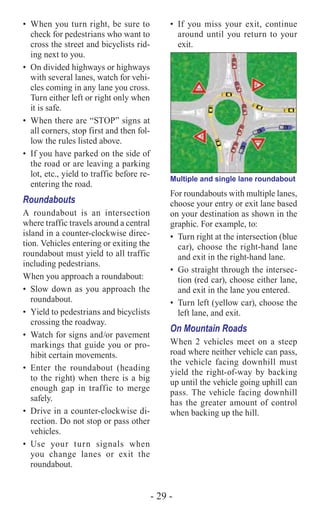
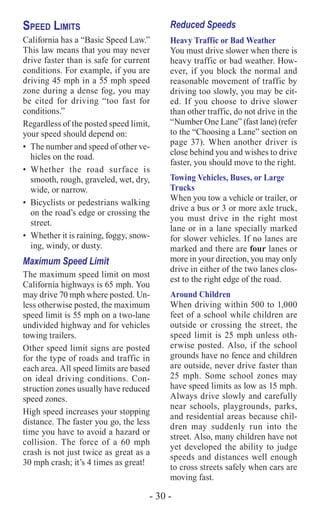
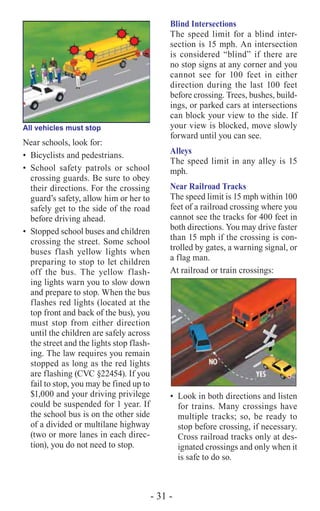
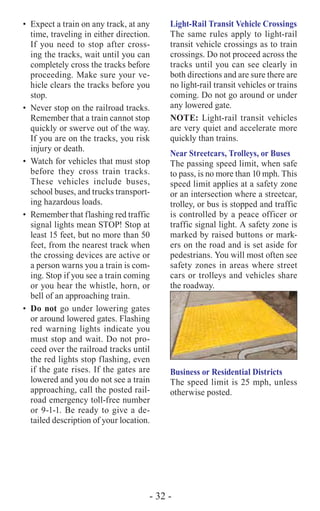
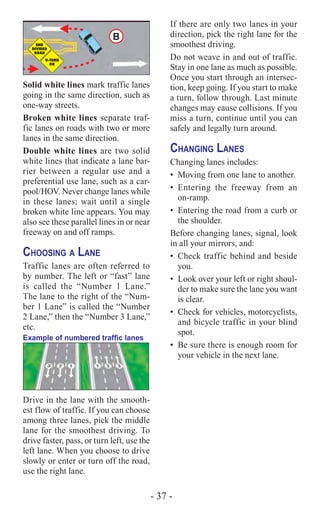
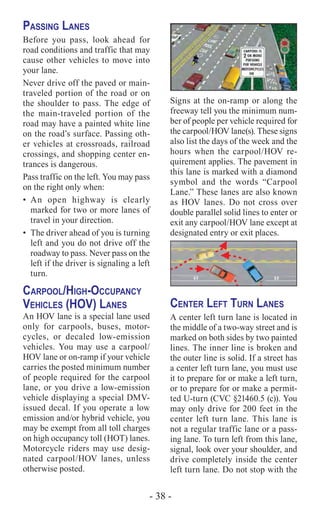
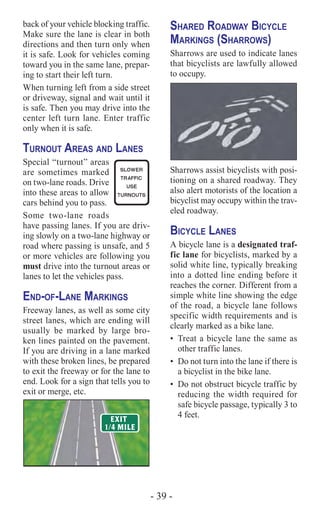
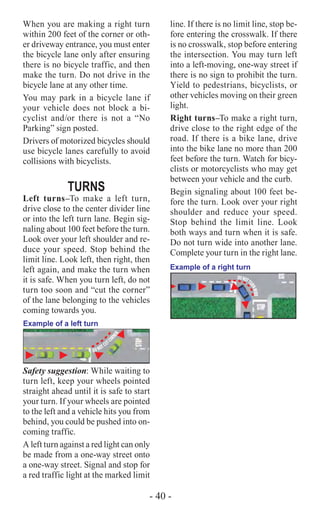
®
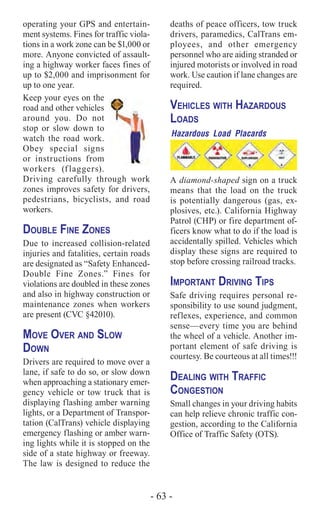
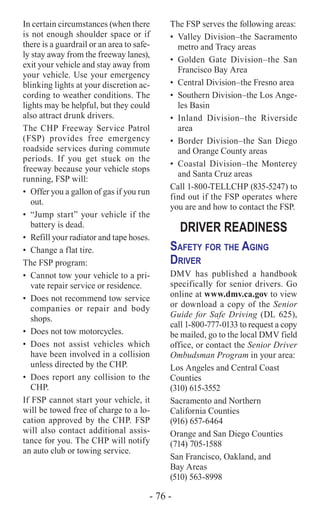
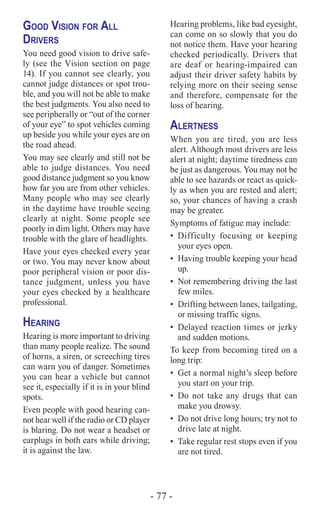
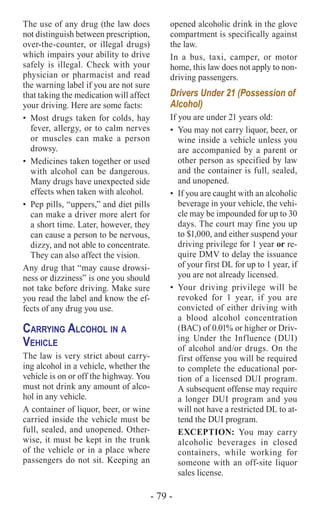
Edmund G. Brown Jr., Governor
State of California
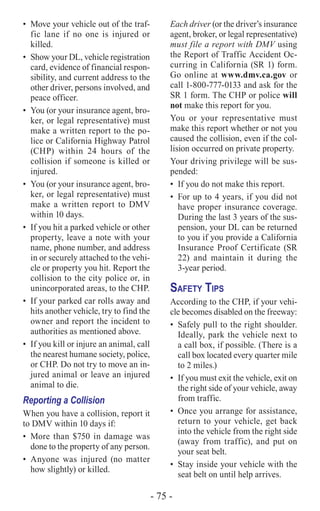
Brian P. Kelly, Secretary
California State Transportation Agency
Jean Shiomoto, Director
California Department of Motor Vehicles
English
2016
This handbook is available at
www.dmv.ca.gov.
California
DRIVER HANDBOOK
This Page Left
Intentionally Blank
- i -
Dear Fellow Californian,
In May 2015 the California Department of Motor Vehicles (DMV) celebrated
100 years of public service. Pretty amazing!
Since its inception the DMV has undergone numerous changes and grown in
ways no one could have imagined. The department has kept pace with popula-
tion growth, technology, security, innovation, and road safety, and it continues
to transition to new ways of doing business striving for one goal: improving
customer service.
The California Driver Handbook is an excellent example of how the department
has adapted to present-day needs and expectations.
To accommodate customer preferences, the DMV now offers the handbook in
hardcopy and via technology. There is even a free DMV “app” that downloads
the handbook and other DMV information onto personal electronic devices --
including interesting and fun ways to learn the rules of the road using sample
quizzes, videos and other interactive tutorials.
We must not forget that the issuance of a driver license is a privilege that comes
with responsibility. For that reason, making time to study in advance of taking
the driver license test is extremely important. We know that about half of first-
time test takers fail the exam.
Whether driving to work, taking children to school, or traveling on one of the
state’s scenic roads and highways, we want you to be safe. So please take ad-
vantage of the many ways DMV can help you know the rules of the road.
Sincerely,
BRIAN P. KELLY
Secretary
California State Transportation Agency
This Page Left
Intentionally Blank
- iii -
NEW 2016 LAWS.................................VII
Where to Write..................................viii
DMV INFORMATION............................. IX
Field Office Hours of Operation.......... ix
GENERAL INFORMATION......................1
Disclaimer..........................................1
Accurate Identification........................1
Basic Information................................1
THE CALIFORNIA DRIVER LICENSE......2
Who Must Have a Driver License?......2
California Residents........................2
California Resident Military
Personnel (U.S. Armed Forces).......2
Nonresident Military Personnel
Stationed in California.....................2
New California Residents................2
Adults Visiting California.................2
OBTAINING A DRIVER LICENSE............3
Application Requirements for a Basic
Class C Driver License........................3
Adults’ Permit Requirements...............4
Adults’ Driver License Requirements...4
DRIVER LICENSE CLASSES..................6
THE EXAMINATION PROCESS...............7
Where to Take the Tests......................7
Cheating.............................................7
DMV Examinations.............................7
SPECIAL SECTION - MINORS................8
Minors’ Permit Requirements..............8
Minors’ Permit Restrictions..................9
Minors’ Driver License Requirements...9
Exceptions - Minors’ Driver License
Restrictions.........................................9
Out-Of-State Minors.........................10
Out-Of-State Minors’ Permit..........10
Out-Of-State Minors’ Driver
License.........................................10
Traffic Violations...............................10
Teenage Traffic Deaths.................11
Actions Against the Provisional Driver
License.............................................11
Keeping Your Provisional Driver
License.........................................11
Habitual Truant—
Persons 13–18 Years Old..............11
Minors and Cell Phones....................12
MISCELLANEOUS LICENSING
INFORMATION.....................................12
To Replace a Lost/Stolen or
Damaged Driver License...................12
Name Changes.................................12
Driver License Renewals...................12
Renewal by Mail or Internet...............13
Driver License Extension..................13
Driver License in Your Possession....13
Address Changes.............................13
Vision...............................................14
Medical Information Card..................14
Organ and Tissue Donation..............14
Veteran Designation and Benefit
Information.......................................14
How Can I Get The Veterans
Designation?.................................15
Register To Vote...............................15
Unlicensed Drivers............................15
Diplomatic Driver Licenses................15
Identification (ID) Cards....................16
Free ID Cards for Physical and
Mental (P&M) Conditions..................16
Identification (ID) Card Renewal by
Mail or Internet..................................16
Driving Schools.................................16
Mature Driver Program......................17
Pedestrian Responsibilities...............17
New Technology...............................18
OCCUPANT PROTECTION...................18
Seat Belts.........................................18
Mistaken Beliefs About Seat
Belts.............................................19
Child Restraint System and Safety
Seats................................................20
Riding Safely with Air Bags...............20
Side-Impact Air Bags....................21
Unattended Children in Motor
Vehicles............................................21
Distracted Driving.............................21
Hot Weather Risks............................22
TABLE OF CONTENTS
- iv -
TRAFFIC CONTROLS...........................22
Traffic Signal Lights..........................22
Pedestrian Signal Lights...................23
Traffic Signs......................................23
LAWS AND RULES
OF THE ROAD.....................................26
Right-of-Way Rules...........................26
General Information......................26
Pedestrians...................................27
Crosswalks...................................28
Intersections.................................28
Roundabouts................................29
On Mountain Roads......................29
Speed Limits.....................................30
Maximum Speed Limit...................30
Reduced Speeds..........................30
VISUAL SEARCH.................................33
Scanning..........................................33
Know What Is Ahead.....................33
Know What Is at Your Side............34
Know What Is Behind You.............35
How Well Can You Stop?..................36
LANE CONTROL..................................36
Line Colors.......................................36
Choosing a Lane...............................37
Changing Lanes...............................37
Passing Lanes..................................38
Carpool/High-Occupancy Vehicles
(HOV) Lanes ....................................38
Center Left Turn Lanes.....................38
Turnout Areas and Lanes..................39
End-of-Lane Markings......................39
Shared Roadway Bicycle Markings
(Sharrows)........................................39
Bicycle Lanes...................................39
TURNS................................................40
Examples of Right and Left Turns......41
Legal U-Turns...................................42
Illegal U-Turns...................................43
PARKING.............................................43
Parking on a Hill................................43
Parallel Parking................................43
Parking at Colored Curbs..................44
Illegal Parking...................................48
Special Parking Rules.......................48
SAFE DRIVING PRACTICES.................49
Signaling..........................................49
Steering............................................49
Horn, Headlights, and Emergency
Signals.............................................50
Use Your Horn..............................50
Do Not Use Your Horn..................50
Use Your Headlights.....................50
Use Your Emergency Signals........51
Text Messaging and Cell Phones......51
VEHICLE POSITIONING.......................52
Following Distances..........................52
Taking Dangers One at a Time......52
Splitting the Difference..................52
Persons Who Present Dangers
to Drivers......................................52
Merging In/Out of Traffic....................52
Space to Merge............................53
Space to Cross or Enter................53
Space to Exit................................53
Passing Other Traffic........................54
Space and Speed to Pass.............54
Space to Return............................54
SHARING THE ROAD...........................55
Large Trucks (Big Rigs) and
Recreational Vehicles (RVs)..............55
Braking.........................................55
Trucker’s Blind Spots—the “No
Zone”............................................55
Turning.........................................55
Maneuverability.............................55
Buses, Streetcars, and Trolleys.........56
Light-Rail Vehicles............................57
Emergency Vehicles.........................57
Slow-Moving Vehicles.......................58
Neighborhood Electric
Vehicles (NEV) and Low-Speed
Vehicles (LSV)..................................58
Animal-Drawn Vehicles.....................58
Motorcycles......................................58
Bicycles............................................59
Bicycles in Travel Lanes................61
Pedestrians Who Are Blind...............61
Road Workers and
Work Zones (Cone Zones)................62
Double Fine Zones...........................63
Move Over and Slow Down...............63
- v -
Vehicles with Hazardous Loads.........63
Important Driving Tips.......................63
Dealing with Traffic Congestion.........63
Dealing with Aggressive Drivers
and Road Rage.................................64
SPECIAL DRIVING SITUATIONS...........64
Keep Your Car Visible.......................64
What is the Road Condition...............64
Curves..............................................64
Driving in Heavy Traffic.....................65
Traffic Speeds..................................65
Driving Hazards................................65
Water on the Road........................65
Slippery Roads.............................65
High Winds...................................66
Driving in the Fog..........................66
Driving with Sun Glare..................66
Driving in Darkness.......................67
Driving in Rain or Snow.................67
Flooded Roadways...........................70
Driving in Hill Country or Curves....70
Traffic Breaks................................70
Clean Windows and Mirrors..............71
Adjust Seat and Mirrors.....................71
Tire Safety........................................71
Other Dangers..................................72
What a Driver Should Do During an
Enforcement Stop.............................72
HANDLING EMERGENCIES..................73
Mechanical Tips................................73
Skids on Slippery Surfaces...........73
Driving Off of the Pavement..............73
Acceleration Skids........................73
Locked Wheel Skids.....................73
Accelerator Malfunction.................74
Steering Wheel Locking Device.....74
Collisions Are Not Accidents.............74
Causes of Collisions......................74
Involved in a Collision...................74
Reporting a Collision.....................75
Safety Tips.......................................75
DRIVER READINESS...........................76
Safety for the Aging Driver................76
Good Vision for All Drivers................77
Hearing............................................77
Alertness..........................................77
Medications......................................78
Health and Emotions.........................78
Conditions Physicians Must Report....78
ALCOHOL AND DRUGS.......................78
Alcohol/Drugs and Driving Is
Dangerous........................................78
Carrying Alcohol in a Vehicle............79
Drivers Under 21 (Possession of
Alcohol)........................................79
Drivers of All Ages............................83
Blood Alcohol Concentration (BAC)
Limits................................................83
Admin Per Se...................................83
Under 21—Zero Tolerance for
Alcohol Use..................................84
Court DUI Convictions......................84
Drivers 21 and Older­—DUI Programs
and Restricted Driver Licenses..........85
Designated Driver Program...............85
ADDITIONAL DRIVING LAWS/RULES....86
Things You Must Not Do:..................86
Things You Must Do:.........................87
ADMINISTRATIVE................................88
Financial Responsibility.....................88
Insurance Requirements...................88
Collisions on Your Record.................89
Collisions, Insurance, and Minors......89
Getting a Ticket................................89
Evading a Peace Officer...................89
Points on the Driver Record..............90
Traffic Violator School Convictions....90
Suspension or Revocation by the
DMV.................................................90
Suspension by Judge........................91
Record Confidentiality.......................91
Vandalism/Graffiti—All Ages.............91
Speed Contests/Reckless Driving.....91
Possessing Firearms........................91
Vehicle Registration Requirements....92
California Vehicles........................92
Out-of-State Vehicles....................92
Vehicle Theft Prevention Tips............93
DRIVER LICENSE FAST FACTS
AND OTHER PUBLICATIONS...............94
Available Online................................94
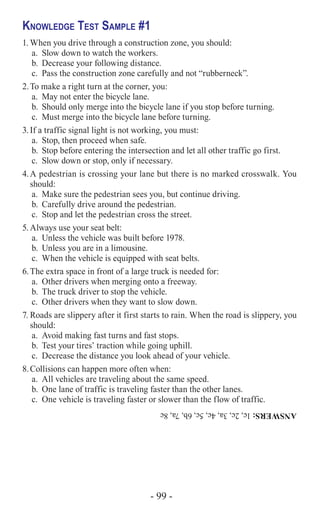
Knowledge Test Sample #1...............99
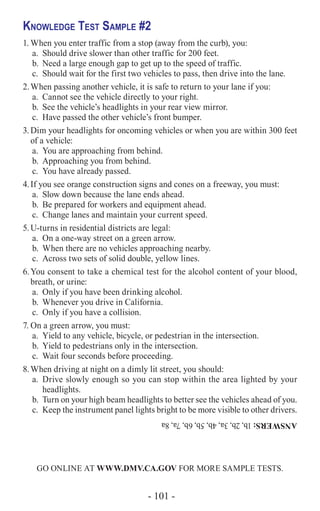
Knowledge Test Sample #2.............101
- vii -
NEW 2016 LAWS
Effective January 1, 2016
Bicycle Reflector
Bicycles operated during darkness upon a highway or a sidewalk must be
equipped with a red reflector or a solid or flashing red light with a built-in
reflector on the rear (California Vehicle Code [CVC] §21201).
Slow Moving Vehicles
Vehicles proceeding at a speed less than the flow of traffic and moving
on a two-lane highway where passing is unsafe, must turn off the roadway
at the nearest place designated as a turnout or wherever sufficient area
for a safe turnout exists if a line of 5 or more vehicles forms behind them
(CVC §21656).
Driver License for Exonerated Persons
DMV must issue a no fee driver license (DL) to a person exonerated of a
conviction and released from state prison within the previous six months
(CVC §14903).
Electric Bicycle Classes
Three classes of electric bicycles have been created. All operators of a
Class 3 (maximum speed of 28 miles per hour [mph]) electric bicycle must
be 16 years old or older and are required to wear a bicycle helmet. There is
no financial responsibility, DL, registration, or license plate requirement
for these electric bicycles (CVC §§312.5, 12804.9, 21113, & 24016).
Expanded Pedicab Definition
The definition of a pedicab has expanded to include provisions that al-
low for consumption of alcoholic beverages by passengers until January 1,
2020. Additional operational and safety equipment is required for this new
type of pedicab (CVC §§467.5, 21215, 21215.5, & 23229).
Effective July 1, 2016
California Residency Requirement
All original DL or identification (ID) card applicants must submit satis-
factory proof of California residency. DMV is prohibited from issuing an
original DL/ID card to a person who does not submit satisfactory proof of
California residency (CVC §12801.5).
- viii -
Effective January 1, 2017
Increased Accident Reportability Threshold
The minimum damage threshold for collision reportability has increased
from $750 to $1,000. A driver of a motor vehicle involved in a collision
with property damages greater than $1,000 must submit a Report of Traf-
fic Accident Occurring in California (SR 1) to DMV. DMV is authorized
to impose sanctions following an uninsured reportable collision (CVC
§§1656.2, 1808, 1808.1, 12517.1, 13369, 13558, 16000, 16000.1, 16020.1,
16020.2, 16075, 16251, 16430, & 16434).
Child Safety Seat Requirements
In addition to the existing child passenger restraint system laws, any child
who is under 2 years old must be secured in a rear-facing child passenger
restraint system unless the child is 40 pounds or more, or 3’3” or taller
(CVC §27360).
Where to Write
If you have any comments or suggestions regarding this publication, please send them to:
Department of Motor Vehicles
Customer Communications Section, MS H165
PO Box 932345
Sacramento, CA 94232-3450
© Copyright, Department of Motor Vehicles 2016
All rights reserved
ThisworkisprotectedbyU.S.CopyrightLaw.DMVownsthecopyrightofthiswork.Copyright
lawprohibitsthefollowing:(1)reproductionofthecopyrightedwork;(2)distributionofcopies
of the copyrighted work; (3) preparation of derivative works based upon the copyrighted
work; (4) displaying the copyrighted work publicly; or (5) performing the copyrighted work
publicly. All requests for permission to make copies of all or any part of this publication
should be addressed to:
Department of Motor Vehicles
Legal Office, MS C128
PO Box 932382
Sacramento, CA 94232-3820
- ix -
DMV INFORMATION
Field Office Hours of Operation
Monday 8 a.m. to 5 p.m.
Tuesday 8 a.m. to 5 p.m.
Wednesday 9 a.m. to 5 p.m.
Thursday 8 a.m. to 5 p.m.
Friday 8 a.m. to 5 p.m.
Saturday Closed
Sunday Closed
Some field offices may have extended hours and a few offer only DL or vehicle
registration services. To find out if your local field office has extended hours, or to
find a field office location and service options, go online or call the toll-free number
listed below.
Go online at www.dmv.ca.gov for (to):
•	 Field office locations, hours, directions, and phone numbers.
•	 Make appointments to visit a field office or take a driving test (except for commer-
cial driving tests).
•	 Order personalized plates.
•	 DL/ID card information.
•	 Vehicle/vessel registration information.
•	 Downloadable forms.
•	 Publications—handbooks, brochures, and sample tests.
•	 Senior driver information.
•	 Teen driver information.
•	 Links to other state and federal agencies.
•	 Renew your DL or vehicle registration.
Call 1-800-777-0133 during normal business hours to:
•	 Obtain/request DL and vehicle registration information, forms, and publications.
•	 Find office locations and hours.
•	 Make a driving test appointment.
•	 Speak to a DMV representative or request a call back.
Call 1-800-777-0133 for automated service 24 hours a day, 7 days a week to:
•	 Renew your vehicle registration with the renewal identification number (RIN) pro-
vided on your billing notice. You can pay with a credit card or e-check.
•	 Make a field office appointment.
Make sure to have your DL or ID card number, vehicle license plate number, and/or
vehicle identification number (VIN) available.
Persons with speech or hearing impairments can call, toll free, 1-800-368-4327 for
assistance with DMV services. Only typed messages from another TTY are received
and responded to at this number.
Advertising sponsorship helps defray the printing costs of this publication. The products
and services provided by the advertising sponsors are not promoted or endorsed by DMV,
but the significant contribution by the advertising sponsors is most appreciated.
If you would like to advertise in this publication, please call the Office of State Publishing
Advertising Department at 1-866-824-0603.
STA
TE OF CALIFOR
NIA
®
DMV IS CONNECTING
with Californians...
www.dmv.
- 1 -
GENERAL INFORMATION
Disclaimer
This handbook provides a summary of the laws and regulations outlined in the
California Vehicle Code (CVC). The Department of Motor Vehicles (DMV), law
enforcement, and the courts follow the full and exact language of the CVC. The
CVC and DMV fees are available online at www.dmv.ca.gov. You may also buy
a copy of the CVC at any DMV field office. The fees listed in the California
Driver Handbook are subject to change.
This handbook is primarily for a basic Class C driver license (DL). For de-
tailed information on other DL types and endorsements refer to the California
Commercial Driver Handbook, Recreational Vehicles and Trailers Handbook,
Ambulance Drivers Handbook, California Parent-Teen Training Guide, and
California Motorcycle Handbook.
Accurate Identification
The reliability, integrity, and confidentiality of the California DL/ID card is of
prime concern to all levels of government, the private sector and general public.
It is critical that these documents be completely authenticated and accurate.
California law requires that all applicants who apply for an original California
DL/ID card submit proof of legal presence in the United States (U.S.) or an iden-
tity and California residency document . Your true full name as shown on your
legal presence or identity document will appear on your DL/ID card.
EXCEPTION: Effective July 1, 2016, all original DL/ID applicants will be
required to submit satisfactory proof of California residency.
Basic Information
A California DL shows that you have been given permission by the state to
drive on public roadways. You may apply for a DL at most DMV field offices
(refer to page ix).
It is a misdemeanor to drive in California without a valid DL. If you do, you can
be cited, your vehicle may be impounded, and you may have to appear in court.
If you do not have outstanding actions on your record, you will receive a DL
after you pay the application fee, pass all applicable knowledge tests, show that
your physical and/or mental condition is satisfactory, and demonstrate your abil-
ity to drive safely. If you have a medical condition or a disability, DMV may
require you to take a driving test. You may also have to provide a statement from
your physician regarding your current health condition.
- 2 -
THE CALIFORNIA
DRIVER LICENSE
Who Must Have a Driver
License?
California Residents
California residents who drive on
public highways or use parking fa-
cilities that are open to the public
must have a California DL, unless
they are:
•	 An officer or employee of the U.S.
government operating a vehicle
owned or controlled by the U.S.
government on federal business,
except when operating a commer-
cial motor vehicle.
•	 Driving or operating implements
of husbandry not operated or
moved over a highway.
•	 Driving or operating an off-high-
way vehicle across a highway.
California Resident Military
Personnel (U.S. Armed Forces)
If you are out of state on active mili-
tary duty and have a valid California
DL, you and your spouse’s Califor-
nia DL will be valid for the full time
you are absent from California and
for 30 days following your discharge
date, if you are honorably discharged
outside of California. Carry both
your DL and discharge or separation
documents, during those 30 days
(CVC §12817).
Call 1-800-777-0133 to obtain an
Extension of License for Person in
Armed Forces (DL 236) card which
extends your California DL.
NOTE: Your DL is not valid if it is
suspended, cancelled, or revoked.
Nonresident Military Personnel
Stationed in California
If you are 18 years old or older, re-
fer to the “California Residents” and
“Adults Visiting California” sections
on this page for additional informa-
tion. Licensees eligible for military
extensions should carry documenta-
tion from their home state to verify
their status to law enforcement.
New California Residents
When you become a California
resident and you want to drive in
California, you must apply for a
California DL within 10 days. Resi-
dency is established in a variety of
ways, including the following:
•	 Being registered to vote in Califor-
nia elections.
•	 Paying resident tuition at a Cali-
fornia college or university.
•	 Filing for a home owner’s property
tax exemption.
•	 Receiving any other privilege or
benefit not ordinarily extended to
nonresidents.
Adults Visiting California
Visitors over 18 years old with a valid
DL from their home state or country
may drive in California without get-
ting a California DL as long as their
home state DL is valid.
- 3 -
OBTAINING A DRIVER
LICENSE
When you apply for an original Cal-
ifornia DL card, you must present
acceptable document(s) establishing
your identity, residency (if appli-
cable), birthdate, and provide your
social security number (SSN), if eli-
gible. The document(s) provided:
•	 Must be a certified copy, or an
original document.
•	 May contain an impressed seal or
original stamped impression.
•	 Must not be a photocopy.
•	Must not present self-laminated
cards or documents.
If you present a legal presence docu-
ment, your DL/ID card may expire
on the same date as your legal pres-
ence document. If the name on your
document is different from the name
on your DL/ID card application, you
must also bring an acceptable true
full name document. Your finger-
print, signature, and photograph will
also be taken (refer to the “Applica-
tion Requirements for a Basic Class
C Driver License” section on page
3). For any other DL/ID card
transaction, you must present photo
identification.
Examples of acceptable documents
include: U.S. Birth Certificate, U.S.
Passport, U.S. Armed Forces ID
Cards, Certificate of Naturalization,
Permanent Resident Card, or a for-
eign passport with a valid I-94. The
I-94 expiration date must be more
than 2 months from the DL/ID card
application date.
Examples of true full name verifi-
cation documents include: adoption
documents containing your legal
name as a result of the adoption,
name change documents contain-
ing your legal name both before
and after, a marriage certificate, a
certificate or registration document
verifying the formation of a domes-
tic partnership, or a dissolution of
marriage document containing your
legal name as a result of the court
order.
A complete list of accepted documents
is available at www.dmv.ca.gov or in
the Documents Required to Apply for
a Driver License (FFDL 5A) Fast
Facts brochure.
Application Requirements
for a Basic Class C
Driver License
To apply for a Class C DL, you must:
•	 Submit a completed and signed
Driver License or Identification
Card Application (DL 44) form.
Signing this form means you agree
to submit to a chemical test to
determine the alcohol or drug con-
tent of your blood when requested
by a peace officer. If you refuse to
sign this statement, DMV will not
issue a permit or DL.
•	 Present an acceptable document(s)
establishing your identity, residen-
cy (if applicable), and birthdate.
•	 Provide your true full name.
•	Provide your SSN, if eligible,
which will be electronically veri-
fied with the Social Security
Administration (SSA).
- 4 -
•	 Pay a nonrefundable application
fee. The fee is good for 12 months
and allows you to take the appro-
priate knowledge test(s) 3 times.
If you fail the knowledge test and/
or driving test 3 times, your ap-
plication will be void and a new
application and fee are required.
This fee pays for both the instruc-
tion permit and DL, if you qualify
for both documents within the
12-month period. If the applica-
tion expires, you must resubmit
documents, repay the application
fee, and retake the required tests.
•	 Pass a vision test. You must be
able to pass a vision test, with or
without corrective lenses, with vi-
sual acuity better than 20/200 in
at least one eye without the use of
a bioptic telescopic lens or similar
bioptic device to meet the mini-
mum vision acuity standard (CVC
§12805(b)).
•	 Have your photograph taken.
•	 Give a fingerprint scan.
•	 Sign your name.
Adults’ Permit
Requirements
If you are at least 18 years old, meet
the application requirements, and
pass the required tests, you may
be issued a California instruction
permit.
You must have an instruction permit
while learning to drive. Your accom-
panying driver must be 18 years old
or older and have a valid California
DL. This person must be seated close
enough to you that he or she is able
to take control of the vehicle at any
time. An instruction permit does not
permit you to drive alone–not even
to a DMV field office to take the
driving test.
If you want to obtain professional
driver education and driver train-
ing, refer to the “Driving Schools”
section on page 16 and “Mature
Driver Program” section on page
17.
If you have a motorcycle permit, you
cannot carry passengers, you must
ride during daylight hours only, and
you cannot ride on the freeway.
To get a motorcycle permit, you
must:
•	 Be at least 18 years old.
•	 Complete the application require-
ments.
•	 Pass a knowledge test.
Adults’ Driver License
Requirements
If you have never been licensed, you
must meet the following criteria:
•	 Be at least 18 years old.
•	 Comply with the requirements for
a driving permit and when you
are ready, make an appointment
to take the behind-the-wheel driv-
ing test. When you report for the
driving test, bring your instruction
permit with you.
•	 Pass the behind-the-wheel driv-
ing test. If you fail the test, you
must pay a retest fee for a second
or subsequent test and schedule a
behind-the-wheel driving test for
another day.
If you have an out-of-state or out-of-
country DL, you must:
•	 Complete all the steps required for
an instruction permit.
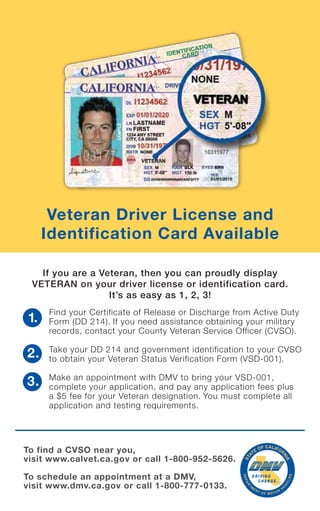
Veteran Driver License and
Identification Card Available
Find your Certificate of Release or Discharge from Active Duty
Form (DD 214). If you need assistance obtaining your military
records, contact your County Veteran Service Officer (CVSO).
Take your DD 214 and government identification to your CVSO
to obtain your Veteran Status Verification Form (VSD-001).
Make an appointment with DMV to bring your VSD-001,
complete your application, and pay any application fees plus
a $5 fee for your Veteran designation. You must complete all
application and testing requirements.
If you are a Veteran, then you can proudly display
VETERAN on your driver license or identification card.
It’s as easy as 1, 2, 3!
3.
2.
1.
®
To find a CVSO near you,
visit www.calvet.ca.gov or call 1-800-952-5626.
To schedule an appointment at a DMV,
visit www.dmv.ca.gov or call 1-800-777-0133.
- 6 -
•	 Bring your valid out-of-state DL
to DMV. Your out-of-state DL will
be invalidated and returned to you
unless you are applying for a com-
mercial driver license (CDL).
NOTE: The behind-the-wheel driv-
ing test for holders of out-of-state
or U.S. territory DL’s are normally
waived. However, DMV may re-
quire a behind-the-wheel driving
test for any type of DL application.
Behind-the-wheel driving tests are
mandatory for out-of-country DL
holders.
DRIVER LICENSE
CLASSES
Class C driver license -
•	 You may drive a:
–	2-axle vehicle with a gross ve-
hicle weight rating (GVWR) of
26,000 pounds (lbs.) or less.
–	3-axle vehicle weighing 6,000
lbs. or less gross.
–	Housecar 40 feet or less.
–	3-wheel motorcycle with 2
wheels located in the front or
back.
–	Vanpool vehicle designed to
carry more than 10 persons, but
no more than 15 persons includ-
ing the driver.
NOTE: A driver of a vanpool may
operate with a Class C license but
shall possess evidence of a medical
examination required for a Class B
license when operating vanpool ve-
hicles. The driver must keep in the
vanpool vehicle a statement signed
under penalty of perjury, that he
or she has not been convicted of
reckless driving, drunk driving, or
hit-and-run in the last 5 years (CVC
§12804.9(j)).
•	 You may tow a:
–	 Single vehicle with a GVWR of
10,000 lbs. or less, including a
tow dolly, if used.
•	 With a vehicle weighing 4,000 lbs.
or more unladen, you may tow a:
–	Trailer coach or 5th-wheel
travel trailer under 10,000 lbs.
GVWR when towing is not for
compensation.
–	5th-wheel travel trailer exceed-
ing 10,000 lbs. but under 15,000
lbs. GVWR, when towing is
not for compensation, and with
endorsement.
•	 A farmer or employee of a farmer
may drive:
–	Any combination of vehicles
with a GVWR of 26,000 lbs. or
less, if used exclusively in agri-
cultural operations and it is not
for hire or compensation.
NOTE:
•	Class C licensees may not tow
more than 1 vehicle.
•	 A passenger vehicle, regardless of
weight, may not tow more than 1
vehicle.
•	 A motor vehicle under 4,000 lbs.
unladen weight may not tow any
vehicle weighing 6,000 lbs. or
more gross (CVC §21715(b)).
Other classes of driver licenses/en-
dorsements are:
•	 Noncommercial Class A
•	 Noncommercial Class B
•	 Commercial Class A
•	 Commercial Class B
•	 Commercial Class C
- 7 -
•	 Motorcycle Class M1
•	 Motorcycle Class M2
•	 Commercial endorsements:
–	Doubles/Triples
–	Hazardous Materials
–	Passenger Transportation
–	Tank Vehicle
•	 Ambulance Driver Certificate
•	 School Bus Endorsement
•	 Tow Truck Driver Certificate
•	 Verification of Transit Training
Certificate
•	 Firefighter Endorsement
NOTE: Commercially licensed
firefighters must submit a Medical
Examination Report (DL 51) every
2 years. Noncommercially licensed
firefighters can submit a self-cer-
tifying Health Questionnaire (DL
546).
THE EXAMINATION
PROCESS
Where to Take the Tests
You may take the knowledge, vision,
and behind-the-wheel driving tests at
most DMV field offices that provide
DL services.
To save time, make an appointment
online at www.dmv.ca.gov or call
1-800-777-0133 during normal busi-
ness hours.
NOTE: DMV will not administer
knowledge or audio exams after 4:30
p.m. to ensure you have sufficient
time for testing. Knowledge and
vision tests are required when you
apply for an original DL or upgrade
to a different class of DL.
Cheating
The use of testing aids is strictly
prohibited. This includes, but is not
limited to: the California Driver
Handbook, cheat sheets, and/or elec-
tronic communication devices such
as a cell phone, hand-held computer,
etc. If any testing aid is used during
the knowledge test, the knowledge
test will be marked as a “failure.” An
action may also be taken by DMV
against your driving privilege or
the driving privilege of anyone else
who assists you in the examination
process.
DMV Examinations
Your DL examinations include:
•	 A vision test (bring your eyeglass-
es or contact lenses to the exam).
•	 A knowledge test.
•	 A behind-the-wheel driving test,
if required. You must have an
appointment to take the behind-
the-wheel driving test. For the
driving test, bring:
–	Your old DL or instruction per-
mit, if you have one.
–	A licensed driver age 18 years
old or older with a valid DL.
–	Proof that the vehicle is prop-
erly insured.
IMPORTANT: If you use a rental
vehicle, the driving test applicant
must be listed on the rental contract.
The contract must not exclude driv-
ing tests.
–	A vehicle that is safe to drive,
and has valid registration. The
vehicle’s brake lights, horn,
parking brake, and turn sig-
nals must work properly. The
- 8 -
vehicle cannot have bald tires,
which would have less than 1
/32
inch tread depth in any 2 adja-
cent grooves. The driver’s side
window must roll down. The
windshield must allow a full un-
obstructed field of vision for you
and the examiner. There must be
at least 2 rear view mirrors (one
must be on the left outside of the
vehicle).
–	You will be asked to locate
the controls for the vehicle’s
headlights, windshield wipers,
defroster, and emergency flash-
ers. You must demonstrate how
to use the parking brake.
NOTE: The behind-the-wheel driv-
ing test will be rescheduled if the
vehicle does not meet the above re-
quirements or if you refuse to use
your seat belt during the driving test.
Technology, such as back up cameras
and self-parking, cannot be used on
a driving test.
For more information, refer to
DMV’s Driving Test (FFDL 22)
Fast Facts brochure, DMV videos,
and sample tests available online at
www.dmv.ca.gov.
SPECIAL SECTION -
MINORS
Minors’ Permit
Requirements
A minor is a person under 18 years
old. Minors must have their appli-
cations (for a DL or any change of
DL class) signed by their parent(s)
or legal guardian(s). If both parents/
guardians have joint custody, both
must sign.
NOTE: Minors may not work as a
driver for pay and they may not drive
a school bus containing pupils.
To get a permit you must:
•	 Be at least 15½ years old, but un-
der 18 years old.
•	 Complete the Driver License or
Identification Card Application
(DL 44) form.
•	 Have your parent(s) or guardian(s)
sign the DL 44 form.
•	 Pass the knowledge test. If you fail
the test, you must wait 7 days (1
week), not including the day the test
was failed before retaking the test.
•	 If you are 15½–17½ years old, you
will need to provide proof that
you:
–	Completed driver education
(Certificate of Completion of
Driver Education) OR
–	Are enrolled and participat-
ing in an approved integrated
driver education/driver train-
ing program (Certificate of
Enrollment in an Integrated
[Classroom] Driver Education
and Driver Training Program).
For more information, refer
to the Provisional Licensing
(FFDL 19) Fast Facts brochure
at www.dmv.ca.gov.
The provisional permit is not
valid until you start your behind-
the-wheel driver training with an
instructor or reach age 17½.
If you have a permit and plan to
drive outside of California, check li-
censing requirements in that state or
country.
NOTE: If you are at least 17½ years
old, you may obtain a permit without
completing driver education or driver
- 9 -
training. However, you cannot get a
DL before you are 18 years old.
Minors’ Permit
Restrictions
Your permit is not valid until you
begin driver training; your instruc-
tor will sign the permit to validate
it. You must practice with a licensed
California driver: parent, guard-
ian, driving instructor, spouse, or
an adult 25 years old or older. The
person must sit close enough to you
to take control of the vehicle at any
time. A provisional permit does not
allow you to drive alone at anytime,
not even to a DMV field office to
take a driving test.
Minors’ Driver License
Requirements
You must:
•	 Be at least 16 years old.
•	 Prove that you have finished both
driver education and driver training.
•	 Have had a California instruction
permit or an instruction permit
from another state for at least 6
months (refer to the Out-of-State
Minors section on page 10).
•	Provide parent(s) or guardian(s)
signature(s) on your instruction
permit certifying that you have
completed 50 hours of supervised
driving practice (10 hours must
be night driving) as outlined in

the California Parent-Teen Train-
ing Guide (DL 603). Visit the teen
website at www.dmv.ca.gov or
call 1-800-777-0133 to request this
booklet.
•	 Pass the behind-the-wheel driving
test. You have 3 chances to pass
the driving test while your permit
is valid. If you fail the behind-the-
wheel driving test, you must pay a
retest fee for a second or subsequent
test and wait 14 days (2 weeks), not
including the day the test was failed
before you are retested.
Once you have your provisional DL,
you may drive alone, as long as you
do not have any collisions or traffic
violations on your driving record.
During the first 12 months after you
are licensed, you cannot drive be-
tween 11 p.m. and 5 a.m. and you
cannot transport passengers under
20 years old, unless you are ac-
companied by a licensed parent or
guardian, a licensed driver 25 years
old or older, or a licensed or certified
driving instructor.
When you become 18 years old, the
“provisional” part of your DL ends.
You may keep your provisional pho-
to license or pay a fee for a duplicate
DL without the word “provisional.”
Exceptions - Minors’
Driver License
Restrictions
The law allows the following excep-
tions when reasonable transportation
is not available and it is necessary
for you to drive. A signed note ex-
plaining the necessity to drive and
the date when this driving necessity
will end must be kept in your pos-
session for the following exceptions
(emancipated minors are excluded
from this requirement):
•	 Medical necessity to drive when
reasonable transportation alter-
natives are inadequate. The note
must be signed by a physician with
the diagnosis and probable date of
recovery.
- 10 -
•	Schooling or school-authorized
activity. The note must be signed
by the school principal, dean, or
designee.
•	Employment necessity and the
need to operate a vehicle as part of
your employment. The note must
be signed by the employer verify-
ing employment.
•	The necessity to drive an im-
mediate family member. A note
signed by your parent(s) or legal

guardian(s) is required, stating the
reason and probable end date of
the necessity to drive the immedi-
ate family member.
EXCEPTION: These requirements
do not apply to an emancipated mi-
nor. You must have declared yourself
emancipated and provided DMV
with proof of financial responsibil-
ity (SR 1P) in lieu of your parent(s)
or guarantor(s) signature(s).
Out-Of-State Minors
All out-of-state minor applicants
must comply with the application
requirements outlined in the “Ap-
plication Requirements for a Basic
Class C Driver License” section on
page 3 and must have parent(s)
and/or legal guardian(s) signature on
the Driver License or Identification
Card Application (DL 44) form.
Out-Of-State Minors’ Permit
Out-of-state minors’ permit appli-
cants must meet the requirements
listed in the “Minors” Permit Re-
quirements” section on page 9. In
addition, if your driver education and
driver training courses were taken in
a state other than California, DMV
may accept a To Secondary Schools
Other Than California Schools (DL
33) form completed by the out-of-
state secondary school. You may
obtain a DL 33 form at your local
DMV field office or by calling DMV
at 1-800-777-0133. Send the DL 33
form to your out-of-state secondary
school and ask them to complete and
return it to you.
Out-Of-State Minors’ Driver
License
You will be asked to present your
out-of-state DL and pass a knowl-
edge test as part of the application
process. The behind-the-wheel driv-
ing test for holders of out-of-state
DLs are normally waived. Howev-
er, DMV may require a behind-the
wheel driving test for any type of DL
application.
NOTE: Out-of-state minor appli-
cants are subject to all provisional
restrictions per California law for
the first year of the DL or until he/
she turns 18 years old.
Traffic Violations
Nearly 50% of the drivers between
15–19 years old are convicted of a
traffic violation in their first year of
driving.
The most common violation is for
speeding, which often results in the
loss of vehicle control and accounts
for about 50% of all teen traffic
convictions.
When you violate traffic laws, you
increase your chances of having a
collision.
- 11 -
Teenage Traffic Deaths
Drivers 15–19 years old have the
highest traffic conviction, collision,
and injury rates of any age group.
Traffic collisions are the leading
cause of death for teenagers. If you
are under 18 years old, your risk of a
fatal collision is about 2½ times that
of the “average” driver. Your risk of
an injury collision is 3 times higher
than the average driver’s risk.
Actions Against the
Provisional Driver License
Teenagers as a group average twice
as many collisions as adult drivers,
while driving only half as many
miles. The teenage collision rate per
mile is 4 times greater than the adult
driver collision rate per mile.
Traffic deaths of new drivers are
deadly combinations of their inex-
perience driving, lack of familiarity
with the vehicle, and their need to
push themselves and the vehicle to
the limit.
Keeping Your Provisional Driver
License
DMV will track your driving record
and take actions based upon any col-
lisions or violations as follows:
•	 If you get a traffic ticket and fail
to appear in court, DMV will sus-
pend your driving privilege until
you appear in court.
•	 If you get a traffic ticket and fail
to pay the fine, DMV will suspend
your driving privilege until you
pay the fine.
•	 If you have 1 “at fault” collision
or conviction within 12 months,
DMV will send you a warning
letter.
•	If you have a second “at fault”
collision or conviction (or combi-
nation of both) within 12 months,
you cannot drive for 30 days, un-
less accompanied by your licensed
parent or other licensed adult who
is at least 25 years old.
•	If you have a third “at fault”
collision or conviction (or any
combination) within 12 months,
you will be suspended for 6
months and placed on probation
for 1 year.
•	 If you have additional “at fault”
collisions or point count convic-
tions while on probation, you will
be suspended again. (Traffic law
violations resolved in juvenile
court are also reported to DMV.)
•	 If you are convicted of using alco-
hol or a controlled substance and
you are between 13–21 years old,
the court orders DMV to suspend
your DL for 1 year. If you do not
have a DL, the court orders DMV
to delay your eligibility to apply
for a DL. You may also be required
to complete a DUI program.
Any restriction, suspension, or pro-
bation will continue for its full term
past your 18th birthday.
Other, stronger actions may be taken
if your driving record justifies them.
Remember, if your driving privilege
has been suspended or revoked, you
may not drive in California.
Habitual Truant—
Persons 13–18 Years Old
The court will suspend, restrict, de-
lay, or revoke your driving privilege
for 1 year if you are convicted of be-
ing a habitual truant from school.
- 12 -
Minors and Cell Phones
•	 It is against the law for a minor to
use a cell phone while driving. If
your cell phone rings, do not an-
swer the call or respond to the text
message.
•	 Convictions for violations of this
law are subject to fines.
EXCEPTIONS: You may use a cell
phone to contact law enforcement, a
health care provider, the fire depart-
ment, or another emergency entity in
an emergency situation.
MISCELLANEOUS
LICENSING
INFORMATION
To Replace a Lost/Stolen
or Damaged Driver License
If your DL is lost, stolen, or dam-
aged, you must go to a DMV field
office, complete the Driver License
or Identification Card Application
(DL 44) form, and pay a fee for the
replacement. You should also present
a photo ID. If DMV cannot confirm
your identity, you will not be issued
a temporary DL.
If you are a minor, your parent(s)
or guardian(s) must sign the DL 44
form. If both parents/guardians have
joint custody, both must sign.
Once a replacement DL is issued, the
previous DL is no longer valid. De-
stroy the old DL if you find it later.
Name Changes
When you legally change your name
because of marriage or other rea-
sons, be sure to change your name
with SSA before coming into DMV.
Bring your DL to DMV in person,
along with your marriage certificate
or other acceptable verification of
your “true full name” (refer to the
“Obtaining a Driver License” section
on page 3). You must complete
the Driver License or Identification
Card Application (DL 44) form and
pay the applicable fee. DMV will
electronically verify your name,
birth date, and SSN with SSA.
A new photograph, fingerprint, and
signature will be taken. Your old DL/
ID card will be invalidated and may
be returned to you.
Driver License Renewals
DMV sends a renewal notice to your
address of record about 2 months
before your DL expires. Follow the
instructions on the renewal notice. If
you do not receive a renewal notice,
go online or call to make an ap-
pointment to renew your DL (refer
to page ix).
Qualified drivers may be eligible
to renew their DL online at DMV’s
website at www.dmv.ca.gov or by
mail.
DMV may issue a DL for 5 years.
The DL expires on your birthday in
the year shown on the DL, unless
otherwise indicated. It is against the
law to drive with an expired DL.
A driving test may be required as
part of any DL transaction. Driving
tests are not required simply because
of age.
- 13 -
If DMV cannot confirm your identi-
ty, you will not be issued a temporary
DL.
For other types of DLs, refer to
the California Commercial Driver
Handbook, Recreational Vehicles
and Trailers Handbook, or Califor-
nia Motorcycle Handbook.
Renewal by Mail or
Internet
If you have not received 2 consecu-
tive 5-year DL extensions, you may
be eligible to renew by mail or in-
ternet without taking a knowledge
test, if:
•	 Your current DL expires before
age 70.
•	 You do not have a probationary DL
(CVC §14250).
•	 You have not violated a written
promise to appear in court or to
pay a fine within the last 2 years.
•	 You are not suspended for driving
with an illegal blood alcohol con-
centration (BAC) level, or refusing
or failing to complete a chemical
or preliminary alcohol screening
test within the last 2 years.
•	 You do not have a total violation
point count greater than 1 point.
Driver License Extension
If you are away from California (up
to 1 year), you may request a free 1
year extension before your DL ex-
pires. Mail your request to DMV,
PO Box 942890, Sacramento, CA
94290-0001. Include your name,
DL number, birth date, California
residence address, and out-of-state
address. Limited-term drivers are
not eligible for this extension.
Driver License in Your
Possession
You must always have your DL with
you when you drive. You must show
it to any peace officer who asks to
see it. If you are in a collision, you
must show it to the other driver(s)
involved (refer to the “Involved in a
Collision” section on page 74).
Address Changes
When you move, you must give
DMV your new address within 10
days. There is no fee to change your
address. You may notify DMV of
your address change for your DL/ID
card, and vehicle(s) online at www.
dmv.ca.gov. You may also down-
load a Change of Address (DMV
14) form and mail it to the address
on the form, or call DMV at 1-800-
777-0133 and request a DMV 14 be
mailed to you.
A new DL or ID card is not issued
when you change your address.
You may type or write your new ad-
dress on a small piece of paper, sign
and date the paper and carry it (do
not use tape or staples) with your DL
or ID card.
If you change your address at a field
office, a DMV representative will
give you a Change of Address Card
(DL 43) to complete and carry with
your DL/ID card.
REMINDER: The U.S. Postal
Service forwards some DMV cor-
respondence; however, it is your
responsibility to ensure DMV has
your correct mailing address on
record.
- 14 -
Vision
DMV screens all drivers to measure
vision with or without corrective
lenses. If you do not meet DMV’s
vision standard (20/40), you will be
required to visit a vision specialist.
The DMV representative will give
you a Report of Vision Examination
(DL 62) form to have completed by
the vision specialist. If your vision
is not worse than 20/70, DMV may
issue you a 30-day temporary DL to
allow you time to have your vision
checked.
All drivers applying for a DL must
have a visual acuity better than
20/200 (best corrected) in at least
one eye before a DL can be issued.
You are prohibited from using a bi-
optic telescope or similar lens to
meet the 20/200 visual acuity stan-
dard in the better eye.
Medical Information Card
Call 1-800-777-0133 to obtain a
Medical Information Card (DL 390)
to list your blood type, allergies,
physician name , and other medical
information. It can be carried with
your DL/ID card.
Organ and Tissue Donation
You may sign up to donate your or-
gans and tissue for transplantation
after your death. When you apply for
or renew your DL or ID card, check
the “Yes, add my name to the donor
registry” box on the renewal form
to place your name on the Donate
Life California Organ Tissue Donor
Registry. If you need additional in-
formation, check the “I do not wish
to register at this time” box and call
Donate Life California where repre-
sentatives can answer any questions
you may have about organ and tissue
donation. You may also use the re-
newal form to financially contribute
to the registry by checking the “$2
voluntary contribution to support
and promote organ and tissue dona-
tion” box.
If you are older than 13, and under 18
years old, you may register with Do-
nate Life California, provided your
parent(s) or legal guardian(s) autho-
rize the donation.
You may consent to the organ and
tissue donation on the Donate Life
California website; however, a new
DL or ID card with a pink dot will
not be issued until you check “Yes,
add my name to the donor registry”
box on the DL or ID application and
DMV processes the new transaction
(replacement, renewal, change of
name, etc.). It is your responsibility
to contact Donate Life California if
you wish to change or update your
donor status or information. For
more information about the donor
registry, adding restrictions to your
gift, and the donation process, visit
the Donate Life California website at
donateLIFEcalifornia.org, or call
1-866-797-2366.
Veteran Designation and
Benefit Information
Have you ever served in the U.S. Mil-
itary? For an additional $5 fee, DMV
offers those who proudly served
our country the option to mark the
face of their DL/ID card with the
- 15 -
word “VETERAN” to indicate they
served in the U.S. Armed Forces. In
addition, DMV will refer veterans
to the California Department of Vet-
eran Affairs to determine eligibility
for benefits acquired while serving
in the U.S. Armed Forces.
How Can I Get The Veterans
Designation?
•	 Visit a County Veteran Service
Officer (CVSO) to obtain a signed,
certified Veteran Status Verifica-
tion Form (VSD-001).
•	For more information, visit the
DMV website at www.dmv.ca.gov
or refer to the Are You a Veteran?
(FFDL 43) Fast Facts brochure.
The California Department of
Veterans Affairs (CalVet) CalVet
Connect program would like you to
receive information regarding ben-
efits, such as employment, housing,
education, and health care servic-
es for which you may be entitled.
Check the “If you have served,
would you like to receive benefits
information for which you may be
eligible?” box on the Driver License
or Identification Card Application
(DL 44) form. DMV will transmit
your name and mailing address to
CalVet for them to forward you ben-
efits information.
To locate a CalVet office near you, re-
fer to your local government listing in
your telephone book, or visit the Cal-
Vet website at www.calvet.ca.gov or
the DMV website at www.dmv.ca.gov.
Register To Vote
You may register to vote or update
your voter registration with DMV
when applying for an original DL/
ID, renewing your DL/ID, or chang-
ing your address by mail or internet.
For more information, visit the DMV
website at www.dmv.ca.gov.
Unlicensed Drivers
It is against the law to loan your ve-
hicle to a person who is unlicensed
or whose driving privilege has been
suspended. If an unlicensed person
is caught driving your vehicle, it
may be impounded for 30 days (CVC
§14607.6).
No person of any age may drive on a
highway or in a public parking facil-
ity unless he or she has a valid DL or
permit. The law also states that you
must not employ, permit, or autho-
rize any person to drive your vehicle
on a public street or highway, unless
he or she is licensed to drive that
class of vehicle.
A person must be at least 21 years
old to drive most commercial vehi-
cles for hire in interstate commerce
and to transport hazardous materials
or wastes.
Diplomatic Driver Licenses
Nonresidents who possess a valid
diplomatic DL issued by the U.S.
Department of State are exempt
from California driver licensing
requirements.
- 16 -
Identification (ID) Cards
DMV issues ID cards to eligible per-
sons of any age. To obtain an original
ID card, you must present a birth
date/legal presence verification doc-
ument and provide your SSN (refer
to the “Obtaining a Driver License”
section on page 3). The ID card
is valid until the 6th birthday after
the issue date. The fee for an ID card
may be reduced, if you meet cer-
tain requirements for specific public
assistance programs. Refer to the
Requirements for a California Iden-
tification Card (FFDL 6) Fast Facts
brochure for additional information.
NOTE: Governmental or nonprofit
organizations determine whether an
individual meets the requirements
for a reduced-fee ID card.
If you are age 62 or older, you may
obtain a free senior citizen ID card
that is valid for 10 years.
Free ID Cards for
Physical and Mental
(P&M) Conditions
Drivers with physical or mental
(P&M) conditions may need to be
reexamined from time to time by a
physician or be retested more often
than every 5 years by a DMV exam-
iner to obtain a limited-term DL.
Drivers who are no longer able to
drive safely because of a P&M con-
dition may be eligible to exchange
their valid DL for a no-fee ID card, if
certain guidelines are met. Go online
at www.dmv.ca.gov or call 1-800-
777-0133 for additional information.
Identification (ID) Card
Renewal by Mail or
Internet
Customers who are eligible to renew
their ID cards by mail or internet
will receive a notice approximate-
ly 60 days before the expiration of
their current ID card. Reduced-fee
ID cards cannot be renewed by mail
or internet.
There is a fee for regular ID cards
(customers under 62 years old);
there is no charge for senior citizen
ID cards (customers 62 years old or
older), if applying for a senior citizen
ID card.
Driving Schools
When learning to drive, you should
seek qualified instruction, either
with a public or private high school
or a state licensed professional driv-
ing school.
DMV licenses professional schools
and instructors in California that
meet rigid qualifying standards.
Schools must carry liability insur-
ance, hold a bond, and maintain
complete records for DMV inspec-
tion. Vehicles are subject to annual
inspection. Instructors must pass a
written examination every 3 years or
show proof of continuing education
in the traffic safety field. If you use
the services of a professional driving
school, ask to see the instructor’s ID
card. Go online at www.dmv.ca.gov
or refer to the Selecting a Driving
School (FFDL 33) Fast Facts bro-
chure for additional information.
- 17 -
Mature Driver Program
The Mature Driver Program is an
8-hour course for drivers 55 and
older. This course covers a variety
of topics of special interest to the
mature driver and is available from
DMV approved course providers.
Visit the DMV website for more
information.
Your insurance company may offer
discounts for those who complete the
class and receive a completion cer-
tificate. The certificate is valid for 3
years and can be renewed by com-
pleting a 4-hour course.
Pedestrian Responsibilities
Pedestrians (including joggers)
should be aware of traffic conditions.
Watch out for drivers before assum-
ing you have the right-of-way when
crossing a street.
Be aware that hybrid and electric
vehicles are virtually silent when
running on electric power and you
may not hear them approaching an
intersection.
Yield the right-of-way to vehicles
when you cross a street between
intersections and in areas with no
pedestrian crosswalks or signals.
REMEMBER: Making eye contact
with a driver does not mean the driv-
er will yield the right-of-way.
Do not suddenly leave a curb or oth-
er safe place, and walk or run into
the path of a vehicle close enough to
be a danger to you. This is true even
though you are in a crosswalk. The
law states that drivers must always
yield the right-of-way to a pedestri-
an, but if the driver cannot stop in
time to avoid hitting you, you still
run the risk of being hit.
Avoid distractions as a pedestrian.
Do not use your mobile phone or
electronic device while moving. To
avoid becoming a hazard to vehicles
and other pedestrians, you should
be aware of your surroundings at all
times.
Always obey traffic signal lights.
Whether the intersection has pedes-
trian signals or traffic signal lights,
you must obey the pedestrian rules
(refer to pages 22 and 23). At an
intersection where traffic is not con-
trolled by traffic signal lights, drivers
are required to yield the right-of-way
to pedestrians within any crosswalk,
marked or unmarked.
When a traffic signal light chang-
es to green or “WALK,” look left,
right, and then left again, and yield
the right-of-way to any vehicle in the
intersection before the traffic signal
light changes.
If the traffic signal light begins
blinking or changes to “DON’T
WALK,” or to an upraised hand af-
ter you have gone part way across
a divided street, you may continue
across the street.
Do not stop or delay traffic unneces-
sarily while crossing a street.
Pedestrians are not permitted on
any toll bridge or highway cross-
ing, unless there is a sidewalk and
signs stating pedestrian traffic is
permitted.
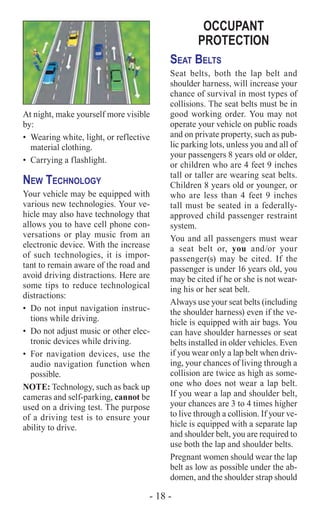
If there are no sidewalks, walk fac-
ing oncoming traffic (see graphic
on page 18). Do not walk or jog
on any freeway where signs tell you
that pedestrians are not allowed. Do
not walk or jog in a bike lane unless
there is no sidewalk.
- 18 -
At night, make yourself more visible
by:
•	 Wearing white, light, or reflective
material clothing.
•	 Carrying a flashlight.
New Technology
Your vehicle may be equipped with
various new technologies. Your ve-
hicle may also have technology that
allows you to have cell phone con-
versations or play music from an
electronic device. With the increase
of such technologies, it is impor-
tant to remain aware of the road and
avoid driving distractions. Here are
some tips to reduce technological
distractions:
•	 Do not input navigation instruc-
tions while driving.
•	 Do not adjust music or other elec-
tronic devices while driving.
•	For navigation devices, use the
audio navigation function when
possible.
NOTE: Technology, such as back up
cameras and self-parking, cannot be
used on a driving test. The purpose
of a driving test is to ensure your
ability to drive.
OCCUPANT
PROTECTION
Seat Belts
Seat belts, both the lap belt and
shoulder harness, will increase your
chance of survival in most types of
collisions. The seat belts must be in
good working order. You may not
operate your vehicle on public roads
and on private property, such as pub-
lic parking lots, unless you and all of
your passengers 8 years old or older,
or children who are 4 feet 9 inches
tall or taller are wearing seat belts.
Children 8 years old or younger, or
who are less than 4 feet 9 inches
tall must be seated in a federally-
approved child passenger restraint
system.
You and all passengers must wear
a seat belt or, you and/or your
passenger(s) may be cited. If the
passenger is under 16 years old, you
may be cited if he or she is not wear-
ing his or her seat belt.
Always use your seat belts (including
the shoulder harness) even if the ve-
hicle is equipped with air bags. You
can have shoulder harnesses or seat
belts installed in older vehicles. Even
if you wear only a lap belt when driv-
ing, your chances of living through a
collision are twice as high as some-
one who does not wear a lap belt.
If you wear a lap and shoulder belt,
your chances are 3 to 4 times higher
to live through a collision. If your ve-
hicle is equipped with a separate lap
and shoulder belt, you are required to
use both the lap and shoulder belts.
Pregnant women should wear the lap
belt as low as possible under the ab-
domen, and the shoulder strap should
- 19 -
be placed between the breasts and to
the side of the abdomen’s bulge.
WARNING: Using seat belts re-
duces the risk of being thrown from
your vehicle in a collision. If you do
not install and use a shoulder har-
ness with the seat (lap) belt, serious
or fatal injuries may happen in some
collisions. Lap-only belts increase
the chance of spinal column and
abdominal injuries—especially in
children. Shoulder harnesses may be
available for your vehicle, if it is not
already equipped with them.
Mistaken Beliefs About Seat
Belts
Crash tests have proven safety belts
can reduce injuries and deaths. Have
you heard these myths?
“Seat belts can trap you inside a ve-
hicle.” It actually takes less than a
second to take off a seat belt. This
myth often describes a vehicle that
caught fire or sank in deep water.
A seat belt may keep you from be-
ing “knocked unconscious.” Being
aware and conscious will greatly
increase your chances of survival in
such situations.
“Seat belts are good on long trips,
but I don’t need them if I’m driving
around town.” More than half of all
traffic deaths happen within 25 miles
of home. Do not take chances with
your life or the lives of your passen-
gers. Buckle up every time you drive
regardless of travel distance.
“Some people are thrown from a
vehicle in a crash and walk away
with hardly a scratch.” Your chances
of surviving a collision are 5 times
better if, upon impact, you are not
thrown from the vehicle. A seat belt
can keep you from being thrown into
the path of another vehicle.
“I’m only going to the store. My
young child doesn’t need to be se-
cured in a safety seat.” Vehicle
collisions are the number one pre-
ventable cause of death for children.
The law requires that children under
8 years old who are 4 feet 9 inches
tall or taller to be properly secured
with an appropriate safety belt, or
be buckled into a federally-approved
child passenger restraint system if
under 8 years old and less than 4 feet
9 inches tall.
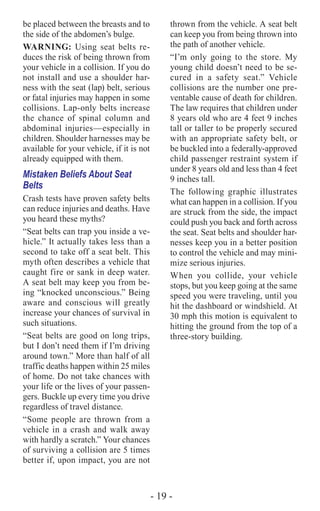
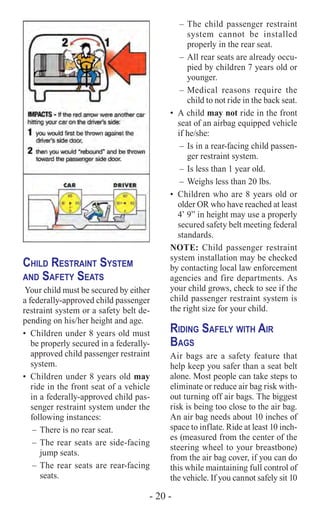
The following graphic illustrates
what can happen in a collision. If you
are struck from the side, the impact
could push you back and forth across
the seat. Seat belts and shoulder har-
nesses keep you in a better position
to control the vehicle and may mini-
mize serious injuries.
When you collide, your vehicle
stops, but you keep going at the same
speed you were traveling, until you
hit the dashboard or windshield. At
30 mph this motion is equivalent to
hitting the ground from the top of a
three-story building.
- 20 -
Child Restraint System
and Safety Seats
Your child must be secured by either
a federally-approved child passenger
restraint system or a safety belt de-
pending on his/her height and age.
•	 Children under 8 years old must
be properly secured in a federally-
approved child passenger restraint
system.
•	 Children under 8 years old may
ride in the front seat of a vehicle
in a federally-approved child pas-
senger restraint system under the
following instances:
–	There is no rear seat.
–	The rear seats are side-facing
jump seats.
–	The rear seats are rear-facing
seats.
–	The child passenger restraint
system cannot be installed
properly in the rear seat.
–	All rear seats are already occu-
pied by children 7 years old or
younger.
–	Medical reasons require the
child to not ride in the back seat.
•	 A child may not ride in the front
seat of an airbag equipped vehicle
if he/she:
–	Is in a rear-facing child passen-
ger restraint system.
–	Is less than 1 year old.
–	Weighs less than 20 lbs.
•	 Children who are 8 years old or
older OR who have reached at least
4’ 9” in height may use a properly
secured safety belt meeting federal
standards.
NOTE: Child passenger restraint
system installation may be checked
by contacting local law enforcement
agencies and fire departments. As
your child grows, check to see if the
child passenger restraint system is
the right size for your child.
Riding Safely with Air
Bags
Air bags are a safety feature that
help keep you safer than a seat belt
alone. Most people can take steps to
eliminate or reduce air bag risk with-
out turning off air bags. The biggest
risk is being too close to the air bag.
An air bag needs about 10 inches of
space to inflate. Ride at least 10 inch-
es (measured from the center of the
steering wheel to your breastbone)
from the air bag cover, if you can do
this while maintaining full control of
the vehicle. If you cannot safely sit 10
- 21 -
inches away from the air bag, contact
your vehicle dealer or manufacturer
for advice about additional ways of
moving back from your air bag.
Passengers should also sit at least 10
inches away from the passenger-side
air bag.
Side-Impact Air Bags
Side-impact air bags can provide
extra safety benefits to adults in
side-impact crashes. However, chil-
dren who are seated next to a side
air bag may be at risk of serious or
fatal injury. Since side air bags are
different in design and performance,
you should consider the benefits and
risks associated with the use of side
air bags if you transport children.
Children who are leaning against a
side air bag when it inflates are at
risk of serious injury. Children who
are traveling in a correctly installed
child passenger restraint system ap-
propriate to age and weight are not at
risk of serious injury. These children
are usually not in the path of a side
air bag when it inflates.
Unattended Children in
Motor Vehicles
It is never a good idea to leave a
child unattended in a vehicle.
It is illegal to leave a child 6 years
old or younger unattended in a mo-
tor vehicle.
The court may fine a violator and
require him or her to attend a com-
munity education program. Also,
DMV and court penalties for leaving
an unattended child in a vehicle are
more severe if the child is injured,
requires emergency medical servic-
es, or passes away.
NOTE: The child may be left under
the supervision of a person 12 years
old or older.
Distracted Driving
Anything that prevents you from
operating your vehicle safely is a
distraction. The following are the 3
types of driver distractions:
•	 Visual-Eyes off the road.
•	 Cognitive-Mind off the road.
•	Manual-Hands off the steering
wheel.
Approximately 80% of collisions and
65% of near-collisions involve some
form of a driver distraction. Ac-
cording to the “100-Car Naturalistic
Driving Study” (2006) released by
the National Highway Traffic Safety
Administration (NHTSA) and the
Virginia Tech Transportation Insti-
tute (VTTI), concluded that drivers
looked away from the roadway at
least once in the 3-second window
prior to the collision.
Some actions that cause distracted
driving and lead to vehicle colli-
sions are:
•	 Using a handheld device (i.e. cell
phone, music device).
•	 Reaching for an object inside the
vehicle.
•	 Looking at an object or event out-
side of the vehicle.
•	Reading.
•	Eating.
•	 Applying cosmetics (makeup).
When you are driving, the condition
of the roadway you are on and the
behavior of other drivers can change
abruptly, leaving you little or no time
to react.
- 22 -
Drive safely. Remember to always
keep your mind on driving, eyes on
the road, and hands on the wheel.
More information regarding colli-
sions and distractions can be found
in the Driver Distraction (FFDL 28)
Fast Facts brochure.
Hot Weather Risks
As stated in the “Unattended Chil-
dren in Motor Vehicles” section, it is
against the law to leave unattended
minor children in a vehicle (CVC
§15620). Additionally, and equally
important, it is dangerous and ille-
gal to leave children and/or animals
in a hot vehicle. After sitting in the
sun, even if a window is slightly
opened, the temperature can rise
rapidly inside a parked vehicle. The
temperature inside a vehicle can rise
approximately 40–50 degrees higher
than the outside temperature.
Dehydration, heat stroke, and death
can result from overexposure to the
heat. California Penal Code §597.7
prohibits leaving or confining an
animal in any unattended motor ve-
hicle under conditions that endanger
the health or well-being of an animal
due to heat. Remember if it’s too hot
for you, it’s too hot for children and
pets.
TRAFFIC CONTROLS
Traffic Signal Lights
Solid Red–A red traffic sig-
nal light means “STOP.”
You can make a right turn
against a red traffic signal
light after you stop. Yield to pedes-
trians, bicyclists, and vehicles close
enough to be a hazard. Make the
right turn only when it is safe. Do not
turn if a “NO TURN ON RED” sign
is posted.
Red Arrow–A red arrow
means “STOP.” Remain
stopped until the green signal
or green arrow appears. Do not turn
against a red arrow.
Flashing Red–A flashing
red traffic signal light means
“STOP.” After stopping, you
may proceed when it is safe.
Observe the right-of-way rules.
Solid Yellow–A yellow traf-
fic signal light means
“CAUTION.” The red traffic
signal light is about to appear. When
you see the yellow traffic signal
light, stop if you can do so safely. If
you cannot stop safely, cross the in-
tersection cautiously.
Yellow Arrow–A yellow
arrow means the “protect-
ed” turning time period is
ending. Be prepared to obey the next
traffic signal light, which could be
the green or red traffic signal light or
the red arrow.
Flashing Yellow–A flash-
ing yellow traffic signal
light warns you to “PRO-
CEED WITH CAUTION.” Slow
down and be alert before entering the
intersection. Yield to any pedestrians,
bicyclists, or vehicles in the intersec-
tion. You do not need to stop for a
flashing yellow traffic signal light.
Flashing Yellow Arrow–
This traffic signal light
means turns are permit-
ted (unprotected), but you
must first yield to oncoming traffic
and pedestrians and then proceed
with caution.
- 23 -
Solid Green–Give the
right-of-way to any vehicle,
bicyclist, or pedestrian in
the intersection. A green traffic sig-
nal light means “GO.” If you are
turning left, make the turn only if
you have enough space to complete
the turn before creating a hazard for
any oncoming vehicle, bicyclist, or
pedestrian. Do not enter the intersec-
tion if you cannot get completely
across before the traffic signal light
turns red. If you block the intersec-
tion, you can be cited.
Green Arrow–A green
arrow means “GO.” You
must turn in the direction
the arrow is pointing after you yield
to any vehicle, bicyclist, or pedes-
trian still in the intersection. The
green arrow allows you to make a
“protected” turn. Oncoming vehi-
cles, bicyclists, and pedestrians are
stopped by a red traffic signal light
as long as the green arrow is lighted.
Traffic Signal Light Not Work-
ing (Blackout)–The traffic signal
light is not working and/or no lights
are showing on the signal. Proceed
cautiously as if the intersection is
controlled by “STOP” signs in all
directions.
Pedestrian Signal Lights
Pedestrian traffic signal lights show
words or pictures similar to the fol-
lowing examples:
”Walk” or “Walking
Person” traffic signal
light means it is legal to
cross the street.
“Don’t Walk” or “Raised
Hand” traffic signal light
means you may not start
crossing the street.
Flashing “Don’t Walk” or
Flashing “Raised Hand” traffic sig-
nal light means do not start crossing
the street because the traffic signal
light is about to change. If a pedes-
trian begins crossing the street after
the traffic signal light starts flash-
ing, wait until the pedestrian(s) has
crossed the street before proceeding.
Countdown traffic signal lights in-
dicate how many seconds remain for
crossing. These traffic signal lights
allow pedestrians the flexibility to
speed up if the crossing phase is
about to expire.
Some traffic signal lights may pro-
vide a beeping or chirping sound or
a verbal message. These traffic sig-
nal lights are designed to help blind
or visually impaired pedestrians
cross the street.
At many traffic signal lights, you
need to push the pedestrian push
button to activate the “Walk” or
“Walking Person” traffic signal
light. If there are no pedestrian sig-
nals, obey the traffic signal lights.
Traffic Signs
The shape and color of a sign offers
you a clue about the information con-
tained on the sign. Here are the
common shapes used:
An 8-sided red STOP sign
indicates that you must
make a full “STOP” when-
ever you see this sign.
Stop at the white limit line (a wide
white line painted on the street) or
before entering the crosswalk. If a
STOP
- 24 -- 78 -
Red and White Regulatory Signs
Highway Construction and Maintenance Signs
Guide Signs
Hazardous Loads Placards
White Regulatory Signs
Slow Moving Vehicle
No U-turn	 No Left Turn	 No Right Turn
- 25 -
Warning Signs
Slippery
When Wet
Merging
Traffic
Divided
Highway
Sharp
Turn
Lane
Ends
Two Way
Traffic
“T”
Intersection
Winding
Road
Stop AheadCrossroadAdded Lane
Ahead
Traffic
Signal
Pedestrian
Crossing
End Divided
Highway
Yield Ahead Directional
Arrow
Curve
For more information:
www.dot.ca.gov
- 26 -
limit line or crosswalk is not painted
on the street, stop before entering the
intersection. Check traffic in all di-
rections before proceeding.
A 3-sided red YIELD
sign indicates that you
must slow down and be
ready to stop, if necessary,
to let any vehicle, bicyclist, or pedes-
trian pass before you proceed.
A square red and white
regulatory sign indi-
cates that you must
follow the sign’s in-
struction. For example,
the DO NOT ENTER
sign means do not enter
a road or off ramp
where the sign is posted (usually on
a freeway off ramp). The WRONG
WAY sign may or may not be posted
with the DO NOT ENTER sign. If
you see one or both of these signs,
drive to the side of the road and stop.
You are going against traffic. When
safe, back out or turn around and re-
turn to the road you were on. At
night if you are going the wrong way,
the road reflectors will shine red in
your headlights.
A sign that has a red
circle with a red line
through it always indi-
cates “NO.” The picture
inside the circle shows
what you cannot do. The sign may be
shown with or without words.
A yellow and black cir-
cular sign indicates that
you are approaching a
railroad crossing.
DO NOT
WRONG
WAY
ENTER
DO NOT
WRONG
WAY
ENTER
R R
R
A
IL
R
O
A
D
C
R
O
S
S
IN
G
An x-shaped sign with a white back-
ground that states
RAILROAD CROSS-
ING indicates that you
must look, listen, slow
down, and prepare to stop, if neces-
sary. Let any trains pass before you
proceed.
A 5-sided sign indi-
cates that you are near a
school. Stop if children
are in the crosswalk.
A 4-sided diamond-shaped sign
warns you of specific road condi-
tions and dangers ahead. Many
warning signs are diamond-shaped.
A white rectangular sign indicates
that you must obey important rules.
Some warning signs have a fluo-
rescent yellow-green background.
These signs warn of conditions re-
lated to pedestrians, bicyclists,
schools, playgrounds, school buses,
and school passenger loading zones.
Obey all warning signs regardless of
their shape or color (refer to pages
24 and 25 for examples).
LAWS AND RULES
OF THE ROAD
Right-of-Way Rules
General Information
Right-of-way rules, together with
courtesy and common sense, help to
promote traffic safety. It is important
to respect the right-of-way of others,
especially pedestrians, motorcycle
riders, and bicycle riders. Never as-
sume other drivers will give you the
right-of-way. Yield your right-of-way
when it helps to prevent collisions.
- 27 -
Respecting the right-of-way of oth-
ers is not limited to situations such
as yielding to pedestrians in cross-
walks, or watching carefully to
ensure the right-of-way of bicyclists
and motorcyclists. Motorists must
respect the right-of-way of others
by not violating traffic laws, such as
failing to stop at a stop sign or traf-
fic light, speeding, making unsafe
lane changes, or illegal turns. Statis-
tics show that right-of-way violations
cause a high percentage of injury
collisions in California.
Pedestrians
Pedestrian safety is a serious issue.
A pedestrian is a person on foot or
who uses a conveyance such as roller
skates, skateboard, etc., other than a
bicycle. A pedestrian can also be a
person with a disability using a tri-
cycle, quadricycle, or wheelchair for
transportation.
In California, pedestrian deaths oc-
cur in approximately 22% of all
traffic fatalities. Drive cautiously
when pedestrians are near because
they may suddenly cross your path.
Pedestrians may be at risk walking
near hybrid and electric vehicles be-
cause these vehicles are virtually
silent while operating. Use extra cau-
tion when driving near pedestrians.
•	Respect the right-of-way of pe-
destrians. Always stop for any
pedestrian crossing at corners
or other crosswalks, even if the
crosswalk is in the middle of the
block, at corners with or without
traffic signal lights, whether or
not the crosswalks are marked by
painted lines.
•	 Do not pass a vehicle stopped at a
crosswalk. A pedestrian you can-
not see may be crossing the street.
Stop and proceed when all pedes-
trians have crossed the street.
•	 Do not drive on a sidewalk, except
to cross it to enter or exit a drive-
way or alley. When crossing, yield
to all pedestrians.
•	 Do not stop in a crosswalk. You
will place pedestrians in danger.
•	 Remember, if a pedestrian makes
eye contact with you, he or she is
ready to cross the street. Yield to
the pedestrian.
•	 Allow older pedestrians, disabled
pedestrians, and pedestrians with
young children sufficient time to
cross the street.
•	 Obey signs pertaining to pedestri-
ans. Examples include:
IMPORTANT: Blind pedestrians
rely on the sound of your vehicle to
become aware of your vehicle’s pres-
ence. It is important that you stop your
vehicle within 5 feet of the crosswalk.
Drivers of hybrid or electric vehicles
must remain especially aware that
the lack of engine noise may cause
a blind pedestrian to assume there is
not a vehicle nearby. Follow this cue:
•	 When a blind person pulls in his
or her cane and steps away from
the intersection, this gesture usu-
ally means for you to go (additional
information regarding blind pedes-
trians can be found on page 61).
- 28 -
Crosswalks
A crosswalk is the part of the road-
way set aside for pedestrian traffic.
Most intersections have a pedestrian
crosswalk whether or not lines are
painted on the street. Most cross-
walks are located at corners, but they
can also be located in the middle
of the block. Before turning a cor-
ner, watch for pedestrians about to
cross the street. Pedestrians have
the right-of-way in marked or
unmarked crosswalks. Although
pedestrians have the right-of-way,
they also must abide by the rules of
the road. A pedestrian should not
suddenly leave a curb, or other place
of safety, and cross into the path of a
vehicle as this creates an immediate
hazard. Furthermore, a pedestrian
must not stop unnecessarily or delay
traffic while in a crosswalk.
If you approach a crosswalk while
driving, you are required to exer-
cise caution and reduce your speed
to safeguard the safety of the pedes-
trian. You may need to stop to ensure
the safety of the pedestrian, as out-
lined in CVC §21950.
Crosswalks are often marked with
white lines. Yellow crosswalk lines
may be painted at school crossings.
Most often, crosswalks in residential
areas are not marked.
Some crosswalks have flashing
lights to warn you that pedestrians
may be crossing. Look for pedestri-
ans and be prepared to stop, whether
or not the lights are flashing.
Intersections
An intersection is any place where
one line of roadway meets another
roadway. Intersections include cross
streets, side streets, alleys, freeway
entrances, and any other location
where vehicles traveling on different
highways or roads join each other.
Driving through an intersection
is one of the most complex traffic
situations motorists encounter. Inter-
section collisions account for more
than 45% of all reported crashes and
21% of fatalities according to the
Federal Highway Administration.
•	 At intersections without “STOP”
or “YIELD” signs, slow down
and be ready to stop. Yield to traf-
fic and pedestrians already in the
intersection or just entering the
intersection. Also, yield to the ve-
hicle or bicycle that arrives first,
or to the vehicle or bicycle on your
right if it reaches the intersection
at the same time as you.
•	At “T” intersections without
“STOP” or “YIELD” signs, yield
to traffic and pedestrians on the
through road. They have the
right-of-way.
•	 When you turn left, give the right-
of-way to all vehicles approaching
that are close enough to be danger-
ous. Also, look for motorcyclists,
bicyclists, and pedestrians.
Safety suggestion: While wait-
ing to turn left, keep your wheels
pointed straight ahead until it
is safe to start your turn. If your
wheels are pointed to the left, and
a vehicle hits you from behind,
you could be pushed into oncom-
ing traffic.
- 29 -
•	 When you turn right, be sure to
check for pedestrians who want to
cross the street and bicyclists rid-
ing next to you.
•	 On divided highways or highways
with several lanes, watch for vehi-
cles coming in any lane you cross.
Turn either left or right only when
it is safe.
•	 When there are “STOP” signs at
all corners, stop first and then fol-
low the rules listed above.
•	 If you have parked on the side of
the road or are leaving a parking
lot, etc., yield to traffic before re-
entering the road.
Roundabouts
A roundabout is an intersection
where traffic travels around a central
island in a counter-clockwise direc-
tion. Vehicles entering or exiting the
roundabout must yield to all traffic
including pedestrians.
When you approach a roundabout:
•	 Slow down as you approach the
roundabout.
•	 Yield to pedestrians and bicyclists
crossing the roadway.
•	 Watch for signs and/or pavement
markings that guide you or pro-
hibit certain movements.
•	Enter the roundabout (heading
to the right) when there is a big
enough gap in traffic to merge
safely.
•	 Drive in a counter-clockwise di-
rection. Do not stop or pass other
vehicles.
•	Use your turn signals when
you change lanes or exit the
roundabout.
•	If you miss your exit, continue
around until you return to your
exit.
Multiple and single lane roundabout
For roundabouts with multiple lanes,
choose your entry or exit lane based
on your destination as shown in the
graphic. For example, to:
•	 Turn right at the intersection (blue
car), choose the right-hand lane
and exit in the right-hand lane.
•	 Go straight through the intersec-
tion (red car), choose either lane,
and exit in the lane you entered.
•	 Turn left (yellow car), choose the
left lane, and exit.
On Mountain Roads
When 2 vehicles meet on a steep
road where neither vehicle can pass,
the vehicle facing downhill must
yield the right-of-way by backing
up until the vehicle going uphill can
pass. The vehicle facing downhill
has the greater amount of control
when backing up the hill.
- 30 -
Speed Limits
California has a “Basic Speed Law.”
This law means that you may never
drive faster than is safe for current
conditions. For example, if you are
driving 45 mph in a 55 mph speed
zone during a dense fog, you may
be cited for driving “too fast for
conditions.”
Regardless of the posted speed limit,
your speed should depend on:
•	 The number and speed of other ve-
hicles on the road.
•	Whether the road surface is
smooth, rough, graveled, wet, dry,
wide, or narrow.
•	 Bicyclists or pedestrians walking
on the road’s edge or crossing the
street.
•	 Whether it is raining, foggy, snow-
ing, windy, or dusty.
Maximum Speed Limit
The maximum speed limit on most
California highways is 65 mph. You
may drive 70 mph where posted. Un-
less otherwise posted, the maximum
speed limit is 55 mph on a two-lane
undivided highway and for vehicles
towing trailers.
Other speed limit signs are posted
for the type of roads and traffic in
each area. All speed limits are based
on ideal driving conditions. Con-
struction zones usually have reduced
speed zones.
High speed increases your stopping
distance. The faster you go, the less
time you have to avoid a hazard or
collision. The force of a 60 mph
crash is not just twice as great as a
30 mph crash; it’s 4 times as great!
Reduced Speeds
Heavy Traffic or Bad Weather
You must drive slower when there is
heavy traffic or bad weather. How-
ever, if you block the normal and
reasonable movement of traffic by
driving too slowly, you may be cit-
ed. If you choose to drive slower
than other traffic, do not drive in the
“Number One Lane” (fast lane) (refer
to the “Choosing a Lane” section on
page 37). When another driver is
close behind you and wishes to drive
faster, you should move to the right.
Towing Vehicles, Buses, or Large
Trucks
When you tow a vehicle or trailer, or
drive a bus or 3 or more axle truck,
you must drive in the right most
lane or in a lane specially marked
for slower vehicles. If no lanes are
marked and there are four lanes or
more in your direction, you may only
drive in either of the two lanes clos-
est to the right edge of the road.
Around Children
When driving within 500 to 1,000
feet of a school while children are
outside or crossing the street, the
speed limit is 25 mph unless oth-
erwise posted. Also, if the school
grounds have no fence and children
are outside, never drive faster than
25 mph. Some school zones may
have speed limits as low as 15 mph.
Always drive slowly and carefully
near schools, playgrounds, parks,
and residential areas because chil-
dren may suddenly run into the
street. Also, many children have not
yet developed the ability to judge
speeds and distances well enough
to cross streets safely when cars are
moving fast.
- 31 -
All vehicles must stop
Near schools, look for:
•	 Bicyclists and pedestrians.
•	School safety patrols or school
crossing guards. Be sure to obey
their directions. For the crossing
guard’s safety, allow him or her to
safely get to the side of the road
before driving ahead.
•	 Stopped school buses and children
crossing the street. Some school
buses flash yellow lights when
preparing to stop to let children
off the bus. The yellow flash-
ing lights warn you to slow down
and prepare to stop. When the bus
flashes red lights (located at the
top front and back of the bus), you
must stop from either direction
until the children are safely across
the street and the lights stop flash-
ing. The law requires you remain
stopped as long as the red lights
are flashing (CVC §22454). If you
fail to stop, you may be fined up to
$1,000 and your driving privilege
could be suspended for 1 year. If
the school bus is on the other side
of a divided or multilane highway
(two or more lanes in each direc-
tion), you do not need to stop.
Blind Intersections
The speed limit for a blind inter-
section is 15 mph. An intersection
is considered “blind” if there are
no stop signs at any corner and you
cannot see for 100 feet in either
direction during the last 100 feet
before crossing. Trees, bushes, build-
ings, or parked cars at intersections
can block your view to the side. If
your view is blocked, move slowly
forward until you can see.
Alleys
The speed limit in any alley is 15
mph.
Near Railroad Tracks
The speed limit is 15 mph within 100
feet of a railroad crossing where you
cannot see the tracks for 400 feet in
both directions. You may drive faster
than 15 mph if the crossing is con-
trolled by gates, a warning signal, or
a flag man.
At railroad or train crossings:
•	 Look in both directions and listen
for trains. Many crossings have
multiple tracks; so, be ready to
stop before crossing, if necessary.
Cross railroad tracks only at des-
ignated crossings and only when it
is safe to do so.
- 32 -
•	 Expect a train on any track, at any
time, traveling in either direction.
If you need to stop after cross-
ing the tracks, wait until you can
completely cross the tracks before
proceeding. Make sure your ve-
hicle clears the tracks before you
stop.
•	 Never stop on the railroad tracks.
Remember that a train cannot stop
quickly or swerve out of the way.
If you are on the tracks, you risk
injury or death.
•	 Watch for vehicles that must stop
before they cross train tracks.
These vehicles include buses,
school buses, and trucks transport-
ing hazardous loads.
•	 Remember that flashing red traffic
signal lights mean STOP! Stop at
least 15 feet, but no more than 50
feet, from the nearest track when
the crossing devices are active or
a person warns you a train is com-
ing. Stop if you see a train coming
or you hear the whistle, horn, or
bell of an approaching train.
•	 Do not go under lowering gates
or around lowered gates. Flashing
red warning lights indicate you
must stop and wait. Do not pro-
ceed over the railroad tracks until
the red lights stop flashing, even
if the gate rises. If the gates are
lowered and you do not see a train
approaching, call the posted rail-
road emergency toll-free number
or 9-1-1. Be ready to give a de-
tailed description of your location.
Light-Rail Transit Vehicle Crossings
The same rules apply to light-rail
transit vehicle crossings as to train
crossings. Do not proceed across the
tracks until you can see clearly in
both directions and are sure there are
no light-rail transit vehicles or trains
coming. Do not go around or under
any lowered gate.
NOTE: Light-rail transit vehicles
are very quiet and accelerate more
quickly than trains.
Near Streetcars, Trolleys, or Buses
The passing speed limit, when safe
to pass, is no more than 10 mph. This
speed limit applies at a safety zone
or an intersection where a streetcar,
trolley, or bus is stopped and traffic
is controlled by a peace officer or
traffic signal light. A safety zone is
marked by raised buttons or mark-
ers on the road and is set aside for
pedestrians. You will most often see
safety zones in areas where street
cars or trolleys and vehicles share
the roadway.
Business or Residential Districts
The speed limit is 25 mph, unless
otherwise posted.
- 33 -
Near Animals
If you see a sign with
a picture of an animal
(see example), be alert
for possible animals in
or near the roadway. If
you see animals or livestock near the
roadway, slow down and proceed
with caution. Be sure to follow di-
rections from the person in charge of
the animals. If you see a stray animal
in your path, slow down or stop if it’s
safe. Do not swerve as you may lose
control of your vehicle and cause an
accident. Be aware of sudden move-
ments from the animals as they are
unpredictable and may run into the
roadway.
VISUAL SEARCH
Scanning
Scanning your surroundings (keeping
your eyes moving) includes keeping
a safe distance around your vehicle.
When another driver makes a mis-
take, you need time to react. Give
yourself this reaction time by keeping
enough space on all sides of your ve-
hicle. This space will give you room
to brake or maneuver if necessary.
Know What Is Ahead
To avoid last minute moves, scan the
road 10–15 seconds ahead of your
vehicle so you can see hazards early.
Constantly staring at the road right
in front of your vehicle is dangerous.
As you scan ahead, be alert for ve-
hicles around you.
Where is the green vehicle headed?
Use your mirrors. Know what is
behind you, so you can prepare for
what is ahead. Allow enough space
between you and the vehicle ahead to
give yourself time to react.
Take in the whole scene–If you
only look at the middle of the road,
you will miss what is happening on
the side of the road and behind you.
Scanning helps you to see:
•	 Cars, motorcycles, bicyclists, and
people that may be in the road by
the time you reach them.
•	 Signs warning of problems ahead.
•	 Signs giving you directions.
Theshadedareasareyourblindspots.
Before changing lanes, look into
your rear view mirror for nearby
vehicles and over your shoulder to
check for blind spots. Blind spots
can hide a motorcyclist, a vehicle,
or a bicyclist. Watch for things about
to happen, like a ball rolling into the
street or a vehicle door opening.
- 34 -
Watch for hazards–Look beyond
the vehicle ahead of you. Do not de-
velop a “fixed stare.” Keep scanning.
Check your rear view mirrors every
2–5 seconds so you know the posi-
tion of vehicles near you.
On the freeway, be ready for chang-
es in traffic conditions. Watch for
signals from other drivers. Expect
merging vehicles at on-ramps and
interchanges. Be prepared for rapid
changes in road conditions and traf-
fic flow. Know which lanes are clear
so you can use them, if necessary.
Do not be a tailgater! Many drivers
follow too closely (tailgate) and are
not able to see as far ahead as they
should because the vehicle ahead
blocks their view.
The more space you allow between
your vehicle and the vehicle ahead,
the more time you will have to rec-
ognize and avoid a hazard.
If a vehicle merges in front of you too
closely, take your foot off of the ac-
celerator. This gives space between
you and the vehicle ahead, without
having to slam on your brakes or
swerve into another lane.
Most rear end collisions are caused
by tailgating. To avoid tailgating, use
the “3 second rule”: when the ve-
hicle ahead of you passes a certain
point, such as a sign, count “one-
thousand-one, one-thousand-two,
one-thousand-three.” This takes ap-
proximately 3 seconds. If you pass the
same point before you finish count-
ing, you are following too closely.
You should allow for 4 or more sec-
onds or when:
•	 A tailgater is behind you. Allow
extra room ahead and do not brake
suddenly. Slow down gradually or
merge into another lane to prevent a
collision with the tailgater!
•	 Driving on slippery roads.
•	Following motorcyclists on wet
or icy roads, metal surfaces (e.g.,
bridge gratings, railroad tracks,
etc.), and gravel. Motorcyclists can
fall easily on these surfaces.
•	 The driver behind you wants to
pass. Allow room in front of your
vehicle so the driver will have
space to move in front of you.
•	Towing a trailer or carrying a
heavy load. The extra weight
makes it harder to stop.
•	Following large vehicles that
block your view ahead. The extra
space allows you to see around the
vehicle.
•	 You see a bus, school bus, or a
placarded vehicle at railroad cross-
ings. These vehicles must stop at
railroad crossings.
•	 Merging onto a freeway.
Know What Is at Your Side
Any time you come to a place where
people may cross or enter your path
or a line of traffic meets another,
you should look to the left and right
sides of your vehicle to make sure no
one is coming. Always look to each
side of your vehicle at intersections,
crosswalks, and railroad crossings.
At intersections:
•	 Look both ways even if other traf-
fic has a red traffic signal light or
a stop sign.
- 35 -
–	Look to the left first, since ve-
hicles coming from the left are
closer to you than vehicles com-
ing from the right.
–	Look to the right.
–	Take one more look to the left
in case there is a vehicle or a pe-
destrian you did not see the first
time.
•	 Do not rely on traffic signal lights.
Some drivers do not obey traffic
signal lights. Before you enter an
intersection, look left, right, and
ahead for approaching traffic.
To maintain a space cushion on each
side of your vehicle:
•	Do not stay in another driver’s
blind spot. The other driver may
not see your vehicle and could
change lanes and hit you.
•	 Avoid driving directly alongside
other vehicles on multilane streets
with or without traffic in the op-
posite direction. Another driver
might crowd your lane or change
lanes without looking and crash
into you. Drive either ahead of or
behind the other vehicle.
•	 If possible and when safe, make
room for vehicles entering free-
ways even though you have the
right-of-way.
•	At freeway exits, do not drive
alongside other vehicles. A driv-
er may decide to exit suddenly or
swerve back onto the freeway.
•	 Keep a space between your vehi-
cle and parked vehicles. Someone
may step out from between them,
a vehicle door may open, or a ve-
hicle may pull out suddenly.
•	 Be careful when driving near mo-
torcyclists or bicyclists. Always
leave plenty of room between your
vehicle and any motorcyclists or
bicyclists.
Know What Is Behind You
It is very important to check behind
you before you:
•	Change lanes. Look over your
shoulder to make sure you are not
getting in the way of vehicles in
the lane you want to enter.
•	 Reduce your speed. Take a quick
look in your mirrors. Also, check
your mirrors when you are pre-
paring to turn into a side road or
driveway and when you are stop-
ping to pull into a parking space.
•	 Drive down a long or steep hill.
Watch for large vehicles because
they can gather speed very quickly.
•	Back up. Backing up is always
dangerous because it is hard to see
behind your vehicle. When you are
backing out of a parking space:
–	Check in front and behind the
vehicle before you get in.
–	Know where your kids are.
Make sure they are away from
your vehicle and in full view
before moving your vehicle.
–	If other children are nearby,
make sure you can see them be-
fore backing up.
–	Do not depend only on your
mirrors or only looking out a
side window.–
- 36 -
Turn and look over your right
and left shoulders before you
begin backing. As a safety
measure, look over your right
and left shoulders again while
backing.
–	Back slowly to avoid collisions.
Check traffic behind you often to
know if you are being tailgated (an-
other driver is following too closely).
If you are being tailgated, be care-
ful! Brake slowly before stopping.
Tap your brakes lightly a few times
to warn the tailgater you are slow-
ing down.
”Lose” the tailgater as soon as you
can. Change lanes and allow the tail-
gater to pass you, or slow down to
allow enough space between you and
the car in front of you. If this does
not work, pull off the road when it is
safe and let the tailgater pass.
How Well Can You Stop?
If something is in your path, you
need to see it in time to stop. Assum-
ing you have good tires, good brakes,
and dry pavement:
•	 At 55 mph, it takes about 400 feet
to react and bring the vehicle to a
complete stop.
•	 At 35 mph, it takes about 210 feet
to react and bring the vehicle to a
complete stop.
Adjust your driving speed to the
weather and road conditions (refer to
the “Basic Speed Law” in the “Speed
Limits” section on page 30). Turn
on your lights during the day, if it is
hard to see or you cannot see at least
1,000 feet ahead of you.
LANE CONTROL
(1)	 Solid yellow line: No passing if the
solid yellow line is on your side.
(2)	 Double solid lines: DO NOT pass.
(3)	 Broken yellow line: May pass if
movement can be made safely.
Examples of lane markings
Line Colors
Solid yellow lines mark the center of
a road used for two-way traffic.
Broken yellow lines indicate that
you may pass if the broken line is
next to your driving lane.
Two solid yellow lines indicate no
passing. Never drive to the left of
these lines unless you are:
•	 In a carpool lane/High Occupancy
Vehicle (HOV) lane that has a des-
ignated entrance on the left.
•	 Instructed by construction or other
signs to drive on the other side of
the road because your side of the
road is closed or blocked.
You may turn left across a single set
of double yellow lines to enter or exit
a driveway, make a U-turn, or into or
out of a private road.
Two sets of solid double yellow
lines spaced 2 feet or more apart
are considered a barrier. Do not drive
on or over this barrier, make a left
turn, or a U-turn across it, except at
designated openings (see diagram).
- 37 -
B
Solid white lines mark traffic lanes
going in the same direction, such as
one-way streets.
Broken white lines separate traf-
fic lanes on roads with two or more
lanes in the same direction.
Double white lines are two solid
white lines that indicate a lane bar-
rier between a regular use and a
preferential use lane, such as a car-
pool/HOV. Never change lanes while
in these lanes; wait until a single
broken white line appears. You may
also see these parallel lines in or near
freeway on and off ramps.
Choosing a Lane
Traffic lanes are often referred to
by number. The left or “fast” lane
is called the “Number 1 Lane.”
The lane to the right of the “Num-
ber 1 Lane” is called the “Number
2 Lane,” then the “Number 3 Lane,”
etc.
Example of numbered traffic lanes
Drive in the lane with the smooth-
est flow of traffic. If you can choose
among three lanes, pick the middle
lane for the smoothest driving. To
drive faster, pass, or turn left, use the
left lane. When you choose to drive
slowly or enter or turn off the road,
use the right lane.
If there are only two lanes in your
direction, pick the right lane for the
smoothest driving.
Do not weave in and out of traffic.
Stay in one lane as much as possible.
Once you start through an intersec-
tion, keep going. If you start to make
a turn, follow through. Last minute
changes may cause collisions. If you
miss a turn, continue until you can
safely and legally turn around.
Changing Lanes
Changing lanes includes:
•	 Moving from one lane to another.
•	Entering the freeway from an
on-ramp.
•	 Entering the road from a curb or
the shoulder.
Before changing lanes, signal, look
in all your mirrors, and:
•	 Check traffic behind and beside
you.
•	 Look over your left or right shoul-
der to make sure the lane you want
is clear.
•	 Check for vehicles, motorcyclists,
and bicycle traffic in your blind
spot.
•	 Be sure there is enough room for
your vehicle in the next lane.
- 38 -
Passing Lanes
Before you pass, look ahead for
road conditions and traffic that may
cause other vehicles to move into
your lane.
Never drive off the paved or main-
traveled portion of the road or on
the shoulder to pass. The edge of
the main-traveled portion of the
road may have a painted white line
on the road’s surface. Passing oth-
er vehicles at crossroads, railroad
crossings, and shopping center en-
trances is dangerous.
Pass traffic on the left. You may pass
on the right only when:
•	An open highway is clearly
marked for two or more lanes of
travel in your direction.
•	 The driver ahead of you is turning
left and you do not drive off the
roadway to pass. Never pass on the
left if the driver is signaling a left
turn.
Carpool/High-Occupancy
Vehicles (HOV) Lanes
An HOV lane is a special lane used
only for carpools, buses, motor-
cycles, or decaled low-emission
vehicles. You may use a carpool/
HOV lane or on-ramp if your vehicle
carries the posted minimum number
of people required for the carpool
lane, or you drive a low-emission
vehicle displaying a special DMV-
issued decal. If you operate a low
emission and/or hybrid vehicle, you
may be exempt from all toll charges
on high occupancy toll (HOT) lanes.
Motorcycle riders may use desig-
nated carpool/HOV lanes, unless
otherwise posted.
Signs at the on-ramp or along the
freeway tell you the minimum num-
ber of people per vehicle required for
the carpool/HOV lane(s). These signs
also list the days of the week and the
hours when the carpool/HOV re-
quirement applies. The pavement in
this lane is marked with a diamond
symbol and the words “Carpool
Lane.” These lanes are also known
as HOV lanes. Do not cross over
double parallel solid lines to enter or
exit any carpool/HOV lane except at
designated entry or exit places.
BIKE
LANE
BIKE
LANE
Center Left Turn Lanes
A center left turn lane is located in
the middle of a two-way street and is
marked on both sides by two painted
lines. The inner line is broken and
the outer line is solid. If a street has
a center left turn lane, you must use
it to prepare for or make a left turn,
or to prepare for or make a permit-
ted U-turn (CVC §21460.5 (c)). You
may only drive for 200 feet in the
center left turn lane. This lane is
not a regular traffic lane or a pass-
ing lane. To turn left from this lane,
signal, look over your shoulder, and
drive completely inside the center
left turn lane. Do not stop with the
- 39 -
back of your vehicle blocking traffic.
Make sure the lane is clear in both
directions and then turn only when
it is safe. Look for vehicles coming
toward you in the same lane, prepar-
ing to start their left turn.
When turning left from a side street
or driveway, signal and wait until it
is safe. Then you may drive into the
center left turn lane. Enter traffic
only when it is safe.
Turnout Areas and Lanes
Special “turnout” areas
are sometimes marked
on two-lane roads. Drive
into these areas to allow
cars behind you to pass.
Some two-lane roads
have passing lanes. If you are driv-
ing slowly on a two-lane highway or
road where passing is unsafe, and 5
or more vehicles are following you
must drive into the turnout areas or
lanes to let the vehicles pass.
End-of-Lane Markings
Freeway lanes, as well as some city
street lanes, which are ending will
usually be marked by large bro-
ken lines painted on the pavement.
If you are driving in a lane marked
with these broken lines, be prepared
to exit the freeway or for the lane to
end. Look for a sign that tells you to
exit or merge, etc.
Shared Roadway Bicycle
Markings (Sharrows)
Sharrows are used to indicate lanes
that bicyclists are lawfully allowed
to occupy.
Sharrows assist bicyclists with posi-
tioning on a shared roadway. They
also alert motorists of the location a
bicyclist may occupy within the trav-
eled roadway.
Bicycle Lanes
A bicycle lane is a designated traf-
fic lane for bicyclists, marked by a
solid white line, typically breaking
into a dotted line ending before it
reaches the corner. Different from a
simple white line showing the edge
of the road, a bicycle lane follows
specific width requirements and is
clearly marked as a bike lane.
•	 Treat a bicycle lane the same as
other traffic lanes.
•	 Do not turn into the lane if there is
a bicyclist in the bike lane.
•	 Do not obstruct bicycle traffic by
reducing the width required for
safe bicycle passage, typically 3 to
4 feet.
- 40 -
When you are making a right turn
within 200 feet of the corner or oth-
er driveway entrance, you must enter
the bicycle lane only after ensuring
there is no bicycle traffic, and then
make the turn. Do not drive in the
bicycle lane at any other time.
You may park in a bicycle lane if
your vehicle does not block a bi-
cyclist and/or there is not a “No
Parking” sign posted.
Drivers of motorized bicycles should
use bicycle lanes carefully to avoid
collisions with bicyclists.
TURNS
Left turns–To make a left turn,
drive close to the center divider line
or into the left turn lane. Begin sig-
naling about 100 feet before the turn.
Look over your left shoulder and re-
duce your speed. Stop behind the
limit line. Look left, then right, then
left again, and make the turn when
it is safe. When you turn left, do not
turn too soon and “cut the corner”
of the lane belonging to the vehicles
coming towards you.
DO NOT CUTCO
RNER
Example of a left turn
Safety suggestion: While waiting to
turn left, keep your wheels pointed
straight ahead until it is safe to start
your turn. If your wheels are pointed
to the left and a vehicle hits you from
behind, you could be pushed into on-
coming traffic.
A left turn against a red light can only
be made from a one-way street onto
a one-way street. Signal and stop for
a red traffic light at the marked limit
line. If there is no limit line, stop be-
fore entering the crosswalk. If there
is no crosswalk, stop before entering
the intersection. You may turn left
into a left-moving, one-way street if
there is no sign to prohibit the turn.
Yield to pedestrians, bicyclists, or
other vehicles moving on their green
light.
Right turns–To make a right turn,
drive close to the right edge of the
road. If there is a bike lane, drive
into the bike lane no more than 200
feet before the turn. Watch for bicy-
clists or motorcyclists who may get
between your vehicle and the curb.
Begin signaling about 100 feet be-
fore the turn. Look over your right
shoulder and reduce your speed.
Stop behind the limit line. Look
both ways and turn when it is safe.
Do not turn wide into another lane.
Complete your turn in the right lane.
Example of a right turn
DONOTT
URNWIDE
- 41 -
Right turn against a red traffic sig-
nal light–Signal and stop for a red
traffic signal light at the marked limit
line. If there is no limit line, stop be-
fore entering the crosswalk. If there
is no crosswalk, stop before entering
the intersection. You may turn right
if there is no sign to prohibit the turn.
Yield to pedestrians, motorcyclists,
bicyclists, or other vehicles moving
on their green traffic signal light.
Right turn onto a road with a ded-
icated lane–You may make a right
turn without stopping if the road you
are turning onto has a non-merging
lane dedicated to right turning vehi-
cles, and there is no sign to prohibit
a free right turn. You may proceed
without stopping, even if there is a
red traffic signal light located with-
in the island for vehicles proceeding
straight through the intersection. If
there is a traffic signal light or sign
on the right curb of the right turn
lane, you must follow the directions
of that traffic signal light or sign.
You must always yield to pedestri-
ans within a crosswalk.
No turn against a red arrow–You
may not turn right or left against a
red arrow.
Examples of Right and
Left Turns
Numbers on the cars in the diagrams
refer to numbered sentences on these
pages. Always use your turn signals.
1.	 Left turn from a two-way street.
Start the turn in the left lane clos-
est to the middle of the street.
Complete the turn, if safe, in
either lane of the cross street
(shown by the arrows). Use the
center left turn lane if one is
available. A left turn may be
made from the other lane, if per-
mitted by signs or arrows.
1
1
2*
2.	 Right turn. Begin and end the
turn in the lane nearest the right-
hand curb. Do not swing wide
into another lane of traffic. Watch
for pedestrians, motorcyclists,
and bicyclists between your ve-
hicle and the curb. Sometimes,
signs or pavement markings will
let you turn right from another
lane as shown by the graphic.
3.	 Left turn from a two-way street
into a one-way street. Start the
turn from the lane closest to the
middle of the street. Turn into
any lane that is safely open, as
shown by the arrows.
- 42 -
4.	 Left turn from a one-way street
into a two-way street. Start the
turn from the far left lane. Turn
into either of the lanes that are
safely open, as shown by the
arrows.
5.	 Left turn from a one-way street
into a one-way street. Start the
turn from the far left lane. Watch
for pedestrians, motorcyclists,
and bicyclists between your ve-
hicle and the curb because they
can legally use the left turn lane
for their left turns. Turn into any
lane that is safely open, as shown
by the arrows.
5
6
*
oneway
6.	 Right turn from a one-way street
into a one-way street. Start the
turn in the far right lane. If safe,
you may end the turn in any lane.
Sometimes, signs or pavement
markings will let you turn right
from another lane, as shown by
the graphic.
7.	 Turn at a “T” intersection from
a one-way street into a two-way
street. Through traffic has the
right-of-way. You may turn either
right or left from the center lane.
Watch for vehicles, motorcyclists,
and bicyclists inside your turn.
7
Legal U-Turns
A U-turn is turning your vehicle
around in the street to go back the
way you came. To make a U-turn,
signal and use the far left lane or the
center left turn lane. You may make
a legal U-turn:
•	 Across a double yellow line when
it is safe and legal.
•	 In a residential district:
–	If there are no vehicles ap-
proaching you within 200 feet.
–	Whenever a traffic sign, light,
or traffic signal light protects
you from approaching vehicles.
•	At an intersection on a green
traffic signal light or green ar-
row, unless a “No U-turn” sign is
posted.
•	 On a divided highway, only if an
opening is provided in the center
divider.
- 43 -
Illegal U-Turns
Never make a U-turn:
•	 At or on a railroad crossing.
•	 On a divided highway by crossing
a dividing section, curb, strip of
land, or two sets of double yellow
lines.
•	 Where you cannot see clearly 200
feet in each direction because of
a curve, hill, rain, fog, or other
reason.
•	Where a “No U-Turn” sign is
posted.
•	 When other vehicles may hit you.
•	 On a one-way street.
•	 In front of a fire station. Never use
a fire station driveway to turn your
vehicle around.
•	 In business districts. Areas with
churches, apartments, multi-
family housing units, and public
buildings (except schools) are also
considered to be business districts.
Turn only at an intersection, un-
less a sign prohibits it, or where
openings are provided for turns.
PARKING
Parking on a Hill
When you park:
•	 On a sloping driveway, turn the
wheels so the vehicle will not roll
into the street if the brakes fail.
•	 Headed downhill, turn your front
wheels into the curb or toward the
side of the road. Set the parking
brake.
•	Headed uphill, turn your front
wheels away from the curb and let
your vehicle roll back a few inches.
The wheel should gently touch the
curb. Set the parking brake.
•	Headed either uphill or down-
hill when there is no curb, turn
the wheels so the vehicle will roll
away from the center of the road if
the brakes fail.
	 downhill	 uphill	 no curb-
			 uphill or
			 downhill
Always set your parking brake and
leave the vehicle in gear or in the
“park” position.
Parallel Parking
Parallel parking is a driving tech-
nique which allows you to park
parallel to the road in line with other
parked vehicles. The steps below ex-
plain how to parallel park safely.
1.	 Find a space. Look for a space
at least 3 feet longer than your
vehicle. When you find a space,
signal that you intend to park.
2.	 Pull your vehicle alongside
the space or vehicle in front
of where you intend to park.
Leave approximately 2 feet be-
tween the vehicle or space next
to you and stop once your bum-
per is aligned to the space. Check
your rear view mirror and look
over your shoulder for approach-
ing vehicles. Keep your foot on
the brake and put the vehicle in
reverse. Maintain the signal.
- 44 -
curb. You may need to pull for-
ward and backward to straighten
out. Your vehicle should now be
parallel and no further than 18
inches from the curb.
Step 3
Once the car is parallel with the
curb, pull forward to center your
car within the space.
5.	 Check for hazards. Check
your mirrors and look over your
shoulder for any hazards before
opening your vehicle door.
Parking at Colored Curbs
Painted colored curbs have the fol-
lowing special parking rules:
White–Stop only long enough to
pick up or drop off passengers or
mail.
Green–Park for a limited time. Look
for a posted sign next to the green
zone for time limits, or locate the
time limit painted on the curb.
Yellow–Stop no longer than the time
posted to load or unload passengers
or freight. Drivers of noncommercial
vehicles are usually required to stay
with the vehicle.
Step 1
Bring your car to a stop along-
side the car at the front of the
space.
3.	 Lift your foot off the brake.
Before backing up, check your
mirrors and look over your
shoulder for any hazards. Begin
to back up, at approximately a 45
degree angle.
4.	
45°
Step 2
Reverse into the space with an
S motion.
Straighten out. Begin turning
the steering wheel away from
the curb when your rear wheel
is within 18 inches from the
- 45 -
Red–No stopping, standing, or park-
ing. (Buses may stop at a red zone
marked for buses.)
Blue–Parking is permitted
only for a disabled person
or driver of a disabled per-
son who displays a placard
or special license plate for disabled
persons or disabled veterans. Dis-
abled people with a placard or special
plates may park in special areas for
unlimited periods of time, regardless
of time restrictions. A crosshatched
(diagonal lines) area adjacent to a
designated disabled parking space is
a no parking area. Visit the DMV
website at www.dmv.ca.gov or call
1-800-777-0133 to obtain a form for
a parking placard or special plates.
Qualified persons may apply by mail
or at a DMV field office. A docu-
ment will be issued to holders of
disabled person or disabled veteran
license plates.
Example of crosshatched
(diagonal lines) area
NOTE: Placard abuse results in the
loss of special parking privileges.
It is also a misdemeanor and pun-
ishable by a fine of up to $1,000,
imprisonment in county jail for up
to 6 months, or both.
Examples of disabled placard/plate
abuse:
•	 Using a placard/plate after it has
been reported lost or stolen with-
out reporting that the placard/plate
was found.
•	Loaning your placard/plate to
friends or family members (dis-
abled or not).
•	Interchanging placards with
friends or family members.
•	Using a placard/plate when the
person it was issued to is not in the
vehicle with you (disabled child or
family member, disabled employ-
er, etc.).
•	 Using a deceased person’s placard/
plate.
NOTE: You must return the plac-
ard/plate of the deceased disabled
person to a DMV field office or
mail to:
DMV
PO Box 942869 MS D238
Sacramento, CA 94269-0001
This Page Left
Intentionally Blank
This Page Left
Intentionally Blank
- 48 -
Illegal Parking
Never park or leave your vehicle:
•	Where a “No Parking” sign is
posted.
•	On a marked or unmarked
crosswalk, sidewalk, partially
blocking a sidewalk, or in front of
a driveway.
•	 Within 3 feet of a sidewalk ramp
for disabled persons or in front of
or on a curb that provides wheel-
chair access to a sidewalk.
•	 In a disabled person parking space,
unless you are disabled and dis-
play a placard or disabled license
plates.
•	 In the space next to a disabled per-
son parking space, if it is painted
in a crosshatched (diagonal)
pattern (CVC §22507.8(c)(2)).
•	 In a space designated for parking
or fueling zero-emission vehicles
which display an identifying decal.
•	 In a tunnel or on a bridge, except
where permitted by signs.
•	 Within 15 feet of a fire hydrant or
a fire station driveway.
•	 On or within 7½ feet of a railroad
track.
•	Between a safety zone and the
curb.
•	 “Double parked.” (Parking in the
street when all legal parking plac-
es at the curb are taken.)
•	 On the wrong side of the street.
•	 At a red curb.
•	 On a freeway, except:
–	In an emergency.
–	When a peace officer or device
requires a stop.
–	Where a stop is specifically
permitted. A vehicle (even
if disabled) that is stopped,
parked, or left standing on
a freeway for more than 4
hours may be removed (CVC
§22651(f)).
NOTE: If you must stop on a
freeway, park completely off the
pavement and stay in your vehicle
with the doors locked until help ar-
rives. Leave enough space for other
vehicles to freely pass by your ve-
hicle. Your vehicle should be visible
for at least 200 feet in each direction.
Special Parking Rules
•	 When you park alongside a curb
on a level street, the front and back
wheels must be parallel and within
18 inches of the curb. Park parallel
to the street if there is no curb.
•	 Never leave your vehicle while the
engine is still running; stop the en-
gine and set the parking brake.
•	 When you are ready to exit your
vehicle, look carefully for passing
vehicles, bicyclists, and motorcy-
clists. Do not open the driver’s side
door unless it is safe and you do
not interfere with traffic. Do not
leave the door open longer than
necessary.
- 49 -
SAFE DRIVING
PRACTICES
Signaling
Always signal when turning left or
right, changing lanes, slowing down,
or stopping; it lets other drivers,
motorcyclists, bicyclists, and pedes-
trians know your intentions.
Signals may be given by hand-
and-arm positions or by using the
vehicle’s signal lights. If bright sun-
light makes the signal lights hard to
see, also use hand-and-arm signals.
Motorcyclists often use hand signals
to make themselves more visible. Bi-
cyclists may give right turn-signals
with their right arm held straight out,
pointing right.
Signal:
•	During the last 100 feet before
reaching the turning point (left or
right turn).
CAUTION!­—Even though you sig-
nal, do not assume that the space you
want to occupy is clear.
•	 Before every lane change. Check
your mirrors, look over your
shoulder, and check your blind
spot before changing lanes.
•	At least 5 seconds before you
change lanes on a freeway.
•	 Before pulling next to the curb or
away from the curb.
•	 When you change directions.
•	 Even when you do not see other
vehicles. A vehicle you do not see
may suddenly appear and hit you.
•	 If you plan to turn beyond an inter-
section, start signaling when you
are in the intersection. If you sig-
nal too early, the other driver may
think you plan to turn into the in-
tersection and he or she may pull
out in front of you.
Remember to cancel your signal af-
ter turning.
Steering
Steering Control–Modern vehicles
require very little effort to turn.
Look at the steering wheel as a clock
face and place your hands at 9 and
3 o’clock or slightly lower at around
8 and 4 o’clock. These are the de-
sired hand positions that reduce the
possibility of turning the wheel too
sharply.
To reduce forearm and hand injuries,
your hands should be placed on the
lower half of the steering wheel, with
your knuckles on the outside of the
wheel, and your thumbs stretched
along the rim of the steering wheel.
Pull-Push Steering–Use pull-push
steering for most turning maneu-
vers. Pull down with one hand and
push up with the other. This results
in smooth steering and reduces the
potential for over steering, which
can lead to loss of control. Keep your
hands and thumbs on the outside of
the wheel.
- 50 -
Hand-Over-Hand Steering–Use
hand-over-hand steering when steer-
ing movements are critical, such as
when:
•	Parking.
•	 Performing sharp right turns.
•	 Correcting a skid.
Use quick movements on entry to the
maneuver, and then use slow, smooth
movements when straightening the
wheel.
One-Hand Steering–Use one-hand
steering for:
•	 Backing maneuvers that do not re-
quire full left or right turns.
•	 When operating vehicle controls
for information, safety, or comfort.
Horn, Headlights, and
Emergency Signals
Use Your Horn
•	Only when necessary, to avoid
collisions.
•	 To try to get “eye contact” with
other drivers. You may tap your
horn to alert another driver who
might turn in front of you and
cause a collision.
•	 On narrow mountain roads, where
you cannot see at least 200 feet
ahead of your vehicle.
Do Not Use Your Horn
•	 If a driver or bicyclist is moving
slowly, and you want him or her
to drive faster or get out of your
way. The driver or bicyclist may
not be able to safely go faster due
to illness, being lost, intoxication,
or mechanical problems with the
vehicle.
•	To alert other drivers that they
made a mistake. Your honking
may cause them to make more
mistakes or to become angry and
retaliate.
•	Because you may be angry or
upset.
•	 To honk at pedestrians, bicyclists,
or motorcyclists unless necessary
to avoid a collision. Remember
that your horn sounds much louder
outside a vehicle.
NOTE: Honking your horn may
startle other drivers. It is safer to
slow down or stop instead of honk-
ing your horn.
Use Your Headlights
•	 When it is cloudy, raining, snow-
ing, or foggy. If weather conditions
require you to use your windshield
wipers, you are required to turn on
your low-beam headlights—it’s
the law.
•	 On frosty mornings, when other
drivers’ windows may be icy or
“fogged.”
•	Any time conditions (clouds,
rain, snow, dust, smoke, fog, etc.)
prevent you from seeing other ve-
hicles. Other drivers may have
trouble seeing you, too.
•	On small country or mountain
roads, even on sunny days. This
helps other drivers see you and
may help you avoid a head-on
collision.
•	When necessary to get another
driver’s attention.
- 51 -
Use Your Emergency Signals
If you can see a collision ahead,
warn the drivers behind you by turn-
ing on your emergency flashers or
tapping your brake pedal quickly 3
or 4 times. You can also use the hand
signal when slowing and stopping.
Never stop on the road unless neces-
sary for safety or to obey a law. If
you need to stop, start braking early
as a signal to the cars behind you.
If your vehicle breaks down on the
road, make sure that other drivers
can see it. If you experience vehicle
trouble and need to stop, follow these
rules:
•	 Pull off the road away from all
traffic, if possible.
•	 If you cannot get completely off
the road, stop where people can
see you and your vehicle from be-
hind. Do not stop just over a hill or
just around a curve.
•	Turn on your emergency flash-
ers if you are not moving. If your
vehicle doesn’t have emergency
flashers, turn signals may be used
instead.
•	 If it is safe, lift the hood to signal
an emergency.
•	 Give other drivers plenty of warn-
ing. Place emergency flares or
triangles 200–300 feet behind the
vehicle. This allows other drivers
time to change lanes, if necessary.
Be very careful when using flares.
They may cause fires, especially
when used near flammable liquids.
•	If you do not have emergency
flares, follow the rules listed above
and stay in your vehicle until help
arrives. Be careful for your safety
and stay off the road.
REMEMBER: Do not try to
change a tire if it means you have
to stand in a traffic lane.
Text Messaging and Cell
Phones
It is illegal to drive a motor vehicle
while using an electronic wireless
communication device to write,
send, or read text messages, instant
messages, and emails unless you are
18 years old or older and using an
electronic wireless communications
device designed and configured to
allow voice-operated and hands-free
operation to dictate, send, or listen
to text-based communications when
operating a vehicle.
Although hands-free devices are
permitted (except for minors), driv-
ers should minimize distractions to
focus on safe driving practices.
•	 Call for help in emergencies only.
•	 If your cell phone rings, do not
answer it. Let the call go to voice-
mail, if you have this feature.
•	 If you must make a call, pull safely
off the road and stop before mak-
ing the call.
•	Keep telephone conversations
short or, if possible, have a pas-
senger make the call.
Do not use your cell phone:
•	 During hazardous conditions.
•	 To engage in distracting conversa‑
tions.
NOTE: Minors may not use a cell
phone except in certain emergen-
cies (refer to the “Minors and Cell
Phones” section on page 12 for ad-
ditional information).
- 52 -
VEHICLE POSITIONING
Following Distances
Taking Dangers One at a Time
Suppose there is an oncoming ve-
hicle to your left and a child on a
bicycle to your right. Instead of
driving between the vehicle and
the child, take one danger at a time.
First, slow down and let the vehicle
pass. Then, move to the left to allow
plenty of room to pass the child.
Splitting the Difference
Sometimes there will be dangers
on both sides of the road at the
same time. For example, there will
be parked cars to the right and on-
coming cars to the left. In this case,
the best thing to do is “split the dif-
ference.” Steer a middle course
between the oncoming cars and the
parked cars.
If one danger is greater than the
other, give the most room to the
most dangerous situation. Suppose
there are oncoming cars on your left
side and a child on a bike on your
right side. The child is more likely
to make a sudden move. Therefore,
slow down and, if safe, use as much
of your lane to the left as possible un-
til you pass the child.
Persons Who Present Dangers
to Drivers
Increase your following distance
and allow a bigger space cushion for
drivers who may be potentially dan-
gerous. Persons who present dangers
are:
•	 Drivers who cannot see you be-
cause their view is blocked by
buildings, trees, or other cars.
•	 Drivers backing out of driveways
or parking spaces.
•	 Drivers who pass you when there
is a curve or oncoming vehicle(s)
ahead.
•	Drivers about to be forced into
your lane to avoid a vehicle, pe-
destrian, bicyclist, obstruction, or
because of fewer lanes ahead.
•	Pedestrians with umbrellas in
front of their faces or hats pulled
down over their eyes.
•	 Distracted people, such as:
–	Delivery persons.
–	Construction workers.
–	Distracted pedestrians, such as
those on the phone or texting.
–	 Children, who often run into the
street without looking.
–	Drivers talking on cell phones
or speaking to their passengers.
–	Drivers taking care of children,
eating, or looking at maps while
driving.
•	 Confused people, such as:
–	Tourists, often at complicated
intersections.
–	Drivers who are looking for
a house number or who slow
down for no apparent reason.
Merging In/Out of Traffic
Whenever you enter traffic, signal
and be sure you have enough room
to safely enter the lane. You have to
share space with traffic already on
the road, and you must know how
much space you need to merge with
traffic, cross or enter traffic, and exit
out of traffic.
- 53 -
Space to Merge
Enter the freeway at or near the
speed of traffic. (Remember that
the maximum speed allowed is
65 mph on most freeways.) Do not
stop before merging into free-
way traffic, unless it is absolutely
necessary. Freeway traffic has the
right-of-way.
Any time you merge with other
traffic, you need a gap of at least 4
seconds, which gives both you and
the other vehicle only a 2 second fol-
lowing distance. When it is safe, go
back to following the “3-second rule
(refer to the “Do not be a tailgater!”
section on page 34).
•	 Do not try to squeeze into a gap
that is too small. Leave yourself a
big enough space cushion.
•	Watch for vehicles around you.
Use your mirrors and turn signals.
Turn your head to look quickly
over your shoulder before chang-
ing lanes or merging in traffic.
Leave 3 seconds of space between
you and the vehicle ahead of you.
Make sure you can stop safely, if
necessary.
•	 If you need to cross several free-
way lanes, cross them one at a
time. If you wait until all of the
lanes are clear, you may cause
traffic delays or a collision.
Space to Cross or Enter
Whenever you cross or enter city
or highway traffic from a full stop,
you will need a large enough gap
(from vehicles approaching in either
direction) to get up to the speed of
other vehicles. You need a gap that
is about:
•	 Half a block on city streets.
•	 A full block on the highway.
If you are crossing lanes or turning,
make sure there are no vehicles or
people blocking the path ahead or to
the sides of your vehicle. You do not
want to be caught in an intersection
with traffic coming at you.
Even if you have the green traffic
signal light, do not start across the
intersection if there are vehicles
blocking your way.
When turning left, do not start the
turn just because an approaching ve-
hicle has its right turn signal on. The
driver may plan to turn just beyond
you, or the signal may have been left
on from an earlier turn. This is par-
ticularly true of motorcycles. Their
signal lights often do not turn off
automatically. Wait until the other
driver actually starts to turn before
you continue.
Space to Exit
When you plan to exit the freeway,
give yourself plenty of time. You
should know the name or number of
the freeway exit you want, as well
as the one that comes before it. To
exit safely:
•	 Signal, look over your shoulder,
and change lanes one at a time un-
til you are in the proper lane to exit
the freeway.
•	 Signal your intention to exit for
approximately 5 seconds before
reaching the exit.
•	 Be sure you are at the proper speed
for leaving the traffic lane–not too
fast (so you remain in control) and
not too slow (so the flow of traffic
can still move freely).
- 54 -
Passing Other Traffic
Space and Speed to Pass
Always signal before passing. Do not
pull out to pass unless you know you
have enough space to pull back into
your lane.
Avoid passing other vehicles, in-
cluding motorcycles and bicycles,
on two-lane roads; it is dangerous.
Every time you pass, you increase
your chances of having a collision.
However, when you pass a bicyclist,
be patient. Slow down and pass him/
her only when it is safe, allowing for
a minimum of 3 feet between your
vehicle and the bicyclist where pos-
sible. Do not pass a bicyclist unless
it is safe to do so and do not squeeze
the bicyclist off the road.
At highway speeds of 50–55 mph,
you need a 10–12 second gap in on-
coming traffic to pass safely. At 55
mph, you will travel over 800 feet in
10–12 seconds; so will an oncoming
vehicle. That means you need over
1,600 feet (about ⅓ of a mile) to pass
safely. It is harder to see and judge
the speed of oncoming vehicles that
are traveling ⅓ of a mile or more
away from you.
You must judge whether or not you
have enough room to pass whenever
you approach:
•	 An oncoming vehicle.
•	 A hill or a curve.
•	 An intersection.
•	 A road obstruction.
Do not pass:
•	 If you are approaching a hill or
curve and you cannot see if there
is another vehicle approaching.
•	 Within 100 feet of an intersection.
Vehicles appear to move slower than
they really are moving. A vehicle that
is far enough away generally appears
to be standing still. In fact, if you can
see it moving closer to you, it is prob-
ably too close for you to start to pass.
Space to Return
Before you return to your driving
lane, be sure you are not dangerous-
ly close to the vehicle you have just
passed. One way to do this is to look
for the vehicle in your inside rear
view mirror. When you can see both
headlights in your rear view mirror,
you have enough room to return to
your driving lane. Do not count on
having enough time to pass several
vehicles at once or that other drivers
will make room for you.
- 55 -
SHARING THE ROAD
Large Trucks (Big Rigs)
and Recreational Vehicles
(RVs)
To reduce the chance of having a
collision with a large truck or RV,
you must be familiar with a big
rig’s physical capabilities and how it
maneuvers.
Braking
Large trucks take longer to stop than
vehicles traveling at the same speed.
The average passenger vehicle trav-
eling at 55 mph can stop within 400
feet. However, a large truck traveling
at the same speed can take almost
800 feet to stop. Do not move in front
of a large truck and suddenly slow
down or stop. The truck driver will
not be able to stop quickly enough to
avoid crashing into you.
Trucker’s Blind Spots—the “No
Zone”
Shaded areas are the driver’s blind
spots.
Passenger vehicle drivers incor-
rectly assume that a trucker can see
the road better because he or she is
higher off the road. While truckers
do have a better forward view and
bigger mirrors, they still have large
blind spots and your vehicle can get
lost in those blind spots. If you stay
in those blind spots, you block the
trucker’s ability to take evasive ac-
tion to avoid a dangerous situation.
Generally speaking, if you cannot
see the truck driver in his or her side
mirror, he or she cannot see you.
These blind spots are often called
the “NO ZONE.”
Turning
When a vehicle makes a turn, the
rear wheels follow a shorter path
than the front wheels. The longer
the vehicle, the greater the difference
in the turning path. This is why big
rig drivers must often swing wide to
complete a right turn. When you fol-
low a big rig, look at its turn signals
before you start to pass. If the truck
appears to be turning left, check the
turn signals again; the driver may
actually be turning right but first
swinging wide.
Maneuverability
Trucks are not as maneuverable as
passenger vehicles. Large trucks
have longer stopping and starting
distances. They take more space for
turns and they weigh more. When
no signs are posted, these vehicles
must be driven in the right hand traf-
fic lane or as close as possible to the
right edge of the roadway. On a di-
vided highway with 4 or more traffic
lanes in one direction, these vehicles
may also be driven in the lane just to
the left of the right hand lane.
Avoid these mistakes when driving
around large trucks:
•	 Cutting off a truck in traf-
fic or on the highway to reach
an exit or turn. Cutting into the
open space in front of a truck is
dangerous. Trying to beat a truck
- 56 -
through a single-lane construction
zone, for example, removes the
truck driver’s cushion of safety
and places you and others in dan-
ger. Slow down and take your turn
entering the construction zone.
Do not speed up to pass a truck,
so you can exit the roadway. Take
a moment to slow down and exit
behind a truck—it will only take
you a few extra seconds.
•	Lingering alongside a truck
when passing. Always pass a
large truck on the left side, and
after you pass the truck, move
ahead of it. Do not linger. Other-
wise, you make it very difficult, if
not impossible, for the trucker to
take evasive action if an obstacle
appears in the road ahead.
•	 Following too closely or tailgat-
ing. When you follow so closely
behind a truck that you cannot see
the truck driver’s side view mir-
rors, the trucker cannot see you
and has no way of knowing you
are there. Tailgating a truck, or
any vehicle, is dangerous because
you take away your own cushion
of safety if the vehicle in front of
you stops quickly.
•	 Underestimating the size and
speed of an approaching trac-
tor-trailer. A large tractor-trailer
often appears to be traveling at a
slower speed because of its large
size. Many collisions involving a
passenger vehicle and a large truck
occur at intersections, when the
passenger vehicle driver did not
realize how close the truck was or
how fast it was traveling.
Buses, Streetcars, and
Trolleys
Do not drive through a safety zone.
This is a space set aside for pedestri-
ans, and marked by raised buttons or
markers on a roadway.
When people are boarding or leav-
ing a streetcar or trolley where there
is no safety zone, stop behind the
vehicle’s nearest door or vehicle plat-
form and wait until the people have
reached a safe place.
When a bus, streetcar, or trolley is
stopped at a safety zone or at an in-
tersection where traffic is controlled
by a peace officer or traffic signal
light, you may pass at no more than
10 mph.
Do not overtake and pass any
light–rail vehicle or streetcar on the
left side, whether it is moving or
standing.
EXCEPTIONS:
•	 When you are on a one-way street.
•	 When the tracks are so close to the
right side that you cannot pass on
the right.
•	 When a traffic officer directs you
to pass on the left.
- 57 -
Light-Rail Vehicles
Light-rail vehicles have the same
rights and responsibilities on pub-
lic roadways as other vehicles.
Although everyone must follow the
same ­traffic laws, light-rail vehicles
require exceptional handling ability
because of their size.
Safely share the road with light-rail
vehicles by:
•	 Being aware of where light-rail
vehicles operate. Buildings, trees,
etc., cause blind spots for the trol-
ley operator.
•	Never turning in front of an ap-
proaching light-rail vehicle.
Do not turn in front of light-rail
vehicles.
•	 Maintaining a safe distance from
the light-rail vehicle if it shares a
street with vehicular traffic.
Safety Zones are marked by dotted
white lines.
•	 Looking for approaching light-rail
vehicles before you turn across the
tracks. Complete your turn only if
a traffic signal light indicates you
may proceed.
NOTE: Light-rail vehicles can in-
terrupt traffic signal lights. Do not
proceed until the traffic signal light
indicates you may proceed.
Emergency Vehicles
You must yield the right-of-way to
any police vehicle, fire engine, am-
bulance, or other emergency vehicle
using a siren and red lights. Drive to
the right edge of the road and stop
until the emergency vehicle(s) have
passed. However, never stop in an
intersection. If you are in an inter-
section when you see an emergency
vehicle, continue through the inter-
section and then, drive to the right as
soon as it is safe and stop. Emergen-
cy vehicles often use the wrong side
of the street to continue on their way.
They sometimes use a loud speaker
to talk to drivers blocking their path.
Yield to emergency vehicles.
You must obey any traffic direction,
order, or signal given by a traffic or
peace officer, or a firefighter even if
it conflicts with existing signs, sig-
nals, or laws.
It is against the law to follow with-
in 300 feet behind any fire engine,
police vehicle, ambulance, or other
emergency vehicle with a siren or
flashing lights (CVC §21706).
If you drive for sight-seeing purpos-
es to the scene of a fire, collision, or
other disaster, you may be arrested.
- 58 -
Casual observers interfere with the
essential services of police, firefight-
er, ambulance crews, or other rescue
or emergency personnel.
Slow-Moving Vehicles
Some vehicles are not designed to
keep up with the speed of traffic.
Farm tractors, animal-drawn carts,
and road maintenance vehicles
usually travel 25 mph or less. Slow-
moving vehicles have an orange/red
triangle on the back of the vehicles.
It looks like the sign in the picture
below. Look for these vehicles and
adjust your speed before you reach
them.
A Slow-Moving Vehicle
Also, be aware that large trucks, bi-
cyclists, and small-underpowered
cars lose speed on long or steep hills
and take longer to get up to speed
when entering traffic.
Other types of slow-moving motor-
ized vehicles, such as wheelchairs,
scooters, neighborhood electric ve-
hicles (NEVs) and golf carts may
legally operate on public roads.
Adjust your speed accordingly to
accommodate them.
Neighborhood Electric
Vehicles (NEV) and Low-
Speed Vehicles (LSV)
You may have seen lanes marked or
signs posted for NEV USE ONLY
or NEV ROUTE on roadways in
some California towns, especially
those near retirement communities
and golf courses. When you see
these signs or markings, watch out
for slow-moving vehicles in the road-
way. NEVs and LSVs are restricted
from roadways where the speed limit
is greater than 35 mph (CVC §§385.5
and 21260). NEV and LSV vehicles
reach a maximum speed of 25 mph.
Owners of registered NEVs and
LSVs must comply with financial
responsibility laws and a DL is re-
quired to operate the vehicle.
Animal-Drawn Vehicles
Horse-drawn vehicles and riders of
horses or other animals are entitled
to share the road with motor vehi-
cles. It is a traffic offense to scare
horses or stampede livestock. Slow
down or stop, if necessary, or when
requested to do so by the riders or
herders.
Motorcycles
Motorcyclists have the same rights
and responsibilities as automobile
drivers. While everyone must follow
the same traffic laws, motorcyclists
face additional dangers because
motorcycles require exceptional han-
dling ability and are harder to see.
Therefore, many motorcycles keep
their headlight on even during day-
light hours.
- 59 -
From ahead or behind, a motorcy-
cle’s outline, whether 2 or 3 wheels,
is much smaller than a passenger ve-
hicle’s outline. Most drivers expect
to see larger vehicles on the road and
are not looking for motorcycles.
Motorcyclists can do many things to
make it easier for others to recognize
them while increasing their chances
of being seen.
•	 Wear a bright-colored jacket, vest,
and helmet.
•	 Wear reflective material on hel-
mets and clothes.
•	 Use turn signals when planning to
change lanes or turn.
•	Flash their brake lights before
slowing down to help others notice
the motorcycle.
Follow these rules to respect the
right-of-way and safely share the
road with motorcyclists:
•	 When you change lanes or enter
a major thoroughfare, make a vi-
sual check for motorcycles. Also
use your mirrors. Motorcycles are
small and can easily disappear into
a vehicle’s blind spots.
•	 Allow a 4 second following dis-
tance. You will need this space to
avoid hitting the motorcyclist, if
he or she brakes suddenly or falls
off the motorcycle. Motorcycles
generally can stop faster than pas-
senger vehicles.
•	 Allow the motorcycle a full lane
width. Although it is not illegal to
share lanes with motorcycles, it is
unsafe.
•	 Never try to pass a motorcycle in
the same lane you are sharing with
the motorcycle.
•	When you make a turn, check
for motorcyclists and gauge their
speed before turning.
•	 Look carefully for motorcyclists
before opening doors next to mov-
ing traffic or before turning right.
•	 Remember that road conditions,
which are minor annoyances to
you, pose major hazards to motor-
cyclists. Potholes, gravel, wet or
slippery surfaces, pavement seams,
railroad crossings, and grooved
pavement can cause motorcyclists
to change speed or direction sud-
denly. If you are aware of the effect
of these conditions and drive with
care and attention, you can help
reduce motorcyclist injuries and
fatalities. For more information re-
garding motorcycle safety, contact
the California Motorcyclist Safety
Program at 1-877-RIDE-411 or
www.californiamotorcyclist.com.
Bicycles
Bicyclists are entitled
to share the road with
motor vehicles. Many
people choose to travel
by bicycle because it
can alleviate traffic and
reduce air pollution. Bi-
cyclists are also required to obey
traffic laws just like motorists. Bicy-
clist responsibilities include:
•	 Obeying all traffic signs and traf-
fic signal lights.
•	 Riding in the same direction as
traffic.
•	 Signaling when changing lanes or
turning.
•	 Yielding to pedestrians.
- 60 -
•	Wearing a helmet (if under 18
years old).
•	Allowing faster traffic to pass
when safe.
•	 Wearing the appropriate, reflec-
tive attire when it is dark.
•	 Staying visible (e.g. never weave
between parked vehicles).
•	Riding single file when riding
with a group of bicyclists.
•	 Riding as near to the right curb or
edge of the roadway as possible—
not on the sidewalk.
•	 Making left and right turns in the
same way drivers do, using the
same turn lanes. If the bicyclist is
traveling straight ahead, he or she
should use a through traffic lane
rather than ride next to the curb
and block traffic making right
turns.
•	 Carrying ID.
Bicyclists shall not operate a bicycle
on a roadway unless the bicycle is
equipped with a brake which will
enable the operator to make a one-
wheel skid on dry, level, clean
pavement.
During darkness, bicyclists should
avoid wearing dark clothing and
must have the following equipment:
•	 A front lamp emitting a white light
visible from a distance of 300 feet.
•	 A rear red reflector or a solid or
flashing red light with a built in
reflector that is visible from a dis-
tance of 500 feet.
•	 A white or yellow reflector on each
pedal or on the bicyclist’s shoes or
ankles visible from a distance of
200 feet.
Bicyclists have the right to operate
on the road and may:
• 	Lawfully be permitted to ride on
certain sections of roadway in
rural areas where there is no alter-
nate route.
Turns for bicyclists
Intersections with special lanes
•	 Move left to pass a parked or mov-
ing vehicle, bicycle, animal, or
avoid debris or other hazards.
•	 Choose to ride near the left curb or
edge of a one-way street.
- 61 -
Bicycles in Travel Lanes
When passing a bicyclist in the travel
lane, you should allow at least 3 feet
between your vehicle and the bicy-
clist, unless doing so would cause a
hazard. In these cases, slow down
and pass the bicyclist when it is safe
to do so.
Right Wrong
Bicyclists may occupy the center of
the lane when conditions such as a
narrow lane or road hazard make it
unsafe to ride in a position that may
provide room for a vehicle to pass.
With any slow-moving vehicle or bi-
cycle, drivers should follow at a safe
distance. When it is safe, the bicy-
clists should move to a position that
allows vehicles to pass. Remember,
bicyclists are entitled to share the
road with other drivers.
Bicyclists have the same rights and
responsibilities as vehicle and motor-
cycle drivers.
Respect the right-
of-way of bicyclists
because they are en-
titled to share the road
with other drivers.
Bicycles may be trav-
elling faster than you
think. Do not turn in
front of a bicyclist unless there is
enough time to safely make the turn.
Here are some critical points for
drivers and bicyclists to remember.
Motor vehicle drivers must:
•	 Always look carefully for bicy-
clists before opening doors next to
moving traffic or before turning.
•	 Allow bicyclists enough room to
avoid colliding with vehicle doors
that are opened into traffic.
•	 Merge toward the curb or into the
bike lane only when it is safe.
•	 Not try to pass a bicyclist just be-
fore making a turn. Merge safely
where it is allowed, then turn.
•	 Not drive in a bike lane unless ini-
tiating a turn at an intersection or
driveway, and not more than 200
feet in advance.
•	 Make a visual check for bicyclists
when changing lanes or entering
traffic. Bicycles are small and may
be hidden in a vehicle’s blind spot.
•	 Be careful when approaching or
passing a bicyclist on a two-lane
highway or freeway.
Pedestrians Who Are
Blind
Pedestrians using guide dogs or
white canes with or without a red tip
must be given the right-of-way at all
times. These pedestrians are partial-
ly or totally blind.
When these pedestrians are in your
vicinity, be especially careful when
turning corners or backing up, par-
ticularly if you are driving a quiet
hybrid vehicle.
Here are some suggestions for help-
ing pedestrians who are blind:
•	 At a stop light or sign, do not
stop your vehicle more than 5
feet from the crosswalk, unless
- 62 -
•	 Do not honk your horn at a blind
person. The blind person has no
idea who you are honking at and
may be startled by the noise.
•	 Do not block any sidewalk.
Road Workers and
Work Zones (Cone Zones)
Pay close attention
when road work is be-
ing performed. Signs
and message boards
warn you of workers,
slow-moving equip-
ment, and closed lanes ahead. Cones,
drums, or other barriers will guide
you through the work zone. Reduce
your speed and be prepared to slow
down or stop for highway equip-
ment. Merge as soon as it is safe to
do so and without crossing the cones
or drums. In work zones where lanes
are narrow or where the shoulder is
closed, watch for bicycles and “share
the road” when they are present.
Watch for work zone speed limit and
reduced speed limit warning signs.
The most common cause of deaths
and injuries in work zones is rear-
end collisions. In fact, most of the
people killed in work zones are driv-
ers and passengers. For your own
safety and the safety of your pas-
sengers remember to pass the work
zone carefully, slow down, allow ex-
tra following room between vehicles,
merge early, expect sudden slowing
or stopping, watch for drivers chang-
ing lanes at the last minute, and
avoid distractions while driving in a
work zone. Distractions include us-
ing your hands-free cell phone, read-
ing/sending text messages, and/or
there is an advance stop bar
(line). Blind pedestrians rely on
the sound of your vehicle to be-
come aware of your vehicle’s
presence; so, it is important that
you stop your vehicle within 5
feet of the crosswalk. Drivers of
hybrid or electric vehicles must re-
main especially aware that the lack
of engine noise may cause a blind
pedestrian to assume there is not
a vehicle nearby. Follow this cue:
When a blind person pulls in his or
her cane and steps away from the
intersection, this gesture usually
means they are not ready to cross
the street and for you to go.
•	 Stop at all crosswalks where pe-
destrians are waiting. Wait for
the pedestrian to cross the street.
•	 Do not stop in the middle of a
crosswalk. This forces the blind
pedestrian to go around your ve-
hicle and into traffic outside of the
crosswalk.
•	 Do not give the blind pedestrian
verbal directions. A blind pedes-
trian listens to all traffic sounds
before deciding to cross the street.
•	Do not turn right without
looking first. Look for any pedes-
trians, especially blind pedestrians
or traffic, before starting your
turn. Blind pedestrians who have
a green light are not expecting a
driver to make a right turn in front
of them. Turning may result in the
blind pedestrian becoming dis-
oriented and vulnerable to being
hit by another right turning vehi-
cle when attempting to cross the
street.
- 63 -
operating your GPS and entertain-
ment systems. Fines for traffic viola-
tions in a work zone can be $1,000 or
more. Anyone convicted of assault-
ing a highway worker faces fines of
up to $2,000 and imprisonment for
up to one year.
Keep your eyes on the
road and other vehicles
around you. Do not
stop or slow down to
watch the road work.
Obey special signs
or instructions from
workers (flaggers).
Driving carefully through work
zones improves safety for drivers,
pedestrians, bicyclists, and road
workers.
Double Fine Zones
Due to increased collision-related
injuries and fatalities, certain roads
are designated as “Safety Enhanced-
Double Fine Zones.” Fines for
violations are doubled in these zones
and also in highway construction or
maintenance zones when workers
are present (CVC §42010).
Move Over and Slow
Down
Drivers are required to move over a
lane, if safe to do so, or slow down
when approaching a stationary emer-
gency vehicle or tow truck that is
displaying flashing amber warning
lights, or a Department of Transpor-
tation (CalTrans) vehicle displaying
emergency flashing or amber warn-
ing lights while it is stopped on the
side of a state highway or freeway.
The law is designed to reduce the
deaths of peace officers, tow truck
drivers, paramedics, CalTrans em-
ployees, and other emergency
personnel who are aiding stranded or
injured motorists or involved in road
work. Use caution if lane changes are
required.
Vehicles with Hazardous
Loads
Hazardous Load Placards
A diamond-shaped sign on a truck
means that the load on the truck
is potentially dangerous (gas, ex-
plosives, etc.). California Highway
Patrol (CHP) or fire department of-
ficers know what to do if the load is
accidentally spilled. Vehicles which
display these signs are required to
stop before crossing railroad tracks.
Important Driving Tips
Safe driving requires personal re-
sponsibility to use sound judgment,
reflexes, experience, and common
sense—every time you are behind
the wheel of a vehicle. Another im-
portant element of safe driving is
courtesy. Be courteous at all times!!!
Dealing with Traffic
Congestion
Small changes in your driving habits
can help relieve chronic traffic con-
gestion, according to the California
Office of Traffic Safety (OTS).
- 64 -
Avoid the following driving behav-
iors:
•	Rubbernecking–slowing down to
look at collisions or virtually any-
thing else out of the ordi nary.
•	Tailgating–following too closely.
•	 Unnecessary lane changes–weav-
ing in and out of freeway lanes.
•	Inattention–­eating, grooming,
talking on a cell phone, text mes-
saging, reading the newspaper, etc.
•	 Operating a poorly-maintained
or malfunctioning vehicle or
running out of fuel.
Dealing with Aggressive
Drivers and Road Rage
Aggressive driving and road rage
happens when crowded roads, rush-
ing, and impatience cause one driver
to react angrily to another driver. To
avoid aggressive driving and road
rage situations:
•	 Allow plenty of time to reach your
destination.
•	 Do not cut off other drivers.
•	Do not drive slowly in the left
(fast) lane.
•	 Do not tailgate.
•	Do not make gestures to other
drivers.
•	Use your horn for emergencies
only.
Prevent a potentially violent incident
by:
•	 Avoiding eye contact with an an-
gry driver.
•	 Giving an angry driver plenty of
space.
Take the questionnaire on page 69
to determine the type of driver you are.
SPECIAL DRIVING
SITUATIONS
Keep Your Car Visible
The driver’s blind spots are shown
in the graphic on page 33. If you
look only in your mirrors, you can-
not see vehicles in these blind spots.
Turn your head to see if a vehicle is
in one of these blind spots. Do not
linger in another driver’s blind spot.
As quickly as you can, drop back or
pass the vehicle.
What is the Road
Condition
The faster your speed, the less con-
trol you have of your vehicle. Rather
than driving at the legal posted speed
limit, adjust your driving speed for
road conditions or whatever affects
the safe operation of your vehicle.
For example, should you drive 35
mph (the posted speed limit) on a
curve, down an icy mountain road?
Many inexperienced drivers do not
adjust their driving speed for the
road condition that causes them to
have more “out-of-control” collisions
than experienced drivers.
Curves
On curves, there is a strong outward
pull on your vehicle, which is espe-
cially dangerous when the road is
slippery. Rain, mud, snow, ice, and
gravel make the road slippery. If a
speed limit is not posted before a
curve, you must judge how sharp
the curve is and adjust your speed
accordingly. Slow down before you
enter the curve; you do not know
- 65 -
what may be ahead (stalled vehicle,
collision, etc.). Braking on a curve
may cause you to skid.
Driving in Heavy Traffic
Drive slower in heavy traffic, so you
can stop within the available stop-
ping distance.
As a general rule, drive more slowly:
•	In parking lots and downtown
areas.
•	 On roads with heavy traffic.
•	 When you see the brake lights of
several vehicles ahead of you.
•	 Over narrow bridges and through
tunnels.
•	 Through toll plazas.
•	 Near schools, playgrounds, and in
residential areas.
Traffic Speeds
Collisions are more likely to happen
when one driver goes faster or slower
than the other vehicles on the road.
If you drive faster than other traffic,
you increase your chances of being
involved in a collision. Speeding
does not save much time.
Driving slower than other vehicles
or stopping suddenly can be just as
dangerous as speeding, if not more
dangerous, because you may cause
a rear end collision or cause other
drivers to swerve to avoid hitting
your vehicle. If you are in the fast
lane and you notice vehicles mov-
ing to the right lane to pass you, or
a line of vehicles is forming behind
you, the best thing to do is move into
the right lane, when it is safe, and let
the vehicle(s) pass.
Driving Hazards
Water on the Road
Slow down when there is a lot of
water on the road. In a heavy rain at
speeds of 50 mph or more, your tires
can lose all contact with the road and
then your vehicle will be riding on
water or “hydroplaning.” A slight
change of direction or a gust of wind
could throw your vehicle into a skid.
If your vehicle starts to hydroplane,
slow down gradually—do not apply
the brakes.
Slippery Roads
Slow down at the first sign of rain,
especially after a dry spell. This is
when many roads are the most slip-
pery, because oil and dust have not
washed away. A slippery road will
not give your tires the grip they
need. Drive more slowly than you
would on a dry road. Adjust your
speed as follows:
•	 Wet road–go 5 to 10 mph slower.
•	 Packed snow–reduce your speed
by half.
•	Ice–slow to a crawl.
Some road surfaces are more slip-
pery than others when wet and
usually have warning signs posted.
Here are some clues to help you spot
slippery roads:
•	On cold, wet days, shade from
trees or buildings can hide spots
of ice. These areas freeze first and
dry out last.
•	Bridges and overpasses tend to
freeze before the rest of the road
does. They can hide spots of ice.
- 66 -
•	 If it starts to rain on a hot day, the
pavement can be very slippery
for the first several minutes. Heat
causes oil in the asphalt to come to
the surface. The oil makes the road
slippery until the rain washes the
oil off the surface of the road.
High Winds
High winds can be a hazard while
driving, especially to larger vehicles,
trucks, campers, and vehicles with
trailers. Some precautions for driv-
ing in high winds include:
•	 Reduce your speed. Slowing
down gives you better control over
the vehicle and will give you more
time to react in the event your ve-
hicle gets hit by a strong gust of
wind.
•	 Maintain a firm hand position
on the steering wheel. Strong
wind gusts are unpredictable, and
if you are not holding the wheel
properly, gusts can be strong
enough to cause the steering wheel
to be jerked out of your hands.
•	 Be alert. Look well ahead and
watch for any debris on the road.
High winds can cause debris to lit-
ter the highway or can even throw
debris directly into your path. By
looking ahead you give yourself
more time to react to road hazards.
•	 Do not use cruise control. You
can maintain maximum control of
the gas pedal when unpredictable
gusts of wind occur.
•	 Be proactive. Wait for the storm
to blow over. It may be safer to pull
over and take a break.
Driving in the Fog
The best advice for driving in the fog
is DON’T. You should consider post-
poning your trip until the fog clears.
However, if you must drive, then
drive slow, turn on your windshield
wipers, and use your low-beam
headlights. The light from the high-
beam headlights will reflect back
and cause glare.
Never drive with just your parking
or fog lights.
Increase your following distance and
be prepared to stop within the space
you can see ahead. Avoid crossing
or passing lanes of traffic unless
absolutely necessary. Listen for traf-
fic you cannot see. Use your wipers
and defroster as necessary for best
vision.
If the fog becomes so thick that you
can barely see, consider pulling off
the roadway, activating your emer-
gency signal lights, and waiting
until the weather improves before
continuing.
Driving with Sun Glare
Glare from the sun can be very dan-
gerous while driving. The following
tips may help you manage sun glare:
•	 Keep the inside and outside of
your windshield clean.
•	 Make sure your windshield wip-
ers are in good working order and
your wiper fluid level is full.
•	 Wear polarized sunglasses.
•	 Maintain enough space between
your vehicle and the vehicles
around you.
- 67 -
•	 Your car visor should also be free
of anything that would restrict use
and be in good working order.
•	 Be extra cautious of pedestrians.
You may have difficulty seeing
them.
•	 Try to avoid driving around sun-
rise and sunset.
Driving in Darkness
Drive more slowly at night because
you cannot see as far ahead and
you will have less time to stop for
a hazard. Make sure you can stop
within the distance lighted by your
­headlights.
Use your low-beam headlights at
night when it rains. Do not drive us-
ing only your parking lights.
Use your high-beam headlights
whenever possible in open country
or dark city streets, as long as it is
not illegal. Do not blind other driv-
ers with your high-beam headlights.
Dim your lights when necessary. If
another driver does not dim his or
her lights:
•	 Do not look directly into the on-
coming headlights.
•	 Look toward the right edge of your
lane.
•	 Watch the oncoming vehicle out of
the corner of your eye.
•	 Do not try to “get back” at the oth-
er driver by keeping your bright
lights on. If you do, both of you
may be blinded.
When you drive at night, remember:
•	Pedestrians and bicyclists are
much harder to see at night; stay
alert for them.
•	 Motorcycles are also harder to see
at night because most have only
one taillight.
•	Highway construction can take
place at night. Reduce your speed
in highway construction zones.
•	When you leave a brightly-lit
place, drive slowly until your eyes
adjust to the darkness.
•	 Drive as far to the right as possi-
ble, when a vehicle with one light
drives toward you. It could be a bi-
cyclist or motorcyclist, but it could
also be a vehicle with a missing
headlight.
Driving in Rain or Snow
Many road pavements are the most
slippery when it first starts to rain or
snow because oil and dust have not
yet washed away. Slow down at the
first sign of rain, drizzle, or snow on
the road. Turn on your windshield
wipers, low-beam headlights, and
defroster.
In a heavy rainstorm or snowstorm,
you may not be able to see more than
100 feet ahead of your vehicle. When
you cannot see any farther than 100
feet, you cannot safely drive faster
than 30 mph. You may have to stop
from time to time to wipe mud or
snow off your windshield, head-
lights, and taillights.
If you drive in snowy areas, carry
the correct number of chains and be
sure they will fit your drive wheels.
Learn how to put the chains on be-
fore you need to use them.
STA
TE OF CALIFOR
NIA
®
Safe driving practices:
www.dmv.ca.gov
Keep your
EYES moving
and SCAN your
surroundings
to AVOID
HAZARDS!
ARE YOU AN AGGRESSIVE DRIVER?
(Check the appropriate box)
DO YOU: Y N
Overtake other vehicles only
on the left..............................
Avoid blocking passing lanes....
Yield to faster traffic by
moving to the right.................
Keep to the right as much as
possible................................
Maintain appropriate following
distance................................
Provide appropriate distance
when cutting in after passing
vehicles................................
Use headlights in cloudy,
rainy, low light conditions........
Yield to pedestrians...............
Come to a complete stop at
stop signs, etc.......................
Stop for red traffic lights.........
Approach intersections and
pedestrians at slow speeds.....
Follow right-of-way rules at
four-way stops.......................
Drive below the posted speed
limit when conditions warrant....
Drive at slower speeds in
construction zones.................
Maintain speeds appropriate
for conditions.........................
Use vehicle turn signals for
turns and lane changes..........
Make eye contact and signal
intention where needed..........
Acknowledge intention of
others...................................
DO YOU: Y N
Use your horn sparingly.........
Avoid unnecessary use of
high beam headlights.............
Yield and move to the right for
emergency vehicles...............
Refrain from flashing
headlights.............................
Make slow, deliberate
U-turns...................................
Maintain proper speeds
around roadway crashes........
Avoid returning inappropriate
gestures................................
Avoid challenging other
drivers...................................
Try to get out of the way of
aggressive drivers.................
Focus on driving and avoid
distracting activities................
DO YOU AVOID: Y N
Driving when drowsy..............
Blocking the right-turn lane.....
Taking more than one parking
space....................................
Parking in a space designated
for the disabled......................
Letting your door hit the
vehicle parked next to you......
Using the cell phone while
driving...................................
Stopping in the road to talk.....
Inflicting loud music on
neighboring cars....................
Score Yourself:
COUNT THE NUMBERS OF “NO” ANSWERS
(1-3) SAFE DRIVER
(4-7) GOOD DRIVER
(8-11) SEMI-AGGRESSIVE DRIVER
(12+) AGGRESSIVE DRIVER
- 70 -
Flooded Roadways
Excessive water on a roadway may
cause flooding. This can happen
gradually or suddenly. Flooding is
dangerous and can be life threaten-
ing. It is important to understand the
risks of water on the roadway. Some
of the dangers of a flooded roadway
include:
•	 The vehicle being swept off the
road.
•	Floating debris and unseen
hazards.
•	 The roadway collapsing.
•	 Vehicle malfunction (e.g. stalled
engine or break failure).
•	 Electrocution if accompanied by
fallen power lines.
It is best to find an alternate route if
you encounter a flooded roadway. It
may not be possible to determine the
depth of the flood by looking; it may
be deep and too dangerous to cross.
If you have no other option but to
drive through a flooded roadway, be
sure to drive slowly. Once you have
safely navigated through the wa-
ter, slowly and carefully check your
brakes to ensure that they function
correctly.
Driving in Hill Country or Curves
You never know what is on the
other side of a steep hill or a sharp
curve. When you come to a hill or
curve, slow down so you can stop for
any hazard. You must drive slowly
enough to stop.
Any time your view is blocked by a
hill or a curve, you should assume
there is another vehicle ahead of
you. Only pass the vehicle if a hill
or curve is at least ⅓ of a mile away,
because you need at least that much
room to pass safely.
Do not drive on the left side of the
road when coming to a curve or the
top of a hill, because you cannot see
far enough ahead to know if it is safe
to pass.
Traffic Breaks
Traffic breaks are used by law en-
forcement to:
•	 Slow or stop traffic to remove haz-
ards from the roadway.
•	 Conduct emergency operations.
•	 Prevent traffic collisions in heavy
fog or unusually heavy traffic.
During a traffic break, the officer
turns on the rear emergency lights,
slows the vehicle, and drives across
the lanes of traffic in a serpentine
manner. To assist the officer in con-
ducting a traffic break:
•	 Activate your emergency flash-
ers to warn other drivers there is
a hazard ahead.
•	Slowly begin to decrease your
speed. Do not slow abruptly unless
it is necessary to avoid a collision.
Slow to the same speed as the of-
ficer while keeping a safe distance
from the patrol vehicle ahead of
you.
•	Do not attempt to drive past the
patrol vehicle. Do not accelerate
until the patrol vehicle has turned
off its emergency lights and traffic
conditions ahead allow the return
to normal speeds.
- 71 -
Clean Windows and
Mirrors
Keep your windshield and side win-
dows clean inside and outside. Bright
sun or headlights on a dirty window
make it hard to see out. Clear off ice,
frost, or dew from all windows be-
fore you drive.
Make sure you can see and be seen.
If you drive in rain or snow, you may
have to stop sometimes to wipe mud
or snow off your windshield, head-
lights, and taillights.
Adjust Seat and Mirrors
Adjust your seat before you put on
your seat belt. You should sit high
enough to see the road. If you still
cannot see, use a seat cushion.
Adjust your rear and side mirrors be-
fore you start driving. If your vehicle
has a day/night mirror, learn how to
use it. The night setting reduces the
headlight glare from the cars behind
you and helps you see well.
Tire Safety
Tires are an important part of driv-
ing safety. Be sure that your tires
have adequate tread and air pressure
prior to driving your car. Some ve-
hicles will alert you when your tire
pressure or tread is low. Even with
such assistance, it is important to
know how to check the tire pressure
and tread on your vehicle manually.
Here are a few simple tips to help
you maintain your tires:
•	 You can use a penny to check the
tread on your tire.
–	Hold the penny so you can see
Abraham Lincoln’s head. You
should hold the coin between
your fingers so his head is
facing you and is completely
visible.
If you can see the top of Lincoln’s
head, it’s time for new tires.
–	Place the coin, with the head
pointing down, into the deepest
groove of your tire tread.
–	 If his head is completely visible,
your tires need to be replaced.
•	 Use a tire pressure gauge.
–	Inside your vehicle manual, or
within the inside edge of the car
door, you should see a pounds
per square inch (PSI) indicator.
PSI is the measurement of air
pressure in your tires.
–	When your tires are cold, use
the gauge to find the PSI read-
ing for your tires.
–	Adjust your tire pressure
accordingly to match the manu-
facturer recommended PSI for
your vehicle.
- 72 -
Other Dangers
All gas-powered vehicles produce
carbon monoxide. Carbon monox-
ide is a deadly, odorless, gas which
is released out of the exhaust pipe
of the vehicle. Symptoms of carbon
monoxide poisoning may include:
weariness, yawning, dizziness, nau-
sea, headache, and/or ringing in the
ears. You can prevent carbon monox-
ide poisoning by having the exhaust
system checked regularly. Also,
leave the window partially open
when starting the engine, while driv-
ing the vehicle or when running the
engine while parked. Never run the
engine with your garage door closed.
What a Driver Should Do
During an Enforcement
Stop
Acknowledge the officer’s pres-
ence by turning on your right turn
signal. Activating your signal lets
the officer know that you recognize
his or her presence. An officer may
become alarmed if you fail to recog-
nize him or her, and might perceive
that you have a reason to avoid yield-
ing or that you might be impaired.
Move your vehicle to the right
shoulder of the road. The officer
will guide you using his or her patrol
vehicle. Do not move onto the cen-
ter median. Do not stop in the center
median of a freeway or on the oppo-
site side of a two-lane roadway. This
places both the driver and the officer
in danger of being hit by oncoming
traffic.
On a freeway, move completely onto
the right shoulder, even if you’re
in the carpool/HOV lane. Stop in
a well lit area when possible. Pull
your vehicle as far off the roadway
as possible. When it is dark look for
locations that have more light, such
as areas with street or freeway lights,
near restaurants, or service stations.
End your cell phone conversation
and turn off your radio. The officer
needs your full attention to com-
municate with you to complete the
enforcement stop in the least amount
of time needed.
Remain inside your vehicle unless
otherwise directed by the officer.
Never step out of your vehicle, un-
less an officer directs you to do so.
During an enforcement stop, the of-
ficer’s priorities are your safety, the
safety of your passengers, and the of-
ficer’s own personal safety. In most
situations, the safest place for you
and your passengers is inside your
vehicle. Exiting your vehicle without
first being directed by an officer can
increase the risk of being struck by
a passing vehicle and/or increase the
officer’s level of feeling threatened.
Place your hands in clear view, in-
cluding all passengers’ hands such
as on the steering wheel, on top of
your lap, etc. During an enforce-
ment stop, an officer’s inability to
see the hands of the driver and all oc-
cupants in the vehicle increases the
officer’s level of feeling threatened.
Most violent criminal acts against
a law enforcement officer occur
through the use of a person’s hands,
such as the use of a firearm, sharp
object, etc. If your windows are tint-
ed, it is recommended that you roll
- 73 -
down your windows after you have
stopped your vehicle on the right
shoulder of the roadway and before
the officer makes contact with you.
HANDLING
EMERGENCIES
Mechanical Tips
Skids on Slippery Surfaces
A road that is normally safe can be-
come dangerous when it is slippery.
Ice and packed snow on the road can
cause your vehicle to skid, especially
if you are driving too fast or going
downhill. If you start to skid:
•	 Ease off the gas pedal.
•	 Stop braking, and
•	 Turn the steering wheel in the di-
rection of the skid.
If you cannot control your vehicle on
a slippery surface, try to find some-
thing to stop the skid. Try to get a
wheel on dry pavement or on the
shoulder of the road. You may have
to edge slowly into a snow bank or
bushes to stop the vehicle.
To prevent skidding on slippery
surfaces:
•	 Drive slowly and stay farther be-
hind the vehicle ahead of you.
•	 Slow down as you approach curves
and intersections.
•	 Avoid fast turns.
•	Avoid quick stops. “Pump” the
brakes to slow or stop. (Do not
pump antilock brakes.)
•	Shift to low gear before going
down a steep hill.
•	 Avoid especially slippery areas,
such as ice patches, wet leaves, oil,
or deep puddles.
If the brakes get wet, dry them by
lightly pressing the gas pedal and
brake pedal at the same time so that
the vehicle drives against the pres-
sure of the brakes. Perform this light
pressing only until the brakes dry.
Driving Off of the
Pavement
If your wheels drift off the pavement
onto the shoulder, grip the steering
wheel firmly, ease your foot off the
accelerator (gas) pedal, and brake
gently. After checking for traffic be-
hind you, gently steer back onto the
pavement. Do not pull or turn your
steering wheel suddenly to correct
your steering. This may cause you
to drive into oncoming traffic.
Acceleration Skids
An acceleration skid usually hap-
pens when the drive wheels lose
traction on the road surface. To
maintain control of a skidding ve-
hicle, do not apply the brakes. Ease
off the gas pedal and straighten the
front wheels as the vehicle begins to
straighten itself out.
Locked Wheel Skids
This type of skid is usually caused
by braking too hard at a high rate of
speed and locking the wheels. The
vehicle will skid no matter which
way the steering wheel is turned.
Take your foot off the brake to un-
lock the wheels. Then, straighten the
front wheels as the vehicle begins to
- 74 -
straighten out, if your vehicle is not
equipped with anti-lock brakes and
you enter a locked wheel skid, step
on the brake gradually until you are
at a safe speed to continue driving.
However, if you press the brake ped-
al and it sinks to the floor, quickly
pump the brake pedal to build pres-
sure. As you’re pumping the breaks,
down shift your vehicle into a lower
gear or neutral to slow down. Then
try using your emergency or parking
brake to stop. Slow the vehicle grad-
ually until you are at a safe speed to
continue driving.
Accelerator Malfunction
If your accelerator becomes stuck
you should:
1.	 Shift to neutral.
2.	 Apply the brakes.
3.	 Keep your eyes on the road.
4.	 Look for an alternate route away
from traffic or look for a way out.
5.	 Warn other drivers by honking
and turning on your emergency
lights.
6.	 Try to drive the car safely off the
road.
7.	 Stop and turn off the ignition.
WARNING: Turning the ig-
nition off while the vehicle is
moving may lock the steering
wheel; you will not have control
of the steering.
Steering Wheel Locking Device
Never turn your vehicle’s ignition to
the “lock” position while it is still in
motion; the steering will lock and
you will lose control of your vehicle.
Collisions Are Not
Accidents
An “accident” implies an unforeseen
event that occurs without anyone’s
fault or negligence. Most often in
traffic, that is not the case.
If you see a vehicle’s hazard lights
ahead, slow down. There may be
a collision or other road emergen-
cy ahead. Stop and give assistance
if asked by anyone, or pass very
carefully.
Avoid driving near collisions, if
you can. Those injured will be
helped faster if other vehicles aren’t
blocking the road. If you must drive
near a collision, do not stop or slow
down just to look. You may cause
another crash. Drive by carefully,
watching for people in the road.
Causes of Collisions
The most common causes of colli-
sions are:
•	 Driver distractions.
•	 Unsafe speed.
•	 Driving on the wrong side of the
road.
•	 Improper turns.
•	 Violating the right-of-way rules.
•	 Violating stop signals and signs.
Involved in a Collision
If you are involved in a collision:
•	 You must stop. Someone could be
injured and need your help. If you
do not stop, you may be convicted
of “hit and run” and could be se-
verely punished.
•	 Call 9-1-1, if anyone is hurt.
- 75 -
•	 Move your vehicle out of the traf-
fic lane if no one is injured or
killed.
•	 Show your DL, vehicle registration
card, evidence of financial respon-
sibility, and current address to the
other driver, persons involved, and
peace officer.
•	 You (or your insurance agent, bro-
ker, or legal representative) must
make a written report to the po-
lice or California Highway Patrol
(CHP) within 24 hours of the
collision if someone is killed or
injured.
•	 You (or your insurance agent, bro-
ker, or legal representative) must
make a written report to DMV
within 10 days.
•	 If you hit a parked vehicle or other
property, leave a note with your
name, phone number, and address
in or securely attached to the vehi-
cle or property you hit. Report the
collision to the city police or, in
unincorporated areas, to the CHP.
•	 If your parked car rolls away and
hits another vehicle, try to find the
owner and report the incident to
authorities as mentioned above.
•	 If you kill or injure an animal, call
the nearest humane society, police,
or CHP. Do not try to move an in-
jured animal or leave an injured
animal to die.
Reporting a Collision
When you have a collision, report it
to DMV within 10 days if:
•	 More than $750 in damage was
done to the property of any person.
•	Anyone was injured (no matter
how slightly) or killed.
Each driver (or the driver’s insurance
agent, broker, or legal representative)
must file a report with DMV using
the Report of Traffic Accident Oc-
curring in California (SR 1) form.
Go online at www.dmv.ca.gov or
call 1-800-777-0133 and ask for the
SR 1 form. The CHP or police will
not make this report for you.
You or your representative must
make this report whether or not you
caused the collision, even if the col-
lision occurred on private property.
Your driving privilege will be sus-
pended:
•	 If you do not make this report.
•	 For up to 4 years, if you did not
have proper insurance coverage.
During the last 3 years of the sus-
pension, your DL can be returned
to you if you provide a California
Insurance Proof Certificate (SR
22) and maintain it during the
3-year period.
Safety Tips
According to the CHP, if your vehi-
cle becomes disabled on the freeway:
•	 Safely pull to the right shoulder.
Ideally, park the vehicle next to
a call box, if possible. (There is a
call box located every quarter mile
to 2 miles.)
•	 If you must exit the vehicle, exit on
the right side of your vehicle, away
from traffic.
•	 Once you arrange for assistance,
return to your vehicle, get back
into the vehicle from the right side
(away from traffic), and put on
your seat belt.
•	 Stay inside your vehicle with the
seat belt on until help arrives.
- 76 -
In certain circumstances (when there
is not enough shoulder space or if
there is a guardrail or an area to safe-
ly stay away from the freeway lanes),
exit your vehicle and stay away from
your vehicle. Use your emergency
blinking lights at your discretion ac-
cording to weather conditions. The
lights may be helpful, but they could
also attract drunk drivers.
The CHP Freeway Service Patrol
(FSP) provides free emergency
roadside services during commute
periods. If you get stuck on the
freeway because your vehicle stops
running, FSP will:
•	 Offer you a gallon of gas if you run
out.
•	 “Jump start” your vehicle if the
battery is dead.
•	 Refill your radiator and tape hoses.
•	 Change a flat tire.
The FSP program:
•	 Cannot tow your vehicle to a pri-
vate repair service or residence.
•	 Does not recommend tow service
companies or repair and body
shops.
•	 Does not tow motorcycles.
•	Does not assist vehicles which
have been involved in a collision
unless directed by the CHP.
•	 Does report any collision to the
CHP.
If FSP cannot start your vehicle, it
will be towed free of charge to a lo-
cation approved by the CHP. FSP
will also contact additional assis-
tance for you. The CHP will notify
an auto club or towing service.
The FSP serves the following areas:
•	 Valley Division–the Sacramento
metro and Tracy areas
•	Golden Gate Division–the San
Francisco Bay Area
•	 Central Division–the Fresno area
•	 Southern Division–the Los Ange-
les Basin
•	Inland Division–the Riverside
area
•	Border Division–the San Diego
and Orange County areas
•	Coastal Division–the Monterey
and Santa Cruz areas
Call 1-800-TELLCHP (835-5247) to
find out if the FSP operates where
you are and how to contact the FSP.
DRIVER READINESS
Safety for the Aging
Driver
DMV has published a handbook
specifically for senior drivers. Go
online at www.dmv.ca.gov to view
or download a copy of the Senior
Guide for Safe Driving (DL 625),
call 1-800-777-0133 to request a copy
be mailed, go to the local DMV field
office, or contact the Senior Driver
Ombudsman Program in your area:
Los Angeles and Central Coast
Counties
(310) 615-3552
Sacramento and Northern
California Counties
(916) 657-6464
Orange and San Diego Counties
(714) 705-1588
San Francisco, Oakland, and
Bay Areas
(510) 563-8998
- 77 -
Good Vision for All
Drivers
You need good vision to drive safe-
ly (see the Vision section on page
14). If you cannot see clearly, you
cannot judge distances or spot trou-
ble, and you will not be able to make
the best judgments. You also need to
see peripherally or “out of the corner
of your eye” to spot vehicles coming
up beside you while your eyes are on
the road ahead.
You may see clearly and still not be
able to judge distances. You need
good distance judgment so you know
how far you are from other vehicles.
Many people who may see clearly
in the daytime have trouble seeing
clearly at night. Some people see
poorly in dim light. Others may have
trouble with the glare of headlights.
Have your eyes checked every year
or two. You may never know about
poor peripheral vision or poor dis-
tance judgment, unless you have
your eyes checked by a healthcare
professional.
Hearing
Hearing is more important to driving
than many people realize. The sound
of horns, a siren, or screeching tires
can warn you of danger. Sometimes
you can hear a vehicle but cannot
see it, especially if it is in your blind
spots.
Even people with good hearing can-
not hear well if the radio or CD player
is blaring. Do not wear a headset or
earplugs in both ears while driving;
it is against the law.
Hearing problems, like bad eyesight,
can come on so slowly that you do
not notice them. Have your hearing
checked periodically. Drivers that
are deaf or hearing-impaired can
adjust their driver safety habits by
relying more on their seeing sense
and therefore, compensate for the
loss of hearing.
Alertness
When you are tired, you are less
alert. Although most drivers are less
alert at night; daytime tiredness can
be just as dangerous. You may not be
able to see hazards or react as quick-
ly as when you are rested and alert;
so, your chances of having a crash
may be greater.
Symptoms of fatigue may include:
•	Difficulty focusing or keeping
your eyes open.
•	 Having trouble keeping your head
up.
•	 Not remembering driving the last
few miles.
•	 Drifting between lanes, tailgating,
or missing traffic signs.
•	 Delayed reaction times or jerky
and sudden motions.
To keep from becoming tired on a
long trip:
•	 Get a normal night’s sleep before
you start on your trip.
•	 Do not take any drugs that can
make you drowsy.
•	 Do not drive long hours; try not to
drive late at night.
•	 Take regular rest stops even if you
are not tired.
- 78 -
•	 Keep shifting your eyes from one
part of the road to another. Look at
objects near and far, left and right.
•	 Try chewing gum or singing along
with the radio/CD.
•	Roll your window down to get
some fresh air.
•	 Alternate drivers.
If you are tired all the time and fall
asleep often during the day, ask your
physician to check for a sleep disorder.
Medications
Remember that all medications, pre-
scription or over-the-counter, are
potentially dangerous and can im-
pair your driving. Over-the-counter
medicines that you take for colds
and allergies can make you drowsy
and affect your driving ability. If you
must take medication before driving,
find out the effects of the medication
from your physician or pharmacist. It
is your responsibility to know the
effects of the medications you take.
Before you decide to drive, do not:
•	 Mix medications, unless directed
by your physician.
•	 Take medications prescribed for
someone else.
•	 Mix alcohol with your medications
(prescribed or over-the-counter).
Health and Emotions
Your personality affects the way you
drive. Do not let your emotions inter-
fere with safe driving. Use all of your
good judgment, common sense, and
courtesy when you drive. Follow all
the recommended safe driving rules.
Discuss health concerns such as poor
vision, heart problems, diabetes, or
epilepsy with your physician and
follow his or her advice. Notify DMV
if you have a condition that might af-
fect your ability to drive safely.
Conditions Physicians
Must Report
Physicians and surgeons are required
to report patients at least 14 years
old and older who are diagnosed
as having lapses of consciousness,
Alzheimer’s disease, or related dis-
orders (California Health & Safety
Code [CHSC] §103900).
Although not required by law, your
physician may report to DMV any
other medical condition that he or
she believes may affect your ability
to drive safely.
ALCOHOL AND DRUGS
Alcohol/Drugs and
Driving Is Dangerous
Alcohol and/or drugs impair your
judgment. Impaired judgment or
good sense affects how you react to
sounds and what you see. It is also
dangerous to walk in traffic or ride a
bicycle while under the influence of
alcohol or drugs.
Much of what has been said about
alcohol also applies to drugs. Cali-
fornia’s drunk driving law is also a
drugged driving law. It refers to “DUI
of alcohol and/or drugs.” If an offi-
cer suspects that you are under the
influence of drugs, the officer can
legally require you to take a blood or
urine test. Drivers who refuse these
tests are subject to longer DL suspen-
sions and revocations.
- 79 -
The use of any drug (the law does
not distinguish between prescription,
over-the-counter, or illegal drugs)
which impairs your ability to drive
safely is illegal. Check with your
physician or pharmacist and read
the warning label if you are not sure
that taking the medication will affect
your driving. Here are some facts:
•	 Most drugs taken for colds, hay
fever, allergy, or to calm nerves
or muscles can make a person
drowsy.
•	 Medicines taken together or used
with alcohol can be dangerous.
Many drugs have unexpected side
effects when taken with alcohol.
•	 Pep pills, “uppers,” and diet pills
can make a driver more alert for
a short time. Later, however, they
can cause a person to be nervous,
dizzy, and not able to concentrate.
They can also affect the vision.
Any drug that “may cause drowsi-
ness or dizziness” is one you should
not take before driving. Make sure
you read the label and know the ef-
fects of any drug you use.
Carrying Alcohol in a
Vehicle
The law is very strict about carry-
ing alcohol in a vehicle, whether the
vehicle is on or off the highway. You
must not drink any amount of alco-
hol in any vehicle.
A container of liquor, beer, or wine
carried inside the vehicle must be
full, sealed, and unopened. Other-
wise, it must be kept in the trunk
of the vehicle or in a place where
passengers do not sit. Keeping an
opened alcoholic drink in the glove
compartment is specifically against
the law.
In a bus, taxi, camper, or motor
home, this law does not apply to non-
driving passengers.
Drivers Under 21 (Possession of
Alcohol)
If you are under 21 years old:
•	 You may not carry liquor, beer, or
wine inside a vehicle unless you
are accompanied by a parent or
other person as specified by law
and the container is full, sealed,
and unopened.
•	 If you are caught with an alcoholic
beverage in your vehicle, the vehi-
cle may be impounded for up to 30
days. The court may fine you up
to $1,000, and either suspend your
driving privilege for 1 year or re-
quire DMV to delay the issuance
of your first DL for up to 1 year, if
you are not already licensed.
•	Your driving privilege will be
revoked for 1 year, if you are
convicted of either driving with
a blood alcohol concentration
(BAC) of 0.01% or higher or Driv-
ing Under the Influence (DUI)
of alcohol and/or drugs. On the
first offense you will be required
to complete the educational por-
tion of a licensed DUI program.
A subsequent offense may require
a longer DUI program and you
will not have a restricted DL to at-
tend the DUI program.
EXCEPTION: You may carry
alcoholic beverages in closed
containers, while working for
someone with an off-site liquor
sales license.
Provide law enforcement with the:
exact location
vehicle make & model
license plate
One call could save a life.
If you see a drunk driver
on the road, call 911.
- 81 -
GetaDUI–LoseYourLicense!
Itisillegaltodrivewithabloodalcoholcontent(BAC)of.08%ormore(.04%forcommercial
vehicledriversand.01%ifunder21).Otherfactors,suchasfatigue,medicationsorfoodmay
affectyourabilitytolegallyoperateavehicle.Thetablebelowgivesanestimateofbloodalcohol
levelsbasedonthenumberofdrinksconsumed,gender,andbodyweight.REMEMBER:Even
onedrinkislikelytoaffectyourabilitytodrivesafely!
BLOODALCOHOLCONTENT(BAC)
TableforMale(M)/Female(F)
Numberof
Drinks
BodyWeightinPoundsDriving
Condition100120140160180200220240
0
M.00.00.00.00.00.00.00.00OnlySafe
DrivingLimitF.00.00.00.00.00.00.00.00
1
M.06.05.04.04.03.03.03.02
DrivingSkills
Impaired
F.07.06.05.04.04.03.03.03
2
M.12.10.09.07.07.06.05.05
F.13.11.09.08.07.07.06.06
3
M.18.15.13.11.10.09.08.07
F.20.17.14.12.11.10.09.08
Legally
Intoxicated
4
M.24.20.17.15.13.12.11.10
F.26.22.19.17.15.13.12.11
5
M.30.25.21.19.17.15.14.12
F.33.28.24.21.18.17.15.14
Subtract.01%foreach40minutesofdrinking.
1drink=1.5oz.80proofliquor,12oz.5%beer,or5oz.12%wine.
Fewerthan5personsoutof100willexceedthesevalues.
Funding for this program was provided
by a grant from the California Office
of Traffic Safety, through the National
Highway Traffic Safety Administration.
CALIFORNIA PEDESTRIAN AND BICYCLIST
ENFORCEMENT AND EDUCATION PROJECT
“Three Feet for Safety Act”establishes three
feet as the standard minimum space required
when passing a bicyclist.
- 83 -
Drivers of All Ages
It is illegal to drive after consuming
excessive amounts of alcohol in any
form (including medications such
as cough syrup), or taking any drug
(including prescription medications),
or using any combination of alcohol
or drugs that impairs your ability to
drive.
Blood Alcohol
Concentration (BAC)
Limits
It is illegal for any person to operate
a vehicle with a:
•	 BAC of 0.08%or higher, if the per-
son is age 21 or older.
•	 BAC of 0.01% or higher, if the per-
son is under age 21.
•	 BAC of 0.01% or higher at any age,
if the person is on a DUI probation.
•	 BAC of 0.04% or higher, in any
vehicle requiring a CDL—with or
without a CDL issued to the driver.
DMV can take an administrative ac-
tion against your driving privilege
after you are detained or arrested for
a DUI. The court may take a separate
action for the same offense. DMV’s
action is related only to your driv-
ing privilege. The court’s action
may involve a fine, jail time, delay
of the DL, and completion of a DUI
program.
When notified of a DUI conviction
by the court, DMV will take an ad-
ditional action to suspend or revoke
your driving privilege.
Similar provisions (California
Harbors and Navigation Code) ap-
ply when you operate any vessel,
aquaplane, jet skis, water skis, or
similar devices. These convictions
are placed on your driving record
and will be used by the court to
determine “prior convictions” for
motor vehicle DUI sentencing. These
convictions are also used when de-
termining the length of a suspension
or revocation action or the reinstate-
ment requirements, because of a
violation you committed while driv-
ing a motor vehicle.
Admin Per Se
When you drive in California, you
consent to have your breath, blood
or, under certain circumstances,
urine tested if you are arrested for
DUI of alcohol, drugs, or a combina-
tion of both.
If arrested, the officer may take your
DL, issue you a temporary DL for 30
days, and give you an order of sus-
pension. You may request a DMV
administrative hearing within 10
days. The arresting officer may re-
quire you to submit to either a breath
or blood test. You do not have a right
to consult with a lawyer before se-
lecting or completing a test.
If your BAC is 0.08% or higher, the
peace officer may arrest you (CVC
§§23152 or 23153). If the officer
reasonably believes you are under
the combined influence of alcohol
and drugs, and you have already
submitted to a preliminary alcohol
screening (PAS) and/or breath test,
- 84 -
you may still be required to submit
to a blood or urine test because the
breath test does not detect the pres-
ence of drugs.
If you refuse to submit to the re-
quired blood and/or urine test(s),
your driving privilege may be sus-
pended because of your refusal. Even
if you change your mind later, your
driving privilege may be suspended
for both reasons, although both ac-
tions will run concurrently.
Under 21—Zero Tolerance for
Alcohol Use.
If you are under 21 years old, you
must submit to a hand-held breath
test, preliminary alcohol screening
(PAS), or one of the other chemical
tests. If your BAC measures 0.01%
or higher on the PAS, you may be
suspended for 1 year.
If your PAS shows a BAC of 0.05%,
the officer may require you to submit
to either a breath or blood test.
If a subsequent test reveals a BAC
of 0.05% or higher, the officer will
issue you an order of suspension and
arrest you for DUI (CVC §23140).
Court DUI Convictions
If you are convicted of DUI of either
alcohol and/or drugs or both, and you
have an excessive BAC level, you
may be sentenced to serve up to 6
months in jail and pay a fine between
$390–$1,000 (plus about 3 times the
fine in penalty assessments) the first
time you are convicted. Your vehicle
may be impounded and is subject to
storage fees.
On the first conviction your driv-
ing privilege will be suspended for 6
months and you will be required to
complete a DUI program, file a Cal-
ifornia Insurance Proof Certificate
(SR 22), and pay all fees before your
DL can be reinstated. The length of
the program may vary. If your BAC
is 0.15% or higher, and you already
have a record of violations for other
reasons or you refuse to submit to
a chemical test, the court may order
you to complete a 9 month or lon-
ger program. If your BAC is 0.20%
or higher and the court refers you
to an enhanced DUI treatment pro-
gram, your DL will be suspended
for 10 months. You could also be
required to install an ignition inter-
lock device (IID) on your vehicle. An
IID prevents you from starting your
vehicle if you have any alcohol on
your breath. If anyone is injured as
a result of your DUI, the suspension
period is 1 year.
Effective July 1, 2010, through July
1, 2017, all first time and repeat DUI
offenders convicted in Alameda,
Los Angeles, Sacramento or Tulare
Counties are required to install and
maintain, for a specific period of
time, an IID on all vehicles they own
and operate and pay a $45 adminis-
trative service fee to reinstate their
driving privileges (CVC §23700).
In cases involving serious injury or
death, you may face civil lawsuits.
All DUI convictions will remain on
DMV’s records for 10 years. The
courts and/or DMV may impose
more stringent penalties for subse-
quent violations during that period.
- 85 -
A BAC below legal limits does not
mean that you are safe to drive. Al-
most all drivers show impairment by
alcohol at levels lower than the legal
limit. The impairment you exhibit
at the time you are stopped may be
enough to convict you of a DUI even
without a BAC measurement.
Drivers 21 and Older­—
DUI Programs and
Restricted Driver Licenses
Completion of a DUI program is re-
quired for all DUI convictions.
Generally, if you are over 21 years
old, enroll in a DUI program, file a
California Insurance Proof Certifi-
cate (SR 22), and pay the restriction
and reissue fees, DMV will issue
you a restricted DL, unless you hold
a CDL. First DUI convictions are
allowed a license that restricts you
to drive to/from work, during the
course of employment, and to/from
a DUI program. However, if you are
considered a “traffic safety” or “pub-
lic safety” risk, the court may order
DMV to not grant you a restricted
DL. Other actions against you may
also prohibit the issuance of a re-
stricted DL.
NOTE: Commercial drivers are
disqualified for 1 year and cannot
obtain a restricted CDL without
downgrading to a noncommercial
license (see California Commercial
Driver Handbook [DL 650] for more
information).
Second and subsequent DUI convic-
tions result in increased penalties,
including a 2 year suspension or a
revocation of up to 4 years. After
you complete a prescribed period of
your suspension/revocation and ei-
ther enroll in, or complete a portion
of, a DUI program, you may obtain a
restricted DL to drive anywhere nec-
essary, if you:
•	 Install an IID on your vehicle.
•	Agree not to drive any vehicle
without an IID.
•	 Agree to complete the prescribed
DUI program.
•	 File an SR 22.
•	Pay the reissue and restriction
fees.
Designated Driver
Program
The Designated Driver Program is
an anti-DUI effort that works. This
program encourages one individual
to abstain from consuming alcoholic
beverages during an outing, so he or
she can be responsible for transport-
ing other person(s) safely.
To participate as a designated driver,
an individual:
•	 Should be at least 21 years old and
must possess a valid DL.
•	 Must be part of a group of 2 or
more persons and verbally identify
himself or herself as the designat-
ed driver to the server.
•	 Must abstain from consuming al-
coholic beverages for the duration
of the outing.
•	 Must not be an otherwise impaired
driver.
•	 Must understand that management
reserves the right to refuse service
to anyone at any time.
- 86 -
ADDITIONAL DRIVING
LAWS/RULES
Things You Must Not Do:
•	 Do not smoke at any time when a
minor is in the vehicle. You can be
fined up to $100.
•	 Do not dump or abandon animals
on a highway. This crime is pun-
ishable by a fine of up to $1,000,
6 months in jail, or both.
•	 Do not operate a cell phone with-
out the use of a hands-free device
(minors, refer to the “Minors and
Cell Phones” section on page 12
for additional information).
•	 Do not drive a motor vehicle while
using a wireless communications
device to write, send, or read text-
based communications.
•	 Do not wear a headset or earplugs
in both ears while driving.
•	 Do not drive a vehicle so loaded,
either with property or people, that
you cannot control it, or see ahead
or to the sides of your vehicle.
–	It is illegal to drive any vehicle
with an unsafe, unsecured load
that is a safety hazard (CVC
24002(a)). Unsecured loads (lad-
ders, buckets, and loose items in
the back of pickup trucks) can
cause danger for other motorists,
especially motorcycles, when
they fall onto the road.
•	 Do not carry anything in or on a
passenger vehicle which extends
beyond the fenders on the left side
or more than 6 inches beyond the
fenders on the right side. Cargo ex-
tending more than 4 feet from the
back rear bumper of the vehicle
must display a 12-inch red or fluo-
rescent orange square flag or 2 red
lights at night.
•	 Do not allow anyone to ride on any
part of your vehicle not intended
for passengers.
•	 Do not allow anyone to ride in the
trunk of your vehicle. Convictions
will result in penalties for both the
driver and the person(s) riding in
the trunk.
•	 Do not allow a person to ride in
the back of a pickup or other truck,
unless the vehicle is equipped with
seats and the person uses both the
seat and a safety belt.
•	 Do not transport animals in the
back of a pickup or other truck
unless the animal is properly se-
cured; this prevents the animal
from falling, jumping, or being
thrown from the vehicle.
•	 Do not leave a child or an animal
unattended in a hot vehicle (refer
to the “Unattended Children in
Motor Vehicles” section on page
21 and the “Hot Weather Risks”
section on page 22).
•	 Do not tow anyone who is riding
a bicycle, in a wagon, on roller
skates, roller blades, skis, sled, toy
vehicle, skateboard, etc.
•	 Do not litter the roadside. The fine
is $1,000 and you may be forced
to pick up what you threw away.
Littering convictions show on your
driving record.
•	 Do not wear eyeglasses with tem-
ples wide enough to keep you from
seeing clearly to the sides.
•	 Do not drive a vehicle equipped
with a video monitor, if the monitor
is visible to the driver and displays
- 87 -
anything other than vehicle infor-
mation, global mapping displays,
external media player (MP3), or
satellite radio information.
•	Do not honk your horn unless
it is a safety warning to avoid a
collision.
•	 Do not throw any cigarette, cigar,
or other flaming or glowing sub-
stance from your vehicle.
•	 Do not shoot firearms on a high-
way or at traffic signs.
•	 Do not block your view by putting
signs or other objects on the front
windshield or back side windows.
Do not hang objects on the mirror.
Windshield/window stickers, etc.,
are permitted in these locations
only:
–	A 7 inch square on either the
passenger’s side windshield
lower corner or the lower cor-
ner of the rear window.
–	A 5 inch square on the low-
er corner of the driver’s side
window.
–	The side windows behind the
driver.
–	A 5 inch square located in the
center uppermost portion of
your windshield for an elec-
tronic toll payment device.
•	 Do not drive any motor vehicle
into a designated wilderness area
(CVC §38301.3).
•	 Do not drive with illegally tinted
safety glass. If you have sun-sen-
sitive skin, you may use removable
sun screens during daylight trav-
el, provided you have a letter from
your physician.
•	 Do not block or hinder a funeral
procession. Vehicles taking part
in a funeral procession have the
right-of-way, and if you interfere,
obstruct, or interrupt the funeral
procession, you are subject to a
citation (CVC §2817). A funeral
procession is led by a traffic offi-
cer. All vehicles taking part in the
procession have windshield mark-
ers to identify them and have their
headlights on.
•	 Do not ride, or allow a child to
ride, a “pocket bike” on a public
street or highway. These vehicles
are not manufactured or designed
for highway use, and do not meet
federal safety standards.
•	 Do not operate a vehicle that has a
visual or electronic product or de-
vice that obscures the reading or
recognition of the license plate.
•	 Do not alter a license plate in any
manner.
Things You Must Do:
•	 You must drive as far to the right
as reasonably possible on narrow
mountain roads. If you cannot see
at least 200 feet ahead, honk your
horn.
•	 You must use your headlights 30
minutes after sunset and leave them
on until 30 minutes before sunrise.
•	 You must dim your lights to low
beams within 500 feet of a vehicle
coming toward you or within 300
feet of a vehicle you are following.
•	 You must turn on your headlights
if snow, rain, fog, dust, or low vis-
ibility (1,000 feet or less) requires
the use of windshield wipers.
- 88 -
•	 If you are involved in a collision,
you must move your vehicle out
of the traffic lane (unless it is dis-
abled) when it is safe to do so. Law
enforcement may tow or impound
your vehicle if it is left in an unsafe
area and causes safety concerns.
ADMINISTRATIVE
Financial Responsibility
The California Compulsory Finan-
cial Responsibility Law requires
every driver and every owner of a
motor vehicle to maintain financial
responsibility (liability coverage) at
all times. There are 4 forms of finan-
cial responsibility:
•	 A motor vehicle liability insurance
policy.
•	 A deposit of $35,000 with DMV.
•	A surety bond for $35,000 ob-
tained from a company licensed
to do business in California.
•	A DMV-issued self-insurance
certificate.
You must possess evidence of fi-
nancial responsibility whenever you
drive, and show it to a peace officer
after a traffic stop or collision when
asked to do so. You may have to
pay a fine or have your vehicle im-
pounded if you do not comply with
this law.
Insurance Requirements
The law states that you must be
financially responsible for your ac-
tions whenever you drive and for all
the motor vehicles you own. Most
drivers choose to have a liability in-
surance policy as proof of financial
responsibility. If you have a collision
not covered by your insurance, or
you do not have insurance, your DL
will be suspended. If the driver is not
identified, the owner of the motor
vehicle involved in a collision will
have his or her DL suspended.
The minimum amount your insur-
ance*
must cover per collision is:
•	 $15,000 for a single death or injury.
•	 $30,000 for death or injury to more
than one person.
•	 $5,000 for property damage.
Call 1-800-927-HELP before you
purchase insurance to confirm that
your agent/broker and insurer are li-
censed by the California Department
of Insurance.
If you are visiting California or have
just moved here, be aware that not
all out-of‑state insurance companies
are authorized to do business in Cal-
ifornia. Before you drive here, ask
your insurance company if you are
covered in case of a collision. If you
have a collision in California, all 3
of the following conditions must be
met to avoid the suspension of your
driving privilege:
1.	 Your liability policy must pro-
vide bodily injury and property
damage coverage which equals or
exceeds the required limits stated
in this section.
2.	 Your insurance company must
file a power of attorney allowing
DMV to act as its agent for legal
service in California.
*	Low cost automobile policies are available in
Alameda, Contra Costa, Fresno, Imperial, Kern,
Los Angeles, Orange, Riverside, Sacramento, San
Bernardino, San Diego, San Francisco, San Joaquin,
San Mateo, Santa Clara, and Stanislaus counties.
Please contact your insurance agent.
- 89 -
3.	 You must insure the vehicle be-
fore you come to California. You
cannot renew the out-of-state pol-
icy once the vehicle is registered
in California.
Collisions on Your
Record
DMV retains information on every
collision reported to DMV by:
•	 Law enforcement, unless the re-
porting officer states another
person was at fault.
•	 You or another party involved in
the collision, if any one person has
over $750 in damage, or if anyone
is injured or dies.
It does not matter who caused the
collision; DMV must keep this
record.
Collisions, Insurance, and
Minors
If you are under 18 years old, your
parent(s) or guardian(s) must sign
your DL application and assume
financial responsibility for your
driving. When you reach age 18,
your parent(s) or guardian(s)’ liabil-
ity automatically ends.
If you are involved in a collision,
your parent(s) or guardian(s) may be
liable for civil damages and you may
also be fined.
EXCEPTION: Your parent(s) or
guardian(s) can have your DL can-
celled at any time while you are a
minor.
Getting a Ticket
If you are stopped by a peace officer
and cited for a traffic law violation,
you sign a promise to appear in traffic
court. When you go to court, you may
plead guilty or not guilty, or you may
forfeit (pay) the citation fine. Paying
the fine is the same as a guilty plea.
If you ignore the traffic ticket and
do not keep your promise to appear
in court, the failure to appear (FTA)
goes on your driver record. If you
fail to pay a fine (FTP), the court
will notify DMV and it will also
show on your driver record. Even 1
FTA or FTP can cause DMV to sus-
pend your DL. To end the suspension
will cost you a DL reissue fee of $55.
Each time you are convicted of a
moving traffic law violation, the
court notifies DMV and the convic-
tion is placed on your DL record.
Convictions reported by other states
are also added to your driver record.
Evading a Peace Officer
Any person, while operating a mo-
tor vehicle, who willfully flees or
attempts to evade a peace officer
performing his or her duties is guilty
of a misdemeanor punishable by im-
prisonment in a county jail for not
more than 1 year (CVC §2800.1).
If a person is convicted of causing se-
rious bodily injury during the course
of a police pursuit (CVC §2800.3(a)),
he or she is subject to:
•	 Imprisonment in a state prison for
3, 5, or 7 years or in a county jail
for not more than 1 year.
•	 A fine that is not less than $2,000
or more than $10,000.
•	 Both a fine and imprisonment.
- 90 -
When a person is convicted of man-
slaughter resulting from evading
police during a pursuit, he or she is
subject to imprisonment in a state
prison for a minimum of 4 to 10
years (CVC §2800.3(b)).
Points on the Driver
Record
DMV keeps a public record of all
your traffic convictions and colli-
sions. Each occurrence stays on your
record for 36 months, or longer, de-
pending on the type of conviction.
The Negligent Operator Treatment
System (NOTS) is based on negli-
gent operator points and consists of
a computer generated series of warn-
ing letters and progressive sanctions
against the driving privilege.
You may be considered a negligent
operator when your driving record
shows 1 of the following “point
count” totals:
•	 4 points in 12 months
•	 6 points in 24 months
•	 8 points in 36 months
Some examples of 1 point violations:
•	 Traffic convictions
•	 At-fault collisions
Some examples of 2 point violations:
•	 Reckless driving or hit-and-run
driving
•	 DUI of alcohol/drugs
•	 Driving while DL is suspended or
revoked
If you get 4 points in 12 months,
you will lose your DL. A violation
received in a commercial vehicle
carries 1½ times the point count
normally assessed. For detailed
point count information, refer to
the California Commercial Driver
Handbook (DL 650).
Traffic Violator School
Convictions
When a driver is cited for a 1 point
traffic violation, the judge may offer
the driver the opportunity to attend
a traffic violator school. Drivers who
do not have a CDL may participate
once in any 18-month period to have
a citation masked from their driving
record. Completion of the course is
reported electronically to the court
by the school. Paper completion
certificates are no longer used for
reporting purposes; however, the
student will receive a completion re-
ceipt from the school.
NOTE: When a commercial driver
is cited in a noncommercial vehicle,
the driver may be eligible to attend
traffic school. Refer to DMV’s web-
site for further information at www.
dmv.ca.gov.
Suspension or Revocation
by the DMV
If you get too many negligent driver
points, DMV will place you on pro-
bation for 1 year (which includes a
6 month suspension) or revoke your
driving privilege (refer to the top-
ics included in the “Administrative”
section on pages 88–93). Your
suspension or revocation order in-
forms you of your right to a hearing.
At the end of the suspension or re-
vocation period, you may apply for
a new DL and must show proof of
financial responsibility.
- 91 -
DMV will revoke your DL if you are
convicted of a hit-and-run or reck-
less driving that resulted in injury.
Suspension by Judge
A judge may suspend a person’s DL,
if the driver is convicted of one of
the following:
•	 Breaking speed laws or reckless
driving.
•	 DUI of alcohol or drugs.
•	Hit-and-run.
•	Engaging in lewd conduct and
prostitution in a vehicle within
1,000 feet of a residence.
•	Assaulting a driver, passenger,
bicyclist, or pedestrian when the
offense occurs on a highway (road
rage).
•	 Failure to stop as required at a rail-
way grade crossing.
•	 Felony or misdemeanor offense of
recklessly fleeing a law enforce-
ment officer.
Regardless of the point count, many
serious offenses in which a vehicle
is used carry heavy penalties such
as fines and/or imprisonment. If you
use your vehicle as a weapon, your
DL may be permanently revoked.
Record Confidentiality
Most information in your DL record
is available to the public. Your resi-
dence address may only be viewed
by authorized agencies. Your mail-
ing address, if different from your
residence, is less restricted.
Records on the physical or men-
tal condition of a driver remain
confidential.
You may obtain a copy of your driv-
ing record at any DMV field office
for a fee with valid ID.
Vandalism/Graffiti—All
Ages
California law allows the courts to
suspend the DL for up to 2 years of
a person convicted of engaging in
vandalism, including graffiti. If you
are convicted and do not have a DL,
the courts can delay the issuance of
your DL for up to 3 years from the
date you are legally eligible to drive.
Speed Contests/Reckless
Driving
A person convicted of driving reck-
lessly or engaging in a speed contest
which causes bodily injury to anoth-
er person is subject to:
•	 Imprisonment in a county jail or
state prison for a minimum of 30
days to 6 months.
•	 A fine ranging from $220–$1,000.
•	Both, a fine and imprisonment
(CVC §23104(a)).
Possessing Firearms
The court will:
•	Suspend or revoke the driving
privilege of any minor convicted
of possessing a concealable weap-
on or live ammunition.
•	 Impose DL sanctions for minors
convicted of misdemeanors in-
volving firearms.
- 92 -
Vehicle Registration
Requirements
The following is a brief summary
of California’s vehicle registration
requirements. Visit the DMV’s web-
site to obtain detailed information at
www.dmv.ca.gov.
California Vehicles
When you purchase a new or used
vehicle from a licensed California
dealer, the dealer collects use tax
fees to register and title the vehi-
cle. The use tax is forwarded to the
Board of Equalization.
The transfer and registration fees
and documents are submitted to
DMV which gives you temporary
operating authority. Usually within
6 to 8 weeks after the purchase date,
you will receive a registration card,
license plates, stickers, and a Certifi-
cate of Title, as appropriate.
If the dealer participates in the Busi-
ness Partner Automation (BPA)
program, the dealer or their regis-
tration service will process DMV
documents and issue the registration
card, license plates, and stickers to
the customer.
If you obtain or purchase a vehicle
from a private party, you must trans-
fer the ownership within 10 days.
Submit the following to DMV:
•	 A properly endorsed and complet-
ed California Certificate of Title
or Application for Duplicate or
Paperless Title (REG 227) form.
•	 Smog certification, if required.
•	 Use tax payment, if required.
•	Odometer Mileage Disclosure
Statement, if applicable.
•	 Appropriate vehicle registration
fees.
When you sell or transfer a vehicle,
report it to DMV within 5 days. You
can complete the Notice of Transfer
and Release of Liability (REG 138)
form online, download and mail the
completed form, or call DMV at
1-800-777-0133 to request the form
be mailed.
Out-of-State Vehicles
Vehicles registered in another state
or foreign country must be regis-
tered in California within 20 days
after you become a resident or get a
job (refer to page 2 for informa-
tion regarding additional residency
criteria).
NOTE: If you are a California resi-
dent and acquire a new vehicle,
truck, or motorcycle (this includes
certain diesel-powered vehicles)
from another state, ensure that it
meets California smog laws; oth-
erwise, it might not qualify to be
registered here. DMV cannot accept
an application to register the vehicle
in California when the vehicle does
not qualify for registration (CHSC
§§43150–43156).
Nonresident military personnel and
their spouses may operate their ve-
hicles in California with their valid
home state license plates or until the
plates issued from the state of their
last assigned duty station expire.
They may renew the registration in
their home state before it expires or
register the vehicle in California.
The items needed to register any out-
of-state vehicle are:
- 93 -
•	 Completed and signed Application
for Title or Registration (REG 343)
form.
•	 Verification of the vehicle com-
pleted by DMV, law enforcement
agent, or an auto club employee.
•	 Out-of-state title and/or last issued
out-of-state registration card, if the
title is not submitted.
•	 Smog certification, if required.
•	 Weight certificate for commercial
vehicles only.
•	 Appropriate vehicle registration
fees and use tax, if applicable.
•	 Completed Odometer Mileage Dis-
closure Statement, if applicable.
If the vehicle is purchased from a
dealer enrolled in the BPA program,
the documentation may be submitted
by the dealer to DMV.
Vehicle Theft Prevention
Tips
In the United States, a vehicle is sto-
len an average of every 21 minutes.
Vehicle theft results in costs to the
victim and it increases insurance
premiums. Also, vehicle thieves of-
ten use the stolen vehicles to commit
other crimes.
Vehicle thefts occur more often
where large groups of cars are
parked at any time of day for extend-
ed periods of time, such as shopping
centers, colleges, sporting events,
movie complexes, and large apart-
ment complexes.
Here are some tips you can use to
avoid becoming the victim of vehicle
theft. If you follow the suggestions,
you can minimize your chances of
becoming the victim of vehicle theft.
•	 Never leave:
–	Your vehicle running and un-
attended, even to dash into a
store.
–	The keys in the ignition.
–	Keys inside a locked garage or
a hide-a-key box.
–	Valuables such as purses, lap-
tops, etc., in plain view even
if your vehicle is locked. Place
them out of sight.
–	 Personal ID documents, such as
the vehicle title or credit cards
in the vehicle.
•	Always:
–	Roll up your windows and lock
your vehicle even if it is parked
in front of your house.
–	Park in high-traffic, well-light-
ed areas whenever possible.
–	Immediately report a stolen ve-
hicle to the police.
•	Suggestions:
–	Install a mechanical device that
locks the steering wheel, col-
umn, or brakes.
–	Think about purchasing a ve-
hicle theft tracking/security
system, especially if you own
one of the frequently-stolen
model vehicles.
–	When you must leave your key
with a valet, attendant, or me-
chanic, only leave the ignition
key.
–	Copy your license plate and
vehicle information on a card,
and keep that information with
you and not in the car. The po-
lice will need this information
if your vehicle is stolen.
- 94 -
DRIVER LICENSE FAST FACTS
AND OTHER PUBLICATIONS
Available Online
•	 FFDL 3 	 Driver License Secondary Review Referral Process
•	 FFDL 5 	 Requirements for a California Driver License
•	 FFDL 5A 	 Documents Required to Apply for a Driver License
•	 FFDL 6 	 Requirements for a California Identification Card
•	 FFDL 7 	 How to Prepare and Apply for a California Driver License
•	 FFDL 8 	 Social Security Number
•	 FFDL 8A	 Social Security Number Supplemental Requirements
•	 FFDL 10 	 Potentially Unsafe Driver
•	 FFDL 14 	 Vision Standards
•	 FFDL 15 	 Retention of Driver Record Information
•	 FFDL 16 	 Vehicle Collisions!
•	 FFDL 19 	 Provisional Licensing
•	 FFDL 22 	 DMV’s Driving Test
•	 FFDL 24 	 Identity Theft
•	 FFDL 25 	 Identity Fraud
•	 FFDL 26 	 Driver Safety Administrative Hearings Process
•	 FFDL 27 	 DMV’s Reexamination Process
•	 FFDL 28 	 Driver Distractions
•	 FFDL 29 	 Federal Hazardous Materials Requirements
•	 FFDL 31 	 Ignition Interlock Devices
•	 FFDL 32 	 Limited Term for Legal Presence
•	 FFDL 33 	 Selecting a Driving School for Driver Education and Driver
Training
•	 FFDL 34 	 Fast Facts on Organ & Tissue Donation
•	 FFDL 35 	 Driving Under the Influence -
Immediate Driver License Suspension or Revocation:
Drivers Age 21 and Older
•	 FFDL 36 	 Driving Under the Influence - Immediate Driver License
Suspension: Drivers Under Age 21
•	 FFDL 37 	 Sharing the Road
•	 FFDL 40 	 Diabetes and Driving
•	 FFDL 41 	 Helping Drivers Maintain Their Driving Independence
•	 FFDL 42 	 Firefighter Endorsement Training Requirements
•	 FFDL 43 	 Are You a Veteran?
•	 FFDL 44 	 Ignition Interlock Device (IID) Pilot Program
•	 FFDMV 17	How Your DMV Information Is Shared or Used
•	 Senior Guide for Safe Driving (DL 625)
•	 California Parent-Teen Training Guide (DL 603)
•	 Preparing for Your Supplemental Driving Performance Evaluation (DL 956)
•	 Driving Test Criteria (DL 955)
Three Feet for
Safety Act
a driverwho wants to pass
a bicyclistmust do so at
a distance no less than three
feet, unless unable to do so due
to traffic or roadway conditions.
In these cases, the driver must
slowto a reasonable and safe
speed, and pass only when doing so
does not create a hazard.
Be AwAre: this
Act BecAme
lAw sept. 2014
www.dmv.ca.gov
learn about bicycle safety
& other areas of interest
For more information:
www.dmv.ca.gov
FORMULAS FOR ACCIDENTS:
DISTRACTED DRIVERS &
DISTRACTED PEDESTRIANS
STA
TE OF CALIFOR
NIA
®
www.dmv.ca.gov
1-800-777-0133
BLIND
SPOTS
It is not only trucks that have
All vehicles have them. Where
are your vehicles’ blind spots?
ANY WHERE, ANY
TIME, ANY DEVICE
DMV’s convenient, time-saving
online and mobile services.
1-800-777-0133 or dmv mobile app
www.dmv.ca.gov
STA
TE OF CALIFOR
NIA
®
- 99 -
Knowledge Test Sample #1
1.	When you drive through a construction zone, you should:
a.	 Slow down to watch the workers.
b.	 Decrease your following distance.
c.	 Pass the construction zone carefully and not “rubberneck”.
2.	To make a right turn at the corner, you:
a.	 May not enter the bicycle lane.
b.	 Should only merge into the bicycle lane if you stop before turning.
c.	 Must merge into the bicycle lane before turning.
3.	If a traffic signal light is not working, you must:
a.	 Stop, then proceed when safe.
b.	 Stop before entering the intersection and let all other traffic go first.
c.	 Slow down or stop, only if necessary.
4.	A pedestrian is crossing your lane but there is no marked crosswalk. You
should:
a.	 Make sure the pedestrian sees you, but continue driving.
b.	 Carefully drive around the pedestrian.
c.	 Stop and let the pedestrian cross the street.
5.	Always use your seat belt:
a.	 Unless the vehicle was built before 1978.
b.	 Unless you are in a limousine.
c.	 When the vehicle is equipped with seat belts.
6.	The extra space in front of a large truck is needed for:
a.	 Other drivers when merging onto a freeway.
b.	 The truck driver to stop the vehicle.
c.	 Other drivers when they want to slow down.
7.	Roads are slippery after it first starts to rain. When the road is slippery, you
should:
a.	 Avoid making fast turns and fast stops.
b.	 Test your tires’ traction while going uphill.
c.	 Decrease the distance you look ahead of your vehicle.
8.	Collisions can happen more often when:
a.	 All vehicles are traveling about the same speed.
b.	 One lane of traffic is traveling faster than the other lanes.
c.	 One vehicle is traveling faster or slower than the flow of traffic.
ANSWERS:1c,2c,3a,4c,5c,6b,7a,8c
NOTES
- 101 -
Knowledge Test Sample #2
1.	When you enter traffic from a stop (away from the curb), you:
a.	 Should drive slower than other traffic for 200 feet.
b.	 Need a large enough gap to get up to the speed of traffic.
c.	 Should wait for the first two vehicles to pass, then drive into the lane.
2.	When passing another vehicle, it is safe to return to your lane if you:
a.	 Cannot see the vehicle directly to your right.
b.	 See the vehicle’s headlights in your rear view mirror.
c.	 Have passed the other vehicle’s front bumper.
3.	Dim your headlights for oncoming vehicles or when you are within 300 feet
of a vehicle:
a.	 You are approaching from behind.
b.	 Approaching you from behind.
c.	 You have already passed.
4.	If you see orange construction signs and cones on a freeway, you must:
a.	 Slow down because the lane ends ahead.
b.	 Be prepared for workers and equipment ahead.
c.	 Change lanes and maintain your current speed.
5.	U-turns in residential districts are legal:
a.	 On a one-way street on a green arrow.
b.	 When there are no vehicles approaching nearby.
c.	 Across two sets of solid double, yellow lines.
6.	You consent to take a chemical test for the alcohol content of your blood,
breath, or urine:
a.	 Only if you have been drinking alcohol.
b.	 Whenever you drive in California.
c.	 Only if you have a collision.
7.	On a green arrow, you must:
a.	 Yield to any vehicle, bicycle, or pedestrian in the intersection.
b.	 Yield to pedestrians only in the intersection.
c.	 Wait four seconds before proceeding.
8.	When driving at night on a dimly lit street, you should:
a.	 Drive slowly enough so you can stop within the area lighted by your
headlights.
b.	 Turn on your high beam headlights to better see the vehicles ahead of you.
c.	 Keep the instrument panel lights bright to be more visible to other drivers.
GO ONLINE AT WWW.DMV.CA.GOV FOR MORE SAMPLE TESTS.
ANSWERS:1b,2b,3a,4b,5b,6b,7a,8a
NOTES
This Page Left
Intentionally Blank
Products or services provided by advertisers are not
promoted or endorsed by DMV.
Mail to:
Address:
City, State, ZIP Code:
  
DL 600 ENGLISH (REV. 7/2016)
This Page Left
Intentionally Blank

Dl

  • 1.
    ® Edmund G. BrownJr., Governor State of California Brian P. Kelly, Secretary California State Transportation Agency Jean Shiomoto, Director California Department of Motor Vehicles English 2016 This handbook is available at www.dmv.ca.gov. California DRIVER HANDBOOK
  • 2.
  • 3.
    - i - DearFellow Californian, In May 2015 the California Department of Motor Vehicles (DMV) celebrated 100 years of public service. Pretty amazing! Since its inception the DMV has undergone numerous changes and grown in ways no one could have imagined. The department has kept pace with popula- tion growth, technology, security, innovation, and road safety, and it continues to transition to new ways of doing business striving for one goal: improving customer service. The California Driver Handbook is an excellent example of how the department has adapted to present-day needs and expectations. To accommodate customer preferences, the DMV now offers the handbook in hardcopy and via technology. There is even a free DMV “app” that downloads the handbook and other DMV information onto personal electronic devices -- including interesting and fun ways to learn the rules of the road using sample quizzes, videos and other interactive tutorials. We must not forget that the issuance of a driver license is a privilege that comes with responsibility. For that reason, making time to study in advance of taking the driver license test is extremely important. We know that about half of first- time test takers fail the exam. Whether driving to work, taking children to school, or traveling on one of the state’s scenic roads and highways, we want you to be safe. So please take ad- vantage of the many ways DMV can help you know the rules of the road. Sincerely, BRIAN P. KELLY Secretary California State Transportation Agency
  • 4.
  • 5.
    - iii - NEW2016 LAWS.................................VII Where to Write..................................viii DMV INFORMATION............................. IX Field Office Hours of Operation.......... ix GENERAL INFORMATION......................1 Disclaimer..........................................1 Accurate Identification........................1 Basic Information................................1 THE CALIFORNIA DRIVER LICENSE......2 Who Must Have a Driver License?......2 California Residents........................2 California Resident Military Personnel (U.S. Armed Forces).......2 Nonresident Military Personnel Stationed in California.....................2 New California Residents................2 Adults Visiting California.................2 OBTAINING A DRIVER LICENSE............3 Application Requirements for a Basic Class C Driver License........................3 Adults’ Permit Requirements...............4 Adults’ Driver License Requirements...4 DRIVER LICENSE CLASSES..................6 THE EXAMINATION PROCESS...............7 Where to Take the Tests......................7 Cheating.............................................7 DMV Examinations.............................7 SPECIAL SECTION - MINORS................8 Minors’ Permit Requirements..............8 Minors’ Permit Restrictions..................9 Minors’ Driver License Requirements...9 Exceptions - Minors’ Driver License Restrictions.........................................9 Out-Of-State Minors.........................10 Out-Of-State Minors’ Permit..........10 Out-Of-State Minors’ Driver License.........................................10 Traffic Violations...............................10 Teenage Traffic Deaths.................11 Actions Against the Provisional Driver License.............................................11 Keeping Your Provisional Driver License.........................................11 Habitual Truant— Persons 13–18 Years Old..............11 Minors and Cell Phones....................12 MISCELLANEOUS LICENSING INFORMATION.....................................12 To Replace a Lost/Stolen or Damaged Driver License...................12 Name Changes.................................12 Driver License Renewals...................12 Renewal by Mail or Internet...............13 Driver License Extension..................13 Driver License in Your Possession....13 Address Changes.............................13 Vision...............................................14 Medical Information Card..................14 Organ and Tissue Donation..............14 Veteran Designation and Benefit Information.......................................14 How Can I Get The Veterans Designation?.................................15 Register To Vote...............................15 Unlicensed Drivers............................15 Diplomatic Driver Licenses................15 Identification (ID) Cards....................16 Free ID Cards for Physical and Mental (P&M) Conditions..................16 Identification (ID) Card Renewal by Mail or Internet..................................16 Driving Schools.................................16 Mature Driver Program......................17 Pedestrian Responsibilities...............17 New Technology...............................18 OCCUPANT PROTECTION...................18 Seat Belts.........................................18 Mistaken Beliefs About Seat Belts.............................................19 Child Restraint System and Safety Seats................................................20 Riding Safely with Air Bags...............20 Side-Impact Air Bags....................21 Unattended Children in Motor Vehicles............................................21 Distracted Driving.............................21 Hot Weather Risks............................22 TABLE OF CONTENTS
  • 6.
    - iv - TRAFFICCONTROLS...........................22 Traffic Signal Lights..........................22 Pedestrian Signal Lights...................23 Traffic Signs......................................23 LAWS AND RULES OF THE ROAD.....................................26 Right-of-Way Rules...........................26 General Information......................26 Pedestrians...................................27 Crosswalks...................................28 Intersections.................................28 Roundabouts................................29 On Mountain Roads......................29 Speed Limits.....................................30 Maximum Speed Limit...................30 Reduced Speeds..........................30 VISUAL SEARCH.................................33 Scanning..........................................33 Know What Is Ahead.....................33 Know What Is at Your Side............34 Know What Is Behind You.............35 How Well Can You Stop?..................36 LANE CONTROL..................................36 Line Colors.......................................36 Choosing a Lane...............................37 Changing Lanes...............................37 Passing Lanes..................................38 Carpool/High-Occupancy Vehicles (HOV) Lanes ....................................38 Center Left Turn Lanes.....................38 Turnout Areas and Lanes..................39 End-of-Lane Markings......................39 Shared Roadway Bicycle Markings (Sharrows)........................................39 Bicycle Lanes...................................39 TURNS................................................40 Examples of Right and Left Turns......41 Legal U-Turns...................................42 Illegal U-Turns...................................43 PARKING.............................................43 Parking on a Hill................................43 Parallel Parking................................43 Parking at Colored Curbs..................44 Illegal Parking...................................48 Special Parking Rules.......................48 SAFE DRIVING PRACTICES.................49 Signaling..........................................49 Steering............................................49 Horn, Headlights, and Emergency Signals.............................................50 Use Your Horn..............................50 Do Not Use Your Horn..................50 Use Your Headlights.....................50 Use Your Emergency Signals........51 Text Messaging and Cell Phones......51 VEHICLE POSITIONING.......................52 Following Distances..........................52 Taking Dangers One at a Time......52 Splitting the Difference..................52 Persons Who Present Dangers to Drivers......................................52 Merging In/Out of Traffic....................52 Space to Merge............................53 Space to Cross or Enter................53 Space to Exit................................53 Passing Other Traffic........................54 Space and Speed to Pass.............54 Space to Return............................54 SHARING THE ROAD...........................55 Large Trucks (Big Rigs) and Recreational Vehicles (RVs)..............55 Braking.........................................55 Trucker’s Blind Spots—the “No Zone”............................................55 Turning.........................................55 Maneuverability.............................55 Buses, Streetcars, and Trolleys.........56 Light-Rail Vehicles............................57 Emergency Vehicles.........................57 Slow-Moving Vehicles.......................58 Neighborhood Electric Vehicles (NEV) and Low-Speed Vehicles (LSV)..................................58 Animal-Drawn Vehicles.....................58 Motorcycles......................................58 Bicycles............................................59 Bicycles in Travel Lanes................61 Pedestrians Who Are Blind...............61 Road Workers and Work Zones (Cone Zones)................62 Double Fine Zones...........................63 Move Over and Slow Down...............63
  • 7.
    - v - Vehicleswith Hazardous Loads.........63 Important Driving Tips.......................63 Dealing with Traffic Congestion.........63 Dealing with Aggressive Drivers and Road Rage.................................64 SPECIAL DRIVING SITUATIONS...........64 Keep Your Car Visible.......................64 What is the Road Condition...............64 Curves..............................................64 Driving in Heavy Traffic.....................65 Traffic Speeds..................................65 Driving Hazards................................65 Water on the Road........................65 Slippery Roads.............................65 High Winds...................................66 Driving in the Fog..........................66 Driving with Sun Glare..................66 Driving in Darkness.......................67 Driving in Rain or Snow.................67 Flooded Roadways...........................70 Driving in Hill Country or Curves....70 Traffic Breaks................................70 Clean Windows and Mirrors..............71 Adjust Seat and Mirrors.....................71 Tire Safety........................................71 Other Dangers..................................72 What a Driver Should Do During an Enforcement Stop.............................72 HANDLING EMERGENCIES..................73 Mechanical Tips................................73 Skids on Slippery Surfaces...........73 Driving Off of the Pavement..............73 Acceleration Skids........................73 Locked Wheel Skids.....................73 Accelerator Malfunction.................74 Steering Wheel Locking Device.....74 Collisions Are Not Accidents.............74 Causes of Collisions......................74 Involved in a Collision...................74 Reporting a Collision.....................75 Safety Tips.......................................75 DRIVER READINESS...........................76 Safety for the Aging Driver................76 Good Vision for All Drivers................77 Hearing............................................77 Alertness..........................................77 Medications......................................78 Health and Emotions.........................78 Conditions Physicians Must Report....78 ALCOHOL AND DRUGS.......................78 Alcohol/Drugs and Driving Is Dangerous........................................78 Carrying Alcohol in a Vehicle............79 Drivers Under 21 (Possession of Alcohol)........................................79 Drivers of All Ages............................83 Blood Alcohol Concentration (BAC) Limits................................................83 Admin Per Se...................................83 Under 21—Zero Tolerance for Alcohol Use..................................84 Court DUI Convictions......................84 Drivers 21 and Older­—DUI Programs and Restricted Driver Licenses..........85 Designated Driver Program...............85 ADDITIONAL DRIVING LAWS/RULES....86 Things You Must Not Do:..................86 Things You Must Do:.........................87 ADMINISTRATIVE................................88 Financial Responsibility.....................88 Insurance Requirements...................88 Collisions on Your Record.................89 Collisions, Insurance, and Minors......89 Getting a Ticket................................89 Evading a Peace Officer...................89 Points on the Driver Record..............90 Traffic Violator School Convictions....90 Suspension or Revocation by the DMV.................................................90 Suspension by Judge........................91 Record Confidentiality.......................91 Vandalism/Graffiti—All Ages.............91 Speed Contests/Reckless Driving.....91 Possessing Firearms........................91 Vehicle Registration Requirements....92 California Vehicles........................92 Out-of-State Vehicles....................92 Vehicle Theft Prevention Tips............93 DRIVER LICENSE FAST FACTS AND OTHER PUBLICATIONS...............94 Available Online................................94 Knowledge Test Sample #1...............99 Knowledge Test Sample #2.............101
  • 9.
    - vii - NEW2016 LAWS Effective January 1, 2016 Bicycle Reflector Bicycles operated during darkness upon a highway or a sidewalk must be equipped with a red reflector or a solid or flashing red light with a built-in reflector on the rear (California Vehicle Code [CVC] §21201). Slow Moving Vehicles Vehicles proceeding at a speed less than the flow of traffic and moving on a two-lane highway where passing is unsafe, must turn off the roadway at the nearest place designated as a turnout or wherever sufficient area for a safe turnout exists if a line of 5 or more vehicles forms behind them (CVC §21656). Driver License for Exonerated Persons DMV must issue a no fee driver license (DL) to a person exonerated of a conviction and released from state prison within the previous six months (CVC §14903). Electric Bicycle Classes Three classes of electric bicycles have been created. All operators of a Class 3 (maximum speed of 28 miles per hour [mph]) electric bicycle must be 16 years old or older and are required to wear a bicycle helmet. There is no financial responsibility, DL, registration, or license plate requirement for these electric bicycles (CVC §§312.5, 12804.9, 21113, & 24016). Expanded Pedicab Definition The definition of a pedicab has expanded to include provisions that al- low for consumption of alcoholic beverages by passengers until January 1, 2020. Additional operational and safety equipment is required for this new type of pedicab (CVC §§467.5, 21215, 21215.5, & 23229). Effective July 1, 2016 California Residency Requirement All original DL or identification (ID) card applicants must submit satis- factory proof of California residency. DMV is prohibited from issuing an original DL/ID card to a person who does not submit satisfactory proof of California residency (CVC §12801.5).
  • 10.
    - viii - EffectiveJanuary 1, 2017 Increased Accident Reportability Threshold The minimum damage threshold for collision reportability has increased from $750 to $1,000. A driver of a motor vehicle involved in a collision with property damages greater than $1,000 must submit a Report of Traf- fic Accident Occurring in California (SR 1) to DMV. DMV is authorized to impose sanctions following an uninsured reportable collision (CVC §§1656.2, 1808, 1808.1, 12517.1, 13369, 13558, 16000, 16000.1, 16020.1, 16020.2, 16075, 16251, 16430, & 16434). Child Safety Seat Requirements In addition to the existing child passenger restraint system laws, any child who is under 2 years old must be secured in a rear-facing child passenger restraint system unless the child is 40 pounds or more, or 3’3” or taller (CVC §27360). Where to Write If you have any comments or suggestions regarding this publication, please send them to: Department of Motor Vehicles Customer Communications Section, MS H165 PO Box 932345 Sacramento, CA 94232-3450 © Copyright, Department of Motor Vehicles 2016 All rights reserved ThisworkisprotectedbyU.S.CopyrightLaw.DMVownsthecopyrightofthiswork.Copyright lawprohibitsthefollowing:(1)reproductionofthecopyrightedwork;(2)distributionofcopies of the copyrighted work; (3) preparation of derivative works based upon the copyrighted work; (4) displaying the copyrighted work publicly; or (5) performing the copyrighted work publicly. All requests for permission to make copies of all or any part of this publication should be addressed to: Department of Motor Vehicles Legal Office, MS C128 PO Box 932382 Sacramento, CA 94232-3820
  • 11.
    - ix - DMVINFORMATION Field Office Hours of Operation Monday 8 a.m. to 5 p.m. Tuesday 8 a.m. to 5 p.m. Wednesday 9 a.m. to 5 p.m. Thursday 8 a.m. to 5 p.m. Friday 8 a.m. to 5 p.m. Saturday Closed Sunday Closed Some field offices may have extended hours and a few offer only DL or vehicle registration services. To find out if your local field office has extended hours, or to find a field office location and service options, go online or call the toll-free number listed below. Go online at www.dmv.ca.gov for (to): • Field office locations, hours, directions, and phone numbers. • Make appointments to visit a field office or take a driving test (except for commer- cial driving tests). • Order personalized plates. • DL/ID card information. • Vehicle/vessel registration information. • Downloadable forms. • Publications—handbooks, brochures, and sample tests. • Senior driver information. • Teen driver information. • Links to other state and federal agencies. • Renew your DL or vehicle registration. Call 1-800-777-0133 during normal business hours to: • Obtain/request DL and vehicle registration information, forms, and publications. • Find office locations and hours. • Make a driving test appointment. • Speak to a DMV representative or request a call back. Call 1-800-777-0133 for automated service 24 hours a day, 7 days a week to: • Renew your vehicle registration with the renewal identification number (RIN) pro- vided on your billing notice. You can pay with a credit card or e-check. • Make a field office appointment. Make sure to have your DL or ID card number, vehicle license plate number, and/or vehicle identification number (VIN) available. Persons with speech or hearing impairments can call, toll free, 1-800-368-4327 for assistance with DMV services. Only typed messages from another TTY are received and responded to at this number. Advertising sponsorship helps defray the printing costs of this publication. The products and services provided by the advertising sponsors are not promoted or endorsed by DMV, but the significant contribution by the advertising sponsors is most appreciated. If you would like to advertise in this publication, please call the Office of State Publishing Advertising Department at 1-866-824-0603.
  • 12.
    STA TE OF CALIFOR NIA ® DMVIS CONNECTING with Californians... www.dmv.
  • 13.
    - 1 - GENERALINFORMATION Disclaimer This handbook provides a summary of the laws and regulations outlined in the California Vehicle Code (CVC). The Department of Motor Vehicles (DMV), law enforcement, and the courts follow the full and exact language of the CVC. The CVC and DMV fees are available online at www.dmv.ca.gov. You may also buy a copy of the CVC at any DMV field office. The fees listed in the California Driver Handbook are subject to change. This handbook is primarily for a basic Class C driver license (DL). For de- tailed information on other DL types and endorsements refer to the California Commercial Driver Handbook, Recreational Vehicles and Trailers Handbook, Ambulance Drivers Handbook, California Parent-Teen Training Guide, and California Motorcycle Handbook. Accurate Identification The reliability, integrity, and confidentiality of the California DL/ID card is of prime concern to all levels of government, the private sector and general public. It is critical that these documents be completely authenticated and accurate. California law requires that all applicants who apply for an original California DL/ID card submit proof of legal presence in the United States (U.S.) or an iden- tity and California residency document . Your true full name as shown on your legal presence or identity document will appear on your DL/ID card. EXCEPTION: Effective July 1, 2016, all original DL/ID applicants will be required to submit satisfactory proof of California residency. Basic Information A California DL shows that you have been given permission by the state to drive on public roadways. You may apply for a DL at most DMV field offices (refer to page ix). It is a misdemeanor to drive in California without a valid DL. If you do, you can be cited, your vehicle may be impounded, and you may have to appear in court. If you do not have outstanding actions on your record, you will receive a DL after you pay the application fee, pass all applicable knowledge tests, show that your physical and/or mental condition is satisfactory, and demonstrate your abil- ity to drive safely. If you have a medical condition or a disability, DMV may require you to take a driving test. You may also have to provide a statement from your physician regarding your current health condition.
  • 14.
    - 2 - THECALIFORNIA DRIVER LICENSE Who Must Have a Driver License? California Residents California residents who drive on public highways or use parking fa- cilities that are open to the public must have a California DL, unless they are: • An officer or employee of the U.S. government operating a vehicle owned or controlled by the U.S. government on federal business, except when operating a commer- cial motor vehicle. • Driving or operating implements of husbandry not operated or moved over a highway. • Driving or operating an off-high- way vehicle across a highway. California Resident Military Personnel (U.S. Armed Forces) If you are out of state on active mili- tary duty and have a valid California DL, you and your spouse’s Califor- nia DL will be valid for the full time you are absent from California and for 30 days following your discharge date, if you are honorably discharged outside of California. Carry both your DL and discharge or separation documents, during those 30 days (CVC §12817). Call 1-800-777-0133 to obtain an Extension of License for Person in Armed Forces (DL 236) card which extends your California DL. NOTE: Your DL is not valid if it is suspended, cancelled, or revoked. Nonresident Military Personnel Stationed in California If you are 18 years old or older, re- fer to the “California Residents” and “Adults Visiting California” sections on this page for additional informa- tion. Licensees eligible for military extensions should carry documenta- tion from their home state to verify their status to law enforcement. New California Residents When you become a California resident and you want to drive in California, you must apply for a California DL within 10 days. Resi- dency is established in a variety of ways, including the following: • Being registered to vote in Califor- nia elections. • Paying resident tuition at a Cali- fornia college or university. • Filing for a home owner’s property tax exemption. • Receiving any other privilege or benefit not ordinarily extended to nonresidents. Adults Visiting California Visitors over 18 years old with a valid DL from their home state or country may drive in California without get- ting a California DL as long as their home state DL is valid.
  • 15.
    - 3 - OBTAININGA DRIVER LICENSE When you apply for an original Cal- ifornia DL card, you must present acceptable document(s) establishing your identity, residency (if appli- cable), birthdate, and provide your social security number (SSN), if eli- gible. The document(s) provided: • Must be a certified copy, or an original document. • May contain an impressed seal or original stamped impression. • Must not be a photocopy. • Must not present self-laminated cards or documents. If you present a legal presence docu- ment, your DL/ID card may expire on the same date as your legal pres- ence document. If the name on your document is different from the name on your DL/ID card application, you must also bring an acceptable true full name document. Your finger- print, signature, and photograph will also be taken (refer to the “Applica- tion Requirements for a Basic Class C Driver License” section on page 3). For any other DL/ID card transaction, you must present photo identification. Examples of acceptable documents include: U.S. Birth Certificate, U.S. Passport, U.S. Armed Forces ID Cards, Certificate of Naturalization, Permanent Resident Card, or a for- eign passport with a valid I-94. The I-94 expiration date must be more than 2 months from the DL/ID card application date. Examples of true full name verifi- cation documents include: adoption documents containing your legal name as a result of the adoption, name change documents contain- ing your legal name both before and after, a marriage certificate, a certificate or registration document verifying the formation of a domes- tic partnership, or a dissolution of marriage document containing your legal name as a result of the court order. A complete list of accepted documents is available at www.dmv.ca.gov or in the Documents Required to Apply for a Driver License (FFDL 5A) Fast Facts brochure. Application Requirements for a Basic Class C Driver License To apply for a Class C DL, you must: • Submit a completed and signed Driver License or Identification Card Application (DL 44) form. Signing this form means you agree to submit to a chemical test to determine the alcohol or drug con- tent of your blood when requested by a peace officer. If you refuse to sign this statement, DMV will not issue a permit or DL. • Present an acceptable document(s) establishing your identity, residen- cy (if applicable), and birthdate. • Provide your true full name. • Provide your SSN, if eligible, which will be electronically veri- fied with the Social Security Administration (SSA).
  • 16.
    - 4 - • Pay a nonrefundable application fee. The fee is good for 12 months and allows you to take the appro- priate knowledge test(s) 3 times. If you fail the knowledge test and/ or driving test 3 times, your ap- plication will be void and a new application and fee are required. This fee pays for both the instruc- tion permit and DL, if you qualify for both documents within the 12-month period. If the applica- tion expires, you must resubmit documents, repay the application fee, and retake the required tests. • Pass a vision test. You must be able to pass a vision test, with or without corrective lenses, with vi- sual acuity better than 20/200 in at least one eye without the use of a bioptic telescopic lens or similar bioptic device to meet the mini- mum vision acuity standard (CVC §12805(b)). • Have your photograph taken. • Give a fingerprint scan. • Sign your name. Adults’ Permit Requirements If you are at least 18 years old, meet the application requirements, and pass the required tests, you may be issued a California instruction permit. You must have an instruction permit while learning to drive. Your accom- panying driver must be 18 years old or older and have a valid California DL. This person must be seated close enough to you that he or she is able to take control of the vehicle at any time. An instruction permit does not permit you to drive alone–not even to a DMV field office to take the driving test. If you want to obtain professional driver education and driver train- ing, refer to the “Driving Schools” section on page 16 and “Mature Driver Program” section on page 17. If you have a motorcycle permit, you cannot carry passengers, you must ride during daylight hours only, and you cannot ride on the freeway. To get a motorcycle permit, you must: • Be at least 18 years old. • Complete the application require- ments. • Pass a knowledge test. Adults’ Driver License Requirements If you have never been licensed, you must meet the following criteria: • Be at least 18 years old. • Comply with the requirements for a driving permit and when you are ready, make an appointment to take the behind-the-wheel driv- ing test. When you report for the driving test, bring your instruction permit with you. • Pass the behind-the-wheel driv- ing test. If you fail the test, you must pay a retest fee for a second or subsequent test and schedule a behind-the-wheel driving test for another day. If you have an out-of-state or out-of- country DL, you must: • Complete all the steps required for an instruction permit.
  • 17.
    Veteran Driver Licenseand Identification Card Available Find your Certificate of Release or Discharge from Active Duty Form (DD 214). If you need assistance obtaining your military records, contact your County Veteran Service Officer (CVSO). Take your DD 214 and government identification to your CVSO to obtain your Veteran Status Verification Form (VSD-001). Make an appointment with DMV to bring your VSD-001, complete your application, and pay any application fees plus a $5 fee for your Veteran designation. You must complete all application and testing requirements. If you are a Veteran, then you can proudly display VETERAN on your driver license or identification card. It’s as easy as 1, 2, 3! 3. 2. 1. ® To find a CVSO near you, visit www.calvet.ca.gov or call 1-800-952-5626. To schedule an appointment at a DMV, visit www.dmv.ca.gov or call 1-800-777-0133.
  • 18.
    - 6 - • Bring your valid out-of-state DL to DMV. Your out-of-state DL will be invalidated and returned to you unless you are applying for a com- mercial driver license (CDL). NOTE: The behind-the-wheel driv- ing test for holders of out-of-state or U.S. territory DL’s are normally waived. However, DMV may re- quire a behind-the-wheel driving test for any type of DL application. Behind-the-wheel driving tests are mandatory for out-of-country DL holders. DRIVER LICENSE CLASSES Class C driver license - • You may drive a: – 2-axle vehicle with a gross ve- hicle weight rating (GVWR) of 26,000 pounds (lbs.) or less. – 3-axle vehicle weighing 6,000 lbs. or less gross. – Housecar 40 feet or less. – 3-wheel motorcycle with 2 wheels located in the front or back. – Vanpool vehicle designed to carry more than 10 persons, but no more than 15 persons includ- ing the driver. NOTE: A driver of a vanpool may operate with a Class C license but shall possess evidence of a medical examination required for a Class B license when operating vanpool ve- hicles. The driver must keep in the vanpool vehicle a statement signed under penalty of perjury, that he or she has not been convicted of reckless driving, drunk driving, or hit-and-run in the last 5 years (CVC §12804.9(j)). • You may tow a: – Single vehicle with a GVWR of 10,000 lbs. or less, including a tow dolly, if used. • With a vehicle weighing 4,000 lbs. or more unladen, you may tow a: – Trailer coach or 5th-wheel travel trailer under 10,000 lbs. GVWR when towing is not for compensation. – 5th-wheel travel trailer exceed- ing 10,000 lbs. but under 15,000 lbs. GVWR, when towing is not for compensation, and with endorsement. • A farmer or employee of a farmer may drive: – Any combination of vehicles with a GVWR of 26,000 lbs. or less, if used exclusively in agri- cultural operations and it is not for hire or compensation. NOTE: • Class C licensees may not tow more than 1 vehicle. • A passenger vehicle, regardless of weight, may not tow more than 1 vehicle. • A motor vehicle under 4,000 lbs. unladen weight may not tow any vehicle weighing 6,000 lbs. or more gross (CVC §21715(b)). Other classes of driver licenses/en- dorsements are: • Noncommercial Class A • Noncommercial Class B • Commercial Class A • Commercial Class B • Commercial Class C
  • 19.
    - 7 - • Motorcycle Class M1 • Motorcycle Class M2 • Commercial endorsements: – Doubles/Triples – Hazardous Materials – Passenger Transportation – Tank Vehicle • Ambulance Driver Certificate • School Bus Endorsement • Tow Truck Driver Certificate • Verification of Transit Training Certificate • Firefighter Endorsement NOTE: Commercially licensed firefighters must submit a Medical Examination Report (DL 51) every 2 years. Noncommercially licensed firefighters can submit a self-cer- tifying Health Questionnaire (DL 546). THE EXAMINATION PROCESS Where to Take the Tests You may take the knowledge, vision, and behind-the-wheel driving tests at most DMV field offices that provide DL services. To save time, make an appointment online at www.dmv.ca.gov or call 1-800-777-0133 during normal busi- ness hours. NOTE: DMV will not administer knowledge or audio exams after 4:30 p.m. to ensure you have sufficient time for testing. Knowledge and vision tests are required when you apply for an original DL or upgrade to a different class of DL. Cheating The use of testing aids is strictly prohibited. This includes, but is not limited to: the California Driver Handbook, cheat sheets, and/or elec- tronic communication devices such as a cell phone, hand-held computer, etc. If any testing aid is used during the knowledge test, the knowledge test will be marked as a “failure.” An action may also be taken by DMV against your driving privilege or the driving privilege of anyone else who assists you in the examination process. DMV Examinations Your DL examinations include: • A vision test (bring your eyeglass- es or contact lenses to the exam). • A knowledge test. • A behind-the-wheel driving test, if required. You must have an appointment to take the behind- the-wheel driving test. For the driving test, bring: – Your old DL or instruction per- mit, if you have one. – A licensed driver age 18 years old or older with a valid DL. – Proof that the vehicle is prop- erly insured. IMPORTANT: If you use a rental vehicle, the driving test applicant must be listed on the rental contract. The contract must not exclude driv- ing tests. – A vehicle that is safe to drive, and has valid registration. The vehicle’s brake lights, horn, parking brake, and turn sig- nals must work properly. The
  • 20.
    - 8 - vehiclecannot have bald tires, which would have less than 1 /32 inch tread depth in any 2 adja- cent grooves. The driver’s side window must roll down. The windshield must allow a full un- obstructed field of vision for you and the examiner. There must be at least 2 rear view mirrors (one must be on the left outside of the vehicle). – You will be asked to locate the controls for the vehicle’s headlights, windshield wipers, defroster, and emergency flash- ers. You must demonstrate how to use the parking brake. NOTE: The behind-the-wheel driv- ing test will be rescheduled if the vehicle does not meet the above re- quirements or if you refuse to use your seat belt during the driving test. Technology, such as back up cameras and self-parking, cannot be used on a driving test. For more information, refer to DMV’s Driving Test (FFDL 22) Fast Facts brochure, DMV videos, and sample tests available online at www.dmv.ca.gov. SPECIAL SECTION - MINORS Minors’ Permit Requirements A minor is a person under 18 years old. Minors must have their appli- cations (for a DL or any change of DL class) signed by their parent(s) or legal guardian(s). If both parents/ guardians have joint custody, both must sign. NOTE: Minors may not work as a driver for pay and they may not drive a school bus containing pupils. To get a permit you must: • Be at least 15½ years old, but un- der 18 years old. • Complete the Driver License or Identification Card Application (DL 44) form. • Have your parent(s) or guardian(s) sign the DL 44 form. • Pass the knowledge test. If you fail the test, you must wait 7 days (1 week), not including the day the test was failed before retaking the test. • If you are 15½–17½ years old, you will need to provide proof that you: – Completed driver education (Certificate of Completion of Driver Education) OR – Are enrolled and participat- ing in an approved integrated driver education/driver train- ing program (Certificate of Enrollment in an Integrated [Classroom] Driver Education and Driver Training Program). For more information, refer to the Provisional Licensing (FFDL 19) Fast Facts brochure at www.dmv.ca.gov. The provisional permit is not valid until you start your behind- the-wheel driver training with an instructor or reach age 17½. If you have a permit and plan to drive outside of California, check li- censing requirements in that state or country. NOTE: If you are at least 17½ years old, you may obtain a permit without completing driver education or driver
  • 21.
    - 9 - training.However, you cannot get a DL before you are 18 years old. Minors’ Permit Restrictions Your permit is not valid until you begin driver training; your instruc- tor will sign the permit to validate it. You must practice with a licensed California driver: parent, guard- ian, driving instructor, spouse, or an adult 25 years old or older. The person must sit close enough to you to take control of the vehicle at any time. A provisional permit does not allow you to drive alone at anytime, not even to a DMV field office to take a driving test. Minors’ Driver License Requirements You must: • Be at least 16 years old. • Prove that you have finished both driver education and driver training. • Have had a California instruction permit or an instruction permit from another state for at least 6 months (refer to the Out-of-State Minors section on page 10). • Provide parent(s) or guardian(s) signature(s) on your instruction permit certifying that you have completed 50 hours of supervised driving practice (10 hours must be night driving) as outlined in the California Parent-Teen Train- ing Guide (DL 603). Visit the teen website at www.dmv.ca.gov or call 1-800-777-0133 to request this booklet. • Pass the behind-the-wheel driving test. You have 3 chances to pass the driving test while your permit is valid. If you fail the behind-the- wheel driving test, you must pay a retest fee for a second or subsequent test and wait 14 days (2 weeks), not including the day the test was failed before you are retested. Once you have your provisional DL, you may drive alone, as long as you do not have any collisions or traffic violations on your driving record. During the first 12 months after you are licensed, you cannot drive be- tween 11 p.m. and 5 a.m. and you cannot transport passengers under 20 years old, unless you are ac- companied by a licensed parent or guardian, a licensed driver 25 years old or older, or a licensed or certified driving instructor. When you become 18 years old, the “provisional” part of your DL ends. You may keep your provisional pho- to license or pay a fee for a duplicate DL without the word “provisional.” Exceptions - Minors’ Driver License Restrictions The law allows the following excep- tions when reasonable transportation is not available and it is necessary for you to drive. A signed note ex- plaining the necessity to drive and the date when this driving necessity will end must be kept in your pos- session for the following exceptions (emancipated minors are excluded from this requirement): • Medical necessity to drive when reasonable transportation alter- natives are inadequate. The note must be signed by a physician with the diagnosis and probable date of recovery.
  • 22.
    - 10 - • Schoolingor school-authorized activity. The note must be signed by the school principal, dean, or designee. • Employment necessity and the need to operate a vehicle as part of your employment. The note must be signed by the employer verify- ing employment. • The necessity to drive an im- mediate family member. A note signed by your parent(s) or legal guardian(s) is required, stating the reason and probable end date of the necessity to drive the immedi- ate family member. EXCEPTION: These requirements do not apply to an emancipated mi- nor. You must have declared yourself emancipated and provided DMV with proof of financial responsibil- ity (SR 1P) in lieu of your parent(s) or guarantor(s) signature(s). Out-Of-State Minors All out-of-state minor applicants must comply with the application requirements outlined in the “Ap- plication Requirements for a Basic Class C Driver License” section on page 3 and must have parent(s) and/or legal guardian(s) signature on the Driver License or Identification Card Application (DL 44) form. Out-Of-State Minors’ Permit Out-of-state minors’ permit appli- cants must meet the requirements listed in the “Minors” Permit Re- quirements” section on page 9. In addition, if your driver education and driver training courses were taken in a state other than California, DMV may accept a To Secondary Schools Other Than California Schools (DL 33) form completed by the out-of- state secondary school. You may obtain a DL 33 form at your local DMV field office or by calling DMV at 1-800-777-0133. Send the DL 33 form to your out-of-state secondary school and ask them to complete and return it to you. Out-Of-State Minors’ Driver License You will be asked to present your out-of-state DL and pass a knowl- edge test as part of the application process. The behind-the-wheel driv- ing test for holders of out-of-state DLs are normally waived. Howev- er, DMV may require a behind-the wheel driving test for any type of DL application. NOTE: Out-of-state minor appli- cants are subject to all provisional restrictions per California law for the first year of the DL or until he/ she turns 18 years old. Traffic Violations Nearly 50% of the drivers between 15–19 years old are convicted of a traffic violation in their first year of driving. The most common violation is for speeding, which often results in the loss of vehicle control and accounts for about 50% of all teen traffic convictions. When you violate traffic laws, you increase your chances of having a collision.
  • 23.
    - 11 - TeenageTraffic Deaths Drivers 15–19 years old have the highest traffic conviction, collision, and injury rates of any age group. Traffic collisions are the leading cause of death for teenagers. If you are under 18 years old, your risk of a fatal collision is about 2½ times that of the “average” driver. Your risk of an injury collision is 3 times higher than the average driver’s risk. Actions Against the Provisional Driver License Teenagers as a group average twice as many collisions as adult drivers, while driving only half as many miles. The teenage collision rate per mile is 4 times greater than the adult driver collision rate per mile. Traffic deaths of new drivers are deadly combinations of their inex- perience driving, lack of familiarity with the vehicle, and their need to push themselves and the vehicle to the limit. Keeping Your Provisional Driver License DMV will track your driving record and take actions based upon any col- lisions or violations as follows: • If you get a traffic ticket and fail to appear in court, DMV will sus- pend your driving privilege until you appear in court. • If you get a traffic ticket and fail to pay the fine, DMV will suspend your driving privilege until you pay the fine. • If you have 1 “at fault” collision or conviction within 12 months, DMV will send you a warning letter. • If you have a second “at fault” collision or conviction (or combi- nation of both) within 12 months, you cannot drive for 30 days, un- less accompanied by your licensed parent or other licensed adult who is at least 25 years old. • If you have a third “at fault” collision or conviction (or any combination) within 12 months, you will be suspended for 6 months and placed on probation for 1 year. • If you have additional “at fault” collisions or point count convic- tions while on probation, you will be suspended again. (Traffic law violations resolved in juvenile court are also reported to DMV.) • If you are convicted of using alco- hol or a controlled substance and you are between 13–21 years old, the court orders DMV to suspend your DL for 1 year. If you do not have a DL, the court orders DMV to delay your eligibility to apply for a DL. You may also be required to complete a DUI program. Any restriction, suspension, or pro- bation will continue for its full term past your 18th birthday. Other, stronger actions may be taken if your driving record justifies them. Remember, if your driving privilege has been suspended or revoked, you may not drive in California. Habitual Truant— Persons 13–18 Years Old The court will suspend, restrict, de- lay, or revoke your driving privilege for 1 year if you are convicted of be- ing a habitual truant from school.
  • 24.
    - 12 - Minorsand Cell Phones • It is against the law for a minor to use a cell phone while driving. If your cell phone rings, do not an- swer the call or respond to the text message. • Convictions for violations of this law are subject to fines. EXCEPTIONS: You may use a cell phone to contact law enforcement, a health care provider, the fire depart- ment, or another emergency entity in an emergency situation. MISCELLANEOUS LICENSING INFORMATION To Replace a Lost/Stolen or Damaged Driver License If your DL is lost, stolen, or dam- aged, you must go to a DMV field office, complete the Driver License or Identification Card Application (DL 44) form, and pay a fee for the replacement. You should also present a photo ID. If DMV cannot confirm your identity, you will not be issued a temporary DL. If you are a minor, your parent(s) or guardian(s) must sign the DL 44 form. If both parents/guardians have joint custody, both must sign. Once a replacement DL is issued, the previous DL is no longer valid. De- stroy the old DL if you find it later. Name Changes When you legally change your name because of marriage or other rea- sons, be sure to change your name with SSA before coming into DMV. Bring your DL to DMV in person, along with your marriage certificate or other acceptable verification of your “true full name” (refer to the “Obtaining a Driver License” section on page 3). You must complete the Driver License or Identification Card Application (DL 44) form and pay the applicable fee. DMV will electronically verify your name, birth date, and SSN with SSA. A new photograph, fingerprint, and signature will be taken. Your old DL/ ID card will be invalidated and may be returned to you. Driver License Renewals DMV sends a renewal notice to your address of record about 2 months before your DL expires. Follow the instructions on the renewal notice. If you do not receive a renewal notice, go online or call to make an ap- pointment to renew your DL (refer to page ix). Qualified drivers may be eligible to renew their DL online at DMV’s website at www.dmv.ca.gov or by mail. DMV may issue a DL for 5 years. The DL expires on your birthday in the year shown on the DL, unless otherwise indicated. It is against the law to drive with an expired DL. A driving test may be required as part of any DL transaction. Driving tests are not required simply because of age.
  • 25.
    - 13 - IfDMV cannot confirm your identi- ty, you will not be issued a temporary DL. For other types of DLs, refer to the California Commercial Driver Handbook, Recreational Vehicles and Trailers Handbook, or Califor- nia Motorcycle Handbook. Renewal by Mail or Internet If you have not received 2 consecu- tive 5-year DL extensions, you may be eligible to renew by mail or in- ternet without taking a knowledge test, if: • Your current DL expires before age 70. • You do not have a probationary DL (CVC §14250). • You have not violated a written promise to appear in court or to pay a fine within the last 2 years. • You are not suspended for driving with an illegal blood alcohol con- centration (BAC) level, or refusing or failing to complete a chemical or preliminary alcohol screening test within the last 2 years. • You do not have a total violation point count greater than 1 point. Driver License Extension If you are away from California (up to 1 year), you may request a free 1 year extension before your DL ex- pires. Mail your request to DMV, PO Box 942890, Sacramento, CA 94290-0001. Include your name, DL number, birth date, California residence address, and out-of-state address. Limited-term drivers are not eligible for this extension. Driver License in Your Possession You must always have your DL with you when you drive. You must show it to any peace officer who asks to see it. If you are in a collision, you must show it to the other driver(s) involved (refer to the “Involved in a Collision” section on page 74). Address Changes When you move, you must give DMV your new address within 10 days. There is no fee to change your address. You may notify DMV of your address change for your DL/ID card, and vehicle(s) online at www. dmv.ca.gov. You may also down- load a Change of Address (DMV 14) form and mail it to the address on the form, or call DMV at 1-800- 777-0133 and request a DMV 14 be mailed to you. A new DL or ID card is not issued when you change your address. You may type or write your new ad- dress on a small piece of paper, sign and date the paper and carry it (do not use tape or staples) with your DL or ID card. If you change your address at a field office, a DMV representative will give you a Change of Address Card (DL 43) to complete and carry with your DL/ID card. REMINDER: The U.S. Postal Service forwards some DMV cor- respondence; however, it is your responsibility to ensure DMV has your correct mailing address on record.
  • 26.
    - 14 - Vision DMVscreens all drivers to measure vision with or without corrective lenses. If you do not meet DMV’s vision standard (20/40), you will be required to visit a vision specialist. The DMV representative will give you a Report of Vision Examination (DL 62) form to have completed by the vision specialist. If your vision is not worse than 20/70, DMV may issue you a 30-day temporary DL to allow you time to have your vision checked. All drivers applying for a DL must have a visual acuity better than 20/200 (best corrected) in at least one eye before a DL can be issued. You are prohibited from using a bi- optic telescope or similar lens to meet the 20/200 visual acuity stan- dard in the better eye. Medical Information Card Call 1-800-777-0133 to obtain a Medical Information Card (DL 390) to list your blood type, allergies, physician name , and other medical information. It can be carried with your DL/ID card. Organ and Tissue Donation You may sign up to donate your or- gans and tissue for transplantation after your death. When you apply for or renew your DL or ID card, check the “Yes, add my name to the donor registry” box on the renewal form to place your name on the Donate Life California Organ Tissue Donor Registry. If you need additional in- formation, check the “I do not wish to register at this time” box and call Donate Life California where repre- sentatives can answer any questions you may have about organ and tissue donation. You may also use the re- newal form to financially contribute to the registry by checking the “$2 voluntary contribution to support and promote organ and tissue dona- tion” box. If you are older than 13, and under 18 years old, you may register with Do- nate Life California, provided your parent(s) or legal guardian(s) autho- rize the donation. You may consent to the organ and tissue donation on the Donate Life California website; however, a new DL or ID card with a pink dot will not be issued until you check “Yes, add my name to the donor registry” box on the DL or ID application and DMV processes the new transaction (replacement, renewal, change of name, etc.). It is your responsibility to contact Donate Life California if you wish to change or update your donor status or information. For more information about the donor registry, adding restrictions to your gift, and the donation process, visit the Donate Life California website at donateLIFEcalifornia.org, or call 1-866-797-2366. Veteran Designation and Benefit Information Have you ever served in the U.S. Mil- itary? For an additional $5 fee, DMV offers those who proudly served our country the option to mark the face of their DL/ID card with the
  • 27.
    - 15 - word“VETERAN” to indicate they served in the U.S. Armed Forces. In addition, DMV will refer veterans to the California Department of Vet- eran Affairs to determine eligibility for benefits acquired while serving in the U.S. Armed Forces. How Can I Get The Veterans Designation? • Visit a County Veteran Service Officer (CVSO) to obtain a signed, certified Veteran Status Verifica- tion Form (VSD-001). • For more information, visit the DMV website at www.dmv.ca.gov or refer to the Are You a Veteran? (FFDL 43) Fast Facts brochure. The California Department of Veterans Affairs (CalVet) CalVet Connect program would like you to receive information regarding ben- efits, such as employment, housing, education, and health care servic- es for which you may be entitled. Check the “If you have served, would you like to receive benefits information for which you may be eligible?” box on the Driver License or Identification Card Application (DL 44) form. DMV will transmit your name and mailing address to CalVet for them to forward you ben- efits information. To locate a CalVet office near you, re- fer to your local government listing in your telephone book, or visit the Cal- Vet website at www.calvet.ca.gov or the DMV website at www.dmv.ca.gov. Register To Vote You may register to vote or update your voter registration with DMV when applying for an original DL/ ID, renewing your DL/ID, or chang- ing your address by mail or internet. For more information, visit the DMV website at www.dmv.ca.gov. Unlicensed Drivers It is against the law to loan your ve- hicle to a person who is unlicensed or whose driving privilege has been suspended. If an unlicensed person is caught driving your vehicle, it may be impounded for 30 days (CVC §14607.6). No person of any age may drive on a highway or in a public parking facil- ity unless he or she has a valid DL or permit. The law also states that you must not employ, permit, or autho- rize any person to drive your vehicle on a public street or highway, unless he or she is licensed to drive that class of vehicle. A person must be at least 21 years old to drive most commercial vehi- cles for hire in interstate commerce and to transport hazardous materials or wastes. Diplomatic Driver Licenses Nonresidents who possess a valid diplomatic DL issued by the U.S. Department of State are exempt from California driver licensing requirements.
  • 28.
    - 16 - Identification(ID) Cards DMV issues ID cards to eligible per- sons of any age. To obtain an original ID card, you must present a birth date/legal presence verification doc- ument and provide your SSN (refer to the “Obtaining a Driver License” section on page 3). The ID card is valid until the 6th birthday after the issue date. The fee for an ID card may be reduced, if you meet cer- tain requirements for specific public assistance programs. Refer to the Requirements for a California Iden- tification Card (FFDL 6) Fast Facts brochure for additional information. NOTE: Governmental or nonprofit organizations determine whether an individual meets the requirements for a reduced-fee ID card. If you are age 62 or older, you may obtain a free senior citizen ID card that is valid for 10 years. Free ID Cards for Physical and Mental (P&M) Conditions Drivers with physical or mental (P&M) conditions may need to be reexamined from time to time by a physician or be retested more often than every 5 years by a DMV exam- iner to obtain a limited-term DL. Drivers who are no longer able to drive safely because of a P&M con- dition may be eligible to exchange their valid DL for a no-fee ID card, if certain guidelines are met. Go online at www.dmv.ca.gov or call 1-800- 777-0133 for additional information. Identification (ID) Card Renewal by Mail or Internet Customers who are eligible to renew their ID cards by mail or internet will receive a notice approximate- ly 60 days before the expiration of their current ID card. Reduced-fee ID cards cannot be renewed by mail or internet. There is a fee for regular ID cards (customers under 62 years old); there is no charge for senior citizen ID cards (customers 62 years old or older), if applying for a senior citizen ID card. Driving Schools When learning to drive, you should seek qualified instruction, either with a public or private high school or a state licensed professional driv- ing school. DMV licenses professional schools and instructors in California that meet rigid qualifying standards. Schools must carry liability insur- ance, hold a bond, and maintain complete records for DMV inspec- tion. Vehicles are subject to annual inspection. Instructors must pass a written examination every 3 years or show proof of continuing education in the traffic safety field. If you use the services of a professional driving school, ask to see the instructor’s ID card. Go online at www.dmv.ca.gov or refer to the Selecting a Driving School (FFDL 33) Fast Facts bro- chure for additional information.
  • 29.
    - 17 - MatureDriver Program The Mature Driver Program is an 8-hour course for drivers 55 and older. This course covers a variety of topics of special interest to the mature driver and is available from DMV approved course providers. Visit the DMV website for more information. Your insurance company may offer discounts for those who complete the class and receive a completion cer- tificate. The certificate is valid for 3 years and can be renewed by com- pleting a 4-hour course. Pedestrian Responsibilities Pedestrians (including joggers) should be aware of traffic conditions. Watch out for drivers before assum- ing you have the right-of-way when crossing a street. Be aware that hybrid and electric vehicles are virtually silent when running on electric power and you may not hear them approaching an intersection. Yield the right-of-way to vehicles when you cross a street between intersections and in areas with no pedestrian crosswalks or signals. REMEMBER: Making eye contact with a driver does not mean the driv- er will yield the right-of-way. Do not suddenly leave a curb or oth- er safe place, and walk or run into the path of a vehicle close enough to be a danger to you. This is true even though you are in a crosswalk. The law states that drivers must always yield the right-of-way to a pedestri- an, but if the driver cannot stop in time to avoid hitting you, you still run the risk of being hit. Avoid distractions as a pedestrian. Do not use your mobile phone or electronic device while moving. To avoid becoming a hazard to vehicles and other pedestrians, you should be aware of your surroundings at all times. Always obey traffic signal lights. Whether the intersection has pedes- trian signals or traffic signal lights, you must obey the pedestrian rules (refer to pages 22 and 23). At an intersection where traffic is not con- trolled by traffic signal lights, drivers are required to yield the right-of-way to pedestrians within any crosswalk, marked or unmarked. When a traffic signal light chang- es to green or “WALK,” look left, right, and then left again, and yield the right-of-way to any vehicle in the intersection before the traffic signal light changes. If the traffic signal light begins blinking or changes to “DON’T WALK,” or to an upraised hand af- ter you have gone part way across a divided street, you may continue across the street. Do not stop or delay traffic unneces- sarily while crossing a street. Pedestrians are not permitted on any toll bridge or highway cross- ing, unless there is a sidewalk and signs stating pedestrian traffic is permitted. If there are no sidewalks, walk fac- ing oncoming traffic (see graphic on page 18). Do not walk or jog on any freeway where signs tell you that pedestrians are not allowed. Do not walk or jog in a bike lane unless there is no sidewalk.
  • 30.
    - 18 - Atnight, make yourself more visible by: • Wearing white, light, or reflective material clothing. • Carrying a flashlight. New Technology Your vehicle may be equipped with various new technologies. Your ve- hicle may also have technology that allows you to have cell phone con- versations or play music from an electronic device. With the increase of such technologies, it is impor- tant to remain aware of the road and avoid driving distractions. Here are some tips to reduce technological distractions: • Do not input navigation instruc- tions while driving. • Do not adjust music or other elec- tronic devices while driving. • For navigation devices, use the audio navigation function when possible. NOTE: Technology, such as back up cameras and self-parking, cannot be used on a driving test. The purpose of a driving test is to ensure your ability to drive. OCCUPANT PROTECTION Seat Belts Seat belts, both the lap belt and shoulder harness, will increase your chance of survival in most types of collisions. The seat belts must be in good working order. You may not operate your vehicle on public roads and on private property, such as pub- lic parking lots, unless you and all of your passengers 8 years old or older, or children who are 4 feet 9 inches tall or taller are wearing seat belts. Children 8 years old or younger, or who are less than 4 feet 9 inches tall must be seated in a federally- approved child passenger restraint system. You and all passengers must wear a seat belt or, you and/or your passenger(s) may be cited. If the passenger is under 16 years old, you may be cited if he or she is not wear- ing his or her seat belt. Always use your seat belts (including the shoulder harness) even if the ve- hicle is equipped with air bags. You can have shoulder harnesses or seat belts installed in older vehicles. Even if you wear only a lap belt when driv- ing, your chances of living through a collision are twice as high as some- one who does not wear a lap belt. If you wear a lap and shoulder belt, your chances are 3 to 4 times higher to live through a collision. If your ve- hicle is equipped with a separate lap and shoulder belt, you are required to use both the lap and shoulder belts. Pregnant women should wear the lap belt as low as possible under the ab- domen, and the shoulder strap should
  • 31.
    - 19 - beplaced between the breasts and to the side of the abdomen’s bulge. WARNING: Using seat belts re- duces the risk of being thrown from your vehicle in a collision. If you do not install and use a shoulder har- ness with the seat (lap) belt, serious or fatal injuries may happen in some collisions. Lap-only belts increase the chance of spinal column and abdominal injuries—especially in children. Shoulder harnesses may be available for your vehicle, if it is not already equipped with them. Mistaken Beliefs About Seat Belts Crash tests have proven safety belts can reduce injuries and deaths. Have you heard these myths? “Seat belts can trap you inside a ve- hicle.” It actually takes less than a second to take off a seat belt. This myth often describes a vehicle that caught fire or sank in deep water. A seat belt may keep you from be- ing “knocked unconscious.” Being aware and conscious will greatly increase your chances of survival in such situations. “Seat belts are good on long trips, but I don’t need them if I’m driving around town.” More than half of all traffic deaths happen within 25 miles of home. Do not take chances with your life or the lives of your passen- gers. Buckle up every time you drive regardless of travel distance. “Some people are thrown from a vehicle in a crash and walk away with hardly a scratch.” Your chances of surviving a collision are 5 times better if, upon impact, you are not thrown from the vehicle. A seat belt can keep you from being thrown into the path of another vehicle. “I’m only going to the store. My young child doesn’t need to be se- cured in a safety seat.” Vehicle collisions are the number one pre- ventable cause of death for children. The law requires that children under 8 years old who are 4 feet 9 inches tall or taller to be properly secured with an appropriate safety belt, or be buckled into a federally-approved child passenger restraint system if under 8 years old and less than 4 feet 9 inches tall. The following graphic illustrates what can happen in a collision. If you are struck from the side, the impact could push you back and forth across the seat. Seat belts and shoulder har- nesses keep you in a better position to control the vehicle and may mini- mize serious injuries. When you collide, your vehicle stops, but you keep going at the same speed you were traveling, until you hit the dashboard or windshield. At 30 mph this motion is equivalent to hitting the ground from the top of a three-story building.
  • 32.
    - 20 - ChildRestraint System and Safety Seats Your child must be secured by either a federally-approved child passenger restraint system or a safety belt de- pending on his/her height and age. • Children under 8 years old must be properly secured in a federally- approved child passenger restraint system. • Children under 8 years old may ride in the front seat of a vehicle in a federally-approved child pas- senger restraint system under the following instances: – There is no rear seat. – The rear seats are side-facing jump seats. – The rear seats are rear-facing seats. – The child passenger restraint system cannot be installed properly in the rear seat. – All rear seats are already occu- pied by children 7 years old or younger. – Medical reasons require the child to not ride in the back seat. • A child may not ride in the front seat of an airbag equipped vehicle if he/she: – Is in a rear-facing child passen- ger restraint system. – Is less than 1 year old. – Weighs less than 20 lbs. • Children who are 8 years old or older OR who have reached at least 4’ 9” in height may use a properly secured safety belt meeting federal standards. NOTE: Child passenger restraint system installation may be checked by contacting local law enforcement agencies and fire departments. As your child grows, check to see if the child passenger restraint system is the right size for your child. Riding Safely with Air Bags Air bags are a safety feature that help keep you safer than a seat belt alone. Most people can take steps to eliminate or reduce air bag risk with- out turning off air bags. The biggest risk is being too close to the air bag. An air bag needs about 10 inches of space to inflate. Ride at least 10 inch- es (measured from the center of the steering wheel to your breastbone) from the air bag cover, if you can do this while maintaining full control of the vehicle. If you cannot safely sit 10
  • 33.
    - 21 - inchesaway from the air bag, contact your vehicle dealer or manufacturer for advice about additional ways of moving back from your air bag. Passengers should also sit at least 10 inches away from the passenger-side air bag. Side-Impact Air Bags Side-impact air bags can provide extra safety benefits to adults in side-impact crashes. However, chil- dren who are seated next to a side air bag may be at risk of serious or fatal injury. Since side air bags are different in design and performance, you should consider the benefits and risks associated with the use of side air bags if you transport children. Children who are leaning against a side air bag when it inflates are at risk of serious injury. Children who are traveling in a correctly installed child passenger restraint system ap- propriate to age and weight are not at risk of serious injury. These children are usually not in the path of a side air bag when it inflates. Unattended Children in Motor Vehicles It is never a good idea to leave a child unattended in a vehicle. It is illegal to leave a child 6 years old or younger unattended in a mo- tor vehicle. The court may fine a violator and require him or her to attend a com- munity education program. Also, DMV and court penalties for leaving an unattended child in a vehicle are more severe if the child is injured, requires emergency medical servic- es, or passes away. NOTE: The child may be left under the supervision of a person 12 years old or older. Distracted Driving Anything that prevents you from operating your vehicle safely is a distraction. The following are the 3 types of driver distractions: • Visual-Eyes off the road. • Cognitive-Mind off the road. • Manual-Hands off the steering wheel. Approximately 80% of collisions and 65% of near-collisions involve some form of a driver distraction. Ac- cording to the “100-Car Naturalistic Driving Study” (2006) released by the National Highway Traffic Safety Administration (NHTSA) and the Virginia Tech Transportation Insti- tute (VTTI), concluded that drivers looked away from the roadway at least once in the 3-second window prior to the collision. Some actions that cause distracted driving and lead to vehicle colli- sions are: • Using a handheld device (i.e. cell phone, music device). • Reaching for an object inside the vehicle. • Looking at an object or event out- side of the vehicle. • Reading. • Eating. • Applying cosmetics (makeup). When you are driving, the condition of the roadway you are on and the behavior of other drivers can change abruptly, leaving you little or no time to react.
  • 34.
    - 22 - Drivesafely. Remember to always keep your mind on driving, eyes on the road, and hands on the wheel. More information regarding colli- sions and distractions can be found in the Driver Distraction (FFDL 28) Fast Facts brochure. Hot Weather Risks As stated in the “Unattended Chil- dren in Motor Vehicles” section, it is against the law to leave unattended minor children in a vehicle (CVC §15620). Additionally, and equally important, it is dangerous and ille- gal to leave children and/or animals in a hot vehicle. After sitting in the sun, even if a window is slightly opened, the temperature can rise rapidly inside a parked vehicle. The temperature inside a vehicle can rise approximately 40–50 degrees higher than the outside temperature. Dehydration, heat stroke, and death can result from overexposure to the heat. California Penal Code §597.7 prohibits leaving or confining an animal in any unattended motor ve- hicle under conditions that endanger the health or well-being of an animal due to heat. Remember if it’s too hot for you, it’s too hot for children and pets. TRAFFIC CONTROLS Traffic Signal Lights Solid Red–A red traffic sig- nal light means “STOP.” You can make a right turn against a red traffic signal light after you stop. Yield to pedes- trians, bicyclists, and vehicles close enough to be a hazard. Make the right turn only when it is safe. Do not turn if a “NO TURN ON RED” sign is posted. Red Arrow–A red arrow means “STOP.” Remain stopped until the green signal or green arrow appears. Do not turn against a red arrow. Flashing Red–A flashing red traffic signal light means “STOP.” After stopping, you may proceed when it is safe. Observe the right-of-way rules. Solid Yellow–A yellow traf- fic signal light means “CAUTION.” The red traffic signal light is about to appear. When you see the yellow traffic signal light, stop if you can do so safely. If you cannot stop safely, cross the in- tersection cautiously. Yellow Arrow–A yellow arrow means the “protect- ed” turning time period is ending. Be prepared to obey the next traffic signal light, which could be the green or red traffic signal light or the red arrow. Flashing Yellow–A flash- ing yellow traffic signal light warns you to “PRO- CEED WITH CAUTION.” Slow down and be alert before entering the intersection. Yield to any pedestrians, bicyclists, or vehicles in the intersec- tion. You do not need to stop for a flashing yellow traffic signal light. Flashing Yellow Arrow– This traffic signal light means turns are permit- ted (unprotected), but you must first yield to oncoming traffic and pedestrians and then proceed with caution.
  • 35.
    - 23 - SolidGreen–Give the right-of-way to any vehicle, bicyclist, or pedestrian in the intersection. A green traffic sig- nal light means “GO.” If you are turning left, make the turn only if you have enough space to complete the turn before creating a hazard for any oncoming vehicle, bicyclist, or pedestrian. Do not enter the intersec- tion if you cannot get completely across before the traffic signal light turns red. If you block the intersec- tion, you can be cited. Green Arrow–A green arrow means “GO.” You must turn in the direction the arrow is pointing after you yield to any vehicle, bicyclist, or pedes- trian still in the intersection. The green arrow allows you to make a “protected” turn. Oncoming vehi- cles, bicyclists, and pedestrians are stopped by a red traffic signal light as long as the green arrow is lighted. Traffic Signal Light Not Work- ing (Blackout)–The traffic signal light is not working and/or no lights are showing on the signal. Proceed cautiously as if the intersection is controlled by “STOP” signs in all directions. Pedestrian Signal Lights Pedestrian traffic signal lights show words or pictures similar to the fol- lowing examples: ”Walk” or “Walking Person” traffic signal light means it is legal to cross the street. “Don’t Walk” or “Raised Hand” traffic signal light means you may not start crossing the street. Flashing “Don’t Walk” or Flashing “Raised Hand” traffic sig- nal light means do not start crossing the street because the traffic signal light is about to change. If a pedes- trian begins crossing the street after the traffic signal light starts flash- ing, wait until the pedestrian(s) has crossed the street before proceeding. Countdown traffic signal lights in- dicate how many seconds remain for crossing. These traffic signal lights allow pedestrians the flexibility to speed up if the crossing phase is about to expire. Some traffic signal lights may pro- vide a beeping or chirping sound or a verbal message. These traffic sig- nal lights are designed to help blind or visually impaired pedestrians cross the street. At many traffic signal lights, you need to push the pedestrian push button to activate the “Walk” or “Walking Person” traffic signal light. If there are no pedestrian sig- nals, obey the traffic signal lights. Traffic Signs The shape and color of a sign offers you a clue about the information con- tained on the sign. Here are the common shapes used: An 8-sided red STOP sign indicates that you must make a full “STOP” when- ever you see this sign. Stop at the white limit line (a wide white line painted on the street) or before entering the crosswalk. If a STOP
  • 36.
    - 24 --78 - Red and White Regulatory Signs Highway Construction and Maintenance Signs Guide Signs Hazardous Loads Placards White Regulatory Signs Slow Moving Vehicle No U-turn No Left Turn No Right Turn
  • 37.
    - 25 - WarningSigns Slippery When Wet Merging Traffic Divided Highway Sharp Turn Lane Ends Two Way Traffic “T” Intersection Winding Road Stop AheadCrossroadAdded Lane Ahead Traffic Signal Pedestrian Crossing End Divided Highway Yield Ahead Directional Arrow Curve For more information: www.dot.ca.gov
  • 38.
    - 26 - limitline or crosswalk is not painted on the street, stop before entering the intersection. Check traffic in all di- rections before proceeding. A 3-sided red YIELD sign indicates that you must slow down and be ready to stop, if necessary, to let any vehicle, bicyclist, or pedes- trian pass before you proceed. A square red and white regulatory sign indi- cates that you must follow the sign’s in- struction. For example, the DO NOT ENTER sign means do not enter a road or off ramp where the sign is posted (usually on a freeway off ramp). The WRONG WAY sign may or may not be posted with the DO NOT ENTER sign. If you see one or both of these signs, drive to the side of the road and stop. You are going against traffic. When safe, back out or turn around and re- turn to the road you were on. At night if you are going the wrong way, the road reflectors will shine red in your headlights. A sign that has a red circle with a red line through it always indi- cates “NO.” The picture inside the circle shows what you cannot do. The sign may be shown with or without words. A yellow and black cir- cular sign indicates that you are approaching a railroad crossing. DO NOT WRONG WAY ENTER DO NOT WRONG WAY ENTER R R R A IL R O A D C R O S S IN G An x-shaped sign with a white back- ground that states RAILROAD CROSS- ING indicates that you must look, listen, slow down, and prepare to stop, if neces- sary. Let any trains pass before you proceed. A 5-sided sign indi- cates that you are near a school. Stop if children are in the crosswalk. A 4-sided diamond-shaped sign warns you of specific road condi- tions and dangers ahead. Many warning signs are diamond-shaped. A white rectangular sign indicates that you must obey important rules. Some warning signs have a fluo- rescent yellow-green background. These signs warn of conditions re- lated to pedestrians, bicyclists, schools, playgrounds, school buses, and school passenger loading zones. Obey all warning signs regardless of their shape or color (refer to pages 24 and 25 for examples). LAWS AND RULES OF THE ROAD Right-of-Way Rules General Information Right-of-way rules, together with courtesy and common sense, help to promote traffic safety. It is important to respect the right-of-way of others, especially pedestrians, motorcycle riders, and bicycle riders. Never as- sume other drivers will give you the right-of-way. Yield your right-of-way when it helps to prevent collisions.
  • 39.
    - 27 - Respectingthe right-of-way of oth- ers is not limited to situations such as yielding to pedestrians in cross- walks, or watching carefully to ensure the right-of-way of bicyclists and motorcyclists. Motorists must respect the right-of-way of others by not violating traffic laws, such as failing to stop at a stop sign or traf- fic light, speeding, making unsafe lane changes, or illegal turns. Statis- tics show that right-of-way violations cause a high percentage of injury collisions in California. Pedestrians Pedestrian safety is a serious issue. A pedestrian is a person on foot or who uses a conveyance such as roller skates, skateboard, etc., other than a bicycle. A pedestrian can also be a person with a disability using a tri- cycle, quadricycle, or wheelchair for transportation. In California, pedestrian deaths oc- cur in approximately 22% of all traffic fatalities. Drive cautiously when pedestrians are near because they may suddenly cross your path. Pedestrians may be at risk walking near hybrid and electric vehicles be- cause these vehicles are virtually silent while operating. Use extra cau- tion when driving near pedestrians. • Respect the right-of-way of pe- destrians. Always stop for any pedestrian crossing at corners or other crosswalks, even if the crosswalk is in the middle of the block, at corners with or without traffic signal lights, whether or not the crosswalks are marked by painted lines. • Do not pass a vehicle stopped at a crosswalk. A pedestrian you can- not see may be crossing the street. Stop and proceed when all pedes- trians have crossed the street. • Do not drive on a sidewalk, except to cross it to enter or exit a drive- way or alley. When crossing, yield to all pedestrians. • Do not stop in a crosswalk. You will place pedestrians in danger. • Remember, if a pedestrian makes eye contact with you, he or she is ready to cross the street. Yield to the pedestrian. • Allow older pedestrians, disabled pedestrians, and pedestrians with young children sufficient time to cross the street. • Obey signs pertaining to pedestri- ans. Examples include: IMPORTANT: Blind pedestrians rely on the sound of your vehicle to become aware of your vehicle’s pres- ence. It is important that you stop your vehicle within 5 feet of the crosswalk. Drivers of hybrid or electric vehicles must remain especially aware that the lack of engine noise may cause a blind pedestrian to assume there is not a vehicle nearby. Follow this cue: • When a blind person pulls in his or her cane and steps away from the intersection, this gesture usu- ally means for you to go (additional information regarding blind pedes- trians can be found on page 61).
  • 40.
    - 28 - Crosswalks Acrosswalk is the part of the road- way set aside for pedestrian traffic. Most intersections have a pedestrian crosswalk whether or not lines are painted on the street. Most cross- walks are located at corners, but they can also be located in the middle of the block. Before turning a cor- ner, watch for pedestrians about to cross the street. Pedestrians have the right-of-way in marked or unmarked crosswalks. Although pedestrians have the right-of-way, they also must abide by the rules of the road. A pedestrian should not suddenly leave a curb, or other place of safety, and cross into the path of a vehicle as this creates an immediate hazard. Furthermore, a pedestrian must not stop unnecessarily or delay traffic while in a crosswalk. If you approach a crosswalk while driving, you are required to exer- cise caution and reduce your speed to safeguard the safety of the pedes- trian. You may need to stop to ensure the safety of the pedestrian, as out- lined in CVC §21950. Crosswalks are often marked with white lines. Yellow crosswalk lines may be painted at school crossings. Most often, crosswalks in residential areas are not marked. Some crosswalks have flashing lights to warn you that pedestrians may be crossing. Look for pedestri- ans and be prepared to stop, whether or not the lights are flashing. Intersections An intersection is any place where one line of roadway meets another roadway. Intersections include cross streets, side streets, alleys, freeway entrances, and any other location where vehicles traveling on different highways or roads join each other. Driving through an intersection is one of the most complex traffic situations motorists encounter. Inter- section collisions account for more than 45% of all reported crashes and 21% of fatalities according to the Federal Highway Administration. • At intersections without “STOP” or “YIELD” signs, slow down and be ready to stop. Yield to traf- fic and pedestrians already in the intersection or just entering the intersection. Also, yield to the ve- hicle or bicycle that arrives first, or to the vehicle or bicycle on your right if it reaches the intersection at the same time as you. • At “T” intersections without “STOP” or “YIELD” signs, yield to traffic and pedestrians on the through road. They have the right-of-way. • When you turn left, give the right- of-way to all vehicles approaching that are close enough to be danger- ous. Also, look for motorcyclists, bicyclists, and pedestrians. Safety suggestion: While wait- ing to turn left, keep your wheels pointed straight ahead until it is safe to start your turn. If your wheels are pointed to the left, and a vehicle hits you from behind, you could be pushed into oncom- ing traffic.
  • 41.
    - 29 - • When you turn right, be sure to check for pedestrians who want to cross the street and bicyclists rid- ing next to you. • On divided highways or highways with several lanes, watch for vehi- cles coming in any lane you cross. Turn either left or right only when it is safe. • When there are “STOP” signs at all corners, stop first and then fol- low the rules listed above. • If you have parked on the side of the road or are leaving a parking lot, etc., yield to traffic before re- entering the road. Roundabouts A roundabout is an intersection where traffic travels around a central island in a counter-clockwise direc- tion. Vehicles entering or exiting the roundabout must yield to all traffic including pedestrians. When you approach a roundabout: • Slow down as you approach the roundabout. • Yield to pedestrians and bicyclists crossing the roadway. • Watch for signs and/or pavement markings that guide you or pro- hibit certain movements. • Enter the roundabout (heading to the right) when there is a big enough gap in traffic to merge safely. • Drive in a counter-clockwise di- rection. Do not stop or pass other vehicles. • Use your turn signals when you change lanes or exit the roundabout. • If you miss your exit, continue around until you return to your exit. Multiple and single lane roundabout For roundabouts with multiple lanes, choose your entry or exit lane based on your destination as shown in the graphic. For example, to: • Turn right at the intersection (blue car), choose the right-hand lane and exit in the right-hand lane. • Go straight through the intersec- tion (red car), choose either lane, and exit in the lane you entered. • Turn left (yellow car), choose the left lane, and exit. On Mountain Roads When 2 vehicles meet on a steep road where neither vehicle can pass, the vehicle facing downhill must yield the right-of-way by backing up until the vehicle going uphill can pass. The vehicle facing downhill has the greater amount of control when backing up the hill.
  • 42.
    - 30 - SpeedLimits California has a “Basic Speed Law.” This law means that you may never drive faster than is safe for current conditions. For example, if you are driving 45 mph in a 55 mph speed zone during a dense fog, you may be cited for driving “too fast for conditions.” Regardless of the posted speed limit, your speed should depend on: • The number and speed of other ve- hicles on the road. • Whether the road surface is smooth, rough, graveled, wet, dry, wide, or narrow. • Bicyclists or pedestrians walking on the road’s edge or crossing the street. • Whether it is raining, foggy, snow- ing, windy, or dusty. Maximum Speed Limit The maximum speed limit on most California highways is 65 mph. You may drive 70 mph where posted. Un- less otherwise posted, the maximum speed limit is 55 mph on a two-lane undivided highway and for vehicles towing trailers. Other speed limit signs are posted for the type of roads and traffic in each area. All speed limits are based on ideal driving conditions. Con- struction zones usually have reduced speed zones. High speed increases your stopping distance. The faster you go, the less time you have to avoid a hazard or collision. The force of a 60 mph crash is not just twice as great as a 30 mph crash; it’s 4 times as great! Reduced Speeds Heavy Traffic or Bad Weather You must drive slower when there is heavy traffic or bad weather. How- ever, if you block the normal and reasonable movement of traffic by driving too slowly, you may be cit- ed. If you choose to drive slower than other traffic, do not drive in the “Number One Lane” (fast lane) (refer to the “Choosing a Lane” section on page 37). When another driver is close behind you and wishes to drive faster, you should move to the right. Towing Vehicles, Buses, or Large Trucks When you tow a vehicle or trailer, or drive a bus or 3 or more axle truck, you must drive in the right most lane or in a lane specially marked for slower vehicles. If no lanes are marked and there are four lanes or more in your direction, you may only drive in either of the two lanes clos- est to the right edge of the road. Around Children When driving within 500 to 1,000 feet of a school while children are outside or crossing the street, the speed limit is 25 mph unless oth- erwise posted. Also, if the school grounds have no fence and children are outside, never drive faster than 25 mph. Some school zones may have speed limits as low as 15 mph. Always drive slowly and carefully near schools, playgrounds, parks, and residential areas because chil- dren may suddenly run into the street. Also, many children have not yet developed the ability to judge speeds and distances well enough to cross streets safely when cars are moving fast.
  • 43.
    - 31 - Allvehicles must stop Near schools, look for: • Bicyclists and pedestrians. • School safety patrols or school crossing guards. Be sure to obey their directions. For the crossing guard’s safety, allow him or her to safely get to the side of the road before driving ahead. • Stopped school buses and children crossing the street. Some school buses flash yellow lights when preparing to stop to let children off the bus. The yellow flash- ing lights warn you to slow down and prepare to stop. When the bus flashes red lights (located at the top front and back of the bus), you must stop from either direction until the children are safely across the street and the lights stop flash- ing. The law requires you remain stopped as long as the red lights are flashing (CVC §22454). If you fail to stop, you may be fined up to $1,000 and your driving privilege could be suspended for 1 year. If the school bus is on the other side of a divided or multilane highway (two or more lanes in each direc- tion), you do not need to stop. Blind Intersections The speed limit for a blind inter- section is 15 mph. An intersection is considered “blind” if there are no stop signs at any corner and you cannot see for 100 feet in either direction during the last 100 feet before crossing. Trees, bushes, build- ings, or parked cars at intersections can block your view to the side. If your view is blocked, move slowly forward until you can see. Alleys The speed limit in any alley is 15 mph. Near Railroad Tracks The speed limit is 15 mph within 100 feet of a railroad crossing where you cannot see the tracks for 400 feet in both directions. You may drive faster than 15 mph if the crossing is con- trolled by gates, a warning signal, or a flag man. At railroad or train crossings: • Look in both directions and listen for trains. Many crossings have multiple tracks; so, be ready to stop before crossing, if necessary. Cross railroad tracks only at des- ignated crossings and only when it is safe to do so.
  • 44.
    - 32 - • Expect a train on any track, at any time, traveling in either direction. If you need to stop after cross- ing the tracks, wait until you can completely cross the tracks before proceeding. Make sure your ve- hicle clears the tracks before you stop. • Never stop on the railroad tracks. Remember that a train cannot stop quickly or swerve out of the way. If you are on the tracks, you risk injury or death. • Watch for vehicles that must stop before they cross train tracks. These vehicles include buses, school buses, and trucks transport- ing hazardous loads. • Remember that flashing red traffic signal lights mean STOP! Stop at least 15 feet, but no more than 50 feet, from the nearest track when the crossing devices are active or a person warns you a train is com- ing. Stop if you see a train coming or you hear the whistle, horn, or bell of an approaching train. • Do not go under lowering gates or around lowered gates. Flashing red warning lights indicate you must stop and wait. Do not pro- ceed over the railroad tracks until the red lights stop flashing, even if the gate rises. If the gates are lowered and you do not see a train approaching, call the posted rail- road emergency toll-free number or 9-1-1. Be ready to give a de- tailed description of your location. Light-Rail Transit Vehicle Crossings The same rules apply to light-rail transit vehicle crossings as to train crossings. Do not proceed across the tracks until you can see clearly in both directions and are sure there are no light-rail transit vehicles or trains coming. Do not go around or under any lowered gate. NOTE: Light-rail transit vehicles are very quiet and accelerate more quickly than trains. Near Streetcars, Trolleys, or Buses The passing speed limit, when safe to pass, is no more than 10 mph. This speed limit applies at a safety zone or an intersection where a streetcar, trolley, or bus is stopped and traffic is controlled by a peace officer or traffic signal light. A safety zone is marked by raised buttons or mark- ers on the road and is set aside for pedestrians. You will most often see safety zones in areas where street cars or trolleys and vehicles share the roadway. Business or Residential Districts The speed limit is 25 mph, unless otherwise posted.
  • 45.
    - 33 - NearAnimals If you see a sign with a picture of an animal (see example), be alert for possible animals in or near the roadway. If you see animals or livestock near the roadway, slow down and proceed with caution. Be sure to follow di- rections from the person in charge of the animals. If you see a stray animal in your path, slow down or stop if it’s safe. Do not swerve as you may lose control of your vehicle and cause an accident. Be aware of sudden move- ments from the animals as they are unpredictable and may run into the roadway. VISUAL SEARCH Scanning Scanning your surroundings (keeping your eyes moving) includes keeping a safe distance around your vehicle. When another driver makes a mis- take, you need time to react. Give yourself this reaction time by keeping enough space on all sides of your ve- hicle. This space will give you room to brake or maneuver if necessary. Know What Is Ahead To avoid last minute moves, scan the road 10–15 seconds ahead of your vehicle so you can see hazards early. Constantly staring at the road right in front of your vehicle is dangerous. As you scan ahead, be alert for ve- hicles around you. Where is the green vehicle headed? Use your mirrors. Know what is behind you, so you can prepare for what is ahead. Allow enough space between you and the vehicle ahead to give yourself time to react. Take in the whole scene–If you only look at the middle of the road, you will miss what is happening on the side of the road and behind you. Scanning helps you to see: • Cars, motorcycles, bicyclists, and people that may be in the road by the time you reach them. • Signs warning of problems ahead. • Signs giving you directions. Theshadedareasareyourblindspots. Before changing lanes, look into your rear view mirror for nearby vehicles and over your shoulder to check for blind spots. Blind spots can hide a motorcyclist, a vehicle, or a bicyclist. Watch for things about to happen, like a ball rolling into the street or a vehicle door opening.
  • 46.
    - 34 - Watchfor hazards–Look beyond the vehicle ahead of you. Do not de- velop a “fixed stare.” Keep scanning. Check your rear view mirrors every 2–5 seconds so you know the posi- tion of vehicles near you. On the freeway, be ready for chang- es in traffic conditions. Watch for signals from other drivers. Expect merging vehicles at on-ramps and interchanges. Be prepared for rapid changes in road conditions and traf- fic flow. Know which lanes are clear so you can use them, if necessary. Do not be a tailgater! Many drivers follow too closely (tailgate) and are not able to see as far ahead as they should because the vehicle ahead blocks their view. The more space you allow between your vehicle and the vehicle ahead, the more time you will have to rec- ognize and avoid a hazard. If a vehicle merges in front of you too closely, take your foot off of the ac- celerator. This gives space between you and the vehicle ahead, without having to slam on your brakes or swerve into another lane. Most rear end collisions are caused by tailgating. To avoid tailgating, use the “3 second rule”: when the ve- hicle ahead of you passes a certain point, such as a sign, count “one- thousand-one, one-thousand-two, one-thousand-three.” This takes ap- proximately 3 seconds. If you pass the same point before you finish count- ing, you are following too closely. You should allow for 4 or more sec- onds or when: • A tailgater is behind you. Allow extra room ahead and do not brake suddenly. Slow down gradually or merge into another lane to prevent a collision with the tailgater! • Driving on slippery roads. • Following motorcyclists on wet or icy roads, metal surfaces (e.g., bridge gratings, railroad tracks, etc.), and gravel. Motorcyclists can fall easily on these surfaces. • The driver behind you wants to pass. Allow room in front of your vehicle so the driver will have space to move in front of you. • Towing a trailer or carrying a heavy load. The extra weight makes it harder to stop. • Following large vehicles that block your view ahead. The extra space allows you to see around the vehicle. • You see a bus, school bus, or a placarded vehicle at railroad cross- ings. These vehicles must stop at railroad crossings. • Merging onto a freeway. Know What Is at Your Side Any time you come to a place where people may cross or enter your path or a line of traffic meets another, you should look to the left and right sides of your vehicle to make sure no one is coming. Always look to each side of your vehicle at intersections, crosswalks, and railroad crossings. At intersections: • Look both ways even if other traf- fic has a red traffic signal light or a stop sign.
  • 47.
    - 35 - – Lookto the left first, since ve- hicles coming from the left are closer to you than vehicles com- ing from the right. – Look to the right. – Take one more look to the left in case there is a vehicle or a pe- destrian you did not see the first time. • Do not rely on traffic signal lights. Some drivers do not obey traffic signal lights. Before you enter an intersection, look left, right, and ahead for approaching traffic. To maintain a space cushion on each side of your vehicle: • Do not stay in another driver’s blind spot. The other driver may not see your vehicle and could change lanes and hit you. • Avoid driving directly alongside other vehicles on multilane streets with or without traffic in the op- posite direction. Another driver might crowd your lane or change lanes without looking and crash into you. Drive either ahead of or behind the other vehicle. • If possible and when safe, make room for vehicles entering free- ways even though you have the right-of-way. • At freeway exits, do not drive alongside other vehicles. A driv- er may decide to exit suddenly or swerve back onto the freeway. • Keep a space between your vehi- cle and parked vehicles. Someone may step out from between them, a vehicle door may open, or a ve- hicle may pull out suddenly. • Be careful when driving near mo- torcyclists or bicyclists. Always leave plenty of room between your vehicle and any motorcyclists or bicyclists. Know What Is Behind You It is very important to check behind you before you: • Change lanes. Look over your shoulder to make sure you are not getting in the way of vehicles in the lane you want to enter. • Reduce your speed. Take a quick look in your mirrors. Also, check your mirrors when you are pre- paring to turn into a side road or driveway and when you are stop- ping to pull into a parking space. • Drive down a long or steep hill. Watch for large vehicles because they can gather speed very quickly. • Back up. Backing up is always dangerous because it is hard to see behind your vehicle. When you are backing out of a parking space: – Check in front and behind the vehicle before you get in. – Know where your kids are. Make sure they are away from your vehicle and in full view before moving your vehicle. – If other children are nearby, make sure you can see them be- fore backing up. – Do not depend only on your mirrors or only looking out a side window.–
  • 48.
    - 36 - Turnand look over your right and left shoulders before you begin backing. As a safety measure, look over your right and left shoulders again while backing. – Back slowly to avoid collisions. Check traffic behind you often to know if you are being tailgated (an- other driver is following too closely). If you are being tailgated, be care- ful! Brake slowly before stopping. Tap your brakes lightly a few times to warn the tailgater you are slow- ing down. ”Lose” the tailgater as soon as you can. Change lanes and allow the tail- gater to pass you, or slow down to allow enough space between you and the car in front of you. If this does not work, pull off the road when it is safe and let the tailgater pass. How Well Can You Stop? If something is in your path, you need to see it in time to stop. Assum- ing you have good tires, good brakes, and dry pavement: • At 55 mph, it takes about 400 feet to react and bring the vehicle to a complete stop. • At 35 mph, it takes about 210 feet to react and bring the vehicle to a complete stop. Adjust your driving speed to the weather and road conditions (refer to the “Basic Speed Law” in the “Speed Limits” section on page 30). Turn on your lights during the day, if it is hard to see or you cannot see at least 1,000 feet ahead of you. LANE CONTROL (1) Solid yellow line: No passing if the solid yellow line is on your side. (2) Double solid lines: DO NOT pass. (3) Broken yellow line: May pass if movement can be made safely. Examples of lane markings Line Colors Solid yellow lines mark the center of a road used for two-way traffic. Broken yellow lines indicate that you may pass if the broken line is next to your driving lane. Two solid yellow lines indicate no passing. Never drive to the left of these lines unless you are: • In a carpool lane/High Occupancy Vehicle (HOV) lane that has a des- ignated entrance on the left. • Instructed by construction or other signs to drive on the other side of the road because your side of the road is closed or blocked. You may turn left across a single set of double yellow lines to enter or exit a driveway, make a U-turn, or into or out of a private road. Two sets of solid double yellow lines spaced 2 feet or more apart are considered a barrier. Do not drive on or over this barrier, make a left turn, or a U-turn across it, except at designated openings (see diagram).
  • 49.
    - 37 - B Solidwhite lines mark traffic lanes going in the same direction, such as one-way streets. Broken white lines separate traf- fic lanes on roads with two or more lanes in the same direction. Double white lines are two solid white lines that indicate a lane bar- rier between a regular use and a preferential use lane, such as a car- pool/HOV. Never change lanes while in these lanes; wait until a single broken white line appears. You may also see these parallel lines in or near freeway on and off ramps. Choosing a Lane Traffic lanes are often referred to by number. The left or “fast” lane is called the “Number 1 Lane.” The lane to the right of the “Num- ber 1 Lane” is called the “Number 2 Lane,” then the “Number 3 Lane,” etc. Example of numbered traffic lanes Drive in the lane with the smooth- est flow of traffic. If you can choose among three lanes, pick the middle lane for the smoothest driving. To drive faster, pass, or turn left, use the left lane. When you choose to drive slowly or enter or turn off the road, use the right lane. If there are only two lanes in your direction, pick the right lane for the smoothest driving. Do not weave in and out of traffic. Stay in one lane as much as possible. Once you start through an intersec- tion, keep going. If you start to make a turn, follow through. Last minute changes may cause collisions. If you miss a turn, continue until you can safely and legally turn around. Changing Lanes Changing lanes includes: • Moving from one lane to another. • Entering the freeway from an on-ramp. • Entering the road from a curb or the shoulder. Before changing lanes, signal, look in all your mirrors, and: • Check traffic behind and beside you. • Look over your left or right shoul- der to make sure the lane you want is clear. • Check for vehicles, motorcyclists, and bicycle traffic in your blind spot. • Be sure there is enough room for your vehicle in the next lane.
  • 50.
    - 38 - PassingLanes Before you pass, look ahead for road conditions and traffic that may cause other vehicles to move into your lane. Never drive off the paved or main- traveled portion of the road or on the shoulder to pass. The edge of the main-traveled portion of the road may have a painted white line on the road’s surface. Passing oth- er vehicles at crossroads, railroad crossings, and shopping center en- trances is dangerous. Pass traffic on the left. You may pass on the right only when: • An open highway is clearly marked for two or more lanes of travel in your direction. • The driver ahead of you is turning left and you do not drive off the roadway to pass. Never pass on the left if the driver is signaling a left turn. Carpool/High-Occupancy Vehicles (HOV) Lanes An HOV lane is a special lane used only for carpools, buses, motor- cycles, or decaled low-emission vehicles. You may use a carpool/ HOV lane or on-ramp if your vehicle carries the posted minimum number of people required for the carpool lane, or you drive a low-emission vehicle displaying a special DMV- issued decal. If you operate a low emission and/or hybrid vehicle, you may be exempt from all toll charges on high occupancy toll (HOT) lanes. Motorcycle riders may use desig- nated carpool/HOV lanes, unless otherwise posted. Signs at the on-ramp or along the freeway tell you the minimum num- ber of people per vehicle required for the carpool/HOV lane(s). These signs also list the days of the week and the hours when the carpool/HOV re- quirement applies. The pavement in this lane is marked with a diamond symbol and the words “Carpool Lane.” These lanes are also known as HOV lanes. Do not cross over double parallel solid lines to enter or exit any carpool/HOV lane except at designated entry or exit places. BIKE LANE BIKE LANE Center Left Turn Lanes A center left turn lane is located in the middle of a two-way street and is marked on both sides by two painted lines. The inner line is broken and the outer line is solid. If a street has a center left turn lane, you must use it to prepare for or make a left turn, or to prepare for or make a permit- ted U-turn (CVC §21460.5 (c)). You may only drive for 200 feet in the center left turn lane. This lane is not a regular traffic lane or a pass- ing lane. To turn left from this lane, signal, look over your shoulder, and drive completely inside the center left turn lane. Do not stop with the
  • 51.
    - 39 - backof your vehicle blocking traffic. Make sure the lane is clear in both directions and then turn only when it is safe. Look for vehicles coming toward you in the same lane, prepar- ing to start their left turn. When turning left from a side street or driveway, signal and wait until it is safe. Then you may drive into the center left turn lane. Enter traffic only when it is safe. Turnout Areas and Lanes Special “turnout” areas are sometimes marked on two-lane roads. Drive into these areas to allow cars behind you to pass. Some two-lane roads have passing lanes. If you are driv- ing slowly on a two-lane highway or road where passing is unsafe, and 5 or more vehicles are following you must drive into the turnout areas or lanes to let the vehicles pass. End-of-Lane Markings Freeway lanes, as well as some city street lanes, which are ending will usually be marked by large bro- ken lines painted on the pavement. If you are driving in a lane marked with these broken lines, be prepared to exit the freeway or for the lane to end. Look for a sign that tells you to exit or merge, etc. Shared Roadway Bicycle Markings (Sharrows) Sharrows are used to indicate lanes that bicyclists are lawfully allowed to occupy. Sharrows assist bicyclists with posi- tioning on a shared roadway. They also alert motorists of the location a bicyclist may occupy within the trav- eled roadway. Bicycle Lanes A bicycle lane is a designated traf- fic lane for bicyclists, marked by a solid white line, typically breaking into a dotted line ending before it reaches the corner. Different from a simple white line showing the edge of the road, a bicycle lane follows specific width requirements and is clearly marked as a bike lane. • Treat a bicycle lane the same as other traffic lanes. • Do not turn into the lane if there is a bicyclist in the bike lane. • Do not obstruct bicycle traffic by reducing the width required for safe bicycle passage, typically 3 to 4 feet.
  • 52.
    - 40 - Whenyou are making a right turn within 200 feet of the corner or oth- er driveway entrance, you must enter the bicycle lane only after ensuring there is no bicycle traffic, and then make the turn. Do not drive in the bicycle lane at any other time. You may park in a bicycle lane if your vehicle does not block a bi- cyclist and/or there is not a “No Parking” sign posted. Drivers of motorized bicycles should use bicycle lanes carefully to avoid collisions with bicyclists. TURNS Left turns–To make a left turn, drive close to the center divider line or into the left turn lane. Begin sig- naling about 100 feet before the turn. Look over your left shoulder and re- duce your speed. Stop behind the limit line. Look left, then right, then left again, and make the turn when it is safe. When you turn left, do not turn too soon and “cut the corner” of the lane belonging to the vehicles coming towards you. DO NOT CUTCO RNER Example of a left turn Safety suggestion: While waiting to turn left, keep your wheels pointed straight ahead until it is safe to start your turn. If your wheels are pointed to the left and a vehicle hits you from behind, you could be pushed into on- coming traffic. A left turn against a red light can only be made from a one-way street onto a one-way street. Signal and stop for a red traffic light at the marked limit line. If there is no limit line, stop be- fore entering the crosswalk. If there is no crosswalk, stop before entering the intersection. You may turn left into a left-moving, one-way street if there is no sign to prohibit the turn. Yield to pedestrians, bicyclists, or other vehicles moving on their green light. Right turns–To make a right turn, drive close to the right edge of the road. If there is a bike lane, drive into the bike lane no more than 200 feet before the turn. Watch for bicy- clists or motorcyclists who may get between your vehicle and the curb. Begin signaling about 100 feet be- fore the turn. Look over your right shoulder and reduce your speed. Stop behind the limit line. Look both ways and turn when it is safe. Do not turn wide into another lane. Complete your turn in the right lane. Example of a right turn DONOTT URNWIDE
  • 53.
    - 41 - Rightturn against a red traffic sig- nal light–Signal and stop for a red traffic signal light at the marked limit line. If there is no limit line, stop be- fore entering the crosswalk. If there is no crosswalk, stop before entering the intersection. You may turn right if there is no sign to prohibit the turn. Yield to pedestrians, motorcyclists, bicyclists, or other vehicles moving on their green traffic signal light. Right turn onto a road with a ded- icated lane–You may make a right turn without stopping if the road you are turning onto has a non-merging lane dedicated to right turning vehi- cles, and there is no sign to prohibit a free right turn. You may proceed without stopping, even if there is a red traffic signal light located with- in the island for vehicles proceeding straight through the intersection. If there is a traffic signal light or sign on the right curb of the right turn lane, you must follow the directions of that traffic signal light or sign. You must always yield to pedestri- ans within a crosswalk. No turn against a red arrow–You may not turn right or left against a red arrow. Examples of Right and Left Turns Numbers on the cars in the diagrams refer to numbered sentences on these pages. Always use your turn signals. 1. Left turn from a two-way street. Start the turn in the left lane clos- est to the middle of the street. Complete the turn, if safe, in either lane of the cross street (shown by the arrows). Use the center left turn lane if one is available. A left turn may be made from the other lane, if per- mitted by signs or arrows. 1 1 2* 2. Right turn. Begin and end the turn in the lane nearest the right- hand curb. Do not swing wide into another lane of traffic. Watch for pedestrians, motorcyclists, and bicyclists between your ve- hicle and the curb. Sometimes, signs or pavement markings will let you turn right from another lane as shown by the graphic. 3. Left turn from a two-way street into a one-way street. Start the turn from the lane closest to the middle of the street. Turn into any lane that is safely open, as shown by the arrows.
  • 54.
    - 42 - 4. Left turn from a one-way street into a two-way street. Start the turn from the far left lane. Turn into either of the lanes that are safely open, as shown by the arrows. 5. Left turn from a one-way street into a one-way street. Start the turn from the far left lane. Watch for pedestrians, motorcyclists, and bicyclists between your ve- hicle and the curb because they can legally use the left turn lane for their left turns. Turn into any lane that is safely open, as shown by the arrows. 5 6 * oneway 6. Right turn from a one-way street into a one-way street. Start the turn in the far right lane. If safe, you may end the turn in any lane. Sometimes, signs or pavement markings will let you turn right from another lane, as shown by the graphic. 7. Turn at a “T” intersection from a one-way street into a two-way street. Through traffic has the right-of-way. You may turn either right or left from the center lane. Watch for vehicles, motorcyclists, and bicyclists inside your turn. 7 Legal U-Turns A U-turn is turning your vehicle around in the street to go back the way you came. To make a U-turn, signal and use the far left lane or the center left turn lane. You may make a legal U-turn: • Across a double yellow line when it is safe and legal. • In a residential district: – If there are no vehicles ap- proaching you within 200 feet. – Whenever a traffic sign, light, or traffic signal light protects you from approaching vehicles. • At an intersection on a green traffic signal light or green ar- row, unless a “No U-turn” sign is posted. • On a divided highway, only if an opening is provided in the center divider.
  • 55.
    - 43 - IllegalU-Turns Never make a U-turn: • At or on a railroad crossing. • On a divided highway by crossing a dividing section, curb, strip of land, or two sets of double yellow lines. • Where you cannot see clearly 200 feet in each direction because of a curve, hill, rain, fog, or other reason. • Where a “No U-Turn” sign is posted. • When other vehicles may hit you. • On a one-way street. • In front of a fire station. Never use a fire station driveway to turn your vehicle around. • In business districts. Areas with churches, apartments, multi- family housing units, and public buildings (except schools) are also considered to be business districts. Turn only at an intersection, un- less a sign prohibits it, or where openings are provided for turns. PARKING Parking on a Hill When you park: • On a sloping driveway, turn the wheels so the vehicle will not roll into the street if the brakes fail. • Headed downhill, turn your front wheels into the curb or toward the side of the road. Set the parking brake. • Headed uphill, turn your front wheels away from the curb and let your vehicle roll back a few inches. The wheel should gently touch the curb. Set the parking brake. • Headed either uphill or down- hill when there is no curb, turn the wheels so the vehicle will roll away from the center of the road if the brakes fail. downhill uphill no curb- uphill or downhill Always set your parking brake and leave the vehicle in gear or in the “park” position. Parallel Parking Parallel parking is a driving tech- nique which allows you to park parallel to the road in line with other parked vehicles. The steps below ex- plain how to parallel park safely. 1. Find a space. Look for a space at least 3 feet longer than your vehicle. When you find a space, signal that you intend to park. 2. Pull your vehicle alongside the space or vehicle in front of where you intend to park. Leave approximately 2 feet be- tween the vehicle or space next to you and stop once your bum- per is aligned to the space. Check your rear view mirror and look over your shoulder for approach- ing vehicles. Keep your foot on the brake and put the vehicle in reverse. Maintain the signal.
  • 56.
    - 44 - curb.You may need to pull for- ward and backward to straighten out. Your vehicle should now be parallel and no further than 18 inches from the curb. Step 3 Once the car is parallel with the curb, pull forward to center your car within the space. 5. Check for hazards. Check your mirrors and look over your shoulder for any hazards before opening your vehicle door. Parking at Colored Curbs Painted colored curbs have the fol- lowing special parking rules: White–Stop only long enough to pick up or drop off passengers or mail. Green–Park for a limited time. Look for a posted sign next to the green zone for time limits, or locate the time limit painted on the curb. Yellow–Stop no longer than the time posted to load or unload passengers or freight. Drivers of noncommercial vehicles are usually required to stay with the vehicle. Step 1 Bring your car to a stop along- side the car at the front of the space. 3. Lift your foot off the brake. Before backing up, check your mirrors and look over your shoulder for any hazards. Begin to back up, at approximately a 45 degree angle. 4. 45° Step 2 Reverse into the space with an S motion. Straighten out. Begin turning the steering wheel away from the curb when your rear wheel is within 18 inches from the
  • 57.
    - 45 - Red–Nostopping, standing, or park- ing. (Buses may stop at a red zone marked for buses.) Blue–Parking is permitted only for a disabled person or driver of a disabled per- son who displays a placard or special license plate for disabled persons or disabled veterans. Dis- abled people with a placard or special plates may park in special areas for unlimited periods of time, regardless of time restrictions. A crosshatched (diagonal lines) area adjacent to a designated disabled parking space is a no parking area. Visit the DMV website at www.dmv.ca.gov or call 1-800-777-0133 to obtain a form for a parking placard or special plates. Qualified persons may apply by mail or at a DMV field office. A docu- ment will be issued to holders of disabled person or disabled veteran license plates. Example of crosshatched (diagonal lines) area NOTE: Placard abuse results in the loss of special parking privileges. It is also a misdemeanor and pun- ishable by a fine of up to $1,000, imprisonment in county jail for up to 6 months, or both. Examples of disabled placard/plate abuse: • Using a placard/plate after it has been reported lost or stolen with- out reporting that the placard/plate was found. • Loaning your placard/plate to friends or family members (dis- abled or not). • Interchanging placards with friends or family members. • Using a placard/plate when the person it was issued to is not in the vehicle with you (disabled child or family member, disabled employ- er, etc.). • Using a deceased person’s placard/ plate. NOTE: You must return the plac- ard/plate of the deceased disabled person to a DMV field office or mail to: DMV PO Box 942869 MS D238 Sacramento, CA 94269-0001
  • 58.
  • 59.
  • 60.
    - 48 - IllegalParking Never park or leave your vehicle: • Where a “No Parking” sign is posted. • On a marked or unmarked crosswalk, sidewalk, partially blocking a sidewalk, or in front of a driveway. • Within 3 feet of a sidewalk ramp for disabled persons or in front of or on a curb that provides wheel- chair access to a sidewalk. • In a disabled person parking space, unless you are disabled and dis- play a placard or disabled license plates. • In the space next to a disabled per- son parking space, if it is painted in a crosshatched (diagonal) pattern (CVC §22507.8(c)(2)). • In a space designated for parking or fueling zero-emission vehicles which display an identifying decal. • In a tunnel or on a bridge, except where permitted by signs. • Within 15 feet of a fire hydrant or a fire station driveway. • On or within 7½ feet of a railroad track. • Between a safety zone and the curb. • “Double parked.” (Parking in the street when all legal parking plac- es at the curb are taken.) • On the wrong side of the street. • At a red curb. • On a freeway, except: – In an emergency. – When a peace officer or device requires a stop. – Where a stop is specifically permitted. A vehicle (even if disabled) that is stopped, parked, or left standing on a freeway for more than 4 hours may be removed (CVC §22651(f)). NOTE: If you must stop on a freeway, park completely off the pavement and stay in your vehicle with the doors locked until help ar- rives. Leave enough space for other vehicles to freely pass by your ve- hicle. Your vehicle should be visible for at least 200 feet in each direction. Special Parking Rules • When you park alongside a curb on a level street, the front and back wheels must be parallel and within 18 inches of the curb. Park parallel to the street if there is no curb. • Never leave your vehicle while the engine is still running; stop the en- gine and set the parking brake. • When you are ready to exit your vehicle, look carefully for passing vehicles, bicyclists, and motorcy- clists. Do not open the driver’s side door unless it is safe and you do not interfere with traffic. Do not leave the door open longer than necessary.
  • 61.
    - 49 - SAFEDRIVING PRACTICES Signaling Always signal when turning left or right, changing lanes, slowing down, or stopping; it lets other drivers, motorcyclists, bicyclists, and pedes- trians know your intentions. Signals may be given by hand- and-arm positions or by using the vehicle’s signal lights. If bright sun- light makes the signal lights hard to see, also use hand-and-arm signals. Motorcyclists often use hand signals to make themselves more visible. Bi- cyclists may give right turn-signals with their right arm held straight out, pointing right. Signal: • During the last 100 feet before reaching the turning point (left or right turn). CAUTION!­—Even though you sig- nal, do not assume that the space you want to occupy is clear. • Before every lane change. Check your mirrors, look over your shoulder, and check your blind spot before changing lanes. • At least 5 seconds before you change lanes on a freeway. • Before pulling next to the curb or away from the curb. • When you change directions. • Even when you do not see other vehicles. A vehicle you do not see may suddenly appear and hit you. • If you plan to turn beyond an inter- section, start signaling when you are in the intersection. If you sig- nal too early, the other driver may think you plan to turn into the in- tersection and he or she may pull out in front of you. Remember to cancel your signal af- ter turning. Steering Steering Control–Modern vehicles require very little effort to turn. Look at the steering wheel as a clock face and place your hands at 9 and 3 o’clock or slightly lower at around 8 and 4 o’clock. These are the de- sired hand positions that reduce the possibility of turning the wheel too sharply. To reduce forearm and hand injuries, your hands should be placed on the lower half of the steering wheel, with your knuckles on the outside of the wheel, and your thumbs stretched along the rim of the steering wheel. Pull-Push Steering–Use pull-push steering for most turning maneu- vers. Pull down with one hand and push up with the other. This results in smooth steering and reduces the potential for over steering, which can lead to loss of control. Keep your hands and thumbs on the outside of the wheel.
  • 62.
    - 50 - Hand-Over-HandSteering–Use hand-over-hand steering when steer- ing movements are critical, such as when: • Parking. • Performing sharp right turns. • Correcting a skid. Use quick movements on entry to the maneuver, and then use slow, smooth movements when straightening the wheel. One-Hand Steering–Use one-hand steering for: • Backing maneuvers that do not re- quire full left or right turns. • When operating vehicle controls for information, safety, or comfort. Horn, Headlights, and Emergency Signals Use Your Horn • Only when necessary, to avoid collisions. • To try to get “eye contact” with other drivers. You may tap your horn to alert another driver who might turn in front of you and cause a collision. • On narrow mountain roads, where you cannot see at least 200 feet ahead of your vehicle. Do Not Use Your Horn • If a driver or bicyclist is moving slowly, and you want him or her to drive faster or get out of your way. The driver or bicyclist may not be able to safely go faster due to illness, being lost, intoxication, or mechanical problems with the vehicle. • To alert other drivers that they made a mistake. Your honking may cause them to make more mistakes or to become angry and retaliate. • Because you may be angry or upset. • To honk at pedestrians, bicyclists, or motorcyclists unless necessary to avoid a collision. Remember that your horn sounds much louder outside a vehicle. NOTE: Honking your horn may startle other drivers. It is safer to slow down or stop instead of honk- ing your horn. Use Your Headlights • When it is cloudy, raining, snow- ing, or foggy. If weather conditions require you to use your windshield wipers, you are required to turn on your low-beam headlights—it’s the law. • On frosty mornings, when other drivers’ windows may be icy or “fogged.” • Any time conditions (clouds, rain, snow, dust, smoke, fog, etc.) prevent you from seeing other ve- hicles. Other drivers may have trouble seeing you, too. • On small country or mountain roads, even on sunny days. This helps other drivers see you and may help you avoid a head-on collision. • When necessary to get another driver’s attention.
  • 63.
    - 51 - UseYour Emergency Signals If you can see a collision ahead, warn the drivers behind you by turn- ing on your emergency flashers or tapping your brake pedal quickly 3 or 4 times. You can also use the hand signal when slowing and stopping. Never stop on the road unless neces- sary for safety or to obey a law. If you need to stop, start braking early as a signal to the cars behind you. If your vehicle breaks down on the road, make sure that other drivers can see it. If you experience vehicle trouble and need to stop, follow these rules: • Pull off the road away from all traffic, if possible. • If you cannot get completely off the road, stop where people can see you and your vehicle from be- hind. Do not stop just over a hill or just around a curve. • Turn on your emergency flash- ers if you are not moving. If your vehicle doesn’t have emergency flashers, turn signals may be used instead. • If it is safe, lift the hood to signal an emergency. • Give other drivers plenty of warn- ing. Place emergency flares or triangles 200–300 feet behind the vehicle. This allows other drivers time to change lanes, if necessary. Be very careful when using flares. They may cause fires, especially when used near flammable liquids. • If you do not have emergency flares, follow the rules listed above and stay in your vehicle until help arrives. Be careful for your safety and stay off the road. REMEMBER: Do not try to change a tire if it means you have to stand in a traffic lane. Text Messaging and Cell Phones It is illegal to drive a motor vehicle while using an electronic wireless communication device to write, send, or read text messages, instant messages, and emails unless you are 18 years old or older and using an electronic wireless communications device designed and configured to allow voice-operated and hands-free operation to dictate, send, or listen to text-based communications when operating a vehicle. Although hands-free devices are permitted (except for minors), driv- ers should minimize distractions to focus on safe driving practices. • Call for help in emergencies only. • If your cell phone rings, do not answer it. Let the call go to voice- mail, if you have this feature. • If you must make a call, pull safely off the road and stop before mak- ing the call. • Keep telephone conversations short or, if possible, have a pas- senger make the call. Do not use your cell phone: • During hazardous conditions. • To engage in distracting conversa‑ tions. NOTE: Minors may not use a cell phone except in certain emergen- cies (refer to the “Minors and Cell Phones” section on page 12 for ad- ditional information).
  • 64.
    - 52 - VEHICLEPOSITIONING Following Distances Taking Dangers One at a Time Suppose there is an oncoming ve- hicle to your left and a child on a bicycle to your right. Instead of driving between the vehicle and the child, take one danger at a time. First, slow down and let the vehicle pass. Then, move to the left to allow plenty of room to pass the child. Splitting the Difference Sometimes there will be dangers on both sides of the road at the same time. For example, there will be parked cars to the right and on- coming cars to the left. In this case, the best thing to do is “split the dif- ference.” Steer a middle course between the oncoming cars and the parked cars. If one danger is greater than the other, give the most room to the most dangerous situation. Suppose there are oncoming cars on your left side and a child on a bike on your right side. The child is more likely to make a sudden move. Therefore, slow down and, if safe, use as much of your lane to the left as possible un- til you pass the child. Persons Who Present Dangers to Drivers Increase your following distance and allow a bigger space cushion for drivers who may be potentially dan- gerous. Persons who present dangers are: • Drivers who cannot see you be- cause their view is blocked by buildings, trees, or other cars. • Drivers backing out of driveways or parking spaces. • Drivers who pass you when there is a curve or oncoming vehicle(s) ahead. • Drivers about to be forced into your lane to avoid a vehicle, pe- destrian, bicyclist, obstruction, or because of fewer lanes ahead. • Pedestrians with umbrellas in front of their faces or hats pulled down over their eyes. • Distracted people, such as: – Delivery persons. – Construction workers. – Distracted pedestrians, such as those on the phone or texting. – Children, who often run into the street without looking. – Drivers talking on cell phones or speaking to their passengers. – Drivers taking care of children, eating, or looking at maps while driving. • Confused people, such as: – Tourists, often at complicated intersections. – Drivers who are looking for a house number or who slow down for no apparent reason. Merging In/Out of Traffic Whenever you enter traffic, signal and be sure you have enough room to safely enter the lane. You have to share space with traffic already on the road, and you must know how much space you need to merge with traffic, cross or enter traffic, and exit out of traffic.
  • 65.
    - 53 - Spaceto Merge Enter the freeway at or near the speed of traffic. (Remember that the maximum speed allowed is 65 mph on most freeways.) Do not stop before merging into free- way traffic, unless it is absolutely necessary. Freeway traffic has the right-of-way. Any time you merge with other traffic, you need a gap of at least 4 seconds, which gives both you and the other vehicle only a 2 second fol- lowing distance. When it is safe, go back to following the “3-second rule (refer to the “Do not be a tailgater!” section on page 34). • Do not try to squeeze into a gap that is too small. Leave yourself a big enough space cushion. • Watch for vehicles around you. Use your mirrors and turn signals. Turn your head to look quickly over your shoulder before chang- ing lanes or merging in traffic. Leave 3 seconds of space between you and the vehicle ahead of you. Make sure you can stop safely, if necessary. • If you need to cross several free- way lanes, cross them one at a time. If you wait until all of the lanes are clear, you may cause traffic delays or a collision. Space to Cross or Enter Whenever you cross or enter city or highway traffic from a full stop, you will need a large enough gap (from vehicles approaching in either direction) to get up to the speed of other vehicles. You need a gap that is about: • Half a block on city streets. • A full block on the highway. If you are crossing lanes or turning, make sure there are no vehicles or people blocking the path ahead or to the sides of your vehicle. You do not want to be caught in an intersection with traffic coming at you. Even if you have the green traffic signal light, do not start across the intersection if there are vehicles blocking your way. When turning left, do not start the turn just because an approaching ve- hicle has its right turn signal on. The driver may plan to turn just beyond you, or the signal may have been left on from an earlier turn. This is par- ticularly true of motorcycles. Their signal lights often do not turn off automatically. Wait until the other driver actually starts to turn before you continue. Space to Exit When you plan to exit the freeway, give yourself plenty of time. You should know the name or number of the freeway exit you want, as well as the one that comes before it. To exit safely: • Signal, look over your shoulder, and change lanes one at a time un- til you are in the proper lane to exit the freeway. • Signal your intention to exit for approximately 5 seconds before reaching the exit. • Be sure you are at the proper speed for leaving the traffic lane–not too fast (so you remain in control) and not too slow (so the flow of traffic can still move freely).
  • 66.
    - 54 - PassingOther Traffic Space and Speed to Pass Always signal before passing. Do not pull out to pass unless you know you have enough space to pull back into your lane. Avoid passing other vehicles, in- cluding motorcycles and bicycles, on two-lane roads; it is dangerous. Every time you pass, you increase your chances of having a collision. However, when you pass a bicyclist, be patient. Slow down and pass him/ her only when it is safe, allowing for a minimum of 3 feet between your vehicle and the bicyclist where pos- sible. Do not pass a bicyclist unless it is safe to do so and do not squeeze the bicyclist off the road. At highway speeds of 50–55 mph, you need a 10–12 second gap in on- coming traffic to pass safely. At 55 mph, you will travel over 800 feet in 10–12 seconds; so will an oncoming vehicle. That means you need over 1,600 feet (about ⅓ of a mile) to pass safely. It is harder to see and judge the speed of oncoming vehicles that are traveling ⅓ of a mile or more away from you. You must judge whether or not you have enough room to pass whenever you approach: • An oncoming vehicle. • A hill or a curve. • An intersection. • A road obstruction. Do not pass: • If you are approaching a hill or curve and you cannot see if there is another vehicle approaching. • Within 100 feet of an intersection. Vehicles appear to move slower than they really are moving. A vehicle that is far enough away generally appears to be standing still. In fact, if you can see it moving closer to you, it is prob- ably too close for you to start to pass. Space to Return Before you return to your driving lane, be sure you are not dangerous- ly close to the vehicle you have just passed. One way to do this is to look for the vehicle in your inside rear view mirror. When you can see both headlights in your rear view mirror, you have enough room to return to your driving lane. Do not count on having enough time to pass several vehicles at once or that other drivers will make room for you.
  • 67.
    - 55 - SHARINGTHE ROAD Large Trucks (Big Rigs) and Recreational Vehicles (RVs) To reduce the chance of having a collision with a large truck or RV, you must be familiar with a big rig’s physical capabilities and how it maneuvers. Braking Large trucks take longer to stop than vehicles traveling at the same speed. The average passenger vehicle trav- eling at 55 mph can stop within 400 feet. However, a large truck traveling at the same speed can take almost 800 feet to stop. Do not move in front of a large truck and suddenly slow down or stop. The truck driver will not be able to stop quickly enough to avoid crashing into you. Trucker’s Blind Spots—the “No Zone” Shaded areas are the driver’s blind spots. Passenger vehicle drivers incor- rectly assume that a trucker can see the road better because he or she is higher off the road. While truckers do have a better forward view and bigger mirrors, they still have large blind spots and your vehicle can get lost in those blind spots. If you stay in those blind spots, you block the trucker’s ability to take evasive ac- tion to avoid a dangerous situation. Generally speaking, if you cannot see the truck driver in his or her side mirror, he or she cannot see you. These blind spots are often called the “NO ZONE.” Turning When a vehicle makes a turn, the rear wheels follow a shorter path than the front wheels. The longer the vehicle, the greater the difference in the turning path. This is why big rig drivers must often swing wide to complete a right turn. When you fol- low a big rig, look at its turn signals before you start to pass. If the truck appears to be turning left, check the turn signals again; the driver may actually be turning right but first swinging wide. Maneuverability Trucks are not as maneuverable as passenger vehicles. Large trucks have longer stopping and starting distances. They take more space for turns and they weigh more. When no signs are posted, these vehicles must be driven in the right hand traf- fic lane or as close as possible to the right edge of the roadway. On a di- vided highway with 4 or more traffic lanes in one direction, these vehicles may also be driven in the lane just to the left of the right hand lane. Avoid these mistakes when driving around large trucks: • Cutting off a truck in traf- fic or on the highway to reach an exit or turn. Cutting into the open space in front of a truck is dangerous. Trying to beat a truck
  • 68.
    - 56 - througha single-lane construction zone, for example, removes the truck driver’s cushion of safety and places you and others in dan- ger. Slow down and take your turn entering the construction zone. Do not speed up to pass a truck, so you can exit the roadway. Take a moment to slow down and exit behind a truck—it will only take you a few extra seconds. • Lingering alongside a truck when passing. Always pass a large truck on the left side, and after you pass the truck, move ahead of it. Do not linger. Other- wise, you make it very difficult, if not impossible, for the trucker to take evasive action if an obstacle appears in the road ahead. • Following too closely or tailgat- ing. When you follow so closely behind a truck that you cannot see the truck driver’s side view mir- rors, the trucker cannot see you and has no way of knowing you are there. Tailgating a truck, or any vehicle, is dangerous because you take away your own cushion of safety if the vehicle in front of you stops quickly. • Underestimating the size and speed of an approaching trac- tor-trailer. A large tractor-trailer often appears to be traveling at a slower speed because of its large size. Many collisions involving a passenger vehicle and a large truck occur at intersections, when the passenger vehicle driver did not realize how close the truck was or how fast it was traveling. Buses, Streetcars, and Trolleys Do not drive through a safety zone. This is a space set aside for pedestri- ans, and marked by raised buttons or markers on a roadway. When people are boarding or leav- ing a streetcar or trolley where there is no safety zone, stop behind the vehicle’s nearest door or vehicle plat- form and wait until the people have reached a safe place. When a bus, streetcar, or trolley is stopped at a safety zone or at an in- tersection where traffic is controlled by a peace officer or traffic signal light, you may pass at no more than 10 mph. Do not overtake and pass any light–rail vehicle or streetcar on the left side, whether it is moving or standing. EXCEPTIONS: • When you are on a one-way street. • When the tracks are so close to the right side that you cannot pass on the right. • When a traffic officer directs you to pass on the left.
  • 69.
    - 57 - Light-RailVehicles Light-rail vehicles have the same rights and responsibilities on pub- lic roadways as other vehicles. Although everyone must follow the same ­traffic laws, light-rail vehicles require exceptional handling ability because of their size. Safely share the road with light-rail vehicles by: • Being aware of where light-rail vehicles operate. Buildings, trees, etc., cause blind spots for the trol- ley operator. • Never turning in front of an ap- proaching light-rail vehicle. Do not turn in front of light-rail vehicles. • Maintaining a safe distance from the light-rail vehicle if it shares a street with vehicular traffic. Safety Zones are marked by dotted white lines. • Looking for approaching light-rail vehicles before you turn across the tracks. Complete your turn only if a traffic signal light indicates you may proceed. NOTE: Light-rail vehicles can in- terrupt traffic signal lights. Do not proceed until the traffic signal light indicates you may proceed. Emergency Vehicles You must yield the right-of-way to any police vehicle, fire engine, am- bulance, or other emergency vehicle using a siren and red lights. Drive to the right edge of the road and stop until the emergency vehicle(s) have passed. However, never stop in an intersection. If you are in an inter- section when you see an emergency vehicle, continue through the inter- section and then, drive to the right as soon as it is safe and stop. Emergen- cy vehicles often use the wrong side of the street to continue on their way. They sometimes use a loud speaker to talk to drivers blocking their path. Yield to emergency vehicles. You must obey any traffic direction, order, or signal given by a traffic or peace officer, or a firefighter even if it conflicts with existing signs, sig- nals, or laws. It is against the law to follow with- in 300 feet behind any fire engine, police vehicle, ambulance, or other emergency vehicle with a siren or flashing lights (CVC §21706). If you drive for sight-seeing purpos- es to the scene of a fire, collision, or other disaster, you may be arrested.
  • 70.
    - 58 - Casualobservers interfere with the essential services of police, firefight- er, ambulance crews, or other rescue or emergency personnel. Slow-Moving Vehicles Some vehicles are not designed to keep up with the speed of traffic. Farm tractors, animal-drawn carts, and road maintenance vehicles usually travel 25 mph or less. Slow- moving vehicles have an orange/red triangle on the back of the vehicles. It looks like the sign in the picture below. Look for these vehicles and adjust your speed before you reach them. A Slow-Moving Vehicle Also, be aware that large trucks, bi- cyclists, and small-underpowered cars lose speed on long or steep hills and take longer to get up to speed when entering traffic. Other types of slow-moving motor- ized vehicles, such as wheelchairs, scooters, neighborhood electric ve- hicles (NEVs) and golf carts may legally operate on public roads. Adjust your speed accordingly to accommodate them. Neighborhood Electric Vehicles (NEV) and Low- Speed Vehicles (LSV) You may have seen lanes marked or signs posted for NEV USE ONLY or NEV ROUTE on roadways in some California towns, especially those near retirement communities and golf courses. When you see these signs or markings, watch out for slow-moving vehicles in the road- way. NEVs and LSVs are restricted from roadways where the speed limit is greater than 35 mph (CVC §§385.5 and 21260). NEV and LSV vehicles reach a maximum speed of 25 mph. Owners of registered NEVs and LSVs must comply with financial responsibility laws and a DL is re- quired to operate the vehicle. Animal-Drawn Vehicles Horse-drawn vehicles and riders of horses or other animals are entitled to share the road with motor vehi- cles. It is a traffic offense to scare horses or stampede livestock. Slow down or stop, if necessary, or when requested to do so by the riders or herders. Motorcycles Motorcyclists have the same rights and responsibilities as automobile drivers. While everyone must follow the same traffic laws, motorcyclists face additional dangers because motorcycles require exceptional han- dling ability and are harder to see. Therefore, many motorcycles keep their headlight on even during day- light hours.
  • 71.
    - 59 - Fromahead or behind, a motorcy- cle’s outline, whether 2 or 3 wheels, is much smaller than a passenger ve- hicle’s outline. Most drivers expect to see larger vehicles on the road and are not looking for motorcycles. Motorcyclists can do many things to make it easier for others to recognize them while increasing their chances of being seen. • Wear a bright-colored jacket, vest, and helmet. • Wear reflective material on hel- mets and clothes. • Use turn signals when planning to change lanes or turn. • Flash their brake lights before slowing down to help others notice the motorcycle. Follow these rules to respect the right-of-way and safely share the road with motorcyclists: • When you change lanes or enter a major thoroughfare, make a vi- sual check for motorcycles. Also use your mirrors. Motorcycles are small and can easily disappear into a vehicle’s blind spots. • Allow a 4 second following dis- tance. You will need this space to avoid hitting the motorcyclist, if he or she brakes suddenly or falls off the motorcycle. Motorcycles generally can stop faster than pas- senger vehicles. • Allow the motorcycle a full lane width. Although it is not illegal to share lanes with motorcycles, it is unsafe. • Never try to pass a motorcycle in the same lane you are sharing with the motorcycle. • When you make a turn, check for motorcyclists and gauge their speed before turning. • Look carefully for motorcyclists before opening doors next to mov- ing traffic or before turning right. • Remember that road conditions, which are minor annoyances to you, pose major hazards to motor- cyclists. Potholes, gravel, wet or slippery surfaces, pavement seams, railroad crossings, and grooved pavement can cause motorcyclists to change speed or direction sud- denly. If you are aware of the effect of these conditions and drive with care and attention, you can help reduce motorcyclist injuries and fatalities. For more information re- garding motorcycle safety, contact the California Motorcyclist Safety Program at 1-877-RIDE-411 or www.californiamotorcyclist.com. Bicycles Bicyclists are entitled to share the road with motor vehicles. Many people choose to travel by bicycle because it can alleviate traffic and reduce air pollution. Bi- cyclists are also required to obey traffic laws just like motorists. Bicy- clist responsibilities include: • Obeying all traffic signs and traf- fic signal lights. • Riding in the same direction as traffic. • Signaling when changing lanes or turning. • Yielding to pedestrians.
  • 72.
    - 60 - • Wearinga helmet (if under 18 years old). • Allowing faster traffic to pass when safe. • Wearing the appropriate, reflec- tive attire when it is dark. • Staying visible (e.g. never weave between parked vehicles). • Riding single file when riding with a group of bicyclists. • Riding as near to the right curb or edge of the roadway as possible— not on the sidewalk. • Making left and right turns in the same way drivers do, using the same turn lanes. If the bicyclist is traveling straight ahead, he or she should use a through traffic lane rather than ride next to the curb and block traffic making right turns. • Carrying ID. Bicyclists shall not operate a bicycle on a roadway unless the bicycle is equipped with a brake which will enable the operator to make a one- wheel skid on dry, level, clean pavement. During darkness, bicyclists should avoid wearing dark clothing and must have the following equipment: • A front lamp emitting a white light visible from a distance of 300 feet. • A rear red reflector or a solid or flashing red light with a built in reflector that is visible from a dis- tance of 500 feet. • A white or yellow reflector on each pedal or on the bicyclist’s shoes or ankles visible from a distance of 200 feet. Bicyclists have the right to operate on the road and may: • Lawfully be permitted to ride on certain sections of roadway in rural areas where there is no alter- nate route. Turns for bicyclists Intersections with special lanes • Move left to pass a parked or mov- ing vehicle, bicycle, animal, or avoid debris or other hazards. • Choose to ride near the left curb or edge of a one-way street.
  • 73.
    - 61 - Bicyclesin Travel Lanes When passing a bicyclist in the travel lane, you should allow at least 3 feet between your vehicle and the bicy- clist, unless doing so would cause a hazard. In these cases, slow down and pass the bicyclist when it is safe to do so. Right Wrong Bicyclists may occupy the center of the lane when conditions such as a narrow lane or road hazard make it unsafe to ride in a position that may provide room for a vehicle to pass. With any slow-moving vehicle or bi- cycle, drivers should follow at a safe distance. When it is safe, the bicy- clists should move to a position that allows vehicles to pass. Remember, bicyclists are entitled to share the road with other drivers. Bicyclists have the same rights and responsibilities as vehicle and motor- cycle drivers. Respect the right- of-way of bicyclists because they are en- titled to share the road with other drivers. Bicycles may be trav- elling faster than you think. Do not turn in front of a bicyclist unless there is enough time to safely make the turn. Here are some critical points for drivers and bicyclists to remember. Motor vehicle drivers must: • Always look carefully for bicy- clists before opening doors next to moving traffic or before turning. • Allow bicyclists enough room to avoid colliding with vehicle doors that are opened into traffic. • Merge toward the curb or into the bike lane only when it is safe. • Not try to pass a bicyclist just be- fore making a turn. Merge safely where it is allowed, then turn. • Not drive in a bike lane unless ini- tiating a turn at an intersection or driveway, and not more than 200 feet in advance. • Make a visual check for bicyclists when changing lanes or entering traffic. Bicycles are small and may be hidden in a vehicle’s blind spot. • Be careful when approaching or passing a bicyclist on a two-lane highway or freeway. Pedestrians Who Are Blind Pedestrians using guide dogs or white canes with or without a red tip must be given the right-of-way at all times. These pedestrians are partial- ly or totally blind. When these pedestrians are in your vicinity, be especially careful when turning corners or backing up, par- ticularly if you are driving a quiet hybrid vehicle. Here are some suggestions for help- ing pedestrians who are blind: • At a stop light or sign, do not stop your vehicle more than 5 feet from the crosswalk, unless
  • 74.
    - 62 - • Do not honk your horn at a blind person. The blind person has no idea who you are honking at and may be startled by the noise. • Do not block any sidewalk. Road Workers and Work Zones (Cone Zones) Pay close attention when road work is be- ing performed. Signs and message boards warn you of workers, slow-moving equip- ment, and closed lanes ahead. Cones, drums, or other barriers will guide you through the work zone. Reduce your speed and be prepared to slow down or stop for highway equip- ment. Merge as soon as it is safe to do so and without crossing the cones or drums. In work zones where lanes are narrow or where the shoulder is closed, watch for bicycles and “share the road” when they are present. Watch for work zone speed limit and reduced speed limit warning signs. The most common cause of deaths and injuries in work zones is rear- end collisions. In fact, most of the people killed in work zones are driv- ers and passengers. For your own safety and the safety of your pas- sengers remember to pass the work zone carefully, slow down, allow ex- tra following room between vehicles, merge early, expect sudden slowing or stopping, watch for drivers chang- ing lanes at the last minute, and avoid distractions while driving in a work zone. Distractions include us- ing your hands-free cell phone, read- ing/sending text messages, and/or there is an advance stop bar (line). Blind pedestrians rely on the sound of your vehicle to be- come aware of your vehicle’s presence; so, it is important that you stop your vehicle within 5 feet of the crosswalk. Drivers of hybrid or electric vehicles must re- main especially aware that the lack of engine noise may cause a blind pedestrian to assume there is not a vehicle nearby. Follow this cue: When a blind person pulls in his or her cane and steps away from the intersection, this gesture usually means they are not ready to cross the street and for you to go. • Stop at all crosswalks where pe- destrians are waiting. Wait for the pedestrian to cross the street. • Do not stop in the middle of a crosswalk. This forces the blind pedestrian to go around your ve- hicle and into traffic outside of the crosswalk. • Do not give the blind pedestrian verbal directions. A blind pedes- trian listens to all traffic sounds before deciding to cross the street. • Do not turn right without looking first. Look for any pedes- trians, especially blind pedestrians or traffic, before starting your turn. Blind pedestrians who have a green light are not expecting a driver to make a right turn in front of them. Turning may result in the blind pedestrian becoming dis- oriented and vulnerable to being hit by another right turning vehi- cle when attempting to cross the street.
  • 75.
    - 63 - operatingyour GPS and entertain- ment systems. Fines for traffic viola- tions in a work zone can be $1,000 or more. Anyone convicted of assault- ing a highway worker faces fines of up to $2,000 and imprisonment for up to one year. Keep your eyes on the road and other vehicles around you. Do not stop or slow down to watch the road work. Obey special signs or instructions from workers (flaggers). Driving carefully through work zones improves safety for drivers, pedestrians, bicyclists, and road workers. Double Fine Zones Due to increased collision-related injuries and fatalities, certain roads are designated as “Safety Enhanced- Double Fine Zones.” Fines for violations are doubled in these zones and also in highway construction or maintenance zones when workers are present (CVC §42010). Move Over and Slow Down Drivers are required to move over a lane, if safe to do so, or slow down when approaching a stationary emer- gency vehicle or tow truck that is displaying flashing amber warning lights, or a Department of Transpor- tation (CalTrans) vehicle displaying emergency flashing or amber warn- ing lights while it is stopped on the side of a state highway or freeway. The law is designed to reduce the deaths of peace officers, tow truck drivers, paramedics, CalTrans em- ployees, and other emergency personnel who are aiding stranded or injured motorists or involved in road work. Use caution if lane changes are required. Vehicles with Hazardous Loads Hazardous Load Placards A diamond-shaped sign on a truck means that the load on the truck is potentially dangerous (gas, ex- plosives, etc.). California Highway Patrol (CHP) or fire department of- ficers know what to do if the load is accidentally spilled. Vehicles which display these signs are required to stop before crossing railroad tracks. Important Driving Tips Safe driving requires personal re- sponsibility to use sound judgment, reflexes, experience, and common sense—every time you are behind the wheel of a vehicle. Another im- portant element of safe driving is courtesy. Be courteous at all times!!! Dealing with Traffic Congestion Small changes in your driving habits can help relieve chronic traffic con- gestion, according to the California Office of Traffic Safety (OTS).
  • 76.
    - 64 - Avoidthe following driving behav- iors: • Rubbernecking–slowing down to look at collisions or virtually any- thing else out of the ordi nary. • Tailgating–following too closely. • Unnecessary lane changes–weav- ing in and out of freeway lanes. • Inattention–­eating, grooming, talking on a cell phone, text mes- saging, reading the newspaper, etc. • Operating a poorly-maintained or malfunctioning vehicle or running out of fuel. Dealing with Aggressive Drivers and Road Rage Aggressive driving and road rage happens when crowded roads, rush- ing, and impatience cause one driver to react angrily to another driver. To avoid aggressive driving and road rage situations: • Allow plenty of time to reach your destination. • Do not cut off other drivers. • Do not drive slowly in the left (fast) lane. • Do not tailgate. • Do not make gestures to other drivers. • Use your horn for emergencies only. Prevent a potentially violent incident by: • Avoiding eye contact with an an- gry driver. • Giving an angry driver plenty of space. Take the questionnaire on page 69 to determine the type of driver you are. SPECIAL DRIVING SITUATIONS Keep Your Car Visible The driver’s blind spots are shown in the graphic on page 33. If you look only in your mirrors, you can- not see vehicles in these blind spots. Turn your head to see if a vehicle is in one of these blind spots. Do not linger in another driver’s blind spot. As quickly as you can, drop back or pass the vehicle. What is the Road Condition The faster your speed, the less con- trol you have of your vehicle. Rather than driving at the legal posted speed limit, adjust your driving speed for road conditions or whatever affects the safe operation of your vehicle. For example, should you drive 35 mph (the posted speed limit) on a curve, down an icy mountain road? Many inexperienced drivers do not adjust their driving speed for the road condition that causes them to have more “out-of-control” collisions than experienced drivers. Curves On curves, there is a strong outward pull on your vehicle, which is espe- cially dangerous when the road is slippery. Rain, mud, snow, ice, and gravel make the road slippery. If a speed limit is not posted before a curve, you must judge how sharp the curve is and adjust your speed accordingly. Slow down before you enter the curve; you do not know
  • 77.
    - 65 - whatmay be ahead (stalled vehicle, collision, etc.). Braking on a curve may cause you to skid. Driving in Heavy Traffic Drive slower in heavy traffic, so you can stop within the available stop- ping distance. As a general rule, drive more slowly: • In parking lots and downtown areas. • On roads with heavy traffic. • When you see the brake lights of several vehicles ahead of you. • Over narrow bridges and through tunnels. • Through toll plazas. • Near schools, playgrounds, and in residential areas. Traffic Speeds Collisions are more likely to happen when one driver goes faster or slower than the other vehicles on the road. If you drive faster than other traffic, you increase your chances of being involved in a collision. Speeding does not save much time. Driving slower than other vehicles or stopping suddenly can be just as dangerous as speeding, if not more dangerous, because you may cause a rear end collision or cause other drivers to swerve to avoid hitting your vehicle. If you are in the fast lane and you notice vehicles mov- ing to the right lane to pass you, or a line of vehicles is forming behind you, the best thing to do is move into the right lane, when it is safe, and let the vehicle(s) pass. Driving Hazards Water on the Road Slow down when there is a lot of water on the road. In a heavy rain at speeds of 50 mph or more, your tires can lose all contact with the road and then your vehicle will be riding on water or “hydroplaning.” A slight change of direction or a gust of wind could throw your vehicle into a skid. If your vehicle starts to hydroplane, slow down gradually—do not apply the brakes. Slippery Roads Slow down at the first sign of rain, especially after a dry spell. This is when many roads are the most slip- pery, because oil and dust have not washed away. A slippery road will not give your tires the grip they need. Drive more slowly than you would on a dry road. Adjust your speed as follows: • Wet road–go 5 to 10 mph slower. • Packed snow–reduce your speed by half. • Ice–slow to a crawl. Some road surfaces are more slip- pery than others when wet and usually have warning signs posted. Here are some clues to help you spot slippery roads: • On cold, wet days, shade from trees or buildings can hide spots of ice. These areas freeze first and dry out last. • Bridges and overpasses tend to freeze before the rest of the road does. They can hide spots of ice.
  • 78.
    - 66 - • If it starts to rain on a hot day, the pavement can be very slippery for the first several minutes. Heat causes oil in the asphalt to come to the surface. The oil makes the road slippery until the rain washes the oil off the surface of the road. High Winds High winds can be a hazard while driving, especially to larger vehicles, trucks, campers, and vehicles with trailers. Some precautions for driv- ing in high winds include: • Reduce your speed. Slowing down gives you better control over the vehicle and will give you more time to react in the event your ve- hicle gets hit by a strong gust of wind. • Maintain a firm hand position on the steering wheel. Strong wind gusts are unpredictable, and if you are not holding the wheel properly, gusts can be strong enough to cause the steering wheel to be jerked out of your hands. • Be alert. Look well ahead and watch for any debris on the road. High winds can cause debris to lit- ter the highway or can even throw debris directly into your path. By looking ahead you give yourself more time to react to road hazards. • Do not use cruise control. You can maintain maximum control of the gas pedal when unpredictable gusts of wind occur. • Be proactive. Wait for the storm to blow over. It may be safer to pull over and take a break. Driving in the Fog The best advice for driving in the fog is DON’T. You should consider post- poning your trip until the fog clears. However, if you must drive, then drive slow, turn on your windshield wipers, and use your low-beam headlights. The light from the high- beam headlights will reflect back and cause glare. Never drive with just your parking or fog lights. Increase your following distance and be prepared to stop within the space you can see ahead. Avoid crossing or passing lanes of traffic unless absolutely necessary. Listen for traf- fic you cannot see. Use your wipers and defroster as necessary for best vision. If the fog becomes so thick that you can barely see, consider pulling off the roadway, activating your emer- gency signal lights, and waiting until the weather improves before continuing. Driving with Sun Glare Glare from the sun can be very dan- gerous while driving. The following tips may help you manage sun glare: • Keep the inside and outside of your windshield clean. • Make sure your windshield wip- ers are in good working order and your wiper fluid level is full. • Wear polarized sunglasses. • Maintain enough space between your vehicle and the vehicles around you.
  • 79.
    - 67 - • Your car visor should also be free of anything that would restrict use and be in good working order. • Be extra cautious of pedestrians. You may have difficulty seeing them. • Try to avoid driving around sun- rise and sunset. Driving in Darkness Drive more slowly at night because you cannot see as far ahead and you will have less time to stop for a hazard. Make sure you can stop within the distance lighted by your ­headlights. Use your low-beam headlights at night when it rains. Do not drive us- ing only your parking lights. Use your high-beam headlights whenever possible in open country or dark city streets, as long as it is not illegal. Do not blind other driv- ers with your high-beam headlights. Dim your lights when necessary. If another driver does not dim his or her lights: • Do not look directly into the on- coming headlights. • Look toward the right edge of your lane. • Watch the oncoming vehicle out of the corner of your eye. • Do not try to “get back” at the oth- er driver by keeping your bright lights on. If you do, both of you may be blinded. When you drive at night, remember: • Pedestrians and bicyclists are much harder to see at night; stay alert for them. • Motorcycles are also harder to see at night because most have only one taillight. • Highway construction can take place at night. Reduce your speed in highway construction zones. • When you leave a brightly-lit place, drive slowly until your eyes adjust to the darkness. • Drive as far to the right as possi- ble, when a vehicle with one light drives toward you. It could be a bi- cyclist or motorcyclist, but it could also be a vehicle with a missing headlight. Driving in Rain or Snow Many road pavements are the most slippery when it first starts to rain or snow because oil and dust have not yet washed away. Slow down at the first sign of rain, drizzle, or snow on the road. Turn on your windshield wipers, low-beam headlights, and defroster. In a heavy rainstorm or snowstorm, you may not be able to see more than 100 feet ahead of your vehicle. When you cannot see any farther than 100 feet, you cannot safely drive faster than 30 mph. You may have to stop from time to time to wipe mud or snow off your windshield, head- lights, and taillights. If you drive in snowy areas, carry the correct number of chains and be sure they will fit your drive wheels. Learn how to put the chains on be- fore you need to use them.
  • 80.
    STA TE OF CALIFOR NIA ® Safedriving practices: www.dmv.ca.gov Keep your EYES moving and SCAN your surroundings to AVOID HAZARDS!
  • 81.
    ARE YOU ANAGGRESSIVE DRIVER? (Check the appropriate box) DO YOU: Y N Overtake other vehicles only on the left.............................. Avoid blocking passing lanes.... Yield to faster traffic by moving to the right................. Keep to the right as much as possible................................ Maintain appropriate following distance................................ Provide appropriate distance when cutting in after passing vehicles................................ Use headlights in cloudy, rainy, low light conditions........ Yield to pedestrians............... Come to a complete stop at stop signs, etc....................... Stop for red traffic lights......... Approach intersections and pedestrians at slow speeds..... Follow right-of-way rules at four-way stops....................... Drive below the posted speed limit when conditions warrant.... Drive at slower speeds in construction zones................. Maintain speeds appropriate for conditions......................... Use vehicle turn signals for turns and lane changes.......... Make eye contact and signal intention where needed.......... Acknowledge intention of others................................... DO YOU: Y N Use your horn sparingly......... Avoid unnecessary use of high beam headlights............. Yield and move to the right for emergency vehicles............... Refrain from flashing headlights............................. Make slow, deliberate U-turns................................... Maintain proper speeds around roadway crashes........ Avoid returning inappropriate gestures................................ Avoid challenging other drivers................................... Try to get out of the way of aggressive drivers................. Focus on driving and avoid distracting activities................ DO YOU AVOID: Y N Driving when drowsy.............. Blocking the right-turn lane..... Taking more than one parking space.................................... Parking in a space designated for the disabled...................... Letting your door hit the vehicle parked next to you...... Using the cell phone while driving................................... Stopping in the road to talk..... Inflicting loud music on neighboring cars.................... Score Yourself: COUNT THE NUMBERS OF “NO” ANSWERS (1-3) SAFE DRIVER (4-7) GOOD DRIVER (8-11) SEMI-AGGRESSIVE DRIVER (12+) AGGRESSIVE DRIVER
  • 82.
    - 70 - FloodedRoadways Excessive water on a roadway may cause flooding. This can happen gradually or suddenly. Flooding is dangerous and can be life threaten- ing. It is important to understand the risks of water on the roadway. Some of the dangers of a flooded roadway include: • The vehicle being swept off the road. • Floating debris and unseen hazards. • The roadway collapsing. • Vehicle malfunction (e.g. stalled engine or break failure). • Electrocution if accompanied by fallen power lines. It is best to find an alternate route if you encounter a flooded roadway. It may not be possible to determine the depth of the flood by looking; it may be deep and too dangerous to cross. If you have no other option but to drive through a flooded roadway, be sure to drive slowly. Once you have safely navigated through the wa- ter, slowly and carefully check your brakes to ensure that they function correctly. Driving in Hill Country or Curves You never know what is on the other side of a steep hill or a sharp curve. When you come to a hill or curve, slow down so you can stop for any hazard. You must drive slowly enough to stop. Any time your view is blocked by a hill or a curve, you should assume there is another vehicle ahead of you. Only pass the vehicle if a hill or curve is at least ⅓ of a mile away, because you need at least that much room to pass safely. Do not drive on the left side of the road when coming to a curve or the top of a hill, because you cannot see far enough ahead to know if it is safe to pass. Traffic Breaks Traffic breaks are used by law en- forcement to: • Slow or stop traffic to remove haz- ards from the roadway. • Conduct emergency operations. • Prevent traffic collisions in heavy fog or unusually heavy traffic. During a traffic break, the officer turns on the rear emergency lights, slows the vehicle, and drives across the lanes of traffic in a serpentine manner. To assist the officer in con- ducting a traffic break: • Activate your emergency flash- ers to warn other drivers there is a hazard ahead. • Slowly begin to decrease your speed. Do not slow abruptly unless it is necessary to avoid a collision. Slow to the same speed as the of- ficer while keeping a safe distance from the patrol vehicle ahead of you. • Do not attempt to drive past the patrol vehicle. Do not accelerate until the patrol vehicle has turned off its emergency lights and traffic conditions ahead allow the return to normal speeds.
  • 83.
    - 71 - CleanWindows and Mirrors Keep your windshield and side win- dows clean inside and outside. Bright sun or headlights on a dirty window make it hard to see out. Clear off ice, frost, or dew from all windows be- fore you drive. Make sure you can see and be seen. If you drive in rain or snow, you may have to stop sometimes to wipe mud or snow off your windshield, head- lights, and taillights. Adjust Seat and Mirrors Adjust your seat before you put on your seat belt. You should sit high enough to see the road. If you still cannot see, use a seat cushion. Adjust your rear and side mirrors be- fore you start driving. If your vehicle has a day/night mirror, learn how to use it. The night setting reduces the headlight glare from the cars behind you and helps you see well. Tire Safety Tires are an important part of driv- ing safety. Be sure that your tires have adequate tread and air pressure prior to driving your car. Some ve- hicles will alert you when your tire pressure or tread is low. Even with such assistance, it is important to know how to check the tire pressure and tread on your vehicle manually. Here are a few simple tips to help you maintain your tires: • You can use a penny to check the tread on your tire. – Hold the penny so you can see Abraham Lincoln’s head. You should hold the coin between your fingers so his head is facing you and is completely visible. If you can see the top of Lincoln’s head, it’s time for new tires. – Place the coin, with the head pointing down, into the deepest groove of your tire tread. – If his head is completely visible, your tires need to be replaced. • Use a tire pressure gauge. – Inside your vehicle manual, or within the inside edge of the car door, you should see a pounds per square inch (PSI) indicator. PSI is the measurement of air pressure in your tires. – When your tires are cold, use the gauge to find the PSI read- ing for your tires. – Adjust your tire pressure accordingly to match the manu- facturer recommended PSI for your vehicle.
  • 84.
    - 72 - OtherDangers All gas-powered vehicles produce carbon monoxide. Carbon monox- ide is a deadly, odorless, gas which is released out of the exhaust pipe of the vehicle. Symptoms of carbon monoxide poisoning may include: weariness, yawning, dizziness, nau- sea, headache, and/or ringing in the ears. You can prevent carbon monox- ide poisoning by having the exhaust system checked regularly. Also, leave the window partially open when starting the engine, while driv- ing the vehicle or when running the engine while parked. Never run the engine with your garage door closed. What a Driver Should Do During an Enforcement Stop Acknowledge the officer’s pres- ence by turning on your right turn signal. Activating your signal lets the officer know that you recognize his or her presence. An officer may become alarmed if you fail to recog- nize him or her, and might perceive that you have a reason to avoid yield- ing or that you might be impaired. Move your vehicle to the right shoulder of the road. The officer will guide you using his or her patrol vehicle. Do not move onto the cen- ter median. Do not stop in the center median of a freeway or on the oppo- site side of a two-lane roadway. This places both the driver and the officer in danger of being hit by oncoming traffic. On a freeway, move completely onto the right shoulder, even if you’re in the carpool/HOV lane. Stop in a well lit area when possible. Pull your vehicle as far off the roadway as possible. When it is dark look for locations that have more light, such as areas with street or freeway lights, near restaurants, or service stations. End your cell phone conversation and turn off your radio. The officer needs your full attention to com- municate with you to complete the enforcement stop in the least amount of time needed. Remain inside your vehicle unless otherwise directed by the officer. Never step out of your vehicle, un- less an officer directs you to do so. During an enforcement stop, the of- ficer’s priorities are your safety, the safety of your passengers, and the of- ficer’s own personal safety. In most situations, the safest place for you and your passengers is inside your vehicle. Exiting your vehicle without first being directed by an officer can increase the risk of being struck by a passing vehicle and/or increase the officer’s level of feeling threatened. Place your hands in clear view, in- cluding all passengers’ hands such as on the steering wheel, on top of your lap, etc. During an enforce- ment stop, an officer’s inability to see the hands of the driver and all oc- cupants in the vehicle increases the officer’s level of feeling threatened. Most violent criminal acts against a law enforcement officer occur through the use of a person’s hands, such as the use of a firearm, sharp object, etc. If your windows are tint- ed, it is recommended that you roll
  • 85.
    - 73 - downyour windows after you have stopped your vehicle on the right shoulder of the roadway and before the officer makes contact with you. HANDLING EMERGENCIES Mechanical Tips Skids on Slippery Surfaces A road that is normally safe can be- come dangerous when it is slippery. Ice and packed snow on the road can cause your vehicle to skid, especially if you are driving too fast or going downhill. If you start to skid: • Ease off the gas pedal. • Stop braking, and • Turn the steering wheel in the di- rection of the skid. If you cannot control your vehicle on a slippery surface, try to find some- thing to stop the skid. Try to get a wheel on dry pavement or on the shoulder of the road. You may have to edge slowly into a snow bank or bushes to stop the vehicle. To prevent skidding on slippery surfaces: • Drive slowly and stay farther be- hind the vehicle ahead of you. • Slow down as you approach curves and intersections. • Avoid fast turns. • Avoid quick stops. “Pump” the brakes to slow or stop. (Do not pump antilock brakes.) • Shift to low gear before going down a steep hill. • Avoid especially slippery areas, such as ice patches, wet leaves, oil, or deep puddles. If the brakes get wet, dry them by lightly pressing the gas pedal and brake pedal at the same time so that the vehicle drives against the pres- sure of the brakes. Perform this light pressing only until the brakes dry. Driving Off of the Pavement If your wheels drift off the pavement onto the shoulder, grip the steering wheel firmly, ease your foot off the accelerator (gas) pedal, and brake gently. After checking for traffic be- hind you, gently steer back onto the pavement. Do not pull or turn your steering wheel suddenly to correct your steering. This may cause you to drive into oncoming traffic. Acceleration Skids An acceleration skid usually hap- pens when the drive wheels lose traction on the road surface. To maintain control of a skidding ve- hicle, do not apply the brakes. Ease off the gas pedal and straighten the front wheels as the vehicle begins to straighten itself out. Locked Wheel Skids This type of skid is usually caused by braking too hard at a high rate of speed and locking the wheels. The vehicle will skid no matter which way the steering wheel is turned. Take your foot off the brake to un- lock the wheels. Then, straighten the front wheels as the vehicle begins to
  • 86.
    - 74 - straightenout, if your vehicle is not equipped with anti-lock brakes and you enter a locked wheel skid, step on the brake gradually until you are at a safe speed to continue driving. However, if you press the brake ped- al and it sinks to the floor, quickly pump the brake pedal to build pres- sure. As you’re pumping the breaks, down shift your vehicle into a lower gear or neutral to slow down. Then try using your emergency or parking brake to stop. Slow the vehicle grad- ually until you are at a safe speed to continue driving. Accelerator Malfunction If your accelerator becomes stuck you should: 1. Shift to neutral. 2. Apply the brakes. 3. Keep your eyes on the road. 4. Look for an alternate route away from traffic or look for a way out. 5. Warn other drivers by honking and turning on your emergency lights. 6. Try to drive the car safely off the road. 7. Stop and turn off the ignition. WARNING: Turning the ig- nition off while the vehicle is moving may lock the steering wheel; you will not have control of the steering. Steering Wheel Locking Device Never turn your vehicle’s ignition to the “lock” position while it is still in motion; the steering will lock and you will lose control of your vehicle. Collisions Are Not Accidents An “accident” implies an unforeseen event that occurs without anyone’s fault or negligence. Most often in traffic, that is not the case. If you see a vehicle’s hazard lights ahead, slow down. There may be a collision or other road emergen- cy ahead. Stop and give assistance if asked by anyone, or pass very carefully. Avoid driving near collisions, if you can. Those injured will be helped faster if other vehicles aren’t blocking the road. If you must drive near a collision, do not stop or slow down just to look. You may cause another crash. Drive by carefully, watching for people in the road. Causes of Collisions The most common causes of colli- sions are: • Driver distractions. • Unsafe speed. • Driving on the wrong side of the road. • Improper turns. • Violating the right-of-way rules. • Violating stop signals and signs. Involved in a Collision If you are involved in a collision: • You must stop. Someone could be injured and need your help. If you do not stop, you may be convicted of “hit and run” and could be se- verely punished. • Call 9-1-1, if anyone is hurt.
  • 87.
    - 75 - • Move your vehicle out of the traf- fic lane if no one is injured or killed. • Show your DL, vehicle registration card, evidence of financial respon- sibility, and current address to the other driver, persons involved, and peace officer. • You (or your insurance agent, bro- ker, or legal representative) must make a written report to the po- lice or California Highway Patrol (CHP) within 24 hours of the collision if someone is killed or injured. • You (or your insurance agent, bro- ker, or legal representative) must make a written report to DMV within 10 days. • If you hit a parked vehicle or other property, leave a note with your name, phone number, and address in or securely attached to the vehi- cle or property you hit. Report the collision to the city police or, in unincorporated areas, to the CHP. • If your parked car rolls away and hits another vehicle, try to find the owner and report the incident to authorities as mentioned above. • If you kill or injure an animal, call the nearest humane society, police, or CHP. Do not try to move an in- jured animal or leave an injured animal to die. Reporting a Collision When you have a collision, report it to DMV within 10 days if: • More than $750 in damage was done to the property of any person. • Anyone was injured (no matter how slightly) or killed. Each driver (or the driver’s insurance agent, broker, or legal representative) must file a report with DMV using the Report of Traffic Accident Oc- curring in California (SR 1) form. Go online at www.dmv.ca.gov or call 1-800-777-0133 and ask for the SR 1 form. The CHP or police will not make this report for you. You or your representative must make this report whether or not you caused the collision, even if the col- lision occurred on private property. Your driving privilege will be sus- pended: • If you do not make this report. • For up to 4 years, if you did not have proper insurance coverage. During the last 3 years of the sus- pension, your DL can be returned to you if you provide a California Insurance Proof Certificate (SR 22) and maintain it during the 3-year period. Safety Tips According to the CHP, if your vehi- cle becomes disabled on the freeway: • Safely pull to the right shoulder. Ideally, park the vehicle next to a call box, if possible. (There is a call box located every quarter mile to 2 miles.) • If you must exit the vehicle, exit on the right side of your vehicle, away from traffic. • Once you arrange for assistance, return to your vehicle, get back into the vehicle from the right side (away from traffic), and put on your seat belt. • Stay inside your vehicle with the seat belt on until help arrives.
  • 88.
    - 76 - Incertain circumstances (when there is not enough shoulder space or if there is a guardrail or an area to safe- ly stay away from the freeway lanes), exit your vehicle and stay away from your vehicle. Use your emergency blinking lights at your discretion ac- cording to weather conditions. The lights may be helpful, but they could also attract drunk drivers. The CHP Freeway Service Patrol (FSP) provides free emergency roadside services during commute periods. If you get stuck on the freeway because your vehicle stops running, FSP will: • Offer you a gallon of gas if you run out. • “Jump start” your vehicle if the battery is dead. • Refill your radiator and tape hoses. • Change a flat tire. The FSP program: • Cannot tow your vehicle to a pri- vate repair service or residence. • Does not recommend tow service companies or repair and body shops. • Does not tow motorcycles. • Does not assist vehicles which have been involved in a collision unless directed by the CHP. • Does report any collision to the CHP. If FSP cannot start your vehicle, it will be towed free of charge to a lo- cation approved by the CHP. FSP will also contact additional assis- tance for you. The CHP will notify an auto club or towing service. The FSP serves the following areas: • Valley Division–the Sacramento metro and Tracy areas • Golden Gate Division–the San Francisco Bay Area • Central Division–the Fresno area • Southern Division–the Los Ange- les Basin • Inland Division–the Riverside area • Border Division–the San Diego and Orange County areas • Coastal Division–the Monterey and Santa Cruz areas Call 1-800-TELLCHP (835-5247) to find out if the FSP operates where you are and how to contact the FSP. DRIVER READINESS Safety for the Aging Driver DMV has published a handbook specifically for senior drivers. Go online at www.dmv.ca.gov to view or download a copy of the Senior Guide for Safe Driving (DL 625), call 1-800-777-0133 to request a copy be mailed, go to the local DMV field office, or contact the Senior Driver Ombudsman Program in your area: Los Angeles and Central Coast Counties (310) 615-3552 Sacramento and Northern California Counties (916) 657-6464 Orange and San Diego Counties (714) 705-1588 San Francisco, Oakland, and Bay Areas (510) 563-8998
  • 89.
    - 77 - GoodVision for All Drivers You need good vision to drive safe- ly (see the Vision section on page 14). If you cannot see clearly, you cannot judge distances or spot trou- ble, and you will not be able to make the best judgments. You also need to see peripherally or “out of the corner of your eye” to spot vehicles coming up beside you while your eyes are on the road ahead. You may see clearly and still not be able to judge distances. You need good distance judgment so you know how far you are from other vehicles. Many people who may see clearly in the daytime have trouble seeing clearly at night. Some people see poorly in dim light. Others may have trouble with the glare of headlights. Have your eyes checked every year or two. You may never know about poor peripheral vision or poor dis- tance judgment, unless you have your eyes checked by a healthcare professional. Hearing Hearing is more important to driving than many people realize. The sound of horns, a siren, or screeching tires can warn you of danger. Sometimes you can hear a vehicle but cannot see it, especially if it is in your blind spots. Even people with good hearing can- not hear well if the radio or CD player is blaring. Do not wear a headset or earplugs in both ears while driving; it is against the law. Hearing problems, like bad eyesight, can come on so slowly that you do not notice them. Have your hearing checked periodically. Drivers that are deaf or hearing-impaired can adjust their driver safety habits by relying more on their seeing sense and therefore, compensate for the loss of hearing. Alertness When you are tired, you are less alert. Although most drivers are less alert at night; daytime tiredness can be just as dangerous. You may not be able to see hazards or react as quick- ly as when you are rested and alert; so, your chances of having a crash may be greater. Symptoms of fatigue may include: • Difficulty focusing or keeping your eyes open. • Having trouble keeping your head up. • Not remembering driving the last few miles. • Drifting between lanes, tailgating, or missing traffic signs. • Delayed reaction times or jerky and sudden motions. To keep from becoming tired on a long trip: • Get a normal night’s sleep before you start on your trip. • Do not take any drugs that can make you drowsy. • Do not drive long hours; try not to drive late at night. • Take regular rest stops even if you are not tired.
  • 90.
    - 78 - • Keep shifting your eyes from one part of the road to another. Look at objects near and far, left and right. • Try chewing gum or singing along with the radio/CD. • Roll your window down to get some fresh air. • Alternate drivers. If you are tired all the time and fall asleep often during the day, ask your physician to check for a sleep disorder. Medications Remember that all medications, pre- scription or over-the-counter, are potentially dangerous and can im- pair your driving. Over-the-counter medicines that you take for colds and allergies can make you drowsy and affect your driving ability. If you must take medication before driving, find out the effects of the medication from your physician or pharmacist. It is your responsibility to know the effects of the medications you take. Before you decide to drive, do not: • Mix medications, unless directed by your physician. • Take medications prescribed for someone else. • Mix alcohol with your medications (prescribed or over-the-counter). Health and Emotions Your personality affects the way you drive. Do not let your emotions inter- fere with safe driving. Use all of your good judgment, common sense, and courtesy when you drive. Follow all the recommended safe driving rules. Discuss health concerns such as poor vision, heart problems, diabetes, or epilepsy with your physician and follow his or her advice. Notify DMV if you have a condition that might af- fect your ability to drive safely. Conditions Physicians Must Report Physicians and surgeons are required to report patients at least 14 years old and older who are diagnosed as having lapses of consciousness, Alzheimer’s disease, or related dis- orders (California Health & Safety Code [CHSC] §103900). Although not required by law, your physician may report to DMV any other medical condition that he or she believes may affect your ability to drive safely. ALCOHOL AND DRUGS Alcohol/Drugs and Driving Is Dangerous Alcohol and/or drugs impair your judgment. Impaired judgment or good sense affects how you react to sounds and what you see. It is also dangerous to walk in traffic or ride a bicycle while under the influence of alcohol or drugs. Much of what has been said about alcohol also applies to drugs. Cali- fornia’s drunk driving law is also a drugged driving law. It refers to “DUI of alcohol and/or drugs.” If an offi- cer suspects that you are under the influence of drugs, the officer can legally require you to take a blood or urine test. Drivers who refuse these tests are subject to longer DL suspen- sions and revocations.
  • 91.
    - 79 - Theuse of any drug (the law does not distinguish between prescription, over-the-counter, or illegal drugs) which impairs your ability to drive safely is illegal. Check with your physician or pharmacist and read the warning label if you are not sure that taking the medication will affect your driving. Here are some facts: • Most drugs taken for colds, hay fever, allergy, or to calm nerves or muscles can make a person drowsy. • Medicines taken together or used with alcohol can be dangerous. Many drugs have unexpected side effects when taken with alcohol. • Pep pills, “uppers,” and diet pills can make a driver more alert for a short time. Later, however, they can cause a person to be nervous, dizzy, and not able to concentrate. They can also affect the vision. Any drug that “may cause drowsi- ness or dizziness” is one you should not take before driving. Make sure you read the label and know the ef- fects of any drug you use. Carrying Alcohol in a Vehicle The law is very strict about carry- ing alcohol in a vehicle, whether the vehicle is on or off the highway. You must not drink any amount of alco- hol in any vehicle. A container of liquor, beer, or wine carried inside the vehicle must be full, sealed, and unopened. Other- wise, it must be kept in the trunk of the vehicle or in a place where passengers do not sit. Keeping an opened alcoholic drink in the glove compartment is specifically against the law. In a bus, taxi, camper, or motor home, this law does not apply to non- driving passengers. Drivers Under 21 (Possession of Alcohol) If you are under 21 years old: • You may not carry liquor, beer, or wine inside a vehicle unless you are accompanied by a parent or other person as specified by law and the container is full, sealed, and unopened. • If you are caught with an alcoholic beverage in your vehicle, the vehi- cle may be impounded for up to 30 days. The court may fine you up to $1,000, and either suspend your driving privilege for 1 year or re- quire DMV to delay the issuance of your first DL for up to 1 year, if you are not already licensed. • Your driving privilege will be revoked for 1 year, if you are convicted of either driving with a blood alcohol concentration (BAC) of 0.01% or higher or Driv- ing Under the Influence (DUI) of alcohol and/or drugs. On the first offense you will be required to complete the educational por- tion of a licensed DUI program. A subsequent offense may require a longer DUI program and you will not have a restricted DL to at- tend the DUI program. EXCEPTION: You may carry alcoholic beverages in closed containers, while working for someone with an off-site liquor sales license.
  • 92.
    Provide law enforcementwith the: exact location vehicle make & model license plate One call could save a life. If you see a drunk driver on the road, call 911.
  • 93.
    - 81 - GetaDUI–LoseYourLicense! Itisillegaltodrivewithabloodalcoholcontent(BAC)of.08%ormore(.04%forcommercial vehicledriversand.01%ifunder21).Otherfactors,suchasfatigue,medicationsorfoodmay affectyourabilitytolegallyoperateavehicle.Thetablebelowgivesanestimateofbloodalcohol levelsbasedonthenumberofdrinksconsumed,gender,andbodyweight.REMEMBER:Even onedrinkislikelytoaffectyourabilitytodrivesafely! BLOODALCOHOLCONTENT(BAC) TableforMale(M)/Female(F) Numberof Drinks BodyWeightinPoundsDriving Condition100120140160180200220240 0 M.00.00.00.00.00.00.00.00OnlySafe DrivingLimitF.00.00.00.00.00.00.00.00 1 M.06.05.04.04.03.03.03.02 DrivingSkills Impaired F.07.06.05.04.04.03.03.03 2 M.12.10.09.07.07.06.05.05 F.13.11.09.08.07.07.06.06 3 M.18.15.13.11.10.09.08.07 F.20.17.14.12.11.10.09.08 Legally Intoxicated 4 M.24.20.17.15.13.12.11.10 F.26.22.19.17.15.13.12.11 5 M.30.25.21.19.17.15.14.12 F.33.28.24.21.18.17.15.14 Subtract.01%foreach40minutesofdrinking. 1drink=1.5oz.80proofliquor,12oz.5%beer,or5oz.12%wine. Fewerthan5personsoutof100willexceedthesevalues.
  • 94.
    Funding for thisprogram was provided by a grant from the California Office of Traffic Safety, through the National Highway Traffic Safety Administration. CALIFORNIA PEDESTRIAN AND BICYCLIST ENFORCEMENT AND EDUCATION PROJECT “Three Feet for Safety Act”establishes three feet as the standard minimum space required when passing a bicyclist.
  • 95.
    - 83 - Driversof All Ages It is illegal to drive after consuming excessive amounts of alcohol in any form (including medications such as cough syrup), or taking any drug (including prescription medications), or using any combination of alcohol or drugs that impairs your ability to drive. Blood Alcohol Concentration (BAC) Limits It is illegal for any person to operate a vehicle with a: • BAC of 0.08%or higher, if the per- son is age 21 or older. • BAC of 0.01% or higher, if the per- son is under age 21. • BAC of 0.01% or higher at any age, if the person is on a DUI probation. • BAC of 0.04% or higher, in any vehicle requiring a CDL—with or without a CDL issued to the driver. DMV can take an administrative ac- tion against your driving privilege after you are detained or arrested for a DUI. The court may take a separate action for the same offense. DMV’s action is related only to your driv- ing privilege. The court’s action may involve a fine, jail time, delay of the DL, and completion of a DUI program. When notified of a DUI conviction by the court, DMV will take an ad- ditional action to suspend or revoke your driving privilege. Similar provisions (California Harbors and Navigation Code) ap- ply when you operate any vessel, aquaplane, jet skis, water skis, or similar devices. These convictions are placed on your driving record and will be used by the court to determine “prior convictions” for motor vehicle DUI sentencing. These convictions are also used when de- termining the length of a suspension or revocation action or the reinstate- ment requirements, because of a violation you committed while driv- ing a motor vehicle. Admin Per Se When you drive in California, you consent to have your breath, blood or, under certain circumstances, urine tested if you are arrested for DUI of alcohol, drugs, or a combina- tion of both. If arrested, the officer may take your DL, issue you a temporary DL for 30 days, and give you an order of sus- pension. You may request a DMV administrative hearing within 10 days. The arresting officer may re- quire you to submit to either a breath or blood test. You do not have a right to consult with a lawyer before se- lecting or completing a test. If your BAC is 0.08% or higher, the peace officer may arrest you (CVC §§23152 or 23153). If the officer reasonably believes you are under the combined influence of alcohol and drugs, and you have already submitted to a preliminary alcohol screening (PAS) and/or breath test,
  • 96.
    - 84 - youmay still be required to submit to a blood or urine test because the breath test does not detect the pres- ence of drugs. If you refuse to submit to the re- quired blood and/or urine test(s), your driving privilege may be sus- pended because of your refusal. Even if you change your mind later, your driving privilege may be suspended for both reasons, although both ac- tions will run concurrently. Under 21—Zero Tolerance for Alcohol Use. If you are under 21 years old, you must submit to a hand-held breath test, preliminary alcohol screening (PAS), or one of the other chemical tests. If your BAC measures 0.01% or higher on the PAS, you may be suspended for 1 year. If your PAS shows a BAC of 0.05%, the officer may require you to submit to either a breath or blood test. If a subsequent test reveals a BAC of 0.05% or higher, the officer will issue you an order of suspension and arrest you for DUI (CVC §23140). Court DUI Convictions If you are convicted of DUI of either alcohol and/or drugs or both, and you have an excessive BAC level, you may be sentenced to serve up to 6 months in jail and pay a fine between $390–$1,000 (plus about 3 times the fine in penalty assessments) the first time you are convicted. Your vehicle may be impounded and is subject to storage fees. On the first conviction your driv- ing privilege will be suspended for 6 months and you will be required to complete a DUI program, file a Cal- ifornia Insurance Proof Certificate (SR 22), and pay all fees before your DL can be reinstated. The length of the program may vary. If your BAC is 0.15% or higher, and you already have a record of violations for other reasons or you refuse to submit to a chemical test, the court may order you to complete a 9 month or lon- ger program. If your BAC is 0.20% or higher and the court refers you to an enhanced DUI treatment pro- gram, your DL will be suspended for 10 months. You could also be required to install an ignition inter- lock device (IID) on your vehicle. An IID prevents you from starting your vehicle if you have any alcohol on your breath. If anyone is injured as a result of your DUI, the suspension period is 1 year. Effective July 1, 2010, through July 1, 2017, all first time and repeat DUI offenders convicted in Alameda, Los Angeles, Sacramento or Tulare Counties are required to install and maintain, for a specific period of time, an IID on all vehicles they own and operate and pay a $45 adminis- trative service fee to reinstate their driving privileges (CVC §23700). In cases involving serious injury or death, you may face civil lawsuits. All DUI convictions will remain on DMV’s records for 10 years. The courts and/or DMV may impose more stringent penalties for subse- quent violations during that period.
  • 97.
    - 85 - ABAC below legal limits does not mean that you are safe to drive. Al- most all drivers show impairment by alcohol at levels lower than the legal limit. The impairment you exhibit at the time you are stopped may be enough to convict you of a DUI even without a BAC measurement. Drivers 21 and Older­— DUI Programs and Restricted Driver Licenses Completion of a DUI program is re- quired for all DUI convictions. Generally, if you are over 21 years old, enroll in a DUI program, file a California Insurance Proof Certifi- cate (SR 22), and pay the restriction and reissue fees, DMV will issue you a restricted DL, unless you hold a CDL. First DUI convictions are allowed a license that restricts you to drive to/from work, during the course of employment, and to/from a DUI program. However, if you are considered a “traffic safety” or “pub- lic safety” risk, the court may order DMV to not grant you a restricted DL. Other actions against you may also prohibit the issuance of a re- stricted DL. NOTE: Commercial drivers are disqualified for 1 year and cannot obtain a restricted CDL without downgrading to a noncommercial license (see California Commercial Driver Handbook [DL 650] for more information). Second and subsequent DUI convic- tions result in increased penalties, including a 2 year suspension or a revocation of up to 4 years. After you complete a prescribed period of your suspension/revocation and ei- ther enroll in, or complete a portion of, a DUI program, you may obtain a restricted DL to drive anywhere nec- essary, if you: • Install an IID on your vehicle. • Agree not to drive any vehicle without an IID. • Agree to complete the prescribed DUI program. • File an SR 22. • Pay the reissue and restriction fees. Designated Driver Program The Designated Driver Program is an anti-DUI effort that works. This program encourages one individual to abstain from consuming alcoholic beverages during an outing, so he or she can be responsible for transport- ing other person(s) safely. To participate as a designated driver, an individual: • Should be at least 21 years old and must possess a valid DL. • Must be part of a group of 2 or more persons and verbally identify himself or herself as the designat- ed driver to the server. • Must abstain from consuming al- coholic beverages for the duration of the outing. • Must not be an otherwise impaired driver. • Must understand that management reserves the right to refuse service to anyone at any time.
  • 98.
    - 86 - ADDITIONALDRIVING LAWS/RULES Things You Must Not Do: • Do not smoke at any time when a minor is in the vehicle. You can be fined up to $100. • Do not dump or abandon animals on a highway. This crime is pun- ishable by a fine of up to $1,000, 6 months in jail, or both. • Do not operate a cell phone with- out the use of a hands-free device (minors, refer to the “Minors and Cell Phones” section on page 12 for additional information). • Do not drive a motor vehicle while using a wireless communications device to write, send, or read text- based communications. • Do not wear a headset or earplugs in both ears while driving. • Do not drive a vehicle so loaded, either with property or people, that you cannot control it, or see ahead or to the sides of your vehicle. – It is illegal to drive any vehicle with an unsafe, unsecured load that is a safety hazard (CVC 24002(a)). Unsecured loads (lad- ders, buckets, and loose items in the back of pickup trucks) can cause danger for other motorists, especially motorcycles, when they fall onto the road. • Do not carry anything in or on a passenger vehicle which extends beyond the fenders on the left side or more than 6 inches beyond the fenders on the right side. Cargo ex- tending more than 4 feet from the back rear bumper of the vehicle must display a 12-inch red or fluo- rescent orange square flag or 2 red lights at night. • Do not allow anyone to ride on any part of your vehicle not intended for passengers. • Do not allow anyone to ride in the trunk of your vehicle. Convictions will result in penalties for both the driver and the person(s) riding in the trunk. • Do not allow a person to ride in the back of a pickup or other truck, unless the vehicle is equipped with seats and the person uses both the seat and a safety belt. • Do not transport animals in the back of a pickup or other truck unless the animal is properly se- cured; this prevents the animal from falling, jumping, or being thrown from the vehicle. • Do not leave a child or an animal unattended in a hot vehicle (refer to the “Unattended Children in Motor Vehicles” section on page 21 and the “Hot Weather Risks” section on page 22). • Do not tow anyone who is riding a bicycle, in a wagon, on roller skates, roller blades, skis, sled, toy vehicle, skateboard, etc. • Do not litter the roadside. The fine is $1,000 and you may be forced to pick up what you threw away. Littering convictions show on your driving record. • Do not wear eyeglasses with tem- ples wide enough to keep you from seeing clearly to the sides. • Do not drive a vehicle equipped with a video monitor, if the monitor is visible to the driver and displays
  • 99.
    - 87 - anythingother than vehicle infor- mation, global mapping displays, external media player (MP3), or satellite radio information. • Do not honk your horn unless it is a safety warning to avoid a collision. • Do not throw any cigarette, cigar, or other flaming or glowing sub- stance from your vehicle. • Do not shoot firearms on a high- way or at traffic signs. • Do not block your view by putting signs or other objects on the front windshield or back side windows. Do not hang objects on the mirror. Windshield/window stickers, etc., are permitted in these locations only: – A 7 inch square on either the passenger’s side windshield lower corner or the lower cor- ner of the rear window. – A 5 inch square on the low- er corner of the driver’s side window. – The side windows behind the driver. – A 5 inch square located in the center uppermost portion of your windshield for an elec- tronic toll payment device. • Do not drive any motor vehicle into a designated wilderness area (CVC §38301.3). • Do not drive with illegally tinted safety glass. If you have sun-sen- sitive skin, you may use removable sun screens during daylight trav- el, provided you have a letter from your physician. • Do not block or hinder a funeral procession. Vehicles taking part in a funeral procession have the right-of-way, and if you interfere, obstruct, or interrupt the funeral procession, you are subject to a citation (CVC §2817). A funeral procession is led by a traffic offi- cer. All vehicles taking part in the procession have windshield mark- ers to identify them and have their headlights on. • Do not ride, or allow a child to ride, a “pocket bike” on a public street or highway. These vehicles are not manufactured or designed for highway use, and do not meet federal safety standards. • Do not operate a vehicle that has a visual or electronic product or de- vice that obscures the reading or recognition of the license plate. • Do not alter a license plate in any manner. Things You Must Do: • You must drive as far to the right as reasonably possible on narrow mountain roads. If you cannot see at least 200 feet ahead, honk your horn. • You must use your headlights 30 minutes after sunset and leave them on until 30 minutes before sunrise. • You must dim your lights to low beams within 500 feet of a vehicle coming toward you or within 300 feet of a vehicle you are following. • You must turn on your headlights if snow, rain, fog, dust, or low vis- ibility (1,000 feet or less) requires the use of windshield wipers.
  • 100.
    - 88 - • If you are involved in a collision, you must move your vehicle out of the traffic lane (unless it is dis- abled) when it is safe to do so. Law enforcement may tow or impound your vehicle if it is left in an unsafe area and causes safety concerns. ADMINISTRATIVE Financial Responsibility The California Compulsory Finan- cial Responsibility Law requires every driver and every owner of a motor vehicle to maintain financial responsibility (liability coverage) at all times. There are 4 forms of finan- cial responsibility: • A motor vehicle liability insurance policy. • A deposit of $35,000 with DMV. • A surety bond for $35,000 ob- tained from a company licensed to do business in California. • A DMV-issued self-insurance certificate. You must possess evidence of fi- nancial responsibility whenever you drive, and show it to a peace officer after a traffic stop or collision when asked to do so. You may have to pay a fine or have your vehicle im- pounded if you do not comply with this law. Insurance Requirements The law states that you must be financially responsible for your ac- tions whenever you drive and for all the motor vehicles you own. Most drivers choose to have a liability in- surance policy as proof of financial responsibility. If you have a collision not covered by your insurance, or you do not have insurance, your DL will be suspended. If the driver is not identified, the owner of the motor vehicle involved in a collision will have his or her DL suspended. The minimum amount your insur- ance* must cover per collision is: • $15,000 for a single death or injury. • $30,000 for death or injury to more than one person. • $5,000 for property damage. Call 1-800-927-HELP before you purchase insurance to confirm that your agent/broker and insurer are li- censed by the California Department of Insurance. If you are visiting California or have just moved here, be aware that not all out-of‑state insurance companies are authorized to do business in Cal- ifornia. Before you drive here, ask your insurance company if you are covered in case of a collision. If you have a collision in California, all 3 of the following conditions must be met to avoid the suspension of your driving privilege: 1. Your liability policy must pro- vide bodily injury and property damage coverage which equals or exceeds the required limits stated in this section. 2. Your insurance company must file a power of attorney allowing DMV to act as its agent for legal service in California. * Low cost automobile policies are available in Alameda, Contra Costa, Fresno, Imperial, Kern, Los Angeles, Orange, Riverside, Sacramento, San Bernardino, San Diego, San Francisco, San Joaquin, San Mateo, Santa Clara, and Stanislaus counties. Please contact your insurance agent.
  • 101.
    - 89 - 3. You must insure the vehicle be- fore you come to California. You cannot renew the out-of-state pol- icy once the vehicle is registered in California. Collisions on Your Record DMV retains information on every collision reported to DMV by: • Law enforcement, unless the re- porting officer states another person was at fault. • You or another party involved in the collision, if any one person has over $750 in damage, or if anyone is injured or dies. It does not matter who caused the collision; DMV must keep this record. Collisions, Insurance, and Minors If you are under 18 years old, your parent(s) or guardian(s) must sign your DL application and assume financial responsibility for your driving. When you reach age 18, your parent(s) or guardian(s)’ liabil- ity automatically ends. If you are involved in a collision, your parent(s) or guardian(s) may be liable for civil damages and you may also be fined. EXCEPTION: Your parent(s) or guardian(s) can have your DL can- celled at any time while you are a minor. Getting a Ticket If you are stopped by a peace officer and cited for a traffic law violation, you sign a promise to appear in traffic court. When you go to court, you may plead guilty or not guilty, or you may forfeit (pay) the citation fine. Paying the fine is the same as a guilty plea. If you ignore the traffic ticket and do not keep your promise to appear in court, the failure to appear (FTA) goes on your driver record. If you fail to pay a fine (FTP), the court will notify DMV and it will also show on your driver record. Even 1 FTA or FTP can cause DMV to sus- pend your DL. To end the suspension will cost you a DL reissue fee of $55. Each time you are convicted of a moving traffic law violation, the court notifies DMV and the convic- tion is placed on your DL record. Convictions reported by other states are also added to your driver record. Evading a Peace Officer Any person, while operating a mo- tor vehicle, who willfully flees or attempts to evade a peace officer performing his or her duties is guilty of a misdemeanor punishable by im- prisonment in a county jail for not more than 1 year (CVC §2800.1). If a person is convicted of causing se- rious bodily injury during the course of a police pursuit (CVC §2800.3(a)), he or she is subject to: • Imprisonment in a state prison for 3, 5, or 7 years or in a county jail for not more than 1 year. • A fine that is not less than $2,000 or more than $10,000. • Both a fine and imprisonment.
  • 102.
    - 90 - Whena person is convicted of man- slaughter resulting from evading police during a pursuit, he or she is subject to imprisonment in a state prison for a minimum of 4 to 10 years (CVC §2800.3(b)). Points on the Driver Record DMV keeps a public record of all your traffic convictions and colli- sions. Each occurrence stays on your record for 36 months, or longer, de- pending on the type of conviction. The Negligent Operator Treatment System (NOTS) is based on negli- gent operator points and consists of a computer generated series of warn- ing letters and progressive sanctions against the driving privilege. You may be considered a negligent operator when your driving record shows 1 of the following “point count” totals: • 4 points in 12 months • 6 points in 24 months • 8 points in 36 months Some examples of 1 point violations: • Traffic convictions • At-fault collisions Some examples of 2 point violations: • Reckless driving or hit-and-run driving • DUI of alcohol/drugs • Driving while DL is suspended or revoked If you get 4 points in 12 months, you will lose your DL. A violation received in a commercial vehicle carries 1½ times the point count normally assessed. For detailed point count information, refer to the California Commercial Driver Handbook (DL 650). Traffic Violator School Convictions When a driver is cited for a 1 point traffic violation, the judge may offer the driver the opportunity to attend a traffic violator school. Drivers who do not have a CDL may participate once in any 18-month period to have a citation masked from their driving record. Completion of the course is reported electronically to the court by the school. Paper completion certificates are no longer used for reporting purposes; however, the student will receive a completion re- ceipt from the school. NOTE: When a commercial driver is cited in a noncommercial vehicle, the driver may be eligible to attend traffic school. Refer to DMV’s web- site for further information at www. dmv.ca.gov. Suspension or Revocation by the DMV If you get too many negligent driver points, DMV will place you on pro- bation for 1 year (which includes a 6 month suspension) or revoke your driving privilege (refer to the top- ics included in the “Administrative” section on pages 88–93). Your suspension or revocation order in- forms you of your right to a hearing. At the end of the suspension or re- vocation period, you may apply for a new DL and must show proof of financial responsibility.
  • 103.
    - 91 - DMVwill revoke your DL if you are convicted of a hit-and-run or reck- less driving that resulted in injury. Suspension by Judge A judge may suspend a person’s DL, if the driver is convicted of one of the following: • Breaking speed laws or reckless driving. • DUI of alcohol or drugs. • Hit-and-run. • Engaging in lewd conduct and prostitution in a vehicle within 1,000 feet of a residence. • Assaulting a driver, passenger, bicyclist, or pedestrian when the offense occurs on a highway (road rage). • Failure to stop as required at a rail- way grade crossing. • Felony or misdemeanor offense of recklessly fleeing a law enforce- ment officer. Regardless of the point count, many serious offenses in which a vehicle is used carry heavy penalties such as fines and/or imprisonment. If you use your vehicle as a weapon, your DL may be permanently revoked. Record Confidentiality Most information in your DL record is available to the public. Your resi- dence address may only be viewed by authorized agencies. Your mail- ing address, if different from your residence, is less restricted. Records on the physical or men- tal condition of a driver remain confidential. You may obtain a copy of your driv- ing record at any DMV field office for a fee with valid ID. Vandalism/Graffiti—All Ages California law allows the courts to suspend the DL for up to 2 years of a person convicted of engaging in vandalism, including graffiti. If you are convicted and do not have a DL, the courts can delay the issuance of your DL for up to 3 years from the date you are legally eligible to drive. Speed Contests/Reckless Driving A person convicted of driving reck- lessly or engaging in a speed contest which causes bodily injury to anoth- er person is subject to: • Imprisonment in a county jail or state prison for a minimum of 30 days to 6 months. • A fine ranging from $220–$1,000. • Both, a fine and imprisonment (CVC §23104(a)). Possessing Firearms The court will: • Suspend or revoke the driving privilege of any minor convicted of possessing a concealable weap- on or live ammunition. • Impose DL sanctions for minors convicted of misdemeanors in- volving firearms.
  • 104.
    - 92 - VehicleRegistration Requirements The following is a brief summary of California’s vehicle registration requirements. Visit the DMV’s web- site to obtain detailed information at www.dmv.ca.gov. California Vehicles When you purchase a new or used vehicle from a licensed California dealer, the dealer collects use tax fees to register and title the vehi- cle. The use tax is forwarded to the Board of Equalization. The transfer and registration fees and documents are submitted to DMV which gives you temporary operating authority. Usually within 6 to 8 weeks after the purchase date, you will receive a registration card, license plates, stickers, and a Certifi- cate of Title, as appropriate. If the dealer participates in the Busi- ness Partner Automation (BPA) program, the dealer or their regis- tration service will process DMV documents and issue the registration card, license plates, and stickers to the customer. If you obtain or purchase a vehicle from a private party, you must trans- fer the ownership within 10 days. Submit the following to DMV: • A properly endorsed and complet- ed California Certificate of Title or Application for Duplicate or Paperless Title (REG 227) form. • Smog certification, if required. • Use tax payment, if required. • Odometer Mileage Disclosure Statement, if applicable. • Appropriate vehicle registration fees. When you sell or transfer a vehicle, report it to DMV within 5 days. You can complete the Notice of Transfer and Release of Liability (REG 138) form online, download and mail the completed form, or call DMV at 1-800-777-0133 to request the form be mailed. Out-of-State Vehicles Vehicles registered in another state or foreign country must be regis- tered in California within 20 days after you become a resident or get a job (refer to page 2 for informa- tion regarding additional residency criteria). NOTE: If you are a California resi- dent and acquire a new vehicle, truck, or motorcycle (this includes certain diesel-powered vehicles) from another state, ensure that it meets California smog laws; oth- erwise, it might not qualify to be registered here. DMV cannot accept an application to register the vehicle in California when the vehicle does not qualify for registration (CHSC §§43150–43156). Nonresident military personnel and their spouses may operate their ve- hicles in California with their valid home state license plates or until the plates issued from the state of their last assigned duty station expire. They may renew the registration in their home state before it expires or register the vehicle in California. The items needed to register any out- of-state vehicle are:
  • 105.
    - 93 - • Completed and signed Application for Title or Registration (REG 343) form. • Verification of the vehicle com- pleted by DMV, law enforcement agent, or an auto club employee. • Out-of-state title and/or last issued out-of-state registration card, if the title is not submitted. • Smog certification, if required. • Weight certificate for commercial vehicles only. • Appropriate vehicle registration fees and use tax, if applicable. • Completed Odometer Mileage Dis- closure Statement, if applicable. If the vehicle is purchased from a dealer enrolled in the BPA program, the documentation may be submitted by the dealer to DMV. Vehicle Theft Prevention Tips In the United States, a vehicle is sto- len an average of every 21 minutes. Vehicle theft results in costs to the victim and it increases insurance premiums. Also, vehicle thieves of- ten use the stolen vehicles to commit other crimes. Vehicle thefts occur more often where large groups of cars are parked at any time of day for extend- ed periods of time, such as shopping centers, colleges, sporting events, movie complexes, and large apart- ment complexes. Here are some tips you can use to avoid becoming the victim of vehicle theft. If you follow the suggestions, you can minimize your chances of becoming the victim of vehicle theft. • Never leave: – Your vehicle running and un- attended, even to dash into a store. – The keys in the ignition. – Keys inside a locked garage or a hide-a-key box. – Valuables such as purses, lap- tops, etc., in plain view even if your vehicle is locked. Place them out of sight. – Personal ID documents, such as the vehicle title or credit cards in the vehicle. • Always: – Roll up your windows and lock your vehicle even if it is parked in front of your house. – Park in high-traffic, well-light- ed areas whenever possible. – Immediately report a stolen ve- hicle to the police. • Suggestions: – Install a mechanical device that locks the steering wheel, col- umn, or brakes. – Think about purchasing a ve- hicle theft tracking/security system, especially if you own one of the frequently-stolen model vehicles. – When you must leave your key with a valet, attendant, or me- chanic, only leave the ignition key. – Copy your license plate and vehicle information on a card, and keep that information with you and not in the car. The po- lice will need this information if your vehicle is stolen.
  • 106.
    - 94 - DRIVERLICENSE FAST FACTS AND OTHER PUBLICATIONS Available Online • FFDL 3 Driver License Secondary Review Referral Process • FFDL 5 Requirements for a California Driver License • FFDL 5A Documents Required to Apply for a Driver License • FFDL 6 Requirements for a California Identification Card • FFDL 7 How to Prepare and Apply for a California Driver License • FFDL 8 Social Security Number • FFDL 8A Social Security Number Supplemental Requirements • FFDL 10 Potentially Unsafe Driver • FFDL 14 Vision Standards • FFDL 15 Retention of Driver Record Information • FFDL 16 Vehicle Collisions! • FFDL 19 Provisional Licensing • FFDL 22 DMV’s Driving Test • FFDL 24 Identity Theft • FFDL 25 Identity Fraud • FFDL 26 Driver Safety Administrative Hearings Process • FFDL 27 DMV’s Reexamination Process • FFDL 28 Driver Distractions • FFDL 29 Federal Hazardous Materials Requirements • FFDL 31 Ignition Interlock Devices • FFDL 32 Limited Term for Legal Presence • FFDL 33 Selecting a Driving School for Driver Education and Driver Training • FFDL 34 Fast Facts on Organ & Tissue Donation • FFDL 35 Driving Under the Influence - Immediate Driver License Suspension or Revocation: Drivers Age 21 and Older • FFDL 36 Driving Under the Influence - Immediate Driver License Suspension: Drivers Under Age 21 • FFDL 37 Sharing the Road • FFDL 40 Diabetes and Driving • FFDL 41 Helping Drivers Maintain Their Driving Independence • FFDL 42 Firefighter Endorsement Training Requirements • FFDL 43 Are You a Veteran? • FFDL 44 Ignition Interlock Device (IID) Pilot Program • FFDMV 17 How Your DMV Information Is Shared or Used • Senior Guide for Safe Driving (DL 625) • California Parent-Teen Training Guide (DL 603) • Preparing for Your Supplemental Driving Performance Evaluation (DL 956) • Driving Test Criteria (DL 955)
  • 107.
    Three Feet for SafetyAct a driverwho wants to pass a bicyclistmust do so at a distance no less than three feet, unless unable to do so due to traffic or roadway conditions. In these cases, the driver must slowto a reasonable and safe speed, and pass only when doing so does not create a hazard. Be AwAre: this Act BecAme lAw sept. 2014 www.dmv.ca.gov learn about bicycle safety & other areas of interest
  • 108.
    For more information: www.dmv.ca.gov FORMULASFOR ACCIDENTS: DISTRACTED DRIVERS & DISTRACTED PEDESTRIANS
  • 109.
    STA TE OF CALIFOR NIA ® www.dmv.ca.gov 1-800-777-0133 BLIND SPOTS Itis not only trucks that have All vehicles have them. Where are your vehicles’ blind spots?
  • 110.
    ANY WHERE, ANY TIME,ANY DEVICE DMV’s convenient, time-saving online and mobile services. 1-800-777-0133 or dmv mobile app www.dmv.ca.gov STA TE OF CALIFOR NIA ®
  • 111.
    - 99 - KnowledgeTest Sample #1 1. When you drive through a construction zone, you should: a. Slow down to watch the workers. b. Decrease your following distance. c. Pass the construction zone carefully and not “rubberneck”. 2. To make a right turn at the corner, you: a. May not enter the bicycle lane. b. Should only merge into the bicycle lane if you stop before turning. c. Must merge into the bicycle lane before turning. 3. If a traffic signal light is not working, you must: a. Stop, then proceed when safe. b. Stop before entering the intersection and let all other traffic go first. c. Slow down or stop, only if necessary. 4. A pedestrian is crossing your lane but there is no marked crosswalk. You should: a. Make sure the pedestrian sees you, but continue driving. b. Carefully drive around the pedestrian. c. Stop and let the pedestrian cross the street. 5. Always use your seat belt: a. Unless the vehicle was built before 1978. b. Unless you are in a limousine. c. When the vehicle is equipped with seat belts. 6. The extra space in front of a large truck is needed for: a. Other drivers when merging onto a freeway. b. The truck driver to stop the vehicle. c. Other drivers when they want to slow down. 7. Roads are slippery after it first starts to rain. When the road is slippery, you should: a. Avoid making fast turns and fast stops. b. Test your tires’ traction while going uphill. c. Decrease the distance you look ahead of your vehicle. 8. Collisions can happen more often when: a. All vehicles are traveling about the same speed. b. One lane of traffic is traveling faster than the other lanes. c. One vehicle is traveling faster or slower than the flow of traffic. ANSWERS:1c,2c,3a,4c,5c,6b,7a,8c
  • 112.
  • 113.
    - 101 - KnowledgeTest Sample #2 1. When you enter traffic from a stop (away from the curb), you: a. Should drive slower than other traffic for 200 feet. b. Need a large enough gap to get up to the speed of traffic. c. Should wait for the first two vehicles to pass, then drive into the lane. 2. When passing another vehicle, it is safe to return to your lane if you: a. Cannot see the vehicle directly to your right. b. See the vehicle’s headlights in your rear view mirror. c. Have passed the other vehicle’s front bumper. 3. Dim your headlights for oncoming vehicles or when you are within 300 feet of a vehicle: a. You are approaching from behind. b. Approaching you from behind. c. You have already passed. 4. If you see orange construction signs and cones on a freeway, you must: a. Slow down because the lane ends ahead. b. Be prepared for workers and equipment ahead. c. Change lanes and maintain your current speed. 5. U-turns in residential districts are legal: a. On a one-way street on a green arrow. b. When there are no vehicles approaching nearby. c. Across two sets of solid double, yellow lines. 6. You consent to take a chemical test for the alcohol content of your blood, breath, or urine: a. Only if you have been drinking alcohol. b. Whenever you drive in California. c. Only if you have a collision. 7. On a green arrow, you must: a. Yield to any vehicle, bicycle, or pedestrian in the intersection. b. Yield to pedestrians only in the intersection. c. Wait four seconds before proceeding. 8. When driving at night on a dimly lit street, you should: a. Drive slowly enough so you can stop within the area lighted by your headlights. b. Turn on your high beam headlights to better see the vehicles ahead of you. c. Keep the instrument panel lights bright to be more visible to other drivers. GO ONLINE AT WWW.DMV.CA.GOV FOR MORE SAMPLE TESTS. ANSWERS:1b,2b,3a,4b,5b,6b,7a,8a
  • 114.
  • 115.
  • 116.
    Products or servicesprovided by advertisers are not promoted or endorsed by DMV. Mail to: Address: City, State, ZIP Code:    DL 600 ENGLISH (REV. 7/2016) This Page Left Intentionally Blank