Killing Monsters II: Getting Your Game On In Libraries 2008 Susan White, MLIS University Librarian [email_address]
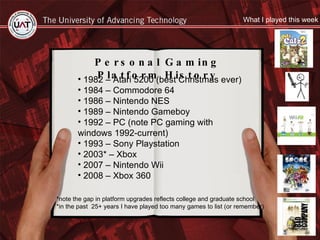
Personal Gaming Platform History 1982 – Atari 5200 (best Christmas ever) 1984 – Commodore 64  1986 – Nintendo NES 1989 – Nintendo Gameboy 1992 – PC (note PC gaming with windows 1992-current) 1993 – Sony Playstation  2003* – Xbox  2007 – Nintendo Wii 2008 – Xbox 360 *note the gap in platform upgrades reflects college and graduate school *in the past  25+ years I have played too many games to list (or remember) What I played this week
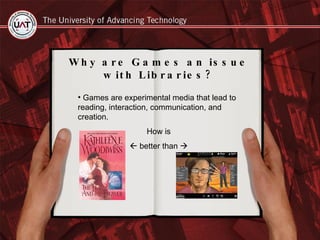
Why are Games an issue with Libraries? Games are experimental media that lead to reading, interaction, communication, and creation. How is    better than  
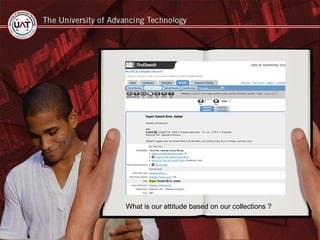
What is our attitude based on our collections ?
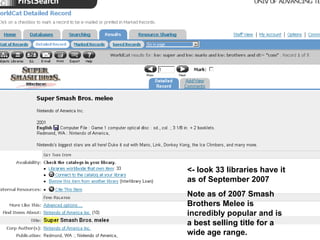
<- look 33 libraries have it as of September 2007 Note as of 2007 Smash Brothers Melee is incredibly popular and is a best selling title for a wide age range.
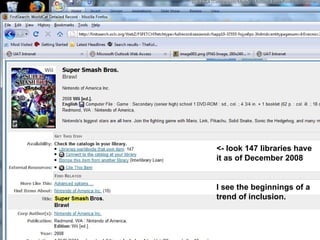
<- look 147 libraries have it as of December 2008 I see the beginnings of a trend of inclusion.
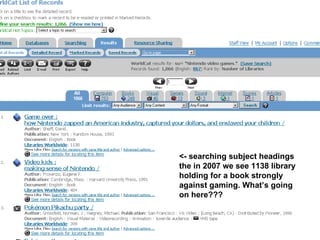
<- searching subject headings the in 2007 we see 1138 library holding for a book strongly against gaming. What’s going on here???
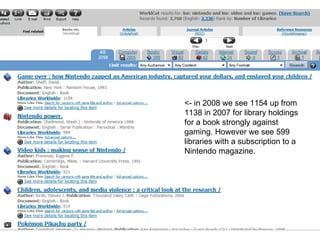
<- in 2008 we see 1154 up from 1138 in 2007 for library holdings for a book strongly against gaming. However we see 599 libraries with a subscription to a Nintendo magazine.
My Agenda creating vibrant library programming  advancing game collection development for children through adults  defining library policies and circulation procedures.
Admirable Focus on Teen Services Gaming events Tournaments Libraries with dedicated teen spaces Ties-ins to movies, graphic novels (i.e. teen culture) Games and Libraries Right Now Limited focus on Multimedia text collections, interactive worlds, Dynamic content creation etc.
Critical Objections to Gaming in libraries Expense “ My library isn’t a rec. center” Mission Staff knowledge
Collections Policies  Does your library have signs that say “no gaming” ? If so what does that say about your organization’s philosophy about gaming? Ability to provide reference about game Programming for all constituents The reality about gaming and libraries is best expressed in
On August 3, 2007 Library of Congress announced: Digital Preservation Program Makes Awards to Preserve American Creative Works Preserving Creative America Initiative to Engage Private Sector Creators of Films, Sound Recordings, Photographs, Cartoons and Video Games in Digital Formats National Digital Information Infrastructure and Preservation Program (NDIIPP )  Source http://www.loc.gov/today/pr/2007/07-156.html Cultural Shift from the Top Down
Getting Game in the Collection Changing Attitudes  Collection Development Professional Development Circulation that works Cataloging Programming Collection Maintenance
What We Can Learn From Games Physics, Mathematics (Even in Halo 3) Social Consciousness (Darfur is Dying) Sociology and Economics (Second life) Oh, and there are intentionally educational  games too Note: If you can’t apply basic geometry and physics Mario will never save the princess
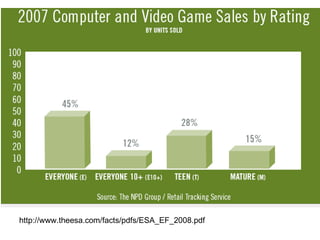
Some Important Statistics for Your Library Director or Board Eighty-five percent of all games sold in 2007 were rated &quot;E&quot; for Everyone, &quot;T&quot; for Teen, or &quot;E10+&quot; for Everyone 10+.  For more information on game ratings, please see . www.esrb.org .  The average game player is 35 years old and has been playing games for 13 years.  In 2008, 26 percent of Americans over the age of 50 played video games, an increase from nine percent in 1999 40% of all game players are women. In fact, women over the age of 18 represent a significantly greater portion of the game-playing population (33 percent) than boys age 17 or younger (18 percent). Source : http://www.theesa.com/facts/index.asp
Understand and Use Game Ratings from ESRB.org EARLY CHILDHOOD (EC) -  no material that parents would find inappropriate.  3+ EVERYONE (E)  - minimal cartoon, fantasy or mild violence and/or infrequent use of mild language.  6+ EVERYONE (E10+) -  cartoon, fantasy or mild violence, mild language and/or minimal suggestive themes.  10+ TEEN (T) -  violence, suggestive themes, crude humor, minimal blood, simulated gambling, and/or infrequent use of strong language.  13+ MATURE (M) -  intense violence, blood and gore, sexual content and/or strong language. ADULTS ONLY (AO) -  may include prolonged scenes of intense violence and/or graphic sexual content and nudity.
http://www.theesa.com/facts/pdfs/ESA_EF_2008.pdf
Why I  love  Nintendo As A Librarian Systems are extremely durable The Nintendo game catalog is designed for a wide audience with teen and younger ratings (E-T) Wide appeal to children and adults Cheaper than every other system Multiplayer Incredible Technology – Controllers  Wii
Your Basic Starter Game Library Pick  one  System (250-400) Consoles Handheld PC Controllers (35 each) at least 4 and plan to buy replacements Games (15-20 titles at an average of 45 each) Total : 1500 – 2000 initial cost =  one set of reference books
Common Mistakes to Avoid when you get started Buying games and supporting programs for controversial games Circulating PC Games EULAs Other Licensing Concerns Only having one person develop the collection or understand the systems Trying to support too many platforms Leaving any equipment small enough to fit in a backpack unsecured in public areas Having controversial games in your collection or programming Trying to support multiple platforms PC games EULAs System and other licensing issues Having only one person on staff knowledgeable about game reference or technical services Leaving equipment small enough to fit in a backpack unsecured Failing to catalog your controllers Some Common Mistakes to Avoid when you start
Common Mistakes to Avoid when you get started Buying games and supporting programs for controversial games Circulating PC Games EULAs Other Licensing Concerns Only having one person develop the collection or understand the systems Trying to support too many platforms Leaving any equipment small enough to fit in a backpack unsecured in public areas Know your collection  Understand how to set up your system (Technical Services) Become knowledgeable about a wide range of games (Basic Reference) Have the capacity to discuss game and game related issues with your constituents Professional Development
Build Your Collection Based on community wants and needs Create an Advisory Board  Consult libraries that game Consult gaming librarians (yes we exist!) http://groups.google.com/group/LibGaming?hl=en Check the library game blogs:  http://libgaming.blogspot.com/ Review Game Resources http://www.seriousgames.org/ http://www.gamasutra.com/ Learn the publishers (EA, Rockstar, Nintendo, Microsoft etc Check out YALSA’s resources
Borrowers can save their progress and this is a unique problem for circulation Late items Never returned Game check outs should be commensurate to Film Minimizes staff and patron confusion Enables easier adoption by institution  Game Circulation Yes, I understand this game takes 400 hours to complete, but it’s still due tomorrow.
Programming Typical Game Programming Includes options for Teens Lan parties (Networking Machines) Tournaments  Contests Atypical Programming can include Wii community bowling ages 3-99 Family Smash Brothers competitions Senior Movement Games  Learning game competitions  Etc.
Policy Create game policies commensurate to existing film policies  If children can’t borrow rated R films they can’t borrow (M) Mature games Fines and late fees should be well stated Equipment check outs and peripherals should reflect other equipment check out policies Create procedures (and signage) to support your policies Evaluate and change regularly If your board supports your film policies they can understand and support game too.
Can I Help Your Library Game? I’m a librarian on a mission to see Arizona Libraries embracing gaming. If you share my enthusiasm or just have questions contact me: Sue White, MLIS University Librarian University of Advancing Technology [email_address] [email_address]  < Facebook me! my presentations http://www.slideshare.net/suewhiteg
ALA Support 1. Teen Tech Week will be celebrated March 8-14 in 2009 with the theme Press Play @ your library.  Resources and details are available at  www.ala.org/teentechweek     3. YALSA has a Gaming Interest Group that members are welcome to opt-in to.  Information is here:  http://www.ala.org/ala/mgrps/divs/yalsa/aboutyalsab/discussion.cfm     4. Get Connected: Tech Programs for Teens was published in 2007 and features many ideas for connecting teens and gaming at libraries.   http://www.neal-schuman.com/bdetail.php?isbn=1555706134     5. YALSA's Gaming Interest Group has compiled a list of recommended games for libraries as well as other gaming resources:    http://wikis.ala.org/yalsa/index.php/Gaming_Lists_%26_Activities      8. YA-YAAC is a listserv open to anyone interested in participating. It has over 1,000 subscribers who discuss library programming ideas for teens, including gaming.  People can subscribe or learn more here:  www.ala.org/ala/yalsa/electronicresourcesb/electronicresources.cfm

2008 AZLA Conference

  • 1.
    Killing Monsters II:Getting Your Game On In Libraries 2008 Susan White, MLIS University Librarian [email_address]
  • 2.
    Personal Gaming PlatformHistory 1982 – Atari 5200 (best Christmas ever) 1984 – Commodore 64 1986 – Nintendo NES 1989 – Nintendo Gameboy 1992 – PC (note PC gaming with windows 1992-current) 1993 – Sony Playstation 2003* – Xbox 2007 – Nintendo Wii 2008 – Xbox 360 *note the gap in platform upgrades reflects college and graduate school *in the past 25+ years I have played too many games to list (or remember) What I played this week
  • 3.
    Why are Gamesan issue with Libraries? Games are experimental media that lead to reading, interaction, communication, and creation. How is  better than 
  • 4.
    What is ourattitude based on our collections ?
  • 5.
    <- look 33libraries have it as of September 2007 Note as of 2007 Smash Brothers Melee is incredibly popular and is a best selling title for a wide age range.
  • 6.
    <- look 147libraries have it as of December 2008 I see the beginnings of a trend of inclusion.
  • 7.
    <- searching subjectheadings the in 2007 we see 1138 library holding for a book strongly against gaming. What’s going on here???
  • 8.
    <- in 2008we see 1154 up from 1138 in 2007 for library holdings for a book strongly against gaming. However we see 599 libraries with a subscription to a Nintendo magazine.
  • 9.
    My Agenda creatingvibrant library programming advancing game collection development for children through adults defining library policies and circulation procedures.
  • 10.
    Admirable Focus onTeen Services Gaming events Tournaments Libraries with dedicated teen spaces Ties-ins to movies, graphic novels (i.e. teen culture) Games and Libraries Right Now Limited focus on Multimedia text collections, interactive worlds, Dynamic content creation etc.
  • 11.
    Critical Objections toGaming in libraries Expense “ My library isn’t a rec. center” Mission Staff knowledge
  • 12.
    Collections Policies Does your library have signs that say “no gaming” ? If so what does that say about your organization’s philosophy about gaming? Ability to provide reference about game Programming for all constituents The reality about gaming and libraries is best expressed in
  • 13.
    On August 3,2007 Library of Congress announced: Digital Preservation Program Makes Awards to Preserve American Creative Works Preserving Creative America Initiative to Engage Private Sector Creators of Films, Sound Recordings, Photographs, Cartoons and Video Games in Digital Formats National Digital Information Infrastructure and Preservation Program (NDIIPP ) Source http://www.loc.gov/today/pr/2007/07-156.html Cultural Shift from the Top Down
  • 14.
    Getting Game inthe Collection Changing Attitudes Collection Development Professional Development Circulation that works Cataloging Programming Collection Maintenance
  • 15.
    What We CanLearn From Games Physics, Mathematics (Even in Halo 3) Social Consciousness (Darfur is Dying) Sociology and Economics (Second life) Oh, and there are intentionally educational games too Note: If you can’t apply basic geometry and physics Mario will never save the princess
  • 16.
    Some Important Statisticsfor Your Library Director or Board Eighty-five percent of all games sold in 2007 were rated &quot;E&quot; for Everyone, &quot;T&quot; for Teen, or &quot;E10+&quot; for Everyone 10+.  For more information on game ratings, please see . www.esrb.org . The average game player is 35 years old and has been playing games for 13 years. In 2008, 26 percent of Americans over the age of 50 played video games, an increase from nine percent in 1999 40% of all game players are women. In fact, women over the age of 18 represent a significantly greater portion of the game-playing population (33 percent) than boys age 17 or younger (18 percent). Source : http://www.theesa.com/facts/index.asp
  • 17.
    Understand and UseGame Ratings from ESRB.org EARLY CHILDHOOD (EC) - no material that parents would find inappropriate. 3+ EVERYONE (E) - minimal cartoon, fantasy or mild violence and/or infrequent use of mild language. 6+ EVERYONE (E10+) - cartoon, fantasy or mild violence, mild language and/or minimal suggestive themes. 10+ TEEN (T) - violence, suggestive themes, crude humor, minimal blood, simulated gambling, and/or infrequent use of strong language. 13+ MATURE (M) - intense violence, blood and gore, sexual content and/or strong language. ADULTS ONLY (AO) - may include prolonged scenes of intense violence and/or graphic sexual content and nudity.
  • 18.
  • 19.
    Why I love Nintendo As A Librarian Systems are extremely durable The Nintendo game catalog is designed for a wide audience with teen and younger ratings (E-T) Wide appeal to children and adults Cheaper than every other system Multiplayer Incredible Technology – Controllers Wii
  • 20.
    Your Basic StarterGame Library Pick one System (250-400) Consoles Handheld PC Controllers (35 each) at least 4 and plan to buy replacements Games (15-20 titles at an average of 45 each) Total : 1500 – 2000 initial cost = one set of reference books
  • 21.
    Common Mistakes toAvoid when you get started Buying games and supporting programs for controversial games Circulating PC Games EULAs Other Licensing Concerns Only having one person develop the collection or understand the systems Trying to support too many platforms Leaving any equipment small enough to fit in a backpack unsecured in public areas Having controversial games in your collection or programming Trying to support multiple platforms PC games EULAs System and other licensing issues Having only one person on staff knowledgeable about game reference or technical services Leaving equipment small enough to fit in a backpack unsecured Failing to catalog your controllers Some Common Mistakes to Avoid when you start
  • 22.
    Common Mistakes toAvoid when you get started Buying games and supporting programs for controversial games Circulating PC Games EULAs Other Licensing Concerns Only having one person develop the collection or understand the systems Trying to support too many platforms Leaving any equipment small enough to fit in a backpack unsecured in public areas Know your collection Understand how to set up your system (Technical Services) Become knowledgeable about a wide range of games (Basic Reference) Have the capacity to discuss game and game related issues with your constituents Professional Development
  • 23.
    Build Your CollectionBased on community wants and needs Create an Advisory Board Consult libraries that game Consult gaming librarians (yes we exist!) http://groups.google.com/group/LibGaming?hl=en Check the library game blogs: http://libgaming.blogspot.com/ Review Game Resources http://www.seriousgames.org/ http://www.gamasutra.com/ Learn the publishers (EA, Rockstar, Nintendo, Microsoft etc Check out YALSA’s resources
  • 24.
    Borrowers can savetheir progress and this is a unique problem for circulation Late items Never returned Game check outs should be commensurate to Film Minimizes staff and patron confusion Enables easier adoption by institution Game Circulation Yes, I understand this game takes 400 hours to complete, but it’s still due tomorrow.
  • 25.
    Programming Typical GameProgramming Includes options for Teens Lan parties (Networking Machines) Tournaments Contests Atypical Programming can include Wii community bowling ages 3-99 Family Smash Brothers competitions Senior Movement Games Learning game competitions Etc.
  • 26.
    Policy Create gamepolicies commensurate to existing film policies If children can’t borrow rated R films they can’t borrow (M) Mature games Fines and late fees should be well stated Equipment check outs and peripherals should reflect other equipment check out policies Create procedures (and signage) to support your policies Evaluate and change regularly If your board supports your film policies they can understand and support game too.
  • 27.
    Can I HelpYour Library Game? I’m a librarian on a mission to see Arizona Libraries embracing gaming. If you share my enthusiasm or just have questions contact me: Sue White, MLIS University Librarian University of Advancing Technology [email_address] [email_address] < Facebook me! my presentations http://www.slideshare.net/suewhiteg
  • 28.
    ALA Support 1.Teen Tech Week will be celebrated March 8-14 in 2009 with the theme Press Play @ your library.  Resources and details are available at www.ala.org/teentechweek   3. YALSA has a Gaming Interest Group that members are welcome to opt-in to.  Information is here: http://www.ala.org/ala/mgrps/divs/yalsa/aboutyalsab/discussion.cfm   4. Get Connected: Tech Programs for Teens was published in 2007 and features many ideas for connecting teens and gaming at libraries.  http://www.neal-schuman.com/bdetail.php?isbn=1555706134   5. YALSA's Gaming Interest Group has compiled a list of recommended games for libraries as well as other gaming resources:    http://wikis.ala.org/yalsa/index.php/Gaming_Lists_%26_Activities     8. YA-YAAC is a listserv open to anyone interested in participating. It has over 1,000 subscribers who discuss library programming ideas for teens, including gaming.  People can subscribe or learn more here: www.ala.org/ala/yalsa/electronicresourcesb/electronicresources.cfm