Municipal website, Community
             website, or both?

          The City of St. Louis
Community Information Network
    http://stlouis.missouri.org


  Sonya Pelli, Manager Internet Services,
                    City of St. Louis ITSA
                City of St. Louis, Missouri
                               March 2006
CIN Timeline
                      milestones                                     funding

1994    WWW and Enterprise Community Grant
                                                              Grants:
1995    First CIN website is live                            Enterprise Community
           MIT, WU, Coro Fellows…                            Missouri Express
                                                              Corporation for Public
1997    Neighborhood web pages, community dial-up            Broadcasting
         services, and not-for-profit web hosting
                                                              OJJP Ounce of Prevention
1998    Focus on Government content                          EPA > CERP


                                                                        >>>
1999    CIN becomes official website for City of St. Louis


                                                                       >>>
2003    CIN operations integrated in new City IT Agency
                                                              City general revenue
2005  Efforts to merge systems conflicts with
       Community-based services
2006  Next Generation web presence
Original Philosophy
 Community centric information
 Public participation/involvement features
 Capacity building, promoting early adoption of web
    Dial-up
    HTML training
    Free web hosting
    Privacy statements
 Accessibility
 Early Portal approach
 Ease of access to government data (dynamic
  content generation)
The Early Years: Citizen and Government
Outreach and Support
Community
 Neighborhood Web Fairs
 Neighborhood Web Site Coordinators
 ISP Services
 E-lists
 News Archives and other databases access
 HTML Classes as a way to community content

Government
 Same outreach as community, hosting, HTML
  classes, etc.
CIN Then and Now
Early Adoption of Portal Approach
   >>> CIN in 1997    >>> CIN in 2006
Funding issues
 Outside grants and inter-departmental
  collaboration primarily funded all of CIN from
  1995-2003
  Pros: creativity, interesting collaborations, fastest
   implementation
  Cons: fiscal insecurity, staff morale issues, difficulty to
   implement a coordinated web strategy
 General revenue assumed full funding as of
  January 2004
  Pros: basic fiscal needs addressed
  Cons: more red tape, difficulty pursuing grants, creativity
   and out-of-the box thinking constrained, more political,
Examples of Internet-Based Mapping made possible through
outside grant funds
Map & Data Portal. The Maps & Data section of the Community Information
Network (CIN) web site, serves as an interactive website that assembles and maps
census 2000 data that can be used in neighborhood research by residents,
community leaders, businesses and government. Users can map data by a City
address or by selected geography and display census variables, point data, and
geographic boundaries.
Web address - <http://stlcin.missouri.org/mapportal/>


GeoStlouis. This is a prototype developed by staff of the Planning & Urban
Design Agency. Users can obtain parcel based information available from
disparate sources and tie the data to on-line mapping. This system will be most
useful once a data integration effort is completed.
Web address - <http://stlcin.missouri.org/citydata/>

Community Environmental Resource System (CERP). This project was a
joint initiative with the East-West Gateway Coordinating Council to develop an
environmental monitoring on-line mapping system. Maps and data for vacant
buildings, lead, illegal dumping, and brownfields are available for the City of St.
Louis and the City of East St. Louis.
Web address -<http://stlcin.missouri.org/cerp/data.cfm>

Map St. Louis History. This is also known as the “Mound City of the
Mississippi” web site. This is a joint effort with the Planning and Urban Design
Agency’s Cultural Resources Office and Research Division. The site chronicles
the history of St. Louis back from the 1700s to present times. Users can use
the interactive map to located historic assets.
Web address - <http://stlcin.missouri.org/history/beta1a/>
4/2/2010                                                                              7
Frequently Mentioned Cities
Albuquerque                               Phoenix, AZ
http://www.cabq.gov/                      http://phoenix.gov/

Minneapolis                               San Diego
http://www.ci.minneapolis.mn.us/          http://www.sandiego.gov

New York City                             Seattle
http://www.nyc.gov                        http://www.seattle.gov/


Source: Center for Digital Government, Best of the Web competition
Ongoing Issues
Municipal website vs. community network
Interface design
  Standards (design, metadata, taxonomy)
  Usability
  Interoperability
  Evolving best practices
  Educating up
Fine Balance between internal staff and
 hired consultants
The Importance of Standards


W3C Standards
 Accessibility - http://www.w3.org/WAI/ and
  http://www.section508.gov/
 Design - http://www.w3.org/MarkUp/
 Mobile - http://www.w3.org/Mobile/

Interoperability for government
 Fed Gov Standards & Guidelines http://www.xml.gov/
   and http://xml.gov/standards.asp
 Dublin Core Metadata Standard http://dublincore.org/
 UK Example: Integrated Public Sector Vocabulary
   http://www.esd.org.uk/standards/ipsv/
Standards, con’t

Why it matters?
 Good public policy > standards facilitate the finding,
  sharing and management of information
 Pragmatic > increasingly a criteria for funding
 Efficiency > ability to share data (inter-departmental,
  inter-agency, ….)
 Liability > ADA Compliance
 Clarity when working with consultants
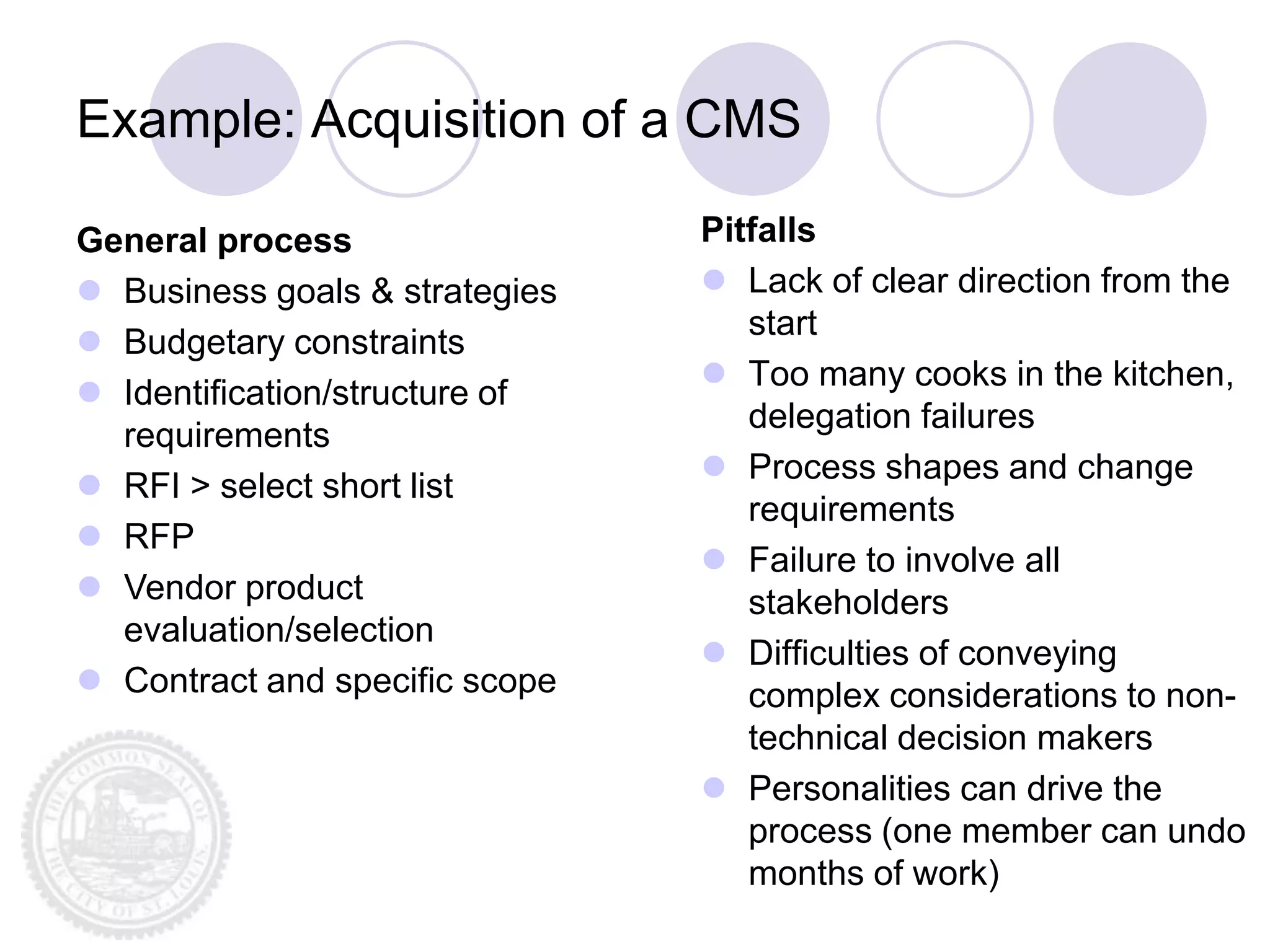
Example: Acquisition of a CMS

General process                 Pitfalls
 Business goals & strategies    Lack of clear direction from the
                                   start
 Budgetary constraints
                                 Too many cooks in the kitchen,
 Identification/structure of
                                   delegation failures
  requirements
                                 Process shapes and change
 RFI > select short list
                                   requirements
 RFP
                                 Failure to involve all
 Vendor product                   stakeholders
  evaluation/selection
                                 Difficulties of conveying
 Contract and specific scope      complex considerations to non-
                                   technical decision makers
                                 Personalities can drive the
                                   process (one member can undo
                                   months of work)
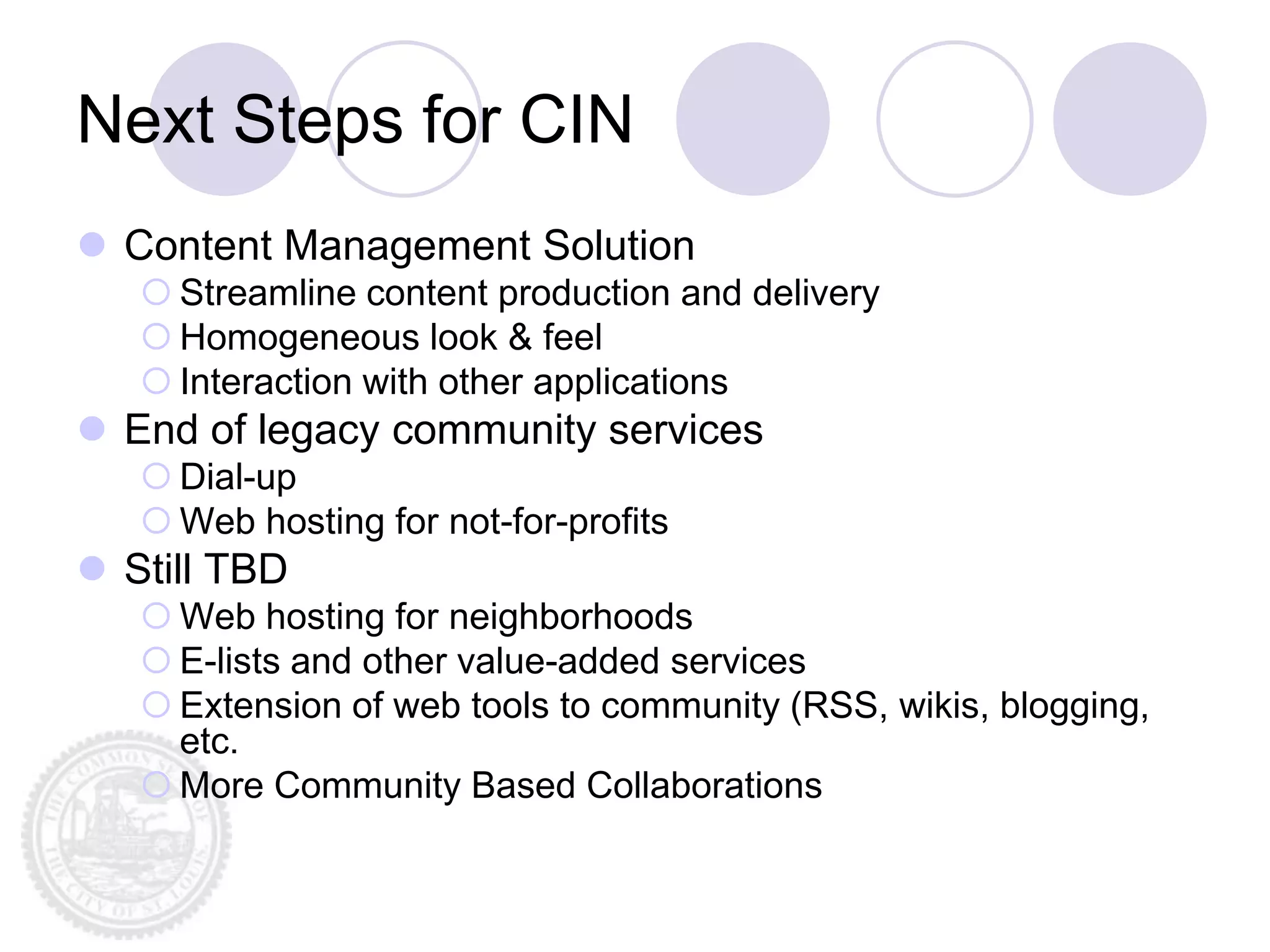
Next Steps for CIN
 Content Management Solution
    Streamline content production and delivery
    Homogeneous look & feel
    Interaction with other applications
 End of legacy community services
    Dial-up
    Web hosting for not-for-profits
 Still TBD
    Web hosting for neighborhoods
    E-lists and other value-added services
    Extension of web tools to community (RSS, wikis, blogging,
     etc.
    More Community Based Collaborations
Thank You!


    Contact
    Sonya Pelli
    Manager Internet Services and
    Community Information Network
    City of St. Louis Information Technology Services Agency
    e: pellis@stlouiscity.com
    v: 314 622-3400 x258
    Web: http://stlouis.missouri.org

2006 Technology

  • 1.
    Municipal website, Community website, or both? The City of St. Louis Community Information Network http://stlouis.missouri.org Sonya Pelli, Manager Internet Services, City of St. Louis ITSA City of St. Louis, Missouri March 2006
  • 2.
    CIN Timeline milestones funding 1994  WWW and Enterprise Community Grant Grants: 1995  First CIN website is live Enterprise Community  MIT, WU, Coro Fellows… Missouri Express Corporation for Public 1997  Neighborhood web pages, community dial-up Broadcasting services, and not-for-profit web hosting OJJP Ounce of Prevention 1998  Focus on Government content EPA > CERP >>> 1999  CIN becomes official website for City of St. Louis >>> 2003  CIN operations integrated in new City IT Agency City general revenue 2005  Efforts to merge systems conflicts with Community-based services 2006  Next Generation web presence
  • 3.
    Original Philosophy  Communitycentric information  Public participation/involvement features  Capacity building, promoting early adoption of web  Dial-up  HTML training  Free web hosting  Privacy statements  Accessibility  Early Portal approach  Ease of access to government data (dynamic content generation)
  • 4.
    The Early Years:Citizen and Government Outreach and Support Community  Neighborhood Web Fairs  Neighborhood Web Site Coordinators  ISP Services  E-lists  News Archives and other databases access  HTML Classes as a way to community content Government  Same outreach as community, hosting, HTML classes, etc.
  • 5.
    CIN Then andNow Early Adoption of Portal Approach >>> CIN in 1997 >>> CIN in 2006
  • 6.
    Funding issues  Outsidegrants and inter-departmental collaboration primarily funded all of CIN from 1995-2003 Pros: creativity, interesting collaborations, fastest implementation Cons: fiscal insecurity, staff morale issues, difficulty to implement a coordinated web strategy  General revenue assumed full funding as of January 2004 Pros: basic fiscal needs addressed Cons: more red tape, difficulty pursuing grants, creativity and out-of-the box thinking constrained, more political,
  • 7.
    Examples of Internet-BasedMapping made possible through outside grant funds Map & Data Portal. The Maps & Data section of the Community Information Network (CIN) web site, serves as an interactive website that assembles and maps census 2000 data that can be used in neighborhood research by residents, community leaders, businesses and government. Users can map data by a City address or by selected geography and display census variables, point data, and geographic boundaries. Web address - <http://stlcin.missouri.org/mapportal/> GeoStlouis. This is a prototype developed by staff of the Planning & Urban Design Agency. Users can obtain parcel based information available from disparate sources and tie the data to on-line mapping. This system will be most useful once a data integration effort is completed. Web address - <http://stlcin.missouri.org/citydata/> Community Environmental Resource System (CERP). This project was a joint initiative with the East-West Gateway Coordinating Council to develop an environmental monitoring on-line mapping system. Maps and data for vacant buildings, lead, illegal dumping, and brownfields are available for the City of St. Louis and the City of East St. Louis. Web address -<http://stlcin.missouri.org/cerp/data.cfm> Map St. Louis History. This is also known as the “Mound City of the Mississippi” web site. This is a joint effort with the Planning and Urban Design Agency’s Cultural Resources Office and Research Division. The site chronicles the history of St. Louis back from the 1700s to present times. Users can use the interactive map to located historic assets. Web address - <http://stlcin.missouri.org/history/beta1a/> 4/2/2010 7
  • 8.
    Frequently Mentioned Cities Albuquerque Phoenix, AZ http://www.cabq.gov/ http://phoenix.gov/ Minneapolis San Diego http://www.ci.minneapolis.mn.us/ http://www.sandiego.gov New York City Seattle http://www.nyc.gov http://www.seattle.gov/ Source: Center for Digital Government, Best of the Web competition
  • 9.
    Ongoing Issues Municipal websitevs. community network Interface design Standards (design, metadata, taxonomy) Usability Interoperability Evolving best practices Educating up Fine Balance between internal staff and hired consultants
  • 10.
    The Importance ofStandards W3C Standards  Accessibility - http://www.w3.org/WAI/ and http://www.section508.gov/  Design - http://www.w3.org/MarkUp/  Mobile - http://www.w3.org/Mobile/ Interoperability for government  Fed Gov Standards & Guidelines http://www.xml.gov/ and http://xml.gov/standards.asp  Dublin Core Metadata Standard http://dublincore.org/  UK Example: Integrated Public Sector Vocabulary http://www.esd.org.uk/standards/ipsv/
  • 11.
    Standards, con’t Why itmatters?  Good public policy > standards facilitate the finding, sharing and management of information  Pragmatic > increasingly a criteria for funding  Efficiency > ability to share data (inter-departmental, inter-agency, ….)  Liability > ADA Compliance  Clarity when working with consultants
  • 12.
    Example: Acquisition ofa CMS General process Pitfalls  Business goals & strategies  Lack of clear direction from the start  Budgetary constraints  Too many cooks in the kitchen,  Identification/structure of delegation failures requirements  Process shapes and change  RFI > select short list requirements  RFP  Failure to involve all  Vendor product stakeholders evaluation/selection  Difficulties of conveying  Contract and specific scope complex considerations to non- technical decision makers  Personalities can drive the process (one member can undo months of work)
  • 13.
    Next Steps forCIN  Content Management Solution  Streamline content production and delivery  Homogeneous look & feel  Interaction with other applications  End of legacy community services  Dial-up  Web hosting for not-for-profits  Still TBD  Web hosting for neighborhoods  E-lists and other value-added services  Extension of web tools to community (RSS, wikis, blogging, etc.  More Community Based Collaborations
  • 14.
    Thank You! Contact Sonya Pelli Manager Internet Services and Community Information Network City of St. Louis Information Technology Services Agency e: pellis@stlouiscity.com v: 314 622-3400 x258 Web: http://stlouis.missouri.org