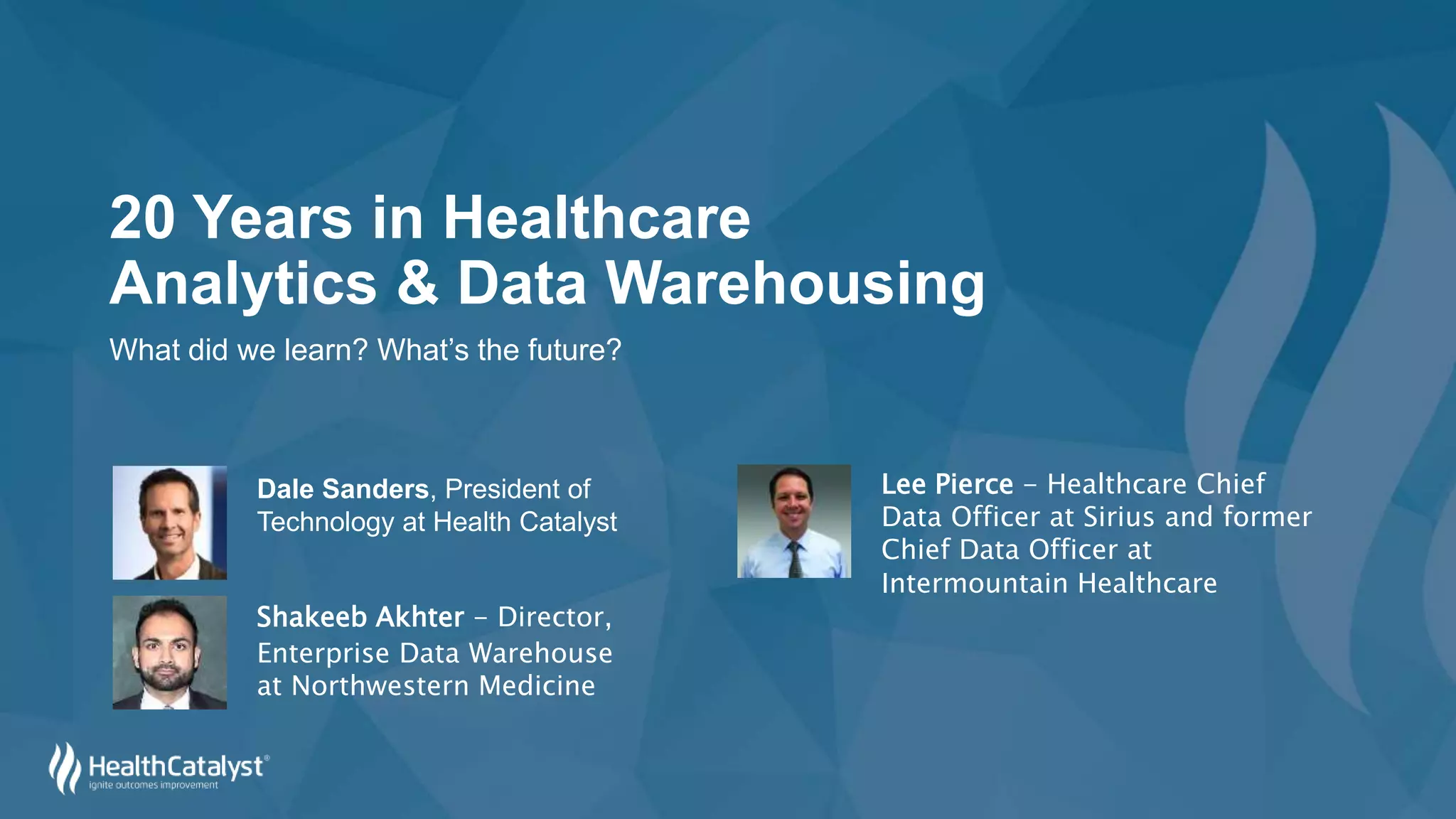
20 Years in Healthcare
Analytics & Data Warehousing
What did we learn? What’s the future?
Shakeeb Akhter - Director,
Enterprise Data Warehouse
at Northwestern Medicine
Lee Pierce - Healthcare Chief
Data Officer at Sirius and former
Chief Data Officer at
Intermountain Healthcare
Dale Sanders, President of
Technology at Health Catalyst
• People
• Processes
• Technology
• What did we do right?
• What did we do wrong?
• What’s the future?
Many thanks to Lee and Shakeeb
Agenda
© 2018
Health
Catalyst
I learned what was right by first doing what was wrong.
Luckily, I watched others do what was wrong and learned from them
without suffering their wounds as mine.
Generally Speaking…
3
People
4
© 2018
Health
Catalyst
What did we do right?
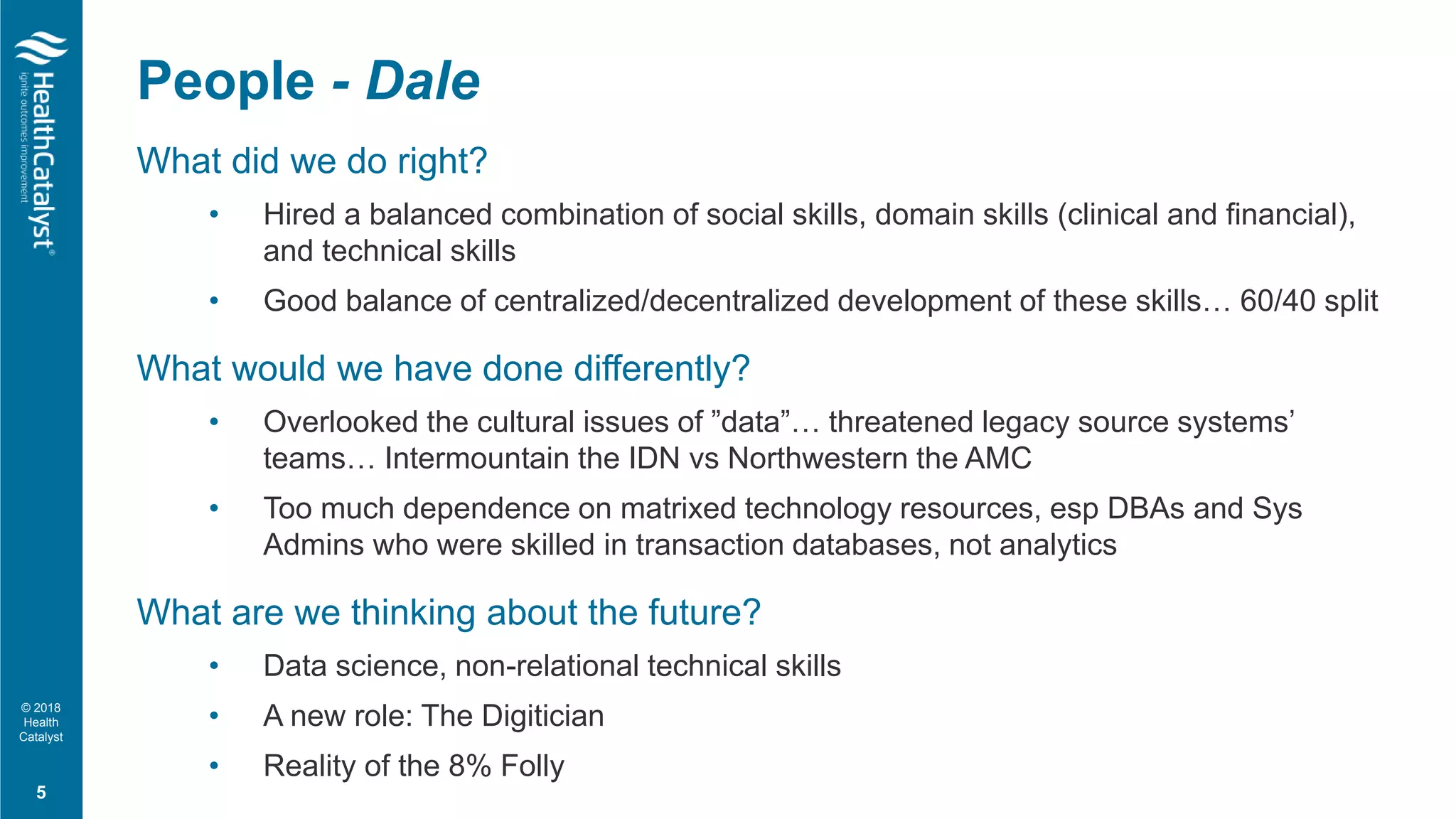
• Hired a balanced combination of social skills, domain skills (clinical and financial),
and technical skills
• Good balance of centralized/decentralized development of these skills… 60/40 split
What would we have done differently?
• Overlooked the cultural issues of ”data”… threatened legacy source systems’
teams… Intermountain the IDN vs Northwestern the AMC
• Too much dependence on matrixed technology resources, esp DBAs and Sys
Admins who were skilled in transaction databases, not analytics
What are we thinking about the future?
• Data science, non-relational technical skills
• A new role: The Digitician
• Reality of the 8% Folly
People - Dale
5
© 2018
Health
Catalyst
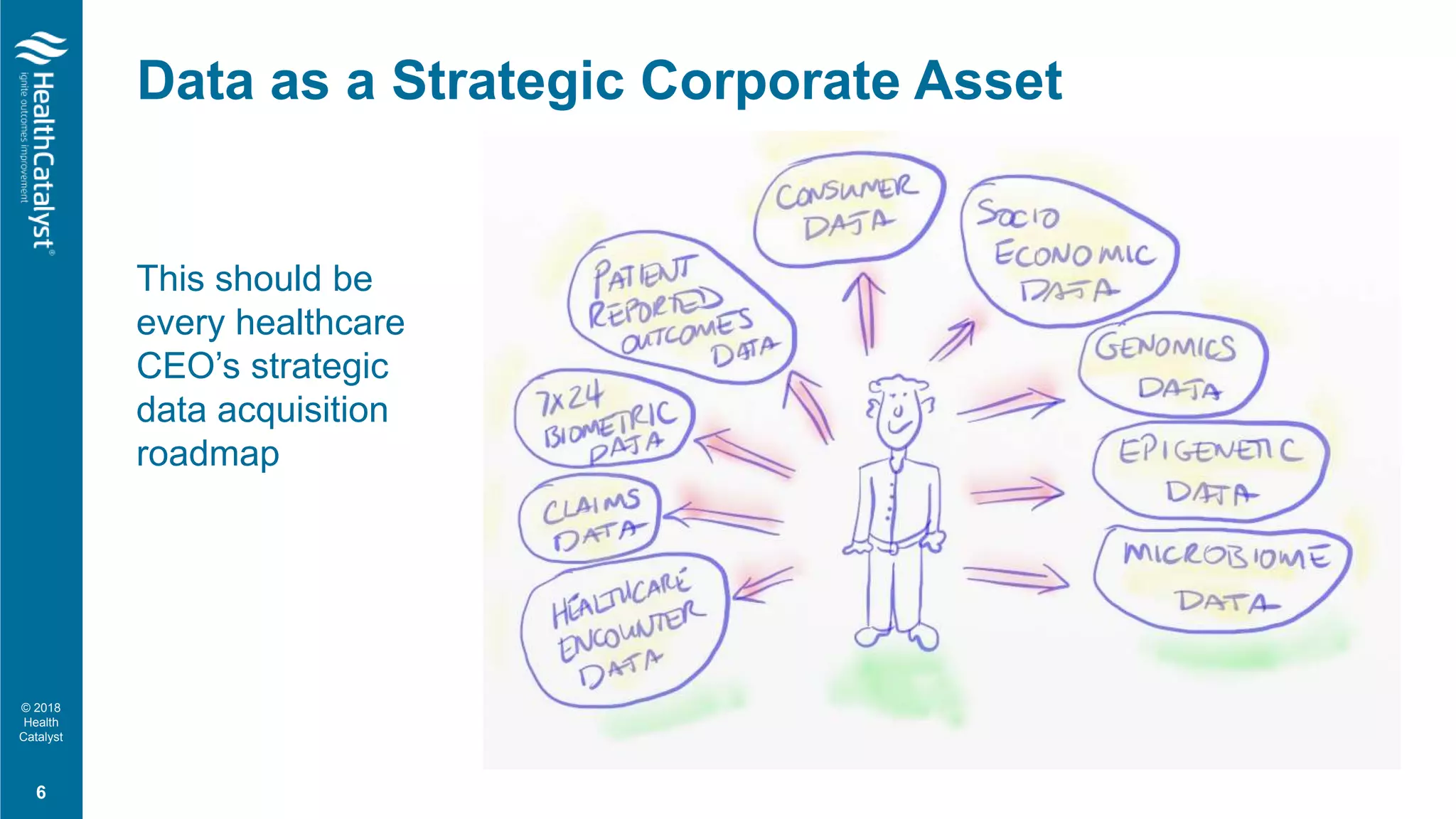
Data as a Strategic Corporate Asset
This should be
every healthcare
CEO’s strategic
data acquisition
roadmap
6
© 2018
Health
Catalyst
What did we do right?
• Hired amazing data professionals - dedicated, smart, committed - treated them right
• Embraced early support from business and clinical leaders that allowed us to start
early: Dr. Brent James, Dr. Homer Warner
• Partnered with & empowered the data analysts to be primary producers of analytics
• Engaged business leaders in Data and Analytics strategy and execution
What would we have done differently?
• More thoughtful and coordinated growth, hiring of data analysts across the business,
earlier job description standardization and smarter growth
• More bold steps to organize analytics as centrally managed, locally deployed
What are we thinking about the future?
• Improved data literacy for leaders = how to ask for analytics help, how to use
insights to improve decision making and change business processes = value
People - Lee
7
© 2018
Health
Catalyst
What did we do right?
• Small, highly skilled team at the start resulted in agility and faster product to market
• Multiple tangentially related functions developed within the EDW team that resulted
in self-sufficiency
• Recruited EMR Application Analysts with exposure to Business Intelligence
What would we have done differently?
• Develop additional roles to accommodate growth and scale with the organization
• Recruit clinical and operational SMEs to assist with understanding of data
What are we thinking about the future?
• Develop specialized roles in order to scale for future growth
• Blur the lines between EDW & Analytics via hybrid resources
People - Shakeeb
8
Processes
9
© 2018
Health
Catalyst
What did we do right?
• Design and code reviews
• Lightweight data governance – govern to the least extent necessary for the greatest
common good
• Using EHR logs to analyze & understand workflow (the first ‘Meaningful Use’)
• Running the data warehouse like a small business
What would we have done differently?
• Prioritization management, demand vs. capacity
• Managing expectations of data and analytic quality validation
What are we thinking about the future?
• AI/data science changes almost everything... design reviews, data governance,
analytic validation
• Study the DevOps of AI
10
Processes - Dale
© 2018
Health
Catalyst
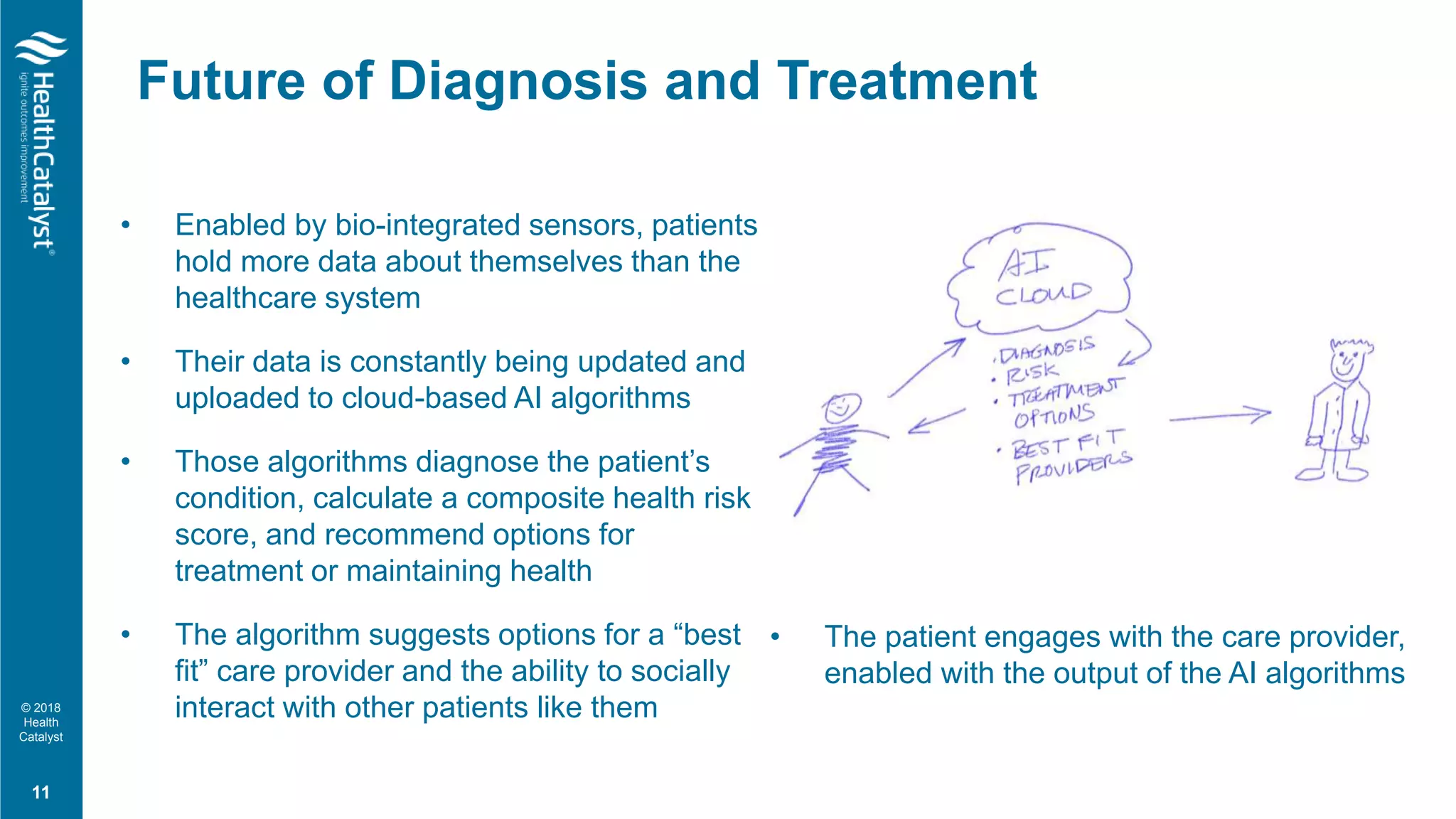
• Enabled by bio-integrated sensors, patients
hold more data about themselves than the
healthcare system
• Their data is constantly being updated and
uploaded to cloud-based AI algorithms
• Those algorithms diagnose the patient’s
condition, calculate a composite health risk
score, and recommend options for
treatment or maintaining health
• The algorithm suggests options for a “best
fit” care provider and the ability to socially
interact with other patients like them
Future of Diagnosis and Treatment
11
• The patient engages with the care provider,
enabled with the output of the AI algorithms
© 2018
Health
Catalyst
What did we do right?
• Vision for the use of data – clinical quality improvement
• Focused on real business/clinical use-cases and needs
• Discipline (in many use cases) to implement insights – close the loop
• Practical data governance – project-based, use-case driven, clear business value
What would we have done differently?
• Require analytics return-on-investment planning and measurement for large
analytics projects, document ROI, communicate successes and repeat
• Establish (and enforce) better standard development practices from the beginning
(EDW/ETL specifically), reducing maintenance required after dev.
• Should have been more bold about data governance value and investment
What are we thinking about the future?
• More business discipline to use insights generated with more focus on end value
12
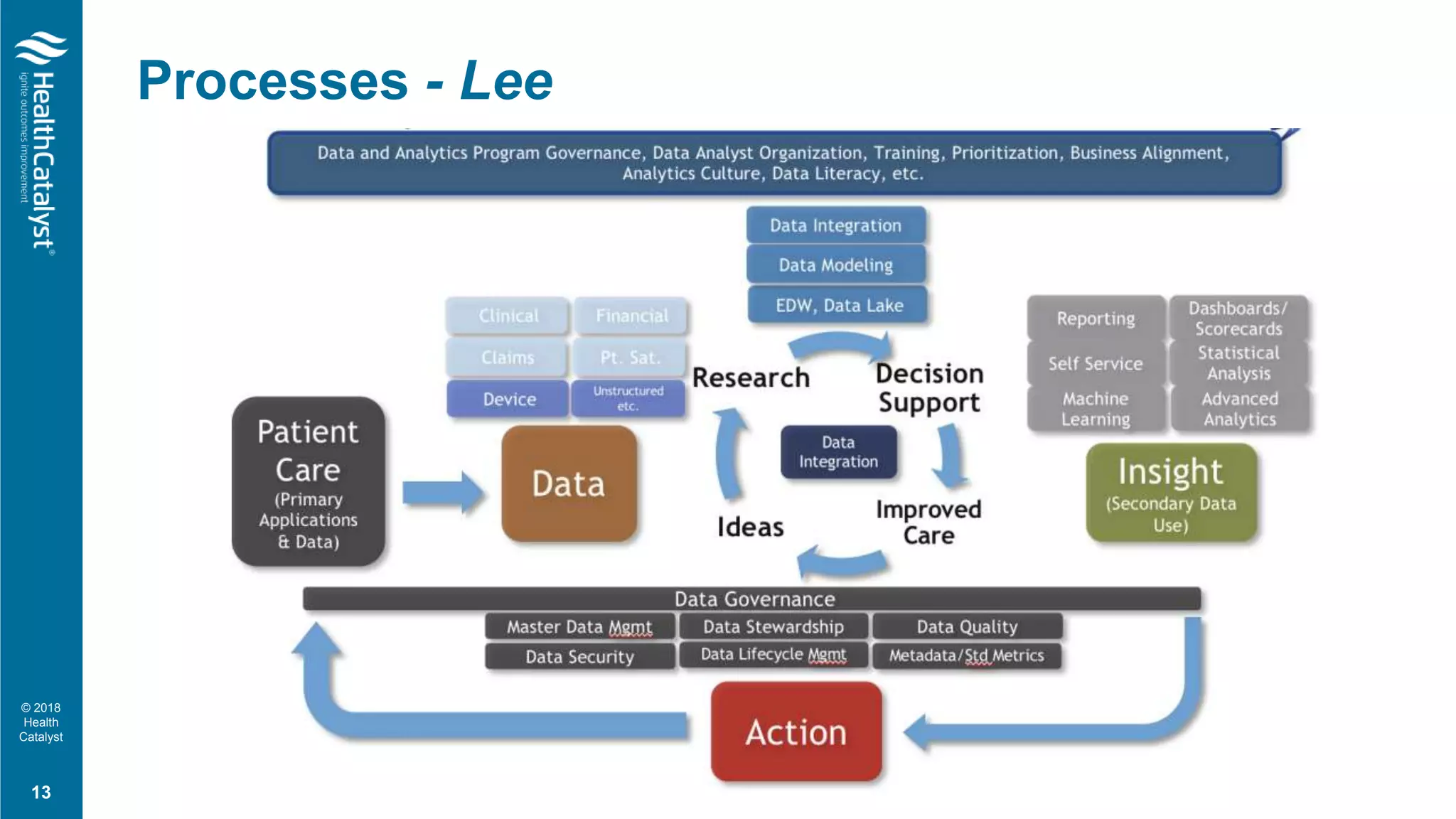
Processes - Lee
© 2018
Health
Catalyst
13
Processes - Lee
© 2018
Health
Catalyst
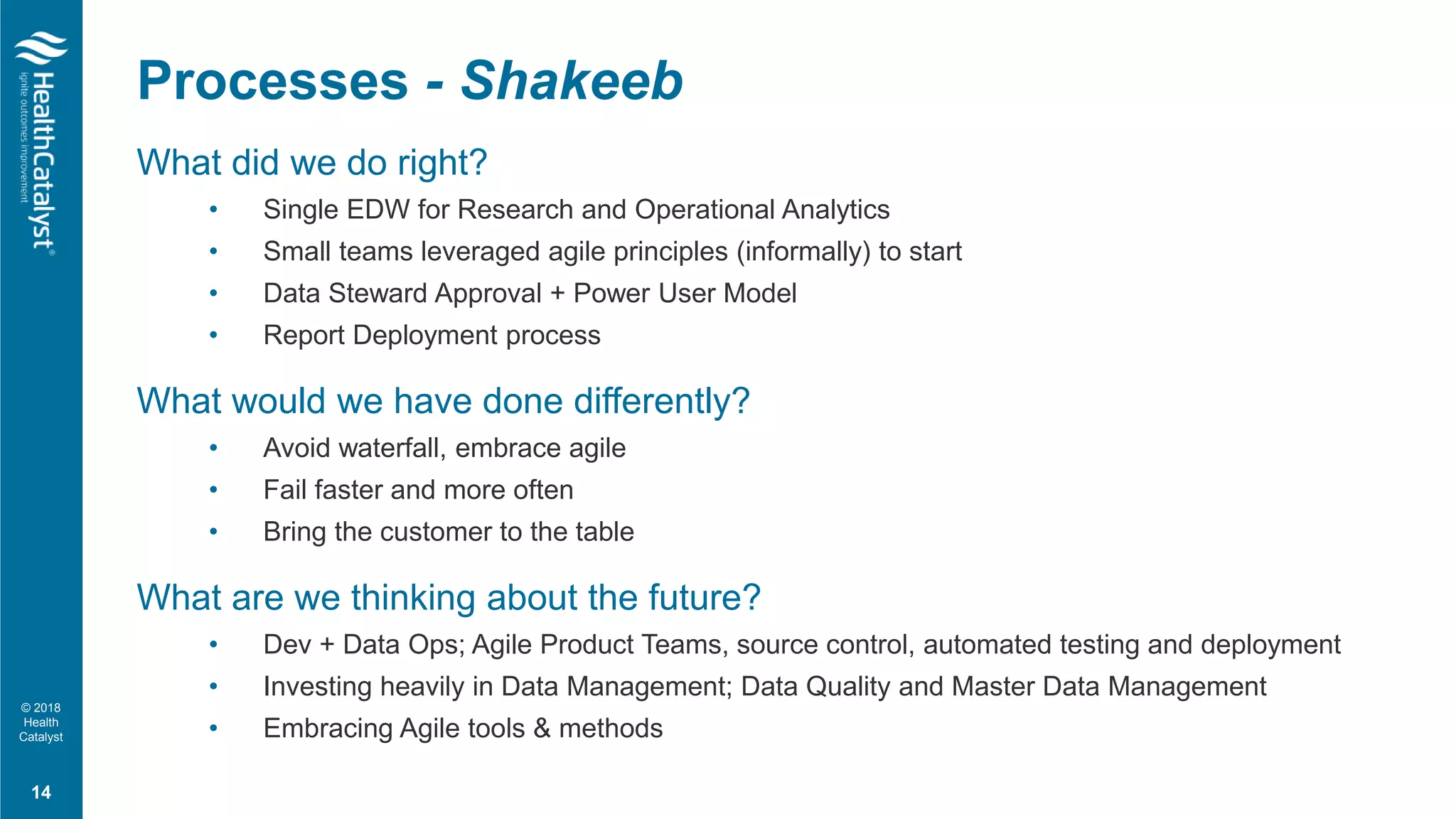
What did we do right?
• Single EDW for Research and Operational Analytics
• Small teams leveraged agile principles (informally) to start
• Data Steward Approval + Power User Model
• Report Deployment process
What would we have done differently?
• Avoid waterfall, embrace agile
• Fail faster and more often
• Bring the customer to the table
What are we thinking about the future?
• Dev + Data Ops; Agile Product Teams, source control, automated testing and deployment
• Investing heavily in Data Management; Data Quality and Master Data Management
• Embracing Agile tools & methods
Processes - Shakeeb
14
© 2018
Health
Catalyst
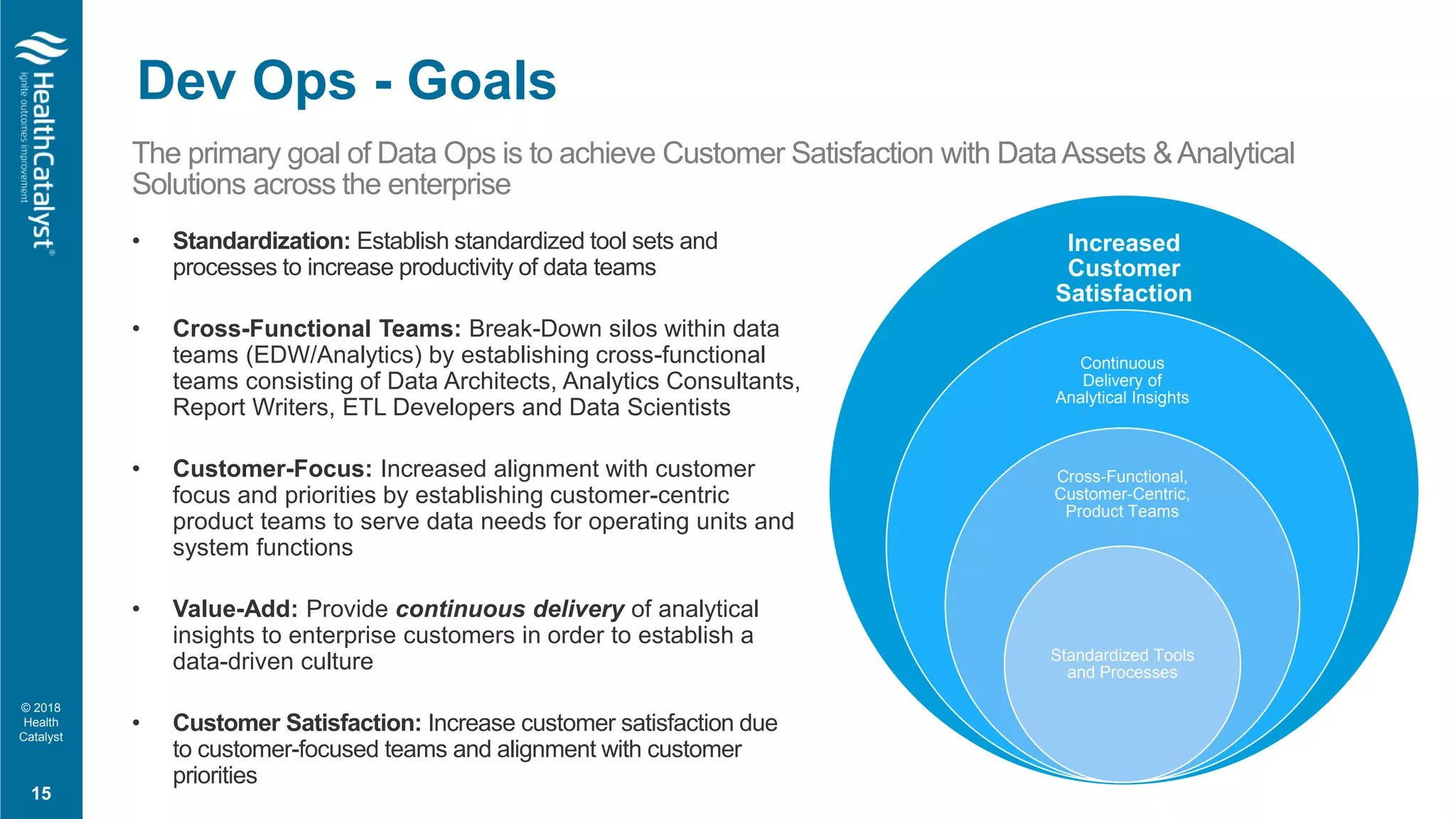
The primary goal of Data Ops is to achieve Customer Satisfaction with DataAssets &Analytical
Solutions across the enterprise
• Standardization: Establish standardized tool sets and
processes to increase productivity of data teams
• Cross-Functional Teams: Break-Down silos within data
teams (EDW/Analytics) by establishing cross-functional
teams consisting of Data Architects, Analytics Consultants,
Report Writers, ETL Developers and Data Scientists
• Customer-Focus: Increased alignment with customer
focus and priorities by establishing customer-centric
product teams to serve data needs for operating units and
system functions
• Value-Add: Provide continuous delivery of analytical
insights to enterprise customers in order to establish a
data-driven culture
• Customer Satisfaction: Increase customer satisfaction due
to customer-focused teams and alignment with customer
priorities
Increased
Customer
Satisfaction
Continuous
Delivery of
Analytical Insights
Cross-Functional,
Customer-Centric,
Product Teams
Standardized Tools
and Processes
15
Dev Ops - Goals
© 2018
Health
Catalyst
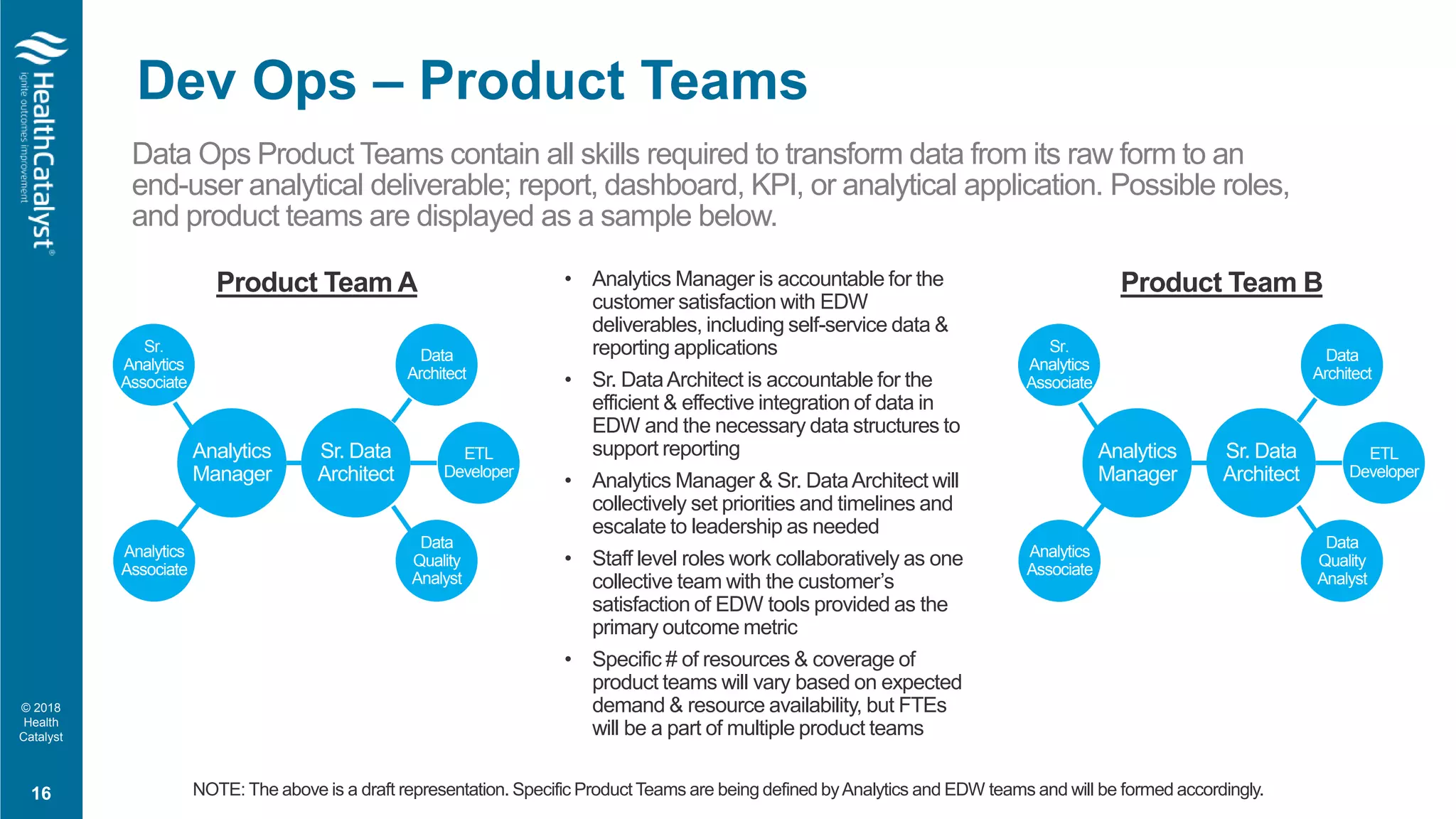
Data Ops Product Teams contain all skills required to transform data from its raw form to an
end-user analytical deliverable; report, dashboard, KPI, or analytical application. Possible roles,
and product teams are displayed as a sample below.
Product Team A
NOTE: The above is a draft representation. Specific Product Teams are being defined byAnalytics and EDW teams and will be formed accordingly.
Data
Architect
Analytics
Manager
Sr. Data
Architect
ETL
Developer
Data
Quality
Analyst
Sr.
Analytics
Associate
Analytics
Associate
Product Team B
Data
Architect
Analytics
Manager
Sr. Data
Architect
ETL
Developer
Data
Quality
Analyst
Sr.
Analytics
Associate
Analytics
Associate
• Analytics Manager is accountable for the
customer satisfaction with EDW
deliverables, including self-service data &
reporting applications
• Sr. DataArchitect is accountable for the
efficient & effective integration of data in
EDW and the necessary data structures to
support reporting
• Analytics Manager & Sr. DataArchitect will
collectively set priorities and timelines and
escalate to leadership as needed
• Staff level roles work collaboratively as one
collective team with the customer’s
satisfaction of EDW tools provided as the
primary outcome metric
• Specific # of resources & coverage of
product teams will vary based on expected
demand & resource availability, but FTEs
will be a part of multiple product teams
16
Dev Ops – Product Teams
Technology
17
© 2018
Health
Catalyst
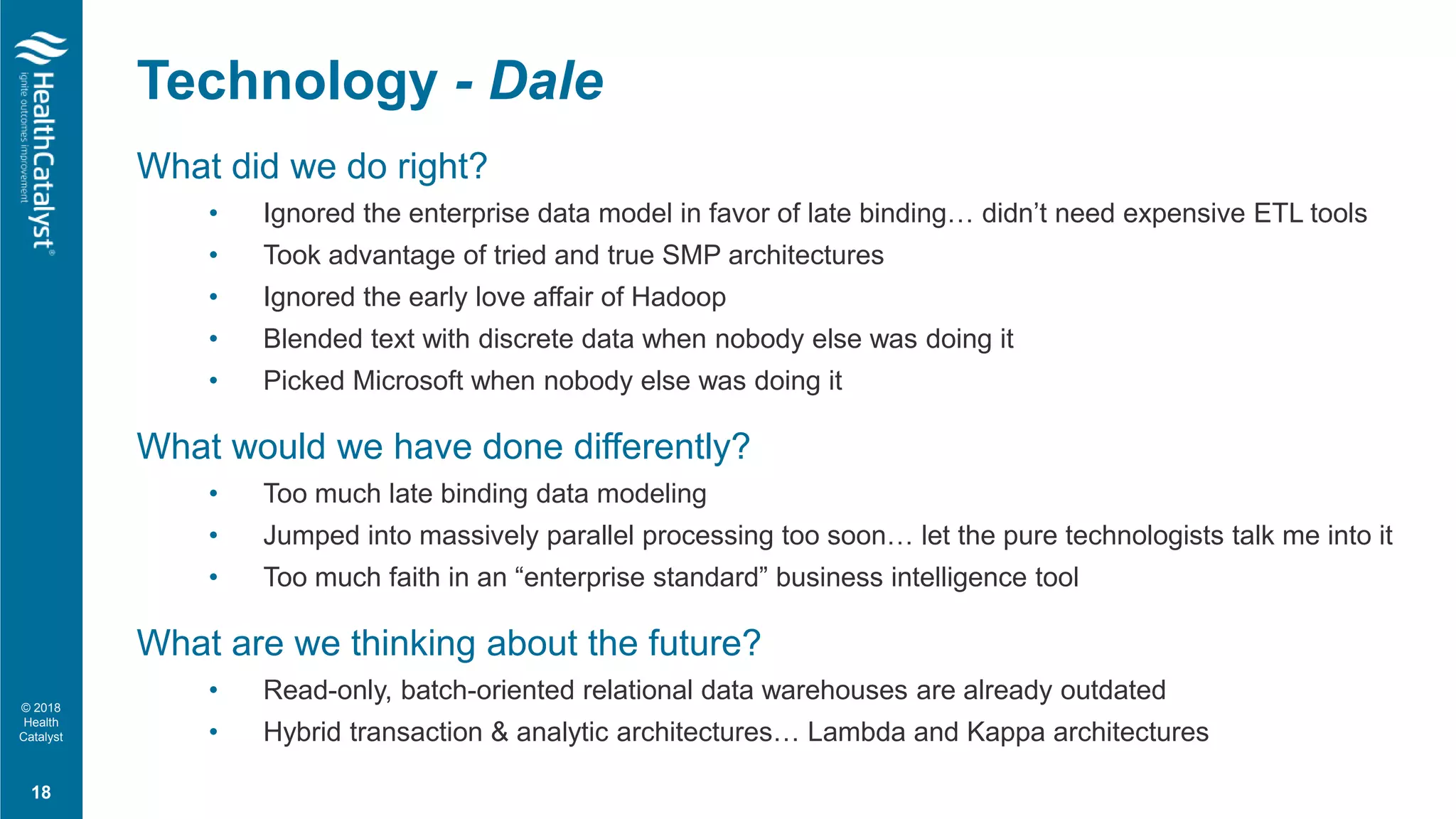
What did we do right?
• Ignored the enterprise data model in favor of late binding… didn’t need expensive ETL tools
• Took advantage of tried and true SMP architectures
• Ignored the early love affair of Hadoop
• Blended text with discrete data when nobody else was doing it
• Picked Microsoft when nobody else was doing it
What would we have done differently?
• Too much late binding data modeling
• Jumped into massively parallel processing too soon… let the pure technologists talk me into it
• Too much faith in an “enterprise standard” business intelligence tool
What are we thinking about the future?
• Read-only, batch-oriented relational data warehouses are already outdated
• Hybrid transaction & analytic architectures… Lambda and Kappa architectures
Technology - Dale
18
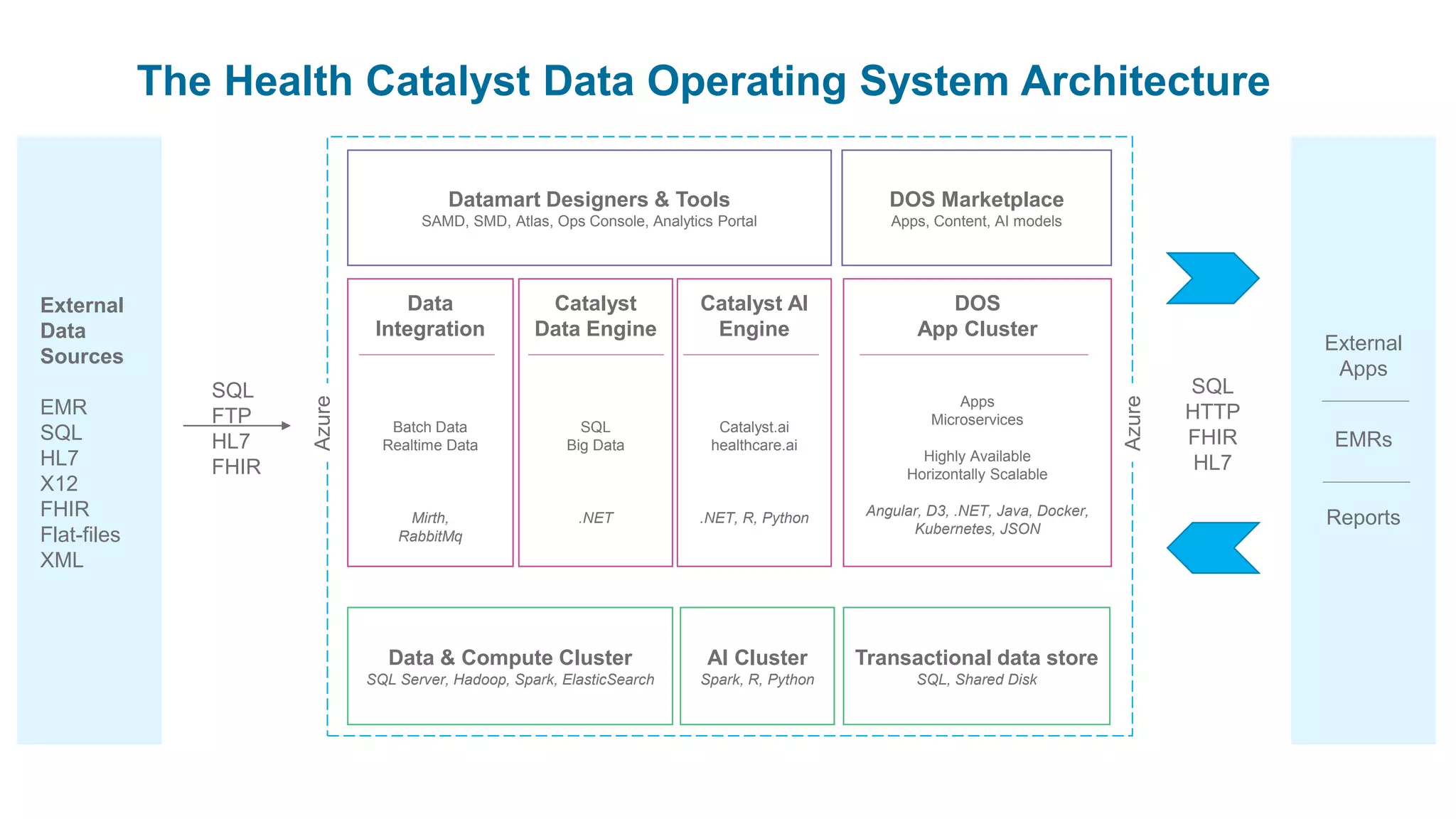
External
Data
Sources
EMR
SQL
HL7
X12
FHIR
Flat-files
XML
Data
Integration
Batch Data
Realtime Data
Mirth,
RabbitMq
Catalyst
Data Engine
SQL
Big Data
.NET
DOS
App Cluster
Apps
Microservices
Highly Available
Horizontally Scalable
Angular, D3, .NET, Java, Docker,
Kubernetes, JSON
Datamart Designers & Tools
SAMD, SMD, Atlas, Ops Console, Analytics Portal
Data & Compute Cluster
SQL Server, Hadoop, Spark, ElasticSearch
Transactional data store
SQL, Shared Disk
DOS Marketplace
Apps, Content, AI models
Catalyst AI
Engine
Catalyst.ai
healthcare.ai
.NET, R, Python
Azure
Azure
AI Cluster
Spark, R, Python
SQL
FTP
HL7
FHIR
SQL
HTTP
FHIR
HL7
External
Apps
EMRs
Reports
The Health Catalyst Data Operating System Architecture
© 2018
Health
Catalyst
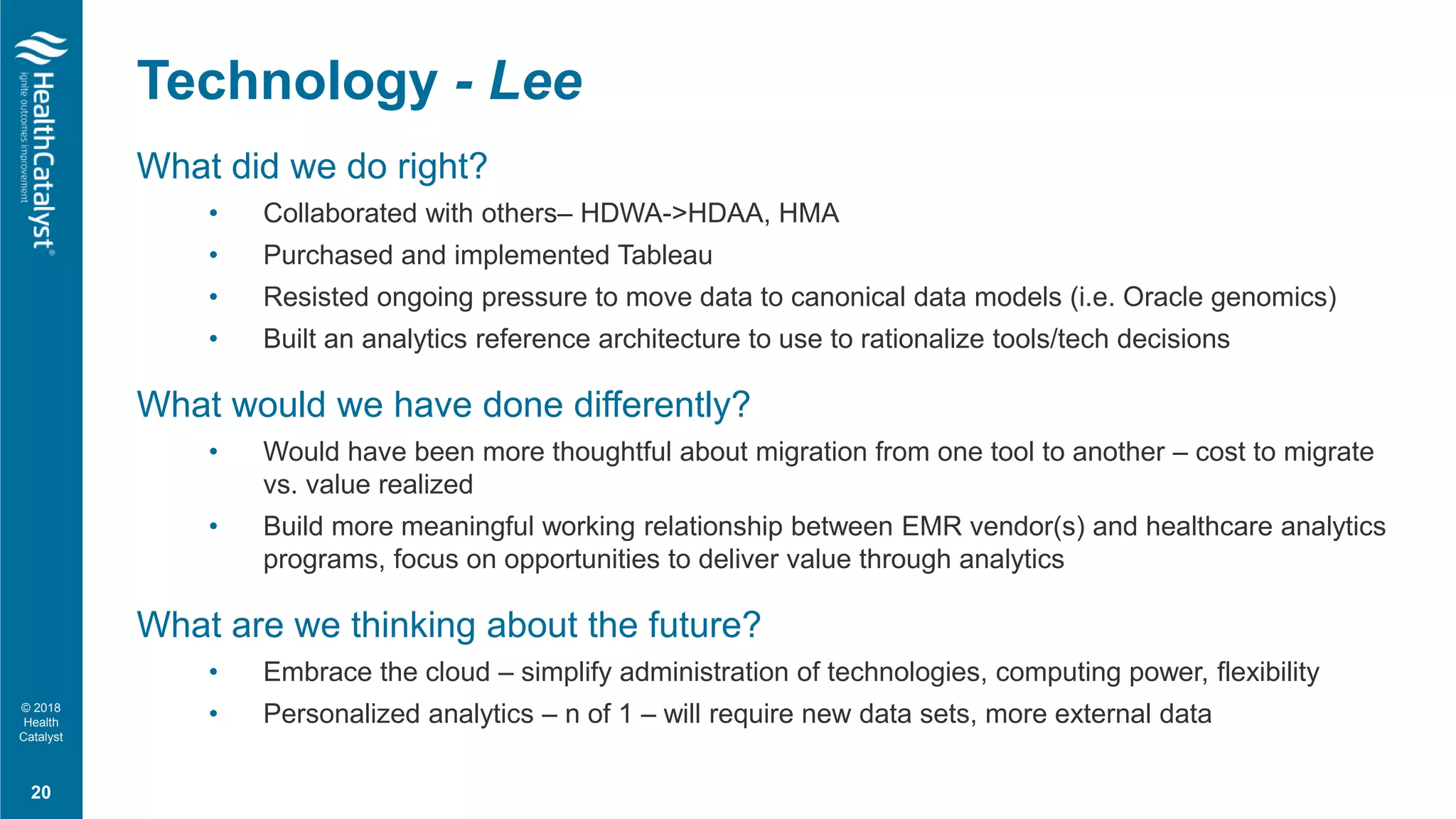
What did we do right?
• Collaborated with others– HDWA->HDAA, HMA
• Purchased and implemented Tableau
• Resisted ongoing pressure to move data to canonical data models (i.e. Oracle genomics)
• Built an analytics reference architecture to use to rationalize tools/tech decisions
What would we have done differently?
• Would have been more thoughtful about migration from one tool to another – cost to migrate
vs. value realized
• Build more meaningful working relationship between EMR vendor(s) and healthcare analytics
programs, focus on opportunities to deliver value through analytics
What are we thinking about the future?
• Embrace the cloud – simplify administration of technologies, computing power, flexibility
• Personalized analytics – n of 1 – will require new data sets, more external data
Technology - Lee
20
© 2018
Health
Catalyst
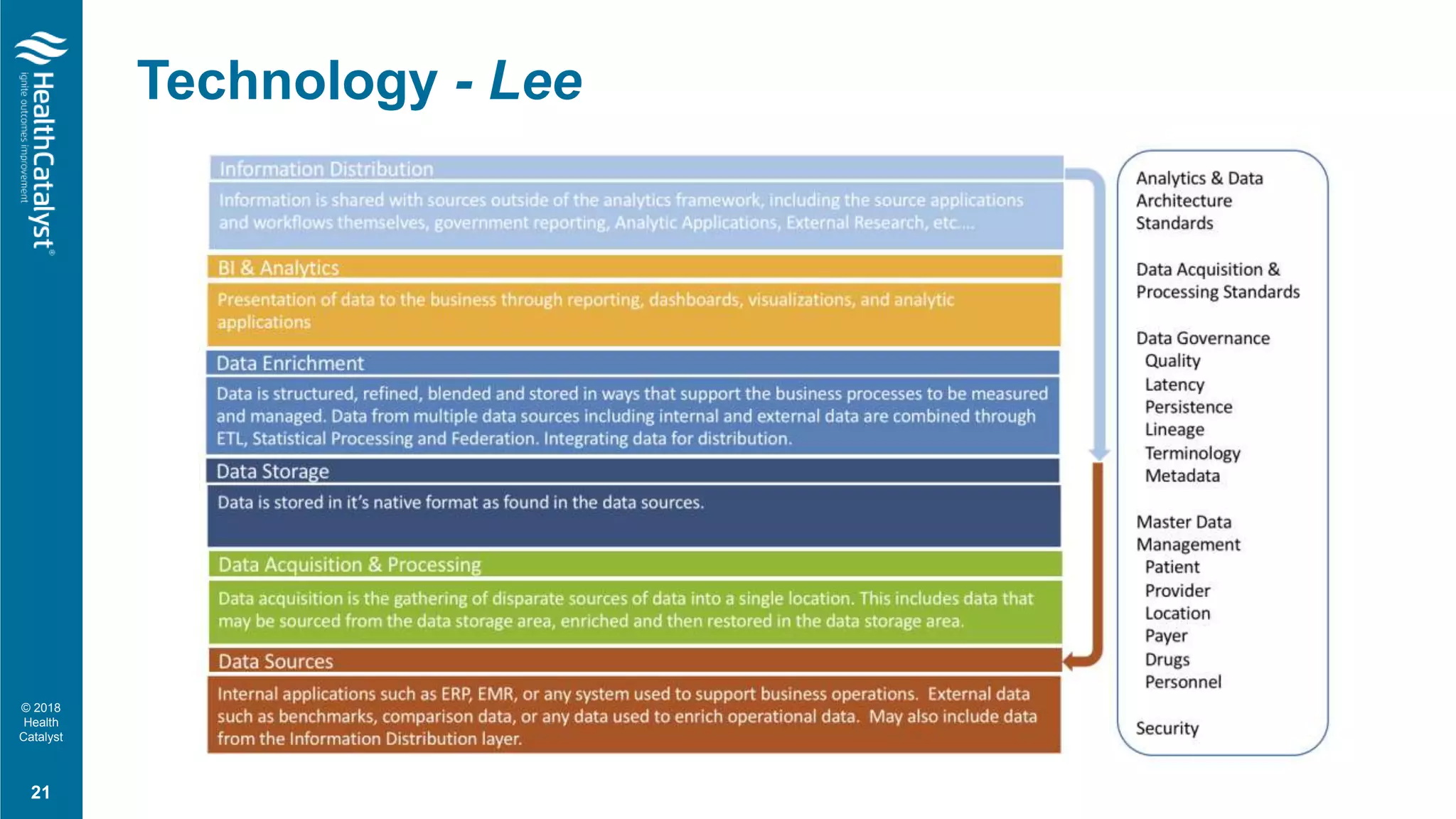
Technology - Lee
21
© 2018
Health
Catalyst
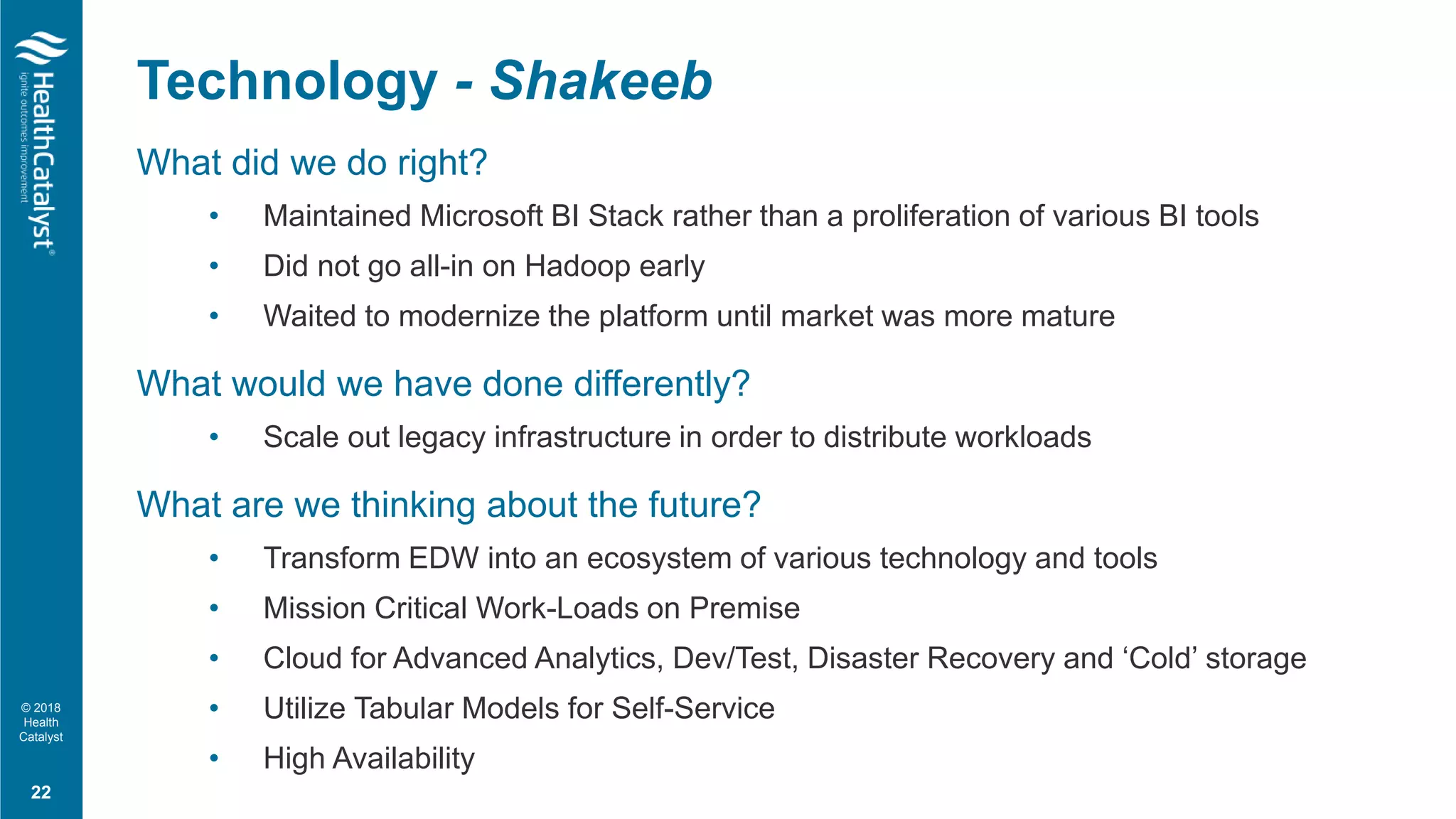
What did we do right?
• Maintained Microsoft BI Stack rather than a proliferation of various BI tools
• Did not go all-in on Hadoop early
• Waited to modernize the platform until market was more mature
What would we have done differently?
• Scale out legacy infrastructure in order to distribute workloads
What are we thinking about the future?
• Transform EDW into an ecosystem of various technology and tools
• Mission Critical Work-Loads on Premise
• Cloud for Advanced Analytics, Dev/Test, Disaster Recovery and ‘Cold’ storage
• Utilize Tabular Models for Self-Service
• High Availability
Technology - Shakeeb
22
© 2018
Health
Catalyst
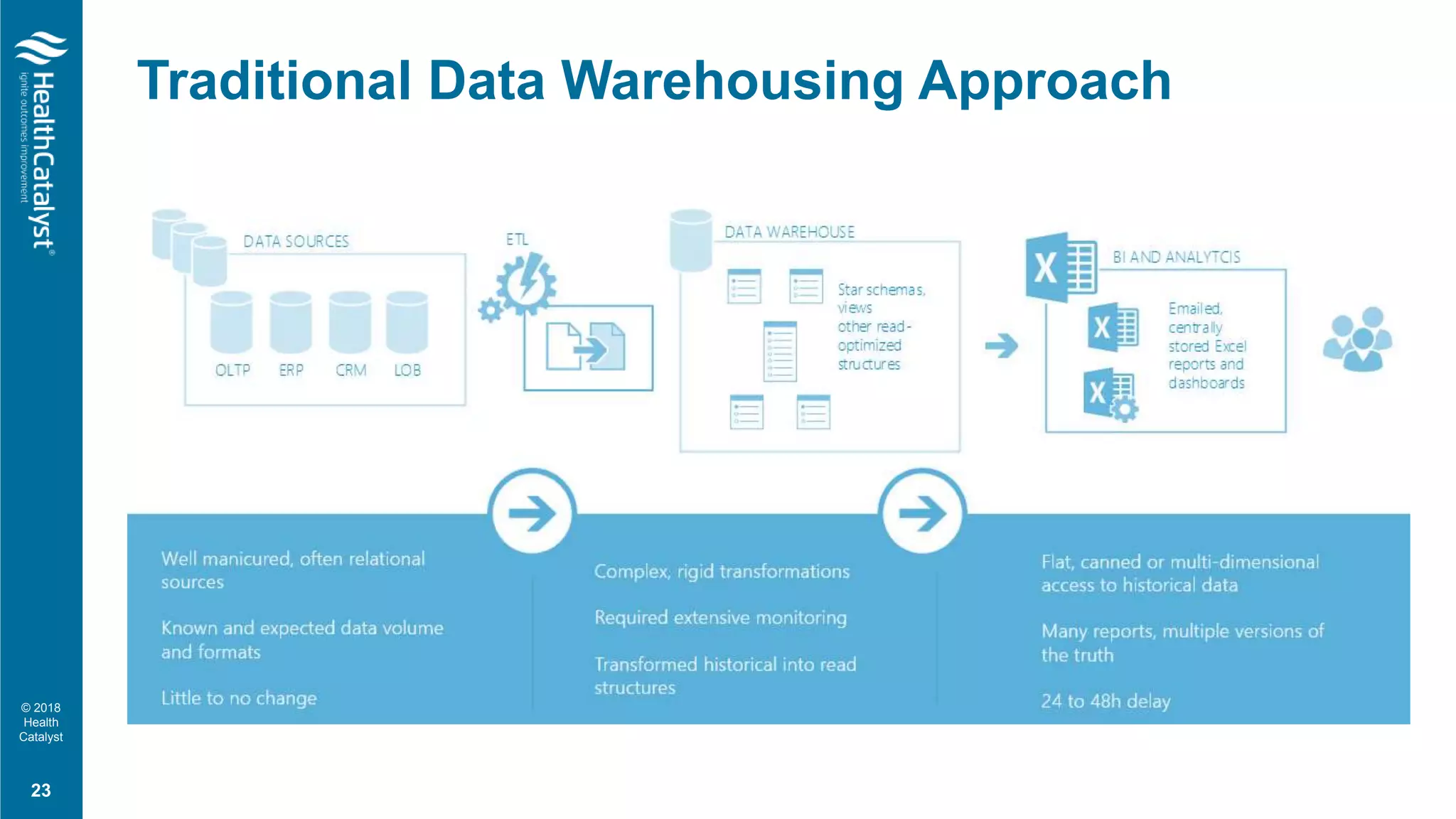
Current state of a data warehouse
23
Traditional Data Warehousing Approach
© 2018
Health
Catalyst
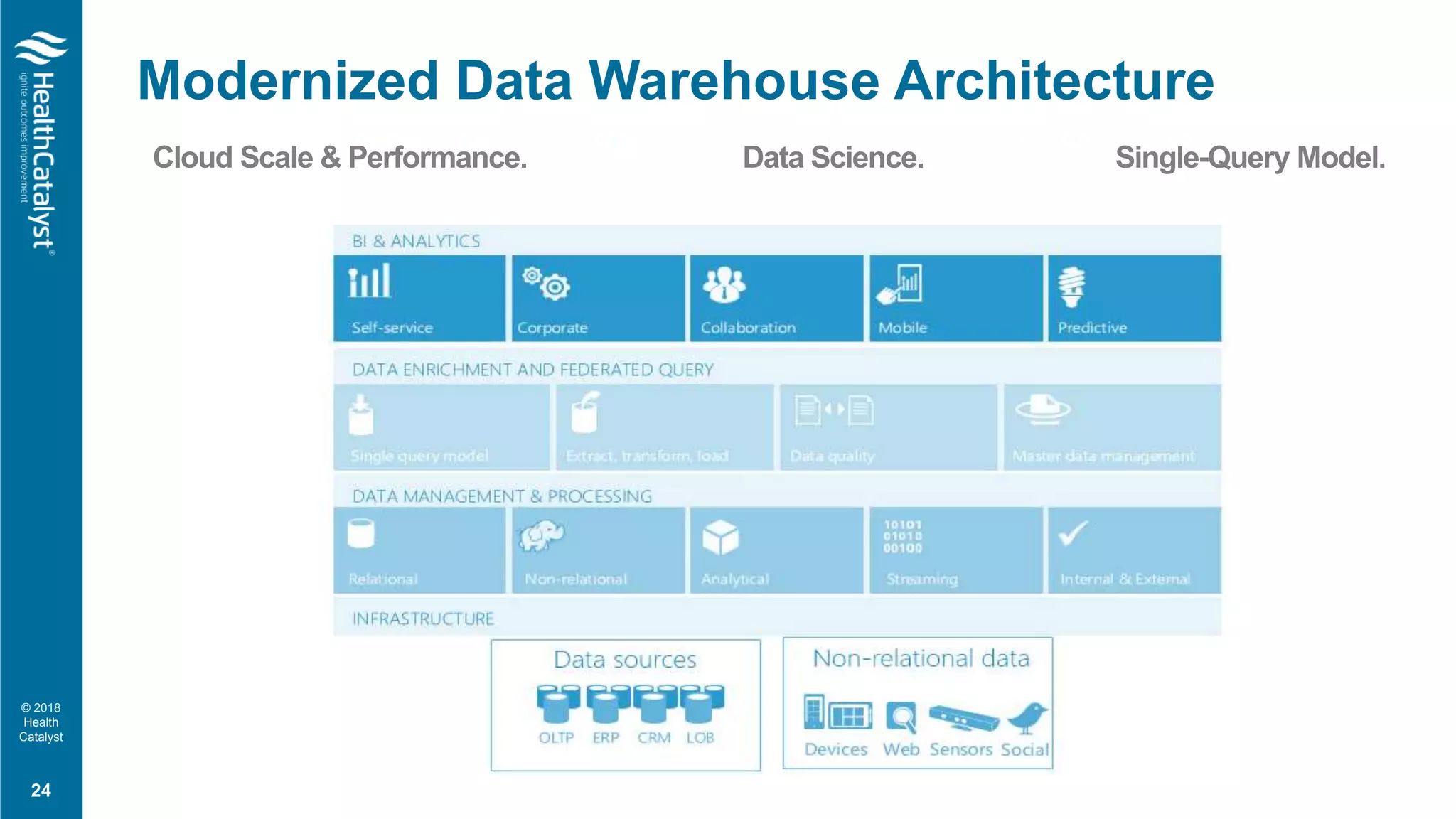
Modernized Data Warehouse Architecture
2
4
Cloud Scale & Performance. Single-Query Model.Data Science.
24
© 2018
Health
Catalyst
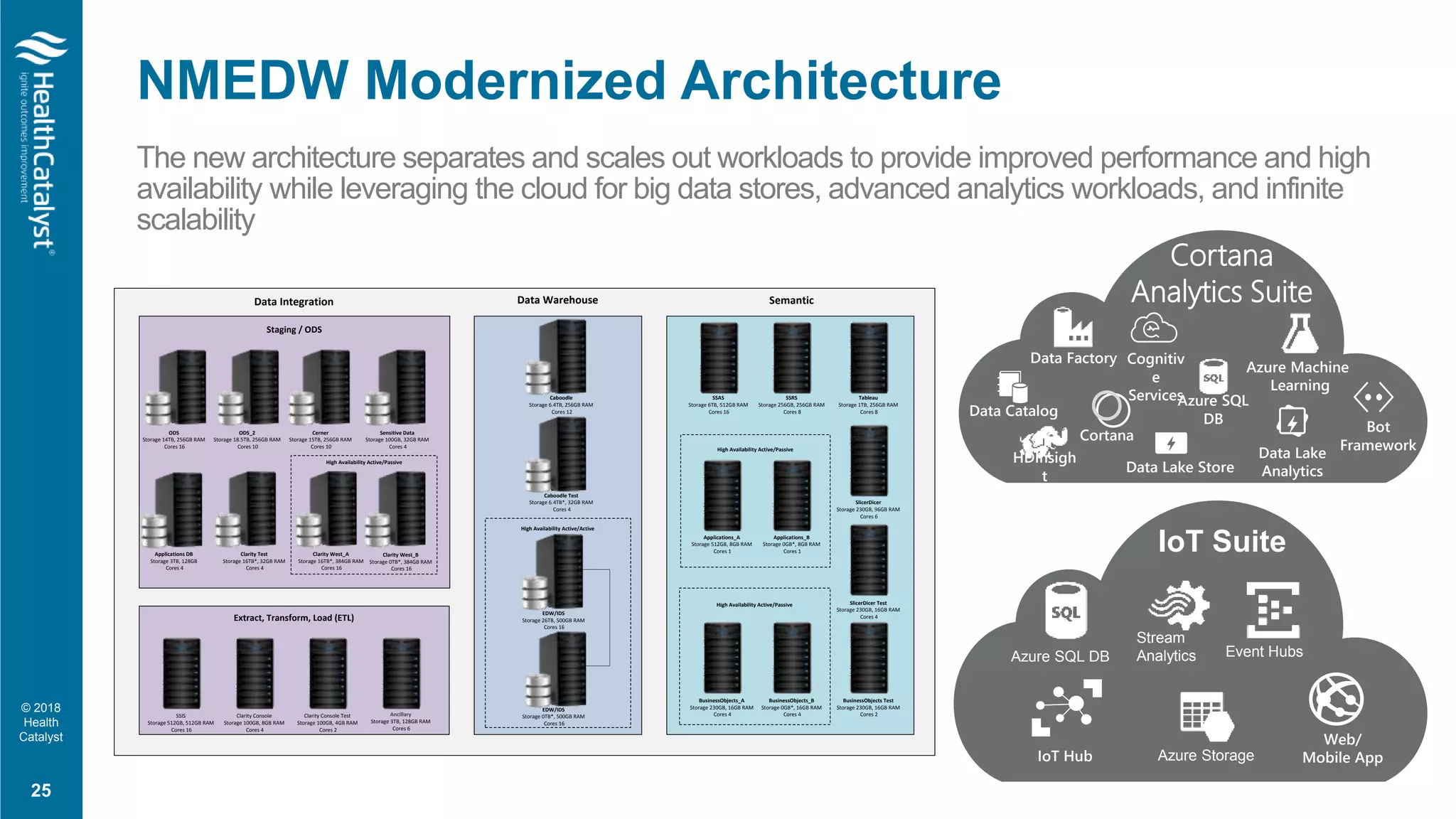
NMEDW Modernized Architecture
2
5
The new architecture separates and scales out workloads to provide improved performance and high
availability while leveraging the cloud for big data stores, advanced analytics workloads, and infinite
scalability
25
Staging / ODS
ODS
Storage 14TB, 256GB RAM
Cores 16
ODS_2
Storage 18.5TB, 256GB RAM
Cores 10
Cerner
Storage 15TB, 256GB RAM
Cores 10
Sensitive Data
Storage 100GB, 32GB RAM
Cores 4
Clarity Test
Storage 16TB*, 32GB RAM
Cores 4
High Availability Active/Passive
Clarity West_A
Storage 16TB*, 384GB RAM
Cores 16
Clarity West_B
Storage 0TB*, 384GB RAM
Cores 16
Extract, Transform, Load (ETL)
SSIS
Storage 512GB, 512GB RAM
Cores 16
Clarity Console
Storage 100GB, 8GB RAM
Cores 4
Clarity Console Test
Storage 100GB, 4GB RAM
Cores 2
Data Integration Data Warehouse Semantic
Caboodle
Storage 6.4TB, 256GB RAM
Cores 12
Caboodle Test
Storage 6.4TB*, 32GB RAM
Cores 4
Applications DB
Storage 3TB, 128GB
Cores 4
Ancillary Environments
Storage 4TB, RAM 128GB
Cores 6
High Availability Active/Active
EDW/IDS
Storage 26TB, 500GB RAM
Cores 16
EDW/IDS
Storage 0TB*, 500GB RAM
Cores 16
SSAS
Storage 6TB, 512GB RAM
Cores 16
SSRS
Storage 256GB, 256GB RAM
Cores 8
Tableau
Storage 1TB, 256GB RAM
Cores 8
BusinessObjects Test
Storage 230GB, 16GB RAM
Cores 2
SlicerDicer
Storage 230GB, 96GB RAM
Cores 6
High Availability Active/Passive
BusinessObjects_B
Storage 0GB*, 16GB RAM
Cores 4
BusinessObjects_A
Storage 230GB, 16GB RAM
Cores 4
SlicerDicer Test
Storage 230GB, 16GB RAM
Cores 4
High Availability Active/Passive
Applications_A
Storage 512GB, 8GB RAM
Cores 1
Applications_B
Storage 0GB*, 8GB RAM
Cores 1
Ancillary
Storage 3TB, 128GB RAM
Cores 6
Azure SQL
DB
HDInsigh
t
Cortana
Analytics Suite
Azure Machine
Learning
Data Factory
Data Catalog
Cognitiv
e
Services
Cortana
Bot
Framework
Data Lake Store
Data Lake
Analytics
Azure Storage
Azure SQL DB
Stream
Analytics Event Hubs
IoT Suite
IoT Hub
Web/
Mobile App
© 2018
Health
Catalyst
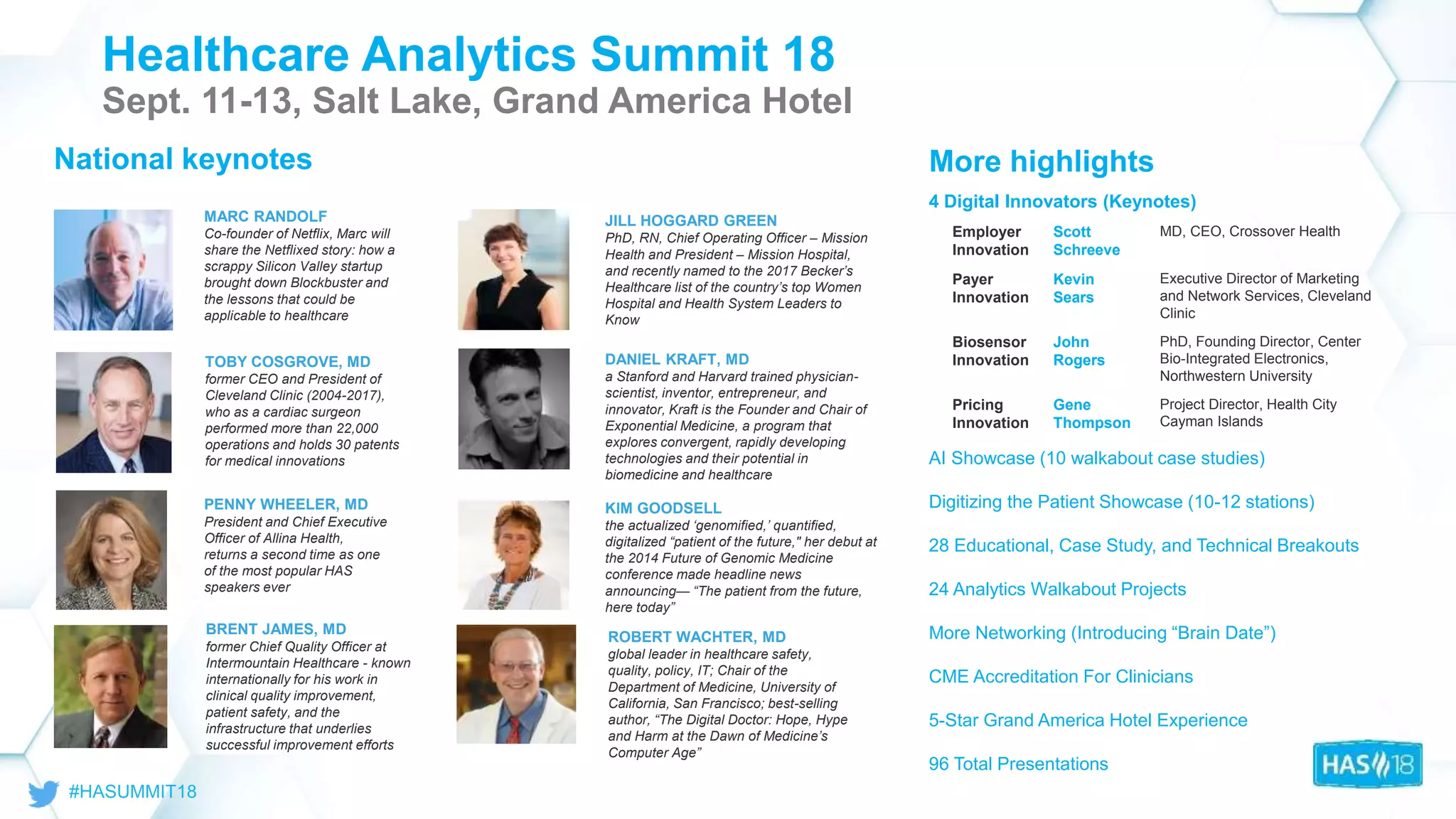
Healthcare Analytics Summit 18
Sept. 11-13, Salt Lake, Grand America Hotel
TOBY COSGROVE, MD
former CEO and President of
Cleveland Clinic (2004-2017),
who as a cardiac surgeon
performed more than 22,000
operations and holds 30 patents
for medical innovations
KIM GOODSELL
the actualized ‘genomified,’ quantified,
digitalized “patient of the future," her debut at
the 2014 Future of Genomic Medicine
conference made headline news
announcing— “The patient from the future,
here today”
DANIEL KRAFT, MD
a Stanford and Harvard trained physician-
scientist, inventor, entrepreneur, and
innovator, Kraft is the Founder and Chair of
Exponential Medicine, a program that
explores convergent, rapidly developing
technologies and their potential in
biomedicine and healthcare
BRENT JAMES, MD
former Chief Quality Officer at
Intermountain Healthcare - known
internationally for his work in
clinical quality improvement,
patient safety, and the
infrastructure that underlies
successful improvement efforts
PENNY WHEELER, MD
President and Chief Executive
Officer of Allina Health,
returns a second time as one
of the most popular HAS
speakers ever
MARC RANDOLF
Co-founder of Netflix, Marc will
share the Netflixed story: how a
scrappy Silicon Valley startup
brought down Blockbuster and
the lessons that could be
applicable to healthcare
JILL HOGGARD GREEN
PhD, RN, Chief Operating Officer – Mission
Health and President – Mission Hospital,
and recently named to the 2017 Becker’s
Healthcare list of the country’s top Women
Hospital and Health System Leaders to
Know
ROBERT WACHTER, MD
global leader in healthcare safety,
quality, policy, IT; Chair of the
Department of Medicine, University of
California, San Francisco; best-selling
author, “The Digital Doctor: Hope, Hype
and Harm at the Dawn of Medicine’s
Computer Age”
More highlights
4 Digital Innovators (Keynotes)
AI Showcase (10 walkabout case studies)
Digitizing the Patient Showcase (10-12 stations)
28 Educational, Case Study, and Technical Breakouts
24 Analytics Walkabout Projects
More Networking (Introducing “Brain Date”)
CME Accreditation For Clinicians
5-Star Grand America Hotel Experience
96 Total Presentations
National keynotes
Employer
Innovation
Scott
Schreeve
MD, CEO, Crossover Health
Payer
Innovation
Kevin
Sears
Executive Director of Marketing
and Network Services, Cleveland
Clinic
Biosensor
Innovation
John
Rogers
PhD, Founding Director, Center
Bio-Integrated Electronics,
Northwestern University
Pricing
Innovation
Gene
Thompson
Project Director, Health City
Cayman Islands
Thank You!

20 Years in Healthcare Analytics & Data Warehousing: What did we learn? What's the future hold?

  • 1.
    20 Years inHealthcare Analytics & Data Warehousing What did we learn? What’s the future? Shakeeb Akhter - Director, Enterprise Data Warehouse at Northwestern Medicine Lee Pierce - Healthcare Chief Data Officer at Sirius and former Chief Data Officer at Intermountain Healthcare Dale Sanders, President of Technology at Health Catalyst
  • 2.
    • People • Processes •Technology • What did we do right? • What did we do wrong? • What’s the future? Many thanks to Lee and Shakeeb Agenda
  • 3.
    © 2018 Health Catalyst I learnedwhat was right by first doing what was wrong. Luckily, I watched others do what was wrong and learned from them without suffering their wounds as mine. Generally Speaking… 3
  • 4.
  • 5.
    © 2018 Health Catalyst What didwe do right? • Hired a balanced combination of social skills, domain skills (clinical and financial), and technical skills • Good balance of centralized/decentralized development of these skills… 60/40 split What would we have done differently? • Overlooked the cultural issues of ”data”… threatened legacy source systems’ teams… Intermountain the IDN vs Northwestern the AMC • Too much dependence on matrixed technology resources, esp DBAs and Sys Admins who were skilled in transaction databases, not analytics What are we thinking about the future? • Data science, non-relational technical skills • A new role: The Digitician • Reality of the 8% Folly People - Dale 5
  • 6.
    © 2018 Health Catalyst Data asa Strategic Corporate Asset This should be every healthcare CEO’s strategic data acquisition roadmap 6
  • 7.
    © 2018 Health Catalyst What didwe do right? • Hired amazing data professionals - dedicated, smart, committed - treated them right • Embraced early support from business and clinical leaders that allowed us to start early: Dr. Brent James, Dr. Homer Warner • Partnered with & empowered the data analysts to be primary producers of analytics • Engaged business leaders in Data and Analytics strategy and execution What would we have done differently? • More thoughtful and coordinated growth, hiring of data analysts across the business, earlier job description standardization and smarter growth • More bold steps to organize analytics as centrally managed, locally deployed What are we thinking about the future? • Improved data literacy for leaders = how to ask for analytics help, how to use insights to improve decision making and change business processes = value People - Lee 7
  • 8.
    © 2018 Health Catalyst What didwe do right? • Small, highly skilled team at the start resulted in agility and faster product to market • Multiple tangentially related functions developed within the EDW team that resulted in self-sufficiency • Recruited EMR Application Analysts with exposure to Business Intelligence What would we have done differently? • Develop additional roles to accommodate growth and scale with the organization • Recruit clinical and operational SMEs to assist with understanding of data What are we thinking about the future? • Develop specialized roles in order to scale for future growth • Blur the lines between EDW & Analytics via hybrid resources People - Shakeeb 8
  • 9.
  • 10.
    © 2018 Health Catalyst What didwe do right? • Design and code reviews • Lightweight data governance – govern to the least extent necessary for the greatest common good • Using EHR logs to analyze & understand workflow (the first ‘Meaningful Use’) • Running the data warehouse like a small business What would we have done differently? • Prioritization management, demand vs. capacity • Managing expectations of data and analytic quality validation What are we thinking about the future? • AI/data science changes almost everything... design reviews, data governance, analytic validation • Study the DevOps of AI 10 Processes - Dale
  • 11.
    © 2018 Health Catalyst • Enabledby bio-integrated sensors, patients hold more data about themselves than the healthcare system • Their data is constantly being updated and uploaded to cloud-based AI algorithms • Those algorithms diagnose the patient’s condition, calculate a composite health risk score, and recommend options for treatment or maintaining health • The algorithm suggests options for a “best fit” care provider and the ability to socially interact with other patients like them Future of Diagnosis and Treatment 11 • The patient engages with the care provider, enabled with the output of the AI algorithms
  • 12.
    © 2018 Health Catalyst What didwe do right? • Vision for the use of data – clinical quality improvement • Focused on real business/clinical use-cases and needs • Discipline (in many use cases) to implement insights – close the loop • Practical data governance – project-based, use-case driven, clear business value What would we have done differently? • Require analytics return-on-investment planning and measurement for large analytics projects, document ROI, communicate successes and repeat • Establish (and enforce) better standard development practices from the beginning (EDW/ETL specifically), reducing maintenance required after dev. • Should have been more bold about data governance value and investment What are we thinking about the future? • More business discipline to use insights generated with more focus on end value 12 Processes - Lee
  • 13.
  • 14.
    © 2018 Health Catalyst What didwe do right? • Single EDW for Research and Operational Analytics • Small teams leveraged agile principles (informally) to start • Data Steward Approval + Power User Model • Report Deployment process What would we have done differently? • Avoid waterfall, embrace agile • Fail faster and more often • Bring the customer to the table What are we thinking about the future? • Dev + Data Ops; Agile Product Teams, source control, automated testing and deployment • Investing heavily in Data Management; Data Quality and Master Data Management • Embracing Agile tools & methods Processes - Shakeeb 14
  • 15.
    © 2018 Health Catalyst The primarygoal of Data Ops is to achieve Customer Satisfaction with DataAssets &Analytical Solutions across the enterprise • Standardization: Establish standardized tool sets and processes to increase productivity of data teams • Cross-Functional Teams: Break-Down silos within data teams (EDW/Analytics) by establishing cross-functional teams consisting of Data Architects, Analytics Consultants, Report Writers, ETL Developers and Data Scientists • Customer-Focus: Increased alignment with customer focus and priorities by establishing customer-centric product teams to serve data needs for operating units and system functions • Value-Add: Provide continuous delivery of analytical insights to enterprise customers in order to establish a data-driven culture • Customer Satisfaction: Increase customer satisfaction due to customer-focused teams and alignment with customer priorities Increased Customer Satisfaction Continuous Delivery of Analytical Insights Cross-Functional, Customer-Centric, Product Teams Standardized Tools and Processes 15 Dev Ops - Goals
  • 16.
    © 2018 Health Catalyst Data OpsProduct Teams contain all skills required to transform data from its raw form to an end-user analytical deliverable; report, dashboard, KPI, or analytical application. Possible roles, and product teams are displayed as a sample below. Product Team A NOTE: The above is a draft representation. Specific Product Teams are being defined byAnalytics and EDW teams and will be formed accordingly. Data Architect Analytics Manager Sr. Data Architect ETL Developer Data Quality Analyst Sr. Analytics Associate Analytics Associate Product Team B Data Architect Analytics Manager Sr. Data Architect ETL Developer Data Quality Analyst Sr. Analytics Associate Analytics Associate • Analytics Manager is accountable for the customer satisfaction with EDW deliverables, including self-service data & reporting applications • Sr. DataArchitect is accountable for the efficient & effective integration of data in EDW and the necessary data structures to support reporting • Analytics Manager & Sr. DataArchitect will collectively set priorities and timelines and escalate to leadership as needed • Staff level roles work collaboratively as one collective team with the customer’s satisfaction of EDW tools provided as the primary outcome metric • Specific # of resources & coverage of product teams will vary based on expected demand & resource availability, but FTEs will be a part of multiple product teams 16 Dev Ops – Product Teams
  • 17.
  • 18.
    © 2018 Health Catalyst What didwe do right? • Ignored the enterprise data model in favor of late binding… didn’t need expensive ETL tools • Took advantage of tried and true SMP architectures • Ignored the early love affair of Hadoop • Blended text with discrete data when nobody else was doing it • Picked Microsoft when nobody else was doing it What would we have done differently? • Too much late binding data modeling • Jumped into massively parallel processing too soon… let the pure technologists talk me into it • Too much faith in an “enterprise standard” business intelligence tool What are we thinking about the future? • Read-only, batch-oriented relational data warehouses are already outdated • Hybrid transaction & analytic architectures… Lambda and Kappa architectures Technology - Dale 18
  • 19.
    External Data Sources EMR SQL HL7 X12 FHIR Flat-files XML Data Integration Batch Data Realtime Data Mirth, RabbitMq Catalyst DataEngine SQL Big Data .NET DOS App Cluster Apps Microservices Highly Available Horizontally Scalable Angular, D3, .NET, Java, Docker, Kubernetes, JSON Datamart Designers & Tools SAMD, SMD, Atlas, Ops Console, Analytics Portal Data & Compute Cluster SQL Server, Hadoop, Spark, ElasticSearch Transactional data store SQL, Shared Disk DOS Marketplace Apps, Content, AI models Catalyst AI Engine Catalyst.ai healthcare.ai .NET, R, Python Azure Azure AI Cluster Spark, R, Python SQL FTP HL7 FHIR SQL HTTP FHIR HL7 External Apps EMRs Reports The Health Catalyst Data Operating System Architecture
  • 20.
    © 2018 Health Catalyst What didwe do right? • Collaborated with others– HDWA->HDAA, HMA • Purchased and implemented Tableau • Resisted ongoing pressure to move data to canonical data models (i.e. Oracle genomics) • Built an analytics reference architecture to use to rationalize tools/tech decisions What would we have done differently? • Would have been more thoughtful about migration from one tool to another – cost to migrate vs. value realized • Build more meaningful working relationship between EMR vendor(s) and healthcare analytics programs, focus on opportunities to deliver value through analytics What are we thinking about the future? • Embrace the cloud – simplify administration of technologies, computing power, flexibility • Personalized analytics – n of 1 – will require new data sets, more external data Technology - Lee 20
  • 21.
  • 22.
    © 2018 Health Catalyst What didwe do right? • Maintained Microsoft BI Stack rather than a proliferation of various BI tools • Did not go all-in on Hadoop early • Waited to modernize the platform until market was more mature What would we have done differently? • Scale out legacy infrastructure in order to distribute workloads What are we thinking about the future? • Transform EDW into an ecosystem of various technology and tools • Mission Critical Work-Loads on Premise • Cloud for Advanced Analytics, Dev/Test, Disaster Recovery and ‘Cold’ storage • Utilize Tabular Models for Self-Service • High Availability Technology - Shakeeb 22
  • 23.
    © 2018 Health Catalyst Current stateof a data warehouse 23 Traditional Data Warehousing Approach
  • 24.
    © 2018 Health Catalyst Modernized DataWarehouse Architecture 2 4 Cloud Scale & Performance. Single-Query Model.Data Science. 24
  • 25.
    © 2018 Health Catalyst NMEDW ModernizedArchitecture 2 5 The new architecture separates and scales out workloads to provide improved performance and high availability while leveraging the cloud for big data stores, advanced analytics workloads, and infinite scalability 25 Staging / ODS ODS Storage 14TB, 256GB RAM Cores 16 ODS_2 Storage 18.5TB, 256GB RAM Cores 10 Cerner Storage 15TB, 256GB RAM Cores 10 Sensitive Data Storage 100GB, 32GB RAM Cores 4 Clarity Test Storage 16TB*, 32GB RAM Cores 4 High Availability Active/Passive Clarity West_A Storage 16TB*, 384GB RAM Cores 16 Clarity West_B Storage 0TB*, 384GB RAM Cores 16 Extract, Transform, Load (ETL) SSIS Storage 512GB, 512GB RAM Cores 16 Clarity Console Storage 100GB, 8GB RAM Cores 4 Clarity Console Test Storage 100GB, 4GB RAM Cores 2 Data Integration Data Warehouse Semantic Caboodle Storage 6.4TB, 256GB RAM Cores 12 Caboodle Test Storage 6.4TB*, 32GB RAM Cores 4 Applications DB Storage 3TB, 128GB Cores 4 Ancillary Environments Storage 4TB, RAM 128GB Cores 6 High Availability Active/Active EDW/IDS Storage 26TB, 500GB RAM Cores 16 EDW/IDS Storage 0TB*, 500GB RAM Cores 16 SSAS Storage 6TB, 512GB RAM Cores 16 SSRS Storage 256GB, 256GB RAM Cores 8 Tableau Storage 1TB, 256GB RAM Cores 8 BusinessObjects Test Storage 230GB, 16GB RAM Cores 2 SlicerDicer Storage 230GB, 96GB RAM Cores 6 High Availability Active/Passive BusinessObjects_B Storage 0GB*, 16GB RAM Cores 4 BusinessObjects_A Storage 230GB, 16GB RAM Cores 4 SlicerDicer Test Storage 230GB, 16GB RAM Cores 4 High Availability Active/Passive Applications_A Storage 512GB, 8GB RAM Cores 1 Applications_B Storage 0GB*, 8GB RAM Cores 1 Ancillary Storage 3TB, 128GB RAM Cores 6 Azure SQL DB HDInsigh t Cortana Analytics Suite Azure Machine Learning Data Factory Data Catalog Cognitiv e Services Cortana Bot Framework Data Lake Store Data Lake Analytics Azure Storage Azure SQL DB Stream Analytics Event Hubs IoT Suite IoT Hub Web/ Mobile App
  • 26.
    © 2018 Health Catalyst Healthcare AnalyticsSummit 18 Sept. 11-13, Salt Lake, Grand America Hotel TOBY COSGROVE, MD former CEO and President of Cleveland Clinic (2004-2017), who as a cardiac surgeon performed more than 22,000 operations and holds 30 patents for medical innovations KIM GOODSELL the actualized ‘genomified,’ quantified, digitalized “patient of the future," her debut at the 2014 Future of Genomic Medicine conference made headline news announcing— “The patient from the future, here today” DANIEL KRAFT, MD a Stanford and Harvard trained physician- scientist, inventor, entrepreneur, and innovator, Kraft is the Founder and Chair of Exponential Medicine, a program that explores convergent, rapidly developing technologies and their potential in biomedicine and healthcare BRENT JAMES, MD former Chief Quality Officer at Intermountain Healthcare - known internationally for his work in clinical quality improvement, patient safety, and the infrastructure that underlies successful improvement efforts PENNY WHEELER, MD President and Chief Executive Officer of Allina Health, returns a second time as one of the most popular HAS speakers ever MARC RANDOLF Co-founder of Netflix, Marc will share the Netflixed story: how a scrappy Silicon Valley startup brought down Blockbuster and the lessons that could be applicable to healthcare JILL HOGGARD GREEN PhD, RN, Chief Operating Officer – Mission Health and President – Mission Hospital, and recently named to the 2017 Becker’s Healthcare list of the country’s top Women Hospital and Health System Leaders to Know ROBERT WACHTER, MD global leader in healthcare safety, quality, policy, IT; Chair of the Department of Medicine, University of California, San Francisco; best-selling author, “The Digital Doctor: Hope, Hype and Harm at the Dawn of Medicine’s Computer Age” More highlights 4 Digital Innovators (Keynotes) AI Showcase (10 walkabout case studies) Digitizing the Patient Showcase (10-12 stations) 28 Educational, Case Study, and Technical Breakouts 24 Analytics Walkabout Projects More Networking (Introducing “Brain Date”) CME Accreditation For Clinicians 5-Star Grand America Hotel Experience 96 Total Presentations National keynotes Employer Innovation Scott Schreeve MD, CEO, Crossover Health Payer Innovation Kevin Sears Executive Director of Marketing and Network Services, Cleveland Clinic Biosensor Innovation John Rogers PhD, Founding Director, Center Bio-Integrated Electronics, Northwestern University Pricing Innovation Gene Thompson Project Director, Health City Cayman Islands
  • 27.