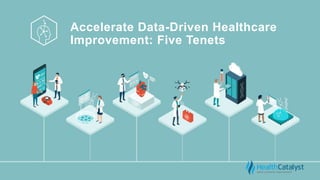
Accelerate Data-Driven Healthcare
Improvement: Five Tenets
© 2022 Health Catalyst
Proprietary. Feel free to share but we would appreciate a Health Catalyst citation.
Accelerate Data-Driven Healthcare Improvement
With seemingly endless amounts of data and
the constant pressure to achieve “data-driven”
healthcare improvement, health systems
increasingly turn to data to solve problems and
accelerate change.
However, this onslaught of data within
healthcare has left many organizations
questioning whether they use their data
effectively to achieve better outcomes.
© 2022 Health Catalyst
Proprietary. Feel free to share but we would appreciate a Health Catalyst citation.
Accelerate Data-Driven Healthcare Improvement
To successfully apply data and track its success in data-driven healthcare
improvement, Bryan Hinton, Health Catalyst Chief Technology officer, and TJ
Elbert, Health Catalyst SVP and General Manager of Data, discuss the five
data-centric mindset shifts health systems must adopt:
#1. Focus on Data
Orchestration, Not
Data Computing
#4: If You’re Not
Using AI, You
Should Be
#2: Real-Time Data
Is Critical in a
Pandemic
#5: Don’t Fit Data
into Existing Care
Models—Change
Care Models to
Fit Data
#3: Data
Governance Is
Less About Control
and More About
Democratization
© 2022 Health Catalyst
Proprietary. Feel free to share but we would appreciate a Health Catalyst citation.
Accelerate Data-Driven Healthcare Improvement
#1. Focus on Data Orchestration, Not Data Computing
As cloud-based data platforms become
more widely available to healthcare
organizations, data interpretation is no
longer the primary challenge.
Instead, healthcare leaders need to focus
on data orchestration: quickly combining
data from different sources, then distributing
the relevant data sets to appropriate end
users throughout the organization.
© 2022 Health Catalyst
Proprietary. Feel free to share but we would appreciate a Health Catalyst citation.
Accelerate Data-Driven Healthcare Improvement
#1. Focus on Data Orchestration, Not Data Computing
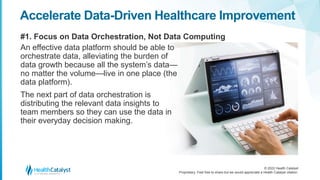
An effective data platform should be able to
orchestrate data, alleviating the burden of
data growth because all the system’s data—
no matter the volume—live in one place (the
data platform).
The next part of data orchestration is
distributing the relevant data insights to
team members so they can use the data in
their everyday decision making.
© 2022 Health Catalyst
Proprietary. Feel free to share but we would appreciate a Health Catalyst citation.
Accelerate Data-Driven Healthcare Improvement
#1. Focus on Data Orchestration, Not Data Computing
Effective data distribution is especially
important for health systems balancing fee-
for-service and value-based payment
models with limited resources.
© 2022 Health Catalyst
Proprietary. Feel free to share but we would appreciate a Health Catalyst citation.
Accelerate Data-Driven Healthcare Improvement
#2: Real-Time Data Is Critical in a Pandemic
COVID-19 surfaced a critical need for real-time
data from all data sources, both structured
(e.g., claims and EHR data) and unstructured
(e.g., clinician notes and imaging).
As structured and unstructured data sources
make the data technology landscape more
complex, most organizations must manage
both source types to gather timely data.
© 2022 Health Catalyst
Proprietary. Feel free to share but we would appreciate a Health Catalyst citation.
Accelerate Data-Driven Healthcare Improvement
#2: Real-Time Data Is Critical in a Pandemic
Instead of relying on humans to manually
compile data into spreadsheets, which has
historically delayed access to real-time data,
automation can increase access to real-time
data, which is vital for organizations
responding to health crises,
including a pandemic, that
require quick decisions in
a short timeframe.
Video: COVID-19 Highlights the
Need for Data - Bryan Hinton
© 2022 Health Catalyst
Proprietary. Feel free to share but we would appreciate a Health Catalyst citation.
Accelerate Data-Driven Healthcare Improvement
#3: Data Governance Is Less About Control and More About Democratization
Health systems have historically been
protective of their data largely due to privacy
concerns. According to Hinton and Elbert,
this protective mindset has become a
roadblock to data sharing.
The broader data landscape has used data
to fuel growth and higher levels of efficiency
without compromising quality, teaching the
healthcare industry that data governance is
less about control and more about data
democratization.
© 2022 Health Catalyst
Proprietary. Feel free to share but we would appreciate a Health Catalyst citation.
Accelerate Data-Driven Healthcare Improvement
#3: Data Governance Is Less About Control and More About Democratization
In short, instead of withholding data from
team members, leaders should enable
teams with data along with the training they
need to use it to make decisions.
Giving team members visibility into data,
data sources, and algorithms that derive
analytic insight also helps team members
trust the data, increasing the likelihood
they will continue to use it.
© 2022 Health Catalyst
Proprietary. Feel free to share but we would appreciate a Health Catalyst citation.
Accelerate Data-Driven Healthcare Improvement
#3: Data Governance Is Less About Control and More About Democratization
When team members feel confident using
data, organizations achieve data-driven
healthcare improvement at every level of
the system, not just the top.
© 2022 Health Catalyst
Proprietary. Feel free to share but we would appreciate a Health Catalyst citation.
Accelerate Data-Driven Healthcare Improvement
#4: If You’re Not Using AI, You Should Be
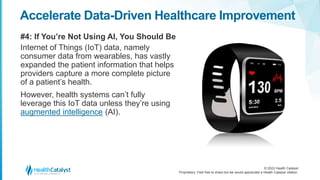
Internet of Things (IoT) data, namely
consumer data from wearables, has vastly
expanded the patient information that helps
providers capture a more complete picture
of a patient’s health.
However, health systems can’t fully
leverage this IoT data unless they’re using
augmented intelligence (AI).
© 2022 Health Catalyst
Proprietary. Feel free to share but we would appreciate a Health Catalyst citation.
Accelerate Data-Driven Healthcare Improvement
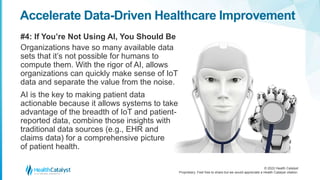
#4: If You’re Not Using AI, You Should Be
Organizations have so many available data
sets that it’s not possible for humans to
compute them. With the rigor of AI, allows
organizations can quickly make sense of IoT
data and separate the value from the noise.
AI is the key to making patient data
actionable because it allows systems to take
advantage of the breadth of IoT and patient-
reported data, combine those insights with
traditional data sources (e.g., EHR and
claims data) for a comprehensive picture
of patient health.
© 2022 Health Catalyst
Proprietary. Feel free to share but we would appreciate a Health Catalyst citation.
Accelerate Data-Driven Healthcare Improvement
#5: Don’t Fit Data into Existing Care Models-Change Care Models to Fit Data
Healthcare leaders typically plug data into
existing care models. Although this sounds
like a sensible solution, organizations should
take the opposite approach and alter their
care models to fit their data sources.
To take full advantage of a health system’s
data and empower team members to work at
the top of their license, leaders should identify
the most relevant data for the appropriate end
users, then alter their care models to support
that data delivery.
© 2022 Health Catalyst
Proprietary. Feel free to share but we would appreciate a Health Catalyst citation.
Accelerate Data-Driven Healthcare Improvement
#5: Don’t Fit Data into Existing Care Models-Change Care Models to Fit Data
This data-first, instead of process-first,
approach also prioritizes how end users,
such as clinicians, need to receive data so
they feel the most comfortable using it and
can help reduce the all-too-common data
burden that many clinicians experience.
Video: Deliver Insights to Decision Makers
© 2022 Health Catalyst
Proprietary. Feel free to share but we would appreciate a Health Catalyst citation.
Less Talk, More Data-Driven Healthcare Improvement
Data is not going away. It’s only becoming
more prevalent in healthcare.
To make sense of the growing data and
maximize this valuable resource,
organizations need to think about data
differently, starting with these five data-
centric mindset shifts.
View the full podcast or download
the audio only version here.
© 2022 Health Catalyst
Proprietary. Feel free to share but we would appreciate a Health Catalyst citation.
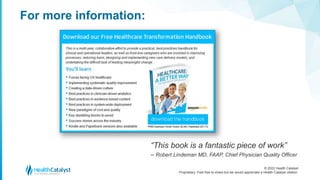
For more information:
“This book is a fantastic piece of work”
– Robert Lindeman MD, FAAP, Chief Physician Quality Officer
© 2022 Health Catalyst
Proprietary. Feel free to share but we would appreciate a Health Catalyst citation.
More about this topic
Link to original article for a more in-depth discussion.
The Four Pillars of Successful Self-Service Analytics in Healthcare
The Healthcare Analytics Summit™ 2021 Virtual
Health Catalyst Editors
Effective Healthcare Decision Support for Leaders at Every Level: Three Problems that Leading Wisely Solves
Dorian DiNardo, Senior VP of Analytics
Five Practical Steps Towards Healthcare Data Governance
Stephen Hess
Four Elements that Bridge the Gap Between Using Data and Becoming Data-Driven
Health Catalyst Editors
How to Build a Healthcare Data Quality Coalition to Optimize Decision Making
Taylor Larsen, DOS Marts Data Quality, Director
© 2022 Health Catalyst
Proprietary. Feel free to share but we would appreciate a Health Catalyst citation.
Bryan Hinton joined Health Catalyst in 2012 and currently serves as the Chief Technology
Officer. He has been instrumental in the development and integration of the Health Catalyst
Data Operating System (DOS™)—Health Catalyst’s primary technology platform. Prior to
joining Health Catalyst, Bryan spent 4 years with The Church of Jesus Christ of Latter-Day
Saints and 7 years with Intel. While at the LDS Church, he led the .NET Development Center of
Excellence and was responsible for setting the architectural guidance of all .NET projects across the
company. As a senior software engineer at Intel, he was responsible for the development and
implementation of Intel’s factory data warehouse product that was installed at Intel factories worldwide.
Bryan carries a deep technical experience and understanding across all facets of software engineering
with an emphasis on adopting software engineering practices as part of the data engineering process.
He is passionate about building software and creating healthy engineering environments and teams. He
believes deeply that curiosity and continuous learning are necessary skills to be fostered and
encouraged for a successful team and is an advocate for a healthy work-life balance. Bryan graduated
from Brigham Young University in Provo, UT with a BS in Computer Science.
Other Clinical Quality Improvement Resources
Click to read additional information at www.healthcatalyst.com
Bryan Hinton
© 2022 Health Catalyst
Proprietary. Feel free to share but we would appreciate a Health Catalyst citation.
TJ Elbert joined Health Catalyst in January 2019 and serves as the SVP and General
Manager of Data. Mr. Elbert brings over 15 years of healthcare information technology, data
warehousing, and analytics experience to Health Catalyst. He came to Health Catalyst from
Northwestern Medicine where he held a number of leadership roles in data warehousing and
population health. Prior to Northwestern he worked as an Integration Architect at Cerner
Corporation where he led a number of large health system EMR implementations and services
engagements. Mr. Elbert graduated from the University of Iowa with a Bachelor of Science in Industrial
Engineering. He will complete his MBA and Master of Science in Business Analytics from the University
of Iowa in December 2021.
Other Clinical Quality Improvement Resources
Click to read additional information at www.healthcatalyst.com
TJ Elbert
© 2022 Health Catalyst
Proprietary. Feel free to share but we would appreciate a Health Catalyst citation.
Other Clinical Quality Improvement Resources
Click to read additional information at www.healthcatalyst.com
Health Catalyst is a mission-driven data warehousing, analytics and outcomes-improvement
company that helps healthcare organizations of all sizes improve clinical, financial, and operational
outcomes needed to improve population health and accountable care. Our proven enterprise data
warehouse (EDW) and analytics platform helps improve quality, add efficiency and lower costs in
support of more than 65 million patients for organizations ranging from the largest US health system
to forward-thinking physician practices.
Health Catalyst was recently named as the leader in the enterprise healthcare BI market in
improvement by KLAS and has received numerous best-place-to work awards including Modern
Healthcare in 2013, 2014, and 2015, as well as other recognitions such as “Best Place to work for
Millenials, and a “Best Perks for Women.”