
© 2021 Health Catalyst
May 26, 2021
Building Analytic Acumen with Less
Classroom Training and More Learning
2
Mission | Froedtert & the Medical College of Wisconsin advance
the health of the diverse communities we serve through
exceptional care enhanced by innovation and discovery.
By the Numbers
• Academic and community health delivery
• 8 Hospitals, 45 health centers
• ~3,000 faculty and community-based physicians
• 1.3 million outpatient, ~75K inpatient visit
• Portfolio across the health care continuum
• Provider owned health plan
• Clinically integrated network (CIN) with over 100K lives
• Innovation/digital health center
• ~45,000 decision makers to support
Froedtert & Medical College of Wisconsin
3
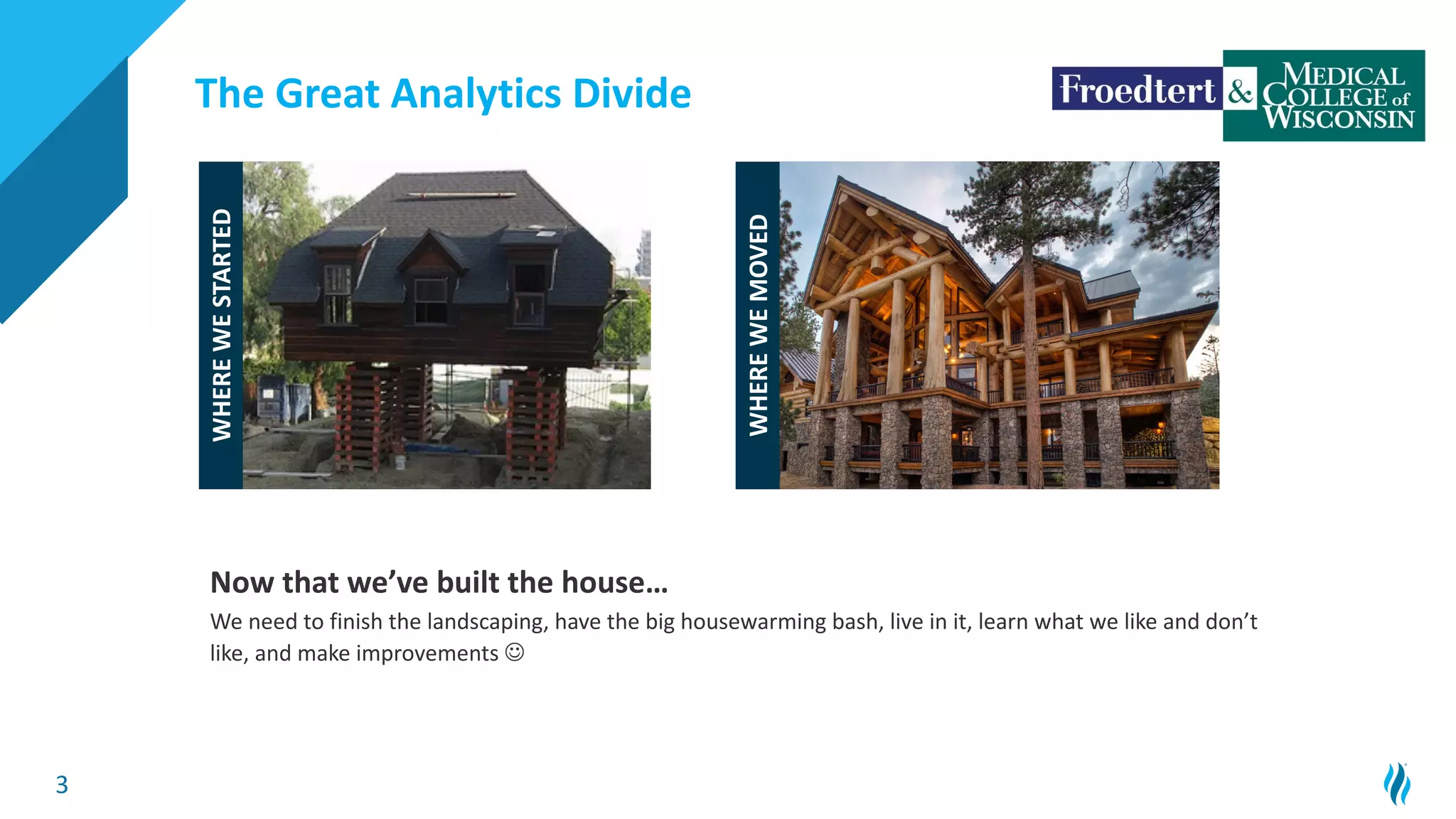
The Great Analytics Divide
WHERE
WE
STARTED
WHERE
WE
MOVED
Now that we’ve built the house…
We need to finish the landscaping, have the big housewarming bash, live in it, learn what we like and don’t
like, and make improvements J
4
• Shift culture and mature data-driven decision-making
• Improve analytical acumen and treat data as an asset
• Support enterprise integration through data access and analytics
• Reduce waste/rework/competing investments and data wrangling
• Enable strategic and operational imperatives
• Assign value and use of data and analytics as intellectual property
• Improve and transform
Enterprise Analytics Strategy
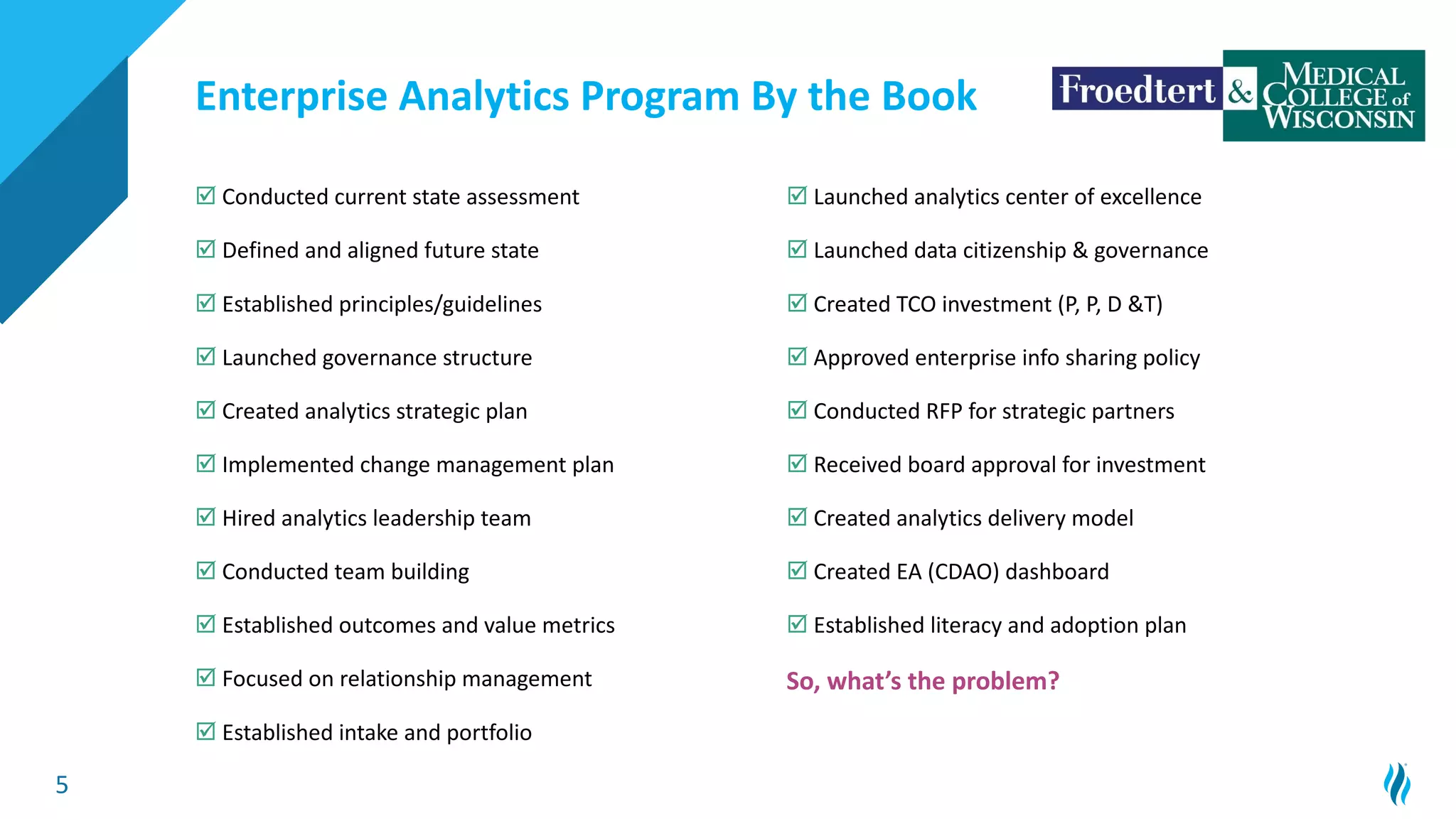
5
Enterprise Analytics Program By the Book
þ Conducted current state assessment
þ Defined and aligned future state
þ Established principles/guidelines
þ Launched governance structure
þ Created analytics strategic plan
þ Implemented change management plan
þ Hired analytics leadership team
þ Launched analytics center of excellence
þ Launched data citizenship & governance
þ Created TCO investment (P, P, D &T)
þ Approved enterprise info sharing policy
þ Conducted RFP for strategic partners
þ Received board approval for investment
þ Created analytics delivery model
þ Created EA (CDAO) dashboard
þ Conducted team building
þ Established outcomes and value metrics
þ Focused on relationship management
þ Established literacy and adoption plan
So, what’s the problem?
þ Established intake and portfolio
6
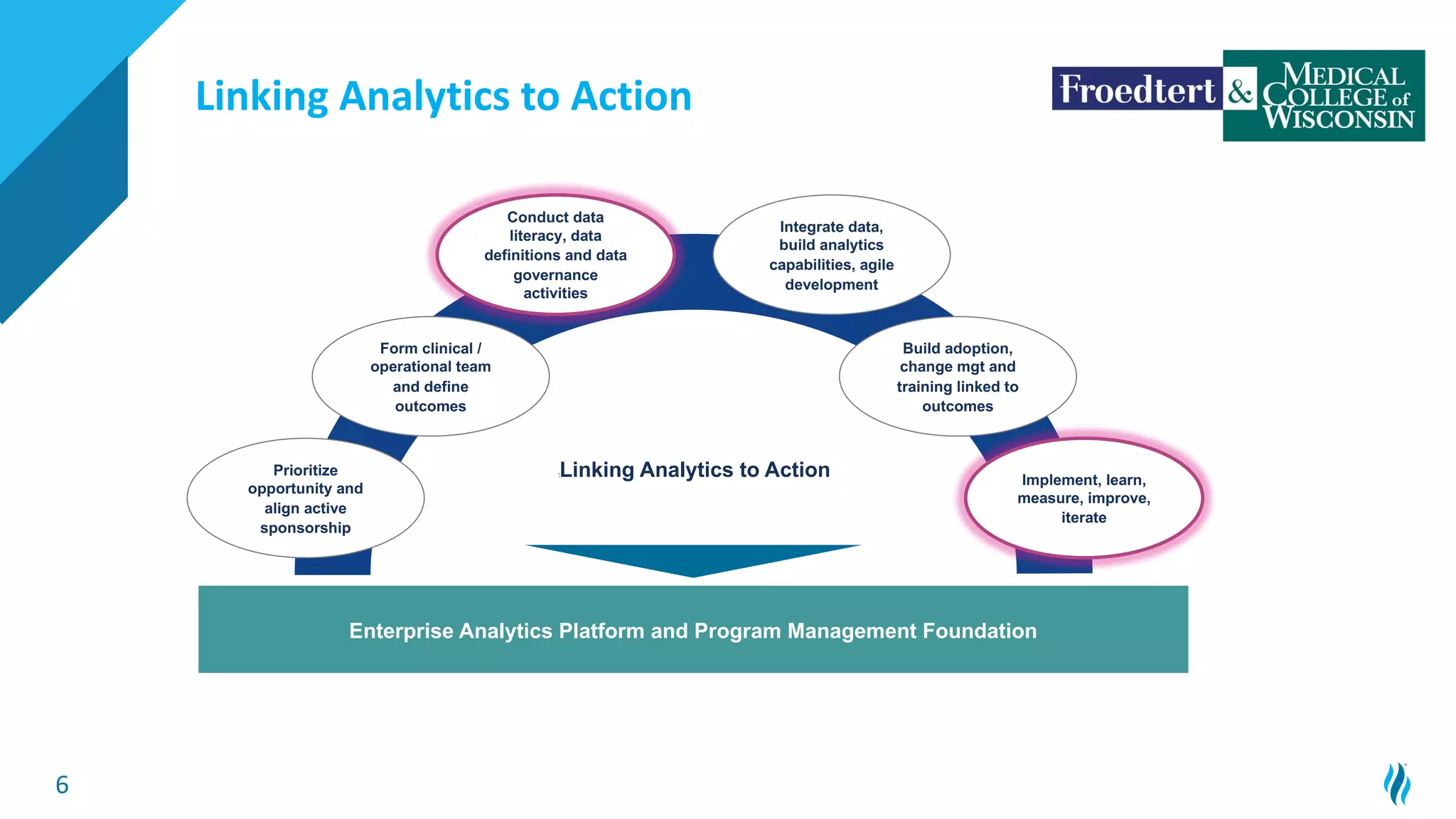
Linking Analytics to Action
Prioritize
opportunity and
align active
sponsorship
Form clinical /
operational team
and define
outcomes
Conduct data
literacy, data
definitions and data
governance
activities
Implement, learn,
measure, improve,
iterate
Build adoption,
change mgt and
training linked to
outcomes
Integrate data,
build analytics
capabilities, agile
development
Enterprise Analytics Platform and Program Management Foundation
‫‏‬Linking Analytics to Action
7
Data Literacy and Process Improvement
Competency Bell Curve
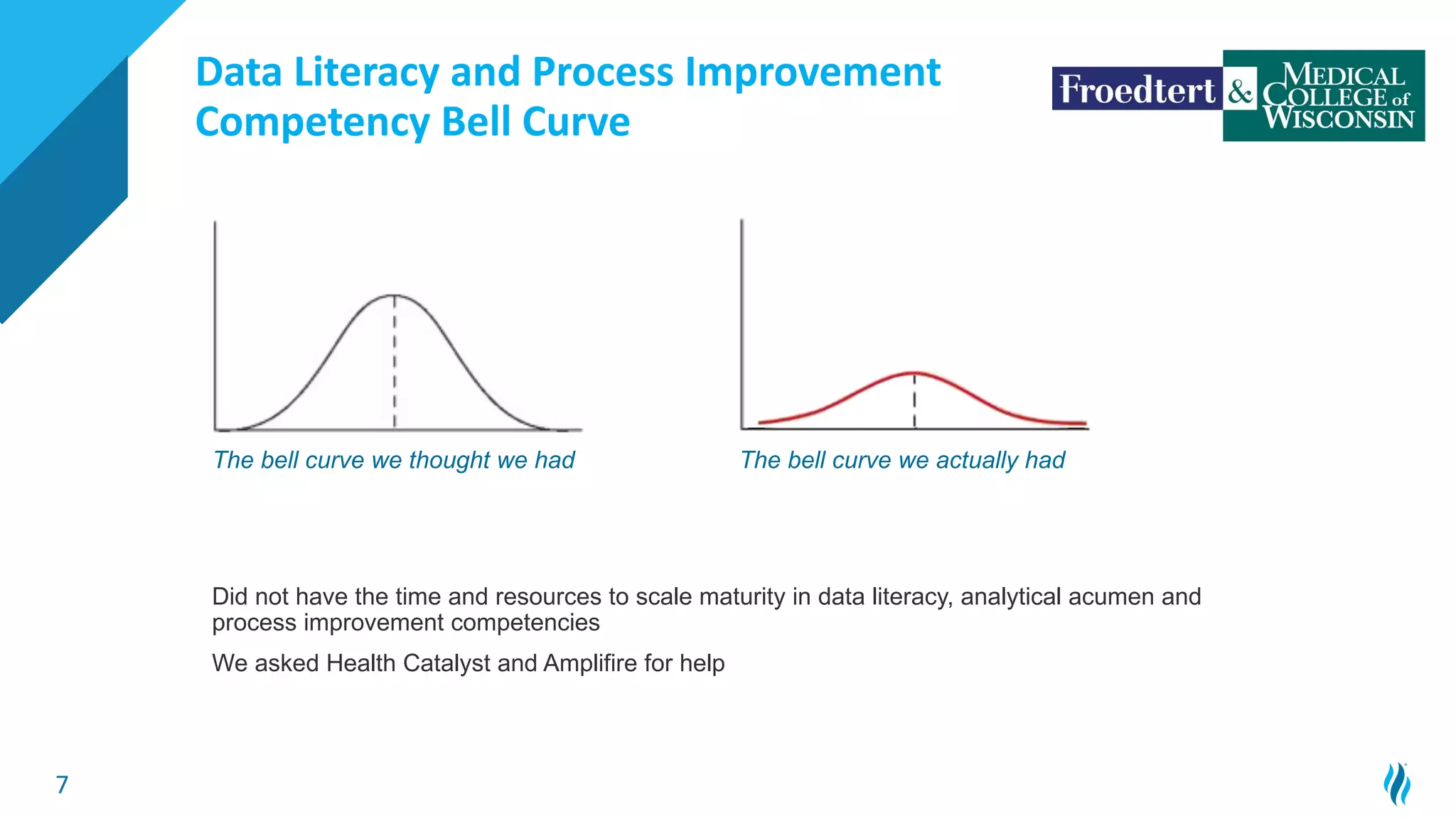
Did not have the time and resources to scale maturity in data literacy, analytical acumen and
process improvement competencies
We asked Health Catalyst and Amplifire for help
The bell curve we actually had
The bell curve we thought we had
8
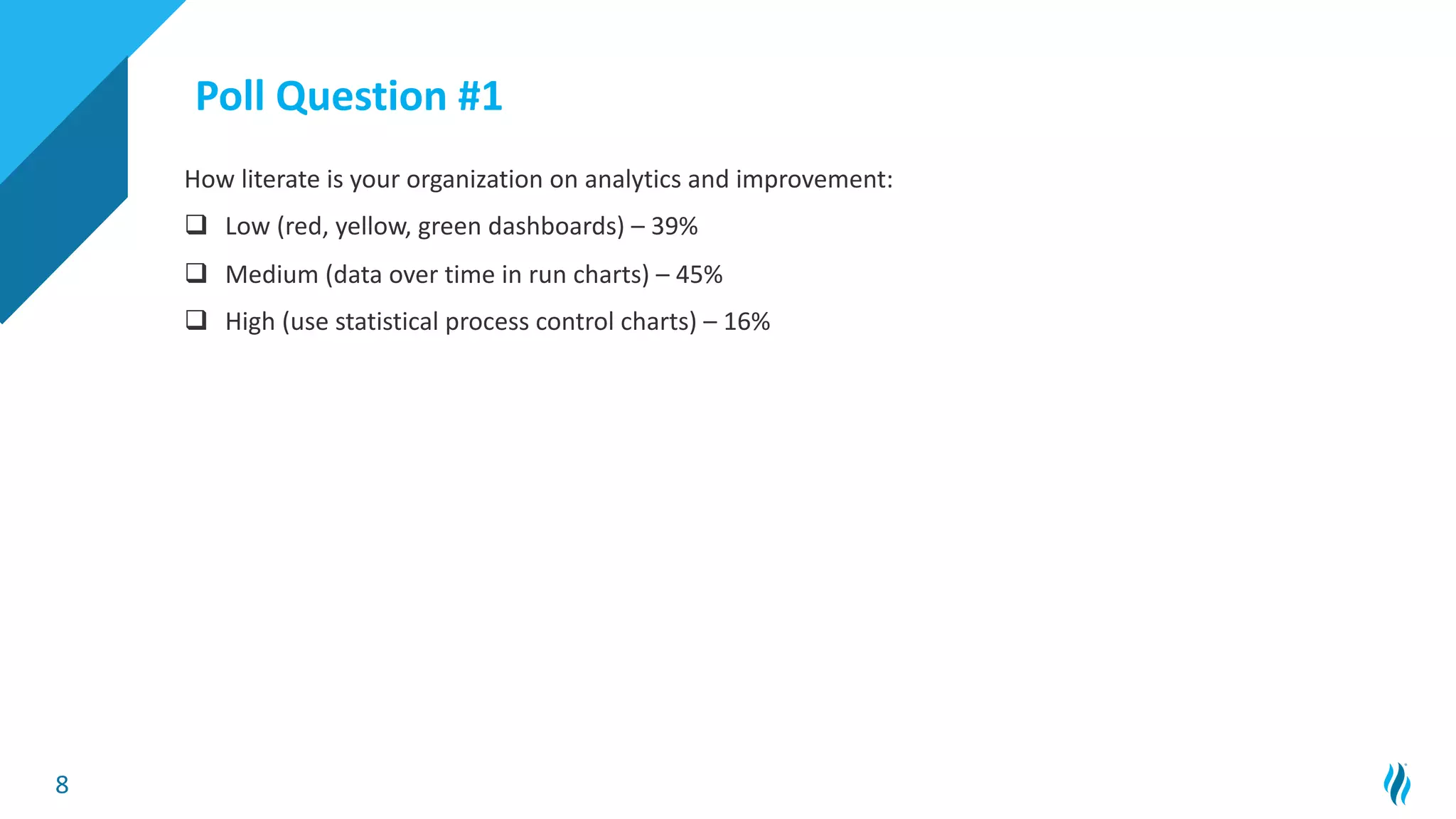
How literate is your organization on analytics and improvement:
q Low (red, yellow, green dashboards) – 39%
q Medium (data over time in run charts) – 45%
q High (use statistical process control charts) – 16%
Poll Question #1
9
How do you know how literate your organization is with analytics and improvement:
q I am guessing from my experience and observations – 67%
q We did a formal assessment a few years ago – 2%
q Our leaders complain that we have a literacy issue – 5%
q Our leaders think we are fine – 5%
q We assess competencies (e.g., mastery and misinformation) –21%
Poll Question #2
10
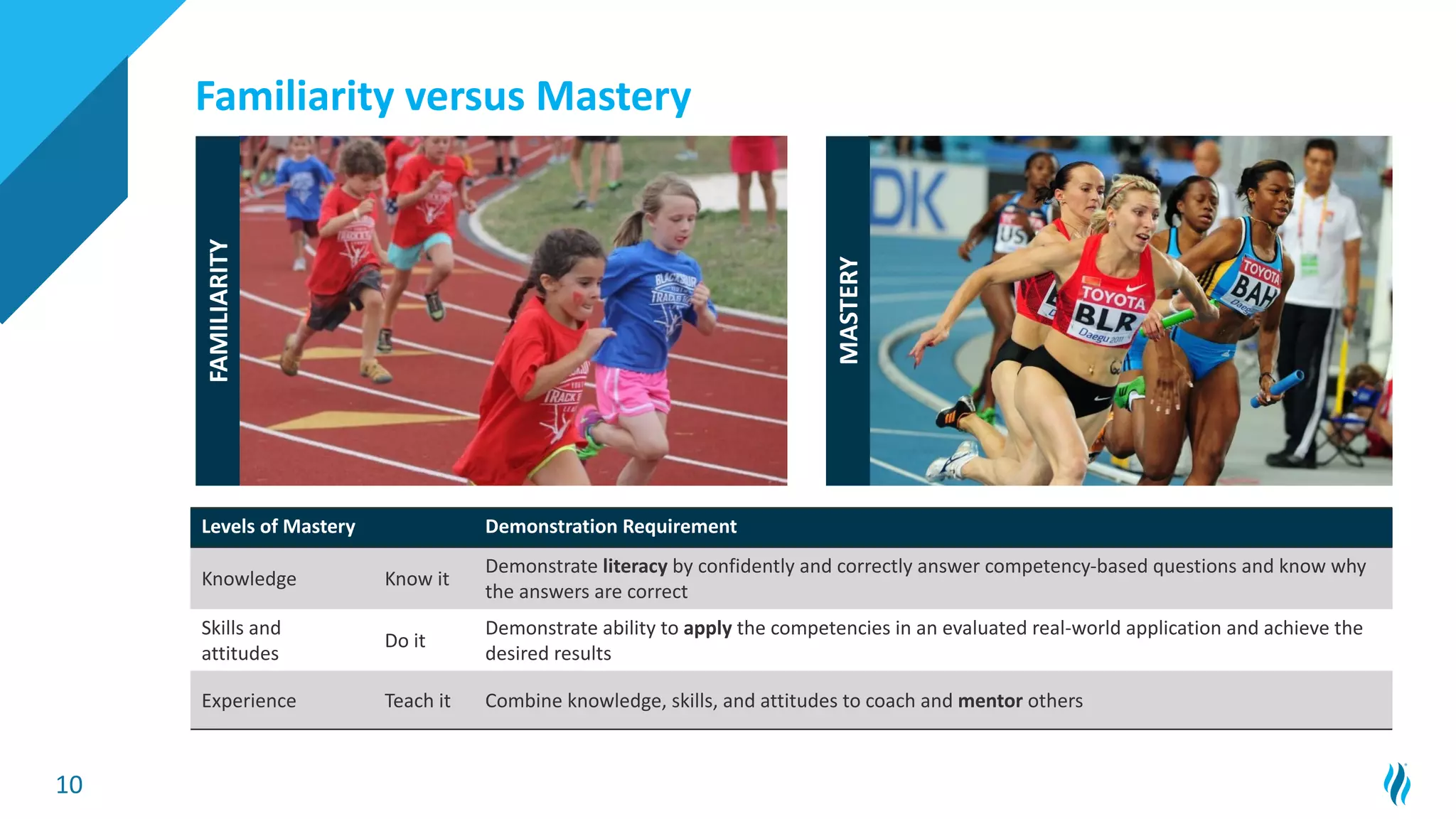
Familiarity versus Mastery
Levels of Mastery Demonstration Requirement
Knowledge Know it
Demonstrate literacy by confidently and correctly answer competency-based questions and know why
the answers are correct
Skills and
attitudes
Do it
Demonstrate ability to apply the competencies in an evaluated real-world application and achieve the
desired results
Experience Teach it Combine knowledge, skills, and attitudes to coach and mentor others
FAMILIARITY
MASTERY
11
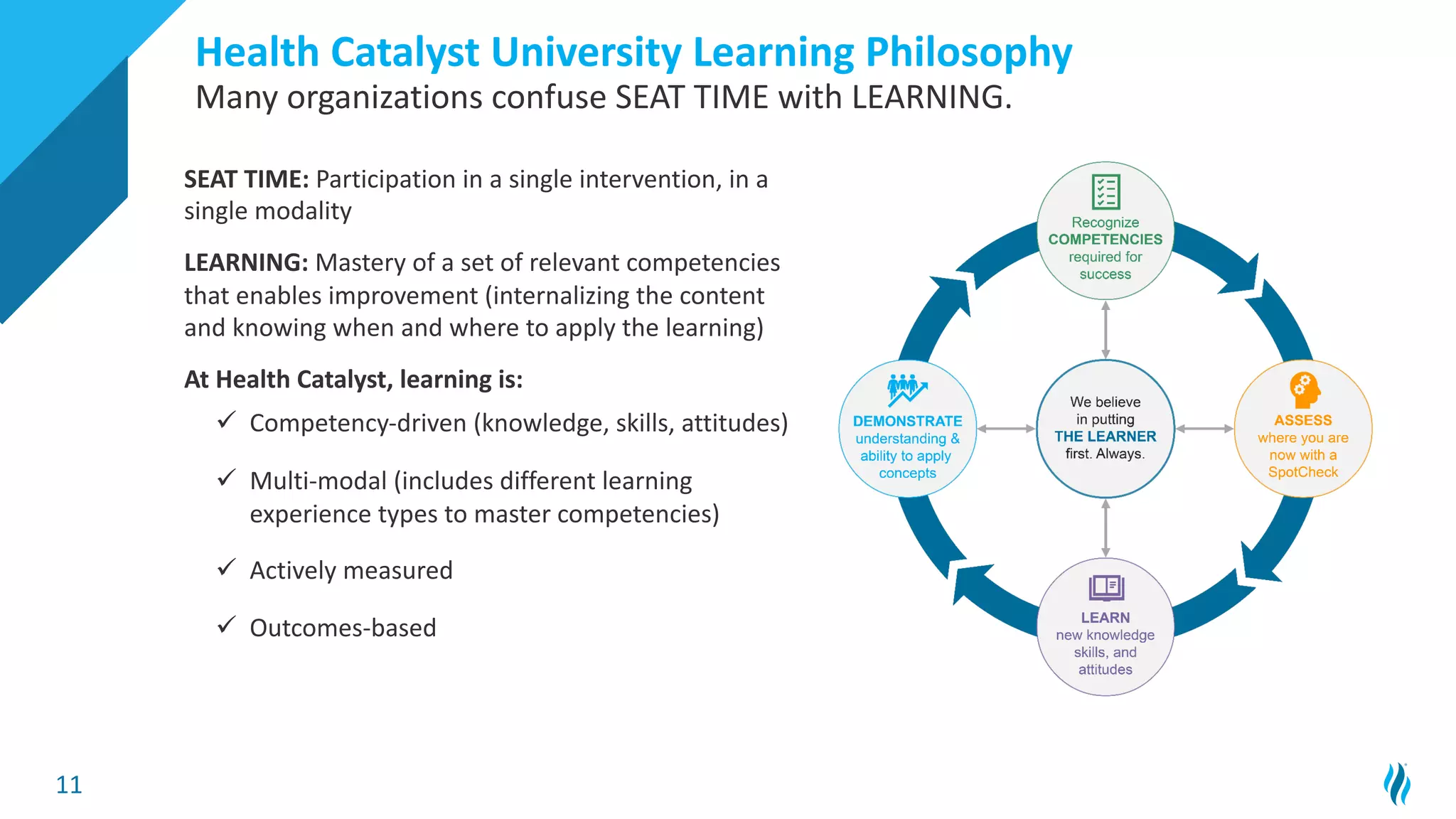
SEAT TIME: Participation in a single intervention, in a
single modality
LEARNING: Mastery of a set of relevant competencies
that enables improvement (internalizing the content
and knowing when and where to apply the learning)
At Health Catalyst, learning is:
ü Competency-driven (knowledge, skills, attitudes)
ü Multi-modal (includes different learning
experience types to master competencies)
ü Actively measured
ü Outcomes-based
Health Catalyst University Learning Philosophy
Many organizations confuse SEAT TIME with LEARNING.
12
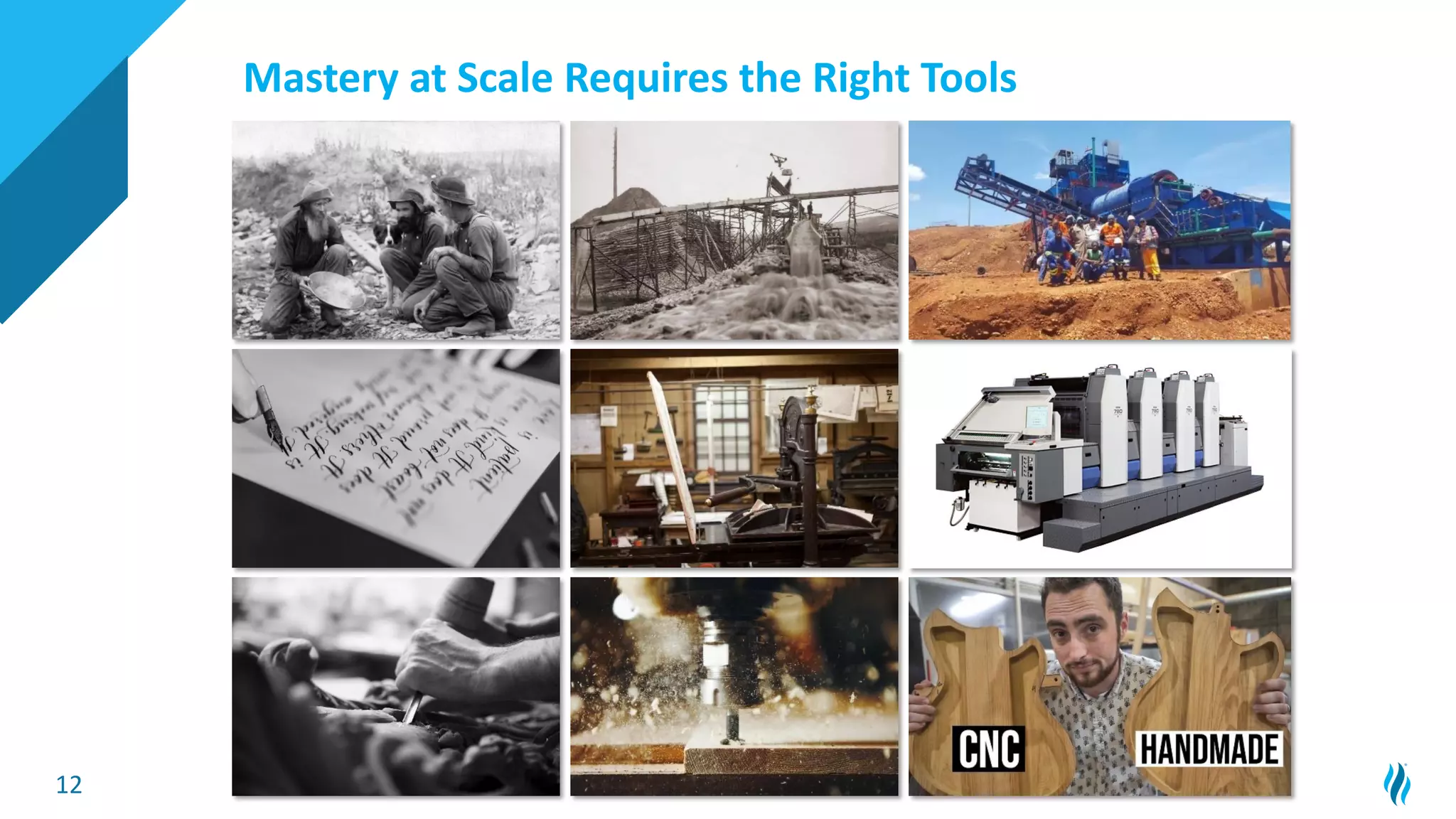
Mastery at Scale Requires the Right Tools
13
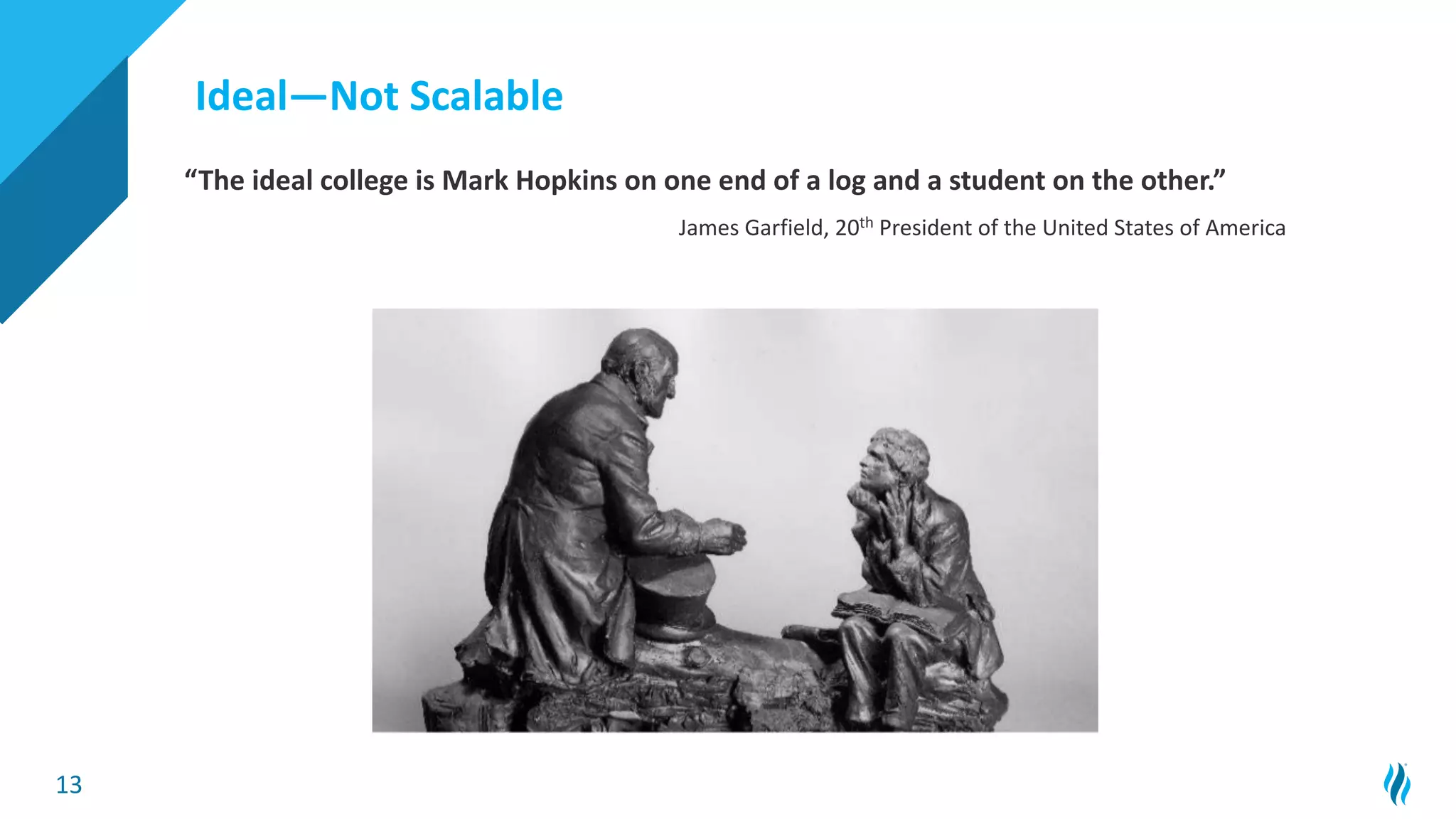
“The ideal college is Mark Hopkins on one end of a log and a student on the other.”
James Garfield, 20th President of the United States of America
Ideal—Not Scalable
14
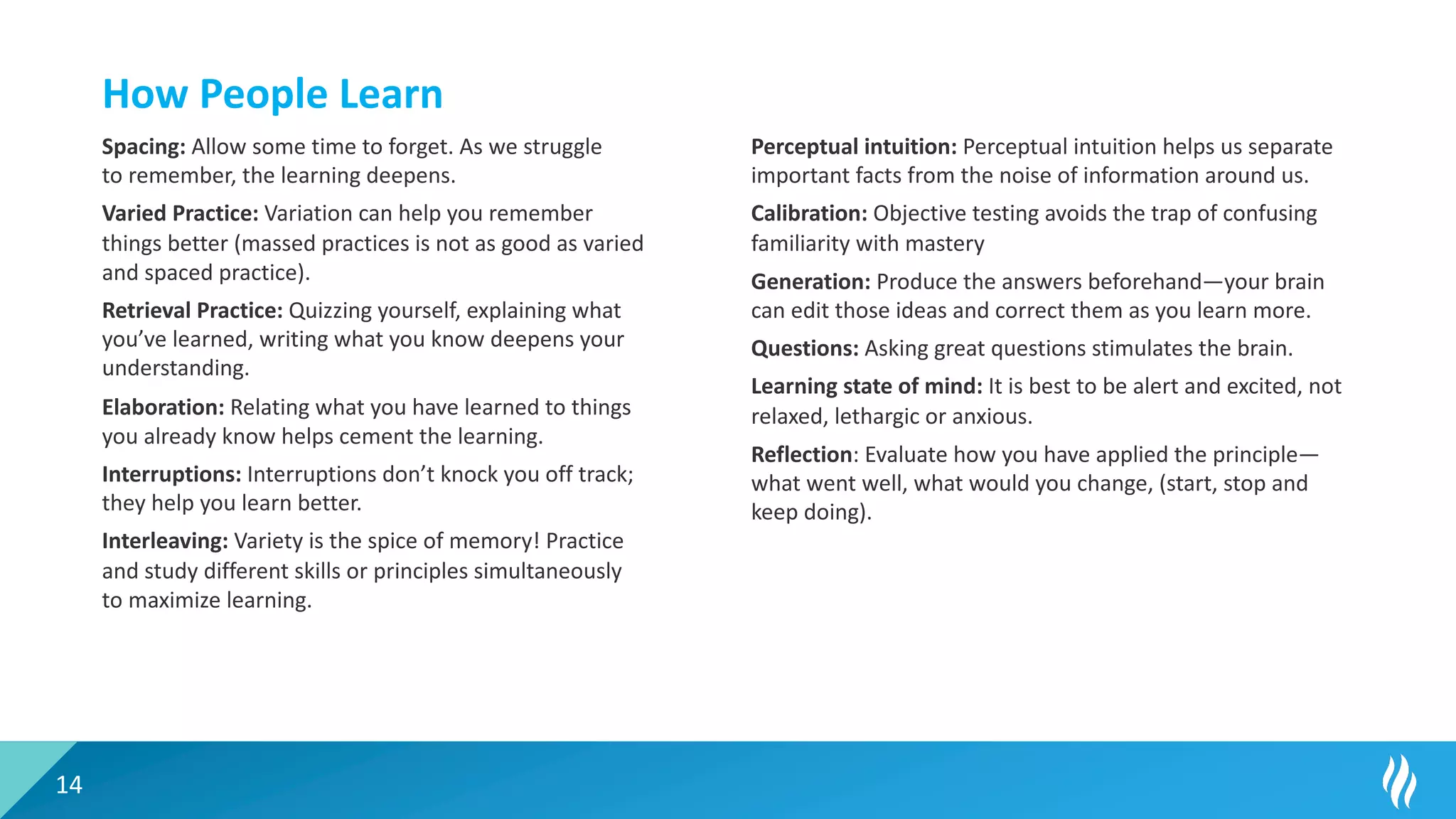
How People Learn
Spacing: Allow some time to forget. As we struggle
to remember, the learning deepens.
Varied Practice: Variation can help you remember
things better (massed practices is not as good as varied
and spaced practice).
Retrieval Practice: Quizzing yourself, explaining what
you’ve learned, writing what you know deepens your
understanding.
Elaboration: Relating what you have learned to things
you already know helps cement the learning.
Interruptions: Interruptions don’t knock you off track;
they help you learn better.
Interleaving: Variety is the spice of memory! Practice
and study different skills or principles simultaneously
to maximize learning.
Perceptual intuition: Perceptual intuition helps us separate
important facts from the noise of information around us.
Calibration: Objective testing avoids the trap of confusing
familiarity with mastery
Generation: Produce the answers beforehand—your brain
can edit those ideas and correct them as you learn more.
Questions: Asking great questions stimulates the brain.
Learning state of mind: It is best to be alert and excited, not
relaxed, lethargic or anxious.
Reflection: Evaluate how you have applied the principle—
what went well, what would you change, (start, stop and
keep doing).
15
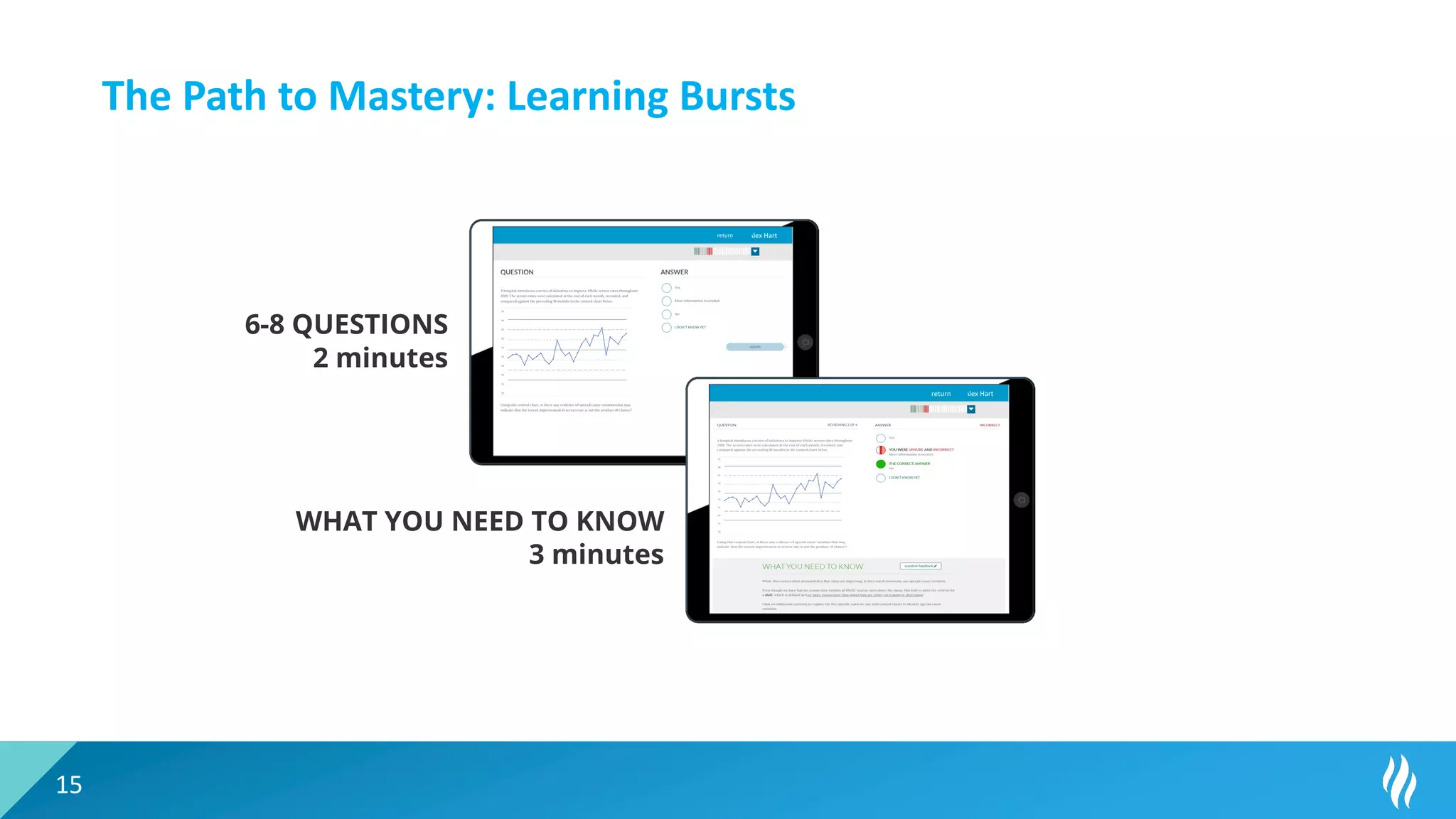
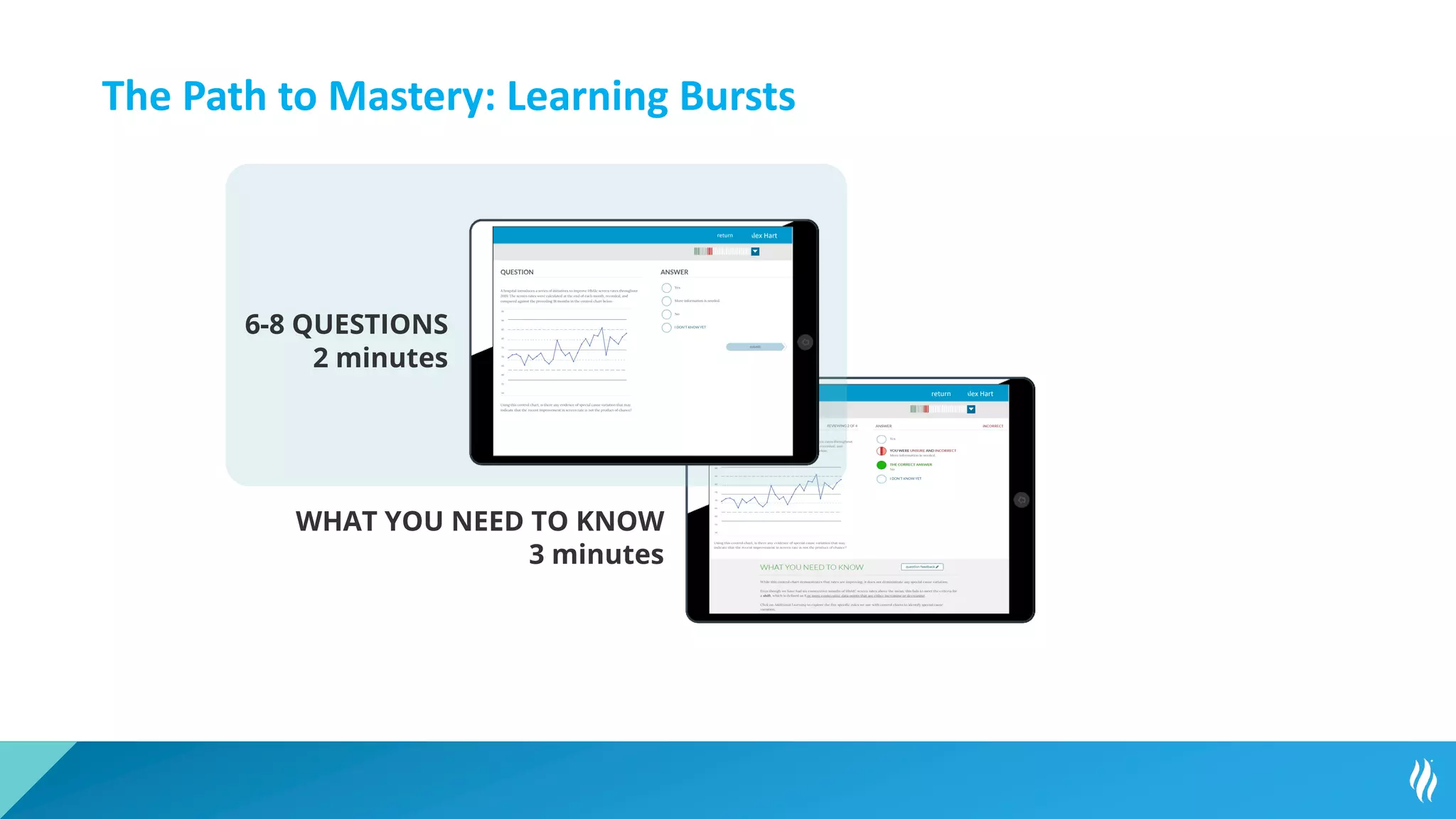
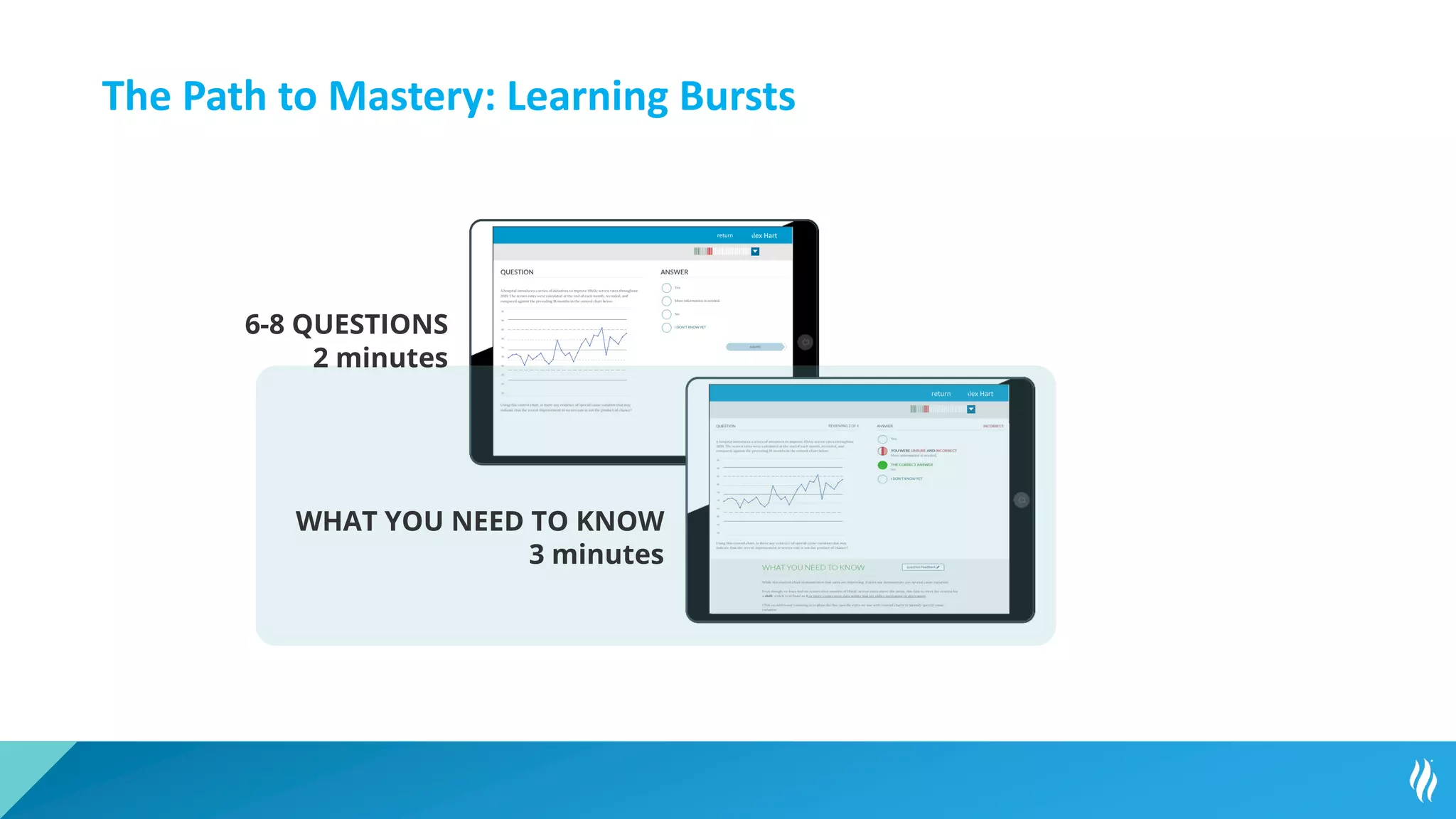
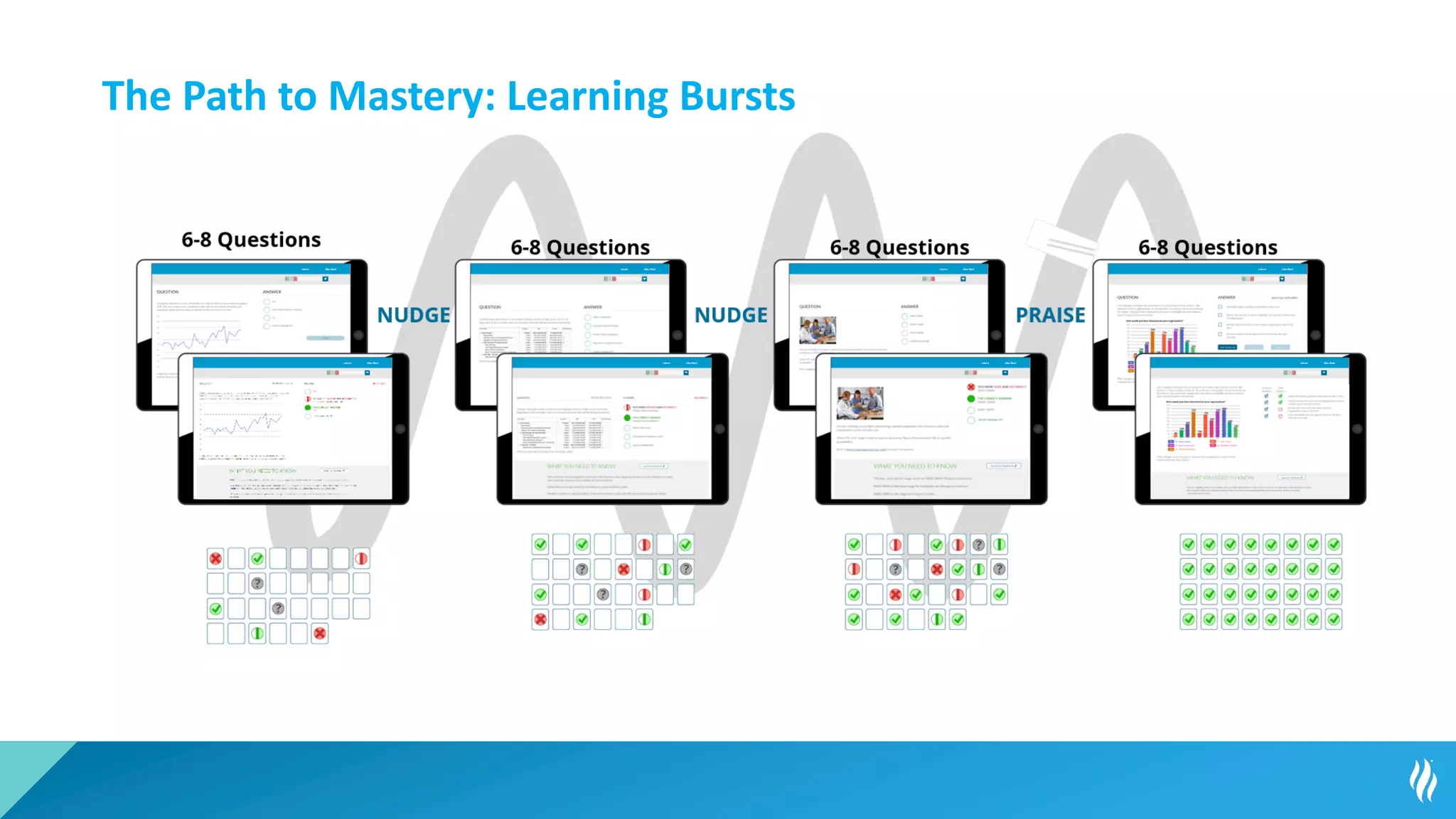
The Path to Mastery: Learning Bursts
Alex Hart
return
Alex Hart
return
6-8 QUESTIONS
2 minutes
WHAT YOU NEED TO KNOW
3 minutes
16
Alex Hart
return
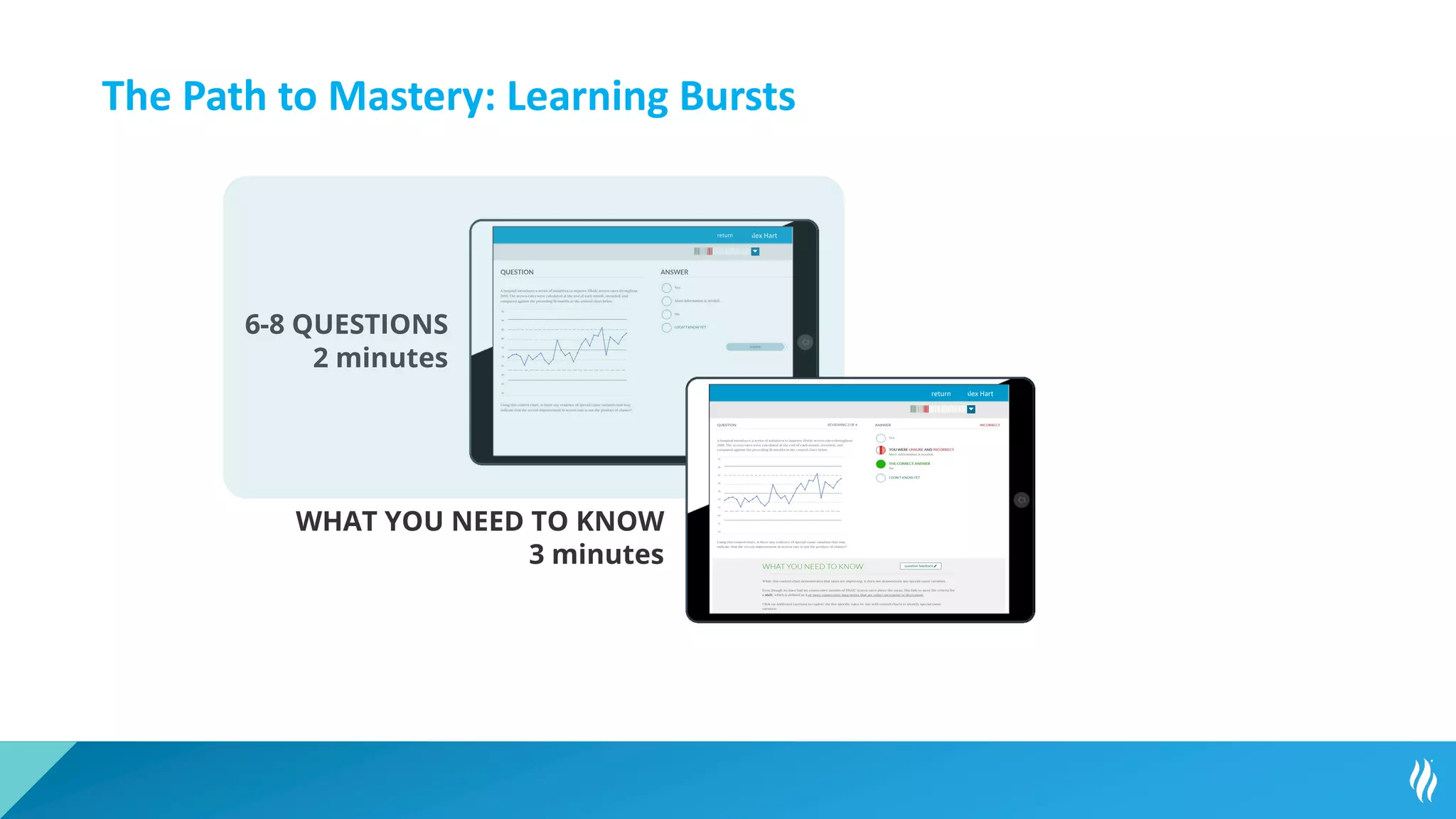
6-8 QUESTIONS
2 minutes
WHAT YOU NEED TO KNOW
3 minutes
Alex Hart
return
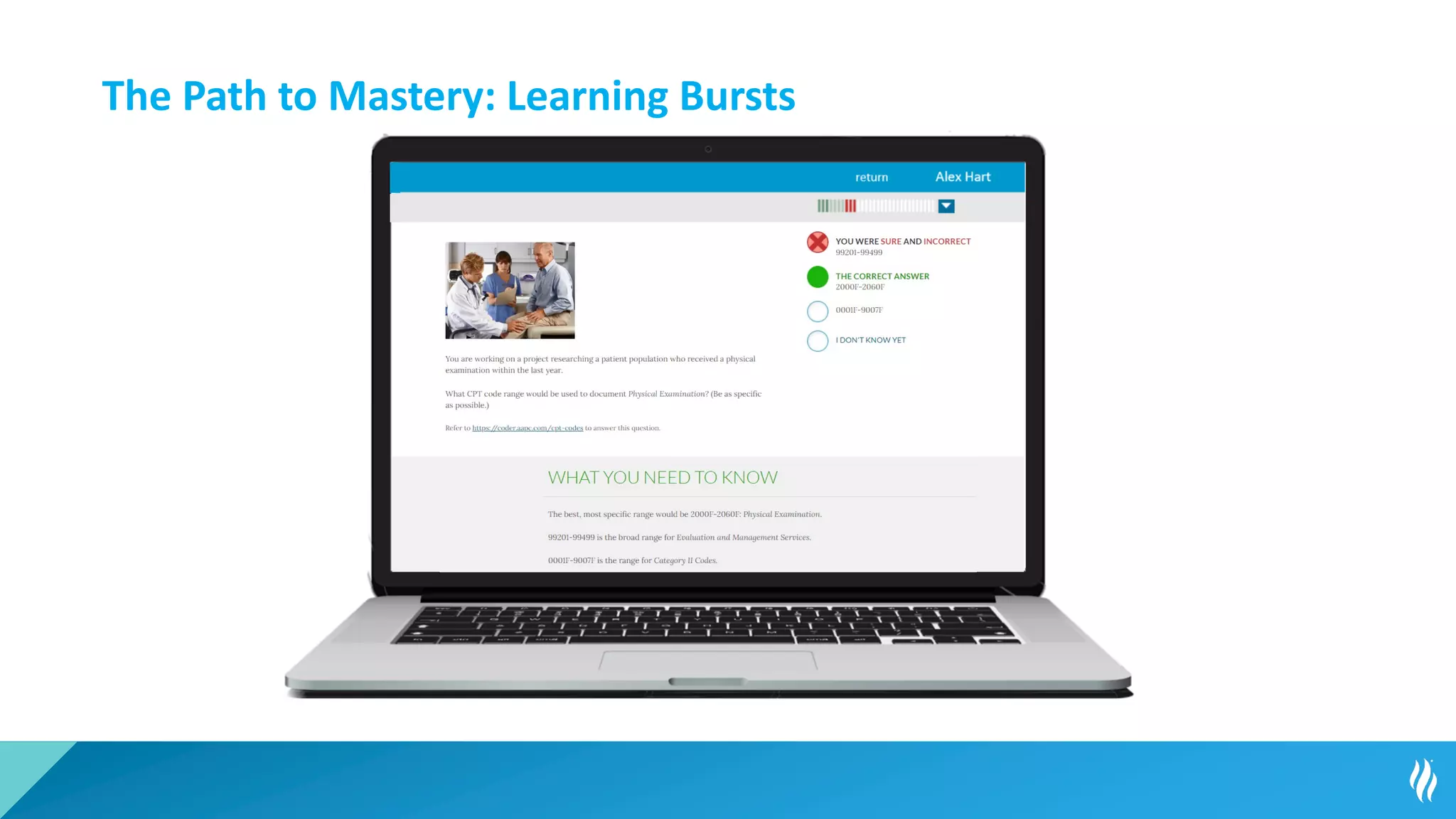
The Path to Mastery: Learning Bursts
17
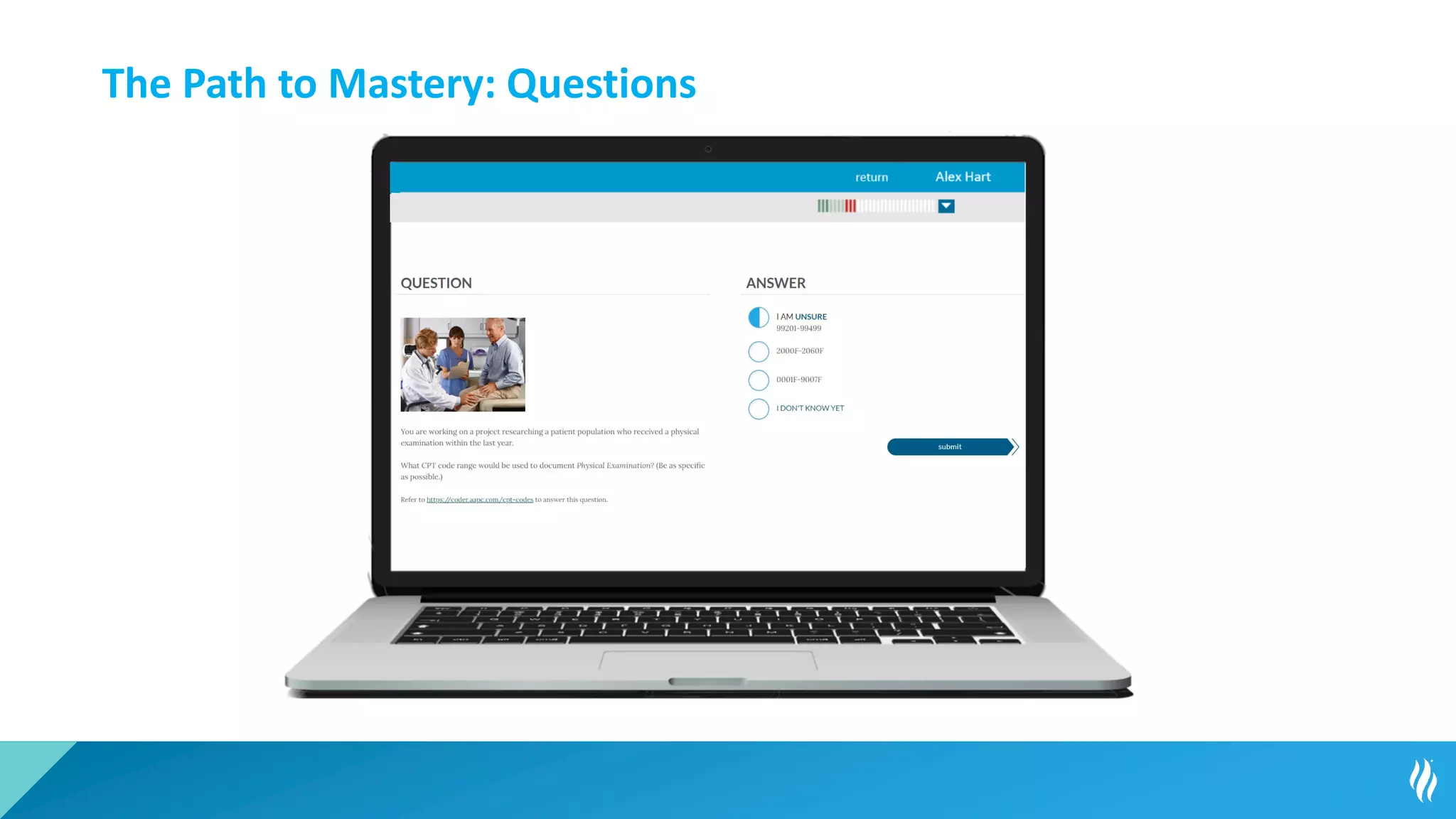
The Path to Mastery: Questions
18
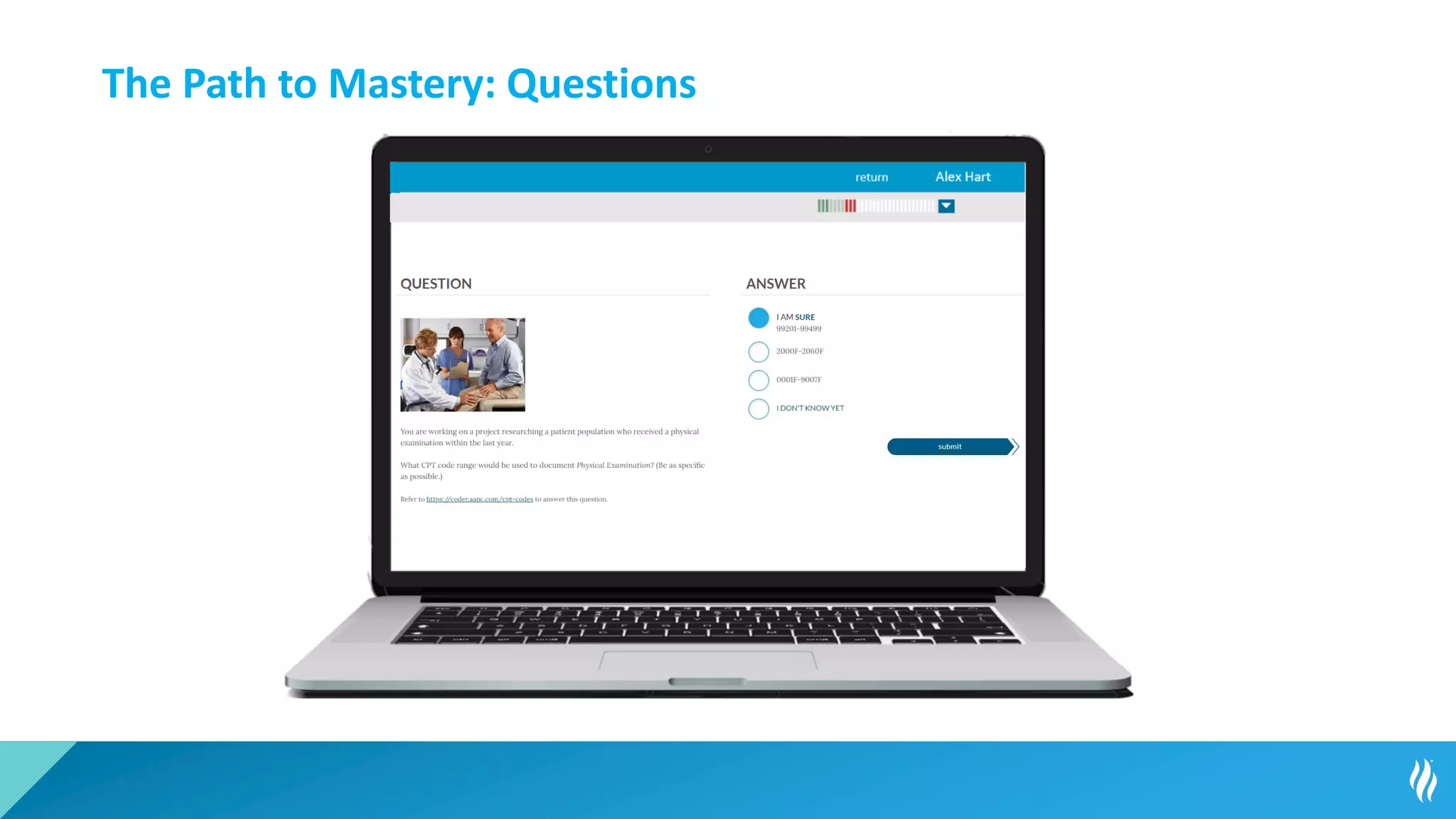
The Path to Mastery: Questions
19
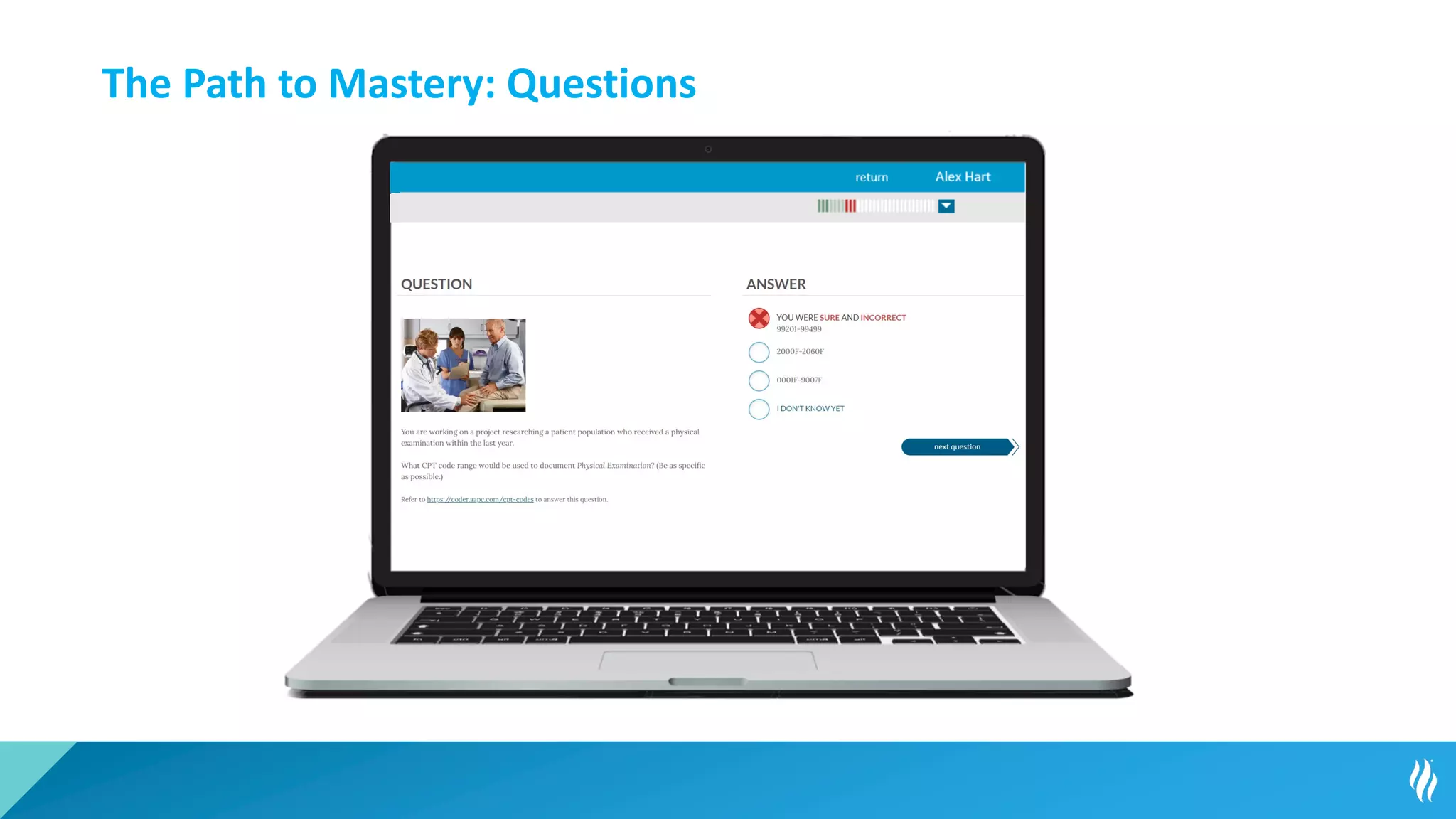
The Path to Mastery: Questions
20
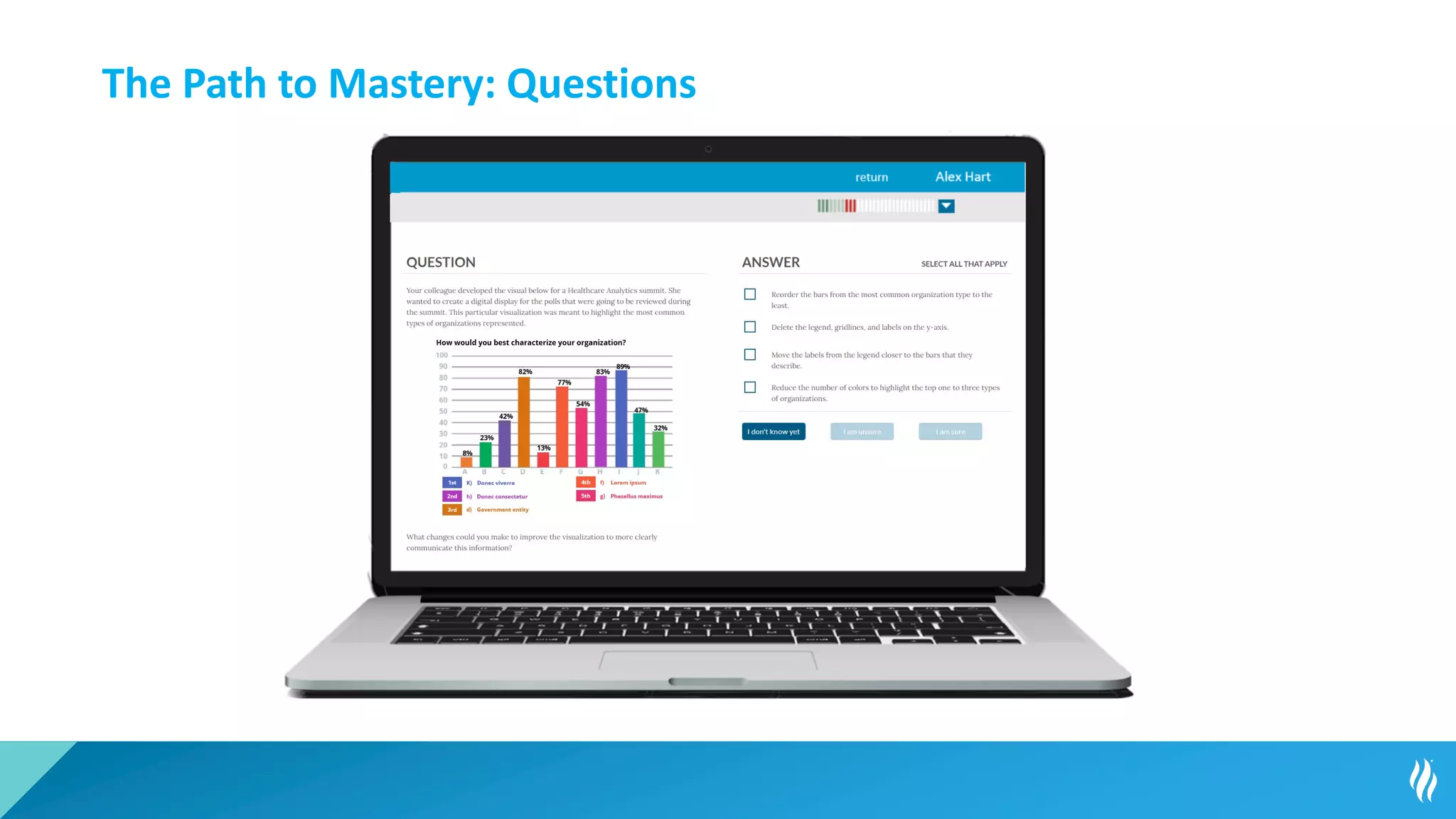
The Path to Mastery: Questions
Alex Hart
return
21
Alex Hart
return
6-8 QUESTIONS
2 minutes
WHAT YOU NEED TO KNOW
3 minutes
The Path to Mastery: Learning Bursts
Alex Hart
return
22
Alex Hart
return
6-8 QUESTIONS
2 minutes
WHAT YOU NEED TO KNOW
3 minutes
The Path to Mastery: Learning Bursts
23
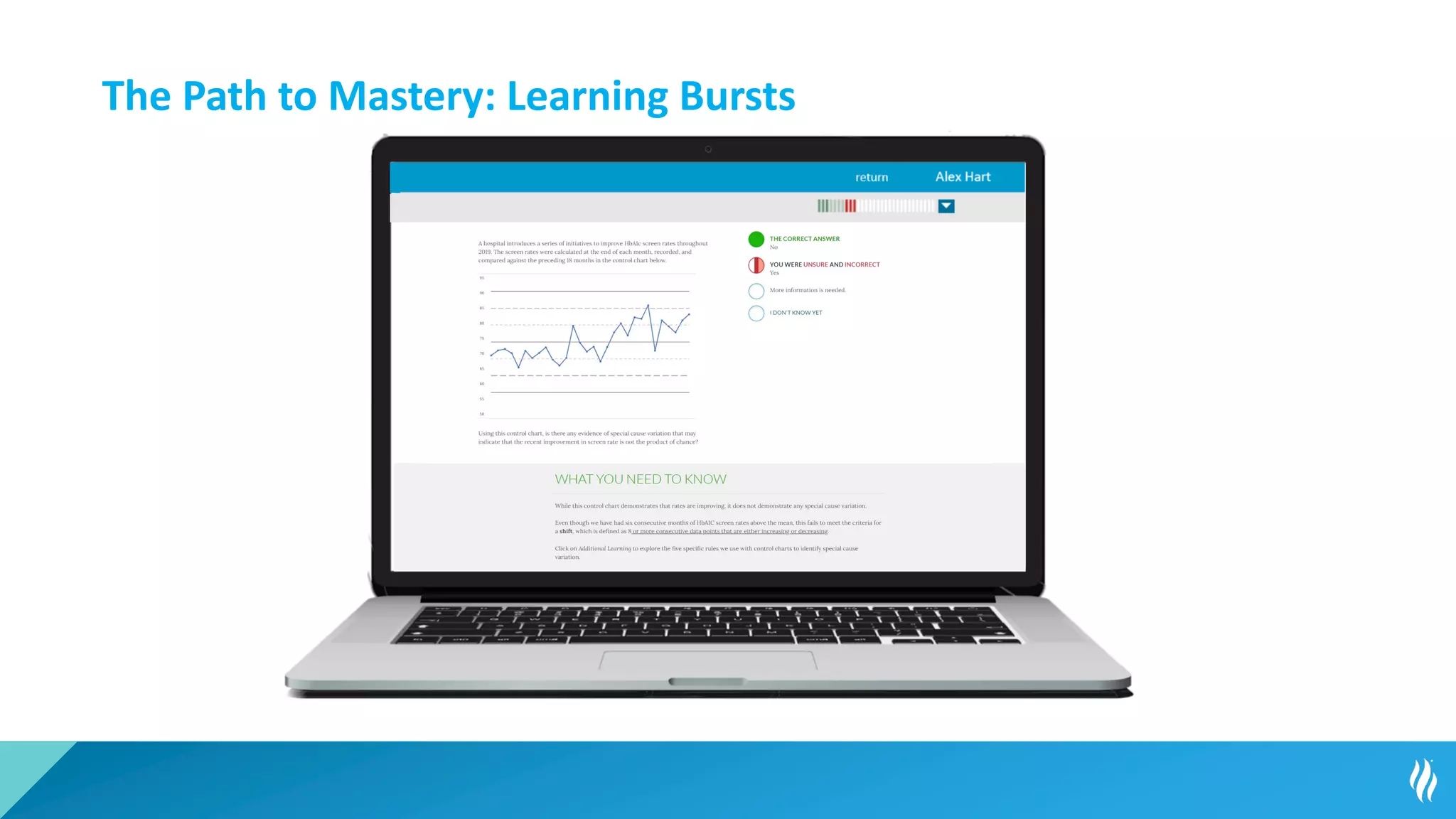
The Path to Mastery: Learning Bursts
24
The Path to Mastery: Learning Bursts
25
The Path to Mastery: Learning Bursts
26
26
27
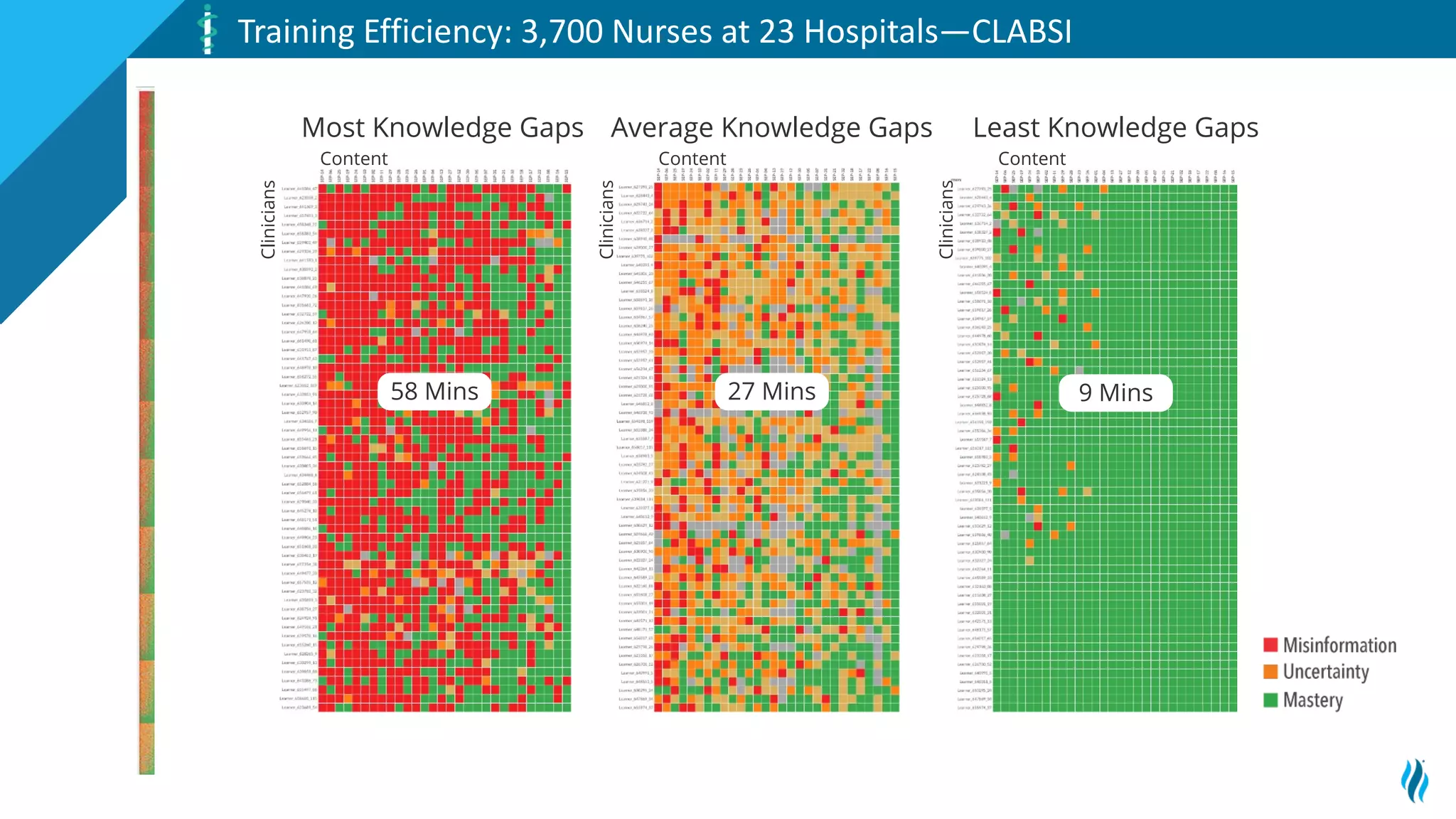
Training Efficiency: 3,700 Nurses at 23 Hospitals—CLABSI
Most Knowledge Gaps Average Knowledge Gaps Least Knowledge Gaps
58 Mins 27 Mins 9 Mins
Content
Clinicians
Content
Clinicians
Content
Clinicians
28
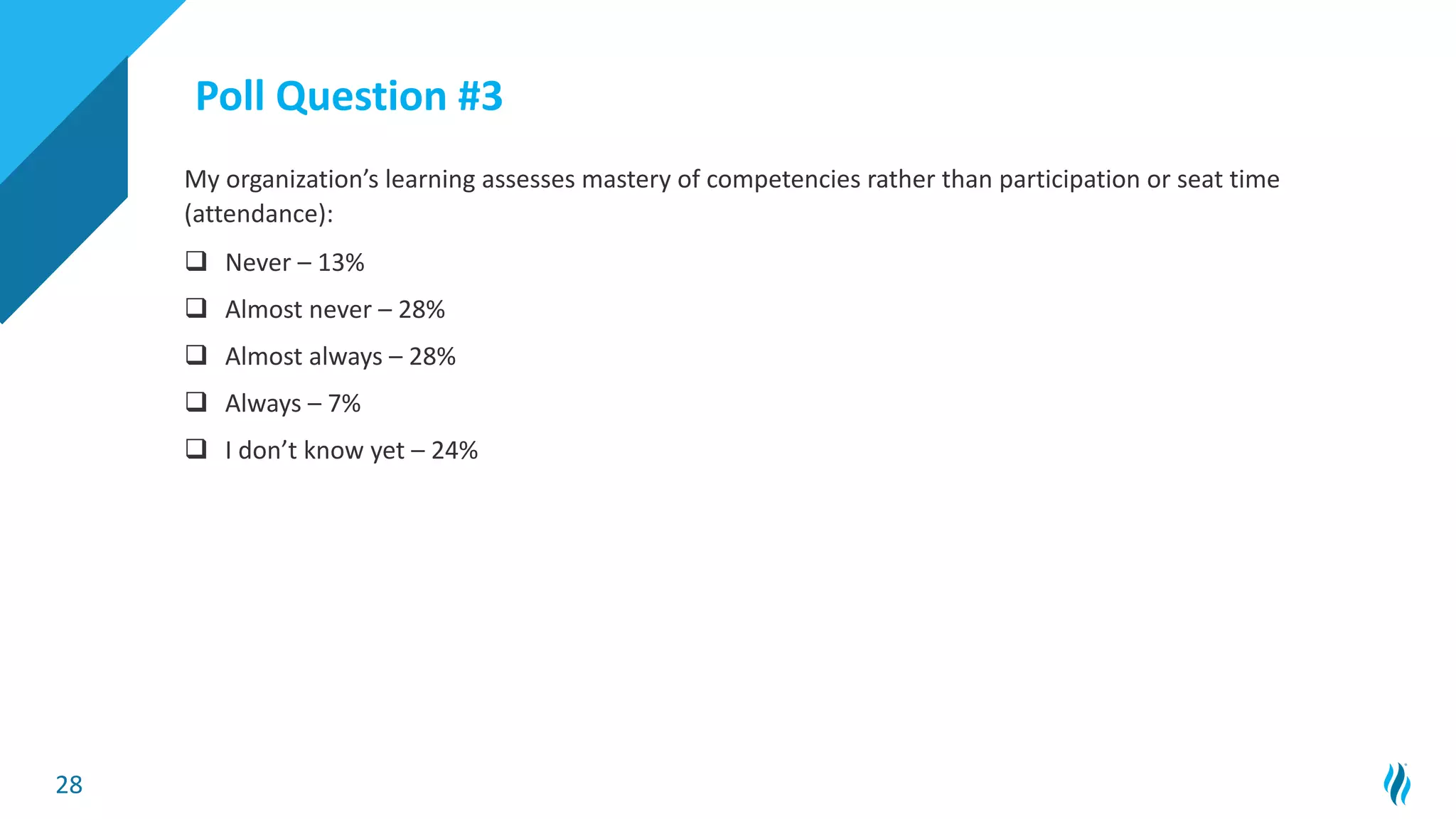
My organization’s learning assesses mastery of competencies rather than participation or seat time
(attendance):
q Never – 13%
q Almost never – 28%
q Almost always – 28%
q Always – 7%
q I don’t know yet – 24%
Poll Question #3
29
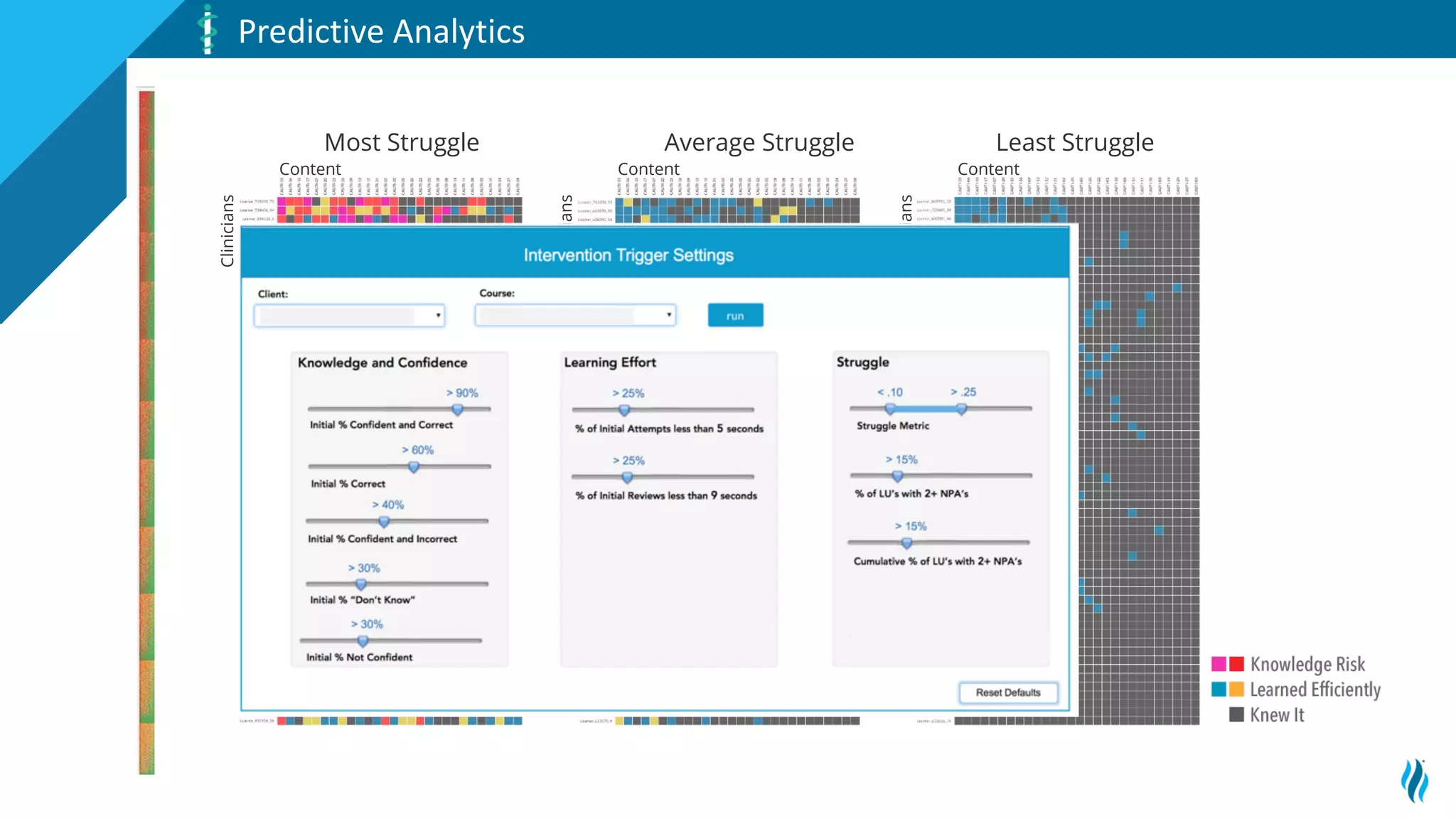
Predictive Analytics
58 Mins 27 Mins 9 Mins
Most Struggle Average Struggle Least Struggle
Content
Clinicians
Content
Clinicians
Content
Clinicians
30
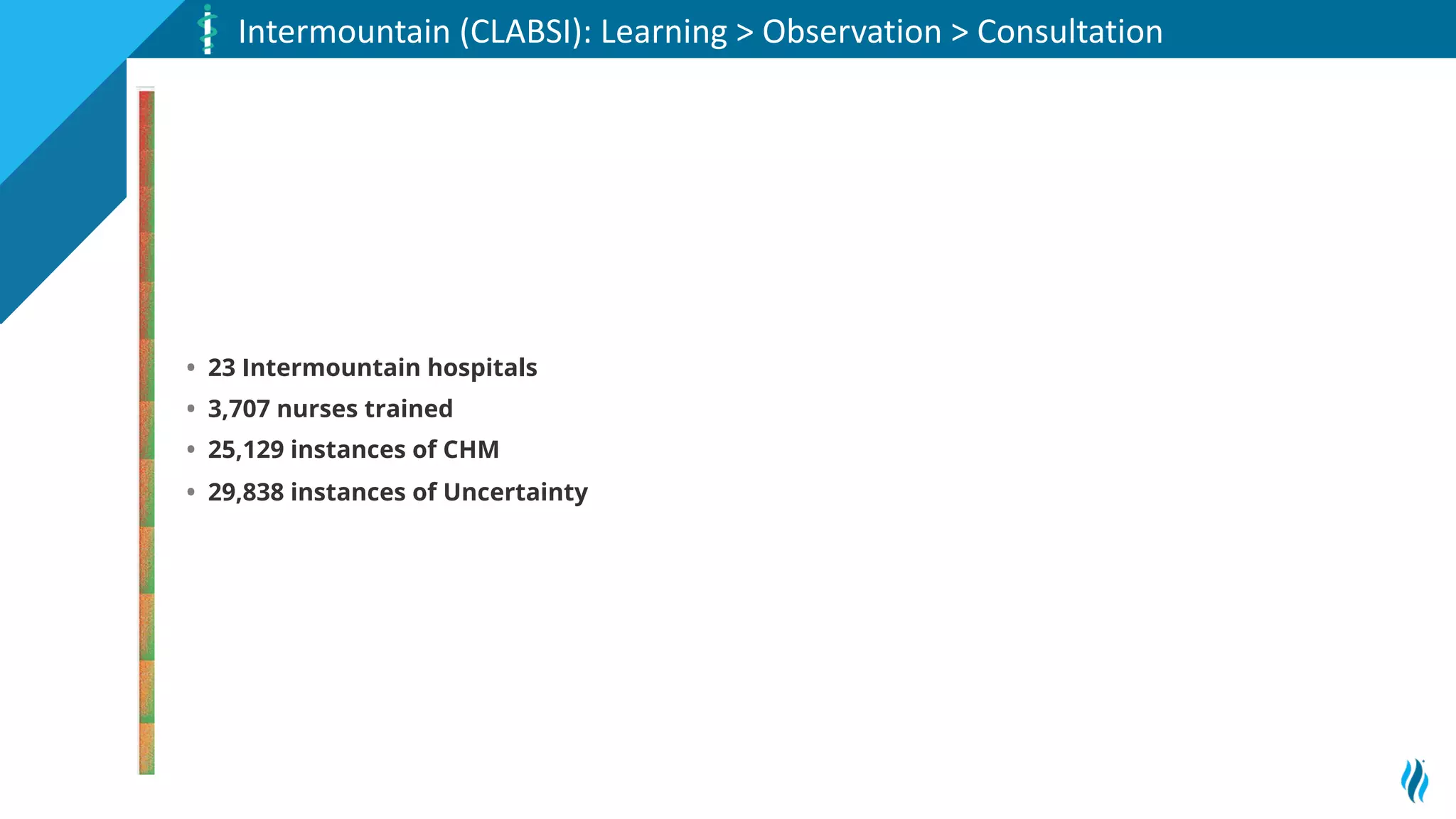
Intermountain (CLABSI): Learning > Observation > Consultation
• 23 Intermountain hospitals
• 3,707 nurses trained
• 25,129 instances of CHM
• 29,838 instances of Uncertainty
31
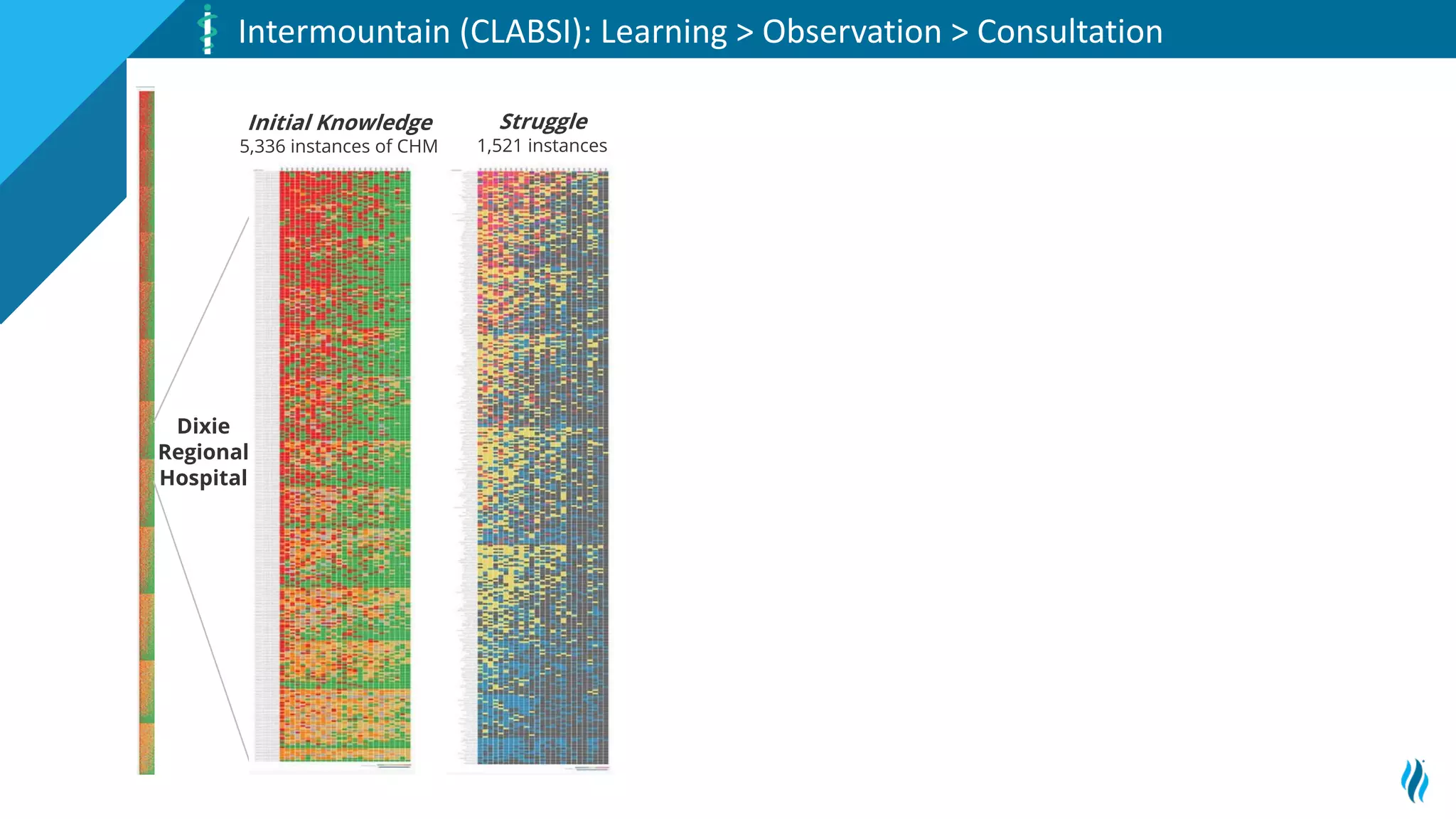
Intermountain (CLABSI): Learning > Observation > Consultation
Dixie
Regional
Hospital
Initial Knowledge
5,336 instances of CHM
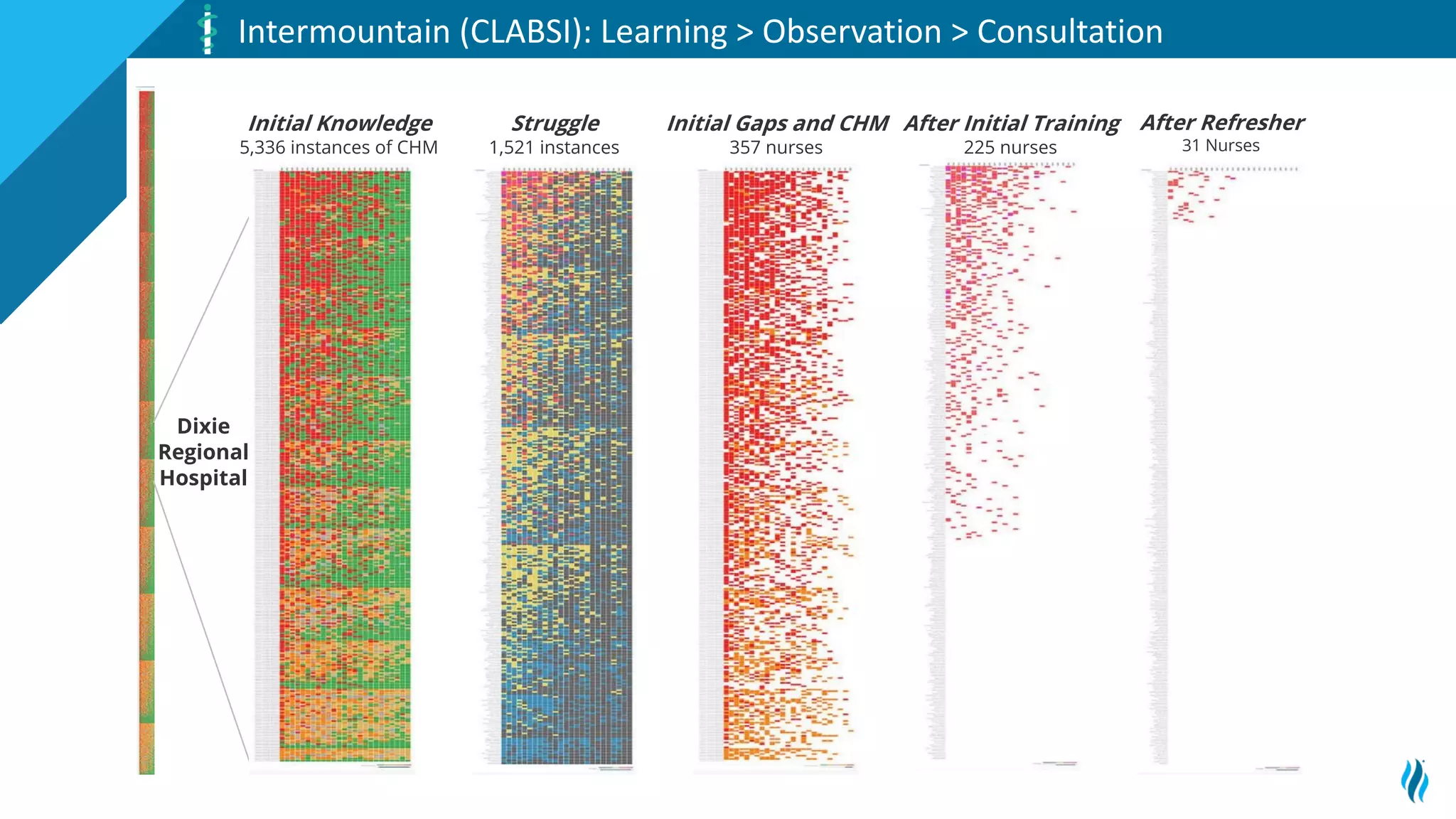
Struggle
1,521 instances
32
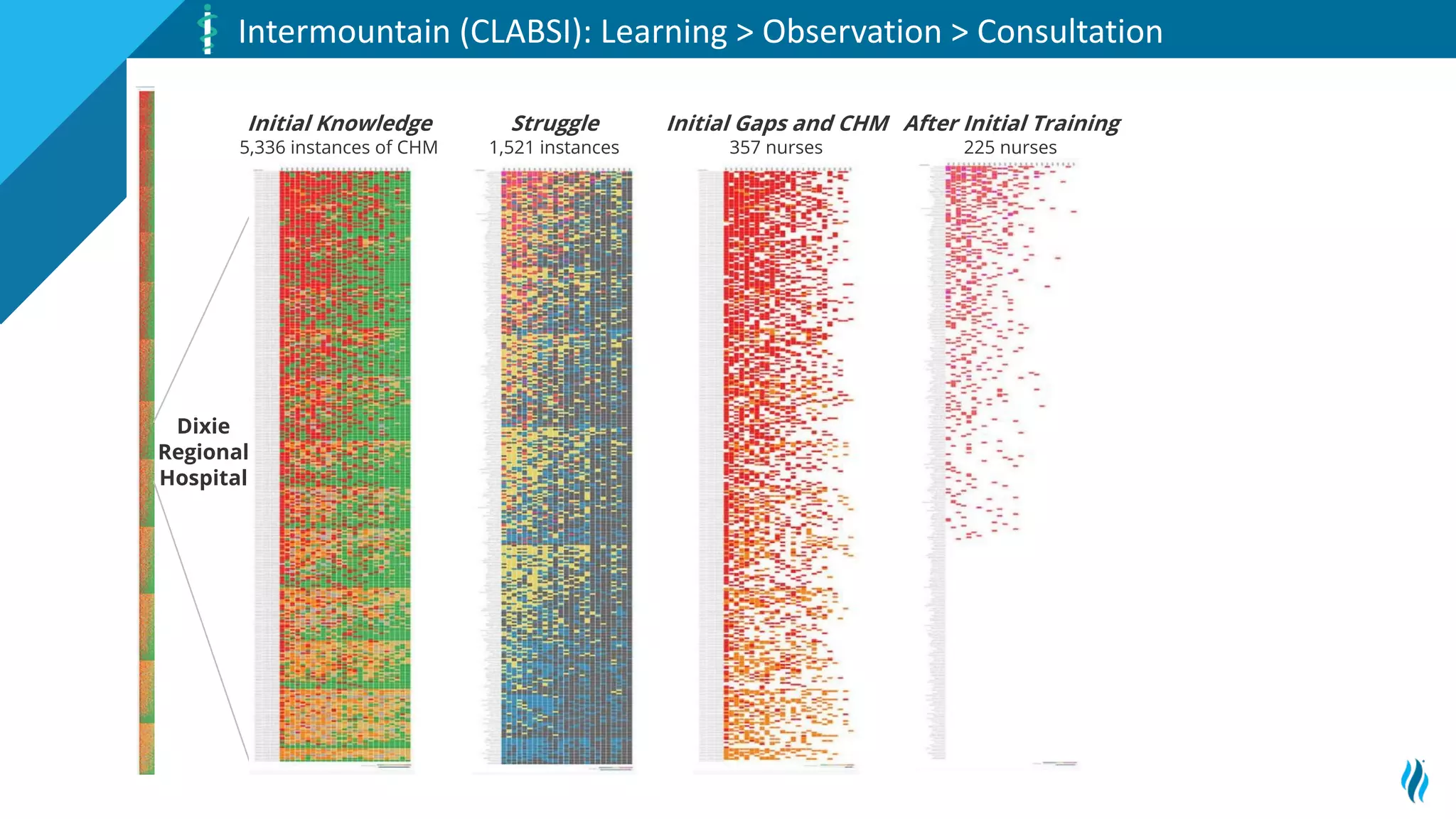
Intermountain (CLABSI): Learning > Observation > Consultation
Dixie
Regional
Hospital
Initial Knowledge
5,336 instances of CHM
Struggle
1,521 instances
Initial Gaps and CHM
357 nurses
After Initial Training
225 nurses
33
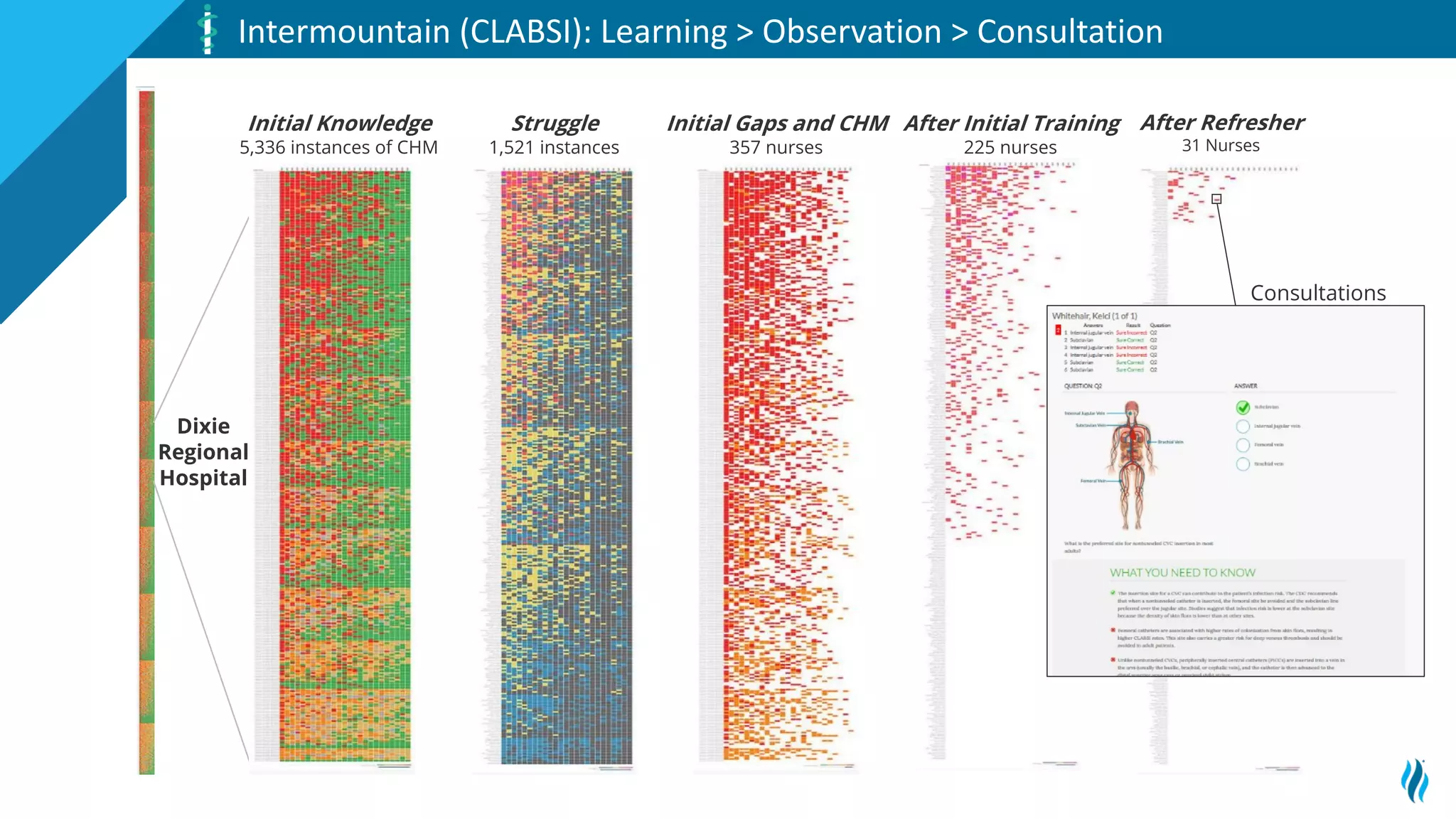
Intermountain (CLABSI): Learning > Observation > Consultation
Dixie
Regional
Hospital
Initial Knowledge
5,336 instances of CHM
Struggle
1,521 instances
Initial Gaps and CHM
357 nurses
After Initial Training
225 nurses
After Refresher
31 Nurses
34
Intermountain (CLABSI): Learning > Observation > Consultation
Dixie
Regional
Hospital
Initial Knowledge
5,336 instances of CHM
Struggle
1,521 instances
Initial Gaps and CHM
357 nurses
After Initial Training
225 nurses
After Refresher
31 Nurses
Consultations
35
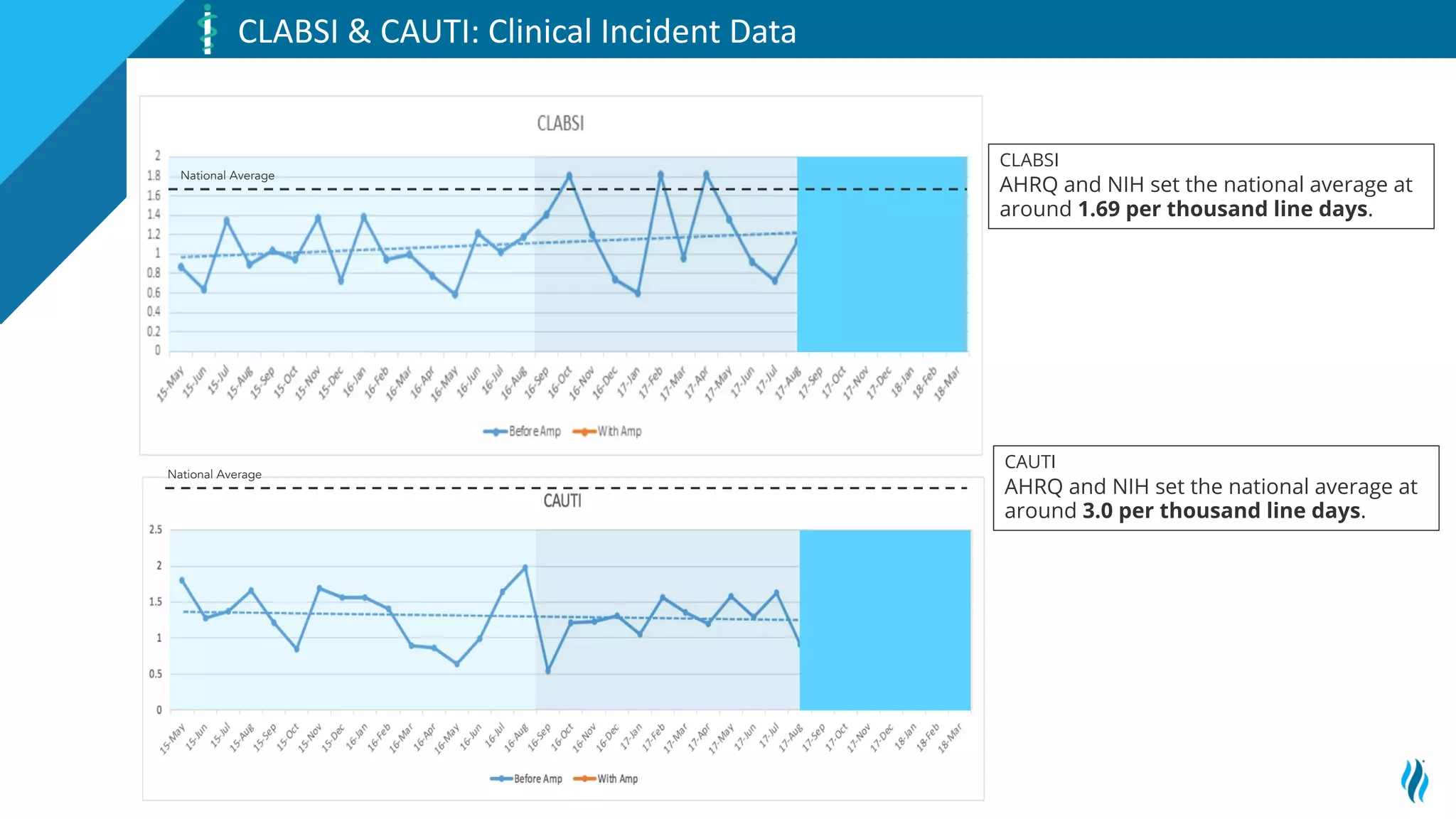
CLABSI & CAUTI: Clinical Incident Data
CLABSI
AHRQ and NIH set the national average at
around 1.69 per thousand line days.
CAUTI
AHRQ and NIH set the national average at
around 3.0 per thousand line days.
National Average
National Average
36
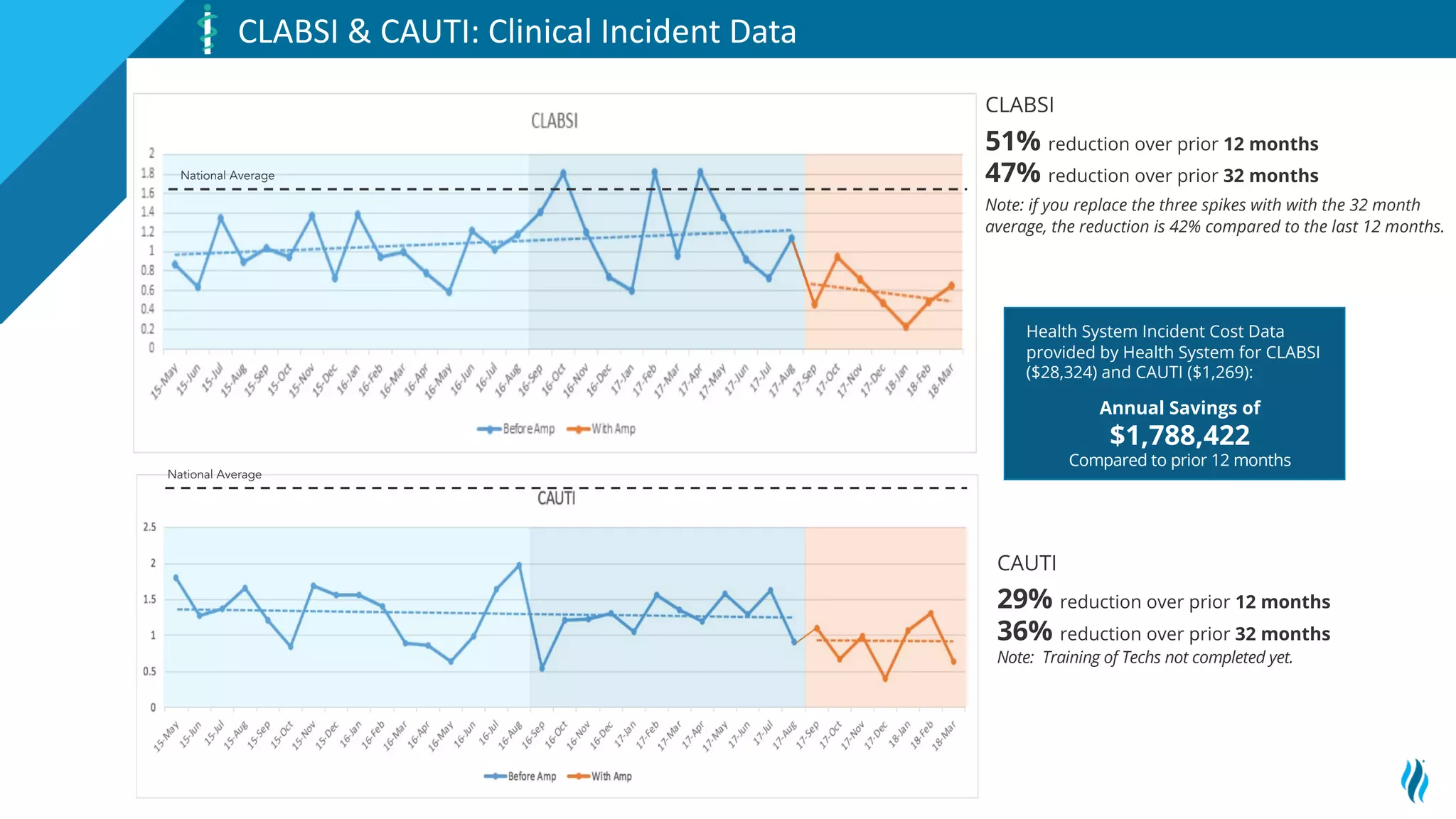
CLABSI & CAUTI: Clinical Incident Data
National Average
National Average
CLABSI
51% reduction over prior 12 months
47% reduction over prior 32 months
Note: if you replace the three spikes with with the 32 month
average, the reduction is 42% compared to the last 12 months.
CAUTI
29% reduction over prior 12 months
36% reduction over prior 32 months
Note: Training of Techs not completed yet.
Health System Incident Cost Data
provided by Health System for CLABSI
($28,324) and CAUTI ($1,269):
Annual Savings of
$1,788,422
Compared to prior 12 months
37
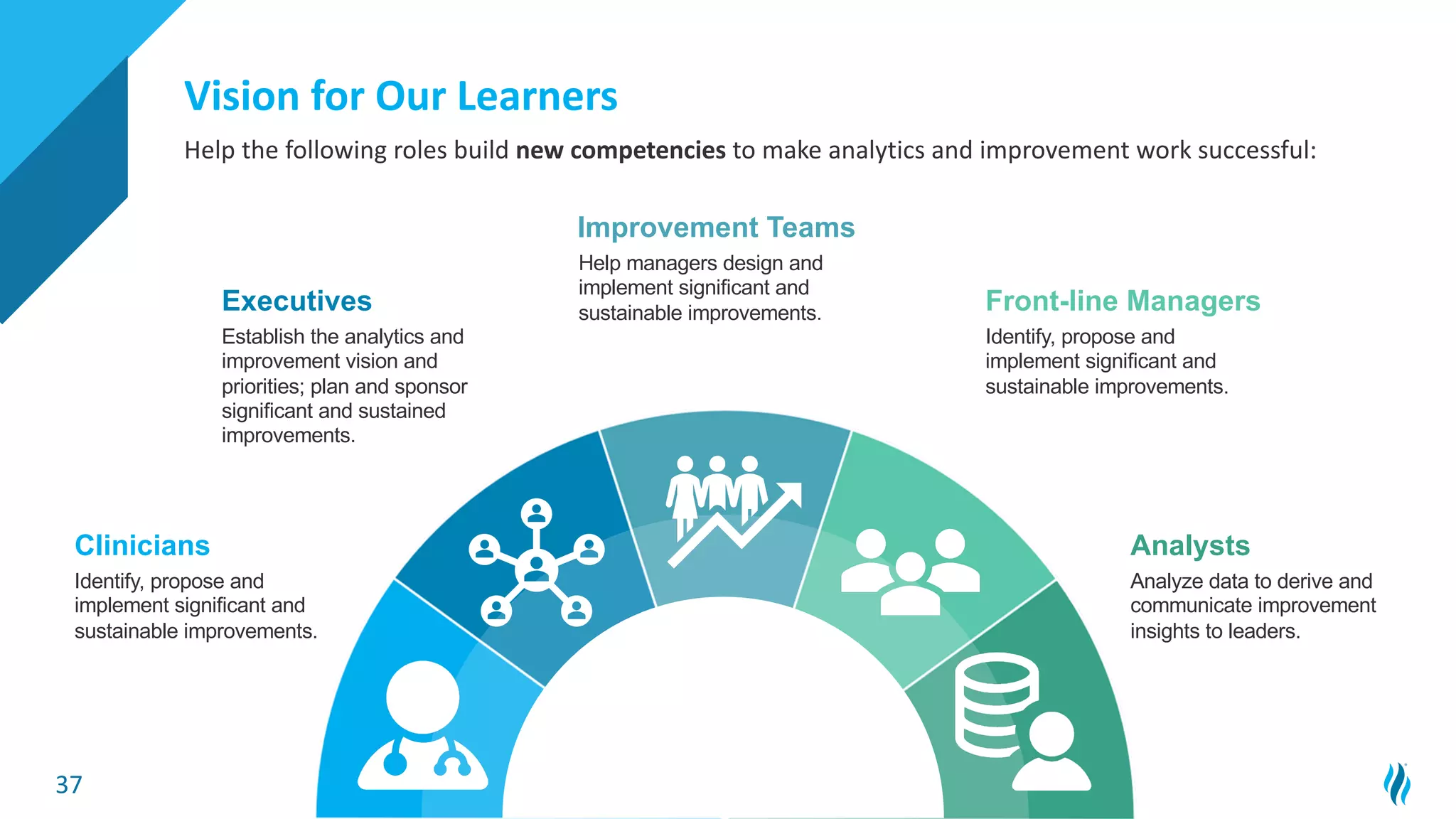
Vision for Our Learners
Help the following roles build new competencies to make analytics and improvement work successful:
Establish the analytics and
improvement vision and
priorities; plan and sponsor
significant and sustained
improvements.
Executives
Identify, propose and
implement significant and
sustainable improvements.
Front-line Managers
Help managers design and
implement significant and
sustainable improvements.
Improvement Teams
Identify, propose and
implement significant and
sustainable improvements.
Clinicians
Analyze data to derive and
communicate improvement
insights to leaders.
Analysts
38
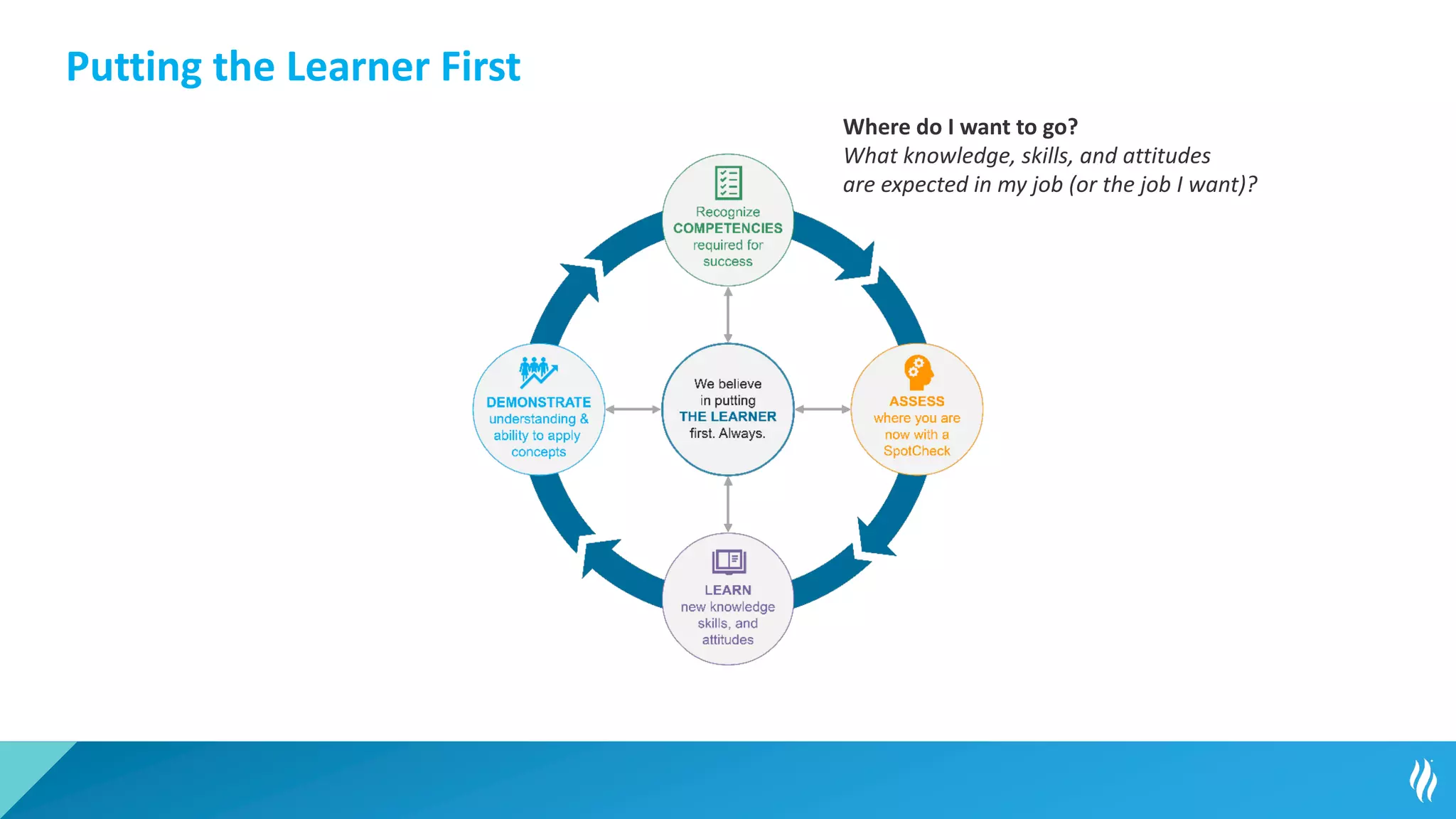
Where do I want to go?
What knowledge, skills, and attitudes
are expected in my job (or the job I want)?
Putting the Learner First
39
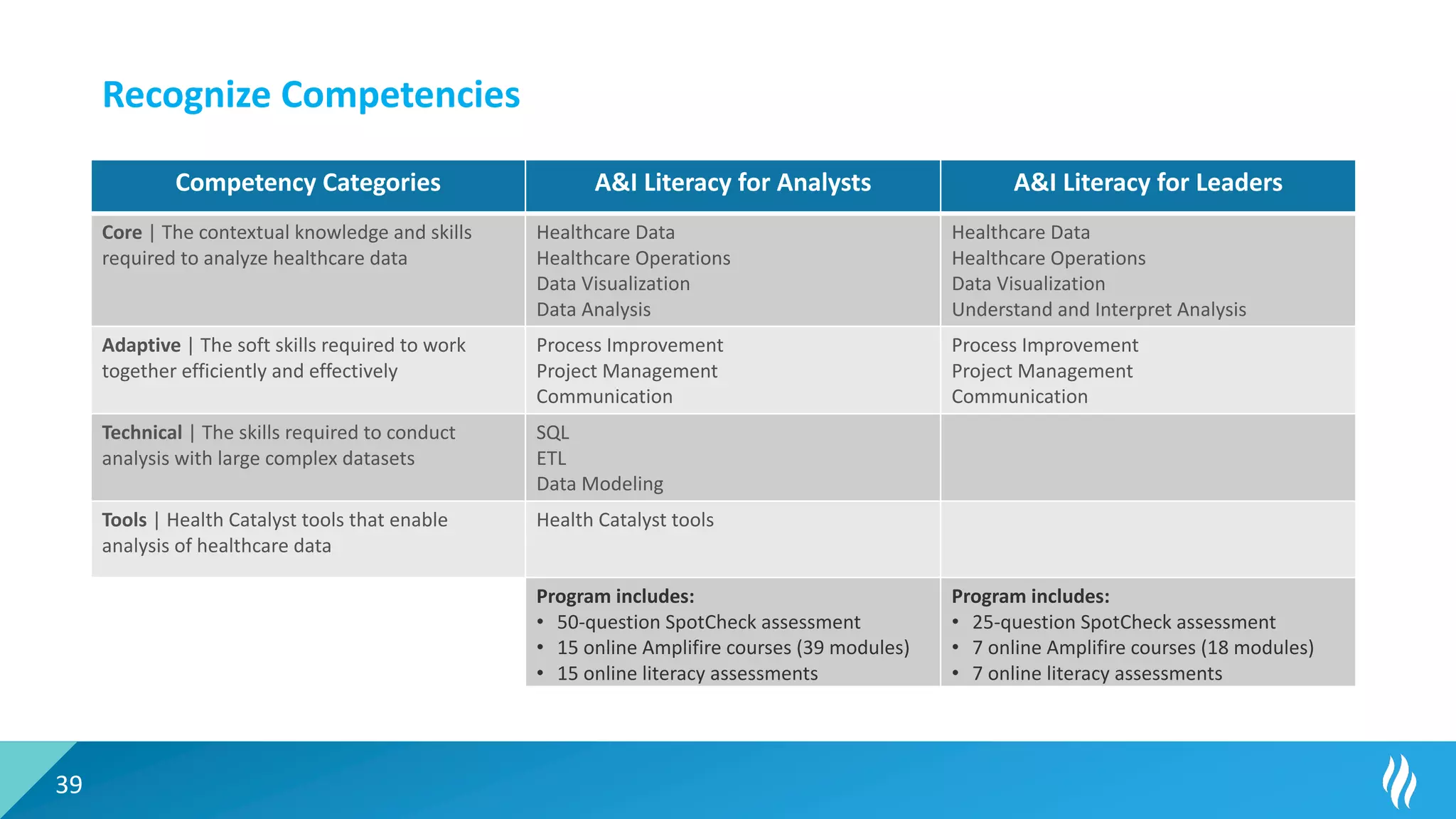
Recognize Competencies
Competency Categories A&I Literacy for Analysts A&I Literacy for Leaders
Core | The contextual knowledge and skills
required to analyze healthcare data
Healthcare Data
Healthcare Operations
Data Visualization
Data Analysis
Healthcare Data
Healthcare Operations
Data Visualization
Understand and Interpret Analysis
Adaptive | The soft skills required to work
together efficiently and effectively
Process Improvement
Project Management
Communication
Process Improvement
Project Management
Communication
Technical | The skills required to conduct
analysis with large complex datasets
SQL
ETL
Data Modeling
Tools | Health Catalyst tools that enable
analysis of healthcare data
Health Catalyst tools
Program includes:
• 50-question SpotCheck assessment
• 15 online Amplifire courses (39 modules)
• 15 online literacy assessments
Program includes:
• 25-question SpotCheck assessment
• 7 online Amplifire courses (18 modules)
• 7 online literacy assessments
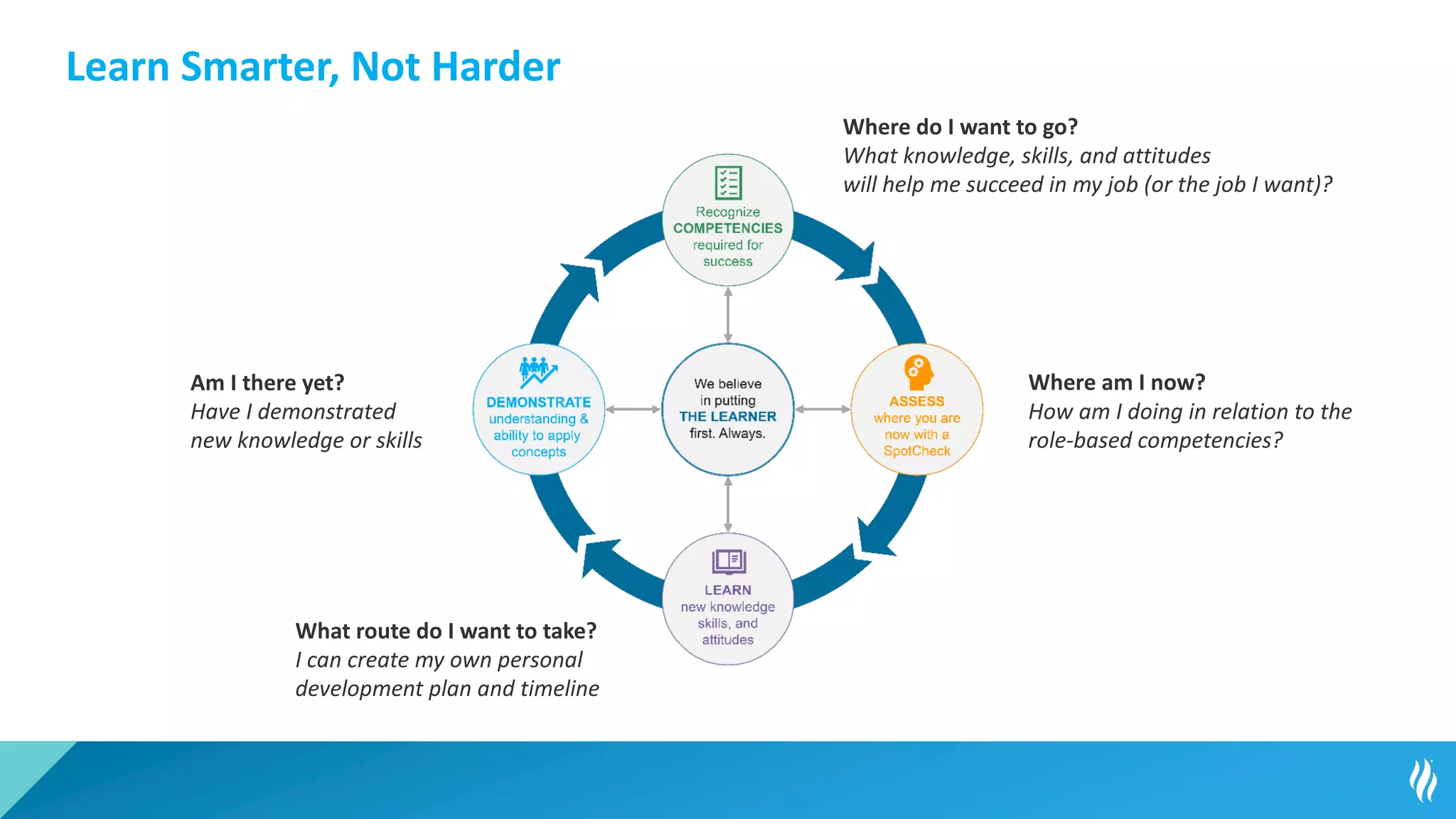
Learn Smarter, Not Harder
40
Where do I want to go?
What knowledge, skills, and attitudes
will help me succeed in my job (or the job I want)?
Where am I now?
How am I doing in relation to the
role-based competencies?
What route do I want to take?
I can create my own personal
development plan and timeline
Am I there yet?
Have I demonstrated
new knowledge or skills
41
Organization Level | Early Results
Healthcare Data Healthcare Operations
Data Modeling
Data Visualization
Communication Project Management
Process Improvement
Data Analysis
Misinformation Uncertainty Mastery
0% 20% 40% 60% 80% 100% 0% 20% 40% 60% 80% 100%
0% 20% 40% 60% 80% 100% 0% 20% 40% 60% 80% 100%
0% 20% 40% 60% 80% 100% 0% 20% 40% 60% 80% 100%
0% 20% 40% 60% 80% 100% 0% 20% 40% 60% 80% 100%
42
0% 20% 40% 60% 80% 100%
0% 20% 40% 60% 80% 100%
0% 20% 40% 60% 80% 100%
0% 20% 40% 60% 80% 100%
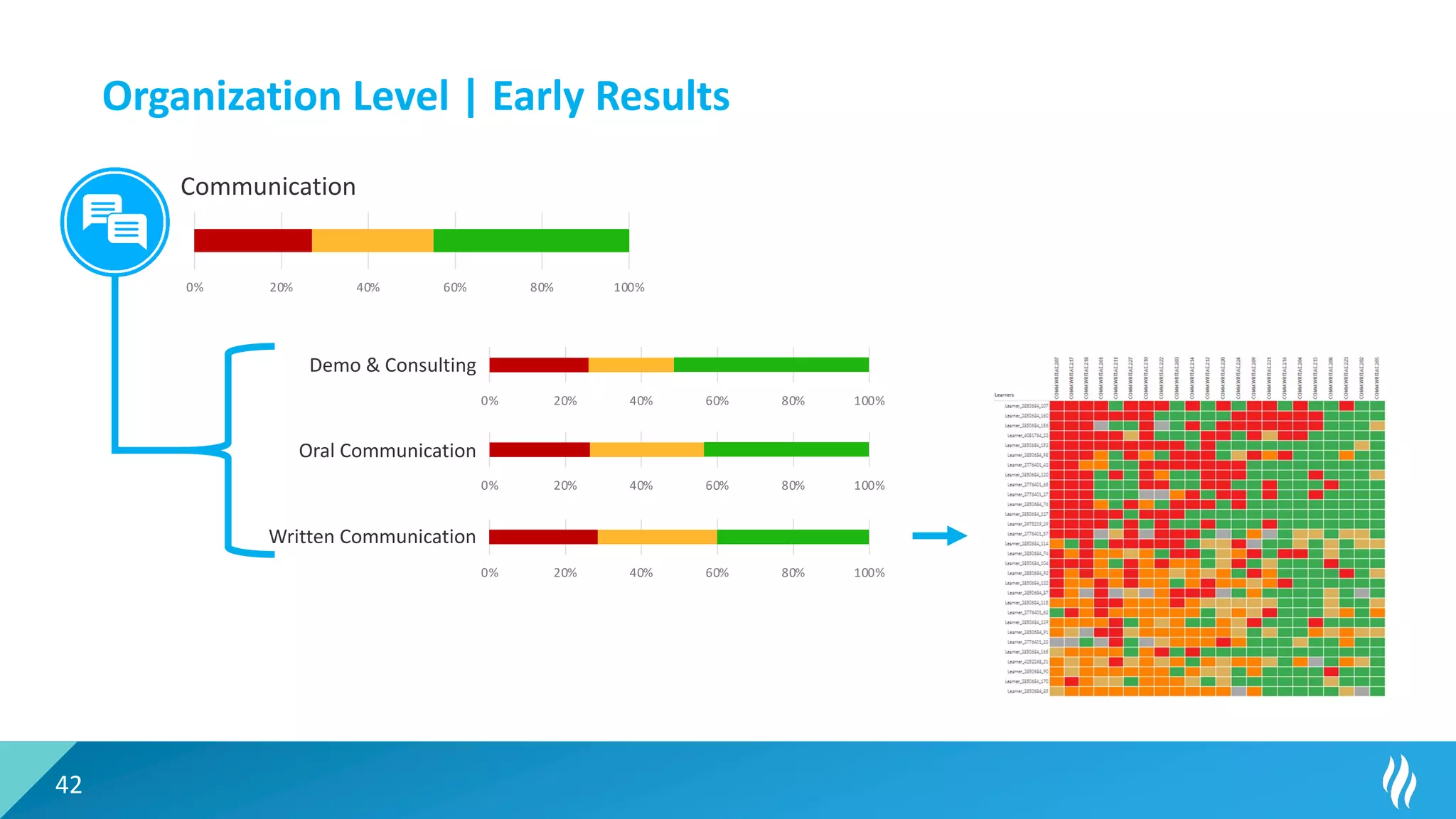
Organization Level | Early Results
Communication
Demo & Consulting
Oral Communication
Written Communication
43
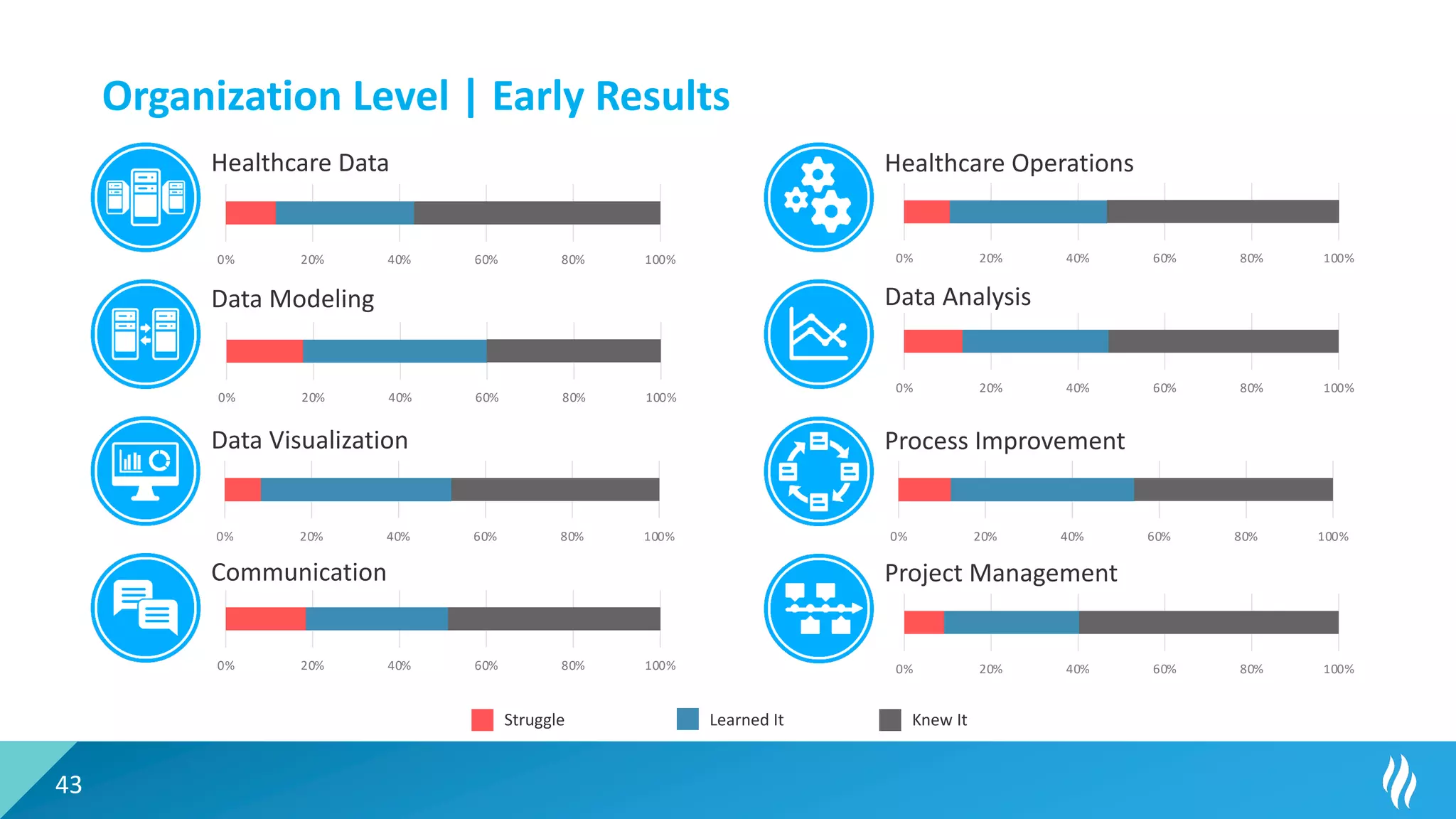
Organization Level | Early Results
Healthcare Data Healthcare Operations
Data Modeling
Data Visualization
Communication Project Management
Process Improvement
Data Analysis
Struggle Learned It Knew It
0% 20% 40% 60% 80% 100% 0% 20% 40% 60% 80% 100%
0% 20% 40% 60% 80% 100%
0% 20% 40% 60% 80% 100%
0% 20% 40% 60% 80% 100% 0% 20% 40% 60% 80% 100%
0% 20% 40% 60% 80% 100% 0% 20% 40% 60% 80% 100%
44
What Have We Learned?
45
The Right Communication for the Role
• Greater transparency on learning and training method
• Speak to its advantages
• Talk about the curriculum and why
• Listen and respond to feedback throughout the learning process
46
I want to learn more about the free SpotChecks to assess our organization’s current analytics and
improvement literacy.
q Yes
q Not yet
Poll Question #4
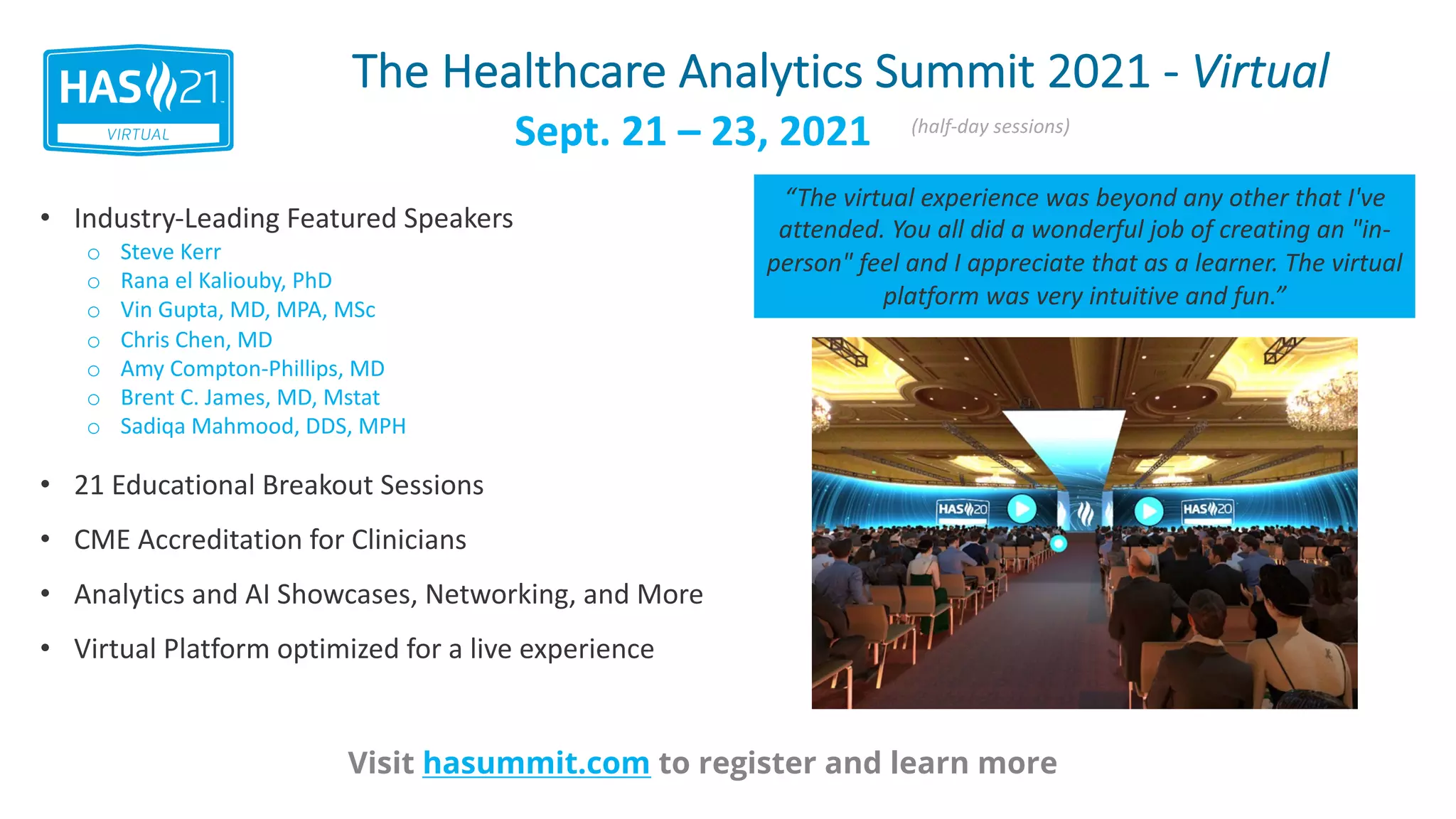
The Healthcare Analytics Summit 2021 - Virtual
Visit hasummit.com to register and learn more
• Industry-Leading Featured Speakers
• 21 Educational Breakout Sessions
• CME Accreditation for Clinicians
• Analytics and AI Showcases, Networking, and More
• Virtual Platform optimized for a live experience
Sept. 21 – 23, 2021 (half-day sessions)
o Steve Kerr
o Rana el Kaliouby, PhD
o Vin Gupta, MD, MPA, MSc
o Chris Chen, MD
o Amy Compton-Phillips, MD
o Brent C. James, MD, Mstat
o Sadiqa Mahmood, DDS, MPH
“The virtual experience was beyond any other that I've
attended. You all did a wonderful job of creating an "in-
person" feel and I appreciate that as a learner. The virtual
platform was very intuitive and fun.”
48
Would you like to be entered to win one of three complimentary passes to HAS
21 Virtual?
q Yes
q No
Poll Question #5
49
Would you like to learn more about Health Catalyst products or services?
q Yes
q No
Poll Question #6
Questions
Contact us: university@healthcatalyst.com

Building Analytic Acumen with Less Classroom "Training" and More Learning

  • 1.
    © 2021 HealthCatalyst © 2021 Health Catalyst May 26, 2021 Building Analytic Acumen with Less Classroom Training and More Learning
  • 2.
    2 Mission | Froedtert& the Medical College of Wisconsin advance the health of the diverse communities we serve through exceptional care enhanced by innovation and discovery. By the Numbers • Academic and community health delivery • 8 Hospitals, 45 health centers • ~3,000 faculty and community-based physicians • 1.3 million outpatient, ~75K inpatient visit • Portfolio across the health care continuum • Provider owned health plan • Clinically integrated network (CIN) with over 100K lives • Innovation/digital health center • ~45,000 decision makers to support Froedtert & Medical College of Wisconsin
  • 3.
    3 The Great AnalyticsDivide WHERE WE STARTED WHERE WE MOVED Now that we’ve built the house… We need to finish the landscaping, have the big housewarming bash, live in it, learn what we like and don’t like, and make improvements J
  • 4.
    4 • Shift cultureand mature data-driven decision-making • Improve analytical acumen and treat data as an asset • Support enterprise integration through data access and analytics • Reduce waste/rework/competing investments and data wrangling • Enable strategic and operational imperatives • Assign value and use of data and analytics as intellectual property • Improve and transform Enterprise Analytics Strategy
  • 5.
    5 Enterprise Analytics ProgramBy the Book þ Conducted current state assessment þ Defined and aligned future state þ Established principles/guidelines þ Launched governance structure þ Created analytics strategic plan þ Implemented change management plan þ Hired analytics leadership team þ Launched analytics center of excellence þ Launched data citizenship & governance þ Created TCO investment (P, P, D &T) þ Approved enterprise info sharing policy þ Conducted RFP for strategic partners þ Received board approval for investment þ Created analytics delivery model þ Created EA (CDAO) dashboard þ Conducted team building þ Established outcomes and value metrics þ Focused on relationship management þ Established literacy and adoption plan So, what’s the problem? þ Established intake and portfolio
  • 6.
    6 Linking Analytics toAction Prioritize opportunity and align active sponsorship Form clinical / operational team and define outcomes Conduct data literacy, data definitions and data governance activities Implement, learn, measure, improve, iterate Build adoption, change mgt and training linked to outcomes Integrate data, build analytics capabilities, agile development Enterprise Analytics Platform and Program Management Foundation ‫‏‬Linking Analytics to Action
  • 7.
    7 Data Literacy andProcess Improvement Competency Bell Curve Did not have the time and resources to scale maturity in data literacy, analytical acumen and process improvement competencies We asked Health Catalyst and Amplifire for help The bell curve we actually had The bell curve we thought we had
  • 8.
    8 How literate isyour organization on analytics and improvement: q Low (red, yellow, green dashboards) – 39% q Medium (data over time in run charts) – 45% q High (use statistical process control charts) – 16% Poll Question #1
  • 9.
    9 How do youknow how literate your organization is with analytics and improvement: q I am guessing from my experience and observations – 67% q We did a formal assessment a few years ago – 2% q Our leaders complain that we have a literacy issue – 5% q Our leaders think we are fine – 5% q We assess competencies (e.g., mastery and misinformation) –21% Poll Question #2
  • 10.
    10 Familiarity versus Mastery Levelsof Mastery Demonstration Requirement Knowledge Know it Demonstrate literacy by confidently and correctly answer competency-based questions and know why the answers are correct Skills and attitudes Do it Demonstrate ability to apply the competencies in an evaluated real-world application and achieve the desired results Experience Teach it Combine knowledge, skills, and attitudes to coach and mentor others FAMILIARITY MASTERY
  • 11.
    11 SEAT TIME: Participationin a single intervention, in a single modality LEARNING: Mastery of a set of relevant competencies that enables improvement (internalizing the content and knowing when and where to apply the learning) At Health Catalyst, learning is: ü Competency-driven (knowledge, skills, attitudes) ü Multi-modal (includes different learning experience types to master competencies) ü Actively measured ü Outcomes-based Health Catalyst University Learning Philosophy Many organizations confuse SEAT TIME with LEARNING.
  • 12.
    12 Mastery at ScaleRequires the Right Tools
  • 13.
    13 “The ideal collegeis Mark Hopkins on one end of a log and a student on the other.” James Garfield, 20th President of the United States of America Ideal—Not Scalable
  • 14.
    14 How People Learn Spacing:Allow some time to forget. As we struggle to remember, the learning deepens. Varied Practice: Variation can help you remember things better (massed practices is not as good as varied and spaced practice). Retrieval Practice: Quizzing yourself, explaining what you’ve learned, writing what you know deepens your understanding. Elaboration: Relating what you have learned to things you already know helps cement the learning. Interruptions: Interruptions don’t knock you off track; they help you learn better. Interleaving: Variety is the spice of memory! Practice and study different skills or principles simultaneously to maximize learning. Perceptual intuition: Perceptual intuition helps us separate important facts from the noise of information around us. Calibration: Objective testing avoids the trap of confusing familiarity with mastery Generation: Produce the answers beforehand—your brain can edit those ideas and correct them as you learn more. Questions: Asking great questions stimulates the brain. Learning state of mind: It is best to be alert and excited, not relaxed, lethargic or anxious. Reflection: Evaluate how you have applied the principle— what went well, what would you change, (start, stop and keep doing).
  • 15.
    15 The Path toMastery: Learning Bursts Alex Hart return Alex Hart return 6-8 QUESTIONS 2 minutes WHAT YOU NEED TO KNOW 3 minutes
  • 16.
    16 Alex Hart return 6-8 QUESTIONS 2minutes WHAT YOU NEED TO KNOW 3 minutes Alex Hart return The Path to Mastery: Learning Bursts
  • 17.
    17 The Path toMastery: Questions
  • 18.
    18 The Path toMastery: Questions
  • 19.
    19 The Path toMastery: Questions
  • 20.
    20 The Path toMastery: Questions
  • 21.
    Alex Hart return 21 Alex Hart return 6-8QUESTIONS 2 minutes WHAT YOU NEED TO KNOW 3 minutes The Path to Mastery: Learning Bursts
  • 22.
    Alex Hart return 22 Alex Hart return 6-8QUESTIONS 2 minutes WHAT YOU NEED TO KNOW 3 minutes The Path to Mastery: Learning Bursts
  • 23.
    23 The Path toMastery: Learning Bursts
  • 24.
    24 The Path toMastery: Learning Bursts
  • 25.
    25 The Path toMastery: Learning Bursts
  • 26.
  • 27.
    27 Training Efficiency: 3,700Nurses at 23 Hospitals—CLABSI Most Knowledge Gaps Average Knowledge Gaps Least Knowledge Gaps 58 Mins 27 Mins 9 Mins Content Clinicians Content Clinicians Content Clinicians
  • 28.
    28 My organization’s learningassesses mastery of competencies rather than participation or seat time (attendance): q Never – 13% q Almost never – 28% q Almost always – 28% q Always – 7% q I don’t know yet – 24% Poll Question #3
  • 29.
    29 Predictive Analytics 58 Mins27 Mins 9 Mins Most Struggle Average Struggle Least Struggle Content Clinicians Content Clinicians Content Clinicians
  • 30.
    30 Intermountain (CLABSI): Learning> Observation > Consultation • 23 Intermountain hospitals • 3,707 nurses trained • 25,129 instances of CHM • 29,838 instances of Uncertainty
  • 31.
    31 Intermountain (CLABSI): Learning> Observation > Consultation Dixie Regional Hospital Initial Knowledge 5,336 instances of CHM Struggle 1,521 instances
  • 32.
    32 Intermountain (CLABSI): Learning> Observation > Consultation Dixie Regional Hospital Initial Knowledge 5,336 instances of CHM Struggle 1,521 instances Initial Gaps and CHM 357 nurses After Initial Training 225 nurses
  • 33.
    33 Intermountain (CLABSI): Learning> Observation > Consultation Dixie Regional Hospital Initial Knowledge 5,336 instances of CHM Struggle 1,521 instances Initial Gaps and CHM 357 nurses After Initial Training 225 nurses After Refresher 31 Nurses
  • 34.
    34 Intermountain (CLABSI): Learning> Observation > Consultation Dixie Regional Hospital Initial Knowledge 5,336 instances of CHM Struggle 1,521 instances Initial Gaps and CHM 357 nurses After Initial Training 225 nurses After Refresher 31 Nurses Consultations
  • 35.
    35 CLABSI & CAUTI:Clinical Incident Data CLABSI AHRQ and NIH set the national average at around 1.69 per thousand line days. CAUTI AHRQ and NIH set the national average at around 3.0 per thousand line days. National Average National Average
  • 36.
    36 CLABSI & CAUTI:Clinical Incident Data National Average National Average CLABSI 51% reduction over prior 12 months 47% reduction over prior 32 months Note: if you replace the three spikes with with the 32 month average, the reduction is 42% compared to the last 12 months. CAUTI 29% reduction over prior 12 months 36% reduction over prior 32 months Note: Training of Techs not completed yet. Health System Incident Cost Data provided by Health System for CLABSI ($28,324) and CAUTI ($1,269): Annual Savings of $1,788,422 Compared to prior 12 months
  • 37.
    37 Vision for OurLearners Help the following roles build new competencies to make analytics and improvement work successful: Establish the analytics and improvement vision and priorities; plan and sponsor significant and sustained improvements. Executives Identify, propose and implement significant and sustainable improvements. Front-line Managers Help managers design and implement significant and sustainable improvements. Improvement Teams Identify, propose and implement significant and sustainable improvements. Clinicians Analyze data to derive and communicate improvement insights to leaders. Analysts
  • 38.
    38 Where do Iwant to go? What knowledge, skills, and attitudes are expected in my job (or the job I want)? Putting the Learner First
  • 39.
    39 Recognize Competencies Competency CategoriesA&I Literacy for Analysts A&I Literacy for Leaders Core | The contextual knowledge and skills required to analyze healthcare data Healthcare Data Healthcare Operations Data Visualization Data Analysis Healthcare Data Healthcare Operations Data Visualization Understand and Interpret Analysis Adaptive | The soft skills required to work together efficiently and effectively Process Improvement Project Management Communication Process Improvement Project Management Communication Technical | The skills required to conduct analysis with large complex datasets SQL ETL Data Modeling Tools | Health Catalyst tools that enable analysis of healthcare data Health Catalyst tools Program includes: • 50-question SpotCheck assessment • 15 online Amplifire courses (39 modules) • 15 online literacy assessments Program includes: • 25-question SpotCheck assessment • 7 online Amplifire courses (18 modules) • 7 online literacy assessments
  • 40.
    Learn Smarter, NotHarder 40 Where do I want to go? What knowledge, skills, and attitudes will help me succeed in my job (or the job I want)? Where am I now? How am I doing in relation to the role-based competencies? What route do I want to take? I can create my own personal development plan and timeline Am I there yet? Have I demonstrated new knowledge or skills
  • 41.
    41 Organization Level |Early Results Healthcare Data Healthcare Operations Data Modeling Data Visualization Communication Project Management Process Improvement Data Analysis Misinformation Uncertainty Mastery 0% 20% 40% 60% 80% 100% 0% 20% 40% 60% 80% 100% 0% 20% 40% 60% 80% 100% 0% 20% 40% 60% 80% 100% 0% 20% 40% 60% 80% 100% 0% 20% 40% 60% 80% 100% 0% 20% 40% 60% 80% 100% 0% 20% 40% 60% 80% 100%
  • 42.
    42 0% 20% 40%60% 80% 100% 0% 20% 40% 60% 80% 100% 0% 20% 40% 60% 80% 100% 0% 20% 40% 60% 80% 100% Organization Level | Early Results Communication Demo & Consulting Oral Communication Written Communication
  • 43.
    43 Organization Level |Early Results Healthcare Data Healthcare Operations Data Modeling Data Visualization Communication Project Management Process Improvement Data Analysis Struggle Learned It Knew It 0% 20% 40% 60% 80% 100% 0% 20% 40% 60% 80% 100% 0% 20% 40% 60% 80% 100% 0% 20% 40% 60% 80% 100% 0% 20% 40% 60% 80% 100% 0% 20% 40% 60% 80% 100% 0% 20% 40% 60% 80% 100% 0% 20% 40% 60% 80% 100%
  • 44.
  • 45.
    45 The Right Communicationfor the Role • Greater transparency on learning and training method • Speak to its advantages • Talk about the curriculum and why • Listen and respond to feedback throughout the learning process
  • 46.
    46 I want tolearn more about the free SpotChecks to assess our organization’s current analytics and improvement literacy. q Yes q Not yet Poll Question #4
  • 47.
    The Healthcare AnalyticsSummit 2021 - Virtual Visit hasummit.com to register and learn more • Industry-Leading Featured Speakers • 21 Educational Breakout Sessions • CME Accreditation for Clinicians • Analytics and AI Showcases, Networking, and More • Virtual Platform optimized for a live experience Sept. 21 – 23, 2021 (half-day sessions) o Steve Kerr o Rana el Kaliouby, PhD o Vin Gupta, MD, MPA, MSc o Chris Chen, MD o Amy Compton-Phillips, MD o Brent C. James, MD, Mstat o Sadiqa Mahmood, DDS, MPH “The virtual experience was beyond any other that I've attended. You all did a wonderful job of creating an "in- person" feel and I appreciate that as a learner. The virtual platform was very intuitive and fun.”
  • 48.
    48 Would you liketo be entered to win one of three complimentary passes to HAS 21 Virtual? q Yes q No Poll Question #5
  • 49.
    49 Would you liketo learn more about Health Catalyst products or services? q Yes q No Poll Question #6
  • 50.