Noun Clauses
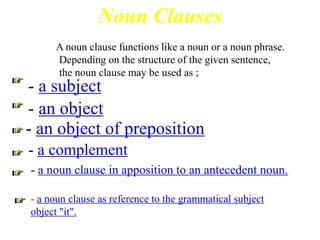
     A noun clause functions like a noun or a noun phrase.
     Depending on the structure of the given sentence,
     the noun clause may be used as ;
- a subject
- an object
- an object of preposition
- a complement
- a noun clause in apposition to an antecedent noun.

- a noun clause as reference to the grammatical subject
object "it".
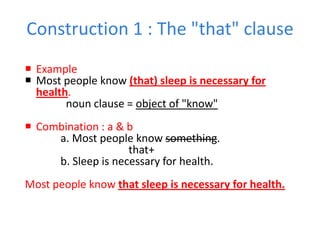
Construction 1 : The "that" clause
 Example
 Most people know (that) sleep is necessary for
  health.
        noun clause = object of "know"
 Combination : a & b
     a. Most people know something.
                    that+
     b. Sleep is necessary for health.
Most people know that sleep is necessary for health.
Construction 1 : The "that" clause
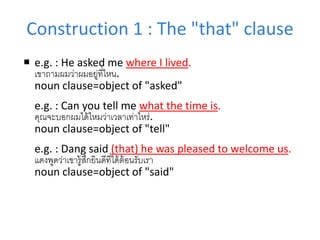
 e.g. : He asked me where I lived.
  เขาถามผมว่าผมอยูที่ไหน.
                 ่
  noun clause=object of "asked"
  e.g. : Can you tell me what the time is.
  คุณจะบอกผมได้ ไหมว่าเวลาเท่าไหร่ .
  noun clause=object of "tell"
  e.g. : Dang said (that) he was pleased to welcome us.
  แดงพูดว่าเขารู้สกยินดีที่ได้ ต้อนรับเรา
                  ึ
  noun clause=object of "said"
Construction 1 : The "that" clause
 e.g. : That he will refuse the offer is unlikely.
  ที่เขาจะปฏิเสธข้ อเสนอนันรู้สึกว่ าจะยังไม่ มีทาง.
                          ้
  noun clause=subject
  e.g. : What you are doing seems very difficult.
  สิ่งที่คุณกาลังกระทารู้สึกว่ าจะยากมาก
  e.g. : How the prisoner escaped is a complex
  mystery.
  นักโทษผู้นันหนีไปได้ อย่ างไรนันเป็ นเรื่องลึกลับซับซ้ อน
             ้                   ้
Construction 1 : The "that" clause
 e.g. : It seems that he has never paid the money.
  ดูราวกับว่ าเขายังไม่ ได้ จ่ายเงิน
  Noun clause as complement of verb "seem"
  e.g. : What surprised me was that he spoke English so well.
  สิ่งที่ทาให้ ผมประหลาดใจก็คือเขาพูดภาษาอังกฤษได้ ดมาก
                                                    ี
  e.g. : The fact that the prisoner was guilty was plain to
  everyone.
  ความจริงที่ว่านักโทษผู้นันผิดจริงเป็ นสิ่งธรรมดาสาหรับทุกคนที่จะเห็น
                           ้
  ได้
  Noun clause as appositive.
Construction 1 : The "that" clause
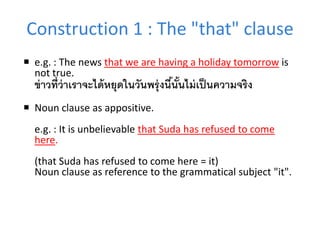
 e.g. : The news that we are having a holiday tomorrow is
  not true.
  ข่ าวที่ว่าเราจะได้ หยุดในวันพรุ่ งนีนันไม่ เป็ นความจริง
                                       ้ ้
 Noun clause as appositive.
  e.g. : It is unbelievable that Suda has refused to come
  here.
  (that Suda has refused to come here = it)
  Noun clause as reference to the grammatical subject "it".
Construction 2 : The "whether" clause

•
    e.g. : It did not matter at all for some students
    whether they had got good grades or not.
•
    1. "It" functions as a grammatical subject,
    referring to the italicized noun clause.
Construction 2 : The "whether" clause
 The sentence is broken into 3 smaller sentences ;
    a. It did not matter at all for some students.
    b. They had got good grades.
    c. They had not got good grades.
  3. Combination : b+c=B
  They had got good grades or they had not get good
  grades.
  ==>B : They had got good grades or not.
Construction 2 : The "whether" clause

 Combination : a+B
  a. it did not matter at all for some students.
  Whether+B ==>They had got good grades or
  not.

  ==>It did not matter at all for some students
  whether they had got good grades or not.
Whether(or not)
   1. Whether(or not) they can get here in time
    does not have anything to do with our plan.


    2. People often ask whether there are
    measures to cope with the increase of crimes.


    3. We wonder if the mayor can handle the
    traffic problems.

20 noun clause

  • 1.
    Noun Clauses A noun clause functions like a noun or a noun phrase. Depending on the structure of the given sentence, the noun clause may be used as ; - a subject - an object - an object of preposition - a complement - a noun clause in apposition to an antecedent noun. - a noun clause as reference to the grammatical subject object "it".
  • 2.
    Construction 1 :The "that" clause  Example  Most people know (that) sleep is necessary for health. noun clause = object of "know"  Combination : a & b a. Most people know something. that+ b. Sleep is necessary for health. Most people know that sleep is necessary for health.
  • 3.
    Construction 1 :The "that" clause  e.g. : He asked me where I lived. เขาถามผมว่าผมอยูที่ไหน. ่ noun clause=object of "asked" e.g. : Can you tell me what the time is. คุณจะบอกผมได้ ไหมว่าเวลาเท่าไหร่ . noun clause=object of "tell" e.g. : Dang said (that) he was pleased to welcome us. แดงพูดว่าเขารู้สกยินดีที่ได้ ต้อนรับเรา ึ noun clause=object of "said"
  • 4.
    Construction 1 :The "that" clause  e.g. : That he will refuse the offer is unlikely. ที่เขาจะปฏิเสธข้ อเสนอนันรู้สึกว่ าจะยังไม่ มีทาง. ้ noun clause=subject e.g. : What you are doing seems very difficult. สิ่งที่คุณกาลังกระทารู้สึกว่ าจะยากมาก e.g. : How the prisoner escaped is a complex mystery. นักโทษผู้นันหนีไปได้ อย่ างไรนันเป็ นเรื่องลึกลับซับซ้ อน ้ ้
  • 5.
    Construction 1 :The "that" clause  e.g. : It seems that he has never paid the money. ดูราวกับว่ าเขายังไม่ ได้ จ่ายเงิน Noun clause as complement of verb "seem" e.g. : What surprised me was that he spoke English so well. สิ่งที่ทาให้ ผมประหลาดใจก็คือเขาพูดภาษาอังกฤษได้ ดมาก ี e.g. : The fact that the prisoner was guilty was plain to everyone. ความจริงที่ว่านักโทษผู้นันผิดจริงเป็ นสิ่งธรรมดาสาหรับทุกคนที่จะเห็น ้ ได้ Noun clause as appositive.
  • 6.
    Construction 1 :The "that" clause  e.g. : The news that we are having a holiday tomorrow is not true. ข่ าวที่ว่าเราจะได้ หยุดในวันพรุ่ งนีนันไม่ เป็ นความจริง ้ ้  Noun clause as appositive. e.g. : It is unbelievable that Suda has refused to come here. (that Suda has refused to come here = it) Noun clause as reference to the grammatical subject "it".
  • 7.
    Construction 2 :The "whether" clause • e.g. : It did not matter at all for some students whether they had got good grades or not. • 1. "It" functions as a grammatical subject, referring to the italicized noun clause.
  • 8.
    Construction 2 :The "whether" clause  The sentence is broken into 3 smaller sentences ; a. It did not matter at all for some students. b. They had got good grades. c. They had not got good grades. 3. Combination : b+c=B They had got good grades or they had not get good grades. ==>B : They had got good grades or not.
  • 9.
    Construction 2 :The "whether" clause  Combination : a+B a. it did not matter at all for some students. Whether+B ==>They had got good grades or not.  ==>It did not matter at all for some students whether they had got good grades or not.
  • 10.
    Whether(or not)  1. Whether(or not) they can get here in time does not have anything to do with our plan.  2. People often ask whether there are measures to cope with the increase of crimes.  3. We wonder if the mayor can handle the traffic problems.