Investigación y Desarrollo de Tecnologías para la  Eficiencia Energética y Energía Renovable  Aplicadas al Sector Agrícola y Agro-alimentario Carlos M. Monreal  Agriculture and Agri-Food Canada - AAFC Ottawa, Canada Seminario Internacional - Seguridad y eficiencia energ é tica:  Un aporte cientifico para la generacion de politicas publicas La Serena, Chile - Abril 17, 2008
Canadian Energy Supply Others less than 1% Tidal Solar   Wind Ethanol Earth Energy Municipal Waste Landfill gas   6 % 11 % Agriculture and Agri-Food   Canada Agriculture et  Agroalimentaire Canada Renewables & Hydro,  17 % - 30 % of world oil reserves Oil,  32 %
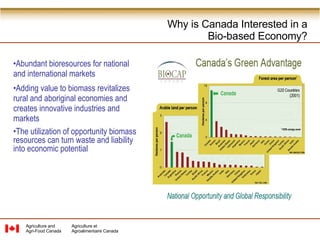
Canada’s green advantage -   0.5 % of worlds population 7.0 % of global land area  10 % of world’s forest Bioenergy use is large relative to other renewables - second only to hydro-electric power. Agriculture and Agri-Food   Canada Agriculture et  Agroalimentaire Canada Canada’s Green Advantage
Climate change / environmental Reducing net greenhouse gas emissions Clean water, air and soils   Rural economic development and revitalization Creation of economically viable natural resource-based enterprises in rural Canada and reduction of farm subsidies Farmer ownership of ethanol and biodiesel production facilities would enhance rural community development Farm income New market opportunities for grains and oilseeds and other biomass feedstocks The emerging bioeconomy Production of new products from natural resources Renewable Energy Policy  Drivers Agriculture and Agri-Food   Canada Agriculture et  Agroalimentaire Canada
Abundant bioresources for national and international markets Adding value to biomass revitalizes rural and aboriginal economies and creates innovative industries and markets The utilization of opportunity biomass resources can turn waste and liability into economic potential Why is Canada Interested in a  Bio-based Economy? Agriculture and Agri-Food   Canada Agriculture et  Agroalimentaire Canada
Climate change / environmental Reducing net greenhouse gas emissions Clean water, air and soils   Rural economic development and revitalization Creation of economically viable natural resource-based enterprises in rural Canada and reduction of farm subsidies Farmer ownership of ethanol and biodiesel production facilities would enhance rural community development Farm income New market opportunities for grains and oilseeds and other biomass feedstocks The emerging bioeconomy Production of new products from natural resources Renewable Energy Policy  Drivers Agriculture and Agri-Food   Canada Agriculture et  Agroalimentaire Canada
PERD -Reducing the Use of Fossil Fuel Sources - Food production Due to the lower energy content of the biodiesel, higher fuel  consumption &  lower fuel efficiency were observed for B50 and  B100 blends. Biodiesel in Agricultural Tractors   Zero-tillage CO 2  emissions (kg/ha) 5 15 25 Diesel B20 B50 B100
PERD - Reducing the Use of Fossil Fuel - Food processing Increasing leafy vegetable stability during storage and distribution P. Delaquis - delaquisp@agr.gc.ca Chlorinated H 2 O at 50 ° C : reduced browning and waste  enhanced antimicrobial effectiveness improved consumer acceptance Delaying fruit ripening during  storage and transport P. Toivonen - toivonenp@agr.gc.ca 1-methylcyclopropene: blocks ethylene action to delay fruit ripening reduced fruit respiration by 30 to 50 % reduced refrigeration need good for apples, less predictable for apricots &  plums
A Feedlot in Alberta -  Highmark Renewables Inc. Agriculture and Agri-Food   Canada Agriculture et  Agroalimentaire Canada
Highmark Renewables Inc. - Alberta Develops and commercializes an Integrated Manure Utilization System (IMUS) to: a) convert livestock manure into biogas using a  thermophilic  (55 °C) AD; b) and produce and export electricity to the power grid.  The AD system produces organic fertilizer and reusable water by recovery and concentration of nutrients in the digested beef manure.   Cattle: 36,000 cattle in feedlot Manure processed : 215 tons slurry/d Digester capacity : 1800 m3 x2 Biogas : 9000 m3/d Energy: 760 kWe, 974 kWt Emission Reduction: 6.3 kt CO2e/yr AD Energy Cogeneration - Pilot Plants IMUS AD system  Agriculture and Agri-Food   Canada Agriculture et  Agroalimentaire Canada
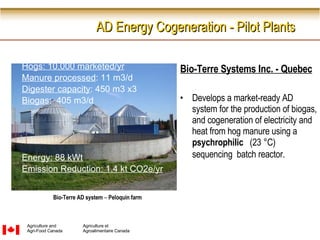
Bio-Terre Systems Inc. - Quebec Develops a market-ready AD system for the production of biogas, and cogeneration of electricity and heat from hog manure using a  psychrophilic   (23 °C) sequencing  batch reactor.   Hogs: 10,000 marketed/yr Manure processed : 11 m3/d  Digester capacity : 450 m3 x3 Biogas :  405 m3/d Energy: 88 kWt Emission Reduction: 1.4 kt CO2e/yr Bio-Terre AD system   –  Peloquin farm AD Energy Cogeneration - Pilot Plants Agriculture and Agri-Food   Canada Agriculture et  Agroalimentaire Canada
Nano-science - Definitions Nanotechnology and Nanobiotechnology Nanotechnology :   a field of applied science and technology focused in the control of matter at the molecular level in scales normally 1 to 100 nanometers, and the fabrication of devices within that size range.  Nanobiotechnology :  is the branch of nanotechnology with biological and biochemical applications or uses. Nanobiotechnology often studies existing  elements of nature  in order to fabricate new devices.
1. Renewable energy and bioproducts from biomass conversion Gases Animal manures  & crop residues Bioliquids Solids   Primary  conversion (Anaer. digestion   gasification,  pyrolysis) Producers   - Canadian Federation of Agriculture - Dairy Farmers of Canada - Canadian Cattlemen’s Association - ACA co-op Industry - Menova - Enerkem ENSYN  Highmark Renewables R&D agencies - AAFC ( ECORC, SC ), NRC - ( BRI, IMB, NINT, IFCI ),  ARC, University of Ottawa, Carleton University,  IRDA, NRCan. - 50 scientists and engineers 1. Biofuels 2. Biochemicals & biomaterials 3. Biofertilizer Biosystems &  Bioproducts  For Use as  Industrial Inputs - Biohydrogen - BioOil*, Methanol* - Bioplastics - Coenzyme Q 10 - Carotenoids - Lipids& waxes - Activated carbon & nanomaterials Research Platforms 4. High Quality  Feeds Themes Bioproducts Secondary Conversion (microbial, chemical,  algal,  enzymatic,  solar energy) - Biochar derived - AD derived - Algal & bacterial biomass Biosystems &  Bioproducts  For Use as  Agricult. Inputs - ARCNet
Pyrolysis of Agricultural Biomass Pyrolysis Plant to Produce BioOil, Syngas & Biochar from Chicken Manure Advanced Bio Refinery Inc., Ottawa, Canada From - Schnitzer, Monreal, Leinweber, Fransham. 2007. 2008  J. Env. Sc. Health. Extraction and Separation of Chemicals from Bio-oils Pyrolysis BioOils and Bio-char derived from chicken manure Agriculture and Agri-Food   Canada Agriculture et  Agroalimentaire Canada
N, O, S free Renewable Bio-fuel Small metallic nanoparticle catalysts N and S to fertilizer Bio-oils containing N, O and S compounds Must be removed from organic  molecules to obtain Bio-oil FDMS Bio-oil Fraction II Distribution of Classes of Chemical Compounds (%) in Bio-oils from Chicken Manure Elemental Analysis of Bio-oil Fractions obtained from Fast Pyrolysis of Chicken Manure - From Schnitzer, Monreal and Jandl. 2008 (In press, J.Env.Sc.Health.) Nanoporous silica 0.4 0.5 14.3 7.4 7.8 70.0 Fraction II 0.5 0.9 37.6 12 5.0 44.5 Fraction I Ash S O N H C Wt % Sample 39.7 2.5 10.2 3.2 9.2 4.0 30.2 Fraction II 44.4  20.4 1.0 12.0 10.3 4.5 7.4 Fraction I Unknown Aliphatics Carbo-cyclics Benzene & derivatives Phenols Furans N-Hetero-cyclics Sample
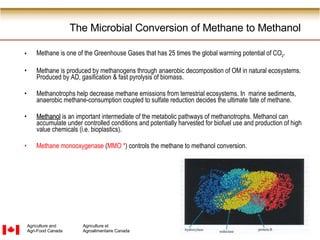
Background 1.b. Converting methane to methanol by  methanotrophs and  MMO* Methane is one of the Greenhouse Gases that has 25 times the global warming potential of CO 2 . Methane is produced by methanogens through anaerobic decomposition of OM in natural ecosystems. Also by AD, gasification & fast pyrolysis. Methanotrophs help decrease methane emissions from terrestrial ecosystems. In  marine sediments, anaerobic methane-consumption coupled to sulfate reduction decides the ultimate fate of methane.  Methanol  is an important intermediate of the metabolic pathway of methane in methanotrophs. Methanol can accumulate under controlled conditions and potentially harvested for biofuel use and high value chemicals (i.e. bioplastics). The methane to methanol conversion process is mediated by  methane monooxygenase  ( MMO * ).  Lorna Carrasco Bin Lin
Methane is one of the Greenhouse Gases that has 25 times the global warming potential of CO 2 . Methane is produced by methanogens through anaerobic decomposition of OM in natural ecosystems. Produced by AD, gasification & fast pyrolysis of biomass. Methanotrophs help decrease methane emissions from terrestrial ecosystems. In  marine sediments, anaerobic methane-consumption coupled to sulfate reduction decides the ultimate fate of methane.  Methanol  is an important intermediate of the metabolic pathways of methanotrophs. Methanol can accumulate under controlled conditions and potentially harvested for biofuel use and production of high value chemicals (i.e. bioplastics). Methane monooxygenase  ( MMO * ) controls the methane to methanol conversion.  The Microbial Conversion of Methane to Methanol  Agriculture and Agri-Food   Canada Agriculture et  Agroalimentaire Canada
Metabolic pathway in methanotrophs Ribulose monophosphate (RuMP),  Type II 1: MMO 2: MDHase Type I
We developed protocols to:  a) grow, culture & isolate methanotrophs, b) measure and inhibit both enzyme activities.   Preliminary findings Achieved > 99.5% inhibition for sMMO Inhibition of sMMO by phenylacetylene 7-hydroxycoumarin (nM) Production of Methanol by Methanotrophs Key enzymes for converting and accumulating CH 3 OH in cell culture: - Soluble  MMO and methanol dehydrogenase
From - Lin, Monreal, Miguez, Tambong. 2008. J. Env. Microb. Methanol Methane Methylosinus trichosporium  Methane Methanol Soil Consortium 2.3 The Microbial Conversion of Methane to Methanol Methanol production by methanotrophic bacteria Agriculture and Agri-Food   Canada Agriculture et  Agroalimentaire Canada
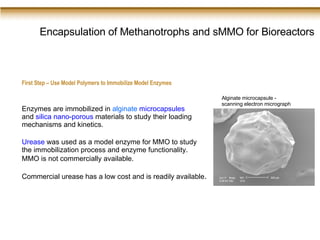
First Step – Use Model Polymers to Immobilize Model Enzymes Encapsulation of Methanotrophs and sMMO for Bioreactors Enzymes are immobilized in  alginate   microcapsules  and  silica   nano-porous  materials to study their loading mechanisms and kinetics.  Urease  was used as a model enzyme for MMO to study  the immobilization process and enzyme functionality.  MMO is not commercially available.  Commercial urease has a low cost and is readily available . Alginate microcapsule - scanning electron micrograph
Conclusions Canada has a diversified portfolio of energy supply, and abundant biomass and natural resources which support the  development of renewable energy. Federal government supports multidisciplinary and  multiorganization R&D whose outputs feed into  policies for enhancing leading-edge technologies  for energy efficiency & renewable energy. New technologies contribute strengthening the bioeconomy, environmental health and agriculture.  Agriculture and Agri-Food   Canada Agriculture et  Agroalimentaire Canada

20 Monreal Serena

  • 1.
    Investigación y Desarrollode Tecnologías para la Eficiencia Energética y Energía Renovable Aplicadas al Sector Agrícola y Agro-alimentario Carlos M. Monreal Agriculture and Agri-Food Canada - AAFC Ottawa, Canada Seminario Internacional - Seguridad y eficiencia energ é tica: Un aporte cientifico para la generacion de politicas publicas La Serena, Chile - Abril 17, 2008
  • 2.
    Canadian Energy SupplyOthers less than 1% Tidal Solar Wind Ethanol Earth Energy Municipal Waste Landfill gas 6 % 11 % Agriculture and Agri-Food Canada Agriculture et Agroalimentaire Canada Renewables & Hydro, 17 % - 30 % of world oil reserves Oil, 32 %
  • 3.
    Canada’s green advantage- 0.5 % of worlds population 7.0 % of global land area 10 % of world’s forest Bioenergy use is large relative to other renewables - second only to hydro-electric power. Agriculture and Agri-Food Canada Agriculture et Agroalimentaire Canada Canada’s Green Advantage
  • 4.
    Climate change /environmental Reducing net greenhouse gas emissions Clean water, air and soils Rural economic development and revitalization Creation of economically viable natural resource-based enterprises in rural Canada and reduction of farm subsidies Farmer ownership of ethanol and biodiesel production facilities would enhance rural community development Farm income New market opportunities for grains and oilseeds and other biomass feedstocks The emerging bioeconomy Production of new products from natural resources Renewable Energy Policy Drivers Agriculture and Agri-Food Canada Agriculture et Agroalimentaire Canada
  • 5.
    Abundant bioresources fornational and international markets Adding value to biomass revitalizes rural and aboriginal economies and creates innovative industries and markets The utilization of opportunity biomass resources can turn waste and liability into economic potential Why is Canada Interested in a Bio-based Economy? Agriculture and Agri-Food Canada Agriculture et Agroalimentaire Canada
  • 6.
    Climate change /environmental Reducing net greenhouse gas emissions Clean water, air and soils Rural economic development and revitalization Creation of economically viable natural resource-based enterprises in rural Canada and reduction of farm subsidies Farmer ownership of ethanol and biodiesel production facilities would enhance rural community development Farm income New market opportunities for grains and oilseeds and other biomass feedstocks The emerging bioeconomy Production of new products from natural resources Renewable Energy Policy Drivers Agriculture and Agri-Food Canada Agriculture et Agroalimentaire Canada
  • 7.
    PERD -Reducing theUse of Fossil Fuel Sources - Food production Due to the lower energy content of the biodiesel, higher fuel consumption & lower fuel efficiency were observed for B50 and B100 blends. Biodiesel in Agricultural Tractors Zero-tillage CO 2 emissions (kg/ha) 5 15 25 Diesel B20 B50 B100
  • 8.
    PERD - Reducingthe Use of Fossil Fuel - Food processing Increasing leafy vegetable stability during storage and distribution P. Delaquis - delaquisp@agr.gc.ca Chlorinated H 2 O at 50 ° C : reduced browning and waste enhanced antimicrobial effectiveness improved consumer acceptance Delaying fruit ripening during storage and transport P. Toivonen - toivonenp@agr.gc.ca 1-methylcyclopropene: blocks ethylene action to delay fruit ripening reduced fruit respiration by 30 to 50 % reduced refrigeration need good for apples, less predictable for apricots & plums
  • 9.
    A Feedlot inAlberta - Highmark Renewables Inc. Agriculture and Agri-Food Canada Agriculture et Agroalimentaire Canada
  • 10.
    Highmark Renewables Inc.- Alberta Develops and commercializes an Integrated Manure Utilization System (IMUS) to: a) convert livestock manure into biogas using a thermophilic (55 °C) AD; b) and produce and export electricity to the power grid. The AD system produces organic fertilizer and reusable water by recovery and concentration of nutrients in the digested beef manure. Cattle: 36,000 cattle in feedlot Manure processed : 215 tons slurry/d Digester capacity : 1800 m3 x2 Biogas : 9000 m3/d Energy: 760 kWe, 974 kWt Emission Reduction: 6.3 kt CO2e/yr AD Energy Cogeneration - Pilot Plants IMUS AD system Agriculture and Agri-Food Canada Agriculture et Agroalimentaire Canada
  • 11.
    Bio-Terre Systems Inc.- Quebec Develops a market-ready AD system for the production of biogas, and cogeneration of electricity and heat from hog manure using a psychrophilic (23 °C) sequencing batch reactor. Hogs: 10,000 marketed/yr Manure processed : 11 m3/d Digester capacity : 450 m3 x3 Biogas : 405 m3/d Energy: 88 kWt Emission Reduction: 1.4 kt CO2e/yr Bio-Terre AD system – Peloquin farm AD Energy Cogeneration - Pilot Plants Agriculture and Agri-Food Canada Agriculture et Agroalimentaire Canada
  • 12.
    Nano-science - DefinitionsNanotechnology and Nanobiotechnology Nanotechnology : a field of applied science and technology focused in the control of matter at the molecular level in scales normally 1 to 100 nanometers, and the fabrication of devices within that size range. Nanobiotechnology : is the branch of nanotechnology with biological and biochemical applications or uses. Nanobiotechnology often studies existing elements of nature in order to fabricate new devices.
  • 13.
    1. Renewable energyand bioproducts from biomass conversion Gases Animal manures & crop residues Bioliquids Solids Primary conversion (Anaer. digestion gasification, pyrolysis) Producers - Canadian Federation of Agriculture - Dairy Farmers of Canada - Canadian Cattlemen’s Association - ACA co-op Industry - Menova - Enerkem ENSYN Highmark Renewables R&D agencies - AAFC ( ECORC, SC ), NRC - ( BRI, IMB, NINT, IFCI ), ARC, University of Ottawa, Carleton University, IRDA, NRCan. - 50 scientists and engineers 1. Biofuels 2. Biochemicals & biomaterials 3. Biofertilizer Biosystems & Bioproducts For Use as Industrial Inputs - Biohydrogen - BioOil*, Methanol* - Bioplastics - Coenzyme Q 10 - Carotenoids - Lipids& waxes - Activated carbon & nanomaterials Research Platforms 4. High Quality Feeds Themes Bioproducts Secondary Conversion (microbial, chemical, algal, enzymatic, solar energy) - Biochar derived - AD derived - Algal & bacterial biomass Biosystems & Bioproducts For Use as Agricult. Inputs - ARCNet
  • 14.
    Pyrolysis of AgriculturalBiomass Pyrolysis Plant to Produce BioOil, Syngas & Biochar from Chicken Manure Advanced Bio Refinery Inc., Ottawa, Canada From - Schnitzer, Monreal, Leinweber, Fransham. 2007. 2008 J. Env. Sc. Health. Extraction and Separation of Chemicals from Bio-oils Pyrolysis BioOils and Bio-char derived from chicken manure Agriculture and Agri-Food Canada Agriculture et Agroalimentaire Canada
  • 15.
    N, O, Sfree Renewable Bio-fuel Small metallic nanoparticle catalysts N and S to fertilizer Bio-oils containing N, O and S compounds Must be removed from organic molecules to obtain Bio-oil FDMS Bio-oil Fraction II Distribution of Classes of Chemical Compounds (%) in Bio-oils from Chicken Manure Elemental Analysis of Bio-oil Fractions obtained from Fast Pyrolysis of Chicken Manure - From Schnitzer, Monreal and Jandl. 2008 (In press, J.Env.Sc.Health.) Nanoporous silica 0.4 0.5 14.3 7.4 7.8 70.0 Fraction II 0.5 0.9 37.6 12 5.0 44.5 Fraction I Ash S O N H C Wt % Sample 39.7 2.5 10.2 3.2 9.2 4.0 30.2 Fraction II 44.4 20.4 1.0 12.0 10.3 4.5 7.4 Fraction I Unknown Aliphatics Carbo-cyclics Benzene & derivatives Phenols Furans N-Hetero-cyclics Sample
  • 16.
    Background 1.b. Convertingmethane to methanol by methanotrophs and MMO* Methane is one of the Greenhouse Gases that has 25 times the global warming potential of CO 2 . Methane is produced by methanogens through anaerobic decomposition of OM in natural ecosystems. Also by AD, gasification & fast pyrolysis. Methanotrophs help decrease methane emissions from terrestrial ecosystems. In marine sediments, anaerobic methane-consumption coupled to sulfate reduction decides the ultimate fate of methane. Methanol is an important intermediate of the metabolic pathway of methane in methanotrophs. Methanol can accumulate under controlled conditions and potentially harvested for biofuel use and high value chemicals (i.e. bioplastics). The methane to methanol conversion process is mediated by methane monooxygenase ( MMO * ). Lorna Carrasco Bin Lin
  • 17.
    Methane is oneof the Greenhouse Gases that has 25 times the global warming potential of CO 2 . Methane is produced by methanogens through anaerobic decomposition of OM in natural ecosystems. Produced by AD, gasification & fast pyrolysis of biomass. Methanotrophs help decrease methane emissions from terrestrial ecosystems. In marine sediments, anaerobic methane-consumption coupled to sulfate reduction decides the ultimate fate of methane. Methanol is an important intermediate of the metabolic pathways of methanotrophs. Methanol can accumulate under controlled conditions and potentially harvested for biofuel use and production of high value chemicals (i.e. bioplastics). Methane monooxygenase ( MMO * ) controls the methane to methanol conversion. The Microbial Conversion of Methane to Methanol Agriculture and Agri-Food Canada Agriculture et Agroalimentaire Canada
  • 18.
    Metabolic pathway inmethanotrophs Ribulose monophosphate (RuMP), Type II 1: MMO 2: MDHase Type I
  • 19.
    We developed protocolsto: a) grow, culture & isolate methanotrophs, b) measure and inhibit both enzyme activities. Preliminary findings Achieved > 99.5% inhibition for sMMO Inhibition of sMMO by phenylacetylene 7-hydroxycoumarin (nM) Production of Methanol by Methanotrophs Key enzymes for converting and accumulating CH 3 OH in cell culture: - Soluble MMO and methanol dehydrogenase
  • 20.
    From - Lin,Monreal, Miguez, Tambong. 2008. J. Env. Microb. Methanol Methane Methylosinus trichosporium Methane Methanol Soil Consortium 2.3 The Microbial Conversion of Methane to Methanol Methanol production by methanotrophic bacteria Agriculture and Agri-Food Canada Agriculture et Agroalimentaire Canada
  • 21.
    First Step –Use Model Polymers to Immobilize Model Enzymes Encapsulation of Methanotrophs and sMMO for Bioreactors Enzymes are immobilized in alginate microcapsules and silica nano-porous materials to study their loading mechanisms and kinetics. Urease was used as a model enzyme for MMO to study the immobilization process and enzyme functionality. MMO is not commercially available. Commercial urease has a low cost and is readily available . Alginate microcapsule - scanning electron micrograph
  • 22.
    Conclusions Canada hasa diversified portfolio of energy supply, and abundant biomass and natural resources which support the development of renewable energy. Federal government supports multidisciplinary and multiorganization R&D whose outputs feed into policies for enhancing leading-edge technologies for energy efficiency & renewable energy. New technologies contribute strengthening the bioeconomy, environmental health and agriculture. Agriculture and Agri-Food Canada Agriculture et Agroalimentaire Canada