NATIONAL FORUM OF APPLIED EDUCATIONAL RESEARCH JOURNAL
                       VOLUME 21, NUMBER 1, 2007-2008


      ONLINE EDUCATION SUCCESS
    FACTORS: ALIGING TECHNOLOGIES
          WITH INSTRUCTION

                            Seung Won Yoon
                        Western Illinois University

                                   ABSTRACT

This article presents two conceptual frameworks, one for course instructors to balance
instructional events, learner interactions, and technologies, and the other for
administrators to create a simple, stable, sustainable, and scalable technology
infrastructure that enables important learner interactions identified from the first
framework. Discussion is also presented regarding how these two frameworks can
facilitate constructive and supportive dialogues between instructors and administrators.


H        aving worn numerous hats for distance learning and having
         taught courses using numerous delivery technologies in the
         field of corporate training and instructional technology, I can
strongly agree with the literature stating that distance learning in the
U.S. higher education, especially online education which uses the
Internet as a delivery tool is not only here to stay and grow (Allen &
Seaman, 2003), but is viewed among more than half of the university
professors as a very effective instructional medium that is capable of
pulling an equal or greater quality course compared to their
counterpart onsite courses (Allen & Seaman, 2004). The traditional
distance education before the age of the Internet was characterized by
the physical and temporal distance between the students and the
instructor. And the nature of delayed or technology-mediated
communication was not regarded as effective as that of the face-to-
face. However, online education that utilizes modern communication
and multimedia technologies at affordable cost has been rapidly

                                          30
31   NATIONAL FORUM OF APPLIED EDUCATIONAL RESEARCH JOURNAL


adopted to reach approximately 3.2 million college students in 2005.
Our daily instructional practices on campus seem to indicate a further
growth of online education in that more online courses are being
proposed to be developed and some onsite courses are continuously
being converted to online in order to reach more or new groups of
students, especially those who work. If not a full-pledged online
course, very interesting trends are also happening for onsite courses to
integrate more of online components, such as resources and cyber
communities on the Internet or discussion forums on a Course
Management System (CMS).

        New educational practices caused by changing technologies
are challenging the higher education system in the U.S. Leaders must
make prudent technology-related decisions in multiple areas, such as
cyber security, information systems and services, reliable network,
policy, quality distance education, IT funding and human resource
management in the middle of limited budget (Gandel, 2000). My
experiences in the area of online education, as a programmer, student,
CMS consultant, development project manager, technology staff
member, and an instructor support that tools of the trade will come and
go, change, and advance, but a quality course is one that has been
designed and implemented well regardless of technologies used. It is
almost impossible to repeat a success unless the whole efforts to
distance learning are the blend of pedagogy, technology, and
organizational support which involve active feedback loops among
key participants: instructional and technology staff members, leaders,
and the learners (Yoon, 2003). Having these elements at hand will
help the institution better prepare and manage their technological
resources and also respond to the changing and growing demands of
the users. Whether it is about migrating onto a new CMS (which has
been reported as a time consuming and resource intensive task),
assisting with the faculty members develop and deliver an online
course, or adjusting course scheduling and enrollment policies,
cooperation among multiple groups is crucial. The literature points out
the particular importance of collaboration among administrators and
faculty members (Milheim, 2001). Expecting instructors to be versatile
Seung Won Yoon 32


and adaptive to technological changes is a risky and imposing solution
that is not likely to succeed. Milheim (2001) states that a high-level of
interactivity should be ingrained into any distance learning programs
and faculty members who deliver the educational experiences directly
to the students need to be advised to know the needs for time and
resources that administrators should put forth to ensure constructive
policies and support. This paper aims to provide a framework through
which dialogues can take place among those two parties to align
technology-related decisions to support high interactivity in online
courses.


                 Distance Learning Success Factors

        Studies reported major factors contributing to the success or
hindrance of distance learning at a program level. Phipps and
Merisotis (2000) reported that institutional support, teaching and
learning, course structure, student support, faculty support, and
evaluation as important for successful distance learning, while the
teaching and learning category was recognized as most critical. In
contrast, factors such as ineffective administrative structure,
organizational change, lack of technical expertise, poor social
interaction and quality, lack of faculty compensation and time, threat
of changing technologies, legal issues, ineffective evaluation, and
poor student-support services were found as common distance
learning barriers (Muilenburg & Berge, 2001).

        Although individuals’ learning styles and backgrounds can
affect the student’s course experiences and how they learn from it,
major success or barrier factors identified above commonly lead to the
primary importance of interaction experiences enjoyed by the learners
with various stakeholders, such as instructional, technology, and
student-support service staff members, course contents, and resources
on the Internet. Students’ course experiences will be largely shaped by
their interactions with those and they in turn will affect their learning.
33   NATIONAL FORUM OF APPLIED EDUCATIONAL RESEARCH JOURNAL


In online education, all the students’ interactions are facilitated
through the students’ interacting with and via technologies.


            Interactivity: Responsibilities of the Instructors

         An online course that does not balance the quantity, variety,
and quality of student interactions runs a risk of becoming a busy,
boring, or superficial course. With all good intentions, a course in the
U.S. Civil war, marketing, or geography can be designed to utilize
authoritative readings, video or audio recordings from the instructor,
and diagnostic quizzes followed by peer discussions or a terminal
examination. Hearing the benefit of reflecting and sharing of thoughts,
instructors may want to add more activities or assessments hoping to
promote collaboration among the learners. In onsite courses, with a
little more planning and preparation, instructors can utilize various
activities and resources on the Internet (probably at the speed of their
thoughts and acts). However, in distance learning, they would soon
find that not a single technology, even a very powerful and feature-
rich CMS comes up very short to accommodate the instructor’s
familiar course events and activities. The Internet provides numerous
tutorials and if lucky, computing support on campus provides
occasional workshops and laboratory visits for the instructor to better
implement technologies to support their instructional practices.
Unfortunately, my experiences indicate that this pattern is reactive and
less than effective, particularly when technological features change. A
more scalable and sustainable approach is necessary.

         Given that instructors are primarily responsible for designing
the structure of a course and by teaching the course over time, know
the most about the goal and contents of the course, utilizing
technologies can be planned and determined around their familiar
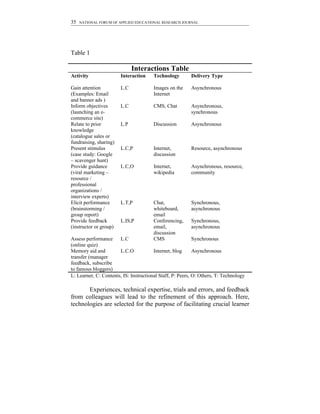
instructional events and expertise. The following template has been
designed adopting Hirumi’s (2002) proposed framework for designing
and sequencing online interactions. The first column lists instructional
activities or assessments and the item can be drawn from established
Seung Won Yoon 34


instructional methods, such as Gagne’s nine event of instruction,
guided discovery, or problem-based learning. Hirumi (2002) states
that the online learners’ interactions can be classified as learner-human
(instructor, peers, and others, such as workplace managers) or learner-
non-human (content, interface, and environment) entities. He
challenges that distance learning can encompass off-line activities,
such as visits to a local library or field experts. The last two columns
identify available technologies and the type of technologies being used
as a real-time (synchronous) or different time (asynchronous) delivery
tool or an information resource or community. I would like to note that
the same technology can be used in more than one delivery type and a
type of technology can utilize more than one tool. For instance, email
(asynchronous) can evolve as a mailing list (community), while a
community can be created among class members only or on the
Internet (to interact with others outside the course) and utilize a chat or
asynchronous discussion forums. Given the upsurge of numerous
online communities and resources, and the fact that our next
generation students spend more time on the Internet than books (for
gaining knowledge and information), the last two columns will
stimulate instructors to make better use of various technologies
converging on the Internet. A sketch plan to teach a course in online
marketing may look like the following (using the nine events of
instruction strategy):
35   NATIONAL FORUM OF APPLIED EDUCATIONAL RESEARCH JOURNAL


Table 1

                              Interactions Table
Activity                Interaction     Technology        Delivery Type

Gain attention          L.C             Images on the     Asynchronous
(Examples: Email                        Internet
and banner ads )
Inform objectives       L.C             CMS, Chat         Asynchronous,
(launching an e-                                          synchronous
commerce site)
Relate to prior         L.P             Discussion        Asynchronous
knowledge
(catalogue sales or
fundraising, sharing)
Present stimulus        L.C,P           Internet,         Resource, asynchronous
(case study: Google                     discussion
– scavenger hunt)
Provide guidance        L.C,O           Internet,         Asynchronous, resource,
(viral marketing –                      wikipedia         community
resource /
professional
organizations /
interview experts)
Elicit performance      L.T,P           Chat,             Synchronous,
(brainstorming /                        whiteboard,       asynchronous
group report)                           email
Provide feedback        L.IS,P          Conferencing,     Synchronous,
(instructor or group)                   email,            asynchronous
                                        discussion
Assess performance     L.C              CMS                 Synchronous
(online quiz)
Memory aid and         L.C.O            Internet, blog      Asynchronous
transfer (manager
feedback, subscribe
to famous bloggers)
L: Learner, C: Contents, IS: Instructional Staff, P: Peers, O: Others, T: Technology

       Experiences, technical expertise, trials and errors, and feedback
from colleagues will lead to the refinement of this approach. Here,
technologies are selected for the purpose of facilitating crucial learner
Seung Won Yoon 36


interactions. A balance among quantity, variety, and quality can be
also made in determining the sequence and type of learner interactions
and the types and frequency of technologies used for contents,
communications, and assessments.


                       Technology Alignments

        In an onsite classroom, when technological failures occur,
there is at least a teacher present to carry out the course. In online
education, however, a glitch in technology may mean a helpless
teacher or a learner with frustration from failed systems or inability to
participate. Quality learner interactions identified as important for
meaningful course experiences are only feasible when technologies are
simple to use for the instructor and the students, stable, sustainable,
scalable (in view of desired growth or changes), and most of all are
capable of enabling social interactions for the learner (4S+1S, Vaccare
& Sherman, 2001). Other technology selection frameworks also exist.
Reiser and Gagne (1982) show how different media, such as papers,
video, and computers compare in terms of capacity to produce,
disseminate, and replicate information. The ASSURE model (Analyze
needs, State objectives, Select methods, media, and materials, Utilize
media and materials, Require participation, and Evaluate and revise)
can help an instructor to consider major instructional factors in
selecting technologies. However, unlike the 4S+1S model, these seem
to be more appropriate for the course instructor to choose technologies
within a single course. The strength of the 4S+1S model is that it
applies a standardized methodology for planning and selecting
technologies addressing the needs of both instructors and
administrators. These frameworks are not mutually exclusive though.
The 4S+1S model can be used alone or in conjunction with the other
models in assessing whether technological arrangements are consistent
across multiple course environments or at a program level.
37   NATIONAL FORUM OF APPLIED EDUCATIONAL RESEARCH JOURNAL


            Expectations and Responsibilities of the Leaders

        Leaders may feel comfortable in seeing that their institution
has a faculty development center, provides online student-support
services, and offers workshops or monetary incentives for online
course development. However, if little feedback or dialogue is taking
place related to how the distance learning infrastructure promotes or
interferes with the students’ interacting with rich content materials,
instructional, technology, and student-support service staff members,
and various resources over the Internet, constructive and cooperative
collaborations can take place by centering dialogues around how
interactions are managed across different distance learning courses and
how technologies are effective or efficient in accomplishing those
interactions. Unless the structure of the course has been established,
instructors feel comfortable in using various delivery technologies, or
proper arrangements be made to assist with online course development
or delivery, faculty development initiatives can run into strong
resistance due to the fact that enabling important learner interactions in
distance learning course take greater amount of time and efforts on the
part of the instructors and require a strong interaction-supporting
technological infrastructure. Given that advancements and innovations
seem to better describe the current and future direction of technologies
and distance learning, leaders are in a position to ensure that
administrative, technology, and policy infrastructures are established
and supported to help the instructors implement various learner
interactions required for quality course experiences. Two perspectives
presented here, the conceptual framework of online interaction and the
4S+1S technology selection model should be helpful for dialogues to
happen for both the administrators and the instructors who are equally
charged to provide quality educational experiences for the students
and whose roles are mutually affecting and improving the practices of
the other.
Seung Won Yoon 38


                          REFERENCES


Allen, I. E., & Seaman, J. (2003). Sizing the Opportunity. The
     Quality and Extent of Online Education in the United States,
     2002 and 2003. Retrieved October 20, 2006, from
     http://www.sloan-
     c.org/publications/survey/pdf/entering_mainstream.pdf
Allen, I. E., & Seaman, J. (2004). Entering the Main Stream: The
     Quality and Extent of Online Education in the United States,
     2003 and 2004. Retrieved October 20, 2006 from
     http://www.sloan-
     c.org/publications/survey/pdf/entering_mainstream.pdf
Gandel, P. (2000). Top IT challenges for 2000. Educause Quarterly,
      2, 11-16.
Hirumi, A. (2002). A Framework to Analyzing, Designing, and
      Sequencing Planned E-Learning Interactions. Quarterly
      Review of Distance Education, 3(2), 141-160.
Milheim, W. (2001). Faculty and Administrative Strategies for the
      Effective Impementation of Distance Education. British
      Journal of Educational Technology, 32(5), 535-542.
Muilenburg, L. Y., & Berge, Z. L. (2001). Barriers to Distance
      Education: A Factor-Analytic Study. The American Journal of
      Distance Education, 15(2), 7-22.
Phipps, R., & Merisotis, J. (2000). Quality on the Line: Benchmark
       for Success in Internet-Based Education. Retrieved
       September 5, 2005, from
       http://www.ihep.com/Pubs/PDF/Quality.pdf
Reiser, R., & Gagne, R. (1982). Characteristics of Media Selection
        Models. Review of Educational Research, 52(4). 499-512.
39   NATIONAL FORUM OF APPLIED EDUCATIONAL RESEARCH JOURNAL


Smaldino, S. E., Molenda, M., Heinich, R., & Russell, J. D. (2005).
      Instructional Media and Technologies for Learning (8th ed.).
      Upper Saddle River, NJ: Prentice-Hall.
Vaccare, C., & Sherman, G. (2001). A Pragmatic Model for
       Instructional Technology Selection. In R. M. Branch & A.
       Fitzgerald (Eds.). Educational Technology and Media
       Yearbook (Vol. 27). Englewood, Colorado: Libraries
       Unlimited.
Yoon, S. W. (2003). Facilitating Learning in Online Environments.
    New Directions for Adult and Continuing Education, 100, 19-30.

2 yoon

  • 1.
    NATIONAL FORUM OFAPPLIED EDUCATIONAL RESEARCH JOURNAL VOLUME 21, NUMBER 1, 2007-2008 ONLINE EDUCATION SUCCESS FACTORS: ALIGING TECHNOLOGIES WITH INSTRUCTION Seung Won Yoon Western Illinois University ABSTRACT This article presents two conceptual frameworks, one for course instructors to balance instructional events, learner interactions, and technologies, and the other for administrators to create a simple, stable, sustainable, and scalable technology infrastructure that enables important learner interactions identified from the first framework. Discussion is also presented regarding how these two frameworks can facilitate constructive and supportive dialogues between instructors and administrators. H aving worn numerous hats for distance learning and having taught courses using numerous delivery technologies in the field of corporate training and instructional technology, I can strongly agree with the literature stating that distance learning in the U.S. higher education, especially online education which uses the Internet as a delivery tool is not only here to stay and grow (Allen & Seaman, 2003), but is viewed among more than half of the university professors as a very effective instructional medium that is capable of pulling an equal or greater quality course compared to their counterpart onsite courses (Allen & Seaman, 2004). The traditional distance education before the age of the Internet was characterized by the physical and temporal distance between the students and the instructor. And the nature of delayed or technology-mediated communication was not regarded as effective as that of the face-to- face. However, online education that utilizes modern communication and multimedia technologies at affordable cost has been rapidly 30
  • 2.
    31 NATIONAL FORUM OF APPLIED EDUCATIONAL RESEARCH JOURNAL adopted to reach approximately 3.2 million college students in 2005. Our daily instructional practices on campus seem to indicate a further growth of online education in that more online courses are being proposed to be developed and some onsite courses are continuously being converted to online in order to reach more or new groups of students, especially those who work. If not a full-pledged online course, very interesting trends are also happening for onsite courses to integrate more of online components, such as resources and cyber communities on the Internet or discussion forums on a Course Management System (CMS). New educational practices caused by changing technologies are challenging the higher education system in the U.S. Leaders must make prudent technology-related decisions in multiple areas, such as cyber security, information systems and services, reliable network, policy, quality distance education, IT funding and human resource management in the middle of limited budget (Gandel, 2000). My experiences in the area of online education, as a programmer, student, CMS consultant, development project manager, technology staff member, and an instructor support that tools of the trade will come and go, change, and advance, but a quality course is one that has been designed and implemented well regardless of technologies used. It is almost impossible to repeat a success unless the whole efforts to distance learning are the blend of pedagogy, technology, and organizational support which involve active feedback loops among key participants: instructional and technology staff members, leaders, and the learners (Yoon, 2003). Having these elements at hand will help the institution better prepare and manage their technological resources and also respond to the changing and growing demands of the users. Whether it is about migrating onto a new CMS (which has been reported as a time consuming and resource intensive task), assisting with the faculty members develop and deliver an online course, or adjusting course scheduling and enrollment policies, cooperation among multiple groups is crucial. The literature points out the particular importance of collaboration among administrators and faculty members (Milheim, 2001). Expecting instructors to be versatile
  • 3.
    Seung Won Yoon32 and adaptive to technological changes is a risky and imposing solution that is not likely to succeed. Milheim (2001) states that a high-level of interactivity should be ingrained into any distance learning programs and faculty members who deliver the educational experiences directly to the students need to be advised to know the needs for time and resources that administrators should put forth to ensure constructive policies and support. This paper aims to provide a framework through which dialogues can take place among those two parties to align technology-related decisions to support high interactivity in online courses. Distance Learning Success Factors Studies reported major factors contributing to the success or hindrance of distance learning at a program level. Phipps and Merisotis (2000) reported that institutional support, teaching and learning, course structure, student support, faculty support, and evaluation as important for successful distance learning, while the teaching and learning category was recognized as most critical. In contrast, factors such as ineffective administrative structure, organizational change, lack of technical expertise, poor social interaction and quality, lack of faculty compensation and time, threat of changing technologies, legal issues, ineffective evaluation, and poor student-support services were found as common distance learning barriers (Muilenburg & Berge, 2001). Although individuals’ learning styles and backgrounds can affect the student’s course experiences and how they learn from it, major success or barrier factors identified above commonly lead to the primary importance of interaction experiences enjoyed by the learners with various stakeholders, such as instructional, technology, and student-support service staff members, course contents, and resources on the Internet. Students’ course experiences will be largely shaped by their interactions with those and they in turn will affect their learning.
  • 4.
    33 NATIONAL FORUM OF APPLIED EDUCATIONAL RESEARCH JOURNAL In online education, all the students’ interactions are facilitated through the students’ interacting with and via technologies. Interactivity: Responsibilities of the Instructors An online course that does not balance the quantity, variety, and quality of student interactions runs a risk of becoming a busy, boring, or superficial course. With all good intentions, a course in the U.S. Civil war, marketing, or geography can be designed to utilize authoritative readings, video or audio recordings from the instructor, and diagnostic quizzes followed by peer discussions or a terminal examination. Hearing the benefit of reflecting and sharing of thoughts, instructors may want to add more activities or assessments hoping to promote collaboration among the learners. In onsite courses, with a little more planning and preparation, instructors can utilize various activities and resources on the Internet (probably at the speed of their thoughts and acts). However, in distance learning, they would soon find that not a single technology, even a very powerful and feature- rich CMS comes up very short to accommodate the instructor’s familiar course events and activities. The Internet provides numerous tutorials and if lucky, computing support on campus provides occasional workshops and laboratory visits for the instructor to better implement technologies to support their instructional practices. Unfortunately, my experiences indicate that this pattern is reactive and less than effective, particularly when technological features change. A more scalable and sustainable approach is necessary. Given that instructors are primarily responsible for designing the structure of a course and by teaching the course over time, know the most about the goal and contents of the course, utilizing technologies can be planned and determined around their familiar instructional events and expertise. The following template has been designed adopting Hirumi’s (2002) proposed framework for designing and sequencing online interactions. The first column lists instructional activities or assessments and the item can be drawn from established
  • 5.
    Seung Won Yoon34 instructional methods, such as Gagne’s nine event of instruction, guided discovery, or problem-based learning. Hirumi (2002) states that the online learners’ interactions can be classified as learner-human (instructor, peers, and others, such as workplace managers) or learner- non-human (content, interface, and environment) entities. He challenges that distance learning can encompass off-line activities, such as visits to a local library or field experts. The last two columns identify available technologies and the type of technologies being used as a real-time (synchronous) or different time (asynchronous) delivery tool or an information resource or community. I would like to note that the same technology can be used in more than one delivery type and a type of technology can utilize more than one tool. For instance, email (asynchronous) can evolve as a mailing list (community), while a community can be created among class members only or on the Internet (to interact with others outside the course) and utilize a chat or asynchronous discussion forums. Given the upsurge of numerous online communities and resources, and the fact that our next generation students spend more time on the Internet than books (for gaining knowledge and information), the last two columns will stimulate instructors to make better use of various technologies converging on the Internet. A sketch plan to teach a course in online marketing may look like the following (using the nine events of instruction strategy):
  • 6.
    35 NATIONAL FORUM OF APPLIED EDUCATIONAL RESEARCH JOURNAL Table 1 Interactions Table Activity Interaction Technology Delivery Type Gain attention L.C Images on the Asynchronous (Examples: Email Internet and banner ads ) Inform objectives L.C CMS, Chat Asynchronous, (launching an e- synchronous commerce site) Relate to prior L.P Discussion Asynchronous knowledge (catalogue sales or fundraising, sharing) Present stimulus L.C,P Internet, Resource, asynchronous (case study: Google discussion – scavenger hunt) Provide guidance L.C,O Internet, Asynchronous, resource, (viral marketing – wikipedia community resource / professional organizations / interview experts) Elicit performance L.T,P Chat, Synchronous, (brainstorming / whiteboard, asynchronous group report) email Provide feedback L.IS,P Conferencing, Synchronous, (instructor or group) email, asynchronous discussion Assess performance L.C CMS Synchronous (online quiz) Memory aid and L.C.O Internet, blog Asynchronous transfer (manager feedback, subscribe to famous bloggers) L: Learner, C: Contents, IS: Instructional Staff, P: Peers, O: Others, T: Technology Experiences, technical expertise, trials and errors, and feedback from colleagues will lead to the refinement of this approach. Here, technologies are selected for the purpose of facilitating crucial learner
  • 7.
    Seung Won Yoon36 interactions. A balance among quantity, variety, and quality can be also made in determining the sequence and type of learner interactions and the types and frequency of technologies used for contents, communications, and assessments. Technology Alignments In an onsite classroom, when technological failures occur, there is at least a teacher present to carry out the course. In online education, however, a glitch in technology may mean a helpless teacher or a learner with frustration from failed systems or inability to participate. Quality learner interactions identified as important for meaningful course experiences are only feasible when technologies are simple to use for the instructor and the students, stable, sustainable, scalable (in view of desired growth or changes), and most of all are capable of enabling social interactions for the learner (4S+1S, Vaccare & Sherman, 2001). Other technology selection frameworks also exist. Reiser and Gagne (1982) show how different media, such as papers, video, and computers compare in terms of capacity to produce, disseminate, and replicate information. The ASSURE model (Analyze needs, State objectives, Select methods, media, and materials, Utilize media and materials, Require participation, and Evaluate and revise) can help an instructor to consider major instructional factors in selecting technologies. However, unlike the 4S+1S model, these seem to be more appropriate for the course instructor to choose technologies within a single course. The strength of the 4S+1S model is that it applies a standardized methodology for planning and selecting technologies addressing the needs of both instructors and administrators. These frameworks are not mutually exclusive though. The 4S+1S model can be used alone or in conjunction with the other models in assessing whether technological arrangements are consistent across multiple course environments or at a program level.
  • 8.
    37 NATIONAL FORUM OF APPLIED EDUCATIONAL RESEARCH JOURNAL Expectations and Responsibilities of the Leaders Leaders may feel comfortable in seeing that their institution has a faculty development center, provides online student-support services, and offers workshops or monetary incentives for online course development. However, if little feedback or dialogue is taking place related to how the distance learning infrastructure promotes or interferes with the students’ interacting with rich content materials, instructional, technology, and student-support service staff members, and various resources over the Internet, constructive and cooperative collaborations can take place by centering dialogues around how interactions are managed across different distance learning courses and how technologies are effective or efficient in accomplishing those interactions. Unless the structure of the course has been established, instructors feel comfortable in using various delivery technologies, or proper arrangements be made to assist with online course development or delivery, faculty development initiatives can run into strong resistance due to the fact that enabling important learner interactions in distance learning course take greater amount of time and efforts on the part of the instructors and require a strong interaction-supporting technological infrastructure. Given that advancements and innovations seem to better describe the current and future direction of technologies and distance learning, leaders are in a position to ensure that administrative, technology, and policy infrastructures are established and supported to help the instructors implement various learner interactions required for quality course experiences. Two perspectives presented here, the conceptual framework of online interaction and the 4S+1S technology selection model should be helpful for dialogues to happen for both the administrators and the instructors who are equally charged to provide quality educational experiences for the students and whose roles are mutually affecting and improving the practices of the other.
  • 9.
    Seung Won Yoon38 REFERENCES Allen, I. E., & Seaman, J. (2003). Sizing the Opportunity. The Quality and Extent of Online Education in the United States, 2002 and 2003. Retrieved October 20, 2006, from http://www.sloan- c.org/publications/survey/pdf/entering_mainstream.pdf Allen, I. E., & Seaman, J. (2004). Entering the Main Stream: The Quality and Extent of Online Education in the United States, 2003 and 2004. Retrieved October 20, 2006 from http://www.sloan- c.org/publications/survey/pdf/entering_mainstream.pdf Gandel, P. (2000). Top IT challenges for 2000. Educause Quarterly, 2, 11-16. Hirumi, A. (2002). A Framework to Analyzing, Designing, and Sequencing Planned E-Learning Interactions. Quarterly Review of Distance Education, 3(2), 141-160. Milheim, W. (2001). Faculty and Administrative Strategies for the Effective Impementation of Distance Education. British Journal of Educational Technology, 32(5), 535-542. Muilenburg, L. Y., & Berge, Z. L. (2001). Barriers to Distance Education: A Factor-Analytic Study. The American Journal of Distance Education, 15(2), 7-22. Phipps, R., & Merisotis, J. (2000). Quality on the Line: Benchmark for Success in Internet-Based Education. Retrieved September 5, 2005, from http://www.ihep.com/Pubs/PDF/Quality.pdf Reiser, R., & Gagne, R. (1982). Characteristics of Media Selection Models. Review of Educational Research, 52(4). 499-512.
  • 10.
    39 NATIONAL FORUM OF APPLIED EDUCATIONAL RESEARCH JOURNAL Smaldino, S. E., Molenda, M., Heinich, R., & Russell, J. D. (2005). Instructional Media and Technologies for Learning (8th ed.). Upper Saddle River, NJ: Prentice-Hall. Vaccare, C., & Sherman, G. (2001). A Pragmatic Model for Instructional Technology Selection. In R. M. Branch & A. Fitzgerald (Eds.). Educational Technology and Media Yearbook (Vol. 27). Englewood, Colorado: Libraries Unlimited. Yoon, S. W. (2003). Facilitating Learning in Online Environments. New Directions for Adult and Continuing Education, 100, 19-30.