CSEDU 2012


     TRACING THE EMMERGING USE OF COMMUNICATION
          TECHNOLOGIES IN HIGHER EDUCATION:
                         A LITERATURE REVIEW


        MARTA PINTO, FRANCISLÊ SOUZA, FERNANDA NOGUEIRA, ANA BALULA,
         LUÍS PEDRO, LÚCIA POMBO, FERNANDO RAMOS, ANTÓNIO MOREIRA


               UNIVERSITY OF AVEIRO | DE-PROJECTO-TRACER@UA.PT
2/17


CSEDU 2012
1- INTRODUCTION

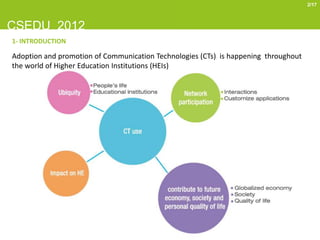
Adoption and promotion of Communication Technologies (CTs) is happening throughout
the world of Higher Education Institutions (HEIs)
3/17


CSEDU 2012
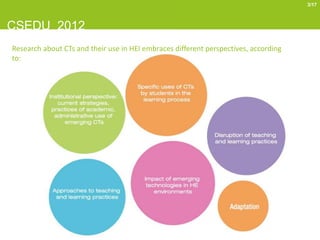
Research about CTs and their use in HEI embraces different perspectives, according
to:
4/17


CSEDU 2012
2- METHODOLOGY
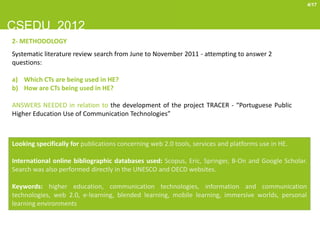
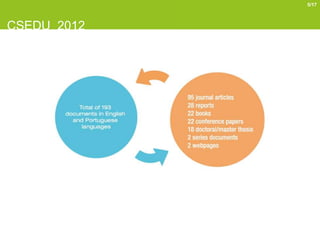
Systematic literature review search from June to November 2011 - attempting to answer 2
questions:

a) Which CTs are being used in HE?
b) How are CTs being used in HE?

ANSWERS NEEDED in relation to the development of the project TRACER - “Portuguese Public
Higher Education Use of Communication Technologies”


Looking specifically for publications concerning web 2.0 tools, services and platforms use in HE.

International online bibliographic databases used: Scopus, Eric, Springer, B-On and Google Scholar.
Search was also performed directly in the UNESCO and OECD websites.

Keywords: higher education, communication technologies, information and communication
technologies, web 2.0, e-learning, blended learning, mobile learning, immersive worlds, personal
learning environments
5/17


CSEDU 2012
6/17


CSEDU 2012
3- CTs USED IN HE TO SUPPORT TEACHING AND LEARNING PRACTICES
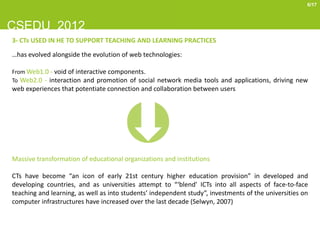
…has evolved alongside the evolution of web technologies:

From Web1.0 - void of interactive components.
To Web2.0 - interaction and promotion of social network media tools and applications, driving new
web experiences that potentiate connection and collaboration between users


Massive transformation of educational organizations and institutions

CTs have become “an icon of early 21st century higher education provision” in developed and
developing countries, and as universities attempt to “‘blend’ ICTs into all aspects of face-to-face
teaching and learning, as well as into students’ independent study”, investments of the universities on
computer infrastructures have increased over the last decade (Selwyn, 2007)
7/17


CSEDU 2012

Research with an international range concerning the specific use of web 2.0 in HE identifies:
• disparities between and within developed countries, concerning:
     • broadband infrastructure;
     • teacher training.
• need of faculty training in HE to effectively integrate and use CTs in both established and emerging
   teaching and learning methodologies.

The emergence of multimedia environments and technologies simultaneously driven change to occur
and contributed towards disruption of teaching and learning practices.

 Disruption:                                          No disruption:
 • Teaching methods
 • Teacher continuously negotiates authority          •   In the assessment methods and activities.
 • Students able to create knowledge and              •   Web tools which demand either
    manage information in different ways                  collaboration or reflection are less used
    (Wesch, 2009)                                         than face-to-face teaching (Blin & Munro,
 • Teaching and learning into a more student              2008)
    centred experience (Garrison & Anderson,
    2003)
 • Roles of teachers and students (Bielaczyc &
    Blake, 2006)
8/17


CSEDU 2012
3.1- TEACHING AND LEARNING SUPPORTED BY CTs
Distance Learning

All the systems referred to teaching and learning as being supported by CTs in both the delivery of
face-to-face and distance modes (Panda, 2005; Bryant, Kahle & Schafer 2005).

Comprises 3 learning paradigms: e-learning, b-learning, m-learning, c-learning


                        e-learning                                       b-learning

     A significant part of learning content made       Mix of face-to-face and online learning (Dias,
     available via the Internet (Punie & Cabrera,      2010; Garrison & Hanuca, 2004), requiring a
     2009), facilitating access to resources and       restructuring of the class, contact hours and
     services, exchanges and collaboration (CEC,       approach although “it is not clear how much
     2003);                                            or how little, online learning is inherent to
                                                       blended learning”(Garrison & Hanuca, 2004);
9/17


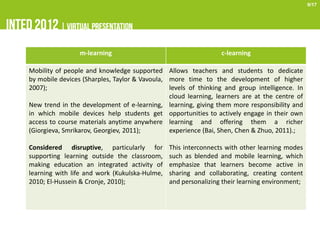
                 m-learning                                     c-learning

Mobility of people and knowledge supported Allows teachers and students to dedicate
by mobile devices (Sharples, Taylor & Vavoula, more time to the development of higher
2007);                                         levels of thinking and group intelligence. In
                                               cloud learning, learners are at the centre of
New trend in the development of e-learning, learning, giving them more responsibility and
in which mobile devices help students get opportunities to actively engage in their own
access to course materials anytime anywhere learning and offering them a richer
(Giorgieva, Smrikarov, Georgiev, 2011);        experience (Bai, Shen, Chen & Zhuo, 2011).;

Considered disruptive, particularly for        This interconnects with other learning modes
supporting learning outside the classroom,     such as blended and mobile learning, which
making education an integrated activity of     emphasize that learners become active in
learning with life and work (Kukulska-Hulme,   sharing and collaborating, creating content
2010; El-Hussein & Cronje, 2010);              and personalizing their learning environment;
10/17


CSEDU 2012
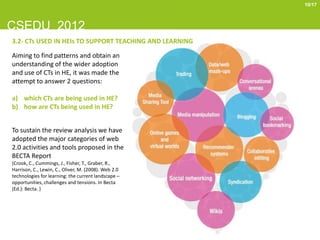
3.2- CTs USED IN HEIs TO SUPPORT TEACHING AND LEARNING

Aiming to find patterns and obtain an
understanding of the wider adoption
and use of CTs in HE, it was made the
attempt to answer 2 questions:

a) which CTs are being used in HE?
b) how are CTs being used in HE?


To sustain the review analysis we have
adopted the major categories of web
2.0 activities and tools proposed in the
BECTA Report
(Crook, C., Cummings, J., Fisher, T., Graber, R.,
Harrison, C., Lewin, C., Oliver, M. (2008). Web 2.0
technologies for learning: the current landscape –
opportunities, challenges and tensions. In Becta
(Ed.): Becta. )
11/17


CSEDU 2012
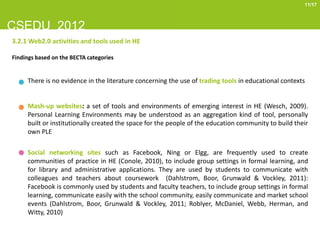
3.2.1 Web2.0 activities and tools used in HE

Findings based on the BECTA categories


     There is no evidence in the literature concerning the use of trading tools in educational contexts


     Mash-up websites: a set of tools and environments of emerging interest in HE (Wesch, 2009).
     Personal Learning Environments may be understood as an aggregation kind of tool, personally
     built or institutionally created the space for the people of the education community to build their
     own PLE

     Social networking sites such as Facebook, Ning or Elgg, are frequently used to create
     communities of practice in HE (Conole, 2010), to include group settings in formal learning, and
     for library and administrative applications. They are used by students to communicate with
     colleagues and teachers about coursework (Dahlstrom, Boor, Grunwald & Vockley, 2011):
     Facebook is commonly used by students and faculty teachers, to include group settings in formal
     learning, communicate easily with the school community, easily communicate and market school
     events (Dahlstrom, Boor, Grunwald & Vockley, 2011; Roblyer, McDaniel, Webb, Herman, and
     Witty, 2010)
12/17


CSEDU 2012
3.2.1 Web2.0 activities and tools used in HE


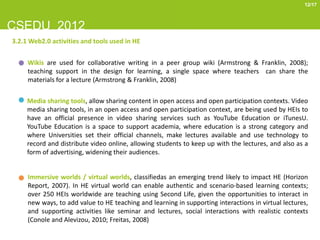
     Wikis are used for collaborative writing in a peer group wiki (Armstrong & Franklin, 2008);
     teaching support in the design for learning, a single space where teachers can share the
     materials for a lecture (Armstrong & Franklin, 2008)

     Media sharing tools, allow sharing content in open access and open participation contexts. Video
     media sharing tools, in an open access and open participation context, are being used by HEIs to
     have an official presence in video sharing services such as YouTube Education or iTunesU.
     YouTube Education is a space to support academia, where education is a strong category and
     where Universities set their official channels, make lectures available and use technology to
     record and distribute video online, allowing students to keep up with the lectures, and also as a
     form of advertising, widening their audiences.


     Immersive worlds / virtual worlds, classifiedas an emerging trend likely to impact HE (Horizon
     Report, 2007). In HE virtual world can enable authentic and scenario-based learning contexts;
     over 250 HEIs worldwide are teaching using Second Life, given the opportunities to interact in
     new ways, to add value to HE teaching and learning in supporting interactions in virtual lectures,
     and supporting activities like seminar and lectures, social interactions with realistic contexts
     (Conole and Alevizou, 2010; Freitas, 2008)
13/17


CSEDU 2012
4- DISCUSSIONS AND RESEARCH AIMS
14/17


CSEDU 2012
4- DISCUSSIONS AND RESEARCH AIMS
15/17


CSEDU 2012
16/17


CSEDU 2012
5- FINAL CONSIDERATIONS

     CTs have a confirmed use in HE
     Use of social Web tools and environments is a trend in teaching and learning practices in HE,
     placing challenges to teachers, students, and institutions, at the level of the interaction,
     production and delivery of educational content

     Ubiquity of web2.0 tools revealed a strong relation to the idea of disruptive changes of more
     traditional forms of education in HE
      Use of CTs may not always potentiate innovation: social web tools are also used as a support
      for already existing educational processes and structures of teaching and learning previously
      used. The expectation is for teaching and learning practices to change along with an effective
      integration and innovative use of CTs.
     But there is change, considered by some to be a disruptive change, showing that teaching and
     learning practices have a progressive, effective and innovative integration of CTs in HE. This
     reflects on the changing roles adopted by teachers and students.
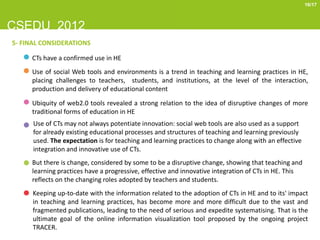
      Keeping up-to-date with the information related to the adoption of CTs in HE and to its' impact
      in teaching and learning practices, has become more and more difficult due to the vast and
      fragmented publications, leading to the need of serious and expedite systematising. That is the
      ultimate goal of the online information visualization tool proposed by the ongoing project
      TRACER.
2/
CSEDU 2012


          THANK YOU FOR YOUR ATTENTION!


       http://cms.ua.pt/TRACER

CSEDU2012 presentation

  • 1.
    CSEDU 2012 TRACING THE EMMERGING USE OF COMMUNICATION TECHNOLOGIES IN HIGHER EDUCATION: A LITERATURE REVIEW MARTA PINTO, FRANCISLÊ SOUZA, FERNANDA NOGUEIRA, ANA BALULA, LUÍS PEDRO, LÚCIA POMBO, FERNANDO RAMOS, ANTÓNIO MOREIRA UNIVERSITY OF AVEIRO | DE-PROJECTO-TRACER@UA.PT
  • 2.
    2/17 CSEDU 2012 1- INTRODUCTION Adoptionand promotion of Communication Technologies (CTs) is happening throughout the world of Higher Education Institutions (HEIs)
  • 3.
    3/17 CSEDU 2012 Research aboutCTs and their use in HEI embraces different perspectives, according to:
  • 4.
    4/17 CSEDU 2012 2- METHODOLOGY Systematicliterature review search from June to November 2011 - attempting to answer 2 questions: a) Which CTs are being used in HE? b) How are CTs being used in HE? ANSWERS NEEDED in relation to the development of the project TRACER - “Portuguese Public Higher Education Use of Communication Technologies” Looking specifically for publications concerning web 2.0 tools, services and platforms use in HE. International online bibliographic databases used: Scopus, Eric, Springer, B-On and Google Scholar. Search was also performed directly in the UNESCO and OECD websites. Keywords: higher education, communication technologies, information and communication technologies, web 2.0, e-learning, blended learning, mobile learning, immersive worlds, personal learning environments
  • 5.
  • 6.
    6/17 CSEDU 2012 3- CTsUSED IN HE TO SUPPORT TEACHING AND LEARNING PRACTICES …has evolved alongside the evolution of web technologies: From Web1.0 - void of interactive components. To Web2.0 - interaction and promotion of social network media tools and applications, driving new web experiences that potentiate connection and collaboration between users Massive transformation of educational organizations and institutions CTs have become “an icon of early 21st century higher education provision” in developed and developing countries, and as universities attempt to “‘blend’ ICTs into all aspects of face-to-face teaching and learning, as well as into students’ independent study”, investments of the universities on computer infrastructures have increased over the last decade (Selwyn, 2007)
  • 7.
    7/17 CSEDU 2012 Research withan international range concerning the specific use of web 2.0 in HE identifies: • disparities between and within developed countries, concerning: • broadband infrastructure; • teacher training. • need of faculty training in HE to effectively integrate and use CTs in both established and emerging teaching and learning methodologies. The emergence of multimedia environments and technologies simultaneously driven change to occur and contributed towards disruption of teaching and learning practices. Disruption: No disruption: • Teaching methods • Teacher continuously negotiates authority • In the assessment methods and activities. • Students able to create knowledge and • Web tools which demand either manage information in different ways collaboration or reflection are less used (Wesch, 2009) than face-to-face teaching (Blin & Munro, • Teaching and learning into a more student 2008) centred experience (Garrison & Anderson, 2003) • Roles of teachers and students (Bielaczyc & Blake, 2006)
  • 8.
    8/17 CSEDU 2012 3.1- TEACHINGAND LEARNING SUPPORTED BY CTs Distance Learning All the systems referred to teaching and learning as being supported by CTs in both the delivery of face-to-face and distance modes (Panda, 2005; Bryant, Kahle & Schafer 2005). Comprises 3 learning paradigms: e-learning, b-learning, m-learning, c-learning e-learning b-learning A significant part of learning content made Mix of face-to-face and online learning (Dias, available via the Internet (Punie & Cabrera, 2010; Garrison & Hanuca, 2004), requiring a 2009), facilitating access to resources and restructuring of the class, contact hours and services, exchanges and collaboration (CEC, approach although “it is not clear how much 2003); or how little, online learning is inherent to blended learning”(Garrison & Hanuca, 2004);
  • 9.
    9/17 m-learning c-learning Mobility of people and knowledge supported Allows teachers and students to dedicate by mobile devices (Sharples, Taylor & Vavoula, more time to the development of higher 2007); levels of thinking and group intelligence. In cloud learning, learners are at the centre of New trend in the development of e-learning, learning, giving them more responsibility and in which mobile devices help students get opportunities to actively engage in their own access to course materials anytime anywhere learning and offering them a richer (Giorgieva, Smrikarov, Georgiev, 2011); experience (Bai, Shen, Chen & Zhuo, 2011).; Considered disruptive, particularly for This interconnects with other learning modes supporting learning outside the classroom, such as blended and mobile learning, which making education an integrated activity of emphasize that learners become active in learning with life and work (Kukulska-Hulme, sharing and collaborating, creating content 2010; El-Hussein & Cronje, 2010); and personalizing their learning environment;
  • 10.
    10/17 CSEDU 2012 3.2- CTsUSED IN HEIs TO SUPPORT TEACHING AND LEARNING Aiming to find patterns and obtain an understanding of the wider adoption and use of CTs in HE, it was made the attempt to answer 2 questions: a) which CTs are being used in HE? b) how are CTs being used in HE? To sustain the review analysis we have adopted the major categories of web 2.0 activities and tools proposed in the BECTA Report (Crook, C., Cummings, J., Fisher, T., Graber, R., Harrison, C., Lewin, C., Oliver, M. (2008). Web 2.0 technologies for learning: the current landscape – opportunities, challenges and tensions. In Becta (Ed.): Becta. )
  • 11.
    11/17 CSEDU 2012 3.2.1 Web2.0activities and tools used in HE Findings based on the BECTA categories There is no evidence in the literature concerning the use of trading tools in educational contexts Mash-up websites: a set of tools and environments of emerging interest in HE (Wesch, 2009). Personal Learning Environments may be understood as an aggregation kind of tool, personally built or institutionally created the space for the people of the education community to build their own PLE Social networking sites such as Facebook, Ning or Elgg, are frequently used to create communities of practice in HE (Conole, 2010), to include group settings in formal learning, and for library and administrative applications. They are used by students to communicate with colleagues and teachers about coursework (Dahlstrom, Boor, Grunwald & Vockley, 2011): Facebook is commonly used by students and faculty teachers, to include group settings in formal learning, communicate easily with the school community, easily communicate and market school events (Dahlstrom, Boor, Grunwald & Vockley, 2011; Roblyer, McDaniel, Webb, Herman, and Witty, 2010)
  • 12.
    12/17 CSEDU 2012 3.2.1 Web2.0activities and tools used in HE Wikis are used for collaborative writing in a peer group wiki (Armstrong & Franklin, 2008); teaching support in the design for learning, a single space where teachers can share the materials for a lecture (Armstrong & Franklin, 2008) Media sharing tools, allow sharing content in open access and open participation contexts. Video media sharing tools, in an open access and open participation context, are being used by HEIs to have an official presence in video sharing services such as YouTube Education or iTunesU. YouTube Education is a space to support academia, where education is a strong category and where Universities set their official channels, make lectures available and use technology to record and distribute video online, allowing students to keep up with the lectures, and also as a form of advertising, widening their audiences. Immersive worlds / virtual worlds, classifiedas an emerging trend likely to impact HE (Horizon Report, 2007). In HE virtual world can enable authentic and scenario-based learning contexts; over 250 HEIs worldwide are teaching using Second Life, given the opportunities to interact in new ways, to add value to HE teaching and learning in supporting interactions in virtual lectures, and supporting activities like seminar and lectures, social interactions with realistic contexts (Conole and Alevizou, 2010; Freitas, 2008)
  • 13.
  • 14.
  • 15.
  • 16.
    16/17 CSEDU 2012 5- FINALCONSIDERATIONS CTs have a confirmed use in HE Use of social Web tools and environments is a trend in teaching and learning practices in HE, placing challenges to teachers, students, and institutions, at the level of the interaction, production and delivery of educational content Ubiquity of web2.0 tools revealed a strong relation to the idea of disruptive changes of more traditional forms of education in HE Use of CTs may not always potentiate innovation: social web tools are also used as a support for already existing educational processes and structures of teaching and learning previously used. The expectation is for teaching and learning practices to change along with an effective integration and innovative use of CTs. But there is change, considered by some to be a disruptive change, showing that teaching and learning practices have a progressive, effective and innovative integration of CTs in HE. This reflects on the changing roles adopted by teachers and students. Keeping up-to-date with the information related to the adoption of CTs in HE and to its' impact in teaching and learning practices, has become more and more difficult due to the vast and fragmented publications, leading to the need of serious and expedite systematising. That is the ultimate goal of the online information visualization tool proposed by the ongoing project TRACER.
  • 17.
    2/ CSEDU 2012 THANK YOU FOR YOUR ATTENTION! http://cms.ua.pt/TRACER