Ana Mercedes García.
                               English Major
                                Year 2011
       Management of Technological Resources for the Teaching and
             Administration of the English Language (Part III)

                     VARK INVENTORY LEARNING STYLE

The purpose of this report is to show that people have a variety of different
approaches of learning and how people use information for effective learning,
communicate more effectively, and perform well in tests and examinations.

In order to be able to identify our learning style to understand the different
learning strategies that can we applied in our studies we will use a guide to
learning styles known as VARK . The acronym VARK stands for Visual, Aural,
Read/write, and Kinesthetic sensory modalities that are used for learning
information. There is some overlap between categories.

VARK is a questionnaire that provides users with a profile of their learning
preferences. These preferences are about the ways that they want to take-in and
give-out information

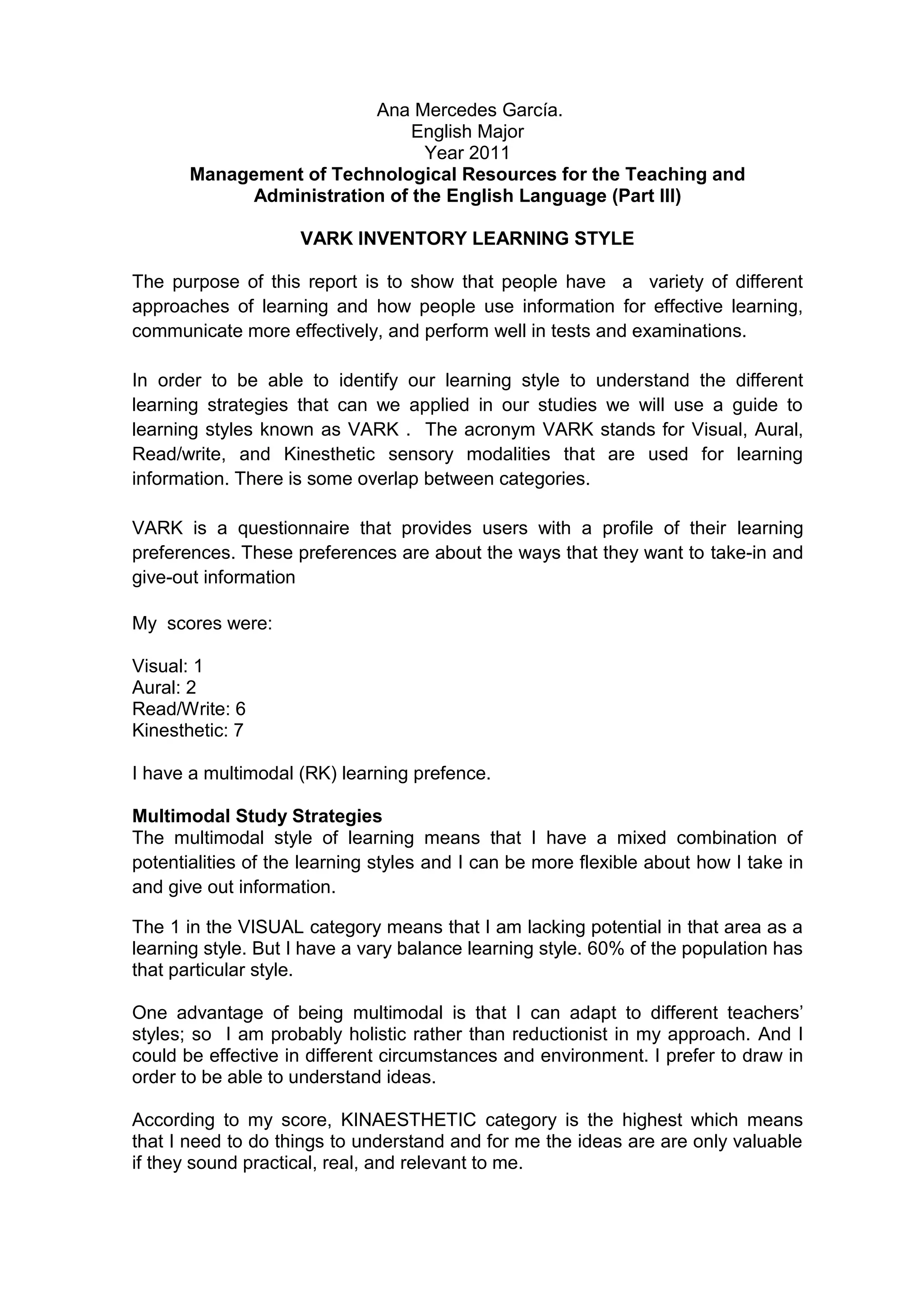
My scores were:

Visual: 1
Aural: 2
Read/Write: 6
Kinesthetic: 7

I have a multimodal (RK) learning prefence.

Multimodal Study Strategies
The multimodal style of learning means that I have a mixed combination of
potentialities of the learning styles and I can be more flexible about how I take in
and give out information.

The 1 in the VISUAL category means that I am lacking potential in that area as a
learning style. But I have a vary balance learning style. 60% of the population has
that particular style.

One advantage of being multimodal is that I can adapt to different teachers’
styles; so I am probably holistic rather than reductionist in my approach. And I
could be effective in different circumstances and environment. I prefer to draw in
order to be able to understand ideas.

According to my score, KINAESTHETIC category is the highest which means
that I need to do things to understand and for me the ideas are are only valuable
if they sound practical, real, and relevant to me.
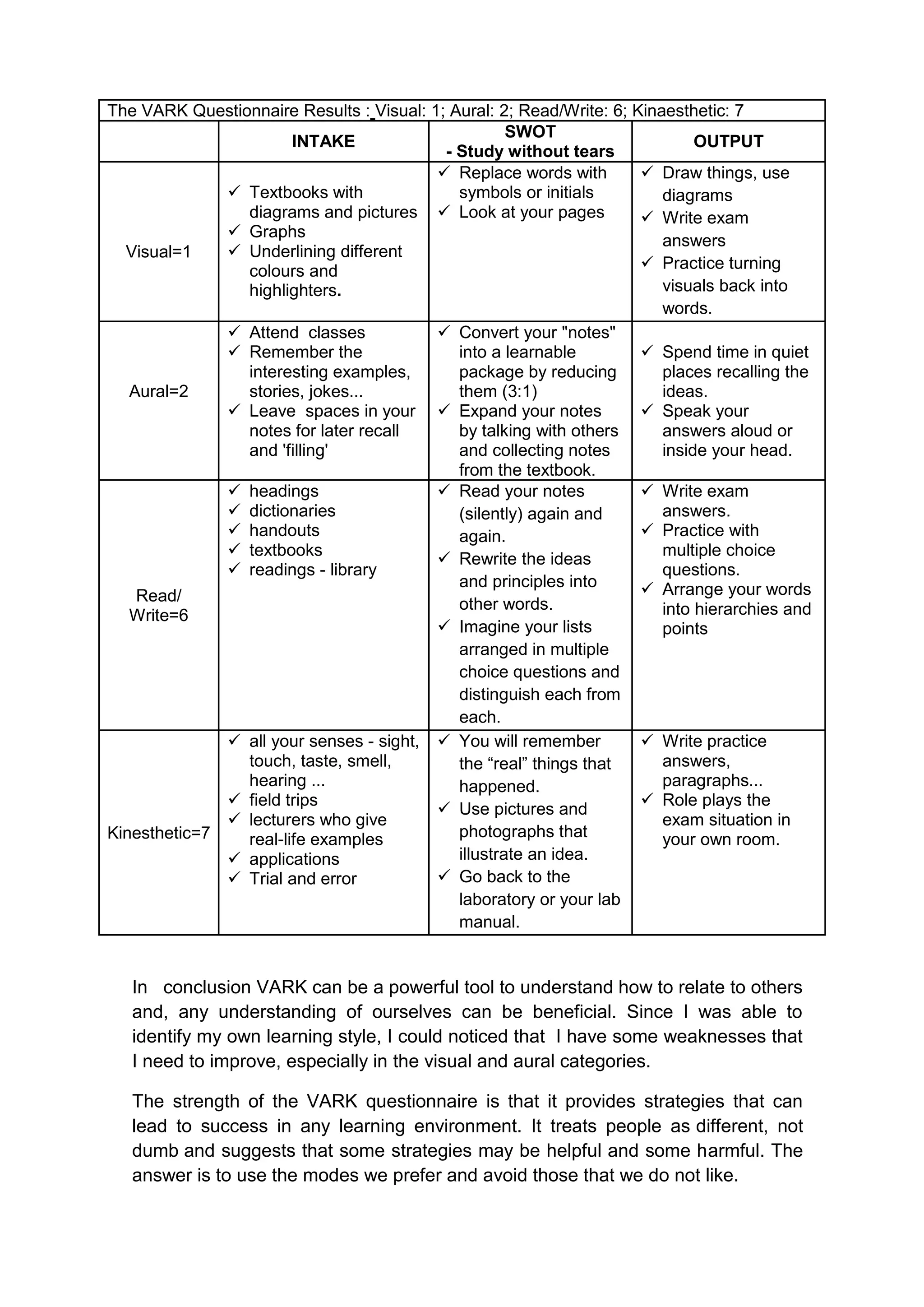
The VARK Questionnaire Results : Visual: 1; Aural: 2; Read/Write: 6; Kinaesthetic: 7
                                                     SWOT
                       INTAKE                                                 OUTPUT
                                           - Study without tears
                                           Replace words with         Draw things, use
               Textbooks with               symbols or initials         diagrams
                diagrams and pictures  Look at your pages             Write exam
               Graphs
                                                                         answers
  Visual=1     Underlining different
                colours and                                            Practice turning
                highlighters.                                            visuals back into
                                                                         words.
               Attend classes             Convert your "notes"
               Remember the                 into a learnable          Spend time in quiet
                interesting examples,        package by reducing         places recalling the
   Aural=2      stories, jokes...            them (3:1)                  ideas.
               Leave spaces in your  Expand your notes               Speak your
                notes for later recall       by talking with others      answers aloud or
                and 'filling'                and collecting notes        inside your head.
                                             from the textbook.
               headings                   Read your notes            Write exam
               dictionaries                 (silently) again and        answers.
               handouts                     again.                    Practice with
               textbooks                                                multiple choice
                                           Rewrite the ideas
               readings - library                                       questions.
                                             and principles into       Arrange your words
    Read/                                    other words.
   Write=6                                                               into hierarchies and
                                           Imagine your lists           points
                                             arranged in multiple
                                             choice questions and
                                             distinguish each from
                                             each.
               all your senses - sight,  You will remember           Write practice
                touch, taste, smell,         the “real” things that      answers,
                hearing ...                  happened.                   paragraphs...
               field trips                                            Role plays the
                                           Use pictures and
               lecturers who give                                       exam situation in
Kinesthetic=7   real-life examples           photographs that            your own room.
               applications                 illustrate an idea.
               Trial and error            Go back to the
                                             laboratory or your lab
                                             manual.


   In conclusion VARK can be a powerful tool to understand how to relate to others
   and, any understanding of ourselves can be beneficial. Since I was able to
   identify my own learning style, I could noticed that I have some weaknesses that
   I need to improve, especially in the visual and aural categories.

   The strength of the VARK questionnaire is that it provides strategies that can
   lead to success in any learning environment. It treats people as different, not
   dumb and suggests that some strategies may be helpful and some harmful. The
   answer is to use the modes we prefer and avoid those that we do not like.

2 vark inventory learning style

  • 1.
    Ana Mercedes García. English Major Year 2011 Management of Technological Resources for the Teaching and Administration of the English Language (Part III) VARK INVENTORY LEARNING STYLE The purpose of this report is to show that people have a variety of different approaches of learning and how people use information for effective learning, communicate more effectively, and perform well in tests and examinations. In order to be able to identify our learning style to understand the different learning strategies that can we applied in our studies we will use a guide to learning styles known as VARK . The acronym VARK stands for Visual, Aural, Read/write, and Kinesthetic sensory modalities that are used for learning information. There is some overlap between categories. VARK is a questionnaire that provides users with a profile of their learning preferences. These preferences are about the ways that they want to take-in and give-out information My scores were: Visual: 1 Aural: 2 Read/Write: 6 Kinesthetic: 7 I have a multimodal (RK) learning prefence. Multimodal Study Strategies The multimodal style of learning means that I have a mixed combination of potentialities of the learning styles and I can be more flexible about how I take in and give out information. The 1 in the VISUAL category means that I am lacking potential in that area as a learning style. But I have a vary balance learning style. 60% of the population has that particular style. One advantage of being multimodal is that I can adapt to different teachers’ styles; so I am probably holistic rather than reductionist in my approach. And I could be effective in different circumstances and environment. I prefer to draw in order to be able to understand ideas. According to my score, KINAESTHETIC category is the highest which means that I need to do things to understand and for me the ideas are are only valuable if they sound practical, real, and relevant to me.
  • 2.
    The VARK QuestionnaireResults : Visual: 1; Aural: 2; Read/Write: 6; Kinaesthetic: 7 SWOT INTAKE OUTPUT - Study without tears  Replace words with  Draw things, use  Textbooks with symbols or initials diagrams diagrams and pictures  Look at your pages  Write exam  Graphs answers Visual=1  Underlining different colours and  Practice turning highlighters. visuals back into words.  Attend classes  Convert your "notes"  Remember the into a learnable  Spend time in quiet interesting examples, package by reducing places recalling the Aural=2 stories, jokes... them (3:1) ideas.  Leave spaces in your  Expand your notes  Speak your notes for later recall by talking with others answers aloud or and 'filling' and collecting notes inside your head. from the textbook.  headings  Read your notes  Write exam  dictionaries (silently) again and answers.  handouts again.  Practice with  textbooks multiple choice  Rewrite the ideas  readings - library questions. and principles into  Arrange your words Read/ other words. Write=6 into hierarchies and  Imagine your lists points arranged in multiple choice questions and distinguish each from each.  all your senses - sight,  You will remember  Write practice touch, taste, smell, the “real” things that answers, hearing ... happened. paragraphs...  field trips  Role plays the  Use pictures and  lecturers who give exam situation in Kinesthetic=7 real-life examples photographs that your own room.  applications illustrate an idea.  Trial and error  Go back to the laboratory or your lab manual. In conclusion VARK can be a powerful tool to understand how to relate to others and, any understanding of ourselves can be beneficial. Since I was able to identify my own learning style, I could noticed that I have some weaknesses that I need to improve, especially in the visual and aural categories. The strength of the VARK questionnaire is that it provides strategies that can lead to success in any learning environment. It treats people as different, not dumb and suggests that some strategies may be helpful and some harmful. The answer is to use the modes we prefer and avoid those that we do not like.