CONDITIONAL
TYPE 2
SECOND YEAR BACK
UNIT EIGHT
GRAMMAR PRACTICE
PROPOSED BY:
HICHAM LAAOUINA
NEXT
Read this paragraph about Bassou:
2
This is bassou. He is 11 years old.
So, he walks to and from school for three or four hours every day. He misses many
lessons because he often arrives late in class. Back at home, he helps with the farm
He lives in a remote area on the Atlas Mountains.
work as his father is very old. Bassou doesn’t perform well at school. Therefore, he
is very sad.
NEXTPREVIOUS
3
So, the paragraph above describes Bassou’s real life in the present.
We notice that all the verbs in the paragraph are conjugated in the present simple.
Now, let us imagine a different life for Bassou and see what his life would be like.
To change facts about the present into imaginary situations, We have to rewrite our
sentences into CONDITIONAL TYPE TWO.
A) FORM OF CONDITIONAL TYPE TWO:
IF + PAST SIMPLE + WOULD + VERB (INFINITIVE)
WOULD + VERB (INFINITIVE) + IF + PAST SIMPLE




NEXTPREVIOUS
4
Would change into:
he wouldn’t walk for 3 or 4 hours … every day.If Bassou didn’t live in a remote area,
We use CONDITIONAL TYPE TWO to talk about imaginary, unreal,
hypothetical situations in the present.
Bassou lives in a remote area. So, he walks for 3 or 4 hours to and from school every day.
CAUSE EFFECT
So, the sentences:
B) FUNCTION OF CONDITIONAL TYPE TWO
‫يسكن‬‫نائية‬ ‫منطقة‬ ‫في‬ ‫باسو‬.‫ٳ‬‫ذن‬‫هو‬ ،‫يمشي‬‫المدرسة‬ ‫ومن‬ ‫الى‬ ‫ساعات‬ ‫أربع‬ ‫أو‬ ‫ثالث‬ ‫مدة‬.
‫لو‬‫يسكن‬ ‫كان‬ ‫ما‬‫نائية‬ ‫منطقة‬ ‫في‬ ‫باسو‬،‫مشى‬ ‫لما‬‫المدرسة‬ ‫ومن‬ ‫الى‬ ‫ساعات‬ ‫أربع‬ ‫أو‬ ‫ثالث‬ ‫مدة‬.
NEXTPREVIOUS
5
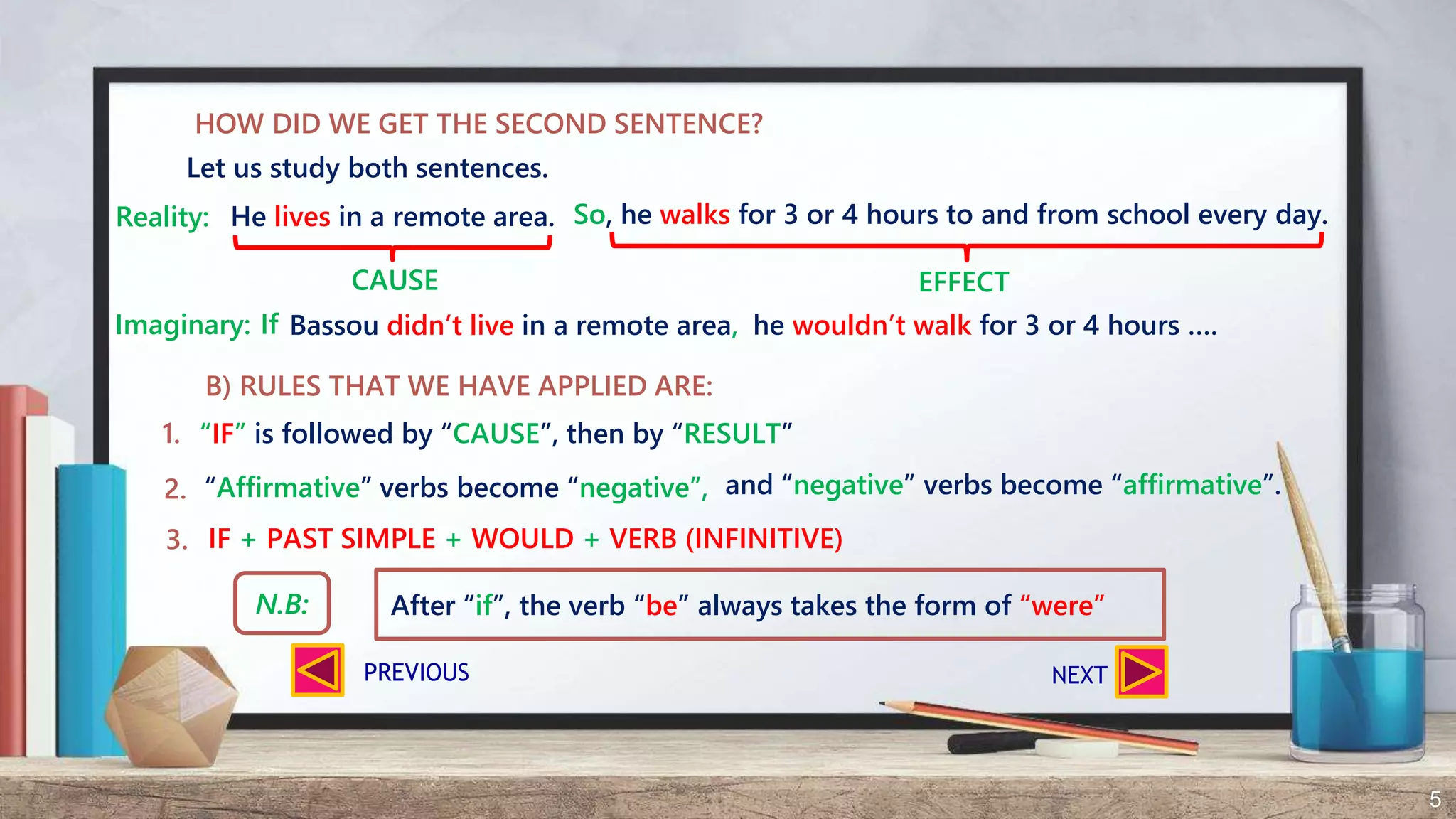
HOW DID WE GET THE SECOND SENTENCE?
He lives in a remote area. So, he walks for 3 or 4 hours to and from school every day.
CAUSE EFFECT
B) RULES THAT WE HAVE APPLIED ARE:
and “negative” verbs become “affirmative”.“Affirmative” verbs become “negative”,
“IF” is followed by “CAUSE”, then by “RESULT”
IF + PAST SIMPLE + WOULD + VERB (INFINITIVE)
Let us study both sentences.
Reality:
Imaginary: he wouldn’t walk for 3 or 4 hours ….If Bassou didn’t live in a remote area,
1.
2.
3.
N.B: After “if”, the verb “be” always takes the form of “were”
NEXTPREVIOUS
6
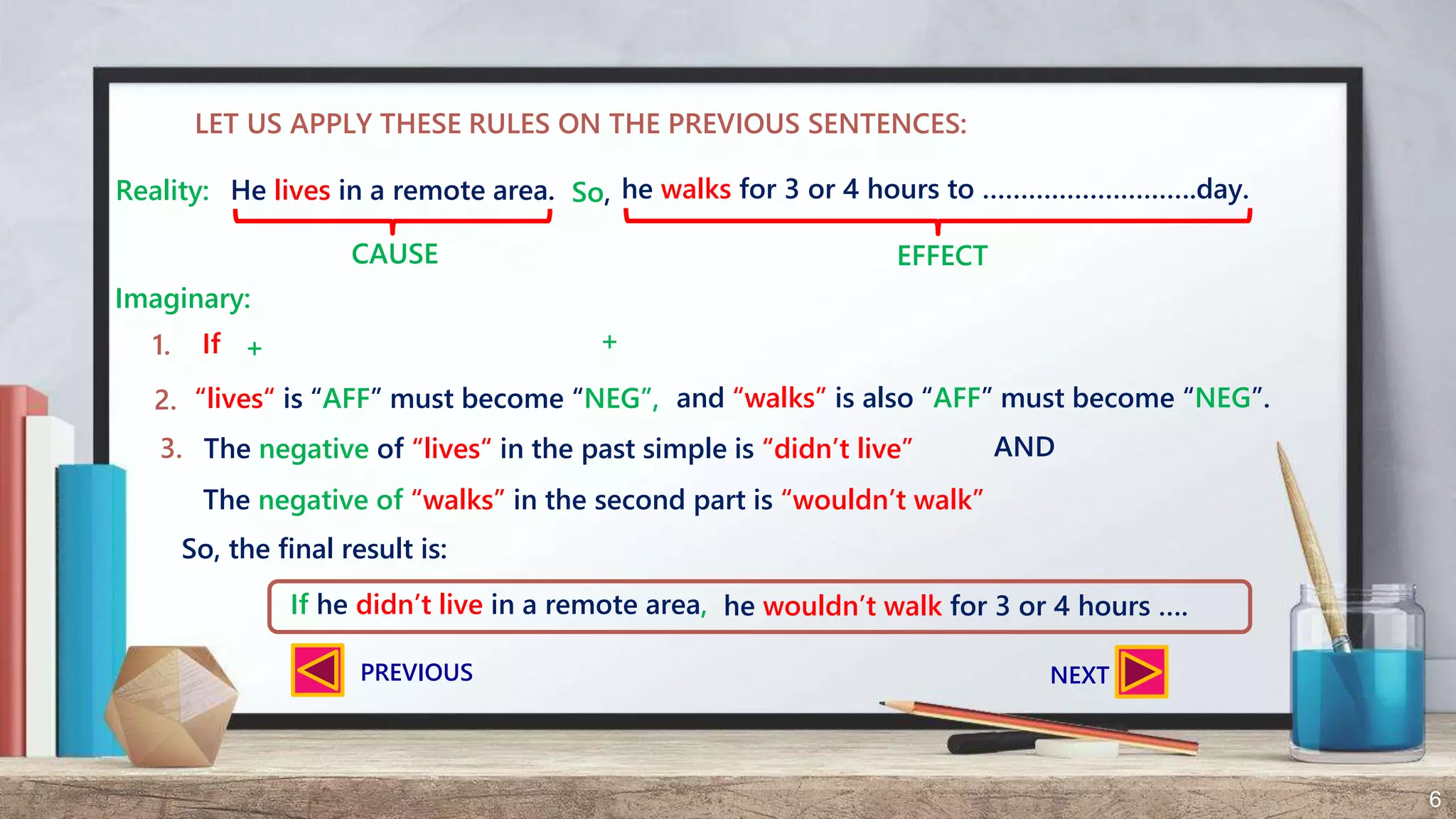
LET US APPLY THESE RULES ON THE PREVIOUS SENTENCES:
He lives in a remote area. he walks for 3 or 4 hours to ……………………….day.
CAUSE EFFECT
and “walks” is also “AFF” must become “NEG”.“lives“ is “AFF” must become “NEG”,
If
The negative of “lives“ in the past simple is “didn’t live”
Reality:
Imaginary:
he wouldn’t walk for 3 or 4 hours ….If he didn’t live in a remote area,
1.
2.
3.
+ +
So,
The negative of “walks” in the second part is “wouldn’t walk”
So, the final result is:
AND
NEXTPREVIOUS
7
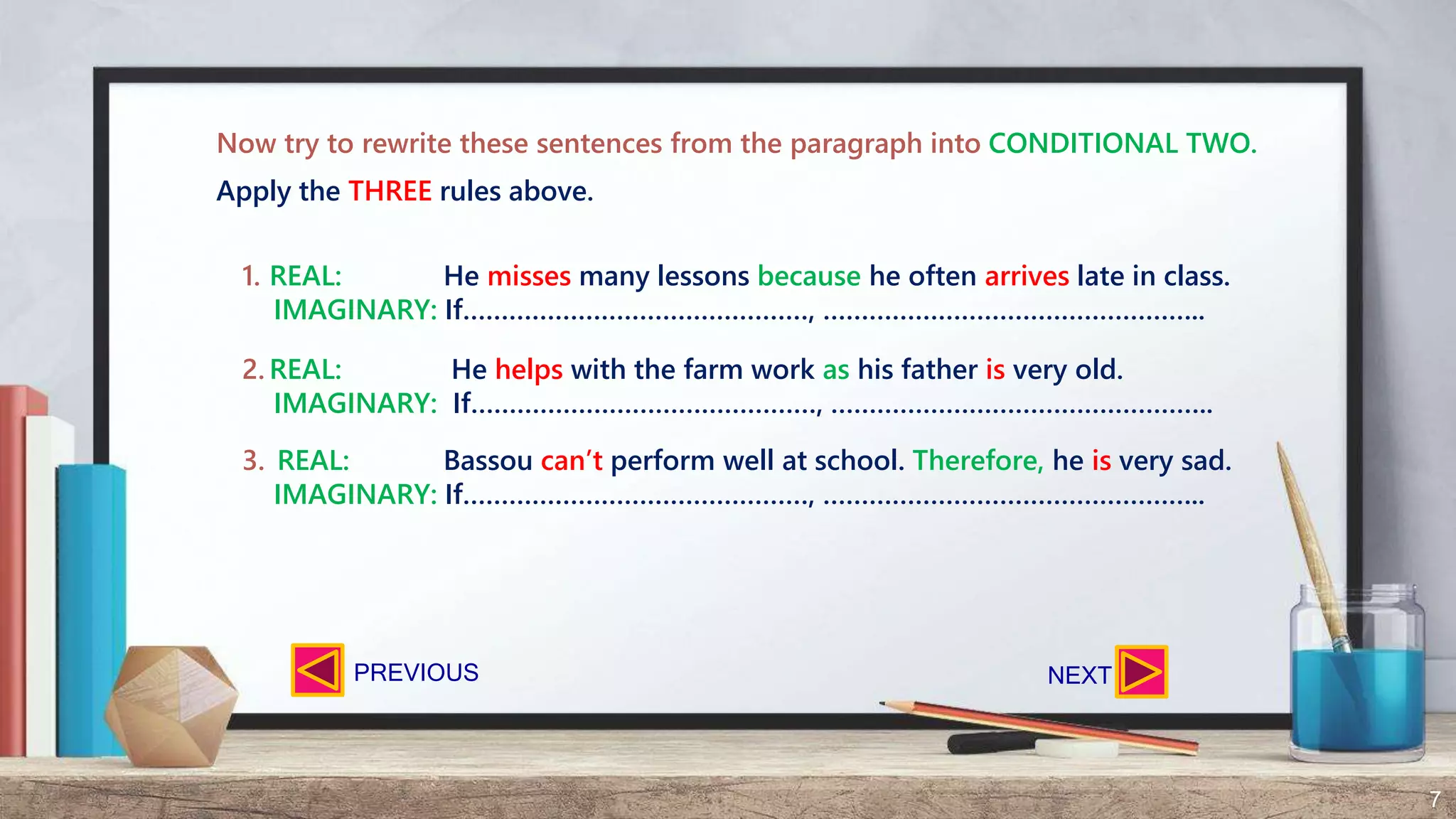
Now try to rewrite these sentences from the paragraph into CONDITIONAL TWO.
1. REAL: He misses many lessons because he often arrives late in class.
IMAGINARY: If………………………………………, …………………………………………..
2. REAL: He helps with the farm work as his father is very old.
IMAGINARY: If………………………………………, …………………………………………..
3. REAL: Bassou can’t perform well at school. Therefore, he is very sad.
IMAGINARY: If………………………………………, …………………………………………..
Apply the THREE rules above.
NEXTPREVIOUS
8
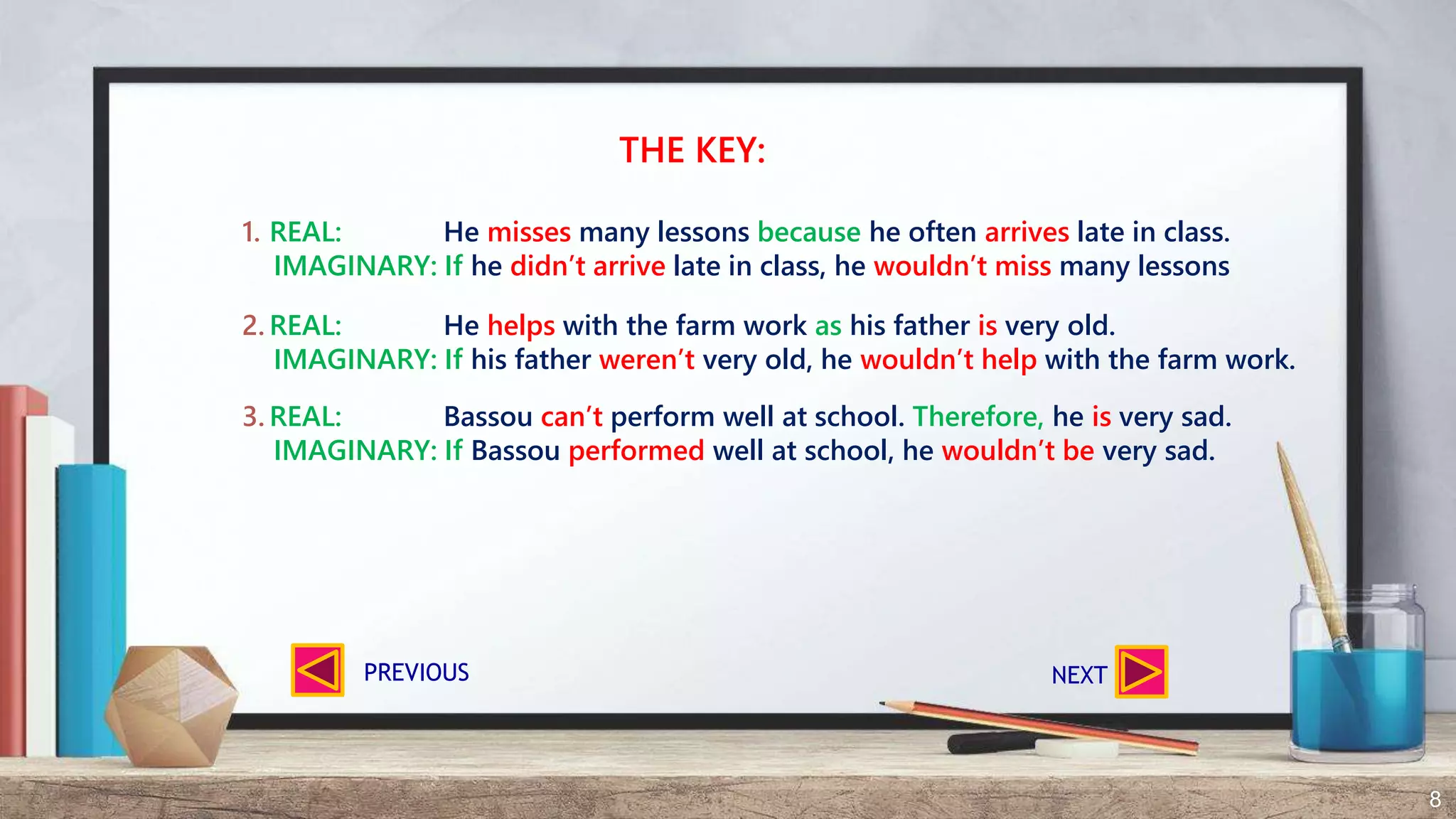
THE KEY:
1. REAL: He misses many lessons because he often arrives late in class.
IMAGINARY: If he didn’t arrive late in class, he wouldn’t miss many lessons
2. REAL: He helps with the farm work as his father is very old.
IMAGINARY: If his father weren’t very old, he wouldn’t help with the farm work.
3. REAL: Bassou can’t perform well at school. Therefore, he is very sad.
IMAGINARY: If Bassou performed well at school, he wouldn’t be very sad.
NEXTPREVIOUS
9
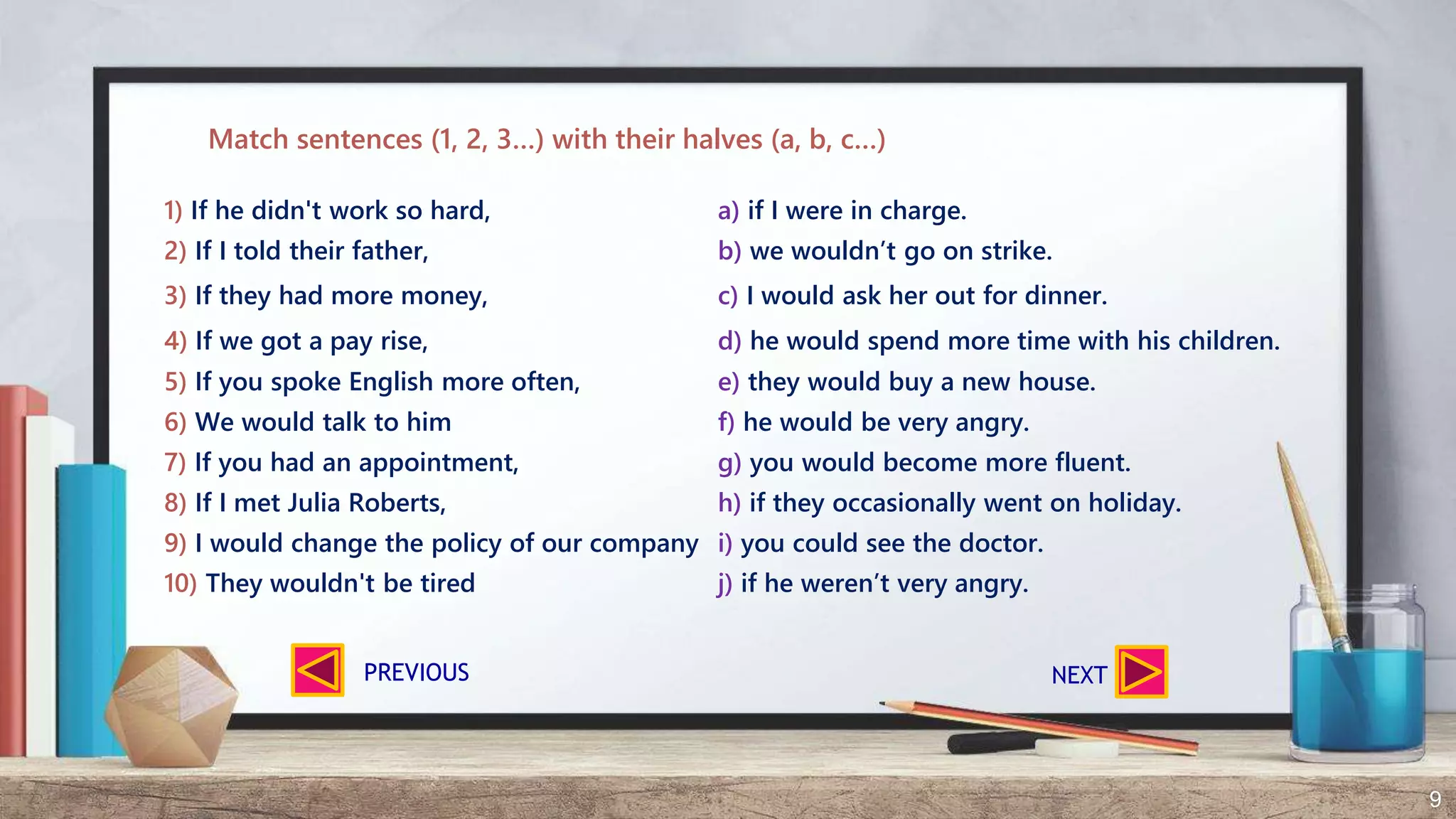
1) If he didn't work so hard, a) if I were in charge.
2) If I told their father, b) we wouldn’t go on strike.
3) If they had more money, c) I would ask her out for dinner.
4) If we got a pay rise, d) he would spend more time with his children.
5) If you spoke English more often, e) they would buy a new house.
6) We would talk to him f) he would be very angry.
7) If you had an appointment, g) you would become more fluent.
8) If I met Julia Roberts, h) if they occasionally went on holiday.
9) I would change the policy of our company i) you could see the doctor.
10) They wouldn't be tired j) if he weren’t very angry.
Match sentences (1, 2, 3…) with their halves (a, b, c…)
NEXTPREVIOUS
10
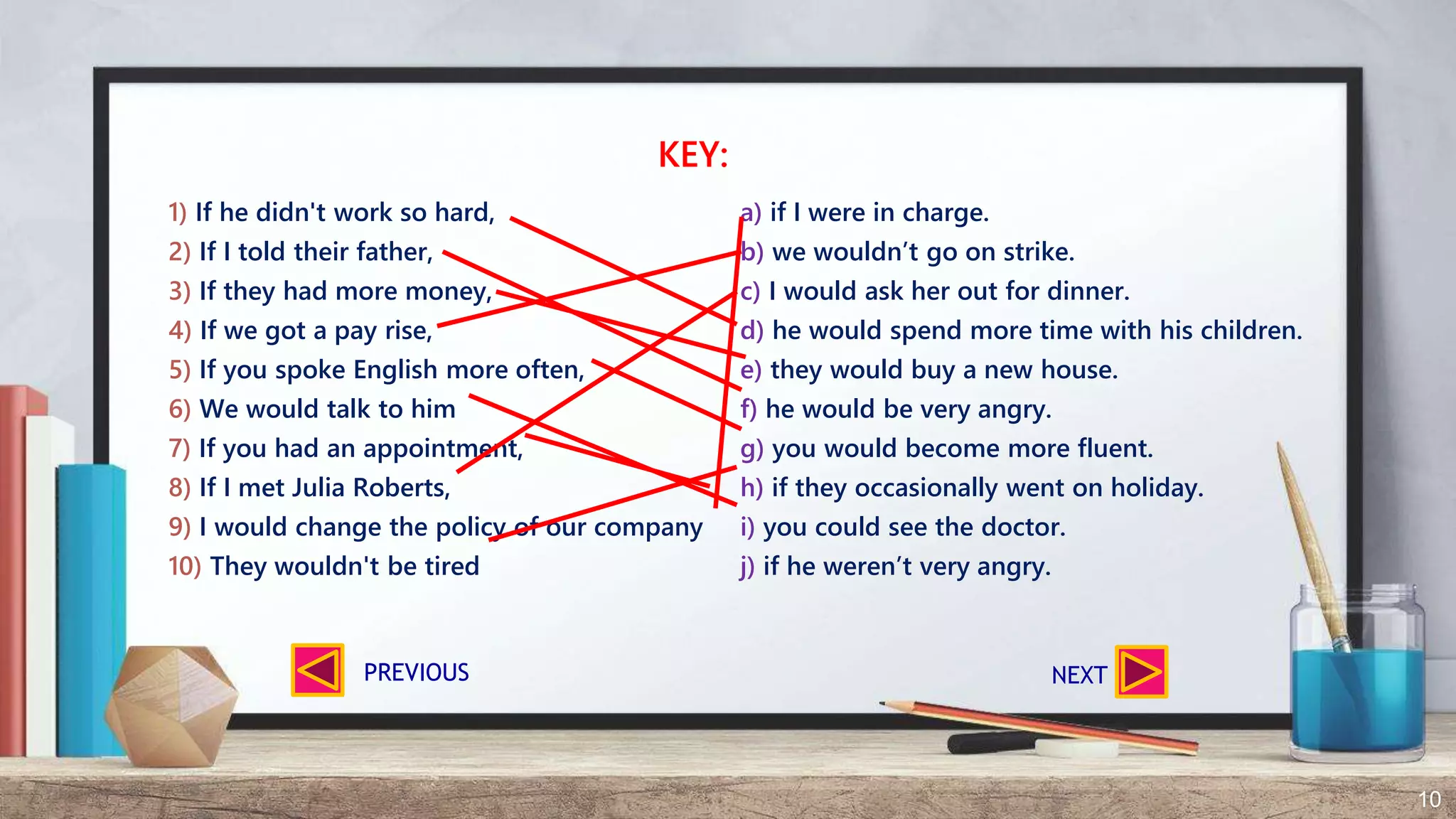
1) If he didn't work so hard, a) if I were in charge.
2) If I told their father, b) we wouldn’t go on strike.
3) If they had more money, c) I would ask her out for dinner.
4) If we got a pay rise, d) he would spend more time with his children.
5) If you spoke English more often, e) they would buy a new house.
6) We would talk to him f) he would be very angry.
7) If you had an appointment, g) you would become more fluent.
8) If I met Julia Roberts, h) if they occasionally went on holiday.
9) I would change the policy of our company i) you could see the doctor.
10) They wouldn't be tired j) if he weren’t very angry.
KEY:
NEXTPREVIOUS
11
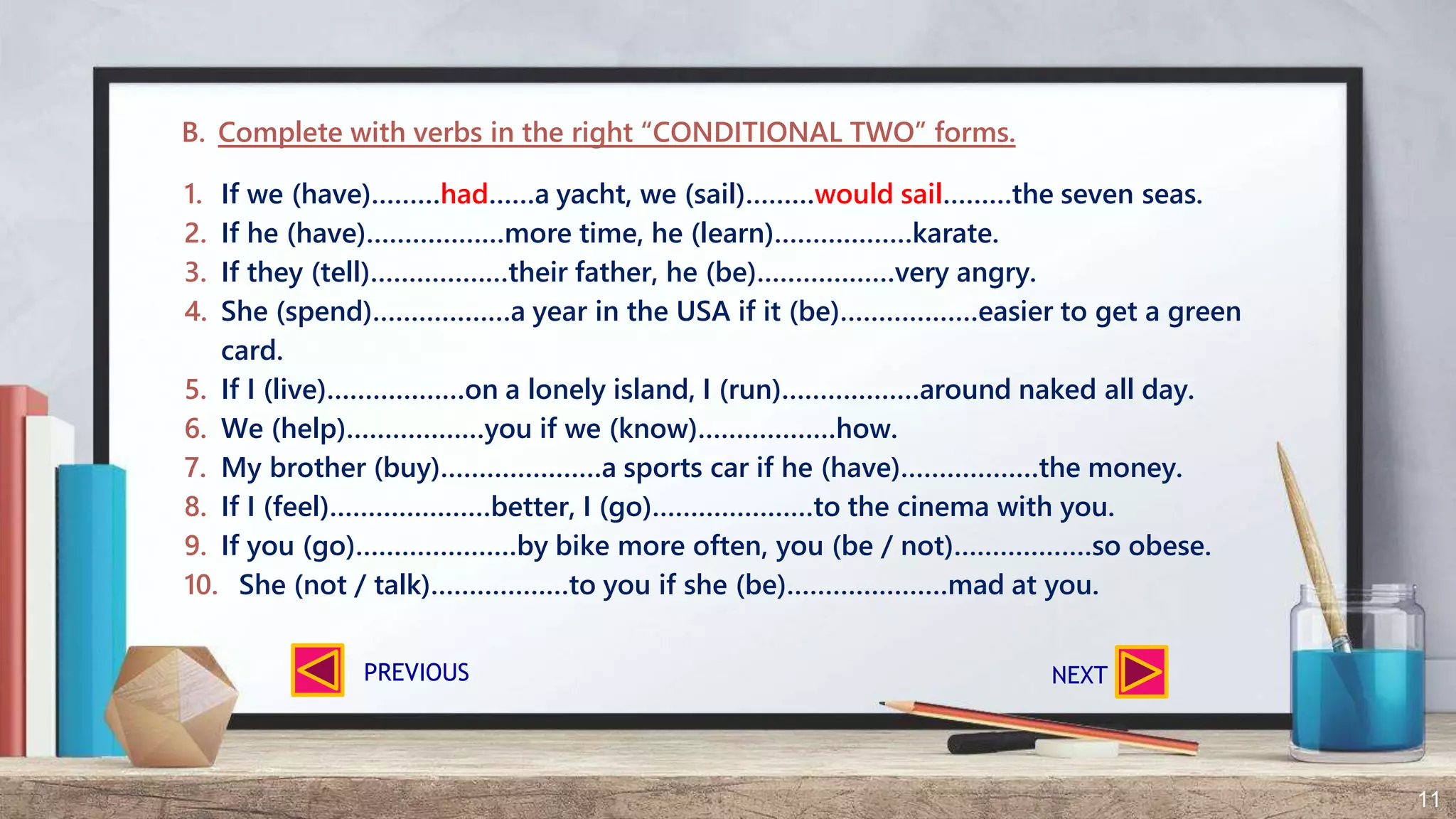
1. If we (have)………had……a yacht, we (sail)………would sail………the seven seas.
2. If he (have)………………more time, he (learn)………………karate.
3. If they (tell)………………their father, he (be)………………very angry.
4. She (spend)………………a year in the USA if it (be)………………easier to get a green
card.
5. If I (live)………………on a lonely island, I (run)………………around naked all day.
6. We (help)………………you if we (know)………………how.
7. My brother (buy)…………………a sports car if he (have)………………the money.
8. If I (feel)…………………better, I (go)…………………to the cinema with you.
9. If you (go)…………………by bike more often, you (be / not)………………so obese.
10. She (not / talk)………………to you if she (be)…………………mad at you.
B. Complete with verbs in the right “CONDITIONAL TWO” forms.
NEXTPREVIOUS
12
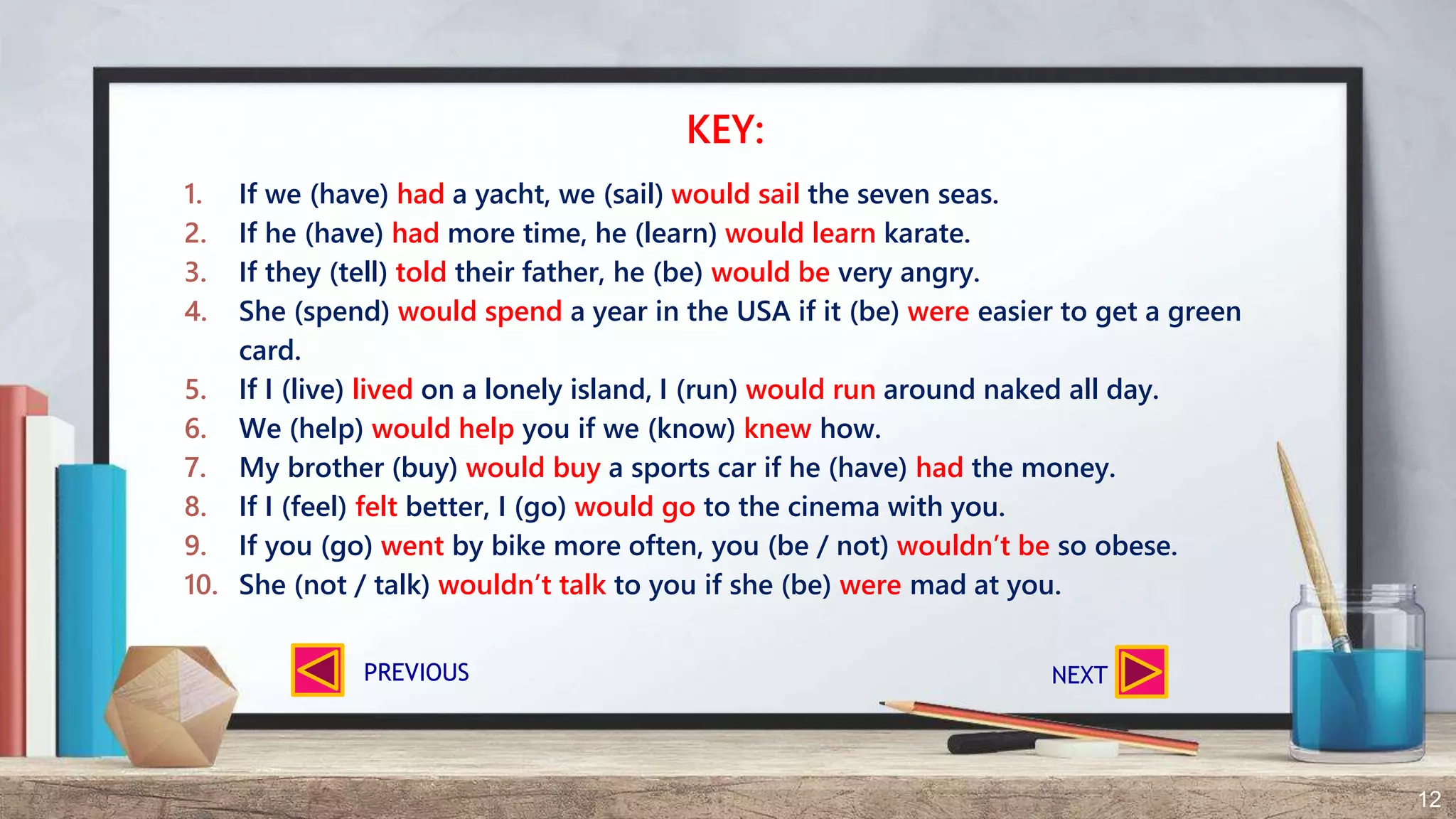
1. If we (have) had a yacht, we (sail) would sail the seven seas.
2. If he (have) had more time, he (learn) would learn karate.
3. If they (tell) told their father, he (be) would be very angry.
4. She (spend) would spend a year in the USA if it (be) were easier to get a green
card.
5. If I (live) lived on a lonely island, I (run) would run around naked all day.
6. We (help) would help you if we (know) knew how.
7. My brother (buy) would buy a sports car if he (have) had the money.
8. If I (feel) felt better, I (go) would go to the cinema with you.
9. If you (go) went by bike more often, you (be / not) wouldn’t be so obese.
10. She (not / talk) wouldn’t talk to you if she (be) were mad at you.
KEY:
NEXTPREVIOUS
13
EXAMPLE: 1. I don’t know his phone number. So, I can’t call him.
If I knew his phone number, I would call him.
2. She goes to the countryside every weekend because she loves nature.
3. They don’t know the way to Marrakech. So, they are lost.
4. Paul goes out too much because his parents don’t care for him.
5. You eat too much sugary food. As a result, you have bad teeth.
6. I don’t trust Nancy because she is a big liar.
7. You don’t do your job perfectly. Consequently, your boss is angry at you.
8. There are a lot of road accidents because people drive too fast.
9. She isn’t a very gifted actress. So, film directors don’t give lead roles.
10. You can’t save enough money since you spend a lot on clothes.
C) Rewrite these sentences into conditional type 2:
NEXTPREVIOUS
14
1. If I knew his phone number, I could call him.
2. If she didn’t love nature, she wouldn’t go to the countryside every weekend.
3. If they knew the way to Marrakech, they wouldn’t be lost.
4. If his parents cared for him, Paul wouldn’t go out too much.
5. If you didn’t eat too much sugary food, you wouldn’t have bad teeth.
6. If Nancy weren’t a big liar, I would trust her.
7. If you did your job perfectly, your boss wouldn’t be angry at you.
8. If people didn’t drive too fast, there wouldn’t be a lot of road accidents.
9. If she were a very gifted actress, film directors would give her lead roles.
10. If you didn’t spend a lot on clothes, you could save enough money.
KEY:
NEXTPREVIOUS
15
a. won a one million dollar?
b. saw a ghost under your bed?
c. met Christiano Ronaldo?
d. didn’t watch too much TV?
e. were a president?
f. didn’t see?
D) Now, what would you do if you
EXITPREVIOUS

Conditional type 2

  • 1.
    CONDITIONAL TYPE 2 SECOND YEARBACK UNIT EIGHT GRAMMAR PRACTICE PROPOSED BY: HICHAM LAAOUINA NEXT
  • 2.
    Read this paragraphabout Bassou: 2 This is bassou. He is 11 years old. So, he walks to and from school for three or four hours every day. He misses many lessons because he often arrives late in class. Back at home, he helps with the farm He lives in a remote area on the Atlas Mountains. work as his father is very old. Bassou doesn’t perform well at school. Therefore, he is very sad. NEXTPREVIOUS
  • 3.
    3 So, the paragraphabove describes Bassou’s real life in the present. We notice that all the verbs in the paragraph are conjugated in the present simple. Now, let us imagine a different life for Bassou and see what his life would be like. To change facts about the present into imaginary situations, We have to rewrite our sentences into CONDITIONAL TYPE TWO. A) FORM OF CONDITIONAL TYPE TWO: IF + PAST SIMPLE + WOULD + VERB (INFINITIVE) WOULD + VERB (INFINITIVE) + IF + PAST SIMPLE     NEXTPREVIOUS
  • 4.
    4 Would change into: hewouldn’t walk for 3 or 4 hours … every day.If Bassou didn’t live in a remote area, We use CONDITIONAL TYPE TWO to talk about imaginary, unreal, hypothetical situations in the present. Bassou lives in a remote area. So, he walks for 3 or 4 hours to and from school every day. CAUSE EFFECT So, the sentences: B) FUNCTION OF CONDITIONAL TYPE TWO ‫يسكن‬‫نائية‬ ‫منطقة‬ ‫في‬ ‫باسو‬.‫ٳ‬‫ذن‬‫هو‬ ،‫يمشي‬‫المدرسة‬ ‫ومن‬ ‫الى‬ ‫ساعات‬ ‫أربع‬ ‫أو‬ ‫ثالث‬ ‫مدة‬. ‫لو‬‫يسكن‬ ‫كان‬ ‫ما‬‫نائية‬ ‫منطقة‬ ‫في‬ ‫باسو‬،‫مشى‬ ‫لما‬‫المدرسة‬ ‫ومن‬ ‫الى‬ ‫ساعات‬ ‫أربع‬ ‫أو‬ ‫ثالث‬ ‫مدة‬. NEXTPREVIOUS
  • 5.
    5 HOW DID WEGET THE SECOND SENTENCE? He lives in a remote area. So, he walks for 3 or 4 hours to and from school every day. CAUSE EFFECT B) RULES THAT WE HAVE APPLIED ARE: and “negative” verbs become “affirmative”.“Affirmative” verbs become “negative”, “IF” is followed by “CAUSE”, then by “RESULT” IF + PAST SIMPLE + WOULD + VERB (INFINITIVE) Let us study both sentences. Reality: Imaginary: he wouldn’t walk for 3 or 4 hours ….If Bassou didn’t live in a remote area, 1. 2. 3. N.B: After “if”, the verb “be” always takes the form of “were” NEXTPREVIOUS
  • 6.
    6 LET US APPLYTHESE RULES ON THE PREVIOUS SENTENCES: He lives in a remote area. he walks for 3 or 4 hours to ……………………….day. CAUSE EFFECT and “walks” is also “AFF” must become “NEG”.“lives“ is “AFF” must become “NEG”, If The negative of “lives“ in the past simple is “didn’t live” Reality: Imaginary: he wouldn’t walk for 3 or 4 hours ….If he didn’t live in a remote area, 1. 2. 3. + + So, The negative of “walks” in the second part is “wouldn’t walk” So, the final result is: AND NEXTPREVIOUS
  • 7.
    7 Now try torewrite these sentences from the paragraph into CONDITIONAL TWO. 1. REAL: He misses many lessons because he often arrives late in class. IMAGINARY: If………………………………………, ………………………………………….. 2. REAL: He helps with the farm work as his father is very old. IMAGINARY: If………………………………………, ………………………………………….. 3. REAL: Bassou can’t perform well at school. Therefore, he is very sad. IMAGINARY: If………………………………………, ………………………………………….. Apply the THREE rules above. NEXTPREVIOUS
  • 8.
    8 THE KEY: 1. REAL:He misses many lessons because he often arrives late in class. IMAGINARY: If he didn’t arrive late in class, he wouldn’t miss many lessons 2. REAL: He helps with the farm work as his father is very old. IMAGINARY: If his father weren’t very old, he wouldn’t help with the farm work. 3. REAL: Bassou can’t perform well at school. Therefore, he is very sad. IMAGINARY: If Bassou performed well at school, he wouldn’t be very sad. NEXTPREVIOUS
  • 9.
    9 1) If hedidn't work so hard, a) if I were in charge. 2) If I told their father, b) we wouldn’t go on strike. 3) If they had more money, c) I would ask her out for dinner. 4) If we got a pay rise, d) he would spend more time with his children. 5) If you spoke English more often, e) they would buy a new house. 6) We would talk to him f) he would be very angry. 7) If you had an appointment, g) you would become more fluent. 8) If I met Julia Roberts, h) if they occasionally went on holiday. 9) I would change the policy of our company i) you could see the doctor. 10) They wouldn't be tired j) if he weren’t very angry. Match sentences (1, 2, 3…) with their halves (a, b, c…) NEXTPREVIOUS
  • 10.
    10 1) If hedidn't work so hard, a) if I were in charge. 2) If I told their father, b) we wouldn’t go on strike. 3) If they had more money, c) I would ask her out for dinner. 4) If we got a pay rise, d) he would spend more time with his children. 5) If you spoke English more often, e) they would buy a new house. 6) We would talk to him f) he would be very angry. 7) If you had an appointment, g) you would become more fluent. 8) If I met Julia Roberts, h) if they occasionally went on holiday. 9) I would change the policy of our company i) you could see the doctor. 10) They wouldn't be tired j) if he weren’t very angry. KEY: NEXTPREVIOUS
  • 11.
    11 1. If we(have)………had……a yacht, we (sail)………would sail………the seven seas. 2. If he (have)………………more time, he (learn)………………karate. 3. If they (tell)………………their father, he (be)………………very angry. 4. She (spend)………………a year in the USA if it (be)………………easier to get a green card. 5. If I (live)………………on a lonely island, I (run)………………around naked all day. 6. We (help)………………you if we (know)………………how. 7. My brother (buy)…………………a sports car if he (have)………………the money. 8. If I (feel)…………………better, I (go)…………………to the cinema with you. 9. If you (go)…………………by bike more often, you (be / not)………………so obese. 10. She (not / talk)………………to you if she (be)…………………mad at you. B. Complete with verbs in the right “CONDITIONAL TWO” forms. NEXTPREVIOUS
  • 12.
    12 1. If we(have) had a yacht, we (sail) would sail the seven seas. 2. If he (have) had more time, he (learn) would learn karate. 3. If they (tell) told their father, he (be) would be very angry. 4. She (spend) would spend a year in the USA if it (be) were easier to get a green card. 5. If I (live) lived on a lonely island, I (run) would run around naked all day. 6. We (help) would help you if we (know) knew how. 7. My brother (buy) would buy a sports car if he (have) had the money. 8. If I (feel) felt better, I (go) would go to the cinema with you. 9. If you (go) went by bike more often, you (be / not) wouldn’t be so obese. 10. She (not / talk) wouldn’t talk to you if she (be) were mad at you. KEY: NEXTPREVIOUS
  • 13.
    13 EXAMPLE: 1. Idon’t know his phone number. So, I can’t call him. If I knew his phone number, I would call him. 2. She goes to the countryside every weekend because she loves nature. 3. They don’t know the way to Marrakech. So, they are lost. 4. Paul goes out too much because his parents don’t care for him. 5. You eat too much sugary food. As a result, you have bad teeth. 6. I don’t trust Nancy because she is a big liar. 7. You don’t do your job perfectly. Consequently, your boss is angry at you. 8. There are a lot of road accidents because people drive too fast. 9. She isn’t a very gifted actress. So, film directors don’t give lead roles. 10. You can’t save enough money since you spend a lot on clothes. C) Rewrite these sentences into conditional type 2: NEXTPREVIOUS
  • 14.
    14 1. If Iknew his phone number, I could call him. 2. If she didn’t love nature, she wouldn’t go to the countryside every weekend. 3. If they knew the way to Marrakech, they wouldn’t be lost. 4. If his parents cared for him, Paul wouldn’t go out too much. 5. If you didn’t eat too much sugary food, you wouldn’t have bad teeth. 6. If Nancy weren’t a big liar, I would trust her. 7. If you did your job perfectly, your boss wouldn’t be angry at you. 8. If people didn’t drive too fast, there wouldn’t be a lot of road accidents. 9. If she were a very gifted actress, film directors would give her lead roles. 10. If you didn’t spend a lot on clothes, you could save enough money. KEY: NEXTPREVIOUS
  • 15.
    15 a. won aone million dollar? b. saw a ghost under your bed? c. met Christiano Ronaldo? d. didn’t watch too much TV? e. were a president? f. didn’t see? D) Now, what would you do if you EXITPREVIOUS