CHILD AND ADOLESCENT
LEARNERS AND LEARNING
PRINCIPLES
Learner Centered Psychological Principles
14
PSYCHOLOGICAL PRINCIPLES
THAT PERTAIN TO LEARNER AND
LEARNING PRINCIPLES
COGNITIVE AND METACOGNITIVE FACTORS
1. Nature of the learning process
The learning of complex subject matter is most
effective when it is an intentional process of
constructing meaning from information and
experience.
Learning in schools emphasizes the
use of intentional processes that students
can use to construct meaning from
information, experiences, and their own
thoughts and beliefs.
COGNITIVE AND METACOGNITIVE FACTORS
2. Goals of the learning process
The successful learner, over time and with
support and instructional guidance, can create
meaningful, coherent representation of knowledge.
To construct useful representations of
knowledge and acquire thinking and
learning strategy necessary for continued
learning success across life span
learners must generate and pursue
personally relevant goals.
COGNITIVE AND METACOGNITIVE FACTORS
3. Construction of Knowledge
The successful learner can link new information
with existing knowledge in meaningful ways.
Knowledge widens and deepens as
students continue to build links between
new information and experiences and
their existing knowledge base.
COGNITIVE AND METACOGNITIVE FACTORS
4. Strategic thinking
The successful learner can create and use a
repertoire of thinking and reasoning strategies to
achieve complex learning goals.
Students understands and use variety
of strategies to help them reach learning
and performance goals and apply their
knowledge in novel situations.
COGNITIVE AND METACOGNITIVE FACTORS
5. Thinking about thinking
Higher order strategies for selecting and
monitoring mental operations facilitate creative and
critical thinking.
Successful learners can reflect how
they think and learn, set reasonable
learning goals, select potentially
appropriate learning strategy, monitor
their progress and know what to do if a
problem occurs.
COGNITIVE AND METACOGNITIVE FACTORS
6. Context of learning
Learning is influenced by environmental factors,
including culture, technology and instructional
practices.
MOTIVATIONAL AND AFFECTIVE FACTORS
7. Motivational and Emotional Influences on
learning.
What and how much is learned is influenced by
learner’s motivation. Motivation to learn, in turn is
influenced by the individual’s emotional state, beliefs,
interests, goals and habits of thinking.
MOTIVATIONAL AND AFFECTIVE FACTORS
8. Intrinsic motivation to learn
The learner’s creativity, higher order thinking, and
natural curiosity all contribute to motivation to learn.
Intrinsic motivation is stimulated by task of optimal
novelty and difficulty relevant to personal interests and
providing for personal choice and control.
MOTIVATIONAL AND AFFECTIVE FACTORS
9. Effects of motivation on effort.
Acquisition of complex knowledge and skills
requires extended learner effort and guided practice.
Without learner’s motivation to learn, the willingness
to exert this effort is unlikely without coercion.
DEVELOPMENTAL AND SOCIAL FACTORS
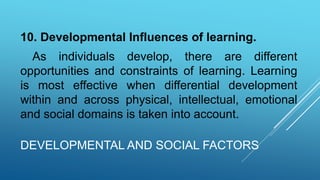
10. Developmental Influences of learning.
As individuals develop, there are different
opportunities and constraints of learning. Learning
is most effective when differential development
within and across physical, intellectual, emotional
and social domains is taken into account.
DEVELOPMENTAL AND SOCIAL FACTORS
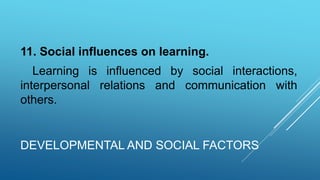
11. Social influences on learning.
Learning is influenced by social interactions,
interpersonal relations and communication with
others.
INDIVIDUAL DIFFERENCES FACTORS
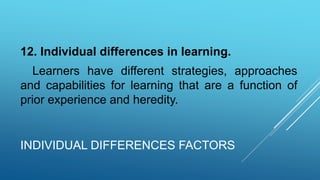
12. Individual differences in learning.
Learners have different strategies, approaches
and capabilities for learning that are a function of
prior experience and heredity.
INDIVIDUAL DIFFERENCES FACTORS
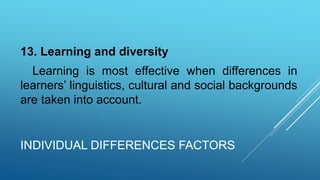
13. Learning and diversity
Learning is most effective when differences in
learners’ linguistics, cultural and social backgrounds
are taken into account.
INDIVIDUAL DIFFERENCES FACTORS
14. Standards and Assessment
Setting appropriately high and challenging
standards and assessing the learner as well as
learning progress including diagnostic, process and
outcome assessment are integral parts of the
learning process.

Modular Activity #1
1. Write a reflection paper about the
topic in a 1 whole sheet of paper.
2. Output must be in handwritten form.
3. Observe indention and neatness.
4. Minimum of 100 words.
REFERENCE
 The child and adolescent learners and learning principles
By: Brenda R. Corpuz, PhD
Ma. Rita D. Lucas, PhD
Heidi grade L. Borabo, PhD
Paz I. Lucido, PhD

1_unit_i_child_and_adolescent_learners_and_learning_principles.ppt

  • 1.
    CHILD AND ADOLESCENT LEARNERSAND LEARNING PRINCIPLES Learner Centered Psychological Principles
  • 2.
    14 PSYCHOLOGICAL PRINCIPLES THAT PERTAINTO LEARNER AND LEARNING PRINCIPLES
  • 3.
    COGNITIVE AND METACOGNITIVEFACTORS 1. Nature of the learning process The learning of complex subject matter is most effective when it is an intentional process of constructing meaning from information and experience.
  • 4.
    Learning in schoolsemphasizes the use of intentional processes that students can use to construct meaning from information, experiences, and their own thoughts and beliefs.
  • 5.
    COGNITIVE AND METACOGNITIVEFACTORS 2. Goals of the learning process The successful learner, over time and with support and instructional guidance, can create meaningful, coherent representation of knowledge.
  • 6.
    To construct usefulrepresentations of knowledge and acquire thinking and learning strategy necessary for continued learning success across life span learners must generate and pursue personally relevant goals.
  • 7.
    COGNITIVE AND METACOGNITIVEFACTORS 3. Construction of Knowledge The successful learner can link new information with existing knowledge in meaningful ways.
  • 8.
    Knowledge widens anddeepens as students continue to build links between new information and experiences and their existing knowledge base.
  • 9.
    COGNITIVE AND METACOGNITIVEFACTORS 4. Strategic thinking The successful learner can create and use a repertoire of thinking and reasoning strategies to achieve complex learning goals.
  • 10.
    Students understands anduse variety of strategies to help them reach learning and performance goals and apply their knowledge in novel situations.
  • 11.
    COGNITIVE AND METACOGNITIVEFACTORS 5. Thinking about thinking Higher order strategies for selecting and monitoring mental operations facilitate creative and critical thinking.
  • 12.
    Successful learners canreflect how they think and learn, set reasonable learning goals, select potentially appropriate learning strategy, monitor their progress and know what to do if a problem occurs.
  • 13.
    COGNITIVE AND METACOGNITIVEFACTORS 6. Context of learning Learning is influenced by environmental factors, including culture, technology and instructional practices.
  • 14.
    MOTIVATIONAL AND AFFECTIVEFACTORS 7. Motivational and Emotional Influences on learning. What and how much is learned is influenced by learner’s motivation. Motivation to learn, in turn is influenced by the individual’s emotional state, beliefs, interests, goals and habits of thinking.
  • 15.
    MOTIVATIONAL AND AFFECTIVEFACTORS 8. Intrinsic motivation to learn The learner’s creativity, higher order thinking, and natural curiosity all contribute to motivation to learn. Intrinsic motivation is stimulated by task of optimal novelty and difficulty relevant to personal interests and providing for personal choice and control.
  • 16.
    MOTIVATIONAL AND AFFECTIVEFACTORS 9. Effects of motivation on effort. Acquisition of complex knowledge and skills requires extended learner effort and guided practice. Without learner’s motivation to learn, the willingness to exert this effort is unlikely without coercion.
  • 17.
    DEVELOPMENTAL AND SOCIALFACTORS 10. Developmental Influences of learning. As individuals develop, there are different opportunities and constraints of learning. Learning is most effective when differential development within and across physical, intellectual, emotional and social domains is taken into account.
  • 18.
    DEVELOPMENTAL AND SOCIALFACTORS 11. Social influences on learning. Learning is influenced by social interactions, interpersonal relations and communication with others.
  • 19.
    INDIVIDUAL DIFFERENCES FACTORS 12.Individual differences in learning. Learners have different strategies, approaches and capabilities for learning that are a function of prior experience and heredity.
  • 20.
    INDIVIDUAL DIFFERENCES FACTORS 13.Learning and diversity Learning is most effective when differences in learners’ linguistics, cultural and social backgrounds are taken into account.
  • 21.
    INDIVIDUAL DIFFERENCES FACTORS 14.Standards and Assessment Setting appropriately high and challenging standards and assessing the learner as well as learning progress including diagnostic, process and outcome assessment are integral parts of the learning process.
  • 22.
    Modular Activity #1 1.Write a reflection paper about the topic in a 1 whole sheet of paper. 2. Output must be in handwritten form. 3. Observe indention and neatness. 4. Minimum of 100 words.
  • 23.
    REFERENCE  The childand adolescent learners and learning principles By: Brenda R. Corpuz, PhD Ma. Rita D. Lucas, PhD Heidi grade L. Borabo, PhD Paz I. Lucido, PhD